
















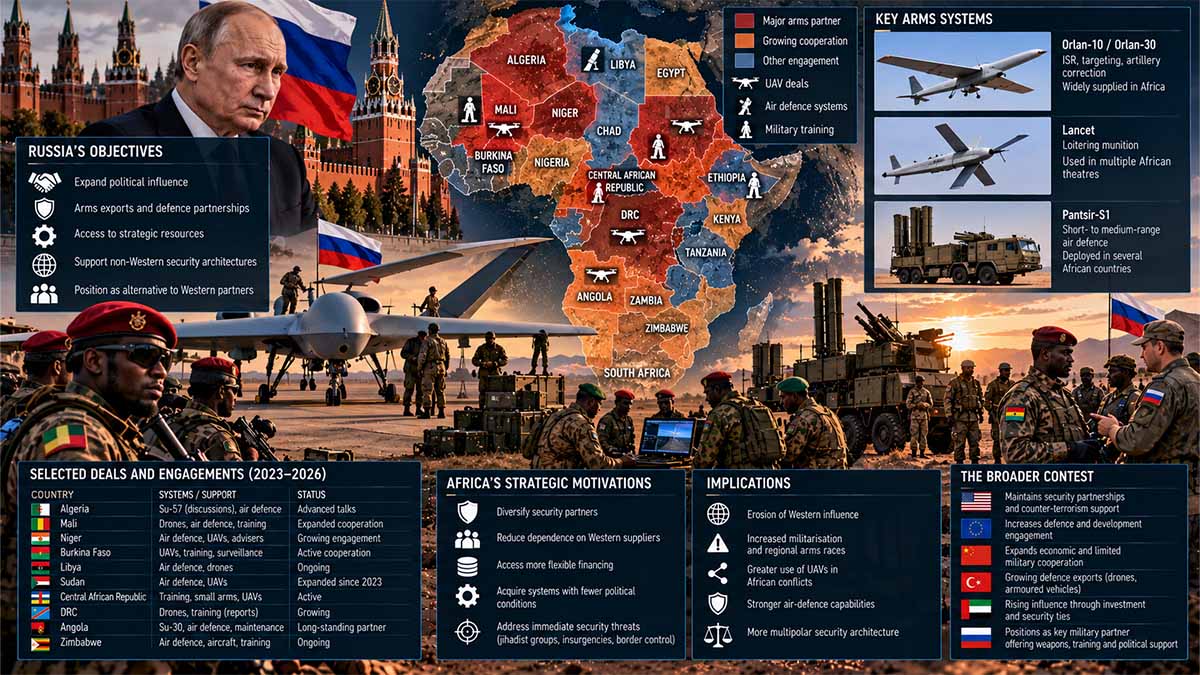
As of: 2026-10-28 | Geographic focus: Africa, Russia and competing external defence suppliers | Strategic horizon: 2026–2031
Strategic Assessment of the Third Russia–Africa Summit, Moscow, 28–29 October 2026
Scope: This assessment examines the weapons exhibition opening in Moscow on 28 October 2026, its relationship to Russian military-technical diplomacy across Africa, the operational and institutional implications of the capabilities advertised, and potential developments through October 2031. It distinguishes the exhibition’s first-day reporting from scheduled presentations and any future procurement decisions.
Executive Summary / BLUF
The Moscow exhibition is strategically significant not because it demonstrates that African countries have acquired new Russian weapons, but because it places offensive unmanned systems, layered air defence, security technologies and potential local production within a common diplomatic-commercial framework.
The first-day reporting identifies the Garpia-A (E) long-range UAV, Dan-T air-launched loitering munition, small arms and an air-defence-system model. Rosoboronexport’s separately published programme advertises additional reconnaissance-strike systems and an integrated counter-drone concept. These are distinct bodies of evidence.
Rosoboronexport reports that African countries account for approximately 30% of the value of its signed-contract order portfolio. This is a company statement, not evidence of 2026 deliveries or contracts generated at the forum.
The wider market is changing. SIPRI reports that Russia’s share of global major-arms exports declined from 21% in 2016–2020 to 6.8% in 2021–2025, while China, Türkiye, the United States and European suppliers remain active competitors in African markets.
The principal operational constraint for African customers is not simply equipment affordability. It is the ability to sustain reconnaissance, targeting, command and control, maintenance, trained personnel, ammunition supply and accountable use.
The highest-consequence risks involve diversion, conflict escalation, civilian harm, weak end-use controls and dependence on external technical support.
The decisive indicators will be signed procurement instruments, export permissions, identified recipient units, funded training, sustainment contracts, verified deliveries and operational integration—not expressions of exhibition interest alone.
Russia’s African Arms Offensive: Sovereignty for Sale, Dependency by Contract
At the third Russia–Africa Summit, Moscow is marketing long-range drones, precision weapons and air defence as instruments of national sovereignty. The decisive competition, however, concerns who controls the technology, financing and military institutions after delivery.
Russia’s presentation of advanced weapons at the third Russia–Africa Summit in Moscow on 28–29 October 2026 exposes a contradiction at the centre of its African strategy: military sovereignty is being marketed through technologies that may establish lasting dependence on foreign suppliers. The Garpia-A1E long-range unmanned aircraft, Dan-T air-launched loitering munition and integrated air-defence proposals extend Moscow’s offer beyond conventional arms exports into maintenance, industrial production and national-security infrastructure. Yet Russia enters this competition with sharply diminished global arms-transfer volumes and faces Chinese, Turkish, American and European suppliers already embedded in African defence markets. For African governments, the financial question is whether these acquisitions deliver independently sustainable military capability. For Moscow, the diplomatic question is whether commercial contracts can preserve influence that equipment exhibitions alone cannot demonstrate.
Russia’s order book conceals the scale of its export contraction
Rosoboronexport, Russia’s state arms-export intermediary within Rostec, reported on 23 October 2026 that African countries accounted for approximately 30% of the value of its signed-contract order portfolio. Alexander Mikheev, the company’s director general, presented African cooperation as a priority extending into local manufacturing and technical development. The figure demonstrates the importance of African contractual commitments to the exporter, but it does not disclose their monetary value, delivery schedules or the proportion already fulfilled. It cannot establish that the Moscow summit has generated additional sales.
The broader market figures explain why the distinction matters. According to SIPRI’s March 2026 assessment, Russia’s share of global major-arms exports declined from 21% in 2016–2020 to 6.8% in 2021–2025, while its export volume contracted by 64%. The United States accounted for 42% of worldwide major-arms exports in the latter period, France for 9.8% and China for 5.6%. Russia remained a major supplier, but its relative position had deteriorated considerably.
Africa is not compensating uniformly for that decline. The continent represented just 4.3% of global major-arms imports in 2021–2025, while its aggregate import volume fell by 41% compared with the preceding five years. Sub-Saharan Africa, however, recorded a 13% increase. Within that subregion, China supplied 22% of major-arms imports, Russia 12% and Türkiye 11%.
These percentages describe SIPRI transfer volumes, not contract revenue or the entire market for drones and ammunition. Their significance is structural: Moscow is competing for customers in a fragmented market where established supplier relationships, fiscal resources and military requirements differ considerably. Its commercial task is not simply to sell more weapons, but to preserve a position within the institutions that will operate and maintain them.
The advertised weapons extend military reach but expose the limits of procurement
The exhibition’s offensive systems demonstrate the type of capability Russia intends to market. In an announcement dated 21 August 2026, Rosoboronexport attributed to the Almaz-Antey Garpia-A1E an advertised maximum range of 1,000 kilometres, a warhead exceeding 50 kilograms and a circular error probable not exceeding four metres. These remain manufacturer claims, not independently verified performance under all operating conditions.
Rostec’s announcement of 8 September 2026 described Dan-T as a jet-powered, air-launched loitering munition capable, according to the manufacturer, of reaching targets hundreds of kilometres away. The distinction between the two systems matters more than their promotional specifications. Dan-T introduces aircraft-compatibility and certification requirements, while a long-range weapon directed against fixed coordinates depends on reliable target information, authorised command and secure technical support.
Rosoboronexport’s wider Moscow programme included KUB-2E, Lancet-E, Skat 350M and S350M-E, alongside the Pantsir-SMD-E and Pantsir-S1M air-defence systems, Verba, ZAK-30 Citadel and electronic counter-UAV equipment. Its proposed Anti-Drone Dome combines surveillance, electronic countermeasures, physical engagement and command functions.
This breadth allows Moscow to approach governments with different requirements, from reconnaissance to infrastructure protection. It also creates a commercial transmission mechanism: hardware acquisition can generate recurring obligations for ammunition, software, maintenance, specialist training and systems integration.
A government may own an unmanned aircraft without possessing independent access to the technical functions necessary to sustain it. An air-defence system may be delivered without a fully operational network of sensors, trained personnel and command arrangements. A production facility may assemble imported kits while critical components and intellectual property remain under foreign control. In each case, the distinction between nominal ownership and operational sovereignty determines the real value of the transaction.
The first-day exhibition account named Garpia-A (E), Dan-T, small arms and an anti-aircraft system model. The broader official programme announced additional products. Neither record establishes an African purchase, a completed delivery or a functioning recipient capability.
Africa’s buyers face different wars and incompatible fiscal demands
The Russian offer encounters military requirements that cannot be reduced to a continental procurement strategy. SIPRI records Morocco’s major-arms imports increasing by 12% between 2016–2020 and 2021–2025, while Algeria’s recorded imports declined by 78%, subject to SIPRI’s explicit warning that some reported Russian transfers could not be sufficiently verified. These North African procurement patterns reflect a different military environment from the counterinsurgency and institutional-security requirements confronting governments farther south.
Nigeria accounted for 16% of sub-Saharan African major-arms imports during 2021–2025, Senegal for 8.8% and Mali for 8.0%. Their positions establish procurement activity, not a common requirement for long-range Russian strike weapons. An aircraft suitable for conventional deterrence may be an inefficient answer to deficiencies in territorial surveillance, military logistics or accountable command.
The practical alternative is visible in Mozambique. The European Commission reported in March 2025 the completion of an €85 million European Peace Facility package supporting 11 Mozambican Quick Reaction Forces with equipment and training. In May 2026, the European Union Military Assistance Mission reported more than 40 training programmes involving approximately 1,200 military personnel, including around 300 undergoing regeneration training.
Those figures do not prove that European assistance achieved its wider security objectives. They demonstrate, however, that military capability can be developed through institutional investment rather than measured solely through weapons delivered. For African finance ministries, the comparison is consequential: a sophisticated imported platform and an adequately trained, maintained military formation represent different expenditure commitments and different forms of national capacity.
The fiscal constraint is particularly severe when a weapons contract includes foreign-currency payments, proprietary components, specialised infrastructure and recurring technical assistance. A low initial price may conceal higher lifecycle liabilities. A local assembly agreement may create employment while failing to transfer the rights necessary for domestic repair or modification. Without identifiable production volumes, financing terms and enforceable technology licences, industrial localisation remains a political proposition rather than a measurable economic result.
Security partnerships are now competing with established European influence
Russia’s industrial offer enters a security environment in which European governments are redefining relationships rather than uniformly withdrawing from Africa. The resulting competition is neither exclusively military nor adequately described as a confrontation between Moscow and the West.
Italy maintains direct maritime interests through Operation Gabinia, launched in 2020 and included among its 2026 foreign missions. The Italian Navy identifies Gulf of Guinea maritime security, protection of national economic interests and cooperation with Nigeria among its objectives. For Rome, the immediate exposure concerns commercial navigation, infrastructure security and the reliability of coastal partners. Russian equipment acquisitions would become operationally significant if they altered those partners’ actual capabilities or technical relationships, not merely because Russian products were exhibited.
France faces a different institutional adjustment. French military facilities in Senegal were returned during 2025 following the Senegalese authorities’ decision to end permanent foreign basing. A letter of intent signed by the countries’ military chiefs on 15 July 2025 provided for continuing cooperation without permanent facilities. The withdrawal of a base therefore did not necessarily terminate bilateral security relations. Nor does it establish that Moscow inherited the departing military presence or its procurement relationships.
Germany identified Sudan, the Sahel, the Horn of Africa and the Great Lakes among its conflict-prevention priorities in a Federal Foreign Office statement of 18 December 2025. Its exposure concerns the consequences of instability, arms circulation and weaknesses in regional institutions. Germany’s 5.7% share of global major-arms exports during 2021–2025 establishes industrial relevance, but its African security interests extend beyond competition for equipment contracts.
The United Kingdom, eighth among global major-arms exporters during 2021–2025, continues to combine bilateral economic and security engagement. Prime Minister Keir Starmer’s meeting with Ghanaian President John Dramani Mahama on 2 June 2026 followed the signing of the UK–Ghana Growth Partnership. London’s separate security and defence partnership with the European Union, established on 19 May 2025, adds another channel for coordination without transferring national export authority to Brussels.
At EU level, the security and defence partnership signed with Ghana on 24 March 2026 provides for annual dialogue covering maritime security, counterterrorism, cybersecurity and crisis management. These programmes are not direct commercial equivalents of Rosoboronexport’s products. They compete in a different but consequential dimension: the formation of continuing institutional relationships.
Russia’s challenge is therefore to demonstrate that its equipment, technical services and industrial agreements can deliver comparable durability. Europe’s challenge is to distinguish the protection of legitimate security interests from an assumption that African procurement decisions belong within established European spheres of influence.
Sanctions, export controls and production dependence constrain the offer
The Moscow exhibition’s economic-humanitarian framing becomes most difficult to sustain where advanced weapons could enter environments characterised by fragmented military command or externally supported armed groups. SIPRI documents armed-UAV transfers to the Sudanese Armed Forces during 2021–2025 from suppliers including Iran, Türkiye, Belarus, Kyrgyzstan and the United Arab Emirates. It also identifies military equipment transfers to the Rapid Support Forces. These findings establish an existing internationalised military supply environment, not a connection between the conflict and the systems presented in Moscow.
The applicable legal distinctions are material. United Nations Security Council Resolution 2830, adopted on 8 October 2026, renewed the relevant Sudan sanctions measures until 11 December 2026 and extended the Panel of Experts’ mandate until 11 January 2027. The restrictions associated with Darfur require recipient- and destination-specific assessment; they are not interchangeable with a blanket prohibition on every transaction involving Sudan.
The Democratic Republic of the Congo presents a different framework. Security Council Resolution 2667 (2022) removed previous notification requirements for arms shipments intended for the Congolese government, while restrictions on supplies to non-governmental armed entities remain relevant. Treating government acquisitions and deliveries to unauthorised armed groups as equivalent would produce an incorrect legal assessment.
The Arms Trade Treaty, particularly Articles 6, 7 and 11, provides rules concerning prohibited transfers, export assessment and diversion prevention for states parties. Its obligations cannot simply be attributed to governments that have not joined the treaty. Binding Security Council measures and applicable national controls nevertheless remain independently consequential.
These restrictions interact with the industrial limitations of defence procurement. Export permissions, retransfer conditions, technical documentation and component availability determine what a recipient can do with equipment after acquisition. The political promise of sovereign capability is therefore constrained by law, production capacity, financing and the contractual distribution of technical rights.
The next 24 months will separate Russian contracts from Russian influence
Between October 2026 and October 2028, the decisive measure of the Moscow initiative will be whether publicised commercial interest develops into identifiable contractual and operational commitments. The relevant evidence will include named recipients, signed procurement instruments, funded training, export permissions, verified deliveries, domestic maintenance arrangements and enforceable industrial licences.
A contract would establish a commitment, not an operational capability. A delivered weapon would establish a transfer, not sustained readiness. A local factory would establish an industrial asset, not necessarily independent production. These distinctions matter because Russia can preserve diplomatic visibility without achieving substantial export growth, while an African government can announce military modernisation without obtaining the financial and technical resources necessary to sustain it.
The cost of inaction will fall unevenly. African defence ministries that purchase equipment without adequate training and support risk inventories with limited availability. Finance ministries will carry the recurring obligations of contracts whose full economic cost was not recognised at signature. Governments that accept poorly defined technology-transfer promises may finance facilities while remaining dependent on imported components and proprietary systems. Civilian populations in conflict-affected areas bear the consequences where military capability expands faster than the institutions responsible for lawful control.
European governments face a different cost: established access and industrial relationships may lose relevance if bilateral security cooperation cannot adapt to African preferences and practical requirements. Russia, meanwhile, risks committing commercial and diplomatic resources to an African market without converting its October 2026 exhibition into deliverable contracts and durable technical partnerships.
The Moscow summit has demonstrated what Russia intends to sell. The next 12–24 months will establish what African governments can afford, what Russia can deliver and who ultimately controls the capabilities acquired. Those results, rather than the weapons displayed at Gostiny Dvor, will determine the economic and geopolitical return on Moscow’s military-technical diplomacy.
Navigational Index
Pillar I — The Exhibition, Weapons Architecture and Russian Strategic Intent
- Chapter 1. Moscow 2026: The Verified Exhibition and Its Diplomatic Context
- Chapter 2. Garpia-A (E), Dan-T and the Broader Unmanned Systems Portfolio
- Chapter 3. Integrated Air Defence, Counter-UAV Systems and Operational Requirements
- Chapter 4. Russia’s Military-Technical Diplomacy and the Political Economy of African Security
Pillar II — African Demand, Supplier Competition and Strategic Vulnerabilities
- Chapter 5. Regional Security Requirements and African Procurement Agency
- Chapter 6. China, Türkiye, Iran, Europe and the United States: Competing Supply Models
- Chapter 7. Industrial Partnerships, Local Assembly, Financing and Lifecycle Dependencies
- Chapter 8. Proliferation, Diversion, Sanctions and Humanitarian Consequences
Pillar III — Geopolitical Consequences, Scenarios and Government Decisions
- Chapter 9. Implications for African Security Institutions and Regional Stability
- Chapter 10. European Interests: Italy, France, Germany, the United Kingdom and the EU
- Chapter 11. Alternative Outcomes and Early-Warning Indicators, 2026–2031
- Chapter 12. Government Options, Procurement Safeguards and Final Strategic Assessment
Master Abstract
A security portfolio embedded in a broader diplomatic relationship
The third Russia–Africa Summit creates a meeting point between two different instruments of Russian foreign policy: diplomatic engagement with African governments on economic development, industrial cooperation and sovereignty, and the commercial presentation of systems designed to detect, suppress or destroy military targets. Their coexistence is not incidental. Russia is positioning security cooperation as part of a wider offer to states seeking greater autonomy over their defence procurement, domestic industrial capabilities and relationships with external powers. For African authorities confronting insurgencies, border insecurity, cross-border attacks, threats to infrastructure or conventional military competition, that proposition has an identifiable appeal. Yet the equipment on display also presents requirements that cannot be solved by political agreements alone: trained operators, maintenance capacity, communications infrastructure, disciplined targeting procedures, access to replacement components and the ability to control weapons throughout their operational lives.
The timing matters. Moscow’s Africa-facing defence diplomacy is taking place while the structure of international arms transfers is changing substantially. Russian major-arms exports contracted sharply during the period covered by SIPRI’s March 2026 assessment, and African states are no longer appropriately understood as a predominantly Russian procurement market. American, Chinese, Turkish, French and other suppliers serve different segments, frequently with different financing arrangements, training relationships and political implications. Russia therefore has incentives to preserve existing relationships, cultivate new categories of demand and develop cooperation models in which equipment sales are reinforced by service provision, technical assistance and locally organised production. These incentives are analytically distinguishable from proof that any particular African delegation intends to purchase the exhibited systems.
The exhibition’s two evidence layers
The first-day account of the Gostiny Dvor exhibition names the Garpia-A (E), Dan-T, small arms and an anti-aircraft missile-system layout. Rosoboronexport’s official programme, published on 23 October, separately describes the intended presentation of KUB-2E, Skat 350M, Lancet-E and S350M-E alongside multiple short-range air-defence, electronic warfare and counter-UAV products. The two records should not be merged into a single confirmed physical inventory: the first is reporting from the opening exhibition, whereas the second is a manufacturer’s pre-event declaration of intentions. The distinction is especially important because the operational significance of a product model, an export brochure, a complete delivered system and a functioning military unit differs fundamentally.
The Garpia-A (E) and Dan-T introduce a further evidentiary issue. Their identification at the exhibition supports analysis of the offensive capabilities being marketed, but it does not establish export-version performance, available quantities, pricing, recipient negotiations or actual deliveries. Similarly, Rosoboronexport’s proposed Anti-Drone Dome is an integration concept rather than proof of a single fully standardised system already operating in African service. Those uncertainties place limits on comparative performance assessments while leaving ample evidence for examining the military, diplomatic and industrial logic of the presentation.
Africa’s decisive variable is institutional control
The principal strategic question for recipient countries is whether a defence acquisition produces independently sustainable security capacity or a continuing dependence on suppliers, external advisers and restricted technical infrastructure. Unmanned aircraft can change the relationship between surveillance and force, but longer range has little operational value without reliable target intelligence, authorisation procedures and an adequately controlled command chain. Loitering munitions may reduce the need to commit crewed aircraft to certain missions, but their effectiveness depends on reconnaissance, integration, replacement stocks and the legal and operational discipline applied to each strike. Air-defence systems can improve protection of strategic assets, although their utility depends on sensor coverage, interoperability and recurrent costs that extend well beyond the initial procurement.
These issues are particularly consequential where military forces operate across fragmented command structures, budgetary constraints coexist with urgent threats, and armed organisations can capture, purchase or otherwise divert military materiel. In such circumstances, an acquisition can simultaneously create a new military capability, a maintenance dependency, an escalation risk and an internal governance obligation. African procurement institutions retain substantial agency in determining which outcome predominates through competitive evaluation, lifecycle budgeting, domestic oversight, supplier diversification and conditions governing technology transfer.
The strategic outcome remains open
The forum’s importance should ultimately be measured by what follows it rather than by the visibility of the weapons exhibited. Moscow may convert part of the interest into procurement, training or industrial arrangements; competing suppliers may retain customers through established support networks; or financial and technical constraints may prevent advertised cooperation from progressing beyond memoranda and exploratory talks. These pathways are not mutually exclusive across Africa’s diverse markets. The strongest evidence of material change would be verifiable state-to-state agreements, budgeted acquisitions, identifiable deliveries and the creation of recipient-controlled operating and maintenance capabilities.
For Russia, the exhibition is a means of maintaining strategic relevance in a competitive and increasingly diversified market. For African governments, it presents opportunities to broaden procurement choices alongside significant operational, financial and governance obligations. For external partners, including European states, the relevant policy question extends beyond Russian commercial market share to the stability, accountability and technical independence of the security institutions receiving advanced weapons.
Key Evidence Table
The evidence base combines Rosoboronexport’s official pre-summit announcements, first-day exhibition reporting, SIPRI’s March 2026 arms-transfer dataset and applicable international control frameworks. Supplier announcements establish intended commercial presentations and attributed company figures; they do not independently establish operational performance or completed export transactions.
| Indicator | Value / status | Reference date | Definition / scope | Issuer | Exact source |
|---|---|---|---|---|---|
| Third Russia–Africa Summit | 28–29 October 2026, Gostiny Dvor, Moscow | October 2026 | Officially announced summit venue and dates | Rostec / Rosoboronexport | Rosoboronexport to Showcase Cutting-Edge Security Solutions — Rostec — Oct 2026 |
| Garpia-A (E) | Long-range UAV system reportedly displayed | 28 October 2026 | First-day journalistic account, citing RIA Novosti; not confirmed in the inspected official pre-event catalogue | Vzglyad / RIA Novosti | Weapons Presented to Russia–Africa Forum Participants — Vzglyad — Oct 2026 |
| Dan-T | Air-launched loitering munition reportedly displayed | 28 October 2026 | Reported exhibition identification; export specifications not established | Vzglyad / RIA Novosti | Weapons Presented to Russia–Africa Forum Participants — Vzglyad — Oct 2026 |
| Additional UAV systems | KUB-2E, Skat 350M, Lancet-E, S350M-E | 23 October 2026 | Officially advertised summit programme, not independent confirmation of each physical display | Rosoboronexport | Rosoboronexport Summit Programme — Rostec — Oct 2026 |
| Counter-UAV architecture | Proposed Anti-Drone Dome with detection, engagement and electronic warfare components | October 2026 | Exporter’s proposed integrated protection concept | Rosoboronexport | Anti-Drone Dome Presentation — Rostec — Oct 2026 |
| African share of Russian exporter portfolio | Approximately 30% | 23 October 2026 | Share of the reported total value of signed contracts in Rosoboronexport’s order portfolio; not annual revenue or deliveries | Rosoboronexport | Rosoboronexport Summit Programme — Rostec — Oct 2026 |
| Russian share of global major-arms exports | 21% to 6.8% | 2016–2020 versus 2021–2025 | SIPRI trend-indicator volume, not commercial revenue | SIPRI | Trends in International Arms Transfers, 2025 — SIPRI — Mar 2026 |
| Russian major-arms export volume | −64% | Same comparison periods | Relative change in SIPRI transfer volume | SIPRI | Trends in International Arms Transfers, 2025 — SIPRI — Mar 2026 |
| African major-arms imports | −41% | Same comparison periods | Continent-wide SIPRI transfer volume | SIPRI | Trends in International Arms Transfers, 2025 — SIPRI — Mar 2026 |
| Sub-Saharan African major-arms imports | +13% | Same comparison periods | Subregional SIPRI transfer volume | SIPRI | Trends in International Arms Transfers, 2025 — SIPRI — Mar 2026 |
| Principal arms suppliers to Africa | USA 19%, China 17%, Russia 15%, France 8.3% | 2021–2025 | Shares of African imports of major arms measured by SIPRI transfer volume | SIPRI | Trends in International Arms Transfers, 2025 — SIPRI — Mar 2026 |
| Principal suppliers to sub-Saharan Africa | China 22%, Russia 12%, Türkiye 11% | 2021–2025 | Subregional major-arms import shares | SIPRI | Trends in International Arms Transfers, 2025 — SIPRI — Mar 2026 |
| Confirmed contracts directly attributable to the exhibition | Not established in the records reviewed | 28 October 2026 | Contract values, recipients, quantities, deliveries and training commitments remain unverified | Public record assessment | No identified official transaction instrument |
Evidence qualification: The 28 October exhibition report is a journalistic account, while the dated Rostec materials establish the official commercial programme. Their different evidentiary standing is retained deliberately. SIPRI figures are expressed as trend-indicator values rather than sales revenue, and some smaller UAV or munition transfers may fall outside its major-arms coverage.
Strategic Interpretation of the Verified Record
Russia is marketing military relationships, not merely equipment
Rosoboronexport’s October 2026 programme is more extensive than the physical objects identified in first-day reports. It links offensive UAVs, reconnaissance assets, short-range air defence, electronic warfare, special-forces equipment, cybersecurity and potential local production. The inclusion of these categories supports an interpretation of the Russian proposal as a combined military-security cooperation offer rather than a collection of unrelated export products.
That distinction has commercial and geopolitical implications. A government acquiring an individual weapon can retain considerable freedom over the remainder of its force structure. A government adopting an integrated surveillance, command, weapons and maintenance architecture may develop longer-lasting relationships with the original supplier. Training, software maintenance, replacement components, ammunition production, diagnostics and future modernisation can all sustain the relationship after the original equipment has been delivered.
The advertised programme also suggests that Russian suppliers are addressing several kinds of African customers simultaneously. Countries confronting insurgent movements may be interested in surveillance and precise tactical engagement. States protecting ports, energy infrastructure, airfields or administrative centres may examine counter-UAV systems. Governments maintaining conventional military deterrence may be more concerned with reconnaissance-strike integration and the defence of military installations. Authorities prioritising domestic production may focus less on initial system performance than on licensing, intellectual-property access, training and the possibility of building a national maintenance base.
These categories are analytical market segments. There is insufficient public evidence to attribute a Garpia-A (E) or Dan-T procurement negotiation to a specific African delegation.
The systems have different operational purposes and different integration burdens
The exhibition should not be interpreted as presenting interchangeable solutions. A long-range unmanned aircraft, an air-launched loitering munition, a surveillance UAV and an air-defence system occupy different positions within a military organisation. Their utility depends on the mission, the wider force structure and the resources available to employ them responsibly.
| Capability | Operational relevance | Integration and sustainment requirements | Verification limitation |
|---|---|---|---|
| Garpia-A (E) | Long-distance unmanned strike capability as characterised in first-day reporting; potentially relevant to theatres with extensive geography | Mission planning, launch support, communications, maintenance, reliable target information and command authorisation | Export-version range, payload, navigation architecture, launch arrangements and production availability not verified |
| Dan-T | Air-launched loitering strike capability as described in first-day reporting | Compatible launch aircraft, carriage and release certification, mission integration, maintenance and crew training | No verified export-specific range, endurance, platform compatibility or demonstrated African availability |
| KUB-2E | Loitering munition capability officially advertised in the summit programme | Launch equipment, targeting process, operator training, ammunition replacement and storage security | Programme announcement does not establish a delivered African configuration |
| Skat 350M / S350M-E | Reconnaissance and surveillance roles, potentially supporting wider situational awareness | Ground control, communications, sensor exploitation, trained analysts and repair capability | Announced display does not establish purchaser-specific performance |
| Lancet-E | Advertised reconnaissance-strike system | Integrated intelligence, authorised targeting, operator qualification and recurrent supply | No summit-specific contract or recipient identified |
| Pantsir-SMD-E / Pantsir-S1M | Proposed protection against aerial threats, including UAVs | Trained crews, radar and fire-control support, spare parts, ammunition, maintenance and airspace coordination | Exporter proposal does not demonstrate effective performance in a specified African deployment |
| Verba and close-in air-defence equipment | Point protection and short-range engagement | Operator identification training, ammunition control, maintenance and airspace deconfliction | Actual exhibition configuration and recipient interest remain unspecified |
| Electronic counter-UAV systems | Detection or disruption of selected unmanned threats | Spectrum management, trained electronic-warfare personnel, integration and continuous adaptation | Effectiveness depends on the technical characteristics of the threat and local electromagnetic environment |
| Small arms and specialist equipment | Infantry, border-security and special-forces applications | Armoury management, training, ammunition supply and end-use accountability | Quantities, intended users and procurement status not established |
The absence of verified technical specifications matters most for the two systems central to the first-day reporting. It would be analytically unsound to assign the Garpia-A (E) a particular export range or the Dan-T a validated host-aircraft configuration based solely on broader knowledge of related Russian platforms. Performance claims concerning domestic configurations, prototypes or wartime employment cannot automatically be transferred to the exact export products identified at the exhibition.
The anti-drone component also presents a distinct question of systems engineering. Rosoboronexport describes the Anti-Drone Dome as a combination of airspace surveillance, electronic countermeasures, physical engagement and integrated command functions. Its potential significance lies in the relationship among those components. A collection of sensors and effectors can be purchased without forming a functioning integrated defensive network. A credible implementation would require documented interfaces, tested procedures, trained personnel and an accountable operational command structure. Rosoboronexport to Unveil Anti-Drone Dome — Rostec — Oct 2026
The African procurement market is becoming more competitive
SIPRI’s March 2026 findings establish a structural reason why Moscow has an incentive to intensify African military-technical engagement. Russia remained the world’s third-largest exporter of major arms in 2021–2025, but its global export volume contracted by 64% compared with the previous five-year period. Russia’s position in Africa must be understood within this broader contraction rather than through historical procurement relationships alone.
At the continent-wide level, the United States, China, Russia and France accounted for substantial but different shares of African major-arms imports. Within sub-Saharan Africa, Chinese and Turkish supplies were particularly relevant alongside Russia. The contrast between a 41% fall in continent-wide imports and a 13% rise in sub-Saharan imports illustrates why aggregate African figures are inadequate for determining future demand.
Shares of African major-arms imports, 2021–2025
SIPRI trend-indicator volume; shares within each geographic market, not revenue or contract value.
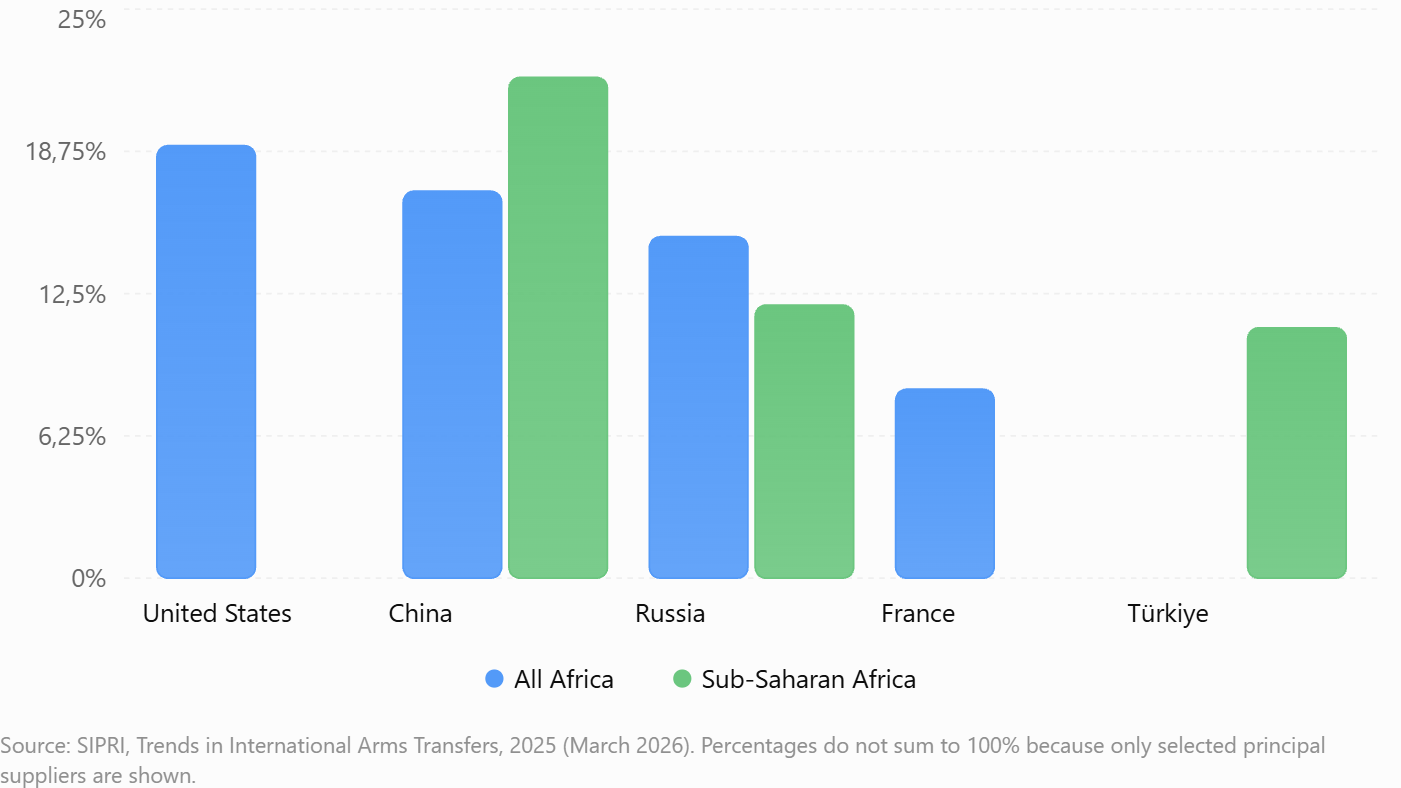
Source: SIPRI, Trends in International Arms Transfers, 2025 (March 2026). Percentages do not sum to 100% because only selected principal suppliers are shown.
Missing bar values denote shares not specified in the selected comparison, not zero exports. Source: SIPRI, March 2026.
The implications for competition vary by supplier. China offers a broad defence-industrial product base and already occupies a significant position in African arms transfers. Türkiye has established a meaningful place in the sub-Saharan market and competes in military aviation and unmanned systems. Iran is relevant to some conflict-specific supply relationships, although the available SIPRI evidence does not justify presenting it as a continent-wide exporter on the same scale as China or Russia. Western suppliers retain important positions through established equipment fleets, military cooperation, financing arrangements and support infrastructures.
Russia’s potential differentiation therefore cannot be reduced to an assumption that its systems will necessarily be cheaper. No comparable, verified October 2026 quotations for the relevant Russian, Chinese, Turkish, Iranian and Western products have been established. Political conditions, payment arrangements, technology transfer, training access, delivery guarantees and dependence on proprietary components may be at least as consequential as purchase price.
For an African procurement authority, the relevant comparison is total capability acquired and sustained over the equipment lifecycle, rather than the nominal price of an aircraft, munition or air-defence launcher.
The humanitarian and economic framing creates both opportunities and contradictions
The forum’s economic-humanitarian branding does not inherently exclude security cooperation. Civilian protection, infrastructure security and the capacity to resist armed violence are material conditions for economic activity in conflict-affected states. Protecting transport corridors, electricity installations, ports and essential public infrastructure can have direct developmental consequences.
The central tension arises when these defensive purposes are presented alongside systems explicitly designed to conduct strikes. A loitering munition is not a humanitarian instrument by virtue of being displayed at a humanitarian forum; its effects depend on deployment, target selection, command authority and compliance with the laws of armed conflict. Similarly, the description of an anti-drone system as protecting civilians must be assessed against its actual design, deployment conditions and operational record.
The Russian programme also includes cybersecurity, intelligence-analysis and video-analytics technologies. Their presence broadens the political implications of the summit beyond conventional defence procurement. Such products may support legitimate security and infrastructure missions, but they also create questions about personal-data protection, surveillance oversight, digital dependency, access controls and the relationship between national security institutions and civilian authorities.
For African governments, the challenge is to distinguish technologies that strengthen public security and industrial autonomy from arrangements that transfer critical technical control to external providers without sufficient domestic oversight.
Proliferation and end-use control are central security questions
The diffusion of unmanned strike technologies creates particular risks in environments where national armed forces, armed non-state organisations and external suppliers operate within overlapping conflict systems.
The Sudanese conflict offers an important documented reference point. SIPRI identifies transfers of armed UAVs to the Sudanese Armed Forces from a group of suppliers including Iran, Türkiye and other states during 2021–2025, while also documenting major-arms transfers to the opposing Rapid Support Forces. That evidence does not implicate the systems displayed in Moscow, but it demonstrates that African conflicts already involve transnational supply arrangements for advanced military equipment. Trends in International Arms Transfers, 2025 — SIPRI — Mar 2026
The United Nations framework for Sudan further demonstrates that arms-transfer risk cannot be separated from destination-specific restrictions. UN Security Council sanctions associated with Darfur impose geographically and legally defined constraints, and the applicability of those measures must be evaluated using the operative resolutions rather than assuming that an entire state is subject to an undifferentiated prohibition.
The verified UN page for Resolution 2828 (2026) records a renewal of the relevant sanctions measures until 9 October 2026 and an extension of the Panel of Experts’ mandate until 9 November 2026. Consequently, the sanctions position applicable to any hypothetical transaction after 9 October would require verification against subsequent Security Council action; the September resolution alone cannot establish the regime’s current operative status on 28 October. Resolution 2828 (2026) — UN Security Council — Sep 2026
International arms-control frameworks also provide relevant standards concerning export assessment, diversion prevention, recordkeeping and cooperation among transferring states. Articles 6, 7, 8 and 11 of the Arms Trade Treaty are particularly relevant where applicable to the parties and equipment categories concerned. Treaty obligations should not be attributed indiscriminately to governments that have not become parties. Separately, binding UN Security Council measures may apply regardless of Arms Trade Treaty membership. Treaty Text — Arms Trade Treaty Secretariat
The principal pathways requiring attention are loss of stockpile control, transfer to unauthorised armed formations, cross-border diversion, unauthorised use by nominally state-controlled forces and dependency on external actors for targeting or maintenance. Each involves different preventive obligations and institutional safeguards. The mere exhibition of advanced weapons, however, does not demonstrate that any such diversion has occurred.
Competing Explanations and Strategic Pathways
The available evidence supports three overlapping explanations of Russia’s diplomatic-commercial strategy. They are not mutually exclusive: Moscow could simultaneously pursue export revenue, political influence and industrial partnerships.
| Hypothesis | Diagnostic support | Evidence that would weaken it | Observable indicators | Current standing |
|---|---|---|---|---|
| H1 — Commercial portfolio recovery | Russia’s major-arms export contraction; broad product presentation; Rosoboronexport’s stated African order portfolio | Persistent lack of new orders or documented deliveries despite promotional activity | Contract awards, financing, export authorisations, deliveries | Strong structural explanation; specific commercial outcomes unresolved |
| H2 — Long-term security and diplomatic relationships | Integrated defence, cybersecurity and security-cooperation offer; emphasis on sovereignty and military-technical ties | Purchases limited to isolated equipment with no continued training or institutional relationship | Bilateral cooperation instruments, training missions, recurrent support agreements | Consistent with announced programme; future depth uncertain |
| H3 — African industrial partnerships and localisation | Explicit offer of joint development and production within partner countries | Agreements without equipment, licensing rights, trained personnel or operational facilities | Licensed-production contracts, industrial investment, verified assembly lines, maintenance certification | Documented Russian commercial objective; implementation not demonstrated |
The distinction among these pathways is essential for evaluating Russia’s actual influence. A substantial order portfolio may indicate existing commercial relationships without revealing how much of that portfolio is deliverable, how quickly customers will receive equipment or which contracts involve continuing Russian operational support.
Conversely, even a modest number of transfers could produce durable influence if they require recurring technical assistance or give the supplier a central role in the recipient’s defence architecture. Industrial localisation could reduce dependency if it gives the recipient meaningful repair, testing and production rights, but it could also reproduce dependency if the host country receives only limited assembly functions while critical software, components and certification remain externally controlled.
There is no defensible numerical probability estimate for these pathways from the available evidence. The appropriate near-term test is to compare observable implementation with the announced cooperation objectives.
Principal Gaps and Watch Indicators
The opening-day record establishes a commercial presentation and a declared programme, but it does not establish how many systems African delegations intend to purchase, which governments are negotiating or whether particular equipment can be manufactured and supported at export scale.
| Priority | Missing evidence | Decisive record or observation | Strategic interpretation |
|---|---|---|---|
| Critical | Garpia-A (E) and Dan-T export specifications | Authenticated export product sheets, manufacturer documentation or formal equipment acceptance specifications | Determines whether advertised characteristics constitute a viable capability for particular military requirements |
| Critical | Identified African buyers | Official bilateral procurement announcements or signed acquisition instruments | Separates commercial interest from state procurement decisions |
| Critical | Funding and transaction structure | Defence-budget allocations, credit agreements, public contract disclosures | Establishes whether announced acquisition plans are financially executable |
| High | Delivery and production capacity | Verified shipment records, acceptance reports, production commitments | Tests the supplier’s ability to fulfil orders |
| High | Training and support | Funded training agreements, maintenance arrangements and identified receiving units | Measures the probability of sustainable operational capability |
| High | Localisation commitments | Industrial licensing instruments, facility investment and certification records | Differentiates genuine technology transfer from assembly or political announcements |
| High | End-use control | Recipient stockpile procedures, export conditions, traceability and inspection arrangements | Determines exposure to diversion and unauthorised employment |
| High | External supplier displacement | Documented procurement cancellations, competitive tender outcomes or supplier substitution | Establishes whether Russian products actually gain market share against competitors |
| High | Regional escalation | Verified deployments, cross-border incidents and documented changes in military posture | Tests whether new equipment alters local conflict dynamics |
The first measurable transition from exhibition diplomacy to a new military-technical relationship would involve an identified state customer and a formal procurement or technical-cooperation instrument with sufficiently specific obligations. The stronger transition would involve delivery and documented readiness to operate and maintain the equipment.
Local assembly should be assessed separately. An announcement of a future facility does not establish an industrial capability; meaningful evidence would include construction or conversion of premises, installed equipment, trained personnel, technology licences, quality-control procedures and demonstrated production or repair activity.
Initial Government-Level Decision Implications
For African defence ministries, the immediate requirement is disciplined capability assessment. Procurement decisions should be connected to documented military requirements, realistic operating costs and the existence of sufficient personnel and institutions to exercise national command over the equipment. Where those conditions are weak, the acquisition of a technically sophisticated weapon may create financial liabilities without producing proportionate operational availability.
For African finance ministries and parliamentary oversight institutions, the relevant exposure extends beyond contract price. Long-term payment obligations, spare parts, software, ammunition, infrastructure, external advisers and potential currency or payment constraints must be considered within an integrated lifecycle assessment. Industrial participation commitments should be evaluated according to enforceable rights and measurable domestic economic outputs.
For regional security organisations, the principal concerns are interoperability, cross-border escalation, control of military materiel and compliance with applicable restrictions. The implications differ between conventional deterrence, counterinsurgency and protection of civilian infrastructure, and therefore require theatre-specific rather than continent-wide assessments.
For European and other external suppliers, competitive responses based exclusively on the price or technological characteristics of Russian equipment would overlook the institutional dimension of the offer. Long-term training, reliable support, transparent procurement, financing sustainability and recipient control over critical technical functions are also dimensions of competition. Whether these considerations improve a supplier’s market position must be established through observed procurement outcomes rather than assumed.
For governments monitoring proliferation, the priority should be end-use documentation, sanctioned destinations, supply-chain traceability and actual transfers. The fact that a delegation examines a weapon or receives promotional material does not by itself establish a transaction, a violation or a new military capability.
Opening Net Assessment
The Moscow summit illustrates the increasing integration of defence commerce, industrial policy and diplomatic competition in Russia’s Africa strategy. The first-day display of the reported Garpia-A (E), Dan-T and other equipment provides a visible expression of that strategy, while Rosoboronexport’s official programme reveals a broader effort to market combined offensive, defensive and security technologies.
The most significant development would not necessarily be the sale of an individual long-range UAV. It would be the establishment of enduring military-technical relationships that shape how recipient states train their forces, maintain equipment, organise surveillance and air defence, develop domestic industrial capacity and control the employment of advanced weapons.
Such relationships can provide genuine operational benefits where recipient institutions possess the personnel, funding, oversight and technical independence required to sustain them. They can also generate long-term dependencies or security risks where those conditions are absent.
The distinction between demonstrated equipment, negotiated commitments, delivered systems and independently sustained military capability remains the central analytical requirement. Until concrete procurement and implementation records emerge, the exhibition establishes Russian commercial intent and diplomatic positioning—not a documented transformation of African military inventories.
RUSSIA–AFRICA 2026
MILITARY-TECHNICAL DIPLOMACY
Advanced Unmanned Systems, Air Defence, Security Cooperation and the Contest for African Military Sovereignty
Moscow, 28–29 October 2026 | Assessment cut-off: 28 October 2026 | Strategic horizon: 2026–2031
The portfolio percentage is a company-reported order-book measure. SIPRI percentages and volume changes use trend-indicator values, not sales revenue. They must not be added or treated as equivalent measures.
What Was Reported, Advertised and Verified?
The opening-day account and Rosoboronexport’s official pre-event announcements represent different levels of evidence. They should not be combined into a claim that every announced product was physically demonstrated.
First-Day Exhibition Reporting
Garpia-A (E) long-range UAV; Dan-T air-launched loitering munition; small arms; and an anti-aircraft missile-system layout.
JOURNALISTIC REPORTING
Officially Announced Programme
KUB-2E, Lancet-E, Skat 350M, S350M-E, air-defence systems, electronic warfare, cybersecurity and the proposed Anti-Drone Dome architecture.
OFFICIAL COMMERCIAL ANNOUNCEMENT
Product interest, export specifications, recipient negotiations, quantities, prices and eventual operational deployment require independent transaction-level evidence.
Russia’s Changing Export Position
Russia’s share of global major-arms exports declined substantially between the two five-year periods measured by SIPRI.
Global share
Global share
change
share, 2021–2025
Visual convention: columns use a 25% scale for market shares. The red −64% column is a separate magnitude indicator, displayed on a 100% change scale; it is not directly comparable in height to market-share columns. The Africa column refers to a different geographic denominator from global export share.
Africa’s Defence Import Market
Major-arms supplier shares, 2021–2025. Values indicate the share of imports within each specified African market.
All Africa
Selected leading suppliers. Other supplying countries are not shown.
Sub-Saharan Africa
Different geographic denominator. Figures must not be added to those for the continent as a whole.
Both horizontal charts use a 0–25% measurement scale. These are historical major-arms import shares, not forecasts or estimates of future UAV contracts.
Divergent African Import Trends
All African States
Change in aggregate major-arms imports, 2021–2025 against 2016–2020.
Sub-Saharan Africa
Change in major-arms imports for the subregional grouping over the same periods.
Russia’s Advertised Security Portfolio
Surveillance & Reconnaissance
Skat 350M and S350M-E. Intelligence collection, observation and information support.
Unmanned Strike
Garpia-A (E), Dan-T, KUB-2E and Lancet-E in their respective reported or announced contexts.
Counter-Air Defence
Air-defence equipment, electronic warfare and the proposed Anti-Drone Dome.
Sensors & Intelligence
Reliable observation, information assessment and identification procedures.
Command & Control
National authority, accountability, interoperable communications and lawful operational decisions.
Lifecycle Support
Personnel, training, spares, maintenance, software support and recurrent financing.
Conceptual relationship scheme only. It illustrates requirements that can arise when these capability classes are acquired. It is not a published Russian system architecture or proof of interoperability among specific products.
Systems, Missions and Critical Dependencies
| System | Capability category | Potential relevance | Critical integration burden | Evidence status |
|---|---|---|---|---|
| Garpia-A (E) | Long-range UAV | Long-distance unmanned strike capability | Communications, maintenance, target information, command authority | Reported display |
| Dan-T | Air-launched loitering munition | Airborne precision-strike applications | Aircraft compatibility, certification, training and support | Reported display |
| KUB-2E | Loitering munition | Tactical strike capability | Operator qualification, intelligence and recurrent stocks | Official programme |
| Lancet-E | Reconnaissance-strike system | Integrated unmanned strike missions | Surveillance, authorised targeting and maintenance | Official programme |
| Skat 350M / S350M-E | Reconnaissance UAVs | Observation and situational awareness | Ground control, communications, trained analysts and repair | Official programme |
| Pantsir family | Air defence | Protection against selected airborne threats | Radar integration, trained crews, spares and ammunition | Official programme |
| Anti-Drone Dome | Integrated counter-UAV concept | Detection, disruption and engagement of UAV threats | Interfaces, electronic warfare, command integration and testing | Proposed architecture |
| Small arms | Infantry equipment | Conventional military and internal-security missions | Stockpile security, ammunition and accountability | Reported display |
No verified export-specific performance values, range figures, platform compatibility specifications or summit-linked contract quantities are available for Garpia-A (E) and Dan-T in the assessment record.
Capability Demand Is Not Uniform
These are conditional procurement archetypes, not documented purchaser intentions or country-specific orders.
Insurgency-Affected States
Potential demand includes reconnaissance, force protection and tactical surveillance. Key limitations include intelligence quality, civilian protection and sustainable logistics.
Border and Maritime Security
Large-area surveillance and protection of strategic infrastructure may motivate unmanned-system interest. Effective command coordination remains essential.
Conventional Defence Forces
Air defence and reconnaissance-strike integration may support conventional military requirements, subject to interoperability and readiness.
Industrial Localisation Buyers
Licensing, assembly, maintenance and workforce training may be central procurement objectives. Technology access and enforceable industrial rights determine the domestic benefit.
From Equipment Purchase to Real Capability
Structural Risk Pathways
Stockpile Diversion
Weapons or components may leave authorised custody in environments with fragmented institutions and weak physical security.
Unauthorised Use
Weak command oversight may create opportunities for operations beyond lawful authorisation or agreed end uses.
Cross-Border Escalation
Longer-range capabilities can create new concerns about strikes, attribution, airspace control and regional deterrence.
Technical Dependency
Proprietary software, specialised spares, restricted maintenance and supplier access can limit recipient autonomy.
These are risk mechanisms, not quantified probabilities and not findings that any exhibited Russian system has been diverted. Applicability of sanctions and treaty obligations requires destination-specific legal verification.
Three Overlapping Strategic Explanations
Commercial Recovery
Preserve customers, market new systems and develop export revenue after a major contraction in Russian global arms transfers.
Security Relationships
Expand military-technical links through training, servicing, systems integration and bilateral cooperation.
Industrial Localisation
Promote joint production, technology partnerships and domestic maintenance capacity where agreements permit.
These hypotheses may operate simultaneously. No numerical likelihoods are assigned because a validated forecast model or suitable base-rate dataset has not been established.
Indicators That Matter After the Summit
| Evidence category | Observable record | Meaning | Current assessment |
|---|---|---|---|
| Buyer identification | Official recipient announcement | Establishes named negotiating party | Not established |
| Acquisition commitment | Signed contract or award | Distinguishes intention from obligation | Not established |
| Financial commitment | Budget allocation or credit instrument | Tests funding availability | Not established |
| Delivery | Acceptance or shipment documentation | Confirms physical transfer | Not established |
| Operational integration | Trained receiving unit and support agreement | Supports readiness assessment | Not established |
| Local production | Licensing, facility and output records | Tests industrial implementation | Not established |
| End-use governance | Controls, traceability and legal compliance | Tests accountability and diversion exposure | Recipient-specific review required |
“Not established” refers to the evidence reviewed for this summit and these products. It does not prove that no agreement or transaction exists outside the public record.
Five Questions for Defence Policymakers
01 — Does the system answer a documented operational requirement?
02 — Can the recipient sustain the full operating lifecycle?
03 — Who controls the system after delivery?
04 — Are diversion and civilian-protection controls sufficient?
05 — Does industrial cooperation create genuine national capability?
The Exhibition Is a Diplomatic Signal. The Test Is Operational Reality.
Russia’s 2026 Africa-facing defence presentation combines unmanned strike technologies, surveillance, air defence and security cooperation within a broader commercial and diplomatic offer.
Its significance rests in the possibility of longer-lasting institutional and industrial relationships rather than the visibility of individual weapons alone. Whether such relationships produce national security autonomy, external technical dependency or new escalation pressures will depend on the terms and implementation of subsequent agreements.
PILLAR I — THE EXHIBITION, WEAPONS ARCHITECTURE AND RUSSIAN STRATEGIC INTENT
Chapter 1. Moscow 2026: The Verified Exhibition and Its Diplomatic Context
The Transformation of an Economic and Humanitarian Forum into a Platform for Strategic Defence Diplomacy
The central significance of the third Russia–Africa Summit lies in Moscow’s deliberate presentation of military technology as an element of a broader political, economic and industrial partnership with African states. The exhibition at Moscow’s Gostiny Dvor on 28–29 October 2026 is not simply a conventional defence-industry demonstration attached to a diplomatic gathering. It brings long-range unmanned strike systems, air-defence technologies, military electronics, small arms, cyber capabilities and prospective local manufacturing arrangements into an event formally organised around economic and humanitarian cooperation. This juxtaposition is consequential because it places the acquisition of military capabilities within a wider Russian proposition concerning sovereignty, industrial development and national security. The political argument advanced through the official programme is that security assistance and technological cooperation should be understood as complementary instruments of state development rather than competing priorities. The analytical question for governments is whether that proposition can be translated into genuinely autonomous national capabilities, or whether the integration of military equipment, technical services and industrial dependency creates a different and potentially more durable form of external influence.
The event’s official programme gives this interpretation a clear documentary foundation. Rosoboronexport, the Russian state arms-export intermediary within Rostec, announced that its participation would encompass modern security technologies as well as arrangements for joint development and production within partner countries. The emphasis on local production is particularly important because it changes the commercial conversation from equipment delivery to the possible reorganisation of recipient-state industrial capacity. Rosoboronexport also announced a session addressing comprehensive technologies for national stability and security, including counterterrorism, cross-border crime and digital sovereignty. These subjects establish a wider security agenda extending into domestic institutional capacity, data management and the relationship between civilian authorities and security organisations. They do not, however, demonstrate that African governments have accepted a common Russian security model or that specific contracts have resulted from the forum. Rosoboronexport to Showcase Cutting-Edge Security Solutions at Third Russia-Africa Summit — Rostec — October 2026.
The exhibition also raises an issue of diplomatic sequencing. A conventional arms trade fair primarily brings together defence suppliers, acquisition agencies and military professionals who have already identified the sector as the purpose of the event. An economic-humanitarian summit attracts a broader institutional audience, potentially including heads of government, finance and industry representatives, infrastructure authorities, diplomatic delegations and commercial actors whose responsibilities extend beyond military procurement. Presenting defence technologies within this environment may expand the range of officials exposed to Russian military-industrial proposals and create opportunities to connect security cooperation with infrastructure protection, industrial investment, technical education and public-sector modernisation. This is a plausible strategic advantage for Moscow, although the available evidence does not establish that individual non-defence delegations initiated procurement discussions as a result. The distinction matters: the forum creates a diplomatic environment in which military-technical cooperation can be discussed as part of state development, but it does not by itself establish conversion from political engagement into defence acquisition.
The First-Day Exhibition Record and the Hierarchy of Evidence
The first-day reporting dated 28 October 2026 identifies a specific group of weapons and equipment presented to participants: the Garpia-A (E) long-range unmanned aircraft system, the Dan-T loitering munition intended for air-launched employment, small arms and a model of a Russian anti-aircraft missile system at the Rosoboronexport stand. The reporting also describes visitors examining informational materials and photographing the equipment. These observations are relevant because they establish the immediate public visibility of the military display within the forum. Nevertheless, the source is a journalistic account referring to RIA Novosti, rather than an official signed exhibition inventory, a procurement declaration or an independently authenticated technical evaluation. The activities described are consistent with exhibition engagement, but they are insufficient to identify prospective purchasers, establish the seriousness of negotiations or infer the existence of specific transactions. Participants at the Russia–Africa Forum Were Presented with Advanced Russian Weapons — Vzglyad — 28 October 2026.
The official Rosoboronexport announcement provides a second and more extensive evidence layer. It identifies the KUB-2E loitering munition system, the Skat 350M reconnaissance UAV, the Lancet-E reconnaissance-strike system and the S350M-E reconnaissance UAV among the unmanned products selected for presentation. It further names Pantsir-SMD-E, Pantsir-S1M, Verba, TKB-1167 and the 30 mm ZAK-30 Citadel among the systems associated with its broader counter-drone offer, together with Silok, Repellent-Patrol, Sky-Hunter 4PC and Radescan Anti-Drone electronic-warfare products. The announced exhibition includes Kalashnikov weapons, specialist optical systems, the SKL ZOV Shturm tactical rifle, the Specter sniper system, cybersecurity solutions, artificial-intelligence-supported information-analysis tools and video analytics. This official list is materially broader than the objects named in the opening-day media account and demonstrates the scope of the commercial presentation Moscow intended to deliver. It must nevertheless be interpreted according to its precise evidentiary function: an announced exhibition programme does not automatically establish that every product was physically available, demonstrated in working condition or offered under a completed export contract. Rosoboronexport to Showcase Cutting-Edge Security Solutions at Third Russia-Africa Summit — Rostec — October 2026.
A further distinction concerns the relationship between exhibited products and systems that Russia had previously marketed elsewhere. The Garpia-A1E was the subject of an official Rosoboronexport international marketing announcement on 21 August 2026, while Rostec announced the public presentation of the Dan-T in Egypt in September 2026. Consequently, their appearance in Moscow should not be understood as necessarily representing their first international exposure. Instead, the available chronology indicates a continuing export-marketing campaign in which individual technologies are introduced, promoted at sector-specific events and subsequently incorporated into broader diplomatic presentations. This interpretation is supported by the sequence of manufacturer announcements, although the evidence does not establish how many potential purchasers encountered the systems at each stage. Rosoboronexport Launches Global Marketing Campaign for a New Long-Range Loitering Munition — Rostec — 21 August 2026; Rostec’s World Premiere of the Dan-T Loitering Munition to Take Place in Egypt — Rostec — 8 September 2026.
Verified Exhibition and Programme Catalogue
| Equipment or programme | Organisation identified in the record | Documented function | Evidentiary status at the summit | Principal significance |
|---|---|---|---|---|
| Garpia-A (E) / Garpia-A1E | Almaz-Antey; Rosoboronexport | Long-range unmanned strike system | Reported physical exhibition; earlier official export-marketing record | Extension of Russian unmanned-strike export offerings |
| Dan-T | Rostec | Air-launched, jet-powered loitering munition | Reported physical exhibition; earlier manufacturer presentation | Air-launched autonomous strike capability |
| KUB-2E | Kalashnikov Group | Loitering munition system | Officially announced summit presentation | Tactical unmanned strike portfolio |
| Skat 350M | Kalashnikov Group | Reconnaissance UAV | Officially announced summit presentation | Intelligence and surveillance |
| Lancet-E | ZALA | Reconnaissance-strike system | Officially announced summit presentation | Reconnaissance and strike integration |
| S350M-E | Rostec | Reconnaissance UAV | Officially announced summit presentation | Complementary unmanned surveillance |
| Pantsir-SMD-E | High-Precision Systems / Rostec | Surface-to-air missile system | Announced under counter-drone programme | Ground-based counter-air capability |
| Pantsir-S1M | High-Precision Systems / Rostec | Combined gun-and-missile air defence | Announced under counter-drone programme | Air-defence and point-protection capability |
| Verba | Russian defence industry | Man-portable air defence | Officially announced summit presentation | Portable short-range air defence |
| TKB-1167 | Russian defence industry | Close-in counter-UAV weapon | Officially announced summit presentation | Close-range physical engagement |
| ZAK-30 Citadel | Rostec | 30 mm anti-drone artillery system | Officially announced summit presentation | Gun-based terminal defence |
| Silok | Russian defence industry | Electronic counter-UAV system | Officially announced summit presentation | Electronic disruption of selected UAV threats |
| Repellent-Patrol | Russian defence industry | Electronic counter-UAV system | Officially announced summit presentation | Detection and electronic countermeasures |
| Sky-Hunter 4PC | Russian defence industry | Electronic counter-UAV system | Officially announced summit presentation | Counter-UAV electronic protection |
| Radescan Anti-Drone | Russian defence industry | Anti-drone detection and electronic countermeasures | Officially announced summit presentation | Airspace awareness and counter-UAV response |
| SKL ZOV Shturm | Kalashnikov Group | Tactical semi-automatic rifle | Officially announced summit presentation | Infantry and specialist-force equipment |
| Specter | BespokeGun | Sniper weapon system | Officially announced summit presentation | Precision small-arms category |
| Cybersecurity and video analytics | Russian suppliers; NTechLab identified as technology partner | Digital-security and analytical systems | Officially announced summit presentation | Security-sector digital infrastructure |
The table intentionally distinguishes equipment identified through the first-day exhibition account from products named in the official pre-event programme. It does not assign unverified quantities, purchasers or prices. Source: Rosoboronexport Summit Programme — Rostec — October 2026, with the opening-day exhibition account in Vzglyad — 28 October 2026.
The Political Meaning of Sovereignty in Russia’s Africa-Facing Security Narrative
One of the most revealing elements of the official programme is the language used to describe the Russian approach to African national security. Rosoboronexport’s planned discussion of comprehensive sovereignty connects military capability, internal stability, digital systems and the protection of public institutions. The framing has a clear strategic function: it encourages African authorities to evaluate Russian technology not exclusively as imported hardware, but as an instrument through which the state may strengthen its control over security functions and reduce exposure to external restrictions. Whether this proposition delivers the independence it advertises depends on conditions that the summit’s political language cannot resolve by itself. A government may acquire domestically operated equipment while remaining dependent on the supplier for proprietary software, technical diagnostics, specialised components, access to maintenance documentation or the replacement of precision weapons. The distinction between national ownership and national technical control is therefore indispensable.
The issue is especially relevant to African governments pursuing diversified external partnerships. Supplier diversification can increase diplomatic bargaining power when it provides genuine alternatives, competitive pricing, access to technical information and freedom to reorganise procurement priorities. It can produce the opposite effect if competing systems require incompatible infrastructure, separate training institutions, multiple proprietary maintenance arrangements and fragmented command-and-control structures. A state that purchases equipment from several foreign suppliers may reduce dependence on any single diplomatic relationship while increasing the complexity and cost of its defence establishment. The result depends on acquisition governance, interoperability planning and the terms negotiated with each supplier rather than the nationality of the hardware alone.
The Russian programme’s emphasis on digital sovereignty introduces a parallel challenge. Cybersecurity, information analysis and video analytics may assist the protection of critical systems and strengthen the ability of governments to identify threats, but their introduction into public-security institutions requires decisions about data ownership, lawful access, auditing, system administration and external technical privileges. National authorities that cannot independently inspect critical systems or determine how data is processed may obtain new technological capabilities without securing the institutional control implied by the sovereignty narrative. This analytical concern follows from the categories of technologies officially advertised; it is not evidence that a specific Russian system has been used improperly by an African government.
Economic and Humanitarian Credibility: The Central Diplomatic Contradiction
The presentation of strike-capable weapons at an economic and humanitarian event creates a tension that must be assessed without assuming that security and development are inherently incompatible. States require protection against armed violence, and the security of electricity networks, transport infrastructure, ports, commercial corridors and public institutions can be essential to economic activity. A credible security programme may therefore contribute to economic resilience when its purposes are clearly defined, its costs are sustainable and its implementation is accountable. Russian officials can reasonably present technologies for defending infrastructure as part of a wider development relationship, even though the effectiveness and suitability of particular systems remain subject to independent assessment.
The contradiction becomes more substantial when long-range offensive weapons and domestic surveillance technologies are presented within the same humanitarian narrative without an equally developed account of civilian protection, lawful targeting, public accountability and independent operational control. A system designed to attack specified coordinates has an entirely different function from equipment intended to detect an approaching unmanned aircraft near a civilian facility. The former potentially expands the geographic reach of military force; the latter may strengthen defensive protection, depending on its design and operational employment. The categories should not be merged through generic references to security. Nor should the presence of offensive equipment be treated as proof of unlawful intent. The correct distinction concerns capability, authorised use and compliance with applicable legal obligations.
For Russia, integrating these technologies into a broader diplomatic programme may produce practical benefits through visibility, access to decision-makers and opportunities for industrial negotiation. For African governments, the same integration creates a need to separate genuine developmental value from promotional claims. The presence of a ministerial delegation, the signing of a general cooperation statement or the announcement of prospective manufacturing arrangements cannot establish that the proposed technologies will improve security outcomes. Such outcomes require measurable implementation and accountable institutional choices.
Chapter 1 — Key Judgments
The evidence supports the conclusion that Moscow is using the third Russia–Africa Summit as a platform for comprehensive security-sector diplomacy in which arms exports, industrial cooperation, digital technologies and political relationships are deliberately connected. The most consequential element is not the number of exhibits but the attempt to broaden the meaning of military-technical cooperation beyond isolated sales. The first-day reporting and the official promotional programme are consistent in demonstrating an extensive Russian defence-commercial presence, although they establish different things and must not be treated as interchangeable evidence. The absence of identified contract instruments limits any conclusion about immediate procurement outcomes.
What would materially change this assessment is the publication of recipient-specific agreements, official records of technology-transfer arrangements, confirmed deliveries or detailed institutional cooperation programmes demonstrating that the summit generated new commitments rather than providing another forum for established marketing activities.
The unresolved official record includes the complete authenticated exhibition inventory, the recipient-specific schedule of bilateral defence discussions, any formally announced agreements and the contractual or industrial terms associated with the localisation proposals.
Chapter 2. Garpia-A (E), Dan-T and the Broader Unmanned Systems Portfolio
The Emergence of a Differentiated Russian Unmanned Strike Export Architecture
The military importance of the unmanned portfolio associated with the Moscow summit lies in the differentiation of strike missions, launch architectures and support requirements, rather than in a generic expansion of Russian drone exports. The Garpia-A1E and Dan-T represent distinct approaches to long-distance unmanned attack, while the KUB-2E, Lancet-E and reconnaissance platforms address other tactical and intelligence functions. From a procurement perspective, this differentiation matters because range alone is an inadequate measure of operational value. Two weapons capable of reaching distant targets may require entirely different launch infrastructure, aircraft integration, maintenance arrangements, mission-support equipment and operating procedures. The acquisition of one may be achievable by a military organisation with limited aviation infrastructure, while the acquisition of another may be dependent on the compatibility and readiness of an existing combat-aircraft fleet. In both cases, the existence of an advertised technical capability is separate from its demonstrated performance in a specific export configuration.
The official Russian material published before the summit provides greater technical detail than the opening-day exhibition reporting alone. On 21 August 2026, Rosoboronexport announced the international marketing of the Garpia-A1E, attributing its development and production to Almaz-Antey. The exporter described a system intended to engage fixed targets with specified coordinates, claimed a maximum range of up to 1,000 kilometres, a warhead exceeding 50 kilograms and a circular error probable not exceeding four metres. Those figures are commercially significant because they place the product in a long-distance strike category rather than the short-range tactical drone segment. They must nevertheless remain explicitly identified as manufacturer and exporter claims: the available public evidence does not establish the test conditions underlying the reported precision figure, the proportion of successful missions under contested operational conditions or the degree to which every advertised parameter is available simultaneously in a delivered export configuration. Rosoboronexport Launches Global Marketing Campaign for a New Long-Range Loitering Munition — Rostec — 21 August 2026.
The Dan-T presents a different technological and operational proposition. In its September 2026 announcement of the weapon’s public presentation at El Alamein International Airshow in Egypt, Rostec described an air-launched loitering munition fitted with a small jet engine, designed for release from aircraft and capable, according to the manufacturer, of reaching targets at distances measured in hundreds of kilometres. Rostec identified autonomous post-release operation, high cruising speed and a flight mode intended to reduce vulnerability to air defences as relevant characteristics. It also asserted that the system had undergone testing as an air-launched weapon and that successful operational launches had occurred during the war in Ukraine. These claims demonstrate the manufacturer’s intended positioning of Dan-T within the market for longer-range, aircraft-delivered unmanned weapons, but they do not independently establish the precise performance achieved in combat, the conditions of those engagements or the suitability of the munition for individual African aircraft types. Rostec’s World Premiere of the Dan-T Loitering Munition to Take Place in Egypt — Rostec — 8 September 2026.
Garpia-A1E: Long-Distance Strike Capability and the Limits of Manufacturer Specifications
The Garpia-A1E’s advertised 1,000-kilometre maximum range warrants attention because it implies a potential operational reach substantially greater than that of many systems acquired primarily for local reconnaissance or short-distance engagement. Yet geographic reach and military effectiveness are not synonymous. A weapon intended to engage fixed coordinates depends on the reliability of the location data supplied before employment, the accuracy and integrity of its navigation system, the suitability of the target for the intended effect and the legal authority under which the attack is conducted. The capacity to travel a long distance does not itself establish the ability to locate a moving target, verify changes in the target environment, distinguish military objects from civilian infrastructure or assess the consequences of a strike after impact.
The manufacturer’s reference to a warhead exceeding 50 kilograms also requires careful interpretation. Warhead mass is not equivalent to total explosive mass, and neither quantity determines a uniform destructive effect. Actual consequences depend on warhead construction, the target’s physical characteristics, the conditions of impact and other variables that are not resolved by the promotional description. Similarly, the quoted precision figure requires a defined measurement and test environment. Circular error probable is a statistical measure of impact dispersion under specified conditions; a quoted value cannot establish that the same accuracy will be obtained against all targets, in all weather, under electronic interference or with every operational configuration. Without authenticated test procedures and results, it would be inappropriate to transform Rosoboronexport’s claim into an independently verified performance statement.
The range figure also has implications for export governance. A publicly advertised system combining long reach with a substantial warhead calls for particular scrutiny under applicable export-control arrangements, including the Missile Technology Control Regime framework where relevant. The MTCR’s Category I threshold concerns complete delivery systems capable of carrying a payload of at least 500 kilograms to at least 300 kilometres; consequently, a claim involving more than 50 kilograms should not be confused with evidence that the system meets the 500-kilogram payload criterion. Other categories and national controls may still be relevant, depending on verified technical characteristics and national implementation. The assessment of controls must be undertaken through the actual equipment specification and exporting-state rules rather than inferred from a product designation.
Manufacturer-Declared Garpia-A1E Parameters
| Parameter | Publicly reported value | Source status | Analytical qualification |
|---|---|---|---|
| Export designation | Garpia-A1E; also reported as Garpia-A (E) | Manufacturer and exhibition reporting | Exact naming equivalence should be checked against authenticated product documentation |
| Developer/manufacturer | Almaz-Antey | Rosoboronexport announcement | Manufacturer attribution, not evidence of production volume |
| Principal mission | Engagement of fixed targets with known coordinates | Official exporter description | Does not establish a general moving-target capability |
| Maximum advertised range | Up to 1,000 km | Official exporter claim | Not an independently verified operational radius |
| Advertised warhead mass | More than 50 kg | Official exporter claim | Warhead mass is not necessarily explosive fill |
| Advertised accuracy | CEP not exceeding 4 metres | Official exporter claim | Test conditions, sample size and operational variability not established |
| Export sales | International marketing campaign announced | August 2026 | No identified African contract established by this announcement |
| African deliveries | Not established | Public record reviewed through 28 October 2026 | Absence of public confirmation does not demonstrate absence of all confidential negotiations |
| Sustained operational availability | Not established for an African recipient | Public record reviewed | Requires delivery, integration, staffing, maintenance and operating records |
The commercial significance of these specifications must be assessed alongside the procurement environment of individual states. A country may be attracted by the apparent ability to conduct long-distance unmanned missions without acquiring expensive crewed strike aircraft, but that inference is only partially valid. Even a relatively self-contained unmanned weapon requires trained personnel, secure storage, maintenance support, suitable launch arrangements and an intelligence process capable of producing reliable and legally actionable information. A recipient that lacks those supporting institutions risks acquiring a capability whose advertised range is more impressive than its practical availability. Conversely, a country possessing capable military intelligence and disciplined command structures could potentially integrate a comparatively modest quantity of such weapons into a wider defence framework. The difference is institutional and organisational, not merely technological.
Dan-T: Air-Launched Strike Capability and Aircraft Integration as a Procurement Constraint
The Dan-T’s defining characteristic is its air-launched employment concept. This introduces a different set of requirements from those associated with an unmanned system operated from ground-based launch infrastructure. Air-launched weapons must be compatible with an aircraft’s carriage arrangements, release procedures, operational limitations and relevant safety requirements. Compatibility may involve mechanical, electrical and procedural considerations, as well as flight testing and acceptance by the organisation responsible for the aircraft. Rostec’s indication that the munition can be adapted for aircraft and helicopters, including foreign designs, should therefore be understood as an expression of technical adaptability rather than evidence that every potential host aircraft has already been certified. Rostec’s World Premiere of the Dan-T Loitering Munition to Take Place in Egypt — Rostec — 8 September 2026.
The integration question has particular relevance for African armed forces operating mixed fleets acquired over several decades. A military organisation may possess aircraft originating from different foreign manufacturers, maintained under distinct support arrangements and subject to varying degrees of external technical control. Introducing a new air-launched weapon into such an environment can require cooperation involving the aircraft operator, the weapons manufacturer, maintenance contractors and the authority responsible for flight safety. Where documentation is incomplete or intellectual-property restrictions limit access to aircraft systems, integration may become more complicated. These are general engineering and acquisition considerations rather than evidence of a specific obstacle already encountered by Dan-T in Africa.
Rostec’s description of autonomous post-release operation also deserves careful treatment. Automation can reduce the need for continuous operator control during a weapon’s flight, but it does not eliminate the requirement for human responsibility over target approval, mission authorisation and compliance with international humanitarian law. A system described commercially as autonomous or fire-and-forget may still depend critically on the accuracy of information supplied before release. The ability to operate without continuous communication cannot be equated with an ability to distinguish independently between lawful and unlawful targets or to adapt correctly to every change in civilian circumstances. These limitations are especially relevant to governments considering deployments in geographically dispersed conflicts where military objectives, civilian movement and the condition of infrastructure can change rapidly.
The manufacturer has also described a flight mode designed to make detection and engagement more difficult. That statement is pertinent to how Rostec markets the weapon, but it should not be converted into an assertion of guaranteed survivability against modern air-defence systems. Actual survivability depends on the technical characteristics of the munition and the environment in which it is employed. Public promotional language does not establish a validated probability of successful penetration or a universal performance advantage over competing products.
Dan-T: Publicly Declared Capabilities and Integration Questions
| Analytical dimension | Manufacturer’s stated characteristic | What remains unestablished |
|---|---|---|
| Launch architecture | Air-launched from aircraft | Complete certified list of compatible foreign platforms |
| Propulsion | Small jet engine | Verified propulsion performance across export configurations |
| Range | Hundreds of kilometres | Fully authenticated range envelope; mission-dependent limitations |
| Flight control | Autonomous after release | Technical details of target identification and mission-update capabilities |
| Speed | High cruising speed, according to Rostec | Independently verified export performance |
| Air-defence survivability | Special flight mode described by manufacturer | Independent effectiveness against specified defensive systems |
| Operational experience | Rostec reports successful wartime employment | Independently audited results and representative success rates |
| African integration | Foreign aircraft adaptation advertised | Named African integration contract, acceptance and certification |
| Industrial support | Not established for an African programme | Lifecycle support terms, spare parts, local servicing and technical rights |
The Broader UAV Portfolio: Reconnaissance, Tactical Engagement and the Economics of Military Integration
The inclusion of KUB-2E, Lancet-E, Skat 350M and S350M-E in the official summit programme suggests an attempt to address several different layers of unmanned operations rather than a single operational requirement. Reconnaissance aircraft principally contribute to observation, situational awareness and intelligence collection, while loitering munitions provide a means of delivering destructive effects against selected targets. Reconnaissance-strike systems connect these functions within a broader operational architecture, although the precise degree of integration differs among products and must be established through their actual technical configuration. This distinction is important because surveillance and strike capabilities generate different recurring costs, maintenance demands, legal obligations and requirements for trained personnel. An African government seeking persistent observation over remote territory may have little reason to purchase a long-distance strike weapon if its principal deficit concerns sensors, communications or intelligence analysis. A military organisation possessing adequate surveillance capacity but lacking certain means of engagement may face the reverse problem. The existence of multiple Russian products therefore increases the range of possible procurement conversations without demonstrating that the products constitute a universally integrated solution.
The KUB-2E and Lancet-E also illustrate the importance of separating a manufacturer’s announced system from a procurement authority’s complete operating requirement. A loitering munition is consumed when employed as intended, which means that the quantity acquired, the security of ammunition storage, the cost of training, the availability of replacement weapons and the conditions of resupply are central to its military value. Even where the individual weapon is technologically sophisticated, a small initial order may create only a limited operational capability if ammunition replenishment is uncertain. Conversely, a large procurement commitment may create substantial fiscal and stockpile-management obligations. Military effectiveness therefore cannot be measured from the presence of a launcher or the number of weapons displayed in a promotional catalogue. It requires an understanding of the entire support arrangement, including the capacity of national authorities to maintain custody of the weapons and account for their employment.
Reconnaissance platforms such as the Skat 350M and S350M-E present a different form of dependency. Although their primary function does not necessarily involve delivering an explosive payload, they can require communications infrastructure, image-processing capacity, sensor calibration, repair services, trained analysts and arrangements governing the handling of collected data. Their contribution to national security depends on the ability of military organisations to transform raw observations into reliable operational information. A state acquiring a reconnaissance UAV without investing in the personnel and systems required to analyse its output may gain a technically functional aircraft without a correspondingly useful intelligence capability. This is a recurring distinction between the acquisition of sensors and the creation of an intelligence institution.
Rosoboronexport’s selection of both reconnaissance and strike platforms is consequently consistent with a commercial strategy that seeks to address a broader portion of the recipient’s military capability requirements. The exporter can present different equipment categories to customers with different levels of financing and institutional capacity, while potentially offering subsequent training, maintenance and integration services. Such a model can generate durable commercial relationships. Whether the resulting arrangement increases or reduces national dependence depends on contractual access to technical data, the capacity to train local specialists and the scope of the recipient’s control over maintenance and future system modifications. Rosoboronexport to Showcase Cutting-Edge Security Solutions at Third Russia-Africa Summit — Rostec — October 2026.
Functional Comparison of the Advertised Unmanned Portfolio
| System | Operational category | Launch or employment architecture | Main institutional requirement | Principal procurement issue |
|---|---|---|---|---|
| Garpia-A1E | Long-distance unmanned attack | Exporter describes engagement of fixed coordinates; complete launch configuration not verified here | Reliable target intelligence, national authorisation, secure technical support | Whether the advertised long-range capability is sustainable and appropriately controlled |
| Dan-T | Aircraft-delivered unmanned weapon | Air launch; aircraft compatibility required | Airworthiness, weapons integration, trained aircrews and maintainers | Whether an existing aircraft fleet can support the weapon without disproportionate modification costs |
| KUB-2E | Loitering munition | Product-specific export configuration requires confirmation | Operator training, storage security and resupply | Recurrent ammunition expenditure and custody |
| Lancet-E | Reconnaissance-strike system | System architecture advertised; recipient-specific integration unverified | Coordinated intelligence and strike authorisation | Ability to maintain a functioning reconnaissance-strike process |
| Skat 350M | Reconnaissance UAV | Product-specific employment arrangements | Ground control, communications, sensor analysis | Transformation of surveillance data into usable intelligence |
| S350M-E | Reconnaissance UAV | Product-specific employment arrangements | Trained operators and maintenance personnel | Sustained observation capability and systems compatibility |
The official programme establishes the advertised product categories, but not complete export-configuration specifications or African acquisition arrangements. Source: Rosoboronexport Summit Programme — Rostec — October 2026.
Combat Experience as a Commercial Argument and an Evidentiary Problem
An additional feature of Russia’s 2026 defence marketing is the invocation of operational experience. Rostec’s statements concerning Dan-T and Garpia-A1E draw on Russian wartime experience to support the commercial credibility of the products. Such claims may influence purchasing authorities because procurement agencies routinely consider whether equipment has undergone operational employment rather than remaining confined to development programmes and controlled demonstrations. Nevertheless, the existence of combat employment and the independent validation of performance are fundamentally different propositions. A manufacturer may correctly state that a product has been used during hostilities while leaving unresolved the conditions under which it was employed, the frequency of failure, the effect of countermeasures, the relationship between successful and unsuccessful missions and the comparability of the fielded version with the product offered for export.
This distinction is especially important when military technologies evolve rapidly. Production batches, electronic components, guidance arrangements, software configurations and manufacturing processes can change during wartime development. A reported successful operation involving a particular domestic configuration does not establish that an export model incorporates identical components or will produce comparable results. Equally, the fact that a system has experienced failures under combat conditions does not necessarily establish poor performance in every other environment. Responsible procurement evaluation requires technical acceptance criteria, evidence of configuration control, product documentation and contractually defined performance requirements. Promotional references to combat experience may justify further technical investigation, but they should not substitute for it.
The manufacturer-origin evidence reviewed for this chapter therefore establishes the Russian commercial proposition and certain declared technical characteristics. It does not independently establish the comparative effectiveness of Garpia-A1E, Dan-T or other systems against Chinese, Turkish, Iranian, European or American alternatives. Nor does it justify assigning a numerical ranking to these products in the absence of comparable technical trials and lifecycle cost data.
From Unmanned Weapons to the Institutional Burden of Autonomous Systems
The broader implication for African military organisations concerns the governance of systems that can operate over substantial distances and may require limited human interaction after launch. Greater technical autonomy can alter how forces organise certain military activities, but it cannot remove the need for accountable national command. Every procurement authority considering such equipment must distinguish between autonomy in navigation or flight control and responsibility for selecting lawful targets. The ability of an aircraft or munition to follow programmed instructions does not establish independent compliance with the principles of distinction, proportionality and precautions in attack. These obligations arise from the legal framework governing military operations and apply irrespective of the manufacturer’s description of the weapon.
There is also a significant difference between external technological assistance and external operational control. A recipient may legitimately obtain specialist training, maintenance support and technical advice from a foreign manufacturer. However, the arrangement becomes institutionally sensitive when external personnel are indispensable to operational decisions, exclusive access to critical software or the preparation of missions. Such arrangements may create dependencies extending beyond the original procurement relationship. They must be evaluated through actual contractual and technical arrangements; there is no basis in the reviewed summit evidence for asserting that the systems offered to African participants are subject to a particular form of foreign operational control.
For African governments, the central procurement principle is that technological sophistication should be matched by institutional capacity. A technically advanced weapon integrated into a poorly coordinated military organisation may generate less sustained capability than a simpler system operated within an effective command, maintenance and accountability structure. Conversely, advanced equipment can provide meaningful benefits when incorporated into a disciplined and adequately resourced defence establishment. The decisive question is therefore not whether African countries should acquire sophisticated unmanned technologies as a category, but whether a particular state can translate the characteristics of a proposed product into an affordable, lawful and independently controlled national capability.
Chapter 2 — Key Judgments
The Garpia-A1E and Dan-T represent meaningfully different unmanned strike propositions. Rosoboronexport’s published Garpia-A1E specifications describe a system with a claimed range of up to 1,000 kilometres, a warhead exceeding 50 kilograms and a CEP not exceeding four metres, while Rostec presents Dan-T as an autonomous, jet-powered, air-launched weapon capable of reaching targets hundreds of kilometres away. These statements establish identifiable product characteristics as claimed by the manufacturers, but they do not constitute independent technical validation. The other UAVs advertised for Moscow address reconnaissance and different forms of tactical strike capability. Their simultaneous presentation demonstrates commercial breadth, not proven interoperability or a single completed export package.
The assessment would change materially if authenticated export specification sheets, independent acceptance-test results, signed recipient contracts, documented aircraft integrations or confirmed operational deployments became available.
The remaining official-record gaps concern the exact export configurations, certified Dan-T host aircraft, production and delivery commitments, service-life costs, support agreements and evidence of sustained operation by an identified African recipient.
Chapter 3. Integrated Air Defence, Counter-UAV Systems and Operational Requirements
From Individual Weapons to Layered Airspace Protection
Rosoboronexport’s Anti-Drone Dome proposition is strategically significant because it markets the protection of infrastructure, personnel and military installations as an integrated security architecture rather than the purchase of a single anti-aircraft weapon. The project announced for the third Russia–Africa Summit combines airspace surveillance, physical interception, electronic countermeasures, geoinformation functions, automated command-and-control elements and engineering protection. It is intended, according to the exporter, to be configured around the requirements of individual customers and facilities. This architecture responds to a general technological problem confronting modern defence establishments: unmanned threats differ greatly in their size, flight characteristics, navigation arrangements and potential effects, while the means suitable for detecting one class of threat may not be appropriate for detecting or countering another. The commercial proposition therefore lies in combining complementary measures within a coherent protection system rather than assuming that a single radar, jammer, gun or missile system can address every airborne threat.
Rosoboronexport states that the project is intended to protect civilian populations, military personnel, strategic infrastructure, bridges, buildings, fuel and energy facilities and troop deployment locations. The official Russian description also identifies configurations for transport convoys and vehicles carrying protected persons or sensitive cargo. These applications are not identical. Protecting a fixed power station involves different operational conditions from protecting a mobile convoy, and the defence of a military installation differs from airspace management around a populated urban area. The manufacturer’s stated intention to tailor system composition to the protected object is therefore technically and commercially relevant, although the available public record does not establish a fully tested African deployment or a standardised price for any particular configuration. Rosoboronexport to Unveil Anti-Drone Dome Project at the Third Russia-Africa Summit — Rostec — October 2026.
The Russian-language manufacturer announcement provides additional detail about the project’s proposed components and technological development. It identifies surveillance and electronic-suppression systems, automated geoinformation functions and engineering protection as elements of a layered solution. It also describes future additions involving laser systems and electromagnetic-pulse technologies, distinguishing serially manufactured equipment from products reported to be approaching completion of testing. This latter distinction is essential: prospective equipment cannot be treated as an available operational capability merely because it appears in a manufacturer’s development roadmap. A government evaluating the Russian proposal would need to establish which components are in production, which are eligible for export, which have completed relevant acceptance testing and which remain developmental. Rosoboronexport Presents the Anti-Drone Dome Project — Rostec — October 2026.
The Operational Functions of the Advertised Counter-UAV Equipment
The systems associated with the Anti-Drone Dome can be divided into several functional categories, each imposing its own requirements on the recipient. Surface-to-air missile systems contribute a physical engagement capability against selected aerial threats, but their effectiveness depends on the combination of sensors, fire control, crew proficiency, ammunition characteristics and maintenance. Gun-based systems provide another means of engaging airborne objects, although their appropriate employment depends on local airspace safety, target characteristics and the protection of people and infrastructure near the engagement area. Electronic countermeasure systems attempt to affect relevant communications, navigation or other electronic functions, but their effectiveness necessarily varies with the design of the target and the surrounding electromagnetic environment. Surveillance systems are necessary for maintaining awareness, while command-and-control functions determine how information is interpreted and how decisions are authorised.
The Pantsir-SMD-E and Pantsir-S1M illustrate the importance of distinguishing related but different systems within a product family. The official programme identifies Pantsir-SMD-E as a surface-to-air missile system and Pantsir-S1M as a combined gun-and-missile system. These distinctions matter because a procurement authority should evaluate the exact configuration being offered rather than assume that every product carrying the Pantsir name includes the same weapons, sensors or operational capabilities. The Verba man-portable air-defence system and the TKB-1167 close-in weapon serve different categories of defensive employment, while the 30 mm ZAK-30 Citadel contributes an artillery-based approach to countering airborne threats. Their presence in one commercial programme does not establish that they share a common command system or that all are necessary for a particular customer.
The manufacturer additionally names Silok, Repellent-Patrol, Sky-Hunter 4PC and the Anti-Drone version of Radescan among its electronic-warfare and detection offerings. Such equipment may be commercially attractive to governments interested in protecting infrastructure without relying exclusively on ammunition-consuming interceptors. Nevertheless, electronic suppression should not be regarded as a universally effective or consequence-free method of protection. Its operational performance depends on the threat’s characteristics, the relevant frequency environment and the ability of authorities to avoid unacceptable interference with legitimate communications and navigation. The procurement assessment must therefore incorporate spectrum management, legal authorisation and coordination among relevant national institutions, including civil authorities where necessary.
Functional Architecture of the Anti-Drone Dome Proposal
| Functional layer | Equipment or capability identified | Principal protective function | Recipient-state institutional requirement | Verification boundary |
|---|---|---|---|---|
| Airspace awareness | Detection and surveillance components | Identification and monitoring of selected airborne threats | Surveillance personnel, information management and airspace coordination | Performance depends on actual sensor configuration |
| Integrated command | Automated command-and-control and geoinformation functions | Consolidation of information and coordination of defensive decisions | National command authority, approved procedures and system administration | Common interfaces and system-wide testing must be demonstrated |
| Missile-based engagement | Pantsir-SMD-E | Physical engagement of selected aerial targets | Trained crews, missile stocks, technical servicing and safety procedures | Export configuration and effectiveness require customer-specific verification |
| Combined engagement | Pantsir-S1M | Gun-and-missile defensive capability | Fire-control integration, ammunition support and maintenance | Product-family association does not establish identical performance |
| Portable air defence | Verba | Short-range portable air-defence capability | Strict custody, operator training and airspace control | Portability creates distinct storage and transfer obligations |
| Close-in physical engagement | TKB-1167 | Countering selected nearby aerial threats | Qualified operators and safe employment procedures | Performance against individual drone classes not established by programme announcement |
| Gun-based engagement | ZAK-30 Citadel | Artillery-based counter-UAV protection | Ammunition management, training, maintenance and safety planning | Actual engagement performance must be established |
| Electronic countermeasures | Silok, Repellent-Patrol, Sky-Hunter 4PC and Radescan Anti-Drone | Detection or disruption of selected UAV electronic functions | Spectrum governance and qualified electronic-warfare personnel | Effectiveness is threat- and environment-dependent |
| Physical protection | Engineering measures | Limitation of damage and exposure | Infrastructure engineering, maintenance and facility planning | Protection depends on facility-specific implementation |
| Future development | Laser and electromagnetic-pulse technologies referenced by Rostec | Potential additional counter-UAV options | Testing, infrastructure and technical authorisation | Not established as currently available integrated export capability |
Source: Rosoboronexport Anti-Drone Dome Announcement — Rostec — October 2026.
The Economic Problem of Defending Infrastructure Against Unmanned Threats
The economics of counter-UAV protection differ from conventional military procurement because a protective system may remain operational for extended periods without engaging a target, while still consuming significant resources through staffing, equipment maintenance, training, communications and technical support. When engagements occur, expenditure can increase through the consumption of interceptors, specialised ammunition or other expendable components. These characteristics make it misleading to compare defensive options solely by the price of the principal launcher or sensor. A meaningful acquisition evaluation must consider the protected facility’s strategic importance, the cost and consequences of potential disruption, the recurring cost of maintaining protection and the ability of the security organisation to sustain operations during extended periods of heightened threat.
This matters particularly for critical infrastructure. Electricity facilities, ports, airports, pipelines, transport junctions and telecommunications assets may produce economic consequences far beyond their direct physical replacement value if their operation is interrupted. A successful protective arrangement could preserve essential services, reduce disruption and support economic continuity. However, the economic value of a counter-drone installation cannot be presumed without a facility-specific assessment. Nor can the total benefit be attributed solely to military equipment: passive protection, emergency procedures, physical resilience, redundancy and coordination with civilian operators may also contribute substantially to risk reduction.
The appropriate evaluation is therefore a combination of security and infrastructure economics. An energy company, civil aviation authority or public infrastructure operator may face financial constraints and operational priorities different from those of the defence ministry responsible for purchasing the equipment. A system funded through a military budget but installed around civilian infrastructure may require clear arrangements over property rights, access, maintenance, emergency intervention and liability. These institutional questions become even more important where equipment capable of physical interception or electronic suppression is located near civilian populations. The presence of military technology in a civilian operating environment requires explicit coordination rather than the assumption that the supplier’s technical demonstration resolves legal and administrative responsibilities.
Fixed-Site Defence and Mobile Protection Are Different Procurement Problems
The inclusion of convoy protection within Rosoboronexport’s commercial concept deserves separate examination because mobile defence creates challenges that cannot be resolved simply by transferring the components of a fixed-site installation to vehicles. A permanent infrastructure site can potentially support dedicated physical installations, established technical maintenance arrangements and continuous coordination with local authorities. A moving convoy operates across changing environments, potentially involving different communications conditions, transport routes and jurisdictions. The practical reliability of any protective arrangement therefore depends on how effectively the responsible institutions maintain command, communications, technical support and legal authority throughout the mission. These considerations apply to counter-UAV systems generally, without establishing that a specific Russian equipment package has overcome them.
There is also a distinction between protecting a military convoy and protecting a civilian transport movement. A military unit may operate under rules and command arrangements unavailable to a commercial transport operator, while civilian convoys may be subject to more extensive constraints concerning public safety and the use of force. Consequently, the advertised possibility of convoy protection should be treated as a potential application requiring independent feasibility and governance assessment, rather than a standard configuration suitable for every African security environment.
Interoperability, Training and National Control
The operational value of an integrated defensive architecture depends heavily on interoperability. Sensors must provide information that operators can interpret accurately, defensive components must be coordinated by an effective command structure, and maintenance organisations must be able to sustain the network. This does not mean that all equipment must originate from a single manufacturer or country. Mixed-source systems can be effective where integration arrangements are sufficiently mature and technical access is adequate. However, the combination of different proprietary technologies may create integration costs, documentation problems and reliance on suppliers for system modifications. The possibility of such dependencies should be considered before a government chooses between a unified supplier package and a modular architecture.
Training poses an equally important challenge. Personnel operating radar equipment, electronic countermeasures, air-defence weapons and automated command systems require different technical competencies. A recipient may therefore need not only initial equipment instruction but continuing specialist education, supervisory expertise and the domestic ability to certify personnel. Where multiple military and civilian institutions participate in airspace protection, effective operation also requires shared procedures and clear responsibility for authorising defensive actions. Procurement contracts that fund the equipment but provide inadequate support for these institutional functions may produce equipment inventories without a proportionate increase in protective capacity.
The degree of recipient control over software, diagnostics and technical maintenance is another determinant of autonomy. A country may possess the launchers, sensors and operating facilities while remaining unable to update software, resolve faults or integrate additional technologies without external authorisation. Conversely, the acquisition of technical documentation, trained domestic specialists and appropriate licensing rights may strengthen national control. This relationship between technical access and sovereignty is central to evaluating Rosoboronexport’s industrial-cooperation proposition, particularly where the same supplier seeks to provide several interconnected components of the customer’s security system.
Procurement Requirements by Operational Environment
| Protection environment | Principal acquisition consideration | Essential institutional capacity | Material lifecycle exposure | Distinct governance issue |
|---|---|---|---|---|
| Electricity generation and distribution | Continuity of essential energy services | Coordination between utilities and security authorities | Maintenance, monitoring and facility integration | Protection of civilians and essential infrastructure |
| Airports and air transport infrastructure | Compatibility with civil aviation operations | Airspace coordination and operational safety | Specialist staffing and technical integration | Civil-military authority over airspace |
| Ports and maritime logistics facilities | Protection of critical commercial infrastructure | Port authority, security and customs coordination | Continuous facility support | Continuity of trade and civilian operations |
| Military bases | Force and facility protection | Military command, training and maintenance | Ammunition, equipment readiness and recurrent support | Military accountability and secure custody |
| Government facilities | Protection of state institutions | Security command and public-safety procedures | Infrastructure integration and personnel | Proportionality of security measures |
| Mobile transport convoys | Protection during movement | Interagency coordination and trained personnel | Mobile technical support | Authority and public safety across operating areas |
| Border infrastructure | Surveillance and protection of fixed facilities | Border-security governance and communications | Remote maintenance and logistics | Cross-border incident management |
These categories are analytical applications derived from the manufacturer’s stated protection objectives. They do not identify confirmed customers or operational deployments.
Planned Technologies and the Risk of Premature Capability Claims
Rostec’s discussion of additional laser and electromagnetic systems provides evidence of its intended technological direction, but future-product references must be separated from currently marketable equipment. Research programmes, testing campaigns, pilot production, serial manufacture, export approval and delivered operational capability are distinct stages. A manufacturer can legitimately present developmental systems to signal technical ambition, but a defence procurement authority should not count anticipated capabilities as part of its current inventory or assume that they will become available within a particular period. The same principle applies to integrated counter-drone architectures: the presence of commercially available components does not prove that a customer-specific network has completed system-wide acceptance testing.
The distinction has financial consequences. Governments undertaking multiyear procurement programmes may face incentives to anticipate future upgrades, but any investment based on an unproven technology should identify the technical milestones and contractual conditions required before additional expenditure is authorised. Developmental claims become particularly consequential when they influence decisions to postpone other investments or accept long-term dependence on a supplier’s future product roadmap. The official Russian announcement provides a basis for monitoring these potential developments, not for treating them as completed technologies.
Chapter 3 — Key Judgments
Rosoboronexport’s Anti-Drone Dome is best understood as a proposed customer-specific integration framework combining surveillance, command functions, electronic countermeasures, physical engagement and engineering protection. Its commercial significance lies in linking several defensive technologies to broader infrastructure and national-security requirements. Its operational credibility, however, depends on the actual performance of each component, interoperability among them, sustained maintenance, trained personnel and clear national command authority. Future laser and electromagnetic technologies mentioned in the Russian programme remain separate from established operational capability unless their production and acceptance status is verified.
The assessment would change if an identified African customer published a contract for an integrated system, if independent acceptance testing demonstrated performance against specified threat classes, or if recipient-operated installations showed sustained availability supported by domestic personnel.
The unresolved records include detailed component configurations, tested interoperability documentation, export-approval status, facility-specific acquisition terms, maintenance obligations and verified records of operational integration.
Chapter 4. Russia’s Military-Technical Diplomacy and the Political Economy of African Security
Defence Exports as Instruments of Foreign Policy, Industrial Continuity and Long-Term State Relationships
Russia’s military-technical diplomacy in Africa must be understood as the intersection of defence-industrial economics, bilateral state relationships, strategic positioning and the long-term technical dependencies created by modern military procurement. The third Russia–Africa Summit provides a particularly useful example because its official programme combines conventional equipment marketing with the offer of locally organised manufacturing, technical cooperation and digital-security technologies. This combination creates several possible channels of Russian influence, but their practical significance depends on whether announced initiatives become funded, implemented and sustained. The sale of a weapon may establish a commercial relationship lasting several years; the provision of maintenance infrastructure, training, specialist software, technology licences or industrial assistance can extend that relationship considerably. Nevertheless, the duration of an agreement should not be confused with its effectiveness, nor should the existence of technical dependence be presumed to establish political control over the recipient government.
The official commercial position is unusually explicit about Africa’s importance to Rosoboronexport. In its summit announcement, the company reported that African countries represented approximately 30% of the total value of its signed-contract order portfolio. Alexander Mikheev, its director general, described African markets as central to the development of Russian military-technical cooperation and linked equipment deliveries to the modernisation of recipient countries’ national industries. This statement is material evidence of the company’s commercial priorities, but it does not disclose the total nominal value of the portfolio, the distribution among African customers, the product categories involved, the dates of contract signature, the contractual delivery schedules or the proportion represented by equipment already delivered. The reported percentage cannot therefore be converted into a monetary estimate without an authenticated total portfolio figure of the same reference date and accounting definition. Rosoboronexport to Showcase Cutting-Edge Security Solutions at Third Russia-Africa Summit — Rostec — October 2026.
The distinction between an order portfolio and completed arms transfers is particularly important in the Russian case because the international market has changed sharply over the preceding decade. SIPRI’s March 2026 assessment identifies Russia as the third-largest exporter of major arms in 2021–2025, with 6.8% of global transfers measured through its trend-indicator methodology, compared with 21% in 2016–2020. The corresponding Russian export volume declined by 64%, while the United States accounted for 42% of global transfers in the more recent period. SIPRI further identifies substantial reductions in Russian transfers to Algeria, China and Egypt as major contributors to the contraction. These figures do not establish that the Russian defence industry experienced an equivalent 64% reduction in revenue, production output or total military exports. They establish a change in the observed volume of international transfers of equipment falling within SIPRI’s major-arms methodology. The distinction is indispensable when assessing a market that increasingly includes unmanned systems, munitions, electronics, technical services and other products not necessarily measured on the same basis as combat aircraft, armoured vehicles or major naval platforms. Trends in International Arms Transfers, 2025 — Stockholm International Peace Research Institute — March 2026.
Russia’s commercial incentives therefore extend beyond the replacement of lost sales volumes. The promotion of smaller unmanned systems, counter-UAV technologies and modular security equipment may allow exporters to address procurement requirements different from those historically associated with large combat-aircraft or air-defence acquisitions. Such products may involve different purchasing agencies, budgetary procedures, delivery schedules and support arrangements. This does not prove that the Russian government has adopted a continent-wide replacement strategy centred on drones; there is insufficient evidence for such a definitive policy claim. It does, however, provide a credible structural explanation for the breadth of the equipment advertised at the summit. A state exporter operating within a more competitive market has an incentive to diversify the categories of products it offers, improve access to procurement decision-makers and create relationships that can generate continuing technical and industrial activity.
Understanding the Russian Export Position: Contract Portfolios, Transfers and Industrial Capacity
Three distinct economic measures are necessary to understand the Russian defence-commercial position: the value of signed contracts remaining in the exporter’s portfolio, the realised value of commercial transactions and the volume of equipment actually transferred. These measures answer different questions. A contract portfolio provides an indication of future contractual obligations, subject to delivery conditions and possible changes; transaction or revenue figures concern financial activity during a particular accounting period; and physical transfers establish the movement of equipment to recipients. SIPRI’s trend-indicator values are a further measure constructed to compare the international transfer volumes of major weapons and should not be interpreted as market prices. A company can therefore report a substantial order portfolio while its measured deliveries decline, just as an increase in deliveries need not imply an equivalent increase in current-year contract signatures.
This distinction is especially consequential when assessing the financial implications of military-technical cooperation with African countries. Contracting structures may include staged payments, export credits, guarantees, service agreements, licensed production, technical assistance or other arrangements that distribute obligations over time. The presence and terms of such arrangements must be established through the actual instruments involved. An announced commitment to local production is not evidence of an equity investment, an enforceable technology licence, a sovereign loan or a completed manufacturing facility. Similarly, an exporter may identify a customer as commercially important without disclosing whether the relationship is concentrated in one large programme or spread across numerous smaller contracts.
Defence-Export Accounting: What the Public Figures Actually Measure
| Indicator | Verified reference | Economic meaning | What it does not establish |
|---|---|---|---|
| African share of Rosoboronexport’s order portfolio | Approximately 30% of total value of signed contracts, company statement in October 2026 | Relative importance of African contractual commitments within the reported portfolio | Annual sales, delivered weapons, payment receipts or 2026 summit-generated contracts |
| Russian share of global major-arms exports | 6.8%, 2021–2025 | Share of SIPRI’s measured global major-arms transfer volume | Share of global defence-industry revenue |
| Russian share in preceding period | 21%, 2016–2020 | Earlier share under SIPRI methodology | Monetary value of historical Russian defence sales |
| Change in Russian major-arms exports | −64% between five-year periods | Decline in measured major-arms transfer volume | Equivalent reduction in production, employment or revenue |
| China as global supplier | 5.6% of global major-arms exports, 2021–2025 | Position in measured international transfers | Value of China’s total defence-industrial production |
| France as global supplier | 9.8% of global major-arms exports, 2021–2025 | Position within global major-arms transfers | Value of all French defence services and commercial contracts |
| Germany as global supplier | 5.7% of global major-arms exports, 2021–2025 | Position in measured equipment transfers | Value of total German defence exports under every national accounting definition |
| Italy as global supplier | 5.1% of global major-arms exports, 2021–2025 | Position in SIPRI’s global transfer dataset | Total annual Italian export authorisations or cash receipts |
| Total Russian defence-export contract value generated by the Moscow summit | Not established | Would measure new transaction commitments if disclosed | Cannot be inferred from exhibition attendance |
| Value of African local-production projects announced at the summit | Not established in reviewed official records | Would measure contractual industrial commitments if documented | Cannot be inferred from general cooperation proposals |
Source: Rosoboronexport Summit Programme — Rostec — October 2026; Trends in International Arms Transfers, 2025 — SIPRI — March 2026.
The difference between these measures also complicates attempts to evaluate the effectiveness of a summit through immediate commercial announcements. A large contract signed during a diplomatic event may not result in prompt delivery if financing, production or export conditions remain unresolved. Conversely, a series of technical discussions may generate future service or industrial agreements without being represented immediately in major-arms transfer data. A credible assessment of the commercial impact of the Moscow forum would therefore require a transaction-level record tracking the nature, value and subsequent implementation of each commitment. Without such evidence, numerical claims about revenue generated by the summit or military capabilities acquired by African states would be speculative.
The African Market Is Structurally Divided Between Different Security Economies
Russia’s military-technical engagement cannot be evaluated as though Africa constituted a single defence market governed by common security requirements or identical budgetary conditions. SIPRI’s most recent completed five-year dataset demonstrates substantial differences between North Africa and sub-Saharan Africa, while also revealing variations within those regions. Morocco and Algeria were the continent’s two largest recipients of major arms during 2021–2025, but their procurement trajectories were markedly different. Morocco’s imports increased by 12% compared with the preceding five-year period, while Algeria’s measured imports decreased by 78%. SIPRI explicitly warns that Algerian procurement is affected by limited transparency and reports of Russian transfers that could not be fully verified, meaning that the recorded decline may not capture the complete extent of military acquisition activity. This qualification is essential because observed imports should not be used as an unqualified measure of actual procurement decisions where reporting is incomplete. Trends in International Arms Transfers, 2025 — SIPRI — March 2026.
The economic and strategic logic of North African procurement differs substantially from that of countries whose principal security concerns involve insurgency, internal conflict or the protection of dispersed infrastructure. Morocco and Algeria operate within an environment shaped by longstanding bilateral tensions and conventional military competition, making complex aviation, surveillance and air-defence capabilities potentially relevant to broader force-structure decisions. However, historical procurement patterns do not establish future interest in the Garpia-A1E, Dan-T or the systems exhibited in Moscow. A legitimate assessment would require the relationship between each government’s stated requirements, existing inventory, procurement budget and future force-development plans to be established through official national sources. The technical characteristics of an offered Russian system alone cannot identify its purchaser.
Sub-Saharan Africa presents another pattern. SIPRI records an increase of 13% in major-arms import volume between 2016–2020 and 2021–2025, despite the substantial contraction recorded for Africa as a whole. Nigeria accounted for 16% of subregional imports during the more recent period, Senegal for 8.8% and Mali for 8.0%. These figures indicate a concentration of measured procurement among a relatively small number of recipients, but they do not explain the entire structure of security spending. In particular, purchases of small arms, ammunition, intelligence services, vehicles or certain unmanned technologies may not be represented comprehensively within the major-arms dataset. This limits the use of SIPRI transfer shares as a complete proxy for the market available to Rosoboronexport’s newly advertised products. Trends in International Arms Transfers, 2025 — SIPRI — March 2026.
African Procurement Structure: Verified Quantitative Indicators
| Geography or recipient | Verified figure | Reference period | Analytical interpretation | Principal limitation |
|---|---|---|---|---|
| Africa, total | −41% change in major-arms imports | 2016–2020 versus 2021–2025 | Continental contraction in measured transfers | Does not cover every category of military procurement |
| Sub-Saharan Africa | +13% change in major-arms imports | Same periods | Subregional expansion despite continental decline | Aggregate conceals national differences |
| Morocco | +12% change in imports | Same periods | Increased measured major-arms acquisition | Does not establish new Russian procurement |
| Algeria | −78% change in imports | Same periods | Sharp decline in measured transfers | SIPRI explicitly identifies uncertainty concerning undisclosed Russian transactions |
| Nigeria | 16% of sub-Saharan African imports | 2021–2025 | Largest subregional recipient in the dataset | Share of regional transfer volume, not national defence spending |
| Senegal | 8.8% of sub-Saharan African imports | 2021–2025 | Second-largest subregional recipient | Not a measure of unmanned-system expenditure |
| Mali | 8.0% of sub-Saharan African imports | 2021–2025 | Third-largest subregional recipient | Does not establish interest in the Moscow exhibits |
| China | 22% of sub-Saharan imports | 2021–2025 | Major external supplier | Share does not indicate future contract competitiveness |
| Russia | 12% of sub-Saharan imports | 2021–2025 | Significant established supplier | Historical deliveries do not demonstrate future market share |
| Türkiye | 11% of sub-Saharan imports | 2021–2025 | Significant competitor in the subregion | Not specific to UAV or air-defence sales |
These distinctions have direct consequences for the assessment of Russian export prospects. A government with an established fleet of Russian-origin military equipment may face a different set of switching costs from a government operating predominantly Western or Chinese systems. Such costs can include retraining, infrastructure modifications, new maintenance documentation, spare-parts inventories and the administrative consequences of moving between supplier support arrangements. Established technical relationships may therefore provide Russia with advantages in some markets, but these advantages should not be presumed to overcome financing constraints, diplomatic preferences or the capabilities offered by competitors. The same installed-base logic applies to competing suppliers: countries with established Turkish, Chinese, French or American systems may have corresponding incentives to preserve support continuity or diversify selectively.
The Political Economy of Local Production and Technology Transfer
Rosoboronexport’s proposal to develop manufacturing capacity within partner countries is one of the most strategically consequential parts of the Moscow programme. According to the official announcement, the company intends to promote local production arrangements involving small arms, unmanned aircraft, wheeled vehicles and other products. Such arrangements can serve several purposes simultaneously. They may allow the exporter to enter markets in which domestic industrial participation is politically important, provide recipient governments with an argument that defence spending will generate national employment and technical skills, and create longer-term contractual relationships involving machinery, components, training and support. For recipients, localisation can offer an opportunity to improve repair capacity and acquire industrial knowledge, provided that the arrangements transfer substantive capabilities rather than merely relocating final assembly operations. Rosoboronexport to Showcase Cutting-Edge Security Solutions at Third Russia-Africa Summit — Rostec — October 2026.
The term local production, however, can refer to very different industrial arrangements. At one end of the spectrum, a recipient country may undertake the assembly of imported kits using limited domestic processes. At another, it may acquire substantial manufacturing rights, qualified personnel, testing facilities and the capacity to produce or repair important components independently. Between these extremes lie many intermediate arrangements involving different proportions of local labour, imported technology, licensed designs and external technical supervision. A government cannot evaluate the industrial significance of a proposed programme without identifying the exact activities to be performed domestically, the rights attached to technical documentation, the arrangements for quality assurance and the continued availability of necessary components.
The political economy becomes more complicated when localisation is supported by public finance. A domestic assembly facility can create employment and technical experience while also imposing costs through infrastructure construction, training, equipment acquisition and minimum production commitments. The national economic benefit depends on the value retained domestically, the durability of demand, the proportion of inputs imported and whether the facility can maintain production or repair activity without indefinite external support. If the programme’s scale is too small to justify its fixed costs, an industrial partnership may produce a politically visible facility without developing a competitive domestic production base. Conversely, a carefully structured maintenance and repair programme may provide valuable technical independence even where it does not involve complete manufacture of the original weapon.
The distinction between domestic value creation and domestic control is also important. A facility may employ local workers while relying on external entities for critical software, specialised materials, certification or access to proprietary designs. The presence of a national workforce does not necessarily establish sovereign technical capability. Meaningful technology transfer should be assessed according to enforceable rights, trained personnel, the scope of processes performed locally and the recipient’s capacity to maintain the relevant equipment over time.
Industrial Cooperation Models and Their Strategic Consequences
| Cooperation model | Domestic activity | Potential benefit to recipient | Principal dependency | Evidence required |
|---|---|---|---|---|
| Direct import | Receipt and operation of finished equipment | Relatively limited initial industrial requirements | External maintenance and replacement supply | Contract, delivery and support documentation |
| Local final assembly | Assembly of supplied kits | Workforce training and selected industrial activity | Imported major components and design rights | Facility records, assembly agreement and actual output |
| Licensed component manufacture | Production of specified parts under licence | Expanded technical skills and domestic industrial value | Licensing limits, specialised materials and certification | Technology licence, production records and quality approvals |
| Maintenance, repair and overhaul | Domestic servicing and refurbishment | Improved availability and local technical capacity | Access to diagnostics, documentation and restricted components | Maintenance certification and demonstrated repair performance |
| Joint development | Shared engineering and product-development activity | Potential accumulation of design expertise | Intellectual-property allocation and long-term financing | Binding development agreement and technical deliverables |
| Broader licensed production | Manufacture of a greater share of the system | Potentially greater manufacturing autonomy | Continued access to critical technology and inputs | Enforceable licences, production facilities and sustained output |
| Nationally controlled modernisation | Domestic authority to modify and integrate equipment | Greater flexibility over the equipment lifecycle | Technical access and domestic engineering capacity | Modification rights, technical competence and completed upgrades |
The models are analytical categories rather than identified contracts from the October 2026 summit.
A further issue concerns industrial scale and financial sustainability. Military manufacturing can be capital-intensive even where individual products are relatively small. Quality-control systems, testing facilities, skilled personnel, technical certification and reliable access to components all create recurring requirements. A localisation proposal may therefore be economically viable only when supported by sufficient domestic demand, export opportunities permitted by the relevant agreements or a wider industrial programme capable of employing the facilities productively. Governments should distinguish between politically attractive manufacturing announcements and industrial investments supported by credible demand.
Defence Cooperation as a Long-Term Diplomatic Relationship
The political significance of military-technical cooperation extends beyond industrial production. A state that acquires complex military systems may maintain contact with the supplier through recurring training, upgrades, servicing, technical consultations and the negotiation of replacement equipment. Such contacts can create channels of communication between defence establishments even when other aspects of bilateral relations fluctuate. They can also provide opportunities for diplomatic engagement concerning national-security priorities. However, the existence of a technical relationship does not demonstrate that a recipient government will automatically align its foreign policy with that of the supplier. African governments can maintain diverse diplomatic relationships, negotiate with multiple defence exporters and change procurement priorities according to domestic political and financial circumstances.
The Russian proposition presented at the summit may be understood within this wider framework of institutional relationships. By combining equipment, security technology and prospective industrial cooperation, Rosoboronexport is offering several possible points of sustained engagement. Some recipients may be interested principally in the acquisition of a specific weapon. Others may seek training arrangements, maintenance facilities or partnerships intended to develop domestic technical capacity. The political significance of each arrangement will depend on its substantive content and the balance of responsibilities between the parties. It would be analytically unsound to assign a uniform degree of Russian influence to every African customer merely because a country purchases Russian equipment.
The principle of African agency is therefore fundamental. Governments are not passive recipients of competing external offers. They can establish technical requirements, demand contractual safeguards, negotiate industrial participation, diversify suppliers and define the national institutions responsible for equipment operation. Their capacity to do so varies with administrative resources, military professionalism, fiscal conditions and the degree of political oversight. A supplier may offer technology transfer as a diplomatic benefit, but the recipient determines whether that promise becomes a measurable institutional achievement through the quality of its negotiations and implementation controls.
Financial Constraints, Payment Arrangements and the Risk of Unfunded Commitments
The commercial viability of future Russian–African defence agreements will also depend on the financing structures available to prospective buyers. Military acquisitions compete with other public expenditure, including education, healthcare, transport infrastructure, energy security and debt service. The existence of an urgent security requirement does not remove these fiscal constraints. Large procurement programmes may require commitments extending beyond a single budget year, while equipment with complex maintenance requirements can impose substantial recurring expenditure after the initial purchase. These obligations become particularly significant when payments, replacement components or service contracts are denominated in foreign currency.
For Russian exporters, the financial environment includes the need to establish workable settlement mechanisms and manage any applicable sanctions or compliance constraints. Russian and African counterparties may explore different payment arrangements, but the reviewed summit material does not provide authenticated contract-level evidence establishing how a particular Garpia-A1E, Dan-T or Anti-Drone Dome acquisition would be financed. It would therefore be inappropriate to assume the use of concessional loans, barter, commodity-linked arrangements or any other specific mechanism without documentary confirmation. Likewise, sanctions exposure must be assessed according to the entities involved, the applicable jurisdictions and the actual structure of the proposed transaction rather than presumed to apply identically to every African customer.
A transparent assessment of financing should also distinguish affordability from value. A lower acquisition price may be attractive to a government facing an immediate fiscal constraint, but total lifecycle expenditure may be higher if maintenance, spare parts or technical services are costly or uncertain. A more expensive initial acquisition may provide stronger long-term value if the contract includes reliable support, domestic technical rights and predictable financing. Neither outcome can be established from general supplier reputation or political alignment. Comparable offers must be evaluated on common technical, financial and contractual assumptions.
Financial and Contractual Variables Requiring Verification
| Variable | Essential contractual information | Consequence if unavailable |
|---|---|---|
| Acquisition price | Currency, quantity, configuration and included services | Purchase quotations cannot be compared consistently |
| Financing structure | Payment milestones, interest, maturity and guarantees where applicable | Long-term fiscal exposure remains uncertain |
| Delivery obligations | Schedule, acceptance criteria and remedies for non-performance | Capability planning may rest on unsupported assumptions |
| Maintenance expenditure | Service scope, duration, prices and responsibilities | Operating costs may be materially underestimated |
| Replacement components | Availability, prices and technical restrictions | Readiness may depend on uncertain supply |
| Training | Number and qualification of personnel, curriculum and recurrent instruction | Equipment may be delivered without sufficient operating capacity |
| Software and technical data | Access rights, updates, diagnostics and intellectual-property restrictions | Domestic technical independence may remain limited |
| Local industrial participation | Investment, domestic processes, licensing and output requirements | Localisation benefits cannot be measured |
| Export and re-export conditions | Permitted users, destinations and transfer restrictions | Future operational and procurement flexibility may be constrained |
| Contract oversight | Reporting, audit and dispute-resolution mechanisms | Public accountability and contract enforcement may be weakened |
This framework identifies information necessary for procurement evaluation; it does not assert that the relevant terms have been agreed at the summit.
Competition, Supplier Diversification and the Limits of Russia’s Political Offer
The Russian offer exists within a market in which other external suppliers already occupy substantial positions. SIPRI records the United States, China, Russia and France as the largest suppliers to Africa during 2021–2025 by measured major-arms transfer volume, while China, Russia and Türkiye were the leading suppliers to sub-Saharan Africa. The figures demonstrate that Moscow is competing in a diverse environment and that historical Russian relationships do not imply exclusive access to African defence markets. The observed increase in Chinese and Turkish relevance within parts of the continent also means that procurement choices cannot be interpreted solely through a Russia-versus-West framework. Trends in International Arms Transfers, 2025 — SIPRI — March 2026.
Supplier competition operates through several mechanisms that are not captured by transfer statistics alone. Technical performance is one dimension, but delivery schedules, training, financing, maintenance support, technology-transfer terms and export restrictions can influence procurement choices. Political relationships may affect the willingness of suppliers and recipients to enter agreements, while existing military inventories can influence the cost of integrating new equipment. A government may prefer an established supplier to reduce logistical complexity, or it may diversify to improve bargaining power and reduce dependence. These different strategies are not inherently contradictory; they reflect the range of institutional and geopolitical considerations that shape defence acquisition.
Iran occupies a distinct position in this competitive landscape. SIPRI documents Iranian-origin armed UAV transfers to the Sudanese armed forces during 2021–2025, establishing that Iranian unmanned systems have entered at least some African conflict environments. This evidence is important for analysing the diffusion of strike technologies, but it does not justify treating Iran as a continent-wide supplier possessing a market share comparable to China or Russia. The scale, structure and political conditions of individual relationships require separate investigation. Similarly, the presence of Turkish systems in regional transfer data does not establish that they are direct commercial substitutes for every Russian product advertised in Moscow. Comparability requires matching operational requirements, actual product configurations, financing conditions and sustainment capabilities.
The broadest competitive question concerns the relationship between political conditions and operational autonomy. Some governments may regard supplier restrictions on equipment use, end-user controls or maintenance access as limitations on national sovereignty. Others may consider such conditions necessary for legal compliance, accountability, protection against diversion or the preservation of technical support. Russian commercial language emphasising national security and sovereignty may appeal to buyers seeking alternatives to particular foreign procurement arrangements, but the public evidence does not establish that all Russian exports are free of political or contractual restrictions. Export approval, technical access and continued servicing can create practical conditions regardless of the supplier’s stated diplomatic principles.
The Structural Relationship Between Security Dependency and Political Influence
Modern military procurement can create several different forms of dependency, and conflating them leads to inaccurate strategic conclusions. Technical dependency arises when a recipient lacks the knowledge, documentation or equipment required to maintain a system independently. Industrial dependency concerns reliance on externally supplied components, manufacturing processes or production licences. Financial dependency may arise through extended borrowing, deferred payment or contractual obligations whose costs become difficult to sustain. Operational dependency exists where external assistance is indispensable to maintaining a capability or conducting particular activities. Diplomatic influence may emerge from these relationships, but it is not an automatic consequence of any one of them.
The distinction is especially relevant to Russia’s proposed localisation model. A recipient might reduce dependence on foreign technicians through domestic maintenance while remaining reliant on imported critical components. Another state might obtain broad manufacturing rights but lack sufficient demand to sustain the facility economically. A third might operate imported equipment effectively while choosing not to develop domestic production because its available resources are better allocated elsewhere. None of these arrangements can be evaluated solely by the presence or absence of a local factory. The appropriate measure is whether the procurement programme advances clearly defined national security and industrial objectives at a sustainable cost.
For Moscow, long-term technical relationships may preserve commercial relevance even when the volume of large-platform exports declines. For African governments, the same arrangements may provide valuable continuity and access to specialist expertise. Their strategic consequences depend on the distribution of contractual rights, technical knowledge and decision-making authority. The strongest evidence of coercive influence would require documented restrictions or actions demonstrating that the supplier used a dependency to affect the recipient’s decisions. A mere maintenance contract or ongoing training relationship is not sufficient evidence for such a conclusion.
Russia’s Industrial Constraints and the Relationship Between Domestic Demand and Export Commitments
An assessment of Russia’s future defence exports must also account for the relationship between domestic military requirements and international delivery commitments. Russian military production operates within an environment shaped by the continuing war in Ukraine, while Rosoboronexport is simultaneously seeking to market equipment internationally. The existence of domestic demand creates a relevant question about the allocation of manufacturing output, specialist components and industrial capacity. However, it does not establish that a particular export product is unavailable, that any identified African customer has experienced delivery delays or that Russian manufacturers are incapable of meeting additional contracts.
Rostec’s public statements present the domestic defence industry as capable of supporting both Russian requirements and export activity, while its August and September 2026 product announcements emphasise continued development of unmanned strike technologies. Those statements provide evidence of the manufacturer’s position but not independent audited production capacity for each product. The distinction becomes important when prospective customers consider whether delivery guarantees can be met and whether replacement components will remain available over the equipment’s expected operating life. Rosoboronexport Launches Global Marketing Campaign for a New Long-Range Loitering Munition — Rostec — August 2026; Rostec’s World Premiere of the Dan-T Loitering Munition to Take Place in Egypt — Rostec — September 2026.
Potential supply constraints should therefore be assessed by reference to individual programmes, production commitments and contractual performance. The export readiness of a small unmanned system cannot necessarily be inferred from the production conditions affecting combat aircraft or major air-defence complexes, and the reverse is equally true. Different products draw upon different industrial processes and supply chains. A defensible forecast would require product-specific evidence concerning manufacturing capacity, outstanding orders, component availability and delivery performance. Such information has not been established for the African programmes associated with the Moscow exhibition.
The Five-Year Structural Outlook: Commercial Possibilities Rather Than Unsupported Predictions
The period from October 2026 to October 2031 offers several plausible pathways for Russian military-technical engagement in Africa. The first involves selective commercial expansion through the delivery of relatively specialised equipment to existing or new customers. The second involves deeper institutional cooperation through training, maintenance, technical support and security-sector technology. The third involves local industrial arrangements that create domestic assembly, repair or manufacturing capacity. These pathways can coexist, and their relative importance will vary among recipient countries. The available evidence does not provide a defensible basis for assigning numerical probabilities, future contract values or expected market shares to them.
The commercial pathway would be supported by signed contracts, identified recipients, export approvals and verified deliveries. The institutional pathway would become more credible through funded training programmes, recurrent servicing agreements, domestic technical certification and evidence that recipient organisations can operate the acquired systems effectively. The industrial pathway would require technology licences, physical facilities, trained personnel and measurable production or repair activity. Public announcements can indicate intent, but implementation records will determine whether these developments produce durable changes in military capacity and state relationships.
The risks are also structurally different. Commercial expansion without adequate recipient oversight may increase the circulation of advanced weapons in insecure environments. Institutional cooperation without meaningful domestic technical access can deepen dependency. Industrial localisation without sufficient economic scale or enforceable technology rights can create expensive facilities that produce limited national value. Conversely, well-governed procurement, accountable technical cooperation and carefully negotiated industrial participation can improve national capacity without necessarily creating disproportionate dependence on the supplier.
Observable Tests of the Three Strategic Pathways
| Strategic pathway | What would constitute meaningful evidence | What would remain insufficient | Principal government implication |
|---|---|---|---|
| Equipment export expansion | Signed acquisition contracts, authorised deliveries and acceptance records | Exhibitions, expressions of interest and general memoranda | Assess actual inventory changes and operational implications |
| Long-term institutional cooperation | Funded training, technical support, domestic qualifications and sustained operational readiness | Ceremonial agreements or isolated short training events | Examine domestic capacity and continuing supplier dependence |
| Industrial localisation | Licensed production, functioning facilities, qualified personnel and verified output | Factory announcements, preliminary discussions and unsigned plans | Evaluate domestic value added, technical rights and lifecycle viability |
| Broader diplomatic influence | Documented relationships between cooperation instruments and specific governmental decisions | Assumptions based solely on the nationality of equipment | Distinguish observable influence from presumed political alignment |
| Reduced recipient dependency | Demonstrated independent maintenance, control and sustainable operation | Ownership of equipment without access to critical technology | Measure practical national autonomy |
| Increased regional military capability | Delivered systems integrated into trained and accountable military units | Advertised performance or publicly displayed prototypes | Evaluate changes in operational readiness rather than nominal inventory |
Chapter 4 — Key Judgments
The Russian military-technical proposition presented at the third Russia–Africa Summit is economically and diplomatically broader than the direct export of advanced weapons. Rosoboronexport’s emphasis on African contractual commitments, comprehensive security technologies and local production reflects an effort to preserve and expand relationships in a market where Russia faces established competitors and where its measured global major-arms exports have contracted substantially. The reported African share of the company’s order portfolio is significant as an attributed commercial indicator, but it cannot be used as evidence of specific summit-generated sales, completed transfers or future revenue.
The political significance of Russian cooperation will depend on the institutional form that agreements take. Direct equipment exports, technical support, training arrangements and local industrial programmes can create different balances of benefit, dependency and national control. The most consequential distinction is between the formal acquisition of military equipment and the recipient state’s ability to sustain, govern and independently employ the resulting capability. African governments retain substantial agency in determining the economic and strategic results through contractual negotiation, lifecycle financing, technical requirements and institutional oversight.
The assessment would change if official records demonstrated substantial new export orders attributable to the Moscow summit, documented industrial projects with enforceable technology rights, sustained recipient-operated military capabilities or identifiable changes in procurement relationships with competing suppliers. Evidence of unsuccessful implementation, cancelled contracts, persistent delivery delays or major financial difficulties would support a different interpretation of Russia’s commercial and diplomatic prospects.
The unresolved official record includes recipient-specific contract values, the composition and maturity of Rosoboronexport’s African order portfolio, financing instruments, manufacturing commitments, production availability and the technical rights attached to proposed localisation arrangements. Until these records are available, the defensible conclusion remains that Moscow has presented a broad and strategically coherent military-technical offer, while its conversion into additional African military capability and enduring political influence remains a matter for subsequent documentary verification.
PILLAR II — AFRICAN DEMAND, SUPPLIER COMPETITION AND STRATEGIC VULNERABILITIES
Chapter 5. Regional Security Requirements and African Procurement Agency
African Defence Demand Is Determined by Different Conflict Systems, Not by a Single Continental Security Market
The principal judgment is that the potential African market for advanced Russian military technologies is divided less by geography alone than by the relationship between military threats, state capacity, existing force structures and the political objectives of national procurement authorities. The equipment presented or advertised around the October 2026 Russia–Africa Summit enters a continent where conventional interstate deterrence, counterinsurgency, civil conflict, maritime security, border management and the protection of economically critical infrastructure coexist but generate substantially different military requirements. This diversity limits the analytical value of treating Russian unmanned systems, loitering munitions and air-defence equipment as universally applicable products. A capability capable of performing a technically impressive mission may nonetheless be poorly suited to a government whose principal operational deficit concerns intelligence collection, communications, logistics, airspace administration or the maintenance of existing inventories. Conversely, a comparatively limited acquisition may deliver substantial institutional value when it addresses an accurately diagnosed requirement and can be sustained through domestic personnel, infrastructure and financing.
The continental security environment is also characterised by a profound distinction between the scale of armed violence and the volume of imported major weapons. SIPRI’s March 2026 assessment records that African countries accounted for only 4.3% of global major-arms imports during 2021–2025, while states in sub-Saharan Africa accounted for 2.2%. These figures describe international transfers within SIPRI’s defined major-arms universe, not total military expenditure, the value of internal-security procurement or the full circulation of small arms, ammunition and unmanned systems. They therefore cannot establish that African security demand is intrinsically small, nor can they be used to calculate the addressable commercial market for the products advertised in Moscow. What they do demonstrate is that Africa’s share of measured global major-equipment transfers is relatively limited, making selective procurement, financing conditions and the ability to absorb equipment especially consequential to the commercial prospects of outside suppliers. Trends in International Arms Transfers, 2025 — Stockholm International Peace Research Institute — March 2026.
The distinction between continental procurement aggregates and local operational requirements becomes clearer when the main conflict environments are examined separately. North African conventional military competition is substantially different from the fragmented security systems of the central Sahel, while Sudan represents an especially serious example of competing armed organisations receiving military equipment through externally connected supply networks. The eastern Democratic Republic of the Congo presents another structure, in which government security forces, foreign and domestic armed organisations, regional involvement and international sanctions coexist. In coastal West Africa, parts of the Gulf of Guinea and the western Indian Ocean, governments must account for maritime activities, infrastructure protection and territorial surveillance in addition to conventional military requirements. These environments cannot be reduced to a common procurement model without obscuring the conditions that determine whether a particular weapon will produce useful capability.
Regional Demand and Institutional Constraints
| Regional security environment | Documented or structurally relevant security problem | Potential capability category | Principal institutional condition | Procurement interpretation |
|---|---|---|---|---|
| North Africa: Morocco and Algeria | Conventional military competition and strategic deterrence | Air defence, reconnaissance, military aviation and long-range capabilities | Mature force planning, interoperability and long-term support | Potential relevance of advanced systems; no summit-linked buyer identified |
| Central Sahel | Insurgency, territorial control and dispersed security operations | Surveillance, reconnaissance, force protection and selected tactical systems | Reliable intelligence, accountable command and logistics | Purchases must address persistent operational capacity rather than platform visibility |
| Sudan | Large-scale civil conflict and externally connected arms flows | UAVs, military aviation and air defence already appear in documented transfer patterns | Lawful command, humanitarian protection and sanctions compliance | Elevated concern over diversion and escalation; no inference of new Russian summit transfer |
| Eastern DRC and Great Lakes | Armed groups, cross-border tensions and complex security authority | Surveillance, protected mobility, communications and air defence where justified | State control, regional coordination and compliance with applicable embargoes | Government procurement must be distinguished from prohibited supplies to armed groups |
| Nigeria and Lake Chad environment | Diverse internal-security threats and substantial national defence requirements | Reconnaissance, tactical aviation and infrastructure protection | Interservice coordination and sustained support | Established procurement scale does not establish a preference for the exhibited Russian systems |
| Horn of Africa | Interstate security concerns, maritime exposure and internal armed conflict | Surveillance, maritime awareness and appropriate defensive systems | Regional coordination, civil-military oversight and budget sustainability | Requirements differ sharply among states |
| Southern Africa and Mozambique | Protection of territory, economic infrastructure and responses to insurgency | Intelligence, mobility, training and protective equipment | Integrated training and equipment support | Existing European assistance demonstrates an alternative force-development approach |
| Maritime and port-dependent economies | Security of shipping, ports, coastal facilities and energy infrastructure | Maritime surveillance and selected counter-UAV protection | Civil-military integration and infrastructure governance | Military procurement must be connected to civilian operating requirements |
The table presents capability alignment and governance requirements, not a list of governments known to be negotiating with Rosoboronexport. Regional procurement figures are grounded in SIPRI’s March 2026 arms-transfer assessment; the Sudan and DRC legal distinctions are addressed through the relevant United Nations Security Council records.
North Africa: Conventional Deterrence, Procurement Sophistication and the Strategic Limits of Supplier Substitution
North Africa is particularly relevant to the military-technological aspects of the Moscow presentation because the procurement requirements of Morocco and Algeria extend beyond internal security and include sophisticated conventional force structures. Their longstanding strategic tensions remain an important determinant of defence planning, although their respective procurement choices differ in supplier relationships, modernisation programmes and institutional arrangements. A long-range unmanned strike system or an advanced air-defence architecture could be examined within such environments as part of a broader force-development process, but its relevance would depend on compatibility with existing equipment, national doctrine, procurement financing and the perceived contribution of the proposed technology to specific requirements. The availability of a Russian system does not establish a corresponding acquisition requirement, nor does a government’s historical relationship with Russian suppliers guarantee future procurement.
The documentary complication is particularly evident in Algeria. SIPRI reports that the country’s major-arms imports declined by 78% between 2016–2020 and 2021–2025, but explicitly qualifies this result by observing that Algerian arms acquisitions are often opaque and that some reported transfers involving Russia could not be verified sufficiently for inclusion. Consequently, Algeria’s measured decline should not be interpreted mechanically as an equivalent contraction in all defence procurement or as conclusive evidence that the country has abandoned Russian military equipment. Morocco, by contrast, recorded a 12% increase in measured major-arms imports over the same comparison periods and had outstanding procurement commitments involving countries including the United States and Spain at the end of 2025. These facts demonstrate different procurement trajectories, but they cannot establish comparative military effectiveness or forecast which government will acquire a particular UAV. Trends in International Arms Transfers, 2025 — SIPRI — March 2026.
The relevance of supplier diversification is particularly important in this region. A government operating complex aviation or air-defence equipment faces significant consequences when introducing technologies from a different industrial ecosystem. Those consequences may include maintenance documentation, compatibility assessment, training, software administration and the management of parallel supply chains. The political advantage of having more suppliers can therefore coexist with higher technical and administrative costs. Conversely, reliance on a single established supplier may simplify aspects of support while limiting the recipient’s bargaining flexibility. Neither approach is inherently more sovereign. National autonomy depends on the actual contractual rights, internal technical competencies and flexibility retained by the purchasing state.
For Morocco, a potential Russian offer would be assessed against existing commitments, available budgets and the institutional costs of integrating equipment acquired from different countries. For Algeria, a possible Russian offer would have to be considered within the context of an established defence relationship but also against unresolved questions concerning current procurement volumes and future requirements. The available public record does not establish that either government entered negotiations for Garpia-A1E or Dan-T during the Moscow summit.
The Central Sahel: Tactical Technology and the Problem of Territorial Control
The military requirements of the central Sahel arise from a security environment in which armed organisations operate across extensive territories, political boundaries and areas with uneven state presence. This gives surveillance, communications, mobility, intelligence coordination and sustained logistical support particular importance. Yet the acquisition of a strike-capable UAV cannot independently solve the problem of securing territory or maintaining the routine presence of legitimate state institutions. Tactical military effects may be temporary if they are not accompanied by the capacity to protect communities, administer territory, maintain transport connections and provide accountable public security. The distinction between an individual military engagement and durable security control is therefore essential to evaluating the relevance of advanced weapons.
A long-range system may possess a geographic reach exceeding the immediate requirements of many counterinsurgency missions. In some circumstances, that could create flexibility; in others, it may result in expenditure on characteristics that do not address the most important operational limitation. Similarly, loitering munitions can offer specialised tactical functions, but those functions depend on the quality of information available before employment, the authority of commanders and the discipline of units operating in environments where civilians and armed personnel may be difficult to distinguish. Procurement decisions that prioritise weapon performance while neglecting intelligence institutions, training and civilian-protection procedures risk producing a disproportionate imbalance between destructive capacity and operational control.
The central Sahel also illustrates the relationship between military procurement and political legitimacy. Governments confronting armed threats may regard rapid acquisition as a demonstration of state capacity, particularly where public expectations for improved security are high. However, procurement visibility is not equivalent to improved territorial security. An aircraft can be delivered and displayed publicly without the military organisation possessing adequate resources to operate it consistently. The most appropriate indicators of institutional progress would therefore concern the availability of trained personnel, sustained equipment operation, the protection of civilian populations and the demonstrated ability to maintain secure supply chains.
Sudan: An Existing Theatre of Internationalised UAV Transfers
Sudan provides a concrete case in which the proliferation of advanced military equipment is already reflected in publicly documented arms-transfer records. SIPRI’s March 2026 assessment identifies transfers of armed UAVs, armoured vehicles and transport aircraft to the Sudanese Armed Forces during 2021–2025 from at least five known suppliers: Belarus, Iran, Kyrgyzstan, Türkiye and the United Arab Emirates. It also records transfers to the Rapid Support Forces, including artillery and at least one air-defence system whose suppliers were unidentified. These findings matter because they demonstrate that African civil conflicts are already connected to international supply networks involving several states and different equipment categories. They do not establish that the Russian weapons presented in Moscow have entered Sudan, and no such conclusion should be inferred from the existence of broader Russian–African defence cooperation. Trends in International Arms Transfers, 2025 — SIPRI — March 2026.
The Sudanese conflict also illustrates why the legal status of a recipient matters as much as the technical nature of a proposed transfer. The United Nations arms embargo associated with Darfur is not equivalent to a blanket prohibition covering every form of military transaction with every institution throughout Sudan. Its scope must be determined by the operative Security Council resolutions, relevant territorial and recipient restrictions and any applicable exemptions. Importantly, on 8 October 2026, the Security Council adopted Resolution 2830, extending the relevant sanctions measures until 11 December 2026 and the associated Panel of Experts’ mandate until 11 January 2027. This is the operative renewal relevant to the dossier’s 28 October cut-off, superseding the earlier September renewal dates for these purposes. Security Council Resolution 2830 (2026) — United Nations Security Council — 8 October 2026.
The Sudan example demonstrates that an arms transfer’s implications cannot be assessed from product characteristics alone. The identity of the recipient, the area of intended employment, the relationship between military command and armed groups, the applicable sanctions regime and the anticipated humanitarian consequences are all essential to legal and strategic evaluation. Where a conflict involves competing authorities and extensive population displacement, the introduction of further strike capabilities can create risks that differ fundamentally from those associated with a stable government’s acquisition of defensive equipment for a controlled military installation.
Eastern Democratic Republic of the Congo: The Difference Between State Procurement and Supply to Armed Groups
The Democratic Republic of the Congo presents a particularly important case for understanding the legal and institutional distinction between government-controlled acquisitions and transfers to non-state actors. The United Nations Security Council’s sanctions framework concerning the DRC restricts arms and related military assistance to non-governmental entities and individuals operating within the country. It does not impose the same arms embargo on the Government of the DRC. Furthermore, Resolution 2667 (2022) removed the previous requirement for states to notify the sanctions committee of arms shipments and associated military assistance intended for the Congolese government. The distinction is not merely procedural: it means that an assessment based on the phrase “DRC arms embargo” without specifying the relevant recipient could reach an incorrect legal conclusion. Security Council Committee Established Pursuant to Resolution 1533 (2004) Concerning the Democratic Republic of the Congo — United Nations Security Council.
The DRC framework is also informative because the Security Council has explicitly addressed the importance of stockpile management, weapons marking, monitoring and prevention of diversion. These obligations and expectations reflect the reality that the legal delivery of weapons to a government does not eliminate the possibility of subsequent loss, theft or unauthorised transfer. Military equipment can change hands after arrival through capture, corruption, the fragmentation of command structures or the breakdown of custody arrangements. The relevant policy question is therefore not solely whether a transfer was authorised at the border, but whether the recipient maintains effective control throughout the equipment’s operational life.
For potential suppliers, this creates a requirement for destination-specific due diligence. For recipient governments, it underscores the importance of inventories, authorised storage sites, trained custodians and procedures for documenting loss or recovery. Such governance systems may appear less politically visible than the acquisition of aircraft or missiles, but they are indispensable to preventing legitimate procurement from becoming an unintended source of capability for unauthorised armed organisations.
Nigeria, Senegal and the Diversity of Sub-Saharan Procurement
Nigeria, Senegal and Mali accounted respectively for 16%, 8.8% and 8.0% of sub-Saharan African major-arms imports during 2021–2025, making them the three largest recipients within the subregional dataset. Their positions establish measurable procurement activity but should not be interpreted as a common security strategy or a uniform propensity to acquire Russian products. Nigeria’s military requirements arise within a large and diverse security environment, while Senegal’s procurement profile and institutional conditions differ substantially, and Mali operates within a separate political and conflict context. Procurement shares cannot capture these differences by themselves. Trends in International Arms Transfers, 2025 — SIPRI — March 2026.
The significance for Russian suppliers is that established purchasing activity may make some states more accessible as commercial markets, but it does not identify a product-specific requirement. A government that acquires aircraft, vehicles or surveillance equipment may have no immediate need for an air-launched loitering munition. Another state with smaller historical imports may identify a narrow requirement for counter-UAV protection that is financially and operationally achievable. The assessment of market opportunity must therefore move below the aggregate level to examine actual acquisition programmes, procurement agencies and budget authorisations.
The nationality of existing equipment also matters, but it is not decisive. Training and maintenance continuity may favour established suppliers, while political considerations or dissatisfaction with existing arrangements may encourage diversification. The appropriate analytical conclusion is that market access results from a combination of technical fit, financing, implementation capacity and political decision-making, rather than from historical import shares alone.
Southern Africa: Mozambique and an Alternative Model of Security Assistance
Mozambique provides a documented example of external security cooperation in which equipment supply is explicitly linked to the training and organisation of recipient military units. On 20 March 2025, the European Commission reported the completion of an €85 million European Peace Facility assistance package supporting Mozambican armed forces responding to the security crisis in Cabo Delgado. The package supported 11 units trained through the European Union’s military training mission and included protective equipment, ground and amphibious mobility assets, technical devices including drones, and a field hospital. The Commission stated that these units formed 11 Quick Reaction Forces. A separate €15 million European Peace Facility action supported the Southern African Development Community Mission in Mozambique, with equipment transferred to Mozambican forces following the mission’s withdrawal in July 2024. Mozambique Receives the Final Batch of Equipment under the European Peace Facility — European Commission, Service for Foreign Policy Instruments — 20 March 2025.
This record is relevant not because the European arrangement is a direct substitute for Russia’s offensive UAV portfolio, but because it demonstrates a different security-assistance model. The documented EU programme combined non-lethal equipment, unit training and organisational support. Its published value and delivery milestones provide an auditable basis for assessing implementation, although they do not prove that the programme achieved all its wider security objectives. The Russian summit proposals, by contrast, include commercial military products and prospective technical partnerships whose African recipients and transaction values have not been established in the public record reviewed for this dossier.
The comparison demonstrates why external defence cooperation must be assessed according to the type of capability produced. A programme focused on forming and equipping trained military units is not directly comparable with a contract for precision weapons, even when both are intended to improve national security. Governments should assess each according to its defined objectives, delivered outputs, recurrent costs and contribution to accountable national institutions.
African Procurement Agency: State Capacity, Civilian Oversight and the Sovereignty Test
African agency is not adequately represented by the formal freedom to choose between foreign exporters. Meaningful procurement agency depends on the state’s ability to define its own military requirements, conduct technically informed evaluations, negotiate enforceable contractual terms, finance the full lifecycle and exercise independent control over operational employment. The existence of multiple suppliers may strengthen bargaining power, but only where the purchasing government possesses sufficient institutional expertise to compare offers and resist contractual arrangements that create disproportionate obligations. A state negotiating from a position of fiscal pressure or urgent military necessity may face narrower practical choices than the number of available suppliers suggests.
The relationship between civilian authorities and military procurement is particularly consequential. Defence ministries and armed forces may prioritise immediate operational requirements, while finance ministries must consider long-term budget sustainability, public-debt exposure and competing expenditure. Parliamentary institutions, audit bodies and relevant legal authorities can provide oversight, although the precise allocation of powers varies among national systems. Where these functions are poorly coordinated, equipment may be acquired without sufficient provision for recurrent operating expenditure, or industrial commitments may be accepted without adequate evaluation of their economic viability. Conversely, a coordinated procurement process can improve the likelihood that military acquisitions produce sustainable public value.
A further dimension is national technical capacity. Governments capable of maintaining accurate inventories, training engineers, testing equipment and managing software access possess greater flexibility when negotiating with suppliers. Those capabilities can reduce the need for permanent external assistance and improve the ability to change vendors over time. The most meaningful form of defence sovereignty is therefore not the symbolic possession of advanced equipment, but the capacity to control its use, understand its limitations and sustain it without sacrificing essential national decision-making authority.
Institutional Conditions for Credible African Procurement
| Institutional function | Minimum decision-relevant evidence | Failure mechanism | Consequence for national autonomy |
|---|---|---|---|
| Strategic planning | Approved defence requirement connected to identifiable security functions | Equipment selected primarily for prestige or political visibility | Procurement disconnected from national needs |
| Financial governance | Funded lifecycle plan and documented recurring obligations | Initial acquisition affordable but subsequent support unfunded | Falling availability and financial pressure |
| Technical evaluation | Authenticated specifications and acceptance criteria | Marketing assertions substituted for independently assessed requirements | Weak contractual protection |
| Military command | Clear authority over deployment and employment | Fragmented control or unclear responsibility | Reduced operational accountability |
| Industrial governance | Enforceable technical rights and measurable local activities | Assembly announced without substantive knowledge transfer | Continuing external dependency |
| Inventory management | Reliable serialised records and secure storage | Loss, theft or unauthorised transfer | Increased diversion risk |
| Civilian oversight | Applicable audit and legal review mechanisms | Limited accountability for expenditure and use | Reduced public control |
| External relations | Transparent assessment of supplier conditions | Incompatible obligations across suppliers | Restricted procurement flexibility |
Chapter 5 — Key Judgments
The available record supports the conclusion that African demand for the systems promoted in Moscow cannot be inferred from geography, diplomatic attendance or historical weapons purchases alone. Regional security requirements differ profoundly, and the institutional conditions governing procurement are at least as significant as the advertised capabilities of the equipment. North African conventional requirements, central Sahel counterinsurgency, Sudanese civil conflict, eastern Congolese armed-group violence and Mozambican security-sector development represent distinct acquisition environments requiring different technical and legal evaluations.
The principal indicators capable of changing this assessment would be official recipient-specific procurement requirements, funded programmes identifying the exact capabilities sought, documented acceptance criteria and verified implementation records showing that advanced equipment has been integrated into accountable national security institutions.
The unresolved record includes country-specific defence budgets, procurement decisions, technical evaluation documents and the terms of any discussions arising from the October 2026 summit. No named African delegation can presently be identified from the reviewed evidence as having committed to acquire Garpia-A1E or Dan-T.
Chapter 6. China, Türkiye, Iran, Europe and the United States: Competing Supply Models
Competition Is Moving Beyond Equipment Specifications Towards the Institutional Architecture of Defence Cooperation
The central competitive question is not whether Russian weapons can outperform individual Chinese, Turkish, Iranian, European or American products in isolated technical comparisons, but which suppliers can deliver an acceptable combination of military capability, financing, operational support, political conditions and long-term technical autonomy. The Moscow exhibition enters an international defence environment in which the commercial value of an advanced system increasingly depends on the wider institutional arrangement through which it is purchased and sustained. A foreign supplier may provide a technically capable weapon while imposing requirements concerning authorised end users, software access, technical services or subsequent transfers. Another may offer comparatively flexible industrial arrangements but require a larger domestic investment in training and infrastructure. A third may provide security assistance through government programmes involving the formation of recipient units rather than through a conventional commercial sale. These approaches are not interchangeable, and their respective advantages cannot be reduced to a single hierarchy of supplier attractiveness.
A further analytical distinction concerns the difference between countries that export complete major weapons systems and countries that supply smaller unmanned platforms, munitions, components or specialised services. SIPRI’s major-arms data provides a common measure for substantial categories of international weapons transfers, but its methodology does not capture every military technology or commercial relationship. Consequently, the market shares recorded for 2021–2025 cannot be treated as direct estimates of each supplier’s position in the market for loitering munitions or counter-UAV equipment. This limitation becomes especially important when comparing Russia’s advertised portfolio with Iranian or Turkish unmanned systems, some of which may occupy different categories from those captured in conventional major-arms statistics. SIPRI Arms Transfers Database — Stockholm International Peace Research Institute — Updated 9 March 2026.
The competitive environment also contains important differences between commercial exports and state-funded assistance. United States Foreign Military Sales are organised through government-to-government agreements and associated statutory procedures, while the European Union can support partner forces through assistance instruments that combine training, equipment and institutional development. Chinese and Turkish suppliers operate through their own combinations of commercial export activity and bilateral defence cooperation. Iranian military equipment has entered particular African conflict environments, but the available public evidence does not establish a uniform Iranian commercial model for the continent. Russia’s proposition should therefore be assessed against these documented mechanisms rather than an assumed dichotomy between politically conditional Western weapons and unrestricted alternatives.
China: Manufacturing Capacity, Supplier Breadth and the Economic Logic of Defence-Industrial Relationships
China’s competitive position is supported by an established international arms-export presence and substantial diversification across recipient countries. SIPRI identifies China as the fifth-largest global supplier of major arms during 2021–2025, with a 5.6% share of global exports, and reports that Chinese major-arms exports increased by 11% compared with 2016–2020. Of China’s total measured arms exports during the later period, 77% went to Asia and Oceania, while 13% went to African states. The geographic distribution is important because it demonstrates that Africa is a significant but not dominant destination for Chinese major-arms transfers. China supplied major weapons to 47 recipient states during the period, although Pakistan alone accounted for 61% of China’s global export volume. These figures establish the scale and concentration of China’s measured export activity without proving that Chinese suppliers can deliver every product under consideration more rapidly or at lower cost than Russian competitors. Trends in International Arms Transfers, 2025 — SIPRI — March 2026.
China’s potential advantage in African defence markets derives partly from the breadth of its industrial activities, but the practical effect of that breadth is contingent on the specific programme. A defence acquisition may be connected to communications systems, technical education, industrial infrastructure or wider bilateral economic cooperation, yet such connections require documentary evidence before they can be attributed to an individual transaction. The presence of broader Chinese commercial activity in a recipient country should not automatically be interpreted as proof that a military purchase is financed through infrastructure loans or embedded within a political package. Conversely, the existence of an established economic relationship may provide institutional channels through which procurement, servicing or industrial cooperation can be discussed.
For Russia, the Chinese challenge is therefore not confined to product specifications. A recipient evaluating alternative surveillance or air-defence systems may consider the ease with which a supplier can provide compatible equipment, recurring technical support and additional capabilities over time. Where Chinese-origin equipment already constitutes an important part of the national inventory, continuity may reduce some procurement burdens. Where Russian equipment is already established, the reverse may apply. The resulting competition depends heavily on the installed equipment base and the terms of the proposed agreement.
The Chinese export record also demonstrates that supplier concentration can coexist with geographic diversity. The fact that China delivered major arms to dozens of states does not mean that its export portfolio is evenly distributed among them. For African governments, this implies that the global scale of a supplier is an imperfect measure of its commitment to smaller markets. The relevant considerations are the specific industrial and contractual arrangements offered to the recipient, the availability of technical support and the ability of the recipient to enforce delivery obligations.
Türkiye: Unmanned Systems, Export Diversification and the Importance of Bilateral Technical Relationships
Türkiye is especially relevant to the Russian unmanned-systems offer because Turkish military aviation and unmanned technologies have become part of the procurement landscape in several African states. SIPRI identifies Türkiye as the supplier of 11% of sub-Saharan African major-arms imports during 2021–2025, placing it behind China and Russia within that defined subregional dataset. This is a significant position for a supplier competing in a market historically shaped by larger established exporters. However, the 11% figure covers major weapons across multiple categories and should not be interpreted as Türkiye’s share of the African drone market. Trends in International Arms Transfers, 2025 — SIPRI — March 2026.
Turkish unmanned aircraft are relevant to the competitive assessment because they illustrate a procurement model in which airframe capability, surveillance equipment, weapons integration, ground-control infrastructure and recurring support may form part of a wider national aviation programme. The appropriateness of such an arrangement depends on the recipient’s requirements. A reusable reconnaissance-and-strike aircraft is not directly equivalent to a one-way attack weapon or an air-launched loitering munition. Even where these systems can affect targets at considerable distances, they differ in maintenance, recoverability, payload arrangements, endurance, infrastructure needs and recurring costs. Comparing the Garpia-A1E directly with a Turkish reusable UAV solely through advertised range would therefore produce a misleading technical assessment.
The distinction is commercially consequential. A government may prefer a reusable aircraft if its principal requirement is sustained intelligence collection combined with selected strike capability. A different government may seek specialised expendable weapons for a narrower military purpose. Neither choice is inherently preferable without examining the intended employment, available intelligence infrastructure, financial constraints and legal governance. The Russian and Turkish offers may therefore compete in some procurement programmes while remaining complementary in others.
Türkiye’s relevance also extends to training and support. The acquisition of unmanned aircraft can create enduring relationships involving operator instruction, maintainers, software services, sensor support and the integration of complementary systems. These forms of cooperation generate institutional connections that cannot be measured from an airframe’s purchase price. The precise political conditions attached to Turkish exports require individual contractual and governmental evidence; they should not be presumed universally lighter or more restrictive than Russian conditions.
Iran: Conflict-Specific Transfers and a Different Commercial and Political Context
Iran’s role in African military technology requires more careful differentiation than that of China or Türkiye because its documented presence in certain conflicts does not establish a correspondingly extensive continent-wide export market. SIPRI identifies Iran among the countries that supplied armed UAVs to the Sudanese Armed Forces during 2021–2025. This provides competent evidence that Iranian unmanned strike technology has entered at least one major African conflict environment, but it does not justify attributing a specific Sudanese operation to an Iranian system without further evidence, nor does it establish the identity, quantity or exact configuration of every transferred weapon. Trends in International Arms Transfers, 2025 — SIPRI — March 2026.
Iranian-origin systems are relevant to the competitive environment because they demonstrate that military technologies may circulate through bilateral relationships shaped by political, security and legal considerations that differ from ordinary competitive tenders. Yet it would be incorrect to assume that every Iranian-origin transfer follows the same political model or that Iran competes openly for all African procurement requirements. Some relationships may be highly specific to the recipient, conflict and applicable international restrictions.
There is also a methodological concern involving attribution. The presence of an unmanned weapon in a conflict zone does not necessarily establish the identity of the state that transferred it, the date of the transaction or the intended recipient. Equipment can be transferred indirectly, captured, redistributed or otherwise acquired through channels that differ from the original supplier’s commercial relationship. These possibilities make authenticated transfer documentation especially important. They also demonstrate why comparing weapons based on conflict imagery alone may produce erroneous conclusions about supplier market share or contractual responsibility.
For Russia, the Iranian example highlights the distinction between visibility and commercial structure. The official Russian presentation in Moscow offers an identifiable institutional platform for negotiating military-technical cooperation. That visibility does not establish that all future contracts will be transparent, but it provides a publicly documented commercial framework. Iranian involvement in specific conflict environments must instead be assessed through the transfer records, legal context and competent international investigations applicable to each case.
The United States: Government-to-Government Procurement and Formal End-Use Monitoring
The United States operates a distinctive defence-export architecture in which major transactions may proceed through Foreign Military Sales, a government-to-government programme administered under the Arms Export Control Act. The Defense Security Cooperation Agency explains that these transactions are formalised through a Letter of Offer and Acceptance, with the Department of State responsible for relevant programme decisions and the Department of Defense executing the government programme. Foreign Military Sales may be financed through recipient national funds or United States government resources, depending on the applicable arrangement. This institutional structure can provide recipient governments with clearly defined contractual procedures, but it also involves statutory conditions and administrative requirements that differ from ordinary direct commercial purchases. Foreign Military Sales — United States Defense Security Cooperation Agency.
End-use monitoring is a central component of this approach. The United States Golden Sentry programme is designed to verify that defence equipment and services transferred through relevant government programmes are used consistently with the terms of the agreements. Recipient governments accept obligations concerning authorised use, restrictions on unauthorised retransfer, physical security and access for monitoring. The programme distinguishes routine from enhanced monitoring, with the level of attention influenced by the characteristics of the equipment and the risks associated with diversion or misuse. These requirements are not incidental administrative details: they are part of the institutional structure through which the United States manages defence exports and their consequences after delivery. Golden Sentry End-Use Monitoring Program — United States Defense Security Cooperation Agency; Security Assistance Management Manual, Chapter 8: End-Use Monitoring — United States Defense Security Cooperation Agency.
Such controls can create trade-offs for recipient governments. Restrictions on retransfer or modification may limit operational and procurement flexibility, while monitoring requirements can impose administrative obligations and provide safeguards against diversion. Whether these arrangements are acceptable depends on the recipient’s legal framework, intended use and strategic priorities. A supplier’s willingness to provide fewer restrictions may be attractive to some purchasers, but the absence of particular safeguards is not automatically an advantage from the perspective of civilian protection, accountability or long-term security.
The United States model is therefore relevant to Russia’s Africa diplomacy in two ways. It represents a competing institutional system for military procurement, and it illustrates the importance of evaluating the conditions attached to equipment rather than treating the purchase as an isolated commercial event. However, the available record does not establish that the Russian systems presented in Moscow would necessarily be offered with fewer restrictions than comparable American equipment. Such a conclusion would require recipient-specific Russian export contracts and the relevant American offer.
Europe: Industrial Competition and Security Assistance Are Different Functions
European involvement in African security includes both national defence exports and multinational assistance programmes. France, Germany, Italy and the United Kingdom have distinct defence industries, legal responsibilities and foreign-policy relationships; the European Union additionally possesses instruments that can support partner security forces through arrangements involving training, equipment and institutional assistance. Treating these actors collectively as a single Western supplier would obscure important differences in authority and implementation.
France is particularly relevant as an established major-arms exporter. SIPRI records that it accounted for 9.8% of global major-arms exports during 2021–2025, making it the second-largest supplier after the United States. Germany accounted for 5.7%, Italy for 5.1%, and the United Kingdom remained among the world’s ten largest exporters. These figures measure the global distribution of major-arms transfers, not the respective value of European contracts with African countries. They demonstrate industrial capacity and international export activity, but they do not establish direct competition with every product presented by Rosoboronexport. Trends in International Arms Transfers, 2025 — SIPRI — March 2026.
The European Union’s Mozambique programme illustrates a different dimension of competition. The European Commission’s documented €85 million European Peace Facility package connected equipment provision with the training and formation of recipient units. This approach is not equivalent to a commercial export of long-range loitering munitions, but it demonstrates how external assistance can create a more extensive institutional relationship. For a recipient government, a choice may therefore involve not merely one weapon against another, but different combinations of assistance, training, financing, industrial cooperation and continuing oversight. Mozambique Receives the Final Batch of Equipment under the European Peace Facility — European Commission — March 2025.
EU member-state military exports operate under national licensing authority within a shared European framework. The principles associated with Council Common Position 2008/944/CFSP have traditionally required consideration of factors including international obligations, human rights, regional stability and diversion risks. Their application can affect whether particular weapons or technologies are authorised for transfer. Nevertheless, licensing decisions should not be presumed identical across all European states, and the existence of common criteria does not eliminate differences in industrial policy, bilateral relations or national legal processes.
Comparative Supplier and Cooperation Frameworks
| Supplier or institutional system | Documented market or programme evidence | Principal cooperation architecture | Important recipient consideration | Unsupported generalisation to avoid |
|---|---|---|---|---|
| Russia | 6.8% of global major-arms exports, 2021–2025; African portfolio importance asserted by Rosoboronexport | State exporter, equipment sales and proposed industrial cooperation | Delivery, technical control and contractual support | All Russian transactions are unrestricted or inexpensive |
| China | 5.6% of global major-arms exports; 22% of sub-Saharan imports | National defence exports and bilateral technical relationships | Equipment compatibility and support arrangements | Every Chinese offer is linked to infrastructure financing |
| Türkiye | 11% of sub-Saharan major-arms imports | Defence exports and bilateral military-technical cooperation | UAV architecture, training and sustainment | Turkish systems are directly interchangeable with every Russian drone |
| Iran | Documented armed-UAV transfers to Sudanese forces | Conflict- and relationship-specific transfers | Provenance, legality and supplier identification | Iran possesses a verified continent-wide share comparable to leading exporters |
| United States | 42% of global major-arms exports | Foreign Military Sales, direct commercial sales and formal monitoring | Contractual controls, financing and end-use obligations | US acquisition is always more expensive or operationally restrictive |
| France | 9.8% of global major-arms exports | National defence-industrial exports and bilateral cooperation | Equipment integration and national export licensing | All French programmes follow a single Africa-wide model |
| Germany | 5.7% of global major-arms exports | Nationally authorised defence exports | Legal approval and industrial support | Global export share measures African market share |
| Italy | 5.1% of global major-arms exports | National defence exports and industrial partnerships | Export authorisation and lifecycle support | Global transfer volume establishes the size of Italian UAV sales in Africa |
| United Kingdom | Among the ten largest global suppliers | National defence exports and security cooperation | Government approvals, technology conditions and support | All British defence agreements have identical political requirements |
| European Union | €85 million documented EPF support to Mozambique | Multilateral assistance, training and non-lethal equipment support in the cited programme | Institutional development and implementation accountability | EU security assistance is equivalent to a commercial weapons sale |
Figures and programme characteristics are grounded in SIPRI’s March 2026 assessment, the United States Defense Security Cooperation Agency’s Foreign Military Sales programme and the European Commission’s Mozambique programme record.
Price Competition Cannot Be Established Without Comparable Procurement Evidence
An important limitation in the current evidence concerns price. No authenticated, comparable quotations have been established for the Garpia-A1E, Dan-T and suitable competing systems that include equivalent equipment configurations, quantities, training, spare parts, infrastructure, delivery terms and maintenance obligations. It would therefore be inappropriate to conclude that Russia’s advertised products systematically undercut Chinese, Turkish, Iranian or Western alternatives. Even a publicly reported purchase price may be misleading if it excludes support arrangements or covers a different quantity and configuration from another contract.
The economic comparison should therefore distinguish between acquisition price and lifetime programme expenditure. A reusable UAV may incur substantial maintenance and training costs while supporting repeated missions; an expendable munition may impose a different pattern of recurring procurement expenditure. A counter-UAV installation can create continuous staffing and infrastructure obligations even when it is not actively engaging threats. These products cannot be placed within a common cost hierarchy without clearly defined mission requirements, comparable performance data and verified contractual terms.
Political conditionality is similarly difficult to rank. United States monitoring requirements are publicly documented, while European export authorities apply relevant legal controls. Chinese, Turkish, Iranian and Russian arrangements must be assessed through their respective national rules and recipient-specific contracts. The absence of published conditions in one country’s commercial announcement does not establish that no conditions exist. The defensible conclusion is that procurement models differ materially and that those differences can influence the balance between flexibility, accountability and supplier dependence.
Chapter 6 — Key Judgments
The available evidence establishes a competitive African defence market in which Russia faces suppliers with different industrial strengths, historical relationships and institutional mechanisms for transferring military capability. China and Türkiye are especially relevant in sub-Saharan Africa, while the United States and European exporters remain significant through equipment transfers, formal procurement programmes and security assistance. Iran’s documented role in Sudan illustrates the importance of conflict-specific military supply relationships but does not justify a broad continent-wide commercial ranking.
The most important unresolved issue is the absence of comparable procurement offers for the Russian systems advertised in Moscow. Without verified prices, configurations, training obligations and support terms, claims of Russian superiority, greater affordability or fewer political conditions would exceed the available evidence.
A material change in the assessment would require documented competitive tenders, signed contracts identifying displaced suppliers, recipient decisions explaining procurement criteria or authenticated lifecycle cost comparisons. Until such evidence emerges, the Russian offer should be understood as a potential competitor within several distinct defence-technology markets rather than as an established replacement for other suppliers.
Chapter 7. Industrial Partnerships, Local Assembly, Financing and Lifecycle Dependencies
Defence Industrialisation Requires More Than Local Assembly
The economic value of a military-industrial partnership depends on the extent to which it transfers productive capability, technical knowledge and enforceable decision-making rights to the recipient state, rather than merely relocating selected manufacturing activities. This distinction is especially important for African governments evaluating foreign offers that combine military equipment with promises of local production, workforce training or industrial modernisation. A factory assembled from imported machinery and dependent on externally supplied components may create employment and useful technical experience, but it does not necessarily establish independent manufacturing capability. Conversely, a limited programme focused on maintenance, repair, testing and specialist training can produce substantial practical benefits if it enables national institutions to sustain equipment without continuing reliance on foreign personnel.
Industrial localisation should therefore be evaluated as a sequence of distinct capabilities rather than a binary distinction between imported and domestically manufactured weapons. The first level involves the ability to receive, inspect and operate equipment. Subsequent levels include domestic maintenance, diagnosis of faults, repair of components, assembly of imported kits, manufacture of selected parts, quality certification and eventually participation in design or modification. These functions differ in required investment, access to intellectual property, workforce competence and the degree of autonomy achieved. A recipient government can make meaningful progress without attempting complete domestic production, provided the selected activities correspond to its available resources and long-term requirements.
The economic implications become particularly significant where the expected domestic market is small. Defence manufacturing commonly involves fixed costs associated with facilities, equipment, specialised labour, quality assurance and certification. If annual demand is limited or highly irregular, a domestic factory may struggle to maintain efficient production, retain trained specialists or justify reinvestment. A government may therefore need to distinguish between the strategic value of domestic production and its commercial profitability. A facility can be strategically useful while requiring recurrent public support, but such expenditure should be recognised explicitly rather than presented as an automatic economic return from localisation.
The alternative is to concentrate domestic investment on activities that provide recurring value across an existing military inventory. Maintenance and repair capabilities can support equipment availability, reduce the time required to address technical problems and retain specialist knowledge within the country. Their economic performance still depends on the equipment types being supported and the terms of access to technical information, but the investment may be more directly connected to measurable operational requirements than the creation of a new manufacturing plant with uncertain production volumes.
The Industrial Value Chain and the Distribution of Technical Control
The practical distribution of capability within a defence-industrial partnership can be examined through the relationship among design authority, manufacturing processes, critical components, software access, quality certification and lifecycle support. These elements may be controlled by different organisations even when the finished equipment is assembled domestically. A foreign manufacturer might retain ownership of the design and the authority to approve modifications while a national company performs selected assembly or maintenance tasks. Such an arrangement may be commercially appropriate, but it should not be described as complete technology transfer.
Access to software and diagnostic systems deserves particular attention because modern unmanned aircraft and air-defence equipment incorporate substantial electronic and computational functionality. A recipient that possesses mechanical maintenance facilities but cannot diagnose faults, install authorised updates or access necessary technical records may remain dependent on the original supplier for the most consequential elements of sustainment. Conversely, contractual access to diagnostic information and domestic technical training may reduce vulnerability even when certain components continue to be imported.
Intellectual-property rights are another potential constraint. A production licence may permit manufacture of specified equipment for national use without authorising independent modification, export to third countries or the development of derivative products. Restrictions of this kind are not necessarily improper; they reflect the legal and commercial structure of technology ownership. Their significance lies in the extent to which they align with the recipient’s declared industrial objectives. A government seeking a domestic maintenance capability may require narrower rights than a government seeking to establish an export-oriented manufacturing sector. The relevant contractual requirements should be specified accordingly.
Industrial Dependency and Technology-Transfer Assessment
| Industrial function | Technical capability required | Potential domestic economic benefit | Principal constraint | Documentary proof of implementation |
|---|---|---|---|---|
| Equipment inspection | Technical staff, inspection tools and acceptance procedures | Quality assurance and national inventory control | Access to specifications | Inspection records and certified personnel |
| Routine maintenance | Workshops, tools, manuals and replacement parts | Domestic employment and improved equipment availability | Supplier-controlled spares and documentation | Maintenance logs and domestic certification |
| Advanced repair | Specialist diagnostics and component-repair capability | Retention of technical expertise | Proprietary tools and technical access | Demonstrated repairs and approved procedures |
| Assembly of imported kits | Production facilities and assembly instructions | Industrial employment and process experience | Imported components and design ownership | Assembly records and quality acceptance |
| Component manufacture | Materials, machinery and process certification | Greater domestic value added | Specialised inputs and quality requirements | Verified local component output |
| Software support | Authorised access and trained specialists | Reduced external support requirements | Intellectual-property restrictions | Support rights and qualified domestic personnel |
| System modification | Engineering authority and design information | Greater operational flexibility | Certification and design-control rights | Approved modifications and technical documentation |
| Domestic testing | Test facilities and validated procedures | Improved national acceptance capability | Capital costs and specialist staff | Test reports and accredited capabilities |
| Export-oriented production | Manufacturing rights and external market access | Potential industrial scale | Re-export restrictions and uncertain demand | Licences and actual export authorisations |
The framework is an analytical tool for assessing future industrial proposals. It does not attribute any of these capabilities to an unidentified African factory or assume that Rosoboronexport has agreed to transfer particular intellectual-property rights.
Lifecycle Costs and the Distinction Between Acquisition Affordability and Military Availability
The total cost of acquiring a military capability extends beyond the initial equipment purchase. For an unmanned aircraft, recurring expenditure may include maintenance, repair, operator training, ground infrastructure, communications, software services, replacement equipment and the management of technical personnel. For loitering munitions, replenishment and safe storage become especially important because the equipment is expended through its intended use. For air-defence systems, costs may include sensors, launchers, ammunition, maintenance, command facilities and training. The relative weight of these components varies among products, and no meaningful universal percentage can be assigned without programme-specific evidence.
A useful financial distinction is between costs that are fixed at the beginning of a programme and costs that arise as equipment is operated. Fixed expenditure may include infrastructure, training facilities and the acquisition of the initial inventory. Variable expenditure may depend on the number of operating hours, maintenance requirements, ammunition consumption and recurring support arrangements. Some obligations are neither fully fixed nor directly proportional to activity, such as periodic software support, inspection or the replacement of major components after defined service intervals. Procurement authorities must identify these differences to avoid funding a system’s introduction without providing sufficient resources for continued operation.
Lifecycle expenditure should also be evaluated in relation to the useful output produced. A system that is available only intermittently may impose similar fixed infrastructure and staffing costs to one that operates consistently, while providing substantially less military value. However, nominal availability is only one indicator. A technically functioning aircraft may lack trained operators, approved procedures or necessary intelligence support; a serviceable air-defence launcher may lack adequate ammunition or integration with other systems. Consequently, financial evaluation should consider the ability to sustain the complete operating capability rather than the technical condition of the principal platform alone.
Budgetary risks may be amplified where equipment is acquired through financing arrangements that distribute costs over many years. A government may face payment obligations even when utilisation falls below expectations, while maintenance and training expenditure may compete with other defence priorities. Exchange-rate movements can alter the domestic fiscal cost of foreign-currency obligations. These are general financial mechanisms, not evidence of particular loan arrangements associated with the Moscow summit.
Contractual Governance: Preventing Industrial Promises from Becoming Unfunded Liabilities
A credible defence-industrial agreement should identify what the parties are obliged to deliver, how performance will be verified and which institution bears responsibility if implementation differs from the original plan. Statements of intent or broad memoranda may be useful diplomatic instruments, but their economic significance is limited unless they establish enforceable obligations or lead to subsequent contracts. A government considering an industrial partnership must therefore distinguish between political announcements, preliminary commercial negotiations, licensed-production agreements and completed operational facilities.
The verification of industrial commitments should extend to both physical and institutional outputs. A constructed building does not establish manufacturing readiness. Installed machinery does not prove that production can meet required standards. A training programme does not necessarily establish independent workforce competence unless qualifications can be assessed and retained domestically. Similarly, a production licence may have limited practical value if the recipient cannot obtain the required components or is prohibited from manufacturing the quantities necessary to sustain the facility.
The allocation of risk also matters. A contract may place significant capital expenditure on the recipient while leaving critical technology, component supply or certification under the supplier’s control. Another may provide more comprehensive technical support but require a longer service commitment. A third may distribute responsibilities through a joint venture. These arrangements can produce different financial outcomes despite being described publicly under the same heading of local production.
Contractual Conditions for an Auditable Industrial Partnership
| Contractual area | Required information | Government decision consequence | Evidence of compliance |
|---|---|---|---|
| Capital investment | Parties, committed amounts, currencies and payment schedule | Determines fiscal burden and financing exposure | Audited expenditure and investment records |
| Technology licensing | Scope, duration, modification rights and restrictions | Defines the limits of domestic autonomy | Executed licence and technical schedules |
| Domestic employment | Positions, qualifications, recruitment and training obligations | Establishes workforce-development commitments | Employment and training records |
| Domestic value added | Defined local processes, accounting basis and reporting | Measures economic contribution | Auditable production and procurement records |
| Production milestones | Facilities, equipment, testing and output | Determines implementation progress | Acceptance certificates and production logs |
| Maintenance obligations | Scope, response terms and support duration | Influences sustained availability | Service reports and performance records |
| Component supply | Availability, delivery obligations and substitution conditions | Determines supply-chain resilience | Inventory and contractual compliance records |
| Quality certification | Applicable standards and authority | Determines whether equipment meets acceptance requirements | Certification and test documentation |
| Intellectual property | Ownership and permitted use of technical information | Determines future industrial flexibility | Licensing and engineering agreements |
| Contract termination | Rights, liabilities, access to information and continuity | Determines reversibility and exit costs | Operative contractual provisions |
Financing Constraints and the Exposure of African Public Budgets
Defence procurement can create fiscal obligations that extend well beyond the period in which the acquisition is announced. In countries with limited fiscal flexibility, foreign-currency financing can increase exposure to exchange-rate changes, while deferred payments may transfer expenditure into future budgets without reducing the ultimate economic cost. Maintenance contracts, personnel requirements and ammunition replenishment can create recurring commitments that are politically less visible than the initial contract signature. The size and sustainability of these obligations must be evaluated against the government’s medium-term expenditure framework rather than assessed through nominal acquisition price alone.
A further issue concerns the distinction between sovereign borrowing and other forms of financing. A direct commercial purchase funded through an approved defence budget has different fiscal consequences from a state-guaranteed loan, a supplier-financed transaction or an industrial joint venture involving public guarantees. Each structure requires separate assessment of liabilities, payment conditions and contingent obligations. The reviewed evidence does not establish which financing structures, if any, have been agreed for the Moscow systems. Accordingly, claims that Russia is systematically offering concessional finance, commodity-backed transactions or preferential payment arrangements for these products would be unsupported.
The involvement of private intermediaries or external service providers can introduce additional contractual complexity. A government may need to distinguish between the manufacturer, official exporter, financing institution, local contractor and organisation responsible for maintenance. These entities may have different obligations and different legal responsibilities. Without a transparent allocation of those responsibilities, a recipient could face difficulties enforcing warranties, obtaining replacement components or determining which organisation is accountable for technical defects.
International restrictions can also affect transaction feasibility. Export-control measures, financial sanctions and restrictions on specific entities or technologies may influence the ability of counterparties to deliver equipment, obtain components or process payments. Such constraints must be assessed according to the actual parties, products and applicable law. The presence of sanctions affecting Russian entities or technologies does not mean that every hypothetical African defence transaction has the same legal status.
Supply-Chain Concentration and the Strategic Meaning of Maintenance Independence
The ability to maintain equipment domestically is a particularly important determinant of national security resilience. A weapon whose essential components can only be repaired by an external manufacturer may remain vulnerable to disruptions in transport, financing or bilateral relations. The risk can be reduced through stockholding, technical training, contractual support guarantees and access to appropriate repair documentation, although no single measure eliminates all dependencies. A government should therefore evaluate how its procurement choices affect the continuity of critical military functions during periods when ordinary commercial support becomes difficult.
Supplier concentration creates several possible dependencies. A country relying on one manufacturer for multiple capabilities may benefit from common training or logistics arrangements, but disruption affecting that supplier could have consequences across several parts of its military inventory. A country relying on multiple suppliers may reduce some concentration risks while increasing the burden of managing incompatible equipment and service arrangements. The economically appropriate balance depends on the structure of the inventory, the availability of domestic technical personnel and the cost of integration.
The sovereignty implications should not be exaggerated. No modern military establishment can necessarily manufacture every component of every system it operates. National autonomy is therefore better understood as the ability to manage dependencies, retain operational decision-making authority and maintain essential capabilities under a plausible range of disruptions. Complete domestic production is one possible means of improving resilience, but it is neither universally achievable nor automatically economical.
Measurable Conditions for Successful Localisation
A government evaluating the success of a defence-industrial partnership should examine outcomes rather than announced intentions. Relevant evidence would include the number and qualifications of domestic technical personnel, the range of maintenance tasks actually performed, the proportion of components produced locally under a defined accounting methodology, the availability of technical documentation, the ability to undertake approved modifications and the continuity of production or repair operations. These measures should be tied to contractual definitions rather than constructed through arbitrary scores.
The same principle applies to employment and industrial-development claims. Gross employment created by a facility does not establish net national economic benefit if the programme involves substantial public subsidies or displaces other activity. Domestic assembly output does not necessarily establish substantial local value added where most components are imported. Export revenue projections do not establish realised sales. These distinctions are essential to a government-level assessment because military-industrial projects may be justified simultaneously on national-security, employment, technological and regional-development grounds, each requiring different evidence.
A technically credible localisation programme may also generate benefits outside its immediate defence application through specialist education, industrial quality systems and engineering experience. Such benefits remain conditional and should not be presumed. They require evidence of transferable skills, sustainable employment and productive activity beyond the initial procurement programme.
Chapter 7 — Key Judgments
The economic significance of future Russian–African industrial partnerships will depend on the contractual allocation of technical rights, the scale of domestic industrial activity and the recipient’s ability to sustain equipment over time. Local assembly, maintenance, licensed manufacture and joint development are materially different arrangements that cannot be treated as equivalent evidence of technology transfer. A facility may create national employment without establishing independence, while a comparatively limited maintenance programme may produce substantial improvements in operational resilience.
No verified project-level financing, production agreement or recipient-specific technology-transfer contract arising from the October 2026 summit has been established in the reviewed record. Consequently, neither the economic benefits nor the fiscal liabilities of such projects can presently be quantified.
The assessment would change with the publication of enforceable industrial agreements, verified investment commitments, functioning local facilities, independently assessed domestic technical competencies or audited evidence of production and maintenance activity. Until then, localisation remains a documented commercial objective rather than an established industrial outcome.
Chapter 8. Proliferation, Diversion, Sanctions and Humanitarian Consequences
The Strategic Risk Is Not Only the Transfer of Advanced Weapons, but the Loss of Effective Control After Transfer
The principal security concern associated with the wider circulation of long-range unmanned aircraft, loitering munitions and portable air-defence equipment is the possibility that capabilities initially acquired through authorised state channels may subsequently be employed outside effective national control, transferred to unauthorised actors or used in circumstances that produce severe civilian harm and regional escalation. The risks differ according to the equipment category, the recipient’s command structure, the condition of national institutions and the conflict environment in which the system is introduced. They cannot be established merely from the nationality of the supplier or the fact that a weapon was exhibited at a diplomatic event. Nor can the presence of sophisticated military technology be treated as inherently unlawful. The central question is whether the procurement, custody, deployment and employment of the equipment are governed by sufficiently effective legal, administrative and operational controls.
The distinction between lawful acquisition and subsequent diversion is fundamental. A government may receive equipment under an authorised export arrangement and maintain it securely for an extended period before institutional disruption, armed conflict or unauthorised transfer creates an opportunity for the weapon to leave its intended chain of custody. A weapon can also remain physically within a national military organisation while being employed contrary to authorised procedures or applicable legal obligations. These two situations should not be conflated. Diversion concerns the movement of equipment away from an authorised destination or end user; misuse concerns the manner in which the equipment is employed. They may coexist, but each requires different evidence and preventive measures.
The implications are particularly consequential for unmanned strike technologies. A long-range system may enable a military organisation to conduct attacks at substantial distances from the personnel responsible for launching it, while a loitering munition may combine navigation and destructive capability within a compact weapon. Such characteristics do not establish an inherent tendency towards unlawful employment, but they increase the importance of target verification, mission authorisation, inventory control and reliable command arrangements. Where those institutions are weak, technological capability can exceed the recipient’s ability to govern its use responsibly.
The International Committee of the Red Cross emphasises that armed drones are not prohibited as a category under international humanitarian law, but their use remains subject to the same rules that govern other weapons in armed conflict. These include distinction, proportionality and precautions in attack. The ICRC also identifies concerns involving targeting errors, uncertain target identification, explosive hazards and threats to humanitarian operations. The legal obligations do not diminish because a weapon is remotely controlled or capable of autonomous flight after launch. Frequently Asked Questions: International Humanitarian Law and the Use of Drones in Armed Conflict — International Committee of the Red Cross — 10 December 2025.
Diversion Pathways: Custody, Command Authority and the Fragmentation of Security Institutions
Diversion risk begins with the management of the authorised inventory. Military organisations require accurate records of equipment received, its assigned custodians, storage conditions and subsequent movement or disposal. The importance of these procedures increases when equipment is portable, valuable, capable of causing substantial harm or dependent on specialised components that may themselves be sensitive. A state may possess appropriate procurement authorisations while lacking sufficient systems for tracking individual items after delivery. Under such conditions, the legal status of the original transaction provides limited assurance about subsequent custody.
The risk can develop through several different institutional mechanisms. Physical loss may occur when military facilities are overrun or abandoned. Unauthorised transfer may arise through corruption, informal military relationships or the breakdown of normal approval procedures. Fragmentation of command can create situations in which nominally state-controlled formations operate without reliable supervision from central authorities. Equipment may also be transferred between authorised organisations without adequate documentation, creating uncertainty about the identity of its effective custodian. These mechanisms are analytically distinct, and attributing a specific incident to one of them requires evidence concerning the particular equipment, organisations and circumstances involved.
For complex unmanned systems, diversion must also be examined beyond the principal aircraft or munition. Technical documentation, sensitive components and software access may have security significance even where complete systems remain under government control. However, the presence of a component outside its original supply chain does not establish that a complete weapon can be assembled or operated. Claims about the proliferation implications of individual components require technical evidence concerning their function and the capabilities of the receiving actor.
The Democratic Republic of the Congo provides a documentary example of the importance attached by the Security Council to stockpile management. The sanctions committee’s official record refers to requests concerning the secure storage, marking, monitoring and management of national arms and ammunition inventories, as well as measures to combat trafficking and diversion. This demonstrates that international security institutions recognise the gap between authorised state possession and reliable long-term control. Security Council Committee Established Pursuant to Resolution 1533 (2004) Concerning the Democratic Republic of the Congo — United Nations Security Council.
Principal Proliferation and Diversion Mechanisms
| Risk mechanism | Institutional vulnerability | Potential consequence | Evidence required for attribution | Relevant preventive governance |
|---|---|---|---|---|
| Loss of weapons from official storage | Inadequate physical security or inventory procedures | Equipment enters unauthorised possession | Inventory discrepancy, recovery record or authenticated investigation | Secure storage, serialised accounting and independent inspection |
| Capture during armed conflict | Loss of control over personnel or facilities | Armed organisations acquire military materiel | Documented capture and equipment identification | Custody planning and accountable loss reporting |
| Unauthorised transfer by officials | Corruption or abuse of authority | Diversion to prohibited or unintended recipients | Transaction records, investigation or reliable chain-of-custody evidence | Segregated approval authority and audit mechanisms |
| Fragmented military command | Competing chains of authority | Equipment employed without effective central control | Command documentation and incident investigation | Clear operational authority and enforceable procedures |
| Cross-border trafficking | Weak customs and transfer controls | Equipment circulates beyond the original recipient jurisdiction | Verified shipment or interdiction evidence | Export documentation, border controls and international cooperation |
| Unauthorised re-export | Inadequate compliance with transfer conditions | Breach of contractual or legal obligations | Original export terms and subsequent transfer records | Re-export authorisation and end-user verification |
| Misuse by authorised forces | Weak operational oversight | Unlawful or unauthorised employment | Mission records and competent investigation | Training, legal review and operational accountability |
| Loss of technical information | Inadequate management of sensitive documentation | Potential unauthorised technical exploitation | Documented disclosure and technical assessment | Information security and controlled access |
| Improper disposal | Incomplete decommissioning and asset accounting | Sensitive equipment remains accessible | Disposal records and physical verification | Auditable demilitarisation and disposal procedures |
These are general risk mechanisms, not allegations that the Russian systems exhibited in Moscow have followed any particular diversion pathway.
The International Legal Framework: Treaty Obligations, Security Council Measures and National Export Controls
The legal assessment of international military transfers must distinguish among treaty obligations, binding Security Council measures, national export-control legislation and the international humanitarian law governing the use of weapons. These instruments regulate different activities and do not apply identically to every transaction. The Arms Trade Treaty provides a particularly relevant framework for states parties. Its Article 6 establishes prohibitions concerning certain transfers that would violate applicable Security Council measures or other relevant international obligations, and transfers where the exporting state has the specified knowledge concerning use in grave international crimes. Article 7 addresses the assessment of covered exports, while Article 11 concerns the prevention and management of diversion. The application of these provisions depends on the treaty’s scope and the status of the state concerned. Arms Trade Treaty, Article 6: Prohibitions — International Committee of the Red Cross Treaty Database; Arms Trade Treaty: Official Treaty Text — Arms Trade Treaty Secretariat.
The distinction concerning treaty membership is indispensable. It would be incorrect to attribute all Arms Trade Treaty obligations directly to a state that is not a party. At the same time, the absence of treaty membership does not eliminate other applicable obligations under international law, including binding Security Council measures or international humanitarian law. National export-control systems may also impose restrictions independently of the treaty. For this reason, a credible legal assessment must identify the exporting state, importing state, intended recipient, product category, transaction structure and applicable restrictions before reaching a conclusion.
The Arms Trade Treaty framework also illustrates the relationship between risk assessment and mitigation. An exporting authority may need to evaluate the likelihood of serious adverse consequences and consider relevant measures before deciding whether an export can be authorised. The existence of mitigation measures does not automatically establish that a proposed transfer is permissible, and a general political commitment to responsible use is not equivalent to a documented legal assessment. Conversely, the presence of risk factors does not in every case produce an identical legal conclusion. The competent authority must apply the relevant legal provisions to the specific circumstances and available evidence.
The treaty’s official implementation guidance further demonstrates that diversion prevention is an ongoing governance issue rather than a single declaration made at the moment of export. The Arms Trade Treaty Secretariat maintains supporting guidance on export assessment, national control systems and measures intended to prevent or address diversion. Such material can assist governments in designing domestic procedures, although the status of individual guidance documents must be distinguished from binding treaty text. Tools and Guidelines — Arms Trade Treaty Secretariat.
Sudan: The Importance of Current and Geographically Precise Sanctions Analysis
The Sudan sanctions regime is a particularly important illustration of the consequences of incomplete legal analysis. The Security Council originally established restrictions associated with the Darfur conflict and subsequently renewed and adjusted the relevant measures. At the dossier’s cut-off date, the operative recent renewal is Resolution 2830, adopted on 8 October 2026, which extended the sanctions regime until 11 December 2026 and the associated Panel of Experts’ mandate until 11 January 2027. This is a material temporal distinction because reliance on Resolution 2828 alone would incorrectly suggest that the relevant renewal expired on 9 October without recognising the subsequent Security Council decision. Security Council Resolution 2830 (2026) — United Nations Security Council — 8 October 2026.
The regime’s geographic and recipient scope must also be interpreted accurately. An arms embargo relating to actors operating in Darfur cannot automatically be treated as a universally applicable prohibition on all military transactions involving Sudan. Equally, the existence of a geographically defined embargo does not mean that transactions outside its direct territorial description are free from all other legal restrictions. The identity of the receiving organisation, intended destination, applicable sanctions listings and the relevant obligations of the exporting and transit states remain critical.
The political complexity of the regime is reflected in the Security Council’s deliberations over renewal and potential expansion. The fact that member states have considered different approaches to the geographic scope and technological coverage of restrictions illustrates a genuine policy disagreement concerning how best to address arms flows and civilian harm. These disagreements should be attributed to the relevant institutional positions rather than interpreted as proof that any one technological category is intrinsically unlawful.
For a hypothetical future transfer of long-range UAVs or loitering munitions into Sudan, a defensible legal assessment would therefore require the precise recipient, final destination, intended use, authorising state and operative legal instruments. Nothing in the exhibition record establishes such a transaction involving Garpia-A1E or Dan-T.
Eastern DRC: Why a Recipient-Specific Embargo Analysis Matters
The DRC sanctions regime provides a different legal configuration. The current United Nations sanctions committee record distinguishes the embargo applicable to non-governmental entities and individuals operating in the country from the legal position of the Congolese government. The removal of previous notification requirements for government-directed military transfers under Resolution 2667 (2022) further reinforces the importance of examining the operative legal instrument rather than relying on simplified references to an arms embargo. Security Council Committee Established Pursuant to Resolution 1533 (2004) Concerning the Democratic Republic of the Congo — United Nations Security Council.
This distinction has substantial implications for procurement and compliance. A transaction directed to an authorised government institution may differ legally from the supply of comparable equipment to an armed organisation operating in the same territory. However, the original legality of a government acquisition does not eliminate responsibility for preventing subsequent diversion or complying with applicable restrictions on onward transfer. The appropriate governance framework must therefore address the entire chain of custody rather than the initial customs clearance alone.
The DRC framework also shows why sanctions analysis must not be reduced to a supplier-based judgment. The legality of a transfer depends on operative obligations, the recipient and the transaction’s circumstances. The same equipment may face different legal constraints depending on its intended destination and end user. This is particularly relevant where regional conflicts involve armed groups operating across political borders or where military equipment may circulate through complex supply networks.
International Humanitarian Law and the Employment of Unmanned Strike Weapons
International humanitarian law imposes obligations concerning the conduct of hostilities independently of the commercial conditions under which weapons are acquired. The rules of distinction require attacks to be directed at lawful military objectives rather than civilians or civilian objects. The proportionality rule prohibits attacks expected to cause incidental civilian harm that would be excessive in relation to the concrete and direct military advantage anticipated. The requirement to take feasible precautions governs the verification of targets and the selection of means and methods intended to minimise civilian harm. These principles apply to the use of armed drones and loitering munitions just as they apply to other means of warfare. Targeting under International Humanitarian Law — International Committee of the Red Cross.
The technical characteristics of unmanned weapons can affect the practical application of these rules, but they do not alter the underlying legal obligations. A weapon with precise navigation may reduce certain forms of inaccuracy, yet precision alone does not establish that the designated target is lawful. A system able to reach a specified location may operate against information that has become outdated. The danger is especially relevant in environments where civilian movement, damaged infrastructure and changing military positions can alter the circumstances surrounding a previously identified target. The ability of a weapon to follow programmed coordinates cannot substitute for reliable target identification or appropriate legal and operational supervision.
The ICRC’s December 2025 analysis specifically cautions against assuming that armed drones are necessarily safer for civilians. Their effects depend on technical characteristics, the information available to those responsible for employment and the circumstances of use. The organisation also identifies concerns involving explosive hazards, the difficulty of distinguishing civilian and military activities and threats to humanitarian personnel. These observations are particularly relevant to conflicts where civilian organisations use unmanned aircraft for mapping, disaster response or assistance, potentially creating confusion between legitimate humanitarian technologies and military systems. Frequently Asked Questions: International Humanitarian Law and the Use of Drones in Armed Conflict — International Committee of the Red Cross — December 2025.
The relationship between autonomous functions and human accountability deserves particular attention. A weapon described by its manufacturer as autonomous after launch may perform specified technical functions without continuous operator input, but this does not establish that it can independently evaluate every legal and factual circumstance relevant to an attack. National authorities remain responsible for the legal framework governing military operations, including the allocation of command responsibility and the procedures through which target decisions are authorised. A procurement decision that introduces greater technical autonomy should therefore be accompanied by corresponding attention to doctrine, training and accountability.
Humanitarian Consequences Extend Beyond Immediate Civilian Casualties
The humanitarian implications of advanced strike systems extend beyond the immediate physical effects of individual attacks. Armed violence can interrupt electricity, transport, medical services, water supplies and commercial activity, while the threat of further attacks may contribute to displacement and the withdrawal of essential personnel from affected areas. The severity and duration of these consequences depend on the character of the conflict and the vulnerability of the affected population. They should not be attributed automatically to a particular equipment category without incident-specific evidence.
Critical infrastructure illustrates the complexity. The same facility may be protected by defensive military technologies while remaining vulnerable to attack by other systems. Governments may therefore present air defence as a contribution to civilian protection, but the effectiveness of such protection must be evaluated through demonstrated operational performance, lawful employment and integration with broader emergency planning. Defensive equipment cannot replace physical resilience, continuity procedures or the responsibilities of civilian infrastructure operators.
The distinction between military advantage and humanitarian outcome is also important. A weapon may achieve its intended military effect while contributing to broader civilian consequences that require separate legal and humanitarian assessment. Conversely, a defensive system may prevent an attack on essential infrastructure without producing readily visible military effects. Evaluating security outcomes solely through the number of attacks conducted or intercepted would therefore provide an incomplete picture.
For recipient governments, this creates a requirement to link military procurement with civilian-protection policy. Where equipment is intended to operate near populated areas or critical infrastructure, the relevant institutions should establish how legal review, operational authorisation, public safety and emergency response will be coordinated. The necessary arrangements will vary by country and system, but the fundamental obligation to protect civilians cannot be delegated to the supplier or discharged through a manufacturer’s performance claims.
Long-Range Systems and the Possibility of Cross-Border Escalation
Long-range unmanned weapons can alter the geographic relationship between military forces and potential targets. A state may acquire the technical ability to conduct operations over distances that previously required more extensive aviation infrastructure or different military assets. This potential reach can affect threat perceptions among neighbouring governments, especially where borders are disputed, armed organisations operate across territories or military incidents are difficult to attribute. However, an advertised maximum range does not prove that a weapon has been deployed, that its recipient intends cross-border employment or that it provides reliable operational capability under the relevant conditions.
The escalation implications depend on political and institutional factors as well as technology. Neighbouring states may interpret a new acquisition as defensive, deterrent or potentially offensive depending on existing relations, declared doctrine and observed deployment. Misinterpretation can contribute to insecurity even where the acquiring government has no intention of conducting cross-border attacks. Conversely, transparent procurement and regional communication may reduce uncertainty. The existence of a new capability therefore does not automatically produce escalation, but it can create additional questions that governments and regional organisations must manage.
The problem of attribution further complicates the assessment. An incident involving an unmanned system does not necessarily reveal who ordered the operation, who supplied the weapon or whether the equipment was employed by an authorised recipient. Reliable attribution may require technical evidence, custody information, operational records and independent investigation. Premature conclusions based on visual resemblance or unverified claims risk confusing the manufacturer of a weapon with the party responsible for its use.
End-Use Monitoring as a Continuing Institutional Responsibility
End-use control should be understood as a process extending from the original procurement decision through delivery, storage, operation, maintenance, transfer and eventual disposal. The United States Golden Sentry programme provides a documented example of this lifecycle approach. Its published framework includes recipient assurances, restrictions on unauthorised transfer, physical-security obligations and procedures for monitoring compliance. The programme distinguishes different levels of scrutiny according to equipment sensitivity and relevant risks, demonstrating how monitoring can be incorporated into the architecture of international defence transfers. Security Assistance Management Manual, Chapter 8: End-Use Monitoring — United States Defense Security Cooperation Agency.
Such mechanisms illustrate principles that may be relevant to other exporting and importing states, although they do not establish that every supplier follows identical procedures. A recipient’s own institutions remain central. Foreign monitoring may provide additional assurance, but it cannot replace domestic accountability or the need for national authorities to know where their equipment is located and who is authorised to use it. Conversely, recipient governments may reasonably seek to protect sensitive operational information when negotiating monitoring arrangements. The balance between external verification and national control must therefore be established within the applicable legal and contractual framework.
For advanced unmanned systems, the management of technical information may require particular attention. Equipment inventories, maintenance histories, software access rights and authorised operating organisations can all be relevant to accountability. The precise information required depends on the system and national legal framework. These considerations should be addressed through documented administrative and contractual processes rather than assumptions concerning the reliability or intentions of particular suppliers.
Legal, Operational and Humanitarian Control Matrix
| Control domain | Principal governing concern | Responsible institution | Evidence required | Consequence of inadequate control |
|---|---|---|---|---|
| Export authorisation | Applicable national law and international obligations | Exporting-state competent authority | Licence or official authorisation | Potential unlawful transfer |
| Sanctions compliance | Applicable Security Council restrictions and designated persons | Exporting, transit and importing authorities | Legal screening and transaction records | Risk of sanctions violation |
| End-user identification | Authorised recipient and intended use | Exporting and importing authorities | End-user certification and custody records | Increased diversion exposure |
| Physical security | Protection against loss, capture and unauthorised transfer | Recipient military and security institutions | Inventory and inspection records | Equipment entering unauthorised possession |
| Operational authorisation | Lawful command over employment | Recipient military command | Approved procedures and command records | Unauthorised use |
| Civilian protection | Distinction, proportionality and precautions | Responsible commanders and legal authorities | Training, operational procedures and incident review | Increased risk of unlawful attacks and civilian harm |
| Technical access | Control over sensitive components and information | Defence technical and security authorities | Access rights, logs and contractual controls | Unauthorised disclosure or dependence |
| Re-export | Compliance with original transfer conditions | Recipient export-control authority | Required permissions and records | Unauthorised onward transfer |
| Loss investigation | Accountability after suspected diversion | National investigative and oversight bodies | Incident records and findings | Undetected or repeated failures |
| Disposal | Secure removal of equipment from service | Inventory and disposal authorities | Disposal certification | Continued circulation of sensitive materiel |
The matrix is a legal and institutional assessment framework, not an allegation of deficiencies in any specified African armed force.
The Limits of Open-Source Attribution and the Requirements of Responsible Intelligence Assessment
Open-source analysis of weapons proliferation faces particular difficulties where military transactions are confidential, equipment markings are obscured, governments provide limited reporting or armed organisations operate through indirect supply networks. These limitations should influence the language and confidence assigned to individual findings. A photograph of a weapon may establish that equipment with certain visible characteristics was present at a location, but it may not establish the complete configuration, origin, ownership or date of transfer. A manufacturer announcement can establish commercial intent and stated specifications without proving independent performance. A government procurement statement can establish an announced transaction without demonstrating completed delivery.
The distinction among these evidence categories is central to the Moscow case. The public exhibition report identifies particular Russian weapons, and official Russian materials advertise a broader security-technology portfolio. Neither establishes that those weapons have been transferred to an African conflict party or employed in a particular operation. Existing United Nations and SIPRI evidence concerning arms circulation in Sudan and the DRC provides a basis for evaluating structural risks, but it does not provide direct evidence connecting the Garpia-A1E or Dan-T to those conflicts.
An assessment that attributed future violations or specific diversion risks to an unidentified buyer would therefore exceed the evidence. The appropriate approach is to identify the conditions under which risks could materialise, distinguish those conditions from documented incidents and establish the records that would confirm or contradict the concern. This is particularly important when the findings may influence government decisions, public debate or diplomatic relationships.
The Relationship Between Proliferation Control and African Defence Sovereignty
Proliferation control and national sovereignty are sometimes presented as opposing objectives, but the relationship is more complex. A government capable of maintaining secure inventories, exercising lawful command and controlling the transfer of military materiel possesses stronger practical sovereignty than one whose weapons circulate outside authorised institutions. Effective stockpile management and end-use governance can therefore strengthen rather than diminish national control. Similarly, the ability to investigate military incidents and hold personnel accountable may improve the credibility of national security institutions.
External suppliers may seek end-use assurances to satisfy their own legal obligations or to manage the risk of diversion. Recipient governments may negotiate the scope of those arrangements to preserve legitimate national-security interests. The essential issue is whether the resulting system provides meaningful accountability without creating unjustified external operational control. The balance will differ according to the equipment, legal framework and institutional capacity of the parties.
The wider implication for African security is that advanced weapons should be evaluated not solely by their advertised military effects, but by their compatibility with the national institutions responsible for governing them. Where those institutions are effective, modern equipment may support lawful national defence and the protection of populations. Where they are weak or fragmented, the same equipment may contribute to additional security risks. Neither outcome can be presumed from the nationality of the exporter.
Chapter 8 — Key Judgments
The diffusion of advanced unmanned and air-defence technologies across African security environments presents several distinct challenges involving custody, operational authority, diversion, applicable sanctions and international humanitarian law. The available evidence establishes that advanced military equipment already circulates through multiple external supply relationships in African conflicts, most clearly illustrated by the documented Sudanese arms-transfer record. It does not establish that the systems displayed at the October 2026 Russia–Africa Summit have been transferred into those conflicts or diverted to unauthorised actors.
The legal analysis must remain recipient-specific and temporally accurate. The Sudan sanctions regime was renewed by Security Council Resolution 2830 on 8 October 2026, while the DRC framework continues to distinguish restrictions on non-governmental armed actors from the legal position of the Congolese government. The Arms Trade Treaty provides additional obligations for its states parties, but treaty membership and applicable provisions must be verified rather than assumed. International humanitarian law continues to govern the use of armed drones and loitering munitions irrespective of their supplier.
The principal indicators that would materially change the assessment are authenticated transfer records, verified equipment recoveries, competent investigations of unauthorised use, new sanctions designations, documented end-user violations or official evidence that recipient governments have introduced effective controls over the equipment concerned. Without such records, the assessment must remain focused on established legal obligations and structurally identifiable risk mechanisms rather than allegations of specific misconduct.
Pillar II Net Assessment
The relationship between African demand and external military supply is shaped by three forces that must be evaluated together: the diversity of actual security requirements, the competitive arrangements offered by foreign suppliers and the capacity of recipient institutions to govern complex military technologies. Russia’s presentation at the Moscow summit introduces additional commercial options into an already diversified environment, but the public record does not demonstrate that those options have been converted into new African procurement commitments.
China, Türkiye, Iran, European states and the United States participate in this environment through different forms of equipment supply, bilateral cooperation, training, financing and legal control. Their respective positions cannot be reduced to a single comparison of purchase prices or political conditions. Similarly, local manufacturing promises must be distinguished from implemented industrial capabilities, and the existence of a technically sophisticated weapon must be distinguished from its sustained operational availability.
The most consequential government-level judgment is that the strategic value of future acquisitions will be determined by the quality of national procurement decisions and the institutions controlling the equipment after delivery. This includes the ability to establish genuine operational requirements, finance long-term support, negotiate enforceable industrial rights, maintain secure inventories and comply with applicable international obligations.
In the absence of recipient-specific contracts and implementation evidence, the October 2026 summit establishes an important Russian diplomatic-commercial initiative, not a verified reconfiguration of African military power. The subsequent assessment must concentrate on observable changes in procurement, supplier relationships, regional security and institutional control rather than extrapolating outcomes from exhibition activity.
PILLAR III — GEOPOLITICAL CONSEQUENCES, SCENARIOS AND GOVERNMENT DECISIONS
Chapter 9. Implications for African Security Institutions and Regional Stability
The Strategic Consequences of Military Modernisation Depend on the Relationship Between Technology, Political Authority and Regional Security Institutions
The decisive geopolitical consequence of Russia’s military-technical diplomacy is not necessarily a measurable increase in the number of weapons available to African governments, but the possibility that external defence partnerships will reshape national command structures, patterns of regional security cooperation, institutional dependencies and the distribution of military capabilities among neighbouring states. The advanced weapons advertised at the third Russia–Africa Summit become strategically significant only when considered within the political and organisational systems that would eventually control them. Unmanned strike weapons may expand the range of possible military operations, while sophisticated counter-air technologies may strengthen the protection of selected military or economic installations. Neither development necessarily produces greater stability. The outcome depends on the relationships among national defence institutions, civilian authorities, neighbouring governments, regional organisations and existing mechanisms for resolving security disputes. A technologically advanced military capability introduced into an otherwise coherent and accountable defence structure may strengthen an existing security policy; the same acquisition introduced into a fragmented command environment may create additional uncertainty about the authorisation, direction and consequences of military operations.
This distinction has implications beyond the purchasing state. Military procurement is often assessed principally as an exchange between an exporter and an importer, but the strategic effects can extend across political boundaries even when no weapons are transferred to neighbouring countries. Other governments may reconsider their own security requirements, request further technical cooperation from existing partners or adjust diplomatic communications concerning military intentions. International organisations may face additional demands for monitoring and confidence-building, while regional security institutions may need to accommodate countries operating systems acquired from several suppliers with differing procedures and technical standards. These effects are plausible mechanisms rather than documented consequences of the Moscow exhibition. As of 28 October 2026, the available records do not establish that the reported display of Garpia-A (E) and Dan-T generated new African deployments or a regional military reaction.
The wider African security environment already contains evidence of the limits of interpreting defence procurement as a direct indicator of stability. According to SIPRI’s March 2026 assessment, Africa accounted for 4.3% of worldwide major-arms imports during 2021–2025, while the continent’s imports declined by 41% compared with the previous five-year period. Over the same comparison, imports into sub-Saharan Africa increased by 13%, producing a marked divergence between the continent-wide trend and the subregional experience. These figures demonstrate that procurement trajectories vary significantly, but they do not establish corresponding changes in conflict intensity or state security effectiveness. A decline in equipment transfers may reflect procurement timing, financing constraints, industrial conditions or incomplete reporting, while an increase may accompany either improvements in national defence capacity or continued insecurity. The relationship between military acquisitions and stability must therefore be established through additional institutional and conflict-specific evidence rather than inferred from the direction of transfer volumes. Trends in International Arms Transfers, 2025 — Stockholm International Peace Research Institute — March 2026.
The Reorganisation of National Security Institutions Through Advanced Military Technology
The introduction of complex unmanned and defensive systems can affect how national security institutions divide responsibilities, manage information and exercise authority. Traditional procurement structures may be designed around separate military services, established equipment inventories and relatively predictable patterns of maintenance. Advanced reconnaissance and defensive technologies increasingly require coordination across organisational boundaries because information, communications, military operations and infrastructure protection can involve multiple authorities. This creates an institutional challenge that is distinct from the technical capability of any individual product: a government may acquire functioning equipment without establishing a corresponding ability to coordinate all the organisations responsible for its use.
In the case of unmanned surveillance, the relevant institutional questions include the ownership and management of collected information, the relationship between intelligence analysts and operational commanders, procedures for sharing information with authorised agencies and the protection of sensitive records. The creation of additional surveillance capacity can expand the information available to government, but its value depends on the quality and accountability of the process through which observations become official assessments. Excessive centralisation may restrict the timely availability of information, while uncontrolled distribution can create confidentiality and misuse risks. A sustainable institutional arrangement therefore requires both effective coordination and clearly defined access rights.
Counter-UAV protection introduces different relationships among military, law-enforcement and civilian infrastructure authorities. An airport, commercial port or energy installation may be operated by a civilian organisation while security responsibilities are divided between national defence institutions, police and specialised regulators. The introduction of equipment capable of electronic interference or physical interception requires legal clarity about who may authorise its use, who controls the protected airspace and who bears responsibility for public safety. These questions are especially significant in densely populated areas, where civilian communications and legitimate aviation activities may coexist with security operations. The manufacturer’s description of a protective system cannot independently resolve the domestic allocation of authority.
Advanced weapons can also affect the relationship between central government and territorially dispersed military formations. Where national command arrangements are stable, the introduction of sophisticated systems can be incorporated into existing institutional structures. Where authority is fragmented, additional capabilities may complicate the government’s ability to supervise employment and enforce national policy. The relevant governance objective is consequently not simply to train individuals to operate equipment, but to ensure that the capability remains within an accountable institutional structure throughout its service life.
Institutional Transformation Matrix
| Institutional domain | Potential effect of advanced military technology | Principal governance challenge | Observable evidence of progress | Consequence of institutional weakness |
|---|---|---|---|---|
| National defence planning | Additional options for surveillance, protection and military operations | Alignment with approved strategic requirements | Published or authorised capability plans | Technology-driven procurement without strategic coherence |
| Joint military command | Greater need for coordination among military services | Clear operational responsibility and interoperability | Documented joint procedures and qualification programmes | Fragmented control over equipment |
| Military intelligence | Increased volume of collected information | Analysis, verification and information security | Qualified analysts and established intelligence procedures | Unreliable assessments or uncontrolled information circulation |
| Civil aviation governance | Additional airspace-protection requirements | Coordination between military and civil authorities | Formal civil-military agreements | Conflict between security activity and civilian aviation |
| Infrastructure protection | Potential integration of military and civilian security systems | Authority, public safety and operating responsibilities | Facility-specific governance plans | Unclear accountability |
| Defence maintenance | Greater need for specialised technical personnel | Domestic repair and diagnostic competence | Technical certification and demonstrated maintenance | Dependence on external contractors |
| Parliamentary and financial oversight | More complex long-term obligations | Contract transparency and recurrent-budget scrutiny | Audited expenditure and programme reporting | Unfunded commitments |
| Military justice and accountability | New operational technologies requiring appropriate legal supervision | Command responsibility and incident investigation | Approved procedures and competent investigations | Unauthorised or unlawful employment |
| Regional security cooperation | Possible need for additional coordination and confidence-building | Differing doctrines, suppliers and legal frameworks | Bilateral or regional technical agreements | Misinterpretation and escalation risks |
These categories describe institutional consequences that may arise from future acquisitions; they are not evidence that identified African states have already undergone these changes following the Moscow summit.
Regional Security Organisations and the Problem of Uneven Military Modernisation
The African Union and Africa’s regional economic communities occupy an important position in the continent’s security architecture because national military developments can have consequences for collective security even when procurement decisions remain the responsibility of individual governments. The African Peace and Security Architecture provides institutional mechanisms concerned with conflict prevention, peace support, political consultation and the management of security crises. Nevertheless, the existence of regional mechanisms does not establish uniform national participation, identical military capabilities or an automatically enforceable common procurement policy. The practical influence of regional institutions depends on the authority delegated to them, available resources and the willingness of member states to cooperate.
The introduction of advanced military equipment can interact with these arrangements in different ways. Where neighbouring states maintain constructive relations, improvements in surveillance or defensive protection may support shared security objectives, provided that information exchange and operating responsibilities are agreed. Where relations are strained, the same acquisitions may generate concern about future military intentions, even when the purchasing government’s declared purpose is defensive. Regional institutions may consequently face demands for additional consultation, confidence-building or arrangements intended to prevent misunderstandings. Such measures should be connected to specific risks rather than treated as universal requirements for every new weapon acquisition.
The issue of interoperability is also important for peace-support operations. Forces contributed by different countries may use equipment originating from several manufacturers, and national restrictions may govern the information or technical support that each contingent can share. These differences can complicate cooperation even when the participating governments support a common political objective. The relevant response is not necessarily complete equipment standardisation, which may be financially unrealistic, but a clear understanding of the technical and administrative conditions required for authorised cooperation.
The European Union’s engagement in Mozambique illustrates one institutional approach to sustained capacity development. Its Military Assistance Mission, launched on 1 September 2024, was extended in May 2026 through 31 December 2026, with the stated objective of supporting Mozambican Quick Reaction Forces in the development of a sustainable operational cycle. In the official May 2026 announcement, the mission reported more than 40 training programmes involving approximately 1,200 Mozambican military personnel, including roughly 300 personnel then undergoing regeneration programmes for Commando and Marine Quick Reaction Forces. These figures document training activity, not independently measured improvements in security outcomes. They nevertheless demonstrate the scale of organisational effort involved in maintaining military capabilities beyond initial equipment delivery. Mandate of the European Union Military Assistance Mission in Mozambique Extended for Another Six Months — European External Action Service — 14 May 2026.
The Regional Security Consequences of Different Defence Partnerships
The strategic effects of foreign defence cooperation depend partly on whether arrangements reinforce existing national institutions or create parallel structures dependent on external support. A partnership centred on equipment delivery can expand a government’s inventory without necessarily changing the quality of military administration. A programme involving the training of instructors, logistics specialists and maintenance personnel may gradually strengthen domestic capabilities, although its results require verification. An arrangement involving external technical personnel may deliver more immediate operational support but create a different pattern of dependency. These forms of cooperation can be combined, and none is inherently sufficient to establish either durable security or foreign political control.
The distinction is particularly important where multiple foreign partners operate in the same regional environment. National authorities may receive different forms of assistance from governments, international organisations and commercial suppliers. Without coherent national planning, these activities may produce overlapping training programmes, incompatible information systems or competing maintenance arrangements. The costs can be administrative as well as financial, because defence ministries may need to devote scarce personnel to managing several external relationships simultaneously. Conversely, effective coordination can allow governments to obtain complementary capabilities from different partners while retaining control over national priorities.
The appropriate measure of success should therefore include institutional continuity. A security programme that remains dependent on foreign personnel long after its initial implementation may represent an enduring partnership, but it may also reveal an unresolved domestic capacity deficit. A programme that trains national instructors and establishes functioning maintenance arrangements offers a different form of institutional value. The distinction should be assessed from documented responsibilities and outcomes rather than assumptions about the supplier’s political intentions.
Border Security, Regional Deterrence and the Importance of Military Transparency
The potential acquisition of longer-range strike capabilities raises a particular issue for governments operating in regions where territorial disputes, armed cross-border movements or fragile bilateral relations already exist. A state’s possession of equipment capable of reaching distant locations can influence how neighbouring authorities interpret its military posture, even if the system has never been used outside national territory. The effect depends on the perceived relationship between the new capability and the acquiring government’s declared security objectives. A system procured for national deterrence may be interpreted differently where relations are cooperative than where neighbouring governments have recently experienced armed incidents.
Military transparency can reduce some of these uncertainties, although governments may have legitimate reasons to protect operationally sensitive information. Relevant confidence-building measures might include notification of major acquisitions through established regional channels, clarification of national doctrine where appropriate and institutional communication during periods of heightened tension. These measures should not disclose sensitive military details unnecessarily. Their purpose is to reduce the risk that a capability acquisition is mistaken for an immediate intention to employ force.
The possibility of regional escalation must nevertheless be distinguished from observed escalation. As of the dossier’s cut-off date, the evidence concerning the Moscow exhibition does not establish new recipient deployments, changes in national military doctrine or formal reactions by neighbouring states. Any assertion that the exhibition itself altered the regional balance of power would therefore be premature. The correct analytical approach is to identify which future observations would establish a material change, including verified deliveries, operational integration and documented responses from neighbouring governments.
Conflict Economies, Critical Infrastructure and the Security of Development Corridors
The relationship between military technology and economic security is especially important in countries where infrastructure networks connect production areas, transport corridors, ports and national markets. Interruptions to electricity, transport or telecommunications may have economic consequences extending beyond the immediate site of an incident. Governments may therefore consider defensive technologies as part of a wider programme of infrastructure resilience. However, the purchase of military equipment does not establish that the underlying economic vulnerability has been reduced. The contribution of a protective programme depends on the facility’s exposure, the effectiveness of the equipment and the existence of complementary measures such as redundancy, emergency procedures and physical security.
This relationship becomes more complex where infrastructure serves several countries. A transport corridor may cross national boundaries, while an energy installation or port may support regional trade. Security investments made by one government can therefore have consequences for neighbouring economies. Regional cooperation may improve the ability to coordinate emergency responses and protect shared infrastructure, but the mechanisms must be tailored to the relevant assets and legal jurisdictions.
The broader policy implication is that governments should distinguish between the militarisation of infrastructure protection and the development of comprehensive resilience. Armed defensive systems may have a legitimate role, but they are not substitutes for engineering protection, institutional continuity or the economic governance of the infrastructure itself. The value of any particular equipment purchase should be assessed against the alternatives available for reducing the same risk.
The Relationship Between External Military Presence and African Political Agency
Foreign security relationships also operate within a changing political environment in which African governments have expressed different preferences concerning the presence of external military forces. France’s restructuring of its military relationship with Senegal provides a documented example. French official records state that military facilities previously occupied by France in Senegal were fully returned during 2025, following the Senegalese authorities’ wish to end the presence of permanent foreign military bases. A letter of intent signed by the two countries’ military chiefs on 15 July 2025 provided a temporary framework for continuing cooperation without permanent French facilities while maintaining certain naval and airport access arrangements. This illustrates that the reduction of foreign basing arrangements does not necessarily entail the termination of bilateral defence relationships. France and Senegal — French Ministry for Europe and Foreign Affairs — Official Bilateral Relations Record.
The example has relevance beyond French policy because it demonstrates the difference between external military presence, equipment supply and institutional cooperation. A government may seek the withdrawal of foreign troops while preserving training or technical relationships. Another may maintain foreign military facilities while diversifying equipment suppliers. A third may prioritise local production without seeking a major external operational presence. These choices should not be compressed into a single measure of alignment with Russia, Europe or another external actor.
For Moscow, the political emphasis on sovereignty may create opportunities to engage governments reconsidering existing security relationships. For African governments, the same environment creates opportunities to renegotiate terms with several partners. Neither proposition establishes that a change in military basing automatically produces a corresponding change in equipment procurement. The relevant evidence must identify the actual decisions taken and the institutional arrangements that replace earlier relationships.
Chapter 9 — Key Judgments
The principal geopolitical consequences of future acquisitions arising from Russia’s military-technical diplomacy would occur through changes in institutional capacity, national command authority and relations among neighbouring states, rather than through the physical transfer of equipment alone. Advanced military technologies can provide additional operational possibilities, but their strategic effect depends on the quality of existing security institutions and the ability to integrate new capabilities into accountable national structures.
The verified European and African cooperation records demonstrate that equipment delivery, training, maintenance and regional consultation are separate functions whose outcomes should be measured independently. The example of Mozambique provides a documented institutional-development programme, while the restructuring of the French military presence in Senegal illustrates how African governments can change the form of external security cooperation without necessarily ending it.
The assessment would change materially if official records demonstrated that new equipment acquired through the October 2026 Russian initiative had altered military readiness, generated regional diplomatic reactions, contributed to institutional reforms or created documented concerns regarding cross-border security. The principal open records are recipient-specific procurement decisions, national integration programmes, regional consultations and verified evidence of operational availability.
Chapter 10. European Interests: Italy, France, Germany, the United Kingdom and the European Union
Africa’s Changing Defence Relationships Have Different Consequences for European Security, Industrial Policy and Diplomatic Influence
The European significance of Russia’s defence diplomacy in Africa lies in the interaction between military access, industrial competition, maritime security, regional stability and the changing willingness of African governments to define their security relationships independently of established European arrangements. The implications differ among Italy, France, Germany and the United Kingdom because their geographic interests, military commitments, industrial structures and diplomatic relationships are not interchangeable. They also differ from those of the European Union, which possesses common security and assistance instruments but does not exercise a single sovereign authority over every member state’s defence exports. An assessment that treats European involvement as a unified reaction to Russian military activity would obscure these differences and risk exaggerating both the coherence of European policy and the immediate consequences of the Moscow exhibition.
Russia’s attempt to market advanced unmanned systems and comprehensive security technologies is occurring while European governments are responding to separate changes in the international defence market. SIPRI’s March 2026 assessment reports that European states increased their imports of major arms by 210% between 2016–2020 and 2021–2025, while the 29 European NATO member states covered in the dataset increased their combined imports by 143%. The United States supplied 58% of those European NATO imports during 2021–2025. These figures establish the scale of Europe’s recent procurement expansion but do not imply that equipment destined for European forces competes directly with exports intended for African customers. They do, however, demonstrate that European industrial and military institutions operate within a period of exceptionally strong demand, which can affect production priorities, export delivery schedules and the allocation of public resources. Trends in International Arms Transfers, 2025 — Stockholm International Peace Research Institute — March 2026.
The relationship between European defence procurement and African security is therefore partly indirect. European governments have interests in the stability of maritime routes, the protection of commercial activities, regional conflict prevention, counterterrorism, migration management and the prevention of illicit weapons circulation. They also have industrial interests in preserving export relationships and developing new technologies. These interests can reinforce one another, but they can also create policy tensions. A weapons export may support an industrial partnership while generating obligations concerning end-use monitoring; a military training programme may improve relations with a partner government while producing limited commercial returns; and a change in foreign military presence may alter operational access without necessarily ending diplomatic cooperation.
Italy: The Gulf of Guinea, Mediterranean Security and the Protection of Commercial Interests
Italy’s most direct operational exposure to African security developments is shaped by the interaction between the Mediterranean, maritime trade, energy-related infrastructure and security cooperation with countries along the continent’s northern and western approaches. An important documentary reference is Operation Gabinia, the Italian Navy’s mission in the Gulf of Guinea. The Navy identifies the mission’s objectives as preventing and countering piracy and armed robbery at sea, protecting national economic interests, supporting Italian merchant vessels, contributing to maritime situational awareness and strengthening cooperation with Nigeria and other coastal states. The operation began on a non-continuous basis in 2020 and is included among Italian defence missions abroad for 2026. Its geographic focus encompasses the Gulf of Guinea and the adjacent Atlantic waters off West Africa. L’Operazione Gabinia — Marina Militare Italiana — Official Mission Record.
This establishes a specific Italian security interest that differs from the conventional military competition associated with North Africa. The immediate operational objective of Gabinia concerns maritime security, commercial continuity and relations with coastal states rather than direct competition with Russian defence exporters. Nevertheless, the modernisation of African surveillance, electronic-warfare and military command systems could become relevant to Italian operations if partner governments introduce new technologies affecting maritime awareness, infrastructure security or regional military communications. Such consequences would require actual deployments and interoperability arrangements; the Moscow exhibition alone does not establish any change in Gabinia’s operating environment.
The economic dimension is particularly important. Maritime insecurity can impose costs on commercial navigation through disruption, protective measures, insurance arrangements and the diversion of resources. Italy’s interest in reducing those risks does not necessarily require the acquisition of Italian-made military systems by African governments. It may instead be advanced through information exchange, institutional cooperation, maritime governance and the development of effective local capabilities. Commercial exports and maritime security assistance should therefore be evaluated as separate policy instruments, even where they contribute to a common diplomatic relationship.
Italy also possesses a substantial defence-industrial sector capable of participating in international military technology markets. SIPRI identifies Italy as the world’s sixth-largest exporter of major arms during 2021–2025, accounting for 5.1% of measured global exports. This position establishes Italy’s importance as an international supplier, but it should not be converted into a claim that Italian companies compete directly with the Garpia-A1E or Dan-T in every African market. The relevant commercial comparison requires identifiable products, technical requirements and contractual offers. Trends in International Arms Transfers, 2025 — SIPRI — March 2026.
Italy’s export-governance framework also creates a distinct legal and institutional dimension. Law No. 185 of 9 July 1990, as amended, establishes the principal national framework regulating the export, import and transit of military goods, including authorisation and reporting functions. Its implementation requires attention to the applicable current text, competent authorities and relevant international obligations. Consequently, an Italian industrial opportunity involving African defence procurement cannot be evaluated solely through commercial feasibility. The identity of the destination, the intended equipment, relevant restrictions and the national authorisation process remain decisive.
From a strategic perspective, Italy faces several separate policy questions. It must maintain the effectiveness of its maritime security activities, preserve relationships with African governments, ensure that national export decisions comply with applicable law and determine whether additional technical cooperation would improve security outcomes. These objectives may be complementary, but they are not identical. A policy focused exclusively on countering Russian commercial influence would risk neglecting the more immediate Italian requirement for stable maritime corridors and reliable African security institutions.
France: The Reconfiguration of Military Presence and the Transition Towards Negotiated Security Partnerships
France’s position differs fundamentally from Italy’s because French defence relationships with parts of Africa have historically included substantial military deployments, permanent facilities, bilateral assistance and direct involvement in regional security operations. The current strategic issue is the reorganisation of those relationships in response to changing African political preferences and French policy decisions. The withdrawal or transfer of foreign military facilities should therefore be distinguished from the termination of diplomatic, technical or industrial cooperation.
The official French bilateral record for Senegal demonstrates this distinction. Following the Senegalese government’s decision to end the presence of permanent foreign military bases, facilities occupied by French forces were fully returned during 2025. A letter of intent signed by the two countries’ chiefs of defence staff on 15 July 2025 established a temporary framework for continuing a bilateral partnership without permanent French facilities while preserving certain naval and airport access arrangements. The official French account also records sustained cooperation in cybersecurity and training, demonstrating that the institutional relationship extends beyond the physical presence of troops. France and Senegal — French Ministry for Europe and Foreign Affairs — Updated 12 June 2026.
This development has several implications for evaluating Russia’s military-technical diplomacy. First, changes in African security relationships cannot be interpreted automatically as a zero-sum transfer of influence between France and Russia. A government may reduce foreign basing arrangements while continuing technical cooperation with France and acquiring equipment from several other suppliers. Second, physical military access and industrial exports operate through different political and legal mechanisms. A country may be receptive to French technical education while purchasing weapons from another state, or it may maintain established French equipment while redefining the terms under which foreign military personnel operate domestically.
The French industrial position also remains substantial. SIPRI reports that France accounted for 9.8% of global major-arms exports during 2021–2025, ranking second worldwide. However, the global export figure should not be confused with France’s share of the African market, which SIPRI identifies as 8.3% of African major-arms imports during the same period. These are different denominators and cannot be compared as though they measured a single commercial relationship. Trends in International Arms Transfers, 2025 — SIPRI — March 2026.
France’s strategic challenge is therefore multidimensional. It must manage evolving military relationships, preserve credible security cooperation, protect legitimate industrial interests and respect the political preferences of African partners. The Russian exhibition may create additional competitive pressure in selected technologies, but it does not establish that the restructuring of French military facilities has produced a corresponding transfer of procurement relationships to Moscow. That proposition would require evidence of actual contracts and recipient decisions.
Germany: Conflict Prevention, Regional Stabilisation and Defence-Industrial Governance
Germany approaches African security through a policy framework in which conflict prevention, diplomacy, humanitarian concerns and multilateral cooperation occupy prominent positions alongside defence and industrial interests. In a Federal Foreign Office statement published on 18 December 2025, the German government identifies Sudan, the Sahel, the Horn of Africa and the Great Lakes region as geographic priorities for its crisis-prevention and conflict-management engagement. The ministry links instability in these regions to displacement, organised crime, regional insecurity and consequences for European states. This establishes a defined German policy interest in African security that is broader than the commercial export of military equipment. Crisis Prevention and Conflict Management in Africa: Promoting Peace, Security and Lasting Stability — German Federal Foreign Office — 18 December 2025.
Germany’s strategic exposure to Russia’s Africa-facing defence activity therefore arises partly through the consequences of conflict and the effectiveness of international security institutions. If new military technologies are introduced into fragile environments without adequate accountability, the resulting risks may affect German diplomatic and humanitarian objectives. Conversely, improvements in nationally controlled defensive capacity could contribute to local stability where their implementation is lawful and sustainable. The central question is not the nationality of the equipment but its consequences for conflict dynamics, institutional governance and civilian protection.
Germany is also a major defence-industrial exporter. SIPRI identifies the country as the world’s fourth-largest exporter of major arms during 2021–2025, with 5.7% of global transfers. This establishes international industrial relevance but does not prove that German companies offer direct substitutes for the specific Russian unmanned systems presented at the summit. German procurement and export decisions are also subject to national legal and administrative processes, including applicable international obligations. Trends in International Arms Transfers, 2025 — SIPRI — March 2026.
The German policy challenge involves balancing defence-industrial cooperation with conflict-prevention objectives and legal constraints. An African government may seek technology to protect national institutions or infrastructure, but the terms of a proposed transfer must still be assessed in light of the security environment and the recipient’s capacity to exercise lawful control. In some cases, technical assistance, training or support for public institutions may address a requirement that additional weapons would not resolve. In others, properly governed defensive acquisitions may form part of a wider security programme.
This distinction is particularly important when assessing potential competition with Russian suppliers. A commercial comparison based solely on the immediate availability of military hardware would omit the institutional and legal features that shape German involvement. Conversely, an assessment centred exclusively on development assistance would neglect the legitimate role of defence capabilities within national security policy. The balance must be determined by the actual requirements and the applicable authority rather than a general preference for one form of cooperation.
The United Kingdom: Maritime Security, African Partnerships and the Relationship Between Defence and Economic Policy
The United Kingdom’s interests in African security extend across maritime activity, bilateral diplomacy, defence cooperation and wider international security. Its relationship with Ghana provides a relevant example of the interaction between economic and political engagement. On 2 June 2026, the British prime minister met Ghanaian President John Dramani Mahama in London following the signing of the UK–Ghana Growth Partnership. The British government’s published account emphasised economic cooperation, migration and international security concerns. This establishes a continuing bilateral relationship but does not, by itself, demonstrate that a particular British defence programme competes with the Russian systems promoted in Moscow. Prime Minister’s Meeting with President Mahama of Ghana — UK Prime Minister’s Office — 3 June 2026.
The British security interest is broader than bilateral equipment exports. Instability affecting maritime transport, regional trade, international shipping or conflict-affected territories can generate consequences for British economic and foreign-policy interests. A change in the military capabilities of coastal states may become relevant where it affects maritime security cooperation, information exchange or the protection of strategically important commercial facilities. However, such effects must be demonstrated through actual changes in capability and policy rather than inferred from a foreign arms exhibition.
The United Kingdom also has a significant international defence-export position. SIPRI places it eighth among global suppliers of major arms during 2021–2025 and records an increase of 13% in its export volume compared with 2016–2020. This historical export position provides context for industrial competition, although the available evidence does not establish a direct British alternative to every Russian product advertised at the summit. Trends in International Arms Transfers, 2025 — SIPRI — March 2026.
A further institutional consideration is the UK’s relationship with the European Union. On 19 May 2025, the UK and EU established a security and defence partnership, creating a framework for cooperation across relevant security priorities. This does not transfer British export-licensing authority to the EU, but it provides an additional mechanism through which consultation and coordination can occur. Security and Defence Partnerships — Council of the European Union — Official Partnership Record.
For the United Kingdom, therefore, the Russian summit is best understood as one element of a broader competitive environment rather than a discrete threat to an identified British programme. The principal government interests concern the stability of partner states, the integrity of maritime and commercial relationships, the lawful management of defence exports and the effectiveness of international cooperation.
The European Union: Security Partnerships, Military Assistance and the Institutional Competition for Long-Term Influence
The European Union occupies a different institutional position from its member states because its security and defence instruments can support partner countries without necessarily functioning as conventional commercial arms-export mechanisms. The EU’s Africa policy includes Common Security and Defence Policy missions, European Peace Facility assistance measures and political partnerships. The Council’s official description identifies European engagement in the Central African Republic, Libya, Mali, Mozambique and Somalia, alongside regional activities in the Gulf of Guinea and naval operations near Africa or in adjacent crisis areas. These activities differ in mandate and implementation; their existence does not mean that the EU maintains a uniform operational presence across the continent. EU–Africa Relations — Council of the European Union — Official Policy Record.
A particularly important development occurred on 24 March 2026, when the EU and Ghana signed a security and defence partnership. According to the Council, the agreement provides for an annual peace, security and defence dialogue covering conflict prevention, crisis management, maritime security, counterterrorism, cybersecurity, hybrid threats and the relationship among climate, the environment and security. This arrangement illustrates a form of external security cooperation centred on sustained political and institutional engagement rather than a single procurement contract. It also demonstrates that European relationships with African partners continue to develop within the same period as Russia’s renewed defence-commercial outreach. EU–Ghana Security and Defence Partnership — Council of the European Union — 24 March 2026.
The EU’s Mozambique programme provides a second, more operationally measurable example. As of May 2026, EUMAM Mozambique reported more than 40 training programmes involving around 1,200 personnel, and the mission’s mandate had been extended through December 2026. Its declared focus includes logistics, maintenance and the regeneration of Quick Reaction Forces. These activities demonstrate that European assistance can involve sustained institutional development, although their reported outputs should not be confused with independently proven reductions in armed violence. EUMAM Mozambique: Mandate Extended for Another Six Months — European External Action Service — 14 May 2026.
The EU’s strategic position is therefore defined by its ability to combine political engagement, financial instruments, training, institutional reform and cooperation with member states. Its principal limitation is that these instruments operate through different legal authorities and implementation procedures. Member governments retain national responsibilities for defence procurement and export authorisation, while EU missions depend on agreed mandates and contributions. This institutional structure creates opportunities for comprehensive engagement but also imposes coordination requirements.
Comparative European Exposure and Policy Instruments
| European actor | Verified institutional or quantitative baseline | Primary Africa-related exposure | Relevant authority or instrument | Principal decision constraint |
|---|---|---|---|---|
| Italy | Operation Gabinia included in 2026 foreign missions; 5.1% of global major-arms exports in 2021–2025 | Gulf of Guinea maritime security, commercial shipping and Mediterranean-linked interests | National defence authority, naval mission framework and export law | Maritime continuity, national authorisations and operational resources |
| France | Military facilities in Senegal returned during 2025; 9.8% of global major-arms exports | Bilateral defence relationships, institutional cooperation and defence industry | National bilateral agreements and export authorisation | Managing changed African preferences and continued cooperation |
| Germany | December 2025 foreign-policy focus on Sudan, Sahel, Horn of Africa and Great Lakes; 5.7% of global exports | Conflict prevention, regional stability, humanitarian and security policy | Federal foreign policy, national export controls and multilateral mechanisms | Legal conditions, conflict sensitivity and implementation capacity |
| United Kingdom | Eighth-largest global supplier in 2021–2025; EU–UK security partnership established in May 2025 | Maritime interests, bilateral partnerships and wider regional stability | National security and export institutions, bilateral and EU–UK cooperation | National legal authority and coordination with external partners |
| European Union | EU–Ghana security partnership signed March 2026; EUMAM Mozambique extended to December 2026 | Institutional capacity, maritime security, regional stabilisation and security assistance | CSDP, European Peace Facility and partnership agreements | Member-state coordination, mandates and delivery capacity |
Sources: SIPRI, Trends in International Arms Transfers, 2025 — March 2026; Italian Navy, Operation Gabinia; French Ministry for Europe and Foreign Affairs, France and Senegal; German Federal Foreign Office, Crisis Prevention and Conflict Management in Africa — December 2025; Council of the European Union, Security and Defence Partnerships.
The Limits of a Unified European Response
The evidence supports the conclusion that European governments share interests in regional stability, lawful arms transfers and the security of commercial connections with Africa. It does not support the stronger proposition that they possess identical strategic priorities or would respond in the same way to an increase in Russian defence exports. Italy’s maritime exposure, France’s reorganisation of military relationships, Germany’s conflict-prevention emphasis and the United Kingdom’s wider bilateral and maritime interests create different policy considerations.
At the European Union level, coordination can improve the consistency of security assistance, diplomatic consultation and compliance with applicable restrictions, but it cannot eliminate national differences in legal authority and industrial interest. A government’s decision to provide training, an exporter’s attempt to sell equipment and an EU mission’s institutional-development objectives should be evaluated as separate actions, even when they concern the same African partner.
Chapter 10 — Key Judgments
The European consequences of Russian military-technical diplomacy are indirect and highly differentiated. The October 2026 exhibition does not establish an immediate change in European force posture or a measurable displacement of European defence suppliers. It nevertheless raises questions concerning long-term competition for institutional relationships, the security of maritime infrastructure and the consistency of export and end-use governance.
The assessment would change with verified Russian equipment deliveries to countries hosting European missions, documented changes in African procurement relationships, official revisions to European operational mandates or evidence that new military technologies materially affect regional security. The principal unresolved records concern recipient-specific agreements and their practical interaction with existing European cooperation programmes.
Chapter 11. Alternative Outcomes and Early-Warning Indicators, 2026–2031
A Five-Year Assessment Must Distinguish Commercial Intent, Institutional Implementation and Actual Military Effects
The central forecasting judgment is that Russia’s Africa-facing defence initiative may follow several overlapping development pathways between October 2026 and October 2031, but the available evidence does not support assigning numerical probabilities, contract values or predicted market shares to those outcomes. The public record establishes an official commercial programme, identified military technologies, an attributed African order-portfolio figure and a wider international market in which Russian major-arms exports have declined substantially. It does not establish the number of serious prospective buyers generated by the summit, the financial terms under discussion, the availability of production capacity for particular African orders or the institutional readiness of possible recipients. A five-year assessment must therefore concentrate on observable transitions rather than construct an apparently precise forecast from incomplete information.
The timeframe is nevertheless analytically useful. Five years is sufficient for a procurement initiative to progress through several possible stages, including preliminary technical discussions, governmental authorisation, funding arrangements, delivery, training and the establishment of some domestic support capacity. It is not sufficient to assume that all industrial partnerships will reach maturity or that military equipment will necessarily alter regional strategic relationships. The duration required for implementation varies by product, customer, financing structure and institutional complexity. A relatively limited technical-support arrangement may be implemented through existing facilities, while a licensed manufacturing programme may require infrastructure investment, technical certification and sustained production demand.
The principal uncertainty concerns the relationship between Russian commercial ambition and recipient-state capacity. Moscow has incentives to preserve defence-export relationships and market technologies that respond to contemporary security requirements. African governments possess different incentives, including the diversification of suppliers, strengthening of national capabilities, protection of infrastructure and development of domestic industry. These incentives may align in some transactions and conflict in others. A supplier may seek a substantial contract while the recipient prioritises affordability, technology transfer or freedom from external technical dependency. The resulting agreement, if any, will reflect those negotiations rather than the promotional objectives of the exhibition alone.
Pathway One: Selective Procurement Without Major Institutional Transformation
The first possible pathway involves a limited number of African governments acquiring individual Russian military systems without adopting an extensive package of technical services or industrial cooperation. Such an outcome would be consistent with the use of the summit as a commercial platform through which suppliers introduce products to prospective customers and develop relationships that subsequently lead to specific contracts. It would not necessarily represent a major change in Russia’s regional influence. A government might acquire a specialised defensive system to address an immediate requirement while maintaining other military equipment and international relationships.
This pathway would become more credible if official procurement announcements identified products, recipients, quantities and financing arrangements, followed by verifiable delivery records. The significance of individual transactions would depend on the equipment acquired and the receiving institution’s capacity to employ it. A limited purchase may have considerable operational relevance for a particular security function while producing little broader effect on regional supplier relationships. Conversely, a large nominal order may generate minimal capability if implementation is delayed or recurrent support is inadequate.
Evidence weakening this pathway would include continued promotional activity without binding agreements, persistent uncertainty concerning financing, repeated changes in delivery schedules or the inability to identify recipient organisations capable of integrating the equipment. These observations would not necessarily demonstrate that Russian defence diplomacy had failed, because commercially relevant discussions can remain confidential, but they would limit the grounds for asserting material implementation.
Pathway Two: Integrated Security Partnerships and Long-Term Technical Relationships
A second pathway involves the development of broader arrangements combining equipment, training, maintenance, information systems and continuing technical assistance. Such agreements could be more strategically significant than isolated sales because they may influence how recipient institutions organise military functions and allocate long-term expenditure. The relevant consequence would not necessarily be an immediate increase in the quantity of equipment delivered, but the establishment of continuing relationships involving specialised personnel, software support, technical documentation and organisational development.
This pathway would be supported by the publication of funded training agreements, technical-support contracts, arrangements for domestic maintenance and identifiable programmes for integrating different systems. The strongest evidence would demonstrate that recipient institutions were acquiring the capacity to sustain operations through their own personnel rather than remaining dependent indefinitely on external assistance. However, sustained supplier involvement is not itself evidence of coercive influence. The strategic significance would depend on the contractual distribution of responsibilities and the degree of operational control retained by national authorities.
A contrasting observation would be the continuation of technical dependence without measurable domestic capacity development. Such an outcome could still produce a durable commercial relationship, but its implications for national sovereignty would differ from those of a programme that transfers substantial technical competence.
Pathway Three: Industrial Localisation With Measurable Domestic Production
A third pathway involves the conversion of announced industrial-cooperation objectives into functioning African manufacturing, assembly or maintenance facilities. This outcome would be commercially and politically significant because it could create domestic employment, technical education and new industrial relationships. Its strategic significance would depend on the extent of actual technology transfer, the economic sustainability of the facilities and the recipient’s ability to exercise control over production and maintenance.
A credible industrial-localisation outcome would require more than a signed memorandum. Observable evidence would include enforceable licensing agreements, capital investment, physical facilities, installed production equipment, trained national personnel and verified output. The ability to maintain or modify equipment domestically would provide additional evidence of practical technical autonomy, depending on the relevant rights and capabilities. A facility performing only limited assembly of imported kits would represent a different achievement from one capable of manufacturing critical components or conducting advanced repairs.
The principal countervailing factors would include insufficient production demand, unavailable technical rights, financing difficulties and dependence on imported components. These constraints may prevent announced facilities from reaching planned output or limit their long-term viability. The existence of such risks does not establish that future projects will fail, but it identifies the evidence necessary to evaluate implementation.
Pathway Four: Commercial Stagnation and the Persistence of Exhibition Diplomacy
A fourth pathway is that Russia continues to advertise sophisticated systems and announce broad cooperation objectives while relatively few summit-related initiatives progress into documented contracts or deliveries. This outcome could arise from financial constraints, competing supplier offers, uncertain production capacity or recipient governments deciding that the proposed equipment does not meet their requirements. It could also reflect the limited visibility of confidential transactions, making careful interpretation necessary.
The absence of public contracts immediately after an exhibition would be weak evidence for stagnation because military procurement frequently involves lengthy and confidential procedures. Over a longer period, however, repeated announcements unaccompanied by verifiable implementation would weaken claims that the summit had generated substantial new procurement activity. The most relevant indicators would include the accumulation of authenticated delivery records, operational acceptance and industrial implementation rather than the number of subsequent promotional events.
This pathway is analytically distinct from a decline in Russia’s diplomatic visibility. Moscow could maintain active political relationships and conduct regular technical discussions without securing major new equipment contracts. Diplomatic engagement and commercial success must therefore be measured separately.
Pathway Five: Fragmented Adoption and Uneven Security Consequences
A fifth possible development is a combination of selective acquisitions, partial industrial partnerships and uneven institutional results across African states. This pathway is particularly relevant because Africa’s procurement markets differ substantially, and there is no basis for expecting uniform responses to Russian offers. Some countries may acquire equipment through established relationships, others may pursue competing suppliers, and still others may avoid major procurement commitments because of financing or institutional constraints. The resulting pattern could be fragmented rather than centred on a single regional transformation.
The security implications would also differ. An acquisition might improve the protection of a particular facility without affecting regional deterrence. Another could increase the availability of military strike capability while creating concerns regarding command oversight or civilian protection. A third might support domestic industrial development without generating a corresponding increase in immediate operational readiness. These outcomes should be evaluated individually rather than aggregated into a single judgment concerning the strategic success or failure of Russia’s Africa policy.
Alternative Development Pathways, October 2026–October 2031
| Pathway | Principal mechanism | Evidence supporting the pathway | Evidence weakening the pathway | Strategic consequence |
|---|---|---|---|---|
| Selective procurement | Individual equipment contracts | Signed acquisitions and verified deliveries | Persistent absence of binding orders or acceptance records | Limited, customer-specific capability changes |
| Integrated partnerships | Training, maintenance and technical support | Funded institutional programmes and domestic qualifications | Continued dependence without measurable capability development | Longer-lasting institutional relationships |
| Industrial localisation | Licensing and domestic production | Functioning facilities, technical rights and verified output | Unimplemented agreements and insufficient production | Potential domestic industrial capacity |
| Commercial stagnation | Promotional activity without material implementation | Repeated announcements and few documented results over time | Significant new deliveries and implemented agreements | Continued diplomatic visibility without major verified commercial expansion |
| Fragmented adoption | Different choices among African recipients | Mixed supplier decisions and uneven implementation | Convergent, widely documented procurement patterns | Diverse national outcomes rather than continental transformation |
These pathways are neither mutually exclusive nor collectively exhaustive. Numerical probabilities are not assigned because no validated underlying base rate or sufficiently specific forecast model has been established.
The Early-Warning System: From Political Statements to Verified Capability
A decision-useful monitoring system should distinguish between developments that merely indicate interest and those demonstrating substantive implementation. Public exhibition attendance is a weak indicator because officials and commercial representatives may examine technologies without an intention to procure them. A signed memorandum is stronger evidence of institutional engagement but may still lack binding delivery or financing obligations. A procurement contract establishes a more concrete commitment, although it does not demonstrate completed delivery. Equipment acceptance and the qualification of recipient personnel provide stronger evidence of implementation, while sustained operational availability provides a more demanding test of actual capability.
The indicators should therefore be organised according to the specific proposition being assessed. If the question concerns Russian commercial success, contract awards and deliveries are relevant. If it concerns African industrial autonomy, technical rights, functioning facilities and domestic repair capability become more important. If it concerns regional military stability, verified changes in military posture, incidents and diplomatic responses are the appropriate observations. No single indicator can establish all three outcomes.
Strategic Indicators and Documentary Thresholds
| Indicator | Observable record | Assessment threshold | Interpretation | Principal limitation |
|---|---|---|---|---|
| Official procurement interest | Public announcement by competent recipient authority | Named system and government | Identifiable potential customer | Does not prove funding or contract |
| Binding acquisition | Executed procurement instrument | Defined quantity, parties and obligations | Commercial commitment | Does not prove delivery |
| Budget commitment | Authorised funding or financing instrument | Identifiable allocation and conditions | Increased financial feasibility | Funding may be revised |
| Delivery | Acceptance record or independently verified transfer | Identified equipment and receiving institution | Physical implementation | Does not prove readiness |
| Training | Funded programme with documented participants | Qualified national personnel | Institutional capacity development | Training volume alone does not prove operational effectiveness |
| Maintenance capability | Certified domestic facilities and repair records | Demonstrated independent service activity | Reduced selected technical dependencies | May still depend on imported components |
| Industrial localisation | Licensed operations and verified production | Measurable domestic output | Implemented industrial cooperation | Assembly may not represent deep technology transfer |
| Operational readiness | Authorised readiness or capability assessment | Sustained usable equipment and personnel | Effective military capability | Some records may remain confidential |
| Supplier displacement | Documented tender or procurement substitution | Identifiable replacement of an existing supplier | Commercial competitive effect | One transaction does not establish a market-wide shift |
| Regional reaction | Official diplomatic or military communication | Explicit reference to a verified acquisition | Evidence of wider security consequences | Statements may not correspond to operational changes |
| Diversion incident | Competent investigation or authenticated recovery | Identified equipment and chain of custody | Material end-use concern | Attribution may remain incomplete |
| Contract cancellation | Official cancellation, suspension or revised agreement | Identifiable programme and reason | Evidence weakening implementation expectations | Does not necessarily affect other programmes |
The 2026–2031 Monitoring Calendar
The adopted horizon can be divided into successive periods for assessment purposes, without assuming that procurement projects will follow a uniform timetable. The initial period should prioritise identification of actual commitments. Subsequent years should test whether agreements have produced equipment deliveries, qualified personnel and functioning support structures. The later part of the horizon should evaluate whether recipient institutions maintain the capability independently and whether the commercial relationship has produced broader strategic consequences.
| Monitoring period | Principal analytical question | Priority evidence | Decision significance |
|---|---|---|---|
| October–December 2026 | Did the summit generate identifiable commitments? | Official communiqués, named negotiations and procurement announcements | Separates diplomatic exposure from commercial intent |
| 2027 | Are proposed programmes financially and contractually executable? | Agreements, budget instruments, export authorisations and delivery schedules | Tests feasibility |
| 2028 | Have significant agreements produced implementation? | Delivery acceptance, training records and technical infrastructure | Identifies emerging capabilities |
| 2029 | Are acquired systems sustainable? | Maintenance records, personnel qualifications and recurrent funding | Tests institutional resilience |
| 2030 | Have relationships produced industrial or strategic changes? | Verified production, supplier substitution and formal bilateral arrangements | Evaluates long-term effects |
| January–October 2031 | What outcomes have persisted across the five-year horizon? | Cumulative procurement, readiness, industrial and governance evidence | Supports final strategic comparison |
The calendar defines collection priorities, not expected completion dates. Individual programmes may progress more rapidly, remain delayed or become unobservable because of confidentiality.
The Consequential Intelligence Gaps
The most significant unresolved information concerns the specific equipment configurations offered for export, the identity and intentions of prospective African customers, the financial arrangements available to them and the production capacity committed to future deliveries. These gaps are not equivalent in importance. Technical specifications would clarify what could be acquired, while procurement records would establish whether acquisition is actually intended. Financing instruments would determine whether the commitment is executable, and delivery records would establish whether the equipment has entered a recipient inventory. Institutional records would then be necessary to evaluate whether the recipient can sustain and control the capability.
A further gap concerns the interaction between Russian exports and competing suppliers. Historical market-share figures establish the structure of earlier arms transfers, but they do not identify how individual governments evaluate new offers. To demonstrate displacement of a Chinese, Turkish or Western supplier, the record would need to establish that the recipient considered identifiable alternatives and selected a Russian product in place of them. Without such evidence, even a substantial Russian contract should not automatically be described as a competitive victory over a particular country.
The lack of a complete public transaction record also limits forecasting. Confidential negotiations may exist without formal disclosure, and some acquisitions may be reported only after delivery. A responsible assessment must therefore distinguish absence of public evidence from evidence that no agreement exists. Nevertheless, sustained absence of verifiable implementation over several years would appropriately reduce confidence in claims of substantial programme expansion.
Chapter 11 — Key Judgments
The five-year outlook is characterised by multiple overlapping possibilities rather than a single defensible forecast. Selective procurement, integrated technical partnerships, industrial localisation, commercial stagnation and fragmented adoption are all consistent with different aspects of the current structural environment. The evidence does not justify numerical probabilities or monetary projections for these pathways.
The most informative monitoring approach is to follow the progression from identified customer interest to binding obligations, financing, delivery, training and sustained institutional capability. The distinction among these stages is necessary to avoid converting diplomatic announcements into assumed military outcomes.
The assessment would change substantially with recipient-specific procurement documentation, verified implementation of industrial programmes or evidence that new Russian equipment materially affects regional military relationships. The absence of such evidence requires continued caution concerning claims of strategic transformation.
Chapter 12. Government Options, Procurement Safeguards and Final Strategic Assessment
The Central Government Decision Is How to Convert Defence Cooperation into Accountable and Sustainable National Capability
The final strategic judgment is that the consequences of Russia’s military-technical diplomacy will be determined less by the sophistication of the equipment displayed in Moscow than by the institutional arrangements through which African governments acquire, finance, control and sustain any resulting capability. The summit has created a documented setting in which Russia can present military technology alongside industrial cooperation and a wider political narrative concerning sovereignty. That setting may facilitate future transactions, but it does not establish that they will occur or that their consequences will be beneficial or destabilising. The responsibility of national governments is consequently to evaluate the available proposals according to identifiable security requirements, enforceable contractual conditions, legal obligations and the capacity of domestic institutions to manage the resulting equipment.
This conclusion has separate implications for importing governments, exporting authorities, regional organisations and European partners. Importing governments must determine whether a proposed acquisition addresses a real capability deficit and whether its full lifecycle can be financed. Exporting authorities must apply the relevant national and international rules to the transaction, including applicable sanctions and diversion risks. Regional institutions must consider whether developments create consequences for neighbouring states or collective security operations. External partners must distinguish legitimate procurement competition from issues requiring diplomatic, legal or humanitarian attention.
These responsibilities overlap, but they are not interchangeable. A technically suitable weapon may still be financially unsustainable. A legally authorised export may still create significant operating risks if the recipient lacks sufficient custody and command arrangements. A well-funded industrial programme may remain dependent on proprietary foreign technology. A successful training initiative may improve domestic capacity without producing major new equipment acquisitions. Each proposition requires different evidence and a different responsible authority.
Option One: Establish a Recipient-Led Capability and Affordability Review
For African defence ministries, the first option is to require a formal capability review before authorising acquisition of any advanced unmanned or air-defence system. The competent authority would ordinarily be the national government acting through its defence, finance and procurement institutions under domestic law. Such a review would establish the military requirement, identify the complete equipment configuration under consideration, assess integration costs and define how the capability would be maintained throughout its expected service life.
The expected effect would be greater coherence between procurement expenditure and national security requirements. The implementation burden would involve qualified technical personnel, military planners, financial analysts and legal advisers. The time required would depend on the complexity of the equipment and the availability of relevant documentation. The process is substantially reversible before a binding acquisition commitment, but less so after financing and infrastructure obligations have been incurred. Its principal downside is that extensive evaluation may delay an acquisition intended to address an urgent security problem. That risk can be managed through proportionate procedures, but urgency should not be used to eliminate essential technical and legal checks.
The review should distinguish between a product that possesses attractive advertised characteristics and a capability that the national armed forces can actually employ. For long-range UAVs, the essential issue is not range alone but the capacity to organise lawful, reliable and accountable operations. For air-launched weapons, aircraft compatibility and safety certification are central. For integrated defensive systems, the principal requirements concern interoperability, trained personnel and coordination with the authorities responsible for protected infrastructure.
Option Two: Strengthen Procurement Transparency and Contractual Accountability
A second option is to establish clearer institutional standards for the approval, reporting and auditing of defence contracts. The precise authority depends on national constitutional arrangements and procurement legislation. In some jurisdictions, parliamentary approval may be required for particular expenditures; in others, oversight may primarily involve the executive, national audit institutions and designated security authorities. The objective is not to impose a uniform constitutional model across African states, but to ensure that procurement commitments are authorised, financially accounted for and subject to competent review.
The expected effect would be to reduce uncertainty concerning contractual obligations, industrial promises and recurring expenditure. The principal implementation requirements involve legal expertise, procurement records, auditing capacity and appropriate arrangements for protecting legitimately sensitive information. Transparency need not mean unrestricted publication of operational details. Governments can provide meaningful fiscal and institutional accountability while safeguarding military information whose disclosure would create security risks.
The principal downside is the administrative burden associated with documentation and review. Excessive procedures may delay implementation without improving decisions if the responsible institutions lack adequate personnel or authority. The appropriate response is to establish clear responsibilities and proportionate evidentiary requirements rather than multiply approval bodies unnecessarily.
Option Three: Negotiate Technology Transfer According to Measurable Domestic Outcomes
A third option is to connect industrial participation commitments to measurable outcomes rather than broad statements concerning localisation. The competent authorities would include the national defence ministry, industry ministry, public investment bodies and the institutions legally authorised to enter technology agreements. Their responsibilities should be coordinated so that military requirements and industrial objectives do not produce conflicting contractual obligations.
The expected benefit would be stronger domestic maintenance, training or manufacturing capacity where the necessary economic and technical conditions exist. Implementation may require substantial investment in facilities, specialist personnel, certification and equipment. The time to realise benefits can be longer than the time required for direct equipment delivery, particularly where new industrial processes or technical qualifications are necessary.
The reversibility of this option depends heavily on the agreement. A limited maintenance partnership may be adapted relatively easily, while a dedicated manufacturing plant with specialised infrastructure and long-term minimum-purchase obligations may create substantial exit costs. The principal risk is that an industrial project becomes financially burdensome without delivering meaningful technical autonomy. Governments should therefore evaluate whether the proposed activities can be supported by sufficient demand and whether the promised rights actually permit the domestic functions being advertised.
Option Four: Integrate End-Use Governance With National Security Management
A fourth option concerns the treatment of end-use monitoring and stockpile security as permanent national functions rather than requirements imposed only at the point of export. The competent authorities would include military command, national inventory and procurement organisations, security agencies and legally designated oversight institutions. Their responsibilities should extend throughout the lifecycle of sensitive equipment.
The expected effect would be stronger accountability and a reduced vulnerability to unauthorised transfer or employment. Implementation requires reliable records, secure facilities, qualified personnel and established procedures for reporting loss or suspected misuse. These measures can be introduced progressively, but their effectiveness depends on sustained institutional attention rather than a single initial investment.
The principal downside may involve recurring administrative and security expenditure, as well as potential tensions between external verification demands and the recipient’s legitimate operational confidentiality. The appropriate contractual arrangements should preserve national authority while satisfying applicable legal requirements. The importance of these functions is supported by the Arms Trade Treaty’s provisions concerning diversion prevention and by the United Nations Security Council’s continuing attention to the management of arms and ammunition in conflict-affected states. Arms Trade Treaty — Official Treaty Text — Arms Trade Treaty Secretariat; Security Council Committee Concerning the Democratic Republic of the Congo — United Nations Security Council.
Option Five: Develop Regional Confidence-Building Where New Capabilities Affect Neighbouring States
A fifth option is for neighbouring governments and competent regional organisations to establish appropriate consultation arrangements when major acquisitions create a material change in perceived military capabilities. The relevant authorities would be national foreign and defence ministries working through bilateral or regional mechanisms. Such arrangements may include communication concerning procurement intentions, clarification of defensive requirements or procedures for addressing incidents, depending on the relevant security environment.
The expected effect would be a reduction in avoidable misunderstanding. The implementation burden would primarily involve diplomatic engagement and institutional coordination rather than major infrastructure investment. Some arrangements could be introduced relatively quickly where constructive diplomatic relationships already exist, while others would require prolonged negotiation. They would generally be reversible through national decisions, although termination could affect confidence between the parties.
The principal risk is that governments may resist disclosures they consider inconsistent with national security or political sovereignty. This risk can be reduced by focusing on confidence-building outcomes rather than requiring publication of sensitive technical information. Such measures should be developed only where the specific regional environment justifies them.
Option Six: Coordinate European Security Assistance Without Treating African Procurement as a Zero-Sum Competition
For European governments, a sixth option is to improve coordination among existing bilateral and EU security instruments while recognising African governments’ authority to determine their procurement relationships. The relevant authorities include national governments, the European Council and Council of the EU, the European External Action Service and the institutions responsible for individual missions and assistance programmes.
The expected effect would be greater coherence between maritime security cooperation, training, institutional development and applicable export-control obligations. Implementation would require agreement on priorities, coordination of existing programmes and clearer evaluation of their results. The time required would vary according to the legal instruments and political decisions involved.
The principal risk is that external coordination could be interpreted as an attempt to restrict African governments’ legitimate choices or create competition among security partnerships rather than support national capacity. The policy value therefore depends on maintaining a distinction between the lawful management of arms-transfer risks and the commercial interests of European suppliers.
The EU–Ghana security and defence partnership of March 2026 and the ongoing EU mission in Mozambique provide existing institutional frameworks that can inform this approach. Their effectiveness must be evaluated according to documented outputs and recipient priorities, not their presumed ability to counter Russian influence. EU–Ghana Security and Defence Partnership — Council of the European Union — 24 March 2026; European Union Military Assistance Mission in Mozambique — European External Action Service — Official Mission Record.
Government Decision Matrix
| Course of action | Competent authority | Expected effect | Implementation burden | Time to effect | Reversibility | Principal risk |
|---|---|---|---|---|---|---|
| Capability review | National defence and procurement institutions | Better alignment between requirements and equipment | Technical, financial and legal evaluation | Before procurement authorisation | High before binding commitment | Delays under urgent conditions |
| Contract transparency | Government, finance and legally competent oversight institutions | Stronger fiscal accountability | Reporting, auditing and legal capacity | During procurement and throughout implementation | Moderate | Administrative burden or disclosure concerns |
| Measurable localisation | Defence and industry authorities | Development of selected domestic technical functions | Investment, skills, certification and governance | Medium to long term | Depends on capital and contractual commitments | Unproductive industrial expenditure |
| End-use governance | National military and security institutions | Reduced diversion and unauthorised-use exposure | Secure storage, personnel and records | Continuous | Limited without weakening control systems | Recurring institutional expenditure |
| Regional confidence-building | Foreign and defence ministries, regional bodies | Reduced misunderstanding and escalation exposure | Diplomatic coordination | Variable | Generally moderate to high | Political resistance or excessive disclosure |
| European programme coordination | EU institutions and national governments | Greater coherence of external security cooperation | Political agreement and programme management | Variable | Depends on legal commitments | Weak alignment with African priorities |
These are policy options rather than a single prescribed course of action. Their relative feasibility depends on national authority, resources, the particular security requirement and the evidence available for each procurement decision.
Final Comparative Assessment: Military Technology, Sovereignty and the Limits of External Influence
The three pillars of this assessment establish a distinction between the visibility of Russian military technology and its practical consequences for African security. The first pillar identified the commercial and diplomatic character of the Moscow exhibition, including the presentation of advanced unmanned systems and a broader portfolio of protective and security technologies. The second examined the differences among African security requirements, the competitive environment involving other suppliers and the institutional and legal vulnerabilities associated with advanced military equipment. The third has addressed the wider consequences for African security institutions, European interests, future procurement outcomes and government decision-making.
The evidence supports the conclusion that the Russian initiative is strategically relevant as an expression of commercial intent and diplomatic positioning. Rosoboronexport has publicly associated military equipment with industrial development and national security cooperation, while its management has identified African contractual commitments as an important component of its business. The international market context provides a plausible incentive for this activity: Russia’s measured global major-arms export volume contracted substantially during the period covered by SIPRI’s latest completed dataset. These observations do not establish that Russia will recover its historical export position or that African governments will make procurement decisions according to Moscow’s preferred political framework.
The African dimension is equally important. Recipient governments possess different security requirements, existing inventories, fiscal conditions and institutional capabilities. A technically sophisticated weapon may be appropriate for one clearly defined requirement and unsuitable for another. The decisive measure is not the prominence of the equipment within a diplomatic exhibition, but its contribution to a national capability that can be financed, maintained and governed. Industrial cooperation can strengthen autonomy when it transfers practical technical knowledge and enforceable rights, but it can also create new dependencies when critical components or intellectual property remain inaccessible. These are outcomes to be established through actual agreements and implementation rather than attributed automatically to the intentions of suppliers.
The European dimension should also be interpreted without overstating the significance of the Moscow event. Italy has documented maritime-security responsibilities in the Gulf of Guinea; France is restructuring some of its historical military relationships while preserving other forms of cooperation; Germany identifies African conflict prevention as a central foreign-policy interest; the United Kingdom maintains bilateral and international security relationships; and the European Union operates institutional assistance programmes and security partnerships. These interests are related but distinct. Russia’s commercial activity may interact with them over time, but the exhibition does not demonstrate an immediate displacement of European suppliers or a transformation of European military posture.
The proliferation and humanitarian consequences require a similarly disciplined approach. Advanced unmanned systems can create additional military capabilities, but the existence of a technical capability does not establish unlawful intent or actual misuse. Risks arise through identifiable mechanisms involving weak custody, fragmented command, unauthorised transfer and failures of operational accountability. International humanitarian law and applicable export-control obligations remain relevant regardless of the supplier. The strongest analytical conclusions therefore depend on specific transactions, verified deployments, competent investigations and documented legal circumstances.
Final Net Assessment
As of 28 October 2026, the third Russia–Africa Summit represents a significant Russian effort to promote advanced military technology and long-term security cooperation, but the available evidence does not establish that the exhibition has generated new African military capabilities or altered the regional balance of power. The products advertised are relevant to contemporary military requirements, and Russia has identifiable commercial and diplomatic incentives to pursue their export. Nevertheless, prospective contracts, recipient-state capabilities and geopolitical consequences remain separate propositions requiring different forms of evidence.
Over the 2026–2031 horizon, the highest-consequence outcomes would be verified equipment deliveries accompanied by sustained operational integration, enforceable industrial cooperation creating genuine domestic technical capacity, or changes in regional security relationships directly attributable to new acquisitions. The absence of such evidence should prevent promotional announcements from being described as strategic achievements.
The central policy conclusion is that military technology and sovereignty are not equivalent. A government may possess advanced weapons while remaining dependent on external suppliers, just as it may strengthen national security through less visible investments in training, maintenance, legal governance and institutional control. The durable consequences of Russia’s Africa-facing military-technical diplomacy will therefore be determined by the quality of the agreements concluded, the capacities developed by recipient governments and the ability of national institutions to retain authority over the technologies they acquire.
The exhibition demonstrates an offer. Contracts would establish commitments. Deliveries would establish transfers. Sustained, nationally controlled operation would establish usable capability. Only documented changes in security relationships and outcomes would establish wider strategic transformation.
This distinction provides the governing basis for evaluating Russia’s military-technical presence in Africa beyond the political theatre of the October 2026 summit.


