















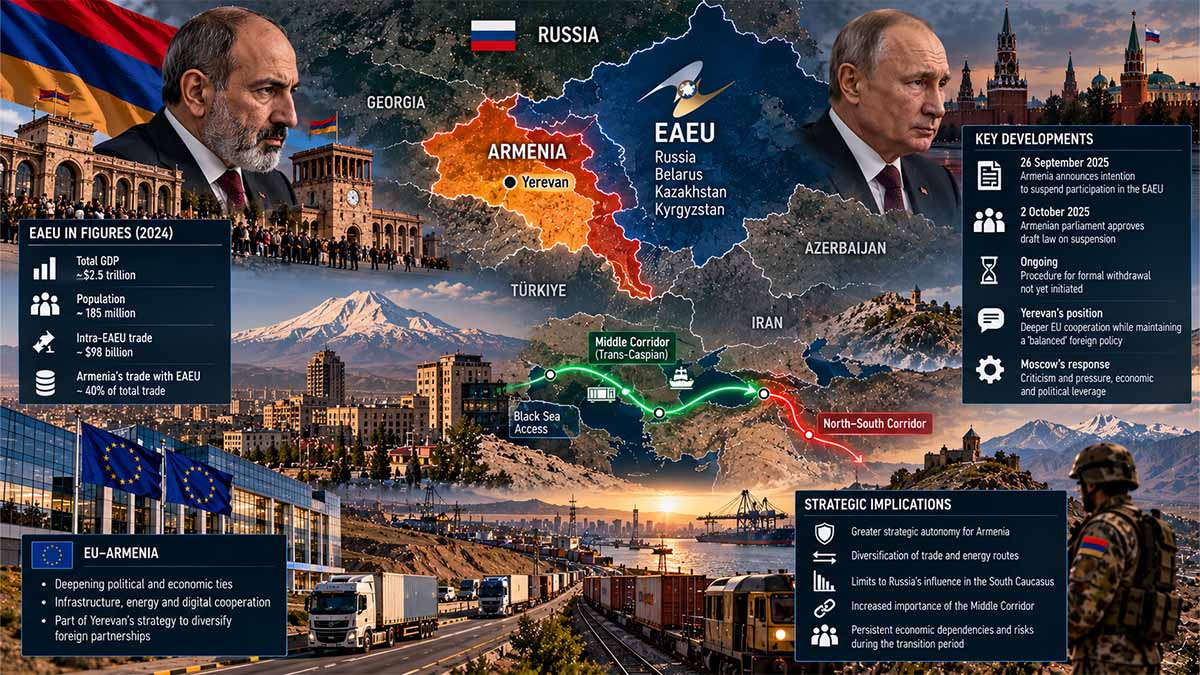
The 20 October 2026 initiative by Russia, Belarus, Kazakhstan and Kyrgyzstan, Armenia’s legal response, and the consequences for the durability of Eurasian integration and Armenia’s European diversification.
Scope: This assessment examines Armenia, the four other Eurasian Economic Union members and the European Union, concentrating on developments through 27 October 2026 and their implications for the period 2026–2031.
Executive Summary — Bottom Line Up Front
Principal judgment: A negotiated confrontation without immediate suspension remains the more plausible near-term pathway. The four governments have put Armenia’s EAEU position in question but have not established, on the verified record, that a legally effective suspension has occurred.
The 20 October 2026 report represents a significant escalation: Armenia’s European trajectory is being evaluated not merely as a political divergence but as a possible basis for restricting its treaty rights. Russia’s government has published the report under the title On the Possible Consequences of Suspending the Application of the Treaty on the Eurasian Economic Union in Respect of the Republic of Armenia. Report — Government of the Russian Federation — Oct 2026.
The central legal controversy concerns whether Armenia’s European integration measures amount to a sufficiently serious violation of existing EAEU obligations to justify suspension under international treaty law. Armenian Foreign Minister Ararat Mirzoyan expressly disputes that premise.
The economic implications are material: the report’s publicly reported scenarios describe substantial disruption to trade, prices and economic activity. They are conditional estimates advanced by Armenia’s partners, not independently validated forecasts.
For Moscow, the immediate advantage is negotiating leverage. The longer-term risk is that economic pressure encourages Armenia to reduce the dependencies through which Russia retains influence.
For Yerevan, strategic autonomy depends on retaining economically important relationships while developing credible alternatives. European political engagement alone cannot eliminate the adjustment costs of an institutional rupture.
The decisive variable is Russia’s willingness to distinguish compliance with binding economic obligations from broader geopolitical alignment. If that distinction is maintained, accommodation remains possible; if it collapses, Eurasian integration risks becoming less attractive to states seeking diversified international relationships.
Armenia and the Eurasian Union: When Economic Integration Becomes a Test of Sovereignty
Russia’s attempt to condition Armenia’s Eurasian economic position on its European orientation exposes a deeper problem for Moscow: economic dependence can sustain influence, but using it as political leverage may accelerate the very diversification it is intended to prevent.
On 20 October 2026, Russia, Belarus, Kazakhstan and Kyrgyzstan presented a report examining the possible suspension of the Eurasian Economic Union Treaty’s application to Armenia. Foreign Minister Ararat Mirzoyan rejected the legal justification, insisting that Yerevan had violated no treaty obligations. The confrontation places two competing principles on a collision course: the enforceability of regional economic integration and a member state’s right to determine its international orientation. For Russia, the stakes extend beyond commercial privileges to the credibility of its influence across the post-Soviet space. For Armenia, the danger lies in preserving indispensable economic relationships under conditions that could progressively restrict sovereign decision-making. The central contradiction is that Moscow can increase the immediate costs of Armenian diversification without necessarily strengthening Armenia’s willingness to remain within the Russian-led institutional order.
A treaty dispute that began as a question of political loyalty
The October report followed an initiative launched on 29 May 2026, when the presidents of Russia, Belarus, Kazakhstan and Kyrgyzstan called for an examination of the consequences of suspending the EAEU Treaty’s application to Armenia. The document was transmitted through the Eurasian Economic Commission for consideration by the Union’s highest political authorities. Its scope extended from European integration measures and regulatory compatibility to possible legal mechanisms and economic consequences. The institutional sequence matters: the four governments have moved beyond diplomatic objections to prepare an instrument capable of influencing Armenia’s future decisions, without establishing that suspension has already taken effect.
Armenia’s response has been carefully calibrated. On 21 October, Foreign Minister Ararat Mirzoyan disputed the existence of an ordinary mechanism allowing the other members to exclude Armenia. Prime Minister Nikol Pashinyan reinforced that objection on 22 October. By 27 October, Mirzoyan had sharpened the argument: the Vienna Convention on the Law of Treaties contains provisions concerning suspension, but Armenia had committed no breach justifying their application. He maintained Yerevan’s willingness to negotiate, while refusing to accept that economic membership confers authority over the country’s broader foreign policy.
The distinction is consequential. The EAEU, established by the Treaty of 29 May 2014, is an economic organisation whose founding provisions recognise sovereign equality, national interests and binding common obligations. Armenia joined on 2 January 2015. Its membership imposes constraints in areas covered by Eurasian integration, particularly customs and commercial arrangements, but does not automatically establish a common foreign policy. Moscow’s political concern is understandable: Armenian participation in a competing customs framework could eventually undermine the Union’s common rules. Yet an anticipated incompatibility is not equivalent to an existing violation.
The economic figures reveal leverage, not an inevitable collapse
The four-government report attaches severe economic consequences to a hypothetical suspension. Its reported estimates envisage a 15.6% contraction in Armenian GDP, a 14.9-percentage-point increase in inflation, a 14.6% decline in consumption, a 48.8% reduction in imports and a 55.6% fall in Armenia’s trade with EAEU members. Exports of domestically produced goods could decline by 30–50%, while re-exports could contract by more than 90%. These are conditional projections advanced by interested governments, not independently validated forecasts. Their baseline assumptions and adjustment horizon are not sufficiently established in the available record.
Their political function is nevertheless clear. By quantifying the potential losses, the report seeks to make Armenia’s European trajectory economically expensive before any institutional rupture occurs. The message reaches beyond the Armenian cabinet to exporters, importers, investors and households dependent on established commercial relationships.
Yet Armenia’s trade structure is already changing. According to figures attributed to its Statistical Committee, merchandise turnover reached US$14.9534 billion in January–September 2026, an increase of 2.7% year on year. Exports declined 8.0% to US$5.1631 billion, while imports increased 9.5% to US$9.7903 billion, producing a merchandise trade deficit of US$4.6272 billion. These figures describe an economy with expanding import requirements and weaker export performance, not one insulated from external disruption.
Preliminary January–August 2026 partner statistics indicate that trade with EAEU members fell 17.2% to approximately US$3.8465 billion, while commerce with Russia declined 19.2% to US$3.591 billion. During the same period, trade with the European Union reportedly rose 53.9% to US$2.4298 billion. The geographical redistribution is substantial, although changes in gross turnover cannot establish that alternative suppliers and markets perform the same economic functions.
The World Bank identified the contraction of precious-metal and precious-stone re-exports as a major explanation for Armenia’s 36.1% decline in exports during 2025. Excluding those categories, exports increased 8.9%. This distinction matters when evaluating the four-government report: an abrupt fall in re-export turnover does not necessarily imply a proportionate collapse in domestic production or value added.
Economic pressure is therefore real, but its likely consequences cannot be inferred directly from the largest numbers in a politically consequential report.
Gas, labour and logistics make disengagement more costly than changing trade partners
The deepest constraints on Armenian autonomy are not captured by aggregate merchandise statistics. They concern commercial relationships whose economic value depends on infrastructure, contracts and administrative arrangements that cannot be replaced by diplomatic declarations.
The October report’s reported gas scenario illustrates the problem. An increase in the Russian supply price from US$177.50 to US$300 per 1,000 cubic metres would represent approximately 69%. But this is an illustrative scenario, not an implemented tariff, and the EAEU Treaty’s suspension would not necessarily amend bilateral energy contracts automatically. The legal mechanism matters as much as the price itself.
Labour mobility creates another exposure. The Eurasian framework provides arrangements governing employment across participating states, while the World Bank reported US$714 million in Armenian net non-commercial transfers during 2025, an increase of approximately 53.5% from the previous year. These flows cannot all be classified as workers’ remittances, but they demonstrate the importance of cross-border private financial relationships. Any disruption affecting employment or payment channels could reach households well beyond companies directly engaged in Eurasian trade.
Infrastructure imposes an additional constraint. Armenian producers may obtain preferential entry to European markets without possessing equivalent transport, certification or distribution capacity. Rail connectivity, border administration, logistics and dependable commercial finance determine whether tariff advantages become actual sales. The adjustment from one established market to another therefore involves physical and institutional costs that cannot be eliminated through a political decision.
For Yerevan, diversification is consequently not synonymous with breaking commercial relations with Russia. It means ensuring that indispensable goods, markets and income channels do not depend so heavily on one external relationship that economic cooperation becomes a permanent restriction on political choice.
Treaty law limits what economic power can legitimately enforce
The legal argument is narrower than the political confrontation surrounding it. Article 60 of the 1969 Vienna Convention on the Law of Treaties provides for the suspension of a multilateral treaty in circumstances involving material breach. Such a breach requires repudiation of the treaty or violation of a provision essential to its object or purpose. Article 65 establishes relevant notification and procedural requirements.
The EAEU’s common customs regime creates genuine obligations. Armenia cannot retain its benefits while disregarding binding external trade commitments. Full participation in the European Union’s customs and common commercial-policy framework would raise fundamental compatibility questions. But the Armenian law adopted in March 2025 initiating European integration is not equivalent to completed EU accession or the assumption of an incompatible customs tariff.
That difference is central to Mirzoyan’s position. Armenia argues that it remains compliant with existing treaty obligations, while its partners seek to address risks associated with its future institutional direction. The four governments may legitimately request clarification and examine potential incompatibilities. Their collective agreement, however, cannot substitute for the substantive conditions required to establish a material breach.
The dispute also concerns the proposed link between suspension and an Armenian referendum on international orientation. A referendum could clarify domestic political preferences, but it would not itself determine whether Armenia had breached an international treaty or resolve every conflict between future institutional commitments. Making economic participation conditional on such a vote would extend the controversy from customs governance into the organisation of sovereign political choice.
An EAEU capable of enforcing clearly established economic obligations would strengthen its institutional credibility. One that treats geopolitical divergence as sufficient grounds for restricting treaty rights would create a precedent potentially relevant to all its members.
Europe is becoming an alternative, but not yet an economic replacement
The European Union’s contribution to Armenia’s diversification has become more concrete. The Comprehensive and Enhanced Partnership Agreement, fully effective since 1 March 2021, established a framework for sectoral and institutional cooperation. Armenia adopted legislation initiating European integration in March 2025, followed by the EU–Armenia Strategic Agenda of 2 December 2025 and the first EU–Armenia summit in May 2026.
The economic baseline remains limited. In 2025, the European Union accounted for 11.3% of Armenia’s merchandise trade, including 7.9% of exports and 13.5% of imports. European programmes include a €270 million Resilience and Growth Plan for 2024–2027, while expected investment mobilisation through Global Gateway has been described as reaching €2.5 billion. These figures represent programme commitments and investment expectations, not equivalent amounts of completed expenditure.
The European Council’s 24 September 2026 adoption of temporary trade-liberalisation measures is more immediately relevant. The arrangement suspends duties on specified Armenian products and covers categories representing approximately 80% of Armenian exports to the EU, subject to applicable requirements and safeguards. It offers commercial relief in response to Russian restrictions, but does not guarantee new customers or compensate automatically for the loss of Eurasian markets.
European engagement is also differentiated. French President Emmanuel Macron consolidated a strategic partnership with Armenia during his May 2026 visit, strengthening political and defence cooperation. German Chancellor Friedrich Merz supported an expanded bilateral agenda following the December 2025 German–Armenian strategic declaration, with emphasis on economic modernisation and investment. Italy, through Deputy Minister of Foreign Affairs Edmondo Cirielli, advanced commercial and infrastructure cooperation during consultations in January 2026 and announced an expanded development-cooperation presence in September. British Prime Minister Keir Starmer strengthened a separate bilateral relationship through the May 2026 UK–Armenia Strategic Partnership, covering security, economic development and institutional resilience.
These relationships increase Armenia’s diplomatic and commercial options, but their institutional effects differ. France, Germany and Italy participate in EU common trade policy; the United Kingdom operates outside it. None can independently guarantee Armenian EU accession or immediately replace established Russian energy, labour and commercial relationships.
Europe’s credibility will be measured not by the number of agreements signed, but by the export revenues, productive investment and operating infrastructure those agreements ultimately generate.
Moscow’s regional influence now depends on the credibility of its rules
Russia’s problem is larger than Armenia’s economic weight within the Eurasian Union. Moscow seeks to preserve a regional system in which economic interdependence reinforces political influence. Yet the October initiative raises a question about the institutional foundations of that system: whether common economic rules can accommodate foreign-policy diversity or whether access to their benefits is conditional on geopolitical alignment.
Belarus, Kazakhstan and Kyrgyzstan have joined Russia in examining Armenia’s position, but their interests cannot automatically be assumed identical. In 2025, Armenian merchandise turnover with Russia reached approximately US$7.661 billion, compared with about US$251.4 million with Belarus and US$115.9 million with Kazakhstan. Russia possesses the dominant direct commercial relationship, while the other members also have an interest in the legal precedent created by any suspension.
A Union whose rules can be invoked to penalise a member for an established material breach may become more credible. A Union whose economic rights are perceived as vulnerable to political disagreement may become less attractive, particularly for governments seeking diversified external partnerships.
That is the contradiction confronting Moscow. The more convincingly Russia demonstrates Armenia’s exposure to Eurasian economic decisions, the stronger Yerevan’s incentive may become to reduce that exposure. Economic dependence can compel caution, but political influence becomes less durable when the dependent state begins to regard the relationship itself as a source of uncertainty.
The next 24 months will reveal who bears the cost of institutional inflexibility
Between 27 October 2026 and October 2028, Armenia’s immediate challenge will be to protect economic continuity while building usable alternatives. Continued negotiations remain more plausible than an immediate institutional rupture, but this judgment depends on whether the four EAEU governments distinguish actual treaty violations from anticipated geopolitical divergence.
Three developments will determine the outcome: whether Armenian-produced exports gain sustainable access to additional markets; whether European financing and connectivity initiatives become functioning economic assets; and whether Moscow accepts continued Armenian treaty compliance without requiring broader foreign-policy subordination.
An actual suspension could impose substantial short-term costs on Armenian businesses and households, particularly those dependent on established trade, energy and labour arrangements. Yet a suspension based primarily on political orientation could also reduce confidence in the EAEU’s predictability, increasing the incentives for Armenia to seek alternatives.
For Brussels, inaction would expose the distance between institutional declarations and the commercial capacity required to support them. For Yerevan, failure to diversify would preserve economic vulnerabilities that constrain future decisions. For Moscow, the cost of treating integration principally as an instrument of discipline would be the possible erosion of the voluntary economic relationships sustaining Russian influence.
The choice facing Russia is not between permitting Armenian sovereignty and preserving Eurasian integration. It is whether Eurasian integration can remain economically valuable to a state whose political orientation is no longer exclusively aligned with Moscow. Over the next 12–24 months, the costs of failing to answer that question will fall first on Armenia’s economy, but the longer-term institutional consequences could be borne by Russia and the Eurasian system it seeks to preserve.
Navigational Index — Three Thematic Pillars
Pillar I — Treaty Legitimacy, Institutional Authority and the October 2026 Confrontation
- Chapter 1. Armenia’s European Orientation and the Evolution of Eurasian Economic Integration
- Chapter 2. The 20 October Report: Institutional Origin, Content and Strategic Purpose
- Chapter 3. The Legal Contest: EAEU Treaty Obligations, Vienna Convention and Armenian Sovereignty
Pillar II — Economic Dependence, Geopolitical Leverage and External Diversification
- Chapter 4. Armenia’s Eurasian Economic Exposure: Trade, Energy, Market Access and Labour Mobility
- Chapter 5. Russia’s Influence Mechanisms and the Strategic Interests of Belarus, Kazakhstan and Kyrgyzstan
- Chapter 6. The European Alternative: EU Institutions, Commercial Integration and the Distinct Roles of France, Germany, Italy and the United Kingdom
Pillar III — Institutional Resilience, Negotiating Pathways and Strategic Outlook
- Chapter 7. Economic Pressure as a Negotiating Instrument: Coercive Effects and Counterproductive Outcomes
- Chapter 8. Near-Term Negotiations and the 2027–2031 Sustainability of Armenia’s Dual Orientation
- Chapter 9. Institutional Options, Decision Indicators and the Final Net Assessment of Russian Post-Soviet Influence
Master Abstract
The 20 October 2026 report prepared by representatives of Russia, Belarus, Kazakhstan and Kyrgyzstan introduces a consequential question into the governance of the Eurasian Economic Union: whether economic membership can remain stable when a participating state actively develops an international orientation that its partners regard as strategically incompatible with the integration project. The report’s immediate significance does not rest on an executed suspension. It lies in the decision by four governments to elevate Armenia’s European integration programme from a subject of diplomatic concern into a possible justification for altering the legal and economic conditions of its EAEU participation. The Russian government published the document on 20 October, following an initiative associated with the four heads of state at the Supreme Eurasian Economic Council meeting of 29 May 2026. The report’s presentation through the Eurasian institutional framework gives the initiative considerable political weight while leaving the requirements for an effective suspension subject to legal dispute. Report on the Possible Consequences of Suspending the EAEU Treaty in Respect of Armenia — Government of the Russian Federation — Oct 2026.
Armenia’s response illustrates why this dispute cannot be reduced to a confrontation between two mutually exclusive geopolitical blocs. Yerevan does not deny the economic value of Eurasian integration and has not presented immediate departure as its preferred solution. Its government instead contests the proposition that pursuing closer relations with the European Union is itself sufficient to justify punitive alteration of treaty rights. On 27 October, Foreign Minister Ararat Mirzoyan argued that Armenia had not violated its EAEU obligations and rejected the legal reasoning advanced by the four governments. He also emphasised that Armenian sovereignty and independent decision-making were not negotiable, while expressing willingness to continue constructive engagement. This combination of treaty-compliance claims and political resistance demonstrates a strategy designed to preserve existing economic advantages without accepting their conversion into permanent restrictions on foreign-policy autonomy. His statements are documented in contemporaneous reporting by Armenia’s state news agency, pending identification of a complete ministry transcript.
The competing positions are more complex than a simple conflict between Russian geopolitical control and Armenian independence. EAEU members have a legitimate institutional interest in protecting a common customs and regulatory framework against genuinely incompatible obligations. Armenia has an equally significant interest in maintaining external policy choices that do not demonstrably violate its existing commitments. The analytical question is where prospective incompatibility becomes an operative legal breach, and whether political pressure is being used to bring that moment forward. Article 3 of the EAEU Treaty combines obligations to avoid undermining the organisation’s objectives with principles of sovereign equality, respect for national interests and recognition of differing political arrangements. The same provision therefore supplies arguments relevant to both institutional integrity and the protection of member-state autonomy. Treaty on the Eurasian Economic Union — Eurasian Economic Commission — May 2014, Article 3, consolidated text.
Economic exposure gives the October report its practical force. The report’s reported estimates include a potential GDP contraction of 15.6%, a 48.8% reduction in imports and a 55.6% decline in trade between Armenia and other EAEU members under a suspension scenario. These figures should not be mistaken for measured losses or treated as independent predictions. Their importance is that Armenia’s partners have chosen to quantify the potential costs of institutional distancing, making economic vulnerability a central feature of the political negotiation. Whether that strategy induces accommodation or accelerates diversification will depend on the credibility of the threatened measures, the availability of alternative economic relationships and Yerevan’s assessment of the risks associated with continued dependence. The report’s complete modelling annex and assumptions have not yet been independently validated in this assessment.
At the regional level, the confrontation tests two potentially conflicting conceptions of Eurasian integration. The first regards the EAEU primarily as an economic institution capable of preserving market cooperation despite divergence in the foreign policies of its members. The second treats economic membership as part of a wider regional settlement whose effectiveness depends on maintaining a degree of geopolitical alignment. Russia’s long-term influence would be more institutionally sustainable under the first conception, provided essential economic obligations remain enforceable. Under the second, Moscow could retain substantial coercive capacity while diminishing the voluntary attractiveness of regional integration. Armenia’s response to economic pressure would thus become an indicator of the limits of Russia’s ability to convert interdependence into durable political authority.
The principal judgment for the period beginning on 27 October 2026 is that prolonged legal and political negotiation is more plausible than immediate institutional separation, although neither a negotiated settlement nor eventual suspension can be treated as predetermined. Over the medium term, Armenia’s room for manoeuvre will be governed by its success in diversifying trade, the material depth of its European partnerships and the tolerance of its Eurasian partners for geopolitical pluralism. A decision to suspend treaty application without an adequately substantiated legal breach would expose the EAEU to a credibility problem extending beyond Armenia. Conversely, an arrangement that preserves treaty compliance while permitting external diversification could demonstrate the adaptability of the Eurasian economic framework. The determining uncertainty remains whether Moscow is willing to exercise influence through mutually beneficial cooperation rather than through the enforcement of strategic alignment.
Key Evidence Table
The following table separates operative legal instruments, documented institutional developments, official statistical indicators and conditional estimates attributed to the four Eurasian governments. Figures presented as forecasts are not treated as observed results.
| Indicator | Value / status | Reference date | Definition / scope | Issuing authority and exact source |
|---|---|---|---|---|
| EAEU founding treaty | Signed 29 May 2014 | 2014 | Founding legal instrument for Eurasian integration | Eurasian Economic Commission — Treaty on the Eurasian Economic Union |
| Core treaty principles | Article 3 | Applicable framework | Sovereign equality, national interests, mutually beneficial cooperation and protection of Union objectives | Eurasian Economic Commission — Treaty, Article 3 |
| Potential suspension mechanism | Material breach provisions | 1969 Convention | Articles 60 and 65; legal threshold and procedural requirements | United Nations — Vienna Convention on the Law of Treaties |
| Four-government report | Published | 20 Oct 2026 | Possible suspension of EAEU Treaty application to Armenia | Government of the Russian Federation — Report |
| Armenian legal position | Suspension grounds disputed | 27 Oct 2026 | Official ministerial position; complete transcript not independently located | Armenian MFA statement reported by Armenpress; |
| EU–Armenia Strategic Agenda | Adopted | 2 Dec 2025 | Political, economic and sectoral cooperation | European External Action Service — Strategic Agenda |
| First EU–Armenia summit | Held | 5 May 2026 | Connectivity, energy, digital and political cooperation | Council of the EU — Summit Results |
| EU share of Armenian goods trade | 11.3% | 2025 | Total merchandise trade | Council of the EU — Armenia Country Relations |
| EU share of Armenian goods exports | 7.9% | 2025 | Armenian merchandise exports | Same official Council record |
| EU share of Armenian goods imports | 13.5% | 2025 | Armenian merchandise imports | Same official Council record |
| EU resilience and growth plan | €270 million | 2024–2027 | Announced assistance framework, not equivalent to disbursed expenditure | Same official Council record |
| EU Global Gateway investment expectation | €2.5 billion | Stated May 2026 | Expected investment mobilisation, not completed investment | Council of the EU — May 2026 Summit |
| EU temporary trade measures | Around 80% of Armenian export product coverage described by the Council | 24 Sep 2026 | Temporary tariff liberalisation for specified Armenian products; not equivalent to an 80% increase in exports | Council of the EU — Armenia Policy Record |
The original Russian government report is publicly indexed as a 72-page document, but attempts to retrieve its full PDF were unsuccessful in this research session. Its economic modelling therefore cannot be independently verified against the complete primary text. The conditional figures below are separately identified as reported claims and excluded from the table of fully verified official economic results.
The European indicators are relevant because they establish the distinction between an expanding European partnership and an economically complete alternative to Eurasian integration. In 2025, the EU accounted for 11.3% of Armenia’s total merchandise trade, according to the Council of the European Union. This establishes a meaningful commercial relationship but does not prove that existing EAEU trade exposure could be replaced rapidly.
The EU has also introduced concrete instruments supporting diversification. On 24 September 2026, the Council adopted temporary trade-liberalisation measures for certain Armenian products, following trade restrictions imposed by Russia. The arrangement provides evidence of European implementation rather than political aspiration alone. Nevertheless, improved tariff access does not automatically remove transport costs, regulatory requirements, commercial adjustment burdens or supply-chain constraints. These distinctions are essential when evaluating Armenia’s capacity to withstand a deterioration of its Eurasian economic relationships. Armenia — Council of the European Union — 2026.
Conditional economic estimates advanced in the October report
| Variable | Reported suspension scenario | Evidentiary status |
|---|---|---|
| Armenian GDP | −15.6% | Four-government estimate; modelling not independently validated |
| Inflation | +14.9 percentage points | Conditional projection, not observed inflation |
| Consumption | −14.6% | Conditional projection |
| Armenian imports | −48.8% | Conditional projection |
| Armenia–EAEU merchandise trade | −55.6% | Conditional projection |
| Exports of Armenian-produced goods | −30% to −50% | Reported scenario range |
| Re-exports | More than −90% | Reported scenario |
| Russian gas supply price | US$177.50 to US$300 per 1,000 m³ | Illustrative commercial scenario, not an implemented tariff |
These values were publicly attributed to the four-government report on 20 October 2026. They cannot be treated as a validated macroeconomic forecast without access to the model’s baseline, reference year, sectoral assumptions and adjustment horizon.
Even with this qualification, the figures illuminate the mechanism through which the report may influence Armenian policy. A government confronted with the prospect of substantial trade disruption has an incentive to negotiate transitional arrangements, preserve access to established markets and avoid legal uncertainty. But estimates of severe losses may also strengthen the political case for diversifying external economic relationships. The same economic exposure can generate incentives for accommodation in the short term and for strategic decoupling over a longer horizon.
Competing Explanations and Strategic Pathways
The available record supports three distinct, potentially overlapping interpretations of the four governments’ initiative. They differ chiefly in the objectives attributed to the report and the circumstances that would indicate movement towards an actual suspension.
| Hypothesis | Diagnostic support | Evidence against or limitations | Observable indicators | Current standing |
|---|---|---|---|---|
| H1 — Negotiating leverage | Publication of economic costs, referral to EAEU leadership and absence of an executed suspension | Report also discusses potential legal grounds for an enforceable measure | Continued negotiations; preservation of treaty benefits; proposals for accommodation | Best supported immediate interpretation |
| H2 — Preparation for suspension | Explicit examination of legal instruments, consequences and suspension conditions | No verified final decision; material-breach threshold contested | Formal notification, documented breach allegation, adopted suspension instrument | Credible contingency, not established outcome |
| H3 — Defence of regulatory integrity | EAEU Treaty obligations and potential incompatibility between two customs frameworks | European political cooperation does not itself establish a present material treaty breach | Specific conflicting obligations identified and documented; proposals for legally proportionate adjustment | Legitimate institutional concern, but insufficiently demonstrated as grounds for suspension |
Assessment of the competing pathways
The negotiating-leverage interpretation has the strongest immediate support because the four governments have chosen to document the consequences of a possible measure before implementing it. That is consistent with an attempt to influence Yerevan’s future decisions by making the potential costs of divergence more visible. It is not proof of a predetermined coercive strategy: the same report can serve preparatory legal and institutional purposes.
The suspension-preparation hypothesis cannot be dismissed because the reported document expressly examines mechanisms through which application of the EAEU Treaty might be interrupted. But the existence of a legal argument does not establish its validity, and the publication of a proposed measure is not equivalent to its adoption.
The regulatory-integrity interpretation has a genuine legal foundation. Article 3 of the EAEU Treaty creates obligations relevant to the functioning of the Union, while Article 60 of the Vienna Convention recognises material breach as a potential ground for suspension of treaty operation. Yet the critical factual and legal connection remains contested: whether Armenia’s current European integration measures constitute a breach sufficiently serious to justify the contemplated action. The Convention also sets out notification and dispute-handling requirements in Article 65. Vienna Convention on the Law of Treaties — United Nations — May 1969, Articles 60 and 65.
The three interpretations can coexist. The October initiative may simultaneously express a genuine concern about future regulatory incompatibility, create economic bargaining leverage and prepare a legal argument for institutional action should negotiations fail. This makes it particularly important not to infer an irreversible decision from the publication of the report alone.
Principal Intelligence Gaps and Watch Indicators
The legal threshold for suspension
The most consequential unresolved legal issue is whether the specific measures adopted by Armenia constitute a material breach under the relevant international treaty framework. The publicly available positions do not establish agreement on that question.
The decisive evidence would be the precise legal argument advanced by the four governments, including its identification of the allegedly breached obligation, the act constituting the alleged breach and the basis for characterising it as material.
The principal indicators of escalation would be a formal finding of breach, notification under an identified legal procedure or the adoption of an operative instrument specifying the terms of suspension.
The economic adjustment mechanism
The second major gap concerns the assumptions underlying the report’s severe economic projections.
The public estimates identify potential losses but do not, in the material independently examined here, establish the complete methodology or the timeframe over which the projected economic adjustment would occur.
Any future official release of the model’s assumptions, trade baselines, sectoral estimates and sensitivity analysis would materially improve assessment of Armenia’s exposure.
A particularly important distinction concerns changes that follow directly from the EAEU legal regime and changes that would require separate bilateral commercial or political decisions. Gas-price adjustments, for example, cannot automatically be equated with treaty suspension without examining the contractual and regulatory basis of supply.
The practical depth of European diversification
The third gap concerns the relationship between the EU’s announced cooperation measures and Armenia’s ability to replace economically significant Eurasian trade arrangements.
Evidence of European engagement is already substantial: the Comprehensive and Enhanced Partnership Agreement, the December 2025 Strategic Agenda, the May 2026 summit and the September 2026 trade measures constitute identifiable institutional developments. They do not, however, establish that Armenia possesses a fully substitutable alternative to its existing economic integration.
The decisive indicators will be changes in actual export destinations, investment realisation, viable transport arrangements, energy diversification and the capacity of Armenian businesses to satisfy alternative market requirements.
The tolerance of the remaining EAEU partners
The fourth gap concerns whether Russia, Belarus, Kazakhstan and Kyrgyzstan would ultimately agree on the necessity, extent and timing of suspension.
Their joint report establishes common concern but does not demonstrate identical preferences concerning all possible outcomes. The practical positions taken by the four governments when considering a specific suspension decision will therefore be more informative than their participation in the preliminary report.
A willingness to negotiate safeguards without changing Armenia’s membership conditions would support an adaptive interpretation of Eurasian integration. Conversely, adoption of a measure justified predominantly by Armenia’s external geopolitical orientation would indicate that political alignment is increasingly being treated as an implicit condition of continued participation.
The December 2026 institutional decision point
The anticipated consideration of the report by EAEU leadership is the nearest identifiable institutional test. The precise agenda, any subsequent decision and the legal consequences of that decision must be verified against official proceedings when published.
For decision-makers, the important threshold is not the intensity of political rhetoric but the passage from policy consideration to legally operative action. Until that threshold is crossed, an assessment of immediate institutional rupture would overstate the established evidence.
Initial Net Assessment
As of 27 October 2026, the strongest supported judgment is that the dispute has become an instrument through which the limits of Armenia’s dual orientation are being tested. Yerevan seeks to preserve the benefits of Eurasian economic integration while strengthening cooperation with the European Union. Moscow and the other three EAEU partners have now signalled that this strategy may carry institutional consequences if they conclude that Armenia’s European trajectory compromises its existing obligations.
The question is not simply whether Armenia can remain a member of one organisation while cultivating a relationship with another. It is whether an economic union can distinguish enforceable treaty obligations from broader expectations of geopolitical loyalty.
In the short term, the material incentives for negotiation remain substantial. In the medium term, Armenia’s sustainability as an economically integrated but geopolitically diversified state will depend on the development of credible alternative commercial relationships and on the willingness of its Eurasian partners to tolerate an independent external orientation.
For Russia, the strategic test is whether preserving influence requires restricting Armenia’s choices or whether influence can remain effective through stable, mutually beneficial economic integration.
The first approach may strengthen immediate leverage while weakening institutional confidence. The second may preserve a degree of Russian influence without demanding comprehensive geopolitical alignment. The consequences for the broader post-Soviet architecture will depend on which conception guides actual decisions, not merely on the severity of the economic costs outlined in the October report.
No decision-useful visualisation is supportable from the verified record beyond the evidence and pathway tables above; a quantitative dependency or risk graphic would require additional comparable data and defensible assumptions.
ARMENIA & THE EURASIAN ECONOMIC UNION
Treaty suspension, economic interdependence and the future of Russian influence in the post-Soviet space.
The institutional confrontation
The four other EAEU members have examined a possible suspension of treaty application to Armenia. The report is an institutional initiative, not evidence of an already implemented suspension.
Modelled economic shock under suspension
Conditional estimates attributed to the four-government report. These figures describe a hypothetical suspension scenario, not economic outcomes already observed.
Reported contraction indicators
Horizontal scale: 0–100% contraction. Bar lengths directly represent the cited estimates. Decorative depth effects do not represent additional data.
Reported change in the inflation rate, expressed in percentage points rather than percent.
Estimated contraction range for Armenian-produced goods under the stated scenario.
The estimates illustrate potential leverage, not independently established future losses.
Russian gas: illustrative price scenario
Reported reference price and hypothetical higher price, in US dollars per 1,000 cubic metres. This comparison does not assert that a price increase has been implemented.
Common zero baseline; cylinder heights proportional to the indicated prices. Source: economic scenario attributed to the October 2026 report.
Calculated from ($300 − $177.50) / $177.50. The calculation compares scenario values only.
Armenia’s measurable relationship with the EU
European trade participation provides a factual baseline for assessing diversification capacity. These are historical merchandise-trade shares, not forecasts.
EU share of Armenian goods trade, 2025
Each bar shows the EU percentage of the corresponding Armenian trade aggregate. Scale: 0–100%.
Source: Council of the European Union, Armenia country relations, 2025 goods-trade indicators.
From treaty dispute to strategic behaviour
A conditional analytical chain. The connections identify plausible mechanisms, not events already confirmed at every stage.
Three interpretations of the October initiative
These pathways can overlap. No numerical probability is assigned because a defensible model or base rate is not available.
Negotiated accommodation
Economic exposure strengthens the negotiating incentive without requiring a suspension decision. Armenia continues to defend compliance with the EAEU Treaty.
Preparation for suspension
The four partners develop an actionable legal mechanism and move beyond analysis toward a binding institutional decision.
Regulatory incompatibility
Actual conflicting obligations emerge between Armenian commitments within Eurasian integration and binding European arrangements.
Legal, diplomatic and economic baseline
Source distinctions matter: operative law, government positions, historical statistics and hypothetical economic projections do not carry the same evidentiary weight.
| Record | Date | Verified or reported status | Analytical significance |
|---|---|---|---|
| EAEU Treaty | 29 May 2014 | Operative founding instrument | Defines the principles and obligations governing economic integration. |
| Vienna Convention | 1969 | Articles 60 and 65 | Material-breach criteria and applicable procedural safeguards. |
| EU–Armenia Strategic Agenda | 2 Dec 2025 | Adopted | Expands political and sectoral cooperation without itself constituting EU accession. |
| EU–Armenia Summit | May 2026 | Held | Reinforces cooperation on connectivity and economic development. |
| Four-government report | 20 Oct 2026 | Published; full modelling not independently validated | Raises potential treaty suspension and presents economic cost estimates. |
| Armenian foreign-minister response | 27 Oct 2026 | Attributable ministerial position | Contests legal justification and maintains Armenia’s sovereign policy rights. |
| EU merchandise-trade share | 2025 | 11.3% | Historical trade exposure; not a measure of potential EAEU replacement. |
| Hypothetical GDP shock | October 2026 scenario | −15.6% reported | Conditional estimate; macroeconomic assumptions not independently validated. |
What would change the assessment?
Operative legal action
Formal finding of material breach, procedural notification or legally effective suspension.
Continued integration
Treaty compliance, ongoing negotiations and agreement on how to manage future incompatibilities.
Implemented alternatives
Changes in actual trade flows, functioning alternative supply relationships and realised European cooperation.
Russia’s decisive choice: economic partnership or geopolitical subordination
The central test is not whether Russia can expose Armenia to economic costs. It is whether Moscow can preserve regional influence while accepting that economic membership does not necessarily entail permanent geopolitical alignment.
Near term: negotiated confrontation remains more plausible than immediate rupture. Medium term: Armenian autonomy depends on economic diversification, credible European implementation and tolerance within the EAEU for divergent foreign-policy orientations.
The credibility of Eurasian integration will depend on whether its rules can remain predictable when member states pursue different international strategies.
PILLAR I — TREATY LEGITIMACY, INSTITUTIONAL AUTHORITY AND THE OCTOBER 2026 CONFRONTATION
ACADEMIC GOVERNANCE EDITION V10-1 — INSTITUTIONAL STRATEGIC ASSESSMENT
Reference date: 27 October 2026 | Geographic scope: Armenia, Eurasian Economic Union, European Union and the South Caucasus | Analytical horizon: 2026–2031
Chapter 1. Armenia’s European Orientation and the Evolution of Eurasian Economic Integration
1.1. Armenia’s geopolitical diversification and the transformation of regional economic integration
Armenia’s progressive reorientation of its external relations has reached a stage at which the institutional arrangements designed to facilitate its economic development are being subjected to a more fundamental test of political compatibility. The question is no longer confined to whether Yerevan can sustain cooperative relations with both the Eurasian Economic Union and the European Union, nor can it be answered simply by comparing the economic advantages offered by Moscow and Brussels. It concerns the extent to which a sovereign state can retain its established participation in a regional economic organisation while developing diplomatic, regulatory and strategic relationships that depart from the geopolitical preferences of the organisation’s dominant member. The controversy that became explicit in October 2026 reflects an accumulation of legal, economic and political developments rather than an abrupt change in Armenian policy. At its centre is an unresolved distinction between economic integration as a contractual framework of reciprocal obligations and economic integration as an instrument through which regional political influence is preserved.
The Eurasian Economic Union was established through the Treaty signed in Astana on 29 May 2014 by Belarus, Kazakhstan and Russia. Armenia subsequently joined through an accession treaty signed on 10 October 2014, with membership taking effect on 2 January 2015. Kyrgyzstan followed in August 2015, completing the five-member configuration that remains central to the present dispute. This institutional history matters because Armenia did not enter an informal preferential trading arrangement from which commercial concessions could be withdrawn through an ordinary political declaration. It entered a treaty-based international organisation possessing its own legal personality, institutional structure, customs regime and defined allocation of competences between member states and supranational bodies. The Union’s foundational provisions establish arrangements for the movement of goods, services, capital and labour, alongside coordinated, agreed or common economic policies in areas governed by the Treaty. These provisions place Armenia’s commercial relationships within an institutional framework whose alteration may affect not only bilateral transactions with Russia but also the treatment of economic operators and individuals under a broader body of Eurasian law. Treaty on the Eurasian Economic Union — Eurasian Economic Commission — May 2014, consolidated text as of March 2024.
The legal identity of the EAEU is central to understanding the significance of Armenia’s present position. Article 1 describes the Union as an international organisation of regional economic integration with international legal personality. Article 3 establishes principles governing its operation, including sovereign equality, territorial integrity, respect for the distinctive political systems of member states, mutually beneficial cooperation, equality and consideration of national interests. Article 4 identifies economic development, the creation of common markets and improved competitiveness as the principal objectives of the organisation. These provisions define an institutional project that is economically ambitious but does not, by its express founding language, constitute a comprehensive political union or require identical foreign policies among members. The Treaty nevertheless obliges participating states to create favourable conditions for the Union’s functioning and refrain from measures capable of jeopardising its objectives. The coexistence of these principles creates the interpretative tension underlying the October 2026 confrontation: sovereign discretion and common economic obligations are both protected by the legal framework, but the exact boundary between them becomes contentious when a member seeks integration with another regional system possessing potentially incompatible regulatory and customs requirements. Treaty on the Eurasian Economic Union — Eurasian Economic Commission — May 2014, Articles 1–5.
Armenia’s participation in the EAEU must therefore be understood as an exercise in institutional interdependence rather than an irreversible transfer of its entire external economic sovereignty. The Union creates binding commitments in the areas covered by the Treaty, including the operation of the customs union and the application of common external trade arrangements. Within those limits, members retain international legal personality and national political institutions, as well as the ability to develop foreign relationships compatible with their existing obligations. This distinction is particularly important in Armenia’s case because the evolution of relations with the European Union has followed several legally differentiated stages. Political cooperation, regulatory approximation, sectoral integration, a formal accession application, candidate status, negotiations and eventual membership are not interchangeable categories. Each would have a different potential impact on Armenia’s existing Eurasian commitments, and the legal consequences cannot be established by treating the entire European integration process as a single completed act.
The original architecture of Eurasian integration contains an additional feature that helps explain why such a dispute is particularly difficult to manage. By constructing a common customs territory while preserving separate national political authorities, the organisation necessarily depends on a combination of binding economic rules and continuing political consent. A member’s external decisions may have consequences for the entire customs territory, especially where common tariffs, border treatment, technical standards or external commercial agreements are involved. At the same time, the Treaty cannot be interpreted as transferring every aspect of external sovereignty to the Union merely because some foreign-policy choices may eventually generate economic consequences. The issue is consequently not whether the EAEU can legitimately defend its regulatory integrity; it can. The issue is whether a prospective shift in political orientation constitutes a present violation of a binding obligation, and whether the response contemplated by the other members remains within the powers granted by the existing treaty system.
1.2. From the 2017 partnership agreement to the European integration initiative of 2025
The development of Armenia’s relationship with the European Union demonstrates that European diversification did not originate with the October 2026 confrontation. The Comprehensive and Enhanced Partnership Agreement, signed in November 2017 and fully effective from 1 March 2021, established a broad framework for cooperation covering governance, economic development, energy, transport, environmental policy, trade-related matters and institutional reform. Its legal and political significance derives partly from the fact that it was designed to support closer EU–Armenia cooperation while Armenia remained a member of the EAEU. It therefore represented an attempt to develop a differentiated relationship with European institutions without immediately requiring Armenia to abandon its existing Eurasian commitments. In practical terms, the agreement made it possible to pursue substantial institutional approximation in selected sectors while leaving the fundamental question of membership in competing customs regimes outside the immediate scope of bilateral integration. Armenia: EU–Armenia Comprehensive and Enhanced Partnership Agreement — Council of the European Union — 2026.
This distinction became increasingly consequential as cooperation extended beyond conventional diplomatic dialogue and into the practical capacities of Armenian institutions. The European partnership has supported reform objectives involving public administration, judicial accountability, economic opportunity, regulatory practices and the broader operation of a market economy. Such measures are not simply political declarations intended to signal affinity with European values. They can alter how Armenian institutions implement policy, how businesses prepare for external markets and how the government evaluates alternative channels of economic development. However, regulatory approximation is not equivalent to accession to the European Union’s internal market, and the adoption of standards aligned with European practice does not automatically confer the reciprocal market rights enjoyed by EU member states. The resulting asymmetry is important: Armenia can incur administrative and economic adjustment costs as it moves towards European standards without necessarily obtaining the full commercial benefits associated with EU membership.
The acceleration of political engagement became more explicit after the European Council’s conclusions of October 2023, which called for strengthening EU–Armenia relations across their various dimensions. The European Union subsequently launched a visa-liberalisation dialogue in September 2024 and expanded its political engagement with Yerevan. These measures reflected a growing European willingness to treat Armenia as a partner whose institutional development, sovereignty and regional security had acquired greater importance. They did not, however, establish an accession timetable or remove the economic constraints arising from participation in the Eurasian framework. The distinction between stronger political recognition and a fully credible path to membership remained fundamental to Armenia’s strategic calculation. First EU–Armenia Summit: Preparatory Institutional Record — Council of the European Union — March 2026.
A more consequential political development occurred in March 2025, when Armenia adopted legislation launching a process of European integration. The European Council’s subsequent official description of the measure characterised it as an expression of the country’s intention to move towards the European Union. The legal significance of this formulation must be treated carefully. A domestic legislative commitment to pursue integration does not itself constitute accession to another international organisation, establish all the rights and obligations of membership or amend existing international treaties. It nevertheless creates an identifiable political direction that other states may regard as relevant when evaluating the compatibility of future commitments. Armenia thus moved from maintaining broad European cooperation alongside Eurasian membership towards giving the European relationship a more explicit strategic and potentially institutional destination. EU–Armenia Summit: Main Results and Background — Council of the European Union — May 2026.
The distinction between political intention and legal transformation became the defining source of disagreement between Yerevan and the other EAEU members. Armenia could argue that it remained bound by and compliant with existing obligations, while the four governments could contend that the formal initiation of an EU integration process created foreseeable risks for the integrity of the Eurasian customs and regulatory system. Neither proposition, taken in isolation, determines whether an actionable breach has occurred. The Armenian position addresses current treaty performance; the position developed by the four governments addresses the consequences of a political trajectory and the potential incompatibility of future obligations. The dispute therefore contains a temporal asymmetry: one side emphasises what has already been legally undertaken, while the other emphasises what a declared process may eventually require.
This temporal difference is not a technical detail. International economic arrangements routinely require governments to make decisions before every prospective conflict has materialised, particularly when long-term regulatory alignment can affect investment, supply chains and administrative priorities. Yet the ability to anticipate future incompatibility is different from the authority to impose treaty sanctions for a present material breach. A government can legitimately request clarification, initiate consultations or assess possible economic consequences without necessarily possessing grounds to suspend another party’s treaty rights. The October confrontation became politically sensitive because these distinct stages of institutional risk management were brought unusually close together.
1.3. European institutional consolidation in 2025–2026 and the meaning of strategic diversification
The EU–Armenia Strategic Agenda adopted on 2 December 2025 represented a further development in the relationship. Its importance lies in the establishment of more ambitious common priorities across economic development, security, institutional resilience and sectoral cooperation. By building on the existing Comprehensive and Enhanced Partnership Agreement, the agenda strengthened the continuity of European engagement rather than replacing the earlier legal framework with an accession instrument. It also demonstrated that Armenia’s European orientation had evolved beyond a narrow programme of administrative reforms into a broader effort to diversify the country’s external political and economic relationships. The agreement provided an institutional structure through which cooperation could be implemented, monitored and extended, while leaving the eventual destination and legal form of deeper European integration unresolved. Armenia — Council of the European Union — 2026.
The first EU–Armenia summit, held in Yerevan on 5 May 2026, consolidated that progression at the highest political level. European Council President António Costa and European Commission President Ursula von der Leyen represented the European Union, while Prime Minister Nikol Pashinyan represented Armenia. The summit concentrated on connectivity, energy, transport, digital cooperation and wider regional developments, and produced a joint declaration affirming support for Armenia’s sovereignty, resilience and reform agenda. The participants also exchanged documents relating to connectivity, administrative cooperation and the development of institutional relations. The summit’s significance should not be exaggerated into an accession commitment: the official documentation acknowledged Armenian European aspirations and supported closer sectoral integration, but it did not establish that Armenia had entered a formal negotiating process for EU membership. It nevertheless marked a visible elevation of Armenia’s relationship with Brussels and confirmed that the country’s external diversification had become a sustained component of its governmental strategy. Joint Declaration Following the First Armenia–EU Summit — Council of the European Union — May 2026.
The same summit demonstrated that Armenia’s European orientation involves several policy dimensions that cannot be reduced to the question of customs-union membership. The European Union’s documented cooperation includes connectivity, administrative reforms, economic diversification, crisis management and security-related assistance. The summit record identifies €30 million allocated through the European Peace Facility to support Armenia’s armed forces and improve logistical capacities, alongside broader cooperation intended to strengthen civilian protection and institutional resilience. These activities are relevant because they broaden the sources of external support potentially available to Yerevan. Their significance is not that they necessarily substitute for Armenia’s established relationships with Russia, but that they reduce the exclusivity of those relationships across selected policy areas. The diversification of external cooperation may therefore affect political expectations even before it transforms the distribution of economic dependencies. EU–Armenia Summit — Council of the European Union — May 2026.
The relationship between security diversification and economic integration requires particular analytical care. Participation in the EAEU does not automatically prescribe Armenia’s entire defence policy, nor does European security assistance establish legal incompatibility with the Eurasian customs framework. Nevertheless, the two dimensions interact politically. Where a dominant economic partner also possesses substantial influence through security relationships and regional diplomatic networks, the development of alternative partnerships can change the expected distribution of influence even if the economic treaty remains formally unaffected. Russia may consequently interpret developments that are legally separate from the EAEU as strategically connected to its broader regional position. That interpretation can explain political concern, but it cannot independently supply an operative legal basis for suspension of an economic treaty.
The regional environment further complicates the distinction between formal legal arrangements and broader strategic perceptions. The EU’s May 2026 summit documentation identifies developments in Armenia–Azerbaijan relations, the initialling of a peace treaty in August 2025 and the continuing normalisation process involving Türkiye as important components of the South Caucasus context. These developments matter because improved regional connectivity and more predictable external relationships could eventually expand Armenia’s economic alternatives. However, the existence of diplomatic initiatives cannot be equated with operational transport corridors, guaranteed access to new markets or completed infrastructure. The strategic relevance of regional normalisation lies in the opportunities it may create for the reorganisation of economic geography, not in any assumption that those opportunities have already eliminated established dependencies. EU–Armenia Summit: South Caucasus and Connectivity — Council of the European Union — May 2026.
By 2026, Armenia’s strategy could therefore be described more precisely as institutional diversification under continuing economic interdependence. The government was expanding the scope of European cooperation and acquiring additional external partnerships while seeking to preserve its established treaty-based access to the Eurasian economic area. This approach differed from immediate institutional disengagement and from unconditional acceptance of the geopolitical expectations of Moscow. Its sustainability required the separation of legally binding economic obligations from broader political preferences, together with an expectation that the other EAEU members would continue to recognise that distinction.
1.4. Institutional duality and the limits of simultaneous integration
The coexistence of Eurasian membership and expanding European cooperation presents a legal problem whose severity depends on the depth of integration actually achieved. Broad diplomatic relations, technical assistance, sectoral cooperation and domestic reforms may coexist with membership in a customs union where they do not create conflicting obligations. The position becomes materially different when an external agreement requires independent tariff commitments, incompatible customs arrangements or regulatory obligations inconsistent with the Union’s common rules. This distinction follows from the institutional architecture of the EAEU itself. The Treaty defines the customs union through a common customs territory, the elimination of specified internal trade barriers and the application of a common external tariff and relevant measures governing commerce with third parties. These arrangements impose constraints on the ability of an individual member to conduct an autonomous external trade policy in areas reserved to common Eurasian competence. Treaty on the Eurasian Economic Union — Eurasian Economic Commission — May 2014, Article 2 and customs-union provisions.
Full EU membership would entail participation in the European Union’s customs union and common commercial policy, creating substantial incompatibilities with simultaneous full application of a separate customs regime. That prospective difficulty is real, but it does not establish that a preliminary national law, an institutional dialogue or a sectoral agreement already constitutes the same legal condition. Treating these stages as equivalent would erase precisely the distinctions upon which treaty interpretation depends. Conversely, the Armenian government cannot assume that a future decision to assume binding EU customs obligations could be insulated indefinitely from existing Eurasian commitments simply because earlier stages of cooperation were compatible. A credible legal position must recognise both the latitude available under present obligations and the potential necessity of institutional change if Armenia eventually pursues a substantially deeper form of European integration.
The practical problem is therefore one of sequencing. Armenia has an incentive to maintain its Eurasian economic relationships while gradually increasing the effectiveness of European alternatives; the four EAEU partners have an incentive to seek clarity before the anticipated transition threatens the existing common framework. The former requires sufficient time to diversify markets and administrative capabilities, while the latter requires confidence that Armenia will not make legally incompatible commitments without addressing their consequences. In principle, these interests need not be irreconcilable. Consultation mechanisms, clarification of sectoral obligations and agreed transitional arrangements could reduce uncertainty, provided they rest on valid legal authority and do not require Armenia to surrender decisions beyond the competence transferred by treaty.
A second problem concerns credibility. Armenia’s efforts to diversify become less effective if European partners supply political recognition without commercially meaningful implementation. At the same time, its continued Eurasian participation becomes less attractive if existing membership rights are perceived as vulnerable to restrictions arising from political disagreements rather than demonstrable violations. The durability of dual engagement thus depends on the predictability of both relationships. European cooperation must become sufficiently substantive to expand Armenia’s options, while Eurasian integration must remain sufficiently rule-based to justify continued economic reliance.
The development of Armenia’s external orientation consequently presents a test of institutional maturity for the EAEU. A regional economic organisation capable of distinguishing between binding regulatory commitments and independent foreign-policy choices can accommodate a meaningful degree of political diversity. An organisation that treats divergent external partnerships as presumptive evidence of disloyalty may preserve internal discipline in the short term, but risks undermining confidence in the neutrality and predictability of its economic rules. The October 2026 initiative placed that distinction at the centre of the Union’s relationship with Armenia.
1.5. The institutional transition from cooperation to contestation
The progression from the 2017 EU partnership agreement to the 2025 Armenian integration law and the 2026 EU–Armenia summit demonstrates that Yerevan’s external diversification developed through successive institutional measures, each with a different legal character and political significance. The earlier partnership architecture was compatible with continued Eurasian membership because it did not establish a competing customs-union commitment. The later expression of a European accession ambition raised a more consequential question about the country’s eventual institutional destination, but remained distinguishable from completed accession or an enforceable conflict between two sets of membership obligations. The resulting ambiguity was manageable while the other EAEU members treated Armenian European cooperation as a matter for monitoring and negotiation. It became an institutional confrontation when they began examining whether that orientation could justify restricting Armenia’s treaty participation.
This development reveals a limitation of economic integration projects operating in politically heterogeneous regions. Formal treaties can define customs procedures, regulatory powers and institutional responsibilities, but cannot entirely eliminate conflicts arising from changing national strategic priorities. When member states interpret the political purposes of integration differently, legal provisions intended to preserve economic coherence may become instruments in a wider dispute about sovereignty and influence. The resulting contest is particularly difficult where economic interdependence creates genuine adjustment costs and the participants possess unequal capacities to absorb them.
The principal conclusion of Chapter 1 is that Armenia’s European orientation should not be analysed as an abrupt repudiation of Eurasian integration. It is a progressive attempt to widen the country’s external opportunities while preserving established economic relationships. Its future compatibility with the EAEU depends on the content of actual obligations and the capacity of the regional framework to manage divergent political orientations. The distinction between a prospective conflict and an established breach provides the necessary foundation for assessing the four-government initiative of 20 October 2026.
Chapter 2. The 20 October Report: Institutional Origin, Content and Strategic Purpose
2.1. The Astana initiative of 29 May 2026 and the institutionalisation of the Armenian question
The central judgment is that the report presented on 20 October 2026 represents an institutional escalation of an existing political disagreement, but its publication must be distinguished from a binding decision to suspend the application of the EAEU Treaty to Armenia. The measure is strategically significant because Russia, Belarus, Kazakhstan and Kyrgyzstan have chosen to move beyond expressions of concern and develop a collective assessment of Armenia’s European integration trajectory, its potential incompatibility with Eurasian obligations and the legal instruments that might be employed to address that incompatibility. The initiative brings together legal interpretation, institutional procedure and economic consequences within a single governmental document, thereby creating a framework through which the four partners can seek to influence Armenia’s future decisions without immediately abandoning the existing economic relationship.
The report originated in the joint position adopted by the presidents of Russia, Belarus, Kazakhstan and Kyrgyzstan at the Supreme Eurasian Economic Council meeting in Astana on 29 May 2026. According to the published account of the initiative, the four leaders expressed concern that Armenia’s movement towards European integration could generate risks for the economic security of EAEU members and requested an assessment of the consequences of a possible suspension of treaty application. They also supported the proposition that Armenia should hold a nationwide referendum to clarify whether the country intended to continue its participation in the EAEU or pursue membership in the European Union. The instruction required the preparation of a report for consideration by December 2026. The significance of this sequence lies in the identity of the initiating authorities and the institutional route selected: the question was elevated to the level of heads of state, but preparatory examination was assigned to governmental representatives rather than presented as an immediately operative act. On the Possible Consequences of Suspending the Application of the EAEU Treaty to Armenia — Government of the Russian Federation — Oct 2026.
The May initiative establishes that the October report was not a spontaneous reaction to a single statement by Armenian officials. It followed an identified political concern and a specific instruction to analyse legal and economic consequences. This sequence makes the report more consequential than an ordinary ministerial commentary because it connects the work of the Eurasian Intergovernmental Council to a prospective decision by the Supreme Eurasian Economic Council. Nevertheless, the respective functions of these bodies must be maintained. Political direction by heads of state, technical or governmental preparation, formal transmission of documents and the adoption of an enforceable measure are separate institutional stages. Their legal consequences cannot be treated as identical merely because they form part of the same process.
The institutional route also explains why the collective character of the report should not be confused with unanimity on every conceivable future measure. Four governments have demonstrated agreement that Armenia’s trajectory warrants examination and that potential consequences should be presented to the Union’s political leadership. That does not prove that each government has independently concluded that suspension is legally established, economically desirable or immediately necessary. The report creates a common basis for discussion, but subsequent political decisions would require their own assessment of legal authority, implementation and consequences. This distinction is important when evaluating Russia’s capacity to manage the dispute through the Union: Moscow is the most consequential geopolitical actor, but the EAEU’s institutional legitimacy depends on the participation of its other members and adherence to the procedures governing common decisions.
2.2. The report submitted on 20 October: scope, institutional channel and evidentiary limits
On 20 October 2026, representatives of Russia, Belarus, Kazakhstan and Kyrgyzstan presented their report on the possible consequences of suspending the application of the Treaty on the Eurasian Economic Union of 29 May 2014 in relation to Armenia. A communication addressed to the Supreme Eurasian Economic Council, with the report attached, was sent to the Eurasian Economic Commission for formal transmission to the heads of the member states. The publicly described document covers Armenia’s steps towards European integration, the compatibility of the legal frameworks of the EAEU and the EU, possible mechanisms for preventing risks associated with Armenia’s anticipated integration and the consequences of temporarily suspending treaty application. This four-part structure is analytically important because it makes the initiative simultaneously a legal compatibility study, an economic assessment and a potential instrument for institutional decision-making. On the Possible Consequences of Suspending the EAEU Treaty in Respect of Armenia — Government of the Russian Federation — Oct 2026.
The formal Russian government notice was publicly identified, although the original document could not be retrieved in full through the available official-source access. The report’s detailed legal argument and its modelling assumptions therefore cannot be represented as independently examined in their entirety. The published description establishes the existence, origin, transmission and stated subjects of the initiative, but not every underlying calculation or legal interpretation. This distinction is indispensable because the report is both a source of information about potential disruption and a document issued by governments possessing a direct interest in Armenia’s subsequent conduct. Its claims must be attributed accordingly.
The report’s political purpose is evident from the combination of its subjects, although the complete hierarchy of the four governments’ intentions cannot be established from the public description alone. A narrowly technical compatibility study could have identified regulatory conflicts and proposed methods of managing them. The October initiative goes further by considering the temporary withdrawal of treaty application and attaching substantial potential economic consequences to that possibility. This creates an explicit relationship between Armenia’s strategic orientation and the possible loss of established economic advantages. The report may thus be understood as an attempt to clarify the costs of further distancing from Eurasian integration, while also preserving the option of institutional action if the dispute remains unresolved.
The analytical significance of the report does not require assuming that suspension is its predetermined objective. A document that identifies severe economic losses can be effective as a negotiating instrument precisely because the threatened outcome has not yet occurred. By making the consequences explicit, the four governments can attempt to alter Armenia’s perception of the risks associated with its European trajectory. The report can therefore exert political influence through expectations, commercial uncertainty and the anticipation of institutional change. Its immediate effect may consist less in the alteration of existing legal rights than in the creation of doubt about their future continuity.
This mechanism has important limits. The consequences described in a governmental assessment are not automatically equivalent to the consequences that would occur under a legally valid and operationally implementable suspension. Some effects might follow from the loss of specified treaty privileges; others could depend on separate customs decisions, commercial contracts, administrative measures or bilateral arrangements. The legal and economic transmission mechanisms must consequently be examined individually. Without the complete modelling documentation and a precise suspension instrument, it would be methodologically unsound to treat every estimate in the report as an unavoidable consequence of the same institutional decision.
2.3. The reported economic scenarios and their role in intergovernmental bargaining
The economic figures attributed to the October report are unusually severe, and their significance lies as much in the political message they convey as in their possible economic implications. The reported suspension scenario envisages a 15.6% contraction in Armenian GDP, an increase of 14.9 percentage points in inflation, a 14.6% decline in consumption and a 48.8% reduction in imports. Total trade between Armenia and other EAEU members is projected to fall by 55.6%, while exports of goods produced in Armenia are estimated to decline by 30–50% and re-exports by more than 90%. These values are conditional estimates attributed to the four-government report; they are not observed results, official Armenian statistical releases or independently reproduced forecasts. Their analytical use must remain limited by the absence of a fully accessible modelling methodology, including the assumed timeframe, adjustment process, baseline conditions and treatment of alternative trade relationships. On the Possible Consequences of Suspending the EAEU Treaty in Respect of Armenia — Government of the Russian Federation — Oct 2026.
The distinction between projected macroeconomic effects and legally necessary consequences deserves emphasis. A projected decline in GDP aggregates multiple possible transmission channels, including changes in imports, exports, domestic production, consumption and prices. Those channels cannot be assumed to operate independently, and their effects cannot be added together without accounting for overlap. A contraction in trade may reduce intermediate inputs used in domestic production, affect consumer supply, change business investment incentives and generate price adjustments. Some economic activity may be redirected rather than eliminated, while some transactions may become more expensive without disappearing. The magnitude of the final effect depends on the model’s assumptions about substitution, exchange rates, administrative costs, market access and the time available for adjustment. None of these underlying relationships can be established simply from the publication of an aggregate percentage.
The reported decline of more than 90% in re-exports merits a different interpretation from the projected reduction in domestically produced exports. Re-export activity can depend heavily on the continued availability of particular cross-border commercial arrangements and on the profitability of transactions moving through an intermediate jurisdiction. Changes in tariffs, administrative treatment or market access may therefore alter the economic rationale for such trade more abruptly than they affect production requiring domestic investment, labour and physical facilities. However, the report’s estimate cannot establish how much of the projected reduction represents permanently lost Armenian value added, relocated trading activity or a change in the commercial routes through which goods reach final markets. A defensible assessment of the national economic impact would require distinguishing gross merchandise flows from their domestic economic contribution.
The inflation estimate likewise cannot be treated as a simple percentage increase in the price level without examining the report’s definitions. An increase of 14.9 percentage points in the inflation rate is different from a 14.9% increase in the prices of imported goods or an equivalent rise in the overall price level. The economic implications would depend on the baseline inflation rate, the period over which adjustment occurs and the extent to which higher import or transport costs are passed through to households and firms. In a policymaking context, a failure to preserve these distinctions could materially misrepresent the severity and timing of the projected shock.
The reported gas-price scenario introduces a further complication. A rise from US$177.50 to US$300 per 1,000 cubic metres would represent an increase of approximately 69.0% relative to the stated reference price. This is a significant illustrative adjustment, but the calculation does not establish a new contractual price or demonstrate that an EAEU suspension would automatically alter the terms of Russian gas supplies. Energy pricing may be influenced by contractual arrangements, commercial policy and bilateral political decisions that operate outside the direct legal consequences of the Union’s founding treaty. The reported scenario is therefore relevant as an indication of potential economic vulnerability, but it should not be presented as a tariff increase already announced for implementation. On the Possible Consequences of Suspending the EAEU Treaty in Respect of Armenia — Government of the Russian Federation — Oct 2026.
These limitations do not make the report politically insignificant. Economic pressure can influence government decisions even when its eventual scale is uncertain, because firms, investors and public authorities must take account of the possibility that established commercial conditions could deteriorate. The report may therefore influence expectations before any formal decision is adopted. Businesses could become more cautious about commitments dependent on stable Eurasian market access, while Armenian policymakers may face stronger incentives to secure assurances about customs treatment, energy supplies and the continuity of commercial relationships. Such responses remain possible behavioural mechanisms rather than verified consequences of the report. Their significance is that institutional uncertainty itself can become a channel of influence.
The critical question is whether uncertainty encourages Armenia to preserve its established relationships or leads it to regard dependence on those relationships as an increasing strategic liability. The first outcome would make the report effective as a negotiating instrument. The second would make it potentially counterproductive over the longer term. The same economic vulnerabilities that create leverage for the four governments could provide Yerevan with a stronger justification for accelerating diversification, even if that diversification remained economically costly.
2.4. The referendum proposal and the extension of an economic dispute into sovereign political choice
The proposal that a potential suspension could remain in effect until Armenia holds a referendum concerning continued EAEU participation or European Union membership introduces one of the report’s most consequential political elements. The question of whether Armenia should consult its electorate on a major change in international orientation belongs to its constitutional and domestic political processes, subject to the relevant Armenian legal framework. The EAEU may legitimately seek clarity about the international obligations of a member state, but the existence of uncertainty over future policy does not automatically confer authority to prescribe the timing or content of a national referendum. The reported connection between a suspension and such a referendum therefore extends the controversy beyond the compatibility of current trade obligations into the conditions under which Armenia exercises sovereign political choice. On the Possible Consequences of Suspending the EAEU Treaty in Respect of Armenia — Government of the Russian Federation — Oct 2026.
This development is strategically significant because it establishes a potential link between market access and the internal legitimacy of Armenia’s external policy decisions. A referendum might clarify domestic political preferences, but it would not automatically resolve international treaty obligations. A vote favouring European integration would not itself constitute EU accession, nor would it determine how conflicting commitments should be legally adjusted. Similarly, a vote supporting continued Eurasian participation would not eliminate every future regulatory disagreement with the European Union. The assumption that one referendum could provide a comprehensive legal solution risks conflating domestic political authorisation with the distinct processes through which international organisations admit members, modify obligations and regulate withdrawal or suspension.
The referendum proposal may nevertheless serve a political purpose independent of its immediate legal effects. It could introduce a more demanding domestic threshold for European integration, expose the government’s policy to a wider political contest and increase the visibility of the economic costs associated with alternative choices. In this sense, the report’s potential economic consequences and its proposed political mechanism reinforce one another: severe projected losses may be intended to influence the conditions under which a referendum is debated, while the referendum provides a proposed temporal endpoint for the application of institutional pressure.
The limitation of this approach is that it may affect the perceived legitimacy of the Eurasian framework. An economic organisation gains durability when members believe that its rules are predictable and that their economic rights are not routinely contingent on political decisions outside the organisation’s delegated competence. If economic advantages appear conditional on adopting a particular geopolitical orientation, the institutional relationship may cease to be evaluated solely through commercial benefits and obligations. This is the point at which an initiative intended to preserve integration may instead strengthen the political case for reducing dependence on it.
2.5. The collective interests of Russia, Belarus, Kazakhstan and Kyrgyzstan
The four-government initiative should not be reduced to a unilateral Russian decision disguised as multilateral procedure. Russia’s geopolitical interest in Armenia is substantial and central to the dispute, but the legal and institutional positions of Belarus, Kazakhstan and Kyrgyzstan also matter. All four governments participate in a common economic system whose coherence depends on the observance of shared obligations. Each has an interest in preventing arrangements that could compromise the common customs territory, create regulatory uncertainty or establish precedents that weaken the enforceability of the Union’s rules. Their participation therefore has an institutional rationale that should be distinguished from the broader geopolitical question of Russian influence.
At the same time, the interests of the four states cannot be presumed identical merely because they supported a common report. Russia’s capacity to exercise regional influence is directly affected by the political meaning of Armenia’s diversification. For the other partners, the institutional consequences of a precedent permitting suspension for a contested external orientation may be especially important. A rule or practice that strengthens the ability of a collective majority to discipline a member today might affect the predictability of membership rights in future disputes. This is an analytical consideration rather than evidence that any of the three governments has adopted a separate position on the proposed suspension.
The distinction matters for the sustainability of the EAEU. A common legal framework must provide participating states with confidence that institutional powers will be exercised according to ascertainable criteria. If Article 3 is interpreted so broadly that any significant external political divergence constitutes a threat to the Union’s objectives, the organisation risks introducing uncertainty about the boundaries of national autonomy. If, conversely, members can enter into binding arrangements that directly undermine the common customs regime without consequence, the Union’s regulatory effectiveness would be weakened. The collective interest lies in maintaining a defensible distinction between these two situations.
The report could therefore serve two different institutional functions. It could establish a basis for clarifying which European integration measures are compatible with Eurasian membership and identifying the point at which legal adjustments would become necessary. Alternatively, it could be employed to justify pressure designed primarily to constrain Armenia’s political orientation. The ultimate significance of the initiative will depend on whether subsequent decisions address identifiable treaty conflicts through proportionate legal mechanisms or seek broader geopolitical compliance through the threat of economic exclusion.
2.6. The first Armenian responses and the limits of institutional consensus
The Armenian government’s initial response demonstrated that the report would not be accepted as a neutral interpretation of existing legal authority. On 21 October, Foreign Minister Ararat Mirzoyan stated that Armenia was examining the document and disputed the existence of an ordinary EAEU mechanism permitting a group of members to expel another member or suspend its participation. He emphasised the importance of Armenia’s economic interests and traditional relations with Russia and other Eurasian partners while maintaining that national sovereignty and independence would remain decisive in determining the government’s position. This formulation was significant because it avoided treating economic relations with the EAEU as disposable while refusing to accept the proposed suspension as an uncontested institutional competence.
Prime Minister Nikol Pashinyan reinforced the objection on 22 October by rejecting the proposition that other EAEU members possessed the right to expel Armenia from the organisation. His intervention made clear that the dispute had reached the highest level of Armenian political authority and was not confined to technical exchanges among legal advisers. It also demonstrated the government’s intention to challenge the political implications of the initiative rather than simply negotiate the economic terms of a possible departure. Pashinyan: EAEU Member States Have No Right to Expel Armenia — Armenpress — Oct 2026.
On 27 October, Mirzoyan developed a more detailed response. He acknowledged that the Vienna Convention on the Law of Treaties contains provisions concerning suspension in specified circumstances, but rejected their application to Armenia on the basis that Yerevan had not violated its EAEU obligations. He described the report as politically motivated, asserted that Armenia had complied with its commitments and expressed the expectation that its partners would likewise respect their obligations. Importantly, he also stated that Armenia would seek constructive discussions. His position therefore combined a substantive legal objection with a willingness to preserve diplomatic channels. The formulation provides evidence of a strategy centred on maintaining treaty participation while resisting efforts to subordinate Armenian external policy to the preferences of the other members. Armenian Foreign Minister Rejects Legal Grounds Cited in Report on Possible EAEU Suspension — Armenpress — Oct 2026.
The progression from the initial review of the report to a more explicit rejection of its legal reasoning suggests that Yerevan’s immediate response is focused on contesting the basis for suspension rather than initiating unilateral withdrawal. That distinction is consequential because withdrawal and suspension entail different legal processes, different distributions of responsibility and potentially different political narratives. Armenia would be taking a materially different position if it announced that membership itself had become unacceptable. As of 27 October, the documented ministerial response instead sought to preserve the economic relationship while denying that the other governments had established a lawful basis for altering it.
2.7. The strategic purpose of the report and its implications for the EAEU’s credibility
The October report can be interpreted as an attempt to make the costs of Armenia’s prospective European integration more immediate and politically salient. By linking future institutional choices to severe economic projections, the four governments have introduced a bargaining mechanism that operates before any actual suspension. This mechanism may strengthen their negotiating position if Armenian authorities conclude that maintaining existing Eurasian advantages requires slowing or redefining certain aspects of European integration. It may also clarify the need for a negotiated settlement concerning prospective legal incompatibilities. But the report’s effectiveness cannot be assessed solely by the magnitude of the costs it attributes to suspension. Economic pressure may alter behaviour in ways that differ from the preferences of the governments applying it.
For Moscow, the initiative offers the possibility of defending a wider principle: participation in Eurasian integration should not become a platform from which member states progressively move towards institutional arrangements capable of displacing the EAEU. Yet there is a difference between defending the Union against concrete legal incompatibility and asserting that membership requires a continuing geopolitical orientation favourable to Russia. The former can be addressed through treaty interpretation and economic negotiation. The latter would change the political character of the institution by making its economic benefits contingent on expectations that may exceed the express allocation of legal competences.
The issue is equally important for Armenia. A government that depends on established commercial relationships must take potential disruption seriously, but it must also assess whether preserving those relationships under conditions of increasing political uncertainty would leave the country more exposed in future. If economic privileges become discretionary instruments of political influence, diversification may appear more costly in the immediate term but more necessary over a longer period. This does not establish that rapid disengagement would be rational or feasible. It means that the threat of exclusion can alter the strategic value attributed to continued integration.
The principal conclusion of Chapter 2 is that the 20 October report constitutes a deliberate escalation from political concern to an organised examination of legal and economic pressure. Its most immediate function is to structure negotiations and communicate potential costs, while its capacity to support actual suspension depends on legal and institutional requirements that remain contested. The report’s effectiveness will ultimately be determined not by its publication alone but by the extent to which its authors can demonstrate legally relevant incompatibility, sustain agreement among themselves and induce an Armenian response that preserves rather than weakens the coherence of Eurasian integration.
Chapter 3. The Legal Contest: EAEU Treaty Obligations, Vienna Convention and Armenian Sovereignty
3.1. The governing legal question: treaty compliance rather than geopolitical preference
The decisive legal question is whether Armenia has committed a material breach of an obligation essential to the object or purpose of the Eurasian Economic Union Treaty, not whether its European orientation is regarded as strategically undesirable by the other members. This distinction determines the legal relevance of the four-government report and the strength of Armenia’s response. A member state’s political preference for developing relations with another international organisation may generate legitimate concerns about future compatibility, particularly where common customs obligations are involved. It does not necessarily establish that the member has repudiated an existing treaty or violated a provision of sufficient importance to justify suspension of its operation. The case must therefore be approached by separating the applicable legal rules, the conduct attributed to Armenia, the interpretation advanced by the four governments and the institutional procedure that would be required before any suspension could become legally effective.
The first source of legal authority is the EAEU Treaty itself. Its constitutive provisions establish both the economic purposes of the Union and the limits of the competences transferred to it. Article 1 defines the organisation’s legal identity and the scope of economic integration, Article 3 identifies the principles governing its operation, and Article 5 specifies that the Union exercises competences within the limits established by the Treaty and associated international agreements. This is an important restriction on institutional authority: the Union’s objectives do not automatically create unlimited powers to regulate the political choices of member states. A legal argument founded on preserving the purposes of Eurasian integration must therefore demonstrate how the particular measure being challenged falls within an existing obligation, rather than assuming that every development regarded as politically inconvenient is subject to institutional prohibition. Treaty on the Eurasian Economic Union — Eurasian Economic Commission — May 2014, Articles 1–5.
The second source is the general international law governing treaties. The 1969 Vienna Convention on the Law of Treaties addresses treaty interpretation, observance, breach, termination and suspension. Its provisions are directly relevant to the argument advanced by Russia, Belarus, Kazakhstan and Kyrgyzstan because the EAEU’s founding instrument does not establish an ordinary procedure through which a group of members can simply expel another member for pursuing an external political orientation. The absence of an express expulsion mechanism is significant, but it is not sufficient by itself to exclude every possible suspension based on general international law. Conversely, the existence of a general international-law rule permitting suspension in certain circumstances does not prove that its conditions are satisfied in the Armenian case. Vienna Convention on the Law of Treaties — United Nations — May 1969.
A complete legal assessment must also distinguish suspension from termination, withdrawal and expulsion. Termination brings the operation of a treaty to an end under the relevant legal conditions; suspension interrupts its application for a period or under specified circumstances without necessarily extinguishing the underlying treaty relationship. Withdrawal concerns the departure of a party through a recognised legal mechanism, while expulsion implies the removal of a member pursuant to an applicable institutional authority. These concepts are not interchangeable. Their consequences for acquired rights, commercial arrangements, institutional representation and the resumption of obligations may differ materially. The language employed in the October report refers to suspending treaty application in relation to Armenia, and it would therefore be inaccurate to treat the initiative automatically as a completed expulsion or a decision permanently terminating Armenian membership.
3.2. Article 3 of the EAEU Treaty and the limits of the obligation to protect Union objectives
The four governments’ reported legal argument places particular emphasis on Article 3 of the EAEU Treaty, which obliges members to establish favourable conditions for the Union’s functioning and refrain from measures capable of jeopardising the achievement of its objectives. This is a potentially significant provision because a customs union depends on its members maintaining the effectiveness of common economic rules. A state that adopts incompatible customs arrangements, disregards the common external tariff or undermines binding market obligations could create difficulties extending beyond its own territory. The obligation to protect the Union’s functioning is therefore not devoid of enforceable content, and Armenia’s sovereign status would not provide a general exemption from commitments it has accepted through treaty membership.
Article 3 must nevertheless be interpreted as a whole rather than isolating the obligation most favourable to one party’s position. The same provision establishes respect for sovereign equality, territorial integrity, the distinctive political systems of member states, mutually beneficial cooperation and consideration of national interests. These principles do not nullify common economic obligations, but they are relevant to determining the limits of the Union’s competence and the proper interpretation of disputed conduct. A construction under which every significant foreign-policy divergence automatically jeopardises the EAEU’s objectives would risk transforming an economic obligation into a general requirement of geopolitical conformity. Such an interpretation would require substantial legal justification because it would affect the balance between delegated economic authority and retained national sovereignty established by the founding treaty. Treaty on the Eurasian Economic Union — Eurasian Economic Commission — May 2014, Article 3.
This interpretative problem is illuminated by Article 31 of the Vienna Convention, which requires treaties to be interpreted in good faith according to the ordinary meaning of their terms, in context and in light of their object and purpose. The EAEU’s purpose includes the creation of a common economic space, but its context also includes express recognition of member-state sovereignty and national interests. The four governments may therefore argue that Armenia’s conduct threatens a fundamental economic objective, while Armenia may respond that political engagement with the European Union remains within its retained national competence until an actual conflicting obligation is assumed or an existing duty is violated. Neither position should be accepted merely because it invokes a treaty principle in general terms. The relevant conduct, obligation and alleged interference with the Union’s operation must be identified with sufficient precision to permit legal assessment. Vienna Convention on the Law of Treaties — United Nations — May 1969, Article 31.
The distinction between conduct capable of jeopardising an institutional objective and conduct amounting to a material breach is especially important. A measure may generate uncertainty or justify consultations without satisfying the much higher threshold associated with suspension under Article 60 of the Vienna Convention. The language of Article 3 must therefore be considered alongside the separate legal conditions governing suspension. Treating a potential risk to institutional objectives as automatically equivalent to a material breach would collapse two different legal tests and substantially expand the circumstances in which membership rights could be interrupted.
3.3. Article 60 of the Vienna Convention: material breach and the proposed collective suspension
Article 60 of the Vienna Convention provides the principal general-law framework invoked in the suspension controversy. Its second paragraph addresses material breach of a multilateral treaty and permits the other parties, by unanimous agreement, to suspend its operation in whole or in part in specified relationships with the defaulting state or, alternatively, among all parties. The third paragraph defines a material breach as either an impermissible repudiation of the treaty or the violation of a provision essential to the accomplishment of its object or purpose. The fourth paragraph preserves the operation of relevant treaty provisions dealing with breach. This framework is materially different from a general power of collective political sanction. The unanimity of the remaining parties is a necessary element of the route contemplated under Article 60(2)(a), but it does not replace the need to establish the underlying material breach. Vienna Convention on the Law of Treaties — United Nations — May 1969, Article 60.
Applied to Armenia, the first question is whether the country’s conduct constitutes repudiation of the EAEU Treaty. The evidence considered through 27 October does not establish such repudiation. Armenia’s foreign minister has expressly affirmed the government’s intention to fulfil its Eurasian obligations, while the government’s political position continues to distinguish European cooperation from immediate departure from the Union. A domestic law expressing an intention to pursue European integration cannot be assumed to constitute repudiation of an existing treaty when the government simultaneously affirms its continued observance. Whether particular future acts might produce a different conclusion is a separate question requiring examination of those acts and the obligations they create.
The second potential basis is violation of a provision essential to the Treaty’s object or purpose. This is the more substantial legal issue because a customs union relies on the integrity of its common external arrangements. If Armenia were to assume a conflicting obligation requiring it to apply a separate customs tariff or commercial policy in an area governed by binding Eurasian rules, the other members could identify a concrete incompatibility requiring legal resolution. But the record examined here does not establish that Armenia’s 2025 European integration law or the diplomatic instruments adopted with the EU already impose such an incompatible customs regime. The four governments’ prospective concern may therefore justify institutional consultation and legal preparation, but it cannot be treated as proof of material breach without a demonstrated violation of an essential provision.
The relationship between Articles 60(2) and 60(3) is fundamental. Even if all four other EAEU members agreed that suspension would be politically desirable, their agreement would not itself resolve the threshold question of whether Armenia had materially breached the Treaty. Their collective view could provide a basis for invoking the procedure, but it would remain open to legal contestation. Armenia’s objection is therefore directed not simply against the number of governments participating in the initiative but against the alleged absence of the substantive legal conditions required to authorise it.
The precise international-law status of the proposed measure also requires examination of the relationship between general treaty law and the EAEU’s own institutional system. Article 60(4) expressly recognises that treaty-specific provisions applicable in the event of breach remain relevant. It would consequently be insufficient to invoke the Vienna Convention without considering the EAEU’s institutional procedures, the powers of its governing bodies and the legal effects of decisions concerning the Union’s wider body of agreements. The report reportedly contemplates suspension of the EAEU Treaty and other international instruments forming part of the Union’s legal system. The extension from a foundational treaty to related agreements requires particular care because those instruments may possess their own parties, purposes and operative conditions.
3.4. Procedural validity: Articles 65–67 and the distinction between alleging a breach and implementing suspension
The legal analysis does not end with Article 60. Article 65 of the Vienna Convention establishes a procedure for invoking grounds of invalidity, termination, withdrawal or suspension. A party seeking to invoke such a ground must notify the other parties of its claim, indicating the proposed measure and the reasons for it. Subject to the Convention’s provisions, the notified parties must have an opportunity to raise objections, and the procedure provides for further engagement where the proposed measure is disputed. Articles 66 and 67 address additional procedures and formal requirements relevant to the settlement of disputes and instruments concerning treaty termination or suspension. Their precise application depends on the legal basis invoked and the status of the states concerned under the relevant instruments. Vienna Convention on the Law of Treaties — United Nations — May 1969, Articles 65–67.
These provisions matter because the October report cannot be treated as an operative suspension instrument merely because it was transmitted through an EAEU institution. A preliminary assessment, a collective political statement, a formal allegation of breach and an instrument intended to suspend treaty operation are legally different acts. The distinction becomes particularly important where the affected state expressly disputes both the alleged violation and the proposed legal consequences. Armenia’s response creates a contested legal situation in which the existence of a report does not eliminate the procedural requirements associated with an eventual attempt to alter treaty application.
A further qualification concerns the applicable dispute-resolution framework. The EAEU Treaty establishes institutional mechanisms concerned with the interpretation and application of Union law, including the Court of the Eurasian Economic Union. It would be premature, however, to assert that the Court possesses automatic or exclusive jurisdiction over every dispute arising from a proposed suspension under the Vienna Convention. Questions of jurisdiction, admissibility, procedural standing and the relationship between the Union’s internal legal system and general international treaty law require examination of the relevant jurisdictional instruments. The existence of a treaty-based court should not be confused with proof that it can automatically determine every aspect of a dispute between member states over suspension of the founding treaty.
The procedural dimension also affects the strategic calculation of the parties. A government considering suspension must assess not only whether the measure would serve its political objectives but also whether the legal justification is sufficiently robust to withstand sustained institutional contestation. A weakly substantiated claim could undermine the legitimacy of the measure, even if the initiating governments possessed sufficient economic power to impose substantial practical costs. Conversely, a clearly documented violation of a binding essential obligation would strengthen the position of the other members and narrow Armenia’s ability to characterise the dispute as purely political.
This distinction between legal authority and practical capacity is indispensable. States may possess economic means to disrupt commercial relationships independently of whether a particular treaty sanction is legally justified. Such capacity does not establish the legality of the measure selected. Equally, a state may possess a persuasive legal objection while remaining economically vulnerable to restrictions, uncertainty or changes in commercial conditions. Armenia’s position must therefore be evaluated through two separate questions: whether the four governments can lawfully suspend the relevant treaty arrangements, and what practical consequences Armenia might face if they nevertheless attempt to alter the economic relationship.
3.5. The Armenian response: sovereignty, good-faith performance and the rejection of anticipatory breach
Armenia’s legal position, as articulated by Foreign Minister Ararat Mirzoyan on 27 October, rests on three connected propositions. The first is that the EAEU Treaty does not contain an express mechanism permitting the other members to expel Armenia or suspend its participation through an ordinary collective decision. The second is that the Vienna Convention’s provisions concerning suspension are conditional rather than discretionary, and that the required grounds are absent because Armenia has not violated its obligations. The third is that Armenia’s independence and sovereignty remain the governing principles of its external policy, even while it continues to value cooperation with Russia and the other EAEU members. Mirzoyan’s declaration that Armenia intended to pursue constructive discussions is significant because it confirms that the legal objection is not equivalent to a refusal to engage with the institution. Armenian Foreign Minister Rejects Legal Grounds for EAEU Suspension — Armenpress — Oct 2026.
The strength of Armenia’s position derives principally from the distinction between an intention to develop another international relationship and an actual violation of existing obligations. A declaration of policy direction may have political significance and may justify inquiries into future compatibility. It does not necessarily create an immediately conflicting legal duty. The four governments would therefore need to identify the specific Armenian action that allegedly breaches an essential provision of the EAEU Treaty and demonstrate why the breach meets the Vienna Convention’s materiality threshold. Armenia’s assertion of compliance is an interested governmental position rather than an independently adjudicated determination, but it constitutes a direct answer to the central legal allegation.
The Armenian position is not without limits. Sovereignty is a fundamental principle of international law, but it does not eliminate treaty obligations voluntarily accepted by a state. Article 26 of the Vienna Convention establishes the principle that treaties in force are binding upon the parties and must be performed in good faith. Armenia cannot therefore invoke independence as a general entitlement to disregard binding EAEU rules while retaining the benefits of participation. Its position is legally stronger when framed as a claim that no breach has occurred, and that its present European cooperation remains compatible with existing duties, than when framed as an unrestricted right to pursue any future integration arrangement regardless of the resulting conflict. Vienna Convention on the Law of Treaties — United Nations — May 1969, Article 26.
The four governments are subject to the same general expectation of good-faith performance. If they seek to invoke treaty suspension, the measure must be grounded in an applicable legal rule and implemented according to the relevant procedure. The reciprocal character of these obligations is essential to Armenia’s argument that membership cannot be transformed into a discretionary privilege. A treaty system in which obligations bind only the economically weaker participant would lose the predictability that gives integration its institutional value.
The dispute is consequently not resolved by declaring that sovereignty must prevail over integration or that integration must prevail over sovereignty. International treaties are instruments through which sovereign states establish binding obligations, and the legal question is how far those obligations extend. Armenia’s freedom to pursue European cooperation exists alongside its duty to respect valid Eurasian commitments. The other members’ right to protect the Union’s legal order exists alongside their duty not to impose measures lacking the substantive and procedural conditions required by that same order.
3.6. The compatibility test: existing European agreements, prospective accession and conflicting legal regimes
A defensible compatibility assessment must examine the legal content of Armenia’s European commitments rather than their political symbolism. The Comprehensive and Enhanced Partnership Agreement establishes a framework of cooperation that has operated while Armenia remained an EAEU member. The December 2025 Strategic Agenda expands political and sectoral priorities, while the May 2026 summit confirms the development of closer institutional relations. These documents demonstrate a sustained European orientation, but they do not independently establish completed accession to the EU customs union or the assumption of a new common external tariff incompatible with Eurasian obligations. EU–Armenia Summit — Council of the European Union — May 2026.
The compatibility problem would become materially more serious if Armenia entered into binding commitments requiring it to exercise powers already transferred to the EAEU, particularly in the customs and common commercial-policy fields. A customs union cannot function coherently if a member independently applies a competing external tariff in violation of the common arrangements binding the Union. Similarly, agreements governing external market access may require assessment where they overlap with exclusive or common Eurasian competences. The correct analytical method is therefore to identify the exact legal obligation, determine the competent institution, establish the date on which the obligation becomes effective and examine whether both commitments can be performed simultaneously.
This approach is supported by the Vienna Convention’s rules concerning successive treaties, including Article 30, which addresses treaties relating to the same subject matter. However, those rules should not be used to imply that every agreement between Armenia and the European Union automatically displaces or conflicts with the EAEU Treaty. The relevant instruments must concern overlapping subject matter and create obligations whose interaction requires legal reconciliation. A broad cooperation agreement and a customs-union treaty may coexist across numerous areas without producing an operative conflict. The existence of future integration ambitions is not a substitute for establishing the content of a later binding agreement. Vienna Convention on the Law of Treaties — United Nations — May 1969, Article 30.
The distinction also clarifies the limits of the referendum proposal. A national vote favouring EU membership could authorise or strengthen the legitimacy of a political direction under Armenian domestic law, but it would not automatically establish the international legal conditions for accession. Nor would it instantly determine which existing obligations must be modified, suspended or terminated. The actual legal consequences would depend on subsequent international acts and the processes required by the relevant organisations.
A properly constituted negotiation could therefore distinguish between measures that Armenia is free to undertake under existing obligations, measures that require consultation and measures that would create a genuine incompatibility demanding an institutional choice or agreed legal adjustment. Such differentiation would make the dispute more manageable while preserving the integrity of the EAEU legal framework. The alternative is to treat the entire process of European integration as a single prohibited trajectory, an approach that may be politically straightforward but is difficult to reconcile with the different legal effects of the instruments already adopted.
3.7. Treaty suspension and the legal position of Armenian businesses and citizens
The potential consequences of suspension extend beyond the interstate relationship because Eurasian integration establishes economic arrangements affecting businesses and individuals. A suspension of treaty application could raise questions concerning customs treatment, administrative requirements, regulatory recognition, market access and the position of persons benefiting from arrangements established within the Union’s legal framework. These questions cannot be resolved by assuming that suspension would simply reproduce the conditions prevailing before Armenia’s accession. The specific legal effects would depend on the terms, scope and implementation of any operative instrument, as well as on the continued applicability of other international agreements and relevant domestic legislation.
The report’s publicly described scenarios contemplate the reintroduction of customs controls, duties, sanitary controls and taxation of goods under altered trading conditions. Such measures would affect the practical operation of established commercial relationships, but their precise application could differ by product, route, transaction and legal basis. A suspension of treaty rights would not automatically determine every customs rate, licensing requirement or administrative procedure applicable to subsequent trade. The distinction is essential when assessing the proportionality and implementation burden of a proposed measure.
The position of individuals and economic operators also raises questions of legal certainty. Businesses may have concluded contracts, organised supply chains or undertaken investment decisions in reliance on existing rules. Workers and households may depend on rights or economic opportunities associated with participation in the Union. A change to the applicable legal regime would therefore require consideration of transitional arrangements, previously established legal positions and the division of authority between Union institutions and national administrations. The present official record does not establish a detailed transitional regime for a hypothetical suspension, and it would be premature to assume that every right would disappear simultaneously or that all economic relationships would be extinguished.
This distinction creates a further constraint on the practical attractiveness of suspension. Even if the other governments concluded that a legal basis existed, they would still have to determine how to implement a measure affecting a complex body of economic relationships without creating unnecessary uncertainty for their own businesses and citizens. The institutional costs of suspension would not be confined to Armenia. Commercial relationships are reciprocal, and a substantial alteration in the legal conditions governing one member’s economic participation could affect counterparties in the remaining states.
3.8. Institutional authority and the limits of coercive economic governance
The broader governance problem concerns the relationship between legal discipline and political influence. An international economic organisation must possess mechanisms for ensuring that members comply with obligations essential to its operation. Without such mechanisms, common rules risk losing effectiveness and the benefits of integration may become unevenly distributed. Yet the authority to enforce obligations must remain distinguishable from the capacity to impose political preferences that were not transferred to the institution through treaty. When enforcement powers are interpreted more broadly than the founding agreement supports, the institution may become an instrument through which economically stronger participants exert pressure on weaker members.
This issue is particularly sensitive in the EAEU because the organisation’s economic purposes coexist with broader geopolitical relationships among its member states. Russia’s influence in the post-Soviet space is not derived exclusively from the Union, and its bilateral political, commercial and security relationships cannot be reduced to the EAEU’s legal competences. The danger arises when those different sources of influence become indistinguishable in the practical treatment of membership rights. If a state’s economic participation is made conditional on its external political orientation without a demonstrable treaty violation, the organisation risks weakening the perception that its rules operate independently of the geopolitical interests of its dominant participant.
At the same time, a legally constrained approach to enforcement should not be mistaken for institutional weakness. The capacity to distinguish a genuine material breach from a politically unwelcome but legally permissible action can strengthen the credibility of the organisation by making its obligations more predictable. Clear legal thresholds allow governments and economic operators to assess the consequences of their decisions. Such predictability supports investment, long-term commercial relationships and confidence in the continuity of integration arrangements. An ambiguous enforcement practice, by contrast, can increase the perceived risk of participation even where the immediate economic benefits remain significant.
For Armenia, this governance distinction affects the strategic value of continued membership. Stable economic integration provides benefits that may justify the limitations associated with common rules. Politically contingent participation introduces a different calculation, in which the government must assess not only the benefits of current arrangements but also the probability that those arrangements could become instruments of pressure during future disputes. The present record does not support assigning numerical probabilities to such outcomes. It does, however, establish that the October 2026 initiative has made the possibility of suspension a matter of formal institutional consideration.
3.9. Legal options and the conditions for an enforceable accommodation
The most defensible institutional response would begin by establishing the exact acts regarded as incompatible with the EAEU Treaty and the provisions allegedly affected. This would permit the parties to separate present compliance questions from hypothetical future conflicts. Where no operative breach exists, consultation and clarification would be more consistent with the principle of legal certainty than immediate suspension. Where a specific incompatibility is established, the parties would need to examine the appropriate legal consequences, including whether adjustment, negotiated accommodation or another treaty-governed mechanism is available.
The relevant authority would depend on the nature of the measure. Interpretation and application of existing obligations would engage the institutions and procedures established under the EAEU’s legal system, subject to their defined competences. A proposed suspension based on material breach would require satisfaction of the applicable international-law conditions and procedures. A future Armenian decision to assume obligations fundamentally incompatible with continued Eurasian participation would require a separate legal assessment of how the existing treaty relationship could be modified or brought to an end in accordance with the governing instruments. These options cannot be collapsed into a single political decision without sacrificing important distinctions in authority, legal effect and reversibility.
An accommodation centred on treaty compliance could preserve Armenia’s ability to develop diplomatic and sectoral relations with the European Union while requiring transparency concerning measures that might eventually affect the common customs regime. Such an approach would not guarantee that every future stage of European integration could coexist with EAEU membership. It would instead recognise that the legal consequences should arise from the content of binding obligations rather than from speculative assumptions about the final destination of Armenia’s foreign policy.
The implementation burden of such an arrangement would primarily involve sustained institutional dialogue, review of relevant commitments and the establishment of procedures for addressing future conflicts. Its advantage would be the preservation of economic continuity while avoiding premature legal confrontation. Its limitation would be that a sufficiently deep future European integration process might eventually generate incompatible obligations that no interpretative agreement could eliminate. The purpose of accommodation would therefore be to manage the transition lawfully, not to deny that a future institutional choice may become necessary.
A suspension-based approach would have a different risk profile. It could exert substantial economic pressure and communicate that the EAEU will defend its institutional objectives against perceived threats. But its validity would depend on a substantiated breach, and its implementation could generate legal disputes, commercial disruption and incentives for Armenia to accelerate diversification. Its reversibility would depend on the legal terms of the measure and on whether the resulting economic and political changes could be restored once the suspension ended. Even a formally temporary measure might generate adjustments in commercial relationships that would not be automatically reversed.
3.10. Final legal assessment: the boundary between institutional integrity and sovereign autonomy
The legal controversy surrounding Armenia’s EAEU participation reveals a structural tension that cannot be resolved by treating either national sovereignty or regional integration as an unrestricted principle. Armenia is bound by its international commitments and cannot legitimately disregard obligations essential to the functioning of the common economic framework. Russia, Belarus, Kazakhstan and Kyrgyzstan possess a legitimate interest in ensuring that those commitments remain effective. However, the authority to protect treaty obligations does not automatically include the power to prohibit a member state’s broader geopolitical diversification or to suspend its participation because of anticipated rather than demonstrated incompatibility.
As of 27 October 2026, the decisive legal threshold remains contested. The four governments have identified a potential international-law route for suspension and have developed an institutional report assessing its implications. Armenia has denied that the substantive conditions for applying that route are present and has reaffirmed its intention to comply with existing obligations. The available evidence establishes the existence of the dispute, the positions taken by the parties and the legal provisions upon which the controversy turns. It does not establish a binding determination that Armenia has materially breached the EAEU Treaty or that suspension has become legally effective.
The strategic consequences of this uncertainty are considerable. If the Union’s members can resolve the dispute through the identification of specific obligations and proportionate legal arrangements, the EAEU could demonstrate an ability to preserve economic integration while accommodating a measure of foreign-policy diversity. Such an outcome would not eliminate Russia’s concerns about Armenia’s European trajectory, but it would preserve the distinction between treaty enforcement and geopolitical discipline. If, by contrast, suspension were pursued principally to constrain Armenia’s external orientation without a clearly established material breach, the EAEU could face a wider legitimacy problem, as economic rights would appear increasingly contingent on political alignment.
The governing principle is therefore that the durability of Eurasian integration depends not only on the capacity to enforce common obligations, but also on the capacity to define their limits predictably and lawfully. Armenia’s sovereignty does not place it outside the Treaty, and the Treaty does not place Armenia’s entire foreign policy under the discretionary authority of the other members. The October confrontation tests whether that distinction can survive growing strategic divergence.
Key judgments
The four-government initiative has identified a legally consequential route through which treaty application might be contested, but the existence of such a route is not proof that its substantive conditions have been fulfilled. Article 60 of the Vienna Convention is central because it makes material breach, not geopolitical disagreement alone, the relevant threshold for the collective suspension mechanism being discussed. Article 3 of the EAEU Treaty protects the functioning of the Union while also recognising sovereign equality and national interests. These provisions must be interpreted together rather than selectively.
Armenia’s present legal position is grounded in its declared continued compliance with EAEU obligations and its objection to the application of a material-breach framework to measures of European cooperation. This is a substantive legal argument, but not a final adjudication. The record does not support a conclusion that all forms of future European integration would remain compatible with Eurasian membership. It supports the narrower conclusion that compatibility must be evaluated against specific binding obligations and their actual legal effects.
What would change the assessment
The most important development would be the publication of a formal legal instrument identifying a specific material breach, the provision allegedly violated, the evidentiary basis for that allegation and the procedure proposed for suspension. Such a document would allow the October report’s general legal reasoning to be tested against the requirements of the EAEU Treaty and the Vienna Convention. A second decisive development would be Armenia’s assumption of a new binding European obligation demonstrably incompatible with its existing customs or external trade commitments. A third would be an institutional agreement clarifying which forms of European cooperation can continue without violating Eurasian rules.
The adoption of a suspension measure would change the assessment of the dispute’s institutional stage, but would not automatically resolve the question of legality. Conversely, an agreed clarification preserving Armenia’s treaty rights while specifying future compatibility requirements would provide evidence that the EAEU can manage political diversity without immediate institutional rupture.
Open official record
The principal outstanding document is the complete original text of the four-government report published on 20 October 2026, including its legal analysis and any annexes relating to the implementation of suspension. Its full examination is necessary to establish whether the authors identify a specific Armenian act constituting material breach or rely primarily on prospective risks associated with European integration. The relevant formal proceedings of the Supreme Eurasian Economic Council, any subsequent legal notification and any instrument purporting to alter treaty application would also be indispensable to assessing changes in the status of Armenia’s membership.
The current assessment remains anchored in the founding treaty, the applicable Vienna Convention provisions, official European institutional records and the attributed public positions of the governments concerned. It does not infer an operative suspension from the publication of a report or treat governmental allegations as adjudicated legal facts.
The central finding of Pillar I is that the October 2026 confrontation concerns the permissible use of regional economic institutions to influence a member state’s external strategic orientation. The legal framework permits enforcement of binding commitments, but it requires the distinction between actual breach, prospective incompatibility and political disagreement to be maintained. Whether Russia and its partners preserve that distinction will determine not only the immediate legal treatment of Armenia, but also the credibility of the Eurasian institutional system as a framework for cooperation among sovereign states with increasingly differentiated international relationships.
PILLAR II — ECONOMIC DEPENDENCE, GEOPOLITICAL LEVERAGE AND EXTERNAL DIVERSIFICATION
Chapter 4. Armenia’s Eurasian Economic Exposure: Trade, Energy, Market Access and Labour Mobility
4.1. Armenia’s external economic structure: the difference between declining trade concentration and declining strategic vulnerability
Armenia’s economic exposure to the Eurasian Economic Union must be assessed through the structure of commercial relationships, the evolution of actual trade flows, the dependence of households and enterprises on external income, and the extent to which critical imports can be obtained from alternative suppliers without disproportionate adjustment costs. The decisive finding is that Armenia has begun to change the geographical composition of its international trade, but this development cannot yet be interpreted as economic independence from Russia or as evidence that the consequences of a disruption to Eurasian integration would be readily manageable. Trade diversification, supply-chain substitution, energy security and labour mobility are distinct dimensions of economic resilience, and progress in one does not automatically imply equivalent progress in the others. The October 2026 controversy therefore concerns an economy whose external relationships are changing measurably while several underlying dependencies remain capable of transmitting significant pressure.
The latest aggregate trade figures available within the adopted cut-off provide a more current picture than the 2025 baseline. Data released by Armenia’s Statistical Committee and reported on 26 October 2026 place total merchandise trade during January–September 2026 at US$14.9534 billion, an increase of 2.7% over the corresponding nine months of 2025. Exports amounted to US$5.1631 billion, a decline of 8.0%, while imports reached US$9.7903 billion, an increase of 9.5%. Calculated directly from these values, Armenia recorded a merchandise trade deficit of US$4.6272 billion over the nine-month period, equivalent to approximately 47.3% of merchandise imports. The calculation is an accounting difference between the reported import and export values, not a measure of the balance of payments or a fiscal deficit. The figures show an economy whose total international trade continues to expand modestly despite weaker export performance, but in which the composition and direction of trade warrant closer examination than the aggregate turnover alone permits. Armenia’s Foreign Trade Turnover Grows 2.7% in January–September 2026 — Statistical Committee data reported by Armenpress — October 2026.
The distinction between aggregate trade growth and export weakness has direct implications for Armenia’s room for manoeuvre. An increase in imports may reflect stronger domestic demand, expanding investment, changes in merchandise composition or other economic conditions; the aggregate figure does not independently establish which of these mechanisms predominates. Declining exports, by contrast, indicate that an expansion in trade turnover cannot be interpreted as an equivalent expansion in the economy’s capacity to generate external earnings through merchandise sales. If the government were required to manage a sudden deterioration in access to established Eurasian markets, the immediate difficulty would therefore not be limited to replacing the physical movement of goods. It would also involve preserving export revenues, maintaining access to intermediate and capital goods, protecting firms with geographically concentrated customer relationships and preventing disruptions from weakening the broader financial position of businesses and households.
The most revealing feature of the January–August 2026 partner-level data is the simultaneous contraction of commerce with the Eurasian area and expansion of trade with the European Union. Preliminary figures attributed to Armenia’s Statistical Committee indicate that total trade with EAEU members declined from approximately US$4.6432 billion in January–August 2025 to US$3.8465 billion in January–August 2026, a contraction of 17.2%. Trade with Russia fell from approximately US$4.4419 billion to US$3.5910 billion, a decline of 19.2%. During the same period, trade with the European Union rose from approximately US$1.5785 billion to US$2.4298 billion, an increase of 53.9%. These partner-level figures were reproduced in contemporaneous reporting attributed to the Statistical Committee; the complete underlying statistical tables were not independently retrieved from the Armenian authority in this research session, so they are identified as preliminary attributed statistics rather than presented as independently audited results. Statistical Committee of the Republic of Armenia — Official Statistical Authority.
The movement is strategically important, but the distinction between a change in trade shares and a substitution of economic functions must be preserved. A reduction in trade turnover with Russia does not establish that all the products previously obtained from Russia can now be acquired from European suppliers at comparable prices, nor does an increase in European trade demonstrate that Armenia has secured equivalent access for its domestically produced exports. Trade turnover combines imports and exports and may be strongly influenced by transactions involving imported goods that are subsequently re-exported. Partner shares can change because one flow contracts, another expands, or the composition of traded products changes substantially. An assessment based only on aggregate partner percentages would therefore risk overstating the economic autonomy created by diversification.
The January–August figures nevertheless demonstrate that Armenia’s foreign economic geography is not static. Russia represented approximately 27.0% of total reported merchandise turnover during the period, compared with 34.5% one year earlier, while the European Union’s share increased from approximately 12.3% to 19.0%. The EAEU as a whole accounted for approximately 29.0%, compared with 36.1% in the corresponding period of 2025. These changes provide evidence of a substantial reduction in Russia’s relative position as a trading partner over the measured interval. They do not provide evidence that Russia’s importance has disappeared, particularly because commercial concentration must be evaluated alongside the contractual, infrastructural and financial dependencies addressed in the following sections.
Table 4.1 — Armenia’s external trade: latest aggregate statistical baseline
| Indicator | January–September 2026 | Change from January–September 2025 | Definition and analytical significance |
|---|---|---|---|
| Total merchandise trade | US$14,953.4 million | +2.7% | Combined merchandise exports and imports |
| Merchandise exports | US$5,163.1 million | −8.0% | Value of outward merchandise trade |
| Merchandise imports | US$9,790.3 million | +9.5% | Value of inward merchandise trade |
| Merchandise trade deficit | US$4,627.2 million | Calculated from reported figures | Imports minus exports; not current-account deficit |
| September trade turnover | US$1,644.1 million | −3.0% year on year | Monthly merchandise trade |
| September exports | US$543.0 million | −18.6% year on year | Monthly outward trade |
| September imports | US$1,101.1 million | +7.2% year on year | Monthly inward trade |
| Average AMD/USD exchange rate | AMD 371.32 per US$1 | January–September average | Exchange-rate reference supplied with official statistical release |
Source: Armenia’s Foreign Trade Turnover Grows 2.7% in January–September 2026 — Statistical Committee data reported by Armenpress — October 2026. The trade deficit is calculated from the cited official export and import totals.
Table 4.2 — Geographical redistribution of Armenian merchandise trade
January–August 2025 compared with January–August 2026; US$ million unless otherwise indicated. Preliminary partner-level statistical figures attributed to Armenia’s Statistical Committee; shares are rounded and should not be used as exact reconciliation inputs.
| Partner | Jan–Aug 2025 | Jan–Aug 2026 | Reported year-on-year change | Share of total, 2026 |
|---|---|---|---|---|
| EAEU members collectively | 4,643.2 | 3,846.5 | −17.2% | Approximately 29.0% |
| Russia | 4,441.9 | 3,591.0 | −19.2% | Approximately 27.0% |
| European Union | 1,578.5 | 2,429.8 | +53.9% | Approximately 19.0% reported |
| Germany | 297.3 | 390.2 | +31.2% | Approximately 2.9% |
| Italy | 295.7 | 313.1 | +5.9% | Approximately 2.4% |
| China | 1,662.1 | 2,177.9 | +31.0% reported | 15.7% reported |
| Iran | 482.3 | 517.6 | +7.3% | Approximately 3.8% |
| United States | 239.3 | 324.7 | +35.7% | Approximately 2.5% |
Source authority: Statistical Committee of the Republic of Armenia. These figures are retained as preliminary attributed partner statistics because the underlying January–August source table was not independently opened. Some reported percentage shares do not reproduce exactly from the listed values and aggregate denominator; values should not be interpreted as a fully reconciled statistical series.
The combination of a reduction in Russian trade and increased commerce with several other partners suggests that Armenia’s external adjustment is not confined to a bilateral transfer of commercial activity from Moscow to Brussels. China, Iran and the United States also appear in the developing trade geography, illustrating that diversification is best understood as an expansion of available external relationships rather than as an exclusive movement towards the European Union. This matters because Armenia’s capacity to reduce vulnerability will depend partly on retaining flexibility among several potential suppliers, customers and logistical partners. A diversification strategy concentrated entirely on replacing one dominant relationship with another would risk reproducing concentration under a different institutional framework.
However, geographical diversity cannot be equated automatically with economic substitutability. Commercial transactions with China, Iran, Germany, Italy and Russia may involve different products, modes of transport, financing arrangements, regulatory requirements and domestic users. An additional dollar of imports from one country does not necessarily compensate for a lost dollar of critical imports from another. The same is true for exports, where firms may face different consumer preferences, product standards, distribution networks and commercial risks. Armenia’s strategic resilience will therefore depend less on a headline redistribution of trade shares than on the ability of its enterprises to maintain operations and competitiveness when individual external relationships become more expensive or uncertain.
4.2. Russia’s continued position in Armenian commerce and the limits of interpreting bilateral trade contraction
A longer statistical perspective helps distinguish structural transformation from temporary changes in the composition of merchandise flows. The economic information published by Poland’s official diplomatic representation in Armenia records bilateral trade turnover between Armenia and Russia of approximately US$12.423 billion in 2024, representing 41.1% of Armenia’s total foreign trade, and approximately US$7.661 billion in 2025, representing 35.8%. The same official economic profile records China, the United Arab Emirates, Iran and several European countries as other significant trading partners. These figures establish that Russia’s relative position had already declined materially between 2024 and 2025, before the October 2026 institutional dispute. They also demonstrate why any interpretation of the October report as the original cause of Armenian trade diversification would be chronologically incorrect. Economic Information: Armenia — Embassy of the Republic of Poland in Yerevan — 2026.
The contraction in the reported value of Russia–Armenia trade is not, by itself, sufficient to establish an equivalent reduction in Armenia’s exposure to Russian economic decisions. Gross trade turnover can be particularly sensitive to the valuation and routing of high-value products. The World Bank’s February 2026 economic update identifies the phasing out of precious-stone and precious-metal re-exports as a major factor in the decline of Armenia’s merchandise exports and imports during 2025. The update reports that exports fell by 36.1% and imports by 23.6% over the year, while trade excluding precious metals and stones followed a different pattern: exports increased by 8.9% and imports by 7.5%. This difference is essential because it demonstrates that the decline in aggregate merchandise trade was influenced substantially by the re-export cycle and cannot be interpreted as a uniform contraction of Armenian productive activity or a direct measure of geopolitical decoupling. Armenia Monthly Economic Update — World Bank — February 2026.
The World Bank’s findings also illuminate the analytical limitations of the October report’s exceptionally severe projected decline in re-exports. A hypothetical reduction in re-export turnover may correspond to a large change in recorded gross trade while producing a smaller proportional effect on domestic value added than would occur from an equivalent contraction in goods manufactured within Armenia. Re-export activity nonetheless generates economic value through commercial intermediation, distribution, transport, financing and associated services; it cannot be dismissed as economically irrelevant. The correct distinction is between the total declared value of goods moving through commercial arrangements and the share of that value attributable to income generated domestically.
This matters directly for policymakers evaluating external pressure. A shock affecting the re-export sector may be transmitted first through trading companies, financial institutions and logistics providers, whereas restrictions on domestically produced exports can affect manufacturing employment, agricultural producers, investment and the utilisation of productive capacity. The two shocks may have different adjustment horizons and different consequences for the domestic economy. Without a model specifying sectoral exposure, domestic value added and substitution possibilities, the aggregate figures attributed to the four-government report cannot establish precisely where the economic burden would fall.
The changing composition of Armenian exports strengthens the case for examining production rather than turnover alone. The World Bank identified increased production in base metals and mining during the final months of 2025, alongside expansion in ready food products and minerals within the export structure. It reported that manufacturing activity rose substantially in December 2025 and that economic activity growth for the full year reached 9.2%. The interpretation must remain precise: the World Bank figure refers to growth in its economic-activity measure and should not be silently substituted for independently verified real GDP growth. Nevertheless, the evidence establishes that substantial changes in the composition of trade occurred alongside continued growth in domestic economic activity, further demonstrating that gross merchandise movements and domestic productive performance are not interchangeable. Armenia Monthly Economic Update — World Bank — February 2026.
The broader implication is that Russia’s influence cannot be measured accurately by one trade ratio. Russia may remain strategically important because particular Armenian industries depend on established customers, because certain imports have limited immediate substitutes, because household income is linked to employment and transfers from Russia, or because energy and infrastructure relationships create adjustment costs. Conversely, an increase in the number of alternative customers or suppliers can reduce the bargaining power associated with a given relationship without eliminating its commercial importance. Armenia’s ability to withstand pressure depends on the marginal cost of replacing economically critical relationships, not simply on the proportion of total turnover that one partner represents.
4.3. Energy dependence: price exposure, physical supply and the difference between commercial leverage and treaty rights
Energy constitutes a particularly sensitive component of Armenia’s economic relationship with Russia because reliable supply affects households, industrial production, public services and the cost structure of the broader economy. The gas-price scenario attributed to the October report illustrates how an economic relationship governed partly through bilateral commercial arrangements can become implicated in a wider institutional controversy. The reported comparison between US$177.50 and US$300 per 1,000 cubic metres implies an increase of approximately 69.0%, but the figure should be understood as an illustrative conditional scenario rather than an implemented price adjustment. More importantly, it does not demonstrate that a suspension of the EAEU Treaty would itself amend existing gas contracts. The legal basis of supply, the relevant commercial counterparties, the applicable pricing formula and the authority to modify contractual terms would require separate documentary examination.
The economic mechanism is nonetheless clear. An increase in the price of an essential imported energy input can affect a substantially wider range of activities than the direct purchasing cost of the importing entity. Depending on domestic tariff regulation and contractual arrangements, higher costs may be absorbed by the importing company, passed to industrial customers, reflected in household tariffs or require fiscal and regulatory intervention. The ultimate distribution of the burden would depend on the structure of the Armenian energy market and the government’s capacity to manage the adjustment. It would therefore be methodologically incorrect to multiply the hypothetical price difference by an unspecified quantity of imported gas and present the result as a verified national cost. An accurate calculation would require the relevant physical volumes, contract periods, domestic transmission arrangements and any offsetting adjustments in supply or consumption.
The distinction between energy-price leverage and energy-supply security is equally important. A country may obtain energy at a favourable price while remaining vulnerable to changes in contractual conditions, or it may secure additional suppliers without possessing sufficient physical infrastructure to substitute them at short notice. Resilience depends on the existence of operational supply routes, available volumes, contractual flexibility and the technical capacity of domestic networks to accommodate alternative sources. Political declarations about diversification provide limited protection unless they are accompanied by changes in these underlying conditions. For Armenia, the challenge is intensified by geography: alternative energy arrangements must be evaluated against actual cross-border infrastructure and the commercial and technical conditions governing their use, rather than assumed to become available automatically through closer relations with European institutions.
Energy exposure must also be placed in the context of the EAEU’s allocation of economic competences. The Union pursues coordinated energy-market development, but not every aspect of energy supply or pricing falls under a uniform supranational mechanism. Bilateral contractual relationships may therefore remain economically consequential even when the dispute is formally framed through EAEU treaty law. This creates a potentially powerful transmission channel for pressure, but also a potential source of legal ambiguity if commercial measures are represented as unavoidable consequences of a treaty decision without identifying the specific authority governing them.
From Yerevan’s perspective, the economically rational objective is not necessarily to terminate existing Russian energy relationships but to increase the range of options available should their terms deteriorate. Diversification has value even if alternative supplies are initially more expensive, because it can improve bargaining conditions and reduce the probability that a single counterparty can determine essential commercial terms. That benefit must nevertheless be weighed against the capital expenditure, implementation periods and contractual commitments required to establish alternatives. A strategy designed to reduce strategic vulnerability may therefore generate near-term economic costs even where its longer-term effect is to strengthen autonomy.
4.4. Labour mobility, cross-border financial flows and household exposure
An assessment confined to merchandise trade would materially underestimate the social dimension of Armenia’s relationship with Russia. The EAEU’s economic architecture includes provisions concerning the movement and employment of workers within the Union, creating a distinct channel through which integration affects citizens rather than merely enterprises. Labour-market access can influence household earnings, employment choices and the circulation of income between countries. Any change in Armenia’s position within this framework would therefore raise questions about employment rights, administrative requirements, recognition of qualifications and the position of individuals whose economic activities depend on existing arrangements. The precise consequences would depend on the terms of an operative suspension and on the continued application of any relevant bilateral agreements; they cannot be assumed from the October report’s aggregate GDP estimates. Treaty on the Eurasian Economic Union — Eurasian Economic Commission — May 2014, provisions governing labour migration.
Financial transfers provide evidence of the importance of Russia in Armenia’s household and cross-border economic relationships, although several statistical categories must be distinguished. Data attributed to the Central Bank of Armenia indicate that gross transfers received by individuals from Russia reached approximately US$3.88 billion in 2025. Such transfers include transactions through banking and money-transfer systems and should not automatically be classified as workers’ remittances or household income generated exclusively through labour abroad. They may include other forms of private financial movement. The gross inflow is also not equivalent to the net resources received from Russia, because money moves in both directions. Consequently, comparing the gross annual inflow directly with GDP can illustrate the scale of transactions but does not establish an equivalent contribution to national income.
The World Bank’s February 2026 economic update provides a more narrowly defined complementary measure. It reports that net non-commercial money transfers to Armenia amounted to US$714 million in 2025, approximately 53.5% above the preceding year’s level, although still below the US$880 million recorded in 2023. The update identifies Russia as a major source of these flows and reports that net inflows from Russia represented approximately 52% of total net transfers in December 2025. These indicators should not be conflated with gross bank-mediated transfers because the definitions, aggregation methods and coverage differ. The World Bank data are particularly valuable because they establish that private financial relationships with Russia remained important even as the geography and composition of merchandise trade changed. Armenia Monthly Economic Update — World Bank — February 2026.
The transmission of labour-related pressure would be politically sensitive because income disruptions can affect households that have no direct involvement in governmental decisions concerning European integration. A deterioration in employment access or associated financial arrangements could affect household consumption, savings and the ability to finance education, healthcare or domestic investment. Yet there is insufficient verified evidence in the present record to calculate the number of individuals who would lose employment rights or the proportion of transfers that would cease under a hypothetical suspension. Such figures would require an official breakdown of Armenian workers by host country, the legal basis of their employment, the rights potentially affected and the continued applicability of existing bilateral or transitional arrangements.
The relationship between labour mobility and political autonomy is therefore multidimensional. Existing labour opportunities create concrete benefits that Armenia has an interest in protecting. At the same time, strong dependence on a single external labour market can increase household exposure to policy changes beyond the Armenian government’s control. European diversification may gradually create additional opportunities for education, business and professional cooperation, but it should not be presented as an immediate substitute for labour-market access currently available through Eurasian integration. Visa facilitation, mobility dialogue and labour-market rights are legally distinct, and the benefits of one cannot simply be counted as replacing the other.
4.5. Macroeconomic resilience, financial buffers and the capacity to absorb external adjustment
The country’s financial resilience must be considered alongside its trade and labour exposure because adjustment to external disruption depends on the capacity of firms, banks and public authorities to absorb changes in revenues, prices and financing conditions. The World Bank’s February 2026 assessment recorded gross international reserves of approximately US$5.2 billion in January 2026, equivalent to around 4.1 months of imports under the coverage measure used in that update. It also reported a capital adequacy ratio of 20.7% for the banking system and a non-performing loan ratio of approximately 1.3%. These indicators describe elements of the financial system’s condition at the reference dates, but they cannot be treated as a guarantee that Armenia would absorb an unprecedented trade or energy shock without difficulty. Reserve adequacy, bank capital and liquidity are different dimensions of resilience, while the availability of reserves for any particular intervention depends on monetary-policy objectives, exchange-rate conditions and the character of the shock. Armenia Monthly Economic Update — World Bank — February 2026.
The same World Bank assessment recorded a fiscal deficit of approximately 3.8% of estimated GDP in 2025, compared with 3.6% in 2024. The figure is relevant because a severe deterioration in trade conditions could create demands for expenditure or temporary support to affected households and firms, while simultaneously changing the tax base. It would, however, be inappropriate to infer a specific fiscal cost from the four-government report’s hypothetical GDP or consumption projections without a validated fiscal transmission model. Fiscal exposure would depend on the affected sectors, the government’s response, available financing and the persistence of the disruption.
The nature of external adjustment is likely to be as important as its aggregate size. A gradual change in trade routes, sourcing decisions and export-market orientation may permit businesses to invest in new relationships, adjust inventories and manage contracts over time. An abrupt change in established economic privileges could compress those adjustments into a much shorter period, increasing liquidity pressures even where alternative commercial partners eventually become available. This difference explains why the timing and implementation conditions of any suspension would matter at least as much as the formal decision itself.
Armenia’s economic policy challenge is consequently to develop sufficient flexibility to preserve national decision-making without imposing unnecessary short-term costs on households and productive enterprises. A successful diversification strategy need not eliminate trade with Russia, Belarus, Kazakhstan or Kyrgyzstan. It would instead reduce the extent to which the loss or alteration of a particular relationship could undermine essential economic functions. The most meaningful indicators of success would include the emergence of alternative customers for domestically produced goods, competitive suppliers of critical inputs, stable financing channels and operational infrastructure that permits trade to continue under different external conditions.
Table 4.3 — Macroeconomic and financial resilience indicators
| Indicator | Officially reported value | Reference period | Interpretation and limitation |
|---|---|---|---|
| Economic activity growth | +9.2% | 2025 | Annual growth of economic activity reported by the World Bank; not substituted for a separately verified GDP growth rate |
| Merchandise exports | −36.1% | 2025 | Aggregate year-on-year decline influenced by re-export contraction |
| Merchandise imports | −23.6% | 2025 | Aggregate year-on-year decline |
| Exports excluding precious metals and stones | +8.9% | 2025 | Demonstrates different performance outside the affected re-export category |
| Imports excluding precious metals and stones | +7.5% | 2025 | Shows aggregate import decline was not uniform across products |
| Net non-commercial transfers | US$714 million | 2025 | Net private transfers, distinct from gross bank-mediated inflows |
| Gross international reserves | Approximately US$5.2 billion | January 2026 | Reported equivalent of 4.1 months of imports |
| Capital adequacy ratio | 20.7% | January 2026 update | Banking-sector capital indicator |
| Non-performing loan ratio | 1.3% | January 2026 update | Banking asset-quality indicator |
| Fiscal deficit | 3.8% of estimated GDP | 2025 | Fiscal balance, not trade or current-account balance |
Source: Armenia Monthly Economic Update — World Bank — February 2026.
4.6. Transport geography, market access and the economics of substitution
The geographical conditions under which Armenia trades are crucial to assessing whether commercial diversification can become an economically credible foundation for strategic autonomy. Armenia’s opportunities to develop alternative commercial relationships are affected by the availability, capacity and reliability of international transport connections. The formal existence of a market-access arrangement is economically meaningful only when Armenian producers can move goods to that market at costs and delivery times compatible with the commercial requirements of their customers. Similarly, alternative suppliers can mitigate dependence only where goods can be transported, financed, insured and cleared through the relevant administrative procedures.
The practical difference between market access and market integration is often underestimated in geopolitical assessments. A tariff reduction may improve the competitiveness of a product at the border, but the benefit may be limited if transport is expensive, certification requirements remain difficult to satisfy or firms lack distribution relationships in the destination market. For some Armenian products, particularly those requiring reliable logistics or conformity with technical and sanitary standards, these constraints may be more consequential than the nominal tariff applied. Trade diversification therefore requires improvements in commercial capabilities as well as political agreements.
Regional connectivity projects may expand Armenia’s opportunities over time, but their strategic value depends on implementation. The European Union’s May 2026 summit documents emphasised transport, energy and digital connectivity, while the United Kingdom’s subsequent strategic partnership with Armenia identified the Crossroads of Peace and TRIPP initiatives as potential platforms for regional economic cooperation. These references establish the political importance attached to improved connectivity, not the completion of all associated infrastructure or the availability of particular transport capacities. EU–Armenia Summit — Council of the European Union — May 2026. Joint Declaration on a Strategic Partnership between the United Kingdom and Armenia — UK Prime Minister’s Office — May 2026.
For Armenia, the significance of improved regional connectivity is not that it would eliminate the economic relevance of Russia. A more diversified transport network could instead reduce the costs of accessing multiple markets, thereby increasing the country’s bargaining flexibility. Such a development could benefit commercial relations with Eurasian partners as well as with the European Union and other states. The economic value of connectivity should therefore be assessed primarily through lower transaction costs, greater route reliability and improved access to suppliers and customers, rather than through an assumption that every new corridor must represent a geopolitical transfer of allegiance.
A credible evaluation would require data on actual freight volumes, border-processing times, route availability, insurance costs, transport tariffs and infrastructure capacity. Those indicators are not sufficiently established in the present record to support quantitative claims about how much trade could be redirected following suspension of EAEU privileges. The absence of such evidence is important because it limits the confidence with which economic substitution can be modelled. Announced corridors and diplomatic agreements cannot be entered into an adjustment scenario as though their entire projected capacity were already operational.
4.7. Economic net assessment: interdependence as both a stabilising force and a strategic constraint
The evidence establishes a more complex economic position than either continued Russian dominance or completed Armenian decoupling. Armenia’s merchandise trade with Russia has contracted markedly in the latest available comparative periods, while trade with the European Union and other partners has expanded. Yet several forms of economic exposure remain relevant beyond the gross value of bilateral commerce, including critical imports, energy arrangements, labour mobility, financial transfers and the costs of establishing alternative market relationships. The World Bank’s findings concerning re-exports further demonstrate that changes in gross trade statistics must be interpreted through the underlying composition of activity before they can support conclusions about national economic independence.
The strategic consequence is that Armenia’s immediate incentive to preserve stable Eurasian relations remains substantial, even as its longer-term interest in increasing commercial flexibility becomes stronger. This combination helps explain why economic pressure may initially encourage negotiation rather than departure. It also explains why the same pressure could accelerate diversification if the government concludes that the benefits of integration are becoming too dependent on geopolitical acceptance.
The decisive economic question is therefore not whether Armenia can replace every Russian relationship with a European one. It is whether the country can reduce the concentration of essential commercial dependencies sufficiently to negotiate future institutional choices without facing disproportionate disruption. Measured against that standard, the 2025–2026 record demonstrates movement but not completion. The foundations of diversification are visible in trade patterns and institutional cooperation, while the effectiveness of those foundations under a major institutional shock remains unproven.
Key judgments
Armenia’s economic exposure cannot be represented accurately by trade concentration alone. Changes in partner shares indicate meaningful diversification, but energy pricing, labour mobility, private transfers and sector-specific commercial relationships remain independent sources of vulnerability. The decline in re-export activity also requires substantial caution when interpreting changes in merchandise turnover or estimates of the consequences of suspension.
The January–September 2026 figures establish continued import growth alongside declining exports, while the available January–August partner statistics indicate reduced commerce with Russia and increased trade with European and other partners. The next analytical question is how these economic dependencies translate into the distribution of bargaining power among the five EAEU members.
What would change the assessment
A validated disaggregation of Armenia’s merchandise exports by domestic value added, destination and product category would materially improve the assessment of market-substitution capacity. Equally important would be officially documented alternative energy arrangements, changes in EAEU-related employment and household transfer dependence, and operating evidence from new transport connections. These observations would determine whether reduced trade concentration is becoming a durable reduction in strategic vulnerability.
Chapter 5. Russia’s Influence Mechanisms and the Strategic Interests of Belarus, Kazakhstan and Kyrgyzstan
5.1. Russia’s regional influence as a system of differentiated economic relationships
Russia’s position in Armenia cannot be assessed solely through the proportion of Armenian merchandise trade conducted with Russian counterparties, nor can the strategic importance of the Eurasian Economic Union be measured simply by the commercial value of one member’s participation. The central issue is the capacity of an established network of trade, energy, labour, financial and institutional relationships to influence the decisions available to the Armenian government. These relationships create tangible economic advantages for Armenia, but they also generate adjustment costs that may strengthen the bargaining position of the states and commercial counterparties upon which Armenian economic activity depends. The October 2026 initiative demonstrates how such interdependence can become politically consequential without requiring that every potential pressure mechanism be formally contained within the EAEU Treaty.
Russia’s influence operates through several overlapping relationships whose legal and economic characteristics must remain distinct. Access to the Eurasian common market is governed by a multilateral institutional framework. Energy supplies may depend on bilateral contracts and sector-specific regulatory arrangements. Labour mobility derives from international obligations as well as national administrative implementation. Financial transfers are affected by private economic activity, banking channels and applicable financial regulations. Diplomatic and security relationships operate through additional instruments possessing different legal bases. The combination can produce significant influence, but it would be inaccurate to treat the entire network as a single centrally controlled mechanism or assume that every commercial relationship can be modified through a common political decision.
The distinction is fundamental to assessing Moscow’s practical capacity. The formal ability to influence decisions within a multilateral economic organisation is different from the commercial ability to alter the conditions under which Russian businesses supply particular goods or services. Similarly, a political declaration by the Russian government is not necessarily an operative instruction binding every economic actor. A rigorous assessment must therefore identify which instruments Russia can control directly, which require agreement among EAEU members, which depend on commercial negotiations and which would face legal or operational constraints.
The October report may strengthen Russia’s position by introducing uncertainty across several of these relationships. Firms and policymakers could begin incorporating the possibility of changed market conditions into their decisions, even without the immediate adoption of restrictions. Such a mechanism can operate through expectations rather than formal enforcement. However, the same uncertainty can affect counterparties in Russia and the other EAEU states, particularly where businesses have developed commercially valuable relationships with Armenia. This reciprocity limits the assumption that economic pressure can be applied without costs to the governments or economic operators initiating it.
The distribution of dependence also changes over time. The decline in Armenia’s recorded trade turnover with Russia between 2024 and 2026 suggests that the commercial relationship has become less concentrated in aggregate terms, although this does not demonstrate that critical dependencies have disappeared. Moscow’s bargaining position could weaken as Armenian firms acquire alternative customers and suppliers, but it could remain substantial in sectors where substitution is technically difficult or commercially expensive. Influence is consequently determined by the structure of remaining dependencies, not exclusively by the historical scale of trade.
5.2. The distinction between economic bargaining power and coercive effectiveness
Economic bargaining power consists partly in the ability to change the relative attractiveness of another state’s available choices. A government may possess considerable leverage where its commercial relationships provide benefits that are difficult to replace, but the effectiveness of that leverage depends on how the affected state interprets the alternatives. If Yerevan regards the threatened loss of Eurasian advantages as a temporary and avoidable consequence of particular decisions, pressure may encourage a negotiated adjustment. If it interprets the same threat as evidence that economic integration is becoming structurally unreliable, the incentive may shift towards reducing dependence even where doing so entails substantial short-term costs.
This difference explains why coercive capacity and political influence are not synonymous. The capacity to impose economic harm demonstrates leverage, but successful influence requires producing behaviour that advances the initiating government’s objectives. An economically vulnerable state may comply with demands under some circumstances, seek accommodation under others or accept considerable costs to reduce future vulnerability. The direction of the response depends on the perceived credibility of commitments, the legitimacy of the demands, the availability of alternatives and the strategic importance attributed to autonomy.
Russia’s position is particularly sensitive to this distinction because the EAEU is intended to produce durable economic cooperation rather than merely episodic pressure. The organisation’s attractiveness depends on the expectation that member states will receive predictable benefits from observing common rules. If those benefits are increasingly perceived as conditional on broader geopolitical conformity, the organisation may retain the ability to create immediate economic costs while becoming less attractive as a long-term framework for cooperation.
The institutional consequences would extend beyond the Armenian case. Governments contemplating deeper economic integration must evaluate not only expected commercial gains but also the future stability of the rules governing participation. A precedent in which political disagreements become grounds for threatening economic rights, without a clearly established breach of essential obligations, could alter that calculation. This is not evidence that other EAEU governments presently intend to distance themselves from the organisation. It is an institutional risk arising from the possible reinterpretation of membership conditions.
Conversely, an economically integrated organisation cannot remain credible if members are free to disregard obligations essential to its functioning. The legitimate exercise of enforcement authority may strengthen confidence in common rules where violations are established and consequences are proportionate. The challenge for Russia and the other partners is therefore to preserve a clear distinction between enforcing economic commitments and seeking political alignment beyond those commitments.
5.3. Russia’s commercial leverage and the changing structure of Armenian dependency
The scale of Russia’s commercial position can be illustrated by the official economic profile published by Poland’s diplomatic representation in Armenia. It records approximately US$7.661 billion in Armenia–Russia merchandise turnover for 2025, representing 35.8% of Armenia’s total foreign trade. That remains a substantial relationship, notwithstanding the decline from approximately US$12.423 billion and a 41.1% share in 2024. The decline demonstrates changing commercial patterns, but it does not establish a corresponding reduction in every form of Russian bargaining power. Economic Information: Armenia — Embassy of the Republic of Poland in Yerevan — October 2026.
The same official profile provides a useful basis for differentiating Russia’s commercial importance from that of the other EAEU members. In 2025, recorded Armenian trade turnover with Belarus was approximately US$251.4 million, while trade with Kazakhstan was approximately US$115.9 million. These amounts are substantially smaller than turnover with Russia and demonstrate the uneven distribution of direct commercial relationships within the Union. This asymmetry helps explain why Russia’s position is central to the practical consequences of any institutional disruption, but it also establishes that Belarus and Kazakhstan maintain identifiable economic interests rather than participating in an entirely abstract political initiative.
Table 5.1 — Commercial distribution of Armenia’s Eurasian relationships
| Partner | Armenia’s merchandise turnover, 2025 | Share of total Armenian trade | Principal implication |
|---|---|---|---|
| Russia | US$7,661.4 million | 35.8% | Dominant direct commercial relationship and principal source of concentrated exposure |
| Belarus | US$251.4 million | Approximately 1.2% | Smaller but identifiable bilateral commercial relationship |
| Kazakhstan | US$115.9 million | Approximately 0.5% | Limited direct turnover relative to Russia; institutional interests extend beyond bilateral trade |
| Kyrgyzstan | Not established from the cited comparable table | Not established | No unsupported numerical estimate introduced |
Source: Economic Information: Armenia — Embassy of the Republic of Poland in Yerevan — October 2026. Figures are merchandise-turnover data, not value added or measures of political dependence.
The economic asymmetry is especially relevant because the political agreement required to support an institutional initiative need not reflect equal exposure to its consequences. Russia may possess the greatest direct commercial leverage through the scale of its bilateral economic relationship, but Belarus, Kazakhstan and Kyrgyzstan participate in the same treaty-based framework and have an interest in preserving the predictability of the rules governing their own membership. Their willingness to support a report examining suspension may therefore reflect concern about common regulatory integrity, political alignment with Moscow, or a combination of institutional and diplomatic considerations. The presently available official record does not establish the relative weight each government assigns to those considerations.
The difference between direct bilateral exposure and common institutional interests is particularly important for Kazakhstan and Kyrgyzstan. Even where direct trade with Armenia is comparatively limited, a decision concerning the suspension of treaty application may affect how the Union’s legal powers are interpreted in future. A government can therefore have a significant interest in the outcome of the Armenian dispute without possessing a large bilateral commercial relationship with Armenia. The relevant question is not simply how much trade Kazakhstan or Kyrgyzstan might lose, but what institutional precedent a collective suspension could establish.
5.4. Belarus: collective discipline, market predictability and the risks of precedent
Belarus’s participation in the four-government report places it within the collective effort to examine Armenia’s future position in the EAEU. Its direct merchandise trade with Armenia is substantially smaller than Russia’s, but its institutional interest extends beyond bilateral commercial volume. As a founding member of the Union, Belarus has a stake in the predictability of common rules and the effectiveness of mechanisms intended to maintain treaty compliance. From this perspective, the possibility that a member state could progressively assume incompatible external obligations without addressing their consequences represents a legitimate institutional concern.
Yet the suspension mechanism itself could also create an important precedent. If the Union were to establish that substantial foreign-policy divergence, rather than a demonstrated breach of an essential economic obligation, can justify restricting membership rights, the interpretation could affect the confidence of other members in the limits of collective enforcement. Belarus would consequently have an institutional interest in ensuring that any legal mechanism remains connected to specific treaty obligations and does not become an unrestricted instrument of political discipline.
There is insufficient verified official evidence to conclude that Minsk supports an immediate suspension independently of the four-government initiative or that its preferred implementation conditions are identical to those of Moscow. Its participation establishes agreement on the need to assess Armenia’s position, but not the complete set of considerations governing a final decision.
Belarus’s role is therefore best understood through the relationship between institutional cohesion and legal predictability. A collective approach that demonstrates the enforceability of clearly defined common obligations could strengthen the EAEU’s credibility. An approach that leaves the distinction between economic breach and geopolitical disagreement unresolved could create longer-term uncertainty about the character of the institution.
5.5. Kazakhstan: the institutional implications of geopolitical pluralism
Kazakhstan’s participation is especially significant for evaluating whether Eurasian economic integration can accommodate different external economic and diplomatic priorities. The relevant issue is not whether Kazakhstan’s foreign policy mirrors Armenia’s, but whether a multilateral economic organisation can preserve common rules without requiring complete alignment among its members on every external strategic question. Kazakhstan’s direct commercial exposure to Armenia is limited relative to Russia’s, but the legal consequences of a precedent concerning treaty suspension would apply within an institutional system in which Kazakhstan possesses rights and obligations of its own.
The October initiative therefore raises a question concerning the extent to which economic integration can remain politically pluralistic. A common customs framework requires coordination on matters within its competence, but it need not imply uniform positions on security relationships, diplomatic partnerships or all forms of external economic cooperation. For an economic union with heterogeneous members, the ability to preserve that distinction can be a source of resilience rather than weakness. It allows governments to sustain commercial integration without forcing every political disagreement into an institutional confrontation.
Kazakhstan’s support for preparing a report demonstrates that it recognises the issue as sufficiently important to warrant collective examination. It does not establish that Kazakhstan considers the current Armenian legal position indefensible or that it would necessarily favour an immediate interruption of economic relations. Such judgments would require explicit official statements or a subsequent recorded decision.
The distinction between participation in a preparatory initiative and commitment to an operative sanction is essential. The former may serve to preserve collective bargaining strength and ensure that potential incompatibilities are assessed before they become unmanageable. The latter would require acceptance of particular legal arguments, implementation costs and wider institutional consequences. Kazakhstan’s eventual position on a concrete suspension proposal would therefore provide stronger evidence of the Union’s tolerance for geopolitical diversity than its participation in the preliminary October report.
5.6. Kyrgyzstan: labour-market interests and the credibility of common membership rights
Kyrgyzstan’s participation introduces another institutional consideration: the value that EAEU membership provides through labour mobility and related rights affecting individuals rather than exclusively through the exchange of goods. The Union’s framework for employment and movement of workers makes membership relevant to the economic opportunities available to citizens of participating states. A precedent concerning the suspension of a member’s treaty participation can therefore raise questions extending beyond tariffs and common-market access.
The present record does not establish the complete set of Kyrgyzstan’s reasons for supporting the report, and it would be inappropriate to infer a specific preference for suspension from its participation alone. Nevertheless, the institutional stakes are identifiable. If membership rights can be interrupted through a disputed interpretation of external political orientation, confidence in the durability of common arrangements may be affected. If the Union instead demonstrates that essential obligations are enforceable only through clearly established legal conditions, the credibility of membership rights may be strengthened.
Kyrgyzstan consequently illustrates why the Armenian controversy cannot be reduced to the direct economic relationship between Russia and Armenia. Smaller EAEU members possess an interest in the interpretation of common rules because those rules determine the security of their own economic participation. Their institutional preferences may therefore depend on the balance between preserving collective discipline and preventing the expansion of enforcement powers beyond the agreed legal framework.
5.7. The asymmetry between the four governments’ collective position and their individual strategic interests
The central institutional challenge is that the four governments can share concern about Armenia’s European trajectory without necessarily sharing identical preferences regarding the eventual outcome. They may agree that future incompatibility should be prevented, that existing economic privileges create bargaining leverage and that the Union’s legal framework must remain effective. These common interests do not establish that suspension is economically preferable for each government or that all would benefit equally from an escalation.
A report prepared collectively can reduce the appearance of a purely bilateral dispute between Moscow and Yerevan. It presents the question as one concerning the interests and rules of the Eurasian organisation rather than solely Russia’s external policy. This can strengthen the political legitimacy of seeking clarification, particularly where common regulatory arrangements are genuinely at stake. However, collective presentation does not eliminate the need to establish each institution’s legal competence and the substantive conditions for action.
This creates a second layer of bargaining within the EAEU itself. Before a hypothetical suspension could be implemented, the participating governments would have to evaluate the consequences for the common institutional framework, the enforceability of the proposed measure and their own interests in maintaining stable economic relations. The level of agreement required for an actionable decision may be more demanding than that required to commission or publish an assessment.
The October initiative thus serves as a test not only of Armenia’s position but also of the ability of the four other states to define the common purposes of Eurasian integration. A narrow agreement concerning the protection of treaty obligations would be easier to reconcile with the organisation’s economic mandate than a broad agreement requiring geopolitical conformity as a condition of membership.
5.8. Russia’s influence beyond formal EAEU competence
A further analytical distinction concerns the instruments through which Moscow may seek to influence Armenia independently of the EAEU. Russia’s relationships with Armenia encompass economic, financial, energy and wider diplomatic dimensions, and the legal authorities governing them are not identical. An assessment that attributes every source of Russian leverage to the EAEU would overstate the organisation’s competence while understating the importance of bilateral interdependence.
For example, an alteration in the terms of an energy contract would require analysis of the relevant commercial and regulatory arrangements. Changes in banking relationships would require examination of financial regulations and the decisions of participating institutions. Diplomatic pressure could influence negotiations without creating direct legal consequences under the EAEU Treaty. These channels can reinforce one another politically, but they must be assessed separately in determining what measures are actually available and what legal constraints govern their use.
This separation also matters for evaluating the sustainability of Armenian diversification. Even if Yerevan secured an accommodation preserving its EAEU membership rights, it could remain exposed to changes in bilateral commercial relationships. Conversely, improvements in bilateral relations might reduce economic pressure without resolving the legal dispute over future European integration. The two levels of policy therefore cannot be treated as interchangeable.
Russia’s broader strategic interest is to preserve influence through a regional network that retains relevance to the economic and political choices of neighbouring states. The challenge is that an instrument of influence can become less effective when its use changes the preferences of the state it is intended to influence. Economic pressure may preserve access or induce concessions in the short term while encouraging the target government to invest in reducing dependence over time.
The evidence does not support a conclusion that Russia has already lost its capacity to influence Armenia. It supports the more precise judgment that the mechanisms through which Moscow exercises influence are being tested by Armenia’s diversification and by the changing commercial environment. Whether Russian influence remains durable will depend partly on the country’s willingness to accommodate Armenian policy choices that remain compatible with binding economic obligations.
5.9. Institutional credibility and the relationship between economic power and political authority
The distinction between economic power and institutional authority is central to the future of Eurasian integration. Economic power enables a state to influence the costs and benefits confronting its partners. Institutional authority rests on the rules through which common decisions are justified, adopted and implemented. Durable integration requires the two to operate in a manner that members regard as sufficiently predictable and legitimate.
If Russia and the other EAEU partners respond to Armenia’s European orientation through narrowly defined legal mechanisms addressing identifiable incompatibilities, they may preserve both the enforceability of common obligations and the confidence of members in the institutional system. If economic pressure is instead used to impose political limits not clearly established by the Treaty, the immediate capacity to influence Armenia may increase while the longer-term attractiveness of membership declines.
The relationship is not necessarily linear. A successful negotiated accommodation could demonstrate that the EAEU possesses sufficient flexibility to accommodate an economically integrated state pursuing a diversified external policy. Such an outcome might preserve Russian commercial influence even if Moscow could no longer expect the same degree of geopolitical exclusivity. A confrontation leading to suspension could instead strengthen the political case for Armenian diversification, even while producing considerable immediate economic disruption.
The institutional test is therefore whether Moscow regards Armenia primarily as a partner whose compliance with binding rules is sufficient for continued economic cooperation, or as a state whose external orientation must remain consistent with a wider hierarchy of regional influence. The distinction has consequences extending beyond Armenia because it determines how other governments may assess the relationship between treaty membership and retained sovereign discretion.
Table 5.2 — Institutional positions and decision relevance
| Actor | Documented position | Material interest | Decisive uncertainty |
|---|---|---|---|
| Russia | Participated in initiating and preparing the suspension assessment | Preservation of regional influence and economic integration | Whether treaty compliance can be separated from broader geopolitical alignment |
| Belarus | Participated in the four-government initiative | Common-market integrity and predictability of membership rights | Preferred threshold for moving from assessment to operative action |
| Kazakhstan | Participated in the collective initiative | Integrity of common rules and implications of institutional precedent | Tolerance for divergent external economic orientations |
| Kyrgyzstan | Participated in the collective initiative | Security and predictability of EAEU membership arrangements | Position on concrete suspension terms and their wider precedent |
| Armenia | Rejected the asserted grounds for suspension and affirmed continued treaty compliance | Preservation of economic advantages and sovereign decision-making | Extent to which future European commitments can remain compatible |
Institutional basis: Treaty on the Eurasian Economic Union — Eurasian Economic Commission — May 2014. The distinctions between material interests are analytical interpretations rather than attributed statements of identical government intentions.
5.10. Final assessment of Russian and Eurasian influence
Russia remains the most consequential external economic actor within Armenia’s Eurasian relationships, but its capacity to convert interdependence into political influence depends on the continued credibility of the underlying arrangements. The decline in bilateral merchandise turnover, the diversification of Armenian external partnerships and the expansion of European institutional cooperation indicate that the environment in which Russian influence operates is changing. Those developments have not eliminated Armenian economic dependence, but they have increased the importance of how Moscow chooses to exercise its remaining leverage.
The participation of Belarus, Kazakhstan and Kyrgyzstan makes the October initiative a multilateral institutional challenge rather than a purely bilateral confrontation. Yet their direct economic relationships with Armenia are smaller and their institutional interests cannot be assumed identical to Russia’s wider geopolitical calculations. The collective character of the report strengthens the case for examining common legal obligations, but it does not independently establish either the legality or desirability of suspension.
The decisive strategic risk is that economic leverage may become less politically effective when it is exercised in ways that encourage the affected state to question the reliability of the relationship. For Russia, a sustainable position would depend on preserving sufficient economic value and institutional predictability for Armenia to continue treating Eurasian participation as advantageous. A strategy centred predominantly on demonstrating the costs of divergence could maintain short-term pressure while accelerating efforts to create alternatives.
Key judgments
Russia’s influence derives from a network of distinct economic and institutional relationships rather than from a single measure of trade dependence. The EAEU provides a multilateral framework capable of reinforcing that influence, but its legal powers should not be conflated with Moscow’s bilateral commercial or diplomatic capacities. The four-government initiative demonstrates shared concern over Armenia’s trajectory without proving identical preferences concerning suspension.
What would change the assessment
The adoption of a legally operative suspension instrument would establish that the four governments had moved beyond collective assessment to institutional action. Alternatively, an agreement permitting continued Armenian participation while clarifying prospective incompatibilities would indicate that the EAEU can accommodate differentiated foreign-policy orientations. Changes in Russia’s remaining sector-specific economic exposure would further clarify whether Armenia’s commercial diversification is materially reducing Moscow’s bargaining leverage.
Chapter 6. The European Alternative: EU Institutions, Commercial Integration and the Distinct Roles of France, Germany, Italy and the United Kingdom
6.1. Europe’s institutional offer: diversification without immediate economic substitution
The central judgment is that the European Union and several European governments have created a substantially more developed framework for cooperation with Armenia, but the economic and institutional instruments currently in place cannot be treated as an immediate substitute for every benefit associated with Eurasian integration. Europe’s importance lies in its capacity to expand Armenia’s commercial options, improve institutional capabilities, mobilise investment and support the development of alternative economic relationships. Its limitations lie in the difference between political commitment and legally enforceable market access, between financing announcements and realised investment, and between prospective infrastructure connectivity and transport capacity already available to Armenian businesses.
The European alternative is not a single instrument or a uniform collection of national policies. It consists of the European Union’s common commercial policy, institutional agreements implemented through the European Commission and the European External Action Service, financial and development instruments, and bilateral relationships with individual European states. France, Germany and Italy operate within the EU’s common external trade framework while pursuing their own bilateral political, commercial and sectoral priorities. The United Kingdom, outside the European Union, possesses a distinct institutional position and develops its relationship with Armenia through bilateral arrangements. These differences are important because an Armenian government seeking greater strategic autonomy must distinguish the economic opportunities available through EU-wide policies from those that can be developed through national partnerships.
The EU’s existing relationship with Armenia rests on the Comprehensive and Enhanced Partnership Agreement, which entered fully into force on 1 March 2021. Unlike an accession treaty or an agreement establishing Armenian participation in the EU customs union, it provides a framework for cooperation compatible with the continuation of Armenia’s established Eurasian economic arrangements. Its importance lies in supporting the progressive improvement of institutional, regulatory and commercial conditions under which Armenia can develop a broader international economic position. The agreement can help improve Armenia’s capacity to trade with European markets, but it does not remove the structural differences between a customs union and a partnership agreement. EU Trade Relations with Armenia — European Commission, Directorate-General for Trade — 2026.
The economic asymmetry is apparent in the European Commission’s 2025 merchandise-trade figures. The EU accounted for 11.3% of Armenia’s total trade in goods, 7.9% of Armenian merchandise exports and 13.5% of imports. The Union was Armenia’s third-largest overall goods-trading partner and fourth-largest export market. Armenian exports to the EU were concentrated principally in manufactured goods and mining products. These figures establish that European commerce provides a significant component of Armenia’s external economic relationships, but also that the EU did not constitute Armenia’s dominant export destination during the reference year. EU Trade Relations with Armenia — European Commission — 2026.
This difference between imports and exports has strategic implications. Greater access to European suppliers may help Armenia diversify its sources of machinery, manufactured goods and other inputs, depending on product characteristics and competitiveness. However, the capacity to import from Europe does not automatically establish the ability to sell domestically produced Armenian goods into European markets. Export diversification requires firms to satisfy product-specific requirements, establish distribution relationships, compete on price and reliability, and overcome transport constraints. These changes can require investment and administrative adaptation whose benefits develop over time.
The reported acceleration of EU–Armenia trade during January–August 2026 is encouraging but must be interpreted against the structural features of the relationship. A rapid increase in gross turnover may reflect higher imports, stronger exports, changes in the valuation of particular products or other composition effects. It does not independently demonstrate an equivalent increase in Armenian productive capacity or a permanent reduction in dependence on Russian markets. The more important question is whether the increase is accompanied by a durable expansion in Armenian firms’ ability to export competitively to the European Union.
6.2. The European Union’s 24 September 2026 trade measures: a concrete response to economic pressure
The European Union’s decision of 24 September 2026 constitutes one of the most important developments for assessing whether Europe’s policy towards Armenia is moving beyond political encouragement into practical economic support. According to the Council of the European Union, the measure temporarily suspends import duties on a range of Armenian goods representing approximately 80% of Armenia’s exports to the EU. The Council states that the products covered include categories corresponding to almost 99% of Armenia’s exports of fresh fruit, vegetables and plants to Russia and more than 91% of its exports of beverages and spirits to that market. The measures are intended to operate for two years from the regulation’s entry into force, subject to the specified conditions and safeguards. The Council explicitly situates the arrangement in the context of recent Russian trade restrictions and the objective of helping Armenian exporters diversify their markets. Armenia: Council Adopts Temporary Trade Measures to Reduce Import Tariffs — Council of the European Union — September 2026.
This measure is analytically more consequential than a general statement expressing support for Armenian sovereignty because it changes, for the products covered and subject to the applicable rules, the commercial conditions under which goods may enter the European market. It therefore addresses a specific transmission channel through which economic pressure can affect Armenian firms: the loss or restriction of access to established export destinations. If products formerly directed towards Russia can satisfy European market requirements and be sold competitively, preferential entry conditions could reduce the commercial costs of diversification.
However, the measure’s effectiveness should not be overstated. The suspension of import duties does not establish that Armenian exporters will secure equivalent sales volumes in Europe, nor does it eliminate sanitary, technical, logistical and commercial requirements. For agricultural producers, differences in packaging, traceability, certification, distribution and transport conditions may affect the feasibility of redirecting products. For beverage producers, consumer preferences, retail networks and established market competition may create additional barriers. The removal of tariffs can improve relative competitiveness, but it does not automatically establish demand or guarantee commercial profitability.
The measure is also temporary and conditional. A two-year arrangement can provide an opportunity for firms to establish new commercial relationships, but investment decisions may depend on expectations concerning the durability of market access beyond the immediate period. The existence of safeguard provisions further demonstrates that European market opening is governed by reciprocal institutional considerations and cannot be interpreted as an unconditional guarantee that Armenian goods will face no future restrictions. These features do not diminish the importance of the decision; they establish the difference between a targeted adjustment instrument and a permanent structural replacement for Eurasian market access.
The September measures are particularly important because they demonstrate that Europe’s role in Armenia’s diversification is not confined to the prospect of eventual EU membership. The Union can exercise its existing commercial competence to provide more favourable access to selected products without resolving the much larger legal and political question of Armenian accession. This creates an intermediate form of economic support that may be compatible with Armenia’s continued participation in the EAEU, subject to the precise obligations involved.
6.3. Financial assistance, investment mobilisation and the distinction between commitments and realised economic capacity
European financial support is another important component of Armenia’s diversification strategy, but it must be assessed according to the status and purpose of each instrument. The European Council’s institutional documentation identifies a €270 million Resilience and Growth Plan for Armenia for 2024–2027, intended to support socio-economic reforms and regional connectivity. Under the Global Gateway strategy, expected EU investment mobilisation in Armenia has been described as reaching €2.5 billion. These figures demonstrate the scale of the European policy framework, but they refer to different financial concepts. The former is a defined support plan covering a specified period; the latter is an investment-mobilisation expectation rather than evidence that the corresponding value of projects has already been completed or disbursed. They should not be added together and presented as an amount of cash already transferred to Armenia. EU–Armenia Summit — Council of the European Union — May 2026.
The distinction matters because Armenia’s capacity to withstand external economic pressure depends on actual economic resources and functioning infrastructure rather than only on announced financing envelopes. Development programmes may improve public administration, facilitate private investment or finance infrastructure over several years. Their benefits can be substantial, but they may emerge at different speeds and depend on implementation, procurement, regulatory approvals and the ability of public and private institutions to execute projects. An investment expectation cannot be treated as equivalent to a completed transport route, a functioning energy connection or a permanent increase in export capacity.
The European Union’s business-support mechanisms offer another dimension of the relationship. According to the Council, EU4Business programmes have allocated more than €473 million to support Armenian enterprises since 2009, reaching approximately 25,000 businesses and contributing to 900 new jobs as recorded in the published programme indicators. These figures relate to different measurement concepts and should not be interpreted as the complete economic effect of European engagement. Financial allocation is not necessarily identical to disbursement, the number of supported enterprises does not establish the intensity or economic return of each intervention, and recorded jobs do not capture every potential productivity or export benefit. Nonetheless, the indicators demonstrate that European economic engagement includes practical enterprise-support instruments extending beyond high-level diplomacy. Armenia — Council of the European Union — 2026.
The strategic value of these instruments lies in their capacity to strengthen the domestic economic foundations of external diversification. Greater access to financing, technical assistance and export-market expertise can improve the ability of firms to identify new customers, satisfy standards and undertake investment. Such improvements may reduce concentration over time, but they do not establish that firms can immediately replace established Eurasian relationships. The effectiveness of the European alternative must therefore be evaluated through changes in enterprise performance, export composition and realised investment rather than by interpreting announced funding as an automatic increase in Armenia’s capacity to withstand disruption.
Table 6.1 — European Union instruments and their economic relevance
| Instrument | Verified value or status | Reference period | Economic mechanism | Principal limitation |
|---|---|---|---|---|
| Comprehensive and Enhanced Partnership Agreement | In force since 1 March 2021 | Ongoing | Regulatory and sectoral cooperation | Not equivalent to EU customs-union participation |
| EU share of Armenian goods trade | 11.3% | 2025 | Existing commercial integration | Aggregate share does not establish substitution capacity |
| EU share of Armenian exports | 7.9% | 2025 | Access to EU customers | Export-market concentration and competitiveness remain material |
| EU share of Armenian imports | 13.5% | 2025 | Access to European suppliers | Alternative suppliers may differ in price and product characteristics |
| Temporary trade measures | Approximately 80% of Armenian exports to the EU covered | Adopted September 2026 | Reduced import duties for specified products | Temporary, conditional and subject to safeguards |
| Resilience and Growth Plan | €270 million | 2024–2027 | Reform, development and connectivity support | Programme value is not proof of completed expenditure |
| Global Gateway | Expected mobilisation of €2.5 billion | Announced by May 2026 | Investment and infrastructure development | Not equivalent to realised investment |
| EU4Business | More than €473 million allocated | Since 2009 | Enterprise finance, training and export support | Allocation, enterprise coverage and outcomes are distinct measures |
| EU4Business enterprise coverage | Approximately 25,000 enterprises | Cumulative programme record | Private-sector support | Does not establish equal benefit per enterprise |
Sources: EU Trade Relations with Armenia — European Commission — 2026; Armenia — Council of the European Union — 2026; EU–Armenia Summit — Council of the European Union — May 2026.
6.4. European institutional resilience and the non-commercial foundations of economic autonomy
Economic diversification depends partly on the capacity of domestic institutions to resist disruption, maintain regulatory credibility and preserve confidence among investors and external partners. The European Union’s engagement with Armenia therefore extends into areas that are not directly measured through bilateral merchandise turnover. In April 2026, the Council decided to establish the EU Partnership Mission in Armenia, which commenced operations on 13 July 2026 with an initial two-year mandate. The Council identifies cyber threats, foreign information manipulation and interference, and illicit financial flows among the mission’s areas of activity. It records that the mission was established at the request of the Armenian government. Armenia: EU Partnership Mission — Council of the European Union — 2026.
The significance of this mission lies in the relationship between institutional resilience and the credibility of economic policy. A country seeking to develop new investment and commercial relationships must maintain reliable administrative systems, protect economic information, strengthen public-sector capacity and reduce vulnerabilities that could undermine confidence in its institutions. These conditions affect the functioning of markets even when they are not reflected directly in customs statistics.
However, the presence of an EU mission should not be interpreted as proof that the relevant vulnerabilities have been eliminated or that Armenia possesses comprehensive protection against external pressure. The mission’s mandate identifies areas of cooperation and capacity development; it does not constitute evidence of completed capabilities or guaranteed outcomes. Its strategic relevance lies in providing an additional institutional channel through which Armenia can strengthen selected aspects of national resilience.
The distinction between resilience assistance and economic substitution remains important. Measures addressing cyber threats or illicit financial flows can support the reliability of institutions, but they cannot replace energy supplies, transport infrastructure or established export customers. A diversified external policy becomes sustainable through the combination of institutional capability and commercially functioning alternatives, rather than through either element in isolation.
6.5. France: strategic partnership, sovereignty and the security conditions for economic diversification
France occupies a distinctive position within Armenia’s European relationships because its engagement combines political support for Armenian sovereignty with defence cooperation and wider institutional, educational, cultural and economic initiatives. The French Ministry for Europe and Foreign Affairs describes bilateral relations as intensive and records that President Emmanuel Macron’s state visit to Armenia on 4–5 May 2026 resulted in the signature of a strategic partnership intended to provide a framework for cooperation between the two governments, armed forces, businesses, academic institutions and civil societies. The French government identifies support for Armenia’s sovereignty, territorial integrity and resilience as central to the relationship, while characterising the expansion of defence cooperation as an important component of that policy. Armenia: Politics and Economy — French Ministry for Europe and Foreign Affairs — Updated October 2026.
The strategic importance of the French relationship should not be measured exclusively through the present value of bilateral trade. France’s principal contribution to Armenia’s diversification may involve the broadening of diplomatic and security relationships that previously depended more heavily on other partners. Such support can affect Armenia’s confidence in pursuing independent external policies, but the economic consequences are indirect and cannot be quantified from diplomatic commitments alone. Stronger security cooperation does not automatically increase merchandise exports, eliminate energy dependence or create functioning transport routes. It can nevertheless contribute to the broader conditions under which commercial activity and public institutions operate.
The French position also demonstrates why Europe’s engagement cannot be understood simply as a coordinated attempt to replace Russia in every field. Paris has its own bilateral relationship with Yerevan and operates through instruments that differ from those used by the European Commission. Defence cooperation is governed by national and relevant international authorities, while common external trade policy remains an EU competence. The distinction means that France may support Armenian resilience through bilateral security arrangements while participating in common European commercial policies that determine the tariff and regulatory conditions faced by Armenian exporters.
An assessment of the French contribution must also distinguish cooperation agreements from delivered capabilities. A strategic partnership establishes political priorities and institutional channels, but its implementation depends on specific decisions, resources and programmes. Similarly, the announcement of defence cooperation does not establish that particular equipment has been delivered, integrated or made operational unless supported by corresponding official evidence. For the purposes of evaluating Armenia’s external economic autonomy, the relevant question is whether the French relationship creates enduring capabilities, investment opportunities and institutional support that remain available under conditions of political or commercial pressure.
France’s engagement may also influence the broader European discussion concerning Armenia by reinforcing the importance attached to sovereignty and regional stability. Yet there is no basis in the available record for treating the French government as capable of independently guaranteeing Armenia’s future EU membership or replacing its established Eurasian economic relationships. France is an important participant in the collective European framework, not a substitute for the institutional decisions and economic adjustments required at EU level.
The commercial scale of the relationship illustrates this distinction. The official Polish diplomatic economic profile records Armenia–France merchandise turnover of approximately US$210.2 million in 2025 in its comparative country table. This figure should be interpreted as the reported value of bilateral merchandise flows, not as a complete measure of French strategic influence or total economic involvement. A relatively modest bilateral trade position can coexist with substantial political and security cooperation, demonstrating why country assessments must separate direct commercial weight from institutional and diplomatic significance. Economic Information: Armenia — Embassy of the Republic of Poland in Yerevan — October 2026.
France’s most significant potential contribution to Armenia’s strategic autonomy is consequently the reinforcement of a broader network of external relationships that reduces the exclusivity of existing dependencies. The limitation is that political and security cooperation, however substantial, cannot be assumed to generate immediate commercial substitution. Its durability will depend on implementation, continued political commitment and its integration with wider European development and connectivity policies.
6.6. Germany: commercial scale, institutional modernisation and economic resilience
Germany’s relationship with Armenia is analytically distinct because its contribution to European diversification is closely connected to commercial activity, investment potential, technology, institutional reform and the wider economic opportunities associated with European markets. On 9 December 2025, Germany and Armenia adopted a joint declaration establishing a strategic agenda for their bilateral partnership. The declaration provides a framework for expanding cooperation across political, economic and institutional fields, building on the existing EU–Armenia Comprehensive and Enhanced Partnership Agreement. Its significance lies in the development of a bilateral programme that can complement EU-wide policies while addressing specific areas of German–Armenian cooperation. Joint Declaration on a Strategic Agenda for the Bilateral Partnership between Germany and Armenia — Federal Government of Germany — December 2025.
Chancellor Friedrich Merz subsequently emphasised the potential for cooperation involving digital technology, sustainable economic development, education and investment. The German government’s published account of discussions with Prime Minister Pashinyan identifies Armenia’s position along potential trade connections between Asia and Europe as an area of economic interest. Berlin also described strengthening Armenia’s resilience and supporting its ability to pursue a more diversified economic and security position as relevant objectives of the partnership. These statements establish governmental priorities, not completed investment or operational transport capacity. Germany and Armenia Deepen Partnership with Joint Declaration — Federal Government of Germany — December 2025.
Germany’s commercial importance is supported by the available trade statistics. The Polish diplomatic economic profile identifies Germany as one of Armenia’s principal European trading partners, with bilateral merchandise turnover of approximately US$474.2 million in 2025, while the January–August 2026 preliminary partner series attributes approximately US$390.2 million in turnover to Germany over the first eight months of the year, an increase of 31.2% against the comparable period in 2025. These two measures refer to different periods and should not be combined to construct a forecast for full-year trade. They nevertheless indicate that Germany possesses a meaningful existing commercial relationship with Armenia, rather than representing a solely prospective partner. Economic Information: Armenia — Embassy of the Republic of Poland in Yerevan — October 2026.
The strategic value of German engagement lies partly in the potential to expand Armenia’s access to advanced industrial products, technical expertise and commercially organised investment. Such opportunities could support the development of Armenia’s productive capacity and reduce dependence on selected external suppliers, but the scale of the benefit would depend on the sectors involved, the terms of financing, local implementation and the capacity of Armenian enterprises to absorb technology and compete internationally. The existence of German commercial capabilities does not establish that those capabilities have already been transferred to Armenia.
Germany’s approach also illustrates the importance of institutional reliability for attracting investment. Investors evaluating a market consider legal predictability, administrative capacity, infrastructure and the stability of external commercial conditions. Armenia’s ongoing dispute with the EAEU may therefore affect investment decisions even if no suspension occurs, because uncertainty concerning future trade treatment can influence expected costs and market access. German-supported institutional and economic cooperation could help improve the business environment, but it would not remove all external risks associated with Armenia’s existing treaty relationships.
From a strategic perspective, Germany’s most consequential potential contribution is to help convert European diversification into productive economic capacity rather than merely an increase in imports. A country that purchases more goods from alternative suppliers may reduce dependence on one trading partner, but durable autonomy requires the ability to generate competitive exports and maintain investment. German cooperation becomes especially relevant where it supports industrial development, technological capabilities and access to commercially sustainable markets.
There is also a distinction between German bilateral priorities and the collective decisions required at EU level. Germany can deepen commercial and institutional cooperation with Armenia, but the terms of EU market access and the eventual development of an accession process depend on the competent institutions and procedures of the European Union. Berlin’s support can influence those processes, but cannot independently replace them.
6.7. Italy: commercial diversification, infrastructure connectivity and development cooperation
Italy’s relationship with Armenia has become more economically significant and institutionally structured during 2026. On 20 January 2026, Italian Deputy Minister of Foreign Affairs Edmondo Cirielli and Armenian Deputy Foreign Minister Vahan Kostanyan co-chaired bilateral political consultations in Rome. The Italian Ministry of Foreign Affairs reported that the discussions addressed the normalisation process between Armenia and Azerbaijan, Armenia’s relations with the European Union, infrastructure connectivity and the expansion of bilateral commerce. The ministry recorded merchandise trade of more than €415 million in 2024 and specifically identified railway connectivity among the areas in which additional cooperation opportunities could emerge. Deputy Minister Cirielli Co-Chairs Political Consultations with Armenia — Italian Ministry of Foreign Affairs and International Cooperation — January 2026.
The focus on infrastructure is strategically important because it addresses a practical condition for the development of Armenia’s external economic alternatives. Expanded market access cannot produce its full commercial effect without efficient transport, reliable logistics and the capacity to connect producers with customers. Italian expertise and commercial participation in infrastructure development could therefore contribute to diversification, provided that cooperation progresses from diplomatic discussion to defined projects with financing, regulatory approvals and measurable implementation. The January consultations establish an official interest in these opportunities, but they do not constitute evidence of completed railway construction or a specific infrastructure investment.
The September 2026 development of the bilateral relationship adds an institutional dimension. The Italian Foreign Ministry reported that Cirielli concluded a two-day mission to Armenia on 18 September 2026, involving consultations with senior Armenian officials and discussion of economic and regional issues. During the visit, Italy announced the establishment of a new office of the Italian Agency for Development Cooperation in Yerevan, intended to operate from early October and cover Armenia, Kyrgyzstan and Tajikistan. This is a material institutional development because it creates an administrative platform for cooperation extending beyond bilateral diplomacy into regional development activity. Deputy Minister Cirielli’s Mission to Armenia — Italian Ministry of Foreign Affairs and International Cooperation — September 2026.
The geographical scope of the planned AICS office is noteworthy. By covering Armenia alongside Kyrgyzstan and Tajikistan, the Italian development presence is not structured exclusively around the division between European and Eurasian institutions. It creates a potential platform for cooperation involving states with different institutional relationships and economic circumstances. This demonstrates a possible form of European engagement that can complement regional connectivity and development without requiring all participating countries to share the same geopolitical orientation.
Italy’s economic relationship with Armenia should nevertheless be evaluated through comparable statistical measures. The Polish diplomatic economic profile records approximately US$453.8 million in Armenia–Italy merchandise turnover for 2025, while the preliminary January–August 2026 partner series attributes approximately US$313.1 million to Italy, representing a reported year-on-year increase of 5.9%. The Italian Ministry’s figure of more than €415 million for 2024 uses a different currency and reference year and should not be treated as directly comparable without an appropriate exchange-rate and statistical reconciliation. These distinctions are necessary to prevent an apparent increase or decrease arising from differences in currency, coverage or period rather than actual commercial change. Economic Information: Armenia — Embassy of the Republic of Poland in Yerevan — October 2026. Italy–Armenia Political Consultations — Italian Ministry of Foreign Affairs — January 2026.
The Italian relationship may be especially relevant to Armenia’s efforts to strengthen its economic position through productive investment, industrial cooperation, infrastructure and access to European markets. However, the existence of potential complementarity between Italian capabilities and Armenian development priorities should not be transformed into claims concerning specific investments, production facilities or procurement contracts without supporting official records. The present evidence establishes diplomatic engagement, measurable trade relationships and an expanded development-cooperation presence. It does not justify inventing a project pipeline or assigning expected investment values to programmes that have not been documented.
Italy’s position also differs from France’s and Germany’s in institutional emphasis. French engagement prominently includes defence and strategic cooperation, while Germany has developed a broad bilateral economic and institutional agenda. Italy’s recent official record places particular emphasis on commercial relations, railway connectivity, development cooperation and regional diplomatic engagement. These are not mutually exclusive national policies, but they represent distinct channels through which European involvement may strengthen Armenia’s external economic options.
For Armenia, the value of the Italian relationship will depend on whether trade growth and institutional cooperation generate durable commercial relationships and investment opportunities. A stronger bilateral partnership can contribute to diversification without requiring Armenia to abandon beneficial relationships elsewhere. Its strategic significance lies in expanding economic choice rather than replacing one exclusive dependency with another.
6.8. The United Kingdom: strategic partnership outside the EU institutional framework
The United Kingdom represents a separate European channel for Armenia’s external diversification because it is not a member of the European Union and does not participate in the EU’s common commercial policy. Its relationship with Armenia must therefore be assessed through bilateral diplomatic, commercial and security arrangements rather than treated as an extension of Brussels’ institutional commitments. This distinction is particularly relevant to the sustainability of Armenia’s broader strategy, since it permits Yerevan to cultivate an additional international partnership without making that relationship dependent on the outcome of its eventual European Union membership aspirations.
On 5 May 2026, London and Yerevan issued a joint declaration establishing a strategic partnership. The document builds on the UK–Armenia Strategic Dialogue initiated in November 2023 and identifies three principal areas of cooperation: defence and security, economic growth and development, and governance and democratic resilience. The partnership includes commitments to strengthen cooperation concerning regional stability, border security, cybersecurity, responses to hybrid threats, private-sector development and improved economic connectivity. It also envisages an annual Strategic Partnership session and an outcome framework through which implementation can be reviewed. The declaration expressly states that it is not an international treaty and does not create legal rights or obligations under domestic or international law. This qualification is important: the political significance of the agreement is substantial, but its legal character differs from that of a binding trade agreement or a treaty creating enforceable market-access rights. Joint Declaration on a Strategic Partnership between the United Kingdom and Armenia — UK Prime Minister’s Office — May 2026.
The partnership illustrates how Armenia’s diversification extends beyond the institutional relationship between the EU and the EAEU. London can develop bilateral cooperation in sectors within its national competence, support Armenia’s administrative and security resilience and pursue commercial opportunities without participating in decisions concerning Armenian access to the EU customs regime. Such cooperation may broaden Armenia’s external options, but it does not remove the practical economic constraints associated with replacing established Eurasian trade relationships.
The commercial scale of the relationship also requires precision. A UK Department for Business and Trade factsheet released on 14 May 2026 recorded bilateral trade in goods and services of £128 million during the four quarters ending in December 2025, an increase of 37.6% from the preceding comparable period. UK exports to Armenia amounted to £103 million, while UK imports from Armenia totalled £25 million. Armenia ranked as the United Kingdom’s 150th-largest trading partner under the report’s methodology, representing less than 0.1% of total UK trade. These data establish that bilateral commerce remained comparatively limited despite the expansion of political cooperation. They also demonstrate why the UK’s strategic importance cannot be inferred solely from trade volume. Armenia Trade and Investment Factsheet — UK Department for Business and Trade — May 2026.
The British statistical record also differentiates trade from investment. The same factsheet reported UK foreign direct investment stock in Armenia of approximately £2 million at the end of 2024, with the corresponding Armenian investment stock in the United Kingdom estimated at approximately £1 million. These are stock measures at a particular date and cannot be treated as annual investment flows. Their relatively modest scale indicates that the bilateral economic relationship had not yet developed into a major direct-investment channel under the reported official statistics. Future cooperation could change that position, but the May 2026 strategic declaration itself does not establish that such a transformation has already occurred.
The official British position places additional emphasis on resilience and regional stability. Prime Minister Keir Starmer’s meeting with Prime Minister Pashinyan in Yerevan on 4 May 2026 addressed cooperation concerning counter-disinformation, cybersecurity and institutional independence. These areas can contribute to Armenia’s ability to manage external pressures, but their economic effects would be indirect and depend on implementation. The partnership should consequently be understood as a contribution to the diversification of Armenia’s strategic relationships rather than an immediate macroeconomic alternative to its Eurasian arrangements. Prime Minister’s Meeting with Nikol Pashinyan — UK Prime Minister’s Office — May 2026.
The UK’s relationship with Armenia also creates an important institutional distinction concerning defence and export controls. The British government announced that the previous UK arms embargo applied to Armenia and Azerbaijan ceased to be in force on 13 October 2025, while specifying that relevant export and trade licence applications would continue to be assessed individually under the Strategic Export Licensing Criteria. The removal of the general embargo should therefore not be confused with automatic approval of defence exports or evidence of particular deliveries. Its significance lies in the change to the regulatory conditions under which future transactions may be considered. Notice to Exporters 2025/28: Removal of UK Arms Embargo on Armenia and Azerbaijan — UK Department for Business and Trade — October 2025.
For Armenia, the British partnership provides an additional diplomatic and institutional relationship outside both the EU and EAEU structures. Its value lies in reducing the exclusivity of existing external relationships, supporting selected areas of national resilience and creating opportunities for further economic engagement. Its present limitations are equally clear: bilateral commerce is relatively modest, recorded investment stocks are small and the strategic declaration does not itself create enforceable trade privileges or guaranteed financial commitments.
6.9. Comparative assessment: France, Germany, Italy and the United Kingdom
The four European countries contribute to Armenia’s diversification through different combinations of commercial relationships, institutional commitments and bilateral capabilities. The significance of these differences is not that one state should be ranked as Armenia’s principal European partner across every domain. It is that diversification becomes more robust when external relationships provide complementary economic and institutional functions rather than reproducing identical forms of dependence.
France’s relationship is particularly significant in the political and defence fields, Germany’s in commercial and institutional development, Italy’s in trade, infrastructure opportunities and development cooperation, and the United Kingdom’s in a bilateral strategic framework operating independently of the EU’s common institutions. These distinctions are grounded in the respective official governmental records, but they do not constitute an exhaustive assessment of every aspect of the countries’ bilateral relationships.
Table 6.2 — European country comparison: institutional, commercial and strategic dimensions
| Country | Verified bilateral instrument or development | Commercial baseline | Principal cooperation channel | Material limitation |
|---|---|---|---|---|
| France | Strategic partnership signed May 2026 | Approximately US$210.2 million in Armenian merchandise turnover, 2025 | Defence, political cooperation, institutions, education and resilience | Political and security cooperation does not directly establish commercial substitution |
| Germany | Strategic bilateral agenda, December 2025 | Approximately US$474.2 million in Armenian merchandise turnover, 2025 | Investment potential, industrial cooperation, technology and institutional development | Announced cooperation does not establish realised investment or export capacity |
| Italy | Political consultations, January 2026; AICS office announced September 2026 | Approximately US$453.8 million in Armenian merchandise turnover, 2025 | Trade, connectivity, railway opportunities and development cooperation | Project implementation, financing and operational outcomes require separate verification |
| United Kingdom | Bilateral strategic partnership, May 2026 | £128 million in goods and services trade, year ending December 2025 | Defence and security, economic development and governance | Different statistical coverage; political declaration is non-binding |
Sources: France–Armenia Relations — French Ministry for Europe and Foreign Affairs — October 2026; Germany–Armenia Strategic Agenda — Federal Government of Germany — December 2025; Italian Deputy Minister’s Mission to Armenia — Italian Ministry of Foreign Affairs — September 2026; United Kingdom–Armenia Strategic Partnership — UK Prime Minister’s Office — May 2026; Economic Information: Armenia — Embassy of Poland in Yerevan — October 2026.
The commercial figures in this comparison must be interpreted carefully. The French, German and Italian values derive from Armenia’s reported merchandise-turnover statistics for 2025, while the British value is expressed in pounds sterling and includes both goods and services under the UK’s own statistical methodology. They are therefore not directly comparable as a ranking of bilateral economic importance. Nor do they measure the strategic contribution of security cooperation, institutional support or development programmes.
The comparison nevertheless shows the potential value of a differentiated European network. The EU provides a common regulatory and commercial framework, while individual states contribute bilateral relationships shaped by their own institutional capabilities and policy priorities. For Armenia, such diversity can increase the range of available partnerships and reduce the risk that external economic cooperation becomes concentrated in a single governmental relationship.
The same diversity can create coordination challenges. EU-level measures require the procedures governing common European competences, while bilateral commitments depend on national decisions and budgetary resources. A development programme, a trade preference, a strategic partnership and a defence cooperation agreement each operate under different authorities and implementation conditions. Their benefits cannot be combined automatically into a single measure of European support.
6.10. European coordination: the distinction between political convergence and implementation capacity
The European Union, France, Germany, Italy and the United Kingdom broadly support Armenia’s sovereignty and the development of stronger external partnerships, but their institutional capacities and legal responsibilities differ. The EU determines common trade measures for its member states, while individual governments develop national bilateral relationships within the applicable division of competences. The United Kingdom operates outside the EU framework and therefore cannot be treated as a participant in decisions concerning common EU tariffs or accession conditions.
This division of responsibilities has important consequences for Armenia’s economic diversification. Political convergence among European governments may strengthen diplomatic confidence, but practical economic benefits depend on the instruments each actor can implement. Preferential trade treatment requires applicable EU legal measures; development financing requires programme resources and execution; investment depends on commercial decisions and project conditions; security cooperation depends on national authorities and specific agreements.
The September 2026 EU trade measures demonstrate that collective European action can directly alter the economic conditions confronting selected Armenian exporters. By contrast, the French strategic partnership, German bilateral agenda, Italian development-cooperation expansion and British strategic declaration operate through separate channels. Their combined effect could improve Armenian resilience, but the available record does not support treating them as a fully coordinated package possessing a single budget, timetable or guaranteed economic outcome.
This distinction is particularly significant when assessing the medium-term credibility of European integration. Armenia’s government may interpret the growing number of European agreements as evidence that diversification is politically supported, but commercial actors require more concrete information concerning market access, financing, infrastructure and regulatory conditions. The development of a sustainable European economic relationship will depend on whether political commitments are progressively translated into opportunities that Armenian firms and institutions can use.
6.11. The limits of European economic substitution and the importance of sequencing
The European alternative faces three structural limitations that must be recognised without diminishing the significance of the cooperation already established. The first is the difference between an existing trade relationship and a fully substitutable market. Armenian firms may benefit from greater access to European customers, but product requirements, distribution costs and commercial competition may prevent rapid redirection of goods previously sold within Eurasian markets. The second is the time required to convert investment and infrastructure commitments into operating economic assets. Financing announcements and development programmes can support long-term adjustment, but they cannot be assumed to offset an immediate loss of market access or energy-price advantages. The third is the institutional distinction between progressively deeper European cooperation and completed EU membership, particularly where full integration would eventually create obligations potentially incompatible with continued participation in the EAEU’s common customs framework.
These limitations give economic sequencing particular importance. Armenia can obtain greater strategic flexibility by diversifying incrementally while preserving commercially advantageous existing relationships, provided that its partners continue to recognise the compatibility of present obligations. A sudden institutional rupture would change the adjustment problem by reducing the time available for businesses and public authorities to establish alternatives. The economic costs would then depend not only on the final trade relationships eventually achieved but also on the speed with which the transition was imposed.
The September 2026 EU measures are relevant precisely because they provide an intermediate form of support. They do not require completed EU accession, and they aim to improve market access for products exposed to recent Russian restrictions. They consequently demonstrate that Europe’s contribution to Armenian economic autonomy can develop through targeted, practical policies rather than requiring an immediate comprehensive institutional choice.
However, the usefulness of these measures will ultimately depend on observed trade performance. A preference covering a high proportion of current exports to the EU is not equivalent to a guaranteed increase in those exports, and the eligibility of products previously directed towards Russia does not establish that comparable quantities can immediately be sold into European markets. The practical evaluation must therefore examine actual export growth, product diversification and the capacity of firms to maintain profitability under new market conditions.
The same principle applies to financial and development cooperation. The €270 million Resilience and Growth Plan and the expected €2.5 billion Global Gateway mobilisation indicate European ambition, but their contribution to strategic autonomy must be assessed according to executed projects, actual financing flows and measurable economic outcomes. The difference between policy intent and implementation is especially important in a situation where the threat of economic disruption may develop faster than the delivery of alternative infrastructure or productive capacity.
6.12. Final net assessment: Europe’s contribution to Armenia’s strategic room for manoeuvre
The evidence available through 27 October 2026 establishes that Armenia’s European diversification has become more substantial, institutionally differentiated and economically relevant. The European Union has developed an extensive cooperation framework, expanded financial and business-support instruments and introduced temporary trade preferences specifically intended to improve Armenian export opportunities in the context of Russian restrictions. France, Germany, Italy and the United Kingdom have strengthened bilateral relationships through distinct political, economic, security and development channels. These changes create an increasingly diversified network of external partnerships and demonstrate that Armenia’s European orientation is supported by more than general diplomatic declarations.
The record does not, however, establish that the European framework can immediately replace every economic advantage associated with Eurasian integration. The EU’s 2025 trade shares indicate a meaningful but still limited position in Armenia’s merchandise exports, while the January–August 2026 figures suggest an important redistribution of trade whose long-term structural consequences require further evidence. Financial commitments and investment expectations cannot be treated as completed economic capacity, and bilateral strategic partnerships cannot be counted as equivalent to binding market-access arrangements.
The strategic significance of Europe is therefore best understood in terms of expanding Armenia’s available choices rather than replacing Russia through a single alternative dependency. European cooperation can strengthen the conditions under which Yerevan negotiates with its Eurasian partners by improving access to additional markets, institutions, financial resources and political relationships. The effectiveness of that diversification will depend on implementation, commercial sustainability and the time available for adjustment.
The implications for Russia are substantial. A policy designed to emphasise the economic costs of Armenian diversification may preserve bargaining leverage in the immediate term, but the development of alternative European relationships changes the longer-term calculation. As Armenia acquires additional commercial and institutional options, the capacity of any one partner to determine the country’s external policy through economic dependence may diminish, although this process is neither automatic nor necessarily rapid.
Europe’s policy also faces a credibility test. If European governments encourage Armenian strategic diversification without providing economically usable alternatives, Yerevan could face increased exposure to pressure while remaining dependent on established relationships. Conversely, a European approach that translates political commitments into practical market access, investment and institutional resilience could gradually expand Armenia’s autonomy without requiring an abrupt deterioration in its Eurasian economic relations.
The underlying strategic question is consequently not whether Armenia must choose between Europe and Russia, but whether it can construct a sufficiently diversified set of economic relationships to preserve sovereign decision-making while honouring the binding commitments it retains.
Key judgments
European integration provides Armenia with a developing but incomplete economic alternative. The EU’s September 2026 tariff measures constitute a concrete commercial instrument, while its financial, investment and institutional programmes can support adjustment over longer periods. The bilateral relationships with France, Germany, Italy and the United Kingdom add complementary capabilities, but differ significantly in legal form, economic scale and implementation authority.
The credibility of the European pathway will be determined by realised commercial and institutional outcomes rather than by the number of political agreements signed. The most consequential medium-term development would be a sustained expansion in Armenian domestic-value-added exports to alternative markets, supported by functioning logistics, reliable finance and commercially viable production.
What would change the assessment
A sustained increase in exports of Armenian-produced goods to the European Union, supported by verified product-level and destination-level data, would strengthen the conclusion that diversification is becoming structurally effective. Confirmed implementation of Global Gateway projects, additional operating transport capacity and realised bilateral investment would further improve Armenia’s adjustment options. Conversely, failure to convert trade preferences and investment programmes into usable economic opportunities would indicate that European political engagement is advancing faster than the commercial foundations required to support strategic autonomy.
Open official record
The principal outstanding records concern detailed Armenian merchandise exports by destination and product, the complete implementation and disbursement status of EU financial instruments, and verified project-level information on infrastructure and investment. Updated bilateral statistical releases for France, Germany, Italy and the United Kingdom would also permit a more precise comparison of commercial relationships under common definitions and reference periods. No unverified values have been used to fill these gaps.
The final judgment of Pillar II is that Armenia’s diversification is economically real but structurally incomplete. The country has begun to reduce the geographical concentration of its external commerce and has acquired a broader network of European institutional partners. At the same time, established Eurasian market arrangements, energy relationships, labour mobility and financial interdependence continue to influence the practical costs of major policy changes. Russia retains meaningful economic leverage, while Europe’s expanding engagement increases Armenia’s capacity to develop alternatives over time. The sustainability of Armenia’s position will depend on the interaction between these developments: the speed at which alternative relationships become economically effective, the conditions under which Eurasian benefits remain available and the willingness of all parties to manage institutional divergence without turning economic interdependence into an instrument of permanent geopolitical subordination.
PILLAR III — INSTITUTIONAL RESILIENCE, NEGOTIATING PATHWAYS AND STRATEGIC OUTLOOK
Chapter 7. Economic Pressure as a Negotiating Instrument: Coercive Effects and Counterproductive Outcomes
7.1. The transformation of economic interdependence into negotiating leverage
The central judgment is that the four-government initiative of 20 October 2026 is more immediately effective as an instrument for altering Armenia’s negotiating environment than as an established mechanism for terminating its economic participation in the Eurasian Economic Union. The distinction is consequential because an economic instrument can influence political calculations before it is implemented, provided that the state against which it is directed regards the threatened consequences as credible, sufficiently costly and potentially avoidable through negotiation. The joint report presented by Russia, Belarus, Kazakhstan and Kyrgyzstan has introduced the possibility that Armenia’s continuing access to established Eurasian economic arrangements could become subject to institutional restriction as its relationship with the European Union develops. In doing so, the four governments have changed the political context in which Yerevan evaluates future cooperation: the advantages of remaining economically integrated must now be weighed not only against the obligations of membership, but also against uncertainty concerning the conditions under which those advantages will remain available.
The immediate institutional record establishes an important boundary. On 20 October, the Eurasian Economic Commission received a joint communication from representatives of Belarus, Kazakhstan, Kyrgyzstan and Russia, accompanied by a report concerning the possible consequences of suspending application of the EAEU Treaty to Armenia. The Commission’s notice identified the report as a response to the four presidents’ joint statement of 29 May 2026 and indicated that it would be formally transmitted to the members of the Supreme Eurasian Economic Council. This confirms a structured institutional process, but not an adopted suspension decision. The distinction between receiving a document, considering a measure and bringing a legally operative restriction into effect is the foundation for evaluating the initiative’s immediate bargaining function. Information on Receipt of the Report Concerning Possible Suspension of the EAEU Treaty in Respect of Armenia — Eurasian Economic Commission — October 2026.
Economic leverage operates through the relationship between the benefits of continued cooperation and the costs associated with its possible interruption. In an established customs and common-market arrangement, businesses organise commercial relationships around expectations concerning tariffs, customs treatment, administrative procedures, regulatory recognition and access to customers and suppliers. Households may likewise organise employment and financial decisions around established mobility arrangements. When governments indicate that these conditions could change, uncertainty becomes relevant even before a formal decision occurs. Enterprises considering new contracts may demand stronger safeguards or shorter commitments, financial intermediaries may reassess exposure to particular counterparties, and policymakers may face pressure to clarify the future treatment of existing economic relationships. Such responses are plausible transmission mechanisms rather than observed consequences proven to have occurred following the October report. Their importance is that the capacity of an institutional threat to influence decisions does not depend exclusively on its immediate execution.
The mechanism can be described as a change in the expected cost of Armenia’s available policy choices. Before a credible threat is introduced, Yerevan may expect to preserve the benefits of Eurasian participation while progressively expanding cooperation with European institutions, subject to compliance with existing rules. Once the other four members formally consider suspension, the Armenian government must also evaluate the possibility that additional European integration measures could prompt institutional or commercial restrictions even where the legal justification for those restrictions remains contested. The resulting uncertainty may increase the political value of seeking assurances from Eurasian partners, negotiating the interpretation of existing obligations or delaying decisions that could become focal points for confrontation. Yet this effect cannot automatically be equated with successful coercion. A government may respond to the same uncertainty by investing more heavily in alternative relationships, particularly if it interprets the threatened restrictions as evidence that continued dependence entails increasing political costs.
The distinction between economic vulnerability and political compliance is therefore essential. A country may be highly exposed to disruption but unwilling to accept demands that it regards as affecting fundamental sovereignty. Conversely, an economically stronger state may possess the capacity to impose material costs without being able to secure a durable change in the other government’s strategic preferences. In Armenia’s case, this tension is visible in Foreign Minister Ararat Mirzoyan’s public response of 27 October. He contested the legal grounds advanced for possible suspension, maintained that Armenia had not violated its obligations and reaffirmed the importance of sovereign decision-making, while also expressing willingness to engage in constructive discussions. The verified ministerial position is available through contemporaneous reporting of his public statements; the precise complete ministerial transcript has not been independently obtained. Foreign Minister Rejects Legal Grounds Cited in Report on Possible EAEU Suspension — Armenpress, Reporting Ministerial Statements — October 2026.
The Armenian response has an immediate bargaining implication. Yerevan is attempting to prevent the four governments from establishing that the economic consequences of its European orientation must be accepted as the normal enforcement of existing treaty obligations. Instead, Armenia seeks to preserve a distinction between legitimate demands for treaty compliance and political pressure intended to influence a sovereign choice. This distinction is not merely rhetorical. If Armenia accepted that pursuing European integration itself constituted sufficient grounds for suspension, it would concede a potentially broad interpretation of the obligations governing its external policy. If it rejects that interpretation while continuing to comply with existing economic commitments, it preserves a legal position through which negotiations can proceed without accepting that the other governments possess unrestricted authority to determine its geopolitical orientation.
For Russia, the attraction of the October initiative lies in its capacity to influence Armenian decisions while maintaining the possibility of continued economic cooperation. A report describing the consequences of suspension can communicate resolve without immediately imposing the commercial and institutional costs that suspension might create for all participating states. Moscow can therefore seek greater clarity or restraint in Armenia’s European trajectory while avoiding, at least initially, a measure that could make the deterioration of the relationship more difficult to reverse. This approach is potentially effective when the affected government wishes to retain existing benefits and believes that accommodation remains possible. Its effectiveness diminishes if the recipient concludes that concessions will not produce reliable assurances or that additional demands will follow regardless of compliance.
7.2. Credibility, conditionality and the limits of threats that depend on contested legal authority
The effectiveness of a threatened measure depends substantially on the credibility of the government’s ability and willingness to implement it. The October report presents a particular credibility problem because the contemplated institutional action remains subject to a disputed legal basis. Armenia’s foreign minister has acknowledged that general international treaty law contains provisions concerning suspension but rejected their applicability to Armenian conduct. This creates a situation in which the four governments may possess significant economic capacity to influence Armenia while the specific legal instrument proposed remains contestable. The difference is important: the practical ability to interrupt certain economic relationships does not automatically establish the legal authority to suspend the application of an international treaty.
The Vienna Convention on the Law of Treaties — United Nations — May 1969, Articles 60 and 65 establishes conditions for invoking suspension following a material breach of a multilateral treaty and procedures relevant to notifying other parties of the proposed measure. For the purpose of evaluating economic pressure, the relevant implication is not a repetition of the legal analysis developed in Chapter 3, but the effect of legal uncertainty on the bargaining process. Where the grounds for action are disputed, governments considering suspension must evaluate the risk that implementation will produce a prolonged legal controversy, weaken institutional confidence or create objections extending beyond the immediate target. Legal uncertainty may therefore restrain escalation even where economic asymmetry favours the governments contemplating it.
The same uncertainty can influence the Armenian response in different directions. If Yerevan regards the legal case for suspension as weak and expects its partners to remain concerned about the legitimacy of their actions, it may be less inclined to alter its European policy solely in response to the report. If it concludes that commercial restrictions could be imposed through other instruments regardless of the treaty dispute, legal objections may provide limited protection against immediate economic costs. This distinction creates two separate bargaining questions: whether the four governments can establish a valid legal basis for suspension, and whether Armenia can preserve the commercial conditions upon which important parts of its economy depend while that question remains unresolved.
A further condition concerns the specificity of the demand. Economic pressure tends to be more negotiable when the initiating governments identify a concrete action that the other state can undertake to avoid the proposed measure. In the Armenian case, a request to refrain from assuming particular conflicting customs obligations would be substantially different from a demand to abandon the broader objective of European integration. The former could be evaluated against existing treaty commitments and potentially addressed through legal clarification or transitional arrangements. The latter would require Armenia to accept a political limitation potentially extending beyond the delegated economic competences of the EAEU. The broader and less precisely defined the demand, the more difficult it becomes to determine what constitutes satisfactory compliance.
The issue of reversibility is equally consequential. A temporary suspension can be described as a measure intended to change behaviour rather than permanently terminate a relationship, but its economic consequences may outlast its formal duration. Enterprises may reorganise supply chains, conclude new contracts or make investments based on the expectation that previous conditions are no longer reliable. European institutions may respond by strengthening alternative market-access arrangements, as the Council of the European Union already did on 24 September 2026 when it adopted temporary trade-liberalisation measures following Russian trade restrictions. Once businesses have incurred the costs of developing alternative relationships, restoring the original legal framework may not be sufficient to recreate the previous pattern of economic dependence. Armenia: Council Adopts Temporary Trade Measures to Reduce Import Tariffs — Council of the European Union — September 2026.
This creates a strategic asymmetry between the imposition and removal of pressure. Restrictions can sometimes be introduced more quickly than the commercial relationships they disrupt can be restored. The affected state may therefore interpret a temporary measure as evidence of a longer-term risk even after the immediate dispute has been resolved. The initiating governments must accordingly consider whether the leverage obtained during the confrontation would outweigh the possibility of permanently weakening the economic relationships through which that leverage was previously exercised.
7.3. The European response and the emergence of countervailing economic incentives
The European Union’s September 2026 trade measures provide a concrete example of how pressure can generate countervailing action by an external partner. The Council formally adopted temporary liberalisation measures affecting approximately 80% of Armenia’s exports to the European Union, suspending import duties on specified products for a period of two years from the regulation’s entry into force, subject to the applicable conditions and safeguards. The Council explicitly situated the initiative in the context of trade restrictions imposed by Russia and described the measure as an instrument for strengthening Armenian access to alternative markets. This is an important distinction from a hypothetical European response: the Council’s adoption of the measure is an established institutional fact, although the exact start of application and the actual commercial effect must be assessed through the subsequently published legal instrument and trade statistics. Armenia: Council Adopts Temporary Trade Measures to Reduce Import Tariffs — Council of the European Union — 24 September 2026.
The significance of this decision for coercive effectiveness lies in its capacity to alter the available alternatives confronting Armenian exporters. Where access to an established market becomes more restrictive, preferential access to another market can reduce the relative attractiveness of accommodating the restricting government. The extent of that effect depends on product eligibility, rules of origin, administrative compliance, transport costs, commercial relationships and actual demand. The Council’s September decision therefore demonstrates a potential mechanism for reducing exposure, but the reported percentage coverage must not be interpreted as an equivalent increase in Armenian export revenue or as a guaranteed ability to redirect products previously sold to Russia.
The conditionality of the European measure is especially relevant. The Council’s official position requires compliance with applicable rules of origin, administrative cooperation and other conditions, while preserving safeguards to protect EU producers. This demonstrates that diversification does not eliminate external constraints; it changes their institutional form and potentially reduces the concentration of bargaining power. Armenia gains greater autonomy when several relationships remain commercially usable, not merely when dependence on one partner is replaced by dependence on another. Council Backs Temporary Trade Measures to Support Armenia — Council of the European Union — September 2026.
The broader strategic consequence is that the effectiveness of pressure cannot be evaluated only through the initial relationship between the imposing government and the affected state. It must also account for the response of third parties. If external partners provide viable economic alternatives, pressure may become progressively less effective as a means of securing long-term compliance. If those alternatives remain politically attractive but commercially insufficient, the initiating state may retain substantial leverage. The crucial distinction is between the announcement of support and the creation of usable economic capacity, a distinction that will become central to the 2027–2031 outlook.
7.4. Economic pressure and the problem of domestic political legitimacy
The October initiative may also affect Armenia through domestic political mechanisms that operate independently of formal intergovernmental negotiations. Economic exposure is ultimately experienced by firms, workers, consumers and households, whose interests may differ according to the sources of their income, the markets they serve and their capacity to absorb disruption. A threatened loss of market privileges can therefore change the domestic distribution of perceived costs associated with alternative international orientations. Exporters dependent on established Eurasian customers may place greater emphasis on commercial continuity, while enterprises positioned to benefit from European market access may favour stronger diversification. These are analytically plausible differences in exposure, not evidence that specific Armenian sectors or political groups have adopted verified positions regarding the October report.
The distinction between public awareness of costs and political acceptance of external conditions is important. Greater visibility of possible economic losses does not necessarily produce greater support for the government applying pressure. Citizens may conclude that the benefits of an established economic relationship justify a more cautious foreign policy, but they may also interpret threats to those benefits as an argument for reducing dependence. The outcome depends on whether the pressure is perceived as a predictable consequence of binding legal commitments or as an attempt to constrain sovereign decision-making. The Armenian government’s emphasis on independence and treaty compliance indicates that it seeks to frame the confrontation through this distinction.
The referendum proposal attributed to the four-government report adds another dimension. A national consultation concerning Armenia’s future international orientation could become a legitimate element of domestic political decision-making, but its significance would depend on Armenia’s constitutional procedures and the terms under which the question was presented. If the referendum were perceived as a condition imposed through external economic pressure, its political consequences could differ from those of a consultation initiated independently by Armenian institutions. The report’s suggested relationship between suspension and a referendum therefore cannot be evaluated solely as a procedural solution to institutional ambiguity. It would also affect the domestic political context in which Armenia’s long-term strategic orientation is debated.
For an external government seeking influence, domestic legitimacy is a critical constraint because a policy that achieves a short-term concession while strengthening opposition to the relationship may weaken its long-term position. Conversely, pressure limited to a specific and publicly defensible obligation may be more readily accepted as normal enforcement of international commitments. The distinction is not reducible to public rhetoric. It turns on whether the demanded action is proportionate, legally justified and capable of producing a stable arrangement that both governments can credibly maintain.
7.5. The difference between imposing costs and changing strategic preferences
A central methodological error in assessing coercive economic measures is to assume that the greater the threatened damage, the greater the probability of obtaining the desired political outcome. Economic costs influence decisions, but they do so through the preferences and expectations of the government experiencing them. A state that regards a proposed concession as commercially manageable may be willing to negotiate. A state that regards it as surrendering an essential element of sovereignty may resist even when the economic burden is considerable. The October report’s conditional economic projections therefore cannot be converted into numerical estimates of the likelihood that Armenia will alter its European trajectory.
The causal relationship is more complex because pressure can affect immediate behaviour and long-term preferences differently. A government may temporarily avoid a contentious decision in order to preserve economic stability, while simultaneously allocating greater political and administrative effort to reducing future vulnerability. Such a response could provide the initiating government with a visible short-term success while weakening its influence over a longer horizon. In evaluating the October initiative, the relevant measure of success is consequently not limited to whether Armenia modifies a particular statement or delays an institutional step. It includes whether the resulting arrangement strengthens Armenia’s confidence in continued Eurasian participation and preserves the Union’s attractiveness as a predictable economic institution.
The four governments face a related problem concerning the credibility of assurances. If Armenia modifies its conduct in response to the report, it will have an incentive to seek clarity about which forms of European cooperation remain permissible and whether future economic restrictions can be threatened under similar circumstances. An accommodation that leaves these questions unanswered may postpone rather than resolve the underlying dispute. A more durable settlement would require the parties to define the relationship between existing treaty obligations and prospective external commitments sufficiently precisely that businesses and public authorities could plan around it.
This illustrates the distinction between bargaining over a specific obligation and bargaining over geopolitical orientation. The former can potentially be resolved by identifying applicable legal provisions and agreeing on their implementation. The latter is more difficult because the expectations of the parties may change as international relationships evolve. A demand that Armenia indefinitely avoid any integration inconsistent with future Russian geopolitical preferences would be much broader than a commitment not to violate existing EAEU customs obligations. The broader demand would create greater uncertainty over the conditions of continued membership.
7.6. Counterproductive pathways: how pressure could accelerate Armenian diversification
The principal counterproductive pathway begins when economic pressure changes Armenia’s assessment of the reliability of existing integration arrangements. Under ordinary conditions, the value of a customs union includes not only the immediate advantages of common rules but also the expectation that those rules will remain predictable. If the government concludes that membership benefits can be threatened because of foreign-policy decisions that do not demonstrably violate existing obligations, the value of continued integration must be discounted by the perceived risk of future restrictions. This creates an incentive to invest in alternatives even where the current relationship remains economically beneficial.
A second pathway operates through commercial adaptation. Businesses exposed to the possibility of restrictions may seek additional markets or suppliers, reducing the concentration of their activity. Such adaptation can occur without a formal decision by the government to leave the EAEU. It may consist of ordinary commercial risk management, including diversification of customers, financing relationships and transport arrangements. The existence and scale of these adjustments would require evidence from trade statistics, enterprise surveys or documented investment decisions; they should not be presumed to have occurred solely because the October report was published.
A third pathway concerns the response of external institutions. The EU’s September measures demonstrate that European authorities possess instruments through which they can improve commercial access for selected Armenian products in response to Russian restrictions. If further measures were introduced, their effect would depend on their legal form, scale and implementation. The prospect of additional assistance cannot be treated as a guaranteed outcome, but the existing European response establishes that economic pressure may encourage third parties to become more directly involved in supporting Armenia’s diversification.
A fourth pathway involves institutional reputation. The EAEU’s ability to maintain economic influence depends partly on its perceived reliability. A suspension justified by a clearly demonstrated material breach could reinforce the expectation that common obligations are enforceable. A suspension justified primarily by external political orientation, without a sufficiently established legal basis, could create uncertainty concerning the rights of other members. The distinction would influence how governments evaluate the risks associated with future integration, although the available evidence does not support predictions concerning particular decisions by Belarus, Kazakhstan or Kyrgyzstan.
These mechanisms show why an actual suspension could accelerate rather than restrain diversification. The immediate economic shock might be severe, and Armenia’s capacity to replace established relationships would remain constrained. Nevertheless, the political incentive to reduce dependence could become stronger precisely because the costs of dependence had been demonstrated. A government facing significant disruption would have an additional reason to seek alternative partners, even if the transition were economically difficult and prolonged.
7.7. Comparative assessment of coercive effectiveness
The strategic effectiveness of the October initiative is conditional on the relationship between the demands advanced by the four governments, the legal basis of those demands, Armenia’s available alternatives and the reversibility of the consequences. These conditions permit a structured comparison without constructing unsupported probabilities or numerical risk scores.
| Pressure pathway | Mechanism | Conditions favouring effectiveness | Conditions favouring counterproductive effects | Evidence needed |
|---|---|---|---|---|
| Institutional uncertainty | Raises doubts about continuity of EAEU privileges | Specific, credible and legally grounded demands | Broad or unpredictable conditions unrelated to demonstrated treaty breach | Formal decisions, identified obligations and implementation notices |
| Merchandise-market access | Potentially increases costs for Armenian exporters and importers | Limited alternative markets and high switching costs | Effective access to alternative customers and suppliers | Product-level customs data, actual tariffs and sales destinations |
| Energy-price exposure | Potentially changes costs of essential imported inputs | Concentrated supply and limited contractual alternatives | Development of viable alternative supply or pricing arrangements | Contracts, tariffs, volumes and infrastructure records |
| Labour and household exposure | Potentially affects employment arrangements and cross-border income | Dependence on existing mobility arrangements | Alternative employment opportunities and preserved bilateral rights | Official labour, transfer and legal-status statistics |
| Referendum conditionality | Connects institutional participation to domestic political choice | Accepted domestic process and clear legal consequences | Perception of external intervention in sovereign decision-making | Official Armenian constitutional and electoral acts |
| European countermeasures | Reduces costs of changing commercial relationships | Effective implementation and commercially usable access | Weak uptake, temporary preferences or high compliance costs | EU customs data, rules-of-origin utilisation and export performance |
| Institutional precedent | Shapes confidence in common EAEU rules | Proportionate enforcement of established obligations | Politically discretionary enforcement and legal uncertainty | EAEU decisions and recorded member-state positions |
The comparison demonstrates that the most consequential variable is not the absolute severity of a hypothetical economic shock. It is whether the affected relationships remain sufficiently valuable and predictable that Armenia regards accommodation as preferable to reducing exposure. This is a dynamic calculation: measures that increase pressure immediately can simultaneously change the incentives governing future economic restructuring.
7.8. Final assessment: negotiating leverage without guaranteed strategic compliance
The report published on 20 October 2026 has strengthened the ability of Russia and the other three EAEU partners to present Armenia with a defined institutional risk associated with its European trajectory. It has not established that the contemplated suspension is legally justified, that all its projected economic consequences would occur or that Armenia would respond by abandoning its diversification strategy. The Armenian government’s response indicates that it intends to preserve economic cooperation while challenging the legal and political premise that broader European engagement can be treated as sufficient grounds for restricting treaty participation.
The strongest immediate interpretation is therefore that the report operates as a negotiating instrument. This judgment is supported by the absence of an established operative suspension, the existence of continuing institutional procedures and the incentives of both sides to avoid uncontrolled economic disruption. It remains conditional: a formal finding of material breach, adoption of an enforceable suspension instrument or implementation of additional commercial restrictions would change the assessment.
The broader strategic implication is that Russia’s capacity to preserve influence depends on the relationship between coercive leverage and the perceived reliability of the institutions through which that leverage operates. Economic pressure may influence a government’s immediate choices, but it does not automatically produce durable consent. Where pressure undermines confidence in continuing integration, it can strengthen the incentive to diversify even while demonstrating the costs of doing so.
Key judgments
The October initiative possesses significant bargaining value without requiring immediate implementation, but its effectiveness depends on the specificity and legal credibility of the demands attached to it. A measure intended to preserve Eurasian economic influence could become counterproductive if it leads Armenia to regard established market advantages as politically contingent and therefore strategically insecure. The European Union’s September 2026 trade measures provide an observable example of an external institution responding to Russian commercial restrictions through measures intended to expand Armenian market alternatives.
What would change the assessment
A negotiated interpretation of permissible European cooperation, accepted by Armenia and the four other EAEU members, would strengthen the assessment that the October report is primarily a bargaining instrument. A formal suspension decision or demonstrable restrictions directly associated with the report would shift the assessment towards institutional confrontation. Evidence of sustained increases in Armenian exports to alternative markets would strengthen the conclusion that pressure is accelerating diversification, while continued concentration in commercially indispensable relationships would indicate the persistence of substantial Eurasian leverage.
Chapter 8. Near-Term Negotiations and the 2027–2031 Sustainability of Armenia’s Dual Orientation
8.1. The short-term baseline: negotiation is more plausible than immediate rupture
The principal assessment for the period beginning on 27 October 2026 is that Armenia and the four other EAEU members have stronger immediate incentives to negotiate the conditions of continued economic cooperation than to implement an abrupt and legally contested suspension. This judgment does not presume that the dispute will be resolved amicably or that the parties possess equivalent bargaining power. It reflects the institutional situation established by the available record: the four governments have submitted an assessment of possible suspension, the Eurasian Economic Commission has received the corresponding communication, Armenia has disputed the substantive legal justification and the mechanism has not been shown to have produced an operative suspension. The remaining stages of any formal decision would therefore require additional institutional action, while implementation would raise commercial, administrative and legal questions extending beyond the political declaration of intent.
The distinction between formal confrontation and immediate rupture is important because the two processes operate on different timescales. Diplomatic disagreement can intensify rapidly, and governments can issue statements or introduce proposed measures without completing the institutional processes necessary to alter treaty application. Commercial relationships, by contrast, often depend on existing contracts, customs procedures, business inventories, labour arrangements and infrastructure that cannot be reorganised instantaneously without cost. The relative persistence of these relationships creates an incentive to negotiate, particularly where both sides retain an interest in avoiding disruptions affecting their own enterprises and citizens. This incentive does not guarantee restraint, but it provides a practical counterweight to political escalation.
The initial Armenian position is consistent with this assessment. On 27 October, Foreign Minister Ararat Mirzoyan rejected the legal grounds presented for suspension while indicating that Armenia would seek constructive discussions with its partners. This combination is more consistent with a government attempting to defend its existing treaty position than with an announcement of unilateral institutional disengagement. The minister also emphasised that Armenia had not violated EAEU obligations and did not intend to do so, thereby preserving an argument that continued membership and external political diversification could remain compatible under existing law. Foreign Minister Rejects Legal Grounds Cited in Report on Possible EAEU Suspension — Armenpress, Reporting Ministerial Statements — October 2026.
The four governments have a corresponding reason to maintain the possibility of negotiation. The report’s value as a means of influencing Armenia depends partly on the existence of an arrangement that Yerevan could preserve by reaching an understanding with its partners. If suspension were implemented immediately, the initiating governments would lose some flexibility associated with the threat of action and would assume the institutional and commercial consequences of the decision itself. They would also face the challenge of demonstrating that the contemplated measure satisfied the applicable legal requirements and could be implemented coherently across the relevant economic arrangements.
The near-term assessment must nevertheless incorporate the possibility of pressure outside a formal suspension. The European Council’s September 2026 decision expressly refers to Russian trade restrictions affecting Armenia, demonstrating that commercial friction was already present before the four-government report was issued. This matters because the absence of an operative EAEU suspension does not imply an absence of economic pressure. Different measures may arise under different legal and commercial arrangements, and their cumulative effect could influence the negotiating environment even if the formal institutional dispute remains unresolved. Armenia: Council Adopts Temporary Trade Measures to Reduce Import Tariffs — Council of the European Union — September 2026.
The most plausible immediate configuration is therefore one of parallel processes: legal disagreement concerning the grounds for suspension, intergovernmental negotiation concerning Armenia’s future commitments, continued economic interaction under existing arrangements and efforts by Yerevan to expand alternative relationships. These processes may reinforce or contradict one another. Progress in legal consultations could reduce commercial uncertainty, while additional restrictions could weaken confidence and encourage faster diversification. The direction of the relationship will depend on specific decisions rather than on the mere persistence of disagreement.
8.2. The importance of institutional sequencing during the remainder of 2026
The remainder of 2026 presents an identifiable institutional test because the October report was prepared for consideration by the EAEU’s higher political authorities. The existence of this process does not establish that a particular decision has already been scheduled, approved or legally authorised. Its significance lies in the opportunity for the parties to clarify whether the report is intended to support consultations, establish findings of incompatibility or prepare a measure altering Armenia’s participation.
Institutional sequencing matters because the validity and practical consequences of any decision depend on the form of the action taken. The publication of a report is analytically different from a formal allegation that Armenia has violated a specific treaty provision. Such an allegation is different from the adoption of a decision or the delivery of a notification satisfying the applicable international-law requirements. A decision purporting to suspend treaty operation is different again from the implementation of customs controls, commercial restrictions or changes affecting individuals. Treating these stages as a single event would obscure the points at which negotiation remains possible and the points at which legal or economic consequences become more difficult to reverse.
The parties therefore face a sequence of institutional choices. They can continue to contest the interpretation of existing obligations while preserving current participation; they can identify particular European integration measures requiring clarification; they can attempt to negotiate procedures for addressing future incompatibilities; or they can pursue formal action based on an alleged material breach. Each approach would carry different consequences for legal predictability, commercial stability and the political character of the EAEU. No evidence presently establishes that one of these courses has been irreversibly selected.
The distinction between an established present violation and a future institutional incompatibility will remain decisive. Armenia’s existing European political and sectoral cooperation is not equivalent to completed EU accession, while eventual participation in the European Union’s customs and common commercial-policy arrangements would raise more substantial compatibility questions. Negotiations that preserve this temporal distinction could allow the parties to identify future decision points without imposing immediate restrictions based solely on prospective developments.
A different outcome would follow if the four governments insisted that Armenia’s declared European aspiration constituted sufficient grounds for suspension irrespective of any identified violation of current obligations. That approach would substantially narrow the space for compromise because it would require Yerevan to renounce or suspend a political objective rather than address a demonstrable conflict of legal duties. Such a demand could be more difficult to reconcile with the Armenian government’s stated emphasis on sovereignty and with its public assertion of continued treaty compliance.
8.3. The 2027 transition: the importance of regulatory clarification and commercial continuity
The year 2027 is likely to be an important period for determining whether the present dispute becomes a manageable feature of Armenia’s external relations or a persistent source of institutional instability. The conclusion is not based on an assumption that a specific suspension will occur in that year. It follows from the need to translate the unresolved questions of late 2026 into workable arrangements concerning treaty compliance, market access and the next stages of European cooperation. The more deeply Armenian institutions and businesses become engaged with European programmes, the greater the importance of determining which commitments are compatible with EAEU membership and which might require future adjustment.
A viable settlement would need to distinguish between political cooperation and legal obligations affecting the common economic framework. This could involve exchanges concerning the content of Armenian legislation, the scope of European agreements and the measures that would constitute an actual conflict with EAEU rules. Such clarification would not require the parties to agree on Armenia’s ultimate geopolitical orientation. It would require them to identify the limits of their respective rights and obligations sufficiently clearly that disagreements could be managed through institutional procedures rather than recurring threats to economic participation.
Commercial continuity would be equally important. Firms require predictable treatment of goods, stable access to payments and logistics, and clarity about the conditions applicable to existing contracts. An institutional settlement that addresses the legal controversy but leaves major economic relationships vulnerable to discretionary alteration may not restore confidence. Conversely, continuity of trade without legal clarification could preserve economic activity in the immediate term while leaving the underlying dispute unresolved.
The European side of the relationship introduces a separate timetable. The EU’s temporary trade-liberalisation arrangement applies for two years from its legal entry into force, while the existing Resilience and Growth Plan covers 2024–2027. These dates create practical policy horizons that should not be confused with a guaranteed Armenian accession timetable. The trade preferences will require monitoring for actual commercial use, while the development plan’s significance will depend on implementation and the resources delivered within its stated period. Armenia: Council Adopts Temporary Trade Measures to Reduce Import Tariffs — Council of the European Union — September 2026. Armenia — Council of the European Union — 2026.
The broader implication is that Armenia’s ability to sustain dual engagement depends on the interaction between the pace of political integration and the pace of economic adjustment. A faster European political trajectory would be less destabilising if it were accompanied by substantial improvements in trade opportunities and institutional capacity. It would be more difficult to sustain if new political commitments increased friction with the EAEU before viable commercial alternatives had developed. Similarly, the costs of preserving Eurasian membership would increase if existing privileges became less predictable despite continued treaty compliance.
8.4. The first sustainability variable: diversification of actual commercial flows
The first condition governing Armenia’s medium-term strategic autonomy is the capacity to diversify trade in ways that reduce exposure to the interruption of particular relationships. The important distinction is between a change in the geographic distribution of gross merchandise turnover and a durable improvement in the economy’s capacity to maintain production, consumption and external earnings under alternative commercial conditions. An increase in trade with the European Union or other partners can contribute to resilience, but its significance depends on the goods involved, the commercial terms obtained and the extent to which domestic producers can operate profitably in the new markets.
The European Commission’s trade figures establish that the EU accounted for 11.3% of Armenian goods trade, 7.9% of exports and 13.5% of imports in 2025. These values provide a historical baseline for assessing subsequent change, but they cannot alone establish how rapidly existing Eurasian relationships could be replaced. Their importance for the 2027–2031 period lies in enabling a distinction between meaningful expansion in European commerce and an increase that remains concentrated in a limited range of goods. Armenia — Council of the European Union — 2026.
The most useful performance indicator would be the development of exports produced within Armenia and sold into a broader range of markets. This would demonstrate that diversification is strengthening the country’s productive external relationships rather than merely changing the routes through which imported goods are traded. Other relevant observations would include greater access to alternative suppliers of essential inputs, reductions in transport costs, new commercial financing relationships and the continued ability of firms to comply with the regulatory requirements of their destination markets.
The structure of trade also matters for the distribution of adjustment costs. An Armenian manufacturer dependent on specialised inputs may face challenges different from those of an agricultural exporter seeking new customers. A re-export business may adapt quickly to changes in commercial incentives, while an industrial enterprise may require significant investment to alter its production processes or distribution network. A credible diversification strategy must therefore be evaluated sector by sector rather than through aggregate trade shares alone.
The decisive threshold is not a particular percentage of exports directed to Europe, because no evidence-based universal threshold can be defined from the present record. It is the point at which alternative relationships become sufficiently effective that the interruption of one major economic connection no longer threatens the continuity of essential activities. This condition cannot be inferred from political agreements or financing announcements. It requires observed commercial performance and evidence that alternative markets, suppliers and routes are operational.
8.5. The second sustainability variable: the depth and credibility of European integration
The second condition is the capacity of European cooperation to provide institutional and economic benefits that are both substantial and predictable. Armenia’s European orientation has advanced through formal agreements, political commitments, financial programmes and market-access measures, but these instruments differ in legal effect and implementation. Their combined value for strategic autonomy depends on whether they strengthen the country’s actual options rather than merely its diplomatic recognition.
The EU’s September 2026 trade measures provide a particularly relevant test because they affect specified commercial conditions and are explicitly intended to support Armenian exporters following Russian restrictions. Their practical contribution will depend on whether eligible firms use the preferences, whether products satisfy applicable origin and regulatory requirements, and whether European customers purchase greater quantities at sustainable prices. A measure covering a large proportion of current export categories may be meaningful even without producing immediate dramatic growth, but the scale of its economic effect must be established through realised transactions rather than inferred from legal eligibility alone.
Financial and investment programmes create a different type of opportunity. They may support infrastructure, enterprise development and regulatory reform, thereby improving the conditions for future economic activity. However, their impact depends on implementation and may emerge over a longer period than the political pressures associated with the October dispute. A development programme can strengthen long-term adjustment capacity without being capable of compensating immediately for a sudden loss of market access.
The credibility of the European relationship also depends on its institutional direction. A clearly articulated and practically supported pathway towards closer integration could improve the incentives for Armenian firms and public authorities to undertake adaptation. An ambiguous process in which political aspirations advance without corresponding market access or investment may produce adjustment costs before the expected benefits become available. This does not mean that deeper European cooperation is economically undesirable; it means that the timing and sequencing of obligations and opportunities will determine its sustainability.
The EU’s institutional framework also has its own constraints. Membership decisions, common commercial rules, budgetary measures and sectoral programmes are governed by different procedures. Bilateral support from France, Germany and Italy can complement collective European action, while the United Kingdom contributes through an independent strategic partnership. These relationships can increase Armenia’s range of options, but their political commitments cannot be treated as interchangeable with enforceable EU membership rights.
8.6. The third sustainability variable: Eurasian tolerance for geopolitical pluralism
The third condition concerns the willingness of the remaining EAEU partners to maintain economic cooperation with a state pursuing a different external political orientation. Unlike trade diversification, which Armenia can influence through domestic policy and commercial development, this variable depends substantially on decisions made by other governments. Yerevan can undertake measures to comply with existing treaty obligations and clarify the content of its European commitments, but it cannot independently determine how Russia, Belarus, Kazakhstan and Kyrgyzstan will interpret the permissible boundaries of membership.
The distinction is crucial because Armenia’s strategy may remain legally coherent for a period while becoming politically contested. A government can comply with existing customs arrangements yet be regarded by its partners as moving towards an eventual institutional destination inconsistent with their broader strategic expectations. If the partners distinguish between present compliance and future incompatibility, the relationship can remain manageable through consultation and negotiated adjustment. If they treat the anticipated direction itself as grounds for restricting economic participation, the practical space for dual engagement will narrow independently of Armenia’s immediate commercial performance.
The credibility of the EAEU’s institutions is implicated because the other members must decide whether common economic obligations can remain the principal criterion for participation. This does not require tolerance of actual violations. It requires a distinction between enforceable rules and wider geopolitical preferences. A flexible approach may preserve the Union’s economic relevance despite political diversity, while an expansive interpretation of membership discipline may reduce the attractiveness of integration for states seeking autonomous foreign relationships.
The positions of Belarus, Kazakhstan and Kyrgyzstan will matter because a common institutional decision cannot be assessed solely through Russian bilateral preferences. Their participation in the October report establishes collective concern, but not identical preferences regarding every possible future measure. The decisive observation will be whether the four governments agree on a legally specific approach to compatibility or support measures whose principal effect is to constrain Armenia’s political orientation.
8.7. Conditional pathways for 2027–2031
A five-year outlook cannot responsibly be expressed through invented probabilities. The available record does not provide a reproducible base rate, a defensible quantitative forecasting model or independently validated assumptions sufficient to assign numerical likelihoods to the possible institutional outcomes. The pathways should instead be assessed by their causal mechanisms, necessary conditions and observable indicators. They are not all mutually exclusive: negotiated accommodation can coexist with economic diversification, while institutional pressure may intensify or diminish over time.
Table 8.1 — Conditional strategic pathways, 2027–2031
| Pathway | Necessary conditions | Economic consequences | Institutional consequences | Indicators that would strengthen the assessment |
|---|---|---|---|---|
| Managed coexistence | Continued Armenian compliance and EAEU tolerance of differentiated external relationships | Existing Eurasian benefits largely maintained alongside gradual diversification | Common rules preserved; future incompatibilities handled through consultation | Written compatibility understandings, stable market access, continued institutional participation |
| Prolonged contested coexistence | No decisive breach finding, but recurrent pressure and unresolved political expectations | Commercial uncertainty and selective adjustment costs | Membership continues with reduced predictability | Repeated legal disputes, changing commercial conditions without formal suspension |
| Negotiated institutional transition | Concrete future obligations become incompatible and parties agree on lawful adjustment | Transitional costs potentially managed over time | Membership rights or obligations modified through agreed procedures | Published transition terms, safeguards and implementation timetable |
| Contested suspension | Four governments pursue an operative measure based on alleged material breach | Potential abrupt disruption, depending on scope and implementation | Disputed interpretation of treaty rights and enforcement powers | Formal instrument, notification, implementation measures and Armenian objection |
| Accelerated diversification without rupture | Commercial alternatives expand while Eurasian participation continues | Gradual reduction in concentrated exposure | EAEU economic relationship retained, geopolitical exclusivity weakened | Product-level export diversification, investment realisation and continuing treaty compliance |
This framework identifies a critical distinction between institutional status and economic orientation. Armenia could remain formally within the EAEU while its trade and external partnerships become more diversified. It could also experience significant commercial pressure without an operative suspension. Conversely, a negotiated legal transition could occur without requiring the most disruptive form of economic separation. Treating membership status as the sole indicator of strategic influence would therefore obscure important changes in the economic foundations of the relationship.
8.8. Decision points and observable thresholds
The outlook should be updated when specific events alter the legal, economic or institutional conditions underlying the principal judgment. The most significant threshold would be the publication of a formal instrument purporting to suspend treaty application, accompanied by an identifiable legal basis and implementation procedure. That would establish a materially different institutional situation from the publication of a preliminary report. It would not by itself determine the legality of the measure, but it would indicate that the dispute had moved beyond preparatory consideration.
A second threshold would be Armenia’s assumption of a binding obligation demonstrably incompatible with an essential EAEU commitment. Such an event would strengthen the legal relevance of compatibility concerns and potentially narrow the available space for negotiated coexistence. A domestic political declaration or an agreement concerning cooperation in a non-conflicting field would not satisfy this threshold merely by expressing closer relations with the European Union.
A third threshold would arise from measurable economic substitution. Sustained diversification of Armenian-produced exports, verified investment realisation and operational alternative supply arrangements would indicate that Armenia was becoming less vulnerable to disruption in particular relationships. The converse—continued dependence on commercially indispensable inputs or markets—would demonstrate the persistence of substantial economic leverage even if aggregate partner shares continued to change.
A fourth threshold would concern institutional conduct by the four other EAEU partners. An agreement that specifies the limits of permissible European cooperation while preserving Armenian membership rights would suggest a willingness to accommodate geopolitical pluralism. A measure restricting participation principally because of Armenia’s general political orientation would suggest a more expansive conception of institutional discipline.
Table 8.2 — Monitoring framework for 2027–2031
| Indicator | Required official record | Analytical question | Change that would matter |
|---|---|---|---|
| EAEU suspension proceedings | Supreme Eurasian Economic Council decisions and EEC records | Has consideration become operative action? | Adopted and legally specified suspension measure |
| Armenian treaty compliance | Official notifications and competent institutional findings | Is a particular essential obligation breached? | Documented material breach or accepted compliance clarification |
| EU legal integration | EU Official Journal and Armenia–EU institutional decisions | Have new binding obligations become incompatible? | Adoption of a concrete conflicting obligation |
| Armenian export diversification | Armenian Statistical Committee and EU customs data | Are alternative markets supporting domestic production? | Sustained change in product-level export destinations |
| Trade-preference utilisation | EU customs and regulatory implementation records | Are tariff preferences producing usable commercial benefits? | Demonstrable eligible trade flows under the measure |
| Energy vulnerability | Official pricing, supply and infrastructure records | Can essential imports be obtained under alternative terms? | Operational and contractually available alternatives |
| Investment implementation | Competent EU and Armenian programme records | Are financing commitments producing economic capacity? | Verified disbursements and operational projects |
| Labour and financial exposure | Armenian central bank and labour-mobility statistics | Are households becoming less concentrated in one external relationship? | Sustained diversification of lawful employment and income sources |
| EAEU partner positions | Official governmental statements and recorded decisions | Is collective concern becoming agreement on enforcement? | Common position on a specific operative measure |
The framework deliberately avoids arbitrary numerical thresholds. A particular increase in trade share or decrease in dependence cannot be classified as strategically decisive without considering the affected products, the costs of substitution and the durability of the alternative arrangements. The appropriate standard is whether the observed change materially alters Armenia’s capacity to maintain essential economic functions under adverse conditions.
8.9. Assessment of the five-year sustainability problem
The sustainability of Armenia’s present strategy will depend on whether the three principal variables evolve in a mutually supportive manner. Commercial diversification without credible institutional access may produce unstable gains. European political engagement without sufficient economic implementation may increase expectations faster than the country’s capacity to adapt. Continued Eurasian membership without tolerance for independent external relationships may preserve immediate economic benefits while increasing uncertainty over their future availability.
The strongest configuration would combine continued compliance with EAEU obligations, gradual improvement in Armenia’s economic alternatives and an institutional understanding that external political cooperation does not automatically constitute a breach of economic commitments. Such an arrangement would not eliminate the possibility of future incompatibility if Armenia pursued full EU membership. It would, however, allow the parties to address that question when legally relevant obligations arose rather than treating all prior cooperation as grounds for immediate institutional confrontation.
The weakest configuration would involve rapid political escalation, limited commercial substitution and the imposition of restrictions that undermine established economic relationships without creating a clear path towards resolution. Armenia would then face significant adjustment burdens while the EAEU would confront a credibility problem concerning the predictability of membership rights. Such a development could increase the strategic motivation for diversification even where the country’s ability to implement it remained limited.
The 2027–2031 horizon therefore does not support a categorical prediction that Armenia will remain permanently within the EAEU or ultimately depart from it. It supports a conditional assessment: the more effectively Armenia develops alternative economic relationships, and the more narrowly the EAEU defines its enforceable obligations, the greater the possibility of sustaining a differentiated international orientation without an immediate institutional rupture. The converse would progressively narrow that space.
Key judgments
Negotiated coexistence remains the stronger immediate interpretation of the October 2026 record, but the medium-term outlook depends on developments not yet determined. The three decisive conditions are commercial diversification, credible European implementation and Eurasian tolerance for geopolitical pluralism. None can substitute entirely for the others.
The most important institutional distinction is between a state that remains compliant while diversifying its external relations and a state that assumes obligations incompatible with its existing treaty commitments. The EAEU’s treatment of that distinction will determine whether the October confrontation becomes a precedent for adaptive integration or for escalating disputes over political orientation.
What would change the assessment
The assessment would change materially following an operative suspension decision, a legally established material breach, a binding compatibility arrangement or substantial evidence that Armenia’s alternative economic relationships had become capable of mitigating the loss of essential Eurasian advantages. These developments should be evaluated through official legal instruments and comparable economic data rather than attributed political intentions or unsupported projections.
Chapter 9. Institutional Options, Decision Indicators and the Final Net Assessment of Russian Post-Soviet Influence
9.1. The strategic decision confronting Russia and the Eurasian institutional system
The final judgment of this assessment is that the October 2026 confrontation tests Russia’s capacity to preserve regional influence through institutions whose effectiveness increasingly depends on their ability to accommodate economic integration without demanding exclusive geopolitical alignment. Armenia’s European orientation presents a challenge to Moscow because it alters the relationship between existing economic dependencies and the political expectations traditionally associated with them. Yet the strategic significance of the confrontation is not exhausted by the possibility of Armenia’s suspension from the EAEU. The more consequential question is whether Russia can maintain a durable economic relationship with a neighbouring state whose external partnerships are becoming progressively more diversified, or whether preserving influence is understood to require restricting that state’s strategic choices beyond the obligations formally established by treaty.
The distinction matters because an economic integration project can serve different political functions. It can facilitate trade, reduce transaction costs and create mutually beneficial relationships that participants wish to preserve because the advantages exceed the obligations. It can also reinforce the political influence of its most economically consequential member by increasing the costs associated with institutional distancing. These functions may coexist, but tensions emerge when the preservation of influence becomes an objective capable of overriding the predictability of common rules. A state may accept binding economic obligations while resisting the proposition that participation entails permanent acceptance of another government’s geopolitical preferences. The Armenian dispute places precisely that distinction under examination.
The formal status of the confrontation remains important. The four-government report was submitted through the Eurasian institutional framework on 20 October, and Armenia’s government has rejected the asserted legal grounds for suspension. The available official institutional notice establishes the preparation and transmission of the report, not the completion of an operative suspension. The Armenian position further establishes that Yerevan regards itself as compliant with existing obligations and intends to contest any interpretation that would transform European political engagement into an automatic ground for exclusion. Information on Receipt of the Report Concerning Possible Suspension of the EAEU Treaty in Respect of Armenia — Eurasian Economic Commission — October 2026. Foreign Minister Rejects Legal Grounds Cited in Report on Possible EAEU Suspension — Armenpress, Reporting Ministerial Statements — October 2026.
Russia’s decision is therefore not simply whether to tolerate or prevent Armenia’s European integration. It concerns the institutional means through which disagreements should be managed and the consequences of those means for Moscow’s broader influence. A legal approach centred on identifying specific incompatible obligations could preserve the economic relationship while maintaining the EAEU’s regulatory integrity. An approach that treats geopolitical orientation itself as the decisive criterion for participation could generate greater immediate pressure but reduce Armenia’s confidence in the permanence of existing benefits.
This distinction is particularly relevant to the wider post-Soviet architecture because institutional influence depends on more than the enforcement of a particular decision. Governments assess the value of economic integration through expectations concerning future rights, obligations and the predictability of collective action. A precedent established in the Armenian case may therefore influence perceptions of how the EAEU balances common rules against the national discretion of its members, even where the immediate economic consequences are concentrated primarily in Armenia.
9.2. Institutional resilience as a function of legal credibility, economic value and political consent
The resilience of a regional economic organisation depends on the interaction of legal credibility, economic value and political consent. Legal credibility requires that obligations and enforcement mechanisms be interpreted according to ascertainable rules rather than modified unpredictably in response to political disagreements. Economic value requires that participation continue to provide benefits that members regard as worth preserving. Political consent requires that governments remain willing to accept the limitations associated with common rules because they consider those limitations legitimate and connected to the purposes of integration.
The Armenian controversy demonstrates how these elements can come into tension. The four governments may regard Armenia’s European trajectory as a threat to the future integrity of the customs and economic framework. Armenia may regard its diversification as compatible with current obligations and essential to the exercise of sovereign choice. The institutions governing the dispute must reconcile these concerns without assuming that economic integration necessarily entails identical foreign-policy orientations.
A measure justified through an established material breach could reinforce legal credibility if the underlying obligation were essential and the procedure valid. A measure justified primarily through the political implications of external diversification could produce a different effect, making the conditions of participation appear less predictable. The consequences would not be limited to a legal disagreement. Businesses may discount the stability of future market access, governments may reassess the value of transferring competences to common institutions, and external partners may gain opportunities to present alternative relationships as more dependable.
The strength of an economic institution cannot therefore be measured solely by its capacity to impose costs on a member considering an alternative orientation. It must also be measured by its capacity to retain the willingness of participants to cooperate. A system that can penalise divergence but cannot accommodate legitimate national variation may possess substantial short-term enforcement capacity while facing a more difficult problem of long-term political sustainability.
This is particularly relevant where the organisation’s members have unequal economic weight. A dominant participant may be capable of bearing disruption more easily than a smaller partner, but asymmetry does not eliminate the institutional costs associated with unpredictable enforcement. Smaller members may value the benefits of integration precisely because the treaty framework offers protection against arbitrary changes in bilateral commercial relationships. The greater the gap between formal equality and perceived political discretion, the more important the credibility of institutional procedures becomes.
9.3. Institutional option one: preserve membership through narrowly defined compatibility arrangements
The first option is a negotiated arrangement that preserves Armenia’s EAEU participation while clarifying the obligations that could become incompatible with future European integration. The relevant authorities would be the governments concerned and the competent EAEU institutions, operating within their existing powers. The purpose would not be to establish an unrestricted right to disregard common economic rules, but to determine which Armenian measures are currently consistent with treaty commitments, which require consultation and which could create a future legal conflict.
The principal advantage of this approach is that it preserves economic continuity while addressing the substantive institutional concern. Armenia could continue developing external relationships in areas not prohibited by existing obligations, while the other members would obtain greater clarity concerning the boundaries of permissible cooperation. Businesses would benefit from improved predictability, provided that the arrangement established sufficiently clear conditions for future decisions.
The implementation burden would consist mainly of legal examination, intergovernmental negotiation, administrative coordination and continuing review of relevant commitments. Its time-to-effect would depend on the parties’ willingness to define the disputed obligations and accept a common interpretation. The approach would be relatively reversible in the sense that clarifications and procedures could be revised by the competent parties, although any modification would need to remain consistent with binding obligations.
Its principal limitation is that clarification cannot eliminate genuine legal incompatibilities. If Armenia eventually assumes obligations requiring participation in the European Union’s customs and common commercial-policy arrangements, the parties may have to consider a more substantial institutional adjustment. A compatibility arrangement would therefore be a means of preserving lawful cooperation during a period of transition, not a guarantee that every future form of integration could coexist indefinitely.
The second-order consequence for Russia could be favourable if the settlement preserved commercial influence through mutually beneficial relationships. Moscow would retain the economic relevance of the EAEU while accepting that Armenia’s diplomatic orientation need not be identical to its own. The potential political cost would be the recognition that economic integration does not necessarily confer exclusive strategic influence. Whether Russia regards that cost as acceptable is the decisive uncertainty.
9.4. Institutional option two: maintain existing arrangements while negotiating transitional safeguards
A second option would preserve current economic participation while developing procedures for managing a possible future transition, should Armenia eventually move towards binding European commitments incompatible with its Eurasian obligations. This approach differs from immediate compatibility clarification because it explicitly anticipates a future institutional change without treating that change as legally completed.
The relevant authority would again lie with the participating governments and competent institutional bodies, subject to the applicable treaty rules. Any transitional mechanism would need to specify the obligations concerned, the conditions under which an adjustment would become necessary and the treatment of existing commercial arrangements. The objective would be to prevent a future political decision from producing avoidable disruption through inadequate preparation.
The economic rationale is substantial. Enterprises require time to adapt contractual relationships, identify alternative suppliers, satisfy different regulatory requirements and reorganise logistics. Public authorities require time to adjust administrative processes and establish the legal treatment of goods, services and individuals affected by a change in institutional status. A transition that permits orderly adjustment may reduce immediate disruption even where the eventual legal change is significant.
However, transitional safeguards cannot be assumed to exist merely because they would be economically desirable. Their legal feasibility depends on the terms of the relevant treaties and the willingness of the parties to negotiate. The present record does not establish an agreed transitional mechanism or a timetable for Armenian departure. The option should therefore be treated as a potential institutional course of action rather than as a policy already adopted.
For Russia, a negotiated transition could preserve commercial relationships and institutional credibility even if Armenia ultimately assumed a different international economic orientation. It would demonstrate that Eurasian integration is governed by legal procedures rather than exclusively by the ability of its dominant member to retain participants. The strategic disadvantage, from a perspective seeking to maintain geopolitical exclusivity, would be the acceptance that a member might lawfully move towards another framework. Nevertheless, an orderly relationship after institutional adjustment could preserve more durable influence than an antagonistic separation.
9.5. Institutional option three: pursue suspension through an established legal mechanism
The third option is the course contemplated by the four-government report: pursuing suspension of treaty application on the basis of an alleged material breach. Its legal foundation would require satisfaction of the relevant treaty and international-law conditions. The central distinction is that the unanimous agreement of the other parties under the relevant provision of Article 60 of the Vienna Convention does not eliminate the requirement to establish material breach. Procedural requirements concerning notification and dispute resolution would also be relevant. Vienna Convention on the Law of Treaties — United Nations — May 1969, Articles 60 and 65.
The intended effect would be to alter the conditions of Armenia’s participation, potentially imposing costs capable of influencing its policy choices. The implementation burden would depend on the scope of the measure and the legal treatment of associated economic rights. A restriction affecting customs arrangements could require changes in border administration, tariff treatment, documentation and the handling of existing transactions. Measures affecting labour rights or other economic relationships would raise additional legal and administrative questions. The complete implementation burden cannot be quantified without a specific operative instrument.
The principal economic risk would be disruption to relationships that remain valuable to both Armenia and counterparties in the other EAEU states. The political risk would be that Armenia interprets suspension as confirmation that continued integration is incompatible with meaningful strategic autonomy. If so, the measure could accelerate efforts to develop alternative commercial and institutional relationships, even if those efforts remained costly.
The legal risk is equally important. A contested suspension could weaken confidence in the predictable application of the EAEU’s rules if the alleged material breach were not adequately substantiated. Conversely, a measure based on a clearly established violation of an essential obligation and implemented through valid procedures could strengthen confidence in the enforceability of the common legal framework. The legitimacy of the outcome would depend on the facts and legal basis, not on the economic strength of the governments adopting it.
The reversibility of suspension would also require careful examination. A formal measure might be temporary, but commercial relationships and investment decisions could change during its operation. Restoration of treaty application would not guarantee restoration of the previous distribution of trade, employment and institutional confidence.
9.6. Institutional option four: strengthen Armenia’s adjustment capacity while maintaining lawful economic cooperation
A fourth option would focus on Armenia’s domestic economic resilience and the implementation of alternative commercial relationships, without treating disengagement from the EAEU as an immediate objective. The relevant authorities would principally be the Armenian government, its competent economic and regulatory institutions, European institutions acting within their established competences and commercial actors responding to market opportunities.
The approach would involve improving the conditions under which Armenian enterprises can access a broader range of customers and suppliers, supporting compliance with applicable foreign-market requirements, strengthening financial and administrative capabilities and implementing infrastructure projects that reduce transaction costs. Its objective would be to lower the economic cost of maintaining sovereign choice rather than to eliminate commercially beneficial relationships with Russia or the other EAEU members.
The European Union’s September 2026 trade measures provide an existing instrument within this approach. Their implementation could assist eligible Armenian producers in developing alternative export relationships, provided that market access becomes commercially effective. European financial and development programmes may also contribute to adjustment capacity, but their effects depend on execution and should not be counted as realised benefits before implementation. Armenia: Council Adopts Temporary Trade Measures to Reduce Import Tariffs — Council of the European Union — September 2026. Armenia — Council of the European Union — 2026.
The implementation burden would be distributed over several years and would include administrative reforms, enterprise adaptation, investment and changes in commercial relationships. The time-to-effect would vary substantially by sector. Certain export opportunities might become usable relatively quickly, while infrastructure development and industrial investment could require much longer periods. Its reversibility would depend on the nature of the investments undertaken, but diversification generally expands options rather than requiring the termination of existing relationships.
The principal risk is that economic adaptation progresses more slowly than political confrontation. Armenia could incur costs associated with developing new markets while remaining exposed to restrictions affecting established Eurasian relationships. The strategy therefore requires careful sequencing and should not be confused with a guarantee of short-term protection.
9.7. Comparative decision matrix: authority, feasibility and strategic consequences
The following comparison addresses the institutional courses of action identified above without assigning arbitrary scores, numerical probabilities or unsupported cost estimates. The distinctions concern legal authority, implementation requirements, expected effects and possible second-order consequences.
| Institutional option | Responsible authority | Expected effect | Implementation burden | Time-to-effect | Reversibility | Principal downside |
|---|---|---|---|---|---|---|
| Compatibility clarification | EAEU member governments and competent institutions | Preserve membership while defining obligations | Legal and administrative negotiation | Depends on agreement; no verified timetable | Generally adaptable through further agreement | May not resolve future fundamental incompatibilities |
| Negotiated transition safeguards | Parties to relevant treaties and competent institutions | Reduce disruption if future legal commitments become incompatible | Treaty coordination, commercial safeguards, administrative preparation | Requires advance negotiation | Depends on the legal arrangement adopted | May be interpreted politically as acceptance of eventual institutional separation |
| Legally grounded suspension | Competent parties acting under applicable treaty law | Alter treaty operation in response to established material breach | Potentially extensive legal, customs and administrative changes | Cannot be determined before an operative instrument | Formal reversal may not restore commercial relationships | Economic disruption, legal contestation and accelerated diversification |
| Armenian economic diversification | Armenian authorities, external partners and enterprises | Reduce concentrated vulnerability while preserving choice | Investment, reform, market access and infrastructure implementation | Sector-dependent; generally progressive | Existing partnerships need not be terminated | Adjustment costs may precede economic benefits |
| Continued informal pressure without settlement | Governments and commercial actors within their respective authorities | Retain negotiating leverage without immediate suspension | Variable and potentially fragmented | Potentially immediate uncertainty effects | Depends on measures and market responses | Persistent unpredictability and erosion of institutional confidence |
The matrix reveals that the most forceful option is not necessarily the most strategically effective. A legally grounded suspension might impose substantial immediate costs, but it could also alter Armenia’s long-term preferences and weaken confidence in continued Eurasian integration. Compatibility clarification may appear less coercive, but could preserve a more durable economic relationship by reducing uncertainty and maintaining the attractiveness of existing arrangements.
The feasibility of each course also depends on political assumptions that are not established by the available official record. The fact that four governments jointly commissioned a report does not prove that they would agree on the detailed terms of suspension. The fact that Armenia seeks closer European relations does not prove that it would accept any particular transitional arrangement. The purpose of the comparison is therefore to identify the legal and practical conditions under which each option could operate, rather than to attribute unverified decisions to the parties.
9.8. Decision indicators for senior policymakers
The decisive indicators should identify changes in the underlying legal and economic conditions rather than changes in the intensity of political rhetoric. A public statement may reveal a government’s position, but it does not necessarily establish that a legal measure has been adopted or that commercial consequences have occurred. Similarly, an announced investment programme does not demonstrate that alternative economic capacity is already functioning.
The most important institutional indicator is a formal act identifying the legal basis, scope and implementation conditions of suspension. Such an act would materially alter the status of the dispute and permit a more precise assessment of legal consequences. The second is a specific finding concerning treaty compliance, because the distinction between an alleged and established material breach remains central to the legality of the proposed action. The third is the adoption by Armenia of any new binding obligation that creates a demonstrable incompatibility with existing EAEU rules.
Economic indicators should concentrate on the actual operation of alternative relationships. Product-level export data would show whether Armenian producers are establishing new markets. Import data would identify changes in sourcing patterns and possible continuing concentration in essential products. Energy contracts and supply records would clarify whether Armenia has obtained credible alternatives to existing arrangements. Labour-market and financial-transfer statistics would illuminate changes in household exposure.
The institutional behaviour of the four other EAEU governments would provide further evidence. A collective agreement preserving Armenian participation while specifying future compatibility conditions would indicate an adaptive approach. A decision applying suspension despite a contested legal basis would suggest a more restrictive interpretation of the relationship between membership and national autonomy.
Table 9.1 — Decision indicators, evidence standards and strategic interpretation
| Decision indicator | Official evidence required | Finding supporting accommodation | Finding supporting escalation |
|---|---|---|---|
| EAEU institutional decision | Published decision and official proceedings | Continued participation under clarified rules | Operative suspension measure |
| Alleged treaty breach | Identified obligation and supporting factual record | No established material breach | Specific material-breach determination, subject to legal contest |
| Armenian EU obligations | Applicable EU and Armenian legal instruments | Cooperation within existing EAEU commitments | Binding obligation demonstrably incompatible with essential EAEU rules |
| Market-access treatment | Customs regulations and implementation data | Stable treatment of Armenian trade | Formal restrictions affecting applicable privileges |
| EU preference utilisation | Official customs and product-level trade data | Increased commercially usable access | Preferences underused or offset by other barriers |
| Financial and investment implementation | Programme accounts and project records | Realised economic capacity and completed projects | Persistent gap between announcements and implementation |
| Energy arrangements | Official contracts, tariffs and infrastructure data | Reliable supply conditions and credible alternatives | Material deterioration without effective substitution |
| Labour and household exposure | Official employment and transfer statistics | Continued lawful access and diversified income sources | Verified restrictions or sustained concentration of exposure |
| Positions of remaining EAEU members | Government decisions and institutional records | Common acceptance of legally defined pluralism | Collective support for restrictions based on political orientation |
The absence of evidence for a particular development should not be treated as proof that the development is impossible or will not occur. The monitoring framework is intended to identify observations that would justify revising the assessment, not to imply that the existing record resolves every question.
9.9. Russia’s post-Soviet influence: the distinction between institutional reach and strategic authority
The Armenian case provides a broader test of Russia’s capacity to manage influence across the post-Soviet space because it exposes the limits of treating regional economic integration as equivalent to enduring geopolitical alignment. A state may remain economically connected to Russia while developing political relationships that reduce Moscow’s exclusivity as an external partner. Conversely, a state may reduce its recorded trade concentration without becoming free from Russian influence where critical dependencies remain substantial. The relationship between economic integration and political authority is therefore neither automatic nor fixed.
The EAEU offers Russia an institutional means of sustaining commercial relationships that can remain valuable even when bilateral political relations become more difficult. Its rules establish common procedures and economic expectations that extend beyond individual transactions. This institutional character can make influence more durable because the benefits of participation do not require constant bilateral renegotiation. Yet the same institutional structure also constrains the ability of the dominant member to alter obligations arbitrarily without affecting the credibility of the framework.
The choice confronting Moscow is consequently between different forms of influence. One approach seeks to preserve a high degree of geopolitical alignment by emphasising the costs associated with divergence. The other seeks to retain substantial economic relevance even where neighbouring states develop more autonomous external policies. The first may create more immediate pressure but carries the risk of encouraging countervailing partnerships. The second may accept a reduction in exclusive political influence while preserving commercial relationships and institutional confidence.
This is not a judgment that Russia must abandon legitimate concerns about incompatible economic obligations. The EAEU’s common customs and regulatory arrangements require enforceable rules. The distinction concerns whether enforcement remains connected to demonstrable obligations or becomes a means of imposing wider political conditions not established by treaty.
The implications extend beyond Armenia in institutional rather than predictive terms. A precedent that clarifies the enforceable limits of economic membership could strengthen confidence among states participating in Eurasian integration. A precedent that makes membership appear contingent on broad geopolitical conformity could change how governments assess the costs and benefits of retaining economic relationships under common rules. The available record does not justify predicting particular future decisions by other post-Soviet governments, but it does establish why the Armenian controversy has relevance beyond its immediate economic scale.
9.10. The potential consequences of a managed accommodation
A negotiated accommodation could preserve the EAEU’s commercial relevance while allowing Armenia to continue developing external relationships within the limits of its binding obligations. Such an outcome would demonstrate that the organisation can distinguish economic compliance from geopolitical uniformity. It would not require the four other governments to endorse every aspect of Armenia’s European aspirations, nor would it imply that full EU membership could be pursued without legal consequences for existing Eurasian commitments. It would instead establish that disagreement over an eventual political destination need not automatically produce immediate economic exclusion.
For Armenia, the benefit would be the preservation of established commercial advantages while reducing uncertainty concerning the permissible scope of diversification. This could provide additional time for firms and institutions to develop alternative relationships without facing an abrupt institutional shock. For Russia, the benefit would be the continued economic relevance of the EAEU and the preservation of relationships through which Moscow retains influence. For Belarus, Kazakhstan and Kyrgyzstan, the benefit would include reinforcement of the principle that institutional powers remain governed by identifiable rules rather than discretionary political preference.
The main limitation is that accommodation may postpone rather than eliminate the eventual need for an institutional choice. If Armenia proceeds towards binding EU customs obligations incompatible with its EAEU commitments, the parties would need to determine how the resulting conflict should be resolved. A sustainable arrangement would therefore need to anticipate future consultation rather than assume that present compatibility guarantees permanent institutional coexistence.
The strategic importance of accommodation lies in its potential to preserve cooperation despite uncertainty about the future. It would establish that the relationship can remain economically productive while allowing national political trajectories to evolve. Such flexibility could strengthen the credibility of the EAEU as an economic institution capable of operating in a heterogeneous geopolitical environment.
9.11. The potential consequences of a contested suspension
A contested suspension would create a materially different strategic environment. The immediate economic consequences would depend on the scope of the instrument adopted and the manner in which existing trade, labour and commercial arrangements were treated. The four-government report’s published estimates suggest that its authors anticipate substantial disruption, but the complete modelling assumptions have not been independently validated. The precise consequences therefore cannot be presented as established forecasts.
The most important second-order effect would concern Armenia’s incentives. A suspension could demonstrate the immediate costs associated with dependence on Eurasian integration while simultaneously increasing the political priority attached to developing alternatives. If the Armenian government regarded the measure as evidence that its economic relationships were being conditioned on broad geopolitical compliance, the suspension could strengthen the case for reducing dependence even where the transition was economically difficult.
For Russia, this would create a strategic contradiction. A measure intended to preserve influence could reduce the long-term attractiveness of the economic relationship through which that influence had been exercised. The contradiction would be particularly pronounced if European or other external partners responded by expanding commercially effective alternatives. The EU’s September 2026 trade decision demonstrates that such a countervailing response is institutionally possible, but does not establish that every economic consequence of suspension could be offset.
For the EAEU, a contested suspension would place the legitimacy of enforcement mechanisms under scrutiny. A measure grounded in a clearly established material breach might reinforce the authority of common rules. A measure whose central justification remained the political direction of Armenia’s foreign policy could instead weaken confidence in the distinction between treaty obligations and the preferences of the Union’s dominant member.
The practical consequences would also depend on reversibility. A formally temporary suspension could lead to lasting commercial reorganisation, changing investment decisions and new institutional relationships. The ability to restore the original legal position would not necessarily restore the previous distribution of trade or political confidence.
9.12. The decisive strategic variable: Russia’s conception of Armenia
The final analytical question is how Russia understands Armenia’s position within the regional order. If Armenia is regarded as an economically autonomous partner that must comply with binding EAEU commitments but remains entitled to develop independent political relationships, the current dispute can potentially be managed through institutional clarification and negotiation. If Armenia is regarded as a state whose international orientation must remain subordinated to established regional balances, the space for durable dual engagement becomes substantially narrower.
This distinction influences the interpretation of every major mechanism examined in the dossier. Economic dependence can be used to sustain mutually beneficial cooperation or to impose political costs. Treaty obligations can be interpreted as rules governing defined economic conduct or expanded into expectations concerning external alignment. European diversification can be treated as a permissible exercise of retained national competence or as evidence of unacceptable strategic departure. The direction chosen will determine whether the EAEU adapts to greater geopolitical diversity or seeks to preserve cohesion through increasingly restrictive conditions.
The decision is not exclusively Russia’s because the EAEU is a multilateral organisation and its other members possess institutional rights and interests. Nevertheless, Russia’s economic importance and broader regional role make its preferences particularly consequential for the political interpretation of Armenia’s trajectory. Moscow’s willingness to distinguish economic cooperation from geopolitical subordination will therefore be a central determinant of whether the present confrontation remains negotiable.
Armenia’s agency is substantial but not unlimited. Its government can seek alternative economic relationships, negotiate European cooperation, observe existing obligations and contest measures that it considers unlawful. It cannot unilaterally compel the other EAEU members to accept every form of diversification, nor can it immediately eliminate the costs of established dependencies. Strategic autonomy is consequently a matter of expanding the range of feasible decisions under conditions of interdependence, not attaining complete insulation from external economic constraints.
9.13. Final net assessment of Armenia, the EAEU and Russian post-Soviet influence
As of 27 October 2026, the most defensible conclusion is that the four-government report has transformed Armenia’s European orientation into a formal question of Eurasian institutional governance without establishing that Armenia has been lawfully suspended from the organisation. The document creates bargaining leverage by making the possible consequences of institutional restriction more explicit, while the Armenian response challenges the legal grounds for such action and reaffirms the government’s commitment to sovereign decision-making and constructive discussion.
The near-term evidence favours negotiation over immediate institutional rupture. This is not because the underlying disagreement is minor, but because the parties retain reasons to preserve existing economic relationships and because the legal and administrative conditions for suspension remain consequential. A negotiated outcome would be more sustainable if it clarified specific obligations and future incompatibilities rather than requiring Armenia to abandon external political aspirations as a general condition of membership.
The medium-term outlook is more demanding. Armenia’s capacity to maintain a diversified orientation will depend on whether its commercial relationships become less concentrated, whether European cooperation produces meaningful economic capabilities and whether the remaining EAEU partners accept that political diversity can coexist with compliance in areas governed by common rules. Progress in these areas may be uneven. Alternative markets can develop without immediately replacing critical imports, while stronger European institutions can increase strategic options without establishing a near-term path to full membership.
For Russia, the central strategic risk is that a policy intended to preserve influence through economic pressure may encourage Armenia to reduce the dependencies sustaining that influence. This would not necessarily produce rapid disengagement or eliminate Moscow’s relevance. It could, however, alter the long-term relationship by making autonomy from concentrated economic exposure an increasingly important objective of Armenian policy.
For the EAEU, the decisive question is whether institutional integrity can be maintained through predictable enforcement of defined obligations rather than through expectations of broad geopolitical conformity. A legal framework that accommodates differentiated national orientations while preserving common economic rules could remain attractive despite political divergence. A framework in which economic participation becomes contingent on discretionary assessments of geopolitical alignment may retain coercive capacity while weakening its credibility as a durable system of integration.
The Armenia dispute therefore provides a test of Russian regional leadership that extends beyond immediate commercial volumes or the outcome of one institutional report. The measure of durable influence is not simply whether Moscow can make divergence costly. It is whether Armenia and other participating states continue to regard cooperation within Eurasian institutions as sufficiently predictable, mutually beneficial and compatible with sovereign choice to preserve it voluntarily.
The final strategic judgment is that Russia’s capacity to sustain influence in the post-Soviet space will increasingly depend on its ability to manage political diversity within economically valuable relationships. Armenia’s European orientation does not automatically terminate its existing Eurasian obligations, and those obligations do not necessarily confer an unrestricted right to direct Armenia’s wider foreign policy. The October 2026 confrontation will become a precedent for institutional resilience if the parties preserve this distinction through legally grounded negotiation. It will become a warning about the limits of coercive integration if economic pressure intended to restrain diversification instead accelerates the search for alternatives.
The determining issue is consequently not whether Armenia chooses Russia or Europe as an exclusive partner. It is whether the international economic arrangements governing Armenia can remain credible in a regional order where sovereign states increasingly seek diversified relationships, and whether Russia is willing to preserve influence through cooperation even when that cooperation no longer guarantees geopolitical exclusivity.
Final key judgments
The immediate institutional dispute remains unresolved, and the published evidence does not establish that a legally operative suspension has occurred. The October report is best understood as a consequential negotiating instrument whose potential implementation depends on legal and political decisions not yet demonstrated in the accessible official record.
Economic pressure can influence Armenia’s short-term calculations, but its longer-term effectiveness depends on whether the resulting relationship remains sufficiently predictable and beneficial to preserve. European measures already demonstrate a capacity to support selected forms of commercial diversification, although the present record does not establish that these measures can immediately replace Armenia’s full range of Eurasian economic relationships.
The decisive determinant of the EAEU’s institutional resilience is the distinction between enforcing economic obligations and demanding geopolitical alignment. A negotiated clarification based on specific treaty commitments would preserve more opportunities for continued cooperation than a confrontation centred on political orientation alone.
Final indicators capable of changing the assessment
The assessment would require immediate reconsideration following the adoption of a legally operative suspension measure, a competent finding establishing material breach, a binding arrangement resolving disputed compatibility questions or Armenia’s assumption of obligations demonstrably incompatible with essential Eurasian economic rules. Over the longer horizon, sustained changes in domestic-value-added exports, realised European investment, operational alternative infrastructure and the treatment of Armenian labour and commercial rights would provide the strongest evidence of whether diversification is materially altering the country’s external dependence.
Open official record and evidentiary limitations
The most consequential outstanding primary document is the complete report submitted by the four EAEU governments on 20 October 2026, including its legal analysis, economic methodology and any technical annexes. The publicly accessible institutional notice establishes the report’s receipt and intended transmission but does not independently provide the complete modelling record. The precise terms of any subsequent proposal, notification or decision would therefore require examination before concluding that the legal or economic conditions governing Armenia’s membership had changed.
The analysis has used the official Eurasian institutional notice, the Vienna Convention, applicable European Council records and the attributed public statements of Armenian authorities. It has not assigned unsupported numerical probabilities, presented conditional economic estimates as observed outcomes or treated potential future institutional measures as completed decisions.
FINAL NET ASSESSMENT — 27 OCTOBER 2026
Armenia’s room for manoeuvre remains constrained but not extinguished by Eurasian economic interdependence. The four-government initiative increases negotiating pressure without resolving the underlying institutional question. The future of the relationship will depend on whether Russia and its partners use their economic position to preserve a rules-based framework for cooperation or to demand a degree of geopolitical conformity that Armenia increasingly seeks to avoid.


