
















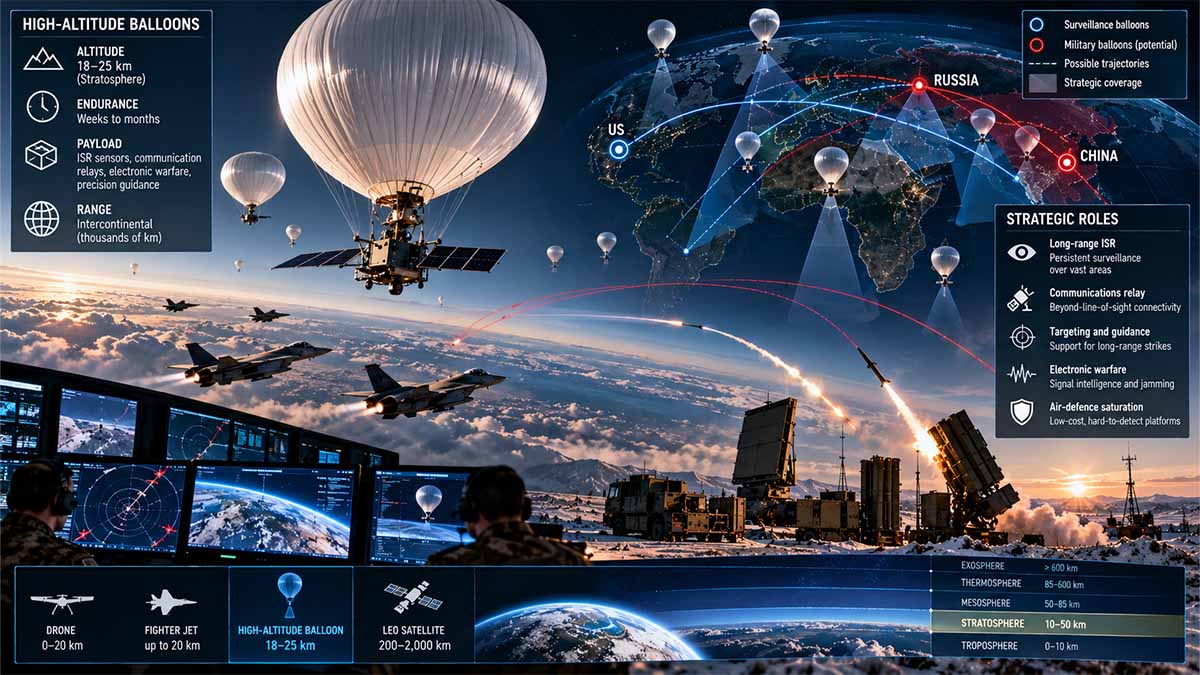
Scope: Strategic assessment of the re-emergence of military high-altitude balloons and aerostats, examining operational developments in the Ukraine–Russia conflict, United States and Chinese military programmes, European security implications, and the historical precedent of the 1849 siege of Venice, with an analytical outlook extending to 2031.
Executive Summary — Bottom Line Up Front
The re-emergence of high-altitude balloons represents a potentially consequential redistribution of military capabilities into the atmospheric layer between conventional aviation and space. Its importance lies not in the balloon itself, but in the possibility of extending operational reach while imposing disproportionate detection, classification and engagement burdens on integrated air-defence systems.
The central judgment is that stratospheric platforms are moving from experimental adjuncts toward a distributed military architecture for intelligence collection, communications extension, deception and potentially long-range effects, although available evidence does not establish that all proposed missions have achieved operational maturity.
The United States Army has documented balloon launches in Sweden and Poland during 2026, including operations at approximately 60,000–70,000 feet, while identifying surveillance, communications extension and launched effects among its programme objectives. These activities demonstrate practical deployment and experimentation, not an operationally validated constellation of hundreds of coordinated systems.
Reports of Ukrainian balloon-carried drones, including the Hornet tests in May 2026, suggest a different employment pathway: exploiting atmospheric circulation to transport weapons carriers toward distant release areas, reducing the powered-flight requirement of the attacking aircraft. However, attribution of the reported Omsk chemical-plant strike to this method remains unconfirmed.
The Chinese surveillance-balloon incident of February 2023 established that high-altitude systems can produce major sovereignty, intelligence and diplomatic consequences even without a kinetic attack. The United States Department of Defense subsequently situated the incident within a wider Chinese programme involving surveillance and communications-related technology.
The strategic challenge for defenders is not necessarily the destruction of an individual balloon, but the capacity to discriminate among harmless objects, decoys, reconnaissance platforms and weapon carriers without exhausting expensive interceptors, overwhelming command systems or introducing unacceptable risks to civilian populations.
The principal uncertainty is the distance between demonstrated individual operations and the reliable coordination, survivability, precision, persistence and affordability required for genuinely transformative stratospheric warfare.
Decision consequence: Governments and military commands should treat the lower-signature, high-altitude aerial layer as an increasingly relevant component of airspace sovereignty, strategic infrastructure protection, theatre communications resilience and integrated air and missile defence, while withholding conclusions about large-scale operational effectiveness until supported by repeatable evidence.
The Return of Balloon Warfare: Why the Stratosphere Is Becoming a New Test of Military Power
From Ukraine’s reported wind-assisted drones to America’s plans for hundreds of airborne platforms, an old technology is exposing a costly weakness in modern defence: the difficulty of distinguishing cheap aerial objects from threats worth intercepting.
The return of military balloons presents governments with a contradiction that defence procurement has yet to resolve: inexpensive atmospheric platforms may compel states to employ surveillance networks, command resources and interceptors whose costs substantially exceed those of the objects being monitored. The strategic problem is not whether balloons can defeat modern aviation, but whether they can impose enough uncertainty to change the economics of national air defence. Ukraine’s reported experiments with balloon-carried drones, China’s 2023 surveillance incursion and the United States Army’s expanding stratospheric programme point toward the same question from different directions. As NATO members increase defence spending and European governments reinforce industrial resilience, a technology associated with nineteenth-century warfare is forcing a reassessment of three assumptions: that distance provides protection, that detection produces identification, and that technological superiority guarantees an economically sustainable defensive response.
1. The real advantage is not altitude but the cost of uncertainty
Modern air defence is designed to detect, track, identify and, where necessary, engage threatening objects. Yet those functions impose different costs, and the arrival of numerous high-altitude balloons can complicate decisions long before an interceptor is launched. A balloon carrying reconnaissance equipment, a communications relay, an electronic payload or a drone may initially appear similar to a harmless atmospheric object. Its military significance depends on capabilities that may not be immediately observable.
The United States encountered this problem in February 2023, when a Chinese high-altitude surveillance balloon crossed North America. American defence authorities reported that the object was operating at approximately 60,000 feet. President Joe Biden’s administration ultimately authorised its destruction on 4 February, but the decision was influenced by the risk of debris falling over populated territory. The episode disrupted diplomatic engagement with Beijing and demonstrated that even an interceptable object could impose significant political and operational costs.
China described the balloon as a civilian meteorological platform that had deviated from its intended route. Washington rejected that explanation. The disagreement mattered because neither physical identification nor technical superiority automatically resolved attribution, intent or the appropriate exercise of sovereign authority.
The governing legal principle remains Article 1 of the 1944 Chicago Convention, recognising complete and exclusive state sovereignty over national airspace. The distinction between civilian and state aircraft remains relevant, while high altitude does not create an unrestricted right to conduct military operations over foreign territory.
The strategic imbalance begins when an inexpensive aerial object forces a government to make an expensive decision without complete information.
2. Ukraine is testing whether wind can substitute for powered endurance
Ukraine’s reported experimentation introduces a more directly operational proposition: using balloons to transport unmanned aircraft over long distances before releasing them for a subsequent powered phase. The concept separates part of the journey from the aircraft’s own propulsion requirements, potentially extending the geographical reach of drones whose conventional endurance would otherwise be insufficient.
Public reporting described May 2026 tests involving the AI-guided Hornet drone, followed by imagery of larger twin-engine aircraft associated with balloon-carriage concepts. These accounts indicate experimentation with an alternative delivery architecture, but they do not establish reliable operational performance, standardised deployment or repeatable deep-strike capability.
The reported attack on the Omsky Kauchuk chemical plant on 24 October 2026 illustrates the importance of the distinction. Omsk lies approximately 2,500 kilometres from the Ukrainian border, placing the incident far beyond the immediate land battlefield. However, the available record does not establish that balloon-assisted transport was responsible.
That uncertainty cannot be dismissed, but neither can it be converted into proof. Physical reach, successful release, target arrival and repeatable military effectiveness represent different capability thresholds. A platform that can exploit favourable winds for an exceptional long-distance journey is not necessarily capable of conducting dependable operations on a military timetable.
The historical precedent is instructive. During the Austrian siege of Venice in 1849, balloon-delivered explosive devices associated with the Uchatius system attempted to exploit atmospheric movement against the besieged city. Their limited military effectiveness contrasted with the psychological significance of an unfamiliar aerial threat.
Modern electronics have radically changed the possible payloads; atmospheric dependence remains a constraint. Ukraine’s reported innovation would become strategically consequential only if successful transportation could be converted into predictable military results.
3. Washington’s ambition has moved from experimental flights to hundreds of platforms
The United States Army has provided the clearest official evidence of systematic military experimentation. During Valiant Shield 2024, the 3rd Multi-Domain Task Force tested high-altitude balloons around Guam and the Northern Mariana Islands, employing electromagnetic sensing and communications equipment intended to contribute to maritime awareness.
The European programme subsequently expanded. On 9 May 2026, Multi-Domain Command–Europe launched experimental balloons in Sweden at approximately 60,000–70,000 feet, with flights lasting around 12 hours. Further activity during Exercise Cold Raptor in Poland tested launch procedures, remote monitoring, communications and recovery. By August 2026, the Army reported more than 50 launches over the preceding year.
Those figures demonstrate accumulated operational experience, not a deployed constellation.
Andrew Evans, the Army official responsible for strategy and transformation within military intelligence, subsequently described balloons supporting United States Central Command operations in the Middle East, reportedly including groups of approximately two dozen. The detailed mission results remain insufficiently documented for an independent assessment.
Brigadier General Steven Carpenter, commanding Multi-Domain Command–Europe, articulated a more ambitious objective in October 2026: operating 200–300 balloons simultaneously. The proposed functions include deception, communications retransmission, reconnaissance, electronic attack and the deployment of drones.
The difference between 50 cumulative experimental launches and 300 simultaneous operational platforms is decisive. The former indicates learning; the latter would require a substantially more demanding system of command, communications, logistics, payload integration and sustained availability.
More importantly, each proposed function requires separate validation. Carrying a sensor does not prove intelligence effectiveness; transmitting signals does not establish communications resilience; integrating electronic equipment does not demonstrate successful electronic attack.
Washington is developing a distributed military architecture. It has not yet publicly demonstrated that the complete architecture works at the proposed scale.
4. Defence budgets expose the gap between technological ambition and operational affordability
The economic implications arrive during a period of substantial Western defence commitments. NATO’s Hague agreement of 25 June 2025 established a target of annual defence and defence-related expenditure equivalent to 5% of GDP by 2035, including at least 3.5% for core defence requirements and up to 1.5% for wider eligible expenditure.
This commitment does not constitute an existing budget for stratospheric systems. It does, however, intensify the obligation to distinguish useful capabilities from programmes whose political visibility exceeds their measurable military return.
France’s original 2024–2030 Military Programming Law provided a €413 billion framework. Law No. 2026-791 of 16 August 2026 added a €36 billion rearmament trajectory for 2026–2030 and identified €500 million in additional upstream technological research across several priorities, including a very-high-altitude strategy. That research allocation is not exclusively devoted to balloons.
The United Kingdom’s 2025 Strategic Defence Review announced up to £1 billion in new homeland air and missile defence funding, alongside £6 billion in munitions investment and more than £1 billion for a Digital Targeting Web intended for delivery in 2027.
At EU level, Readiness 2030 envisages up to €800 billion in additional potential defence expenditure by 2030. This is a financing and investment framework, not completed expenditure or an allocation to any particular atmospheric technology.
The financial question is whether these programmes can improve defensive efficiency rather than merely increase the number of systems purchased. An expensive interceptor may be economically justified if it prevents catastrophic industrial damage. It may be wasteful if deployed against an object presenting no material threat.
The relevant comparison must therefore include total attacking-system costs, defensive surveillance and identification expenditure, successful mission rates, interceptor consumption, replenishment and the economic value of protected assets.
Without those variables, claims that inexpensive balloons can financially exhaust sophisticated air defences remain plausible arguments, not established cost-exchange calculations.
5. Europe’s vulnerability lies in industrial continuity as much as territorial defence
For European governments, the atmospheric question intersects with industrial geography. Chemical facilities, energy networks, logistics infrastructure and specialised manufacturing plants can suffer economic consequences extending well beyond physical damage. The decisive variable is often not the replacement cost of equipment but the availability of alternative production, essential services and recovery capacity.
Directive (EU) 2022/2557 on the Resilience of Critical Entities provides a regulatory framework covering eleven principal sectors, including energy, transport, health, digital infrastructure and food. It establishes risk-assessment and resilience obligations, including initial notification generally within 24 hours for qualifying incidents.
These provisions do not replace military air defence. They address the continuity of essential services when disruption occurs.
The national implications differ.
Italy’s priorities involve its Mediterranean security responsibilities, industrial infrastructure and participation in the Franco-Italian SAMP/T New Generation programme. OCCAR reported successful integrated-system firings in Italian and French configurations in December 2025, confirming programme progress without establishing balloon-specific interception performance.
France combines the same SAMP/T NG cooperation with a formally recognised very-high-altitude research priority under its August 2026 military-programming update. Its central challenge is converting sovereign aerospace and defence-industrial investment into validated capability rather than accumulating experimental programmes.
Germany’s position is shaped by continental air defence, the European Sky Shield Initiative and the importance of its industrial and logistical networks to allied operations. Its priority is connecting national infrastructure resilience with interoperable surveillance and procurement, while avoiding fragmented technical solutions.
The United Kingdom has placed particular emphasis on integrated command and decision systems, including the RAF’s GUARDIAN Air Battle Management system and NEXUS command-and-control capability. Their significance lies in improving the ability to interpret and manage heterogeneous aerial threats, although balloon-specific performance remains unverified.
NATO’s Integrated Air and Missile Defence Policy of 13 February 2025 already provides the governing military framework: continuous surveillance, layered protection, interoperable command structures and passive resilience.
The institutional risk is duplication. European governments could respond to an emerging threat by purchasing incompatible systems before establishing common requirements, while critical infrastructure operators remain insufficiently integrated into warning and continuity arrangements.
6. By 2028, the cost of inaction will fall on command systems and industrial operators
Over the next 12–24 months, the most consequential decisions will concern surveillance standards, classification procedures, interoperability tests and the allocation of research expenditure before the 2030 European defence-readiness horizon. The available record supports continued development of stratospheric sensing and communications, but not an assumption that large-scale balloon saturation or dependable balloon-assisted deep strikes have already become mature capabilities.
That distinction should govern procurement. France’s €36 billion additional programming trajectory, Britain’s announced homeland-defence investment and NATO’s 2035 expenditure commitment create financial room for adaptation, but also expose governments to substantial opportunity costs if technology acquisition proceeds without demonstrated operational requirements.
The immediate beneficiaries of better evidence would be defence ministries responsible for selecting systems, military commands responsible for identifying threats and industrial operators whose continuity depends on credible warning and recovery arrangements. The cost of inaction would fall first on these same institutions: commanders managing an increasingly ambiguous air picture, governments committing expensive defensive resources without reliable classification, and companies bearing the consequences of disruption to production and essential services.
Over the same period, the United States Army’s proposed 200–300-balloon formations and reported Ukrainian wind-assisted drone programme will provide meaningful strategic evidence only if experimentation produces documented, repeatable outcomes. Platform numbers and exceptional flight distances will remain inadequate substitutes for operational performance.
The governing choice is therefore narrower, and more consequential, than a competition to dominate the stratosphere. States must determine whether relatively inexpensive atmospheric systems can impose persistent costs on sophisticated defence architectures—and whether those architectures can adapt without making every unidentified aerial object an expensive engagement.
The financial and military advantage will belong to the side that can turn uncertain atmospheric activity into reliable operational results, or neutralise that uncertainty at sustainable cost.
Navigational Index
PILLAR I — Atmospheric Exploitation and the Reconfiguration of Operational Reach
- Chapter 1 — The Return of Military Aerostats: Historical Continuity, Technological Adaptation and the Strategic Meaning of Altitude : The historical development of balloon warfare from the Austrian siege of Venice in 1849 through modern intelligence operations; the physical characteristics of atmospheric mobility; and the renewed military importance of the space between conventional aircraft operating environments and orbital systems.
- Chapter 2 — Wind-Assisted Power Projection: Ukraine, Deep-Strike Geography and the Limits of Conventional Unmanned Aviation : The reported Ukrainian employment of balloon-carried drones, the May 2026 Hornet tests, subsequent observations involving larger aircraft, the Omsk attribution problem, and the distinction between theoretical reach, successful payload release and repeatable long-range strike capability.
- Chapter 3 — United States and Chinese Stratospheric Programmes: From Surveillance Platforms to Distributed Military Systems : The Chinese programme and 2023 continental United States incident; American Army experimentation, CENTCOM-related claims, European exercises, institutional capability development and proposed large-scale balloon employment.
PILLAR II — Air-Defence Economics, Multi-Domain Integration and Strategic Infrastructure Vulnerability
- Chapter 4 — The Saturation Problem: Detection, Classification, Interceptor Economics and Command Decision-Making : The consequences of numerous simultaneous high-altitude objects for sensor architecture, discrimination, weapons allocation, interceptor inventories, rules of engagement, civilian safety and defence resource expenditure.
- Chapter 5 — The Stratosphere as a Multi-Domain Operating Layer: ISR, Communications, Electronic Effects and Drone Deployment : The integration of high-altitude platforms into reconnaissance, communications bridging, command-and-control resilience, electronic warfare and airborne launch operations, distinguishing planned, experimentally demonstrated and combat-proven functions.
- Chapter 6 — Strategic Depth Under Pressure: Industrial Infrastructure, Chemical Facilities, Logistics and Rear-Area Protection : The implications of atmospheric transport for geographically distant industrial assets; the changing economics of strategic depth; the protection of chemical and energy infrastructure; and the distinction between potential exposure and demonstrated vulnerability.
PILLAR III — Great-Power Competition, European Security Governance and the 2031 Outlook
- Chapter 7 — Strategic Competition in the Atmospheric Domain: Military Signalling, Escalation and Airspace Sovereignty : The interaction among American, Chinese, Ukrainian and Russian approaches; intelligence competition, ambiguous aerial activity, legal authority, attribution difficulties, diplomatic signalling and escalation management.
- Chapter 8 — NATO and European Defence: Implications for Italy, France, Germany, the United Kingdom and the European Union : Separate national assessments of air surveillance, industrial resilience, alliance coordination, host-nation authorisation, defence-industrial opportunities and the future architecture of European integrated air and missile defence.
- Chapter 9 — Five-Year Strategic Outlook, Capability Thresholds and Government Decision Framework, 2027–2031 : Alternative development pathways, indicators of genuine operational maturity, technology and logistical constraints, acquisition and force-design implications, institutional options, decision thresholds and final net strategic assessment.
Master Abstract
The atmospheric layer becomes an operational variable
The renewed military interest in high-altitude balloons is best understood as an attempt to change the economic and geographic conditions under which states project military effects. Conventional long-range aircraft must sustain powered flight and navigate hostile detection and engagement environments. A balloon can instead exploit atmospheric currents for part of its movement, transporting sensors, communications equipment or other payloads without requiring the continuous propulsion of a conventional aircraft. This does not eliminate the demands of navigation, communications, power supply, precision or survivability, but it changes the distribution of those demands across the mission. As a consequence, the relevant strategic comparison is no longer simply between balloons and aircraft; it is between a relatively inexpensive atmospheric carrier and the entire sequence of systems required to detect, identify, evaluate and, when justified, neutralise it.
The distinction is critical because an airborne object does not need to be particularly destructive to impose costs. It may oblige a defending state to monitor an extended trajectory, investigate an uncertain payload, deploy surveillance or interception assets, restrict airspace and coordinate decisions among military and civilian authorities. If large numbers of objects are introduced simultaneously, those requirements could multiply even where individual balloons have limited tactical utility. The decisive question is whether defenders can distinguish genuine threats from decoys at an acceptable cost before an adversary can exploit the resulting uncertainty.
The United States Army has already incorporated this logic into its public capability architecture. Its programme description identifies micro high-altitude balloons as low-cost, low-observable platforms intended for tactical deployment, situational awareness, communications extension and launched effects. That institutional framing places balloons within a broader network of sensors, command systems and effectors rather than treating them as independent aircraft. PD Sensors Aerial Intelligence — U.S. Army Capability Program Executive, Intelligence and Spectrum Warfare — undated
From experimental launch to operational architecture
The clearest first-order evidence available for 2026 concerns American exercises. On 9 May, soldiers from Multi-Domain Command–Europe launched micro high-altitude balloons from Sweden during the Sword 26 and Aurora exercise activities. The Army reported experimental sensing and communications payloads, flight at approximately 60,000–70,000 feet and an endurance of approximately 12 hours. One flight was deliberately terminated over water following a technical issue, after which Swedish personnel assisted with recovery. The significance of the exercise was therefore both technological and institutional: it tested flight operations while demonstrating that high-altitude military activity requires airspace coordination, allied authorisation, contingency procedures and recovery arrangements. Multi-Domain Command–Europe Test Stratospheric Balloons in Baltic Exercise — U.S. Army — May 2026
Further exercises in Poland during July and August extended this practical learning into a different European operating environment. The Army’s reporting identifies the operational challenge of managing weather, launch windows, experimental equipment and coordination with aviation authorities. These activities provide evidence of a maturing experimentation process; they do not by themselves demonstrate dependable high-volume deployments, persistent electronic attack or coordinated kinetic operations. Multi-Domain Command–Europe Launches Cold Raptor Balloon Training in Poland — U.S. Army — July 2026
The reported October statements of Andrew Evans and Brigadier General Steven P. Carpenter point toward the next intended phase. Evans has been quoted describing balloons operating in support of United States Central Command, including groups of approximately two dozen, while Carpenter has articulated an ambition to place 200–300 balloons simultaneously in the stratosphere. The reported military functions extend from decoys and communications retransmission to surveillance, electronic effects and the release of unmanned aircraft. These reported statements are strategically material because they reveal a possible transition from isolated platforms to distributed systems. Nevertheless, the specific CENTCOM mission results and the projected deployment scale have not been established to the same documentary standard as the Army’s published European exercises. They must therefore be treated as attributed accounts and command ambitions, not as independently confirmed performance.
Ukraine and the erosion of geographic sanctuary
Ukraine’s reported experimentation illustrates an alternative use of atmospheric mobility: the separation of long-distance transport from the powered terminal movement of an unmanned aircraft. Under the reported concept, a balloon carries a drone along favourable atmospheric currents, with remotely commanded release or activation allowing the aircraft to operate closer to its intended destination. This could potentially extend the effective geographic reach of aircraft that would otherwise be limited by their fuel, propulsion or endurance. The reference to AI-guided Hornet testing in May 2026, followed by imagery reportedly depicting larger twin-engine drone configurations, suggests experimentation with payload characteristics and mission scale, but the public evidence available for this assessment does not prove routine operational employment or independently establish the performance of those systems.
The reported attack against chemical infrastructure at Omsk, approximately 2,500 kilometres from the Ukrainian border, is consequently significant without being conclusive. A strike at such distance raises important questions about the vulnerability of industrial installations traditionally considered remote from a land-war theatre. It does not, however, prove that balloons enabled the operation. Range alone cannot establish the launch mechanism, and a successful distant strike would not demonstrate repeatability without evidence concerning the carrier, route, release, navigation and terminal engagement. The assessment therefore separates the established strategic proposition—that atmospheric transport could change the reach of certain payloads—from the unresolved proposition that a particular strike employed that technique.
The wider governmental consequence is that industrial distance becomes a weaker measure of relative protection when alternative delivery systems can exploit conditions outside the assumptions of conventional powered-flight planning. This concern is particularly relevant to energy processing, chemical production, industrial logistics and other fixed facilities whose economic importance may exceed their capacity for local aerial defence. Whether this potential becomes a systematic threat depends on reliable arrival, identification, payload delivery and resistance to defensive countermeasures, all of which remain consequential evidentiary gaps.
Great-power competition and the institutionalisation of stratospheric operations
China’s 2023 balloon incursion provides the clearest example of how an ostensibly simple atmospheric system can have effects far beyond its physical capabilities. American authorities identified and tracked a Chinese high-altitude surveillance balloon travelling across North America before destroying it on 4 February 2023 over waters off South Carolina. The incident involved intelligence-protection measures, political decisions about the timing of interception, concern over falling debris, coordination with Canada and a significant deterioration in the diplomatic environment. It demonstrated that the consequences of atmospheric penetration must be evaluated across several dimensions: the intelligence potentially collected, the resources committed to monitoring the object, the sovereignty implications and the political decisions produced by uncertainty about its intentions.
The Chinese government characterised the object as a civilian weather balloon that had deviated from its intended course, a description rejected by the United States Department of Defense. The central intelligence question is therefore not confined to physical identification but extends to the assessment of purpose, command authority and the relationship between civilian and military aerospace activities. The 2023 incident also demonstrated that high-altitude operation does not confer immunity from interception. Rather, it can complicate the defender’s decision about whether, where and when interception is justified. DoD Statement on High-Altitude Surveillance Balloon — U.S. Department of Defense — February 2023
The competitive relationship between China and the United States is consequently not a simple contest to produce the largest number of balloons. China has demonstrated a capacity for long-distance atmospheric surveillance activity with strategic consequences, whereas the American Army’s publicly documented activities show institutional efforts to integrate high-altitude platforms into distributed land-force operations. Ukraine’s reported use of balloons as drone carriers introduces an additional operational concept concerned with extending strike geography. These approaches overlap technologically but differ in their immediate purposes, degree of documentation and demonstrated military effects. Treating them as equivalent would obscure what remains the most important assessment distinction: an observed flight, an operationally useful payload, a coordinated group of systems and a sustained combat capability are separate levels of military achievement.
Air-defence saturation and the conditions of asymmetric advantage
The possibility of simultaneously introducing numerous high-altitude objects creates a problem for integrated air and missile defence that cannot be reduced to interceptor expenditure alone. Modern defence systems must establish tracks, assess identities, determine intent, prioritise threats and assign weapons or alternative responses. Balloons may complicate this process because a similar category of aerial object can perform substantially different missions, ranging from meteorological observation to intelligence collection, deception and payload delivery. The consequence is an information burden preceding any physical engagement. Where many objects appear in overlapping periods, uncertainty about their roles may compete for the same intelligence, surveillance, command and decision-making resources needed to respond to more conventional threats.
The frequently asserted economic advantage of balloons requires qualification. A low-cost airborne platform can impose a disproportionate defensive burden if the defender must expend substantially more resources identifying or defeating it than the attacker spends operating it. Yet that relationship cannot be inferred from the cost of the balloon envelope alone. The attacking system also depends on payloads, communications, deployment arrangements, mission planning, losses and potentially recovery. Equally, defenders are not restricted to expensive missile interception; surveillance, classification, electronic measures, controlled engagement and selective non-engagement may reduce the attacker’s desired economic imbalance. The strategic advantage is therefore conditional rather than automatic.
A distributed stratospheric constellation would become genuinely consequential if it could sustain enough operationally relevant systems to create uncertainty, preserve useful sensing or communications functions despite losses, and support other military assets while remaining affordable to replenish. At present, publicly documented American exercises validate selected elements of that architecture but not its full battlefield performance. The directional change remains important because military organisations are increasingly treating atmospheric systems as components of their wider force structure rather than as exceptional surveillance devices.
Historical continuity and psychological effects
The Austrian use of balloon-delivered explosive devices during the siege of Venice in 1849 provides a historically grounded illustration of the relationship between atmospheric uncertainty and military effect. The Austrian Museum of Military History preserves surviving examples of the Uchatius balloon bombs used during the siege, establishing that airborne weapons employing the movement of the atmosphere were attempted long before powered military aviation. The limited physical effectiveness attributed to those operations did not prevent them from becoming part of the broader psychological experience of siege warfare. Wind-dependent delivery produced uncertain outcomes, but its unpredictability also contributed to the perception that dangers could arrive from a direction not readily controlled by the defenders. Austrian Naval Power — Museum of Military History, Vienna — undated
The analogy with contemporary conflict should not be overstated. Modern aerostats can carry electronic sensors, communications equipment and digitally controlled payloads unavailable to nineteenth-century forces. Nevertheless, the structural continuity is significant. Atmospheric movement offers relatively inexpensive access beyond familiar lines of contact, while uncertainty about arrival, timing and purpose can influence civilian and military behaviour independently of the eventual physical damage. This psychological mechanism is particularly relevant to distant industrial centres, where the mere demonstration that a potential threat can traverse large distances may change expectations about security, continuity of production and the allocation of defensive resources. The historical lesson is not that balloons inevitably constitute effective weapons; it is that relatively modest physical capabilities can generate effects disproportionate to their direct destructive power when they challenge established assumptions about geographic protection.
Implications for defence governance and European strategic autonomy
The European implications extend beyond military technology acquisition. France, Germany, Italy and the United Kingdom face a common strategic question concerning the protection of national territory and critical infrastructure against aerial objects that may not fit conventional aircraft or ballistic-missile threat categories. Their institutional responsibilities and defence structures differ, however, and the evidence available does not support treating them as interchangeable.
For Germany, the location of United States Multi-Domain Command–Europe and the organisation’s involvement in European experimentation create a direct connection between American capability development and the continent’s evolving military command architecture. France must evaluate the issue through its national air-defence, strategic-force protection and aerospace-industrial responsibilities, while the United Kingdom’s relevant exposure lies in national airspace surveillance, maritime and expeditionary operations, and the resilience of intelligence and communications systems supporting allied activity. Italy’s strategic interests concern the protection of industrial and energy infrastructure, military installations, air and maritime approaches and its participation in NATO’s integrated defensive arrangements. These are analytical areas for government consideration, not evidence that each country has already adopted dedicated high-altitude balloon programmes.
The European Union adds an industrial and regulatory dimension, particularly where cross-border surveillance, critical infrastructure protection, dual-use aerospace technology and civil aviation safety intersect with national military authority. NATO remains central to common operational planning and collective defence, but alliance interoperability does not eliminate the need for individual governments to approve activities in their airspace. The Swedish and Polish exercises in 2026 demonstrate this distinction in practice: operational experimentation required host-nation coordination, compatible procedures and arrangements for managing unexpected flight outcomes.
The five-year outlook to 2031 therefore depends less on whether balloons continue to appear in military exercises than on whether their users can demonstrate scalable employment, repeatable payload performance, reliable command links, acceptable attrition and integration into existing defence networks. The most consequential change would be the emergence of sustained, distributed systems capable of performing sensing, communications and selected effects at a cost and tempo that existing defences cannot efficiently match. Conversely, persistent problems with meteorological predictability, payload performance, recovery, communications security or classification by defenders could restrict these systems to specialised missions without fundamentally changing the balance of long-range military power.
The present assessment supports a meaningful shift toward systematic exploitation of the high-altitude atmospheric environment, with greater confidence in the expansion of experimentation and operational concepts than in claims of transformative combat effectiveness. Governments should therefore distinguish the urgency of understanding this emerging operational layer from the temptation to assume that every proposed capability is already available at military scale.
Key Evidence Table
The following table distinguishes documented official activity, attributed operational claims, announced ambitions and analytical propositions whose performance has not yet been established.
| Indicator | Value/status | Reference date | Definition/scope | Issuer | Exact source |
|---|---|---|---|---|---|
| Chinese surveillance-balloon incident | Intercepted by the United States after crossing North America | 4 Feb 2023 | Documented high-altitude incursion; disputed original purpose | U.S. Department of Defense | DoD release, February 2023 |
| Austrian balloon warfare | Surviving Uchatius balloon bombs from the siege of Venice | 1849 | Historical evidence of balloon-delivered munitions | Austrian Museum of Military History | Austrian Naval Power |
| U.S. micro-HAB programme | Low-cost, low-observable systems intended for sensing, communications extension and launched effects | Current programme description | Institutional capability objectives, not certification of all proposed effects | U.S. Army CPE ISW | PD Sensors Aerial Intelligence |
| Swedish stratospheric exercise | Approximately 60,000–70,000 feet; 12-hour flights | 9 May 2026 | Experimental sensing and communications payloads | U.S. Army | Baltic Exercise, May 2026 |
| European deployment experience | More than 50 launches reported over the preceding year | 18 Aug 2026 | Unit-level experimentation, not simultaneous constellation strength | U.S. Army | Inside Exercise Cold Raptor, August 2026 |
| Decentralised command operations | Launch and remote flight-management teams separated during testing | July–Aug 2026 | Experimental command-and-control procedure | U.S. Army | Inside Exercise Cold Raptor, August 2026 |
| Carpenter’s proposed constellation | 200–300 balloons simultaneously | Reported Oct 2026 | Command ambition; not demonstrated deployment strength | Attributed to BG Steven P. Carpenter | Exact primary transcript not located |
| Evans’s CENTCOM account | Groups of approximately 24; mission reportedly completed | Reported Oct 2026 | Attributed operational claim; mission outcomes not independently established | Attributed to Andrew Evans | Exact primary operational record not located |
| Ukrainian Hornet balloon tests | Reported tests in May 2026 | May 2026 | Reported drone-carrier experimentation | Ukrainian activity reported in public material | No qualifying official test record established |
| Omsk chemical infrastructure | Approximately 2,500 km from the Ukrainian border | Oct 2026 | Reported attack and approximate distance supplied in the assessment topic | Attribution unresolved | Balloon involvement not verified |
The most important quantitative distinction is between the American Army’s documented cumulative launches and the much larger number proposed for simultaneous use. More than 50 experimental launches over a year cannot establish the ability to control 200 or 300 balloons concurrently. Similarly, an estimated distance to an industrial target cannot serve as evidence of the delivery method used to reach it.
Competing Explanations and Strategic Pathways
The available record supports three overlapping development pathways, rather than three mutually exclusive hypotheses about a single event. Their comparative standing is qualitative; no numerical likelihoods are assigned.
| Strategic pathway | Diagnostic support | Evidence against premature conclusions | Decisive indicators | Current standing |
|---|---|---|---|---|
| Distributed intelligence and communications architecture | Documented sensing and communications experiments; decentralised command testing; formal Army programme objectives | No public proof of sustained theatre-wide coverage under hostile interference | Persistent multi-platform operations; validated network continuity; successful allied integration | Most strongly supported development pathway |
| Low-cost saturation and defensive resource exhaustion | Proposed high-volume deployment; decoy employment concepts; potential classification and engagement burdens | No verified large-scale combat experiment establishing net cost advantage | Simultaneous deployment numbers; defensive engagement results; documented replacement and operating costs | Plausible but not demonstrated at proposed scale |
| Long-range payload delivery and electronic attack | Reported Ukrainian carrier tests; formal U.S. interest in launched effects and electronic operations | No verified repeatable Omsk-type balloon strike or sustained electronic-attack performance | Independently documented payload releases; repeatable delivery; measurable electronic effects | Emerging concept with significant evidence gaps |
These pathways can reinforce one another. A network designed primarily for reconnaissance might also complicate defensive identification, while a balloon carrier designed for payload delivery could potentially contribute to deception or communications activity. That convergence is precisely what makes the atmospheric layer relevant to multi-domain operations: platforms that are inexpensive or operationally limited when considered individually could impose greater defensive and organisational demands when combined with other systems.
The opposing possibility must receive equal analytical attention. If atmospheric dependence prevents timely arrival, payload limitations reduce mission value or defenders develop inexpensive and reliable identification methods, the supposed cost advantage could narrow substantially. Consequently, the movement from experiments to sustained operational employment, rather than the announcement of progressively larger intended formations, remains the decisive test.
Principal Gaps and Watch Indicators
Priority evidence requirements for government and defence assessment, 2027–2031
| Consequential gap | Required official record or observation | Strategic decision relevance |
|---|---|---|
| Ukrainian balloon-carried drone employment | Authenticated test documentation, official operational statement or independently established physical evidence | Distinguishes reported experimentation from demonstrated combat capability |
| Omsk attack attribution | Competent investigative findings, verified debris evidence or an attributable operational account | Prevents a distant strike from being incorrectly credited to an unproven delivery architecture |
| CENTCOM mission performance | U.S. Army or CENTCOM after-action documentation | Clarifies whether successful operation means flight completion, useful intelligence collection or a validated military effect |
| Large-scale balloon coordination | Official evidence of simultaneous multi-platform employment under representative conditions | Establishes whether a proposed constellation is technologically and organisationally feasible |
| Electronic-attack effectiveness | Instrumented test results identifying actual effects and operational limitations | Separates payload integration from effective electronic warfare |
| Interceptor and surveillance cost-exchange | Comparable official data on detection, engagement, replenishment and platform cost | Determines whether the apparent economic asymmetry survives full-system comparison |
| Meteorological reliability | Repeated mission outcomes covering different weather conditions and required arrival windows | Establishes predictability, operational availability and resilience |
| European command and regulatory integration | National and NATO exercise records, airspace coordination procedures and formal capability requirements | Identifies interoperability, governance and infrastructure-protection requirements |
The highest-priority collection requirement is not further confirmation that balloons can reach the stratosphere. Official evidence already establishes that proposition. The intelligence requirement is to determine whether large formations can deliver reliable military value, remain connected to command structures, survive or compensate for attrition, and impose a measurable disadvantage on opposing defences.
For national governments, the corresponding decision threshold is evidence that high-altitude platforms can materially alter either the probability of hostile penetration or the total defensive resources required to preserve critical infrastructure and military operations. Without such evidence, substantial procurement or doctrine changes based solely on projected swarm sizes would risk confusing military ambition with operational necessity.
For NATO and European governments, additional attention is warranted where balloons cross national airspace, support allied operations from foreign territory, create recovery obligations or introduce uncertainty into existing surveillance and defensive engagement procedures. These are present governance considerations even before a mature hostile stratospheric strike capability is demonstrated.
The historical and current evidence points toward a consistent strategic proposition: exploiting atmospheric circulation is not inherently new, but its integration with modern unmanned systems, electronic payloads and distributed command networks could alter the relationship between operational distance, military cost and defensive burden. Whether this becomes a fundamental change in warfare will be determined by evidence of scale, repeatability and survivability rather than by the novelty of individual demonstrations.
THE STRATOSPHERIC BATTLESPACE
How high-altitude balloons could transform operational reach, intelligence collection, air-defence economics and long-range strategic competition.
Operational Evidence and Scale
Different measures are deliberately kept separate. Experimental flights, accumulated launches, proposed constellation size and reported strike distance are not interchangeable indicators of readiness.
From Atmospheric Mobility to Strategic Burden
The mechanism is conditional: atmospheric transport can reduce the powered-flight requirement, but useful military effects still depend on suitable weather, navigation, payload operation and command integration.
Atmospheric Transport
High-altitude currents provide movement without continuous conventional aircraft propulsion.
Extended Operating Geography
Sensors, relays or carried payloads may operate at distances otherwise constrained by powered-flight endurance.
Defensive Uncertainty
Defenders must classify objects, determine intent and decide whether engagement is required.
Strategic Consequences
Potential increased surveillance demand, defensive expenditure and exposure of distant infrastructure.
The Balloon as a Distributed Military Node
Conceptual architecture based on publicly described military employment objectives. Connections show functional relationships, not proven simultaneous capabilities or an operational flight configuration.
Demonstrated, Reported and Unresolved
This is a categorical evidence-status graphic, not a quantitative readiness score.
U.S. Army European Exercises
Balloon flights in Sweden and Poland, experimental payload integration, launch operations and associated command procedures have official Army documentation.
Demonstrates experimentation and practical flight operations, not universal mission readiness.Large Formations and CENTCOM Use
Statements attributed to Andrew Evans describe CENTCOM employment, while Steven Carpenter’s reported 200–300-balloon objective describes a prospective scale.
Primary operational details and formation performance require corroboration.Repeatable Deep Strike
Reported Ukrainian balloon-carried drone experiments have not established that the Omsk attack used this method or that such strikes are repeatable at scale.
Range, successful release, terminal accuracy and combat attribution are separate questions.Historical and Contemporary Reference Points
| Date | Actor / Location | Event or claim | Evidence status | Strategic meaning |
|---|---|---|---|---|
| 1849 | Austria / Venice | Balloon-carried incendiary or explosive weapons used during the siege. | HISTORICALLY DOCUMENTED | Early example of atmospheric delivery and psychological signalling. |
| Feb 2023 | China / United States | Chinese high-altitude balloon tracked and intercepted over the United States. | OFFICIALLY DOCUMENTED | Surveillance, sovereignty, intelligence and escalation questions. |
| May 2026 | U.S. Army / Sweden | Stratospheric flights with experimental sensing and communications payloads. | OFFICIALLY DOCUMENTED | Practical flight, payload and host-nation coordination experience. |
| May 2026 | Ukraine | Reported tests of AI-guided Hornet drones carried by balloons. | REPORTED / NOT PRIMARY-VERIFIED | Potential separation of long-distance atmospheric transport and powered flight. |
| Jul–Aug 2026 | U.S. Army / Poland | Cold Raptor experimentation and decentralised balloon operations. | OFFICIALLY DOCUMENTED | Command integration, logistics and multinational exercise experience. |
| Reported Oct 2026 | U.S. Army / CENTCOM | Attributed account of operations involving groups of approximately 24 balloons. | ATTRIBUTED CLAIM | Possible transition toward multi-platform operational employment. |
| Reported Oct 2026 | U.S. Army / Europe | Reported ambition to operate 200–300 balloons simultaneously. | PROPOSED SCALE | Potential high-volume sensing, deception and defensive saturation. |
| Oct 2026 | Russia / Omsk | Reported chemical-facility strike. Balloon-based delivery remains unconfirmed. | ATTRIBUTION UNRESOLVED | Raises questions about the protection of geographically distant industry. |
The Four Structural Trade-Offs
Economic and operational effects are conditional. No numerical cost ratio or defensive performance score can be substantiated from the current record.
01 / Mobility and Predictability
Atmospheric transport reduces the need for continuous propulsion, but does not guarantee timely arrival or useful payload delivery.
02 / Platform Cost and System Cost
Carriers may be inexpensive, but payloads, control, launch, attrition and recovery determine the full attacking-system cost.
03 / Saturation and Discrimination
Numerous uncertain objects can increase surveillance and decision demands, while effective classification can prevent unnecessary defensive expenditure.
04 / Strategic Reach and Reliability
An expanded theoretical operating area does not itself demonstrate dependable penetration, accurate strikes or sustained electronic effects.
Decision-Relevant Indicators
| Assessment question | Required evidence | Institutional implication |
|---|---|---|
| Can balloons operate reliably in large formations? | Documented simultaneous deployments, mission completion and control continuity. | Reassess integrated air surveillance and high-volume threat handling. |
| Can carried drones perform repeatable deep strikes? | Authenticated releases, arrival results, target attribution and repeated outcomes. | Review assumptions about strategic depth and industrial infrastructure protection. |
| Can stratospheric relays sustain useful connectivity? | Validated network performance and continuity under representative conditions. | Consider integration with resilient multi-domain communications architectures. |
| Do they impose a favourable cost exchange? | Comparable full-system attacking costs, defensive costs and mission outcomes. | Test procurement and defensive allocation assumptions. |
| Can European states coordinate military balloon operations? | Exercise authorisations, aviation procedures, recovery plans and allied command records. | Clarify national and NATO responsibilities for shared airspace and force protection. |
The critical shift is from individual balloons to distributed atmospheric systems.
High-altitude balloons could become strategically significant where atmospheric transport, distributed sensing and communications, payload flexibility and scalable operations create effects that outweigh total system costs. Their strongest currently documented contribution is to military experimentation and emerging operational concepts. Claims of sustained saturation, reliable long-range strike and decisive cost-exchange advantage still require direct evidence.
The immediate governmental priority is to strengthen the evidence base, understand the consequences for airspace control and critical infrastructure, and identify the threshold at which a developing capability warrants material changes to defence planning.
Official Source Record
The links below support the documentary baseline. Reported October operational claims and Ukrainian strike attribution remain qualified where an authoritative primary record was not established.
- U.S. Army — PD Sensors Aerial Intelligence: Programme objectives and high-altitude systems
- U.S. Army — Multi-Domain Command–Europe Tests Stratospheric Balloons in Baltic Exercise, May 2026
- U.S. Army — Cold Raptor Balloon Training in Poland, July 2026
- U.S. Army — Learning with Every Launch: Inside Exercise Cold Raptor, August 2026
- U.S. Department of Defense — Statement on High-Altitude Surveillance Balloon, February 2023
- Austrian Museum of Military History — Austrian Naval Power, historical material on Venice
PILLAR I — ATMOSPHERIC EXPLOITATION AND THE RECONFIGURATION OF OPERATIONAL REACH
Chapter 1 — The Return of Military Aerostats: Historical Continuity, Technological Adaptation and the Strategic Meaning of Altitude
The atmospheric domain as a neglected dimension of strategic power
The return of high-altitude balloons to military planning reflects a structural change in the relationship between operational geography, technological sophistication and the cost of projecting military capabilities over long distances. The relevant development is not the rediscovery of an obsolete flying machine, but the growing recognition that atmospheric circulation can be exploited as a form of mobility, allowing relatively simple airborne carriers to complement conventional aircraft, remotely piloted systems and satellites in missions involving surveillance, communications, military deception and, potentially, the delivery of other unmanned platforms. For defence institutions, the significance of this development derives from a longstanding asymmetry between the resources required to place an object into a strategically relevant area and those required to identify, monitor and, where necessary, intercept it. An airborne system that lacks the speed, manoeuvrability and independent navigation of a powered aircraft may nevertheless acquire military value if it can remain sufficiently useful during flight, carry an operationally relevant payload, exploit atmospheric movement and impose a disproportionate burden on the defensive infrastructure responsible for protecting national airspace.
The contemporary debate has been sharpened by three developments of different evidentiary standing: China’s high-altitude surveillance operations, brought into international focus by the interception of a Chinese balloon over the United States in February 2023; the United States Army’s progressively documented experimentation with stratospheric platforms in the Indo-Pacific and Europe between 2024 and 2026; and reports that Ukraine has tested balloons carrying unmanned attack aircraft as an alternative means of extending operational reach against Russian territory. These developments must not be treated as equivalent demonstrations of a single mature capability. The Chinese incident demonstrated long-distance atmospheric penetration and generated an exceptional diplomatic and security response; the American exercises established practical experience with experimental sensing, communications and distributed command functions; and the reported Ukrainian activity suggests an innovative employment concept whose operational reliability remains uncertain. Their common implication, however, is that the atmosphere itself is becoming an increasingly deliberate variable in the design of military operations, rather than merely an environmental condition through which aircraft must pass.
An adequate strategic assessment must therefore distinguish the ability of a balloon to travel from the ability of the military system supporting it to achieve an assigned result. The physical movement of a lighter-than-air platform is only one component of operational success. Reconnaissance also requires relevant sensor performance, useful observations and the capacity to deliver information to decision-makers; communications support requires continuity and compatibility with existing networks; electronic warfare requires measurable effects against specific electromagnetic functions; and offensive payload delivery requires the carried system to reach an appropriate operating area and perform its mission after release. The presence of a balloon in the stratosphere is consequently evidence of atmospheric access, not automatically evidence of operational control, strategic persistence or combat effectiveness. This distinction is particularly important because the same simplicity that creates the potential economic appeal of balloons can also produce limitations in navigation, power availability, payload capacity, weather tolerance and recoverability.
The United States Army’s public programme architecture illustrates the institutional significance of this transition. The Army’s Program Executive Office for Intelligence and Spectrum Warfare identifies micro high-altitude balloons among the technologies intended to provide aerial intelligence and operational support, including sensing, communications extension and launched effects. This official characterisation places balloons within a broader intelligence and force-integration framework rather than categorising them as an isolated branch of military aviation. It is also significant that the functions described are not confined to intelligence collection: they concern the relationship between observing the operational environment, maintaining communications across extended distances and enabling other systems to generate military effects. The strategic importance of the balloon therefore depends increasingly on what it contributes to the wider force, rather than on the independent performance of the carrier itself. PD Sensors Aerial Intelligence — U.S. Army Capability Program Executive, Intelligence and Spectrum Warfare — undated.
Venice, 1849: the historical origins of wind-dependent aerial bombardment
The Austrian siege of Venice in 1849 constitutes an important historical precedent because it illustrates the earliest tension between the theoretical reach provided by atmospheric mobility and the practical uncertainty associated with using wind-driven objects as weapons. During the final phase of the conflict, Austrian forces employed balloon-delivered explosive devices associated with the Uchatius system, attempting to introduce an aerial dimension into siege operations against a city whose defence depended on geographical, military and logistical circumstances fundamentally different from those encountered in modern warfare. The historical use of these weapons is supported by the Austrian Museum of Military History in Vienna, which identifies the surviving Uchatius balloon bombs from the siege of Venice among the objects in its Austrian naval-history exhibition. The museum’s record establishes the material existence and military use of these devices, although it does not itself provide a complete quantitative reconstruction of the number launched, the number reaching intended areas or the resulting casualties and damage. Austrian Naval Power — Austrian Museum of Military History — undated.
The operational logic of the Austrian experiment was conceptually significant. Balloon-carried weapons offered a possible method of moving an explosive payload over obstacles that complicated conventional surface-based delivery, exploiting air movement rather than relying on a powered flying vehicle that did not yet exist. In principle, this introduced a means of threatening locations whose immediate accessibility was constrained by the existing geometry of siege warfare. In practice, however, the attacking force could not exercise precise control over the atmospheric conditions governing the flight, and the absence of reliable terminal navigation sharply limited the correspondence between the intended target and the actual place of arrival. The historical operation therefore provides an early example of a military technology whose theoretical geographic reach was not matched by dependable targeting. Its significance lies less in the destruction achieved than in the demonstration that atmospheric mobility could create a new avenue of military approach while simultaneously transferring a substantial part of operational control to an environmental variable.
Venice also illustrates the distinction between material effectiveness and psychological consequence. A population already suffering under siege conditions, including the effects of deprivation and disease, could experience the prospect of aerial attack as an additional manifestation of insecurity even when the weapons themselves produced little measurable military damage. The psychological mechanism was not dependent upon the precision or destructive power of every individual balloon. Rather, it arose from uncertainty regarding the arrival of weapons from an unfamiliar direction and from the inability of ordinary defensive arrangements to offer an immediately comprehensible response. That interpretation is analytically relevant to contemporary conflicts, although the available museum documentation is insufficient to quantify the particular psychological effects of the Austrian attacks. Claims concerning the precise scale of those effects should therefore remain subordinate to what the surviving historical evidence establishes.
The comparison with modern stratospheric systems should be developed through continuity of operational problems rather than superficial similarity of equipment. Nineteenth-century balloon weapons faced substantial uncertainty over atmospheric trajectory and payload arrival; contemporary systems can incorporate electronic navigation, remote communications and autonomous functions, but they remain affected by the relationship between environmental movement and mission requirements. Modern technology may improve the ability to observe, adapt to or exploit that movement without necessarily granting the direct navigational freedom of a powered aircraft. The persistent strategic question is whether a military force can convert a transport method largely dependent on the atmosphere into an operationally useful and sufficiently predictable sequence of events. The invention of advanced payloads changes what can be accomplished after arrival; it does not eliminate the need to reach a useful location.
There is a second historical continuity of greater importance for national-security decision-makers. Both the Venetian precedent and contemporary high-altitude operations challenge assumptions about the direction from which danger can originate. In a conventional siege, threats are often associated with the location and range of identifiable attacking forces. A wind-driven aerial carrier introduces a different geometry, in which the immediate line separating attacker and defender is less directly related to the path travelled by the payload. In a modern context, this means that the effective distance between a launching force and an intended operating area may depend partly on atmospheric transport, available release opportunities and downstream payload capabilities. The resulting uncertainty can affect defensive dispositions and governmental perceptions of security before a new system has demonstrated decisive battlefield effectiveness.
The physical economy of altitude: mobility without continuous conventional propulsion
The most consequential physical characteristic of a high-altitude balloon is its ability to derive lift from buoyancy while being transported horizontally by surrounding atmospheric movement. Unlike conventional powered aircraft, which rely on an aerodynamic flight regime and propulsion arrangements appropriate to their design, a balloon obtains its basic airborne condition through the density relationship between its lifting gas, envelope and surrounding atmosphere. Horizontal displacement can then be provided by prevailing winds. This changes the sources of energy needed for flight and introduces a potential economic advantage, but it also creates dependence on environmental conditions that the operator cannot command. The distinction between free-flying balloons, tethered aerostats and systems possessing additional means of directional control is essential: they do not share identical mobility, endurance, basing or recovery characteristics, and conclusions applicable to one category cannot automatically be extended to another.
At high altitude, lower atmospheric density, variations in temperature and wind structure, and changing environmental conditions influence the useful carrying capacity and behaviour of balloon systems. The expression stratospheric platform therefore describes an operating environment rather than a guarantee of uniform capability. Flight altitude may improve certain observation or communications geometries, but it does not automatically establish that a platform will remain above a particular location, maintain continuous visibility of an intended target or preserve an uninterrupted connection to supporting military networks. The relationship between altitude and mission usefulness is mediated by payload characteristics, line of sight, atmospheric conditions, available power, communications architecture and the movement of the carrier itself. These constraints are particularly relevant when evaluating proposals for persistent intelligence collection or electronic attack, because a platform passing through an operating area and one capable of maintaining useful coverage over that area may produce very different military outcomes.
For long-range transport, the possible advantage lies in the separation of horizontal displacement from the continuous propulsion requirement that characterises many conventional unmanned aircraft. A payload transported by balloon may conserve some of the energy that would otherwise be needed for the entire journey, potentially allowing the carried device to perform a more specialised mission after release. This mechanism should not, however, be confused with the creation of an unrestricted range capability. The transport platform must encounter sufficiently favourable atmospheric conditions, the payload must remain functional throughout carriage, release must occur within a useful operating context and the subsequent mission must still satisfy its own navigation and performance constraints. A long-distance atmospheric journey that does not culminate in useful sensing, communications or another intended military result may demonstrate physical reach without delivering operational value.
The implications extend beyond transport efficiency. High-altitude balloon operations can potentially influence how military planners understand endurance, force dispersion and the distribution of sensing resources. A conventional aircraft may offer comparatively direct manoeuvring and controlled return but require greater propulsion and operational support. A balloon may offer a different balance, in which inexpensive or expendable atmospheric presence is exchanged for reduced flexibility and more complicated mission timing. Neither arrangement is inherently superior. The relevant comparison depends on the assigned mission, the time sensitivity of the desired effect, the density of opposing defences, the availability of supporting communications and the cost of losing the platform or its payload.
The American Army’s European exercises illustrate both the attraction and the difficulty of this operating environment. During launches from Sweden on 9 May 2026, the United States Army reported balloon operations between approximately 60,000 and 70,000 feet, corresponding to about 18,300–21,300 metres, with experimental sensing and communications payloads remaining airborne for approximately 12 hours. One of the documented flights encountered a technical problem and was deliberately terminated over water, with recovery arrangements requiring cooperation from Swedish personnel. These observations are important because they demonstrate that the operational burden of a balloon mission extends well beyond the initial launch and includes communications monitoring, airspace management, contingencies, recovery and host-nation coordination. Multi-Domain Command–Europe Test Stratospheric Balloons in Baltic Exercise — U.S. Army — May 2026.
Table 1.1 — The physical and operational distinctions that determine military value
| Analytical dimension | Free-flying high-altitude balloon | Tethered aerostat | Powered unmanned aircraft | Strategic consequence |
|---|---|---|---|---|
| Primary means of remaining airborne | Buoyant lift | Buoyant lift with a physical tether | Aerodynamic lift or powered flight, according to design | Different energy, infrastructure and operating constraints |
| Horizontal mobility | Primarily atmospheric transport; controllability depends on configuration | Restricted by tether and installation geometry | Controlled through the aircraft’s propulsion and flight-control systems | Distinguishes broad atmospheric reach from precise manoeuvrability |
| Geographic persistence | Depends on winds and any available control capability | Can remain associated with a fixed operating area, subject to operating limits | Depends on aircraft performance and mission support | Determines whether a platform can provide sustained coverage |
| Basing requirements | Launch arrangements, airspace access and possible recovery | Fixed or deployable ground installation and tether management | Launch, recovery or landing facilities according to platform | Changes infrastructure and logistical demands |
| Payload utility | Mission-dependent sensing, communications or carried systems | Mission-dependent observation and communications | Mission-dependent surveillance, communications or effects | Carrier characteristics do not prove payload performance |
| Weather sensitivity | Significant influence on trajectory and mission timing | Significant influence on safe operation and availability | Weather affects performance within aircraft-specific limits | Environmental availability must be assessed separately |
| Recoverability | Dependent on design, flight trajectory and operational arrangements | Associated with ground-based recovery arrangements | Dependent on aircraft configuration and mission outcome | Changes replacement costs and operational sustainability |
| Principal analytical limitation | Reaching a useful location at a useful time | Restricted mobility and exposure of supporting installation | Propulsion, endurance, detectability and support requirements | No platform class is universally optimal |
Interpretation: This is a qualitative comparison of operating principles, not a performance ranking. It does not imply that all balloon systems possess the same control capabilities or that all unmanned aircraft share identical endurance characteristics.
Between conventional aviation and orbit: the strategic meaning of the atmospheric layer
High-altitude balloon systems occupy a distinctive position in the wider architecture of intelligence collection and military communications because they can operate in a region of the atmosphere that is accessible to some specialised aircraft but is separate from orbital systems. That position creates opportunities for complementarity rather than an automatic substitution for either aircraft or satellites. A satellite provides coverage governed by its orbital characteristics, sensor geometry and communications arrangements; an aircraft offers varying degrees of manoeuvrability and mission control; a balloon provides a different combination of buoyant endurance, atmospheric movement and potential payload carriage. The utility of each depends on whether its physical characteristics correspond to the spatial and temporal demands of the mission.
The military attraction of an additional operating layer is especially apparent when considering resilience. A command system relying on a limited set of sensing or communications assets can encounter difficulties if those assets are disrupted, unavailable or unable to provide the required coverage at a particular moment. Additional airborne relays or sensors may provide alternative pathways through which information can move, but resilience depends on the independence and compatibility of those pathways rather than on the mere addition of platforms. Hundreds of balloons connected to the same vulnerable communications arrangement would not necessarily create a robust distributed network. Conversely, a smaller number of appropriately integrated systems might contribute meaningful redundancy if they perform useful functions when other assets are unavailable. The value of atmospheric distribution therefore depends on network design, operational integration and the quality of information exchanged, all of which require specific evidence beyond platform counts.
This issue is directly connected to the growing military emphasis on multi-domain operations. Information obtained by one platform may need to be transmitted to another, incorporated into command decisions and made available to forces operating at considerable distance from the sensor. The usefulness of an atmospheric node therefore emerges from its contribution to an information chain. An isolated balloon equipped with a functioning sensor is not equivalent to an integrated intelligence system; a communications relay is not operationally useful merely because it can transmit a signal; and an airborne launch platform is not an effective weapon system simply because it can release an aircraft. Each function acquires military significance when it produces information, connectivity or effects that can be exploited by other elements of the force within the relevant decision period.
The American experience in the Indo-Pacific offers an earlier documented foundation for this concept. In June 2024, the United States Army Pacific announced high-altitude balloon training around Guam and the Northern Mariana Islands during Valiant Shield 2024, with the 3rd Multi-Domain Task Force and the Office of the Under Secretary of Defense involved in the activity. The Army stated that balloons would operate above 50,000 feet and carry electromagnetic-spectrum sensors and radio networking equipment intended to support maritime domain awareness. The announced launch arrangements involved Won Pat International Airport and coordination with local authorities, the Federal Aviation Administration and relevant military organisations. Subsequent Army reporting confirmed that the balloons were launched during the exercise and that their attached sensing capabilities were included in broader military experimentation. US Army to Launch High Altitude Balloons — U.S. Army Pacific — June 2024; 3d MDTF Demonstrates Ability to Operate in the Indo-Pacific — U.S. Army — June 2024.
The Indo-Pacific setting also provides an important conceptual distinction between distance and coverage. Large maritime operating areas create demands for sensing and communications across geographically dispersed forces, but the usefulness of an airborne platform depends on where it travels relative to those forces and the areas being observed. The same balloon that offers an advantageous communications position under one set of atmospheric conditions might move away from that position under another. Thus, the military value of atmospheric transport is partly a problem of matching environmental opportunity with operational requirements. It is not sufficient to demonstrate that a platform can cross a large region; its trajectory must also contribute to an operational need that exists at the time and location of the flight.
The institutional consequences are substantial. Military organisations considering atmospheric systems must determine whether the principal requirement is persistent sensing, broad-area communications, electronic monitoring, low-cost deception or the delivery of another platform. These missions differ not only in technical requirements but also in the authorities, personnel, command relationships and recovery arrangements needed to support them. A capability designed for extended observation may be constrained by the need to maintain useful coverage; a disposable decoy may tolerate large positional uncertainty; a communications platform may require more dependable network connectivity; and a carrier intended to deliver a weapon introduces additional requirements concerning operational control and mission effectiveness. The common carrier does not eliminate the differences between these military functions.
The strategic importance of altitude cannot be reduced to survivability
The expression low signature requires particular care when applied to balloons. It may refer to characteristics of particular systems or payload configurations, but it cannot be assumed that altitude alone makes an object difficult to detect or engage. Large balloons may be observable using suitable sensors, and the Chinese incident in 2023 demonstrated that a high-altitude object can be tracked and intercepted by a state possessing the necessary capabilities and political authority. Equally, the ability to detect an object does not resolve the separate problem of determining its purpose, evaluating the threat it presents or selecting an appropriate response. For integrated air defence, the distinction between detection, classification, identification and engagement remains decisive.
The United States Department of Defense stated on 3 February 2023 that the Chinese balloon being tracked over North America was operating at approximately 60,000 feet, and explained that the decision not to destroy it immediately reflected concern about the consequences of falling debris over populated areas. That episode demonstrates why the military response to a high-altitude object cannot be assessed solely through the range and performance of available weapons. The state must also consider where an interception can safely occur, whether the object poses an immediate threat, what intelligence may be obtained from monitoring it and how the decision will affect diplomatic relations. General Says Chinese Surveillance Balloon Now Over Center of U.S. — U.S. Department of Defense — February 2023.
The relevant vulnerability for the defender is therefore partly institutional. A platform that can be destroyed may still impose surveillance demands, compel coordination among agencies and create uncertainty concerning the appropriate legal and military response. In peacetime or an ambiguous security environment, these difficulties may be more significant than the actual interception problem. During armed conflict, the arrival of multiple objects with different possible functions could further complicate decisions about the allocation of defensive attention, particularly where commanders must preserve the capacity to respond to other threats. These implications follow from the interaction between uncertain aerial activity and defensive decision-making, but the scale of any additional resource expenditure must be established by operational evidence rather than assumed from the number of balloons in flight.
For this reason, the military re-emergence of balloons should not be interpreted as evidence that conventional air power or missile defence has become obsolete. Balloons remain dependent on physical and operational constraints that can limit their utility, and defensive systems may adapt through improved classification, tailored engagement procedures and more efficient management of the air picture. The significance of the emerging atmospheric layer lies instead in its capacity to introduce additional operating possibilities and associated complications into an already complex military environment. The more useful strategic question is not whether balloons can replace established platforms, but under which conditions their contribution changes the cost, reliability or geographical reach of the broader force.
Table 1.2 — Documentary foundations of modern high-altitude military experimentation
| Date | Institution or operation | Documented activity | Quantitative or operational evidence | What the evidence establishes | What it does not establish |
|---|---|---|---|---|---|
| 1849 | Austrian forces, siege of Venice | Use of Uchatius balloon-delivered bombs | Surviving historical examples | Military use of balloon-carried explosive weapons | Precise effectiveness, casualty totals or reliable targeting |
| February 2023 | United States Department of Defense | Tracking of Chinese surveillance balloon | Approximately 60,000 feet reported on 3 February | Detection, monitoring and subsequent interception of a high-altitude object | General immunity or vulnerability of all balloon designs |
| June 2024 | U.S. Army Pacific, Guam and Mariana Islands | High-altitude balloon launch and sensing experiments | Operating altitude above 50,000 feet | Integration of balloons into Indo-Pacific military experimentation | Persistent operational coverage or combat-tested sensing performance |
| 9 May 2026 | Multi-Domain Command–Europe, Sweden | Stratospheric launches with experimental sensing and communications | Approximately 60,000–70,000 feet; flights of about 12 hours | Practical allied flight operations, payload trials and recovery procedures | Sustained regional constellation or combat effectiveness |
| July–August 2026 | Multi-Domain Command–Europe, Poland | Exercise Cold Raptor | More than 50 cumulative launches reported over the preceding year | Accumulated training, operational procedures and distributed command experimentation | Simultaneous high-volume deployment or full mission readiness |
Documentary references: Austrian Naval Power — Austrian Museum of Military History; U.S. Army Pacific High-Altitude Balloon Training — June 2024; Baltic Stratospheric Exercise — U.S. Army — May 2026; Inside Exercise Cold Raptor — U.S. Army — August 2026.
Chapter 1 — Key judgments and evidentiary limits
The historical record demonstrates that the military exploitation of atmospheric transport is not a recent invention, while the contemporary official record establishes that high-altitude balloons have again become objects of systematic military experimentation. The technological distinction is the modern possibility of combining a buoyant carrier with electronic sensing, communications and remotely operated payloads. That combination can potentially increase the military usefulness of a platform whose horizontal movement remains substantially dependent on atmospheric conditions, but neither the history of balloon warfare nor the current record of experimental launches justifies treating stratospheric operations as inherently precise, persistent or difficult to defeat.
The strongest evidence for the significance of this atmospheric layer is institutional rather than speculative. American Army programmes and exercises demonstrate that military organisations are investing personnel, procedures and operational attention in high-altitude platforms as potential contributors to multi-domain forces. The principal unresolved issue is whether these systems can provide reliable and economical effects when the full requirements of mission timing, communications, payload performance, weather and sustainment are considered. The assessment would materially strengthen if competent official records demonstrated repeatable operational coverage, measurable integration benefits and useful mission performance under representative adverse conditions; it would weaken if the accumulated results showed that atmospheric unpredictability and supporting-system demands consistently outweighed the advantages of the carriers.
The historical continuity from Venice to contemporary stratospheric experimentation is therefore not a story of technological repetition, but of a recurring military ambition: to convert the atmosphere from an obstacle into a means of accessing territory, extending operational presence and complicating an opponent’s defensive assumptions. Modern technology has changed the range of payloads and functions that balloons may support, while the fundamental problem of translating environmental mobility into controlled military outcomes remains central to their strategic value.
Chapter 2 — Wind-Assisted Power Projection: Ukraine, Deep-Strike Geography and the Limits of Conventional Unmanned Aviation
The transformation of operational range through atmospheric transport
The reported Ukrainian development of balloon-carried unmanned aircraft introduces a distinct operational problem into the wider transformation of long-range warfare: whether the physical distance separating an attacking force from an industrial or military objective can be traversed partly through atmospheric movement, rather than entirely through the powered flight of the attack aircraft itself. This distinction matters because conventional assessments of unmanned aerial systems generally consider operational reach in relation to propulsion, onboard energy, payload, navigation, communications and the ability to complete a mission within the performance limits of the air vehicle. Balloon-assisted transportation changes that relationship by separating at least part of the long-distance journey from the subsequent employment of the carried aircraft. Under the reported concept, the balloon acts as a transport system, while the attached drone remains available for a later phase of the mission. The potential result is not the removal of range constraints, but their redistribution between the carrier, the environment and the payload.
The relevance of this concept to Ukraine arises from the geographical character of the conflict with Russia, in which military operations have increasingly involved attempts to affect infrastructure and industrial installations far beyond the immediate land battlefield. A system whose usefulness depends primarily on short-range tactical engagement faces different limitations from one intended to influence distant industrial assets. The reported balloon-carried approach seeks to exploit that difference by allowing atmospheric movement to perform a portion of the journey that would otherwise require the aircraft’s own propulsion. If the concept can be employed successfully, the effective radius within which a comparatively limited-endurance drone becomes operationally relevant may exceed the distance it could independently travel. Nevertheless, the resulting operational reach is not equivalent to the linear flight range of a missile or purpose-built long-range unmanned aircraft, because atmospheric travel introduces variability in timing, trajectory and the circumstances under which a payload can usefully operate.
The existence of the reported Ukrainian concept is supported by public accounts describing balloon-carried attack drones, including imagery circulated in May 2026 of a Hornet unmanned aircraft being released from a balloon. Contemporary defence reporting identified the aircraft as an AI-guided system associated with the American company Perennial Autonomy and described the purpose of the arrangement as the extension of Ukrainian strike reach through wind-assisted transportation. These reports constitute evidence that the concept entered public discussion and was associated with observable testing imagery; they do not independently establish the full flight trajectory, production configuration, operational availability or subsequent military effectiveness of the system. The distinction is especially important because visual evidence of a release mechanism can validate only part of a much larger operational sequence. Ukraine’s Newest Strike Weapon Drifts Into Russia on the Wind — Defense News — June 2026.
The reported circulation of later imagery showing larger twin-engine drones suggests interest in extending the concept beyond a single small aircraft configuration. Such imagery may indicate experimentation with different payload classes or transport arrangements, but photographs alone cannot establish whether the aircraft shown were operationally deployed, whether the balloon system could transport them reliably over relevant distances or whether the illustrated configuration represented an experimental demonstration rather than an established weapon. The correct interpretation is therefore developmental: the public record indicates interest in using atmospheric carriage for unmanned systems of different configurations, while the degree of successful operational integration remains uncertain. Neither the appearance of a more substantial aircraft nor the presence of multiple propulsion units proves a corresponding increase in effective range, terminal performance or mission reliability.
This evidentiary caution is central to understanding the broader strategic proposition. The innovative component of the reported Ukrainian practice is not the use of a balloon alone, nor the employment of a drone as a weapon, but the integration of two movement regimes into a single mission concept. Such integration could allow a military organisation to reconsider how much powered-flight endurance an unmanned aircraft must possess to influence a distant area. At the same time, the overall operation acquires additional dependencies because the successful employment of the aircraft becomes conditional upon the preceding atmospheric transport phase. The potential gain in energy efficiency and reach must therefore be assessed against the reduction in direct control over the timing and location of that transport. The system’s military value cannot be determined from either component considered independently.
From distance to mission reliability: the difference between physical reach and operational effectiveness
The term range extension can obscure several distinct propositions that require separate verification. A balloon may travel a considerable geographical distance without delivering an operational payload; a carried drone may be successfully released without reaching a useful destination; a drone may reach a relevant area without achieving an assigned effect; and a single successful operation may occur under environmental conditions that cannot be replicated with acceptable frequency. These distinctions matter because the strategic significance of a delivery architecture depends on more than its maximum observed displacement. Military commanders require systems whose expected performance can be incorporated into planning, whose operating limitations are understood and whose results can be assessed against the resources expended.
Physical reach is the narrowest of these propositions. It concerns whether a platform can traverse a given geographical separation. Useful delivery requires an additional relationship between the movement of the carrier and the operating requirements of the payload. Mission completion introduces further demands concerning the functioning of the carried equipment and its ability to accomplish the intended task. Operational repeatability requires sufficient consistency across multiple activities to allow planners to regard the system as an available capability rather than an occasional opportunity. Finally, sustained military employment requires the personnel, logistics, communications, production and organisational arrangements needed to generate recurring operations. Public accounts often move too quickly from the first or second proposition to the fifth, particularly when describing new and visually striking technologies.
For balloon-assisted unmanned systems, the environmental dependence of atmospheric transport creates a particular distinction between possible and dependable reach. A region may lie within the geographical area that a balloon could traverse under favourable conditions without being accessible on a schedule useful to military operations. Conversely, a balloon may arrive within the general vicinity of an intended operating area while leaving the carried aircraft with requirements that exceed its remaining capabilities. The result is an important analytical distinction between the theoretical geographical envelope of a system and its practical operational availability. Strategic planning based on the former without evidence of the latter risks exaggerating a capability’s value.
The proposition that a balloon-assisted drone can place a target within theoretical reach is consequently weaker than a claim that a military force possesses a reliable strike capability against that target. It may be sufficient to modify a defender’s threat assessment, particularly where the possibility of long-range penetration forces additional surveillance or protective measures. It is not sufficient to establish that attacks can be launched at predictable intervals, coordinated with other military operations or repeated under different environmental conditions. For governmental decision-makers, this means that the existence of a new potential delivery method can justify enhanced intelligence collection before it justifies a complete revision of industrial-defence assumptions.
Table 2.1 — The five evidentiary thresholds for assessing balloon-assisted long-range operations
| Capability threshold | Proposition to be established | Available evidence as of 27 October 2026 | Critical limitation | Defensible assessment |
|---|---|---|---|---|
| Atmospheric carriage | A balloon can carry an unmanned aircraft during flight | Public reporting and May 2026 release imagery | Complete technical and operational records unavailable | Reported experimental capability |
| Payload release | An unmanned aircraft can separate from its atmospheric carrier | Publicly circulated Hornet-related imagery described by defence reporting | Does not demonstrate a complete long-distance mission | Reported functional demonstration |
| Geographic reach | The combined system can transport a payload toward distant territory | Mechanism supported conceptually by atmospheric transport | No verified recurring arrival performance across the claimed distances | Plausible conditional capability |
| Successful deep strike | The released aircraft can achieve a designated effect at long range | Specific Omsk attribution not established | Delivery mechanism and mission evidence unresolved | Not demonstrated by the Omsk report |
| Repeatable operational employment | The method can be used consistently and supported at meaningful scale | No sufficient official operational series identified | Unknown reliability, deployment availability and loss rates | Operational maturity undetermined |
The distinctions are not semantic. They determine what governments can reasonably conclude about the security of distant industrial installations and whether defensive planning should be based on a demonstrated threat, a credible experimental capability or an unresolved scenario.
Omsk and the changing perception of strategic depth
The reported attack against the Omsky Kauchuk chemical plant on 24 October 2026 is a particularly relevant case because it concerns an industrial installation situated approximately 2,500 kilometres from Ukraine, a distance that places the incident outside the familiar geography of immediate battlefield activity. Reporting published on the date of the incident described a drone attack and a fire at the facility, citing imagery circulated by an open-source investigative community and statements attributed to Vitaly Khotsenko, Governor of Omsk Oblast, confirming an attack. The same reporting described preliminary geolocation assessments suggesting that the affected areas included installations associated with methyl tert-butyl ether production and another identified production unit. Those facility-level indications remain part of the reported account and should not be converted into a verified damage assessment without competent industrial or investigative documentation. Drones Attack Chemical Plant in Russia’s Omsk, 2,500 km from Ukraine — Ukrainska Pravda — October 2026.
The significance of Omsk is not that the incident proves the effectiveness of a particular Ukrainian delivery technology. The public material available for this assessment does not establish that a balloon carried the attacking aircraft, that atmospheric transport accounted for any part of the journey or that the reported Hornet-related concept was involved. Its significance is instead that an attack reported at such distance illustrates the importance of reassessing the relationship between industrial geography and exposure to unmanned aerial threats. A chemical facility situated far from the land battlefield may nevertheless be affected by an aerial attack conducted through means not conclusively identified in the available public record. That proposition concerns the observed geography of the incident; the additional claim that balloon-assisted systems were responsible would require independent supporting evidence.
For strategic infrastructure assessment, the distinction between geographic remoteness and actual protection is essential. Industrial installations are often valued and planned through considerations of production capacity, access to energy and feedstocks, transport infrastructure, technological concentration and their contribution to wider supply chains. Their vulnerability to aerial attack adds another dimension, but the relationship is not necessarily proportional to distance from the border or front line. If long-distance delivery methods become more varied, a facility’s security may depend increasingly on the characteristics of the defensive systems assigned to its region and on the ability of authorities to detect and assess threats that were previously considered improbable. However, the extent of any newly created vulnerability cannot be measured without data on the performance and frequency of the relevant delivery systems.
Chemical infrastructure presents particular governance concerns because damage can generate consequences extending beyond the immediate loss of industrial output. Depending on the installation and the nature of an incident, disruption may affect production continuity, worker safety, environmental management, supporting utilities and the supply of intermediate products to other industries. These consequences do not arise automatically from every reported strike. Their scale depends on the actual assets affected, the severity of damage, the effectiveness of safety systems and the speed of operational recovery. In the case of Omsk, the public evidence reviewed here does not establish a complete inventory of damaged equipment, verified production losses, the duration of any shutdown or the environmental consequences of the attack. It would therefore be methodologically unsound to assign a precise economic or industrial impact from the existence of imagery and preliminary reports alone.
The broader strategic implication lies in the potential weakening of what might be described as geographical sanctuary: the assumption that sufficient distance from the immediate conflict area confers substantial protection against certain classes of attack. Contemporary long-range weapons already complicate that assumption, and balloon-assisted delivery, if operationally validated, could add another possible means of reaching distant locations. Yet the impact on strategic depth is contingent upon the system’s ability to perform more than occasional exceptional missions. A capability that can reach a distant region only under restrictive environmental conditions has different implications from one that can threaten it repeatedly and with sufficient reliability to influence industrial investment, defence allocation or production planning.
The economics of a two-stage transportation system
The possible economic appeal of balloon-carried unmanned aircraft arises from the separation between the resources required to transport a payload and those required for the payload’s eventual employment. In a powered unmanned aircraft, propulsion and the energy needed to sustain flight form part of the design choices governing endurance, payload and achievable operating range. A buoyant carrier may allow certain payloads to travel without expending their own propulsion energy throughout the entire journey. At a conceptual level, this could permit a military force to allocate a greater share of the carried aircraft’s available performance to activities after release. Nevertheless, a comparison based only on the cost of the balloon and the apparent energy saved would omit significant elements of the total military system.
A full economic assessment must consider the acquisition or construction of both carrier and payload, the equipment used to prepare and monitor the mission, the personnel required for launch and support, communications and navigation functions, the losses associated with unsuccessful operations and the degree to which equipment is recoverable or expendable. The fact that some components may be inexpensive does not prove that the combined system has a lower cost per successful military result than alternative means of delivery. Equally, a low probability of successful arrival could offset an otherwise favourable unit cost if many launches were required to achieve a useful effect. The correct economic denominator is therefore not simply the price of one balloon, but the resources consumed per operationally meaningful outcome.
This distinction also affects the defensive comparison. A defender that treats every atmospheric object as a threat requiring an expensive interceptor could create an economic advantage for the attacker. A defender capable of classifying objects effectively, assessing their actual threat and applying proportionate responses might prevent that advantage from materialising. Consequently, the strategic cost exchange is a relationship between two systems of operations rather than two individual pieces of equipment. It depends on the attacker’s ability to generate useful missions at scale and the defender’s ability to discriminate among threats without incurring excessive expenditure or accepting unacceptable risks.
The Ukrainian context gives this question particular importance because the availability of many different unmanned-aircraft configurations creates opportunities for experimentation with combinations of relatively simple transport systems and more capable payloads. However, publicly reported experimentation does not establish industrial production capacity, standardised operational procedures or sustained procurement. A credible assessment of mass deployment would require records showing quantities of systems produced and used, results achieved, losses sustained and the capacity to replenish the equipment. None of those numerical series has been established from the authoritative record reviewed for the reported balloon-assisted strike concept.
Attribution, intelligence confidence and the danger of technological overinterpretation
The most serious analytical error in evaluating the Omsk incident would be to attribute a specific delivery mechanism on the basis of the attack’s distance and the existence of a separately reported experimental technology. The two propositions are compatible, but compatibility is not proof of causation. A distant target can be attacked through more than one aerial delivery architecture, and the fact that a balloon-assisted method might enable long-range operations does not establish its use in a particular incident. The task of attribution therefore requires evidence that is diagnostic of the mechanism itself rather than merely consistent with it.
The evidentiary value of individual observations must also be distinguished. Photographs or videos may demonstrate the presence of damage or identifiable equipment, but they may not establish an entire flight history. A statement by an official may confirm that an incident occurred without specifying how it occurred. Reporting on the geographic separation between an attacker’s territory and a target can establish the scale of the range problem without resolving the route or launch location. Similarly, a manufacturer-related claim concerning an unmanned aircraft’s capabilities is not equivalent to an independently observed military result. These distinctions determine whether a conclusion can be described as established, attributed, supported by inference or unresolved.
Three broad explanations remain compatible with the limited public record of the Omsk incident: a long-range powered unmanned aircraft, a system employing some form of intermediate transport or release, or another delivery arrangement not established in available reporting. These alternatives are presented to identify the limits of attribution, not to suggest that each has equal evidentiary support. The currently available evidence does not permit a reliable comparative ranking of the mechanisms. Establishing a preferred explanation would require competent operational or physical evidence that discriminates among them.
The importance of maintaining this uncertainty is governmental as well as analytical. Decisions about infrastructure protection, defensive deployment and threat communication can be distorted when an unverified technological explanation becomes embedded in public discussion as an established fact. Overstatement can generate unnecessary defensive expenditure or lead authorities to concentrate on a particular threat pathway while neglecting others. Understatement can produce the opposite failure, allowing a genuine emerging capability to develop without sufficient attention. A sound assessment must therefore recognise the credibility of the reported experimentation while refusing to treat the most dramatic possible application as an accomplished result.
Table 2.2 — The Omsk incident: established reporting, unresolved attribution and industrial implications
| Analytical question | Available information | Documentary standing | Consequence for assessment |
|---|---|---|---|
| Did reporting identify an attack at Omsk? | Accounts dated 24 October 2026 describe an attack at Omsky Kauchuk | Reported incident, with regional official acknowledgement cited | Supports examination of industrial exposure |
| What is the approximate geographical scale? | Approximately 2,500 km from Ukraine | Published approximate distance | Demonstrates the relevance of long-range threat assessment |
| Which industrial installations were reportedly affected? | Preliminary accounts referred to the D-3 and D-5 production areas | OSINT attribution, not a verified engineering damage report | Insufficient to quantify production or equipment losses |
| Was balloon-assisted transport employed? | No conclusive supporting evidence identified | Unresolved | Must not be treated as a demonstrated balloon strike |
| Was the Hornet system involved? | No authenticated connection to the attack established | Unresolved | The May test reporting cannot establish October operational use |
| Did the incident establish routine access to Russian Asian industrial regions? | A reported distant attack does not establish a repeatable delivery system | Unsupported broader conclusion | Operational frequency and reliability remain unknown |
| Can economic losses be calculated? | No verified production-loss, repair-cost or shutdown-duration series identified | Insufficient quantitative evidence | Monetary impact must remain unquantified |
Incident reference: Drones Attack Chemical Plant in Russia’s Omsk — Ukrainska Pravda — 24 October 2026. The source records contemporary reporting, not a conclusive determination of the attack mechanism or final damage.
The relationship between technical innovation and strategic psychological effect
A further consequence of balloon-assisted long-range concepts concerns their effect on expectations about security. The possibility that a relatively simple airborne carrier could help deliver a weapon over great distances can create uncertainty disproportionate to the system’s demonstrated effectiveness. This does not mean that every reported experiment materially changes a state’s military vulnerability. It means that perceived reach and verified reach may develop at different speeds, particularly when information concerning new systems is incomplete and public discussion concentrates on exceptional geographical distances.
For industrial enterprises and public authorities, such uncertainty can influence precautionary decisions even before a specific delivery architecture becomes operationally mature. Facilities may review emergency procedures, authorities may reassess monitoring arrangements and defence organisations may investigate whether existing detection networks adequately distinguish unusual high-altitude activity from routine atmospheric phenomena. These are possible responses to a changing threat assessment, not documented outcomes of the Ukrainian balloon programme. Their strategic importance lies in the resources and administrative attention that an emerging threat can command before its effectiveness has been measured.
The corresponding risk for the attacker is that psychological influence may be temporary if the underlying technology proves unreliable or if defensive organisations become proficient at identifying and managing the threat. A novel delivery method can generate substantial initial attention precisely because its characteristics are unfamiliar. Over time, repeated observation can reduce ambiguity and allow military institutions to develop more efficient procedures. The strategic significance of the innovation therefore depends on whether the attacker can convert initial uncertainty into a lasting operational advantage.
For Ukraine, the possible advantage of wind-assisted transport is particularly relevant to the geographic scale of the conflict and the diversity of Russian industrial locations. Yet the analytical threshold remains unchanged: a method that theoretically extends the range of a limited-endurance aircraft is not necessarily capable of selecting a distant objective, reaching it within a useful operational period and producing a repeatable effect. The distinction between transportation and military achievement must remain the foundation of any assessment of the programme.
Chapter 2 — Key judgments and evidentiary limits
The reported Ukrainian experimentation with balloon-carried drones demonstrates an emerging concept for redistributing the requirements of long-distance unmanned operations between atmospheric transport and powered flight. The physical principle is credible and the reported May 2026 Hornet demonstration provides a basis for treating the concept as a subject of actual experimentation rather than purely theoretical speculation. However, the available evidence does not establish a standardised weapon architecture, reliable long-distance delivery, predictable operational availability or sustained combat performance.
The Omsk incident illustrates why distant industrial infrastructure warrants careful reassessment in an environment of increasingly varied unmanned threats, but it does not establish that balloons were responsible for the attack. Its evidentiary value lies in the reported occurrence of an industrial attack at considerable distance from Ukraine, not in proof of a particular technological explanation. The strategic significance of balloon-assisted transport would become substantially stronger if authenticated operational records linked the reported system to successful long-distance missions and demonstrated repeatability across varying atmospheric conditions. Until such evidence exists, the appropriate conclusion is that balloon-assisted delivery constitutes a potentially important range-extension method whose combat maturity remains unresolved.
Chapter 3 — United States and Chinese Stratospheric Programmes: From Surveillance Platforms to Distributed Military Systems
The emergence of competing institutional approaches to atmospheric military power
The strategic competition surrounding high-altitude balloons has entered a new phase in which their importance is determined increasingly by the military organisations integrating them, the networks to which they contribute and the operational concepts they are intended to support. China and the United States illustrate two different but partially convergent approaches to this development. The Chinese high-altitude surveillance incident of February 2023 brought international attention to the potential intelligence and sovereignty consequences of atmospheric platforms operating across great distances, while American military experimentation has progressively established a documented programme of integrating balloon systems with electromagnetic sensing, tactical communications and distributed command functions. The contrast should not be interpreted as proof that one country possesses superior capability across all stratospheric missions. The available evidence instead shows different levels of transparency, different institutional objectives and different forms of operational activity, making direct comparisons of capability maturity particularly difficult.
China’s approach, as characterised by American defence and diplomatic authorities, has involved the development of high-altitude platforms within a wider reconnaissance and intelligence architecture. United States officials have described Chinese high-altitude activity as part of a broader surveillance programme rather than an isolated meteorological incident, and Washington has associated the programme with activities affecting multiple countries. These are official American assessments and should be identified as such; they do not constitute unrestricted access to Chinese programme records or independent verification of every element of the network attributed to Beijing. Nevertheless, the incident demonstrated that an atmospheric platform could become an object of sustained military tracking, command-level decision-making and diplomatic confrontation without undertaking a kinetic mission. The strategic effect emerged from the combination of suspected intelligence collection, physical intrusion into national airspace and the difficulty of selecting a response that balanced security, public safety and international consequences.
The American approach provides a more extensive public record of military experimentation. United States Army activities in Guam in June 2024, Sweden in May 2026 and Poland during July and August 2026 show a progression from theatre-specific experiments toward the accumulation of practical experience with launching, operating, monitoring and recovering high-altitude platforms in different geographical and allied environments. The relevant institutional development is not simply an increase in launches. The official documentation increasingly addresses the relationship among tactical units, communications specialists, experimental payloads, separate operating locations and military aviation authorities. By August 2026, Multi-Domain Command–Europe publicly described more than 50 launches during the preceding year, providing evidence of recurring activity and organisational learning rather than a single technology demonstration. 3d MDTF Demonstrates Ability to Operate in the Indo-Pacific — U.S. Army — June 2024; Learning with Every Launch: Inside Exercise Cold Raptor — U.S. Army — August 2026.
The principal strategic difference concerns the intended integration of these platforms into wider military activity. A surveillance balloon travelling across another state’s territory can acquire political and intelligence significance through its presence alone. A balloon embedded within a distributed military force must satisfy a different test: it must contribute to the ability of commanders to observe, communicate or generate an effect in a manner that improves the performance of the overall formation. The first problem is primarily one of penetration, intelligence protection and sovereignty; the second involves operational integration, availability, logistics and the relationship between an aerial platform and the supporting force. Future competition is likely to involve both dimensions, but they should remain analytically distinct because the evidence required to establish success differs substantially.
China, 2023: intelligence collection, sovereignty and the politics of interception
The February 2023 Chinese balloon incident provides the most consequential documented modern example of the diplomatic and military effects that can follow an extended high-altitude penetration of national airspace. On 2 February 2023, the United States Department of Defense publicly acknowledged that the government was tracking a Chinese high-altitude surveillance balloon over the continental United States, with the North American Aerospace Defense Command involved in monitoring the object. American authorities stated that the balloon was operating above conventional commercial air traffic and that measures had been taken to protect sensitive information. The significance of the announcement was that it transformed an intelligence and airspace-monitoring problem into a matter of national political authority, requiring public explanation of the perceived threat, the available military responses and the reasons for the decisions taken. DoD Statement on High-Altitude Surveillance Balloon — U.S. Department of Defense — February 2023.
On 3 February, the Pentagon described the balloon as being approximately 60,000 feet above the United States and explained that the risk of falling debris over populated areas was a material consideration in deciding whether to intercept it immediately. This created a distinctive decision problem: the United States possessed the military capability to engage the object, but the availability of a weapon did not by itself determine when and where engagement was appropriate. Public safety, the protection of intelligence-sensitive installations and the political consequences of the incursion all entered the assessment. The incident therefore demonstrated that high-altitude objects can create a burden extending beyond the technical responsibilities of air-defence forces. Political leadership must evaluate the consequences of allowing continued flight against those of intervention, while intelligence authorities seek to understand what the object is collecting and what can be learned from observing it. General Says Chinese Surveillance Balloon Now Over Center of U.S. — U.S. Department of Defense — February 2023.
The diplomatic effects were immediate. On 3 February 2023, Secretary of State Antony Blinken informed China’s senior foreign-policy official Wang Yi that his planned visit to Beijing would not proceed under the circumstances created by the balloon’s presence. The American statement characterised the incursion as a violation of sovereignty and international law, while noting China’s expression of regret. The subsequent interception on 4 February did not eliminate the dispute; at the Munich Security Conference on 18 February, Blinken again raised the matter with Wang Yi and emphasised the United States’ objection to the activity. The official American account also described a wider Chinese balloon programme affecting numerous countries, although the precise details of all such incidents are not established by the diplomatic statement itself. Secretary Blinken’s Call with Wang Yi — U.S. Department of State — February 2023; Secretary Blinken’s Meeting with Wang Yi — U.S. Department of State — February 2023.
The episode illustrates how the consequences of a stratospheric operation can extend far beyond the information collected by the platform itself. The interruption of high-level diplomatic engagement represented a direct political consequence, while the public debate over the appropriate interception decision showed the pressure created when national authorities must respond to an unfamiliar or ambiguous aerial threat. The incident also provided an opportunity for the United States to observe and assess the balloon during its flight. Such opportunities can complicate the attacker’s own calculation, because a platform intended to collect intelligence may also reveal information about its design or operating arrangements to the state monitoring it. The generalisable strategic implication is that penetration of another state’s airspace can generate reciprocal intelligence opportunities and political costs, making mission value a broader calculation than successful physical transit.
China’s official characterisation of the balloon as a civilian meteorological object that had deviated from its intended route remained in conflict with Washington’s assessment. That disagreement cannot be resolved merely by repeating the respective governmental positions. It requires consideration of the evidence available for the object’s equipment, activity and institutional connections, as well as the limitations of public disclosure. For this assessment, the United States’ identification of the object as a surveillance platform is treated as an attributed official assessment supported by its documented monitoring and subsequent actions, while China’s competing explanation remains a part of the diplomatic record. The broader question of how the Chinese military intended to integrate high-altitude platforms into its intelligence architecture cannot be fully answered from the incident alone.
American programmes: from Pacific sensing to European multi-domain experimentation
The documented American programme differs from the Chinese 2023 episode in its emphasis on publicly reported exercises, organisational learning and the integration of atmospheric platforms with existing military structures. During Valiant Shield 2024, the 3rd Multi-Domain Task Force launched high-altitude balloons from Guam in cooperation with the Office of the Under Secretary of Defense’s research and experimentation activities and the industrial participant Aerostar. The Army reported that the balloons operated above 50,000 feet and carried electromagnetic sensing and mesh-communications equipment, with their deployment contributing to experimentation concerning maritime domain awareness. This is a significant institutional detail because it establishes that the programme was not confined to demonstrating that balloons could remain airborne. The purpose was to examine how high-altitude sensing and communications equipment could contribute to a larger military operation involving dispersed forces and multiple operating domains. 3d MDTF Demonstrates Ability to Operate in the Indo-Pacific — U.S. Army — June 2024.
The Indo-Pacific environment gives additional meaning to the emphasis on communications and sensing. Dispersed military operations create demands for maintaining information exchange across geographically separated forces, and maritime surveillance requires timely information about activity over extensive operating areas. An additional airborne sensing or communications layer may help address particular gaps, provided that the information collected is relevant and the platform remains connected to supporting networks. The Army’s documentation establishes that these functions were examined during the exercise; it does not establish continuous regional coverage, a permanently deployed architecture or an independently quantified improvement in maritime surveillance performance. Those distinctions are essential because military experimentation is designed to explore possible capabilities, whereas operational readiness requires evidence that a system can deliver defined results consistently.
The following phase involved the European theatre. On 9 May 2026, personnel from Multi-Domain Command–Europe launched micro high-altitude balloons from Kosta, Sweden, as part of activities associated with Sword 26 and the Swedish Aurora exercise. The platforms operated at approximately 60,000–70,000 feet and carried experimental sensing and communications payloads, remaining airborne for approximately 12 hours. Coordination with Swedish authorities and NATO allies formed part of the activity, and the Army’s reporting addressed technical monitoring and recovery procedures. The significance of this operation was therefore not confined to altitude or duration. It also demonstrated the integration of experimental high-altitude systems into an allied operating environment, where military authorities could not treat airspace and recovery arrangements as matters under the exclusive control of the launching unit. Multi-Domain Command–Europe Test Stratospheric Balloons in Baltic Exercise — U.S. Army — May 2026.
The subsequent Cold Raptor activity in Poland provided evidence of further procedural development. The United States Army reported launches from Powidz, with recovery operations planned in the Ustka area, while personnel tested the procedures needed to prepare, monitor, control and recover balloon systems. The August account added that the exercise involved separate launch and flight-management locations, with communications personnel responsible for maintaining the connection between those functions. This represents an operationally meaningful advance over a demonstration in which the launch team remains physically associated with all aspects of flight management. Distributed control is relevant because atmospheric systems intended to contribute to wider military operations must be integrated into command structures that may be geographically dispersed. Nevertheless, a successful exercise in separating launch and monitoring functions does not establish that a large formation can sustain the same coordination under combat conditions. Multi-Domain Command–Europe Launches Cold Raptor Balloon Training in Poland — U.S. Army — July 2026; Learning with Every Launch: Inside Exercise Cold Raptor — U.S. Army — August 2026.
The cumulative launch figure deserves careful interpretation. More than 50 launches over the preceding year provide evidence of recurring experimentation and an increasingly experienced group of operators. They also demonstrate that the programme has moved beyond a single exceptional event. Yet the figure is a historical count of activity, not a measure of simultaneously available aircraft, operationally effective payloads or deployable military formations. A force that has conducted numerous individual launches may still face substantial obstacles in conducting concurrent operations, maintaining communications with many airborne platforms or integrating their outputs into a coherent military picture. Accordingly, the cumulative number is best understood as an indicator of organisational experience rather than proof of scalable operational strength.
Table 3.1 — Evolution of documented United States military balloon activity, 2024–2026
| Period | Military organisation | Location | Publicly documented activity | Operating information | Institutional significance |
|---|---|---|---|---|---|
| June 2024 | 3rd Multi-Domain Task Force, with OUSD research participation | Guam and Mariana Islands | Launches of balloons carrying electromagnetic sensors and mesh-communications equipment | Above 50,000 feet | Maritime-domain awareness experimentation and cooperation with industry |
| May 2026 | Multi-Domain Command–Europe | Kosta, Sweden; Baltic exercise environment | Experimental sensing, communications, monitoring and recovery | Approximately 60,000–70,000 feet; about 12 hours airborne | Allied airspace coordination and European flight experience |
| July 2026 | Multi-Domain Command–Europe | Powidz and Ustka area, Poland | Launch, flight control, recovery and experimental payload procedures | Approximately 60,000–70,000 feet in the reported exercise activity | Procedures for repeated deployment under field conditions |
| August 2026 reporting | Extended Range Sensing and Effects Company, Multi-Domain Command–Europe | Poland and preceding programme activity | More than 50 cumulative launches in the preceding year; decentralised operating arrangements | Cumulative count, not simultaneous fleet size | Training repetition, communications discipline and organisational learning |
| October 2026 statements | U.S. Army intelligence and Multi-Domain Command–Europe leadership | CENTCOM operations and proposed European employment | Attributed accounts of balloon groups and future large formations | Approximately 24 in reported groups; proposed 200–300 simultaneously | Evidence of emerging command ambitions, with substantial validation gaps |
Official exercise documentation: U.S. Army Pacific Programme Experimentation — June 2024; Baltic Stratospheric Exercise — May 2026; Cold Raptor — July 2026; Cold Raptor Results — August 2026.
October 2026: CENTCOM experience and the proposed transition to mass employment
The reported October 2026 statements by senior American Army personnel suggest that the institutional debate is moving beyond whether high-altitude balloons can carry useful experimental payloads toward questions of operational employment, force structure and the scale at which atmospheric systems should be integrated into future military formations. Andrew Evans, identified in contemporary reporting as the official responsible for strategy and transformation within the Army intelligence directorate, described the redirection of balloon experimentation from an anticipated Indo-Pacific activity toward operations supporting United States Central Command in the Middle East. He stated that the systems had been employed in support of an assigned mission and indicated that the activity generated practical observations concerning environmental conditions, operating arrangements, contractor support and airspace control. The account is significant because it attributes to a senior official experience beyond conventional exercises, but the public interview does not disclose the precise operational locations, mission objectives, payload performance or measurable outcomes needed to independently assess its effectiveness. Army Sent Balloon Swarms to Middle East to Support CENTCOM Operations — Breaking Defense — October 2026.
Evans’s remarks are particularly important because they identify limitations that may remain significant even when the basic flight technology has been demonstrated repeatedly. Temperature and environmental conditions can affect practical operations; military organisations must determine which functions should be performed by uniformed personnel and which may be supported by contractors; and airspace coordination can remain difficult even when the equipment itself is functioning. These are not peripheral administrative problems. They concern the ability of a force to generate missions when required, integrate them into broader operations and sustain them under appropriate military authority. The transition from experimentation to fielded capability requires an organisation to institutionalise precisely these functions, because reliance on ad hoc technical support or exceptional coordination arrangements may be acceptable during demonstrations but unsuitable for routine deployment at scale.
The reported ambition expressed by Brigadier General Steven Carpenter, commanding Multi-Domain Command–Europe, is more expansive. At the Association of the United States Army conference in Washington in October 2026, Carpenter described a prospective employment concept involving 200 or 300 high-altitude balloons simultaneously, with functions extending to deception, communications retransmission, electronic sensing, electronic attack and the release of airborne effects. The concept envisages a distributed set of platforms performing different roles within the same wider operational environment. Its potential value lies in the difficulty an opponent might face in determining which objects are carrying useful sensors, which are supporting communications, which are decoys and which can generate a more direct military effect. However, the size of the proposed formation and the diversity of intended payloads remain statements of military ambition rather than proof of a deployed and combat-validated system. The interview establishing Carpenter’s position is a firsthand journalistic record, rather than an official transcript or an operational evaluation. Army’s Plan to Launch Hundreds of Balloons into Enemy Territory if a Future Conflict Breaks Out — The War Zone — October 2026.
The distinction between a group of approximately two dozen balloons described in the CENTCOM-related reporting and the proposed employment of several hundred is strategically consequential. The first concerns an attributed account of activity undertaken in a real operational context, although its outcomes remain incompletely documented. The second concerns a future scale substantially beyond the simultaneous deployment information established by available official exercises. A larger formation would require more than the replication of a small deployment. It would also require the ability to coordinate launch activities, maintain appropriate command relationships, manage multiple flight trajectories and preserve the usefulness of individual payloads while avoiding unnecessary burdens on friendly airspace management and communications systems. These requirements are analytical implications of scale, not evidence that a particular technical obstacle has already been solved or quantified.
The proposed use of balloons as decoys introduces another distinction. A deception platform does not necessarily require the same precision, endurance or communications performance as an airborne reconnaissance sensor or electronic-attack system. Its intended military effect may arise from the attention it attracts or the defensive response it provokes. By contrast, a communications relay must maintain useful links, while a reconnaissance platform must collect relevant information and transmit it within a suitable time frame. Electronic attack introduces further performance requirements concerning the ability to produce an intended effect. A large atmospheric formation could theoretically combine these roles, but doing so creates a heterogeneous force whose components must be judged against different mission criteria. The capacity to launch many inexpensive balloons would not itself establish that they could perform these functions successfully as an integrated system.
The strategic importance of Carpenter’s statement is therefore best understood as a declaration of desired force architecture. It indicates that American military leaders are considering atmospheric platforms as potential contributors to a distributed operational environment in which some systems may be expendable, others may support communications or sensing, and a smaller subset may carry capabilities capable of producing direct military effects. That approach reflects a broader effort to create multiple paths through which a force can collect and exchange information and impose uncertainty upon an adversary. The public evidence supports the existence of this ambition and the development of selected supporting capabilities, but not the assumption that the intended full architecture has already become operational.
Force structure, industrial support and the limits of scalability
A central consequence of the American programme is the need to distinguish technological scalability from institutional scalability. Balloon systems may be comparatively simple to manufacture or launch, but military scalability depends on whether the organisation can generate useful missions repeatedly while supporting the complete system of operations. A formation capable of deploying multiple atmospheric platforms requires trained personnel, payload integration, communications management, airspace coordination, replacement equipment and maintenance or recovery arrangements appropriate to the intended mission. These requirements become more important as the programme moves from experimental activity supported by specialised personnel toward routine employment by military units.
The published Army programme description explicitly identifies a relationship between the payload and the physical characteristics of the vehicle, including size, weight and power requirements. It also describes micro high-altitude balloons as systems being provided for experimentation and demonstration, rather than simply asserting that every envisioned mission function has been operationally fielded. This is a material distinction because a platform capable of carrying one type of sensor is not automatically suitable for a different electronic payload or airborne effect. The capacity to integrate diverse equipment must be established through engineering and operational testing appropriate to the individual function. PD Sensors Aerial Intelligence — U.S. Army Capability Program Executive, Intelligence and Spectrum Warfare — undated.
The programme’s relationship with commercial suppliers adds an industrial dimension to its maturation. The Army’s official account of the June 2024 Guam activity identifies Aerostar as a participating industrial partner, demonstrating that military experimentation draws upon capabilities outside the uniformed organisation. Such participation can provide access to specialised design, production and operational experience, but it also requires clear allocation of responsibilities as the military system becomes more closely connected to actual operations. Evans’s October observations about contractor support and military ownership of certain functions make this issue especially relevant. A system may be technically viable while its operating organisation remains dependent on support arrangements that require modification before large-scale military employment becomes practical.
The ability to produce many balloon envelopes should therefore not be confused with the ability to field an equivalent number of complete military systems. The limiting resource might instead be a specialised payload, an operator qualification, a communications component, a recovery capability or the institutional capacity to coordinate multiple simultaneous missions. No verified public data series reviewed for this chapter establishes the cost of producing and sustaining a complete American military balloon formation at the scale proposed by Carpenter. Nor is there sufficient official evidence to calculate the ratio between manufacturing cost and operationally useful mission output. Assigning a numerical advantage would therefore create an impression of precision unsupported by the record.
Table 3.2 — Institutional requirements for the transition from experiments to deployable formations
| Capability component | Documentary baseline | Requirement for wider operational employment | Present evidence limitation |
|---|---|---|---|
| Platform availability | Repeated U.S. Army experimental launches | Sufficient usable platforms available for assigned missions | No complete operational inventory established |
| Payload integration | Documented experimental sensing and communications equipment | Verified compatibility between payloads, aircraft and mission requirements | Performance varies by function and remains incompletely published |
| Operators | Specialist military personnel involved in European exercises | Trained and available personnel for recurring missions | No public force-wide qualification or readiness totals established |
| Distributed flight management | Cold Raptor tested separated launch and control activities | Reliable coordination across multiple operating locations | Large-formation performance not established |
| Industrial support | Aerostar participated in Guam experimentation | Sustainable supply and clearly assigned military-industrial responsibilities | Full procurement and sustainment economics not established |
| Airspace coordination | Swedish, Polish and Pacific activities required coordination | Repeatable procedures compatible with relevant civilian and military authorities | Requirements vary by theatre and mission |
| Recovery and replenishment | Recovery procedures documented during exercises | Economically and operationally sustainable loss-management arrangements | Mission-specific loss and replacement rates unavailable |
| Multi-domain integration | Official Army programme objectives include sensing and launched effects | Measurable contribution to wider intelligence, communications and operational activity | Integrated combat performance not established |
The practical importance of these requirements is that military advantage is generated by a functioning organisation, not by a nominal inventory of inexpensive objects. An atmospheric platform acquires strategic relevance when it can contribute to a force at the time, scale and level of reliability required by that force. The mere possibility of manufacturing large numbers of balloons cannot substitute for evidence of those wider institutional conditions.
China and the United States: convergent technologies, different strategic implications
A comparison of Chinese and American atmospheric programmes must account for the fact that the most visible evidence relates to different aspects of capability. The 2023 Chinese incident demonstrated the geographical and diplomatic consequences of long-distance balloon surveillance activity, but public evidence provides a limited basis for assessing China’s current deployable inventory, operational doctrine or readiness for large-scale coordinated employment. The American record, by contrast, provides more detailed information about experiments, launch procedures, locations, named military formations and prospective functions, but leaves important questions concerning combat effectiveness and mass deployment unresolved. This asymmetry in transparency should not be mistaken for a quantified difference in technical capability.
In intelligence competition, the Chinese incident illustrates the value and risk of placing a collection platform near sensitive territory. Such operations may offer information that cannot be obtained through other means at the same time or under the same conditions, but they can also generate counterintelligence opportunities, political exposure and defensive responses. American experimentation illustrates a related but institutionally different objective: using the atmospheric layer to contribute to the sensing and communications requirements of distributed military operations. Both approaches depend on the integration of airborne equipment with wider information systems, but their immediate strategic tests differ. For the first, the question concerns whether the intelligence gained justifies the risk of exposure and diplomatic consequences; for the second, whether the additional atmospheric systems improve force performance sufficiently to justify their operational and logistical burdens.
The competitive consequences are especially significant because a state may interpret another state’s balloon activity through several possible lenses simultaneously. A high-altitude object might be a reconnaissance system, a communications platform, a civilian scientific instrument, a decoy or a carrier for another payload. Its physical characteristics may not immediately resolve its purpose, and the government observing it may lack complete information about the authorities controlling it. This ambiguity can increase the demands placed on intelligence and decision-making institutions, particularly when the object enters sensitive airspace or approaches strategically important infrastructure. The Chinese incident demonstrated the importance of these questions in peacetime conditions; American proposals for heterogeneous balloon formations indicate how such ambiguity might become a deliberate component of military planning.
The political implications also differ according to context. Activities conducted within an authorised exercise environment under arrangements with allied authorities have a different legal and diplomatic character from the penetration of another state’s sovereign airspace without permission. The use of balloons in international or allied military operations therefore requires attention to the distinction between technical freedom of atmospheric movement and lawful authority to conduct military activity within particular airspace. High altitude alone does not place an object outside the jurisdictional considerations applicable to sovereign airspace, and the military utility of atmospheric circulation does not remove the responsibilities associated with crossing national boundaries. The United States’ diplomatic response in February 2023 is a concrete illustration of the importance attached to these issues. Secretary Blinken’s Call with Wang Yi — U.S. Department of State — February 2023.
For allied defence planning, the competitive significance of these programmes extends beyond the bilateral relationship between Washington and Beijing. European forces operating alongside the United States may encounter American high-altitude systems as part of their own exercise or operational environment, while Chinese or other foreign platforms may present intelligence and sovereignty concerns. The relevant question is whether the procedures used to identify, authorise, monitor and manage atmospheric objects can accommodate this expanding range of activity without creating disproportionate operational burdens. The issue involves intelligence sharing, airspace management, military communications compatibility and the relationship between national authority and multinational operations. Detailed national implications require separate analysis because the responsibilities and defence structures of individual European states differ materially.
Table 3.3 — Comparative strategic assessment of the principal actors
| Actor | Principal documented or reported activity | Strategic orientation | Strongest available evidence | Principal unresolved question |
|---|---|---|---|---|
| China | High-altitude surveillance activity, including the February 2023 U.S. incursion | Intelligence collection and potential integration with wider surveillance networks | U.S. defence monitoring and diplomatic records | Current operational scale, readiness and detailed command architecture |
| United States | Balloon launches in Guam, Sweden and Poland; reported CENTCOM employment | Distributed sensing, communications, experimentation and proposed multi-domain effects | Official U.S. Army exercise records | Whether large coordinated formations deliver measurable combat value |
| Ukraine | Reported Hornet balloon-release experimentation and later larger aircraft imagery | Potential extension of unmanned-aircraft operational reach | Contemporary accounts of testing imagery | Repeatability, operational deployment and relationship to specific distant attacks |
| Russia | Subject of reported long-distance unmanned attacks, including Omsk | Defensive exposure and adaptation to varied aerial threats | Contemporary incident reporting | Actual delivery methods, defensive outcomes and infrastructure effects |
| NATO European environment | Allied exercise coordination and American high-altitude operations | Integration, airspace governance and operational interoperability | Official Swedish and Polish exercise documentation | Full multinational command and defensive integration requirements |
The distinction between numerical proliferation and operational superiority
The most substantial analytical uncertainty surrounding the projected proliferation of balloons concerns the assumption that numerical scale will translate into military advantage. Several hundred high-altitude objects could create substantial demands for defensive monitoring if their roles were uncertain and if the defender lacked inexpensive methods of classification. Yet the same formation could generate considerable complexity for the force employing it, particularly if different objects carried different payloads and required varying degrees of connectivity, timing and recovery. Scale can amplify useful capability, but it can also amplify logistical and organisational weaknesses. The decisive measure is therefore not the number launched but the military effect obtained relative to the resources consumed by both sides.
For intelligence and communications applications, increasing platform numbers may improve the availability of alternative sensing or network nodes, provided that the additional systems contribute usable information and do not depend on the same vulnerable supporting arrangements. For deception, a larger number of objects may complicate defensive identification, but the effect depends on whether those objects are credible enough to influence an opponent’s decisions. For electronic attack, numerical proliferation has little meaning without evidence of the electromagnetic effects generated by each system and their combined interaction with the relevant target environment. For airborne effects, the number of potential carriers does not establish the number of useful payload deliveries. Treating all these functions as interchangeable would therefore distort the relationship between fleet size and military performance.
This is also why the reported American ambition to deploy 200–300 balloons must remain separate from the more limited evidence of individual and small-group operations. The shift from a collection of experimental platforms to a coordinated distributed force involves changes in command, logistics, communications and the management of operational uncertainty. It may ultimately produce advantages unavailable to individual platforms, but those advantages require demonstration. The relevant evidence would include the ability to sustain simultaneous operations, maintain mission continuity despite the loss or failure of individual systems, produce useful sensing or communications outputs and manage the consequences of atmospheric movement at the intended scale.
The same standard applies to China and Ukraine. A balloon’s successful passage through sensitive airspace does not establish the existence of a resilient and persistent reconnaissance constellation. A successful experimental drone release does not establish an operationally reliable deep-strike force. A military commander’s declared ambition does not establish an available formation. Comparative strategic assessments must preserve these distinctions because the future significance of atmospheric systems is likely to depend precisely on the transition between them.
Chapter 3 — Key judgments and evidentiary limits
The United States and China have established the strategic relevance of high-altitude balloons through different forms of activity. The Chinese incident of February 2023 demonstrated that long-distance atmospheric surveillance can produce major intelligence, sovereignty and diplomatic consequences, while the American Army’s documented activities between 2024 and 2026 demonstrate an increasingly systematic effort to incorporate high-altitude platforms into distributed sensing, communications and military experimentation. The reported October 2026 statements by Andrew Evans and Steven Carpenter suggest that American military leaders are considering a more ambitious operational architecture, including larger formations and a wider range of payload functions. Nevertheless, the available public record does not establish that this intended architecture has achieved the simultaneous scale, survivability or combat effectiveness implied by its most expansive descriptions.
The central institutional development is the movement from treating balloons as exceptional aerial objects toward regarding them as potential components of wider military systems. This shift has implications for force structure, allied airspace coordination, industrial support, military communications and the allocation of defensive attention. It also introduces a distinction between the costs imposed upon an opponent and those incurred by the force employing the balloons. Any claim of decisive advantage requires evidence that the systems can deliver useful effects reliably and economically at the proposed scale, rather than merely demonstrating inexpensive flight or successful experimental launches.
The principal official records required to strengthen the assessment would be detailed operational evaluations of American multi-platform missions, documented results from the reported CENTCOM employment, authoritative evidence concerning the maturity of Chinese high-altitude intelligence capabilities and authenticated operational records connecting reported Ukrainian balloon-assisted systems to actual long-distance missions. Until these records are available, the most defensible judgment is that the exploitation of the high-altitude atmosphere has become an increasingly significant field of military experimentation and strategic competition, but large-scale operational superiority remains unproven.
For the 2027–2031 horizon, the question is consequently not whether high-altitude balloons will continue to interest military organisations—the official record already demonstrates that interest—but whether national defence establishments can convert the physical and economic attractions of atmospheric platforms into dependable military capabilities whose contribution exceeds their operational limitations. That question establishes the analytical foundation for Pillar II, which will examine the effects of atmospheric proliferation upon integrated air and missile defence, distributed military networks and the protection of strategic infrastructure without repeating the historical and programme-development analysis completed here.
PILLAR II — AIR-DEFENCE ECONOMICS, MULTI-DOMAIN INTEGRATION AND STRATEGIC INFRASTRUCTURE VULNERABILITY
Chapter 4 — The Saturation Problem: Detection, Classification, Interceptor Economics and Command Decision-Making
Air-defence saturation as a crisis of information, resources and sovereign decision-making
The principal strategic challenge created by the possible proliferation of military high-altitude balloons is not necessarily the inability of modern air-defence systems to destroy an individual atmospheric object, but the disproportionate organisational burden that may emerge when a defensive architecture must continuously observe, classify, prioritise and respond to numerous objects whose military purpose cannot be established immediately. This distinction changes the analytical framework through which high-altitude platforms should be assessed. Conventional discussions of air-defence effectiveness frequently concentrate on engagement range, interception probability and the performance of individual weapons against identifiable threats. A distributed population of comparatively inexpensive airborne objects instead places pressure on the entire sequence of activities preceding engagement, including the generation of a reliable air picture, the fusion of observations from different sensors, the determination of whether an object represents an actual threat, the allocation of available defensive resources and the authority required to take action. The military and economic consequences of saturation therefore arise before the first interceptor is launched, because uncertainty itself consumes surveillance capacity, staff attention, communications resources and decision-making time.
This interpretation is consistent with NATO’s Integrated Air and Missile Defence Policy, endorsed by Allied defence ministers on 13 February 2025, which defines the defence mission as a continuous, multilayered activity addressing aerial threats across all relevant directions, altitudes and velocities. The document explicitly recognises the expanding challenge posed by small unmanned aircraft, large-volume attacks, complex missile threats and contested command-and-control environments. It also establishes that integrated air and missile defence must combine active engagement capabilities with passive protection, intelligence, warning, civil-military coordination and resilience of critical infrastructure. The significance of this institutional framework is that high-altitude balloons do not require the invention of an entirely new category of national defence responsibility. They expose the need to determine whether existing surveillance, identification and response arrangements can accommodate objects whose flight characteristics, possible payloads and military functions may differ substantially from the threats around which individual defensive systems were originally organised. NATO Integrated Air and Missile Defence Policy — North Atlantic Treaty Organization — February 2025.
The distinction between numerical saturation and functional saturation is fundamental. A large number of airborne objects does not automatically imply that a defensive system has been overwhelmed. Saturation occurs when the demands generated by those objects exceed the capacity of some consequential part of the defensive system to respond effectively within the required period. That constraint might involve available surveillance attention, the ability to maintain accurate and distinct tracks, the time needed for human assessment, the capacity of communications networks, the availability of suitable engagement systems or the willingness of political authorities to accept the consequences of intervention. These elements do not necessarily fail together, and their relative importance changes according to the operating environment. In peacetime, the central problem may involve identification, airspace sovereignty and public safety; during a major conflict, it may involve the preservation of defensive resources for attacks presenting substantially greater destructive potential.
The resulting strategic imbalance can be particularly difficult to evaluate because a balloon’s military value may remain unknown to the defender at the moment when a response must be considered. An object carrying a reconnaissance payload creates different potential consequences from one equipped for communications support, one intended as a decoy or one carrying an aircraft. The defender may initially observe aspects of the object without possessing enough information to determine which function it performs. This uncertainty creates a potential advantage for an adversary, but the advantage is not automatic: effective classification procedures, intelligence sharing and proportional responses can substantially reduce the burden generated by objects that do not represent material threats. The objective of a mature defensive architecture is therefore not to engage the greatest possible number of targets, but to maintain sufficient confidence in identification and threat assessment to protect critical assets without exhausting resources on objects whose destruction would contribute little to security.
Sensor architecture and the difference between detection and reliable classification
The technical and institutional distinction between detecting an aerial object and determining its military significance is among the most consequential features of the high-altitude saturation problem. Detection establishes that a sensor or combination of sensors has registered a phenomenon consistent with an object or activity of interest. Tracking establishes a continuing representation of its location and movement. Classification attempts to determine its general nature, while identification seeks to establish more specific characteristics, ownership or function where the evidence permits. Threat evaluation then considers what the object is capable of doing, what it appears likely to do and whether its presence justifies further action. These processes are related but not interchangeable, and their successful execution may depend on different sources of information and different levels of confidence.
An integrated defence architecture can employ radar, optical, infrared, electromagnetic and other forms of observation, but the existence of several sensing methods does not ensure that their information will combine into an accurate operational picture. Measurements may differ in quality, coverage, continuity and the characteristics they reveal. Observations must also be correlated so that one object is not treated as several unrelated tracks, and several nearby objects are not mistakenly represented as one. In a crowded or ambiguous operating environment, the burden of correlation may become operationally important even when the total number of airborne objects is comparatively modest. The relevant defence requirement is therefore a coherent and adequately reliable understanding of the airspace rather than the multiplication of unintegrated sensor outputs.
The United States Government Accountability Office has identified similar difficulties in its assessment of counter-unmanned-aircraft technologies, observing that detection capabilities can be affected by electromagnetic interference and other environmental factors, and that non-threatening objects can complicate reliable identification. It also highlights that counter-drone measures may generate unintended consequences, including interference with nearby communications or navigation systems. These findings concern counter-UAS technology broadly and do not establish the performance of any particular national system against stratospheric balloons. Their analytical relevance lies in the official recognition that detection, discrimination and mitigation are distinct tasks, each of which introduces constraints that must be addressed when building a defensive capability. Science & Tech Spotlight: Counter-Drone Technologies — United States Government Accountability Office — March 2022.
High-altitude objects introduce an additional problem because altitude alone does not determine whether an object is threatening. Some may be associated with scientific, meteorological or authorised military activity, while others may perform intelligence or combat-support functions. The principal operational question is how to associate observed characteristics with a defensible assessment of purpose. A system that merely identifies an object as balloon-like may provide inadequate information for decisions carrying diplomatic, economic or public-safety consequences. Conversely, treating every unidentified balloon as hostile can produce unnecessary engagements and divert defensive capacity from threats for which the available evidence is considerably stronger.
The NATO policy expressly places persistent surveillance within a continuous operational framework and requires the ability to monitor aerial threats on a twenty-four-hour basis. Its provisions on rapid detection, decision and engagement must therefore be read together with those concerning interoperability, civil-military coordination and the resilience of command networks. The policy is not a balloon-specific operational manual, but it offers an authoritative framework for understanding why the proliferation of unusual aerial objects presents a system-wide challenge rather than a narrow problem for one category of interceptor. NATO Integrated Air and Missile Defence Policy — North Atlantic Treaty Organization — February 2025.
Table 4.1 — Air-defence functions exposed to high-altitude saturation
| Defensive function | Core institutional responsibility | Potential pressure from numerous high-altitude objects | Consequence of insufficient capacity | Relevant evidence or decision requirement |
|---|---|---|---|---|
| Detection | Establish the presence of relevant aerial objects | Increased demand for continuous surveillance across different operating conditions | Objects may remain unobserved or observations may be incomplete | Validated sensor coverage and detection performance |
| Track management | Maintain coherent individual object tracks | Additional correlation and data-management demands | Fragmented or duplicated representation of the air picture | Recorded track continuity and correlation performance |
| Classification | Distinguish object categories | Similar external characteristics may conceal different functions | Unnecessary alarm or insufficient attention to actual threats | Documented classification accuracy under representative conditions |
| Identification | Establish origin, ownership or function where possible | Uncertain payloads and incomplete intelligence | Misattribution or delayed decisions | Multi-source corroboration and clear confidence assessments |
| Threat evaluation | Determine consequences and urgency | Unequal threats competing for assessment resources | Misallocation of attention and defensive priorities | Explicit threat criteria and operational evaluation |
| Command and control | Integrate information and authorised decisions | Increased volume of tracks, reports and coordination demands | Slower or inconsistent response | Exercise evidence on processing and coordination performance |
| Engagement allocation | Match defensive resources to assessed threats | Possible competition for limited weapons or other mitigation means | Reduced defensive capacity for higher-consequence attacks | Available inventories, readiness and engagement suitability |
| Civil-military coordination | Protect aviation and civilian populations | Airspace restrictions and consequences of possible interception | Secondary safety, transport and economic disruption | Agreed airspace and public-safety procedures |
| Strategic communication | Explain uncertainty and decisions to political authorities and the public | Pressure to respond before sufficient evidence is available | Loss of confidence or escalation through misinterpretation | Verified information channels and clearly assigned authority |
The table identifies potential mechanisms rather than observed failure rates. The verified public record does not provide a comparable series demonstrating how many high-altitude balloons a particular national air-defence system can simultaneously classify or engage. Quantitative saturation thresholds therefore cannot be assigned without introducing unsupported assumptions.
Interceptor economics: why unit cost alone is an inadequate measure of strategic advantage
The proposition that inexpensive balloons can exhaust expensive air-defence missiles is intuitively compelling but analytically incomplete. A low-cost object may impose a substantial burden if the defender consistently chooses a high-cost engagement method, particularly when the perceived threat is sufficiently serious that ignoring the object is politically or militarily unacceptable. Yet the relevant economic comparison must include much more than the purchase prices of the balloon and interceptor. For the attacker, the complete cost encompasses the carrier, any operational payload, communications and support equipment, deployment activities, unsuccessful missions and replacement requirements. For the defender, it encompasses surveillance, personnel, identification, command coordination, engagement resources, replenishment and the costs of any secondary disruption. The comparison must also consider the value of the asset being protected and the expected consequences of a successful hostile action.
The essential economic distinction concerns the cost of an engagement compared with the cost of a successful defensive outcome. A relatively expensive interception may be justified where it prevents damage of considerably greater consequence, while a low-cost engagement may be wasteful if it is directed at an object that presents no material threat. The price of a missile is therefore not the same as the economic efficiency of the defence decision. A credible cost-exchange analysis requires information about what would have happened without intervention, whether alternative responses were feasible and the extent to which the chosen action preserved military capability or civilian safety.
There is also a difference between expenditure and depletion. A missile launched against a balloon consumes a particular weapon, but the strategic consequences of that expenditure depend on replacement availability, competing operational requirements and the condition of the remaining inventory. The same launch may be relatively inconsequential for a force with substantial replenishment capacity and significant for one already operating under supply constraints. Conversely, a defender that spends time monitoring and classifying many objects may experience a substantial organisational burden without expending a single interceptor. These costs are real in operational terms, but they are not directly comparable to missile procurement expenditure unless they are measured through a consistent methodology.
NATO’s 2025 policy explicitly identifies the volume and quality of defensive systems as central to the durability of integrated air and missile defence, while recognising the need for a layered mixture of systems suited to threats at different ranges and altitudes. It also incorporates passive protection and resilience measures intended to reduce the consequences of an attack. The implication is that efficient defensive resource allocation depends on matching responses to the nature of the threat instead of presuming that every aerial object requires the same category of weapon. NATO Integrated Air and Missile Defence Policy — North Atlantic Treaty Organization — February 2025.
Table 4.2 — Economic variables required for a defensible saturation assessment
| Variable | Relevant measure | Analytical purpose | Present public-record limitation |
|---|---|---|---|
| Attacking platform cost | Complete deployed-system expenditure | Establish resources consumed to introduce an object into the operating environment | No verified, comparable cost series for proposed mass balloon formations |
| Payload cost | Cost and availability of operationally relevant equipment | Distinguish inexpensive carriers from complete military systems | Payload configuration and acquisition costs frequently undisclosed |
| Successful mission yield | Useful outcomes relative to total missions | Determine whether low unit cost produces meaningful operational efficiency | Repeatable combat results not established |
| Surveillance burden | Personnel, sensor and network resources used | Measure costs generated before engagement | No balloon-specific, system-wide operational series established |
| Interceptor expenditure | Actual engagement cost and weapons consumed | Assess the immediate defensive resource burden | No representative balloon engagement-cost dataset available |
| Replenishment capacity | Replacement supply relative to consumption | Evaluate whether expenditure translates into strategic depletion | National inventory and production availability incompletely disclosed |
| Alternative response cost | Monitoring, classification or other lawful mitigation expenditure | Compare engagement with selective non-engagement | No common cross-system benchmark established |
| Protected asset value | Consequences of damage or disruption avoided | Determine whether defensive spending is proportionate | Asset-specific consequence analysis required |
| Civilian disruption | Airspace, transport, recovery and public-safety costs | Capture consequences outside the military inventory | Highly dependent on operating environment and official decisions |
The table also exposes why unsupported cost ratios can mislead. A claim that a balloon costs a small fraction of the interceptor used against it establishes little without confirming that engagement was necessary, that the balloon would otherwise have achieved a relevant effect and that the attacker can reproduce the operation at the assumed cost. The strategic asymmetry is therefore conditional upon a sequence of operational and institutional circumstances, not an intrinsic property of balloons.
Decision timelines, rules of engagement and the problem of uncertainty
The compression of defensive decision timelines is frequently associated with fast aircraft and missiles, but numerous slow-moving or unusual aerial objects can create a different form of temporal pressure. The object itself may move relatively slowly, while the process of establishing its identity, determining its purpose and securing authority for a response consumes time. Where multiple cases require simultaneous assessment, decision-makers may face increasing uncertainty about which observations deserve immediate attention. The resulting burden is not necessarily a shortage of seconds before impact; it may be the cumulative inability to resolve ambiguous situations quickly enough to maintain an adequately reliable air picture and preserve the capacity to respond to other events.
This distinction has direct implications for command structures. Military personnel may be able to observe an object without possessing the legal or operational authority to engage it. Civil aviation authorities may need to manage airspace restrictions, intelligence agencies may possess relevant but incomplete information about possible ownership, and political leadership may need to consider whether an engagement could create diplomatic consequences. The relationship between these institutions is especially important in peacetime or crisis conditions, when aerial activity may be suspicious without amounting to an immediately identifiable armed attack. During war, the decision environment may be different, but the requirements of positive identification, proportionality of response, coordination and civilian protection do not disappear.
The United States Government Accountability Office’s findings concerning counter-UAS technology reinforce the importance of evaluating the secondary effects of mitigation measures. Techniques that affect electronic systems may have implications for nearby communications or navigation services, and the effectiveness of a defensive measure can depend on the surrounding environment. These findings do not establish that a particular countermeasure will be effective against a stratospheric balloon, but they demonstrate why mitigation cannot be treated as a purely technical decision detached from safety and institutional authority. Science & Tech Spotlight: Counter-Drone Technologies — United States Government Accountability Office — March 2022.
The defender must also preserve flexibility in its response. An object assessed as harmless at one point may become relevant if new information emerges, while an object initially considered suspicious may later be identified as authorised or non-threatening. Effective command-and-control procedures must permit assessments to change as evidence develops, without converting initial uncertainty into irreversible escalation. This is one reason why information quality and disciplined attribution can carry greater strategic value than immediate engagement capacity against every detected object.
Civilian safety and the limits of unconstrained interception
The implications of interception for civilian populations represent a further constraint on high-altitude defensive operations. Destroying an aerial object does not necessarily eliminate the physical consequences of its presence, because components may descend into areas where they create additional hazards. The potential consequences depend on the object’s characteristics, the location of the engagement, the surrounding environment and the nature of any carried payload. It would be inappropriate to generalise one interception outcome across every balloon configuration, but the existence of this secondary-risk problem is established by the reasoning publicly articulated by American defence authorities during the 2023 Chinese balloon incident.
For national governments, the consequence is that defensive success must be defined more broadly than the destruction of the target. An engagement may be tactically successful while producing avoidable civilian or economic damage, and a decision to monitor rather than immediately engage may be defensible if the assessed threat is limited and additional information can be obtained safely. These judgments are context-dependent, but their importance increases when an adversary or an unidentified operator introduces aerial objects near populated or economically significant territory.
The resulting institutional burden includes coordination among defence ministries, civil aviation authorities, emergency services, infrastructure operators and political decision-makers. The challenge is especially pronounced where high-altitude activity intersects with commercial aviation routes or where possible recovery areas create additional safety concerns. Such coordination cannot be improvised exclusively at the moment an unidentified object appears; it requires established responsibilities and reliable channels for exchanging information.
Chapter 4 — Key judgments, decision thresholds and open official record
The saturation problem created by high-altitude atmospheric systems is fundamentally a problem of matching uncertain threats with finite defensive attention, weapons, institutional authority and decision time. Numerical proliferation can increase these burdens, but the magnitude of the effect depends on detection and classification performance, the actual military value of the objects, the defender’s available response options and the capacity to preserve resources for higher-consequence threats. The 2025 NATO policy provides an authoritative framework for treating these factors as components of an integrated defensive system, while the United States Government Accountability Office documents the broader difficulties associated with counter-UAS detection and mitigation.
The strongest policy conclusion is that the economics of stratospheric saturation cannot be reduced to comparing balloon prices with missile prices. A defensible assessment must incorporate successful mission yield, surveillance and command expenditure, replenishment, protected asset value and the consequences of alternative defensive decisions. None of the available official records supports assigning a numerical probability of saturation or a generalised cost-exchange ratio to the proposed employment of hundreds of balloons.
The assessment would change materially if authoritative operational evaluations demonstrated that large high-altitude formations systematically exceeded defensive classification or engagement capacity under representative conditions. It would also change if defenders demonstrated inexpensive, scalable methods for maintaining reliable identification and proportionate responses. The most consequential open records are therefore instrumented defensive exercises, engagement and replenishment data, classification performance studies, and documented command decisions from representative large-object scenarios. Until such evidence becomes available, the strategic problem is sufficiently credible to warrant institutional analysis, but not sufficiently quantified to support categorical claims of defensive exhaustion.
Chapter 5 — The Stratosphere as a Multi-Domain Operating Layer: ISR, Communications, Electronic Effects and Drone Deployment
From airborne equipment to an integrated military information architecture
The most significant operational development associated with military high-altitude balloons is the possibility of transforming an individual atmospheric carrier into a functional component of a distributed military information architecture. This proposition differs from the question of how far a balloon can travel or how many objects an air-defence system can process. It concerns whether an airborne platform can contribute information, connectivity or other useful effects to a broader force in a manner that strengthens operational continuity, improves situational awareness and reduces dependence on a limited number of critical systems. The strategic value of an atmospheric node is therefore relational: its contribution is measured through the performance of the networks and military activities it supports, rather than solely through the duration or geographical extent of its own flight.
Modern military operations depend on the interaction among intelligence collection, communications, analysis, command decisions and the coordination of forces operating across different geographical areas and domains. An additional atmospheric platform could potentially strengthen one or several of these relationships, but the term multi-domain capability should not be used as a substitute for demonstrating what has actually been achieved. A balloon carrying a sensor may collect information without delivering it to a military user; a communications payload may transmit signals without improving the resilience of the wider network; an electronic payload may function technically without producing a useful operational effect; and an airborne release mechanism may operate successfully without establishing that the released aircraft can accomplish its intended mission. Multi-domain integration is established only when a platform contributes to a defined operational function through a demonstrable connection to the larger force.
This standard is consistent with NATO’s formal treatment of interoperability in its February 2025 integrated air and missile defence policy, which requires coordination among land, air, maritime, space and cyber capabilities and identifies standardisation of doctrine, procedures, communications and command arrangements as a condition of effective integration. Although the document primarily addresses defensive operations, the underlying institutional principle applies to the assessment of atmospheric military systems: technological components become militarily consequential when they operate through compatible command structures and contribute reliable information or effects. NATO Integrated Air and Missile Defence Policy — North Atlantic Treaty Organization — February 2025.
The United States Army’s public experience provides a documented foundation for this assessment. Its August 2026 reporting on Exercise Cold Raptor identifies soldiers from the Extended Range Sensing and Effects Company, 2nd Multi-Domain Effects Battalion, operating balloons while testing the separation of launch activities from remote flight monitoring. Many of the personnel involved were qualified satellite communications systems operator-maintainers applying their existing expertise to experimental high-altitude equipment. This institutional connection is important because it illustrates how balloon experimentation can be absorbed into an established communications and intelligence workforce rather than requiring an entirely separate military organisation. The exercise does not, however, establish an operationally resilient network under hostile interference or demonstrate that all intended payload functions have reached the same level of maturity. Learning with Every Launch: Inside Exercise Cold Raptor — U.S. Army — August 2026.
Intelligence, surveillance and reconnaissance: the distinction between observation and intelligence advantage
High-altitude balloons may contribute to intelligence, surveillance and reconnaissance because they can carry equipment intended to observe activity or collect information from an elevated position. The military usefulness of that position depends on the relationship between the characteristics of the sensor, the location and movement of the platform, the subject being observed and the wider system through which collected information is processed. Greater altitude can change the geographical relationships relevant to observation, but it does not guarantee superior information quality, continuous coverage or reliable access to the areas of greatest operational interest. A balloon’s movement can be favourable for one mission and disadvantageous for another, particularly where the military requirement concerns a specific location or a narrow decision period.
The relevant distinction is between the production of sensor data and the generation of actionable intelligence. A platform can collect technically valid observations that are too late, too incomplete or insufficiently relevant to support an operational decision. Conversely, a relatively modest sensor contribution may become important if it confirms a critical observation, fills a temporary information gap or provides an alternative source when other systems are unavailable. Intelligence value is therefore not proportional to the number of sensors deployed or the duration for which they remain airborne. It is determined by the relationship between the information obtained and the decisions it supports.
Persistent surveillance also requires a more demanding definition than the continued presence of an airborne object. A platform can remain aloft without observing the same area continuously, while a succession of different platforms might theoretically provide recurring coverage without any individual system remaining in one location. These distinctions make it necessary to examine coverage continuity, the reliability of data transfer, the frequency of useful observations and the degree to which the resulting information can be integrated with other intelligence sources. The public record of American balloon experimentation establishes that sensing capabilities have been tested, but it does not provide the longitudinal performance data needed to conclude that an operationally persistent stratospheric intelligence constellation has been fielded.
The intelligence implications are particularly significant in environments where forces are geographically dispersed and information must be shared across organisational boundaries. Additional aerial collection sources may help broaden awareness, but they can also produce an increased volume of data requiring analysis and validation. If the supporting intelligence system cannot process that information effectively, additional sensors may increase workload without producing a corresponding improvement in understanding. This creates a potentially important distinction between collection capacity and analytical capacity, which should be considered when assessing the value of large balloon formations proposed for reconnaissance functions.
The relationship between collection and deception further complicates assessment. A platform intended to influence an opponent’s interpretation of the air picture may be useful even if it collects little information itself, while an intelligence platform depends on the confidentiality and reliability of its observations. These missions have different measures of success and potentially different requirements for communications and survivability. Treating them as interchangeable components of a generic high-altitude network would obscure the operational standards required to determine whether the overall system is useful.
Communications bridging and command-and-control resilience
Communications may be among the more institutionally plausible applications of high-altitude balloons because an elevated relay can contribute an additional pathway between geographically separated users, subject to the technical characteristics and availability of the equipment involved. The operational problem being addressed is not simply the absence of radio coverage, but the vulnerability that arises when military units depend on a limited number of communications routes or supporting systems. A distributed force requires connectivity sufficient to exchange relevant information, receive authorised instructions and coordinate activities. Additional atmospheric relays could potentially contribute redundancy or temporary extension where the existing architecture does not provide the required service.
The ability to establish a communications link, however, is only the first stage in demonstrating operational value. Resilience requires the network to continue providing sufficiently useful service when individual components fail, become unavailable or encounter interference. A constellation that relies on a single critical ground station, common control arrangement or other shared dependency may remain vulnerable despite containing numerous airborne platforms. The physical distribution of nodes does not necessarily produce organisational or technical independence. The analytical question is whether additional airborne components reduce the consequences of failure elsewhere in the system, rather than merely adding equipment to an unchanged dependency structure.
The August 2026 Cold Raptor account provides relevant evidence concerning decentralised operations. Soldiers tested an arrangement in which one team launched the balloon while another managed and monitored flight activity from a separate location, preserving communications between the functions. This establishes that distributed operating arrangements formed part of the exercise and that maintaining connectivity was an explicit objective. It does not establish the performance of the system under sustained electronic interference, cyber compromise, multiple simultaneous failures or the demands of a much larger deployment. The distinction matters because peacetime exercise success can demonstrate procedural feasibility without reproducing every condition that would determine performance during conflict. Learning with Every Launch: Inside Exercise Cold Raptor — U.S. Army — August 2026.
A further issue concerns the relationship between communications availability and command authority. Greater connectivity can improve the capacity to transmit information, but it does not necessarily accelerate or improve decisions if the responsible organisations lack clear procedures, compatible systems or sufficient confidence in the underlying information. High-altitude communications nodes cannot substitute for a coherent chain of command. Their contribution depends on whether the relevant users can access the network, understand the information exchanged and act within an established legal and operational framework. This is particularly important in multinational settings, where technical interoperability must be accompanied by agreement on responsibilities, information sharing and the authority to conduct military activity.
The systemic consequence is that balloons should be evaluated as potential additions to a layered communications architecture, not as autonomous replacements for terrestrial, airborne or satellite systems. Their strengths and constraints differ from those of other platforms, and the value of combining them depends on whether the resulting architecture is more reliable than its separate components. The public record supports continued experimentation with this role, but provides no verified quantitative basis for assigning network availability, throughput, resistance to interference or restoration-time advantages to the proposed large-scale employment concepts.
Electronic effects and the gap between payload integration and operational influence
Electronic warfare represents one of the most demanding potential applications of a distributed atmospheric platform because its effectiveness depends upon producing a particular result in an electromagnetic environment that may change considerably over time. The installation of electronic equipment on a balloon does not establish that the system can collect the desired signals, interfere with relevant functions or maintain its effect under realistic operating conditions. The operational contribution of an electronic payload must instead be evaluated against a defined mission and supported by observations demonstrating that the intended result occurred.
A distinction is required between electromagnetic sensing and electronic attack. Equipment capable of detecting or characterising emissions may contribute to situational awareness without affecting the systems generating them. Electronic attack, by contrast, seeks to alter the performance or availability of an opposing electromagnetic function. These activities require different evidence of success. A test showing that equipment remained operational at altitude may establish environmental compatibility, while a demonstration of useful sensing would require evidence of relevant collection. A claim of effective electronic attack would require additional information concerning the actual effect produced and its operational significance.
The reported October ambition to include electronic-attack platforms within large American balloon formations should therefore be interpreted as a proposed mission function rather than a demonstrated capability at scale. The Army’s officially documented European activities establish experimentation with sensing and communications payloads, but they do not publicly provide the detailed results needed to validate sustained electronic attack from a distributed stratospheric architecture. The possibility remains strategically relevant, particularly because an airborne electronic platform could operate as one element within a larger military system, but the gap between technical compatibility and operational effect must not be obscured.
A distributed set of electronic platforms could theoretically offer redundancy or wider opportunities for observation, yet the resulting effectiveness would depend on the characteristics of the target environment, coordination with other systems and the ability to maintain useful operations despite losses or interference. More platforms do not automatically produce a proportionate increase in military effect. Multiple systems can also create additional management requirements and, where relevant, the need to avoid unintended interference with friendly or civilian communications. The Government Accountability Office’s discussion of the unintended consequences associated with counter-UAS electronic mitigation illustrates the broader importance of evaluating electromagnetic effects in relation to the surrounding communications environment rather than treating them as isolated technical outcomes. Science & Tech Spotlight: Counter-Drone Technologies — United States Government Accountability Office — March 2022.
The strategic test is therefore whether atmospheric platforms can generate useful electronic effects that are measurable, repeatable and compatible with the wider force. Until such evidence exists, electronic warfare should remain an important prospective function rather than an assumed source of operational superiority.
Drone deployment and the integration of airborne effects
The use of balloons as carriers for other unmanned platforms introduces a separate multi-domain function because the high-altitude system becomes a means of transporting an aircraft rather than merely carrying a sensor or communications payload. The principal operational implication, established conceptually in the preceding chapter, is the possibility of separating an initial transportation phase from the subsequent activity of the carried aircraft. For the purpose of multi-domain integration, however, the more important question is how an airborne release capability relates to command authority, intelligence support, mission coordination and the assessment of the resulting effect.
An airborne release system may be technically functional without being operationally useful. The military organisation must be able to determine whether the carried platform remains capable of performing the intended mission, whether its use is consistent with authorised objectives and whether the resulting activity can be distinguished from the movement of the carrier. These are system-integration questions rather than matters of the release mechanism alone. They also introduce additional demands for recordkeeping and assessment, because evidence of a successful launch does not establish the result of the subsequent operation.
The American programme’s public description includes launched effects among its intended applications, but this terminology should not be interpreted as proof of a combat-proven, balloon-based strike architecture. It establishes that the capability is within the institutional scope of experimentation and development. Similarly, reported Ukrainian demonstrations of balloon-carried drones support the existence of an experimental employment concept without independently establishing routine battlefield success. The maturity of the two programmes cannot be inferred solely from the similarity of their proposed functions. PD Sensors Aerial Intelligence — U.S. Army Capability Program Executive, Intelligence and Spectrum Warfare — undated.
The broader strategic consequence concerns the potential combination of different mission categories within a distributed system. Some atmospheric platforms might support information collection, others communications and others the delivery of separate aircraft. Such differentiation could increase the number of functions available to a military force, but it also complicates performance assessment because each mission has distinct requirements and outcomes. A credible evaluation of a future constellation would therefore need to establish not only that multiple balloon platforms operated simultaneously, but that their combined contribution improved the effectiveness or resilience of the wider military operation.
Table 5.1 — Mission maturity of high-altitude balloon applications, 27 October 2026
| Mission category | Demonstrated or documented basis | Proposed extension | Evidence required for operational validation | Current assessment |
|---|---|---|---|---|
| Atmospheric sensing | U.S. Army exercises with experimental sensing payloads | Distributed or persistent ISR contribution | Useful collection performance, continuity and integration with intelligence users | Experimentally demonstrated function |
| Communications extension | U.S. Army communications-payload experiments | Additional relay capacity and greater network resilience | Verified service performance, continuity and resilience under representative conditions | Experimentally demonstrated function |
| Remote flight management | Cold Raptor decentralised launch and monitoring arrangements | Distributed operation of larger formations | Reliable simultaneous control and communications across multiple missions | Procedural experimentation demonstrated |
| Electronic sensing | Publicly described programme and exercise objectives | Broader electromagnetic situational awareness | Validated collection results and operational usefulness | Development and experimentation |
| Electronic attack | Reported military ambition for future formations | Distributed electronic effects | Measured, repeatable performance under representative conditions | Proposed; operational effectiveness unproven |
| Military deception | Reported role in prospective large balloon formations | Increased defensive ambiguity | Evidence that opposing decisions or resources were materially affected | Proposed operational concept |
| Drone carriage and release | Reported Ukrainian demonstrations; U.S. programme interest in launched effects | Extended operational reach for carried systems | Authenticated full-mission results and repeatability | Experimental or proposed, depending on programme |
| Integrated constellation | Programme ambition to combine multiple functions | Distributed sensing, communications and effects | Coordinated deployment with demonstrable mission contribution | Full architecture not established |
The table does not assign numerical readiness levels because the evidence is not sufficiently comparable across the different functions. An experimentally demonstrated communications payload and an attributed electronic-attack ambition cannot be placed on the same quantitative scale without introducing unsupported measurement assumptions.
The institutional cost of integrating heterogeneous atmospheric networks
The transition from a single-purpose balloon to a heterogeneous constellation may increase the strategic value of atmospheric operations, but it also creates a more demanding institutional structure. Different payload types can require different personnel expertise, data handling, operating permissions and performance evaluation. The organisation responsible for launching a carrier may not be the same organisation responsible for the intelligence collected or the effects produced by the payload. In multinational operations, these responsibilities may also cross national boundaries. The resulting architecture therefore depends on clear allocation of authority as much as on equipment interoperability.
The difficulty becomes particularly important when military organisations attempt to use experimental systems alongside established forces. New payloads must produce information or effects in a form that existing commanders can understand and employ, while existing procedures must be sufficiently adaptable to incorporate capabilities whose availability may vary with environmental conditions. A system that generates data but requires exceptional manual intervention at every stage may remain useful for testing without being suitable for routine operational employment. Equally, an airborne node that performs well technically but cannot be integrated into the authorised command environment may contribute little to the wider force.
The United States Army’s Cold Raptor exercise is relevant precisely because its published objectives included procedures and personnel adaptation rather than performance claims alone. By describing the role of signal specialists, separate operating locations and the repeated management of real-world technical problems, the official account provides insight into the organisational effort required to make atmospheric systems usable. It also shows why the move toward large formations cannot be measured by aircraft numbers alone: more platforms increase the amount of equipment to be managed, but a larger capability emerges only if the corresponding command, communications and sustainment functions develop sufficiently to support them. Learning with Every Launch: Inside Exercise Cold Raptor — U.S. Army — August 2026.
A further consideration is the evidentiary problem created by dual-use technologies. Atmospheric sensing, communications equipment and balloon platforms can have civilian applications, while some military missions may use components developed outside defence-specific industrial programmes. The military nature of an operation cannot therefore be established solely by identifying commercial equipment or a general platform type. The decisive questions concern the operator, mission, command relationship and actual function. This distinction matters for intelligence attribution, export controls, procurement governance and international confidence, particularly when states disagree about the purpose of an airborne object.
Chapter 5 — Key judgments, decision thresholds and open official record
The principal significance of high-altitude balloons for multi-domain operations lies in their possible contribution to distributed military systems rather than in the performance of isolated carriers. Official American exercises support the conclusion that sensing, communications and decentralised operating procedures have progressed beyond abstract concepts into practical experimentation. The available record does not, however, establish a fully operational constellation capable of maintaining resilient theatre communications, producing sustained electronic-attack effects and deploying airborne weapons as an integrated combat system.
The most consequential distinction concerns the difference between technical functionality and military usefulness. A payload must produce information, connectivity or effects that are sufficiently reliable and relevant to improve a wider military operation. Numerical proliferation alone cannot establish that contribution, and proposed electronic or airborne effects should not be treated as equivalent to documented sensing and communications exercises.
The assessment would materially strengthen if official evaluations demonstrated that high-altitude networks maintain useful services despite individual failures, contribute reliable intelligence to authorised users and operate effectively within established multinational command arrangements. It would weaken if sustained testing revealed that the additional platforms generated more management and communications burdens than operational benefits. The principal open records concern validated sensor outputs, network-resilience tests, electronic-effects evaluations, operational availability and the results of exercises involving multiple differentiated payload functions.
Chapter 6 — Strategic Depth Under Pressure: Industrial Infrastructure, Chemical Facilities, Logistics and Rear-Area Protection
The changing relationship between geographical distance and industrial security
The strategic significance of long-range atmospheric systems for national infrastructure protection lies in the possibility that the geographical distance separating industrial facilities from a conflict zone may become a less reliable indicator of exposure to aerial threats. This does not mean that distance has ceased to matter, or that balloon-assisted systems have already demonstrated a capacity to reach every industrial region within a continental state. It means that the relationship between distance and vulnerability must be assessed through the actual capabilities of available delivery systems, the characteristics of the installations being protected and the effectiveness of the institutions responsible for detecting, managing and responding to threats. The appearance of additional potential delivery methods complicates security assumptions that rely primarily on remoteness, particularly where fixed industrial installations are economically important, difficult to replace and dependent on extensive networks of energy, transport and supporting services.
The vulnerability of an industrial facility cannot be inferred from the existence of a plausible aerial route alone. A meaningful threat assessment must establish whether hostile systems can reach the surrounding region with sufficient reliability, whether they can generate an operationally consequential effect and whether defensive and protective arrangements can reduce the probability or consequences of damage. These requirements are distinct from the theoretical reach of an atmospheric carrier. A balloon may transport equipment across a large geographical distance without creating an effective means of attacking a particular facility, while a different system with less theoretical range may produce a more serious threat because its performance is reliable and its employment is well established. This distinction prevents a technological novelty from being mistaken for a generalised transformation of industrial vulnerability.
What changes at the governmental level is the need to examine security through a broader set of possible approaches. Industrial risk can no longer be evaluated solely by the proximity of a facility to an identifiable front line or hostile border, particularly in conflicts involving long-range unmanned aircraft and other remotely delivered systems. Fixed infrastructure may be affected by threats originating far from the immediate region in which the installation operates, while the resulting consequences may propagate through supply chains and essential services well beyond the physical area directly affected. The relevant concept of strategic depth therefore includes not only geographical separation, but also the capacity of industrial, logistical and governmental systems to continue functioning when individual facilities experience disruption.
NATO’s February 2025 integrated air and missile defence policy provides an authoritative framework for this broader interpretation. It identifies critical infrastructure protection as a central function of the Alliance’s defensive posture and explicitly recognises passive measures such as physical protection, dispersion and redundancy as complements to active interception. The policy also places resilience within a systemic perspective, requiring attention to the consequences of damage and not merely the survival of individual assets. These principles are directly relevant to national industrial planning because they treat the continuity of strategically important functions as an objective that cannot be achieved solely by placing defensive weapons around individual facilities. NATO Integrated Air and Missile Defence Policy — North Atlantic Treaty Organization — February 2025.
Chemical infrastructure: from physical damage to systemic industrial consequences
Chemical production facilities present a particularly demanding category of infrastructure risk because their operational significance cannot be assessed exclusively through the physical replacement cost of equipment. Chemical plants may form part of interconnected production systems in which intermediate products, feedstocks, energy supplies, industrial utilities, transport services and downstream manufacturing depend on one another. A disruption affecting a single facility may therefore have consequences extending beyond its immediate output, although the magnitude and duration of those consequences depend on the specific industrial process, the availability of substitutes, the organisation of supply chains and the ability to restore operations. It would be inappropriate to assume that every chemical-plant attack produces severe environmental damage or prolonged industrial interruption; the actual consequences must be established through competent technical and operational records.
The distinction between industrial disruption and hazardous-material consequences is especially important. Physical damage to a chemical installation may interrupt production without causing a significant release of dangerous substances, while other incidents may require emergency measures to protect workers, surrounding populations or the environment. The result depends on the materials present, the conditions of the affected processes, installed safeguards and the effectiveness of emergency response. These considerations are relevant to hostile incidents as well as accidents, but the available public record of a reported attack does not necessarily establish the technical information required to determine the scale of either industrial or environmental damage. A verified fire, for example, does not by itself establish the type or quantity of substances released, the effectiveness of containment or the duration of production losses.
The United States Environmental Protection Agency’s Risk Management Program provides a useful official reference for distinguishing the principal components of chemical-facility safety governance. Under Section 112(r) of the Clean Air Act, facilities meeting the applicable regulatory conditions must develop risk-management arrangements addressing potential accident consequences, prevention measures and emergency response. The programme includes consideration of potential releases, maintenance and monitoring arrangements, employee training and communication with emergency services. These requirements are not equivalent to an assessment of military attack vulnerability, but they demonstrate the institutional separation between identifying hazards, preventing incidents and limiting consequences after an incident occurs. Risk Management Program Rule Overview — United States Environmental Protection Agency — current guidance.
The regulatory sequence also requires attention to its reference dates. In March 2024, EPA finalised the Safer Communities by Chemical Accident Prevention amendments, which addressed additional prevention, emergency preparedness and community-protection matters. In February 2026, EPA published a proposed rule reconsidering elements of those requirements. As of the 27 October 2026 cut-off, the 2026 proposal should not be described as a completed replacement of the earlier framework without evidence of a final regulatory action. This distinction matters because industrial-security assessments must distinguish operative obligations from proposed regulatory changes, particularly when examining the relationship between safety investments, compliance expenditure and broader infrastructure resilience. Risk Management Program: Safer Communities by Chemical Accident Prevention Final Rule — United States Environmental Protection Agency — March 2024; Common Sense Approach to Chemical Accident Prevention Proposed Rule — United States Environmental Protection Agency — February 2026.
The implications for national-security planning are broader than regulatory compliance. Safety governance and defence planning address partially overlapping but distinct questions. Chemical-safety programmes primarily seek to prevent hazardous incidents and reduce their consequences, while defence and intelligence institutions assess the possibility of deliberate hostile action and the means of preventing or limiting its effects. A facility may possess sophisticated accident-prevention arrangements without being comprehensively protected against aerial attack, just as a facility benefiting from regional air defence may remain vulnerable to an unrelated industrial accident or supply-chain interruption. A coherent governmental framework must therefore identify where responsibilities overlap and where separate capabilities are required, without assuming that compliance with one system provides comprehensive protection against all threats.
Industrial continuity and the transmission of disruption through supply chains
The economic significance of attacks or credible threats against fixed industrial installations depends heavily on the organisation of production beyond the facility itself. A plant may supply intermediate materials to several downstream industries, depend on specialised inputs from other locations or rely on transport and energy networks that are shared by a wider industrial region. Disruption can therefore propagate through relationships that are not apparent from the physical extent of damage. The transmission mechanism is particularly important where alternative production capacity is limited, substitution requires time or the affected material is needed for other essential industrial functions. These conditions cannot be inferred from the name of a facility alone; they require information about production volumes, inventories, contractual relationships, alternative suppliers and restoration capabilities.
The same principle applies to energy infrastructure. A disruption affecting an electricity, fuel or other energy-supply function can have consequences for industrial activity beyond the installation directly involved, but the severity depends on network redundancy, available reserves, technical configuration and the duration of the interruption. The important distinction is between the physical loss of a particular asset and the loss of the service that the wider system requires. A national government concerned with industrial resilience should therefore evaluate whether essential functions can continue when individual facilities or links become unavailable, rather than treating every installation as an isolated object requiring the same degree of protection.
For logistics, the relevant variables include the availability of alternative routes, transport capacity, storage arrangements and the ability to maintain the movement of goods when individual facilities are disrupted. A distant industrial region may appear geographically protected but remain economically exposed if a small number of essential services or transport connections are difficult to replace. Conversely, a facility located closer to an area of conflict may possess sufficient redundancy and operational flexibility to recover more effectively from disruption. Geography remains relevant, but its relationship to economic security is mediated by the structure of the industrial system.
These considerations are consistent with NATO’s explicit recognition that passive air and missile defence requires attention to infrastructure resilience as a whole rather than the survivability of individual assets. That framework supports an assessment based on continuity of essential functions, the consequences of disruption and the interaction between active defence and passive protection. It does not establish that particular national industrial networks are adequately protected, nor does it provide a quantitative ranking of their vulnerability to balloon-assisted threats. Such conclusions would require country-specific infrastructure information and competent national assessments. NATO Integrated Air and Missile Defence Policy — North Atlantic Treaty Organization — February 2025.
Table 6.1 — Industrial risk transmission channels and the evidence required to evaluate them
| Industrial function | Potential direct consequence of disruption | Possible wider transmission channel | Required evidence | Appropriate analytical distinction |
|---|---|---|---|---|
| Chemical production | Temporary or prolonged loss of processing capacity | Shortage of industrial intermediates or downstream manufacturing inputs | Verified production interruption, inventories and alternative suppliers | Physical damage versus output loss |
| Energy generation or supply | Reduced availability of essential energy services | Interruption of dependent industrial and civilian activity | Network operating data, restoration time and available redundancy | Facility loss versus system service loss |
| Industrial logistics | Reduced movement or handling capacity | Delays affecting multiple producers and customers | Transport volumes, alternative routes and recovery arrangements | Local incident versus network disruption |
| Hazardous-material management | Potential requirement for protective and emergency measures | Worker, community or environmental consequences | Competent incident investigation, monitoring and response records | Reported fire versus verified hazardous release |
| Specialised manufacturing | Loss of particular productive capabilities | Delays where substitution or replacement is difficult | Capacity, technological dependencies and restoration requirements | Nominal capacity versus available substitutes |
| Communications and control | Reduced coordination or visibility of industrial operations | Slower diagnosis, response and restoration | System availability and continuity records | Equipment damage versus operational service interruption |
| Emergency services | Increased demand for incident response | Competition for local and regional response resources | Response logs, available capacity and incident requirements | Emergency deployment versus sustained resource exhaustion |
| Regional employment and services | Reduced industrial activity | Effects on connected businesses and communities | Employment, output and duration records | Immediate disruption versus longer-term economic consequences |
The table identifies distinct channels through which infrastructure disruption may become economically or socially important. It does not establish that any of these consequences occurred at Omsk or at another specific facility. Such conclusions require incident-specific evidence.
The economic limitations of treating every industrial installation as a separate defended target
A national infrastructure-protection strategy based exclusively on placing a dedicated defensive system around every economically important facility would face substantial resource-allocation challenges. Industrial networks may contain numerous installations whose importance varies by function, substitutability and the consequences of interruption. Defensive resources also serve military bases, civilian populations, transport networks and other national requirements, making the allocation problem inherently governmental rather than purely industrial. The presence of an additional potential long-range delivery method increases the need for prioritisation but does not automatically justify equivalent protection for all assets.
The appropriate unit of analysis is therefore the essential function that must be preserved. In some circumstances, protecting a particular facility may be necessary because its output cannot readily be replaced. In others, the continuity of the wider service may be improved through redundancy, alternative production arrangements, emergency planning or the ability to restore operations promptly. These measures do not eliminate the need for active defence, but they can reduce the consequences of incidents that defensive systems cannot always prevent. NATO’s policy explicitly recognises this complementarity between active and passive defence, establishing a basis for evaluating resilience alongside interception capacity. NATO Integrated Air and Missile Defence Policy — North Atlantic Treaty Organization — February 2025.
The economic choice cannot be made reliably without information about the likely consequences of disruption, the costs of alternative protective arrangements and the probability or frequency of relevant threats. In the case of balloon-assisted delivery, those probabilities are not currently supported by a sufficiently complete operational record. It would therefore be inappropriate to assign expected annual losses, projected insurance costs or quantitative protection benefits specifically to the emerging balloon concept. Governments can nevertheless identify the information needed for future decisions and examine whether existing infrastructure assessments adequately consider unconventional aerial threats without presuming their successful use.
There is also a distinction between temporary precautionary expenditure and permanent changes to national infrastructure design. An emerging technological possibility may justify closer surveillance, improved information sharing or a review of response procedures before it supports major capital investment. Permanent expenditure should be connected to evidence that the relevant risk is sufficiently consequential and persistent to warrant the resources committed. This is particularly important when defence and industrial budgets face competing demands, because resources allocated to a speculative threat cannot simultaneously be used to address established vulnerabilities elsewhere.
Insurance, investment and the financial transmission of perceived vulnerability
The financial consequences of emerging long-range threats may develop through expectations as well as actual damage. Industrial enterprises, lenders, insurers and public authorities consider whether facilities can operate reliably and whether unexpected disruption could affect revenue, repayment capacity or the continuity of essential supply. The perceived expansion of geographical exposure may therefore become relevant to financial decision-making even before a specific attack mechanism has been conclusively demonstrated. This is an analytical possibility, not evidence that balloon-related concerns have already produced measurable changes in insurance premiums, investment decisions or industrial financing conditions.
A rigorous financial assessment must distinguish physical loss, operational interruption and perceived risk. Physical loss involves damage to assets; interruption concerns the income and expenses associated with reduced activity; perceived risk concerns expectations about future events and may influence decisions even when no incident has occurred. These variables are related but require different evidence. A reported attack cannot by itself establish the cost of repairs, the value of interrupted production or the financial response of insurers and lenders. Similarly, the emergence of a new delivery concept cannot justify a claim that capital costs have risen without relevant market or company records.
The economic consequences of strategic depth under pressure are therefore best understood through conditional mechanisms. If a new delivery method becomes sufficiently reliable and repeatedly threatens previously remote infrastructure, economic actors may need to reassess the continuity of production and the adequacy of protective arrangements. If the method remains experimental, difficult to employ or readily mitigated, the financial consequences may be limited. The direction of the effect is plausible, but its scale remains dependent on operational evidence and economic data that are not established in the current balloon-specific record.
Industrial protection as a shared governmental responsibility
The protection of critical industrial infrastructure involves responsibilities extending beyond the operator of an individual facility. National defence authorities may be responsible for elements of airspace protection, intelligence organisations for threat assessment, civilian regulators for industrial safety, emergency services for incident response and infrastructure operators for business continuity and facility-level risk management. Effective governance requires these responsibilities to be connected without confusing their respective purposes. The existence of a credible aerial threat does not transfer every industrial-safety obligation to the armed forces, just as compliance with civilian safety requirements does not remove the need for military intelligence and national defensive planning.
This institutional separation has important consequences for information sharing. Military authorities may possess intelligence concerning possible threats that cannot be disclosed in full, while industrial operators may hold detailed information about the consequences of disruption that is not available to military planners. Emergency services require practical information necessary to protect populations and manage incidents, while political decision-makers need a reliable understanding of the wider economic and security implications. The effectiveness of protection therefore depends partly on the capacity to combine information from these different communities without compromising sensitive data or creating unclear decision responsibilities.
The EPA Risk Management Program provides an example of the civilian side of such a framework because it explicitly requires covered facilities to address hazard assessment, prevention and emergency response. Its relevance to the present analysis is institutional rather than jurisdictionally universal: American chemical-safety regulations do not govern facilities in Russia or automatically establish obligations for European industrial operators. The transferable principle is that hazardous industrial processes require structured prevention and response arrangements, while deliberate hostile threats introduce an additional security dimension that must be assessed through the competent national framework. Risk Management Program Rule Overview — United States Environmental Protection Agency.
For NATO members, the Alliance’s integrated air and missile defence framework supplies a further layer of institutional coordination. The policy recognises the importance of protecting populations, forces and critical infrastructure, while preserving the roles of national authorities and multinational command arrangements. The resulting challenge for governments is to connect national infrastructure priorities with shared surveillance, warning and defensive capabilities without assuming that every industrial installation can receive identical military protection. This requires assessments of essential functions, response capacity and the consequences of infrastructure disruption, supported by evidence appropriate to each jurisdiction.
Distinguishing demonstrated vulnerability from a projected continental threat
The reported Omsk incident illustrates why a distant industrial location may require attention in contemporary security assessments, but it does not establish that balloon-assisted attack systems can routinely penetrate the depth of a large continental state. The distinction between an observed incident and a generalisable operational capability is particularly important when considering industrial facilities located in regions far from an active front. A single reported attack may indicate that some form of aerial access has occurred, while leaving unresolved the method employed, the reliability of the system and the conditions required to reproduce the event.
The available official evidence concerning American balloon programmes also does not establish that military balloons can deliver operational payloads across arbitrary geographical distances or produce consistent effects against defended industrial sites. The documented exercises support a narrower conclusion: atmospheric platforms can be operated with experimental payloads and integrated into military training, while their future multi-domain functions remain under development. Extending those observations into categorical conclusions about industrial vulnerability would exceed the evidence.
For national-security planning, a more defensible approach is to separate three questions. The first concerns the established vulnerability of infrastructure to existing long-range threats. The second concerns whether the reported balloon-assisted concept introduces a credible additional delivery mechanism. The third concerns whether the additional mechanism changes the probability, scale or economic consequences of disruption sufficiently to alter protection priorities. The first question can be investigated through incident and infrastructure records, the second through capability verification, and the third through comparative risk and economic assessment. Combining them prematurely creates a risk of attributing industrial exposure to a technology whose practical contribution has not been demonstrated.
Table 6.2 — Strategic infrastructure protection: evidence, authority and decision consequences
| Decision area | Responsible institutional function | Evidence required | Potential governmental response | Principal uncertainty |
|---|---|---|---|---|
| Threat attribution | Defence intelligence and competent investigative authorities | Verified incident, payload and delivery evidence | Update threat assessments according to demonstrated mechanisms | Whether the suspected system was actually employed |
| Industrial consequence assessment | Facility operators and competent industrial authorities | Damage, production and restoration records | Determine continuity and recovery requirements | Actual duration and scale of disruption |
| Hazardous-material protection | Industrial safety regulators, operators and emergency authorities | Process-safety and incident-response information | Review prevention and emergency preparedness | Whether physical damage could create hazardous consequences |
| National airspace protection | Competent defence and aviation authorities | Threat characteristics and defensive performance data | Assess surveillance and response adequacy | Reliability of detection and classification |
| Essential-service continuity | Government infrastructure authorities and operators | Network dependencies, substitution and redundancy evidence | Improve resilience of critical functions | Consequences of simultaneous or prolonged disruptions |
| Economic exposure | Finance ministries, firms and relevant market institutions | Verified losses, costs and financing information | Evaluate proportionate financial and continuity measures | Lack of balloon-specific financial loss data |
| Allied coordination | National defence institutions and NATO structures | Compatible assessments, procedures and authorised information exchange | Align relevant warning and defensive arrangements | Differences in national infrastructure priorities and authority |
The matrix provides a decision framework rather than a ranking of industrial installations. Its purpose is to identify the competent authority and evidentiary basis for each class of judgment, preventing physical threat assessment, industrial safety and financial exposure from being collapsed into a single unsupported estimate.
The limits of strategic-depth erosion and the persistence of geographic advantage
It would be equally mistaken to assume that long-distance atmospheric systems make geographic distance irrelevant. Distance remains significant because it affects the conditions under which systems must operate, the information available to their operators, the time between launch and potential arrival and the ability to generate repeatable effects. Atmospheric movement may modify the relationship between those variables, but it does not abolish them. A transport system dependent on environmental conditions may produce opportunities that are not available on demand, while the carried payload remains subject to its own operational limits.
Geographic depth also provides opportunities for defensive organisation. Industrial facilities located far from a conflict zone may benefit from available warning time, regional defensive infrastructure, alternative routes and the ability of national authorities to coordinate protection over an extended area. These advantages are not automatic, and they may differ greatly among states and regions, but they demonstrate why strategic depth cannot be evaluated through distance alone. Its value derives from the interaction between space, time, infrastructure and institutional capacity.
The emerging question is therefore whether atmospheric delivery systems could reduce the protective value of distance more quickly than defensive and industrial institutions can adapt. A repeatable long-range capability would make that question increasingly consequential, especially where fixed installations support essential economic or military functions. An experimental capability with uncertain availability would have a different effect, potentially requiring monitoring and contingency analysis without producing a major revision of established infrastructure-protection priorities.
The correct governmental response is proportional to the available evidence. The presence of an emerging operational concept justifies examining whether existing assessments neglect an increasingly relevant category of aerial activity, but it does not justify unsupported declarations that remote industrial regions have become uniformly vulnerable. The threshold for changing national investment and defence priorities should be tied to demonstrated capability, credible exposure and the consequences of disruption.
Chapter 6 — Key judgments, changing indicators and open official record
The growing diversity of long-range aerial delivery concepts weakens the adequacy of geographical distance as a standalone measure of industrial security, but the extent of that change cannot be established from balloon experimentation alone. The reported attack at Omsk illustrates the relevance of distant industrial exposure, while the absence of conclusive attribution prevents the incident from being treated as proof of balloon-assisted deep-strike capability. The strategic significance of such systems would become substantially greater if their users demonstrated reliable, repeatable access to distant operating areas and the ability to produce meaningful effects against fixed infrastructure.
Chemical, energy and logistics facilities require an assessment that extends beyond physical damage to encompass industrial continuity, hazardous-material consequences, interdependent services and the wider economy. Official NATO policy supports a systemic approach to resilience combining active and passive protection, while the United States EPA Risk Management Program provides a documented example of the separate institutional functions involved in chemical accident prevention and emergency preparedness. Neither source establishes that a particular industrial installation is vulnerable to balloons or that the emerging delivery concept has already produced measurable economic losses.
The principal missing records are authenticated attribution findings from relevant incidents, competent industrial damage assessments, documented restoration periods, infrastructure dependency analyses and operational evidence concerning the repeatability of long-range atmospheric delivery. These records are necessary to determine whether the potential change in strategic depth warrants substantial adjustments to defence expenditure, industrial investment or national resilience policy.
The cumulative conclusion of Pillar II is that the military relevance of high-altitude atmospheric systems is transmitted through three distinct but connected mechanisms: the information and resource burden imposed on defensive architectures, the contribution of atmospheric nodes to distributed military operations, and the potential exposure of industrial functions previously regarded as geographically protected. None of these effects can be measured adequately through balloon counts or theoretical range alone. Their strategic weight depends on operational reliability, effective integration, the capacity of defending institutions and the economic consequences of disruption. This distinction provides the analytical basis for Pillar III’s examination of great-power competition, national security governance, NATO and European defence responsibilities, and the strategic outlook to 2031.
PILLAR III — GREAT-POWER COMPETITION, EUROPEAN SECURITY GOVERNANCE AND THE 2031 OUTLOOK
Chapter 7 — Strategic Competition in the Atmospheric Domain: Military Signalling, Escalation and Airspace Sovereignty
Atmospheric competition as a problem of political authority and strategic ambiguity
The emerging military competition over high-altitude atmospheric systems introduces a strategic problem whose significance extends beyond the capabilities of the platforms themselves: the difficulty of determining when an aerial activity constitutes legitimate scientific or civilian operation, intelligence collection, coercive signalling, military preparation or an immediately threatening act requiring a defensive response. This ambiguity is especially consequential in relations among major powers because the interpretation of an airborne object may influence decisions about national sovereignty, intelligence protection, diplomatic engagement and military escalation before its precise origin, payload or mission has been established. The strategic problem is therefore not simply the ability of a state to employ atmospheric systems at considerable distance, but the relationship between the physical characteristics of those systems and the political authority required to respond to them. A platform may remain airborne for a prolonged period without presenting an immediate physical danger, yet its presence over sensitive territory can generate a serious interstate dispute if the territorial state regards it as an unauthorised intelligence operation. Conversely, the premature classification of an unfamiliar object as a military threat can produce unnecessary engagement, diplomatic confrontation or the diversion of resources from more consequential dangers.
The underlying geopolitical structure is becoming increasingly complex because the principal actors are approaching the atmospheric environment from different strategic positions. The United States is developing and evaluating high-altitude systems as potential components of distributed military operations, while retaining responsibility for defending its own airspace and supporting allied surveillance arrangements. China has demonstrated the capacity to generate a major international incident through a long-distance balloon operation, although the full present maturity of its wider programme cannot be established from public evidence. Ukraine’s reported experimentation concerns a possible extension of unmanned military reach within an ongoing armed conflict, whereas Russia faces the problem of assessing and defending strategically important territory against increasingly varied aerial threats. These activities interact because advances by one actor can change the information requirements, threat perceptions and defence priorities of others without requiring equivalent technologies or identical military doctrines.
This situation generates a distinction between technological competition and strategic interaction. Technological competition concerns which states can design, manufacture, operate and integrate atmospheric systems successfully. Strategic interaction concerns how other states interpret those capabilities, whether they respond through surveillance, diplomacy, procurement or force posture, and how their responses affect the incentives of the original operator. An atmospheric platform might be technically modest but strategically significant if its movement obliges a government to disclose defensive capabilities, disrupt diplomatic engagement or make a politically consequential decision under uncertainty. By contrast, a technologically sophisticated system may have limited strategic value if it cannot achieve useful effects reliably or if the opponent can manage it without substantial additional expenditure. The relationship between capability and political consequence is therefore mediated by perception, institutional competence and the available evidence concerning the object’s actual function.
The 2023 Chinese balloon incident remains the most visible reference point for this relationship, but its diplomatic implications should now be understood within the larger framework of emerging atmospheric military activity. The incident demonstrated that an object operating at high altitude could become a matter of national executive decision-making, international protest and intelligence assessment. Its relevance to future competition does not depend on assuming that subsequent atmospheric systems will follow the same route or perform the same mission. It lies in showing that the airspace sovereignty question can become politically decisive before an object creates direct kinetic damage. For senior government audiences, this means that the strategic value and risk of atmospheric systems cannot be evaluated solely through defence-industrial or technical performance criteria; the diplomatic and legal consequences of their employment must form part of the capability assessment from the outset.
The governing legal distinction: atmospheric mobility does not displace territorial sovereignty
The foundation of the applicable civil aviation framework is Article 1 of the Convention on International Civil Aviation of 7 December 1944, which recognises the complete and exclusive sovereignty of each state over the airspace above its territory. The International Civil Aviation Organization reaffirmed this principle in its statement of 1 December 2025 concerning airspace sovereignty and safety assessments, explaining that states possess authority to regulate, manage and control the use of their airspace, including the designation of routes, restrictions over particular areas and the provision of air traffic services. This principle is directly relevant to military balloon operations because the use of atmospheric currents does not by itself create a legal entitlement to cross another state’s airspace. The fact that a platform’s horizontal movement may be substantially determined by environmental conditions does not eliminate the need to examine authorisation, responsibility or the consequences of an unauthorised incursion. ICAO Statement on State Sovereignty over Airspace and Safety Assessments — International Civil Aviation Organization — December 2025.
The legal analysis must nevertheless distinguish different categories of aircraft and operations. The Chicago Convention primarily establishes the framework for international civil aviation, and Article 3 distinguishes civil aircraft from state aircraft, including those used in military, customs and police services. Its provisions concerning pilotless aircraft must therefore be read in light of the Convention’s scope rather than applied indiscriminately to every military platform as though military and civilian operations were legally identical. The broader principle of territorial airspace sovereignty remains relevant, but the precise rights, obligations and possible legal consequences depend on the character of the aircraft, the identity of the operator, the circumstances of the flight and the applicable international legal regime. The essential texts are available in the official Convention on International Civil Aviation — International Civil Aviation Organization.
A further question concerns the vertical boundary between sovereign airspace and outer space. International law does not establish a universally agreed fixed altitude at which sovereign airspace ends and outer space begins. This does not mean that the stratosphere is a legal vacuum or that a military operator can invoke proximity to space to avoid questions of territorial authority. The atmospheric environment commonly described in current balloon experiments lies within a region where the legal and operational treatment of aircraft remains materially relevant. The absence of a universally accepted outer-space boundary should therefore not be confused with freedom to undertake unauthorised military operations over foreign territory.
The consequences are particularly important for high-altitude systems whose flight cannot be controlled with the same precision as many powered aircraft. Environmental influence may complicate questions concerning intent, precautions and responsibility, but it does not automatically transform a foreseeable cross-border operation into a legally neutral event. Where a state deliberately launches an object knowing that its expected movement may take it into foreign airspace, the legal evaluation cannot be reduced to the assertion that the wind determined the eventual route. Equally, an unexpected deviation may require a different factual assessment from a deliberately planned penetration. The distinction depends on evidence concerning the launch, control arrangements, communications, reasonable precautions and the operator’s knowledge of the relevant circumstances.
The assessment must also separate an internationally wrongful act from an armed attack. An unauthorised intelligence-related incursion may violate another state’s sovereignty without necessarily meeting the legal threshold for an armed attack permitting self-defence under Article 51 of the United Nations Charter. A kinetic attack producing substantial destructive consequences raises different questions, including those concerning the law governing the use of force and, during armed conflict, international humanitarian law. The technical category of the carrier does not determine the legal classification of the operation. A balloon carrying meteorological instruments, a surveillance system or a weapon may involve materially different factual and legal considerations, even where the carrier technology is similar.
For public authorities, this means that classification of the physical object must not be confused with classification of the legal event. An object may be identified as a balloon while its purpose remains uncertain; its purpose may subsequently become clear while the identity of the responsible operator remains contested; and its attribution may be established without necessarily demonstrating that the applicable threshold for military self-defence has been reached. The integrity of these distinctions is essential to maintaining proportionate, lawful and diplomatically defensible responses.
Table 7.1 — Legal and institutional distinctions relevant to high-altitude operations
| Legal or governance issue | Applicable principle or framework | Competent institutional level | Main factual question | Strategic consequence |
|---|---|---|---|---|
| Sovereign airspace | Chicago Convention, Article 1; customary sovereignty principles | Territorial state | Did the object enter national airspace without authorisation? | Sovereignty dispute and possible diplomatic or lawful defensive response |
| Civil versus state aircraft | Chicago Convention, Article 3 | National aviation and state authorities | Is the aircraft civil, military or otherwise operated as a state aircraft? | Different regulatory and operational treatment |
| Pilotless civil aircraft | Chicago Convention, Article 8, subject to the Convention’s scope | State aviation authorities | Was appropriate permission obtained for an applicable civil operation? | Civil aviation compliance and safety obligations |
| High-altitude military activity | Territorial sovereignty and applicable international law | Government and military authorities | What activity was authorised, by whom and within which territory? | Basing, cross-border and host-nation responsibilities |
| Attribution | International law of state responsibility, applied to established facts | National government and competent investigative bodies | Which actor exercised relevant direction or control? | Diplomatic claims, legal consequences and response legitimacy |
| Unauthorised intelligence activity | Sovereignty and relevant domestic security law | National security and political authorities | Was the purpose surveillance or another activity? | Counterintelligence response and diplomatic consequences |
| Use of force | UN Charter and applicable law governing force | National political and military authorities | Did the event involve force, and what were its nature and gravity? | Escalation and possible self-defence questions |
| Armed-conflict operations | Applicable international humanitarian law | Parties to an armed conflict | What was targeted, by whom and with what consequences? | Rules concerning distinction, proportionality and precautions |
| Civil aviation safety | ICAO framework and competent national rules | Civil aviation authorities, in coordination with defence bodies | Does the activity create a risk to other airspace users? | Airspace management, notices and emergency arrangements |
Principal legal references: Convention on International Civil Aviation — ICAO; ICAO Statement on State Sovereignty over Airspace and Safety Assessments — December 2025.
The table identifies governing distinctions and does not attempt to determine the legality of an individual operation without sufficient facts. Military necessity, intelligence purpose and technological novelty cannot independently displace the requirement to identify an applicable legal authority.
Strategic signalling and the management of ambiguity between major powers
Atmospheric activity becomes a means of strategic signalling when its observation changes another state’s understanding of capability, intent or political resolve. The signal may be explicit, as when a military organisation publicly announces an exercise or operational ambition, or implicit, as when a foreign platform is detected in sensitive airspace. In either case, the signal received by the observing state may differ from the message intended by the operator. A surveillance mission may be interpreted as deliberate coercion; a technological demonstration may be understood as preparation for a broader military capability; and an unintended incursion may be interpreted through the surrounding relationship between the two governments.
For the United States and China, this distinction is particularly important because the consequences of the 2023 balloon episode were not limited to the immediate security problem. The event became part of a wider deterioration in diplomatic confidence, illustrating how an aerial activity whose destructive potential was limited could nevertheless interrupt high-level political engagement. The broader strategic lesson is that ambiguity can magnify the consequences of an operation when it occurs within an already competitive relationship. The same operation might generate a more limited response in an environment of established confidence and communication, but a more severe confrontation where the parties interpret unfamiliar activity through expectations of hostile intent.
The danger is not confined to deliberate deception. Intelligence organisations may disagree about the meaning of incomplete observations, political authorities may face pressure to demonstrate control of national airspace, and public communication may establish expectations before technical assessment is complete. A government that describes an object as a threat may subsequently find it difficult to revise that judgement without appearing inconsistent, while a government that initially minimises an incident may face criticism if later evidence demonstrates that the activity was military in nature. These pressures can constrain strategic flexibility precisely when the evidence remains incomplete.
The situation becomes more demanding where several objects appear over different areas or where the same general category of platform can support multiple military functions. An individual high-altitude balloon might not warrant an immediate military response, but a pattern of repeated incursions could affect the interpretation of subsequent events. Conversely, an adversary might attempt to exploit the defender’s uncertainty by combining activities whose outward characteristics are similar but whose purposes differ. Such possibilities remain analytical scenarios unless supported by specific operational evidence; they should not be treated as established strategies of any particular state solely because the technology permits them.
The principal governmental requirement is therefore disciplined escalation management. Decision-makers need procedures that distinguish the physical observation from the assessed purpose, the assessed purpose from the attribution of responsibility, and attribution from the legal basis for action. These distinctions do not guarantee agreement between competing states, but they reduce the risk that an uncertain technical observation will be converted prematurely into a political or military conclusion.
Ukraine, Russia and the relationship between operational innovation and escalation
The interaction between Ukraine and Russia introduces different legal and strategic considerations because the relevant aerial activities arise within an ongoing international armed conflict rather than primarily within peacetime intelligence competition. In that environment, the significance of a delivery system is connected to the conflict’s conduct, the character of the intended military objective and the consequences of an attack. The introduction of an atmospheric carrier does not change the legal rules governing the selection of targets or the requirement to comply with applicable international humanitarian law. It may, however, change the practical geographical scope within which a party considers military operations possible, provided that the capability can be demonstrated.
The use of unfamiliar delivery systems can also complicate attribution and threat assessment. A distant industrial incident may be reported before competent authorities have established the launch mechanism, the operator or the precise damage. Political narratives can develop around the incident while these questions remain unresolved, creating an incentive for competing parties to emphasise interpretations compatible with their wider strategic objectives. Such narratives may affect public confidence, domestic political expectations and international perceptions of the conflict. The existence of an emerging balloon-assisted concept therefore has potential signalling effects even when a particular strike cannot be attributed to that method.
The distinction between signalling and verified military performance is particularly important in assessing the reported Omsk incident. A distant attack may communicate that an industrial region is no longer assumed to be beyond the reach of hostile aerial activity, but it does not prove that a specific atmospheric method enabled the operation. The political meaning of the attack and the technical explanation of how it occurred must remain separate. For Russia, the governmental consequences concern the maintenance of public confidence, the protection of economically significant installations and the allocation of defensive resources across a large territory. For Ukraine, the possible strategic consequence of technological experimentation lies in broadening the range of operational options, but public assertions of capability must not be confused with independently established mission performance.
The effect on escalation also depends on the character of the target and the context in which an attack occurs. A military operation against an industrial facility may involve different factual and legal questions according to the facility’s actual contribution to military action, the anticipated civilian consequences and the precautions taken. Industrial importance alone does not automatically establish that an installation constitutes a lawful military objective. Similarly, the psychological significance of reaching a distant location does not independently establish the military value or legality of the attack.
The strategic assessment must consequently avoid two opposing errors: assuming that every unusual long-range incident demonstrates a major technological breakthrough, and assuming that unverified attribution makes the broader emerging capability irrelevant. The first exaggerates operational maturity; the second may obscure a genuine developmental trend. A government capable of distinguishing these propositions is better positioned to assess both military innovation and the potential for escalation arising from disputed incidents.
Crisis communication and the requirements of governmental credibility
High-altitude incidents create a distinctive communication problem because the information available to military authorities, political leaders and the public may differ substantially. A state may know that an object is present while remaining uncertain about its payload, origin or intended activity. Intelligence assessments may improve as observations accumulate, but the political demand for a response can arise before that process is complete. This mismatch between the speed of public concern and the pace of technical verification is particularly consequential where national sovereignty is perceived to have been violated.
Effective governmental communication must therefore distinguish what has been observed from what is assessed and from what remains unknown. A statement confirming that an unidentified aerial object has been detected need not imply that it is hostile, just as an assessment identifying a foreign operator need not resolve every question concerning purpose. Public authorities also require the capacity to explain why a particular response was chosen without disclosing sensitive intelligence or operational details that would undermine future security. This is not merely a public-relations concern. The credibility of official communication can influence the population’s willingness to accept temporary restrictions, the confidence of allied governments and the diplomatic space available for managing a dispute.
For multinational alliances, common language and compatible attribution procedures become especially important. One government may possess observations unavailable to another, while national decision-makers retain responsibility for their own territory and political consequences. Sharing an air picture does not automatically produce a common interpretation of an ambiguous event. Alliance coordination must therefore support the exchange of evidence and assessments while preserving clarity about which authorities are empowered to take particular decisions.
Table 7.2 — Escalation pathways and evidence required for defensible governmental action
| Situation | Immediate governmental concern | Possible escalation mechanism | Principal restraint or countervailing factor | Evidence required |
|---|---|---|---|---|
| Unidentified high-altitude object | Airspace safety and classification | Public alarm or premature attribution | Monitoring and progressive evidence collection | Observations, track history and reliable identification |
| Suspected foreign surveillance system | Sovereignty and intelligence security | Diplomatic protest, reciprocal measures or interception | Proportionate response and diplomatic channels | Payload evidence, origin and assessed mission |
| Repeated unauthorised incursions | Pattern of hostile or negligent conduct | Accumulation of political pressure and mistrust | Joint technical investigation or established procedures | Comparable incident records and corroborated attribution |
| Military balloon exercise near allied borders | Safety and host-nation authority | Misinterpretation of authorised activity | Prior notification and coordinated airspace management | Permissions, exercise documentation and communications |
| Reported balloon-carried weapon | Threat to territory or infrastructure | Increased readiness and possible military response | Verification of actual capability and threat | Physical evidence and authenticated operational information |
| Incursion during an interstate crisis | Intent and proportional response | Rapid political or military escalation | Crisis communication and calibrated decisions | Multi-source assessment and legal review |
| Incident affecting civilian aviation | Public safety | Disruption, demands for immediate intervention | Civil-military coordination and verified risk evaluation | Air traffic and safety information |
Chapter 7 — Key judgments and open official record
The principal consequence of emerging atmospheric military competition is the increasing importance of political authority and evidence-based decision-making in an operating environment where physically similar objects may have substantially different functions. The 2023 Chinese incident demonstrates the potential diplomatic consequences of high-altitude activity, while the subsequent evolution of American military concepts and the reported Ukrainian experimentation broaden the range of purposes that governments may need to consider when unfamiliar objects are detected.
The decisive legal principle is that atmospheric mobility does not remove territorial sovereignty or create an unrestricted right to undertake military operations over foreign territory. The character of an incursion, its attribution and its consequences must be assessed separately, and the existence of an unauthorised flight does not automatically establish that an armed attack has occurred.
The assessment would materially change if states established reliable mechanisms for rapid identification, incident notification and shared technical evaluation, because those arrangements could reduce the escalation potential created by ambiguity. It would also change if repeated operations demonstrated deliberate exploitation of uncertainty to produce coercive political effects. The principal open official records concern authenticated attribution findings, national airspace-response procedures, formal diplomatic exchanges and multinational incident-management evaluations.
Chapter 8 — NATO and European Defence: Implications for Italy, France, Germany, the United Kingdom and the European Union
Europe’s institutional challenge: reconciling sovereign airspace, allied defence and industrial resilience
The emergence of high-altitude atmospheric systems intersects with a major transformation already underway in European defence governance: the transition from arrangements developed around air policing, traditional aerial threats and relatively limited homeland-defence requirements toward a more comprehensive architecture capable of addressing persistent surveillance competition, increasingly heterogeneous unmanned threats, complex missile attacks and the protection of industrial and civilian infrastructure. For European governments, the significance of balloons is consequently not the creation of an entirely separate procurement category, but the requirement to ensure that existing investments in sensors, command systems, defensive weapons and infrastructure resilience remain relevant as the characteristics of aerial activity continue to diversify. The challenge has a distinctly European institutional dimension because national governments exercise sovereign authority over their territory, NATO provides the principal framework for collective territorial defence, and the European Union possesses significant competences affecting industry, infrastructure resilience, procurement cooperation and the conditions under which critical services operate.
The governing NATO framework is unusually explicit. The Integrated Air and Missile Defence Policy endorsed on 13 February 2025 identifies the mission as a continuous activity covering threats from every direction, across different altitudes and velocities, while treating command-and-control resilience, civil-military coordination and the protection of critical infrastructure as integral components of defensive effectiveness. Paragraphs 29–33 address battle management, command, control, communications and information, including the need for centralised strategic direction and flexible tactical execution. Paragraphs 40–42 establish the complementary role of passive protection, while paragraphs 47–61 address surveillance, readiness, interoperability, the sufficiency of defensive capabilities and the ability to operate in degraded electromagnetic and cyber environments. The document therefore provides a policy framework within which unfamiliar high-altitude objects can be assessed without presuming that any existing platform has already demonstrated sufficient performance against them. NATO Integrated Air and Missile Defence Policy — North Atlantic Treaty Organization — February 2025.
The financial context has also changed. At the Hague Summit on 25 June 2025, NATO allies committed to investing 5% of GDP annually in defence and defence-related expenditure by 2035, comprising at least 3.5% for core defence requirements and up to 1.5% for wider defence- and security-related spending, subject to the agreed definitions and implementation arrangements. The commitment represents a collective future investment objective rather than evidence that every member has already reached the specified level. Its relevance to atmospheric security is indirect but important: governments are being required to translate larger strategic commitments into capability priorities, infrastructure projects, industrial capacity and operational readiness. High-altitude threats must compete for resources within that wider programme of investment, rather than being treated as grounds for automatically expanding every category of air-defence expenditure. Defence Investment and NATO’s 5% Commitment — North Atlantic Treaty Organization — June 2026.
The European Union’s position is different because defence remains principally a national competence, while EU institutions can facilitate cooperation, industrial development, financing and the resilience of essential services. The European Council’s June 2026 conclusions called for an acceleration of defence readiness by 2030, a reduction of critical dependencies and measures to address capability gaps, explicitly connecting these objectives to the security consequences of Russia’s war against Ukraine and the protection of European borders. This creates a potential relationship between NATO’s operational requirements and the EU’s industrial and regulatory mechanisms, although the two institutions do not possess identical responsibilities or command authority. European Council Conclusions on Ukraine and European Defence and Security — Council of the European Union — June 2026.
The first governmental task is therefore to identify the actual institutional gap created by atmospheric systems. Where the principal issue concerns identification and airspace control, the requirement lies primarily within national and allied surveillance and command arrangements. Where it concerns the protection of industrial services, responsibility extends to national infrastructure authorities, regulators and operators. Where it concerns the acquisition of new defensive technology, ministries of defence and procurement agencies must determine whether existing programmes can accommodate the requirement and whether cooperation offers advantages over national development. Where it concerns a military balloon operated from allied territory, host-nation authority and civil aviation arrangements remain relevant even if the activity contributes to a multinational military objective. These different responsibilities cannot be compressed into a single European balloon-defence programme without first establishing the problem each institution is authorised and equipped to address.
Italy: industrial geography, Mediterranean exposure and the integration of national and allied defence capabilities
Italy’s strategic position makes the emerging atmospheric question relevant through three relationships that differ from those of the principal continental military powers: the country’s industrial and energy infrastructure, its central Mediterranean location and its participation in multinational air and missile defence programmes. The Italian assessment should not begin from an assumption that balloons constitute an immediately established threat to the peninsula. It should begin from the broader requirement to protect essential national functions against an expanding variety of aerial systems while ensuring that investments made for more demanding missile and aircraft threats are not diverted toward speculative scenarios without evidence of operational necessity. The relevant governmental question is whether Italy’s existing surveillance, command and infrastructure-resilience arrangements can identify and manage unusual high-altitude objects effectively, and whether any demonstrated deficiency is better addressed through procedural adaptation, additional sensing, industrial cooperation or new equipment.
Italy possesses an established defence-industrial connection to European air and missile defence through the SAMP/T New Generation programme, undertaken with France and managed through OCCAR. On 16 December 2025, OCCAR reported two successful firings of SAMP/T NG systems, one in the Italian configuration at the Salto di Quirra test range in Sardinia and another in the French configuration at Biscarrosse. The organisation stated that the trials involved interconnected radar, engagement and launcher components, following earlier successful firings involving the Aster B1NT missile in October 2024 and July 2025. OCCAR identified the Italian Army, Italian Air Force and French Air and Space Force among the intended users of the enhanced capability, with MBDA, Thales and Eurosam contributing to the programme. These are programme milestones, not proof that Italy possesses a fully fielded or balloon-specific national defensive architecture. Successful Firings with the SAMP/T New Generation Long-Range Air Defence Systems — OCCAR — December 2025.
The importance of SAMP/T NG to the present subject is institutional and industrial rather than evidence that a long-range interceptor should be the normal response to a balloon. Italy’s participation gives it an established position in the development of sensors, engagement systems, missile technology and the command relationships needed for integrated air defence. Those competencies can support a broader assessment of how unusual aerial objects should be classified and incorporated into the national air picture. However, the suitability of a particular weapon against a particular atmospheric object must be established through technical and operational evaluation. The existence of an advanced interceptor does not mean its use would be proportionate, economical or necessary in every case.
Italian defence planning also operates within a national industrial geography that includes geographically distributed manufacturing activity, energy infrastructure, transport connections and essential communications services. The protection of these functions is a governmental resilience question rather than simply a military engagement problem. A credible national assessment would need to consider whether available early-warning information reaches the competent infrastructure authorities, whether industrial operators possess appropriate emergency and continuity arrangements and whether military and civilian institutions can distinguish an actual hostile aerial threat from authorised atmospheric activity. Such an approach is consistent with the EU framework for critical-entity resilience, which focuses on essential services, cross-sector dependencies and proportionate risk-management obligations rather than providing identical protection requirements for every industrial facility.
The civil aviation dimension is especially important. Italy’s Ente Nazionale per l’Aviazione Civile maintains a regulatory framework for balloon operations, explaining the application of European rules to relevant civilian balloon activities and distinguishing particular nationally regulated categories. That framework should not be confused with blanket authorisation for military stratospheric operations, but it demonstrates the presence of a competent civil authority whose responsibilities may need to be coordinated with those of the armed forces when unusual airborne systems are tested or operated in Italian airspace. Operazioni di Volo con i Palloni — Ente Nazionale per l’Aviazione Civile — undated.
Italy’s Mediterranean geography adds a further planning consideration because national air and maritime surveillance responsibilities intersect with military installations, logistics, commercial aviation and the activities of allied forces. A high-altitude platform employed in a multinational exercise or operation could require coordination among military commands and civilian authorities across different jurisdictions. The relevant investment question is whether existing information-sharing procedures adequately accommodate such activities, not whether Italy should reproduce every experiment conducted by the American Army. In particular, the presence of American-developed atmospheric systems within allied operations does not establish a requirement for Italy to acquire identical platforms. The Italian requirement should instead be derived from demonstrable national or NATO capability gaps.
For Italian defence industry, the potential opportunity lies in technologies and services that can be integrated into broader surveillance and command architectures, including sensor integration, secure communications, software, environmental testing and the industrial support of defensive systems. These possibilities should not be presented as awarded programmes or guaranteed markets. The existence of established Italian participation in OCCAR-managed air-defence development supplies a verified institutional foundation, but any new commercial opportunity would depend on formal requirements, procurement decisions, industrial competitiveness and the availability of funding. The correct distinction is between an existing industrial capability base and a prospective application that remains subject to government evaluation.
The Italian government’s most defensible near-term objective is therefore to establish whether the emergence of atmospheric military systems changes any material assumptions in existing national surveillance and infrastructure-protection planning. That assessment can be conducted through the competent defence and civilian authorities within established NATO and EU frameworks, while avoiding premature assumptions concerning the availability or operational effectiveness of a dedicated balloon-threat capability.
France: strategic autonomy, the 2026 military-programming revision and very-high-altitude technologies
France’s position differs substantially from Italy’s because its defence policy combines national strategic autonomy, an independent nuclear deterrent, a developed aerospace and defence-industrial base, and participation in multinational European programmes. This combination makes high-altitude military systems relevant both as potential threats to be incorporated into national air-defence planning and as technologies that could contribute to France’s wider objectives in intelligence, communications and sovereign military capability. The assessment must nevertheless distinguish between the strategic importance of very-high-altitude technologies and evidence that France has already fielded a particular military balloon system. The available official record establishes a policy and investment framework, but it does not establish the operational maturity of a French balloon constellation comparable to the architecture proposed in American military statements.
France’s Loi de programmation militaire 2024–2030, originally established in 2023, provided an indicative military-resource envelope of €413 billion for the period. The legal framework was materially updated by Law No. 2026-791 of 16 August 2026, published in the Journal officiel on 18 August 2026. The updated programming annex establishes an additional rearmament trajectory of €36 billion over 2026–2030 and identifies fourteen areas of increased effort, including drones, surface-to-air defence and counter-drone capabilities, electromagnetic warfare, space, operational innovation, deep fires and military readiness. These figures must be treated as programming decisions and objectives within the applicable legal framework, not as evidence that the entire planned expenditure has already been disbursed or that every intended capability has entered service. Loi de Programmation Militaire 2024–2030 — Ministère des Armées — updated August 2026; Law No. 2026-791 Updating Military Programming for 2024–2030 — République française, Légifrance — August 2026.
The most important new element for the subject of this assessment is that the 2026 programme update specifically includes a very-high-altitude strategy among the areas eligible for additional upstream studies and technological development. The annex identifies €500 million in additional upstream research during 2026–2030, distributed across several technological priorities that include quantum applications, naval drones, remotely operated munitions, maritime-patrol data processing and very-high-altitude technologies. The €500 million is therefore not a budget allocated exclusively to balloons or the atmospheric domain; attributing the entire sum to a French stratospheric programme would be a material misrepresentation of the legislation. The significance of the provision is instead that very-high-altitude capability has been explicitly incorporated into a legally adopted national defence-modernisation framework, establishing institutional recognition of the technology domain at a level that is more formal than an isolated experiment or informal command proposal. Law No. 2026-791, Annexed Military Programming Report — République française, Légifrance — August 2026.
This development creates a distinctive French policy opportunity. Very-high-altitude systems can be examined within a national aerospace framework already concerned with military communications, intelligence, electromagnetic operations and the resilience of defence capabilities. Yet the military value of a new atmospheric programme would depend on whether it fulfils a requirement not adequately met by existing equipment, contributes to sovereign operational capacity or strengthens interoperability with allied systems. Investment should therefore be justified through verifiable capability gaps rather than through the assumption that the introduction of balloons represents a universally advantageous technology.
France’s participation in the SAMP/T NG programme provides a complementary industrial reference. OCCAR’s December 2025 report confirms integrated-system firings in French and Italian configurations, with involvement from French and Italian military authorities and the participating industrial consortium. For France, this supports continuity in advanced surface-based air and missile defence and offers an institutional route through which future requirements concerning surveillance integration and threat classification could be evaluated. It does not establish that the system has been validated specifically against large groups of stratospheric balloons. Successful Firings with the SAMP/T New Generation Long-Range Air Defence Systems — OCCAR — December 2025.
The French industrial dimension is consequently two-sided. On the one hand, additional atmospheric sensing or communications systems might contribute to national sovereignty if their practical utility and supporting infrastructure can be demonstrated. On the other, the appearance of foreign or hostile high-altitude systems may create requirements for more flexible surveillance, classification and defensive coordination. France’s challenge is not to choose one side of this relationship prematurely, but to determine which investments preserve operational autonomy while remaining compatible with NATO obligations and European industrial cooperation.
The 2026 legislative update also introduces a valuable governance consideration: programme oversight must distinguish the legal authority to invest from demonstrated delivery of capability. A defence ministry may lawfully allocate funds and establish priorities while particular technologies remain immature. Parliament’s role in assessing whether such expenditure produces usable military outcomes remains distinct from the military command’s responsibility to identify operational needs. This distinction is especially relevant to high-altitude systems because experimental success can create pressure for accelerated procurement before the full operational and sustainment costs have been demonstrated.
Germany: continental air defence, procurement coordination and the vulnerability of networked infrastructure
Germany’s strategic exposure arises from its position within continental European defence, its central role in industrial and logistical networks and the importance of multinational air-defence cooperation. Unlike an assessment focused primarily on expeditionary applications, the German governmental question concerns whether the evolving aerial threat environment can be addressed through the country’s contribution to NATO’s integrated defensive posture and whether existing procurement and infrastructure-protection arrangements provide sufficient flexibility to respond to unconventional objects. High-altitude balloons introduce an additional classification and governance problem into that environment, but they should not be treated as a separate justification for replacing capabilities designed to address more established aircraft, cruise-missile and ballistic-missile threats.
Germany’s European Sky Shield Initiative is relevant as an institutional example of multinational cooperation on ground-based air-defence procurement and interoperability. Its significance to the atmospheric question is not that any particular system associated with the initiative has been proven effective against all types of balloon or aerostat. Rather, it demonstrates an approach in which multiple European governments attempt to coordinate capability development, acquisition and integration across different defensive layers. That approach creates opportunities for common requirements and shared technical evaluation, while also generating questions about industrial sourcing, interoperability, cost and the relationship between national procurement decisions and alliance-level defence planning.
The German position is particularly important because defensive systems do not operate in isolation from the industrial and logistical infrastructure supporting a military alliance. National transport networks, communications systems, energy services and manufacturing capacity may contribute to the movement, sustainment and readiness of allied forces, giving their continuity significance beyond Germany’s domestic economic interests. The resulting protection requirement must be assessed across both military and civilian responsibilities. A narrow approach based on identifying high-value facilities and assigning interception systems would fail to capture the wider significance of cross-sector dependencies and the capacity to maintain services during disruption.
The EU Critical Entities Resilience Directive provides an applicable regulatory foundation for examining these interdependencies. Directive (EU) 2022/2557 requires Member States to assess relevant risks affecting essential services and establishes requirements for the identification and resilience of critical entities. Article 12 requires assessments that take account of natural and human-made risks, cross-sector dependencies and relevant cross-border relationships; Article 13 requires appropriate and proportionate technical, security and organisational measures to support resilience. These legal obligations are not a direct substitute for military air defence, but they create a framework within which governments and operators can examine the continuity of essential services as part of a wider security problem. Directive (EU) 2022/2557 on the Resilience of Critical Entities — European Parliament and Council of the European Union — December 2022.
Germany’s particular institutional challenge lies in connecting these civilian resilience responsibilities to military and allied air-defence planning without blurring their different authorities. An industrial operator may be responsible for continuity arrangements and incident notification, while defence authorities maintain responsibility for relevant military surveillance and protection functions. Federal and regional administrative responsibilities can also affect the coordination of civilian protective measures. The defence value of a coherent arrangement emerges when relevant information moves between these institutions quickly enough to support justified decisions and when the consequences of an incident can be managed without placing every requirement upon military defensive assets.
The implications for German industry are similarly conditional. Multinational defence programmes may create opportunities in electronics, sensors, systems integration and supporting technologies, but there is no adequate basis for claiming that a specific German company has received a balloon-related defence award unless the corresponding procurement record is identified. Industrial policy should instead concentrate on the distinction between technologies with demonstrable cross-platform utility and speculative applications whose economics remain unproven. A sensor or communications improvement that strengthens several classes of military and civilian systems may provide broader value than a narrowly designed response to a threat whose operational frequency is uncertain.
Germany’s governmental priority is therefore to maintain coherence between its contribution to NATO’s layered air-defence system, its participation in European procurement cooperation and the resilience of the industrial and logistical functions essential to national and allied security. Atmospheric threats should be integrated into this assessment through evidence-based requirements, rather than used to create a separate programme structure before the relevant operational deficiencies have been established.
United Kingdom: homeland air defence, command modernisation and the strategic significance of resilient decision systems
The United Kingdom enters the emerging atmospheric competition with an official defence strategy that places unusual emphasis on the integration of air defence, autonomous systems, modernised command structures and homeland resilience. The Strategic Defence Review 2025, published by the British government, describes the increasing complexity of aerial attack and defence, identifies the need to strengthen national readiness for state-on-state conflict and recognises the importance of integrating crewed aircraft, unmanned systems and the information architectures supporting them. The review states that the Royal Air Force has the lead UK military role in integrated air and missile defence and identifies the need for effective command-and-control systems that can operate within NATO structures. The Strategic Defence Review 2025: Making Britain Safer — United Kingdom Ministry of Defence — June 2025.
The review announced up to £1 billion of new funding for homeland air and missile defence, while also setting out wider commitments involving munitions production, autonomous systems and digital military integration. It identified £6 billion in munitions investment during the parliamentary period, including £1.5 billion for continuing production capacity, and proposed investment exceeding £1 billion in a Digital Targeting Web intended for delivery in 2027. These figures concern different programmes and purposes; they should not be added together as though they constituted a single budget for high-altitude defence. Their analytical relevance lies in illustrating the United Kingdom’s effort to address defensive endurance, the availability of military effects and the information architecture connecting sensors to command decisions. The Strategic Defence Review 2025: Making Britain Safer — United Kingdom Ministry of Defence — June 2025.
The review is particularly relevant to the high-altitude problem because it identifies the GUARDIAN Air Battle Management system and the NEXUS cloud-based command-and-control decision-support capability as components of the RAF’s approach to integrated air and missile defence. These are official programme descriptions; they do not demonstrate that the systems have undergone a specific operational evaluation against a large stratospheric balloon formation. Nevertheless, they show that the British response to increasingly complex aerial threats is explicitly connected to the ability to combine information, manage defensive decisions and operate through NATO command arrangements. This is an important distinction from procurement approaches that concentrate primarily on the number or range of interceptors.
The British assessment must also account for the geographical and operational character of the United Kingdom. National airspace surveillance, maritime approaches, overseas commitments and the requirements of the Euro-Atlantic defence environment create a different operational profile from that of a centrally located continental state. Additional atmospheric objects could become relevant to intelligence collection, airspace safety or the protection of military and industrial facilities, but the actual level of threat requires evidence concerning their ability to operate within those environments. It would be inaccurate to infer from American military experimentation that the United Kingdom already faces a sustained balloon-based attack threat or that a dedicated system must immediately be procured.
The governance implication is instead that an adaptive command system may have value across a broad range of aerial uncertainties. Improved information fusion, reliable identification procedures, interoperable decision support and resilient communications can contribute to the management of different threats without requiring prior certainty about the exact technology an adversary will employ. Such investments may also reduce the need for expensive engagements against objects that do not present a material threat. However, their effectiveness must be established through exercises, technical validation and operational outcomes rather than inferred from the existence of modern software or artificial-intelligence components.
The United Kingdom’s industrial opportunities should be assessed through its announced priorities in digital integration, autonomous systems, munitions and defensive technology. A prospective high-altitude capability may contribute to these areas if validated requirements emerge, but the Strategic Defence Review does not provide evidence that a dedicated British balloon-constellation programme has already been funded or fielded. The appropriate policy approach is to preserve procurement flexibility while ensuring that investments respond to measurable operational needs.
The European Union: regulatory competence, industrial financing and the protection of essential services
The European Union’s contribution to atmospheric security differs from NATO’s military function because the Union does not operate as a substitute for the Alliance’s integrated air and missile defence command structure. Its principal contribution lies in the industrial, financial, regulatory and resilience mechanisms through which Member States can strengthen relevant capabilities and protect essential economic functions. This distinction is especially important in public debate because the expression European air defence can refer either to military capabilities coordinated through national and NATO arrangements or to the industrial and procurement policies through which EU institutions support Member State investment. Treating these as interchangeable creates confusion concerning legal authority, procurement responsibility and the ownership of operational decisions.
The EU’s Readiness 2030 framework reflects an effort to accelerate defence-industrial development and reduce strategic dependencies. The Commission and High Representative presented the White Paper for European Defence on 19 March 2025, accompanied by the ReArm Europe Plan. The Council’s institutional overview describes a framework intended to facilitate up to €800 billion in additional defence expenditure by 2030, subject to the programme’s legal, fiscal and national implementation mechanisms. The figure represents a prospective aggregate financing and investment capacity, not an existing dedicated appropriation, a completed expenditure or a budget for air and missile defence alone. European Defence Readiness — Council of the European Union — 2026.
For atmospheric systems, the potential contribution of this framework lies in strengthening industrial capabilities with multiple defence applications, such as sensors, secure communications, electronic systems, software integration and the production capacity needed to maintain defensive readiness. These are relevant categories of investment, but their relationship to future balloon-specific requirements remains to be established. A rational European industrial strategy would therefore avoid assuming that the appearance of a novel platform automatically warrants a dedicated funding stream. The stronger proposition is that common technological and organisational capabilities should be designed with sufficient adaptability to accommodate emerging aerial threats as credible evidence becomes available.
The Union possesses a more direct regulatory connection to infrastructure resilience through Directive (EU) 2022/2557. Its Annex identifies eleven principal sectors, including energy, transport, banking, financial-market infrastructure, health, drinking water, wastewater, digital infrastructure, public administration, space and food. The Directive’s framework is concerned with essential-service continuity, risk assessment, institutional coordination and proportionate resilience measures. Its importance to atmospheric security lies not in creating a military right to engage aerial objects, but in establishing obligations that can help governments and operators understand the wider consequences of disruptions affecting essential services. Directive (EU) 2022/2557 on the Resilience of Critical Entities — European Parliament and Council of the European Union — December 2022.
Article 15 of the Directive also establishes incident-notification requirements, including an initial notification generally required within 24 hours after a relevant critical entity becomes aware of an incident, unless operational circumstances prevent this, followed where appropriate by more detailed reporting. This does not mean every balloon sighting constitutes a reportable critical-infrastructure incident. The provision concerns incidents that significantly disrupt, or may significantly disrupt, essential-service provision within the Directive’s scope and according to the applicable national implementation arrangements. The distinction matters because excessive reporting of non-consequential observations can itself create administrative burdens, while insufficient reporting of serious disruptions can delay coordinated responses. Directive (EU) 2022/2557, Article 15 — European Parliament and Council of the European Union — December 2022.
The EU framework additionally recognises critical entities of particular European significance under defined conditions, including provision of the same or similar essential services in six or more Member States. This threshold is important because the consequences of disruption may extend beyond the territory where a facility or system is located. For atmospheric threat assessment, the lesson is that national geography and economic exposure do not necessarily coincide. A disruption affecting an installation in one country can have consequences for several others, while the relevant military protection remains subject to national and allied responsibilities.
The challenge for European governance is therefore to connect two different forms of resilience without confusing them: the military resilience of the air-defence architecture and the civilian-economic resilience of essential services. Both can benefit from reliable information sharing and coordinated planning, but they operate through different authorities, funding mechanisms and legal obligations. A mature European response to high-altitude threats should preserve this division of competence while ensuring that the resulting institutional system can respond coherently when an aerial incident threatens economically consequential infrastructure.
Table 8.1 — Verified European defence and resilience commitments relevant to the assessment
| Institution or programme | Documented value or provision | Reference period | Scope and correct interpretation | Relevance to emerging atmospheric systems |
|---|---|---|---|---|
| NATO Hague defence commitment | 5% of GDP annually by 2035 | 2025 agreement; 2035 target | Collective commitment covering core defence and wider security-related expenditure | Future resource framework, not a balloon-specific allocation |
| NATO core defence component | At least 3.5% of GDP | 2035 target | Defence expenditure according to NATO definitions | Readiness, military capabilities and sustainment |
| NATO wider security component | Up to 1.5% of GDP | 2035 target | Eligible defence- and security-related spending | Relevant to resilience and supporting infrastructure |
| France, original LPM 2024–2030 | €413 billion | 2024–2030 | Original military-programming envelope | National defence-modernisation baseline |
| France, 2026 LPM update | Additional €36 billion | 2026–2030 | Additional programmed rearmament trajectory | Includes air defence, drones, electromagnetic warfare and other priorities |
| France, additional upstream research | €500 million | 2026–2030 | Multiple technological areas, including very-high-altitude strategy | Research opportunity; not a dedicated balloon budget |
| UK homeland IAMD commitment | Up to £1 billion | Strategic Defence Review 2025 | Announced new homeland air and missile defence funding | Defensive resilience and command capability |
| UK munitions investment | £6 billion, including £1.5 billion for continuing capacity | Parliamentary period covered by the review | Wider defence-industrial expenditure | Defensive endurance and replenishment |
| UK Digital Targeting Web | More than £1 billion | Intended delivery in 2027 | Digital integration programme | Sensor-to-command integration |
| EU Readiness 2030 | Up to €800 billion additional potential expenditure | To 2030 | Aggregate financing and investment potential, not completed spending | Industrial and procurement capacity |
| EU Critical Entities Resilience Directive | Eleven principal sectors | Directive adopted 2022; implementation obligations thereafter | Regulatory resilience framework | Protection and recovery of essential services |
| EU critical-entity initial notification | Generally within 24 hours | Applicable under Article 15 | Notification of qualifying incidents, subject to stated conditions | Incident coordination and essential-service continuity |
| EU particularly significant critical entities | Services in six or more Member States, subject to all relevant criteria | Article 17 | Cross-border regulatory significance | Recognition of transnational infrastructure dependencies |
Official records: NATO Defence Investment Commitment — June 2026; French Military Programming Law — August 2026; UK Strategic Defence Review — June 2025; European Defence Readiness — Council of the European Union; Directive (EU) 2022/2557 — EUR-Lex.
The figures concern different jurisdictions, accounting definitions, time horizons and legal instruments. They must not be aggregated into a notional European balloon-defence budget or interpreted as evidence of completed procurement.
Table 8.2 — Comparative governmental responsibilities and national strategic priorities
| Jurisdiction | Principal defence or regulatory authority | Established capability or policy foundation | Priority question for atmospheric threats | Main implementation constraint |
|---|---|---|---|---|
| Italy | National defence authorities, military air-surveillance structures and ENAC within their respective competences | NATO integration; Italian-French SAMP/T NG cooperation; civilian aviation regulation | Can unusual high-altitude activity be identified and managed without disproportionate defensive expenditure? | Coordination across military, civil aviation and infrastructure authorities |
| France | Ministère des Armées, DGA, relevant national air-defence and aerospace institutions | 2026 LPM update; very-high-altitude research priority; SAMP/T NG | Which atmospheric technologies provide demonstrable sovereign capability or defensive value? | Converting programming into mature capabilities while balancing other priorities |
| Germany | Federal defence authorities, relevant national air-defence institutions and civilian resilience authorities | NATO IAMD participation; European Sky Shield cooperation; EU resilience obligations | How should surveillance, procurement and essential-service protection be integrated? | Multinational procurement, industrial dependencies and divided institutional responsibilities |
| United Kingdom | Ministry of Defence, Royal Air Force and relevant national authorities | Strategic Defence Review 2025; GUARDIAN and NEXUS C2 programmes; homeland IAMD funding | Can modern command systems distinguish and manage heterogeneous aerial activity efficiently? | Proving system performance while balancing expensive capability programmes |
| European Union | Commission, Council, Member States and competent national authorities | Readiness 2030; Directive (EU) 2022/2557 | How can industrial investment and essential-service resilience complement military air defence? | EU competence does not replace national or NATO operational authority |
| NATO | North Atlantic Council, allied military authorities and national contributing forces | Integrated Air and Missile Defence Policy 2025 | Can the common defensive architecture remain coherent across new threat classes? | Interoperability, national contributions and credible operational readiness |
European defence-industrial cooperation and the limits of procurement fragmentation
The interaction among these national approaches suggests that Europe possesses several relevant institutional and technological foundations but lacks a publicly established, comprehensive requirement specifically defined around large-scale stratospheric balloon operations. France has incorporated very-high-altitude technologies into its updated military-programming priorities; Italy and France are collaborating on a next-generation long-range air-defence capability; Germany participates in multinational defensive procurement initiatives; the United Kingdom has committed to modernising homeland air defence and command integration; and the EU has developed broader instruments for industrial readiness and essential-service resilience. These developments are relevant but do not constitute a single integrated programme addressing atmospheric military systems.
The principal danger of premature procurement fragmentation is that governments could establish separate national projects based on different assumptions about a threat whose operational characteristics remain incompletely verified. Some might emphasise additional interceptors, others specialised sensors and others dedicated atmospheric platforms, without first determining whether the same information and command requirements can be addressed through existing cooperative structures. Such fragmentation can increase integration costs and delay interoperability. Conversely, centralising every procurement decision into one common European programme could also be inefficient where legitimate national requirements differ substantially. The defensible approach is to establish common evidence and interface requirements while preserving the ability to procure mission-specific capabilities where justified.
The future competitiveness of European industry will depend partly on whether procurement institutions can distinguish between technologies that improve the wider defence architecture and those whose utility is limited to an unproven operating concept. Sensor fusion, secure communications and adaptable command interfaces may provide value across several threat categories, but such broad utility still requires technical validation and realistic cost assessment. Dedicated balloon-related research may also be justified where governments identify specific military needs, but research authorisation, prototype demonstration, procurement award and fielded readiness remain distinct stages.
A further issue concerns supportability. Advanced military equipment can create long-term dependencies in maintenance, software integration, supply chains and operational training. A programme that appears relatively inexpensive at acquisition may become costly if it requires specialised personnel or cannot share infrastructure with other capabilities. Conversely, systems developed through existing industrial and institutional arrangements may benefit from established support structures, although this advantage cannot be assumed without comparing actual lifecycle costs. These considerations are especially important when governments are being asked to increase defence investment substantially while delivering visible readiness improvements within the 2030 horizon.
Chapter 8 — Key judgments and governmental implications
Europe’s response to emerging high-altitude military systems should be developed within the existing division of authority among national governments, NATO and the European Union. The relevant policy frameworks already recognise many of the central requirements: integrated surveillance, resilient command systems, appropriate defensive capabilities, the continuity of critical infrastructure and multinational industrial cooperation. The emergence of balloons adds a potentially consequential operating category, but it does not by itself establish that existing European programmes are inadequate or that dedicated new equipment should be purchased immediately.
Italy’s principal concern is the integration of national airspace protection, industrial resilience and multinational defence capabilities. France possesses a particularly direct policy connection through the 2026 military-programming update’s explicit recognition of very-high-altitude technologies. Germany’s challenge concerns continental defensive coherence and the resilience of industrial and logistical networks. The United Kingdom has established a substantial policy foundation in its Strategic Defence Review’s emphasis on homeland defence and integrated command-and-control systems. The European Union’s distinctive contribution lies in financing, industrial cooperation and essential-service resilience rather than in replacing national or NATO military authority.
The assessment would strengthen if European governments and NATO published validated evaluations of their capacity to detect, classify and manage representative high-altitude objects, together with common requirements derived from those evaluations. It would weaken if the threat remained too infrequent, unreliable or readily manageable to justify substantial dedicated programmes. The priority should therefore be interoperable evidence collection and proportionate capability development, with investment decisions linked to demonstrated gaps rather than technological novelty.
Chapter 9 — Five-Year Strategic Outlook, Capability Thresholds and Government Decision Framework, 2027–2031
The strategic forecast: from experimental atmosphere exploitation to an uncertain military capability
The period from 2027 to 2031 will be decisive not because high-altitude balloons are certain to transform long-range warfare, but because military institutions will increasingly be required to determine whether atmospheric systems offer a measurable advantage over established alternatives and whether the advantages identified during experimentation can survive the organisational, environmental and operational constraints of sustained employment. The principal forecast is that atmospheric exploitation will continue to attract military research and selected operational investment, especially where it offers potential contributions to surveillance, communications extension and relatively inexpensive distributed presence. This directional judgment is supported by the existence of American experimental programmes, France’s incorporation of very-high-altitude technology into its 2026–2030 military-programming framework, and the continued institutional emphasis on distributed military systems. It does not imply that the deployment of hundreds of coordinated balloons, repeatable long-range strike missions or sustained electronic attack will necessarily become operational realities within the forecast period.
The central strategic uncertainty is whether atmospheric platforms can advance from useful but specialised adjuncts to dependable components of military force structures. The outcome depends on the relationship between environmental availability, operational performance, supporting communications, payload effectiveness, industrial sustainment and defensive adaptation. A capability that performs well during controlled or favourable exercises may encounter different constraints when subjected to sustained operational demand, while a system whose individual platforms are inexpensive may prove more costly when its full supporting architecture is considered. The correct five-year assessment therefore requires a distinction between the continued development of a technology and the emergence of a capability capable of changing the military balance. The first is already supported by the public record; the second remains contingent.
The forecast must also recognise that the atmospheric problem is developing within an existing transformation of defence institutions rather than in isolation. NATO’s 2025 Integrated Air and Missile Defence Policy already requires the Alliance to respond to increasingly heterogeneous threats through surveillance, command integration, flexible engagement and passive protection. The EU’s Readiness 2030 programme and the United Kingdom’s Strategic Defence Review similarly establish broader investment and institutional priorities that may influence the resources available for future atmospheric capabilities. The most important question is therefore not whether governments will acknowledge the stratosphere as militarily relevant, but whether they will identify capabilities and defensive requirements sufficiently specific to justify changes in procurement, doctrine and operational responsibility.
The resulting five-year outlook should be framed through three overlapping pathways rather than a single deterministic projection. Atmospheric systems may remain primarily experimental and specialised; they may become routinely useful for selected sensing and communications missions; or they may progress toward larger, heterogeneous formations capable of producing operational effects beyond those achievable by individual platforms. These pathways are not mutually exclusive across actors or mission categories. One state may establish useful atmospheric communications operations while another continues experimentation with offensive delivery, and a military organisation may field reconnaissance functions without achieving sustained electronic warfare performance. The absence of a complete operational dataset prevents a defensible assignment of numerical probabilities to these outcomes.
Alternative development pathways and their implications
The first pathway involves continued experimentation without a decisive transition to broad military deployment. Under this development pattern, high-altitude platforms would remain useful for exercises, environmental research, selected intelligence activities or temporary communications functions, but their integration into sustained operations would be constrained by mission timing, weather variability, logistical requirements or insufficient advantages over other systems. Such an outcome would not render the technology irrelevant. It would instead establish that its military utility is specialised and context-dependent, potentially warranting modest research and operational investment rather than a fundamental redesign of national defence structures. The principal evidence favouring this pathway would be recurring demonstration activity accompanied by limited operational procurement, persistent mission-performance restrictions and a failure to establish a favourable lifecycle cost relative to alternatives.
The second pathway involves the maturation of selected atmospheric functions into dependable supporting capabilities. Under this development pattern, military organisations would integrate balloons into established intelligence and communications arrangements where repeated testing demonstrates useful performance and acceptable cost. The strategic effect would be incremental but potentially significant, because additional distributed nodes could improve selected aspects of sensing availability, connectivity or resilience without replacing conventional aircraft, satellites or ground systems. This pathway is more directly supported by the available official experimental record than the most ambitious concepts of mass offensive employment, although its ultimate scale and cost remain undetermined. Its principal indicators would include formal operational requirements, validated network performance, trained military operating units, recurring budget allocations and evidence that the systems contribute useful results within representative military activities.
The third pathway involves the emergence of heterogeneous atmospheric formations capable of generating several distinct military functions in a coordinated manner. Such formations could include sensing, communications, decoys and other payload categories, with their military value emerging from the combined effect of multiple platforms rather than from the performance of any single system. This pathway corresponds most closely to the future architecture described in reported American command statements, but the public evidence supporting its current operational maturity is substantially weaker. A credible transition to this level would require proof of simultaneous operation at meaningful scale, dependable command relationships, useful payload performance, resilience despite losses and an acceptable total cost of employment. Large platform numbers alone would be insufficient.
These pathways may also coexist with defensive adaptation. A formation that initially imposes substantial uncertainty upon an opponent may become less advantageous if classification and response procedures improve. Conversely, a system that is only marginally useful in isolation may acquire greater value if it can be integrated into an increasingly distributed military network. The strategic outcome therefore depends on reciprocal adaptation rather than a one-sided process of technological development.
Table 9.1 — Alternative development pathways for 2027–2031
| Pathway | Defining characteristics | Evidence supporting plausibility | Evidence that would weaken it | Principal strategic implication |
|---|---|---|---|---|
| Specialised atmospheric capability | Limited mission categories and periodic employment | Current experimental programmes; environmental and operational constraints | Sustained fielding across multiple missions | Balloons remain useful adjuncts without transforming defence architecture |
| Routine sensing and communications integration | Repeatable supporting missions embedded in military networks | Official American sensing and communications experimentation | Inadequate availability or limited network benefit | Incremental improvement in distributed military functions |
| Heterogeneous high-volume formations | Coordinated sensing, communications, deception and other effects | Published programme ambitions and emerging institutional interest | Failure of simultaneous control, payload utility or sustainment | Potential change in defensive burden and military force design |
| Defensive adaptation limits advantage | Improved classification and proportionate response reduce imposed costs | Existing NATO commitment to integrated surveillance and flexible defence | Repeated evidence of effective saturation despite adaptation | Reduced economic and strategic value of low-cost aerial proliferation |
Evidence foundation: PD Sensors Aerial Intelligence — U.S. Army Capability Program Executive, Intelligence and Spectrum Warfare; NATO Integrated Air and Missile Defence Policy — February 2025; French Military Programming Update — August 2026.
The pathways are qualitative and do not represent a probability distribution. Their purpose is to distinguish observable conditions that would support materially different governmental decisions.
Capability maturity: the difference between announced ambition and deployable military power
A major requirement for the 2027–2031 assessment is the establishment of capability thresholds that distinguish technological experimentation from military readiness. The current public record contains several categories of information that are not directly comparable: individual flights, cumulative exercise launches, programme objectives, command statements about future force size and reports of potential combat applications. Without a disciplined classification system, these observations can produce an exaggerated impression of military progress because the successful completion of one stage is interpreted as evidence that all subsequent stages have been achieved.
The first threshold concerns technical functionality. It must be established that a system can perform the intended basic function under known conditions, whether that involves carrying equipment, collecting information, maintaining communications or releasing another platform. The second concerns mission performance: the system must provide a result relevant to a defined military requirement. The third concerns repeatability, establishing that performance is not dependent on an exceptional demonstration or highly restrictive conditions. The fourth concerns operational integration, including command authority, trained personnel, supporting infrastructure and compatibility with other systems. The fifth concerns sustained availability and the resources required to maintain the capability over time. These thresholds represent an analytical structure, not a claimed official certification sequence used by every military organisation.
This distinction has direct implications for procurement. A government purchasing equipment on the basis of a successful demonstration may acquire a technology that still requires substantial investment before it can be employed reliably. Conversely, a government that refuses to evaluate emerging technology until every aspect has matured may miss opportunities to shape standards, industrial capacity or future requirements. The appropriate balance is an acquisition process that preserves experimentation while requiring increasingly demanding evidence before larger, less reversible commitments are made.
France’s 2026 programme update illustrates the importance of preserving this distinction because it explicitly provides for further upstream technological work in areas including very-high-altitude systems. Such research is a legitimate component of military planning, but its presence in a legally adopted programme is not equivalent to the delivery of an operational capability. The same principle applies to Britain’s proposed digital and defensive investments and to American military experiments. Governments should distinguish the authority to conduct research, the existence of a prototype, successful trials, a procurement decision and actual operational readiness. Law No. 2026-791 Updating Military Programming for 2024–2030 — République française — August 2026.
Table 9.2 — Capability thresholds and the official evidence needed to establish them
| Threshold | Required proposition | Principal documentary evidence | Consequence for government decisions |
|---|---|---|---|
| Technical functionality | Equipment performs a defined basic function | Instrumented trials and competent technical reports | Continued research or prototype development |
| Mission usefulness | The function contributes to a military requirement | Evaluations linking performance to defined operational objectives | Consideration for mission-specific development |
| Repeatability | Results can be reproduced under representative conditions | Multiple trials, failure records and validated performance data | More credible assessment of operational value |
| Network integration | System can operate through authorised military command structures | Interoperability and operational exercise records | Integration with existing force architecture |
| Operational availability | Equipment and personnel are available when required | Readiness, sustainment and personnel records | Potential fielding decision |
| Scalable employment | Larger numbers produce useful results without disproportionate additional burdens | Simultaneous deployment and sustainment evaluations | Consideration of force-structure expansion |
| Economic efficiency | Full-system benefits justify total lifecycle costs | Auditable procurement, operating and outcome data | Investment prioritisation |
| Combat validation | Capability has produced defined military results in conflict | Competent operational records and independently assessable outcomes where available | Revision of doctrine and threat assessments |
The table intentionally does not assign percentages or readiness scores. No sufficiently comparable source series has been established to support a numerical maturity index across American, Chinese, Ukrainian and European atmospheric programmes.
The 2027–2031 institutional horizon and the relationship between funding and capability
The forecast period coincides with major defence-policy deadlines that create opportunities to incorporate emerging atmospheric requirements into existing institutional processes. The European Union’s defence-readiness horizon extends to 2030, France’s updated military-programming framework covers the same period, and the United Kingdom’s Strategic Defence Review identifies priorities intended to reshape its force structure and defence-industrial capacity over several years. NATO’s Hague defence-investment commitment extends to 2035, creating a longer-term resource framework within which governments must demonstrate that increased expenditure generates usable capabilities.
These timelines matter because military procurement and organisational development are rarely instantaneous. Even where a technology can be manufactured relatively quickly, integrating it into an established defence system may require changes in doctrine, personnel training, operational procedures, information security and national authorisation. Governments that identify new requirements late in a programme period may be unable to produce operational benefits within the intended horizon, while those that invest too early may commit resources before technical uncertainties have been resolved. The relationship between funding decisions and capability delivery should therefore be evaluated through explicit milestones rather than through announcements alone.
The European Council’s June 2026 conclusions reinforce the urgency of making defence-readiness improvements measurable by 2030. They call for accelerated delivery, reduced dependencies and the closing of critical capability gaps, while recognising the importance of coordination among Member States. For atmospheric systems, this creates an institutional opportunity to establish common evaluation requirements within wider air-defence and resilience programmes. It does not establish that the Council has approved a dedicated stratospheric procurement programme or allocated a specific portion of defence expenditure to balloons. European Council Conclusions on Ukraine and European Defence and Security — Council of the European Union — June 2026.
The most efficient institutional sequence would therefore place evidence collection before major procurement commitments while ensuring that findings are incorporated into the appropriate national and multinational planning cycles. A government can authorise limited experimentation, require a formal evaluation of existing surveillance arrangements and examine the compatibility of proposed technologies with established communications systems without committing to a large operational fleet. If the resulting evidence demonstrates a material advantage or deficiency, investment can proceed on a stronger basis. If it does not, the government retains the flexibility to redirect resources toward more established security requirements.
Government decision options: authority, cost, reversibility and downside exposure
The final policy assessment should distinguish actions that can be undertaken within existing responsibilities from those requiring major changes in procurement or doctrine. Not every response to an emerging aerial technology requires new legislation or a dedicated military programme. Some actions concern the quality of available evidence, the clarity of institutional responsibility and the adaptation of existing exercises. Others involve industrial investment, equipment procurement or the establishment of new force elements, which create larger financial and organisational commitments.
The first category concerns the systematic evaluation of existing capability. National defence authorities and NATO can assess whether current surveillance and command procedures remain adequate for unusual high-altitude activity, using exercises and technical evidence to identify actual limitations. This approach is relatively reversible and can improve understanding without presuming that new equipment is necessary. Its principal risk is that evaluation may be insufficiently realistic or may take too long to influence relevant procurement decisions.
The second category concerns interoperability and information exchange. Governments can review whether national and allied authorities possess compatible procedures for identifying atmospheric objects, managing airspace and sharing the information needed for proportionate decisions. This option may be less capital-intensive than creating a new platform programme, but it can be institutionally demanding because it involves different legal authorities, security classifications and operational cultures. Its effectiveness depends on implementation and recurring validation rather than agreement on general principles alone.
The third category concerns research and limited procurement. Governments with credible requirements may authorise development work or experimental acquisition while preserving decision points that require further evidence before expansion. This approach can stimulate industrial innovation and generate technical knowledge, but it also creates the possibility of supporting technologies that never achieve operational usefulness. The appropriate safeguards include a defined military requirement, measurable performance criteria, documented lifecycle expenditure and clear authority to discontinue or redirect the programme.
The fourth category concerns the expansion of defensive or operational force structures. This is the most consequential and potentially least reversible option because it can require sustained personnel, training, infrastructure and maintenance commitments. It should therefore be based on evidence that existing systems cannot satisfy a relevant requirement and that the proposed additional capability provides a demonstrable advantage. The availability of larger defence budgets does not remove the need for that comparison.
Table 9.3 — Government decision framework for 2027–2031
| Policy option | Responsible authority | Expected effect | Implementation burden | Time to effect | Reversibility | Principal risk |
|---|---|---|---|---|---|---|
| High-altitude threat and capability evaluation | National defence authorities and relevant allied structures | Establish operational facts and identify deficiencies | Low to moderate, depending on technical scope | Near term for initial assessments; longer for repeated trials | High | Incomplete or unrepresentative testing |
| Common classification and incident procedures | National defence, aviation and intelligence authorities | Improve coherence of response to unusual aerial objects | Moderate institutional coordination | Near to medium term | High | Inconsistent national implementation |
| Multinational experimental exercises | Participating defence ministries and authorised commands | Test interoperability and operational assumptions | Moderate, including airspace and logistics arrangements | Medium term | High | Exercise outcomes may not generalise to conflict |
| Targeted atmospheric technology research | Competent procurement and research authorities | Resolve technical uncertainties and develop options | Moderate and programme-dependent | Medium term | Moderate to high | Technology remains immature or lacks operational demand |
| Adaptation of surveillance and command systems | National and NATO capability authorities | Improve the handling of heterogeneous threats | Potentially substantial, depending on integration requirements | Medium term | Moderate | Costly integration without measurable performance improvement |
| Dedicated operational balloon capability | National military and procurement authorities | Add a defined atmospheric mission function | High if fielded at scale | Medium to long term | Limited after major procurement | Insufficient operational value or excessive sustainment costs |
| Expanded infrastructure resilience | Competent civilian and defence authorities | Reduce consequences of disruption to essential services | Variable and potentially substantial | Medium to long term | Often limited for major physical investments | Misallocation without asset-specific risk evidence |
The options should not be interpreted as a mandatory sequence for every state. A government with an urgent verified deficiency may need to proceed more rapidly, while another with adequate existing capabilities may reasonably limit its response to monitoring and evaluation. The central requirement is a documented relationship between the identified problem, the authority undertaking the action, the resources committed and the outcome expected.
Decision thresholds and evidence that would materially change the assessment
The usefulness of a strategic forecast depends on its ability to identify observations that would confirm, weaken or materially alter the principal judgment. For high-altitude systems, the most consequential evidence would concern the transition from experimental or attributed capability to repeatable operational performance. A future exercise demonstrating hundreds of simultaneous launches would be relevant, but it would not by itself establish military utility unless the platforms performed defined missions and the exercise produced assessable results. Conversely, a smaller number of systems that reliably improved network continuity or intelligence availability could provide stronger evidence of operational maturation than a visually impressive mass deployment.
For defensive governments, the relevant observations concern the ability to preserve awareness and proportionate response despite the presence of heterogeneous aerial objects. Evidence that large numbers of balloons caused sustained confusion, unnecessary expenditure or failure to address more serious threats would strengthen the saturation concern. Evidence that existing or adapted systems could identify and manage those objects efficiently would weaken it. Such evaluations should be connected to representative operating conditions and documented outcomes, not solely to manufacturer claims or theoretical system performance.
For infrastructure resilience, the most consequential evidence would concern whether a balloon-assisted delivery method had been conclusively associated with successful long-distance operations and whether those operations could be repeated under materially different conditions. A distant incident attributed to an unidentified unmanned aircraft would remain relevant to general infrastructure security, but would not independently establish the value of balloon-assisted delivery. This distinction should remain central to official threat assessment, because misattribution can distort both defensive investment and the interpretation of an adversary’s capabilities.
Table 9.4 — Strategic watch indicators, 2027–2031
| Observation | Implication if confirmed | Interpretation if absent | Required evidence |
|---|---|---|---|
| Repeated useful military sensing from high-altitude platforms | Strengthens the case for operational integration | Continued specialised or experimental status | Validated mission-output records |
| Sustained communications service under representative conditions | Supports claims of resilience and network value | Limits confidence in persistent relay functions | Instrumented network evaluations |
| Coordinated heterogeneous formations | Supports progression toward distributed constellations | Weakens near-term claims of mass multi-domain employment | Simultaneous exercise and operational reports |
| Demonstrated electronic effects | Strengthens the electronic-warfare mission case | Electronic attack remains unproven | Competent test and operational evaluations |
| Verified balloon-assisted deep strike | Establishes a new demonstrated delivery application | Attribution and combat maturity remain unresolved | Authenticated operational and physical evidence |
| Favourable full-system economics | Supports wider procurement | Reduces justification for expansion | Auditable lifecycle costs and useful mission outcomes |
| Efficient defensive classification at scale | Weakens saturation-based advantage | Preserves uncertainty concerning defensive workload | Validated defensive exercises |
| Formal military requirements and procurement awards | Indicates institutional commitment | Continued exploratory status | Official acquisition and budget records |
| Sustained military availability | Establishes movement toward fielded capability | Limits conclusions about readiness | Unit readiness and sustainment evidence |
| Significant multinational interoperability improvements | Supports allied integration | Continued dependence on fragmented national arrangements | Joint exercise assessments and agreed technical standards |
The indicators do not carry numerical probabilities or arbitrary importance scores. Their value lies in the identification of observable changes that can support a revised judgment.
Final net strategic assessment — The atmospheric domain and the future distribution of military power
The re-emergence of high-altitude balloons should be understood as part of a wider transformation in the distribution of sensing, communications and military effects across different operating environments. The military significance of this transformation is not determined primarily by the age or simplicity of the carrier, but by the possibility of combining atmospheric mobility with electronic equipment, unmanned systems and distributed command arrangements. The public record available through 27 October 2026 supports the conclusion that high-altitude platforms are the subject of increasingly systematic military experimentation and that governments are beginning to incorporate very-high-altitude technologies into broader defence-planning frameworks. It does not support the stronger conclusion that large constellations have already transformed the economics of air defence or made continental industrial depth irrelevant.
The strategic relationship among the United States, China, Ukraine and Russia illustrates the diversity of possible applications. Chinese activity has demonstrated the international political and intelligence consequences of high-altitude penetration; the American Army has documented experimental progress in sensing, communications and distributed operating procedures; Ukrainian reporting suggests an innovative approach to extending unmanned operational reach; and Russia’s exposure to distant aerial incidents highlights the importance of reassessing industrial security through more than geographical distance. These observations are consequential, but they do not form a uniform evidentiary record. Each supports different conclusions, and no credible assessment should treat an attributed operational claim, a prototype demonstration, an official exercise and a combat-validated capability as interchangeable.
For defensive institutions, the most important transmission mechanism is the relationship between uncertainty and resource allocation. High-altitude objects may impose costs through surveillance, identification, command coordination and possible engagement, particularly where their functions cannot be determined promptly. Yet those burdens do not automatically translate into a favourable economic exchange for the operator. Defensive adaptation, accurate classification, selective engagement and infrastructure resilience may reduce the expected advantage, while the attacking system’s own logistical and operational requirements may prove more substantial than implied by the low cost of an individual carrier.
The European implications are principally institutional and industrial. NATO already maintains a policy framework encompassing continuous surveillance, flexible command systems, layered defence and passive resilience. The European Union possesses important mechanisms for industrial investment and essential-service continuity. Italy, France, Germany and the United Kingdom approach the problem through different national capabilities and responsibilities, but each faces the need to connect emerging aerial threats with existing defence and infrastructure arrangements without prematurely committing resources to technologies whose effectiveness remains uncertain. The most important verified development during 2026 is France’s explicit inclusion of very-high-altitude technologies within the updated military-programming framework, demonstrating that the subject has entered formal national investment planning beyond the American experimental context.
The decisive question for 2031 is therefore whether atmospheric military systems can become reliable, repeatable, interoperable and economically sustainable components of wider military operations. If they can, they may alter the distribution of intelligence capabilities, extend selected operational functions and impose additional demands on air-defence systems. If they cannot, they may remain useful specialised platforms without fundamentally changing the character of long-range competition. The current evidence supports continued development and selective institutional adaptation, but not categorical claims of an approaching revolution in aerial warfare.
The appropriate governmental response is to retain the distinction between strategic possibility and demonstrated capability while ensuring that the consequences of a genuine technological advance can be incorporated into defence planning without institutional delay. That requires rigorous evaluation, compatible military and civilian authority, auditable procurement decisions and resilience measures proportionate to established risks. The future importance of the stratosphere will ultimately be determined not by the number of balloons visible above the battlefield, but by the degree to which their presence changes the operational choices, defensive resources and political decisions of the states confronting them.
Final judgment as of 27 October 2026: High-altitude atmospheric systems have re-entered the field of serious military development and national-security competition. Their most credible near-term value lies in specialised sensing, communications and distributed operational support. Their potential to produce decisive air-defence saturation, sustained electronic effects or dependable deep-strike capability remains unverified. The period to 2031 should therefore be governed by evidence-led capability development, legally coherent international operations and the preservation of defensive and industrial resilience, rather than the assumption that an emerging technology has already achieved the strategic effects attributed to it.


