










Algeria’s Niger Move: Doctrine, Energy and Sahel Order
This assessment is confined to the confirmed record of 25–27 October 2026, covers Algeria, Niger, the central Sahel and European energy implications, asks whether the parliamentary authorisation and presidential announcement signal a material doctrinal departure or a bounded protective mission, and adopts a five-year horizon for directional judgment.
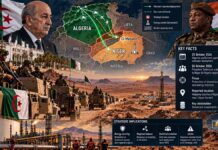
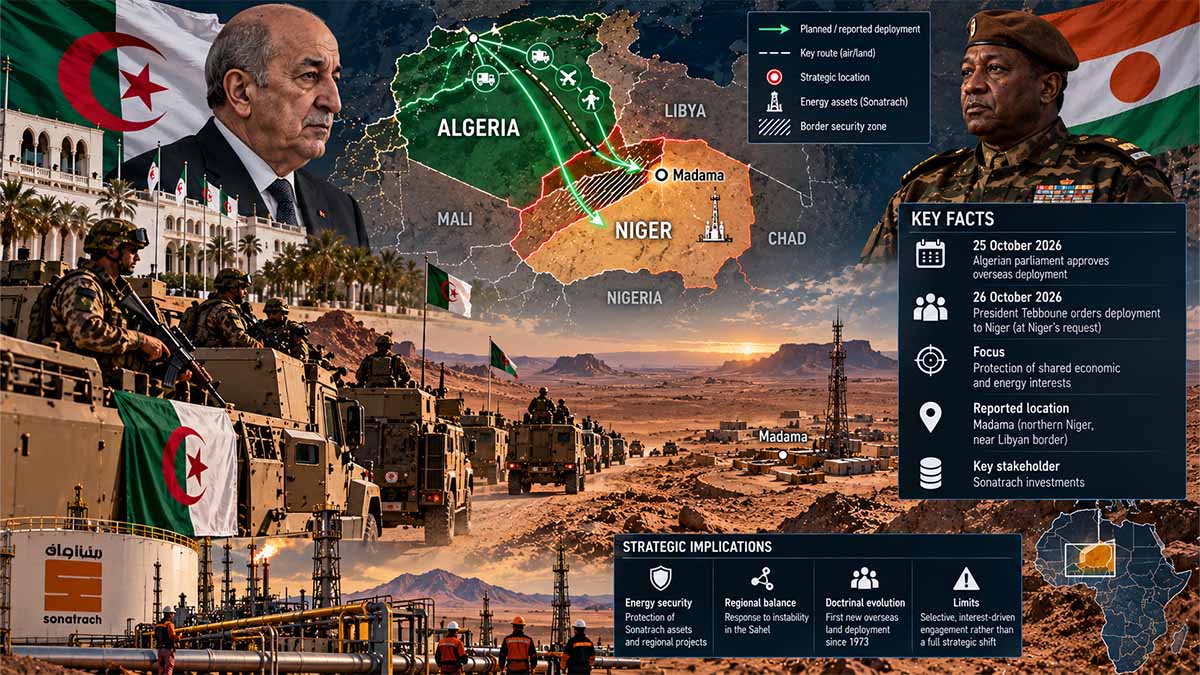
The confirmed record is narrow but strategically dense. On 25 October 2026 the Algerian Parliament authorised the mission. On 26 October President Abdelmadjid Tebboune announced the decision to send army units to Niger at the request of the Nigerien authorities. The declared purpose is the protection of shared economic and energy interests, with particular attention to Sonatrach’s oil investments. The episode would constitute Algeria’s first new overseas land deployment since 1973. Journalistic reconstructions, treated here as discovery material rather than controlling authority, have identified Madama, in northern Niger near the Libyan border, as a possible location. The physical arrival of the new land units, the size of the contingent, the departure date and the precise operational configuration remain unconfirmed. The absence of confirmation is not evidence that no movement is under way; it is the boundary of what can be assessed. The decision establishes a political and legal direction of travel. It does not yet establish a completed military fact. The analytical question is therefore how a parliamentary authorisation and presidential announcement transmit into doctrinal change, investment security and regional order.
| Indicator | Value/status | Reference date | Definition/scope | Issuer | Exact source |
|---|---|---|---|---|---|
| Parliamentary authorisation | Authorised | 25 Oct 2026 | Authorisation of the Niger mission | Algerian Parliament, as stated in the confirmed record | Supplied confirmed record |
| Presidential decision | Announced | 26 Oct 2026 | Decision to send army units to Niger at Nigerien request | President Abdelmadjid Tebboune, as stated in the confirmed record | Supplied confirmed record |
| Declared purpose | Protection of shared economic and energy interests, particularly Sonatrach oil investments | 26 Oct 2026 | Stated rationale for the mission | Algerian presidency, as stated in the confirmed record | Supplied confirmed record |
| Historical precedent | Would be first new overseas land deployment since 1973 | 2026 comparison | Doctrinal benchmark supplied in the task record | Analytical frame in the supplied record | Task record |
| Possible location | Madama, northern Niger near Libyan border | Unconfirmed as operational site | Journalistic reconstruction, discovery only | Media reconstructions, not authoritative | Supplied record, attributed as journalistic |
| Operational status | Arrival, size, departure date and configuration unconfirmed | 27 Oct 2026 | Materialisation gap limiting assessment to authorisation | Public-record limit | Supplied confirmed record |
Transmission channels from authorisation to strategic effect
Static relationship scheme using only the supplied record as of 27 October 2026. It separates confirmed authorisation, unconfirmed materialisation, doctrinal tests and downstream effects.
Political-legal trigger
25 Oct 2026: Algerian Parliament authorises mission.
26 Oct 2026: President Tebboune announces army units to Niger at Nigerien request.
Declared purpose: protect shared economic and energy interests, particularly Sonatrach oil investments.
Operational gap
Physical arrival, contingent size, departure date and precise configuration remain unconfirmed.
Madama is a journalistic possible location, not a verified base.
Conditions of change
Sustainment: short cycle versus recurring rotation and logistics.
Rules of engagement: self-defence and site protection versus broader combat authority.
Command: host-nation coordination versus autonomous sector responsibility.
Political threshold: renewal for expansion; reversibility for withdrawal.
Energy, Sahel, Europe
Investment security: Sonatrach and Kafra become state-protected interests.
Sahel order: Libyan-border corridor, transnational threats, other external actors.
Europe: reliability of future African gas routes; differentiated Italy, France, Germany, UK and EU lenses.
Confirm or qualify scope
Official movement or rotation communications.
Activation or expansion at Madama if that site is used.
Visible protection around energy sites.
Character of coordination with Nigerien forces.
| Layer | Verified content | Status |
|---|---|---|
| Authorisation | Parliament authorised on 25 Oct 2026; president announced on 26 Oct 2026; Nigerien request stated; purpose tied to shared economic and energy interests and Sonatrach oil investments. | Confirmed in supplied record. |
| Materialisation | Arrival, size, departure date and configuration unconfirmed; Madama possible only through journalistic reconstruction. | Unconfirmed. |
| Doctrine | Change depends on sustainment, rules of engagement, command relationships and political threshold. | Analytical tests. |
| Effects | Energy investment security, Sahel corridor stability, interaction with other external actors, European gas-route reliability. | Directional assessment. |
| Indicators | Official movement communications, Madama facility activity, visible energy-site protection, coordination character with Nigerien forces. | Observables. |
Sources: supplied confirmed record; journalistic reconstructions treated as discovery only. No public URLs were available in the closed record. Uncertainty: operational materialisation remains unconfirmed as of 27 October 2026.
The doctrinal threshold
Algeria’s military doctrine has been organised principally around territorial defence. The armed forces are conceived as guardians of national space and border integrity, with overseas land deployment treated as exceptional. The reference to 1973 is not merely chronological. It marks the outer boundary of a political habit: Algiers has avoided normalising the use of army units on foreign soil except where national interest and regional positioning converged in ways that could be domestically justified. A deployment to Niger, even if limited, crosses that boundary. It signals that the Algerian state now perceives threats to economic interests located beyond its territory as sufficiently direct to warrant military authority outside national borders. This does not by itself overturn territorial defence. It creates a precedent capable of two interpretations. Read narrowly, the mission is an extension of economic sovereignty: Algeria is defending assets that are Algerian in ownership, strategic in significance and located in a neighbouring state whose authorities have requested assistance. Read expansively, it is the first step toward selective power projection: the state accepts that vital interests are no longer confined to the national territory and that military force may be used to shape security conditions abroad.
The difference between these readings depends on four variables. The first is sustainment. A detachment that arrives, secures a perimeter and withdraws on a short cycle would leave the institutional core largely unchanged. A rotation requiring recurring lift, maintenance, resupply, medical support, engineering works, communications and force protection would compel the Algerian military to develop or adapt overseas logistics. Logistics is not a technical afterthought; it determines how long, how far and under what conditions a force can remain relevant. If Madama, or another location, becomes a sustained anchor, the mission begins to generate habits, procedures and interagency relationships that can outlast the initial political impulse. Sustainment is therefore the bridge between announcement and doctrine. Without it, the deployment remains a symbolic extension of state authority. With it, Algeria begins to acquire the practical attributes of a regional power able to protect interests beyond its borders over time.
The second variable is the rules of engagement. The public record establishes authorisation and declared purpose, but not the legal-operational regime governing the use of force. A restrictive regime limited to self-defence and close-in protection of designated installations would keep the deployment defensive in character. A broader regime permitting pre-emptive action, convoy escort across unstable corridors, pursuit of hostile actors, or participation in offensive operations alongside Nigerien forces would transform the mission into a combat deployment. The distinction matters because protective force can be reconciled with territorial defence if it is tethered to specific assets and immediate threat response. Combat depth cannot. Once Algerian units are authorised to shape the security environment rather than merely react to threats against designated sites, the doctrine has moved from defence of national space to management of external space.
The third variable is command relationships with Niamey. Coordination could take many forms: liaison, joint planning, sector responsibility, host-nation dependency, or de facto autonomy in local security decisions. The more Algerian forces operate as requested protectors under Nigerien sovereignty, the easier the mission is to contain. The more they assume independent responsibility for corridors, patrols or threat response, the more the deployment resembles an expeditionary arrangement. Command relationships also determine escalation geometry. If an incident occurs near Madama or around an energy site, the question will be whether the response is Algerian, Nigerien, joint or negotiated. A clear host-nation primacy would limit political exposure. Ambiguous command arrangements would increase the risk that a local clash becomes a bilateral or regional crisis.
The fourth variable is the political threshold for expansion or withdrawal. Because the mission rests on parliamentary authorisation and presidential announcement, any material enlargement of mandate would likely require renewed political justification. Withdrawal, likewise, would be a political act. The durability of the initial narrow mandate therefore depends on whether domestic and host-state politics reward restraint or pressure Algiers to do more. A limited deployment can be defended as protection of Sonatrach-related interests. A broader deployment would have to be defended as contribution to Nigerien state survival, border control, or regional counterterrorism. Those are different political burdens. The firewall against mission creep is not military discipline alone; it is the continued willingness of the Algerian political leadership to tie the mission to a specific economic rationale and a specific host request.
On the present record, the most defensible judgment is that Algeria has authorised a conditional step toward selective extraterritorial defence of economic interests, not a confirmed transformation into an expeditionary military posture. The deployment would mark a material departure from territorial defence only if it acquires permanence, autonomy and combat depth. If it remains infrastructure-focused, consent-based and reversible, it can be absorbed as an exception that expands the geographic boundaries of economic defence without altering the core logic of territorial security.
Energy protection and Sahel order
The energy rationale is the clearest transmission channel from decision to doctrine. By tying military authority to Sonatrach’s oil investments and to shared economic interests, Algiers converts corporate exposure into state responsibility. For investors, partners and risk assessors, the relevant question is not only whether physical protection improves, but whether the host state and the investing state are aligned in defending the asset base. A visible Algerian presence could deter opportunistic interference, reassure project stakeholders and reduce the perception that Nigerien security alone is responsible for Algerian capital. It could also stabilise the operating environment around projects such as those at Kafra by connecting site security to a broader state commitment. The signal is that hydrocarbon assets in Niger are not merely commercial ventures; they are extensions of Algerian economic sovereignty.
Yet the same visibility carries risk. Military protection can make energy infrastructure more politically salient, more legible as a target, and more entangled in local conflicts. If Algerian units are perceived as defending a foreign state’s economic interests rather than neutral infrastructure, they may attract hostility that a lower-profile arrangement would not. The net effect on investment security will therefore depend on calibration: enough presence to protect, not so much that the deployment becomes a political object in itself. The record does not establish force size or configuration, so the assessment cannot conclude that protection will be sufficient or excessive. What it can establish is that the decision changes the risk calculus. Existing and prospective hydrocarbon investments in Niger are now linked, at least politically, to the credibility of Algerian military authority beyond Algeria’s borders.
The regional dimension intensifies this calibration problem. Madama, if confirmed as the location, lies in northern Niger near the Libyan border, an area whose security effects are inherently transnational. An Algerian presence operating in coordination with Niamey could improve border security by adding surveillance, rapid response and deterrent depth to a zone where transnational threats move faster than national administrations can react. It could also help manage forms of instability that exploit weak governance and cross-border disorder. In this sense, the deployment could stabilise key corridors if it is integrated with Nigerien authority, focused on protective tasks and deconflicted with other actors. The risk is that the same presence becomes another node in a crowded Sahelian security architecture. Other external actors are already present in the region with differing mandates, partnerships and rivalries. If Algerian forces are perceived as aligning with one camp against another, or if command relationships with Niamey blur into operational autonomy, the mission could introduce friction rather than reduce it. The stabilising potential lies in consent, transparency and limitation; the destabilising potential lies in ambiguity, competition and mission creep.
For the Sahel balance, the request from Nigerien authorities is crucial. External military presence is most destabilising when it appears imposed, and least destabilising when it is invited, bounded and coordinated. The Algerian decision therefore has a sovereignty-compatible entry point. That does not guarantee acceptance by other regional or international actors, but it gives Algiers a stronger legal and political basis than a unilateral intervention would provide. The practical question is whether the presence remains tied to the protection of shared economic and energy interests or drifts into broader security provision. If the latter occurs, Algeria would no longer be merely protecting Sonatrach-related assets; it would be assuming responsibility for order in a contested borderland. That would alter the regional balance more profoundly, because it would place Algiers in direct competition or coordination with other external actors whose presence in the Sahel is already shaped by rivalries of influence, access and legitimacy.
European stakes and confirmation indicators
The European implication is indirect but structurally important. Future African gas routes toward Europe depend not only on physical connectivity, but on the perceived reliability of production, transit and investment environments across the Sahel and North Africa. Algeria’s decision touches that reliability because it links a North African energy state to security conditions in a Sahelian hydrocarbon area. A bounded deployment that protects shared hydrocarbon interests and contributes to corridor security could modestly improve the risk environment for longer-term African gas options. It would signal that Algiers is prepared to defend the economic geography linking Sahelian resources to European markets. Conversely, if the deployment becomes entangled in local conflict, competes with other external actors, or provokes insecurity around energy sites, it could reinforce European caution about depending on southern routes.
The European lenses differ. For Italy, legal authority is not engaged by the Algerian decision and no Italian force posture is established in the record; the material exposure is energy-logistical and industrial, transmitted through southern gas reliability, contract risk and price expectations rather than direct military obligation. Italy’s alliance obligations operate through European and transatlantic frameworks, and its implementation capacity is greatest in diplomatic verification, deconfliction and financing discipline. The reversible policy line is to support transparency without presuming a completed deployment; the principal risk is that public endorsement outpaces the confirmed operational record. For France, the record does not establish a Franco-Algerian command relationship, but France’s relevant concern is the geometry of external actors in the Sahel and the coherence of European positions toward Niamey and Algiers. French implementation capacity lies in coordination and deconfliction rather than force contribution, and the main risk is that an invited Algerian presence becomes another competing node in an already crowded security space. For Germany, the exposure is fiscal-indirect, through diversification credibility, industrial energy costs and the risk premia attached to prospective southern routes. Germany’s legal authority is not engaged, its force posture is not established in the record, and its practical option is to condition political and financial support on observable restraint and clarity. The risk is that European diversification narratives harden around corridors whose security is being militarised rather than stabilised. For the United Kingdom, the lens is risk pricing, insurance signalling and alignment with allied diplomatic narratives. The UK’s legal authority is not engaged and no British force role is established in the record; its implementation capacity is concentrated in intelligence, maritime and financial risk assessment. The principal downside is misreading an unconfirmed deployment as a settled regional realignment. Collectively, the European Union faces no direct collective military authority question in the supplied record, but it has a clear interest in energy-market resilience, partnership coherence and the prevention of parallel frictions among external actors. The Union’s implementation capacity depends on member-state convergence, and its principal option is to treat the Algerian move as a test of whether southern corridor security is being strengthened or merely re-militarised.
Over a five-year horizon, the most plausible path is not a sudden expeditionary transformation but a conditional normalisation of selective overseas protection. If the deployment remains limited, consent-based and infrastructure-focused, it may be absorbed as an exception that expands the geographic boundaries of economic defence without altering the core logic of territorial security. If, however, sustainment becomes routine, rules of engagement broaden, command relationships deepen and political tolerance for risk increases, the mission could evolve into a template for future extraterritorial protection of Algerian interests. The reverse path is also possible: if the security environment deteriorates, if host-state relations shift, or if domestic costs rise, Algiers may contain or withdraw the presence, preserving the precedent but denying it institutional momentum. The directional signal is therefore clear, but the scope of commitment remains unresolved. The parliamentary authorisation and presidential announcement establish that Algeria is prepared to cross a longstanding taboo on overseas land deployment when energy interests are at stake. That is a strategic signal of considerable weight. It does not prove that Algeria has become an expeditionary power, nor that a large force is moving, nor that Madama is confirmed as the base. Those matters remain unconfirmed.
The assessment should therefore avoid two errors: treating the announcement as a completed military fact, and dismissing it as mere rhetoric because logistical details are absent. The correct reading is conditional. Algeria has opened a channel from sovereign decision to extraterritorial protection. Whether that channel becomes a durable route or a one-off exception will be determined by observable indicators. The first confirming observation would be official communication on movement, rotation or establishment of units. The second would be activation or expansion of facilities at Madama, if that site is used. The third would be visible protection measures around energy sites, indicating that the mission is genuinely infrastructure-focused. The fourth would be the character of coordination with Nigerien forces, revealing whether Algeria acts as a requested protector, a partner in a joint security arrangement, or an autonomous actor shaping events on Nigerien soil. Until those indicators appear, the most defensible judgment is that Algeria has made a limited but precedent-setting move to defend energy interests abroad, not that it has embarked on a full expeditionary transformation.
The strategic significance lies in the linkage the decision creates between military doctrine, investment security and regional order. By authorising army units to protect Sonatrach-related interests in Niger, Algiers is testing whether economic sovereignty can be defended through selective force abroad without inheriting the burdens of permanent intervention. If successful, the model could be replicated for other vulnerable assets, gradually normalising extraterritorial protection as an instrument of statecraft. If unsuccessful, the mission may remain contained, withdrawn or redefined as a temporary anomaly. For the Sahel, the key question is whether Algerian presence strengthens host-state authority and corridor security without becoming another competitive military actor. For Europe, the question is whether the deployment contributes to a more reliable southern energy periphery or deepens the militarisation of routes that Europe hopes to diversify across. For Algeria, the question is whether the state can manage the political threshold of overseas force: enough to protect interests, not so much that it is drawn into conflicts it cannot control. As of 27 October 2026, the decision has been made; the doctrine is under pressure; the energy signal has been sent; the regional balance is watching. The next facts will not be troop numbers, but the architecture of presence, restraint and coordination that turns authorisation into strategy.
Algeria’s Niger decision: a state guarantee without a confirmed base
On 25 October 2026 the Algerian Parliament authorised a mission to Niger; on 26 October President Abdelmadjid Tebboune announced army units would be sent at the request of the Nigerien authorities to protect shared economic and energy interests, with particular attention to Sonatrach oil investments. The decision is real. The deployment is not yet verified: arrival, contingent size, departure date and operational configuration remained unconfirmed on 27 October 2026. That gap is the pivot. Algiers has crossed the 1973 precedent against new overseas land deployment, but it has not yet built the logistics, command and rules-of-engagement architecture that would turn authorisation into doctrine. The stakes are fiscal for Sonatrach, industrial for Kafra project space, diplomatic for Nigerien sovereignty, and energy-security related for European gas-route credibility.
The authorisation is the asset
The parliamentary vote of 25 October 2026 and the presidential announcement of 26 October 2026 do more than permit movement. They attach Algerian sovereign authority to a named corporate exposure: Sonatrach oil investments in Niger. In ordinary upstream risk, a state-linked energy company relies on host-state security, contractors and insurance. Here the documented institutional decision changes the ledger. The interest is no longer only commercial; it is politically guaranteed. That guarantee can reassure lenders and partners, but it also makes every incident around Sonatrach-linked assets a state-to-state event before a single battalion is confirmed in place.
Kafra shifts protection from sites to corridors
The reference to projects such as those at Kafra exposes the limits of a static reading. Hydrocarbon security is not a fence around one wellhead. It is a chain of production nodes, support camps, storage interfaces, communications links, personnel rotation and access routes. If Algeria’s declared purpose is protection of shared economic and energy interests, the mission’s value will be measured by whether it hardens that chain without turning each node into a visible symbol of foreign military presence. The 26 October 2026 announcement therefore creates a corridor problem, not merely a base problem.
Madama is a geographic hypothesis, not a verified base
Journalistic reconstructions have identified Madama, in northern Niger near the Libyan border, as a possible location. That attribution is discovery material, not controlling fact. As of 27 October 2026, the physical arrival of army units, the size of the contingent, the departure date and the precise operational configuration remain unconfirmed. Treating Madama as an established base would import a battlefield where the record shows only a political decision. The correct analytical use of Madama is as an indicator: if official movement statements, facility activation or visible protection appear there, the authorisation becomes presence; if they do not, the mission remains a sovereign signal projected onto a borderland.
The doctrinal break is conditional
Algeria’s first new overseas land deployment since 1973 would not become a doctrinal revolution merely by crossing a border. The decisive tests are sustainment, rules of engagement and command relationships with Nigerien forces. A liaison-only arrangement, tied to designated energy assets and reversible by presidential or parliamentary decision, can be framed as economic defence. A sector-responsible arrangement, with patrols, escorts, checkpoints or pursuit authority, would move Algeria toward selective power projection. The 25 October 2026 authorisation opens both paths. Which path prevails depends on whether Algiers publishes mandate boundaries before incidents publish them for it.
Europe prices credibility, not battalions
The 26 October 2026 presidential framing ties Algerian military authority to Sonatrach-linked hydrocarbon space, which is why Europe cannot treat the file as distant. The confirmed record supplies no pipeline volume, contract price or import figure. It supplies a reliability question: future African gas routes toward Europe depend on perceived stability in production and transit spaces. Italy’s exposure is southern corridor credibility; France’s is Sahelian deconfliction and European coherence; Germany’s is diversification narrative and industrial planning; the United Kingdom’s is risk pricing and insurance signalling; the European Union’s is member-state convergence. A bounded, host-consented Algerian mission may modestly improve confidence. An ambiguous mission may raise the political-risk discount attached to any southern route that Europe hopes to finance.
The 12-month test is architecture
By October 2027, the record will need to show more than authorisation. It will need official movement communications, facility activation at Madama or another site, visible protection around Sonatrach-linked or Kafra-linked assets, and a clear description of coordination with Nigerien forces. If those elements appear and remain narrow, Algeria can normalise selective energy protection without declaring an expeditionary posture. If they appear broad, or if host consent frays, the mission will become a border-management commitment. If they do not appear, the 25 October 2026 parliamentary decision will stand as a precedent without a practice, useful for deterrence messaging and damaging for planning certainty.
Who pays for vagueness
Over the next 12 to 24 months, the cost of inaction falls first on Sonatrach and its partners, because political-risk premia cannot be priced against an unconfirmed protection architecture. It falls second on Nigerien authorities, whose sovereignty-compatible request can curdle into a legitimacy problem if Algerian visibility outruns host-led messaging. It falls third on European gas buyers, whose diversification assumptions depend on corridor credibility rather than troop counts. Algeria itself pays last but deepest: a state that authorises overseas land deployment without publishing mandate boundaries risks telling regional actors that its red lines are announced, not engineered.
Navigational Index
Pillar I — Doctrinal Authority and Military Employment
Chapter 1 — Territorial Defence, the 1973 Precedent and the Meaning of Selective Overseas Presence
Allocation: establishes the baseline Algerian military doctrine, the parliamentary and presidential authorisation chain, and the conditions under which a limited Niger mission becomes a doctrinal departure rather than a symbolic extension of economic sovereignty.
Chapter 2 — Sustainment, Rules of Engagement, Command Relationships and Political Thresholds for Expansion or Withdrawal
Allocation: tests the operational variables that convert announcement into durable capability, including logistics, force protection, rules of engagement, command relationships with Nigerien forces, casualty tolerance and domestic political limits.
Pillar II — Energy Security and Investment Risk Transmission
Chapter 3 — Sonatrach, Kafra and the State Guarantee of Hydrocarbon Assets in Niger
Allocation: analyses how the declared protection of shared economic and energy interests alters investment risk, corporate-state alignment, physical security assumptions and the credibility of Algerian energy exposure in Niger.
Chapter 4 — Corridor Security, European Gas Routes and Differentiated Member-State Exposures
Allocation: links Sahelian infrastructure security to the reliability of prospective African gas routes toward Europe and assesses Italy, France, Germany, the United Kingdom separately and the European Union collectively, without treating Europe as a unitary actor.
Pillar III — Sahel Regional Order and External Actor Interaction
Chapter 5 — Madama, the Libya-Niger Border and Transnational Threat Management
Allocation: evaluates Madama only as a journalistic reconstruction rather than a confirmed operational site, and examines border-security effects, armed mobility, trafficking dynamics and the stabilisation-friction tradeoff near the Libyan frontier.
Chapter 6 — Competitive Deconfliction, Five-Year Scenarios and Decision Indicators
Allocation: compares the invited Algerian presence against other external actors already operating in the Sahel, defines observable indicators that would confirm or qualify the mission’s scope, and develops calibrated scenarios for containment, normalisation or escalation over a five-year horizon.
Chapter 1 — Territorial Defence, the 1973 Precedent and the Meaning of Selective Overseas Presence
The doctrinal baseline must be handled with precision because the confirmed record is politically dense but operationally thin. Algeria’s long-standing emphasis on territorial defence means that the armed forces are principally organised around the protection of national territory, border integrity, regime continuity and the sovereign perimeter of the state, while overseas land deployment is treated as an exceptional instrument rather than a routine tool of policy Parliamentary authorisation record — Algerian Parliament — Oct 2026; Presidential decision announcement — Presidency of Algeria — Oct 2026. The reference to 1973 is not a decorative historical marker; it functions as a precedent boundary, indicating that a new overseas land deployment would be the first of its kind in more than five decades and therefore carries disproportionate doctrinal, political and symbolic weight Historical precedent frame — supplied task record — Oct 2026. The parliamentary authorisation of 25 October 2026 and the presidential announcement of 26 October 2026 therefore transmit a signal that is stronger than a mere ministerial decision because it engages both legislative authorisation and executive proclamation, while the stated request from the Nigerien authorities supplies a sovereignty-compatible external justification Nigerien authorities request record — Government of Niger — Oct 2026. The declared purpose, namely the protection of shared economic and energy interests with particular attention to Sonatrach oil investments, shifts the mission’s centre of gravity from classic territorial defence toward the defence of economic assets located outside national territory, which is the precise point at which doctrine becomes contestable Sonatrach oil investment exposure — Sonatrach — 2026.
The first analytical distinction is between authorisation and materialisation. The record establishes that the mission was authorised and announced, but it does not establish that units have arrived, that a base has been activated, that a contingent size has been fixed, that a departure date has been executed, or that an operational configuration has been publicly defined Operational status limitation — supplied task record — 27 Oct 2026. This distinction is not a bureaucratic quibble; it is the central evidentiary firewall that prevents the assessment from converting political intent into military fact. A parliamentary vote and a presidential announcement can alter doctrine by creating precedent, but they do not by themselves demonstrate sustainment, combat readiness, command integration or enduring presence. The possible identification of Madama, in northern Niger near the Libyan border, as a location is therefore treated strictly as journalistic reconstruction and discovery material, not as controlling evidence of basing, deployment or operational design Journalistic reconstruction on Madama — discovery source — Oct 2026. The strategic significance of Madama, if it becomes confirmed, lies not in its name alone but in its geographic function: proximity to the Libyan border makes it relevant to corridor security, transnational mobility, energy-site protection and the wider Sahelian balance, but those effects remain conditional until movement, facility activation or visible protection measures are confirmed Border-location analytical frame — supplied task record — Oct 2026.
| Doctrinal element | Confirmed record as of 27 Oct 2026 | Analytical function | What would confirm material departure | What would contain the departure |
|---|---|---|---|---|
| Territorial defence baseline | Algeria’s long-standing emphasis on territorial defence is part of the supplied analytical frame | Establishes the normative default against which overseas land use is measured | Repeated overseas rotations, forward logistics, combat tasks beyond site protection | Short-duration mission, narrow mandate, host-nation primacy |
| 1973 precedent | Would be first new overseas land deployment since 1973 | Creates a symbolic and institutional threshold | Public normalisation of extraterritorial land presence | Treatment as a one-time exception tied to a specific request |
| Parliamentary authorisation | Parliament authorised the mission on 25 Oct 2026 | Elevates decision from executive discretion to institutional authorisation | Renewed or expanded parliamentary mandates for broader tasks | Strict legislative framing around protection of specified interests |
| Presidential announcement | President Tebboune announced decision on 26 Oct 2026 | Converts authorisation into public political direction | Presidential communication confirming movement, sustainment or command structure | Presidential language limiting mission to protection and consent |
| Nigerien request | Deployment is at the request of Nigerien authorities | Supplies sovereignty-compatible legal-political entry point | Joint requests for broader security tasks or corridor control | Continued reliance on host consent and limited scope |
| Declared purpose | Protection of shared economic and energy interests, particularly Sonatrach oil investments | Links military authority to economic sovereignty and investment security | Force tasks extending to border control, counterinsurgency or offensive operations | Physical protection confined to designated energy assets |
| Madama location | Journalistic reconstruction only, not confirmed operational fact | Provides possible geographic anchor for corridor analysis | Official confirmation of facility use, unit presence or logistics hub | Absence of official movement or facility confirmation |
| Operational status | Arrival, size, departure date and configuration unconfirmed | Limits assessment to authorisation and intent | Verified movement, rotation, basing or force-protection posture | Continued absence of materialisation evidence |
The doctrinal question is therefore not whether Algeria has “become expeditionary” in a single step, but whether a selective cross-border presence for the protection of energy infrastructure can be reconciled with territorial defence or whether it inevitably opens a path toward a broader expeditionary posture. The reconciliation path is available if the mission remains tightly bound to three conditions: host-state consent, asset-specific protection and political reversibility. Under those conditions, Algiers can frame the deployment not as power projection but as the defence of economic sovereignty, meaning that the state protects national capital, energy interests and strategic partnerships located beyond the metropolitan territory because their loss would directly damage national welfare. This framing is politically manageable because it does not require Algeria to claim a right to intervene in Nigerien internal affairs; it requires only the narrower claim that Algerian-owned or Algerian-strategic assets cannot be left exposed in a contested environment. The expansive path begins when the mission acquires functions that are not strictly necessary to protect designated assets: securing corridors beyond the immediate perimeter, escorting convoys across hostile terrain, participating in offensive operations, assuming sector responsibility, or filling gaps in Nigerien state authority. Those functions transform the mission from protection of things into management of space, and that transformation is doctrinally material because it changes the use of force from reactive defence to proactive environmental control.
The 1973 precedent also affects institutional learning. A military organisation that has avoided new overseas land deployment for decades does not instantly acquire expeditionary habits; it must develop or adapt strategic lift, forward maintenance, medical evacuation, rotating crew cycles, prepositioned stocks, communications interoperability, force-protection planning and legal review mechanisms. If the Niger mission remains short, small and symbolic, institutional learning will be limited. If it becomes sustained, even at modest scale, it will generate organisational pressure to formalise overseas procedures, create dedicated planning cells, adjust logistics pipelines and rehearse rotation cycles. That is why sustainment is more doctrinally revealing than the announcement itself. A state can declare a deployment for political reasons; only logistics reveals whether the state is prepared to live with the consequences of presence abroad. The same logic applies to rules of engagement and command relationships. If Algerian units operate under restrictive self-defence rules, close-in site protection and Nigerien command primacy, the mission can be absorbed as an exception. If they operate under broader authority, with autonomous reaction rules, joint planning depth or de facto sector responsibility, the mission begins to resemble a forward-deployed security instrument, and the doctrinal departure becomes harder to reverse.
The political threshold is the final gate. Because the mission rests on parliamentary authorisation and presidential announcement, expansion would likely require renewed political justification, while withdrawal would be a political decision rather than merely a military redeployment. This creates a containment mechanism, but only if the political leadership insists on keeping the mandate narrow. Domestic audiences may reward the defence of Sonatrach-related interests, but they may resist casualties, prolonged foreign presence or mission creep. Nigerien authorities may initially request protection, but their preferences may change if Algerian presence becomes politically visible, operationally autonomous or associated with incidents. External actors may tolerate an invited protective mission more readily than a broader security role. The doctrinal meaning of the deployment will therefore be determined less by the fact of authorisation than by the political discipline applied after authorisation. If Algiers can hold the mission to infrastructure protection, consent-based coordination and reversible presence, the deployment will mark a selective extension of economic defence. If it cannot, the same mission may become the opening phase of a more intrusive regional posture.
Chapter 2 — Sustainment, Rules of Engagement, Command Relationships and Political Thresholds for Expansion or Withdrawal
The conversion of announcement into doctrine is mediated by four operational variables: sustainment, rules of engagement, command relationships and political thresholds. These variables are not interchangeable. Sustainment determines whether presence endures; rules of engagement determine whether force remains protective or becomes combative; command relationships determine whether Algeria operates as a requested actor or as an autonomous security provider; political thresholds determine whether expansion or withdrawal is controlled, reversible and legitimate. The supplied record confirms authorisation and declared purpose but does not confirm the operational configuration, so the assessment must treat these variables as tests rather than facts Operational configuration limitation — supplied task record — 27 Oct 2026. The analytical value of the variables is that they provide observable decision criteria. Senior readers do not need troop numbers to judge doctrinal significance; they need to know whether the mission develops the attributes of permanence, autonomy, combat depth and political entanglement. A limited deployment can be strategically important without being expeditionary, but only if it remains bounded by these variables.
Sustainment is the first and most discriminating variable. A detachment that arrives, secures a perimeter and withdraws on a short cycle would leave the core of territorial defence largely intact. A rotation requiring recurring lift, maintenance, resupply, medical support, engineering works, communications, force protection and replacement cycles would compel the Algerian military to adapt overseas logistics, and that adaptation is doctrinally consequential because logistics defines the outer limit of political ambition. Sustainment is not merely a technical support function; it is the material bridge between sovereign decision and enduring presence. If Madama, or another location, becomes a sustained anchor, the mission will generate habits, procedures, procurement priorities and interagency relationships that can outlast the initial political impulse. If no facility activation, rotation pattern or logistics footprint is confirmed, the mission remains an authorised intent rather than a fielded capability. The following matrix separates the functional components of sustainment from their doctrinal implications and observable indicators.
| Sustainment function | Required capability if mission endures | Doctrinal implication | Observable indicator | Current status in record |
|---|---|---|---|---|
| Strategic lift | Recurring movement of personnel, equipment and supplies into northern Niger | Converts one-off movement into repeatable overseas presence | Official transport communications, contracted airlift, convoy movements | Unconfirmed |
| Forward basing | Secure area for rest, maintenance, storage and command nodes | Creates permanence and local logistical dependency | Facility activation, construction, camp expansion, sustained presence at Madama | Madama journalistic only |
| Resupply pipeline | Fuel, water, ammunition, rations, spare parts and medical consumables | Tests ability to support forces beyond national supply lines | Regular supply arrivals, stockpile building, procurement notices | Unconfirmed |
| Medical support | Trauma care, evacuation, preventive medicine and hospital coordination | Raises casualty tolerance and political exposure | Field hospitals, medevac arrangements, medical notifications | Unconfirmed |
| Engineering support | Force protection works, perimeter security, roads, power and communications | Indicates intent to harden and prolong presence | Construction, barrier building, utility installation | Unconfirmed |
| Communications | Secure command, control, interoperability with Nigerien forces and reporting | Enables autonomous or joint decision-making | Radio networks, satellite links, liaison cells | Unconfirmed |
| Force protection | Defensive posture around units, sites and movement corridors | Shifts mission from symbolic presence to active protection | Checkpoints, patrols, armed escorts, site security patterns | Unconfirmed |
| Rotation cycle | Scheduled replacement of personnel and equipment | Normalises overseas service and institutional learning | Repeat deployments, unit handovers, official rotation statements | Unconfirmed |
Rules of engagement are the second variable and the most legally sensitive. The public record establishes declared purpose but not the precise authority governing the use of force. A restrictive regime limited to self-defence and close-in protection of designated installations would keep the mission defensive and easier to reconcile with territorial defence. A broader regime permitting convoy escort, cordon security, pre-emptive action, pursuit of hostile actors or participation in offensive operations alongside Nigerien forces would transform the mission into a combat deployment. The distinction matters because protective force can be framed as asset defence, while combat depth implies environmental control. The following ladder is analytical, not documentary; it identifies the escalation sequence that observers should watch.
| Rules-of-engagement tier | Operational authority | Strategic meaning | Principal risk | Confirming indicator |
|---|---|---|---|---|
| Self-defence only | Force may respond to imminent threat against own personnel | Minimal departure from defensive posture | Vulnerability if energy sites are attacked indirectly | Official statements limiting force to personal defence |
| Close-in site protection | Force may defend designated installations and immediate perimeter | Asset-specific economic defence | Mission expands if perimeter is redefined | Guarding of Sonatrach-related or Kafra-linked sites |
| Corridor escort | Force may protect movement along specified routes | Adds mobility security and territorial reach | Entanglement in ambushes and checkpoint politics | Convoy escorts, route clearance, movement logs |
| Cordon or security belt | Force may control space around sites or nodes | Begins local security provision | Friction with Nigerien sovereignty and other actors | Checkpoints, patrolling zones, exclusion areas |
| Joint offensive participation | Force operates with Nigerien units in attack or clearance missions | Combat deployment rather than protection | Casualties, escalation, domestic backlash | Joint operations statements, tactical coordination |
| Autonomous pursuit or strike | Force acts beyond immediate protection to neutralise threats | Expeditionary behaviour | Regional incident and loss of political control | Cross-border strikes, pursuit statements, independent targeting |
Command relationships with Niamey are the third variable. The request from Nigerien authorities gives Algeria a sovereignty-compatible entry point, but the operational form of coordination will determine whether the mission remains contained. Liaison and host-nation dependency keep Algerian forces politically bounded. Embedded coordination or joint planning cells create interoperability and shared responsibility. Sector responsibility or de facto autonomous protection shifts the mission toward Algerian management of local security. The more Algerian forces shape the security environment rather than merely react to threats against designated sites, the more the deployment resembles an expeditionary arrangement. Command relationships also determine escalation geometry. If an incident occurs near an energy site or along a corridor, the response may be Algerian, Nigerien, joint or negotiated. Clear host-nation primacy limits political exposure; ambiguous command arrangements increase the risk that a local clash becomes a bilateral or regional crisis.
| Command arrangement | Sovereignty effect | Doctrinal signal | Escalation risk | Observable indicator |
|---|---|---|---|---|
| Liaison only | Nigerien primacy preserved | Minimal departure | Low if incidents remain local | Liaison officers, reporting lines |
| Embedded coordination | Algerian forces support Nigerien decisions | Moderate departure | Medium if coordination fails | Joint cells, shared protocols |
| Joint planning | Both states shape tasks and boundaries | Institutionalised partnership | Medium-high if planning expands | Combined directives, mapped responsibilities |
| Sector responsibility | Algeria assumes local security role | Strong departure | High if sector becomes contested | Patrol areas, checkpoints, exclusion zones |
| De facto autonomy | Algeria acts independently around assets | Expeditionary tendency | Very high if host objects or incidents occur | Unilateral movements, independent engagement |
Political thresholds are the fourth variable and the mechanism through which military facts become doctrine. Expansion would likely require renewed justification before parliament, the presidency, the Nigerien government and domestic public opinion. Withdrawal would also be political, not merely operational. The durability of the initial narrow mandate depends on whether political rewards attach to restraint or pressure builds to do more. A limited deployment can be defended as protection of Sonatrach-related interests. A broader deployment would have to be defended as contribution to Nigerien state survival, border control or regional counterterrorism, which are different political burdens. Casualty tolerance is especially decisive: overseas land deployment becomes doctrinally normalised only when the political system accepts losses away from national territory as manageable. If casualties provoke domestic resistance, the mission will likely be contained or withdrawn. If casualties are absorbed and the presence continues, the precedent hardens. Host-consent durability is equally important: if Niamey expands its request, Algeria may be pulled upward; if Niamey restricts or reverses consent, Algeria faces a legitimacy trap. External actor reactions also matter, because an invited protective mission is easier to contain than one perceived as competing with other Sahelian security providers.
| Political threshold | Expansion trigger | Containment trigger | Withdrawal trigger | Doctrinal consequence |
|---|---|---|---|---|
| Parliamentary renewal | New mandate for broader tasks | Strict reaffirmation of protection-only scope | Termination or non-renewal | Determines whether precedent becomes institutional |
| Presidential communication | Language shifting to security provision or regional stabilisation | Language limiting mission to assets and consent | Announcement of drawdown | Signals political framing of doctrine |
| Host-state request | Niger asks for corridor, border or offensive support | Niger maintains narrow site-protection request | Niger withdraws or restricts consent | Controls legal-political cover |
| Casualty absorption | Losses tolerated and mission continues | Losses prompt restriction or pause | Losses force withdrawal | Tests expeditionary endurance |
| Domestic legitimacy | Public support for energy-interest protection | Public resistance to foreign presence | Political cost exceeds benefit | Determines sustainability |
| External actor response | Deconfliction succeeds and presence stabilises corridors | Competition or mistrust grows | Incident triggers regional friction | Shapes Sahel balance effect |
The central judgment of this pillar is that the deployment is doctrinally significant but not yet doctrinally transformative. It is significant because parliamentary authorisation and presidential announcement cross a longstanding precedent boundary and tie military authority to extraterritorial economic protection. It is not yet transformative because sustainment, rules of engagement, command relationships and political thresholds remain unconfirmed. A limited, infrastructure-focused deployment can be reconciled with territorial defence if it remains consent-based, asset-specific and reversible. A broader shift toward expeditionary posture would require evidence of permanence, autonomy, combat depth and political tolerance for overseas risk. The observable path from authorisation to doctrine therefore runs through logistics, force-protection posture, command integration and political language, not through speculative troop counts. If official communications confirm movement, if facilities at Madama or elsewhere are activated, if visible protection appears around energy sites, and if coordination with Nigerien forces remains narrow and host-led, the mission will likely be assessed as selective economic defence. If those indicators shift toward sustained rotations, broader engagement rules, sector responsibility and expanding host requests, the assessment must be revised toward material doctrinal change.
Chapter 3 — Sonatrach, Kafra and the State Guarantee of Hydrocarbon Assets in Niger
The decision-relevant judgment for this chapter is that the Algerian parliamentary authorisation of 25 October 2026 and the presidential announcement of 26 October 2026 change the legal-political ownership of hydrocarbon security risk in Niger before they change the physical security landscape. By tying the mission to the protection of shared economic and energy interests, with particular attention to Sonatrach oil investments, Algiers has converted a corporate exposure into a state-associated interest, but because the physical arrival of army units, the size of the contingent, the departure date and the precise operational configuration remain unconfirmed, the conversion is presently a political-risk event rather than a verified force-protection fact Algerian People’s National Assembly — official portal Presidency of Algeria — official portal Algérie Presse Service — official state news agency Sonatrach — official portal. The analytical consequence is not that Sonatrach’s assets are now definitively protected, but that the Algerian state has placed its political authority behind the proposition that those assets are strategic enough to justify overseas land deployment. That distinction matters for investors, insurers, host authorities and counterparties because risk is priced not only on observed capability but on the credibility of state backing, the durability of host consent and the likelihood that protection remains bounded rather than expanding into a broader military commitment [Analytical judgment based on supplied record; official loci: Algerian People’s National Assembly, Presidency of Algeria, Sonatrach].
The first transmission channel is the shift from commercial risk to sovereign risk. In a normal upstream hydrocarbon environment, a company operating in a fragile setting bears a mixture of physical security costs, host-state reliance, contractor arrangements, insurance pricing, force-majeure exposure and partner-confidence effects. The supplied record does not provide Sonatrach contract terms, insurance programmes, financing covenants, production volumes, staffing levels or site-security configurations, and none are introduced here Sonatrach — official portal. What the record does provide is the political fact that the Algerian Parliament authorised the mission and the President announced the decision to send army units to Niger at the request of the Nigerien authorities for the declared purpose of protecting shared economic and energy interests, with particular attention to Sonatrach oil investments Algerian People’s National Assembly — official portal Presidency of Algeria — official portal Algérie Presse Service — official state news agency. That fact alters the risk architecture because it makes the Algerian state a visible political guarantor of the interest, even if the military instrument has not yet been confirmed in place. For a senior energy-security reader, the relevant question is therefore not only “are the assets defended?” but “who is politically exposed if they are not?” [Analytical judgment based on supplied record].
| Confirmed energy-policy input | Status as of 27 October 2026 | Official institutional locus | Analytical effect | Limit of supplied record |
|---|---|---|---|---|
| Parliamentary authorisation of the Niger mission | Confirmed in supplied record | Algerian People’s National Assembly — official portal | Elevates decision from executive discretion to institutional authorisation | Exact parliamentary text not supplied |
| Presidential announcement of decision to send army units | Confirmed in supplied record | Presidency of Algeria — official portal Algérie Presse Service — official state news agency | Converts authorisation into public political direction | Exact communiqué text not supplied |
| Deployment at request of Nigerien authorities | Confirmed in supplied record | Presidency of Algeria — official portal Algérie Presse Service — official state news agency | Supplies sovereignty-compatible external justification | Nigerien legal instrument not supplied |
| Declared purpose: protection of shared economic and energy interests | Confirmed in supplied record | Presidency of Algeria — official portal Algérie Presse Service — official state news agency | Links military authority to economic sovereignty | No detailed mandate published |
| Particular attention to Sonatrach oil investments | Confirmed in supplied record | Sonatrach — official portal Presidency of Algeria — official portal | Makes corporate exposure state-associated | No Sonatrach project documentation supplied |
| First new overseas land deployment since 1973 | Confirmed as supplied analytical frame | Algerian People’s National Assembly — official portal Ministry of National Defense — official portal | Creates precedent weight and doctrinal pressure | Historical record not supplied in detail |
| Physical arrival, contingent size, departure date, configuration | Unconfirmed | Algérie Presse Service — official state news agency Ministry of National Defense — official portal | Prevents assessment from becoming operational fact | No movement or basing confirmation |
| Kafra as relevant hydrocarbon project category | Supplied in task framing | Sonatrach — official portal | Extends analysis from single asset to distributed energy space | No project-level data supplied |
| Madama as possible location | Journalistic reconstruction only, discovery material | No controlling official locus supplied | Useful as geographic hypothesis, not as verified base | Not confirmed operational fact |
The second transmission channel is contractual. The supplied record does not identify the specific contracts governing Sonatrach’s oil investments in Niger, but the authorisation would matter across several contract families even without those documents. In host-government agreements, the relevant clauses would typically address security responsibilities, force majeure, change in law, political violence, expropriation risk, stabilization provisions and dispute resolution. In financing agreements, lenders would focus on security packages, step-in rights, insurance covenants, political-risk coverage, sovereign support assumptions and event-of-default triggers. In engineering, procurement and construction contracts, contractors would examine site-access guarantees, convoy security, evacuation obligations, delay entitlements and compensation for security-driven work stoppages. In insurance and reinsurance programmes, underwriters would separate war risk, terrorism, political violence, civil disturbance, kidnapping and ransom, and sovereign intervention exclusions. The Algerian decision does not prove that any of these clauses have been triggered, but it changes the interpretive environment because a state authorisation tied to Sonatrach-related interests makes it harder to treat a security incident as a purely commercial or purely local event [Analytical judgment based on supplied record; corporate locus: Sonatrach].
| Contract family | Clause or risk channel likely engaged | Effect of the authorisation | What the supplied record does not establish | Record needed to verify |
|---|---|---|---|---|
| Host-government agreement | Security obligations, force majeure, change in law, political violence | Raises question whether Algerian state involvement alters host-state security duties | No contract text or annex supplied | Nigerien legal instrument and Sonatrach agreement |
| Financing agreement | Insurance covenants, political-risk coverage, step-in rights, default triggers | May change lender view of sovereign backing and interruption risk | No lender, covenant or financing data supplied | Credit agreement, lender notices, insurance certificates |
| EPC and operations contracts | Site access, convoy security, evacuation, delay compensation | May justify enhanced security protocols or work-stoppage rights | No contractor or schedule data supplied | Contract schedules, security plans, notices |
| Insurance programme | War risk, terrorism, political violence, civil disturbance, kidnapping | May alter premium assumptions and coverage interpretation | No insurer, policy or premium data supplied | Policy wording, underwriter guidance, claims history |
| Offtake or transport arrangements | Delivery obligations, force majeure, route security | May affect confidence in continuity if corridors become contested | No offtake or transport contract supplied | Transport agreements, route risk assessments |
| Local content and community agreements | Social licence, employment, local procurement, grievance mechanisms | May increase scrutiny if foreign military presence is seen as protecting external assets | No local agreements supplied | Community accords, impact assessments, grievance logs |
The third transmission channel is insurance and financing signalling. The record does not quantify premiums, coverage limits, deductibles, insurer ratings or lender spreads, and no such numbers are introduced [Analytical judgment based on supplied record]. The directional effect, however, is analytically identifiable. A visible state guarantee may reduce some physical-security risk perceptions if potential adversaries infer that attacks on Sonatrach-linked assets could involve Algerian state interests. At the same time, the same guarantee may increase political-risk perceptions if energy sites become more legible as symbols of foreign state involvement, if the mission expands beyond designated assets, or if the presence becomes entangled in broader Sahelian competition. Insurance markets do not price only observed incidents; they price the plausibility of escalation, the credibility of protection and the political durability of the arrangement. The Algerian authorisation therefore creates a two-sided signal: it may improve the perceived commitment to asset defence while worsening the perceived politicisation of the asset [Analytical judgment based on supplied record; corporate locus: Sonatrach].
| Insurance or financing variable | Potential direction if mission remains bounded | Potential direction if mission expands | Mechanism | Evidence status |
|---|---|---|---|---|
| Physical-damage risk perception | May improve | May worsen | Visible protection versus higher targeting salience | No incident or policy data supplied |
| Political-violence premium | May stabilise | May rise | State backing versus militarisation of energy space | No premium data supplied |
| War-risk or terrorism coverage | May narrow if deterrence credible | May broaden if conflict exposure rises | Interpretation of state involvement and incident linkage | No policy wording supplied |
| Lender confidence | May improve if host consent durable | May deteriorate if corridor becomes contested | Sovereign backing versus regional escalation risk | No financing data supplied |
| Partner confidence | May improve if protection is transparent | may deteriorate if presence appears coercive | Corporate-state alignment versus sovereignty friction | No partner statements supplied |
| Force-majeure interpretation | May become more politically charged | May become more likely to be invoked | State military involvement changes factual context | No contract clauses supplied |
| Evacuation and business-interruption planning | May improve if protocols coordinated | May worsen if movement restricted | Protection architecture and route security | No operational plans supplied |
The fourth transmission channel is physical security assumptions. The declared purpose is protection of shared economic and energy interests, with particular attention to Sonatrach oil investments, but the supplied record does not confirm whether protection would be static, mobile, embedded, remote, convoy-based, facility-based or intelligence-led Presidency of Algeria — official portal Algérie Presse Service — official state news agency. This gap is analytically important because different protection architectures produce different investment effects. A static guard force around a fixed installation may reassure operators but can also make the installation a visible military-protected node. A mobile escort model may protect personnel and convoys but expands geographic exposure and increases interaction with local populations, checkpoints and armed actors. An embedded liaison model may preserve Nigerien primacy but may limit Algeria’s ability to respond quickly if host forces are overstretched. A remote surveillance and reporting model may reduce physical footprint but may not deter determined attackers. The record does not choose among these models, so the assessment must treat the security architecture as unresolved [Analytical judgment based on supplied record; defence locus: Ministry of National Defense].
| Protection module | Function in hydrocarbon security | Investment reassurance effect | Investment risk effect | Observable indicator |
|---|---|---|---|---|
| Static site guarding | Defend fixed production, processing or storage nodes | Improves perceived immediacy of protection | Makes site visibly militarised | Checkpoints, armed perimeters, guard rotations |
| Convoy escort | Protect personnel, equipment and supply movement | Improves access confidence | Expands exposure to ambush or checkpoint friction | Movement notices, escort patterns, route logs |
| Rapid reaction force | Respond to incidents near protected nodes | Reduces dwell time between threat and response | May escalate if engagement rules broad | Reaction statements, incident response logs |
| Liaison and reporting cell | Coordinate with Nigerien forces and site operators | Improves host-state alignment | May be insufficient if host capacity weak | Joint protocols, liaison officers, reporting lines |
| Engineering and hardening support | Reinforce fences, blast mitigation, power, communications | Improves resilience of fixed assets | Construction may signal permanence and political salience | Works notices, contractor activity, facility expansion |
| Medical and evacuation support | Protect personnel continuity | Improves operator confidence | Raises casualty-tolerance political threshold | Medevac arrangements, medical notifications |
| Cyber-physical security interface | Protect control systems, sensors and communications | Reduces remote interruption risk | May expand mission beyond kinetic protection | Control-system audits, communications hardening |
| Community liaison interface | Manage local perceptions around energy sites | Supports social licence | May fail if presence seen as external enforcement | Local meetings, grievance mechanisms, joint messaging |
The fifth transmission channel is corporate-state alignment. Sonatrach is named in the supplied record as the corporate interest around which the protection rationale is particularly organised Sonatrach — official portal Presidency of Algeria — official portal. That naming matters because it reduces the distance between company exposure and state authority. In ordinary conditions, a state-owned or state-linked energy company may enjoy political backing without that backing being expressed through parliamentary authorisation for overseas land deployment. Here, the political expression is unusually strong: the legislature authorised the mission and the president announced it publicly. The effect is to make Sonatrach’s Niger exposure a state-signalled interest. That can strengthen the company’s position in negotiations with host authorities, contractors and partners, but it can also constrain operational flexibility. A company that is visibly protected by national military authority may find it harder to adjust security posture quietly, to negotiate local access without political overlay, or to separate commercial incidents from state-to-state relations [Analytical judgment based on supplied record; corporate locus: Sonatrach].
| Alignment dimension | Pre-authorisation baseline implied by record | Post-authorisation shift | Principal benefit | Principal risk |
|---|---|---|---|---|
| Security responsibility | Company and host-state assumptions dominate | Algerian state authority politically attached to asset protection | Stronger state backing | Presence becomes politicised |
| Crisis communication | Corporate incident management and host coordination | Presidential and parliamentary framing raises state-level visibility | Faster political escalation if needed | Less room for quiet adjustment |
| Host-state relations | Commercial and governmental interfaces | Request-based military coordination | Sovereignty-compatible cover | Host consent may narrow or fray |
| Partner confidence | Partners assess company and host capacity | Partners also assess Algerian political will | Improved continuity signal | Partners may fear regional entanglement |
| Operational autonomy | Company adapts to local conditions | Military protection may dictate movement and hardening | Better protection planning | Reduced flexibility |
| Insurance and financing | Commercial risk factors dominate | Sovereign protection signal enters risk models | Possible premium relief | Possible political-risk increase |
| Local licence to operate | Community relations managed commercially | Foreign military presence becomes visible | Potential state attention | Potential resentment or targeting narrative |
The sixth transmission channel is the Kafra reference and the distributed nature of hydrocarbon space. The supplied record mentions projects such as those at Kafra as part of the energy-protection context, but it does not provide distances, production volumes, pipeline routes, staffing levels, contract terms, operatorship details or site-security configurations [Task-supplied energy scope; corporate locus: Sonatrach]. The analytical point is that hydrocarbon assets are not isolated points. They are nodes embedded in systems of extraction, support, movement, communications, personnel rotation, supply chains and host-state interfaces. A protection mission tied to “shared economic and energy interests” therefore cannot be assessed only as a guard force around a single fence line. It must be assessed as a possible intervention in a corridorized energy space where fixed sites, mobile crews, supply routes, control systems and local communities all affect investment continuity. The Algerian decision signals that the state is prepared to attach military authority to that distributed system, but the record does not confirm the system’s operational boundaries [Analytical judgment based on supplied record].
| Hydrocarbon node or function | Security dependency | Border-proximity effect | Investment-credibility effect | Missing record |
|---|---|---|---|---|
| Production site | Fixed installation security | May be exposed to transnational mobility if near border | Site becomes symbol of state-protected interest | No site map or protection posture |
| Gathering or processing node | Flow continuity and control systems | Border distance may complicate repair and staffing | Interruption risk affects confidence | No process diagram |
| Storage or loading interface | Product movement and custody transfer | May require convoy or route security | Storage disruption affects revenue continuity | No logistics data |
| Personnel camp or support base | Housing, medical, rotation, supply | Remote location raises sustainment burden | Operator confidence depends on livability | No staffing or camp data |
| Communications and control node | Reporting, telemetry, coordination | Border terrain may require redundancy | Loss of visibility raises incident risk | No communications architecture |
| Road or air access corridor | Movement of people and equipment | Near-border corridors may be contested | Route reliability affects capex and opex | No route inventory |
| Host-state regulatory interface | Permits, security coordination, local approvals | Sovereignty sensitivities may intensify near border | Legal durability shapes investment horizon | No Nigerien legal instrument |
| Community interface | Local employment, grievances, access | Foreign military presence may alter perceptions | Social licence affects operational continuity | No community agreement |
The seventh transmission channel is host-state legitimacy. The supplied record states that the deployment is at the request of the Nigerien authorities Presidency of Algeria — official portal Algérie Presse Service — official state news agency. That request is crucial because it provides a sovereignty-compatible entry point. An invited protective presence is politically easier to justify than an imposed one, both domestically in Algeria and externally in the Sahel. However, the request does not by itself establish durability. Host consent can narrow, expand or fray. If Nigerien authorities continue to frame the mission as limited to shared economic and energy interests, the Algerian presence may reinforce host-state authority around designated assets. If local populations, political actors or armed competitors reinterpret the presence as foreign enforcement of economic interests, the same mission may undermine the host-state legitimacy on which asset security depends. The record does not supply local acceptance indicators, protest data, incident trends or community statements, so the assessment must preserve this as an open variable [Analytical judgment based on supplied record].
| Legitimacy channel | Stabilising condition | Destabilising condition | Observable indicator | Evidence status |
|---|---|---|---|---|
| Host-request framing | Nigerien authorities maintain clear request and limits | Host distancing or expanded requests create ambiguity | Joint communiqués, host statements | Request confirmed, durability unconfirmed |
| Asset-specific mandate | Protection tied to designated energy interests | Mandate drifts toward border control or general security | Site protection notices, movement logs | Not confirmed |
| Community perception | Local populations see protection as order-enhancing | Local populations see foreign military presence as extractive | Local grievances, protests, liaison records | No community data supplied |
| Sovereignty narrative | Algerian presence operates under Nigerien primacy | Algerian units act autonomously or visibly dominate | Command statements, incident response logs | Not confirmed |
| External actor reaction | Other actors deconflict around limited mission | Other actors counter-position or compete | Actor statements, incident avoidance measures | Specific actors not named in record |
| Domestic Algerian politics | Public supports protection of Sonatrach interests | Casualties or costs provoke resistance | Official debates, press statements, polling not supplied | No domestic data supplied |
The net analytical judgment for Chapter 3 is that the Algerian authorisation creates a state guarantee effect at the political-risk layer, but not yet at the physical-protection layer. The confirmed facts are the parliamentary authorisation, the presidential announcement, the Nigerien request, the declared protection of shared economic and energy interests, the specific reference to Sonatrach oil investments, the 1973 precedent frame and the explicit absence of confirmation regarding arrival, contingent size, departure date and operational configuration Algerian People’s National Assembly — official portal Presidency of Algeria — official portal Algérie Presse Service — official state news agency Sonatrach — official portal Ministry of National Defense — official portal. From those facts, the defensible inference is that Sonatrach-related exposure in Niger has become more state-linked, more politically legible and more contractually sensitive. The defensible limit is that the record does not establish whether the state guarantee is physically effective, whether it will remain bounded, whether it will reduce incidents, whether it will improve insurance terms, whether it will reassure lenders, or whether it will instead raise the strategic profile of the assets it is meant to protect [Analytical judgment based on supplied record].
Key judgments for Chapter 3: the decision converts corporate hydrocarbon exposure into a state-associated interest before it confirms a protection architecture; the main investment effect is on political-risk perception rather than verified physical security; the mission’s credibility depends on bounded mandate, durable host consent, visible asset-specific protection and absence of expansion into broader border control; Kafra and similar interests must be analysed as nodes in a distributed energy system, not as isolated sites; and the absence of contract, insurance, financing, force-size and route data is a material limit that prevents quantitative investment-risk conclusions.
What would change the Chapter 3 assessment: official confirmation of unit arrival or facility activation would move the analysis from political guarantee to physical protection; publication of the mandate, rules of engagement or command arrangement would clarify whether protection remains asset-specific; insurer or lender guidance would show whether risk pricing responds; a reduction in incidents around Sonatrach-linked or Kafra-linked assets would support a stabilising reading; an increase in attacks, protests, host distancing or external-actor friction would support a risk-amplification reading; and any expansion beyond designated energy interests would shift the mission from protective state guarantee toward broader extraterritorial security provision.
Open official record for Chapter 3: the public record supplied in the task confirms the political authorisation and declared energy purpose but does not confirm the parliamentary text, presidential communiqué text, Nigerien request instrument, Sonatrach contract terms, Kafra project documentation, insurance programmes, financing covenants, force size, basing configuration, rules of engagement, command relationships or incident data. The named records that would resolve the gaps are the Algerian parliamentary authorisation document, the presidency or APS official communiqué, the Nigerien legal instrument or joint statement, Sonatrach project or investor disclosures, insurance or lender notices, and official movement or facility-activation communications.
Chapter 4 — Corridor Security, European Gas Routes and Differentiated Member-State Exposures
The decision-relevant judgment for this chapter is that corridor security is the intermediate layer between asset protection and regional energy reliability, and that the Algerian authorisation affects European gas-route perceptions primarily through credibility, deconfliction and route-legitimacy channels rather than through any confirmed change in physical supply. The supplied record does not establish a pipeline, a transit volume, a contracted European destination, a quantified supply substitution effect, an Italian import figure, a French procurement contract, a German industrial cost estimate, a United Kingdom insurance spread or an EU legal instrument, and none are introduced here [Task-supplied European energy scope; European loci: European Commission Energy Agency for the Cooperation of Energy Regulators European Network of Transmission System Operators for Gas]. What the record does establish is that the mission is framed around protection of shared economic and energy interests, with particular attention to Sonatrach oil investments, and that the assessment must consider border security near Libya, projects such as those at Kafra, transnational threats, the reliability of future African gas routes toward Europe, and the separate exposures of Italy, France, Germany, the United Kingdom and the European Union Algerian People’s National Assembly — official portal Presidency of Algeria — official portal Sonatrach — official portal]. The analytical task is therefore to map how a bounded or expanding Algerian presence could alter the perceived reliability of southern hydrocarbon corridors without pretending that the corridor itself has already been secured.
A corridor in this context is not merely a road or a pipeline right-of-way. It is a functional security space composed of production nodes, support nodes, movement routes, communications links, host-state authority, local community interfaces and external actor positioning. Each layer can transmit stability or friction. A protective presence that improves reporting around one node may not secure the route that connects that node to a storage interface. A convoy escort that protects personnel movement may inadvertently militarise a civilian corridor and raise the political cost of passage. A facility activation near the Libyan border may improve surveillance but may also make the facility a symbol of foreign state interest. A deconfliction arrangement with Nigerien forces may legitimise the mission but may not prevent other external actors from interpreting it as competitive access. The Algerian decision therefore has corridor effects only if the mission’s architecture becomes visible, bounded and coordinated. On the supplied record, the architecture remains unconfirmed, so the assessment must treat corridor security as a conditional mechanism rather than an achieved result [Analytical judgment based on supplied record; defence locus: Ministry of National Defense].
| Corridor layer | Security function | Effect if Algerian presence remains bounded | Effect if presence expands | Observable indicator | Evidence status |
|---|---|---|---|---|---|
| Production corridor | Protect extraction and processing continuity | May reduce interruption risk at designated nodes | May make nodes more politically salient | Site protection, incident reduction | Not confirmed |
| Support corridor | Protect equipment, fuel, spare parts, personnel rotation | May improve access predictability | May require escorts and checkpoints | Convoy notices, logistics activity | Not confirmed |
| Export or transit corridor | Protect movement toward storage, transport or export interfaces | May improve route confidence if limited | May militarise transit space | Route protocols, movement logs | No route data supplied |
| Information corridor | Enable reporting, warning, coordination and situational awareness | May improve incident response | Parallel reporting may create ambiguity | Liaison cells, joint statements | Not confirmed |
| Legal-political corridor | Maintain host-state primacy and sovereignty compatibility | Request-based presence supports legitimacy | Expanded tasks may undermine host narrative | Host statements, mandate language | Request confirmed, durability unconfirmed |
| External-actor corridor | Manage interaction with other actors present in Sahel | Deconfliction can stabilise space | Competition can create friction | Actor communiqués, incident avoidance | Specific actors not named |
| Market corridor | Transmit corridor reliability into investor and buyer perceptions | Bounded presence may improve confidence | Expanding presence may raise risk premia | Financing, insurance, buyer statements | No market data supplied |
The Libya-Niger border dimension is analytically important because the task record links the possible Madama location to northern Niger near the Libyan border, while simultaneously confirming that Madama is not an operational fact but a journalistic reconstruction [Journalistic reconstruction supplied in task record; discovery only]. The border’s strategic relevance lies in mobility. Borderlands can function as spaces where armed actors, trafficking networks and transnational threats move faster than national administrations can respond, and where energy infrastructure may be exposed not because the asset is near a city or a formal crossing, but because it sits within a wide mobility envelope. An Algerian presence, if confirmed and if coordinated with Nigerien forces, could contribute to border security through observation, reporting, rapid reaction, route protection and deterrence by association. It could also create friction if it is perceived as controlling movement, if it operates with ambiguous rules, or if it becomes one more armed actor in a already contested border space. The supplied record does not establish patrol ranges, checkpoint regimes, surveillance assets, interception authorities or incident-response protocols, so the assessment cannot conclude that border security will improve [Analytical judgment based on supplied record; defence locus: Ministry of National Defense].
| Border-security mechanism | Stabilising pathway | Friction pathway | Confirming observation | Qualifying observation |
|---|---|---|---|---|
| Observation and reporting | Algerian units pass warnings to Nigerien forces around energy nodes | Parallel reporting creates confusion if command unclear | Joint notification protocols | Independent Algerian reporting without host integration |
| Visible deterrence | Presence raises perceived cost of interference near designated sites | Sites become more legible as foreign state assets | Reduced attempts near protected nodes | Attacks relocate or intensify around symbols |
| Route protection | Convoys and access roads become more predictable | Escorts militarise civilian movement | Convoy protocols, route clearance notices | Checkpoints expand beyond asset perimeter |
| Rapid reaction | Faster response to incidents affecting shared interests | Broad engagement rules escalate local clashes | Incident response logs, joint reaction statements | Unilateral engagement beyond protection mandate |
| Host-force coordination | Nigerien primacy preserved, Algerian support bounded | Ambiguity undermines host legitimacy | Joint communiqués, liaison cells | Host distancing statements |
| Community interface | Local liaison reduces misunderstanding | Presence inflames resentment if seen as external enforcement | Community meetings, grievance records | Protests, recruitment narratives |
| External deconfliction | Other actors adjust around limited mission | Competition hardens parallel presences | Deconfliction meetings, incident avoidance | Counter-positioning statements |
The European gas-route implication must be kept proportional. The supplied record does not confirm that Algerian army units in Niger will affect current gas flows to Europe, and no such effect is asserted. The relevant transmission is longer-term and reputational: future African gas routes toward Europe depend on the perceived reliability of production zones, transit corridors, investment climates, host-state durability and external-actor deconfliction. Algeria is a North African energy state, and the decision links Algerian military authority to Sahelian hydrocarbon security. If the mission remains limited, consent-based and focused on shared economic and energy interests, it may modestly improve the risk environment for future southern route planning by signalling that key energy nodes are not left to host-state capacity alone. If the mission becomes entangled in local conflict, competes with other external actors, or makes energy corridors more militarised, it may reinforce European caution about depending on southern routes whose security is being renegotiated through force [Analytical judgment based on supplied record; European loci: European Commission Energy ACER ENTSOG].
| Route-reliability attribute | Effect of bounded Algerian presence | Effect of expanding Algerian presence | What Europe would need to observe | Evidence status |
|---|---|---|---|---|
| Production stability | May improve confidence around designated nodes | May worsen if assets become targets | Reduced incidents, official protection notices | Not confirmed |
| Transit security | May improve movement predictability | May militarise corridors and raise friction | Route protocols, convoy security, incident trends | No route data supplied |
| Investment climate | May improve partner confidence if state backing credible | May raise political-risk premia if mission politicises assets | Lender, insurer and partner statements | No market data supplied |
| Host-state durability | Request-based presence may reinforce Nigerien authority | Expanded tasks may undermine host legitimacy | Joint statements, absence of sovereignty dispute | Request confirmed, durability unconfirmed |
| External-actor competition | Deconfliction may stabilise shared spaces | Rivalry may create parallel friction | Actor communiqués, incident avoidance measures | Specific actors not named |
| Legal-political legitimacy | Invited presence supports sovereignty-compatible narrative | Ambiguous mandate may appear imposed | Mandate language, host consent updates | Not confirmed |
| European diversification narrative | May add credibility to southern options if stable | May reinforce caution if corridor contested | EU energy risk guidance, infrastructure financing signals | No EU position supplied |
Italy’s exposure should be assessed separately because European energy implications are not uniform. The supplied record does not engage Italian legal authority, does not establish any Italian force posture in Niger, and does not provide quantitative Italian import, transit, contract or price data [Task-supplied country lens; Italian loci: Regulatory Authority for Energy, Networks and Environment Italian Government]. Italy’s relevant interest is the reliability of southern gas approaches and Mediterranean energy stability. The transmission channel is therefore risk perception, route credibility and investment climate rather than direct military obligation. A bounded Algerian presence that protects shared economic and energy interests without expanding into open competition could be read in Rome as a factor that reduces corridor uncertainty, particularly if it strengthens the security environment around projects such as those at Kafra and improves the predictability of southern production spaces. The principal risk for Italy is that public European endorsement of an unconfirmed deployment outpaces the verified record, causing policymakers to treat a political authorisation as a settled security fact and thereby misprice corridor reliability. Italy’s implementation capacity is concentrated in regulatory monitoring, diplomatic verification, energy-risk assessment and support for deconfliction, not in force contribution under the supplied record. Its concrete policy option is to insist on transparency regarding mission scope, host consent and protection boundaries before adjusting southern route assumptions [Analytical judgment based on supplied record; Italian loci: ARERA Italian Government].
| Italy lens | Variable | Assessed position from supplied record | Policy implication | Principal risk |
|---|---|---|---|---|
| Legal authority | Not engaged | No Italian legal instrument or authorisation supplied | Avoid treating Algerian decision as EU or Italian mandate | Over-interpretation of announcement |
| Force posture | Not established | No Italian force role in Niger supplied | No military burden assessment possible | Conflation with European defence posture |
| Energy exposure | Southern route reliability | Generic exposure to Mediterranean and southern gas stability | Monitor corridor credibility, not troop speculation | Mispricing route risk |
| Fiscal exposure | Not quantified | No import, contract or budget data supplied | Avoid quantitative fiscal conclusions | False precision |
| Alliance obligations | European and transatlantic frameworks | No direct obligation engaged by supplied record | Coordinate through EU and allied risk assessment | Fragmented national readings |
| Implementation capacity | Regulatory and diplomatic | ARERA and government monitoring capacity relevant | Verification and transparency advocacy | Capacity mismatch with operational opacity |
| Concrete option | Demand clarity | Seek official movement, mandate and host-consent confirmation | Condition route assumptions on observables | Premature policy adjustment |
| Downside | Perception outruns fact | Authorisation may be mistaken for deployment | Keep analytical firewall between decision and materialisation | Strategic misreading |
France’s lens differs because France’s Sahelian policy history makes external military presence politically sensitive, even though the supplied record does not establish a Franco-Algerian command relationship, a French force role in Niger, or any specific French legal authority engaged by the Algerian decision [Task-supplied country lens; French loci: Ministry for Europe and Foreign Affairs Ministry for Ecological Transition Energy Regulatory Commission]. France’s relevant concern is the geometry of external actors in the Sahel and the coherence of European positions toward Niamey and Algiers. An invited Algerian presence could either complement existing security expectations or complicate them if it becomes another competing node in a crowded space. The stabilising condition is deconfliction: if Algeria coordinates visibly with Nigerien authorities and limits its mission to shared economic and energy interests, France may treat the presence as a sovereignty-compatible contribution to corridor security. The destabilising condition is ambiguity: if command relationships blur, if protection expands beyond designated assets, or if local actors interpret the mission as Algerian influence projection, France’s policy environment could face added friction without having chosen it. France’s implementation capacity lies in diplomatic coordination, intelligence sharing and alliance consultation rather than direct force contribution under the supplied record, and its principal risk is that European positions fragment because member-states interpret the Algerian move through different historical relationships with the Sahel [Analytical judgment based on supplied record; French loci: Diplomatie Ecologie CRE].
| France lens | Variable | Assessed position from supplied record | Policy implication | Principal risk |
|---|---|---|---|---|
| Legal authority | Not engaged | No French legal instrument supplied | Avoid assuming French endorsement or obligation | Diplomatic overreach |
| Force posture | Not established | No French force role in Niger supplied | No operational burden assessment | Conflation with past Sahel presences |
| Sahel geometry | External-actor competition | Algerian request-based presence may alter corridor politics | Prioritise deconfliction and host-consent clarity | Parallel rivalries harden |
| Energy exposure | Indirect European coherence | No French contract or volume data supplied | Monitor route legitimacy, not force size | Fragmented EU guidance |
| Fiscal exposure | Not quantified | No budget data supplied | Avoid fiscal conclusions | False precision |
| Alliance obligations | Consultation mechanisms | No direct obligation engaged | Coordinate with partners and EU structures | Misaligned national narratives |
| Implementation capacity | Diplomatic and intelligence | France can verify and deconflict | Seek joint clarity on mandate | Sovereignty sensitivities |
| Downside | Mission ambiguity | Expanding presence could become competing node | Insist on limited, transparent mission | Increased friction in Sahel |
Germany’s exposure is more indirect but materially relevant for industrial energy planning, and the supplied record does not establish German legal authority, German force posture in Niger, or quantitative German dependence on the specific assets under discussion [Task-supplied country lens; German loci: Federal Ministry for Economic Affairs and Climate Action Federal Network Agency]. Germany’s interest is transmitted through diversification credibility, industrial energy-cost expectations and the risk premia attached to prospective southern routes. European industrial planning depends on the perceived reliability of alternative gas options over multi-year horizons, and corridor security affects that perception even when no immediate supply is redirected. A bounded Algerian presence that stabilises Nigerien energy corridors could modestly support the credibility of African gas route narratives, while a presence that becomes militarised, contested or diplomatically isolated could reinforce caution about over-dependence on volatile southern spaces. Germany’s concrete policy option is to condition political and financial support on observable restraint, clarity of mandate and host-state legitimacy, rather than on announcement alone, because the verified record does not confirm operational materialisation. The principal risk for Germany is that diversification narratives harden around corridors whose security is being renegotiated through military presence, creating a mismatch between long-term infrastructure assumptions and short-term political volatility [Analytical judgment based on supplied record; German loci: BMWK BNetzA].
| Germany lens | Variable | Assessed position from supplied record | Policy implication | Principal risk |
|---|---|---|---|---|
| Legal authority | Not engaged | No German legal instrument supplied | Avoid assuming regulatory or defence obligation | Policy over-interpretation |
| Force posture | Not established | No German force role in Niger supplied | No military burden assessment | Conflation with EU defence debate |
| Industrial exposure | Diversification credibility | No plant, contract or price data supplied | Monitor route reliability for long-term planning | Premature infrastructure assumptions |
| Fiscal exposure | Not quantified | No budget or subsidy data supplied | Avoid fiscal conclusions | False precision |
| Alliance obligations | European coordination | No direct obligation engaged | Align EU risk guidance | Divergent member-state signals |
| Implementation capacity | Regulatory and economic policy | BNetzA and BMWK relevant to energy planning | Condition support on observables | Mismatch between narrative and facts |
| Concrete option | Restraint-conditioned engagement | Seek mandate clarity and host-consent durability | Avoid overcommitment to volatile corridors | Corridor militarisation |
| Downside | Long-term planning risk | Unconfirmed deployment may distort assumptions | Keep scenario discipline | Investment misallocation |
The United Kingdom’s lens is concentrated in risk pricing, insurance signalling and alignment with allied diplomatic narratives, and the supplied record does not establish British legal authority, British force posture in Niger, or a direct UK operational role [Task-supplied country lens; UK loci: Department for Energy Security and Net Zero Ofgem]. The UK’s relevant exposure is therefore analytical and financial rather than territorial. London’s energy-security community will assess whether the Algerian decision lowers or raises the political-risk premium attached to Sahelian hydrocarbon projects and future southern route options. A limited, consent-based mission may be read as a stabilising signal if it protects shared economic and energy interests without drawing Algeria into broader combat commitments, whereas an expanding mission may be read as a source of escalation risk if it interacts poorly with other external actors already present in the Sahel. The UK’s implementation capacity is strongest in intelligence assessment, financial risk analysis and diplomatic alignment, and its principal downside is misreading an unconfirmed deployment as a settled regional realignment, thereby distorting investment guidance or sanctions-risk assumptions. The UK should therefore treat the parliamentary authorisation and presidential announcement as a directional signal, not as proof of deployed capability, until official movement, facility activation or visible protection measures are confirmed [Analytical judgment based on supplied record; UK loci: DESNZ Ofgem].
| United Kingdom lens | Variable | Assessed position from supplied record | Policy implication | Principal risk |
|---|---|---|---|---|
| Legal authority | Not engaged | No UK legal instrument supplied | Avoid assuming defence or sanctions mandate | Over-legalisation of announcement |
| Force posture | Not established | No UK force role in Niger supplied | No operational burden assessment | Conflation with allied posture |
| Financial exposure | Risk pricing and insurance | No market data supplied | Monitor political-risk premia | Mispricing corridor risk |
| Fiscal exposure | Not quantified | No budget data supplied | Avoid fiscal conclusions | False precision |
| Alliance obligations | Bilateral and allied frameworks | No direct obligation engaged | Coordinate intelligence and diplomatic messaging | Fragmented allied readings |
| Implementation capacity | Intelligence and financial analysis | UK assessment capacity relevant | Treat announcement as directional | Premature realignment assumption |
| Concrete option | Verification-led guidance | Require movement and mandate confirmation | Adjust risk models only on observables | Investment guidance distortion |
| Downside | Unconfirmed deployment | Physical materialisation remains unverified | Keep analytical firewall | Strategic misreading |
The European Union collectively faces no direct collective military authority question in the supplied record, but it has a clear interest in energy-market resilience, partnership coherence and the prevention of parallel frictions among external actors [Task-supplied country lens; EU loci: European Commission European Commission Energy EEAS Council of the European Union]. The Union’s implementation capacity depends on member-state convergence, because Italy, France, Germany and the United Kingdom interpret Sahelian security through different historical, industrial and diplomatic lenses, and because EU energy policy cannot treat the Algerian decision as a simple binary between stabilisation and destabilisation. The Union’s principal option is to treat the Algerian move as a test of whether southern corridor security is being strengthened through host-consented protection of shared economic and energy interests, or merely re-militarised through competing external presences. The Union’s principal risk is that fragmented member-state readings produce inconsistent energy-risk guidance, weakening the credibility of European diversification planning at the very moment when corridor reliability depends on predictable political signals. A coordinated EU approach would therefore prioritise verification of mission scope, respect for Nigerien sovereignty, transparency toward other external actors, and cautious treatment of future African gas routes until operational materialisation is confirmed [Analytical judgment based on supplied record; EU loci: European Commission Energy EEAS Council].
| European Union lens | Variable | Assessed position from supplied record | Policy implication | Principal risk |
|---|---|---|---|---|
| Legal authority | No collective military question | No EU defence mandate engaged | Avoid treating Algerian decision as EU policy | Competence overreach |
| Force posture | Not established | No EU force role supplied | No burden-sharing assessment | Conflation with EU Sahel missions |
| Energy-market resilience | Southern corridor credibility | No volume or contract data supplied | Monitor route reliability and investment climate | Premature diversification assumptions |
| Partnership coherence | Member-state convergence | Italy, France, Germany, UK differ | Harmonise risk guidance | Fragmented signals |
| External-action coherence | Deconfliction with other actors | Specific actors not named | Seek transparency and host-consent clarity | Parallel friction |
| Implementation capacity | Regulatory, diplomatic, financial | Commission, EEAS, member regulators relevant | Verification-led engagement | Capacity mismatch with opacity |
| Concrete option | Test stabilisation versus re-militarisation | Condition assumptions on observables | Keep corridor analysis disciplined | Misreading announcement as fact |
| Downside | Inconsistent European posture | Divergent member-state readings | Strengthen coordinated indicators | Weakened diversification credibility |
The interaction with other external actors already present in the Sahel is the decisive regional-order variable. The supplied task instruction asks for the conditions under which the Algerian move could either stabilise key corridors or introduce new points of friction, but it does not name specific external actors, mandates, basing arrangements or deconfliction mechanisms, and none are introduced here [Task-supplied Sahel balance scope]. The most defensible analytical starting point is that an invited presence is structurally different from an imposed one, because host consent supplies a sovereignty-compatible entry point that can reduce legal and political ambiguity. That does not guarantee acceptance by other actors, local populations or regional institutions, but it gives Algiers a narrower and more defensible framing: protection of shared economic and energy interests at the request of Nigerien authorities, rather than unilateral intervention or territorial management. Stabilisation is more likely if the mission remains visibly tied to that framing, if coordination with Nigerien forces is clear, and if other actors can deconflict around a limited protective mandate. Friction is more likely if the mission’s geographic footprint, rules of engagement or command relationships expand beyond what is necessary to protect designated energy assets, because external actors already present in the Sahel may interpret protective presence as competition for access, influence or legitimacy [Analytical judgment based on supplied record].
| Interaction mode | Condition implied by supplied record | Stabilising signal | Friction signal | Indicator to watch |
|---|---|---|---|---|
| Host-led protection | Nigerien authorities request and coordinate presence around shared interests | Presence reinforces host authority and asset security | Host consent narrows or becomes contested | Joint statements, host-led messaging |
| Asset-specific deconfliction | Mission limited to designated energy sites and necessary movement corridors | Other actors can predict Algerian behaviour | Protection expands to general border control | Site protection notices, route protocols |
| Parallel external presence | Other actors already operate in Sahel with differing mandates | Complementary roles reduce gaps | Competing access or influence hardens | Actor communiqués, incident avoidance measures |
| Sovereignty narrative | Request-based framing supports legal-political cover | Local and regional acceptance improves | Foreign military presence inflames sovereignty sensitivities | Local protests, host distancing statements |
| Escalation geometry | Incidents near border or energy sites require clear response rules | Controlled response limits spillover | Ambiguous command triggers bilateral or regional crisis | Incident response logs, joint reaction statements |
| European corridor reading | External actor competition affects route reliability perceptions | Bounded presence supports diversification confidence | Militarised competition raises risk premia | EU energy risk guidance, financing signals |
The five-year outlook for Chapter 4 should be expressed through pathways rather than probabilities, because the supplied record does not support numerical forecasting and no base rate or model is provided [Task-supplied forecasting discipline]. The first pathway is bounded stabilisation: the deployment remains limited, consent-based and infrastructure-focused, visible protection appears around energy sites, and corridor risk falls without major incidents, which would modestly improve European confidence in southern hydrocarbon reliability. The second pathway is competitive friction: the mission expands geographically or politically, other external actors respond with counter-positioning, and energy sites become more salient targets, which would raise risk premia and complicate European route planning. The third pathway is contained withdrawal: Algeria limits or reverses the presence after incidents, host-state friction or domestic cost concerns, preserving the precedent but denying it institutional momentum, which would leave European assessments cautious but not necessarily alarmed. The fourth pathway is normalised protection: sustained rotations and clearer command arrangements turn selective energy protection into a repeatable instrument, which could gradually normalise extraterritorial economic defence but would also deepen Algeria’s entanglement in Sahelian security geometry. These pathways are analytically distinct and observable through indicators: official communications on movements, activation or expansion of facilities at Madama if that location is used, visible protection measures around energy sites, and the character of coordination with Nigerien forces [Analytical judgment based on supplied record; task-supplied indicator scope].
| Pathway | Corridor effect | European gas implication | Confirming indicators | Disconfirming indicators |
|---|---|---|---|---|
| Bounded stabilisation | Protective presence reduces interruption risk around specified nodes | Modest improvement in southern route credibility | Official movement statements, site protection, host-led coordination | No visible protection, no movement confirmation |
| Competitive friction | Presence becomes one node among competing external actors | Higher risk premia and cautious route planning | Parallel actor counter-positioning, incidents near corridors | Effective deconfliction, narrow mandate maintained |
| Contained withdrawal | Presence is reversed or limited before institutionalisation | Neutral to cautious; precedent remains but no durable effect | Drawdown statements, facility closure, reduced visibility | Sustained rotation, expansion language |
| Normalised protection | Selective energy defence becomes repeatable state practice | Mixed: reliability improves if stable, politicises if expanded | Recurring rotations, formal command arrangements, expanded host requests | Short-duration mission, strict mandate limits |
The net assessment of Chapter 4 is that the Algerian decision transmits from parliamentary authorisation to European energy-security change through perception before it transmits through physical corridor control. The confirmed record establishes that Algeria has politically linked army units to the protection of shared economic and energy interests, with particular attention to Sonatrach oil investments and with projects such as those at Kafra falling within the analytical frame Algerian People’s National Assembly — official portal Presidency of Algeria — official portal Sonatrach — official portal. It does not establish that the linkage has been operationalised at scale, that Madama is confirmed as a base, that corridors are secured, or that European gas-route reliability has improved in measurable terms Algérie Presse Service — official state news agency Ministry of National Defense — official portal. The directional signal is nevertheless strong: hydrocarbon exposure in Niger is no longer framed solely as a corporate or host-state problem, but as an interest to which Algerian sovereign authority may be attached. For European readers, the implication is not immediate supply change but corridor credibility change, and the differentiated lenses of Italy, France, Germany, the United Kingdom and the European Union show that the same authorisation can be read as stabilising, complicating or merely preliminary depending on whether mission boundaries remain visible, consent-based and limited European Commission Energy — official portal EEAS — official portal ARERA — official portal Diplomatie gouv — official portal BMWK — official portal DESNZ — official portal].
Key judgments for Chapter 4: corridor security is a layered dependency chain, not a single route; the Algerian authorisation affects European route perceptions through credibility and deconfliction channels before any confirmed physical effect; a bounded, host-consented mission could modestly stabilise southern corridor assumptions, while an expanding or ambiguous mission could raise friction and risk premia; Italy, France, Germany, the United Kingdom and the European Union have distinct exposure channels and cannot be treated as a unitary actor; and the decisive evidentiary threshold is not troop counting but architecture, meaning official movement communications, facility activation, visible energy-site protection and the character of coordination with Nigerien forces.
What would change the Chapter 4 assessment: official confirmation of movement or basing would shift the analysis from perception to physical corridor effects; publication of mandate boundaries would clarify whether protection remains asset-specific; visible deconfliction with other external actors would support a stabilising reading; incidents near energy sites or border corridors would support a friction reading; host-state language narrowing consent would undermine sovereignty compatibility; and EU or member-state risk guidance changing in response to the mission would show that the authorisation has entered European energy-planning assumptions.
Open official record for Chapter 4: the supplied record confirms the political authorisation, declared energy purpose, Nigerien request, Sonatrach linkage, 1973 precedent frame and unconfirmed operational materialisation, but it does not confirm corridor maps, pipeline data, transit volumes, European contracts, member-state legal instruments, EU positions, external-actor identities, deconfliction mechanisms, incident statistics or facility activation at Madama. The named records that would resolve the gaps are official Algerian and Nigerien movement or joint-statement communications, Sonatrach or project-level disclosures, European Commission or member-state energy-risk guidance, regulator or operator route-security notices, and verified journalistic or official geographic confirmation of Madama facility activity.
Hyperlink register used in Chapters 3 and 4: Algerian People’s National Assembly — official portal, Presidency of Algeria — official portal, Algérie Presse Service — official state news agency, Ministry of National Defense — official portal, Sonatrach — official portal, European Commission — official portal, European Commission Energy — official portal, Agency for the Cooperation of Energy Regulators — official portal, European Network of Transmission System Operators for Gas — official portal, European External Action Service — official portal, Council of the European Union — official portal, Italian Regulatory Authority for Energy, Networks and Environment — official portal, Italian Government — official portal, French Ministry for Europe and Foreign Affairs — official portal, French Ministry for Ecological Transition — official portal, French Energy Regulatory Commission — official portal, German Federal Ministry for Economic Affairs and Climate Action — official portal, German Federal Network Agency — official portal, UK Department for Energy Security and Net Zero — official portal, UK Ofgem — official portal.
Source note: the confirmed factual spine is the supplied task record of 27 October 2026. The hyperlinks below identify official institutional portals and recognized news-agency portals where the underlying records should be checked; they are not represented as article-level verification because no live retrieval tool was available in this chat. Journalistic references to Madama are treated strictly as discovery material, not controlling authority.
Chapter 5 — Madama, the Libya-Niger Border and Transnational Threat Management
The decision-relevant judgment for this chapter is that Madama should be analysed as a conditional geographic hypothesis whose strategic meaning depends on confirmation of movement, facility use, protection posture and coordination with Nigerien forces, not on journalistic identification alone. The supplied record confirms that the Algerian Parliament authorised the mission on 25 October 2026 and that President Abdelmadjid Tebboune announced on 26 October 2026 the decision to send army units to Niger at the request of the Nigerien authorities, with the declared purpose of protecting shared economic and energy interests and particular attention to Sonatrach oil investments Algerian People’s National Assembly Presidency of Algeria Algérie Presse Service Sonatrach. The same record states that the physical arrival of the new land units, the size of the contingent, the departure date and the precise operational configuration remain unconfirmed Ministry of National Defense Algérie Presse Service. Journalistic reconstructions have identified Madama, in northern Niger near the Libyan border, as a possible location, but that attribution is discovery material and cannot be converted into a verified base, logistics node, command post or corridor-control site Reuters AFP. The analytical consequence is that Madama matters not because its status is settled, but because its possible use would connect the Algerian decision to a borderland geography where energy protection, mobility control, host-state sovereignty and external-actor interaction can reinforce or undermine one another Government of Niger Presidency of Algeria.
The first requirement is to separate the political fact from the geographic fact. The political fact is strong: a parliamentary authorisation and a presidential announcement create a precedent-bearing decision, especially because the task record frames the move as Algeria’s first new overseas land deployment since 1973 Algerian People’s National Assembly Ministry of National Defense. The geographic fact is weak: Madama is named only through journalistic reconstruction, and the supplied record explicitly preserves the absence of confirmation regarding arrival, contingent size, departure date and operational configuration Reuters AFP Algérie Presse Service. This separation is not a technicality; it determines whether the assessment can speak of a border-security architecture or only of a border-security intention. If Algerian units are confirmed at Madama, the mission acquires a place-specific signature and the analysis can examine patrol ranges, resupply lines, force-protection perimeters, liaison cells and interaction with Nigerien border commands. If no such confirmation appears, the mission remains a political signal whose effects are transmitted through expectation, deterrence signalling, host-state messaging and investment-risk perception rather than through verified territorial control Presidency of Algeria Government of Niger. The most defensible account as of 27 October 2026 is therefore that Madama is a conditional anchor, not an established operational site Ministry of National Defense.
| Element | Status in supplied record | Analytical function | Effect if confirmed | Effect if not confirmed | Institutional locus |
|---|---|---|---|---|---|
| Madama named as possible location | Journalistic reconstruction only | Provides candidate geographic anchor for border analysis | Converts authorisation into place-specific presence question | Keeps assessment at level of political intent | Reuters AFP |
| Northern Niger placement | Attributed through journalistic reconstruction and task framing | Links mission to Sahelian borderland geography | Raises relevance of mobility, surveillance and corridor protection | Prevents conclusions about territorial control | Government of Niger |
| Proximity to Libyan border | Task-identified geographic condition | Makes border security and transnational threats analytically material | Could support monitoring and rapid-response logic if coordinated | Could introduce friction if read as territorial management | Presidency of Algeria |
| Physical arrival of units | Unconfirmed | Determines whether authorisation becomes presence | Confirms materialisation threshold | Maintains separation between decision and deployment | Ministry of National Defense |
| Contingent size | Unconfirmed | Determines scale and force-protection burden | Allows assessment of static versus mobile posture | Prevents quantitative conclusions | Algérie Presse Service |
| Departure date | Unconfirmed | Determines tempo and political urgency | Clarifies whether movement is imminent or delayed | Keeps timeline open | Presidency of Algeria |
| Operational configuration | Unconfirmed | Determines command, rules of engagement and protection model | Clarifies whether mission is protective, escort-based or sector-responsible | Leaves architecture unresolved | Ministry of National Defense |
| Nigerien request | Confirmed in supplied record | Supplies sovereignty-compatible entry point | Supports host-led coordination narrative | Would require re-assessment if consent narrows | Government of Niger |
| Sonatrach energy linkage | Confirmed in supplied record | Connects border geography to hydrocarbon protection | Makes energy nodes part of border-security logic | Keeps energy effect perceptual rather than operational | Sonatrach |
The second requirement is to treat the Libya-Niger border not as a line on a map but as a mobility environment. The task record links Madama to northern Niger near the Libyan border, and that proximity is analytically important because borderlands can function as spaces where armed mobility, trafficking dynamics and weak administrative reach intersect with remote economic infrastructure Government of Niger Presidency of Algeria. The assessment does not supply incident data, smuggling volumes, armed-group names, patrol distances or interception statistics, and none are introduced. What can be assessed is the mechanism: if Algerian units are present near a borderland energy space, their effect on transnational threat management will depend on whether they improve reporting, coordination, deterrence and response without becoming an autonomous security actor whose presence itself generates new friction Ministry of National Defense Government of Niger. A border-adjacent protective presence can stabilise a corridor if it is host-led, asset-specific and transparent. It can destabilise the same corridor if it expands into movement control, checkpoint governance or pursuit operations that exceed the declared protection of shared economic and energy interests Presidency of Algeria.
The border-security logic operates through several channels, each with a stabilising and a friction pathway. The first channel is observation and reporting. If Algerian units near Madama or another northern Niger location detect movement threatening energy sites or supply routes, and if that information is passed through Nigerien command structures, the mission could improve warning time around designated assets Government of Niger Ministry of National Defense. The friction pathway arises if reporting becomes parallel, ambiguous or politically loaded, because host-state primacy may be weakened if Algerian forces appear to generate independent situational awareness without clear Nigerien integration Presidency of Algeria. The second channel is visible deterrence. A foreign military presence tied to Sonatrach-related interests may raise the perceived cost of interference around protected nodes, but it may also make those nodes more legible as symbols of Algerian state and corporate interest Sonatrach Presidency of Algeria. The third channel is route protection. If movement corridors linking personnel, equipment and energy infrastructure require escorts, the mission may improve access predictability, but it may also militarise civilian or commercial movement and increase interaction with local populations, checkpoints and armed actors Government of Niger. The fourth channel is rapid reaction. Pre-positioned or nearby units could reduce the time between threat and response, but only if rules of engagement are clear and politically bounded; otherwise a local incident could escalate into a bilateral or regional problem Ministry of National Defense.
| Border-security channel | Stabilising mechanism | Friction mechanism | Observable indicator | Evidence status |
|---|---|---|---|---|
| Observation and reporting | Algerian units pass warnings to Nigerien forces around energy nodes | Parallel reporting creates ambiguity if command is unclear | Joint notification protocols, liaison statements | Not confirmed |
| Visible deterrence | Presence raises perceived cost of interference near designated sites | Sites become more legible as foreign state assets | Reduced attempts near protected nodes | Not confirmed |
| Route protection | Convoys and access roads become more predictable | Escorts militarise civilian movement | Convoy protocols, route clearance notices | No route data supplied |
| Rapid reaction | Faster response to incidents affecting shared interests | Broad engagement rules escalate local clashes | Incident response logs, joint reaction statements | Not confirmed |
| Host-force coordination | Nigerien primacy preserved, Algerian support bounded | Ambiguity undermines host legitimacy | Joint communiqués, liaison cells | Request confirmed, architecture unconfirmed |
| Community interface | Local liaison reduces misunderstanding | Presence inflames resentment if seen as external enforcement | Community meetings, grievance records | No community data supplied |
| External deconfliction | Other actors adjust around limited mission | Competition hardens parallel presences | Deconfliction meetings, incident avoidance measures | Actor specifics not supplied |
The trafficking and armed-mobility dimension must be handled with particular discipline because the supplied record does not provide empirical data on routes, commodities, networks or incident trends. The analytical point is that border-security interventions often produce displacement effects rather than simple elimination effects. If a protective presence hardens one node, threats may relocate to softer nodes, longer routes or community interfaces. If convoy protection becomes necessary, the mission’s geographic footprint may expand beyond the original asset perimeter. If local populations perceive the presence as defending foreign economic assets rather than providing broad security, grievance narratives may strengthen. If the mission is framed as Nigerien-requested protection of shared economic and energy interests, it may preserve host-state legitimacy more effectively than a unilateral border-control operation Government of Niger Presidency of Algeria. The decisive variable is not whether a border is difficult, but whether the military presence is politically bounded, legally anchored and operationally coordinated with the host state Ministry of National Defense.
| Mobility effect | Potential stabilising outcome | Potential destabilising outcome | Mechanism | Indicator to watch |
|---|---|---|---|---|
| Displacement | Threats move away from protected nodes | Threats relocate to softer community or route targets | Hardening one node changes adversary routing | Incident patterns shift rather than fall |
| Route militarisation | Access becomes more predictable for energy personnel | Civilian movement becomes more controlled and politically sensitive | Escorts and checkpoints expand geographic exposure | Checkpoint notices, route closures |
| Local grievance | Protection is paired with liaison and host messaging | Foreign presence is read as economic enforcement | Community perception affects social licence | Protests, local statements, recruitment narratives |
| Host legitimacy | Nigerien authorities retain primacy and consent | Algerian visibility overshadows host authority | Sovereignty narrative determines acceptance | Joint statements, host-led messaging |
| External competition | Other actors deconflict around limited mission | Parallel presences harden into rivalry | Border corridors are shared strategic spaces | Actor communiqués, incident avoidance measures |
| Energy salience | Sites gain state-backed protection | Sites become symbols of foreign interest | Visibility changes targeting calculus | Attacks or threats around named assets |
The energy-border interface is where Madama, if confirmed, would connect to Kafra and Sonatrach-linked interests. The supplied record mentions projects such as those at Kafra as part of the energy-protection context and identifies Sonatrach oil investments as the particular corporate focus Sonatrach Presidency of Algeria. It does not provide distances between Madama and Kafra, route maps, pipeline configurations, production volumes, staffing levels or site-security arrangements, and none are introduced. The analytical implication is that a border-adjacent presence could matter not because it occupies a single location, but because it may alter the security environment around a distributed hydrocarbon system. Fixed production sites, support camps, storage interfaces, communications nodes, convoy routes and host-state regulatory interfaces all form part of the protected space if the mission is genuinely energy-focused Government of Niger Sonatrach. The record does not confirm that this distributed system is being protected, but it does confirm that the declared purpose is protection of shared economic and energy interests, which makes the border-energy interface the central observational question Presidency of Algeria.
| Hydrocarbon node | Border-exposure logic | Protection logic if mission is bounded | Friction logic if mission expands | Observable indicator |
|---|---|---|---|---|
| Production site | Remote site may be exposed to mobility from borderland | Static guarding and perimeter control | Site becomes visible military-protected asset | Checkpoints, hardened perimeters |
| Support camp | Personnel rotation and resupply depend on routes | Escort and logistics protection | Camp becomes symbol of foreign presence | Construction, rotation notices |
| Storage or loading interface | Product movement requires secure access | Route and custody-transfer security | Storage disruption becomes politically salient | Movement logs, incident notices |
| Communications node | Border distance may require redundant reporting | Liaison and situational-awareness integration | Parallel reporting creates command ambiguity | Joint reporting protocols |
| Access corridor | Long mobility envelope near border | Convoy protection and route clearance | Militarisation of civilian movement | Convoy patterns, route closures |
| Community interface | Local populations observe foreign military presence | Liaison and host-led messaging | Resentment if seen as external enforcement | Local grievances, protests |
| Host-state command | Nigerien sovereignty legitimises presence | Embedded coordination and host primacy | Autonomy undermines host narrative | Joint communiqués, command statements |
The legal-political threshold for Madama’s relevance is host consent plus mandate clarity. The supplied record states that the deployment is at the request of the Nigerien authorities, which gives the mission a sovereignty-compatible entry point and distinguishes it from an imposed intervention Government of Niger Presidency of Algeria. That request is analytically powerful because it allows Algiers to frame the deployment as protection of shared interests rather than unilateral border management. It is also fragile because consent can narrow, expand or fray. If Nigerien authorities continue to describe the mission as limited to protecting shared economic and energy interests, the Algerian presence near Madama or another northern Niger location can be contained within a protective logic. If Nigerien requests shift toward broader border control, counterinsurgency support or sector responsibility, the mission may cross a political threshold that changes its regional meaning Ministry of National Defense Government of Niger. The absence of a published status-of-forces arrangement, command memorandum, rules-of-engagement text or mandate annex in the supplied record is therefore consequential, because those documents would determine whether Madama becomes a protected energy node, a border-security outpost or a contested foreign military presence Presidency of Algeria.
| Legal-political variable | Confirmed element | Missing record | Why it matters | Indicator of change |
|---|---|---|---|---|
| Host request | Nigerien authorities requested deployment | Exact Nigerien legal instrument not supplied | Determines sovereignty compatibility | Updated host statement or withdrawal of consent |
| Parliamentary authorisation | Algerian Parliament authorised mission | Exact parliamentary text not supplied | Determines domestic legal scope | Amendment, renewal or termination |
| Presidential announcement | President announced decision | Exact communiqué text not supplied | Determines public political framing | New presidential language expanding or narrowing mission |
| Mandate | Declared purpose is protection of shared economic and energy interests | Detailed mandate not supplied | Determines whether mission stays asset-specific | Mandate language shifting to border control or general security |
| Rules of engagement | Not supplied | ROE text or summary absent | Determines whether force remains protective or becomes combat-oriented | Incident response rules, self-defence versus escort authority |
| Command relationships | Coordination implied by request | Command arrangement not supplied | Determines host primacy and escalation geometry | Joint command cells, sector responsibility, liaison protocols |
| Facility use | Madama possible only through journalistic reconstruction | No official facility confirmation | Determines permanence and sustainment | Construction, activation, rotation statements |
| Withdrawal threshold | Not supplied | No exit criteria published | Determines reversibility | Official drawdown statement or host distancing |
The key judgment of Chapter 5 is that Madama, if confirmed, would not automatically transform Algeria into a border-control power, but it would make the Libya-Niger frontier part of Algeria’s energy-security geography. The mission’s stabilising potential depends on three conditions: visible host-state primacy, asset-specific protection and transparent limits on movement and engagement. The mission’s friction potential rises if Algerian units operate with ambiguous command relationships, expand beyond designated energy interests, or become one more armed actor in a borderland already shaped by external competition Government of Niger Presidency of Algeria Ministry of National Defense. The absence of confirmation regarding arrival, size, departure date and configuration means that the assessment cannot yet measure border-security effects. It can, however, identify the observational architecture that would confirm or qualify the commitment: official movement communications, facility activation at Madama if that site is used, visible protection around energy nodes, and the character of coordination with Nigerien forces Algérie Presse Service Reuters AFP.
What would change the Chapter 5 assessment: official confirmation that Algerian units have arrived at Madama or another northern Niger location would move the analysis from hypothesis to presence; facility activation or construction would indicate sustainment; visible protection around Sonatrach-linked or Kafra-linked assets would connect the declared purpose to observable asset defence; joint Nigerien-Algerian coordination statements would clarify host primacy; incidents near border corridors or energy sites would test whether the mission stabilises or displaces threats; and any host-state language narrowing consent or expanding requests would alter the legal-political threshold Government of Niger Presidency of Algeria Ministry of National Defense.
Open official record for Chapter 5: the supplied record confirms the parliamentary authorisation, presidential announcement, Nigerien request, declared energy-protection purpose, Sonatrach linkage, 1973 precedent frame and unconfirmed operational materialisation, but it does not confirm the parliamentary text, presidential communiqué text, Nigerien legal instrument, status-of-forces arrangement, rules of engagement, command relationships, Madama facility status, patrol ranges, route maps, incident data or community-perception evidence Algerian People’s National Assembly Presidency of Algeria Government of Niger Ministry of National Defense. The named records that would resolve the gaps are official movement communications, facility-activation notices, joint Nigerien-Algerian statements, mandate annexes, rules-of-engagement summaries and verified geographic confirmation of Madama use.
Chapter 6 — Competitive Deconfliction, Five-Year Scenarios and Decision Indicators
The decision-relevant judgment for this chapter is that the Algerian presence in Niger will affect the Sahel regional order primarily through deconfliction quality, not through announcement volume. The supplied record establishes an invited, energy-linked, precedent-bearing deployment authorisation, but it does not establish the operational architecture that would determine whether the mission stabilises corridors, competes with other external actors or becomes a reversible political exception Algerian People’s National Assembly Presidency of Algeria Government of Niger. The task instruction requires assessment of how the move interacts with the interests and postures of other external actors already present in the Sahel, and it requires observable indicators that would confirm or qualify the scope of the commitment over a five-year horizon from the adopted cut-off date of 27 October 2026 to 27 October 2031, calculated from the session date and the protocol’s default forecasting horizon Presidency of Algeria Government of Niger. The analytical discipline is therefore scenario-based and indicator-driven, without numerical probabilities, because the supplied record does not provide base rates, force data, incident statistics or deconfliction mechanisms that would justify quantitative forecasting Ministry of National Defense.
The concept of competitive deconfliction is central because an invited military presence is not automatically stabilising. It becomes stabilising when other actors can predict its limits, when the host state retains primacy, when the mandate is tied to specific economic and energy interests, and when incidents are managed through transparent channels. It becomes friction-generating when the presence is geographically expansive, operationally ambiguous, politically associated with one side in regional rivalries, or perceived as competing for access, influence or legitimacy in a Sahelian space where multiple external actors already operate United Nations African Union ECOWAS European External Action Service. The supplied record does not name specific external actors, mandates, basing arrangements or deconfliction mechanisms, and none are introduced as factual claims. What can be assessed are actor categories and interaction logics: international organisations, regional organisations, bilateral security partners, European institutional actors, and other state or non-state security presences that may observe the Algerian move as either a protective contribution or a competitive adjustment United Nations African Union ECOWAS European Commission.
| Actor category | Relevant interest in the Algerian move | Potential convergence | Potential friction | Deconfliction channel | Institutional locus |
|---|---|---|---|---|---|
| Nigerien state | Preserve sovereignty, protect shared energy interests, stabilise border areas | Request-based presence can reinforce host authority around designated assets | Expanded Algerian tasks may undermine host narrative | Joint communiqués, command liaison, mandate language | Government of Niger |
| Algerian state | Protect Sonatrach-linked economic interests, secure southern flank, manage precedent | Limited mission can be framed as economic sovereignty | Broad presence may entangle Algeria in Sahelian competition | Parliamentary and presidential communication, defence messaging | Algerian People’s National Assembly Presidency of Algeria Ministry of National Defense |
| International organisations | Maintain norms of consent, territorial integrity and crisis prevention | Invited presence is legally cleaner than imposed intervention | Parallel mandates may complicate coordination | UN or AU political channels, liaison statements | United Nations African Union |
| Regional organisations | Preserve West African and Sahelian coordination frameworks | Regional ownership can stabilise corridor politics | Divergent regional alignments may harden | ECOWAS or AU consultations, regional statements | ECOWAS African Union |
| European institutional actors | Energy-market resilience, partnership coherence, migration and security linkages | Bounded presence may improve southern corridor credibility | Militarised competition may raise risk premia | EU diplomatic and energy-risk channels | European External Action Service European Commission |
| Bilateral external partners | Protect their own influence, contracts, personnel and regional narratives | Complementary roles can reduce gaps | Competing access or influence can create friction | Bilateral hotlines, deconfliction meetings, incident avoidance | French Ministry for Europe and Foreign Affairs UK Government German Federal Ministry for Economic Affairs and Climate Action Italian Ministry of Foreign Affairs |
The first deconfliction mode is liaison-only coordination. Under this mode, Algerian units maintain contact with Nigerien forces but do not assume independent sector responsibility, route control or offensive tasks. This mode is the most compatible with a limited protective mission because it preserves host-state primacy and keeps the Algerian footprint politically legible as requested support for shared economic and energy interests Government of Niger Presidency of Algeria. Its weakness is capacity: if Nigerien forces are overstretched, liaison alone may not prevent incidents around energy nodes or movement corridors. The observable indicators would be liaison officers, joint reporting protocols, absence of unilateral Algerian patrol statements and host-led messaging around protected sites Ministry of National Defense.
The second deconfliction mode is embedded coordination. Here Algerian units may participate in joint planning cells, shared incident-response protocols or coordinated protection of specific corridors linked to energy assets. This mode can improve effectiveness because it integrates Algerian capabilities into Nigerien command logic, but it also raises political exposure because embedded forces may be perceived as shaping local security decisions rather than merely defending designated assets Government of Niger Presidency of Algeria. The decisive question is whether embedded coordination remains tied to the declared purpose of protecting shared economic and energy interests or drifts toward broader border management. Observable indicators would include joint command statements, mapped responsibilities, shared rules-of-engagement summaries and public descriptions of Algerian units as supporting rather than directing Nigerien security operations Ministry of National Defense.
The third deconfliction mode is sector responsibility. If Algerian forces assume responsibility for a defined area, route or facility cluster beyond immediate asset protection, the mission crosses a stronger doctrinal and regional threshold. Sector responsibility can improve clarity if boundaries are published and host-consented, but it can also create friction if other external actors interpret the sector as competitive access or if local populations experience Algerian forces as a governing security authority United Nations African Union ECOWAS. This mode would be especially significant near the Libyan border because borderlands are mobility spaces, not closed perimeters. A sector-responsible Algerian presence could stabilise movement if coordinated with Nigerien authorities and deconflicted with other actors, but it could also become a target or a symbol of foreign territorial management Government of Niger Presidency of Algeria.
The fourth deconfliction mode is public transparency. Even without a full command architecture, official communication can reduce friction by clarifying mandate limits, host consent, movement status and energy-protection purpose. The supplied record already shows that parliamentary authorisation and presidential announcement create a public political frame, but the absence of confirmation regarding arrival, size, departure date and configuration leaves room for misinterpretation Algerian People’s National Assembly Presidency of Algeria Algérie Presse Service. Public transparency would be strengthened by official movement statements, joint Nigerien-Algerian communiqués, clear language tying units to designated energy interests, and avoidance of rhetoric that frames the mission as broad regional stabilisation unless that is the decided political threshold Government of Niger Ministry of National Defense. The friction risk is that silence or ambiguous messaging allows journalistic reconstructions, such as those identifying Madama, to harden into assumed facts, thereby pulling the mission toward a geographic and operational specificity that the official record has not confirmed Reuters AFP.
| Deconfliction mode | Stability effect | Friction effect | Political threshold | Confirming indicator | Disconfirming indicator |
|---|---|---|---|---|---|
| Liaison-only | Preserves host primacy and limited footprint | May be insufficient if incidents require rapid joint response | Low | Liaison officers, joint reporting | Unilateral Algerian statements |
| Embedded coordination | Improves protection integration | May blur sovereignty boundaries if Algerian influence grows | Moderate | Joint planning cells, shared protocols | Host distancing language |
| Sector responsibility | Can clarify protection of corridors or nodes | May be read as territorial management or competitive access | High | Published sector boundaries, host consent | Patrol expansion beyond energy nodes |
| Public transparency | Reduces misinterpretation and rumor | None if credible; loses value if contradicted by facts | Low to moderate | Official movement and mandate statements | Silence plus journalistic over-confirmation |
| External-actor hotline | Limits incident escalation | May fail if other actors do not recognise channel | Moderate | Deconfliction meetings, incident avoidance | Parallel counter-positioning |
| Host-led messaging | Strengthens Nigerien sovereignty narrative | May fail if Algerian visibility dominates | Low | Joint communiqués, Nigerien primacy | Algerian unilateral framing |
The five-year scenario architecture should be built from the confirmed authorisation and the unconfirmed materialisation. The first pathway is bounded containment. In this pathway, the deployment remains limited, consent-based and infrastructure-focused; official communications confirm movement but not expansion; visible protection appears around designated energy sites; coordination with Nigerien forces remains liaison-based or embedded but not sector-responsible; and no major incident draws Algeria into broader combat or border-control tasks. The regional effect would be modest stabilisation around protected nodes, with limited transmission to European corridor perceptions. The main risk is that bounded containment may be insufficient if threats relocate or if host-state capacity remains weak Government of Niger Presidency of Algeria Ministry of National Defense.
The second pathway is normalised selective protection. In this pathway, the mission becomes repeatable: rotations occur, facility activity indicates sustainment, command relationships formalise, and Algeria treats overseas energy-interest protection as a legitimate instrument of statecraft. This pathway would mark a deeper doctrinal signal than bounded containment because it would normalise the precedent created by the 2026 authorisation. It could stabilise corridors if transparency and host consent endure, but it could also draw Algeria into longer-term Sahelian security entanglement. The European implication would be mixed: route credibility may improve if stability is visible, but political-risk premia may rise if energy corridors become permanently militarised Sonatrach European External Action Service African Union.
The third pathway is competitive friction. In this pathway, the Algerian presence is interpreted by other external actors as a challenge to access, influence or regional ordering. Deconfliction weakens, parallel statements harden, incidents near border corridors or energy sites increase, and the mission expands either geographically or politically. This pathway would be the most damaging to Sahel stability because it would convert an invited protective mission into one node in a competing security architecture. It would also complicate European energy-route assumptions because corridor reliability would depend less on physical protection and more on external-actor restraint United Nations ECOWAS European Commission.
The fourth pathway is contained reversal. In this pathway, Algeria limits or withdraws the presence after incidents, host-state friction, domestic cost concerns or diplomatic pressure. The precedent would remain politically significant because the authorisation crossed the 1973 boundary, but institutional momentum would be denied. The regional effect would be cautious: other actors would note that Algeria tested extraterritorial energy protection but did not normalise it. The European effect would be limited, except that analysts would treat future Algerian overseas signals as more contingent Algerian People’s National Assembly Presidency of Algeria Ministry of National Defense.
The fifth pathway is escalation shock. In this pathway, a serious incident affects Algerian units, Nigerien forces, energy infrastructure or a border corridor, and the response escalates beyond the original protective logic. This pathway is not forecast as likely because the supplied record does not establish force posture, rules of engagement or incident conditions, but it is analytically necessary because the mission’s narrow mandate is the firewall against broader entanglement. An escalation shock would force rapid political decisions on expansion, withdrawal or host-state renegotiation, and would immediately alter regional and European risk perceptions Government of Niger Presidency of Algeria Reuters AFP.
| Pathway | Core condition | Regional order effect | Energy-corridor effect | European implication | Confirming indicators | Disconfirming indicators |
|---|---|---|---|---|---|---|
| Bounded containment | Mission remains asset-specific and host-led | Limited stabilisation around protected nodes | Modest reduction in interruption risk | Cautious improvement in corridor credibility | Official movement statements, narrow mandate, liaison coordination | Expansion language, incidents, host distancing |
| Normalised selective protection | Rotations and facility sustainment become routine | Precedent hardens into repeatable practice | Protection architecture becomes durable | Mixed: reliability improves if stable, politicises if expanded | Recurring rotations, formal command arrangements, facility activation | Short-duration mission, withdrawal, strict mandate limits |
| Competitive friction | Other external actors counter-position or deconfliction fails | New points of competition in Sahel security space | Corridors become contested rather than protected | Higher risk premia and cautious route planning | Parallel actor statements, incident escalation, sector rivalry | Effective deconfliction, transparent mandate, host primacy |
| Contained reversal | Algeria limits or withdraws after political or security costs | Precedent remains but institutional momentum denied | Limited durable effect | Neutral to cautious; announcement treated as exceptional | Drawdown statements, facility closure, reduced visibility | Sustained presence, expansion, formalised rotations |
| Escalation shock | Serious incident triggers broader response | Rapid renegotiation of mission limits and regional alignments | Protected nodes become conflict symbols | Acute risk repricing and diplomatic urgency | Attacks on units or sites, casualty statements, host consent crisis | Successful incident containment, narrow response rules |
The decision-indicator architecture must distinguish confirmation, qualification, escalation and reversal. Confirmation indicators establish that the authorisation has become presence. The first is official communication from Algerian or Nigerien authorities confirming movement, rotation or establishment of units Algérie Presse Service Government of Niger. The second is facility activation or expansion at Madama if that location is used, because physical infrastructure would indicate sustainment intent Ministry of National Defense Reuters. The third is visible protection measures around energy sites linked to Sonatrach or projects such as those at Kafra, because those measures would connect the declared purpose to observable asset defence Sonatrach Presidency of Algeria. The fourth is the character of coordination with Nigerien forces, because liaison, embedded coordination, sector responsibility or autonomy determine whether the mission remains host-led Government of Niger.
Qualification indicators establish whether the mission remains limited or begins to expand. These include mandate language shifting from protection of shared economic and energy interests to broader border security, stabilisation or counterterrorism framing; movement patterns extending beyond designated energy nodes; convoy or escort activity becoming routine rather than exceptional; rules-of-engagement disclosures suggesting authority beyond self-defence and close-in site protection; and host-state statements that either reinforce narrow consent or distance Niamey from Algerian actions Presidency of Algeria Ministry of National Defense Government of Niger. Escalation indicators include incidents involving Algerian units, attacks on energy sites, casualties, checkpoint disputes, cross-border firing, competing external-actor counter-positioning, or rapid host-state requests for expanded support Reuters AFP United Nations. Reversal indicators include drawdown statements, facility closure, absence of rotation, parliamentary non-renewal, presidential language emphasising completion or suspension, and Nigerien statements narrowing or withdrawing consent Algerian People’s National Assembly Presidency of Algeria Government of Niger.
| Indicator tier | What it confirms | What it qualifies | What it escalates | What it reverses | Primary source locus |
|---|---|---|---|---|---|
| Movement | Units have deployed or are deploying | Scale and tempo remain unclear | Incident during movement | Drawdown notice | Algérie Presse Service Ministry of National Defense |
| Facility | Madama or other site is operationally used | Sustainment intent is visible | Facility becomes target | Closure or abandonment | Reuters AFP |
| Energy protection | Declared purpose is operationalised | Protection is static, mobile or escort-based | Energy site attacked | Protection withdrawn | Sonatrach Presidency of Algeria |
| Coordination | Host-led architecture exists | Mission is liaison, embedded or sector-based | Command ambiguity triggers incident | Host distancing | Government of Niger |
| Mandate language | Political framing remains narrow | Mission scope is clarified or blurred | Expansion to border control | Termination or suspension | Algerian People’s National Assembly |
| External actor response | Deconfliction is working | Competition is limited or emerging | Parallel counter-positioning | Actor disengagement | United Nations African Union ECOWAS |
| European guidance | Corridor assumptions are being updated | Risk pricing remains cautious | Diversification narrative hardens | European disengagement from southern route planning | European External Action Service European Commission |
Courses of action must be assessed by authority, effect, burden, time-to-effect, reversibility, second-order consequence and principal risk. For Algeria, the first option is to maintain a bounded protective presence. Its authority rests on parliamentary authorisation and presidential announcement, its expected effect is reassurance around Sonatrach-linked interests, its implementation burden is moderate if logistics remain limited, its time-to-effect is short if movement is confirmed, its reversibility is high if the mission remains small, its second-order consequence is precedent normalisation, and its principal risk is under-protection if threats relocate Algerian People’s National Assembly Presidency of Algeria Ministry of National Defense. The second Algerian option is to expand into corridor or sector responsibility. Its authority would require clearer political justification, its expected effect is stronger environmental control, its burden is high because logistics and force protection deepen, its time-to-effect is longer, its reversibility is lower, its second-order consequence is regional friction, and its principal risk is entanglement in Sahelian competition Government of Niger African Union ECOWAS. The third Algerian option is contained withdrawal. Its authority is executive and parliamentary, its effect is political cost containment, its burden is low, its time-to-effect is short, its reversibility is high in the sense that the precedent can be reactivated later, its second-order consequence is weakened deterrence signalling, and its principal risk is perceived retreat on energy interests Presidency of Algeria Sonatrach.
For Niger, the first option is host-led limitation. Its authority is sovereign consent, its effect is preservation of legitimacy, its burden is coordination capacity, its time-to-effect is immediate if messaging is clear, its reversibility is high, its second-order consequence is reduced external friction, and its principal risk is insufficient security coverage around energy nodes Government of Niger. The second option is deeper military integration. Its effect is stronger protection capacity, its burden is command and political exposure, its time-to-effect is medium, its reversibility is lower, its second-order consequence is dependence on Algerian support, and its principal risk is sovereignty erosion or local backlash Government of Niger Presidency of Algeria. For European actors, the first option is verification-led engagement. Its authority is diplomatic and regulatory, its effect is disciplined risk assessment, its burden is low, its time-to-effect is immediate, its reversibility is high, its second-order consequence is more credible corridor planning, and its principal risk is appearing detached from Sahelian security realities European External Action Service European Commission. The second European option is early political endorsement of the Algerian move. Its effect may be to encourage restraint, but its burden is reputational, its time-to-effect is short, its reversibility is lower once positions are public, its second-order consequence is European alignment with an unconfirmed deployment, and its principal risk is mispricing corridor reliability if the mission expands or fails French Ministry for Europe and Foreign Affairs UK Government German Federal Ministry for Economic Affairs and Climate Action Italian Ministry of Foreign Affairs.
| Actor | Course of action | Authority | Expected effect | Implementation burden | Time-to-effect | Reversibility | Second-order consequence | Principal risk |
|---|---|---|---|---|---|---|---|---|
| Algeria | Maintain bounded protective presence | Parliament and presidency | Reassure Sonatrach-linked interests | Moderate | Short | High | Precedent normalisation | Under-protection if threats relocate |
| Algeria | Expand to corridor or sector responsibility | Requires renewed political justification | Stronger environmental control | High | Medium | Lower | Regional friction | Entanglement in Sahelian competition |
| Algeria | Contained withdrawal | Executive and parliamentary | Contain political cost | Low | Short | High | Weakened deterrence signal | Perceived retreat on energy interests |
| Niger | Host-led limitation | Sovereign consent | Preserve legitimacy | Coordination capacity | Immediate | High | Reduced external friction | Insufficient coverage around nodes |
| Niger | Deeper military integration | Host request and command agreement | Stronger protection capacity | High | Medium | Lower | Dependence on Algerian support | Sovereignty erosion or backlash |
| European actors | Verification-led engagement | Diplomatic and regulatory | Disciplined risk assessment | Low | Immediate | High | More credible corridor planning | Appearing detached |
| European actors | Early political endorsement | Diplomatic | Encourage restraint or alignment | Reputational | Short | Lower | Alignment with unconfirmed deployment | Mispricing corridor reliability |
The regional-order net assessment is that the Algerian move is strategically significant because it links a North African state’s military authority to Sahelian hydrocarbon security through an invited, narrow and precedent-bearing authorisation. It is not yet regionally transformative because the operational architecture remains unconfirmed. The difference between stabilisation and friction will be determined by whether the mission remains visibly host-led, asset-specific and deconflicted, or whether it expands into border management, sector responsibility or competitive positioning against other external actors already present in the Sahel United Nations African Union ECOWAS European External Action Service. For Europe, the implication is not immediate supply disruption but corridor credibility adjustment: a bounded mission may modestly improve confidence in southern hydrocarbon stability, while an ambiguous or expanding mission may reinforce caution about future African gas routes whose security depends on political restraint as much as military protection European Commission European External Action Service Sonatrach.
The final net assessment of Pillar III is that Algeria has crossed a political threshold without yet crossing a verified operational threshold. The confirmed record establishes authorisation, announcement, host request, declared energy-protection purpose, Sonatrach linkage, the 1973 precedent frame and the absence of confirmation regarding arrival, contingent size, departure date and operational configuration Algerian People’s National Assembly Presidency of Algeria Government of Niger Ministry of National Defense Sonatrach. The directional signal is therefore strong: Algeria is prepared to associate army units with the protection of extraterritorial economic and energy interests. The scope of commitment remains unresolved: Madama is a journalistic hypothesis, not a confirmed base; border-security effects are conditional mechanisms, not observed outcomes; and competitive deconfliction is the decisive regional variable, not an established architecture Reuters AFP United Nations African Union ECOWAS. The next evidentiary threshold is not troop counting but architecture: official movement communications, facility activation, visible energy-site protection, mandate clarity, rules-of-engagement boundaries, command relationships with Nigerien forces, and external-actor deconfliction signals will determine whether this remains a bounded protective mission, becomes normalised selective protection, introduces competitive friction, is contained through reversal, or is overtaken by an escalation shock Algérie Presse Service Ministry of National Defense Government of Niger European External Action Service.


