


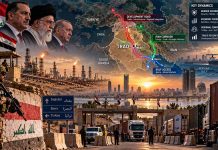









The strategic consequences of Baghdad’s confrontation with Iran, American financial leverage, regional infrastructure competition and the struggle for control of Middle Eastern connectivity
Geographic scope: Iraq, Iran, the United States, Türkiye, Saudi Arabia, the Gulf, Syria and the European trading system, with an assessment of economic, security and diplomatic consequences through 2031.
Executive Summary — Bottom Line Up Front
The suspension of operations at Iraq’s Al-Sheeb border crossing on 21 October 2026 is a test of Baghdad’s capacity to exercise sovereign control over its borders while preserving commercial relations with Iran, access to international finance and the viability of its emerging transit economy.
The principal assessment is that Iraq faces three interconnected vulnerabilities: the exposure of its domestic economy to Iranian trade disruptions, its dependence on international financial and energy networks, and the political fragmentation that complicates federal control over strategic infrastructure.
The Iraqi government publicly attributes the closure to inadequate technical and security arrangements. American pressure to restrict Iranian commerce has been reported and is publicly alleged by Tehran, but the available official record does not establish that Washington ordered this specific closure.
The economic consequences already extend beyond the frontier. Iraqi authorities have intervened to admit stranded perishable shipments, while disputes over reopening the crossing have escalated into a confrontation between the federal government and provincial political leadership.
The broader economic environment is exceptionally fragile. In its October 2026 assessment, the World Bank projects a 12.4% contraction in Iraqi GDP during 2026, principally associated with the regional conflict and disruption of oil production and exports. This is a forecast, not a measured annual result.
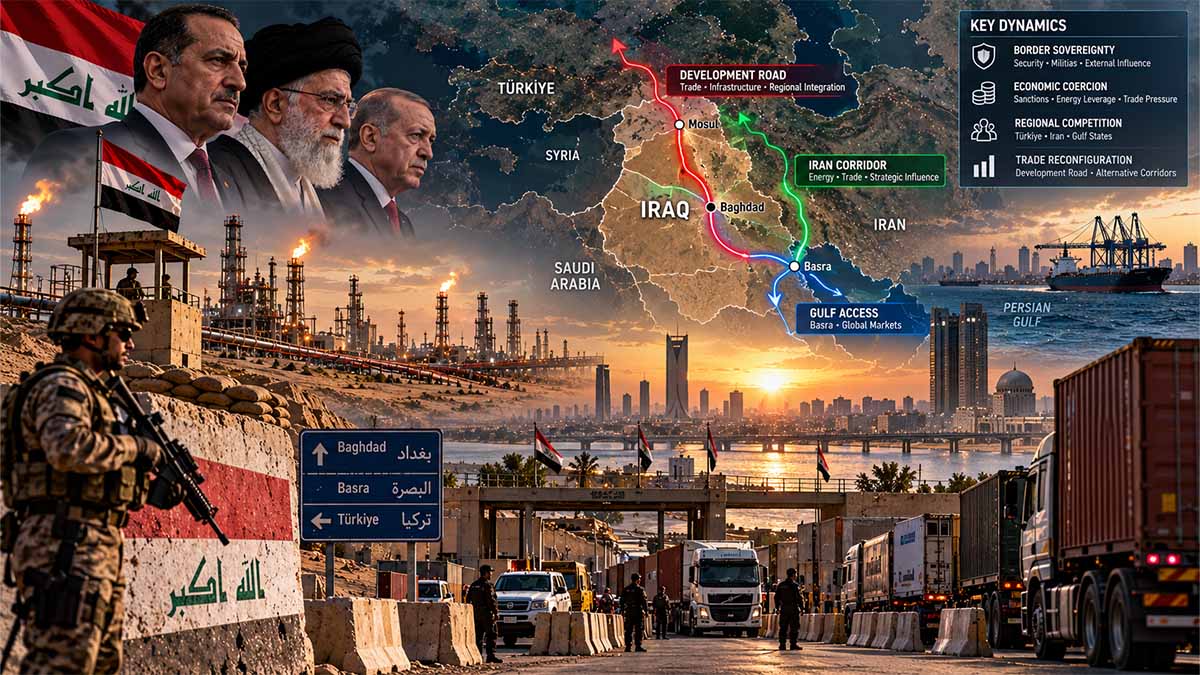
The strategic contest is not simply between Iran and the United States. Türkiye, Gulf governments, international financiers and Iraqi provincial authorities influence which future corridors become economically credible. Baghdad’s proposed Development Road offers a possible route toward diversification, but its strategic value depends on financing, operational security, customs integrity, infrastructure completion and reliable international connections.
Central judgment: Iraq’s economic sovereignty will increasingly depend less on which crossings it opens or closes than on whether Baghdad can establish dependable, diversified and internationally financeable transport, energy and commercial networks without turning its border provinces into the principal bearers of geopolitical adjustment costs.
Iraq’s New Economic Front: How Border Controls, Oil Dependence and Regional Corridors Are Redefining Baghdad’s Sovereignty
The closure of Iraq’s Al-Sheeb crossing with Iran on 21 October 2026 has exposed a contradiction that Baghdad can no longer manage through diplomatic balancing alone. Prime Minister Ali al-Zaidi’s government is attempting to preserve Iranian commerce, satisfy international financial requirements and develop alternative trade corridors while a regional conflict erodes the petroleum revenues on which the Iraqi state depends. The dispute extends well beyond customs administration. It concerns the authority to determine which goods, capital and energy can move through Iraqi territory, and under whose conditions. With the World Bank forecasting a 12.4% contraction in 2026 and Washington intensifying financial enforcement against Iran-linked networks, border controls have become instruments of economic statecraft. Iraq’s sovereignty will increasingly be determined not by its diplomatic alliances, but by its ability to control the infrastructure and financial systems on which those alliances depend.
A closed crossing has exposed the limits of Baghdad’s balancing strategy
On 21 October, Iraq suspended commercial and passenger movements through Al-Sheeb in Maysan province, opposite Iran’s Chazabeh crossing. Government spokesman Haider al-Aboudi attributed the decision to inadequate technical and logistical facilities. The Border Ports Authority subsequently authorised stranded agricultural shipments to enter, acknowledging the risk of spoiled produce, disrupted supply and rising prices. Iran’s Interior Ministry protested the absence of advance notification, arguing that the bilateral arrangements governing border operations required consultation over prolonged closures. The original agreement’s operative provisions have not been independently established in the available record, leaving the legal dispute unresolved.
The political context is more consequential than the declared technical deficiencies. On 15 October, US Treasury Secretary Scott Bessent’s department announced Operation Economic Outcast, targeting financial networks allegedly facilitating Iranian sanctions evasion, including an Iraqi bank. Three months earlier, on 16 July, the Treasury had publicly linked its cooperation with Prime Minister al-Zaidi and Iraq’s Central Bank to financial integrity and the threat posed by Iran. These are documented American policy decisions. They establish Washington’s financial leverage, but not an authenticated instruction requiring Baghdad to close Al-Sheeb.
For Prime Minister al-Zaidi, the distinction matters. Closing one crossing while keeping alternative routes available allows Baghdad to exercise regulatory authority without completely interrupting commerce with Tehran. Yet the same selectivity raises questions about why Al-Sheeb was chosen and which technical conditions would permit reopening. A government seeking credibility with international banks must demonstrate that border restrictions respond to identifiable legal and operational requirements rather than changing diplomatic demands.
Oil revenues expose the financial ceiling on Iraqi independence
The scale of Iraq’s economic vulnerability explains why a dispute over one crossing has acquired national significance. According to the World Bank, petroleum accounted for 53% of Iraqi real GDP, 88% of government revenues and 91% of merchandise exports in 2025. The figures describe three different economic aggregates, but together demonstrate the concentration of national income, fiscal capacity and foreign-exchange earnings in a single industry.
Before the 2026 regional conflict transformed the outlook, the International Monetary Fund projected Iraqi crude exports of approximately 3.5 million barrels per day, annual export receipts of $79.2 billion and a fiscal deficit equivalent to 9.2% of GDP. It also projected government expenditure of 43.8% of GDP against revenues of 34.6%, with wages and pensions absorbing 24.5% of GDP. The World Bank’s October 2026 forecast of a 12.4% economic contraction has overtaken those earlier growth assumptions. The comparison reveals the deterioration in Iraq’s economic environment, not a directly comparable statistical revision by one institution.
More recent figures attributed to SOMO documentation supplied to the Iraqi parliament indicate approximately 533 million barrels exported during January–September 2026, generating $37.39 billion in reported proceeds. A separate figure of $33.51 billion was attributed to deposits into Central Bank accounts. Those amounts require reconciliation against the original institutional records; the difference cannot be described as missing revenue without examining settlement periods and accounting definitions.
The underlying problem is physical as well as financial. Higher international crude prices cannot compensate automatically for barrels that cannot reach export markets. Disruption around the Strait of Hormuz has therefore renewed the importance of alternative petroleum outlets. Iraq needs additional export resilience at precisely the moment declining fiscal capacity makes major infrastructure commitments harder to finance.
Türkiye offers an alternative outlet, but capacity is not production
On 1 August 2026, Türkiye’s Ministry of Energy and Natural Resources announced a one-year crude transportation agreement involving pipeline operator BOTAŞ, Iraq’s SOMO and the North Oil Company. The arrangement allocated 750,000 barrels per day of transportation capacity through the Silopi–Ceyhan system. Turkish officials separately described the wider pipeline network as possessing approximately 1.5 million barrels per day of technical capacity.
Neither figure establishes realised exports. Contracted capacity, operational capacity and actual deliveries are different economic quantities. Iraq must supply suitable crude to the northern network, maintain functioning pipeline infrastructure and secure reliable loading arrangements at Ceyhan. Expanding connections from southern producing regions would require further engineering, financing and construction.
The agreement nevertheless changes Iraq’s negotiating position. A functioning Mediterranean outlet reduces exclusive exposure to the Gulf maritime chokepoint, while giving Ankara an increasingly important role in Iraqi petroleum transportation. Diversification thus creates a new diplomatic dependency even as it reduces an existing geographical vulnerability.
The same tension governs the proposed 1,200-kilometre Development Road linking Grand Faw Port with the Turkish frontier. The project has been presented as a means of connecting Gulf maritime commerce with European markets, but its commercial viability depends on substantially more than geographical distance. Freight operators must compare port handling, railway tariffs, transhipment costs, border procedures and delivery reliability against established maritime alternatives.
In July 2026, Iraqi transport authorities reported the completion of preliminary designs and progress toward detailed engineering and financing. These developments show institutional preparation, not an operational international corridor. Reported overall investment requirements of at least $17 billion remain indicative rather than a fully financed and audited construction programme.
Two World Bank investments provide a more credible industrial test
The most concrete evidence of Iraq’s transport transformation lies in two separately approved World Bank programmes worth a combined $1.83 billion. In June 2025, the institution approved $930 million for the Iraq Railways Extension and Modernization Project, covering approximately 1,047 kilometres of existing railway infrastructure connecting Umm Qasr with Baghdad and Mosul. In June 2026, it approved another $900 million for the Iraq Transport Economic Corridors project, covering strategic road connections toward Türkiye, Syria and Jordan.
These commitments are economically important but cannot be counted as completed construction or realised expenditure. The World Bank’s September 2026 financial register identified approved financing without recorded disbursements for the relevant entries. The programmes also have distinct purposes: rehabilitating national transport infrastructure is not equivalent to financing the entire Development Road.
The railway programme provides measurable future objectives. By 2037, it is expected to support annual movements of 6.3 million tonnes of domestic freight, 1.1 million tonnes of international merchandise and 2.85 million passengers. It anticipates more than 3,000 full-time construction jobs over seven years and 21,900 annual jobs by 2040. These are projected outcomes, not existing employment or traffic volumes.
The road programme is intended to benefit approximately 7.9 million people living along improved routes. Its significance is reinforced by the World Bank’s assessment that roads account for more than 90% of Iraq’s transportation activity. Better road maintenance, railway operations and freight handling could reduce costs for Iraqi manufacturers, agricultural producers and distributors even if international transit develops more slowly than anticipated.
This is the distinction on which Iraq’s industrial policy will be judged. Infrastructure creates lasting economic value when it improves domestic productivity, attracts manufacturing and supports competitive logistics services. Construction expenditure alone does not establish diversification. A new corridor operating below commercial capacity could leave Baghdad with maintenance obligations and financing costs while doing little to reduce petroleum dependence.
Federal authority, provincial livelihoods and banking compliance now collide
The internal political costs became visible in Maysan. Provincial Council chairman Mustafa Daeer al-Mohammadawi threatened civil disobedience over the continued Al-Sheeb closure. On 26 October, Prime Minister al-Zaidi ordered an investigation, and reporting indicated that a Karkh court subsequently issued an arrest warrant. The reported judicial action does not establish criminal guilt, but it shows how rapidly an administrative restriction developed into a confrontation between federal and provincial authorities.
Iraq’s Constitution assigns foreign policy and national security to the federal government under Article 110, while Article 114 identifies customs management as a shared competence requiring coordination. Article 122 protects important elements of provincial administration. The legal issue is therefore not whether Baghdad can exercise national security authority, but whether it can do so through procedures that respect statutory responsibilities and the rights of elected provincial institutions.
Economically, rerouting a shipment does not necessarily preserve the employment and income generated where it originally crossed. Drivers, freight brokers, warehouses and wholesale businesses in Maysan can lose commercial activity even when the imported goods eventually reach another Iraqi market. Without audited traffic, customs and employment data, attributing a precise monetary loss to Al-Sheeb would be unjustified.
Financial regulation adds another constraint. The IMF reported that Iraq shifted legitimate international trade transactions toward commercial banks’ correspondent relationships beginning in January 2025. This makes reliable documentation, beneficial-ownership checks and sanctions compliance increasingly important. But excessive restrictions can also drive lawful businesses away from regulated payment channels. Baghdad must therefore demonstrate that stronger financial oversight reduces illicit activity without suppressing ordinary commerce.
The government’s problem is no longer merely to enforce a closure. It must show that enforcement improves security, maintains legitimate supply chains and strengthens financial credibility without transferring disproportionate costs to provincial communities.
Regional competitors and European partners are testing Iraq’s commercial credibility
The regional contest is not organised into two unified opposing blocs. Iran seeks to preserve access to Iraqi markets. Türkiye wants reliable transport connections and stronger energy cooperation. Saudi Arabia prioritises the security of its territory and infrastructure. Qatar and the United Arab Emirates participate in the quadrilateral Development Road framework established with Iraq and Türkiye in April 2024. Their political participation, however, must be distinguished from specific financed investments.
The security dimension is explicit. On 12 July 2026, Saudi Foreign Minister Prince Faisal bin Farhan and Iraqi Foreign Minister Fuad Hussein reaffirmed the principle that Iraqi territory and airspace should not be used to launch attacks against Saudi Arabia, GCC members or neighbouring states. For potential investors, the commercial meaning is direct: infrastructure cannot attract durable private capital without credible security and continuity arrangements.
European governments approach Iraq with different instruments. The EU–Iraq Partnership and Cooperation Agreement has been in force since August 2018, while the EU Advisory Mission in Iraq has supported civilian security-sector reform and integrated border management. The mission’s revised financial reference amount reached approximately €79.08 million for the period extending from May 2024 to October 2026. This is an advisory allocation, not funding for railway construction.
Italy has particularly direct economic interests. Foreign Minister Antonio Tajani’s October 2026 meeting with Iraqi Foreign Minister Fuad Hussein identified energy, infrastructure, water management and industrial machinery as areas of cooperation. Bilateral trade reached €2.3 billion in 2025. Italian diplomacy also identified the Development Road and the India–Middle East–Europe Economic Corridor as projects of interest, without announcing corresponding construction awards.
France combines support for Iraqi sovereignty with security cooperation and potential infrastructure participation. Germany reported cumulative assistance exceeding €3.6 billion since 2014, including development, stabilisation and humanitarian programmes, while German industrial engagement encompasses electricity infrastructure. The United Kingdom announced an export package worth up to £12.3 billion in January 2025, including £66.5 million in border-security equipment exports. These announced ceilings must not be confused with realised investment or completed deliveries.
The European interest is therefore commercial and institutional, not merely geopolitical. Iraq could become an additional market for engineering, industrial systems, freight services and energy infrastructure. But neither European interest nor Gulf financing capacity can compensate for opaque procurement, unstable payment arrangements or infrastructure that fails to deliver competitive transport services.
The next 24 months will determine who absorbs the cost of inaction
Between October 2026 and October 2028, Baghdad faces a series of decisions whose consequences will extend to 2031. Al-Sheeb’s future requires transparent security and reopening criteria. The northern petroleum agreement must be assessed through actual export volumes rather than its 750,000-barrel-per-day capacity allocation. The World Bank’s $1.83 billion in approved transport financing must advance toward verified procurement, disbursement and infrastructure delivery. The Development Road requires credible financing, binding operating arrangements and demonstrated freight demand.
The alternative is not necessarily an immediate geopolitical rupture. It is a gradual accumulation of costs: higher logistics expenses for importers, reduced income for provincial transport businesses, weaker investment returns, continued petroleum-export concentration and greater dependence on external financial intermediaries.
For Prime Minister Ali al-Zaidi, the political price would be diminished control over economic policy despite the formal exercise of sovereign authority. For Iranian exporters and Iraqi merchants, it would be reduced commercial predictability. For Türkiye and Gulf investors, it would be uncertainty over the profitability and security of infrastructure commitments. For European companies, it would mean attractive projects remaining difficult to finance or execute.
The largest cost would fall on Iraq’s public finances and domestic productive economy. A state confronting a projected 12.4% contraction in 2026 cannot indefinitely substitute diplomatic announcements for operating infrastructure. By October 2028, Iraq’s sovereignty will be measured less by the crossings it has the authority to close than by the trade, energy and financial networks it has acquired the capacity to keep open.
Navigational Index
Pillar I — Borders, Sovereignty and the Architecture of Political Authority
- Chapter 1. Al-Sheeb and the Changing Geography of Iraqi–Iranian Relations
- Chapter 2. Federal Authority, Provincial Resistance and Armed-Network Influence
- Chapter 3. American Economic Statecraft, Sanctions Exposure and Baghdad’s Strategic Autonomy
Pillar II — Trade, Energy and the Geoeconomics of Regional Corridors
- Chapter 4. The Economic Cost of Border Disruption: Customs, Supply Chains, Prices and Employment
- Chapter 5. From Hormuz to Grand Faw: Iraq’s Development Road and Competing Connectivity Systems
- Chapter 6. Oil Export Diversification, Rail Infrastructure, Banking and Investment Risk
Pillar III — Regional Power Competition and Iraq’s Strategic Outlook to 2031
- Chapter 7. Iran, Türkiye, Saudi Arabia and the Gulf: Competing Economic and Security Interests
- Chapter 8. Implications for the United States, European Union, Italy, France, Germany and United Kingdom
- Chapter 9. Strategic Scenarios, Early-Warning Indicators and Policy Options, 2027–2031
Master Abstract — Iraq’s Transition from Energy Dependence to Corridor Competition
The events at Al-Sheeb expose a structural contradiction at the centre of Iraqi foreign and economic policy. Baghdad seeks to preserve commercial access to Iran, avoid confrontation with Washington, maintain Gulf security relationships and establish itself as an indispensable transit state between Asian and European markets. These objectives are not inherently incompatible. They become difficult to reconcile when regional warfare, sanctions enforcement, non-state armed networks and fragmented domestic authority undermine the predictability required for international trade.
On 21 October 2026, Iraqi authorities suspended passenger and commercial movements through Al-Sheeb, opposite Chazabeh in Iran’s Khuzestan province. Government spokesman Haider al-Aboudi attributed the decision to deficiencies in technical and logistical readiness. Border Ports Authority chairman Omar al-Waeli subsequently confirmed measures permitting stranded agricultural shipments to enter Iraq. These announcements establish an operational security and supply-chain dimension, but do not conclusively establish the decision’s geopolitical motivation.
The distinction matters. Border controls are legitimate instruments of national security and customs administration. Their economic and diplomatic consequences, however, depend on proportionality, implementation, transparency and the availability of alternative routes. A narrowly targeted closure accompanied by infrastructure modernisation produces a different strategic outcome from a sustained programme designed to isolate an entire neighbouring economy.
The fiscal vulnerability behind the border confrontation
The Fiscal Vulnerability Behind the Border Confrontation
Un’indagine strutturale sull’impatto macroeconomico, l’esposizione al monoprodotto idrocarburico e i vincoli di bilancio dello Stato iracheno nella riorganizzazione dei corridoi geoeconomici eurasiatici.
Proiezione World Bank (Ottobre 2026) in scenario di contrazione da conflitto.
Quota delle entrate fiscali governative originate dal greggio (Stima WB, 2025).
Esposizione delle esportazioni aggregate sull’estero (Stima WB, 2025).
Specifiche progettuali infrastrutturali (Ministry of Planning, Iraq).
1. La Trasmissione Sistemica dell’Urto Idrocarburico sul Canale Fiscale
Questi parametri quantitativi rivelano con inequivocabile chiarezza le ragioni per cui la politica di diversificazione delle rotte e lo sviluppo dei corridoi logistici hanno smesso di essere semplici ambizioni infrastrutturali, assurgendo a rango di priorità primaria per la sicurezza nazionale economica. Secondo le rilevazioni della Banca Mondiale, nel corso del 2025 il comparto estrattivo ha generato circa l’88% delle entrate pubbliche correnti e ha rappresentato il 91% del valore cumulativo dell’export mercantile dell’Iraq. Una simile concentrazione rende la tesoreria di Baghdad eccezionalmente vulnerabile a qualunque variazione nei volumi di esportazione e nei corsi energetici internazionali.
In questo assetto di monocoltura esportativa, qualsivoglia interruzione fisica o aumento del rischio operativo nelle rotte di transito marittimo petrolifero — in particolare l’imboccatura del Golfo e gli snodi dello Stretto di Hormuz — non agisce unicamente quale deterrente commerciale, bensì si traduce in tempi brevissimi in uno shock macroeconomico polidimensionale:
- Erosione Fiscale Immediata: L’interruzione delle spedizioni abbatte il gettito tributario e le royalties versate dalla State Organization for Marketing of Oil (SOMO), privando l’erario della liquidità necessaria per sostenere la spesa corrente.
- Strette sulla Liquidità Valutaria: Con oltre il 90% delle entrate in valuta pregiata legato al greggio, la contrazione dei flussi esteri comprime le riserve della Central Bank of Iraq (CBI), innescando pressioni svalutative sul tasso di cambio parallelo e limitando l’accesso ai mercati internazionali delle merci.
- Compressione delle Spese in Conto Capitale: La necessità di preservare la massa salariale pubblica e le reti di sussidi generalizzati costringe l’esecutivo a sacrificare in primis gli investimenti pluriennali e le manutenzioni strategiche.
- Impoverimento del Potere d’Acquisto Interno: L’indebolimento del dinaro e l’aumento dei costi logistici di importazione per i beni alimentari e intermedi si scaricano in via diretta sui prezzi al consumo, deprimendo la domanda aggregata interna.
2. Dal Quadro Fiscale Pre-Crisi al Deterioramento Bellico del 2026
Il deterioramento congiunturale odierno non cade su una struttura economica resiliente. Già nel luglio del 2025, le valutazioni del Fondo Monetario Internazionale (FMI) a titolo dell’Articolo IV avevano segnalato profonde fragilità strutturali e rigidità di bilancio ben prima che le conseguenze del conflitto regionale del 2026 manifestassero per intero la loro portata distruttiva.
Metriche di Vulnerabilità Pre-Crisi (Quadro IMF – Luglio 2025)
Spinto principalmente dall’ipertrofia della spesa corrente e dal libro paga statale.
In rapida ascesa rispetto ai minimi registrati durante il ciclo rialzista delle commodity.
È cruciale evidenziare sul piano analitico che le proiezioni dell’FMI del luglio 2025 riflettevano uno scenario base antecedente, non una quantificazione del posizionamento fiscale dell’Iraq in economia di guerra o sotto prolungato stress logistico. Pertanto, la stima della Banca Mondiale pubblicata nell’ottobre 2026 — che prevede un crollo verticale del PIL reale pari a -12.4% — non è che la formalizzazione statistica di un quadro macroeconomico andato incontro a una discontinuità sistemica senza precedenti recenti.
3. Il Dilemma Strategico: Sviluppo Logistico vs. Spazio Fiscale
Tale configurazione genera una trappola di politica economica per Baghdad. Da un lato, l’Iraq necessita urgentemente di finanziare la riqualificazione dei valichi di confine, la posa degli scali multimodali e l’avanzamento dei 1,200 km della cosiddetta Development Road (Tariq al-Tanmiya), infrastruttura concepita per collegare il porto di Grand Faw con la rete autostradale e ferroviaria turca ed europea. Tale corridoio costituisce l’unico meccanismo credibile a lungo termine per svincolare il commercio nazionale dalla dipendenza marittima esclusiva delle acque del Golfo e gettare le basi di un’economia di transito diversificata.
Dall’altro lato, la contrazione fiscale cagionata dagli attriti regionali interviene nel momento di minor elasticità finanziaria: i ricavi crollano, l’indebitamento sovrano affronta premi al rischio proibitivi e le priorità del bilancio sono monopolizzate dal sostentamento emergenziale della popolazione e dal presidio delle frontiere. Baghdad si trova così ad aver bisogno di ingenti capitali per modernizzare il proprio apparato infrastrutturale proprio quando le perdite connesse alle contese geopolitiche ne azzerano i margini di manovra.
The strategic significance of the Development Road
Iraq’s proposed Development Road is a separate infrastructure project from the Al-Sheeb crossing, and there is no verified basis for treating the two as physically competing routes. Their connection is institutional and geopolitical.
The Iraqi Ministry of Planning describes a proposed 1,200-kilometre transport connection from Grand Faw Port to the Turkish border. Official discussions have addressed railway rehabilitation, construction of new sections and coordination with the Kurdistan Regional Government over the northern connection. A September 2026 announcement by Iraq’s General Company for Land Transport further documents discussions in Ankara regarding the Fishkhabur–Ovaköy crossing, rail and road integration, and coordination involving Syria.
These developments establish continuing institutional work, not completion of an operational international corridor.
The distinction is critical for investors. Announced routes do not generate reliable transit revenue until border procedures, rail interoperability, port handling, security guarantees, commercial contracts and financing arrangements function together. Iraq cannot replace the economic role of its oil exports simply by announcing alternative transport infrastructure.
The more consequential possibility is that a successful corridor could diversify the sources of Iraqi national income, strengthen federal control over customs and transport revenues, attract industrial and logistics investment, and reduce dependence on any single external economic relationship.
Domestic power is the immediate constraint
The confrontation is not confined to foreign policy. The dispute surrounding the Al-Sheeb closure has generated resistance in Maysan, where commercial livelihoods are directly exposed to border restrictions.
On 26 October, Prime Minister Ali al-Zaidi ordered an investigation into Maysan Provincial Council chairman Mustafa Daeer Mohammedawi following threats of civil disobedience connected to the crossing’s continued closure. Reports also identify legal objections concerning federal intervention against an elected provincial official.
This controversy illustrates a systemic obstacle to Iraqi economic transformation: infrastructure may fall under federal jurisdiction while its immediate economic costs are concentrated locally.
A policy that strengthens international financial compliance but destroys confidence among transport operators, merchants and border communities could ultimately weaken Baghdad’s ability to govern the very network it seeks to secure.
Key Evidence Table
| Indicator | Verified value or status | Reference period | Institution or source |
|---|---|---|---|
| Al-Sheeb crossing | Closure effective 21 October, 06:00; no confirmed reopening in the reviewed record | October 2026 | Iraqi government statements, reported by 964media |
| Official justification | Technical, logistical and security deficiencies | 21 October 2026 | Iraqi government spokesman |
| Agricultural trade | Exceptional admission of stranded perishable shipments authorised | 21 October 2026 | Iraqi Border Ports Authority |
| Iraqi GDP forecast | −12.4% real growth | 2026 forecast | World Bank, October 2026 |
| Oil share of government revenues | 88% | 2025 estimate | World Bank |
| Oil share of merchandise exports | 91% | 2025 estimate | World Bank |
| Fiscal deficit | −9.2% of GDP | 2026 pre-war projection | IMF, July 2025 |
| Development Road | 1,200 km planned transport corridor | Official project baseline | Iraqi Ministry of Planning |
| Northern corridor governance | Federal–Kurdistan coordination concerning Turkish border connection | August 2025 | Iraqi Ministry of Planning |
| Iraq–Türkiye transport coordination | Meetings involving road, rail and border integration | September 2026 | General Company for Land Transport |
Competing Explanations and Strategic Pathways
The evidence supports three potentially overlapping explanations for the crossing’s closure. They are not mutually exclusive.
| Hypothesis | Supporting evidence | Principal limitation | Current assessment |
|---|---|---|---|
| Security and customs modernisation | Government statements identify inadequate facilities; perishable-goods exemptions indicate an effort to manage the interruption | No independently verified implementation schedule for the required upgrades | Directly supported as Baghdad’s declared justification |
| Response to American financial and sanctions pressure | Iranian officials have publicly alleged US pressure; other reporting attributes similar claims to Iraqi political sources | No authenticated US instruction ordering this specific closure has been established | Plausible contributing influence, not proven direct causation |
| Selective reassertion of federal authority | The closure demonstrates Baghdad’s ability to suspend a crossing; federal–provincial tensions have subsequently intensified | No official record confirms that centralisation was the original purpose | Supported as a consequence; unresolved as an initial motive |
An important analytical consequence follows: the closure can be simultaneously justified on security grounds, welcomed by external actors seeking to restrict Iranian trade, and interpreted domestically as a redistribution of authority. Demonstrating one effect does not establish every alleged intention.
Principal Repercussions Through 2031
Financial and monetary repercussions
Iraq’s exposure to sanctions-related compliance risks creates an asymmetry in its bilateral relationships. Trade with Iran supports important sectors of the domestic economy, while access to international banking and dollar settlement remains essential to wider import financing and government financial operations.
The probable adjustment is an increase in compliance costs for banks, importers and logistics providers where transactions involve sanctions-sensitive counterparties. A more restrictive environment could encourage some trade to move toward less transparent channels, thereby weakening customs collection and creating additional financial integrity risks.
This is not an inevitable consequence of the Al-Sheeb closure itself. It becomes material if restrictions expand or legitimate alternative payment and transit arrangements remain insufficient.
Energy and infrastructure repercussions
The Development Road could enhance non-oil commercial activity but cannot substitute directly for large-volume crude export infrastructure. Rail corridors, maritime ports and oil pipelines provide different economic functions and have different capacity requirements.
A comprehensive Iraqi diversification strategy would therefore need to distinguish merchandise transit from petroleum evacuation, electricity integration and industrial development. Failure to do so would lead to unrealistic expectations of the revenue contribution of transport projects.
Security repercussions
The intersection of infrastructure and armed politics raises the potential costs of protecting trade corridors. Transport infrastructure becomes less commercially attractive when a single disruption can suspend deliveries, interrupt border services or affect insurance and financing decisions.
Federal customs control, police capacity, technological inspection and coordination with provincial authorities consequently become economic competitiveness factors rather than merely security expenditures.
Diplomatic repercussions
A more restrictive border regime would affect Tehran’s commercial access and could intensify pressure on Baghdad from Iranian institutions and Iraq-based political actors sympathetic to Iran.
Conversely, a predictable and internationally compliant border framework could improve Baghdad’s position with Washington and potential external investors without requiring the termination of legitimate bilateral trade.
For Türkiye and Gulf governments, the practical question is whether Iraq can provide stable routes for goods, capital and industrial investment. Their willingness to commit resources will depend on demonstrated delivery capacity rather than declarations of geopolitical alignment.
European repercussions
The European Union’s exposure is principally indirect: maritime-route reliability, supply-chain diversification, energy prices, financing compliance and the commercial prospects of infrastructure linking the Gulf with Türkiye and European markets.
For Italy, potential interests lie in ports, engineering, rail systems, industrial equipment and energy infrastructure. France has relevant transport, energy and security-industrial capabilities. Germany’s strategic exposure includes machinery exports, industrial logistics and trade-route resilience. The United Kingdom has interests in international finance, risk management, insurance and regional security partnerships.
These are areas of potential exposure and commercial opportunity, not evidence of awarded contracts or new national commitments arising from the border closure.
Strategic Outlook: 2027–2031
Pathway A — Controlled reopening and institutional modernisation
Baghdad restores operations after defined security upgrades, preserves legitimate commerce and introduces more consistent customs supervision. This would contain provincial disruption while giving the government a credible basis for stronger border administration.
Pathway B — Selective restrictions and trade diversion
Border controls become more restrictive or unevenly enforced. Freight shifts toward alternative crossings, increasing costs and economic pressure on certain provinces. Baghdad retains trade channels but faces growing administrative and political burdens.
Pathway C — Regional confrontation and corridor fragmentation
Further military or financial escalation interrupts multiple transport, trade and energy networks. Infrastructure investment weakens, the political costs of provincial instability increase, and Iraqi economic diversification is delayed.
These pathways are conditional, not probability-weighted forecasts. Their relative likelihood depends on developments for which consistent contemporary operational and financial data are not yet available.
Principal Gaps and Watch Indicators
The most consequential outstanding records are the formal Iraqi decision establishing the closure and its legal basis; the inspection and infrastructure deficiencies identified by competent authorities; a timetable for remediation; daily customs, truck and passenger statistics before and after 21 October; and any authenticated American communication concerning Iraqi border controls.
For the wider corridor strategy, the decisive indicators are financing closure, enforceable construction contracts, railway and border completion milestones, and transparent governance arrangements for transit revenues.
The principal policy priority is therefore not unconditional reopening or permanent closure. It is the development of a rules-based border administration that can enforce security requirements while maintaining predictable legal commerce. That would give Baghdad the strongest foundation for simultaneously protecting domestic stability, improving external financial credibility and advancing its long-term infrastructure strategy.
No decision-useful quantitative visualisation is supportable from a verified, comparable time series of Al-Sheeb traffic before and after closure. Geographic relationships are established, but current route-capacity data are insufficient for a defensible comparative flow chart.
Final assessment: Iraq’s capacity to become a regional connectivity hub will be determined by the credibility of federal institutions, the security and reliability of transport networks, and the country’s ability to manage external geopolitical competition without converting necessary economic diversification into domestic political fragmentation.
IRAQ AT THE CROSSROADS
Border sovereignty, economic coercion and the reconfiguration of West Asian trade. A strategic assessment of Iraq’s exposure to energy disruption, Iranian trade dependence, US financial influence, federal–provincial tensions and infrastructure competition through 2031.
01 — Iraq’s Strategic Economic Exposure
Official estimates and forecasts. Reference periods differ.
02 — The Structure of Iraq’s Oil Dependence
Dimensional bar chart. Each bar represents oil’s percentage share in a different economic aggregate in 2025.
Vertical scale: 0–100%; 2 pixels represent one percentage point. The baseline is zero and the two bars use the same scale. The categories have different denominators and should not be added. Source: World Bank, Iraq country assessment, 2025 estimates.
03 — The Geography of Competing Corridors
Schematic of separate commercial systems. This represents institutional and geographic relationships, not operating traffic volumes or an assertion that all projects are complete.
Proposed North–South Development Road
Iraq
1,200 km overall project
toward wider markets
Other Relevant Regional Systems
Blue chain: proposed Development Road architecture. Amber panels: distinct regional transport or energy systems. No direct Al-Sheeb–Development Road infrastructure link is asserted.
04 — Border Disruption: Economic Transmission
Qualitative causal mechanism. Actual magnitude depends on closure duration, rerouting capacity, cargo composition and enforcement.
05 — Verified Strategic Indicators
Documentary baseline. Forecasts and older projections are explicitly distinguished from observed events.
| Indicator | Value / Status | Reference | Strategic Significance |
|---|---|---|---|
| Al-Sheeb crossing | Operations suspended | 21 October 2026 | Commercial interruption and dispute over border governance |
| Government explanation | Technical, logistical and security deficiencies | 21 October 2026 | Declared domestic rationale; external causation not established |
| Perishable shipments | Exceptional entry arrangements authorised | October 2026 | Recognition of immediate supply-chain impacts |
| 2026 real GDP growth | −12.4% forecast | World Bank, October 2026 | Severe macroeconomic deterioration |
| Oil / government revenues | 88% | World Bank, 2025 estimate | High fiscal vulnerability to export disruption |
| Oil / merchandise exports | 91% | World Bank, 2025 estimate | Concentrated foreign-trade structure |
| 2026 fiscal deficit | 9.2% of GDP projected | IMF, July 2025 | Pre-war projection; not an updated wartime outcome |
| Development Road | 1,200 km planned | Iraqi Ministry of Planning | Potential long-term diversification of transport activity |
| US direction of Al-Sheeb closure | Not established by an authenticated instruction | Record reviewed to 26 October 2026 | Reported pressure must remain separate from proven causation |
06 — Strategic Pathways, 2027–2031
Conditional scenarios, without numerical probabilities or invented risk scores.
Pathway A
Security deficiencies are remedied, predictable commercial procedures return, and Baghdad strengthens customs administration.
Watch: certified infrastructure upgrades, published reopening decisions and consistent cargo processing.
Pathway B
Some border movements continue through alternative routes, increasing administrative burdens and concentrating costs in affected provinces.
Watch: rerouted freight, customs changes, provincial disputes and banking compliance requirements.
Pathway C
Further conflict or financial restrictions impair multiple transport and energy networks, weakening investment confidence.
Watch: disruption of other crossings, export interruptions and delays in financed infrastructure projects.
07 — Strategic Net Assessment
Iraq’s infrastructure strategy will be judged not by announced corridor length alone, but by the credibility of border institutions, secured commercial access, financing arrangements and integration with neighbouring transport systems.
The decisive economic question is whether Baghdad can reduce concentration risk without converting border management into prolonged domestic political and commercial instability.
PILLAR I — BORDERS, SOVEREIGNTY AND THE ARCHITECTURE OF POLITICAL AUTHORITY
Chapter 1. Al-Sheeb and the Changing Geography of Iraqi–Iranian Relations
A border decision that exposes the limits of Iraq’s strategic autonomy
The suspension of operations at the Al-Sheeb border crossing on 21 October 2026 must be understood within the changing institutional relationship between Iraq and Iran, rather than interpreted exclusively as a commercial interruption or an isolated security intervention. Its significance arises from the convergence of three developments: the increasing importance of border administration as an instrument of economic security, the growing political difficulty of maintaining relations with Tehran during the regional conflict, and the Iraqi government’s attempt to establish control over international trade networks that have historically operated through overlapping federal, provincial, commercial and political interests. The central analytical judgment is that the incident does not establish a decisive Iraqi geopolitical realignment away from Iran. It does, however, reveal a shift in the practical instruments through which Baghdad seeks to manage that relationship. Customs procedures, inspection systems, crossing authorisations, banking compliance and control over provincial trade infrastructure are becoming central to decisions previously understood primarily through diplomacy, military cooperation and political alignments.
On 21 October, the Iraqi government publicly explained the suspension as a consequence of inadequate technical, logistical and operational readiness. Government spokesman Haider al-Aboudi maintained that the decision was connected to the need for infrastructure improvements and that commercial movements continued at other crossings. This explanation followed reports on 20 October indicating that Al-Sheeb would close from 06:00 the following morning, with the possibility of subsequent restrictions at other Iranian border crossings. The initial reporting did not contain a publicly authenticated timetable for a general border shutdown, while the subsequent government explanation did not establish that such a programme had been formally adopted. These distinctions are essential. A verified suspension at one crossing cannot automatically be extrapolated into a national policy of closing the entire Iraqi–Iranian frontier. Iraqi Government Statement on Al-Sheeb — Iraqi News Agency, reported 21 October 2026; Iraq Border Closure Announcement — 964media, 20 October 2026.
The government simultaneously introduced an exception for perishable agricultural shipments awaiting clearance on the Iranian side. Lieutenant General Omar al-Waeli, chairman of Iraq’s Border Ports Authority, explained that the intervention responded to requests from traders and importers concerned about spoiled produce, disruptions in supply and higher domestic prices. The authority also described instructions to rehabilitate border infrastructure, construct additional access roads and install improved inspection equipment. This combination of restrictive and compensatory measures is analytically important because it suggests that Baghdad recognised the immediate economic costs of suspending normal commercial activity. Nevertheless, the announcement of infrastructure upgrades cannot be equated with completed improvements, independently established technical deficiencies or an approved investment programme. The responsible authorities would need to publish the relevant technical findings, procurement decisions and reopening criteria to establish the full administrative justification. Border Ports Authority Statement on Trade and Infrastructure Measures — 21 October 2026.
Iran’s immediate response introduced a second dimension: the question of bilateral notification. An Iranian Interior Ministry spokesman stated that Tehran had not been informed in advance and argued that the bilateral arrangements governing border-crossing management required notification when a closure exceeded one day. This is an attributable Iranian interpretation of the relevant agreement, not an independently verified legal conclusion. The operative treaty provision, its exceptions for security emergencies and the precise notification procedures require examination before concluding that Iraq violated an international obligation. Nevertheless, the diplomatic significance is clear. A sovereign state’s unilateral ability to suspend access to its territory does not eliminate the practical need for predictable bilateral procedures when the crossing is integrated into international freight, passenger and pilgrimage networks. Iranian Interior Ministry Statement on Border Notification — 21 October 2026.
The geography of the incident also requires precision. Al-Sheeb, located in Iraq’s Maysan governorate, corresponds to Chazabeh on the Iranian side in Khuzestan. It serves bilateral road commerce and passenger movements and occupies a distinct position from the Shalamcheh crossing serving the Basra area. Iranian authorities directed some travellers and traders toward Shalamcheh when the Al-Sheeb–Chazabeh route was interrupted. Consequently, the immediate economic effect should be evaluated as a redistribution of traffic within a network of crossings, not as the elimination of all Iranian access to Iraqi markets. The extent to which neighbouring facilities can absorb diverted freight depends on their actual daily handling capacity, inspection resources, road connections, operating hours and demand from other users. Without comparable statistics for these variables, neither complete substitution nor systemic paralysis can be asserted. Khuzestan Border Authorities on Chazabeh and Alternative Routes — 21 October 2026.
From political interdependence to regulatory sovereignty
The deeper transformation concerns the meaning of sovereignty in an economy characterised by high import requirements, concentrated export revenues and multiple cross-border dependencies. For Baghdad, control over an international crossing is not simply the physical power to stop a truck. It includes the authority to determine which goods may enter, which firms are authorised to transport them, which certificates and inspections are required, which financial institutions settle the resulting transactions and which public bodies retain the customs revenues. For Tehran, the same network represents access to a neighbouring market and a means of maintaining commercial relationships amid international financial restrictions. These interests overlap in ordinary circumstances but can become conflicting when the security or diplomatic priorities of one government demand more restrictive treatment of the other.
The economic foundation of this relationship must be separated into three channels. The first is formal merchandise trade, comprising goods declared, inspected and admitted through recognised customs procedures. The second is services and passenger-related economic activity, including transportation, accommodation, retail consumption and religious travel. The third is the financial infrastructure supporting purchases, invoices, settlement, currency conversion and payment to suppliers. A government may restrict one channel while leaving the others functioning. Accordingly, the consequences of border intervention cannot be assessed reliably from bilateral merchandise-trade totals alone. The more useful evidence would include customs declarations by commodity, daily loaded and empty truck movements, country of origin, declared transaction values, settlement currencies and information about the commercial entities involved.
The regional conflict has made the distinction between these channels more consequential. Iran faces extensive United States sanctions, but sanctions restrictions do not mean that every conceivable transaction involving an Iranian counterparty is automatically prohibited for every non-US participant. The applicable obligations depend on the identities of the parties, the goods or services, the financial and territorial nexus, and the relevant sanctions instruments and authorisations. The United States Treasury’s Office of Foreign Assets Control maintains Iran-related restrictions alongside specific general licences, exclusions and licensing policies. Its October 2026 guidance also addresses risks to foreign financial institutions. For Iraq, the practical consequence is that trade policy can no longer be managed independently of banking oversight, counterparty screening and documentation. Iran Sanctions Programme and Current Regulatory Guidance — US Department of the Treasury, Office of Foreign Assets Control.
This regulatory environment creates a particularly difficult problem for Iraqi policymakers. If inspection and banking requirements are inadequate, the country risks greater exposure to illicit financial activity, commercial misdeclaration and international compliance concerns. If restrictions are introduced without transparent criteria and sufficient processing capacity, legitimate traders may face delays or seek alternative channels that are less visible to public authorities. A strategy intended to strengthen the integrity of the border could therefore become counterproductive if it reduces formal commerce without reducing the economic demand that sustains informal activity. The decisive institutional distinction is between stronger regulation and economically indiscriminate closure. The former can increase government control and improve the commercial credibility of Iraq’s logistics system; the latter can weaken customs revenue, encourage circumvention and transfer the cost of foreign-policy adjustment onto border communities.
Historical geography and the changing structure of Iraqi–Iranian dependence
Iraqi–Iranian interdependence is not distributed evenly across the two economies or across Iraqi territory. The southern frontier connects Iranian commercial centres with Iraqi provinces whose local economies depend on agricultural distribution, road transport, warehousing and the movement of visitors. Other border corridors support different commodity flows and connect to distinct Iraqi urban markets. This means that changes in border administration generate geographically uneven consequences. A restriction that can be absorbed by the national economy through rerouting may produce serious losses for firms operating in the affected province. Equally, an alternative crossing may remain physically open while becoming less commercially competitive because of congestion, increased distances or additional inspection requirements.
This geographic asymmetry complicates the notion that Baghdad can reduce Iranian economic influence through the closure of a single facility. Trade relationships are rarely extinguished by a change at one border point when suppliers, importers and transport operators have established commercial incentives to continue dealing with one another. The immediate adjustment may instead consist of rerouting, the restructuring of transport contracts and the redistribution of profits among logistics intermediaries. Some operators benefit from diversion; others lose business. Consumers may experience higher delivered prices for perishable products, particularly when shipments must move through longer or more congested routes. The exact effects depend on the time required to replace supply, the availability of domestic products and the proportion of additional transport costs passed through to buyers.
The Iraqi Border Ports Authority’s intervention to admit stranded vegetables provides a concrete example of this transmission mechanism. The authority explicitly connected the decision with traders’ concerns about spoilage and price pressures. Separate local reporting described interruptions in shipments entering Basra through Shalamcheh earlier in October and resulting difficulties in agricultural markets. These events cannot establish a national inflation effect without official retail-price series, but they demonstrate why administrative uncertainty at crossings handling food imports can require rapid intervention from Baghdad. Border Ports Authority Statement on Agricultural Shipments — 21 October 2026.
The political implication is equally important. A decision concerning international security may be made at federal level, but the losses accumulate within identifiable local constituencies. Truck drivers, wholesale importers, customs brokers, temporary workers, warehouse operators and related businesses experience changes in income before the central government can demonstrate any strategic benefit. This creates an inherent temporal imbalance: the cost of restriction is immediate and visible, while potential security gains may be delayed, diffuse or difficult to quantify. If Baghdad wishes to maintain a restrictive measure for a prolonged period, it must establish not only its legal authority but also the administrative and economic rationale required to sustain public confidence.
Border modernisation as a test of institutional capacity
The government’s declared intention to improve inspection equipment, access roads and operating infrastructure creates a measurable policy test. A technically justified suspension should normally be accompanied by a documented assessment of operational deficiencies, a description of the minimum standards required for resumption, procurement arrangements for necessary equipment and a transparent administrative process for reopening. Where risks relate to smuggling, counterfeit currency or prohibited commodities, the authorities must also distinguish the effectiveness of better inspections from the broader economic costs of stopping lawful trade. A crossing can be made more secure through risk-based inspection and improved intelligence coordination; closure is only one possible administrative instrument.
A further distinction concerns security at the border and security within the surrounding territory. Customs inspection systems are designed principally to identify irregularities in goods, vehicles, documentation and persons passing through an authorised point of entry. They are not substitutes for territorial surveillance, criminal investigation, control of armed groups or the prevention of attacks launched from locations elsewhere within a province. Any argument linking the Al-Sheeb suspension to wider instability in Maysan must therefore establish a credible operational connection between the deficiency identified and the proposed corrective measure. Merely locating two security problems in the same province does not demonstrate that they share a cause or can be remedied through the same intervention.
For a government attempting to strengthen its control over international commerce, the relevant measure of success is not the number of crossings temporarily suspended. It is the capacity to produce faster and more reliable customs clearance, lawful revenue collection, lower opportunities for corruption, accurate shipment records and credible enforcement. International transport firms assess border performance through predictability, documentation requirements, turnaround times and the frequency of arbitrary interruptions. A programme that improves all four can enhance Iraq’s commercial position even where inspection becomes stricter. Conversely, sophisticated equipment installed within a poorly governed administrative process will have limited value if users remain exposed to inconsistent decisions or discretionary interference.
Evidence matrix — The institutional dimensions of the Al-Sheeb decision
| Dimension | Established position or documented assertion | Principal uncertainty | Strategic consequence |
|---|---|---|---|
| Operational suspension | Iraqi government announced suspension of Al-Sheeb operations effective 21 October | Final reopening date and conditions | Direct interruption at one crossing |
| Technical justification | Government spokesman identified deficiencies in operational readiness | Detailed technical inspection report | Test of administrative credibility |
| Border modernisation | Border Ports Authority announced plans for improved equipment and access roads | Procurement, financing and completion | Potential improvement in customs performance |
| Agricultural exemptions | Special arrangements for stranded perishable shipments were authorised | Shipment volumes and clearance outcomes | Evidence of supply-chain sensitivity |
| Bilateral notification | Iranian Interior Ministry asserted that advance notice was required for prolonged closure | Original bilateral agreement and exceptions | Diplomatic and procedural dispute |
| Alternative crossings | Government stated that other border crossings continued operating | Verified spare freight-processing capacity | Potential rerouting rather than trade elimination |
| Wider closure programme | Initial reporting referred to possible phased restrictions | Formal adoption, scope and timetable | Distinguishes targeted control from strategic escalation |
The documentary basis for this matrix is found in the Iraqi government explanation of the closure, 21 October 2026, the Border Ports Authority’s announced operational measures, 21 October 2026, and the Iranian Interior Ministry’s notification complaint, 21 October 2026. No audited facility-level cargo series or complete bilateral notification agreement was established in the reviewed official record.
The emerging strategic balance
The most significant change in Iraqi–Iranian relations is not necessarily a reduction in bilateral economic activity, but the increasing political importance of the terms under which that activity takes place. Tehran benefits from predictable access to Iraqi markets; Baghdad benefits from the availability of imports and cross-border services. Yet Baghdad also needs regulatory institutions that can protect the banking system, ensure customs compliance and support relationships with a wider group of international partners. The government’s problem is therefore not whether economic cooperation with Iran should exist in principle, but how such cooperation can be administered without allowing the frontier to become a source of financial vulnerability, political coercion or insecurity.
A durable Iraqi policy would separate three questions that are frequently conflated in public debate: whether specific border facilities satisfy technical requirements; whether individual transactions comply with applicable law and sanctions restrictions; and whether Iraq’s broader relationship with Tehran serves its national economic and security interests. These questions require different evidence, legal authorities and corrective measures. Treating them as interchangeable risks making border administration hostage to geopolitical disputes while leaving genuine security deficiencies unresolved.
Chapter 1 net assessment: Al-Sheeb represents a significant test of regulatory sovereignty rather than proof of an irreversible geopolitical break. A selective reopening under transparent security and customs requirements would support the interpretation that Baghdad is seeking stronger institutional control. A widening programme of restrictions without published administrative criteria, especially if accompanied by additional financial or diplomatic measures, would instead indicate that the frontier is becoming an instrument of broader strategic pressure. The distinction must be determined through observable government decisions and operational records, not inferred from the symbolism of the original closure.
Chapter 2. Federal Authority, Provincial Resistance and Armed-Network Influence
The constitutional paradox: national control over borders and the limits of federal command
The confrontation between Baghdad and Maysan illustrates a central weakness in Iraq’s post-2003 institutional architecture: the distribution of authority between the federal government and elected provincial institutions is more complicated than the assertion that international borders belong exclusively to the central state. The constitutional framework gives Baghdad decisive responsibilities for foreign affairs, national security and sovereign economic functions, but customs administration is expressly identified as an area of shared competence. The resulting legal structure creates a distinction between the state’s authority to make an international security decision and the manner in which it coordinates, implements and defends that decision within provinces whose economic interests are directly affected. The Al-Sheeb controversy has made this distinction politically consequential because the provincial response has developed from commercial protest into a dispute concerning constitutional autonomy, administrative accountability and the permissible limits of opposition to federal decisions.
Article 110 of Iraq’s Constitution establishes federal exclusivity over foreign policy and diplomatic representation, the negotiation and conclusion of international agreements, national security policy, and specified monetary and fiscal functions. Article 114, however, identifies customs management as a shared competence requiring coordination with regions and governorates not organised into regions, subject to legislation. Article 115 allocates powers not expressly reserved to the federation to regional and relevant provincial authorities, while Article 122 provides the basis for decentralised administration and important guarantees for provincial councils. These provisions must be read together rather than interpreted as granting either Baghdad or the provinces unconditional authority over every activity conducted at an international crossing. The exact legal basis of a closure depends on the statutory powers exercised, the purpose of the measure, its duration and the procedures required by the governing legislation. Constitution of the Republic of Iraq — Council of Representatives, Articles 110, 114, 115 and 122.
An important distinction follows. Baghdad may possess the constitutional authority to adopt national security measures affecting an international crossing without thereby acquiring unrestricted authority to intervene in the internal affairs of an elected provincial council. Likewise, provincial administrative autonomy does not necessarily allow a governorate to disregard a valid federal security decision concerning an international frontier. The controversy therefore contains at least two separate legal questions: whether the suspension itself was lawfully authorised, and whether subsequent measures directed against provincial officials respected the applicable constitutional and criminal procedures. Treating these as a single political confrontation conceals the institutional issues that will determine whether the conflict can be settled through ordinary administrative channels or produces a more enduring dispute over federalism.
The immediate political escalation demonstrates how quickly these distinctions can become operationally important. On 25 October, Maysan Provincial Council chairman Mustafa Daeer al-Mohammadawi participated in protests against the continued suspension and threatened civil disobedience, including the obstruction of roads connecting the province with the rest of Iraq, unless the crossing reopened. Reports attributed to him an ultimatum extending to Thursday, 29 October. On 26 October, Prime Minister Ali al-Zaidi directed an investigation into the statements, arguing through his office that public officials were required to respect constitutional and administrative procedures. Later that day, reporting from Baghdad indicated that a Karkh court had issued an arrest warrant following a complaint by the prime minister. The reported warrant is a judicial procedural development, not evidence that the official committed an offence or that the merits of the underlying dispute have been adjudicated. Prime Minister’s Office Statement Concerning Maysan Provincial Council — 26 October 2026; Reported Karkh Court Arrest Warrant and Provincial Responses — 26 October 2026.
The reaction of other provincial representatives demonstrates that the dispute has evolved beyond the commercial value of Al-Sheeb. Members of the Maysan Provincial Council challenged what they considered interference with an elected institution and invoked Article 122 of the Constitution, together with the provincial-governance framework established under Law No. 21 of 2008, as amended. Their position is a constitutional argument advanced by interested political actors; it is not equivalent to a final interpretation by Iraq’s Federal Supreme Court. Nevertheless, the intervention reveals a wider problem for Baghdad. Even where a federal decision is constitutionally defensible, the government must consider whether its enforcement creates a second controversy involving the institutional independence of provincial authorities. Maysan Provincial Council Members’ Statements on Constitutional Autonomy — 26 October 2026.
The political economy of provincial dependence
Maysan’s response cannot be explained entirely through allegiance to Iran or hostility toward Baghdad. Its economic geography creates a direct material interest in the functioning of Al-Sheeb. International crossings support employment and enterprise far beyond the formal customs service. The relevant economic network includes road hauliers, vehicle maintenance businesses, loading and unloading workers, freight agents, agricultural wholesalers, commercial intermediaries and service establishments supporting cross-border movements. When an international crossing is suspended, these activities experience a contraction in transactions even if national merchandise imports are subsequently redirected to another province. The resulting loss is concentrated geographically and occupationally, producing political resistance that may be considerably stronger than aggregate national economic statistics would suggest.
This difference between national and local welfare is central to understanding the dispute. From Baghdad’s perspective, rerouting commercial shipments through another functioning crossing could preserve essential imports while allowing a problematic facility to be upgraded. From Maysan’s perspective, the same measure may transfer commercial activity, associated employment and business revenues to competing transport routes. The government’s aggregate objective may therefore be compatible with an immediate redistribution of income away from the affected province. A policy can be nationally rational and locally damaging at the same time. The administrative challenge is to determine whether those local costs are unavoidable, proportionate and accompanied by credible compensatory arrangements.
The absence of a verified, facility-level economic assessment is consequently a substantive governance weakness. Publicly circulated estimates of the crossing’s daily truck movements, monthly revenues or number of dependent households cannot be treated as audited economic impact figures without an identifiable underlying record. A proper assessment would require customs revenues collected at the facility, actual freight volumes, the proportion of movements involving local registered carriers, direct employment at the crossing and the surrounding logistics industry, and the volume of trade successfully redirected through other routes. It would also need to distinguish customs receipts accruing to the federal budget from commercial income retained within Maysan. Without such a distinction, political statements about the amount of revenue supposedly lost by the province risk combining public revenue, private turnover and household income in a misleading way.
The political importance of these missing distinctions is substantial. If federal customs revenue continues to be collected elsewhere while local transport workers lose their contracts, the central government may conclude that the trade system is functioning adequately while provincial residents experience severe hardship. Conversely, if freight diversion increases informal payments or bypasses formal customs inspection, both Baghdad and Maysan could suffer losses. Neither outcome can be established from the closure announcement alone. The relevant policy question is the distribution of costs and benefits across jurisdictions, rather than the simplistic assumption that every shipment rerouted successfully preserves the economic interests of everyone previously involved.
Provincial resistance as a test of political legitimacy
The public demonstrations by truck drivers and other affected operators demonstrate how an administrative decision can develop into a dispute about political representation. Protesters described Al-Sheeb as an important economic lifeline and questioned why their crossing had been singled out when other routes remained operational. These claims, while reflecting the perspectives of directly affected participants, identify a real governance issue: the burden of a national decision becomes politically difficult to justify when the reasons for selecting one location over another are not documented in publicly understandable terms. If one crossing is demonstrably less secure, the government can explain the relevant technical criteria. If several facilities possess comparable deficiencies, a selective suspension requires an explanation of why the chosen intervention is proportionate and operationally necessary. Maysan Truck Drivers’ Protest and Economic Concerns — 22 October 2026.
The government must also distinguish between lawful political opposition and conduct that may violate criminal law. Elected officials possess political responsibilities to represent their constituencies, including by challenging decisions that adversely affect local employment and commerce. However, threats to obstruct essential roads or prevent the functioning of national institutions may raise separate legal issues depending on their precise character, context and implementation. A legitimate disagreement over federal policy does not confer unrestricted authority to organise coercive action, but neither does the existence of a controversial statement automatically justify bypassing the procedural protections associated with elected office. The rule-of-law test is whether legal action is based on an identifiable offence, pursued through competent institutions and separated from retaliation against political criticism.
The controversy may also affect the credibility of future decentralisation reforms. International investors considering logistics facilities, industrial estates or customs-service partnerships need to understand which level of government can issue permits, guarantee access, maintain road connections and enforce commercial arrangements. If provincial authorities can credibly threaten disruptions whenever federal policies generate local costs, infrastructure investments face political continuity risks. If Baghdad can intervene unpredictably in provincial commercial arrangements, investors face the opposite problem: central administrative discretion becomes a source of uncertainty. Neither unrestricted provincial vetoes nor unconstrained federal intervention provides a stable foundation for development. The investment-compatible solution lies in clearly allocated authority, formal coordination procedures and transparent mechanisms for resolving disputes.
Armed organisations, political parties and the fragmentation of security authority
The security dimension of Iraq’s border governance requires particularly careful analysis because political influence, organisational affiliation and operational control are distinct concepts. Iraq contains armed formations operating under the framework of the Popular Mobilization Forces, alongside political parties and parliamentary blocs with relationships to organisations that have participated in the country’s security landscape. The existence of these relationships does not by itself demonstrate that a particular organisation controls a specific border crossing, directs its customs staff or participates in illicit activity there. Such conclusions require facility-specific evidence, documented command arrangements, financial investigations or findings by competent security and judicial authorities.
This distinction is especially important in assessing the position of the Badr political organisation. Its parliamentary representatives have publicly called for the reopening of Al-Sheeb, warning that prolonged closure could deepen public dissatisfaction and damage livelihoods. That intervention establishes the organisation’s expressed political position on the dispute. It does not establish that the organisation operates the crossing or that its opposition is motivated by an undisclosed financial interest. The same principle applies to other groups that may have influence within Maysan. Political advocacy, the historical presence of armed networks and demonstrable control over customs operations must be assessed separately. Badr Parliamentary Bloc Statement Concerning the Reopening of Al-Sheeb — 26 October 2026.
At the institutional level, the underlying challenge is that the legitimate use of force, customs enforcement, intelligence collection and political oversight must operate through identifiable lines of responsibility. A border-control strategy cannot succeed if agencies disagree about who has authority to inspect vehicles, investigate offences, detain suspects or authorise commercial movements. Nor can improved scanners and surveillance equipment substitute for sound governance when information collected at a crossing is not transmitted reliably to the competent investigative authorities. Effective security requires an integrated process extending from detection through investigation, prosecution and administrative correction.
The relationship between border control and armed-network influence is also more complex than the proposition that closing a crossing automatically weakens undesirable organisations. Restricting formal trade can remove legitimate commercial opportunities from the local economy while increasing the incentives for clandestine transport elsewhere. If enforcement is uneven, businesses may become more dependent on intermediaries capable of navigating administrative barriers. Stronger border governance must therefore prioritise the transparency and enforceability of commercial procedures, rather than merely reducing the number of authorised movements. The objective should be to increase the proportion of trade subject to reliable inspection and lawful financial settlement, not to encourage economic activity to migrate outside formal supervision.
The operational implications of these considerations are particularly important in areas affected by regional military tensions. The Iraqi government has stated that national territory must not be used to threaten neighbouring states. Such a position requires more than diplomatic assurances: it demands credible territorial surveillance, lawful command relationships and an ability to investigate incidents without political interference. Yet the presence of a security threat in a governorate does not justify automatically attributing responsibility to every politically influential armed or civilian organisation active there. The government must preserve the distinction between evidence-based enforcement and political generalisation if it is to maintain both internal legitimacy and regional credibility.
Institutional responsibility matrix
| Institution or actor | Relevant authority or interest | Principal limitation | Required governance safeguard |
|---|---|---|---|
| Federal executive | National security coordination and execution of federal policy | Decisions remain subject to law and constitutional limits | Written administrative authority and reviewable decisions |
| Border Ports Authority | Border administration, operational coordination and inspection arrangements | Specific statutory competences must be observed | Published procedures, inspection records and operational performance reporting |
| Customs authorities | Lawful classification, valuation and collection of customs duties | Vulnerability to inconsistent declarations and discretionary treatment | Auditable electronic declarations and enforcement oversight |
| Maysan governorate administration | Local service delivery and economic coordination | Cannot independently determine national foreign policy | Formal consultation and economic-impact reporting |
| Provincial council | Elected oversight and representation of provincial interests | No general power to override lawful federal security measures | Constitutional procedures and respect for elected-office safeguards |
| Police and security services | Investigation and enforcement within assigned jurisdictions | Fragmented responsibility can weaken accountability | Unified incident reporting and clear referral procedures |
| Judicial authorities | Adjudication of alleged offences and relevant legal disputes | Judicial independence and due process must be preserved | Competent jurisdiction and reasoned decisions |
| Political parties and parliamentary blocs | Political representation and legislative oversight | Political influence is not equivalent to legal administrative authority | Transparency concerning conflicts of interest and institutional responsibilities |
| Commercial operators | Freight movement, customs declarations and contractual delivery | Exposure to unpredictable restrictions and operating costs | Clear appeals procedures and predictable clearance standards |
The distribution of constitutional responsibilities derives from the Constitution of the Republic of Iraq — Council of Representatives. The requirements in the final column are analytical governance recommendations, not assertions that all listed measures are currently required by Iraqi legislation.
The administrative mechanisms needed to prevent recurrent confrontations
The first necessary reform is the institutional separation of technical border assessments from political decisions about their economic consequences. A competent security or customs authority should identify deficiencies against defined operational criteria and determine which facilities require immediate restriction. The relevant federal ministry or executive authority can then decide, within its legal powers, which measures are necessary and proportionate. Provincial institutions should receive timely information about expected disruption and planned mitigating measures. This arrangement does not transfer sovereign security authority to local councils; rather, it makes the exercise of that authority more transparent and less vulnerable to allegations of arbitrary selection.
The second requirement is an economic continuity mechanism for affected provinces. When a border crossing is suspended, government agencies need to establish whether alternative routes can absorb the relevant traffic without generating excessive delays or losses. The solution may include temporary routing arrangements, additional customs shifts, expedited clearance of highly perishable goods and time-limited assistance to workers whose employment depends directly on the facility. However, compensation schemes should not be announced without identifying eligible beneficiaries, the responsible spending authority and available funding. Public resources directed toward mitigating disruption must be distinguished from permanent subsidies designed to preserve inefficient operating structures.
The third requirement is a structured dispute-resolution process between federal and provincial institutions. Constitutional litigation may ultimately be appropriate where legal competencies are genuinely disputed, but not every administrative disagreement should require escalation to the judiciary or criminal authorities. A practical coordination mechanism could require written technical findings, a defined provincial consultation period where circumstances permit, periodic publication of the reasons for continued suspension and an established process for reviewing reopening conditions. Its effectiveness would depend on binding responsibilities rather than the creation of another advisory forum lacking implementation authority.
The fourth requirement is independent scrutiny of the security claims underlying the decision. When a border closure is defended by reference to smuggling or counterfeiting, relevant customs, police and judicial records should allow the government to demonstrate the character of the threat and the limits of less restrictive alternatives. Not every intelligence assessment can be disclosed publicly, but aggregate enforcement outcomes, inspection deficiencies and infrastructure requirements can often be communicated without exposing sensitive investigations. This distinction would make it more difficult for criminal enforcement to become a pretext for unrelated political measures, while also protecting legitimate security action from unfounded allegations.
Strategic consequences for Iraqi federalism
The Maysan confrontation is important because it highlights the connection between economic decentralisation and the legitimacy of the central state. Provincial institutions cannot govern effectively if they have no credible means of influencing policies that determine the survival of important local industries. The federal government, in turn, cannot preserve national security if provincial authorities can suspend compliance with every central decision that imposes local costs. The challenge is therefore the design of an enforceable distribution of powers in which the national government retains sovereign responsibilities while provincial institutions retain genuine administrative and representative functions.
There is an additional risk associated with the broader economic environment. The World Bank’s 2026 assessment identifies severe pressure on Iraq’s economy arising from the regional conflict, disrupted oil exports and reduced fiscal capacity. Its country analysis reports unemployment of 13.5%, labour-force participation of 38% and a youth population aged 15–29 representing approximately 29% of the national population. These indicators refer to different statistical measures and should not be interpreted as a single contemporaneous labour-market survey. Nevertheless, they point to an economy in which the capacity to replace disrupted private-sector employment is constrained. Under these conditions, a local logistics shock can acquire disproportionate political significance because alternative employment is not necessarily available. Iraq Country Economic and Development Assessment — World Bank, 2026.
This does not imply that Baghdad should avoid necessary security measures whenever local employment is affected. It means that the legitimacy of those measures depends partly on the government’s ability to demonstrate necessity, establish a credible implementation period and address foreseeable economic consequences. A more capable state is not simply one that issues stronger orders. It is one that can implement them without provoking avoidable institutional confrontation or destroying confidence in lawful commercial activity.
Chapter 2 net assessment: The most consequential immediate development is the transition from opposition to a border suspension into a dispute involving an elected provincial official and judicial enforcement. As of 26 October, this development increases the political cost of maintaining the closure and raises separate constitutional questions concerning the relationship between federal security powers and provincial autonomy. The durability of Baghdad’s policy will depend on whether it can establish a defensible legal foundation, demonstrate operational necessity and create a credible means of protecting local economic interests without surrendering federal authority. The available evidence does not establish that armed organisations control the crossing or directed the provincial mobilisation; such conclusions would require independent operational and financial proof.
Chapter 3. American Economic Statecraft, Sanctions Exposure and Baghdad’s Strategic Autonomy
Financial infrastructure has become an instrument of geopolitical power
The most consequential structural constraint on Iraq’s strategic independence is not the presence of an American military force or the political influence exercised by Iran. It is the extent to which Iraq’s international economic activity depends on financial institutions, reserve-management arrangements, payment systems and regulatory relationships that lie partly outside Baghdad’s sovereign control. This dependence does not mean the United States automatically determines Iraqi government decisions, nor does it establish that Washington directed the closure of Al-Sheeb. It means that the Iraqi state must consider the potential consequences of its policies for access to international banking, foreign-exchange settlement and correspondent institutions. In a country whose fiscal revenues remain overwhelmingly dependent on oil and whose private economy requires imported goods, disruption to these financial relationships can have consequences substantially greater than the immediate value of trade passing through an individual border crossing.
The institutional architecture of Iraqi trade finance has changed significantly. In its 2025 Article IV consultation, the International Monetary Fund reported that, beginning in January 2025, legitimate international transactions were being processed through commercial banks using their correspondent banking relationships. The Central Bank of Iraq shifted toward replenishing correspondent balances in response to foreign-exchange demand, undertaking subsequent audits and focusing on the supervisory responsibilities associated with anti-money-laundering and counter-terrorism-financing compliance. The IMF regarded the transition as an important development in financial-sector reform and encouraged the strengthening of correspondent relationships, including with non-US institutions. Iraq: 2025 Article IV Consultation, Staff Report, Section on Trade Finance — International Monetary Fund, July 2025.
This reform has substantial geopolitical consequences. Under a correspondent-banking model, the ability of an importer to settle a transaction is influenced not only by Iraqi exchange regulations but also by the compliance requirements of the banks involved. A payment may encounter difficulties because an institution cannot verify the beneficial owner of a commercial counterparty, identify the purpose of a transaction, establish the origin of goods or confirm that no prohibited entity is involved. The financial consequences arise from the interaction of Iraqi regulation, foreign banking policies and applicable sanctions law. These mechanisms can create external leverage even without a publicly announced demand by a foreign government.
The distinction between direct American intervention and the indirect influence of financial architecture is fundamental. Washington can impose restrictions through legally established sanctions programmes and specific measures directed at designated persons or institutions. International banks, meanwhile, may independently restrict transactions that they consider too difficult or expensive to monitor. Such risk avoidance can affect legitimate commerce beyond the minimum restrictions imposed by law. For Iraq, the effect is an uneven commercial environment in which formal access to foreign exchange does not necessarily guarantee that every otherwise lawful transaction can be processed efficiently.
The changing American sanctions environment in 2026
The United States Treasury maintains a comprehensive framework of Iran-related sanctions, incorporating restrictions, designations, advisories and licensing provisions. The public record available in October 2026 includes an OFAC notice directed at foreign financial institutions conducting business with Iran, dated 5 October 2026, as well as regulatory changes affecting certain authorisations in September. These developments are relevant to Iraqi financial institutions because they reinforce the importance of examining counterparties and financial exposure in transactions involving Iranian economic actors. The existence of these instruments does not establish that any particular Iraqi import or shipment through Al-Sheeb was prohibited. That determination depends on the applicable legal provisions and the parties involved. Iran Sanctions: Current Advisories, Licensing Policies and General Licences — United States Department of the Treasury, Office of Foreign Assets Control, October 2026.
The regulatory consequences are more complex than a binary choice between unrestricted trade and economic isolation. American sanctions can apply differently to US persons, foreign financial institutions, designated entities and particular categories of goods and services. Some activities may be authorised under general or specific licences, and humanitarian-related provisions require careful assessment of their precise conditions. Conversely, transactions involving parties or activities subject to applicable prohibitions may remain unlawful even when conducted through intermediaries or denominated in a currency other than the US dollar. The legal question must therefore be answered at the level of the transaction, rather than through general claims that trade with Iran is either entirely legal or entirely prohibited.
This has direct implications for Baghdad’s border policy. Physical customs clearance and financial compliance are complementary but different processes. A cargo inspection can establish whether declared goods correspond to their physical description, subject to the reliability of the inspection and documentation. It cannot, by itself, establish that the buyer, seller, financier or beneficial owner satisfies every applicable sanctions requirement. Equally, successful payment through a compliant bank does not demonstrate that a shipment meets customs valuation, origin or product-safety requirements. The economic credibility of Iraq’s trading system depends on the ability to reconcile these forms of oversight without creating unnecessary obstacles for lawful commerce.
The credibility of claims concerning American pressure
Reports attributing the Al-Sheeb decision to American demands deserve examination because they are consistent with the wider existence of US financial leverage over Iraq. However, consistency with a known strategic pattern is not proof of causation in a specific decision. The Iraqi government has publicly described the closure in terms of technical deficiencies and security concerns, while political opponents and other reporting have alleged that American pressure contributed to the measure. No authenticated Treasury instruction requiring the closure of this particular crossing has been established in the official evidence reviewed for this assessment.
The distinction between documented pressure and inferred compliance must be preserved. A foreign government might request a broad reduction in sanctions-sensitive financial activity without prescribing the closure of a particular facility. Baghdad might independently identify a security problem and adopt a measure whose consequences are welcomed by Washington. Alternatively, the Iraqi government might select a targeted restriction partly because it offers a politically manageable response to wider external demands. These explanations are not mutually exclusive, but their relative importance cannot be determined merely by observing that the crossing was closed while US sanctions pressure existed.
A defensible assessment of direct causation would require evidence such as an authenticated diplomatic communication, a Treasury notice identifying the relevant border operations, a contemporaneous Iraqi executive record establishing the reasons for selection, or consistent official statements identifying the precise external demand. Absent such evidence, the most supportable judgment is that American financial and sanctions policy constitutes an important strategic constraint on Baghdad, while the specific causal relationship between that constraint and the Al-Sheeb closure remains unresolved.
This distinction has practical importance. If the closure resulted primarily from demonstrable operational deficiencies, its resolution would depend on technical remediation and administrative verification. If it formed part of a broader programme of sanctions enforcement, reopening might require changes to inspection, banking or commercial documentation procedures. If it represented a political concession to an external partner, the conditions for reversal might lie partly outside the formal border administration. Different causes generate different expected durations, diplomatic repercussions and policy remedies. Treating every possibility as established would produce unreliable forecasts.
The connection between customs integrity and exchange-rate stability
The IMF’s assessment of Iraq’s financial reforms identifies a direct relationship between customs controls, legitimate trade finance and foreign-exchange market performance. The Fund reported that the transition to correspondent-bank settlement contributed to a narrowing of the gap between official and parallel-market exchange rates. It also recommended improved border customs checks to reduce smuggling and informal trade, broader use of Iraqi dinars in domestic transactions and continued strengthening of anti-money-laundering supervision. The significance is that weaknesses in merchandise documentation can interact with weaknesses in the banking system, creating opportunities for misinvoicing or illegitimate foreign-exchange demand. Iraq: 2025 Article IV Consultation, Financial Sector and Exchange-Rate Assessment — International Monetary Fund.
A simplified example illustrates the institutional mechanism without assuming that it occurred at Al-Sheeb. An importer seeking foreign currency to pay for goods must provide documentation supporting the commercial transaction. If the invoiced value is materially inconsistent with the goods actually imported, the difference may indicate an error, misrepresentation or another transaction requiring investigation. Reliable customs data make it easier for banks and authorities to detect discrepancies. Weak customs records reduce the ability to verify whether foreign-exchange payments correspond to real merchandise movements. Consequently, improvements in border administration can support financial integrity as well as security, even when the physical value of goods crossing the border represents only part of Iraq’s international trade.
However, the policy response must avoid confusing stricter control with less economic activity. A customs system that rejects legitimate declarations unpredictably can push importers toward informal intermediaries, increase transaction costs and discourage the use of regulated banking channels. This creates a potential contradiction: measures intended to reduce illicit financial flows may increase incentives to bypass transparent settlement mechanisms if they are implemented without sufficient administrative capacity. The relevant objective is therefore improved verification of commercial transactions and consistent enforcement, not the arbitrary reduction of cross-border trade.
Iraq’s fiscal structure magnifies the consequences of financial disruption
Iraq’s dependence on oil revenues magnifies the economic consequences of difficulties in external payment systems. The World Bank estimates that oil accounted for 53% of real GDP, 88% of government revenues and 91% of merchandise exports in 2025. These are shares of three different economic aggregates, and they demonstrate distinct forms of concentration. The government-revenue figure measures fiscal dependence; the merchandise-export figure reflects foreign-trade concentration; the GDP figure reflects the contribution of petroleum activity to domestic economic output. Taken together, they show why interruptions in oil exports can weaken public finances, foreign-exchange earnings and economic activity simultaneously. Iraq Economic and Development Overview — World Bank, 2026.
In July 2025, before the macroeconomic consequences of the 2026 regional conflict were fully incorporated, the IMF projected government expenditure and net lending equivalent to 43.8% of GDP in 2026, compared with revenues and grants equivalent to 34.6% of GDP. The resulting fiscal deficit projection was 9.2% of GDP. It also projected wages and pensions of 24.5% of GDP, illustrating the weight of recurrent expenditure. These figures describe an earlier fiscal outlook and must not be presented as current observed outcomes. They remain relevant as evidence of the structural position from which Iraq entered the subsequent crisis. IMF Executive Board Concludes 2025 Article IV Consultation with Iraq — 9 July 2025.
The October 2026 World Bank Macro Poverty Outlook projects a 12.4% contraction in the Iraqi economy during 2026, reflecting major disruption associated with the regional conflict and oil production and export difficulties. The projection is not a final statistical measurement of annual GDP. Nevertheless, it indicates that Iraq is confronting an economic shock of a magnitude capable of changing the feasibility of major public investment programmes. When revenues decline while substantial recurrent obligations remain, the government faces competing demands for salaries, social services, energy infrastructure, border modernisation and commercial-route development. Macro Poverty Outlook for Iraq: Annual Meetings 2026 — World Bank, October 2026.
The economic consequence is that financial sovereignty cannot be measured solely by the central bank’s formal control over domestic monetary instruments. It also depends on the resilience of export earnings, the availability of external settlement channels, the management of public expenditure and the capacity to maintain legitimate imports during periods of geopolitical disruption.
Statistical baseline — The financial constraints on Iraqi strategic autonomy
| Indicator | 2024 | 2025 | 2026 | Definition and documentary status |
|---|---|---|---|---|
| Real GDP growth | −2.3% | +3.1% | +1.4% | IMF July 2025 vintage: 2024 estimate, 2025–2026 projections |
| Government revenues and grants | 39.3% | 36.9% | 34.6% | Percentage of GDP; IMF July 2025 vintage |
| Government expenditure and net lending | 43.5% | 44.4% | 43.8% | Percentage of GDP; IMF July 2025 vintage |
| Fiscal balance | −4.2% | −7.5% | −9.2% | Percentage of GDP; IMF July 2025 vintage |
| Wages and pensions | 22.0% | 24.0% | 24.5% | Percentage of GDP; IMF July 2025 vintage |
| Oil revenue | 36.0% | 33.3% | 31.0% | Percentage of GDP; IMF July 2025 vintage |
| Real GDP growth, revised conflict outlook | — | — | −12.4% | World Bank October 2026 projection |
The first six rows use the IMF’s July 2025 forecast vintage and should not be read as final 2025 or 2026 statistical outcomes. The final row belongs to the World Bank’s October 2026 assessment. The difference between the earlier IMF expectation of 1.4% growth and the subsequent World Bank forecast of a 12.4% contraction is 13.8 percentage points, calculated from the two published figures. This difference illustrates the deterioration in the outlook, but it is not a direct statistical revision by the same institution using an identical model or dataset. Sources: IMF 2025 Article IV Consultation — July 2025; World Bank Macro Poverty Outlook — October 2026.
Banking sovereignty and the limits of diversification through alternative currencies
One frequently proposed response to financial dependence is to expand trade settlement in currencies other than the US dollar. This can be useful under specific conditions, but currency substitution does not automatically eliminate sanctions exposure, counterparty risk or the need for trustworthy financial intermediaries. The economic effectiveness of a settlement currency depends on the willingness of counterparties to accept it, its convertibility, the availability of correspondent relationships, liquidity, transaction costs and the legal restrictions applying to the parties involved. A payment denominated in another currency may still involve a prohibited counterparty or a financial institution unwilling to process the transaction.
The IMF has encouraged Iraqi banks to diversify correspondent relationships, including through non-US institutions, as part of broader financial-sector reform. This is a strategy for improving banking resilience and service provision, not evidence that the Fund advocates evading lawful sanctions. The distinction is fundamental. Diversification can reduce concentration risk while preserving compliance. Attempts to conceal counterparties or transactions would instead increase legal and reputational exposure, potentially making international banking relationships more difficult to maintain.
The Central Bank of Iraq faces an additional institutional challenge in balancing foreign-exchange provision against financial integrity. If access to official foreign currency is restricted too broadly, businesses may shift toward parallel markets, potentially widening exchange-rate differentials. If access is insufficiently supervised, the system becomes vulnerable to abuse. The IMF’s recommendations on risk-based supervision, customs documentation and correspondence banking reflect this balance. A credible Iraqi reform programme must improve transaction verification without encouraging legitimate commerce to move outside the regulated financial sector. Iraq: 2025 Article IV Consultation, Informational Annex — International Monetary Fund.
Economic statecraft and the distribution of Iraqi policy options
Washington’s financial influence operates through several channels that must remain analytically separate. The first is the enforcement of legally applicable sanctions against specified entities, conduct or transactions. The second is the indirect influence of international financial institutions’ compliance policies. The third is diplomatic pressure, which may involve communications between governments concerning wider security and economic priorities. The fourth is the signalling effect of regulatory announcements, which can change the behaviour of private banks even before a particular transaction is directly affected.
Baghdad cannot respond effectively to these mechanisms through a single policy instrument. Sanctions compliance requires legal assessment, transparent banking and reliable customer identification. Diplomatic pressure requires negotiation and political judgment. Financial-system fragility requires regulatory reform and stronger institutions. Border insecurity requires inspection, policing and judicial enforcement. Treating all four problems as manifestations of the same foreign intervention would prevent the government from choosing proportionate remedies.
The United States also faces trade-offs in pursuing Iraqi compliance. Measures that strengthen financial transparency and reduce transactions involving sanctioned actors may support Washington’s objectives. However, restrictions that inadvertently undermine legitimate Iraqi imports, damage civilian livelihoods or weaken state institutions could produce economic and political instability inconsistent with a durable partnership. The most effective approach for both governments would distinguish prohibited activities from permissible trade, establish comprehensible compliance requirements and avoid generating uncertainty that encourages the informalisation of commercial transactions.
Iran’s position contains a corresponding dilemma. It has an economic interest in maintaining access to Iraqi markets and preserving commercial relationships through established transport corridors. Yet it also benefits from an Iraqi banking and customs system sufficiently credible to process lawful commerce and withstand international scrutiny. If Iranian exporters or intermediary institutions are unable to demonstrate compliance with applicable requirements, counterparties may withdraw even in the absence of a physical border closure. Conversely, predictable and transparent trade procedures could preserve legitimate commercial exchange while reducing the political controversy attached to individual border decisions.
Financial-risk transmission matrix
| Risk mechanism | Immediate transmission channel | Potential Iraqi consequence | Documentary evidence required for case-specific confirmation |
|---|---|---|---|
| Sanctions designation | Transactions involving a designated counterparty | Legal restrictions or payment refusal | Applicable designation and transaction-party records |
| Correspondent-bank withdrawal | Loss or restriction of international banking relationships | Delayed settlement and increased trade-finance costs | Bank notices, correspondent arrangements and payment records |
| Customs misdeclaration | Inconsistent invoice and shipment information | Revenue leakage, investigation and compliance concerns | Customs declarations and verified inspection findings |
| Foreign-exchange market segmentation | Differences between official and parallel-market access | Higher commercial costs and currency-market pressure | Central bank and market exchange-rate series |
| Oil-export disruption | Reduction in export volume or receipts | Lower fiscal revenue and foreign-exchange earnings | Official production, export and revenue data |
| Unpredictable border restrictions | Freight delays and diversion | Contractual losses, price pressures and local unemployment | Cargo records, transport tariffs and sectoral surveys |
| Excessive compliance avoidance | Banks declining otherwise lawful transactions | Reduced access to regulated trade finance | Transaction rejection records and banking-sector reporting |
| Weak enforcement against illicit activity | Inadequate detection or prosecution | Greater financial integrity and security risks | Competent customs, police and judicial records |
These are defined mechanisms of financial and commercial risk. The table does not assert that every mechanism has occurred at Al-Sheeb, nor does it assign unsupported probabilities or monetary loss estimates. The relevant institutional basis is provided by the IMF’s 2025 assessment of Iraqi trade-finance reform and the US Treasury’s Iran sanctions framework.
Sovereignty as institutional capability rather than diplomatic distance
For Iraq, strategic autonomy cannot mean maintaining equal political distance from every external power at all times. The country faces structural relationships that differ in character: Iran is a neighbouring state with important cross-border commercial connections; the United States exercises significant influence within international financial and security structures; Türkiye controls access to a major potential northern transport connection; and Gulf countries represent potential markets, investors and energy partners. Iraq’s ability to manage these relationships depends on the strength of the institutions responsible for implementing national decisions.
A policy of diversification must therefore be evaluated in operational rather than rhetorical terms. Diversifying payment relationships matters if it reduces the probability that legitimate transactions fail because of dependence on a single institution. Diversifying transport routes matters if alternative facilities have sufficient capacity and operate under predictable rules. Diversifying fiscal revenues matters if new activities generate sustainable government receipts rather than merely increasing public capital expenditure. Strengthening sovereign authority matters if decisions are lawful, enforceable and sufficiently transparent to command compliance from provincial administrations and private firms.
This perspective also changes how the Al-Sheeb decision should be evaluated. A government able to close a crossing demonstrates the capacity to issue an order. A government able to identify a technical deficiency, implement a proportionate restriction, safeguard lawful commerce, complete the necessary improvements, coordinate with a neighbouring state and reopen under transparent conditions demonstrates a more advanced form of sovereignty. The latter requires administrative competence, fiscal resources, legal accountability and diplomatic credibility operating together.
Implications for Baghdad’s relationship with Washington and Tehran through 2031
The first potential trajectory is a gradual institutionalisation of Iraqi economic independence through more diversified transport and banking relationships. This would not require the elimination of trade with Iran or the weakening of relations with the United States. It would involve reducing reliance on discretionary political arrangements and increasing the proportion of economic activity conducted through documented, legally compliant and commercially predictable systems. Such an outcome would improve Iraq’s ability to preserve ordinary trade during regional crises, while potentially making its infrastructure and financial sector more attractive to international investors.
A second trajectory would involve selective restrictions that become politically entrenched without producing corresponding institutional improvements. In that case, border policy would become a recurring arena of contestation between Baghdad, Tehran, Washington and local Iraqi actors. The practical consequences would include less predictable freight movement, higher compliance costs, possible diversion toward informal transactions and renewed tension between federal and provincial authorities. The persistence of these effects would depend on the scope and duration of restrictions, the extent of commercial substitution and the willingness of the government to address local economic damage.
The most disruptive trajectory would arise from simultaneous deterioration in regional security, oil-export capacity and international financial access. Under those conditions, restrictions on commerce with Iran could interact with reduced fiscal receipts and weaker confidence in Iraq’s banking system. The government’s capacity to invest in alternative infrastructure would decline just as the economic need for diversification increased. Such a scenario would not be caused by the Al-Sheeb closure alone, but the crossing’s treatment would become one component of a much broader reduction in Iraqi economic resilience.
The indicators capable of distinguishing these trajectories are concrete. They include the publication of official reopening conditions at Al-Sheeb, changes in the number and identity of operational crossings, the outcome of infrastructure procurement and inspection upgrades, the behaviour of regulated correspondent-bank relationships, verified changes in trade settlement practices, and official measures affecting Iraqi institutions under American sanctions law. Evidence of new financial restrictions would strengthen the assessment that economic statecraft is becoming more coercive. Evidence of restored commercial operations under improved supervision would instead support the interpretation of regulatory consolidation.
Final net assessment of Pillar I
The three chapters establish that Iraq’s contemporary sovereignty problem cannot be reduced to a binary struggle between Iranian influence and American pressure. It is a problem of institutional capacity operating across three connected dimensions.
The first is territorial and administrative: Baghdad must be capable of regulating its international crossings without turning necessary security measures into indefinite commercial disruptions. The second is constitutional and political: federal institutions must exercise their powers without undermining the legal protections and economic responsibilities of provincial authorities. The third is financial: Iraqi policymakers must preserve access to international banking and legitimate foreign trade while ensuring that the country does not become vulnerable to sanctions violations, illicit financial transactions or excessive dependence on a narrow range of settlement channels.
These dimensions reinforce one another. Inadequate customs governance increases financial risk. Financial restrictions can impose additional economic costs on border communities. Concentrated local losses can provoke political resistance to federal enforcement. That resistance can in turn weaken the government’s credibility with investors and international counterparties. A durable strategy must address the whole institutional chain rather than treating each crisis as an isolated event.
The decisive unresolved question remains whether the Al-Sheeb suspension will lead to demonstrable institutional modernisation or become part of a wider pattern of politically mediated restrictions. The official explanation establishes a declared technical and security rationale; it does not conclusively resolve the allegations of external pressure. The provincial confrontation establishes immediate political costs; it does not prove that local opposition is directed by armed organisations. The existence of significant American financial leverage establishes an external constraint; it does not prove American authorship of the closure.
The central strategic conclusion is that Iraq will gain meaningful autonomy not by eliminating its economic relationships with competing powers, but by making those relationships governable through credible institutions, diversified infrastructure, transparent law and reliable financial procedures. The ability to enforce a border decision is one element of sovereignty. The ability to maintain national economic stability while enforcing it is the more demanding test.
PILLAR II — TRADE, ENERGY AND THE GEOECONOMICS OF REGIONAL CORRIDORS
Chapter 4. The Economic Cost of Border Disruption: Customs, Supply Chains, Prices and Employment
The economic geography of border disruption: why the national trade balance conceals the real losses
The principal economic consequence of restricting an international crossing is not necessarily an equivalent reduction in national imports or exports. It is the deterioration of the logistical conditions under which transactions are completed, combined with the redistribution of commercial activity between transport operators, provincial economies, customs facilities and competing supply routes. This distinction is fundamental to assessing Iraq’s border economy because the suspension of Al-Sheeb affects a system in which merchandise transport, agricultural distribution, international passenger movements and commercial services generate separate but interdependent income streams. A shipment prevented from entering through one crossing may eventually reach the same Iraqi customer through another. National import statistics may therefore record little change in the total value of goods received, while the affected transport companies experience lost contracts, additional operating expenses, delayed payments or the destruction of perishable inventory. The resulting economic damage is not captured adequately by measuring aggregate bilateral merchandise trade alone.
The first indication that the interruption created a material supply-chain problem came from the Iraqi Border Ports Authority itself. On 21 October 2026, Lieutenant General Omar al-Waeli announced that the government would permit stranded agricultural shipments to enter following requests from traders concerned about deterioration of vegetables and other perishable goods. The exceptional admission arrangements demonstrate the presence of an immediate operational difficulty, although the publicly accessible account does not quantify the tonnage involved, the value of the cargo or the number of affected vehicles. They also expose a critical distinction between the value of a shipment and the economic loss caused by delaying it. A truck carrying construction material can sometimes be redirected or held with limited physical deterioration, although financing and contractual costs continue to accumulate. A truck carrying vegetables may suffer substantial losses in commercial value within a much shorter period, especially where refrigeration, storage capacity or alternative wholesale buyers are unavailable. The economic effects of identical delays are therefore highly sensitive to the composition of cargo. Iraq Border Ports Authority Announcement on Stranded Agricultural Shipments — 21 October 2026.
This difference has implications for the design of border-security measures. Uniform restrictions that apply to all commercial vehicles without considering the nature of their cargo may generate avoidable economic losses while doing little to improve the effectiveness of inspections. A system of differentiated inspection categories can concentrate administrative resources on transactions presenting demonstrably higher risks while maintaining the continuity of lower-risk lawful commerce. Such a system requires reliable declarations, documentary verification, trained customs personnel, functioning inspection equipment and cooperation between border, police and financial authorities. Its success should be measured through clearance performance and enforcement outcomes, not merely through the volume of traffic stopped. Under conditions of heightened geopolitical tension, this becomes an important source of national economic resilience: preserving legitimate imports reduces the risk that security measures themselves amplify domestic shortages and commercial instability.
Transport costs, inventory deterioration and the commercial transmission of delays
The direct economic cost of a border interruption contains several components that must be measured separately. The first is additional transport expenditure arising from rerouting, including fuel, vehicle depreciation, driver remuneration, tolls and the cost of returning equipment to its normal operating network. The second is the opportunity cost of vehicles immobilised while awaiting administrative decisions. A truck that remains at a crossing for several days may lose subsequent assignments even if the original cargo ultimately reaches its destination. The third is inventory deterioration, which becomes particularly important for agricultural produce and other time-sensitive goods. The fourth is financial exposure: delayed delivery can postpone the settlement of invoices, increase working-capital requirements and affect a company’s ability to pay suppliers and employees. The fifth is contractual uncertainty, including disputes over delivery obligations, insurance coverage and responsibility for extraordinary expenses.
These costs are cumulative, but they are not always additive in a straightforward way. Some may be absorbed by exporters, others by Iraqi importers, logistics companies, wholesalers or final consumers. Their incidence depends on the contractual terms governing each transaction, the ability of the affected parties to renegotiate and the availability of substitutes. For example, a trader purchasing goods under terms that place transportation and customs risks on the seller may initially transfer part of the burden to the exporting company. However, repeated disruption can eventually appear in higher contract prices, reduced credit availability or withdrawal of suppliers from the market. Where the Iraqi importer bears the risk, disruption can directly reduce working capital and generate losses before any final retail-price adjustment occurs.
The significance for Iraq lies in the structure of its domestic distribution system. Road transport accounts for more than 90% of transportation activity, according to the World Bank’s June 2026 assessment accompanying the Iraq Transport Economic Corridors programme. The institution also reports that substantial portions of the national road network are in moderate or poor condition, despite the fact that most of the network is paved. This means that rerouting commercial vehicles cannot automatically be assumed to be inexpensive or operationally neutral. Additional journeys may expose operators to road deterioration, congestion, safety risks and unpredictable delivery times. The cost of a crossing restriction must therefore be evaluated against the condition and capacity of the entire alternative transport chain rather than the mere existence of another border facility. New US$900 Million World Bank Financing to Improve Iraq’s Road Connectivity and Support Job Creation — World Bank, 5 June 2026.
The same structural weakness complicates the government’s efforts to contain food-price pressures. A disruption affecting imported vegetables does not necessarily produce a measurable increase in the national consumer price index. The effect depends on the share of the affected goods in household expenditure, domestic harvest conditions, inventories available in wholesale markets, imports entering through other routes and the capacity of distributors to substitute alternative products. Nevertheless, agricultural products with limited storage lives are particularly vulnerable to short disruptions because inventories cannot always be carried over without deterioration. Even where the national inflation rate remains moderate, certain commodities or local markets may experience abrupt price movements.
The World Bank’s October 2026 assessment reinforces the importance of avoiding a mechanical relationship between aggregate inflation and household economic security. Its Macro Poverty Outlook forecasts a severe contraction in Iraqi economic activity while noting that inflation remains relatively contained. At the same time, the report identifies food-import dependence and electricity shortages as threats to household welfare. These conditions are entirely compatible: a country can experience relatively moderate aggregate inflation while suffering serious local supply problems, declining real incomes and reduced access to essential services. In Iraq’s case, the interaction between disrupted oil revenues, electricity constraints and food distribution may be more damaging than any single border-related price movement considered in isolation. Macro Poverty Outlook for Iraq: Annual Meetings 2026 — World Bank, October 2026.
Employment effects: from border operators to wholesale markets
Employment exposure extends well beyond the personnel physically stationed at a border crossing. Commercial transport networks support direct employment in trucking, handling, customs brokerage and freight forwarding. They also sustain indirect employment in vehicle servicing, fuel distribution, storage, wholesale trade and related professional services. A suspension can affect these activities through reduced transaction volumes, lower utilisation of capital equipment and delayed commercial payments. However, the number of people economically dependent on a crossing should not be confused with the number of full-time equivalent jobs attributable to its operation.
Political claims concerning local dependence must consequently be interpreted with care. A provincial official may identify several thousand residents whose livelihoods are connected with a crossing, but that population may include employees, self-employed transport operators, dependants and businesses conducting only part of their activity through the facility. Without a defined methodology, such a figure cannot be translated into a direct employment loss, a household poverty estimate or an amount of foregone wages. Nor can all declared customs receipts be treated as income accruing to the local economy. Customs revenues, private commercial turnover, transport-service income and household earnings belong to different accounting categories.
A technically defensible economic assessment would therefore need to establish the value added generated locally rather than merely the gross value of merchandise passing through the crossing. The distinction matters because the imported goods themselves may have been produced outside Iraq. Their declared customs value is not equivalent to Iraqi domestic economic output. The local contribution arises principally from transport, handling, distribution, warehousing, retail and other services performed within Iraq, together with any domestic processing of imported inputs. Estimating the economic damage from a suspension requires understanding which of these activities disappear entirely, which are delayed and which are transferred to other Iraqi locations.
This analytical approach also identifies possible beneficiaries of disruption. Alternative crossings may receive additional business, logistics firms operating along new routes may gain customers, and wholesalers holding inventory may obtain temporary pricing advantages. Such gains do not establish that the intervention is beneficial for Iraq as a whole, because they may be accompanied by higher system-wide costs and lower productivity. They demonstrate, however, that the distributional consequences of border closures are not uniform. A national response must consider both losses and displaced commercial activity rather than assuming that every affected transaction represents a permanent destruction of economic value.
Quantifying the cost of disruption without inventing unobserved losses
The available official record does not establish a complete daily series of shipments, customs receipts, clearance times and retail prices before and after 21 October. Consequently, it would be methodologically unjustified to publish a precise monetary estimate of Al-Sheeb’s closure losses or to present an invented percentage increase in the price of imported food. The appropriate approach is to construct a measurable framework that can be populated with customs and commercial records.
| Economic variable | Required measurement | Unit | Principal institution or record | Analytical purpose |
|---|---|---|---|---|
| Freight activity | Loaded and empty commercial vehicles entering and exiting | Vehicles per day | Border Ports Authority, customs records | Establish the scale of displaced traffic |
| Customs value | Declared value of goods by commodity and origin | Iraqi dinars or US dollars per reporting period | General Commission for Customs | Distinguish merchandise flows from local income |
| Fiscal receipts | Customs duties and related legally collected charges | Iraqi dinars per month | Ministry of Finance and Customs | Identify effects on public revenue |
| Clearance efficiency | Time from registration to release | Hours per vehicle | Border operating records | Measure administrative performance |
| Rerouting | Additional distance travelled and waiting time | Kilometres and hours | Transport operators and road authorities | Quantify additional logistics requirements |
| Perishable losses | Quantity rejected, spoiled or sold below contracted value | Tonnes and monetary value | Agricultural inspection and commercial records | Assess commodity-specific losses |
| Retail transmission | Comparable pre- and post-disruption prices | IQD per kilogram or other standard unit | Central Statistical Organization | Test consumer-price effects |
| Employment | Workers directly affected and hours or income lost | Persons, hours, IQD | Labour authorities and establishment surveys | Estimate household exposure |
| Commercial financing | Payment delays and additional working-capital costs | Days and financing charges | Banks and audited company records | Measure liquidity transmission |
| Substitution capacity | Spare handling capacity at alternative crossings | Vehicles or tonnes per day | Border Ports Authority | Test whether trade can be redirected efficiently |
The table defines the evidence needed to calculate economic consequences. It does not present these quantities as already measured. The importance of systematic monitoring follows from the World Bank’s assessment of Iraqi road-sector constraints and the government’s acknowledged need to intervene in delayed agricultural shipments. Iraq Transport Economic Corridors Project — World Bank, June 2026; Border Ports Authority Statement — 21 October 2026.
Customs reform, fiscal receipts and the economics of inspection capacity
Border reform also has implications for the structure of non-oil revenue. The IMF’s July 2025 Article IV assessment recommended improvements to Iraqi tax administration, including strengthening customs and excise revenues as part of a broader effort to stabilise public finances. This recommendation is economically significant because customs reform offers a potential route to improving fiscal collection without relying exclusively on petroleum receipts. However, higher receipts cannot be produced sustainably through tariff increases alone if the underlying administrative system permits undervaluation, inconsistent classification or diversion into informal trade channels. The quality of enforcement and the predictability of procedures are therefore central determinants of whether customs administration can contribute to genuine fiscal diversification. IMF Executive Board Concludes 2025 Article IV Consultation with Iraq — International Monetary Fund, 9 July 2025.
For an importing economy, customs performance must reconcile revenue collection with the broader economic role of imported production inputs. Excessive delays in the clearance of machinery, spare parts, chemicals or manufacturing components can disrupt Iraqi domestic production even when the imports themselves remain legally permitted. This creates an important distinction between fiscal extraction and economic efficiency. Maximising administrative charges or inspections at every entry point does not necessarily maximise national welfare or even long-term government revenue. A more productive strategy would improve valuation accuracy, reduce discretionary intervention and accelerate the movement of compliant shipments, allowing increased commercial activity to generate a broader and more reliable tax base.
The importance of this distinction extends into the financing of infrastructure. A more credible customs system can improve the commercial attractiveness of transport corridors by reducing uncertainty over transit charges and clearance times. Investors in logistics terminals and inland distribution facilities assess whether goods can move through a network predictably, not simply whether roads and railways exist. If customs decisions remain inconsistent across provinces, the economic value of infrastructure investment may be reduced substantially. The quality of border administration is therefore a component of the economic return on national transport expenditure.
The wider employment opportunity created by transport modernisation
Iraq’s road-sector difficulties are also relevant to the country’s capacity to create employment outside government and petroleum-related activities. The World Bank’s June 2026 $900 million Iraq Transport Economic Corridors project is intended to improve road reliability, safety and regional connectivity, with anticipated benefits for approximately 7.9 million people living along new or improved routes, including approximately 3 million women and 1.5 million young people. These figures describe the project’s expected beneficiary population, not jobs already created or people receiving direct payments. The programme is designed around two principal axes: a north–south connection linking Baghdad with the Turkish border through Expressway 2, and an east–west connection through Expressway 1 toward Syria and Jordan. The first phase includes selected rehabilitation works along E1, improvements within the Kurdistan Region and an initial section of E2. New US$900 Million World Bank Financing to Improve Iraq’s Road Connectivity and Support Job Creation — World Bank, 5 June 2026.
These investments should not be portrayed as a direct remedy for the Al-Sheeb suspension. They belong to the broader national transport system, and their geographical coverage and implementation timetable differ from the immediate needs of the crossing. Their significance is structural: a more reliable national road network increases the flexibility of commercial distribution and reduces the economic cost of temporary interruptions at particular facilities. Road rehabilitation also benefits internal Iraqi trade, access to agricultural markets, emergency services and mobility between population centres, independently of the success of any international corridor project.
The World Bank explicitly identifies performance-based road maintenance, climate-resilient asset management and opportunities for private-sector participation as elements of the programme. These institutional provisions matter because constructing or rehabilitating a road creates an asset whose economic value depends on continuous maintenance. In a fiscal environment dominated by recurrent public expenditure, insufficient maintenance can erode the benefits of large capital projects and force governments into repeated reconstruction cycles. The transport sector’s economic contribution must consequently be judged through life-cycle performance, not simply expenditure during construction.
Chapter 4 — Key judgments
The direct economic costs of a border suspension arise from interrupted transactions, additional logistics expenditure, deterioration of time-sensitive inventory and delayed commercial settlement. The available evidence establishes that Iraq experienced an immediate need to protect stranded agricultural shipments, but it does not support a precise estimate of total losses attributable to Al-Sheeb. The economically decisive distinction is between trade destroyed, trade delayed and trade successfully diverted at additional cost. This distinction can be resolved only through daily customs records and comparable commercial and retail-price data.
The broader policy conclusion is that efficient border management and investment in the national road network reinforce one another. Iraq needs customs controls that preserve legality without unnecessarily suppressing commerce, and infrastructure capable of absorbing disruptions without concentrating their costs indefinitely in particular provinces. The World Bank’s 2026 road programme provides a documented investment framework, but its expected benefits must be tested against actual implementation, maintenance performance, journey times and freight costs.
What would change the assessment: publication of a verified pre- and post-closure traffic series, audited customs receipts, commodity-level spoilage data and evidence showing whether redirected cargo reached alternative Iraqi crossings without significant commercial losses.
Chapter 5. From Hormuz to Grand Faw: Iraq’s Development Road and Competing Connectivity Systems
The Development Road as an economic transformation strategy rather than a conventional transport project
The strategic importance of Iraq’s Development Road lies in the potential reorganisation of the country’s economic geography, rather than merely in the construction of a new railway and motorway between the Persian Gulf and Türkiye. The proposed system seeks to combine maritime access, inland freight transportation, industrial logistics, national market integration and international transit within a country whose commercial infrastructure has historically been constrained by conflict, inadequate investment and dependence on hydrocarbon exports. The central economic question is whether Iraq can convert its position between the Gulf, Anatolia and the Eastern Mediterranean into a durable source of transport revenue, manufacturing investment and commercial services. That outcome would require the development of a functioning economic corridor, not simply the physical completion of infrastructure.
The distinction is essential because major corridors derive their economic value from the combined performance of numerous assets: ports, rail lines, highways, logistics terminals, intermodal equipment, customs services, financial institutions, border crossings and connecting networks in neighbouring countries. An efficient port can lose commercial attractiveness if inland rail operations are unreliable. A high-capacity railway can remain underutilised if cargo handling at maritime terminals creates delays. A technically modern border crossing can still impose prohibitive commercial costs if documentation standards differ substantially between countries. The economic value of a corridor is therefore determined by the performance of its least reliable components as much as by its nominal design capacity.
Iraq’s Development Road aims to establish approximately 1,200 kilometres of north–south transport connectivity, linking Grand Faw Port in the Basra area with the Turkish frontier. Its strategic ambition extends beyond servicing Iraqi domestic demand to attracting international cargo that might otherwise move through different maritime and overland networks. The project was introduced in 2023 and has subsequently advanced through planning, engineering work and bilateral discussions. Yet an important difference remains between political endorsement, completion of preliminary engineering, approval of individual financing packages and the delivery of an integrated operational network. In July 2026, the Iraqi Ministry of Transport reported that preliminary designs had been completed and that work was progressing toward detailed engineering and a comprehensive financing mechanism. In October, railway authorities continued to describe the project as being in the design and financing stage. This sequence demonstrates ongoing preparation, not completion of the principal international corridor. Iraqi Ministry of Transport Statement on Development Road Design and Financing — 26 July 2026; Iraqi Railway Authorities on the Proposed Financing Structure — October 2026.
The project’s ultimate competitiveness depends on a question that cannot be answered from route length alone: which cargo owners would obtain a lower total logistics cost by sending shipments through Iraq rather than established alternatives? For some consignments, speed may justify higher transhipment or handling charges. For others, especially low-value bulk commodities, reducing transport costs may matter more than transit time. Containerised consumer goods, industrial components, agricultural products, bulk construction materials and petroleum-related cargo therefore require separate demand assessments. Without reliable estimates of cargo mix, terminal charges, rail operating costs, transit times and delivery reliability, a claim that the Development Road will automatically displace major established maritime routes is not economically defensible.
Grand Faw and the problem of maritime–inland integration
Grand Faw occupies a potentially important position because it offers Iraq a southern maritime interface from which freight could move north by road or rail. However, port capacity and corridor capacity must be distinguished. A maritime terminal’s technical specifications indicate the volume and type of cargo its infrastructure is designed to handle under particular assumptions. Actual throughput depends on vessel arrivals, terminal equipment, labour productivity, customs procedures, commercial demand and the availability of onward transport. No port becomes an international logistics hub simply because it possesses deep-water berths or modern cargo-handling facilities.
The first major economic challenge is the handling of competing flows. Grand Faw must serve Iraqi imports and exports while potentially accommodating cargo that neither originates nor terminates in Iraq. These markets have different commercial requirements. Domestic importers need reliable distribution into Iraqi cities and industrial centres. International transit operators require guarantees that cargo can cross Iraqi territory without unnecessary customs clearance, repeated handling or unpredictable security interruptions. Industrial investors require access to utilities, land, labour and intermediate inputs. A successful port-based development strategy must accommodate all three functions while avoiding congestion and administrative conflicts.
The second challenge is network integration. International containers arriving at Grand Faw would need to move efficiently between maritime terminals and the inland rail or road system. Transhipment involves physical handling, equipment allocation, terminal storage and document processing. Each additional transfer introduces costs and possible delays. This means that a Gulf-to-Europe land corridor is not automatically faster or cheaper than an established all-maritime route even if the geographical distance appears shorter. The appropriate comparison is door-to-door performance between specified origin and destination markets, using comparable cargo types and service conditions.
The third challenge is the economic development of adjacent territory. A port and rail corridor can generate limited domestic value if most traffic passes through without significant local services or industrial activity. The more transformative possibility lies in creating logistics facilities, bonded warehouses, manufacturing zones, cold-chain infrastructure and maintenance industries that generate Iraqi employment and value added. This requires commercial demand, infrastructure services and predictable legal arrangements. If the government primarily subsidises transit without attracting related production, the corridor may create considerable capital expenditure while generating a relatively narrow domestic economic return.
The importance of a financing architecture that already exists
One of the most significant developments in Iraq’s transport strategy is the emergence of identifiable multilateral financing programmes that support the broader corridor system. These are separate from political announcements concerning the Development Road and provide a more concrete basis for assessing institutional commitment.
On 24 June 2025, the World Bank approved $930 million for the Iraq Railways Extension and Modernization Project, known as IREM. The programme covers rehabilitation and modernisation of approximately 1,047 kilometres of existing railways linking Umm Qasr Port in the south with Mosul through Baghdad. It includes track improvements, rolling-stock maintenance, upgrades to the Baiji maintenance workshop, safety management, level-crossing improvements and institutional strengthening of Iraqi Republic Railways. The railway programme is intended to improve the existing national network and create a foundation for future integration with the Development Road. It must not be interpreted as financing the entirety of the proposed new 1,200-kilometre corridor. Iraq: New US$930 Million Project to Extend and Modernize Railways — World Bank, 25 June 2025.
On 4 June 2026, the World Bank approved a separate $900 million financing package for the Iraq Transport Economic Corridors project, ITREC. This programme addresses strategic road connections, including sections serving routes toward Türkiye, Syria and Jordan. The Bank emphasised road safety, climate resilience, asset management and the strengthening of Iraq’s transport institutions. The two financing programmes together represent $1.83 billion in approved principal commitments. That total is a straightforward addition of the two authorisations; it is not a statement that $1.83 billion has been spent, disbursed or applied directly to the Development Road. New US$900 Million World Bank Financing to Improve Iraq’s Road Connectivity — World Bank, 5 June 2026.
The World Bank’s country project ledger, current to 30 September 2026 for the relevant project commitments, lists the two facilities separately, with expected closing dates of 30 June 2032. In the published financial record reviewed here, the approved principal remains shown as available and no disbursed amount is recorded for these entries. This is an important distinction for assessment purposes: financing authorisation demonstrates institutional commitment and creates a legal and financial pathway toward implementation, but it does not establish that construction expenditures have already occurred or that the projects have reached physical completion. Changes to loan effectiveness, procurement and disbursement should be verified against subsequent official project records. WBG Finances One: Iraq Projects and Commitments — World Bank, 30 September 2026.
Quantified infrastructure baseline
| Programme or infrastructure component | Verified or officially declared parameter | Relevant period | Status and interpretation |
|---|---|---|---|
| Development Road | Approximately 1,200 km | Project specification | Planned international rail and road corridor |
| Estimated Development Road capital requirement | At least $17 billion in reported project estimates | 2026 | Indicative programme estimate; not an audited final investment cost |
| IREM railway financing | $930 million | Approved June 2025 | World Bank financing for existing railway modernisation |
| IREM railway network | 1,047 km | Project specification | Planned rehabilitation and modernisation |
| IREM implementation area | Eight Iraqi governorates | Project design | National railway connectivity programme |
| IREM beneficiary population | Approximately 17 million people | Project expectation | Population expected to benefit, not employment created |
| ITREC road financing | $900 million | Approved June 2026 | World Bank financing for strategic road corridors |
| ITREC beneficiary population | Approximately 7.9 million people | Project expectation | Population along roads expected to benefit |
| ITREC transport baseline | Road transport accounts for over 90% of activity | World Bank assessment, June 2026 | Demonstrates importance of road infrastructure |
| Combined IREM and ITREC commitments | $1.83 billion | Approval vintages 2025–2026 | Approved loan principal, not disbursements |
| World Bank project closing dates | 30 June 2032 | Project ledger, September 2026 | Scheduled financial/project administration dates, not guarantees of operational completion |
Sources: World Bank IREM Project Approval — June 2025, World Bank ITREC Project Approval — June 2026, and World Bank Iraq Financial Commitments Register — September 2026. The reported overall Development Road cost is an indicative estimate associated with the wider programme and must not be conflated with the two World Bank-financed projects.
Competing connectivity systems: why not every corridor serves the same market
The Development Road is frequently placed within a geopolitical debate about competition between East–West and North–South trade networks. Such comparisons can be strategically useful, but they become misleading when transport systems with different functions are treated as interchangeable. Iraq’s proposed international land bridge, existing maritime routes through Suez, regional rail systems, Iranian transport networks and oil pipelines do not carry identical cargoes or face the same commercial constraints. Some networks move general merchandise, others serve petroleum markets, while still others primarily support domestic transport or passenger mobility. Their competitiveness must be assessed according to the particular market being served.
The Suez Canal system benefits from established maritime services, port infrastructure and global shipping networks. An Iraqi corridor would need to compensate cargo owners for additional unloading, inland transport and reloading through advantages in journey time, reliability or access to specific destinations. Rail can be commercially attractive for time-sensitive or higher-value freight, but its advantages diminish when terminal handling is slow, border procedures are uncertain or cargo requires numerous transfers. The correct strategic proposition is therefore not that the Development Road will replace Suez, but that it could compete for particular flows if an integrated service demonstrates sufficient commercial advantages.
Türkiye’s participation is necessary for the proposed northern connection, but it introduces a separate layer of operational and commercial dependency. Iraqi freight would require access to Turkish transport infrastructure and onward networks. Timetables, rail standards, capacity allocation, tariffs, customs interoperability and the treatment of transit goods must all be coordinated. A route that is efficient within Iraq may still underperform if cross-border services are irregular or onward connections are congested. For Baghdad, bilateral cooperation with Ankara therefore extends beyond financing and construction into the continuing governance of international trade flows.
Alternative connections toward Jordan and Syria serve different strategic purposes. They potentially diversify Iraq’s western commercial access and provide redundancy for regional transport, but they also depend on infrastructure conditions, border security and the stability of neighbouring transit arrangements. The World Bank’s ITREC programme recognises these requirements by supporting the east–west Expressway 1 axis toward Syria and Jordan alongside the north–south infrastructure strategy. That approach is economically important because domestic network resilience often depends on having several commercially usable connections rather than concentrating all traffic into one prestigious international project. Iraq Transport Economic Corridors Project — World Bank, June 2026.
Iran’s transport interests must also be understood through differentiated infrastructure. The proposed Shalamcheh–Basra railway represents a separate bilateral connection from the Development Road, potentially strengthening rail links between the two countries and supporting passenger and commercial movements. It cannot be treated as a completed high-capacity freight alternative simply because the project appears in official investment planning. Iraq’s National Investment Commission lists the Basra–Shalamcheh railway among transport opportunities, with an indicative cost of $250 million and a design parameter of 1 million passengers annually. These are investment-planning figures, not evidence of realised passenger traffic or the final project cost. Transport Sector Investment Opportunities — Iraq National Investment Commission.
The existence of both an Iranian railway connection and a Turkish-oriented national corridor does not automatically establish a zero-sum contest. A railway connecting Iran with Basra could theoretically feed additional passenger and cargo movements into Iraq’s domestic transport system, while north–south improvements could increase the country’s ability to move goods between internal markets. Whether such integration occurs depends on commercial agreements, operational compatibility, infrastructure completion and political conditions. Competing national interests can obstruct integration, but physical connectivity itself is not necessarily incompatible with diversified international transport relationships.
Corridor competition and the importance of the 2026 Hormuz shock
The conflict-related disruption of the Strait of Hormuz has altered the economic incentives surrounding alternative regional routes. The World Bank’s October 2026 regional assessment identifies an unusual pattern in which oil-exporting economies have suffered severe economic losses despite the potential for higher international petroleum prices. The reason lies in the distinction between price and exportable volume. A country can benefit from higher prices only to the extent that it can produce, transport and sell its petroleum. When export routes become unavailable, higher benchmark prices do not compensate automatically for lost physical sales, reduced production or the financial consequences of interrupted shipments.
The World Bank projects that the Middle East, North Africa, Afghanistan and Pakistan region will contract by an average of 2.1% in 2026, following growth of 3.3% in 2025. Within the Gulf Cooperation Council, it forecasts an average contraction of 4.3%, reflecting the particularly severe impact on economies affected by disruptions to petroleum exports. The report also identifies wider economic consequences for aviation, logistics, tourism and food prices, demonstrating that the disruption extends beyond energy markets into broader commercial activity. Middle East Conflict Further Weakens Regional Outlook, with Gulf Oil Exporters Hit Hardest — World Bank, 6 October 2026.
For Iraq, the resulting incentive is to develop alternatives that reduce dependence on a single maritime outlet. Nevertheless, geographic diversification involves different levels of capital expenditure and implementation difficulty depending on whether the government seeks to move merchandise, passengers or crude oil. Roads and railways can increase resilience for general cargo, but they cannot absorb the country’s petroleum exports on a commercially equivalent basis without dedicated hydrocarbon transport infrastructure. The Development Road may contribute to diversification of the broader economy; it does not independently solve the country’s oil-export vulnerability.
This distinction has consequences for investment sequencing. Projects capable of improving existing domestic transport reliability may deliver economic benefits sooner than entirely new international routes requiring multiple cross-border agreements. Rehabilitation of functioning railway sections can reduce costs for Iraqi manufacturers and importers even before the Development Road becomes internationally operational. Improving freight connections to industrial districts and established ports may generate domestic economic returns independent of uncertain future transit demand. Such incremental investments may be less politically visible than a major international corridor, but they can reduce implementation risk while creating a stronger economic foundation for the larger programme.
Chapter 5 — Key judgments
The Development Road’s strategic importance is supported by Iraq’s geography and the country’s need for economic diversification, but its eventual success remains conditional on factors that extend well beyond infrastructure construction. Its competitiveness will depend on commercially viable freight demand, efficient maritime–rail integration, predictable customs processing, secure international connections and sustainable financing.
The $930 million IREM railway programme and $900 million ITREC road programme are concrete multilateral financing commitments that improve the credibility of Iraq’s wider transport-development agenda. They must nevertheless be distinguished from completed infrastructure, actual loan disbursements and financing for the entire Development Road.
What would change the assessment: evidence of enforceable construction contracts for the principal Development Road sections, official financing agreements covering the remaining investment requirement, independently verifiable completion milestones, binding cross-border operating arrangements with Türkiye and market-tested freight contracts with identifiable cargo volumes and commercial tariffs.
Chapter 6. Oil Export Diversification, Rail Infrastructure, Banking and Investment Risk
The central strategic vulnerability: petroleum production without dependable access to export markets
Iraq’s energy-security challenge is fundamentally a problem of market access, infrastructure concentration and fiscal exposure. The country possesses substantial petroleum resources and established export industries, but the value of those resources depends on the continuous operation of production facilities, pipelines, storage systems, export terminals and international shipping routes. The 2026 regional conflict has demonstrated that petroleum wealth alone does not guarantee the availability of government revenues. When export infrastructure becomes constrained, crude production may have to be reduced, storage capacity can become saturated and fiscal receipts can deteriorate even where global oil prices remain elevated. The economic shock is therefore transmitted through physical export volumes as well as international prices.
The scale of Iraq’s exposure can be established by comparing the production and export assumptions prevailing before the latest conflict with the subsequent reported performance. In July 2025, the International Monetary Fund projected Iraqi crude exports of approximately 3.5 million barrels per day in 2026, alongside average export prices of $62 per barrel and annual crude export receipts of $79.2 billion. These were forward-looking assumptions made before the full consequences of the 2026 conflict, not actual results for the year. Their importance is that they establish the scale of petroleum activity around which the earlier fiscal outlook was constructed. IMF Executive Board Concludes 2025 Article IV Consultation with Iraq — International Monetary Fund, 9 July 2025.
More recent information indicates a substantially different operating environment. A report dated 24 October 2026, citing a SOMO document supplied to the Iraqi parliament and examined by the Eco Iraq economic observatory, stated that Iraq exported approximately 533 million barrels during the first nine months of 2026, generating approximately $37.39 billion in crude export proceeds. It separately reported deposits of approximately $33.51 billion into Central Bank of Iraq accounts. These figures are relevant but require an explicit evidentiary qualification: they were published as figures extracted from a reported official document, rather than verified directly against the original signed SOMO submission. They should therefore be treated as reported documentary figures pending examination of the original institutional record. Iraq Oil Sales Exceed 533 Million Barrels in 2026 — Shafaq News, 24 October 2026.
The distinction between crude export proceeds and deposits into central bank accounts is also essential. The difference between two reported aggregates cannot automatically be described as missing public revenue, a financial loss or an irregularity. Their accounting periods, transaction coverage, settlement dates and institutional definitions must be reconciled before drawing conclusions. Export proceeds may be reported on a shipment or sales basis, while deposits reflect particular settlement arrangements and timing. Currency conversion, contractual obligations and the treatment of financial receipts may introduce additional differences. An audit-quality reconciliation would require the original SOMO schedules, Central Bank statements and the applicable accounting rules.
The reported nine-month shipment volume is nevertheless consistent with the World Bank’s broader assessment that disruption to the Strait of Hormuz significantly reduced Iraq’s export capacity and slowed production. This is the decisive strategic development: Iraq’s principal foreign-exchange-generating industry has become exposed to a transportation chokepoint whose availability depends on regional security conditions beyond Baghdad’s exclusive control. Iraq Country Economic Assessment — World Bank, 2026.
Iraq–Türkiye pipeline diplomacy: a verified change in the export architecture
The most concrete development in Iraq’s petroleum diversification strategy is the new transportation agreement with Türkiye. On 1 August 2026, Türkiye’s Ministry of Energy and Natural Resources announced a one-year crude oil transportation agreement between Turkish pipeline operator BOTAŞ and Iraqi entities SOMO and the North Oil Company. The arrangement allocated 750,000 barrels per day of pipeline capacity to the Iraqi companies through the Silopi–Ceyhan transport system. It followed negotiations between Baghdad and Ankara during July and was intended to maintain petroleum transportation while a more comprehensive long-term arrangement was considered. One-Year New Agreement on Iraqi Oil — Republic of Türkiye Ministry of Energy and Natural Resources, 1 August 2026.
This agreement changes the institutional position of Iraq’s northern export network, but the terms must be interpreted accurately. An allocation of 750,000 barrels per day of transportation capacity does not establish that 750,000 barrels are being transported every day. Contractual entitlement, engineering capacity, available crude supply and actual throughput are separate quantities. A pipeline may have nominal capacity substantially above its current utilisation because production fields, feeder infrastructure, pumping stations or commercial arrangements limit the volumes delivered to it. The Turkish ministry separately described the wider pipeline system as having approximately 1.5 million barrels per day of capacity, while discussing the possibility of increasing future use. This larger figure is a stated infrastructure capacity, not a verified daily Iraqi export flow. Turkish Minister Alparslan Bayraktar on Kirkuk Petroleum Infrastructure and Export Diversification — Türkiye Ministry of Energy and Natural Resources, 5 August 2026.
The strategic relevance of the northern route is substantial because it provides access to Mediterranean markets without requiring petroleum shipments to pass through the Strait of Hormuz. Nevertheless, the resilience gained from a northern outlet depends on the functioning of the entire supply system. Crude must reach collection and pumping infrastructure, move through functioning pipeline sections, satisfy quality and contractual requirements and be loaded at a maritime terminal capable of handling the available volumes. The presence of a transport agreement cannot substitute for repairs, maintenance, operational coordination or the resolution of disputes over the ownership and marketing of petroleum.
The Kurdish dimension remains particularly important. Petroleum exported from fields in the Kurdistan Region has been affected by disputes involving Baghdad, Erbil and Türkiye over contractual authority, financial arrangements and the marketing of crude. These issues are distinct from the engineering capacity of the pipeline itself. A technically available route may remain commercially underutilised when the parties disagree about who is entitled to sell the crude, receive payment or determine the conditions of transport. The durability of the August 2026 agreement must therefore be judged through actual utilisation, continuity of flows and the longer-term legal and commercial arrangements governing the network.
Türkiye’s official announcement also contains a wider geopolitical implication. The ministry identified oil, natural gas and electricity as areas for expanded cooperation and referred to bilateral trade of approximately $17 billion. That figure describes the broader economic relationship discussed by the Turkish ministry; it is not petroleum-pipeline revenue and should not be interpreted as income generated by the new transportation agreement. The relationship increasingly encompasses energy diplomacy, upstream petroleum investment, transport access and potential infrastructure financing, strengthening the commercial interdependence between Ankara and Baghdad. One-Year New Agreement on Iraqi Oil — Türkiye Ministry of Energy and Natural Resources, 1 August 2026.
Petroleum transport capacity and actual export performance
The following comparison demonstrates why nominal engineering capacity, reserved capacity and realised petroleum movements cannot be treated as equivalent indicators.
| Petroleum indicator | Value | Reference period | Correct interpretation |
|---|---|---|---|
| Iraqi crude exports, IMF baseline | 3.5 million bpd | 2026 projection published July 2025 | Pre-conflict forecast, not realised output |
| Iraqi crude export receipts, IMF baseline | $79.2 billion | 2026 projection published July 2025 | Forecast sales value under earlier assumptions |
| Silopi–Ceyhan capacity allocated under new agreement | 750,000 bpd | Agreement announced August 2026 | Contractual capacity allocation |
| Wider Iraq–Türkiye pipeline system capacity | Approximately 1.5 million bpd | Turkish ministerial statement, August 2026 | Stated technical capacity |
| Iraqi crude export volume, January–September | Approximately 533 million barrels | 2026, nine months | Reported figures attributed to SOMO parliamentary documentation |
| Iraqi crude export proceeds, January–September | Approximately $37.39 billion | 2026, nine months | Reported gross export proceeds |
| Central Bank deposits associated with reported oil data | Approximately $33.51 billion | 2026, nine months | Separately reported financial aggregate requiring reconciliation |
| Northern Iraqi crude via Ceyhan | Approximately 50.76 million barrels | Reported January–September 2026 | Reported shipment volume |
| Kurdistan Region crude via Ceyhan | Approximately 25.1 million barrels | Reported January–September 2026 | Separate reported shipment category |
Sources: IMF Iraq Article IV Consultation — July 2025; Türkiye Ministry of Energy: Iraq Oil Transportation Agreement — August 2026; Türkiye Ministry of Energy: Pipeline Capacity and Future Development — August 2026; Reported SOMO Export Documentation — 24 October 2026.
The table deliberately separates the level of evidentiary confidence attached to official ministerial statements and IMF publications from that of figures attributed to a reported parliamentary document. The reported export volumes are informative, but a conclusive fiscal reconciliation requires direct access to the underlying institutional records.
The economic limits of expanding existing pipelines
The strategic appeal of the northern oil route is clear, but expanding its contribution to Iraq’s exports involves more than negotiating larger contractual allocations. The ability to increase throughput depends on available production from the fields connected to the pipeline system, the condition and hydraulic capacity of relevant sections, pumping equipment, pressure management, crude blending requirements, storage and export-terminal capacity. Where production is concentrated in southern Iraq, additional investment in long-distance connections would be needed before large southern volumes could reach the Turkish network.
Turkish officials have discussed the possibility of extending petroleum transport infrastructure toward Basra and potentially allowing additional Gulf petroleum to reach Mediterranean markets. This is a strategically significant concept because it addresses the geographical concentration of Gulf oil exports. However, a proposal to extend the network does not establish an approved route, completed engineering study, financing agreement, environmental authorisation or construction timetable. Nor does the availability of capacity in an existing northern section establish that the same volume can be delivered economically from a distant southern production area. Turkish Energy Ministry Statement on Pipeline Expansion Concepts — 5 August 2026.
A new long-distance petroleum connection would require an extensive assessment of capital expenditure, tariff structures, shipping differentials, pipeline security, financing and commercial utilisation. Its economic attractiveness depends partly on the difference between the cost of exporting through established southern terminals and the total cost of transporting equivalent crude through a northern system. Under normal conditions, the existing southern export route may possess significant economic advantages because it is closer to the principal production infrastructure. During prolonged maritime disruption, however, the value of route redundancy increases because the alternative provides access to markets that would otherwise be unavailable.
This produces a strategic trade-off between efficiency and resilience. The least expensive export route under ordinary conditions is not always the most valuable configuration during a crisis. Maintaining alternative infrastructure may involve higher fixed costs or lower utilisation in normal years, yet generate substantial economic benefits when the principal route fails. A responsible investment decision would therefore examine avoided disruption losses alongside routine transport costs, while recognising that the frequency, duration and economic severity of future regional conflicts cannot be predicted precisely.
Basra, Haditha, Ceyhan and Baniyas: diversification concepts at different stages of maturity
The Iraqi authorities have also considered additional petroleum export connections involving routes through western Iraq and the Eastern Mediterranean. References to Basra–Haditha–Ceyhan and connections toward Syria’s Baniyas port should be treated as proposed infrastructure concepts unless supported by completed engineering, financing and operational evidence. Their strategic rationale is to provide different maritime outlets and reduce dependence on a single chokepoint. Their feasibility, however, is contingent on multiple political and technical conditions, particularly where the infrastructure would cross international borders or transit territories affected by conflict and reconstruction requirements.
The Syrian dimension illustrates the distinction between geographical opportunity and operational feasibility. A theoretical pipeline connection from Iraqi production regions toward the Mediterranean may appear attractive on a map, but its implementation would require agreements concerning transit rights, ownership, tariffs, security, repairs, environmental obligations and the commercial handling of crude. Syria’s infrastructure and institutional conditions introduce substantial additional uncertainty. Even if political support emerges, the time required for technical assessments, financing, procurement and construction may be considerable. Such projects should therefore be evaluated as potential medium- or long-term options rather than immediate substitutes for disrupted petroleum exports.
The commercial and strategic value of route diversification also depends on avoiding concentration in a different form. Replacing dependence on Hormuz with overwhelming dependence on a single northern transit state would improve geographic access while creating a new external vulnerability. A more resilient strategy would combine functioning southern maritime terminals with commercially viable northern export capacity and other alternatives where technically and financially justified. Its objective should be to prevent the failure of one transport route from disabling the country’s ability to earn foreign exchange.
Railway modernisation and the financing of non-oil growth
The railway sector occupies a different economic position from the petroleum pipeline network. Rail investment can expand trade capacity for industrial, agricultural and consumer goods, create employment and reduce the burden on roads, but it should not be treated as a direct substitute for large-scale crude oil pipelines. The World Bank’s IREM programme provides unusually detailed estimates of the potential economic benefits of existing-network modernisation. By 2037, the rehabilitated railway is expected to carry 6.3 million tonnes of domestic freight, 1.1 million tonnes of import and export freight, and 2.85 million passengers. These are project targets for a future year, not current traffic measurements. The distinction matters because the economic benefits will depend on the completion of infrastructure works, acquisition and maintenance of rolling stock, availability of demand and the operational performance of Iraqi Republic Railways. Iraq Railways Extension and Modernization Project — World Bank, 25 June 2025.
The same World Bank announcement projects more than 3,000 full-time construction jobs over seven years, followed by 21,900 jobs annually by 2040 as the railway operates and the sector expands. These figures are expected project-related employment impacts under the programme’s assumptions. They are not existing jobs or evidence that the forecast will be achieved. Their significance is that the institution has linked railway investment to measurable domestic employment and logistics outcomes rather than relying exclusively on claims concerning Iraq’s international transit potential. Successful implementation could support industrial development by connecting firms to domestic and external markets, improving access to bulk commodities and reducing the cost of transporting manufactured goods.
Railway modernisation nevertheless faces several implementation constraints. Existing tracks may require rehabilitation while passenger and freight movements continue. Rolling-stock procurement and maintenance must be coordinated with the infrastructure works. Staff need training in modern operating procedures and safety management. Stations, signalling systems and level crossings must be adapted to higher traffic intensity. The World Bank’s programme includes a safety management system, refurbishment of the Baiji maintenance workshop and institutional support for Iraqi Republic Railways. These provisions demonstrate that the development challenge is not limited to track construction; it includes the operating institution’s ability to manage equipment, personnel, timetables and long-term asset maintenance. World Bank IREM Project Description and Institutional Components — June 2025.
Quantified railway development targets
| Indicator | World Bank project target or parameter | Reference period | Analytical significance |
|---|---|---|---|
| Rail infrastructure rehabilitation | 1,047 km | IREM project design | Scope of existing-network modernisation |
| Approved financing | $930 million | June 2025 | Authorised financing, not expenditure |
| Domestic freight | 6.3 million tonnes annually | Target for 2037 | Future domestic rail demand |
| Import/export freight | 1.1 million tonnes annually | Target for 2037 | Future international merchandise flows |
| Passenger transportation | 2.85 million passengers annually | Target for 2037 | Future passenger-service demand |
| Construction employment | More than 3,000 full-time jobs | Expected over seven years | Projected construction employment |
| Longer-term employment | 21,900 jobs annually | Expected by 2040 | Modelled broader employment impact |
| Population benefiting | Approximately 17 million | Programme estimate | Population expected to benefit across eight governorates |
| Financial closing date | 30 June 2032 | World Bank project ledger | Scheduled project financing closure |
Source: World Bank: Iraq Railways Extension and Modernization Project — June 2025; WBG Finances One: Iraq Project Register — September 2026.
The figures also reveal a methodological limitation. The project’s principal freight targets extend to 2037, while the strategic horizon of this assessment ends in 2031. They are useful for understanding the planned scale of investment but should not be presented as performance forecasts already expected within the earlier horizon. For decisions concerning 2027–2031, the relevant measures are procurement progress, track sections completed, rolling stock restored to service and improvements in actual traffic volumes and journey times.
Oil-backed infrastructure financing: commercial opportunity and fiscal exposure
The proposed use of petroleum to finance the Development Road introduces a potentially important change in Iraq’s infrastructure funding model. In October 2026, Iraqi railway officials described negotiations with Türkiye concerning a financing fund under which Turkish companies could execute construction works in exchange for oil-related payments. The reported initiative seeks to combine Iraq’s hydrocarbon resources with Turkish construction capabilities to finance major transport infrastructure. However, the publicly available information establishes a proposal under negotiation, not a complete, binding financial agreement whose pricing, repayment and risk-allocation terms can already be evaluated. Iraqi Railways Official on Proposed Oil-Backed Development Road Financing — October 2026.
The economic appeal is understandable. Iraq has long-term petroleum resources but faces constraints on conventional public spending, particularly during periods of reduced export revenue. An oil-backed financing arrangement might allow the government to commit future economic resources toward construction while spreading immediate cash requirements over time. For contractors, a contractual relationship linked to oil revenues might offer an alternative basis for securing payment. Yet such structures do not eliminate the economic cost of investment. They transform the timing, form and allocation of that cost.
The principal risks concern the valuation of crude, the timing of deliveries, exposure to commodity-price fluctuations, repayment priority and the effect on future fiscal flexibility. If a contractor’s remuneration is fixed in barrels rather than currency, a change in the oil price alters the financial value received by the contractor and the opportunity cost borne by Iraq. If remuneration is denominated in currency but settled through oil deliveries, the parties must establish transparent conversion and pricing mechanisms. If the government pledges future export receipts, the arrangement may constrain its capacity to finance recurrent expenditure or other investments during periods of fiscal stress. These risks do not make oil-backed finance inherently unsuitable; they make the contract’s detailed economic provisions decisive.
A well-designed arrangement would require transparent project valuation, competitive procurement, verifiable construction milestones, clear treatment of commodity-price risk and independent monitoring of financial obligations. It would also need to establish whether the transaction creates public debt, contingent liabilities, future delivery commitments or other fiscal obligations that must be disclosed in official accounts. An agreement that removes immediate pressure from the cash budget can still impose substantial future economic costs. Without complete terms, it would be premature to describe the proposed Development Road financing model as cheaper or safer than conventional debt finance.
The difference between investment commitments and economic returns
The distinction between announced capital expenditure and realised economic performance is particularly important in Iraq’s current fiscal environment. The World Bank’s financial register records approved commitments for individual projects, while actual implementation depends on effectiveness requirements, procurement procedures, contractor mobilisation and disbursement conditions. The existence of an approved multilateral loan may strengthen an infrastructure project’s credibility, but it does not itself demonstrate that physical assets have been delivered or that expected commercial benefits are occurring. World Bank Financial Commitments and Project Register for Iraq — September 2026.
Transport projects also create ongoing fiscal obligations after construction. Track inspection, locomotive maintenance, signalling systems, road repairs, drainage, terminal operations and security arrangements require annual spending. If user charges and freight revenues do not cover the relevant costs, the public sector may have to provide operating or maintenance support. The return on investment therefore depends on the relationship between traffic demand, tariffs, capital costs, operating expenditure and the public benefits generated by lower transport costs and improved connectivity.
For large international corridors, commercial risk is especially sensitive to demand forecasts. A project may be engineered to handle substantial volumes but attract only a fraction of the anticipated freight if established routes retain cost advantages or if border delays undermine reliability. Such a shortfall can affect debt servicing and the willingness of private partners to invest in related logistics facilities. Conversely, an infrastructure improvement may generate substantial domestic benefits even if international transit volumes grow more slowly than expected, particularly where it reduces road damage, supports regional manufacturing or improves agricultural distribution. Separating domestic and international benefits makes project evaluation more resilient to uncertain geopolitical outcomes.
Project-financing and implementation risk matrix
| Risk category | Exposure mechanism | Principal consequence | Required mitigation or evidence |
|---|---|---|---|
| Oil-price volatility | Petroleum-linked construction payments | Changes in effective project cost or available repayment resources | Published pricing formula and sensitivity analysis |
| Export-volume disruption | Lower petroleum receipts or delivery availability | Reduced capacity to honour financing obligations | Export-flow assumptions and repayment safeguards |
| Construction delays | Procurement, land, engineering or contractor problems | Cost escalation and deferred economic benefits | Milestone-based contracts and independent supervision |
| Weak freight demand | Traffic below commercial assumptions | Lower user revenue and asset utilisation | Independent demand studies and shipper commitments |
| Cross-border incompatibility | Different operating rules and infrastructure standards | Delays and reduced corridor competitiveness | Binding bilateral operating arrangements |
| Currency and settlement risk | Payment obligations in different currencies | Financial costs and counterparty exposure | Contractual currency arrangements and banking due diligence |
| Political and security disruption | Damage, restricted access or repeated interruptions | Higher operating costs and financing uncertainty | Security planning and business-continuity arrangements |
| Maintenance underfunding | Insufficient recurrent expenditure | Asset deterioration and declining reliability | Life-cycle budget and maintenance performance contracts |
| Fiscal opacity | Obligations outside ordinary expenditure reporting | Hidden future commitments and debt-management difficulties | Complete disclosure of guarantees and payment obligations |
| Environmental and social impact | Land acquisition and disruption to affected communities | Litigation, delays and reputational costs | Completed assessments and enforceable mitigation plans |
The matrix identifies material risks applicable to petroleum-backed financing and large transport investments. It does not assert that each risk has already materialised in a particular Iraqi contract. The relevance of robust procurement, environmental safeguards and institutional reform is reinforced by the World Bank’s formal documentation of the ITREC programme. Iraq Transport Economic Corridors: Environmental and Social Impact Assessment — World Bank, June 2026.
Banking and investment risk under conditions of fiscal contraction
The financing environment for Iraq’s infrastructure ambitions is shaped by the conflict-related deterioration in public finances and the need to preserve external financial credibility. A government facing declining petroleum receipts must decide which projects produce the greatest economic benefit per unit of scarce fiscal resources. It may need to defer some capital expenditure while protecting maintenance and completion spending on infrastructure with demonstrable economic returns. The IMF’s July 2025 assessment had already warned of growing financing constraints and recommended limiting non-essential expenditure while protecting important non-oil capital investments, including transport, electricity and natural-gas development. The subsequent deterioration in the economic outlook increases the importance of those trade-offs. IMF Executive Board Assessment of Iraqi Fiscal Vulnerabilities — July 2025.
Foreign financing is not a costless substitute for domestic resources. Loans must ultimately be serviced, private investors require returns, and guarantees may create contingent obligations that become payable if revenue or implementation assumptions fail. Multilateral institutions can improve project governance through procurement and reporting requirements, but the borrowing government remains responsible for the sustainability of its investment programme. Iraq’s strategic challenge is therefore to develop infrastructure capable of reducing future economic concentration without creating an unsustainable portfolio of financial commitments during an already severe fiscal shock.
The private sector also requires predictable legal and commercial conditions. A foreign investor considering a logistics terminal, railway maintenance facility or industrial park must assess the enforceability of contracts, access to foreign exchange, the reliability of public utilities and the ability to move goods across international borders. Uncertainty in any of these areas raises the required return on investment and may delay commercial commitments. Improving the credibility of the banking system and project governance is consequently as important to long-term corridor development as the construction of physical transport assets.
The strategic relationship between railways, pipelines and national industrial development
Oil pipelines and general-freight railways should be evaluated as complementary elements of a national diversification strategy, not as competing solutions to the same problem. Petroleum transport infrastructure protects the principal source of fiscal revenue and foreign-exchange earnings. Freight railways improve the movement of merchandise and potentially support industrial production. Roads provide accessibility, distribution flexibility and connections to facilities that railways do not serve directly. Maritime ports connect these domestic systems to international shipping networks. The economic benefit arises from effective integration while preserving the different operational functions of each mode.
A strategically coherent investment programme would therefore avoid equating additional kilometres of infrastructure with economic diversification. Petroleum pipelines can make oil revenue more resilient without reducing its share of the economy. Railways and industrial logistics may support non-oil activity, but their contribution depends on the emergence of commercially viable services and related production. Roads can connect agricultural producers to urban markets, while reliable electricity and banking services enable firms to use that access productively. The decisive measure is whether infrastructure investment raises domestic productivity, creates sustainable employment and expands sources of public revenue beyond the export of crude petroleum.
Iraq’s economic position also differs from that of states able to finance diversification through large accumulated fiscal reserves. Its investment choices must operate within the constraints of current revenue needs, reconstruction requirements and recurrent expenditure. Projects with measurable improvements to existing assets may therefore deserve priority over more speculative expansions where commercial demand and financing remain unresolved. This is not an argument against ambitious international corridors. It is an argument for sequencing their implementation around demonstrated operational capability and credible economic returns.
Investment priorities for 2027–2031
The first priority should be protecting the reliability of functioning petroleum export infrastructure while developing alternative capacity only where technical and financial evidence supports it. This requires maintenance of pipelines and terminals, commercial coordination with transit partners and transparent reporting of export flows. The August 2026 agreement with Türkiye provides an institutional foundation for improving northern export reliability, but its actual contribution must be assessed through throughput and continued operations rather than allocated capacity alone.
The second priority should be delivering measurable improvements under the existing World Bank railway and road programmes. Their combined $1.83 billion in approved financing offers a defined investment framework, with identified executing agencies and published development objectives. The relevant progress indicators are loan effectiveness, procurement awards, contractor mobilisation, infrastructure rehabilitation and verified improvements in transport service. These indicators are more useful than speculative estimates of future international corridor revenues.
The third priority should be establishing a financially credible Development Road implementation plan. That plan must distinguish funding already approved for supporting infrastructure from the remaining investment requirement of the wider project. It should identify which assets are financed through public borrowing, which may be delivered through commercial partnerships and which depend on negotiated bilateral arrangements. Any oil-backed commitments should be disclosed in a manner that permits their economic costs and fiscal implications to be compared with alternative financing models.
The fourth priority should be integrating infrastructure expenditure with productive investment. Without reliable electricity, industrial utilities, customs performance and private financing, transport improvements may generate less employment and domestic value added than expected. A successful diversification programme should therefore connect railway and road investments to identifiable industrial and agricultural markets, rather than relying solely on future long-distance transit demand.
Chapter 6 — Key judgments
The 2026 regional conflict has demonstrated that Iraq’s petroleum wealth is economically vulnerable when physical access to export markets is disrupted. The August agreement with Türkiye is an important institutional development because it allocates 750,000 barrels per day of pipeline transportation capacity, but the agreement does not establish equivalent realised export volumes. The distinction between contracted capacity, technical capacity and actual flow remains central to assessing Iraq’s energy security.
The most concrete elements of Iraq’s non-oil connectivity strategy are the World Bank’s $930 million railway modernisation programme and $900 million road-corridor programme. These projects provide verifiable financing commitments and measurable future objectives, but their approval does not constitute evidence of completed infrastructure or realised economic benefits. The proposed use of oil-backed financing for the wider Development Road could expand the available funding mechanisms, although its fiscal attractiveness cannot be determined without contract terms and transparent risk allocation.
What would change the assessment: sustained northern petroleum exports approaching contracted capacity, publication of detailed long-distance pipeline feasibility studies, verified disbursement and construction milestones for the railway and road programmes, binding Development Road financing contracts and demonstrable private freight demand.
Pillar II — Integrated Strategic Assessment
The economic analysis establishes three distinct time horizons for Iraq’s diversification strategy. The immediate priority is reducing the economic damage caused by interrupted freight movements and preserving access to critical imports. The medium-term priority is improving the reliability of existing roads, railways and petroleum export connections. The longer-term objective is building an integrated international transport system capable of generating commercial revenues and industrial development beyond the petroleum sector.
These objectives are related, but they cannot be achieved through the same instruments or at the same speed. Border continuity requires operational administration and commercial coordination. Existing-network modernisation requires procurement, maintenance and institutional capability. International corridor development requires substantially greater financing, cross-border agreements and sustained demand from private cargo owners.
The available evidence also demonstrates why Iraq should avoid treating every proposed regional connection as a commercially viable alternative to established routes. An international corridor becomes economically meaningful only when its full chain of services operates reliably and competitively. Nominal capacity does not establish actual throughput; approved loans do not establish completed construction; engineering proposals do not establish operational infrastructure; and higher transport investment does not automatically produce economic diversification.
The most consequential strategic possibility is that Iraq can use the current crisis to build a more resilient infrastructure system that simultaneously protects petroleum revenues and reduces the national economy’s dependence on them. That objective would be undermined if new projects generated inflexible future fiscal obligations without credible economic returns, or if trade restrictions increased the costs of operating the very supply chains that the government seeks to develop.
Final judgment: Iraq’s transition from an oil-dependent economy toward a regional logistics and industrial platform will depend on its ability to reconcile immediate energy-export security with the long-term financing, governance and commercial requirements of transport diversification. The August 2026 petroleum agreement with Türkiye and the two World Bank transport programmes provide important institutional foundations, but the decisive phase remains implementation. Between 2027 and 2031, the most reliable measures of progress will be realised export volumes, functioning railway and highway assets, declining freight costs, verifiable project disbursements and sustainable growth in non-oil commercial activity.
PILLAR III — REGIONAL POWER COMPETITION AND IRAQ’S STRATEGIC OUTLOOK TO 2031
Chapter 7. Iran, Türkiye, Saudi Arabia and the Gulf: Competing Economic and Security Interests
Iraq’s emergence as a strategic intersection between four regional systems
The changing regional position of Iraq is determined by a transformation in the relationship between security, economic geography and diplomatic influence. Baghdad occupies territory connecting the Iranian plateau, the Arabian Peninsula, Anatolia and the Eastern Mediterranean. This position creates opportunities for commercial integration, but it also exposes the Iraqi state to competing strategic interests involving access to international markets, energy transportation, political influence and the use of national territory for regional security activities. The principal development is not the emergence of a single regional alliance seeking to control Iraqi infrastructure. It is the increasing tendency of neighbouring governments to evaluate Iraqi stability and connectivity through their own national economic and security requirements. These interests sometimes reinforce one another, but their incompatibilities can become particularly acute during regional conflict.
Iran’s priorities centre on preserving economic access and preventing the emergence of security arrangements it considers threatening. Türkiye seeks to consolidate northern trade and energy connections, while addressing security threats it associates with armed Kurdish organisations operating in northern Iraq. Saudi Arabia and other Gulf states want assurances that Iraqi territory will not be used to threaten their infrastructure, alongside opportunities to expand commercial links and participate in regional development. Qatar and the United Arab Emirates have formally associated themselves with the Development Road initiative, although political participation in its institutional framework does not establish the financing or construction of specific project components. These interests intersect in Iraq without necessarily producing a coherent or unified regional strategy.
The April 2024 visit of President Recep Tayyip Erdoğan to Baghdad established an important institutional foundation for Iraq–Türkiye cooperation. According to the Turkish Ministry of Foreign Affairs, the two governments signed 27 legal texts covering transport, energy, industry, agriculture, investment, security and other areas. They also established a framework intended to support regular joint planning and specialised committees. The Development Road was specifically incorporated into this process, including through a quadrilateral memorandum involving Türkiye, Iraq, Qatar and the United Arab Emirates. The Turkish government records subsequent meetings of the four transport ministers in August and October 2024. These arrangements establish a diplomatic and administrative structure for cooperation, but they do not create an automatically integrated investment consortium or guarantee that every participating state will finance the project. Relations between Türkiye and Iraq — Republic of Türkiye Ministry of Foreign Affairs.
The strategic significance of this institutional framework is that it brings together countries with different comparative advantages. Iraq provides the territorial connection and potential southern maritime gateway. Türkiye offers access to Anatolian infrastructure and onward commercial connections. Qatar and the UAE possess significant financial, logistics and international commercial capabilities. Yet each government must assess whether participation serves national priorities under commercially viable conditions. Investors will distinguish between diplomatic endorsement and enforceable financing, construction and operating arrangements. The presence of four governments in a memorandum cannot therefore be equated with a unified funding commitment.
Iran’s strategic dilemma: preserve Iraq as an economic partner without accelerating diversification away from Iranian influence
Iran’s interests in Iraq extend beyond bilateral merchandise exchange. Iraq occupies an important place in Tehran’s regional security calculations, its commercial relations with neighbouring economies and its wider political environment. However, these interests must be analysed separately. Iran’s legitimate economic relationships with Iraqi companies are not equivalent to Iranian government control over Iraqi institutions, and the existence of political organisations sympathetic to Tehran does not demonstrate Iranian direction of every action those organisations undertake.
The immediate strategic problem for Tehran is that economic interdependence can become a source of vulnerability when the neighbouring state faces external pressure. A commercial route that ordinarily supports exports and services may become less reliable if customs regulations, financial compliance requirements or security measures change. In such circumstances, preserving access requires more than political influence: suppliers and financial intermediaries must be capable of satisfying the legal and commercial requirements imposed by Iraq and by the international institutions participating in transactions.
Iran must also evaluate Iraq’s relationship with the Gulf and Türkiye. Economic diversification does not necessarily require Baghdad to terminate cooperation with Tehran. A more internationally connected Iraq might expand total trade opportunities, including for Iranian firms operating lawfully. The strategic tension arises when diversification is perceived as the creation of alternative political dependencies or security arrangements designed to diminish Iranian influence. This risk increases when transport projects become associated with external pressure campaigns rather than presented as commercially inclusive infrastructure.
An important distinction must be made between Iran’s actual ability to obstruct a project and its political incentives to oppose particular configurations. A rail or road corridor through Iraq may generate concern in Tehran without Iran possessing the operational ability to stop construction. Equally, objections voiced by individual Iraqi political organisations do not establish a unified Iranian government position. An evidence-based assessment would require official Iranian statements, documented diplomatic interventions, contractual developments or identifiable security actions before attributing specific obstruction to Tehran.
The most consequential potential outcome is a shift from political competition to regulatory and infrastructure competition. Under that trajectory, Iran would seek to preserve commercial relevance through reliable border services, transport connections and legitimate financial arrangements, while other regional actors would promote alternative services. Such competition could improve Iraqi bargaining power if Baghdad maintained effective control over its national institutions. It could instead intensify instability if competing actors attempted to achieve commercial objectives through political coercion or disruption.
Türkiye: transport leadership, security interests and the expansion of strategic interdependence
Türkiye has a more direct role in Iraq’s prospective north–south transport architecture because its territory is necessary to connect the proposed Development Road with onward markets. Ankara’s advantages include an existing national transport system, commercial relationships with European markets and institutional experience in large infrastructure projects. Yet these advantages must not be confused with guaranteed commercial superiority. The success of the Iraqi connection will depend on freight demand, rail interoperability, customs procedures, logistics costs and the stability of the international operating framework.
The Turkish Ministry of Foreign Affairs identifies the Development Road as a major bilateral priority and records the establishment of specialised cooperation mechanisms following Erdoğan’s April 2024 visit. It also explicitly identifies the presence of the PKK in Iraqi territory as an important security issue in the bilateral relationship. These elements illustrate how Turkish policy combines commercial connectivity with national-security priorities. The two dimensions can reinforce cooperation, but they can also create friction when military requirements, local political arrangements or security operations affect transport infrastructure and communities in northern Iraq. Relations between Türkiye and Iraq — Republic of Türkiye Ministry of Foreign Affairs.
The distinction between recognised federal authority and practical territorial administration becomes relevant in the northern corridor. International connections may require coordination involving Baghdad, authorities in the Kurdistan Region, Turkish border institutions and operating companies. Infrastructure construction can progress only if access, land rights, technical standards and responsibilities for security are sufficiently clear. An agreement between two national governments may establish the intended direction of a corridor without resolving every administrative issue along its route.
Ankara also faces potential overconcentration risk. As the northern gateway develops, Türkiye may become indispensable to the operation of certain Iraqi transport and energy systems. This creates bargaining advantages, but also imposes expectations concerning the reliability of Turkish infrastructure and policy continuity. Iraqi cargo owners and international shippers will seek predictable charges and access conditions. If dependence on the Turkish connection becomes excessive, Iraq could improve its position relative to the Gulf maritime chokepoint while creating a new vulnerability to disruptions or disputes farther north.
Türkiye therefore has an interest in supporting commercially credible Iraqi alternatives rather than merely securing political endorsement for a single route. A diversified Iraqi transport economy could increase trade through Turkish territory, stimulate investment and provide additional markets for Turkish firms. However, the achievement of these benefits depends on peaceable management of security disputes and effective economic coordination.
Saudi Arabia: infrastructure security and the prevention of territorial spillover
Saudi Arabia’s relationship with Iraq has acquired particular strategic significance because Riyadh’s economic transformation depends on the reliability of energy, transport and industrial infrastructure. The use of neighbouring territory for attacks against regional facilities represents a direct threat to that objective. The Saudi government’s official statements provide a clear documentary basis for identifying security of territorial jurisdiction as a priority in relations with Baghdad.
On 12 July 2026, Saudi Foreign Minister Prince Faisal bin Farhan and Iraqi Foreign Minister Fuad Hussein co-chaired an official meeting in Riyadh. According to the Saudi Press Agency, the two sides emphasised respect for sovereignty, non-interference and the principle that national territory should not be used to threaten other states. The Iraqi delegation specifically reaffirmed its commitment not to allow Iraqi territory or airspace to serve as a launch point for attacks against Saudi Arabia, other GCC member states or neighbouring countries. This is an important formal political assurance. It does not, by itself, establish the effectiveness of Iraq’s territorial surveillance or guarantee prevention of future incidents. Foreign Minister and Iraqi Deputy Prime Minister and Foreign Minister Hold Official Meeting — Saudi Press Agency, 12 July 2026.
The distinction between diplomatic commitment and demonstrated enforcement is particularly important in the current regional environment. Saudi Arabia needs reliable protection of facilities whose disruption can affect international petroleum markets and national investment programmes. Iraq, meanwhile, has an interest in preventing its territory from becoming an operational platform for attacks that could expose it to retaliation, undermine relations with Gulf investors or provoke wider political confrontation.
The security relationship also has a commercial dimension. Gulf investment in Iraqi infrastructure may be attractive because of Iraq’s domestic market and geographic position, but investors need confidence that their assets can operate without recurrent politically motivated interruption. A transport terminal, industrial estate or electricity interconnection is only as commercially useful as the security and legal arrangements supporting it. Improving relations with Riyadh could therefore contribute to Iraq’s wider diversification, although actual economic benefits must be demonstrated through signed investments, operational projects and documented trade flows.
Saudi policy should not be reduced to an automatic alignment with Washington against Tehran. Riyadh has distinct national interests in regional stability, export continuity and economic diversification. These interests can favour diplomacy and commercial engagement even where Saudi Arabia disagrees with Iran on security matters. For Baghdad, that creates room for cooperation, provided Iraq can demonstrate that its territorial commitments are credible.
Qatar and the United Arab Emirates: capital, logistics and the commercial conditions of regional integration
Qatar and the United Arab Emirates occupy a different position from Iran and Türkiye in the Iraqi corridor equation. Their involvement is particularly relevant to potential financing, logistics management and regional commercial integration. Both are participants in the quadrilateral framework concerning the Development Road, but the framework should not be interpreted as establishing a single investment policy or identical interests between Doha and Abu Dhabi.
Qatar’s potential contribution includes long-term investment capacity and participation in regional commercial infrastructure. Doha may view Iraq as a possible route for diversification of regional trade networks, while also considering the diplomatic value of supporting projects that encourage cooperation between governments with competing strategic interests. Its participation becomes economically consequential only when associated with identifiable financial commitments, investment structures or commercial operating arrangements. Political endorsement should not be treated as evidence of completed equity participation.
The UAE’s potential role differs because of its established maritime logistics, port-management and international trade capabilities. Emirati participation could become significant in areas such as terminal operations, freight management, warehousing and logistics-related investment. However, the ability to transfer commercial experience does not automatically establish that Emirati entities have secured operating rights at particular Iraqi facilities. Any assessment of actual project exposure must distinguish state-level participation from signed corporate agreements.
For both Gulf states, the commercial question is whether Iraq can offer a predictable investment environment. Financing risk increases when projects depend on unresolved land rights, unclear procurement arrangements, inconsistent customs administration or uncertain cross-border operating procedures. A government may possess substantial financial resources while declining to commit them until legal and commercial conditions are sufficiently attractive.
This also creates an opportunity for Iraq. Competition among potential financiers and operators can improve bargaining terms if Baghdad conducts transparent procurement and avoids granting excessive exclusivity. Conversely, opaque bilateral arrangements may reduce future flexibility and create disputes over tariffs, ownership or operating rights.
Regional strategic-interest matrix
| Actor | Verified institutional position | Primary economic interest | Security concern | Implication for Iraq |
|---|---|---|---|---|
| Iran | Bilateral commercial relationship and opposition to disruptive restrictions, as expressed through official responses | Continued market access and regional connectivity | Regional military pressure and access vulnerability | Preserve legitimate commerce while diversifying external relationships |
| Türkiye | Development Road cooperation, 2024 agreements and standing bilateral mechanisms | North–south freight and energy connections | PKK-related security issues and route stability | Manage transit dependence and northern political complexity |
| Saudi Arabia | July 2026 assurances on sovereignty and preventing attacks from Iraqi territory | Stable regional energy and investment environment | Protection of territory and strategic infrastructure | Demonstrate enforceable territorial security |
| Qatar | Participant in the 2024 quadrilateral Development Road framework | Potential investment and trade connectivity | Regional instability and project continuity | Convert political participation into bankable arrangements |
| United Arab Emirates | Participant in the quadrilateral Development Road framework | Potential logistics, port and investment opportunities | Protection of commercial infrastructure and investment security | Establish transparent operating and investment conditions |
| Iraq | Host state, owner of essential transport assets and principal regulator | Diversified commerce, employment and fiscal resilience | Domestic fragmentation and regional escalation | Maintain control over infrastructure and contractual commitments |
The matrix is grounded in Türkiye’s official account of the bilateral and quadrilateral framework and the Saudi–Iraqi diplomatic statement of July 2026. For Qatar and the UAE, the stated interests are analytical assessments of the potential commercial role of their participation; the table does not assert specific investment amounts or awarded contracts.
Regional consequences for 2027–2031
Three developments will determine whether competition among neighbouring states strengthens Iraq or turns its infrastructure into another source of geopolitical vulnerability.
The first is the degree to which regional governments accept that connectivity projects can accommodate multiple commercial interests. A corridor operated through internationally recognised standards, transparent access charges and predictable border procedures can serve participants that disagree on security matters. The second is the ability of Baghdad to prevent military activity originating on Iraqi territory from triggering wider regional confrontation. The July 2026 Saudi–Iraqi assurances establish the political importance of this issue, but the credibility of those commitments depends on implementation. The third is whether infrastructure financing remains commercially disciplined. Projects developed primarily to demonstrate geopolitical alignment may expose Iraq to higher costs than investments selected through transparent demand and financial analysis.
The most favourable development would be a gradual separation of economic connectivity from immediate geopolitical confrontation. Iran could retain lawful commercial relationships, Türkiye could provide northern transport access and Gulf states could participate through commercially viable investments. The principal danger is that infrastructure becomes conditional on exclusionary political relationships or security concessions that Iraq cannot consistently enforce.
Chapter 7 net assessment: Iraq’s regional position offers economic advantages only if Baghdad can prevent any single neighbouring actor from acquiring decisive influence over the country’s commercial connectivity. The most credible strategy is diversified cooperation under Iraqi law and verifiable contractual arrangements. The decisive indicators are signed financing commitments, implemented border-security understandings, functioning international transport agreements and documented commercial flows, rather than declarations of regional solidarity.
Chapter 8. Implications for the United States, European Union, Italy, France, Germany and United Kingdom
Iraq as a test of Western strategic coordination after the transformation of the military mission
For Western governments, Iraq presents a more complicated policy problem than the traditional choice between military engagement and withdrawal. The conclusion of the international coalition’s military mission inside Iraq, the emergence of more assertive American financial measures against Iranian networks, and the diversification of Iraqi economic partnerships create a new relationship between security assistance, financial integrity and commercial influence. The strategic challenge is to support Iraqi sovereign institutions without making access to international trade and finance appear contingent on an exclusive geopolitical alignment. Such an approach would be particularly difficult during a period of direct confrontation involving Iran, because the distinction between legitimate sanctions enforcement and broader economic coercion becomes politically contested.
The security transition is documented. On 30 September 2026, the United Kingdom Ministry of Defence announced the conclusion of the Global Coalition’s military mission against Daesh in Iraq, including the departure of UK personnel operating within that mission. The statement described a transition toward Iraqi-led security arrangements and longer-term bilateral defence partnerships. It reported that British forces had helped train more than 111,000 Iraqi security personnel, including over 21,000 Peshmerga, during the preceding decade. These figures represent cumulative training activity, not the number of personnel currently operational or available to protect strategic infrastructure. Conclusion of the Global Coalition’s Military Mission in Iraq — UK Ministry of Defence, 30 September 2026.
The implications for Western policy are substantial. Counterterrorism capabilities and national-security institutions developed through international partnerships must now function in an environment where commercial infrastructure, border management and financial compliance occupy a larger share of the security agenda. Protection against the resurgence of Daesh remains important, but it is not identical to the supervision of customs networks, the prevention of attacks against neighbouring states or the protection of commercial corridors. These activities require different institutional capabilities and different relationships between civilian and military authorities.
There is also a diplomatic asymmetry among Western partners. The United States possesses powerful sanctions and financial instruments, while individual European governments have significant capabilities in energy, civil engineering, industrial equipment, banking, transport management and institution-building. These strengths are potentially complementary, but they can produce contradictory outcomes if commercial programmes are not coordinated with legal and security requirements. An infrastructure investment may be commercially viable yet encounter problems if a participating bank, contractor or counterparty becomes subject to restrictive measures. Conversely, stringent compliance requirements can support more durable investment by reducing the risk of illicit counterparties and unstable financial arrangements.
United States: financial enforcement, Iraqi sovereignty and the risk of economic displacement
The United States has the most direct ability among Iraq’s Western partners to affect transactions involving Iranian sanctions exposure. This capacity derives from specific legal authorities, international banking relationships and the willingness of private institutions to avoid transactions that present significant compliance risk. The strategic question is not whether Washington has financial leverage—it demonstrably does—but whether the use of that leverage strengthens Iraqi institutions or generates incentives that move economic activity away from transparent channels.
Two official American developments in 2026 are particularly relevant. On 16 July, the US Treasury published a readout of Secretary Scott Bessent’s meeting with Iraqi Prime Minister Ali al-Zaidi. The Treasury described a continuing partnership with the Iraqi government and Central Bank to combat illicit finance and strengthen the financial sector. It also explicitly stated that Bessent emphasised coordination with the Trump administration concerning the threat posed by Iran. This establishes the American government’s declared policy priorities and the direct diplomatic connection between financial governance and regional security. It does not establish that Treasury subsequently ordered the closure of a particular Iraqi border crossing. Readout: Secretary Scott Bessent’s Meeting with Iraqi Prime Minister Ali al-Zaidi — US Department of the Treasury, 16 July 2026.
On 15 October 2026, the Treasury announced Operation Economic Outcast, describing measures against financial networks alleged to facilitate Iran-related sanctions evasion. The announcement specifically identified an Iraqi bank as part of the targeted network and alleged connections to Iranian financial activity and armed groups. This is substantially more concrete than a general statement about American pressure: it documents an identifiable enforcement action involving Iraq’s financial system. The allegations and legal consequences, however, must be understood according to the actual designations and instruments published by the competent authorities, rather than enlarged into claims that all Iraqi institutions or trade with Iran were sanctioned. Operation Economic Outcast Targets Iran’s International Financial Networks and Shadow Banking Architecture — US Department of the Treasury, 15 October 2026.
The timing is analytically significant because the October financial action preceded the suspension at Al-Sheeb. Chronological proximity establishes a relevant policy environment, not a proven command relationship. There are at least three possible forms of transmission. Financial institutions may tighten transaction screening in response to formal designations. Iraqi authorities may independently strengthen customs and commercial oversight because of increased concern about financial integrity. Political decision-makers may consider the international repercussions of trade and border policies when choosing among domestic administrative measures. The relative importance of these mechanisms cannot be established without transaction-level evidence or authenticated diplomatic communications.
The most important risk for Washington is that financial enforcement produces displacement rather than effective institutional compliance. When clearly unlawful activity is identified, enforcement can protect the banking system and discourage illicit financial relationships. When restrictions are applied or interpreted excessively broadly, lawful companies may lose access to normal banking and become more dependent on cash, informal intermediaries or less transparent networks. The resulting reduction in visibility may undermine the same financial integrity objectives that enforcement seeks to advance.
American policy therefore faces a balance between pressure and institutional continuity. A sustainable arrangement would preserve clear channels for permitted economic activity, provide guidance to regulated institutions and support Iraqi supervisory capacity. The effectiveness of the strategy should be measured by improved identification of illicit transactions and stronger regulated banking relationships, rather than by the simple reduction of bilateral trade.
European Union: partnership instruments, institutional reform and commercial resilience
The European Union’s role differs fundamentally from that of the United States. The EU has an established treaty framework with Iraq, civilian security-sector expertise and commercial interests in regional stability. Its principal institutional foundation is the EU–Iraq Partnership and Cooperation Agreement, signed in Brussels on 11 May 2012 and in force since 1 August 2018. The agreement creates a basis for political dialogue and cooperation across a range of policy areas. It does not grant the EU authority to determine Iraqi border policy or automatically establish financing for particular transport projects. Partnership and Cooperation Agreement between the European Union and Iraq — Council of the European Union, Treaty Record.
The fourth EU–Iraq Cooperation Council, held in Luxembourg in October 2025, reaffirmed cooperation covering trade, development, energy, migration, human rights and regional security. Both sides expressed support for Iraqi sovereignty and continued institutional dialogue. This matters because the EU possesses a platform through which border modernisation and transport connectivity can be addressed without requiring the establishment of an entirely new diplomatic architecture. The challenge is converting the broad partnership into implementable technical and commercial activities. Joint Press Release — Fourth EU–Iraq Cooperation Council, Council of the European Union, 20 October 2025.
Civilian security-sector assistance offers a second instrument. The EU Advisory Mission in support of Security Sector Reform in Iraq, established in 2017, has supported Iraqi institutions in areas including institutional reform, organised crime, corruption, counterterrorism and integrated border management. The Council’s April 2024 decision allocated almost €66 million for the period from May 2024 through April 2026. Subsequent 2026 Council documentation provides for an extension of the mission’s mandate to 31 October 2026, with a revised financial reference amount of approximately €79.08 million for the longer period beginning in May 2024. This total is a revised mission financial allocation, not an additional €79.08 million on top of the earlier amount. EUAM Iraq Mandate and Budget — Council of the European Union, 29 April 2024; Council Documentation on EUAM Iraq Mandate Extension — 2026.
The relevance of this mission to Iraq’s corridor strategy is institutional rather than financial. Expertise in border management and administrative coordination can help improve the integrity of national systems, but the mission should not be described as financing railway construction, operating crossings or conducting security enforcement on Iraq’s behalf. Technical advisory activities require Iraqi ownership and implementation by the competent national authorities.
The EU also has a strong interest in the compatibility of future trade infrastructure with internationally recognised standards. European manufacturers and logistics companies need confidence that commercial documentation, customs treatment, technical specifications and contractual rules are stable. However, European support for an Iraqi route should not be confused with an obligation to favour that route over existing maritime or land connections. The economic case must be demonstrated for specific origin–destination pairs and cargo categories.
Italy: energy security, industrial cooperation and Mediterranean connectivity
Italy possesses a particularly relevant combination of economic and strategic interests in Iraq. Its relationship encompasses petroleum, infrastructure engineering, industrial equipment, electricity, water management, security cooperation and the wider stability of the Mediterranean and Gulf regions. The significance of this engagement is supported by contemporary official statements, not merely by Italy’s historical involvement in Iraqi reconstruction.
In October 2026, Italian Foreign Minister Antonio Tajani met Iraqi Foreign Minister Fuad Hussein to discuss regional conflict, bilateral cooperation and economic opportunities. According to the Italian Ministry of Foreign Affairs, bilateral trade reached €2.3 billion in 2025. Tajani identified energy, infrastructure, water management, agribusiness, healthcare and industrial machinery as areas for further cooperation. He also specifically referred to the Development Road and the India–Middle East–Europe Economic Corridor, IMEC, as connectivity initiatives of interest. The ministry’s statement expresses Italian interest in those programmes; it does not establish that Italy has been awarded construction contracts or has committed an identifiable financing amount to either corridor. Tajani Meets Iraqi Foreign Minister Fuad Hussein — Italian Ministry of Foreign Affairs and International Cooperation, October 2026.
The strategic importance for Italy lies partly in the relationship between Gulf instability and the Mediterranean economy. Disruptions affecting petroleum exports, commercial shipping and industrial supply chains can transmit into energy prices, freight costs and investment decisions in European markets. An Iraqi transport network offering reliable access to Türkiye could create opportunities for Mediterranean logistics and European industrial suppliers, although the ultimate economic consequences would depend on how freight is distributed after crossing the Turkish frontier.
The Italian Embassy in Baghdad documented a meeting on 17 June 2026 between Ambassador Niccolò Fontana and Iraqi Oil Minister Bassim Mohammed Khudair Jasim al-Abadi. Discussions included energy infrastructure, hydrocarbon export routes and opportunities for industrial cooperation. This establishes a specific bilateral interest in the infrastructure issues highlighted by the 2026 regional crisis. It does not demonstrate Italian involvement in financing a particular export pipeline or guarantee a future industrial contract. Meeting with the Iraqi Minister of Oil — Embassy of Italy in Baghdad, 17 June 2026.
A further meeting on 18 June 2026 between Ambassador Fontana and the Iraqi Minister of Industry and Minerals addressed industrial opportunities in chemicals, silicates, cement, silica sands and pharmaceuticals. These sectors are economically significant because they demonstrate the possibility of developing Iraqi production capabilities beyond the immediate operation of transit infrastructure. Italian expertise in machinery and industrial systems could be relevant to such investments, but commercial opportunities require project-level due diligence, available utilities and identified counterparties. Meeting with the Iraqi Minister of Industry and Minerals — Embassy of Italy in Baghdad, 18 June 2026.
For Italy, the most credible strategy would distinguish three layers of engagement. The first concerns protection of existing energy and commercial interests under worsening regional-security conditions. The second involves the supply of technology and services to verified Iraqi infrastructure programmes. The third concerns longer-term industrial integration, where machinery, engineering and logistics capabilities contribute to production within Iraq rather than solely to the movement of imported goods. These layers have different financing requirements, implementation horizons and risk profiles.
France: sovereignty, security-sector cooperation and industrial positioning
France’s relationship with Iraq is characterised by an explicit diplomatic emphasis on sovereignty and a substantial security dimension. The French Ministry for Europe and Foreign Affairs identifies support for Iraqi territorial sovereignty, participation in counter-Daesh cooperation and the NATO Mission Iraq as important components of the bilateral relationship. France also has experience in infrastructure, energy and industrial projects relevant to Iraqi development. However, these capabilities should not be converted into assumptions concerning future contracts without identifiable procurement or investment records. Iraq: Political and Economic Relations — French Ministry for Europe and Foreign Affairs, updated 26 October 2026.
France’s potential contribution to Iraqi economic resilience differs from the American emphasis on financial enforcement. Paris can support stronger Iraqi institutions while encouraging commercial cooperation and participating in European coordination. Its diplomatic position may be particularly relevant where Iraq requires external partners capable of engaging both federal authorities and regional governments without making every economic project conditional on exclusive strategic alignment.
The security implications are important. International commercial corridors require not only physical protection but also competent civilian institutions, enforceable law and reliable investigation of threats. French security cooperation provides an institutional basis for dialogue on state capacity, but its military and civilian functions should remain distinct. Training and defence partnerships cannot substitute for customs reform, commercial courts or transparent infrastructure procurement.
France also has an interest in the implications of Iraqi connectivity for European trade routes. Yet the Development Road’s commercial value to French firms cannot be assessed simply from geographic proximity to Europe. Freight would have to compete through identifiable markets and service arrangements. French industrial opportunities should consequently be assessed through project procurement, equipment demand, financing structures and operating requirements rather than speculative claims of large-scale trade diversion.
A further consideration is the relationship between French national initiatives and EU-level programmes. France can pursue bilateral industrial cooperation while supporting EU policies on border management and regional security. Such activities may be complementary, but financing decisions and institutional responsibilities remain separate. A French company bidding for an Iraqi project does not thereby represent an EU institutional commitment.
Germany: industrial infrastructure, electricity and long-term development capacity
Germany’s strategic position is especially significant because of its documented development engagement and industrial capabilities. The Federal Foreign Office reported on 18 February 2026 that Germany had provided more than €3.6 billion to Iraq since 2014 through development cooperation, stabilisation and humanitarian assistance, making it the country’s second-largest donor after the United States according to that official statement. Germany identified economic diversification, employment, climate adaptation and transformation of the energy sector as central priorities. These cumulative contributions are not equivalent to an available infrastructure investment fund or an amount designated specifically for the Development Road. Germany and Iraq: Bilateral Relations — German Federal Foreign Office, 18 February 2026.
The German government’s statement identifies Siemens Energy’s engagement in electricity generation and grid expansion as an important industrial example. This matters because transport and manufacturing projects rely on dependable electricity supplies. New logistics terminals, workshops, cold-chain installations and industrial facilities cannot operate efficiently where electricity is unreliable or excessively costly. Energy infrastructure is therefore a potential enabling condition for commercial diversification, rather than an unrelated development objective.
German industrial engagement could be relevant to railway signalling, electrical systems, industrial automation, maintenance equipment and engineering services. Yet the identification of potential capability areas does not establish that a specific German manufacturer has won a particular Iraqi contract. The appropriate measure of industrial engagement is the existence of funded projects, identifiable contracts and demonstrable delivery.
Germany also has an interest in the broader political conditions surrounding infrastructure investment. Its development policy emphasises employment and institutional capacity, while its security cooperation has supported stabilisation and assistance to Iraqi security institutions. From an economic perspective, projects that improve essential services and domestic market access may generate more dependable development benefits than speculative long-distance transit schemes. German engagement can therefore help balance the international visibility of corridor projects with the less visible requirements of domestic economic productivity.
United Kingdom: trade finance, border enforcement and a changing defence partnership
The United Kingdom has established one of the more explicit recent bilateral frameworks linking trade, investment and security cooperation with Iraq. During Prime Minister Mohammed Shia al-Sudani’s January 2025 visit to London, the British government announced an export package worth up to £12.3 billion, supported by a wider partnership agenda. The announcement covered potential commercial opportunities in areas including water, energy, telecommunications and infrastructure. The value is an upper limit associated with the announced export package; it is not evidence that £12.3 billion had been disbursed, that every project had reached financial closure or that equivalent revenue had already been earned by British companies. UK and Iraq Boost Cooperation on Trade, Growth and Illegal Migration — UK Government, 13 January 2025.
The same British announcement identified £66.5 million of border-security equipment exports, linking commercial activity with efforts to combat smuggling and strengthen law-enforcement capabilities. This is particularly relevant to Iraq’s broader institutional requirements because border modernisation can generate legitimate demand for inspection equipment, communications systems and enforcement technology. The announced equipment package must nevertheless be distinguished from specific upgrades at Al-Sheeb; no reviewed official record establishes that it financed or delivered the equipment required at that crossing. UK–Iraq Cooperation Announcement — UK Government, January 2025.
The bilateral partnership was reinforced by a formal agreement signed in January 2025 and published by the British government in July. The broader defence relationship also evolved through an official joint statement, followed by the September 2026 conclusion of the coalition’s military mission in Iraq. This sequence demonstrates a movement toward bilateral institutional cooperation rather than the complete termination of British security engagement. UK–Iraq Agreement on Partnership and Cooperation — Foreign, Commonwealth & Development Office, July 2025; Joint Statement between the Prime Ministers of the United Kingdom and Iraq — UK Government, 14 January 2025.
A December 2025 British trade factsheet reported bilateral trade in goods and services of approximately £1.2 billion over the four quarters ending in June 2025, comprising approximately £938 million of UK exports and £214 million of UK imports. Those measured trade flows are different in definition and period from the announced export-package ceiling. Comparing them directly as if they were equivalent realised values would be misleading. The contrast nevertheless illustrates the scale of the potential commercial ambition relative to previously measured bilateral trade. Iraq Trade and Investment Factsheet — UK Department for Business and Trade, 17 December 2025.
The United Kingdom’s potential role also includes trade finance, insurance, banking services and professional expertise relevant to infrastructure transactions. Such capabilities may become important if Iraq attempts to mobilise more private capital for transport and industrial development. However, financing institutions will require careful assessment of sanctions compliance, borrower creditworthiness, repayment structures and political risks. A large export-finance announcement does not remove those requirements.
Comparative Western engagement: documented financial and institutional parameters
| Actor | Documented baseline | Reference period | Principal instrument | Correct interpretation |
|---|---|---|---|---|
| United States | Treasury engagement with Iraqi prime minister and Central Bank | July 2026 | Financial-sector and security cooperation | Official diplomatic position, not proof of direct control over border decisions |
| United States | Operation Economic Outcast targeting alleged Iran-linked networks, including an Iraqi bank | 15 October 2026 | Sanctions enforcement | Specific US enforcement action requiring institution-level legal analysis |
| European Union | EU–Iraq Partnership and Cooperation Agreement | In force since August 2018 | Treaty-based cooperation | Institutional framework, not project financing |
| European Union | Approximately €79.08 million revised EUAM Iraq financial reference amount | May 2024–October 2026 period | Civilian security-sector advisory mission | Mission allocation, not construction expenditure |
| Italy | €2.3 billion bilateral trade | 2025 | Trade and industrial partnership | Reported trade flow, not a new investment commitment |
| France | Continued sovereignty and security cooperation | Official position, 2026 | Diplomacy, defence and institutional relations | No corridor financing figure established |
| Germany | More than €3.6 billion cumulative support since 2014 | Reported February 2026 | Development, stabilisation and humanitarian support | Historical cumulative assistance, not current cash availability |
| United Kingdom | Up to £12.3 billion export package | Announced January 2025 | Export and commercial framework | Ceiling of announced package, not realised exports |
| United Kingdom | £66.5 million border-security equipment exports | Announced January 2025 | Commercial and law-enforcement cooperation | Identifiable package, not proof of equipment deployment at Al-Sheeb |
| United Kingdom | Approximately £1.2 billion bilateral goods-and-services trade | Four quarters ending June 2025 | Measured bilateral commerce | Statistical trade flow under a different period and definition |
The documentary basis includes the US Treasury’s October 2026 enforcement announcement, the EU–Iraq Cooperation Council records, the Italian Ministry of Foreign Affairs’ October 2026 statement, the German Federal Foreign Office’s February 2026 bilateral assessment, the French Ministry for Europe and Foreign Affairs’ country assessment, and the UK government’s January 2025 bilateral package.
Strategic convergence and divergence among Western partners
Western governments share an interest in Iraqi stability, the prevention of renewed terrorist territorial control and the development of stronger institutions. Their economic priorities and instruments are nevertheless different. Washington’s financial enforcement powers create direct implications for sanctions-sensitive transactions. The EU possesses a treaty framework and civilian institutional expertise. Italy’s recent diplomacy emphasises energy, industrial opportunities and Mediterranean connectivity. France places particular weight on sovereignty and security cooperation. Germany combines industrial infrastructure with long-term development and stabilisation objectives. The United Kingdom has created a broad commercial framework alongside bilateral security cooperation and border-enforcement initiatives.
These differences can produce productive specialisation if projects are coordinated around clear Iraqi requirements. European technical assistance may help strengthen institutional capacity, while national firms compete for commercial contracts and international financial institutions provide project financing. However, coordination does not imply that Western countries can be treated as a single actor. Their legal authorities, national budgets, foreign-policy interests and commercial priorities differ.
The principal strategic opportunity lies in assisting Iraq to develop infrastructure and institutions that remain commercially functional regardless of temporary changes in geopolitical alignment. The corresponding danger is that competing external requirements create an environment in which Iraqi officials must choose between financial access, domestic political stability and legitimate international commerce.
Chapter 8 net assessment: Western engagement is transitioning toward a model in which financial regulation, bilateral security cooperation and economic investment are increasingly interconnected. The United States possesses the strongest documented coercive financial instruments, while European governments offer differentiated industrial and institutional capabilities. Iraq’s long-term interests are best served by transparent projects and legal arrangements capable of accommodating these partnerships without creating exclusive dependencies or undermining sovereign decision-making.
Chapter 9. Strategic Scenarios, Early-Warning Indicators and Policy Options, 2027–2031
The strategic question: economic diversification under conditions of sustained geopolitical uncertainty
The outlook for Iraq between 2027 and 2031 should not be framed primarily as a prediction of whether Baghdad will align more closely with Washington or Tehran. Such a framing would exaggerate the coherence of external political blocs and underestimate the importance of Iraqi institutional decisions. The more consequential question is whether Iraq can improve control over its national economy while operating within an international environment characterised by conflict-related uncertainty, sanctions enforcement, competing infrastructure investments and increasingly demanding financial compliance standards. The country’s strategic position will depend on the combination of four outcomes: the reliability of its essential export infrastructure, the credibility of its sovereign institutions, the commercial performance of transport and industrial investments, and its capacity to prevent neighbouring conflicts from destabilising Iraqi territory.
These dimensions interact, but they should not be collapsed into one general measure of national stability. A government could improve its relationships with international banks while experiencing renewed provincial political unrest. It could complete important transport investments without attracting sufficient international freight. It could preserve political relations with Iran while reducing dependence on specific Iranian commercial channels. Conversely, Iraq could maintain balanced diplomatic relationships but suffer severe fiscal consequences from renewed energy-export interruptions. A serious forecast must therefore consider distinct pathways and identify the observations that would confirm or weaken each interpretation.
The analysis below uses conditional scenarios rather than numerical probabilities. There is no sufficiently robust, reproducible base rate for estimating the probability that Iraq will achieve a particular combination of geopolitical alignment, transport integration and fiscal stability during 2027–2031. Assigning percentages to these outcomes would create an appearance of precision unsupported by the available evidence.
Scenario A — Managed strategic diversification and institutional consolidation
Under the first scenario, Baghdad succeeds in separating legitimate commercial activity from prohibited financial conduct, implements more predictable border-management procedures and strengthens the institutions responsible for administering international infrastructure. Cooperation with Iran continues where legally and commercially feasible, while relationships with Türkiye, Saudi Arabia, other Gulf countries and Western partners expand through identifiable projects. The critical change is not the disappearance of geopolitical competition, but Iraq’s improved ability to maintain ordinary economic activity despite that competition.
This pathway would require measurable progress in several areas. Border restrictions would become rules-based and tied to published operational criteria. Financial institutions would improve customer and transaction verification without unnecessarily excluding lawful trade. Provincial authorities would receive clearer information about national infrastructure and security decisions. Transport projects would advance through transparent procurement and functioning contracts, with performance measured by actual service improvements rather than announcements.
The economic consequences would extend beyond international trade. More reliable infrastructure could improve domestic market integration, lower distribution uncertainty and support private-sector investment. Better customs and financial administration could improve the quality of non-oil public revenue collection. Industrial firms would benefit if electricity, logistics and financing become sufficiently reliable to support production for domestic and regional markets.
This is the most institutionally demanding pathway because it requires sustained implementation across several government bodies. It cannot be achieved through a diplomatic agreement alone. Its feasibility would be strengthened by transparent project governance, legal continuity and the successful completion of existing infrastructure-modernisation programmes.
Scenario B — Selective fragmentation and economically costly balancing
The second scenario involves continued diplomatic engagement with competing external powers, but without sufficient institutional progress to prevent repeated commercial and political disruption. Baghdad retains its relationships with Iran, Türkiye, Gulf states and Western partners, yet important economic decisions remain vulnerable to pressure from domestic political networks, inconsistent regulations and external financial restrictions.
Under this pathway, some infrastructure projects advance while others experience delays or financing difficulties. Border administration improves unevenly, with certain facilities adopting modern inspection procedures while others remain dependent on discretionary practices. Commercial operators adapt through rerouting, additional inventories and more expensive financing arrangements. The national economy continues functioning, but transaction costs remain elevated and private investment becomes more selective.
The political consequences would be important. Provincial communities whose economic interests are adversely affected by national decisions might increasingly demand specific guarantees or compensation. Baghdad could respond through ad hoc concessions rather than durable administrative reform, preserving short-term stability at the expense of predictable governance.
International partners could continue investing in projects with strong commercial or political support, but a fragmented investment environment would make it difficult to achieve the full economic benefits of an integrated corridor network. Infrastructure would improve in selected locations without producing a sufficiently reliable national transport system.
This pathway does not require a major regional escalation. It can emerge from ordinary implementation failures, delayed procurement, unresolved disputes and insufficient fiscal capacity. Its principal danger is gradual underperformance rather than immediate systemic collapse.
Scenario C — Regional confrontation and economic deterioration
The third scenario involves renewed or sustained disruption to regional energy and commercial networks, accompanied by increased pressure on Iraq’s fiscal and financial systems. Under these conditions, the Iraqi government’s ability to finance infrastructure and preserve domestic economic stability would deteriorate, even if its declared commitment to diversification remained unchanged.
The transmission mechanism would begin with reduced export reliability or deterioration in the external financial environment. Lower petroleum receipts would constrain public expenditure and investment. Banks and commercial firms would face greater uncertainty concerning payments and counterparties. Transport costs and supply interruptions could affect essential imports. Provincial economic stress could increase, particularly where households depend on commercial services with few immediate alternatives.
A significant regional security incident involving Iraqi territory could intensify these pressures by damaging relations with neighbouring countries and discouraging investors. Infrastructure projects could face delays, higher financing costs or temporary suspension. As confidence weakened, the government might be tempted to prioritise politically visible short-term measures over reforms whose benefits require several years to materialise.
The scenario should not be described as an inevitable consequence of intensified sanctions or the failure of a single border crossing. Its emergence would require a combination of adverse developments across energy, finance, security and government capacity. Nevertheless, it illustrates why Iraq’s economic vulnerabilities are interconnected and why contingency planning must address more than the protection of individual installations.
Scenario D — Infrastructure progress without corresponding economic transformation
A fourth pathway deserves separate consideration because it could be mistaken for success if assessed only through construction statistics. Under this scenario, Iraq completes or substantially advances important roads, railway sections and logistics facilities but fails to generate sufficient commercial demand or related industrial development to justify the investment.
The causes could include high operating costs, inadequate onward international connections, weak private-sector participation, insufficient electricity supplies, poor asset maintenance or freight tariffs that are uncompetitive with established alternatives. Some projects might provide important domestic benefits despite lower-than-expected international transit activity. Others could create substantial recurrent financial obligations without delivering the anticipated revenue.
This pathway demonstrates why physical infrastructure completion and economic diversification must be evaluated separately. Construction expenditure contributes to economic activity while projects are being built, but sustainable transformation requires productive use over many years. The presence of new assets does not automatically generate higher industrial output, competitive exports or durable government revenue.
It also reinforces the importance of distinguishing the Development Road from the rehabilitation of existing railways and roads. A national transport improvement may be socially valuable even if the wider international corridor underperforms. Project appraisal should preserve these different benefit categories rather than linking the success of every investment to one ambitious national narrative.
Comparative strategic scenario matrix, 2027–2031
| Dimension | Scenario A: Managed diversification | Scenario B: Selective fragmentation | Scenario C: Regional deterioration | Scenario D: Infrastructure underperformance |
|---|---|---|---|---|
| External relations | Multiple functioning partnerships | Diplomatic balance with recurrent tensions | Intensified regional confrontation | Partnerships continue but commercial expectations weaken |
| Border administration | Predictable and technically grounded | Uneven and periodically restrictive | Recurrent emergency measures | Improved physical assets but inconsistent service |
| Petroleum exports | More reliable diversified access | Continued concentration with partial alternatives | Severe or repeated disruption | Export system may improve independently of non-oil performance |
| International banking | Stronger compliant relationships | Higher transaction uncertainty | Greater restrictions and commercial withdrawal | Banking improvement insufficient to stimulate real investment |
| Development Road | Bankable, phased implementation | Uneven progress and political delays | Construction and financing disrupted | Physical progress with weak commercial demand |
| Provincial stability | More effective consultation | Recurrent distributional conflicts | Severe economic and political pressure | Frustration over limited local economic benefits |
| Private investment | Improved confidence | Selective and costly | Delayed or withdrawn | Limited by weak project returns |
| Non-oil diversification | Gradual productive expansion | Slow and uneven | Reversal or stagnation | Limited despite capital expenditure |
| Decisive evidence | Improved operating performance | Repeated interruptions and delayed projects | Simultaneous export, financial and security shocks | Low asset utilisation after completion |
The scenarios are analytical constructs, not official forecasts or probability estimates. Their evidentiary basis lies in the structural vulnerabilities documented by the IMF’s 2025 Iraq consultation, the World Bank’s 2026 transport-sector financing programmes, the US Treasury’s October 2026 financial-enforcement actions, and the documented regional diplomatic frameworks.
Early-warning indicators: distinguishing political declarations from real strategic change
Effective monitoring requires observations capable of distinguishing between the four scenarios. General indicators such as the frequency of diplomatic meetings or the number of public statements are insufficient because they can increase without producing meaningful changes in policy or economic performance. The strongest indicators involve operational decisions, legally binding financial commitments, demonstrable infrastructure progress and changes in actual commercial activity.
For the border economy, the first significant indicator is whether restrictions are introduced and removed through transparent administrative procedures. The relevant information includes the legal instrument authorising a measure, the technical reason for intervention, the facilities affected and the conditions required for resumption. Repeated closures without published criteria would weaken the assessment of institutional consolidation. Conversely, improved operating performance under more effective inspection would strengthen it.
In energy security, actual export flows are more informative than announced pipeline capacity. Sustained operation of alternative export connections would demonstrate improved resilience, while repeated interruptions or unusually low utilisation would reveal continuing vulnerabilities. The government should also monitor the degree to which route diversification creates new dependencies on transit countries or contractual counterparties.
In infrastructure, the critical indicators are financial close, disbursement, procurement, construction milestones and realised operating performance. An announced investment agreement is less informative than a binding contract; a contract is less informative than completed construction; and completed construction is less informative than an asset delivering reliable services at commercially viable cost.
In financial governance, changes in correspondent relationships, formal sanctions designations, transaction-processing reliability and supervisory findings are more useful than general statements about international pressure. The objective is to identify whether the system is becoming more transparent and resilient or whether legitimate transactions are increasingly forced outside regulated institutions.
Strategic early-warning and decision-indicator table
| Indicator | Verification source | Positive signpost | Adverse signpost | Decision relevance |
|---|---|---|---|---|
| Border operating continuity | Border Ports Authority decisions and records | Published standards and predictable reopening | Repeated indefinite suspensions | Whether emergency controls are becoming structural |
| Freight clearance performance | Customs processing data | Falling delays without weaker enforcement | Increasing congestion and inconsistent treatment | Commercial competitiveness |
| Provincial institutional relations | Official federal and provincial records | Formal dispute resolution and consultation | Escalating judicial and political confrontation | Domestic governance stability |
| Financial enforcement | OFAC designations and Central Bank notices | Clear compliance procedures and maintained lawful channels | Additional institutional restrictions and transaction failures | Banking resilience |
| Alternative oil export flows | SOMO and pipeline operator reports | Sustained delivered volumes | Falling utilisation or repeated interruptions | Export-route resilience |
| Railway implementation | Executing agency and World Bank records | Procurement, disbursement and completed sections | Persistent delays and cost escalation | Capital investment effectiveness |
| Road-corridor implementation | World Bank and Iraqi transport records | Measurable improvements in route reliability | Incomplete construction and maintenance gaps | Domestic market integration |
| Development Road financing | Signed agreements and fiscal disclosures | Transparent financing and project milestones | Unfunded commitments or opaque liabilities | Long-term fiscal sustainability |
| Gulf diplomatic security assurances | Joint statements and documented enforcement | Sustained territorial security cooperation | Repeated incidents affecting neighbouring states | Regional investment confidence |
| Private cargo demand | Audited operator and terminal data | Contracted traffic and growing utilisation | Capacity expansion without paying customers | Commercial viability |
| Industrial diversification | Official production, investment and employment data | Growth in productive non-oil activity | Construction without sustained industrial output | Structural transformation |
| European commercial participation | Contract awards and institutional records | Implemented, compliant projects | Announcements without financed delivery | External investment credibility |
The purpose of the table is to establish a consistent monitoring framework. Numerical thresholds should be adopted only after reliable baseline observations and defined policy targets are available. Arbitrary percentages would not improve the assessment.
Policy option I — Establish a national infrastructure and border-continuity framework
The first policy option is the creation of a formal administrative mechanism linking border-security decisions with commercial continuity arrangements. Its central purpose would be to prevent avoidable disruption when operational deficiencies require intervention.
The competent federal authorities would retain responsibility for national security and international border administration, while customs, transport, provincial and relevant commercial bodies would contribute information necessary for implementation. The framework would require written technical assessments, documented decisions, alternative freight-processing arrangements and periodic review of continuing restrictions.
The expected effect would be improved predictability and more credible enforcement. The principal implementation burden would involve institutional coordination, information systems and staff training rather than necessarily large new capital expenditure. Some improvements could be implemented through administrative instructions, while changes to statutory responsibilities would require the appropriate legislative authority.
The measure would be substantially reversible in its administrative details, but frequent reversals of technical standards could damage credibility. Its main risk would be becoming a procedural formality without improving actual customs and security performance.
Policy option II — Prioritise commercially demonstrable infrastructure returns
The second option is to sequence transport investments according to verified economic and operational benefits. This would require distinguishing projects that improve existing domestic connections from those dependent on future international transit demand.
Government ministries, public infrastructure operators and relevant lenders would need to establish common methods for appraising capital expenditure, maintenance requirements, commercial demand and public benefits. Projects would be assessed through comparable life-cycle costs and expected performance, while recognising that certain resilience benefits are not fully captured by ordinary operating revenue.
The expected effect would be more disciplined use of limited fiscal resources and improved credibility with lenders. Implementation would require independent engineering and demand assessments, stronger procurement oversight and regular publication of project performance.
The principal political risk is that commercially justified sequencing may delay highly visible projects. Nevertheless, postponing an unfunded or technically immature component can preserve resources for investments capable of generating earlier economic benefits.
Policy option III — Strengthen financial compliance while preserving legitimate commerce
The third option is to improve the coordination of customs, banking and supervisory information without treating all commerce involving sanctioned jurisdictions as automatically unlawful. This would require more reliable documentation, better identification of counterparties and clear guidance concerning transactions permitted under applicable law.
The Central Bank of Iraq, competent financial supervisors, customs authorities and regulated institutions would have distinct responsibilities. Banking reforms should preserve legitimate access to trade finance while ensuring that suspicious activity can be investigated effectively.
The expected effect would be reduced financial integrity risk and greater confidence among international counterparties. The principal implementation burden would include technology, specialised staff, training and legal coordination.
The main danger is excessive risk avoidance, in which banks refuse lawful transactions because they cannot assess them efficiently. A successful system would therefore measure both enforcement effectiveness and the continued functioning of legitimate commercial channels.
Policy option IV — Institutionalise regional security and commercial coordination separately
The fourth option is to establish distinct processes for regional security assurances and commercial infrastructure cooperation. Iraq’s relations with neighbouring countries often connect these issues politically, but their operational management requires different evidence and institutions.
Security cooperation should address territorial responsibility, incident investigation and communication between competent authorities. Commercial coordination should address tariffs, border procedures, infrastructure interoperability and the rights of investors and transport operators.
Separating the mechanisms would reduce the risk that an unresolved security dispute automatically disables otherwise lawful economic arrangements. It would also help prevent commercial negotiations from being presented as proof of military or political alignment.
The principal limitation is that governments cannot always separate security from economic policy during an acute regional crisis. The purpose is therefore not to eliminate geopolitical risk but to reduce unnecessary transmission between different policy domains.
Policy option V — Create a transparent long-term infrastructure obligations register
The fifth option concerns the fiscal management of major transport and energy investments. Iraq should establish an integrated register of approved financing, actual disbursements, sovereign guarantees, oil-linked payment obligations and relevant public-private partnership commitments.
Such a register would improve the ability of policymakers, lenders and auditors to distinguish available financing from actual expenditure and future payment obligations. It would also make it easier to identify concentration risks arising from particular lenders, contractors, currencies or commodity-linked repayment mechanisms.
The responsibility would rest principally with the relevant fiscal authorities and project-owning institutions, supported by established audit and disclosure requirements. The register would not eliminate the commercial risks of major infrastructure projects, but it could reduce the danger that financing obligations accumulate outside normal fiscal scrutiny.
Its effectiveness would depend on comprehensive reporting and the willingness of public institutions to disclose material commitments. A partial register that excludes politically sensitive projects would offer limited assurance.
Comparative decision-options matrix
| Option | Responsible authority | Expected effect | Implementation burden | Reversibility | Principal downside |
|---|---|---|---|---|---|
| Border-continuity framework | Federal security, customs and transport authorities | More predictable lawful trade | Moderate institutional coordination | High for procedures | Administrative complexity without real enforcement improvement |
| Commercial infrastructure prioritisation | Planning, finance and executing agencies | Stronger project returns | High analytical and procurement requirements | Medium before contract award | Political resistance to delayed projects |
| Financial compliance reform | Central Bank, financial supervisors and customs | Greater integrity and banking credibility | High technical and supervisory requirements | Limited once institutionalised | Excessive de-risking of legitimate trade |
| Separate regional security and trade mechanisms | Foreign ministry and competent sectoral authorities | Reduced cross-sector diplomatic disruption | Moderate to high diplomatic burden | Medium | Weak coordination during acute crises |
| Infrastructure obligations register | Finance ministry and audit institutions | Greater fiscal transparency | Moderate data and governance requirements | Low desirability of reversal | Incomplete disclosure creating false confidence |
The geopolitical implications of successful Iraqi diversification
If Iraq achieves meaningful progress in institutional and commercial diversification, the regional consequences would extend beyond its domestic economy. A more reliable Iraqi transport system could expand opportunities for trade among Gulf countries, Türkiye and European markets while also strengthening domestic industrial distribution. A better-governed financial sector could support lawful commercial relationships with a wider range of counterparties. More reliable export options could reduce the fiscal consequences of disruptions affecting a single petroleum route.
These developments could increase Iraq’s diplomatic bargaining power by reducing the cost of refusing arrangements that do not serve its national interests. However, diversification should not be equated with independence from all external systems. International connectivity necessarily creates interdependence. The relevant strategic achievement would be to make that interdependence more balanced, transparent and commercially manageable.
There is also a potential security benefit. When neighbouring governments and commercial actors share an interest in the reliable operation of infrastructure, they may have stronger incentives to prevent disruption. Nevertheless, economic interdependence does not automatically prevent conflict. Infrastructure may become a target precisely because it is valuable. This means that economic integration must be accompanied by enforceable security arrangements and credible institutions.
The implications of failure: the risk of becoming a transit territory without economic sovereignty
A less favourable outcome would involve Iraq constructing significant infrastructure while remaining unable to exercise consistent control over its commercial and financial systems. Such a configuration could allow external actors to benefit from routes crossing Iraqi territory without generating equivalent gains in domestic productivity or fiscal resilience.
The risk arises when transit charges are insufficient, procurement costs are high, commercial rights are allocated through opaque agreements or domestic firms lack the capabilities required to participate in new supply chains. Infrastructure can then produce visible construction activity without establishing durable industries or employment.
The problem would be intensified if the government’s fiscal resources remained dependent on petroleum exports while infrastructure financing created new long-term payment obligations. Under those conditions, Iraq could become more connected internationally without becoming more economically resilient.
The appropriate test is therefore whether corridor development generates additional domestic value added, commercially sustainable services and more diversified sources of national income. Simply increasing the geographical number of routes crossing Iraq would not be sufficient.
Final Strategic Net Assessment — Iraq’s Position in the Regional Order of 2031
Iraq’s geopolitical relevance is likely to remain high because its territory connects several economically and strategically important regions. Yet geography alone cannot guarantee prosperity or autonomy. The value of location depends on the ability of the state to provide security, enforce contracts, regulate trade, maintain infrastructure and preserve financial credibility.
The evidence establishes a complex external environment. Türkiye has created an institutional framework for expanded transport cooperation with Iraq and Gulf partners. Saudi Arabia has formally demanded credible guarantees concerning the use of Iraqi territory. The United States has demonstrated its willingness to target financial institutions allegedly facilitating prohibited Iranian networks. The European Union and individual European governments possess established mechanisms for security, development and commercial cooperation, while Italy, France, Germany and the United Kingdom have different national capabilities and priorities.
These developments do not point inevitably toward either Iraqi strategic consolidation or national fragmentation. The outcome will depend on implementation choices made over the next five years.
The most consequential policy distinction is between diversification as a geopolitical declaration and diversification as a measurable economic achievement. The former can be announced through new partnerships, infrastructure proposals and diplomatic agreements. The latter requires operating assets, sustainable financing, enforceable contracts, reliable commercial services and increased productive activity.
By 2031, an Iraq that has improved customs integrity, maintained lawful international financial access, strengthened territorial security and delivered commercially useful infrastructure would possess greater capacity to manage external pressure without sacrificing national economic stability. An Iraq that accumulates infrastructure commitments while failing to address institutional fragmentation and fiscal concentration would remain vulnerable, regardless of the number of regional partnerships it announces.
The decisive strategic conclusion is that Iraq’s future position in West Asia will be determined less by its formal proximity to competing powers than by its ability to transform strategic geography into economic capability under sovereign institutional control. Transport corridors, energy networks, banking relationships and regional security arrangements will remain instruments through which neighbouring governments and international partners exercise influence. Baghdad’s challenge is to ensure that these instruments contribute to Iraqi economic development rather than allowing external competition to determine the operation of the national economy.
The most reliable evidence of success will not be another memorandum or a declaration of strategic balance. It will be the sustained operation of infrastructure, measurable improvements in commercial performance, stronger national institutions, and a demonstrable reduction in the fiscal and economic costs of regional disruption.


