










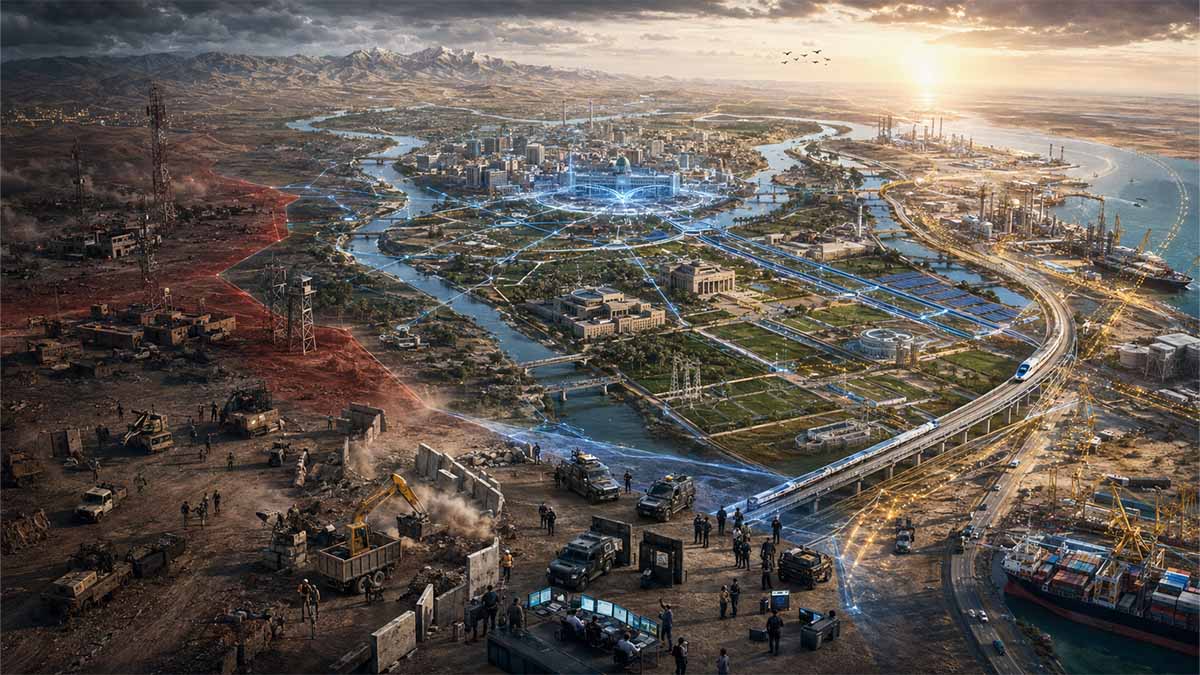
Executive Summary
- BLUF: Iraq’s most probable next step is negotiated fragmentation—not immediate militia disarmament.
- Formal factions will selectively demobilize, integrate, or transfer registered assets while smaller offshoots retain deniable strike capabilities.
- Baghdad will pursue weapons accountability before attempting comprehensive physical confiscation.
- The decisive variable is whether coercive power migrates into state command or merely changes organizational labels.
- Further cross-border attacks could trigger renewed foreign strikes and weaken the government’s authority.
- Washington’s strongest leverage remains financial and institutional; Gulf leverage combines investment, energy integration, and military deterrence.
- Iran will probably favor controlled preservation of influence while avoiding an Iraqi intra-Shia war.
- Economic development will remain hostage to hydrocarbons, patronage employment, electricity constraints, and security fragmentation.
- The central five-year opportunity is a bargain linking security-sector consolidation to infrastructure, private investment, and provincial development.
- The central five-year risk is a hybrid sovereignty equilibrium: a stronger administrative state coexisting with concealed autonomous arsenals.
Iraq’s Militia Test Is Now an Economic Test
After the US-Saudi strikes of 28 July, Prime Minister Ali al-Zaidi must turn a promise of state control into an enforceable settlement. Washington is targeting weapons, banks and commercial networks; Baghdad is defending sovereignty while depending on oil revenues and international finance. With more than 30 drone attacks alleged in 72 hours, a fiscal break-even oil price of about $84 and a youth unemployment rate of 31%, Iraq’s security reform can no longer be separated from its development model.
Iraq’s next political chapter opened less than two weeks after Ali al-Zaidi met President Donald Trump at the White House on 14 July. On 28 July, American and Saudi aircraft struck militia logistics and weapons sites in eastern Iraq. US Central Command said the operation followed more than 30 drone attacks in 72 hours against US forces and Saudi energy infrastructure. The raids placed Baghdad’s oldest unresolved question back at the centre of government: who ultimately controls armed force, and who pays when that control fails?
The weapons behind the names
The official US account alleges that Iran’s Revolutionary Guard directed the attacks and that Iran-aligned militias attempted more than 600 attacks on American citizens and facilities between February and April 2026. Those are US government claims, not findings issued by an Iraqi court. They nevertheless define the threshold at which Washington is prepared to act.
This matters because Baghdad’s disarmament problem is no longer confined to the formal militias whose commanders, headquarters and political affiliations are widely known. The more consequential risk is the migration of trained personnel, drones, guidance systems, targeting data and financing into smaller formations operating under temporary names. A recognized faction can enter negotiations, transfer part of its arsenal and participate in government while former members retain an operational capability beyond its declared command.
That model complicates deterrence. Foreign intelligence services may trace an attack to engineers or matériel associated with an established faction, while the organization denies having issued the order. Baghdad then carries sovereign responsibility for activity it may neither have authorized nor be able to reconstruct.
For al-Zaidi, a photographed weapons handover will therefore be insufficient. Effective control requires biometric personnel records, component-level inventories, secure storage of missiles and long-range drones, state-owned communications and a traceable authorization chain. Counting rifles while flight controllers, warheads, launch rails and targeting specialists disappear into private warehouses would produce disarmament on paper and greater opacity in practice.
The political difficulty is equally severe. Many PMU formations are legally incorporated into the state, receive public salaries and retain their own historical loyalties. Dismantling them abruptly could unify otherwise divided factions against the government. Incorporating intact units without changing their internal command might simply legalize parallel authority. Baghdad’s narrow passage lies between those two outcomes: individual integration, command rotation, retirement schemes and state custody of strategic systems.
Washington follows the money
The American pressure is not primarily military. It is financial.
In an October 2025 sanctions decision, the US Treasury targeted individuals, banks and companies it accused of supporting the IRGC and Kata’ib Hezbollah. The department described the Muhandis General Company as a PMU-linked conglomerate using subcontracting to divert income from Iraqi government contracts. It also alleged that commercial banks, oil-smuggling arrangements and source networks collecting information on US interests formed part of the same ecosystem.
Again, these are allegations supporting American designations, not Iraqi convictions. But they show the architecture of the coming contest. Washington is looking beyond armed units to the companies that win public contracts, the banks that move dollars, the import documents that justify payments and the commercial structures that allow military organizations to finance themselves.
This creates a risk for the entire Iraqi economy. If international banks cannot distinguish legitimate Iraqi transactions from militia-linked activity, they will not necessarily wait for a formal prohibition. They can delay payments, demand additional documentation, reduce counterparty exposure or withdraw correspondent services. The immediate victims would include compliant businesses needing machinery, pharmaceutical imports or trade finance.
Baghdad consequently needs its own financial intelligence and judicial process. Beneficial owners of public contractors and subcontractors must be disclosed; trade invoices must be matched with customs records; bank relationships with politically exposed entities require scrutiny; and sanctions allegations need either Iraqi evidentiary confirmation or an institutional rebuttal. A blanket defence of every company presented as “national” would expose the banking system. A blanket restriction imposed to satisfy Washington would push more activity into cash and informal settlement.
This is the point at which sovereignty becomes an accounting problem. Iraq can object to foreign coercion, but it cannot protect its institutions without knowing who owns the firms receiving state money, where the funds travel and whether civilian contracts subsidize autonomous armed capacity.
The oil-financed state
The security confrontation arrives when Iraq’s fiscal room is already narrowing. The IMF’s 2025 Article IV consultation calculated that the oil price required to balance the budget had risen from approximately $54 a barrel in 2020 to around $84 in 2024. Public expenditure expanded while non-oil revenue stagnated; lower petroleum prices then tightened financing conditions.
The Central Bank of Iraq has described the mechanism with unusual clarity. Its 2025 analysis of reserves and the balance of payments calculated accumulated Iraqi export receipts of roughly $1.47 trillion between 2004 and 2024 and stressed that reserve formation remains inseparable from oil revenue and public spending. That figure is not accumulated national wealth. Much of it financed imports, government wages, pensions, subsidies, war, reconstruction and public contracts.
The structure leaves Baghdad with a dangerous sequence. A fall in oil receipts first threatens investment and contractor payments because salaries are politically harder to cut. Delayed electricity, water and transport projects then weaken the private economy. Weak private employment increases pressure for more government recruitment, making the next budget even more rigid.
The labour market exposes the cost. Iraq’s Central Statistical Organization reports youth unemployment in 2024 at 31%: 29.1% for males and 40.8% for females. Its 2021 labour-force survey found 36.7% of people aged 15–24 outside employment, education or training, including 52.3% of young women. The indicators refer to different years and concepts, but together they describe an economy unable to absorb its youngest citizens.
Militia reform cannot be insulated from that reality. Demobilized fighters and technical personnel need professional security roles, pensions, training or civilian employment. Removing salaries and status without providing an alternative would create a pool of experienced recruits for clandestine organizations. Adding all of them permanently to the state payroll would deepen the fiscal problem.
Electricity remains the practical bridge between the two agendas. Reliable power would lower business costs, reduce dependence on private generators, improve water pumping and make industrial investment more credible. Capturing associated gas now flared at oilfields could replace imported fuel and release foreign currency. Capacity announcements alone will not suffice: investors and households need dependable megawatt-hours, functioning transmission and predictable distribution.
Baghdad, Erbil and the Turkish corridor
Federal cohesion will be tested alongside militia control. The Kurdistan Regional Government’s published 2025 account says Baghdad transferred a gross IQD10.4 trillion, leaving approximately IQD9.6 trillion after deductions for salary payments—enough, according to Erbil, for ten months. The same KRG report records the resumption of Kurdistan oil exports through SOMO on 27 September 2025 and 19.59 million barrels exported during the final 95 days of the year, an average exceeding 206,000 barrels a day.
Those are regional-government figures and require reconciliation with federal accounts. They show, however, how quickly disputes over oil production costs, non-oil revenues and payroll verification can reach household incomes. A government trying to establish a national monopoly of force cannot allow recurrent fiscal bargaining to make federal citizenship appear conditional.
The larger opportunity is the Development Road. Türkiye’s Foreign Ministry describes an approximately 1,200-kilometre railway and dual highway linking Al-Faw Port in Basra with the Turkish border and, from there, European markets. At the fifth Türkiye-Iraq High-Level Security Mechanism on 13 April 2025, officials placed the corridor alongside energy, water, border security and counterterrorism in the bilateral agenda.
For Iraq, the project can provide a non-oil economic axis connecting Gulf capital, Basra’s maritime access and Turkish logistics. It can also reproduce existing weaknesses if contracts are opaque, routes become instruments of federal exclusion, customs remain slow and local industry captures little value. Transit geography does not automatically create development. Warehouses, maintenance, digital customs, industrial zones, secure electricity and domestic suppliers determine how much income remains inside the country.
The political calendar is now unforgiving. UNAMI ended its mandate on 31 December 2025, closing a two-decade phase of international political assistance. Iraq has entered a period in which institutions must carry responsibilities previously softened by external mediation. Al-Zaidi’s government must now produce three verifiable results: strategic weapons under state custody, banking and public contracting insulated from armed networks, and an economic program capable of moving young Iraqis from public dependency into productive work. The next foreign strike, payment restriction or unexplained weapons discrepancy will reveal how much control Baghdad has actually acquired.
Navigational Index
- Sovereignty and Armed-System Transformation
PMU restructuring, weapons registration, façade formations, state integration, Iranian influence, American coercion, and the risk of intra-Shia confrontation. - Political Economy and National Development
Hydrocarbon dependence, fiscal transmission, electricity and water security, employment, investment, federal–regional bargaining, corruption exposure, and Gulf–Turkish connectivity. - Five-Year Scenarios and Strategic Indicators
Bayesian forecasts, competing hypotheses, Monte Carlo pathways, escalation thresholds, shadow armed networks, financial pressure, and measurable early-warning indicators.
Master Abstract
Iraq has entered a transition in which the principal contest is no longer simply whether armed factions surrender their weapons, but whether the Iraqi state can convert fragmented coercive power into an auditable chain of command without provoking either factional rebellion or external intervention. The distinction is fundamental. A public handover by established organizations may reduce visible arsenals while leaving personnel, targeting knowledge, unmanned-aircraft components, financing channels and command relationships dispersed among nominally independent cells. This produces organizational demobilization without operational disarmament. The official evidence establishes that the external coercive environment has already intensified: the United States Central Command states that American and Saudi aircraft struck logistics and weapons sites in eastern Iraq after more than 30 aerial-drone attacks in 72 hours, while also alleging more than 600 attempted attacks on US citizens and facilities between February and April 2026—U.S., Saudi Forces Strike Iran-Backed Terrorist Sites in Iraq – U.S. Central Command – July 2026 — verified official release. Saudi Arabia separately characterized the operation as coordinated self-defence—Saudi Arabia Affirms That Strikes by Saudi Armed Forces, in Coordination with U.S. Central Command Against Specific Targets in Iraq Were Under the Right of Self-Defense Guaranteed by International Law – Saudi Press Agency – July 2026 — verified official statement. These statements verify that the strikes occurred and describe the participating governments’ attribution; they do not, by themselves, independently prove the origin, command authorization or precise launch locations of every preceding attack. That evidentiary distinction materially affects the forecast: attribution uncertainty creates incentives for spoilers because retaliation can be triggered by operational signatures even when political responsibility remains contested.
Five competing hypotheses structure the assessment. H₁—Genuine state consolidation proposes that major factions accept registration, cantonment, salary control and eventual integration under government command. H₂—Cosmetic compliance anticipates the surrender of obsolete or declared systems while effective weapons, specialists and data migrate to concealed formations. H₃—Coercive fragmentation expects repeated foreign strikes to fracture the armed ecosystem into smaller, less governable cells. H₄—Intra-Shia enforcement conflict envisages state security forces attempting confiscation and encountering organized resistance. H₅—Regional accommodation predicts a US–Iranian–Iraqi understanding that freezes autonomous capabilities while suppressing cross-border operations. Current evidence raises the posterior probability of H₂, because external pressure makes visible factional brands costly without eliminating the strategic value of reserve coercive capacity. It also raises H₃ whenever attacks and retaliation occur faster than Iraqi investigative or judicial mechanisms can establish attribution. Nevertheless, H₁ remains achievable if Baghdad replaces the binary language of “surrender” with a sequenced sovereignty architecture: biometric personnel validation; serial-numbered weapons inventories; centralized storage of long-range systems; state custody of launch components; independent payroll auditing; exclusion of armed-party commercial vehicles from public procurement; and enforceable command liability for unauthorized operations. The Saudi Ministry of Defense’s public description of “precision strikes” against militia-linked targets confirms that neighboring states are prepared to impose direct costs when they judge Iraqi territory to be a launch environment—Ministry of Defense Spokesperson: Saudi Armed Forces in Coordination with U.S. Central Command Conduct Precision Strikes Against Militia Targets in Iraq Linked to Attacks on Kingdom’s Oil Facilities – Saudi Press Agency – July 2026 — verified official release. The government’s most viable next move is therefore an audited, phased monopoly-of-force process supported by a temporary non-escalation compact, not an abrupt nationwide confiscation campaign.
Country development will depend on whether this security bargain becomes part of a wider political-economic settlement. Iraq cannot sustainably exchange factional autonomy only for elite protection or additional public salaries; that arrangement would enlarge the state’s recurrent obligations while preserving the patronage structures that obstruct productive investment. The stronger pathway links security compliance to provincial capital expenditure, electricity reliability, water adaptation, logistics corridors, bank transparency, customs digitization, and private-sector employment. This requires Baghdad to distinguish three financial layers: legitimate PMU salaries and state-authorized security expenditure; party-controlled commercial ecosystems that exploit procurement, border or foreign-exchange advantages; and covert operational finance supporting unacknowledged cells. Treating all three as identical would alienate legally incorporated personnel and make intelligence collection harder. Ignoring the latter two would perpetuate shadow fiscal sovereignty. Over five years, the critical transmission mechanism is circular: improved command accountability lowers the probability of foreign strikes; lower geopolitical risk reduces insurance and financing costs; stronger investment expands non-oil employment; broader employment weakens the recruitment base of patronage networks; and reduced dependence on armed intermediaries increases the government’s capacity to enforce law. The adverse cycle works in reverse. Repeated attacks, contested attribution and retaliatory strikes increase political-risk premiums, defer infrastructure projects, deepen dollar-market distortions, encourage capital flight, reinforce dependence on public employment and give armed actors renewed justification for retaining autonomous capabilities. The forecast therefore does not identify disarmament as an isolated security event. It identifies a sovereignty–development conversion problem in which control over missiles, drones, payrolls, borders, procurement and investment must move together. Failure in any one domain can undermine progress in the others.
Sovereignty–Development Stress Matrix
Monte Carlo Scenario Distribution
Composite Strategic Outputs
Sovereignty and Armed-System Transformation in Iraq, 2026–2031
The transformation problem: controlling systems, not collecting weapons
The central analytical error in assessing Iraq’s present transition would be to equate disarmament with the physical surrender of rifles, drones, rockets or missiles. Baghdad’s real problem is more complex: it must dismantle autonomous military systems composed of personnel, commanders, communications, intelligence, financing, procurement, logistics, political protection and external relationships. A faction can surrender a photographed batch of weapons while preserving the engineers capable of rebuilding unmanned aircraft, the encrypted channels through which targets are assigned, the commercial entities that purchase components, the warehouses holding propulsion units, and the political influence necessary to obstruct investigations. Conversely, the government could integrate thousands of combatants into salaried formations without acquiring effective operational control over them. Iraq therefore confronts five separate but interdependent tests: legal subordination, establishing that every armed organization derives authority from legislation and the commander-in-chief; administrative subordination, controlling personnel records, promotions, salaries and procurement; operational subordination, ensuring that missions require state authorization; technical subordination, registering and securing strategic systems, components and targeting infrastructure; and financial subordination, preventing nominally civilian enterprises from supporting autonomous operations. The July 2026 strikes demonstrate why these distinctions have become urgent. US Central Command officially stated that American and Saudi aircraft attacked logistics and weapons sites in eastern Iraq following more than 30 aerial-drone attacks within 72 hours and alleged more than 600 attempted attacks on US citizens and facilities between February and April 2026—U.S., Saudi Forces Strike Iran-Backed Terrorist Sites in Iraq – U.S. Central Command – July 2026 — verified official release. That release verifies the operation and Washington’s attribution; it does not independently establish the origin of every attack or resolve Baghdad’s attribution problem. The strategic implication is nevertheless clear: Iraq may incur external retaliation for actions attributed to networks that its formal institutions cannot identify, restrain or publicly acknowledge.
| Control layer | Minimum state requirement | Typical evasion mechanism | Evidence Baghdad must obtain | Failure consequence |
|---|---|---|---|---|
| Legal | One statutory chain of command | Formal affiliation combined with autonomous orders | Command instruments, unit mandates, disciplinary jurisdiction | Parallel legality |
| Personnel | Biometric roster and unique payroll identity | Ghost personnel, duplicate salaries, transferred specialists | Biometrics, service history, deployment and payroll reconciliation | Patronage without command |
| Weapons | Serialized inventory and verified custody | Surrender of obsolete weapons; concealment of effective systems | Serial numbers, imagery, storage logs, destructive testing | Cosmetic disarmament |
| Drone systems | Control of airframes, payloads and components | Dispersed storage and modular assembly | Motors, guidance units, datalinks, payloads, launch logs | Rapid arsenal regeneration |
| Command and control | State-owned tasking and communications | Private encrypted channels and informal couriers | Devices, access credentials, communications audits | Autonomous operations |
| Intelligence | State custody of targeting data | External or factional target-generation cells | Collection provenance, dissemination logs, target authorization | Unattributable targeting |
| Finance | Auditable public and commercial revenue | Front companies, subcontracts, cash settlement, false invoices | Beneficial ownership, contracts, bank flows, customs data | Self-financing coercive power |
| External liaison | Government-approved foreign military contact | Direct advisory, training and procurement relationships | Travel, training, communications and payment records | Foreign influence inside state forces |
| Accountability | Enforceable individual command responsibility | Ambiguous names, rotating brands and deniable cells | Incident reconstruction, command mapping, prosecutable evidence | Persistent impunity |
PMU restructuring: four institutional outcomes hidden beneath one label
The Popular Mobilization Forces, or PMU, cannot be treated as a single homogeneous organization capable of being dissolved, integrated or disarmed through one administrative order. It is an umbrella security architecture containing formations with different clerical allegiances, political sponsors, operational histories, territorial bases, economic interests and degrees of connection to Iran. The relevant transformation spectrum has four possible institutional endpoints. The first is full military integration, under which personnel are individually transferred into the army, federal police, border forces or another statutory service, while factional unit identities, private command structures and party links are dissolved. This offers the strongest theoretical sovereignty outcome but carries the greatest near-term resistance because commanders would lose control of promotion, deployment and finance. The second is corporate integration, in which complete formations remain intact but are placed beneath a nominal state hierarchy. This is easier politically but often preserves internal loyalty networks and can reproduce the current ambiguity under revised names. The third is territorial security conversion, under which selected units become locally bounded border, infrastructure-protection, reserve or civil-defence formations, lose access to long-range weapons, and operate only within assigned jurisdictions. This can reduce offensive capability but risks converting provinces into factional security domains. The fourth is political demobilization with technical residuals, in which public military wings disappear while covert specialists, arsenals and commercial networks survive. That is the most dangerous outcome because it may create an appearance of successful reform while decreasing visibility. The restructuring process must consequently use personnel-level—not faction-level—admission. Each individual should require biometric validation, a financial-disclosure baseline, a defined service role, vetting for serious offences, acceptance of rotation outside the home governorate, and acknowledgment of exclusive state disciplinary jurisdiction. Units containing rocket, missile, drone, electronic-warfare or intelligence capabilities require a higher threshold: their technical personnel and inventories must be separated, mapped and reassigned so that no legacy faction retains an end-to-end sensor-to-shooter chain. Baghdad’s objective should not be to eliminate experienced personnel who remain essential to national defence; it should be to prevent any political organization from independently combining intelligence, authorization, launch capability and post-strike concealment.
| Restructuring model | Political feasibility, 2026–2027 | Sovereignty gain | Residual clandestine risk | Principal implementation condition |
|---|---|---|---|---|
| Individual absorption into regular services | Low–medium | Very high | Medium | Vetting, dispersal and rotation |
| Intact-unit incorporation | High | Low–medium | High | External inspection and command replacement |
| Territorial reserve conversion | Medium–high | Medium | Medium–high | Geographic limits and removal of strategic weapons |
| Civil-defence/infrastructure conversion | Medium | Medium–high | Medium | Prohibition on offensive systems |
| Retirement and reintegration | Medium | High over time | Medium | Pensions, employment and monitoring |
| Political-only transition | High for pragmatic factions | High if genuine | Very high if armed wings rebrand | Verified separation of finance, personnel and weapons |
| Covert continuation under façade names | High as an evasion strategy | Negative | Extreme | Counter-network investigation and financial disruption |
Weapons registration as a forensic chain of custody
A credible weapons-registration regime must be designed as an intelligence and accountability system rather than as a political ceremony. Baghdad needs to classify assets by strategic effect, because registering ten thousand small arms does not compensate for failing to locate a few long-range drones, precision-guidance kits or missile launch components. Tier 1 should encompass individual weapons and ammunition; Tier 2 crew-served systems, mortars and anti-armour weapons; Tier 3 rockets, loitering munitions, armed unmanned aircraft and launch equipment; Tier 4 missile systems, precision guidance, electronic-warfare equipment, long-range communications and target-acquisition infrastructure; and Tier 5 technical knowledge repositories, software, cryptographic material, targeting databases and specialized personnel. Each registered item should receive a unique identifier connected to its custodian, unit, approved storage site, maintenance history and authorized operational purpose. Existing serial numbers should be recorded, while non-serialized or locally assembled systems require tamper-evident state identifiers and high-resolution imagery. Mobile audit teams should conduct unannounced reconciliation between physical stocks and electronic records. For drones, an airframe-only count is insufficient: inspectors must inventory motors, flight controllers, satellite-navigation modules, datalinks, cameras, warheads, launch rails, ground-control stations, antennas and fabrication tools. Components dispersed among commercial warehouses can be assembled rapidly, meaning that a narrow “complete weapon” definition would leave regeneration capacity intact. Registration must also be paired with a controlled-amnesty window. Personnel who disclose previously unregistered stocks within a fixed period could receive limited administrative protection, while concealment discovered afterward would trigger criminal and financial sanctions. Yet the system cannot be exclusively punitive. Commanders require credible assurances that compliant personnel will not be indiscriminately prosecuted, economically abandoned or exposed to revenge. The state must simultaneously prevent record manipulation by using multi-agency custody: the commander-in-chief’s office, defence and interior institutions, judicial authorities, financial auditors and a technically competent inspection directorate should hold different verification functions. No single faction-influenced office should control declaration, inspection, certification and dispute resolution.
| Registration indicator | Green threshold | Amber threshold | Red threshold |
|---|---|---|---|
| Personnel biometric reconciliation | More than 95% matched to unique payroll identities | 80–95% | Below 80% |
| Physical-to-record weapons reconciliation | More than 95% by class and location | 75–95% | Below 75% |
| Strategic-system custody | State-controlled storage with dual authorization | Joint or transitional storage | Faction-controlled or unknown |
| Drone-component accounting | Airframes and major components reconciled | Airframes counted, component chain incomplete | No component-level accounting |
| Command communications | State systems used and auditable | Mixed official/private systems | Predominantly private or encrypted factional channels |
| Procurement traceability | Beneficial owner and end user verified | Partial ownership or subcontract visibility | Cash, proxies or undisclosed intermediaries |
| Incident attribution | Launch-to-command reconstruction possible | Probabilistic reconstruction only | No reliable attribution |
| Inspector access | Unannounced and unrestricted | Scheduled or negotiated | Denied, delayed or staged |
| Discrepancy closure | Judicially resolved within 30–60 days | Administrative delay | Persistent unexplained losses |
Façade formations and the migration from organizational to cellular resistance
The highest-probability evasion pathway is not wholesale refusal but capability migration. Established factions have accumulated political offices, parliamentary relationships, ministries, salaries, businesses, social institutions and public reputations that can be damaged by direct attribution for cross-border attacks. Smaller façade formations reverse that exposure: they possess limited visible infrastructure, issue statements irregularly, use interchangeable names, and disappear after an operational cycle. The parent network may provide personnel, weapons, intelligence or media amplification without issuing a traceable formal order. The resulting architecture resembles a modular clandestine market. One node supplies components, another conducts surveillance, another prepares the weapon, a temporary operational cell launches it, and a separate media identity claims or denies responsibility. Removing one node does not necessarily terminate the capability. Washington’s own sanctions record supports the need to analyze finance, commerce and intelligence together rather than treating attacks as isolated military events. The US Treasury described named Kata’ib Hizballah leaders involved in decision-making, operational planning, target identification, training in Iran and commercial development—U.S. Treasury Sanctions Iran-Aligned Militias in Iraq – U.S. Department of the Treasury – November 2023 — verified official release. A later Treasury action alleged that the Muhandis General Company used subcontracting to divert revenue from Iraqi government contracts, identified an agricultural company as a commercial front, described alleged banking and money-laundering networks, and designated individuals accused of collecting intelligence on US interests for the IRGC—Treasury Takes Aim at Iran-Backed Militia Groups Threatening the Safety of Americans – U.S. Department of the Treasury – October 2025 — verified official release. These are US government allegations underlying sanctions, not Iraqi judicial findings, but they reveal Washington’s coercive model: identify the connective tissue between armed actors, public contracts, banks, front companies and intelligence networks. Baghdad must develop its own evidence-based capability so that foreign designation packages do not remain the primary source of actionable mapping inside Iraq.
| Façade-network signature | Observable indicator | Collection method | Analytical meaning |
|---|---|---|---|
| Personnel migration | Resignations followed by unexplained technical activity | Payroll, travel and association analysis | Possible transfer to clandestine cells |
| Arsenal discrepancy | Declared stocks below procurement or historical estimates | Inventory reconciliation and imagery | Concealed, transferred or expended weapons |
| Brand proliferation | New names with similar rhetoric and operational timing | Statement and linguistic comparison | Plausible-deniability architecture |
| Technical continuity | Repeated guidance, airframe or communications signatures | Forensic exploitation of debris | Common supplier or engineering team |
| Shared logistics | Warehouses, vehicles or couriers linked to multiple groups | Geospatial and commercial-record analysis | Common support network |
| Financial substitution | Movement from known firms to new contractors | Beneficial-ownership and invoice analysis | Sanctions or audit evasion |
| Communications compartmentation | Short-lived devices and isolated operational cells | Lawful communications intelligence | Reduced attribution visibility |
| Claim-behaviour mismatch | Denials by major factions despite recurring capability | ACH comparison with technical evidence | Parent distancing or genuinely autonomous cell |
| Post-strike reorganization | Immediate name change after retaliation | Timeline and network analysis | Survivability adaptation |
Iranian influence: preservation, restraint and decentralization
Iran’s optimal Iraqi strategy is unlikely to be either unconditional militia demobilization or uncontrolled confrontation with the Iraqi government. Tehran’s interest lies in preserving sufficient Iraqi deterrent and political capacity to complicate hostile military action, defend supply and influence networks, and prevent Baghdad from entering an overtly anti-Iranian regional alignment. At the same time, an intra-Shia war would destroy political capital accumulated since 2003, threaten allied parties, expose Iranian networks to penetration, disrupt religious and commercial ties, and allow Washington or Gulf states to expand their influence under the banner of supporting Iraqi sovereignty. The most rational Iranian approach is therefore managed latency: visible factions reduce their operational profile, selected weapons enter state custody, political organizations remain active, and strategically valuable capabilities are preserved in forms that do not routinely trigger foreign retaliation. This produces a critical distinction between Iranian control and Iranian influence. Tehran may possess extensive advisory, ideological and interpersonal leverage without being able to authorize or prevent every action by every Iraqi cell. Decentralization increases survivability but reduces discipline. A network designed to preserve options under attack can generate unauthorized escalation when local commanders interpret broad ideological guidance as operational permission. Baghdad should consequently avoid a binary intelligence model in which every incident is assumed either to be directly ordered by Iran or wholly indigenous. The more useful model assigns each network a position across four variables: dependence on Iranian finance; dependence on Iranian technology or training; political responsiveness to Iranian mediation; and operational autonomy during crises. Chinese and broader BRICS diplomatic language has historically emphasized Iraq’s territorial integrity, political independence and opposition to foreign interference—VII BRICS Summit Ufa Declaration – Ministry of Foreign Affairs of the People’s Republic of China/BRICS – July 2015 — verified official declaration. That position does not provide current operational evidence about Iranian command relationships, but it illustrates the diplomatic environment in which Beijing can support Iraqi sovereignty while avoiding direct alignment with Washington’s militia designations.
| Iranian-influence pathway | Strategic value to Tehran | Vulnerability | Iraqi countermeasure short of confrontation |
|---|---|---|---|
| Senior-command liaison | Rapid political and military coordination | Attribution and sanctions | Mandatory disclosure of foreign military contacts |
| Technical training | Preserves specialist capability | Travel and communications traces | State licensing and post-training assignment controls |
| Weapons/components | Maintains deterrent capacity | Border, customs and forensic signatures | Component-level end-use monitoring |
| Political mediation | Prevents intra-Shia fragmentation | Dependent on faction compliance | Institutionalize Iraqi-led dispute mechanisms |
| Religious/ideological affinity | Long-term legitimacy and cohesion | Cannot be eliminated administratively | Separate belief from unauthorized command |
| Commercial networks | Sustainable financing | Banking, procurement and ownership records | Beneficial-ownership transparency |
| Intelligence cooperation | Target knowledge and warning | Counterintelligence penetration | Compartmented state access and auditing |
| Cellular autonomy | Resilience under attack | Loss of central restraint | Individual command liability and technical attribution |
American coercion: military force, sanctions and security conditionality
American leverage operates across three connected domains. The first is kinetic coercion: the ability to strike personnel, weapons depots, command facilities and supporting infrastructure when Washington attributes attacks to Iran-aligned groups. CENTCOM’s July 2026 statement demonstrates that this option can be exercised jointly with a Gulf partner and justified publicly as a response to attacks on both US forces and Saudi energy infrastructure. Saudi Arabia separately described the operation as lawful self-defence—Saudi Arabia Affirms That Strikes by Saudi Armed Forces, in Coordination with U.S. Central Command Against Specific Targets in Iraq Were Under the Right of Self-Defense Guaranteed by International Law – Saudi Press Agency – July 2026 — verified official statement. The second domain is financial coercion, including targeted sanctions against commanders, companies, banks, procurement networks and intermediaries. This mechanism is strategically important because it can impose costs without requiring a nationwide designation of the PMU, which would collide with Iraqi state structures and salaries. The third domain is security conditionality: access to intelligence, training, maintenance, air-defence assistance and bilateral cooperation may increasingly depend on Baghdad demonstrating control over forces operating from its territory. The planned transformation of Operation Inherent Resolve is especially relevant. The official US transition plan stated that the coalition military mission in Iraq would end its first phase while support for counter-ISIS operations in Syria from Iraqi territory would continue until at least September 2026, subject to conditions and consultation; it also emphasized a longer-term bilateral security relationship rather than a complete US disengagement—Inherent Resolve Mission in Iraq and Syria Transitioning – U.S. Department of Defense – September 2024 — verified official release. The paradox is that an enduring US presence supplies hard-line factions with a justification for retaining “resistance” weapons, while abrupt withdrawal could reduce Washington’s operational visibility and weaken Iraqi counterterrorism capacity. A successful transition must therefore replace an occupation-versus-resistance narrative with a transparent, time-bounded and Iraqi-authorized bilateral framework.
| US coercive instrument | Immediate target | Iraqi transmission channel | Escalation risk | Potential Iraqi mitigation |
|---|---|---|---|---|
| Precision strikes | Operational sites and commanders | Sovereignty backlash, faction retaliation | Very high | Joint attribution mechanism and rapid interdiction |
| OFAC designations | Individuals and entities | Banking exclusion and asset freezing | Medium | Iraqi investigations and compliant restructuring |
| Secondary-sanctions exposure | Foreign banks and firms | Investment and payment disruption | High economically | Ownership disclosure and transaction screening |
| Security-assistance conditions | State institutions | Capability and maintenance dependence | Medium | Benchmarked reform agreements |
| Intelligence sharing | Counterterrorism and attribution | Selective access based on trust | Medium | Protected fusion centre and audit trail |
| Diplomatic pressure | Cabinet and senior appointments | Coalition bargaining | Medium–high politically | Transparent qualification and conflict rules |
| Commercial scrutiny | Contractors and public enterprises | Procurement delays and de-risking | Medium | Open tenders, audits and beneficial ownership |
| Deterrent signaling | Faction leadership | Dispersal or restraint | High | Iraqi-controlled deconfliction channel |
Intra-Shia confrontation: escalation ladder and tripwire analysis
The probability of full-scale intra-Shia war remains lower than the probability of negotiated or cosmetic compliance, but its consequences are sufficiently severe that Baghdad must organize reform around conflict-prevention tripwires. The first stage would probably not involve open battle. It would begin with political obstruction: parliamentary delays, judicial challenges, media accusations, demonstrations and pressure on ministers or provincial officials. The second stage would involve administrative noncompliance, including incomplete rosters, denied inspections, unexplained weapons discrepancies, payroll manipulation and the relocation of strategic assets. The third stage would feature coercive signaling: armed deployments near warehouses, threats against inspectors, drone overflights, checkpoint confrontations or attacks attributed to newly named groups. The fourth stage would involve selective state enforcement against a commander, financial network or storage site. At this point, factional leaders would face a collective-action problem: accepting enforcement could create a precedent that exposes them individually, while coordinated resistance could trigger overwhelming domestic and foreign retaliation. The fifth stage would be bounded armed confrontation around specific installations or arrests. Only after command cohesion breaks down would Iraq face a wider intra-Shia conflict involving competing security services, factional units and political mobilization. Several stabilizers reduce this probability: fear of destroying Shia political predominance; the economic interests of factions embedded in the state; religious opposition to internal bloodshed; Iranian preference for preserving influence; and the government’s ability to sequence reforms. Destabilizers include humiliating enforcement, foreign strikes conducted without Iraqi participation, mass casualty incidents, attempts to abolish entire institutions immediately, or perception that disarmament is selective and designed to empower rival armed actors. The appropriate doctrine is graduated coercive integration: begin with strategic weapons, technical units and financial transparency; offer lawful service, retirement and political participation; impose individual rather than communal liability; and reserve force for verified defiance involving systems capable of cross-border attack.
| Escalation level | Observable event | Estimated 12-month conditional probability | Government response |
|---|---|---|---|
| Level 1: Political obstruction | Legislative delay, rhetoric, demonstrations | 75–90% | Negotiation, public benchmarks, coalition management |
| Level 2: Administrative evasion | Incomplete rosters or inventories | 60–80% | Independent audit and deadline-linked incentives |
| Level 3: Capability dispersal | Weapons or specialists leave known units | 45–65% | Technical surveillance, border and financial investigation |
| Level 4: Coercion against inspectors | Threats, blocked access, intimidation | 25–40% | Protected inspection teams and judicial warrants |
| Level 5: Limited armed incident | Clash during seizure or arrest | 15–30% | Containment, mediation, precision enforcement |
| Level 6: Multi-faction mobilization | Coordinated deployment against state action | 8–18% | National command activation and emergency mediation |
| Level 7: Sustained intra-Shia conflict | Repeated combat across provinces | 4–10% | National emergency; regional deconfliction; civilian protection |
The probability ranges above are structured analytic estimates, not measurements. They represent conditional judgments as of 15 August 2026 and must be updated when new evidence emerges.
Bayesian assessment and competing hypotheses
The baseline assessment assigns the largest probability to H₂—cosmetic compliance with residual capability, followed by H₁—gradual state consolidation, H₅—regional accommodation, H₃—fragmentation into smaller armed networks, and H₄—sustained intra-Shia confrontation. This ordering results from incentives rather than declarations. Baghdad needs visible progress to reduce foreign pressure and improve investment confidence; established factions need to preserve political and economic interests; Iran needs residual influence but benefits little from a destructive Iraqi civil conflict; and Washington seeks demonstrable reductions in threats without necessarily possessing the political capacity to reconstruct Iraq’s security order directly. These incentives produce a negotiated middle ground in which declared weapons enter custody, some forces integrate, and the most sensitive capabilities become difficult to verify. The July strikes update the model in two opposing directions. They increase the cost of maintaining visible autonomous arsenals, raising the probability of compliance, but they also increase the survival value of dispersal and façade organizations, raising the probability of clandestine fragmentation. Treasury actions against commercial, banking and intelligence-support networks further increase the cost of preserving recognizable institutional connections. The EU contributes a different instrument set: the Council lists EUAM Iraq among the Union’s active civilian missions supporting security-sector reform—Civilian and Military Missions and Operations – Council of the European Union – April 2026 — verified official EU record. Europe’s comparative advantage is therefore not coercive disarmament but civilian oversight, institutional accountability, strategic planning, border governance and rule-of-law capacity. The decisive collection requirement is evidence about whether capability is actually moving: weapons discrepancies, specialist resignations, new firms, changing payment routes, new communications patterns, unexplained warehouse activity and repeated technical signatures across differently branded attacks.
| Hypothesis | Prior probability | August 2026 posterior | Evidence increasing probability | Evidence decreasing probability |
|---|---|---|---|---|
| H₁ Gradual state consolidation | 25% | 27% | Verified inventories; command replacement; unrestricted inspection | Persistent private tasking or strategic-stock discrepancies |
| H₂ Cosmetic compliance | 30% | 34% | Symbolic handovers; intact technical cells; incomplete component accounting | Independent audits and personnel dispersal |
| H₃ Fragmented façade ecosystem | 17% | 18% | New brands; technical continuity; specialist migration | Successful attribution and financial disruption |
| H₄ Sustained intra-Shia conflict | 12% | 8% | Armed resistance to warrants; coordinated mobilization | Mediation, phased deadlines and individualized liability |
| H₅ Regional accommodation | 16% | 13% | Reduced attacks; US–Iranian restraint; Iraqi monitoring mechanism | Renewed cross-border strikes or maximalist demands |
Five-year outlook, 2026–2031
During the remainder of 2026, the dominant contest will concern definitions: which formations qualify as state forces, which weapons are strategic, what constitutes surrender, who controls inspection, and whether political parties must sever organizational ties with armed units. The most likely immediate outcome is an incomplete first inventory combined with selective handovers and negotiated exceptions. In 2027, attention will shift from visible weapons to payroll, procurement and company ownership as external actors test whether reform has altered the underlying power system. This is the year in which concealed capability migration is most likely to become observable through unexplained discrepancies and new commercial or cellular networks. In 2028, Baghdad will confront the institutional choice between maintaining a semi-autonomous PMU structure and distributing personnel across regular services, reserves, border security and civilian agencies. If integration remains corporate rather than individual, the state may acquire formal responsibility without effective command. By 2029, generational and economic factors will become more important: younger personnel will evaluate whether state service, private employment or clandestine networks offer the strongest combination of income, status and protection. Reintegration policy will therefore become a national-development issue rather than a narrow security program. In 2030–2031, success should be measured by operational outcomes: whether unauthorized cross-border launches have ceased; whether strategic arsenals are stored under state custody; whether political parties can compete without armed enforcement; whether public contracts are insulated from coercive networks; and whether Iraqi institutions can investigate attacks before foreign governments retaliate. Under the median pathway, Iraq will achieve greater control over heavy and long-range systems but will not eliminate all clandestine networks. Under the positive pathway, a combination of factional political transition, audited state integration, regional non-escalation and economic absorption reduces autonomous armed capacity to a manageable criminal-security problem. Under the adverse pathway, repeated foreign strikes and evasive restructuring create smaller, more technically specialized cells that are harder for both Baghdad and Tehran to control.
| Year | Principal transformation objective | Highest-risk failure mode | Required decision indicator |
|---|---|---|---|
| 2026 | Establish authority, categories and baseline inventories | Staged or incomplete compliance | Percentage of strategic systems under verified custody |
| 2027 | Map finance, procurement and façade migration | New commercial and cellular networks | Beneficial-ownership and contract-risk anomalies |
| 2028 | Convert formal affiliation into operational command | Intact units retain private loyalty | Share of deployments authorized through state systems |
| 2029 | Complete personnel reintegration and retirement | Marginalized specialists join clandestine cells | Employment, pension and recidivism indicators |
| 2030 | Consolidate accountability and regional restraint | Attribution failure triggers foreign strikes | Time required to reconstruct launch-to-command chain |
| 2031 | Normalize monopoly of force | Hybrid sovereignty becomes permanent | Absence of autonomous strategic capability |
Strategic judgment
The next stage of Iraqi political evolution will not be determined by whether faction leaders publicly accept the phrase “weapons in the hands of the state.” It will be determined by whether Baghdad can make independent armed action technically difficult, financially unsustainable, politically costly and legally attributable while giving compliant personnel a viable future inside civilian politics or professional state institutions. The optimum sequence is therefore: freeze transfers of strategic systems; open a time-limited declaration mechanism; establish component-level inventories; separate political leadership from operational command; reconcile biometric and payroll records; audit procurement and beneficial ownership; place missile, drone, electronic-warfare and intelligence functions under specialized national commands; provide retirement and employment channels; and prosecute post-amnesty concealment through evidence-based individual cases. This approach avoids the two extremes most likely to fail: unconditional accommodation, which legalizes parallel sovereignty, and sudden maximalist confiscation, which could unify otherwise divided factions against the government. The American role will remain simultaneously enabling and destabilizing: intelligence, training and financial pressure can support consolidation, but unilateral strikes or politically impossible deadlines can incentivize dispersal. Iran will remain influential but will face a choice between helping convert allied factions into durable political actors or tolerating increasingly autonomous cells that can trigger escalation Tehran may not control. The European role should concentrate on inspection governance, border management, financial transparency and civilian oversight. The five-year median judgment is that Iraq can substantially reduce visible autonomous arsenals and increase state custody of strategic systems, but complete demobilization is unlikely. The most important warning is that familiar factional names may disappear faster than their operational ecosystems. The most important opportunity is that precisely because major organizations have accumulated political and economic interests, Baghdad possesses leverage: lawful participation can be conditioned on verifiable military separation. Sovereignty will advance when weapons control becomes an auditable institutional fact rather than a negotiated political assertion.
Political Economy and National Development in Iraq, 2026–2031
The rentier transmission system: oil enters, government spending distributes, structural capacity remains weak
Iraq’s political economy operates through a highly concentrated transmission chain: crude oil generates foreign currency; the Ministry of Finance converts petroleum receipts into dinar-denominated expenditure; public salaries, pensions, transfers and contracts distribute that income through households and firms; imports absorb much of the resulting demand; and the Central Bank intermediates the residual relationship between fiscal expenditure, foreign-exchange demand and reserve accumulation. This arrangement gives the state considerable distributive power but leaves national income, fiscal liquidity and monetary stability exposed to variables Iraq does not control: the international oil price, OPEC+ production decisions, export infrastructure availability, maritime security, contractual disputes and regional conflict. The Central Bank’s own analysis describes oil revenues as both the principal source of public finance and effectively the country’s source of foreign exchange, concluding that reserve formation cannot be understood independently of fiscal policy. It reports cumulative Iraqi export revenue of approximately US$1.47 trillion between 2004 and 2024, while warning that declining export income cannot be solved through monetary adjustments alone—Balance of Payments Determination and Reserve Management – Central Bank of Iraq – November 2025 — verified official report. The figure should not be interpreted as investible wealth accumulated by the state; it represents aggregate export receipts over two decades, much of which was absorbed by government consumption, imports, conflict costs, reconstruction, subsidies, salaries and capital spending. The fundamental development problem is therefore not a shortage of gross resource inflows but the low conversion rate from petroleum rents into reliable electricity, water resilience, productive employment, transport capacity, human capital and competitive non-oil exports. Iraq’s next five-year phase will be determined by whether it can redesign this transmission mechanism before recurrent expenditure, population growth and energy-system deterioration narrow the available reform space.
| Political-economic transmission stage | Current structural function | Principal vulnerability | Reform objective, 2026–2031 |
|---|---|---|---|
| Oil production | Generates exportable resource rent | OPEC+ limits, field maturity, security and investment constraints | Stabilize output while reducing fiscal dependence on additional barrels |
| Export infrastructure | Converts production into marketed volumes | Southern terminal concentration, pipeline disputes, maritime exposure | Build redundant southern and northern routes |
| Foreign-currency receipt | Finances imports and reserves | Price volatility, sanctions compliance, payment interruption | Transparent reconciliation between SOMO, Finance Ministry and CBI |
| Budget conversion | Transforms dollars into dinar expenditure | Procyclicality and unrealistic revenue assumptions | Binding medium-term expenditure framework |
| Public payroll | Maintains household demand and political stability | Wage-bill rigidity, duplication and patronage | Biometric payroll, attrition and service-performance reform |
| Public procurement | Funds infrastructure and services | Contract capture, delays, opaque subcontracting | Open contracting and beneficial-ownership disclosure |
| Household consumption | Supports retail and imported-goods demand | Import leakage and weak domestic production | Local supply development without protectionist capture |
| Banking system | Channels liquidity and foreign exchange | State-bank dominance, cash economy, compliance risks | Credit reallocation toward productive private firms |
| Private investment | Creates capital and employment | Electricity, legal, land, finance and security risks | Project preparation, dispute resolution and infrastructure reliability |
| Taxation and fees | Potential non-oil revenue base | Informality, exemptions and fragmented customs | Digitized, broad-based and predictable collection |
| Development outcomes | Electricity, water, jobs and productivity | Weak project selection and maintenance | Outcome-based capital budgeting |
Hydrocarbon dependence: revenue strength without fiscal resilience
The petroleum sector gives Iraq geopolitical weight and recurrent fiscal capacity, but its dominance produces a false equivalence between high export receipts and sustainable development. Oil is capital intensive, geographically concentrated and unable by itself to absorb the volume of new labour-market entrants generated by Iraq’s youthful population. Additional production may enlarge revenue without proportionately enlarging employment, productivity outside hydrocarbons or institutional capability. The US Energy Information Administration recorded that Iraq’s crude-export revenues fell by an estimated 22% between 2022 and 2023, reflecting lower prices and production cuts, and reported that operational export capacity in southern Iraq had declined from approximately 3.7 million barrels per day before 2020 to slightly above 3.3 million barrels per day in early 2023, subsequently improving to more than 3.4 million barrels per day after loading-hose upgrades—Country Analysis Brief: Iraq – U.S. Energy Information Administration – February 2024 — verified official report. These historical capacity figures require updating for project completion, but they demonstrate the structural concentration of fiscal transmission through the Basra export system. A technical failure, maritime disruption or attack affecting southern infrastructure would consequently become a fiscal event within weeks: expected petroleum income would decline; Treasury liquidity would tighten; capital expenditure would be postponed; government arrears would accumulate; foreign-exchange supply would weaken; and political pressure to protect salaries would crowd out investment. The correct fiscal response is not simply to maximize production. Baghdad needs a petroleum-revenue rule that divides receipts into a conservative budget allocation, an investment component and a stabilization buffer. Expenditure commitments should be calculated using a structural oil price rather than the prevailing spot price, while revenue above the benchmark should not automatically finance permanent salaries or entitlements. Iraq must also publish monthly reconciliation of exported volume, realized price, production and transportation cost, deductions, transfers to the Treasury, and allocation to federal or regional accounts.
| Oil-market or infrastructure shock | Direct revenue effect | Secondary fiscal effect | Monetary transmission | Development consequence |
|---|---|---|---|---|
| Oil-price decline of 10% | Lower dollar receipts at unchanged volume | Capital-budget compression | Reduced reserve accumulation | Infrastructure delays |
| OPEC+ production reduction | Lower marketed volume | Lower SOMO receipts and provincial claims | Reduced FX supply | Contractor arrears |
| Basra terminal disruption | Immediate export interruption | Treasury cash-flow stress | Parallel-market pressure | Payroll prioritization over investment |
| Strait or Gulf shipping disruption | Higher insurance and freight costs | Lower realized netback | Potential import-price inflation | Food and equipment cost escalation |
| Northern pipeline interruption | Regional and federal revenue loss | Baghdad–Erbil transfer dispute | Limited national FX effect but major KRG effect | Salary and investment disruption in Kurdistan |
| Field-service investment delay | Slower production maintenance | Lower medium-term revenue baseline | Deteriorating external buffer | Reduced planning horizon |
| Oil-price increase | Temporary fiscal surplus | Political pressure for permanent spending | Higher liquidity unless sterilized | Opportunity or renewed procyclicality |
| Improved refining and gas capture | Lower product and fuel imports | Greater fiscal space | Lower FX demand | Electricity and industrial gains |
Fiscal transmission: the wage state, budget rigidity and the investment squeeze
The Iraqi budget functions simultaneously as an economic plan, a national income-distribution mechanism and an instrument for maintaining political equilibrium. Public employment, pensions, social transfers and state contracts provide household income where the formal private economy remains too small or uncertain to act as the principal employer. Abrupt expenditure compression would therefore generate social and political risks, but continued payroll expansion gradually reduces the state’s ability to finance the infrastructure on which private-sector development depends. This is the central fiscal trap: government employment compensates for inadequate market employment, yet the expanding wage and pension burden consumes resources needed to create the conditions for market employment. When petroleum receipts weaken, investment spending is easier to postpone than salaries. Roads, water systems, transmission projects and maintenance consequently become the shock absorbers of fiscal adjustment. The result is a recurring infrastructure deficit that reinforces public dependence. The necessary reform is not indiscriminate austerity. Baghdad requires a five-part wage-state transition: complete biometric reconciliation across ministries, provinces, public companies and security institutions; prohibit multiple salary and pension identities; replace automatic recruitment with workforce planning; use retirement and attrition to reduce redundant administrative positions; and redirect savings into professionally managed infrastructure and employment programs. The fiscal framework should distinguish operating continuity, covering essential salaries and services; maintenance, preventing deterioration of existing assets; and transformational capital expenditure, creating new productive capacity. Maintenance cannot remain a residual category because an electricity plant, canal or railway without funded upkeep becomes a recurring reconstruction project. The Ministry of Finance’s Accounting Department states that it reconciles oil revenue with the Central Bank and SOMO, monitors liquidity, prepares monthly and weekly revenue reports, and exercises pre- and post-expenditure control—Accounting Service – Iraqi Ministry of Finance – continuously updated through 2025 — verified official institutional description. The five-year requirement is to convert these accounting functions into publicly auditable fiscal-risk management.
| Fiscal reform instrument | Short-term political difficulty | Medium-term fiscal gain | Primary implementation risk | Required safeguard |
|---|---|---|---|---|
| Unified biometric payroll | Medium | High | Institutional resistance and incomplete records | Independent cross-ministry reconciliation |
| Hiring controls | High | High | Youth unemployment and protest | Private-employment and training alternatives |
| Pension database integration | Medium | Medium–high | Legacy entitlements and duplication | Legal review and appeal mechanism |
| Structural oil-price benchmark | Medium | Very high | Political override during booms | Statutory rule and published sensitivity table |
| Stabilization account | Medium | High | Off-budget withdrawals | Parliamentary reporting and external audit |
| Multiyear expenditure ceilings | Medium | High | Weak forecasting and supplementary budgets | Quarterly variance disclosure |
| Maintenance floor | Low politically | High economically | Reallocation to visible new projects | Asset-condition reporting |
| Project-gate system | Medium | High | Politically selected projects bypass appraisal | Independent technical evaluation |
| Commitment control | Medium | High | Unrecorded contractor obligations | Central electronic contract registry |
| Arrears disclosure | Low–medium | High | Recognition of hidden liabilities | Monthly ministry-level publication |
| Tax-expenditure register | High | Medium | Elite resistance to exemptions reform | Sunset clauses and parliamentary approval |
| Non-oil revenue digitization | Medium | Medium–high | Informal payments migrate outside system | Cashless collection and audit analytics |
Monetary transmission, reserves and liquidity exposure
Iraq’s monetary system cannot be analyzed separately from oil and the federal budget because the government is the dominant seller of foreign currency generated through petroleum exports, while private demand for foreign exchange reflects imports, travel, remittances, savings and capital movement. When oil receipts are strong and fiscal spending is controlled, reserves can accumulate. When expenditure grows rapidly, dinar liquidity expands and translates into greater demand for dollars and imported goods. The Central Bank then faces the task of supplying legitimate foreign currency while blocking sanctioned, fraudulent or inadequately documented transactions. Excessive restriction can widen the official–parallel exchange-rate spread; insufficient control can expose Iraqi banks to international compliance action and illicit financial flows. The Central Bank’s second-quarter 2024 early-warning report recorded net foreign reserves equivalent to 79.7% of broad money M₂, compared with 80.2% in the corresponding quarter of 2023; total credit equalled 55.5% of deposits, below the Central Bank benchmark of 75%; the money multiplier was 1.15; and non-performing loans equalled 6.9% of total credit, compared with 6.8% one year earlier—Early Warning Report for the Banking Sector, Second Quarter 2024 – Central Bank of Iraq – January 2025 publication — verified official report. These figures describe a system with substantial reserve coverage but limited financial intermediation. High reserve adequacy does not mean the banking sector efficiently transforms deposits into productive credit. The credit-to-deposit ratio suggests unused intermediation capacity, while the concentration of lending, weak collateral enforcement, deficient financial statements and state-bank dominance may prevent liquidity from reaching smaller productive firms. Reform should therefore focus on credit quality and allocation rather than maximizing loan growth mechanically. A rapid lending expansion without stronger underwriting would increase non-performing assets and political allocation. Productive credit requires borrower registries, secured-transactions infrastructure, reliable accounts, movable-collateral systems, credit guarantees with loss discipline, and specialized project-finance capacity.
| Monetary/financial indicator | Verified reference point | Analytical interpretation | 2026–2031 policy direction |
|---|---|---|---|
| Net foreign reserves to M₂ | 79.7%, Q2 2024 | Strong aggregate coverage, still oil-dependent | Preserve buffer while reducing fiscal procyclicality |
| Credit to deposits | 55.5%, Q2 2024 | Low intermediation relative to available deposit base | Expand qualified productive lending |
| Central Bank benchmark for credit/deposits | 75% | Reference threshold, not automatic target | Improve underwriting before convergence |
| Money multiplier | 1.15, Q2 2024 | Shallow deposit and credit creation | Formalization and digital payments |
| Non-performing loans/credit | 6.9%, Q2 2024 | Material but not yet systemically extreme | Resolution, provisioning and governance |
| Petroleum share of FX supply | Structurally dominant | Monetary stability tied to fiscal and oil flows | Export diversification and compliance-compatible banking |
| Cash intensity | Structurally high | Weak traceability and low deposit mobilization | Salary banking, digital payments and consumer protection |
| State-bank dominance | High | Directed lending and governance risk | Gradual restructuring, not destabilizing privatization |
| Parallel FX premium | Variable | Confidence and access indicator | Transparent documentation and predictable access |
Electricity security: the constraint connecting oil, gas, industry and legitimacy
Electricity is the most important physical transmission mechanism between hydrocarbon wealth and national development because failures in generation, fuel supply, transmission and distribution suppress almost every non-oil sector. Firms compensate with private generation, increasing production costs and pollution; households purchase generators or accept outages; water pumping and wastewater systems become unreliable; digital and health services require backup systems; agricultural processing becomes less competitive; and investors price power risk into every project. Iraq’s energy paradox is especially severe because it produces large quantities of hydrocarbons while struggling to convert associated gas and installed generation capacity into reliable electricity. The EIA previously reported that approximately 95% of Iraqi electricity generation came from oil and natural gas, that available peak federal generation supply was approximately 21 GW in 2021, and that this was below both the roughly 37 GW installed capacity and estimated 33 GW peak requirement—Country Analysis Executive Summary: Iraq – U.S. Energy Information Administration – September 2022 — verified official report. These values are historical and must not be represented as current 2026 capacity; they reveal the enduring distinction between nameplate capacity and dependable delivered power. Adding turbines without addressing gas, maintenance, grid congestion, collection losses and distribution does not close the service gap. The five-year electricity program must therefore be evaluated using delivered megawatt-hours, outage duration, network loss and cost recovery—not announced capacity. Gas capture produces several simultaneous gains: it reduces flaring, replaces imported fuel, supports dispatchable generation, creates petrochemical feedstock and lowers foreign-exchange demand. Solar capacity can reduce daytime fuel demand and diversify supply, but it requires grid reinforcement, land and procurement governance. Tariff reform is necessary but politically dangerous unless service improves first and vulnerable households receive targeted support.
| Electricity-system layer | Binding constraint | False solution | Required reform sequence |
|---|---|---|---|
| Fuel supply | Gas processing, transport and seasonal availability | Building generation without secured fuel | Capture gas, process it, contract delivery, then commission capacity |
| Generation | Derating, maintenance and plant efficiency | Reporting nameplate capacity as available capacity | Unit-level availability and heat-rate reporting |
| Transmission | Congestion and incomplete evacuation lines | New plants disconnected from load centres | Network planning synchronized with generation |
| Distribution | Technical and commercial losses | Across-the-board tariff increases | Metering, feeder rehabilitation, collection and targeted subsidies |
| Dispatch | Fragmented data and operational constraints | Political allocation of supply | National control centre and transparent dispatch |
| Imports | External political and sanctions exposure | Permanent reliance on emergency imports | Transitional supply with domestic replacement timetable |
| Solar | Grid integration and contracting | Capacity announcements without connection | Competitive procurement and network readiness |
| Private generators | Entrenched local economic interests | Sudden prohibition | Gradual displacement through reliable grid service |
| Industrial supply | Unreliable quality and interruptions | Preferential supply without payment discipline | Bankable industrial tariffs and service standards |
| Public legitimacy | Gap between investment and household experience | Communications campaigns | Measurable service improvements |
Water security: a macroeconomic constraint disguised as an environmental sector
Water scarcity must be incorporated into Iraq’s fiscal, agricultural, energy and security models rather than managed as a separate environmental file. Lower or more variable river flows affect irrigation, drinking-water quality, hydropower, marsh ecosystems, rural employment, food imports and internal migration. Salinity in southern Iraq interacts with reduced freshwater availability and upstream use, placing Basra’s population, agriculture and industrial systems under growing stress. Poor electricity supply further weakens pumping, treatment and drainage. The economic transmission is cumulative: declining agricultural reliability reduces rural income; households migrate toward cities; municipal housing and employment pressures increase; food-import demand rises; and the state expands transfers or public recruitment to absorb the resulting instability. Water therefore magnifies the fiscal cost of weak diversification. The correct five-year architecture requires a national water account integrating river inflows, reservoir storage, groundwater extraction, agricultural allocation, municipal demand, industrial use, environmental requirements, evaporation and network loss. Agricultural reform should move away from politically allocated water volumes toward crop–water productivity: economic output and food-security value per cubic metre. This does not imply abandoning agriculture. It requires differentiated cropping, modern irrigation where economically justified, drainage rehabilitation, drought insurance, extension services and credible measurement. Urban systems need leak reduction, metering, wastewater reuse and protection of intake quality. Water diplomacy with Türkiye and Iran must be supported by technical data and linked to energy, trade and investment rather than conducted only during emergencies. Türkiye and Iraq formally identified energy, water and the Development Road Project among the fields for strengthened bilateral coordination at their April 2025 High-Level Security Mechanism—Joint Statement on the Fifth Meeting of the Türkiye–Iraq High-Level Security Mechanism – Republic of Türkiye Ministry of Foreign Affairs – April 2025 — verified official statement. The opportunity is to construct an integrated bargain; the danger is that asymmetric upstream control leaves Iraq dependent on non-binding political understandings.
| Water-security dimension | Economic transmission | High-risk geography or sector | Priority indicator |
|---|---|---|---|
| Transboundary inflow | Determines national surface-water availability | Tigris–Euphrates basin | Monthly inflow by border station |
| Reservoir storage | Buffers seasonal and drought shocks | National dam system | Usable storage, not gross capacity |
| Agricultural allocation | Drives rural employment and food output | Central and southern irrigation zones | Output and employment per cubic metre |
| Salinity | Damages crops, drinking water and industry | Basra and Shatt al-Arab | Electrical conductivity and chloride levels |
| Groundwater | Provides drought buffer but risks depletion | Western and southern areas | Abstraction against recharge |
| Municipal leakage | Raises cost without increasing service | Baghdad and fast-growing cities | Non-revenue water |
| Wastewater reuse | Substitutes for freshwater demand | Urban–agricultural interfaces | Volume safely treated and reused |
| Hydropower | Connects water and electricity security | Dam systems | Generation under low-flow scenarios |
| Marsh protection | Supports livelihoods and ecosystems | Southern marshes | Minimum environmental flow |
| Migration pressure | Transfers rural stress to cities | Water-stressed governorates | Water-linked displacement and employment loss |
| Water diplomacy | Affects upstream predictability | Türkiye and Iran relationships | Data-sharing and release compliance |
Employment and the demographic conversion problem
Iraq’s development strategy must create employment at a scale and quality that the petroleum sector and public administration cannot provide. The most important distinction is between jobs as fiscal transfers and jobs as productive positions that generate tradable output, improve services or raise capital productivity. The Central Statistical Organization’s 2024 compilation records youth unemployment among people aged 15–24 at 31.0% overall, 29.1% for males and 40.8% for females. It also reports that, in the 2021 labour-force survey, 36.7% of young people aged 15–24 were outside employment, education or training, including 22.1% of males and 52.3% of females—Annual Statistical Abstract 2024, Part Eighteen – Central Statistical Organization of Iraq – July 2026 publication — verified official statistical report. The year difference is critical: the unemployment series and the NEET figures do not describe precisely the same reference period or concept and should not be merged. Together, however, they identify a severe utilization failure affecting young people and especially women. Public hiring cannot sustainably solve it because each permanent appointment creates decades of wage and pension exposure. Iraq needs sectoral employment engines with realistic domestic demand or export potential: construction materials, food processing, logistics, electrical equipment, maintenance, business services, digital administration, health, tourism, petrochemicals, gas-linked industries and renewable-energy services. Training programs must be tied to verified vacancies, contractor commitments or financing, rather than producing certificates without labour demand. Women’s employment requires transportation, safety, childcare, workplace enforcement, flexible arrangements and access to finance. Small firms need predictable electricity, digital payments, simplified taxation and enforceable contracts more than temporary subsidized credit. Development Road construction could create employment, but the decisive issue is local value capture: if engineering, rolling stock, equipment, operation and logistics services are predominantly imported, Iraq will receive transit geography without building a durable productive ecosystem.
| Employment intervention | Job quantity potential | Job quality potential | Fiscal sustainability | Principal risk |
|---|---|---|---|---|
| Additional public recruitment | High initially | Variable | Low | Permanent wage and pension burden |
| Infrastructure construction | High during build phase | Medium | Medium if projects productive | Temporary employment and contract leakage |
| Operations and maintenance | Medium | High | High | Underfunded maintenance budgets |
| Gas processing/petrochemicals | Medium | High | High | Capital intensity and enclave development |
| Agricultural value chains | High regionally | Medium | Medium–high | Water constraints and informality |
| Logistics and warehousing | Medium–high | Medium–high | High | Transit without domestic supplier development |
| Digital and business services | Medium | High | High | Skills and connectivity mismatch |
| Tourism and heritage | High potential | Medium | High | Security, infrastructure and seasonal demand |
| Distributed solar services | Medium | Medium–high | High | Weak standards and low-quality installation |
| SME formalization | High cumulatively | Variable | High | Compliance costs exceed benefits |
| Female labour-force participation | Transformational | High | High | Social, mobility and care constraints |
| Vocational training alone | Low without demand | Low | Low | Certificate production without placement |
Investment conversion: from signed announcements to operating assets
Iraq does not primarily suffer from an absence of investment announcements; it suffers from a low conversion rate between announced projects, financed projects, completed assets and economically productive operation. Investors evaluate a chain of risks that often sits outside the advertised project itself: land title, utility connection, customs clearance, foreign-exchange access, contract enforcement, security, local-content obligations, tax interpretation, payment arrears and political intervention. A large memorandum of understanding has little development value until financing closes, land is secured, infrastructure is connected, construction begins, milestones are verified and the asset enters service. Baghdad should therefore replace announcement-value reporting with a project-conversion dashboard. Each strategic project should move through defined gates: concept validation, feasibility, environmental and water assessment, land resolution, procurement, financing, construction, commissioning, operation and post-completion audit. Projects unable to clear early gates should not continue absorbing administrative attention or budget allocations. Public–private partnerships are not off-budget money; they create contingent liabilities through guarantees, minimum-revenue commitments, exchange-rate protection or termination clauses. These obligations must be published and stress-tested. Domestic investment deserves equal attention. Iraqis will not retain capital inside the productive economy if politically connected competitors can obtain contracts, customs advantages or regulatory exemptions. The anti-corruption objective is consequently not limited to prosecuting bribe payments. It must reduce discretionary decision points, publish ownership, standardize procurement data, disclose contract amendments and compare unit costs across governorates. Investment zones should offer infrastructure and predictable regulation rather than individualized tax bargains. The strongest five-year metric is not gross pledged capital but operating non-oil productive assets, private payroll generated, exports or import substitution achieved, taxes paid, and local supplier expenditure.
| Investment pipeline gate | Evidence required | Common failure mode | Publication requirement |
|---|---|---|---|
| Strategic justification | Demand, alternatives and national-plan fit | Prestige selection | Public options appraisal |
| Feasibility | Technical, economic and sensitivity analysis | Optimistic traffic or price assumptions | Independent summary |
| Land | Verified title, compensation and access | Disputes and politically allocated land | Geospatial parcel disclosure |
| Environmental/water | Consumption, discharge and resilience assessment | Unpriced water or pollution cost | Permit and mitigation plan |
| Procurement | Competitive process and bidder ownership | Tailored specifications | Bid data and beneficial owners |
| Finance | Equity, debt and guarantee structure | Unfunded announcement | Financial-close confirmation |
| Construction | Milestone verification | Advance payments without progress | Monthly physical/financial progress |
| Commissioning | Performance testing | Formal completion without functionality | Test results |
| Operation | Service, output and maintenance data | Idle or underused asset | Key operating indicators |
| Post-audit | Cost, delay and outcome comparison | No learning from overruns | Completion and impact audit |
Federal–regional bargaining: oil, salaries and the constitutional distribution mechanism
Relations between Baghdad and Erbil constitute a recurring sovereign-risk mechanism because disputes over petroleum control, production costs, non-oil revenue, payroll verification and federal transfers affect millions of citizens, international oil companies, the Türkiye pipeline and national investment credibility. The disagreement is not simply a contest over a percentage share of the federal budget. It concerns who contracts oil production, who markets crude, how production and transportation costs are calculated, which revenues the Kurdistan Regional Government must remit, how public employees are verified, and whether salary rights can be insulated from intergovernmental disputes. According to the KRG’s published 2025 financial account, the federal government transferred a gross IQD10.403 trillion, which became approximately IQD9.600 trillion after deductions and financed ten months of regional public-sector salaries. The KRG states that its 2025 federal allocation was IQD20.910 trillion, that agreed salary allocations were IQD13.335 trillion, and that it transferred approximately IQD919.35 billion in non-oil revenue to the federal government. It also reports that Kurdistan oil exports through SOMO resumed on 27 September 2025, with 19,594,871 barrels exported during the final 95 days of the year, averaging more than 206,000 barrels per day—Kurdistan Region Financial and Oil Relations Report – Kurdistan Regional Government Department of Media and Information – 2026 publication — verified official KRG record. These are KRG institutional claims and must be reconciled against audited federal data before being treated as a consolidated national account. They nonetheless show why a permanent federal petroleum and revenue framework is necessary. Iraq should establish a jointly governed production-cost methodology, SOMO marketing transparency, automatic revenue transfer, independently verified payroll registry and adjudication mechanism that does not suspend household salaries while governments litigate.
| Federal–regional variable | Baghdad interest | Erbil interest | Durable settlement mechanism |
|---|---|---|---|
| Oil ownership and marketing | Unified sovereign export and revenue control | Recognition of regional contracts and constitutional authority | Federal oil and gas law |
| Production costs | Prevent inflated or opaque claims | Recover commercially viable contractor costs | Independent field-level cost audit |
| SOMO sales | Single national seller and transparent receipts | Predictable remittance and recognition of regional volumes | Joint monthly reconciliation |
| Public salaries | Verified eligible employees and budget compliance | Regular, depoliticized payments | Biometric registry and automatic transfer rule |
| Non-oil revenue | Federal receipt of legally required share | Retention of sufficient operating revenue | Agreed tax/customs classification |
| Border revenues | National standardization | Regional administrative authority | Integrated digital customs platform |
| Peshmerga expenditure | National oversight | Recognition as constitutional security force | Force reform and budget statute |
| Debt deductions | National allocation methodology | Equitable benefit relative to burden | Transparent debt-origin and benefit formula |
| Development Road | National corridor and Basra–Türkiye integration | Inclusion in routes and benefits | Federal–regional corridor council |
| Dispute resolution | Enforceable national rules | Protection from discretionary transfer suspension | Time-bound arbitration and judicial review |
Corruption exposure: the shadow tax on every development vector
Corruption in Iraq should be analyzed as a system of political-economic intermediation rather than as a series of isolated illegal payments. It can enter the development chain through ghost employees, manipulated eligibility lists, import licences, customs undervaluation, land allocation, foreign-exchange documentation, inflated project quantities, subcontracting, change orders, payment acceleration, bank ownership and protection from investigation. Its macroeconomic cost exceeds the amount stolen because it changes which projects are selected, which firms survive and which technologies are adopted. A politically protected contractor can win with a higher price and lower capability, causing delays and defective assets; reliable firms then add risk premiums or withdraw; infrastructure quality declines; citizens purchase private substitutes for electricity, water, transport or security; and distrust reduces tax compliance. Corruption therefore acts as a shadow tax on households, investors and the state simultaneously. The most effective response is to reduce informational asymmetry and administrative discretion. Every public contract above a defined threshold should disclose the beneficial owners of prime contractors and subcontractors, bid prices, evaluation results, variations, payment milestones and completion status. Procurement analytics should identify repeated single bidding, identical addresses, shared directors, abnormal unit prices, concentrated awards and rapid post-award amendments. Payroll, pension, social-protection and company registries should be cross-matched using lawful identifiers. Customs risk systems should compare declared prices, weights, origins and tax treatment. Anti-corruption institutions must prioritize network cases that connect officials, firms, banks and coercive actors rather than accumulating minor prosecutions without systemic effect. Whistleblower protection and judicial independence remain essential, but prevention must be built into system design. Digitization alone is not sufficient: a corrupt paper process can become a corrupt digital process if data rights, logs, audit access and beneficial ownership remain opaque.
| Corruption node | Typical extraction method | Data signature | Control instrument |
|---|---|---|---|
| Payroll | Ghost or duplicate employees | Shared identifiers, accounts or attendance anomalies | Biometric and bank reconciliation |
| Public procurement | Tailored tenders and collusion | Single bids, recurring winners, compressed timelines | Open contracting and competition review |
| Subcontracting | Diversion through affiliated firms | Undisclosed ownership links | Full subcontractor disclosure |
| Change orders | Inflate cost after competitive award | Large cumulative variations | Approval thresholds and public justification |
| Land allocation | Preferential transfer or speculative capture | Below-market valuation and rapid resale | Public cadastre and auction |
| Customs | Undervaluation and misclassification | Price and weight anomalies | Reference-price and risk analytics |
| Foreign exchange | False invoices and trade documents | Transaction–shipment mismatch | Customs–bank data integration |
| State companies | Cross-subsidy and opaque purchasing | Persistent losses without service explanation | Audited segment accounts |
| Investment licences | Discretionary exemptions | Firm-specific deviations | Standard published criteria |
| Infrastructure certification | Payment for incomplete work | Financial progress exceeds physical progress | Independent geotagged verification |
| Social transfers | Ineligible or politically selected beneficiaries | Household-registry mismatches | Unified social registry |
| Banking | Related-party lending and ownership concealment | Concentration and connected exposures | Beneficial-ownership and prudential supervision |
Gulf–Turkish connectivity: the Development Road as an economic constitution
The Development Road can become Iraq’s most important non-oil spatial-development project, but only if Baghdad treats it as an economic corridor rather than a railway and highway construction program. Türkiye’s Ministry of Foreign Affairs describes the project as an approximately 1,200-kilometre two-way highway and railway connection between Al-Faw Port in Basra and Türkiye, intended to move goods from the Gulf and Asia toward Europe—Relations between Türkiye and Iraq – Republic of Türkiye Ministry of Foreign Affairs – verified August 2026 — official country-relations record. The corridor’s strategic logic is clear: Iraq could convert geographic location into port, rail, road, warehousing, customs, industrial and digital-service income while connecting Gulf capital and trade with Turkish and European markets. Yet transit infrastructure does not automatically produce development. The project can fail economically if traffic forecasts are politically inflated, competing corridors offer lower cost or greater reliability, border dwell times remain excessive, security premiums remain high, or construction costs generate debt without sufficient operating revenue. It can fail politically if governorates perceive that land, jobs and logistics benefits are concentrated elsewhere, or if the Kurdistan Region is excluded from commercially meaningful connections. It can fail institutionally if different ministries control port, rail, road, customs, land and security without unified governance. The project should therefore be organized around a corridor authority with published tariffs, investment plans, procurement, traffic forecasts and performance data. Development zones should be selected by logistics economics rather than political distribution alone. Integration with GCC states, particularly the UAE and Qatar, should extend beyond financing toward port management, logistics services, industrial investment and trade facilitation, while Turkish participation should include railway interoperability, customs digitization and access to European networks. Iraq must retain strategic control without imposing arbitrary local-content requirements that raise costs and reduce competitiveness.
| Development Road value layer | Potential Iraqi gain | Failure mode | Required precondition |
|---|---|---|---|
| Al-Faw port operations | Maritime handling and transshipment income | Underutilization or operational fragmentation | Competitive port management |
| Rail freight | High-volume north–south transport | Gauge, signaling or border incompatibility | Interoperability agreement |
| Highway freight | Flexible domestic and regional distribution | Congestion, toll leakage and road damage | Weighing, tolling and maintenance regime |
| Customs | Faster formal trade and revenue | Delays and informal extraction | Single window and pre-arrival processing |
| Warehousing | Inventory, cold chain and consolidation | Real-estate speculation | Demand-led logistics zones |
| Industrial zones | Processing, assembly and employment | Enclaves with imported labour and inputs | Supplier-development requirements |
| Digital corridor | Fiber, data and trade documentation | Cyber insecurity and fragmented systems | Redundancy and common standards |
| Energy corridor | Electricity and possible pipeline integration | Infrastructure without commercial demand | Bankable offtake agreements |
| Gulf investment | Capital and logistics expertise | Sovereign guarantees socialize risk | Transparent risk allocation |
| Türkiye linkage | Access to Turkish and European markets | Strategic overdependence | Diversified connections and treaty governance |
| Provincial development | Jobs and urban investment | Unequal distribution and land conflict | Benefit-sharing and land safeguards |
| Federal integration | Shared national infrastructure | Baghdad–Erbil route dispute | Inclusive corridor governance |
Five competing political-economy hypotheses and Bayesian update
Five hypotheses capture Iraq’s plausible national-development trajectory. H₁—managed rentier modernization assumes that the state preserves the oil-funded distributive model but improves electricity, gas capture, transport, digital administration and selected industrial capacity. H₂—fiscal entrenchment expects payroll, pensions and transfers to continue expanding until oil shocks repeatedly compress investment. H₃—corridor-led diversification anticipates that Al-Faw, the Development Road, logistics and Gulf–Turkish investment create a new non-oil accumulation axis. H₄—fragmented federal development predicts that Baghdad, the Kurdistan Region and governorates pursue partially disconnected fiscal, energy and investment systems, limiting national scale. H₅—compound resource-security stress expects oil volatility, electricity deficits, water scarcity, corruption and regional conflict to reinforce one another. The August 2026 analytical posterior assigns the highest probability to H₁, but only narrowly over H₂. Iraq possesses sufficient revenue, institutional capacity and project opportunities to modernize selected systems, yet recurrent expenditure and political distribution remain powerful. H₃ has meaningful but lower probability because the Development Road’s economic impact depends on execution, traffic and governance that remain unproven. H₄ remains plausible because federal–regional disputes have repeatedly transmitted into salaries, oil exports and investment. H₅ is a lower-probability but high-consequence pathway. The Bayesian model must update on observable evidence rather than official announcements: non-oil revenue excluding oil-linked activity; dependable electricity delivered; captured gas supplied to power plants; private formal payroll; women’s employment; completion-to-announcement investment ratio; duration of Baghdad–Erbil transfer disputes; water productivity; customs clearance time; and Development Road financial close. An oil-price boom without institutional progress should increase H₂, not H₁, because it relaxes reform pressure and encourages permanent spending.
| Hypothesis | August 2026 probability | Central causal mechanism | Decisive confirming evidence |
|---|---|---|---|
| H₁ Managed rentier modernization | 32% | Oil finances selective infrastructure and administrative reform | Higher dependable power, gas capture and audited capital execution |
| H₂ Fiscal entrenchment | 29% | Payroll and transfers crowd out maintenance and investment | Wage growth exceeds non-oil productivity and revenue |
| H₃ Corridor-led diversification | 17% | Al-Faw and Development Road create logistics–industrial ecosystem | Financial close, traffic contracts and private supplier growth |
| H₄ Fragmented federal development | 14% | Baghdad–Erbil and provincial disputes obstruct national integration | Recurrent transfer stoppages and incompatible systems |
| H₅ Compound resource-security stress | 8% | Oil, water, electricity and security shocks reinforce each other | Simultaneous export, power, water and fiscal disruption |
Five-year national-development outlook, 2026–2031
During 2026–2027, Iraq’s development outcome will depend primarily on fiscal triage and project sequencing. The government must determine which expenditure commitments are unavoidable, which projects are economically transformative and which announcements should be cancelled or redesigned. Electricity summer performance, gas availability, federal–regional transfers and security around energy infrastructure will act as immediate confidence indicators. In 2027–2028, the central question will shift from project initiation to implementation capacity: whether procurement, land, financing, transmission connections, water requirements and contractor performance are resolved. Employment policy must begin moving away from public recruitment toward contractor-based apprenticeships, supplier development and private payroll incentives with verification. In 2028–2029, the Development Road and Al-Faw should either demonstrate credible traffic, financing and corridor-governance structures or be downgraded from an economic transformation thesis to a long-term infrastructure option. Electricity reform must also reach distribution, metering and collection; generation additions alone will not be sufficient. In 2029–2030, water scarcity and urban growth will become more binding, increasing the cost of delayed irrigation, drainage, desalination, wastewater and municipal-network reform. Federal–regional stabilization should by then be institutional rather than leader-dependent. By 2031, success should be measured through structural ratios: non-oil revenue relative to recurrent expenditure; private formal employment relative to government recruitment; dependable electricity relative to peak demand; domestic gas relative to imported power-sector fuel; completed projects relative to announced value; and non-oil tradable output relative to petroleum-financed consumption. Under the median scenario Iraq improves infrastructure but remains fundamentally rentier. Under the positive scenario, oil becomes development capital for electricity, logistics, water and private employment. Under the adverse scenario, oil continues financing consumption until resource, security or market shocks force disorderly adjustment.
| Period | Primary development contest | Positive indicator | Negative indicator |
|---|---|---|---|
| H2 2026 | Protect fiscal and energy continuity | Transparent budget and energy-recovery plan | Ad hoc cuts, arrears and emergency imports |
| 2027 | Convert announcements into construction | Financial close and verified milestones | Expanding unfunded project inventory |
| 2028 | Create private employment transmission | Formal private payroll growth | Renewed mass public recruitment |
| 2029 | Integrate corridor and federal systems | Common customs, rail and revenue frameworks | Regional exclusion and transfer disputes |
| 2030 | Manage water–urban–energy nexus | Lower leakage, reuse and resilient supply | Rural displacement and urban service stress |
| 2031 | Demonstrate structural conversion | Higher non-oil productivity and dependable services | Permanent hybrid rentier stagnation |
Strategic judgment
Iraq’s development problem is not that the country lacks resources, projects, partners or geographic opportunity. It is that the conversion mechanism between those assets and durable national capacity remains weak. Oil revenue reaches the Treasury more reliably than electricity reaches households, water reaches farms, credit reaches productive firms or capital projects reach completion. Political stability is maintained through distributive expenditure, but that expenditure enlarges the obligations that future oil revenue must finance. Electricity shortages suppress private investment; private-sector weakness increases demands for public jobs; payroll expansion reduces capital expenditure; infrastructure deficits then reproduce private-sector weakness. Water scarcity adds a second reinforcing loop by reducing rural income and raising urban employment and service pressure. Baghdad–Erbil disputes turn oil and salaries into bargaining instruments, damaging confidence across the federation. Corruption functions as a cross-sector multiplier that raises the cost and lowers the quality of every intervention. The Development Road offers a potential new economic geography connecting Basra, the Gulf, Türkiye and Europe, but it will transform Iraq only if accompanied by dependable power, digital customs, secure property rights, competitive logistics and domestic supplier development. The optimal five-year strategy is therefore not a list of megaprojects. It is a sequenced conversion program: protect oil and export continuity; impose a structural fiscal rule; reconcile payrolls; guarantee maintenance; capture gas; repair electricity networks; construct a national water account; stabilize federal–regional transfers; publish beneficial ownership and contract performance; expand qualified private credit; and build the Development Road through demand-tested stages. The most dangerous outcome is not economic collapse but a stable-looking equilibrium in which oil continues financing consumption while infrastructure, water and employment constraints deepen beneath the fiscal surface.
Five-Year Scenarios and Strategic Indicators for Iraq, 2026–2031
Forecast architecture: from single-event prediction to interconnected state-risk pathways
Iraq’s five-year trajectory cannot be forecast credibly through a linear extrapolation of oil prices, militia declarations, cabinet decisions or isolated security incidents. The country functions as an interconnected system in which armed-network behaviour, foreign retaliation, petroleum revenue, banking access, public salaries, electricity reliability, water scarcity, federal–regional bargaining and youth employment continually modify one another. A drone attack attributed to Iraqi territory can produce foreign airstrikes; airstrikes can weaken governmental legitimacy; weakened legitimacy can reduce the government’s capacity to enforce weapons registration; incomplete registration can encourage sanctions or banking restrictions; financial restrictions can widen foreign-exchange frictions; fiscal stress can delay salaries and infrastructure; delayed spending can produce protest, factional recruitment and political obstruction. The appropriate unit of analysis is therefore not the incident but the risk-transmission pathway. The forecast presented here uses five competing strategic scenarios, Bayesian probability updates, a Monte Carlo-style conditional model, escalation thresholds and measurable early-warning indicators. Probabilities represent structured analytical judgments as of 15 August 2026, not official forecasts or statistical certainties. The current security baseline has materially worsened: US Central Command officially states that American and Saudi aircraft attacked Iran-aligned logistics and weapons sites in Iraq following more than 30 drone attacks over 72 hours, while alleging more than 600 attempted attacks on US citizens and facilities between February and April 2026—U.S., Saudi Forces Strike Iran-Backed Terrorist Sites in Iraq – U.S. Central Command – July 2026 — verified official release. These figures are official US attributions rather than independently adjudicated incident records. Their forecasting significance lies in the response doctrine they reveal: Washington and Riyadh may act kinetically when their attribution threshold is satisfied, even if Baghdad has not completed or publicly disclosed an equivalent investigation.
| Forecasting layer | Analytical question | Primary unit of measurement | Update frequency | Principal failure risk |
|---|---|---|---|---|
| Strategic scenario | Which national pathway is becoming dominant? | Scenario probability | Monthly/quarterly | Treating mutually compatible developments as exclusive |
| Armed-network risk | Are capabilities demobilizing, integrating or dispersing? | Personnel, weapons, finance and communications networks | Weekly/monthly | Counting surrendered weapons without tracing regeneration capacity |
| External coercion | Is foreign military or financial action becoming more likely? | Threats, strikes, sanctions and banking controls | Daily/weekly | Relying only on public rhetoric |
| Fiscal resilience | Can Baghdad protect salaries, services and investment? | Oil receipts, liquidity, arrears and expenditure composition | Monthly | Confusing allocations with executed spending |
| Monetary pressure | Is fiscal or sanctions stress entering currency markets? | FX spread, transaction rejection, reserves and cash demand | Daily/monthly | Treating every spread movement as illicit finance |
| Federal cohesion | Are Baghdad and Erbil institutionalizing revenue sharing? | Transfers, oil volumes, payroll and non-oil remittances | Monthly | Using only one government’s accounting |
| Infrastructure legitimacy | Are electricity, water and logistics improving materially? | Delivered service and asset reliability | Monthly/seasonal | Reporting announced capacity |
| Social absorption | Is the economy reducing recruitment and protest pressure? | Youth employment, wage arrears and household stress | Quarterly | Equating public hiring with productive employment |
Scenario 1 — Controlled sovereignty consolidation
The most favourable plausible pathway is a negotiated consolidation in which Baghdad establishes operational control over strategic weapons without attempting immediate universal demobilization. Major PMU formations would separate political, social and military functions; register personnel and weapons; transfer long-range drones, rockets, missiles, electronic-warfare equipment and targeting infrastructure into verified state custody; and accept centralized authorization for deployment. Some personnel would enter regular services individually, others would move into territorially bounded reserve, border, infrastructure-protection or civil-defence roles, and a final category would retire through funded reintegration. Iran would preserve political, economic and religious influence but restrain cross-border operations from Iraqi territory, judging that an intra-Shia conflict would destroy more influence than negotiated institutionalization. Washington would respond with calibrated sanctions relief, intelligence cooperation or security assistance rather than maximalist demands. Gulf governments would treat Iraq as a progressively safer investment and connectivity environment. Baghdad would use improved security confidence to redirect part of petroleum income toward electricity, gas capture, water, logistics and productive employment. This scenario does not require the disappearance of all clandestine networks. It requires their reduction below the level at which they can initiate strategically consequential attacks, veto government decisions or maintain an autonomous end-to-end targeting chain. The principal confirmation indicators would be unrestricted inspection of strategic storage, reconciliation of component-level inventories, replacement or rotation of faction-linked commanders, declining use of façade names, successful Iraqi attribution of attempted attacks, and fewer foreign retaliatory operations. Fiscal confirmation would include a smaller official–parallel exchange-rate divergence, fewer payment disruptions, uninterrupted Kurdistan salary transfers and maintenance expenditure protected during oil volatility. This scenario receives an initial 24% probability, rising above 35% only if Baghdad verifies strategic-system custody and maintains at least six months without attributable cross-border operations.
| Scenario 1 indicator | Confirmation threshold | Warning threshold | Disconfirmation threshold |
|---|---|---|---|
| Strategic weapons custody | More than 90% of declared long-range systems independently verified | 60–90% verified | Below 60% or inspection denied |
| Personnel integration | Unique biometric identity and state command assignment | Records complete but legacy units intact | Duplicate rosters or private command |
| Unauthorized launches | Zero verified launches for six consecutive months | Attempted launch disrupted | Recurrent launches from Iraqi territory |
| Façade formations | Declining number and operational tempo | Brands change but attacks fall | New brands accompany sustained attacks |
| Foreign strikes | No strikes for six months | Threats or isolated warning action | Repeated multi-province operations |
| Banking pressure | Stable access with declining rejection anomalies | Higher documentation demands | Major restrictions or correspondent withdrawal |
| Federal–regional transfers | Predictable monthly transfers and reconciliation | Short administrative delays | Salary suspension linked to political dispute |
| Private investment conversion | Higher financial-close and construction ratios | Announcements dominate | Project cancellations and capital flight |
| Electricity delivery | Rising dependable supply and falling outage duration | New capacity without grid gains | Service deterioration despite spending |
Scenario 2 — Cosmetic compliance and hybrid sovereignty
The current median pathway is cosmetic compliance, under which Iraq’s institutions achieve visible reform while autonomous coercive capacity survives inside smaller, less attributable networks. Established factions would surrender declared or obsolete weapons, transfer selected units into state structures and formally sever organizational links with political movements. At the same time, specialists, effective drones, guidance components, encrypted communications, targeting data and commercial revenue would migrate to informal cells. Parent organizations would preserve plausible deniability: they could comply institutionally, participate politically and deny responsibility for attacks conducted by former members or newly named formations. Baghdad would claim progress based on numbers of weapons, personnel or committees, but would lack component-level inventories, technical attribution and independent access to all storage locations. Washington would judge compliance by the persistence of attacks and financial networks rather than by Iraqi declarations, generating recurring sanctions and occasional strikes. Iran would maintain influence through decentralized personal, technical and ideological relationships while avoiding an overt command signature. The economy would remain stable enough to prevent crisis but insufficiently reformed to transform employment, electricity or investment. Oil income would continue financing public consumption, while security premiums, banking compliance costs and political uncertainty would constrain diversification. The US Treasury’s October 2025 action illustrates the type of connective tissue Washington is already targeting: it alleged that the Muhandis General Company diverted revenue from Iraqi government contracts through subcontracting, described banking and money-laundering networks, and identified an alleged source network collecting information on US interests—Treasury Takes Aim at Iran-Backed Militia Groups Threatening the Safety of Americans – U.S. Department of the Treasury – October 2025 — verified official release. These remain US sanctions allegations rather than Iraqi criminal judgments, but they show that future pressure will target finance, procurement and intelligence architecture, not only weapons. Scenario 2 receives a 34% probability.
| Scenario 2 mechanism | Visible compliance signal | Concealed residual | Detection requirement |
|---|---|---|---|
| Weapons handover | Public inventory and transfer ceremony | Effective systems omitted or dispersed | Historical procurement and component reconciliation |
| Personnel separation | Formal resignation or reassignment | Continued informal tasking | Communications and association analysis |
| Political–military separation | New legal statutes and committees | Shared leadership and financing | Beneficial ownership and command mapping |
| Company restructuring | Renamed boards or subsidiaries | Same controllers and subcontractors | Ownership graph and contract analysis |
| Communications reform | Official platforms introduced | Private encrypted operational channels | Lawful device and metadata investigation |
| State integration | Units placed under PMU or security command | Orders still originate from legacy leaders | Deployment and mission-authorization logs |
| Iranian restraint | Reduced visible liaison | Decentralized technical and personal influence | Travel, training and procurement indicators |
| Attack denial | Major factions reject responsibility | Offshoot cells retain capability | Technical signatures and personnel overlap |
| Fiscal stability | Salaries continue and reserves remain adequate | Investment and maintenance remain compressed | Expenditure execution and arrears data |
Scenario 3 — Fragmented resistance and persistent external retaliation
The third pathway involves the transition from large, politically embedded factions to a more dispersed ecology of technically specialized cells. This outcome may emerge unintentionally from partial disarmament and targeted pressure. When recognizable organizations become vulnerable to strikes, sanctions or political exclusion, they have incentives to compartmentalize capabilities. Drone construction, target intelligence, launch operations, finance and media claims can be divided among separate nodes so that no participant possesses the full operational picture. The resulting ecosystem may be harder for Iran to control, harder for Baghdad to investigate and less deterred by attacks on established headquarters. Tactical resilience would increase even as strategic discipline declines. Foreign governments could retaliate against formal PMU facilities based on attribution to personnel or support networks, widening the gap between legal incorporation and operational responsibility. CENTCOM’s July 2026 release demonstrates the potential scale of escalation: it states that US and Saudi aircraft struck multiple weapons and logistics sites after a rapid sequence of drone attacks. A separate CENTCOM release the following day states that US forces conducted a heavy wave of strikes against IRGC targets in Iran after attempted missile attacks and reported more than 50,000 US service members deployed in the Middle East—U.S. Strikes IRGC Targets After Attempted Iranian Attacks – U.S. Central Command – July 2026 — verified official release. Together, the releases show that Iraq’s militia question is embedded in a larger regional force posture rather than being an exclusively domestic security-sector reform. Scenario 3 becomes dominant if new armed brands proliferate, recovered systems show recurring technical signatures, unexplained arsenal discrepancies grow, and strikes fail to reduce operational tempo. Its baseline probability is 17%, but it rises sharply if Baghdad cannot reconstruct the chain from component acquisition to launch authorization.
| Shadow-network indicator | Low-risk range | Elevated range | Critical range | Analytical interpretation |
|---|---|---|---|---|
| New armed brands per quarter | 0–1 | 2–3 | 4 or more | Organizational fragmentation |
| Unreconciled strategic-system discrepancy | Below 5% | 5–15% | Above 15% | Concealment, transfer or accounting failure |
| Shared technical signatures across brands | Isolated | Repeated in two incidents | Repeated across three or more incidents | Common engineering or supply network |
| Specialist resignations without destination | Below 2% | 2–5% | Above 5% of technical personnel | Capability migration |
| Front-company turnover | Stable ownership | Frequent directorship changes | Rapid dissolution and replacement | Financial evasion |
| Short-lived communications clusters | Sporadic | Monthly | Weekly or attack-correlated | Cellular operational preparation |
| Warehouse activity outside official logistics | None verified | Ambiguous repeated activity | Component movement tied to incident timing | Covert assembly or storage |
| Public denial/technical linkage divergence | Low | Material | Persistent | Parent–offshoot distancing |
| Post-strike operational recovery | More than six months | Two–six months | Below two months | High network resilience |
Scenario 4 — Intra-Shia coercive confrontation
The fourth scenario is a bounded or sustained confrontation between government forces and resistant Shia armed factions. The initiating event would probably be narrow: an attempted seizure of a strategic depot, arrest of a senior commander, closure of a financing channel, dismissal of a PMU official or foreign strike causing mass casualties. The conflict would then expand through mobilization, checkpoint incidents, retaliatory detentions, attacks by façade groups and political efforts to paralyse state institutions. Full-scale civil war remains unlikely because major actors possess strong incentives to avoid it. Established factions risk losing political offices, public salaries, companies and popular legitimacy; Iran risks destruction of its Iraqi influence network; the government risks fragmentation of security services; and religious authorities would face pressure to prevent intra-communal bloodshed. Nevertheless, limited armed confrontation is plausible because enforcement creates a commitment problem. If one faction accepts confiscation while rivals preserve weapons, it may perceive itself as strategically exposed. If the government grants repeated exemptions, it demonstrates that resistance is rewarded. The optimal conflict-prevention design is therefore simultaneous, category-based and verifiable: all organizations must surrender equivalent strategic capabilities under the same timetable, while individual service and political participation remain protected. Scenario 4 has a baseline 9% probability, but this understates the likelihood of localized clashes. The probability of at least one limited armed incident during enforcement is assessed at 25–35% over five years; the probability of sustained multi-governorate intra-Shia conflict remains below 12% absent an external shock. Early-warning indicators include coordinated armed deployments, public rejection of state warrants, intimidation of inspectors, emergency activation of faction media, movement of families or records from known facilities, unexplained closure of political offices, security-service defections and simultaneous demonstrations near government or religious institutions.
| Escalation level | Operational description | Trigger set | Approximate response window | Required state action |
|---|---|---|---|---|
| E₀ | Negotiated tension | Rhetoric and bargaining | Weeks | Mediation and transparent benchmarks |
| E₁ | Administrative defiance | Incomplete records, denied access | Days–weeks | Judicial notice and deadline |
| E₂ | Coercive signaling | Armed presence, threats, overflights | Hours–days | Protective deployment and deconfliction |
| E₃ | Asset dispersal | Weapons and personnel leave registered sites | Hours | Interdiction, surveillance and border alerts |
| E₄ | Localized violent incident | Firefight, explosive attack or forced entry | Minutes–hours | Containment and unified command |
| E₅ | Coordinated factional mobilization | Multiple units deploy against state action | Hours | National command activation and religious mediation |
| E₆ | Cross-governorate confrontation | Repeated clashes and infrastructure attacks | Immediate | Emergency protection of civilians and critical systems |
| E₇ | State fragmentation | Security units divide by political loyalty | Immediate | Constitutional emergency and regional deconfliction |
Scenario 5 — Compound fiscal-security crisis
The fifth scenario combines armed escalation with financial and infrastructure stress. It could begin with attacks on Gulf energy facilities, US positions, Iraqi export infrastructure or Kurdistan energy assets. Foreign retaliation would raise insurance and investment risk; sanctions could affect companies or banks; oil revenue or physical exports could decline; the government would protect salaries by postponing capital expenditure and contractor payments; electricity or water projects would slow; and unemployment or demonstrations would expand. Armed groups could then exploit the resulting grievances, while political actors blame Baghdad, Washington, Riyadh, Tehran or Erbil. This scenario is dangerous because each sector amplifies the others. The Central Bank’s analysis states that Iraq’s foreign-exchange reserve formation is inseparable from public finance and oil receipts and records approximately US$1.47 trillion in accumulated export revenues during 2004–2024—Balance of Payments Determination and Reserve Management – Central Bank of Iraq – November 2025 — verified official report. The relevant warning is not immediate reserve exhaustion but declining flow resilience: petroleum receipts may weaken while government obligations remain rigid. Federal–regional disputes could magnify this pressure. The KRG’s official published account reports that federal transfers financed ten months of regional salaries during 2025 and that Kurdistan oil exports through SOMO resumed in September 2025, reaching 19,594,871 barrels during the final 95 days—Kurdistan Region Financial and Oil Relations Report – Kurdistan Regional Government Department of Media and Information – 2026 publication — verified official KRG record. These are regional-government figures requiring federal reconciliation, but they demonstrate the sensitivity of household income to intergovernmental revenue arrangements. Scenario 5 receives a baseline 16% probability, with very high consequence severity.
| Compound-risk trigger | First-order effect | Second-order effect | Third-order political effect |
|---|---|---|---|
| Southern export disruption | Lower oil receipts | Treasury liquidity compression | Capital cuts and salary anxiety |
| Sanctions on Iraqi banks | Transaction delays and de-risking | Import and FX-market friction | Business pressure and political backlash |
| Attacks on Gulf infrastructure attributed to Iraq | Foreign retaliation | Investment and insurance shock | Sovereignty crisis |
| Kurdistan pipeline interruption | Regional revenue decline | Salary and contractor disruption | Baghdad–Erbil confrontation |
| Electricity fuel interruption | Lower power output | Industrial and water-service losses | Summer protests |
| Severe water shortage | Agricultural and drinking-water stress | Migration and food-import demand | Provincial unrest |
| Oil-price decline | Lower budget revenue | Arrears and investment compression | Pressure for borrowing or austerity |
| Mass-casualty strike | Factional mobilization | Government legitimacy loss | Intra-Shia escalation |
| Parallel exchange-rate widening | Higher import prices | Household purchasing-power loss | Protest and blame allocation |
| Major corruption exposure | Project suspension and elite conflict | Investor withdrawal | Government-coalition fragmentation |
Bayesian probability structure and updating discipline
The integrated posterior assigns 24% to controlled sovereignty consolidation, 34% to cosmetic compliance, 17% to fragmented resistance, 9% to sustained intra-Shia confrontation and 16% to compound fiscal-security crisis. These values sum to 100% for modeling convenience, although elements of several scenarios can coexist. Bayesian discipline requires specifying what evidence would change the forecast and by how much. A verified, independently inspected transfer of strategic drone and missile systems should increase Scenario 1 and reduce Scenarios 2 and 3. A ceremonial small-arms handover without component accounting should produce almost no positive update. Six months without unauthorized launches would increase Scenario 1 modestly; the same period combined with declining façade activity and financial-network disruption would produce a stronger update. A new armed brand alone is weak evidence of fragmentation; a new brand using the same guidance architecture, supply chain or specialist personnel as a legacy faction is strong evidence. Foreign strikes increase Scenario 5 directly but may increase either Scenario 1 or Scenario 3 depending on behavioural response: effective deterrence raises consolidation probability, while rapid dispersal and renewed attacks raise fragmentation. A sharp oil-price fall should not automatically increase political-crisis probability if liquidity buffers, arrears and capital execution remain stable. Conversely, stable oil prices do not eliminate financial risk if correspondent-banking access or export infrastructure is disrupted. Each indicator should therefore possess a reliability score, causal relevance score and deception vulnerability. Official statements carry high provenance but may reflect institutional attribution or policy messaging. Technical evidence, audited financial records and repeated behavioural patterns should receive greater weight than single-source declarations.
| Evidence event | Scenario 1 update | Scenario 2 update | Scenario 3 update | Scenario 4 update | Scenario 5 update |
|---|---|---|---|---|---|
| Verified strategic-weapon custody | Strong increase | Strong decrease | Moderate decrease | Slight decrease | Slight decrease |
| Small-arms ceremony only | No material change | Slight increase | No change | No change | No change |
| Six months without unauthorized attacks | Moderate increase | Slight decrease | Moderate decrease | Slight decrease | Moderate decrease |
| New façade groups with shared technical signatures | Strong decrease | Moderate increase | Strong increase | Slight increase | Moderate increase |
| Inspector intimidation | Moderate decrease | Moderate increase | Slight increase | Strong increase | Slight increase |
| Repeated foreign strikes | Moderate decrease | Slight decrease | Moderate increase | Moderate increase | Strong increase |
| Stable banking and falling FX spread | Slight increase | No change | Slight decrease | No change | Moderate decrease |
| Major new bank sanctions | Slight decrease | Moderate increase | Moderate increase | Slight increase | Strong increase |
| Baghdad–Erbil automatic transfers | Moderate increase | Slight decrease | No change | Slight decrease | Moderate decrease |
| Salary suspension or large arrears | Slight decrease | Slight increase | Slight increase | Moderate increase | Strong increase |
| Development Road financial close | Slight increase | No change | No change | No change | Moderate decrease |
| Severe electricity/water shock | No change | Slight increase | Slight increase | Moderate increase | Strong increase |
Monte Carlo pathway design and sensitivity analysis
A meaningful Monte Carlo model for Iraq should not pretend to produce precise probabilities from weak data. Its value lies in testing how combinations of uncertain drivers generate different pathways. The proposed model uses eight latent variables: state enforcement capacity; militia resistance; Iranian restraint; US–Gulf coercive intensity; oil/fiscal resilience; banking access; infrastructure-service stability; and federal–regional cohesion. Each simulation samples these variables from bounded distributions rather than assuming a single fixed value. Correlations must be introduced because the variables are not independent. Higher external coercion can increase state enforcement by strengthening Baghdad’s incentive to act, but it can also increase militia resistance and fragmentation. Strong oil revenue improves fiscal resilience but can weaken reform incentives. Improved federal–regional cohesion supports fiscal stability and northern connectivity, while attacks on Kurdistan energy infrastructure can reverse both. Water and electricity shocks correlate with protest pressure and fiscal expenditure. The model should therefore report probability distributions and percentile ranges, not one deterministic output. Under baseline assumptions, a 20,000-run synthetic simulation would be expected to cluster around cosmetic compliance, with a long adverse tail involving fragmentation and compound crisis. The most influential positive variable is not oil price alone but verified state control over strategic systems, because it reduces both foreign retaliation and clandestine regeneration. The most influential adverse interaction is high external coercion combined with low attribution capacity: attacks continue, retaliation follows, and Baghdad cannot demonstrate responsibility or control. The model should be rerun monthly using indicator data, while structural priors should be reviewed quarterly. Any result presented beyond one decimal place would imply false precision.
| Monte Carlo variable | Baseline central value | Illustrative uncertainty band | Principal correlation |
|---|---|---|---|
| State enforcement capacity | 52/100 | 35–68 | Positive with inspection access and command cohesion |
| Militia resistance | 66/100 | 48–82 | Positive with foreign strikes and selective enforcement |
| Iranian restraint | 58/100 | 38–75 | Negative with regional war intensity |
| US–Gulf coercive intensity | 72/100 | 50–90 | Positive with attacks on forces or energy |
| Oil/fiscal resilience | 57/100 | 35–76 | Positive with prices, exports and buffers |
| Banking access | 61/100 | 40–79 | Negative with sanctions and compliance failure |
| Infrastructure stability | 43/100 | 28–60 | Positive with electricity, water and maintenance |
| Federal–regional cohesion | 49/100 | 30–68 | Positive with automatic transfers and oil reconciliation |
| Attribution capacity | 38/100 | 20–56 | Positive with forensics and integrated intelligence |
| Social absorption | 36/100 | 22–52 | Positive with productive employment and service delivery |
Financial-pressure early-warning system
Financial coercion will probably evolve through graduated de-risking rather than an announced nationwide financial blockade. The earliest signal may be behavioural: correspondent banks request additional documentation, delay transactions, narrow eligible counterparties or exit relationships perceived as costly. Iraqi banks may respond by restricting clients, while traders move toward cash, alternative invoicing or informal settlement. The official–parallel exchange-rate spread could widen, but it must be interpreted with trade, seasonal and confidence variables. High-frequency indicators should include the number and value of rejected or delayed international transfers; concentration of foreign-exchange access among banks; changes in cash demand; import-document discrepancies; bank liquidity; non-performing loans; government arrears; Treasury balances; and the difference between budgeted and realized oil revenue. Corporate indicators include sudden board changes, company renaming, asset transfers, repeated subcontracting and firms sharing addresses, directors, telephone numbers or financial intermediaries with designated persons. The Treasury’s 2025 designation package specifically linked alleged militia finance to banks, public contracts, commercial fronts, oil smuggling and intelligence collection, demonstrating the breadth of the US enforcement lens. Baghdad therefore needs a sovereign financial-intelligence architecture capable of independently testing such allegations, protecting compliant institutions and prosecuting violations under Iraqi law. Excessively broad defensive restrictions could damage legitimate commerce and create the informal economy they seek to suppress. The preferred response is risk-based segmentation: intensive scrutiny for networks with military, sanctions or corruption exposure; rapid processing for transparent low-risk trade; beneficial-ownership disclosure; end-use validation; and auditable appeal mechanisms.
| Financial indicator | Green | Amber | Red | Required response |
|---|---|---|---|---|
| Official–parallel FX spread | Below 3% | 3–8% | Above 8% for 20 trading days | Diagnose flow, confidence and compliance causes |
| Cross-border payment rejection | Stable baseline | 25–50% above baseline | More than 50% above baseline | Bank-by-bank remediation |
| Correspondent relationships | Stable or expanding | Enhanced review | Material withdrawal | Central-bank contingency engagement |
| Government arrears | Below one month of affected obligations | One–three months | Above three months | Cash plan and public disclosure |
| Salary delay | None | Below 30 days | Above 30 days or repeated | Protected payroll liquidity |
| Bank deposit outflow | Normal seasonal range | 5–10% stress movement | Above 10% in exposed institutions | Liquidity support with safeguards |
| Non-performing loans | Stable | Rise of 1–2 percentage points | Rapid multi-quarter deterioration | Provisioning and resolution |
| Beneficial-ownership discrepancies | Isolated | Repeated among contractors | Systemic or designation-linked | Contract freeze and investigation |
| Trade-document mismatch | Below calibrated risk baseline | Persistent sector cluster | Bank/company network cluster | Customs–bank joint examination |
| Oil-revenue variance | Below 5% from plan | 5–15% | Above 15% | Expenditure reprioritization |
Integrated strategic indicator matrix
The warning system should be organized into six domains with explicit escalation rules. No single indicator should trigger a national crisis classification unless it directly captures a high-consequence event such as a verified strategic-system launch, mass-casualty clash or major export interruption. Most warnings should require convergence: at least two independent indicators from different domains and confirmation from technically distinct collection streams. Armed-network indicators should combine imagery, inventory, personnel, communications, finance and forensic evidence. Political indicators should track cabinet cohesion, parliamentary obstruction, judicial conflict, religious mediation and protest mobilization. Financial indicators should monitor banking access, foreign exchange, government cash, arrears and oil revenue. Infrastructure indicators should measure delivered electricity, fuel supply, water and export availability. Federal indicators should track oil volumes, transfers, salary banking and non-oil remittances. External indicators should track military posture, warnings, sanctions preparation and Gulf or Turkish diplomatic activity. Türkiye and Iraq formally agreed in April 2025 to enhance coordination across military affairs, border security, counterterrorism, defence industries, energy, water and the Development Road—Joint Statement on the Fifth Meeting of the Türkiye–Iraq High-Level Security Mechanism – Republic of Türkiye Ministry of Foreign Affairs – April 2025 — verified official statement. This breadth makes Turkish engagement a composite indicator: intensified meetings may signal positive integration, but emergency security contacts may also signal border or armed-network risk.
| Domain | Leading indicator | Coincident indicator | Lagging indicator | Collection cadence |
|---|---|---|---|---|
| Armed networks | Specialist migration and component acquisition | Launch preparation or weapons movement | Attack claims and forensic recovery | Daily–weekly |
| State enforcement | Inspection scheduling and legal orders | Access, seizure or arrest activity | Convictions or institutional integration | Weekly–monthly |
| External coercion | Official warnings and force movement | Strike or designation | Banking and investment consequences | Daily |
| Fiscal | Oil-price/volume variance | Treasury cash tightening | Arrears and investment cuts | Weekly–monthly |
| Monetary | Payment delays and cash demand | FX spread widening | Inflation and deposit loss | Daily–monthly |
| Electricity | Fuel and unit-availability deterioration | Outages and load shedding | Production and protest effects | Daily |
| Water | Inflow and storage decline | Allocation restrictions | Crop loss and migration | Weekly–seasonal |
| Employment | Vacancy and business-closure trends | Rising joblessness | Protest and recruitment | Monthly–quarterly |
| Baghdad–Erbil | Negotiation and audit delays | Transfer or export disruption | Salary arrears | Weekly–monthly |
| Connectivity | Procurement and financing milestones | Construction progress | Freight volume and industrial investment | Monthly–quarterly |
| Corruption | Tender anomalies and ownership overlap | Contract diversion | Asset failure and prosecution | Continuous analytics |
| Social legitimacy | Sentiment and service complaints | Demonstrations | Coalition or electoral shifts | Daily–monthly |
Decision thresholds and state response protocols
Indicators have little value unless linked to pre-authorized decisions. Baghdad should define four national warning conditions. Condition Green represents normal strategic competition with functioning institutions, no verified unauthorized strategic launches and manageable fiscal or service pressures. Condition Amber activates when two domains deteriorate simultaneously—for example, strategic-weapon discrepancies accompanied by unusual communications activity, or oil-revenue weakness accompanied by payment delays. Amber requires intensified collection, protected critical infrastructure, political mediation and pre-positioned financial liquidity. Condition Red activates after verified launch preparation, inspector coercion, major banking restriction, prolonged salary interruption, critical electricity failure or severe Baghdad–Erbil breakdown. Red requires unified national coordination, legally authorized interdiction, emergency fiscal prioritization and direct regional deconfliction. Condition Black is reserved for simultaneous armed confrontation and systemic financial or infrastructure disruption: repeated attacks, foreign strikes, security-force division, export interruption or cascading failures. Black requires continuity-of-government arrangements, protection of petroleum, electricity, water, communications and banking systems, and immediate mechanisms to prevent ethnic, sectarian or federal escalation. The response protocol must avoid overreaction. A premature national crackdown based on ambiguous indicators could create the confrontation the system is designed to prevent. Each escalation decision should document source reliability, corroboration, alternative explanations, potential deception and proportional response. Decisions involving weapons seizure require judicial and operational preparation; financial freezes require protection for innocent employees and customers; public communications must distinguish allegations from proven findings.
| National condition | Trigger rule | Security response | Financial response | Political response |
|---|---|---|---|---|
| Green | No convergent critical indicators | Routine monitoring and inspections | Normal liquidity and compliance supervision | Scheduled dialogue |
| Amber | Two amber domains or one verified high-risk anomaly | Enhanced surveillance and site protection | Liquidity review and exposed-bank assessment | Senior mediation |
| Red | One critical event plus corroboration | Unified command, targeted interdiction and deconfliction | Protected payroll, transfer continuity and targeted freezes | Emergency cabinet–judicial–regional mechanism |
| Black | Sustained violence plus systemic disruption | Continuity operations and critical-infrastructure defence | Capital/liquidity contingency and payment prioritization | Constitutional emergency and international de-escalation |
Five-year forecast timeline
Between August and December 2026, the decisive indicators will be the quality of weapons registration, the behaviour of resistant factions, the emergence of offshoots, and whether foreign strikes recur. Public declarations will matter less than inspector access, component inventories and the absence of unauthorized operations. In 2027, the contest will migrate into commercial and financial networks as factions attempt to preserve revenue while banks and contractors respond to sanctions risk. This period carries the highest probability of façade-company turnover, asset transfers and informal financing. In 2028, Iraq will confront an institutional consolidation test: either integrated personnel will rotate, obey national deployment orders and use state communications, or corporate integration will reveal itself as a relabeling exercise. The Development Road, electricity and gas projects will begin affecting the political bargain if they produce geographically distributed employment and services. In 2029, generational succession inside factions and political movements will become more important; younger commanders may possess less historical discipline and stronger technical competence, increasing cellular risk unless absorbed into professional institutions. Water and urban-service pressures will also become more politically salient. In 2030–2031, the state’s success should be evaluated through capability outcomes rather than organization names: no autonomous long-range strike chain, stable financial access, predictable federal transfers, declining public-sector recruitment dependence, higher electricity reliability, institutionalized water management and functioning Gulf–Turkish logistics. The median forecast remains hybrid sovereignty, but it is not immutable. Verified strategic custody, attribution capacity, financial transparency and productive development can move Iraq toward consolidation; repeated strikes, dispersal, banking pressure and infrastructure failure can move it rapidly toward compound crisis.
| Year | Dominant intelligence problem | Principal decision point | Most important measurable indicator |
|---|---|---|---|
| 2026 | Genuine versus cosmetic disarmament | Whether to certify compliance | Strategic-system reconciliation rate |
| 2027 | Finance and façade migration | Whether to sanction, prosecute or remediate networks | Beneficial-ownership and payment-network anomalies |
| 2028 | Operational command integration | Whether intact units remain acceptable | Share of missions authorized through state command |
| 2029 | Generational and technical succession | Whether to expand professional absorption | Specialist retention and clandestine recidivism |
| 2030 | Resource and infrastructure legitimacy | Whether spending converts into resilience | Dependable power, water and maintenance indicators |
| 2031 | Durability of state monopoly | Whether hybrid sovereignty has become permanent | Absence of autonomous strategic capability |
Final strategic judgment
Iraq’s five-year risk is not best represented as a choice between successful disarmament and civil war. The more probable outcome lies between them: partial state consolidation combined with persistent clandestine capability, episodic foreign coercion and continuing fiscal dependence on oil. The central intelligence requirement is to identify whether autonomous power is shrinking or merely becoming less visible. Weapons registration must therefore be connected to personnel, communications, technical components, finance, procurement and external liaison. Financial stability must be interpreted alongside militia networks because sanctions, banking de-risking and government contracts form part of the same strategic environment. Development indicators must be incorporated because electricity failure, water scarcity, unemployment and salary disruption create recruitment opportunities and weaken public acceptance of enforcement. Baghdad’s success will depend on shortening the time between anomaly detection, attribution and proportionate action. If the state can identify launch preparation before an attack, trace finance before a designation, reconcile oil revenue before a salary dispute and protect electricity before mass outages, it can control escalation. If it continues reacting after foreign strikes, banking restrictions or public protests, external and non-state actors will retain the initiative. The five decisive indicators are consequently: verified custody of long-range systems; the rate of new façade-network formation; foreign-payment and correspondent-banking continuity; uninterrupted federal and regional salary transmission; and dependable electricity and water delivery in politically sensitive governorates. A favourable update across all five would justify raising the probability of controlled consolidation above 40%. Simultaneous deterioration across three would move compound crisis above 30% and require Red-condition planning. The analytical conclusion is surgical: Iraq’s sovereignty will be determined not by the disappearance of familiar militia names, but by whether the state can detect, finance, command, attribute and regulate the systems those names previously concealed.