












Executive Summary
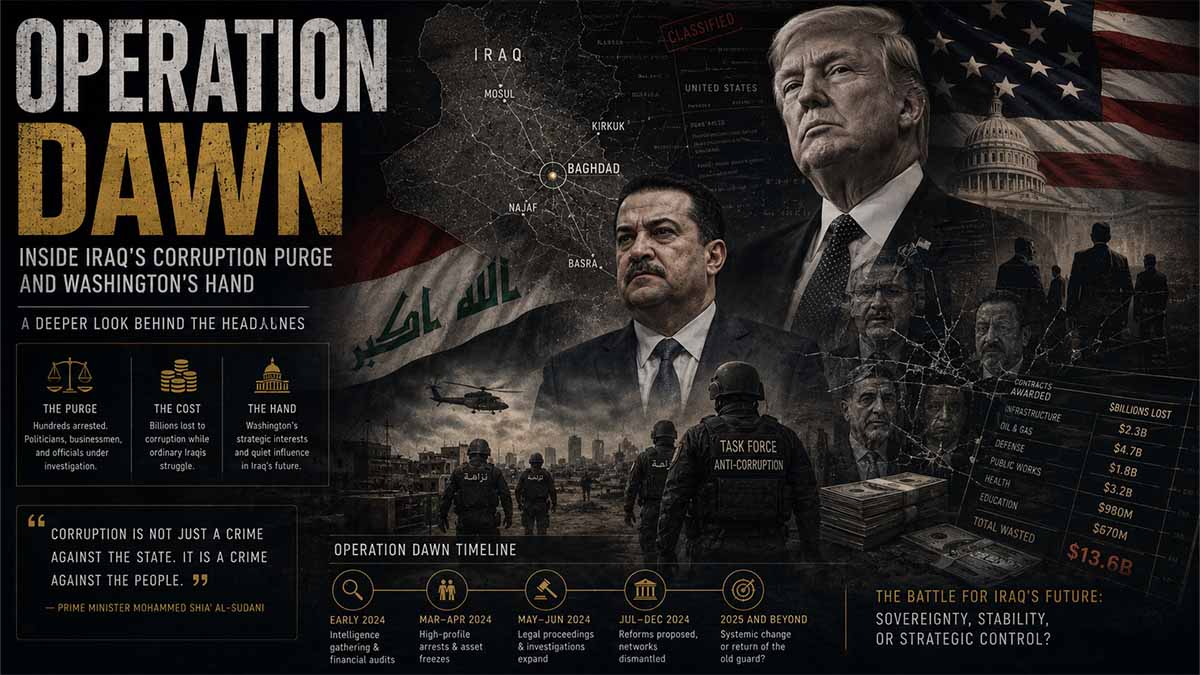
Iraq’s late-June 2026 anti-corruption sweep, dubbed Operation Dawn, broke from a decade-long pattern of arrests limited to low-level bureaucrats. Backed by Counter-Terrorism Service units, judicial warrants, and the Integrity Commission, the operation detained dozens of officials — including sitting MPs — after Deputy Oil Minister Adnan al-Jumaili’s arrest reportedly exposed a wider network. The campaign coincides with a narrowed US channel into Iraqi politics: US envoy Tom Barrack now works primarily through judiciary chief Faiq Zaidan rather than Iraq’s traditional multi-factional diplomacy. PM Ali al-Zaidi, a businessman-turned-premier with no traditional party base, is driving the crackdown while facing scrutiny over his own family’s state contracts. The stakes extend past graft: participation in government is increasingly tied to severing ties with the PMU and disarmament, with roughly a third of parliament aligned with Tehran-linked factions. Framed as a beginning rather than an endpoint, the operation raises open questions about how far — and toward whom — the pressure will ultimately be directed.
Navigational Index
- The Arrests and Their Optics — scale, methods, and the staged presentation of seized wealth
- The Washington Channel — Barrack, Judge Zaidan, and the collapse of multi-factional US diplomacy into a single conduit
- What Comes Next — disarmament conditions, the PMU question, and Petraeus’s Baghdad visits
Master Abstract
Operation Dawn marks a genuine break from the pattern that has defined Iraqi anti-corruption enforcement since 2003: cases against senior officials tied to oil contracts, border crossings, or major investment files rarely proceeded past announcement. The exception, the roughly $3 billion “heist of the century” tax deposit case under Mustafa al-Kadhimi, stood out precisely because it was unusual. Operation Dawn is different in scale and mechanism — CTS units, judicial warrants, and Integrity Commission personnel moved together to seal the Green Zone, and parliamentary immunity was lifted procedurally rather than through a floor vote, a departure Iraqi observers have flagged as constitutionally unusual even if technically permitted under the speaker’s recess authority.
The political context matters as much as the arrests themselves. Prime Minister Ali al-Zaidi entered office in May 2026 without a traditional political-bloc base; his family’s wealth is tied to state supply contracts, most notably the roughly 45-million-basket monthly food ration agreement with the Ministry of Trade, with Iraq’s outstanding debt to the company estimated near $2 billion. That a premier from this background is now leading history’s most aggressive graft campaign against the political class raises fair questions about selectivity and intent that deserve to be asked directly in reporting, rather than left implicit.
The external dimension is the more consequential story. Where US diplomacy in Iraq once ran through parallel tracks with Shia, Sunni, and Kurdish leaderships, it has narrowed to a single channel through Judge Faiq Zaidan, head of the Supreme Judicial Council — a shift that predates and outlasts Tom Barrack’s formal appointment. This follows the precedent set by Ambassador Alina Romanowski’s lists to former PM Mohammed Shia al-Sudani naming Tehran-linked financial networks; what has changed is throughput — fewer intermediaries, faster decisions, less room to stall once a name surfaces.
The stakes reported around Operation Dawn go beyond recovering stolen funds. Government formation has slowed as PMU disarmament and severance from Iran-aligned factions become conditions for senior appointments — significant given that roughly a third of the current parliament is aligned with Tehran or PMU-linked blocs. Raids on figures like Huqooq movement head Hussein Mounes, despite no publicly documented financial network, and David Petraeus’s multiple 2026 visits to Baghdad discussing PMU restructuring, point toward a campaign whose ultimate scope — corruption enforcement, or a broader realignment of Iraq’s security architecture — is not yet settled.
Operation Dawn: Reported Detentions by Source (Initial Wave, 28 June 2026)
Figures vary by outlet as reporting developed over the first 72 hours.
The Arrests and Their Optics: Scale, Methods, and the Staged Presentation of Seized Wealth
The scale of Operation Dawn has been genuinely difficult to pin down, and that ambiguity is itself part of the story. In the first 72 hours after the Green Zone raids on June 28, reported detention figures moved fast and inconsistently: the Associated Press’s earliest count put the number at seven, including five MPs; Shafaq News reported 21 the following day, then a running total climbing to 67; Al Jazeera and most Western outlets settled on 47 as the widely-cited figure for the initial wave, including more than a dozen sitting lawmakers. A Kurdistan24 report citing security sources went further still, describing a suspect list of nearly 1,000 names and a dedicated operations room under Prime Minister Ali al-Zaidi’s direct supervision, with the June 28 sweep framed as only the first phase of a campaign expected to reach “more than 200 senior figures” within days. Whether that scale materializes or the number quietly plateaus is one of the more consequential open questions about the operation’s durability.
The al-Jumaili case alone illustrates how fast the numbers have moved. Government spokesman Haider al-Aboudi told Al Jazeera the funds traced to the former deputy oil minister’s network exceeded 127 billion Iraqi dinars (roughly $96 million) plus another $24 million in cash, alongside real estate, vehicles, and jewelry. That figure kept growing week to week: a $10 million initial haul with 40 properties and a weapons cache at the time of arrest; then 25 billion dinars, $1 million in cash and 5kg of gold found hidden inside plastic water bottles; then 14 billion dinars ($10.6 million) recovered from a rainwater drainage pit; and by July 13, a further 375kg of gold — 358kg recovered in an operation involving Kurdistan’s regional authorities — handed to the Central Bank of Iraq’s Issue and Treasury Department. CBS News and other outlets have cumulatively described “more than $100 million” in cash and over 825 pounds of gold tied to this single case, which officials repeatedly stress concerns just one sector: oil refining contracts.
The concealment methods disclosed by investigators have become a recurring feature of the coverage itself — cash hidden in home walls, buried in underground chambers, stuffed into plastic water bottles, and, most widely circulated, $10.6 million found inside a storm drainage pit. Whether these details are released because they are operationally significant (demonstrating investigative reach) or because they generate shareable, visceral images of graft is a fair question. The recurrence of made-for-camera reveals — gold bars laid out for photographs, cash stacked for handout images released by the Iraqi News Agency and the Supreme Judicial Council — suggests the government understands the seizures as a public messaging exercise as much as a legal one. Government statements framing the campaign as “a central pillar of efforts to strengthen state institutions and protect public funds” are doing communications work aimed at a domestic audience that has heard anti-corruption rhetoric before and had reason to be skeptical of it.
That skepticism is worth taking seriously rather than dismissing. Former president Barham Salih estimated in 2021 that roughly $150 billion had been lost to embezzlement since the 2003 invasion — a figure so large that any single campaign’s recoveries, however dramatic the imagery, represent a small fraction of the alleged total. The selective visibility of the al-Jumaili case — extensively documented, repeatedly updated, image-rich — versus the comparatively opaque handling of other files raises the question of whether the optics are calibrated to build public confidence in a manageable, headline-friendly case while broader networks remain under wraps. Reports that Iraq has prepared extradition paperwork for “several hundred suspects” living abroad, and accounts of lawmakers intercepted attempting to flee across borders, add a fugitive-manhunt dimension that keeps the story in the news cycle independent of any actual conviction.
Figure: Al-Jumaili Case — Cumulative Seized Cash Disclosed Over Time (USD equivalent, millions)
Cash figures only (excludes gold, real estate, vehicles). Source: The National, Al Jazeera, CBS News, June–July 2026.
The Washington Channel: Barrack, Judge Zaidan, and the Collapse of Multi-Factional US Diplomacy into a Single Conduit
Tom Barrack took on the Iraq brief formally on May 31, 2026, when President Trump expanded his existing Syria and Turkey envoy role to include Iraq — but the shift in Washington’s operating channel in Baghdad predates that appointment. By April 19, 2026, Barrack was already meeting directly with Judge Faiq Zaidan, head of Iraq’s Supreme Judicial Council, in what the Middle East Forum described as a decisive intervention against the candidacy of Nouri al-Maliki for prime minister. That April visit, and a further meeting on June 15 in which Zaidan received Barrack in Baghdad to discuss “strengthening legal pathways” and the completion of constitutional requirements, established a pattern: rather than Washington’s ambassador rotating through Shia, Sunni, and Kurdish party leaderships as in previous administrations, the operative relationship now runs through one man who is not an elected official at all, but the country’s most senior judge.
The strategic logic Washington appears to be applying is one Ambassador Alina Romanowski used earlier with former PM Mohammed Shia al-Sudani: hand over a list of individuals and institutions tied to Iran-linked financial flows and let the recipient act on it. What has changed under Barrack, per The Cradle’s sourcing, is throughput — fewer intermediaries and less room for a target to negotiate once named. Zaidan’s public readouts of these meetings are notably thin — INA statements describe the judiciary’s role in “completing constitutional entitlements” without elaborating on any substantive political content, which itself is consistent with a channel designed to keep sensitive coordination out of public view.
Zaidan’s own position is genuinely contested in the analytical literature, and a fair account has to hold both readings simultaneously. On one side, he is widely described as Iraq’s “kingmaker” — a 2023 Combating Terrorism Center at West Point study, cited in reporting on Iraq’s militia dynamics, found that in February 2022 Zaidan’s Federal Supreme Court issued rulings that derailed a government-formation effort by an anti-Iran-aligned bloc, and commentary notes that no prime ministerial candidate has advanced since 2018 without his consultation. On the other side, the Middle East Forum has argued directly that portraying Zaidan as a reform-minded broker is a dangerous illusion, pointing to his rise under Qasem Soleimani’s patronage and arguing he is “a central pillar of the hybrid system” of militia influence and corruption rather than an agent capable of dismantling it. Both the Iranian Quds Force’s Esmail Qaani and the American envoy have separately courted him — which either makes him a genuine fulcrum point or evidence that he is simply the system’s most durable node, depending on which analysts you credit.
| Dimension | Pre-Barrack practice (through ~2025) | Current practice (2026) |
|---|---|---|
| Primary US interlocutor | Ambassador touring Shia, Sunni, Kurdish party leaders | Single channel via Judge Faiq Zaidan |
| Formal envoy structure | Separate country desks | Combined Syria–Iraq–Turkey brief under Barrack |
| Mechanism for pressure | Diplomatic messaging through multiple factional contacts | Named lists (lawmakers, officials, banks, companies) delivered directly |
| Precedent | Romanowski–Sudani lists on Iran-linked financial networks | Same model, fewer intermediaries, faster action |
| Public transparency of meetings | Limited | Minimal — SJC statements are procedural, not substantive |
| Contested reading | — | Kingmaker enabling reform vs. entrenched insider sustaining the status quo |
Whether this narrowed channel produces durable change or simply relocates the same informal bargaining into a less visible venue is the open question. The al-Maliki episode is the clearest test case so far: Washington’s opposition, delivered partly through Zaidan, did block that nomination, and reports describe US leverage tied to threats over access to Iraqi dollar accounts. That is a concrete, verifiable outcome. What remains unverified is whether Operation Dawn’s targeting list reflects Barrack’s inputs, an independent Iraqi judicial process, or some blend of the two — The Cradle’s sourcing asserts the former, while official Iraqi statements insist the campaign is judiciary-driven and domestically initiated. Both claims cannot be fully reconciled with available public evidence, and I’d flag that gap explicitly to your readers rather than resolve it for them.
What Comes Next: Disarmament Conditions, the PMU Question, and Petraeus’s Baghdad Visits
The disarmament track running alongside Operation Dawn has its own hard deadline: September 30, 2026 — the date government spokesman Haider al-Aboudi set for all pro-Iran armed factions to surrender weapons outside the state framework, chosen deliberately to coincide with the scheduled end of the US-led anti-ISIS coalition’s mission in Iraq. Aboudi was explicit about the stakes: “After this date, all weapons outside the state framework will be subject to legal redress.” The timing is not incidental — it lands just ahead of PM Ali al-Zaidi’s July visit to Washington, and Shafaq News has reported this is governed by a 2024 Baghdad–Washington agreement whose first phase closed in January 2026 (combat missions ending, partial troop pullback) and whose second phase, running to this September, narrows the US–Iraq relationship to advisory coordination and ends use of Iraqi bases to support operations in Syria.
Compliance across the Popular Mobilization Forces (PMF/PMU) umbrella is sharply uneven, and that split is probably the single most important variable for how this plays out over the next year:
| Faction | Stance on disarmament (as of July 2026) | Notes |
|---|---|---|
| Saraya al-Salam (Moqtada al-Sadr) | Complied — flag lowered, command handed to state (late May) | Not Iran-aligned; opened the current phase |
| Asaib Ahl al-Haq | Announced compliance, handing brigade control to state | Formed committee for handover logistics |
| Kataeb Imam Ali | Announced compliance; weapons data submitted | Cited as “first step” toward integration |
| Kataib Hezbollah | Holding out | Links disarmament to continued US troop presence in Iraq |
| Harakat Hezbollah al-Nujaba | Holding out | Same conditionality argument as Kataib Hezbollah |
The government’s own framing acknowledges the gap: a Coordination Framework politician told The National the plan was to complete the process “within three months” with thousands of security-sector jobs opening for vetted PMF members — but Shafaq’s analysis is blunt that “enforcement is the gap the declared mechanism has not closed,” since no announced procedure yet specifies who takes physical custody of holdout factions’ weapons or what “legal treatment” for non-compliance actually means in practice. That ambiguity matters because Kataib Hezbollah and Harakat Hezbollah al-Nujaba are precisely the two US-designated groups Washington cares most about — and both are conditioning compliance on something (full US troop withdrawal) that is not fully within Baghdad’s gift to deliver on the current timeline.
David Petraeus’s repeated 2026 visits to Baghdad sit inside this same file rather than alongside it. His stated public position — that Iraq needs to secure a state monopoly on the use of force — lines up precisely with the disarmament deadline’s logic, and his meetings with judiciary leadership (including Zaidan) suggest the corruption prosecutions and the militia file are being coordinated through overlapping channels rather than run as separate workstreams. That reading is circumstantial rather than confirmed by any on-record US statement, and I’d flag it to readers as informed inference, not established fact.
A rough timeline of how the three tracks — corruption arrests, disarmament deadline, and US diplomatic engagement — have converged:
| Date (2026) | Corruption track | Disarmament / security track | US engagement |
|---|---|---|---|
| April 19 | — | — | Barrack–Zaidan meeting; opposition to al-Maliki candidacy |
| Late May | Al-Jumaili arrested | Saraya al-Salam hands weapons to state | Zaidi takes office |
| June 4–10 | — | Kataeb Imam Ali, Asaib Ahl al-Haq announce compliance | — |
| June 15 | — | — | Second Barrack–Zaidan meeting |
| June 28–29 | Green Zone raids; 47–67 detained | Sept. 30 deadline announced | Zaidi’s Washington visit imminent |
| July 6–13 | Water bottles, drainage pit, 375kg gold disclosed | Holdout factions (Kataib Hezbollah, Nujaba) unmoved | Zaidi–Trump Oval Office meeting |
| Sept. 30 (pending) | — | Deadline for all factions | Coalition mission scheduled to end |
The honest bottom line for a five-month-out forecast: the corruption arrests and the disarmament deadline are being run in visible parallel and are almost certainly politically linked, but the file most likely to determine whether Operation Dawn represents a genuine state-building moment or a managed reshuffling of power is the disarmament deadline — because unlike arrests of individuals, it requires two heavily armed, US-designated factions to give up something they have shown no inclination to give up on the timeline offered. What happens on or after September 30 with Kataib Hezbollah and Nujaba, more than any additional wave of arrests, will be the real signal of whether this campaign changes the underlying structure of power in Iraq or simply redistributes it


