













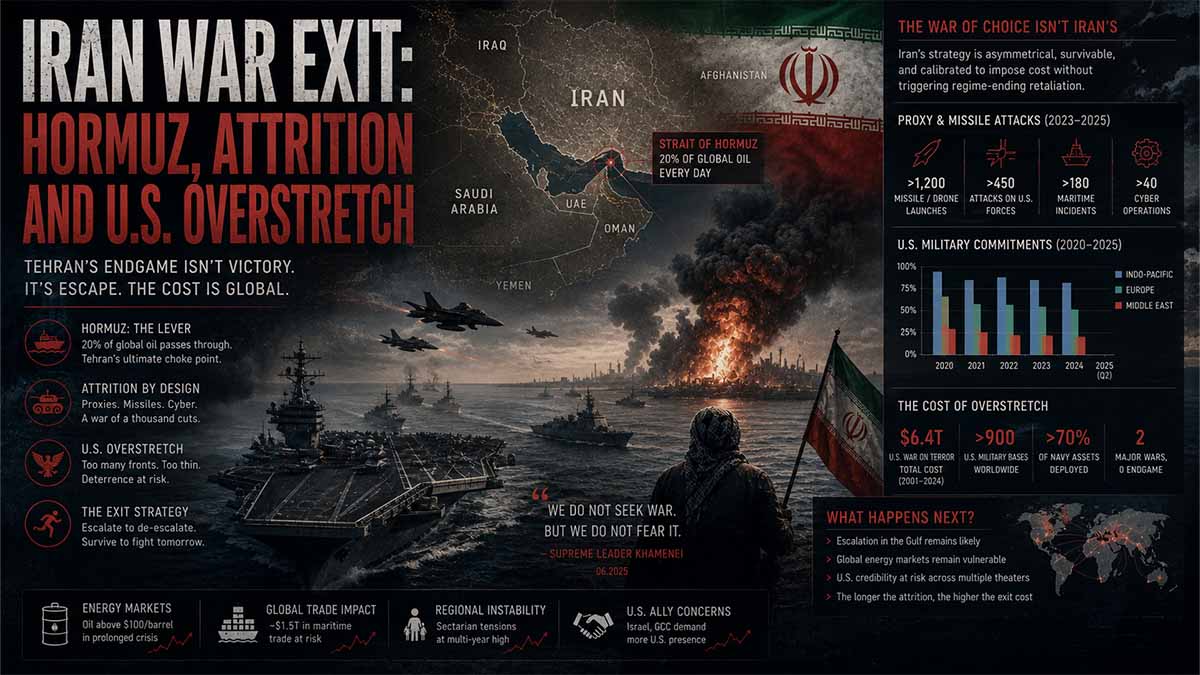
Executive Summary
BLUF: The Iran war is evolving from a strike campaign into a coercive contest over who determines the acceptable risk and price of navigation through the Strait of Hormuz.
The June 2026 memorandum reduced hostilities but did not eliminate Iran’s residual capacity—or political incentive—to threaten commercial traffic.
Renewed attacks on 7–8 July 2026 demonstrate that reopening the Strait is reversible rather than consolidated.
A large ground invasion remains militarily conceivable but politically prohibitive, operationally enormous and strategically disproportionate.
A renewed strategic bombardment could destroy additional assets without guaranteeing persistent maritime security.
Unilateral American withdrawal would conserve forces but could damage alliance confidence, maritime law enforcement and deterrence in Europe and the Indo-Pacific.
The most probable course is therefore a prolonged escort, surveillance, interdiction and retaliatory-strike architecture combined with intermittent diplomacy.
This is not yet another Vietnam, Afghanistan or Iraq; it could nevertheless become a “lake of blood” through cumulative losses, fiscal attrition, force diversion and recurring escalation.
Five-year base-case probability: 44% managed armed containment, 23% unstable negotiated settlement, 16% renewed major air war, 10% regionalized conflict, 7% U.S. strategic disengagement.
The principal exit mechanism is not decisive military victory but a verifiable maritime compact that changes Tehran’s incentives while preventing the United States from becoming the permanent insurer of Gulf commerce.
Navigational Index
Pillar I — The Hormuz Commitment Trap
Iranian coercive leverage, freedom of navigation, commercial insurance, alliance credibility and the limits of air-sea power.
Pillar II — Attrition, Escalation and Strategic Opportunity Cost
Missile economics, naval readiness, munitions expenditure, force rotation, energy shocks, cyber exposure and diversion from China and Russia contingencies.
Pillar III — Exit Architecture, 2026–2031
Escorted transit, negotiated maritime arrangements, regional burden-sharing, sanctions calibration, verification mechanisms and five competing strategic pathways.
Master Abstract
The analytical starting point must be corrected for chronology. The April 2026 ceasefire did not simply disappear without an intervening diplomatic process: the United States and Iran subsequently concluded a June memorandum intended to extend the ceasefire and reopen the Strait of Hormuz, after which oil traffic recovered substantially. That arrangement did not become self-enforcing. The International Energy Agency records that Gulf oil exports climbed by 6.5 million barrels per day in June to 16.1 million barrels per day, yet remained well below the approximately 24 million barrels per day pre-war level; renewed hostilities on 7–8 July lifted North Sea Dated crude from roughly $68 in early July to approximately $77 per barrel and clouded the recovery forecast. The International Maritime Organization separately condemned new attacks against several commercial vessels during those two days and, on 13 July, again called for de-escalation and protection of civilian shipping. These facts establish the conflict’s present form: neither a stable peace nor an uninterrupted general war, but a coercive maritime equilibrium in which commercial confidence can collapse faster than military capabilities can be regenerated. Oil Market Report – International Energy Agency – July 2026 — Verified primary source. IMO Secretary-General Condemns New Attacks on Ships in the Strait of Hormuz – International Maritime Organization – July 2026 — Verified primary source. IMO Council Reaffirms Commitment to Protecting Vital Shipping Lanes – International Maritime Organization – July 2026 — Verified primary source.
The thesis supplied for this assessment—that the United States faces four unattractive choices and will probably default to an indefinite blockade-and-escort operation—is therefore strategically relevant but should be treated as an argued course-of-action framework rather than an official operational forecast. The decisive distinction is between opening the Strait physically and making it commercially usable. A destroyer can escort a tanker through a threatened corridor; it cannot, by that act alone, guarantee affordable war-risk insurance, predictable crew availability, port access, uninterrupted schedules or confidence that the next transit will not coincide with a missile, mine, drone or seizure attempt. Iran consequently does not need absolute sea control. It requires only enough latent capability and demonstrated intent to make every voyage a probabilistic security decision.
The structural danger is an American commitment trap produced by an asymmetry in political value. For Tehran, an ability to contest Hormuz is simultaneously a defensive deterrent, an economic weapon, a bargaining instrument and a symbol that the Islamic Republic cannot be strategically bypassed. For Washington, freedom of navigation is important but competes with Indo-Pacific force requirements, European deterrence, homeland defense and munitions replenishment. The United States therefore possesses vastly greater aggregate power while potentially assigning lower marginal political value to each additional month of Gulf operations. That asymmetry creates conditions under which the materially weaker actor can survive repeated punishment and still impose strategic costs. The scale of the contested system is exceptional. Before the war, approximately 20 million barrels per day of crude oil and petroleum products crossed Hormuz, representing about 25% of seaborne oil trade; Qatar and the United Arab Emirates also supplied almost 20% of globally traded LNG through the passage.
At its narrowest point the Strait is approximately 29 nautical miles wide, while the established traffic-separation scheme contains inbound and outbound navigational channels only two nautical miles wide, separated by a two-mile buffer. Strait of Hormuz – International Energy Agency – 2026 — Verified primary source. Amid Regional Conflict, the Strait of Hormuz Remains Critical – U.S. Energy Information Administration – June 2025 — Verified primary source. During the 2026 disruption, the IEA classified the fall in global oil supply as the largest interruption in oil-market history: March supply dropped by 10.1 million barrels per day, while the EIA reported that more than 10 billion cubic feet per day of LNG—approximately one-fifth of global supply—was affected, with no known laden LNG carrier crossing between 1 March and 24 April. Oil Market Report – International Energy Agency – April 2026 — Verified primary source. International LNG Prices Rise amid Strait of Hormuz Closure – U.S. Energy Information Administration – April 2026 — Verified primary source. This dependence converts even tactically limited Iranian actions into globally distributed economic damage. China, India, South Korea, Japan and European LNG consumers absorb energy-price and supply-chain consequences; Gulf monarchies lose export income; shipping firms face higher premiums; and Washington is pressed to provide a public security good whose principal direct beneficiaries include major Asian importers. That burden-allocation problem is the conflict’s central geopolitical fault line.
Five competing hypotheses organize the five-year outlook. H₁, negotiated stabilization, holds that both governments recognize the costs of recurrent closure and convert the June memorandum into a verified maritime regime; its present posterior probability is assessed at 23% because the agreement demonstrated negotiability but the July attacks demonstrated weak enforcement. H₂, managed armed containment, holds that neither side can impose its maximal political objective and that escorts, air patrols, maritime surveillance, sanctions and limited counterforce attacks become semipermanent; this is the base case at 44%. H₃, renewed coercive air war, at 16%, assumes recurring Iranian attacks eventually cross an American casualty, shipping-loss or nuclear threshold that triggers another major strike sequence. H₄, regionalization, at 10%, assumes conflict diffusion through attacks on Gulf infrastructure, proxy networks, cyber operations, mines, covert sabotage or Israeli-Iranian escalation. H₅, strategic disengagement, at 7%, assumes Washington judges the opportunity cost intolerable and transfers most navigational responsibility to Gulf, European and Asian stakeholders.
These are analytical estimates rather than official forecasts. The probabilities are updated from four observable indicators: renewed attacks after the June agreement, recovery but incomplete normalization of Gulf exports, the enormous economic sensitivity of the chokepoint, and the demonstrated capacity of U.S. forces to create protected transit corridors without eradicating all threats. In May, the Pentagon described Project Freedom as a defensive operation involving guided-missile destroyers, more than 100 aircraft, approximately 15,000 service members, and an enhanced security area along the Strait’s southern side; it also reported more than 1,500 vessels and roughly 22,500 mariners trapped inside the Gulf at that stage. Project Freedom Aims to Get Thousands of Commercial Ships Safely Through Strait – U.S. Department of Defense – May 2026 — Verified primary source. These force levels illuminate why tactical success can become strategic attrition. Persistent coverage requires aircraft readiness, tanker support, airborne warning, intelligence collection, ballistic- and cruise-missile defense, mine countermeasures, electronic warfare, naval escorts, base protection and replenishment vessels. Every deployment consumes interceptor inventories, flight hours, maintenance capacity and crew endurance that cannot simultaneously be reserved for the Western Pacific. The “lake of blood” risk therefore does not require a catastrophic invasion. It can emerge incrementally through casualties, sunk or damaged merchant ships, recurring oil shocks, cyber disruption, munitions depletion, alliance disputes and the normalization of an open-ended military obligation.
The proposed Monte Carlo envelope for 2026–2031 models conflict evolution across eight stochastic variables: monthly Iranian attack frequency, probability of American fatalities per attack cycle, commercial-shipping loss severity, oil-flow interruption, coalition participation, Iranian missile regeneration, U.S. interceptor availability and diplomatic compliance. In the central parameterization, the model does not predict five uninterrupted years of high-intensity combat. It produces oscillation: agreements reduce violence, traffic resumes, verification weakens, an attack or attribution dispute reopens escalation, and a limited retaliatory phase restores temporary deterrence. The cumulative strategic burden is therefore more important than the average daily intensity. The most dangerous feedback loop begins when a low-cost Iranian system—an uncrewed surface craft, loitering munition, concealed coastal missile battery, limpet mine or deniable cyber operation—imposes a disproportionately expensive defensive response. Washington must then choose between absorbing reputational damage, firing costly interceptors, expanding target sets inside Iran or pressuring private operators to accept greater risk. Tehran’s shadow ecosystem may amplify this asymmetry through proxy procurement, sanctions-evasion revenue, cryptocurrency settlement, ship-to-ship transfers, falsified cargo documentation, compromised port systems, cyber reconnaissance and dual-use commercial technology. Attribution uncertainty is itself a weapon: an operation need not remain permanently deniable; it must only delay consensus long enough to divide coalition members over retaliation. The maritime human cost is already material.
The IMO had verified at least 46 attacks against international shipping by mid-June, while later reporting continued danger to commercial crews and renewed July attacks. IMO Secretary-General Welcomes U.S.–Iran Agreement – International Maritime Organization – June 2026 — Verified primary source. A strategically credible exit must therefore combine five instruments: a toll-free transit commitment, a technically monitored traffic regime, explicit prohibitions on mines and attacks against civilian vessels, a graduated enforcement ladder, and material burden-sharing by the states whose energy security depends on Hormuz. The objective should not be Iranian capitulation or an American guarantee of zero risk. It should be an equilibrium in which Tehran’s expected political and economic cost for disrupting transit exceeds the bargaining value of disruption, while American forces retain enough stand-off capability to punish violations without becoming permanently responsible for escorting every vessel.
The five-year trajectory is likely to divide into three periods. During 2026–2027, the principal contest will concern implementation of the June arrangement, attribution of violations, restoration of insurance markets and the degree to which the United States can reduce its emergency posture without inviting renewed coercion. The most useful warning indicators will be the number of vessels transiting without military escort, war-risk premiums, attacks per thousand passages, Gulf export recovery relative to the pre-war 24 million-barrel-per-day baseline, Iranian mobile-launcher activity, mine discoveries, and coalition contributions measured in escorts, surveillance aircraft and replenishment capacity. During 2028–2029, the decisive variable will shift from immediate operational control to force regeneration. Iran will attempt to replace missiles, drones, sensors and small craft; the United States will seek cheaper counter-uncrewed systems and greater regional burden-sharing; Gulf producers will accelerate bypass pipelines, storage, export redundancy and air-defense integration; Asian importers will diversify energy portfolios and strategic stocks. During 2030–2031, one of two structural outcomes becomes probable. Either a regional maritime-security architecture reduces the American role from continuous guardian to over-the-horizon guarantor, or periodic attacks become institutionalized and the Gulf joins Korea and the post-1991 Iraq containment system as a long-duration U.S. military commitment. The comparison with Afghanistan, Iraq and Vietnam is consequently useful only at the level of strategic mechanism. Iran is not primarily an occupation problem unless Washington elects to make it one. It is a denial, coercion and endurance problem in which adversary success may consist not of defeating the U.S. military, but of keeping it committed at an unfavorable exchange ratio. The most effective “way out” is therefore neither withdrawal without arrangement nor maximal bombardment without political settlement. It is a bounded coercive diplomacy: protect a clearly defined southern traffic corridor; distribute escort obligations among the United States, Europe, Gulf states and Asian beneficiaries; establish independent incident investigation; connect sanctions relief to measurable maritime compliance; preserve automatic reimposition mechanisms; and maintain a limited counterforce option against positively identified launch, mine-laying and command nodes. Such an architecture cannot eliminate danger. It can prevent the United States from confusing permanent tactical vigilance with a political strategy.
Hormuz Conflict Exit Matrix
Composite Escalation Risk
Five-Year Scenario Distribution
Pillar I — The Hormuz Commitment Trap: Coercion, Navigation and the Limits of Air-Sea Power
The central asymmetry: Iran does not need to close Hormuz completely
The Hormuz commitment trap arises from a structural asymmetry between the standard of success imposed on the United States and the much lower threshold Iran must satisfy to retain coercive leverage. Washington is expected to provide continuous, credible and commercially meaningful freedom of navigation; Tehran needs only to demonstrate that transit remains intermittently dangerous, politically conditional or financially punitive. This distinction is decisive. The military reopening of a sea lane is not equivalent to the restoration of a functioning maritime market. A U.S. carrier group, destroyer screen or combat-air patrol can suppress identified coastal launchers, intercept drones and accompany selected merchant vessels, but commercial normalization also requires shipowners, crews, charterers, banks, reinsurers, classification societies and port operators to believe that the next passage will probably occur without loss, detention or contractual dispute. Iran can therefore impose strategic effects without maintaining a physically impermeable blockade. A small number of successful or even attempted attacks can elevate war-risk premiums, delay sailings, reduce available tonnage and create congestion inside the Gulf. The March 2026 disruption demonstrated this leverage with unusual clarity: UN Trade and Development reported that daily Strait transits fell from a February average of approximately 129 ships to only four, a decline of about 97%, even though Iran had not established classical naval command of the waterway. The International Maritime Organization’s verified incident count reached 56 attacks and 18 seafarer fatalities by 15 July 2026, indicating that the relevant coercive unit is not control of every nautical mile but the repeated production of credible danger. (Strait of Hormuz Disruptions: Implications for Global Trade and Development – UN Trade and Development – March 2026 — Verified primary source; Middle East – Highlighted Confirmed Incidents – International Maritime Organization – July 2026 — Verified primary source). The supplied strategic text correctly identifies this dynamic when it argues that no air-sea campaign can guarantee complete removal of dispersed missiles, drones, speedboats and concealed stocks, but its most important implication is broader: Iran does not require total residual capability; it requires sufficient residual uncertainty to keep the United States politically and militarily engaged.
Iran’s coercive leverage is magnified by the extreme concentration of global energy trade in a narrow maritime space and by the limited physical substitutes available during crisis. The International Energy Agency estimates that nearly 20 million barrels per day of oil passed through Hormuz in 2025, while approximately 5 million barrels per day of refined products also used the Strait. Roughly 80% of these oil and product flows were destined for Asian markets. More than 110 billion cubic metres of LNG transited the passage, including about 93% of Qatar’s and 96% of the United Arab Emirates’ LNG exports, together representing almost one-fifth of global LNG trade. Unlike crude oil, which can be partially rerouted through Saudi and Emirati pipelines, LNG exported from the inner Gulf has no operational overland bypass capable of preserving present volumes. The IEA estimates only 3.5–5.5 million barrels per day of available crude-pipeline capacity outside Hormuz, meaning that even optimistic rerouting assumptions leave most normal Gulf exports exposed. This creates a coercive multiplier: Iran’s marginal attack effort is transformed into global price volatility, emergency stock releases, industrial input shocks and diplomatic pressure on Washington from energy-importing states. (Strait of Hormuz – International Energy Agency – 2026 — Verified primary source; The Middle East and Global Energy Markets – International Energy Agency – 2026 — Verified primary source). The 2026 disruption demonstrated the market consequences: the IEA reported a 10.1 million-barrel-per-day fall in global oil supply during March, describing it as the largest disruption in oil-market history, while Gulf-country production remained 14.4 million barrels per day below pre-war levels in April. By June, exports recovered sharply but remained below the approximately 24 million-barrel-per-day pre-war baseline, proving that physical reopening does not instantly restore operational confidence, production schedules or tanker circulation. (Oil Market Report – International Energy Agency – April 2026 — Verified primary source; Oil Market Report – International Energy Agency – May 2026 — Verified primary source; Oil Market Report – International Energy Agency – July 2026 — Verified primary source).
Freedom of navigation as law, reputation and enforcement burden
The legal issue is clear at the level of normative architecture but difficult at the level of enforcement. Part III of the United Nations Convention on the Law of the Sea defines transit passage as freedom of navigation and overflight for continuous and expeditious passage through straits used for international navigation. States bordering such straits may regulate navigational safety, pollution and certain operational matters, but they may not convert transit passage into a discretionary licensing system, selective political privilege or toll extracted under threat. The European Union has explicitly characterized Iranian actions against vessels in Hormuz as contrary to international law and as infringements of established transit- and innocent-passage rights. In June 2026, the Council of the European Union further stated that the IRGC Navy was undermining freedom of navigation by enforcing a toll system and by threatening, harassing and attacking commercial vessels. (Part III: Straits Used for International Navigation – United Nations – December 1982 — Verified primary source; Middle East: Council Extends EU Legal Framework to Target Those Involved in Iran’s Actions Impeding Lawful Transit Passage and Freedom of Navigation – Council of the European Union – May 2026 — Verified primary source; Freedom of Navigation in the Strait of Hormuz: EU Lists Two Individuals and One Entity – Council of the European Union – June 2026 — Verified primary source). Yet law does not enforce itself. Once a coastal state develops the ability to vary risk by ship identity, cargo, flag, ownership or navigational route, a nominally universal legal entitlement can become a selectively priced privilege. The enforcement burden then shifts toward the power capable of suppressing coercion. For the United States, failure to act would not merely affect Gulf oil; it would establish evidence that an international strait can be subjected to politically discriminatory passage if the coercing state can impose enough military and economic pain. That precedent would resonate beyond the Gulf because American maritime strategy rests on the proposition that globally connected trade routes cannot be subordinated to unilateral armed toll systems.
The legal consensus does not, however, produce geopolitical consensus over who bears responsibility for restoring navigation or what degree of force is legitimate. The European Union has emphasized lawful passage and sanctioned actors associated with Iranian coercion, but it has not thereby assumed primary operational responsibility for escorting the volume of traffic involved. China supports safe and free passage while simultaneously rejecting the American interpretation of causality. In April 2026, the Chinese Foreign Ministry argued that obstruction of Hormuz resulted fundamentally from U.S. and Israeli military action, opposed Security Council language that Beijing believed could legitimize unauthorized force, and supported a Chinese-Russian draft centred on de-escalation, negotiation and maritime rights. China subsequently called on Iran to cease attacks on Gulf-state facilities and affirmed that the freedom and safety of navigation in an international strait must be protected. In July, Beijing again stated that early restoration of safe and free passage served all parties’ interests, but it did not endorse a permanent U.S.-controlled security architecture. (Foreign Ministry Spokesperson Mao Ning’s Regular Press Conference – Ministry of Foreign Affairs of the People’s Republic of China – April 2026 — Verified primary source; Ambassador Fu Cong’s Explanation of Vote on the Strait of Hormuz – Ministry of Foreign Affairs of the People’s Republic of China – April 2026 — Verified primary source; Foreign Minister Wang Yi’s Telephone Call with Iranian Foreign Minister Abbas Araghchi – Ministry of Foreign Affairs of the People’s Republic of China – April 2026 — Verified primary source; Foreign Ministry Spokesperson Lin Jian’s Regular Press Conference – Ministry of Foreign Affairs of the People’s Republic of China – July 2026 — Verified primary source). Russia likewise welcomed the June agreement and supported freedom of navigation under international law, but framed the solution around negotiated confidence-building rather than American maritime primacy. (Statement of the Russian Foreign Ministry on the U.S.–Iran Agreement – Ministry of Foreign Affairs of the Russian Federation – June 2026 — Verified primary source). The resulting diplomatic geometry is unfavorable to Washington: many states demand navigational security, fewer accept American strategic framing, and fewer still are prepared to contribute proportionately to the military burden.
Commercial insurance: the hidden sovereign of the Strait
Commercial insurance converts tactical danger into systemic exclusion. A vessel may be seaworthy, legally entitled to transit and militarily escortable, yet remain commercially immobilized because war-risk cover is unavailable, prohibitively expensive or burdened by exclusions that transfer unacceptable liabilities to the owner. UN Trade and Development reported that tanker freight rates, marine-fuel prices and war-risk premiums surged after the 2026 disruption. Its March assessment illustrated the non-linear cost structure using a $100 million very large crude carrier: a war-risk premium of 0.25% implies approximately $250,000 per voyage; doubling the premium raises the cost to $500,000; a fourfold increase raises it to $1 million before fuel, delay, crew, escort, financing and opportunity costs are included. (Strait of Hormuz Disruptions: Implications for Global Trade and Development – UN Trade and Development – March 2026 — Verified primary source). These costs alter routing and contracting decisions even when the statistical probability of a strike remains low. Marine insurance prices tail risk rather than average conditions: one successful missile hit, mine detonation, boarding or crew fatality can reset actuarial assumptions for the entire region. The risk premium also compounds through finance. Higher insurance raises voyage costs; higher voyage costs raise cargo values and working-capital requirements; delayed cargoes extend loan duration; uncertainty raises collateral haircuts; and high volatility encourages traders to hold inventory or purchase options, increasing liquidity demand. UNCTAD found that the Strait shock propagated simultaneously through freight, energy prices, external borrowing costs, currency pressure and equity-market declines, with developing economies particularly vulnerable because limited fiscal space constrained their ability to absorb imported inflation. (Strait of Hormuz Disruptions: Growth and Financial Implications – UN Trade and Development – April 2026 — Verified primary source).
The insurance mechanism gives Tehran a form of indirect leverage over states that are not military belligerents. Asian importers bear most of the physical-flow exposure: the IEA calculates that approximately 80% of Hormuz oil and oil-product exports were destined for Asia in 2025, while the U.S. Energy Information Administration estimated that 83% of Hormuz LNG flows in 2024 went to Asian markets, with China, India and South Korea together receiving 52% of all LNG passing through the Strait. (The Middle East and Global Energy Markets – International Energy Agency – 2026 — Verified primary source; About One-Fifth of Global Liquefied Natural Gas Trade Flows Through the Strait of Hormuz – U.S. Energy Information Administration – June 2025 — Verified primary source). Yet the security provider remains disproportionately American. This creates a classic collective-action problem: importing states benefit from escorted passage but may rationally underinvest in the naval, intelligence, mine-countermeasure and air-defence capabilities required to maintain it, expecting Washington to act because the reputational consequences of failure are highest for the United States. Tehran can exploit this by applying selective pressure rather than universal interdiction. It may allow some cargoes to pass, prioritize certain flags, threaten vessels associated with coalition states, or impose administrative assessment procedures that resemble commercial regulation while functioning as coercive selection. Such differentiation fragments coalition interests. A Chinese or Indian company that obtains passage may oppose escalation; a European owner whose vessel is threatened may demand stronger action; Gulf exporters may seek U.S. protection while refusing politically sensitive basing arrangements. The “hidden sovereign” is therefore the combined risk judgment of insurers and operators, not the naval force physically present on any given day.
| Commercial layer | Iranian coercive input | Market transmission | Strategic result for Washington |
|---|---|---|---|
| War-risk insurance | Missile, drone, mine or seizure threat | Premium repricing and exclusions | Escorts may not restore commercial confidence |
| Chartering | Voyage delay and crew exposure | Reduced vessel availability | Higher freight rates and congestion |
| Trade finance | Delivery uncertainty | Larger collateral and liquidity requirements | Broader financial shock beyond oil prices |
| Port operations | Arrival and departure uncertainty | Storage saturation and production shut-ins | Gulf allies demand continuous U.S. protection |
| Crew management | Fatality, detention and evacuation risk | Refusal to sail or higher compensation | Military passage remains commercially unusable |
| Reinsurance | Correlated regional-loss scenario | Capacity withdrawal or strict limits | One incident can affect the entire Gulf market |
Alliance credibility and the problem of selective reassurance
Alliance credibility is not a unitary asset that rises whenever Washington uses force and falls whenever it exercises restraint. It is an inference made by allies from the consistency between American commitments, capabilities, priorities and willingness to bear costs. The 2026 National Defense Strategy calls for allies and partners to assume primary responsibility in Europe, the Middle East and the Korean Peninsula, with critical but more limited U.S. support, while placing the prevention of Chinese domination at the centre of force planning. (2026 National Defense Strategy – U.S. Department of Defense – January 2026 — Verified primary source). Hormuz places that burden-sharing doctrine under severe stress. If Washington withdraws while Iranian coercion remains effective, Gulf partners may conclude that U.S. security guarantees are conditional on low-cost contingencies and seek accommodation, autonomous missile programmes, alternative patrons or more aggressive unilateral policies. European and Indo-Pacific allies could interpret abandonment differently, not because Hormuz is directly comparable to their treaty commitments, but because observable American tolerance for coercive revisionism becomes part of their assessment of future crisis behaviour. Conversely, indefinite American overcommitment can also erode credibility. If Gulf operations consume interceptors, surveillance aircraft, tanker capacity, destroyer availability and political attention required for the Western Pacific or Europe, allies in those theatres may doubt whether U.S. guarantees remain operationally executable. Credibility therefore has two failure modes: insufficient resolve and insufficient residual capacity. The optimal signalling strategy is not maximal persistence at any cost but bounded persistence tied to explicit objectives, coalition contribution and measurable exit conditions.
The burden-sharing gap is already visible. In May 2026, the U.S. Department of Defense described Project Freedom as an operation using land, naval and air assets to protect a southern security area, restore commercial traffic and sustain freedom of navigation. Official briefings referred to guided-missile destroyers, more than 100 aircraft, approximately 15,000 U.S. service members, and thousands of trapped merchant mariners and vessels requiring protection or evacuation. (Project Freedom Aims to Get Thousands of Commercial Ships Safely Through Strait – U.S. Department of Defense – May 2026 — Verified primary source; Secretary of War and Chairman of the Joint Chiefs of Staff Hold a Press Briefing – U.S. Department of Defense – May 2026 — Verified primary source). These deployments demonstrate capacity but also expose the opportunity cost of reassurance. Every Aegis destroyer assigned to convoy protection is unavailable for other missions; every airborne early-warning orbit requires tankers, maintenance crews and secure bases; every missile-defense engagement consumes an interceptor that may take far longer to replace than an Iranian drone or cruise missile. A credible alliance strategy must therefore distinguish between the American contribution that only the United States can provide—integrated command, high-end ISR, theatre missile warning, long-range strike and certain air-defence capabilities—and functions that partners can assume, including escort rotation, patrol aviation, mine clearance, port security, logistics and financing of commercial-risk mechanisms.
The limits of air-sea power
Air-sea power can impose severe punishment, degrade launch infrastructure, protect selected corridors and alter the immediate cost-benefit calculation of an adversary. It cannot guarantee permanent elimination of every mobile launcher, mine stock, small craft, storage site, command node or dual-use drone component across Iran’s extensive coastline and interior. This is not primarily a statement about American technological insufficiency; it is a problem of target persistence, concealment, regeneration and positive identification. Mobile anti-ship systems can disperse into civilian or hardened environments, operate briefly and relocate. Mines can be laid covertly by submarines, small craft or disguised vessels. Commercial drones and autonomous surface craft can be assembled from distributed components. Coastal sensors can remain passive until required. A defender must succeed repeatedly; an attacker needs only occasional penetration. The U.S. Department of Defense’s earlier assessment of Iranian military power described missiles as a central component of Tehran’s deterrence strategy and identified a large, diverse force of short- and medium-range systems, while 2026 Missile Defense Agency budget documentation emphasized Iran’s continued development of more sophisticated missiles. (Iran Military Power Report Statement – U.S. Department of Defense – November 2019 — Verified primary source; Missile Defense Agency Fiscal Year 2026 Budget Justification – U.S. Department of Defense – June 2025 — Verified primary source). Aerial bombardment can reduce launch rates, but the marginal cost of locating and destroying the final fraction of a dispersed arsenal rises sharply. Strategic success cannot therefore be defined as zero residual threat unless Washington is prepared to occupy terrain, control supply chains and conduct continuous searches—an objective that would convert the maritime problem into a ground-war and regime-security problem.
The operational architecture can be represented as a contest between a high-cost defensive network and a lower-cost, regenerating disruption network:
Escalation Analysis Matrix
Analyze how asymmetric kinetic threats translate into global risk signals, provoking defensive responses and operational adaptations within the global supply system.
Iranian Coercive Network
- Mobile anti-ship missiles
- One-way attack drones
- Mines and covert minelaying
- Fast attack craft / unmanned surface vessels
- Cyber reconnaissance and port disruption
- Selective passage, toll and intimidation
Risk Signal Generated
- Insurer repricing (War-risk premium)
- Owner and crew transit refusal
- Charter cancellation and route rerouting
- Port congestion at primary junctions
- Upstream oil/gas production shut-ins
U.S.–Coalition Response Network
- ISR and continuous early warning
- Air and multi-domain missile defence
- Surface escort groups for merchant trade
- Active mine countermeasures (MCM)
- Counterbattery strikes & structural deterrence
- Financial and diplomatic containment
Temporary Reduction of Risk
- Tactical adaptation, dispersal, and weapon regeneration
This loop explains why a purely military solution tends toward indefinite commitment. Tactical suppression reduces immediate attacks and permits traffic to resume, but resumed traffic restores the target set and increases the political cost of a later failure. Iran adapts by changing launch locations, attack profiles, attribution methods or target selection. The United States must then maintain surveillance and strike readiness even during nominal calm. The force is no longer conducting a finite campaign against a fixed order of battle; it is policing an adaptive ecosystem. The more effectively it protects commerce, the greater the expectation that it will continue doing so. That is the commitment trap in its mature form.
Analysis of competing hypotheses
Five hypotheses explain how the Hormuz security system may evolve between mid-2026 and 2031. H₁ — Durable maritime compact assumes Iran concludes that predictable export income, sanctions relief and regime security outweigh the bargaining value of recurrent disruption. This hypothesis gains support from the June memorandum and from Chinese, Russian, European and IMO support for reopening the Strait, but it is weakened by renewed July attacks and by the absence of a robust independent verification mechanism. H₂ — Managed armed containment assumes the conflict stabilizes into escorts, surveillance, sanctions, intermittent counterforce strikes and recurring negotiations without definitive settlement. This hypothesis best fits the current combination of incomplete normalization, residual Iranian capability and American unwillingness to launch a large ground war. H₃ — Coercive Iranian maritime regime assumes Tehran succeeds in normalizing selective approvals, tolls or politically differentiated passage while avoiding attacks severe enough to provoke overwhelming retaliation. EU sanctions targeting actors associated with the alleged toll system provide direct evidence that such a model has already been attempted. H₄ — Renewed major air-sea war assumes a mass-casualty attack, sinking of a protected vessel, nuclear escalation or sustained closure leads Washington and Israel to restart intensive bombardment. H₅ — Burden-transfer and partial U.S. disengagement assumes American opportunity costs become unacceptable and Gulf, European and Asian states are compelled to provide most routine security. The hypotheses are not mutually exclusive over five years; the system can move from H₂ to H₁, regress into H₄, or evolve toward H₅ after prolonged containment.
| Hypothesis | Initial probability | Evidence raising probability | Evidence lowering probability | July 2026 posterior |
|---|---|---|---|---|
| H₁ Durable maritime compact | 25% | June U.S.–Iran memorandum; multilateral demand for reopening | Renewed attacks; weak enforcement | 20% |
| H₂ Managed armed containment | 35% | Residual threat; U.S. escort architecture; no appetite for invasion | High cost and coalition fatigue | 43% |
| H₃ Coercive Iranian maritime regime | 15% | Selective passage and reported toll system | EU sanctions; U.S. counterforce capacity | 13% |
| H₄ Renewed major air-sea war | 15% | July strikes; risk of fatalities and miscalculation | Munitions cost; uncertain political payoff | 17% |
| H₅ Burden-transfer/disengagement | 10% | 2026 NDS emphasis on limited U.S. support | Alliance and legal reputational costs | 7% |
The Bayesian update places H₂ at 43% because the observed evidence is most consistent with an equilibrium in which neither side accepts the other’s maximal conditions. Iran has demonstrated that it can impose maritime and economic costs after intensive military pressure; the United States has demonstrated that it can reopen at least a protected corridor and impose punishment without occupying Iran. The posterior for H₁ falls because an agreement existed but did not prevent renewed violence, showing that signature and implementation are separate variables. H₄ rises because attacks after reopening increase the probability of an escalatory incident involving U.S. personnel or escorted shipping. H₅ remains low in the near term because withdrawal during active coercion would impose heavy reputational costs, but its probability rises materially after 2028 if coalition participation remains weak. These probabilities are structured analytic estimates, not official forecasts. Their value lies in making assumptions explicit: H₁ depends on verification and sanctions sequencing; H₂ depends on affordable force rotation; H₃ depends on Tehran calibrating violence below the threshold of major retaliation; H₄ depends on a trigger event; H₅ depends on Washington convincing allies that burden transfer is not abandonment.
Five-year outlook, 2026–2031
The first phase, from mid-2026 through 2027, will be dominated by the distinction between reopening and normalization. Key indicators will include daily ship transits relative to the pre-conflict baseline, the percentage of voyages requiring military escort, war-risk premiums, confirmed attacks per thousand transits, the number of seafarers stranded or evacuated, and Gulf production restored after shut-ins. The U.S. Energy Information Administration expected oil output and trade flows to approach pre-conflict levels by the end of 2026, with most shut-in production returning by early 2027, but renewed attacks introduced substantial downside risk. (EIA Increases Global Oil Production Forecast after the U.S.–Iran Memorandum – U.S. Energy Information Administration – July 2026 — Verified primary source; Petroleum Markets Responded to Disruptions in the Middle East – U.S. Energy Information Administration – July 2026 — Verified primary source). During 2027–2028, the strategic centre of gravity will shift toward regeneration and burden-sharing. Iran will seek to replenish missiles, drones, sensors and small craft through domestic production, dual-use imports and sanctions-evasion networks; the United States will attempt to lower defensive exchange ratios through directed energy, cheaper interceptors, electronic warfare and autonomous surveillance; Gulf states will expand pipeline bypass, storage and port redundancy. Between 2028 and 2029, insurance-market behaviour may become a stronger determinant of strategic stability than the number of attacks. If insurers continue to require extraordinary premiums during periods of calm, the Strait will remain economically contested even when militarily open.
By 2030–2031, three structural outcomes are plausible. The first is a regional maritime compact under which Iran renounces tolls and attacks, an international mechanism investigates incidents, sanctions relief is released in stages, and the United States moves to an over-the-horizon role. The second is institutionalized armed containment resembling a permanent naval-security mission, with coalition escorts, recurring sanctions and periodic strikes. The third is partial American disengagement combined with selective intervention after major incidents. The second remains the most likely because it demands fewer political concessions from either principal actor: Iran preserves a residual deterrent and resistance narrative; Washington preserves freedom of navigation without invading; allies receive protection without fully replacing U.S. capabilities. Its cumulative cost, however, may be greater than its annual visibility suggests. Repeated six-month deployments, interceptor expenditure, readiness degradation and crisis-driven oil shocks can impose strategic damage without producing a dramatic battlefield defeat. The “lake of blood” analogy is therefore most analytically valid not as a prediction of an Iran occupation comparable to Vietnam, Iraq or Afghanistan, but as a warning about commitment accretion. Each individual decision—to escort one convoy, extend one deployment, suppress one launcher or retaliate for one attack—may be rational. The sequence can still produce an open-ended obligation disconnected from a feasible political end state.
| Forecast period | Dominant risk | Critical indicators | Most likely U.S. posture |
|---|---|---|---|
| 2026–2027 | Reopening failure and renewed attacks | Transits, attack rate, premiums, escorted-voyage share | High-tempo escort and counterforce |
| 2027–2028 | Iranian regeneration and U.S. munitions strain | Launcher activity, drone production, interceptor expenditure | Distributed surveillance and partner training |
| 2028–2029 | Coalition fatigue and insurance persistence | Allied ship-days, premium normalization, basing access | Burden-sharing pressure and sanctions |
| 2029–2030 | Political transition or escalation trigger | Iranian command cohesion, nuclear indicators, casualty events | Conditional force surge or negotiated drawdown |
| 2030–2031 | Permanent architecture versus disengagement | Treaty compliance, regional financing, U.S. fleet availability | Over-the-horizon guarantee or enduring containment |
Exit conditions: avoiding permanent tactical success without strategic termination
A viable exit requires redefining success away from elimination of all Iranian maritime capability. That objective is neither verifiable nor sustainable without occupation. The achievable objective is to reduce the expected value of coercive interference below the value Iran obtains from predictable trade, sanctions relief and regional stability. Five conditions are necessary. First, passage must be explicitly toll-free and non-discriminatory, with no requirement that vessels seek political permission from Tehran. Second, incidents must be investigated by a technically credible mechanism drawing on satellite imagery, voyage-data recorders, radar tracks, weapons fragments and crew testimony, thereby reducing the value of deniable attacks. Third, sanctions relief must be modular and reversible, released against measurable compliance rather than political declarations. Fourth, escort and mine-countermeasure responsibilities must be distributed among the United States, European navies, Gulf states and principal Asian beneficiaries. Fifth, the coalition must predefine an enforcement ladder ranging from diplomatic attribution and targeted asset freezes to interception, quarantine of identified military units and proportionate counterforce strikes. The mechanism should be designed to prevent a single incident from forcing an improvised choice between passivity and general war.
The strategic test is whether the United States can make its commitment credible without making it unlimited. Credibility requires a willingness to protect lawful transit and punish clearly attributable attacks. Limitation requires published objectives, coalition cost-sharing, munitions thresholds, deployment-review dates and a political channel capable of converting military suppression into negotiated restraint. A mission defined merely as “keeping Hormuz open” has no natural endpoint because risk can never be reduced to zero. A mission defined as maintaining a specified transit rate, reducing attacks below a measurable threshold, restoring ordinary insurance pricing and transferring routine protection to regional stakeholders can terminate or contract when those conditions are met. The commitment trap is escaped not by choosing between abandonment and endless war, but by replacing an unconditional security service with a conditional enforcement regime. Without that shift, American air-sea power will continue to win tactical engagements while the political obligation expands around it.
Figure 1: Hormuz Commitment-Trap Risk Projection, 2026–2031
Analytical index, 0–100. Higher values indicate greater U.S. exposure to persistent escort obligations, insurance dysfunction, escalation risk and force-diversion costs.
Pillar II — Attrition, Escalation and Strategic Opportunity Cost
The attrition system: tactical defence, strategic depletion
The second pillar of the Hormuz conflict is not defined principally by territorial conquest or daily sortie counts, but by the cumulative conversion of tactical protection into strategic depletion. The United States can destroy launch sites, intercept missiles, escort tankers and reopen selected corridors while simultaneously worsening its readiness for a larger contingency elsewhere. This apparent contradiction arises because operational success and strategic efficiency are different measurements. An escort mission may prevent a merchant ship from being struck, yet consume destroyer deployment days, fighter hours, tanker support, surveillance coverage, maintenance capacity and scarce defensive missiles whose replacement cycles are measured in months or years rather than hours. Iran’s relevant objective is therefore not necessarily to defeat an American naval formation. It can impose adverse exchange ratios by forcing high-end platforms to remain continuously present and by making the United States expend expensive, industrially constrained weapons against cheaper and more rapidly replaceable threats. The Department of Defense’s FY2026 weapons budget requested $384.3 billion for investment accounts, including $205.2 billion for procurement, while continuing purchases of systems such as SM-6, THAAD, Patriot-related capabilities and other air-and-missile-defence weapons. The scale of the aggregate budget should not be mistaken for unlimited immediately usable inventory: appropriations must be converted into contracts, industrial capacity, trained labour, tested components and delivered rounds. (Program Acquisition Costs by Weapon System, Fiscal Year 2026 – U.S. Department of Defense – July 2025 — Verified primary source; Fiscal Year 2026 Budget Request Overview Book – U.S. Department of Defense – July 2025 — Verified primary source). The supplied Hormuz assessment frames this problem as a potentially indefinite maritime commitment consuming a significant fraction of deployable naval capacity; analytically, the more precise concern is that a prolonged operation would consume selected high-demand assets at a rate disproportionate to the fleet percentage visible on an organizational chart. A destroyer equipped for ballistic-missile defence, an airborne early-warning aircraft or an aerial-refuelling squadron cannot be replaced in theatre by a nominally equivalent hull or airframe lacking the required sensors, weapons, crews and integration. The attrition metric must consequently track not total force size, but the availability of mission-qualified capability at the moment a second crisis begins.
Missile economics and the exchange-ratio problem
Missile economics favours the actor that can generate credible threats at lower marginal cost than the defender must pay to neutralize them. Exact unit prices vary by production lot, configuration, contract structure and whether development expenses are included, making simplistic “drone versus interceptor” comparisons unreliable. The strategic relationship, however, is robust. A coalition defender must detect, classify, track and defeat threats before impact, often using layered systems because no single interceptor provides perfect reliability. A salvo containing ballistic missiles, cruise missiles, one-way attack drones and decoys can force the defender to employ different sensors and weapons simultaneously, while retaining additional rounds against follow-on attacks. The attacker can further complicate the calculation by launching from mobile platforms, varying flight profiles or targeting fixed installations whose geographic coordinates are already known. The Missile Defense Agency’s FY2026 justification confirms sustained investment requirements across sensors, command networks, interceptors, testing and integration, demonstrating that missile defence is an industrial and systems-engineering enterprise rather than a stockpile that can be replenished instantly. (Missile Defense Agency Fiscal Year 2026 Budget Estimates – U.S. Department of Defense – June 2025 — Verified primary source). The adverse exchange ratio becomes strategically significant when a low-cost Iranian threat causes the United States to expend not merely one interceptor but an entire defensive sequence: an intelligence collection cycle, fighter launch, tanker sortie, electronic-warfare activation, multiple shipborne missiles and post-engagement assessment. Even an unsuccessful Iranian launch may compel commercial traffic to pause, insurers to reprice risk and coalition forces to increase alert status. The correct calculation is therefore not interceptor cost divided by attacking-weapon cost. It is the total marginal cost of preserving confidence divided by the marginal cost of recreating uncertainty. Iran gains when uncertainty is cheap to generate and expensive to suppress. Washington gains only if it can lower defensive costs through electronic attack, directed-energy systems, guns, cheaper interceptors, uncrewed pickets and better discrimination, while reserving high-end missiles for ballistic, supersonic or otherwise complex threats. Over five years, this technological and doctrinal adaptation race will determine whether armed containment remains affordable or becomes a resource sink.
| Attrition layer | Iranian or proxy input | U.S.–coalition response | Strategic cost multiplier |
|---|---|---|---|
| One-way attack drones | Inexpensive, dispersed, replaceable | Fighters, ship missiles, electronic warfare | High operating cost per alert cycle |
| Cruise missiles | Low-altitude, manoeuvring profiles | Aegis, combat air patrol, airborne warning | Persistent sensor and tanker demand |
| Ballistic missiles | Speed, terminal complexity, salvos | Patriot, THAAD, Aegis BMD | Scarce interceptor consumption |
| Mines | Covert emplacement, delayed attribution | Mine countermeasures and route closure | Slow clearance; major insurance shock |
| Uncrewed surface craft | Swarming and civilian clutter | Helicopters, guns, missiles, patrol craft | Rules-of-engagement burden |
| Cyber operations | Deniable, geographically unconstrained | Network defence, restoration, attribution | Simultaneous military-commercial disruption |
Naval readiness: deployment is not availability
Naval readiness imposes a harder ceiling than nominal fleet size. A warship counted in the battle force may be in depot maintenance, undergoing modernization, training a new crew, recovering from deployment or restricted by unresolved material deficiencies. GAO has repeatedly found that maintenance delays cascade into lost training time and postponed deployments. Its 2026 military-readiness assessment noted that maintenance delays can propagate through training and deployment schedules, while its 2025 shipbuilding and repair assessment concluded that Navy ships are frequently delivered or returned to service later than expected and at greater cost. GAO also reported that some ship-construction programmes faced delays of as much as approximately three years, while amphibious ships examined in a separate review deployed later than planned following maintenance difficulties. (Military Readiness: DOD Faces Continued Challenges – U.S. Government Accountability Office – March 2026 — Verified primary source; Shipbuilding and Repair: Navy Needs a Strategic Approach for the Industrial Base – U.S. Government Accountability Office – February 2025 — Verified primary source; Amphibious Warfare Fleet: Navy Needs to Complete Key Efforts to Better Ensure Ships Are Available for Marines – U.S. Government Accountability Office – December 2024 — Verified primary source). Hormuz consequently produces a readiness tax even in the absence of ship losses. Accelerated steaming, sustained high-alert operations, sand and heat exposure, radar use, helicopter flight hours and repeated weapons handling increase maintenance demand. Extended deployments defer repairs and compress the time available for crew certification before the next cycle. Sending a replacement ship may protect the immediate mission but does not erase the accumulated maintenance liability; it transfers pressure to another hull and crew. Over time, the fleet risks a negative feedback loop in which fewer ships are ready, available ships deploy more frequently, those ships accumulate wear faster, and maintenance facilities confront a larger backlog. This loop is particularly dangerous for specialized assets such as ballistic-missile-defence-capable destroyers and cruisers, mine-countermeasure forces, replenishment ships and carrier aviation. The strategic opportunity cost is therefore nonlinear: the first month of crisis can be supported from ready forces, whereas the twelfth or twenty-fourth month increasingly draws on assets that would otherwise recover, modernize or train for more demanding combat.
The readiness problem extends beyond surface ships. GAO’s May 2026 review of Air Force depots found that aircraft-maintenance delays had increased considerably since fiscal year 2019, whether measured against original completion dates or revised schedules accounting for unplanned work. Earlier GAO work similarly documented long-running aviation-maintenance problems and the operational consequences of aircraft spending more days in depots than planned. (Air Force Readiness: Actions Needed to Address Depot Maintenance Delays – U.S. Government Accountability Office – May 2026 — Verified primary source; Military Depots: The Navy Needs Improved Planning to Address Persistent Aircraft Maintenance Delays – U.S. Government Accountability Office – June 2020 — Verified primary source). A Hormuz air campaign depends heavily on aircraft that are already high-demand assets across the global force: tankers, airborne early-warning and control aircraft, electronic-attack platforms, intelligence aircraft, maritime-patrol aircraft and fighters capable of sustained defensive counter-air or precision strike. Their burden is not captured adequately by counting sorties. A tanker may support several fighters but also requires its own maintenance, protected operating base, crews and fuel supply. Airborne-warning aircraft provide a theatre-wide sensing function whose absence can sharply reduce the efficiency of every other defensive system. Persistent operations also affect munitions carriage, engine life, airframe fatigue and crew retention. Force rotation can distribute exhaustion but cannot abolish it. Every incoming unit must complete predeployment preparation; every outgoing unit requires recovery; every additional theatre commitment reduces the scheduling margin for unexpected contingencies. The five-year risk is not that the United States suddenly “runs out” of aircraft, but that mission-capable rates, crew proficiency and surge capacity decline in precisely those enabling fleets required to connect an Indo-Pacific or European combat force. A force may remain globally deployed while becoming less globally responsive.
Munitions expenditure and industrial replenishment
Munitions expenditure represents the most visible bridge between the Iran campaign and opportunity costs in the Indo-Pacific and Europe. The same industrial ecosystem that produces ship-based air-defence missiles, long-range precision weapons, rocket motors, seekers, energetic materials and guidance electronics must satisfy simultaneous demand from U.S. inventories, allies, Ukraine support, missile-defence expansion and prospective Pacific requirements. NATO’s updated Defence Production Action Plan, endorsed by defence ministers in February 2025 and approved by Allied leaders in June 2025, addresses aggregated demand, industrial capacity, raw materials and supply-chain resilience. NATO’s capability priorities include air and missile defence, long-range weapons, logistics and larger deployable formations, all categories that overlap with the requirements of a sustained Gulf campaign. (Increasing Defence Industrial Production – North Atlantic Treaty Organization – updated July 2026 — Verified primary source; NATO’s Role in Capability Development – North Atlantic Treaty Organization – July 2026 — Verified primary source). The European Commission’s White Paper for European Defence – Readiness 2030 likewise identifies air defence, missiles, drones and deep precision strike among the urgent capability gaps and calls for sustained ammunition deliveries to Ukraine, including a minimum objective of 2 million large-calibre artillery rounds annually. (White Paper for European Defence – Readiness 2030 – European Commission and High Representative – March 2025 — Verified primary source). Although artillery shells are not interchangeable with naval interceptors, the programmes compete indirectly for capital, skilled labour, chemicals, electronic components and political attention. A sustained Hormuz campaign therefore creates a portfolio-allocation problem within the transatlantic industrial base: investments optimized for inexpensive drone defeat may not accelerate production of long-range anti-ship missiles; expanding Patriot or shipboard-interceptor production may draw resources from weapons intended for deep strike or maritime denial in the Pacific.
The critical variable is replenishment elasticity—the speed at which production responds to unexpected expenditure. Defence production is not a conventional consumer market in which a price increase immediately attracts supply. Facilities require security approvals, specialized tooling, certified suppliers, quality assurance and long-term orders large enough to justify investment. Rocket motors, seekers and energetic materials may be produced by a small number of qualified sources, creating bottlenecks invisible in top-line procurement numbers. NATO’s publication of a list of 12 defence-critical raw materials in December 2024 reflected concern that material dependencies could constrain advanced weapons production. (NATO Releases List of 12 Defence-Critical Raw Materials – North Atlantic Treaty Organization – December 2024 — Verified primary source). Over the 2026–2031 horizon, the United States must therefore manage three inventory thresholds. The first is the theatre threshold: enough rounds to protect ships, bases and commercial traffic during an immediate salvo. The second is the global-surge threshold: enough remaining inventory to respond to a simultaneous Russian or Chinese contingency. The third is the industrial bridge threshold: enough stock to sustain operations until expanded production delivers at scale. Hormuz becomes strategically dangerous when expenditure approaches the second or third threshold, even if the first remains comfortable. A commander in the Gulf may rationally employ a premium interceptor to protect a high-value target; national decision-makers must simultaneously consider whether repeated engagements are consuming the contingency reserve required for Guam, Japan, NATO’s eastern flank or strategic homeland defence. This is why the military objective must include lowering the exchange ratio, not only maximizing interception probability.
Munitions-Attrition Chain
Analyze the strategic cost-exchange loop where asymmetric offensive salvos deplete high-value tactical defense reserves, impacting industrial production pipelines and global readiness.
Iranian Salvo or Ambiguous Threat
- Asymmetric Kinetic Salvo
- Ambiguous Threat Warning
Layered Defensive Tactics
- Shipborne Interceptors
- Land-Based Air Defense
- Fighter / Tanker Sorties
- Electronic Warfare (EW)
- ISR / Radar Tracking Cycles
Depletion & Platform Wear
- Inventory Drawdown
- Accelerated Platform Wear
Replenishment Demands
- Solid Rocket Motors
- Seekers & Microelectronics
- Energetic Materials
- Skilled Tech Labor Force
- Testing & Military Certification
Strategic Trade-offs
- Global Theater Competition
- Reduced Surge Capacity
Force rotation, personnel endurance and the readiness debt
Force rotation initially appears to solve prolonged commitment by replacing tired units with rested ones, but sustained rotation converts a theatre burden into a force-wide readiness debt. A conventional deployment cycle requires preparation, certification, deployment, return and recovery. When operational demand rises without a proportional increase in available units, services shorten recovery periods, extend deployments or deploy units with less scheduling margin. The visible cost is fatigue; the less visible cost is foregone training for missions not required in the current theatre. A destroyer conducting escort and air defence in Hormuz may retain high proficiency in those tasks while losing opportunities for anti-submarine warfare, distributed maritime operations or integrated high-end exercises tailored to a Pacific conflict. An aircraft squadron flying repetitive defensive patrols may accumulate combat hours while postponing complex training against advanced electronic attack or peer air defences. GAO has linked maintenance delays to cascading effects on training and deployment, and its Navy-readiness work has repeatedly highlighted the importance of spare parts, sailor-led maintenance and reliable management data. (Navy Readiness: Actions Needed to Improve Support for Sailor-Led Maintenance – U.S. Government Accountability Office – September 2024 — Verified primary source). The force can therefore appear experienced and overworked while becoming less prepared for a qualitatively different conflict.
A five-year commitment also creates retention and family-readiness costs that are difficult to price in a campaign budget. Repeated deployment extensions, uncertain return dates and high operational tempo affect experienced technicians, maintainers, aviators and warfare specialists whose replacement requires years of training. Personnel attrition can become a strategic bottleneck even when equipment remains available. The relevant index is not aggregate end strength but the number of fully qualified crews and maintenance teams that can sustain high-tempo operations without violating safety margins or hollowing out training commands. Service leaders may respond by offering retention bonuses, increasing contractor support or moving personnel between commands, but each measure redistributes rather than eliminates scarcity. The attrition pattern resembles compound interest: a deferred maintenance event or shortened training cycle creates a small immediate gain in operational availability but increases the probability of future delay, mishap or qualification failure. By 2028–2029, the accumulated readiness debt could become a stronger constraint than the direct fiscal cost of the Gulf mission. Strategic planners should consequently evaluate Hormuz rotations against a global readiness ledger measuring deployment-to-dwell ratios, missed certification events, delayed depot inductions, critical-skill retention and the decline in units available for immediate surge.
Energy shocks as an operational and geopolitical weapon
Energy disruption converts the Hormuz theatre into a global macroeconomic battlespace. The EIA estimated in April 2026 that crude-production shut-ins among Iraq, Saudi Arabia, Kuwait, the UAE, Qatar and Bahrain reached approximately 7.5 million barrels per day in March and could rise to 9.1 million barrels per day in April under assumptions of continued limited transit. A later EIA release estimated approximately 10.5 million barrels per day of regional crude production had been shut in during April. (Hormuz Closure and Related Production Outages Are Key Drivers of Oil Prices – U.S. Energy Information Administration – April 2026 — Verified primary source; EIA Will Publish New Energy Security Datasets – U.S. Energy Information Administration – May 2026 — Verified primary source). LNG exposure was equally consequential: the EIA reported that closure affected more than 10 billion cubic feet per day, approximately 20% of global LNG supply, and that no known laden LNG vessel crossed between 1 March and 24 April 2026. (International LNG Prices Rise amid Strait of Hormuz Closure – U.S. Energy Information Administration – April 2026 — Verified primary source). These figures reveal that Iran’s strategic leverage operates through production shut-ins as much as through direct destruction. Gulf exporters cannot continue producing indefinitely if tanks, terminals and available ships reach capacity. A shipping interruption therefore propagates upstream into wells and processing facilities, extending recovery even after transit resumes.
The shock redistributes economic advantage and diplomatic leverage. U.S. petroleum exports reached a record 13.6 million barrels per day in April 2026, approximately 15% above the prior monthly record, as foreign demand for American crude and products increased. EIA expected U.S. crude and petroleum-product net exports to average 4.2 million barrels per day in 2026, up 1.4 million barrels per day from 2025. (U.S. Exports of Crude Oil and Petroleum Products Reached a Record in April – U.S. Energy Information Administration – July 2026 — Verified primary source; EIA Expects a Drop in Global Oil Demand Will Limit Price Increases – U.S. Energy Information Administration – June 2026 — Verified primary source). Russia can benefit from higher hydrocarbon prices and increased demand for non-Gulf supply, while China faces higher import costs but may acquire greater negotiating leverage over sanctioned producers and deepen overland energy ties with Russia and Central Asia. Beijing’s Foreign Ministry explicitly warned that Hormuz instability was disrupting international goods and energy trade and threatening the global economy, while Chinese officials called for restoration of normal passage and protection of industrial and supply chains. (Foreign Ministry Spokesperson Lin Jian’s Regular Press Conference – Ministry of Foreign Affairs of the People’s Republic of China – March 2026 — Verified primary source; Wang Yi Holds Talks with Pakistani Deputy Prime Minister and Foreign Minister Mohammad Ishaq Dar – Ministry of Foreign Affairs of the People’s Republic of China – April 2026 — Verified primary source). The energy shock consequently creates a paradox: Washington bears much of the military cost of reopening a waterway whose disruption may generate commercial gains for U.S. exporters and Russian producers while imposing the largest import burden on Asian economies.
| Energy transmission channel | Immediate effect | Second-order consequence | Strategic beneficiary or loser |
|---|---|---|---|
| Oil-flow interruption | Price spike and inventory draw | Inflation and slower growth | Exporters gain; importers lose |
| LNG interruption | Regional gas-price divergence | Power and industrial curtailment | Non-Gulf LNG suppliers gain |
| Production shut-ins | Lost Gulf export revenue | Fiscal pressure on partner states | Iran gains coercive leverage |
| Higher freight and insurance | Increased delivered-energy cost | Trade-finance and currency pressure | Vulnerable developing states lose |
| U.S. export surge | Higher external demand | Domestic price and political tension | U.S. producers gain; consumers face risk |
| Russian substitution | Greater demand for alternative barrels | Additional revenue and geopolitical leverage | Moscow may gain indirectly |
Cyber exposure and the shadow battlespace
Cyber operations offer Iran and other actors a mechanism for imposing disruption without directly challenging American naval superiority. The maritime transportation system depends on integrated digital services spanning vessel navigation, satellite communications, cargo manifests, customs documentation, terminal operating systems, pipeline controls, port cranes, financial settlement and insurance claims. The International Maritime Organization’s 2025 revised guidelines define maritime cyber risk as the possibility that compromised computer-based systems could cause operational, safety or security failures and call on shipping stakeholders to manage risks created by digitalization, integration and automation. (Guidelines on Maritime Cyber Risk Management, MSC-FAL.1/Circ.3/Rev.3 – International Maritime Organization – April 2025 — Verified primary source). GAO’s February 2025 review found that the U.S. maritime transportation system faced significant and increasing cyber risk and identified China, Iran, North Korea, Russia and transnational criminal organizations among the principal threat actors. GAO concluded that vessels and facilities increasingly depend on vulnerable technology and that the Coast Guard lacked a fully developed strategic risk assessment and complete visibility into deficiencies identified during inspections. (Coast Guard: Additional Efforts Needed to Address Cybersecurity Risks to the Maritime Transportation System – U.S. Government Accountability Office – February 2025 — Verified primary source).
In a Hormuz campaign, cyber effects can be synchronized with kinetic operations or used as substitutes when direct attack would be too escalatory. Manipulated cargo records can delay loading; ransomware can immobilize terminal systems; false vessel-position data can create collision risk or force naval escorts to investigate phantom contacts; attacks on insurers or brokers can delay cover even when ships remain physically safe. Compromised operational technology at desalination, electricity or export facilities could widen the conflict into a humanitarian emergency without requiring a missile strike. Attribution difficulties are strategically useful because they slow coalition consensus and complicate proportional response. A cyber incident might originate from an Iranian state unit, a proxy, a criminal group acting opportunistically or a third state exploiting the crisis. The shadow dimension also includes Russian and Chinese intelligence collection against logistics networks. In April 2026, CISA and partner agencies warned that Russia’s GRU Unit 26165 was targeting Western logistics and technology entities, illustrating how a separate adversary can exploit wartime transport systems even when it is not a direct belligerent in the Gulf. (Russian GRU Targeting Western Logistics Entities and Technology Companies – Cybersecurity and Infrastructure Security Agency – April 2026 — Verified primary source). The strategic cost of cyber defence therefore extends beyond preventing Iranian attacks: the United States must defend a multinational commercial ecosystem against multiple actors while preserving intelligence and cyber capacity for Europe and the Indo-Pacific.
Diversion from China and Russia contingencies
The central strategic opportunity cost is not that operations against Iran make deterrence of China or Russia impossible. It is that they reduce the margin available to absorb surprise, simultaneous escalation or early wartime losses. The 2026 National Defense Strategy emphasizes the Indo-Pacific and expects allies to assume greater responsibility in Europe and the Middle East with more limited U.S. support. A prolonged Hormuz operation cuts against that allocation by retaining American high-end enabling capabilities in a theatre that the strategy seeks to manage with greater partner burden-sharing. The diversion effect should be measured across five categories: scarce munitions, high-demand naval platforms, air-refuelling and surveillance aircraft, intelligence collection, and senior command attention. The United States can shift assets rapidly, but redeployment during crisis carries transit time, maintenance requirements and signalling costs. Removing a destroyer from Hormuz may weaken commercial confidence; leaving it in place may reduce the missile-defence screen available to an Indo-Pacific task force. The problem becomes acute if Beijing times military pressure around Taiwan, the South China Sea or the East China Sea during a Gulf escalation, or if Moscow increases operations against NATO’s eastern flank while European inventories remain under reconstruction.
European vulnerability intensifies the trade-off. The EU’s Readiness 2030 programme identifies air and missile defence, strategic enablers, military mobility, ammunition and deep precision strike as urgent requirements, demonstrating that Europe cannot yet replace every U.S. capability diverted elsewhere. The Readiness Roadmap envisages mobilizing up to €800 billion through the broader ReArm Europe framework and establishes milestones for ammunition, drones and defence-industrial expansion, but financial authorization does not immediately produce operational forces. (Preserving Peace – Defence Readiness Roadmap 2030 – European Commission and High Representative – October 2025 — Verified primary source). NATO’s July 2026 multinational-capability framework also highlights joint procurement of surface-to-air and surface-to-surface missiles, torpedoes and naval gun ammunition, confirming that maritime munitions stockpiles remain an active expansion priority. (Delivering Capabilities Through Multinational Cooperation – North Atlantic Treaty Organization – July 2026 — Verified primary source). Until these investments mature, a U.S. Gulf commitment creates a triangular scarcity problem: the Indo-Pacific demands maritime and aerospace enablers; Europe demands air defence, logistics and long-range fires; Hormuz demands many of the same categories continuously rather than episodically.
Competing hypotheses and Bayesian update
Five hypotheses structure the 2026–2031 attrition outlook. H₁ — Sustainable low-cost containment assumes technological adaptation, regional escorts and declining attack frequency allow Washington to protect transit without material damage to global readiness. H₂ — Chronic readiness erosion assumes the mission remains tactically manageable but progressively consumes deployment capacity, interceptor stocks and maintenance margin. H₃ — Munitions shock assumes one or more intensive salvo periods drive selected defensive inventories below prudent global-reserve levels. H₄ — Simultaneous-theatre exploitation assumes China or Russia increases coercion while U.S. high-demand assets remain committed to the Gulf. H₅ — Forced burden transfer assumes strategic opportunity costs eventually compel Washington to reduce the mission and impose greater responsibility on Gulf, European and Asian partners. The initial probabilities are updated using five current observations: documented Navy and Air Force maintenance delays; industrial expansion programmes that acknowledge existing production constraints; substantial Gulf energy disruption; cyber vulnerabilities throughout maritime logistics; and strategic guidance seeking greater partner responsibility outside the Indo-Pacific. These observations strengthen H₂ and H₅ while leaving H₃ dependent on the future intensity and composition of Iranian salvos.
| Hypothesis | Prior probability | Principal confirming indicators | Principal disconfirming indicators | July 2026 posterior |
|---|---|---|---|---|
| H₁ Sustainable low-cost containment | 24% | Cheap interceptors; falling attack tempo; broad escort coalition | Continued premium-missile use; weak partner participation | 16% |
| H₂ Chronic readiness erosion | 30% | Deployment extensions; maintenance backlog; reduced training margin | Rapid normalization and shorter mission duration | 37% |
| H₃ Munitions shock | 18% | Large mixed salvos; inventory restrictions; emergency reprogramming | Low engagement rates; production surge | 20% |
| H₄ Simultaneous-theatre exploitation | 13% | Chinese or Russian mobilization during Gulf crisis | Stable European and Indo-Pacific theatres | 11% |
| H₅ Forced burden transfer | 15% | U.S. redeployment; coalition procurement; commercial security levy | Alliance refusal or renewed Iranian escalation | 16% |
The posterior distribution makes chronic readiness erosion the base case at 37%, not because catastrophic depletion is inevitable but because small recurrent losses of availability, training time and stockpile depth are already consistent with the underlying maintenance and industrial evidence. Munitions shock rises to 20% because the interaction between mixed salvos and layered defence can generate sudden expenditure spikes, though the absence of public inventory data prevents a precise threshold estimate. Forced burden transfer rises modestly because strategic doctrine, NATO procurement initiatives and European industrial expansion all point toward eventual redistribution of responsibilities. Simultaneous-theatre exploitation remains lower at 11% because deliberate coordination by Beijing or Moscow cannot be assumed; nevertheless, opportunistic pressure would not require formal coordination and could emerge from independent strategic calculations. Sustainable low-cost containment falls to 16% because it requires several favourable conditions to occur together: reduced attack frequency, cheaper defensive methods, predictable commercial transit and credible partner contribution.
Monte Carlo five-year scenario envelope
A five-year Monte Carlo-style model should treat attrition as a distribution of cumulative burdens rather than a prediction of one decisive battle. The model can be parameterized around monthly attack cycles, salvo size, proportion of threats requiring premium interceptors, average ship-deployment extensions, maintenance-delay propagation, coalition contribution, oil-flow disruption and probability of a simultaneous external crisis. In the central scenario, Iran conducts intermittent rather than continuous attacks, producing several high-alert periods annually. Coalition forces intercept most direct threats, but each episode raises insurance costs, slows traffic and delays planned force rotations. Under this structure, the median outcome by 2031 is not fleet collapse; it is a measurable reduction in strategic reserve: fewer mission-qualified ships available for surge, lower selected interceptor inventories relative to contingency requirements, and deferred modernization or training. The upper-tail outcome emerges when three variables coincide—large mixed salvos, weak allied burden-sharing and a second-theatre crisis. That combination forces national command authorities to choose among reducing Gulf protection, accepting greater risk to Indo-Pacific or European plans, or accelerating procurement at extremely high fiscal and industrial cost.
The lower-risk outcome requires active policy intervention rather than passive endurance. By 2027, coalition forces would need to move a larger share of drone defence toward electronic warfare, guns and low-cost effectors; by 2028, regional partners would need to provide routine escort, patrol and base-defence capacity; by 2029, expanded missile and rocket-motor production would need to reduce replenishment time; and by 2030–2031, the United States would need to shift from continuous presence to surge-backed assurance. The model’s strategic warning threshold is reached when any two of the following occur simultaneously: deployment extensions exceed planned cycles across multiple high-demand units; selected defensive munitions are rationed for anything other than operational necessity; depot delays materially reduce replacement availability; or Indo-Pacific exercises and European commitments are cancelled to source Gulf forces. At that point, the operation ceases to be a contained regional mission and becomes a global force-allocation crisis.
Strategic control measures, 2026–2031
The United States can reduce the opportunity cost only by managing the Hormuz mission as a constrained portfolio rather than an unlimited operational requirement. First, it should adopt an explicit cost-exchange doctrine requiring commanders to reserve premium interceptors for threats that cannot be defeated reliably by cheaper layers. Second, the coalition should establish a shared maritime-defence inventory mechanism that reports consumption, production lead times and minimum reserve requirements without publicly revealing operationally sensitive stock levels. Third, escort burdens should be financed partly by the principal commercial beneficiaries through negotiated state contributions or an internationally administered security mechanism, avoiding ad hoc Iranian tolls while preventing the entire cost from falling on the U.S. defence budget. Fourth, force rotations should include protected maintenance and training floors that cannot be overridden indefinitely by theatre demand. Fifth, regional ports, pipelines, energy terminals and shipping companies should be integrated into a cyber-fusion architecture capable of distinguishing criminal incidents from state-linked preparation and of restoring operations rapidly after compromise.
The final requirement is political prioritization. No commander can solve a national strategy that treats every theatre as simultaneously decisive. Washington must identify which Gulf outcomes justify consuming capabilities reserved for a conflict with a nuclear-armed peer. Protection of civilian navigation and prevention of regional economic collapse justify substantial action; achieving zero residual Iranian strike capacity does not. The operational end state should therefore be a sufficiently secure, commercially insurable corridor supported by regional forces and backed by a limited American surge capacity. The attrition trap deepens whenever the mission expands from protecting transit into continuous suppression of every Iranian military capability that might someday threaten transit. Such expansion has no stable endpoint and directly competes with the forces, weapons and industrial capacity required to deter China and Russia. By 2031, success should be measured not only by whether oil tankers cross Hormuz, but by whether the United States can still generate a credible, fully supplied and properly trained force in another theatre without first unwinding an inherited Gulf commitment.
Figure 1: Five-Year Strategic Attrition and Opportunity-Cost Projection
Analytical indices, 0–100. Values represent relative pressure rather than disclosed inventory or readiness data. The central projection assumes intermittent Iranian attacks, incomplete allied burden-sharing and gradual industrial expansion.
Pillar III — Exit Architecture, 2026–2031: From Armed Escort to a Verifiable Maritime Settlement
Exit is an architecture, not an event
An exit from the Iran war cannot be defined as the date on which American aircraft stop striking Iranian targets or the moment a limited number of tankers again pass through the Strait of Hormuz. A sustainable exit must replace emergency military protection with a political, legal and commercial system capable of preserving transit after the visible U.S. force posture declines. The distinction is essential because the June 2026 memorandum demonstrated that a negotiated pause can reopen diplomatic space without producing a self-enforcing maritime order. The International Maritime Organization welcomed the U.S.–Iran agreement on 15 June 2026, but its subsequent evacuation operation had to be paused after another attack in the Gulf of Oman; by 26 June, only 136 vessels carrying an estimated 2,900 seafarers had been evacuated through the mechanism, while thousands remained exposed to renewed instability. The episode revealed both the feasibility and fragility of coordinated safe passage: diplomatic authorization, vessel lists, communications and state cooperation allowed substantial movement, but a single security incident was sufficient to suspend operations. (IMO Secretary-General Welcomes US-Iran Agreement – International Maritime Organization – June 2026 — Verified primary source; IMO Announces Evacuation Plan in the Strait of Hormuz – International Maritime Organization – June 2026 — Verified primary source; IMO Pauses Evacuation in Strait of Hormuz Following Attack – International Maritime Organization – June 2026 — Verified primary source). The supplied strategic assessment correctly identifies indefinite escort and selective counterforce operations as the least immediately destructive of four unattractive choices, but that option becomes strategically viable only if it functions as a bridge toward an institutional settlement rather than as a permanent substitute for one. The exit architecture must therefore solve six interlocking problems: who may transit and under what rules; who verifies compliance; who escorts vessels during the transition; who pays for security; how sanctions are relaxed or restored; and how violations are punished without automatically reopening full-scale war. Failure in any one component can reactivate the commitment trap because shipowners and insurers assess the system as an integrated whole. A legal assurance without physical security is insufficient, an escort without insurance normalization is commercially incomplete, and sanctions relief without verification may finance the regeneration of the very capabilities used to disrupt navigation.
The legal baseline cannot be negotiated away
The first design principle is that any settlement must regulate implementation without renegotiating the underlying right of passage. Under Part III of UNCLOS, ships and aircraft enjoy transit passage through straits used for international navigation, and that passage “shall not be impeded.” States bordering a strait may adopt laws concerning navigational safety, pollution, fishing and customs matters, but those rules may not discriminate among foreign vessels or have the practical effect of denying, hampering or impairing passage. The legal structure therefore permits technical coordination but not a political licensing regime through which Tehran decides which flags, cargoes or owners may move. (Part III: Straits Used for International Navigation – United Nations – December 1982 — Verified primary source). This distinction has direct operational consequences. A negotiated arrangement can establish reporting windows, communications frequencies, mine-warning procedures, emergency anchorage rules and mutually recognized traffic lanes, but it cannot legitimize tolls, compulsory payments, political questionnaires or guarantees purchased from an IRGC-linked authority. The U.S. Treasury stated that payments or guarantees to the Iranian government or the IRGC for safe passage were not authorized for U.S. persons, and it designated the so-called Persian Gulf Strait Authority after describing it as an Iranian mechanism for maritime extortion. Treasury also warned that prohibited consideration could include fiat payments, digital assets, offsets, informal swaps, in-kind transfers or ostensibly charitable donations. (Economic Fury Targets Iranian Maritime Extortion – U.S. Department of the Treasury – May 2026 — Verified primary source; Iran Sanctions Frequently Asked Questions – U.S. Department of the Treasury – June 2026 — Verified primary source; Iran Sanctions – Office of Foreign Assets Control – 2026 — Verified primary source). The European Council adopted the same normative boundary, stating that any Hormuz arrangement must not limit freedom of navigation or alter the Strait’s governance, while the EU widened its sanctions framework to cover actors threatening lawful passage. (EU Position on the Situation in the Middle East – Council of the European Union – June 2026 — Verified primary source; Middle East: Council Extends EU Legal Framework to Target Actions Impeding Transit Passage – Council of the European Union – May 2026 — Verified primary source). A durable settlement must consequently distinguish between Iranian participation in administering safety and Iranian sovereignty over access. Tehran can be a necessary party to the operational regime without becoming the grantor of a right that already exists under international law.
Escorted transit must evolve from military convoy to risk-managed corridor
Escorted transit is indispensable during the transition but dangerous as a permanent end state. The most efficient architecture would not assign a destroyer to every merchant vessel. It would establish a layered corridor in which naval forces concentrate on the highest-risk segments and periods while commercial vessels transit in coordinated groups under shared surveillance, standardized communications and pre-cleared emergency procedures. In its early phase, the system would require continuous maritime-domain awareness, airborne early warning, mine surveillance, defensive counter-air, electronic warfare, search-and-rescue support and rapid counterbattery capability. Merchant ships would register for transit through a neutral coordination cell that records flag, ownership, cargo category, draught, speed, crew requirements and communications status but does not request Iranian political authorization. The coordination cell would publish protected windows without disclosing tactical escort formations far in advance. High-value or vulnerable ships—LNG carriers, passenger vessels, vessels carrying hazardous cargo and ships lacking robust self-protection or communications—would receive priority. Lower-risk vessels could move through monitored windows without close escort once attack rates and insurance conditions improved. The IMO safe-passage and evacuation experience provides a partial administrative prototype because it used voluntary participation, state and industry coordination, vessel identification and published transit figures while preserving the navigation rights embodied in UNCLOS. (Middle East: Strait of Hormuz Operational Information – International Maritime Organization – July 2026 — Verified primary source). The military architecture should be designed to shrink automatically as measurable risk declines. During Phase A, naval escorts and combat-air patrols would protect nearly all organized movements. During Phase B, only designated high-risk categories would receive direct escort, while other vessels would rely on surveillance and rapid reaction. During Phase C, regional coast guards and navies would provide routine security, with U.S. and European forces held at operational reach. During Phase D, international monitoring and commercial insurance would become the primary stabilizers, while external naval forces retained surge capacity. Without this phased contraction, the escort system would generate its own permanence: every successful passage would prove the value of military protection, while every attempted reduction would appear to increase risk. The exit mechanism must therefore contain pre-agreed transition criteria based on attack frequency, mine discoveries, traffic volume, war-risk premiums, Iranian compliance and partner-force readiness.
Emergency Escort to Normalized Transit
A multi-stage operational framework tracking the normalization timeline from direct naval convoy operations to standard commercial shipping passage.
High-Threat Corridor
U.S./Coalition Command
- Close naval escort
- Persistent air defence
- Mine-countermeasure screen
- Continuous ISR
- Counterbattery response
Controlled Windows
Coordination Cell
- High-risk direct escort
- Remote patrol protection
- Verified incident reporting
- Insurance operating protocols
Regionalized Security
GCC/Oman Routine Ops
- Local regional patrols
- Partner-funded surveillance
- International mine monitoring
- Rapid-reaction reserves
Normal Governance
UNCLOS Transit Passage
- No political permission
- No discriminatory tolls
- Independent verification
- Automatic enforcement
The negotiated maritime arrangement requires modularity
A comprehensive “grand bargain” covering the nuclear programme, sanctions, regional proxies, ballistic missiles, maritime passage and diplomatic normalization would be politically attractive but operationally brittle. The probability that every dispute can be resolved simultaneously is low, and making Hormuz transit contingent on unrelated negotiations would effectively permit civilian shipping to become permanent leverage. The preferable structure is a modular maritime agreement legally and operationally distinct from broader U.S.–Iran disputes, even though sanctions incentives and security assurances would connect the files. The June 2026 memorandum and subsequent regional diplomacy indicate that this separation is partially possible. The U.S.–GCC ministerial statement of 25 June 2026 welcomed the 17 June memorandum and recognized the contribution of regional mediators, while U.S. engagements with the UAE, Kuwait and Bahrain focused on full and safe transit through the Strait. (Joint Statement Following the Ministerial Meeting of the United States and the Gulf Cooperation Council – U.S. Department of State – June 2026 — Verified primary source; Secretary Rubio’s Travel to the UAE, Kuwait and Bahrain – U.S. Department of State – June 2026 — Verified primary source). The maritime module should contain at least eight provisions: explicit recognition of uninterrupted transit passage; prohibition of tolls and compulsory guarantees; prohibition of attacks, seizures and mine-laying against civilian shipping; a mutual maritime incident hotline; prior notification of naval exercises that could obstruct commercial lanes; an agreed technical mechanism for vessel and threat information; independent investigation of incidents; and a graduated sanctions-and-enforcement mechanism. Iran would not be required to surrender its territorial waters or abandon lawful navigational regulation. It would be required to separate safety regulation from political coercion. The United States and coalition members would correspondingly commit that protected transit corridors would not be used as a pretext for offensive operations unrelated to verified maritime threats. This reciprocal limitation matters because Beijing and Moscow reject an architecture that legitimizes indefinite U.S. military domination of the Strait. China welcomed the June memorandum, called for normal navigation and emphasized that the peace process would be difficult, while Russia supported the agreement and advocated broader regional security arrangements. (Foreign Ministry Spokesperson Lin Jian’s Regular Press Conference – Ministry of Foreign Affairs of the People’s Republic of China – June 2026 — Verified primary source; Wang Yi Holds a Phone Conversation with Pakistani Deputy Prime Minister and Foreign Minister Mohammad Ishaq Dar – Ministry of Foreign Affairs of the People’s Republic of China – June 2026 — Verified primary source; Foreign Ministry Statement on the Memorandum Reached between the United States and Iran – Ministry of Foreign Affairs of the Russian Federation – June 2026 — Verified primary source). A modular arrangement capable of receiving Chinese and Russian political support would have greater durability than one framed solely as ratification of American coercive success.
Verification must transform ambiguity into attributable evidence
Verification is the central technical weakness of any maritime settlement because many prohibited acts can be performed covertly, indirectly or through proxies. A mine may be laid days before detonation; an uncrewed surface vessel may be assembled from commercial components; a drone may use navigation data obtained from civilian networks; a missile may be launched from a mobile unit that disappears before retaliation. The verification architecture must therefore fuse multiple evidence streams rather than depend on a single observer or national intelligence service. Its core should be a Hormuz Maritime Verification Cell composed of the IMO, Oman, GCC representatives, neutral technical states and liaison officers from major flag, insurance and shipping jurisdictions. The cell would not command military forces or adjudicate sovereignty. It would collect and preserve evidence, issue preliminary incident assessments and maintain a common operating record. Evidence should include satellite imagery, coastal radar data, automatic-identification-system records, voyage-data recorders, hull and weapons fragments, acoustic signatures, electronic emissions, crew testimony, port logs, cyber indicators and financial records connected to toll or guarantee demands. The United Nations Secretary-General’s March 2026 task-force initiative focused on technical mechanisms addressing humanitarian needs, while the Security Council subsequently called for restoration of navigational rights and emphasized that the Strait’s legal regime is grounded in UNCLOS and customary international law. (Note to Correspondents on the Strait of Hormuz – United Nations Secretary-General – March 2026 — Verified primary source; Secretary-General’s Remarks to the Security Council on Maritime Security – United Nations – April 2026 — Verified primary source; Immediately Restore Freedom of Navigation through the Strait of Hormuz – United Nations Security Council – April 2026 — Verified primary source). The verification cell would build on that technical orientation while avoiding the political impossibility of an intrusive land-based inspection regime across Iran. It should use graduated confidence levels—confirmed, highly probable, plausible, unresolved—rather than wait for judicial certainty before issuing warnings. Evidence thresholds for sanctions could be lower than those for military retaliation; evidence thresholds for kinetic action should be significantly higher. This separation reduces the probability that ambiguous attribution becomes an automatic escalatory trigger.
The communications architecture must also be redundant. A permanent U.S.–Iran maritime hotline, with Oman as a fallback relay, should operate alongside naval deconfliction channels and an IMO emergency line. Every reported incident would generate a fixed sequence: immediate hazard notification; preservation of radar and communications data; assignment of a neutral technical team; preliminary assessment within 24 hours; detailed assessment within seven days; and publication of a redacted report sufficient for insurers and operators. Cyber incidents would require a parallel forensic protocol because manipulation of vessel positions, manifests or port systems could produce physical effects without conventional weapons. The verification cell should maintain cryptographically secured evidence repositories and standardized chain-of-custody rules. Participation by China would be particularly valuable because Chinese companies and energy flows are deeply exposed to Hormuz, while Beijing’s political relationship with Tehran could improve access and compliance. Participation by Russia would carry counterintelligence risks but could increase the legitimacy of findings if confined to a transparent technical role. Neither state should possess a veto over publication. Verification succeeds not when every actor accepts every conclusion, but when the evidentiary process is sufficiently credible that denial becomes costly and insurers can distinguish systemic danger from an isolated, contained event.
Regional burden-sharing must be functional, not symbolic
Regional burden-sharing is indispensable because an arrangement that leaves the United States responsible for every escort, mine threat, surveillance orbit and retaliatory strike will not constitute an exit. The GCC states possess the greatest direct economic stake in uninterrupted export flows, while major Asian consumers possess the largest aggregate import exposure. Contributions should therefore be allocated according to capacity, geography and economic dependence rather than ceremonial coalition membership. Oman is uniquely positioned to host coordination because it borders the southern approach, retains channels with Tehran and was referenced in Iran’s communication to the United Nations regarding development of a safe-passage framework. The U.S.–GCC ministerial process already recognizes the role of regional mediators and the need to secure full passage. Saudi Arabia and the UAE can contribute air defence, maritime patrols, logistics, port infrastructure and financing. Bahrain can support command coordination and mine-countermeasure operations. Qatar can provide financing, air support and diplomatic mediation. Kuwait can contribute logistics and medical support. European states should focus on specialized naval escorts, mine clearance, maritime surveillance, sanctions enforcement and insurance-market stabilization. Japan, South Korea and India could finance monitoring, provide patrol or support vessels, contribute satellite data and underwrite commercial-risk mechanisms. China could deploy non-combatant escort or observation assets under a multilateral mandate, contribute satellite and tracking data, and pressure Tehran against discriminatory passage. Such a division would reduce American exposure while making the security regime harder for Iran to depict as unilateral U.S. control.
| Actor | Primary contribution | Secondary contribution | Political constraint |
|---|---|---|---|
| United States | High-end ISR, missile defence, rapid strike | Command integration and surge force | Avoid permanent fleet absorption |
| Oman | Mediation and southern-corridor coordination | Hotline relay and incident access | Preserve neutrality and sovereignty |
| Saudi Arabia/UAE | Air defence, logistics and patrol capacity | Financing and infrastructure protection | Avoid uncontrolled regional escalation |
| Bahrain/Kuwait/Qatar | Command support, logistics and diplomacy | Medical, basing and financial support | Domestic and regional political sensitivity |
| European Union members | Mine countermeasures, escorts and sanctions | Insurance and legal coordination | Limited high-end naval availability |
| China | Diplomatic leverage and tracking data | Non-combatant escort or observation | Reject U.S.-dominated architecture |
| Japan/South Korea/India | Financing, surveillance and support vessels | Strategic-stock coordination | Constitutional and political limitations |
| IMO/United Nations | Technical coordination and verification | Reporting and seafarer protection | No independent enforcement force |
Burden-sharing should be measured in operational outputs rather than communiqués: escort-days, patrol hours, mine-clearance capacity, data contributions, logistics tonnage, financial underwriting and rapid-reaction readiness. A state that endorses freedom of navigation but contributes no usable capability should not be counted as carrying the burden. Conversely, contributions need not all be military. Asian energy importers could fund a multilateral Hormuz Navigation Security Facility that pays for monitoring, seafarer support, emergency towing, salvage, insurance backstops and regional training. Contributions could be calculated using a formula combining Hormuz-import dependence, gross domestic product and commercial tonnage. Such a mechanism would avoid legitimizing Iranian tolls because payments would fund a neutral security service rather than purchase permission from Tehran.
Sanctions calibration must reward compliance without financing rearmament
Sanctions are most effective in an exit architecture when they function as reversible behavioural instruments rather than as an undifferentiated demand for capitulation. Permanent maximum pressure gives Tehran little economic reason to preserve maritime compliance once limited military escalation resumes; unconditional relief can release revenue without securing durable restraint. The preferable model is a calibrated ladder in which each concession corresponds to a verified action and can be reversed if that action ceases. The United States could first authorize narrowly defined humanitarian, maritime-safety and insurance transactions required to operate the corridor. A second stage could permit limited access to frozen revenues for food, medicine, civilian port repairs and environmental protection. A third could authorize capped petroleum or petrochemical transactions through monitored channels, with proceeds held in escrow and released according to continued compliance. More significant relief—including access to banking, shipping and investment—would occur only after a sustained period without attacks, toll demands, vessel seizures or mine-laying. Treasury’s 2026 actions demonstrate the administrative flexibility of the sanctions system: OFAC issued and revoked general licences, designated maritime and procurement networks, and clarified that safe-passage payments remained prohibited. (Iran Sanctions – Office of Foreign Assets Control – 2026 — Verified primary source; Economic Fury Disrupts Foreign Networks Supporting Iran’s Weapons Program – U.S. Department of the Treasury – June 2026 — Verified primary source; Treasury Targets Global Network Procuring Weapons for the IRGC – U.S. Department of the Treasury – July 2026 — Verified primary source). The EU has separately demonstrated its capacity to extend and target restrictions against specific individuals and entities associated with maritime interference. (Freedom of Navigation in the Strait of Hormuz: EU Lists Two Individuals and One Entity – Council of the European Union – June 2026 — Verified primary source).
The calibration mechanism should use automaticity to reduce political bargaining after each violation. A verified minor breach—such as an unauthorized demand for vessel data or payment—would suspend the next relief tranche and trigger targeted designation of responsible officials or entities. A confirmed seizure, mine-laying operation or deliberate attack would reactivate a wider package of shipping, banking and procurement restrictions. A mass-casualty attack would permit coordinated interdiction of military-linked assets and suspension of all discretionary relief. Conversely, 90 days of verified compliance could unlock a narrow benefit; 180 days could unlock a larger one; one year could move the system toward normal commercial relations. Relief should be structured so that the Iranian civilian economy receives visible benefits while military procurement networks remain constrained. Escrow, end-use monitoring and exclusion of IRGC-controlled entities would be essential. The principal weakness is fungibility: revenue released for civilian use can indirectly free domestic resources for defence. The architecture cannot eliminate that risk, but it can reduce it through capped flows, transparent accounts and procurement-focused sanctions that remain in force independently of maritime relief. Sanctions should therefore have two tracks: a maritime-compliance track that can relax substantially, and a weapons-procurement track that remains tied to separate concerns. This modularity prevents every broader dispute from automatically closing the Strait while preserving leverage against missile and drone regeneration.
Five competing strategic pathways
The five-year exit outlook can be organized through five competing pathways rather than a single linear forecast. Pathway P₁ — Multilateral maritime compact produces a legally bounded settlement, independent verification, regional security contributions and phased sanctions relief. Pathway P₂ — Armed corridor without political settlement preserves traffic through recurring escorts and limited strikes but leaves the underlying conflict unresolved. Pathway P₃ — Bilateral U.S.–Iran transactional arrangement secures temporary passage through direct understandings and selective relief but lacks broad institutional legitimacy. Pathway P₄ — Iranian selective-control regime normalizes permits, toll-like arrangements or differentiated access while avoiding sufficiently severe attacks to trigger general war. Pathway P₅ — Escalatory breakdown and renewed major war follows a mass-casualty attack, collapse of verification, nuclear escalation or sustained closure. The June memorandum increased the plausibility of P₁ and P₃ by proving that an arrangement can be reached, but subsequent attacks and the suspension of the IMO evacuation mechanism increased the probability of P₂ and P₅. Chinese and Russian support for negotiation improves the diplomatic feasibility of P₁, although both states oppose an architecture perceived as legitimizing unilateral American military predominance. EU insistence that no arrangement alter the Strait’s legal governance constrains P₃ and P₄. U.S. sanctions against the Iranian toll mechanism directly challenge P₄ but do not eliminate Tehran’s ability to recreate similar arrangements through intermediaries.
| Pathway | Core mechanism | Five-year probability | Principal advantage | Principal failure mode |
|---|---|---|---|---|
| P₁ Multilateral maritime compact | Verification, burden-sharing, calibrated relief | 29% | Most durable and legally legitimate exit | Requires sustained U.S.–Iran and great-power cooperation |
| P₂ Armed corridor | Escorts, surveillance and recurring strikes | 36% | Immediately feasible and militarily controllable | Becomes an indefinite commitment trap |
| P₃ Bilateral transactional arrangement | Direct bargain and selective sanctions relief | 14% | Rapid implementation | Vulnerable to leadership change and opaque side deals |
| P₄ Iranian selective-control regime | Political permission, differentiated passage or tolls | 8% | Preserves Iranian leverage | Rejected by UNCLOS-based coalition and insurers |
| P₅ Escalatory breakdown | Renewed high-intensity air-sea war | 13% | May degrade capabilities temporarily | High casualty, energy and regional-war risk |
The Bayesian base case remains P₂ at 36% because it requires the fewest political breakthroughs and reflects the demonstrated willingness of the United States to provide military protection while negotiations remain incomplete. P₁ rises to 29% because the legal, institutional and diplomatic components already exist in partial form: UNCLOS supplies the normative baseline, IMO possesses technical legitimacy, Oman and Pakistan have mediation roles, the GCC has endorsed the memorandum, and the EU, China and Russia all support restoration of navigation despite disagreements over causality and enforcement. P₃ at 14% is plausible if leaders prefer speed and flexibility, but its durability would be low because commercial actors require transparent and predictable rules. P₄ remains at 8% because selective control can impose coercive leverage but faces U.S. and EU sanctions, legal opposition and commercial resistance. P₅ at 13% remains a substantial tail risk because a single high-casualty incident can overwhelm gradualist mechanisms. These estimates are analytical probabilities, not official forecasts.
Monte Carlo pathway envelope, 2026–2031
A Monte Carlo-style five-year model for the exit architecture should simulate monthly interactions among seven variables: Iranian attack frequency, verification credibility, coalition participation, sanctions-relief value, Iranian domestic political cohesion, commercial insurance normalization and the probability of a high-casualty incident. In the median simulation, the conflict does not move cleanly from war to peace. Instead, P₂ dominates through 2027 as escorted transit and intermittent strikes maintain partial access. P₁ gains probability during 2028 if verification becomes credible and coalition contributions expand. P₃ emerges intermittently when political leaders negotiate temporary bargains outside the formal architecture. P₅ spikes whenever an attack kills U.S. personnel, sinks a protected vessel or is linked to a wider nuclear or regional escalation. P₄ remains a minority pathway but can expand if commercial operators begin treating Iranian permission or informal payments as an unavoidable operating cost. The strongest positive feedback loop for P₁ is compliance–relief–normalization: fewer attacks permit limited relief; relief increases the value of continued compliance; insurers reduce premiums; higher traffic and Iranian revenue increase the cost of renewed disruption. The strongest negative loop is attack–retaliation–closure: an incident generates military retaliation; Iran responds against shipping or Gulf infrastructure; insurers withdraw; exports collapse; and both sides gain incentives to escalate further.
The model’s transition thresholds should be explicit. Movement from P₂ toward P₁ requires at least 180 consecutive days without a verified deliberate attack on civilian shipping, no toll or guarantee demands, restored average transit volumes approaching the pre-war range, a material decline in war-risk premiums and operational contributions from at least five non-U.S. partners. Regression toward P₅ would occur if the verification system attributes multiple attacks to Iranian state organs, if mines are discovered in designated traffic lanes, if U.S. or coalition forces suffer mass casualties, or if Tehran formally suspends passage. Movement toward P₃ would be indicated by non-public waivers, bilateral vessel lists or relief measures not linked to multilateral verification. Movement toward P₄ would be indicated by selective passage approvals, differential treatment by flag, informal digital-asset payments or demands for commercially sensitive vessel information. These indicators allow policymakers to distinguish a temporary decrease in violence from a genuine structural exit.
The 2031 end state
By 2031, the optimal end state is neither an American withdrawal that leaves navigation vulnerable nor a permanent convoy system consuming high-end naval capacity. It is a regionalized, internationally verified maritime regime under which transit passage remains legally unconditional, routine security is provided principally by regional and user states, and the United States supplies high-end reinforcement rather than continuous guardianship. Iran would retain sovereignty over its territorial waters and lawful regulatory authority but would renounce discriminatory obstruction, tolls, attacks and seizures. Oman would host or co-host the neutral coordination mechanism. The IMO would maintain incident, safety and seafarer functions. A multinational verification cell would issue technical findings. Gulf states would provide patrols, air defence and logistics. European and Asian partners would contribute escorts, surveillance, mine countermeasures and financing. The United States would preserve long-range intelligence, missile-warning, rapid-strike and surge capabilities without assigning a fixed proportion of its deployable fleet indefinitely. Sanctions relief would remain conditional, modular and reversible, while procurement restrictions against missile, drone and IRGC networks would remain separable from maritime compliance.
The architecture should be judged against six measurable outcomes by the end of 2031: average commercial transits restored near historical levels; ordinary rather than emergency war-risk pricing; no systematic requirement for close U.S. escort; no toll or political-permission system; regional forces capable of sustaining routine security for at least 90 days without an American surge; and an incident mechanism able to produce a credible preliminary attribution within 24 hours. If these conditions are met, the United States can claim a strategic exit without claiming the elimination of Iranian military power. If they are not, even reduced violence may conceal a continuing commitment trap. The central strategic lesson is that military superiority can create the space for an exit but cannot itself design one. Exit requires converting force into rules, rules into incentives, incentives into commercial confidence and commercial confidence into a reduction of the military burden. Failure at any transition point returns the system to escorted containment.
Figure 1: Five Strategic Exit Pathways, 2026–2031
Interactive analytical projection. Select a pathway in the legend to isolate it. Values represent modeled pathway probability, not an official forecast.


[…] Iran War Exit: Hormuz, Attrition and U.S. Overstretch […]