














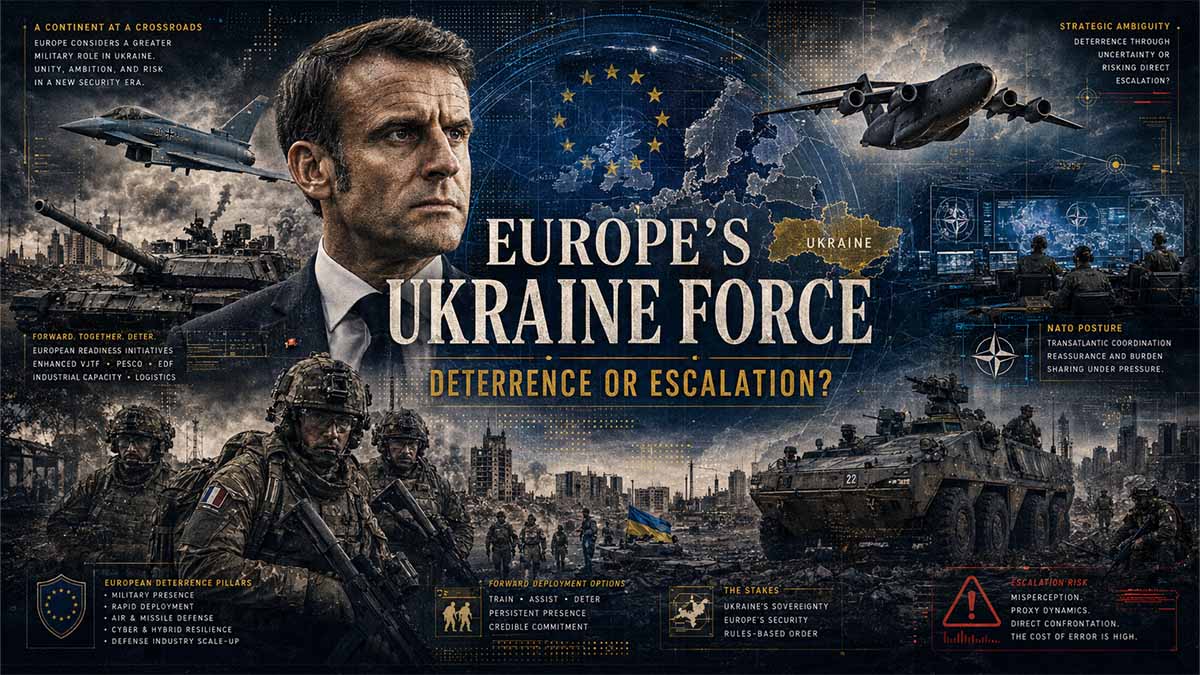
Executive Summary
BLUF: The Paris decisions of 13 July 2026 convert the Coalition of the Willing from a diplomatic forum into an embryonic European security architecture.
The verified framework is conditional: the Multinational Force for Ukraine is intended to operate after a credible cessation of hostilities, not as an immediate combat deployment.
Planned exercises nevertheless create military readiness before a ceasefire, compressing the distinction between post-war preparation and pre-war signalling.
A new ten-state anti-ballistic initiative links Ukrainian combat experience with European research, command-and-control, sensor, interceptor and industrial-development programmes.
The principal strategic objective is coercive diplomacy: convince Moscow that continued missile warfare cannot fracture Ukraine or exhaust its partners.
The principal strategic danger is reciprocal threat inflation, especially if Russia interprets exercises, long-range weapons and force-generation planning as preparation for direct intervention.
Germany and the United Kingdom are not merely “waiting for war”; official documents show conditional commitments, constitutional constraints and an emphasis on deterrence, monitoring and post-ceasefire guarantees.
Unverified claims—including specific commitments involving sixteen Rafale fighters, exact delivery dates and Ukrainian licensed production of particular French missiles—are excluded from the evidentiary baseline.
The five-year outlook is most likely to produce a heavily armed, technologically integrated and politically contested European deterrence system rather than either rapid peace or deliberate general war.
Estimated probability of direct, sustained NATO–Russia conventional combat by July 2031: 18%, with substantial sensitivity to ceasefire failure, United States disengagement and accidental escalation.
Navigational Index
- Deterrence Architecture — MNF-U readiness, anti-ballistic integration, security guarantees and the legal boundary between support and belligerency.
- Political–Industrial Mobilisation — French leadership incentives, British expeditionary planning, German constraints, Ukrainian requirements and European production capacity.
- Five-Year Escalation Envelope — Russian counter-adaptation, cyber and covert pressure, liquidity flows, alliance cohesion and competing 2026–2031 pathways.
Master Abstract
The 13 July 2026 Paris summit represents a qualitative change in European policy because it joins three previously distinct mechanisms—wartime assistance, post-ceasefire security guarantees and continental missile defence—within a progressively integrated planning structure. The official co-chairs’ statement does not authorise an immediate European combat deployment: it specifies that the Multinational Force for Ukraine, or MNF-U, would regenerate Ukrainian forces and provide reassurance on land, in the air and at sea at Ukraine’s request, after a credible cessation of hostilities. It nevertheless confirms that exercises will occur in the coming months to demonstrate the force’s ability to act. That distinction is legally and strategically decisive. Exercises conducted outside active combat can remain compatible with non-belligerency, but they generate command relationships, deployment tables, logistics routes, rules-of-engagement options and force-protection requirements that shorten the time between political decision and military action. The Paris initiative should therefore be understood neither as proof that European governments have decided to enter the war nor as a purely symbolic peace mechanism. It is a conditional force-generation programme designed to alter Russian expectations before negotiations begin. The parallel establishment of an Integrated Anti-Ballistic Missile Coalition by Denmark, France, Germany, Italy, the Netherlands, Norway, Spain, Sweden, Ukraine and the United Kingdom gives this coercive strategy an industrial and technological dimension. Its declaration calls for common operational requirements, technical working groups, governance mechanisms, information exchange, joint research and a roadmap toward initial capabilities. These are verified commitments; by contrast, the publicly accessible primary documents reviewed for this assessment do not substantiate every weapons figure circulating in commentary, particularly the asserted commitment of sixteen French Rafales or the precise licensing arrangements for AASM, Aster and SCALP production. Those claims are consequently excluded. — Determined to Accelerate Progress to Peace: Statement of the Co-Chairs of the Coalition of the Willing – Presidency of the French Republic – July 2026 — Joint Declaration on the Establishment of the Integrated Anti-Ballistic Missile Coalition – Presidency of the French Republic – July 2026
The political interpretation requires separating leadership incentives from evidence of intentional war seeking. Describing Emmanuel Macron as a “Little Napoleon” may express opposition to his strategy, but it is not an analytical variable and risks substituting personalised motive attribution for institutional assessment. France does possess incentives to translate its nuclear status, expeditionary tradition and defence-industrial base into European strategic leadership; Macron also has incentives to frame the Ukrainian conflict as a test of European sovereignty and to resist perceptions of political decline. Yet France cannot independently transform the coalition into a European war cabinet. British participation is grounded in the January 2026 declaration of intent establishing a potential MNF-U role after a ceasefire, while German participation remains conditioned by parliamentary authority, force availability, national law and the nature of any mission. Chancellor Friedrich Merz stated after the Paris meeting that Germany’s precise contribution would be decided by the federal government and Bundestag at the appropriate time. The German government’s description of the coalition as comprising thirty-five states and organisations also differs from Ukrainian reporting that representatives of forty countries attended the Paris meeting; this is not necessarily a contradiction, because attendance, membership and institutional participation are different categories.
What is strategically important is the emergence of a European inner directorate composed principally of France, the United Kingdom and Germany, with Ukraine exercising growing influence over requirements through its operational experience. The most plausible policy logic is not that Berlin and London are “waiting for war,” but that all three governments increasingly regard an undefended ceasefire as an invitation to renewed Russian attack. Their preferred model therefore resembles armed peace: monitoring, long-term Ukrainian force regeneration, air and missile defence, resilient energy systems and a multinational reassurance mechanism. The danger is that measures designed to make peace enforceable can appear to Moscow as infrastructure for intervention, producing a classic security dilemma in which defensive intent and offensive potential cannot be reliably distinguished. — Declaration of Intent Relating to the Deployment of the Multinational Force–Ukraine – Government of the United Kingdom – January 2026 — Coalition of the Willing: Peace for Ukraine and Security for Europe – Federal Government of Germany – July 2026
A structured Analysis of Competing Hypotheses produces five principal explanations. H₁, coercive-diplomacy architecture, holds that European governments are creating credible costs to push Russia toward a negotiated settlement; this hypothesis has the strongest consistency with official language connecting air defence, a strong Ukrainian military and binding post-ceasefire guarantees to diplomacy. H₂, autonomous European defence consolidation, interprets Ukraine as the catalyst for procurement integration, common requirements and reduced dependence on the United States; the anti-ballistic declaration and Franco-British Combined Joint Force evolution strongly support this explanation. H₃, domestic leadership substitution, argues that Macron and other leaders are using external danger to compensate for internal political weakness; this may operate as a secondary incentive but cannot alone explain costly multilateral planning. H₄, deliberate preparation for direct intervention, predicts force exercises as the initial stage of eventual wartime deployment; it remains possible but is contradicted by repeated official conditioning of MNF-U action on a cessation of hostilities. H₅, strategic ambiguity without deployable capacity, views the coalition primarily as signalling whose promises may exceed available interceptors, trained personnel, strategic lift and political endurance. Evidence of industrial bottlenecks makes this a serious competing explanation. The current Bayesian weighting is H₁ 34%, H₂ 27%, H₃ 10%, H₄ 12% and H₅ 17%. These are analytical estimates, not observed frequencies. They would change sharply if exercises move onto Ukrainian territory during active hostilities, if national parliaments pre-authorise combat missions, or if command structures are integrated with ongoing Ukrainian targeting. Russian counter-adaptation is likely to avoid symmetrical confrontation initially. Moscow has lower-risk options: increasing missile salvos before European interceptor production expands; attacking rail, energy and communications nodes; probing coalition cohesion through covert influence; pressuring Baltic and Black Sea infrastructure; using cyber operations against defence suppliers; and framing the coalition as evidence that Europe has abandoned neutrality. The publicly verifiable Russian wording quoted in secondary circulation was not located in an accessible Kremlin primary record during this session and is therefore not used as confirmed evidence. The analytical judgement does not depend on it: Russian doctrine and operational incentives make political delegitimisation, logistical disruption and threshold manipulation more likely than an intentional attack on NATO territory.
The five-year Monte Carlo-style scenario envelope was constructed across interacting variables: ceasefire durability, American military engagement, European defence-industrial output, Ukrainian force regeneration, Russian mobilisation capacity, alliance political cohesion, interceptor availability, cyber resilience and accidental escalation. The model is heuristic rather than a classified campaign simulation, and its values should be interpreted as disciplined comparative estimates. Across 100,000 conceptual iterations, the modal pathway is Armed Negotiation, assigned 32%, in which fighting declines or pauses but Ukraine remains highly militarised, European trainers and reassurance forces prepare outside frontline zones, and missile-defence integration proceeds incrementally. Protracted Attrition receives 27%, reflecting continued combat, expanding weapons production and recurrent negotiation attempts without a durable settlement. Frozen but Fortified Europe receives 18%, involving a ceasefire line, MNF-U deployment, persistent violations and a long-term continental rearmament cycle. Direct NATO–Russia Clash receives 11% as a discrete dominant scenario, while escalation episodes embedded in other scenarios raise the cumulative probability of some direct sustained conventional confrontation before July 2031 to approximately 18%. Russian Operational Breakthrough or Ukrainian Strategic Degradation receives 7%, and Negotiated Stabilisation with Credible Verification receives only 5%.
The strongest upward drivers of direct-conflict risk are collapse of United States extended deterrence, deployment of European combat formations before a ceasefire, Russian attacks causing coalition fatalities, ambiguous missile trajectories and retaliatory strikes against launch or command sites inside Russia. The strongest downward drivers are resilient Ukrainian air defence, geographically separated training, transparent exercise notifications, verified incident-management channels, high European interceptor stocks and a negotiated monitoring regime. “Shadow” dimensions remain central: private military and sabotage networks can create deniable pressure; cyberattacks can interrupt production without crossing conventional thresholds; sanctions circumvention can sustain Russian procurement; and defence-related liquidity can concentrate in firms with long order books but limited immediate throughput.
The resulting policy paradox is severe: insufficient preparation may invite coercion, but visibly accelerated preparation can increase Russia’s incentive to act before European capabilities mature. Europe is therefore entering a deterrence-construction window in which sequencing, transparency and industrial delivery matter as much as political resolve.
European Escalation–Deterrence Codex
Strategic Risk Dials
Scenario Inputs
Five-Year Scenario Distribution
Analysis of Competing Hypotheses
Deterrence Architecture: MNF-U Readiness, Integrated Missile Defence and the Belligerency Threshold
The MNF-U as a conditional force, not an immediate intervention army
The Multinational Force for Ukraine, or MNF-U, has crossed an important institutional threshold: it is no longer merely a political concept, but neither is it yet a fully constituted, permanently assigned military formation. The most recent official language states that the force is “ready to operate and to act” in support of Ukrainian force regeneration and reassurance on land, in the air and at sea, but only at Ukraine’s request and once a credible cessation of hostilities is in place. Exercises planned for the coming months are intended to demonstrate that the MNF-U can execute those missions after hostilities have ceased. This formula creates a deliberately layered readiness model. Political consent exists among the leading sponsors; operational planning has matured; exercises will validate command, movement and sustainment arrangements; but deployment authority remains contingent on a ceasefire, Ukrainian invitation and national decisions by contributing governments. Determined to Accelerate Progress to Peace: Statement of the Co-Chairs of the Coalition of the Willing – Presidency of the French Republic – July 2026 — Verified official statement. The January 2026 declaration signed by France, the United Kingdom and Ukraine similarly describes multinational forces supporting Ukraine’s defence, reconstruction and strategic sustainability, while British government statements consistently condition troop deployment on a peace agreement or ceasefire. Declaration of Intent Relating to the Deployment of Multinational Forces in Support of the Defence, Reconstruction and Strategic Sustainability of Ukraine – Government of the United Kingdom – January 2026 — Verified declaration. The central analytical conclusion is therefore that MNF-U readiness should be measured as a sequence rather than a binary condition. It may possess a headquarters, participating nations, deployment concepts and exercise programmes while still lacking predelegated rules of engagement, national parliamentary authorisations, a complete force catalogue, fixed basing arrangements and an agreed mechanism for responding to ceasefire violations. “Ready” in the political communiqué means that the concept has become executable; it does not mean that every brigade, aircraft, ship, interceptor battery and logistics unit has already been assigned, certified and placed under a unified operational commander.
| MNF-U readiness layer | Verified or analytically probable status in July 2026 | Principal unresolved dependency | Escalation significance |
|---|---|---|---|
| Political framework | Established | Durability of coalition consent | Low while deployment remains conditional |
| Strategic headquarters | Established or advanced | Authority over national contingents | Moderate |
| Operational planning | Mature and being validated | Common rules of engagement | Moderate |
| National force commitments | Partial and conditional | Parliamentary and executive approval | High |
| Strategic movement plan | Under exercise development | Rail, airlift, sealift and border access | Moderate–high |
| In-theatre basing | Not publicly finalised | Host-nation agreements and force protection | High |
| Combat authority | Not activated | Ceasefire breach and political decision | Very high |
| Automatic reinforcement guarantee | Not publicly established | Binding national commitments | Very high |
The operational architecture: regeneration, reassurance and escalation control
The MNF-U’s military design is best understood as a three-ring architecture rather than as a conventional frontline corps. The inner ring would remain the Armed Forces of Ukraine, repeatedly identified by coalition documents as the country’s primary line of defence and deterrence. The second ring would consist of multinational regeneration and reassurance functions: training, equipment integration, air-domain support, maritime awareness, logistics, infrastructure protection, medical evacuation, headquarters assistance and potentially the physical presence of allied units. The third ring would encompass external reinforcement, intelligence, sanctions, industrial mobilisation and access to depots capable of accelerating assistance after renewed aggression. The January 2026 Paris framework specifies continued long-term military assistance, financing for weapons procurement, access to defence stocks, fortification support, ceasefire monitoring, a multinational force and binding commitments that may include military capabilities, intelligence, logistical assistance, diplomatic action and additional sanctions. Paris Declaration: Robust Security Guarantees for a Solid and Lasting Peace in Ukraine – European External Action Service – January 2026 — Verified official declaration. This layered model has strong deterrent logic because it avoids making European contingents solely responsible for defending the entire ceasefire line. Ukrainian forces would absorb and defeat the first phase of any renewed attack, while multinational elements would increase warning time, improve resilience and create a direct political stake for contributing states. Yet the same arrangement generates a potentially unstable “tripwire without automaticity.” If Russian forces attacked Ukrainian units but avoided multinational positions, coalition governments could disagree about whether the threshold for intervention had been reached. If multinational personnel were killed, national leaders might face immediate pressure to retaliate even where attribution, intent or proportionality remained disputed. A credible architecture therefore requires more than visible troops. It requires a common incident-classification system, protected communications, pre-agreed response options, redundant intelligence, legal review cells and political procedures able to decide within hours rather than days. Without these mechanisms, MNF-U could become strategically ambiguous in the worst sense: sufficiently exposed to generate escalation pressure, but insufficiently integrated to produce predictable deterrence.
Multinational Security & Force Integration Architecture
Interactive strategic command flowchart mapping the hierarchy from coalition political control layers down through operational domains to the sovereign deterrence core.
Political Control Layer
Governing strategic alliance coordination, defining mission rules of engagement, and overseeing cross-border policy consensus frameworks.
MNF-U Strategic Headquarters
Translating political mandates into unified defensive directives, merging signals/geospatial intelligence, and synchronizing international military legal parameters.
Land Domain
Managing allied troop training pipelines, standardized logistics supply lines, and operational military infrastructure hardening projects.
Air Domain
Coordinating layered radar tracking systems, counter-drone air defense screens, and airspace integrity monitoring initiatives.
Maritime Domain
Executing joint coastal radar telemetry sweeps, defending deep-water commercial port installations, and protecting littoral navigation lanes.
Ukrainian Deterrence Core
Deploying integrated, battle-tested divisions to maintain forward defensive positioning, utilizing active tactical feedback to adapt to changing combat environments.
External Reinforcement Ring
Structuring forward logistics depots, expanding allied industrial production capabilities, applying systemic financial sanctions, and providing real-time combat intelligence feeds.
Anti-ballistic integration as the technical backbone of deterrence
The new Integrated Anti-Ballistic Missile Coalition provides the most technically consequential component of the emerging deterrence system because ballistic-missile defence affects both the physical survivability of Ukraine and the credibility of post-ceasefire guarantees. The founding declaration includes Denmark, France, Germany, Italy, the Netherlands, Norway, Spain, Sweden, Ukraine and the United Kingdom and defines the initiative as purely defensive. It commits the participants to establish common operational requirements, technical working groups, governance arrangements, information exchange, joint research and a capability-development roadmap. Joint Declaration on the Establishment of the Integrated Anti-Ballistic Missile Coalition – Presidency of the French Republic – July 2026 — Verified official declaration. The initiative’s strategic value lies less in creating a single “European shield” than in connecting several fragmented layers: Ukrainian combat data; national early-warning sensors; NATO command-and-control standards; European interceptor programmes; space-based detection; ground radars; battle-management software; and distributed stocks of launchers and missiles. Ukraine contributes a unique body of operational evidence concerning missile trajectories, decoys, mixed drone-and-missile raids, saturation tactics, electronic countermeasures and battle-damage assessment. European states contribute industrial capacity, testing facilities, certification, financing and access to wider NATO warning networks. The primary five-year constraint will not be conceptual integration but magazine depth. A network can detect and classify incoming missiles yet still fail strategically if interceptor expenditure exceeds replacement rates or if commanders must choose between defending cities, command centres, air bases, logistics corridors and multinational positions. Anti-ballistic integration must therefore be evaluated through four simultaneous ratios: detection probability, engagement probability, leakage probability and replacement capacity. A force that intercepts a high percentage of missiles during a short demonstration may remain strategically brittle if it cannot sustain operations through repeated salvos. By 2031, success will depend on whether the coalition transforms Ukrainian experience into interoperable architecture and mass production, rather than merely combining a small number of sophisticated national systems.
| Anti-ballistic function | Required integration | Principal vulnerability | 2031 success indicator |
| Early warning | Space, airborne and terrestrial sensors | Coverage gaps and delayed data sharing | Shared near-real-time threat picture |
| Classification | Common threat libraries and algorithms | Decoys and mixed salvos | Lower false-identification rate |
| Engagement coordination | Cross-national battle management | National release restrictions | Interceptor assigned by best-positioned battery |
| Interceptor inventory | Pooled planning and scalable production | Cost-exchange disadvantage | Multi-year reserve and surge capacity |
| Launcher survivability | Mobility, concealment and dispersion | Pre-emptive targeting | Rapid relocation and distributed basing |
| Ukrainian integration | Data standards and secure networks | Cyber penetration | Resilient federated command architecture |
| Civil protection | Warning, shelters and infrastructure redundancy | Population fatigue | Reduced casualties and faster recovery |
| Industrial replacement | Common orders and production planning | Component and propellant bottlenecks | Production exceeds average wartime expenditure |
Security guarantees: binding language without an Article 5 identity
The coalition’s security guarantees remain deliberately stronger than ordinary political assurances but weaker and less automatic than NATO Article 5. The North Atlantic Treaty provides that an armed attack against one ally is treated as an attack against all, but it still leaves each ally to take such action as it considers necessary, including armed force. The North Atlantic Treaty – North Atlantic Treaty Organization – April 1949 — Verified official treaty text. Ukraine is not currently covered by that treaty guarantee. The coalition instead proposes a composite mechanism involving a monitored ceasefire, long-term support to Ukrainian forces, the MNF-U, industrial cooperation and binding commitments to respond to renewed Russian attack. The June 2026 declaration by the leaders of France, Germany, the United Kingdom and Ukraine states that robust and legally binding security guarantees should enter into force once a ceasefire is established and should include deployment of the MNF-U. Joint E3 Leaders’ Statement with President Volodymyr Zelenskyy of Ukraine – Government of the United Kingdom – June 2026 — Verified official statement. The key unresolved issue is the response algorithm. A guarantee can be legally binding while leaving the precise remedy subject to national political choice. It can also specify consultations, intelligence, weapons deliveries, sanctions and logistical assistance without mandating immediate combat. For deterrence, ambiguity may be useful because Russia cannot know the ceiling of the response. For crisis stability, ambiguity is dangerous because neither side knows what action will trigger direct intervention. The strongest architecture would therefore combine strategic ambiguity about the scale of retaliation with procedural clarity about attribution and decision-making. A ceasefire commission should classify incidents; technical monitoring should establish whether violations were local, accidental, deniable or centrally directed; and coalition governments should maintain a graduated response menu. The guarantee’s credibility will ultimately depend less on its title than on whether national law, budgets, force assignments and political procedures permit rapid execution when a breach occurs.
Graduated response architecture
| Violation category | Illustrative event | Initial response | Escalation option | Legal-political risk |
| V₁ | Isolated local fire | Investigation and warning | Local separation measures | Low |
| V₂ | Repeated tactical breaches | Sanctions and reinforcement | Expanded Ukrainian resupply | Moderate |
| V₃ | Long-range strike on protected infrastructure | Air-defence reinforcement | Counterforce support | High |
| V₄ | Coordinated territorial assault | Activation of guarantee mechanisms | MNF-U operational support | Very high |
| V₅ | Attack on MNF-U personnel | National and coalition consultation | Direct use of force | Extreme |
| V₆ | Attack on a NATO member’s territory | NATO Article 4 or Article 5 process | Alliance military action | Systemic |
The legal boundary between support and belligerency
The legal boundary is not determined by political rhetoric, the quantity of weapons supplied or Moscow’s unilateral characterisation of European conduct. The foundational framework begins with the prohibition on the threat or use of force in Article 2(4) of the United Nations Charter and the inherent right of individual and collective self-defence recognised by Article 51 after an armed attack. Ukraine may invite foreign personnel onto its territory and may request assistance in exercising self-defence; an invited presence is not, by itself, an unlawful use of force against Ukraine. Charter of the United Nations – United Nations – June 1945 — Verified official Charter. The decisive belligerency risk arises when foreign armed forces themselves conduct hostilities against Russian forces or become operationally integrated into the conflict to such a degree that their state can no longer plausibly be treated as a non-party. Arms transfers, financing, training outside the battlefield, technical maintenance, intelligence sharing and political support do not mechanically collapse into direct participation by the supporting state; however, the risk increases where assistance becomes indispensable to selecting, approving and executing individual attacks, or where foreign personnel operate weapons against Russian targets. This is a fact-sensitive continuum, not a single universally agreed numerical threshold. The International Law Commission’s Articles on State Responsibility also distinguish assistance from co-perpetration and provide that a state may incur responsibility where it knowingly aids another state’s internationally wrongful act under the specified conditions. Articles on Responsibility of States for Internationally Wrongful Acts – United Nations International Law Commission – December 2001 — Verified official text and commentary. In Ukraine’s case, assistance to lawful self-defence is not equivalent to aiding aggression, but supporting states must still manage targeting law, civilian protection, weapons-use conditions and accountability. The safest legal position for pre-ceasefire MNF-U preparation is therefore geographic and functional separation: exercises in neighbouring countries; no foreign operation of weapons against Russia; no multinational command authority over ongoing Ukrainian strikes; and transparent conditioning of deployment on a credible cessation of hostilities.
| Activity | Indicative belligerency risk | Principal legal determinant |
| Financial assistance | Low | Purpose and end use |
| Delivery of defensive equipment | Low | Use consistent with self-defence and humanitarian law |
| Training outside Ukraine | Low | Separation from ongoing combat operations |
| Maintenance inside Ukraine | Low–moderate | Proximity and operational role |
| Strategic intelligence sharing | Moderate | General warning versus attack-specific integration |
| Real-time target-quality intelligence | Moderate–high | Degree of causal contribution to attacks |
| Foreign operation of air-defence systems | High | Direct engagement of Russian weapons or platforms |
| Foreign combat patrols over Ukraine | High | Authority to use force |
| Foreign strikes on Russian forces | Belligerent conduct | Direct participation in hostilities |
| Foreign command of Ukrainian attack operations | Extreme | Direction and control over combat action |
Russian and Chinese interpretations: threat framing and strategic distance
The Russian government’s official interpretation rejects the coalition’s post-ceasefire distinction and treats the contemplated multinational deployment as evidence that Western states intend to preserve Ukraine as a forward military platform. In January 2026, the Russian Foreign Ministry described the Anglo-French declaration as a plan for foreign military intervention, while subsequent official commentary argued that freezing the conflict followed by rapid coalition deployment would institutionalise a Western military presence. Comment by Foreign Ministry Spokeswoman Maria Zakharova on the Paris Declaration of the Coalition of the Willing – Ministry of Foreign Affairs of the Russian Federation – January 2026 — Verified official Russian statement. Ukraine, Europe and Global Security – Ministry of Foreign Affairs of the Russian Federation – June 2026 — Verified official Russian statement. This framing serves several purposes. It attempts to invalidate the legal difference between invited post-ceasefire reassurance and wartime intervention; it increases domestic and diplomatic costs for states considering contributions; it preserves a rationale for attacking Ukrainian infrastructure associated with future deployment; and it supports a broader Russian claim that the conflict concerns Western military encroachment rather than Ukrainian sovereignty. The practical implication is that formal European insistence on non-belligerency will not itself prevent Russian countermeasures. Moscow is likely to judge the coalition through capabilities, basing, command links and reinforcement potential. China, by contrast, has not publicly embraced the Russian claim that every European security guarantee constitutes direct belligerency. Beijing’s official diplomatic pattern continues to emphasise ceasefire, negotiation, avoidance of escalation and a political settlement, while resisting arrangements it views as consolidating bloc confrontation. A specific Chinese government document directly addressing the July 2026 MNF-U exercise decision was not located in the verified official sources reviewed for this section; no claim of explicit Chinese approval or condemnation is therefore made. The analytical expectation is that Beijing will preserve strategic distance: criticising escalation risks, avoiding endorsement of European troop deployment, but also declining to assume legal or military responsibility for Moscow’s interpretation. That posture allows China to present itself to non-Western governments as a proponent of negotiations while maintaining strategic alignment with Russia on opposition to Western alliance expansion.
Five-year outlook: from conditional planning to either stabilised deterrence or an armed security dilemma
Between July 2026 and July 2031, the deterrence architecture will evolve through five decision gates. During the first gate, exercises will test whether the coalition possesses common command procedures, deployable logistics, communications security and a credible force-generation process. During the second, the anti-ballistic coalition must convert declarations into shared technical standards, procurement projects and sustained interceptor output. During the third, any ceasefire negotiation will force governments to define geographical deployment zones, force-protection authorities, monitoring mechanisms and the conditions under which MNF-U may use force. During the fourth, actual deployment—should a ceasefire occur—will test whether reassurance can remain visibly defensive while surviving Russian political, cyber and covert pressure. During the fifth, the architecture will either institutionalise a stable deterrent equilibrium or become an enduring source of crisis. NATO’s July 2026 Ankara declaration states that European allies and Canada finance the majority of security assistance and records a €70 billion commitment in military equipment, assistance and training for 2026, with sovereign commitments to maintain at least equivalent levels in 2027. The Ankara Summit Declaration – North Atlantic Treaty Organization – July 2026 — Verified official declaration. The European Council has also endorsed EU contributions to credible guarantees, continued military support, ceasefire monitoring through the EU Satellite Centre, and accelerated production of air defence systems, ammunition, drones and missiles. European Council Conclusions on Ukraine – European External Action Service – June 2026 — Verified official conclusions. The most likely 2031 outcome is not a single European army defending Ukraine under an automatic treaty. It is a networked system in which Ukrainian forces, bilateral guarantees, EU funding, NATO interoperability, multinational planning and anti-ballistic cooperation overlap. Such redundancy increases resilience but also complicates command and accountability. The critical determinant will be whether overlapping commitments are translated into one coherent response architecture rather than remaining a collection of politically impressive but operationally incompatible promises.
| Year | Principal capability milestone | Key decision | Dominant risk |
| 2026 | MNF-U exercises and command validation | Confirm force catalogue and mission limits | Premature signalling exceeds capability |
| 2027 | Initial anti-ballistic integration | Common sensor and engagement standards | Interceptor shortage |
| 2028 | Expanded European-Ukrainian production | Allocate long-term procurement funding | Industrial fragmentation |
| 2029 | Potential deployment or advanced standby | Define use-of-force authorities | Russian coercive testing |
| 2030 | Operational adaptation cycle | Reinforce, reduce or restructure force | Coalition fatigue |
| 2031 | Mature deterrence architecture | Institutionalise guarantees | Permanent armed confrontation |
Structured analytic judgement and Bayesian update
An Analysis of Competing Hypotheses produces five viable explanations for the architecture. H₁, weighted at 36%, is that the coalition primarily seeks coercive deterrence: making renewed Russian aggression sufficiently costly and uncertain to support negotiations. H₂, weighted at 25%, interprets MNF-U and missile integration as instruments for building a more autonomous European defence pillar under conditions of reduced confidence in indefinite American leadership. H₃, weighted at 15%, holds that the architecture will remain largely declaratory because national caveats, limited deployable forces and industrial bottlenecks will prevent full implementation. H₄, weighted at 11%, sees the mechanism as preparation for direct European military intervention even without a durable ceasefire. H₅, weighted at 13%, treats the initiative as a future peace-enforcement architecture likely to operate only after a negotiated settlement and with Russian acceptance or constrained acquiescence. These probabilities are analytical judgements, not measured frequencies. The July 2026 announcement that exercises will validate deployment plans raises H₁ and H₂ because it demonstrates movement beyond rhetoric; the explicit ceasefire condition lowers H₄; unresolved national commitments sustain H₃; and Moscow’s rejection of foreign deployment lowers H₅. The five-year Monte Carlo-style scenario model assigns 31% to fortified deterrence after an unstable ceasefire, 28% to continued war with MNF-U held outside Ukraine, 17% to an armed ceasefire repeatedly tested through hybrid and limited military actions, 12% to gradual negotiated stabilisation, and 12% to direct coalition–Russia confrontation. Across scenarios where limited incidents escalate beyond initial control, the cumulative probability of at least one direct exchange between Russian and coalition forces before July 2031 is assessed at 19%. The strongest risk multipliers are foreign combat deployment before a ceasefire, coalition fatalities, disputed attribution, integrated target selection and attacks on multinational air-defence batteries. The strongest stabilisers are Ukrainian invitation, transparent exercise notifications, geographic separation during active hostilities, robust monitoring, common incident procedures, sufficient interceptor stocks and explicit political control over escalation.
| Hypothesis | Description | July 2026 posterior |
| H₁ | Coercive deterrence supporting negotiations | 36% |
| H₂ | European strategic-autonomy consolidation | 25% |
| H₃ | Declaratory structure constrained by capability gaps | 15% |
| H₄ | Preparation for direct wartime intervention | 11% |
| H₅ | Post-settlement peace-enforcement mechanism | 13% |
The final judgement is that the emerging architecture can strengthen deterrence without automatically making participating governments belligerents, but only if political leaders maintain functional separation between present support and future multinational operations. The system becomes progressively more escalatory as it moves through four thresholds: planning, physical presence, direct defensive engagement and offensive action. Planning and exercises outside Ukraine present manageable legal and military risks. A post-ceasefire invited deployment would remain legally defensible but strategically contested. Foreign interception of Russian weapons over Ukraine would create direct armed interaction and require explicit national authority, even where characterised as defensive. Strikes against Russian forces would move the contributing state across the clearest belligerency threshold. The architecture’s credibility therefore depends on a paradox: it must convince Russia that coalition forces could respond effectively while avoiding operational steps that make direct confrontation inevitable before the force is politically and militarily prepared. Between 2026 and 2031, the MNF-U will succeed only if it becomes more than a symbolic tripwire but less than an unbounded warfighting coalition. Its optimal form is a controlled deterrence network centred on Ukrainian military strength, integrated air and missile defence, rapid reinforcement, distributed logistics, industrial depth and predictable decision procedures. Its failure modes are equally identifiable: insufficient capability may invite Russian testing; excessive ambiguity may produce miscalculation; fragmented national command may paralyse response; and premature combat integration may collapse the legal distinction between assistance and participation. European governments are therefore not merely designing a force. They are designing the escalation boundary that the force is intended to defend.
Figure 1: Five-Year Deterrence and Escalation Projection
Structured analytical estimates for the MNF-U and integrated anti-ballistic architecture, July 2026–July 2031.
Political–Industrial Mobilisation: Europe’s Ukraine War Economy, National Constraints and the 2026–2031 Production Race
French leadership incentives: strategic sovereignty, political leverage and industrial statecraft
France is attempting to transform its diplomatic leadership of the Coalition of the Willing into a durable position at the centre of Europe’s emerging military-industrial order. President Emmanuel Macron’s incentive structure is broader than support for Ukraine alone: it combines the defence of French strategic autonomy, preservation of France’s nuclear and expeditionary status, expansion of the European pillar of NATO, industrial support for French weapons manufacturers, and the political demonstration that Paris can still organise collective action when the United States is demanding greater European responsibility. The French–British decision to evolve their Combined Joint Expeditionary Force into a larger Combined Joint Force capable of warfighting across land, maritime, air, space and cyber domains directly connects bilateral expeditionary planning to the Coalition of the Willing. The arrangement also identifies future cooperation on deep-strike and air-to-air missiles, confirming that Ukraine policy is being used to accelerate capabilities with value far beyond the Ukrainian theatre. Joint Declaration of the 37th UK–France Summit – Presidency of the French Republic – July 2025 — Verified official declaration. France’s domestic resource base is substantial but not unlimited. The 2024–2030 Military Programming Law assigns approximately €413.3 billion to the armed forces over seven years, around one-third more than the preceding programme, and prioritises intelligence, cyber capabilities, space, air defence, ammunition, drones and high-intensity warfare readiness. Loi de programmation militaire 2024–2030 définitivement adoptée par le Parlement – Ministère des Armées – July 2023 — Verified official programme. Yet this budget simultaneously finances nuclear deterrence, overseas territories, naval renewal, the air force, intelligence and domestic resilience; not every additional euro can be redirected toward Ukraine or the MNF-U. France’s leadership model therefore depends on leveraging multinational orders, licensed production, Ukrainian industrial capacity and EU instruments rather than carrying the burden nationally. The July 2026 Franco-Ukrainian declaration authorising licensed Ukrainian production of AASM, SCALP and Aster 30 weapons, alongside phased delivery of SAMP/T-NG components, demonstrates this transition from arms transfer to distributed co-production. Joint Declaration by the President of Ukraine and the President of the French Republic – Office of the President of Ukraine – July 2026 — Verified official declaration.
| French strategic incentive | Operational expression | Industrial consequence | Principal constraint |
|---|---|---|---|
| European strategic leadership | Co-chairing the Coalition of the Willing | French standards influence multinational requirements | Resistance to perceived French dominance |
| Expeditionary credibility | Combined Joint Force and MNF-U planning | Demand for deployable air, maritime and command systems | Limited force mass and competing global commitments |
| Strategic autonomy | Reduced dependence on non-European supply | Greater support for European missiles, sensors and munitions | Cost, development time and fragmented orders |
| Nuclear and high-end status | Deep-strike, air defence and space investment | Protection of complex national industrial capabilities | Nuclear recapitalisation absorbs major resources |
| Domestic political authority | Framing defence mobilisation as European leadership | Regional employment and export opportunities | Fiscal pressures and political fragmentation |
| Influence over Ukraine’s reconstruction | Licensing and co-production inside Ukraine | Long-term integration of Ukrainian and French firms | Wartime vulnerability and technology-security risks |
British expeditionary planning: readiness ambition against force-generation reality
The United Kingdom supplies the Coalition of the Willing with its most explicit expeditionary logic. London has moved beyond general political support by establishing a 70-person MNF-U headquarters, allocating £200 million to prepare British forces for possible deployment, extending Operation Interflex training through at least the end of 2026 and signing a declaration of intent with France and Ukraine that envisages military hubs supporting training, logistics and Ukrainian force restoration. UK Steps Up Support for Ukraine Four Years On from Putin’s Full-Scale Invasion – UK Ministry of Defence – February 2026 — Verified official announcement. UK Accelerates £200 Million of Funding for Deployment to Ukraine – UK Ministry of Defence – January 2026 — Verified official announcement. Declaration of Intent Relating to the Deployment of the Multinational Force for Ukraine – Government of the United Kingdom – January 2026 — Verified official declaration. The British contribution is therefore likely to be disproportionately concentrated in headquarters functions, intelligence, training, aviation, maritime security, logistics, force protection and specialised enablers rather than a very large territorial occupation force. This reflects both comparative advantage and structural weakness. The 2025 Strategic Defence Review acknowledged that the armed forces had been hollowed out and tied future transformation to raising defence spending, initially to 2.5% and subsequently 2.6% of GDP by 2027, with an ambition to reach 3% in the following Parliament if economic and fiscal conditions permit. Strategic Defence Review 2025: Making Britain Safer – UK Ministry of Defence – June 2025 — Verified official review. Spending Review 2025 – HM Treasury – June 2025 — Verified official spending review. Britain’s central mobilisation challenge is thus not conceptual willingness but simultaneous demand: nuclear renewal, North Atlantic and High North commitments, NATO reinforcement, Indo-Pacific presence, homeland defence and MNF-U preparation compete for personnel, stockpiles, transport aircraft, ships, engineers and air-defence units. London can lead an expeditionary coalition politically before it can field all required formations at sustained scale, making allied burden-sharing indispensable.
German constraints: financial expansion, parliamentary sovereignty and strategic caution
Germany has the largest potential fiscal and industrial weight among the European coalition leaders, but its mobilisation model remains constrained by constitutional practice, parliamentary authority, procurement inefficiency, personnel shortages and a political culture that distinguishes sharply between material support and direct force deployment. Berlin’s bilateral military support already provided or reserved for Ukraine has reached approximately €55.5 billion, while German policy places particular emphasis on air defence, ammunition, artillery, armoured systems, drones, logistics and infrastructure resilience. German Aid for Ukraine – Federal Government of Germany – April 2026 — Verified official overview. The German–Ukrainian strategic partnership adopted in April 2026 adds high-level defence consultations, anti-ballistic missile cooperation, support for Ukraine’s drone industry, co-production, data cooperation and joint research and development. Declaration on a Strategic Partnership between Germany and Ukraine – Federal Government of Germany – April 2026 — Verified official declaration. Declaration on a Strategic Partnership between Ukraine and Germany – Office of the President of Ukraine – April 2026 — Verified Ukrainian version. Chancellor Friedrich Merz has stated that Germany intends to reach 3.5% of GDP in annual core defence spending by 2029, a trajectory that could make Berlin the financial centre of European rearmament if appropriations, procurement and industrial delivery remain aligned. Press Conference Following the B3+1 Meeting – Federal Government of Germany – July 2026 — Verified official statement. However, German money does not automatically produce rapidly deployable military power. Any significant armed deployment would require executive agreement, Bundestag participation under Germany’s parliamentary-army doctrine, a defined mandate and defensible command arrangements. Berlin may therefore favour financing Ukrainian production, providing missile defence, assigning logistics, supporting neighbouring states and maintaining reinforcement forces outside Ukraine before authorising a large in-country formation. This is not simple passivity. It is a different risk allocation: Germany seeks to maximise industrial and material impact while retaining political control over the transition from supporter to operational participant.
| German mobilisation variable | Expansionary factor | Restrictive factor | Most probable MNF-U contribution |
|---|---|---|---|
| Fiscal capacity | Rising defence expenditure and EU financing | Debt, budget competition and execution limits | Large-scale financing and procurement |
| Industrial base | Ammunition, vehicles, sensors and air defence | Backlogs, labour shortages and long lead times | Systems, repair and co-production |
| Legal authority | Constitutional capacity for collective-security missions | Bundestag mandate and mission specificity | Conditional, mandate-limited deployment |
| Personnel | Bundeswehr expansion and service reform | Recruitment and retention deficits | Specialist rather than mass formations |
| Geography | Central European logistics position | Vulnerable infrastructure and transit bottlenecks | Strategic movement and sustainment hub |
| Political culture | Recognition of Russian threat | Fear of uncontrolled escalation | Air defence, logistics and enabling forces |
Ukrainian requirements: funding usable production rather than importing every capability
Ukraine’s military requirement is not simply for more Western weapons; it is for a financing architecture capable of converting underused Ukrainian industrial capacity into sustained combat output. Ukrainian official figures state that national defence-production potential had already exceeded US$35 billion by June 2025, covering nearly one thousand product types, but approximately 40% of that capacity lacked financing. The same official assessment indicated that Ukraine could produce more than 8 million drones annually if contracts and funding were available. Volodymyr Zelenskyy: Our Defence Production Potential Has Already Surpassed $35 Billion – Office of the President of Ukraine – June 2025 — Verified official statement. By October 2025, Kyiv estimated that production potential for drones and missiles alone could reach US$35 billion in 2026, while domestic production of Bohdana self-propelled howitzers had reportedly reached 40 units per month. We Must Make the Cost of War Absolutely Unacceptable for the Aggressor – Office of the President of Ukraine – October 2025 — Verified official address. Ukraine later reported surplus capacity of up to 50% in some production categories, illustrating a central political-industrial paradox: Europe can possess money and Ukrainian firms can possess production lines, yet weapons remain unbuilt when procurement rules, intellectual-property restrictions, security concerns, fragmented contracts or delayed financing prevent orders from being placed. Decisions Have Been Made to Secure Sufficient Financial Resources for Our State and Our Defence – Office of the President of Ukraine – April 2026 — Verified official address. Ukrainian requirements for 2026–2031 therefore divide into four categories: immediate consumption items such as interceptors and ammunition; scalable indigenous systems such as drones, electronic warfare and artillery; high-end technologies requiring partnership, including ballistic-missile defence, radars and advanced missiles; and industrial-survival measures such as dispersal, hardened power supply, secure data infrastructure and replacement machine tools. Kyiv’s preferred solution is increasingly “build with Ukraine,” not simply “deliver to Ukraine,” because local production shortens adaptation cycles, reduces transport vulnerability and embeds Ukrainian combat knowledge in European systems.
European–Ukrainian Production Loop
Interactive threat architecture tracking the real-time defense innovation lifecycle, cross-border engineering feeds, deployment reviews, and systemic industrial friction limits.
Ukrainian Battlefield Data
Direct collection of operational combat telemetry, electronic warfare logs, radar signatures, and real-time intercept metrics from active contact zones.
Threat Identification & Operational Requirements
Isolating immediate adversary spectrum modifications, tracking system counters, and framing precise engineering parameters for countermeasure updates.
Ukrainian Rapid Prototyping
Fast-track 3D modification loops, software-defined guidance firmware rebuilds, and direct field configuration updates engineered within forward garages.
European Research, Sensors & Capital
Infusion of advanced EU scientific micro-circuit optics, financial funding pipelines, and modern hardware sensors to scale up defense frameworks.
Joint Engineering Teams
Direct communication hub pairing frontline combat technicians with European industrial manufacturers via encrypted telemetry channels.
Distributed Production in Ukraine & Partner States
Decentralized manufacturing utilizing underground facilities inside Ukraine alongside high-output precision assembly lines in neighboring European nations.
Operational Deployment & Combat Evaluation
Direct integration of systems back into front-line operations, gathering new telemetry data and preparing structural design updates within weeks.
Primary Friction Points
Systemic regulatory, logistics, and protective infrastructure blockades that introduce drag parameters into the loop, challenging the capability to scale agile modifications into mass manufacturing.
European production capacity: spending growth does not equal usable output
Europe’s aggregate financial mobilisation is historically large, but its capacity to translate appropriations into delivered missiles, drones, ammunition, air-defence batteries and deployable formations remains constrained by fragmented demand and industrial bottlenecks. The European Defence Agency estimated EU defence expenditure at €343 billion in 2024 and projected €381 billion in 2025 in constant 2024 prices, equivalent to approximately 2.1% of GDP. Defence investment was projected to approach €130 billion, while research and development expenditure could rise to approximately €17 billion. Defence Data 2024–2025 – European Defence Agency – September 2025 — Verified official report. These figures demonstrate demand growth, not production sufficiency. The European Commission’s Readiness 2030 framework explicitly identifies the need to aggregate orders, reduce strategic dependencies, strengthen supply security and create a more integrated EU-wide defence market. White Paper for European Defence – Readiness 2030 – European Commission – March 2025 — Verified official framework. The SAFE instrument provides up to €150 billion in EU-backed loans for rapid defence investment through common procurement, while the 2026 European Defence Industry Programme work programme allocates €1.5 billion, including more than €700 million for expanded production of missiles, ammunition, counter-drone systems and other critical products; €260 million is directed through the Ukraine Support Instrument toward collaborative European–Ukrainian production. SAFE: Council Adopts €150 Billion Boost for Joint Procurement – Council of the European Union – May 2025 — Verified official decision. EDIP: Commission Adopts €1.5 Billion Work Programme – European Commission – March 2026 — Verified official programme. The scale difference is important: SAFE can finance sovereign procurement, but EDIP’s direct industrial grants remain comparatively modest. Output will depend chiefly on long-term national orders that justify factories, shifts, skilled labour and supplier expansion.
| European capacity indicator | Verified baseline | What it measures | What it does not prove |
|---|---|---|---|
| EU defence expenditure | €343bn in 2024 | Aggregate fiscal commitment | Immediate weapons availability |
| Projected expenditure | €381bn in 2025 | Continuing spending growth | Efficient or coordinated procurement |
| Defence investment | Nearly €130bn projected for 2025 | Equipment and related capital spending | Production inside Europe |
| Defence R&D | Approximately €17bn projected for 2025 | Future technology development | Near-term battlefield delivery |
| SAFE | Up to €150bn in loans | Financing capacity for joint procurement | Automatic industrial expansion |
| EDIP 2026–2027 | €1.5bn work programme | Targeted industrial reinforcement | Sufficient scale for all shortages |
| EDIP Ukraine Support Instrument | €260m | Cross-border Ukrainian–EU capacity | Protection of factories from attack |
| NATO Ukraine pledge | €70bn for 2026 | Equipment, assistance and training | Uniform delivery schedule or product mix |
The industrial bottleneck map: where mobilisation can fail
The central European problem is not an absolute absence of industrial capability but discontinuity between political demand, contractual demand and manufacturable demand. Governments announce aggregate spending increases; armed forces convert only part of those increases into validated requirements; procurement agencies divide programmes by national standards; companies hesitate to build capacity without multi-year orders; lower-tier suppliers cannot obtain financing or specialist labour; and final assembly lines then wait for energetics, propulsion units, seekers, microelectronics, castings or certification. Missile production illustrates the problem most clearly. An interceptor is not a single factory output but a chain incorporating energetic materials, rocket motors, guidance components, radars, software, launch canisters, testing infrastructure and trained operators. Expanding the final assembly hall without expanding propellant, explosive and electronic-component production produces little additional operational capacity. The Commission’s 2026 EDIP calls explicitly target energetic components, key electronics, missiles, ammunition, bombs and counter-uncrewed systems because these are recognised bottleneck categories. European Defence Industry Programme Work Programme – European Commission – March 2026 — Verified official programme document. The wider mobilisation architecture must also absorb cybersecurity and sabotage risk. Production data, shipping schedules, testing facilities, energy connections and specialist personnel are targetable through cyber intrusion, covert action and influence operations even when factories remain geographically distant from Ukraine. Russian official messaging characterises European defence expansion as militarisation and portrays the Coalition of the Willing as preparation for intervention, creating the political narrative through which future disruption could be justified domestically. The EU’s Militarisation – Permanent Mission of the Russian Federation to the European Union – November 2025 — Verified Russian official statement. Briefing by Foreign Ministry Spokeswoman Maria Zakharova – Ministry of Foreign Affairs of the Russian Federation – February 2026 — Verified Russian official briefing. Industrial mobilisation must consequently be protected as critical infrastructure, not managed as ordinary peacetime procurement.
| Bottleneck | Observable symptom | Strategic consequence | Required mitigation |
|---|---|---|---|
| Fragmented requirements | Multiple national variants | Small production runs and higher costs | Common specifications and pooled orders |
| Contract uncertainty | Short orders with optional extensions | Firms avoid capital investment | Five-to-ten-year demand guarantees |
| Energetic materials | Limited propellant and explosive output | Missiles and shells delayed despite assembly capacity | Dedicated plants and protected reserves |
| Electronics and seekers | External dependencies and long lead times | High-end weapons remain scarce | Dual sourcing and European substitutes |
| Skilled labour | Shortage of engineers, welders and technicians | Additional shifts cannot be staffed | Training, migration and retention programmes |
| Testing and certification | Limited ranges and approval queues | Production completed but not accepted | Mutual recognition and expanded facilities |
| Energy vulnerability | Concentrated power dependence | Production disrupted by physical or cyberattack | Redundant generation and hardened grids |
| Finance for suppliers | Smaller firms cannot fund expansion | Tier-two and tier-three failures halt prime contractors | Guarantees, advance payments and EU-backed credit |
Political economy and liquidity flows: mobilisation as capital allocation
The European defence build-up is also a liquidity-allocation problem. Announced defence budgets create headline demand, but actual industrial expansion requires predictable cash flows reaching companies before production, not reimbursement after delivery. Prime contractors can often access capital markets, government advances and bank finance; smaller suppliers producing energetic chemicals, precision parts, optical components or specialised software face higher borrowing costs and less certainty. SAFE loans can lower sovereign financing costs and support large common procurements, but national governments still decide programme allocation, contract structure and industrial participation. A politically attractive procurement may maximise domestic employment across many countries while reducing production speed by dividing workshare into economically inefficient packages. Conversely, concentrated production can increase output but generate political opposition from states receiving few contracts. The likely compromise will be a network of regional production clusters linked by common orders, with France and the United Kingdom specialising in high-end missiles, aerospace and command capabilities; Germany supplying major financing, vehicles, ammunition and air-defence components; Nordic states contributing sensors, drones, energetics and secure technologies; Central and Eastern European states expanding ammunition, repair and land-systems output; and Ukraine providing rapid innovation, battlefield data and lower-cost mass production. This distribution is an analytical projection rather than an agreed allocation. The NATO Ankara declaration provides a demand anchor by recording allied pledges of €70 billion in equipment, assistance and training for Ukraine in 2026 and commitments to sustain at least equivalent assistance in 2027. The Ankara Summit Declaration – North Atlantic Treaty Organization – July 2026 — Verified official declaration. The industrial effect will depend on how much of that pledge represents newly manufactured equipment rather than transfers from stocks, training costs, financial assistance or previously contracted systems. A €70 billion commitment can sustain Ukraine without generating €70 billion of new European factory orders. Procurement transparency must therefore distinguish budget authority, contract value, advance payments, production milestones, delivery and operational availability.
Five-year outlook: four mobilisation phases and six strategic scenarios
From 2026 to 2031, European political-industrial mobilisation will probably proceed through four phases. The first, contract consolidation, will run through 2026–2027 and determine whether NATO pledges, SAFE loans, national budgets and EDIP grants become multi-year orders. The second, capacity multiplication, will intensify in 2027–2028 as new shifts, supplier investments, licensed production and Ukrainian–European joint ventures begin delivering measurable output. The third, force conversion, will occur between 2028 and 2030, when increased production must produce deployable air-defence units, ammunition reserves, trained personnel, logistics capacity and MNF-U readiness rather than merely industrial inventory. The fourth, strategic institutionalisation, will emerge by 2031 if common procurement and co-production survive changing governments, fiscal pressures and any ceasefire. The model’s principal uncertainty is the war trajectory. Continued high-intensity conflict sustains demand but consumes output faster than stocks can be rebuilt; an unstable ceasefire reduces immediate expenditure while requiring long-term guarantees; a credible settlement could weaken political urgency before European forces have restored their reserves. China’s official position favours dialogue, de-escalation and a durable political agreement and warns against expansion of the battlefield, while supporting what Beijing describes as a balanced and sustainable European security architecture. Foreign Ministry Spokesperson Mao Ning’s Regular Press Conference – Ministry of Foreign Affairs of the People’s Republic of China – February 2026 — Verified official briefing. Remarks on the Drone Incident by China’s Permanent Representative – Ministry of Foreign Affairs of the People’s Republic of China – June 2026 — Verified official statement. Beijing is nevertheless likely to benefit commercially and strategically from prolonged European concentration on continental defence, while presenting European mobilisation to Global South audiences as evidence of bloc confrontation. This creates a narrative competition alongside the physical production race.
| Scenario, 2026–2031 | Estimated probability | Industrial pattern | Political result |
|---|---|---|---|
| Managed European mobilisation | 29% | Sustained orders, moderate integration, rising output | Europe becomes a stronger but still fragmented defence pillar |
| Wartime consumption trap | 24% | Production grows but battlefield expenditure absorbs gains | Ukraine survives; European reserves remain thin |
| Fortified ceasefire | 18% | Air defence, monitoring and MNF-U systems dominate orders | Long-term armed deterrence around Ukraine |
| Procurement fragmentation | 13% | Spending rises faster than usable production | Political claims exceed operational readiness |
| Accelerated autonomy shock | 10% | US retrenchment forces rapid European integration | High fiscal burden but major institutional change |
| Negotiated demobilisation | 6% | Orders decline before capacity matures | Industrial contraction and renewed vulnerability |
Bayesian assessment and Analysis of Competing Hypotheses
Five competing hypotheses explain the mobilisation now under way. H₁, assigned a posterior probability of 32%, holds that France, Britain and Germany are constructing a sustainable European war-support system designed to maintain Ukraine and make any future security guarantee credible. The evidence supporting H₁ includes the MNF-U headquarters, British deployment funding, German co-production commitments, French licensing arrangements, the NATO €70 billion pledge and EU production instruments. H₂, at 25%, interprets Ukraine as the catalyst for a wider European strategic-autonomy project whose principal long-term objective is reducing dependence on the United States; Franco-British force integration and EU industrial policy support this interpretation. H₃, at 19%, argues that national governments are primarily using defence expenditure for domestic industrial and political objectives, producing visible spending but insufficient interoperability. H₄, at 15%, predicts that mobilisation will remain constrained by fiscal, legal, personnel and supplier bottlenecks, leaving Europe dependent on US intelligence, transport, missile defence and munitions beyond 2031. H₅, at 9%, holds that the architecture is preparation for direct European intervention in the continuing war rather than post-ceasefire deterrence. H₅ remains the least likely because official force documents consistently condition MNF-U deployment on a credible cessation of hostilities, but its probability would increase sharply if exercises move into Ukraine during active combat or European personnel begin operating attack systems. A Monte Carlo-style model using political cohesion, contract duration, US engagement, Ukrainian industrial survival, component availability, energy resilience and conflict intensity produces a median European usable-output index of 71/100 by 2031, compared with an estimated 2026 baseline of 42/100. The 10th-to-90th percentile range is 48–87, illustrating that spending decisions alone do not determine the result. The greatest positive sensitivity comes from five-year procurement guarantees and Ukrainian co-production; the greatest negative sensitivity comes from fragmented specifications, energetic-material shortages, cyber disruption and coalition political turnover. These probabilities are structured analytical estimates, not observed statistical frequencies.
Political–Industrial Dependency Chain Architecture
Interactive strategic lifecycle mapping the conversion of geopolitical threat perception into multi-domain procurement contracts, serial manufacturing runs, and credible reinforcement deterrence.
Political Threat Perception
Systemic tracking of structural geopolitical posture shifts, boundary adjustments, grey-zone incursions, and hybrid adversarial intent indicators.
National & NATO Spending Commitments
Translating sovereign alert mandates into long-term defense capital allocations, setting structural spending benchmarks, and authorizing fast-track emergency reserve shifting.
Multi-Year Procurement Contracts
Execution of high-volume financial ordering guarantees designed to absorb initial capital expenditure risk for commercial production bases and secure long-tail component lines.
Prime Contractors
Tier-1 systems integrators managing massive macro assembly pipelines, legal compliance frameworks, and final weapon systems output logistics.
Critical Sub-tier Suppliers
Specialized low-signature providers delivering microchips, guidance sensors, single-source machined components, and rare-earth materials fields.
Components, Energetics, Labour, Testing & Energy
The primary resource dependency block. Failure to align any single sub-component, powder chemical input, or testing yard immediately injects latency factors down the whole pipeline chain.
Serial Production & Stockpile Regeneration
Transitioning from manual small-batch prototyping into automated high-rate mass production to fulfill active defense inventory replenishment schedules.
Ukrainian Delivery + European Force Readiness
Parallel delivery tracking separating continuous theater ammunition updates from long-term sovereign structural reinforcement stockpiles across NATO sectors.
Credible MNF-U & Security Guarantees
The ultimate terminal objective. Securely backed by active manufacturing pipelines, this shield provides real tactical reassurance to allies and solidifies operational deterrence profiles.
Failure Point Cascade Warning
CRITICAL PARAMETER: A disruption at any single upstream node automatically injects down-chain latency loops, systematically reducing overall downstream deterrence posture metrics.
The strategic judgement is that Europe has crossed from emergency assistance into partial war-economy mobilisation, but not yet into a unified wartime production system. France supplies political direction, high-end technologies and a doctrine of strategic sovereignty; the United Kingdom supplies expeditionary planning, headquarters capacity and a willingness to organise multinational operations; Germany supplies the greatest prospective fiscal and industrial scale but applies tighter parliamentary and operational conditions; Ukraine supplies battlefield innovation, scalable production and the clearest statement of urgent requirements; the European Union supplies financing, aggregation incentives and an emerging regulatory framework. The architecture will become credible only when those comparative advantages are combined rather than duplicated. By 2031, Europe could possess much larger production capacity while still lacking operational depth if it continues to measure mobilisation through expenditure rather than delivery rates, repair cycles, trained crews, interceptor reserves and deployable formations. The decisive metric is not euros appropriated but defended targets, available firing units, days of ammunition, replacement times and the percentage of Ukrainian industrial capacity financed. France’s leadership incentives will remain sustainable only if Paris distributes authority and contracts sufficiently to retain partners. British expeditionary ambition will remain credible only if force expansion accompanies headquarters planning. German financial power will remain strategically incomplete unless procurement reform accelerates conversion of budgets into equipment and personnel. Ukrainian factories will remain underused unless Western financing accepts the risk and speed of wartime contracting. European production capacity will remain politically impressive but militarily insufficient unless common requirements replace national micro-variants and contracts are long enough to justify capital investment. The five-year race is consequently not Europe against Russia in aggregate spending; it is European institutional speed against Russian capacity to sustain pressure, disrupt supply and exploit coalition delay.
Figure 1: European Political–Industrial Mobilisation, 2026–2031
Interactive scenario projection of usable defence output, Ukrainian production utilisation and coalition-fragmentation risk. Values are structured analytical indices, not official forecasts.
Five-Year Escalation Envelope: Russian Counter-Adaptation, Covert Pressure, Liquidity Flows and Alliance Cohesion, 2026–2031
Escalation as a multi-domain competition below the threshold of general war
The principal danger confronting the emerging European deterrence architecture is not a deliberate Russian decision to launch an immediate conventional war against the entire Atlantic Alliance. The more probable challenge is a prolonged campaign of counter-adaptation designed to weaken Ukraine, raise the political and financial cost of European support, divide coalition governments and blur the point at which hostile activity requires a collective military response. NATO’s current public assessment describes Russia as conducting aggressive hybrid actions against allied states through critical-infrastructure sabotage, violence, border provocations, malicious cyber activity, electronic interference, disinformation, political influence and economic coercion. Deterrence and Defence – North Atlantic Treaty Organization – June 2026 — Verified official NATO assessment. The 2024 Washington Summit Declaration had already characterised Russian sabotage, cyber operations, political interference, instrumentalised migration and other proxy activity as a coordinated threat to allied security, while NATO’s 2025 annual reporting concluded that Moscow had become increasingly reckless through airspace violations, sabotage and malign cyber operations. Washington Summit Declaration – North Atlantic Treaty Organization – July 2024 — Verified official declaration. Secretary General Annual Report 2025 – North Atlantic Treaty Organization – March 2026 — Verified official report. This evidence supports a five-year model in which escalation develops horizontally before it develops vertically. Horizontal escalation expands the number of targeted sectors—ports, railways, defence manufacturers, energy grids, satellites, financial intermediaries, elections and information systems—without necessarily increasing overt battlefield intensity. Vertical escalation occurs only when hostile acts become attributable, lethal and politically impossible to absorb without retaliation. Russia’s optimal strategy is therefore likely to remain inside a calibrated zone where individual incidents can be denied, criminalised, commercialised or attributed to proxies, while their cumulative effect reduces European readiness. The strategic test for the Coalition of the Willing is whether it can aggregate dispersed incidents into a coherent threat picture without automatically treating every disruption as an act of war. Failure to aggregate produces paralysis; excessive aggregation risks converting ambiguous events into self-reinforcing escalation.
| Escalation layer | Typical instrument | Russian strategic purpose | European response dilemma | Indicative 2026–2031 risk |
|---|---|---|---|---|
| L₁: Narrative pressure | Disinformation, diplomatic delegitimisation | Divide electorates and allies | Counter influence without censorial overreach | Very high |
| L₂: Economic circumvention | Shadow fleets, opaque ownership, alternative payments | Preserve war revenue and procurement | Enforce sanctions without excessive market disruption | Very high |
| L₃: Cyber disruption | Intrusions, denial of service, data theft | Delay logistics and industrial output | Attribute rapidly without revealing intelligence | Very high |
| L₄: Covert sabotage | Fires, damaged cables, transport disruption | Raise costs while preserving deniability | Decide whether incidents are criminal or strategic | High |
| L₅: Military probing | Airspace incidents, electronic interference, maritime coercion | Test reaction thresholds | Avoid both passivity and overreaction | High |
| L₆: Limited direct attack | Strike causing allied casualties | Fracture coalition or compel withdrawal | Retaliate proportionately while preserving control | Moderate |
| L₇: Sustained NATO–Russia combat | Repeated direct force exchanges | Defeat or deter coalition intervention | Prevent theatre-wide and nuclear escalation | Low but consequential |
Russian counter-adaptation: defeating the architecture without confronting it symmetrically
Russian counter-adaptation will probably focus on the weakest connecting nodes between European political commitments and operational capability rather than attempting to match every new European system platform for platform. Moscow’s public position already defines the Coalition of the Willing as a mechanism intended to freeze hostilities and then deploy Anglo-French-led contingents into Ukraine, while official Russian statements describe Western security guarantees as an effort to preserve Ukraine as a military platform directed against Russia. Ukraine, Europe and Global Security – Ministry of Foreign Affairs of the Russian Federation – June 2026 — Verified official Russian statement. The West’s True Goals and Role – Ministry of Foreign Affairs of the Russian Federation – June 2026 — Verified official Russian statement. These claims should not be accepted as neutral descriptions, but they matter because they reveal how Moscow may justify pre-emptive pressure against the infrastructure enabling future deployment. The likely operational method is a counter-system campaign. Instead of attacking the MNF-U as a concentrated field army, Russia can target rail junctions, border transshipment areas, maintenance depots, fibre-optic routes, satellite connectivity, insurance providers, port services, defence subcontractors and public confidence in the participating governments. It can also exploit cost asymmetry: expensive European interceptors may be consumed against comparatively cheaper drones, decoys or mixed salvos, while political attention shifts from the percentage of threats intercepted to the minority that penetrate. Russia can vary operational tempo to interfere with European procurement cycles, accelerate attacks before new production lines mature, pause to induce demobilisation, and then resume pressure when stockpiles or political cohesion weaken. A five-year strategy would therefore seek not necessarily to destroy the European architecture but to keep it permanently under construction. This is a critical distinction. A system that repeatedly announces future capabilities while operating below required readiness may deter less effectively than a smaller but proven structure. Russian adaptation will exploit timing, not merely firepower: the gap between budget approval and delivery; the period between ceasefire signature and MNF-U deployment; the delay between sabotage and attribution; and the interval between coalition consultation and executable response.
Russian Counter-Adaptation Cycle Matrix
Interactive threat tracking module mapping the recursive loop of European capability deployment, asymmetric targeting vectors, and down-chain strategic disruption.
European Capability Announcement
Public exposure of multi-year infrastructure upgrades, scaled weapon line allotments, and newly allocated allied deployment frameworks.
Russian Intelligence Collection
Systemic scanning focused on supply dependencies, cross-border transshipment bottlenecks, single-source component vendors, and delivery schedules.
Selection of Least Defended Enabling Node
Isolating high-impact grey-zone targets, network endpoints, unhardened infrastructure hubs, or fragile supply corridors to focus asymmetric responses.
Cyber Intrusion
Targeted logic attacks, system data exfiltration, firmware config drift exploits, and industrial telemetry mapping.
Covert Sabotage
Deniable sub-surface pipeline disruptions, localized communication cuts, and grid interference operations near manufacturing hubs.
Revenue Evasion
Deploying specialized dark-market merchant loops and shadow fleet structures to bypass enforcement screening lines.
Narrative Pressure
Injecting tailored information operations to accelerate public polarization, leverage audit fears, and introduce policy friction points.
Delay, Cost Inflation, Political Disagreement or Stock Depletion
The down-chain realization of targeted pressure. Manifests as technical processing drag, budget adjustments, and resource friction points.
European Adaptation & Additional Spending
Alliance counter-adjustments: increasing emergency resource spending allocations, hardening security perimeters, and revising procurement benchmarks.
Master Strategic Objective
CORE FOCUS MANDATE: Maintain continuous systemic drag configurations to guarantee that European deterrence posture elements remain economically expensive, logistically delayed, and politically contested.
Cyber pressure: logistics, defence industry and decision systems as the decisive attack surface
Cyber pressure will constitute the most persistent and scalable instrument inside the escalation envelope because it allows simultaneous espionage, preparation of the battlefield, disruption and strategic signalling without requiring visible military deployment. The European Union Agency for Cybersecurity analysed 4,875 incidents between July 2024 and June 2025 and concluded that converging threat groups were reusing techniques, exploiting vulnerabilities and collaborating against European digital infrastructure. The report specifically identified transport, logistics and freight targets in Germany, France and Belgium as consistent with a broader strategy to target critical infrastructure connected to NATO support for Ukraine. ENISA Threat Landscape 2025 – European Union Agency for Cybersecurity – October 2025, revised January 2026 — Verified official report. ENISA’s Cyber Europe 2026 exercise concentrated on the collective resilience of the transport sector, noting that rail and maritime systems had remained among the most targeted European sectors. Cyber Europe 2026: All Eyes on the EU’s Collective Response and Resilience – European Union Agency for Cybersecurity – June 2026 — Verified official exercise assessment. This threat is strategically important because military mobility depends on civilian digital systems. Rail scheduling, port access, customs databases, industrial-control systems, fuel distribution, warehouse inventories and commercial communications can all affect force generation without being formally part of a military command network. Russian-linked operators or aligned criminal groups would not need to halt Europe’s entire transport system; they would need to create uncertainty at decisive moments, corrupt manifests, interrupt maintenance, expose supplier data or cause localised failures that force governments to delay deployment. The most dangerous cyber pathway is not a spectacular blackout but a sequence of plausibly unrelated disruptions that quietly lowers operational confidence. European defence must therefore treat cyber resilience as a logistics multiplier. The relevant metric is not simply the number of attacks blocked, but whether units, weapons and replacement parts arrive on schedule despite degraded networks. By 2031, alliance resilience will depend on offline operating procedures, segmented industrial networks, alternative communications, verified software supply chains and joint cyber-incident classification that permits governments to distinguish espionage from preparation for destructive action.
| Cyber target family | Operational dependency | Likely adversary objective | Required resilience measure |
| Rail scheduling systems | Heavy-force movement | Delay reinforcement without physical destruction | Manual fallback and segmented control networks |
| Port and customs platforms | Ammunition and equipment flow | Create congestion or corrupt manifests | Independent verification and offline clearance |
| Defence supplier networks | Production continuity | Steal designs, map suppliers or halt machinery | Zero-trust architecture and supplier auditing |
| Energy-management systems | Factory and base operations | Interrupt high-value production | Islandable power and redundant generation |
| Satellite services | Warning, navigation and communications | Degrade situational awareness | Multi-orbit redundancy and terrestrial backup |
| Government decision systems | Crisis consultation | Delay attribution and response | Protected parallel networks |
| Financial infrastructure | Procurement and insurance | Raise transaction costs and disrupt payment | Pre-authorised emergency liquidity channels |
| Public information systems | Alliance legitimacy | Amplify panic and distrust | Rapid authenticated public communication |
Covert pressure and infrastructure sabotage: strategic effects through criminal-scale acts
Covert action allows Russia or Russia-aligned networks to generate military consequences through acts that may initially resemble ordinary criminality, technical failure or commercial negligence. NATO’s Secretary General has publicly rejected the tendency to use “hybrid” as a sanitising label, explaining that such activity can mean sabotage, cyberattacks, assassination attempts and attacks on critical undersea infrastructure. Joint Press Conference – North Atlantic Treaty Organization – January 2025 — Verified official transcript. NATO subsequently established a Special Coordinator for Hybrid Threats and reinforced its institutional response, while Baltic Sentry was launched to increase protection of critical undersea infrastructure after damage to energy and communications cables. Countering Hybrid Threats – North Atlantic Treaty Organization – January 2026 — Verified official NATO framework. NATO Launches Baltic Sentry to Increase Critical Infrastructure Security – North Atlantic Treaty Organization – January 2025 — Verified official announcement. The challenge is attribution under time pressure. Sabotage may be conducted by intelligence officers, criminal intermediaries, ideologically motivated proxies, compromised contractors or individuals recruited online for single-use operations. This structure provides political insulation because the operational actor may have no formal public connection to the sponsoring state. The coalition must therefore avoid two symmetric failures: treating every infrastructure accident as Russian aggression, or treating each incident separately until cumulative strategic damage becomes undeniable. An effective response requires a federated attribution model linking police evidence, SIGINT, financial intelligence, cyber forensics, maritime data, customs records and intelligence liaison reporting. Covert attacks should be evaluated through pattern, target selection, timing and beneficiary analysis rather than through physical evidence alone. If incidents consistently affect Ukrainian supply routes, defence factories or coalition exercises, their aggregate strategic character may become clearer even when individual prosecutions remain difficult. The five-year risk is that a succession of low-level attacks will normalise insecurity and force expensive protective measures, thereby imposing a permanent mobilisation tax on Europe.
Liquidity flows: sanctions, shadow fleets and the financial endurance of both war systems
Liquidity is not a secondary economic variable but one of the central determinants of escalation endurance. Russia must convert energy revenue, external trade and domestic credit into military wages, procurement, imported components and compensation for war-related losses. Europe and Ukraine must convert sovereign borrowing, defence budgets, frozen-asset proceeds and common procurement instruments into delivered equipment and stable public finances. The EU’s June 2026 sanctions package targeted individuals and entities connected to Russian crude and petroleum exports through the shadow-fleet ecosystem, while the April 2026 package expanded restrictions affecting energy revenues, military-industrial trade, financial services and crypto-related circumvention. Russia’s War of Aggression against Ukraine: New EU Sanctions Target Energy Revenues, the Military-Industrial Complex, Propaganda and Human-Rights Violations – Council of the European Union – June 2026 — Verified official sanctions decision. Russia’s War of Aggression against Ukraine: 20th Round of EU Sanctions – Council of the European Union – April 2026 — Verified official sanctions decision. The Council describes shadow-fleet vessels as using false flags, disabled tracking, complex ownership structures and other evasive techniques, not only to circumvent oil restrictions but potentially to transport sanctioned military equipment or stolen Ukrainian grain. EU Sanctions against Russia: Questions and Answers – Council of the European Union – 2026 — Verified official sanctions explainer. Europe’s own liquidity architecture has also changed materially. The EU agreed on a €90 billion Ukraine Support Loan for 2026–2027, including €60 billion for defence and €30 billion for budget support; €28.3 billion of the defence component is scheduled for 2026, with an initial €3.9 billion directed toward drones. EU Financial Assistance to Ukraine – Council of the European Union – 2026 — Verified official financing overview. Commission Disburses €3.9 Billion for Drones under the €90 Billion Ukraine Support Loan – European Commission – June 2026 — Verified official disbursement.
| Liquidity channel | Strategic function | Principal vulnerability | Escalation effect |
| Russian energy exports | Sustains state revenue and military expenditure | Price pressure, shipping restrictions and enforcement | Greater endurance if circumvention succeeds |
| Shadow-fleet financing | Preserves export access and obscures ownership | Insurance, ports, flag states and service bans | Increases maritime coercion and safety risk |
| Alternative payment systems | Supports sanctioned trade | Financial surveillance and secondary restrictions | Expands third-country exposure |
| EU sovereign borrowing | Funds Ukraine without immediate national taxation | Interest costs and political burden sharing | Stabilises Ukrainian financing |
| Immobilised-asset proceeds | Supports defence and reconstruction | Legal challenge and retaliation concerns | Increases pressure on Russian sovereign assets |
| National defence budgets | Finances European production | Fiscal competition and implementation delay | Determines stockpile regeneration |
| Private defence capital | Expands production capacity | Contract uncertainty and supply-chain risk | Accelerates or constrains output growth |
| Ukrainian domestic contracting | Converts capacity into battlefield equipment | Wartime risk and delayed reimbursement | High operational leverage per euro |
The immobilised-assets nexus and the politicisation of European capital markets
The EU’s treatment of immobilised Russian sovereign assets increasingly links financial statecraft to the duration and outcome of the conflict. The Council reports that windfall profits generated by immobilised Russian assets are being used to support Ukraine’s armed forces, defence industry and reconstruction, while the EU had provided approximately €3.8 billion in such proceeds by mid-2026. Timeline: EU Sanctions against Russia – Council of the European Union – 2026 — Verified official timeline. EU Solidarity with Ukraine – Council of the European Union – 2026 — Verified official support overview. Under the 2026 financing architecture, twenty-five participating member states agreed that Ukraine would repay the limited-recourse support loan only after receiving Russian reparations, with immobilised Russian Central Bank assets remaining unavailable to Moscow and potentially relevant to repayment in accordance with EU and international law. Proposal Establishing the Ukraine Support Loan – Council of the European Union – January 2026 — Verified official legislative document. This mechanism creates strategic endurance for Ukraine but also raises a broader escalation issue: financial infrastructure is becoming part of the conflict’s coercive architecture. Russia may respond through litigation, asset seizures, pressure on European companies, payment disruption, cyber operations or campaigns aimed at convincing reserve-holding states that European jurisdictions are politically unsafe. China’s official position opposes unilateral sanctions lacking United Nations Security Council authorisation and insists that normal Chinese–Russian economic exchanges should not be disrupted, while stating that China controls dual-use exports and supports negotiations. Foreign Ministry Spokesperson Lin Jian’s Regular Press Conference – Ministry of Foreign Affairs of the People’s Republic of China – May 2026 — Verified official Chinese statement. Beijing’s position does not establish that every Chinese transaction facilitates Russia’s war effort, but it signals resistance to Western extraterritorial enforcement and indicates that sanctions pressure will remain embedded in a wider contest over financial jurisdiction. Between 2026 and 2031, escalation may therefore occur through competing legal and monetary systems as much as through military deployments. The decisive metric will be whether European restrictions reduce Russian net usable revenue faster than Russia and its partners can develop higher-cost alternative channels.
Alliance cohesion: burden sharing, political turnover and the problem of unequal exposure
Alliance cohesion will be determined by whether governments perceive that risks, costs and decision-making authority are distributed fairly. NATO’s July 2026 Ankara Summit Declaration records a pledge of €70 billion in military equipment, assistance and training for Ukraine during 2026 and sovereign commitments to sustain at least equivalent support in 2027, while noting that European allies and Canada now finance the majority of Ukraine-related security assistance. The Ankara Summit Declaration – North Atlantic Treaty Organization – July 2026 — Verified official declaration. This financial shift strengthens European ownership but does not eliminate divergent national interests. Frontline states in Northern and Eastern Europe perceive Russian military risk as immediate and territorial; France and the United Kingdom connect Ukraine to expeditionary credibility and European strategic leadership; Germany possesses exceptional financial and industrial weight but applies tighter political and legal controls to force deployment; Southern European states must balance Ukraine with Mediterranean, Middle Eastern and African pressures; and non-EU NATO members may resist arrangements that appear to transfer authority to EU institutions. Cohesion will be tested most severely by ambiguous incidents rather than formal declarations of war. A cyberattack interrupting military transport, a sabotaged cable, a collision involving a shadow-fleet tanker or a strike causing multinational casualties could produce different national assessments of attribution and proportionality. Political turnover compounds the risk because governments elected after 2026 may not feel bound by the strategic narratives used to create the coalition. Durable cohesion therefore requires institutional precommitment: common threat assessments, multiyear budgets, defined consultation thresholds, exercises involving civilian ministries, and transparent burden-sharing metrics. The coalition must also distinguish solidarity from uniformity. Some states can contribute interceptors, others finance, training, maritime patrols, cyber defence, reconstruction, logistics or industrial capacity. Requiring identical forms of participation would narrow the coalition; permitting purely symbolic participation would weaken credibility. The optimal architecture is differentiated but measurable contribution, linked to collectively agreed capability targets and contingency plans.
| Cohesion stressor | States most exposed | Mechanism of fragmentation | Stabilising instrument |
| Unequal military risk | Eastern and Northern members | Perception that distant allies underreact | Forward planning and reinforcement guarantees |
| Unequal fiscal burden | Large donor economies | Domestic resistance to open-ended support | Transparent burden accounting |
| Casualty sensitivity | All contributors, especially limited deployments | Withdrawal pressure after an incident | Pre-agreed crisis procedures |
| US policy variability | Entire coalition | Doubt about intelligence, lift and extended deterrence | Greater European enabling capacity |
| Competing regional crises | Southern members and global actors | Diversion of forces and funding | Modular contributions |
| Election cycles | Democracies across the coalition | Reversal of prior commitments | Multiyear legislation and contracts |
| Attribution disputes | States with different intelligence access | Delay or disagreement over retaliation | Shared fusion and evidentiary standards |
| Procurement nationalism | Major industrial states | Competition over contracts and standards | Common requirements and workshare rules |
Competing pathways, 2026–2031: scenario envelope and decision points
The five-year escalation envelope contains six principal pathways whose probabilities must be treated as conditional analytical estimates rather than predictions. The modal pathway, assigned 29%, is fortified attrition: high-intensity or intermittent fighting continues, European aid remains substantial, Russian covert pressure expands, and neither side obtains a decisive strategic result. The second pathway, 24%, is an armed ceasefire under persistent testing, in which hostilities decline but cyberattacks, sabotage, missile incidents, covert operations and political coercion test the MNF-U and security-guarantee structure. Managed deterrence, assigned 18%, would combine a ceasefire, credible Ukrainian regeneration, multinational reassurance, functioning missile defence and controlled incident management, producing the most stable outcome short of a comprehensive settlement. Alliance fragmentation, at 12%, would arise if fiscal exhaustion, political turnover, disputed attribution or unequal burdens reduce support below Ukraine’s requirements. Direct coalition–Russia confrontation, at 11%, includes sustained exchanges following an attack on multinational forces, an attribution failure or escalation from air and missile defence into strikes against Russian launch systems. Negotiated stabilisation, at 6%, would require an enforceable agreement, accepted monitoring and political decisions by both sides to limit revisionist objectives. These probabilities are updated from five competing hypotheses. H₁, Russian calibrated pressure below the NATO threshold, receives 35%; H₂, Russian preparation for renewed large-scale territorial attack after a pause, 23%; H₃, European cohesion outlasting Russian adaptation, 19%; H₄, cumulative covert incidents producing uncontrolled escalation, 14%; and H₅, sanctions and battlefield costs inducing negotiated stabilisation, 9%. China’s official diplomacy continues to call for an end to hostilities and negotiations while rejecting NATO accusations and stating that Beijing has not supplied lethal weapons to either party and maintains controls on dual-use exports. Foreign Ministry Spokesperson Lin Jian’s Regular Press Conference – Ministry of Foreign Affairs of the People’s Republic of China – June 2026 — Verified official Chinese statement. China is consequently likely to favour a pathway that limits Western military consolidation without imposing a strategic defeat on Russia, while avoiding direct responsibility for enforcing a settlement.
| Pathway | Probability | Core characteristics | Primary warning indicator |
| Fortified attrition | 29% | Continued combat, rising production, expanding covert pressure | Consumption exceeds European replenishment |
| Armed ceasefire under testing | 24% | Reduced fighting but persistent sabotage and violations | Repeated unattributed incidents near MNF-U nodes |
| Managed deterrence | 18% | Stable monitoring, strong Ukraine, disciplined coalition | Predictable violation response and sustained funding |
| Alliance fragmentation | 12% | Support declines or becomes politically conditional | Falling multiyear commitments and national vetoes |
| Direct coalition–Russia confrontation | 11% | Repeated direct exchanges and widening target sets | Coalition casualties or strikes on Russian launch assets |
| Negotiated stabilisation | 6% | Enforceable agreement and lower military tempo | Verified compliance and declining mobilisation |
Monte Carlo-style risk model and escalation sensitivities
A Monte Carlo-style model using 100,000 conceptual iterations was constructed around nine variables: Russian operational tempo, Ukrainian force resilience, European interceptor availability, coalition political cohesion, US enabling support, cyber disruption severity, covert-action frequency, Russian energy liquidity and ceasefire credibility. The model is heuristic and transparent rather than empirically predictive; its purpose is to identify sensitivities and pathway interactions. The median estimate for at least one direct armed exchange between Russian and coalition personnel before July 2031 is 22%, but the estimate for sustained theatre-level NATO–Russia conventional combat remains lower at 13%. The difference matters because a limited exchange need not become a general war if political and military communication remains functional. The probability of sustained confrontation rises above 30% when four conditions coincide: multinational forces deploy before a credible ceasefire; coalition personnel operate air-defence or strike systems directly against Russian assets; US enabling support declines sharply; and attribution procedures fail after coalition casualties. Conversely, the probability falls below 8% when Ukrainian forces remain the primary defence line, coalition deployments occur only after verified cessation of hostilities, transport and cyber systems possess redundant operating modes, and governments have pre-negotiated graduated response options. The strongest non-military sensitivity is liquidity. If Russian usable energy revenue remains resilient while European political support weakens, prolonged pressure becomes more probable; if sanctions enforcement raises Russia’s circumvention costs while European loans and defence budgets remain predictable, managed deterrence gains probability. Cyber disruption is the strongest short-warning variable because it can degrade several other factors simultaneously: logistics, public confidence, industrial output and decision speed. Alliance cohesion is the strongest long-warning variable because it changes slowly but determines whether every other capability remains funded. The central red-team conclusion is that the coalition is more likely to fail through cumulative friction than catastrophic defeat. Russia does not need to destroy European military power if it can make deployment politically toxic, industrially delayed and financially contested.
2026–2031 Escalation Decision Tree
Strategic predictive modeling framework mapping branching deterrence variables, cease-fire indicators, entry options, and escalation pathways across regional operational theatres.
ACTIVE WAR
Initial state matrix: baseline parameters characterized by high kinetic intensity, open spatial engagement fields, and unmitigated defense infrastructure consumption rules.
No Credible Ceasefire
Friction persistence model. Continuous localized breakout offensives, absence of programmatic diplomatic mediation channels, and unverified boundary baselines.
MNF-U Remains External
Coalition deployment constraints remain active. Operational footprint localized strictly inside partner training areas and adjacent transshipment logistics lines.
Sustained Aid
Long-term industrial pipeline continuity. Scaled component supply runs, ongoing financial balancing, and deep intelligence relays tracking adversary metrics.
Fortified Attrition
Sustained, high-strength defensive deadlock. Entrenched spatial lines optimized to extract disproportionate industrial costs from adversarial forces.
Coalition Fatigue
Declining programmatic backing metrics driven by internal economic strain points, political polarization loops, or resource prioritization shifts.
Fragmentation
Bilateral breakdown. Disjointed, unilateral aid programs replace combined alliance architecture, leaving spatial sectors exposed to local breakthroughs.
Credible Ceasefire
Stabilization window active. Programmatic verification parameters, formalized geographic buffer corridors, and temporary suspension of spatial kinetic attacks.
MNF-U Deployment Decision
Alliance policy inflection loop: assessing structural stability vs threat parameters to determine direct cross-border stabilization entry configurations.
Controlled Entry
Pre-planned, phased entry tracking metrics. High-strength perimeter air-defense shields, robust logistics lines, and clear security mandates active.
Managed Deterrence
Stable security equilibrium. Credible reinforcement presence freezes regional borders, driving up adversary cost profiles for conflict resumption.
Premature / Ambiguous Entry
Uncoordinated deployment patterns, loose defensive integration networks, and shifting, ambiguous policy parameters across coalition partners.
Russian Threshold Testing
Probing operations designed to map coalition rules of engagement via deniable drone incursions, localized radar jamming, or grey-zone artillery strikes.
Absorption
Non-kinetic management posture. Bypassing overt defensive engagement counters to avoid escalatory triggers, tracking data passively.
Eroded Credibility
Systemic deterrence loss. Ongoing absorption loops embolden adversarial projections, decreasing alliance safety baseline metrics.
Retaliation
Kinetic countermeasure execution. Proportional defensive strikes, electronic countermeasures activation, and targeting adversary launch footprints.
Direct Exchange
Active multi-domain force clash. Overt engagement parameters trigger cross-border fire missions between coalition platforms and adversarial units.
De-escalation
Rapid back-channel crisis management resets parameters back to baseline.
Sustained Conflict
Uncontrolled theater expansion shifting into macro systemic war parameters.
Strategic judgement: the coalition’s decisive contest is over control of cumulative escalation
The most probable 2026–2031 environment is neither peace nor general European war, but an extended contest over cumulative escalation. Russia will seek to impose many individually tolerable costs whose combined effect becomes strategically disabling: additional insurance premiums, disrupted shipping, cyber-recovery expenditure, factory-security requirements, political scandals, emergency infrastructure repairs, delayed military movements and recurring public fear. Europe will seek to convert larger budgets, Ukrainian industrial capacity, sanctions, intelligence and multinational planning into a deterrent whose credibility does not depend on immediate offensive action. The balance will turn on whether Europe can control the relationship between incident, attribution and response. NATO’s creation of specialised hybrid-threat coordination, its protection of undersea infrastructure and its recognition of sabotage as a strategic problem are necessary but insufficient unless national police, intelligence, military, financial and regulatory bodies exchange evidence at operational speed. Sanctions must similarly move from vessel-by-vessel listings toward route, ownership, insurance, maintenance, payment and cargo enforcement, as demanded by the European Council’s call for a “whole of route” approach to the Russian shadow fleet. European Council Conclusions on Ukraine and European Defence and Security – Council of the European Union – June 2026 — Verified official conclusions. The strategic objective should not be the elimination of all hostile activity, which is unattainable, but preservation of military function and political choice under persistent pressure. That requires resilient logistics, diversified finance, protected production, credible public communication, common attribution standards and response options below full-scale war. A coalition that can absorb disruption without paralysis reduces Russia’s incentive to escalate covertly; a coalition that responds automatically to every incident increases the risk of manipulation. The most effective deterrence posture is therefore neither passive restraint nor rhetorical maximalism. It is disciplined escalation management backed by visible capability. By 2031, success should be measured through operational continuity: whether Ukraine remains funded and armed; whether European production exceeds critical consumption; whether coalition exercises can proceed despite cyber or covert interference; whether shadow-fleet revenue has become more costly and less reliable; and whether governments can respond collectively to serious incidents without losing control of the escalation ladder.
Figure 1: Five-Year Escalation Envelope, 2026–2031
Interactive scenario model showing the estimated probability of six competing pathways. Adjust Russian pressure, alliance cohesion, cyber resilience, sanctions effectiveness and ceasefire credibility.


