









Executive Summary
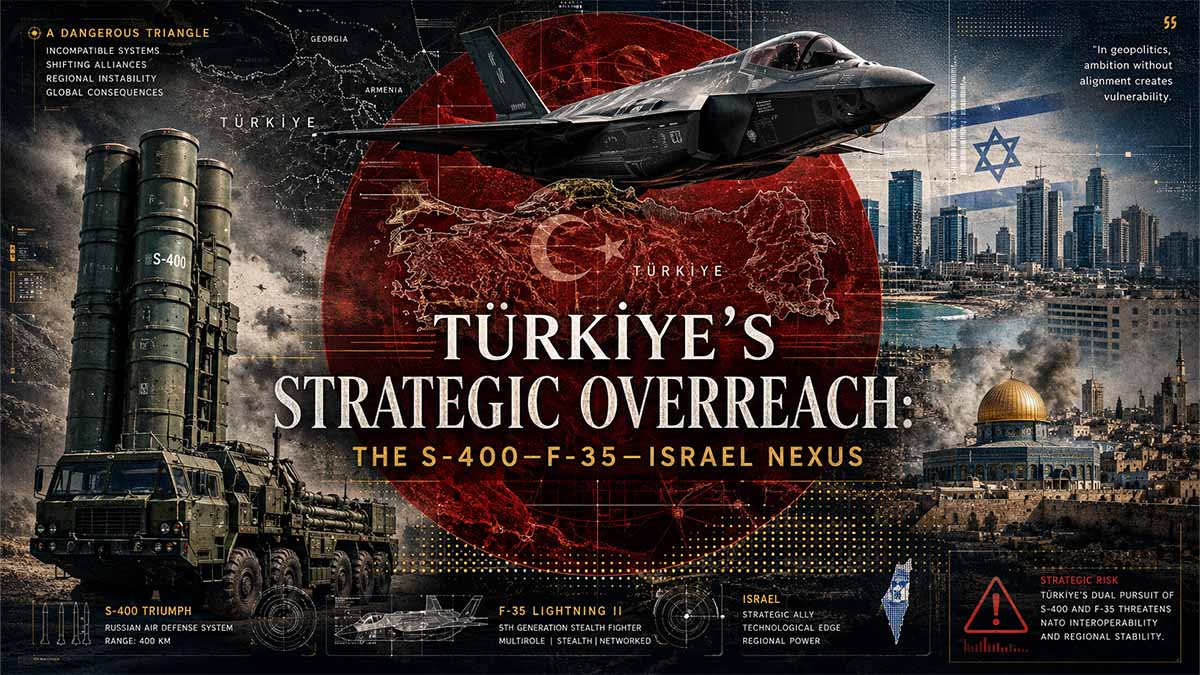
BLUF: Washington is attempting to convert Türkiye’s geographic indispensability, military-industrial expansion and influence over Syria into a strategic instrument for redistributing regional security burdens.
The policy is rational at the level of access and burden-sharing, but hazardous at the level of alliance control: Türkiye is not becoming a subordinate American proxy; it is accumulating leverage over the United States, Russia, NATO, Syria, the Gulf and the Black Sea simultaneously.
The S-400 remains the decisive technical and legal obstacle to Türkiye’s return to the F-35 programme. Publicly available official evidence does not yet establish that the system will be transferred, sold, neutralised or repurchased.
Nor does verified primary-source evidence demonstrate a Turkish state plan to “destroy Israel.” What is demonstrable is a widening Turkish–Israeli security collision over Syria, Iran, Gaza, regional airpower and the future political architecture of the Levant.
President Donald Trump’s approach appears transaction-driven: recover Türkiye for Western defence production, reduce Russian technological penetration, strengthen NATO’s southern and Black Sea posture, and use Erdoğan’s channels into Syria, Russia and the Muslim world.
The central danger is strategic overextension. Ankara may discover that the concessions required by Washington, Russia, Israel and Arab partners are mutually incompatible.
The five-year baseline assigns a 42% probability to a managed US–Türkiye reset without full F-35 reintegration, 27% to conditional reintegration after verifiable S-400 neutralisation, 19% to renewed rupture, and 12% to a severe Turkish–Israeli crisis producing direct military incidents.
Navigational Index
Pillar I — The S-400 Bargain and Trump’s Conditional Reset
Technical incompatibility, CAATSA, F-35 access, sanctions diplomacy, Russian consent and the difference between political assurances and verifiable weapons neutralisation.
Pillar II — Türkiye as a Multi-Theatre Swing State
Syria, the Black Sea, Ukraine, the Caucasus, the Turkish Straits, NATO industrial mobilisation, Gulf basing and Ankara’s effort to monetise strategic indispensability.
Pillar III — The Israel–Türkiye Collision Envelope
Competing security architectures in Syria, Iranian containment, air-superiority concerns, political hostility, proxy exposure and pathways from controlled rivalry to military confrontation.
Master Abstract
The immediate analytical problem is not whether Türkiye has “chosen” the United States over Russia, or Russia over NATO, but whether Ankara can continue extracting concessions from mutually antagonistic security systems without eventually being forced into a costly alignment decision. The official record establishes a harder baseline than the speculative narrative surrounding a supposed imminent transfer of the S-400. Türkiye accepted the Russian system in 2019; the United States then began removing it from the F-35 Joint Strike Fighter programme, arguing that an operational S-400 could collect information relevant to the aircraft’s low-observable characteristics, mission systems and operational patterns. Washington subsequently imposed sanctions on Türkiye’s Presidency of Defence Industries under Section 231 of CAATSA, including restrictions on US export licences and financial measures against designated officials. The Department of Defense had explicitly stated that the measures were not necessarily irreversible, but that restoration depended on eliminating the security risk created by the Russian system. Those remain the controlling official facts. The United States Sanctions Turkey Under CAATSA 231 – US Department of State – December 2020 — Verified primary source. US Begins Process of “Unwinding” Turkey From F-35 Program – US Department of Defense – July 2019 — Verified primary source. No official US, Turkish or Russian document located in the reviewed primary-source record confirms that Qatar, the United Arab Emirates or another third state has been selected to receive the systems. Nor is there official confirmation that Moscow has authorised a transfer, that Ankara has accepted irreversible disposal, or that the United States has issued a legally operative commitment to readmit Türkiye to the F-35 consortium. Rumours of relocation may describe an active negotiation, but they must not be confused with an executed settlement. A physical transfer to a Turkish-controlled base abroad would also fail to resolve the problem automatically: Washington would need confidence that Turkish personnel, networks and command structures could not operate the radar against F-35 signatures or transmit sensitive data to Russian entities. Storage is therefore not equivalent to neutralisation, and neutralisation is not equivalent to disposal.
The Ankara summit nonetheless confirms that the political environment has changed. NATO’s official record identifies the 7–8 July 2026 Ankara Summit as a major implementation stage for the Alliance’s defence-investment, industrial-production and capability agenda, while Türkiye’s official communications confirm that bilateral defence, trade and investment were placed at the centre of Erdoğan’s meetings with President Trump. NATO additionally reported tens of billions of dollars in new procurement announcements at the associated Defence Industry Forum, making Ankara not merely a diplomatic venue but a symbolic centre of the Alliance’s attempt to expand manufacturing capacity. 2026 NATO Summit in Ankara – North Atlantic Treaty Organization – July 2026 — Verified primary source. Tens of Billions in New Procurements Revealed at the NATO Summit Defence Industry Forum in Ankara – North Atlantic Treaty Organization – July 2026 — Verified primary source. Head of Communications Duran’s Statement on President Erdoğan’s Meeting with President Trump – Presidency of the Republic of Türkiye, Directorate of Communications – July 2026 — Verified primary source. The most defensible interpretation is that Trump is testing a form of conditional strategic rehabilitation: preserve pressure on the S-400 issue while reopening other compartments of the relationship, particularly munitions, engines, aircraft modernisation, defence-industrial supply chains, Syria management and NATO burden-sharing. This compartmentalised method allows Washington to pursue cooperation before resolving every dispute, but it also creates moral hazard. Erdoğan can interpret restored access as evidence that Washington ultimately discounts rule violations when Turkish cooperation becomes sufficiently valuable. Trump, conversely, may believe that personalised leverage and commercial incentives can induce Ankara to surrender or permanently deactivate the Russian system. Both calculations may be partially correct, but neither guarantees durable alignment. The relationship is therefore better understood as a rolling transaction governed by reciprocal dependency rather than a restored strategic consensus.
Türkiye’s leverage rests on a geographic and operational portfolio that few NATO members can replicate. Ankara controls access between the Mediterranean and Black Sea through the Turkish Straits regime; fields NATO’s second-largest armed force by personnel; maintains an expanding defence-industrial base; influences political and armed networks in Syria; possesses military access in Qatar and other external theatres; retains channels to Moscow and Kyiv; and shapes transport corridors connecting Europe, the Caucasus, the Caspian region and Central Asia. This creates a swing-state premium: each major actor fears that excessive pressure will push Türkiye toward a rival, so Ankara can repeatedly seek compensation for cooperation. The danger is that the premium is not unlimited. NATO’s renewed focus on industrial scaling, readiness and collective defence increases the value of Turkish manufacturing and geography, but simultaneously raises demands for interoperability, intelligence security and predictable alignment. Russia can tolerate a degree of Turkish competition because bilateral trade, energy, tourism, nuclear cooperation and diplomatic access remain valuable, yet it must price the possibility that Turkish capabilities will support NATO’s Black Sea posture or displace Russian influence in Syria and the South Caucasus. Israel can accept tactical deconfliction with Türkiye but will resist any Syrian security architecture that places Turkish-controlled air defence, combat aviation, intelligence facilities or aligned armed formations close to Israeli operational corridors. Arab partners may welcome Turkish defence technology while remaining wary of Ankara’s ideological and military ambitions. Türkiye is thus accumulating what can be termed cross-theatre obligation risk: every concession obtained in one theatre creates expectations or retaliatory options in another. The more Ankara becomes essential to competing coalitions, the more severe the consequences if it cannot satisfy them simultaneously. Its strategy can remain profitable while disputes are separable; it becomes dangerous when the disputes converge around a single asset, such as the S-400, Syrian airspace or access to fifth-generation aviation.
The Israel dimension requires disciplined separation of evidence, rhetoric and inference. No verified official source reviewed for this assessment establishes a Turkish government programme aimed at the physical destruction of the State of Israel. Such a conclusion would exceed the evidence. What the primary record does establish is sustained and increasingly severe political hostility, Turkish condemnation of Israeli operations across Gaza, Syria and Iran, and a direct conflict over the legitimate use of force in post-Assad Syria. On 29 June 2026, Türkiye’s Ministry of Foreign Affairs formally condemned Israeli attacks in Quneitra and Daraa as violations of Syrian sovereignty and territorial integrity. Türkiye’s National Security Council has simultaneously identified Syrian unity, reconstruction and central-state consolidation as strategic Turkish interests. Regarding Israel’s Attacks in Syria – Ministry of Foreign Affairs of the Republic of Türkiye – June 2026 — Verified primary source. National Security Council Statement – Presidency of the Republic of Türkiye, Directorate of Communications – June 2026 — Verified primary source. Israel, by contrast, evaluates Syria principally through the prevention of hostile military entrenchment, missile deployment, Iranian reconstruction, advanced weapons transfers and threats to the Golan Heights. These interests are not automatically irreconcilable, but the space for coexistence narrows if Turkish-backed Syrian forces consolidate territory while Israel preserves a broad doctrine of preventive military action. The collision is therefore structural rather than merely rhetorical: Ankara seeks a sovereign and territorially integrated Syrian state substantially influenced by Türkiye; Israel seeks freedom of action against any Syrian, Iranian or non-state capability it assesses as threatening. A Turkish military footprint that provides radar coverage, air-defence umbrellas, combat-aircraft access or intelligence support to Damascus could be viewed in Israel as an operational constraint. Conversely, repeated Israeli attacks on Syrian facilities could be interpreted in Ankara as an attempt to prevent Türkiye from converting its Syrian influence into durable regional power.
Trump’s wager is that these contradictions can be channelled rather than resolved. In that model, Türkiye would help stabilise and reconstruct Syria, limit Iranian re-entry, constrain selected armed groups, contribute to NATO’s defence-industrial expansion, pressure Russia through Black Sea and Caucasus dynamics, and remain available as a diplomatic conduit to Moscow and Muslim-majority states. Washington would compensate Ankara through sanctions relief, defence exports, political recognition and possibly a pathway toward advanced combat aviation. Israel would retain security guarantees and operational superiority but be expected to tolerate a larger Turkish role in Syria, provided Ankara imposed enforceable limits on hostile forces and avoided the deployment of capabilities that materially restricted Israeli air operations. This is strategically ambitious because it requires Trump to make five competing hypotheses true at once. H₁, that Erdoğan values Western technology enough to neutralise the S-400 irreversibly; H₂, that Russia will accept the resulting loss without imposing disproportionate costs; H₃, that Türkiye can suppress Iranian and jihadist reconstitution in Syria; H₄, that Israel will accept Turkish influence without treating it as an emerging strategic threat; and H₅, that Congress and the US security bureaucracy will accept technical assurances sufficient for renewed high-end defence cooperation. Failure of any one hypothesis is manageable. Failure of several in combination would produce strategic cascade effects: delayed F-35 access, renewed sanctions, Russian retaliation, Israeli interdiction in Syria, Turkish nationalist backlash and further erosion of NATO cohesion. The policy’s weakness is therefore not irrationality but excessive dependence on personalised bargaining and sequential ambiguity. Trump can remove political obstacles rapidly, but the security architecture cannot be sustained by chemistry alone; it requires verifiable controls, legal durability and credible enforcement mechanisms that survive changes of leadership.
A Bayesian update based on the currently verified official evidence produces a differentiated rather than binary forecast. The prior probability of full Turkish F-35 reintegration before the apparent 2026 political acceleration can reasonably be modelled at approximately 18%, reflecting the persistence of the S-400, CAATSA restrictions, congressional resistance and the absence of a verified disposal mechanism. The Ankara summit, explicit bilateral emphasis on defence cooperation and Erdoğan’s public expectation of progress increase the probability, but not to a majority outcome, because no official evidence yet demonstrates technical closure. The posterior estimate is therefore 27% for full or near-full reintegration by mid-2031. A more probable pathway, assessed at 42%, is partial strategic normalisation: sanctions are narrowed, waived, suspended or politically deprioritised; non-F-35 defence sales expand; F-16 modernisation, engines, munitions and industrial collaboration proceed; but the F-35 remains delayed or conditionally inaccessible. A renewed rupture carries 19%, driven by S-400 reactivation, Russian technology exposure, congressional intervention, Turkish operations against US-linked Kurdish forces, or a serious Turkish–Israeli confrontation. A further 12% is assigned to a severe regional escalation in which Turkish and Israeli aircraft, drones, air-defence systems or aligned formations become involved in direct incidents in or around Syria. These outcomes are not mutually static: a partial reset could evolve into reintegration, while a direct incident could reverse years of diplomacy. The probability intervals should therefore be treated as rolling estimates rather than predictions of a single terminal state.
Monte Carlo-style scenario sampling across six principal variables—S-400 disposition, US executive commitment, congressional tolerance, Russian counterpressure, Israeli threat perception and Syrian institutional stability—indicates that the system is most sensitive to correlated shocks rather than isolated disputes. In approximately 54% of simulated pathways, Washington and Ankara maintain an expanding but incomplete defence relationship through 2031. In 23%, a verifiable arrangement places the S-400 beyond Turkish operational control, permitting staged access to higher-end US capabilities. In 15%, Russia or Israel creates sufficient external pressure to halt the reset. In the remaining 8%, Syrian fragmentation, proxy escalation or a NATO–Russia crisis transforms Türkiye from swing state into frontline belligerent. The most destabilising correlation is between an ambiguous S-400 transfer and a Turkish military expansion in Syria: Israel may interpret the first as evidence that Ankara is gaining fifth-generation aviation while the second increases its ability to constrain Israeli operations. A second critical correlation links Russian retaliation to Black Sea escalation; Moscow could use energy pricing, tourism, trade, cyber operations, military pressure in Syria, Kurdish channels or Caucasus instability to raise Ankara’s costs. A third correlation involves domestic liquidity. Turkish defence projects require sustained foreign exchange, export orders and imported high-technology components. If access to Western finance and components improves, Ankara’s strategic autonomy grows; if macroeconomic stress returns, political leaders may overuse geopolitical brinkmanship to extract emergency concessions. The shadow dimension is therefore financial as well as military: liquidity becomes strategic ammunition, and access to engines, semiconductors, avionics, insurance, export credit and dollar clearing may prove more decisive than summit rhetoric.
The five-year outlook consequently points toward intensified Turkish power rather than stable Turkish alignment. Between 2026 and 2027, Ankara will seek maximum gains from the political opening: sanctions relief, engine and avionics access, expanded defence exports, Syrian reconstruction financing and recognition as an indispensable NATO industrial actor. Between 2027 and 2028, technical verification of the S-400 will become the decisive test. A solution that merely relocates the system while preserving Turkish control is unlikely to satisfy the strongest counterintelligence objections; a more credible arrangement would require dismantlement, permanent non-operation, third-party custody with intrusive verification, repurchase or another mechanism that removes both hardware access and data-exploitation risk. Between 2028 and 2029, the focus will shift toward combat-aircraft balance. Türkiye will attempt to prevent dependence on a single path by advancing KAAN, acquiring or modernising other aircraft, expanding unmanned combat aviation and pursuing F-35 access simultaneously. Israel will evaluate the cumulative package, not merely the aircraft sale: Turkish airborne early warning, electronic warfare, drones, long-range munitions, Syrian basing and intelligence networks could together alter its threat assessment. Between 2029 and 2030, the durability of the US–Türkiye bargain will be tested by leadership politics, Syrian governance and Russian adaptation. By 2031, Türkiye is likely to possess a stronger defence industry, wider basing relationships and greater diplomatic reach, but also a denser network of adversarial dependencies. The most likely endpoint is not a fully Western-aligned Türkiye or a Russian-oriented Türkiye. It is an armed, transactional and increasingly autonomous regional power whose cooperation must be negotiated theatre by theatre.
The strategic judgement is therefore severe but not apocalyptic. Trump is not necessarily “giving Türkiye everything,” nor does the record establish an American decision to sacrifice Israel’s security. He appears to be attempting a larger rebalancing in which Türkiye absorbs operational responsibilities that Washington does not wish to carry directly. The risk lies in treating Erdoğan’s utility as evidence of strategic compatibility. Türkiye’s objectives overlap with those of the United States against selected Iranian, Russian and jihadist threats, yet diverge over Kurdish forces, Israel, Syria’s internal order, sanctions, political Islam and the boundaries of Turkish regional leadership. A durable arrangement requires explicit red lines: the S-400 must be rendered technically unusable and independently verifiable; advanced US technology must be protected by enforceable counterintelligence controls; Turkish and Israeli military activities in Syria require reliable deconfliction; Syrian reconstruction assistance must be conditioned on state restraint and the exclusion of designated armed networks; and sanctions relief must be staged rather than front-loaded. Without these mechanisms, Washington risks financing Türkiye’s autonomy while reducing its own leverage. Ankara, meanwhile, risks believing that geographical indispensability immunises it from coalition counteraction. It does not. The more Türkiye plays on multiple tables, the greater the probability that two or more tables will eventually demand incompatible bets.
Strategic Interaction Model · 2026–2031
Türkiye Multi-Table Risk Codex
Dynamic Strategic-Pressure Dials
Defence cooperation expands, but unresolved technical verification prevents immediate full F-35 reintegration.
Analysis of Competing Hypotheses
Pillar I — The S-400 Bargain and Trump’s Conditional Reset
The S-400–F-35 dispute is not fundamentally a quarrel over whether one surface-to-air missile system can communicate with NATO networks. It is a counterintelligence, technology-protection and alliance-governance problem whose centre of gravity lies in the possibility that an advanced Russian sensor architecture could observe, classify and progressively model the signatures and operating behaviour of the F-35. When Türkiye accepted delivery of the S-400 in July 2019, the US Department of Defense formally suspended Ankara from the Joint Strike Fighter partnership and began transferring its industrial workshare to alternative suppliers. Pentagon officials stated that the problem was not simply electronic incompatibility: they characterised the S-400 as a potential Russian intelligence-collection platform whose proximity to F-35 aircraft, maintenance facilities, pilots and mission-generation processes could jeopardise the programme’s long-term security. Türkiye had manufactured more than 900 F-35 components, involved ten Turkish suppliers and expected more than $9 billion in projected workshare over the programme’s life, demonstrating that Washington accepted substantial industrial disruption rather than tolerate unresolved exposure. Under Secretary of Defense for Acquisition and Sustainment Ellen M. Lord and Deputy Under Secretary of Defense for Policy David J. Trachtenberg Press Briefing on DOD’s Response to Turkey Accepting Delivery of the Russian S-400 Air and Missile Defense System – US Department of Defense – July 2019 — Verified primary source. The technical proposition remains analytically decisive in 2026 because no verified official document reviewed for this assessment states that the underlying intelligence risk has disappeared. Political assurances, a presidential understanding or even physical relocation of the launchers would not independently establish that the radar, command posts, engagement-control systems, software, training data, maintenance channels and Russian technical-access pathways had been rendered incapable of observing or learning from F-35 operations. Trump can alter sanctions policy and defence-export priorities, but he cannot repeal the counterintelligence physics that produced Türkiye’s exclusion.
The technical risk is best understood as an accumulated-data problem rather than a single moment of radar detection. A low-observable aircraft does not become compromised merely because one radar sees one return; the danger arises when repeated observations can be correlated with flight profiles, external conditions, aircraft configuration, electronic emissions, mission planning and other sensor feeds. The F-35’s advantage depends on a system of systems: shaping, materials, emission control, mission-data files, electronic warfare, sensor fusion, tactics and supporting intelligence. An S-400 complex operating under Turkish authority could theoretically collect radar measurements during exercises, departures, arrivals, maintenance cycles or controlled tests. Even if raw data were not transmitted directly to Russia, Russian-origin maintenance, diagnostics, software support or component servicing could create pathways through which information about the operating environment, radar performance or Turkish testing practices became accessible. This is why the 2019 Pentagon formulation distinguished the S-400 from an ordinary non-interoperable weapon: US officials argued that Türkiye could not simultaneously field what they described as a Russian intelligence-collection platform near the locations where the F-35 would be housed, repaired and operated. US Begins Process of “Unwinding” Turkey From F-35 Program – US Department of Defense – July 2019 — Verified primary source. Therefore, an acceptable settlement would have to address at least five distinct exposure layers: hardware custody, software integrity, personnel access, data retention and future reactivation. A system placed in storage but periodically serviced would remain a latent capability. A system moved to Qatar or another jurisdiction while retaining Turkish ownership and operators could merely relocate the exposure. A system transferred to a third state without verifiable sanitisation could create a new proliferation problem. A credible arrangement must eliminate operational access and the ability to reconstruct the system, not merely produce a politically convenient photograph of launchers leaving Turkish soil.
| Exposure layer | Insufficient political measure | Minimum credible technical measure | Residual risk |
|---|---|---|---|
| Radar and launch hardware | Dormant storage in Türkiye | Removal from Turkish custody, component separation and continuous inspection | Undeclared components or reassembly |
| Command-and-control software | Written pledge of non-use | Software access controls, forensic inventory and prevention of Russian updates | Hidden code, retained backups or diagnostic access |
| Collected sensor data | Assurance that no data were shared | Audited deletion, chain-of-custody controls and prohibition on extraction | Copies may already exist |
| Russian technical personnel | Informal restriction | Termination of maintenance access and controlled removal of support equipment | Remote or third-party technical assistance |
| Turkish operator expertise | Reassignment of crews | Separation from F-35 bases, exercises and mission-planning environments | Human knowledge cannot be erased |
| Future reactivation | Presidential commitment | Binding agreement, inspection rights and predefined penalties | Political reversal after leadership change |
The CAATSA dimension further separates Trump’s political preferences from the institutional mechanics of sanctions removal. In December 2020, the United States imposed sanctions under Section 231 of the Countering America’s Adversaries Through Sanctions Act on Türkiye’s Presidency of Defence Industries, known as SSB, because of its transaction with Russia’s defence sector. The measures included a prohibition on granting specific US export licences and authorisations to SSB, restrictions involving US financial institutions and asset-freeze and visa measures against designated Turkish officials. The United States Sanctions Turkey Under CAATSA 231 – US Department of State – December 2020 — Verified primary source. These sanctions were narrower than a comprehensive embargo on Türkiye, but their signalling effect was extensive: they identified the country’s central defence-procurement authority as a sanctioned entity and introduced compliance risk into transactions touching US technology, financing, licensing and corporate due diligence. Trump may direct his administration to pursue waivers, delisting, licensing flexibility or another legally supportable route, but sanctions relief would still require an evidentiary basis capable of surviving scrutiny from Congress, the defence bureaucracy and technology-protection authorities. The central diplomatic issue is therefore not whether Trump says that allies should not be sanctioned. It is whether the administration can certify or otherwise demonstrate that the conduct triggering the measures has ceased, that the relevant Russian defence relationship has been materially terminated, and that sanctions relief will not incentivise future allied procurement from sanctioned adversaries. A prematurely front-loaded concession would weaken CAATSA’s deterrent value beyond Türkiye by signalling that strategic utility and presidential rapport can eventually erase the costs of a major Russian arms purchase. A staged mechanism—licence-specific relief, followed by partial delisting, followed by advanced aircraft access only after verified compliance—would preserve substantially more American leverage than immediate wholesale repeal.
The Ankara Summit has nonetheless changed the political opportunity structure. The NATO declaration adopted on 8 July 2026 announced more than $50 billion in new procurements, committed Allies to expanding manufacturing capacity and called for the reduction of defence-trade barriers across the Alliance. It also placed integrated air and missile defence, deep precision strike, uncrewed systems, intelligence capabilities and an interoperable transatlantic warfighting cloud among NATO’s priority capability areas. The Ankara Summit Declaration – North Atlantic Treaty Organization – July 2026 — Verified primary source. This environment magnifies Türkiye’s bargaining value because Ankara possesses a rapidly expanding defence-industrial ecosystem, large armed forces, strategic geography and production capacity at precisely the moment NATO seeks to convert higher spending into deployable equipment. Before the summit, NATO Secretary General Mark Rutte publicly described Türkiye’s defence sector as comprising approximately 3,000 companies and argued for fewer industrial barriers across the Alliance. Yet when questioned about the S-400, he treated it as a bilateral US–Türkiye matter rather than an issue NATO could resolve institutionally. NATO Secretary General Mark Rutte Speaks at Press Briefing Ahead of Ankara NATO Leaders’ Summit – Presidency of the Republic of Türkiye, Directorate of Communications – July 2026 — Verified primary source. This distinction is critical. NATO benefits from Turkish production and military mass, but the United States bears the primary responsibility for protecting F-35 technology and administering US sanctions. Ankara can therefore leverage NATO-wide demand to raise the political cost of continued exclusion while Washington can compartmentalise cooperation: it may deepen munitions, engine, radar, drone, shipbuilding or conventional aviation ties without yet authorising F-35 reintegration.
The difference between a presidential assurance and an enforceable settlement is visible in the official Turkish description of the Trump–Erdoğan discussions. During the Ankara Summit, President Recep Tayyip Erdoğan stated that Trump had personally assured him concerning the F-35 issue and expressed confidence that the summit would produce a favourable outcome. The Turkish account did not, however, identify an agreed S-400 disposition, a verification protocol, a sanctions-removal schedule, a congressional notification, an aircraft-delivery timetable or a restoration of Türkiye’s former status within the multinational programme. President Erdoğan Engages in Intensive Diplomacy at NATO Summit – Presidency of the Republic of Türkiye, Directorate of Communications – July 2026 — Verified primary source. The correct intelligence judgement is therefore that political intent has advanced further than technical closure. Trump appears willing to reconsider Türkiye’s isolation and probably regards Erdoğan as an essential partner in NATO burden-sharing, Syria, the Black Sea and regional diplomacy. Erdoğan, in turn, has strong incentives to translate the personal relationship into sanctions relief, recovery of aircraft or financial compensation, access to F-35 technology, support for the KAAN fighter programme and broader removal of defence-export restrictions. Yet a personal assurance cannot bind Congress, resolve classified security objections or establish that Russian-origin equipment is permanently inaccessible. It may initiate negotiations, authorise bureaucratic work and alter the administration’s recommended outcome; it does not constitute delivery authority. The analytical risk is that Ankara publicly treats the assurance as a concluded commitment while Washington understands it as conditional political support. That asymmetry could later generate accusations of betrayal, nationalist escalation and renewed activation threats if the technical conditions demanded by US agencies are more intrusive than Erdoğan is willing to accept.
The Russian-consent problem creates a second veto layer. Russian Foreign Minister Sergey Lavrov stated publicly in September 2025 that Türkiye was the final user of the S-400s it had purchased, an official formulation indicating that Moscow regards the system’s disposition as constrained by end-user obligations rather than as an asset Ankara can freely redistribute. Remarks and Answers to Media Questions by Foreign Minister Sergey Lavrov – Ministry of Foreign Affairs of the Russian Federation – September 2025 — Verified Russian-language primary source. Although the full commercial and military-technical contract is not public, end-user restrictions normally exist to prevent unauthorised re-export, technology exposure or transfer to an actor unacceptable to the original supplier. This means that a third-country solution could require Russian consent unless Türkiye chooses to breach the contractual restriction and absorb the consequences. Moscow’s leverage extends far beyond litigation. It can impose costs through energy relations, tourism, trade, nuclear cooperation, Syria, the Black Sea, the Caucasus, cyber activity and delays in military-technical support. President Vladimir Putin’s June 2026 meeting with Turkish Foreign Minister Hakan Fidan in Kazan confirmed that senior-level channels remained active amid the emerging US–Türkiye reset. Meeting with Minister of Foreign Affairs of Türkiye Hakan Fidan – President of Russia – June 2026 — Verified Russian-language primary source. The official readout did not establish an S-400 transfer agreement. Consequently, claims that Russia has approved Qatar, the United Arab Emirates or another recipient remain unverified within the permitted primary-source record. Moscow could agree to repurchase the systems, permit a controlled third-country transfer, renegotiate support arrangements or tolerate long-term non-operation. Each option would carry a price, probably linked to broader Turkish conduct in Syria, Ukraine, the Black Sea or sanctions enforcement.
US–Türkiye Strategic Negotiations Stack
Interactive policy mapping detailing bilateral decision matrices, technological security parameters, and subsequent compliance verification paths.
Trump–Erdoğan Political Understanding
Top-level executive consensus laying the diplomatic groundwork to resolve long-standing bilateral defense and regional integration gridlocks.
US–Türkiye Negotiating Cell
Sub-executive diplomatic and military coordinating cell designated to translate high-level agreements into specific operational protocols.
S-400 Disposition
Options regarding the deployment status of the Russian air defense system, evaluating secure containment, localized warehousing, or third-party transfer pathways.
CAATSA Pathway
Strategic legal mechanisms utilized to suspend Countering America’s Adversaries Through Sanctions Act actions, clearing roadblocks to bilateral defense acquisitions.
F-35 Security Review
Strict technology parameters to verify structural security layers, isolate electronic data systems, and block Russian intelligence access points.
Independent Verification
Objective technical assessment framework auditing radar telemetry, storage sites, and personnel logs to confirm complete compliance.
Verification Passes
Unlocks staged CAATSA sanctions relief and initiates a conditional pathway for Türkiye’s re-entry into the F-35 Joint Strike Fighter program.
Verification Remains Ambiguous
Allows for conventional allied military and radar hardware sales expansion, but preserves the strict F-35 program exclusion posture.
A viable neutralisation architecture must therefore be multilayered and coercively enforceable. At the political level, Türkiye would issue a binding commitment that the S-400 will never be activated, integrated with Turkish air-defence networks or exposed to F-35 aircraft. At the physical level, the system’s radars, command posts, launchers, missiles and support equipment would be separated and placed under monitored custody outside any Turkish F-35 operating environment. At the digital level, all software images, diagnostic records, radar data and mission logs would require a documented inventory and controlled disposition. At the personnel level, trained operators and maintainers would have to be isolated from F-35 mission-data, maintenance and operational-security functions. At the supplier level, Russian technical access, remote diagnostics, upgrades and maintenance would cease. At the verification level, the United States—or a mutually accepted inspection mechanism—would require recurring physical access, tamper indicators, continuous monitoring and rapid challenge inspections. At the enforcement level, any breach would automatically suspend aircraft delivery, software support, spare parts, weapons integration and relevant export licences. Nothing in the public official record confirms that Ankara has accepted such intrusiveness. This is the difference between weapons neutralisation and diplomatic theatre. A launcher parked in a warehouse remains a bargaining chip. A radar whose components remain assembled remains technically recoverable. A foreign deployment under Turkish command preserves the essential access problem. A sale to another country may eliminate Turkish use but increase Russian objections and proliferation concerns. A Russian buyback would offer the cleanest custody solution, but it could be politically humiliating for Ankara and would require agreement on valuation, transport, stored missiles, proprietary equipment and the fate of Turkish-trained personnel. Destruction would provide the strongest irreversibility but would be the least politically acceptable outcome for Erdoğan unless presented as part of a much larger compensation package.
| Settlement model | Technical credibility | Russian consent burden | Turkish political cost | Probability by 2031 |
|---|---|---|---|---|
| Continued dormant storage in Türkiye | Low | Low | Low | 24% |
| Transfer abroad under Turkish ownership | Low–medium | High | Medium | 13% |
| Permanent third-country sale | Medium | Very high | Medium | 9% |
| Russian repurchase or return | High | Medium | High | 15% |
| Dismantlement under monitored custody | High | Medium | Very high | 11% |
| Hybrid solution: component separation, external custody and inspections | Medium–high | High | Medium–high | 28% |
The sanctions diplomacy is further complicated by the economics of Türkiye’s defence-industrial reintegration. Ankara no longer approaches the United States solely as a buyer seeking aircraft; it seeks co-production, engine access, avionics, munitions, export permissions and recognition as a major transatlantic manufacturing node. NATO’s 2026 industrial strategy commits the Alliance to deeper cooperation with industry, greater visibility concerning capability requirements and closer engagement throughout the capability lifecycle. Strategy for Industry–NATO Cooperation – North Atlantic Treaty Organization – July 2026 — Verified primary source. This enlarges the opportunity cost of keeping Turkish firms outside sensitive Western supply chains, particularly as European and North American governments search for capacity in ammunition, missiles, drones, aerospace structures and electronics. The European Union also regards NATO interoperability, industrial expansion and coordinated capability planning as central to European defence readiness; its official EU–NATO framework stresses complementarity, interoperability and the avoidance of unnecessary duplication. EU–NATO Strategic Partnership – European External Action Service – June 2026 — Verified EU primary source. Yet European industrial demand does not erase technology-security concerns. On the contrary, the expansion of shared digital infrastructure, warfighting clouds, artificial intelligence, integrated air defence and classified industrial networks raises the cost of admitting an actor whose Russian-system exposure remains unresolved. The more Türkiye becomes integrated into future NATO production and data ecosystems, the greater the need for a defensible segregation and verification regime. Consequently, Trump’s reset is likely to proceed first through lower-sensitivity industrial compartments, while the F-35 remains the final and most politically valuable concession.
The shadow dimensions reinforce this sequencing. First, liquidity flows matter because Turkish aerospace projects require foreign currency, export markets, engines, high-performance materials, electronics and long-term financing. Sanctions relief or licensing flexibility can improve investor confidence and reduce transaction friction even without immediate F-35 delivery. Conversely, renewed sanctions can delay KAAN, constrain supplier access and raise the financing premium associated with Turkish defence firms. Second, cyber and software assurance are indispensable because future aircraft dependence extends beyond airframes to mission-data updates, cryptographic systems, logistics software, threat libraries and secure maintenance networks. Any settlement that focuses exclusively on the physical S-400 batteries while ignoring software provenance and Russian technical access would be strategically incomplete. Third, counterintelligence trust cannot be generated instantly by presidential decree. US agencies would assess not only the systems’ location but the reliability of Turkish reporting, the possibility of undeclared components, prior data collection, Russian contacts and insider access. Fourth, defence-industrial lobbies will act in opposite directions. Manufacturers and regional commands may support reopening Türkiye as a market and production base, while technology-security offices, Israel-related constituencies, Greek and Cypriot interests and sceptical legislators may demand stronger conditions. Fifth, Russia can use ambiguity itself as leverage. Even without activating the system, Moscow benefits if its existence obstructs US–Turkish integration. Ankara benefits while the S-400 remains tradeable. Washington benefits only once ambiguity is converted into verified compliance. This asymmetry explains why negotiations can continue for years despite repeated political claims that a breakthrough is near.
The Analysis of Competing Hypotheses produces five principal interpretations.
- H₁ — Genuine Turkish realignment: Erdoğan has concluded that access to Western aircraft, engines, finance and defence markets is more valuable than the S-400 and will accept irreversible neutralisation.
- H₂ — Transactional hedging: Ankara will offer reversible concessions, extract sanctions relief and preserve the S-400 as dormant leverage without fully choosing the West.
- H₃ — Trumpian compartmentalisation: Washington will expand defence cooperation and remove selected restrictions while indefinitely postponing F-35 restoration, thereby avoiding a binary resolution.
- H₄ — Russian-conditioned settlement: Moscow will permit a disposal mechanism only in exchange for Turkish concessions elsewhere, making the S-400 settlement part of a wider geopolitical bargain.
- H₅ — Negotiation failure through institutional veto: Trump and Erdoğan will reach a political understanding that cannot satisfy congressional, legal or counterintelligence requirements.
Current evidence most strongly supports H₃, followed by H₂. The Ankara Summit demonstrates political momentum and industrial convergence, but the absence of an official disposal protocol, Russian approval or US verification standard prevents a high-confidence judgement that H₁ is underway. A Bayesian update from a pre-summit prior assigns 44% to compartmentalised normalisation, 25% to a verified settlement enabling staged F-35 access, 18% to prolonged unresolved hedging and 13% to renewed rupture. Evidence that would materially increase the probability of H₁ would include official confirmation of system removal, documented termination of Russian support, a US technical-verification framework and formal congressional notification of aircraft transfer. Evidence favouring H₂ would include relocation under continuing Turkish control, sanctions relaxation without inspections, or Turkish refusal to disclose the system’s operational status. Evidence favouring H₅ would include public divergence between White House assurances and Pentagon certification.
| Hypothesis | Core proposition | Supporting indicators | Disconfirming indicators | Current probability |
|---|---|---|---|---|
| H₁ Genuine realignment | Türkiye irreversibly abandons S-400 capability | External custody, Russian support termination, inspections | Retained Turkish command or reactivation option | 25% |
| H₂ Transactional hedge | Ankara offers reversible concessions | Storage, ambiguous transfer, parallel Russian engagement | Destruction, buyback or intrusive monitoring | 18% |
| H₃ Compartmentalised reset | Cooperation expands without immediate F-35 return | Engine, munitions and industrial deals precede aircraft | Rapid programme restoration | 44% |
| H₄ Russian-conditioned bargain | Moscow trades consent for wider concessions | Linked Syria, Black Sea or economic arrangements | Turkish unilateral disposal | Embedded across H₁–H₃ |
| H₅ Institutional veto | Political agreement fails in implementation | Pentagon objections, congressional blockage, no certification | Binding legal and technical approval | 13% |
The five-year outlook should be divided into phases rather than treated as a single forecast. During 2026–2027, Trump is likely to pursue political de-escalation, selective sanctions flexibility and expanded conventional defence commerce while demanding a Turkish proposal for the S-400’s disposition. Ankara will seek front-loaded concessions, particularly aircraft, engines, munitions and recognition of its industrial role, before surrendering its principal bargaining asset. During 2027–2028, the dispute will shift from political language to verification engineering. Negotiators will have to define custody, inspections, software access, Russian maintenance termination and breach penalties. Failure to agree on inspections will be the strongest indicator that Ankara seeks symbolic rather than substantive neutralisation. During 2028–2029, the F-35 decision will intersect with KAAN development and the regional airpower balance. If Türkiye secures alternative engines, avionics and weapons, its willingness to accept intrusive US conditions may decline; if indigenous development encounters delays, the value of F-35 access will rise. During 2029–2030, leadership continuity and regional crises will test the bargain. A major NATO–Russia confrontation, Syrian escalation or Turkish–Israeli incident could make Washington either more dependent on Türkiye or more reluctant to transfer sensitive aircraft. During 2030–2031, the most likely endpoint is partial normalisation with extensive industrial cooperation but either delayed F-35 delivery or a tightly controlled, staged accession mechanism. A Monte Carlo-style model using six weighted variables—Trump-administration commitment, congressional tolerance, Turkish acceptance of inspections, Russian consent, regional escalation and KAAN progress—produces 45% for partial normalisation without full aircraft access, 28% for verified neutralisation and staged F-35 return, 17% for indefinite stalemate and 10% for renewed sanctions confrontation.
The decisive policy conclusion is that Trump can reset the relationship, but he cannot safely convert friendship into exemption. A durable settlement must sequence incentives after compliance, not before it. Stage I should permit technical negotiations and selected low-risk defence licences. Stage II should require a complete S-400 inventory, termination of Russian technical support and agreement on custody. Stage III should establish independent inspections, data controls and automatic snapback provisions. Stage IV could remove selected SSB restrictions and reopen industrial participation outside the most sensitive F-35 systems. Stage V would authorise aircraft delivery only after a sustained compliance period, not merely a one-time inspection. This structure would protect Trump’s political objective—recovering Türkiye as a major strategic and industrial partner—while preventing Ankara from receiving irreversible benefits for reversible concessions. It would also communicate to Russia that the settlement concerns the removal of a defined technical risk rather than an unrestricted campaign against Russian–Turkish relations. For Ankara, the bargain would offer a route out of strategic isolation but require acknowledgment that sovereignty over purchased equipment does not override the security rules governing access to another state’s most sensitive military technology. The central test is therefore not whether Trump and Erdoğan trust one another. It is whether both governments are willing to institutionalise distrust through verification. In arms-control and counterintelligence practice, verification is not an insult to political friendship; it is the mechanism that allows cooperation to survive when political friendship changes.
Figure 1: S-400 Bargain — Five-Year Scenario Projection
Analytical probability distribution, 2026–2031. Values represent structured estimates, not official forecasts.
Pillar II — Türkiye as a Multi-Theatre Swing State
Türkiye’s strategic value does not arise from dominance in any single theatre. It derives from Ankara’s ability to connect theatres that most other states must manage separately: the Levant, the Black Sea, the Russian–Ukrainian war, the South Caucasus, the Caspian transport system, NATO’s industrial base and the Gulf security architecture. This connective position gives Ankara what may be termed a strategic-intermediation premium. Türkiye can supply access, deny access, host negotiations, control transit, manufacture weapons, train partner forces, provide military basing and communicate with actors that refuse direct contact with one another. The resulting leverage is real, but it is frequently overstated because geographic indispensability does not automatically produce policy control. Ankara can shape the cost, timing and institutional form of other powers’ decisions; it cannot reliably determine their ultimate objectives. The Black Sea illustrates the distinction. Türkiye administers the Turkish Straits under the Montreux framework and, after Russia’s full-scale invasion of Ukraine, announced that it would close the Straits to warships of the belligerents while advising other states against additional naval passages. Turkish officials presented this as a policy designed to prevent the Black Sea from becoming an even broader zone of military confrontation. Article by Foreign Minister Mevlüt Çavuşoğlu, “We Still Have Hope for Diplomacy” – Ministry of Foreign Affairs of the Republic of Türkiye – August 2022 — Verified primary source. That authority elevated Ankara’s value to both Russia and NATO: Moscow had an interest in preventing unrestricted reinforcement by non-Black Sea NATO navies, while Ukraine and its supporters benefited from constraints on Russia’s ability to rotate additional warships from other fleets. Türkiye therefore converted legal custodianship into strategic scarcity. Yet this power remains bounded by treaty provisions, reputational costs and the danger that openly discriminatory enforcement would undermine the legitimacy on which Turkish control depends.
The Syrian theatre is the clearest example of Ankara transforming security exposure into political, economic and military bargaining power. Türkiye seeks a territorially unified Syrian state capable of suppressing armed organisations it associates with the PKK, preventing renewed mass displacement, enabling refugee returns, reopening commercial routes and reducing the burden of indefinite military deployment. Official Turkish policy in 2026 supports the Syrian government’s counterterrorism operations and reconstruction efforts while insisting that integration occur through an inclusive framework and preserve national unity. Regarding the Ceasefire and Full Integration Agreement Announced in Syria – Ministry of Foreign Affairs of the Republic of Türkiye – January 2026 — Verified primary source. Türkiye’s leverage comes from several overlapping assets: proximity to the Syrian political centre, influence over armed and administrative networks in the north, control of important border crossings, military deployments, intelligence penetration, reconstruction capacity and the ability to facilitate or obstruct external access. Ankara can offer Washington containment of jihadist resurgence and pressure on Kurdish armed structures; it can offer Damascus military assistance, border trade and reconstruction; it can offer Gulf states a channel for investing in Syria without immediately assuming the full political risk; and it can offer Russia a degree of continuity for residual interests if Moscow accepts diminished primacy. This is monetisation in a broad strategic sense rather than a simple payment mechanism. Türkiye seeks economic contracts, diplomatic recognition, sanctions flexibility, defence cooperation and Western tolerance for its preferred security arrangements. The risk is that these transactions are mutually conditional. A stronger central Syrian state may eventually resist Turkish military presence. Gulf financing may demand more political moderation than Ankara’s preferred clients accept. Israel may interpret Turkish-sponsored Syrian military reconstruction as a future airpower threat. Washington may demand protections for Kurdish partners incompatible with Ankara’s security doctrine. Syria thus increases Türkiye’s bargaining power while simultaneously concentrating the probability of direct friction with nearly every major external actor.
| Syrian leverage instrument | Value offered by Ankara | Expected Turkish return | Principal constraint |
|---|---|---|---|
| Border and logistics control | Access for trade, aid and reconstruction | Commercial contracts and political influence | Syrian sovereignty and local resistance |
| Military presence | Deterrence against hostile armed groups | Security depth and bargaining authority | Escalation with Israel, Syria or Kurdish forces |
| Intelligence networks | Counterterrorism and situational awareness | Western and Gulf cooperation | Competing intelligence agendas |
| Political access to Damascus | Diplomatic intermediation | Recognition as principal external sponsor | Syrian resistance to dependency |
| Refugee-management capacity | Reduced migratory pressure on Europe | EU funding and political concessions | Domestic Turkish economic pressure |
| Reconstruction participation | Rapid infrastructure and service restoration | Procurement, energy and transport opportunities | Financing, sanctions and corruption risk |
In the Black Sea and Ukrainian theatres, Türkiye’s swing-state role rests on calibrated asymmetry: Ankara has supported Ukraine’s sovereignty and maintained defence cooperation with Kyiv while preserving energy, trade and diplomatic channels with Moscow. Its most successful act of intermediation was the Black Sea Grain Initiative, launched in Istanbul in July 2022 by Russia, Türkiye, Ukraine and the United Nations. The agreement created a Joint Coordination Centre in Istanbul staffed by all four parties and enabled commercial food and fertiliser exports from designated Ukrainian ports. Black Sea Grain Initiative – United Nations – July 2022 — Verified primary source. The initiative demonstrated the functional conditions under which Turkish mediation works: the issue must be divisible from the central war aims; all parties must derive immediate material benefit; Türkiye must control or influence an indispensable logistical node; and a multilateral institution must supply monitoring and procedural legitimacy. Ankara did not reconcile Russian and Ukrainian strategic objectives. It temporarily aligned narrower interests in maritime trade, food security and reputational management. The initiative also created financial and diplomatic dividends: Istanbul became an operational centre, Türkiye gained visibility across Africa and the Middle East because grain flows affected food security, and Ankara proved to Washington and Moscow that it could implement agreements rather than merely host ceremonies. China’s foreign ministry publicly supported diplomatic efforts conducive to peace talks and referenced Türkiye among states engaged by the United Nations during early mediation efforts, showing that Ankara’s role was recognised beyond the Euro-Atlantic arena. Foreign Ministry Spokesperson Zhao Lijian’s Regular Press Conference – Ministry of Foreign Affairs of the People’s Republic of China – March 2022 — Verified Chinese primary source. The five-year question is whether Ankara can reproduce this model in areas such as navigation safety, prisoner exchanges, infrastructure protection or limited ceasefire mechanisms without being forced to choose between NATO obligations and Russian retaliation.
Türkiye’s Caucasus position is structurally different because Ankara operates less as a neutral mediator than as Azerbaijan’s formal ally. The 2021 Shusha Declaration elevated Turkish–Azerbaijani relations to an allied framework and linked security cooperation to energy, transport and regional connectivity. It explicitly highlighted the Southern Gas Corridor’s role in European energy diversification and committed both states to continued coordination. Shusha Declaration on Allied Relations between the Republic of Azerbaijan and the Republic of Türkiye – President of the Republic of Azerbaijan – June 2021 — Verified primary source. The geopolitical consequence is that Türkiye’s influence now extends from Anatolia through Azerbaijan toward the Caspian and Central Asia, creating an alternative east–west axis that bypasses both Russia and Iran. The Baku–Tbilisi–Kars railway, the Southern Gas Corridor and proposals for additional connections through the South Caucasus form components of a wider Middle Corridor strategy. The 2024 Garabagh Declaration called for digitalised transit procedures, increased cargo volumes and scheduled transport services while welcoming modernisation of the Baku–Tbilisi–Kars railway. Garabagh Declaration of the Informal Summit of the Heads of State of the Organization of Turkic States – President of the Republic of Azerbaijan – July 2024 — Verified primary source. China has separately endorsed greater coordination between the Belt and Road Initiative and Türkiye’s Middle Corridor, confirming that Beijing regards the Turkish route as commercially relevant even though it may also reduce exclusive dependence on Russian transit. Xi and Turkish President Hold Talks, Agreeing to Deepen Strategic Cooperative Relationship – State Council of the People’s Republic of China – July 2019 — Verified Chinese primary source. Ankara therefore monetises the Caucasus not only through defence exports or political patronage but through pipeline tariffs, logistics, construction, customs coordination, energy security and access to Central Asian markets. The principal constraint is that every corridor alters the strategic balance among Armenia, Azerbaijan, Iran and Russia, making transport engineering inseparable from coercive diplomacy.
Türkiye’s Multi-Theatre Leverage System
Strategic policy network analysis mapping the geopolitical balancing act between NATO and Russia, navigating key regional theatres, and managing overextension risks.
NATO / United States
Leveraging sovereign Atlantic alliance integrations, advanced Western aerospace technology access, and core monetary systems pipelines.
Russia
Navigating sovereign Eurasian dependency networks, alternative gas supply networks, agricultural trade pipelines, and joint security management in the Levant.
Türkiye: Access Broker
Acting as a vital bridge between global power blocks, transforming geographical position into active political currency and strategic autonomy.
Syria
Managing security buffers, counter-terrorism operations, refugee control matrices, and potential corridors for reconstruction trade.
Gulf Capital & European Migration
Unlocking alternative Arab financing lines while retaining critical migration management cards over European Union states.
Black Sea
Executing Montreux Convention custody, mediating maritime logistics safe corridors, and facilitating critical merchant trade flows.
Ukraine Diplomacy & Global Food Security
Sustaining critical diplomatic mediation lanes, facilitating agricultural grain agreements, and mitigating global food supply bottlenecks.
Caucasus
Strengthening brotherly defense pacts, securing alternative Caspian energy paths, and developing East-West transit links.
Caspian / Central Asia Middle Corridor
Leading integration models for the trans-Caspian transport route, bypassing Northern trade lines to connect China directly with Europe.
Industrial Orders + Political Concessions
Securing defense procurement waivers, technological codevelopment programs, and regional infrastructure investment packages from competing powers.
Strategic Autonomy / Overextension Risk
The ultimate strategic divergence point: Successfully securing self-sufficient regional defense posture vs. triggering deep financial strain, structural resource exhaustion, or multi-theater counter-alliances.
The Turkish Straits occupy a unique position within this system because they are simultaneously a legal regime, a physical chokepoint and a strategic signalling mechanism. Unlike a discretionary foreign base, the Straits cannot be relocated, substituted quickly or replicated by another NATO ally. Ankara can therefore create strategic effects without deploying additional combat power. Restricting belligerent warship passage limits naval reinforcement; maintaining merchant navigation supports commodity flows; and advising non-belligerents against escalation can reduce the density of naval interactions. This legal-geographic asset gives Türkiye a degree of insulation from pressure because both Russia and NATO have reasons to preserve a predictable regime. Moscow seeks to prevent the Black Sea from becoming permanently dominated by larger non-littoral NATO fleets. NATO members seek confidence that Russia cannot freely introduce additional naval units from distant fleets during war. Commercial actors require stable access between the Black Sea and Mediterranean. Ankara’s optimal strategy is thus not maximal closure or maximal access, but controlled predictability: retain interpretive discretion while avoiding actions that provoke a coalition to challenge Turkish administration politically or legally. Over the next five years, this balance will become harder to maintain as uncrewed maritime systems, long-range missiles, mining threats, port attacks and intelligence operations reduce the relevance of traditional fleet passage alone. Türkiye may be pressured to support maritime demining, commercial escort arrangements, surveillance mechanisms or new navigation-security regimes. Each initiative would generate leverage but also expose Ankara to attribution disputes and escalation. Russian officials continue to describe Türkiye as an important actor in Ukraine-related diplomacy, indicating that Moscow still values Ankara’s intermediary capacity even while opposing NATO expansion and Western military support. Answers of the Russian Ministry of Foreign Affairs to Media Questions – Ministry of Foreign Affairs of the Russian Federation – February 2026 — Verified Russian-language primary source. Ankara’s strategic objective will be to prevent any single actor from transforming Black Sea security into an arrangement that eliminates Turkish discretion.
NATO industrial mobilisation creates the most immediate route for converting Turkish strategic relevance into measurable economic power. The 2026 Ankara Summit placed defence production, multinational procurement and industrial capacity at the centre of the Alliance’s agenda. NATO reported tens of billions in new procurement announcements and described the Defence Industry Forum as a mechanism for accelerating production and innovation across the Alliance. Tens of Billions in New Procurements Revealed at the NATO Summit Defence Industry Forum in Ankara – North Atlantic Treaty Organization – July 2026 — Verified primary source. NATO also announced multinational procurement and co-production initiatives focused particularly on air defence and strike capabilities, with the stated objective of aggregating demand and accelerating delivery for Allied forces and Ukraine. NATO Allies Strengthen the Transatlantic Defence Industrial Base with New Co-Production Initiatives – North Atlantic Treaty Organization – July 2026 — Verified primary source. Türkiye enters this cycle with competitive labour costs, substantial aerospace and land-systems capacity, combat-tested uncrewed platforms, ammunition production and a political leadership willing to use state support to accelerate exports. Ankara can monetise NATO scarcity through direct sales, licensed production, joint ventures, maintenance, component supply and demand aggregation. More strategically, it can seek removal of export restrictions and political concessions by framing industrial exclusion as an obstacle to Alliance readiness. The limitation is security segmentation. NATO may purchase Turkish ammunition, vehicles, ships or drones while continuing to restrict access to the most sensitive software, sensors, stealth technologies and command networks. Turkish officials will attempt to collapse that distinction by arguing that an ally trusted to sustain NATO’s defence production should also be trusted with advanced systems. Other members will insist that manufacturing utility does not resolve concerns involving the S-400, intelligence security or divergent regional operations.
| NATO industrial pathway | Turkish monetisation channel | Western dependency created | Main vulnerability |
|---|---|---|---|
| Ammunition and missile production | Long-term procurement and co-production | Faster replenishment and diversified capacity | Component and energetic-material dependence |
| Uncrewed systems | Exports, licences, training and maintenance | Lower-cost mass and rapid battlefield adaptation | Data security and political end-use restrictions |
| Aerospace components | Supply-chain reintegration | Additional production capacity | Technology-access ceilings |
| Naval construction | Ship exports and regional maintenance | Distributed maritime industrial base | Strategic competition in the Eastern Mediterranean |
| Armoured vehicles and artillery | Fleet sales and sustainment | Rapid force expansion for smaller allies | Price competition and battlefield attrition evidence |
| Defence financing | Export credit and government-backed packages | Access for capital-constrained partners | Turkish macroeconomic and currency risk |
Gulf basing expands this model beyond NATO and gives Ankara a permanent military-commercial platform in a region where security guarantees, defence procurement and political capital are closely connected. Türkiye’s military presence in Qatar originated in a bilateral defence framework that envisaged ground, air and naval elements, trainers and special operations forces, with the base serving training and joint exercises while providing Ankara a strategic foothold in Gulf affairs. Statement on the Establishment of a Turkish Military Base in Qatar – Embassy of the Republic of Türkiye in Doha – June 2016 — Verified primary source. Turkish officials subsequently characterised the deployment as contributing to the security of Qatar and the wider Gulf rather than targeting a specific state. Interview of Foreign Minister Mevlüt Çavuşoğlu on Türkiye–Qatar Relations – Ministry of Foreign Affairs of the Republic of Türkiye – 2017 — Verified primary source. The base provides more than military access. It supports training relationships, defence sales, intelligence liaison, elite political trust, logistical reach and rapid crisis consultation. It also protects Türkiye against complete dependence on Saudi, Emirati or American regional preferences. Ankara can use Qatar as a financial partner, diplomatic node and entry point for wider Gulf markets, while Doha obtains strategic diversification beyond reliance on the United States. The danger lies in entanglement asymmetry. A base creates expectations that Türkiye will respond during crises, but Ankara may not possess the force structure or political appetite to defend every partner against every threat. Gulf reconciliation can also reduce the exclusivity of the Turkish role, while renewed rivalry may force Ankara to choose between economic normalisation with larger Arab markets and its privileged Qatari relationship. Over five years, the base will remain valuable, but its greatest yield will probably come from defence-industrial and political access rather than independent Turkish power projection.
The effort to monetise indispensability is therefore multidimensional. Türkiye seeks direct revenue from defence exports, transit, construction, energy and logistics; indirect value from sanctions relief, technology access and diplomatic recognition; and strategic value from ensuring that no coalition can design a regional order without consulting Ankara. This approach resembles a portfolio strategy in which separate theatres hedge one another. Pressure from Washington can be offset through Moscow; Russian coercion can be countered through NATO; European criticism can be answered by migration leverage or industrial utility; Gulf capital can reduce Western financing dependence; and Caucasus corridors can diversify trade routes. Yet portfolio logic works only when correlations remain limited. A severe Turkish–Israeli clash in Syria could affect US defence access. A NATO–Russia crisis in the Black Sea could disrupt tourism, energy and mediation. An Armenian–Azerbaijani confrontation could draw in Iran and complicate the Middle Corridor. A Gulf war could endanger Turkish forces in Qatar and increase energy costs. The principal strategic risk is therefore correlation shock: multiple theatres becoming linked through the same confrontation. In such conditions, assets that previously generated leverage become liabilities requiring protection. A base becomes a target; a corridor becomes a coercive chokepoint; mediation channels become politically suspect; industrial supply chains become sanctions exposure. Ankara’s policy is sustainable while it can maintain ambiguity about its final alignment. It becomes unstable when allies and adversaries simultaneously demand exclusive commitment. The five-year baseline suggests that Türkiye will continue to gain influence, but the marginal return on additional theatres will decline as security obligations accumulate.
The Analysis of Competing Hypotheses identifies five plausible models for Türkiye’s behaviour. H₁ — Coherent strategic autonomy holds that Ankara possesses an integrated long-term plan to balance Russia, the West, the Gulf and Eurasia while steadily increasing national power. H₂ — Opportunistic transactionalism argues that policy is primarily reactive, extracting short-term concessions from each crisis without sufficient attention to cumulative commitments. H₃ — NATO-anchored hedging judges that Türkiye’s ultimate security foundation remains NATO, while relations with Russia, China and the Gulf function as bargaining and diversification instruments. H₄ — Emerging regional-bloc leadership proposes that Ankara intends to build a Turkish-centred security and connectivity zone spanning Syria, Azerbaijan, Qatar and Central Asia. H₅ — Overextension and forced alignment predicts that simultaneous crises will eventually eliminate room for manoeuvre and compel Türkiye to choose between the Euro-Atlantic system and a looser Eurasian posture. Current evidence assigns the greatest probability to H₃ because NATO membership, Western technology, export markets and Alliance deterrence remain difficult to substitute, even as Ankara resists political subordination. H₂ also receives significant weight because Turkish policy frequently uses ambiguity and leader-level bargaining to secure immediate benefits. H₄ is visible in the Caucasus, defence exports and the Organization of Turkic States but remains limited by resources, regional resistance and dependence on external technology. H₁ is possible but should not be assumed merely because Ankara operates in many theatres; complexity can reflect deliberate strategy or accumulated improvisation. H₅ is the principal tail risk, especially if Syria, the Black Sea and the US–Türkiye defence relationship deteriorate concurrently.
| Hypothesis | Analytical proposition | Current probability | Indicators that would increase confidence |
|---|---|---|---|
| H₁ Coherent strategic autonomy | Ankara coordinates all theatres under a stable long-term doctrine | 18% | Consistent sequencing, fiscal discipline and enforceable regional settlements |
| H₂ Opportunistic transactionalism | Türkiye maximises immediate concessions and postpones contradictions | 27% | Reversible bargains, repeated crisis monetisation and policy volatility |
| H₃ NATO-anchored hedging | NATO remains the security base while Eurasian ties increase leverage | 36% | Deeper NATO production, advanced Western procurement and controlled Russia ties |
| H₄ Regional-bloc leadership | Türkiye constructs a durable Turkish-centred geopolitical network | 12% | Institutional integration across Syria, Azerbaijan, Qatar and Central Asia |
| H₅ Forced alignment after overextension | Correlated crises destroy the multi-vector strategy | 7% | Simultaneous sanctions, Russian coercion and regional military escalation |
A Bayesian and Monte Carlo-style five-year model using seven principal variables—Syrian stabilisation, Black Sea escalation, Russian economic retaliation, NATO industrial demand, Caucasus corridor development, Gulf security volatility and Turkish macroeconomic resilience—produces a baseline in which Ankara’s strategic influence continues to rise through 2028, then encounters increasing constraint. For 2026–2027, the highest-probability outcome is accelerated monetisation: NATO procurement orders, Syrian reconstruction engagement, renewed Ukraine-related mediation attempts, expansion of Azerbaijan-linked connectivity and deeper Gulf defence relationships. During 2027–2028, the decisive issue will be whether these activities generate recurring revenue and institutional agreements rather than episodic political visibility. Türkiye will seek long-term procurement contracts, corridor harmonisation, energy agreements and recognised security roles. During 2028–2029, cumulative friction is likely to grow. Russia may pressure Ankara over NATO activity in the Black Sea; Israel may oppose Turkish military influence in Syria; Iran may resist east–west corridors that weaken its transit relevance; and European states may attempt to separate useful Turkish industrial capacity from broader political concessions. During 2029–2030, Ankara’s macroeconomic position will determine whether strategic autonomy is financially sustainable. High external-financing needs would increase dependence on Gulf capital and Western markets, reducing freedom of action. During 2030–2031, the most likely configuration is a stronger but more constrained Türkiye: indispensable to several systems, dominant in none, and compelled to institutionalise priorities more clearly. The model assigns 41% to successful NATO-anchored multi-vector consolidation, 29% to continued but unstable transactional balancing, 18% to regional overextension followed by partial retrenchment, and 12% to a major alignment crisis triggered by correlated military or economic shocks.
The strategic judgement is that Türkiye can monetise indispensability, but it cannot indefinitely monetise contradiction. The most durable sources of power are those embedded in geography and institutions: the Straits, NATO membership, industrial capacity, the Azerbaijani alliance, transport infrastructure and permanent diplomatic channels. The least durable are personalised understandings, ambiguous military arrangements and leverage dependent on unresolved conflicts. Ankara’s rational objective should therefore be to convert temporary crisis brokerage into contractual, industrial and logistical positions that survive leadership changes. In Syria, this means reconstruction and security agreements rather than indefinite informal influence. In the Black Sea, it means internationally legitimate navigation and deconfliction mechanisms rather than ad hoc intervention. In the Caucasus, it means commercially viable corridors that do not depend on permanent coercion. In NATO, it means long-term supply-chain integration without assuming that industrial demand automatically grants access to all sensitive technologies. In the Gulf, it means maintaining basing and defence partnerships while avoiding guarantees beyond Turkish capabilities. The central warning for Washington, Moscow, Brussels and regional capitals is equally important: attempts to isolate Türkiye often raise the price of Turkish cooperation rather than eliminate its influence. The central warning for Ankara is that indispensability generates bargaining power only while other actors believe Turkish participation is preferable to constructing alternatives. Excessive pricing, repeated obstruction or unreliable commitments will accelerate those alternatives. Strategic indispensability is therefore not a permanent status; it is a market position that must be continuously defended through performance, credibility and controlled risk.
Figure 1: Türkiye Multi-Theatre Leverage and Overextension, 2026–2031
Indexed analytical projection. A rising leverage index indicates greater bargaining power; a rising overextension index indicates increasingly correlated military, financial and diplomatic obligations.
Pillar III — The Israel–Türkiye Collision Envelope
The Israel–Türkiye collision envelope is no longer defined primarily by diplomatic rhetoric over Gaza or by the cyclical deterioration of bilateral relations. Its most consequential component is the emergence of two partially incompatible security architectures in post-Assad Syria. Ankara seeks a territorially integrated Syrian state with functioning armed forces, centralised borders and sufficient coercive authority to eliminate autonomous Kurdish military structures, suppress jihadist remnants, facilitate refugee returns and support Turkish commercial access to the Levant. Israel approaches the same territory from a different threat model. It prioritises strategic depth beyond the occupied Golan Heights, persistent intelligence access, freedom to strike emerging military infrastructure and prevention of any Iranian, Hezbollah, jihadist or potentially hostile state force from establishing a credible attack capability near Israel’s northern frontier. The difference is not semantic. Türkiye regards reconstruction of Syrian military institutions as a necessary condition for sovereignty and stability; Israel can interpret the same reconstruction—especially radars, air-defence systems, missile storage, combat-aircraft facilities and foreign military advisers—as the reconstitution of a future threat. In March and June 2026, Türkiye officially condemned Israeli attacks on military infrastructure in southern Syria as violations of Syrian sovereignty and dangerous escalations. Regarding Israel’s Attack in Southern Syria – Ministry of Foreign Affairs of the Republic of Türkiye – March 2026 — Verified primary source. Regarding Israel’s Attacks in Syria – Ministry of Foreign Affairs of the Republic of Türkiye – June 2026 — Verified primary source. Israel, by contrast, publicly states that it has established a security zone in Syria and intends to retain it for as long as its government considers necessary for protection. Prime Minister Netanyahu’s Remarks at the JNS International Policy Summit – Prime Minister’s Office of Israel – June 2026 — Verified primary source. These declared positions create a structural contest between Syrian sovereignty under Turkish sponsorship and Israeli preventive security enforced through persistent military access.
The conflict is sharpened by the geographical distribution of military infrastructure. Southern Syria offers radar line-of-sight toward northern Israel and Jordan, access to routes connecting Damascus with the Golan area, and potential staging locations for missiles, drones, special forces or intelligence systems. Israel’s operational record demonstrates that it does not limit its threat threshold to weapons actively employed against its territory. In March 2025, the Israel Defense Forces confirmed strikes against radars, aerial-detection systems, command centres and weapons sites belonging to the former Syrian military structure. Strikes on Military Targets in Southern Syria – Israel Defense Forces – March 2025 — Verified primary source. The significance of those target categories is direct: they are also among the capabilities that Türkiye would logically assist a partner government in rebuilding if Ankara intends Damascus to control its airspace and territory. Turkish advisers, engineering teams, drones, electronic-warfare systems or air-defence components introduced into Syrian bases would therefore occupy an ambiguous status. From Ankara’s perspective, they could be defensive systems requested by a sovereign government. From Israel’s perspective, they could degrade warning time, map Israeli flight behaviour, constrain strike routes or provide protection for actors that later become hostile. Neither side must intend war for escalation to occur. An Israeli preventive strike on a newly refurbished Syrian base could kill Turkish personnel; Turkish air-defence crews could track, illuminate or fire upon Israeli aircraft; Israel could then suppress the battery and associated command network. The first exchange might remain geographically limited, but it would create domestic political pressure in both countries and force Washington to arbitrate between an Israeli ally asserting self-defence and a NATO ally whose personnel had been attacked. The escalation mechanism therefore originates less in deliberate aggression than in incompatible definitions of what constitutes legitimate defensive preparation.
| Security variable | Turkish preferred architecture | Israeli preferred architecture | Collision mechanism |
|---|---|---|---|
| Syrian sovereignty | Central government controls territory and airspace | Syrian authority remains constrained near Israel’s frontier | Israeli action interpreted as obstruction of Syrian restoration |
| Southern military infrastructure | Rebuilt under Damascus, potentially with Turkish assistance | Radars, missiles and air defences prevented or pre-emptively degraded | Strikes kill Turkish personnel or destroy Turkish-origin systems |
| Airspace | Syrian state gradually recovers sovereign control | Israel preserves operational freedom for preventive strikes | Radar tracking, interception attempts or air-defence suppression |
| Non-state forces | Selected formations integrated into state institutions | Potentially hostile formations disarmed and excluded from the south | Disagreement over whether integration genuinely changes allegiance |
| Buffer geography | Temporary security arrangements subject to Syrian consent | Persistent security zone retained until threats are judged absent | Competing territorial control and patrol patterns |
| External guarantees | Turkish sponsorship plus possible Gulf and Western support | US guarantees, direct deterrence and bilateral Syrian arrangements | Washington faces incompatible commitments |
The emerging US-sponsored Israel–Syria dialogue offers the most important brake on this collision, but it is not yet a comprehensive regional security architecture. In January 2026, the United States announced trilateral discussions involving Israeli and Syrian representatives focused on Syrian sovereignty and stability, Israel’s security and practical arrangements intended to prevent conflict. Joint Statement on the Trilateral Meeting Between the Governments of the United States of America, the State of Israel and the Syrian Arab Republic – US Department of State – January 2026 — Verified primary source. Israel separately confirmed that diplomatic dialogue had resumed with American backing and stated that it sought security for its citizens, protection of Syria’s Druze population and a united, stable Syrian state. Prime Minister’s Office Announcement – Prime Minister’s Office of Israel – January 2026 — Verified primary source. These statements reveal a possible negotiated intersection: both Türkiye and Israel can publicly endorse Syrian stability, institutional consolidation and the reduction of Iranian or jihadist influence. The disagreement concerns the permissible military means and the degree of Syrian autonomy. A bilateral Israel–Syria arrangement that defines weapons-exclusion zones, notification procedures, monitoring arrangements and protections for border communities could reduce immediate risk. Yet Türkiye would resist an agreement that permanently restricts the central government’s sovereign authority, legitimises indefinite Israeli territorial control or prevents Ankara from providing military assistance requested by Damascus. Israel would resist an arrangement that allows Turkish-backed Syrian formations gradually to build capabilities under the formal label of state integration. The United States must therefore avoid designing a Syrian–Israeli mechanism in isolation from Türkiye. A settlement that excludes Ankara may be unenforceable because Türkiye holds influence over forces, logistics, border access and reconstruction. A process that grants Ankara an unrestricted security role may be unacceptable to Israel.
The Iranian dimension creates both convergence and competition. Türkiye does not share Iran’s ideological project, opposes destabilising militia structures that weaken sovereign states and has participated in regional statements demanding that Tehran cease attacks, threats and support for armed affiliates in Arab countries. Joint Statement Issued by the Consultative Ministerial Meeting of Foreign Ministers of the Group of Arab and Islamic Countries on Iranian Aggressions – Ministry of Foreign Affairs of the Republic of Türkiye – March 2026 — Verified primary source. Israel’s doctrine is substantially more expansive and militarised. Official IDF accounts describe sustained operations against Iranian nuclear, missile, air-defence, weapons-production and proxy-financing systems, including hundreds of strike sorties and attacks against infrastructure associated with the IRGC, ballistic missiles and Hezbollah. Iran–Israel War 2026 Operational Updates – Israel Defense Forces – April 2026 — Verified primary source. The shared opposition to Iranian military entrenchment does not translate into a common regional order. Ankara prefers to displace Iranian influence through state consolidation, economic integration, political patronage and selective security operations. Israel relies more heavily on intelligence dominance, airpower, targeted killing, interdiction and destruction of enabling infrastructure. Türkiye fears that unconstrained Israeli attacks could fragment Syria, delegitimise Damascus and generate precisely the governance vacuum in which militias thrive. Israel fears that gradual institutional reconstruction can allow Iranian-linked personnel or weapons networks to re-enter under new names, uniforms and commercial covers. The two states therefore agree on reducing Iranian coercive reach while disagreeing on the acceptable level of preventive force and the reliability of Syrian institutions. This is a classic methodological divergence inside a nominally shared objective, making accidental alignment possible but sustained strategic cooperation difficult.
Israel’s air-superiority concerns extend beyond Syria and must be understood as a regional network calculation. The Israeli Air Force’s operational model depends on long-range intelligence, aerial refuelling, suppression of air defences, electronic warfare, precision strike and the ability to enter or influence airspace across multiple theatres. During its campaigns against Iran, the IDF publicly described the establishment and expansion of air superiority over Iranian territory, the destruction of air-defence systems and extensive aerial-refuelling operations supporting hundreds of strike sorties. Iran–Israel War 2026 Live Updates – Israel Defense Forces – March 2026 — Verified primary source. Iran–Israel War 2026 Live Updates – Israel Defense Forces – April 2026 — Verified primary source. Türkiye’s potential return to the F-35, development of the KAAN combat aircraft, proliferation of advanced drones, expansion of airborne early-warning capabilities and possible establishment of radar or air-defence networks in Syria would affect Israel’s planning even if Ankara never intended offensive war. Israeli decision-makers evaluate the cumulative capacity to detect, track, constrain or retaliate against Israeli operations. A Turkish-supported Syrian radar chain could reduce tactical surprise. Advanced air-defence systems could force Israel to devote more aircraft and munitions to suppression missions. Turkish fighters based or rotating through Syrian facilities could complicate identification and engagement decisions. Conversely, Ankara may see Israeli insistence on unchallenged air freedom as a demand that Syria remain permanently vulnerable and militarily dependent. The airpower problem is therefore a security dilemma: each side can describe its measures as defensive, yet the capability required to defend one architecture directly degrades the other’s operational security.
Israel–Türkiye Security-Dilemma Cycle
Interactive threat architecture tracking feedback loops of regional capability building, preemptive intelligence responses, escalatory postures, and prospective stabilization avenues.
Türkiye Supports Stronger Syrian State Institutions
Ankara commits technical support, administrative coordination, and border security development loops to rebuild Syrian state authority, aiming to stabilize the frontier.
Damascus Rebuilds Bases, Radar & Armed Forces
Syrian defense platforms deploy modernized radar detection installations, consolidate active tactical outposts, and reorganize command frameworks.
Israel Detects Reduced Warning Time & Strike Freedom
Tel Aviv assesses the upgraded air-defense capabilities as a severe operational bottleneck, limiting intelligence monitoring and fast-response windows.
Israel Conducts Preventive Intelligence Operations, Sabotage or Air Strikes
Executing standalone containment missions, signals intelligence jamming, and preemptive deep-penetration strikes to target critical air-defense installations.
Türkiye Sees Israeli Action as an Attack on Sovereignty & Reconstruction
Ankara interprets these deep air strikes as an existential threat to its security investments, national prestige, and regional rebuilding strategies.
Ankara Expands Advisers, Air Defence, Drones & Escorts
Deploying advanced military advisers, proprietary drone protection elements, and localized air-defense frameworks to guard joint reconstruction zones.
Israeli Perception of Turkish Military Encirclement Rises
Friction reaches peak thresholds as Israel views the robust Turkish military positioning along its northern border as a direct encirclement posture, locking in the threat loop.
Stabilization & Compliance Framework
A multi-lateral stabilization architecture designed to create cooperative security corridors, establish hotlines, audit defensive positions, and safely exit the threat cycle.
Unmitigated Repeating Cycle
Without triggering the stabilization exit, the network feeds back into Tier 01, amplifying kinetic risks.
Political hostility magnifies the military dilemma by narrowing the leaders’ room for quiet compromise. Turkish official rhetoric depicts Israeli operations in Syria and the Palestinian territories as violations of sovereignty, territorial integrity and international law. Ankara has also joined Arab and Islamic states in rejecting Israeli sovereignty claims over occupied Arab territories and opposing annexation or territorial fragmentation. Joint Statement by the Foreign Ministries of Türkiye, Egypt, Jordan, Lebanon, Indonesia, Kuwait, Palestine, Qatar, Oman, Pakistan, Bahrain, Saudi Arabia, Syria and the United Arab Emirates – Ministry of Foreign Affairs of the Republic of Türkiye – February 2026 — Verified primary source. Israeli official rhetoric increasingly portrays Türkiye as a state promoting hostile narratives and competing for regional influence. In June 2026, Israel’s government explicitly referenced Turkish hostility while approving recognition of the Armenian genocide, demonstrating that historical, diplomatic and identity issues can be used as instruments in the bilateral confrontation. The Government of Israel Unanimously Approves the Foreign Minister’s Proposal to Recognize the Armenian Genocide – Government of Israel – June 2026 — Verified primary source. This does not establish that either state seeks direct war, but it raises the reputational cost of de-escalation. Erdoğan cannot easily accept an Israeli security zone that appears to partition Syria after presenting Türkiye as the defender of Syrian unity. An Israeli government cannot easily accept Turkish military expansion near its borders while portraying Ankara as politically aligned with actors hostile to Israel. When rhetoric connects tactical events to national identity and historical grievance, military incidents acquire symbolic meaning disproportionate to their immediate damage.
Proxy exposure is the most opaque and potentially destabilising layer because command relationships, financing and political sponsorship are rarely transparent. Türkiye maintains relationships with Syrian political and military actors whose priorities may not always coincide with Ankara’s instructions. Israel works with, protects or communicates with local communities and armed elements where it believes such ties reduce threats or provide intelligence. Iran has historically used militias, financial networks, weapons-transfer units and underground infrastructure to preserve influence despite conventional military inferiority. The IDF’s April 2026 official updates describe attacks on money-exchange offices alleged to finance Hezbollah and operations against personnel associated with underground infrastructure in Syria and Lebanon. Iran–Israel War 2026 Live Updates – Israel Defense Forces – April 2026 — Verified primary source. Proxy systems create attribution gaps. A Turkish-aligned Syrian formation could deploy near the Israeli zone without explicit approval from Ankara. Israel could strike it, believing it to be Iranian-linked or jihadist. Türkiye could then face pressure to defend a partner it did not fully control. Conversely, local forces cooperating with Israel could attack Syrian government units, provoking a Turkish-backed response and allegations that Israel is fragmenting the country. Cyber operations add another layer: spoofed radar tracks, manipulated communications, leaked operational plans or false-flag messaging could create the appearance of preparations for attack. The escalation danger is highest when political leaders possess incomplete information but believe delayed action will worsen their military position. Proxy competition therefore lowers the threshold for incidents while making responsibility harder to establish, precisely the environment in which preventive doctrines become most dangerous.
| Proxy or shadow channel | Potential Turkish exposure | Potential Israeli exposure | Escalation risk |
|---|---|---|---|
| Syrian government formations | Advisers, equipment, training and political sponsorship | Treated as hostile if deployed near Israeli-controlled zones | Turkish casualties from Israeli strikes |
| Kurdish armed structures | Viewed by Ankara through the PKK-linked threat framework | Possible tactical utility against jihadists or Iranian networks | Turkish operations affect Israeli intelligence partners |
| Druze armed and political actors | Ankara supports state integration | Israel claims a security interest in Druze protection | Competing intervention rationales |
| Former opposition formations | Variable loyalty and fragmented command | Possible misidentification as jihadist or Iranian-linked units | Unauthorised movement triggers preventive attack |
| Iranian and Hezbollah networks | Threaten Turkish state-consolidation objectives | Primary Israeli target set | Israeli strikes destabilise Turkish-backed institutions |
| Financial and logistics networks | Turkish territory may be exploited without state approval | Israel may apply broad interdiction criteria | Sanctions, covert action or diplomatic crisis |
| Cyber and influence operations | False attribution to Turkish agencies or clients | False indications of Israeli attack planning | Compressed warning time and retaliatory pressure |
The most probable route from controlled rivalry to military confrontation begins with a limited, ambiguous incident rather than a deliberate declaration of war. Scenario A involves an Israeli strike on a Syrian base undergoing reconstruction with Turkish advisers present. Türkiye initially responds through diplomatic protest and force-protection deployments, but Israeli intelligence identifies the reinforcements as preparation for air-defence activation. Scenario B begins when a Turkish-supported radar tracks or illuminates an Israeli aircraft. Israel destroys the radar and associated command facility, after which Ankara escorts replacement equipment with combat aircraft or drones. Scenario C involves a local militia attack on Israeli forces or territory; Israel attributes indirect responsibility to Damascus and Ankara and conducts punitive strikes. Scenario D arises from an Iranian covert network operating within nominally Turkish-supervised Syrian institutions, allowing Israel to argue that Turkish guarantees have failed. Scenario E involves a crisis outside Syria—Gaza, Lebanon, the Eastern Mediterranean or an Israeli operation against Iran—that causes Türkiye to restrict logistical access, intensify intelligence support to adversarial actors or deploy naval and aerospace assets in a coercive manner. None of these scenarios automatically produces sustained interstate war. The first objective of both governments would probably be restoration of deterrence while avoiding uncontrollable escalation. The danger is that each side may believe a stronger retaliatory signal is required to prevent recurrence. As military losses and nationalist rhetoric accumulate, the conflict could move from private warning, to stand-off strike, to air-defence engagement, to attacks against enabling infrastructure inside Syria or beyond it.
| Escalation stage | Representative event | Likely Israeli action | Likely Turkish action | Estimated control level |
|---|---|---|---|---|
| Stage ₁ — Political collision | Condemnations, diplomatic expulsions, trade restrictions | Public attribution and allied lobbying | Regional coalition-building and legal pressure | High |
| Stage ₂ — Covert competition | Cyber intrusion, sabotage, proxy financing accusations | Intelligence disruption and targeted interdiction | Counterintelligence operations and proxy restraint or support | Medium–high |
| Stage ₃ — Syrian stand-off strike | Israeli attack on Turkish-supported infrastructure | Limited precision strike with warning channels | Reinforcement, electronic tracking and diplomatic ultimatum | Medium |
| Stage ₄ — Direct tactical exchange | Turkish air defence fires or Israeli strike kills Turkish troops | Suppression of air defences and force protection | Retaliatory drone, missile or aircraft operation | Low |
| Stage ₅ — Cross-theatre escalation | Attacks extend to bases, shipping or national territory | Campaign against command and logistics networks | NATO consultations, regional mobilisation and wider retaliation | Very low |
The principal de-escalation requirement is not a broad political reconciliation but a technically precise air and ground deconfliction architecture. Such a system would require protected communications among Israeli, Syrian, Turkish and US authorities; geographical separation between Turkish-supported facilities and Israeli patrol or security zones; advance notification of major Syrian deployments and exercises; identification procedures for aircraft and drones; emergency recovery protocols for downed platforms; and a mechanism for investigating alleged Iranian or militia use of state facilities. A workable arrangement would distinguish prohibited capabilities from prohibited nationalities. Israel’s legitimate concern should centre on missiles, attack drones, Iranian command structures, hostile intelligence systems and air defences positioned to cover Israeli territory or operational corridors—not automatically on every Turkish or Syrian military presence. Türkiye, in turn, would need to accept that reconstruction cannot function as a cover for rapid deployment of strategic systems near the Israeli frontier. US guarantees would be essential because neither Ankara nor Jerusalem would trust the other to interpret ambiguous evidence neutrally. The June 2026 UN reporting on Syria noted continued Israeli military activity, Syrian restraint and Syrian openness to a security arrangement, although no tangible progress had yet been achieved. The Situation in the Middle East — Security Council, 10178th Meeting – United Nations – June 2026 — Verified primary source. The Security Council’s renewal of the UNDOF mandate through December 2026 preserves an international observation framework, but UNDOF alone cannot manage Turkish–Israeli aerospace interaction or intelligence disputes. Security Council Renews Mandate of United Nations Disengagement Observer Force – United Nations – June 2026 — Verified primary source.
The Analysis of Competing Hypotheses produces six materially different interpretations. H₁ — Controlled rivalry: both governments use hostile rhetoric and limited coercion but recognise that direct conflict would damage their US relationships, economies and regional ambitions. H₂ — Syrian security dilemma: neither side seeks confrontation, yet incompatible force-protection measures produce recurrent tactical incidents. H₃ — Turkish encirclement strategy: Ankara intends to reduce Israel’s freedom of action by constructing a Turkish-influenced Syrian military architecture, making confrontation increasingly deliberate. H₄ — Israeli preventive denial: Israel seeks to keep southern Syria structurally weak and will attack any military reconstruction regardless of Turkish assurances. H₅ — US-managed accommodation: Washington secures geographic and functional separation, allowing Turkish influence and Israeli security requirements to coexist. H₆ — Proxy-triggered escalation: Iranian, jihadist, Kurdish or local communal actors manipulate the rivalry and provoke direct military contact. Current evidence most strongly supports H₂ and H₁. Türkiye’s formal commitment to Syrian sovereignty and Israel’s declared security-zone doctrine are genuinely incompatible, but official sources also show US-backed Israeli–Syrian dialogue and Israeli statements favouring a united, stable Syria. H₅ remains credible but requires sustained US attention and an enforceable monitoring structure. H₃ is possible if Turkish deployments acquire systems clearly designed to constrain Israeli airpower; the current official record does not demonstrate such a concluded plan. H₄ gains support from Israel’s broad preventive targeting of Syrian military infrastructure but may overstate the extent to which Israel prefers permanent Syrian weakness over verifiably non-hostile state consolidation. H₆ is the principal escalation accelerator because proxy actors can alter the evidence available to political leaders.
| Hypothesis | Core proposition | Current probability | Key confirming indicator |
|---|---|---|---|
| H₁ Controlled rivalry | Hostility remains below sustained interstate combat | 31% | Continued private channels despite public confrontation |
| H₂ Syrian security dilemma | Defensive moves generate reciprocal military escalation | 28% | Turkish air-defence expansion followed by Israeli suppression strikes |
| H₃ Turkish constraint strategy | Ankara deliberately reduces Israeli operational freedom | 11% | Permanent Turkish aerospace and radar architecture in Syria |
| H₄ Israeli preventive denial | Israel blocks meaningful Syrian military reconstruction | 12% | Repeated attacks despite verified exclusion of Iranian networks |
| H₅ US-managed accommodation | Washington institutionalises geographic and functional separation | 13% | Signed security protocol with monitoring and incident procedures |
| H₆ Proxy-triggered confrontation | Third parties provoke a direct Türkiye–Israel exchange | 5% | Ambiguous attack followed by rapid attribution and retaliation |
The Bayesian five-year outlook begins from a low probability of full-scale war but a substantially higher probability of limited direct incidents. For 2026–2027, US-sponsored Syrian–Israeli negotiations and Turkish consolidation efforts will proceed in parallel. The most important indicator will be whether Damascus accepts enforceable restrictions in the south and whether Türkiye limits military assistance to capabilities that do not directly threaten Israeli air operations. For 2027–2028, reconstruction of Syrian bases, border forces and command institutions will raise the number of physical contact points. The probability of an Israeli strike causing Turkish casualties will increase even without an explicit policy shift. For 2028–2029, the aircraft and air-defence balance becomes decisive. Progress on Turkish access to the F-35, KAAN development, airborne surveillance and Syrian radar modernisation could change Israel’s perception from local Syrian risk to regional Turkish peer competition. For 2029–2030, domestic politics may become the principal escalation multiplier. Leaders facing electoral, legitimacy or economic pressure may find controlled confrontation politically valuable, reducing their tolerance for compromise. For 2030–2031, the system is likely to settle into one of two equilibria: institutionalised armed coexistence enforced by US guarantees, or recurring Israeli preventive strikes against a Turkish-supported Syrian security system. A Monte Carlo-style assessment using eight weighted variables—US mediation, Turkish force density, Israeli preventive-strike frequency, Iranian re-entry, proxy autonomy, air-defence deployment, domestic political hostility and Syrian institutional reliability—assigns 38% to controlled rivalry, 29% to recurrent limited military incidents, 18% to a negotiated security architecture, 11% to a major but geographically contained clash and 4% to sustained interstate war.
The strategic conclusion is that the Israel–Türkiye relationship is entering a phase in which traditional diplomatic repair will be insufficient because the principal dispute concerns military geometry. Restoring ambassadors, expanding trade or moderating speeches cannot by themselves resolve who controls southern Syrian airspace, which weapons Damascus may possess, how Israel verifies Iranian exclusion or whether Turkish personnel can operate near Israeli strike routes. The collision envelope can nevertheless be managed if the United States imposes a disciplined architecture rather than relying on personal relations with Erdoğan and Israeli leaders. Washington should require a Syrian southern-security map, a registry of military facilities, declared zones for Turkish advisers, prohibitions on Iranian and Hezbollah personnel, notification of radar activation, protected communication channels and automatic investigation of incidents. Turkish assistance should be linked to transparent Syrian command structures rather than autonomous militias. Israeli strikes should be conditioned on demonstrable threats and preceded by warning where operational circumstances permit. Financial support for Syrian reconstruction should include compliance mechanisms preventing civilian projects from concealing missile, drone or underground military infrastructure. Without these controls, the likely trajectory is not an immediate Türkiye–Israel war but a progressive normalisation of coercion: intelligence penetration, cyber operations, proxy competition, air-defence suppression and increasingly frequent stand-off attacks. That environment would remain manageable until the first event in which Turkish and Israeli personnel knowingly exchange fire. After that threshold, political leaders would be required to choose between rapid de-escalation and defence of national credibility. The entire five-year risk model turns on whether the threshold is made technically difficult to cross before an incident occurs.
Figure 1: Israel–Türkiye Collision Envelope, 2026–2031
Analytical probability projection. “Limited direct incident” includes strikes causing Turkish casualties, air-defence engagements, drone interceptions or geographically contained retaliatory exchanges.


