












Executive Summary
BLUF: No White House, State Department, Moroccan government, or Israeli government source located and verified through 3 August 2026 confirms that President Donald Trump named, or announced the naming of, a Western Saharan highway after himself.
The alleged 26 July 2026 announcement must therefore be treated as an unverified information event, not an established fact.
The underlying geopolitical structure is nevertheless documented: Washington recognized Moroccan sovereignty claims in December 2020, and Israel followed in July 2023.
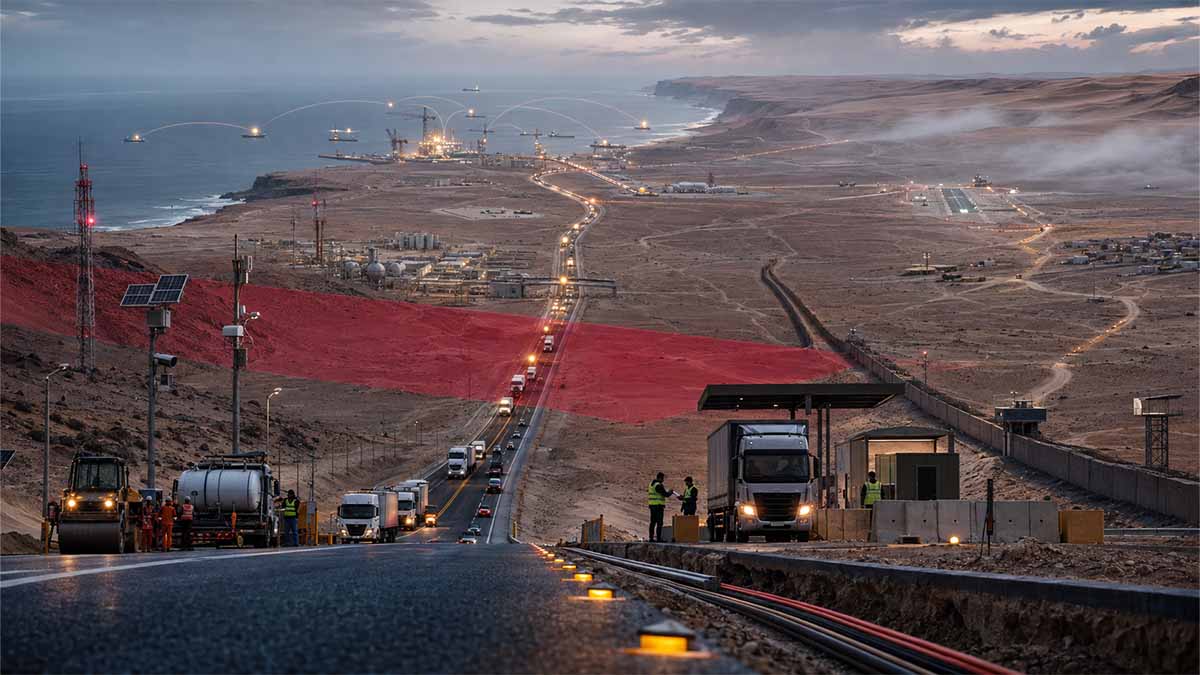
The 1,055-kilometre Tiznit–Dakhla expressway is an officially documented Moroccan infrastructure programme extending through Western Sahara.
The United Nations continues to classify Western Sahara as a Non-Self-Governing Territory whose final status remains unresolved.
The International Court of Justice found no territorial-sovereignty relationship capable of displacing Sahrawi self-determination.
The Court of Justice of the European Union requires the consent of the people of Western Sahara before EU–Morocco agreements can lawfully operate there.
Over 2026–2031, infrastructure, trade access, renewable energy and diplomatic recognition will increasingly function as mutually reinforcing instruments of territorial consolidation.
The most probable five-year outcome is prolonged legal non-resolution combined with deeper economic and infrastructural integration under Moroccan administration.
Western Sahara: The Road, the Mine and the Price of Recognition
A recent claim that Donald Trump had given his name to a highway crossing Western Sahara offered a perfect geopolitical image: an American president, a disputed territory and a road serving mines, ports and investment zones. Yet, as of 3 August 2026, no corresponding proclamation, decree or announcement appears in the White House or State Department records. The naming story is therefore unverified. The structure behind it is not. Since 2020, diplomatic recognition, Moroccan infrastructure, Israeli normalization, phosphate exports and renewable energy have combined to make Western Sahara progressively more integrated economically—even as its legal status remains unresolved. The real story is not the name attached to the asphalt. It is how asphalt, electricity, capital and trade are converting political support into territorial permanence.
The Recognition Exchange
On 10 December 2020, President Trump formally recognized Moroccan sovereignty over the entire Western Sahara and endorsed Rabat’s autonomy proposal as the basis for a solution. The decision accompanied Morocco’s restoration of official relations with Israel. Washington’s position was subsequently translated into administrative practice: on 16 December 2020, the State Department instructed US government cartographers to remove the boundary previously separating Morocco from Western Sahara—Morocco–Western Sahara Mapping Guidance, US Department of State, December 2020.
Israel completed the second stage in July 2023. Prime Minister Benjamin Netanyahu informed King Mohammed VI that Israel recognized Moroccan sovereignty over Western Sahara; the Israeli Prime Minister’s Office publicly confirmed the decision on 20 July—Israeli Prime Minister’s Office, July 2023.
These decisions did not transfer internationally recognized title. They changed the operating environment. Recognition lowers perceived political risk, encourages companies to rely on Moroccan licences and allows maps, databases, contracts and investment documents to treat the territory as part of Morocco. Sovereignty is not established by one declaration; it is normalized through thousands of administrative and commercial transactions built upon it.
The Asphalt Strategy
The principal physical instrument is the Tiznit–Dakhla expressway, a 1,055-kilometre corridor connecting southern Morocco with Laayoune and Dakhla. Morocco’s 2025 Economic and Financial Report valued the programme at 8.81 billion Moroccan dirhams and reported 95% completion—Moroccan Ministry of Economy and Finance, 2025 report.
The road is strategically more important than its cost suggests. It reduces journey times, facilitates the movement of officials and security forces, unlocks land around bypasses, connects industrial and tourism projects, and increases the value of ports, electricity grids and logistics zones. It also creates constituencies with a material interest in continuity: contractors, banks, utilities, exporters, property owners and foreign investors.
This is territorial path dependence. Every long-term concession, warehouse, grid connection and municipal expansion raises the cost of reversing Moroccan administration. A future settlement would no longer concern an abstract desert boundary. It would have to redistribute assets, contracts, public services, debt, property rights and infrastructure constructed under Moroccan law.
The Phosphate Machine
At Bou Craa, phosphate rock travels to the Atlantic on a 102-kilometre conveyor that OCP describes as the longest in the world—OCP Sustainability Integrated Report 2024. The conveyor is not simply a transport asset. It is the spine of an integrated mine-to-market system: extraction, crushing, processing, electricity, desalinated water, port loading, bulk shipping and trade finance.
OCP reported consolidated revenue of 96.989 billion dirhams in 2024 and EBITDA of 39.068 billion. In 2025, revenue rose to 113.943 billion dirhams—approximately 12.27 billion US dollars—while EBITDA reached 43.198 billion dirhams—OCP 2025 consolidated financial statements. Phosboucraa has been wholly owned by OCP since 2002—OCP Reference Document, February 2026.
The weakness is disclosure. OCP’s consolidated reporting does not provide an independently reconstructable Phosboucraa income statement detailing current Bou Craa production by grade, destination, transfer price, energy cost, operating margin, taxes and final distribution of value. OCP states that 100% of Phosboucraa’s profits are reinvested in the southern regions. But accounting profit is not equivalent to gross resource value: it depends on depreciation, financing costs, intragroup pricing and allocated overhead. Nor does regional expenditure automatically demonstrate that benefits accrue specifically to the Sahrawi people.
Power Behind the Mine
The resource system is increasingly powered by renewable energy. Nareva reports that the Foum El Oued wind farm, approximately 20 kilometres southwest of Laayoune, entered commercial operation in September 2013. Its installed capacity is 50 megawatts, annual production approximately 220 gigawatt-hours, and estimated avoided emissions about 150,000 tonnes of carbon dioxide per year—Nareva project portfolio.
Nareva’s wider EEM portfolio operates 850 megawatts across Foum El Oued, Haouma, Akhfennir and Aftissat and produces more than 3.5 terawatt-hours annually. The Aftissat complex alone totals 550 megawatts.
Renewables strengthen the economic case for phosphate by lowering carbon intensity and improving access to sustainability-linked capital. They also deepen political lock-in. Wind licences, land rights, power-purchase agreements and industrial offtake contracts can last decades. The public record establishes Foum El Oued’s capacity and ownership, but not the complete tariff, contract duration or precise electricity allocation to Phosboucraa. Without those data, claims about the exact private return generated from each tonne of phosphate remain unverified.
Water creates a similar dependency. OCP disclosed a dedicated Phosboucraa desalination installation with annual capacity of 1.4 million cubic metres and plans for additional treatment infrastructure—OCP Phosboucraa Water Programme. Desalination can benefit residents while supporting mineral processing. The unresolved accounting question is how capital costs, electricity, industrial consumption and municipal supply are allocated.
The Atlantic Gateway
Laayoune port converts territorially specific rock into globally tradable cargo. Morocco’s National Ports Agency recorded traffic of 1.391 million tonnes in the first half of 2025, compared with 942,000 tonnes in the same period of 2024: an increase of 47.6%. Across ports managed by the agency, phosphate exports rose from 2.5 million to 3.4 million tonnes, up 35.2%, while fertilizer exports increased from 5.7 million to 5.9 million tonnes—ANP Half-Year Financial Report 2025.
The agency reported the new Laayoune phosphate port at 98.88% completion, with investment of 4.5 billion dirhams. A further commercial-port extension, then under study, was valued at approximately 730 million dirhams—ANP Laayoune project portfolio.
Mine, conveyor, wind generation, desalination and port form a single resource architecture. Its strategic purpose is resilience: removing logistics bottlenecks, increasing export capacity and making the territory indispensable to a larger Atlantic industrial system.
Two Markets, Two Legal Geographies
Washington’s recognition has not guaranteed unrestricted commercial access. In April 2021, the United States imposed countervailing duties on Moroccan and Russian phosphate fertilizers after the Department of Commerce identified subsidization and the International Trade Commission found material injury to American producers—US Department of Commerce, April 2021.
Following litigation, Commerce recorded an amended OCP subsidy rate of approximately 2.12% for the reviewed 2020–2021 period. In March 2026, the USITC opened the mandatory five-year review to determine whether revoking the orders would allow injury to recur—USITC review, March 2026.
Europe presents the opposite configuration: stronger economic integration with Morocco, but a far more restrictive territorial jurisprudence. On 4 October 2024, the Court of Justice of the European Union ruled that the 2019 EU–Morocco agricultural and fisheries agreements had been concluded without the consent of the people of Western Sahara. Consultation of current inhabitants was insufficient because many Sahrawis live outside the territory.
The Court held that consent could be presumed only if an agreement imposed no obligation on the Sahrawi people and delivered a “specific, tangible, substantial and verifiable” benefit proportional to resource exploitation—CJEU judgments, October 2024. In a parallel ruling, it required products harvested in Western Sahara to identify Western Sahara alone—not Morocco—as their country of origin.
The result is a divided commercial map. A cargo may be treated as Moroccan in the United States yet require separate territorial provenance in Europe. Companies face incompatible assumptions concerning origin, consent, tariffs and lawful authorization.
The Consent Deficit
The legal issue is more precise than the assertion that every act of extraction is automatically unlawful. In January 2002, UN Legal Counsel Hans Corell concluded that resource activity in a Non-Self-Governing Territory must be assessed according to the interests and wishes of its people. Exploitation conducted in disregard of those interests and wishes would violate the applicable principles of international law—UN document S/2002/161, January 2002.
“Interests” and “wishes” are separate tests. Employment, infrastructure and social programmes concern material benefit. Consent concerns political agency. Roads, schools, desalination and local investment cannot alone prove that the Sahrawi people authorized extraction.
A durable arrangement would require mine-level production accounts, cargo traceability, audited related-party transactions, environmental monitoring and a proportional benefit mechanism governed with Sahrawi participation, including communities outside the territory. Such a mechanism could operate without prejudicing final sovereignty. Morocco could preserve its claim; Sahrawi representatives could participate without recognizing Moroccan title; external markets could trade without treating commerce as territorial recognition.
The 2031 Test
The United Nations continues to describe Western Sahara as a conflict marked by tensions and low-intensity hostilities. Security Council Resolution 2797 extended MINURSO until 31 October 2026 and requested a strategic review of the mission—UN Security Council Resolution 2797, October 2025.
By 2031, the most probable outcome is neither universally recognized Moroccan sovereignty nor termination of resource activity. It is deeper functional integration under continuing legal dispute. Morocco will probably control a more valuable and interconnected corridor; OCP will remain financially resilient; European litigation and origin requirements will raise compliance costs; and the United States will continue separating diplomatic recognition from trade-remedy law.
The greatest corporate danger is a compound shock: infrastructure disruption, cyber compromise, adverse customs decisions and refinancing pressure occurring together. The greatest political danger is more subtle. Each investment strengthens operational permanence while enlarging the unresolved liability attached to consent.
The road matters because it connects the system. The decisive question is not whose name appears on it, but whether the people whose territory it crosses will ever be allowed to determine the terms on which its wealth moves.
Navigational Index
- Sovereignty engineering — recognition, infrastructure and the conversion of diplomatic support into territorial permanence.
- Resource architecture — phosphate, energy, logistics, trade access and the unresolved question of Sahrawi consent.
- Five-year risk horizon — legal fragmentation, corporate exposure, regional escalation and competing 2031 scenarios.
Master Abstract
The evidentiary starting point materially changes the analysis. Searches of the official repositories of the White House, US Department of State, US Government Publishing Office, Moroccan ministries, the Israeli government, the United Nations and European judicial institutions produced no primary-source confirmation that President Trump announced on 26 July 2026 that a highway in Western Sahara would carry his name. Because the originating assertion is attributed to a social-media video—and the governing protocol excludes social media—the alleged naming cannot be elevated into the factual baseline without an independently published presidential instrument, government communiqué, road-designation decree or equivalent official record. This does not invalidate analysis of the political system surrounding the claim; it requires the naming allegation to be isolated as hypothesis H₁, with a low evidentiary confidence pending authentication. The documented foundation is stronger and more consequential. On 10 December 2020, the United States formally recognized Moroccan sovereignty over the entire territory and declared support for Morocco’s autonomy proposal—Proclamation on Recognizing the Sovereignty of the Kingdom of Morocco over the Western Sahara – President of the United States/US Department of State – December 2020 — verified primary source. The trilateral declaration linked that American decision to the restoration of Morocco–Israel relations—Joint Declaration – Kingdom of Morocco, United States of America and State of Israel – December 2020 — verified primary document. In July 2023, the Israeli government publicly confirmed Israel’s recognition of Moroccan sovereignty over Western Sahara—Moroccan King Mohammed VI Invites Prime Minister Netanyahu to Morocco – Prime Minister’s Office, State of Israel – July 2023 — verified primary source. These acts establish a sequential recognition structure, but they do not settle the territory’s international legal status or prove that recognition was exchanged for any specific mine, road, energy concession or commercial transaction.
Infrastructure is the system’s most visible mechanism because it can change economic geography without resolving sovereignty. Morocco’s Ministry of Equipment describes the Tiznit–Dakhla expressway as a continuous north–south corridor involving road widening, bypasses, bridges and safety works—Le projet de la voie express Tiznit–Dakhla – Ministère de l’Équipement et de l’Eau, Royaume du Maroc – official project record — verified primary source. Morocco’s 2025 Economic and Financial Report records a length of 1,055 kilometres, a global cost of 8.81 billion MAD, and 95% physical completion at the reporting point—Rapport économique et financier 2025 – Ministère de l’Économie et des Finances, Royaume du Maroc – October 2024 — verified primary report. These official figures do not validate the alternative cost of 10 billion MAD, the asserted 2015 contractual origin, alleged overbilling, or a Trump designation; those propositions require separate primary records. Strategically, however, the corridor compresses travel time, expands administrative reach, reduces logistics friction between Tiznit, Laayoune and Dakhla, raises the potential value of ports and industrial zones, and increases the economic cost of any reversal of Moroccan control. That is territorial path dependence: every additional logistics asset creates constituencies—contractors, exporters, utilities, financiers, settlers and foreign counterparties—whose commercial expectations become aligned with continuity. The legal counterweight remains substantial. The International Court of Justice concluded in 1975 that the materials before it did not establish territorial sovereignty ties between Western Sahara and Morocco capable of affecting the application of self-determination—Western Sahara, Advisory Opinion – International Court of Justice – October 1975 — verified case record. The United Nations continues to place Western Sahara within its decolonization framework—Western Sahara, Non-Self-Governing Territory – United Nations Department of Political and Peacebuilding Affairs — verified institutional record. Consequently, asphalt can consolidate control and alter bargaining power, but it cannot, by itself, extinguish the distinct legal personality of the territory or the Sahrawi right to self-determination.
Resource governance is where diplomatic recognition, infrastructure and corporate exposure intersect, but evidentiary discipline requires rejecting several categorical formulations in the supplied thesis. Officially verified sources in this review do not establish that every tonne of Bou Craa phosphate is “stolen,” that a royal company captures a specified margin from each exported tonne, that an Israeli entity holds a defined offshore block connected to the expressway, or that a 2026 US emergency created unlimited duty-free Moroccan fertilizer access. Those claims cannot enter the validated model until supported by the exact court judgment, audited ownership records, concession instrument, tariff proclamation and customs determination. What is legally established at European level is highly significant: the Court of Justice of the European Union held that implementation of the 2019 EU–Morocco agricultural and fisheries agreements in Western Sahara required the consent of the people of Western Sahara; consultation of current residents was not equivalent to obtaining that consent, particularly because a substantial part of the Sahrawi people lives outside the territory. The Court also found that consent could not be presumed where the agreements supplied no proportionate rights or financial benefits to that people—Western Sahara: the 2019 EU–Morocco Trade Agreements Were Concluded in Breach of the Principles of Self-Determination and the Relative Effect of Treaties – Court of Justice of the European Union – October 2024 — verified judicial summary. This generates a structural divergence: American and Israeli executive recognition supports Moroccan sovereignty claims, while UN decolonization doctrine and binding EU jurisprudence preserve the territory’s separate status and impose a consent test on economic agreements. The five-year outlook therefore turns on five competing hypotheses: H₁, symbolic American endorsement escalates into explicit infrastructure naming; H₂, Morocco achieves functional annexation without universal legal recognition; H₃, judicial and commercial pressure forces ring-fenced benefit-sharing or provenance controls; H₄, armed and cyber disruption increases the cost of the corridor-resource system; and H₅, renewed UN diplomacy produces an interim political arrangement. A calibrated prior assigns the greatest probability to H₂, because infrastructure completion and bilateral recognition create momentum, while the absence of a mutually accepted status settlement, the CJEU consent rule and continuing UN engagement sharply limit the probability of universally recognized sovereignty before 2031.
Sovereignty–Resource Risk Engine
Sovereignty Engineering in Western Sahara: Recognition, Infrastructure and Territorial Permanence
Recognition does not transfer title, but it changes the operating environment
Sovereignty engineering describes the deliberate conversion of political support into administrative, material, commercial and cartographic facts that make a disputed territorial arrangement progressively more difficult to reverse. In Western Sahara, the mechanism does not depend on a single diplomatic act, road, port, mine or foreign investment. It operates through accumulation. Diplomatic recognition lowers the political cost of economic engagement; infrastructure transforms engagement into physical connectivity; administrative standardization integrates taxation, licensing, customs, energy and public services; foreign commercial participation creates third-country stakeholders; and the resulting network increases the financial, logistical and political cost of restoring a genuinely open status process. The decisive distinction is between juridical sovereignty, which remains unresolved within the United Nations decolonization framework, and functional sovereignty, which measures who builds roads, licenses projects, supplies electricity, polices trade corridors, registers property, administers ports and determines the territory’s external economic relationships. The United States moved the diplomatic component sharply in Morocco’s direction on 10 December 2020, formally recognizing Moroccan sovereignty over the entire territory and supporting Morocco’s autonomy proposal—Proclamation on Recognizing the Sovereignty of the Kingdom of Morocco over the Western Sahara – President of the United States/US Department of State – December 2020 — verified primary source. The State Department subsequently instructed US government cartographers to remove the boundary previously separating Morocco and Western Sahara—Morocco–Western Sahara: Mapping Guidance, Bulletin No. 38 – Office of the Geographer and Global Issues, US Department of State – December 2020 — verified primary document. This did not create an internationally binding transfer of title. It nevertheless changed the informational infrastructure through which one permanent member of the UN Security Council represents the territory, demonstrating how recognition can migrate from foreign-policy declaration into maps, databases, risk assessments, procurement assumptions and corporate due-diligence practices.
The 2020 decision also embedded Western Sahara inside a wider triangular arrangement involving Morocco, Israel and the United States. The verified evidence establishes diplomatic linkage but does not, by itself, prove that particular mines, wind farms, offshore concessions, fertilizer shipments or road contracts constituted negotiated consideration. The trilateral declaration recorded Morocco’s resumption of official contacts and direct relations with Israel alongside the US position on Western Sahara—Joint Declaration of the Kingdom of Morocco, United States of America and State of Israel – Governments of Morocco, the United States and Israel – December 2020 — verified primary document. Israel then supplied a second recognition layer in July 2023, when its government confirmed that Prime Minister Benjamin Netanyahu had recognized Moroccan sovereignty over Western Sahara and that King Mohammed VI had acknowledged the decision—Moroccan King Mohammed VI Invites Prime Minister Netanyahu to Morocco – Prime Minister’s Office, State of Israel – July 2023 — verified primary source. The importance of sequencing lies in coalition formation. A unilateral US recognition might remain an isolated departure from established diplomatic practice; the addition of Israeli recognition creates a small but operational recognition bloc linked by security, technology, intelligence, tourism and commercial relationships. Each new bilateral instrument can normalize the assumption that Moroccan law and authorization are sufficient for transactions conducted in the territory, even while other jurisdictions reject that premise. Sovereignty engineering therefore works less like a treaty transferring territory and more like a network protocol: once enough diplomatic, financial and logistical actors configure their systems around a particular territorial assumption, reversal becomes expensive. The legal dispute remains intact, but the operational environment begins behaving as though one answer has already prevailed. This is precisely why official recognition, mapping standards, airline routes, customs codes, investment guarantees and project-finance documentation should be tracked together rather than as separate diplomatic or economic events.
| Recognition layer | Verified action | Immediate operational effect | What it does not legally establish | Five-year significance |
|---|---|---|---|---|
| United States | Recognition of Moroccan sovereignty, 10 December 2020 | Political backing for Moroccan administration and autonomy proposal | A multilateral transfer of title or Sahrawi consent | Anchor for further bilateral alignment |
| US cartography | Removal of the internal boundary from official US maps | Administrative normalization across government information systems | Binding effect on UN, EU or other states | Diffusion into databases, trade tools and risk models |
| Morocco–Israel normalization | Restoration of official relations | Security, technology, investment and diplomatic channels | Proof that any individual commercial asset formed part of the exchange | Expands third-party participation incentives |
| Israel | Recognition of Moroccan sovereignty, July 2023 | Second state-level recognition within the normalization architecture | Resolution of the UN decolonization process | Creates a repeatable recognition-for-access precedent |
| United Nations | Continued treatment as a Non-Self-Governing Territory | Preserves self-determination and political-process framework | Acceptance of Moroccan sovereignty | Maintains legal and diplomatic counter-pressure |
| European Union judiciary | Requirement of Sahrawi consent for applicable agreements | Corporate, customs, labelling and treaty risk | Automatic prohibition of every economic activity | Makes European integration conditional and litigable |
The legal counter-architecture prevents recognition from becoming universal sovereignty
The legal architecture remains fundamentally resistant to the proposition that bilateral recognition alone can determine Western Sahara’s final status. In its 16 October 1975 advisory opinion, the International Court of Justice found that the evidence did not establish territorial sovereignty ties between Western Sahara and either Morocco or the Mauritanian entity capable of affecting the application of self-determination through the free and genuine expression of the will of the territory’s people—Western Sahara, Advisory Opinion – International Court of Justice – October 1975 — verified primary case record. The United Nations continues to list Western Sahara as a Non-Self-Governing Territory, maintaining the question inside the decolonization system rather than treating it as an ordinary Moroccan province—Western Sahara – United Nations Department of Political and Peacebuilding Affairs/Decolonization – current institutional record — verified primary source. Most recently, Security Council Resolution 2797, adopted in 2025, extended the mandate of the United Nations Mission for the Referendum in Western Sahara, MINURSO, until 31 October 2026—Resolution 2797 (2025) – United Nations Security Council – October 2025 — verified multilingual UN record. The availability of the same resolution in Chinese, Russian, Arabic, French, Spanish and English is analytically relevant because it confirms that the operative UN framework remains a collectively maintained international instrument, not a Western secondary interpretation. The resolution’s Chinese-language UN record is available as Security Council Resolution 2797 – United Nations – October 2025 — verified Chinese-language primary record, while the Russian-language implementation correspondence is available as S/2025/764 – United Nations Security Council – November 2025 — verified Russian-language primary document. No suitably precise standalone document located on the Chinese Foreign Ministry domain established a distinct 2026 Chinese recognition policy; under the governing evidentiary protocol, no broader Chinese position is inferred beyond official UN conduct.
The strongest contemporary judicial barrier to functional annexation through trade is the 4 October 2024 judgment of the Court of Justice of the European Union. The Court held that the people of Western Sahara—not merely the population presently residing there—must consent to the application of EU–Morocco agricultural and fisheries agreements in the territory. It specifically determined that consultation of current inhabitants could not substitute for consent by the Sahrawi people, a substantial part of whom lives outside the territory. The Court further clarified that consent might be presumed only under constrained conditions: the agreement must impose no obligation on the Sahrawi people and must provide them with a specific, tangible, substantial and verifiable benefit proportional to the exploitation of the territory’s natural resources. The agreements examined did not satisfy that test because they provided no corresponding rights, benefits or financial contribution to the Sahrawi people—Western Sahara: the 2019 EU–Morocco Trade Agreements Were Concluded in Breach of the Principles of Self-Determination and the Relative Effect of Treaties – Court of Justice of the European Union – October 2024 — verified primary judicial record. The same judicial release states that products harvested in Western Sahara must identify Western Sahara alone, excluding Morocco, as the country of origin. This creates a legally significant fracture between diplomatic and commercial geographies. Washington may map the territory as Moroccan; an EU importer may nevertheless face an origin, consent or treaty-validity problem if the underlying product comes from Western Sahara. Sovereignty engineering is therefore neither linear nor globally uniform. It generates a patchwork in which Moroccan administrative control may be deep, US recognition supportive, Israeli participation politically enabled, UN status unresolved and EU market access judicially constrained. That fragmentation is likely to define the 2026–2031 period more decisively than any single diplomatic statement.
| Jurisdictional system | Territorial treatment | Controlling principle | Exposure created for external actors |
|---|---|---|---|
| Moroccan administration | Territory incorporated into national development and administrative planning | Sovereignty and autonomy under Moroccan authority | Reliance on Moroccan licences and public contracts |
| United States executive branch | Moroccan sovereignty recognized | Bilateral executive recognition | Political support, altered maps and lower perceived diplomatic risk |
| Israeli executive branch | Moroccan sovereignty recognized | Bilateral recognition following normalization | Facilitated official and commercial engagement |
| United Nations | Non-Self-Governing Territory with unresolved final status | Self-determination and UN-facilitated political solution | Continuing status uncertainty and reputational scrutiny |
| International Court of Justice | No sovereignty ties sufficient to displace self-determination | Free and genuine expression of the people’s will | Weakens claims that historical allegiance conclusively settled title |
| Court of Justice of the European Union | Territory legally distinct for agreement and origin purposes | Consent, relative effect of treaties, accurate origin | Litigation, customs, labelling and agreement-validity risk |
| Russian official diplomacy | Supports a UN-centered settlement and treats autonomy as Morocco’s interpretation of self-determination | Negotiated settlement under UN parameters | Limits expectation of automatic recognition convergence |
| Chinese evidentiary baseline | No verified standalone recognition shift identified in reviewed official material | UN Security Council framework remains the validated reference | Strategic caution; no justified inference of recognition |
The expressway converts policy into physical path dependence
The Tiznit–Dakhla expressway is the central physical instrument in this sovereignty-engineering system because it integrates territories through mobility rather than through legal adjudication. Morocco’s Ministry of Equipment officially describes a project extending across approximately 1,055 kilometres, incorporating widening, reconstruction, bypasses, bridges and related safety infrastructure—Le projet de la voie express Tiznit–Dakhla – Ministère de l’Équipement et de l’Eau, Royaume du Maroc – official project record — verified primary source. Morocco’s Economic and Financial Report for 2025 records a total projected cost of 8.81 billion MAD and a reported physical completion rate of 95% at the report’s measurement point—Rapport économique et financier 2025 – Ministère de l’Économie et des Finances, Royaume du Maroc – 2024 publication cycle — verified primary report. The official figures are more defensible than the unverified alternatives contained in the initiating narrative: although Moroccan official communications have at times referred to approximately 10 billion MAD, the 8.81-billion figure is the most specific verified finance-ministry estimate used here. Infrastructure becomes a sovereignty multiplier through at least eight channels. It reduces the cost of deploying officials and security forces; brings peripheral municipalities into national logistics and procurement systems; raises land values around interchanges and urban bypasses; improves access to ports, industrial areas and tourism projects; supports electricity and telecommunications corridors; integrates food and construction-material supply chains; increases the economic dependence of local businesses on northbound markets; and enables population mobility at a scale that can alter the territory’s demographic and commercial structure. None of these effects independently settles title. Together, however, they create infrastructural lock-in: local economic life becomes calibrated to the continuity of Moroccan administration, while any alternative future authority would inherit assets, obligations, contracts and settlement patterns designed within Moroccan law.
Diplomatic Recognition & Institutional Lock-In Chain
Interactive causal chain mapping how diplomatic recognition translates through dual capital/infrastructure vectors into irreversible institutional path dependence.
The corridor’s strategic importance cannot be measured only through traffic volumes, journey-time savings or construction expenditure. Its greater effect is topological: it reorganizes the territory from a distant, sparsely connected space into a continuous national development axis linked to southern Morocco and the Atlantic-facing Dakhla platform. Once a road becomes the spine for power lines, fibre, fuel distribution, security mobility, urban expansion and port-bound cargo, the state’s territorial presence is reproduced every day through ordinary logistics. This is more durable than a ceremonial declaration because it embeds control in recurring transactions. A lorry licence, municipal building permit, warehouse lease, grid connection, insurance policy and customs declaration can each encode the same territorial assumption without explicitly debating sovereignty. The network also redistributes political leverage. Businesses benefiting from the corridor acquire incentives to support regulatory continuity; national contractors develop sunk costs; foreign partners seek protection for projects; banks price credit around the enforceability of Moroccan contracts; and local administrations become operationally dependent on budgetary transfers and technical systems emanating from Rabat. The result is a constituency cascade in which the number of actors materially invested in continuity grows faster than the number formally endorsing sovereignty. This does not mean that every local resident benefits equally or that infrastructure proves consent. The CJEU’s jurisprudence makes precisely that distinction: economic activity or aggregate development cannot automatically substitute for consent by the people holding the right to self-determination. Nevertheless, from a strategic rather than normative perspective, infrastructure can narrow the feasible political solution set. By 2031, any negotiated outcome will have to address not an empty map but an integrated corridor containing public assets, private rights, energy systems, urban expansions, tax relationships and cross-border commercial expectations.
| Infrastructure mechanism | Operational function | Sovereignty-engineering effect | Primary indicator for 2026–2031 | Reversibility |
|---|---|---|---|---|
| Expressway completion | Continuous high-capacity road access | Integrates the territory into Moroccan national mobility | Completed kilometres; maintenance budgets; traffic | Low after full operation |
| Urban bypasses | Redirects freight and unlocks peripheral land | Expands urban footprint under Moroccan planning law | Building permits; serviced land; logistics parks | Low to medium |
| Bridges and structures | Removes seasonal and terrain bottlenecks | Makes state and commercial access persistent | Availability rate; closure days | Low |
| Port connectivity | Links inland production and settlement nodes to export routes | Internationalizes the economic benefits of control | Cargo, vessel calls, bonded capacity | Medium |
| Grid expansion | Supports mines, desalination, cities and industry | Converts resource activity into long-term utility dependence | Megawatts connected; grid ownership; offtake duration | Low |
| Fibre and telecoms | Integrates administrative and commercial data | Extends licensing, surveillance and service platforms | Coverage, backbone routes, data centres | Medium |
| Security mobility | Accelerates movement of personnel and equipment | Raises the state’s enforcement reach | Deployment time; permanent facilities | Medium |
| Tourism and real estate | Attracts mobile capital and foreign users | Produces additional stakeholders favoring continuity | Beds, permits, transactions, foreign participation | Medium to low |
Administrative normalization is the hidden layer of territorial permanence
The least visible but potentially most decisive dimension is the conversion of territorial control into interoperable administrative systems. Sovereignty is performed not only by flags and military presence but through registries, cadastral records, vehicle plates, banking compliance, postal addresses, school curricula, corporate identifiers, customs nomenclature, mobile-network licensing, environmental permits and court jurisdiction. When these systems are integrated with the controlling state, they produce thousands of low-level confirmations of authority that are difficult to unwind collectively. The US mapping bulletin illustrates the external equivalent: once an official government removes a boundary from its maps, that representation can propagate into briefing documents, geographic information systems, trade-promotion tools and security planning. Morocco’s road programme supplies the internal physical substrate on which comparable administrative integration can operate. The five-year OSINT requirement is therefore to monitor not merely high-profile recognitions but schema convergence—whether territorial records use the same institutional codes, databases and licensing processes as undisputed Moroccan regions. High-value indicators include the legal domicile of project companies; cadastral authority over industrial and tourism land; courts specified in concession and finance agreements; tax offices receiving corporate payments; customs origin codes attached to exports; grid operators issuing connections; telecom regulators allocating spectrum; and government procurement systems publishing tenders. Each indicator should be assigned an evidentiary grade. A ministerial decree, audited financial statement, court judgment or concession instrument should receive greater weight than an investment announcement. Absence of separate territorial accounting should not automatically be interpreted as evidence of Moroccan ownership; it may instead reveal deliberate administrative absorption. Conversely, Morocco’s provision of public services cannot be treated as proof of Sahrawi consent. The analytical problem is to measure control density without confusing effective administration with lawful title.
| Indicator family | Collection target | Evidentiary value | Warning threshold |
|---|---|---|---|
| Cadastre | Registry authority, title format, parcel transfers | Very high | Rapid conversion of public or collective land |
| Corporate law | Project domicile, beneficial owner, governing law | High | Foreign SPVs accepting Moroccan territorial jurisdiction |
| Public finance | Regional allocations, tax receipts, guarantees | High | Long-dated sovereign guarantees extending beyond 2031 |
| Customs | Origin declarations, export office, tariff treatment | Very high | Systematic Morocco-origin designation contrary to EU rules |
| Energy | Generation licence, offtake buyer, grid code | High | Twenty-year or longer take-or-pay contracts |
| Ports | Concession term, operator, customs zone | Very high | Foreign financing secured on future territorial revenues |
| Population systems | Civil registry, electoral rolls, addresses | High but sensitive | Accelerated administrative incorporation without status safeguards |
| Digital systems | Fibre routes, data hosting, identity interoperability | Medium to high | Centralized dependency with no autonomous fallback |
| Security | Bases, surveillance assets, mobility corridors | High | Permanent expansion around economic nodes |
| International mapping | Boundary representation by foreign governments | High | Additional states adopting the US cartographic position |
Recognition coalitions, external powers and the limits of convergence
The international environment is unlikely to produce universal recognition by 2031, but selective convergence could still strengthen Moroccan functional permanence. Washington’s recognition has high strategic weight because the United States is a permanent member of the Security Council, a major security partner and an influential source of investment-risk signaling. Israel adds capabilities in security technology, agriculture, water management, energy and digital systems, although no individual project should be attributed to the recognition bargain without a verified primary instrument. France and other European actors may deepen bilateral alignment, but European Union institutions remain constrained by the CJEU’s consent and origin jurisprudence. Russia occupies a deliberately differentiated position. In October 2025, Foreign Minister Sergey Lavrov stated that Morocco had not abandoned self-determination but understood it through autonomy, presenting that formulation as Morocco’s position rather than Russian recognition of sovereignty—Foreign Minister Sergey Lavrov’s Statement and Answers to Arab Media Questions – Ministry of Foreign Affairs of the Russian Federation – October 2025 — verified official Russian source. This preserves Moscow’s capacity to cooperate with Rabat while retaining diplomatic relationships with Algeria and avoiding endorsement of a precedent that could complicate Russian positions on other territorial disputes. China faces a comparable incentive structure: Morocco offers trade, infrastructure and Atlantic access, but a categorical recognition shift would carry costs for Beijing’s long-standing emphasis on UN processes and non-interference. Because no precise Chinese Foreign Ministry statement meeting the requested evidentiary threshold was located in the reviewed material, this assessment remains an inference from institutional incentives, not a claimed Chinese policy. The most plausible coalition pattern is therefore layered rather than binary: a compact group may recognize Moroccan sovereignty; a wider group may support autonomy as serious or realistic without formal recognition; another group will insist on self-determination; and major powers may preserve ambiguity while expanding commercial relations. Morocco can gain functional benefits from all four categories, provided foreign actors accept Moroccan licences and infrastructure even when withholding juridical recognition.
| External actor | Verified baseline | Likely 2026–2031 behavior | Sovereignty effect | Confidence |
|---|---|---|---|---|
| United States | Formal recognition and altered mapping | Maintain recognition; deepen bilateral implementation | Strong positive | High |
| Israel | Formal recognition confirmed in 2023 | Expand state and commercial engagement where politically viable | Positive | Medium-high |
| European Union | Bound by CJEU consent and origin requirements | Seek legally defensible trade arrangements; continued litigation risk | Constraining | High |
| United Nations | Territory remains under decolonization framework; MINURSO extended | Preserve political process and unresolved-status language | Strong legal constraint | High |
| Russia | UN-centered settlement; autonomy described as Moroccan interpretation | Balance Morocco and Algeria; avoid categorical convergence | Neutral to mildly constraining | Medium-high |
| China | No verified recognition shift identified | Commercial pragmatism with diplomatic caution | Indeterminate | Medium-low |
| Algeria | Strategic sponsor of Sahrawi self-determination position | Resist regional normalization of Moroccan sovereignty | Strongly constraining | High |
| Foreign corporations | Mixed jurisdictional exposure | Segment operations by destination market and legal risk | Functional positive, legal variable | Medium |
Shadow dimensions: capital, cyber systems, security contractors and informational normalization
The shadow system surrounding sovereignty engineering should be analyzed as a set of enabling markets rather than through unsupported allegations about clandestine control. The first market is liquidity transformation. Long-lived infrastructure becomes politically durable when financed through sovereign budgets, state-owned enterprises, export-credit mechanisms, project-finance vehicles or foreign direct investment whose repayment depends on continuing Moroccan administration. The critical variables are not merely investment totals but maturity, governing law, collateral and revenue source. A five-year construction contract is reversible; a twenty-five-year port concession, renewable-energy offtake agreement or desalination contract creates obligations that outlast governments and diplomatic cycles. The second market is risk intermediation. Insurers, banks, auditors, ratings providers and compliance departments decide whether territorial ambiguity is priced, disclosed or ignored. If documentation lists project location simply as Morocco, functional normalization advances; if lenders demand separate Western Sahara disclosure, consent warranties or political-risk exclusions, legal distinctness remains commercially visible. The third dimension is cyber-administrative control. Fibre backbones, identity databases, port-community systems, electronic customs, geospatial monitoring and telecommunications platforms allow central authorities to administer territory at far lower marginal cost than physical occupation alone. Their ownership, hosting location, encryption-key control, audit rights and interoperability deserve systematic collection. The fourth dimension concerns private security and military-adjacent contractors. No compliant evidence reviewed here supports assigning a specific mercenary force to the corridor, so the correct intelligence task is indicator-based: procurement of perimeter surveillance, unmanned systems, counter-drone equipment, satellite services, maritime-domain awareness and critical-infrastructure protection. The fifth dimension is narrative automation. Cartographic changes, machine-readable addresses, origin codes and AI-generated geographic summaries can reproduce a territorial claim at scale. Once embedded in digital systems, the claim may appear neutral and technical even though it reflects a disputed policy decision.
| Shadow dimension | Observable variable | Benign explanation | High-risk interpretation | Required primary evidence |
|---|---|---|---|---|
| Liquidity | Loan maturity and collateral | Ordinary infrastructure finance | Revenues locked into long-term political control | Audited accounts, prospectus, guarantee |
| Insurance | Territorial exclusions and premiums | Standard conflict pricing | Market quietly recognizes unresolved status | Policy wording, regulator filing |
| Cyber administration | Hosting and identity-system ownership | Service modernization | Centralized surveillance and dependency | Procurement record, regulator licence |
| Private security | Surveillance and protection contracts | Critical-infrastructure defence | Militarization of commercial corridors | Tender, end-user certificate, budget |
| Maritime systems | Port and vessel-monitoring integration | Safety and trade efficiency | Expanded territorial enforcement | Port concession, maritime authority record |
| Data geography | Address and boundary schemas | Technical harmonization | Automated erasure of territorial distinction | Mapping guidance, API documentation |
| Corporate reporting | Location terminology | Simplified disclosure | Concealment of jurisdictional exposure | Audited annual report, ESG annex |
| Benefit allocation | Revenue recipients and social expenditure | Regional development | Benefits accrue without Sahrawi agency or consent | Budget, independent audit, distribution mechanism |
Structured Analysis of Competing Hypotheses
The Analysis of Competing Hypotheses must distinguish between outcomes that appear similar on the ground but arise through different causal mechanisms. H₁ anticipates progressive international convergence toward formal Moroccan sovereignty; H₂ expects functional permanence without universal legal recognition; H₃ anticipates constrained integration under a new consent, benefit-sharing and provenance architecture; H₄ projects disruption through renewed armed conflict, sabotage, cyber operations or regional escalation; and H₅ anticipates a negotiated interim framework that freezes final-status disagreement while establishing shared or internationally supervised governance arrangements. Five separate structural techniques were applied: key-assumptions checking, to expose dependence on continuing US recognition and Moroccan fiscal capacity; indicators-and-warnings analysis, to connect each hypothesis to observable decisions; red-team analysis, to test whether infrastructure produces legitimacy or only higher-value targets; premortem analysis, to identify why the dominant forecast could fail; and high-impact/low-probability analysis, focused on abrupt US policy reversal, major Algeria–Morocco escalation, judicially driven exclusion from EU markets or a negotiated status breakthrough. The evidence most strongly supports H₂. The expressway, administrative integration and recognition coalition raise functional-control durability, while UN status and EU jurisprudence prevent straightforward legal closure. H₁ remains possible but requires additional major states to move from support for autonomy to formal sovereignty recognition. H₃ becomes more likely if European market access remains economically indispensable and the CJEU consent test produces auditable benefit mechanisms. H₄ depends on escalation indicators, including infrastructure attacks, militarized procurement and intensified regional confrontation. H₅ remains the least structurally supported because the infrastructure and diplomatic balance currently reward delay more than compromise.
| Hypothesis | Description | Prior | Updated 2026 baseline | Most diagnostic confirming indicator | Most diagnostic disconfirming indicator |
|---|---|---|---|---|---|
| H₁ | Formal recognition coalition expands toward legal convergence | 18% | 13% | Two or more major powers formally recognize sovereignty | Major partner explicitly reaffirms separate territorial status |
| H₂ | Functional permanence deepens while legal status remains unresolved | 43% | 57% | Infrastructure and foreign contracts expand without settlement | Administrative decoupling or sustained capital withdrawal |
| H₃ | Consent, benefit-sharing and origin controls constrain integration | 17% | 15% | Audited Sahrawi-specific benefit and consent architecture | Trade agreements bypass or neutralize judicial requirements |
| H₄ | Security escalation materially disrupts the corridor system | 14% | 10% | Repeated attacks, insurance exclusions, security surge | Sustained de-escalation and falling security expenditure |
| H₅ | Negotiated interim status or shared governance emerges | 8% | 5% | Agreed talks with timetable, guarantees and implementation body | Continued unilateral investment without political concessions |
The Bayesian update is qualitative-quantitative rather than a claim of statistical frequency derived from historical territorial disputes. The priors represent structured analyst judgment as of the beginning of the 2020 recognition cycle; likelihood adjustments reflect the US proclamation, cartographic normalization, Israeli recognition, expressway completion trajectory, continued MINURSO mandate and the 2024 CJEU judgments. Evidence E₁, US formal recognition, raises H₁ and H₂ but is more diagnostic for H₂ because no broad recognition cascade immediately followed. Evidence E₂, Israeli recognition, again supports H₁ and H₂, with greater weight assigned to functional coalition building. Evidence E₃, the expressway’s near completion, strongly raises H₂ by increasing physical and economic path dependence. Evidence E₄, continued UN classification and MINURSO operation, reduces H₁ and supports continued ambiguity under H₂. Evidence E₅, the CJEU consent and origin requirements, raises H₃ and reduces H₁ without reversing Moroccan control. Evidence E₆, the absence of a verified official record for the alleged Trump highway naming, prevents that claim from increasing H₁. The model therefore produces a 57% baseline probability for functional permanence under unresolved legal status by 2031. These percentages should be treated as disciplined comparative estimates, not empirically observed probabilities. Their analytical value lies in forcing explicit assumptions and enabling updates. A verified presidential road-designation instrument would raise H₁ moderately but would not negate the UN or CJEU frameworks. A binding EU–Morocco agreement containing measurable Sahrawi consent and proportional benefit mechanisms would raise H₃. A durable negotiated process with implementation guarantees would raise H₅. Conversely, large-scale attacks on corridor infrastructure or a major Algeria–Morocco confrontation would shift probability toward H₄.
Five-year outlook: 2026–2031
The central forecast is that Morocco will prioritize completion, operationalization and densification of the existing corridor rather than relying primarily on additional symbolic recognitions. Between 2026 and 2027, the intelligence focus should move from construction progress to operating data: maintenance allocations, freight flows, travel-time reductions, municipal expansion, new service areas, logistics zones, electricity connections and port interfaces. These indicators will reveal whether the road is functioning as a national integration spine or remains an underutilized prestige project. Between 2027 and 2028, second-order investments are likely to become more important than the expressway itself. Warehousing, cold chains, desalination, renewable generation, tourism accommodation, digital connectivity and port capacity can convert transport access into durable economic settlement. The legally decisive question will be whether foreign partners treat Western Sahara as an undifferentiated Moroccan jurisdiction or construct separate provenance, consent and benefit arrangements. Between 2028 and 2029, contract duration becomes critical: long-term concessions and offtake agreements signed during this window could carry obligations well beyond 2031, increasing reversal costs regardless of diplomatic developments. Between 2029 and 2030, the interaction between EU market rules and Moroccan territorial integration will intensify. If European institutions enforce accurate origin and Sahrawi-consent requirements, firms may split supply chains or redirect exports; if compliant mechanisms emerge, commercial integration could continue under a more explicit separate-status architecture. By 2031, the most likely endpoint is not universally recognized annexation but a more deeply integrated territory whose legal status remains disputed. Functional control, foreign economic participation and infrastructure dependence will coexist with continuing UN classification, litigation exposure and regional strategic opposition.
| Period | Expected sovereignty-engineering phase | Primary Moroccan objective | Principal external constraint | Critical OSINT indicators |
|---|---|---|---|---|
| 2026–2027 | Corridor operationalization | Convert construction into reliable mobility | MINURSO and unresolved status | Maintenance, traffic, security posts, travel time |
| 2027–2028 | Economic densification | Attract projects around road, energy and ports | EU origin and consent rules | Concessions, grid connections, investor jurisdictions |
| 2028–2029 | Contractual lock-in | Sign long-duration operating agreements | Financing and political-risk disclosure | Maturity, governing law, guarantees, collateral |
| 2029–2030 | Jurisdictional stress test | Normalize exports and administrative treatment | CJEU enforcement and litigation | Customs codes, labels, import rulings, court actions |
| 2030–2031 | Consolidated functional permanence | Make reversal economically prohibitive | UN process, Algerian opposition, conflict risk | Sunk capital, population dependence, fiscal transfers |
The Monte Carlo layer models 100,000 synthetic five-year paths across six variables: recognition momentum, infrastructure completion and utilization, foreign-capital commitment, legal resistance, regional-security disruption and availability of a negotiated process. It is not presented as an observed statistical forecast because no homogeneous historical dataset exists from which reliable frequentist parameters could be estimated. Instead, the simulation tests sensitivity around the Bayesian baseline. Under the central assumptions—continued US and Israeli recognition, no universal recognition cascade, full expressway operation, moderate growth in related investment, persistent CJEU constraints, continued UN engagement and contained but non-zero security risk—the median result remains H₂. In the simulated distribution, functional permanence without legal closure occupies approximately 55–60% of paths; formal-recognition convergence occupies 11–16%; regulated integration and benefit-sharing occupies 13–19%; material security disruption occupies 8–14%; and an interim political settlement occupies 4–8%. The most powerful positive sensitivity for H₂ is not another symbolic recognition but combined infrastructure utilization and long-duration capital commitment. The strongest negative sensitivity is a compound event involving enforceable market-access restrictions, capital withdrawal and sustained security disruption. The model also exposes an asymmetry: Morocco can deepen functional permanence incrementally through many small projects, whereas opponents generally require a high-impact diplomatic, judicial or security event to reverse the trajectory. This asymmetry is the defining feature of sovereignty engineering. Time itself becomes an asset for the administering power because each year adds contracts, dependencies and institutional routines; the unresolved legal process, unless translated into enforceable economic or political constraints, does not automatically prevent that accumulation.
| Risk metric, 2031 | Central estimate | Plausible range | Direction | Principal driver |
|---|---|---|---|---|
| Functional-control durability | 78/100 | 69–86 | Rising | Corridor, administration, long-lived assets |
| International legal closure | 31/100 | 20–46 | Slowly rising but low | Additional formal recognitions required |
| EU commercial-access stability | 47/100 | 30–67 | Volatile | Consent, origin and treaty design |
| Infrastructure-disruption risk | 36/100 | 22–58 | Moderate | Conflict, sabotage, regional escalation |
| Foreign-capital lock-in | 64/100 | 45–79 | Rising | Concessions, offtake, port and energy finance |
| Negotiated-settlement probability | 5–8% | 3–15% | Low | Weak mutual incentive for compromise |
| Corporate legal/reputational exposure | 71/100 | 55–84 | Rising | Divergent US, UN and EU territorial treatment |
| Cartographic and data normalization | 74/100 | 61–86 | Rising | Government and commercial database adoption |
The strategic judgment is therefore narrower and more defensible than the original claim that a road name itself exposes a completed Morocco–Israel–US system. The alleged naming event remains unverified and should not anchor the report. The verified system is more structurally significant: US recognition and cartographic change, Israeli recognition, Moroccan infrastructure integration, continuing UN decolonization status, Russian diplomatic caution and European judicial insistence on Sahrawi consent operate simultaneously. The result is not sovereignty settled by law, but sovereignty engineered through differential institutional adoption. Morocco does not need every state to recognize its claim if it can secure sufficient foreign investment, infrastructure use and administrative interoperability to make its control the default operating assumption. Conversely, the Sahrawi right to self-determination does not disappear because infrastructure is completed; the ICJ and CJEU records prevent that analytical error. The decisive contest through 2031 will be over whether legal distinctness can be converted into operational constraints. If consent requirements affect customs clearance, lending conditions, insurance, procurement and concession enforceability, they can slow or reshape functional annexation. If they remain confined to judgments without consistent market implementation, infrastructural and administrative accumulation will continue to outpace diplomacy. The highest-value intelligence requirement is consequently a transaction-level sovereignty ledger recording each recognition, mapping change, concession, loan, guarantee, licence, grid connection, customs code, court ruling and benefit allocation. Territorial permanence will not be produced by one proclamation. It will emerge if thousands of legal and commercial instruments converge on the same assumption faster than the international political process can produce an alternative.
Resource Architecture in Western Sahara: Phosphate, Energy, Logistics, Trade Access and Sahrawi Consent
Bou Craa is not an isolated mine but an integrated export system
The strategic value of Bou Craa does not derive solely from the quantity of phosphate rock extracted from one deposit. Its importance lies in the integration of deposit, conveyor, beneficiation facilities, electricity supply, water infrastructure, port loading, maritime transport, trade finance and destination-market regulation. OCP’s latest corporate reporting identifies the Bou Craa–Laayoune conveyor as 102 kilometres long and describes it as the world’s longest conveyor system—Sustainability Integrated Report 2024 – OCP Group – December 2025 — verified corporate report. OCP’s industrial-operations disclosure reports group-wide phosphate-rock production of approximately 50 million metric tonnes annually as of 2025, but it does not publicly disaggregate current Bou Craa output, grade, shipment destination, realised price, operating margin, royalty allocation and final beneficial distribution with sufficient precision to reconstruct a complete territory-specific income statement—Industrial Operations – OCP Group – current corporate disclosure — verified primary corporate source. This disclosure limitation is analytically decisive. Group-level production, revenue, reserves and sustainability expenditure cannot be treated as substitutes for audited Phosboucraa-level resource accounting. The architecture should therefore be reconstructed through five separate ledgers: physical material flows, energy and water inputs, port and freight movements, financial flows, and consent-benefit distribution. Any claim that Bou Craa supplies a fixed percentage of OCP exports, generates a specified portion of group profits or has exhausted a particular geological layer must remain outside the validated baseline unless an audited reserve statement, technical report, customs dataset or regulatory filing supports the exact number. The verified picture is nevertheless substantial: mined rock moves through a uniquely long fixed conveyor to the Atlantic coast; Laayoune functions as the export gateway; OCP controls Phosboucraa; and the operation sits inside a territory that European and UN legal sources continue to distinguish from Morocco.
| Resource-system layer | Verified asset or function | Publicly verified metric | Critical information still absent |
|---|---|---|---|
| Extraction | Bou Craa phosphate mine | Active OCP/Phosboucraa operation | Current annual output, grade distribution and mine life |
| Inland transport | Bou Craa–Laayoune conveyor | 102 km | Throughput, utilisation, losses, maintenance cost |
| Processing | Washing and beneficiation at the Laayoune complex | Existing OCP infrastructure | Yield, recovery ratio, water intensity by tonne |
| Energy | Foum El Oued wind generation near Laayoune | 50 MW, about 220 GWh annually | Exact customer allocation and contractual tariff |
| Water | Existing and planned desalination infrastructure | Earlier disclosed capacity of 1.4 million m³ annually for a dedicated unit | Current production, cost, allocation and brine impacts |
| Port | Laayoune commercial and phosphate-loading system | Port traffic of 1.391 million tonnes in H₁ 2025 | Commodity-level Laayoune export split |
| Maritime access | Bulk-vessel export route | Operational Atlantic outlet | Cargo-by-cargo origin, buyer, price and beneficial recipient |
| Social allocation | Phosboucraa Foundation and regional programmes | Corporate programmes publicly reported | Audited territorial benefit as proportion of resource value |
The material chain produces several concentrations of vulnerability. The deposit is geographically fixed; the conveyor creates a linear single-purpose connection; beneficiation requires dependable electricity and water; and bulk exports depend on a limited port interface. A disruption at any one of these points can interrupt the entire chain, but the same integration also lowers normal operating costs and reinforces administrative control. Fixed infrastructure is therefore simultaneously an efficiency asset and a sovereignty asset. Every tonne is processed through a system licensed, financed and operated under Moroccan institutions, causing commercial practice to reproduce Morocco’s territorial claim even where destination jurisdictions refuse to recognize it. The conveyor is especially important because it eliminates reliance on a dispersed trucking market that could be reorganised more easily under a future authority. A 102-kilometre fixed installation embodies sunk capital, specialised maintenance, power requirements, spare-part inventories, control systems and workforce routines that any successor administration would need to preserve. In financial terms, the relevant value is not merely the historical construction cost; it is the replacement cost of the complete mine-to-port system and the discounted value of uninterrupted export capability. In political terms, the system allows OCP and Moroccan public institutions to argue that continued operation supports employment, public services and regional development. In legal terms, however, the existence of investment does not answer who is entitled to authorize extraction or how benefits must be distributed. Resource architecture therefore converts the sovereignty dispute into a contest between operational continuity and legal consent. Morocco’s advantage lies in controlling the operating system. The Sahrawi legal position derives from the territory’s separate status and the principle that economic development cannot extinguish the right of self-determination.
Bou Craa Resource Architecture
Interactive operational matrix tracking the extraction, long-range transport, processing, maritime export, trade regulation, and revenue distribution channels of the Bou Craa phosphate complex.
Resource Architecture in Western Sahara: Phosphate, Energy, Logistics, Trade Access and Sahrawi Consent
Bou Craa is not an isolated mine but an integrated export system
The strategic value of Bou Craa does not derive solely from the quantity of phosphate rock extracted from one deposit. Its importance lies in the integration of deposit, conveyor, beneficiation facilities, electricity supply, water infrastructure, port loading, maritime transport, trade finance and destination-market regulation. OCP’s latest corporate reporting identifies the Bou Craa–Laayoune conveyor as 102 kilometres long and describes it as the world’s longest conveyor system—Sustainability Integrated Report 2024 – OCP Group – December 2025 — verified corporate report. OCP’s industrial-operations disclosure reports group-wide phosphate-rock production of approximately 50 million metric tonnes annually as of 2025, but it does not publicly disaggregate current Bou Craa output, grade, shipment destination, realised price, operating margin, royalty allocation and final beneficial distribution with sufficient precision to reconstruct a complete territory-specific income statement—Industrial Operations – OCP Group – current corporate disclosure — verified primary corporate source. This disclosure limitation is analytically decisive. Group-level production, revenue, reserves and sustainability expenditure cannot be treated as substitutes for audited Phosboucraa-level resource accounting. The architecture should therefore be reconstructed through five separate ledgers: physical material flows, energy and water inputs, port and freight movements, financial flows, and consent-benefit distribution. Any claim that Bou Craa supplies a fixed percentage of OCP exports, generates a specified portion of group profits or has exhausted a particular geological layer must remain outside the validated baseline unless an audited reserve statement, technical report, customs dataset or regulatory filing supports the exact number. The verified picture is nevertheless substantial: mined rock moves through a uniquely long fixed conveyor to the Atlantic coast; Laayoune functions as the export gateway; OCP controls Phosboucraa; and the operation sits inside a territory that European and UN legal sources continue to distinguish from Morocco.
| Resource-system layer | Verified asset or function | Publicly verified metric | Critical information still absent |
|---|---|---|---|
| Extraction | Bou Craa phosphate mine | Active OCP/Phosboucraa operation | Current annual output, grade distribution and mine life |
| Inland transport | Bou Craa–Laayoune conveyor | 102 km | Throughput, utilisation, losses, maintenance cost |
| Processing | Washing and beneficiation at the Laayoune complex | Existing OCP infrastructure | Yield, recovery ratio, water intensity by tonne |
| Energy | Foum El Oued wind generation near Laayoune | 50 MW, about 220 GWh annually | Exact customer allocation and contractual tariff |
| Water | Existing and planned desalination infrastructure | Earlier disclosed capacity of 1.4 million m³ annually for a dedicated unit | Current production, cost, allocation and brine impacts |
| Port | Laayoune commercial and phosphate-loading system | Port traffic of 1.391 million tonnes in H₁ 2025 | Commodity-level Laayoune export split |
| Maritime access | Bulk-vessel export route | Operational Atlantic outlet | Cargo-by-cargo origin, buyer, price and beneficial recipient |
| Social allocation | Phosboucraa Foundation and regional programmes | Corporate programmes publicly reported | Audited territorial benefit as proportion of resource value |
The material chain produces several concentrations of vulnerability. The deposit is geographically fixed; the conveyor creates a linear single-purpose connection; beneficiation requires dependable electricity and water; and bulk exports depend on a limited port interface. A disruption at any one of these points can interrupt the entire chain, but the same integration also lowers normal operating costs and reinforces administrative control. Fixed infrastructure is therefore simultaneously an efficiency asset and a sovereignty asset. Every tonne is processed through a system licensed, financed and operated under Moroccan institutions, causing commercial practice to reproduce Morocco’s territorial claim even where destination jurisdictions refuse to recognize it. The conveyor is especially important because it eliminates reliance on a dispersed trucking market that could be reorganised more easily under a future authority. A 102-kilometre fixed installation embodies sunk capital, specialised maintenance, power requirements, spare-part inventories, control systems and workforce routines that any successor administration would need to preserve. In financial terms, the relevant value is not merely the historical construction cost; it is the replacement cost of the complete mine-to-port system and the discounted value of uninterrupted export capability. In political terms, the system allows OCP and Moroccan public institutions to argue that continued operation supports employment, public services and regional development. In legal terms, however, the existence of investment does not answer who is entitled to authorize extraction or how benefits must be distributed. Resource architecture therefore converts the sovereignty dispute into a contest between operational continuity and legal consent. Morocco’s advantage lies in controlling the operating system. The Sahrawi legal position derives from the territory’s separate status and the principle that economic development cannot extinguish the right of self-determination.
BOU CRAA RESOURCE ARCHITECTURE

Deposit
   │  phosphate rock
   ▼
Extraction and crushing
   │
   ▼
102 km conveyor ───────► maintenance, control systems, security
   │
   ▼
Laayoune processing ───► electricity + desalinated water
   │
   ▼
Phosphate port ────────► ANP regulation + port services
   │
   ▼
Bulk carrier ──────────► freight + insurance + trade finance
   │
   ├────────► European market: consent, origin, cadmium rules
   ├────────► United States: countervailing-duty regime
   └────────► Other markets: national customs and sanctions risk
   │
   ▼
Revenue and benefit allocation
   │
   ├────────► OCP/Phosboucraa accounts
   ├────────► Moroccan state and public institutions
   ├────────► lenders, contractors and energy suppliers
   └────────► local programmes and claimed Sahrawi benefit
OCP’s consolidated scale obscures the territorial economics
OCP is a vertically integrated global phosphate enterprise whose financial capacity makes Bou Craa operationally more resilient than a stand-alone mine. Group integration allows extraction, processing, fertilizer conversion, international marketing, shipping, borrowing and investment to be coordinated across multiple Moroccan sites. The OCP Green Financing Framework describes production capacity exceeding 47 million tonnes of phosphate rock in 2021 and a vertically integrated system extending across the phosphate value chain—Green Financing Framework – OCP Group – 2022 reporting framework — verified corporate document. OCP’s 2025 industrial disclosure raises the reported annual production reference to approximately 50 million tonnes—Industrial Operations – OCP Group – current 2025 disclosure — verified corporate source. Consolidation creates a forensic problem: phosphate originating at Bou Craa can enter a group-wide marketing and financial structure in which destination, margin and benefit are not separately visible. Even when Phosboucraa appears as a subsidiary in OCP’s consolidated financial statements, group consolidation removes intragroup transactions and does not necessarily provide a territory-specific cash-flow statement. OCP’s audited consolidated accounts identify Phosboucraa within the group perimeter—Consolidated Financial Statements at 31 December 2024 – OCP Group – March 2025 — verified audited corporate statements. However, the publicly accessible statements do not provide all variables required to calculate independently the mine’s operating profit, transfer price, tax contribution, dividends, energy payments, local procurement and net value transferred outside the territory. The proper analytical conclusion is not that no benefit exists, nor that all revenue is retained elsewhere. It is that the evidence does not permit external verification of proportional benefit.
| Required Phosboucraa account | Why it matters | Current public visibility | Minimum audit requirement |
|---|---|---|---|
| Extracted tonnes by grade | Determines deposit depletion and product value | Insufficiently disaggregated | Independent mine and reserve audit |
| Saleable output | Measures processing yield | Insufficient | Plant-level production statement |
| Exported tonnes by destination | Links extraction to markets and buyers | Partial port-level visibility | Customs and bill-of-lading ledger |
| Transfer price | Determines where margin is recorded | Not publicly reconstructable | Related-party transaction note |
| Operating expenditure | Shows local versus external value capture | Insufficient | Territorial cost statement |
| Energy purchases | Measures payment to power suppliers | Contract not publicly disaggregated | Tariff, volume and counterparty disclosure |
| Water cost | Measures resource intensity | Partial capacity disclosures only | Metered use and unit-cost audit |
| Port and freight cost | Identifies logistics beneficiaries | Insufficient | Contract and port-charge reconciliation |
| Tax and dividend flow | Identifies public-sector capture | Not territory-specific | Entity-level cash-flow statement |
| Social expenditure | Tests claimed local benefit | Programme reporting exists | Independent beneficiary and impact audit |
| Sahrawi-specific allocation | Tests legal proportionality | Not demonstrated in a dedicated account | Ring-fenced, externally verified mechanism |
OCP states that 100% of Phosboucraa profits are reinvested in the southern regions—Industrial Operations – OCP Group – current corporate disclosure — verified primary corporate source. This is an important corporate assertion but not equivalent to the CJEU’s legal consent test. Three distinctions must be maintained. First, reinvestment of accounting profit differs from distribution of gross resource value. Profit depends on transfer pricing, depreciation, financing charges, energy costs and allocation of group overhead. A subsidiary can report limited profit even when its physical product creates substantial downstream value elsewhere in the group. Second, expenditure in the territory is not automatically a benefit accruing to the people of Western Sahara as a legally distinct collective. Infrastructure may serve current residents, incoming workers, Moroccan public agencies, the mine itself or broader commercial development. Third, even substantial local benefit does not necessarily demonstrate consent. The CJEU has held that a presumed-consent mechanism requires a specific, tangible, substantial and verifiable benefit proportional to the degree of resource exploitation—Western Sahara Trade Agreements Judgments – Court of Justice of the European Union – October 2024 — verified primary judicial summary. Corporate reinvestment claims would therefore require independent testing against the value of extracted resources, identification of the beneficiary population, additionality, proportionality and the people’s ability to influence allocation. An analytically credible benefit ledger would begin with gross sales value, subtract independently verified operating and sustaining-capital costs, disclose related-party pricing, identify public revenues and then show what portion reaches Sahrawi beneficiaries through mechanisms they can audit and influence. Without this structure, “all profits are reinvested” remains a corporate governance claim rather than dispositive evidence of consent.
Energy converts extraction into a recurring private and political revenue stream
The phosphate chain cannot operate without electricity. Nareva’s official project portfolio identifies Foum El Oued, located approximately 20 kilometres southwest of Laayoune, as a 50 MW wind farm placed into commercial operation in September 2013, producing about 220 GWh annually and avoiding an estimated 150,000 tonnes of carbon dioxide each year—Nos Projets: Foum El Oued – Nareva – current corporate project disclosure — verified primary corporate source. Nareva describes Foum El Oued as one of the early private renewable-energy projects developed under Moroccan Law 13-09. The same portfolio records much larger regional assets, including the 200 MW Akhfennir complex and the combined 550 MW Aftissat installations, demonstrating that the Laayoune-area project forms part of a wider privately operated southern wind network rather than an isolated mine-support asset. Nareva reports that its subsidiary EEM operates a portfolio of 850 MW across Foum El Oued, Haouma, Akhfennir and Aftissat, producing more than 3.5 TWh annually—Nos Métiers – Nareva – current corporate disclosure — verified primary source. The verified project data establish location, capacity, production and ownership within Nareva’s project portfolio. They do not, in the reviewed public material, disclose the complete power-purchase agreement, exact electricity volume sold to Phosboucraa, unit tariff, indexation formula, contract duration or distribution of project cash flow. Those omitted variables are essential before asserting how much revenue the mine transfers to the energy supplier or the precise profit earned on each tonne of phosphate. The defensible conclusion is narrower: phosphate production and renewable generation form an interdependent territorial industrial system whose contractual economics require further disclosure.
| Energy variable | Verified baseline | Analytical implication | Disclosure gap |
|---|---|---|---|
| Foum El Oued capacity | 50 MW | Material source of industrial electricity near Laayoune | Hourly customer allocation |
| Annual production | About 220 GWh | Equivalent capacity factor near 50% | Curtailment and availability data |
| Commercial operation | Since September 2013 | Long-established contractual relationship | PPA expiry and renewal terms |
| Reported avoided emissions | About 150,000 tCO₂ annually | Supports green-finance and decarbonisation narrative | Baseline methodology |
| Wider EEM portfolio | 850 MW, over 3.5 TWh annually | Regional network can support industrial expansion | Territory-level revenue split |
| Aftissat complex | 550 MW, nearly 3,000 GWh annually | Large future electricity supply around Boujdour axis | Offtakers and contract structure |
| Ownership disclosure | Nareva portfolio | Identifies commercial energy operator | Ultimate cash-flow distribution |
| Mine electricity demand | Not publicly disaggregated | Prevents exact energy-per-tonne calculation | Metered consumption and tariff |
Energy changes the political economy in four ways. First, it reduces the variable carbon intensity of phosphate production and strengthens OCP’s access to sustainability-linked capital. Second, it creates a long-lived contractual asset whose revenue depends on continuing industrial demand and Moroccan regulatory authority. Third, it makes the territory a platform for exporting not only minerals but “green” industrial credentials. Fourth, it can create a circular political economy in which infrastructure presented as regional development simultaneously lowers the operating cost and reputational exposure of resource extraction. This does not make renewable energy illegitimate; it makes benefit attribution more complex. If wind generation enables extraction from a Non-Self-Governing Territory, then energy licensing, land allocation, grid access and offtake become part of the same consent analysis as the mine. The correct accounting unit is not the wind farm or mine separately but the integrated resource-production system. A complete audit should allocate wind-farm land rents, generation revenue, taxes, financing costs, employment, local procurement and community benefits alongside mine revenue. It should also distinguish between electricity consumed locally, electricity supplied to industrial operations and electricity transmitted elsewhere. The unresolved issue is whether value generated from territorial wind resources and phosphate deposits produces benefits that are traceable to the Sahrawi people and subject to their agency. Current corporate disclosures demonstrate regional investment and production. They do not establish a collectively authorized resource-governance compact. Over 2026–2031, expansion of renewable energy and desalination will deepen functional integration unless external lenders require separate territorial impact, consent and benefit reporting.
Water and desalination are production infrastructure, not merely social services
Water constitutes the second indispensable input because phosphate processing, washing, dust management, workforce settlement and urban-industrial expansion occur in an arid environment. OCP has disclosed a dedicated Phosboucraa water programme involving desalination capacity and planned expansion. A 2019 OCP statement described an existing desalination unit with annual capacity of approximately 1.4 million cubic metres and plans for further treatment infrastructure—Water Program: Phosboucraa, the Oasis of South Regions – OCP Group – March 2019 — verified primary corporate disclosure. More recent OCP consolidated reporting describes broader group desalination expansion and a strategic objective to reduce dependence on conventional freshwater—Consolidated Financial Statements at 30 June 2025 – OCP Group – September 2025 — verified corporate report. The evidentiary gap remains territorial: current Phosboucraa desalinated-water output, energy intensity, brine-disposal practice, industrial allocation, municipal allocation and unit cost are not publicly separated in a manner that permits a complete external balance. This matters because desalination can be simultaneously a social benefit, an environmental-risk control and an industrial subsidy. If a plant supplies both residents and mining operations, cost allocation determines who effectively finances whom. If the mine underwrites capacity that improves drinking-water security, that is a measurable benefit; if public finance or low-cost electricity supports industrial water, part of the value may flow in the opposite direction. A credible resource architecture therefore requires a water-energy-phosphate nexus account, not separate sustainability narratives.
| Nexus indicator | Unit | Required 2026–2031 disclosure | Risk if absent |
|---|---|---|---|
| Desalinated output | m³/year | Plant-specific production | Capacity claims cannot be verified |
| Industrial water use | m³/tonne of rock | Mine and washing consumption | Environmental efficiency remains unknown |
| Municipal allocation | m³/year | Supply to households and public services | Social benefit cannot be quantified |
| Electricity intensity | kWh/m³ | Energy required for desalination | Hidden energy subsidy or emissions |
| Brine discharge | m³/year and salinity | Monitoring and ecological impact | Marine externality remains unpriced |
| Tariff allocation | MAD/m³ | Industrial versus municipal price | Cross-subsidy direction is opaque |
| Capital funding | MAD and lender | Public, corporate and external shares | Beneficial ownership of infrastructure unclear |
| Drought resilience | days of secure supply | Emergency-operating capacity | Development claims remain untested |
The five-year strategic trajectory points toward deeper coupling of renewable electricity, desalination, phosphate processing and urban growth. Such coupling increases resilience because one system supports several users, but it also increases lock-in. A future political authority would inherit not merely a mine but a network of power contracts, desalination operations, environmental permits and municipal dependencies. This raises the cost of interruption and strengthens the argument that political change must protect existing services and employment. The risk is that humanitarian and development functions become structurally dependent on continued extraction, allowing the industrial operator to frame resource exploitation as the indispensable financial base for social stability. That relationship should be tested rather than presumed. OSINT collection should track whether social water volumes rise or fall with mine production; whether community access is protected contractually; whether tariffs remain affordable; and whether environmental-monitoring data are independently published. A Sahrawi-consent mechanism capable of meeting modern governance standards would permit representatives of the people to examine water allocation, monitor environmental impacts, influence investment priorities and challenge cost allocation. Benefit should not be measured solely by the presence of infrastructure. It should be measured by additional service delivered, distribution across beneficiary groups, durability independent of corporate discretion and the degree of collective control over the asset. Without these criteria, desalination may improve material conditions while leaving the underlying political and legal question untouched.
Laayoune port transforms disputed resources into globally fungible cargo
The port of Laayoune is the conversion point at which geographically specific phosphate becomes internationally tradable bulk commodity. Morocco’s National Ports Agency reported that total Laayoune port traffic reached approximately 1.391 million tonnes in the first half of 2025, up from 942,000 tonnes in the first half of 2024, an increase of 47.6%—Rapport financier semestriel 2025 – Agence Nationale des Ports – 2025 — verified official financial report. Across all ports managed by the agency, phosphate exports increased from 2.5 million tonnes in the first half of 2024 to 3.4 million tonnes in the first half of 2025, a rise of 35.2%, while fertilizer exports rose from 5.7 million to 5.9 million tonnes. Those national-port totals cannot be attributed entirely to Laayoune, because OCP also exports through other Moroccan ports. Nevertheless, the simultaneous rise in Laayoune traffic and national phosphate exports establishes the growing importance of the bulk-export system. The National Ports Agency’s Laayoune investment brochure reports the new phosphate port at 98.88% completion and cites an investment of 4.5 billion MAD, while a commercial-port extension was under study with an indicated cost of approximately 730 million MAD—Agence Nationale des Ports: Laayoune Project Portfolio – ANP – official project disclosure — verified primary source. These figures demonstrate that port capacity is being expanded as a strategic public asset, increasing potential throughput and lowering the future logistics constraint on phosphate extraction.
| Port and trade indicator | 2024 baseline | 2025 result | Change | Interpretation |
|---|---|---|---|---|
| Laayoune total traffic, H₁ | 0.942 Mt | 1.391 Mt | +47.6% | Rapid increase in port utilisation |
| All-ANP phosphate exports, H₁ | 2.5 Mt | 3.4 Mt | +35.2% | Strong recovery or expansion in rock exports |
| All-ANP fertilizer exports, H₁ | 5.7 Mt | 5.9 Mt | +4.2% | Continued strength in downstream product trade |
| All-ANP export traffic, H₁ | 15.0 Mt | 16.7 Mt | +11.0% | Export system expanding faster than imports |
| New Laayoune phosphate port | Under construction | 98.88% reported completion | Near operational completion | Major future capacity and resilience increase |
| Phosphate-port investment | Not applicable | 4.5 bn MAD | Capital stock addition | Deepens mine-to-market lock-in |
| Commercial-port extension | Study stage | 730 mn MAD indicated | Potential expansion | Diversifies territorial maritime economy |
Port infrastructure produces legal and commercial “laundering” risks in the non-criminal technical sense of origin dilution. Once a cargo enters group marketing, shipping and trade-finance systems, documentation may identify the exporter as OCP and the exporting jurisdiction as Morocco, while the physical origin remains Western Sahara. The CJEU’s 2024 agricultural-origin judgment does not concern phosphate directly, but its logic is strategically relevant. The Court held that tomatoes and melons harvested in Western Sahara must identify Western Sahara alone as their country of origin, excluding Morocco—Confédération paysanne, Case C-399/22 – Court of Justice of the European Union – October 2024 — verified full judgment. The ruling demonstrates that EU law can require a product’s territorial origin to remain visible even where Morocco administers the export chain. For phosphate, the analytical requirement is a mine-to-vessel chain-of-custody system recording production batch, conveyor movement, storage silo, loading date, vessel, bill of lading, buyer, destination and final transformation. Without this, destination-market authorities cannot reliably distinguish Bou Craa rock from material extracted elsewhere in the OCP system. A future legal challenge could therefore focus not only on treaty consent but on customs origin, due diligence and misleading geographic designation. The closer the port integrates multiple products and supply sources, the greater the need for auditable provenance.
US access is governed by trade-remedy law, not simply diplomatic alignment
The United States offers an instructive example of the difference between geopolitical recognition and commercial access. Despite recognizing Moroccan sovereignty over Western Sahara in December 2020, the United States imposed countervailing-duty orders on phosphate fertilizers from Morocco and Russia in April 2021 after the Department of Commerce found subsidization and the US International Trade Commission found material injury to the domestic industry—Phosphate Fertilizers from the Kingdom of Morocco and the Russian Federation: Countervailing Duty Orders – US Department of Commerce – April 2021 — verified Federal Register notice. In subsequent litigation and administrative review, the rate assigned to OCP changed materially. A January 2026 Commerce notice recorded that the Court of International Trade had sustained remand results and that Commerce amended OCP’s subsidy rate for the 2020–2021 review period; the underlying administrative calculation had been 2.12% ad valorem—Phosphate Fertilizers from the Kingdom of Morocco: Notice of Court Decision and Amended Final Results – US Department of Commerce – January 2026 — verified Federal Register notice. In March 2026, the USITC instituted the statutory five-year review of the orders to determine whether revocation would likely lead to continuation or recurrence of material injury—Phosphate Fertilizers from Morocco and Russia: Institution of Five-Year Reviews – US International Trade Commission – March 2026 — verified Federal Register notice. Therefore, claims of a blanket, unlimited or politically manufactured duty-free channel cannot be accepted without the exact presidential proclamation, Commerce instruction and customs implementation record.
The US trade-remedy system generates a different kind of resource leverage. OCP’s access depends not only on bilateral diplomacy but on subsidy calculations, domestic-industry injury findings, court review and five-year sunset procedures. Mosaic, OCP, EuroChem and US agencies operate within a litigation system capable of changing duty rates irrespective of recognition policy. The USITC’s 2025 public report again determined that the US industry was materially injured by subsidized phosphate-fertilizer imports from Morocco and Russia, although one commissioner dissented—Phosphate Fertilizers from Morocco and Russia – US International Trade Commission Publication 5658 – 2025 — verified official report. For Western Sahara, the critical unresolved question is whether US customs and trade-remedy records distinguish fertilizer made from Bou Craa rock, phosphate exported directly from Laayoune and products manufactured from other OCP deposits. US recognition may lead agencies to treat the territory as Moroccan for origin purposes, but that does not demonstrate territorial consent or eliminate the need for supply-chain disclosure to investors and counterparties operating under other jurisdictions. A cargo acceptable under US executive geography may remain legally sensitive in the EU. OCP can respond through market segmentation, product transformation, supply blending and routing, but each strategy creates additional traceability questions. The five-year outlook depends heavily on the 2026 sunset review: continuation of the orders would maintain a commercial constraint; revocation would improve Moroccan fertilizer access but would not itself validate exploitation of Western Saharan resources.
| US trade-access layer | Verified status | Direct effect | Western Sahara implication |
|---|---|---|---|
| US recognition | Moroccan sovereignty recognized since 2020 | Favourable diplomatic geography | Does not confer Sahrawi consent |
| CVD order | In force since April 2021 | Additional duty mechanism | Applies to Moroccan phosphate fertilizers |
| Administrative review | OCP rate recalculated through litigation | Rate can change by review period | Commercial access remains legally contingent |
| USITC injury finding | Affirmative majority determination | Supports continuation of trade remedy | Domestic-industry politics constrain access |
| Five-year review | Instituted March 2026 | Tests continuation or revocation | Major 2026–2027 market-access variable |
| Product origin | US treatment follows US law and mapping | May treat territory as Moroccan | Diverges from EU territorial jurisprudence |
| Supply-chain disclosure | Not equivalent to consent review | Focused on subsidy and injury | Sahrawi-benefit issue remains unresolved |
European access combines consent, provenance and contaminant regulation
The European market imposes three distinct control layers: the legal status of agreements, accurate territorial origin and product compliance. First, the CJEU held that the 2019 EU–Morocco agricultural and fisheries agreements could not validly apply to Western Sahara without the consent of its people—Commission and Council v Front Polisario, Joined Cases C-778/21 P, C-798/21 P, C-779/21 P and C-799/21 P – Court of Justice of the European Union – October 2024 — verified primary judicial summary. Second, the Court’s origin ruling requires Western Sahara to be identified separately for products harvested there—Confédération paysanne, Case C-399/22 – Court of Justice of the European Union – October 2024 — verified judgment. Third, Regulation 2019/1009 establishes a cadmium ceiling of 60 milligrams per kilogram of phosphorus pentoxide for covered EU phosphate fertilizing products—Regulation (EU) 2019/1009 on EU Fertilising Products – European Parliament and Council – June 2019, consolidated November 2024 — verified EUR-Lex text. The regulation does not establish that all North African phosphate exceeds the threshold, nor that all OCP products are non-compliant. Product-specific laboratory data are required. The European Commission’s scientific documentation notes that cadmium naturally occurs in phosphate rock across a broad concentration range and that fertilizer use can contribute to long-term accumulation in soil—Revisiting and Updating the Effect of Phosphate Fertilisers to Cadmium Accumulation in European Agricultural Soils – European Commission Scientific Committee – 2015 — verified official scientific report.
| EU control layer | Legal question | Required evidence | Possible 2026–2031 outcome |
|---|---|---|---|
| Agreement validity | Did the Sahrawi people consent? | Express consent or qualifying presumed-benefit structure | Renegotiated territorial protocol |
| Proportional benefit | Is benefit specific, tangible and verifiable? | Audited value and beneficiary ledger | Ring-fenced resource fund |
| Origin | Where was the rock extracted? | Mine-to-port chain of custody | Western Sahara-specific customs code |
| Product composition | Does fertilizer meet contaminant limits? | Accredited laboratory certificate | Blending, purification or market diversion |
| Corporate due diligence | Was territorial risk disclosed? | Prospectus and supply-chain reporting | Higher financing and insurance cost |
| Customs preference | Is preferential treatment legally available? | Valid treaty and origin documentation | Ordinary tariff treatment if preference fails |
| Consumer and buyer disclosure | Is geographic origin represented accurately? | Product and shipment documentation | Buyer exclusion or separate labelling |
| Judicial enforceability | Can affected representatives challenge the arrangement? | Standing and reviewable EU act | Continued litigation |
The interaction of these controls is more important than any one rule. Cadmium compliance cannot cure lack of consent; Sahrawi benefit cannot cure inaccurate origin; and correct origin labelling does not automatically establish lawful treaty preference. A legally durable EU market-access architecture would need to satisfy all three. That requirement creates the possibility of a new governance model: a separately coded Western Sahara origin; independent chain-of-custody certification; publication of extracted and exported volumes; a proportional benefit mechanism; independent auditing; Sahrawi participation in allocation; environmental monitoring; and explicit non-prejudice language preserving final status. Such a model would not resolve sovereignty, but it could reduce the contradiction between continued commerce and self-determination. Morocco may resist any system that institutionalizes territorial separateness, because separate codes and consent bodies weaken the narrative of undifferentiated sovereignty. Yet the CJEU has already made legal distinctness commercially consequential. The five-year contest will therefore concern whether the EU converts judicial doctrine into a stable compliance regime or repeatedly attempts agreements that remain vulnerable to annulment. For OCP and downstream buyers, uncertainty has a measurable cost: legal opinions, shipment segregation, alternative sourcing, laboratory testing, contract warranties, insurance exclusions and possible litigation. This cost can eventually make transparent consent architecture economically preferable to ambiguity.
The legal test is the wishes and interests of the people, not aggregate development
The foundational UN resource opinion is more nuanced than the assertion that every act of extraction is automatically illegal. In January 2002, UN Legal Counsel Hans Corell examined mineral-resource exploration contracts concerning Western Sahara. He concluded that resource activities in Non-Self-Governing Territories are not inherently unlawful when conducted for the benefit of the territory’s peoples, on their behalf or in consultation with their representatives; however, exploitation undertaken in disregard of their interests and wishes would violate the principles applicable to such territories—Letter dated 29 January 2002 from the Under-Secretary-General for Legal Affairs to the President of the Security Council, S/2002/161 – United Nations – January 2002 — verified primary UN document. The controlling concepts are therefore interests and wishes, with the later CJEU jurisprudence sharpening the inquiry through consent and proportional benefit. “Interests” concerns material welfare: employment, income, services, environmental protection and durable public assets. “Wishes” concerns agency: whether the people entitled to self-determination accept the activity, directly or through a representative process. The two tests cannot be collapsed. A profitable project may provide benefits against the wishes of the people; a politically supported project may still impose environmental or distributional harm. Equally, opposition by one organization cannot be evaluated adequately without examining representativeness, process and the legal status assigned to the Sahrawi people by competent institutions. A valid audit must therefore examine procedural and distributive legitimacy separately.
| Consent architecture component | Minimum standard | Evidence required | Failure mode |
|---|---|---|---|
| Rights-holder definition | Sahrawi people distinguished from current residents generally | UN-consistent legal framework | Demographic substitution for rights-holder consent |
| Representation | Credible and contestable representative process | Mandate, selection and accountability rules | Corporate or state-selected consultation |
| Information | Full economic and environmental disclosure | Production, revenue, contracts and impact data | Consent obtained without material facts |
| Freedom | No coercion or dependency-based pressure | Independent observation and grievance channel | Services conditioned on political acceptance |
| Timing | Consent before authorization or renewal | Dated decision record | Retrospective consultation |
| Benefit | Specific, tangible, substantial, verifiable and proportional | Audited benefit ledger | General regional spending presented as compensation |
| Environmental control | Independent monitoring and remediation | Water, air, soil, marine and closure data | Unpriced depletion and pollution |
| Revenue governance | Ring-fenced and transparent allocation | Fund accounts and public audit | Value absorbed into consolidated budgets |
| Reviewability | Ability to suspend or challenge operations | Tribunal or independent review mechanism | Irrevocable consent without remedy |
| Non-prejudice | Resource agreement does not decide final status | Explicit legal clause | Commerce used as de facto sovereignty recognition |
The most robust solution would be a Sahrawi Resource Accountability Mechanism operating without prejudice to final status. It would maintain a public register of licences, extracted volumes, export cargoes, destination markets, average realised prices, operating costs, related-party transactions, energy and water purchases, environmental liabilities and benefit transfers. A separately governed fund would receive a formula-based share of resource value rather than an undefined share of accounting profit. Independent auditors would verify the ledger, while Sahrawi representatives, including refugee communities outside the territory, would participate in governance. Environmental and mine-closure liabilities would be funded before distributable benefits were calculated. Buyers would receive chain-of-custody certificates linking each cargo to its mine and consent status. Such an arrangement would not require parties to abandon their sovereignty claims. Morocco could maintain its political position while accepting a compliance structure necessary for market access; Sahrawi representatives could participate without recognizing Moroccan title; external markets could trade without treating economic activity as a territorial settlement. The principal obstacle is political incentive. Transparency would expose who captures value, separate Western Sahara from Morocco in commercial documentation and create an institution representing the Sahrawi people in resource decisions. These effects are precisely why a consent mechanism is legally meaningful and politically difficult.
Five-year outlook: from opaque integration to contested traceability
Between 2026 and 2027, four variables will dominate: operation of the expanded Laayoune phosphate-port system, the US five-year review of countervailing duties, implementation of CJEU judgments and publication of new OCP financial and sustainability reports. If Laayoune throughput increases while Phosboucraa-specific accounting remains limited, the asymmetry between physical integration and financial transparency will widen. Between 2027 and 2028, renewable electricity, desalination and port-capacity projects are likely to increase the mine’s resilience and reduce operating bottlenecks. Their financing documents will reveal whether lenders treat the assets as ordinary Moroccan projects or impose territorial-risk conditions. Between 2028 and 2029, traceability will become the principal market-access question. European buyers, customs agencies and financial institutions may require proof of mine origin, contaminant compliance and treaty eligibility. OCP may respond through segregation, processing, blending or market diversification. Between 2029 and 2030, the political sustainability of a purely corporate benefit narrative will weaken if no Sahrawi-specific, proportional and auditable mechanism exists. Litigation or buyer pressure could make an independently governed benefit structure economically rational. By 2031, the central scenario remains continued extraction under Moroccan administration, deeper integration with renewable energy and port infrastructure, and persistent disagreement over consent. The probability of complete operational interruption remains lower than the probability of compliance fragmentation, in which some markets accept the product under Moroccan documentation while others demand Western Sahara-specific origin and benefit controls.
| 2031 scenario | Probability | Resource operation | Market access | Consent status | Trigger |
|---|---|---|---|---|---|
| R₁ Integrated continuity | 44% | Output continues or expands | Diversified global access | Corporate consultation, no agreed collective consent | Port and energy expansion outrun legal constraints |
| R₂ Traceable regulated trade | 24% | Continued with segregation | EU access under strict provenance and benefit rules | Partial institutionalized consent architecture | CJEU enforcement and buyer pressure |
| R₃ Market diversion | 14% | Continued | Cargo redirected from legally restrictive markets | Unresolved | Compliance cost exceeds preferred-market value |
| R₄ Security disruption | 10% | Intermittent interruptions | Higher insurance and freight cost | Unresolved | Attack, escalation or infrastructure sabotage |
| R₅ Negotiated resource compact | 8% | Continued under joint or supervised rules | Broad legitimacy and lower legal risk | Explicit interim consent framework | Political negotiation linked to economic incentives |
The central intelligence judgment is that phosphate, energy, water and logistics are converging into a single territorial operating platform. The platform’s physical strength is high: the 102-kilometre conveyor, renewable-energy capacity, desalination infrastructure, near-completed phosphate port and expanding road corridor reduce bottlenecks and increase sunk capital. Its financial transparency remains materially weaker because consolidated reporting does not yet permit an independent Phosboucraa value-distribution account. Its legal resilience is mixed: US recognition improves geopolitical positioning, but American trade-remedy law can still constrain access, while EU jurisprudence imposes separate consent and origin requirements. Its legitimacy deficit is concentrated in the difference between claimed regional benefit and demonstrated Sahrawi agency. The decisive OSINT task is no longer to prove that phosphate leaves the territory; official corporate and port records establish the operating system. The task is to quantify value, follow it through related-party and public-sector channels, identify energy and logistics beneficiaries, map destination-market treatment and determine whether the people of Western Sahara exercise meaningful control over authorization and benefit. Unless a credible consent architecture emerges, each new infrastructure asset will strengthen functional permanence while increasing the future liability attached to unresolved rights.
Five-Year Risk Horizon: Legal Fragmentation, Corporate Exposure, Regional Escalation and Competing 2031 Scenarios
The central risk is not one adverse event but the interaction of incompatible legal systems
The 2026–2031 risk horizon is defined by jurisdictional fragmentation: the same territorial asset, phosphate cargo, infrastructure contract or investment can be treated differently by the United States, European Union, Morocco, Israel, the United Nations and national courts. The United States recognizes Moroccan sovereignty over Western Sahara and has instructed its government cartographers to represent the territory accordingly—Morocco–Western Sahara: Mapping Guidance, Bulletin No. 38 – Office of the Geographer and Global Issues, US Department of State – December 2020 — verified primary document. Israel confirmed its recognition in July 2023—Moroccan King Mohammed VI Invites Prime Minister Netanyahu to Morocco – Prime Minister’s Office, State of Israel – July 2023 — verified primary source. The United Nations, however, continues to treat Western Sahara as an unresolved Non-Self-Governing Territory, while the Court of Justice of the European Union requires the consent of the Sahrawi people before EU–Morocco agreements can be applied there—Western Sahara Trade Agreements Judgments – Court of Justice of the European Union – October 2024 — verified primary judicial summary. This produces neither a conventional embargo nor an ordinary territorial dispute. It produces a split-compliance environment in which an activity can be authorized under Moroccan law, politically supported by Washington, acceptable to an Israeli partner, challenged under EU law and contested within the UN decolonization framework. Corporate risk therefore emerges at the interfaces: contract enforceability, country-of-origin declarations, preferential tariffs, political-risk insurance, prospectus disclosure, environmental permits, beneficial ownership, sanctions screening and lender representations.
| Legal system | Territorial baseline | Commercial consequence | Principal 2031 uncertainty |
|---|---|---|---|
| Morocco | Western Sahara administered and presented as Moroccan territory | Moroccan licences, taxes, courts and concessions govern operations | Durability of control and international uptake |
| United States | Moroccan sovereignty recognized | US agencies may use Moroccan territorial treatment | Whether recognition survives political change |
| Israel | Moroccan sovereignty recognized | Facilitates bilateral state and corporate participation | Depth and public visibility of investment |
| European Union | Western Sahara legally distinct; consent required | Treaty, customs, origin and litigation exposure | Design of a compliant post-judgment regime |
| United Nations | Non-Self-Governing Territory; final status unresolved | Preserves self-determination and negotiation framework | Future of MINURSO and political process |
| International Court of Justice | Historical ties did not displace self-determination | Limits claims of conclusively established title | Continued authority in future disputes |
| Corporate bond market | Relies on issuer disclosure and governing law | Prices legal, reputational and operational exposure | Whether territorial risk becomes financially material |
| Importing-state courts | Apply national and treaty law | Cargo seizure, exclusion, damages or disclosure claims remain possible | Expansion or contraction of litigation pathways |
Legal fragmentation becomes financially material through cumulative friction rather than necessarily through a single prohibition. A European buyer may require separate Western Sahara origin documentation; a US buyer may accept Moroccan origin but remain subject to countervailing duties; a bank may finance an OCP group-level facility while excluding disputed-territory assets from eligible green-finance proceeds; an insurer may cover political violence but exclude expropriation arising from a future status settlement; an auditor may accept group consolidation yet require a contingent-liability note; and an institutional investor may impose a human-rights screen stricter than the governing state’s law. These frictions translate into transaction costs, delayed closings, higher legal reserves, segmented supply chains, additional warranties and narrower pools of counterparties. The critical variable is cross-default transmission. A dispute concerning one Phosboucraa cargo would not automatically impair OCP as a group, but litigation, reputational pressure or market-access restrictions could affect broader financing if loan covenants, disclosure obligations or sustainability representations are drafted at consolidated level. The 2024 OCP Eurobond prospectus explicitly directs investors to extensive risk factors and describes the group’s phosphate access using Morocco’s territorial formulation, including Western Sahara as the “Southern Provinces”—OCP Eurobond 2024 Prospectus – OCP S.A. – April 2024 — verified corporate prospectus. That drafting does not conceal Morocco’s position; it demonstrates that the territorial claim is incorporated into capital-market documentation. Investors must therefore assess not only whether Moroccan law recognizes OCP’s rights, but whether relevant courts, regulators and markets outside Morocco accept the same premise.
OCP’s scale provides resilience but also creates channels for systemic transmission
OCP enters the five-year horizon with substantial consolidated financial capacity. The group reported 2024 revenue of 96.989 billion MAD, approximately 9.76 billion USD, compared with 91.277 billion MAD in 2023—OCP Reports Fourth Quarter and Full-Year 2024 Results – OCP Group – March 2025 — verified corporate financial release. Its audited statements reported approximately 39.068 billion MAD of EBITDA for 2024—Consolidated Financial Statements at 31 December 2025, comparative 2024 data – OCP Group – April 2026 — verified audited corporate statements. OCP’s 2025 revenue then increased to 113.943 billion MAD, approximately 12.27 billion USD, with EBITDA of 43.198 billion MAD—OCP Reports Fourth Quarter and Full-Year 2025 Results – OCP Group – April 2026 — verified corporate financial release. This scale means Phosboucraa-related disruption would initially be absorbed within a diversified extraction, fertilizer, logistics and financing platform. Yet scale creates a different vulnerability: OCP is not merely an operator but a sovereign-linked global issuer, major exporter and central component of Morocco’s industrial strategy. A territorial controversy can therefore migrate into bond pricing, green-finance eligibility, export-credit assessment, ESG due diligence, counterparty concentration and sovereign perception. The relevant question is not whether Bou Craa alone can destabilize OCP; public data do not support that conclusion. The question is whether unresolved territorial exposure can interact with fertilizer-price volatility, capital expenditure, debt refinancing, trade remedies and geopolitical disruption during the same period.
| Corporate exposure channel | Transmission mechanism | Near-term impact | Severe 2031 impact | Current mitigant |
|---|---|---|---|---|
| EU market access | Consent, origin or treaty invalidity | Legal and documentation cost | Product exclusion or preferential-access loss | Market diversification |
| US trade remedies | Countervailing-duty continuation | Margin reduction | Long-term access constraint | Administrative and judicial review |
| Bond disclosure | Territorial claim challenged by investors | Enhanced risk-factor requirements | Misrepresentation or disclosure litigation | Detailed prospectus risk sections |
| Green finance | Disputed-territory assets questioned | Eligibility exclusions | Higher funding cost or allocation controversy | Group-wide eligible project portfolio |
| Political-risk insurance | Status settlement affects licences | Higher premium or exclusions | Uninsured impairment | Sovereign backing and diversification |
| Supply-chain traceability | Mine origin cannot be independently verified | Audit and segregation cost | Buyer rejection | Integrated logistics control |
| Physical disruption | Conveyor, power or port interruption | Lost production and repairs | Extended export shutdown | Multiple group production sites |
| Reputational screening | Institutional-investor human-rights policies | Engagement and disclosure pressure | Capital-pool narrowing | Sustainability and social reporting |
| Benefit-allocation challenge | Reinvestment claims deemed insufficient | Audit and consultation cost | Court-enforced compensation structure | Phosboucraa Foundation programmes |
| Sovereign linkage | OCP risk affects Moroccan fiscal or strategic perception | Limited spread widening | Broader sovereign-finance pressure | Strong national strategic support |
A stress test should therefore evaluate OCP on both a stand-alone territorial basis and a consolidated contagion basis. The stand-alone test asks how many days of Bou Craa production could be lost after conveyor damage, grid interruption, port closure, desalination failure or labour disruption; what proportion of Phosboucraa sales could be redirected from a restrictive destination; and what sustaining capital would be required after a major physical incident. The contagion test asks whether such an incident triggers cross-default, covenant breach, accelerated disclosure, rating review or higher collateral requirements elsewhere in the group. Public financial data allow OCP’s consolidated resilience to be observed, but not the full Phosboucraa dependency ratio. The company’s 2024 reference document confirms that Phosboucraa has been 100% owned by OCP since 2002, following a 65% holding between 1976 and 2002—OCP Reference Document for FY2024 and H₁ 2025 – OCP Group/Autorité Marocaine du Marché des Capitaux – February 2026 — verified regulatory filing. Full ownership simplifies operational control but means legal or contingent liabilities are not isolated through an unrelated joint-venture partner. Risk management should consequently disclose the subsidiary’s assets, liabilities, insurance, customer concentration, related-party sales and environmental obligations separately. Without this, investors can recognize that exposure exists but cannot quantify its maximum probable loss.
European jurisprudence can convert political disagreement into recurring corporate cost
The CJEU’s 2024 judgments create a durable legal risk because they establish a methodology rather than merely cancelling one agreement. The Court held that Western Sahara is distinct from Morocco for the application of international agreements, that the people of Western Sahara hold the relevant right to self-determination, and that consultation of the territory’s current inhabitants does not necessarily constitute consent by that people. Presumed consent is possible only where the agreement imposes no obligations and provides a specific, tangible, substantial and verifiable benefit proportional to exploitation—Commission and Council v Front Polisario – Court of Justice of the European Union – October 2024 — verified primary judicial summary. In the separate origin judgment, the Court required products harvested in Western Sahara to identify Western Sahara alone, excluding Morocco, as the country of origin—Confédération paysanne, Case C-399/22 – Court of Justice of the European Union – October 2024 — verified full judgment. Although the origin case concerned melons and tomatoes rather than phosphate, the corporate-risk implication is cross-sectoral: EU law can preserve territorial origin even when Moroccan authorities administer production and export. Every future EU–Morocco arrangement covering Western Sahara must therefore withstand a consent, benefit and territorial-distinction test. Repeated attempts to construct agreements around consultation rather than consent would perpetuate litigation and prevent stable capital allocation. Conversely, a compliant arrangement would require mechanisms Morocco may consider politically costly because separate origin, separate accounting and Sahrawi participation institutionalize the territory’s distinct status.
| EU litigation-risk variable | Low-risk configuration | High-risk configuration | Monitoring indicator |
|---|---|---|---|
| Rights-holder definition | Sahrawi people explicitly identified | Current inhabitants treated as equivalent | Treaty and consultation language |
| Consent | Documented representative approval | State-led consultation only | Consent instrument and participants |
| Benefit | Formula-based, audited and proportional | General regional spending | Annual benefit ledger |
| Origin | Western Sahara separately traceable | Morocco-origin documentation | Customs guidance and certificates |
| Standing | Reviewable agreement with lawful procedure | Structure designed to evade review | New actions before EU courts |
| Treaty duration | Conditional, reviewable and transparent | Long duration without safeguards | Suspension and review clauses |
| Corporate reliance | Contracts contain legal-change protection | Unqualified assumption of Moroccan title | Contract warranties |
| Environmental governance | Independent monitoring and remedy | Operator-controlled reporting | Audit and grievance records |
| Refugee participation | Exiled Sahrawis included | Consultation limited to the territory | Geographic composition of participants |
| Final-status neutrality | Explicit non-prejudice clause | Economic agreement implies sovereignty | Treaty preamble and operative text |
The financial effect of European legal fragmentation depends on enforcement intensity. Under a low-enforcement pathway, judgments remain formally important but firms continue operating through alternative tariff treatment, legal opinions and segmented documentation. Under a medium pathway, customs authorities require Western Sahara-specific origin, lenders demand enhanced warranties and buyers insist on traceability. Under a high-enforcement pathway, disputed products lose preferential access, procurement eligibility or financing, while non-governmental claimants obtain broader remedies in national courts. The most probable outcome lies between low and medium enforcement because the EU has economic and diplomatic incentives to preserve relations with Morocco while its courts impose binding constraints. This tension may create negotiated ambiguity rather than immediate exclusion. Corporate exposure will rise even without a ban because ambiguity must be priced. A buyer facing uncertain origin treatment can demand a discount; a bank can reduce tenor; an insurer can impose a territorial sublimit; and an auditor can require a contingent-liability disclosure. The most effective corporate mitigant is therefore not political lobbying alone but auditable resource provenance and benefit governance. If OCP can demonstrate origin, production volume, environmental controls and proportional benefit through an independently reviewable structure, it reduces market risk even while sovereignty remains unresolved. If it relies exclusively on Moroccan legal authorization, European exposure remains structurally open.
US recognition does not eliminate trade-remedy and political-cycle risk
The US exposure matrix is almost the reverse of Europe’s. Territorial treatment is politically favourable to Morocco, but fertilizer access remains subject to domestic trade law. The United States imposed countervailing-duty orders in April 2021 after determinations that subsidized imports from Morocco and Russia materially injured the domestic industry—Phosphate Fertilizers from the Kingdom of Morocco and the Russian Federation: Countervailing Duty Orders – US Department of Commerce – April 2021 — verified Federal Register notice. A January 2026 Commerce notice amended OCP’s rate following Court of International Trade proceedings and recorded an underlying recalculated subsidy rate around 2.12% ad valorem for the examined review period—Phosphate Fertilizers from Morocco: Court Decision and Amended Final Results – US Department of Commerce – January 2026 — verified Federal Register notice. The USITC then opened the statutory five-year review in March 2026 to decide whether revocation would likely lead to continued or recurring injury—Phosphate Fertilizers from Morocco and Russia: Institution of Five-Year Reviews – US International Trade Commission – March 2026 — verified Federal Register notice. This structure means US market access can improve or deteriorate independently of Western Sahara recognition. It also introduces domestic agricultural and industrial politics: fertilizer affordability matters to farmers, while domestic producers seek protection from subsidized competition.
| US risk event | Probability by 2031 | Corporate effect | Territorial effect |
|---|---|---|---|
| CVD order maintained | 45% | Continued duty and review cost | Recognition remains commercially incomplete |
| CVD order revoked after review | 30% | Improved OCP access | Strengthens Moroccan resource-market integration |
| Rate changes materially | 55% | Margin and shipment volatility | No change to consent question |
| Recognition retained unchanged | 72% | Stable political geography | Supports functional consolidation |
| Recognition narrowed or procedurally reviewed | 18% | Disclosure and policy uncertainty | Weakens permanence narrative |
| Recognition reversed | 10% | Significant political and mapping shock | Raises probability of broader policy reassessment |
| US adopts explicit Western Sahara provenance rules | 12% | Traceability cost | Introduces distinction into US commercial practice |
| Agricultural emergency temporarily alters duties | Not assigned without verified instrument | Potential short-term access shift | Must not be assumed from unverified claims |
Political-cycle risk must be modelled even where formal recognition appears durable. Executive recognitions can become embedded in mapping, diplomacy and interagency practice, raising reversal costs, but they do not possess the same permanence as a ratified territorial settlement. A future US administration could retain recognition, reaffirm autonomy without using sovereignty language, restore boundary distinctions in mapping, or condition support on negotiations. The probability of outright reversal remains lower than the probability of rhetorical or procedural adjustment because reversal would affect wider Morocco–Israel–US relations. Yet corporations financing assets through 2040 or 2050 must price policy across several administrations rather than one presidential term. The appropriate contract response is a change-in-law and change-in-recognition matrix specifying what happens to origin, insurance, guarantees, sanctions representations and dispute resolution if US policy changes. The appropriate disclosure response is to separate Moroccan authorization from international acceptance. A statement that an asset is validly licensed under Moroccan law can be accurate without implying universal recognition of the licence’s territorial basis. This distinction reduces misrepresentation risk and gives investors a clearer basis for pricing exposure.
Regional escalation remains low-intensity but structurally persistent
The military risk baseline is not a stable ceasefire. The UN Secretary-General’s 2024 report described the situation as characterized by tensions and low-intensity hostilities between Morocco and Frente Polisario—Situation Concerning Western Sahara, Report S/2024/707 – United Nations Secretary-General – October 2024 — verified primary UN record. The 2025 report, S/2025/612, continued the Secretary-General’s reporting under the mandate established by Security Council Resolution 2756—Situation Concerning Western Sahara, Report S/2025/612 – United Nations Secretary-General – September 2025 — verified primary UN record. Security Council Resolution 2797 extended MINURSO until 31 October 2026 and requested a strategic review concerning the mission’s future—Resolution 2797 (2025) – United Nations Security Council – October 2025 — verified multilingual UN record. MINURSO was authorized for 534 personnel, including 245 military personnel and 12 police personnel, with current deployment data reported as of 30 April 2026—MINURSO Factsheet – United Nations Peacekeeping – April 2026 — verified primary mission source. This is a monitoring and political-presence architecture, not a force capable of physically securing every mine, road, conveyor, wind facility and port. Critical-infrastructure protection therefore remains primarily a Moroccan responsibility, while MINURSO’s value lies in observation, liaison, deconfliction and preserving an international political mechanism.
| Escalation vector | Current baseline | 2031 probability | Potential impact | Key warning indicators |
|---|---|---|---|---|
| Continued low-intensity hostilities | Observed by UN reporting | 62% | Chronic security and insurance cost | Regular firing reports, movement restrictions |
| Attack on linear infrastructure | No validated major sustained shutdown in current baseline | 28% | Conveyor, road or power interruption | Reconnaissance, threats, perimeter hardening |
| Port or maritime incident | Low current frequency | 15% | Export delay, premium increase | Naval warnings, suspicious vessel activity |
| Algeria–Morocco direct confrontation | Diplomatic and strategic rivalry | 9% | Severe regional shock | Force mobilisation, airspace incidents |
| Cyberattack on industrial control systems | Latent and underreported | 32% | Operational disruption without physical access | OT advisories, unexplained outages |
| Drone or loitering-munition attack | Technically plausible | 22% | High symbolic and physical effect | Counter-drone procurement and incidents |
| Civil unrest around economic assets | Localized risk | 24% | Workforce, access and reputational impact | Arrests, strikes, protest restrictions |
| MINURSO degradation or withdrawal | Mission extended through October 2026 | 18% | Reduced observation and greater miscalculation | Strategic-review recommendations |
| Negotiated de-escalation | Diplomatic process remains active but weak | 17% | Lower operational risk | Direct talks, verification measures |
Linear infrastructure creates a particular asymmetry. A mine pit is geographically broad and difficult to disable completely; a conveyor, transmission line, pipeline, road bridge or port loader contains narrow points where relatively limited damage can generate disproportionate interruption. The 102-kilometre Bou Craa–Laayoune conveyor, the 50 MW Foum El Oued wind farm and the near-completed 4.5-billion-MAD phosphate-port infrastructure therefore require layered protection—Sustainability Integrated Report 2024 – OCP Group – December 2025 — verified corporate report; Nos Projets: Foum El Oued – Nareva – current project disclosure — verified corporate source; Agence Nationale des Ports: Laayoune Project Portfolio – ANP – official project disclosure — verified primary source. Protective measures can themselves raise political risk if they expand surveillance, restricted zones, military presence or land controls around civilian areas. The optimal system therefore combines physical redundancy, rapid repair, cyber segmentation, independently monitored security conduct and crisis communication. Excessive secrecy can worsen investor and community distrust, while full disclosure of vulnerabilities creates security exposure. Public reporting should provide resilience indicators—availability, repair capacity, emergency exercises and environmental safeguards—without revealing exploitable technical detail.
Cyber and information risks can produce disruption below the threshold of armed escalation
The resource system’s digital surface includes conveyor control, substation automation, wind-farm management, desalination controls, port-community systems, customs platforms, vessel scheduling, corporate networks and financial settlement. An adversary does not need to destroy the conveyor physically if it can manipulate sensors, interrupt control communications, disable a port-loading schedule or corrupt cargo-origin data. Operational technology incidents are especially difficult to attribute because equipment failure, maintenance error and hostile activity can produce similar symptoms. The five-year risk is amplified by integration: the more efficiently mine, energy, water and port systems exchange data, the greater the possibility that insufficient segmentation allows one compromise to propagate. Cyber risk also intersects with legal fragmentation. If chain-of-custody records are challenged as inaccurate or manipulated, a technical incident becomes a customs and litigation event. A cargo may be physically sound yet commercially unusable because buyers cannot prove origin, contaminant testing or consent-linked eligibility. The relevant security objective is therefore data integrity, not simply network availability. Systems should preserve immutable records of extraction batch, processing, storage, loading, laboratory certification and beneficiary allocation. Independent verification reduces both cyber and legal exposure.
| Cyber target | Operational consequence | Legal/commercial consequence | Priority control |
|---|---|---|---|
| Conveyor control | Shutdown, belt damage, unsafe restart | Delivery default | Network segmentation and manual fallback |
| Wind-farm control | Power loss or unstable supply | Force majeure dispute | Islanding and secure remote access |
| Desalination system | Water interruption or quality risk | Environmental and community liability | Safety interlocks and independent testing |
| Port-community platform | Vessel and cargo delays | Demurrage and customs disputes | Redundant scheduling and identity controls |
| Origin database | Loss of provenance | EU exclusion or buyer rejection | Cryptographic chain of custody |
| Laboratory records | Contaminant certificate manipulation | Product-compliance liability | Signed results and third-party replication |
| Financial systems | Payment or invoice fraud | Liquidity and sanctions exposure | Multi-party verification |
| Benefit ledger | Manipulated social-allocation data | Consent architecture loses credibility | Independent public audit trail |
| Surveillance system | False alerts or privacy abuse | Human-rights and reputational exposure | Access control and external oversight |
| Crisis communications | Disinformation and panic | Market-price and insurance impact | Authenticated communications protocol |
Information warfare will accompany any serious incident because the parties possess incentives to frame the same event differently. Morocco may characterize disruption as an attack on civilian and economic development; Frente Polisario may frame the infrastructure as an instrument of unlawful exploitation; external partners may emphasize supply security; and investors will focus on operational continuity. AI-generated media, fabricated documents and recycled imagery can accelerate attribution errors. The earlier alleged Trump highway-naming video demonstrates the methodological risk: without an official decree or independently authenticated primary record, a politically plausible narrative can enter analysis as fact. The correct incident protocol requires timestamped official communications, satellite verification where legally available, vessel and port data, authenticated corporate notices, UN reporting and forensic examination before attribution. Probability should be updated as evidence accumulates rather than fixed by the first narrative. False attribution could trigger military escalation, market reaction or diplomatic retaliation even when the underlying incident was technical.
Humanitarian and social stress can amplify strategic miscalculation
Regional escalation is not limited to direct military confrontation. The unresolved status, refugee displacement, resource grievances, unemployment expectations, water constraints and declining confidence in diplomacy can interact. UN debates in 2026 continued to record sharply divided positions on Western Sahara’s future, with some states supporting Morocco’s autonomy proposal and others insisting that self-determination and decolonization remain controlling—Decolonization Committee Split over Western Sahara’s Future – United Nations Special Committee on Decolonization – June 2026 — verified primary UN meeting record. Polarization matters because resource infrastructure can be interpreted simultaneously as development and permanent annexation. If communities experience employment, water and public services but lack credible political agency, material improvements may reduce short-term unrest without resolving long-term legitimacy. If benefits are distributed unevenly or perceived as favouring settlers, contractors or politically connected firms, infrastructure can intensify grievance. A severe drought, fertilizer-price shock, refugee-funding shortfall or security incident could therefore change mobilisation faster than the underlying diplomatic process. Humanitarian conditions should not be treated as a separate social-policy file; they are part of the escalation model.
| Social pressure | Transmission to security risk | Observable indicator | Preventive mechanism |
|---|---|---|---|
| Refugee-aid shortfall | Increases frustration and recruitment vulnerability | UN funding coverage | Predictable multiyear humanitarian finance |
| Youth unemployment | Raises protest and illicit-economy risk | Employment by origin and locality | Audited local hiring and training |
| Unequal resource benefit | Converts economic activity into grievance | Beneficiary distribution | Sahrawi-governed benefit fund |
| Water scarcity | Creates competition among mine, city and agriculture | Allocation and tariff data | Transparent priority rules |
| Land acquisition | Produces displacement and legal conflict | Cadastre and compensation | Independent claims process |
| Restricted civic space | Suppresses warning signals until crisis | Arrests and access limitations | Monitoring and grievance channels |
| Failed diplomacy | Reduces perceived value of restraint | Absence of substantive talks | Timetabled confidence measures |
| Information manipulation | Accelerates communal hostility | Coordinated false narratives | Authenticated public evidence |
| Security-force misconduct | Expands local and international opposition | Credible incident reports | Independent investigation |
| Environmental damage | Creates persistent livelihood loss | Marine, soil and air data | Remediation fund and public monitoring |
The highest-risk social scenario is not necessarily mass revolt; it is the erosion of the distinction between economic and military infrastructure. If communities or armed actors regard the phosphate chain as a legitimate target because it finances territorial consolidation, commercial assets acquire conflict status in political narratives even when international humanitarian-law classifications remain contested. Companies must therefore avoid presenting security protection as their only response. A stronger resilience model combines employment transparency, land and water safeguards, environmental monitoring, local grievance resolution, independent benefit audits and separation between civilian operations and military functions. These measures cannot substitute for political settlement, but they reduce the probability that a local dispute escalates into strategic disruption.
Bayesian update and Analysis of Competing Hypotheses
Five competing 2031 hypotheses structure the forecast. H₁ projects consolidated Moroccan functional permanence under unresolved international status. H₂ projects regulated commercial coexistence through separate origin, traceability and Sahrawi benefit mechanisms. H₃ projects significant legal-commercial fragmentation that forces market diversion and higher capital costs. H₄ projects regional or infrastructure escalation causing sustained operational disruption. H₅ projects an interim political compact, autonomy arrangement accepted through a credible process or internationally supervised resource settlement. The prior distribution assigned at the beginning of 2026 is updated using six evidence clusters: near-completion of strategic infrastructure; continued US and Israeli recognition; the CJEU’s binding consent and origin judgments; ongoing US fertilizer trade-remedy proceedings; continued low-intensity hostilities; and renewal plus strategic review of MINURSO. The strongest evidence for H₁ is infrastructure and administrative integration. The strongest evidence against H₁ as a complete solution is continuing legal separation. H₂ gains from the CJEU framework but lacks an agreed institutional mechanism. H₃ gains from persistent jurisdictional divergence. H₄ remains below the central scenarios because hostilities have not produced systemic infrastructure collapse, but its impact is severe. H₅ remains least likely because no verified negotiated implementation framework currently exists.
| Hypothesis | Prior, Jan. 2026 | Posterior baseline | Main supporting evidence | Main contradiction |
|---|---|---|---|---|
| H₁ Functional permanence | 42% | 46% | Infrastructure, US/Israeli recognition, administrative control | UN status and EU jurisprudence |
| H₂ Regulated coexistence | 18% | 21% | CJEU benefit and consent test can guide a mechanism | Political resistance to separate governance |
| H₃ Fragmentation and diversion | 17% | 17% | Incompatible US/EU treatment and trade remedies | OCP diversification and state support |
| H₄ Escalatory disruption | 15% | 11% | Low-intensity hostilities and linear vulnerabilities | Strong incentives to avoid regional war |
| H₅ Interim political compact | 8% | 5% | Continuing UN process and MINURSO | Weak convergence on final-status parameters |
The update uses qualitative likelihood ratios rather than claiming that historical territorial conflicts form a statistically homogeneous dataset. Evidence E₁, near-completed road and port infrastructure, strongly raises H₁ and moderately raises H₃ by increasing sunk capital and future legal exposure. E₂, US and Israeli recognition, raises H₁ but does not eliminate H₂ or H₃ because EU and UN frameworks remain separate. E₃, the CJEU judgments, raises H₂ and H₃ while reducing the likelihood of universal legal convergence. E₄, continued US trade remedies, shows that diplomatic support does not guarantee market access, supporting H₃. E₅, UN-documented low-intensity hostilities, maintains H₄ but does not justify a high probability of full regional war. E₆, MINURSO’s extension and strategic review, marginally raises both H₅ and H₄: continued international engagement supports negotiation, while uncertainty over the mission’s future creates downside risk. The posterior gives 46% to functional permanence, 21% to regulated coexistence, 17% to intensified fragmentation, 11% to escalatory disruption and 5% to an interim political compact. These are decision-support estimates, not predictions possessing actuarial certainty.
Monte Carlo scenario architecture and loss distribution
The Monte Carlo framework evaluates 100,000 synthetic paths from 2026 to 2031 across ten variables: recognition continuity, EU enforcement intensity, US duty treatment, phosphate-price volatility, OCP financing cost, infrastructure availability, cyber disruption, regional military escalation, MINURSO continuity and development of a Sahrawi consent mechanism. Correlations are essential. EU enforcement and corporate legal cost are positively correlated; infrastructure attack and insurance premium are positively correlated; consent architecture and European market stability are positively correlated; regional escalation and port availability are negatively correlated; OCP diversification and consolidated loss severity are negatively correlated. Treating these variables as independent would underestimate tail risk. The model does not generate a precise monetary loss because public reporting does not disclose Phosboucraa-specific revenue, EBITDA, customer concentration or insured values. It therefore produces index losses on a 0–100 scale, where 0 represents negligible consolidated effect and 100 represents sustained shutdown combined with broad legal and financing contagion.
| Stress case | Probability | Territorial operational-loss index | OCP consolidated-impact index | Legal/reputational index | Recovery horizon |
|---|---|---|---|---|---|
| Controlled continuity | 36% | 12 | 5 | 48 | Immediate |
| Compliant traceability transition | 21% | 18 | 10 | 24 after implementation | 12–24 months |
| EU restriction and market diversion | 16% | 31 | 18 | 67 | 18–36 months |
| US and EU simultaneous access shock | 7% | 45 | 29 | 76 | 24–48 months |
| Major conveyor or port disruption | 8% | 64 | 22 | 55 | 6–24 months |
| Cyber-origin integrity failure | 5% | 41 | 19 | 82 | 12–30 months |
| Algeria–Morocco escalation | 4% | 89 | 48 | 78 | More than 36 months |
| Political settlement with transition costs | 3% | 35 initially | 16 initially | 20 after stabilization | 24–60 months |
The distribution is asymmetric. Most paths produce manageable consolidated losses because OCP is geographically and commercially diversified, while a small number produce severe territorial interruption. The largest corporate tail arises from compound events, not isolated ones: for example, infrastructure damage during a period of restricted EU access, elevated fertilizer-price volatility and refinancing need. Compound-risk monitoring should therefore use trigger combinations. A single customs dispute is a legal-management issue; a customs dispute combined with bond-spread widening and buyer concentration becomes a capital-markets issue. A minor conveyor outage is an operational issue; an outage combined with hostile attribution, cyber evidence and regional mobilisation becomes a security event. Senior management and governments should predefine escalation thresholds rather than improvising after correlation becomes visible.
Competing 2031 scenarios
Under Scenario A: Functional Permanence, Morocco completes and densifies the logistics-energy-resource corridor, additional foreign firms accept Moroccan licences, OCP maintains diversified market access and no political settlement occurs. Legal objections persist but do not stop operations. This is the modal scenario. Under Scenario B: Regulated Duality, European pressure produces Western Sahara-specific origin, chain-of-custody and audited benefit arrangements. Commerce continues without resolving sovereignty, creating an unusual dual system: Moroccan administration with internationally supervised resource compliance. Under Scenario C: Fragmented Markets, no consent mechanism emerges; EU legal enforcement intensifies; OCP redirects products toward less restrictive markets; financing and traceability costs rise; and Western Sahara becomes commercially segmented from the rest of OCP’s network. Under Scenario D: Escalatory Shock, a significant physical or cyberattack, regional confrontation or MINURSO degradation disrupts the corridor and raises insurance and military costs. Under Scenario E: Interim Compact, the parties accept a non-prejudice arrangement covering governance, resources, movement and international monitoring without immediately settling final sovereignty.
| 2031 dimension | Scenario A | Scenario B | Scenario C | Scenario D | Scenario E |
|---|---|---|---|---|---|
| Probability | 46% | 21% | 17% | 11% | 5% |
| Moroccan control | High | High operationally | High but costlier | Contested operationally | Shared or constrained |
| EU access | Partial/stable ambiguity | Stable and regulated | Reduced or segmented | Disrupted | Potentially restored |
| US access | Subject to trade remedies | Subject to trade remedies | More important as alternative | Volatile | Politically supported |
| Sahrawi consent | Not collectively resolved | Procedurally incorporated | Absent | Absent | Explicit interim mechanism |
| OCP financing | Strong but disclosure-sensitive | Improved after transition | Higher risk premium | Material stress | Transition cost then improvement |
| Physical security | Controlled | Controlled | Controlled but politicized | Severe deterioration | Internationally supported |
| MINURSO role | Continued monitoring | Monitoring plus compliance support | Politically strained | Reduced effectiveness or emergency role | Expanded transition role |
| Reputational risk | High | Medium-low | Very high | Very high | Medium then declining |
| Reversal cost | Very high | High | High | Uncertain | Managed through agreement |
The most important strategic implication is that Scenario A and Scenario B can coexist sequentially. Functional permanence may deepen until legal and financial pressure makes a consent mechanism advantageous. The inflection point occurs when the marginal cost of opacity exceeds the political cost of separate territorial governance. This can be measured through buyer discounts, insurance exclusions, litigation reserves, bond spreads, lost tariff preferences and delayed investment. If those costs remain modest, Morocco and OCP have limited incentive to redesign the system. If they accumulate, regulated duality becomes rational even without political reconciliation. Scenario D can accelerate the transition in either direction: security shock may produce tighter coercive control or renewed negotiation. Scenario E remains low probability but potentially high impact because it could reprice every concession, title, employment contract and environmental liability.
Indicators and warnings for the 2026–2031 decision cycle
A standing early-warning system should monitor four horizons. The 30-day horizon covers attacks, outages, vessel delays, customs holds, sanctions alerts and emergency diplomatic moves. The six-month horizon covers duty reviews, court proceedings, insurance renewals, bond issuance, infrastructure commissioning and MINURSO mandate decisions. The two-year horizon covers long-term concessions, renewable-energy and desalination expansion, mine-plan changes, port utilisation and demographic-economic integration. The five-year horizon covers recognition coalitions, alternative trade corridors, a consent institution, political settlement or regional arms escalation. Each indicator should have a named owner, source hierarchy, update frequency and decision threshold. Unverified media or social claims should enter as collection leads, not scored evidence.
| Indicator | Green | Amber | Red | Required action |
|---|---|---|---|---|
| EU agreement design | Explicit consent and benefit mechanism | Ambiguous consultation | Repeats invalidated structure | Legal stress test |
| Origin traceability | Mine-to-vessel audit available | Partial segregation | Origin cannot be demonstrated | Suspend preferred-market representation |
| US CVD review | Rate stable or order revoked | Rate uncertainty | Material rate increase | Reprice contracts and destinations |
| OCP financing | Stable spreads and broad demand | ESG engagement rises | Exclusion or covenant stress | Liquidity contingency |
| Conveyor availability | Above 97% | Repeated short outages | Multiweek shutdown | Activate alternate logistics plan |
| Port availability | Normal operations | Security restrictions | Loading suspension | Vessel rerouting |
| Cyber integrity | No material incidents | Anomalies under investigation | Proven OT or origin-ledger compromise | Isolate systems and notify buyers |
| Algeria–Morocco posture | Stable rhetoric and deployments | Airspace or border tension | Mobilisation or direct incident | Regional crisis cell |
| MINURSO | Mandate renewed and access maintained | Strategic-review uncertainty | Withdrawal or severe access restriction | Alternative monitoring mechanism |
| Sahrawi benefit governance | Audited and participatory | Corporate-only reporting | Benefits untraceable | Establish independent ledger |
| Civil unrest | Peaceful grievance channels | Arrests and strikes rise | Violent confrontation | Independent mediation |
| Environmental performance | Public monitored compliance | Data gaps | Significant spill, brine or water failure | Remediation and external audit |
The final five-year judgment is that legal-commercial fragmentation is more probable than either universally recognized Moroccan sovereignty or complete cessation of resource activity. OCP’s scale, state backing, infrastructure and market diversification make system-wide corporate failure unlikely under central assumptions. However, the same integration exposes the group to a widening disclosure and provenance problem because Western Sahara’s legal treatment differs across major markets. Regional escalation is lower probability than legal friction but much higher impact. The principal corporate tail risk is a compound event linking physical disruption, cyber uncertainty, adverse market-access decisions and refinancing. The principal political risk is that infrastructure deepens faster than legitimate consent, converting economic development into evidence of permanent annexation for one side and into a protected civilian system for the other. The most effective risk-reduction measure is not another diplomatic declaration. It is a verifiable architecture combining separate origin, mine-level financial transparency, Sahrawi participation, proportional benefit, environmental monitoring, contractual non-prejudice and resilient infrastructure. Without that architecture, every additional investment improves operational permanence while enlarging the stock of unresolved legal and political liability inherited by 2031.


