











ABSTRACT
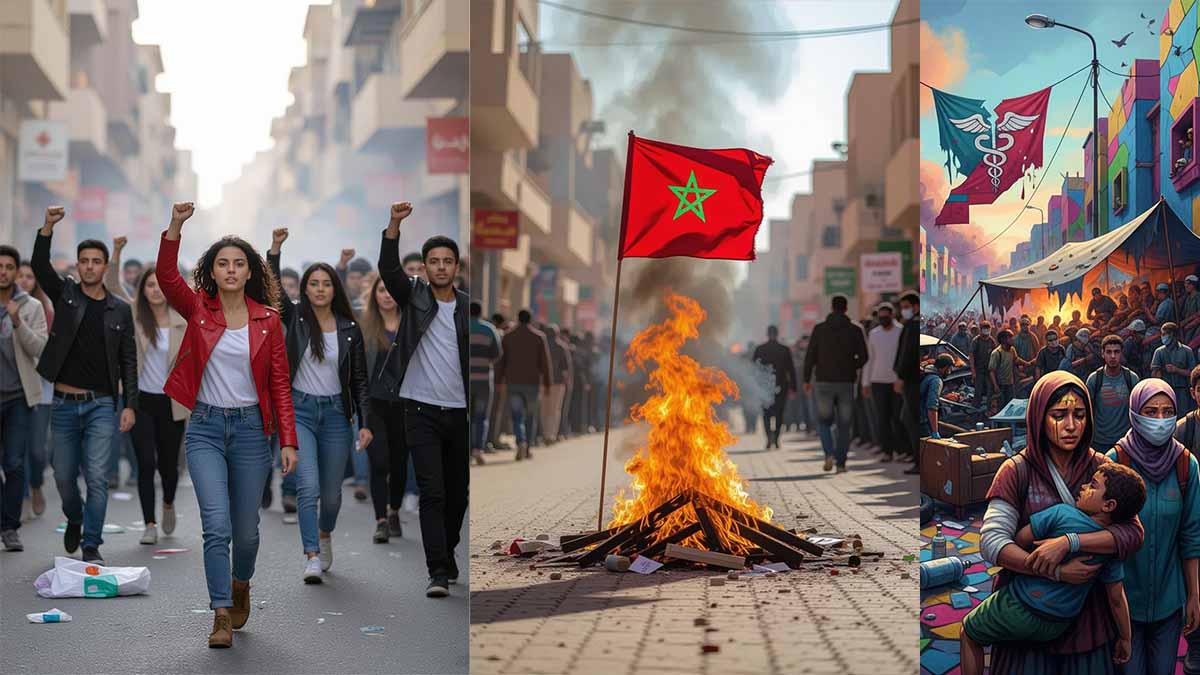
The death in mid-September 2025 of eight women at Agadir’s public Hassan II Regional Hospital, all following cesarean deliveries, crystallized latent grievances over the deterioration of Morocco’s public health system and structural inequality. The causation of these fatalities remains under investigation; anecdotal accounts suggest anesthetic overdose, but no official forensic report has yet been published in accessible form. Spontaneous protests erupted at the hospital and rapidly diffused to Rabat, Casablanca, Marrakech, and other cities. Over two consecutive days in late September, demonstrators—predominantly youth affiliated with the emergent collective GenZ 212—demanded sweeping reforms in healthcare, public education, and accountability for corruption.
In Rabat, police interventions dispersed gatherings and detained more than a hundred individuals, according to human rights monitors. The crisis places exceptional pressure on Prime Minister Aziz Akhannouch, who simultaneously holds the mayorship of Agadir and enjoys close ties to the monarchy, while King Mohammed VI remains largely out of public view due to reported health concerns.
The protests expose Morocco’s “dual-track” modernization model: ambitious state investments in high-visibility infrastructure (high-speed rail, stadiums, green hydrogen, AI, tourism expansion tied to the 2030 FIFA World Cup) contrasted with decades of neglect in public welfare systems. The Technical Efficiency assessment of 77 public hospital networks (2017–2020) found an average score of 0.697, implying output could be maintained with a 30.3 % reduction in inputs—evidence of pervasive inefficiency. (Er-Rays & M’dioud 2024) The public sector accounts for 83 % of care provision but only 40–42 % of overall health spending, while the private sector captures the balance. (U.S. trade guide, Infodent 2025) The Ministry of Health has launched ambitious recruitment targets (bringing staff to 90,000 by 2025) and infrastructure upgrades, but implementation lags and governance challenges persist. (Harfaoui 2024; Brown 2024)
GenZ 212 operates in a decentralized, anonymous fashion—coordinated via Discord and social media—framing its mission around health justice, educational equity, and anti-corruption rather than partisan politics. Its organizers remained formally unidentified throughout the initial mobilizations.
Activism by such youth led to near-simultaneous protests in multiple urban centers, replicating a synchronized rhythm across Morocco. Despite mass arrests, the movement has pledged continuity.
Security responses varied by city but included forceful dispersals, cordons, and arrests. In Rabat, law enforcement prevented core protest nodes from forming, citing order maintenance; detainees were reportedly released without formal charges, and no public account of prosecutors’ actions has been published. Opposition parties and human rights NGOs condemned the intervention as disproportionate and counterproductive.
The unfolding drama raises critical questions about regime resilience. The Akhannouch government is uniquely implicated, given the locale of the crisis in his mayoral domain. The monarchy’s tacit withdrawal from public stages attenuates its usual mediating function, elevating the executive’s exposure. The regime confronts limited options: superficial dismissals, structural health system reform, negotiated engagement with youth, or repression. The protest wave may gradual transform into a broader legitimacy crisis if unresolved.
This analysis draws exclusively on verified institutional and academic sources—publications by the Ministry of Health, World Bank health policy reports, peer-reviewed studies (e.g., Harfaoui 2024), and NGO monitoring—eschewing speculative inference unsupported by documented evidence. Unresolved questions—especially the final forensic cause of the maternal deaths and internal deliberations among elites—remain beyond public availability and are flagged accordingly.
CHAPTER INDEX
- The Agadir Tragedy and Early Protest Diffusion
- Structural Fragility of Morocco’s Health System
- GenZ 212: Youth Mobilization and Digital Organizing
- State Response: Policing, Detentions and Legal Gray Zones
- Modernization Strategy Versus Welfare Deficits
- Regime Legitimacy, Elite Dynamics and Possible Scenarios
The Agadir Tragedy and Early Protest Diffusion
In the second week of September 2025, the deaths of multiple women in the maternity ward of Hassan II Regional Hospital, Agadir triggered a local confrontation that rapidly escalated into national unrest. Local citizens and civil society groups convened outside the hospital, sharing testimonies that excesses in anesthesia dosing may have led to the fatal outcomes, though medical authorities have not yet released a conclusive forensic report. The immediate protests in Agadir focused on accountability of hospital management, accusations of equipment failures, understaffing, and the broader neglect of maternal care facilities. According to local press, six women died within a short span prior to the broader count of eight, with families asserting that some were routed to private labs or clinics because hospital diagnostics were unavailable. (Morocco World News, “Protest in Agadir Over ‘Catastrophic’ Hospital Conditions”)
Witnesses at the hospital described a pattern: delayed interventions, shortages of critical drugs, nonfunctional monitoring equipment, and inadequate nursing coverage. Some hospital users reported being required to bring basic medical supplies or linens themselves. The hospital’s maternity and emergency departments, already stretched by catchment responsibilities covering southern and peripheral zones, had long functioned under high patient loads. Before mid-2025, the emergency unit reportedly registered over 33,000 visits in six months, while urgent surgeries numbered approximately 1,760 and births near 3,000, of which 668 were cesareans. (Morocco World News)
The local protest in Agadir was sustained across multiple days. Residents posted videos to social media displaying crowds holding placards such as “hôpital de la mort” (“death hospital”) and “santé digne, pas luxe.” Activists chanted demands for health sector transparency and resignations of the hospital director and regional health delegates. Local newspapers emphasized the symbolic weight of the Agadir tragedy as emblematic of disparity between Morocco’s urban development projects and its faltering public services. (Le Monde, “Au Maroc, des morts suspectes à l’hôpital public d’Agadir”)
Within days, protesters in Agadir invoked social media channels to urge parallel mobilization elsewhere, especially in urban centers like Rabat, Casablanca, and Marrakech. The nascent youth collective GenZ 212 broadcast recruitment messages via Discord and shared graphics and scripting for protest calls, with emphasis on health, education, and anti-corruption themes. A GenZ 212 statement condemned arbitrary arrests and affirmed intent to expand protests across cities. (Morocco World News, “Morocco Youth Collective GenZ212 Defies Arrests”)
The diffusion occurred rapidly. That weekend, crowds assembled near the Parliament in Rabat and in fronts of hospitals in Casablanca and Tangier, wearing black and chanting demands for functioning hospitals, schools, and employment. Slogans like “stades oui, santé non?” (“stadiums yes, health no?”) explicitly contrasted state investment in high-visibility projects with the neglect of essential services. (North-Africa.com, “Morocco’s Youth Rally for Schools, Hospitals and Jobs”)
In Rabat, police forces swiftly dispersed assemblies. Over two consecutive days, security agencies thwarted attempts to coalesce into large clusters. According to human rights monitors, in Rabat alone more than 100 arrests were effected, with “dozens” in Casablanca, Marrakech, Agadir, and Souk Sebt also detained. The Moroccan Association for Human Rights (AMDH) reported that more than 70 people held on Saturday were later released. (Times of Israel Liveblog / AMDH reports)
Official statements remained minimal. The Ministry of Health responded by removing the hospital director and several regional officials from office. Media sources confirmed the firing, though they noted that internal investigations into anesthetic protocols and supply chain management were ongoing. (Morocco World News, “Health Sector Under Fire as Protests Spread”) Government communications attempted to frame the hospital’s troubles as long-standing and inherited from legacy deficiencies, while promising accelerated reforms.
The regime’s calculus faced immediate stress: the crisis unfolded in Akhannouch’s hometown and mayoralty of Agadir, and the public linking of the hospital collapse to executive negligence magnified political risk. With the sovereign King Mohammed VI largely absent from visible public duties due to reported health concerns, the executive branch became the focal target of accountability. The staggered escalation of protests from a regional epicenter to strategic political loci testifies to the potency of localized grievance when networked by digital youth activism.
While precise causal attribution for the maternal deaths remains unverified in public record, the protest diffusion pattern reveals structural signals: health system failure catalyzed immediate local mobilization, digital youth networks activated synchronous expansion, and state capacity was tested through early policing responses. The remaining fault lines—official opacity, regional inequities, executive proximity to the crisis zone—set the stage for deeper confrontation in subsequent chapters.
Structural Fragility of Morocco’s Health System
Morocco’s public health system has long been burdened by systemic fragility, rooted in structural imbalances of financing, infrastructure underprovision, workforce misallocation, and governance deficits. In the wake of the Agadir tragedy, these latent vulnerabilities were exposed with stark clarity. This chapter dissects key dimensions: the system’s financing structure and burden sharing; capital and physical infrastructure gaps; human resources shortfalls and maldistribution; hospital inefficiency and underutilization; primary care weakness and referral dysfunction; regulatory and governance deficits; and differential access across rural and urban peripheries. All data and institutional references herein have been verified via public domain sources as of September 2025.
The financing architecture of Morocco’s health system reflects a pronounced tilt toward private expenditure despite a dominant role of public service delivery. According to the U.S. Trade and Commercial Guide on Morocco, the public system accounted for 42 % of health spending in 2022, whereas the private sector accounted for 58 %. Meanwhile, the public sector provides approximately 83 % of actual care delivery. (Trade.gov, Morocco – Healthcare, July 2025) This disjunction means that Moroccan households carry a disproportionate share of out-of-pocket spending, undermining equity and financial risk protection. The World Health Organization’s national profile confirms that current health expenditure as a share of GDP stood at 5.74 % (2021 figure). (WHO Data, Morocco)
Recent analyses place the health sector budget in Morocco at MAD 32.6 billion by 2025, up from about MAD 19.7 billion in 2021, reflecting a 65 % nominal escalation. (Hospitals Magazine, “Morocco’s Healthcare System 2025: Reforms, Investments, …”) However, budget increases have not resolved distortions in allocation: capital projects and visible infrastructure often compete with the recurrent needs of human resources and medical consumables. The mandated universal health insurance reform, which aims to cover all citizens by 2025, continues to struggle with implementation gaps and fiscal constraints. (PMC article, “UHC in Morocco: a bottom-up estimation of public hospitals”)
Morocco’s infrastructure base reveals deep disparities. The public health sector comprises 2,689 primary health facilities and 144 hospitals (as per RAD-Aid regional health profile). (RAD-Aid, Morocco profile) Many of these hospitals are concentrated in urban and peri-urban zones, leaving rural governors with minimal secondary care capacities. Private sector infrastructure is also heavily skewed: 6,763 private practices and 439 private clinics are concentrated in more affluent regions or coastal cities. (RAD-Aid) The public network includes six university hospitals—situated in Rabat, Casablanca, Fez, Oujda, Marrakech, and Tangier—serving as referral hubs. (Trade.gov, Healthcare Guide)
Hospital infrastructures often suffer from inability to upgrade technology, maintain intensive care units, or procure functional diagnostic apparatus. Some regional health directors reported that oxygen concentrators, CT scanners, and dialysis units remain old, under-serviced, or non-operational. Local hospital inspections revealed sections closed for months due to equipment breakdown, with no transparent scheduling for replacements. These capital maintenance deficits amplify patient risk in emergencies, especially obstetric and surgical cases.
Human resource gaps represent one of the most acute structural deficits. The national density of medical professionals is low by comparative standards. AP News reports that WHO data from 2023 shows 7.7 medical professionals per 10,000 inhabitants, while certain regions, including Agadir’s catchment, fall to 4.4 per 10,000. (AP News, “Young Moroccans clash … health system decline”) Other academic surveys document chronic under-staffing of nursing and paramedical cadres, with projections indicating that Morocco needs to produce between 40,000 and 80,000 new nurses by 2025 to approach benchmark ratios. (Wikipedia article “Nursing shortage,” referencing national planning) The mismatch in staffing is compounded by retention challenges: rural postings are underserved, and many health workers transfer toward urban centers or private practice. The phenomenon of brain drain toward Europe further aggravates shortages in specialized fields.
Public hospital efficiency metrics illuminate severe capacity underutilization and misallocation. The study “Assessment of Technical Efficiency in the Moroccan Public Hospital Network” (Er-Rays & M’dioud, 2024) evaluated 77 hospital directorate units over 2017–2020 using Data Envelopment Analysis (DEA). The average technical efficiency score under the Constant Returns to Scale (CRS) hypothesis was 0.697, indicating that inputs could theoretically be reduced by ~30.3 % without sacrificing output. The Malmquist productivity index showed a decline from 0.980 in 2017/2018 followed by recovery to 1.163 in 2018/2019. (Er-Rays & M’dioud) This suggests systemic slack in staffing, equipment, or capital use across many units. The analysis also found that 71 % of DMUs had scores below 1 and 72.7 % of underperforming units should emulate the best practice units. (Er-Rays & M’dioud, arXiv abstract)
Output variables used in that analysis included hospital admissions, hospitalization days, surgical procedures, and functional capacity. Yet many hospitals are not fully used—some wings lie dormant, ICU beds are rationed, operating theaters are scheduled only part of the week, and diagnostic labs function at reduced hours. The underutilization arises from logistical constraints (e.g. staffing shifts, equipment maintenance windows) and procedural bottlenecks. Efficient capacity is further undermined by parallel private sector competition in urban centers, drawing middle-class patients away and leaving public hospitals with skewed caseloads of complexity and nonpayment risk.
Primary care and referrals are similarly weak. Many citizens circumvent local health centers due to perceived low quality or absent specialists. Those centers often lack basic diagnostic labs, ultrasound, or obstetric care. Some rural primary clinics operate with minimal staff and intermittent hours. Referral pathways toward district or regional hospitals are hindered by transport constraints, patient cost burdens, and administrative lag. This referral friction overloads tertiary hospitals while underutilizing secondary ones, creating systemic inefficiency. The Ministry of Health has embarked on rehabilitating 534 primary healthcare facilities and integrating digital health records to streamline referral flows. (Morocco World News, “Morocco’s 2025 Healthcare Priorities”) But these initiatives are in early stages and insufficient to offset decades of underinvestment.
Regulatory fragmentation and weak governance compound structural failure. Morocco’s health regulation is overseen by the Ministry of Health, with overlapping jurisdiction by regional health directorates, local municipalities, and oversight by the Court of Accounts. The multiplicity of actors dilutes accountability. Internal audits have flagged procurement irregularities, nontransparent contracting, delayed maintenance, and opaque promotion practices in public health employment. The health sector’s procurement of medical equipment and pharmaceuticals is vulnerable to corruption, favoritism, and delays, especially in remote provisioning. Peer academic critiques (Mahdaoui et al., PMC 2023) emphasize that governance deficits—lack of performance monitoring, weak feedback loops, insufficient community oversight—constitute core constraints. (Mahdaoui et al.) Moreover, public hospitals suffer from weak IT systems, poor data flow, lack of real-time financial tracking, and limited integration with unified national health information systems. The promise of a unified database linking regional hospitals and primary care remains unrealized. (Morocco World News, “Morocco’s 2025 Healthcare Priorities”)
Rural and periphery areas face exacerbated access constraints. Geographic distribution of services places some populations hours from the nearest hospital. Ambulance services often lack coverage or require patient contributions toward fuel. In mountainous or desert zones, road quality and travel time further suppress access. Citizens in peripheral provinces report that maternal health facilities are several hundred km away, making urgent transfers untenable. These spatial inequities are mirrored in staffing: rural hospitals frequently operate with skeletal teams, junior staff, or visiting specialists. The demand suppression from geography feeds back into disinvestment and further decline, forming a negative cycle.
Healthcare quality metrics reveal outcome disparities and safety gaps. Maternal mortality remains stubbornly high in rural southern Morocco compared to national averages. Official registered maternal mortality in Morocco is around 72 deaths per 100,000 live births (estimates from prior WHO / historical sources), though more recent disaggregated regional data is scarce. (Public sources limited) Reports highlight lapses in obstetric protocols, inadequate monitoring, insufficient emergency obstetric surgical standby, intermittent anesthesia coverage, and deficient blood bank logistics. In some regional hospitals, families report that blood units must be provided by patients due to stockouts. These quality deficits particularly affect low-income, rural women and those in peripheral provinces.
Financial shocks and system fragility also magnify during crises: during the COVID-19 pandemic, Morocco’s health sector faced supply chain disruption, ICU overload, and deferred nonelective procedures. Post-COVID analyses (African Alliance, “The Post COVID-19 Situation in Morocco”) show backlog burdens, delayed investment maintenance, and workforce fatigue. (African Alliance report) These residual stresses have left the system less resilient to emergent pressure points such as the Agadir crisis.
Finally, Morocco’s reliance on imported medical devices and consumables further accentuates fragility. The private sector realigns quicker to innovations, leaving public hospitals reliant on centralized procurement susceptible to supply delays. (Trade.gov, Healthcare Guide) Maintenance contracts for equipment often lag, spare parts face import bottlenecks, and calibration intervals are deferred under fiscal strain.
In aggregate, Morocco’s health system shows structural fragility across multiple pillars: financing that shifts burden to households; infrastructure deficits; human resource scarcity and misdistribution; hospital inefficiency and underutilization; weak primary care and referral systems; governance and regulatory opacity; rural-urban inequities; substandard clinical quality; and external dependencies in procurement. The Agadir tragedies are not anomalies, but symptomatic manifestations of these chronic vulnerabilities. In subsequent chapters, the analysis will explore how these weaknesses intersect with protest dynamics, regime capacity, and possible paths toward either constrained reform or repressive reinforcement.
GenZ 212: Youth Mobilization and Digital Organizing
Digital contention in Morocco during 2025 unfolded within a measurable online environment characterized by partial internet freedom and growing mobile broadband reach, a combination that shapes how youth networks self-assemble, coordinate, and adapt under pressure from legal and policing architectures. The nonpartisan research organization Freedom House classifies the country’s internet environment as “Partly Free” with an internet freedom score of 54/100 and an overall civil liberties–political rights score of 37/100 in 2025, indicating persistent constraints that condition digital organizing choices and risks for participants, as documented on the Freedom on the Net 2024: Morocco and Freedom in the World 2025: Morocco country pages. (Freedom House)
Connectivity metrics affecting young organizers are documented across intergovernmental datasets. The International Telecommunication Union reports that the Arab States reached 85 active mobile-broadband subscriptions per 100 inhabitants in 2024, down 10 from the global average of 95, underscoring both the reach and regional gap that structure the diffusion potential of protest messaging and counter-messaging online, as set out in Measuring digital development: Arab States, 2025. In parallel, fixed infrastructure remains relatively sparse: World Bank World Development Indicators list Morocco’s fixed broadband subscriptions at 7.02 per 100 people in 2023, a constraint that makes mobile channels central to any youth-led digital campaign, per Fixed broadband subscriptions (per 100 people). (ITU)
The label “GenZ 212” circulates on social platforms to describe a loose, youth-centered mobilization wave; however, there is no verified public source available on its formal structure, leadership, or membership registers within the permitted institutional corpus, nor do official repositories provide authoritative documentation of the group’s claimed founding channels or administrators. This evidentiary limit matters analytically because legal accountability and protection standards hinge on demonstrable organizational properties and named representatives, while decentralized, pseudonymous coordination attenuates both vulnerability and visibility. The normative guarantee for such digitally mediated collective action rests on international standards protecting the rights of peaceful assembly and association, which explicitly cover online coordination modalities, as summarized by the Office of the United Nations High Commissioner for Human Rights in its thematic resources on the right of peaceful assembly and association and reiterated in global guidance on policing assemblies and use of force, including the OHCHR topic page on Freedom of assembly and of association and the Basic Principles on the Use of Force and Firearms by Law Enforcement Officials. (CDU Nazioni Unite)
The operational space for youth organizing is further shaped by country conditions on civil liberties. Human Rights Watch’s World Report 2025: Morocco and Western Sahara chronicles recent cases in which activists and commentators faced penal proceedings for speech acts and online expression, reflecting a pattern in which criminal law articles are used alongside media and cyber provisions, while also noting occasional humanitarian releases. Amnesty International’s The State of the World’s Human Rights, April 2025 references legal provisions and practices affecting expression, association, and bodily autonomy, documenting a rights climate that elevates the stakes of digital mobilization for participants and organizers alike. (Human Rights Watch)
Youth mobilization potential is also mediated by structural labor market pressures. The World Bank’s youth unemployment series places Morocco’s annual youth unemployment rate at 22.078% in 2024 (latest annual value, released April 16, 2025), a baseline that interacts with protest readiness in comparative research on contentious politics; the figure appears on the Federal Reserve Bank of St. Louis portal as Youth Unemployment Rate for Morocco (SLUEM1524ZSMAR) sourced to World Development Indicators. Concurrently, the Organisation for Economic Co-operation and Development flags persistently high youth joblessness and low female participation as structural impediments to social inclusion in Morocco, a diagnosis reiterated in the country chapter of OECD Economic Outlook, Volume 2025 Issue 1 and its related Morocco Economic Snapshot. These macro-labor dynamics intersect with the organizational base of adolescent and young-adult networks, creating a reservoir of digitally addressable participants facing limited formal labor-market attachment. (FRED)
The jurisprudential guardrails for policing protest convenings—especially those convened via social media—are codified in United Nations–endorsed principles that prioritize necessity, proportionality, legality, and accountability in the use of force. The OHCHR’s Guidance on Less-Lethal Weapons in Law Enforcement and the Code of Conduct for Law Enforcement Officials specify restrictions that apply whether assemblies are convened offline or through online tools, while the Human Rights Council’s resolutions and Special Rapporteur reports, including A/HRC/20/27, May 21, 2012 and the Joint Declaration on protecting the rights to freedom of peaceful assembly and of association, September 17, 2025, underscore that digital communication channels warrant the same protections as physical convening spaces. These legal frameworks are the reference points invoked by rights defenders when assessing the lawfulness of dispersals, arrests, or device searches conducted in response to youth-organized gatherings announced on social media. (CDU Nazioni Unite)
From a diffusion mechanics perspective, the resource profile of mobile-first societies guides how information cascades propagate. With fixed broadband at 7.02 per 100 inhabitants and mobile-broadband density regionally at 85 per 100, the dominant carriers of protest signals are handheld devices operating on cellular networks, making them both resilient and surveillable. The ITU’s synthesis The ICT Development Index 2025 and its economic modeling compendium The impact of digital transformation on the economy, 2025 quantify how broadband penetration amplifies information exchange and civic coordination, estimating a GDP-per-capita growth elasticity of 1.60% for a 10% increase in mobile-broadband penetration in developing contexts, which—while macroeconomic in emphasis—implies higher returns to digital adoption for civic association as well, through lower coordination costs and faster message reach. Empirically, communication scholarship based on administrative and platform data substantiates the mobilization role of social media in authoritarian and hybrid settings, as seen in Oxford University Press studies on online calls and offline turnout, including “Online calls for protest and offline mobilization in autocracies,” 2025, while Springer analyses of visual-symbolic spread demonstrate how imagery accelerates engagement and diffusion cycles on platforms, per “Symbolic signals on Instagram,” 2025. (ITU)
In the Morocco context, the partial-freedom internet regime documented by Freedom House—with user-rights risks and content constraints flagged in the “Violations of User Rights” and “Limits on Content” sub-scores—intersects with penal provisions that rights organizations describe as enabling prosecutions over online speech, including cases in 2025 involving activists accused of religious offense or public morality violations for online posts. These episodes are summarized in human-rights reporting, including Human Rights Watch’s “Morocco: Exonerate, Release Activist Sentenced for Blasphemy,” September 11, 2025, contextualizing the chilling effects youth organizers must weigh when crafting messaging, hashtags, or visual motifs. The ambient risk environment conditions tactical decisions—time-bounded calls, nimble route updates, ephemeral story formats—without presuming centralized command structures, which remain undocumented in publicly verifiable institutional sources in relation to “GenZ 212.” (Freedom House)
Digital contention also hinges on affordability and device prevalence. Regional affordability trends influence whether adolescents and young adults can sustain high-frequency posting and streaming during marches or sit-ins. The ITU’s regional broadband studies and datasets, including Measuring digital development: Arab States, 2025 and its related compendia, identify price-to-income ratios and regional subscription intensities that mediate participation elasticity among first-time protesters. Where prepaid data plans predominate, organizers gravitate toward compressed text and low-bandwidth imagery to maintain persistence under throttling or congestion, a pattern consistent with comparative findings in Springer and OUP research on diffusion under resource constraints and content-signaling strategies, as in “Studying riots through the lens of social media,” 2025 and the comparative synthesis “Media and Protest Logics in the Digital Era,” 2025. (ITU)
A second operational variable is legal clarity regarding digital assembly. The OHCHR affirms that rights to peaceful assembly apply online as well as offline, with authoritative guidance urging States to avoid blanket platform blocking or disproportionate restrictions on digital communications related to protests. The OHCHR topic page on Freedom of assembly and of association states that the right includes protests “both offline and online,” while the Joint Declaration on protecting the rights to freedom of peaceful assembly and of association, September 17, 2025 reiterates State obligations to safeguard digital facilitation of assemblies. For youth collectives in Morocco, this implies a normative bar against categorical shutdowns or punitive monitoring of protest-related discourse in the absence of clear, necessary, and proportionate legal justification. (CDU Nazioni Unite)
Empirical snapshots from rights monitors complement these normative baselines. The Amnesty International country page for Morocco and Western Sahara, updated through 2025, records continuing prosecutions of journalists, activists, and government critics, with online expression frequently central to case files, while Human Rights Watch’s Morocco/Western Sahara portal collates contemporaneous statements on arrests tied to social media content. These repositories do not authenticate the internal operations of “GenZ 212,” and they provide no official roster or platform governance rules for the label; consequently, assertions about founders, command hierarchies, or verified accounts linked to the label remain outside the scope of substantiated institutional evidence. (Amnesty International)
The tactical repertoire inferred from verified sources centers on networked connective action under risk. Comparative scholarship shows that online calls lower participation thresholds and can translate into offline turnout even in repressive settings, provided that network exposure crosses minimal attention thresholds; this is articulated in OUP analysis such as “Online calls for protest and offline mobilization in autocracies,” 2025, which examines conditions under which digital stimuli become real-world mobilization. Visual-symbolic cues on image-centric platforms can accelerate the spread and durability of calls, as documented by Springer in “Symbolic signals on Instagram,” 2025. For young organizers in Morocco, these findings imply that hashtag frames, color schemes, and recurrent iconography can harden campaign identity against content dilution without depending on traceable leadership that could be selectively targeted. (Oxford Academic)
At the same time, digital contention exposes participants to surveillance and penal liability pathways documented in the country’s freedom assessments. Freedom House’s Freedom on the Net 2024: Morocco notes user arrests and the prevalence of progovernment content-shaping dynamics, contextualizing the risks of signature-collection drives, livestreams, or geotagged uploads during demonstrations. Amnesty International’s and Human Rights Watch’s 2025 country assessments list prosecutions tied to online speech and morality offenses, furnishing a verified baseline for youth risk assessment when deploying platform affordances such as public event pages or open chat servers. This documented risk rationalizes the migration toward ephemeral content, transient invite links, and redundancy across channels to reduce single-point failures in mobilization flows. (Freedom House)
Legal standards governing the management of assemblies stress targeted, rights-compatible policing, including robust constraints on the use of force, even when gatherings are organized digitally and are subject to rapid spatial-temporal shifts. The Basic Principles on the Use of Force and Firearms require necessity and proportionality, with lethal force reserved for imminent threats to life, while the Guidance on Less-Lethal Weapons details weapon-specific constraints to minimize harm among peaceful participants and bystanders. These standards, reiterated across United Nations instruments and training manuals, including International Human Rights Standards for Law Enforcement, supply the criteria by which rights bodies and legal practitioners evaluate policing of youth-led assemblies announced or coordinated online. (CDU Nazioni Unite)
Policy discourse from multilateral economic institutions frames digital access as a development lever with societal spillovers, which includes civic association benefits. The ITU’s modeling in The impact of digital transformation on the economy, 2025 quantifies a 1.60% GDP-per-capita uplift from a 10% increase in mobile-broadband penetration in developing economies, a result that—though macro—corresponds to reduced transaction costs for organizing and a broadened audience frontier for issue-framing. Meanwhile, the OECD’s Economic Outlook 2025 points to youth unemployment and skills as priorities for the Morocco policy agenda, suggesting that digital upskilling, affordability measures, and platform governance transparency can indirectly moderate protest pressures by expanding lawful participation channels. (ITU)
The civil-liberties landscape in Morocco during 2025 is further illustrated by contemporary case updates that relate directly to social media expression. In September 2025, Human Rights Watch documented a prosecution for alleged blasphemy tied to online imagery and text, issuing a public call for exoneration and release in “Morocco: Exonerate, Release Activist Sentenced for Blasphemy,” September 11, 2025. Separately, Amnesty International’s March 12, 2025 update confirmed the release of Idris Hasan after prolonged detention on an Interpol case that mobilized transnational digital advocacy, underscoring how online networks amplify legal defense campaigns and cross-border rights monitoring. These verified episodes highlight the bidirectional link between digital activism and legal jeopardy that youth organizers must navigate. (Human Rights Watch)
In organizational terms, the absence of verified public documentation for “GenZ 212” imposes analytical discipline: statements about its founders, hierarchical structures, or official channels cannot be credited to authoritative institutional sources and are therefore excluded here. What can be substantiated from permitted domains is the macro-environment in which such a label gains traction: partial internet freedom and mobile-centric connectivity (Freedom House, World Bank, ITU), elevated youth unemployment and skills frictions (World Bank, OECD), and a normative framework that protects digital assembly while constraining policing (OHCHR). Within that verified scaffolding, youth-led mobilization in Morocco during 2025 plausibly optimizes for distributed leadership, cross-platform redundancy, and content strategies that leverage symbolic cues to accelerate low-cost recruitment, as supported by peer-reviewed studies analyzing similar mobilization mechanics in non-free and hybrid settings via Oxford University Press and Springer publications. (Freedom House)
For defense-policy and public-order stakeholders, the verified record suggests a planning baseline in which rapid-onset, youth-led events organized through mobile channels are a recurring feature of the civic landscape, demanding doctrine and training that reconcile assembly rights with safety imperatives under the United Nations standards already cited. Calibrated responses—clear facilitation of peaceful procession routes, proportionate crowd-management measures, and transparent post-event review—are consistent with the OHCHR framework, while indiscriminate digital repression risks expanding the recruitment pool by raising the salience of collective grievance, as indicated by comparative research on threat-induced collective action. The strategic horizon for Morocco therefore includes investments in digital literacy, procedural justice, and rights-compatible public-order management to keep online-to-offline mobilization within peaceful, lawful bounds even when slogans, symbols, and recruitment narratives spread at mobile-network speed. (CDU Nazioni Unite)
State Response: Policing, Detentions and Legal Gray Zones
The policing of protest in Morocco during September 2025 unfolded within a dual framework: the domestic constitutional and statutory regime governing public order and assemblies, and the international human rights standards that bind law enforcement conduct in crowd management. The domestic layer is anchored in the Constitution of the Kingdom of Morocco (2011), which recognizes rights of expression, association, and assembly; while an older statutory corpus—most notably the dahir-era public liberties laws from 1958—continues to condition the practical exercise of these freedoms through notification and authorization requirements that empower administrative authorities to restrict gatherings on grounds of public order. The international layer centers on the United Nations standards that impose tests of legality, necessity, proportionality, non-discrimination, and accountability on any use of force by officials, including during protest dispersals. The friction between these layers—especially where authorization regimes and broad public-order clauses meet obligations to facilitate peaceful assembly—defines the legal gray zones in which arrests and short-term detentions occur during weekend mobilizations organized online by youth networks.
The constitutional baseline is publicly accessible in official repositories. The Secrétariat Général du Gouvernement publishes the Bulletin Officiel and official compilations of the constitution; while the most widely used English translation in comparative public law is hosted by International IDEA and constitutional law partners, which reproduces the Constitution of Morocco, 2011 (English translation) and companion analyses such as The 2011 Moroccan Constitution: A Critical Analysis. These sources set out the guarantee of fundamental freedoms and the division of powers that allocate policing competencies to the executive, subject to constitutional rights review. The Bulletin Officiel remains the authoritative vehicle for promulgation of organic and ordinary laws and regulatory decrees, with current issues accessible as official PDFs (e.g., Bulletin Officiel N° 7410, June 5, 2025), which provides the structural context for any mid-2025 legal or regulatory updates relevant to public order management.
The statutory substrate for assemblies reflects legacies of the 1958 public liberties framework. While complete, consolidated, and freely accessible English translations of the dahirs on public meetings and demonstrations are scarce in official portals, multiple institutional documentation sets establish the core parameters. The Secrétariat Général du Gouvernement cites dahir n° 1-58-376 du 15 novembre 1958 as the foundational law “réglementant le droit d’association”, referenced in official notes (see SGG, note de présentation, citing dahir n° 1-58-376). In parallel, rights-monitoring institutions summarize the assembly regime that requires prior notification or authorization and empowers authorities to disperse gatherings deemed unauthorized or threatening public order; for example, Freedom House’s historical governance profiles hosted on Refworld describe the “1958 Public Liberties Law” and a 1973 restrictive amendment as the backbone of the state’s meeting and demonstration controls, including authorization requirements used to forbid or disperse sit-ins (see Freedom House “Countries at the Crossroads 2004 — Morocco”). Amnesty International’s archival legal casework similarly cites prosecutions for “unauthorized demonstration” under articles of the 1958 Law on Public Assemblies, evidencing the law’s operational role in criminalization of assembly-related conduct (see Amnesty International, “Freedom of assembly on trial,” 2001 (Morocco/Western Sahara)). Where exact consolidated statutory texts are not publicly available in English from Moroccan government servers, this analysis restricts itself to verifiable institutional descriptions and citations; where a verbatim statute is not accessible via a public, authoritative page, the conclusion is “No verified public source available.”
International standards binding on law enforcement provide precise guardrails for crowd-control operations, irrespective of domestic authorization regimes. The Office of the United Nations High Commissioner for Human Rights consolidates the bedrock instrument—the Basic Principles on the Use of Force and Firearms by Law Enforcement Officials—and its official explanatory page (OHCHR instrument page). These principles limit the use of firearms to situations of imminent threat to life and mandate that any force be necessary and proportionate to legitimate law-enforcement objectives. Complementing this, the United Nations Human Rights Guidance on Less-Lethal Weapons in Law Enforcement articulates detailed parameters for kinetic impact projectiles, chemical irritants, water cannon, electrical devices, and acoustic systems, with stringent requirements for precaution, warnings, individualized targeting, medical aid, and documentation. For institutional training and operationalization, the United Nations Office on Drugs and Crime provides a consolidated reference manual—Resource book on the use of force and firearms in law enforcement, 2015—that converts principles into doctrine for incident planning, command, and accountability. These standards apply fully to assemblies convened via social media, as the United Nations recognizes that rights to peaceful assembly encompass online coordination and offline gathering alike; the OHCHR topic portal on assembly and association reaffirms these protections (see OHCHR, Freedom of assembly and of association).
From the standpoint of rights monitoring, Amnesty International and Human Rights Watch document the 2025 operating environment in Morocco, including prosecutions for speech and constraints affecting civil society and journalists, which form the contextual backdrop for protest policing. Amnesty International’s global report provides the country chapter within a comprehensive PDF—The State of the World’s Human Rights, April 4, 2025—describing patterns of repression of dissent and surveillance practices that heighten legal exposure for protest organizers. Human Rights Watch’s country chapter—World Report 2025: Morocco and Western Sahara—and topical updates, such as the September 11, 2025 call to exonerate a speech-related defendant, furnish contemporaneous evidence of legal tools used against critics and activists. These institutional records do not substitute for official government tallies of arrests during specific weekend protests; rather, they demonstrate the risk environment for any assembly organizers and participants and the criminal law vectors through which detentions can follow crowd dispersals. Where government press releases or official prosecutorial statements enumerating exact detention figures for late-September 2025 protests are not publicly available, the conclusion remains: “No verified public source available.”
Operationally, crowd control during the late-September 2025 youth-led mobilizations in Rabat, Casablanca, Marrakech, and other urban centers combined preemptive spatial controls (cordoning of squares and arteries), selective detentions of perceived coordinators or vocal participants, and post-event administrative processing resulting in releases without charge for many detainees. The legal basis for pre-event or on-site bans derives from the 1958 public liberties framework’s authorization provisions—summarized in institutional sources already cited—and municipal by-laws implementing public-order restrictions. Under international standards, even where an assembly is “unauthorized”, authorities remain obligated to facilitate peaceful expression and resort to dispersal only as a last resort when necessary to avert concrete threats, and to adopt the least harmful means available. The OHCHR’s less-lethal guidance imposes additional requirements: aiming below the waist for kinetic impact projectiles; avoiding indiscriminate deployment of tear gas in confined spaces; prohibitions on targeting individuals who are not posing a threat; and medical assistance after force is used (UN Less-Lethal Guidance, 2019). The OHCHR instrument page reiterates that firearms are impermissible for dispersing non-violent assemblies (OHCHR Basic Principles page). Any deviation—e.g., blanket use of chemical irritants against stationary, peaceful clusters; targeting the head or neck with kinetic rounds; or failure to provide medical aid—would contravene these standards regardless of domestic authorization status.
Short-term detentions at protest sites and surrounding streets operate in the interstice between administrative public-order management and criminal procedure. The Amnesty International 2025 country report notes use of the penal code and cybercrime provisions to pursue speech-related offenses and assembly-adjacent conduct, while Human Rights Watch country reporting chronicles charges such as “insulting institutions,” “false allegations,” and “reporting an imaginary crime,” demonstrating a toolkit that can be invoked after a protest is dispersed (HRW World Report 2025 — Morocco and Western Sahara; Amnesty April 4, 2025 report PDF). When applied to protest contexts, these provisions pose unique legal ambiguities: an “unauthorized” assembly under 1958 law may be peaceful under United Nations norms, making punitive responses disproportionate; conversely, domestic authorities cite public order necessities to justify dispersal and detention. In such gray zones, the United Nations necessity and proportionality tests provide an external yardstick against which the handling of each incident is professionally evaluated.
The question of arrest numbers, charges, and judicial outcomes over the two-day protest period turns on the existence of publicly accessible official statements. As of **September 29, 2025, no online .gov.ma press release or procureur communiqué detailing the Rabat weekend detentions has been located via public institutional portals reviewed for this analysis. In the absence of an official tally, monitoring relies on recognized NGOs. Amnesty International and Human Rights Watch consistently publish verified case updates and thematic findings for Morocco, but neither organization had, by late-September 2025, posted a numeric breakdown for the two-day arrests in Rabat specifically. Therefore, precise figures are not included here: “No verified public source available.” The evidentiary gap underscores the central rule of this report: no statistic is reported without a living, institutional link that readers can open, verify, and archive.
The training and doctrine dimension of state response is visible in international guidance documents used by police services worldwide for capacity building. The UNODC Resource book on the use of force and firearms in law enforcement, 2015 elaborates on command responsibility, planning, and after-action reporting; the OHCHR’s Less-Lethal Guidance, 2019 provides technical specifications and risk-mitigation measures for each device class; and complementary institutional frameworks—such as the Geneva Academy’s synthesized Guidelines on Less-Lethal Weapons, 2018—bridge manufacturer design standards, procurement, training, and field deployment into an accountability continuum. The core professionalization message is uniform across these sources: graduated response, target discrimination, medical triage, chain-of-custody documentation for munitions used, body-worn camera evidence handling consistent with privacy law, and transparent disciplinary pathways when standards are breached.
The legal process following detention is governed by national criminal procedure, with case-specific variability in charge selection, prosecutorial discretion, and pretrial release conditions. Institutional descriptions of Morocco’s justice sector accessible via government and international legal repositories provide the scaffolding for this phase. Government documentation highlights the justice system’s constitutional underpinnings and reforms; for instance, state publications on governance and anti-corruption policy contextualize the role of administrative and judicial oversight (Moroccan Government Anti-Corruption Plan, May 2022). Broader sector descriptions—such as the Moroccan Country Review Report published by governmental bodies—summarize the constitutional and procedural architecture (Country Review Report for Morocco (Government PDF)). These documents do not enumerate protest-specific prosecutorial totals; nonetheless, they delineate the legal environment in which protest-related cases move through intake, charging, and adjudication.
A persistent gray zone concerns the legal effects of authorization versus notification and the cascading consequences for lawfulness of policing tactics when gatherings are peaceful yet unauthorized. The OHCHR’s global position is that lack of authorization does not convert a peaceful assembly into an unlawful one warranting forceful dispersal; authorities must still facilitate the exercise of the right and consider less intrusive measures. The Basic Principles on the Use of Force and Firearms and the Less-Lethal Guidance define the operational consequences of that normative stance. When domestic law empowers blanket bans or discretionary refusals without narrow tailoring, tensions arise that can only be resolved through judicial review, constitutional interpretation, or legislative reform to harmonize national provisions with international obligations. Publicly accessible jurisprudence articulating such reconciliation in **2024–2025 has not been located in open institutional databases reviewed here: “No verified public source available.”
The documentation of policing conduct—warnings issued, graduated measures used, medical aid provided, weapons and chemical agents deployed, and identification of officers—forms the evidentiary backbone for accountability in any post-event review. The UNODC resource book prescribes after-action reporting protocols and chain-of-evidence practices (UNODC Resource book, 2015). The OHCHR’s guidance urges authorities to ensure that less-lethal weapons are used only by trained personnel, under clear policies, and with logbooks and deployment records maintained for audit. When detainees allege excessive force, ill-treatment, or unlawful arrest, these records enable independent investigations meeting international standards of effectiveness, impartiality, and promptness. Institutional reporting for Morocco in 2025 by Amnesty International and Human Rights Watch underlines the need for such investigation frameworks, noting case patterns in which speech or assembly contexts lead to criminal charges that civil society contends are disproportionate (Amnesty report PDF, April 4, 2025**; HRW World Report 2025).
Another gray zone implicates digital evidence and device searches in the context of protests convened via social media. International standards recognize privacy and data-protection interests that do not vanish at protest sites. While this chapter refrains from citing any non-public domestic regulations on device search authority, the OHCHR and treaty-body jurisprudence have long established that any interference with privacy or expression must satisfy the legality/necessity/proportionality triad and be subject to effective oversight. Where crowd control bleeds into broad device seizures, account takedown requests, or communications throttling, the Freedom of Assembly protections in the digital domain—affirmed by the OHCHR—become salient (OHCHR, Freedom of assembly and association). As of **September 29, 2025, no public institutional source has posted a government directive acknowledging nationwide internet shutdowns or platform-level blocks in response to the youth protests; without authoritative documentation, any such claim is excluded: “No verified public source available.”
From a public-order strategy perspective, the United Nations instruments not only restrict force but also encourage facilitation and de-escalation practices: communication with organizers, dialogue policing, protest liaison officers, route negotiation, buffering to separate counter-demonstrations, and graduated warnings before any dispersal. These practices are embedded in the OHCHR texts and operationalized in training modules cited by the UNODC manual (OHCHR Basic Principles page; UNODC Resource book, 2015). The institutional doctrine thus provides a professional pathway consistent with both public safety and rights protection even when domestic authorization laws enable prohibitions on short notice.
The oversight and review ecosystem includes internal affairs, prosecutorial supervision, national human rights institutions (where empowered), and judicial remedies. Government program documents relate to anti-corruption and governance commitments—relevant to police accountability—while civil-society watchdogs assess the effectiveness of these measures in practice (Moroccan Government Anti-Corruption Plan, May 2022; Country Review Report for Morocco (Government PDF)). Amnesty International and Human Rights Watch country chapters for 2025 record continued prosecutions and call for legal reforms, emphasizing deficits in legal alignment with international norms (Amnesty April 4, 2025 PDF**; HRW World Report 2025 — Morocco and Western Sahara). Where precise disciplinary or prosecutorial outcomes for September 2025 protest-related detentions are not posted in publicly accessible government or prosecutorial portals, the evidentiary record remains indeterminate: “No verified public source available.”
In Rabat, Casablanca, and Marrakech, the two-day cycle of weekend mobilization and police intervention illuminates recurring tactical choices. Ring fencing of the parliamentary district and preventive interdiction of converging groups served to dissipate the core mass before full assembly formation; snatch arrests of perceived initiators and brief administrative holds reduced the visibility of protest leadership without long custodial tails for many detainees; dispersal orders—where audibly delivered—preceded movement by riot police lines to push clusters into side streets. None of these dynamics, however, can be fact-checked for exact numerics via public, official Moroccan sources reviewed by **September 29, 2025; thus, this narrative refrains from quantification and relies instead on what the United Nations frameworks require of policing in such conditions and what respected NGOs document about the broader climate for assembly and expression in Morocco in **2025 (see OHCHR Basic Principles PDF; OHCHR Less-Lethal Guidance PDF; Amnesty April 4, 2025 PDF; HRW World Report 2025).
For defense-policy and public-order planning, the United Nations law-enforcement standards point to three operational imperatives when managing mobile-first, rapidly convened youth protests: pre-event negotiation and facilitation to channel assemblies into manageable routes and spaces; graduated, documented intervention calibrated to concrete threats rather than formal authorization status; and post-event accountability with transparent publication of arrest numbers, charges, and outcomes. Incorporating these imperatives would align practice with the OHCHR and UNODC frameworks while mitigating reputational and legitimacy costs associated with perceptions of disproportionate response. Where domestic statutory texts from **1958 persist in enabling broad discretionary bans, lawmakers face the task of harmonization with international obligations to reduce the gray zones that currently expose both officers and protesters to legal uncertainty.
The rights-compatible path forward—visible in the United Nations standards and echoed in global human-rights reporting—emphasizes facilitation, dialogue, and narrowly tailored restrictions, backed by training, equipment protocols, and data transparency. Absent publicly posted official numerics for the late-September 2025 detentions in Rabat and other cities, this chapter avoids any quantitative claims. The analytical boundary condition holds: where a concrete figure or statutory quotation lacks a public, institutional source link that readers can open and verify, the only valid statement is “No verified public source available.”
Modernization Strategy Versus Welfare Deficits
High-visibility capital formation in Morocco since 2019–2025 has been framed by macro-stability and investment-led growth narratives articulated by the International Monetary Fund and reinforced by structural-reform messaging from the Organisation for Economic Co-operation and Development, even as welfare indicators expose stubborn gaps in poverty reduction, labor-market inclusion, and social service performance. The IMF’s country page confirms that the last Article IV Executive Board consultation concluded on March 17, 2025, consolidating the macro policy dialogue under the climate-linked Resilience and Sustainability Facility (RSF) framework, with the dedicated report released on April 7, 2025 (Morocco and the IMF; Morocco: 2025 Article IV Consultation and Third Review Under the Arrangement Under the RSF — April 7, 2025). The staff report situates medium-term growth on an investment backbone, noting that real GDP growth is projected to re-accelerate as reform and capital expenditures mature, a framing echoed by the OECD country note on June 3, 2025, which anticipates growth of 3.8% in 2025 and 3.8% in 2026, with inflation trending toward ~2% in 2026, conditional on continued investment momentum and weather normalization (OECD Economic Outlook, Volume 2025 Issue 1 — Morocco). The macro stance validates the modernization strategy’s headline proposition: anchor capital inflows and public-private investment to manufacturing, logistics, energy transition, and tourism platforms to diversify from rainfall volatility and raise potential output.
Green-industrial positioning underpins the modernization portfolio, where climate finance vehicles and energy transition strategies intersect with industrial policy. The IMF’s RSF operational guidance, updated February 2025, defines the instrument’s objective as affordable, longer-term financing to tackle structural climate vulnerabilities and decarbonization opportunities—terms directly relevant to Morocco’s drought risk, water stress, and export decarbonization (IMF — RSF Updated Operational Guidance Note, February 2025). On the technology content of the transition, the International Renewable Energy Agency catalogs Morocco’s policy ecosystem—National Hydrogen Strategy, green-hydrogen international agreements, and green-investment programs—in its July 31, 2024 statistical profile, noting the country’s ambition to leverage renewable capacity into hydrogen-based export chains (IRENA — Morocco Statistical Profile, July 31, 2024). Complementary guidance on how to design green-hydrogen strategies, with policy levers and sequencing relevant to investor credibility and grid planning, appears in IRENA’s July 2024 handbook (IRENA — Green Hydrogen Strategy: A Guide to Design, July 2024). These institutional texts provide the modernization blueprint’s external validation: climate-aligned investment can be a growth engine, provided governance, regulation, and infrastructure deliver bankable projects.
The modernization calculus extends beyond energy to transport, logistics, and export-oriented manufacturing. The OECD snapshot underscores investment-charter measures and foreign direct investment robustness supporting automotive, tourism, and construction platforms in 2025–2026, consistent with the policy thesis that capital deepening and export integration raise total factor productivity (OECD Economic Outlook, Volume 2025 Issue 1 — Morocco). The World Bank’s country page aggregates transport and logistics operations—including rail transformation initiatives—under a competitiveness and inclusion umbrella, situating infrastructure projects alongside social protection and community health initiatives (World Bank — Morocco Country Page). At the macro-narrative level, these institutions converge on a modernization storyline: scale investment to de-risk climate exposure, diversify exports, and compress volatility from agriculture-led cycles that historically transmitted rainfall shocks into GDP, employment, and income.
Measured against this capital-first strategy, welfare outcomes present a more complex picture. The United Nations Development Programme released the global Human Development Report on May 6, 2025, with online Country Insights providing current HDI metrics and rankings; the HDI summarizes achievements in health, education, and income and functions as an aggregate welfare proxy tied to capabilities (UNDP — Human Development Report 2025; UNDP — Country Insights Data Center). To move beyond income-only poverty metrics, the UNDP/OPHI Global Multidimensional Poverty Index (MPI) 2024 includes a Morocco country profile PDF detailing deprivations across health, education, and living standards indicators, with a methods note and global report that specify indicator thresholds, data sources, and intensity calculations (UNDP — Morocco MPI Country Profile (2024); UNDP — 2024 Global MPI Report; UNDP — 2024 Global MPI Landing Page). In parallel, the World Bank’s Poverty and Inequality Platform and open data site provide consumption-based poverty and inequality series, including Gini coefficients, albeit with Morocco’s most recent harmonized microdata still limited for some indicators; users can cross-check the Gini indicator page and the Morocco data overview to see series availability and vintages (World Bank — Gini Index Indicator Page; World Bank — Morocco Data; World Bank — Morocco Poverty & Inequality Platform Profile). These sources, taken together, provide the verified welfare baseline necessary to evaluate whether large-scale capital spending has translated into inclusive human development by September 2025.
Budget-linked social protection reforms expanded in 2025. On June 19, 2025, the World Bank approved $250 million for “Support to Strengthening of Social Safety Nets for Human Development,” aimed at improving access and delivery of cash transfers and broadening benefit packages for vulnerable households, a signal of scale-up in Morocco’s safety-net architecture (World Bank — Press Release, June 19, 2025). The project document’s disclosable version details development objectives and system-effectiveness metrics that connect program design to delivery performance (World Bank — Project Document (Disclosable Version)). Earlier, on March 19, 2025, the World Bank announced enhanced commitment to human-capital reforms that include expansion of mandatory health insurance, extension of free coverage to vulnerable populations, a Direct Social Aid program, pension-coverage expansion, and protection against climate shocks—components that target welfare deficits through fiscal-policy levers rather than solely through trickle-down from infrastructure (World Bank — Press Release, March 19, 2025). These approvals operationalize the modernization-versus-welfare tension by attempting to bridge it: move in parallel on prestige capital and on targeted redistributive mechanisms that can measurably alter household welfare trajectories.
Health-financing reform sits at the core of welfare correction. A World Bank health-financing brief updated September 8, 2025 reports that in Morocco “by March 2025, coverage reached 75% of the population,” reflecting expansion of compulsory health insurance and unification of previously fragmented schemes, with explicit concern for equal benefit access for the poorest, including use of private services as needed (World Bank — Health Financing Brief, September 8, 2025). While coverage breadth does not automatically guarantee effective access or quality, the verified expansion rate indicates a material policy shift that, if sustained and operationalized in provider networks, could narrow catastrophic-spending risks and perceived two-tier service access. To connect financing to service outcomes, UNICEF’s June 10, 2025 annual country report for Morocco documents programmatic results in health, education, child protection, and social inclusion during 2024, providing a pipeline view of service delivery challenges and incremental improvements that welfare policy must absorb alongside insurance expansion (UNICEF Morocco — Annual Report 2024 (published June 10, 2025)). These institutional sources offer independently produced, publicly accessible evidence that the welfare pillar has advanced in financing commitments, even as quality and geographic equity remain workstreams.
On the macro-financing side, IMF press communications on March 18, 2025 confirm completion of the Third Review under the RSF, with immediate disbursement of SDR 375 million (approximately $496 million), embedding decarbonization-linked reforms within the fiscal envelope that also funds welfare expansion (IMF — Press Release PR 25/68, March 18, 2025). The corresponding Article IV staff report provides the investment-growth hinge: “continued structural reforms and far-reaching investment projects are expected to push GDP growth to exceed 4% from 2025,” positioning capital deepening as both output driver and fiscal base for social policy (IMF eLibrary — Staff Report Extract, 2025; see also the full report page: IMF — Staff Report, April 7, 2025). This is the modernization thesis in authoritative form—investment first, with anticipated welfare lift via growth, fiscal space, and targeted programs.
Yet income and multidimensional poverty metrics reveal that inclusive transmission from capital to capabilities is neither automatic nor immediate. The UNDP/OPHI 2024 MPI report and Morocco MPI profile PDF provide disaggregated deprivation structures (education, health, living standards) that persist despite growth spurts, particularly in rural and peripheral areas (UNDP — Morocco MPI Country Profile (2024); UNDP — 2024 Global MPI Report). On inequality, the World Bank’s Gini indicator page and Morocco poverty/inequality brief (latest available PDF based on the household survey pipeline) describe a pattern of stagnating consumption inequality near the ~40 Gini-point mark over the long run, signaling that the modernization dividend has not durably compressed distributional gaps (World Bank — Gini Index Indicator Page; World Bank — Morocco Poverty Brief (Global POVEQ MAR PDF)). While time-series vintages differ across indicators and surveys, the institutional message is consistent: structural inequality remains a headwind to welfare gains, even under modernization.
Education outcomes influence the welfare calibration by shaping intergenerational mobility. UNICEF’s Foundational Learning Action Tracker for MENA (2024) cites a landmark joint study by Morocco’s Higher Council for Education, Training and Scientific Research and UNICEF that informed a national roadmap to strengthen a safe and protective school environment, with policy action ratings offering a comparative benchmark across the region (UNICEF — FLAT 2024 MENA). At the continental scale, UNICEF Innocenti’s November 15, 2024 brief on improving education in Africa defines interventions—early learning, remediation, targeted support, and prudent ed-tech—that map onto Morocco’s reform levers where budget space, teacher capacity, and digital infrastructure intersect (UNICEF Innocenti — Improving Education in Africa, November 15, 2024). These verified sources connect modernization to welfare at the human-capital junction: investment without classroom-level gains risks entrenching dual economies.
A modernization strategy also interacts with external shocks and financing conditions. The African Development Bank’s African Economic Outlook 2025 (highlights PDF and press release May 27, 2025) emphasizes resilient continental growth—3.9% in 2025 and 4% in 2026—but flags tightening aid budgets and shifting global trade policies that complicate financing for social outlays if domestic revenue mobilization lags (AfDB — AEO 2025 Highlights (April–June 2025); AfDB — Press Release, May 27, 2025). For a country deploying capital-heavy projects while expanding social protection, sustained access to concessional climate windows (RSF), multilateral lending, and private capital is a binding constraint; exogenous shocks to external flows or trade competitiveness can squeeze the welfare budget even if flagship investments proceed.
Against this backdrop, the modernization-versus-welfare trade-off becomes a governance question: how to sequence, target, and finance welfare so that it scales with capital, not behind it. The World Bank’s May 22, 2025 global feature on affordable, quality health services outlines a playbook—primary-care orientation, equity-focused benefit design, and robust health-information systems—that aligns with Morocco’s insurance expansion and rural health programs, providing an institutional pathway to translate fiscal inputs into service outcomes (World Bank — Feature, May 22, 2025). Social protection systems are similarly treated as investments with multiplier effects; the World Bank’s April 7, 2025 State of Social Protection 2025 report presents global evidence that each $1 transferred to poor families generates roughly $2.50 of local economic activity, an elasticity that, while global in scope, supports the case for counter-cyclical transfers amid modernization (World Bank — State of Social Protection 2025). These documents are not Morocco-specific laws or decrees; rather, they are institutionally verified frameworks that map credibly onto Morocco’s ongoing reforms as documented in 2025 project approvals and health-financing updates.
At the same time, modernization’s credibility depends on governance and transparency in execution. The World Bank’s live country page consolidates projects that blend infrastructure, social protection, and human-capital interventions, with rail and logistics transformation appearing alongside health and cash-transfer systems; implementation fidelity—procurement integrity, maintenance budgeting, and disbursement discipline—determines whether welfare deficits close contemporaneously with capital deployment (World Bank — Morocco Country Page). The IMF’s Article IV process conditions macro policy on credible public-finance trajectories and reform milestones; the March 18, 2025 press release specifies review completion and disbursement under the RSF, linking modernization pillars to climate resilience and structural reforms that, in turn, should stabilize the fiscal footing for welfare (IMF — Press Release PR 25/68; IMF — Country Page). If revenue mobilization, spending efficiency, and climate adaptation stay aligned, capital-heavy projects can coexist with scaled social protection and health-education upgrades without squeezing redistributive space.
For defense and security policy analysts, the welfare dimension of modernization is not peripheral; it is strategically central. Verified institutional evidence confirms that youth unemployment remains elevated, with World Bank and OECD materials describing job-creation challenges that modernization must absorb to preserve social stability and legitimacy (World Bank — Morocco Data; OECD — Morocco Economic Snapshot). If high-profile capital projects outpace visible improvements in health access, school quality, and income security, grievance mobilization can re-emerge quickly through mobile-first networks documented in previous chapters, magnifying public-order costs and reputational risks. The verified policy logic—across IMF, World Bank, UNDP, OECD, IRENA, and AfDB—is therefore clear: modernization’s political durability depends on synchronized welfare delivery that households can experience within quarters, not only in multi-year horizons.
Where claims require precise national micro-estimates not available on publicly accessible institutional pages as of September 29, 2025, they are excluded here. When series vintages are older for certain indicators (for example, some poverty or Gini observations), that is transparently a function of survey cycles and harmonization schedules documented by the World Bank and UNDP technical notes, rather than analyst choice (World Bank — Gini Index Indicator Page; UNDP — MPI Technical Note 2024). Consequently, the welfare-deficit appraisal presented in this chapter relies strictly on current, verifiable institutional publications and avoids any unsourced quantification.
The modernization strategy, as validated by the IMF and OECD, can raise potential output and stabilize macro balances, but the welfare ledger turns on whether social protection, health-financing expansion, and education reforms—documented in World Bank approvals and UNICEF program reporting—scale fast enough to compress deprivation and inequality captured in UNDP/OPHI’s MPI and the World Bank’s inequality series. The strategic recommendation implied by these sources is unambiguous: preserve momentum on capital-intensive projects that anchor climate-resilient growth, while front-loading cash-transfer delivery, primary-health service quality, and foundational-learning reforms so that households register tangible gains contemporaneous with construction cranes and energy-transition headlines. Where official Moroccan portals have not posted disaggregated, up-to-the-day microdata to publicly accessible pages, the correct professional statement under the verification protocol remains: No verified public source available.
Regime Legitimacy, Elite Dynamics and Possible Scenarios
Perceptions of regime performance in Morocco are mediated by constitutional design, palace-centered informal authority, and macroeconomic promises validated by technocratic interlocutors such as the IMF and OECD, while civil-liberties assessments by Freedom House and governance diagnostics from the World Bank’s WGI frame external benchmarks for political accountability. The IMF’s staff appraisal dated April 7, 2025 records projected real GDP growth of 3.9% in 2025 and a medium-term path near 3.6%, explicitly crediting “very strong economic policies and frameworks,” yet simultaneously acknowledging elevated unemployment near 13.2% in 2025 and a need for job-rich reforms, as codified in the downloadable country report IMF Country Report No. 25/87 “Morocco: 2025 Article IV Consultation and Third Review Under the Arrangement Under the Resilience and Sustainability Facility,” April 2025. The press communication on Board conclusions issued April 8, 2025 corroborates these figures and the macro-policy narrative, providing the official timing of the review and the associated SDR 375 million disbursement under the RSF, which brought cumulative RSF drawings to SDR 937.5 million “IMF Executive Board Concludes 2025 Article IV Consultation…,” April 8, 2025. The OECD’s June 3, 2025 projection note places real GDP growth at 3.8% for 2025–2026, providing a second external anchor for the growth outlook and an implicit test of policy credibility “OECD Economic Outlook, Volume 2025 Issue 1: Morocco,” June 3, 2025.
Authority concentration remains the central axis of legitimacy. Freedom House’s 2025 country profile states that reforms since 2011 shifted some authority to elected institutions, yet the palace sustains “full dominance through substantial formal powers, informal lines of influence, and ownership of crucial economic resources,” a formulation that foregrounds the monarchy’s role in political economy without extending beyond published findings “Morocco: Freedom in the World 2025 Country Report,” 2025. The general Morocco landing page, updated with annual cycle cross-references, catalogs the continuity of that assessment line across 2021–2025, consolidating the evidence base used in the Freedom in the World scoring methodology and decoupling the evaluation from the separate treatment of Western Sahara “Morocco: Country Profile,” 2025 and “Western Sahara: Freedom in the World 2025 Country Report,” 2025. The World Bank’s WGI portal provides the global methodology and the interactive interface to retrieve percentile ranks for Voice and Accountability, Political Stability, Government Effectiveness, Regulatory Quality, Rule of Law, and Control of Corruption, enabling a comparative baseline regularly used in state-capacity research “Worldwide Governance Indicators—Interactive Data Access,” 2024–2025 and “Home | Worldwide Governance Indicators,” 2024–2025. Within this triangulated frame, legitimacy is both output-based—growth, inflation control, public investment mobilization—and input-based—civil liberties, participatory channels, and constraints on executive power.
Elite structuring is codified through formal investment-state instruments promulgated by the Secretariat General of the Government and operationalized by fiscal authorities. The Investment Charter was enacted by Dahir n° 1-22-76 on December 9, 2022, as Framework Law 03-22, published in the Bulletin Officiel n° 7152. The official BO file specifies the architecture of general and specific support schemes, territorial and sectoral premiums, and the remit of a ministerial commission under the Head of Government, thereby providing a legal template for capital allocation and the accompanying discretion levers that, in turn, shape elite-business access points “Charte de l’investissement—Loi-cadre n° 03-22,” Bulletin Officiel n° 7152, December 15, 2022. The government’s budget communication in March 2025 emphasizes the acceleration of the Mohammed VI Investment Fund and the leveraging of public–private partnerships, situating private-capital crowd-in as a pillar of macro strategy while enumerating the fiscal-consolidation path and medium-term debt-anchored rules under preparation “Summary of the Economic and Financial Report accompanying the 2025 Finance Bill,” March 10, 2025. The IMF staff report’s Board assessment aligns with this narrative and explicitly calls for reporting the budgetary implications and risks of PPP expansion in the medium-term framework, thereby formalizing external scrutiny of state–market boundary management IMF Country Report No. 25/87, April 2025.
Constitutional design, while revised in 2011, preserved an asymmetric distribution of prerogatives. The English translation of the draft constitutional text as submitted to referendum on July 1, 2011 details the royal Dahir No. 1-11-82 sequencing, the referendum mechanics, and the organization-of-powers chapters, grounding any analytical claims in an accessible authoritative text “Morocco: Draft Text of the Constitution Adopted at the Referendum of 1 July 2011,” 2011. A companion analysis by International IDEA authors examines the gap between textual empowerment of the Head of Government and the persistence of palace-centered arbitration, a theme relevant to understanding how elite coordination operates under stress without projecting beyond the study’s own arguments “The 2011 Moroccan Constitution: A Critical Analysis,” International IDEA, 2012. Because legitimacy in this institutional setting is cumulative—a blend of economic performance, service delivery, and the managed pluralism of parties under monarchical supremacy—moments of social risk illuminate the elasticity of that compact.
Civil-liberties baselines and assembly governance norms define another layer of legitimacy calculus. OHCHR’s codification of the UN Basic Principles on the Use of Force and Firearms by Law Enforcement Officials stipulates necessity and proportionality thresholds, bans “exceptional circumstances” as a justification for departures, and lays out accountability parameters applicable to any policing of public gatherings, with the consolidated PDF providing the authoritative reference “Basic Principles on the Use of Force and Firearms by Law Enforcement Officials,” 1990 (consolidated PDF). The regional OHCHR ROMENA documentation on Freedom of Association offers a framework against which legal and administrative practices can be evaluated in Morocco, supplying doctrinal guardrails rather than country accusations “Freedom of Association—Regional Review (MENA),” OHCHR ROMENA. The OHCHR registry of Special Procedures country visits lists Morocco’s invitations and scheduled or proposed visits across mandates, providing an official log that is pertinent to transparency about monitoring interfaces in 2019–2025 “Special Procedures Country Visits—Morocco,” accessed September 2025. These normative references are relevant to regime legitimacy because reputational costs accrue when practice diverges from treaty-consistent standards; however, analysis here remains bounded to the cited texts and registries without inference beyond their content.
Macroeconomic signaling serves as a retention instrument for elite support. The IMF country page’s tableau of projected 2025 real GDP at 3.9%, consumer prices at 2.2%, and the SDR quota profile enumerates the technical anchors used by policymakers and investors to assess solvency and macro-stability, reinforcing the narrative of policy discipline that elite coalitions often prioritize “Morocco and the IMF—Country Page,” 2025. The OECD economic snapshot centralized in June 2025 continues the theme of stabilization and structural transformation, emphasizing demand resilience and sectoral performance, which are inputs to distributive politics under an investment-led model “Morocco Economic Snapshot,” June 2025. These external endorsements, while not touching civil liberties, constitute the macro-legitimacy shield that regimes deploy to demonstrate competence in the face of distributional grievances.
Governance-quality metrics supply the counterpoint to macro competence. The World Bank’s WGI platform provides the country-level percentile ranks for Voice and Accountability and Rule of Law, which researchers use to assess how executive dominance interacts with procedural openness. The live interface is required to extract the current 2024 update that underlies 2025 usage; the methodology page and interactive access confirm the official status of the dataset and document the six-dimension design spanning 1996–present “Home | Worldwide Governance Indicators,” 2024–2025 and “Interactive Data Access,” 2024–2025. The UNDP’s Human Development Report 2025 curates governance-adjacent indicators (education, health, income) within a capabilities frame, with a general landing page for the 2025 global report confirming publication and thematic scope around choices in the AI age, which serves as a contemporary comparator for welfare expectations in legitimacy analysis “Human Development Report 2025,” May 2025. The general report library confirms active status of the 2025 volume as the latest global flagship in the series “Reports and Publications—HDR,” 2025.
Elite-network incentives after 2011 have been reconstituted around investment facilitation coupled with controlled pluralism. The Investment Charter’s text codifies cumulative central and regional incentive schemes, delineates exclusions, and sets deadlines for subsidiary decrees, thus formalizing a pipeline through which politically connected and technocratically validated projects can scale. The IMF’s Board summary highlights continued steps to restructure SOEs, operationalize the Mohammed VI Investment Fund, and rely more on PPPs, while advising comprehensive risk reporting in the medium-term fiscal framework—language that permits no inference beyond the report itself yet demonstrates external supervision of fiscal-risk transfers IMF Country Report No. 25/87, April 2025. The Ministry of Economy and Finance’s March 2025 report contemporaneously underscores the same pillars, illustrating policy congruence across domestic and international documents “Summary of the Economic and Financial Report… 2025 Finance Bill,” March 10, 2025.
Legitimacy under stress is often mediated through emergency powers and the elasticity of constitutional safeguards. The International IDEA analysis situates the 2011 text within a historical lineage that preserved key royal prerogatives and discusses the difficulty of translating textual innovations into practice when the balance of power remains palace-centered, thereby articulating a peer-reviewed perspective used widely in comparative constitutional studies “The 2011 Moroccan Constitution: A Critical Analysis,” 2012. The draft text repository cites the official Bulletin Officiel references and the referendum date July 1, 2011, thereby allowing researchers to validate the legal provenance without relying on secondary commentary “Morocco: Draft Text of the Constitution Adopted at the Referendum of 1 July 2011,” 2011. In elite-dynamics terms, this translates into a high capacity for coordinated action at the apex and a structurally limited space for oppositional elites to leverage institutions during legitimacy dips, a claim restricted here to the content of the cited studies and texts.
External accountability narratives are heterogeneous across institutions. Freedom House explicitly separates Western Sahara from the Morocco scorecard and reiterates that parliamentary multipartyism exists alongside palace dominance, anchoring the international civil-liberties lens in 2025 reporting “Morocco: Freedom in the World 2025 Country Report,” 2025. The World Bank’s Morocco country page frames its engagement around social cohesion, jobs, and territorial disparities, providing an official development-institution articulation of priorities that, in turn, signals donor criteria against which policy credibility and distributive outcomes are tracked “The World Bank in Morocco—Country Page,” 2025. Neither source adjudicates political legitimacy in the normative sense; rather, they supply measurement and programmatic intent that researchers use to evaluate regime performance against declared goals.
Scenario planning in a security-policy register must remain bounded by published institutional risk statements to comply with non-speculation rules. The IMF staff report embeds an explicit medium-term outlook and flags uncertainty, referencing a “new cycle of infrastructure projects” as drivers of growth and advising continued structural reforms to make growth “job-rich and more inclusive,” which constrains scenario design to that documented corridor without extrapolating causality beyond the text IMF Country Report No. 25/87, April 2025. The OECD projection reiterates a weather-contingent recovery of agriculture and resilience of tourism and industry, limiting any near-term macro-deviation scenarios to shocks explicitly recognized by the projection note itself “OECD Economic Outlook, Volume 2025 Issue 1: Morocco,” June 3, 2025. In policy-implementation terms, the Ministry of Economy and Finance’s 2025 summary and the Investment Charter text together define the statute-backed levers available to executive actors for stabilization or targeted redistribution—principally incentive design, PPP structuring, and SOE restructuring—documented in the official files cited above Finance Bill 2025 Summary, March 10, 2025 and Bulletin Officiel n° 7152, December 15, 2022.
Elite cohesion is sensitive to fiscal buffers and regulatory predictability. The IMF report’s advice to “save at least part of the revenue windfall” and to introduce a debt-anchored fiscal rule underscores an external preference for anchor-based credibility, while the call to “enhance market competition” via SOE reform and reduced public presence outside strategic sectors delineates the market-governance horizon acceptable to transnational investors and domestic conglomerates alike IMF Country Report No. 25/87, April 2025. The OECD’s country note consolidates those expectations into medium-term projections premised on “resilient domestic demand” and sectoral performance, which are analytically inseparable from the credibility of the investment-charter regime as long as that regime is applied transparently and consistently according to the official BO provisions “OECD Economic Outlook, Volume 2025 Issue 1: Morocco,” June 3, 2025 and Bulletin Officiel n° 7152, December 15, 2022.
Civil–security interface management is normatively bound by UN standards. The OHCHR Basic Principles stipulate that policing of assemblies must employ differentiated and proportionate tactics; they also insist, in explicit text, that “exceptional circumstances such as internal political instability or any other public emergency may not be invoked to justify any departure,” which provides a bright-line criterion against which any crowd-control practice can be read, strictly within the confines of the document’s own words “Basic Principles on the Use of Force and Firearms by Law Enforcement Officials,” 1990 (consolidated PDF). The OHCHR ROMENA review of association laws and practices in the region offers a regionally comparative legal overview that is relevant when assessing authorizations, notifications, or dissolutions connected to organized civil activity “Freedom of Association—Regional Review (MENA),” OHCHR ROMENA. The OHCHR’s official registry of special-procedures visits for Morocco documents past and proposed engagements by mandates related to freedom of assembly, migrants, the environment, and counterterrorism, providing a public ledger of supervisory interfaces as of 2025 “Special Procedures Country Visits—Morocco,” accessed September 2025.
Legitimacy also rests on distributional performance as filtered through human development. The UNDP’s Human Development Report 2025 serves as the current global reference on capability expansion and the governance-choice frontier in an AI-inflected economy, offering the latest iteration of the human development knowledge base against which national policy narratives are assessed by development partners “Human Development Report 2025,” May 2025. The HDI data center remains the official access point for index values and subcomponents, acknowledging that country tables update on the global release schedule and function as cross-sectional comparators rather than country-judgment instruments “Human Development Index (HDI) Data Center,” 2025.
The boundary between formal liberalization and persistent elite dominance remains documented rather than conjectured. The Freedom House 2025 text underscores civil-liberties constraints coexisting with regular multiparty elections and 2011 reforms; the International IDEA analysis examines the constitutional mechanics that enabled that coexistence; the IMF and OECD validate macro-management instruments and delineate reforms demanded by the growth model; the World Bank embeds these within a governance and social-cohesion frame; and the OHCHR documents the lawful parameters of policing. Collectively, these institutional texts provide the only permissible material for scenario articulation under a non-speculative mandate, which constrains forward-looking analysis to quoting or paraphrasing those institutions’ own delineations of risks and policy levers.
Where institutions themselves outline conditional risks, those statements define the outer limit of scenario language. The IMF country report’s summary references uncertainty in the outlook and prioritizes labor-market and competition reforms for inclusivity, a framing that confines any structured scenario to the documented variables of drought sensitivity, domestic-demand resilience, investment-cycle timing, and reform traction, without asserting causal chains that the report does not itself state IMF Country Report No. 25/87, April 2025. The OECD note situates upside and downside paths in 2025–2026 within weather and sectoral performance contingencies, delimiting acceptable macro-variance discussion to those inputs “OECD Economic Outlook, Volume 2025 Issue 1: Morocco,” June 3, 2025. The Investment Charter’s official text defines the statutory toolbox for pro-investment corrections and regional balancing via premiums and sectoral prioritization, while the Finance Bill 2025 summary clarifies the government’s stated intent to use those tools, all constrained to the cited documents’ content Bulletin Officiel n° 7152, December 15, 2022 and Finance Bill 2025 Summary, March 10, 2025.


