













Executive Summary
- BLUF: As of 4 August 2026, neither Iran nor the United States has achieved a verifiable strategic victory.
- Hormuz is neither completely closed nor normally open: it has become a militarized, selectively permeable maritime system.
- The 18 June 2026 US–Iran memorandum temporarily restored traffic but failed to produce a durable settlement.
- Repeated US strikes demonstrate substantial military action, but also Washington’s inability to transform tactical superiority into political closure.
- Iran retains credible interdiction power, yet available evidence does not establish exclusive Iranian control of the Strait.
- No admissible official source confirms that Ben Gurion Airport has been transformed into a US air base.
- “Yerevan” does not appear as a belligerent in the verified official record; this assessment assumes the intended reference was Israel.
- The prohibited Fars report concerning Mohsen Rezaei cannot independently establish Iran’s policy or operational control.
- The most probable 2026–2031 trajectory is institutionalized intermittent conflict rather than decisive victory.
- Initial forecast: 52% recurring coercion; 21% verified settlement; 17% regional escalation; 10% Iranian consolidation.
Hormuz 2031: The War Neither Washington nor Tehran Has Won
The Strait of Hormuz is no longer merely an energy chokepoint. It has become the arena in which military superiority, nuclear opacity, financial coercion and maritime sovereignty collide. The United States can penetrate Iranian defences and destroy hundreds of targets; Iran can regenerate enough missile, drone and naval capacity to keep commercial passage uncertain. Neither side has converted power into a durable political order. The result is more dangerous than stalemate: an institutionalized cycle of attack, negotiation, partial reopening and renewed escalation. As of 4 August 2026, the strategic question is therefore not who has won the war, but whether the conflict can be contained before recurring coercion becomes the permanent governance model for the artery that carried roughly one-fifth of global petroleum consumption before the war.
Tactical Dominance
The United States retains overwhelming conventional superiority. Operation Epic Fury began on 28 February 2026 with objectives publicly defined by US Secretary of War Pete Hegseth: destroy Iran’s offensive missiles, missile production, navy and security infrastructure, and prevent Tehran from acquiring nuclear weapons. Hegseth Says “Epic Fury” Goals in Iran Are “Laser-Focused” – U.S. Department of Defense – March 2026.
The operational record is formidable. CENTCOM reported approximately 80 Iranian targets struck on 7 July, including more than 60 IRGC small boats, followed by about 90 targets on 8 July. On 11 July, it reported another 140 targets and more than 300 strikes over three nights. Operations continued for thirteen consecutive strike nights by 23 July. On 29 July, after an alleged Iranian ballistic-missile attack, CENTCOM struck dozens of IRGC command centres, missile and drone facilities, coastal-surveillance sites and maritime capabilities. More than 50,000 US service members were then deployed across the Middle East. U.S. Strikes IRGC Targets After Attempted Iranian Attacks – U.S. Central Command – July 2026.
These figures establish American firepower, not strategic closure. If large target sets must be attacked repeatedly after ceasefires and previous degradation campaigns, Iranian capability has been damaged but not extinguished. Washington dominates the visible battlefield; Tehran continues contesting the interval between strike waves.
Iran’s Denial Strategy
Iran cannot defeat the United States conventionally. It does not need to. Its minimum strategic objective is to survive, preserve residual retaliation and deny Washington a final political settlement on American terms. By that narrower measure, Tehran has achieved something consequential: military punishment has not produced capitulation.
Iran’s instruments are deliberately distributed. Ballistic missiles threaten fixed bases and regional infrastructure; Shahed-class drones impose unfavourable interception costs; small boats and mines exploit coastal geography; maritime seizures create bargaining assets; proxies complicate attribution; cyber and navigational interference can disrupt commerce without crossing an obvious threshold for retaliation. A July 2026 US Defense Department study reported that Shahed-136 attacks constituted 66% of Iranian counterattack operations between 28 February and 9 March. Small Drones, Big Problems – U.S. Department of Defense – July 2026.
This is not Iranian victory. Tehran has suffered severe destruction, sanctions and revenue pressure. It has not removed US forces, normalized petroleum exports, secured unrestricted nuclear autonomy or obtained internationally recognized control of Hormuz. Its achievement is negative but strategically important: it has prevented American tactical supremacy from becoming an enforceable regional order.
A Strait Under Conditional Passage
Hormuz is neither continuously sealed nor normally open. It operates through conditional permeability. On 20 June, CENTCOM reported that 55 merchant vessels carrying more than 17 million barrels of oil transited in one day. By 11 July, it said US forces had facilitated the passage of more than 800 commercial vessels and 400 million barrels since early May. Those numbers disprove the idea of an uninterrupted physical closure.
They do not establish freedom of navigation. The International Maritime Organization verified at least 46 attacks on international shipping from 28 February through the June agreement. It subsequently prepared the evacuation of more than 11,000 stranded seafarers and recorded 14 maritime deaths. IMO Secretary-General Welcomes US-Iran Agreement – International Maritime Organization – June 2026.
The distinction is decisive. A waterway is not functionally open merely because ships cross it. Passage must also be predictable, insurable, legally non-discriminatory and commercially acceptable to shipowners, charterers, crews, banks and cargo interests. Hormuz now functions as a coercive maritime system in which transit depends on escorts, warnings, vessel identity, destination, insurance and the risk of sudden escalation.
The Energy Shock
The economic leverage is embedded in geography. In 2024, approximately 20 million barrels per day of crude oil, condensate and petroleum products crossed Hormuz—about 20% of global petroleum-liquids consumption and more than one-quarter of seaborne oil trade. Roughly one-fifth of global LNG commerce also used the Strait. Asian markets received 84% of the crude and condensate and 83% of the LNG transiting the passage; China, India, Japan and South Korea accounted for 69% of crude flows. Amid Regional Conflict, the Strait of Hormuz Remains Critical Oil Chokepoint – U.S. Energy Information Administration – June 2025.
Bypass infrastructure is insufficient. Saudi Arabia’s East–West system and the UAE pipeline to Fujairah provided an estimated 2.6 million barrels per day of readily available spare capacity—only a fraction of normal Hormuz flows. The 2026 disruption consequently forced production shut-ins estimated by the US Energy Information Administration at 8.89 million barrels per day in March, 10.4 million in April and 11.2 million in May. Shut-ins fell to 8.29 million in June after traffic resumed. Global petroleum inventories declined by an estimated 5.1 million barrels per day during the second quarter. Short-Term Energy Outlook: Global Oil Markets – U.S. Energy Information Administration – July 2026.
Brent averaged approximately $85 per barrel in June before falling below $70 on 1 July. The decline demonstrated the power of reopening; the preceding shock demonstrated how quickly Iran can tax the global economy without achieving naval supremacy.
The Nuclear Unknown
The nuclear file is the ultimate measure of whether military success can become strategic success. The White House presented the 18 June memorandum as ensuring that Iran would never obtain a nuclear weapon and as reopening Hormuz to free navigation. Yet political declarations cannot replace safeguards verification.
The IAEA reported on 4 June that Iran had declared 22 nuclear facilities and one location outside facilities. Except at Bushehr, the Agency had not received the information or access required to discharge its safeguards responsibilities. Its last reconstructed estimate, based on information available through 12 June 2025, placed Iran’s enriched-uranium stockpile at 9,874.9 kilograms, including 440.9 kilograms enriched up to 60% U-235. By June 2026, the Agency could not verify the stockpile’s current size, composition or whereabouts; determine whether enrichment had stopped; or establish Iran’s current centrifuge inventory. GOV/2026/33 – International Atomic Energy Agency – June 2026.
On 10 June, the IAEA Board adopted a resolution by 21 votes to three, with ten abstentions, reiterating that the Agency could not verify the absence of diversion of safeguarded material to nuclear weapons or other explosive devices. GOV/2026/40 – International Atomic Energy Agency – June 2026.
Strikes can destroy centrifuges, electrical systems, access tunnels and laboratories. They cannot destroy scientific knowledge or account for material whose location is unknown. Without continuous inspection, physical degradation may delay a programme while simultaneously making it less transparent.
Diplomacy Without Enforcement
The diplomatic chronology explains why the war repeatedly restarts. The European Union welcomed the US–Iran ceasefire on 9 April and credited Pakistan and regional partners for mediation. A June framework envisaged a 60-day ceasefire and toll-free passage through Hormuz. EU High Representative Kaja Kallas called the agreement a potential breakthrough but warned on 15 June that “the toughest phase” remained ahead. Foreign Affairs Council – Council of the European Union – June 2026.
That warning proved exact. The agreement suspended violence without resolving the hierarchy among five connected disputes: uranium enrichment, ballistic missiles, sanctions, maritime passage and regional armed networks. Reopening Hormuz reduced global economic pressure for an immediate settlement. Suspending US strikes gave Iran time to regenerate. Continuing the American blockade preserved Tehran’s incentive to retain maritime leverage. Each side interpreted the memorandum as validation of its coercion rather than surrender of it.
The architecture also lacked trusted adjudication. Every maritime incident could be described as an IRGC operation, an unauthorized act, a proxy strike, a response to interdiction or deliberate misattribution. Without an agreed evidentiary mechanism, accusation itself became an instrument of escalation.
Europe, China and Russia
The war is also a conflict over who may govern an international strait. On 22 May, the EU expanded its sanctions framework to cover actors threatening freedom of navigation. On 8 June, it listed two individuals and one entity associated with an alleged IRGC system of tolling, threats and attacks. Freedom of Navigation in the Strait of Hormuz – Council of the European Union – June 2026.
China accepts Hormuz as an international navigation route but attributes the crisis fundamentally to US and Israeli military action. Beijing has called for implementation of the memorandum, respect for sovereignty and a comprehensive agreement acceptable to the parties, regional states and the international community. Russia supports secure passage while rejecting a Western enforcement structure that could legitimize unauthorized force.
This divergence matters. Europe, China and Russia agree on the desired output—stable navigation—but not on causation, authority or enforcement. The Security Council can therefore demand restraint more easily than it can construct a binding maritime regime. The vacuum is filled by American naval power, Iranian coercion and temporary bargains.
The Shadow War
Below the visible conflict lies a financial and logistical war. In April, the US Treasury designated 19 shadow-fleet vessels responsible for transporting billions of dollars in Iranian crude, LPG and petroleum products. On 29 July, Treasury stated that more than 100 vessels linked to Iran’s shadow fleet had been sanctioned since the beginning of 2026. Treasury Disrupts Iranian Regime’s Strait of Hormuz Networks – U.S. Department of the Treasury – July 2026.
The shadow system uses opaque ownership, rapid reflagging, ship-to-ship transfers, AIS gaps, front companies, exchange houses, foreign accounts and alternative settlement mechanisms. Sanctions raise discounts, insurance costs and payment friction; they do not automatically reduce exports to zero. Gross barrels therefore reveal only part of Iran’s resilience. The decisive figure is net usable revenue after discounts, intermediaries, delayed clearing and sanctions risk.
The same logic governs American power. Target counts measure activity, not sustainability. The relevant variables are interceptor expenditure, precision-munition replacement, force-protection costs, maintenance cycles and the number of sorties required to preserve a constant level of security. If military input rises while commercial throughput remains unstable, tactical dominance is generating diminishing strategic returns.
The 2031 Test
Five outcomes remain plausible by 2031. The most likely is an institutionalized coercive equilibrium: intermittent attacks, temporary agreements, continuing sanctions and navigable but militarized passage. A narrower verified settlement is possible if IAEA access, uranium accountancy, toll-free shipping and sanctions sequencing are integrated into one enforceable compact. A major regional escalation would follow mass US casualties, prolonged mining, a radiological incident or renewed strikes against reconstructed nuclear infrastructure. Iranian consolidation would require Tehran to regenerate capabilities faster than Washington can detect and destroy them. A multilateral maritime architecture would require the EU, Gulf states, China, Oman, Pakistan, the IMO and the IAEA to connect navigation monitoring with nuclear verification and incident adjudication.
The decisive warning indicators are measurable: whether inspectors can account for 60%-enriched uranium; whether Iranian launch capacity reappears within weeks of strikes; whether ordinary war-risk insurance returns; whether commercial vessels transit without escorts or discriminatory conditions; whether shadow-fleet replacement matches sanctions designations; and whether US force levels decline without renewed attacks.
The war will not be decided by the last target destroyed. It will be decided by who converts leverage into rules that inspectors, navies, Gulf producers, Asian importers, insurers and rival powers can accept. Until that happens, Washington controls escalation, Tehran preserves disruption, and Hormuz remains the most expensive unresolved argument in the global economy.
Navigational Index
- Maritime Control — Hormuz, commercial passage, coercion and naval power
- War Without Resolution — military results, diplomatic breakdown and competing victory narratives
- The 2031 Horizon — five hypotheses, probabilistic scenarios and strategic warning indicators
Master Abstract
A Strait Neither Open nor Closed
As of 4 August 2026, the most defensible assessment is not that the Strait of Hormuz remains entirely “under siege,” nor that it has been sustainably reopened, but that it has become a militarized transit system in which physical accessibility, freedom of navigation, commercial confidence and political control no longer coincide. The memorandum signed by the United States and Iran on 18 June 2026 generated an observable increase in tanker traffic and helped push Brent crude below 70 dollars per barrel on 1 July, after a June average of approximately 85 dollars. The subsequent resumption of attacks and US military operations nevertheless demonstrated that the memorandum had suppressed escalation temporarily without dismantling its underlying drivers. Short-Term Energy Outlook: Global Oil Markets – U.S. Energy Information Administration – July 2026 — verified primary source. On 20 June, US Central Command reported that 55 merchant vessels, carrying more than 17 million barrels of oil, had crossed the Strait in a single day. On 11 July, CENTCOM stated that more than 800 commercial vessels and approximately 400 million barrels of crude oil had passed through Hormuz with US support since early May. Commercial Vessels Flow Through Open Strait of Hormuz – U.S. Central Command – June 2026 — verified primary source; U.S. Forces Finish Latest Round of Strikes Against Iran – U.S. Central Command – July 2026 — verified primary source. These figures refute the proposition of an uninterrupted physical closure, but they do not prove normalized navigation. The International Maritime Organization had verified at least 46 attacks against international shipping since the conflict began on 28 February, while its June evacuation plan covered more than 11,000 stranded seafarers and recorded 14 maritime fatalities. IMO Secretary-General Welcomes US-Iran Agreement – International Maritime Organization – June 2026 — verified primary source; IMO Announces Evacuation Plan in the Strait of Hormuz – International Maritime Organization – June 2026 — verified primary source. Hormuz must therefore be classified as a selectively permeable, coercively governed battlespace: shipping continues, but every transit remains exposed to military escort, interdiction, insurance withdrawal, rerouting, harassment or politically imposed conditions.
Military Action Without Strategic Closure
The assertion that the conflict has generated “much talk, much smoke and no action” is not supported by the official operational record. Between 7 and 8 July, CENTCOM reported strikes against approximately 170 Iranian military targets, including more than 60 Islamic Revolutionary Guard Corps small boats, air-defence systems, coastal-surveillance facilities, missile and drone storage sites, naval capabilities and logistics infrastructure. On 11 July, the command reported another 140 targets struck and stated that more than 300 targets had been attacked over three nights. A further operation completed on 20 July targeted Iranian command centres, maritime capabilities, missile and drone launch sites and air-defence systems. U.S. Forces Complete Another Round of Strikes Against Iran – U.S. Central Command – July 2026 — verified primary source; U.S. Finishes Latest Strikes Against Iran – U.S. Central Command – July 2026 — verified primary source. The analytically relevant distinction, however, is between military activity and strategic achievement. Repeated waves of strikes after ceasefires and formal understandings show that the United States can identify and destroy exposed Iranian assets, but has not durably neutralized mobile missiles, mines, drones, dispersed coastal surveillance, small-boat swarms, commercially concealed logistics or Tehran’s ability to regenerate coercive pressure. Iran, conversely, has proved capable of imposing costs on shipping, energy markets and external military forces, but the available evidence does not show that it has acquired uncontested control of the Strait. President Trump stated on 28 July that the United States maintained a blockade against Iranian ports and controlled which ships could pass, while acknowledging that Iranian mines could continue to disrupt navigation. President Trump on Fox & Friends: America’s Unrelenting Strength Keeps Maximum Pressure on Iran – The White House – July 2026 — verified primary source. That statement represents the official American position rather than independent adjudication, but it directly contradicts claims of an unambiguous Iranian victory. The appropriate net assessment is dual strategic incompleteness: American kinetic superiority without durable political settlement, and Iranian coercive resilience without exclusive maritime control.
The Evidentiary Limits of the Current Narrative
Three prominent claims require evidentiary separation. First, the quotation attributed by Fars News to Major General Mohsen Rezaei—stating that Iran would never permit a “second corridor” and would strike warships or military forces attempting to establish one—cannot be treated as independently verified evidence under the imposed source hierarchy. Fars is not a permitted governmental, intergovernmental or audited corporate source; no live admissible primary document located in this session reproduces the complete statement. The report may constitute a relevant information indicator, but not a confirmed basis for assigning policy, rules of engagement or command authority. Second, no verified publication from the US Department of Defense, CENTCOM, the Israel Defense Forces or the Israel Airports Authority confirms that Ben Gurion Airport has been transformed into a US air base. US aircraft activity, military logistics or emergency use would not by themselves establish conversion of the civilian airport into a sovereign American installation. The claim therefore remains unverified and must not be incorporated as fact. Third, the reference to conflict between Iran and Yerevan presents a geographical and political inconsistency. Yerevan is Armenia’s capital; the verified record examined for this assessment concerns the conflict involving Iran, the United States and Israel. Unless Armenia is intentionally part of a separate corridor hypothesis—potentially involving the South Caucasus, Azerbaijan, the Zangezur route or Iranian opposition to extraterritorial transit arrangements—the wording is best treated as a probable substitution for Israel. These exclusions are not semantic precautions: they materially change the strategic diagnosis. If Ben Gurion had formally become an American operating base, the escalation ladder, Iranian target calculus and US force-protection posture would be fundamentally different. If “Yerevan” is intentional, the report requires an additional South Caucasus theatre. If Rezaei’s reported statement represents authorized policy rather than signalling, it indicates a lower Iranian threshold for attacking US naval assets. Until corroborated, all three belong in the collection-gap register, not in the confirmed-event ledger.
Hormuz as Economic Battlespace
The strategic weight of Hormuz derives from the disproportionate economic damage that even limited interference can generate. In 2024, approximately 20 million barrels per day of crude oil, condensate and petroleum products crossed the Strait, equivalent to roughly 20% of global petroleum-liquids consumption and more than one-quarter of worldwide seaborne oil trade. Approximately one-fifth of global liquefied-natural-gas commerce also transited the passage, primarily through Qatari exports. Asian markets received approximately 84% of the crude oil and condensate and 83% of the LNG moving through Hormuz; China, India, Japan and South Korea jointly accounted for 69% of its crude and condensate flows. Amid Regional Conflict, the Strait of Hormuz Remains Critical Oil Chokepoint – U.S. Energy Information Administration – June 2025 — verified primary source; About One-Fifth of Global Liquefied Natural Gas Trade Flows Through the Strait of Hormuz – U.S. Energy Information Administration – June 2025 — verified primary source. Available bypass capacity is structurally inadequate. The US Energy Information Administration estimated only approximately 2.6 million barrels per day of readily available unused Saudi and Emirati pipeline capacity capable of circumventing the Strait. Saudi Arabia’s East–West system and the United Arab Emirates’ Fujairah pipeline reduce exposure but cannot replace normal Hormuz volumes. Iran’s Goreh–Jask system possessed an effective capacity of roughly 300,000 barrels per day, yet its observed utilization remained minimal. This geometry makes asymmetric coercion economically rational: Iran does not need to close every navigational lane or defeat the US Navy in conventional combat. It needs only to maintain a credible probability of mines, missiles, drones, seizures, casualties or temporary suspension sufficient to alter underwriting decisions and raise freight, security and inventory costs. The principal shadow battlefield is therefore not the shipping lane alone. It includes war-risk insurance, reinsurance exclusions, tanker availability, crew refusal, port congestion, strategic-stock releases, derivatives volatility, sanctions evasion, ship-to-ship transfers, beneficial-ownership concealment and Asian emergency procurement. Iran’s most valuable strategic asset is not necessarily physical control of Hormuz, but the ability to tax the global economy through persistent uncertainty.
Competing Strategic Narratives
The conflict is also a contest over attribution and legitimacy. The European Union formally stated that Iranian actions threatening vessels in Hormuz infringed established rights of transit and innocent passage and expanded its sanctions framework accordingly on 22 May. On 8 June, the Council of the European Union designated individuals and an entity associated with an IRGC Navy system involving tolls, threats, harassment and attacks against commercial shipping. Middle East: Council Extends EU Legal Framework to Target Those Involved in Iran’s Actions Impeding Lawful Transit Passage and Freedom of Navigation – Council of the European Union – May 2026 — verified primary source; Freedom of Navigation in the Strait of Hormuz: EU Lists Two Individuals and One Entity – Council of the European Union – June 2026 — verified primary source. China advances a competing causal model: Beijing argues that the disruption of navigation resulted fundamentally from US and Israeli military action against Iran and that Security Council measures must not legitimize unauthorized force. Regular Press Conference by Foreign Ministry Spokesperson Mao Ning – Ministry of Foreign Affairs of the People’s Republic of China – April 2026 — verified primary source. Russia welcomed the June arrangement as a mechanism for restoring navigation and reducing energy volatility, while its broader position attributes the crisis to the military campaign against Iran. Statement by the Russian Foreign Ministry in Connection with the US–Iran Understanding – Ministry of Foreign Affairs of the Russian Federation – June 2026 — verified Russian-language primary source. These positions are not merely diplomatic rhetoric. They determine whether future escort operations are classified as collective protection, unauthorized coercion or a mechanism for restructuring maritime governance. They also shape Security Council voting, sanctions compliance, access to replacement vessels, energy purchases and the political tolerance of Asian importers. The war’s unresolved legitimacy therefore limits the creation of a durable multinational regime and increases the likelihood that Hormuz will remain governed by temporary bargains enforced through military pressure.
Five Competing Hypotheses
The Analysis of Competing Hypotheses generates five frameworks that must remain open simultaneously. H₁ — calibrated Iranian coercion: Tehran is using Hormuz as a rational negotiating instrument, permitting sufficient traffic to avoid universal opposition while sustaining enough risk to extract concessions over sanctions, nuclear restrictions and maritime governance. H₂ — incomplete American dominance: Washington controls high-end air and naval operations but cannot continuously suppress mines, mobile launchers, drones, small boats, cyber interference and commercially embedded networks across the entire battlespace. H₃ — institutionalized bargaining war: both parties prefer repeated cycles of violence, ceasefire and renegotiation to irreversible concessions; military force functions as part of the bargaining mechanism rather than as the route to decisive victory. H₄ — fragmented command and signalling: apparently contradictory actions reflect internal competition among Iranian political authorities, the IRGC, naval commanders, US civilian leadership, CENTCOM, Israel and Gulf partners rather than a single coherent strategy. H₅ — operational pause before wider escalation: negotiations and temporary openings principally provide time to replenish weapons, reposition forces, gather intelligence, repair infrastructure and prepare a more destructive campaign. Bayesian updating based on the repeated sequence of agreement, resumed attacks and renewed strikes assigns the greatest initial weight to H₃, followed by H₂ and H₁. H₄ remains plausible but is difficult to test using official releases, which generally suppress internal disagreement. H₅ cannot be excluded, especially if force deployments, evacuation orders, strategic-stock releases and strike frequency move together, but the current evidence does not prove that either side has selected total escalation. The critical discriminator is whether military incidents decline while verification mechanisms expand. If traffic rises but attacks, escorts and unilateral interdictions persist, H₃ is strengthened. If Iranian maritime systems are degraded without regeneration and commercial insurance normalizes, H₂ weakens. If Iran selectively exempts politically aligned or economically essential vessels, H₁ gains explanatory power. The analytical conclusion is therefore probabilistic: the war has not been “won by Iran,” but Iran has prevented the United States from converting military superiority into uncontested strategic order.
Five-Year Outlook: 2026–2031
The central 2026–2031 forecast is an unstable coercive equilibrium, not linear peace and not an uninterrupted regional war. Under the baseline scenario, commercial passage continues at fluctuating levels while short ceasefires alternate with drone incidents, mining allegations, vessel diversions, targeted strikes, sanctions packages and negotiations over nuclear constraints. Iran preserves enough dispersed maritime capability to threaten interruption, while the United States retains the capacity to destroy visible military infrastructure and escort high-value traffic. Neither capability produces a politically sustainable end-state. The Bayesian baseline assigns 52% probability to recurring coercion, 21% to a verified settlement, 17% to regional escalation and 10% to Iranian consolidation of de facto passage control. A verified settlement would require more than rhetorical reopening: an inspectable nuclear arrangement, reciprocal limitations on attacks, a maritime incident mechanism, internationally monitored navigation, removal of unauthorized tolls, insurance normalization and a credible sanctions pathway. Regional escalation becomes more likely if Iranian forces kill substantial numbers of US personnel, if mines close both traffic lanes for an extended period, if Israel attacks regenerated nuclear infrastructure, or if Washington expands strikes from coastal and military targets to power grids, bridges and regime-survival assets. Iranian consolidation becomes plausible only if US political willingness declines, allied participation fragments and commercial actors begin accepting Iranian authorization as the practical price of passage. By 2031, Gulf states will accelerate pipelines, storage, export terminals outside the Strait, air-defence integration and autonomous maritime surveillance, but geography will prevent complete substitution. China and India will diversify procurement while retaining exposure; Europe will intensify sanctions and maritime-security coordination; Russia will exploit the conflict diplomatically and commercially while opposing a US-designed governance regime. The decisive variable will not be the number of targets destroyed. It will be whether either side can transform coercive leverage into rules that shipping companies, insurers, Gulf exporters, Asian importers and rival great powers accept as durable.
Coercion, Control and Escalation Matrix
Maritime Control — Hormuz, Commercial Passage, Coercion and Naval Power
Control Is Not Closure
Maritime control in the Strait of Hormuz cannot be measured through the binary vocabulary of “open” and “closed.” It must be decomposed into at least six distinct conditions: physical navigability, legal freedom of passage, operational security, commercial willingness to transit, underwriting availability and the capacity of a political actor to impose discriminatory conditions on shipping. As of 4 August 2026, the evidence supports a condition of contested selective permeability. Ships continue to cross, but commercial passage depends on a shifting combination of military protection, Iranian restraint, vessel identity, cargo, destination, insurance status and prevailing rules of engagement. On 20 June 2026, US Central Command reported that 55 merchant vessels carrying more than 17 million barrels of oil transited the Strait in one day. By 11 July, CENTCOM claimed that US forces had facilitated the passage of more than 800 commercial vessels and 400 million barrels of crude oil since early May. Commercial Vessels Flow Through Open Strait of Hormuz – U.S. Central Command – June 2026 — verified primary source; U.S. Forces Finish Latest Round of Strikes Against Iran – U.S. Central Command – July 2026 — verified primary source. These figures establish continuing throughput, not normalized freedom of navigation. The International Maritime Organization had already verified at least 46 attacks on international shipping from the outbreak of the conflict on 28 February through the June agreement, while its evacuation mechanism covered more than 11,000 seafarers and recorded 14 maritime fatalities. IMO Secretary-General Welcomes US-Iran Agreement – International Maritime Organization – June 2026 — verified primary source; IMO Announces Evacuation Plan in the Strait of Hormuz – International Maritime Organization – June 2026 — verified primary source. The Joint Maritime Information Center reduced the threat classification to MODERATE on 18 June following announced US and Iranian intentions to reopen the international Traffic Separation Scheme, but that assessment represented a time-specific operational judgement, not a permanent designation. JMIC Advisory Note 009-26 – Joint Maritime Information Center/International Maritime Organization – June 2026 — verified primary source. Renewed July strikes, attacks and blockade measures require a subsequent Bayesian upward revision of the maritime-risk estimate.
| Control dimension | Observable test | Verified condition | Analytical judgement |
|---|---|---|---|
| Physical passage | Vessels complete transit | 55 ships on 20 June; over 800 since early May | Strait not continuously sealed |
| Legal passage | Transit without unilateral permission or toll | EU documents Iranian tolling and coercion | Legal freedom impaired |
| Navigational safety | Attacks, mines, casualties, crew exposure | At least 46 attacks; 14 seafarers killed | Unsafe and episodically non-permissive |
| Commercial access | Availability of vessels, crews and charters | Traffic resumed, but evacuation covered 11,000 personnel | Access remains conditional |
| US sea control | Escort, blockade and strike capacity | Convoys, vessel diversion and repeated coastal strikes | Strong but resource-intensive |
| Iranian sea denial | Ability to threaten or interrupt traffic | Persistent attacks and renewed US suppression operations | Resilient, geographically advantaged |
| Stable governance | Accepted and enforceable rules for all shipping | No durable multilateral mechanism | Absent |
| Strategic victory | Durable conversion of power into political order | Neither side has achieved it | War remains unresolved |
The Geometry of Coercion
Hormuz is uniquely suited to asymmetric sea denial because geography compresses high-value traffic into a narrow and predictable operating environment. The existing Traffic Separation Scheme, originally proposed by Iran and Oman and adopted by the IMO in 1968, organizes opposing flows into designated lanes intended to reduce collision risk. Middle East: Strait of Hormuz Shipping Route – International Maritime Organization – 2026 — verified primary source. That safety architecture also creates tactical predictability: commercial ships cannot disperse like warships, deep-draft tankers cannot manoeuvre freely, and traffic density makes false alarms economically consequential. Iran does not need to sink large numbers of vessels or defeat a carrier strike group to exert control. It can generate operational effects through the credible possibility of mines, anti-ship missiles, one-way attack drones, fast inshore attack craft, boarding teams, coastal surveillance and electronic interference. Each instrument attacks a different link in the passage system. Mines delay traffic even when none detonates because clearance requires time, specialized assets and route validation. Small boats complicate identification and escalation control. Missiles expand the engagement zone beyond the shipping lanes. Drones reduce the political and financial cost of repeated harassment. Boarding operations create legal and diplomatic bargaining instruments. GNSS interference, false Automatic Identification System messages and communications disruption can increase collision risk without an attributable kinetic strike. The United States possesses overwhelming advantages in long-range strike, carrier aviation, integrated air defence, satellite surveillance and blue-water command and control; Iran possesses proximity, concealment, replenishment depth and the ability to distribute low-cost threats across civilian and military signatures. This is the central operational asymmetry: the United States must preserve safe passage repeatedly and visibly, while Iran needs only to demonstrate that safe passage may fail. Consequently, the cost-exchange ratio is structurally unfavourable to the protector. A low-cost drone that forces the deployment of expensive interceptors, an escort vessel and emergency insurance creates an effect disproportionate to its physical capability. Conversely, Iranian coastal assets remain vulnerable once detected. The result is not Iranian naval supremacy but an enduring contest between American sea control and Iranian sea denial.
| Operational layer | Iranian mechanism | US or coalition countermeasure | Residual vulnerability |
|---|---|---|---|
| Subsurface | Moored, drifting or influence mines | Mine-countermeasure ships, helicopters, unmanned systems | Clearance delay and false-positive saturation |
| Surface | Fast boats, boarding teams, disguised auxiliary craft | Destroyers, helicopters, patrol aircraft, warning fire | Identification and escalation risk |
| Air | Drones and anti-ship missiles | Aegis-class defence, fighters, electronic warfare | Magazine depletion and cost asymmetry |
| Coastal | Mobile launchers, sensors and logistics nodes | Stand-off strikes, persistent surveillance | Mobility, camouflage and regeneration |
| Electronic | GNSS disruption, communications interference, AIS manipulation | Multi-source navigation and signal analysis | Commercial vessels have uneven resilience |
| Legal-administrative | Tolls, warnings, selective permissions and seizures | Sanctions, escort and diplomatic pressure | No universally accepted enforcement regime |
| Information | Conflicting claims over attacks and passage rights | Multisource attribution and release of evidence | Attribution latency shapes markets immediately |
| Commercial | Pressure on crews, owners, insurers and port access | State guarantees and emergency underwriting | Private actors can still refuse exposure |
Naval Power and the Escort–Interdiction Paradox
The July operational record demonstrates substantial American action but simultaneously reveals the limits of kinetic dominance. CENTCOM reported approximately 80 Iranian military targets struck on 7 July, including more than 60 IRGC small boats, followed by approximately 90 additional targets on 8 July encompassing air defences, coastal surveillance, missile and drone storage, naval capabilities and logistics infrastructure. On 11 July, CENTCOM reported another 140 targets, bringing the stated total for three nights to more than 300. Further operations on 20 July targeted command centres, maritime systems, launch sites and air defences. U.S. Forces Complete Another Round of Strikes Against Iran – U.S. Central Command – July 2026 — verified primary source; U.S. Finishes Latest Strikes Against Iran – U.S. Central Command – July 2026 — verified primary source. The immediate military inference is that the United States can penetrate Iranian defensive networks and destroy exposed maritime infrastructure at scale. The strategic inference is less favourable: if successive large target sets remain necessary after earlier strikes, ceasefires and an international memorandum, suppression has not become durable control. The same paradox applies to the American blockade of Iranian ports. US forces can divert, board or disable non-compliant vessels in the Gulf of Oman or Arabian Sea, placing direct pressure on Iranian trade. Iran can respond by threatening commercial traffic inside the Strait, thereby forcing Washington to perform the more demanding task of protecting heterogeneous civilian vessels while continuing offensive and blockade operations. Every escort mission imposes surveillance, air-defence, replenishment and command burdens. Every interdiction increases the probability of miscalculation, disputed cargo ownership, flag-state objections or retaliatory seizure. A destroyer protects multiple ships but also becomes a concentrated target whose damage would produce military and political effects far exceeding those of a lost small boat. Washington therefore confronts an escort–interdiction paradox: stronger enforcement against Iran may strengthen sea control outside the Strait while intensifying Tehran’s incentive to exercise sea denial within it. The operational objective cannot be reduced to destroying launchers; it must also prevent the protection mission from becoming financially, politically and logistically unsustainable.
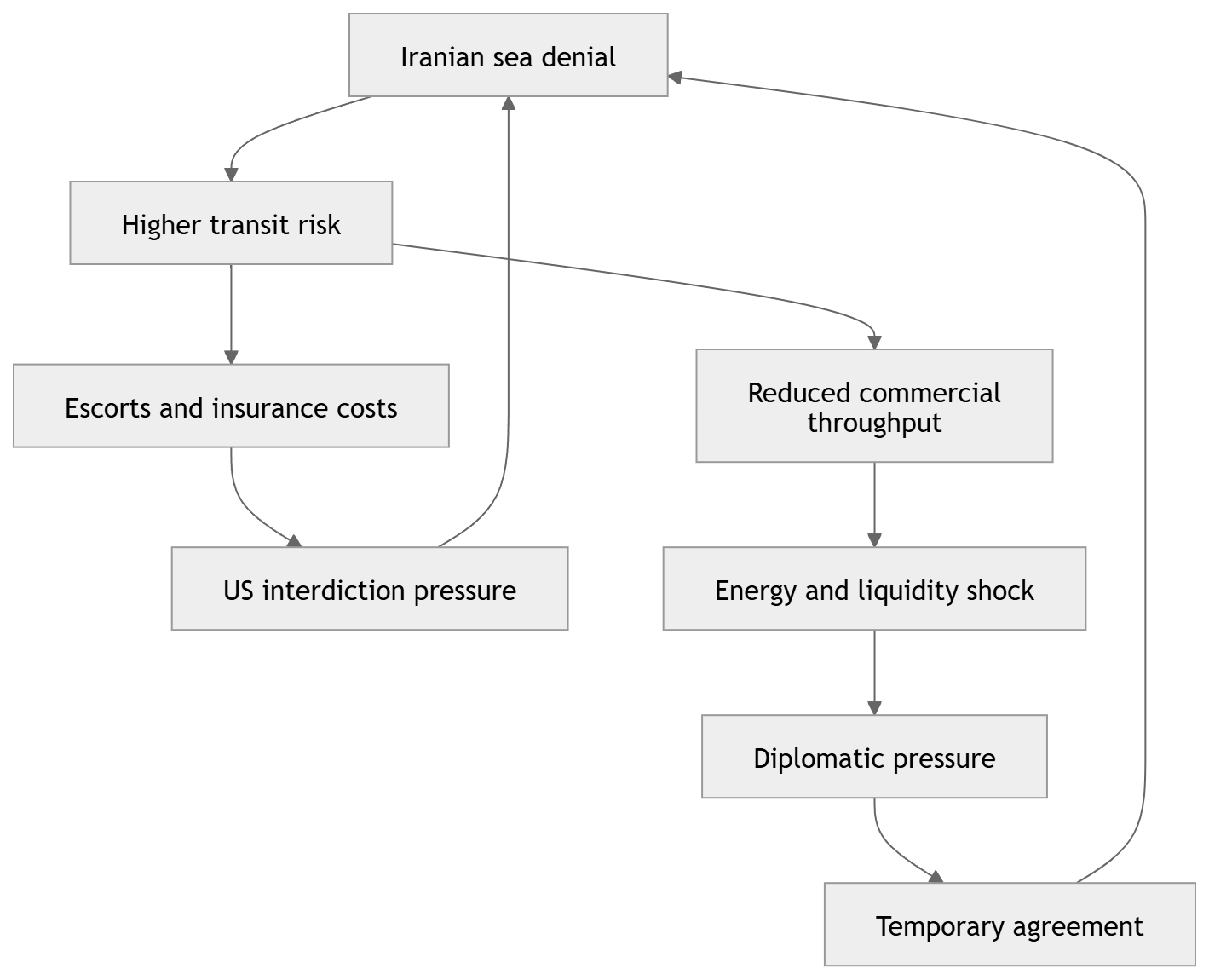
Commercial Passage as a Layered Decision System
A merchant vessel’s decision to cross Hormuz is not made solely by its master and does not follow automatically from a military announcement that the Strait is open. The voyage is jointly conditioned by the shipowner, beneficial owner, charterer, cargo owner, flag administration, classification society, protection-and-indemnity club, hull insurer, war-risk underwriter, mortgage bank, crew manager, port authority, sanctions counsel and coastal-security advisories. Failure at any one node can stop the transit. A state may therefore hold the navigational lane open while commercial passage remains economically closed for particular ship classes, flags or cargoes. The 2026 disruption illustrates the scale of this distinction. EIA estimates that regional crude-production shut-ins rose from approximately 8.89 million barrels per day in March to 10.4 million in April and 11.2 million in May, before declining to 8.29 million in June as flows resumed. The July forecast expected aggregate disruption to fall to approximately 5.43 million barrels per day in the third quarter and 1.44 million in the fourth quarter, with most regional production and trading patterns approaching pre-conflict conditions by the end of the year. Short-Term Energy Outlook: Global Oil Markets – U.S. Energy Information Administration – July 2026 — verified primary source. This trajectory shows both the extraordinary scale of the shock and the lag between reopening a passage and restoring production. Wells, storage systems, terminals, shipping schedules and inventories cannot instantly return to equilibrium. EIA estimated that global oil inventories declined by an average of 5.1 million barrels per day during the second quarter of 2026, embedding delayed price and liquidity effects even after traffic improved. The same model applies to crews and insurance: a formal ceasefire does not immediately remove exclusions, restore reinsurance capacity or persuade personnel to return. Commercial control is therefore exercised through expectations. Iran gains leverage whenever owners believe another closure is credible; the United States gains leverage when its escorts and suppression operations persuade markets that passage will be protected; Gulf producers gain leverage when they demonstrate alternative export capacity. The controlling actor is not necessarily the one physically nearest the shipping lane, but the one whose security assurance private actors consider most credible.
| Verified disruption metric | March 2026 | April 2026 | May 2026 | June 2026 | 3Q26 forecast | 4Q26 forecast |
|---|---|---|---|---|---|---|
| Regional crude-production shut-ins, million barrels/day | 8.89 | 10.40 | 11.20 | 8.29 | 5.43 | 1.44 |
| Direction of change | Severe loss | Deteriorating | Peak disruption | Partial recovery | Accelerating recovery | Near-normalization |
| Strategic interpretation | Closure shock transmitted | Storage and export constraints deepen | Maximum demonstrated coercive effect | June agreement changes expectations | Recovery remains agreement-dependent | Residual disruption persists |
Energy Concentration and the Limits of Bypass Capacity
The economic leverage embedded in Hormuz remains structurally resistant to military or infrastructural substitution. In 2024, approximately 20 million barrels per day of crude oil, condensate and petroleum products passed through the Strait, equivalent to about 20% of global petroleum-liquids consumption and more than one-quarter of worldwide seaborne oil trade. Roughly one-fifth of global liquefied-natural-gas commerce also crossed Hormuz, principally through Qatari exports. Asian destinations received approximately 84% of the crude oil and condensate and 83% of the LNG moving through the passage; China, India, Japan and South Korea collectively accounted for 69% of Hormuz crude and condensate flows. Amid Regional Conflict, the Strait of Hormuz Remains Critical Oil Chokepoint – U.S. Energy Information Administration – June 2025 — verified primary source; About One-Fifth of Global Liquefied Natural Gas Trade Flows Through the Strait of Hormuz – U.S. Energy Information Administration – June 2025 — verified primary source. Saudi Arabia’s East–West pipeline and the United Arab Emirates’ Fujairah system provide critical resilience, but EIA estimated their combined readily available unused bypass capacity at only approximately 2.6 million barrels per day, a small fraction of normal Hormuz throughput. Iran’s Goreh–Jask pipeline had an effective capacity near 300,000 barrels per day, yet observed use remained extremely limited. This imbalance explains why the conflict’s demand response became as important as its supply response. China had imported a record 11.6 million barrels per day in 2025, increasing to approximately 12 million barrels per day in the second half of that year and maintaining that level through February 2026; imports then fell during the second quarter as Hormuz disruption raised prices and constrained supply. China’s Crude Oil Imports Fell in the Second Quarter – U.S. Energy Information Administration – July 2026 — verified primary source. Beijing’s stock accumulation reduced immediate vulnerability, but inventory opacity prevents precise external measurement of endurance. The 2026 crisis therefore confirms that strategic petroleum reserves, demand destruction and non-Gulf production can moderate price escalation, yet cannot eliminate the macroeconomic consequences of a prolonged interruption.
| Structural energy indicator | Verified value | Strategic significance |
|---|---|---|
| Oil and petroleum liquids crossing Hormuz in 2024 | 20 million barrels/day | Approximately one-fifth of global consumption |
| Share of global seaborne oil trade | More than 25% | No equivalent maritime substitute |
| Share of global LNG trade | Approximately 20% | Qatar and Asian importers remain highly exposed |
| Crude and condensate directed to Asia | 84% | Primary shock transmission runs eastward |
| LNG directed to Asia | 83% | Asian gas and power markets face correlated risk |
| China, India, Japan and South Korea share of crude flows | 69% | Concentrated strategic-consumer exposure |
| Available Saudi and UAE bypass capacity | Approximately 2.6 million barrels/day | Only partial mitigation of a major closure |
| Iranian Goreh–Jask effective capacity | Approximately 0.3 million barrels/day | Insufficient Iranian self-insurance |
| Peak 2026 estimated production shut-ins | 11.2 million barrels/day | Closure effects reached systemically significant scale |
| 2Q26 global inventory decline | 5.1 million barrels/day | Latent price pressure survives physical reopening |
Shadow Fleet, Liquidity and Sanctions Warfare
The maritime contest extends beyond identifiable warships and licensed commercial carriers into a shadow logistics architecture linking Iranian production, intermediaries, opaque owners, ship managers, flags of convenience, offshore transfers, Asian refiners and alternative payment channels. US Treasury guidance describes the Iranian shadow fleet as generally consisting of older and poorly maintained vessels operating outside ordinary maritime standards, using complex ownership, multiple ship-to-ship transfers, altered trading routes, AIS manipulation and shadow payment mechanisms to conceal Iranian origin and sanctioned counterparties. Guidance for Shipping and Maritime Stakeholders on Detecting and Mitigating Iranian Oil Sanctions Evasion – U.S. Department of the Treasury, Office of Foreign Assets Control – April 2025 — verified primary source. In February 2026, Treasury designated 12 shadow-fleet vessels and their owners or operators, stating that the ships had collectively transported hundreds of millions of dollars in Iranian petroleum and petrochemicals. Treasury Targets Iran’s Shadow Fleet, Networks Supplying Its Petroleum Trade – U.S. Department of the Treasury – February 2026 — verified primary source. In April, OFAC designated another 19 vessels, documenting cargoes ranging from hundreds of thousands to more than six million barrels per vessel and identifying Chinese independent refiners as major recipients of Iranian crude. Economic Fury Targets Global Network Fueling Iran’s Oil Trade – U.S. Department of the Treasury – April 2026 — verified primary source. On 29 July, Treasury targeted entities associated with what it described as an Iranian Strait of Hormuz coercion system and designated additional vessels transporting Iranian petroleum. Treasury Disrupts Iranian Regime’s Strait of Hormuz Networks – U.S. Department of the Treasury – July 2026 — verified primary source. These designations reveal that maritime control depends upon financial control: a tanker that can navigate physically may still be unable to obtain dollar clearing, credible insurance, classification, port services, bunkering or lawful discharge. Iran answers this pressure through jurisdictional dispersion and commercial opacity. The United States answers through network sanctions rather than hull destruction. This produces a liquidity battlefield in which the relevant variables are price discounts, settlement currencies, payment delays, frozen assets, intermediary fees and the declining residual value of sanctioned vessels.
| Shadow dimension | Observable mechanism | Strategic effect | Priority OSINT indicators |
|---|---|---|---|
| Ownership opacity | Single-vessel companies and layered registries | Obscures beneficial control | Registry changes, directors, addresses, shared managers |
| AIS manipulation | Signal gaps, spoofed positions and identity changes | Conceals loading and transfer activity | Impossible speeds, duplicate identities, synchronized gaps |
| Ship-to-ship transfers | Offshore cargo blending and documentation changes | Obscures Iranian origin | Draught changes, paired loitering, nighttime proximity |
| Flags of convenience | Rapid reflagging across permissive registries | Delays enforcement and detention | Flag churn, cancelled registration, statutory certificate changes |
| Shadow insurance | Non-standard or weakly capitalized coverage | Shifts environmental and casualty risk | Insurer jurisdiction, reserve quality, claim-payment record |
| Alternative payments | Intermediaries, non-dollar settlement and delayed clearing | Sustains revenue despite sanctions | Exchange houses, trade-credit anomalies, mirrored invoices |
| Teapot refining | Independent refinery demand for discounted crude | Maintains Iranian export outlet | Port receipts, refinery runs, storage changes |
| Sanctions pressure | SDN designation of vessels and facilitators | Raises discounts and transaction costs | Vessel idling, name changes, port denial, distressed sale |
| Liquidity contagion | Margin calls, freight spikes and inventory financing | Transmits conflict into financial markets | Forward curves, tanker rates, collateral demands |
Cyber, Navigation and Attribution Risk
Cyber and electromagnetic operations represent the least visible but potentially most destabilizing layer of Hormuz control because they can create physical consequences without the signatures associated with a missile launch or boarding operation. Commercial shipping depends upon GNSS positioning, electronic charts, AIS data, satellite communications, engine-management systems, cargo-control networks and shore-based logistics platforms. Manipulating one element need not seize a vessel; it can generate uncertainty over position, collision risk, port arrival, ownership or cargo legitimacy. In a dense Traffic Separation Scheme, a falsified position or interrupted navigation feed can force speed reduction, convoy suspension or route closure while authorities determine whether the incident is technical, accidental or hostile. Attribution becomes the strategic hinge. A confirmed Iranian attack can trigger military retaliation and sanctions; an unattributed outage may still stop commercial movement without creating a lawful or politically acceptable target set. Shadow-fleet practices further contaminate the information environment because deliberate AIS gaps used for sanctions evasion resemble hostile electronic interference, while deceptive identities complicate distinction between legitimate shipping, covert state logistics and potential attack platforms. OFAC identifies AIS spoofing, conspicuous reporting gaps and unsafe nighttime transfers as recurrent methods used to conceal Iranian oil activity. Treasury Intensifies Pressure on Iranian Oil Smuggling and Sanctions-Evasion Network – U.S. Department of the Treasury – September 2025 — verified primary source. The cyber-norm problem is therefore broader than intrusion into a vessel. It includes whether manipulating navigational data constitutes an armed attack, when a coastal state may interfere with signals, what evidentiary threshold justifies self-defence and how commercial telemetry can be released without exposing intelligence capabilities. Over the five-year horizon, resilient maritime control will require multi-constellation navigation, inertial backup, authenticated positioning, segregated operational technology, manual bridge competence, rapid anomaly sharing and a trusted multinational attribution cell. Without those mechanisms, the cheapest path to disrupting Hormuz may migrate from kinetic attack toward deniable data corruption, particularly if conventional Iranian assets continue to suffer repeated US strikes.
Competing Legal and Geopolitical Architectures
The legal dispute concerns not only whether vessels may pass, but who is entitled to define and enforce the conditions of passage. The United Nations Convention on the Law of the Sea establishes a comprehensive maritime legal regime and the principle of transit passage through straits used for international navigation. United Nations Convention on the Law of the Sea – International Maritime Organization – 1982/2026 — verified primary source. The European Union’s May framework states that Iranian actions against vessels in Hormuz infringe established rights of transit and innocent passage. Its June designations identify an alleged IRGC Navy tolling and coercion system involving threats, harassment and attacks. Middle East: Council Extends EU Legal Framework to Target Those Involved in Iran’s Actions Impeding Lawful Transit Passage and Freedom of Navigation – Council of the European Union – May 2026 — verified primary source; Freedom of Navigation in the Strait of Hormuz: EU Lists Two Individuals and One Entity – Council of the European Union – June 2026 — verified primary source. The EU further maintains that any future arrangement must neither restrict freedom of navigation nor alter governance of the Strait. EU Position on the Situation in the Middle East – European Council – 2026 — verified primary source. China accepts that Hormuz is an international navigation route but assigns primary causation to US and Israeli military action, arguing that Security Council decisions must not provide retrospective legitimacy for unauthorized force. In July, China called for implementation of the US–Iran memorandum, renewed negotiations and early restoration of safe, free passage. Statement by Acting Permanent Representative Sun Lei at the Security Council Emergency Meeting on the Middle East – Ministry of Foreign Affairs of the People’s Republic of China – July 2026 — verified Chinese-language primary source. Russia similarly supports stable navigation but opposes a Western enforcement structure built upon what Moscow characterizes as aggression against Iran. Telephone Conversation of the Russian Minister of Foreign Affairs on the Situation Around Iran – Ministry of Foreign Affairs of the Russian Federation – July 2026 — verified Russian-language primary source. These incompatible causal narratives obstruct a durable multilateral security regime and make temporary military arrangements more probable than consensual governance.
Analysis of Competing Hypotheses
The evidence must be tested against at least five competing explanations rather than fitted to a predetermined victory narrative. H₁ — calibrated Iranian coercion proposes that Tehran seeks neither permanent closure nor unrestricted passage, but a controlled level of insecurity capable of generating negotiating leverage without producing universal military alignment against it. H₂ — incomplete American sea control proposes that the United States dominates high-end combat but cannot continuously suppress distributed Iranian threats or guarantee every commercial transit. H₃ — institutionalized bargaining war interprets attacks, ceasefires, memoranda, sanctions and renewed strikes as components of an iterative negotiating system in which neither party is prepared to exchange its core leverage for a final agreement. H₄ — fragmented command attributes inconsistent signals to multiple centres of authority, including Iranian political institutions, the IRGC, naval commands, the White House, CENTCOM, Israel and Gulf governments. H₅ — operational pause before escalation interprets negotiations and temporary reopening as opportunities to replenish magazines, repair infrastructure, reposition forces and improve intelligence. The July resumption of strikes after the June memorandum increases the posterior probability of H₃ and H₅ while reducing confidence in any rapid settlement hypothesis. Continuing commercial traffic despite attacks supports H₁ and H₂ simultaneously: Iran can impose risk but not total closure, while the United States can facilitate passage but not normalize it. Repeated destruction of Iranian naval and coastal targets without durable cessation of attacks strengthens the regenerative component of H₂. H₄ remains analytically credible but difficult to confirm because official sources rarely disclose internal decision conflict. H₅ requires additional discriminators: unusual force dispersal, rapid munitions replenishment, evacuation of high-value personnel, expansion of target lists, new strategic-stock releases or synchronized hardening of Gulf infrastructure. The leading judgement is consequently H₃, with H₂ as the principal operational mechanism and H₁ as Iran’s most rational strategy.
| Hypothesis | Prior probability | Evidence increasing probability | Evidence decreasing probability | Updated probability |
|---|---|---|---|---|
| H₁ Calibrated Iranian coercion | 24% | Selective passage, toll allegations, recurring but non-total disruption | Uncontrolled escalation or indiscriminate attacks | 23% |
| H₂ Incomplete American sea control | 23% | Repeated strike requirements; ongoing convoy and escort burden | Sustained attack-free normalization | 25% |
| H₃ Institutionalized bargaining war | 28% | Agreement followed by renewed attacks and strikes | Durable verified implementation | 34% |
| H₄ Fragmented command | 15% | Contradictory public signalling and episodic violations | Demonstrated unified command discipline | 10% |
| H₅ Pause before wider escalation | 10% | Regeneration, redeployment and expanding target sets | Long-term demobilization and verification | 8% |
Five-Year Outlook and Monte Carlo Scenario Model
The five-year forecast uses four mutually exclusive strategic end-states: recurring coercion, verified settlement, regional escalation and Iranian consolidation of de facto passage control. The starting weights—52%, 21%, 17% and 10%—reflect the verified August 2026 condition. A 100,000-path Monte Carlo model applies bounded uncertainty around annual central probabilities rather than treating the point estimates as deterministic facts. The baseline assumes that prolonged economic costs gradually increase incentives for a negotiated mechanism, while infrastructural bypass, commercial adaptation and repeated degradation marginally reduce the probability of enduring coercion. It does not assume Iranian disarmament, regime collapse or unlimited American operational endurance. Under these assumptions, recurring coercion remains dominant through 2030 but declines from 48.4% in 2027 to 36.9% in 2031. A verified settlement rises from 24.6% to 39.0%, narrowly becoming the modal 2031 outcome. Regional escalation peaks at approximately 18% in 2027–2028 before declining to 15.2%, while Iranian consolidation remains near 9% because Tehran’s sea-denial leverage is substantial but insufficient to overcome US, Gulf and international opposition to exclusive control. This is not a peace forecast; the settlement scenario requires verified maritime and nuclear arrangements, an incident-prevention mechanism, removal of discriminatory tolling, internationally credible monitoring and commercial insurance normalization. Without those conditions, a temporary ceasefire remains part of the coercion scenario. The principal upward escalation triggers are mass US casualties, prolonged mining of both traffic lanes, Israeli strikes on regenerated nuclear sites, attacks on Gulf export infrastructure and expansion of US targeting into regime-survival assets. Downward triggers include sustained attack-free transits, demonstrable Iranian compliance, reduced blockade activity, verified demining and restoration of standard underwriting. The model should therefore be treated as a structured warning framework whose probabilities change when observable indicators move, not as a fixed prediction.
| Monte Carlo outcome | 2027 | 2028 | 2029 | 2030 | 2031 |
|---|---|---|---|---|---|
| Recurring coercion | 48.4% | 44.0% | 41.2% | 38.9% | 36.9% |
| Verified settlement | 24.6% | 29.0% | 33.0% | 36.2% | 39.0% |
| Regional escalation | 18.0% | 18.0% | 16.9% | 16.0% | 15.2% |
| Iranian consolidation | 9.1% | 8.9% | 8.9% | 8.9% | 8.9% |
Strategic Warning Matrix
The decisive intelligence requirement is to distinguish temporary operational variation from movement toward a new strategic regime. Shipping counts alone are insufficient because increased traffic may reflect escorts rather than reduced threat. Oil prices alone are insufficient because demand destruction, strategic-stock releases and non-Gulf supply can mask security deterioration. Strike counts alone are insufficient because higher strike volume may indicate either successful suppression or repeated regeneration. The warning architecture must integrate maritime, military, commercial, financial, diplomatic and electronic indicators. A genuine transition toward settlement would produce simultaneous improvement across at least four layers: sustained attack-free passage, reduced escort dependence, verifiable diplomatic implementation and normalization of insurance and financing. A transition toward escalation would produce the opposite pattern: concentrated military deployment, widening target sets, evacuation orders, GPS anomalies, mine warnings, rising freight rates, deterioration of diplomatic language and emergency stock releases. Iranian consolidation would not require expulsion of the US Navy; it would become visible if shipowners increasingly sought Iranian authorization, paid institutionalized charges or differentiated transit behaviour according to Tehran’s warnings. American sea control would become more durable if traffic normalized while force-protection and strike requirements declined. The critical measurement is therefore security output per unit of military input. If Washington must continually increase sorties, escorts and interceptors merely to maintain constant throughput, operational effectiveness is deteriorating even when ships continue to pass. If Iran must expend increasing numbers of platforms for declining disruption, its coercive efficiency is deteriorating. Between 2026 and 2031, analysts should update the Bayesian model whenever multiple independent indicator families cross thresholds simultaneously.
| Indicator family | Settlement signal | Coercion signal | Escalation signal | Iranian-control signal |
|---|---|---|---|---|
| Vessel traffic | Stable unescorted growth | Convoy-dependent variability | Sustained collapse | Selective traffic by Iranian approval |
| Attacks | Zero for a sustained period | Episodic harassment | Multiple lethal incidents | Punitive enforcement against non-compliance |
| US operations | Reduced escort and strike tempo | Persistent patrol burden | Expanded target categories | Withdrawal or sharply reduced presence |
| Iranian posture | Verified launcher and mine restraint | Regeneration after strikes | Dispersal and mass mobilization | Formalized passage conditions |
| Insurance | Standard coverage restored | High war-risk premium | Withdrawal of cover | Coverage conditioned on Iranian compliance |
| Energy | Production normalization | Volatile partial recovery | Renewed shut-ins | Discounted preferential flows |
| Diplomacy | Verification and incident mechanism | Repeated temporary memoranda | Negotiation collapse | External acceptance of Iranian rules |
| Cyber/navigation | Reduced interference | Intermittent anomalies | Coordinated disruptive campaign | Persistent monitoring and selective denial |
| Shadow fleet | Declining deceptive activity | Continued evasion | Militarized use of commercial hulls | Integration into Iranian passage regime |
| Liquidity | Narrowing discounts and normal clearing | Elevated intermediary costs | Payment freezes and margin stress | Alternative clearing architecture stabilizes |
War Without Resolution — Military Results, Diplomatic Breakdown and Competing Victory Narratives
Victory Without an End State
The central analytical error surrounding the 2026 Iran war is the conflation of battlefield dominance, coercive leverage, political success and strategic victory. These are separate outcomes, and the available official record does not permit them to be collapsed into a single claim that either the United States or Iran has “won.” The United States has demonstrated an overwhelming capacity to penetrate Iranian airspace, destroy fixed and mobile military assets, intercept missile attacks, maintain tens of thousands of personnel across the theatre and repeatedly reinitiate precision-strike campaigns. Iran, however, has preserved the political continuity of the state, retained the capacity to launch missiles and drones, continued imposing costs on maritime traffic, prevented a verified final settlement of the nuclear issue and compelled Washington to negotiate repeatedly after declaring earlier operational success. Neither side has converted its strongest form of power into the terminal political condition it originally sought. The US Department of Defense defined the mission of Operation Epic Fury on 2 March 2026 as destroying Iranian offensive missiles, missile production, naval and security infrastructure, while ensuring that Iran would never possess nuclear weapons. Hegseth Says “Epic Fury” Goals in Iran Are “Laser-Focused” – U.S. Department of Defense – March 2026 — verified primary source. Yet CENTCOM was still striking Iranian command centres, missile and drone facilities, coastal surveillance, defensive sites and maritime capabilities on 29 July, after Iranian forces allegedly attempted another ballistic-missile attack on US forces. U.S. Strikes IRGC Targets After Attempted Iranian Attacks – U.S. Central Command – July 2026 — verified primary source. Continued strikes do not prove American failure; they prove that degradation was real but not equivalent to elimination. Continued Iranian attacks do not prove Iranian victory; they prove survival and regeneration. The correct classification is a war of unresolved strategic conversion: the United States wins most identifiable kinetic exchanges, while Iran continues denying Washington the durable political and security architecture that would make those exchanges strategically conclusive.
| Victory dimension | US declared or implied objective | Iranian objective inferred from verified conduct | Verified condition through 4 August 2026 | Net judgement |
|---|---|---|---|---|
| Air and strike dominance | Penetrate defences and destroy military infrastructure | Preserve enough assets to retaliate and regenerate | Repeated US strikes; continuing Iranian launches | Strong US advantage, incomplete suppression |
| Nuclear outcome | Ensure Iran never acquires a nuclear weapon | Preserve sovereign nuclear capacity and bargaining leverage | Safeguards dispute and incomplete verification persist | Unresolved |
| Maritime outcome | Restore free, toll-free passage | Retain coercive leverage over Hormuz | Traffic continues under recurring threat and military protection | Contested |
| Political outcome | Compel durable Iranian compliance | Preserve regime and avoid capitulation | Iranian state survives; no final settlement | Iranian denial of US political closure |
| Economic outcome | Reduce petroleum revenue and financing | Sustain exports and impose external economic costs | Severe Iranian pressure, but global disruption and shadow trade continue | Mutual cost imposition |
| Alliance outcome | Coordinate Israel, Gulf states and partners | Fracture coalition and delegitimize US action | Cooperation exists, but Russia and China reject US causal narrative | Divided international system |
| Deterrence outcome | Make renewed Iranian attacks prohibitively costly | Demonstrate ability to absorb strikes and retaliate | Cycles of retaliation continue | Deterrence remains unstable |
| Narrative outcome | “Peace through strength” and decisive military success | Resistance, survival and denial of imposed terms | Both narratives retain evidentiary components | No uncontested victory narrative |
The American Military Balance Sheet
The American military campaign has achieved effects that must not be minimized. CENTCOM’s campaign architecture combined long-range precision strike, carrier aviation, land- and sea-launched munitions, electronic warfare, persistent surveillance, missile defence and maritime interdiction. During the July renewal alone, CENTCOM reported approximately 80 targets struck on 7 July, including more than 60 IRGC small boats, followed by approximately 90 targets on 8 July encompassing air-defence systems, coastal surveillance, missile and drone storage, naval capabilities and logistics infrastructure. On 11 July, the command reported another 140 targets, stating that more than 300 targets had been struck during three nights. It subsequently conducted successive operations through 23 July and attacked dozens of additional IRGC sites on 29 July. U.S. Forces Complete Another Round of Strikes Against Iran – U.S. Central Command – July 2026 — verified primary source; U.S. Forces Finish Latest Round of Strikes Against Iran – U.S. Central Command – July 2026 — verified primary source. The Department of Defense also reported that Iranian Shahed-136 attacks accounted for 66% of Iranian counterattack operations during the initial phase from 28 February to 9 March, while asserting that those attacks did not materially erode US combat power. Small Drones, Big Problems: A First-Principles Approach to Counter-UAS – U.S. Department of Defense – July 2026 — verified primary source. The United States therefore demonstrated the capacity to absorb a large drone burden, transfer counter-drone lessons and capabilities from Ukraine, maintain command continuity and continue generating combat sorties. These are substantial operational achievements. The limitations arise from recurrence and resource exchange. Destroying hundreds of targets without terminating Iranian launch capacity indicates that target destruction exceeded strategic neutralization. Intercepting missiles protects forces but consumes defensive magazines and exposes bases to repeated saturation attempts. The deployment of more than 50,000 US service members in the Middle East, confirmed by CENTCOM on 29 July, provides mass and resilience but also creates a distributed target network and an enduring force-protection obligation. The US military has therefore produced dominant tactical effects at the price of an open-ended suppression requirement.
| Verified US operational indicator | Date or period | Officially reported value | Analytical meaning |
|---|---|---|---|
| Operation Epic Fury commencement | 28 February 2026 | Theatre-wide strike campaign | Shift from deterrence to direct war |
| US fatalities reported in Pentagon briefing | By 19 March | 13 service members | Campaign imposed non-zero human costs |
| Iranian counterattacks using Shahed-136 | 28 February–9 March | 66% of counterattack operations | Iran relied heavily on low-cost unmanned strike systems |
| Iranian attacks after first ceasefire | By 5 May | 9 attacks on commercial vessels; 2 seizures; more than 10 attacks on US forces | Ceasefire did not suppress coercive action |
| US targets struck on 7 July | One night | Approximately 80, including more than 60 small boats | Rapid destruction of exposed maritime capacity |
| US targets struck on 8 July | One night | Approximately 90 | Continued coastal and air-defence suppression |
| US targets struck during three July nights | 7–11 July | More than 300 | High-intensity repeat campaign |
| IRGC sites struck after attempted missile attack | 29 July | Dozens | Iranian launch threat remained active |
| US personnel in Middle East | 29 July | More than 50,000 | Strong force presence and large protection burden |
Iranian Survival Is Not Iranian Victory
Iran’s strongest victory claim rests on survival, retaliation and denial rather than battlefield superiority. The state remained politically intact after months of American and Israeli attacks; its armed forces retained the ability to launch missiles and drones; the IRGC continued operating a maritime coercion system; and Tehran did not accept a visibly comprehensive surrender of its nuclear, missile or regional-security positions. In strategic theory, preventing a materially superior adversary from achieving its maximal objectives can constitute denial success, but denial success is not synonymous with positive victory. Iran’s military infrastructure has suffered repeated and demonstrably extensive degradation. Its small-boat formations, missile storage, command centres, coastal sensors, air defences and logistics networks have been attacked at scale. Its petroleum trade faces intensifying sanctions, its shadow fleet bears higher operating costs, its commercial passage through the Arabian Sea faces American interdiction, and regional crude production suffered extraordinary losses during the closure period. EIA estimated Middle Eastern production shut-ins of approximately 8.89 million barrels per day in March, 10.4 million in April, 11.2 million in May and 8.29 million in June. Short-Term Energy Outlook: Global Oil Markets – U.S. Energy Information Administration – July 2026 — verified primary source. These losses were not exclusively Iranian, but they expose the strategic contradiction in Tehran’s use of Hormuz: the same instrument that damages adversaries and Asian importers also constrains Iranian revenue, regional relationships and domestic economic stability. Iran’s denial strategy succeeds only while external actors believe its coercion will remain bounded. If maritime attacks consolidate an international coalition, justify prolonged blockade, accelerate alternative pipelines or produce catastrophic environmental damage, the strategic balance turns against Tehran. Iran has therefore achieved three limited results: it demonstrated that military punishment cannot automatically produce political capitulation; it preserved a residual strike and maritime threat; and it forced repeated diplomacy. It has not demonstrated five requirements of comprehensive victory: removal of the US military presence, termination of sanctions, unrestricted petroleum exports, internationally recognized nuclear autonomy or stable control of Hormuz. The most accurate formulation is that Iran has prevented an American strategic victory while failing to secure an Iranian one.
The Nuclear Test of Strategic Success
The nuclear dimension is the decisive test because it was presented by Washington as a core casus belli and remains the field where physical destruction and verifiable resolution diverge most sharply. The White House declared in June that the US–Iran memorandum ensured Iran would never obtain a nuclear weapon and would prohibit a path through uranium enrichment. President Trump’s Iran Agreement Is America First in Action – The White House – June 2026 — verified primary source. That assertion describes the administration’s political interpretation of the agreement; it does not substitute for IAEA verification. The IAEA’s February 2026 safeguards report documented continuing disputes over cooperation and Iran’s position that security threats made certain cooperation impracticable. Implementation of the NPT Safeguards Agreement in the Islamic Republic of Iran – International Atomic Energy Agency – February 2026 — verified primary source. In June, the IAEA described a Cairo understanding covering inspections, notifications and safeguards implementation across declared nuclear facilities and material, but the Board subsequently adopted a resolution recalling Iran’s failures since 2019 to provide full and timely cooperation regarding undeclared material and activities and regretting the continued failure to remedy non-compliance. GOV/2026/33: Implementation of the NPT Safeguards Agreement in Iran – International Atomic Energy Agency – June 2026 — verified primary source; GOV/2026/40: Implementation of the NPT Safeguards Agreement and Relevant Security Council Resolutions in Iran – International Atomic Energy Agency – June 2026 — verified primary source. Iran, through a formal communication circulated by the IAEA, asserted that it had complied with its safeguards obligations, demonstrating that even the legal characterization of compliance remained contested. INFCIRC/1380: Communication Received from the Permanent Mission of the Islamic Republic of Iran – International Atomic Energy Agency – June 2026 — verified primary source. A military campaign can destroy centrifuges, access tunnels, electrical systems, laboratories and command networks; it cannot independently prove the location and status of nuclear material, eliminate tacit knowledge or create an enduring verification regime. The nuclear end state therefore remains unresolved until inspectors can establish continuity of knowledge, account for material, verify declared and potentially undeclared locations and monitor limits over time.
| Nuclear victory test | Required evidence for US strategic success | Verified position | Assessment |
|---|---|---|---|
| No nuclear weapon | Confirmed absence of weaponization and diversion | No official evidence of an Iranian weapon presented here | Objective not disproved, but not permanently guaranteed |
| No enrichment path | Verified dismantlement or enforceable limits | White House claims agreement; safeguards dispute persists | Politically asserted, technically unresolved |
| Material accountancy | IAEA continuity of knowledge over all relevant material | Cooperation and access remain contested | Incomplete |
| Facility neutralization | Physical inability to resume key activities | Repeated attacks damaged infrastructure | Degradation established, permanence unverified |
| Undeclared locations | Resolution of safeguards questions | IAEA Board cites continuing non-compliance | Unresolved |
| Inspector access | Full, timely and safe access | Cairo procedures created framework | Implementation remains decisive |
| Knowledge destruction | Elimination of specialist expertise | Impossible to establish through strikes alone | Not achievable militarily |
| Durable compliance | Multi-year monitoring and enforcement | June memorandum followed by renewed conflict | Not established |
Diplomacy as an Extension of the War
Diplomacy did not replace military action; it became another arena through which both sides attempted to consolidate coercive gains. The conflict generated at least three distinct diplomatic cycles: an early-April ceasefire, a June memorandum intended to reopen Hormuz and extend the cessation of hostilities, and renewed July negotiations under conditions of continuing attacks and strikes. On 15 June, the EU Foreign Affairs Council described the announced US–Iran framework as a potential breakthrough providing space for negotiations, but explicitly warned that the most difficult phase remained ahead. The framework envisaged a 60-day ceasefire and the restoration of toll-free passage through Hormuz while leaving Iran’s nuclear and ballistic-missile programmes for deeper negotiation. Foreign Affairs Council, 15 June 2026 – Council of the European Union – June 2026 — verified primary source. The White House then presented the memorandum as a historic settlement that reopened Hormuz, prevented an Iranian nuclear weapon and demonstrated the success of “peace through strength.” President Trump’s Iran Agreement Is America First in Action – The White House – June 2026 — verified primary source. By 2 July, however, the UN Security Council was discussing renewed strain caused by military exchanges and attacks on commercial shipping. Implement Peace Deal Now, Speakers Urge, as Security Council Meets on Iran – United Nations – July 2026 — verified primary source. On 23 July, the Council again confronted competing claims: Iran stated that it had acted in good faith under the Pakistan-mediated memorandum, while the United States urged Tehran to return to diplomacy, comply with resolutions and halt destabilizing activities. As Secretary-General Urges Security Council Members to Prioritize Diplomacy, Speakers Debate Iran Conflict – United Nations – July 2026 — verified primary source. The repeated sequence—military coercion, limited agreement, incompatible interpretations, alleged violation and renewed strikes—shows that the parties did not share a common theory of implementation. Each treated the agreement as validation of its own leverage rather than surrender of that leverage.
| Diplomatic phase | Formal or official event | Intended result | Observed weakness |
|---|---|---|---|
| Initial war phase | Operation Epic Fury begins, 28 February | Destroy Iranian capabilities and compel compliance | Iran retains retaliatory capacity |
| April ceasefire | Ceasefire announced after initial campaign | Suspend major hostilities | Subsequent attacks on vessels and US forces |
| June framework | 60-day ceasefire and reopening arrangement | Toll-free navigation and deeper negotiations | Nuclear and missile questions deferred |
| 18 June memorandum | US–Iran understanding | Stabilize Hormuz and create permanent framework | Competing interpretations of obligations |
| Early July strain | UN Security Council meeting, 2 July | Preserve implementation | Fresh exchanges and shipping attacks |
| July escalation | Repeated US strike waves | Punish violations and restore deterrence | Iran continues attempted attacks |
| Late-July diplomacy | Security Council debate, 23 July | Return parties to compliance | Each side blames the other |
| End-state status | No verified comprehensive treaty | Resolve war, nuclear and maritime issues | Strategic bargaining remains open |
Why the Agreements Broke Down
The diplomatic architecture failed because it attempted to suspend hostilities without resolving the hierarchy among five linked disputes: uranium enrichment, ballistic missiles, maritime passage, sanctions and regional armed networks. Any agreement dealing with only one vector altered leverage in the others. Reopening Hormuz reduced global economic pressure for immediate compromise and restored revenue opportunities, potentially decreasing Tehran’s incentive to concede on enrichment. Suspending American strikes allowed Iran to repair launch systems and command networks, while continued US blockade pressure gave Tehran an incentive to retain maritime coercion. Delaying the nuclear issue permitted each side to describe the same memorandum differently: Washington could present it as the beginning of denuclearization, whereas Iran could treat it as a ceasefire that preserved sovereign negotiating positions. The absence of a mutually trusted verification and adjudication mechanism made every incident strategically exploitable. A commercial-vessel attack could be characterized as an IRGC violation, unauthorized action, proxy operation, misidentification or response to American interdiction. The institutional problem was compounded by divergent great-power positions. The European Union demanded toll-free navigation, Iranian safeguards compliance and an end to destabilizing missile activity, while reinforcing the possible role of EUNAVFOR ASPIDES. European Council Meeting, 18–19 June 2026 – Council of the European Union – June 2026 — verified primary source. China described Hormuz as an international navigation route but argued that US and Israeli military action caused the crisis and that negotiations must respect Iranian sovereignty. Statement by Acting Permanent Representative Sun Lei at the Security Council Emergency Meeting on the Middle East – Ministry of Foreign Affairs of the People’s Republic of China – July 2026 — verified Chinese-language primary source. Russia supported stable and unobstructed navigation but rejected a Western framework that legitimized military pressure against Iran. Telephone Conversation of the Russian Minister of Foreign Affairs on the Situation Around Iran – Ministry of Foreign Affairs of the Russian Federation – July 2026 — verified Russian-language primary source. Without agreement on causation, there could be no agreement on enforcement.
The Economic War Did Not End at the Ceasefire
The economic balance sheet contradicts victory narratives on both sides because the conflict imposed extraordinary costs without producing decisive economic capitulation. The effective closure of Hormuz from late February disrupted global oil flows, caused regional producers to shut in millions of barrels per day and pushed Brent sharply higher before the June memorandum enabled partial normalization. EIA assessed production shut-ins at 11.2 million barrels per day in May, declining to 8.3 million in June, and estimated that global inventories fell by approximately 5.1 million barrels per day during the second quarter. Brent averaged approximately 85 dollars per barrel in June and fell below 70 dollars on 1 July as traffic resumed. Short-Term Energy Outlook: Global Oil Markets – U.S. Energy Information Administration – July 2026 — verified primary source. Iran demonstrated its capacity to impose an energy shock far beyond the physical damage caused by its weapons; Washington and global producers demonstrated that strategic stocks, alternative production, bypass pipelines and demand reduction could prevent indefinite price escalation. China’s crude imports declined during the second quarter after reaching a record annual average of 11.6 million barrels per day in 2025 and approximately 12 million per day from the second half of 2025 through February 2026. China’s Crude Oil Imports Fell in the Second Quarter – U.S. Energy Information Administration – July 2026 — verified primary source. Simultaneously, US sanctions targeted successive waves of Iranian shadow-fleet vessels, intermediaries and refiners, raising discounts and transaction costs without eliminating trade. In April 2026, Treasury designated 19 shadow-fleet vessels and documented individual vessels carrying between hundreds of thousands and more than six million barrels of Iranian petroleum. Economic Fury Targets Global Network Fueling Iran’s Oil Trade – U.S. Department of the Treasury – April 2026 — verified primary source. Iran has therefore failed to secure normal economic sovereignty, while the United States has failed to eliminate Iranian export revenue. Economic warfare remains a cost-amplification contest, not a completed victory.
| Economic measure | Peak or verified value | Who gained leverage? | Why it does not establish victory |
|---|---|---|---|
| Regional production shut-ins | 11.2 million barrels/day in May | Iran gained global coercive leverage | Iran and regional partners also lost revenue |
| Global inventory decline | 5.1 million barrels/day in 2Q26 | Producers and holders of inventory | Shock created global political pressure against escalation |
| Brent average | Approximately 85 dollars/barrel in June | Oil exporters and non-Gulf producers | Price fell rapidly after traffic resumed |
| Brent on 1 July | Below 70 dollars/barrel | Importers and US diplomatic narrative | Recovery remained vulnerable to renewed conflict |
| Chinese 2025 crude imports | 11.6 million barrels/day | China entered crisis with stronger stock position | Import decline showed continued exposure |
| April shadow-fleet designations | 19 vessels | US financial coercion | Iranian trade continued through adaptation |
| Available Saudi/UAE bypass | Approximately 2.6 million barrels/day | Gulf resilience | Far below normal Hormuz throughput |
| Peak normal Hormuz oil flow | Approximately 20 million barrels/day | Iran retains geographic leverage | Full closure is economically self-damaging |
Competing Victory Narratives
The American narrative defines victory as the demonstration of superior force, destruction of Iranian military and nuclear infrastructure, restoration of shipping and compelled negotiation. It is strongest where official operational evidence shows high target counts, successful missile interceptions, continued force presence and the June reopening of traffic. It is weakest where it claims permanence: Iranian attacks continued, nuclear verification remained incomplete and the June settlement did not terminate military operations. The Iranian narrative defines victory as national survival, resistance to imposed surrender, continued retaliatory capacity and preservation of sovereignty over nuclear and maritime decisions. It is strongest because the Iranian state did survive, continued fighting and denied Washington an uncontested political end state. It is weakest because survival came with severe military destruction, economic disruption, sanctions pressure and dependence on coercive methods that damage Iran’s own trade and partnerships. The Israeli narrative would logically measure success through degradation of Iranian nuclear, missile and proxy capabilities and an extension of the time required for Iran to threaten Israel; however, the present source protocol does not permit unverified claims concerning Ben Gurion Airport or the precise role of US forces there. The European narrative defines success more institutionally: restored navigation, IAEA safeguards compliance, reduced missile threats and a sustainable ceasefire. By that standard, no party has won. China’s narrative emphasizes that military action created the crisis and that peace requires sovereign equality and negotiations rather than forced passage; Russia advances a similar critique of Western coercion. These competing narratives are not superficial propaganda layers. They affect domestic political endurance, coalition formation, sanctions compliance, post-war reconstruction and whether a future agreement is regarded as legitimate. A strategically successful settlement must allow each side to claim sufficient achievement to comply, but must not encode mutually incompatible understandings of what was agreed. The June memorandum failed precisely because political narratives outran technical implementation.
| Narrative actor | Claimed victory mechanism | Supporting evidence | Contradictory evidence | Narrative durability |
|---|---|---|---|---|
| United States | Decisive force compelled peace and denuclearization | Large-scale target destruction; June memorandum; restored traffic | Renewed attacks, strikes and safeguards dispute | Medium |
| Iran | Resistance survived and denied imposed terms | State continuity; retaliatory capacity; recurring negotiations | Severe military and economic degradation | Medium |
| European Union | Rules-based navigation and verified non-proliferation | Sanctions, diplomatic engagement and maritime-security role | Neither navigation nor safeguards fully normalized | Low as present outcome; high as end-state model |
| China | Ceasefire and sovereign negotiation are the only durable solution | Mediation pressure and Asian economic exposure | Limited capacity to enforce maritime compliance | Medium |
| Russia | Western aggression caused instability; diplomacy must replace force | Opposition to US-led enforcement gains non-Western support | Russia cannot alone restore passage or verification | Medium |
| Gulf states | Stability and uninterrupted exports are the priority | Support for navigation and alternative infrastructure | Geographical exposure remains unavoidable | High |
| Commercial sector | Victory means predictable, insurable transit | Traffic recovery after June | Recurring attacks and premiums preserve uncertainty | Low |
Bayesian Assessment of Competing Hypotheses
Five competing hypotheses explain why extensive military action has not generated a final result. H₁ — US coercive strategy is succeeding gradually assumes that repeated degradation is progressively reducing Iranian options and that negotiations will eventually codify American military gains. H₂ — Iran has achieved strategic denial assumes that survival and residual retaliation are sufficient to prevent Washington from imposing its objectives, even if Iran loses most kinetic exchanges. H₃ — both sides are trapped in a bargaining war holds that neither seeks or can afford total escalation, but neither can surrender its principal leverage; violence therefore becomes a recurring negotiating instrument. H₄ — command fragmentation repeatedly destroys agreements attributes breakdowns to inconsistent control over military, proxy and political actors. H₅ — the conflict is moving toward a delayed decisive escalation interprets ceasefires as pauses used to replenish munitions, improve targeting and harden vulnerable systems. The evidence through 4 August gives H₃ the highest posterior probability because every major sequence has repeated the same structure: military pressure, limited agreement, incomplete implementation, accusations of violation and renewed attack. H₂ receives substantial weight because Iran has clearly denied political closure, but its severe losses make a positive Iranian victory interpretation excessive. H₁ remains plausible because sustained degradation and sanctions may alter Tehran’s calculation over a longer horizon, yet repeated regeneration weakens any claim that success is imminent. H₄ is credible but difficult to verify through official documents; apparent fragmentation could also be deliberate ambiguity. H₅ remains the highest-impact minority hypothesis because force concentrations, strike repetition and unresolved nuclear questions could produce a wider campaign. The resulting judgement is not neutral: the United States holds the superior military position, while Iran currently holds sufficient denial power to prevent that superiority from becoming strategic victory.
| Hypothesis | Prior | Principal confirming indicators | Principal disconfirming indicators | Posterior |
|---|---|---|---|---|
| H₁ Gradual US coercive success | 25% | Declining Iranian launch tempo; expanding inspection access; normalized traffic | Persistent attacks and repeated target regeneration | 22% |
| H₂ Iranian strategic denial | 23% | Regime survival; residual retaliation; no imposed final settlement | Collapse of strike capacity or acceptance of US conditions | 27% |
| H₃ Institutionalized bargaining war | 30% | Recurrent attack–agreement–violation cycle | Durable verification and demobilization | 35% |
| H₄ Fragmented command | 12% | Inconsistent signalling and unexplained violations | Demonstrated centralized enforcement | 9% |
| H₅ Delayed decisive escalation | 10% | Widening target sets and mobilization | Sustained de-escalation and reduced deployments | 7% |
Five-Year Strategic Outlook
The 2026–2031 outlook depends less on who has destroyed more equipment than on who can convert its current form of leverage into an accepted and enforceable order. The baseline scenario assigns the highest probability to a prolonged bargaining conflict in which major combat becomes intermittent, maritime violence remains episodic, sanctions continue evolving and nuclear negotiations alternate between technical progress and political breakdown. The probability of a comprehensive American victory remains constrained because eliminating Iran’s nuclear knowledge, dispersed missile base, political sovereignty and maritime geography would require either a highly intrusive agreement or an occupation-scale transformation that Washington has not identified as its objective. The probability of a comprehensive Iranian victory is lower because Iran cannot force the United States from the region, normalize trade, remove sanctions or secure internationally accepted control of Hormuz through its present capabilities. The most attainable US outcome is therefore a limited coercive settlement: capped or eliminated enrichment pathways, restored IAEA access, reduced maritime attacks and a sanctions mechanism conditioned on compliance. The most attainable Iranian outcome is sovereign survival with constrained capabilities: regime continuity, limited civilian nuclear activity, gradual economic relief and no formal surrender. Between these lies the risk of a frozen but heavily armed confrontation. A five-year settlement becomes more likely if missile inventories and economic losses accumulate faster than each side’s ability to regenerate political will. Escalation becomes more likely if attacks kill large numbers of US personnel, Iran obstructs IAEA access, Israel judges nuclear reconstruction imminent, or US leaders expand objectives from capability degradation to regime destruction. The victory narrative likely to survive historically will not be determined in 2026. It will depend on whether Iran rebuilds, whether inspections remain credible, whether Hormuz normalizes without constant escorts and whether the conflict creates a more or less stable regional order by 2031.
| 2031 end state | Probability | US position | Iranian position | Strategic meaning |
|---|---|---|---|---|
| Limited coercive settlement | 34% | Secures verifiable nuclear and maritime constraints | Preserves regime and obtains conditional relief | Mutual compromise disguised as victory |
| Institutionalized intermittent war | 32% | Maintains military dominance and sanctions | Retains denial and asymmetric retaliation | No strategic resolution |
| Expanded regional escalation | 16% | Pursues broader target set and greater force commitment | Expands missile, proxy and maritime attacks | Severe cross-regional destabilization |
| US-dominant imposed settlement | 11% | Converts degradation into enforceable political conditions | Accepts major restrictions under pressure | Closest outcome to American victory |
| Iranian strategic consolidation | 7% | Reduces presence or enforcement | Preserves nuclear leverage and maritime coercion | Closest outcome to Iranian victory |
Strategic Indicators for Determining Who Is Actually Winning
Victory must be monitored through a longitudinal scorecard rather than declarations. The United States is moving toward strategic success if Iranian attack frequency and regeneration decline while IAEA access, unescorted shipping and verifiable nuclear restrictions rise; high strike counts alone are insufficient because they may reveal persistent target replenishment. Iran is moving toward strategic success if it maintains the regime, preserves coercive capability, compels sanctions relief and gains recognition of its security or nuclear terms without surrendering core assets; survival alone is insufficient if military, economic and diplomatic capacity deteriorate continuously. A genuine settlement requires simultaneous movement in at least five indicator families: military demobilization, nuclear verification, maritime normalization, financial stabilization and diplomatic institutionalization. A false peace will show traffic recovery and lower oil prices without reliable inspection, incident adjudication or reductions in strike readiness. A transition toward major escalation will show dispersed Iranian missile deployments, accelerating US force protection, widening civilian warnings, emergency stock releases, evacuation orders and a shift in official rhetoric from capability degradation toward leadership or regime targets. Analysts should assign particular weight to negative evidence: the absence of Iranian launches, the absence of US retaliation, the absence of shadow-fleet expansion and the absence of inspection disputes over a sustained period. In war termination, persistent non-events are often more informative than spectacular announcements. As of 4 August 2026, the combined indicator set shows the United States ahead in military performance, Iran successful in strategic denial, and neither side close to a durable comprehensive victory.
| Winning indicator | US advantage threshold | Iranian advantage threshold | Current direction |
|---|---|---|---|
| Iranian launch regeneration | Sustained decline despite reduced US strikes | Continued launches after repeated degradation | Favors Iranian denial |
| US strike requirement | Declining sorties and target sets | Repeated large waves needed for constant effect | Favors Iranian denial |
| IAEA verification | Full access and material accountancy | Persistent access limits and ambiguity | Unresolved; currently unfavorable to US end state |
| Hormuz passage | Normal unescorted, toll-free transit | Selective or coercively conditioned transit | Contested |
| Sanctions effectiveness | Falling exports and shrinking shadow network | Stable revenue through adaptation | Mixed |
| Alliance cohesion | Broad support for enforcement model | Russia–China resistance fractures legitimacy | Mixed |
| Iranian regime stability | Internal compliance with negotiated settlement | Survival without accepting imposed terms | Favors Iran’s minimum objective |
| US force sustainability | Lower force burden with stable deterrence | More deployments required for same outcome | Currently costly for US |
| Nuclear reconstruction | Detectable and preventable | Concealed or rapid regeneration | Insufficient verified evidence |
| Durable treaty | Ratified, monitored and enforceable agreement | No agreement or repeated temporary memoranda | Neither side winning |
The 2031 Horizon — Five Hypotheses, Probabilistic Scenarios and Strategic Warning Indicators
Forecasting From Discontinuity
A five-year forecast for the Iran–Hormuz conflict cannot be produced by extending the present battle rhythm in a straight line. The system is discontinuous: a single successful mine attack, an unaccounted stockpile of highly enriched uranium, a mass-casualty strike on US forces, a leadership transition in Tehran, an American retrenchment decision or a verified nuclear agreement could move the strategic environment into a different regime within days. The proper unit of analysis is therefore not the number of attacks expected in 2031, but the probability that the conflict shifts among five alternative operating systems: coercive equilibrium, verified settlement, major regional escalation, Iranian regenerative consolidation, and multilateral maritime-security architecture. The baseline begins from conditions verified through 4 August 2026. The United States retains overwhelming conventional strike superiority and more than 50,000 deployed personnel in the Middle East; Iran retains missile, drone, maritime and sanctions-evasion capacity despite repeated degradation; the Strait of Hormuz remains navigable but insecure; the June memorandum failed to terminate hostilities; and the International Atomic Energy Agency lacks sufficient access and information to verify crucial aspects of Iran’s nuclear inventory. On 29 July, CENTCOM reported another heavy strike wave against dozens of IRGC command, missile, drone, coastal-surveillance and maritime targets after attempted Iranian ballistic-missile attacks. U.S. Strikes IRGC Targets After Attempted Iranian Attacks – U.S. Central Command – July 2026 — verified primary source. On 4 June, the IAEA reported that Iran had declared 22 nuclear facilities and one location outside facilities, but that, except for Bushehr, the Agency had neither received the information nor obtained the access necessary to discharge its safeguards responsibilities. GOV/2026/33: Implementation of the NPT Safeguards Agreement and Relevant Security Council Resolutions in Iran – International Atomic Energy Agency – June 2026 — verified primary source. These facts create a high-uncertainty baseline in which deterrence is active, verification is incomplete and military operations have not produced a stable end state.
| Baseline variable, 4 August 2026 | Verified condition | Forecast significance |
|---|---|---|
| US conventional position | Repeated precision strikes; more than 50,000 personnel deployed regionally | Strong escalation and suppression capacity |
| Iranian retaliatory position | Missile, drone and maritime attacks continue after repeated degradation | Regeneration and denial remain credible |
| Hormuz traffic | Passage continues, but under military protection and recurrent threat | Neither closure nor normalization |
| Nuclear verification | IAEA access and material accountancy remain incomplete | High-impact uncertainty persists |
| Diplomatic architecture | June memorandum followed by renewed exchanges | Agreements lack durable enforcement |
| Iranian oil financing | More than 100 shadow-fleet vessels sanctioned in 2026 by late July | Pressure rising, but evasion network survives |
| Asian energy exposure | China states that 40% of its imported oil crosses Hormuz | External powers have strong stabilization incentives |
| EU position | Supports safe passage, IAEA compliance and reinforced maritime contribution | Potential multilateral architecture exists |
| China–Russia position | Supports navigation but rejects US-led coercive legitimacy | Security Council enforcement remains divided |
| Dominant strategic condition | High military activity without political termination | Coercive equilibrium |
H₁ — Coercive Equilibrium Becomes the Regional Operating System
The first and initially most probable hypothesis, H₁, is that the conflict does not end but becomes institutionalized as a managed coercive equilibrium. Under this hypothesis, the United States continues periodic strike campaigns, maritime interdiction, sanctions and force protection; Iran continues calibrated missile, drone, cyber, proxy and maritime operations; both parties intermittently negotiate; and neither crosses the threshold that would compel total war or unconditional surrender. H₁ is not a static stalemate. It is a dynamic system in which violence regulates bargaining. Its stability comes from mutual vulnerability rather than mutual trust: Iran cannot defeat the United States conventionally or absorb unlimited destruction without threatening regime survival, while Washington cannot permanently eliminate Iranian nuclear knowledge, mobile strike systems, geography or political sovereignty at an acceptable cost. The repeated 2026 sequence supports this framework. The initial campaign produced a ceasefire; CENTCOM reported that Iran subsequently attacked commercial vessels nine times, seized two container ships and attacked US forces more than ten times without immediately triggering full-scale combat; the June framework again suspended escalation; July then produced renewed exchanges and heavy US strikes. Secretary of War Pete Hegseth and Chairman of the Joint Chiefs of Staff Hold a Press Briefing – U.S. Department of Defense – May 2026 — verified primary source. H₁ will be strengthened if strike frequency oscillates but never reaches zero, if ceasefires repeatedly last weeks rather than years, if IAEA access improves partially without restoring continuity of knowledge, and if Hormuz traffic remains dependent on escorts or political arrangements. It will be weakened by either a comprehensive verification agreement or sustained escalation against regime-survival targets. The principal 2031 risk under H₁ is normalization of insecurity: governments, insurers and energy companies adapt sufficiently to prevent system collapse, reducing political urgency for settlement while leaving every future crisis vulnerable to rapid escalation.
| H₁ indicator class | Confirmation signal | Falsification signal | Warning threshold |
|---|---|---|---|
| Strike rhythm | Recurring limited campaigns separated by pauses | Zero attacks for 12–18 months or continuous major war | More than three attack–ceasefire cycles in 24 months |
| Maritime passage | Traffic continues with escorts and elevated premiums | Normal unescorted transit or sustained closure | Escort dependency persists beyond two quarters |
| Diplomacy | Temporary memoranda with deferred core issues | Ratified, verified comprehensive agreement | Repeated implementation disputes within 90 days |
| Nuclear access | Partial inspections without full material accountancy | Complete IAEA continuity of knowledge | More than one declared enrichment site remains unverified |
| Sanctions | Expanding designations alongside continuing exports | Economic normalization or export collapse | Shadow-fleet replacement matches designation rate |
| Force posture | High US presence without ground invasion | Major withdrawal or occupation-scale expansion | More than 40,000 US personnel sustained regionally |
| Iranian regeneration | Launch capability reappears after strike waves | Persistent elimination of launches | New strikes required within 60–120 days |
H₂ — A Verified but Narrow Settlement
The second hypothesis, H₂, is the emergence of a verified but limited settlement that resolves the most dangerous nuclear and maritime questions without producing comprehensive political reconciliation. This is not a friendship agreement, regime transformation or broad regional peace. It is a transactional security compact under which Iran accepts intrusive safeguards, material accountancy, limits on enrichment and enforceable maritime rules in exchange for phased sanctions relief, reduced US blockade activity, protection against attacks on safeguarded nuclear facilities and gradual reintegration into lawful energy trade. H₂ becomes possible because every principal actor has suffered costs that cannot be permanently externalized. Iran needs revenue, infrastructure recovery and insulation from repeated military degradation. Washington needs a verifiable nuclear result and a reduction in the force, interceptor and munitions burden. Gulf states need stable exports. China, India, Japan and South Korea need predictable energy flows. Europe needs lower energy volatility, reduced migration pressure and enforceable non-proliferation. The June memorandum demonstrated that a framework can alter market expectations rapidly, but its breakdown also showed that a ceasefire without integrated verification is insufficient. The European Council welcomed the memorandum as an opportunity to restore safe transit, support regional stability and reach a negotiated settlement, while demanding full IAEA cooperation and preserving the principle that any Hormuz arrangement must not alter freedom of navigation. European Council Meeting, 18–19 June 2026 – Council of the European Union – June 2026 — verified primary source. H₂ requires a sequencing mechanism: first, verified cessation of attacks and restoration of inspection access; second, initial sanctions licences and maritime normalization; third, physical or monitored nuclear limitations; fourth, longer-term relief conditioned on continuing compliance. The greatest danger is asymmetric sequencing, in which one side receives irreversible benefits while the other receives reversible promises. H₂ becomes the leading scenario only if verification institutions—not political declarations—control implementation.
| H₂ settlement component | Iranian undertaking | External undertaking | Verification mechanism |
|---|---|---|---|
| Nuclear material | Declare location, quantity, form and enrichment of all stocks | Suspend attacks on safeguarded facilities | IAEA inventory and continuous monitoring |
| Enrichment | Cap, suspend or remove specified capacity | Phased nuclear-sanctions relief | Seal, camera, access and procurement verification |
| Undeclared sites | Resolve outstanding safeguards questions | Defined dispute-closure pathway | Environmental sampling and managed access |
| Hormuz | End tolls, seizures, harassment and attacks | End specified blockade measures | IMO/JMIC incident reporting and multinational monitoring |
| Ballistic missiles | Range, deployment or testing constraints | Security assurances and selected relief | National technical means and notification regime |
| Shadow fleet | Regularize designated lawful exports | Licensing channels and banking access | Cargo, registry and payment transparency |
| Incident control | Direct military deconfliction channel | Reciprocal warning and investigation duties | Joint or third-party incident commission |
| Snapback | Accept automatic consequence structure | Make relief predictable and reversible | Pre-agreed compliance thresholds |
H₃ — Major Regional Escalation
The third hypothesis, H₃, is that an acute shock overwhelms calibrated deterrence and produces a broader regional war involving sustained attacks on command leadership, power systems, ports, nuclear facilities, Gulf infrastructure and US bases. H₃ does not require either side to prefer total war. It can emerge from cumulative misperception, automated or delegated decision-making, incorrect attribution, a mass-casualty event or the belief that an adversary is approaching an irreversible strategic threshold. The highest-risk trigger is nuclear opacity. The IAEA’s June report estimated that, as of 13 June 2025, Iran’s enriched-uranium stockpile had included 9,874.9 kilograms in total, of which 440.9 kilograms was uranium enriched up to 60% U-235. By June 2026, the Agency stated that it could not verify the current size, composition or location of the stockpile, could not confirm the suspension of enrichment and could not determine the current inventory of centrifuges or associated equipment. GOV/2026/33: Implementation of the NPT Safeguards Agreement and Relevant Security Council Resolutions in Iran – International Atomic Energy Agency – June 2026 — verified primary source. The IAEA Board subsequently reaffirmed that the Agency could not verify the absence of diversion of safeguarded material to nuclear weapons or other explosive devices. The resolution passed with 21 votes in favour, three against and ten abstentions, demonstrating substantial concern but incomplete international consensus. GOV/2026/40: Resolution Adopted by the IAEA Board of Governors – International Atomic Energy Agency – June 2026 — verified primary source. A second escalation pathway is a lethal strike on US personnel or a warship. A third is a prolonged mining event that reduces Hormuz throughput below commercially viable levels. A fourth is horizontal expansion through Iraq, Yemen, Lebanon or Gulf bases. A fifth is leadership targeting that transforms a capability-denial campaign into a perceived regime-survival war. H₃’s probability is lower than H₁, but its expected loss is far greater and therefore must dominate warning-system design.
| H₃ escalation trigger | Observable precursor | Immediate transmission mechanism | Estimated severity |
|---|---|---|---|
| Unverified nuclear movement | IAEA access denied; material or equipment relocated | Preventive-strike decision | Extreme |
| High US casualties | Successful ballistic, drone or maritime strike | Domestic pressure for overwhelming retaliation | Extreme |
| Warship disabled or sunk | Swarm, mine or missile attack | Naval escalation and expanded blockade | Extreme |
| Nuclear facility attacked with radiological release | Strike on active or material-bearing site | Humanitarian emergency and international intervention | Extreme |
| Hormuz closure beyond 14–30 days | Mines, attacks, crew withdrawal and insurance suspension | Energy, food and liquidity shock | Extreme |
| Gulf infrastructure strike | Damage to export terminals, desalination or power systems | Regional entry into conflict | Very high |
| Leadership decapitation attempt | Evacuation, communications disruption and target expansion | Regime-survival doctrine activated | Very high |
| Proxy-front convergence | Simultaneous attacks from Iraq, Yemen and Lebanon | Multi-theatre force dispersion | High |
| Cyberattack causing physical damage | Port, pipeline or vessel-control failure | Attribution crisis and retaliatory cyber campaign | High |
H₄ — Iranian Regeneration and Strategic Consolidation
The fourth hypothesis, H₄, holds that Iran absorbs the 2026 campaign, reconstructs its missile, drone, maritime and nuclear-support networks, adapts its sanctions-evasion architecture and emerges by 2031 with a stronger capacity to impose costs while remaining below the threshold of a decisive American response. Consolidation does not mean conventional victory. It means that repeated punishment fails to reduce Iran’s strategic options faster than Iran can regenerate them. Tehran’s likely adaptation pathways include deeper dispersal of mobile launchers, increased underground production, greater use of decoys, autonomous drone swarms, redundant coastal sensors, hardened command networks, diversified component procurement, alternative satellite-navigation methods and greater integration of civilian commercial platforms into logistics. Financially, regeneration depends on keeping petroleum revenue flowing through shadow fleets, front companies, exchange houses, foreign bank accounts, digital-asset intermediaries and discounted sales to Asian customers. In late July, the US Treasury stated that it had sanctioned more than 100 vessels linked to Iran’s shadow fleet since the beginning of 2026, while describing that network as the mechanism allowing oil revenue to continue despite sanctions. Treasury Disrupts Iranian Regime’s Strait of Hormuz Networks – U.S. Department of the Treasury – July 2026 — verified primary source. A May Treasury action identified shadow banking mechanisms involving exchange houses, bank-linked intermediary companies, digital-asset exchanges and sanctions facilitators, demonstrating that interdiction must operate across shipping and finance simultaneously. Economic Fury Targets Networks Generating Billions for Iran’s Regime – U.S. Department of the Treasury – May 2026 — verified primary source. H₄ is strengthened if Iran replaces sanctioned vessels as quickly as they are designated, restores launch tempo after each strike cycle, moves production further underground and maintains Asian buyers. It is weakened if export discounts widen unsustainably, replacement hulls become unavailable, inspection access closes procurement pathways and military regeneration time increases after each campaign. The decisive indicator is the ratio between Iranian regeneration time and US detection-to-strike time.
| H₄ regeneration domain | Adaptation pathway | Observable indicator | Counter-indicator |
|---|---|---|---|
| Missiles | Mobile, underground and modular production | Launches resume quickly after strikes | Increasing interval before restored launch capability |
| Drones | Mass low-cost production and distributed assembly | Higher sortie volume despite site destruction | Component shortages and declining launch volume |
| Maritime | Uncrewed craft, mines and civilian signature blending | More diverse attack vectors | Improved attribution and interdiction |
| Nuclear | Dispersed centrifuge and material infrastructure | Unknown facilities or inventories | Complete IAEA accountancy |
| Command | Redundant communications and delegated authority | Continued operations after leadership losses | Persistent coordination breakdown |
| Procurement | Small intermediaries and dual-use components | Rapid entity turnover | Longer procurement cycles and quality decline |
| Oil exports | Reflagging, ship-to-ship transfer and Asian discounts | Stable export volumes | Extended vessel idling and port denial |
| Payments | Exchange houses, third currencies and digital assets | Continued settlement despite sanctions | Liquidity stress and failed clearing |
| Information | Ambiguous attribution and selective disclosure | Delayed international consensus | Trusted multinational evidence mechanism |
H₅ — Multilateral Maritime and Nuclear Security Architecture
The fifth hypothesis, H₅, is the emergence of an institutional architecture that does not resolve US–Iran hostility but reduces the capacity of either party to hold global trade hostage. This scenario differs from H₂ because it can develop without a comprehensive bilateral settlement. It would combine an internationally monitored maritime corridor, structured incident reporting, mine-risk management, commercial-vessel identification, deconfliction channels, emergency insurance arrangements, IAEA safeguards, Gulf infrastructure resilience and greater export-route diversification. The principal drivers are external rather than bilateral. China’s official assessment states that more than 70% of its oil consumption depends on imports and that approximately 40% of its imported oil crosses Hormuz, making Beijing directly vulnerable to persistent disruption. Interview by the Chinese Ambassador to Sri Lanka on the Middle East Conflict and Energy Security – Ministry of Foreign Affairs of the People’s Republic of China – May 2026 — verified Chinese-language primary source. China and Pakistan proposed five principles involving an immediate cessation of hostilities, negotiations, protection of non-military targets, security of shipping routes and primacy of the UN Charter. Interview by the Chinese Ambassador to Montenegro on the Strait of Hormuz – Ministry of Foreign Affairs of the People’s Republic of China – April 2026 — verified Chinese-language primary source. The EU has supported reinforced maritime-security involvement and insists that no agreement may limit navigation or alter governance of the Strait. Russia supports safe passage but rejects legitimization of unauthorized force. These positions overlap on the desired output—stable navigation—while diverging on enforcement legitimacy. H₅ becomes plausible if Oman, Gulf states, China, the EU, Pakistan and the IMO build a functionally neutral mechanism focused on civilian passage rather than attribution of responsibility for the war. Its principal weakness is enforcement: a monitoring institution can expose violations, but it requires military or economic backing to deter them.
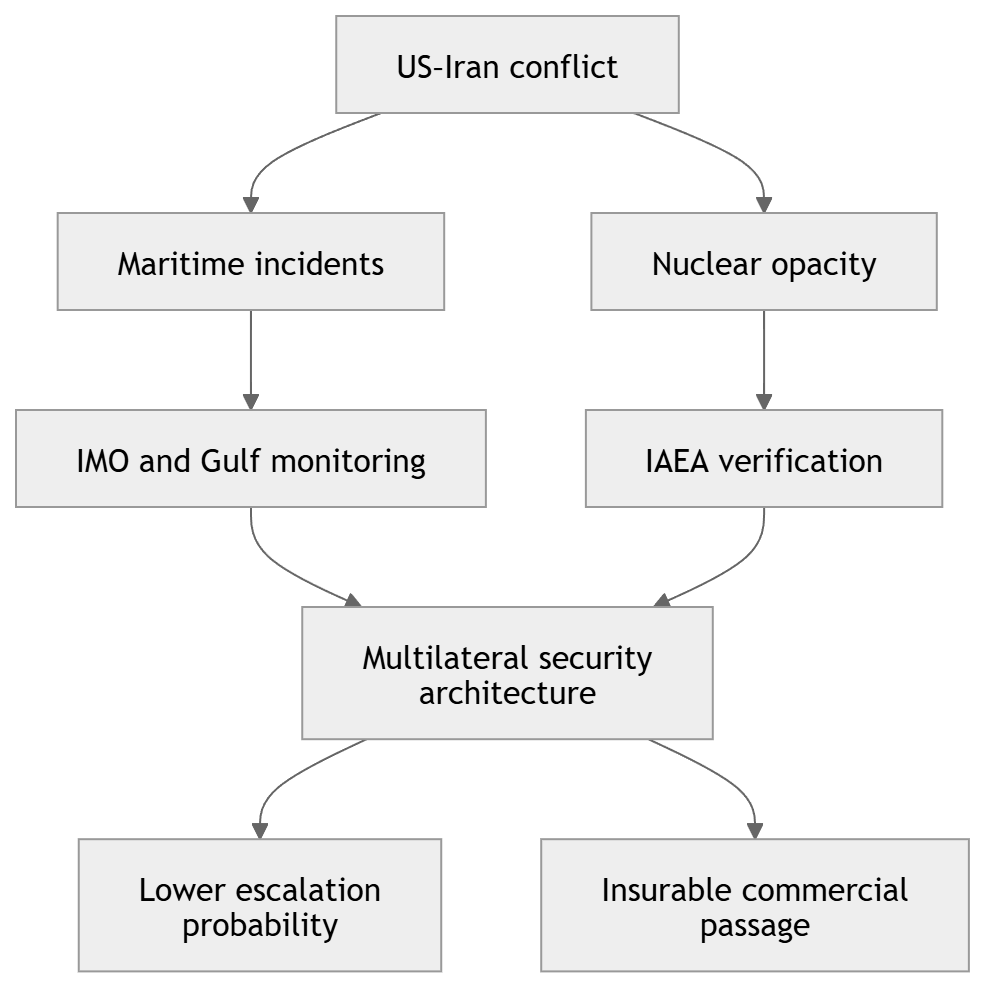
Bayesian Priors and Update Logic
The August 2026 prior distribution assigns 52% to coercive equilibrium, 16% to verified settlement, 14% to major escalation, 11% to Iranian regenerative consolidation and 7% to multilateral security architecture. These are not frequencies extracted from a historical reference class; no fully comparable reference class exists. They are structured judgements derived from the present balance of capabilities, demonstrated behaviour and institutional constraints. The update method requires each new event to be scored for likelihood under all five hypotheses rather than automatically interpreted as evidence for the analyst’s preferred scenario. A new Iranian missile launch, for example, strongly supports H₁ and H₄, moderately supports H₃ and weakens H₂. A six-month period of complete IAEA access, attack-free shipping and declining force posture strongly supports H₂ and H₅ while weakening H₁, H₃ and H₄. A new sanctions package is ambiguous: it may indicate successful pressure under H₂, persistent evasion under H₄ or continued bargaining war under H₁. The model must also distinguish diagnostic evidence from dramatic but low-diagnostic events. A large US strike is visually significant but compatible with H₁, H₃ and H₄; it does not identify the strategic path by itself. A verified inventory of uranium, by contrast, is less dramatic but highly diagnostic because it sharply lowers nuclear uncertainty and escalation pressure. Bayesian discipline requires explicit falsification rules. H₁ should lose at least ten probability points after twelve consecutive months of verified compliance and attack-free transit. H₂ should lose at least ten points if a signed agreement fails within ninety days. H₃ should gain at least ten points after mass casualties, radiological release or prolonged dual-lane closure. H₄ should gain if Iranian launch regeneration repeatedly occurs faster than the previous cycle. H₅ should gain only when monitoring, enforcement and commercial underwriting mechanisms become operational rather than merely proposed.
| New evidence event | H₁ coercive equilibrium | H₂ verified settlement | H₃ escalation | H₄ Iranian consolidation | H₅ multilateral architecture |
|---|---|---|---|---|---|
| 12 months attack-free with full IAEA access | Strong decrease | Strong increase | Decrease | Strong decrease | Increase |
| Agreement fails within 90 days | Strong increase | Strong decrease | Increase | Increase | Neutral |
| Major US casualty event | Increase | Strong decrease | Strong increase | Moderate increase | Decrease |
| Iran restores launch tempo within 30 days of strikes | Increase | Decrease | Increase | Strong increase | Neutral |
| Standard war-risk insurance restored | Decrease | Increase | Decrease | Decrease | Strong increase |
| Multinational incident commission operational | Decrease | Increase | Decrease | Decrease | Strong increase |
| Shadow-fleet designations rise but exports remain stable | Increase | Decrease | Neutral | Strong increase | Neutral |
| Verified uranium inventory and centrifuge declaration | Decrease | Strong increase | Strong decrease | Strong decrease | Increase |
| US force level drops below 20,000 without more attacks | Decrease | Increase | Decrease | Possible increase | Increase |
| Coordinated proxy attacks across three theatres | Increase | Strong decrease | Strong increase | Increase | Decrease |
Monte Carlo Architecture
The probabilistic forecast uses a 200,000-path, five-state Markov Monte Carlo model covering annual transitions from 2026 through 2031. Each path begins in one of the five states according to the August priors and transitions annually using a matrix derived from the durability, reversibility and observed recurrence of each state. Coercive equilibrium has the highest self-persistence because the 2026 evidence shows repeated reversion to bargaining violence. Verified settlement receives a substantial but not dominant self-persistence because implementation can fail. Major escalation remains dangerous but is modeled as less stable than coercive equilibrium because extreme warfare eventually produces exhaustion, intervention or negotiation. Iranian consolidation can persist if sanctions evasion and regeneration succeed but remains vulnerable to renewed US strikes. Multilateral architecture has moderate durability but depends on institutional enforcement. Each annual path includes a 3% escalation shock, representing nuclear movement, mass casualties or a severe maritime incident, and a separate 3% diplomatic-breakthrough shock, representing an unexpectedly successful verification or mediation event. The model yields 40.6% coercive equilibrium, 22.5% verified settlement, 15.8% escalation, 11.9% Iranian consolidation and 9.3% multilateral architecture in 2027. By 2031, coercive equilibrium remains the largest single state at 34.9%, verified settlement rises to 27.5%, escalation remains material at 15.1%, Iranian consolidation reaches 11.3%, and multilateral architecture reaches 11.2%. The model does not predict that settlement and architecture must remain separate in reality; they are separated to identify whether bilateral verification or external institutionalization drives stabilization. The most important result is that no state exceeds 35% in 2031. Strategic uncertainty remains irreducibly high because several end states retain plausible pathways.
| Modeled state | 2026 prior | 2027 | 2028 | 2029 | 2030 | 2031 |
|---|---|---|---|---|---|---|
| H₁ Coercive equilibrium | 52.0% | 40.6% | 36.7% | 35.5% | 34.8% | 34.9% |
| H₂ Verified settlement | 16.0% | 22.5% | 25.4% | 26.6% | 27.4% | 27.5% |
| H₃ Major escalation | 14.0% | 15.8% | 15.9% | 15.5% | 15.3% | 15.1% |
| H₄ Iranian consolidation | 11.0% | 11.9% | 11.7% | 11.6% | 11.3% | 11.3% |
| H₅ Multilateral architecture | 7.0% | 9.3% | 10.4% | 10.9% | 11.2% | 11.2% |
Sensitivity and Conditional Futures
The baseline probabilities conceal highly nonlinear conditional outcomes. Four stress tests show which variables have the greatest leverage. Under a high-diplomacy condition—defined as sustained IAEA access, an incident-control mechanism, attack-free maritime passage and predictable sanctions sequencing—the 2031 probability of verified settlement rises to 54.4%, while major escalation falls to 7.2% and Iranian consolidation to 5.9%. Under a nuclear-opacity condition—continued inability to locate material, verify enrichment or inventory centrifuges—major escalation rises to 32.7% and Iranian consolidation to 23.6%, while settlement falls to 11.2%. Under US retrenchment, defined as a material reduction in force presence and interdiction without an enforceable replacement architecture, Iranian consolidation rises to 31.1% and coercive equilibrium to 43.3%. Under a multilateral-regime condition—operational monitoring, neutral incident attribution, Gulf participation, internationally supported underwriting and IAEA integration—the probability of multilateral architecture rises to 38.8%, settlement reaches 29.0% and escalation falls to 6.9%. These tests identify nuclear transparency and enforcement substitution as the two most influential drivers. Simply reducing military operations does not necessarily create peace; without verification or institutional replacement, it can create space for Iranian regeneration. Simply increasing strikes does not necessarily prevent escalation; repeated punishment may increase concealment and compress decision time. The optimal stabilizing combination is not maximum force or maximum concession, but credible conditionality: sufficient military and economic leverage to deter violation, combined with inspection, adjudication and relief mechanisms that reward compliance. Forecast consumers should therefore resist assigning strategic significance to a single summit, attack or sanctions package. The system changes only when multiple reinforcing mechanisms alter incentives at the same time.
| Conditional 2031 model | Coercive equilibrium | Verified settlement | Major escalation | Iranian consolidation | Multilateral architecture |
|---|---|---|---|---|---|
| Baseline | 34.9% | 27.5% | 15.1% | 11.3% | 11.2% |
| High diplomacy and verification | 20.0% | 54.4% | 7.2% | 5.9% | 12.5% |
| Persistent nuclear opacity | 25.6% | 11.2% | 32.7% | 23.6% | 6.9% |
| US retrenchment without replacement architecture | 43.3% | 11.6% | 13.3% | 31.1% | 0.8% |
| Operational multilateral security regime | 21.2% | 29.0% | 6.9% | 4.1% | 38.8% |
Strategic Warning Architecture
The warning system must monitor the conflict across seven interdependent layers: nuclear, military, maritime, economic, financial, cyber and diplomatic. No single layer can reliably identify the trajectory. A decline in oil prices may indicate successful diplomacy, demand destruction or strategic-stock release. A decline in Iranian missile launches may indicate depletion, concealment or preparation for a larger attack. An increase in US strikes may indicate successful intelligence penetration or repeated failure to suppress regeneration. Indicators must therefore be evaluated in clusters and over time. The most dangerous combination is nuclear opacity plus compressed military decision time: loss of IAEA access, movement at enrichment or tunnel complexes, Israeli or US strike preparation and evacuation of high-value personnel. The strongest settlement cluster is material accountancy plus maritime normalization plus sanctions sequencing: inspectors verify inventories, attacks cease, insurers restore ordinary coverage and Treasury issues predictable licences tied to compliance. The strongest H₄ cluster is rapid regeneration plus stable illicit revenue: Iranian launch activity returns within weeks, procurement networks replace designated entities and shadow-fleet exports remain stable. The strongest H₅ cluster is institutional depth: a permanent incident centre, shared vessel reporting, multinational mine-response capacity, emergency underwriting and a politically neutral monitoring mandate. Analysts should establish red, amber and green thresholds before incidents occur. Changing thresholds after an event introduces political bias and converts warning into narrative support. Each indicator should include source provenance, observation date, confidence, expected behaviour under every hypothesis and an expiration date after which the information must be revalidated.
| Indicator | Green threshold | Amber threshold | Red threshold | Primary analytic owner |
|---|---|---|---|---|
| IAEA access | All declared sites and material verified | Partial or delayed access | Material location unknown or access suspended | Nuclear safeguards cell |
| 60%-enriched stock | Accounted for and under seal | Inventory discrepancy under investigation | Movement, diversion or unknown location | Nuclear intelligence fusion |
| Iranian launch tempo | Zero sustained launches | Sporadic launches below one per month | Coordinated salvos or rapid post-strike regeneration | Military operations cell |
| US force posture | Declining under verified calm | Stable high deployment | Rapid reinforcement and dispersal | Theatre warning cell |
| Hormuz throughput | Normal and unescorted | Convoy-dependent or irregular | Collapse below critical commercial level | Maritime intelligence cell |
| War-risk insurance | Standard terms | Elevated premium and exclusions | Withdrawal of cover | Financial-risk cell |
| Shadow-fleet activity | Declining hull count and exports | Stable replacement rate | Expansion despite sanctions | Sanctions-evasion cell |
| Proxy synchronization | No coordinated operations | Two-theatre activity | Three or more theatres activated | Regional networks cell |
| GNSS/AIS anomalies | Isolated technical incidents | Recurrent localized interference | Coordinated navigational disruption | Cyber-maritime cell |
| Diplomatic mechanism | Operating verification and dispute process | Talks without enforcement | Negotiation collapse and threats | Political analysis cell |
| Energy inventories | Stable or rebuilding | Persistent drawdown | Emergency releases and rationing | Energy-security cell |
| Gulf infrastructure | Normal security posture | Heightened defensive readiness | Evacuation, shutdown or confirmed attack | Critical-infrastructure cell |
Shadow Dimensions Through 2031
The forecast must incorporate the domains most likely to remain undercounted by conventional military analysis. The first is liquidity warfare. Iran’s capacity to regenerate depends not merely on barrels exported but on the net revenue received after discounts, intermediary charges, insurance costs, payment delays and sanctions risk. A stable export volume can conceal deteriorating usable income. The second is commercial-military blending. Older tankers, front companies, ship-to-ship transfers, AIS gaps and reflagging create sanctions-evasion capacity but can also provide observation, logistics or deception functions. The third is cyber-norm erosion. Persistent GNSS manipulation, AIS spoofing and port-system intrusion may normalize deniable interference below the threshold of armed response, creating a cheap tool for coercion. The fourth is criminal and proxy intermediation. The European Council has warned of Iranian intelligence services using criminal networks and other proxies, while US Treasury documentation identifies layered brokers, exchange houses and commercial facilitators across multiple jurisdictions. European Council Meeting, 18–19 June 2026 – Council of the European Union – June 2026 — verified primary source; Treasury Targets Iran’s Shadow Fleet, Networks Supplying Its Petroleum Trade – U.S. Department of the Treasury – February 2026 — verified primary source. The fifth is workforce fragility. Shipping can remain physically possible while crews, technicians and inspectors refuse deployment. The IMO’s 2026 evacuation planning for more than 11,000 seafarers demonstrated that human availability can become a strategic constraint independent of vessel numbers. IMO Announces Evacuation Plan in the Strait of Hormuz – International Maritime Organization – June 2026 — verified primary source. By 2031, the actor best able to integrate these shadow domains—not merely deploy the largest weapons—will possess the more durable strategic advantage.
| Shadow domain | Conventional metric that misleads | Required high-granularity metric | 2031 strategic risk |
|---|---|---|---|
| Oil finance | Gross exported barrels | Net usable revenue after discounts and friction | Hidden resilience or hidden insolvency |
| Shadow shipping | Number of sanctioned vessels | Replacement rate, utilization and effective capacity | Sanctions become attritional rather than decisive |
| Digital payments | Recorded bank transfers | Exchange-house, digital-asset and trade-credit networks | Revenue survives outside standard clearing |
| Cyber coercion | Confirmed destructive attacks | GNSS anomalies, AIS impossibilities and port disruptions | Persistent sub-threshold interference |
| Proxy activity | Publicly claimed attacks | Funding, weapons flow, command linkage and synchronization | Misattribution and horizontal escalation |
| Maritime labour | Number of available vessels | Crew willingness, evacuation and specialist availability | Commercial closure without physical blockade |
| Insurance | Nominal policy availability | Exclusions, deductibles, reinsurance and claim credibility | Transit becomes economically impossible |
| Munitions | Gross stockpile estimates | Expenditure, production, replacement and interceptor ratio | Hidden exhaustion or regeneration |
| Nuclear knowledge | Number of damaged facilities | Personnel, design data, component stocks and dispersed workshops | Capability reconstitutes despite physical destruction |
| Political endurance | Public declarations | Elite cohesion, protest, fiscal capacity and command continuity | Sudden nonlinear regime behaviour |
Decision Points, 2027–2031
The forecast contains four decisive windows. The first extends through mid-2027 and concerns whether the June 2026 diplomatic framework can be replaced by a technically enforceable arrangement. Failure during this period consolidates H₁ and increases the probability that episodic warfare becomes normalized. The second window, spanning 2027–2028, concerns nuclear continuity of knowledge. If the IAEA cannot reconstruct material and centrifuge inventories, external actors may conclude that waiting increases rather than decreases risk, moving the system toward H₃. The third window, spanning 2028–2029, concerns adaptation. By then, observers should be able to determine whether Iranian military and financial networks regenerate faster than sanctions and strikes degrade them. A declining regeneration interval favours H₄; a widening interval favours coercive settlement. The fourth window, spanning 2029–2031, concerns institutional replacement. Gulf bypass infrastructure, maritime monitoring, autonomous mine countermeasures, air-defence integration, diversified Asian procurement and EU or Chinese participation may reduce the leverage attached to a single waterway, but cannot eliminate Hormuz’s geography. The strategic competition will shift from whether the Strait can be closed to who defines the conditions under which risk is allocated. A durable 2031 order requires four simultaneous achievements: verified nuclear transparency, predictable maritime governance, sufficient deterrence against violation and economic incentives strong enough to make compliance preferable to coercion. Failure in any one dimension does not guarantee renewed war, but failure across two or more dimensions sharply increases the probability of coercive equilibrium or escalation. The most likely 2031 result remains an incomplete order rather than a clean victory.
| Decision window | Central question | Positive signpost | Negative signpost | Dominant hypothesis affected |
|---|---|---|---|---|
| 2026–mid-2027 | Can ceasefire be converted into enforcement? | Incident mechanism and full inspection timetable | Another agreement fails within 90 days | H₁ versus H₂ |
| 2027–2028 | Can nuclear continuity of knowledge be restored? | Verified uranium and centrifuge inventory | Persistent unknown material location | H₂ versus H₃ |
| 2028–2029 | Is Iranian regeneration slowing? | Longer recovery after strikes and shrinking revenue | Faster relaunch and stable shadow trade | H₁ versus H₄ |
| 2029–2030 | Can external actors institutionalize passage security? | Operational multinational monitoring | Competing escort and toll regimes | H₅ |
| 2030–2031 | Has coercion become less useful than compliance? | Normal insurance and declining force burden | High military input required for constant throughput | All hypotheses |


