












Scope: This assessment examines Saudi Arabia’s attempt to convert domestic uranium, critical-mineral, hydrocarbon and phosphate endowments into integrated industrial capability, with particular attention to nuclear development, mineral processing, external technology partnerships, supply-chain security and the implications of intensifying regional infrastructure vulnerability over the period to 2031.
Executive Summary / BLUF
Saudi Arabia is moving beyond a resource-export model toward a strategy in which geological endowment, electricity production, processing capacity, industrial localisation and foreign technology partnerships are intended to reinforce one another, although the transformation remains substantially less mature in uranium and rare-earth processing than in hydrocarbons, phosphates and aluminium.
The strongest verified evidence is institutional rather than geological: Vision 2030 formally treats mining as a strategic economic pillar, Saudi authorities have constructed an increasingly extensive exploration and licensing architecture, and the 2025 Vision 2030 annual report states that the estimated value of national mineral resources now exceeds US$2.5 trillion, while explicitly linking mining with processing and high-technology industries. Vision 2030 Annual Report 2025 — Saudi Vision 2030
Saudi uranium potential is real but requires considerably greater precision than current public discussion often permits, because the OECD Nuclear Energy Agency records 34 million tonnes of inferred mineralised material at Jabal Sayid, averaging 415 ppm uranium and containing 14,135 tonnes of uranium at a 300 ppm cut-off, while also reporting that Saudi Arabia had produced no uranium at the time of the national submission. Uranium 2022: Resources, Production and Demand — OECD Nuclear Energy Agency and IAEA
A September 2026 statement attributed publicly to the Saudi energy minister referred to approximately 110 million tonnes of mineralised material containing promising uranium concentrations and significant rare-earth concentrations at Jabal Sayid, but an accessible official Saudi or IAEA transcript supporting the exact figure has not been located during this verification session; consequently, the figure should remain outside the certified quantitative baseline until the underlying official geological statement or technical report becomes available.
The nuclear dimension has moved materially beyond aspiration, because Saudi Arabia’s Comprehensive Safeguards Agreement with the IAEA has been in force since 2009, the Kingdom formally rescinded its Small Quantities Protocol effective 31 December 2024, and the United States and Saudi Arabia signed a civil nuclear cooperation agreement under Section 123 of the U.S. Atomic Energy Act, together with a bilateral safeguards arrangement, on 22 July 2026. INFCIRC/746/Mod.1 — International Atomic Energy Agency — Dec 2024 United States and Saudi Arabia Reach Historic Nuclear Cooperation Agreement — U.S. Department of Energy — Jul 2026
Critical minerals constitute the second strategic axis because Saudi Arabia and the United States established cooperation covering mining and mineral resources in 2025 and subsequently created a framework encompassing uranium, minerals, permanent magnets and critical-mineral supply chains, while Saudi official statements separately identify processing technologies and rare-earth elements as areas of bilateral cooperation. Saudi-U.S. Strategic Economic Partnership — Ministry of Foreign Affairs of Saudi Arabia — May 2025 Joint Statement Following the Crown Prince’s Visit to the United States — Umm Al-Qura — Nov 2025
The commercial significance lies primarily downstream rather than underground, because the International Energy Agency estimates that China accounted in 2024 for approximately 60% of global mined magnet rare-earth production, 91% of refined production and 94% of sintered permanent-magnet production, demonstrating that possession of ore without separation, refining, metallurgy and magnet production does not by itself create strategic supply-chain autonomy. Rare Earth Elements: Executive Summary — International Energy Agency
The regional security environment strengthens the economic logic of diversification without establishing that it originally caused Saudi nuclear or minerals policy, because the September 2026 attack that forced the precautionary closure of the East-West oil pipeline exposed the vulnerability of infrastructure specifically intended to reduce dependence on the Strait of Hormuz, thereby increasing the strategic value of domestic electricity sources and industrial systems whose operation does not require continuous diversion of crude into domestic power generation.
The controlling assessment is therefore that Riyadh is not abandoning hydrocarbons but attempting to use hydrocarbon-generated capital, geological resources and geopolitical partnerships to construct a broader portfolio of industrial capabilities, with success depending less on the headline size of mineral discoveries than on whether Saudi Arabia can create commercially viable separation, refining, fuel-cycle, engineering and advanced-manufacturing capacity under credible regulatory and non-proliferation arrangements.
Saudi Arabia Is Turning Resource Wealth Into Bargaining Power
Saudi Arabia’s announcement at the 70th General Conference of the International Atomic Energy Agency on September 14 matters less for what lies beneath Jabal Sayid than for what Riyadh intends to build above it. Energy Minister Abdulaziz bin Salman said exploration had identified more than 110 million tonnes of mineralised material containing uranium and significant concentrations of rare earth elements, yet the figure is not a uranium reserve and the recoverable quantity remains [NOT IN DOSSIER]. The more consequential development is that uranium, rare earths, phosphates, nuclear power, oil revenues and foreign technology are being assembled into the same industrial strategy. Vision 2030 is therefore moving beyond diversification measured by non-oil sectors: Riyadh is trying to convert resource rent into processing capacity, technological competence and negotiating leverage while preventing any single foreign partner from controlling the resulting system.
The 110 million tonnes matter less than what happens after extraction
The geological headline requires discipline because the more than 110 million tonnes announced on September 14 represent mineralised material, not contained uranium and still less economically recoverable reserves. The dossier records an earlier OECD/NEA Uranium 2022 inferred resource of 14,135 tonnes of uranium at Jabal Sayid, while a later analysis based on Saudi and Ma’aden data indicated approximately 31,000 tonnes; the estimates use different bases and cannot legitimately be added or treated as interchangeable. Their importance lies elsewhere: they establish that Saudi uranium potential has been known for years and that the September 2026 announcement changes the industrial context more than the underlying geological story.
The value-chain strategy already goes beyond exploration because the Saudi programme described in the dossier includes uranium extraction and processing, recovery and yellowcake production, while the Kingdom is also examining uranium associated with phosphoric-acid production and has conducted experimental work with France’s Orano. In January 2025, Energy Minister Abdulaziz bin Salman went further by declaring that Saudi Arabia intended to produce yellowcake and develop uranium-enrichment and sales activities. The difference between these declarations and an operating national fuel cycle remains decisive: the dossier explicitly states that a complete industrial chain does not yet exist, which makes execution—not geological tonnage—the test of whether Saudi resource sovereignty becomes industrial power.
Vision 2030 is becoming a supply-chain strategy rather than a sectoral diversification programme
The Saudi National Atomic Energy Project predates both the September 2026 Vienna announcement and the current Hormuz crisis, and the dossier describes a programme encompassing large nuclear power plants, small modular reactors, fuel-cycle development and regulatory infrastructure. Its stated purpose is economic as well as strategic: reduce domestic hydrocarbon consumption, preserve more oil for export, develop national technological capabilities and create an energy base able to support future industrial growth. Nuclear power is therefore not an emergency reaction to regional instability; it is an existing Vision 2030 instrument whose value increases when regional instability exposes the costs of dependence on oil infrastructure.
The same logic connects nuclear development to phosphates, rare earths and artificial intelligence. The dossier identifies dysprosium and terbium among the heavy rare earths relevant to permanent magnets, advanced electronics and defence applications, while China maintains a dominant position in the processing of many such materials. Saudi Arabia’s industrial objective is consequently more demanding than opening mines: separating, refining and processing determine where the highest-value parts of the chain reside. Artificial intelligence adds another requirement because data centres and advanced industry increase electricity demand, meaning that mineral policy, power generation and digital infrastructure begin to reinforce one another rather than functioning as unrelated Vision 2030 projects.
Hormuz has changed the price of dependence without creating the nuclear policy
On September 12, two days before the Vienna announcement, a drone attack forced Riyadh to suspend operations temporarily on the East-West Pipeline, which links eastern production to the Red Sea terminal at Yanbu and functions as one of the Kingdom’s principal alternatives to the Strait of Hormuz. The importance of the incident is structural: Saudi Arabia can possess enormous hydrocarbon reserves and still remain exposed when the infrastructure required to monetise them becomes vulnerable. An alternative route therefore reduces one chokepoint without eliminating the security problem if that route itself can be disrupted.
That is why nuclear generation acquires additional value after September 12 without the chronology being reversed. The Saudi nuclear programme existed before the attack, but electricity produced without consuming large quantities of domestic crude becomes more valuable when export infrastructure is under pressure. The same applies to diversification across pipelines, ports, minerals and industrial supply chains: the problem is no longer simply how much energy Saudi Arabia owns but how many independent ways it possesses to convert energy and raw materials into revenue, electricity and industrial output.
Washington offers technology; Riyadh offers resources and industrial scale
The Saudi-American relationship crossed a new threshold on July 22, 2026, when Washington and Riyadh signed a civil nuclear cooperation agreement under Section 123 of the U.S. Atomic Energy Act. According to the dossier, the agreement creates a framework through which American companies can participate in the Saudi nuclear programme over decades, while cooperation between the two countries had already expanded during 2025 into critical minerals, including uranium, rare earths and their associated supply chains. The older oil-for-security formulation is therefore being supplemented by technology, nuclear cooperation, strategic minerals, infrastructure, investment and advanced manufacturing.
The bargaining structure is reciprocal rather than symmetrical. Washington wants additional sources and processing routes for materials whose supply chains are heavily exposed to China; Riyadh wants American technology, capital and industrial capability without surrendering control over its own resource base. Uranium places Saudi Arabia inside the nuclear-fuel discussion, rare earths connect the Kingdom to competition over advanced manufacturing, phosphates provide an existing model for linking mineral extraction to industrial transformation, and oil continues to finance the process. The July 22 agreement consequently matters because it gives Riyadh another route for converting geological assets into industrial relationships rather than merely exporting the assets themselves.
China is not the alternative to America; it is another source of leverage
The dossier records that Saudi Arabia has cooperated with China in uranium exploration while maintaining extensive economic and industrial relations with Beijing, even as Washington seeks to develop alternative critical-mineral and nuclear supply chains in the Kingdom. That apparent contradiction is central to the Saudi model rather than evidence of incoherence. China brings industrial capacity and access to Asian markets; the United States brings technology, capital, business connections and security; Europe contributes nuclear and industrial expertise; and suppliers including South Korea and Russia add further technological options.
The Saudi calculation is therefore not necessarily to choose one camp but to prevent cooperation from becoming dependence. The July 22, 2026 U.S. nuclear agreement does not automatically imply strategic subordination to Washington, just as cooperation with China does not automatically establish alignment with Beijing. Riyadh gains leverage when several external powers need access to Saudi resources, investment and markets while no single partner controls the complete chain from mineral extraction through energy generation to advanced manufacturing. That margin of choice is one of the less visible but more consequential outputs of Vision 2030.
Iran raises the security value of the programme without explaining its economic logic
The dossier identifies Iran’s nuclear capabilities as an important Saudi security variable, but it also makes clear that reducing Riyadh’s programme to a bilateral nuclear competition would obscure its industrial purpose. In January 2025, Abdulaziz bin Salman’s statement on yellowcake, enrichment and uranium sales described ambitions with obvious strategic implications, yet the same programme also serves electricity generation, technological localisation, industrial development and the preservation of hydrocarbons for higher-value uses.
The distinction matters diplomatically because the IAEA General Conference on September 14 was not a neutral venue for announcing uranium-bearing material. By choosing Vienna, Riyadh placed the resource simultaneously inside the language of nuclear fuel, international safeguards and non-proliferation. The message reached Washington, which had signed the Section 123 agreement on July 22; the IAEA, whose institutional framework will constrain any future fuel-cycle development; and other industrial powers that may wish to participate in Saudi processing, nuclear or mineral projects. Security therefore raises the value of industrial autonomy, but industrial autonomy remains the broader project.
The next 12–24 months will decide whether leverage becomes capability
Between September 2026 and September 2028, the decisive evidence will not be another headline geological estimate but whether Saudi Arabia moves from exploration toward operating processing capacity, from declared yellowcake ambitions toward industrial production, and from nuclear agreements toward projects that transfer technology and skills into the Kingdom. The dossier does not provide a commercial timetable for uranium mining, enrichment, rare-earth separation or reactor deployment, so the timing of those investments is [NOT IN DOSSIER]; that absence itself identifies the execution gap separating strategic ambition from industrial reality.
The cost of inaction over those 12–24 months would fall first on Saudi Arabia because failure to build processing capacity would leave the Kingdom exporting resources while purchasing higher-value technology back from foreign suppliers, preserving precisely the dependency Vision 2030 is intended to reduce. It would also weaken Riyadh’s bargaining position with Washington, Beijing and European technology providers: the July 22, 2026 nuclear agreement, the September 14 Jabal Sayid announcement and the existing relationships with China and Orano create leverage only if they produce domestic capability. Saudi Arabia’s real test is therefore no longer whether it possesses oil, uranium or rare earths, but whether it can make competing industrial powers need Saudi processing, Saudi energy and Saudi infrastructure as much as Riyadh still needs their technology.
Navigational Index
Resource Sovereignty Becoming Industrial Capability
The central question is whether Saudi mineral wealth can move from geological inventory through extraction and processing into commercially competitive domestic value chains rather than remaining primarily an upstream resource base.
Nuclear Energy, Fuel-Cycle Ambition and Institutional Constraint
The nuclear programme increasingly combines electricity diversification, technology localisation and strategic autonomy, while its eventual character will be determined by reactor procurement, safeguards implementation, fuel-cycle architecture and the commercial terms of international cooperation.
Great-Power Competition as an Industrial Development Instrument
Riyadh is using relationships with the United States and other technology providers to expand choice across nuclear energy, minerals, artificial intelligence and manufacturing rather than allowing any single external relationship to define the entire industrial system.
Master Abstract
Saudi strategy is moving from ownership of resources toward control of transformation
Saudi Arabia’s industrial policy increasingly rests on a distinction that is fundamental to understanding the Kingdom’s economic transformation: possessing a mineral deposit generates resource potential, whereas processing, refining, engineering, manufacturing, energy availability, logistics and market access determine how much strategic and economic value remains inside the country. The Saudi government’s own Vision 2030 reporting describes mining as having evolved from early exploration toward a more integrated industry, records an estimated mineral-resource value exceeding US$2.5 trillion, and explicitly identifies downstream aluminium and phosphate processing as evidence of an industrial model that Riyadh now seeks to extend into additional minerals. Vision 2030 Annual Report 2025 — Saudi Vision 2030 The policy direction is reinforced by licensing activity across the Arabian Shield, including the award of exploration licences covering the Jabal Sayid mineral belt in November 2025, when the Saudi Ministry of Industry and Mineral Resources stated that its objective was to move from exploration toward integrated value chains connecting upstream projects with intermediate and final industries inside the Kingdom. Ministry Issues Exploration Licences for Saudi Arabia’s First Mineralised Belts — Saudi Press Agency — Nov 2025
The distinction is particularly consequential for rare earths because these materials acquire most of their strategic significance after mining, through beneficiation, chemical separation, refining, metal production, alloying and magnet manufacture, stages that require specialised chemical engineering, intellectual property, sustained power supply and environmental management rather than merely geological access. The International Energy Agency calculates that China supplied about 91% of refined magnet rare earths and 94% of sintered permanent magnets in 2024, compared with approximately 60% of mined magnet rare-earth output, demonstrating quantitatively how industrial concentration rises as material moves downstream. Rare Earth Elements: Executive Summary — International Energy Agency Saudi Arabia’s strategic opportunity therefore does not principally consist of replacing China as a mining jurisdiction, which would be an unsupported proposition on presently verified evidence, but of using domestic energy availability, investment capital, emerging mineral production and foreign partnerships to capture selected processing stages presently concentrated elsewhere.
Uranium potential is credible, but the verified resource baseline is narrower than current headlines suggest
The most rigorous public baseline for Saudi uranium remains the OECD Nuclear Energy Agency and IAEA Uranium 2022: Resources, Production and Demand assessment, whose Saudi national report records the Jabal Sayid uranium-thorium prospect at a 300 ppm uranium cut-off as containing 34 million tonnes of inferred material averaging 415 ppm uranium, corresponding to 14,135 tonnes of contained uranium, together with substantial associated thorium; the same national report classifies Saudi occurrences largely as unconventional inferred uranium resources associated with intrusive geological formations and phosphates and states that Saudi Arabia had not produced uranium. Uranium 2022: Resources, Production and Demand — OECD Nuclear Energy Agency and IAEA The report separately estimates 14,551 tonnes of uranium in the Thaniyat Turayf phosphate prospect and gives total in-situ unconventional uranium resources of 77,731 tonnes of uranium, of which 63,171 tonnes are associated with intrusive plutonic deposits and 14,560 tonnes with phosphorite-type resources; these figures describe geological-resource categories rather than proven mineable reserves and therefore cannot legitimately be translated directly into future production.
That distinction becomes essential when assessing the approximately 110-million-tonne figure attributed to the Saudi energy minister at the September 2026 IAEA General Conference, because the figure reportedly refers to total mineralised material rather than tonnes of contained uranium, while neither uranium grade, recoverable metal, economic cut-off, reserve classification nor extraction cost has yet been located in an accessible official technical document during this assessment. Under a certified evidentiary standard, the 110-million-tonne announcement should therefore be treated as an important new Saudi official claim requiring documentary confirmation rather than as a newly demonstrated uranium reserve. The analytical significance remains substantial even before the precise metal content is known, because materially larger mineralised tonnage containing uranium and heavy rare earths would strengthen the rationale for co-product recovery, integrated processing and continued exploration, yet the commercial importance of such material will ultimately depend on grade distribution, metallurgy, recovery rates, infrastructure, permitting and commodity prices rather than gross tonnage alone.
Nuclear development has crossed an institutional threshold
Saudi nuclear ambitions predate the current regional security crisis by many years, and official IAEA records show that the Kingdom has repeatedly connected its national atomic energy project with energy security, economic development and Vision 2030 rather than presenting it exclusively as a response to Iran or to instability around the Strait of Hormuz. In its statement to the IAEA General Conference, Saudi Arabia described the Saudi National Atomic Energy Project, including construction of the Kingdom’s first nuclear power plant, as part of the programme intended to satisfy national development requirements while remaining consistent with international commitments. Statement of the Kingdom of Saudi Arabia at the 67th IAEA General Conference — International Atomic Energy Agency Earlier Saudi statements similarly described cooperation with the IAEA on national plans for introducing nuclear energy into the domestic energy mix and developing the required national human-resource and regulatory capabilities. Record of the First Plenary Meeting, 66th IAEA General Conference — International Atomic Energy Agency
The safeguards architecture has strengthened materially since those earlier declarations because the Kingdom’s Comprehensive Safeguards Agreement entered into force in January 2009, while an exchange of letters between Saudi Arabia and the IAEA formally rescinded the Kingdom’s Small Quantities Protocol on 31 December 2024, removing the reduced safeguards arrangements associated with that protocol. Saudi Arabia Country Fact Sheet — IAEA Office of Legal Affairs INFCIRC/746/Mod.1 — International Atomic Energy Agency — Dec 2024 This is analytically important because a state contemplating a materially larger nuclear programme requires a safeguards structure appropriate to expanding nuclear-material holdings and activities, and the change therefore constitutes a concrete institutional development rather than merely a political declaration.
The next threshold was reached on 22 July 2026, when U.S. Energy Secretary Chris Wright and Saudi Energy Minister Prince Abdulaziz bin Salman signed what the U.S. Department of Energy describes as a peaceful nuclear cooperation agreement under Section 123 of the U.S. Atomic Energy Act alongside a bilateral safeguards agreement, establishing the legal framework through which U.S. companies can participate in Saudi nuclear development. United States and Saudi Arabia Reach Historic Nuclear Cooperation Agreement — U.S. Department of Energy — Jul 2026 The agreement does not demonstrate that reactors, enrichment plants or fuel-fabrication facilities have already been constructed, and it must therefore be understood as an enabling legal architecture whose strategic significance will depend on subsequent contracts, licensing decisions, technology selections, financing arrangements and implementation of agreed safeguards.
Critical minerals increasingly connect Saudi industrial policy with U.S. supply-chain strategy
The minerals relationship with Washington is broader than nuclear fuel because the two governments signed a cooperation memorandum covering mining and mineral resources in May 2025, after which Saudi official statements recorded discussions with senior U.S. officials concerning processing technologies, critical minerals and rare-earth elements. Saudi-U.S. Strategic Economic Partnership — Ministry of Foreign Affairs of Saudi Arabia — May 2025 Industry Minister Explores Boosting Cooperation with U.S. on Critical Minerals — Saudi Press Agency — Nov 2025 The relationship deepened later in 2025 when the two states established a strategic framework for supply chains encompassing uranium, minerals, permanent magnets and critical minerals, placing raw materials and advanced manufacturing within a common bilateral architecture rather than treating them as isolated commodity sectors. Joint Statement Following the Crown Prince’s Visit to the United States — Umm Al-Qura — Nov 2025
Washington’s interest has a readily identifiable supply-chain basis because the IEA’s 2026 critical-minerals assessment states that concentration in mineral refining remained exceptionally high during 2025 and that China remained the principal refiner across most of the key energy minerals examined, while Chinese export controls demonstrated that processing concentration can become an immediate economic-security problem rather than a theoretical vulnerability. Global Critical Minerals Outlook 2026 — International Energy Agency The Saudi proposition is therefore complementary but not identical to the American objective: the United States seeks additional resilient sources and processing channels, whereas Saudi Arabia seeks technology, investment, market access and localisation that allow more of the value chain to be retained domestically, producing a bargaining structure in which cooperation can advance both objectives without making them strategically synonymous.
Oil remains the financial foundation rather than the sector being simply replaced
The Saudi transformation is often described as a transition “away from oil,” but the more defensible interpretation is that oil revenues and existing resource industries provide capital, infrastructure and balance-sheet capacity with which Riyadh is attempting to build additional forms of productive capability, meaning that diversification does not require hydrocarbons to become economically irrelevant. Vision 2030 documentation explicitly describes mining as a third industrial pillar alongside oil and gas and petrochemicals, while the Public Investment Fund’s programme identifies localisation of technology and expansion of mining assets as strategic objectives rather than framing mining as a substitute for the hydrocarbon economy. Public Investment Fund Program 2021–2025 — Saudi Vision 2030
Saudi industrial history already demonstrates the logic of resource-to-processing integration in aluminium and phosphates, where domestic extraction has been connected with large processing complexes rather than being confined to raw-material exports, and current policy seeks to reproduce that architecture across additional mineral classes. Saudi official reporting records, for example, the established integration of mine, refinery, smelter and rolling capacity in aluminium together with large-scale phosphate processing, while newer industrial policy has allocated capital and licensing support intended to extend processing activity into additional metals. Ma’aden Operating Results and Integrated Industrial Projects — Saudi Press Agency This established industrial precedent is more analytically important than treating every newly identified deposit as a transformational discovery, because the decisive Saudi competitive question is whether similar integration can be reproduced economically in technically more demanding chains such as rare-earth separation, permanent magnets and nuclear fuel.
Regional infrastructure vulnerability raises the strategic value of diversification without explaining its origin
The September 2026 attack on Saudi Arabia’s East-West pipeline demonstrates the distinction between possessing energy resources and possessing resilient access to markets, because the cross-country pipeline was constructed precisely to move crude from eastern production areas toward Yanbu on the Red Sea without relying exclusively on Gulf maritime routes, yet the infrastructure itself became vulnerable to long-range attack. Saudi authorities stated that drones originating from Iraqi territory struck the pipeline system in the Riyadh and Medina regions, after which the Ministry of Energy temporarily closed the system as a precaution while assessing its safety; the incident therefore revealed that geographic diversification reduces one chokepoint but does not eliminate infrastructure risk. The underlying Saudi government statements were subsequently reproduced in contemporary reporting, although the directly accessible Saudi ministry release remains an open-record retrieval gap in the present session.
The event strengthens, rather than originates, the strategic case for nuclear and broader electricity diversification because electricity generated from nuclear, renewable or gas-based systems reduces the amount of liquid crude that must be consumed domestically for power generation and can support energy-intensive downstream industries without tying every increment of industrial growth directly to additional crude consumption. This mechanism should not be overstated, because nuclear generation would itself require fuel-cycle security, grid expansion, water-management systems, plant protection and a long construction horizon, while Saudi oil exports would remain exposed to pipeline, terminal and maritime vulnerabilities irrespective of domestic electricity composition. The security implication is therefore one of portfolio resilience rather than energy independence: a more diversified electricity and industrial base can reduce some forms of dependence without eliminating the Kingdom’s fundamental exposure as a major hydrocarbon exporter.
Key Evidence Table
| Indicator | Value/status | Reference date | Definition/scope | Issuer | Exact source |
|---|---|---|---|---|---|
| Estimated Saudi mineral-resource value | More than US$2.5 trillion | 2025 report | National estimate across identified mineral resources; not equivalent to recoverable reserve value or project NPV | Saudi Vision 2030 | Vision 2030 Annual Report 2025 — Saudi Vision 2030 |
| Jabal Sayid inferred uranium prospect | 34 Mt mineralised material; 415 ppm U; 14,135 tU | Uranium 2022 national submission | Inferred resource at a 300 ppm uranium cut-off; contained uranium rather than economically recoverable reserve | OECD NEA / IAEA | Uranium 2022: Resources, Production and Demand — OECD NEA and IAEA |
| Saudi total unconventional uranium resources reported in Uranium 2022 | 77,731 tU | Uranium 2022 | In-situ unconventional uranium resources, including plutonic and phosphorite-associated material | OECD NEA / IAEA | Uranium 2022: Resources, Production and Demand — OECD NEA and IAEA |
| Saudi uranium production in the cited NEA national report | None reported | Uranium 2022 | Historical uranium mine production | OECD NEA / IAEA | Uranium 2022: Resources, Production and Demand — OECD NEA and IAEA |
| Comprehensive Safeguards Agreement | In force since 13 Jan 2009 | Current IAEA country record | Safeguards agreement connected with the NPT | IAEA | Saudi Arabia Country Fact Sheet — IAEA Office of Legal Affairs |
| Small Quantities Protocol | Rescinded effective 31 Dec 2024 | 31 Dec 2024 | Formal rescission through exchange of letters with IAEA | IAEA | INFCIRC/746/Mod.1 — International Atomic Energy Agency |
| U.S.–Saudi civil nuclear framework | 123 Agreement signed | 22 Jul 2026 | Peaceful nuclear cooperation agreement and accompanying bilateral safeguards arrangement | U.S. Department of Energy | United States and Saudi Arabia Reach Historic Nuclear Cooperation Agreement — U.S. Department of Energy |
| China share of global refined magnet rare-earth output | 91% | 2024 production | Refined magnet rare-earth production | International Energy Agency | Rare Earth Elements: Executive Summary — IEA |
| China share of sintered permanent-magnet production | 94% | 2024 production | Sintered permanent magnets | International Energy Agency | Rare Earth Elements: Executive Summary — IEA |
| Saudi-U.S. critical-mineral architecture | Uranium, minerals, permanent magnets and critical minerals included | Nov 2025 | Bilateral strategic supply-chain framework | Saudi government / White House | Joint Statement Following the Crown Prince’s Visit to the United States — Umm Al-Qura Fact Sheet on U.S.–Saudi Economic and Defense Partnership — White House |
| Jabal Sayid exploration licensing | New domestic and international licences awarded | Nov 2025 | Exploration licences within Jabal Sayid mineralised belt | Saudi Ministry of Industry and Mineral Resources / SPA | Ministry Issues Exploration Licences for Saudi Arabia’s First Mineralised Belts — Saudi Press Agency |
Principal Gaps and Watch Indicators
The most important unresolved geological record is the underlying Saudi technical documentation for the September 2026 Jabal Sayid exploration announcement, including the geological model, sampling programme, analytical methodology, ore tonnage, cut-off assumptions, separate uranium and rare-earth grades, mineral-resource classification, metallurgical recovery assumptions and competent-person validation; without those elements, the approximately 110-million-tonne figure cannot be converted responsibly into a uranium reserve, rare-earth reserve or prospective project value.
The most important nuclear implementation indicators are subsequent reactor technology selection, vendor contracts, financing structure, Nuclear and Radiological Regulatory Commission licensing milestones, IAEA infrastructure-review results, fuel-procurement arrangements, safeguards implementation after rescission of the Small Quantities Protocol, and any formally documented domestic conversion, enrichment, fuel-fabrication or yellowcake facilities, because those records would distinguish a broad fuel-cycle policy ambition from actual industrial capability.
The decisive rare-earth indicator is not another exploration headline but the establishment of technically demonstrated beneficiation, cracking, separation, oxide refining, metal production, alloy production or permanent-magnet manufacturing capacity, because these stages determine whether Saudi Arabia becomes principally a mineral supplier or acquires leverage in the processing segments where global supply concentration is currently highest.
The bilateral U.S. relationship should be monitored through implementing agreements beneath the 2025 critical-minerals framework and the July 2026 123 Agreement, particularly provisions governing technology transfer, localisation, intellectual-property protection, ownership, export controls, safeguards, fuel assurances and Saudi participation in downstream production, because the distribution of these functions will determine how much industrial capability is genuinely internalised rather than purchased as a service.
The security indicator with the greatest near-term relevance is the durability and protection of the East-West pipeline and Red Sea export architecture after the September 2026 attack, together with any subsequent changes to Saudi crude-routing, strategic-storage and infrastructure-protection policy, because recurrent disruption would increase the value assigned by Riyadh to economic systems that diversify both energy generation and export dependence.
Net Assessment
Saudi Arabia’s emerging model is best understood neither as a conventional “post-oil” transition nor as a narrowly nuclear strategy, because the verified public record points instead toward an attempt to transform resource rents into industrial optionality, using hydrocarbons and existing mining industries as the financial and infrastructural base from which new mineral-processing, nuclear, technological and manufacturing capabilities can be developed. Vision 2030’s mining architecture, Jabal Sayid exploration, the move toward fuller IAEA safeguards, the U.S.–Saudi 123 Agreement and the bilateral critical-minerals framework belong to the same broader industrial logic even though their individual implementation timelines and technical maturity differ substantially.
The potential source of future Saudi influence therefore lies less in possessing any single deposit than in controlling enough stages between extraction and end use to make the Kingdom difficult to bypass across several strategic industries simultaneously. Uranium without economically demonstrated recovery remains geological potential, rare earths without separation and refining remain an upstream resource, a nuclear agreement without reactors remains an enabling legal instrument, and an industrial strategy without internationally competitive production remains policy ambition; however, when mineral resources, low-cost energy, capital, logistics, technology agreements and domestic processing begin to operate as a coordinated system, their combined strategic effect becomes significantly greater than the value of the underlying commodities considered separately.
The balance of verified evidence indicates that Saudi Arabia has already built important institutional and financial foundations for that transition, while the most consequential technical stages remain incomplete or insufficiently documented in the public record, particularly uranium production, rare-earth separation, advanced magnet manufacture and a commercially operating civil nuclear power sector. The principal judgment would strengthen materially if forthcoming Saudi geological documentation validates the scale and grade of the expanded Jabal Sayid resource, if downstream rare-earth processing moves from agreements into operating facilities, and if the 2026 nuclear cooperation framework produces licensed construction and demonstrable localisation; it would weaken if mineral discoveries prove metallurgically difficult or uneconomic, if external technology restrictions prevent meaningful localisation, or if large capital requirements generate assets that remain dependent on foreign operating capability rather than creating durable Saudi industrial competence.
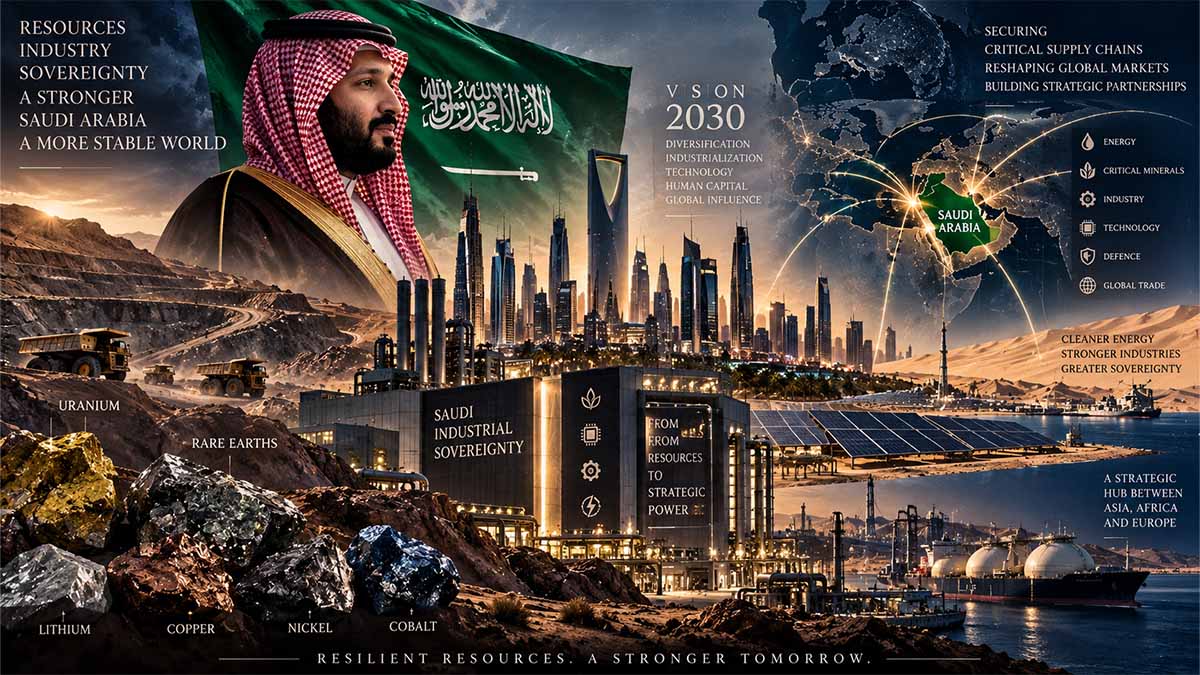
Saudi Arabia’s Resource-to-Power Strategy: Uranium, Critical Minerals & Industrial Sovereignty
BLUF: Riyadh is executing a systemic transformation from pure hydrocarbon export to integrated industrial capacity. By leveraging $2.5T+ in mineral assets, civil nuclear legal frameworks (U.S. 123 Agreement / IAEA safeguards), and strategic mineral partnerships, the Kingdom aims to capture downstream high-tech processing value—though success remains gated by metallurgical validation, refining technology access, and critical infrastructure vulnerability.
Resource Sovereignty & Industrial Transformation
Saudi industrial policy transitions from basic resource extraction toward integrated domestic value chains, supported by $2.5T+ in estimated mineral wealth across the Arabian Shield and established precedents in aluminum and phosphate processing.
| Indicator / Metric | Valuation / Status | Reference Date | Issuer / Source |
|---|---|---|---|
| Estimated Mineral Resource Value | More than US$2.5 Trillion | 2025 Report | Saudi Vision 2030 Annual Report |
| Jabal Sayid Inferred Uranium | 34 Mt material (415 ppm U; 14,135 tU) | Uranium 2022 | OECD NEA / IAEA |
| IAEA Comprehensive Safeguards | In Force (Rescinded SQP Dec 2024) | Dec 31, 2024 | IAEA Office of Legal Affairs (INFCIRC/746) |
| U.S.–Saudi Civil Nuclear Framework | Section 123 Agreement Signed | July 22, 2026 | U.S. Department of Energy |
| China Global Refined Magnet REE Share | 91% Refined / 94% Sintered Magnets | 2024–2025 | International Energy Agency (IEA) |
| Bilateral Critical-Mineral Framework | Uranium, Minerals & Permanent Magnets | Nov 2025 | Saudi Gov / White House Joint Statement |
Resource-to-Transformation
Shifting focus from raw extraction to high-value separation, metallurgy, and advanced manufacturing. Precedents in aluminum and phosphate prove feasibility but scale remains challenging.
Institutional Integration
Escalation of nuclear compliance via full IAEA Comprehensive Safeguards and the U.S. 123 Agreement establishes secure pathways for civil nuclear reactor procurement and fuel cycle development.
Great-Power Balancing
Leveraging technological partnerships across the U.S., China, and global suppliers to maximize industrial optionality without binding the economy to a single external power structure.
- Jabal Sayid Technical Data: Detailed sampling, cut-off grades, and metallurgical recovery metrics for the 110 Mt announcement.
- Pipeline Incident Releases: Full official technical assessments concerning the September 2026 East-West pipeline drone impact.
- Downstream Facility Contracts: Specific commercial vendor agreements for domestic rare-earth separation and nuclear reactor construction.
- Nuclear Reactor Procurement: Vendor selections and regulatory licensing milestones by the Nuclear & Radiological Regulatory Commission.
- Midstream Processing Plants: Groundbreaking or operation of commercial rare-earth cracking and oxide refining facilities.
- Infrastructure Hardening: Upgrades to domestic energy routing and pipeline protection mechanisms following regional security events.
Resource Sovereignty Becoming Industrial Capability
Principal judgment: Saudi Arabia has already demonstrated that it can convert selected geological resources into commercially significant integrated value chains, most clearly in phosphate and aluminium, but the transition remains uneven because the Kingdom is simultaneously operating mature mine-to-market systems, accelerating exploration across much of the Arabian Shield, constructing additional processing capacity, and attempting to enter substantially more technologically demanding chains—including copper, critical minerals, rare earths and potentially uranium—in which geological ownership alone confers little industrial sovereignty.
The distinction matters because Saudi Arabia’s strategic objective is no longer adequately measured by the number or nominal value of mineral deposits identified beneath its territory; the relevant measure is the proportion of economic activity that can be retained between discovery and the final industrial product through exploration, mining, beneficiation, refining, chemical transformation, metallurgy, manufacturing, recycling, logistics, engineering services, intellectual property and skilled employment. Saudi Vision 2030’s 2025 annual report explicitly describes this progression from geological exploration toward large-scale production, infrastructure and downstream aluminium and phosphate industries, while placing the estimated value of Saudi mineral resources above US$2.5 trillion, approximately 90% higher than the 2016 estimate, and presenting the Kingdom’s intended role as a centre for mining, processing and international supply chains rather than merely mineral extraction. Saudi Vision 2030 Annual Report 2025
The industrial question is no longer whether Saudi Arabia possesses minerals, but how much of the value chain it can retain
Resource sovereignty in the Saudi case should not be interpreted as autarky or the domestic production of every component required by the mining economy, because such a standard would be economically inefficient and inconsistent with the Kingdom’s extensive reliance on international technology, capital equipment and export markets; it is more accurately understood as the capacity to control strategically important stages of a value chain, maintain several sources of technology and finance, process a significant share of domestic raw materials inside the Kingdom, retain commercially valuable industrial capabilities, and prevent access to any indispensable foreign supplier from becoming a single point of strategic failure.
That transformation has already occurred in parts of the mining economy, because Saudi phosphate ore does not simply leave the country as mined rock and Saudi bauxite does not simply leave as ore: phosphate is beneficiated and chemically transformed into internationally traded fertiliser products, while the aluminium system connects bauxite mining with alumina refining, smelting, casting and rolling. The Royal Commission for Jubail and Yanbu explicitly describes Ras Al-Khair Industrial City, covering 287.2 km², as an integrated mining-industrial platform equipped with power generation, gas and electricity networks, seawater cooling, industrial wastewater systems, pipeline corridors, roads, rail infrastructure and telecommunications specifically to support value creation from extraction through processing. Ras Al-Khair Industrial City — Royal Commission for Jubail and Yanbu
The analytical implication is substantial because Saudi Arabia does not need to prove the industrialisation concept from first principles: it already possesses functioning examples of mine-to-processing integration at substantial scale, while the unresolved question is whether the same institutional and infrastructural model can be extended from comparatively mature bulk commodities into minerals whose economics depend on more sophisticated processing technologies, tighter purity specifications, smaller markets, proprietary know-how and more concentrated international supply chains.
Resource-to-capability ladder
| Stage | Saudi position by September 2026 | Evidence of capability | Strategic value retained domestically | Principal unresolved constraint |
|---|---|---|---|---|
| Geological mapping | Rapidly expanding | Arabian Shield regional surveys, NGD, geochemical and geophysical programmes | Reduces geological uncertainty and exploration cost | Remaining survey completion, interpretation quality and commercial discovery rate |
| Exploration licensing | Large and accelerating | 2,925 valid mining licences at end-2025, including 1,018 exploration licences | Brings private capital and geological expertise into the resource base | Licence volume does not itself imply discoveries or mines |
| Mine development | Established in several commodities | Phosphate, bauxite, gold and copper operations | Captures upstream resource rent and employment | Capital intensity, ore grades, project economics |
| Beneficiation | Established in phosphate, bauxite and selected metals | Domestic concentration and ore treatment | Prevents export of completely unprocessed material | Energy, water, reagents and technical recovery rates |
| Chemical/metallurgical processing | Advanced in phosphate and aluminium | Phosphoric acid, ammonia, DAP; alumina refining and aluminium smelting | Substantially increases domestic value added | Dependence on imported process inputs and technology remains commodity-specific |
| Fabricated downstream products | Developing | Aluminium rolling and downstream industrial applications | Moves value capture closer to end users | Domestic customer ecosystem, scale and global competitiveness |
| Critical-mineral refining | Emerging rather than demonstrated at comparable scale | Policy frameworks, partnerships and exploration expansion | Potentially much greater strategic leverage | Separation chemistry, intellectual property, commercial-scale facilities |
| Rare-earth magnets | Not yet established as a mature Saudi chain in the verified record | International cooperation and policy interest | High-value technology and defence/EV exposure | Separation, metal/alloy production, magnet technology and customer qualification |
| Uranium mining/fuel-cycle processing | Strategic ambition exceeds current verified industrial capability | Identified resources, nuclear programme, international cooperation | Possible energy and nuclear-fuel optionality | Resource economics, safeguards, technology, licensing and commercial viability |
| Recycling / secondary resource recovery | Expanding, especially aluminium | Maaden aluminium recycling initiatives and dross processing | Reduces imported feedstock dependence and recaptures domestic material | Collection system scale and downstream market depth |
Sources: Saudi Geological Survey National Geological Database, Saudi Ministry of Industry and Mineral Resources, Royal Commission for Jubail and Yanbu and Maaden corporate reporting.
The geological de-risking programme is becoming industrial infrastructure in its own right
One of the most important changes under Vision 2030 has occurred before extraction begins, because Riyadh has increasingly treated geological information as public economic infrastructure rather than as fragmented historical knowledge available only to a limited number of specialists. The National Geological Database incorporates geological mapping, mineral occurrences, geochemistry, geophysics, drilling information, remote sensing and historical exploration records, while the Saudi Geological Survey states explicitly that the system is intended to consolidate national mining information, reduce uncertainty for investors and increase the economic return generated from mineral resources. National Geological Database — Saudi Geological Survey
By September 2026, the Saudi Geological Survey reported that airborne radiometric and magnetic surveys covered approximately 180,000 km², equivalent to roughly 30% of the Arabian Shield, while released geochemical packages covered about 218,000 km², or approximately 40%, and contained 35,575 surface sediment samples with analyses covering 76 elements; these specific published packages should be distinguished from the broader Regional Geological Survey Program, whose intended mapping universe is around 600,000 km² and whose individual geophysical, geochemical and mapping components progress on different schedules.
Saudi officials reported in July 2025 that the larger regional geological programme had completed approximately 70% of its targeted survey work, while a later November 2025 government statement placed completion of the broader geophysical and geochemical programme at approximately 80%; these percentages refer to evolving programme stages rather than directly comparable annual mineral-resource additions, but they show the pace at which geological uncertainty is being converted into searchable investment information.
The level of detail is increasingly commercially relevant because the Saudi Geological Survey’s geochemical database contains more than three million digital analytical inputs, while the October 2025 data release added more than 20,000 linear metres of hyperspectral scanning of drill cores across twelve Arabian Shield projects together with products covering 21 geological quadrangles and 2,394 elemental-distribution maps. The economic mechanism is therefore straightforward: better pre-competitive geological information reduces the amount of capital that a prospective explorer must spend merely determining where to begin, thereby transferring part of the geological-risk burden from individual investors to a national information infrastructure and making larger portions of the territory investable.
Saudi geological-information infrastructure
| Indicator | Verified figure/status | Reference period | Industrial significance |
|---|---|---|---|
| Target area of Regional Geological Survey Program | ~600,000 km² | Programme scope | Covers the mineral-rich Arabian Shield at regional scale |
| Airborne radiometric/magnetic survey packages reported | ~180,000 km² | By Sep 2026 | Improves structural and subsurface targeting |
| Geochemical survey packages reported | ~218,000 km² | By Sep 2026 | Provides elemental-distribution information |
| Surface sediment samples referenced in released packages | 35,575 | By Sep 2026 | Expands geochemical anomaly identification |
| Elements covered | 76 | By Sep 2026 | Supports multi-commodity exploration rather than single-metal targeting |
| NGD chemical-analysis digital inputs | >3 million | Current SGS database | Makes historical and modern exploration data computationally searchable |
| New hyperspectral drill-core scanning released | >20,000 linear metres | Oct 2025 package | Allows mineralogical re-analysis of existing core without immediate redrilling |
| Geological quadrangles in Oct 2025 release | 21 | Oct 2025 | Adds systematic regional coverage |
| Element-distribution maps in that release | 2,394 | Oct 2025 | Reduces early-stage information asymmetry |
Sources: Saudi Geological Survey and Saudi Press Agency reporting of SGS programme data.
Exploration activity has moved from administrative reform into measurable licence expansion
The licensing data provide one of the clearest quantitative indicators that the geological-information programme is translating into commercial activity, although licence numbers must not be confused with mines, reserves or production. The Ministry of Industry and Mineral Resources reported 2,925 valid mining licences at the end of December 2025, comprising 1,553 building-material quarry licences, 1,018 exploration licences, 275 mining and small-mine exploitation licences, 67 reconnaissance licences and 12 surplus-mineral-ore licences.
The comparable ministry figure for the end of 2024 was 2,401 licences, meaning that the valid licence stock increased by approximately 524 licences, or 21.8%, during 2025, calculated from the ministry’s published annual totals; the ministry separately states that 736 new mining licences were issued during 2025, which is greater than the net increase because licence expirations, conversions and other changes affect the year-end stock.
The composition is more revealing than the headline total because exploration represented 1,018 of 2,925 active licences, approximately 34.8% of the licence stock, while exploitation and small-mine licences represented 275, approximately 9.4%; this asymmetry is consistent with a sector undergoing accelerated geological opening rather than one in which all licensed territory is already producing. The government’s decision to offer more than 50,000 km² of mineralised belts during 2025, including 24,423 km² in a single ninth-round tender in which 31 companies qualified from 61 initial applicants, illustrates the deliberate attempt to move from land availability to competitive geological selection.
Mining licence structure at end-2025
| Licence category | Valid licences | Share of 2,925 total* | What the number establishes | What it does not establish |
|---|---|---|---|---|
| Building-material quarries | 1,553 | 53.1% | Large domestic extractive base | Strategic-metal output |
| Exploration | 1,018 | 34.8% | High level of active geological prospecting | Economic discovery |
| Mining / small-mine exploitation | 275 | 9.4% | Existing exploitation pipeline | Full commercial utilisation of every licence |
| Reconnaissance | 67 | 2.3% | Early-stage area assessment | Defined resources |
| Surplus mineral ores | 12 | 0.4% | Specific regulatory category | Large-scale mining capacity |
| Total | 2,925 | 100% | Size of valid licensing universe | Number of commercially operating mines |
*Shares calculated from Ministry of Industry and Mineral Resources licence data and rounded to one decimal place. Source: ministry data transmitted by SPA.
Acceleration during 2025
| Indicator | 2024 / early-2025 baseline | End-2025 | Change |
|---|---|---|---|
| Valid mining licences | 2,401 | 2,925 | +524 / +21.8%* |
| New licences issued during 2025 | — | 736 | Gross issuance, not net stock change |
| Exploration areas planned for offering during 2025 | — | >50,000 km² | Large increase in competitively offered terrain |
| Round 9 mineral belts | — | 24,423 km² | Three belts |
| Qualified Round 9 companies | — | 31 | From 61 applicants |
| December 2025 new licences alone | — | 201 | Including 159 exploration licences |
*Calculated from official year-end totals.
The state is deliberately lowering the cost of converting geological information into investable projects
Exploration expansion has not been left entirely to geological attractiveness because the Saudi policy architecture explicitly reduces private financial exposure during exploration and project development. The Saudi Industrial Development Fund states that mining projects can receive financing of up to 75% of project costs, including support for projects in the final exploration stage involving delineation drilling, while Saudi mining licensing competitions have been accompanied by an Exploration Enablement Program offering up to SAR7.5 million per eligible application in selected rounds.
The significance of this architecture is not the subsidy amount in isolation but its location in the project-risk curve, because geological exploration is characterised by high failure rates and delayed cash flow, meaning that capital often becomes most difficult to obtain precisely before a resource has been defined sufficiently to support conventional project finance. By combining state-funded geological data, competitive licensing, exploration grants and industrial-development finance, Saudi Arabia is effectively constructing a sequence in which the state absorbs or mitigates part of the early information and financing risk while private investors are expected to provide exploration expertise, development capital and operating capability.
Public de-risking architecture
| Constraint normally faced by mining investors | Saudi instrument | Quantified support / mechanism | Expected economic effect |
|---|---|---|---|
| Insufficient regional geology | Regional Geological Survey Program | ~600,000 km² programme universe | Reduces search-space uncertainty |
| Fragmented historical data | National Geological Database | Millions of digital records and multiple survey layers | Lowers information-access costs |
| High exploration risk | Exploration Enablement Program | Up to SAR7.5m per eligible application in cited competition | Reduces initial drilling/geophysics burden |
| High mine/project capital intensity | Saudi Industrial Development Fund | Financing up to 75% of mining project cost for eligible projects | Expands bankable project universe |
| Access to prospective acreage | Competitive mineral-belt tenders | >50,000 km² planned during 2025 | Creates transparent investable acreage |
| Foreign ownership barrier | Mining investment framework | Government states 100% foreign ownership is permitted for eligible companies | Broadens external capital pool |
| Downstream infrastructure burden | Ras Al-Khair / Wa’ad Al-Shamal | Shared power, water, rail, ports and industrial services | Reduces need for each miner to duplicate infrastructure |
Sources: SIDF, Ministry of Industry and Mineral Resources, Saudi Geological Survey and Royal Commission for Jubail and Yanbu.
Phosphate provides the clearest proof that Saudi Arabia can move from geology to global industrial scale
The phosphate system is the strongest existing demonstration of the resource-sovereignty model because it connects mining in the northern part of the Kingdom with beneficiation, railway transport, sulphur and ammonia inputs, phosphoric-acid chemistry, fertiliser manufacturing, port infrastructure and long-term international sales. Saudi official reporting describes Wa’ad Al-Shamal as a 440 km² mining-industrial city in which more than SAR80 billion has been invested, with 290 km² allocated for city development and 150 km² for Maaden phosphate projects.
The same official account identifies three major phosphate projects representing approximately SAR21 billion, SAR31 billion and SAR28 billion of investment respectively, with the first two each designed around approximately 3 million tonnes per year of fertiliser-production capacity, while the Hazm Al-Jalamid mine is reported to produce approximately 11 million tonnes of phosphate ore annually for conversion through the Saudi processing system. The important industrial fact is therefore not simply the existence of Saudi phosphate deposits, but the creation of a chain in which mined rock becomes chemical intermediates and internationally marketable fertilisers before export.
Maaden’s audited corporate disclosures provide a further commercial test because its phosphate business produced a record 6.723 million tonnes of DAP-equivalent product in 2025, up 9% from 6.191 million tonnes in 2024, while DAP-equivalent sales increased 8% to 6.749 million tonnes; phosphate-segment revenue reached SAR20.773 billion, up 17%, and EBITDA reached SAR9.683 billion, up 21%, producing an EBITDA margin of approximately 47%.
This is precisely what distinguishes industrial capability from resource possession, because Saudi Arabia is not monetising phosphate primarily through the price of ore at a mine gate but through a capital-intensive production chain incorporating beneficiation and chemical conversion, while Maaden’s five-year supply arrangement with Indian fertiliser buyers for approximately 3.1 million tonnes of DAP annually covers close to half of the company’s current annual DAP output and demonstrates that the chain has achieved sufficient scale to support long-duration international commercial commitments.
Phosphate industrialisation — operating evidence
| Metric | FY2024 | FY2025 | Change |
|---|---|---|---|
| DAP production | 6.191 Mt | 6.723 Mt | +9% |
| DAP sales | 6.233 Mt | 6.749 Mt | +8% |
| Ammonia production | 3.102 Mt | 3.008 Mt | −3% |
| Phosphate revenue | SAR17.766bn | SAR20.773bn | +17% |
| Phosphate EBITDA | SAR7.980bn | SAR9.683bn | +21% |
| EBITDA margin | 45% | 47% | +2 percentage points |
| Average DAP realised price | US$583/t | US$695/t | +19% |
| Long-term India DAP contract | — | 3.1 Mt/year | Approx. 46% of FY2025 DAP production |
Source: Maaden Integrated Report 2025.
The comparison also demonstrates why vertical integration does not remove commodity and input risk, because during the second quarter of 2026 Maaden reported that elevated sulphur prices and logistical disruption reduced quarterly DAP production from 1.705 million tonnes in Q2 2025 to 1.230 million tonnes in Q2 2026, a decline of 28%, while ammonia production fell 64%, from 747,000 to 267,000 tonnes; phosphate EBITDA consequently dropped 49% year on year despite a 28% increase in realised DAP prices. This episode provides a useful stress test because an integrated domestic chain can retain substantially more value than raw-resource exports while remaining exposed to chemical inputs, logistics, maintenance and regional disruptions.
Aluminium demonstrates deeper vertical integration because the chain reaches manufactured metal products
The aluminium system goes further downstream than a conventional mining operation because bauxite from Al-Ba’itha is transported to Ras Al-Khair, where the industrial system incorporates alumina refining, primary aluminium smelting, casting and rolling; the Royal Commission’s infrastructure, port access, electricity, gas and industrial-water systems make this integration possible at a scale that would be extremely difficult to reproduce as a stand-alone mine investment.
Maaden’s original integrated design envisaged approximately 4 million tonnes per year of bauxite mining, around 1.8 million tonnes per year of alumina output, approximately 740,000 tonnes of primary aluminium, and a rolling mill originally designed for approximately 380,000 tonnes per year of sheet products, thereby structurally linking the ore deposit with industrial products usable in packaging, construction and automotive manufacturing rather than terminating the domestic value chain at the smelter gate.
By 2025 the refinery reported output of approximately 1.890 million tonnes of alumina, while the smelter produced approximately 802,000 tonnes of hot metal and the cast house approximately 999,000 tonnes, with Maaden additionally reporting operational improvements that increased annual alumina production by 62,000 tonnes and generated approximately SAR54.9 million in annual profit from a specific pump-improvement project. These operating improvements are strategically significant because industrial sovereignty is ultimately determined not merely by owning assets but by accumulating the engineering capability to increase yield, reliability and process efficiency inside those assets.
The chain has begun to develop a circular component as well, because Maaden reports a dross-processing facility with 14,000 tonnes per year of recycling capacity and describes a broader aluminium recycling platform intended to convert Saudi scrap into lower-carbon secondary metal, adding a secondary-resource layer to the original mine-to-metal system.
Aluminium — evidence of integrated domestic capability
| Value-chain stage | Verified operating/design evidence | Industrial significance |
|---|---|---|
| Bauxite mining | Approx. 4 Mt/y mine-design basis | Domestic ore supply |
| Alumina refining | 1.890 Mt output reported for 2025 | Chemical conversion performed domestically |
| Primary aluminium | 802 kt hot-metal output reported for 2025 | High-energy metallurgical transformation |
| Cast-house throughput | 999 kt reported for 2025 | Saleable metal and downstream feedstock |
| Rolling capability | Historically designed around 380 kt/y | Extends chain toward industrial end users |
| Process optimisation | +62 kt/y alumina from cited engineering intervention | Demonstrates domestic operating capability, not simply installed capacity |
| Dross recycling | 14 kt/y capacity | Secondary-material recovery |
| 2025 localisation rate across Maaden | 62.23%, versus 57.22% in 2024 | Evidence of expanding domestic supplier participation |
Sources: Maaden and Saudi Exchange corporate disclosure.
The first half of 2026 shows that the integrated chain can generate substantial industrial margins
Maaden’s second-quarter 2026 results offer a current operational test of the Saudi mining-industrial model because aluminium revenue increased 49% year on year to SAR3.794 billion, EBITDA increased 135% to SAR1.539 billion, and the EBITDA margin rose from 26% to 41%, even though physical alumina production declined 6% and aluminium production declined 2%; the result was driven significantly by pricing, with average realised aluminium prices rising from US$2,600/t to US$3,915/t while the company’s reported average aluminium cost per tonne fell from US$2,233 to US$2,162.
That result should not be extrapolated mechanically into long-term profitability because commodity pricing contributed materially to the margin increase, but it nevertheless shows why downstream metallurgical capability matters: when market conditions become favourable, the Kingdom captures the margin associated with alumina refining and aluminium production rather than merely receiving the price of unprocessed bauxite.
Q2 2026 operating snapshot
| Segment | Revenue | EBITDA | EBITDA margin | Key physical output | Year-on-year production change |
|---|---|---|---|---|---|
| Phosphate | SAR5.119bn | SAR1.230bn | 24% | DAP 1.230 Mt | −28% |
| Aluminium | SAR3.794bn | SAR1.539bn | 41% | Aluminium 242 kt | −2% |
| Gold & growth minerals | SAR1.962bn | SAR1.254bn | 64% | Gold 118 koz | +10% |
Source: Maaden Q2 2026 Results, 9 August 2026.
The same disclosure illustrates the diversity now emerging within the resource portfolio because gold and growth minerals generated SAR1.962 billion of quarterly revenue and SAR1.254 billion of EBITDA, with production of 118,000 ounces, compared with 108,000 ounces in Q2 2025, while Maaden maintained full-year 2026 guidance of 470,000–515,000 ounces. Gold does not offer the same long industrial chain as phosphate or aluminium, but it supplies cash generation, geological expertise and mine-development capability that can subsequently support expansion into copper and other metals.
Maaden itself is becoming a vehicle for industrial rather than merely extractive scale
The corporate structure is important because the state does not have to create a separate institution for every mineral: Maaden already provides a vertically integrated national mining champion capable of financing exploration, developing mines, constructing processing infrastructure, acquiring foreign assets, creating joint ventures and operating across several commodity chains. Its 2025 revenue reached SAR38.578 billion, compared with SAR32.546 billion in 2024, while EBITDA increased from SAR12.390 billion to SAR16.159 billion, net profit attributable to shareholders increased from SAR2.872 billion to SAR7.348 billion, operating cash flow reached SAR10.9 billion, and net debt/EBITDA fell from 1.7× to 1.3×.
These figures matter for industrial policy because the ability to finance future mineral projects depends on retained corporate cash flow and access to capital rather than government geological ambition alone. Maaden priced an inaugural US$1.5 billion sukuk in 2025, while its integrated report indicates that the company is simultaneously financing exploration, Phosphate 3, new gold development, international investments and technological upgrades, demonstrating that the mining strategy increasingly rests on a corporate balance sheet able to mobilise international capital rather than exclusively on direct state expenditure.
Maaden financial capacity
| Metric | FY2024 | FY2025 | Change |
|---|---|---|---|
| Revenue | SAR32.546bn | SAR38.578bn | +19% |
| EBITDA | SAR12.390bn | SAR16.159bn | +30% |
| EBITDA margin | 38% | 42% | +4 pp |
| Net profit | SAR2.872bn | SAR7.348bn | +156% |
| Operating cash flow | SAR10.3bn | SAR10.9bn | +5.9% |
| Net debt / EBITDA | 1.7× | 1.3× | −0.4× |
| Shareholders’ equity | SAR51.887bn | SAR61.593bn | +18.7% |
Sources: Saudi Exchange and Maaden Integrated Report 2025.
Localisation is moving from employment policy toward supply-chain engineering
Industrial sovereignty cannot be measured only by whether the mine and refinery are physically located in Saudi territory because an industrial asset whose maintenance, specialist components, engineering services and operating expertise must be imported almost entirely from abroad retains considerably less domestic capability than the same asset supported by a deep domestic supplier ecosystem. Maaden’s reported local-content rate increased from 57.22% in 2024 to 62.23% in 2025, while the company states that localisation initiatives shifted several categories—including storage structures, HDPE liners, industrial valves and heat-exchanger components—from foreign to domestic suppliers, generating approximately SAR43 million of savings and SAR65 million of local-content contribution in the cited initiatives.
This movement is strategically more important than the headline percentage alone because valves, heat exchangers, liners, pumps, control systems and maintenance services determine plant availability over decades, meaning that localisation in these categories progressively reduces foreign dependence in the operation of the industrial system after the original construction contractors have departed. The next qualitative threshold would involve Saudi companies moving beyond component supply and maintenance into process engineering, proprietary mining technology, metallurgy, separation chemistry, automation systems and intellectual-property ownership, where the verified public record presently shows progress but not the same depth achieved in physical infrastructure.
Localisation indicators
| Indicator | 2024 | 2025 | Direction |
|---|---|---|---|
| Maaden local-content rate | 57.22% | 62.23% | +5.01 percentage points |
| Cited localisation savings | — | SAR43m | Positive |
| Cited local-content contribution | — | SAR65m | Positive |
| Categories localised in cited programme | — | Storage structures, HDPE liners, valves, heat-exchanger components | Expanding technical depth |
| Employees | — | >8,000 according to 2026 corporate disclosure | Large operating workforce |
Sources: Maaden Integrated Report 2025 and Q2 2026 results.
Ras Al-Khair converts national mineral deposits into a physical industrial ecosystem
The central geographical asset of Saudi mineral industrialisation is increasingly Ras Al-Khair because the city combines processing assets with the shared infrastructure that permits multiple value chains to coexist, thereby reducing the cost of building each downstream plant separately. The Royal Commission states that the city covers 287.2 km² and includes power, gas and electricity distribution, potable water, seawater industrial cooling, wastewater treatment, roads, bridges, railway corridors, pipelines and telecommunications, while official Saudi reporting in May 2026 placed total investment in the city at approximately SAR165 billion by the end of 2025, with the private sector accounting for more than 90%.
Within the Ras Al-Khair Special Economic Zone, official reporting placed investment at approximately SAR27 billion, including SAR12 billion of foreign direct investment, while approximately 70 km² of the city had been designated for industrial use and around 52% of that industrial land had been allocated to 20 projects that were operating, being built or under development. These figures indicate that downstream minerals policy is moving beyond a single state mining company toward the creation of an industrial cluster in which third-party investors can colocate with established feedstock, utilities and transport infrastructure.
Ras Al-Khair industrial platform
| Indicator | Status by end-2025 / 2026 reporting | Relevance |
|---|---|---|
| Total city area | 287.2 km² | Large dedicated industrial footprint |
| Industrial land | ~70 km² | Available manufacturing zone |
| Industrial land allocated | ~52% | Evidence of project take-up |
| Projects operational / construction / development | 20 | Emerging cluster depth |
| Total investment | ~SAR165bn | Capital scale |
| Private-sector share | >90% | Indicates commercial capital mobilisation |
| Special Economic Zone investment | ~SAR27bn | Downstream-cluster investment |
| FDI within zone | ~SAR12bn | External capital and technology channel |
Sources: Royal Commission for Jubail and Yanbu and SPA.
The industrial cluster is now expanding beyond the existing phosphate and aluminium platforms, because the 2025 Future Minerals Forum produced 126 agreements and memoranda valued at approximately SAR107 billion across exploration, mining, financing, R&D, innovation, sustainability and value-added supply chains, including cooperation between the Royal Commission and Tosyali Holding concerning an integrated flat-steel plant at Ras Al-Khair. The headline value of memoranda must not be confused with committed capital expenditure or completed projects, but the breadth of the agreements illustrates the policy direction toward co-locating mineral processing and downstream manufacturing around common industrial infrastructure.
Wa’ad Al-Shamal and Ras Al-Khair together create a mine–rail–chemicals–port corridor
Saudi resource sovereignty is therefore spatial as well as financial, because the phosphate system connects northern deposits with industrial processing and export infrastructure through dedicated logistics rather than treating each mine as an isolated production site. Historical project documentation describes processed material moving approximately 1,500 km by railway between northern mining districts and Ras Al-Khair, while the modern Wa’ad Al-Shamal system combines mine operations, beneficiation, phosphoric acid, sulphuric acid and other chemical-processing facilities with downstream plants and supporting infrastructure.
This corridor architecture demonstrates a broader policy lesson relevant to copper, rare earths and uranium: deposits located far from ports or manufacturing clusters can become industrially useful if the state supplies transport, electricity, water and common processing infrastructure, whereas the same deposit can remain commercially marginal if every investor must independently construct those systems. Saudi Arabia’s hydrocarbon-era infrastructure-development experience therefore represents an important transferable capability, although minerals such as rare earths introduce technical processing constraints that cannot be solved through infrastructure spending alone.
The 2030 target implies that the next stage must be downstream, because licence expansion alone cannot generate the required value
The Ministry of Industry and Mineral Resources has publicly associated its mining and minerals strategy with a target of raising sector contribution to approximately SAR281 billion by 2030, while ministry reporting for 2025 cited mining-sector investment of approximately SAR189.4 billion and a sector contribution of approximately SAR138 billion to GDP; because the latter figures are ministry-reported sector indicators rather than a directly reconciled GASTAT national-accounts series in the source reviewed here, they should be treated as official programme reporting rather than silently combined with differently defined national-accounts aggregates.
If the SAR138 billion and SAR281 billion figures are considered within the ministry’s own programme framework, the targeted increase amounts to approximately SAR143 billion, or about 104%, between the reported 2025 level and the 2030 objective, meaning that simple expansion of quarry licences cannot plausibly be the only mechanism of growth. The target therefore depends on combinations of higher mine production, additional phosphate capacity, metals projects, gold expansion, new processing industries, industrial clustering and progressively greater downstream value capture.
Scale of the 2030 industrial challenge
| Ministry-reported indicator | 2025 | 2030 objective | Implied change* |
|---|---|---|---|
| Mining-sector contribution | ~SAR138bn | ~SAR281bn | +SAR143bn |
| Percentage increase | — | — | ~104% |
| Valid mining licences | 2,925 | No directly comparable target used here | Licence volume alone is not the output objective |
| Sector investment | ~SAR189.4bn | — | Existing capital base |
| Estimated mineral wealth | ~SAR9.4tn | Resource estimate, not revenue target | Geological potential rather than realised value |
*Calculated from ministry-reported values; definitions should remain within the ministry’s programme framework.
Phosphate 3 is the immediate test of whether existing integration can be scaled further
The most concrete near-term capacity addition is Phosphate 3 Phase 1, which Maaden reported as more than 60% complete during 2025, with its 2026 disclosures placing commissioning at the end of 2026 and production ramp-up expected during 2027. Earlier Maaden planning documents state that the wider Phosphate 3 programme is intended to add approximately 3 million tonnes per year and ultimately lift annual phosphate-production capacity by approximately 50% to around nine million tonnes, although commissioning schedules have evolved and the latest company disclosure should govern current timing.
The project is industrially important because incremental phosphate output is being added to an already functioning mine-processing-logistics-export chain, which lowers execution risk relative to establishing an entirely new mineral industry; it also provides a benchmark against which future critical-minerals projects should be judged, because genuine industrialisation should eventually produce the same evidence sequence—defined resource, final investment decision, construction, commissioning, output, customers, operating cost and recurring cash flow—rather than remaining at the memorandum or exploration-announcement stage.
Gold is providing a second domestic growth engine, but its industrial multiplier is structurally smaller
Saudi gold development demonstrates increasing competence in exploration and mine development, with Maaden reporting approximately 481,000 ounces of gold production in 2025 and an ambition to expand materially over the next decade, while the Ar Rjum project received final investment approval during 2025 and is expected, under the latest August 2026 company guidance, to produce first gold by the end of 2028.
The industrial implications differ from phosphate and aluminium because gold does not naturally generate the same number of high-tonnage downstream chemical and manufacturing stages, but successful exploration and mine development build geological modelling, drilling, project-management, processing, water-management and automation capabilities that can subsequently be applied to copper and other metals. Maaden’s strategy therefore treats gold not merely as a precious-metal revenue stream but as part of the capability platform through which the Arabian Shield can be explored and developed at increasing speed.
Copper is strategically more important than its present Saudi scale would suggest
Copper represents one of the most consequential potential transitions because, unlike gold, it is deeply embedded in power networks, renewable generation, electric vehicles, data centres, industrial electrification and defence manufacturing, while Saudi industrial policy increasingly requires large quantities of the metal for its own domestic infrastructure. Maaden’s existing copper exposure and exploration activity establish a starting point, but the verified public record does not yet demonstrate a Saudi copper value chain with the domestic mine-to-refined-metal scale already achieved in phosphate and aluminium.
The relevant strategic threshold would therefore not be another copper discovery alone but development of sufficient ore supply to support stable concentration, smelting and refining economics, followed by fabrication into wire, rod, tube or other industrial products where domestic demand can anchor production. Until those stages exist at meaningful commercial scale, copper should be classified as an expansion opportunity rather than an accomplished example of Saudi resource sovereignty.
Rare earths impose a much harder industrial test because mining represents only the first technological barrier
The rare-earth challenge differs fundamentally from phosphate, aluminium and gold because a deposit containing rare-earth elements does not create strategic supply-chain power unless the ore can be economically beneficiated, chemically cracked, individual elements separated, purified to required specifications, converted into metals and alloys and, for magnet applications, manufactured into highly engineered permanent magnets. The industrial bottleneck is therefore frequently located in chemical separation and manufacturing rather than resource extraction, which explains why countries possessing rare-earth deposits can remain dependent on processing capacity located elsewhere.
Saudi Arabia’s advantage lies in its experience with large chemical complexes, abundant industrial energy, existing ports, state-supported project finance and the possibility of integrating new facilities into Ras Al-Khair or other specialised clusters, while its disadvantage is that commercially proven rare-earth separation technology, specialised magnet metallurgy and established customer qualification remain concentrated among a relatively small number of international players. Consequently, the critical test will be whether announced mineral partnerships ultimately create operating Saudi separation and manufacturing assets with measurable throughput rather than only securing access to ore or foreign supply.
Industrial difficulty rises sharply as Saudi Arabia moves into strategic minerals
| Commodity/value chain | Saudi upstream position | Saudi processing depth | Technological complexity of next step | Present assessment |
|---|---|---|---|---|
| Phosphate | Mature | Very high | Incremental capacity expansion | Demonstrated industrial sovereignty |
| Aluminium | Mature bauxite supply | Very high | More downstream fabrication/recycling | Demonstrated integrated chain |
| Gold | Mature and expanding | High through doré production | Mine expansion and exploration efficiency | Demonstrated mining capability |
| Copper | Existing but smaller | Partial | Scale, smelting/refining, fabrication | Expansion-stage |
| Rare earths | Exploration/resource potential | Limited verified commercial depth | Separation → metals → magnets | Strategic opportunity, not yet mature chain |
| Uranium | Resource potential established in official studies | No verified commercial uranium production | Mining → milling → conversion/fuel-cycle decisions | Pre-industrial resource opportunity |
Uranium will be the strongest test of whether resource policy can cross into a strategically regulated value chain
Uranium differs even from rare earths because economic viability intersects with nuclear safeguards, export controls, fuel-cycle technology, licensing and international non-proliferation commitments, meaning that possessing uranium mineralisation is neither sufficient nor necessarily necessary for operating nuclear power reactors. Saudi Arabia would therefore derive industrial sovereignty from uranium only if the resource proves economically recoverable and if mining, milling or subsequent fuel-cycle activities can be developed within the regulatory arrangements applicable to the Kingdom’s peaceful nuclear programme.
The earlier verified OECD/NEA–IAEA baseline for Jabal Sayid records 34 million tonnes of inferred mineralised material grading approximately 415 ppm uranium and containing 14,135 tonnes of uranium at a 300 ppm cut-off, but such a resource estimate does not constitute an economically recoverable reserve and cannot establish production cost or mine feasibility without metallurgical recovery, mine design and economic analysis. Consequently, uranium sits significantly earlier on the resource-to-industry ladder than phosphate or aluminium, even though its strategic salience is much greater than its present commercial contribution.
The deepest constraint is not capital but accumulation of technology and operating knowledge
Saudi Arabia’s principal comparative advantage is unusually strong access to capital, industrial infrastructure and energy, while the more difficult constraint lies in developing the human, technical and organisational knowledge necessary to operate increasingly complex processing chains without permanent dependence on external contractors. The distinction can be observed inside Maaden itself because the company’s reported productivity projects increasingly involve digital twins, artificial intelligence, advanced process control, reverse engineering, robotic inspection and reliability engineering, indicating movement from importing physical plants toward improving their performance internally.
That transition is one of the most important indicators to monitor over the remainder of the decade, because an industrial system becomes strategically durable when domestic engineers can modify, optimise, repair and eventually design important parts of it rather than merely operate technology purchased as a turnkey package. Saudi localisation policy therefore becomes more consequential as it moves from procurement percentages toward technical depth.
Resource sovereignty should be measured through capability, not through the nominal US$2.5 trillion geological valuation
The frequently cited US$2.5 trillion mineral-resource estimate is useful as an indication of potential geological scale, but it is not an estimate of profit, fiscal revenue, recoverable reserve value or capitalised commercial production and should therefore never be used as though Saudi Arabia possesses US$2.5 trillion of immediately monetisable mineral assets. Resource valuations depend on geological assumptions and gross commodity values, whereas commercial outcomes depend on grade, recovery, capex, operating costs, infrastructure, financing, environmental constraints, taxation, market prices and the time required to develop individual deposits.
A more defensible institutional dashboard would therefore measure the conversion rate from geological potential into increasingly mature categories of economic activity.
A more rigorous sovereignty dashboard
| Indicator | Why it matters | Current Saudi evidence | What improvement would signify |
|---|---|---|---|
| Geological survey completion | Determines quality of exploration universe | Large Arabian Shield programme approaching advanced coverage | More high-resolution data and target generation |
| Exploration spending | Tests investor willingness to risk capital | Accelerating licence programme and Maaden exploration | Sustained private rather than predominantly state-backed spending |
| Discoveries converted to resources | Tests geological productivity | Multiple announced discoveries | JORC/NI 43-101-equivalent defined resources where applicable |
| Resources converted to reserves | Tests economics | Mature in established commodities | New copper/critical-mineral reserves |
| Final investment decisions | Tests bankability | Phosphate 3, Ar Rjum | FIDs in new strategic-mineral chains |
| Domestic beneficiation | Captures first processing margin | Strong in phosphate and aluminium | Comparable capability in copper/critical minerals |
| Domestic refining/separation | Captures strategic processing | Strong in aluminium/phosphate chemistry | Rare-earth separation or refined copper |
| Domestic fabrication | Captures high-value manufacturing | Aluminium rolling established | Magnets, copper products, advanced alloys |
| Local-content depth | Measures supplier ecosystem | Maaden 62.23% in 2025 | Higher technical-content localisation |
| Export contract duration | Tests commercial competitiveness | 3.1 Mt/y India DAP contract | Long-term contracts across new commodities |
| Operating cash flow | Tests economic sustainability | Maaden SAR10.9bn in 2025 | New chains becoming self-financing |
The 2026 stress test reveals where sovereignty remains incomplete
The second quarter of 2026 is analytically valuable because it showed simultaneously that Saudi integrated assets can produce exceptional margins and that they remain exposed to international and regional inputs. Aluminium delivered its strongest quarterly financial performance since inception, while phosphate experienced sharp reductions in production because of sulphur availability and logistical pressures; this divergence demonstrates that vertical integration reduces certain dependencies without eliminating them.
A genuinely resilient mineral strategy must therefore identify critical inputs for each chain rather than assume that domestic ore creates domestic independence, because phosphate requires sulphur, ammonia inputs and export logistics; aluminium depends on electricity, carbon anodes, caustic soda and specialised equipment; rare-earth processing requires chemical reagents, separation technology and specialist materials; and uranium development would require regulatory and fuel-cycle capabilities that are considerably more sensitive than normal mining technology.
Dependency map
| Chain | Domestic strength | Material external dependency | Strategic consequence |
|---|---|---|---|
| Phosphate | Ore, beneficiation, chemical plants, ammonia capacity, ports | Sulphur markets, equipment, export logistics | High integration but input-sensitive |
| Aluminium | Bauxite, refinery, smelter, casting, rolling | Certain reagents, carbon materials, specialised equipment | Mature but not autarkic |
| Gold | Ore, mines, processing | Specialist equipment and technology | Commercially established |
| Copper | Geology and some production | Scale, processing/fabrication capacity | Domestic industrial opportunity remains incomplete |
| Rare earths | Geological potential and investment capacity | Separation IP, metallurgical expertise, magnet manufacturing | High technological dependence |
| Uranium | Resource potential and nuclear-policy architecture | Mining economics, fuel-cycle technology, safeguards and specialised equipment | Most politically and technically constrained chain |
Key judgments
Saudi Arabia has already crossed the line separating a country that merely owns mineral deposits from one capable of building integrated mineral industries, because phosphate and aluminium provide operating proof that mines, railways, chemicals, refineries, smelters, downstream plants, ports and international customers can be combined into commercially functioning Saudi value chains rather than isolated extraction projects.
The 2,925 valid mining licences recorded at the end of 2025, the programme to offer more than 50,000 km² of prospective terrain, the expanding Arabian Shield survey and the opening of millions of geological data points to private investors demonstrate that Riyadh is constructing a much larger exploration pipeline, although the high proportion of exploration licences confirms that much of the potential resource base remains several stages removed from commercial output.
Maaden has become the principal financial and operating mechanism through which resource potential can be transformed into large industrial projects, with SAR38.6 billion of 2025 revenue, SAR16.2 billion of EBITDA, SAR10.9 billion of operating cash flow and a 1.3× net-debt/EBITDA ratio, giving the company meaningful capacity to co-finance continued expansion while still relying on international capital markets and technology partnerships.
The strongest existing Saudi comparative advantage is the combination of geological resources with state-supported infrastructure, competitive energy, project finance, industrial clustering and large domestic corporate balance sheets, while the principal constraint progressively shifts from physical infrastructure toward technology, process knowledge, specialist skills and intellectual property as the Kingdom moves from bulk minerals into copper, rare-earth separation, magnets and potentially nuclear-fuel activities.
The critical distinction for the remainder of the decade is therefore between more mining and more industrial capability, because the strategic value of Vision 2030 will be determined not by how many additional tonnes of ore Saudi Arabia identifies underground but by how many economically viable stages between ore and finished industrial product can operate competitively inside the Kingdom without creating new single-source technological dependencies.
What would change the assessment
The assessment would strengthen materially if Saudi Arabia commissions Phosphate 3 broadly on its current schedule, demonstrates sustained production from new gold and copper projects, establishes commercial-scale rare-earth separation or other critical-mineral refining, increases localisation from mechanical components toward process technologies and engineering intellectual property, attracts additional downstream manufacturers into Ras Al-Khair, and converts newly licensed exploration territory into independently reported resources followed by commercially financed final investment decisions.
The assessment would weaken if the rapid expansion of exploration licences produces few economically viable discoveries, if new processing projects remain dependent on permanent foreign operational support, if infrastructure or reagent shortages repeatedly constrain established value chains, if announced investment memoranda fail to progress into financed construction, or if downstream Saudi production proves unable to compete internationally without persistent state support.
Open official record
The most decision-relevant information still absent from a complete official public baseline comprises commodity-by-commodity reconciliations between Saudi geological resources and economically recoverable reserves, comprehensive national mineral-processing capacity outside Maaden, detailed import dependence for critical mining and processing inputs, the domestic-versus-imported composition of specialist mining technology, commercial rare-earth separation capacities if any have advanced beyond announced development stages, and complete project economics for the newest strategic-mineral opportunities.
The central assessment is therefore that Saudi Arabia has moved beyond geological sovereignty but has not yet completed industrial sovereignty: the phosphate and aluminium systems prove that the model can work, while copper, rare earths and uranium will determine whether that model can be reproduced in the technologically strategic materials that increasingly define global industrial power.
Resource Sovereignty Becoming Industrial Capability: The Deep Structural Data Matrix
CORE STRATEGIC THESIS: Saudi Arabia’s transition moves beyond geological inventory toward controlled transformation. Backed by $2.5T+ in mineral valuations, 2,925 active mining licences, and integrated platforms like Ras Al-Khair and Wa’ad Al-Shamal, the Kingdom is attempting to replicate its phosphate and aluminium success across copper, rare earths, and nuclear fuel cycles.
Resource-to-Capability Ladder & Structural Progression
Saudi Arabia’s mining industrialisation follows a multi-stage progression from regional geological surveying and exploration licensing to upstream extraction, beneficiation, chemical transformation, and advanced downstream manufacturing.
| Stage | Saudi Position (Sep 2026) | Strategic Value Retained | Principal Unresolved Constraint |
|---|---|---|---|
| Geological Mapping | Rapidly expanding (Arabian Shield surveys) | Reduces search uncertainty & cost | Survey completion rate & interpretation depth |
| Exploration Licensing | 2,925 valid licences (1,018 exploration) | Private capital & expertise mobilization | Licence volume does not guarantee discoveries |
| Chemical / Metallurgical | Advanced in phosphate & aluminium | Substantially increases domestic value added | Imported process inputs & tech dependence |
| Rare Earths & Uranium | Emerging exploration / policy ambition | High-tech manufacturing & fuel optionality | Separation IP, metallurgy, safeguards & licensing |
| Indicator / Parameter | Verified Figure / Status | Reference Period | Industrial Significance |
|---|---|---|---|
| Regional Geological Survey Scope | ~600,000 km² | Programme Scope | Covers mineral-rich Arabian Shield |
| Airborne Radiometric / Magnetic | ~180,000 km² | By Sep 2026 | Improves structural subsurface targeting |
| Geochemical Survey Packages | ~218,000 km² | By Sep 2026 | Provides elemental distribution data |
| Surface Sediment Samples | 35,575 samples (76 elements) | By Sep 2026 | Expands multi-commodity anomaly identification |
Public De-Risking Architecture
The state absorbs early exploration risk via SGS data, SIDF financing up to 75% of project costs, and Exploration Enablement grants up to SAR7.5M, making the Arabian Shield highly investable.
National Champion Balance Sheet
Maaden delivered FY2025 revenue of SAR38.58B, EBITDA of SAR16.16B, and net profit of SAR7.35B, providing robust internal capital generation and international debt access (US$1.5B sukuk).
Ras Al-Khair & Wa’ad Al-Shamal
Shared industrial corridors integrating power, seawater cooling, rail, and port infrastructure reduce capital duplication, enabling downstream processing clusters at massive scale.
- Reserves Reconciliation: Official resource-to-reserve conversions for newly discovered deposits across the Arabian Shield.
- Rare-Earth Processing IP: Specific commercial technology licensing agreements for downstream separation.
- Input Import Dependencies: Detailed quantitative baseline of specialist chemical reagent and equipment imports.
- Phosphate 3 Commissioning: Successful production ramp-up scheduled for late 2026/2027.
- Ar Rjum Gold Milestone: First gold production progress toward the end-2028 operational target.
- Local-Content Evolution: Advancement from mechanical components into engineering design and software.
Nuclear Energy, Fuel-Cycle Ambition and Institutional Constraint
Principal judgment: Saudi Arabia’s nuclear programme has moved beyond conceptual energy diversification and now possesses several of the institutional elements required for an executable civil nuclear programme, including a designated implementing organisation, an independent regulator, an approved site for the first power station, a preferred large-reactor technology class, a dedicated nuclear operating structure, a strengthened safeguards framework and, since July 2026, a bilateral civil-nuclear cooperation agreement with the United States; nevertheless, the decisive transition from nuclear option to nuclear operating state has not yet occurred, because no commercial power reactor is operating or publicly confirmed as under construction, no supplier award for the first large plant has been publicly established in the verified official record reviewed here, and the considerably more ambitious objective of localising the nuclear fuel cycle remains divided between exploration, feasibility work, technical training and declared industrial intent rather than operating conversion, enrichment or fuel-fabrication capacity.
The controlling analytical distinction is therefore between electricity generation, where Saudi Arabia is creating the regulatory, corporate and site infrastructure necessary to purchase and operate established reactor technology, and fuel-cycle sovereignty, where the Kingdom’s official programme extends much further—from uranium exploration through mining, conversion and enrichment to fuel fabrication, spent-fuel management and geological disposal—but where the public record demonstrates very different levels of maturity across those stages. Saudi Arabia’s own Nuclear Fuel Cycle Unit states explicitly that its remit covers the localisation of techniques beginning with uranium exploration and mining, continuing through conversion and enrichment, and ending with nuclear-fuel manufacturing, while the back end includes temporary storage, processing, recycling and permanent geological disposal; that statement establishes the scope of official ambition, rather than proof that all of those capabilities presently exist.
The nuclear programme is now best understood as a three-layer system rather than a single power-plant project
Saudi nuclear policy operates simultaneously through an electricity layer, an industrial-technology layer and a strategic-institutional layer, and failure to distinguish those layers produces either an exaggerated interpretation in which every declared fuel-cycle objective is treated as an accomplished capability or an unduly narrow interpretation in which the programme is reduced to the procurement of two reactors.
At the electricity level, the programme is intended to introduce firm low-carbon generation into a system in which electricity consumption exceeded 340 TWh in 2024, the national grid received more than 402 TWh, and licensed generation capacity reached approximately 92.5 GW; steam units represented 41.8 GW, gas units 29.3 GW, combined-cycle units 17.1 GW, renewable capacity approximately 6.6 GW, and diesel capacity approximately 0.2 GW according to the General Authority for Statistics. Saudi nuclear planning therefore enters a very large electricity system rather than one in which a single reactor would dominate national generation, while continuing load growth, desalination requirements and industrial expansion provide a structural demand rationale independent of the geopolitical value attached to nuclear technology.
At the industrial level, the programme aims to use nuclear procurement to create domestic engineering, operational, regulatory and supply-chain capability rather than merely import electricity-producing equipment, an objective reflected in the establishment of the Saudi Nuclear Energy Holding Company and the Duweihin Nuclear Energy Company, as well as in the Ministry of Energy’s explicit description of localisation and human-capacity development as programme objectives.
At the strategic-institutional level, the programme creates long-duration relationships with reactor vendors, fuel suppliers, regulators and governments that can extend for many decades because reactor operation, fuel supply, maintenance, waste management, safeguards and decommissioning outlast the initial construction contract. The July 2026 U.S.–Saudi peaceful nuclear cooperation agreement therefore matters not simply as a commercial opening for American vendors but as part of the legal architecture governing transfer of U.S.-origin nuclear material, equipment and technology, accompanied by a bilateral safeguards agreement described by the U.S. Department of Energy as supporting high standards of safety, security and non-proliferation.
The three nuclear-policy layers
| Nuclear-policy layer | Primary Saudi objective | Verified institutional evidence | Present maturity | Principal constraint |
|---|---|---|---|---|
| Electricity generation | Firm generation, diversification, reduced hydrocarbon use in power | SNAEP, Duweihin site approval, PWR selection, vendor evaluation architecture | Advanced preparatory stage | No verified first-unit construction start or final supplier award in reviewed official record |
| Industrial localisation | Develop Saudi engineering, operations, services and nuclear supply chain | SNEHC, Duweihin Nuclear Energy Company, localisation mandate, training programmes | Developing | Limited public evidence of nuclear-grade domestic manufacturing at reactor-programme scale |
| Front-end fuel cycle | Uranium → conversion → enrichment → fabrication | Dedicated Nuclear Fuel Cycle Unit and stated localisation objectives | Uneven / mostly pre-commercial | Economics, technology, safeguards and export-control constraints |
| Back-end fuel cycle | Storage, processing, recycling and disposal | Official programme mandate and waste-management programme | Institution-building stage | No operating commercial spent-fuel system because no power reactors operate |
| Regulatory sovereignty | Independent licensing and oversight | NRRC established; site-licensing process completed | Established institution, untested by commercial reactor operation | Full lifecycle licensing experience still to be accumulated |
| International safeguards | Verification of peaceful nuclear activities | CSA in force; SQP rescinded Dec 2024 | Significantly strengthened | No Additional Protocol is shown as in force in the current IAEA safeguards status list |
| External technology access | Maintain several procurement and partnership pathways | U.S. 123 agreement; engagement with multiple reactor-supplier states | Broad diplomatic access | Commercial terms, technology transfer and non-proliferation conditions differ by partner |
Electricity economics provide a durable rationale even without a fuel-cycle strategy
Saudi Arabia’s original official case for nuclear energy was grounded in electricity, desalination and hydrocarbon optimisation rather than uranium ownership, with the Ministry of Energy tracing the policy origin to a 2009 royal decision that identified growing electricity demand, water production and reduced domestic hydrocarbon consumption as principal reasons for developing atomic energy. The current Saudi National Atomic Energy Project preserves that logic by stating that nuclear generation is intended to help meet industrial and residential demand, produce electricity, desalinated water and thermal energy, and reduce the use of petroleum for lower-value domestic consumption so that hydrocarbons can be directed toward higher-value uses and exports.
The current electricity baseline demonstrates why that argument remains economically relevant even after the rapid expansion of renewables, because Saudi electricity consumption exceeded 340 TWh in 2024, representing annual growth of approximately 4.1%, while electricity sent to the network rose by approximately 5.7% to more than 402 TWh; residential consumption alone represented 47.4% of total consumption, followed by industry at 18.6%, commercial users at 17.3%, government at 11.0% and other categories at 5.7%. This consumption structure exposes the system simultaneously to summer cooling loads, industrial expansion and long-term electrification pressures, while the growing renewable fleet reduces fuel consumption but also increases the value of dispatchable firm capacity capable of supporting system adequacy when solar or wind production is unavailable.
Saudi planning documents describe the large-reactor option as approximately 1,000–1,600 MW per reactor, while the more detailed SNAEP programme page identifies the design range for the planned large nuclear unit as 1,200–1,600 MW, with the first plant conceived around two pressurised-water reactor units. Using the more specific 1,200–1,600 MW programme range, two units would provide approximately 2.4–3.2 GW of installed nuclear capacity, equivalent to approximately 2.6–3.5% of Saudi Arabia’s 92.5 GW licensed generation capacity at the end of 2024, calculated directly from GASTAT’s capacity baseline; this capacity comparison should not be confused with energy-generation share, because nuclear units generally operate at different utilisation rates from gas, steam or intermittent renewable assets.
Saudi official programme material separately states that large nuclear reactors are envisaged as supplying approximately 5% of national electricity requirements, which is compatible with a larger generation share than the simple nameplate-capacity ratio if reactors operate at high annual utilisation, but the programme page does not publish the detailed demand year, capacity-factor assumption or dispatch model underlying the 5% figure and it should consequently be treated as the government’s programme estimate rather than reconstructed with unsupported assumptions.
Electricity-system context for the first nuclear plant
| Indicator | Verified baseline | Reference year / status | Nuclear relevance |
|---|---|---|---|
| Electricity sent to national grid | >402 TWh | 2024 | Shows overall system scale |
| Electricity consumption | >340 TWh | 2024 | Provides demand baseline |
| Annual consumption growth | ~4.1% | 2024 vs 2023 | Supports continuing capacity requirement |
| Licensed generation capacity | ~92.5 GW | End-2024 | System against which nuclear capacity should be measured |
| Steam-unit capacity | 41.8 GW | 2024 | Largest existing technology class |
| Gas-unit capacity | 29.3 GW | 2024 | Major thermal component |
| Combined-cycle capacity | 17.1 GW | 2024 | Efficient dispatchable thermal generation |
| Renewable capacity | 6.6 GW | End-2024 | Rapidly expanding non-hydrocarbon generation |
| Planned large reactor rating | 1.2–1.6 GW/unit | SNAEP design range | Determines first-project scale |
| Two-unit nuclear capacity | 2.4–3.2 GW | Calculated from SNAEP | ~2.6–3.5% of 2024 licensed capacity |
| Saudi programme estimate for nuclear electricity contribution | ~5% of electricity requirements | Current Ministry programme description | Official planning estimate rather than independently reconstructed output |
Sources: General Authority for Statistics and Saudi National Atomic Energy Project.
Reactor procurement has narrowed technologically even though the final commercial architecture remains open
The Saudi government has already made an important technology-level decision by identifying pressurised-water reactors, or PWRs, as the preferred technology for the first large nuclear station, while the Ministry of Energy states that the planned plant comprises two PWR units and that technical suppliers from the United States, France, South Korea, Russia and China were requested to provide integrated technology information and reference designs suitable for Saudi climatic and environmental conditions.
This technological narrowing is important because PWR selection substantially defines the broad architecture of the project without yet selecting the vendor: the future plant would belong to the global light-water reactor family, require enriched uranium fuel rather than natural-uranium fuel, depend on large-scale cooling and grid integration, and generate spent fuel whose management must be accommodated through the national radioactive-waste architecture. The official Saudi programme states that coastal construction is required because of cooling requirements, while the Duweihin site has progressed through the national site-licensing process and received approval confirming its suitability for nuclear-power construction.
The procurement process should therefore be understood as a competition over a bundle of variables considerably broader than reactor price, because Saudi authorities must compare plant technology, construction schedule, financing, fuel supply, maintenance, localisation, workforce development, intellectual property, component manufacturing, spent-fuel arrangements, export-control restrictions and the degree to which the vendor state is prepared to support Saudi ambitions beyond the reactor itself. The Saudi Ministry of Energy confirms that preparatory work has included front-end engineering studies, adaptation of reference designs to domestic conditions, development of a detailed construction plan and creation of a technical and financial methodology for evaluating bids, while the site process included 25 technical and engineering studies intended to support the licensing application.
First large nuclear plant — what has and has not been established
| Project element | Verified status | Evidentiary meaning |
|---|---|---|
| Reactor family | PWR selected | Technology class has narrowed materially |
| Unit count | Two units | First-project architecture defined at high level |
| Nominal unit scale | 1.2–1.6 GW | Large baseload-class project |
| Candidate technology states identified in Saudi documentation | United States, France, South Korea, Russia, China | Saudi programme has maintained diversified vendor evaluation |
| Site characterisation | Completed to licensing stage | Physical site programme has materially advanced |
| Site | Duweihin | Named project site in official Saudi programme record |
| Site licence | Approved | Regulator has confirmed site suitability |
| Electricity-sector preliminary permit | Obtained, according to Saudi programme page | Grid-sector administrative preparation has advanced |
| Environmental permit | Obtained, according to Saudi programme page | Environmental permitting has progressed |
| Bid-evaluation headquarters | Prepared | Procurement architecture exists |
| Technical/financial bid evaluation guide | Developed | Procurement framework exists |
| Final reactor vendor | Not publicly established in the official record reviewed for this chapter | Commercial award remains a critical watch indicator |
| Construction start | Not publicly established in the official record reviewed for this chapter | Programme remains pre-construction in the verified baseline |
| Commercial operation date | No current verified binding date used in this assessment | Historical projected dates should not be treated as current commitments |
Sources: Saudi Ministry of Energy / K.A.CARE.
The final row is particularly important because earlier international and Saudi planning documents contained construction and commissioning timetables that have since been overtaken by events; for example, the IAEA’s Nuclear Technology Review 2018 recorded an expectation at that time that construction of the first large Saudi plant could begin in 2021 and commissioning occur around 2028, but those dates were projections current to 2018 rather than evidence of the present project schedule and should not be recycled as current milestones.
Duweihin marks the transition from national policy to a licensable physical project
Site approval is one of the most significant underappreciated milestones because nuclear projects cannot progress simply from political decision to reactor contract: site characteristics influence seismic qualification, geology, hydrology, meteorology, cooling-water availability, external hazards, emergency planning, grid connection and plant design, meaning that the approved site becomes the physical interface between a generic reactor technology and a Saudi-specific nuclear installation.
Saudi programme documents state that the site-characterisation programme covered 25 extensive technical and engineering studies, while subsequent Ministry of Energy reporting states that K.A.CARE, the Nuclear and Radiological Regulatory Commission, the Saudi Nuclear Energy Holding Company and Duweihin Nuclear Energy Company jointly developed the site-licence application beginning in 2022 and that regulatory approval was subsequently received confirming the Duweihin site’s suitability for a nuclear power plant.
The same Saudi source reports that the project also received a preliminary electricity-generation permit from the electricity regulator and an environmental permit from the National Center for Environmental Compliance, while facilities and procedures for evaluation of reactor-project bids were prepared in parallel. These steps do not constitute a construction licence and should not be described as authorisation to build and operate the reactor, but they demonstrate that Saudi nuclear planning has advanced into the sequential regulatory process required before that decision can occur.
Duweihin readiness matrix
| Workstream | Publicly reported status | What remains beyond that milestone |
|---|---|---|
| Site identification | Completed | Final plant configuration |
| Site-characterisation studies | 25 studies included in programme | Continuing design-specific qualification where required |
| Site licence application | Developed from 2022 | Plant-specific construction licensing |
| Site suitability approval | Received | Construction and operating licences remain separate regulatory stages |
| Preliminary electricity-production permit | Received | Full grid integration and commercial arrangements |
| Environmental permit | Received | Ongoing environmental compliance during construction/operation |
| Bid-evaluation methodology | Prepared | Selection and contracting |
| Dedicated project company support | Duweihin Nuclear Energy Company established within programme structure | Financing, EPC and operating model implementation |
| Nuclear safety case for selected technology | Technology-dependent | Requires final selected design |
| Construction mobilisation | Not established in reviewed public record | Final investment, contracting and construction authorisation |
The significance of this matrix is that several generic newcomer-country risks have already been converted into institutionally managed workstreams, while the remaining milestones become progressively more capital-intensive and technology-specific, meaning that the next phase is not simply additional planning but a transition into procurement, financing, licensing of a particular design and construction execution.
The 2018 IAEA review exposed the programme’s institutional requirements before procurement could accelerate
Saudi Arabia invited an IAEA Phase 2 Integrated Nuclear Infrastructure Review in July 2018, a stage used by the Agency for countries preparing infrastructure to begin construction rather than those merely deciding whether to adopt nuclear energy. Saudi Arabia’s national report under the Convention on Nuclear Safety states that the review examined the IAEA’s 19 nuclear-infrastructure issues, produced 21 recommendations and 10 suggestions, and identified five good practices, while acknowledging that additional institutional development would be required as the programme advanced.
Those 19 infrastructure areas extend considerably beyond reactor technology and include national position, nuclear safety, management, funding and financing, legislative framework, safeguards, regulatory framework, radiation protection, electrical grid, human-resource development, stakeholder involvement, site and supporting facilities, environmental protection, emergency planning, nuclear security, nuclear fuel cycle, radioactive waste, industrial involvement and procurement, which is why an apparently simple question—“Which reactor will Saudi Arabia buy?”—captures only a fraction of the programme’s implementation burden. The IAEA describes the INIR methodology as a comprehensive peer-review process structured around precisely these infrastructure issues and the Agency’s Milestones Approach.
Saudi documentation indicates that K.A.CARE subsequently developed an action plan to address the INIR findings, while IAEA technical-cooperation programmes supported project management, implementation, human-resource development and industrial readiness; nevertheless, the absence from the accessible official record reviewed here of a later public Saudi INIR follow-up report prevents a claim that all 2018 recommendations have been formally closed.
Institutional infrastructure required before first operation
| IAEA infrastructure domain | Saudi progress visible in public record | Remaining decision significance |
|---|---|---|
| National policy | SNAEP formally established | Must remain stable through multi-decade project |
| Nuclear safety | Legislation and regulator established | Must be demonstrated through plant-specific licensing |
| Programme management | K.A.CARE, SNEHC, project company architecture | Coordination during EPC execution |
| Funding/financing | Nuclear holding-company mandate includes financing role | Final financing structure not publicly established |
| Legal framework | Nuclear laws and international conventions adopted | Ongoing implementation and secondary regulation |
| Safeguards | CSA active; SQP rescinded | Full safeguards implementation and any future AP decision |
| Regulatory framework | NRRC established | Construction/operation licensing workload |
| Radiation protection | National regulatory competence established | Operational implementation at large reactor scale |
| Electrical grid | Large national grid; preliminary generation permit reported | Unit-size integration and reserve planning |
| Human resources | Training and capacity programmes underway | Operator, regulator and technical workforce at plant scale |
| Site | Duweihin approved | Detailed design/site interface |
| Emergency planning | International engagement and national structures | Plant-specific emergency arrangements |
| Nuclear security | CPPNM and amendment in force | Facility-specific implementation |
| Fuel cycle | Extensive official ambition | Very uneven actual capability |
| Radioactive waste | Dedicated national-centre programme | Commercial-scale spent-fuel strategy still prospective |
| Industrial involvement | Localisation embedded in programme | Nuclear-grade qualification of domestic suppliers |
| Procurement | Evaluation framework developed | Final supplier and commercial structure |
The regulator is institutionally separate, but the real test begins with construction licensing
Saudi Arabia established the Nuclear and Radiological Regulatory Commission, NRRC, in 2018 as an independent regulatory body, while its broader legal architecture included legislation governing nuclear and radioactive materials and civil liability for nuclear damage; the Saudi statement to the IAEA General Conference that year identified this institutional separation as an essential element of the national nuclear programme.
This matters because a nuclear regulator cannot function as a project-promoting organisation without creating conflicts between the desire to accelerate construction and the obligation to reject inadequate safety arguments, meaning that institutional independence is a necessary condition for credible licensing even though formal independence alone does not demonstrate regulatory effectiveness. The upcoming regulatory burden becomes substantially more demanding after a reactor technology is selected, because the NRRC would then need to assess design-specific safety analysis, site integration, construction quality, commissioning, operating limits, security, radiation protection, emergency planning, nuclear-material accounting and eventual decommissioning.
Saudi Arabia’s own nuclear-safety reporting identified the IAEA’s Integrated Regulatory Review Service, IRRS, as an important mechanism through which regulatory arrangements could be assessed against IAEA safety standards, reflecting official recognition that domestic institution-building requires external peer review rather than relying solely on legislative establishment. The public record reviewed for this chapter does not establish completion of a later full IRRS mission whose findings could be used to evaluate present regulatory maturity, making future IAEA peer-review results an especially important transparency indicator.
Safeguards changed fundamentally when the Small Quantities Protocol was rescinded
The most consequential recent non-proliferation development occurred on 31 December 2024, when the exchange of letters between Saudi Arabia and the IAEA rescinding the Kingdom’s Small Quantities Protocol entered into force, ending the modified arrangements that had accompanied Saudi Arabia’s Comprehensive Safeguards Agreement since 2009. The underlying Comprehensive Safeguards Agreement had been approved and signed on 16 June 2005 and entered into force on 13 January 2009, and it remains the legal basis for IAEA safeguards connected with Saudi Arabia’s obligations under the Treaty on the Non-Proliferation of Nuclear Weapons.
The policy significance is greater than a procedural amendment because an original-form Small Quantities Protocol was designed for states possessing little or no nuclear material and no nuclear material in facilities, whereas a state preparing for a large commercial nuclear programme requires a more comprehensive safeguards implementation structure. Saudi Arabia had announced at the 2023 and 2024 IAEA General Conferences that it intended to rescind the protocol and move to full implementation of the Comprehensive Safeguards Agreement, with the 2024 Saudi statement reporting administrative preparations and subsidiary-arrangement work with the Agency before the rescission became effective.
The current IAEA safeguards status list shows Saudi Arabia’s Comprehensive Safeguards Agreement in force but does not list an Additional Protocol as in force, an important distinction because the Additional Protocol provides the IAEA with expanded information and access authorities beyond those of a standard Comprehensive Safeguards Agreement. This should neither be portrayed as evidence of non-compliance nor ignored in analysing future fuel-cycle ambitions; it is simply a material institutional distinction between the safeguards instruments currently recorded as operative for Saudi Arabia and the broader verification framework adopted by many states with extensive nuclear programmes.
Saudi safeguards architecture
| Instrument / arrangement | Saudi status | Date | Analytical significance |
|---|---|---|---|
| NPT-related Comprehensive Safeguards Agreement | In force | 13 Jan 2009 | Foundation for IAEA verification |
| Original Small Quantities Protocol | Rescinded | 31 Dec 2024 | Removes reduced safeguards arrangement |
| Additional Protocol | Not shown as in force in current IAEA status list | Current IAEA status record | Material distinction for breadth of verification authority |
| IAEA membership | Member | Since 13 Dec 1962 | Long-standing institutional relationship |
| Current IAEA Board representation | 2025–2027 | Current term | Saudi participation in Agency governance |
| U.S.–Saudi bilateral safeguards agreement | Signed alongside 123 agreement | 22 Jul 2026 | Additional bilateral framework associated with U.S. nuclear cooperation |
Sources: IAEA Office of Legal Affairs, IAEA safeguards status documentation and U.S. Department of Energy.
Saudi Arabia has constructed a comparatively broad nuclear-law treaty base before operating a power reactor
Saudi Arabia’s international legal architecture extends beyond safeguards, because the IAEA Office of Legal Affairs records the Kingdom as party to the Convention on Nuclear Safety, the Convention on the Physical Protection of Nuclear Material, the 2005 Amendment to the CPPNM, the Convention on Early Notification of a Nuclear Accident, the Convention on Assistance in the Case of a Nuclear Accident or Radiological Emergency, the Joint Convention on the Safety of Spent Fuel Management and on the Safety of Radioactive Waste Management, and the Vienna Convention on Civil Liability for Nuclear Damage together with its amending protocol.
This treaty architecture matters commercially as well as diplomatically because vendors, financiers and insurers evaluating a first nuclear programme require clarity regarding nuclear liability, physical protection, accident notification, waste-management obligations and regulatory authority; however, treaty accession cannot substitute for detailed domestic regulations, competent staff, emergency exercises and operating experience, all of which become increasingly important as the programme approaches construction.
International nuclear legal architecture
| Instrument | Saudi status | Entry into force for Saudi Arabia | Functional area |
|---|---|---|---|
| Comprehensive Safeguards Agreement | Party | 13 Jan 2009 | Nuclear-material safeguards |
| Convention on Physical Protection of Nuclear Material | Party | 6 Feb 2009 | Physical protection |
| Amendment to CPPNM | Party | 8 May 2016 | Broader physical protection obligations |
| Convention on Nuclear Safety | Party | 16 Jun 2010 | Nuclear installation safety |
| Vienna Convention on Civil Liability for Nuclear Damage | Party | 17 Jun 2011 | Nuclear liability |
| Protocol amending Vienna Convention | Party | 17 Jun 2011 | Updated liability framework |
| Joint Convention on Spent Fuel and Radioactive Waste | Party | 18 Dec 2011 | Waste and spent-fuel safety |
| Early Notification Convention | Party | 4 Dec 1989 | Accident notification |
| Assistance Convention | Party | 4 Dec 1989 | International emergency assistance |
| Convention on Supplementary Compensation | Not party in current IAEA record | — | Additional international compensation layer |
Source: IAEA Office of Legal Affairs, status updated in 2026.
The July 2026 U.S. agreement removes one major legal barrier but does not predetermine the reactor vendor
On 22 July 2026, U.S. Secretary of Energy Chris Wright and Saudi Energy Minister Prince Abdulaziz bin Salman signed a peaceful nuclear cooperation agreement under Section 123 of the U.S. Atomic Energy Act, together with an accompanying bilateral safeguards agreement, which the U.S. Department of Energy described as establishing the legal foundation for a decades-long, multibillion-dollar nuclear relationship and improving access for American companies to the Saudi nuclear programme.
Its commercial importance is substantial because U.S. nuclear exports involving significant equipment, material and technology require the statutory cooperation framework applicable under U.S. law, meaning that the agreement creates a channel through which U.S. vendors and U.S.-origin nuclear technology can participate more fully in the Saudi programme. Its strategic significance is broader because nuclear agreements shape not simply initial construction but fuel arrangements, safeguards, component supply, training, technical services and long-term regulatory cooperation.
The agreement should not, however, be interpreted as evidence that Saudi Arabia has already chosen a U.S. reactor, because Saudi official project documentation continues to describe a multi-supplier procurement history involving U.S., French, South Korean, Russian and Chinese technology providers, while the verified sources reviewed for this chapter do not record a final large-reactor vendor award. The most defensible interpretation is therefore that the 123 framework expands the feasible U.S. commercial pathway and sets bilateral conditions for cooperation without itself resolving the reactor competition.
What the U.S. agreement changes—and what it does not establish
| Question | Verified consequence after 22 Jul 2026 |
|---|---|
| Can a structured U.S.–Saudi civil nuclear relationship proceed under a Section 123 framework? | Yes; an agreement was signed |
| Is a bilateral safeguards agreement part of the package? | Yes |
| Does the U.S. government describe the prospective relationship as multibillion-dollar and decades-long? | Yes |
| Does the agreement improve access for U.S. nuclear companies? | Yes, according to DOE |
| Does signing itself prove that a U.S. reactor has been selected? | No |
| Does it prove that reactor construction has begun? | No |
| Does it by itself establish an operating Saudi enrichment capability? | No |
| Does it eliminate IAEA safeguards obligations? | No; the IAEA safeguards framework remains independently applicable |
| Does it settle all future fuel-cycle questions? | No; those depend on implementation, technology, economics and applicable legal conditions |
Source: U.S. Department of Energy and Saudi programme documentation.
Fuel-cycle ambition is considerably broader than the reactor programme itself
Saudi Arabia’s official nuclear-fuel programme is unusually explicit regarding long-term vertical integration, because K.A.CARE defines the front end as including uranium exploration and mining, conversion, enrichment and nuclear-fuel manufacturing, while its programme responsibilities include feasibility studies for each of those stages, national and international partnerships for mining and fuel supply, examination of commercial entities capable of supporting nuclear-fuel services and human-capital development across the fuel cycle.
The same official programme places temporary storage, processing, recycling and permanent geological disposal within the back-end fuel-cycle mandate, thereby defining a full cradle-to-disposal institutional ambition rather than a simple once-through imported-fuel model. This breadth is strategically significant because several technically viable Saudi nuclear futures remain possible: the Kingdom could import fabricated reactor fuel while developing only uranium mining, it could add conversion while purchasing enrichment services abroad, it could seek progressively greater domestic participation across front-end stages, or it could pursue a more comprehensive national fuel cycle if economics, technology access and international arrangements permit.
Those pathways have sharply different capital requirements and strategic consequences, and the present public record does not justify treating the most vertically integrated option as inevitable.
Nuclear fuel cycle — ambition versus verified capability
| Fuel-cycle stage | Official Saudi objective / activity | Verified current maturity | What would constitute the next decisive evidence |
|---|---|---|---|
| Uranium exploration | Domestic resource assessment | Active / resource estimates exist | Measured resources and modern mine-feasibility studies |
| Uranium mining | Develop extraction capability | No commercial Saudi uranium production verified | Mine licence, FID, construction and production data |
| Uranium milling / yellowcake | Localise uranium-oxide production knowledge | Training/prototype/feasibility activities documented | Commercial Saudi U₃O₈ plant and audited production |
| Conversion | Official fuel-cycle localisation scope | Feasibility ambition; no operating plant verified | Licensed UF₆ conversion facility |
| Enrichment | Explicitly included in official localisation remit | No operating Saudi enrichment plant verified | Licensed, safeguarded facility and declared capacity |
| Fuel fabrication | Included in official programme | No commercial fabrication capability verified | Qualified LWR fuel-fabrication line |
| Reactor use | Two-unit large PWR programme | Pre-construction in verified baseline | EPC award, construction licence, first concrete |
| Interim spent-fuel storage | Included in programme responsibilities | Planning/institutional stage | Licensed operating spent-fuel facilities |
| Reprocessing / recycling | Listed within back-end programme remit | No operating capability verified | Specific declared project, technology and licensing |
| Geological disposal | Permanent geological storage listed as responsibility | Programme-level responsibility | Site-selection process and licensed repository programme |
Sources: Saudi Nuclear Fuel Cycle Unit, OECD/NEA–IAEA Uranium 2022 and Saudi Ministry of Energy.
Uranium self-sufficiency remains a strategic aspiration rather than a demonstrated economic proposition
The most authoritative detailed public resource baseline currently available through the OECD Nuclear Energy Agency and IAEA reports 34 million tonnes of inferred mineralised material at Jabal Sayid averaging 415 ppm uranium and containing approximately 14,135 tU at a 300 ppm cut-off, alongside an inferred 14,551 tU associated with the Thaniyat Turayf phosphate prospect, while the Saudi national report states explicitly that no uranium had been produced in Saudi Arabia.
This distinction is central to the fuel-cycle debate because resource ownership and nuclear-fuel independence are separated by several industrial transformations: geological resources must first be converted into mineable reserves; ore must then be mined and milled into uranium concentrate; concentrate must be converted into a chemical form suitable for enrichment; uranium must be enriched to reactor specifications; enriched material must be converted and fabricated into qualified reactor fuel; and each relevant nuclear-material stage must be licensed, safeguarded and economically competitive.
Saudi programme documents have long acknowledged this sequence rather than collapsing it into a single claim of self-sufficiency, with the Nuclear Fuel Cycle Unit describing domestic exploration as a two-stage progression from inferred resources toward indicated and measured resources, and a separate localisation initiative involving cooperation with Jordan for technology transfer, workforce training, prototype extraction design, uranium-oxide production studies and bankable feasibility work.
That Jordan programme included a planned **50 Saudi trainees across three groups—15, 15 and 20 personnel respectively—**covering exploration and extraction competencies, while a K.A.CARE announcement concerning the first graduating group described training in field exploration, laboratory analysis, data analysis, environmental protection and process engineering. These figures are modest relative to the workforce requirements of a commercial nuclear-fuel industry, but they are significant as evidence that Saudi localisation has included practical knowledge transfer rather than only high-level policy declarations.
Saudi uranium capability ladder
| Capability | Evidence level | Current assessment |
|---|---|---|
| Geological prospectivity | Strong | Multiple uranium-bearing prospects documented |
| Inferred resource estimation | Established | OECD/NEA–IAEA national reporting provides quantified resources |
| Indicated/measured resources sufficient for commercial project | Not established by the cited Red Book baseline | Requires further exploration and classification |
| Mining workforce training | Demonstrated at pilot/training level | Saudi personnel trained through Jordanian cooperation |
| Extraction-process knowledge | Pilot/feasibility level | Prototype and feasibility work documented |
| Commercial uranium mine | Not verified | No production in cited official baseline |
| Commercial yellowcake output | Not verified | No current production record established |
| Conversion facility | Not verified | Programme ambition exceeds operational capability |
| Enrichment plant | Not verified | Programme ambition exceeds operational capability |
| LWR fuel fabrication | Not verified | Programme ambition exceeds operational capability |
| Closed or recycled commercial fuel cycle | Not verified | Long-term programme concept only |
Enrichment is the point at which industrial ambition intersects most directly with non-proliferation governance
Uranium enrichment has a fundamentally different institutional character from uranium mining because enrichment technology can produce low-enriched uranium for reactor fuel but, depending on configuration and operation, can also produce material at higher enrichment levels, making the technology particularly sensitive under international export-control and non-proliferation regimes. Saudi Arabia’s public programme nevertheless explicitly includes enrichment among the fuel-cycle techniques it seeks to study and potentially localise, which means that future decisions concerning enrichment will become one of the most consequential intersections between Saudi industrial policy, IAEA safeguards and bilateral nuclear-cooperation arrangements.
The correct current baseline is therefore narrow but important: Saudi Arabia has an official enrichment ambition but no publicly verified operating enrichment facility, its Comprehensive Safeguards Agreement is in force and the Small Quantities Protocol has been rescinded, while the current IAEA status list does not show an Additional Protocol in force. Any future move from feasibility studies to physical enrichment infrastructure would consequently represent not merely an industrial project but a major safeguards, regulatory and international-cooperation milestone requiring much more detailed public documentation than presently exists.
For analytical purposes, enrichment should therefore not be treated as an automatic consequence of domestic uranium deposits, because several established nuclear-power states operate reactors successfully while purchasing enrichment services internationally; the Saudi decision would instead depend on considerations including scale, cost, security of supply, technology transfer, foreign-partner conditions and the strategic value Riyadh attaches to domestic control over the fuel cycle.
The back end of the cycle will eventually constrain the front end if it is not institutionalised early
Saudi nuclear planning explicitly includes radioactive-waste management rather than postponing the issue until reactor operation, with K.A.CARE maintaining a programme for development of a National Center for Radioactive Waste Management intended to meet national regulations and international obligations and prevent environmental release from radioactive-waste facilities. Saudi Arabia is also party to the Joint Convention on the Safety of Spent Fuel Management and on the Safety of Radioactive Waste Management, which entered into force for the Kingdom in December 2011.
The technical and financial challenge will increase sharply once commercial PWRs enter operation because spent nuclear fuel is qualitatively different from the lower-volume radioactive waste generated by medical, industrial and research activities, and any credible plant financing structure must assign responsibilities for interim storage, transport, long-term disposal, decommissioning and associated financial provisioning.
Saudi official programme material leaves open a particularly broad back-end ambition by including processing, recycling and permanent geological storage within the Nuclear Fuel Cycle Unit’s scope. That does not establish that Saudi Arabia has selected reprocessing or a closed fuel cycle, and no such conclusion should be drawn; it demonstrates instead that the national institution has been given a mandate to evaluate options extending beyond simple storage.
Back-end decisions that remain structurally unresolved
| Decision | Why it matters | Present official-record position |
|---|---|---|
| On-site spent-fuel storage duration | Determines initial plant design and operating logistics | No commercial reactor yet operating |
| Central interim storage | Could consolidate future national inventory | Waste-management institutional programme exists |
| Reprocessing | Would fundamentally alter fuel-cycle architecture | Listed within broad programme remit but no operating project verified |
| Direct geological disposal | Requires geology, site consent, safety case and long-duration institution | Permanent geological storage included in programme remit |
| Foreign take-back arrangements | Could reduce domestic back-end burden if contractually available | No verified final reactor/fuel contract |
| Waste fund / decommissioning provision | Ensures lifecycle costs are internalised | Detailed public financing mechanism not established in reviewed sources |
| High-level waste repository site | Long-lead national infrastructure decision | No operating repository established |
| Regulatory responsibility | Requires independent licensing by NRRC | Institutional regulator exists |
Small modular reactors remain an option for industrial heat rather than the core of the first power project
The Saudi National Atomic Energy Project deliberately maintains a separate small modular reactor component, reflecting the fact that the Kingdom’s energy system contains substantial non-electric thermal demand in desalination, petrochemicals, refineries and mining. The Ministry of Energy identifies both high-temperature gas-cooled reactors and the Korean-designed SMART concept as technologies of interest for applications combining electricity, heat and desalination, while earlier Saudi statements to the IAEA described cooperation with South Korea on SMART and with China on high-temperature gas-cooled reactor technology.
The strategic attraction is different from that of the large PWR plant because an SMR deployed near an industrial user could theoretically provide heat and electricity without requiring a 1.2–1.6 GW grid connection, while high-temperature designs can address process applications that conventional renewables cannot directly supply without intermediate electrification or storage.
The public record, however, does not establish that Saudi Arabia has entered construction of a commercial SMR, and historical IAEA expectations that SMR construction could begin around 2020 did not materialise on that timetable. SMRs should consequently be treated as an active technology pathway and localisation option rather than counted as future Saudi generating capacity until a design, project company, financing structure, licence and construction decision are documented.
The commercial model will determine whether localisation produces sovereignty or long-term vendor dependence
Nuclear power is unusual among infrastructure sectors because the commercial relationship with the technology vendor can persist through fuel reloads, digital instrumentation, maintenance, spare parts, outage support, safety upgrades and licensed intellectual property for sixty years or more, meaning that initial local-content percentages can materially overstate national autonomy if safety-critical capabilities remain contractually or technically inaccessible to domestic entities.
Saudi Arabia created the Saudi Nuclear Energy Holding Company as an independent legal vehicle intended to pursue the commercial interests of the national nuclear programme, finance projects, participate in economically viable nuclear assets domestically and internationally, own and operate power and desalination assets through subsidiaries or joint ventures, partner with private investors and technology suppliers, and promote localisation and human-capital development.
This corporate structure permits several possible procurement models, ranging from a conventional engineering-procurement-construction contract with sovereign financing through vendor financing, equity partnerships or long-duration build-own-operate variants, but the final financial and ownership architecture for the first plant has not been established in the official public record reviewed for this chapter. The contractual allocation of construction risk will be particularly important because nuclear megaprojects can transfer schedule and cost risk very differently depending on whether price, completion date, fuel supply and performance guarantees are borne predominantly by the Saudi owner, the reactor vendor, lenders or a vendor-state financing institution.
Commercial terms that will determine the real degree of Saudi nuclear autonomy
| Contractual variable | Low-localisation outcome | Higher-capability outcome |
|---|---|---|
| Engineering | Reference plant imported largely unchanged | Saudi engineers participate in adaptation and lifecycle engineering |
| Construction | Foreign EPC workforce dominates | Saudi qualified contractors acquire nuclear-grade capability |
| Components | Majority imported | Progressive localisation of selected nuclear-grade systems |
| Operations | Long-term expatriate operational dependence | Saudi licensed operators assume progressively greater responsibility |
| Maintenance | Vendor-controlled specialist services | Domestic outage, inspection and maintenance capability develops |
| Fuel supply | Fully bundled foreign service | Diversified long-term procurement and selected domestic front-end participation |
| Training | Plant-specific operator training only | Broader engineering, regulatory and fuel-cycle knowledge transfer |
| Intellectual property | Restricted black-box technology | Negotiated access sufficient for maintenance and lifecycle adaptation |
| Financing | High sovereign exposure | Risk shared through competitive financing and contractual guarantees |
| Waste responsibilities | Deferred / poorly assigned | Full lifecycle responsibilities contractually defined |
| Decommissioning | Future liability left undefined | Dedicated financial and institutional mechanism established |
The most consequential Saudi procurement decision may therefore not be the nationality of the reactor vendor but the structure of technology absorption, because a nominally high local-content figure concentrated in civil works produces substantially less strategic capability than a lower initial percentage that progressively transfers engineering, nuclear-quality assurance, operations, maintenance and fuel-management expertise.
Human-capital requirements extend far beyond reactor operators
The nuclear labour requirement includes regulators, plant operators, reactor physicists, safety analysts, mechanical and electrical engineers, radiation-protection specialists, chemists, emergency planners, cybersecurity experts, safeguards accountants, security personnel, quality-assurance specialists, weld inspectors, waste experts, fuel-cycle specialists and university researchers, making workforce development a national institutional project rather than a single-company training programme.
Saudi Arabia’s IAEA cooperation has therefore included technical-assistance and capacity-building programmes, while the Agency’s programme documentation identifies project management, nuclear-project implementation, human development and industrial readiness as continuing areas of cooperation. Saudi uranium training has separately included personnel specialising in field exploration, laboratory analysis, data analysis, environmental protection and process engineering, illustrating how the fuel-cycle workforce differs from the reactor-operating workforce.
The unresolved question is scale: public sources confirm targeted training and institutional capacity development, but they do not yet provide a complete national workforce balance showing the number of qualified Saudis required at each stage, the number already certified, anticipated expatriate staffing during early operating years or the timetable for localisation of safety-critical roles. That information would materially improve assessment of whether the first reactor can function as an engine of national technological accumulation rather than a largely imported turnkey system.
Nuclear security requirements rise sharply once significant nuclear material and power reactors appear
Saudi Arabia’s existing treaty framework already includes the Convention on the Physical Protection of Nuclear Material and its Amendment, which entered into force for the Kingdom in 2009 and 2016 respectively, while the national programme places security and emergency preparedness alongside nuclear safety as core institutional responsibilities.
The operational burden nevertheless changes qualitatively when a country moves from radioactive sources and research activities to commercial power reactors, large fresh-fuel inventories, spent nuclear fuel and possibly domestic front-end fuel-cycle facilities, because the security system must then protect against theft, sabotage, cyber compromise, insider threat, drone threats and disruption of supporting infrastructure.
Saudi Arabia has consequently invested in emergency-preparedness cooperation with the IAEA and announced the hosting of an international conference on nuclear and radiological emergencies in Riyadh, while its 2024 IAEA statement explicitly linked national preparedness with international cooperation. Such activities strengthen institutional readiness, but they are not substitutes for plant-specific security plans, protected-area design, material accounting and emergency exercises that can only be fully tested once a specific facility exists.
Water is simultaneously a nuclear use case and a plant-design constraint
Desalination has been present in Saudi nuclear planning from the outset because the Kingdom’s demand for potable and industrial water creates a potential market for nuclear electricity or cogenerated heat, and both the original national atomic-energy rationale and the SNAEP programme explicitly identify desalinated water among prospective nuclear applications.
The same water system creates an engineering constraint because large PWRs require substantial heat rejection, which is one reason official Saudi programme material states that large nuclear plants need coastal locations. The eventual economic value of coupling nuclear generation and desalination will depend on the selected reactor design, desalination technology, plant configuration and electricity-market economics, and no quantitative national nuclear-desalination output should therefore be assumed before those project parameters are publicly fixed.
This duality is strategically useful: coastal siting can provide access to cooling while placing generation near desalination infrastructure and major population or industrial corridors, yet it also concentrates critical infrastructure on coastlines that require protection against environmental hazards, maritime threats and regional security disruption.
Nuclear power will complement rather than replace Saudi renewable expansion
Saudi energy policy does not present nuclear and renewables as mutually exclusive pathways, because Vision 2030’s 2025 annual report places nuclear and alternative-energy capabilities within a broader diversification strategy that simultaneously includes large-scale solar, wind, storage, gas transformation and carbon-management initiatives. GASTAT reported that renewable capacity increased from approximately 2.8 GW in 2023 to 6.6 GW in 2024, more than doubling in one year, while Saudi nuclear generation remained at zero commercial capacity during that period.
The two technologies address different system characteristics: solar and wind can add capacity comparatively rapidly and exploit Saudi natural resources, whereas nuclear requires much longer preparation and construction but can provide high-capacity-factor firm generation once operational. The strategic question is therefore not which technology “wins,” but how future grid architecture values dispatchability, gas opportunity cost, storage, interconnection, demand response and generation diversity.
The first nuclear project’s multi-gigawatt scale makes grid integration particularly important because the sudden loss of one large reactor unit represents a much larger contingency than the loss of an individual solar or wind facility, requiring sufficient spinning reserve, network strength and system-management capability; the Saudi programme’s preliminary electricity-sector permitting and inclusion of grid requirements in reactor-design assessment demonstrate that this interface is already recognised institutionally.
The nuclear programme creates optionality, but every additional stage of autonomy raises cost and governance requirements
A Saudi model based exclusively on imported reactors and imported fabricated fuel would minimise the industrial depth of the programme but also reduce technical complexity, initial capital requirements and proliferation sensitivities, whereas a fully vertically integrated model extending from uranium mining through enrichment and fuel fabrication would maximise domestic control over selected supply stages while requiring substantially larger investments, specialist technology, safeguards implementation, regulatory capacity and international confidence.
The rational policy frontier therefore does not lie at “maximum localisation” by definition, because some fuel-cycle activities have economies of scale that make international procurement less expensive than national production, while security of supply can sometimes be achieved through inventory, diversified contracts and multinational supply arrangements more efficiently than through construction of domestic facilities.
Saudi official planning leaves this choice deliberately open by combining a reactor-procurement programme with a much broader fuel-cycle localisation mandate rather than announcing that every stage must be operational from the beginning. The decisive evidence will consequently come from future capital commitments: a uranium mine, conversion facility, enrichment plant or fuel-fabrication facility requires licensing, financing and construction decisions that are objectively distinguishable from policy statements or feasibility studies.
Strategic autonomy versus implementation burden
| Nuclear model | Reactor fuel | Domestic fuel-cycle depth | Capital / institutional burden | Supply autonomy | Present fit with verified Saudi record |
|---|---|---|---|---|---|
| Import model | Fully fabricated fuel imported | Minimal | Lowest | Lowest domestic control, but diversified contracts possible | Technically feasible but narrower than stated Saudi ambition |
| Mining model | Imported fabricated fuel | Uranium mining / milling domestic | Moderate | Domestic raw-material position, foreign enrichment/fabrication dependence | Consistent with current exploration direction |
| Partial front-end model | Enrichment/fabrication partly external | Mining + conversion or selected services | Higher | Greater industrial depth | Officially contemplated, not yet demonstrated |
| Integrated front-end model | Largely domestic fabrication chain | Mining + conversion + enrichment + fabrication | Very high | High front-end control | Matches broad stated ambition, not current capability |
| Closed-cycle model | Recycled materials incorporated | Front end plus reprocessing/recycling | Highest | Maximum technical complexity | Programme remit mentions recycling, but no operating project verified |
Timeline — the programme is better measured by institutional milestones than by obsolete commissioning forecasts
| Date | Verified milestone | Significance |
|---|---|---|
| 2009 | Comprehensive Safeguards Agreement enters into force | Establishes IAEA safeguards framework |
| 2009 | Royal-level policy frames nuclear energy as response to electricity, desalination and hydrocarbon-use requirements | Establishes strategic energy rationale |
| 2010 | K.A.CARE established | Creates nuclear programme institution |
| 2010 | Convention on Nuclear Safety enters into force for Saudi Arabia | Adds international safety commitment |
| 2011 | Vienna liability and spent-fuel/waste conventions enter into force | Expands legal architecture |
| 2017 | Saudi National Atomic Energy Project launched / formalised | Moves programme into structured national implementation |
| 2018 | Nuclear regulatory legislation and NRRC institutional architecture established | Separates regulatory and promotional functions |
| Jul 2018 | IAEA Phase 2 INIR mission | Reviews readiness for construction-phase infrastructure |
| 2020 | Saudi Nuclear Energy Holding Company established according to IAEA programme documentation | Creates commercial/ownership vehicle |
| 2022 | Duweihin site-licence application work reported | Begins plant-specific licensing milestone |
| 2023 | Saudi Arabia publicly announces intention to rescind SQP | Signals transition toward full CSA implementation |
| Jul 2024 | Saudi request to IAEA to rescind SQP | Converts announcement into formal process |
| 31 Dec 2024 | SQP rescission enters into force | Major safeguards milestone |
| 2025 | Continuing IAEA technical cooperation and project-company engagement | Institutional consolidation |
| 22 Jul 2026 | U.S.–Saudi Section 123 agreement and bilateral safeguards agreement signed | Opens expanded U.S. cooperation pathway |
| 2026 verified baseline | Duweihin site approval reported; PWR path and bid-evaluation architecture established | Programme has advanced well beyond policy concept but remains before verified commercial construction |
Sources: IAEA, Saudi Ministry of Energy and U.S. Department of Energy.
Decision thresholds now shift from institution-building to irreversible capital commitments
The programme’s early history was dominated by policy formation, international agreements, legislation, regulatory establishment, site selection and technical studies, whereas the next milestones require much more difficult irreversible commitments involving technology selection, financing, construction risk and long-term fuel architecture.
The next eight decision thresholds
| Threshold | Evidence required before treating it as achieved | Why it changes the assessment |
|---|---|---|
| Final reactor technology selection | Formal government/project-company/vendor announcement | Converts generic PWR plan into defined design |
| EPC / principal construction contract | Executed contract and responsible parties | Allocates construction and schedule risk |
| Financing close | Documented lenders/equity/sovereign structure | Establishes economic executability |
| Construction licence | NRRC approval for plant-specific construction | Regulatory threshold beyond site approval |
| First nuclear concrete | Verified construction commencement | Moves programme into irreversible physical execution |
| Long-term fuel contract | Supplier, duration and fuel-service terms | Reveals actual fuel dependence |
| Domestic uranium FID | Bankable resource, licensed project and investment decision | Converts fuel-cycle aspiration into industry |
| Enrichment-policy implementation decision | Specific safeguarded facility/project, rather than general ambition | Fundamentally alters strategic and non-proliferation assessment |
Five-year implementation pathways
The verified evidence does not support numerical forecasting probabilities because there is no transparent official schedule, final vendor contract, financing close or published construction baseline from which a reproducible probability model could be built; the appropriate approach is therefore to distinguish observable implementation pathways and the evidence that would confirm them.
Reactor-centred pathway
Under this pathway, Riyadh prioritises the first two PWR units, secures competitive fuel supply internationally and deliberately defers expensive domestic conversion, enrichment and fabrication projects until an operating nuclear fleet creates sufficient demand to reconsider their economics. This route would minimise near-term programme complexity, accelerate focus on plant construction and operating capability, and still permit continued domestic uranium exploration as a strategic option rather than immediate fuel necessity.
Confirming indicators: final vendor award, EPC contract, financing close, construction licence, long-duration fuel-supply contracts and localisation commitments concentrated on plant construction, operations and maintenance rather than enrichment infrastructure.
Parallel industrialisation pathway
Under this pathway, construction of the first reactors proceeds while Saudi Arabia simultaneously develops commercial uranium extraction and selected front-end capabilities, initially concentrating on mining, milling and possibly conversion before considering enrichment or fabrication.
Confirming indicators: measured domestic uranium resources, mine feasibility studies, environmental permits, Maaden or another commercial entity entering uranium production, yellowcake plant investment and formal fuel-cycle technology-transfer agreements.
Full fuel-cycle sovereignty pathway
Under the most ambitious pathway, Saudi Arabia seeks to implement the complete official front-end chain over time, including conversion, enrichment and fuel fabrication, while developing domestic reactors and the associated back end.
Confirming indicators: dedicated enrichment legislation or licensing, safeguarded site declaration, technology agreement, construction decision, uranium-conversion capacity and qualified fuel-fabrication programme.
This path would provide the greatest nominal domestic control but would also generate the highest capital burden, most demanding safeguards requirements and greatest sensitivity in foreign nuclear cooperation.
Extended pre-construction pathway
A fourth pathway remains possible in which Saudi Arabia continues to strengthen regulation, geological exploration and international cooperation but delays the final large-reactor investment while renewables, gas generation and storage expand faster than expected or commercial negotiations fail to deliver acceptable risk allocation.
Confirming indicators: continuing technical cooperation without vendor selection, repeated procurement extensions, additional gas/renewable capacity replacing near-term nuclear need, or prolonged absence of a construction licence and project financing.
Key evidence dashboard
| Nuclear-system variable | Verified status at 16 Sep 2026 | Confidence | Principal source |
|---|---|---|---|
| Commercial operating nuclear reactors | None established in official record | High | Saudi programme / IAEA context |
| First plant technology | Two PWR units planned | High | Saudi Ministry of Energy |
| Unit design range | 1,200–1,600 MW | High | SNAEP |
| First site | Duweihin | High | Saudi Ministry of Energy |
| Site suitability | Approved | High | Saudi Ministry of Energy |
| Commercial reactor vendor | Not established in reviewed official sources | High | Saudi programme record |
| Construction commencement | Not established | High | Official record reviewed |
| National regulator | NRRC established | High | Saudi/IAEA record |
| 2018 INIR findings | 21 recommendations; 10 suggestions; 5 good practices | High | Saudi national report to CNS |
| Comprehensive Safeguards Agreement | In force | High | IAEA |
| Small Quantities Protocol | Rescinded 31 Dec 2024 | High | IAEA INFCIRC/746/Mod.1 |
| Additional Protocol | Not listed as in force by IAEA current status record | High | IAEA safeguards status |
| U.S. 123 agreement | Signed 22 Jul 2026 | High | U.S. DOE |
| Commercial uranium production | None in cited OECD/NEA baseline | High | OECD/NEA–IAEA |
| Jabal Sayid inferred uranium | 14,135 tU in 34 Mt @ 415 ppm U | High for cited resource vintage | OECD/NEA–IAEA |
| Domestic conversion | No operating capability verified | Moderate-high | Saudi programme / official record |
| Domestic enrichment | No operating capability verified | Moderate-high | Saudi programme / official record |
| Domestic fuel fabrication | No operating capability verified | Moderate-high | Saudi programme / official record |
| National radioactive-waste programme | Established institutionally | High | Saudi Ministry of Energy |
| Commercial spent-fuel inventory from NPPs | None before reactor operation | High | Programme status |
What the programme would mean for Saudi strategic autonomy
If the first nuclear plant enters construction while maintaining competitive access to several technology and fuel suppliers, Saudi Arabia would acquire a new form of energy-system resilience even without domestic enrichment, because strategic autonomy in nuclear energy does not require self-sufficiency at every stage and can instead be produced through diversified suppliers, strong contractual rights, fuel inventories, competent regulation and domestic operating capability.
If domestic uranium production subsequently proves economically viable, Riyadh would gain another layer of optionality because the Kingdom could participate commercially in the front end of the international nuclear-fuel market even while continuing to purchase conversion, enrichment or fuel-fabrication services abroad. Saudi official fuel-cycle policy explicitly contemplates both fuel security and potential investment returns, confirming that the uranium strategy is not framed exclusively as a captive supply source for Saudi reactors.
If conversion, enrichment and fuel fabrication were ultimately localised as well, the strategic significance would change substantially because Saudi Arabia would control increasingly sensitive and technologically complex stages of the nuclear chain; such a transition would simultaneously increase industrial autonomy and the importance of safeguards, transparency, export-control arrangements and international confidence.
The fundamental constraint is therefore not whether Saudi Arabia possesses the capital to purchase nuclear technology, but whether it can accumulate regulatory competence, engineering knowledge, fuel-cycle economics, human capital and trusted international arrangements at the same pace as physical infrastructure. Nuclear industrial sovereignty becomes durable only when the state can operate, regulate, maintain and adapt the system over multiple reactor generations rather than remaining dependent on the original foreign vendor for every safety-critical function.
Key judgments
Saudi Arabia has progressed far enough that its nuclear programme can no longer accurately be described as merely aspirational, because the Kingdom has created the core programme institutions, developed the Duweihin project through site approval, selected the PWR technology family, established a regulatory authority, completed a Phase 2 IAEA infrastructure review, strengthened safeguards through rescission of the Small Quantities Protocol and created a new U.S. legal cooperation channel through the July 2026 Section 123 agreement.
The programme has nevertheless not crossed the most important physical threshold, because the verified official record reviewed here does not establish a final reactor-vendor award or commencement of commercial nuclear-power-plant construction, making procurement and construction licensing—not additional declarations of intent—the most consequential near-term evidence.
Fuel-cycle policy is significantly more ambitious than current capability, with official Saudi documentation extending from uranium exploration through conversion, enrichment and fuel fabrication to recycling and geological disposal, while the verified operating baseline remains concentrated in exploration, resource estimation, training, feasibility work and institutional design.
The 31 December 2024 rescission of the Small Quantities Protocol represents a major institutional upgrade because it aligns safeguards implementation more closely with the requirements of a state preparing for materially larger nuclear activities, while the absence of an Additional Protocol from the current IAEA status list remains a relevant distinction in assessing the eventual safeguards architecture of a larger Saudi programme.
The July 2026 U.S.–Saudi 123 agreement materially expands the commercial and technological pathway available to American nuclear companies, but it does not itself determine which reactor Saudi Arabia will purchase and should not be interpreted as evidence that the multi-vendor procurement process has been resolved.
The Saudi nuclear project therefore sits at an unusually consequential transition point: much of the institutional architecture required to make a first reactor project credible has been constructed, while the next decisions—vendor selection, financing, construction licensing, first concrete, fuel-contract architecture and the degree of domestic fuel-cycle localisation—will determine whether nuclear energy becomes principally another source of electricity or a new pillar of Saudi technological and strategic capacity.
What would change the assessment
The assessment would strengthen materially toward an executable nuclear-power programme upon publication of a final reactor-vendor selection, binding EPC arrangement, financing close, NRRC construction licence and independently verifiable commencement of nuclear construction, because those milestones would convert several years of infrastructure preparation into irreversible capital deployment.
The assessment of Saudi nuclear industrial sovereignty would strengthen separately if uranium exploration produces bankable measured resources and reserves followed by a commercial mine and yellowcake facility, if domestic companies obtain nuclear-quality certifications and significant reactor-component contracts, and if Saudi operators and engineers assume safety-critical responsibilities rather than localisation remaining concentrated in civil construction and conventional balance-of-plant work.
The assessment of fuel-cycle autonomy would change most substantially if Saudi Arabia announces and licenses a specific conversion, enrichment or fuel-fabrication project under IAEA safeguards, because such a move would transform a long-standing programme aspiration into physical industrial capability and would require a correspondingly deeper analysis of safeguards, economics, technology provenance and bilateral cooperation conditions.
Conversely, prolonged absence of a final reactor contract after the 2026 U.S. agreement and Duweihin site approval, repeated extensions of procurement, or continued construction of alternative generation sufficient to defer a nuclear decision would indicate that institutional readiness is advancing faster than commercial commitment and would require the programme to be assessed as strategically preserved optionality rather than imminent deployment.
Open official record
The principal unresolved records capable of materially changing this assessment are the current procurement timetable and bid status for the Duweihin project; the final reactor technology and vendor evaluation results; the detailed financing and risk-allocation model; any construction-licence application to the NRRC; updated responses to the 2018 INIR recommendations; the status and findings of subsequent regulatory peer reviews; the precise implementation provisions and effective status of the July 2026 U.S.–Saudi nuclear agreements; the long-term fuel procurement strategy; the national workforce requirement and localisation schedule; the latest classified uranium resource estimates suitable for commercial feasibility; any industrial project for uranium conversion, enrichment or fuel fabrication; and the plant-specific strategy for spent fuel, radioactive waste and decommissioning.
The controlling assessment is that Saudi Arabia has largely completed the transition from a political nuclear aspiration to an institutionally credible nuclear option, but it has not yet completed the transition from nuclear option to operating nuclear industry; the distinction will be resolved not by further announcements of uranium resources or strategic intent, but by the sequence of vendor award, financing, construction licensing, first concrete, fuel contracting and demonstrable transfer of safety-critical technological capability into Saudi institutions.
Nuclear Energy, Fuel-Cycle Ambition and Institutional Constraint
EXECUTIVE BLUF: Saudi Arabia’s nuclear programme has transcended conceptual aspiration. Supported by the Duweihin site approval, PWR technology selection, independent NRRC regulation, SQP rescission (Dec 2024), and the July 2026 U.S. 123 Agreement, the Kingdom possesses a robust institutional foundation. However, the definitive leap to an operating nuclear facility remains pending commercial vendor selection and construction execution.
Three-Layer Policy Architecture: Electricity, Industry & Institutions
Saudi nuclear policy operates across three distinct layers: electricity generation (supplying firm low-carbon power to a 92.5 GW grid), industrial localisation (via SNEHC and Duweihin Nuclear Energy Company), and strategic-institutional alignment (IAEA safeguards and U.S. 123 Agreement).
| Nuclear-Policy Layer | Primary Saudi Objective | Verified Institutional Evidence | Present Maturity |
|---|---|---|---|
| Electricity Generation | Firm generation & hydrocarbon reduction | SNAEP, Duweihin site approval, PWR selection | Advanced preparatory stage |
| Industrial Localisation | Develop engineering, operations & supply chain | SNEHC, Duweihin Nuclear Energy Co. | Developing |
| Front-End Fuel Cycle | Uranium → conversion → enrichment → fab | Dedicated Nuclear Fuel Cycle Unit | Uneven / mostly pre-commercial |
| International Safeguards | Verification of peaceful nuclear activities | CSA active, SQP rescinded Dec 2024 | Significantly strengthened |
| Project Element | Verified Status | Evidentiary Meaning |
|---|---|---|
| Reactor Family | Pressurised-Water Reactors (PWR) selected | Technology class has narrowed materially |
| Site & Licensing | Duweihin site approved; electricity & environmental permits obtained | Physical site programme and regulatory setup advanced |
| Bilateral Framework | U.S.–Saudi Section 123 Agreement signed July 22, 2026 | Expanded commercial pathway for U.S. technology |
| Final Vendor & Construction | Not publicly established in verified official record | Programme remains pre-construction in baseline |
SQP Rescission & 123 Agreement
Rescinding the Small Quantities Protocol on Dec 31, 2024, aligned IAEA oversight with expanded material holdings. The July 2026 U.S. 123 Agreement establishes legal cooperation channels.
Site Approval & Permits
Duweihin successfully completed 25 technical studies, receiving site suitability approval, preliminary electricity-generation permits, and environmental compliance clearance.
Front-End Ambition vs Reality
The Nuclear Fuel Cycle Unit aims to localise exploration, mining, conversion, and enrichment. However, operating yellowcake, conversion, or enrichment facilities remain pre-commercial.
- Vendor Selection Timeline: Final commercial reactor supplier award for the Duweihin project.
- Financing & EPC Structure: Documented risk-allocation and capital financing agreements.
- Uranium Reserve Conversion: Bankable measured resource data for Jabal Sayid uranium extraction.
- NRRC Construction Licence: Formal plant-specific construction permit applications.
- First Nuclear Concrete: Physical commencement of nuclear power plant construction.
- Fuel-Cycle Pilot Plants: Progress on domestic yellowcake or conversion prototyping facilities.
Great-Power Competition as an Industrial Development Instrument
Principal judgment: Saudi Arabia is not structuring industrial diversification around a single external patron or technological ecosystem; the evidence instead shows a deliberately differentiated partnership architecture in which the United States supplies access to frontier artificial-intelligence compute, semiconductor technology, aerospace systems, financial markets and advanced energy cooperation, China supplies manufacturing scale, infrastructure capability, petrochemical integration, equipment and access to the Kingdom’s largest merchandise-trading relationship, France and the broader European industrial base provide additional pathways in nuclear technology, transport, water, aerospace, advanced engineering and emerging technologies, while Japan, South Korea and the United Kingdom broaden Riyadh’s access to industrial finance, manufacturing expertise, energy technologies and specialist services. This architecture gives Saudi Arabia materially greater bargaining room than a bilateral dependency model would provide, but it does not create complete technological autonomy because several of the most strategically valuable inputs—notably frontier AI accelerators, semiconductor manufacturing equipment, selected nuclear technologies, aerospace platforms and specialised industrial intellectual property—remain controlled by external states and firms whose governments can impose licensing, security and technology-transfer conditions.
The industrial logic is therefore more sophisticated than conventional “balancing” between Washington and Beijing, because Riyadh is attempting to disaggregate dependence by sector, obtaining different capabilities from different partners while ensuring that foreign companies increasingly build, process, compute, manufacture, finance or train inside Saudi Arabia rather than simply sell finished products into the Saudi market. The resulting system does not eliminate dependence but changes its structure: instead of one strategic relationship supplying security, technology and industrial equipment simultaneously, the Kingdom increasingly manages a portfolio of partially overlapping relationships whose value derives from the ability to substitute partners, negotiate localisation requirements and use access to Saudi capital, energy, markets and megaprojects as bargaining assets.
Saudi industrial diplomacy is becoming a portfolio rather than an alliance-dependent supply chain
The observable structure of Saudi economic diplomacy increasingly resembles a portfolio-management model in which Riyadh assigns different foreign partners to areas where they possess comparative technological, financial or manufacturing advantages, while avoiding the conclusion that cooperation in one sector requires comprehensive alignment across others. The United States–Saudi relationship expanded in 2025 from its traditional security and hydrocarbon foundations into critical minerals, artificial intelligence, energy infrastructure, aerospace and investment; China and Saudi Arabia simultaneously expanded cooperation through the bilateral High-Level Joint Committee across trade, investment, supply chains, science, telecommunications and artificial intelligence; France and Saudi Arabia institutionalised a strategic partnership encompassing energy, peaceful nuclear technology, artificial intelligence, quantum computing, transport and industry; Japan maintained the Japan–Saudi Vision 2030 framework; and the United Kingdom expanded export-finance and industrial cooperation.
This pattern matters because technological sovereignty does not necessarily require Saudi ownership of every technology, but it does require the ability to prevent any single external government or company from becoming an irreplaceable supplier across too many strategic sectors simultaneously. Riyadh’s emerging model seeks to separate dependencies wherever technically possible: U.S. companies can dominate selected frontier-compute layers without necessarily dominating petrochemical infrastructure; Chinese companies can play major roles in manufacturing and industrial construction without controlling the Kingdom’s entire advanced-compute architecture; European companies can compete in energy, aviation, infrastructure and advanced engineering; and Japanese or Korean firms can supply additional industrial pathways. The balance of evidence therefore supports describing Saudi strategy as structured technological diversification, rather than as geopolitical neutrality or equidistance, because the intensity and sensitivity of each relationship differs substantially by sector.
External-partner architecture by strategic function
| Industrial function | United States | China | France / Europe | Japan | South Korea | United Kingdom | Saudi objective |
|---|---|---|---|---|---|---|---|
| Frontier AI accelerators | Very strong | Restricted relative to U.S. frontier chips | Emerging | Limited relative to U.S. | Semiconductor capability | AI / design ecosystem | Secure compute while developing domestic infrastructure |
| Cloud / AI platforms | AWS, Google Cloud, Microsoft ecosystem | Chinese cloud and ICT ecosystem available | European alternatives narrower | Specialist technology | Digital platforms | Cloud / AI services | Avoid single-platform architecture |
| Semiconductor fabrication technology | Strong design/IP; fabrication ecosystem partly Asian | Large but export-control constrained | Equipment strengths through Europe | Materials/equipment strengths | Major memory/foundry capability | Chip-design strengths | Build participation without needing full autarky |
| Petrochemicals | Major technology/providers | Deep integrated partnership | Strong | Strong | Strong | Specialist engineering | Move crude into higher-value chemicals |
| Industrial manufacturing | High-end / aerospace | High scale and equipment depth | High-end engineering | Precision manufacturing | Heavy industry / manufacturing | Advanced engineering | Build local production ecosystems |
| Civil nuclear | U.S. cooperation framework | Potential supplier pathway | Major supplier capability | Components/services | Established reactor exporter | Specialist services | Preserve competitive procurement |
| Critical minerals | Strategic bilateral framework | Large processing ecosystem | Processing and equipment technology | Materials expertise | Batteries / materials | Finance and mining services | Obtain both technology and markets |
| Transport / logistics | Aviation / engineering | Rail, infrastructure, equipment | Rail, aviation, logistics | Transport technology | Shipbuilding/infrastructure | Professional services | Develop Saudi hub capacity |
| Industrial finance | Deep capital markets | Policy-bank / corporate finance | Export-credit and commercial finance | Export finance | Export finance | UKEF and financial services | Diversify funding channels |
| Defence industrialisation | Primary strategic relationship | Limited compared with U.S. role | France material | Selective | Material | Material | Localise maintenance/manufacturing without one supplier monopoly |
| Hydrogen / low-carbon industry | Technology and investment | Solar/manufacturing scale | Electrolysers, engineering | Hydrogen/ammonia cooperation | Hydrogen / industrial systems | Finance / engineering | Build export-oriented energy chains |
The table represents a functional comparison based on documented bilateral programmes rather than a ranking of political relationships.
The United States relationship has moved from purchasing American products toward controlled integration into the American technology stack
The most significant transformation in the U.S.–Saudi economic relationship during 2025 was its extension into the infrastructure underlying artificial intelligence, critical minerals, energy technology and high-end manufacturing. The White House recorded a Saudi commitment announced in May 2025 amounting to US$600 billion across investments and commercial agreements, later describing a November 2025 expansion of the overall commitment toward US$1 trillion; these are political and commercial commitment figures rather than measures of already disbursed foreign direct investment and should therefore not be treated as completed capital flows. The May package included announced plans by Saudi-based DataVolt to invest US$20 billion in AI data centres and energy infrastructure in the United States, an additional US$80 billion in technology commitments involving Google, DataVolt, Oracle, Salesforce, AMD and Uber across the two countries, US$14.2 billion of GE Vernova energy equipment and US$4.8 billion of Boeing aircraft, illustrating that the economic relationship is increasingly reciprocal rather than consisting exclusively of U.S. firms selling into Saudi Arabia.
The reciprocal dimension is strategically useful for Riyadh because Saudi investment inside the United States creates interests within American companies and regions that benefit economically from continued bilateral access, while American technology deployed inside Saudi Arabia provides Riyadh with capabilities that would be difficult to reproduce rapidly through domestic development. The arrangement nevertheless remains asymmetric in areas where export-control authority rests with Washington, particularly frontier semiconductors, because physical investment in Saudi compute capacity does not transfer sovereign control over the underlying semiconductor supply chain.
Quantified U.S.–Saudi economic architecture announced in 2025
| Item | Announced value / scale | Direction | Industrial relevance | Evidentiary qualification |
|---|---|---|---|---|
| Saudi investment / commercial commitment announced May 2025 | US$600bn | Predominantly Saudi → U.S. / bilateral deals | Broad economic interdependence | Commitment envelope, not realised FDI |
| Expanded commitment announced Nov 2025 | Nearly US$1tn | Saudi → U.S. / bilateral | Deepens strategic economic linkage | Political commitment, implementation occurs over time |
| DataVolt U.S. AI/data-centre programme | US$20bn | Saudi → U.S. | Compute infrastructure / energy | Planned investment |
| Google/DataVolt/Oracle/Salesforce/AMD/Uber package | US$80bn | Bilateral | AI and transformative technologies | Aggregate corporate commitments |
| GE Vernova energy solutions | US$14.2bn | U.S. → Saudi | Generation and energy infrastructure | Commercial export package |
| Boeing 737-8 aircraft for AviLease | US$4.8bn | U.S. → Saudi | Aviation ecosystem | Commercial transaction |
| U.S.–Saudi goods trade | US$25.9bn | Bilateral | Established commercial baseline | 2024 goods only |
| U.S. exports to Saudi Arabia | US$13.2bn | U.S. → Saudi | U.S. equipment/products | 2024 |
| U.S. imports from Saudi Arabia | US$12.7bn | Saudi → U.S. | Energy and other goods | 2024 |
| Saudi direct investment stock cited by White House | US$9.5bn | Saudi → U.S. | Existing FDI baseline | 2023 figure |
Source: White House May and November 2025 fact sheets; the figures above preserve the distinction between commitments, trade and established FDI.
Artificial intelligence provides the clearest evidence of Saudi Arabia using foreign technological rivalry to accelerate domestic capability formation
The creation of HUMAIN by the Public Investment Fund in May 2025 converted Saudi AI policy into a dedicated commercial vehicle spanning data centres, cloud infrastructure, models and applications, rather than leaving compute procurement fragmented across government entities. PIF defines HUMAIN as a vertically integrated AI company intended to operate across the value chain, including next-generation data centres, cloud services, advanced models and applications, while its investment portfolio explicitly identifies local manufacturing opportunities in server racks, data-centre cooling equipment and power equipment, demonstrating that the Saudi objective extends from purchasing GPUs into creating an industrial ecosystem around compute infrastructure.
The scale of announced U.S. technology partnerships is exceptional relative to the Kingdom’s previous digital infrastructure. HUMAIN and NVIDIA announced plans for Saudi AI factories with eventual capacity of up to 500 MW and several hundred thousand advanced NVIDIA GPUs over five years, while the first deployment architecture was designed around NVIDIA’s advanced accelerated-computing platforms. AMD separately announced a US$10 billion collaboration with HUMAIN targeting another 500 MW of AI infrastructure over five years, with the architecture deliberately based on AMD’s ROCm open software ecosystem rather than NVIDIA’s CUDA stack. AWS and HUMAIN announced more than US$5 billion of joint investment for a Saudi “AI Zone,” and Google Cloud and PIF announced advancement of a separately stated US$10 billion partnership for an AI hub in Saudi Arabia.
The industrial-development significance lies in the deliberate avoidance of a single accelerator or cloud provider. NVIDIA provides the world’s dominant frontier-compute ecosystem, AMD offers a competing hardware and open-software pathway, AWS provides cloud and model services, Google provides another hyperscale AI platform, Cisco contributes networking, Qualcomm is being used for inference-oriented infrastructure, and HUMAIN remains the Saudi coordinating entity. This is not technological independence, because the hardware and much of the software remain foreign, but it creates supplier plurality inside a Saudi-owned operating layer, allowing Riyadh to accumulate data-centre engineering, power-management, cloud-operation and AI-service capability without becoming entirely dependent on one corporate stack.
Saudi AI industrialisation through competing U.S. technology ecosystems
| Partner | Announced Saudi architecture | Quantified scale | Technology layer | Saudi capability potentially accumulated |
|---|---|---|---|---|
| NVIDIA | AI factories | Up to 500 MW over five years | Frontier GPUs, networking, AI software | Hyperscale GPU operations and AI cloud |
| AMD | Distributed AI compute | Up to 500 MW | GPUs/accelerators + ROCm | Alternative compute ecosystem and software skills |
| AWS | Saudi AI Zone | >US$5bn joint investment | Cloud, servers, AI platforms, training | Cloud operations, AI services, workforce |
| Google Cloud | Saudi global AI hub | US$10bn joint investment | Cloud AI infrastructure/models | Alternative hyperscale platform |
| Qualcomm | AI inference deployment | Targeting 200 MW beginning 2026 | AI200/AI250 inference systems | Edge-to-cloud inference capability |
| Cisco | HUMAIN/AMD architecture | No comparable aggregate figure used here | Networking / security | Data-centre network engineering |
| Microsoft | Listed by PIF among HUMAIN collaborations | Terms vary by project | Cloud/software ecosystem | Enterprise AI integration |
| HUMAIN | Saudi coordinator/operator | PIF-owned | Full stack | Domestic orchestration, procurement and platform integration |
Sources: PIF, NVIDIA, AMD, AWS/HUMAIN, Google Cloud and Qualcomm corporate announcements.
The combined headline capacities should not simply be added to produce a Saudi national AI capacity forecast because partnership announcements can overlap in infrastructure, timing, facilities and deployment stages, and the individual agreements represent maximum or targeted scales rather than necessarily commissioned capacity. The analytically defensible conclusion is narrower: Saudi Arabia has deliberately built relationships with several competing U.S. compute ecosystems at sufficient announced scale to make architectural diversification a visible policy characteristic rather than an incidental procurement outcome.
U.S. semiconductor export control demonstrates the limit of Saudi technological sovereignty
The strategic asymmetry becomes clearest at the semiconductor layer because the U.S. Department of Commerce announced in November 2025 that it had authorised HUMAIN to purchase the equivalent of up to 35,000 NVIDIA Blackwell GB300 chips, while making those approvals conditional on security and reporting requirements and subject to continuing Bureau of Industry and Security compliance monitoring. The United States therefore simultaneously enables Saudi AI development and retains sovereign control over whether the most advanced U.S.-origin computing technology can be exported at scale.
This arrangement reveals the fundamental bargain beneath the U.S.–Saudi AI partnership: Saudi Arabia provides capital, energy, data-centre construction capacity and regional market access, whereas U.S. firms provide the accelerator, networking, software and cloud technologies needed to build frontier-scale systems; Washington, however, retains export-control authority and explicitly linked the November 2025 bilateral AI memorandum to protecting U.S. technology from foreign influence. The relationship therefore produces very high Saudi capability growth but only partial technological sovereignty, because access remains conditional on the geopolitical and regulatory decisions of the technology-origin state.
Where sovereignty resides in the Saudi AI stack
| AI layer | Saudi control | Foreign dependency | Principal external leverage |
|---|---|---|---|
| Land / industrial sites | High | Low | Minimal |
| Electricity supply | High | Equipment inputs remain global | Equipment and engineering |
| Data-centre construction | Growing | Cooling, servers, network equipment partly imported | Vendor supply chains |
| Server racks / power equipment | Targeted for localisation | Technology/import dependence remains | Industrial suppliers |
| Network fabric | Partial | Cisco/NVIDIA/others | Hardware/software licensing |
| Accelerators | Low domestically | Very high U.S./Asian dependency | U.S. export controls and manufacturer supply |
| Memory | Low | Korean/Taiwanese/global suppliers | Semiconductor concentration |
| Advanced foundry fabrication | Minimal domestic capability | Very high external dependency | Asian foundries/equipment controls |
| Cloud orchestration | Increasing Saudi operating role | AWS/Google/Microsoft platforms | Software/platform dependence |
| Arabic foundation models | Increasing | Training stack remains internationally dependent | Compute and frameworks |
| Applications | Potentially high | Sector-specific | Lower strategic external constraint |
| Data governance | High sovereign competence | Cross-border service architecture | Bilateral security requirements |
This structure explains why Riyadh’s immediate objective appears to be localisation of compute operations and physical infrastructure, rather than attempting to reproduce the entire advanced semiconductor fabrication chain from the beginning.
China provides what the U.S. relationship cannot replicate at the same scale: manufacturing depth and integrated industrial supply chains
China’s importance rests on a fundamentally different economic foundation because it is already Saudi Arabia’s largest merchandise-trading partner, and the bilateral relationship combines crude-oil trade with machinery, vehicles, electrical equipment, infrastructure and increasingly sophisticated industrial cooperation. China’s Ministry of Foreign Affairs reports US$107.53 billion in bilateral trade during 2024, comprising US$50.05 billion of Chinese exports to Saudi Arabia and US$57.48 billion of Chinese imports, while China imported 78.639 million tonnes of Saudi crude oil during that year.
Saudi statistics show that this structural prominence continued through 2025: China accounted for 14.9% of Saudi goods exports and 27.6% of imports in Q3 2025, while in Q4 it accounted for 13.1% of exports and 27.2% of imports, meaning that more than one quarter of Saudi merchandise imports originated in China during both quarters. The bilateral relationship is consequently much deeper in physical goods and manufacturing supply chains than the U.S. relationship, even though the United States retains superior influence over several frontier technologies.
China’s position in the Saudi industrial system
| Indicator | Verified figure | Period | Implication |
|---|---|---|---|
| China–Saudi bilateral trade | US$107.53bn | 2024 | Very large goods relationship |
| Chinese exports to Saudi Arabia | US$50.05bn | 2024 | Machinery/manufactured-goods channel |
| Chinese imports from Saudi Arabia | US$57.48bn | 2024 | Energy/petrochemical channel |
| Saudi crude supplied to China | 78.639 Mt | 2024 | Long-term energy interdependence |
| China share of Saudi exports | 14.9% | Q3 2025 | Largest single export market in quarter |
| China share of Saudi imports | 27.6% | Q3 2025 | Dominant import supplier |
| China share of Saudi exports | 13.1% | Q4 2025 | Largest export partner in quarter |
| China share of Saudi imports | 27.2% | Q4 2025 | Continued import dominance |
| China–Saudi trade/investment/tech committee outcomes | >60 cooperation consensuses | May 2025 | Institutional breadth beyond hydrocarbons |
Sources: Chinese Ministry of Foreign Affairs, Chinese Ministry of Commerce and Saudi GASTAT.
The May 2025 meeting of the China–Saudi High-Level Joint Committee’s trade, investment and technology subcommittee recorded more than 60 areas of cooperation consensus, with the Chinese Ministry of Commerce explicitly listing trade, investment, industrial and supply chains, artificial intelligence, information and communications technology and new economic activities. Saudi Investment Minister Khalid Al-Falih stated through the Chinese official record that Riyadh wanted more Chinese firms to invest and establish operations in Saudi Arabia, to use the Kingdom as a gateway into Middle Eastern, African and global markets, and to draw on China’s experience in mature industrial parks.
This is a qualitatively different transfer proposition from purchasing Chinese finished goods, because industrial parks and manufacturing clusters involve suppliers, logistics, tooling, workforce organisation and production systems that can relocate substantial portions of value creation into Saudi territory. China therefore offers Riyadh a route toward manufacturing replication at scale, particularly where Chinese firms possess cost advantages in solar equipment, batteries, electric vehicles, electrical machinery, construction, telecommunications and industrial components.
Petrochemicals demonstrate that Saudi–Chinese interdependence operates in both directions
Saudi Arabia’s industrial relationship with China is not limited to attracting Chinese manufacturing into the Kingdom because Aramco has simultaneously embedded itself deeply in Chinese refining and petrochemical infrastructure, creating a two-directional system in which Saudi crude obtains durable downstream market access in China while Chinese firms participate in value-added industrial projects inside Saudi Arabia.
Aramco stated in August 2025 that projects in China in which it was participating had an aggregate value exceeding RMB240 billion, approximately US$34 billion, with Aramco’s own investment share exceeding RMB90 billion, approximately US$13 billion, spanning refining, petrochemical integration, marketing and low-carbon technology. A new Fujian joint venture established in September 2025 is structured around a 320,000-barrel-per-day refinery, 1.5 million tonnes per year of ethylene capacity, 2 million tonnes per year of paraxylene and associated downstream capacity, and a 300,000-tonne crude terminal, with Aramco and Sinopec each holding 25% and Fujian Petrochemical 50%.
The reciprocity is visible inside Saudi Arabia through the proposed expansion of the Yasref complex in Yanbu, where Aramco and Sinopec began engineering studies for an additional 1.8 million-tonne-per-year mixed-feed steam cracker and 1.5 million-tonne-per-year aromatics complex, layered onto an existing refinery processing approximately 430,000 barrels per day of Saudi heavy crude. The strategic result is not simply increased refinery capacity but a network of cross-owned industrial assets that ties Chinese demand to Saudi upstream resources while giving Chinese industrial firms a durable position within Saudi downstream manufacturing.
Saudi–Chinese downstream integration
| Project / relationship | Location | Capacity / value | Ownership / relationship | Industrial significance |
|---|---|---|---|---|
| Aramco portfolio of projects in China | China | >RMB240bn / ~US$34bn aggregate project value | Aramco share >RMB90bn | Embeds Saudi capital in Chinese downstream markets |
| Fujian integrated complex | China | 320 kb/d refinery | Aramco 25%; Sinopec 25%; FPCL 50% | Long-term crude market + petrochemical integration |
| Fujian ethylene | China | 1.5 Mt/y | Same JV | Higher-value chemicals |
| Fujian paraxylene / derivatives | China | 2 Mt/y | Same JV | Materials value chain |
| Yasref existing refinery | Saudi Arabia | ~430 kb/d | Aramco 62.5%; Sinopec 37.5% | Chinese participation in Saudi refining |
| Planned Yasref steam cracker | Saudi Arabia | 1.8 Mt/y | Expansion framework | Moves further downstream |
| Planned Yasref aromatics complex | Saudi Arabia | 1.5 Mt/y | Expansion framework | Saudi petrochemical diversification |
Sources: Aramco and China’s State-owned Assets Supervision and Administration Commission.
This cross-investment model creates stronger economic lock-in than commodity trade alone because capital-intensive refineries and petrochemical plants have multi-decade operating lives, meaning that both countries acquire a commercial interest in continuity independent of shorter-term diplomatic fluctuations.
The most important U.S.–China constraint is increasingly technological compatibility rather than simple diplomatic alignment
The central challenge for Riyadh is that technological diversification becomes harder when different ecosystems are subject to incompatible security rules. The U.S. November 2025 AI memorandum explicitly linked Saudi access to advanced American systems with protection of U.S. technology from foreign influence, while Commerce subsequently conditioned advanced-chip approvals on security and reporting obligations. China, by contrast, continues to seek expanded Saudi cooperation specifically in artificial intelligence, information technology and high-tech industries, with Chinese Foreign Minister Wang Yi and Crown Prince Mohammed bin Salman reaffirming in December 2025 their intention to broaden cooperation from conventional energy into new energy, AI and high technology.
This creates a practical boundary to partner diversification because Riyadh can maintain extensive relationships with both countries at the macroeconomic level, but it cannot necessarily combine Chinese and American technology inside the same sensitive AI, communications or security infrastructure without restrictions. The more advanced and security-relevant the technology becomes, the more probable it is that suppliers will require segregation of networks, data, hardware or personnel as a condition of access.
Where U.S.–China technological overlap is easiest—and where it becomes constrained
| Sector | Scope for parallel Saudi relationships | Main constraint |
|---|---|---|
| Petrochemicals | Very high | Commercial rather than security restrictions |
| Basic industrial equipment | Very high | Procurement standards and economics |
| Construction / industrial parks | Very high | Financing and localisation terms |
| Renewable generation equipment | High | Trade restrictions may affect export markets |
| EV manufacturing | High | Market access and technology arrangements |
| Mining equipment | High | Limited national-security sensitivity |
| Critical-mineral processing | Medium | U.S./Chinese strategic competition over supply chains |
| Cloud services | Medium | Data governance and cybersecurity |
| Advanced AI compute | Low-to-medium | U.S. export-control/security requirements |
| Frontier AI accelerators | Low within same sensitive architecture | U.S. licensing and technology protection |
| Telecommunications core networks | Constrained | Security restrictions among Western partners |
| Defence / command systems | Highly constrained | Interoperability, export control and security |
| Sensitive nuclear technology | Constrained | Supplier-state laws and safeguards |
The effect is to make sectoral compartmentalisation increasingly important to Saudi strategy: diversification remains possible, but not every technology relationship can be fully integrated with every other one.
France is becoming an important high-technology diversification partner precisely because it is neither Washington nor Beijing
The French–Saudi relationship acquired greater institutional depth with the creation of a strategic partnership in December 2024 and the first French–Saudi Strategic Partnership Council in August 2026, providing Riyadh with an additional advanced-industrial relationship that spans energy, transport, water, defence, finance, artificial intelligence, quantum computing and peaceful nuclear energy. The August 2026 joint declaration records US$11.8 billion in bilateral trade during 2025, identifies France as a significant investor in Saudi Arabia in energy, water management, transport and logistics, and commits the two governments to developing a dedicated financing framework supporting French projects in the Kingdom.
The same declaration commits both states to deeper cooperation in AI, quantum computing and emerging technologies, while energy cooperation explicitly covers petrochemicals, renewables, storage, peaceful nuclear energy, clean hydrogen, energy efficiency and emissions technologies. More than 22 agreements and memoranda of understanding were announced around the August 2026 investment roundtable covering energy, industry, finance, transport, logistics, health, tourism and AI.
France is consequently important less because it can replicate the manufacturing scale of China or frontier-compute dominance of the United States than because it offers technologically sophisticated alternatives in areas where Saudi Arabia benefits from competition among Western suppliers. In aerospace, rail, water treatment, nuclear engineering, defence systems, power infrastructure and industrial automation, access to French firms gives Riyadh an additional negotiating option and reduces the risk that a U.S.–Chinese technological bifurcation leaves the Kingdom with only one viable high-end supplier.
France–Saudi industrial cooperation, August 2026 baseline
| Area | Officially identified cooperation | Strategic Saudi use |
|---|---|---|
| Bilateral trade | US$11.8bn in 2025 | Diversifies high-value trade |
| Energy | Oil, petrochemicals, renewables, storage | Competing engineering and technology source |
| Nuclear | Peaceful nuclear energy | Additional supplier/technology option |
| Hydrogen | Clean hydrogen | Export-industrial pathway |
| AI | Expanded bilateral cooperation | Alternative technology and research relationship |
| Quantum computing | Explicit cooperation area | Advanced research diversification |
| Water | France identified as major investor | Critical infrastructure expertise |
| Transport / logistics | Existing French investment | Vision 2030 infrastructure |
| Finance | Dedicated framework for French projects | Expands funding options |
| 2026 agreements/MoUs | >22 | Broadens corporate pipeline |
Source: French Presidency, 25 August 2026 joint declaration.
Japan offers a different model based on industrial quality, long-duration energy interdependence and technology diffusion
Japan’s role is structurally distinct because the Japan–Saudi Vision 2030 framework was designed specifically to connect Saudi economic transformation with Japanese industrial capabilities rather than to organise the relationship around a single flagship sector. Its eighth ministerial meeting took place in Tokyo in September 2025, following previous ministerial mechanisms and covering continued cooperation under the Vision 2030 framework.
Japanese official statements in 2026 describe the relationship as having expanded beyond the traditional crude-oil foundation into manufacturing, finance, artificial intelligence, healthcare, space, logistics, education and next-generation energy including hydrogen and ammonia, demonstrating how Riyadh uses mature industrial economies to supplement rather than replace relationships with Washington and Beijing. The Japanese model is particularly relevant where Saudi Arabia needs precision manufacturing, industrial quality systems, automotive supply chains, materials science and energy-transition engineering rather than massive infrastructure construction.
Japan’s functional position
| Historical relationship | Newer cooperation layers | Saudi industrial relevance |
|---|---|---|
| Saudi oil → Japan | Manufacturing | Transfer of production systems and industrial standards |
| Saudi oil → Japan | AI | Technology diversification |
| Saudi oil → Japan | Finance | Project-capital alternatives |
| Saudi oil → Japan | Hydrogen / ammonia | Converts energy relationship into future fuels |
| Saudi oil → Japan | Space | High-technology institutional capability |
| Saudi oil → Japan | Healthcare | Economic diversification |
| Saudi oil → Japan | Logistics | Saudi hub strategy |
| Saudi oil → Japan | Education/research | Human-capital formation |
The advantage for Riyadh is therefore not simply another export market for crude oil, but access to an industrial partner whose strongest competencies complement rather than duplicate Chinese mass manufacturing or U.S. frontier digital technology.
The United Kingdom contributes disproportionately through finance, professional services and specialised technology
The Saudi–UK relationship illustrates a different mechanism of industrial development because British comparative advantage is concentrated less in mass equipment manufacturing than in financial services, project structuring, engineering, professional services, aerospace, defence and selected technology sectors. The UK government reported that a 2025 delegation associated with the Future Investment Initiative generated £6.4 billion in trade and investment, including up to £5 billion of UK Export Finance support for projects in Saudi Arabia intended to benefit British suppliers, alongside the establishment of a new Barclays headquarters in Riyadh.
Earlier 2025 UK reporting had separately identified more than £360 million of UK–Saudi investment connected with over 180 jobs under a partnership linked to Vision 2030 and Britain’s Industrial Strategy, covering financial services, life sciences, clean-energy industries and creative sectors. In April 2026, the British Prime Minister and Crown Prince also discussed deeper defence-industrial cooperation in parallel with broader trade and investment ties, demonstrating that the relationship increasingly includes production and sustainment capability rather than only equipment sales.
UK–Saudi industrial-finance channel
| Instrument / outcome | Quantified scale | Industrial effect |
|---|---|---|
| 2025 FII-linked trade and investment | £6.4bn | Expands bilateral project pipeline |
| UKEF potential support | Up to £5bn | Lowers financing barriers for Saudi projects using UK supply |
| Earlier GREAT FUTURES investment package | >£360m | Multi-sector projects |
| Employment associated with cited package | >180 jobs | Economic linkage in both markets |
| Barclays Riyadh headquarters | Non-quantified in cited government record | Financial-sector deepening |
| Defence-industrial cooperation | Framework expanding | Manufacturing/support localisation |
Sources: UK Department for Business and Trade and Prime Minister’s Office.
The UK therefore performs an important enabling role because industrial projects require financing, insurance, engineering, legal structuring, certification and project-management capability alongside machinery, giving Saudi Arabia another set of external institutions through which technically complex Vision 2030 projects can be financed and executed.
South Korea remains strategically important because it combines manufacturing capability with proven export-oriented industrialisation
South Korea’s potential value to Saudi Arabia lies in a combination that relatively few partners possess simultaneously: advanced manufacturing, electronics, shipbuilding, construction, batteries, automotive production, petrochemicals and internationally marketed nuclear technology. Although this chapter avoids repeating the detailed reactor analysis developed separately, South Korea’s broader industrial relevance is significant because its development model is itself based on movement from imported technology and external capital toward nationally controlled manufacturing champions, a trajectory that has obvious resonance with Saudi localisation ambitions.
The Saudi policy value of maintaining Korean participation is therefore competitive rather than exclusive: Korean companies can compete with U.S., Chinese, Japanese and European suppliers across engineering, industrial equipment, energy systems and manufacturing, increasing Riyadh’s ability to negotiate on local content, financing and technology transfer. In strategic-procurement terms, the availability of a credible additional supplier can be valuable even when that supplier does not ultimately win a contract, because it alters the commercial conditions under which competing vendors must bid.
Saudi Arabia is beginning to use outward investment as leverage for inward technology transfer
One of the most important changes in Saudi external economic policy is that the Kingdom increasingly negotiates from the position of a global capital exporter rather than only as an importer of foreign investment. The U.S. investment commitments, Aramco’s multibillion-dollar Chinese downstream portfolio and Saudi investment projects in France demonstrate that inward localisation and outward capital deployment are becoming components of the same strategy rather than separate policies.
The mechanism is commercially important because a state seeking sophisticated technology can offer foreign firms several benefits simultaneously: participation in Saudi megaprojects, access to domestic energy, equity capital, long-duration procurement, access to neighbouring regional markets and reciprocal investment into the supplier’s home economy. This expands the bargaining space beyond conventional technology purchasing and allows Riyadh to negotiate manufacturing, training, engineering and localisation requirements as part of broader investment relationships.
Saudi bargaining assets in technology negotiations
| Saudi asset | What Riyadh can offer external partner | What Saudi Arabia seeks in return |
|---|---|---|
| Sovereign capital | Equity and project financing | Technology access / investment |
| PIF procurement | Anchor demand | Local facilities and employment |
| Energy availability | Power for industrial / compute assets | Energy-intensive manufacturing |
| Hydrocarbon supply | Long-term feedstock security | Refining / chemical integration |
| Domestic market | Large procurement opportunities | Saudi production and local suppliers |
| GCC geography | Regional market access | Regional headquarters / distribution |
| Industrial zones | Sites, infrastructure, incentives | Local manufacturing |
| Megaproject pipeline | Multi-year contracts | Engineering and capability transfer |
| Outward investment | Capital in partner economy | Reciprocal political/commercial interest |
| Minerals | Future feedstock | Processing and technology partnerships |
| Data-centre expansion | Large compute market | Semiconductor/cloud access |
This exchange mechanism is increasingly visible across Saudi partnerships, although outcomes must be judged project by project because a memorandum promising localisation is not equivalent to a functioning domestic factory.
The industrial objective is shifting from local content toward control of interfaces between technologies
Local-content percentages measure where spending occurs, but they do not necessarily reveal who controls the highest-value technological interfaces. Saudi Arabia can localise construction of a data centre while remaining dependent on American accelerators, construct an automotive factory while importing battery cells and power electronics, build a chemical complex while relying on licensed foreign catalysts and process technology, or manufacture equipment whose control systems and software remain externally owned.
The more consequential objective is therefore interface sovereignty: Saudi engineers and companies must acquire sufficient control over how foreign technologies connect with one another that individual suppliers become replaceable without rebuilding the entire system. HUMAIN’s decision to work with NVIDIA, AMD, AWS, Google, Qualcomm, Cisco and others is particularly relevant because architectural plurality can prevent an AI infrastructure layer from becoming inseparable from one vendor, provided interoperability actually exists at the software, networking and workload levels.
Four levels of localisation
| Level | Description | Saudi economic value | Strategic autonomy |
|---|---|---|---|
| Assembly localisation | Foreign technology assembled domestically | Employment / basic supplier development | Low |
| Manufacturing localisation | Components produced domestically | Higher value added | Moderate |
| Engineering localisation | Saudi teams design, optimise and maintain systems | Durable human capability | High |
| Interface / IP control | Saudi entities can integrate, modify or substitute technology | Highest strategic optionality | Very high |
Great-power competition benefits Saudi Arabia most when external vendors compete not merely over price but over which of these four levels they are prepared to transfer.
Critical minerals are becoming an arena where U.S. and Chinese strengths generate opposite Saudi opportunities
The United States and Saudi Arabia signed a critical-minerals framework in November 2025 intended to align strategies and diversify supply chains, building on the May 2025 mining and mineral-resources memorandum between the Saudi Ministry of Industry and Mineral Resources and the U.S. Department of Energy. For Washington, the strategic objective is explicitly diversification of supply chains; for Riyadh, cooperation offers access to technology, investment and a large future market for materials that can potentially be extracted or processed in the Kingdom.
China provides the inverse opportunity because it possesses the world’s deepest industrial ecosystem for processing many of those minerals and is already Saudi Arabia’s dominant supplier of manufactured imports. Chinese official bilateral planning specifically includes industrial and supply-chain cooperation and encourages Chinese firms to invest in Saudi industrial activity. Riyadh can therefore seek American market and technology access while simultaneously learning from Chinese processing and manufacturing expertise, although U.S. security requirements can restrict how far those ecosystems are integrated in particularly sensitive materials or technologies.
Critical-minerals strategic triangle
| Saudi requirement | U.S. contribution | Chinese contribution | Saudi policy value |
|---|---|---|---|
| Exploration technology | Advanced services | Equipment and geological capability | Supplier competition |
| Processing technology | Selective allied-chain technology | Extensive commercial-scale experience | Multiple process pathways |
| Project finance | U.S. private/strategic finance | Chinese corporate / policy financing | Funding diversification |
| Equipment | High-end specialised systems | Cost-competitive industrial equipment | Capex optimisation |
| Offtake market | Western supply-chain demand | Very large Asian industrial demand | Multiple customer bases |
| Strategic legitimacy | Integration with Western resilient supply chains | Integration with Asian manufacturing chains | Avoid market dependence |
| Downstream manufacturing | U.S. technology ecosystem | Chinese manufacturing ecosystem | Local value-add opportunities |
The decisive question is therefore not whether Saudi minerals become “Western” or “Chinese” supply, but whether Riyadh can establish domestic processing sufficiently competitive that both industrial systems have an economic reason to source or invest in Saudi output.
Saudi Arabia’s position between competing systems is strengthened by the scale of its own market
Riyadh’s negotiating power would be much weaker if Saudi Arabia were solely a raw-material exporter, because technology suppliers would then have limited reason to transfer production into the Kingdom; Vision 2030 changes that equation through the simultaneous creation of large domestic demand across aviation, rail, electric vehicles, data centres, renewable electricity, defence, construction, tourism, healthcare, logistics and industrial chemicals.
That demand permits industrial policy to use procurement as a localisation instrument: a technology supplier may accept Saudi assembly, manufacturing or training requirements not because local production is initially the least expensive global option, but because the value of participating in future Saudi projects justifies establishing a domestic footprint. The effectiveness of this mechanism depends on maintaining sufficient competition among suppliers; once a foreign technology becomes structurally irreplaceable, Riyadh’s bargaining leverage falls sharply after procurement.
Geographic location adds a second bargaining asset: Saudi Arabia wants foreign firms to manufacture for markets beyond Saudi demand
Chinese official reporting records Saudi Arabia’s stated intention to attract Chinese enterprises and position the Kingdom as a gateway into the Middle East, Africa and wider international markets, indicating that localisation policy is not intended to terminate at import substitution. This distinction is essential because domestic-market manufacturing supported only by procurement preferences can become expensive once state demand slows, whereas export-competitive production can generate durable scale economies.
The industrial ambition is consequently triangular: import foreign technology, localise production inside Saudi Arabia, and then use logistics infrastructure and trade relationships to export products into the surrounding region. Successful implementation would gradually transform foreign partnerships from Saudi dependence on external suppliers into mutual dependence on Saudi production capacity and market access.
Great-power rivalry creates opportunities but simultaneously introduces supply-chain fragmentation risk
The benefits of competitive technology sourcing should not obscure the growing costs of operating across rival regulatory systems. U.S. controls on advanced chips demonstrate that technology suppliers increasingly impose conditions related not simply to the final user but to the broader technological ecosystem surrounding that user. Similar fragmentation can emerge in telecommunications, defence, dual-use equipment, critical minerals, cloud infrastructure, cybersecurity and potentially nuclear technology.
Saudi Arabia therefore faces a rising architectural cost for maintaining strategic optionality because infrastructure may have to be segmented to satisfy incompatible supplier security requirements. A data-centre campus built around advanced U.S. accelerators may require controls separating it from certain Chinese-origin systems; defence communications may require different cybersecurity arrangements from civilian networks; industrial firms operating simultaneously with U.S. and Chinese partners may need separate data environments; and critical-mineral projects may face different financing or customer conditions depending on their ultimate supply-chain destination.
Strategic optionality is not costless
| Diversification benefit | Associated cost |
|---|---|
| Multiple technology suppliers | Greater system-integration complexity |
| Competitive pricing | Higher certification burden |
| Reduced single-supplier dependence | Parallel inventories / support systems |
| Broader diplomatic relationships | Potential incompatible security requirements |
| Access to Chinese manufacturing | Possible restrictions on integration with sensitive U.S. technology |
| Access to U.S. frontier technology | Export-control compliance obligations |
| Multiple reactor / industrial vendors | Differing technical standards |
| Foreign financing competition | More complex ownership structures |
| Cross-investment | Exposure to multiple jurisdictions |
| Technology transfer | IP restrictions and licensing obligations |
The optimal Saudi architecture will therefore not necessarily maximise the number of foreign partners; it will maximise substitutability at strategically important points while preserving interoperability where integration is economically necessary.
Partner comparison reveals functional differentiation rather than simple geopolitical substitution
| Dimension | United States | China | France | Japan | United Kingdom | Saudi strategic use |
|---|---|---|---|---|---|---|
| Merchandise relationship | Large | Very large | Medium | Significant energy trade | Significant | Avoid market concentration |
| Frontier digital technology | Very strong | Strong but constrained at frontier | Growing | Strong niches | Strong niches | U.S. remains indispensable at top compute layer |
| Mass manufacturing | Moderate-high | Very strong | Specialised | High quality | Specialised | China is principal scale partner |
| Industrial engineering | Very strong | Very strong | Very strong | Very strong | Strong services | Competitive vendor pool |
| Petrochemicals | Strong | Deep bilateral integration | Strong | Strong | Services | China provides unusually deep physical integration |
| Finance | Deep capital markets | State/corporate finance | Export/commercial finance | Export finance | Major financial-services role | Funding diversification |
| Advanced energy | Strong | Strong | Strong | Strong | Strong | Maintain competing technology channels |
| AI infrastructure | Dominant current partner set | Cooperation sought | Expanding | Emerging | Expanding | Diversify above infrastructure layer where feasible |
| Export-control exposure | High in sensitive technology | Increasing in strategic sectors | Moderate | Moderate | Moderate | Major constraint on mixing technologies |
| Ability to build at scale quickly | Strong | Very strong | Moderate | Moderate | Lower physical-construction role | Important to Vision 2030 execution |
| Technology-transfer leverage | Negotiated / constrained | Often tied to investment | Negotiated | Partnership-oriented | Finance/services oriented | Project-specific, not uniform |
No ranking is implied by this comparison; each external relationship supplies a different part of the Saudi industrial-development architecture.
The strongest evidence of Saudi agency is that external powers are increasingly competing to become embedded in Saudi production rather than merely selling into it
The U.S. White House describes its objective explicitly in terms of ensuring that American systems remain central to Saudi AI, critical-mineral and energy development, while China’s Ministry of Commerce openly encourages deeper investment, supply-chain cooperation and participation by Chinese enterprises in Saudi industrial development. France has simultaneously created a dedicated strategic council and project-financing framework, Britain is deploying export finance, and Japan maintains a ministerial mechanism aligned directly with Vision 2030.
This is the critical reversal from the earlier economic model: Saudi Arabia is no longer simply choosing which foreign product to purchase but increasingly deciding which foreign industrial ecosystem receives privileged access to Saudi capital, electricity, land, projects and regional market ambition. The value of those Saudi assets gives Riyadh leverage to demand training, regional headquarters, domestic manufacturing, supplier development and technology cooperation as part of commercial participation.
The pattern is diversification, not equal distance
It would be analytically incorrect to describe the Saudi model as equal strategic distance between the United States and China because the relationships are structurally different. The United States remains the provider of several capabilities that China cannot currently substitute without major political and technological consequences, especially selected defence systems and access to the most advanced U.S.-controlled AI semiconductor ecosystem; the November 2025 U.S.–Saudi agreements explicitly describe Washington as Saudi Arabia’s primary strategic partner in defence while imposing conditions on technology access in artificial intelligence.
China, however, occupies an economic position that the United States equally cannot substitute easily, because it represents more than one quarter of Saudi merchandise imports in recent quarterly data, is a leading destination for Saudi exports and possesses manufacturing ecosystems capable of supplying equipment and infrastructure at enormous scale. France, Britain, Japan and other partners then provide additional layers of redundancy that prevent this U.S.–China asymmetry from becoming a binary choice across every industrial sector.
Saudi policy is therefore better characterised as asymmetric multi-alignment by function: the Kingdom accepts that different relationships have different strategic weights while seeking enough alternatives in each commercial domain to preserve negotiating autonomy.
The most important metric is not foreign investment volume but the technology retained after the foreign partner leaves
Large announced investment values can obscure the central industrial question because a US$10 billion foreign-led project can create less durable Saudi capability than a smaller project that establishes domestic engineering, supplier certification, intellectual property and exportable products. The relevant test is therefore what remains under Saudi control after construction is completed and foreign project teams withdraw.
Capability-retention test for foreign partnerships
| Partnership output | Low strategic retention | High strategic retention |
|---|---|---|
| Capital | Foreign-funded asset | Saudi co-owned cash-generating platform |
| Employment | Construction labour | Skilled Saudi operating workforce |
| Manufacturing | Assembly | Component production and process engineering |
| AI | Rented foreign compute | Saudi-operated multi-vendor AI cloud |
| Mining | Foreign-operated mine | Saudi geological/process expertise |
| Chemicals | Licensed plant | Domestic optimisation and catalyst/process capabilities |
| Infrastructure | Turnkey construction | Saudi engineering and maintenance supply chain |
| Nuclear | Imported operating service | Saudi regulator/operator/engineering capability |
| Vehicles | Imported kits | Saudi supplier ecosystem and export production |
| Data centres | Foreign-owned facility | Saudi-owned infrastructure with local power/cooling manufacturing |
| Finance | Sovereign funding | Commercially sustainable financing ecosystem |
| R&D | Overseas licence | Saudi research centre with IP generation |
The success of great-power competition as an industrial-development instrument will therefore be determined less by the number of agreements signed than by the speed at which foreign capabilities become Saudi organisational knowledge.
Watch indicators through 2031
The first decisive indicator will be the ratio between announced technology partnerships and physically commissioned facilities, particularly in AI data centres, server-rack manufacturing, cooling equipment, power systems, petrochemical expansions and industrial manufacturing, because Saudi optionality remains largely contractual until alternative supplier ecosystems are operating simultaneously.
The second will be whether U.S. semiconductor approvals continue to expand in scale without progressively tighter restrictions on Saudi cooperation with Chinese technology firms, because the November 2025 Commerce decision demonstrates that frontier-compute access is explicitly conditional rather than an unrestricted commercial entitlement.
The third will be whether Chinese manufacturing investment begins to reduce Saudi dependence on imported finished equipment rather than simply increasing imports from China, with factory commissioning, supplier localisation and non-oil export data providing stronger evidence than memoranda of understanding.
The fourth will be whether French, British, Japanese and Korean partnerships generate sufficiently large alternative supplier ecosystems to affect the commercial terms offered by U.S. and Chinese companies, because their strategic value to Riyadh lies partly in preventing a two-power technological duopoly.
The fifth will be the emergence of Saudi firms capable of exporting engineering, AI, industrial equipment or technology services independently of their original foreign partners, which would indicate that localisation had crossed from hosting foreign industrial capacity into producing Saudi-controlled capabilities.
Observable indicators of increasing Saudi strategic optionality
| Indicator | Evidence of strengthening optionality | Evidence of weakening optionality |
|---|---|---|
| Frontier AI suppliers | Multiple operational platforms | Single-vendor dependence |
| Semiconductor access | Repeated approvals and diversified architectures | Export restrictions or delayed deliveries |
| Chinese manufacturing localisation | Saudi factories supplying regional exports | Continued import dependence |
| European industrial presence | Multiple operating Saudi production assets | MoUs without execution |
| Saudi engineering IP | Patents/process designs/software platforms | Continued turnkey dependency |
| Local supplier qualification | Nuclear/AI/industrial-grade suppliers | Domestic participation limited to construction |
| Cross-border Saudi investments | Reciprocal industrial stakes | Purely financial portfolios |
| Export share of Saudi manufactured products | Rising | Production dependent only on domestic procurement |
| Foreign vendor substitutability | Open standards / modular interfaces | Proprietary lock-in |
| Technology workforce | Saudi operating and engineering leadership | Persistent expatriate dependence |
| Capital source diversification | U.S., Asian, European financing | Dependence on sovereign financing alone |
| Industrial standards | Saudi firms certified internationally | Domestic-only protected production |
Strategic constraints
Saudi Arabia possesses substantial financial and energy resources, but those advantages do not automatically overcome four external constraints that will determine the ceiling of the multi-partner strategy.
The first is export-control sovereignty, because Washington can legally restrict advanced American semiconductors and other sensitive technologies irrespective of Saudi willingness to pay, as demonstrated by the conditions attached to the 2025 HUMAIN approvals.
The second is manufacturing concentration, because Chinese production systems remain extraordinarily difficult to substitute rapidly in many categories where Saudi Arabia requires large volumes of equipment, machinery and intermediate goods, reflected in China’s share exceeding 27% of Saudi imports during both Q3 and Q4 2025.
The third is intellectual-property concentration, because control over process licences, advanced semiconductor architectures, specialised industrial software, catalysts, aerospace technology and nuclear designs remains largely external even when the physical asset is located in Saudi Arabia.
The fourth is system incompatibility, because strategic autonomy produced through multiple suppliers can become technically expensive when vendors use different standards, security rules and software environments, forcing Riyadh to decide where diversity creates resilience and where standardisation creates more economic value.
Key judgments
Saudi Arabia has accumulated sufficient capital, project demand and market significance to convert great-power competition into an economic bargaining instrument, because U.S., Chinese, European and Asian governments now explicitly structure parts of their bilateral economic policy around participation in Vision 2030 rather than treating Saudi Arabia solely as an oil supplier or consumer market.
The United States presently occupies the most consequential position in frontier AI and other security-sensitive technologies, illustrated by HUMAIN partnerships with NVIDIA, AMD, AWS, Google and Qualcomm and by U.S. Commerce authorisation for the equivalent of up to 35,000 Blackwell GB300 chips, but this technological access remains subject to U.S. export controls and security conditions and therefore cannot be equated with Saudi technological independence.
China occupies the deepest position in Saudi physical trade and manufacturing supply chains, with bilateral trade of US$107.53 billion in 2024 and Chinese goods representing more than 27% of Saudi imports in both Q3 and Q4 2025, while the bilateral economic mechanism has explicitly expanded into industrial chains, AI, ICT, industrial parks and high technology.
French, British, Japanese and other advanced-economy relationships are strategically important precisely because they add additional technological and financing pathways, increasing Saudi leverage and reducing the probability that U.S.–Chinese competition produces a rigid binary economic architecture. France’s 2026 strategic partnership encompasses AI, quantum, nuclear energy, hydrogen, industry and project finance; Britain offered up to £5 billion in export-finance support for Saudi projects; and Japan–Saudi Vision 2030 now spans manufacturing, AI, hydrogen, finance and multiple advanced industries.
The emerging Saudi model should therefore be understood as selective technological interdependence rather than strategic self-sufficiency, because Riyadh is attempting to ensure that no single external supplier controls the entire industrial architecture while accepting that some individual technological layers will remain externally controlled for the foreseeable future.
The strongest proof of success will not be additional bilateral agreements or larger investment announcements but the appearance of Saudi-controlled operating companies capable of integrating technologies from multiple external ecosystems, producing internationally competitive goods and services, generating their own intellectual property and substituting suppliers without disrupting the wider industrial system.
What would change the assessment
The assessment would strengthen materially if HUMAIN successfully commissions large-scale compute infrastructure using several competing accelerator and cloud ecosystems; if Saudi manufacturing begins producing meaningful shares of data-centre power, cooling and server infrastructure; if Chinese manufacturers establish export-oriented Saudi production rather than predominantly supplying imports; if French, Japanese, British and Korean firms create additional manufacturing and engineering centres inside the Kingdom; and if Saudi companies begin exporting technology-intensive products independently of their original foreign partners.
The assessment would weaken if U.S. technology restrictions force Saudi Arabia to choose between American and Chinese technology ecosystems across broad sectors rather than sensitive subsegments; if Chinese import penetration continues increasing without equivalent Saudi manufacturing localisation; if major foreign partnerships remain memoranda rather than commissioned facilities; or if Saudi industrial assets remain technically dependent on long-term foreign operators despite nominally high local-content figures.
A particularly consequential change would occur if Washington linked continued frontier-AI or other advanced technology access to substantially wider restrictions on Saudi commercial engagement with Chinese firms, because that would reduce Riyadh’s ability to maintain sectoral compartmentalisation and turn technological competition from an industrial-development opportunity into a forced architecture choice.
Open official record
The most important missing official evidence concerns the precise security obligations attached to the U.S.–Saudi AI memorandum and advanced-chip approvals; the actual commissioned versus announced capacity of HUMAIN’s NVIDIA, AMD, AWS, Google and Qualcomm programmes; the extent to which those infrastructures share or segregate facilities; the level of domestic manufacturing embedded in AI infrastructure procurement; the value and sectoral composition of Chinese foreign direct investment physically deployed inside Saudi Arabia rather than trade flows alone; project-level localisation requirements attached to Chinese manufacturing agreements; detailed implementation records for the French–Saudi 2026 agreements; comparable project-level industrial data for Japan and South Korea; and the proportion of Saudi outward investment that carries reciprocal technology-transfer or domestic-investment commitments.
The controlling assessment is that great-power competition is currently increasing rather than reducing Saudi industrial room for manoeuvre because Riyadh possesses enough capital, energy, market demand and geopolitical importance to make participation in Saudi development commercially valuable to multiple competing powers; however, this advantage will endure only if foreign competition is converted into Saudi-owned engineering, manufacturing and technological capability before strategic technologies become sufficiently fragmented that access to one ecosystem requires exclusion from another.
Great-Power Competition as an Industrial Development Instrument
EXECUTIVE BLUF: Saudi Arabia is not structuring industrial diversification around a single external patron. Instead, Riyadh manages a differentiated partnership portfolio—leveraging U.S. frontier AI compute, Chinese manufacturing scale and trade depth, European/French advanced engineering, and Asian capital/precision systems—to maximize bargaining autonomy and localize technological capabilities.
U.S. AI & Technology Stack Integration
The U.S.–Saudi relationship expanded into the infrastructure underlying artificial intelligence, critical minerals, and high-end manufacturing. Backed by massive corporate commitments (NVIDIA, AMD, AWS, Google) and HUMAIN coordination, Riyadh secures frontier compute while navigating U.S. export-control safeguards.
| Industrial Function | United States | China | France / Europe | Japan / S. Korea / UK |
|---|---|---|---|---|
| Frontier AI Accelerators | Very strong (NVIDIA, AMD, Cloud) | Restricted relative to U.S. chips | Emerging European AI alternatives | Specialist hardware / inference |
| Petrochemicals & Refining | Major technology providers | Deep integrated partnership (> $34B) | Strong engineering & equipment | Industrial & plant contracting |
| Manufacturing & Heavy Industry | High-end / aerospace / GE | High scale, equipment depth & parks | Precision machinery & transport | Automotive, electronics & robotics |
| Industrial Finance & Services | Deep capital markets | Policy-bank & corporate finance | Dedicated financing frameworks | UKEF support (£5B) & commercial banks |
| Indicator / Metric | Verified Value / Status | Period | Strategic Significance |
|---|---|---|---|
| Bilateral Merchandise Trade | US$107.53 billion | 2024 | Largest single merchandise trading partner |
| China Share of Saudi Imports | 27.6% (Q3) / 27.2% (Q4) | 2025 Quarters | Dominant import supplier for machinery & goods |
| Aramco Projects in China | > RMB240bn (~US$34bn) aggregate | August 2025 | Embeds Saudi capital in Chinese downstream markets |
| Fujian Integrated Complex | 320 kb/d refinery + 1.5 Mt/y ethylene | September 2025 | Long-term crude market lock-in & chemical integration |
HUMAIN Multi-Vendor Compute
PIF’s HUMAIN orchestrates partnerships with NVIDIA (500 MW AI factories), AMD ($10B open ROCm stack), AWS, Google Cloud, and Qualcomm, avoiding single-vendor lock-in.
Cross-Border Petrochemical Lock-In
Aramco’s $34B Chinese downstream portfolio (Fujian joint venture) combined with Sinopec’s participation in Yasref (Yanbu) creates multi-decade mutual economic interdependence.
France, UK & Advanced Partners
France’s 2026 strategic partnership ($11.8B trade, nuclear, AI, quantum) and UK’s £5B export-finance support provide crucial technological and financial redundancy.
- AI Security Mandates: Precise U.S. compliance conditions attached to advanced Blackwell chip approvals.
- Chinese FDI Deployment: Physically deployed Chinese industrial capital versus general merchandise trade figures.
- Infrastructure Segregation: Specific architectural methods used to separate U.S. and Chinese tech systems within Saudi data centres.
- Compute Commissioning: Actual physical deployment scale of NVIDIA, AMD, and cloud AI facilities.
- Manufacturing Localization: Transition of Chinese MoUs into operational Saudi export factories.
- Export-Control Friction: Potential tightening of U.S. rules regarding Saudi engagement with Chinese tech ecosystems.


