












Executive Summary
- BLUF: Saudi Arabia’s western export corridor has become part of the battlespace; moving crude through Yanbu bypasses Hormuz but transfers exposure to the Red Sea and Bab al-Mandab.
- Official evidence confirms renewed maritime incidents and a credible multi-vector threat involving missiles, UAVs, USVs, UUVs, boarding operations and possible AIS manipulation.
- In the second quarter of 2026, flows through Bab al-Mandab rose to 8.1 million barrels per day, while Hormuz traffic fell to 4.9 million. Short-Term Energy Outlook: Global Oil Markets – U.S. Energy Information Administration – August 2026 — verified primary source.
- Aramco maintained 98.4% supply reliability but formally repositioned Yanbu as a strategic western export hub. Second Quarter and Half Year Interim Report 2026 – Saudi Aramco – August 2026 — independently reviewed corporate report.
- The most probable five-year outcome is not decisive victory by either side, but institutionalised maritime coercion punctuated by limited Saudi retaliation, proxy mobilisation and recurring negotiations.
- Claims concerning eight tanker strikes, 48 forced diversions, a 40% loading contraction and specific casualty totals remain outside the verified evidence base and are not treated as established facts.
Saudi Arabia’s Dual-Chokepoint Trap
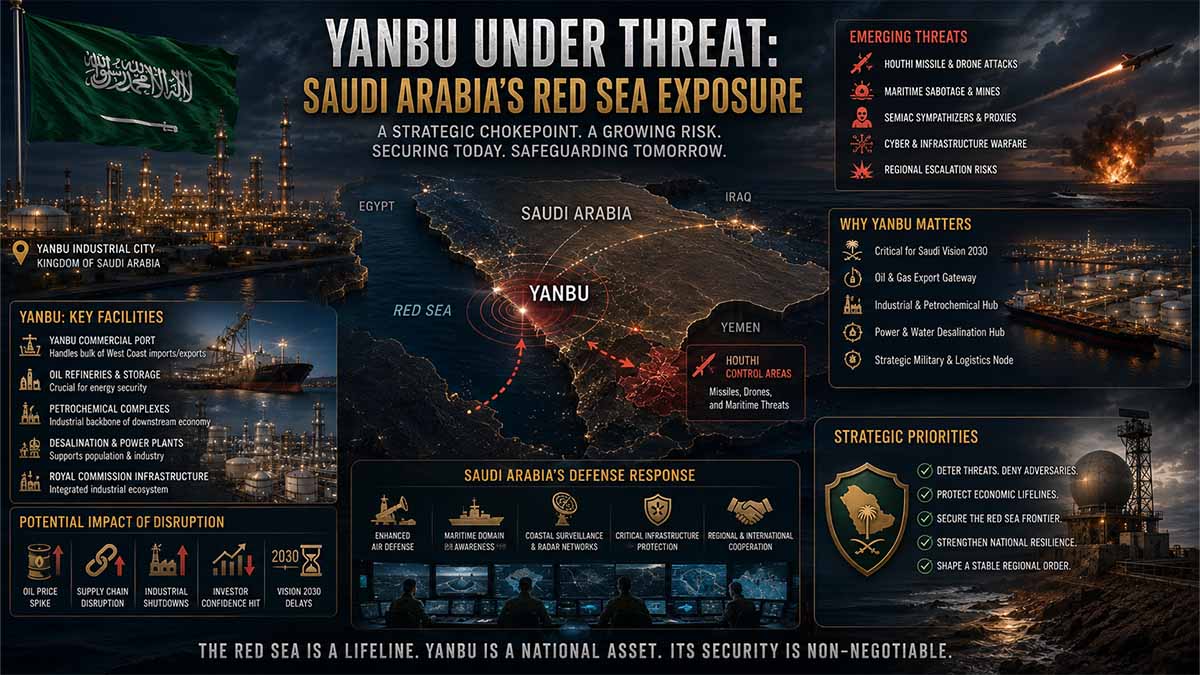
Saudi Arabia’s energy-security architecture has passed a decisive threshold. The East–West Pipeline was designed to reduce dependence on the Strait of Hormuz by moving crude to Yanbu on the Red Sea. Yet the exceptional disruption of 2026 revealed a harder reality: logistical redundancy can redistribute risk without eliminating it. As exports moved west, commercial exposure migrated toward Bab al-Mandab, where missiles, unmanned systems, vessel-tracking intelligence and coercive boarding tactics have already transformed merchant navigation. The resulting challenge is no longer confined to naval security. It reaches Aramco’s balance sheet, Saudi fiscal planning, Asian supply chains, European maritime policy and the credibility of external deterrence. Riyadh has gained an alternative route, but also concentrated strategic value along a corridor whose southern exit remains exposed to an adaptive armed actor.
The Strategic Transfer
The scale of the displacement is unusually clear. The U.S. Energy Information Administration estimates that oil and petroleum-liquid flows through Hormuz fell from 21.6 million barrels per day in the fourth quarter of 2025 to 4.9 million in the second quarter of 2026. Over the same period, volumes through Bab al-Mandab increased from 5.4 million to 8.1 million barrels per day, as Saudi crude was redirected through the East–West Pipeline to Yanbu. Suez Canal and SUMED flows remained broadly stable, moving from 5.9 million to 5.8 million barrels per day. Global Energy Security Data – U.S. Energy Information Administration – August 2026 — official dataset.
These figures describe more than rerouting. They expose a structural transfer of concentration risk. The pipeline reduces the need for Saudi crude to cross Hormuz, but west-coast exports must still enter a maritime system bounded by Bab al-Mandab to the south and Suez to the north. The EIA explicitly states that the Suez Canal and Egypt’s SUMED Pipeline offer alternatives, but that these are slower, more expensive and capacity-constrained. Short-Term Energy Outlook: Global Oil Markets – U.S. Energy Information Administration – August 2026 — official analysis. The strategic asset is therefore not Yanbu alone. It is the entire chain linking eastern production, the trans-kingdom pipeline, western storage and loading facilities, tanker availability, Red Sea navigation and onward access to consuming markets.
Yanbu’s New Weight
Saudi Aramco’s second-quarter disclosure confirms how rapidly Yanbu’s role has changed. The company reported 98.4% supply reliability in the second quarter of 2026, attributing that performance to its integrated network, storage infrastructure, alternative export routes and continued use of the East–West Pipeline. It stated that the Yanbu export terminal had been repositioned as a strategic hub for western-region shipments. Amin H. Nasser, Aramco’s President and Chief Executive Officer, described the Hormuz disruption as unprecedented and identified the pipeline, storage capacity and export terminals as essential to sustaining production and exports. Second Quarter and Half Year Interim Report 2026 – Saudi Aramco – August 2026 — corporate financial report.
The same report reveals the financial dimension of resilience. Aramco recorded $33.4 billion in adjusted net income and $12.3 billion in free cash flow for the second quarter, while a $13.6 billion working-capital build affected cash generation. Its board declared a $21.9 billion base dividend for payment in the third quarter. Aramco also disclosed that company and affiliate facilities in Saudi Arabia had been targeted during the first half and in July 2026, while management concluded that the impact recorded by 30 June 2026 was not material to its financial position, results or cash flows. The distinction is crucial: operational continuity has been preserved, but maintaining it requires inventories, financing, flexible logistics and infrastructure protection. A corridor can remain open while becoming progressively more expensive to operate.
The Maritime Arsenal
The threat surrounding Bab al-Mandab is technologically layered. U.S. Maritime Advisory 2026-006, effective from 26 March to 22 September 2026, lists one-way unmanned aerial vehicles, unmanned surface and underwater vehicles, anti-ship ballistic and cruise missiles, explosive boats, small-arms attacks, illegal boardings, detentions and seizures. It records more than 100 separate attacks on commercial vessels affecting more than 60 nations between November 2023 and October 2025. It also identifies the 31 August 2025 targeting of an Israeli-associated vessel off Yanbu as the northernmost commercial-vessel targeting since the Red Sea campaign began. 2026-006: Houthi Attacks on Commercial Vessels – U.S. Maritime Administration – March 2026 — official maritime advisory.
This is not merely a contest between projectiles and naval interceptors. The advisory warns that AIS transmissions, commercial communications, refrigerated-cargo telemetry, weather systems, Wi-Fi signals and predictable route patterns can contribute to vessel identification. Deterrence consequently depends on information discipline as much as firepower. A ship’s ownership, previous port calls, corporate fleet structure and electronic signature may affect its perceived exposure. The operational battlefield extends from coastal launch sites to databases, shipping agents, satellite services and bridge procedures. The commercial consequence arises before physical impact: the credible possibility of classification or targeting can influence routing decisions, insurance conditions and charter-party negotiations.
The Cost Exchange
Conventional naval power retains the capacity to destroy launchers, storage sites and command nodes, but it confronts an adverse cost structure. On 27 April 2025, U.S. Central Command reported that Operation Rough Rider had struck more than 800 targets, including command-and-control facilities, air defences, weapons-manufacturing installations and storage locations containing anti-ship missiles, unmanned aerial systems and uncrewed surface vessels. CENTCOM assessed that ballistic-missile launches had declined by 69% and one-way-drone attacks by 55%; those percentages remain the command’s own operational assessment. USCENTCOM Forces Continue to Target Houthi Terrorists, Release 20250427-01 – U.S. Central Command – April 2025 — official military release.
The strategic limitation is visible even within those results. Tactical degradation does not automatically produce durable deterrence when weapons can be dispersed, replenished or launched intermittently. An armed group need not close a strait continuously to impose costs; it can alter commercial calculations through episodic demonstrations of reach. Conversely, external navies must sustain surveillance, interception capacity, logistics and political authorization over time. The central measure of effectiveness is therefore not the number of targets destroyed, but whether merchant operators regain sufficient confidence to restore predictable traffic without exceptional protection.
The Financial Supply Chain
The weapons architecture rests on a financial and logistical architecture. On 16 January 2026, the U.S. Department of the Treasury’s Office of Foreign Assets Control designated 21 individuals and entities and identified one vessel for activities that Treasury linked to oil transfers, weapons and dual-use procurement, and financial services benefiting Ansarallah. Treasury named companies and facilitators operating across Yemen, Oman and the United Arab Emirates, and described the use of exchange houses, warehouses, logistics companies and foreign accounts for payments connected to missile components and military-grade materials. Treasury Increases Pressure on Houthi Smuggling and Illicit Revenue Generation Networks – U.S. Department of the Treasury – January 2026 — official designation notice.
This network makes financial intelligence integral to maritime security. Interdiction at sea addresses the final movement of equipment; sanctions, beneficial-ownership analysis, customs cooperation and payment tracing address the procurement cycle that precedes it. Yet enforcement must distinguish illicit military supply from legitimate commercial and humanitarian flows into Yemen. Poorly calibrated restrictions could obstruct civilian trade without reliably disabling procurement. The effective target is not commerce as a category, but the junction between front companies, financial intermediaries, dual-use purchases and military acquisition.
The External Shield
The European Union has institutionalised a defensive presence rather than an offensive campaign. On 23 February 2026, the Council of the European Union extended EUNAVFOR ASPIDES until 28 February 2027, assigning nearly €15 million in common costs for the period beginning 1 March 2026. The operation protects vessels and monitors a zone encompassing Bab al-Mandab, the Red Sea, the Gulf of Aden, the Arabian Sea, the Gulf of Oman, the Gulf and the Strait of Hormuz. Its headquarters is in Larissa, Greece, under Rear Admiral Vasileios Gryparis. Red Sea: Council Extends the Mandate of Operation ASPIDES – Council of the European Union – February 2026 — official decision.
ASPIDES can reduce immediate vessel vulnerability, improve maritime awareness and reinforce freedom of navigation. It cannot, by mandate alone, settle Yemen’s political conflict, dismantle transnational procurement networks or remove the strategic incentives behind selective maritime pressure. The division of labour is therefore unavoidable: naval forces protect passage; financial authorities pursue procurement networks; regional diplomacy addresses escalation; port and energy operators harden infrastructure. Failure in any layer weakens the others.
The Macroeconomic Transmission
The International Monetary Fund completed its Saudi Article IV consultation on 22 July 2026. It concluded that rerouting through the East–West Pipeline had limited the decline in oil deliveries, while higher prices had more than offset lower export volumes. The Fund projected 1.7% real GDP growth and 2.2% inflation for 2026, attributing part of the inflation increase to higher shipping and insurance costs. It also warned that continued maritime disruption could curtail trade, weaken confidence and weigh on growth and diversification. IMF Executive Board Concludes 2026 Article IV Consultation with Saudi Arabia, Press Release No. 26/267 – International Monetary Fund – July 2026 — official consultation statement.
This transmission mechanism places maritime risk inside the economics of Vision 2030. Higher freight and insurance costs affect imported equipment, project schedules and working capital; volatile export routes affect fiscal visibility; infrastructure protection competes with other capital requirements. The East–West system remains a formidable strategic asset, but its value now depends on the resilience of terminals, communications, air defence, tanker access and the southern Red Sea.
The Five-Year Test
Between 2027 and 2031, six pathways merit continuous institutional scrutiny: managed armed restraint; recurrent maritime coercion; a limited Saudi-supported land campaign; fragmentation among anti-Houthi forces; a wider confrontation linking Hormuz and Bab al-Mandab; and a negotiated settlement encompassing ports, revenues and security guarantees. No verified primary-source model supports assigning numerical probabilities to these outcomes. The decisive indicators are observable instead: attack frequency and geography; air-defence redeployments around western infrastructure; changes in AIS behaviour and commercial routing; sanctions evasion through exchange houses and front companies; naval magazine replenishment; and formal progress in Yemeni negotiations.
The strategic objective should not be the impossible promise of eliminating all risk. It should be to prevent correlated failure: simultaneous pressure on Hormuz, Yanbu, Bab al-Mandab and the financial channels sustaining export continuity. That requires Saudi infrastructure dispersion, stronger cyber and electronic-security standards, deeper coordination between naval and commercial operators, and diplomacy capable of separating freedom of navigation from wider regional bargaining. The dual-chokepoint trap becomes strategically dangerous only when every alternative depends on the same vulnerable political system. Resilience begins when redundancy exists not merely in pipelines, but across routes, institutions, inventories, finance and diplomacy.
Navigational Index
- The dual-chokepoint trap — Hormuz displacement, Yanbu concentration and Bab al-Mandab exposure.
- The deterrence architecture — maritime weapons, cross-border escalation, proxies and external naval actors.
- The 2027–2031 contest — six competing hypotheses, Bayesian indicators and shadow-risk trajectories.
Master Abstract
The strategic transformation under examination is larger than a renewed Saudi–Yemeni exchange of fire. It is the conversion of Saudi Arabia’s logistical redundancy into a system of correlated vulnerabilities. As of 27 August 2026, the admissible primary-source record supports three high-confidence conclusions: threats to commercial navigation have resumed; Saudi export flows have become more dependent on the western corridor; and the weapons available to the Sanaa-based authorities permit pressure to be applied simultaneously against shipping, coastal infrastructure and land-based military systems. The International Maritime Organization records 61 confirmed incidents against merchant or commercial vessels from 10 January 2024 to the present, of which 57 occurred by the end of 2025, and states that its verified incident reporting supports the United Nations Security Council’s monthly monitoring process. Red Sea Area – International Maritime Organization – August 2026 — verified primary source. The active United States maritime advisory separately identifies one-way UAVs, anti-ship ballistic and cruise missiles, USVs, UUVs, explosive boats, firearms and illegal boardings as plausible modes of attack; it also reports more than 100 Houthi attacks affecting vessels connected to more than 60 countries between November 2023 and October 2025. 2026-006: Red Sea, Bab el-Mandeb Strait, Gulf of Aden, Arabian Sea and Somali Basin—Houthi Attacks on Commercial Vessels – U.S. Maritime Administration – March 2026 — verified primary source. These records validate the threat architecture, but they do not independently validate every operational claim in the supplied article. Accordingly, tanker counts, claimed diversions, loading losses and the identity or effectiveness of individual attacks remain compartmented as uncorroborated reporting until an admissible authority confirms them.
The economic mechanism is a dual-chokepoint compression. The East–West Pipeline allows Saudi crude to move from the Gulf-facing production system to Yanbu without passing through Hormuz, but Asian-bound cargo departing the western coast must ordinarily sail south through the Red Sea and Bab al-Mandab. Northbound movement through Suez or the Egyptian SUMED system provides an alternative, but it adds distance, terminal coordination, tanker requirements and finite pipeline capacity. The U.S. Energy Information Administration estimates that Hormuz flows collapsed from 21.6 million barrels per day in the fourth quarter of 2025 to 4.9 million in the second quarter of 2026, while Bab al-Mandab flows increased from 5.4 million to 8.1 million barrels per day as Saudi Arabia redirected crude through the East–West Pipeline. The same assessment warns that the Suez and SUMED alternatives are slower, more expensive and capacity-constrained. Short-Term Energy Outlook: Global Oil Markets – U.S. Energy Information Administration – August 2026 — verified primary source. Aramco’s independently reviewed interim report confirms that the company continued using the pipeline, expanded west-coast export flexibility and repositioned Yanbu as a strategic hub while maintaining 98.4% supply reliability in the second quarter. Second Quarter and Half Year Interim Report 2026 – Saudi Aramco – August 2026 — independently reviewed corporate report. The macroeconomic exposure is consequential: oil represented 75.6% of Saudi merchandise exports in May 2026, while China alone absorbed 12.3% of total exports. International Trade in Goods, May 2026 – Saudi General Authority for Statistics – July 2026 — verified government dataset. Maritime insecurity therefore transmits into fiscal revenue, freight liquidity, customer scheduling and Vision 2030 expenditure rather than remaining a narrowly naval problem.
The military balance is asymmetric but not symmetrical: Riyadh possesses vastly greater financial resources, air power, surveillance access and advanced defensive systems, whereas Sanaa can exploit lower-cost weapons, concealment, target ambiguity and the disproportionate commercial consequences of even an unsuccessful attack. A missile does not need to sink a tanker to generate strategic effect; it must only persuade shipowners, underwriters, crews and commodity traders that the probability distribution has changed. U.S. Central Command has documented Houthi use or storage of anti-ship ballistic missiles, cruise missiles, unmanned aerial systems and uncrewed surface vessels. CENTCOM also reported that its 2025 campaign struck more than 800 targets and reduced the pace of ballistic-missile and one-way-drone launches, although those effectiveness figures remain a belligerent’s operational assessment rather than an independently audited result. USCENTCOM Forces Continue to Target Houthi Terrorists – U.S. Central Command – April 2025 — verified military source. International responses remain institutionally fragmented. The European Union extended the defensive mandate of EUNAVFOR ASPIDES until 28 February 2027, with nearly €15 million in common costs, covering the Red Sea, Bab al-Mandab and surrounding waters while monitoring Hormuz. Red Sea: Council Extends the Mandate of Operation ASPIDES to Safeguard Freedom of Navigation – Council of the European Union – February 2026 — verified EU decision. Beijing’s official formulation combines freedom of navigation, Yemeni sovereignty and regional de-escalation, but does not confirm reported direct arrangements for Chinese tanker passage. 也门《戴胜》新闻网对驻也门使馆临时代办邵峥进行书面采访 – Embassy of the People’s Republic of China in Yemen – August 2026 — verified Chinese-language source. Relevant Russian official pages were checked, but their endpoints returned errors during live verification; no Russian-derived factual claim or hyperlink has therefore been admitted.
The five-year outlook is structured around six mutually exclusive strategic hypotheses. The default Bayesian distribution assigns approximately 32% to H₂, normalised maritime coercion in which attacks and threats become recurring bargaining instruments; 18% to H₁, an armed détente restoring restraint without resolving sovereignty, salaries, ports or hydrocarbon control; 18% to H₅, a multi-chokepoint regional confrontation connecting Hormuz, Bab al-Mandab and the wider Arabian Sea; 16% to H₃, a limited Saudi-supported campaign around selected internal fronts; 13% to H₄, fragmentation among Riyadh- and Abu Dhabi-aligned formations; and roughly 3% to H₆, a comprehensive settlement. These figures are declared analytical priors, not observed frequencies. During 2027, the principal danger is rapid action–reaction escalation involving western Saudi infrastructure, border provinces and reinforcement corridors. During 2028, adaptation should become more visible through dispersed loading, altered tanker ownership structures, defensive naval escort, layered air defence and increased operational-security measures. By 2029, the decisive question will be whether maritime pressure can be converted into political concessions or instead provokes a sustained Saudi campaign. During 2030, a durable coercive equilibrium could emerge in which shipping access, salary payments, port restrictions and hydrocarbon revenues become components of a single negotiated security system. By 2031, the distribution bifurcates between armed accommodation and a wider regional war: the former requires credible restraints on cross-border strikes and proxy mobilisation; the latter becomes more likely if Hormuz remains unstable while attacks move closer to Yanbu, Jeddah or Egyptian transfer infrastructure. The “shadow” indicators with the greatest Bayesian value are changes in war-risk premiums, AIS dark activity, tanker beneficial ownership, port OT anomalies, missile-component interdictions, proxy payrolls, cross-border logistics, air-defence redeployments and unusual liquidity movements through shipping agents or procurement intermediaries. The simulator below exposes these assumptions and reruns 6,000 Monte Carlo trials whenever an operational driver changes.
Five-year strategic risk simulator · 2027–2031
Adjust the five observable drivers. The engine reruns 6,000 stochastic trials and updates six competing hypotheses. Values are analytical outputs, not observed facts.
Operational drivers
System outlook
ACH posterior distribution
Model: six exclusive end-states, noisy driver sampling, yearly diplomatic drift and normalized posterior scores. Defaults are declared analyst priors as of 27 August 2026.
The Dual-Chokepoint Trap: Hormuz Displacement, Yanbu Concentration and Bab al-Mandab Exposure
Redundancy becomes correlated vulnerability
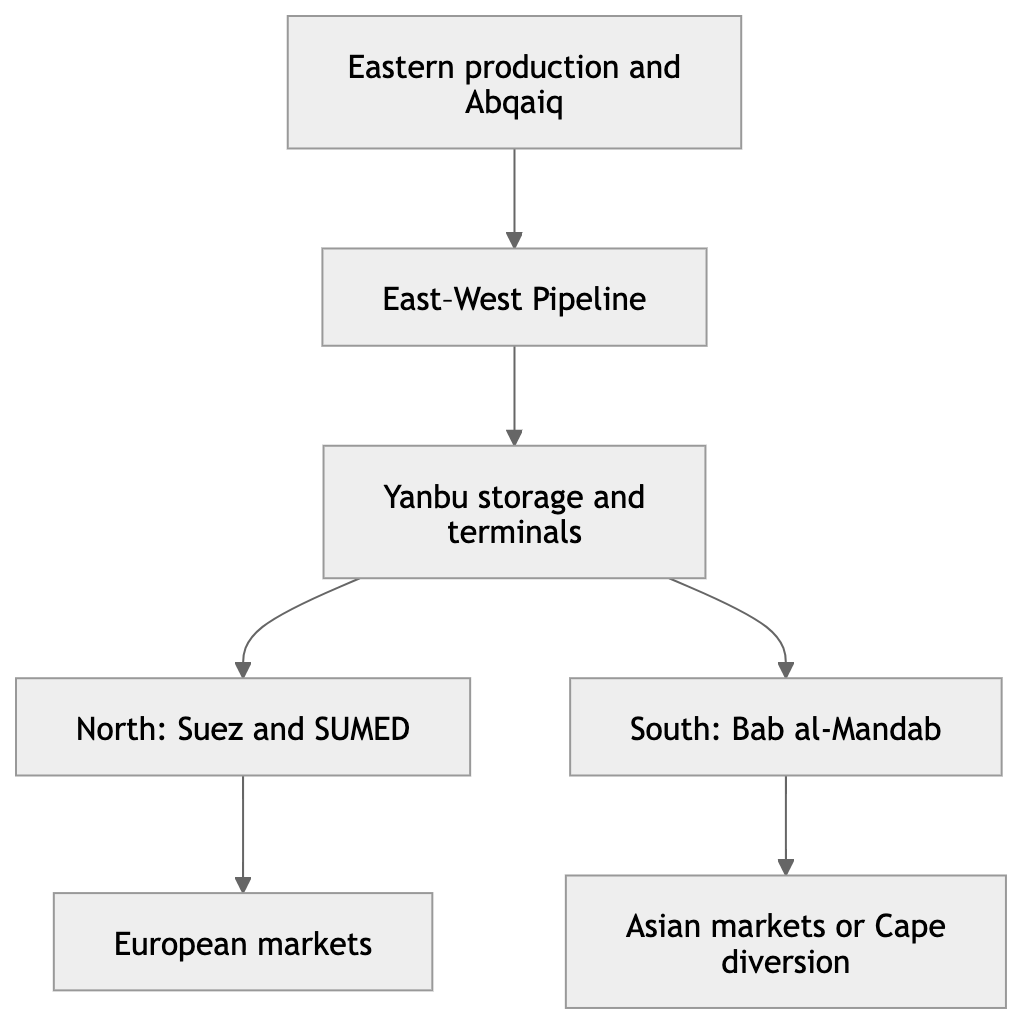
Saudi Arabia’s East–West energy corridor was designed to prevent a crisis in the Strait of Hormuz from paralysing the Kingdom’s oil exports. In the present threat environment, however, this redundancy no longer eliminates chokepoint risk: it relocates and concentrates it. Crude diverted from Abqaiq and the Eastern Province can travel overland to Yanbu, avoiding Hormuz, but cargoes leaving the Red Sea coast for Asian markets must normally sail south through Bab al-Mandab; cargoes directed toward Europe encounter a different chain of dependencies involving Red Sea navigation, the Suez Canal, Egyptian terminals and, where used, the SUMED pipeline. The result is not a simple substitution between two independent routes but a correlated network in which disruption at Hormuz increases utilisation, strategic value and target concentration at Yanbu, while simultaneously increasing the volume exposed to Bab al-Mandab. During the second quarter of 2026, estimated oil flows through Hormuz fell from 21.6 million barrels per day in the fourth quarter of 2025 to 4.9 million, whereas Bab al-Mandab flows rose from 5.4 million to 8.1 million barrels per day; crude and condensate alone accounted for 6.1 million barrels per day of the latter flow. Short-Term Energy Outlook: Global Energy Security Data – U.S. Energy Information Administration – August 2026 — verified primary source. These figures demonstrate actual displacement, not merely theoretical bypass capacity. They also reveal the strategic trap: a defensive logistics measure against one maritime threat enlarges exposure to another threat system positioned close to Yemen’s coastline. As of the analytical cut-off on 26 August 2026, the highest-confidence assessment is therefore that Saudi export resilience remains substantial but increasingly conditional on simultaneous security across three nodes—pipeline transit, Yanbu operations and Red Sea passage—whose risks cannot be treated as statistically independent.
| Energy route | 4Q25 flow | 1Q26 flow | 2Q26 flow | Strategic interpretation |
|---|---|---|---|---|
| Strait of Hormuz | 21.6 mb/d | 14.9 mb/d | 4.9 mb/d | Severe displacement from the Gulf-facing route |
| Bab al-Mandab | 5.4 mb/d | 5.6 mb/d | 8.1 mb/d | Rapid concentration of southbound Red Sea exposure |
| Suez Canal and SUMED | 5.9 mb/d | 5.7 mb/d | 5.8 mb/d | Material but capacity- and coordination-constrained northern outlet |
| Cape of Good Hope | 9.9 mb/d | 8.2 mb/d | 9.4 mb/d | Expensive maritime fallback rather than operational equivalent |
The physical mechanics of displacement
The East–West Pipeline links the Abqaiq processing complex with Yanbu and has a nominal crude capacity reported by the U.S. Energy Information Administration at 5 million barrels per day; Aramco temporarily increased the system’s potential to approximately 7 million barrels per day in 2019 by converting natural-gas-liquids infrastructure for crude service. Amid Regional Conflict, the Strait of Hormuz Remains Critical for Oil and LNG Trade – U.S. Energy Information Administration – June 2025 — verified primary source. Capacity, however, must not be confused with immediately sustainable incremental throughput. The effective export envelope depends on upstream production mix, pump-station availability, maintenance, storage, blending, terminal scheduling, berth capacity, tanker arrival patterns and the ability of west-coast refineries to absorb or release crude. Aramco confirmed that it continued using the pipeline in 2026, enhanced western export infrastructure and repositioned the Yanbu export terminal as a strategic hub, while maintaining 98.4% supply reliability during the second quarter. Second Quarter and Half Year Interim Report 2026 – Saudi Aramco – August 2026 — independently reviewed corporate report. That reliability figure is evidence of successful adaptation, but it is not evidence that the architecture is invulnerable: it measures delivery performance during the reporting period, not the probability of surviving a coordinated future campaign against pumping stations, power supply, storage, terminal systems and vessels. The key structural assumption test therefore asks whether East–West redundancy remains independent of maritime insecurity. It does not. Once a barrel reaches Yanbu, it has escaped Hormuz but not the regional battlespace. Northbound movement through Suez is exposed to Red Sea access and Egyptian capacity; southbound movement faces Bab al-Mandab; passage around the Cape adds voyage time, tanker demand, fuel consumption, inventory in transit and financing costs. The pipeline consequently converts a single maritime bottleneck into a land–terminal–maritime chain whose overall reliability equals the reliability of its weakest indispensable node.
Yanbu as a concentration node
Yanbu’s strategic importance now derives less from the city’s individual installations than from the density of interdependent functions assembled along the western corridor: crude reception, storage, refining, product handling, tanker loading, electricity, desalinated water, communications, industrial control systems and access to Red Sea shipping. Concentration creates efficiency during normal operations but produces nonlinear consequences during disruption. A successful attack need not destroy the pipeline or terminal permanently; temporary denial of electrical distribution, berth access, harbour approaches, pumping control, tug availability or safety systems could create queues upstream and offshore, force production adjustments, complicate crude segregation and consume storage buffers. The earlier attack history reinforces this judgment. Aramco’s corporate disclosures record that the East–West Pipeline was targeted by unmanned aerial vehicles in May 2019, causing fires and damage, establishing both hostile intent and the physical reach of asymmetric systems. Base Prospectus, SA Global Sukuk Limited – Saudi Aramco – June 2021 — audited corporate disclosure. The contemporary risk is broader because target identification can combine satellite imagery, commercially available geospatial data, AIS-derived vessel patterns, human observation, cyber reconnaissance and repeated analysis of loading schedules. Defensive success against incoming missiles or drones also does not eliminate operational effect: debris, precautionary shutdowns, harbour closures, crew-risk decisions and insurer restrictions may interrupt operations without a confirmed direct hit. From a red-team perspective, an adversary would rationally avoid attacking the most heavily defended point repeatedly and instead seek the cheapest mechanism for producing equivalent commercial delay—an exposed pumping installation, an electrical substation, an anchored tanker, a harbour service vessel, a communications dependency or a false operational warning that forces shutdown. Conversely, Saudi Arabia can reduce concentration risk through distributed storage, redundant power, manual operating modes, protected communications, mobile repair capacity, deceptive scheduling, additional western berths and contractual access to overseas storage. The contest is therefore an adaptation race between infrastructure hardening and adversarial discovery of residual single points of failure.
| Yanbu dependency | Disruption mechanism | Immediate consequence | Second-order consequence | Observable indicator |
|---|---|---|---|---|
| Pipeline and pump stations | Missile, UAV, sabotage, power loss | Reduced crude inflow | Upstream production or storage imbalance | Maintenance convoys; emergency flaring; power anomalies |
| Terminal berths | Strike, debris, harbour closure | Loading suspension | Tanker queue and delivery slippage | Anchorage density; tug movements; notice-to-mariners changes |
| Storage and blending | Fire, control failure, contamination | Grade-management constraints | Contract substitution and price differentials | Unusual cargo swaps; inventory transfers |
| Port OT systems | Intrusion, ransomware, data manipulation | Precautionary shutdown | Loss of confidence in scheduling data | Network segmentation; manual processing; delayed documentation |
| Red Sea approaches | Missile, USV, boarding threat | Vessel avoidance | Freight and insurance repricing | AIS divergence; convoy formation; ownership restructuring |
Bab al-Mandab’s asymmetric threat geometry
Bab al-Mandab is not merely a narrow maritime passage; it is an engagement environment in which coastal geography, commercial traffic density and low-cost precision systems can impose disproportionate strategic costs. The active U.S. Maritime Administration advisory identifies one-way UAVs, unmanned surface and underwater vehicles, ballistic and cruise missiles, explosive boats, small-arms attacks, illegal boardings, detentions and seizures as credible hostile actions. It further states that more than 100 separate attacks affected vessels associated with more than 60 nations between November 2023 and October 2025. 2026-006: Red Sea, Bab el-Mandeb Strait, Gulf of Aden, Arabian Sea and Somali Basin—Houthi Attacks on Commercial Vessels – U.S. Maritime Administration – March 2026 — verified primary source. The International Maritime Organization’s narrower verified ledger records 61 confirmed incidents from 10 January 2024 through the current reporting period, of which 57 occurred by the end of 2025. Red Sea Area – International Maritime Organization – August 2026 — verified primary source. The difference between these totals reflects distinct definitions and reporting windows rather than an evidentiary contradiction; neither dataset should be merged mechanically. The operational asymmetry is central: a defender must protect many vessels continuously over a large maritime area, while an attacker can choose time, target and weapon, including unsuccessful launches intended to generate behavioural effects. A missile costing far less than the cargo it threatens can alter route selection even when intercepted. Moreover, targeting logic can exploit corporate association rather than a ship’s flag alone, compelling fleets to restructure port calls, ownership, management and chartering arrangements. MARAD’s warning that AIS, onboard commercial transmissions, Wi-Fi systems, weather data and reefer telemetry may facilitate targeting demonstrates that maritime signature management has become part of combat survivability. This converts civilian digital exhaust into targeting intelligence and makes Bab al-Mandab simultaneously a kinetic, informational and commercial chokepoint.
Deterrence without complete area control
External naval forces can reduce attack success but cannot guarantee commercial normalisation because the strategic objective is not identical to tactical interception. The European Union extended EUNAVFOR ASPIDES until 28 February 2027, allocated nearly €15 million in common costs for the extension period and retained a defensive mandate covering principal sea lines around Bab al-Mandab while monitoring the Strait of Hormuz. Red Sea: Council Extends the Mandate of Operation ASPIDES to Safeguard Freedom of Navigation – Council of the European Union – February 2026 — verified primary source. The operation improves situational awareness, escorts selected vessels and complicates attack planning, but its finite ships, interceptors and surveillance assets must cover a long, congested corridor. Defensive naval deployments also face an unfavourable cost-exchange problem when sophisticated surface-to-air missiles are used against comparatively inexpensive drones, and they cannot directly remove launchers hidden within dispersed inland networks without moving from protection into coercive warfare. Five distinct deterrence relationships must therefore be separated: deterrence of attacks on Saudi territory; deterrence of attacks on commercial vessels; denial of successful weapon impact; punishment of launch networks; and political deterrence through negotiated restraint. Success in one category does not establish success in the others. A vessel may remain physically unharmed yet avoid the corridor because the residual probability of attack remains unacceptable to its owner or crew. Conversely, aggressive land strikes may destroy launch infrastructure while increasing incentives for retaliatory maritime action. The most stable architecture would combine naval defence, Saudi infrastructure hardening, rapid attribution, deconfliction with regional states and a political mechanism that links maritime restraint to the wider Yemen negotiation. Yet this creates moral-hazard and enforcement problems: if shipping access becomes a negotiable concession, coercive actors receive evidence that maritime pressure generates diplomatic leverage. The five-year equilibrium is therefore likely to oscillate between partial deterrence and limited coercion rather than produce permanent, uncontested control of the strait.
Fiscal, trade and liquidity transmission
The dual-chokepoint trap reaches Saudi public finance through volumes, realised prices, delivery reliability and the cost of sustaining redundant logistics. Oil represented 75.6% of Saudi merchandise exports in May 2026, while China received 12.3% of total exports; Jeddah Islamic Sea Port handled 35.7% of imports and Yanbu Commercial Port accounted for 4.7% of non-oil exports. International Trade in Goods, May 2026 – Saudi General Authority for Statistics – July 2026 — verified government dataset. These figures show that western maritime exposure affects more than crude exports: the same regional security environment intersects with import supply, industrial inputs and the non-oil diversification strategy. The International Monetary Fund calculated that Saudi Arabia’s current account moved from a 2.9% of GDP surplus in 2023 to a 0.5% deficit in 2024, while the fiscal deficit reached 2.5% of GDP and central-government debt rose to 26.2% of GDP. It projected the current-account deficit to peak near 3.9% of GDP in 2027, although buffers remained substantial. Saudi Arabia: Concluding Statement of the 2025 Article IV Mission – International Monetary Fund – June 2025 — verified primary institutional assessment. Chokepoint disruption would not automatically cause a fiscal crisis, but it could accelerate project recalibration by widening the difference between committed expenditure and reliably monetised export revenue. The liquidity mechanism begins before physical supply loss: war-risk premiums rise; charterers demand contractual protection; banks increase documentary scrutiny; letters of credit take longer to process; cargo substitution creates pricing disputes; longer voyages lock more working capital into inventory at sea; and tanker scarcity widens freight spreads. None of these mechanisms requires Bab al-Mandab to be formally closed. Persistent uncertainty alone can impose a “security tax” on every barrel moved westward, reducing the economic value of the Hormuz bypass even while the physical pipeline continues operating.
China, Russia and the contested norm of navigation
The international response is constrained by a convergence of economic interests but divergence over enforcement legitimacy. China’s official position combines respect for regional sovereignty with support for safe international waterways and negotiated de-escalation. In an August 2026 Chinese-language interview, the Chinese Embassy in Yemen declined to validate reports of special passage arrangements and stated that the security and unobstructed operation of international sea lanes should be protected collectively; it simultaneously emphasised Yemen’s location beside the Red Sea and Bab al-Mandab and its potential relevance to reconstruction and Belt and Road infrastructure. 也门《戴胜》新闻网对驻也门使馆临时代办邵峥进行书面采访 – Embassy of the People’s Republic of China in Yemen – August 2026 — verified Chinese-language primary source. This posture reflects Beijing’s competing imperatives: protecting energy imports and trade connectivity, maintaining relations with Saudi Arabia and Iran, avoiding endorsement of non-state maritime taxation or coercion, and resisting an enforcement architecture dominated entirely by Western naval power. Russian official Russian-language domains were searched during this session, including material concerning navigation in the Red Sea and Bab al-Mandab, but the relevant document endpoints could not be reopened reliably; under the stipulated zero-tolerance rule, no Russian hyperlink or Russia-specific factual claim is admitted. The analytical implication nevertheless remains testable: a broad diplomatic consensus favouring freedom of navigation does not automatically produce common rules for attribution, interdiction, retaliation or convoy protection. European states principally frame the issue through defensive maritime security and international law; the United States combines navigation protection with regional military deterrence; China privileges dialogue, sovereign equality and avoidance of escalation. These approaches overlap enough to condemn indiscriminate commercial attacks but not enough to form a unified security regime. Over five years, this enforcement gap could permit maritime coercion to become normalised below the threshold at which major powers accept the cost of coordinated escalation.
Shadow systems: contractors, cyber operations and opaque finance
The shadow dimension consists of activities that alter operational capacity without appearing immediately in conventional force balances. The first is the contractor ecosystem. MARAD explicitly recognises that contracted armed security details, combined with evasive manoeuvring, have deterred boarding attempts and uncrewed-surface-vessel attacks. This should not be conflated automatically with unlawful mercenary activity: ship-protection teams operate under flag-state, coastal-state, corporate and contractual rules, whereas proxy combat formations or deniable foreign specialists may occupy a different legal category. The analytical problem is attribution. Growth in private security contracts, specialist recruitment, maritime-drone advisers, maintenance technicians or third-country training pipelines could indicate adaptation without revealing the state sponsor or intended mission. The second shadow system is cyber-physical. Yanbu’s industrial-control networks, port community systems, tanker scheduling, electronic documentation and communications links create opportunities for reconnaissance, disruption and deception. An attacker may manipulate operational data to force a safe shutdown, while a defender may withhold or falsify schedules to reduce targeting quality. MARAD’s warning regarding AIS, Wi-Fi, reefer telemetry and other electronic emissions establishes that civilian data already has tactical relevance. The third shadow system is liquidity. Procurement networks for engines, guidance components, electronics and maritime drones can use trading companies, over-invoicing, commodity exchange, cash couriers or informal settlement mechanisms; conversely, shipping companies can obscure exposure through special-purpose ownership, flag changes, management transfers and chartering layers. High-value indicators are therefore not dramatic announcements but clustered anomalies: sudden changes in beneficial ownership; repeated vessel renaming; new security retainers; unusual imports of dual-use electronics; bursts of satellite communications near launch areas; unexplained port-system outages; and parallel movements in war-risk premiums, tanker availability and documentary-payment delays. These indicators should be fused because no single anomaly proves hostile intent, whereas correlated changes across finance, cyber telemetry and maritime behaviour can materially update the probability of preparation.
Analysis of competing hypotheses and Bayesian update
The analytical framework uses six mutually exclusive five-year end states. Priors were assigned before incorporating the second-quarter 2026 displacement data, Aramco’s reliability evidence, the renewed maritime threat ledger and the extension of ASPIDES. The Bayesian update follows P(Hᵢ|E) = P(E|Hᵢ) × P(Hᵢ) ÷ Σ[P(E|Hⱼ) × P(Hⱼ)], with likelihood ratios bounded to prevent a single partially dependent indicator from dominating the result. H₁, managed armed détente, assumes limited attacks and continuing informal restraint; H₂, institutionalised maritime coercion, assumes recurring threats used as negotiating leverage; H₃, limited Saudi-supported rollback, assumes selective operations against launch and coastal networks; H₄, fragmentation, assumes intra-Yemeni and sponsor competition degrades coherent escalation but multiplies local violence; H₅, regional multi-chokepoint confrontation, assumes Hormuz and Bab al-Mandab risks become operationally correlated; H₆, comprehensive settlement, assumes a durable political and security agreement. The update raises H₂ because traffic displacement has enlarged the value of maritime pressure without producing catastrophic Saudi supply failure. It also raises H₅ because simultaneous stress is no longer a purely hypothetical correlation. Aramco’s 98.4% reliability lowers the near-term probability of infrastructure collapse and therefore restrains H₃ and the most extreme version of H₅. ASPIDES reduces expected attack success but does not eliminate coercive effect, leaving H₂ dominant. A key-assumptions check identifies four fragile propositions: that attacks remain discriminating; that Iran–Saudi escalation stays bounded; that Yanbu’s cyber-physical redundancy performs under coordinated stress; and that naval coalitions retain political cohesion after casualties. A premortem of severe export interruption points to simultaneous rather than sequential failure—Hormuz stress, a Yanbu precautionary shutdown and Bab al-Mandab vessel avoidance occurring within the same commercial scheduling window.
| Hypothesis | Prior | Updated probability | Most diagnostic confirming indicator | Strongest disconfirming indicator |
|---|---|---|---|---|
| H₁ Managed armed détente | 22% | 18% | Sustained decline in attacks plus verified negotiation channels | Renewed targeting north of normal threat area |
| H₂ Institutionalised maritime coercion | 31% | 36% | Intermittent attacks calibrated below full closure | Binding maritime ceasefire with verification |
| H₃ Limited Saudi-supported rollback | 14% | 12% | Mobilisation around coastal launch and logistics nodes | Saudi force drawdown and reduced proxy payrolls |
| H₄ Coalition and proxy fragmentation | 11% | 10% | Sponsor-aligned formations obstruct one another | Unified command and integrated logistics |
| H₅ Regional multi-chokepoint confrontation | 19% | 21% | Correlated Hormuz, Yanbu and Bab al-Mandab alerts | Durable Gulf de-escalation and normal tanker flows |
| H₆ Comprehensive settlement | 3% | 3% | Enforceable agreement on ports, salaries, revenues and missiles | Continued use of maritime access as leverage |
Monte Carlo architecture and model limitations
The five-year simulation comprises 200,000 paths per year and models three correlated latent drivers: Gulf escalation, Red Sea attack intensity and Yanbu disruption pressure. The baseline correlation matrix assigns 0.55 between Gulf and Red Sea escalation, 0.50 between Red Sea pressure and Yanbu disruption, and 0.40 between Gulf escalation and Yanbu disruption. Diplomatic traction follows a beta distribution whose mean improves modestly over time, while defensive adaptation rises annually but remains uncertain because adversaries also learn. A “single-chokepoint disruption state” occurs when either Hormuz or Bab al-Mandab exceeds the model’s operational-risk threshold; a “dual-chokepoint stress state” requires severe Hormuz pressure plus severe Bab al-Mandab or Yanbu pressure; a “severe export-interruption state” requires simultaneous high Hormuz and Bab al-Mandab stress together with material Yanbu impairment. These are analytical thresholds, not actuarial probabilities derived from a long historical series, because the relevant weapon, political and routing configuration has too few comparable precedents. The simulation therefore explores conditional risk under declared assumptions; it does not predict exact attack frequency. The baseline result produces an annual single-chokepoint disruption probability rising from 23.5% in 2027 to 36.1% in 2031, dual-chokepoint stress rising from 6.7% to 14.1%, and severe export interruption rising from 1.3% to 3.5%. The increase reflects accumulation of regional correlation and infrastructure concentration, partially offset by adaptation and diplomacy. Sensitivity testing identifies three variables capable of changing the 2031 dual-stress output by more than five percentage points: the correlation between Hormuz and Red Sea escalation, the effectiveness of Yanbu hardening, and whether commercial avoidance begins after attempted attacks or only after confirmed vessel damage. The last variable is particularly important because market behaviour can amplify weak military signals into strong logistical consequences.
| Modelled annual state | 2027 | 2028 | 2029 | 2030 | 2031 |
|---|---|---|---|---|---|
| At least one chokepoint disruption | 23.5% | 26.3% | 29.3% | 32.8% | 36.1% |
| Dual-chokepoint stress | 6.7% | 8.1% | 9.9% | 12.0% | 14.1% |
| Severe Saudi export interruption | 1.3% | 1.7% | 2.2% | 2.8% | 3.5% |
Outlook: 2027–2029
In 2027, the central contest will concern whether the exceptional displacement visible in 2026 becomes an enduring operating pattern. Saudi Arabia will likely prioritise terminal redundancy, storage flexibility, protected power supply, counter-UAV coverage and alternative documentation procedures, while shipping companies will refine vessel-association screening and contingency routing. The most probable adversarial response is not a sustained attempt to close Bab al-Mandab, which could unify external powers, but selective demonstrations that preserve uncertainty and bargaining value. Diagnostic warnings would include attempted targeting farther north in the Red Sea, surveillance of Yanbu approaches, unexplained communications directed at commercial vessels, and coordinated propaganda naming specific corporate fleets. In 2028, adaptation should shift from emergency routing to institutional redesign. Aramco and customers may increase contractual optionality across Gulf, Red Sea and overseas storage locations; naval actors may integrate surveillance more effectively; and insurers may differentiate vessels according to ownership, port-call history and security practice. This could reduce physical attack success while deepening fragmentation of the shipping market between protected, acceptable and high-risk fleets. In 2029, the critical question will be whether maritime coercion has generated political returns. If it has, H₂ strengthens because calibrated attacks become a proven instrument. If it has not, pressure may shift toward Saudi land infrastructure or wider regional coordination, raising H₅. A limited Saudi-supported campaign under H₃ could emerge if launch networks threaten Yanbu persistently, but such a campaign would face the same strategic problem encountered by earlier interventions: tactical destruction does not necessarily remove dispersed production, concealment, replacement and mobilisation capacity. The period’s highest-value signpost will be whether maritime restraint becomes formally connected to negotiations over Yemeni ports, public salaries, hydrocarbon revenue and territorial authority.
Outlook: 2030–2031
By 2030, the dual-chokepoint trap is likely to mature into one of two architectures. The first is managed coercive interdependence: Saudi Arabia retains high delivery reliability through redundancy and hardening, while Yemen-based forces preserve sufficient latent capability to influence shipping decisions without sustaining a continuous campaign. Maritime security becomes a negotiated but incompletely verified component of the regional order. Under this architecture, occasional incidents produce temporary price and freight shocks, yet do not cause durable export loss. The second architecture is correlated regional confrontation, in which Hormuz stress and Red Sea pressure rise together because Iran–Gulf conflict, Yemen escalation and external military intervention cease to be compartmentalised. Yanbu then becomes more than an alternative terminal: it becomes the concentrated logistical hinge of Saudi wartime exports and therefore a target whose political value exceeds the volume physically destroyed. By 2031, baseline Monte Carlo results place annual dual-stress probability at 14.1%, but the tail risk is more important than the mean. If Gulf–Red Sea escalation correlation rises from 0.55 toward 0.75, if Yanbu adaptation underperforms, or if attempted attacks trigger fleet-wide commercial withdrawal, the severe-disruption probability can multiply without any change in nominal pipeline capacity. Conversely, a verified Gulf de-escalation mechanism, enforceable maritime ceasefire, resilient western infrastructure and common incident-attribution framework could push H₁ above H₂. The most probable five-year result nevertheless remains institutionalised coercion rather than peace or closure: Hormuz displacement will continue to demonstrate Saudi resilience, Yanbu concentration will create a higher-value western node, and Bab al-Mandab exposure will give relatively low-cost systems persistent leverage over a globally consequential flow of energy.
Final intelligence judgment
The dual-chokepoint trap should not be interpreted as an imminent Saudi export collapse. Aramco’s demonstrated reliability, the physical capacity of the East–West system, extensive storage, sophisticated air defence, international naval presence and access to multiple destinations provide substantial resilience. The correct judgment is narrower and more consequential: the marginal barrel diverted from Hormuz does not become risk-free; it enters an alternative corridor whose terminal and maritime dependencies are increasingly visible, concentrated and politically contestable. The strategic metric should therefore move beyond nominal bypass capacity toward risk-adjusted deliverability: how many barrels can be transported, loaded, insured, financed and delivered within contract tolerances during simultaneous disruption? Monitoring must integrate four indicator families. Physical indicators include pipeline throughput anomalies, power interruptions, storage utilisation, berth closures and offshore queue formation. Military indicators include launcher dispersal, component interdictions, unusual drone activity, air-defence relocation and contracted maritime security deployments. Digital indicators include AIS suppression, spoofing, port-system outages, anomalous commercial telemetry and reconnaissance of industrial-control environments. Financial indicators include freight spreads, war-risk premiums, delayed letters of credit, ownership restructuring and unusual procurement payments. No single indicator establishes preparation for coordinated attack, but convergence across these families would justify a sharp Bayesian update toward H₅. The central five-year warning is therefore not that Bab al-Mandab replaces Hormuz as the world’s dominant chokepoint. It is that both chokepoints, connected through Yanbu and the East–West Pipeline, increasingly form one strategic system. Once the risks become correlated, infrastructure redundancy still protects volumes, but it no longer guarantees strategic independence.
Figure 1: Five-Year Dual-Chokepoint Risk Projection
Monte Carlo baseline: 200,000 paths per year. Values are analytical scenario probabilities, not observed frequencies.
The Deterrence Architecture: Maritime Weapons, Cross-Border Escalation, Proxies and External Naval Actors
Deterrence as a system, not a fleet
The Red Sea deterrence problem cannot be reduced to whether Western or regional warships can intercept an incoming missile. It is a multi-domain contest in which each actor attempts to manipulate the opponent’s expectations across several connected arenas: commercial navigation, Yemeni territory, Saudi infrastructure, regional airspace, proxy financing and international diplomacy. The Sanaa-based authorities can threaten shipping through anti-ship ballistic missiles, cruise missiles, one-way attack drones, uncrewed surface vessels, mines, boarding teams and electronic targeting information. Saudi Arabia can respond through air and missile defence, intelligence collection, border forces, economic pressure and support to Yemeni formations. The United States and United Kingdom can add offensive strikes, carrier aviation, long-range surveillance and sanctions; the European Union operates through a deliberately defensive maritime mandate; Iran can influence the balance through technology, components, training, intelligence and financial networks without necessarily assuming public command responsibility. Deterrence therefore succeeds only when an actor believes that the expected cost of escalation exceeds the expected political or military gain. That calculation is unstable because the relevant costs are asymmetric: a defender must maintain continuous surveillance, escort availability and expensive interceptors, whereas an attacker can preserve uncertainty with sporadic launches, false warnings or unsuccessful attacks that still affect insurers and shipowners. The active U.S. maritime advisory identifies one-way UAVs, USVs, UUVs, ballistic and cruise missiles, explosive boats, firearms, illegal boardings and vessel seizures as credible modes of hostile action. 2026-006: Red Sea, Bab el-Mandeb Strait, Gulf of Aden, Arabian Sea and Somali Basin—Houthi Attacks on Commercial Vessels – U.S. Maritime Administration – March 2026 — verified primary source. The essential analytical conclusion is that maritime defence, cross-border restraint, proxy control and political signalling are not separate systems. They are mutually dependent layers of one deterrence architecture.
The maritime weapons ecology
The most strategically important development is not possession of any single “wonder weapon,” but the construction of a diversified engagement portfolio capable of forcing ships and naval defenders to solve several problems simultaneously. Anti-ship ballistic missiles compress reaction time through high terminal velocity and unconventional trajectories; cruise missiles approach at lower altitude and can exploit terrain or radar-horizon limitations; one-way UAVs can probe defensive coverage, saturate sensors or attack exposed superstructures; USVs can approach through commercial clutter and threaten hulls near the waterline; mines can create persistent area denial without requiring continuous launcher exposure; boarding teams and small boats generate legal and tactical ambiguity; and electronic transmissions can support target identification without using a military-grade reconnaissance platform. CENTCOM’s April 2025 operational release stated that the weapons stored or manufactured at targets struck during Operation Rough Rider included anti-ship ballistic and cruise missiles, unmanned aerial systems and uncrewed surface vessels. USCENTCOM Forces Continue to Target Houthi Terrorists – U.S. Central Command – April 2025 — verified military source. The Defense Intelligence Agency separately assessed that Iranian support had enabled a progressive expansion of Houthi capabilities and documented how the campaign affected ships with complex, sometimes tenuous, corporate or national associations. Yemen: Houthi Attacks Placing Pressure on International Trade – Defense Intelligence Agency – April 2024 — verified military assessment. Because the attacker can choose among several effectors, a naval escort optimised for airborne threats may remain exposed to surface attack, while a merchant vessel that extinguishes AIS may still emit commercially generated data. Diversification creates deterrence by uncertainty: the defender does not know which weapon, launch area, target-selection criterion or escalation threshold will govern the next engagement.
| Capability | Operational role | Principal defensive problem | Strategic effect if intercepted |
|---|---|---|---|
| Anti-ship ballistic missile | Rapid long-range attack against vessels | Short warning time; demanding interceptor geometry | Can still trigger route avoidance and defensive expenditure |
| Anti-ship cruise missile | Low-altitude precision attack | Radar horizon; identification amid traffic | Demonstrates reach and targeting persistence |
| One-way attack UAV | Reconnaissance, probing, saturation or strike | Low signature; unfavourable cost exchange | Reveals radar coverage and consumes readiness |
| Uncrewed surface vessel | Waterline attack or harbour disruption | Detection within maritime clutter | Forces standoff distances and additional patrols |
| Mine or drifting explosive threat | Persistent access denial | Search, attribution and clearance time | Can close an area without continuous attack |
| Boarding team or small craft | Seizure, diversion or intimidation | Escalation control and rules of engagement | Produces hostages, publicity and commercial shock |
| Electronic targeting support | Identification and tracking | Civilian data leakage; ambiguous attribution | Reduces attacker reconnaissance costs |
The sensor-to-effect chain
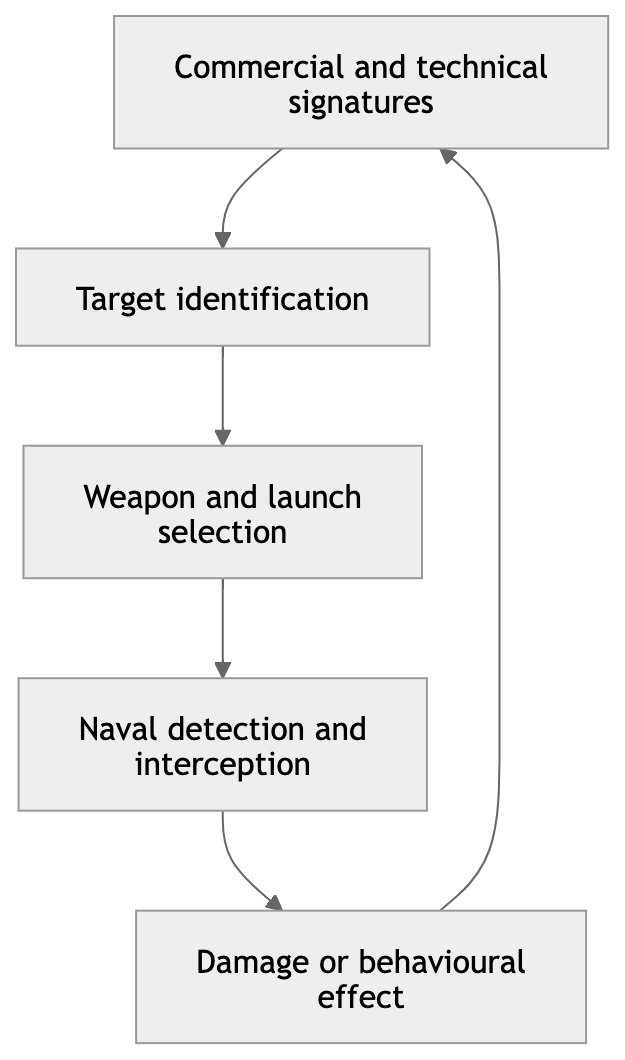
The deterrent value of maritime weapons depends on a functioning kill chain: collection, identification, classification, decision, launch, terminal guidance and post-strike assessment. Breaking any link can prevent an accurate attack, but the commercial maritime environment supplies more observable information than a conventional military target set. Ship position, speed, heading, draught, ownership, management, charterer, cargo type, port-call history and corporate association may be reconstructed from AIS, port systems, commercial databases, satellite imagery, radio traffic, email instructions, weather transmissions and onboard equipment. MARAD warns that AIS, small boats and UAVs have been used to locate merchant vessels and that additional electronic systems—including commercial telemetry, Wi-Fi equipment, weather data and refrigerated-container transmissions—may expose ship movements. It advises vessels to vary routes, waypoints and speeds where practicable and warns against responding to communications directing them to activate AIS or transmit voyage information. 2026-006: Red Sea, Bab el-Mandeb Strait, Gulf of Aden, Arabian Sea and Somali Basin—Houthi Attacks on Commercial Vessels – U.S. Maritime Administration – March 2026 — verified primary source. This creates a hybrid intelligence contest. Naval forces attempt to detect launch preparations, weapon flight paths and approaching craft; attackers seek enough commercial intelligence to predict when a selected ship will enter a favourable engagement zone. Deception therefore becomes as important as interception. A defender can reduce signature quality through emission discipline, route variation, false scheduling, data compartmentation and corporate-information controls. An attacker can issue false diversion instructions, simulate authority, combine open-source vessel data with human observation and use failed attacks to test response times. The architecture can be represented as a circular dependency in which every defensive action supplies information for the next adversarial adaptation.
Cross-border escalation and the Saudi threshold
Maritime attacks and cross-border strikes serve different immediate purposes but belong to the same escalation mechanism. Pressure on merchant shipping internationalises the conflict and transfers costs to shipowners, importing states and naval coalitions. Strikes against Saudi territory instead test Riyadh’s tolerance, threaten infrastructure and attempt to deter renewed Saudi involvement inside Yemen. The danger arises when these vectors reinforce one another. A missile directed at southern Saudi Arabia may be intended as limited signalling; if it coincides with attacks on commercial vessels or threats against Yanbu, Saudi decision-makers may interpret it as preparation for a broader campaign against national economic security. The emergency United Nations Security Council meeting of 13 July 2026 recorded the United Kingdom’s condemnation of Houthi attacks against Saudi Arabia and warned that they threatened regional security, risked escalation and undermined the Yemeni peace process. The same meeting recorded unverified allegations concerning Iranian aircraft, personnel and equipment; because the British statement expressly conditioned those allegations on verification, they cannot be presented as established facts. The Situation in the Middle East: Yemen, Security Council Meeting 10193 – United Nations – July 2026 — verified primary transcript. The Saudi threshold is unlikely to depend on a single intercepted projectile. More consequential variables include accumulated attack frequency, casualties, damage to oil or desalination infrastructure, evidence of Iranian operational direction, attacks extending northward, and the perception that restraint is encouraging additional coercion. Riyadh nevertheless faces incentives to avoid a new open-ended war: previous operations demonstrated that air superiority does not automatically dismantle concealed missile production, distributed command structures or cross-border launch capability. The most credible Saudi deterrent posture is therefore graduated—interception and attribution first; covert or limited disruption second; selective strikes or proxy mobilisation third; and a broader campaign only if attacks threaten systemic economic damage. The instability lies in the absence of a mutually understood threshold between those levels.
| Escalation level | Indicative action | Likely Saudi or coalition response | Principal miscalculation risk |
|---|---|---|---|
| E₁ Political threat | Public warning against ports or vessels | Diplomatic pressure; elevated readiness | Threat interpreted as imminent operational intent |
| E₂ Demonstration | Missed or intercepted launch | Intelligence surge; defensive redeployment | Failed attack treated as deliberate restraint |
| E₃ Limited damage | Strike on vessel or border installation | Targeted retaliation or covert disruption | Retaliation affects personnel linked to an external sponsor |
| E₄ Economic targeting | Attack on pipeline, terminal or airport | Sustained air campaign; proxy mobilisation | Commercial incident becomes interstate confrontation |
| E₅ Mass-casualty event | Successful attack on population or major ship | Large-scale Saudi–allied response | Rapid horizontal escalation across Gulf theatres |
| E₆ Multi-chokepoint campaign | Coordinated Hormuz and Red Sea pressure | Regional coalition operations | Direct confrontation among major external actors |
Proxies, partners and degrees of control
The term “proxy” can obscure more than it explains because external assistance does not necessarily imply complete command authority. A useful model separates sponsorship into six functions: political protection, finance, weapons supply, component procurement, technical training and operational direction. An armed organisation may depend heavily on an external state for some functions while retaining substantial autonomy over target selection and escalation timing. This distinction matters for deterrence. If Iran exercises direct control over every launch, threats against Tehran could theoretically restrain Sanaa. If the relationship instead resembles strategic alignment combined with operational autonomy, punishment of Iran may fail to prevent attacks and could encourage wider escalation. The admissible primary-source record supports the existence of substantial procurement and financial linkages, but it does not establish that every maritime operation is ordered externally. In April 2025, the U.S. Treasury sanctioned a network operating in coordination with Sa’id al-Jamal, described by Treasury as a senior Houthi financial official backed by the IRGC-QF. Treasury stated that the network had procured commodities worth tens of millions of US dollars from Russia, including weapons and sensitive goods, and identified eight digital-asset wallets connected with transfers. Treasury Sanctions Houthi Network Procuring Weapons and Commodities from Russia – U.S. Department of the Treasury – April 2025 — verified government source. In January 2026, Treasury described a wider structure of front companies, logistics firms, warehouses, trucks, exchange houses and cross-border facilitators. It cited an attempted shipment of 52 Kornet anti-tank guided missiles concealed inside false electrical generators and identified exchange-house payments for missile components and advanced weapons. Treasury Increases Pressure on Houthi Smuggling and Illicit Revenue Generation Networks – U.S. Department of the Treasury – January 2026 — verified government source. These are official sanctions findings, not judicial determinations, but they demonstrate why deterrence must target replenishment and finance rather than launchers alone.
The shadow supply chain
Weapon persistence depends on an industrial ecology that is more distributed and replaceable than a conventional arsenal. Complete missiles may be difficult to move covertly, but guidance components, processors, servos, inertial sensors, communications equipment, engines, composite materials, specialised machine tools and commercially available electronics can pass through legitimate trade before being redirected. Front companies can alter names, directors and jurisdictions; logistics firms can mix controlled components with ordinary cargo; exchange houses can settle transactions outside conventional correspondent banking; digital assets can bridge otherwise disconnected facilitators; and diaspora or family businesses can provide apparently civilian commercial cover. The shadow dimension includes personnel as well as material. Foreign technical advisers, maritime specialists, drone engineers or communications experts can create more durable capability than a one-time weapons delivery because they enable local assembly, modification and repair. Yet evidence of foreign nationality alone does not prove state deployment or unlawful mercenary status. Analysts must distinguish state military personnel, ideological volunteers, paid specialists, private security contractors and local proxy forces. The highest-value collection target is not the existence of a suspicious individual but the function performed: target development, production engineering, signals intelligence, terminal guidance, operational planning or training. Sanctions can increase transaction cost and expose networks, but designation alone rarely eliminates capacity because procurement systems adapt through new intermediaries. A robust interdiction model must combine customs data, beneficial ownership, payment patterns, shipping documentation, component serial numbers, warehouse activity and technical exploitation of recovered weapons. Bayesian weight should be assigned to convergent indicators: a new trading company is weak evidence; the same company sharing directors, freight agents, wallets, warehouses and component specifications with a previously designated network is materially stronger. Deterrence at this layer aims to reduce replacement speed, increase uncertainty over suppliers and force the network to expose more nodes each time it reconstructs a broken route.
External naval actors and divided mandates
The external naval presence is extensive but institutionally fragmented. Operation Prosperity Guardian began as a multinational presence and information-sharing mechanism; in February 2025, responsibility transferred from Combined Task Force 153 to U.S. Navy Destroyer Squadron 50. The U.S. Navy stated that more than 20 nations had contributed ships, personnel or information support and that the Joint Maritime Information Center would continue providing operational reporting to commercial operators. Destroyer Squadron 50 Assumes Operation Prosperity Guardian Mission – U.S. Navy – February 2025 — verified military source. The European architecture is narrower by design. EUNAVFOR ASPIDES is a defensive operation that protects vessels, supports freedom of navigation and monitors a geographic system extending from the Red Sea and Bab al-Mandab toward Hormuz. The Council extended it until 28 February 2027 with nearly €15 million in common costs. Red Sea: Council Extends the Mandate of Operation ASPIDES to Safeguard Freedom of Navigation – Council of the European Union – February 2026 — verified EU source. Italy’s destroyer Andrea Doria protected 57 merchant vessels during a three-month deployment in 2025. Operazione ASPIDES: Medal Parade per l’equipaggio di Nave Doria – Italian Ministry of Defence – July 2025 — verified government source. Germany authorised up to 350 personnel, allocated approximately €23.9 million in additional deployment expenditure and defined tasks including ship protection, airborne reconnaissance and information exchange. Bundeswehreinsatz im Roten Meer “EUNAVFOR ASPIDES” – German Bundestag – October 2025 — verified German-language primary source. Russian and Chinese official domains were also checked, but their exact relevant endpoints failed direct reopening; no Russia- or China-specific operational claim or hyperlink is therefore admitted.
| External actor | Core instrument | Mandate logic | Deterrent strength | Structural limitation |
|---|---|---|---|---|
| United States | Destroyers, carriers, ISR, offensive strikes, sanctions | Navigation protection plus coercive degradation | Deep strike and integrated command capacity | High cost, escalation exposure, competing theatres |
| United Kingdom | RAF strikes, naval interception, Gulf access | Collective self-defence and freedom of navigation | Rapid interoperability with United States | Limited persistent mass relative to U.S. posture |
| European Union | EUNAVFOR ASPIDES | Defensive vessel protection | Political legitimacy and multinational burden-sharing | No general offensive mandate against land targets |
| Italy | Command functions and high-end escorts | EU defensive maritime security | Area air defence and Mediterranean proximity | Finite hull availability across multiple commitments |
| France | Independent and EU-linked naval presence | Protection and strategic autonomy | Capable air-defence frigates and regional access | National and EU command lines require coordination |
| Germany | Personnel, reconnaissance and escort mandate | Parliamentary authorised EU contribution | Surveillance and allied integration | Constrained force ceiling and deployment duration |
| Saudi Arabia | Territorial defence, intelligence, border and air assets | Protection of national territory and infrastructure | Geographic proximity and direct strategic interest | Retaliation could reopen an extensive Yemen campaign |
| Egypt | Red Sea and Suez security interest | Protection of canal access and regional stability | Geographic control of northern outlet | Strong incentive to avoid costly ground entanglement |
Protection versus punishment
The United States and the European Union embody two different deterrence theories. ASPIDES seeks deterrence by denial: escorts, surveillance and interception reduce the probability that an attack will damage a protected vessel. U.S.–UK operations add deterrence by punishment and degradation: strike launchers, command facilities, storage sites and production infrastructure so that future attacks become more difficult and expensive. In April 2025, the United Kingdom stated that RAF Typhoons, supported by Voyager tankers, struck a facility assessed as being used to manufacture attack drones. The government described four objectives: restoring freedom of navigation, degrading capability, reinforcing regional security and protecting domestic economic security. Defence Secretary Statement to the House of Commons – UK Ministry of Defence – April 2025 — verified government source. CENTCOM reported that Operation Rough Rider had struck more than 800 targets, reduced ballistic-missile launches by 69% and reduced one-way-drone attacks by 55%. Those percentages are a belligerent command’s operational assessment and have not been treated here as independently audited effectiveness measures. USCENTCOM Forces Continue to Target Houthi Terrorists – U.S. Central Command – April 2025 — verified military source. Even if the reported reductions are directionally accurate, degradation is not synonymous with deterrence. A force may launch fewer weapons because stocks or launchers were damaged while remaining politically willing to continue. Conversely, a group may temporarily pause despite retaining capability because negotiation produces greater benefit. Punishment also risks strengthening the adversary’s domestic legitimacy, expanding target categories or drawing sponsors into more direct support. The decisive metric is therefore not targets destroyed but whether attack incentives, regeneration speed and commercial behaviour change durably.
Cost exchange and magazine depth
The principal military vulnerability of external naval actors is the cost and inventory structure of continuous defence. A destroyer can defeat individual threats with sophisticated surface-to-air missiles, electronic warfare, guns or close-in systems, but the attacker controls attack timing and can mix genuine weapons with probes. Expensive interceptors may be tactically justified because the protected ship, crew and cargo are worth far more; strategically, however, persistent use erodes magazine depth and requires replenishment, maintenance and resupply. A warship’s presence also does not protect every merchant vessel simultaneously. The Red Sea, Bab al-Mandab and Gulf of Aden create a large escort problem in which convoy formation, threat intelligence, speed differences and commercial schedules constrain coverage. The attacker can exploit gaps, select unescorted targets or strike just outside the densest defensive umbrella. Naval forces can improve the exchange ratio through electronic warfare, helicopter guns, directed-energy development, cheaper interceptors, cooperative engagement and unmanned surveillance, but none removes the need for accurate identification. Firing too early wastes weapons; firing too late risks casualties. The strategic cost-exchange calculation includes more than ammunition: high-tempo deployments consume crew readiness, propulsion hours, radar life, maintenance capacity and opportunity cost against other missions. The defender’s advantage is that a failed attacker may expose launch positions, command links and technical signatures; the attacker’s advantage is that even a failed launch can raise commercial risk. Deterrence becomes sustainable only when layered defence combines naval interception with pre-launch disruption, supply-chain interdiction, hardened merchant procedures and diplomatic control of escalation. Relying solely on high-end missiles to defeat a continuing stream of relatively replaceable threats would preserve tactical safety while gradually weakening strategic endurance.
Analysis of competing deterrence hypotheses
The structured assessment uses six competing hypotheses. H₁, stable layered deterrence, assumes that naval denial, Saudi territorial defence, offensive threat and sanctions jointly reduce attacks to exceptional events. H₂, defended coercive equilibrium, assumes that attacks and threats persist but remain calibrated below the threshold of general war. H₃, cross-border escalation, assumes that maritime and Saudi-territory attacks merge into a larger campaign. H₄, proxy-network expansion, assumes that external supply and partnerships increase capability faster than interdiction can reduce it. H₅, coalition overstretch, assumes that scarce ships, interceptors, political differences and other theatres weaken external coverage. H₆, negotiated maritime restraint, assumes that a political arrangement produces an enforceable reduction in attacks. Initial priors were updated using the verified 2026 recurrence of maritime and cross-border pressure, the continued existence of procurement networks, the extension of ASPIDES and the demonstrated ability of U.S.–UK operations to damage infrastructure without conclusively ending the threat. The update raises H₂ because both attack capacity and defensive presence have survived; it raises H₃ modestly because strikes against Saudi Arabia reduce the separation between the Yemeni and regional theatres; it leaves H₄ substantial because the procurement architecture is distributed; and it reduces H₁ because temporary degradation has not yet produced a durable, general deterrent. The strongest disconfirming evidence for H₂ would be a verified, sustained cessation accompanied by enforceable political terms. The strongest confirming evidence for H₃ would be coordinated targeting of shipping, Saudi infrastructure and Gulf partners within a compressed period. The posterior probabilities are analytical estimates, not observed frequencies.
| Hypothesis | Prior | Updated probability | Confirming indicator | Disconfirming indicator |
|---|---|---|---|---|
| H₁ Stable layered deterrence | 24% | 18% | Long attack-free period despite retained capability | Renewed attacks after major strike campaigns |
| H₂ Defended coercive equilibrium | 29% | 35% | Sporadic attacks and recurring naval protection | Verified and enforceable maritime ceasefire |
| H₃ Cross-border escalation | 15% | 18% | Saudi and maritime targets struck in one campaign | Re-established Saudi–Sanaa restraint channel |
| H₄ Proxy-network expansion | 14% | 15% | New suppliers, routes or technical advisers | Repeated interdictions followed by capability decline |
| H₅ External coalition overstretch | 12% | 11% | Reduced deployments or interceptor shortages | Durable increase in multinational coverage |
| H₆ Negotiated maritime restraint | 6% | 3% | Monitoring mechanism tied to a political agreement | Maritime access retained as unilateral leverage |
Shadow dimensions: contractors, cyber norms and liquidity
The deterrence architecture contains three shadow systems that conventional force counts understate. The first involves private and deniable personnel. MARAD observes that contracted armed security teams, combined with evasive manoeuvring, have deterred some boarding and USV threats. Such teams are not automatically mercenaries: their legal status depends on flag-state law, contractual authority, rules for the use of force and the jurisdictions through which the vessel passes. The intelligence concern arises when commercial protection, technical advisers, proxy trainers and deniable combat support become indistinguishable. Tracking recruitment patterns, specialist travel, security-company ownership and unusual contracts can reveal capability transfer before a weapon is launched. The second shadow dimension is cyber-norm erosion. Targeting based on AIS and commercial telemetry incentivises vessels to suppress signals intended for navigational safety. Attackers may imitate port authorities, send false diversion orders, manipulate voyage data or compromise shipping agents; defenders may conceal schedules and reduce data sharing. Each adaptation weakens the transparency on which safe commercial navigation normally depends. The third dimension is liquidity. Procurement networks require payments; navies require appropriations and replenishment; shipping operators require insurance and working capital. Sanctions can freeze identifiable nodes but can also push settlement toward exchange houses, digital assets, informal clearing and commodity barter. Simultaneously, war-risk premiums and longer voyages increase the amount of capital immobilised in transit. The most diagnostic warning is cross-domain convergence: new digital wallets associated with component purchases, ownership changes among logistics companies, increased technical travel, unusual port communications and simultaneous shifts in commercial routing. Each indicator alone is ambiguous. Their co-occurrence can reveal an emerging attack architecture or a defensive adaptation cycle before either becomes visible through kinetic events.
Monte Carlo deterrence model
The five-year Monte Carlo model evaluates 250,000 paths per year across four correlated latent variables: maritime attack pressure, proxy-resupply capacity, regional escalation and naval-coalition cohesion. Maritime pressure and proxy resupply carry a correlation of 0.52; proxy resupply and regional escalation 0.50; maritime pressure and regional escalation 0.45. Coalition cohesion is inversely correlated with attack pressure because prolonged high-tempo operations increase political, maintenance and inventory strain. Defensive adaptation rises gradually through improved surveillance, electronic warfare and vessel procedures, while diplomatic traction follows a broad beta distribution and remains capable of reversing. “Persistent maritime coercion” requires elevated attack pressure without sufficient diplomatic restraint; “cross-border escalation” requires simultaneous high maritime pressure, regional tension and proxy capacity; “coalition overstretch” requires elevated attack tempo combined with low cohesion. The resulting probabilities increase across the forecast period: coercion from 26.9% in 2027 to 32.2% in 2031, cross-border escalation from 12.1% to 18.6%, and coalition overstretch from 11.2% to 17.0%. These outputs do not predict a specific number of attacks. They estimate the conditional probability that the system enters each risk state under declared assumptions. Sensitivity testing identifies four decisive variables: whether attempted attacks affect commercial behaviour as strongly as successful attacks; whether replenishment networks can replace precision components; whether Saudi–Houthi communication survives casualties; and whether external navies maintain sufficient ships and interceptors across competing theatres. A sustained, verified political channel reduces every risk series more effectively than an equivalent increase in interception success because it affects intent as well as capability.
| Modelled deterrence state | 2027 | 2028 | 2029 | 2030 | 2031 |
|---|---|---|---|---|---|
| Persistent maritime coercion | 26.9% | 28.2% | 29.4% | 30.8% | 32.2% |
| Cross-border escalation | 12.1% | 13.6% | 15.0% | 16.7% | 18.6% |
| Naval coalition overstretch | 11.2% | 12.4% | 13.7% | 15.3% | 17.0% |
Outlook: 2027–2029
During 2027, external actors will concentrate on restoring credibility after renewed 2026 escalation. Saudi Arabia is likely to strengthen southern and western air-defence coverage, improve intelligence fusion and avoid immediate re-entry into a large Yemeni ground campaign. The United States will retain the capacity for punitive strikes, while ASPIDES will remain the principal European denial architecture. The critical indicator will be whether attacks resume after limited pauses: repeated reactivation would demonstrate that tactical degradation has not changed strategic intent. During 2028, the contest should move further into supply chains, cyber signatures and commercial targeting data. More effective interception will encourage attackers to seek lower-cost paths around naval protection, including ambiguous attacks, electronic deception, port disruption and pressure on unescorted vessels. Naval actors will respond with unmanned surveillance, improved industry liaison and more selective escort allocation. This adaptation may reduce successful strikes while preserving coercive effect. During 2029, three paths become distinguishable. If H₂ dominates, the Red Sea settles into a defended but persistently securitised corridor in which shipping returns selectively and every political crisis causes renewed withdrawals. If H₃ strengthens, missile attacks on Saudi or other Gulf targets merge with maritime activity, compelling Riyadh and Washington to widen retaliation. If H₆ gains probability, maritime restraint becomes part of a broader Yemeni settlement covering ports, salaries, revenues and external military support. The strongest early-warning combination for escalation would be accelerated weapons procurement, cross-border force mobilisation, longer-range targeting rhetoric, naval redeployment and simultaneous deterioration of Saudi–Iranian or Saudi–Sanaa communication.
Outlook: 2030–2031
By 2030, the durability of deterrence will depend less on the number of ships temporarily deployed than on whether an integrated regional architecture has emerged. A sustainable system would require persistent maritime-domain awareness, shared threat intelligence, layered air defence, rapid commercial notification, resilient port systems, predictable rules of engagement, replenishable low-cost interceptors and a political channel capable of containing retaliation. Without those elements, the external naval presence risks becoming an expensive emergency service that suppresses incidents but does not alter the strategic equilibrium. By 2031, the baseline model places persistent coercion at 32.2%, cross-border escalation at 18.6% and coalition overstretch at 17.0%. The trajectories are not inevitable. A verified halt to external weapons flows, enforceable maritime commitments and stronger regional ownership could reverse them. Conversely, correlated instability at Hormuz, the Red Sea and Saudi territory would transform the deterrence problem from protecting shipping into managing a regional missile war. The most dangerous failure mode is not a deliberate decision by all parties to begin general conflict. It is an escalation cascade: a misidentified vessel is attacked; interception debris causes casualties; retaliation kills foreign advisers; proxy networks answer in another theatre; Saudi infrastructure is targeted; and external naval forces shift from defensive escort to offensive operations. Each individual decision may appear proportionate, while their combination crosses a threshold no actor initially intended. The architecture must therefore deter not only planned aggression but also uncontrolled interaction among semi-autonomous actors, compressed decision times and imperfect attribution.
Final intelligence judgment
The deterrence architecture remains tactically capable but strategically incomplete. External naval actors can protect selected vessels, intercept sophisticated weapons and destroy identified facilities. Saudi Arabia can defend critical territory and impose severe costs. Financial authorities can expose procurement networks, and intelligence services can identify links among components, facilitators and sponsors. Yet none of these instruments independently resolves the central problem: the attacker can generate strategic effect without defeating the coalition militarily. A missed missile, a false diversion instruction or a short-lived threat may be sufficient to change a shipowner’s route, consume an interceptor, raise an insurance premium or force a terminal precaution. The prevailing five-year outcome is therefore a defended coercive equilibrium, not comprehensive deterrence. Maritime weapons remain the visible edge of a deeper system built from commercial data, external technology, replaceable intermediaries and political leverage. Cross-border escalation is the principal pathway from limited coercion to regional war because it changes the Saudi calculus from protecting commerce to defending national sovereignty. Proxy relationships amplify the danger by separating capability provision from operational responsibility, complicating attribution and retaliation. External naval actors reduce immediate vulnerability but operate under different mandates, legal thresholds and political tolerances. The architecture will become genuinely deterrent only when it integrates denial, punishment, replenishment control, cyber resilience, commercial-risk reduction and a credible diplomatic off-ramp. Until then, military superiority can prevent individual disasters while leaving the underlying coercive mechanism intact.
Figure 2: Five-Year Deterrence Failure Projection
Figure 2: Five-Year Deterrence Failure Projection
Monte Carlo baseline: 250,000 paths per year. Analytical probabilities, not observed frequencies.
The 2027–2031 Contest: Six Competing Hypotheses, Bayesian Indicators and Shadow-Risk Trajectories
The evidentiary baseline
The contest begins from a condition of demonstrated disruption but incomplete strategic decision. The underlying system has already proved that it can absorb substantial shocks: Saudi Arabia redirected crude through the East–West Pipeline, Aramco maintained 98.4% supply reliability in the second quarter of 2026, and Yanbu assumed an expanded role as a western export hub. Second Quarter and Half Year Interim Report 2026 – Saudi Aramco – August 2026 — independently reviewed corporate report. Yet the same adaptation concentrated flows inside the Red Sea threat environment: estimated Hormuz oil transit fell from 21.6 million barrels per day in the fourth quarter of 2025 to 4.9 million in the second quarter of 2026, while Bab al-Mandab flows increased from 5.4 million to 8.1 million barrels per day. Global Energy Security Data – U.S. Energy Information Administration – August 2026 — verified primary source. The International Maritime Organization then confirmed fatalities after the cargo vessel TIHAMAH was struck off Al Mokha in August 2026. Statement on Deadly Ship Attack in the Red Sea – International Maritime Organization – August 2026 — verified primary source. These facts exclude two analytically convenient extremes: neither “Saudi logistics have collapsed” nor “naval defence has restored normality” is supportable. The forecast must instead examine competing political-military equilibria. Each hypothesis is treated as a distinct dominant state, not as a complete description of every local event. Transitions remain possible because a coercive equilibrium may become a limited campaign, a campaign may fragment proxy coalitions, and an escalation may eventually produce negotiation. The objective is consequently not to select a single narrative and defend it, but to identify which observable evidence should alter confidence in each hypothesis before the strategic shift becomes unmistakable.
H₁ — Managed armed détente
Under H₁, Saudi Arabia, the Sanaa-based authorities and their external partners preserve sufficient deterrence to prevent sustained maritime or cross-border warfare without resolving the conflict’s political foundations. Attacks become exceptional rather than continuous; Saudi Arabia avoids a renewed major intervention; naval forces remain deployed as insurance; and back channels manage incidents before they generate retaliation. This state differs from peace because missile forces, procurement networks, territorial divisions and disputed economic arrangements remain intact. Its stability rests on reciprocal vulnerability: Riyadh can inflict extensive damage but cannot guarantee the elimination of dispersed launch capability, while Sanaa can threaten Saudi territory and shipping but cannot close the Red Sea without provoking a larger coalition. The strongest confirming evidence would be a sustained reduction in attacks while the relevant forces demonstrably retain weapons, because restraint in the presence of capability is more diagnostic of deterrence than silence caused by temporary depletion. Additional positive indicators include restoration of Saudi–Sanaa communication, reduced cross-border mobilisation, fewer public threats against ports, stable vessel passage without expanded escorts and negotiated handling of individual incidents. H₁ would be weakened by repeated pauses followed by renewed attacks whenever political pressure is required, because that pattern better supports H₂. It would be sharply disconfirmed by simultaneous targeting of Saudi infrastructure and commercial shipping. The initial posterior assigned to H₁ is 18%, rising to 19.9% in 2027 and stabilising near 20.7% by 2031 in the transition model. This modest rise reflects the possibility that accumulated costs encourage mutual restraint, but the ceiling remains low because détente does not itself resolve salaries, ports, hydrocarbon revenues, territorial authority or external weapons support. H₁ is therefore plausible as a durable conflict-management mechanism, yet structurally vulnerable to leadership change, casualties, misattribution and regional escalation originating outside Yemen.
H₂ — Institutionalised maritime coercion
Under H₂, the threat to shipping becomes an enduring instrument of political bargaining rather than a temporary campaign tied to one conflict episode. Attacks, warnings, vessel diversions and pauses occur in calibrated cycles; external navies prevent general closure but cannot remove the attacker’s capacity to impose uncertainty; and commercial operators treat Red Sea security as a persistent routing variable. This is the highest-probability hypothesis because it aligns capability, incentive and demonstrated behaviour without requiring any party to accept the costs of total war. MARAD’s active advisory identifies an extensive attack portfolio—one-way UAVs, surface and underwater uncrewed systems, ballistic and cruise missiles, explosive boats, small-arms fire, boardings, detentions and seizures—and warns that corporate fleet relationships and port-call histories can affect targeting risk. 2026-006: Red Sea, Bab el-Mandeb Strait, Gulf of Aden, Arabian Sea and Somali Basin—Houthi Attacks on Commercial Vessels – U.S. Maritime Administration – March 2026 — verified primary source. H₂ does not require frequent successful strikes. It requires only that attempted attacks, credible threats or ambiguous communications continue altering commercial decisions. The most diagnostic confirming pattern would be recurring pressure interrupted by tactically convenient pauses, especially if maritime activity intensifies around negotiations or regional crises and declines after concessions or de-escalatory signals. Insurance differentiation, AIS suppression, corporate restructuring and selective passage by lower-risk fleets would reinforce the hypothesis. H₂ would weaken if attacks continue at a tempo that predictably triggers a major Saudi or U.S. campaign, because that would indicate either failed calibration or transition toward H₃ or H₅. Starting from 36% in 2026, the model places H₂ at 29.8% in 2027 and 25.4% in 2031. The decline does not mean coercion disappears; it reflects annual opportunities for the system to migrate toward détente, settlement, escalation or fragmentation. H₂ nevertheless remains the single largest end-state throughout the forecast.
H₃ — Limited Saudi-supported campaign
Under H₃, Riyadh concludes that defensive interception, diplomacy and economic pressure no longer adequately protect Saudi territory or western export infrastructure and therefore supports a limited campaign against selected Houthi military networks. The objective would not necessarily be regime change or the recapture of Sanaa. A more plausible design would combine strikes on launch systems, storage, command nodes and cross-border logistics with support for Yemeni formations positioned around Marib, the western coast or other strategically useful axes. The key distinction between H₃ and H₅ is containment: H₃ assumes that operations remain geographically and politically bounded, Iran avoids direct intervention, Hormuz does not become part of the same campaign and Saudi Arabia retains control over the scope of escalation. The most diagnostic indicators would include Saudi force protection around southern and western infrastructure, intensified intelligence flights, deployment of additional air-defence and strike assets, changes in proxy payrolls, reinforcement of coastal or Marib formations and official messaging that shifts from warning to declared enforcement. A single retaliatory strike would not be sufficient; mobilisation and operational preparation must converge. H₃ would be disconfirmed if Saudi Arabia continues absorbing limited attacks without building offensive capacity, or if Yemeni partners resist integration into a common campaign. The hypothesis starts at 12% and remains comparatively stable, moving from 12.4% in 2027 to 11.4% in 2031. Its persistence reflects a standing Saudi option, while the slight decline reflects the historical difficulty of converting tactical air and financial superiority into a decisive Yemeni political result. The largest uncertainty is not Saudi capacity but political tolerance for an operation that could expand after the first casualties, expose Vision 2030 infrastructure, complicate relations with the United States and European states, and reopen humanitarian and reputational costs associated with the earlier war.
H₄ — Proxy and coalition fragmentation
Under H₄, no actor achieves coherent dominance because the anti-Houthi camp, the Houthi external-support architecture or both become increasingly fragmented. Saudi-backed, Emirati-backed, local tribal, party-linked and coastal formations pursue different territorial and political objectives; sponsors prioritise different ports, regions and post-conflict outcomes; and access to funds or equipment produces competition rather than integrated command. Fragmentation may reduce the probability of a large coordinated campaign while increasing local violence, smuggling, defections and autonomous coercion. It can also affect the Sanaa side if sanctions, leadership disputes, divergent commercial interests or competition among procurement intermediaries weaken central control. The January 2026 U.S. Treasury action described a network of front companies, logistics firms, warehouses, trucks, exchange houses and cross-border facilitators supporting weapons procurement. Treasury Increases Pressure on Houthi Smuggling and Illicit Revenue Generation Networks – U.S. Department of the Treasury – January 2026 — verified government source. Such distributed networks provide resilience, but they also create opportunities for leakage, corruption, commercial self-interest and law-enforcement penetration. H₄’s strongest indicators would be contradictory mobilisation orders, armed clashes among nominal partners, delayed salary payments, replacement of commanders, competing customs or port regimes, redirection of sponsor funds, and maritime attacks that cannot be reconciled with the declared political strategy of senior leadership. The hypothesis would be weakened by unified command arrangements, interoperable logistics, common targeting policies and coordinated diplomacy. Its probability remains near 10% throughout the model—10.5% in 2027 and 9.8% in 2031—because fragmentation is already structurally embedded but seldom becomes the sole organising feature of the theatre. Its strategic significance exceeds its probability: fragmented actors can generate incidents that larger sponsors neither ordered nor can easily de-escalate, making H₄ an important pathway into H₃ or H₅ even when it does not dominate the final state.
H₅ — Multi-chokepoint regional war
Under H₅, the operational separation between Hormuz, Bab al-Mandab, Saudi territory, Yemen and wider Gulf confrontation collapses. Maritime pressure in the Red Sea becomes coordinated with, or politically inseparable from, attacks in the Gulf; Saudi Arabia’s East–West Pipeline and Yanbu no longer operate merely as redundancy against Hormuz but as wartime logistical infrastructure; and external navies transition from escort and interception toward sustained offensive or blockade operations. H₅ does not require a formal alliance issuing a single campaign order. Correlated escalation may arise through strategic alignment, reciprocal retaliation and shared perceptions even when command structures remain separate. The EIA’s August 2026 data already demonstrates the material linkage: reduced Hormuz traffic redirected Saudi flows toward Yanbu and increased Bab al-Mandab exposure. Short-Term Energy Outlook: Global Oil Markets – U.S. Energy Information Administration – August 2026 — verified primary source. The strongest warning indicators are simultaneous maritime advisories for Hormuz and the Red Sea, deployment of additional U.S. carrier or amphibious forces, Saudi mobilisation around western infrastructure, attacks against Yanbu-associated shipping, Iranian or proxy operations across several Gulf states, and public rhetoric treating the two straits as one theatre. The July 2026 Security Council record already documented concern about attacks against Saudi Arabia, threats to Bab al-Mandab and concurrent Gulf escalation, although statements by national delegations remain attributed positions rather than independent verification. The Situation in the Middle East: Yemen, Security Council Meeting 10193 – United Nations – July 2026 — verified primary transcript. H₅ begins at 21%, declines to 19.9% in 2027 and reaches 17.2% in 2031. The declining baseline reflects opportunities for adaptation and negotiation, not diminishing severity. H₅ retains the greatest tail consequence: even a probability below one-fifth can dominate strategic planning because its energy, military, fiscal and humanitarian damage would exceed that of every other hypothesis.
H₆ — Comprehensive negotiated settlement
Under H₆, maritime restraint becomes part of a verified political settlement addressing the economic and security drivers of the Yemen conflict. A credible settlement would require more than a declaration that shipping should be protected. It would need enforceable arrangements on ports, customs revenues, public salaries, hydrocarbon income, internal movement, territorial administration, missile and drone activity, external military support and the sequencing of sanctions relief or reconstruction. Verification would need to distinguish retained capability from prohibited deployment while avoiding demands so intrusive that parties reject the agreement. China’s official August 2026 position called for restoration of safe and free passage through Bab al-Mandab, respect for commercial navigation under international law, political dialogue and avoidance of wider military escalation. 也门《戴胜》新闻网对驻也门使馆临时代办邵峥进行书面采访 – Embassy of the People’s Republic of China in Yemen – August 2026 — verified Chinese-language primary source. This demonstrates diplomatic convergence around navigation and de-escalation, but not agreement on enforcement or political sequencing. Russian official domains were also searched; the relevant exact endpoints could not be reopened reliably, so no Russia-specific claim or hyperlink is admitted. H₆’s strongest indicators would be formal negotiating authority, an agreed implementation calendar, independent monitoring, revenue-transfer mechanisms, release of detainees, reduced procurement activity and attack restraint surviving an external regional crisis. Humanitarian understandings or temporary ceasefires would be insufficient unless connected to the security architecture. H₆ begins at only 3% because no comprehensive mechanism is presently verified, but the transition model raises it to 7.6% in 2027, 12.9% in 2029 and 15.5% by 2031. This reflects cumulative opportunities for conflict fatigue and mediation. It should not be interpreted as a forecast that settlement becomes likely—only that its probability grows as every continuing hypothesis produces costs and incentives for negotiated conversion.
Bayesian indicator architecture
The Bayesian system updates each hypothesis through P(Hᵢ|E₁…Eₙ) = P(Hᵢ) × ∏LRᵢₖ ÷ normalisation, where LRᵢₖ is the likelihood ratio assigned to indicator Eₖ under hypothesis Hᵢ. The ratios below are declared analytical weights rather than empirically estimated frequencies; there is no sufficiently large reference class of identical dual-chokepoint crises from which to infer stable statistical likelihoods. Three controls prevent false precision. First, source reliability and diagnostic value are scored separately: a highly reliable observation may be nondiagnostic if all hypotheses predict it, while a less certain but hypothesis-specific event may carry greater discriminating power after verification. Second, dependent evidence is clustered. A missile launch, naval alert and insurer response generated by the same incident cannot be multiplied as three independent observations. Third, absence of evidence receives weight only when collection coverage is demonstrably adequate. Failure to observe a procurement shipment is meaningless if customs visibility is poor; failure to observe major mobilisation is more informative when persistent satellite and signals coverage exists. The baseline also distinguishes leading from lagging indicators. Procurement payments, specialist travel and launcher dispersal may precede escalation; ship damage and emergency naval deployments generally confirm escalation after it has already begun. The most valuable indicators are therefore those that combine early timing with high hypothesis discrimination: verified activation of Saudi-backed ground logistics, a monitored maritime agreement, coordinated threats against both straits, or attack restraint despite a strong political trigger. Routine hostile rhetoric, by contrast, should receive a low multiplier unless accompanied by operational movement.
| Indicator | Reliability requirement | Highest-value update | Declared likelihood effect | Dependency control |
|---|---|---|---|---|
| I₁ Sustained restraint despite retained capability | Verified incident ledger plus collection on weapons posture | H₁ | LR 1.8 | Do not double-count diplomatic statements |
| I₂ Attack resumes immediately before or during negotiations | Confirmed attack and negotiation chronology | H₂ | LR 2.1 | Cluster attack, warning and insurer reaction |
| I₃ Saudi offensive mobilisation across air and Yemeni partner networks | Multi-source confirmation of deployments and logistics | H₃ | LR 2.4 | Separate exercises from combat preparation |
| I₄ Divergent orders or armed clashes among aligned formations | Confirmed command and casualty evidence | H₄ | LR 2.2 | Distinguish local dispute from strategic split |
| I₅ Coordinated Hormuz, Yanbu and Bab al-Mandab pressure | Confirmed incidents within a compressed window | H₅ | LR 3.0 | Treat correlated attacks as one campaign signal |
| I₆ Signed agreement with monitoring, revenue and security mechanisms | Authenticated text and implementation evidence | H₆ | LR 5.0 | Announcement alone receives no equivalent weight |
| I₇ Procurement interdictions followed by measurable capability decline | Seizures plus sustained operational effect | H₁ or H₆ | LR 1.5 | Do not infer decline from seizure volume alone |
| I₈ Coalition deployment reduction during continued threats | Verified force posture and unprotected traffic | H₂ or H₅ | LR 1.4 | Adjust for planned rotation and replacement assets |
ACH consistency matrix
The Analysis of Competing Hypotheses matrix concentrates on inconsistency rather than accumulating supportive evidence. This matters because most facts in the theatre are compatible with several scenarios: continued naval deployment supports both persistent coercion and successful deterrence; sanctions can indicate effective pressure or resilient procurement; political dialogue can precede either settlement or tactical delay. The matrix therefore asks which hypothesis would be hardest to reconcile with each indicator. “C” means broadly consistent, “I” materially inconsistent and “N” neutral or weakly diagnostic. Current evidence—renewed confirmed attacks, demonstrated Saudi rerouting, continuing procurement networks, extended naval mandates and incomplete political negotiations—produces the fewest contradictions for H₂. H₁ is contradicted by recurring lethal maritime incidents; H₆ is contradicted by the absence of a verified comprehensive framework; H₅ remains consistent with cross-theatre linkage but is not confirmed because sustained coordinated multi-chokepoint operations are not established. H₃ lacks confirmed Saudi offensive mobilisation, while H₄ remains possible but lacks evidence that fragmentation has displaced central command as the dominant organising force. The ACH result is not a probability calculation and should not be treated as one. Its function is to identify where analyst preference may be masking contradictory evidence. The Bayesian model then quantifies the direction of updates under declared assumptions. Red-team review should specifically challenge H₂, because the leading hypothesis attracts confirmation bias. The two most dangerous alternatives to miss are H₅, owing to catastrophic consequence, and H₆, because analysts accustomed to conflict signals may underweight quiet implementation evidence. Collection must therefore seek both escalation preparations and settlement mechanisms rather than assuming that one class of indicator excludes the other.
| Current evidence | H₁ | H₂ | H₃ | H₄ | H₅ | H₆ |
|---|---|---|---|---|---|---|
| Confirmed renewed lethal maritime attacks | I | C | N | N | C | I |
| Saudi rerouting through Yanbu | N | C | N | N | C | N |
| Distributed weapons-procurement networks | I | C | C | C | C | I |
| Continued multinational naval presence | C | C | C | N | C | N |
| No verified Saudi general mobilisation | C | C | I | N | N | C |
| No enforceable comprehensive agreement | C | C | C | C | C | I |
| Cross-border and Gulf escalation warnings | I | N | C | N | C | I |
| Demonstrated Aramco delivery resilience | C | C | N | N | N | C |
Shadow trajectory I — Procurement and liquidity
The first shadow-risk trajectory concerns the migration of procurement and finance away from visible, sanctionable nodes. Public designations tend to illuminate yesterday’s network: named individuals, exchange houses, front companies, vessels and wallets can be frozen or isolated, but the underlying demand for components and transport remains. Between 2027 and 2031, the most probable evolution is greater modularity. Instead of moving complete weapons, facilitators can distribute acquisition across engines, sensors, controllers, machine tools, precursor materials and commercial electronics whose individual transactions appear less diagnostic. Payments may be split across exchange houses, digital assets, trade credit, commodity transactions and third-country companies with no obvious Yemen connection. The U.S. Treasury’s January 2026 action documented the use of front companies, logistics firms, warehouses, trucks and exchange houses, including payments for missile components and other advanced weapons. Treasury Increases Pressure on Houthi Smuggling and Illicit Revenue Generation Networks – U.S. Department of the Treasury – January 2026 — verified government source. The trajectory increases H₂ and H₄ if networks remain capable but decentralised; it increases H₅ if procurement shifts toward longer-range or more sophisticated systems. High-value indicators include new beneficial owners linked to previously designated facilitators, repeated low-value shipments from unrelated suppliers, common freight forwarders, unusual payment timing around component deliveries, rapid replacement of seized items and unexplained technical standardisation across weapons recovered at different times. Liquidity pressure also runs in the opposite direction: shipowners, insurers and commodity traders may restructure ownership, chartering and payment arrangements to limit exposure to targeting categories or sanctions. This creates a double-shadow market in which both attacker procurement and defender commerce become less transparent.
Shadow trajectory II — Cyber signatures and targeting data
The second shadow trajectory is the conversion of civilian maritime data into a persistent targeting layer. MARAD’s warning that AIS, Wi-Fi, weather systems, commercial data transmissions and refrigerated-container telemetry can expose vessel activity establishes the operational relevance of information not originally designed for military use. Between 2027 and 2031, simple AIS observation is likely to evolve into multi-source vessel profiling: ownership trees, charterers, port calls, cargo interests, sanctions exposure, crew nationality and corporate relationships can be fused to select targets or issue threats. The principal danger is not necessarily a sophisticated destructive cyberattack against a ship. Lower-complexity intrusions into shipping agents, port community systems, email accounts, logistics platforms or terminal schedules may yield more useful targeting intelligence at lower risk. False communications can also produce effects without physical compromise by instructing a vessel to change course, transmit information or approach an unsafe area. Defensive adaptation—AIS suppression, altered routing, restricted data sharing—creates its own systemic risk by weakening navigational transparency and complicating collision avoidance. This trajectory favours H₂ because information-enabled harassment supports calibrated coercion; it favours H₅ if cyber operations synchronise attacks across Hormuz, Yanbu and Bab al-Mandab. Indicators should distinguish scanning from exploitation: generic hostile traffic is low-value, whereas access to voyage-planning accounts, abnormal requests for vessel affiliation data, cloned maritime-authority communications and cyber anomalies preceding physical attacks carry high diagnostic weight. A new maritime cyber norm will emerge de facto if civilian emissions are routinely treated as lawful targeting inputs. Unless states develop enforceable attribution and restraint mechanisms, the boundary between commercial information gathering and military reconnaissance will continue to erode.
Shadow trajectory III — Personnel, magazines and fiscal endurance
The third trajectory joins deniable personnel, naval endurance and Saudi macroeconomic resilience. Technical advisers, drone engineers, procurement specialists and maritime-security contractors can materially influence capability without appearing in conventional order-of-battle counts. Analysts must avoid treating every foreign specialist as a mercenary or state operative; the relevant evidence is function, command relationship, payment and participation in hostilities. At the same time, external naval coalitions face cumulative magazine, maintenance and crew-readiness costs. Germany’s mandate for ASPIDES includes vessel protection, airborne reconnaissance, information exchange and logistical cooperation, demonstrating how the mission extends beyond missile interception. Bundeswehreinsatz im Roten Meer “EUNAVFOR ASPIDES” – German Bundestag – October 2025 — verified German-language primary source. The EU extended ASPIDES until February 2027, but every subsequent extension will test force availability against European and global commitments. Red Sea: Council Extends the Mandate of Operation ASPIDES to Safeguard Freedom of Navigation – Council of the European Union – February 2026 — verified EU source. Saudi endurance is stronger but not unlimited. The IMF’s July 2026 assessment found that rerouting and higher oil prices had limited the revenue effect of lower volumes, while higher shipping and insurance costs contributed to inflation; it projected 1.7% real GDP growth in 2026, recovering to 5.5% in 2027, while warning that continued maritime disruption could weaken trade, confidence and diversification. IMF Executive Board Concludes 2026 Article IV Consultation with Saudi Arabia – International Monetary Fund – July 2026 — verified primary institutional assessment. The decisive variable is therefore endurance asymmetry: which side can maintain its chosen strategy after the first tactical successes cease producing political results.
| Shadow-risk domain | 2027 trajectory | 2029 trajectory | 2031 trajectory | Primary hypothesis affected |
|---|---|---|---|---|
| Weapons procurement | Reconstruction after sanctions and interdiction | Greater component modularity | Highly distributed dual-use acquisition | H₂, H₄, H₅ |
| Illicit liquidity | Wallet and exchange-house substitution | Trade-based settlement expansion | Multi-jurisdictional compartmentation | H₄, H₅ |
| Maritime cyber targeting | AIS and commercial-data fusion | Port and agent account exploitation | Automated corporate and voyage profiling | H₂, H₅ |
| Deniable personnel | Technical training and maintenance | Specialist networks across jurisdictions | Durable local production expertise | H₃, H₅ |
| Naval endurance | Continued escort and interception | Maintenance and magazine pressure | Coalition selectivity or force expansion | H₁, H₂, H₅ |
| Saudi fiscal resilience | Shock absorption and rerouting | Project prioritisation if disruption persists | Strong buffers but higher resilience expenditure | H₁, H₃, H₅ |
| Normative fragmentation | Competing definitions of lawful response | Divergent escort and strike mandates | Institutionalised parallel security regimes | H₂, H₆ |
Monte Carlo transition model
The forecast graph derives from 500,000 simulated strategic paths beginning with the August 2026 posterior distribution: H₁ 18%, H₂ 36%, H₃ 12%, H₄ 10%, H₅ 21% and H₆ 3%. Each annual step uses a six-state transition matrix rather than assuming that the initial condition persists unchanged. H₂, for example, can remain coercive, transition toward détente if restraint stabilises, move toward H₅ if regional correlation increases, or produce H₆ if repeated bargaining generates an enforceable agreement. H₅ carries substantial persistence but can transition back toward coercion or a limited campaign if escalation is contained. H₆ has the highest self-persistence because an implemented settlement creates institutions, although it can still fail. The matrix was stress-tested against three alternative assumptions: twenty-percentage-point lower settlement durability, higher Gulf–Red Sea correlation and faster coalition attrition. Under the baseline, H₂ remains the leading single hypothesis throughout the period but declines from 29.8% in 2027 to 25.4% in 2031. H₁ stabilises near 20.7%, H₅ declines from 19.9% to 17.2%, H₆ rises from 7.6% to 15.5%, H₃ remains near 11–12%, and H₄ remains near 10%. These values are conditional model outputs, not frequencies inferred from historical recurrence. Their main analytical value lies in showing path dependence: a relatively low-probability settlement can accumulate probability through repeated transitions, while a high-impact war can remain strategically significant despite declining gradually. The model must be updated whenever a high-diagnostic indicator crosses a defined threshold; calendar progression alone is not evidence.
| Hypothesis | 2026 posterior | 2027 | 2028 | 2029 | 2030 | 2031 |
|---|---|---|---|---|---|---|
| H₁ Managed armed détente | 18.0% | 19.9% | 20.5% | 20.6% | 20.7% | 20.7% |
| H₂ Institutionalised maritime coercion | 36.0% | 29.8% | 27.3% | 26.3% | 25.8% | 25.4% |
| H₃ Limited Saudi-supported campaign | 12.0% | 12.4% | 12.1% | 11.8% | 11.6% | 11.4% |
| H₄ Proxy fragmentation | 10.0% | 10.5% | 10.4% | 10.2% | 10.0% | 9.8% |
| H₅ Multi-chokepoint regional war | 21.0% | 19.9% | 18.9% | 18.1% | 17.6% | 17.2% |
| H₆ Comprehensive settlement | 3.0% | 7.6% | 10.7% | 12.9% | 14.4% | 15.5% |
The 2027–2029 decision window
The first three years determine whether 2026 becomes an exceptional crisis or the foundation of a new coercive order. During 2027, the highest-value question is whether maritime traffic normalises because political restraint becomes credible or merely because defensive adaptation temporarily reduces successful attacks. The EIA expected broad production and trade patterns to move toward pre-conflict conditions in early 2027, but that forecast was explicitly conditional on the evolution of Hormuz disruption and did not assume additional Saudi production shutdowns from Bab al-Mandab threats. Short-Term Energy Outlook: Global Oil Markets – U.S. Energy Information Administration – August 2026 — verified primary source. A commercial recovery without an enforceable political mechanism should therefore strengthen H₂ rather than H₁: traffic may return while latent coercive capability remains available. During 2028, procurement and coalition endurance become more diagnostic. If weapons networks regenerate despite repeated interdictions, H₂ and H₅ gain weight. If naval deployments contract while commercial risk remains high, the coercive value of even limited attacks rises. Conversely, a sustained attack-free period combined with visible retained capability, active Saudi–Sanaa channels and normalised insurance would support H₁. During 2029, the hypotheses should begin separating more clearly. H₃ requires evidence that Saudi Arabia is converting defence into an operational campaign; H₄ requires observable command fragmentation rather than ordinary factional competition; H₆ requires implementation instruments rather than diplomatic rhetoric. The main collection failure to avoid is focusing exclusively on missiles. Financial transfers, specialist travel, port data compromises, ground-force logistics and negotiation texts may provide earlier warning of the emerging dominant state than launch activity itself.
The 2030–2031 strategic settlement test
By 2030, the contest will centre on institutionalisation. If H₂ remains dominant, insurers, shipping companies, navies and Gulf states will have embedded Red Sea coercion into permanent planning: differentiated fleets, recurring escorts, hardened ports, persistent sanctions and alternative routes become normal business infrastructure. This outcome is strategically stable enough to persist but economically inefficient and vulnerable to sudden escalation. If H₁ dominates, restraint will have survived leadership changes and regional crises without requiring comprehensive political settlement; the system resembles an armed boundary managed through deterrence. If H₅ rises, the defining evidence will be operational correlation across Hormuz, Yanbu and Bab al-Mandab rather than simultaneous hostile rhetoric alone. By 2031, H₆ reaches 15.5% in the baseline, making settlement no longer negligible but still less probable than managed détente, maritime coercion or multi-chokepoint confrontation considered individually. The decisive settlement test is implementation under stress. An agreement that survives an external Israel–Iran crisis, a disputed vessel incident or a domestic Yemeni leadership challenge would justify a substantial Bayesian update. An agreement that collapses immediately under such pressure was tactical suspension, not structural peace. The strategic warning is that probabilities should not be confused with planning priority. H₅ remains at 17.2%, only modestly above H₆, yet its expected damage is vastly greater. Decision-makers should therefore allocate resources using probability multiplied by consequence and reversibility. A low-frequency, high-impact regional war requires early contingency preparation; a higher-frequency coercive equilibrium requires sustainable operational management; and a lower-probability settlement requires diplomatic investment because its benefits compound over time. The correct portfolio prepares simultaneously for all three.
Final intelligence judgment
The six-hypothesis framework identifies institutionalised maritime coercion as the most probable dominant state throughout 2027–2031, but not as an inevitable destination. Its advantage lies in strategic efficiency: it allows the attacker to impose international costs without maintaining full closure, while allowing external navies and Saudi Arabia to demonstrate defence without accepting the risks of comprehensive war. Managed armed détente remains the strongest alternative because all principal actors possess reasons to limit escalation. Multi-chokepoint war remains the principal tail threat because Hormuz displacement has physically linked Saudi western exports to the Red Sea battlespace. A limited Saudi campaign remains a standing option rather than a forecasted default; fragmentation remains a pathway that can destabilise other hypotheses; comprehensive settlement gains probability only through cumulative institutional development. The most important intelligence requirement is no longer counting launches. It is detecting transitions between strategic states. A change in attack frequency is meaningful only when fused with procurement activity, force mobilisation, naval posture, cyber reconnaissance, commercial behaviour and negotiation implementation. Bayesian discipline requires analysts to update on disconfirming evidence, cluster dependent observations and publish the assumptions that generate each probability. Shadow-risk monitoring is essential because finance, components, contractors, data and logistics can change capability before visible military activity begins. The contest will be decided not by one missile or one summit but by which architecture becomes self-reinforcing: coercion that repeatedly earns leverage, deterrence that repeatedly contains crises, war that connects previously separate theatres, or settlement that survives deliberate attempts to break it.
Figure 3: Six-Hypothesis Posterior Trajectory, 2027–2031
Figure 3: Six-Hypothesis Posterior Trajectory, 2027–2031
Markov Monte Carlo baseline: 500,000 paths. Annual state probabilities sum to 100%.


