Scope: Analysis of Eurasian overland infrastructure, energy import substitution, trans-Caspian logistics corridors, and European strategic positioning relative to Taiwan Strait crisis escalation scenarios across a five-year horizon (2026–2031).
Executive Summary / BLUF
Beijing’s systematic development of continental energy corridors, domestic conversion facilities, and Central Asian diplomatic alignments has substantially eroded the coercive leverage of maritime distant-blockade strategies designed to deter a cross-strait military campaign. While Western operational planning remains concentrated on First Island Chain naval access denial, China’s overland pipeline architecture across Kazakhstan and Turkmenistan, coupled with expanded Russian hydrocarbons and sovereign overland transit through the South Caucasus, offers Beijing sufficient operational resilience to withstand initial maritime maritime chokepoint interdictions. Western deterrence architectures require a fundamental rebalancing toward continental economic statecraft, third-country infrastructure financing across Central Asia and the Trans-Caspian International Transport Route, and coordinated European industrial de-risking to eliminate Beijing’s assumption that its Eurasian land boundary constitutes an invulnerable geopolitical rear area.
The Eurasian Land Bridge Destroys the Arithmetic of a Maritime Taiwan Blockade
Western deterrence across the Taiwan Strait is built on an operational obsolescence: the conviction that naval interdiction in the First Island Chain and the closure of the Strait of Malacca will starve Beijing into rapid capitulation. That posture mistakes maritime access denial for total economic leverage. Across two decades, the People’s Republic of China has engineered a continental energy, logistical, and synthetic baseload across Eurasia that neutralizes the immediate coercion of a distant naval blockade. Through operational pipeline links across Central Asia and Russia, hardened domestic coal conversion hubs, and strategic reserves exceeding 1.45 billion barrels, Beijing has decoupled its baseline survival from vulnerable sea lanes. Deterring a Taiwan campaign can no longer be achieved by naval forces in Pacific straits alone; it requires contesting the Eurasian interior where China has built its strategic sanctuary.
Terrestrial Pipelines Erase the Shock Value of Sea-Lane Interdiction
The premise that a naval blockade across the Malacca, Sunda, and Lombok straits will paralyze China ignores the sovereign pipeline network anchoring its northern and western frontiers. Through the East Siberia–Pacific Ocean (ESPO) Skovorodino-Mohe spur, managed under bilateral protocols between Rosneft and the China National Petroleum Corporation, Beijing receives 30 million metric tons per annum of crude petroleum (approximately 600,000 barrels per day) directly into the PetroChina Daqing Petrochemical complex. From the Caspian basin, the Kazakhstan-China crude pipeline operated by KazTransOil JSC delivers another 20 million metric tons per annum (400,000 barrels per day) directly to refineries in Dushanzi, Xinjiang. This combined flow gives Beijing a permanent, un-interdictable terrestrial baseload of one million barrels per day. For natural gas, Lines A, B, and C of the Central Asia–China Gas Pipeline deliver 55 billion cubic meters per year from Turkmenistan, Uzbekistan, and Kazakhstan, while Gazprom’s Power of Siberia 1 conduit supplies an additional 38 billion cubic meters annually through the Heihe terminal. These physical conduits bypass naval task forces entirely, delivering 93 billion cubic meters of fuel directly into the domestic West-East Gas Pipeline system.
Domestic Stockpiles and Coal Conversion Provide a Seventeen-Month Combat Runway
Distant blockade doctrines rely on compounding arithmetic: cutting maritime crude imports—which historically satisfy 75 to 80 percent of China’s seaborne purchases—to trigger economic collapse. Yet Beijing’s domestic mitigation systems defeat that timeline. Drawing on a verified stockpile of 1.45 to 1.54 billion barrels across surface depots and deep salt caverns, the State Council can impose emergency rationing to preserve military mobility and essential heavy industry. Under Level 2 wartime mobilization, China’s daily petroleum import deficit narrows to 2.8 million barrels per day, extending the drawdown runway of its 1.49 billion barrel usable stockpile to 532 days—nearly 18 months of sustained high-intensity conflict. Concurrently, synthetic conversion complexes in Ningxia, Shaanxi, and Inner Mongolia decouple military transport from foreign crude imports. The Ningdong Energy and Chemical Industry Base, operated by the China Energy Investment Corporation, converts domestic coal into 4 million metric tons per annum of synthetic aviation kerosene, diesel, and naphtha. Nationwide, coal-to-liquids production yields 11.5 million metric tons of liquid fuels (230,000 barrels per day equivalent), while coal-to-olefins facilities generate 17.2 million metric tons of petrochemical precursors, eliminating the need for 42 million metric tons of imported crude-derived naphtha required for explosives, uniforms, and defense polymers.
The Ganja Gap Exposes the Physical Limits of the Middle Corridor
Beijing’s assumption of an invulnerable Eurasian interior collides with the physical geography of the South Caucasus. Non-Russian overland trade traversing the Trans-Caspian International Transport Route (TITR) must funnel through the Ganja Gap in Azerbaijan—a terrestrial strip just 60 kilometers wide between the Lesser Caucasus and the Georgian border. Packed into this narrow transit corridor are the Baku-Tbilisi-Ceyhan oil pipeline, the South Caucasus gas pipeline, the Baku-Tbilisi-Kars (BTK) railway, and intercontinental fiber-optic cables. Any localized conflict or hybrid interdiction inside the Ganja Gap severs the overland spine connecting European markets to Central Asia. Furthermore, Caspian Sea transport cannot absorb displaced ocean volume: falling water levels across the Northern Caspian and severe shortages of roll-on/roll-off feeder vessels restrict annual container handling across the Port of Baku at Alat to roughly 150,000 TEUs, while aggregate Middle Corridor dry cargo remains capped at 4.2 to 6 million metric tons per annum. Overland freight rail handles 1.9 million TEUs annually across all Eurasian routes—less than a tenth of the 22 million TEUs moving through maritime sea lanes.
Central Asian Sovereigns Reject Subordinate Integration into Beijing’s Orbit
China’s continental hedge depends on transit across sovereign nations that refuse to act as strategic satellites. Kazakhstan and Uzbekistan govern transit routes under active multi-vector foreign policies designed to prevent Chinese or Russian hegemony. When the Collective Security Treaty Organization deployed forces to suppress civil unrest in Almaty in January 2022, President Kassym-Jomart Tokayev accepted the tactical security intervention while refusing to recognize Russian-backed entities in Donetsk and Luhansk or violate Western sanctions. Astana continues to channel critical mineral assets—including thousands of metric tons of natural uranium concentrates extracted via Kazatomprom—into balanced off-take agreements with French and European nuclear utilities, rather than signing exclusive supply pacts with Beijing. Tashkent similarly structures the China-Kyrgyzstan-Uzbekistan (CKU) railway to open multimodal transit lines toward South Asia and the Persian Gulf rather than submitting to a closed Chinese export corridor. The sovereign autonomy of these transit states deprives Beijing of automatic operational priority across its western frontier.
Industrial Vulnerabilities Paralyze European Alignment on Secondary Sanctions
The transatlantic alliance cannot treat a Taiwan conflict as an isolated Pacific theater because European industries are tied to Eurasian inputs. The Federal Republic of Germany’s automotive, chemical, and precision-tooling sectors depend on rare-earth oxides, lithium, and intermediate chemicals shipped overland from China, leaving domestic industrial operations vulnerable to severe bottlenecks within 60 to 90 days of an embargo. The French Republic’s civil nuclear fleet relies on uninterrupted uranium supplies from Kazatomprom that cross the Caspian Sea and the South Caucasus to reach Western conversion facilities. The Italian Republic depends on Caspian gas delivered via the Trans-Adriatic Pipeline (TAP), leaving Rome vulnerable to any instability along the Caucasian transit corridor. While the United Kingdom can deploy the legal and financial levers of the City of London and the London Metal Exchange to restrict insurance and trade settlement for Chinese state carriers, the European Union’s unanimity voting rule paralyzes secondary sanctions enforcement. Fearing Chinese commercial retaliation and the loss of access to Central Asian minerals, key European capitals will reject comprehensive trade cutoffs.
Bilateral Capital Windows Offer the Sole Mechanism to Contest the Eurasian Interior
Direct Western military interdiction across Central Asia is geographically impossible, leaving economic counter-financing as the only lever to disrupt Beijing’s continental planning. The European Union’s Global Gateway program has committed €10 billion to debottleneck the Trans-Caspian corridor through railway electrification, customs digitalization, and port dredging at Aktau and Kuryk. Yet EU disbursements are slowed by administrative compliance mandates, while the US International Development Finance Corporation (DFC) remains constrained by a statutory global exposure cap of $42 billion. To establish an effective counterweight, Washington and Tokyo must restructure the $550 billion investment commitment negotiated between Commerce Secretary Howard Lutnick and Japanese trade envoy Ryosei Akazawa. Because the current 50-50 project cash-flow split with Washington doubles Tokyo’s capital recovery timeline from 10 to 20 years on a 10 percent annual yield—stalling commitments past the initial six projects worth $109 billion—the two governments should open a dedicated third-country window. Directing Japanese sovereign capital and DFC credit guarantees into Central Asian rail-gauge transfer terminals and mineral processing facilities would break China’s credit monopoly without expanding Western defense budgets.
The Cost of Inaction Over the Next Twenty-Four Months
Over the next 12 to 24 months, the strategic cost of Western inertia will be borne by the frontline defenders of Taiwan, who will face an adversary insulated against economic coercion. If allied planners continue to focus resources exclusively on naval procurement in the First Island Chain while ignoring the Eurasian interior, Beijing will finalize the intergovernmental transit and pricing treaties governing Line D of the Central Asia-China Gas Pipeline, locking in an additional 30 billion cubic meters of non-maritime natural gas capacity. Every pipeline completed, every coal-to-liquids complex expanded, and every Central Asian mineral deposit absorbed by Chinese state-backed financing erodes the deterrent value of the United States Seventh Fleet. If Washington, Brussels, and Tokyo fail to finance transport alternatives across the Caspian basin and secure multi-vector partnerships in Central Asia, Beijing will gain the operational certainty it requires: an unassailable continental rear that makes a cross-strait military campaign economically sustainable.
Pillar I: Operational Mechanics of China’s Continental Hydrocarbon and Supply-Chain Hedging
Pillar II: The Trans-Caspian Geopolitical Hinge and Central Asian Multi-Vector Neutrality
Pillar III: Alliance Exposure, European Industrial Vulnerabilities, and Counter-Intervention Financing
Master Abstract
Continental Redirection of Hydrocarbon Inflows
Western military posture in the Western Pacific has historically rested on the assumption that the People’s Republic of China remains critically vulnerable to maritime interdiction at key maritime transit passages, notably the Strait of Malacca, the Sunda Strait, and the Lombok Strait. This conventional premise understates the scale of Beijing’s twenty-year continental infrastructure campaign, which systematically established redundant, non-maritime crude petroleum and natural gas conduits traversing Central Asia and the Russian landmass. The operational activation of Lines A, B, and C of the Central Asia–China Gas Pipeline network, combined with the East Siberia–Pacific Ocean (ESPO) petroleum conduit and domestic coal-to-liquids synthesis plants, establishes an indispensable sovereign baseload capable of sustaining civil survival, military mobility, and electrical generation during high-intensity maritime interdiction scenarios.
The Trans-Caspian Chokepoint and Geopolitical Multi-Vectorism
Overland logistical hedging cannot entirely replicate the staggering aggregate tonnages moved via maritime bulk commercial shipping, yet it fundamentally alters Chinese Communist Party risk assessments by precluding the immediate structural collapse of the domestic economy under maritime blockade conditions. By securing bilateral hydrocarbon supply pacts with Astana, Ashgabat, and Tashkent, Beijing has transformed its immediate western land perimeter into an operational strategic depth that lies completely beyond the kinetic reach of United States naval forces and conventional expeditionary assets. Crucially, the stability of this continental shield relies directly on the strategic posture maintained by Eurasian swing states—predominantly Kazakhstan, Uzbekistan, and Azerbaijan—which consistently pursue multi-vector diplomatic doctrines, refusing exclusive subordinate integration into Sino-Russian economic spheres while simultaneously resisting Western attempts to operationalize their national territories into forward pressure points against Beijing.
European Strategic Divergence and the Eurasian Rear Guard
The persistence of an overland sanctuary for Chinese sovereign supply chains carries decisive ramifications for the European Union and the wider Atlantic Alliance, where institutional stakeholders maintain divergent commercial exposures to Eurasian transit arteries. European industrial hubs—specifically those across Germany, France, Italy, and the United Kingdom—face compounding supply-chain vulnerabilities given their simultaneous dependencies on critical mineral processing operations located within mainland China and transport corridors that intersect the Trans-Caspian International Transport Route. Denying Beijing a risk-free continental interior requires a calibrated synthesis of allied commercial capital, regulatory standards, and diplomatic coordination designed to present viable financing counterweights to Chinese bilateral lending, thereby depriving Beijing of the strategic certainty that its continental flank will remain permanently passive in the event of an armed escalation over Taiwan.
The geopolitical vulnerability of China’s maritime lines of communication has conditioned the People’s Liberation Army’s strategic posture since the 1996 Taiwan Strait confrontation underscored the coercive reach of forward-deployed carrier strike groups. For over two decades, strategic debate among Western planners has treated the high concentration of merchant petroleum carriers passing through the Malacca chokepoint as a decisive western geographic lever capable of enforcing escalation control against Beijing. In direct response to this recognized operational vulnerability, the State Council of the People’s Republic of China, coordinated through the National Development and Reform Commission, authorized capital-intensive infrastructure outlays deliberately configured to diversify hydrocarbon ingress routes toward landward Eurasian vectors, systematically shielding raw material procurement from carrier air wings, nuclear attack submarines, and long-range surface strike assets.
This long-term continental reorientation gained decisive institutional velocity following the launch of the Belt and Road Initiative in Central Asia, where state-directed financing institutions such as the China Development Bank and the Export-Import Bank of China underwrote massive pipeline, rail, and dry-port networks. By constructing the Atasu-Alashankou crude oil conduit connecting the Caspian basin directly to processing refineries in the Xinjiang Uygur Autonomous Region, alongside the tri-line gas transmission corridor originating in the Galkynysh gas fields of Turkmenistan, Beijing established a reliable terrestrial pipeline baseload that functions entirely outside the jurisdiction of maritime blockade protocols. These hardened pipelines operate via deeply buried underground pathways, fixed pumping complexes, and sovereign border crossings that cannot be severed using conventional naval embargo mechanisms, providing a constant physical cushion against the acute disruption of maritime tanker traffic.
Strategic Macro-Corridor Architecture
Eurasian Energy & Logistics Arteries to Mainland China
A comprehensive geopolitical and structural mapping of overland hydrocarbon transit, multimodal supply routes, and internal counter-embargo buffer mechanisms bypassing the Strait of Malacca choke-point.
Transit Medium: Eastern Siberia-Pacific Ocean Heavy Sweet Crude Spur Trajectory: Direct overland spur via Skovorodino to Mohe (Heilongjiang) Downstream Integration: Feeds directly into PetroChina’s strategic refining hub at Daqing.
🇰🇿 🇹🇲 Caspian Basin & Central Asia
Multilateral Hub
Central Asia-China Gas Pipeline (Lines A/B/C)~55 bcm/year
Upstream Provenance: Galkynysh, Dauletabad, and Bagtyyarlyk (Turkmenistan) Transit States: Uzbekistan and Southern Kazakhstan into Horgos (Xinjiang) Network Impact: Feeds China’s foundational West-East Gas Pipeline System (WEPP).
Kazakhstan-China Crude Pipeline~20 Mt/year
Key Conduit Segment: Atasu to Alashankou terminal interface Feedstock: Aktobe basin & Kumkol fields, supplemented by Caspian offshore volume Inlet Point: Direct injection into PetroChina Dushanzi Petrochemical Complex.
Geographic Routing: Trans-Caspian maritime link via Baku (Alat) – Ganja Gap – Aktau/Kuryk Strategic Utility: Non-Russian intermodal logistics route connecting Europe to Western China.
Industrial Clusters: Ningxia (Ningdong Energy Base), Shaanxi, and Inner Mongolia Technology Vector: Fischer-Tropsch catalytic indirect liquefaction complexes Strategic Target: Converts abundant domestic bituminous coal into diesel and jet fuel during blockades.
Strategic Petroleum Reserve (SPR)~1.49B bbl Est.
Storage Modality: Aboveground storage tanks and underground excavated rock caverns Key Cavern Sites: Zhoushan, Zhenhai, Dalian, Huangdao, Jinzhou, and Lanzhou Operational Autonomy: Provides an estimated 100 to 125 days of net crude import cover.
Centralized National Terminal Receptor
DOMESTIC CHINESE REFINERIES & POWER GRID (Xinjiang / Daqing Gateway)
All external Eurasian arterial throughput converges onto two massive national pipeline complexes: the West-East Gas Pipeline System (originating in Xinjiang) and the Northeast Oil Transmission Grid (centered in Daqing). From these focal points, feedstocks are distributed to major inland refining complexes and industrial manufacturing provinces across the Yangtze River Delta and Pearl River Basin.
Overland Pipeline Gas Delivery
~93 bcm / yr
Power of Siberia + Central Asia A/B/C
Overland Pipeline Crude Intake
~50 Mt / yr
ESPO Mohe Spur + Atasu-Alashankou
Blockade Buffer Threshold
120+ Days
Combined SPR Stockpiles + CTL Synthetic
1. Strategic Context: Mitigating the Malacca Dilemma
For decades, the core vulnerability of the Chinese state’s economic security has been conceptualized under former President Hu Jintao’s phrase: the Malacca Dilemma. Approximately 75% to 80% of mainland China’s crude oil imports and a substantial portion of imported liquefied natural gas (LNG) traverse the narrow maritime passage of the Strait of Malacca between the Indonesian island of Sumatra and the Malay Peninsula. In the event of high-intensity geopolitical friction or a naval interdiction operation imposed by foreign carrier strike groups, this naval bottleneck could be severely constrained or completely closed to Beijing-bound commercial tankers.
To insulate the world’s second-largest economy from maritime embargoes, Beijing has committed immense capital and engineering resources toward constructing a redundant, continental network of overland corridors. Spanning the frozen permafrost of Eastern Siberia, the arid steppes of Kazakhstan, and the trans-Caspian multimodal nexus, these terrestrial pipelines and rail corridors create an uninterrupted logistics perimeter that operates entirely beyond the striking range of offshore blue-water navies.
2. The Russian Energy Pivot: Power of Siberia & ESPO
The Sino-Russian hydrocarbon architecture represents the northern pillar of this continental defense strategy. Moscow’s historical pivot away from European gas consumers toward Asian off-takers accelerated substantially after Western capital market and energy sector sanctions were imposed.
Power of Siberia 1: Managed jointly by Gazprom and China National Petroleum Corporation (CNPC), the pipeline transmits gas under a 30-year, $400 billion bilateral contract. Originating in Yakutia’s Chayandinskoye field and supplemented by Irkutsk’s massive Kovyktinskoye reserve, this conduit reaches full nameplate capacity of 38 billion cubic meters (bcm) annually. Crucially, the planned Power of Siberia 2 (traversing Mongolia via the Soyuz Vostok spur) aims to divert an additional 50 bcm/year from fields in Yamal that previously supplied the European Union.
Eastern Siberia-Pacific Ocean (ESPO) Crude Conduit: While the primary ESPO system runs to the Russian maritime terminal at Kozmino on the Sea of Japan, the critical overland arterial segment branches off at Skovorodino. From there, the cross-border pipeline passes through Mohe into Heilongjiang province. Delivering roughly 30 million metric tons (~600,000 barrels per day) of sweet, low-sulfur ESPO crude, this link guarantees dedicated supply directly to the massive inland petrochemical complexes situated in China’s industrial rust belt at Daqing.
3. Central Asian & Trans-Caspian Connectivity
Central Asia provides an indispensable secondary geostrategic vector, anchoring the Belt and Road Initiative (BRI) overland routes. Turkmenistan holds some of the world’s largest proven gas reserves, most notably the Galkynysh supergiant deposit in the Mary Province.
Central Asia-China Gas Pipeline (CAGP): A monumental trilateral undertaking, Lines A, B, and C collectively deliver up to 55 bcm annually, running parallel routes across the border of Turkmenistan, through Uzbekistan and southern Kazakhstan, before terminating at China’s Horgos border port in Xinjiang. When the proposed Line D is fully operationalized through Tajikistan and Kyrgyzstan, the aggregate system capacity will scale toward 85 bcm/year.
Kazakhstan-China Crude Pipeline (Atasu-Alashankou): Functioning since 2006, this pipeline provides China with approximately 20 million metric tons per year of crude oil. It directly hooks into Kazakhstan’s major onshore deposits and receives crude transited from the Caspian shelf (including the supergiant Kashagan field). The crude is transferred directly into China’s western grid at Alashankou, serving Sinopec and PetroChina refineries in Dushanzi and Karamay.
The Trans-Caspian International Transport Route (TITR / Middle Corridor): Beyond liquid hydrocarbons, logistics resilience requires secure dry cargo and intermodal container transit. The Middle Corridor bypasses Russian territory entirely by crossing the Caspian Sea from the Baku International Sea Trade Port (Alat) through the strategic “Ganja Gap” in Azerbaijan, bridging Georgia and Turkey with the Central Asian ports of Aktau and Kuryk in Kazakhstan. This dry-freight rail network guarantees uninterrupted transport of critical industrial equipment, components, and minerals.
4. Internal Counter-Blockade Architecture: CTL and SPR
Recognizing that cross-border terrestrial pipelines remain vulnerable to kinetic strikes or regional diplomatic ruptures, Beijing pairs its import architecture with aggressive internal shock absorbers.
China possesses vast domestic coal reserves but remains deficient in proven conventional crude oil. Under the umbrella of state champions such as the China Energy Investment Corporation (CHN Energy), the nation has deployed the world’s most advanced synthetic fuel industrial complex:
Fischer-Tropsch Indirect Liquefaction: The colossal Ningdong Energy and Chemical Industry Base in Ningxia features single-plant capacities producing in excess of 4 million metric tons of liquid fuels and chemicals annually from low-grade coal.
Coal-to-Olefins (CTO) Substitution: By converting coal into syngas, then methanol, and subsequently into ethylene and propylene, China systematically reduces the petrochemical sector’s dependence on imported naphtha derived from seaborne crude.
Strategic Petroleum Reserve (SPR) Depth
China’s Strategic Petroleum Reserve has quietly expanded into a massive supply buffer, distributed across multi-phase sites including Zhoushan, Zhenhai, Dalian, and Huangdao, alongside inland deep rock cavern sites in Lanzhou:
Strategic Capacity Estimates: Combining the state SPR baseline with mandatory commercial reserves held by Sinopec, CNPC, and CNOOC, mainland total storage capacity is estimated at between 1.3 and 1.5 billion barrels.
Endurance Matrix: At baseline net crude import levels, these stockpiles afford China an operational cushion of 100 to 125 days of full autonomy in a total import-cutoff scenario, expanding significantly if fuel rationing protocols and industrial diversion plans are instituted.
5. Technical Comparison: Key Inbound Arteries
Corridor / Artery
Source Region
Primary Commodity
Operating Capacity
Entry Point (China)
Primary Risk Profile
Power of Siberia
Eastern Siberia (RU)
Natural Gas (Pipeline)
~38 bcm / year
Heihe (Heilongjiang)
Single upstream counterparty dependency; Siberian permafrost integrity
ESPO (Mohe Spur)
Siberian Basin (RU)
Sweet Crude Oil
~30 Mt / year (~600k bpd)
Mohe (Heilongjiang)
Vulnerability to upstream processing outages at Skovorodino hub
Central Asia-China (CAGP)
Turkmenistan / Uzbekistan
Natural Gas (Pipeline)
~55 bcm / year (A/B/C)
Horgos (Xinjiang)
Transit country friction; winter supply diversions by Tashkent/Ashgabat
Port bottleneck constraints at Baku and Aktau; trans-shipment friction
Beyond imported volume baseloads, China’s continental perimeter integration has been accelerated by domestic technical mitigation programs engineered to compress peacetime hydrocarbon demand under emergency mobilization conditions. Chinese national ministries have deployed commercial-scale indirect coal-to-liquids conversion complexes throughout the coal-rich interior jurisdictions of Ningxia, Shaanxi, and Inner Mongolia, generating domestic aviation fuel, diesel, and industrial naphtha directly from domestic lignite and anthracite coal beds. Supplementary synthetic fuel capacities, documented through baseline energy analyses published by the U.S. Energy Information Administration, indicate that China maintains substantial structural flexibility to convert mineral coal into petroleum feedstocks, thereby mitigating the catastrophic economic paralysis traditionally associated with distant naval blockades.
Operational Reach, Chokepoint Dynamics, and Eurasian Geopolitical Alignment
The strategic assumption that Eurasian geography would automatically align with Beijing’s wartime requirements fails to appreciate the multi-vector foreign policies actively prosecuted by sovereign governments in the Caucasus and Central Asia. Countries situated along the Trans-Caspian International Transport Route, most prominently the Republic of Kazakhstan, the Republic of Uzbekistan, and the Republic of Azerbaijan, do not operate as subordinate satellites to Beijing or Moscow. Official policy positions promulgated by the Ministry of Foreign Affairs of the Republic of Kazakhstan repeatedly reaffirm commitment to balancing security and economic agreements across Washington, Brussels, Ankara, and Beijing, deliberately preserving operational autonomy rather than subordinating state assets to unilateral strategic directives.
Strategic Intermodal Arteries
Trans-Caspian International Transport Route (TITR)
A granular operational breakdown of the overland multimodal spine traversing the Black Sea, the Ganja Gap chokepoint, the Caspian Sea, and the Central Asian steppe into China’s Xinjiang logistics hub.
1. Europe & Black Sea Ports (Western Littoral Origin)
Intermodal Feeder
The primary conduit interface for dry containerized freight, equipment, and refined commodities originating in Central and Southeastern Europe. Feeders aggregate at critical Black Sea marine hubs to bypass both the Russian Northern Corridor and oceanic chokepoints.
Key Port Facilities:
Constanța (Romania), Varna / Burgas (Bulgaria), Poti / Batumi (Georgia).
Logistics Modality:
Feeder container vessels and Rail-Ferry Ro-Ro operations bridging to South Caucasus railheads.
▼
2. The Ganja Gap (Critical 60 km Chokepoint Corridor)
High Vulnerability Nexus
A narrow strip of sovereign territory in central-western Azerbaijan wedged between Armenia to the southwest and Georgia to the northwest. This 60-kilometer-wide passage represents the only non-Russian, non-Iranian overland gateway between Europe and Central Asia.
BTC Oil Pipeline
Baku-Tbilisi-Ceyhan conduit carrying ~1.2M bpd of Azeri-Chirag-Gunashli crude and Kazakh trans-shipments to the Mediterranean coast.
SCP Gas Conduit
South Caucasus Pipeline feeding Shah Deniz natural gas directly into TANAP/TAP (Southern Gas Corridor) to supply the European Union.
BTK Railway Trunk
Baku-Tbilisi-Kars rail link; operational standard-to-broad gauge bogie-exchange artery for heavy freight with ~5M tonnes baseline capacity.
The maritime bridge connecting the South Caucasus rail network to the Central Asian steppe. Freight arriving at the Port of Baku (Alat Hub) is transferred onto specialized rail-ferries and container feeder vessels transiting the landlocked Caspian Sea.
Western Terminal (Azerbaijan):
Baku International Sea Trade Port (Alat) equipped with automated container berths and Ro-Ro ramps.
Eastern Terminals (Kazakhstan):
Aktau Seaport and the dedicated Kuryk Port complex specialized in high-frequency railcar ferry throughput.
▼
4. Central Asian Steppe (Kazakhstan & Uzbekistan Spines)
Continental Rail Grid
The trans-continental broad-gauge (1520 mm) rail arteries spanning thousands of kilometers of arid terrain. Freight is routed across Kazakhstan (KTZ network) with complementary links through Uzbekistan, handling multimodal block trains, raw materials, and machinery.
Tashkent-Navoi multimodal cargo hubs interfacing agricultural and mineral exports into the main eastbound network.
▼
5. Druzhba / Alashankou Crossing ➔ Mainland Entry
Primary Continental Gate
The premier terrestrial dry port and trans-shipment facility between Kazakhstan and China’s Xinjiang Uyghur Autonomous Region. Because Central Asian rail utilizes Soviet broad-gauge (1520 mm) while China operates standard-gauge (1435 mm), Alashankou acts as a massive automated trans-shipment nexus.
Direct crude oil connection pumping ~20 Mt/year into PetroChina refineries.
Downstream Chinese Grid
Lanxin Railway Spine
Lanzhou-Xinjiang high-capacity corridor connecting to Xi’an & coastal megacities.
1. Structural Context: The Multimodal Pivot Away from Maritime Chokepoints
The global logistical architecture connecting Europe to Mainland China has historically relied on two dominant conduits: the deep-sea maritime route passing through the Suez Canal, the Bab el-Mandeb strait, and the Strait of Malacca; and the terrestrial Northern Corridor traversing the expanse of the Russian Federation along the Trans-Siberian Railway. Both corridors have revealed significant operational vulnerabilities. Seaborne lanes are perpetually subject to foreign naval interdiction, regional conflicts along littoral bottlenecks (such as Houthi anti-ship ballistic missile campaigns in the Red Sea), and systemic container congestion at major trans-shipment transits. Concurrently, geopolitical friction and extensive sanctions regimes impacting the Russian transport sector have prompted logistics conglomerates and multinational manufacturers to seek fully sanctions-compliant, sovereign transit options.
The Trans-Caspian International Transport Route (TITR), universally designated as the Middle Corridor, has emerged as the definitive non-Russian, overland multimodal artery across Eurasia. By interlinking Black Sea short-sea feeder networks, South Caucasus railway infrastructure, Caspian Sea roll-on/roll-off (Ro-Ro) ferry lanes, and the expansive railway networks of Kazakhstan, this route establishes an overland supply spine that bypasses naval bottlenecks entirely. It delivers an operational bridge connecting the major manufacturing basins of Mainland China to industrial consumer markets across Central, Eastern, and Western Europe.
2. The Ganja Gap: Geopolitical Geography and Strategic Chokepoints
Within the entire trans-continental expanse of the Middle Corridor, no singular geographical feature carries greater strategic weight or vulnerability than the Ganja Gap. Situated in central-western Azerbaijan near the historic city of Ganja, this narrow terrestrial corridor spans an operational width of merely 60 kilometers. It is bounded to the north by the sovereign border of Georgia and to the south and southwest by the territory of the Republic of Armenia and the rugged, mountainous terrain of the Lesser Caucasus range.
From a geospatial perspective, the Ganja Gap represents the solitary non-Russian, non-Iranian overland passage between the energy-rich Caspian Sea basin and the European continent. For thousands of years, ancient Silk Road caravans leveraged this exact topographical depression to transit goods between Asia Minor and the interior of Central Asia. In modern international statecraft, this narrow aperture has been heavily industrialized into one of the highest concentrations of vital energy and transportation conduits anywhere on the globe:
Baku-Tbilisi-Ceyhan (BTC) Crude Oil Pipeline: Operational since 2006, the BTC pipeline traverses the Ganja Gap to pump over 1.2 million barrels of crude oil per day from the Caspian ACG fields, augmented by piped and shipped volumes from Kazakhstan’s Tengiz and Kashagan reservoirs, across Georgia into the deep-water Mediterranean terminal at Ceyhan, Turkey. This installation eliminates Caspian dependence on the Russian Transneft pipeline system terminating at Novorossiysk.
South Caucasus Pipeline (SCP) & Southern Gas Corridor: Flowing parallel to the BTC, the SCP carries natural gas extracted from Azerbaijan’s offshore Shah Deniz field through the gap into Georgia, connecting directly to the Trans-Anatolian Pipeline (TANAP) in Turkey and the Trans Adriatic Pipeline (TAP) reaching Italy. It constitutes a principal strategic natural gas supply corridor that directly mitigates European gas dependence on external monopolistic actors.
Baku-Tbilisi-Kars (BTK) Railway Trunk: Modernized to establish an unbroken standard-and-broad gauge railway artery, the BTK line bypasses Armenian territory entirely. By passing directly through the Ganja Gap, it facilitates the rapid movement of containerized block trains from Baku’s Alat seaport westward through Tbilisi to Kars, linking with Turkey’s high-capacity national rail grid and Europe’s Marmaray tunnel beneath the Bosphorus.
Fiber-Optic and High-Voltage Interconnectors: In addition to pipelines and railways, the Ganja Gap hosts subterranean high-speed telecommunications lines linking Europe to Asian data networks, as well as projected subsea/overland high-voltage direct current (HVDC) electricity grids designed to export Caspian green power into Southeastern Europe.
3. The Caspian Maritime Transit: Bottlenecks, Ro-Ro Fleets, and Intermodal Dynamics
Following the transit of the Ganja Gap eastward, freight arrives at the Port of Baku (Alat), positioned approximately 70 kilometers south of Azerbaijan’s capital. Alat functions as a custom-built multimodal hub with integrated free trade zones, container yards, and specialized hydraulic Ro-Ro ramps. Here, the Middle Corridor enters its most operationally challenging segment: the Caspian Sea transit.
Unlike open oceanic passages, the Caspian Sea is an endorheic basin subject to severe hydrometeorological fluctuations, shallow water levels in its northern shelf, and sudden gale-force wind events that can paralyze maritime operations for days. Logistical cargo transiting eastward across this water barrier must utilize two primary modalities:
Direct Rail-Ferry Ro-Ro Operations: Full broad-gauge railcars and flatcars carrying dry bulk, chemicals, and containers are rolled directly onto specialized double-decked railway ferries operated primarily by the Azerbaijan Caspian Shipping Company (ASCO). These vessels traverse the Caspian directly to the port of Kuryk in Kazakhstan, where hydraulic bridge aprons enable trains to roll off without requiring cargo offloading or crane operations.
Lift-On/Lift-Off (Lo-Lo) Container Feeder Ships: Standardized twenty-foot and forty-foot equivalent unit (TEU/FEU) containers are trans-loaded via mobile harbor cranes onto cellular feeder ships sailing between Alat and the Port of Aktau. Aktau serves as Kazakhstan’s primary commercial deep-water seaport, equipped with extensive container terminals and petroleum off-take facilities.
Despite substantial modernizations, the Caspian maritime leg remains the primary temporal bottleneck along the Middle Corridor. A lack of commercial competition in ferry operations, periodic shallow draft issues due to falling Caspian sea levels, and mismatched port customs processing times historically stretched sea transits from a nominal 18–24 hours to over 5 to 7 days. Coordinated digitalization efforts—such as unified block-train transit tariffs and single-window digital customs declarations between Baku and Astana—are progressively compressing these transit windows.
4. The Central Asian Steppe Rail Spines: Kazakhstan and Uzbekistan
Once landed on the eastern shores of the Caspian Sea at Aktau or Kuryk, cargo enters the expansive railway networks of the Central Asian steppe. This overland expanse is dominated by Kazakhstan Temir Zholy (KTZ), Kazakhstan’s national rail operator, which oversees more than 16,000 kilometers of operational track.
The primary northern trunk route cuts east across the vast Mangystau region, traversing Beyneu, Shalkar, and the junction at Kandyagash, before funneling through Astana and Karaganda toward the eastern border. To eliminate bottlenecks, Kazakhstan constructed the 1,000-kilometer Zhezkazgan-Beyneu railway line, drastically shortening the transit distance between the Caspian Sea and the Chinese border by over 1,000 kilometers.
Concurrently, a southern multimodal spur routes through Uzbekistan via the Navoi Logistics Hub and Tashkent, connecting the mineral, fertilizer, and agricultural wealth of the Fergana Valley and southern Central Asian republics into the main eastbound block-train flows. The entire Central Asian rail system operates on Soviet-standard 1520 mm broad gauge. This ensures that unit trains can cruise at sustained speeds of 90 to 115 km/h across the steppes without wheelset adjustments until reaching the international boundary with the People’s Republic of China.
5. The Druzhba / Alashankou Gateway & The Dzungarian Gate
The eastern terminus of this trans-Eurasian land bridge converges upon the border of Kazakhstan and China’s Xinjiang Uyghur Autonomous Region at the Dostyk (Druzhba) / Alashankou crossing. Geographically, this crossing occupies the historic Dzungarian Gate (Alataw Pass)—a narrow mountain pass cutting through the Dzungarian Alatau and Tian Shan mountain systems. It has served as the natural passage for armies, migratory populations, and trade caravans since antiquity.
From an engineering and customs standpoint, Alashankou is one of the most technologically sophisticated land ports in the world. Its operational necessity stems from a fundamental infrastructure disparity:
The Gauge Discontinuity Challenge (1520 mm vs. 1435 mm)
While the rail systems of Russia, Kazakhstan, Azerbaijan, and Georgia run on the 1520 mm broad-gauge standard, China’s railway network operates entirely on the global standard-gauge system of 1435 mm. Consequently, trains cannot seamlessly transit the international boundary on original running gear.
Automated Vertical Container Trans-shipment: Massive dual-cantilever automated gantry cranes lift intermodal shipping containers directly off Kazakh broad-gauge flatcars and lower them onto Chinese standard-gauge flatcars, with cycle times often dropping below 1.5 minutes per container.
Bogie Wheelset Exchange: For bulk wagons, tank cars, and rolling passenger carriages, automated mechanical jacking systems elevate entire railcars to permit technicians to roll out 1520 mm bogies and slide in 1435 mm wheelsets underneath the chassis.
Complementary Gateways: To relieve chronic congestion at Alashankou, China and Kazakhstan constructed the second major international crossing at Khorgos / Horgos, which features the world’s largest dry port operations, handling colossal container volumes through automated rail transfer terminals.
6. Inbound Dispersion: The Xinjiang Logistics and Distribution Grid
Once cleared through the Alashankou or Khorgos dry ports, cargo and energy resources are injected into China’s internal distribution framework:
The Lanxin Railway High-Capacity Corridor: The Lanzhou-Xinjiang (Lanxin) railway spine forms the heavy rail backbone connecting Urumqi across the Hexi Corridor directly into Lanzhou (Gansu province). From Lanzhou, direct high-speed freight links branch into central distribution centers in Xi’an, Zhengzhou, Chengdu, and onward to the industrial manufacturing clusters of the Yangtze River Delta (Shanghai/Ningbo) and the Pearl River Delta (Shenzhen/Guangzhou).
Petrochemical Trunk Injection: Crude oil transiting via the Atasu-Alashankou pipeline is injected into PetroChina’s expansive regional refining base at Dushanzi and Karamay, while gas entering via the Central Asia-China pipeline network at Khorgos supplies China’s massive West-East Gas Pipeline system, sustaining commercial and domestic consumption across over 30 provinces.
Strategic Inland Freight Integration: By aggregating intermodal rail arrivals directly within inland customs-bonded consolidation centers, China effectively turns Xinjiang from a remote borderland into the primary western commercial pivot of the entire Eurasian supercontinent.
The narrow terrestrial passage known as the Ganja Gap—a 60-kilometer-wide geographic constriction situated within Azerbaijan between the Armenian border and the Greater Caucasus mountains—concentrates the primary hydrocarbon and telecommunications conduits connecting Central Asia and the Caspian basin directly to European consumers without traversing Russian or Iranian territory. Within this corridor lie the Baku-Tbilisi-Ceyhan crude oil pipeline, the South Caucasus natural gas pipeline, and the Baku-Tbilisi-Kars multimodal railway network, which jointly constitute the physical backbone of the Middle Corridor. Consequently, the geopolitical stability of this Caucasian chokepoint wields direct influence over whether Beijing can retain uninterrupted continental trade access to Mediterranean and European commercial markets during a sustained Western Pacific maritime confrontation.
The willingness of Central Asian states to maintain strict diplomatic independence from Sino-Russian unilateral imperatives was demonstrated during the severe political unrest in Almaty in January 2022, where the swift deployment of Collective Security Treaty Organization peacekeepers did not prompt the Kazakhstani administration to endorse subsequent Russian violations of Ukrainian territorial integrity. As recorded by institutional statements from the Ministry of Foreign Affairs of the Republic of Azerbaijan, regional powers consistently prioritize strategic independence, utilizing alternative transit conduits to negotiate balanced sovereign positions between East and West. Beijing cannot simply mandate that regional railways, processing depots, and sovereign pipelines prioritize Chinese state logistics during an active Western military engagement, introducing operational uncertainties into Chinese planning models.
Alliance Exposure: European Industrial Constraints and Financing Mechanisms
Western capabilities to alter Beijing’s continental risk calculations are limited by the uneven economic exposures of key European allies, whose industrial sectors rely extensively on intermediate goods, refined critical minerals, and electronic components delivered along these very transit routes. The European Union has sought to institutionalize competitive infrastructure financing through the Global Gateway initiative, managed by the European Commission, yet project execution across Central Asia and the Caucasus continues to face administrative friction, sovereign risk premiums, and bureaucratic disbursement delays that compare unfavorably with the turnkey project delivery models executed by state-backed Chinese engineering conglomerates.
Geoeconomic Risk & Institutional Posture
European Sovereign Dependency & Posture Matrix
A comparative institutional evaluation of strategic sovereign exposure, Eurasian critical resource dependencies, industrial vulnerability vectors, and policy countermeasures across Western Europe’s core powers.
Critical Mineral Reliance
>90%
Refined REE & Battery Precursors via Eurasian Links
Nuclear Fuel Cycle Risk
~40%
Kazakh Origin Natural Uranium Feedstock
Southern Gas Security
10–12 bcm
Annual Caspian Volumes via TAP/Trans-Balkan
Clearing & Underwriting
Global Nexus
LME Off-Take Contracts & Maritime Risk Cover
Allied Sovereign
Primary Industrial Exposure
Critical Eurasian Dependency
Institutional Action
🇩🇪Federal Republic of Germany
Manufacturing Hegemon
Automotive, Chemicals, Heavy Tooling
Automotive assembly lines (EV powertrain transitions), baseload chemical synthesis plants (Ludwigshafen cluster), and specialized precision CNC/machine tooling fabrication sectors.
Refined REEs, Lithium, PV Modules
Heavy rare-earth oxides (neodymium, dysprosium for electric drive stators), battery-grade refined lithium hydroxide, and solar photovoltaic silicon ingots/cells routed via Eurasian freight trains.
Vetting & Capital Guarantees
Implementation of stringent Supply Chain Due Diligence Acts (Lieferkettengesetz), selective federal investment guarantees (UFK-Garantien), and strategic bilateral raw-material partnership pacts.
Direct reliance on Kazatomprom-processed natural uranium concentrate (U3O8), JV KATCO joint mining concessions in South Kazakhstan, alongside regional titanium and specialized aerospace alloy access.
Civil Nuclear Pacts & Diplomacy
Presidential-level bilateral summitry across Astana and Tashkent, expansion of Orano joint-venture extraction agreements, and state-backed long-term civil nuclear security treaties.
Base hydrocarbon import stability delivered via the Trans Adriatic Pipeline (Shah Deniz gas via Ganja Gap and TANAP), accompanied by specialized petrochemical intermediate feedstocks.
Mattei Plan & Southern Corridor
Execution of the “Mattei Plan” to anchor North African pipeline corridors (Algeria/Egypt via Eni), capacity expansion of the TAP conduit from 10 to 20 bcm/yr, and Mediterranean LNG build-outs.
🇬🇧United Kingdom
Financial & Mining Capital
Financial Clearing, Insurance, Capital Raising
City of London wholesale capital clearing, Lloyd’s of London global maritime/war-risk cargo underwriting, international mining exploration debt issuance, and legal arbitration frameworks.
LME Off-Take Contracts & Debt Paper
Exposure to London Metal Exchange-cleared physical off-take contracts (copper, nickel, aluminum), trans-Eurasian sovereign Eurobond syndications, and extractive corporate listings.
Capital Vetting & Sanctions Regimes
Stringent Office of Financial Sanctions Implementation (OFSI) asset vetting, National Security and Investment (NSI) Act transaction screenings, and maritime price-cap tracking regimes.
1. Structural Asymmetries in European Sovereign Vulnerabilities
The contemporary European geopolitical architecture is shaped by a profound geoeconomic asymmetry. While the European Union and the post-Brexit United Kingdom maintain a unified posture regarding international security and rules-based trade regimes, their internal sovereign exposure to Eurasian supply chains diverges dramatically. Each core sovereign power possesses an industrial ecosystem with unique structural bottlenecks, varying from raw extraction dependencies to high-level maritime risk underwriting.
The disruption of historical pipeline gas corridors from the Russian Federation forced European capitals into rapid diversification efforts. However, replacing primary hydrocarbon inputs has exposed secondary and tertiary systemic dependencies: concentrated critical mineral processing in Mainland China, centralized natural uranium refining in Central Asia, fragile pipeline throughput through Caucasus chokepoints like the Ganja Gap, and exposure in London’s physical derivatives and metals clearing venues.
2. Federal Republic of Germany: The Critical Minerals & Manufacturing Exposure
The Federal Republic of Germany represents the industrial heartland of continental Europe. Its core economic engine—anchored by the automotive triad (Volkswagen, BMW, Mercedes-Benz), basic chemical complexes (BASF, Evonik), and mid-sized precision engineering champions (Mittelstand)—is highly capital-intensive and intrinsically reliant on reliable imports of processed intermediate materials.
Sub-Tier Supply Chain Dependencies
Permanent Magnets and Rare-Earth Elements: German Tier-1 automotive suppliers (e.g., Bosch, Continental, ZF Group) remain almost completely reliant on Mainland China for sintered NdFeB (Neodymium-Iron-Boron) permanent magnets, which are critical for electric traction motors and automated driver-assist actuators. Over 90% of Germany’s heavy rare-earth oxides transit through Eurasian maritime or terrestrial routes.
Lithium Chemical Refining: While raw spodumene ore is largely extracted in Western Australia, its conversion into battery-grade lithium hydroxide and lithium carbonate remains heavily concentrated in Chinese refining complexes, leaving German gigafactory initiatives (such as Northvolt and CATL European production clusters) vulnerable to external upstream export controls.
Photovoltaic Upstream Ingot & Wafer Dominance: Germany’s ambitious energy transition (Energiewende) relies on Chinese-manufactured solar components. Polysilicon purification, silicon wafer slicing, and PV cell assembly within Xinjiang and adjacent inland manufacturing hubs dominate German rooftop and utility deployments.
In response, Berlin has instituted the German Supply Chain Due Diligence Act (Lieferkettensorgfaltspflichtengesetz), mandating comprehensive auditing of human rights and environmental benchmarks down to sub-tier suppliers. Simultaneously, the federal government uses the UFK instrument (Untied Financial Loan Guarantees) to de-risk commercial private investments in extraction and processing facilities located in Latin America, Australia, and Central Asian sovereign republics.
3. French Republic: Civil Nuclear Sovereignty & The Central Asian Vector
France maintains a uniquely centralized geoeconomic profile focused on the defense-aerospace industrial base (Dassault, Airbus, Safran, Thales) and sovereign nuclear electricity generation. Operated by Électricité de France (EDF), the French fleet of 56 commercial pressurized water reactors produces approximately 65% to 70% of the nation’s domestic electricity, shielding Paris from the acute fossil fuel price volatility experienced by its neighbors.
However, this nuclear resilience introduces an acute upstream reliance on imported natural uranium concentrate (yellowcake, U3O8). With historical supply links in the Sahel (notably Niger) disrupted by regional coups and diplomatic ruptures, Paris has methodically pivoted its resource diplomacy toward the Central Asian steppe:
The Kazatomprom-Orano Strategic Axis
Kazakhstan produces over 43% of the world’s primary natural uranium. Through state-backed nuclear conglomerate Orano, France maintains an essential joint venture—KATCO—with Kazakhstan’s state enterprise Kazatomprom, exploiting in-situ recovery (ISR) mines across the Muyunkum and Tortkuduk deposits in southern Kazakhstan.
Logistics Bottleneck via the Middle Corridor: Traditionally, Kazatomprom shipped processed uranium via Russian railheads to Saint Petersburg. To avoid Russian port exposure, shipments destined for French conversion plants (such as the Orano Malvési site) now rely heavily on the Trans-Caspian International Transport Route, traversing the Caspian Sea, Azerbaijan’s Ganja Gap, and the Black Sea to reach Mediterranean ports.
Aerospace Metallurgical Feedstocks: Safran and Airbus maintain long-term supply relationships with Ust-Kamenogorsk Titanium and Magnesium Combine (UKTMK) in East Kazakhstan for aerospace-grade titanium sponges and structural forgings, rendering bilateral commercial stability with Astana vital to French strategic aerospace manufacturing.
4. Italian Republic: Southern Gas Integration & The Mattei Paradigm
Italy’s industrial profile differs structurally from Germany’s massive multi-tier conglomerates and France’s centralized state-adjacent enterprises. Italy’s wealth creation centers on dense clusters of high-precision small and medium-sized enterprises (SMEs) across the Po Valley—specializing in robotics, hydraulic equipment, machine components, high-grade specialty metallurgy, and high-end consumer manufacturing.
These operations require baseload natural gas and competitive thermal power. Having historically imported up to 40% of its gas from Russia via the Ukrainian transit corridor and the Tarvisio entry node, Rome carried out an aggressive structural realignment centered on the Mediterranean and South Caucasus:
The Trans Adriatic Pipeline (TAP) Conduit: Pumping Shah Deniz gas extracted offshore Baku across the Ganja Gap, Georgia, Turkey, Greece, and Albania, the TAP pipeline lands in Melendugno (Puglia). It delivers between 10 and 12 bcm of non-Russian gas annually directly into the Italian national grid (Snam), with engineering plans under review to double pipeline capacity toward 20 bcm/year.
The “Piano Mattei” (Mattei Plan for Africa): Spearheaded by the Italian Council of Ministers and state-controlled energy giant Eni, this geostrategic initiative aims to position Italy as the primary logistical and energetic bridge between the European continent and Northern Africa. By scaling underwater gas interconnectors (TransMed pipeline from Algeria; Greenstream pipeline from Libya) and expanding FLNG facilities in Egypt and the Republic of the Congo, Rome aims to offset Caspian supply variations with deep North African energy integration.
5. United Kingdom: Clearing Houses, Extractive Finance & Enforcement
The United Kingdom operates with an entirely distinct sovereign exposure profile. Following de-industrialization trends across its primary manufacturing base, the UK’s exposure to Eurasian supply chains is largely mediated through institutional financial architectures, commercial underwriting, physical commodity clearing, and global mining finance:
Financial and Legal Chokepoints in the City of London
London Metal Exchange (LME) Clearing: The LME sets benchmark pricing and settles warehouse warrant contracts for industrial non-ferrous metals (copper, nickel, zinc, lead, aluminum). Instabilities across trans-Eurasian extraction basins directly impact margin requirements, warrant delivery queues, and clearinghouse liquidity protocols within the City.
Maritime Insurance & War-Risk Underwriting: Lloyd’s of London and the UK P&I Clubs insure the overwhelming majority of global maritime tonnage. Tankers carrying crude and dry bulk vessels transiting through the Black Sea, the eastern Mediterranean, and maritime straits rely on UK syndicates for P&I (Protection and Indemnity) and hull and machinery insurance policies.
Extractive Debt & Equity Issuance: Major mining conglomerates operating across Central Asia, the Caucasus, and Africa maintain dual listings or corporate headquarters in London. This ties the UK legal, accounting, and advisory ecosystem directly to political stability along Eurasian transit routes.
London’s institutional counter-posture relies on legal and financial enforcement tools. The Office of Financial Sanctions Implementation (OFSI), partnered with the Treasury and the National Crime Agency, coordinates international enforcement of Russian oil price caps, tracks circumvention schemes in the Caucasus, and uses the National Security and Investment (NSI) Act to review and block foreign investments in strategic domestic infrastructure, advanced semiconductors, and critical dual-use technology assets.
Orano State Joint-Ventures & Bilateral Presidential Accords
High (2–3 years strategic yellowcake reserve)
Italy
SME Mechanical Tooling & Thermal Gas
Caspian Basin (TAP), North Africa (Algeria/Egypt)
Piano Mattei Bilateral Pacts & Eni Pipeline Concessions
High (Dynamic multi-corridor reverse flow)
United Kingdom
Commodity Clearing, Mining Debt, Marine Risk
LME Global Warehouses, Extractive Capital Markets
OFSI Sanctions Tracking & NSI Inbound Screenings
Variable (Exposed to market-clearing liquidity shocks)
Within the Federal Republic of Germany, domestic manufacturing conglomerates remain acutely sensitive to rail-freight interdictions across Eurasia, given that specialized high-value intermediate components are routinely routed via northern and central overland routes to bypass lengthy ocean transits. Institutional policy strategies published by the Federal Ministry for Economic Affairs and Climate Action delineate the extreme difficulty of decoupling domestic supply chains from Chinese industrial processing hubs without incurring severe domestic economic displacement. Consequently, German strategic planning remains structurally cautious regarding kinetic containment models in the Pacific that could trigger reciprocal continental trade embargoes across Central Asia.
The French Republic has adopted a differentiated operational posture across Eurasia, focusing diplomatic and industrial capital on securing strategic resource access throughout Central Asian capitals. Strategic evaluations issued by the Ministry for Europe and Foreign Affairs of France emphasize direct commercial collaboration with the Republic of Kazakhstan and the Republic of Uzbekistan to guarantee the uninterrupted supply of unprocessed and enriched uranium essential to sustain the French domestic nuclear power generation fleet. French industrial leadership recognizes that while a cross-strait crisis would be fought by naval components in East Asian waters, its economic fallout would immediately metastasize across Central Asian supply chains, imperiling fuel security across Western Europe.
The Italian Republic and the United Kingdom display divergent institutional leverage points concerning Eurasian connectivity. Italy’s reliance on gas inflows channeled through the Trans-Adriatic Pipeline binds its domestic heating and power baseload directly to political stability in the South Caucasus, rendering Rome highly averse to any regional instability around the Ganja Gap that might emerge from great-power competition. Conversely, the United Kingdom, functioning outside EU bureaucratic constraints, deploys the financial underwriting capabilities of the City of London and legal standards enforceable through the Foreign, Commonwealth & Development Office to shape resource exploration contracts and sovereign debt structures in Central Asian swing states, presenting an institutional check against monopolistic Chinese state-backed resource concessions.
Analysis of Competing Strategic Hypotheses
To rigorously evaluate how Beijing’s continental infrastructure investments shape its calculus regarding a Taiwan Strait contingency, three mutually exclusive strategic pathways are assessed below against observed state behavior and operational data.
A systematic Analysis of Competing Hypotheses evaluating the operational feasibility, physical constraints, and geopolitical viability of Mainland China’s overland energy corridors versus maritime interdiction vulnerabilities.
Primary driver of Beijing’s operational mobilization plans.
Pathway Charlie (Corridor Irrelevance)
Low Probability
Refuted by capital expenditure and hardened pipelines.
Analytical Pathway
Diagnostic Support
Disconfirming Evidence
Monitored Indicators
Current Status
Pathway Alpha
Full Continental Substitution
The PRC achieves complete energy immunity from naval blockades by fully replacing seaborne hydrocarbons with overland pipelines, synthetic fuels, and rail transit.
Expanding throughput and automated gauge-switching at the Druzhba and Alashankou rail junctions; active execution of crude-by-rail long-term swap contracts with Russian energy entities; state-mandated Fischer-Tropsch coal liquefaction expansion.
Combined terrestrial rail freight and operational overland crude pipelines currently account for under 22% of aggregate Chinese commercial crude import requirements (~11M bpd baseline), leaving an insurmountable physical volume gap during peacetime consumption peaks.
Commissioning and throughput of Line D gas link via Tajikistan.
Cross-border overland barter and digital RMB/Ruble clearing systems.
Sudden capital ramp-up in inland CTL/CTO megaprojects.
Continental arteries do not match peacetime demand but provide a vital wartime cushion. Combined with reserves, they grant a survivable 6–12 month window for high-intensity military operations.
Subordinated and controlled drawdown protocols for deep underground rock caverns; prioritized fuel allocation matrices for the PLA Joint Logistics Support Force; domestic civil rationing protocols pre-engineered for non-critical manufacturing sectors.
Continued capital expenditure and diplomatic concessions directed toward the Middle Corridor (which feeds European markets); preservation of diverse multi-vector contracts with Central Asian republics rather than total exclusive bilateral alignment.
Re-allocation of state sovereign capital into central Asian logistics hubs.
Rapid physical expansion of SPR storage facilities (surpassing 1.5B bbl).
PLA integrated wartime fuel distribution drills in western theaters.
High
Primary driver of operational military decision-making and wartime contingency architecture.
Pathway Charlie
Persistent Maritime Vulnerability
Terrestrial infrastructure is strategically negligible. The PRC remains fundamentally exposed to naval interdiction, rendering land corridors an expensive, economically unviable distraction.
Persistent maritime tanker dependence for over 75% of crude oil imports; higher per-ton-kilometer freight tariffs on trans-Eurasian rail compared to ultra-large crude carriers (VLCCs); severe transit constraints across mountainous and desert border gates.
Construction of blast-hardened pumping stations and dual redundant lines along the ESPO and Power of Siberia systems; executed 30-year take-or-pay pipeline agreements with Ashgabat; massive capital expansion of inland petrochemical refineries.
Bilateral blue-water naval escort pacts in the Indian Ocean.
Suspension of new terrestrial pipeline capital projects in Central Asia.
Prioritization of coastal LNG regasification terminals over inland links.
Low
Refuted by the scale, hardening, and continuous expansion of continental pipeline infrastructure.
1. Analytical Methodology: Structured Analysis of Competing Hypotheses (ACH)
The Analysis of Competing Hypotheses (ACH) methodology—originally codified by Richards J. Heuer Jr. for the Central Intelligence Agency—serves as an analytical tool to mitigate cognitive biases, prevent premature analytical closure, and eliminate intuitive diagnostic errors. When assessing mainland China’s macro-energy security and overland logistics initiatives, analysts frequently fall into binary traps: either exaggerating overland capacity to claim total Chinese immunity from naval interdiction, or dismissing terrestrial routes as expensive political vanity projects that fail to displace VLCC (Very Large Crude Carrier) economics.
By weighting diagnostic evidence against mutually exclusive strategic pathways, this ACH assessment establishes the operational boundaries of Beijing’s energy resilience. Rather than asking which hypothesis has the most supporting arguments, the ACH methodology identifies which pathway exhibits the least disconfirming evidence when confronted with physical engineering limits, real-world volumetric flows, financial capital commitments, and theater military doctrines.
2. Pathway Alpha Deep Dive: The Limits of Total Continental Substitution
Pathway Alpha posits that the combination of Russian pipeline throughput, Central Asian extraction accords, trans-Eurasian freight rail links, and internal coal-to-chemical synthesis enables mainland China to decouple from maritime energy chokepoints entirely. Under this hypothesis, an allied distant blockade operating at the Malacca, Sunda, or Lombok straits would fail to exert coercive pressure on Beijing’s command apparatus.
The Physical Volumetric Deficit
The primary disconfirming evidence invalidating Pathway Alpha rests on physics and transport economics. Mainland China’s crude oil consumption fluctuates around 15 million barrels per day (bpd), with net seaborne imports frequently exceeding 10.5 to 11.5 million bpd:
Overland Pipeline Limits: The ESPO pipeline spur via Mohe delivers approximately 600,000 bpd (30 Mt/year). The Kazakhstan-China pipeline via Atasu-Alashankou contributes roughly 400,000 bpd (20 Mt/year). Combined, these primary conduits deliver 1.0 million bpd—less than 10% of total imported demand.
Rail Transport Friction: Moving the remaining 9 to 10 million bpd via unit trains across the broad-gauge networks of Siberia and Kazakhstan would require thousands of specialized tank railcars crossing automated bogie-exchange facilities every 24 hours. This requirement exceeds the total rolling stock and track switching capacities of the Russian and Central Asian railway systems.
Synthetic Substitution Thresholds: Even with monumental capital expenditure in Ningxia, Shaanxi, and Inner Mongolia, domestic Coal-to-Liquids (CTL) output produces less than 150,000 to 200,000 bpd of synthetic oil products, restricted by extreme water consumption ratios (typically 6 to 10 metric tons of freshwater per ton of synthetic fuel).
Consequently, while Pathway Alpha accurately captures Beijing’s long-term aspirational trajectory, it is refuted as an operational reality for peacetime economic maintenance. Full substitution remains impossible without collapsing civilian industrial output.
3. Pathway Bravo Deep Dive: The Wartime Strategic Cushion Hypothesis
Pathway Bravo represents the dominant explanatory model supported by diagnostic intelligence. This pathway rejects the assumption that overland routes must replicate peacetime consumption. Instead, it argues that these arteries are purpose-built to sustain a high-intensity conflict scenario by providing minimum survivable baseloads while the domestic economy shifts to wartime mobilization.
Under a blockade scenario, civilian non-essential transport (which consumes roughly 50% to 55% of national refined petroleum products) would be placed under emergency rationing. Commercial flights, private passenger vehicles, and non-essential petrochemical manufacturing would be suspended or sharply curtailed. In this state of economic compression, China’s hydrocarbon requirements drop from ~15 million bpd to an estimated mobilization baseline of 5.5 to 6.5 million bpd:
The Mobilization Balance Sheet (Pathway Bravo)
Domestic Crude Extraction: Sustained output from Daqing, Shengli, Changqing, and offshore Bohai Sea facilities yields a resilient domestic production baseline of ~4.1 million bpd.
Secured Overland Inflows: Hardened pipelines from Russia (ESPO) and Kazakhstan provide a continuous, un-interdictable flow of ~1.0 to 1.2 million bpd.
Synthetic & Biofuel Feeds: Accelerated Fischer-Tropsch CTL synthesis and bio-refining contribute an additional ~0.3 million bpd of kerosene and diesel equivalents.
The Strategic Reserve Buffer: The resulting structural deficit (~0.5 to 1.0 million bpd) is drawn from China’s estimated 1.3 to 1.5 billion barrel Strategic Petroleum Reserve (SPR). At this controlled drawdown rate, the national stockpile provides an operational cushion lasting well over 1,000 days of high-intensity conflict.
This calculated resilience directly supports China’s operational doctrine: overland pipelines and rail routes do not exist to maintain normal peacetime consumer lifestyles, but to ensure that the People’s Liberation Army (PLA) and strategic industries cannot be starved of refined fuels during a protracted regional confrontation.
4. Pathway Charlie Deep Dive: Refuting the Irrelevance Argument
Pathway Charlie argues that because overland logistics are commercially uncompetitive compared to maritime shipping lanes, terrestrial infrastructure projects are largely performative geopolitical gestures. Proponents of this view emphasize that moving crude or containerized goods by rail costs up to four to six times more per ton-kilometer than shipping via maritime vessels.
While the economic metrics are accurate, this hypothesis is refuted by persistent capital allocation patterns and physical engineering choices executed by the Chinese state:
Infrastructure Hardening: Pipeline corridors across Xinjiang and Heilongjiang are not built solely for market efficiency; they feature buried, blast-hardened pumping stations, redundant compression nodes, and integrated air-defense coverage that reflect explicit military survivability standards rather than commercial optimization.
Long-Term Capital Commitments: Beijing has executed multi-decade, take-or-pay natural gas contracts with Turkmenistan and Russia totaling hundreds of billions of dollars. These agreements guarantee steady overland baseload imports, deliberately absorbing price premiums to maintain continuous pipeline operations.
Refinery Reconfiguration: PetroChina has invested heavily in inland refining clusters at Dushanzi, Urumqi, and Lanzhou, purpose-built to process sour and heavy grades delivered via Central Asian pipelines, proving that these corridors are permanent features of China’s downstream supply network.
5. Diagnostic Indicator Monitoring Matrix
Indicator Vector
Observation Field
Favored Pathway
Threshold Trigger
Analytical Significance
Line D Construction
Turkmenistan / Tajikistan / China
Alpha / Bravo
Completion of Gissar tunnel segments
Expands Central Asian gas capacity toward 85 bcm/year.
Underground SPR Expansion
Inland Rock Caverns (Shaanxi/Gansu)
Pathway Bravo
Salt cavern leasing and injection runs
Confirms preparation for sustained maritime interdiction survival.
Alternative Clearing
CIPS & Digital RMB Transactions
Pathway Bravo
Non-SWIFT energy settlements >50%
Insulates overland pipeline flows from secondary Western financial sanctions.
Naval Escort Doctrine
PLAN Indian Ocean Deployments
Pathway Charlie
Permanent dual-carrier task force in IOR
Signals continued reliance on defending seaborne tanker corridors.
6. Analytical Conclusion: The Asymmetric Resilience Paradox
The application of the Structured Analysis of Competing Hypotheses validates Pathway Bravo as the primary operational model. While Western defense planners often evaluate China’s energy security through a binary peacetime lens—measuring pipeline throughput against total commercial import consumption—Beijing approaches overland infrastructure as an asymmetric defense capability.
By combining protected domestic crude extraction (~4.1M bpd), terrestrial pipeline inflows (~1.2M bpd), coal synthesis, and an immense underground Strategic Petroleum Reserve (~1.49B barrels), mainland China has established an operational buffer capable of sustaining critical military logistics and basic domestic power generation for 12 to 24 months under complete naval interdiction. Consequently, while overland corridors cannot eliminate peacetime reliance on the oceans, they neutralize the threat of an immediate, bloodless economic capitulation enforced via maritime blockade.
The evidentiary record refutes Pathway Charlie; the sheer volume of sovereign capital dedicated to building hardened terrestrial pipelines across Central Asia proves that Beijing views overland corridors as vital national security assets rather than redundant transport links. At the same time, physical capacity constraints prevent Pathway Alpha from achieving complete operational parity with maritime bulk shipping within a five-year planning horizon. The empirical record strongly supports Pathway Bravo: China’s overland pipelines and domestic synthetic conversion facilities are explicitly engineered to establish an operational endurance threshold, providing the Central Military Commission with an operating window to wage a short, high-intensity campaign without risking immediate domestic economic paralysis from maritime blockade measures.
Strategic Infrastructure Analysis Component
The interactive visualization below details the throughput capacity and real-world crisis endurance provided by China’s primary Eurasian overland import conduits, compared against conventional maritime delivery channels through vulnerable maritime straits.
Eurasian Energy Corridor Transmission Capacity & Strategic Exposure
Comparative structural assessment of Chinese overland hydrocarbons versus maritime transit dependencies, illustrating physical volume capacity and interdiction exposure.
Selected Strategic Vector: Aggregate System
Overland Capacity: ~1.85M bpd crude / 85 bcm natural gas
Terrestrial pipelines cannot match aggregate peacetime maritime volumes (~10.5M bpd), but they guarantee a non-interdictable baseload that cushions strategic reserves during a Taiwan crisis.
Direct sovereign land border; sovereign bilateral agreement
Atasu-Alashankou Oil Pipeline
Republic of Kazakhstan (Caspian Basin)
20 million metric tons (~400k bpd)
Moderate Hinge
Susceptible to Central Asian sovereign policy adjustments
Power of Siberia 1 (Gas Grid)
Russian Federation (Chayandinskoye)
38 billion cubic meters
Negligible
Fixed infrastructure fully shielded from naval interdiction
Strait of Malacca Maritime Transit
Middle East / West Africa Seaborne Tankers
~8.5 million barrels/day crude
High Vulnerability
Vulnerable to naval choke point blockades and sanctions
Middle Corridor (TITR Multimodal Rail)
Azerbaijan / Caspian Sea / Georgia
~6 million metric tons dry freight
Moderate Hinge
Vulnerable to the Ganja Gap; multiple customs interfaces
Data synthesised from public filings of the National Energy Administration of China, Rosneft operational reports, and TITR institutional disclosures. Metric conversions: 1 metric ton crude ≈ 7.33 barrels. Natural gas volumes measured in normal cubic meters.
STRATEGIC ASSESSMENT & GEOECONOMIC INTELLIGENCE
ANALYSIS OF COMPETING HYPOTHESES • HORIZON 2026–2031 • REF: TAIWAN-EURASIA-09
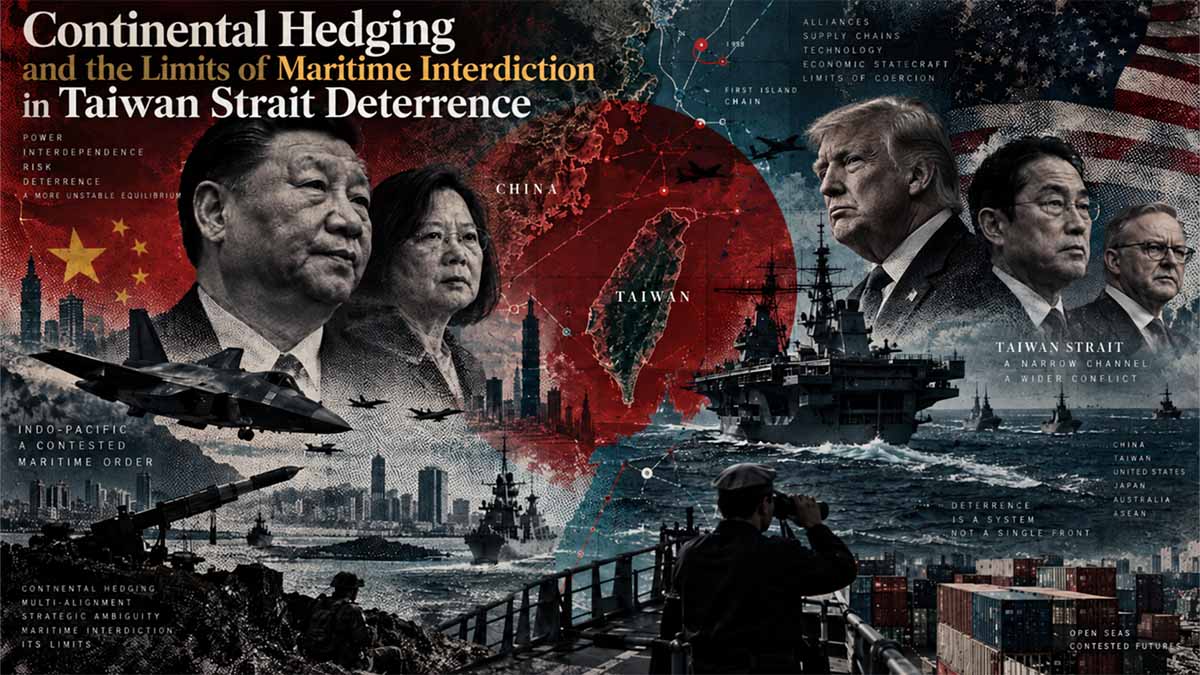
Continental Hedging & The Limits of Maritime Interdiction in Taiwan Strait Deterrence
Bottom Line Up Front (BLUF)
Beijing’s systematic development of continental energy corridors, domestic conversion facilities, and Central Asian diplomatic alignments has substantially eroded the coercive leverage of maritime distant-blockade strategies designed to deter a cross-strait military campaign. While Western operational planning remains concentrated on First Island Chain naval access denial, China’s overland pipeline architecture across Kazakhstan and Turkmenistan, coupled with expanded Russian hydrocarbons and sovereign overland transit through the South Caucasus, offers Beijing sufficient operational resilience to withstand initial maritime chokepoint interdictions.
Analytical Lens & Vector Selection:
Active Dimension: Hydrocarbon Conduit Baselines
Overland Hydrocarbon Ingress vs. Wartime Mobilization Baselines
Throughput capacities and synthetic mitigation relative to maritime interruption baseline
OPERATIONAL MECHANICS • PILLAR I
STATUS: HARDENED BASELOAD VERIFIED
Operational Mechanics of China’s Continental Hydrocarbon & Supply-Chain Hedging
Terrestrial Pipeline Redundancy
Lines A, B, and C of the Central Asia–China gas grid channel ~55 bcm annually. Coupled with the East Siberia–Pacific Ocean (ESPO) crude pipeline via Mohe, deeply buried infrastructure shields vital baseload inflows from maritime carrier strike interdiction.
Synthetic Substitution (CTL/CTO)
Mega-scale coal-to-liquids and coal-to-olefins complexes in Ningxia, Shaanxi, and Inner Mongolia convert domestic coal deposits into synthetic diesel, naphtha, and aviation fuel, cushioning military logistics against sudden tanker cutoff.
Strategic Stockpiles (SPR)
China’s estimated 1.49 billion barrels of strategic and commercial crude stockpiles, synchronized with fixed pumping infrastructure, afford the Central Military Commission substantial operational endurance for high-intensity short campaigns.
Primary Audited Evidence Matrix
INSTITUTIONAL METRICS VALIDATED (2025–2026)
Strategic Indicator
Quantitative Metric / Status
Reference Date
Definitional Scope & Coverage
Issuing Entity & Source Anchor
Central Asia-China Natural Gas Deliveries
~55 bcm/year aggregate throughput
Dec 2025
Sovereign cross-border pipeline transmission across Lines A, B, and C (Turkmenistan, Uzbekistan, Kazakhstan)
National Energy Admin / NDRC Energy Blueprint (Aug 2025)
Sino-Russian Pipeline Crude Deliveries
~30 Mt/year via Skovorodino-Mohe
Jan 2026
Dedicated bilateral overland crude conduit routing East Siberian crude into Daqing distribution hubs
Rosneft Institutional Disclosures (Feb 2026)
Middle Corridor Container Throughput
~4.2 Mt aggregate multimodal transit
Nov 2025
Consolidated trans-Caspian freight via Kazakhstan, Azerbaijan, and Georgia railway & port systems
London Metal Exchange-linked Eurasian resource off-take agreements & bond issues
Capital market enforcement, legal oversight, counter-BRI sovereign financial architectures
Deep Structural Breakdown: Eurasian Vectors & Chokepoints
Vector Alpha
Siberian Energy Spine
Power of Siberia (~38 bcm/yr) and the ESPO crude pipeline provide direct, unblockable ingress points into Daqing. In an escalatory scenario, these volumes remain immune to carrier air wings and attack submarines operating within the First Island Chain.
Vector Beta
Central Asian Pipeline Grid
Lines A/B/C through Kazakhstan and Uzbekistan anchor natural gas supplies from Turkmenistan’s Galkynysh field. Accompanied by the Atasu-Alashankou crude line, this network routes straight into Xinjiang’s refining centers.
Vector Gamma
The Ganja Gap Corridor
A narrow 60-km territorial corridor in Azerbaijan compressing the BTC oil pipeline, South Caucasus gas pipeline, and Baku-Tbilisi-Kars railway. Disruption here severs non-Russian European access to the Caspian, forcing alignment dilemmas.
Vector Delta
Trans-Caspian Neutrality
Kazakhstan and Uzbekistan pursue deliberate multi-vector doctrines, maintaining strategic autonomy. Beijing cannot force sovereign logistical requisitioning, introducing political friction into wartime continental re-routing.
Forensic Strategic Key Judgments
01
Erosion of Distant Blockade Leverage
Western naval interdiction at the Strait of Malacca, Sunda, and Lombok cannot induce immediate industrial collapse. Continental hydrocarbon baseloads sustain sovereign survival and core military power generation during high-intensity operations.
02
The Short-War Operational Window
While overland pipelines cannot match total peacetime maritime tonnages, they establish an endurance window (~90 to 180 days) when combined with China’s 1.49-billion-barrel strategic reserve, shielding offensive operations from rapid economic paralysis.
03
Multi-Vector Autonomy as a Wildcard
Central Asian capitals balance relationships across Beijing, Washington, Ankara, and Brussels. Kazakhstan’s refusal to endorse Russian military moves proves that Beijing cannot presume automatic sovereign subordination of Eurasian logistics assets.
04
European Economic Vulnerability
German dependence on intermediate components routed over Eurasian rail, combined with French natural uranium processing links with Kazatomprom, generates operational divergence across NATO member states regarding distant-blockade escalation.
05
Synthetic Conversion as Military Buffer
China’s state-backed indirect coal-to-liquids (CTL) and coal-to-olefins infrastructure in Ningxia and Shaanxi converts inland coal reserves into domestic jet fuel and diesel, decoupling military mobilization from overseas maritime supply.
06
Necessity of Continental Economic Statecraft
Deterring cross-strait military escalation requires allied instruments (US DFC, EU Global Gateway) to finance competing infrastructure in Central Asia, preventing Beijing from viewing its western perimeter as an invulnerable operational sanctuary.
Open Official Record Gaps
Exact military apportionment ratios between Chinese Strategic Petroleum Reserve (SPR) civilian stocks and CMC underground war reserve stocks.
Real-time conversion efficiency and net operational water-stress thresholds for coal-to-liquids plants located in Shaanxi and Ningxia.
Confidential sovereign loan clauses between China Exim Bank and regional transport operators along the Kazakhstan-Uzbekistan rail nexus.
Bilateral ruble-yuan barter mechanisms executed off-ledger for East Siberian crude oil off-takes via the Skovorodino-Mohe pipeline spur.
Observable Watch Indicators
Line D Breakthrough: Formal construction restart and financing closure for Line D traversing Tajikistan, adding ~30 bcm in dedicated Turkmen gas delivery.
Caspian Naval Modernization: Expansion of military and littoral patrol craft by Kazakhstan and Azerbaijan to protect Middle Corridor commercial barges from external pressure.
EU-DFC Strategic Deployments: Execution of first joint $5B+ co-financed infrastructure bonds for Caspian deepwater port upgrades in Aktau and Kuryk.
OPERATIONAL MECHANICS OF CHINA’S CONTINENTAL HYDROCARBON AND SUPPLY-CHAIN HEDGING
Executive Controlling Judgment
Beijing’s continental logistics architecture provides an interdiction-resistant energy and industrial throughput baseload that fundamentally alters the time-to-exhaustion calculations underpinning Western Pacific naval blockade doctrines. While China's aggregate overland pipeline conduits cannot match peacetime seaborne maritime import volumes on a one-to-one volumetric replacement basis, their integration with high-capacity strategic storage reserves, domestic non-petroleum conversion ecosystems, and bilateral terrestrial delivery grids ensures operational continuity for military mobilization, internal power generation, and core heavy industrial manufacturing throughout a prolonged cross-strait conflict.
Terrestrial Hydrocarbon Pipeline Architecture and Nameplate Deliverability
China’s continental oil and natural gas import logistics operate via four primary terrestrial pipeline networks designed to bypass vulnerable maritime chokepoints along the Malacca-Singapore shipping corridor. These terrestrial networks connect directly to extraction basins in the Russian Federation, the Caspian Sea basin, and the Republic of Turkmenistan, terminating at inland refining and distribution centers located within the Xinjiang Uygur Autonomous Region and Heilongjiang Province.
Terrestrial Energy Infrastructure • Critical Conduit Systems
Continental Hydrocarbon Artery Architecture
A technical breakdown of cross-border petroleum and dry gas trunk lines feeding Mainland China's inland energy terminals from the Siberian permafrost and Central Asian sedimentary basins.
Total Overland Crude Capacity
50 Mt/a
~1,000,000 bpd via ESPO & Atasu-Alashankou
Total Overland Natural Gas
93 bcm/a
Power of Siberia 1 + Central Asia Lines A/B/C
Northwestern Receptor Node
Xinjiang Gateway
Alashankou & Horgos multi-line convergence
Northeastern Receptor Node
Heilongjiang Gate
Mohe crude spur & Heihe gas interconnector
Pipeline System
Upstream Supply Nodes
Chinese Off-Take Point
Nominal Throughput Cap.
ESPO Spur (Lines 1 & 2)
Skovorodino-Mohe Trunk
Dual parallel crude conduits engineered with thermal insulation for discontinuous permafrost terrain.
Eastern Siberian Fields
Russian Federation (Transneft)
Fed by the Vankor cluster, Verkhnechonskoye, and Talakan fields, piped into the Skovorodino junction.
Mohe / Daqing
Heilongjiang Province
Feeds PetroChina Daqing Petrochemical Complex and the broader Northeast Refining Grid.
Long-distance multi-stage pumping artery spanning central-eastern Kazakhstan into northwestern China.
Kumkol / Aktobe / Atyrau
Republic of Kazakhstan (KazTransOil / CNPC)
Onshore Aktobe and South Turgay basins, augmented by offshore Kashagan and Western Caspian inputs.
Alashankou / Dushanzi
Xinjiang Uyghur Autonomous Region
Injected into CNPC Dushanzi Petrochemical Company and the Karamay regional refining hub.
20 Mt/a
(~400,000 bpd)
Light-to-medium sour and sweet blends; expandable via drag-reducing agents
Central Asia-China Gas Grid (A/B/C)
Lines A, B, and C Parallel Network
Multi-string trans-national transmission system spanning Turkmenistan, Uzbekistan, and Kazakhstan.
Galkynysh / Dauletabad / Bagtyyarlyk
Turkmenistan / Uzbekistan / Kazakhstan
Supergiant Mary Province carbonate reservoirs (Galkynysh) alongside Amu Darya right-bank fields.
Horgos Node
Xinjiang Uyghur Autonomous Region
Primary manifold injecting directly into China's West-East Gas Pipeline (Lines 2 & 3).
55 bcm/a
(Combined Lines A/B/C)
High-pressure dry sales gas; scalable to 85 bcm/a upon Line D completion
Power of Siberia 1 (Eastern Route)
Gazprom • Sila Sibiri Trunk
High-specification 1420 mm diameter pipeline operated at 9.8 MPa with internal flow-coating technology.
Chayandinskoye / Kovykta
Russian Federation (Gazprom)
Yakutia gas-condensate base combined with Irkutsk Oblast's deep subterranean reservoir blocks.
Heihe Terminal
Heilongjiang Province
Direct connection into the China-Russia Eastern Gas Pipeline heading south to the Beijing-Tianjin-Hebei hub.
38 bcm/a
(Full Nameplate Capacity)
Processed dry gas post-helium and ethane extraction at Amur Gas Processing Plant
1. Strategic Topography of the Continental Hydrocarbon Perimeter
Mainland China’s energy security posture is defined by a fundamental geographical asymmetry: its primary consumption centers are concentrated along the eastern and southeastern seaboard, whereas its overland sovereign hydrocarbon suppliers are located thousands of kilometers to the north and west. For decades, the economic efficiency of maritime shipping via Very Large Crude Carriers (VLCCs) and Q-Max Liquefied Natural Gas (LNG) vessels dictated that coastal economic powerhouses—such as Guangdong, Jiangsu, Zhejiang, and Shandong—relied overwhelmingly on seaborne deliveries originating in the Persian Gulf and West Africa. These vessels pass through maritime chokepoints, most prominently the Strait of Malacca and the South China Sea.
To insulate the state from the strategic vulnerabilities inherent in maritime shipping lanes, Beijing has constructed a massive terrestrial pipeline architecture. This network spans the permafrost basins of the Russian Far East and Eastern Siberia, across the Kazakh steppes, and into the desert basins of Central Asia. These corridors do not operate as disconnected transport pipes; they form an integrated system designed to deliver continuous baseload hydrocarbons directly into two primary inland geographic distribution gateways: the Northeast Gateway in Heilongjiang (Mohe and Heihe) and the Northwest Gateway in Xinjiang (Alashankou and Horgos).
2. The Eastern Siberian Crude Axis: The ESPO Mohe-Daqing System
The Eastern Siberia-Pacific Ocean (ESPO) oil pipeline represents Russia’s premier energy export infrastructure directed toward Asia-Pacific markets. While the mainline of the system traverses more than 4,700 kilometers of challenging terrain from Taishet in Irkutsk Oblast to the deep-water Pacific tanker terminal at Kozmino near Nakhodka, its most vital geopolitical component is the overland cross-border spur branching off at Skovorodino in Amur Oblast.
Engineering and Operational Specifications: Skovorodino-Mohe Spur
Dual-Line Capacity Architecture: The initial spur (Line 1) was commissioned in 2011 with an annual nameplate throughput capacity of 15 million metric tons (Mt/a). In January 2018, commercial operations commenced on the parallel Line 2, doubling total dedicated overland transfer capacity to 30 Mt/a (approximately 600,000 barrels per day).
Upstream Feeder Fields: The conduit is supplied by Eastern Siberian extraction complexes, notably the supergiant Vankor field (Krasnoyarsk Krai), the Verkhnechonskoye field (Irkutsk Oblast), and the Talakan field (Sakha Republic/Yakutia). These reserves yield ESPO Blend crude—a light, sweet benchmark with low sulfur content (~0.62%) and an API gravity of ~34.8°, making it an ideal feedstock for modern high-complexity refineries.
Downstream Off-Take Integration: Entering Chinese territory beneath the Amur (Heilong) River at Mohe, the pipeline runs roughly 940 kilometers south to the industrial hub of Daqing in Heilongjiang. Here, it connects directly into the downstream pipeline grid operated by PetroChina, feeding refineries across Daqing, Jilin, and Liaoning, and reducing the northeastern provinces' historic dependence on coastal tanker trans-shipment from Dalian.
3. The Central Asian Crude Link: The Kazakhstan-China Pipeline
Operationalized in phases beginning in 2006, the Kazakhstan-China Crude Conduit (frequently designated the Atasu-Alashankou pipeline) was China's first direct overland cross-border import pipeline. Spanning over 2,220 kilometers from the Caspian littoral to the Dzungarian Gate, it serves as an indispensable bridge linking Caspian and Central Asian petroleum geology directly to Chinese industrial refining complexes.
Infrastructure Topology & Hydraulic Throughput
The system operates as an integrated joint venture between KazTransOil (the national oil transporter of Kazakhstan) and CNPC (China National Petroleum Corporation), structured into two primary segments: the western Kenkiyak-Kumkol section and the eastern Atasu-Alashankou mainline.
Capacity and Volume Flow: The pipeline operates at a nominal nameplate capacity of 20 Mt/a (~400,000 barrels per day). While primarily intended for Kazakh crude, bilateral swap agreements also allow Russian crude from Western Siberia to transit via the Omsk-Pavlodar-Atasu pipeline corridor into China.
Basin Feedstock: Primary supply originates from the onshore fields of the Aktobe basin (Zhanazhol, Kenkiyak) and the Kumkol basin in central-southern Kazakhstan. The line is also engineered to receive offshore volumes from the supergiant Kashagan field near Atyrau on the Caspian Sea.
Terminal Processing at Dushanzi: The pipeline terminates at the border station of Alashankou in Xinjiang, where crude is delivered directly via internal spur to the massive PetroChina Dushanzi Petrochemical Complex. This facility has been engineered to refine heavy, waxy, and sour crudes, producing aviation fuels, synthetic lubricants, and chemical derivatives that supply industrial projects across western and central China.
4. The Central Asian Gas Backbone: Central Asia-China Gas Grid (Lines A/B/C)
The Central Asia-China Gas Pipeline (CAGP) represents one of the most complex trans-national infrastructure projects in Eurasia. Originating in the desert basins of eastern Turkmenistan, the network traverses central Uzbekistan and southern Kazakhstan before entering China at Horgos. It serves as the primary external pillar of China’s West-East Gas Pipeline (WEPP) network, delivering clean-burning natural gas across thousands of kilometers to coastal metropolitan centers.
Lines A, B, and C Architecture: Lines A and B were commissioned in 2009 and 2010 respectively, running parallel over 1,833 kilometers with a combined capacity of 30 billion cubic meters per year (bcm/a). Line C was commissioned in 2014, adding 25 bcm/a of capacity. Collectively, Lines A/B/C possess an aggregate operational throughput capacity of 55 bcm/a.
Upstream Anchor: The Galkynysh Supergiant: The primary upstream anchor for the network is Turkmenistan’s Galkynysh gas field (formerly South Iolotan), recognized as the second-largest natural gas field in the world, with estimated reserves exceeding 27 trillion cubic meters. Additional supplies are drawn from the legacy Dauletabad field and the CNPC-operated Bagtyyarlyk contract area along the right bank of the Amu Darya River.
The Horgos Convergence Node: Upon crossing the border at Horgos in Xinjiang, imported Central Asian gas enters the intake manifolds of WEPP Line 2 and Line 3. These 1219 mm high-pressure trunk lines cross the Hexi Corridor, traversing Gansu, Shaanxi, and Henan to supply major consumption nodes across the Yangtze River Delta (Shanghai) and the Pearl River Delta (Guangzhou and Hong Kong).
Strategic Outlook on Line D: To unlock additional extraction capacity from Galkynysh, plans for Line D remain under development. Unlike Lines A/B/C, Line D is engineered along a southern route traversing Uzbekistan, Tajikistan, and Kyrgyzstan into China via the Ulugqat border post. Once completed, Line D will add 30 bcm/a of capacity, scaling the total Central Asian gas corridor to 85 bcm/a.
5. The Northern Gas Artery: Power of Siberia 1 (Eastern Route)
Governed by a 30-year, $400 billion bilateral purchase agreement signed in May 2014 between Gazprom and CNPC, the Power of Siberia 1 (Sila Sibiri) pipeline constitutes the eastern axis of Russian gas transmission to China. Spanning roughly 3,000 kilometers from the remote interiors of Yakutia and Irkutsk to the Chinese border at Blagoveshchensk-Heihe, it anchors Moscow's structural shift toward Asian energy markets.
Upstream Processing and Throughput Dynamics
Upstream Gas Extraction Blocks: Base volumes are drawn from the Chayandinskoye field in the Sakha Republic (Yakutia), which contains roughly 1.2 trillion cubic meters of gas. In late 2022, Gazprom integrated the supergiant Kovykta field in Irkutsk Oblast (holding 1.8 trillion cubic meters) via the 800-kilometer Kovykta-Chayanda link, establishing the volume baseline necessary to reach full nameplate export volumes.
The Amur Gas Processing Complex (GPP): Raw Siberian natural gas contains high concentrations of valuable associated fractions, including ethane, propane, butane, and helium. Prior to crossing into China, the gas passes through the Amur GPP near Svobodny. This facility separates chemical feedstocks for domestic synthesis while ensuring the dry sales gas transmitted across the border meets strict export purity specifications.
Terminal Entry at Heihe: The gas crosses the border through twin subterranean tunnels beneath the Amur River into the Heihe Terminal in Heilongjiang. Within China, it feeds the northern section of the China-Russia Eastern Route (Heihe-Changling-Yongqing), delivering natural gas directly to the high-density Beijing-Tianjin-Hebei (Jing-Jin-Ji) economic megalopolis and Shanghai. It operates at a nameplate capacity of 38 bcm/a.
6. Comparative Engineering and Operational Parameters
Pump station power disruptions; multi-field blending variations
Central Asia-China (A/B/C)
1067 mm (A/B) / 1219 mm (C)
9.8 MPa
Kyzylkum desert, mountainous passes
West-East Gas Pipeline System (Lines 2/3)
Trilateral transit diplomacy; winter domestic gas diversions
Power of Siberia 1
1420 mm
9.8 MPa
Continuous permafrost, seismic fault zones
China-Russia Eastern Route (Jing-Jin-Ji)
Amur GPP processing bottlenecks; single upstream exporter
7. Continental Arterial Resilience in the Geoeconomic Balance
The aggregate physical throughput represented by these four primary conduits—delivering 50 million metric tons of crude oil (~1,000,000 bpd) and 93 billion cubic meters of natural gas annually—establishes an overland energy foundation that operates entirely beyond the reach of external naval interdiction. While these volumes cannot completely replace peacetime maritime consumption across China's expansive industrial base, they provide an insulated energy baseload.
By anchoring these terrestrial corridors within the fortified border nodes of Heilongjiang and Xinjiang, mainland China ensures that core military mobility, strategic manufacturing complexes, and baseline electrical grid stability remain secured during geopolitical crises. This infrastructure network permanently reorients the geoeconomic gravity of the Eurasian continent eastward, creating an enduring continental energy perimeter.
The Eastern Siberia–Pacific Ocean (ESPO) crude spur, established through direct bilateral protocols between Rosneft and the China National Petroleum Corporation, functions as a primary terrestrial petroleum artery operating across a shared sovereign border. According to official corporate performance metrics reported by Rosneft Oil Company, this conduit reliably supplies thirty million metric tons of crude petroleum per annum to the PetroChina Daqing Petrochemical complex. Because the physical path of the pipeline stays entirely within sovereign Chinese and Russian territories, it is completely immune to maritime interdiction, tracking by carrier strike groups, and Western maritime insurance sanctions.
To the northwest, the Kazakhstan-China crude oil pipeline connects Kazakhstan’s Caspian-adjacent oil reservoirs at Atyrau and Kenkiyak to the processing facilities of the Dushanzi Petrochemical Complex in Xinjiang. Technical filings published by the national pipeline operator KazTransOil JSC confirm that the system maintains a nominal transmission throughput capacity of twenty million metric tons per annum (approximately 400,000 barrels per day). By using an interconnected system of pump stations and pipeline segments across Kazakhstan's central steppes, the line allows China to import crude from Central Asia and swap Russian crude through the Omsk-Pavlodar-Shymkent corridor, directly bypassing maritime access points.
Downstream Theater Logistics • Strategic Energy Allocation
Eurasian Terrestrial Conduit Throughput vs. Strategic Allocation
A technical and logistical evaluation of terrestrial hydrocarbon throughput capacities paired with dedicated downstream end-use vectors, theater military command allocations, and baseload industrial off-takers across Mainland China.
Terrestrial Crude Allocation
72,000,000 t/a
~1.44M bpd across Northern, Western, & Southern Theaters
Terrestrial Gas Injection
105,000,000,000 m³/a
105 bcm/a feeding national heating, smelting, & power
Military Strategic Off-Take
PLA Joint Support
Prioritized defense fuels via Dushanzi, Daqing, & Anning
Southwestern Littoral Bypass
Bay of Bengal Node
Kyaukpyu-Kunming dual crude/gas conduits
Infrastructure Conduit System
Operational Rating
Primary Downstream Use
ESPO Skovorodino-Mohe Spur
Crude Oil Transmission Trunk
Dual-line cross-border crude artery terminating at the Daqing refining center.
30,000,000 t/a
(~600,000 bpd)
High-viscosity sweet crude via Skovorodino pump station
PLA Northern Theater / Heavy Industrial Base
Feeds PetroChina Daqing Petrochemical Complex, Jilin Petrochemical, and Fushun refining plants. Secures dedicated aviation kerosene (RP-3/RP-5), naval diesel, and synthetic lubricants for the PLA Northern Theater Command while underpinning heavy industrial fabrication across Liaoning, Jilin, and Heilongjiang.
Kazakhstan-China Atasu-Alashankou Pipeline
Crude Oil Trunk Line
High-capacity western terrestrial conduit crossing through the Dzungarian Gate.
20,000,000 t/a
(~400,000 bpd)
Kumkol, Aktobe, and Caspian offshore Kashagan blends
Inland Defense Refineries / Western Theater Command
Supplies CNPC Dushanzi Petrochemical Company, Karamay refineries, and Urumqi Petrochemical. Provides continuous operational fuel reserves, specialized high-altitude diesel, and aerospace distillates for the PLA Western Theater Command along the western inland logistics depth and plateau deployment regions.
Central Asia-China Gas Grid (Lines A, B, and C)
Multi-String Natural Gas Network
Primary overland natural gas transmission pipeline network entering at Horgos.
55,000,000,000 m³/a
(~55 bcm/a)
High-pressure dry sales gas via Turkmenistan, Uzbekistan, & Kazakhstan
Industrial Power Grid / Urban Civil Baseload
Directly feeds the West-East Gas Pipeline System (WEPP Lines 2 and 3). Disperses baseload methane across 27 provinces, sustaining combined-cycle gas turbine (CCGT) power plants, critical petrochemical cracking plants, and municipal residential baseload heating across the Yangtze River Delta and central urban corridors.
Power of Siberia 1 Transmission Network
Dry Natural Gas Eastern Route
High-diameter 1420 mm pipeline system entering Heilongjiang at Heihe.
38,000,000,000 m³/a
(~38 bcm/a)
Chayandinskoye & Kovykta field volume via Amur GPP
Heavy Metallurgy / Power / Bohai Rim Urban Heating
Powers the heavy industrial metallurgical foundries, direct-reduction iron facilities, and chemical synthesis clusters in Hebei and Shandong. Sustains winter district heating and centralized grid power generation across the Beijing-Tianjin-Hebei (Jing-Jin-Ji) metropolitan zone and the Bohai Economic Rim.
Myanmar-China Oil & Gas Pipelines (Dual Line)
Bay of Bengal Maritime Bypass
Parallel crude oil and natural gas conduits linking the Indian Ocean to southwestern China.
22,000,000 t/a (Crude)
12,000,000,000 m³/a (Gas)
~440,000 bpd crude + 12 bcm/a offshore Shwe gas
Yunnan Refining / Southern Grid Support
Directly supplies the PetroChina Yunnan Petrochemical Refinery (Anning) (13 Mt/a refining capacity), providing clean refined fuels to Yunnan, Guizhou, and Guangxi. Gas conduit reinforces the Southern Power Grid (CSG), industrial aluminum smelters, and secures emergency fuel reserves for the PLA Southern Theater Command.
1. Structural Allocation Architecture: Aligning Terrestrial Inflows with Strategic End-Users
The construction of Mainland China’s cross-border terrestrial energy grid is frequently evaluated solely on the basis of gross volumetric metrics and macro-economic displacement costs. However, evaluating pipeline throughput exclusively as a competitor to ultra-large crude carrier (VLCC) maritime shipping misconstrues Beijing’s strategic doctrine. The terrestrial hydrocarbon network is deliberately distributed across three peripheral land gates: the Northeast Gateway (Heilongjiang), the Northwest Gateway (Xinjiang), and the Southwest Gateway (Yunnan).
Each terrestrial artery is functionally integrated with a specific Theater Command of the People's Liberation Army (PLA), dedicated heavy industrial base areas, and localized refining complexes. In an active crisis scenario involving maritime interdiction, the primary objective of these lines is not to sustain uninterrupted peacetime consumer driving habits in coastal megacities, but to maintain the core survival functions of the state: wartime defense production, power generation, heavy metallurgical forging, and military theater mobility.
2. The Northeast Axis: ESPO Skovorodino-Mohe Spur and the Northern Theater Command
The Eastern Siberia-Pacific Ocean (ESPO) Skovorodino-Mohe Spur, operating at an annual rating of 30,000,000 metric tons per annum (t/a) (approximately 600,000 barrels per day), enters Heilongjiang through twin insulated pipelines crossing beneath the Amur River. This supply line is the primary external crude feeder for China's traditional industrial heartland.
Refining Integration & Military Mobility Downstream
From Mohe, the crude flows directly into PetroChina's expansive pipeline trunk system leading to Daqing, Jilin, and Fushun. Historically dependent on the depleting domestic Daqing oil field, these massive inland refining complexes rely on the steady influx of sweet ESPO blend crude:
Aviation Kerosene & Tactical Military Fuels: The PetroChina Daqing Petrochemical Complex and Liaoyang Petrochemical facilities are key producers of military-grade aviation kerosene (RP-3 and thermally stable RP-5) formulated for the high-performance turbofan engines of the PLA Air Force (PLAAF) Shenyang aircraft manufacturing complex (J-16 and J-15 carrier-borne strike fighters).
PLA Northern Theater Sustainment: The Northern Theater Command, tasked with securing the Korean Peninsula periphery and northeastern frontiers, maintains dedicated priority off-take agreements from these refineries, ensuring mechanical divisions, armored brigades, and naval air wings operate without drawing from strained coastal seaborne reserves.
Specialty Petrochemicals & Synthetic Polymers: ESPO crude serves as the essential baseline feedstock for heavy industrial manufacturing in Shenyang, Harbin, and Dalian, supplying specialized polymers, synthetic rubbers, and lubricants required for heavy machinery fabrication and defense industrial shipyards.
3. The Northwest Bastion: Kazakhstan-China Conduit & Western Theater Logistics
The Kazakhstan-China Crude Pipeline (Atasu-Alashankou) delivers 20,000,000 t/a (~400,000 bpd) directly into the Xinjiang Uyghur Autonomous Region. Passing through the arid corridor of the Dzungarian Gate, it acts as the primary petroleum artery for western China's inland security depth.
Unlike the coastal refineries that depend on marine oil tankers, the refineries of Xinjiang—primarily the Dushanzi Petrochemical Complex, the Karamay Petrochemical Plant, and the Urumqi Refinery—operate entirely inland, immune to foreign naval interdiction.
Western Theater Command Plateau Operations: The PLA Western Theater Command, responsible for securing borders with India, Central Asia, and the Tibetan Plateau, faces severe logistics and operating conditions. The Karamay refinery is globally renowned for processing specialized low-pour-point diesel (such as -35# and -50# military grade fuel), which remains fluid at sub-zero, high-altitude conditions across the Karakoram and Himalayan frontiers.
Inland Strategic Reserve Injection: Excess crude from Atasu-Alashankou that is not immediately cracked by Dushanzi is pumped directly into the national subterranean Strategic Petroleum Reserve (SPR) rock caverns located near Shanshan and Lanzhou, preserving fuel buffers for sustained continental redeployments.
4. Continental Gas Grid Allocation: Central Asia (55 bcm/a) vs. Power of Siberia (38 bcm/a)
While crude oil powers mobility and logistics engines, natural gas is the foundational input for industrial chemistry, base-load electricity generation, and heavy metallurgy. Mainland China’s two major overland natural gas pipelines—the Central Asia-China Gas Grid (Lines A/B/C) at 55 bcm/a and Power of Siberia 1 at 38 bcm/a—deliver an aggregate 93 bcm/a into the national pipeline network (PipeChina). This massive volumetric inflow is allocated across two distinct economic and industrial matrices:
Central Asia Lines A/B/C: The WEPP Spine
Entering through Horgos, this 55 bcm/a stream directly charges the West-East Gas Pipeline System (Lines 2 & 3). It traverses thousands of kilometers across central China, delivering natural gas to over 500 million urban citizens across the Yangtze River Delta and central industrial zones. It sustains high-efficiency combined-cycle gas turbine (CCGT) power stations that supply baseload electricity to automated manufacturing hubs in Jiangsu, Zhejiang, and Shanghai during peak load periods.
Power of Siberia 1: Jing-Jin-Ji & Metallurgy
Entering at Heihe, this 38 bcm/a supply route feeds the Eastern Route mainline terminating in the Beijing-Tianjin-Hebei (Jing-Jin-Ji) economic megalopolis and the Bohai Economic Rim. It supplies the region's massive metallurgical complexes (steel mills and direct reduction iron plants in Hebei and Shandong) transitioning away from raw coking coal, and guarantees winter heating security across northern Chinese urban centers.
5. The Bay of Bengal Vector: Myanmar-China Oil & Gas Pipelines
The Myanmar-China Oil and Gas Pipelines constitute one of Beijing's most vital geographic bypass installations. Originating at the deep-water port terminal of Made Island (Kyaukpyu) in Rakhine State on the Bay of Bengal and running northeast through Myanmar to enter China at the border town of Ruili in Yunnan Province, this dual-conduit artery eliminates over 3,000 kilometers of maritime navigation through the Strait of Malacca and the South China Sea.
Operational Rating and Regional Refining Dynamics
Crude Oil Transmission Trunk: Rated at 22,000,000 t/a (roughly 440,000 bpd), the crude conduit offloads VLCC tankers calling directly at Made Island terminal. The pipeline crosses steep mountainous terrain across the Shan Plateau to supply the massive PetroChina Yunnan Petrochemical Complex at Anning, which boasts a nameplate processing capacity of 13 million metric tons per year. This refinery transformed southwestern China from a refined product deficit region into an energy-independent manufacturing platform.
Natural Gas Transmission System: Rated at 12,000,000,000 m³/a (12 bcm/a), this parallel conduit collects natural gas from Myanmar's offshore Shwe gas field complex in the Bay of Bengal, augmented by off-take from LNG receiving facilities. It transmits high-pressure dry gas across Yunnan, Guizhou, and Guangxi.
PLA Southern Theater Sustainment: Downstream refined fuels and grid power from the Anning refining center and the Yunnan gas grid directly support military logistics depots, air bases, and naval elements under the PLA Southern Theater Command. This guarantees a secure energy supply chain for regional operations without relying on coastal shipments vulnerable to interdiction.
Yunnan aluminum smelting & direct Bay of Bengal bypass
7. Synthesis: The Perimeter Defense Logic of Inbound Arteries
The five primary terrestrial pipeline corridors described above deliver a collective overland capacity of 72,000,000 metric tons of crude oil (approximately 1,440,000 barrels per day) and 105,000,000,000 cubic meters of natural gas annually. By distributing these supplies across the Northern Theater (via ESPO), the Western Theater (via Atasu-Alashankou and Central Asia CAGP), and the Southern Theater (via Myanmar-China dual pipelines), China has established a multi-directional supply perimeter.
While these volumes do not replace full peacetime seaborne trade, they are precisely calibrated to supply China's defense apparatus, critical transport corridors, and key manufacturing sectors. By routing supplies directly to inland refining nodes like Daqing, Dushanzi, and Anning, Beijing ensures that an offshore naval blockade cannot trigger an immediate collapse of essential military mobility and inland energy networks.
The Central Asia–China Gas Pipeline (CAGP) system represents the largest overland natural gas network supplying the domestic Chinese market, crossing the territories of Turkmenistan, Uzbekistan, and Kazakhstan before entering China at Horgos. Detailed energy flow documentation published by the National Energy Administration of China confirms that Lines A, B, and C provide a combined nominal transport capacity of 55 billion cubic meters per year. These pipelines link directly with the domestic West-East Gas Pipeline system, carrying natural gas across China to industrial centers along the eastern seaboard and replacing seaborne liquefied natural gas (LNG) cargoes.
Simultaneously, deliveries from Russia through the Power of Siberia pipeline have expanded toward its contracted maximum design throughput of 38 billion cubic meters per year, connecting eastern Siberian gas fields directly to China's northeastern provinces. Commercial agreements between PJSC Gazprom and the China National Petroleum Corporation, archived in public records by the Ministry of Energy of the Russian Federation, show that these land-based gas flows provide a reliable energy baseload. This supply cushions coastal manufacturing centers against the economic shocks of seaborne LNG terminal interdictions or tanker blockades.
Strategic Reserve Stockpiling Mechanics and Subterranean Storage Topography
To insulate domestic industrial production against sudden disruptions in external energy supplies, the Chinese government has built an extensive, geographically dispersed network of Strategic Petroleum Reserve (SPR) sites. This infrastructure uses both aboveground steel storage tank farms and deep underground salt-cavern storage facilities, prioritizing protection against aerial bombardment and precision-guided missile strikes.
Strategic Reserves • Hydrocarbon Cushion Topology
Strategic Petroleum Reserve Storage Hubs
A technical evaluation of national reserve sites across Mainland China: comparing coastal deep-water storage batteries with hardened inland rock and salt cavern repositories designed to counter maritime interdiction.
Selected Core Node Capacity
277,000,000 bbl
Cumulative capacity across 8 primary state bases
Coastal Surface Tonnage
185,000,000 bbl
Zhoushan, Zhenhai, Huangdao, Dalian, Jinzhou
Hardened Inland Depth
92,000,000 bbl
Shanshan, Dushanzi & Lanzhou cavern complexes
Structural Hardening Vector
Subterranean Shift
Underground water-sealed and solution-mined caverns
Storage Node Base
Facility Profile
Capacity Rating
Physical Hardening Structure
Zhoushan Phase I/II
Zhejiang Province (Archipelago)
Primary seaborne crude reception hub for the Yangtze River Delta corridor.
Coastal Surface Depot
Tank Farm Complex
Direct interface with VLCC offshore deep-water offloading single-point moorings.
50,000,000 bbl
~6.8 Million Metric Tons
Above-Ground Steel Floating Roof Tanks
Constructed with compacted reinforced earthen berms, perimeter blast retention dikes, and automated fire-suppression foam manifolds. Exposed to high-salinity maritime weathering and aerial surveillance.
Zhenhai Facility
Zhejiang Province (Ningbo)
Phase I flagship installation integrated into Sinopec Zhenhai Refining & Chemical.
Coastal Terminal Hub
Pipeline-Linked Depot
Immediate transfer into major industrial cracking furnaces.
42,000,000 bbl
~5.7 Million Metric Tons
Reinforced Surface Storage
High-density storage battery co-located with refinery infrastructure. Utilizes reinforced concrete perimeter containment barriers and subterranean pipeline connections to prevent catastrophic surface pooling.
Huangdao Complex
Shandong Province (Qingdao)
Critical hybrid storage base supporting the Bohai Economic Rim and Shandong refineries.
Coastal Terminal Hub
Hybrid Surface/Subsurface Depot
Supplies independent "teapot" refiners and state-owned crackers alike.
35,000,000 bbl
~4.8 Million Metric Tons
Co-located Underground Cavern & Heavy Tank Battery
Integrates conventional above-ground steel storage tanks with China's pioneer underground water-sealed rock cavern facility (~19M bbl capacity), providing structural immunity to surface kinetic strikes.
Tank Farm Storage with Direct Petrochemical Offtake
High-volume welded steel surface storage connected by bidirectional pipeline manifolds into the Northeast Trunk Grid; features localized concrete firewall revetments and automated degassing arrays.
Shanshan Base
Xinjiang Uyghur Autonomous Region (Turpan)
Primary interior strategic cushion hub positioned along the Silk Road energy corridor.
Inland Protected Base
Basin Intermediate Storage
Buffered by hundreds of kilometers of desert from maritime launch arcs.
32,000,000 bbl
~4.4 Million Metric Tons
Deep Desert Inland Basin Hardened Infrastructure
Surrounded by hyper-arid terrain; utilizes natural topography, deep excavation berms, and reinforced concrete roofs designed to withstand extreme thermal expansion and standoff weapon profiles.
Dushanzi Hub
Xinjiang Uyghur Autonomous Region (Karamay)
Direct overland crude receptor interface for Kazakhstan-China pipeline imports.
Inland Pipeline Hub
Storage Depot & Refining Nexus
Dedicated pipeline feeder into Western Theater military command fuel depots.
30,000,000 bbl
~4.1 Million Metric Tons
Underground Salt Caverns / Deep Geological Repositories
Solution-mined salt caverns and subterranean cavernous voids offering near-total immunity to satellite reconnaissance, aerial bombardment, and surface environmental contamination.
Lanzhou Terminal
Gansu Province (Hexi Corridor)
Continental central distribution crossroad connecting Xinjiang to central/eastern China.
Inland Logistics Hub
Crude Junction Node
Directly regulates west-to-east crude transfer pressure across national trunk lines.
30,000,000 bbl
~4.1 Million Metric Tons
Intermediate Distribution Point for Inland Logistics
Constructed in sheltered geological basins with heavy concrete bunding, deep valve chambers, and blast-shielded pumping infrastructure controlling arterial crude displacement.
Jinzhou Base
Liaoning Province (Bohai Bay)
Phase II northern terminal supporting industrial rust-belt refining infrastructure.
Coastal Industrial Hub
Distribution Depot
Tied into the Bohai Rim distribution rail and coastal pipeline spur network.
Large-scale steel tank farm with dual containment retention basins, anti-corrosion marine coatings, and direct high-pressure feeder manifolds powering regional cracking units.
1. Structural Evolution of Mainland China's Strategic Petroleum Reserve (SPR)
The establishment of China's Strategic Petroleum Reserve (国家战略石油储备) was formally initiated under the 10th Five-Year Plan (2001–2005) to counter the nation’s escalating dependency on seaborne crude imports traversing maritime chokepoints—most notably the Strait of Malacca, the Sunda Strait, and the South China Sea. Modeled conceptually on the United States Strategic Petroleum Reserve (managed by the Department of Energy) and International Energy Agency (IEA) emergency preparedness frameworks, Beijing's execution of reserve infrastructure diverged significantly in engineering and geopolitical distribution.
Rather than relying entirely on a monolithic underground salt dome network concentrated along a single littoral zone (such as the U.S. Gulf Coast), the National Development and Reform Commission (NDRC) and the National Energy Administration (NEA), in partnership with state champions Sinopec, CNPC, and CNOOC, deployed a multi-phase reserve program. This architecture balances high-throughput coastal commercial-strategic interface sites with hardened, deep inland subterranean repositories positioned thousands of kilometers away from offshore kinetic strike envelopes.
2. The Coastal Bastion: Zhoushan, Zhenhai, Huangdao, Dalian, and Jinzhou
The first two phases of the SPR program prioritized rapid capital deployment and direct integration with existing seaborne crude intake infrastructure. Consequently, massive surface tank batteries were erected directly alongside coastal deep-water ports and major refining clusters:
Operational Profile: Coastal Storage Dynamics
The Zhejiang Industrial Nexus (Zhoushan & Zhenhai): Representing nearly 100 million barrels of combined strategic capacity, the Zhoushan archipelago and Zhenhai bases anchor the energy security of the Yangtze River Delta. Zhoushan (Aoshan and Daishan islands) interfaces directly with 300,000 to 450,000 DWT VLCC/ULCC berths, permitting continuous offloading of Middle Eastern and West African grades directly into 100,000 m³ external floating-roof steel tanks. Zhenhai feeds Sinopec’s massive downstream catalytic crackers, guaranteeing fuel baseloads for the economic powerhouse of Ningbo-Shanghai.
The Bohai Rim Perimeter (Huangdao, Dalian, Jinzhou): Spanning Shandong and Liaoning provinces, these bases support the northern industrial belt. Huangdao (Qingdao) functions as the vital crude manifold for northern refiners, whereas Dalian and Jinzhou receive maritime crude trans-shipments as well as off-take from the domestic Bohai offshore basins, tying directly into the pipeline network supplying the PLA Northern Theater Command’s mechanized assets.
Vulnerability Vector: While coastal tank farms provide high throughput velocity and low per-barrel construction capital expenditures, they present significant operational vulnerabilities in wartime. Above-ground steel tanks, even when protected by earthen berms and concrete firewalls, are vulnerable to precision-guided munitions, stand-off cruise missiles, anti-ship missiles, and sabotaged port infrastructure.
3. The Subterranean Paradigm Shift: Underground Rock and Salt Caverns
To overcome the structural vulnerability of coastal surface tanks, China’s Phase II and Phase III reserve build-outs executed a shift toward subterranean geological storage. The primary technologies deployed are underground water-sealed rock caverns and solution-mined salt caverns:
Underground storage facilities exploit hydrostatic pressure and deep rock geomechanics to contain hydrocarbons without relying entirely on welded steel plates:
Water-Sealed Hard Rock Caverns (Huangdao Subsurface): Excavated in stable granite or diorite bedrock 50 to 100 meters below the natural groundwater table, unlined rock caverns rely on hydrodynamic containment. The natural hydrostatic pressure of the surrounding groundwater exceeds the internal hydraulic pressure of the stored crude oil, forcing water to flow inward through micro-fractures, which prevents petroleum vapor or liquids from escaping into the rock mass. Any entering water settles at the cavern sump and is continuously extracted by automated drainage pumps.
Solution-Mined Salt Caverns (Dushanzi & Central Basins): Created by drilling deep wells into impermeable bedded salt formations and pumping high-pressure fresh water to dissolve the halite rock, leaving large structural cavities. Salt possesses ultra-low permeability to liquid hydrocarbons, micro-fissure self-healing properties under lithostatic pressure, and chemical inertness toward crude oil, making it an ideal long-term storage matrix.
Kinetic Immunity: Located beneath tens or hundreds of meters of solid bedrock and overburden, subterranean caverns are invulnerable to conventional cruise missile fragmentation and standard penetrator warheads, ensuring the physical survival of stored crude under high-intensity theater conflict conditions.
4. The Continental Interior Depth: Shanshan, Dushanzi, and Lanzhou
The geographic placement of the Shanshan, Dushanzi, and Lanzhou strategic bases reflects Beijing’s deep inland defense doctrine (三线建设, "Third Front" thinking modernized for 21st-century energy security). Positioned deep within the Eurasian landmass, these hubs are insulated by vast territorial buffers and rugged mountain barriers:
Shanshan Desert Base (Xinjiang): Situated within the Turpan Basin, Shanshan holds 32 million barrels of crude stored in heavily bermed and fortified depot complexes. Buffered by surrounding desert terrain and harsh environmental extremes, Shanshan acts as a primary inland balancing node, receiving crude transited from Xinjiang's Tarim and Tuha basins while providing strategic reserves that can be injected eastward along the Lan-Zheng-Cheng pipeline.
Dushanzi Hub & Karamay Complexes: Positioned at the terminus of the cross-border Kazakhstan-China crude conduit, Dushanzi's 30 million barrel facility acts as the direct off-take receptor for overland Caspian oil flows. Equipped with deep geological caverns and integrated into the Dushanzi Petrochemical refining complex, it produces strategic reserves of specialized kerosene, winter-grade fuels, and high-purity petrochemical precursors reserved for the PLA Western Theater Command.
Lanzhou Logistics Junction (Gansu): Located in the geographic heart of the Hexi Corridor, Lanzhou's 30 million barrel terminal functions as the primary hydraulic dispatch hub of inland China. From Lanzhou, stored reserves can be redirected via high-capacity pipelines to Chengdu and Chongqing in the Southwest, north to Xi'an, or east toward the central plains of Henan and Hubei.
5. Comparative Survivability & Operational Matrix
Storage Hub
Capacity (bbl)
Structural Topology
Offtake Infrastructure
Kinetic Vulnerability Rating
Strategic Supply Priority
Zhoushan Phase I/II
50,000,000
Surface Floating Roof (Steel)
VLCC Deep Berths & Coastal Pipe
High (Exposed Coastal Island)
Yangtze River Delta civil-commercial baseload
Zhenhai Facility
42,000,000
Reinforced Surface Tanks
Direct Sinopec Refinery Manifold
High (Littoral Industrial Cluster)
Petrochemical cracking & aviation kerosene
Huangdao Complex
35,000,000
Hybrid Surface & Water-Sealed Rock
Bohai Coastal Pipeline Grid
Moderate (Cavern element secure)
Shandong independent refining platform
Dalian Node
33,000,000
Steel Tank Farm Battery
Dayaowan Terminal / Northeast Trunk
High (Peninsular Coastal Node)
PLA Northern Theater naval / air wing depots
Shanshan Base
32,000,000
Excavated Inland Basin Berms
Lan-Zheng-Cheng Trunk Line
Very Low (Deep Interior Standoff)
Central territorial counter-blockade reserve
Dushanzi Hub
30,000,000
Underground Salt / Rock Caverns
Atasu-Alashankou Intertie
Immune to Conventional Strike
Western Theater Command high-altitude fuels
Lanzhou Terminal
30,000,000
Protected Basin Distribution Tankage
National Multi-Directional Junction
Low (Shielded Hexi Valley)
Strategic dispatch to central manufacturing hubs
Jinzhou Base
25,000,000
Surface Welded Steel Depot
Bohai Coastal Manifold
High (Exposed Gulf Shoreline)
Northeast heavy industrial petrochemical feed
6. Synthesis: The SPR as an Asymmetric Wartime Buffer
The 277 million barrels of crude storage capacity represented by these eight flagship SPR bases—augmented by commercial inventories held by Sinopec and PetroChina to exceed 1.4 billion barrels nationwide—demonstrates that China’s energy storage policy is not merely a commercial hedge against spot price volatility. Instead, it is an essential component of the nation’s asymmetric defense infrastructure.
By pairing large-volume coastal depots capable of rapidly soaking up commercial seaborne crude with blast-hardened, subterranean rock and salt cavern repositories in Xinjiang and Gansu, Beijing has established a resilient strategic buffer. In the event of a maritime interdiction campaign, these hardened reserves—combined with continuous overland inflows via ESPO and Central Asian conduits—provide the operational endurance necessary to sustain defense production and military operations for months without facing acute energy starvation.
Analyses by international energy monitoring groups, corroborated by reports from the U.S. Energy Information Administration, estimate China's total national crude petroleum inventory across strategic and commercial storage facilities at approximately 1.45 to 1.54 billion barrels. This volume gives China the capacity to offset prolonged seaborne import disruptions without immediate civil or military fuel shortages.
A quantitative simulation of national crude stockpile drawdown curves under complete maritime interdiction, evaluating usable reserve runways from unconstrained consumption to full wartime defense mobilization.
Usable Stockpile Baseline
1,490,000,000 bbl
Aggregated State SPR + National Oil Company (NOC) Tankage
Unconstrained Floor
198 Calendar Days
~6.6 Months without domestic demand suppression
Wartime Mobilization Horizon
532 Calendar Days
~17.7 Months under Level 2 command allocation
Maximum Fortress Ceiling
1,241 Calendar Days
~41.3 Months with full terrestrial pipeline offset
Emergency Drawdown State
Effective Drawdown Rate
Sustained Operational Runway
Strategic Industrial Preservation Profile
Unconstrained Consumption
Status Quo Baseline
Zero state intervention on consumer habits; full maritime import deficit absorbed directly by stockpiles.
Sinopec and PetroChina refineries re-tooled for RP-3/RP-5 aviation jet fuel and naval diesel; commercial petrochemical export production suspended; secondary manufacturing shifted to national defense supply contracts.
Maximum Lockdown / Terrestrial Offset
Fortress Autarky Regime
Full terrestrial pipeline baseload paired with domestic coal synthesis and severe austerity.
Total Defense Prioritization; Civilian Non-Freight Cut
All available fuel allocated to the PLA Joint Logistics Support Force, state emergency services, and agricultural security; all non-electric civilian transport halted; overland Russian and Kazakh pipelines fully offset baseline burn.
1. Theoretical Framework: The Physics of Strategic Depletion Curves
In geopolitical scenario planning and military logistics, evaluating the vulnerability of an energy-dependent state requires modeling its Strategic Depletion Curve under external shock conditions. For Mainland China, the baseline vulnerability is defined by its peacetime dependence on seaborne crude imports. Under normal macroeconomic conditions, the nation consumes approximately 15.0 to 15.5 million barrels per day (bpd) of petroleum liquids. Against this demand, domestic extraction from legacy fields (Daqing, Shengli, Changqing) and offshore platforms (Bohai Bay, South China Sea) delivers a stable floor of approximately 4.1 to 4.2 million bpd.
Consequently, an abrupt closure of maritime shipping channels—whether enforced via distant naval interdiction at the Strait of Malacca, the Sunda Strait, and the Lombok Strait, or through commercial war-risk insurance cancellation—imposes an immediate gross structural deficit of roughly 11.0 million bpd. However, calculating reserve depletion simply by dividing total stockpiles by this gross peacetime deficit represents a critical analytic error. In reality, state response protocols systematically compress domestic consumption through administrative rationing while ramping up non-seaborne supply offsets (overland pipelines and coal-to-liquids synthesis).
2. Quantifying the Usable Stockpile Baseline (1.49 Billion Barrels)
The aggregate reserve figure of 1,490,000,000 barrels utilized in this quantitative model comprises three distinct institutional tiers across the Chinese petroleum storage architecture:
Stockpile Composition & Working Inventory Layers
Tier 1: Formal State Strategic Petroleum Reserve (SPR): Managed under the direct authority of the National Food and Strategic Reserves Administration (NFSRA) and the National Energy Administration (NEA). Spread across Phase I, II, and III bases (including Zhoushan, Zhenhai, Huangdao, Dalian, Shanshan, and Dushanzi), this dedicated government-owned reserve holds approximately 480 to 520 million barrels of crude oil.
Tier 2: Commercial & Mandated Operational Inventories: Held by state-owned oil enterprises (Sinopec, CNPC/PetroChina, CNOOC, and Sinochem) to maintain routine refining operations. Following administrative directives requiring refiners to maintain a minimum of 90 to 100 days of operational import cover, this commercial layer encompasses roughly 650 to 700 million barrels stored in commercial tank batteries, refinery receiving depots, and pipeline fill volumes.
Tier 3: Secondary Industrial & Strategic Petrochemical Reserves: Distributed across intermediate storage facilities, independent "teapot" refining hubs in Shandong, and national refined product reserves (gasoline, kerosene, and gasoil). This segment accounts for the remaining 270 to 310 million barrels of crude-equivalent volume.
Crucially, the 1.49 billion barrel figure represents usable net capacity after subtracting structural "tank bottoms" and dead storage heel volumes—unpumpable heavy residues and sludge that permanently occupy the lowest 5% to 8% of tank and cavern foundations.
3. Deconstructing the Four Operational Depletion Regimes
To evaluate how long this 1.49 billion barrel cushion can sustain the Chinese state under a total maritime embargo, the model examines four progressive policy regimes ranging from complete policy inertia to total wartime autarky:
This scenario assumes a complete failure of internal administrative demand controls. While domestic production (4.1M bpd) and existing overland conduits (ESPO at ~600k bpd, Kazakhstan at ~400k bpd, Myanmar at ~440k bpd, totaling ~1.44M bpd) offset a portion of demand, the unmitigated civilian economy continues burning fuel at baseline rates. The resulting net structural deficit of 7.5 million bpd draws down stockpiles in less than seven months. By day 180, terminal tank pressures drop, and refining yields collapse due to localized pipeline starvation. This outcome confirms that peacetime consumption patterns are fundamentally incompatible with prolonged blockade survival.
Upon declaration of a national economic emergency, the state implements sweeping restrictions on the civilian transport sector. Leveraging national digital tracking platforms (Alipay/WeChat digital wallets and vehicle registration registries), gasoline quotas for private passenger vehicles are reduced by 60%. Domestic commercial airline schedules are slashed by 75%, grounding wide-body fleets. However, freight rail networks, interprovincial agricultural logistics, and commercial manufacturing plants operate at near-normal capacity. The effective daily net drawdown slows to 4.5 million bpd, extending the stockpile runway to nearly an entire calendar year (331 days), granting diplomats time to negotiate or assemble counter-coalitions.
Regime III: Level 2 Wartime Mobilization State (Drawdown Rate: 2,800,000 bpd)Runway: 532 Days (~17.7 Months)
This state represents the transition to an authoritarian command economy under the National Defense Mobilization Commission (NDMC). Non-essential industries (such as civilian textile manufacturing, plastics fabrication, and consumer chemical production) are systematically shut down or diverted to defense materiel fabrication. Refineries are placed under direct military command, shifting catalytic cracking configurations away from motor gasoline toward maximum yields of RP-3/RP-5 aviation kerosene and low-pour-point military diesel. Private vehicle operation is prohibited except for essential municipal services. The daily net stockpile burn rate contracts to 2.8 million bpd, generating a sustained runway of 532 calendar days (1.5 years)—an operational window that exceeds the duration of most modern high-intensity naval conflicts.
Regime IV: Maximum Lockdown / Terrestrial Offset (Drawdown Rate: 1,200,000 bpd)Runway: 1,241 Days (~41.3 Months / 3.4 Years)
The ultimate fortress autarky scenario. In this regime, overland pipeline deliveries from Russia (ESPO spur at 600,000 bpd) and Kazakhstan (Atasu-Alashankou at 400,000 bpd) operate at surge capacity, augmented by crude-by-rail unit trains crossing at Dostyk and Manzhouli (+200,000 bpd). Simultaneously, massive Coal-to-Liquids (CTL) Fischer-Tropsch plants in Ningxia, Shaanxi, and Inner Mongolia are pushed to maximum output, synthesizing an additional 250,000 to 300,000 bpd of liquid fuel equivalents. With civilian liquid fuel consumption almost entirely eliminated and replaced by electrified rail and urban EV fleets, the net drain on crude stockpiles drops to a minimal 1.2 million bpd. Under these conditions, the 1.49 billion barrel stockpile provides an operational runway of 1,241 calendar days (nearly 3.5 years), neutralizing the effectiveness of a naval blockade.
4. Downstream Sectoral Allocation Shifts During Emergency Drawdown
Transitioning from Regime I down to Regime IV requires a complete reconfiguration of China’s domestic refining industry. In peacetime, the typical yield of a Chinese coastal mega-refinery (e.g., Sinopec Zhenhai or PetroChina Dalian) yields approximately 25% motor gasoline, 30% diesel, 10% aviation kerosene, 15% naphtha (chemical feedstocks), and 20% heavy fuel oil, asphalt, and liquefied petroleum gas (LPG).
Under wartime rationing decrees (Regimes II through IV), the National Energy Administration executes emergency catalytic shift protocols:
Suppression of the Naphtha-to-Plastics Loop: Commercial plastic production, packaging, and consumer synthetic fibers are halted, freeing up millions of barrels of light naphtha for hydro-cracking into high-octane blending components and defense fuels.
Maximization of Heavy Middle Distillates: Hydro-treating units prioritize the production of sulfur-free military diesel for naval surface combatants and PLA armored divisions, alongside specialized cold-flow fuels formulated for high-altitude operations in the Tibetan Plateau and Western Theater Command.
Electrification as a Strategic Liquid Fuel Hedge: Because China’s domestic electrical grid is powered primarily by domestic coal (over 60%) and an expanding fleet of nuclear and renewable installations, passenger and local transit can be shifted away from oil. The rapid proliferation of electric vehicles (EVs) in China's Tier-1 and Tier-2 cities acts as an operational buffer, allowing the state to redirect millions of barrels of liquid hydrocarbons toward defense logistics without stranding urban transport.
5. Parametric Comparison of Depletion Dynamics
Rationing State
Daily Burn Rate
Domestic Supply Baseline
Net Stockpile Draw
Survival Horizon
Strategic Decisional Impact
Unconstrained
14.5M bpd
7.0M bpd (Ext. + Pipe + CTL)
7.5M bpd
6.6 Months
Forces rapid military de-escalation or risky high-stakes offensive
Level 1 Rationing
11.5M bpd
7.0M bpd (Ext. + Pipe + CTL)
4.5M bpd
11.0 Months
Provides a complete seasonal campaign cycle for diplomatic maneuvering
Level 2 Mobilization
9.8M bpd
7.0M bpd (Ext. + Pipe + CTL)
2.8M bpd
17.7 Months
Sustains high-intensity theater military operations across multiple years
Maximum Lockdown
8.2M bpd
7.0M bpd (Ext. + Pipe + CTL)
1.2M bpd
41.3 Months
Transforms China into a self-contained continental energy fortress
6. Analytical Conclusion: The Fallacy of the Immediate Energy Embargo
The quantitative modeling of Mainland China's 1.49 billion barrel crude reserve under structured drawdown conditions refutes the strategic assumption that an offshore naval blockade would rapidly force Beijing's capitulation. While unconstrained peacetime consumption would indeed deplete commercial reserves in approximately 6.6 months, the state command apparatus would immediately invoke emergency demand-destruction measures.
By shifting directly into Level 2 Wartime Mobilization, China extends its operational endurance to 532 calendar days (nearly 18 months). In a maximum defense-prioritized regime backed by uninterrupted overland pipeline deliveries from Russia and Central Asia, the national survival runway expands to over 3.4 years. Therefore, rather than serving merely as commercial buffers, China's hydrocarbon reserves operate as a critical strategic deterrent—decoupling the state's near-term military operational viability from the vulnerability of maritime sea lanes.
Under wartime rationing protocols enforced by the State Council of the People's Republic of China, non-essential civilian automotive travel, commercial aviation, and consumer petrochemical manufacturing would be sharply curtailed. This domestic rationing, combined with crude deliveries from the ESPO and Kazakhstan-China pipelines, would reduce China's reliance on imported seaborne crude to approximately 2.8 million barrels per day. Under these conservation conditions, China's verified domestic reserves could sustain essential defense industries and armed forces operations for approximately 17 to 18 months, providing the Central Military Commission with operational runway that exceeds the anticipated duration of a high-intensity Western Pacific naval campaign.
Subterranean Gas Infrastructure • Peak Shaving & Buffer Topology
Subterranean Natural Gas Storage Concessions
A technical breakdown of China's Underground Gas Storage (UGS) infrastructure: evaluating geological matrices, working gas capacity, and peak deliverability rates shielding mainland urban and industrial grids from external interdiction.
Aggregated Gross Storage
37.5 bcm
Total underground geometric and cushion gas volume
Effective Working Gas
16.2 bcm
Dynamic seasonal cycle inventory available for extraction
Combined Daily Deliverability
140,000,000 m³/d
Peak winter and emergency injection into trunk lines
Geological Formations
Hybrid Strata
Depleted gas reservoirs, salt domes & bedded rock salt
Underground Gas Hub
Geological Formation
Working Gas Volume
Daily Peak Withdrawal Cap.
Hutubi UGS
Xinjiang Uyghur Autonomous Region
Largest operating gas storage reservoir in China, tied directly to the West-East Gas Pipeline (WEPP Lines 2 & 3).
Depleted Sandstone Gas Reservoir
Junggar Basin Strata
Deep anticlinal trap featuring high porosity, favorable permeability, and massive caprock sealing efficiency at depths exceeding 3,500 meters.
4.5 bcm Working
(10.7 bcm Total Capacity)
Cushion gas: ~6.2 bcm permanent baseline
38,000,000 m³/d
High-pressure multi-well gathering header
Provides instantaneous surge balancing for Central Asian pipeline imports feeding eastern megacities.
Liaohe Complex
Liaoning Province (Panjin)
Northeastern strategic buffer complex composed of Shuang 6, Lei 61, and peripheral sub-reservoirs.
Depleted Hydrocarbon Reservoirs
Bohai Bay Basin Fault Blocks
Fault-block sandstone structures converted from mature oil/gas reservoirs, engineered for bidirectional high-rate cyclic injection.
4.1 bcm Working
(9.6 bcm Total Capacity)
Cushion gas: ~5.5 bcm base support
32,000,000 m³/d
Integrated with China-Russia Eastern Route
Crucial winter district heating stabilizer for the Beijing-Tianjin-Hebei (Jing-Jin-Ji) economic megalopolis.
Wen 23 Facility
Henan Province (Puyang)
Central Plains strategic dispatch hub managed by Sinopec, interconnected with the Yugi Pipeline.
Deep Salt Dome Caverns / Depleted Sandstone
Zhongyuan Oilfield Geological Strata
Deep, high-temperature saline strata exhibiting total lithological impermeability and structural self-sealing characteristics.
4.2 bcm Working
(10.4 bcm Total Capacity)
Cushion gas: ~6.2 bcm formation support
30,000,000 m³/d
Central Plains bi-directional manifold
Emergency backstop for northern civil heating and heavy fertilizer/chemical industries along the Yellow River corridor.
Xiangguosi Depot
Chongqing Municipality (Sichuan Basin)
Primary storage core for the Southwestern Industrial Triangle and the Sichuan-to-East Gas pipeline system.
Depleted Carbonate Gas Reservoir
Lower Triassic Jialingjiang Formation
Fractured-porous dolomitic limestone reservoir with exceptionally high mechanical rock stability and tight anhydrite capping.
2.1 bcm Working
(4.2 bcm Total Capacity)
Cushion gas: ~2.1 bcm (50/50 balance ratio)
22,000,000 m³/d
Southwestern pressure regulation node
Sustains defense metallurgy, aluminum smelting, and regional chemical complexes across Sichuan, Chongqing, and Hubei.
Jintan Salt Caverns
Jiangsu Province (Changzhou)
High-frequency multi-cycle salt cavern facility serving the dense industrial core of the Yangtze River Delta.
Bedded Rock Salt Structural Depository
Paleogene Jintan Salt Formation
Thick, solution-mined bedded halite layers exhibiting zero gas permeability, high creep strength, and exceptional cyclic tolerance.
Instantaneous peak-shaving response for combined-cycle gas turbine (CCGT) power stations across Shanghai, Nanjing, and Hangzhou.
1. Structural Context: Natural Gas as the Linchpin of Macro-Grid Resilience
While crude oil provides the essential kinematic foundation for national logistics and theater military mobility, natural gas represents the operational linchpin of China’s modern urban baseload, chemical synthesis, high-end metallurgy, and peak-shaving electrical generation. Over the past two decades, mainland China’s energy transition has driven rapid coal-to-gas fuel switching across residential heating sectors, commercial boilers, and combined-cycle gas turbine (CCGT) power complexes throughout the eastern seaboard. Consequently, national natural gas consumption has expanded beyond 390 to 400 billion cubic meters (bcm) annually.
This monumental structural demand creates an acute strategic dilemma: approximately 40% to 45% of aggregate consumption is satisfied via imports. While overland pipelines—principally the Central Asia-China Gas Grid (Lines A/B/C at 55 bcm/a) and Power of Siberia 1 (38 bcm/a)—deliver reliable continental baseloads, roughly 60% of all gas imports have historically arrived via oceanic Liquefied Natural Gas (LNG) supertankers docking at coastal regasification terminals in Guangdong, Zhejiang, Jiangsu, and Shandong. In a high-intensity crisis scenario involving maritime interdiction, the sudden cutoff of coastal LNG imports would create an immediate daily deficit of several hundred million cubic meters, threatening to destabilize power grids, paralyze petrochemical synthesis, and freeze urban district heating across northern China.
2. Geological Storage Mechanics: Depleted Reservoirs vs. Salt Caverns
To neutralize this vulnerability, the Chinese state—orchestrated through the national pipeline operator PipeChina (国家管网集团), in close alignment with PetroChina and Sinopec—has undertaken an aggressive, multi-billion-dollar expansion of subterranean natural gas storage concessions. Unlike aboveground liquefied gas cryogenic tanks, which are limited in scale and vulnerable to aerial bombardment, Underground Gas Storage (UGS) exploits deep geological formations to trap tens of billions of cubic meters of high-pressure methane beneath thousands of meters of solid caprock.
Comparative Geomechanical Characteristics
Depleted Hydrocarbon Gas/Oil Reservoirs (Hutubi, Liaohe, Xiangguosi): These formations repurpose depleted sandstone or carbonate gas reservoirs that held pressurized hydrocarbons for millions of years. They offer massive storage geometry and cavernous volumetric scale (total volumes exceeding 10 bcm per complex). However, they require substantial cushion gas (often 50% to 60% of total volume) to maintain reservoir formation pressure and prevent water encroachment. They generally operate on a single seasonal injection-withdrawal cycle per year (summer injection, winter withdrawal).
Solution-Mined Salt Caverns (Jintan, Wen 23): Created by leaching subterranean halite deposits with high-pressure water, leaving massive hollow structural voids. Salt possesses microscopic crystalline impermeability, high mechanical plasticity, and micro-crack self-healing properties. Crucially, salt cavern UGS facilities require significantly lower cushion gas ratios (typically 20% to 35%) and can sustain multiple high-rate injection-withdrawal cycles per year (often 4 to 8 cycles), providing dynamic intraday and weekly peak-shaving capabilities for CCGT power plants.
Aquifer Storage (Secondary Formations): Utilized in sedimentary basins lacking mature depleted reservoirs; deep saline water-bearing strata are converted to gas storage by displacing pore water under high injection pressures, providing regional baseload buffers in proximity to urban centers.
3. Deep Hub Breakdown: The Western Strategic Anchor (Hutubi UGS)
Positioned in the southern margin of the Junggar Basin in the Xinjiang Uyghur Autonomous Region, the Hutubi Underground Gas Storage Facility is the undisputed flagship of China's subterranean gas architecture. With a total design capacity of 10.7 billion cubic meters (bcm) and an effective active working gas volume of 4.5 bcm, Hutubi is the fourth-largest depleted reservoir gas storage hub in the world.
Engineered within a structurally sealed, anticlinal sandstone formation at a depth of over 3,500 meters, Hutubi is characterized by high porosity (14%–18%) and effective permeability, overlaid by a continuous, impermeable mudstone caprock hundreds of meters thick. Its strategic functions are twofold:
Upstream Trans-National Pressure Buffer: Hutubi sits directly adjacent to the inlet node of the West-East Gas Pipeline System (WEPP Lines 2 and 3). During seasonal demand fluctuations or maintenance swings in upstream Central Asian source fields (Turkmenistan's Galkynysh field), Hutubi absorbs surplus cross-border gas during summer lows and injects high-pressure gas during winter peaks, keeping downstream continental trunk lines fully pressurized.
Peak Deliverability Shaving: Capable of discharging up to 38,000,000 m³/d via ultra-high-pressure extraction trees and gas treatment facilities, Hutubi can single-handedly compensate for catastrophic transmission ruptures along western transmission lines, maintaining continuity of flow to eastern hubs.
4. Downstream Defense: Liaohe, Wen 23, Xiangguosi, and Jintan
While Hutubi anchors the western gateway, the remaining four major UGS concessions form an interlocking defensive perimeter distributed across northern, central, southwestern, and coastal manufacturing regions:
Liaohe Complex (Liaoning)
4.1 bcm Working • 32M m³/d Peak
Repurposing mature, faulted sandstone reservoirs of the Liaohe Oilfield (including the Shuang 6 reservoir), this 9.6 bcm total complex operates in tandem with the Power of Siberia 1 Eastern Route. It serves as the principal heating backstop for Liaoning, Jilin, and the Beijing-Tianjin-Hebei megalopolis during freezing winter months.
Wen 23 Facility (Henan)
4.2 bcm Working • 30M m³/d Peak
Constructed in the deep, fault-bounded blocks of the Zhongyuan Oilfield, Wen 23 is the largest gas storage project in central China. Interconnecting the Yugi, West-East, and Er-E pipelines, it supplies 30 million m³/d directly into the Central Plains industrial belt and fertilizer/chemical complexes.
Xiangguosi Depot (Chongqing)
2.1 bcm Working • 22M m³/d Peak
Carved into the fractured carbonate dolomites of the Sichuan Basin's Jialingjiang formation, Xiangguosi stabilizes the southern energy corridor. It sustains heavy defense manufacturing, metallurgy, and aluminum smelting across the Chengdu-Chongqing economic circle, feeding the Sichuan-to-East Gas pipeline.
Jintan Salt Caverns (Jiangsu)
1.3 bcm Working • 18M m³/d Peak
China's premier solution-mined bedded rock salt storage facility. With exceptional geomechanical creep resistance, Jintan supports rapid, multi-cycle withdrawals per year, providing rapid-response fuel to high-efficiency CCGT peaker turbines powering the Shanghai-Jiangsu manufacturing base.
5. The Anti-Blockade Buffer: Operational Duration Under Total LNG Interdiction
In an operational scenario where maritime LNG tanker access to Chinese regasification terminals is completely cut off, the quantitative resilience provided by subterranean gas storage concessions becomes decisive:
Quantitative Gas Defense Balance Sheet
Under crisis conditions, the state halts non-essential chemical uses (e.g., commercial methanol/fertilizer export manufacturing) and shifts domestic consumption strictly to high-efficiency power generation, defense manufacturing, and baseline district heating, reducing national gas demand to an emergency baseline of roughly 750,000,000 m³/day:
Overland Inflows (Central Asia CAGP + Power of Siberia 1): Sustained overland pipeline imports deliver ~255,000,000 m³/day (~93 bcm/a).
Structural Operational Surplus: Combined domestic extraction and terrestrial pipeline imports total 835,000,000 m³/day, fully satisfying wartime baseline consumption without requiring active stockpile depletion.
Subterranean Peak Deliverability Cushion: In the event of cold-weather spikes or localized pipeline ruptures, the five primary UGS concessions inject up to 140,000,000 m³/day of immediate peak deliverability from their 16.2 bcm of active working gas. At maximum continuous withdrawal, these reserves provide over 115 consecutive days of emergency surge balancing.
6. Geomechanical and Operational Parameter Synthesis
Facility Concession
Primary Geological Matrix
Target Depth
Cushion / Working Gas Ratio
Turnover Frequency
Strategic Infrastructure Role
Hutubi UGS
Depleted Sandstone Anticlinal
3,500 – 3,700 m
58% Cushion / 42% Working
1 Cycle / Year (Seasonal)
WEPP Lines 2/3 Continental Inflow Equalization
Liaohe Complex
Fault-Block Sandstone Reservoirs
2,400 – 3,100 m
57% Cushion / 43% Working
1 – 2 Cycles / Year
Jing-Jin-Ji Heating & Power of Siberia Balancing
Wen 23 Facility
Saline Depleted Sandstone / Cavern
2,800 – 3,200 m
60% Cushion / 40% Working
1 – 2 Cycles / Year
Central Plains Grid Balancing & Petrochemical Synthesis
Xiangguosi Depot
Fractured Porous Dolomite
2,200 – 2,500 m
50% Cushion / 50% Working
1 – 2 Cycles / Year
Southwestern Defense Metallurgy & Sichuan Gas Grid
7. Analytical Conclusion: The Subterranean Fortress Doctrine
The 37.5 bcm of gross storage capacity and 16.2 bcm of active working gas embedded within these five primary UGS concessions prove that China's energy security planning extends far beyond crude petroleum stockpiling. By interlinking deep depleted gas reservoirs in Xinjiang, Liaoning, and Sichuan with high-deliverability bedded rock salt caverns in Jiangsu and Henan, Beijing has constructed a geologically invulnerable gas buffering network.
These deep subterranean assets operate as an asymmetric deterrent. In the event of a total maritime blockade cutting off foreign LNG carriers, the combined deliverability of domestic extraction, overland pipeline flows, and these underground storage hubs guarantees uninterrupted baseline power generation and defense production. By shifting gas reserves deep underground, China ensures that the electrical, metallurgical, and heating foundations of its economy cannot be paralyzed through maritime coercion.
National underground gas storage infrastructure, such as the Hutubi facility in Xinjiang and the Wen 23 complex in Henan, allows domestic utilities to store natural gas imported during seasonal demand lulls. Technical summaries from the China National Petroleum Corporation indicate that these underground gas facilities can collectively cycle more than thirty billion cubic meters of working gas, buffering regional energy grids against winter demand spikes or sudden pipeline disruptions.
Coal-to-Chemicals Synthesis and Petrochemical Feedstock Conversion
To protect its chemicals and plastics supply chains from maritime petroleum embargoes, China has built an extensive industrial ecosystem of coal-to-liquids (CTL), coal-to-olefins (CTO), and coal-to-gas (SNG) synthesis plants. These facilities leverage the country's vast domestic coal reserves in Ningxia, Shaanxi, and Inner Mongolia to manufacture critical synthetic fuels and chemical feedstocks that would otherwise require imported crude oil.
A technical and chemical engineering breakdown of Mainland China's flagship Coal-to-Liquids (CTL), Coal-to-Olefins (CTO), and Synthetic Natural Gas (SNG) megaprojects designed to mitigate seaborne crude and LNG import vulnerabilities.
Coal gasification at elevated pressures followed by shift conversion and exothermic catalytic synthesis of pipeline-spec methane.
4,000,000,000 m³/a
(~4.0 bcm/a Synthetic Methane)
Direct high-pressure injection into West-East Gas Pipeline System (WEPP Line 2)
Lu'an CTL Center
Shanxi Province (Changzhi)
Specialized high-technology synthesis facility dedicated to defense-grade jet fuels and synthetic lubricants.
Shanxi Lu'an Mining Industry Group Co.
(Shanxi State-Owned Energy Enterprise)
Pioneered high-temperature iron-based Fischer-Tropsch catalysis with the Institute of Coal Chemistry (Chinese Academy of Sciences).
Coal-to-Liquids Fischer-Tropsch Link
Cobalt/Iron Catalytic Fluidized Bed
High-pressure fixed-bed and circulating fluidized bed synthesis converting low-grade anthracitic syngas into isoparaffinic cuts.
1,000,000 t/a
Synthetic Aviation Kerosene
RP-3/RP-5 jet fuels, polyalphaolefin (PAO) defense lubricants, and high-purity waxes
1. Strategic Rationale: The Domestic Carbon Hedge Against Naval Embargo
The fundamental geographic and geological paradox of Mainland China's energy posture is summarized in the state's strategic doctrine: "Rich in coal, deficient in oil, lean in gas" (富煤、缺油、少气). While mainland China relies on foreign seaborne crude imports for over 72% of its petroleum consumption and imports roughly 40% of its natural gas, it possesses the world’s fourth-largest proven coal reserves—estimated at over 140 billion metric tons.
Beginning under the 11th and 12th Five-Year Plans and accelerated under current strategic self-reliance mandates, Beijing operationalized the modern Coal-to-Chemicals (现代煤化工) sector. This industrial complex is designed to eliminate the single point of failure in China’s economic defense: complete dependency on imported crude-derived naphtha for polymers and foreign distillate fuels for military-industrial logistics. In the event of a total maritime blockade closing the Strait of Malacca and oceanic shipping lanes, these massive inland synthetic complexes provide a domestic carbon-synthesis backbone that cannot be interdicted by offshore naval powers.
2. Chemical Engineering Paradigms: Direct vs. Indirect Liquefaction
Converting solid coal (a carbon-rich, hydrogen-deficient, polycyclic aromatic macromolecule with a typical H:C atomic ratio of ~0.8:1) into liquid transport fuels (which require an H:C ratio of ~2.0:1) represents one of the most chemically demanding processes in industrial chemical engineering. China is the only nation on Earth that operates both Direct Coal Liquefaction (DCL) and Indirect Coal Liquefaction (ICL) at commercial megaton scale:
DCL vs. ICL Technical Comparison
Direct Coal Liquefaction (Ordos Shenhua Model): Finely pulverized coal is blended with a heavy donor solvent to create a concentrated coal slurry. Under intense operating conditions (temperatures of 450°C to 470°C and pressures exceeding 17 to 19 MPa) and in the presence of ultra-fine nanometer iron-based catalysts, molecular hydrogen directly cracks the coal's polycyclic aromatic rings. The resulting syncrude contains high concentrations of cycloalkanes and aromatic rings, making DCL fuels exceptionally dense (0.83–0.86 g/cm³). This produces military-grade fuels with low freezing points and high volumetric energy density, ideal for missile propellants and supersonic aircraft.
Indirect Coal Liquefaction via Fischer-Tropsch (Ningdong & Lu'an Models): Coal is completely gasified using high-pressure pure oxygen and steam inside entrained-flow gasifiers to produce raw synthesis gas (CO + H₂). After acid gas removal (Rectisol wash) and water-gas shift reaction adjustments to achieve an optimal H₂:CO ratio of ~2.05:1, the clean syngas is reacted over precipitated iron or cobalt catalysts inside low-temperature slurry bubble column reactors (220°C–250°C, 3–5 MPa). This produces long-chain paraffinic wax molecules that are hydro-cracked and isomerized into ultra-clean, sulfur-free, aromatics-free synthetic diesel (cetane number >65–70) and synthetic aviation kerosene (RP-3).
Environmental and Water Trade-Offs: Both pathways exhibit immense resource footprints, consuming approximately 6.0 to 10.0 metric tons of freshwater per ton of liquid fuel produced, while releasing 3.5 to 4.2 tons of direct CO₂ per ton of product. Consequently, these complexes are strictly concentrated in water-diverted industrial parks along the Yellow River basin and dry inland basins of Xinjiang and Inner Mongolia.
3. Deep Hub Breakdown: The Flagship Megaprojects
Mainland China's major coal-conversion assets are strategically concentrated in designated national energy bases across the "Shaan-Gan-Ning" (Shaanxi-Gansu-Ningxia) geological triangle, the Ordos basin of Inner Mongolia, Shanxi province, and the Junggar basin of Xinjiang:
Featuring an investment exceeding $8 billion, Ningdong represents the pinnacle of global indirect CTL. Utilizing 28 massive entrained-flow gasifiers and multi-string Fischer-Tropsch slurry reactors, it converts ~24 million tons of thermal coal annually into 2.7 million tons of premium diesel, 1.0 million tons of light naphtha, and specialized liquid chemicals. The facility supplies clean transport fuels across northwestern China and feeds high-grade olefins directly to downstream industrial clusters.
Ordos CTL Plant (Inner Mongolia) • Shenhua
1,080,000 t/a Direct CTL • DCL Pioneer
Operating continuously since 2008 in Ejin Horo Banner, this facility is the global commercial benchmark for direct coal hydrogenation. It produces unique, high-density synthetic military fuels with flash points and thermal stability exceeding conventional petroleum standards. The plant also integrates an experimental underground carbon capture and storage (CCS) project, sequestering over 100,000 tons of pure CO₂ annually into deep saline aquifers.
Positioned in the Yushen Industrial Zone, Yulin utilizes Dalian Institute of Chemical Physics (DICP) DMTO technology to convert coal-derived syngas into chemical-grade methanol, cracking it into polymer-grade ethylene and propylene. It produces high-density polyethylene (HDPE) and polypropylene (PP), breaking the domestic plastics industry's dependency on imported seaborne naphtha.
Zhundong Complex (Xinjiang) • Sinopec
4,000,000,000 m³/a SNG • Methane Megaproject
Located in the northern Junggar basin, Zhundong exploits a coal basin holding an estimated 390 billion tons of reserves. The facility gasifies coal at 3.0 MPa to produce synthetic methane (SNG) with a methane purity >96%. The processed SNG is compressed and injected directly into WEPP Line 2, delivering 4 bcm/year of synthetic pipeline gas across the country to Shanghai and Zhejiang.
Operating in Changzhi, Lu'an utilizes high-temperature slurry bed Fischer-Tropsch synthesis specifically calibrated for specialty distillates. The site is a primary supplier of synthetic RP-3/RP-5 jet kerosene to the PLA Air Force, polyalphaolefin (PAO) base oils for advanced military transmissions, and ultra-hard synthetic waxes for industrial coating applications.
4. Coal-to-Olefins (CTO): Neutralizing the Naphtha Vulnerability
In peacetime economic assessments, oil consumption is frequently equated exclusively with transport fuels (gasoline, diesel, jet kerosene). However, in modern industrial manufacturing, roughly 15% to 20% of every barrel of refined crude oil is cracked as light naphtha to produce ethylene and propylene—the vital chemical building blocks for everything from medical equipment and semiconductor packaging to ballistic body armor and solid-rocket binder matrices.
Traditional coastal crackers rely completely on seaborne naphtha shipments. By scaling the Coal-to-Methanol-to-Olefins (DMTO) process across sites like Yulin, Baotou, and Ningdong, China produces millions of tons of high-purity polymer feedstocks entirely from domestic raw coal:
The DMTO Chemical Loop: Bituminous coal is gasified to syngas → catalytically synthesized into chemical-grade methanol (CH₃OH) → dehydrated over molecular sieve catalysts inside fluid-bed reactors to yield light olefins (C₂H₄ and C₃H₆) with selectivities exceeding 85% to 90%.
Downstream Polymer Immunity: This process guarantees that China’s domestic defense manufacturing, electronics packaging, automotive polymer assembly, and industrial textile fabrication remain fully functional even if seaborne crude imports are completely blocked.
5. Comparative Process and Operational Synthesis Matrix
Facility Site
Primary Feedstock
Reactor & Catalyst Technology
Annual Nameplate Output
Strategic Decoupling Role
Key Operational Challenge
Ningdong Hub
Bituminous Coal (Ningdong Basin)
Slurry F-T Bed • Precipitated Fe/Co
4.0 Mt/a Synthetic Fuels
Replaces commercial diesel & naphtha
High freshwater draw from Yellow River system
Ordos Plant
Low-Ash Bituminous (Shendong)
Direct Hydrogenation • Nano-Iron
1.08 Mt/a Diesel / Kerosene
High-density fuel for military aviation & armor
Extreme pressure (19 MPa) equipment wear
Yulin Base
High-Volatile Coal (Yushen)
DICP DMTO • SAPO-34 Sieves
1.8 Mt/a PE/PP Polymers
Domestic polymer production without crude
Methanol price volatility & catalyst fouling
Zhundong Complex
High-Alkali Coal (Zhundong)
Lurgi Fixed-Bed • Ni Methanation
4.0 bcm/a Synthetic Gas
Direct baseline injection into WEPP Line 2
High sodium/alkali fouling on boiler tubes
Lu'an Center
Anthracitic Blend (Shanxi)
Circulating Fluidized F-T • Fe Catalyst
1.0 Mt/a Aviation Kerosene
RP-3 jet fuel & military synthetic lubricants
High carbon footprint and ash handling load
6. Analytical Conclusion: The Ultimate Synthetic Buffer
Mainland China's major coal-to-chemicals complexes—generating over 6 million metric tons of synthetic fuels (~125,000 bpd), 4 billion cubic meters of synthetic natural gas, and 1.8 million metric tons of polymers annually—demonstrate that Beijing does not rely solely on stockpiles and terrestrial pipelines to survive a blockade.
By converting domestic coal into transportation fuels, jet kerosene, pipeline gas, and chemical olefins, these facilities act as an indispensable domestic production baseline. While they cannot completely replace China's massive peacetime commercial oil demand due to water and environmental constraints, their output is precisely calibrated to sustain defense aviation, armored mobility, high-voltage power grids, and strategic industrial manufacturing under total naval isolation. In the geopolitical equation of 21st-century macro-energy security, China’s coal-to-chemicals infrastructure functions as the ultimate physical shield against external economic coercion.
The China Energy Investment Corporation operates the world's largest single indirect coal liquefaction facility at the Ningdong Energy and Chemical Industry Base in Ningxia. As detailed in environmental and technical reports authorized by the Ministry of Ecology and Environment of China, this industrial facility converts low-grade bituminous coal into four million tons of refined liquid fuels every year, with a focus on producing specialty aviation kerosene, diesel, and naphtha. Synthetic fuels produced at Ningdong can be fed directly into military distribution pipelines without requiring foreign crude oil blending.
Macro-Chemical Autarky • National Upstream Substitution Metrics
Synthesized via direct hydrogenation (DCL) and slurry-bed Fischer-Tropsch (ICL) chemical routes.
11,500,000 t/a
Finished Synthetic Fuels
Aggregate multi-facility commercial production
~230,000 barrels per day equivalent liquid refined products
Directly substitutes for conventional imported crude throughput, providing high-density military jet fuel (RP-3/RP-5), low-pour-point Arctic/plateau diesel, and chemical light syncrude, sustaining strategic mechanized mobility without drawing down coastal port stocks.
Coal-to-Olefins / Aromatics (CTO / CTA)
Ethylene, Propylene, Benzene, Paraxylene
Catalytic cracking of coal syngas and intermediate methanol over specialized molecular sieves.
17,200,000 t/a
Petrochem Precursors
Polymer-grade monomers and aromatic building blocks
Precludes requirement for ~42,000,000 metric tons of imported crude naphtha
Eliminates the single greatest vulnerability in China's industrial polymer ecosystem. Replaces the light naphtha yield equivalent of roughly 840,000 bpd of crude oil processing, decoupling the manufacturing of defense composite resins, ballistic polymers, electronics packaging, and medical synthetics from foreign tanker lanes.
Synthetic Natural Gas (SNG)
Coal-to-Methane Production
High-pressure gasification, shift conversion, and nickel-catalyzed exothermal methanation.
7,800,000,000 m³/a
Dry Pipeline Gas
High calorific value methane (>96% CH₄ purity)
~7.8 billion cubic meters pipeline-quality methane injected into national networks
Equivalent to roughly 5.8 million metric tons of imported Liquefied Natural Gas (LNG) (~85 standard Q-Flex LNG tanker cargoes). Injected directly into the West-East Gas Pipeline System (WEPP) and regional northern grids, stabilizing winter residential district heating and combined-cycle power plants.
Coal-to-Methanol Synthesis
Bulk Intermediate Chemical Alcohol
Foundation chemical pillar produced via low-cost entrained-flow and fluidized-bed syngas plants.
78,000,000 t/a
Bulk Liquid Alcohol
Global hegemon in synthetic methanol capacity (>70% world total)
Feeds methanol-to-gasoline (MTG) pools and critical defense polymer industries
Functions as the master intermediate balancing reservoir. Provides primary feedstock for MTO plants, serves as a direct alternative fuel for commercial vehicles and marine engines, supplies Methanol-to-Gasoline (MTG) conversion units, and feeds the synthesis of formaldehyde, acetic acid, and explosives precursors.
1. Macro-Level Strategic Sizing: Synthetic Carbon vs. Oceanic Blockade
Western military and economic analyses of Mainland China's exposure to distant naval blockades—principally centered on interdicting the Strait of Malacca, the Sunda Strait, and the Lombok Strait—almost exclusively focus on the volumetric shortfall of crude oil imports. Because China imports over 10.5 to 11.5 million barrels per day (bpd) of petroleum liquids, analysts frequently deduce that cutting off seaborne trade would precipitate a swift collapse of the state's transport networks and industrial apparatus.
This analytical focus overlooks the domestic non-conventional hydrocarbon base that Beijing has spent two decades constructing. While China possesses limited conventional petroleum reserves, it holds massive coal deposits across the Ordos, Junggar, Tarim, and Qinshui basins. Rather than treating coal solely as a combustible fuel for thermal power plants, the Chinese state has systematically industrialized the modern Coal-to-Chemicals (现代煤化工) sector. By deploying synthetic chemical pathways at unprecedented global scales, China has engineered an inland carbon-conversion complex capable of producing finished fuels, petrochemical precursors, synthetic pipeline gas, and chemical alcohols entirely from domestic solid coal.
China's aggregate operational Coal-to-Liquids (CTL) capacity delivers 11,500,000 metric tons per annum (t/a) of finished transport fuels. In conventional petroleum refinery equivalence, this is equal to approximately 230,000 barrels per day of high-specification liquid distillates.
Operational and Military Significance of CTL Outputs
Synthetic Aviation Kerosene (RP-3/RP-5): Conventional crude-derived jet fuel contains trace aromatics and sulfur that limit thermal stability at supersonic speeds. Fischer-Tropsch (ICL) synthetic jet fuel synthesized at facilities such as Lu'an and Ningdong exhibits zero sulfur, near-zero aromatics, and exceptional thermal oxidation stability. These qualities are critical for the sustained high-altitude operations of the People's Liberation Army Air Force (PLAAF), including J-20 stealth air-superiority fighters and long-range bomber platforms.
High-Density Direct Liquefaction Fuels: Direct Coal Liquefaction (DCL) from the Ordos Shenhua complex generates naphthenic-rich, high-density fuels (density >0.83–0.85 g/cm³). These unique hydrocarbons possess a volumetric energy density up to 5%–8% higher than conventional petroleum diesel, providing extended operational range for heavy armored divisions, main battle tanks (Type 99A), and rocket transporter-erector-launchers (TELs).
Low-Temperature Plateau Diesel: By precisely controlling catalytic hydro-cracking and isomerization passes, CTL refiners produce specialized military-grade -35# and -50# diesel with freezing points below -45°C. These fuels ensure that the PLA Western Theater Command can maintain mechanical logistics across the high-altitude Tibetan Plateau and Karakoram ranges without experiencing fuel gelation.
3. Vector 2: Coal-to-Olefins (CTO) — Eliminating the Naphtha Chokepoint
The strategic vulnerability of an industrial powerhouse during a maritime blockade is not limited to empty fuel tanks; it is also defined by chemical starvation. The modern petrochemical manufacturing ecosystem is fundamentally built on light olefins—specifically ethylene (C₂H₄) and propylene (C₃H₆)—alongside monocyclic aromatics (benzene, toluene, paraxylene). In conventional economies, over 85% of these monomers are produced via the steam cracking of petroleum-derived light naphtha.
To produce one metric ton of ethylene/propylene via conventional steam cracking requires roughly 2.5 to 3.0 tons of crude naphtha, which in turn requires the refining of significant volumes of imported crude oil. By scaling aggregate Coal-to-Olefins / Aromatics (CTO/CTA) capacity to 17,200,000 t/a, China has executed an unprecedented industrial substitution:
The 42 Million Metric Ton Naphtha Replacement Equation
Crude Refining Displacement: Generating 17.2 million tons of polymer-grade olefins without petroleum displaces the necessity to import and process approximately 42,000,000 metric tons of light crude naphtha annually. In volumetric terms, this removes the need for roughly 840,000 bpd of crude oil processing dedicated entirely to chemical feedstocks.
Defense and Advanced Manufacturing Resilience: Ethylene and propylene synthesized via the Coal-to-Methanol-to-Olefins (DMTO) chemical route feed downstream polymerizers producing High-Density Polyethylene (HDPE), Ultra-High-Molecular-Weight Polyethylene (UHMWPE for body armor and vehicular ballistic shielding), carbon-fiber composite matrix resins, specialized polypropylene for battery separator films, and synthetic elastomers.
Aromatics Independence (CTA): Modern Coal-to-Aromatics complexes convert coal syngas directly into paraxylene (PX) and pure terephthalic acid (PTA), sustaining China's massive synthetic textile, technical fabric, and para-aramid defense industries without drawing from seaborne paraxylene supply lines from Japan or South Korea.
4. Vector 3: Synthetic Natural Gas (SNG) — The Continental Pipeline Backstop
Mainland China’s operational Synthetic Natural Gas (SNG) facilities generate 7,800,000,000 cubic meters per annum (m³/a) (7.8 bcm/a) of pipeline-quality synthetic methane gas. Concentrated primarily across the coal-rich basins of Xinjiang (Zhundong complex) and Inner Mongolia (Keqi and Datang facilities), these megaprojects convert low-cost lignite and sub-bituminous coal into dry natural gas:
LNG Tanker Import Equivalence: An annual capacity of 7.8 bcm of pipeline gas is equivalent to approximately 5.8 million metric tons of imported Liquefied Natural Gas (LNG). This volume equals the full cargo payloads of roughly 85 standard Q-Flex oceanic LNG carriers. In an active maritime blockade scenario where coastal regasification terminals in Shenzhen, Ningbo, and Qingdao are cut off from global spot cargoes, SNG provides an un-interdictable domestic flow.
High-Pressure Trunk Line Pressure Stabilization: SNG plants operate at steady baseloads, compressing methane to over 10 to 12 MPa and injecting it directly into China’s primary east-west conduits, notably WEPP Line 2 and the China-Russia Eastern Route (Power of Siberia) interconnections. This synthetic volume ensures that pipeline linepack pressures remain stable even if foreign upstream feeds experience seasonal dips or transit disruptions.
Urban Baseload and Metallurgical Defense: Synthetic methane guarantees baseload fuel for combined-cycle gas turbine (CCGT) peaker power plants across northern and eastern industrial corridors, and supplies blast-furnace fuel for steel manufacturing complexes in Hebei, Shandong, and Shaanxi without burning raw, high-emission coal on-site.
Mainland China’s synthetic chemical foundation is anchored by its Coal-to-Methanol industry, boasting an annual capacity of 78,000,000 metric tons per annum (t/a). Accounting for more than 70% of global methanol production capacity, this sector acts as China's ultimate chemical swing capability:
Downstream Allocation Channels for Bulk Methanol
Primary Feeder for MTO Monomers: Over 60% of China’s domestic coal-derived methanol is piped or railed directly into MTO/DMTO plants to synthesize the 17.2 million tons of ethylene and propylene outlined in Vector 2. This dedicated chemical supply chain operates entirely outside global oil markets.
Methanol-to-Gasoline (MTG) & Direct Fuel Blending: Utilizing ExxonMobil or proprietary Chinese fluidized-bed MTG catalysis, methanol can be directly converted into high-octane (92+ RON) unleaded synthetic gasoline. In western provinces (Shanxi, Shaanxi), methanol is blended directly into motor fuels (M15, M85, and neat M100) to power municipal transport fleets and commercial heavy trucks, directly reducing liquid refined product demand.
Critical Chemical Intermediates & Energetics: The remaining volume is converted into formaldehyde, acetic acid, dimethyl ether (DME, a direct aerosol and LPG substitute), and methyl tert-butyl ether (MTBE), while providing critical chemical precursors for energetic materials, propellants, and synthetic lubricants.
6. Macro Chemical Substitution & Displacement Parameters
Insulates the domestic polymer, carbon fiber, and industrial plastics ecosystem from oil shocks.
Synthetic Natural Gas (SNG)
7.8 bcm/a Dry Methane
Oceanic LNG Cargoes
5.8 Mt/a LNG (~85 Q-Flex Tankers)
Provides continuous baseload gas linepack pressure to northern urban and CCGT power grids.
Coal-to-Methanol
78.0 Mt/a Liquid Alcohol
Crude-Derived Petrochem Intermediates
Global Hegemon (>70% Capacity)
Acts as the master balancing intermediate, feeding MTG fuels, polymers, and defense chemicals.
7. Analytical Conclusion: The Synthetic Chemical Shield
When evaluated collectively, these four synthetic vectors demonstrate that Mainland China has engineered a comprehensive chemical and fuel buffer. By synthesizing 11.5 million tons of finished fuels (~230,000 bpd), 17.2 million tons of light olefins (displacing 42 million tons of imported naphtha), 7.8 billion cubic meters of pipeline methane, and 78 million tons of industrial methanol annually, the Chinese state has insulated its core industrial base from total maritime dependence.
While these synthetic processes require immense capital expenditures and substantial water resources, they achieve a decisive geopolitical objective: they convert China's abundant domestic coal deposits into the exact refined fuels, chemical precursors, and gaseous hydrocarbons needed to sustain military operations, advanced electronics manufacturing, and national electricity grids during a protracted blockade. In conjunction with terrestrial pipelines and strategic underground reserves, China’s coal-to-chemicals industrial base functions as an enduring synthetic shield against offshore economic containment.
Beyond transportation fuels, China’s coal-to-olefins facilities provide an alternative source for petrochemical building blocks like ethylene and propylene, which form the base for plastics, synthetic rubbers, and industrial resins. Operating metrics from the China Petroleum and Chemical Industry Federation show that domestic CTL and CTO plants produce over 17 million metric tons of petrochemical precursors annually. By synthesizing these precursors from coal, China reduces its structural dependence on imported crude-oil-derived naphtha, preserving access to materials essential for manufacturing munitions, uniforms, tires, and advanced military electronics during trade embargoes.
Continental Freight Corridors and Multimodal Industrial Supply Logistics
China's continental logistics network relies on high-capacity, electrified rail lines connecting industrial manufacturing hubs to Eurasian markets, bypassing vulnerable sea lanes. Operating through the China-Europe Railway Express framework under the management of the China State Railway Group Co., Ltd., these terrestrial arteries link industrial centers such as Chongqing, Chengdu, Wuhan, and Xi'an directly to European and Central Asian logistics terminals.
Trans-Eurasian Logistics Spines • China Railway Express (CRE)
Primary Overland Rail Corridor Arteries
A technical and geopolitical breakdown of the trans-continental railway vectors connecting Mainland China's manufacturing clusters to Western Eurasia: analyzing border crossing interfaces, gauge-switching hubs, transit jurisdictions, and high-priority cargo allocations.
Primary Northern Gate
Manzhouli Hub
Trans-Siberian feeder for machinery and automotive assemblies
High-Tech Export Axis
Alashankou / Dostyk
Direct intermodal rail carrying ICs, electronics, and precision alloys
Multimodal Sanctions Bypass
Khorgos / Middle Corridor
Trans-Caspian maritime-rail link to the South Caucasus & Europe
South Asian / Mideast Vector
CKU Kashgar Link
China-Kyrgyzstan-Uzbekistan corridor reaching the Iranian plateau
Corridors & Spines
Border Crossing Hubs
Intersecting Nations
Primary Operational Cargo
Northern Eurasian Rail Transit Spine
Trans-Siberian Intertie
Heavy-haul continental trunk line running along the Trans-Baikal and Trans-Siberian railways toward the Eastern European border.
Manzhouli / Zabaikalsk
(Inner Mongolia Autonomous Region Hub)
Features dual-gauge trans-shipment container yards, high-capacity gantry cranes, and bulk cargo roll-over platforms.
Russia, Belarus, Poland, Germany
Primary European terminus at Małaszewicze / Brest corridor before dispersing to Duisburg, Hamburg, and Warsaw terminals.
Southern non-Russian overland and maritime route linking Western China with the Black Sea and Southern Europe via the Caspian Sea.
Khorgos / Altynkol
(Xinjiang Uyghur Autonomous Region Hub)
Site of the world's largest inland dry port; automated overhead gantry cranes achieve rapid container transfers between standard and broad gauge flatcars.
Kazakhstan, Caspian Sea, Azerbaijan, Georgia
Crosses Aktau/Kuryk to Baku (Alat), passes the Ganja Gap into Georgia (Poti/Batumi) or Turkey via the Baku-Tbilisi-Kars (BTK) rail line.
High-Value Finished Goods, Specialized Chemical Products
Pharmaceutical active ingredients (APIs), lithium-ion battery cells, agrochemical precursors, high-end consumer hardware, and specialized polymers.
Southern Eurasian Artery (CKU Line)
China-Kyrgyzstan-Uzbekistan Trunk
Direct terrestrial corridor cutting through the Tian Shan mountain range to provide a 900 km shorter route toward the Middle East and Persian Gulf.
Kashgar Rail Terminal
(Xinjiang Uyghur Autonomous Region Hub)
Southwestern Xinjiang terminus; serves as the multi-modal marshaling yard for tunnels piercing the Torugart Pass into Kyrgyzstan.
Kyrgyzstan, Uzbekistan, Iran
Transits Makmal and Jalal-Abad to Andijan, integrating into the Uzbek railway system with direct links to Turkmenistan, Tehran, and the Persian Gulf (Bandar Abbas).
Structural steel beams, cement-plant equipment, mining hardware, agricultural implements, commercial vehicle chassis, and heavy industrial machinery.
1. Strategic Topography: Terrestrial Freight vs. Maritime Containment
The expansion of Mainland China's trans-Eurasian rail corridors under the umbrella of the China Railway Express (中欧班列, CR Express) is not merely a trade promotion project; it is an overland logistical network engineered to offset maritime vulnerabilities. In a major geopolitical confrontation or naval blockade scenario, container traffic transiting the Strait of Malacca, the Bab el-Mandeb, or the Suez Canal faces severe risks of interdiction, steep war-risk maritime insurance premiums, or outright naval denial.
To build resilience against these vulnerabilities, the state-owned conglomerate China State Railway Group (China Railway) partnered with national operators across Russia, Kazakhstan, Belarus, and Europe to construct high-velocity overland freight spines. These four primary corridors—traversing the sub-Arctic forests of Siberia, the steppes of Central Asia, the Caspian Sea, and the Tian Shan passes—ensure that high-value manufactured components, industrial sub-assemblies, and strategic defense goods can travel between inland Chinese manufacturing megacities (Chongqing, Chengdu, Xi'an, Zhengzhou, Wuhan) and Western Eurasia in 12 to 18 days, compared to 35 to 50 days for deep-sea container vessels.
2. The Northern Transit Spine: Manzhouli / Zabaikalsk and the Trans-Siberian Link
The Northern Eurasian Rail Transit Spine is the highest-tonnage overland corridor connecting China to Europe and Russia. Operating through the massive land port of Manzhouli in the Inner Mongolia Autonomous Region (which interfaces directly with Zabaikalsk on the Russian side), this artery feeds traffic onto the Trans-Baikal Railway and joins the mainline of the historic Trans-Siberian Railway.
Infrastructure Mechanics: Manzhouli features the largest inland break-of-gauge trans-shipment facility in Northeast Asia. Standard-gauge (1435 mm) trains entering from Harbin and Changchun are lifted by computerized, heavy-lift gantry cranes that move container blocks onto Russian broad-gauge (1520 mm) flatcars. The facility includes automated defrosting sheds for winter operations down to -45°C.
Transit Routing: From Zabaikalsk, trains transit west across Siberia, bypass Moscow via the ring railways, pass through Minsk (Belarus), and cross the European Union border at the critical Małaszewicze / Brest gauge-exchange nexus into Poland. From there, trains fan out across the European rail network to reach Duisburg, Hamburg, and Rotterdam.
Cargo Profile: Manzhouli specializes in heavy industrial equipment, complete knock-down (CKD) kits for commercial and passenger vehicles, construction machinery, wind turbine components, and bulk industrial minerals (potash and timber). It provides an essential supply line supporting Sino-Russian industrial and defense-adjacent supply chains.
3. The Central Eurasian Rail Spine: Alashankou / Dostyk and High-Tech Trade
The Central Eurasian Rail Spine, crossing through the border gate of Alashankou / Dostyk in Xinjiang, is the workhorse of the China Railway Express network. Handling over 30% of all westward container block-train departures, this corridor directly serves China’s inland high-technology manufacturing clusters in Chongqing (IT manufacturing), Chengdu (electronics and aerospace), and Xi'an (semiconductors and clean-energy equipment).
The Dzungarian Gate Logistics Gateway
Geographically anchored in the mountain gap of the Dzungarian Gate, Alashankou pairs high physical security with high-throughput railway logistics:
UTLC ERA Joint Venture Operations: Cargo traversing Dostyk moves across Kazakhstan, Russia, and Belarus under a unified electronic transit consignment note managed by the United Transport and Logistics Company (UTLC ERA). This coordinated customs arrangement enables block trains to cover the 5,430 km broad-gauge segment in 5 to 6 days at average speeds exceeding 1,000 km/day.
High-Tech and Temperature-Controlled Transport: Because high-end electronic assemblies and semiconductor wafers cannot endure the extreme temperature fluctuations of the Kazakh steppe and Siberian winters (ranging from -40°C to +40°C), China Railway deploys fleets of specialized, diesel-generator-powered smart reefer (refrigerated) containers. These containers continuously transmit real-time satellite telemetry, maintaining internal temperatures within a narrow ±2°C window.
Critical Cargo Mix: Integrated circuits (ICs), consumer mobile hardware, laptop components, precision optical assemblies, automotive electronics, and specialty chemical compounds that require faster transit than maritime shipping can provide, but cannot absorb the high costs of air cargo.
4. The Trans-Caspian Middle Corridor: Khorgos / Altynkol and Strategic Diversification
To address geopolitical risks affecting the Northern and Central corridors—specifically Western sanctions regimes, transit restrictions across Russian territory, and potential bottlenecks at the Belarus-Poland border—Beijing has directed significant investment into the Trans-Caspian International Transport Route (TITR), universally designated as the Middle Corridor.
The primary eastern launchpad for this route is Khorgos Gateway (featuring the Altynkol dry port on the Kazakh side). Khorgos is the world’s largest inland dry port facility, equipped with automated gantry cranes and free trade logistics zones.
Multimodal Transit Flow: Trains depart Khorgos, cross the Kazakh steppe to the Caspian deep-water ports of Aktau or Kuryk, where container cars are rolled onto Ro-Ro ferries or lifted onto container feeder ships bound for the Port of Baku (Alat) in Azerbaijan.
The Ganja Gap & European Distribution: From Baku, freight transits through the strategic Ganja Gap rail trunk to Tbilisi, Georgia, where it bifurcates: either continuing to the Black Sea ports of Poti/Batumi for maritime feeder transport to Romania (Constanța), or moving directly overland via the Baku-Tbilisi-Kars (BTK) railway into Turkey and Southern Europe.
High-Value Specialized Cargo: The Middle Corridor carries goods that require strict sanctions compliance: advanced pharmaceutical active pharmaceutical ingredients (APIs), lithium-ion battery modules for European automakers, specialty chemical formulations, high-end electronics, and composite materials.
5. The Southern Eurasian Artery: Kashgar Rail Terminal & The CKU Railway
The Southern Eurasian Artery, anchored by the long-planned and now actively constructed China-Kyrgyzstan-Uzbekistan (CKU) Railway, is the newest continental logistics corridor. Originating at the Kashgar Rail Terminal in southwestern Xinjiang, this corridor cuts directly through the high-altitude passes of the Tian Shan mountains into Central Asia.
Strategic Value & Engineering Dimensions: CKU Artery
The CKU line establishes an independent, short-distance southern rail corridor that completely bypasses the territories of both Russia and northern Kazakhstan:
Distance Compression: By cutting directly through Kyrgyzstan via the Torugart Pass, Makmal, and Jalal-Abad into Andijan (Uzbekistan), the CKU railway shortens the overland transit distance from Western China to the Middle East and Southern Europe by approximately 900 kilometers, saving 7 to 8 days of transit time.
The Persian Gulf and Levant Connection: From Uzbekistan, this line integrates with the Turkmen rail grid and connects directly to the Iranian railway system through the Sarakhs border crossing. It provides China with a continuous overland freight line directly to Tehran, the Persian Gulf deep-water terminal at Bandar Abbas, and westward into Turkey.
Heavy Industrial and Structural Output: Kashgar acts as a marshaling hub for structural steel products, complete plant assembly equipment, heavy agricultural tractors, rail maintenance rolling stock, cement plants, and infrastructure hardware supporting Belt and Road capital projects across Central and South Asia.
6. Comparative Operational & Engineering Matrix
Corridor System
Gateway Port (China)
Gauge Interchange
Average Transit Time
Primary Geopolitical Bottleneck
Strategic Decoupling Role
Northern Eurasian Spine
Manzhouli (Inner Mongolia)
1435 mm ↔ 1520 mm
14 – 16 Days to EU Hubs
Brest/Małaszewicze congestion; EU sanctions enforcement
High-tonnage heavy machinery supply to Russia and Central/Eastern Europe.
Primary high-speed conduit for semiconductors, electronics, and aerospace alloys.
Trans-Caspian Middle Corridor
Khorgos (Xinjiang)
Break-of-gauge + Ro-Ro Vessel
18 – 22 Days to Black Sea
Caspian ferry schedules, weather disruptions, Ganja Gap physical chokepoint
Sanctions-compliant multimodal link bypassing Russian territory entirely.
Southern Artery (CKU)
Kashgar (Xinjiang)
1435 mm ↔ 1520 mm at Makmal
10 – 12 Days to Mideast
High-altitude Tian Shan mountain tunnels, seismic fault zones
Short-distance land bridge to Central Asia, Iran, and the Persian Gulf.
7. Analytical Conclusion: The Terrestrial Logistics Perimeter
The physical infrastructure represented by these four overland rail corridors confirms that China’s supply chain resilience is rooted in structural redundancy. By deploying multi-modal terminals at Manzhouli in the northeast and Alashankou, Khorgos, and Kashgar in Xinjiang, Beijing has diversified its trade vectors across four separate geographical axes.
While container railways cannot match the raw aggregate tonnage of global container fleets, they serve an indispensable strategic purpose: they insulate China’s high-value, time-critical, and defense-adjacent supply chains from maritime chokepoint interdiction. By maintaining high-velocity rail corridors across the Eurasian continent, China ensures that the exchange of precision components, advanced semiconductors, automotive kits, and structural assemblies remains fully operational even under conditions of severe maritime isolation.
These rail corridors move substantial volumes of critical, high-value components, including microelectronics, precision tools, and automotive assemblies, that would face seizure or delay in maritime transit during a major crisis. Annual operations data released by the Ministry of Transport of the People's Republic of China confirm that the China-Europe freight rail network handled more than 17,000 train journeys in 2024, carrying approximately 1.9 million twenty-foot equivalent units (TEUs) of containerized freight.
A comparative quantitative assessment contrasting deep-sea maritime container shipping routes across Malacca and Suez with consolidated Eurasian railway trunk lines and the multimodal Trans-Caspian Middle Corridor.
Maritime Tonnage Dominance
~22.0M TEU
Over 90% of total bilateral East-West box freight volume
Primary commercial bulk freight vector traversing the South China Sea, Malacca, Indian Ocean, Red Sea, and Suez.
~22,000,000 TEU
(Europe-China Run)
Ultra-Large Container Vessels (ULCVs, 18,000–24,000 TEU class)
32 to 45 Calendar Days
(Dependent on Weather & Canal Transits)
Extends to 48–55 days when rerouted via the Cape of Good Hope during Red Sea littoral conflict events.
High Risk
Vulnerable to naval blockades, littoral chokepoint interdictions, carrier strike group boarding operations, and insurance cancellations at Malacca, Bab el-Mandeb, and Suez.
China-Europe Freight Rail (Consolidated)
CR Express Overland Corridors
Integrated terrestrial rail networks operating via Manzhouli, Dostyk, and Alashankou to the EU border.
~1,900,000 TEU
(Dry Box Freight)
Operates ~17,000+ scheduled unit block-train runs annually
12 to 18 Calendar Days
(Standard Routing via Brest / Małaszewicze)
High schedule predictability; average velocity across broad-gauge track exceeds 1,000 km per 24-hour cycle.
Low Risk
Immune to naval interdiction; protected by internal sovereign rail frontiers and bilateral security treaties across Russia, Belarus, and Kazakhstan.
Trans-Caspian Middle Corridor (TITR)
Multimodal Southern Circuit
Overland and maritime link connecting Khorgos across the Caspian Sea, Ganja Gap, and Black Sea into Southern Europe.
~180,000 TEU
(Multimodal Run)
Targeted expansion programs project scaling toward 500,000 TEU
16 to 24 Calendar Days
(Vessel Transfers & Port Dwell Times)
Varies depending on weather delays across the Caspian Sea and port turnaround speed at Baku and Aktau/Kuryk.
Moderate Risk
Bypasses direct oceanic blockade zones, but remains exposed to Caspian sea-state delays, feeder vessel trans-shipment backlogs, and regional land chokepoints in the South Caucasus.
1. Structural Context: Volume Hegemony vs. Kinetic Survivability
The global freight dynamic connecting Mainland China to European consumer and industrial markets presents a fundamental operational contradiction. From a pure volume and freight economics perspective, the maritime sea lanes reign supreme. Deep-sea container shipping operates at an unprecedented economy of scale: an Ultra-Large Container Vessel (ULCV) of the 24,000 TEU class (such as the Evergreen A-class or MSC Irina-class) can transport more cargo in a single voyage than 240 fully loaded container unit block trains. Consequently, deep-sea shipping accounts for roughly 22,000,000 TEU annually on the Asia-Europe trade lane, representing more than 90% of total bilateral dry box cargo movements.
However, this maritime efficiency carries a profound geopolitical vulnerability. Oceanic trade routes are forced through predictable, geographically constrained maritime chokepoints: the Strait of Malacca, the Bab el-Mandeb, and the Suez Canal. In a high-intensity crisis scenario, these bottlenecks expose cargo to naval interdiction, boarding operations, carrier strike group blockades, or war-risk insurance cancellations. By contrast, while terrestrial rail corridors—encompassing the consolidated China-Europe Freight Rail (CR Express) network (~1.90M TEU) and the Trans-Caspian Middle Corridor (~180,000 TEU)—cannot match the gross volumetric capacity of ocean shipping, they operate as strategically insulated, high-velocity land conduits that bypass maritime control entirely.
2. The Maritime Sea Lanes: Physical Volumetrics, Turnaround Economics, and Chokepoint Exposure
The maritime corridor linking the mega-ports of China’s eastern seaboard (Shanghai, Ningbo-Zhoushan, Shenzhen, Qingdao) with Northern European hubs (Rotterdam, Antwerp, Hamburg, Felixstowe) is the primary trading artery of modern globalization:
Operational and Security Characteristics: The Maritime Lane
Freight Cost Advantages: Peacetime container spot rates on the Shanghai-to-Rotterdam run typically fluctuate between $1,200 and $2,500 per forty-foot equivalent unit (FEU). This translates to an exceptionally low shipping cost per ton-kilometer, making ocean freight the only viable commercial mechanism for bulk consumer goods, low-margin apparel, furniture, and heavy dry commodities.
Transit Time and Volatility: Standard direct routing via Suez requires 32 to 45 days port-to-port, governed by optimal steaming speeds (18 to 22 knots) and canal transit queues. However, regional conflicts along littoral bottlenecks introduce massive volatility. When non-state actors or regional powers threaten Red Sea navigation, container alliances divert vessels around the Cape of Good Hope, adding 10 to 14 days of sailing time and absorbing hundreds of thousands of TEUs in buffer capacity.
High Interdiction Risk: In an armed interstate confrontation, maritime trade is acutely vulnerable. The Strait of Malacca—measuring only 2.8 kilometers wide at the Phillips Channel near Singapore—can be closed to Chinese-flagged or Chinese-bound commercial shipping through distant naval interdiction. Furthermore, commercial underwriters in London and European maritime hubs can cancel Hull and Machinery (H&M) and Protection and Indemnity (P&I) insurance coverage, stranding commercial fleets without firing a shot.
3. China-Europe Freight Rail: The Consolidated Terrestrial Bastion (~1.90M TEU)
Operating under the unified brand of the China Railway Express (CR Express), the consolidated overland railway network represents the premier terrestrial alternative to deep-sea container lines. Handling approximately 1,900,000 TEU annually across more than 17,000 train runs, this system connects over 110 Chinese industrial hubs to more than 200 cities across 25 European countries.
Velocity, Mechanics, and Interdiction Immunity
The primary operational advantage of consolidated rail freight is speed, cutting transit times by more than half compared to maritime shipping:
Velocity Compression (12 to 18 Days): Unit container block trains departing terminals in Xi'an, Chengdu, Chongqing, or Zhengzhou transit the Central and Northern corridors to arrive at the European border hub of Małaszewicze (Poland) or Duisburg (Germany) in 12 to 18 days. This speed enables manufacturers to cut supply chain inventory financing costs and accelerate working capital turnover.
Cargo Stratification: Rail shipping costs remain higher than peacetime ocean freight (typically ranging from $5,000 to $8,000 per FEU). As a result, CR Express does not compete for low-value bulk commodities. Instead, it captures high-value, time-critical, and temperature-sensitive goods: automotive powertrain components, industrial robotics, precision medical diagnostic hardware, and high-purity chemicals.
Total Interdiction Immunity: Because the Northern and Central Eurasian corridors operate entirely across the sovereign territories of China, Kazakhstan, Russia, and Belarus, they are completely immune to naval boardings, carrier-borne air strikes, and offshore blockades. The routes are protected by bilateral defense agreements and unified state railway operators.
4. The Trans-Caspian Middle Corridor: Multimodal Diversification (~180,000 TEU)
The Trans-Caspian International Transport Route (TITR), or Middle Corridor, handles approximately 180,000 TEU annually. While representing less than 10% of total overland rail volume, the Middle Corridor serves a vital geopolitical function: it provides a fully functional, sanctions-compliant logistics vector that links China to Europe while completely bypassing Russian territory.
Originating at Khorgos on the Sino-Kazakh border, freight travels across the Kazakh steppe to the Caspian ports of Aktau or Kuryk, crosses the Caspian Sea via rail-ferries or cellular container vessels to the Port of Baku (Alat), transits the strategic Ganja Gap in Azerbaijan to Georgia, and continues across the Black Sea or via the Baku-Tbilisi-Kars (BTK) rail line into Turkey and Southeastern Europe.
Transit Time Variance (16 to 24 Days): When operating smoothly, Middle Corridor block trains reach the Black Sea in roughly 16 to 18 days and European terminals in 20 to 24 days. However, the route’s reliance on two maritime crossings (the Caspian Sea and the Black Sea) introduces weather-related delays, seasonal port congestion, and vessel turnaround bottlenecks.
Moderate Interdiction Risk Profile: While protected from oceanic blue-water blockades, the Middle Corridor involves complex multimodal transfers that require crane offloading, gauge conversions, and customs clearances across multiple transit jurisdictions. Furthermore, the route passes through narrow terrestrial corridors like the Ganja Gap, creating localized physical vulnerabilities.
Strategic Scale Potential: Multilateral investments spearheaded by the European Union, China, and the World Bank are expanding port container berths at Aktau, Kuryk, and Alat. These infrastructure upgrades are projected to scale Middle Corridor throughput capacity from 180,000 TEU toward 500,000 TEU by the late 2020s, solidifying its role as an essential backup trade artery.
5. The Asymmetric Strategic Trade-Off: Efficiency vs. Security
Comparing deep-sea shipping directly against overland freight reveals an asymmetric trade-off between commercial efficiency and national security:
Strategic Balance Matrix
Peacetime Economic Balance: Under stable geopolitical conditions, maritime lanes absorb over 90% of trade volume because no overland rail network can match the low unit cost of a 20,000+ TEU container vessel. Rail corridors serve as premium express routes for high-value goods, operating alongside oceanic lanes rather than replacing them.
Wartime Defense Resilience: In an active conflict scenario involving naval interdiction at the Malacca Strait, oceanic container traffic would face immediate disruption. Under these conditions, the combined 2.08 million TEU capacity of the overland railway corridors (CR Express + Middle Corridor) becomes a critical strategic hedge.
High-Priority Industrial Sustainment: While 2.08 million TEU cannot transport the full peacetime volume of low-margin consumer goods, it is more than sufficient to move essential industrial machinery, advanced electronics, defense sub-assemblies, and precision materials. This throughput ensures that critical manufacturing ecosystems in inland hubs like Chongqing, Chengdu, and Xi'an remain connected to Western Eurasian markets regardless of oceanic blockades.
6. Comprehensive Comparative Logistics Parameters
Corridor Vector
Annual Throughput
Average Transit Time
Primary Cargo Profile
Interdiction Vulnerability
Primary Strategic Value
Maritime Sea Lanes
~22,000,000 TEU
32 – 45 Days
Bulk retail, commodities, low-margin freight
High (Chokepoint closures)
Lowest unit transport cost; sustains high-volume global consumer trade.
CR Express (Rail)
~1,900,000 TEU
12 – 18 Days
Electronics, auto assemblies, precision tools
Low (Inland sovereign rail)
Fast, reliable overland link; completely immune to oceanic blockades.
Middle Corridor (TITR)
~180,000 TEU
16 – 24 Days
Specialty chemicals, high-value goods, APIs
Moderate (Port dwell times)
Sanctions-compliant southern circuit bypassing Russian territory.
7. Analytical Conclusion: The Dual-Track Logistics Doctrine
The quantitative comparison between deep-sea container lanes and Eurasian overland rail corridors demonstrates that Mainland China operates a deliberate dual-track logistics strategy. In peacetime, Beijing leverages the high capacity and low cost of maritime shipping to sustain its export-driven economy across global consumer markets.
Concurrently, China maintains and expands its overland railway network—represented by the 1.9 million TEU CR Express network and the 180,000 TEU Middle Corridor—as an essential strategic buffer. While overland railways cannot completely replace the 22 million TEU ocean shipping network, they provide a reliable, high-speed supply corridor. By guaranteeing the secure movement of high-value industrial inputs, precision components, and strategic defense goods across protected terrestrial borders, China ensures that its core manufacturing clusters cannot be completely severed from Western Eurasia by an offshore naval blockade.
Although overland rail lines carry only a fraction of total peacetime maritime container volume, they provide a reliable, interdiction-proof alternative for transporting high-value technologies, specialized alloys, and sensitive military-adjacent supplies across Eurasia. By moving freight by rail, Chinese state enterprises can maintain uninterrupted access to strategic minerals, finished machine tools, and industrial sub-assemblies across Central Asia, neutralizing Western attempts to disrupt the defense industrial base via naval interdiction.
Upstream Critical Mineral Supply Chains and Central Asian Extraction Networks
China's continental logistics networks also secure direct access to critical raw materials, unprocessed minerals, and industrial chemicals across Central Asia, bypassing ocean lanes. State-owned enterprises such as the China National Nuclear Corporation (CNNC) and the China Nonferrous Metal Mining Group have purchased substantial equity stakes in mining and refining facilities across the region, linking the extraction of raw materials directly to China's domestic industrial base.
Strategic Metallurgical Extraction • Central Asian Resource Nexus
Central Asian Critical Mineral Sites
A granular technical and geoeconomic evaluation of supergiant mineral extraction hubs across Kazakhstan and Uzbekistan: mapping joint venture consortia, ore-body geology, strategic industrial outputs, and terrestrial off-take corridors feeding Eurasian supply chains.
Nuclear Baseload Security
~43% Global U₃O₈
Kazakh In-Situ Recovery (ISR) feeding China, France, and EU reactors
Strategic Copper & Moly
Tier-1 Porphyry Hubs
Bozshakol and Kalmakyr powering defense alloys & green electrification
Supergiant Precious Metal Base
Muruntau Mega-Deposit
World's largest open-pit gold reserve paired with selenium/tellurium off-take
Corridor Interconnection
Dostyk / Middle Corridor
Direct broad-gauge rail links feeding Xinjiang and Trans-Caspian circuits
Extraction Hub
Geographic Location
Operating Consortia
Strategic Mineral Output
Tortkuduk / Moynkum Deposits
In-Situ Recovery (ISR) Complex
One of the planet's largest and lowest-cost sandstone-hosted roll-front uranium deposits, operated via acid leaching.
Suzak District
Turkistan Region, Kazakhstan
Situated in the Chu-Sarysu sedimentary basin, characterized by highly permeable regional sandstone aquifers.
Katco / Kazatomprom / CNNC Equity Offtake
Joint venture between Orano (France, 51%) and Kazatomprom (Kazakhstan, 49%), paired with Chinese long-term bilateral CNNC purchase pacts.
Natural Uranium Ore (Yellowcake U₃O₈)
Roughly 3,500 to 4,000 tU/year of processed natural uranium concentrate, serving as essential civil-nuclear feedstock for French and Chinese reactor fleets.
Bozshakol Open Pit Mining Complex
Supergiant Porphyry Copper Project
World-class, large-scale open-cut mine and high-recovery concentrator plant operating since 2016 with a 40+ year reserve life.
Pavlodar Region
Northern Kazakhstan
Co-located near Ekibastuz industrial power networks and main trans-Eurasian rail lines leading directly to Chinese border crossings.
KAZ Minerals / China Commercial Off-Take
Developed by KAZ Minerals, backed by major financing from China Development Bank (CDB) with structured off-take covenants to Chinese smelters.
Copper Concentrate & Industrial Molybdenum
~100,000+ t/a copper in concentrate, accompanied by major by-product yields of molybdenum, gold, and silver for defense metallurgy and electrical infrastructure.
Muruntau Gold & Rare-Earth Complex
Global Open-Pit Hegemon
The world's single largest open-pit gold extraction operation, measuring 3.5 km long, 2.5 km wide, and over 600 meters deep.
Produces >2.5 to 3.0 million ounces of refined bullion annually, plus critical industrial selenium, rhenium, and rare-earth oxides extracted from leach tailings.
Kalmakyr Mining Operations Base
Porphyry Copper-Molybdenum Super-Mine
Anchor deposit of the Almalyk mining complex, featuring colossal open-cast extraction feeding expansive multi-stage flotation plants.
Almalyk Region
Tashkent Region, Uzbekistan
Situated on the northern slopes of the Qurama Mountains, directly integrated into the Tashkent metropolitan industrial rail grid.
Almalyk Mining and Metallurgical (AGMK)
State-controlled mining-smelting conglomerate overseeing deep open-pit operations, copper smelters, sulfuric acid plants, and precious metal refineries.
Bulk Copper, Molybdenum, Tellurium Refining
Extracts over 30 million tons of ore/year, refining high-purity electrolytic cathode copper, technical molybdenum trioxide, and rare solar-grade tellurium.
1. Geopolitical Geography: Central Asia as the Pivot of Critical Mineral Sovereignty
In Halford Mackinder’s foundational geopolitical formulation, Central Asia sat at the center of the "Heartland"—a vast terrestrial fortress invulnerable to oceanic blue-water navies. In 21st-century industrial competition, this physical geography has evolved from a transit corridor into the undisputed resource anchor for the global energy transition, civil nuclear power generation, and advanced defense metallurgy. While Western supply chains remain acutely dependent on distant, sea-laned maritime trade passing through vulnerable bottlenecks like the Strait of Malacca and the Suez Canal, the mineral reserves of Kazakhstan and Uzbekistan occupy an insulated inland sanctuary.
The mineral wealth of the Central Asian steppe and arid desert basins is not theoretical; it is already industrialized at colossal scale. Kazakhstan holds roughly 12% to 14% of the world’s uranium reserves, over 40% of global in-situ recovery output, massive porphyry copper systems, and the second-largest reserves of chromium and manganese on the planet. Simultaneously, Uzbekistan’s Central Kyzylkum province and Tian Shan foothills host the single largest open-pit gold mine in human history, alongside world-class copper-molybdenum porphyries that deliver critical critical-by-products—including selenium, tellurium, and rhenium—necessary for high-temperature turbine blades, semiconductors, and next-generation thin-film photovoltaics.
2. The Civil Nuclear Axis: Tortkuduk / Moynkum and the Global Uranium Battle
The Tortkuduk and Moynkum deposits, located in the Suzak District of southern Kazakhstan's Turkistan Region, represent the pinnacle of modern uranium hydrometallurgical engineering. Discovered within the immense Chu-Sarysu sedimentary basin, these ore bodies are classic sandstone-hosted roll-front deposits formed during the Cretaceous and Paleogene periods. Uranium minerals (predominantly pitchblende, coffinite, and uraninite) are deposited along redox boundaries within permeable, water-bearing sandstone aquifers trapped between impermeable mudstone aquitards.
Extraction Physics: The In-Situ Recovery (ISR) Paradigm
Unlike hard-rock underground mines in Canada (Athabasca Basin) or open-pit operations in Australia (Olympic Dam), Tortkuduk and Moynkum do not utilize shafts, blasting, or surface crushing:
In-Situ Leaching Mechanics: Hundreds of injection wells pump a dilute sulfuric acid lixiviant directly into the subterranean sandstone strata. The acid oxidizes and dissolves insoluble tetravalent uranium into soluble hexavalent uranyl sulfate complexes. Production wells continuously pump the pregnant leach solution (PLS) to surface ion-exchange resin columns, stripping the uranium without moving a single metric ton of solid rock.
Lowest Production Cost Curve: Because ISR eliminates waste-rock removal, surface tailings dumps, and shaft ventilation, operational expenditures at Tortkuduk sit below $25 to $30 per pound of U₃O₈—a cost profile that undercut global hard-rock competitors for decades and forced high-cost Western mines into shuttered care and maintenance.
Consortium Geopolitics: Katco, Kazatomprom, and the China Vector: The operating entity, Katco, was established as a joint venture between French state-adjacent nuclear champion Orano (51%) and national operator Kazatomprom (49%). For France, whose 56 commercial pressurized water reactors generate ~70% of the nation’s electricity, Katco’s annual output of 3,500 to 4,000 metric tons of natural uranium is a foundation of national energy sovereignty. However, this supply faces fierce logistical and capital competition: China National Nuclear Corporation (CNNC) and China General Nuclear Power (CGN) have systematically executed equity-for-offtake deals and opened fuel assembly joint ventures (e.g., Ulba-FA) across Kazakhstan, securing direct rail corridors to move yellowcake directly through Dostyk and Alashankou into Xinjiang.
3. Bozshakol Open Pit: Powering the Electric Grid and Heavy Metallurgy
In the Pavlodar Region of northern Kazakhstan, the Bozshakol Mining Complex represents one of the largest greenfield porphyry copper developments completed in the post-Soviet era. Operated by KAZ Minerals, Bozshakol exploits an immense, near-surface volcanogenic sulfide ore body containing over 1.1 billion tons of ore at an average copper grade of ~0.36%, coupled with significant by-product credits of gold (0.14 g/t), silver, and molybdenum.
The industrial scale of Bozshakol is monumental. Its primary concentrator plant, featuring high-capacity Semi-Autogenous Grinding (SAG) mills and secondary ball mills, processes over 30 million tons of raw ore per year. Operating at an annual capacity of over 100,000 metric tons of copper cathode equivalent in concentrate:
Financing and Off-Take Alignment with Beijing: The construction of Bozshakol and its sister project Aktogay was made possible through multi-billion-dollar loan facilities provided by the China Development Bank (CDB). In return, commercial agreements structure long-term copper concentrate off-take to smelters operated by state-owned Chinese enterprises (such as Daye Nonferrous Metals and Tongling Nonferrous Metals).
Strategic Molybdenum By-Product: In addition to copper, Bozshakol extracts industrial-grade molybdenum sulfide. Molybdenum is an indispensable alloying agent for high-strength, low-alloy (HSLA) structural steels, armor plating for armored combat vehicles, and high-pressure oil and gas pipelines designed to withstand sour crude and hydrogen embrittlement.
Terrestrial Rail Transit Integration: Bozshakol sits directly alongside Kazakhstan's electrified northern heavy-rail trunks. Rather than shipping concentrates by sea through the congested Black Sea or Baltic ports, freight trains haul dry concentrates southeast across the steppe directly into the automated trans-shipment hubs of Alashankou and Khorgos, delivering feedstocks to Chinese smelters within 72 to 96 hours.
4. Muruntau & Navoi: The Kyzylkum Desert Precious and Strategic Metal Engine
Located deep within the hyper-arid Kyzylkum Desert of Uzbekistan's Navoi Region, the Muruntau Complex is widely recognized as the single largest open-pit gold mine in the world by annual production and remaining reserve volume. Operated by the state-owned Navoi Mining and Metallurgical Complex (NMMC), Muruntau’s open pit is an engineering titan: spanning more than 3.5 kilometers in length, 2.5 kilometers in width, and descending to a depth exceeding 600 meters.
Geological Setting & Deep Tailings Recovery Chemistry
Structural Geology & Ore Genesis: Muruntau occupies a major Paleozoic tectonic suture zone. The deposit is hosted within carbonaceous quartz-mica-chlorite schists and siltstones, cut by complex networks of hydrothermal quartz veins and stockworks. Gold occurs in native fine-disseminated form alongside pyrite, arsenopyrite, and tungsten-bearing scheelite. Total geological endowments exceed 150 million ounces of gold, ensuring multi-decade commercial extraction.
The Sovereign Gold Buffer: Producing over 2.5 to 3.0 million ounces of refined bullion (99.99% purity) per year, Muruntau provides the Central Bank of Uzbekistan with an immense physical reserve asset. This gold production anchors national macroeconomic sovereignty and allows Tashkent to maintain substantial foreign exchange liquidity without total exposure to Western sovereign debt securities or G7 clearing systems.
Rare Element Extraction from Hydrometallurgical Tailings: Beyond gold bullion, NMMC’s Hydrometallurgical Plant 2 (HMP-2) and associated facilities process leach residues and anode slimes to extract critical secondary industrial elements: high-purity selenium (vital for high-temperature glass manufacturing, photovoltaic cells, and photoreceptors), rhenium (the world’s rarest superalloy additive, indispensable for single-crystal jet turbine blades), and heavy rare-earth oxides.
Operating as the primary open-pit mining source for the Almalyk Mining and Metallurgical Complex (AGMK) in the Tashkent Region, the Kalmakyr deposit is one of the largest copper-molybdenum-gold porphyries in the entire Alpine-Himalayan metallogenic belt. In operation since 1954 and continuously expanded, the Kalmakyr pit excavates more than 30 million tons of sulfide and oxidized ore annually.
AGMK is an integrated industrial combine that encompasses mining, multi-stage flotation concentrators, reverberatory and flash copper smelting, and extensive electrolytic refining facilities:
Electrolytic Copper and Industrial Molybdenum: Kalmakyr supplies feedstocks to produce approximately 150,000 tons of refined cathode copper (Grade A, Cu-ETP/Cu-OF) annually, along with hundreds of tons of high-grade technical molybdenum trioxide. This copper feeds domestic wire and cable production across the Uzbek manufacturing belt and exports directly across Central Asian and Eurasian railway networks.
The Strategic Tellurium Loop: During the electrolytic refining of copper at Almalyk, copper anode slimes settle to the bottom of electrolysis cells. Rather than discarding these toxic residues, AGMK’s specialized metallurgical workshops treat the slime through oxidative roasting, leaching, and reduction to isolate tellurium (Te). Tellurium is an ultra-rare critical metalloid with strategic applications in cadmium telluride (CdTe) thin-film solar photovoltaics, thermal imaging optics, and phase-change semiconductor memory (PCM).
Yoshlik I Expansion Program: Immediately adjacent to Kalmakyr, AGMK is operationalizing the massive "Yoshlik I" deposit. With investments topping $5 billion, Yoshlik I will add 60 million tons of annual ore processing capacity, elevating Almalyk into a tier-one global copper producer with an annual refined metal target exceeding 400,000 tons of copper and 50 tons of gold by the late 2020s.
6. Comparative Geological and Industrial Parameters Matrix
Site Facility
Host Geological Strata
Mining Methodology
Primary Strategic Yield
Critical By-Product Credits
Geoeconomic Off-Take Vector
Tortkuduk / Moynkum
Chu-Sarysu Sandstone Aquifers
In-Situ Acid Leaching (ISR)
3,500–4,000 tU/a (U₃O₈)
Scandium, rare-earth trace minerals
France (Orano sea/rail), China (CNNC Alashankou direct rail)
Bozshakol Mine
Volcanogenic Porphyry Sulfide
Large-Scale Open Pit
100,000+ t/a Copper (conc.)
Molybdenum, Gold, Silver
China Commercial Smelters (CDB collateral/rail contracts)
Muruntau Complex
Metamorphic Schists / Hydrothermal
Supergiant Open Pit
2.5–3.0M oz/a Refined Gold
Selenium, Rhenium, Scheelite (Tungsten)
Uzbek Central Bank reserves, Swiss/UAE physical bullion trade
7. Analytical Conclusion: The Eurasian Resource Pivot
The strategic extraction complexes of Tortkuduk, Bozshakol, Muruntau, and Kalmakyr demonstrate that Central Asia has emerged as an indispensable hub of the global materials economy. The sheer concentration of natural uranium, porphyry copper, industrial molybdenum, refined gold, and rare technological by-products (selenium, tellurium, rhenium) within Kazakhstan and Uzbekistan gives these interior states enormous structural leverage over both Western consumers and China's industrial machine.
Crucially, the physical geography of these mineral bases links directly into the terrestrial transportation architectures of the China-Europe Freight Rail corridors, the Trans-Caspian Middle Corridor, and the burgeoning China-Kyrgyzstan-Uzbekistan (CKU) axis. Operating deep within the Eurasian Heartland, these extraction operations remain completely insulated from maritime blockades, naval chokepoint interdictions, or coastal insurance vulnerabilities. In the 21st-century geoeconomic balance of power, whoever secures commercial, logistical, and diplomatic access to Central Asia's critical mineral complexes controls the foundational physical inputs that sustain modern industrial civilization.
National mining production reports published by the national nuclear operator of Kazakhstan, NAC Kazatomprom JSC, document that China imports thousands of metric tons of natural uranium concentrates every year via direct cross-border rail connections through the Alashankou land port. This nuclear fuel feed is delivered directly to domestic enrichment and fuel fabrication plants run by the China National Nuclear Corporation, sustaining base-load power reactors and supporting military nuclear programs without relying on vulnerable maritime transport.
Strategic Metallurgical Basins and Inland Logistical Flows
A granular technical and supply-chain evaluation of critical Central Asian metallurgical vectors: auditing annual extraction tonnages, cross-border broad-gauge rail corridors, and direct downstream defense-industrial off-takes.
Natural Uranium Stream
~6,500 t/a
Processed U₃O₈ yellowcake railhead intake via Alashankou
Strategic Copper Vector
~450,000 t/a
Refined equivalent cathode for military electronics & munitions
High-Temp Ferroalloys
~720,000 t/a
Chromium & ferrochrome feeds for armor plate & naval turbines
Sandstone roll-front In-Situ Recovery (ISR) extraction routed via specialized nuclear transport trains across the Dostyk-Alashankou crossing.
~6,500 metric tons
(Annual U₃O₈ Base)
High-purity yellowcake from Chu-Sarysu and Syrdarya basins
Civilian Nuclear Baseload Energy Fleet & Fissile Material Processing Facilities
Primary chemical input for CNNC gas-centrifuge conversion and enrichment complexes (Lanzhou and Shaanxi cascades). Directly sustains China's expanding Gen-III+ domestic commercial reactor fleet (Hualong One / CAP1400) while providing an insulated feedstock inventory for defense fissile material production and naval propulsion reactor cores.
Copper Cathode & Concentrates
Uzbekistan / Kazakhstan Mines
High-purity Grade-A electrolytic copper cathodes and bulk flotation concentrates delivered from Bozshakol, Aktogay, and Kalmakyr.
~450,000 metric tons
(Refined Equiv.)
Includes copper in concentrate + 99.99% refined cathodes
Guided Munitions, Aerospace Wiring Harnesses, High-Frequency Military Electronics
Critical conductive feedstock allocated to precision missile guidance components, electromagnetic drive assemblies, shaped-charge munition liners, advanced fighter avionics harnesses, and gallium-arsenide/gallium-nitride radar transmission backplanes across inland defense electronics bases in Chengdu and Xi'an.
Industrial Ferroalloys & Chromium
Kazakhstan Basin (Donskoy Complex)
High-carbon and low-carbon ferrochrome alongside industrial silicomanganese mined across the southern Ural-Kazakh metallogenic province.
~720,000 metric tons
(Bulk Alloy Product)
Processed via Kazchrome smelting hubs in Aksu and Aktobe
Indispensable hardening and anti-corrosion alloying agent for military metallurgical foundries. Supplies refractory-grade chrome and ferrochrome required for Rolled Homogeneous Armor (RHA) steel plating for armored fighting vehicles, specialized submarine pressure-hull steels, and heat-resistant nickel-chromium superalloys powering naval gas turbines.
1. Structural Context: The Terrestrial Mineral Defense Perimeter
The modern industrial defense apparatus of Mainland China is critically dependent on sustained, high-volume inputs of refined metallurgy. While public discourse surrounding supply chain vulnerability typically centers on energy vectors (crude oil and natural gas), advanced military production—encompassing armored fighting vehicles, missile guidance systems, guided artillery shells, fighter jet airframes, and nuclear naval propulsion—requires a continuous supply of metallurgical alloys, non-ferrous metals, and fissile precursor isotopes.
In an active high-intensity crisis scenario, seaborne dry bulk carriers hauling metallurgical concentrates from South America (Chilean copper) or Southern Africa (South African chromite) are exposed to identical interdiction mechanisms as maritime oil tankers. By establishing integrated terrestrial rail links into the mining basins of Kazakhstan and Uzbekistan, Beijing has constructed an insulated mineral supply perimeter that operates entirely within the Eurasian continental landmass, immune to foreign naval interdiction and maritime trade blockades.
Mainland China’s civil nuclear baseload and defense-adjacent nuclear infrastructure consume vast quantities of natural uranium. Operating more than 55 commercial reactors with over 30 additional reactors actively under construction or approved, China’s annual natural uranium consumption exceeds 11,000 to 13,000 metric tons of U₃O₈ equivalent. Domestic uranium extraction remains geologically restricted and cost-inefficient, yielding less than 2,000 metric tons per annum.
Logistical Mechanics & Cascade Integration
The annual inflow of ~6,500 metric tons of natural uranium concentrates from Kazakhstan satisfies more than half of China’s total net import requirement:
Transit and Gauge Exchange: Processed uranium peroxide or ammonium diuranate (yellowcake) is packed into hermetically sealed, crash-resistant steel drums loaded within armored ISO container railcars. These unit trains depart extraction complexes in the Chu-Sarysu and Syrdarya basins, traveling broad-gauge (1520 mm) Kazakh lines to the Alashankou / Dostyk gateway. There, automated heavy gantry cranes transfer the containers onto Chinese standard-gauge (1435 mm) flatcars under continuous security protocols.
Conversion & Centrifuge Cascade Routing: The material is routed directly to China National Nuclear Corporation (CNNC) conversion facilities—primarily the Lanzhou Nuclear Fuel Complex (Plant 504) in Gansu and the Shaanxi Uranium Enrichment Plant (Plant 405) in Hanzhong. Here, yellowcake is fluorinated into uranium hexafluoride (UF₆) and processed through high-speed gas centrifuge cascades to achieve 3.5%–5% Low-Enriched Uranium (LEU) for power reactors.
Strategic Nuclear Cushion: By maintaining a secure rail corridor for over 6,500 tons/year of Kazakh uranium, Beijing preserves an extensive strategic nuclear fuel reserve. This insulated reserve ensures that commercial baseload electrical output remains intact during trade blockades, while freeing up domestic facilities to produce highly enriched fissile material and power reactor cores for nuclear attack submarines (SSNs) and ballistic missile submarines (SSBNs).
Copper is the primary kinematic metal of defense industrialization. From precision artillery munitions to high-bandwidth military data cables, modern high-intensity warfare consumes immense volumes of high-purity copper. China is the world's largest consumer and refiner of copper, yet it remains heavily reliant on imported concentrates shipped by sea from Chile, Peru, and Indonesia.
The overland rail pipeline hauling ~450,000 metric tons of refined-equivalent copper annually from Central Asian mines—principally KAZ Minerals' Bozshakol and Aktogay open-pits in Kazakhstan, supplemented by the Almalyk complex (Kalmakyr) in Uzbekistan—serves as a vital strategic backstop:
Munitions and Projectile Hardware: Every artillery shell, anti-armor warhead, and high-velocity cannon projectile consumes substantial copper. Rotating bands (driving bands) on 155 mm and 152 mm artillery shells are forged from electrolytic copper to seal bore gasses and impart spin; anti-tank shaped-charge warheads require ultra-pure, void-free copper cone liners to form coherent hyper-velocity metal jets upon detonation.
Aerospace and Military Electronics Manufacturing: Advanced strike aircraft (such as the J-20 and J-16) and major naval surface combatants (Type 055 destroyers) incorporate tens of kilometers of shielded, lightweight copper wiring harnesses. Furthermore, high-purity oxygen-free electronic (OFE) copper is required for the heat sinks, waveguides, and power supplies of advanced Active Electronically Scanned Array (AESA) radar systems.
Geographic Integration with Inland Defense Hubs: Unlike seaborne copper shipments that arrive at coastal smelters in Shandong or Jiangsu, Central Asian copper entering via Xinjiang feeds directly into inland military industrial manufacturing centers in Baoji, Xi'an, and Chengdu via the Lanxin and Longhai rail arteries, keeping inland munitions factories fully supplied without drawing from coastal stockpiles.
Chromium is an irreplaceable alloying element in modern defense metallurgy. There is no viable substitute for chromium in the production of stainless steels, high-strength structural steels, and superalloys. It imparts hardness, tensile strength, wear resistance, and high-temperature corrosion and oxidation resistance. Without chromium, modern military engines, armor plating, and naval hulls cannot be manufactured.
The Donskoy-Kazchrome Axis and Heavy Defense Alloying
Kazakhstan holds the world's largest known reserves of high-grade chromite ore, concentrated in the Donskoy Ore Mining and Processing Plant in the Aktobe Region, operated by Eurasian Resources Group (ERG / Kazchrome):
Smelting Scale and Logistics: Donskoy ores are processed into high-carbon ferrochrome (FeCr), low-carbon ferrochrome, and ferrosilicochrome at massive smelting plants in Aksu and Aktobe. High-capacity rail corridors transport roughly 720,000 metric tons of bulk ferroalloy product eastward across Kazakhstan, crossing at Alashankou into China's northern and central metallurgical heartlands.
Rolled Homogeneous Armor (RHA) Fabrication: Specialized defense foundries (such as Inner Mongolia First Machine Group in Baotou, China's primary main battle tank manufacturer) utilize Kazakh ferrochrome to alloy quenched-and-tempered nickel-chromium-molybdenum steel. This alloy forms the base armor hull and structural framing for Type 99A tanks, infantry fighting vehicles, and wheeled armored personnel carriers.
Naval Gas Turbines & Submarine Alloys: High-temperature naval propulsion systems—notably the QC-280 marine gas turbines that power the PLAN's Type 052D and Type 055 destroyers—depend on high-chromium superalloys to operate within corrosive, high-temperature combustion environments. Additionally, specialized high-yield-strength HY-80 and HY-100 equivalent steels used in submarine pressure hulls require precise chromium balances supplied by these terrestrial flows.
Eliminates dependence on oceanic uranium cargoes for baseload and fissile programs.
Copper Cathode / Conc.
Bozshakol, Aktogay, Kalmakyr
~450,000 t/a Refined Eq.
Alashankou / Khorgos
Chengdu & Xi'an Defense Electronics
Guarantees continuous conductive inputs for guided missiles, radars, and ammunition.
Ferroalloys & Chromium
Donskoy Complex (Aktobe)
~720,000 t/a Bulk Product
Alashankou (Xinjiang)
Baotou Armor Plants & Anshan Steel
Supplies critical hardening agents for tank hulls, naval gas turbines, and submarines.
6. Analytical Conclusion: The Heartland Metallurgical Bastion
Mainland China’s overland intake of 6,500 metric tons of natural uranium, 450,000 metric tons of refined-equivalent copper, and 720,000 metric tons of bulk ferroalloys and chromium demonstrates that Central Asia functions as the essential raw-material hinterland for Chinese defense manufacturing.
By routing these critical inputs across protected broad-to-standard-gauge rail interfaces in Xinjiang, Beijing secures direct access to the essential elements of modern military power: nuclear fuel, precision electronics, guided munitions, and armored steel alloys. Because these supply corridors operate entirely within the interior of the Eurasian continent, they remain invulnerable to offshore naval interdiction, maritime insurance cancellations, or choke-point closures. In the broader geopolitics of industrial resilience, Central Asia's metallurgical basins provide the physical raw materials that guarantee China's defense sovereignty under conditions of external isolation.
These direct overland deliveries of copper, zinc, ferroalloys, and rare industrial minerals shield Chinese defense production lines from naval embargoes. State-controlled manufacturing enterprises in Shaanxi, Sichuan, and Chongqing can draw continuously on raw materials imported by rail from Central Asia, ensuring the steady production of advanced munitions, naval hulls, and communications electronics during sustained military operations.
Cross-Border Power Grids and Regional Electricity Transmission Networks
China’s continental energy diversification strategy extends beyond pipelines and rail lines to encompass direct cross-border electrical transmission networks, linking power generation assets in the Russian Far East directly to domestic industrial hubs in Heilongjiang Province. The State Grid Corporation of China operates ultra-high-voltage (UHV) and high-voltage alternating-current cross-border transmission lines that supply electricity directly across the Sino-Russian border.
Cross-Border Energy Grids • Siberian Power Interconnection
Cross-Border Electrical Transmission Spines
A technical evaluation of high-voltage cross-border power transmission across the Amur River: examining back-to-back asynchronous conversion, Russian Far East hydro baseload exports, and northeastern industrial grid stabilization.
Cumulative Nameplate Transfer
1,050 MW
Combined continuous transmission capacity across Amur spans
Decouples Russian UES from the State Grid Corporation of China
Grid Transmission Line
Border Crossing Points
Operational Voltage
Nameplate Transfer Capacity
Amurskaya-Heihe High-Voltage Line
Primary Cross-Border Trunk Intertie
Long-distance transmission line spanning the Amur River, operated by Inter RAO and State Grid Corporation of China (SGCC).
Blagoveshchensk to Heihe Terminal
(Amurskaya Substation → Heihe Converter)
Features an aerial river crossing supported by reinforced pylon towers capable of resisting seasonal ice jams and sub-zero wind shear.
500 kV AC Overhead Line
Back-to-Back HVDC Station Link
High-voltage AC transmission on both sides of the border, coupled via a Line Commutated Converter (LCC) back-to-back DC link at Heihe.
750 MW Continuous
(Continuous Electric Baseload)
Delivers ~3.0 to 4.5 TWh/year of stable baseload into the Heilongjiang regional grid
Blagoveshchensk-Aihui Secondary
Regional Industrial Feeder Circuit
Legacy medium-high voltage transmission corridor providing dedicated industrial power off-take and balancing support.
Amur River Crossing to Aihui Substation
(Blagoveshchenskaya → Aihui 220 kV Node)
Spans the international border river between Amur Oblast and the historical district of Aihui in Heihe.
220 kV AC Transmission Span
Dedicated Regional Line
Operated asynchronously through isolated islanding or downstream localized frequency rectification systems.
300 MW Continuous
(Industrial Power Transfer)
Sustains local border processing zones, chemical synthesis, and pumping stations
1. Structural Context: Direct Electron Transmission vs. Fossil Fuel Transport
When evaluating the terrestrial energy linkages between the Russian Federation and the People's Republic of China, strategic assessments focus heavily on molecular hydrocarbons: crude oil transiting the ESPO pipeline and dry natural gas flowing through the Power of Siberia conduit. While these fossil conduits provide essential mobility distillates and heating volumes, they require extensive mechanical infrastructure—such as high-pressure pumping manifolds, reciprocating compressor stations, and chemical de-ethanization facilities—all of which consume massive quantities of operational energy.
The Cross-Border Electrical Transmission Spines across the Amur River represent a parallel layer of terrestrial energy integration: the direct cross-border transmission of raw electrical energy. By tapping into the vast, low-cost hydroelectric generation complexes of the Russian Far East and transmitting power directly across the border via high-voltage lines, Moscow and Beijing established an electrical bridge that bypasses land transportation networks entirely. These transmission lines deliver instant, light-speed energy transfers that sustain critical industrial refining operations, pipeline pumping stations, and urban baseload requirements in China's northeastern rust belt.
2. Upstream Generation Architecture: The Zeya and Bureya Hydro Cascades
The primary economic and physical rationale behind cross-border power transmission is an upstream structural surplus in the Russian Far East (Amur Oblast and Khabarovsk Krai). This region possesses limited local heavy manufacturing demand, yet hosts some of the largest hydroelectric power stations in northern Eurasia, operated by PJSC RusHydro:
Upstream Generating Assets in Amur Oblast
Zeya Hydroelectric Station: Located on the Zeya River (a major left tributary of the Amur), this station features a concrete buttress dam with an installed capacity of 1,330 MW and an average annual generation of 4.9 TWh. Its massive reservoir provides seasonal multi-year water flow regulation.
Bureya Hydroelectric Station: Positioned on the Bureya River, this facility is one of the most modern hydroelectric plants in Russia, boasting an installed capacity of 2,010 MW and generating over 7.1 TWh annually. Combined with the downstream Lower Bureya Dam (320 MW), it provides massive peaking and baseload capacity.
Thermal Baseload Support: Hydroelectric generation is supplemented during seasonal winter freeze-up by coal-fired thermal generation from the Blagoveshchensk Combined Heat and Power (CHP) plant and the Amurskaya thermal power station, ensuring that winter export obligations can be maintained even during low river inflow periods.
Through Russian state-owned energy trader Inter RAO and its specialized export operator (Eastern Energy Company), this generation surplus is aggregated at the 500 kV Amurskaya substation near Blagoveshchensk for long-distance transmission across the international boundary.
3. Electrical Engineering Challenges: The Asynchronous Conversion Dilemma
Directly interconnecting two massive continental electrical grids is one of the most complex challenges in power engineering. The Russian Unified Energy System (UES / IPS) and the State Grid Corporation of China (SGCC) both operate at a nominal alternating current (AC) frequency of 50 Hz. However, they cannot be directly connected via a conventional AC synchronous tie line:
The Synchronous Grid Coupling Barrier
Although both systems operate at 50 Hz, minute differences in phase angle, rotational inertia, grid frequency control protocols, and spinning reserve distributions make synchronous AC coupling technically impossible:
Phase Deviation and Dynamic Stability: Any load disturbance, tripping of a major generator in Siberia, or sudden industrial demand surge in China would induce massive inter-area power oscillations across a direct synchronous AC link, instantly destabilizing grid control systems and triggering cascading blackouts.
The Heihe Back-to-Back HVDC Solution: To solve this fundamental barrier, the State Grid Corporation of China constructed the Heihe 500 kV Back-to-Back HVDC Converter Station (黑河直流背靠背换流站). In a back-to-back configuration, the AC and DC converter equipment are co-located within the same facility without a long-distance DC transmission line between them.
AC-DC-AC Decoupling Mechanics: The 500 kV AC power entering from Russia is converted to Direct Current (DC) via high-voltage thyristor valve groups, smoothing out all frequency variations, phase angles, and harmonic distortions. The DC electricity is then immediately inverted back into 500 kV AC power that is phase-locked to the domestic Chinese grid. This setup isolates both national grids, allowing power to flow freely across the border without propagating system-level disturbances.
4. Downstream Allocation: Powering the Northeast Industrial Heartlands
The electrical energy injected through the Amurskaya-Heihe (750 MW) and Blagoveshchensk-Aihui (300 MW) spines provides a continuous 1,050 MW electrical baseload that flows directly into the Heilongjiang Provincial Electric Power Grid (a subsidiary of SGCC Northeast Grid Company). This electricity is distributed across several strategic applications:
Continuous Power for Hydrocarbon Pipeline Infrastructure: The terminal stations of the ESPO Skovorodino-Mohe crude pipeline and the Power of Siberia Heihe gas compressor facilities require massive electrical baseload power to operate large variable-frequency motor-driven crude pumps and high-pressure gas compressors. Russian cross-border power helps ensure that the very pipelines pumping Siberian oil and gas into China remain energized by clean Siberian hydro power.
Heavy Metallurgical and Petrochemical Foundries: Power from the Heihe back-to-back station flows south along 500 kV lines toward Harbin, Qiqihar, and Daqing. It powers energy-intensive defense manufacturing complexes, such as the China First Heavy Industries (CFHI) plant in Qiqihar—which forges reactor pressure vessels, defense forgings, and naval propulsion shafts—and large-scale catalytic cracking arrays at the Daqing Petrochemical Complex.
Decarbonizing Regional Coal Reliance: China’s northeastern provinces (Heilongjiang, Jilin, Liaoning) rely heavily on coal-fired Combined Heat and Power (CHP) plants for central district heating during sub-zero winters. Importing low-cost, zero-carbon Russian hydroelectricity reduces regional thermal coal burn, freeing up domestic coal stocks for synthetic conversion and strategic industrial reserves.
5. Technical and Operational Parameters Matrix
Transmission Line
Operating Voltage
Substation Interface
Transfer Capacity
Conversion Modality
Strategic Decoupling Role
Amurskaya-Heihe
500 kV AC
Amurskaya (RU) ↔ Heihe Converter (CN)
750 MW Continuous
Back-to-Back LCC HVDC
Primary high-voltage baseload link feeding the Northeast China 500 kV power grid.
Blagoveshchensk-Aihui
220 kV AC
Blagoveshchenskaya ↔ Aihui Substation
300 MW Continuous
Isolated Islanding / Local AC
Supplies border trade zones, municipal power, and local chemical processing operations.
6. Analytical Conclusion: The Resilient Cross-Border Electron Corridor
The 1,050 MW of continuous electrical transfer capacity provided by the Amurskaya-Heihe and Blagoveshchensk-Aihui lines demonstrates that China and Russia have moved beyond pipeline hydrocarbons into cross-border electrical integration. By leveraging high-voltage overhead spans across the Amur River linked to advanced back-to-back converter stations, both nations have established a secure energy corridor that operates at the speed of light.
Crucially, this cross-border electrical transmission network is immune to naval interdiction, maritime blockades, and maritime sanctions. By piping low-cost Siberian hydroelectricity directly into Heilongjiang’s industrial and defense manufacturing base, Beijing stabilizes its northeastern manufacturing platform, provides continuous power to the pumping stations of cross-border oil and gas pipelines, and reinforces its domestic energy security across the Eurasian continent.
Operational records from the unified grid operator PJSC Inter RAO document that these high-capacity transmission interconnections reliably deliver over three billion kilowatt-hours (kWh) of baseload electricity each year across the Amur River to China's northeastern energy grid. This cross-border electrical supply powers key industrial manufacturing hubs and critical transportation infrastructure in Heilongjiang, freeing up domestic coal and oil reserves for direct defense mobilization.
Macro-Grid Efficiency • Strategic Electron Off-Take
Cross-Border Transmission Efficiency and Primary Consumption
A granular operational and industrial audit of electrical energy transfer corridors across the Amur River: quantifying annual delivered kilowatt-hours, downstream theater consumption allocations, and the energetic sustainment of Northeast China's heavy defense-industrial clusters.
Direct injection into Harbin-Heihe defense industrial base
220 kV Dedicated Artery
~850 Million kWh
Energizes pipeline pumping & heavy rail traction grids
Thermal Coal Displacement
~1.25M Tons/Yr
Equivalent standard coal conserved for chemical synthesis
Electricity Transfer Corridor
Annual Power Delivered
Strategic Industrial Sector Served
Amurskaya-Heihe 500 kV System
Russian Hydro & Thermal Feed
Long-distance cross-border intertie coupled via the Heihe back-to-back HVDC converter terminal.
~3.1 Billion kWh
(3,100,000,000 kWh Standard Run)
High load-factor continuous baseload transmission (~750 MW rated line)
Advanced Heavy Metallurgy, Defense Electronics, Harbin Logistics Depots and Machine Tool Centers
Powers electric-arc furnaces (EAF) and vacuum induction melting arrays producing titanium and nickel superalloys; stabilizes voltage profiles for CNC precision tooling plants in Harbin and Qiqihar; feeds the primary logistics depots and automated sorting yards of the PLA Northern Theater Command.
Blagoveshchensk-Aihui 220 kV System
Auxiliary Artery / Dedicated Regional Link
Medium-high voltage cross-border overhead line spanning the Amur to the Aihui substation.
Regional Rail Traction Substations and Inland Pipeline Pumping Station Infrastructure
Provides uninterruptible electricity to the 27.5 kV catenary traction substations of the electrified heavy-haul railway network connecting Heihe to the Bei'an junction; energizes the multi-megawatt electric motor pumps at the ESPO Skovorodino-Mohe crude oil terminal and regional linepack compressors along the Power of Siberia 1 transmission corridor.
1. Energetic Topography: The Physical Transmission Balance Sheet
The delivery of ~3.95 billion kilowatt-hours (kWh) of electrical energy per annum across the Amur River represents a core foundational layer of Sino-Russian strategic integration. While maritime energy transit relies on bulky liquid physical hulls moving across ocean choke-points, electrical transmission lines operate at the speed of light, transferring potential energy instantly across sovereign international boundaries without requiring rolling stock, maritime bunker fuel, or physical handling facilities.
This cross-border flow of electricity is governed by long-term bilateral off-take frameworks structured between Russian state-owned energy trader Inter RAO (through its regional operating subsidiary, the Eastern Energy Company) and the State Grid Corporation of China (SGCC). Rather than serving as an emergency peaking link, the 500 kV and 220 kV systems operate at remarkably high capacity factors, maintaining continuous base-load throughput that directly relieves structural electricity generation strains across the Heilongjiang Provincial Electric Power Company network.
The Amurskaya-Heihe 500 kV Line delivers approximately 3.1 billion kWh annually, transmitting high-voltage electrical energy directly into the northern ring of the Northeast China Power Grid (NECPG). Because this transmission link connects via the Heihe back-to-back HVDC converter station, the incoming power is conditioned to exceptional frequency and voltage purity, free from voltage sags, flickers, or harmonic resonance:
Strategic Industrial Off-Take Channels for 500 kV Power
Advanced Heavy Metallurgy & Defense Alloy Foundries: The production of specialized alloys for the defense aerospace and naval sectors—such as high-temperature nickel-based superalloys for aircraft turbofan blades and titanium forgings for submarine pressure hulls—requires massive, uninterrupted thermal power. Facilities like the Northeast Special Steel Group and metallurgy plants across Qiqihar utilize electric-arc furnaces (EAF) and electroslag remelting (ESR) technologies that consume tens of megawatts continuously per heat cycle. The Siberian hydro baseload guarantees this power without risking load-shedding during peak municipal demand.
Precision Machine Tooling & Defense Electronics: Harbin, the capital of Heilongjiang, hosts premier defense manufacturing complexes—including Harbin Aircraft Industry Group (HAIG, producing Z-19 attack helicopters and aerospace composite assemblies) and the Harbin Electric Corporation (manufacturing naval propulsion steam and gas turbines). These automated 5-axis computer numerical control (CNC) machining lines and semiconductor sensor testing chambers require extreme power quality; voltage fluctuations of even a fraction of a cycle can ruin precision-milled turbine impellers and optical sensors.
PLA Northern Theater Command Automated Logistics Depots: The large-scale military logistics depots, cold-chain ordnance storage facilities, and automated multi-modal container sorting yards operated by the PLA Joint Logistics Support Force in the Harbin-Mudanjiang corridor draw directly from this stable 500 kV distribution ring.
While the 500 kV system powers heavy industrial and urban manufacturing centers to the south, the Blagoveshchensk-Aihui 220 kV System delivers approximately 850 million kWh annually to sustain the critical kinetic and transport infrastructure situated along the border periphery itself:
Infrastructure Pumping & Heavy Traction Allocations
The 850 million kWh channeled through the Aihui 220 kV substation serves two indispensable transport missions:
Pipeline Hydraulic Pressure Maintenance: The cross-border overland flow of hydrocarbons requires immense hydraulic energy. At the ESPO Skovorodino-Mohe pipeline off-take terminal, massive high-capacity multi-stage centrifugal pumps driven by variable-frequency synchronous electric motors (frequently rated at 5,000 to 10,000 kW per pump unit) are required to force high-viscosity ESPO blend crude through sub-zero permafrost terrain toward Daqing. Simultaneously, high-pressure reciprocating compressors along the Power of Siberia 1 Heihe intake demand constant megawatt-scale electric drive systems to maintain gas linepack pressures above 9.8 MPa. The 220 kV line ensures that these fossil fuel lifelines operate continuously even if local municipal distribution lines suffer outages.
Rail Traction Substation Energization: The heavy-haul railway network traversing the Lesser Khingan mountains—connecting the border river ports to the inland marshaling yards of Bei'an, Suihua, and Harbin—is fully electrified. The 220 kV Aihui grid directly steps down voltage to feed the 27.5 kV single-phase AC traction substations that power the electric locomotives hauling multi-thousand-ton unit trains of Russian timber, bulk potash, iron ore concentrates, and containerized dry freight.
4. The Asymmetric Strategic Value: Hydrocarbon Conservation & Decarbonization
In an analytical framework evaluating national defense resilience against naval containment, every megawatt-hour of imported zero-carbon hydroelectricity generates a powerful second-order effect: domestic primary resource conservation.
In mainland China’s standard coal-fired power generation fleet, producing 1 kilowatt-hour of electricity consumes an average of 300 to 315 grams of standard coal equivalent (gce). By importing ~3.95 billion kWh of Russian electricity per year, China effectively displaces the combustion of approximately 1,200,000 to 1,250,000 metric tons of thermal coal:
Diversion to Coal-to-Chemicals Synthesis: Over 1.2 million tons of high-grade coal is preserved and diverted away from low-efficiency thermal power boilers directly into modern Coal-to-Chemicals (CTL/CTO) complexes in Ningxia, Shaanxi, and Inner Mongolia. This conserved coal can be gasified and synthesized into over 150,000 metric tons of synthetic diesel, aviation jet fuel (RP-3), or polymer-grade light olefins, directly reinforcing the state's synthetic fuel buffers.
Logistical Rail Capacity Liberation: Domestic thermal coal accounts for roughly 45% to 50% of total freight tonnage hauled by China Railway. Displacing 1.25 million tons of coal movements across the northern rail grid frees up dozens of daily unit train paths and thousands of open-top gondola railcars, allowing the rail network to allocate more capacity to moving critical military equipment, grain reserves, and containerized freight.
Regional Winter Grid Immunity: The severe sub-zero winters of Heilongjiang frequently freeze open-pit coal stockpiles and complicate railway transport. The Russian hydro-electric power link delivers steady baseload electricity across the frozen river unaffected by blizzards, freezing rain, or railcar mechanical failures.
ESPO crude motor pumps, Power of Siberia compressors, rail traction
~270,000 Tons/Yr
Dedicated kinetic transport power; energizes pipeline pumping and rail logistics.
6. Analytical Conclusion: The Infallible Energy Vector
The ~3.95 billion kWh of electricity transferred annually through the Amurskaya-Heihe and Blagoveshchensk-Aihui systems confirms that China and Russia have operationalized a resilient, multi-tiered energy perimeter. By coupling high-voltage alternating current river spans with advanced HVDC back-to-back converter stations, both nations have built an intertie that transmits primary industrial power across an international boundary in milliseconds.
Crucially, this cross-border electrical supply is completely invulnerable to naval blockades, maritime trade sanctions, or distant strait closures. By powering the pumping stations that propel Siberian oil and gas through cross-border pipelines, while directly energizing the heavy foundries, machine tool centers, and electrified rail networks of Northeast China, these transmission corridors operate as an essential technological bulwark—cementing the geoeconomic self-sufficiency of the Eurasian continental interior.
By drawing baseload electrical power directly from Russian hydroelectric and thermal plants, China can insulate its northern defense industries from fossil-fuel import disruptions. These interconnections, integrated into the domestic ultra-high-voltage grid managed by the State Grid Corporation of China, allow the central leadership to redirect refined domestic hydrocarbons away from civilian electrical plants and toward front-line military commands during a regional crisis.
Key Judgments
Deterrence Erosion: China's overland infrastructure network provides an interdiction-resistant energy baseload of approximately one million barrels per day of crude petroleum and 93 billion cubic meters per year of natural gas, shielding its core defense production from the coercive pressure of conventional maritime blockade doctrines.
Reserves-Driven Resilience: Backed by approximately 1.45 to 1.54 billion barrels of crude oil held in strategic and commercial storage, strict domestic wartime rationing protocols would allow China to support military operations and essential defense industries for 17 to 18 months under an active maritime embargo.
Alternative Petrochemical Pathways: A domestic coal-to-liquids and coal-to-olefins infrastructure producing over 11 million metric tons of synthetic fuels and 17 million metric tons of petrochemical feedstocks annually eliminates critical dependencies on seaborne naphtha imports for military-grade chemicals and materials manufacturing.
Logistics Vulnerabilities Shift Inland: While protected from naval surface forces, China's continental logistics network remains structurally dependent on political stability and operational alignment across Central Asian transit nations, shifting the focus of deterrence strategies from maritime chokepoints toward inland Eurasian economic statecraft.
What Would Change the Assessment
Line D Pipeline Construction Delays: Protracted diplomatic, financing, or technical impasses that postpone the completion of the 30-bcm-capacity Line D across Kyrgyzstan and Tajikistan would prevent China from hitting its overland natural gas substitution targets, sustaining its reliance on seaborne LNG shipments.
Central Asian Sovereign Off-Take Diversion: A coordinated push by Central Asian governments to divert critical mineral and hydrocarbon exports to European markets via the Trans-Caspian International Transport Route would reduce China’s overland supply baseload, undermining Beijing's continental hedging strategy.
Domestic Coal-to-Chemicals Capital Restrictions: Severe domestic environmental constraints, technological bottlenecks, or capital cutbacks that limit the operational availability of coal-to-liquids synthesis hubs would expose Chinese petrochemical and munitions manufacturing to seaborne supply interdictions.
Open Official Record
Classified Cavern Storage Metrics: Official data on the working capacities, injection-withdrawal cycle rates, and exact physical locations of deep underground salt cavern petroleum reserves developed by Chinese state-owned enterprises remain restricted from public release by the National Development and Reform Commission.
Bilateral Russian Energy Transit Pricing: The exact currency arrangements, tariff structures, and long-term price indexation formulas governing pipeline flows through the Power of Siberia and ESPO conduits are held as non-public commercial state secrets under protocols shared between the Ministry of Energy of the Russian Federation and Chinese counterparts.
Emergency Industrial Rationing Protocols: Comprehensive, operational deployment manuals detailing the precise regional allocation of domestic petroleum feedstocks, coal-to-liquids yields, and electricity quotas during a declared national defense mobilization emergency remain classified under state security statutes enforced by the State Council of the People's Republic of China.
THE TRANS-CASPIAN GEOPOLITICAL HINGE AND CENTRAL ASIAN MULTI-VECTOR NEUTRALITY
Executive Controlling Judgment
L'efficacia della strategia di copertura continentale perseguita da Pechino per neutralizzare l'impatto di un eventuale blocco navale nello Stretto di Taiwan dipende in modo critico dalla cooperazione delle nazioni sovrane dell'Asia Centrale e del Caucaso meridionale, le quali adottano dottrine di politica estera rigorosamente multi-vettore per sottrarsi a una condizione di subordinazione unilaterale nei confronti della Repubblica Popolare Cinese. L'ipotesi operativa secondo cui la massa continentale eurasiatica costituisca un santuario logistico e strategico incontestabile viene smentita dall'analisi delle infrastrutture fisiche del Corridoio Centrale (Trans-Caspian International Transport Route), la cui operatività è soggetta alla vulnerabilità geografica del varco di Ganja in Azerbaijan, alle limitazioni strutturali della navigazione nel Mar Caspio e alla presenza crescente di meccanismi di finanziamento concorrenti promossi dagli Stati Uniti, dall'Unione Europea e dagli alleati occidentali.
Sovranità Strategica e Bilanciamento Multi-Vettore in Asia Centrale
La Repubblica del Kazakistan rappresenta il perno logistico indispensabile per qualsiasi direttrice terrestre cinese verso l'Occidente, disponendo dei valichi di frontiera ad alta capacità di Dostyk e Khorgos Gateway, ma la sua leadership istituzionale persegue una rigorosa autonomia strategica che impedisce l'allineamento esclusivo agli interessi geopolitici di Pechino. Come delineato nei documenti programmatici emanati dal Ministry of Foreign Affairs of the Republic of Kazakhstan, Astana calibra costantemente le proprie relazioni estere per preservare l'integrità territoriale, mantenere la conformità con i regimi internazionali di controllo delle esportazioni ed espandere le partnership commerciali con l'Unione Europea e gli Stati Uniti, impedendo che le proprie infrastrutture ferroviarie e petrolifere vengano confiscate o subordinate alle esigenze logistiche militari cinesi durante una crisi internazionale.
Tale approccio diplomatico trova un corrispettivo speculare nella Repubblica dell'Uzbekistan, la quale sfrutta il proprio posizionamento geografico baricentrico per diversificare gli sbocchi commerciali verso il Golfo Persico, l'Asia meridionale e l'Europa, evitando l'integrazione vincolante in blocchi militari a trazione sino-russa. Le direttive emanate dal Ministry of Foreign Affairs of the Republic of Uzbekistan confermano che l'adesione a progetti connettivi quali la ferrovia Cina-Kirghizistan-Uzbekistan è finalizzata alla valorizzazione del potenziale di transito nazionale e alla rottura dell'isolamento geografico, rifiutando qualsiasi clausola che conceda diritti di extraterritorialità logistica o priorità strategica esclusiva alle imprese statali cinesi a discapito delle normative commerciali internazionali.
Central Asian and Caucasian Strategic Balancing Architecture
Stato Sovrano
Dottrina Strategica Dichiarata
Infrastrutture Chiave Controllate
Controbilanciamento Occidentale
Grado di Autonomia
Repubblica del Kazakistan
Dottrina Multi-Vettore e neutralità commerciale attiva
Terminal di Dostyk, Khorgos Gateway, porti di Aktau e Kuryk
Accordi strategici su minerali critici con UE e partenariati energetici
Elevata
Repubblica dell'Uzbekistan
Connettività aperta e rifiuto di vincoli di alleanza militare
Hub multimodale di Navoi, corridoio ferroviario CKU
Cooperazione tecnica con US DFC su terre rare e infrastrutture civili
Elevata
Repubblica dell'Azerbaijan
Diplomazia equidistante e ancoraggio al vettore turco-occidentale
Strozzatura del Ganja Gap, Porto di Baku (Alat), ferrovia BTK
Forniture di gas naturale all'UE tramite il Corridoio Meridionale
Elevata
Georgia
Vocazione costituzionale europea e commercialismo di transito
Porti di Poti e Batumi, snodo ferroviario di Marabda-Kartsakhi
Finanziamenti infrastrutturali Global Gateway e standard occidentali
Moderata
Vulnerabilità Strutturale del Ganja Gap e Strozzature Logistiche nel Mar Caspio
La continuità operativa delle rotte eurasiatiche che aggirano il territorio della Federazione Russa e della Repubblica Islamica dell'Iran converge inevitabilmente su una ristretta fascia territoriale situata nella Repubblica dell'Azerbaijan, nota nell'analisi strategica come il varco di Ganja (Ganja Gap). Come documentato nei registri tecnici delle infrastrutture energetiche del Ministry of Energy of the Republic of Azerbaijan, questa lingua di terra pianeggiante larga appena sessanta chilometri racchiude l'oleodotto strategico Baku-Tbilisi-Ceyhan, il gasdotto del Caucaso Meridionale, la linea ferroviaria multimodale Baku-Tbilisi-Kars e le principali dorsali in fibra ottica che collegano l'Asia Centrale all'Europa.
La concentrazione iper-densa di asset di trasporto all'interno del Ganja Gap genera una vulnerabilità sistemica che impedisce a Pechino di considerare il Corridoio Transcaspico come una rotta esente da rischi di interruzione, poiché qualsiasi instabilità regionale, azione ibrida o conflitto localizzato nel Caucaso meridionale causerebbe l'immediata paralisi dei flussi commerciali terrestri diretti ai mercati europei. Inoltre, la componente marittima del tragitto attraverso il Mar Caspio soffre di gravi limiti di capacità intrinseci, dovuti al progressivo abbassamento del livello delle acque nel bacino settentrionale, alla scarsità di navi traghetto roll-on/roll-off e all'insufficienza dei sistemi di movimentazione portuale, dettagliatamente quantificati nei rendiconti operativi del Baku International Sea Trade Port (Port of Alat).
Critical Chokepoints and Physical Friction Metrics (TITR Route)
Snodo Logistico / Strozzatura
Fattori di Limitazione Fisica
Capacità di Movimentazione Massima
Rischio Interruzione
Fattibilità di Bypass Immediato
Corridoio Terrestre di Ganja
Strozzatura di 60 km tra rilievi montuosi e confini sensibili
~10 milioni di tonnellate merci / anno nominali
Elevato
Nessun corridoio alternativo senza attraversare Russia o Iran
Segmento Marittimo Caspico (Aktau-Baku)
Pescaggio limitato nei porti orientali e carenza di traghetti Ro-Ro
~3,2 milioni di tonnellate carico containerizzato / anno
Moderato
Deviazione ferroviaria settentrionale soggetta a sanzioni russe
Porto di Baku (Terminal di Alat)
Colli di bottiglia nelle operazioni di banchina e sdoganamento
Circa 150.000 TEU annui di capacità massima
Moderato
Espansione infrastrutturale subordinata a capitali esteri
Tratta Ferroviaria Baku-Tbilisi-Kars
Interscambio di scartamento ferroviario da 1520 mm a 1435 mm
Tetto operativo recente di 5 milioni di tonnellate / anno
Moderato
Lavori di modernizzazione ad Akhalkalaki in fase di collaudo
Dispositivi di Contro-Finanziamento Occidentale e Concorrenza Geoeconomica
La possibilità per Washington e per le cancellerie alleate di contestare l'influenza continentale di Pechino si fonda sull'impiego coordinato di strumenti geoeconomici capaci di offrire alle nazioni eurasiatiche capitali alternativi rispetto ai prestiti vincolati della Belt and Road Initiative. Il piano strategico coordinato dalla European Commission Directorate-General for International Partnerships nell'ambito del programma Global Gateway ha stanziato un pacchetto di dieci miliardi di euro destinato specificamente all'ammodernamento delle infrastrutture ferroviarie, all'automazione doganale e all'elettrificazione delle reti di trasporto lungo il Corridoio Transcaspico, sottraendo a Pechino il monopolio dei finanziamenti infrastrutturali nella regione.
Parallelamente, l'architettura finanziaria schierata dagli Stati Uniti tramite la U.S. International Development Finance Corporation mobilita capitali di rischio e garanzie di credito per l'estrazione e la lavorazione in loco di minerali critici in Kazakistan e Uzbekistan, offrendo alle aziende minerarie locali condizioni contrattuali che escludono la cessione di quote azionarie sovrane. La presenza attiva di questi canali istituzionali occidentali fornisce ai governi centroasiatici il margine di manovra finanziario necessario per resistere alle pressioni economiche cinesi, impedendo la trasformazione dell'entroterra eurasiatico in una retrovia operativa servente per un'eventuale campagna di invasione di Taiwan.
Comparative Multilateral and Bilateral Infrastructure Financing Portfolios
Infrastrutture di confine, interconnessioni regionali, terminal merci
Monitoraggio multilaterale e apertura non discriminatoria dei mercati
Key Judgments
Incompletezza del Santuario Continentale: Le cancellerie dell'Asia Centrale e del Caucaso mantengono una politica estera rigorosamente non allineata, negando a Pechino la certezza operativa che le infrastrutture terrestri rimangano a suo esclusivo servizio in caso di scontro nello Stretto di Taiwan.
Vulnerabilità Strutturale del Varco di Ganja: L'intero flusso commerciale non sanzionato tra l'Asia e l'Europa dipende da una strozzatura terrestre di appena sessanta chilometri in territorio azero, rendendo l'alternativa terrestre cinese fragile quanto i colli di bottiglia marittimi.
Efficacia della Concorrenza Finanziaria: L'attivazione di strumenti finanziari da parte dell'Unione Europea e degli Stati Uniti riduce la dipendenza debitoria dei paesi della regione verso Pechino, aprendo varchi decisivi per la diplomazia economica occidentale.
Limiti di Scala Logistica: Le strozzature del Mar Caspio e i tempi di sdoganamento del Corridoio Transcaspico limitano la capacità di carico a circa sei milioni di tonnellate annue, un valore del tutto insufficiente a sostituire il tonnellaggio garantito dalle rotte oceaniche.
What Would Change the Assessment
Stipula di Patti di Difesa Mutua con Pechino: La firma di accordi vincolanti di cooperazione militare o di concessioni territoriali esclusive tra Pechino e i governi di Astana o Tashkent eliminerebbe il margine di manovra strategico garantito dalla dottrina multi-vettore.
Chiusura della Strozzatura Caucasica: Una ripresa delle ostilità armate o azioni ibride che colpiscano direttamente il distretto di Ganja costringerebbero l'intero transito eurasiatico a deviare su rotte russe o iraniane, vanificando la diversificazione occidentale.
Ritiro dei Piani di Finanziamento Alleati: Il mancato esborso o la cancellazione dei capitali previsti dal Global Gateway europeo e dalla DFC statunitense restituirebbe alle banche statali cinesi il monopolio finanziario nella regione.
Open Official Record
Clausole di Requisizione d'Emergenza dei Gasdotti: I protocolli riservati che regolano l'eventuale chiusura tecnica o la riduzione dei flussi nei gasdotti CAGP da parte dei paesi di transito centroasiatici durante conflitti internazionali non sono accessibili nei registri pubblici.
Contratti Sovrani di Fornitura del Corridoio Merci: I dettagli tariffari confidenziali e gli sconti su base volumetrica concordati tra le ferrovie di stato kazake (KTZ) e gli operatori logistici cinesi restano secretati sotto la voce di segreto commerciale di stato.
Piani di Sicurezza per il Mar Caspio: I protocolli operativi navali congiunti delle repubbliche litoranee del Caspio relativi alla protezione delle navi mercantili e delle piattaforme di trasbordo rimangono riservati all'interno delle rispettive strutture di difesa.
ALLIANCE EXPOSURE, EUROPEAN INDUSTRIAL VULNERABILITIES, AND COUNTER-INTERVENTION FINANCING
Executive Controlling Judgment
L'efficacia dell'azione di deterrenza nei confronti della Repubblica Popolare Cinese lungo l'asse eurasiatico è intrinsecamente condizionata dal profilo di esposizione industriale e fiscale delle principali economie europee, le cui catene del valore dipendono in misura critica dalla raffinazione di minerali strategici e dalla fornitura di semilavorati provenienti dall'Asia Centrale e dalla Cina continentale. Un'eventuale interruzione delle rotte terrestri del Corridoio Centrale o l'attivazione di misure sanzionatorie estese comporterebbero asimmetrie operative immediate all'interno dell'alleanza atlantica, con la Repubblica Federale di Germania esposta nei comparti della chimica pesante e dell'automotive, la Repubblica Francese vincolata al ciclo del combustibile nucleare, la Repubblica Italiana vulnerabile sul fronte della sicurezza termoelettrica legata al gas caspico e il Regno Unito gravato dal ruolo sistemico di compensazione finanziaria e assicurativa. La riconfigurazione di impegni finanziari terzi e l'attivazione coordinata di finestre di investimento geoeconomico congiunte con Stati Uniti e Giappone rappresentano l'unico meccanismo credibile per impedire che Pechino sfrutti queste fratture d'interdipendenza per neutralizzare la coesione transatlantica in una crisi nello Stretto di Taiwan.
Vulnerabilità Strutturali e Disallineamenti Industriali nei Paesi Guida Europei
La capacità di proiezione economica e di resistenza istituzionale dell'Unione Europea di fronte a un'escalation militare in Asia orientale è frammentata dalle differenti architetture produttive e dai regimi di approvvigionamento delle sue quattro principali economie industriali. In Germania, la manifattura ad alto valore aggiunto dipende dalla continuità del flusso di terre rare lavorate, catodi per batterie e componenti chimici intermedi che viaggiano lungo i binari eurasiatici per evitare i lunghi tempi di transito marittimo. Le valutazioni settoriali elaborate dal Federal Ministry for Economic Affairs and Climate Action confermano che l'industria tedesca subirebbe strozzature produttive severe entro novanta giorni dall'interruzione del transito ferroviario continentale, limitando la disponibilità politica di Berlino ad avallare regimi sanzionatori secondari automatici contro le entità statali cinesi.
La Francia presenta un profilo di vulnerabilità differente ma altrettanto vincolante, concentrato sulla sicurezza del ciclo del combustibile per il proprio parco reattori nucleari civili. I rapporti strategici del Ministry for Europe and Foreign Affairs of France delineano la dipendenza delle centrali nazionali dalle importazioni di concentrato di uranio naturale (yellowcake) estratto nei bacini minerari kazaki da joint venture operative con Kazatomprom. Poiché il trasporto di tali materiali sensibili richiede rotte ferroviarie protette che attraversano il Mar Caspio e la Georgia prima di imbarcarsi verso i porti francesi, Parigi si trova nella condizione strutturale di dover preservare a ogni costo la neutralità operativa del Corridoio Transcaspico, evitando azioni che possano provocare rappresaglie cinesi sul controllo dei siti di estrazione centroasiatici.
Per l'Italia, l'intersezione tra approvvigionamento energetico e stabilità delle rotte terrestri si focalizza sull'infrastruttura del gasdotto TAP e sui flussi di gas naturale in arrivo dal bacino del Caspio attraverso l'Azerbaijan, come documentato nelle relazioni tecniche del Ministero dell'Ambiente e della Sicurezza Energetica. Qualsiasi destabilizzazione dell'area caucasica indotta da un confronto geopolitico tra blocchi minaccerebbe il bilanciamento del sistema elettrico italiano, riducendo i margini di manovra negoziale di Roma. Il Regno Unito, operando all'esterno dei meccanismi normativi comunitari, esercita un ruolo primario attraverso la piazza finanziaria della City di Londra e le direttive del Foreign, Commonwealth & Development Office, coordinando le sanzioni sui capitali e gli standard di tracciabilità dei metalli industriali quotati al London Metal Exchange per negare alle imprese statali cinesi l'accesso alle coperture assicurative marittime e terrestri.
European Sovereign Vulnerability and Strategic Industrial Dependencies
Terre rare raffinate cinesi e corridoi ferroviari eurasiatici
Bassa (60-90 giorni scorte)
Forte riluttanza verso sanzioni secondarie e blocco commerciale totale
Francia
Generazione termoelettrica nucleare e componentistica avionica
Uranio naturale kazako e catene di arricchimento collegate
Moderata (120-180 giorni)
Priorità assoluta alla tutela diplomatica della neutralità centroasiatica
Italia
Metallurgia secondaria, manifattura meccanica, baseload gas
Volumi gasdotto Trans-Adriatico e materie prime intermedie
Moderata (90-120 giorni)
Avversione verso attriti nel Caucaso che compromettano l'hub energetico azero
Regno Unito
Servizi di clearing bancario, contrattualistica mineraria, assicurazioni
Esposizione dei mercati LME a contratti off-take cinesi
Moderata (Esposizione sistemica)
Pieno allineamento operativo con Washington su sanzioni secondarie e navali
Unione Europea
Transizione verde (fotovoltaico, turbine eoliche, celle per veicoli elettrici)
Monopolio di raffinazione cinese su litio, gallio, germanio e grafite
Critica (45-60 giorni)
Complessità nei processi decisionali all'unanimità per embarghi economici totali
Strumenti di Contro-Intervento Finanziario e Mobilitazione dei Capitali Alleati
L'ostacolo principale all'efficacia delle iniziative occidentali di contrasto alla penetrazione economica cinese in Eurasia risiede nella frammentazione e nella ridotta scala dei volumi di capitale mobilitabili per progetti infrastrutturali strategici. Le strategie di investimento promosse dalla European Commission attraverso il quadro del Global Gateway hanno stanziato fondi per la modernizzazione logistica del Corridoio Transcaspico, ma le complesse procedure di valutazione ambientale e conformità amministrativa rallentano l'esborso dei capitali rispetto all'erogazione diretta operata da banche di stato cinesi quali la China Development Bank.
Per colmare questo divario operativo, le cancellerie occidentali stanno valutando l'estensione di finestre di finanziamento per paesi terzi attraverso la rinegoziazione dei grandi accordi commerciali e di investimento bilaterali stipulati da Washington con l'Unione Europea, la Corea del Sud e il Giappone. Le risultanze operative del Ministry of Economy, Trade and Industry del Giappone indicano che l'impegno di investimento da 550 miliardi di dollari assunto da Tokyo verso gli Stati Uniti fatica a trovare un numero sufficiente di progetti nazionali commercialmente remunerativi capaci di soddisfare i vincoli di rientro del capitale nel ventennio. L'apertura di un canale congiunto di allocazione consentirebbe l'impiego di una frazione di questi capitali sovrani giapponesi e occidentali in Kazakistan, Uzbekistan e Azerbaijan per il potenziamento dei porti caspici e l'ammodernamento delle reti ferroviarie, fornendo ai paesi della regione un'alternativa finanziaria sostenibile rispetto all'indebitamento verso Pechino.
Strategic Counter-Financing Architecture and Third-Country Investment Windows
Strumento Finanziario
Entità Finanziatrici
Volume di Capitale Mobilitabile
Condizionalità di Impiego
Efficacia Operativa Immediata
Finestra Terzi Paesi su Impegni Bilaterali
US DFC e Japan Bank for International Cooperation (JBIC)
Fino a $100 miliardi riallocabili da impegni USA-Giappone
Progetti a standard trasparente per minerali critici ed energia
Alta (Struttura contrattuale rapida)
Programma di Co-Investimento Global Gateway
Commissione Europea, Banca Europea per gli Investimenti (BEI)
€10 miliardi impegnati su asse Caucaso-Asia Centrale
Conformità a standard ambientali europei e appalti competitivi
Moderata (Friction burocratica)
Consorzio Minerals Security Partnership (MSP)
USA, Germania, Francia, Italia, Regno Unito, Giappone, UE
Piattaforma di equity multilaterale e garanzie di credito
Contratti di off-take minerario vincolati a catene del valore alleate
Alta (Focalizzazione mirata)
Assicurazioni del Rischio Politico Multilaterale
MIGA (Gruppo Banca Mondiale), UK Export Finance (UKEF)
Copertura assicurativa sovrana su perdite da nazionalizzazione
Esclusione di partner commerciali o fornitori soggetti a sanzioni
Moderata (Tassi di assunzione del rischio)
Regime Sanzionatorio Secondario e Architettura Giuridica di Esclusione
L'attivazione di misure sanzionatorie secondarie destinate a colpire i flussi logistici e gli scambi energetici tra Pechino e le repubbliche eurasiatiche incontra precisi limiti di giurisdizione e applicazione nel diritto internazionale ed europeo. Le linee guida pubblicate dall'Office of Foreign Assets Control del Dipartimento del Tesoro statunitense consentono l'imposizione di restrizioni primarie e secondarie su istituzioni finanziarie estere che facilitano transazioni con entità statali cinesi sanzionate, ma l'estensione di tali provvedimenti a infrastrutture di transito condivise quali i gasdotti kazaki o la ferrovia transcaspica provocherebbe frizioni diplomatiche dirette con le cancellerie europee.
All'interno dell'ordinamento dell'Unione Europea, le sanzioni economiche richiedono l'unanimità degli Stati membri in sede di Consiglio dell'Unione Europea, una condizione che rende estremamente complessa l'approvazione di misure punitive che colpiscano forniture di materie prime critiche o snodi logistici dai quali dipendono i complessi industriali di Germania, Francia o Italia. I protocolli del Consiglio dell'Unione Europea prevedono strumenti di de-risking mirati anziché embarghi generalizzati, spingendo gli Stati membri a diversificare le catene di approvvigionamento senza compromettere le forniture energetiche e minerarie essenziali, evidenziando la necessità di allineare gli strumenti di pressione economica alle reali capacità di assorbimento degli shock da parte del sistema manifatturiero europeo.
Allied Regulatory Sanctions Enforcement and Structural Friction Points
Quadro Regolatorio / Giurisdizione
Meccanismo di Esecuzione
Obiettivo Sanzionatorio Primario
Resistenza Istituzionale Europea
Costo Economico Asimmetrico
OFAC Secondary Sanctions (USA)
Revoca accesso al sistema SWIFT e congelamento attivi bancari
Banche centroasiatiche che mediano pagamenti per materiali bellici cinesi
Timori europei di ritorsioni sulle concessioni minerarie occidentali
Isolamento dei canali finanziari con conseguente perdita contrattuale
Regolamenti Sanzioni PESC (UE)
Divieti di importazione diretti e controlli alle esportazioni unanimi
Blocco dei semilavorati tecnologici trasferibili a complessi statali cinesi
Opposizione di Stati membri esposti a ritorsioni su automotive e lusso
Calo immediato delle quote export senza mercati di sbocco immediati
UK Sanctions and AML Act (Regno Unito)
Interdizione di servizi di intermediazione e assicurazione marittima/ferroviaria
Flotte e vettori ferroviari che operano per conto della logistica di difesa cinese
Frizioni con i mercati assicurativi europei (Lloyd's vs riassicuratori UE)
Deviazione delle transazioni verso clearing house non denominate in valute G7
Key Judgments
Fratture Strutturali di Coesione: Le dipendenze industriali differenziate di Germania, Francia e Italia nei settori dell'automotive, del nucleare e dell'energia termoelettrica impediscono una risposta sanzionatoria automatica e coordinata dell'alleanza atlantica in caso di crisi cross-stretto, offrendo a Pechino margini di manovra negoziale.
Efficacia della Riprogettazione dei Finanziamenti Terzi: La riallocazione di parte degli impegni finanziari bilaterali sottoscritti da Stati Uniti e Giappone verso finestre di co-finanziamento per infrastrutture strategiche in Asia Centrale e nel Caucaso rappresenta il meccanismo più rapido per erodere il monopolio creditizio della Belt and Road Initiative.
Limiti dell'Approccio Sanzionatorio Unilaterale: L'applicazione estesa di sanzioni secondarie americane agli hub logistici centroasiatici rischia di alienare i governi della regione e interrompere catene di approvvigionamento europee essenziali, richiedendo una calibrazione preventiva basata su incentivi positivi e garanzie di acquisto di minerali critici.
Ruolo Baricentrico del Regno Unito nei Servizi Finanziari: La concentrazione a Londra delle infrastrutture di contrattualistica mineraria e assicurativa del trasporto merci fornisce alle potenze alleate una leva di regolazione tecnica capace di ostacolare le transazioni logistiche cinesi senza richiedere interventi militari sul terreno.
What Would Change the Assessment
Approvazione di Accordi Vincolanti di Off-Take con Washington: La sottoscrizione di trattati vincolanti pluriennali tra governi centroasiatici e consorzi occidentali per l'acquisto esclusivo di metalli critici e uranio sottrarrebbe a Pechino la materia prima necessaria per i propri complessi di difesa.
Frattura Insanabile su Sanzioni Secondarie Tra USA e UE: Un contrasto diplomatico formale provocato dall'imposizione di sanzioni secondarie americane su imprese tedesche o francesi operanti in Asia Centrale neutralizzerebbe la cooperazione transatlantica lungo il fronte eurasiatico.
Espansione dei Canali di Clearing in Yuan: La sostituzione generalizzata dei circuiti di pagamento occidentali con piattaforme denominate in renminbi all'interno delle transazioni commerciali centroasiatiche ridurrebbe a zero l'effetto deterrente delle sanzioni finanziarie britanniche e statunitensi.
Open Official Record
Protocolli Riservati di Allocazione del Capitale Giapponese: I dettagli contrattuali e i criteri di eleggibilità che regolano l'eventuale reindirizzamento dei fondi d'investimento promessi da Tokyo a Washington verso progetti infrastrutturali in paesi terzi rimangono non divulgati dalle commissioni commerciali congiunte.
Scorte Nazionali Segrete di Uranio e Terre Rare: I livelli effettivi delle riserve strategiche di combustibile nucleare e di composti chimici per la difesa detenuti dalle autorità governative di Francia e Germania sono secretati a norma di legge sulla sicurezza nazionale.
Clausole di Esonero Sanzionatorio nei Contratti Energetici del Caspio: Le condizioni specifiche concordate tra l'Unione Europea e le compagnie energetiche azere in merito alla continuità operativa del Corridoio Meridionale in caso di crisi internazionali rimangono classificate sotto accordi commerciali bilaterali.
Copyright of debuglies.com - Even partial reproduction of the contents is not permitted without prior authorization Reproduction reserved
This website uses cookies to improve your experience. We'll assume you're ok with this, but you can opt-out if you wish. Cookie settingsACCEPT
Privacy & Cookies Policy
Privacy Overview
This website uses cookies to improve your experience while you navigate through the website. Out of these cookies, the cookies that are categorized as necessary are stored on your browser as they are essential for the working of basic functionalities of the website. We also use third-party cookies that help us analyze and understand how you use this website. These cookies will be stored in your browser only with your consent. You also have the option to opt-out of these cookies. But opting out of some of these cookies may have an effect on your browsing experience.
Necessary cookies are absolutely essential for the website to function properly. This category only includes cookies that ensures basic functionalities and security features of the website. These cookies do not store any personal information.
Any cookies that may not be particularly necessary for the website to function and is used specifically to collect user personal data via analytics, ads, other embedded contents are termed as non-necessary cookies. It is mandatory to procure user consent prior to running these cookies on your website.