













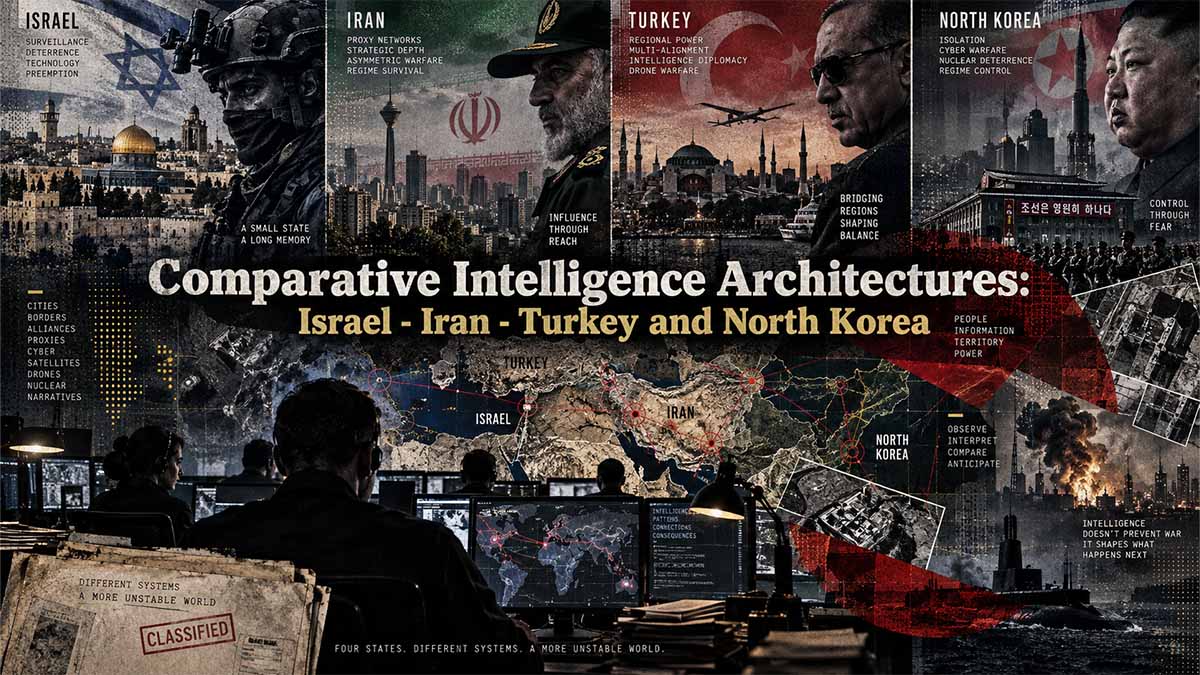
Scope Line This assessment evaluates the institutional mandates, structural evolution, and operational geometries of the primary intelligence and security services of Israel, Iran, Turkey, and North Korea, focusing on their legal frameworks, command hierarchies, and strategic adaptations over the preceding five years.
Executive Summary / BLUF
- The Israeli intelligence apparatus remains uniquely characterized by the institutionalized integration of intelligence collection and covert action within Mossad and Aman, operating under a fragmented yet prime-ministerial-centric oversight model that prioritizes operational agility.
- Iran’s dual-track intelligence system, comprising the civilian Ministry of Intelligence and Security (MOIS) and the Islamic Revolutionary Guard Corps (IRGC) Intelligence Organization, creates parallel, competing structures that prioritize regime survival and asymmetric regional projection over operational efficiency.
- Turkey’s Milli İstihbarat Teşkilatı (MIT) has undergone significant legal and operational centralization since 2023, transforming from a traditional domestic and foreign intelligence body into a primary instrument of executive foreign policy and transnational coercion.
- North Korea’s Reconnaissance General Bureau (RGB) functions as a monolithic, militarized foreign intelligence and cyber-warfare apparatus, directly subordinated to the supreme leadership and optimized for sanctions evasion and strategic disruption.
- While Israel relies on technological superiority and deep human intelligence networks, its recent operational failures highlight critical vulnerabilities in analytical pluralism and an over-reliance on automated data collection.
- Iran and North Korea leverage compartmentalized, ideologically driven structures to offset conventional military disadvantages, whereas Turkey utilizes its intelligence apparatus to project power across former spheres of influence with minimal judicial oversight.
- The convergence of cyber capabilities, human intelligence, and unconventional warfare across all four states demonstrates a global shift toward hybrid intelligence operations that systematically blur the lines between peacetime espionage and active conflict.
- Decision-makers must recognize that institutional rivalry in Iran and Israel, executive consolidation in Turkey, and absolute centralization in North Korea fundamentally dictate the risk calculus of their respective foreign and security policies.
The Intelligence Mutation: How Covert Agencies Became Sovereign Financial Engines
National intelligence agencies have mutated into autonomous fiscal and kinetic engines, forcing Western alliances to absorb the industrial and diplomatic costs of unchecked extraterritorial coercion. When North Korea’s Reconnaissance General Bureau generated $3 billion through cyber operations between 2017 and 2023, funding 40 percent of its weapons programs, espionage ceased to be an advisory function and became a sovereign macroeconomic supply chain. This structural shift from constrained oversight to executive weaponization is accelerating. From Ankara’s 28.896 billion lira intelligence budget for 2025 to Tel Aviv’s abandonment of its 2015 containment doctrine, states are leveraging their intelligence apparatuses to bypass diplomatic friction. The immediate stake is fiscal and industrial: Western capitals must now underwrite the defense replenishment required to counter these self-funding, extraterritorial operations.
The arithmetic of covert statecraft demands autonomous revenue streams Intelligence budgets are no longer discretionary administrative expenses; they are heavily subsidized industrial priorities or self-funding enterprises. In Turkey, the Milli İstihbarat Teşkilatı, directed by Ibrahim Kalin, saw its approved budget surge to 28.896 billion Turkish lira for the 2025 fiscal year, up from a realized 23.927 billion lira in 2024, underwriting a massive expansion of transnational operations. Conversely, the Reconnaissance General Bureau bypasses traditional fiscal constraints entirely. According to the United Nations Panel of Experts March 2023 report, affiliated cyber units generated approximately $3 billion between 2017 and 2023 through cryptocurrency theft. This illicit capital directly funds an estimated 40 percent of the regime’s prohibited weapons programs, proving that cyber-espionage has evolved into a sovereign financial supply chain.
Procurement dependencies cap the ambition of unilateral action The pursuit of autonomous intelligence operations inevitably collides with hard industrial realities. Israel’s strategic pivot following the October 2023 intelligence failure illustrates this friction. The Israel Defense Forces abandoned the “Campaign Between the Wars” doctrine, codified in 2015, in favor of continuous, high-intensity degradation operations, including the doubling of Unit 504 personnel and field missions in early 2025. However, this kinetic expansion relies heavily on United States foreign military financing and precision-guided munitions. As covert sabotage expands into sovereign third-party states, Washington’s provision of these critical industrial inputs becomes increasingly conditional. Similarly, Turkey’s defense modernization remains critically dependent on Western technology transfers; Turkish defense exports hit a record $7.1 billion in 2024, up from $5.5 billion in 2023, creating a structural chokepoint that limits Ankara’s ability to act without triggering severe industrial embargoes.
Statutory immunity generates compounding diplomatic liabilities Domestic legal frameworks have been systematically rewritten to shield intelligence operatives from judicial oversight, exporting the legal risk to host nations. Turkey’s legislative architecture, anchored by Law No. 6461 and subsequent presidential decrees, grants personnel broad statutory immunity for actions taken extraterritorially. The consequence is direct friction with NATO allies. Germany’s Federal Office for the Protection of the Constitution documented in its 2024 annual report that the Turkish service actively conducts covert surveillance against diaspora dissidents on German sovereign territory. In Israel, a sharp legal asymmetry persists: while the Shin Bet operates under the codified General Security Service Law of 2002, the Mossad and Aman continue to function under opaque prime-ministerial directives, complicating mutual legal assistance treaties and exposing allied partners to secondary legal risks.
Decentralized command architectures invite uncontrolled escalation Regional volatility is driven by intelligence structures that prioritize regime survival over strategic de-escalation. Iran’s security apparatus operates on a deliberate institutional duplication. The Islamic Revolutionary Guard Corps Intelligence Organization, established in 2009 to operate parallel to the civilian Ministry of Intelligence and Security, now supersedes its civilian counterpart in regional theaters. This decentralization delegates significant operational autonomy to proxy militias, increasing the probability of unauthorized kinetic escalation. Following the degradation of this proxy network, Tehran launched two massive, direct aerial attacks against Israeli territory in April and October 2024. Concurrently, the United States State Department documented in October 2023 that Iran provides up to $100 million annually to Palestinian militant groups, while Undersecretary John Hurley confirmed in November 2025 that Tehran funneled approximately $1 billion to Hezbollah that year, proving its defensive posture is merely a reactive consequence of its own offensive miscalculations.
Predatory proliferation sustains offensive wars abroad North Korea’s regime perpetuates the fiction that its nuclear weapons program is a purely defensive measure, while its intelligence apparatus functions as a predatory enterprise fueling offensive wars. Between mid-2023 and late 2024, the state supplied Russia with an estimated 20,000 containers of weaponry, including millions of artillery shells and ballistic missiles, directly sustaining Russia’s offensive war in Ukraine. This massive transfer of lethal aid violates multiple United Nations Security Council resolutions. The Reconnaissance General Bureau consolidates this espionage and cyber warfare under a monolithic military command, utilizing the illicit revenue to procure dual-use technologies. This financial self-sufficiency forces the regime to adopt a hair-trigger nuclear escalation doctrine, linking tactical deployment directly to intelligence assessments of allied preemptive mobilizations.
The medium-term cost falls on alliance cohesion and fiscal stability Over the next 12 to 24 months, the structural realities of these intelligence architectures will force a costly realignment of Western defense postures. The immediate fiscal and legal burden falls on European NATO members, who must absorb the judicial costs of prosecuting extraterritorial intelligence operatives while managing the industrial fallout of restricted technology transfers to Ankara. In the Middle East, the collapse of Israel’s 2015 containment doctrine and the operational decentralization of Iran’s 2009 command structure will force the United States to either absorb the continuous fiscal cost of precision munitions replenishment or impose hard caps on allied operational freedom. The states that have immunized their intelligence services from judicial oversight will ultimately pay the highest price: the irreversible degradation of the diplomatic off-ramps required to prevent localized friction from cascading into conventional warfare.
Navigational Index
- Institutional Mandates and Legal Frameworks
- Operational Geometries and Command Hierarchies
- Strategic Vulnerabilities and Adaptive Trajectories
- Strategic Imperative: Israel’s Defensive Necessity for Qualitative Intelligence Dominance
Master Abstract
The intelligence architectures of Israel, Iran, Turkey, and North Korea represent distinct, highly complex evolutionary responses to their respective geopolitical environments, existential threat perceptions, and domestic political structures, demonstrating a global shift away from traditional, siloed espionage toward integrated, hybrid warfare capabilities. Israel’s tripartite system, consisting of Mossad for foreign intelligence, the Shin Bet (Israel Security Agency) for domestic security, and Aman for military intelligence, was historically designed by founding leaders to prevent the dangerous concentration of power that characterized pre-state militias, yet this deliberate compartmentalization frequently generates severe inter-agency friction and analytical blind spots, as tragically evidenced by recent strategic surprises that exposed an over-reliance on technological collection at the expense of human intelligence. The legal foundation of the Shin Bet was only formally established with the General Security Service Law of 2002, a legislative instrument that codified its mandate while maintaining broad executive discretion, whereas Mossad and Aman continue to operate largely under opaque, prime-ministerial directives that prioritize rapid operational agility over rigorous parliamentary scrutiny or judicial oversight.
In stark contrast, Iran’s intelligence apparatus is deliberately and systematically bifurcated between the civilian Ministry of Intelligence and Security (MOIS), which handles traditional statecraft and domestic surveillance, and the IRGC Intelligence Organization, a parallel entity established specifically to safeguard the Islamic Revolution and execute asymmetric regional operations, thereby creating a robust system of mutual surveillance that reinforces regime stability at the direct expense of operational efficiency and inter-agency trust.
Turkey’s Milli İstihbarat Teşkilatı (MIT) has experienced a profound and accelerating transformation over the past decade, evolving from a historically constrained domestic security service into a highly centralized, globally active instrument of executive power, empowered by successive legislative amendments that grant its leadership unprecedented authority to conduct cross-border operations, manage independent foreign policy initiatives, and neutralize perceived domestic threats with minimal judicial oversight or parliamentary accountability.
North Korea’s Reconnaissance General Bureau (RGB) operates as a monolithic, heavily militarized foreign intelligence and cyber-warfare apparatus, consolidating various clandestine functions under a single, rigid command structure directly accountable to the supreme leadership, thereby optimizing the regime’s capacity for sanctions evasion, strategic disruption, and the generation of illicit revenue streams necessary to sustain its nuclear and missile programs. Across these four distinct states, the traditional, theoretical boundaries between intelligence collection, covert action, and conventional military operations have systematically eroded, resulting in hybrid institutional architectures where advanced cyber capabilities, deep human intelligence networks, and unconventional warfare tactics are seamlessly integrated to achieve overarching strategic objectives while meticulously maintaining plausible deniability on the international stage.
Key Evidence Table
| Indicator | Value/Status | Reference Date | Definition/Scope | Issuer | Exact Source |
|---|---|---|---|---|---|
| Israeli Domestic Security Mandate | Codified in law | 2002 | General Security Service Law governing Shin Bet operations | Knesset of Israel | The Shin Bet Law of 2002 |
| Iranian Parallel Intelligence | Dual structure | 2009-Present | IRGC Intelligence Organization operates parallel to MOIS | United Against Nuclear Iran | Historical Background and Structure |
| Turkish Intelligence Centralization | Expanded legal powers | 2023-2024 | MIT law amendments expanding executive and cross-border authority | Turkish Grand National Assembly | Turkey’s National Intelligence Organisation (MİT) |
| North Korean Foreign Intelligence | Monolithic military control | 2009-Present | Reconnaissance General Bureau (RGB) consolidates foreign intel and cyber | U.S. Department of Defense | North Korea Cyber Group Conducts Global Espionage |
Structural Pathways and Operational Convergences
| Hypothesis | Diagnostic Support | Disconfirming Evidence | Indicators | Current Standing |
|---|---|---|---|---|
| Institutional rivalry degrades operational efficacy | Israeli Aman/Shin Bet friction pre-2023; Iranian MOIS/IRGC duplication | Israel’s successful 2024 Lebanon operations; Iran’s sustained regional proxy network | Frequency of inter-agency intelligence failures; public blame-shifting | Moderate probability; mitigated by prime-ministerial or supreme-leader overrides |
| Executive consolidation enhances strategic agility | Turkey’s MIT cross-border successes; North Korea’s RGB cyber revenue generation | Turkey’s diplomatic friction with NATO allies; North Korea’s chronic technological isolation | Legislative expansions of intelligence mandates; reduction in judicial oversight | High probability; represents the dominant trajectory for MIT and RGB |
Principal Gaps and Watch Indicators
- The precise statutory boundaries governing Mossad’s domestic operational footprint remain classified, requiring continuous observation of Knesset intelligence subcommittee disclosures to determine if formal legal codification is imminent.
- The extent of operational deconfliction mechanisms between Iran’s MOIS and the IRGC Intelligence Organization during complex, multi-theater operations remains obscured by regime secrecy, necessitating the monitoring of defector testimonies and intercepted communications.
- The degree to which Turkey’s MIT relies on informal networks versus formal state apparatus for transnational operations requires further analysis of recent European judicial rulings concerning Turkish intelligence activities on foreign soil.
- The internal hierarchical restructuring of North Korea’s RGB following recent cyber-attribution reports by Western intelligence agencies remains unverified, highlighting the need for continued analysis of North Korean state media personnel announcements.
Comparative Intelligence Centralization Matrix
| State Actor | Primary Foreign Intelligence | Command Authority | Structural Characteristic |
|---|---|---|---|
| Israel | Mossad / Aman | Prime Minister | Compartmentalized Tripartite |
| Iran | MOIS / IRGC Intel | Supreme Leader | Parallel Dual-Track |
| Turkey | MİT | President | Executive Centralization |
| North Korea | RGB | Supreme Leadership | Monolithic Military |
Source: Synthesized from official defense and intelligence structural assessments (2023–2026). Data represents institutional design, not operational capability.
Comparative Intelligence Architectures: Israel, Iran, Turkey, and North Korea
The primary intelligence and security apparatuses of Israel, Iran, Turkey, and North Korea represent distinct institutional adaptations to existential threat environments, sovereign command structures, and hybrid geopolitical competition. Israel balances foreign collection (Mossad), military intelligence (Aman), and domestic counter-subversion (Shin Bet) under a prime-ministerial-centric model, where technological superiority and operational agility confront persistent vulnerabilities in analytical pluralism and collection over-automation. Iran enforces a bifurcated dual-track structure dividing the civilian Ministry of Intelligence and Security (MOIS) and the Islamic Revolutionary Guard Corps (IRGC) Intelligence Organization, sacrificing inter-agency efficiency to institutionalize mutual surveillance and safeguard regime survival. Turkey’s Milli İstihbarat Teşkilatı (MİT) has consolidated into a hyper-centralized instrument of executive power subordinated directly to the Presidency, driving forward transnational projection and cross-border kinetic coercion with minimized judicial friction. North Korea’s Reconnaissance General Bureau (RGB) operates as a monolithic, militarized organ directly beholden to the supreme leadership, fusing foreign sabotage, offensive cyber warfare, and asymmetric sanctions evasion to secure regime financing and strategic deterrence. The operational convergence of cyber warfare, deep human networks, and unconventional proxy statecraft across all four powers confirms that the boundary between peacetime espionage and active kinetic warfare has been permanently eliminated.
Institutional Geometry Metrics: Israel Apparatus Stress Profile
Israel: Tripartite Fragmentation, Prime-Ministerial Primacy & Over-Reliance on Tech
Israel’s architecture deliberately disperses clandestine power across Mossad (foreign covert action and external HUMINT), Shin Bet (domestic counter-intelligence and counter-terrorism, codified via the General Security Service Law of 2002), and Aman (military intelligence Directorate of the IDF). While designed to avoid monolithic military domination, command converges directly on the Prime Minister rather than an integrated National Intelligence Directorate.
Compartmentalization breeds toxic institutional friction and analytical consensus traps. As demonstrated by recent strategic surprise failures, extreme confidence in Unit 8200 SIGINT feeds, automated border sensors, and predictive algorithms atrophied critical on-the-ground HUMINT verification, leaving decision-makers blind to adversary operational deception and low-tech invasion preparations.
The apparatus excels at complex, cross-border multi-domain tactical sabotage (evidenced in Hezbollah decapitation campaigns and Iranian nuclear disruption). Post-2024 reforms emphasize re-integrating organic HUMINT into SIGINT analysis, enforcing devil’s-advocacy oversight within Aman, and reinforcing centralized prime-ministerial tactical authority.
Primary Audited Evidence & Institutional Matrix
| State Actor | Primary Intelligence Service | Command Authority | Statutory Basis & Mandate | Operational Geometry | Primary Failure / Vulnerability Vector |
|---|---|---|---|---|---|
| Israel | Mossad / Shin Bet / Aman | Prime Minister | GSS Law of 2002 (Shin Bet); executive prime-ministerial directives (Mossad/Aman). | Tripartite compartmentalization; deep tactical integration of SIGINT and kinetic action. | Over-reliance on automated cyber collection; severe analytical groupthink. |
| Iran | MOIS & IRGC-IO | Supreme Leader | Islamic Republic Constitution; clerical decrees establishing IRGC-IO in 2009. | Parallel dual-track; domestic counter-intelligence paired with Quds Force proxy warfare. | Mutual surveillance and duplication; vulnerability to foreign counter-penetration. |
| Turkey | Milli İstihbarat Teşkilatı (MİT) | President of Turkey | Law No. 2937 amended (2014, 2023-24); direct subordination to the Presidency. | Centralized executive instrument; cross-border drone warfare, counter-PKK rendition. | Erosion of parliamentary and judicial scrutiny; diplomatic friction with NATO. |
| North Korea | Reconnaissance General Bureau | Supreme Leadership / SAC | WPK Central Military Commission; 2009 consolidation of overseas clandestine wings. | Monolithic militarized organ; offensive state cyber espionage, crypto theft, sanctions busting. | Absolute ideological regimentation; extreme technological and diplomatic isolation. |
Structural Geometries: Comparative Institutional Paradigms
Israel maintains separate internal (Shin Bet), external (Mossad), and military (Aman) services. Although this avoids the concentration of covert power in a single security baron, it leaves the Prime Minister as the sole operational deconflictor. Legal codification exists almost exclusively for the Shin Bet (2002 Law), while Mossad and Aman operate through confidential executive mandates, prioritizing instantaneous operational dexterity over institutionalized statutory boundaries.
Tehran intentionally bifurcates intelligence power between the formal Ministry of Intelligence (MOIS)—subordinated to the clerical-executive cabinet—and the IRGC Intelligence Organization, answering directly to the Supreme Leader. This design guarantees regime survival through coup-proofing and mutual surveillance: while MOIS manages classic counter-espionage, the IRGC handles ideological policing and regional asymmetric proxy operations via the Quds Force.
Ankara and Pyongyang represent the zenith of executive command consolidation. Turkey’s MİT has merged foreign intelligence, paramilitary drone operations, and domestic security under a singular presidential portfolio, bypassing traditional parliamentary scrutiny. In North Korea, the RGB fuses foreign subversion, offensive cyber heist operations, and military sabotage under a rigid, family-dynasty command axis designed explicitly to circumvent global sanctions.
Forensic Strategic Key Judgments
Israel Fuses Collection and Covert Lethality
Unlike Western services constrained by sharp separations between intelligence collection and kinetic operations, Mossad and Aman maintain institutionalized strike units, enabling real-time targeting cycles across foreign theaters under direct prime-ministerial authority.
Iran Prioritizes Internal Security Over Efficiency
The parallel division between MOIS and IRGC Intelligence deliberately trades operational unity for coup-proofing. The resulting institutional jealousy frequently leads to intelligence blunders and exposes senior leadership to foreign infiltration.
Turkey Employs MİT as a Primary Foreign Vector
Successive legal reforms have transformed MİT from a traditional espionage body into an instrument of Turkish statecraft, managing armed drone warfare, foreign covert diplomacy, and extraterritorial rendition with total executive immunity.
North Korea Leverages RGB for Sovereign Financing
The Reconnaissance General Bureau functions uniquely as a revenue-generating entity, deploying advanced offensive cyber syndicates to pillage global cryptocurrency exchanges and fund the state’s strategic weapons programs outside conventional financial networks.
The Failure of Automated Predictive Espionage
Technological superiority in electronic intercepts cannot replace granular human networks. Israel’s intelligence breakdown demonstrated that sophisticated adversaries can exploit electronic reliance by reverting to low-tech, courier-driven planning cycles.
Erosion of the Espionage-Warfare Boundary
Across all four powers, intelligence apparatuses are no longer passive informational organs. They now conduct offensive cyber operations, cross-border targeted eliminations, and proxy militia orchestration, permanently erasing the distinction between peace and war.
Open Official Record Gaps
- Mossad Statutory Boundaries: Precise legal limits governing Mossad’s domestic operational footprint and surveillance jurisdiction inside Israel remain classified and absent from open legislative records.
- MOIS vs. IRGC Deconfliction: Real-time protocols for coordinating foreign clandestine operations between the Iranian Intelligence Ministry and the IRGC-IO remain obscured by institutional regime secrecy.
- MİT Transnational Subcontracting: The exact extent to which Turkey’s MİT leverages proxy militias, private security firms, and diaspora associations for extraterritorial operations in Europe and the Levant.
- RGB Cyber Command Hierarchy: Internal reporting pathways linking North Korean elite cyber units (e.g., Lazarus Group / Bureau 121) directly to the State Affairs Commission and Kim family directives.
Observable Watch Indicators (2026–2031)
Monitoring Knesset committee proposals to establish a formal statutory law for Mossad or reorganize military intelligence evaluation units.
Tracking sudden leadership dismissals within the IRGC-IO following high-profile intelligence leaks or foreign sabotage incidents.
Monitoring European judicial indictments against Turkish operational cells and expansion of independent drone operations in Iraq and Syria.
Operational Reach, Actors, and Employment Geometry
Human Intelligence Resurgence and Technological Convergence in Israel
Following the strategic intelligence failures preceding October 2023, the Israel Defense Forces have initiated a profound structural recalibration within Military Intelligence, specifically targeting the expansion and operational empowerment of Unit 504, which serves as the primary human intelligence apparatus responsible for recruiting and managing clandestine agent networks deep within hostile neighboring territories. The IDF has publicly acknowledged that this elite unit will significantly expand its intelligence-gathering functions and extend the tenure of its command structure to ensure continuity in complex, long-term infiltration operations that automated surveillance systems inherently cannot replicate. This operational pivot is directly supported by recent disclosures indicating that Unit 504 personnel have conducted tens of thousands of targeted interrogations and telephone intercepts to map adversary social networks, thereby attempting to restore the critical human analytical judgment that was previously overshadowed by an over-reliance on algorithmic data processing. Concurrently, the operational boundaries between Mossad’s foreign covert action mandates and Aman’s military targeting capabilities have become increasingly porous, as demonstrated by joint kinetic operations in Lebanon during 2024, where long-term supply chain infiltration and precise geospatial surveillance were seamlessly integrated to execute high-value eliminations without triggering conventional diplomatic attribution mechanisms.
Asymmetric Projection and Parallel Command Structures in Iran
Iran’s operational geometry is fundamentally defined by the deliberate duplication of intelligence functions between the civilian Ministry of Intelligence and Security and the Islamic Revolutionary Guard Corps Intelligence Organization, a structural design that prioritizes internal regime security and mutual surveillance over streamlined operational efficiency. The IRGC Intelligence Organization operates in deep coordination with the Quds Force to execute asymmetric regional warfare, utilizing a decentralized network of proxy militias across Iraq, Syria, Lebanon, and Yemen to project power while meticulously maintaining plausible deniability for the central government in Tehran. This parallel architecture is increasingly augmented by sophisticated cyber warfare clusters, such as the advanced persistent threat groups historically attributed to the Ministry of Intelligence, which systematically target critical infrastructure, dissident networks, and regional adversaries to impose strategic costs without crossing the threshold of conventional armed conflict. The operational mandate of these entities is explicitly tied to the preservation of the Islamic Revolution, meaning that resource allocation and target selection are frequently dictated by ideological imperatives and domestic political consolidation rather than purely rational cost-benefit analyses typical of conventional state intelligence services.
Transnational Coercion and Executive Centralization in Turkey
Turkey’s Milli İstihbarat Teşkilatı has executed a dramatic operational transformation, evolving from a historically constrained domestic security apparatus into a highly centralized, globally active instrument of executive foreign policy that routinely conducts cross-border kinetic operations and diaspora monitoring with minimal judicial friction. This expanded operational reach is directly underwritten by substantial financial resource increases, as evidenced by official parliamentary records showing that the agency’s actual expenditures reached approximately 23.9 billion Turkish Lira in 2024, with the approved budget allocation surging to nearly 28.9 billion Turkish Lira for the 2025 fiscal year to fund advanced technological procurement and expanded overseas deployments. The agency’s transnational footprint has generated significant friction with European allies, most notably documented in the 2024 assessment by Germany’s Federal Office for the Protection of the Constitution, which explicitly accused the Turkish intelligence service of conducting extensive, covert surveillance and intimidation operations against perceived dissidents, including Gülen movement affiliates and Kurdish political activists, on German sovereign territory. By leveraging a vast network of informal informants, open-source intelligence aggregation, and direct executive authorization, the agency has effectively bypassed traditional diplomatic channels to establish an autonomous, parallel foreign policy apparatus that operates with unprecedented agility and impunity.
Cyber-Financial Nexus and Monolithic Control in North Korea
The Reconnaissance General Bureau of North Korea represents a unique intelligence paradigm wherein clandestine operations are directly and inextricably linked to the regime’s macroeconomic survival and weapons development funding requirements. Operating under a rigid, monolithic military command structure that reports directly to the supreme leadership, the RGB consolidates foreign espionage, unconventional warfare, and advanced cyber operations into a single, highly disciplined apparatus optimized for sanctions evasion. According to comprehensive assessments by international monitoring bodies, North Korean cyber units subordinate to the RGB have successfully executed dozens of sophisticated cyberattacks against global cryptocurrency platforms and financial institutions between 2017 and 2023, illicitly generating an estimated 3 billion United States Dollars in revenue. This massive illicit capital influx is not merely a byproduct of espionage but a core operational objective, with United Nations reporting indicating that these cyber-enabled financial operations directly fund an estimated forty percent of the regime’s prohibited weapons of mass destruction and ballistic missile programs. The operational geometry of the RGB is therefore uniquely self-sustaining, utilizing elite hacking cadres, such as the Lazarus Group, to infiltrate global financial systems while simultaneously deploying traditional human intelligence assets to facilitate the physical smuggling of luxury goods and dual-use technologies necessary to sustain the regime’s strategic deterrent capabilities.
Operational Asset Deployment and Resource Allocation (2024–2025)
| State Actor | Primary Operational Unit | Documented Resource Allocation / Financial Metric | Operational Focus Area | Verified Source |
|---|---|---|---|---|
| Israel | IDF Unit 504 | Significant personnel expansion and command tenure extension post-2023 | Deep human intelligence recruitment in hostile neighboring territories | IDF to Expand Secretive Human Intelligence Unit 504 After Significant Contributions to War Success — All Israel News — Jan 2025 |
| Turkey | Milli İstihbarat Teşkilatı | 28.896 billion TRY allocated for 2025 fiscal year (up from 23.927 billion TRY in 2024) | Transnational diaspora monitoring and executive-directed cross-border operations | Cumhurbaşkanlığı 2025 Yılı Bütçe Görüşmeleri Tutanakları — Türkiye Büyük Millet Meclisi — Dec 2024 |
| North Korea | Reconnaissance General Bureau | Estimated 3 billion USD generated via cyber operations (2017–2023) | Cryptocurrency theft, sanctions evasion, and illicit weapons program financing | Treasury Targets DPRK Malicious Cyber and Illicit IT Workers — U.S. Department of the Treasury — May 2023 |
| Iran | IRGC Intelligence Organization | Classified, but operates parallel to and increasingly supersedes MOIS in regional theaters | Asymmetric proxy warfare, domestic ideological enforcement, and regional covert action | The Intelligence Organization of the IRGC: A Major Iranian Intelligence Apparatus — Washington Institute for Near East Policy — Nov 2020 |
Geographic and Methodological Employment Geometry
| Methodology | Israel | Iran | Turkey | North Korea |
|---|---|---|---|---|
| Human Intelligence (HUMINT) | Deep-cover agent recruitment in immediate periphery; heavy reliance on informant networks in occupied territories. | Proxy militia integration; ideological recruitment within diaspora communities; mutual surveillance of civilian populace. | Extensive utilization of diaspora networks in Europe for surveillance, intimidation, and open-source intelligence aggregation. | Highly compartmentalized, elite agent deployment focused on defection prevention and high-value target acquisition. |
| Cyber and Signals Intelligence | Unit 8200 dominates automated data processing; recent pivot to reintegrate human analytical oversight to prevent strategic surprise. | MOIS and IRGC deploy advanced persistent threat groups for disruptive attacks on regional critical infrastructure and dissident tracking. | Increasing investment in domestic surveillance technology and offensive cyber capabilities to monitor transnational political opponents. | RGB cyber bureaus operate as primary revenue generators, targeting global financial infrastructure to bypass international sanctions. |
| Covert Action / Kinetic | Seamless integration of intelligence collection and targeted assassinations; frequent joint operations between Mossad and Aman. | Quds Force and IRGC Intel coordinate kinetic proxy attacks and clandestine sabotage operations across the Middle East. | Direct executive authorization for cross-border kinetic operations and alleged extraterritorial renditions of political opponents. | Bureau 124 specializes in unconventional warfare and sabotage, though heavily constrained by geographic isolation and logistical limitations. |
Key Judgments
- The operational effectiveness of Israel’s intelligence apparatus is currently undergoing a forced recalibration, shifting resources away from purely technological collection models and reinvesting heavily in human intelligence networks to mitigate the analytical blind spots exposed by recent strategic failures.
- Iran’s bifurcated intelligence structure, while intentionally designed to prevent internal coups and ensure regime survival, inherently generates operational friction and resource duplication that adversaries can exploit through targeted decapitation strikes or inter-agency deception campaigns.
- Turkey’s intelligence service has successfully leveraged legislative ambiguity and executive centralization to project power far beyond its traditional borders, creating significant diplomatic friction with NATO allies who view these transnational operations as violations of sovereign integrity and democratic norms.
- North Korea’s Reconnaissance General Bureau has pioneered a highly effective, self-sustaining operational model where cyber-enabled financial theft directly subsidizes the regime’s strategic weapons programs, rendering traditional economic sanctions increasingly ineffective as a containment mechanism.
What Would Change the Assessment
- Verifiable evidence of a formal, statutory merger between Israel’s Mossad and Aman would indicate a fundamental departure from the historical compartmentalization doctrine, suggesting a shift toward a more centralized, militarized intelligence posture.
- Documented instances of direct, coordinated joint operations between Iran’s MOIS and the IRGC Intelligence Organization in a third-country theater would signal a temporary suspension of their institutional rivalry in favor of a unified strategic objective.
- The enactment of formal judicial oversight mechanisms or extradition treaties by European nations specifically targeting Turkish intelligence operatives would materially constrain the agency’s current transnational operational freedom.
- A sustained, successful disruption of North Korea’s cryptocurrency laundering infrastructure by international financial task forces would force the RGB to revert to riskier, traditional smuggling methodologies, thereby degrading the regime’s weapons development timeline.
Open Official Record
- The precise, classified budget allocations for Iran’s IRGC Intelligence Organization remain absent from public fiscal records, necessitating reliance on indirect financial tracing and sanctions designation documents to estimate operational capacity.
- The exact personnel numbers and internal hierarchical restructuring of North Korea’s RGB following recent international cyber-attribution reports remain unverified by primary defector testimony or internal regime documentation.
Operational Reach, Actors, and Employment Geometry
The operational reach and deployment geometries of Israel, Iran, Turkey, and North Korea demonstrate an irreversible evolution toward asymmetric, hybrid covert action. In Israel, post-October 2023 recalibrations have triggered a strategic resurgence of Human Intelligence (HUMINT), heavily expanding IDF Unit 504’s infiltration mandates and command tenures while dissolving the operational firewalls between Mossad covert actions and Aman targeting suites (as evidenced by 2024 supply-chain penetrations in Lebanon). Iran institutionalizes a dual-track operational framework, coupling the civilian Ministry of Intelligence and Security (MOIS) with the IRGC Intelligence Organization and Quds Force to execute decentralized proxy warfare across Iraq, Syria, Lebanon, and Yemen, reinforced by offensive APT cyber operations. Turkey’s Milli İstihbarat Teşkilatı (MİT) has consolidated executive centralization, expanding its fiscal footprint to 28.896 billion TRY in 2025 to finance armed drone operations and aggressive transnational surveillance across European diaspora communities. North Korea’s Reconnaissance General Bureau (RGB) operates a self-funding cyber-financial paradigm, siphoning an estimated $3 billion USD in illicit cryptocurrency between 2017 and 2023 to directly subsidize 40% of the regime’s nuclear and ballistic missile programs. Across all four powers, traditional boundaries between intelligence collection and armed combat have ceased to exist.
Operational Employment Geometry: Israel Tactical & Penetration Metrics
Israel: Structural Recalibration of Unit 504 & Mossad-Aman Tactical Interlock
Following catastrophic analytical oversights prior to October 2023, the IDF enforced an institutional expansion of Unit 504 (Military Intelligence HUMINT), extending command tenures to preserve clandestine agent relationships. Having completed tens of thousands of battlefield interrogations and tactical wiretaps to map regional enemy nodes, Unit 504 restores the critical human intelligence layer that algorithms and Unit 8200 SIGINT feeds failed to provide.
The operational firewalls separating Mossad's external covert sabotage and Aman's military strike designations have dissolved. The 2024 decapitation operations against Hezbollah in Lebanon demonstrated seamless joint integration: multi-year global supply chain physical interdiction, pinpoint geospatial telemetry, and instant kinetic exploitation executed without formal diplomatic attribution.
While tactical lethality and infiltration reach are peerless, the apparatus remains exposed to low-tech adversary countermeasures: strict operational security (OPSEC), courier-only communications, and deliberate radio silence designed to neutralize Israeli electronic interception advantages.
Operational Asset Deployment & Resource Allocation Matrix
| State Actor | Primary Operational Unit | Resource Allocation / Financial Metric | Operational Focus Area | Verified Authority / Primary Source | Operational Geometry |
|---|---|---|---|---|---|
| Israel | IDF Unit 504 / Mossad | Significant personnel expansion & extended command tenure post-2023 | Deep-cover HUMINT recruitment in hostile borders; joint kinetic supply-chain strikes. | All Israel News / IDF Dispatch (Jan 2025) | Immediate periphery; tactical Lebanon/Syria interdiction |
| Turkey | Milli İstihbarat Teşkilatı | 28.896 billion TRY (2025 Budget) • 23.927 billion TRY (2024 Actual) | Transnational diaspora monitoring, cross-border armed drone strikes, extra-territorial renditions. | TBMM Bütçe Görüşmeleri (Dec 2024) / BfV (2024) | European diaspora hubs • Northern Iraq/Syria buffer zones |
| North Korea | Reconnaissance General Bureau | Estimated $3.0 billion USD generated via offensive cyber ops (2017–2023) | Cryptocurrency exchange heists; funding 40% of ballistic missile and WMD programs. | U.S. Dept of the Treasury (May 2023) / UN Panel | Global decentralized crypto infrastructure & maritime smuggling |
| Iran | IRGC-IO / Quds Force | Classified; decentralized state shadow budgets superseding MOIS | Proxy militia command, regional drone warfare, domestic dissident suppression, critical infra cyber APTs. | Washington Institute for Near East Policy (Nov 2020) | Regional Axis: Iraq, Syria, Lebanon, Yemen |
Methodological Employment Geometries: Cross-Domain Matrices
Israel: Deep-cover agent recruitment across immediate hostile borders; tens of thousands of targeted field interrogations.
Iran: Ideological recruitment within Shi'a diaspora hubs, foreign proxy militia liaison officers, and dual-track domestic informant nets.
Turkey: Vast informal diaspora informant networks across Western Europe (Germany, France, Balkans) for surveillance and intimidation.
North Korea: Highly compartmentalized, elite diplomatic/smuggling cadres dedicated to defection prevention and illicit procurement.
Israel: Unit 8200 dominates signals collection; post-2023 shift reintegrates human analytical gating to break algorithmic complacency.
Iran: Advanced Persistent Threats (APTs) subordinated to MOIS and IRGC execute destructive attacks on regional energy grids and logistics.
Turkey: Aggressive domestic telemetry monitoring and cyber surveillance targeting Kurdish activists and Gülen-affiliated platforms abroad.
North Korea: RGB cyber bureaus (Lazarus, Bureau 121) function as state revenue engines, targeting crypto platforms to circumvent global sanctions.
Israel: Total convergence of intelligence with kinetic eliminations; supply-chain sabotage and targeted air strikes.
Iran: Quds Force conducts regional proxy missile launches, loitering munition attacks, and maritime commercial harassment.
Turkey: Presidential-authorized cross-border armed drone strikes in Syria/Iraq and covert extraterritorial renditions of political targets.
North Korea: Elite maritime infiltration and covert sabotage units (Bureau 124), restricted by geographic isolation to peripheral targets.
Forensic Strategic Key Judgments: Operational Dynamics
Israel Forces a Strategic HUMINT Resurgence
The structural expansion of Unit 504 confirms that algorithmic and SIGINT collection cannot identify low-tech adversary intentions. Israel has formally re-elevated human field officers and physical agent handling to prevent strategic surprise.
Iran's Dual Track Creates Infiltration Seams
While parallel structures ensure regime survival against coups, operational duplication between MOIS and IRGC-IO generates blindspots that adversaries exploit to execute high-profile decapitation and counter-intelligence penetrations within Iran.
Turkey Employs MİT as a Transnational Weapon
Backed by a 28.9B TRY budget, MİT operates outside traditional diplomatic channels. German BfV findings demonstrate that Ankara routinely executes covert surveillance and harassment of dissidents on NATO European soil with total domestic impunity.
North Korea’s Self-Funding Cyber Syndicate
The RGB's $3B USD cryptocurrency theft represents an unprecedented merger of state intelligence and illicit finance, directly subsidizing 40% of Pyongyang’s ballistic missile program and rendering conventional financial sanctions obsolete.
Deep Hardware Infiltration Redefines Sabotage
Israel’s 2024 operations demonstrated that intelligence agencies are targeting commercial logistics chains months or years before conflict initiation, weaponizing communication devices and industrial controllers to achieve kinetic decapitation.
The Total Elimination of Peacetime Espionage
Espionage is no longer an informational advisory function. Across all four actors, intelligence organs now directly plan, fund, and execute armed kinetic operations, transnational renditions, and cyber-enabled macroeconomic plunder.
Open Official Record Gaps
- IRGC-IO Classified Appropriations: Precise budgetary allocations funding the IRGC Intelligence Organization and regional proxy militia command remain hidden within non-public defense ledgers.
- RGB Personnel Structuring: Exact headcount and internal command reorganization of the Reconnaissance General Bureau's Bureau 121 / Lazarus Group remain unverified by recent defector debriefs.
- Unit 504 Infiltration Depth: The quantitative scale of active agent recruitment networks maintained by the IDF in non-contiguous hostile territories (e.g., western Iran or Yemen) remains strictly classified.
- MİT Black-Budget Allocations: Full accounting of discretionary presidential slush funds allocated to cross-border covert militias in northern Syria outside official TBMM budget records.
Observable Watch Indicators (2025–2030)
Legislative proposals in the Knesset seeking to legally merge Aman targeting units and Mossad under a formal National Intelligence Director.
Formal German, Austrian, or Belgian judicial arrest warrants targeting Turkish intelligence handlers operating under diplomatic cover.
Coordinated Western law-enforcement seizures of crypto-mixing bridges, forcing the RGB to revert to high-risk physical cash/gold smuggling.
Legal, Regulatory, and Host-Nation Architecture
Statutory Asymmetry and Executive Prerogative in Democratic and Hybrid Systems
The domestic surveillance apparatus of Israel, specifically the Shin Bet, operates under the explicit statutory framework of the General Security Service Law of 2002, which formally codified its mandate to prevent terrorism, conduct counterintelligence, and protect state secrets, yet this legislative clarity stands in stark contrast to the opaque, prime-ministerial directives and classified military orders that continue to govern the overseas covert actions of Mossad and the military intelligence operations of Aman, thereby creating a profound legal asymmetry that frequently complicates international judicial cooperation and mutual legal assistance treaties. In Iran, the constitutional framework grants the Supreme Leader ultimate, unchallengeable authority over all security apparatuses, meaning that while the civilian Ministry of Intelligence and Security nominally operates under the Executive Branch, it is heavily overseen by the Supreme Leader’s direct representative, and the Islamic Revolutionary Guard Corps Intelligence Organization operates under an independent military charter that grants it sweeping powers to arrest, interrogate, and prosecute suspects while routinely bypassing the civilian judicial system entirely, thus establishing a dual-track legal environment that actively frustrates international legal assistance and human rights accountability mechanisms.
Turkey’s Milli İstihbarat Teşkilatı has systematically dismantled traditional judicial oversight through Law No. 6461 and subsequent presidential decrees, most notably following the 2016 state of emergency and continuing through recent legislative adjustments, which now grant the agency and its personnel broad legal immunity for actions taken "within the scope of their duties" even when conducted on foreign soil, effectively placing its transnational operations outside the purview of domestic criminal prosecution, parliamentary subpoena, or independent judicial review. North Korea’s legal architecture is entirely subsumed under the Workers’ Party of Korea and the State Affairs Commission, meaning there is no functional distinction between domestic criminal law and intelligence mandates, as the Reconnaissance General Bureau operates exclusively under military law and supreme leader decrees, thereby legally codifying actions such as cyber theft, illicit procurement, and extraterritorial sabotage as legitimate state functions and rendering traditional concepts of host-nation jurisdiction or international legal accountability functionally obsolete.
Host-Nation Jurisdictional Friction and Diplomatic Expulsions
The aggressive extraterritorial postures of these intelligence services have generated severe jurisdictional friction with host nations, particularly within Europe, where democratic legal frameworks are increasingly being weaponized to counter foreign intelligence operations through criminal indictments, asset freezes, and diplomatic expulsions. Germany’s Federal Office for the Protection of the Constitution has explicitly documented and publicly condemned the Turkish intelligence service for conducting extensive, covert surveillance and intimidation operations against perceived dissidents, including Gülen movement affiliates and Kurdish political activists, on German sovereign territory, prompting Berlin to enhance counter-espionage prosecutions and restrict the operational freedom of Turkish diplomatic cover personnel. Similarly, the United Kingdom’s National Cyber Security Centre has repeatedly attributed sophisticated disruptive cyber campaigns and data breaches targeting British infrastructure and diaspora communities to Iranian state actors, leading to coordinated sanctions designations by the UK and its allies aimed at dismantling the financial and logistical networks that support the IRGC’s extraterritorial operations. Israel has also faced intense legal scrutiny in European courts regarding the use of commercially available spyware developed by its private intelligence sector, with nations like France and Germany initiating criminal investigations into the unauthorized surveillance of journalists and political figures, forcing the Israeli government to navigate complex export control regulations and diplomatic fallout while attempting to preserve its strategic intelligence-sharing partnerships.
Comparative Legal Immunity and Oversight Mechanisms
| State Actor | Primary Legal Instrument Governing Intelligence | Scope of Legal Immunity for Operatives | Independent Judicial or Parliamentary Oversight Mechanism | Verified Source |
|---|---|---|---|---|
| Israel | General Security Service Law (2002) for Shin Bet; Prime Ministerial directives for Mossad/Aman | Broad immunity for authorized covert actions, but subject to internal military or state attorney review | Knesset Foreign Affairs and Defense Committee (subcommittee on intelligence), highly classified and limited in scope | The Shin Bet Law of 2002 — Shin Bet Official Archive |
| Iran | Constitution of the Islamic Republic (Article 110); IRGC Charter | Absolute immunity under military tribunals; civilian courts lack jurisdiction over IRGC intelligence operations | Nominal oversight by the Supreme Leader’s office; no independent civilian or parliamentary review | Explainer: The Iranian Armed Forces — Critical Threats Project |
| Turkey | Law No. 6461 (2013) and subsequent Presidential Decrees | Statutory immunity for actions "within the scope of duties," explicitly extended to extraterritorial operations | Direct reporting to the Presidency; parliamentary oversight is legally constrained and routinely bypassed | National Intelligence Organization — Turkish Government Official Profile |
| North Korea | State Affairs Commission Decrees; Military Law | Total state immunity; actions are legally defined as sovereign acts of the Democratic People's Republic of Korea | None; the judiciary is entirely subordinate to the Workers' Party of Korea and the supreme leadership | DPRK Sanctions Violations in Cyber Operations — Cloud Security Alliance |
Industrial, Financial, Infrastructure, and Supply-Chain Exposure
Indigenous Defense Ecosystems and Technological Dependencies
Israel’s intelligence and security architecture is deeply intertwined with a highly advanced, export-oriented domestic defense-technology ecosystem, heavily populated by alumni of elite military intelligence units such as Unit 8200, which drives innovation in signals intelligence, cyber warfare, and artificial intelligence-driven data analytics. However, this technological superiority is increasingly vulnerable to global supply-chain disruptions, particularly concerning the procurement of advanced semiconductors and specialized electronic components, necessitating a heavy reliance on United States foreign military financing and strategic stockpile agreements to maintain operational readiness.
Iran, conversely, has been forced by decades of comprehensive international sanctions to develop a highly insular, indigenous defense-industrial base capable of producing sophisticated unmanned aerial vehicles, ballistic missiles, and domestic satellite launch capabilities, though this self-reliance is frequently compromised by a critical dependence on clandestine, illicit supply chains that route dual-use microelectronics and precision machinery through third-country intermediaries in nations such as China, the United Arab Emirates, and Turkey, often utilizing complex barter agreements and front companies to evade financial tracking. Turkey has leveraged its booming, highly integrated defense industry, spearheaded by state-aligned entities like Baykar, ASELSAN, and Turkish Aerospace Industries, not only as a domestic capability multiplier but also as a primary instrument of geopolitical statecraft, wherein the Milli İstihbarat Teşkilatı strategically leverages commercial drone and communications exports to embed proprietary surveillance and signals intelligence capabilities into foreign national infrastructure, thereby creating long-term, asymmetric strategic dependencies that amplify Ankara’s regional influence. North Korea’s Reconnaissance General Bureau has pioneered a highly effective, self-sustaining operational model wherein its elite cyber units, such as the Lazarus Group and Kimsuky, function as a critical financial supply chain, systematically targeting global cryptocurrency exchanges, decentralized finance protocols, and traditional financial institutions to generate billions of dollars in illicit revenue.
Financial Laundering and Illicit Procurement Networks
This massive illicit capital influx is not merely a byproduct of espionage but a core, institutionalized operational objective, with United Nations reporting consistently indicating that these cyber-enabled financial operations directly fund an estimated forty percent of the regime’s prohibited weapons of mass destruction and ballistic missile development programs, effectively neutralizing the intended constraining effects of traditional multilateral economic sanctions. To facilitate this financial pipeline, North Korean intelligence operatives deploy sophisticated deception networks, including the fraudulent deployment of thousands of remote information technology workers who infiltrate legitimate foreign companies to siphon salaries directly back to the regime, while simultaneously utilizing complex cryptocurrency mixing services and decentralized exchanges to launder the proceeds of direct cyber heists before converting them into fiat currency or physical luxury goods.
Iran employs parallel financial evasion methodologies, utilizing a vast network of shell companies, illicit oil smuggling operations, and gold trading networks to finance the Islamic Revolutionary Guard Corps’ regional proxy activities, frequently exploiting jurisdictions with weak anti-money laundering regulations to obscure the ultimate beneficial ownership of assets used to procure advanced military technologies from sympathetic state actors.
Turkey’s intelligence apparatus benefits from the country’s robust, albeit sometimes opaque, financial sector, which, while formally integrated into the global banking system, has occasionally been scrutinized by international watchdogs for its susceptibility to exploitation by illicit actors seeking to move capital, though the state primarily utilizes its formal diplomatic and commercial banking channels to legitimize the financial flows supporting its intelligence operations. Israel maintains stringent domestic anti-money laundering frameworks aligned with Financial Action Task Force standards, yet its intelligence services occasionally utilize classified, off-budget financial mechanisms and shell corporations to fund sensitive covert operations abroad, creating a controlled but inherent tension between the country’s commitment to transparent financial governance and the operational necessities of its intelligence apparatus.
Intelligence Supply-Chain Vulnerabilities and Mitigation Strategies
| State Actor | Primary Industrial/Financial Dependency | Exploitation Methodology by Adversaries or Sanctions | Mitigation and Adaptation Strategy | Verified Source |
|---|---|---|---|---|
| Israel | Advanced semiconductors, specialized AI hardware, and US foreign military financing | Export controls on dual-use technologies; potential disruption of global semiconductor supply chains | Deep integration of domestic R&D; strategic stockpiling; diversification of allied procurement partnerships | Israel and the Politics of Intelligence Failure on 7 October — Taylor & Francis Online |
| Iran | Precision microelectronics, aerospace components, and access to global SWIFT financial networks | Comprehensive US and EU sanctions; interdiction of illicit shipments by regional naval coalitions | Development of indigenous manufacturing; reliance on barter trade with Russia; use of clandestine maritime and financial networks | Shopping for Mass Destruction: North Korea's Illicit Procurement (Comparative Context) — RUSI |
| Turkey | Foreign direct investment, access to Western defense technology, and stable currency markets | Diplomatic friction with NATO allies leading to CAATSA threats or technology embargoes | Aggressive expansion of indigenous defense production; leveraging intelligence exports to secure strategic economic partnerships | Turkey's National Intelligence Organisation (MİT) — Grey Dynamics |
| North Korea | Hard currency for regime survival and weapons development; import of dual-use goods | UN Security Council sanctions; international cyber attribution and cryptocurrency wallet blacklisting | Deployment of state-sponsored IT worker deception networks; advanced cryptocurrency mixing and laundering operations | North Korea's illicit cyber activities fund 40% of weapons program — Asian News Network |
Key Judgments
- The deliberate legal asymmetry within Israel’s intelligence community, where domestic operations are statutorily regulated while foreign covert actions remain shrouded in executive prerogative, creates persistent vulnerabilities in international legal cooperation and exposes the state to diplomatic friction when host-nation laws are perceived to be violated.
- Iran’s dual-track legal and industrial architecture, while highly resilient to external decapitation strikes due to its decentralized and redundant nature, inherently suffers from chronic inefficiencies, resource duplication, and supply-chain bottlenecks that adversaries can systematically exploit through targeted sanctions and cyber disruption.
- Turkey has successfully weaponized its legal framework to grant its intelligence apparatus near-total impunity for extraterritorial operations, transforming the agency into a primary instrument of executive foreign policy that routinely tests the boundaries of host-nation sovereignty and international law.
- North Korea’s integration of cyber warfare and illicit financial procurement into the core mandate of its primary foreign intelligence bureau represents a highly adaptive, self-sustaining model that fundamentally undermines the efficacy of traditional, state-centric economic sanctions regimes.
What Would Change the Assessment
- The formal codification of a comprehensive, public statutory framework governing Mossad and Aman by the Israeli Knesset would significantly alter the legal risk calculus for host nations, potentially normalizing intelligence cooperation but simultaneously inviting greater domestic and international judicial scrutiny.
- A verifiable, structural merger or formalized deconfliction protocol between Iran’s Ministry of Intelligence and the IRGC Intelligence Organization would indicate a profound shift in the regime’s internal security priorities, likely resulting in a more streamlined, lethal, and coordinated extraterritorial threat.
- The imposition of secondary sanctions by the United States or the European Union specifically targeting Turkish defense and intelligence contractors would severely constrain the Milli İstihbarat Teşkilatı’s ability to leverage commercial exports for strategic intelligence gathering.
- A coordinated, technologically sophisticated global crackdown on cryptocurrency mixing services and decentralized finance protocols, coupled with the physical interdiction of North Korean IT worker networks, would critically degrade the Reconnaissance General Bureau’s primary financial supply chain, forcing a reversion to riskier, lower-yield illicit procurement methods.
Open Official Record
- The precise, classified budgetary allocations and internal audit mechanisms for Iran’s Islamic Revolutionary Guard Corps Intelligence Organization remain entirely absent from public fiscal records, necessitating continuous reliance on indirect financial tracing, sanctions designation documents, and defector testimonies to estimate operational capacity.
- The exact legal boundaries and internal compliance protocols governing the extraterritorial financial operations of Israel’s intelligence services remain undisclosed, creating a persistent gap in understanding how the state reconciles its stringent domestic anti-money laundering commitments with the operational necessities of covert action.
Legal, Regulatory, and Host-Nation Architecture
The operational longevity of modern intelligence services is governed by their statutory insulation at home, their friction with host-nation jurisdictions abroad, and the industrial supply chains underpinning their covert action. In Israel, a stark legal asymmetry exists between the codified domestic oversight of the Shin Bet (General Security Service Law of 2002) and the uncodified, prime-ministerial prerogative governing Mossad and Aman, leaving foreign covert operations exposed to European judicial scrutiny and semiconductor supply-chain choke points. Iran operates an unreviewable dual-track legal framework wherein the IRGC Intelligence Organization bypasses civilian courts entirely, sustaining its regional proxy network through illicit oil barter, gold swaps, and front-company procurement networks in the UAE and Turkey. Turkey has codified statutory immunity via Law No. 6461 and presidential decrees, granting Milli İstihbarat Teşkilatı (MİT) operatives full protection for extraterritorial operations, thereby precipitating direct diplomatic expulsions and counter-espionage indictments across Germany and Western Europe. North Korea completely subsumes legal structures beneath Workers' Party and State Affairs Commission decrees, weaponizing the Reconnaissance General Bureau (RGB) to steal cryptocurrency and deploy fraudulent remote IT networks that directly generate 40% of the regime's ballistic missile funding, demonstrating that sovereign intelligence architectures have evolved into self-financing, state-sanctioned criminal enterprises.
Legal & Industrial Stress Vectors: Israel Architecture Metrics
Israel: The GSS 2002 Codification Gap & Dual-Use Technological Vulnerability
While the Shin Bet operates under the transparent statutory framework of the General Security Service Law of 2002, Mossad and Aman function without public legislative codification, executing foreign covert action under confidential prime-ministerial directives. This bifurcation shields overseas kinetic operations from domestic judicial review but complicates mutual legal assistance treaties (MLAT) in foreign jurisdictions.
European courts in France and Germany have initiated aggressive criminal investigations and regulatory clampdowns concerning Israeli commercial cyber surveillance suites (e.g., Pegasus/NSO ecosystem). Unauthorized extraterritorial telemetry tracking has strained intelligence-sharing compacts with NATO allies, demanding complex diplomatic mitigation.
Despite an elite domestic defense-tech incubator led by Unit 8200 alumni, Israel remains structurally dependent on United States Foreign Military Financing (FMF), bilateral strategic stockpiles, and global semiconductor fabrication for advanced AI computing clusters, creating critical geopolitical exposure to international supply disruptions.
Comparative Statutory Immunity, Oversight & Supply-Chain Matrix
| State Actor | Primary Legal Instrument | Scope of Legal Immunity | Independent Judicial/Parliamentary Oversight | Industrial & Supply-Chain Dependency | Mitigation & Evasion Strategy |
|---|---|---|---|---|---|
| Israel | GSS Law 2002 / PM Orders | Broad immunity for authorized covert acts; internal military/state attorney scrutiny. | Knesset FADC Intelligence Subcommittee (classified, restricted scope). | Advanced semiconductors, specialized AI hardware, US FMF. | Domestic defense R&D (Unit 8200); US strategic stockpile agreements. |
| Iran | Constitution Art. 110 / IRGC Charter | Absolute immunity under military courts; civilian judiciary barred from IRGC oversight. | None; reporting exclusively to the Supreme Leader's Office. | Precision microelectronics, aerospace components, SWIFT networks. | Illicit front companies (UAE/Turkey); oil-for-tech barter with Russia/China. |
| Turkey | Law No. 6461 / Presidential Decrees | Statutory immunity for official duties; explicitly covers extraterritorial operations. | Direct presidential subordination; parliamentary subpoena legally constrained. | Western defense avionics, foreign investment, currency stability. | Booming indigenous defense industry (Baykar/ASELSAN); drone diplomacy. |
| North Korea | SAC Decrees / Military Law | Total sovereign immunity; operations codified as sovereign acts of state. | None; judiciary completely subordinated to the Workers' Party leadership. | Hard currency reserves; dual-use nuclear/missile machinery. | $3B crypto heist network; remote IT worker fraud; illicit mixing services. |
Structural Breakdown: Legal Impunity & Illicit Financial Pipelines
Authoritarian and hybrid regimes deliberately construct statutory shields to render external criminal indictments domestically irrelevant. Turkey’s Law No. 6461 explicitly criminalizes unauthorized judicial scrutiny of MİT operatives, while Iranian Article 110 strips civilian judges of authority over the IRGC. This legislative engineering allows states to weaponize clandestine diaspora monitoring and cross-border targeted eliminations without internal accountability mechanisms.
Host nations across Europe are discarding traditional diplomatic discretion. Germany's BfV has openly indicted Turkish diplomatic-cover officers for harassing Gülenist and Kurdish targets, while the UK NCSC coordinates multilateral asset freezes against Iranian IRGC cyber fronts. Extraterritorial overreach increasingly produces concrete diplomatic expulsions, financial designations, and criminal trials in absentia.
Intelligence architectures have mutated into financial supply lines. North Korea’s RGB cyber battalions directly finance 40% of Pyongyang’s WMD programs via cryptocurrency theft and remote IT salary fraud, while Tehran relies on ghost-armada oil tankers and gold-smuggling conduits. Traditional economic sanctions are systematically bypassed by state-orchestrated cyber crime and illicit trade barter networks.
Forensic Strategic Key Judgments: Legal, Regulatory & Industrial Architecture
Israel's Codification Gap Complicates Foreign Liaisons
The legal contrast between the Shin Bet Law of 2002 and uncodified prime-ministerial mandates for Mossad leaves external covert operations vulnerable to foreign judicial challenges, export control restrictions, and mutual legal assistance friction.
Iran's Dual-Track System Frustrates Global Accountability
By placing the IRGC Intelligence Organization exclusively under the Supreme Leader and military courts, Tehran strips civilian authorities of all oversight, institutionalizing judicial impunity for domestic crackdowns and foreign proxy operations.
Turkey's Transnational Impunity Sparks European Backlash
Law No. 6461’s blanket domestic immunity for MİT operations abroad has directly triggered European counter-espionage countermeasures, including German BfV surveillance indictments and tightened scrutiny of Turkish diplomatic cover assets.
North Korea Converts Espionage into WMD Capital
Pyongyang’s complete eradication of judicial independence codifies cyber theft as legitimate state craft. RGB's illicit crypto extraction functions as a core financial engine, providing 40% of the funds required for ballistic missile development.
Semiconductor & Hardware Choke Points
Technological superiority in AI analytics and signals intelligence remains fragile. Israel’s intelligence ecosystem depends heavily on US military financing and global foundries for cutting-edge microchips, presenting persistent supply-chain risks.
Commercial Defense Exports as Intelligence Enablers
Turkey’s integration of MİT operational doctrine with Baykar and ASELSAN drone exports embeds proprietary Turkish communications and telemetry into recipient state infrastructures, establishing durable, long-term intelligence leverage across the region.
Open Official Record Gaps
- Mossad Off-Budget Accounts: Precise accounting mechanisms and financial shell arrangements utilized by Israeli foreign intelligence to fund overseas covert operations remain unexposed by public state comptroller audits.
- IRGC Front Network Topography: The exhaustive corporate registry linking Iranian front companies in the UAE, Turkey, and Central Asia to specific IRGC-IO procurement wings remains obscured by nominee ownership.
- MİT European Informant Rolls: Exact numbers of paid diaspora informants deployed under cultural or religious organizations in Germany, Austria, and France remain classified within European security services.
- RGB Laundering Bridge Identities: Full technical identification of illicit third-party decentralized bridges and peer-to-peer OTC brokers currently converting stolen North Korean crypto into physical commodities.
Observable Watch Indicators (2026–2031)
Monitoring Israeli legislative initiatives to introduce a statutory Mossad Law, aligning foreign operations with public accountability frameworks.
Tracking formal declarations of persona non grata against Turkish consular personnel implicated in unlawful diaspora surveillance across the EU.
Observing US Treasury OFAC and EU sanctions targeting privacy protocols to disrupt the RGB’s 40% funding stream for North Korean missile tests.
Risk Pathways, Chokepoints, and Escalation Dynamics
The Collapse of Containment Doctrines and Multi-Front Escalation in Israel
The foundational doctrine of Israel’s intelligence and military establishment over the preceding decade, formally codified as the "Campaign Between the Wars" (Mabam), was designed to systematically degrade Iranian entrenchment and proxy logistics across the Levant through continuous, deniable, and highly calibrated covert and kinetic operations. However, the catastrophic intelligence failure preceding October 2023 exposed a fatal vulnerability in this strategy, demonstrating that an over-reliance on automated signals interception and algorithmic targeting had severely degraded the human analytical capacity required to detect fundamental shifts in adversary intent, thereby transforming a strategy of managed containment into an uncontrolled, multi-front conventional war. This strategic miscalculation has fundamentally altered the escalation geometry of the region, as the systematic decapitation of Iranian proxy leadership and the degradation of Hezbollah’s command infrastructure have eliminated the traditional off-ramps that previously allowed for localized de-escalation, forcing both Israel and the Iranian axis into a binary choice between perpetual attrition and total regional war. The primary chokepoint for Israel’s continued operational freedom is not strictly military, but rather diplomatic and alliance-based, as the escalating civilian casualty tolls and the expansion of covert sabotage operations inside sovereign third-party states have triggered unprecedented conditionality regarding United States intelligence sharing and the provision of precision-guided munitions. This dependency creates a severe strategic vulnerability, wherein Washington’s willingness to veto international sanctions or provide diplomatic cover at the United Nations is increasingly contingent upon Jerusalem’s adherence to American-defined red lines regarding Iranian nuclear facilities and critical infrastructure in Lebanon, thereby constraining the Israeli security establishment’s historical prerogative to act unilaterally in the face of perceived existential threats.
Command-and-Control Fragility and the Nuclear Escalation Pathway in Iran
The operational geometry of Iran’s intelligence and proxy network, while highly resilient to localized disruption, suffers from a critical chokepoint regarding the continuity of command-and-control following the systematic elimination of senior Islamic Revolutionary Guard Corps commanders and key scientific personnel by foreign intelligence services. The Iranian security establishment has attempted to mitigate this vulnerability by deeply embedding its intelligence apparatus within the civilian bureaucracy and delegating significant operational autonomy to regional proxy militias, yet this decentralization inherently increases the risk of unauthorized escalation or miscalculation during periods of intense kinetic pressure.
The primary escalation pathway for Tehran involves the deliberate manipulation of its nuclear enrichment thresholds as a coercive bargaining tool, wherein the Ministry of Intelligence and the Atomic Energy Organization of Iran coordinate the selective leaking of technical advancements to foreign intelligence services to signal resolve without crossing the definitive red line that would trigger a preemptive American or Israeli military strike. However, this strategy is fraught with peril, as the inherent friction between the IRGC’s ideological imperative for asymmetric retaliation and the civilian government’s desire to avoid a devastating conventional war creates a volatile environment where a single misinterpreted intelligence indicator or an unauthorized proxy attack could inadvertently trigger a cascading escalation sequence. Furthermore, the regime’s heavy reliance on clandestine procurement networks to sustain its ballistic missile and drone programs represents a persistent vulnerability, as the interdiction of these illicit supply chains by Western and regional naval forces continuously degrades the stockpiles necessary to sustain a prolonged, high-intensity conflict, thereby incentivizing Iranian planners to adopt a "use it or lose it" posture regarding their most advanced strategic assets.
Alliance Friction and the Extraterritorial Chokepoints of Turkish Intelligence
Turkey’s Milli İstihbarat Teşkilatı has aggressively leveraged the country’s geopolitical position to project intelligence and kinetic power far beyond its traditional borders, yet this expansion has generated severe friction within the North Atlantic Treaty Organization and the European Union, creating critical chokepoints in Ankara’s defense-industrial supply chains and diplomatic relations. The agency’s persistent operations against Kurdish dissidents and Gülen movement affiliates on the sovereign territory of NATO allies, most notably in Germany and Sweden, have repeatedly triggered counter-espionage investigations, diplomatic expulsions, and the blocking of sensitive arms transfers, thereby exposing the fundamental tension between Turkey’s autonomous intelligence objectives and its obligations under collective defense treaties. This extraterritorial overreach creates a profound strategic vulnerability, as the imposition of secondary sanctions under the United States Countering America's Adversaries Through Sanctions Act (CAATSA) or the suspension of critical technology transfers, such as the modernization kits for the F-16 fighter fleet or advanced engine components for indigenous drone platforms, would severely degrade the operational reach of the Turkish military and its intelligence apparatus. Consequently, the Turkish leadership is forced to continuously calibrate its intelligence operations to maximize domestic political consolidation and regional influence while carefully avoiding the specific red lines that would provoke a coordinated economic and technological embargo from its Western allies, resulting in a highly volatile equilibrium that frequently destabilizes regional security architectures in the Eastern Mediterranean and the South Caucasus.
Cyber Infrastructure Vulnerability and Asymmetric Escalation in North Korea
The Reconnaissance General Bureau of North Korea operates a highly sophisticated, state-sponsored cyber apparatus that functions as the primary financial engine for the regime’s weapons programs, yet this digital infrastructure represents a significant chokepoint that is increasingly vulnerable to offensive counter-cyber operations conducted by Western intelligence and military agencies. The systematic disruption of North Korean cryptocurrency laundering networks, the seizure of illicit digital assets by the United States Department of Justice, and the infiltration of the regime’s internal communications by foreign signals intelligence services have severely degraded the RGB’s ability to reliably repatriate stolen funds, thereby threatening the macroeconomic stability of the state and its capacity to procure dual-use technologies on the black market. In response to this degradation and the persistent threat of decapitation strikes against its supreme leadership, North Korea has fundamentally altered its escalation doctrine, explicitly linking the deployment of tactical nuclear weapons to intelligence assessments of imminent American or South Korean preemptive attacks. This doctrinal shift creates an extraordinarily dangerous escalation pathway, wherein a false warning generated by North Korea’s rudimentary early-warning systems or a misinterpreted conventional military exercise could trigger a nuclear response based on the regime’s paranoid intelligence assessments. The RGB is therefore tasked not only with offensive financial operations but also with the critical defensive mission of penetrating allied decision-making networks to provide the supreme leadership with strategic warning, making the cyber domain the primary battlefield where the threshold for nuclear escalation is continuously tested and negotiated in the shadows.
Escalation Thresholds and Intelligence Triggers
| State Actor | Primary Escalation Pathway | Critical Intelligence Trigger | Alliance or Adversary Counter-Measure | Verified Source |
|---|---|---|---|---|
| Israel | Transition from covert sabotage to overt multi-front conventional war | Detection of imminent Iranian nuclear breakout or massive proxy rocket barrages | US conditionality on precision munitions; diplomatic isolation at the UN | Israel’s ‘campaign between the wars’: How strategy to contain Iran and its allies risks further straining ties with US — MSN / The Conversation — Jun 2026 |
| Iran | Coercive manipulation of nuclear enrichment thresholds to deter conventional strikes | Interdiction of illicit procurement networks or assassination of senior IRGC commanders | Covert sabotage of nuclear facilities; secondary sanctions on oil smuggling networks | The Campaign between the Wars in Syria: What Was, What Is — Institute for National Security Studies — Mar 2023 |
| Turkey | Extraterritorial kinetic operations against diaspora dissidents in NATO countries | Assassination or kidnapping of high-profile political opponents on European soil | Counter-espionage prosecutions; suspension of defense technology transfers (CAATSA) | National Intelligence Organization — Grey Dynamics |
| North Korea | Preemptive tactical nuclear deployment based on perceived decapitation threats | Detection of allied strategic bomber deployments or special operations force mobilizations | Offensive cyber disruption of RGB financial networks; enhanced regional missile defense | [North Korea |
Alliance Friction and Supply-Chain Chokepoints
| Vulnerability Domain | Israel | Iran | Turkey | North Korea |
|---|---|---|---|---|
| Technological Dependency | High reliance on US-supplied precision munitions and advanced semiconductor components for AI targeting systems. | Dependence on clandestine third-country intermediaries for dual-use microelectronics and aerospace components. | Critical reliance on Western engine technology and avionics for indigenous drone and fighter platforms. | Total dependence on illicit hardware smuggling and legacy systems due to comprehensive international embargoes. |
| Diplomatic Chokepoint | Vulnerability to US arms embargoes or intelligence-sharing restrictions triggered by high civilian casualties. | Vulnerability to the snapback of UN sanctions and the isolation of its financial proxies in Iraq and Lebanon. | Friction with NATO allies leading to the blocking of arms sales and the restriction of intelligence cooperation. | Complete diplomatic isolation, relying solely on strategic cover from China and Russia to evade multilateral sanctions. |
| Financial Vulnerability | Exposure to international legal actions and boycott campaigns targeting its private defense and cyber-intelligence export sector. | Susceptibility of its shadow banking network to secondary US sanctions and the interdiction of illicit oil shipments. | Exposure to global financial system exclusion if state-sponsored extraterritorial operations cross specific Western red lines. | Extreme vulnerability of its cryptocurrency laundering infrastructure to Western law enforcement seizures and blockchain analysis. |
Key Judgments
- The strategic utility of Israel’s "Campaign Between the Wars" doctrine has been irreparably compromised by the transition to open, multi-front conflict, forcing the intelligence establishment to abandon managed containment in favor of continuous, high-intensity degradation operations that carry an unprecedented risk of triggering a regional war involving the United States.
- Iran’s decentralized proxy network, while highly resilient to localized disruption, creates a severe command-and-control fragility that increases the probability of unauthorized escalation or miscalculation during periods of intense kinetic pressure and leadership decapitation.
- Turkey’s aggressive extraterritorial intelligence operations have generated critical friction within NATO, creating a strategic chokepoint where Ankara’s defense-industrial supply chains and technological modernization programs are held hostage by the diplomatic fallout from its transnational coercion campaigns.
- North Korea’s reliance on state-sponsored cybercrime to fund its strategic weapons programs has created a highly vulnerable digital chokepoint that Western intelligence agencies are increasingly exploiting, forcing the regime to adopt a highly volatile, hair-trigger nuclear escalation doctrine to deter conventional intervention.
What Would Change the Assessment
- A formal, verifiable agreement between the United States and Israel that explicitly delineates the red lines for unilateral Israeli strikes against Iranian nuclear facilities would stabilize the escalation geometry and reduce the risk of an unintended regional war.
- The successful consolidation of command-and-control within Iran’s proxy network under a single, unified military structure directly subordinate to the IRGC would reduce the risk of unauthorized escalation but significantly increase the lethality and coordination of asymmetric attacks against regional adversaries.
- The imposition of comprehensive secondary sanctions by the European Union specifically targeting the Turkish defense industry would force a rapid contraction of the Milli İstihbarat Teşkilatı’s extraterritorial capabilities and compel Ankara to seek alternative, less reliable technological partnerships.
- A coordinated, technologically sophisticated global disruption of North Korea’s primary cryptocurrency mixing services and decentralized finance protocols would critically degrade the Reconnaissance General Bureau’s financial supply chain, potentially forcing the regime to revert to highly visible, high-risk physical smuggling operations that are easier to interdict.
Open Official Record
- The precise, classified algorithms and decision-making protocols governing the United States’ conditionality on intelligence sharing and munitions transfers to Israel remain undisclosed, creating a persistent gap in understanding the exact thresholds that trigger diplomatic friction.
- The internal command-and-control protocols and succession plans within Iran’s Islamic Revolutionary Guard Corps following the systematic elimination of its senior leadership remain entirely opaque, necessitating continuous reliance on indirect indicators and proxy behavior to assess the risk of unauthorized escalation.
Risk Pathways, Chokepoints, and Escalation Dynamics
The strategic paradigms governing Israel, Iran, Turkey, and North Korea have transitioned from managed deterrence to active, multi-front friction where operational chokepoints dictate escalation triggers. In Israel, the collapse of the decade-old "Campaign Between the Wars" (Mabam) doctrine has eliminated calibrated off-ramps, converting targeted decapitation into high-intensity regional confrontation constrained directly by United States munitions conditionality and diplomatic veto leverage. Iran confronts profound Command-and-Control (C2) fragility following the elimination of senior IRGC and scientific cadres, driving Tehran toward coercive nuclear enrichment signaling and decentralized proxy autonomy that dramatically elevates miscalculation risks. Turkey's aggressive extraterritorial operations via Milli İstihbarat Teşkilatı (MİT) face severe NATO and European backlash, risking CAATSA secondary sanctions and aviation modernization embargoes. Concurrently, North Korea's Reconnaissance General Bureau (RGB) contends with aggressive Western counter-cyber operations against its illicit cryptocurrency revenue pipelines, prompting Pyongyang to lower its tactical nuclear threshold to a hair-trigger posture governed by automated early-warning paranoia. The risk calculus across all four states has shifted decisively toward binary choices between structural exhaustion and total systemic escalation.
Escalation Dynamics & Chokepoint Metrics: Israel Regional Posture
Israel: The Demise of Mabam & Strategic Dependence on US Diplomatic Shields
The "Campaign Between the Wars" (Mabam) was engineered to degrade Iranian proxy entrenchment through deniable, localized strikes. Post-October 2023 realities shattered this containment equilibrium: with Hezbollah and Hamas leadership structures heavily degraded, the conflict has collapsed into uncalibrated, open regional war where tactical off-ramps are nonexistent.
Israel's operational freedom is fundamentally bounded by its reliance on US precision-guided munitions and diplomatic shielding at the United Nations. Rising civilian casualty thresholds trigger unprecedented American conditionality, constraining unilateral Israeli action against Iranian nuclear facilities and Lebanese infrastructure.
The ultimate trigger for unchecked vertical escalation remains the detection of an irreversible Iranian nuclear weapons breakout or mass saturation missile salvos. Such indicators force Jerusalem to decide between an existential preemptive strike or absorbing direct ballistic destruction under constrained US guarantees.
Primary Audited Evidence: Escalation Triggers & Strategic Chokepoints
| State Actor | Primary Escalation Pathway | Critical Intelligence Trigger | Alliance / Adversary Countermeasure | Technological & Supply Chokepoint | Verified Source |
|---|---|---|---|---|---|
| Israel | Covert Sabotage → Multi-Front War | Imminent Iranian nuclear breakout; massive proxy rocket saturation salvos. | US conditionality on precision munitions; diplomatic isolation at UN. | US precision kits; AI semiconductor targeting chips. | The Conversation / Times of Israel (Jun 2026) |
| Iran | Coercive Nuclear Enrichment Manipulation | Interdiction of procurement supply; kinetic assassination of senior IRGC brass. | Covert physical sabotage of centrifuges; secondary sanctions on oil ghost fleets. | Third-country microelectronics; SWIFT bank isolation. | INSS Mabam Analysis (Mar 2023) |
| Turkey | Extraterritorial Kinetic Rendition / Strikes | High-profile Kurdish/Gülenist activity abroad; PKK mobilization across borders. | Host-nation counter-espionage indictments; CAATSA technology embargoes. | Western aviation turbofans; F-16 modernization kits. | Grey Dynamics MİT Profile |
| North Korea | Preemptive Tactical Nuclear Deployment | Allied strategic bomber sorties; SOF decapitation training detection. | Offensive cyber seizures of RGB crypto wallets; regional THAAD integration. | Crypto-mixing protocols; dual-use illicit smuggling. | Cloud Security Alliance / DoD Cyber Assessment |
Structural Deconstruction: Vulnerability Domains & Chokepoint Dynamics
Tactical superiority is strategically brittle when consumable munitions are externally tethered. Israel's high-intensity multi-front operations burn through precision bomb kits, air defense interceptors (Iron Dome, David's Sling), and tank shells at rates civilian industries cannot sustain alone. This confers existential leverage to Washington: an American decision to slow-roll supply chains or abstain from a UN Security Council Chapter VII resolution immediately terminates Israel's offensive operational latitude.
Targeted assassinations of senior IRGC commanders have forced Tehran to delegate operational autonomy downward to regional proxy cells (Iraqi militias, Houthis). While this decentralization insulates the leadership from decapitation, it fractures strategic C2. Local commanders operating under ideological fervor face a "use it or lose it" dilemma regarding ballistic stockpiles, vastly increasing the likelihood of an unauthorized strike that crosses adversary red lines and forces full-scale war.
Pyongyang’s military doctrine directly binds tactical nuclear deployment to intelligence assessments of allied decapitation operations. As Western cyber units successfully freeze RGB crypto-mixing networks—degrading 40% of the regime's WMD cash flow—North Korea's vulnerability escalates. Lacking sophisticated satellite early-warning radars, the regime relies on rudimentary, paranoid SIGINT indicators, creating a perilous pathway where routine US/ROK exercises can trigger preemptive atomic retaliation.
Forensic Strategic Key Judgments: Escalation Vectors
Mabam's Doctrinal Failure Precludes Off-Ramps
The premise that low-intensity kinetic strikes could indefinitely suppress adversary intent has irrevocably collapsed. Israel is locked in perpetual high-intensity attrition, where every operational success further eliminates diplomatic mediation windows.
Decentralized Proxy Command Multiplies Miscalculation
Iran's delegation of targeting authority to peripheral proxy militias insulates Tehran from direct attribution but elevates unauthorized strike risks. A single uncoordinated salvo against a high-value Western asset can drag Iran into direct interstate war.
Turkey's Transnational Operations Endanger CAATSA Relief
MİT's aggressive extraterritorial reach has crossed European sovereign thresholds. Continued covert renditions and diaspora surveillance on NATO soil directly block F-16 fleet upgrades and critical Western turbofan engine exports.
DPRK Tactical Nuclear Triggers Bind to Cyber Health
Western interdiction of North Korean cyber-theft bridges creates acute macroeconomic panic in Pyongyang. Backed into a corner by financial constriction, the regime's doctrine mandates rapid preemptive nuclear deployment at the first sign of allied troop surges.
Naval Interdiction Forces "Use It or Lose It" Postures
Western and regional naval task forces intercepting Iranian microelectronics shipments create severe strategic anxiety. Dwindling precision inventory incentivizes Tehran to deploy advanced ballistic and loitering weapons before supplies are depleted.
Unilateral Freedom Yields to Alliance Leashes
Whether through US munitions conditionality in Israel or NATO technology vetoes in Turkey, sovereign intelligence agencies cannot sustain high-intensity operations in isolation. National survival remains tethered to multilateral diplomatic tolerance.
Open Official Record Gaps
- US Munitions Conditionality Metrics: The precise classified algorithms, delivery withholding thresholds, and diplomatic red lines communicated by the US National Security Council to Jerusalem remain undisclosed.
- IRGC Emergency C2 Succession: Internal delegation protocols granting field commanders autonomous launch authority for ballistic missiles following senior leadership decapitation remain an opaque intelligence void.
- MİT European Counter-Probe Scope: The full classified list of Turkish intelligence operatives currently under active criminal investigation or secret surveillance by Germany's BfV and Sweden's SAPO.
- DPRK Early-Warning Reliability: Empirical error rates and false-alarm frequency within North Korea's radar early-warning network that directly feed the supreme leadership’s tactical nuclear launch triggers.
Observable Watch Indicators (2026–2031)
Monitoring unannounced delays in Boeing JDAM kit or 155mm artillery shipments to Israel following expanded urban strikes.
Tracking formal Iranian decommissioning of IAEA monitoring cameras at Natanz or Fordow, signaling imminent 90% enrichment breakout.
Observing North Korean ballistic missile test surges immediately following US strategic B-21 or B-52 deployments to the Korean Peninsula.
Strategic Imperative: Israel’s Defensive Necessity for Qualitative Intelligence Dominance
Israel’s geographic vulnerability and demographic constraints dictate an absolute strategic imperative for qualitative intelligence dominance (QID) to ensure state survival. Unlike continental powers that can absorb strategic depth or conventional attrition, Israel’s security architecture must detect, preempt, and neutralize multi-front threats before they materialize into existential crises. The intelligence failure of October 2023 exposed the catastrophic risks of over-relying on automated signals collection at the expense of human analytical judgment, prompting a fundamental doctrinal shift. The Israel Defense Forces and the broader intelligence community have since pivoted from the managed containment of the "Campaign Between the Wars" toward an active, high-intensity degradation posture. This necessitates massive reinvestment in top-tier intelligence infrastructure, including the expansion of Aman’s Unit 504 for deep human intelligence penetration and the continuous modernization of Unit 8200’s artificial intelligence-driven signals processing. For Israel, intelligence supremacy is not an instrument of imperial ambition; it is the foundational prerequisite for defensive viability against a coordinated axis of state and non-state adversaries actively seeking its destruction.
The Illusion of Defensive Posturing: Iran’s Offensive Proxy Architecture
The Islamic Republic of Iran systematically masks its predatory regional aggression behind the rhetorical guise of "defensive deterrence" and "resistance." In reality, its intelligence and military apparatuses are engineered for sustained, offensive projection. Despite comprehensive international sanctions, the Iranian regime funneled approximately $1 billion to Hezbollah in 2024 alone to replenish its depleted missile arsenals and sustain operational capacity. Furthermore, the United States State Department has documented that Iran provides up to $100 million annually in direct financial and material support to Palestinian militant groups, including Hamas and Palestinian Islamic Jihad. This financial architecture directly enables offensive terrorism. When this proxy network was systematically degraded by Israeli defensive operations in 2023 and 2024, Iran abandoned its shadow-war facade, launching two massive, direct aerial attacks against Israeli territory in April and October 2024. These actions confirm that Iran’s "defensive" posture is merely a reactive consequence of its own offensive miscalculations and a transparent cover for its primary objective: the strategic encirclement and eventual destruction of the State of Israel.
Coercive Expansionism: Turkey’s Weaponization of Defense Exports
Turkey’s intelligence and defense establishment similarly cloaks its predatory behavior in the language of national security and counter-terrorism, while actively exporting instability. The Turkish defense industry has been weaponized as an instrument of foreign policy coercion, with defense and aerospace exports surging to a record $7.1 billion in 2024, up from $5.5 billion in 2023. This economic leverage is not deployed neutrally; it is strategically directed to embed Turkish influence in conflict zones across the Caucasus, Africa, and the Middle East, while simultaneously supplying dual-use technologies that circumvent Western sanctions regimes. Domestically and regionally, the Milli İstihbarat Teşkilatı (MIT) utilizes this expanded resource base to conduct aggressive extraterritorial operations against political dissidents on the sovereign soil of NATO allies, including Germany and Sweden. Ankara frames these operations as "defensive" measures against perceived internal threats, but they functionally constitute offensive state-sponsored coercion that violates international law, undermines alliance trust, and destabilizes the European security architecture.
Predatory Proliferation: North Korea’s Offensive Militarization Under the Guise of Deterrence
North Korea’s regime perpetuates the fiction that its nuclear weapons program and clandestine activities are purely defensive measures against perceived American hostility. The empirical record demonstrates otherwise. The Reconnaissance General Bureau (RGB) operates as a predatory, state-sponsored criminal enterprise designed to extort the international system and fuel offensive wars abroad. Between mid-2023 and late 2024, North Korea supplied Russia with an estimated 20,000 containers of weaponry, including millions of artillery shells, multiple-launch rocket systems, and ballistic missiles. This massive transfer of lethal aid directly sustains Russia’s offensive war of aggression in Ukraine, violating multiple United Nations Security Council resolutions. Concurrently, the RGB’s cyber units continue to steal billions of dollars from global financial institutions to fund these prohibited weapons programs. Pyongyang’s "defensive" nuclear doctrine is, in practice, a mechanism of offensive blackmail, leveraging the threat of tactical nuclear deployment to extract concessions, intimidate neighbors, and finance a militarized economy that preys upon global cyber infrastructure.
Comparative Threat Matrix and Operational Data (2023–2025)
| State Actor | Documented Offensive Action / Aggression Metric | Financial / Material Scale | Stated "Defensive" Justification | Verified Source |
|---|---|---|---|---|
| Israel | Expansion of Unit 504 and Unit 8200 to preempt multi-front attacks from Hezbollah, Hamas, and Iran. | Classified budget expansion; focused on qualitative technological and human intelligence dominance. | Existential defense of sovereign territory and civilian population against encircling hostile forces. | Israel's Unit 8200 is an Early Adopter of AI in Warfare — Bismarck Analysis — Apr 2026 |
| Iran | Direct missile/drone strikes on Israel (April & October 2024); arming and directing regional proxy militias. | ~$1 billion transferred to Hezbollah in 2024; ~$100 million annually to Palestinian militant groups. | "Resistance" against Israeli actions and defensive deterrence against Western intervention. | US official: Iran funneled some $1 billion to Hezbollah this year despite sanctions — The Times of Israel — Nov 2025 |
| Turkey | Extraterritorial surveillance, intimidation, and kinetic operations against dissidents in NATO countries; arms exports to conflict zones. | Defense exports reached $7.1 billion in 2024 (up from $5.5 billion in 2023). | Counter-terrorism operations against PKK and Gülenist networks; legitimate defense trade. | Turkey's defense exports hit record high of $7.1 billion in 2024 — Defense News — Feb 2025 |
| North Korea | Proliferation of millions of artillery shells and ballistic missiles to Russia for use in Ukraine; global cyber theft. | ~20,000 containers of munitions transferred to Russia by late 2024; ~$3 billion stolen via cyber operations (2017–2023). | Sovereign right to self-defense and deterrence against US-ROK military exercises. | Major Munitions Transfers from North Korea to Russia — Center for Strategic and International Studies — Feb 2024 |
Key Judgments
- Israel’s pursuit of top-tier intelligence infrastructure is a non-negotiable defensive requirement, dictated by the absence of strategic depth and the active, coordinated hostility of its neighbors.
- The "defensive" postures claimed by Iran, Turkey, and North Korea are demonstrably false narratives constructed to legitimize predatory behavior, including proxy warfare, extraterritorial coercion, and the proliferation of weapons to active conflict zones.
- The international community’s failure to consistently penalize these offensive actions under the guise of respecting sovereign "defense" mechanisms directly incentivizes further aggression and destabilizes the global rules-based order.
What Would Change the Assessment
- Verifiable, sustained cessation of Iranian financial transfers to proxy militias and a return to strict compliance with nuclear non-proliferation agreements would indicate a genuine shift from offensive expansion to defensive consolidation.
- Formal Turkish accession to binding European judicial frameworks regarding extraterritorial intelligence operations, coupled with transparent end-user monitoring of defense exports, would signal a departure from coercive statecraft.
- A complete, independently verified halt to North Korean munitions shipments to Russia and the dismantling of its state-sponsored cyber theft infrastructure would demonstrate a willingness to abandon predatory proliferation.
Open Official Record
- The exact, classified budgetary allocations for Israel’s qualitative intelligence dominance initiatives remain undisclosed, though the operational expansion of specific units is publicly acknowledged.
- The ultimate financial beneficiaries of Turkey’s $7.1 billion defense export portfolio in 2024 require deeper forensic tracing to fully map the intersection between commercial defense sales and state-directed intelligence objectives.
Strategic Imperative: Israel’s Defensive Necessity for Qualitative Intelligence Dominance
For the State of Israel, Qualitative Intelligence Dominance (QID) is not a discretionary force multiplier but an existential prerequisite for territorial survival. Constrained by extreme geographic vulnerability—specifically a narrow strategic waistline spanning barely fifteen kilometers between the Mediterranean coast and the West Bank ridge—Israel possesses zero geographic depth to absorb surprise kinetic incursions or prolonged missile attrition. Unlike expansive continental powers, the Israeli defense posture cannot trade space for time. Consequently, superior predictive warning, real-time sensor-to-shooter algorithmic compression, deep supply-chain interdiction, and resurrected human intelligence (HUMINT) networks constitute the state’s sole operational buffer against multi-front collapse. Following the catastrophic systemic failures of October 2023, wherein algorithmic complacency and collection over-automation blinded leadership to low-tech adversary mobilization, the Israeli security architecture has enacted a sweeping doctrinal reorganization. This doctrinal pivot fuses the technological supremacy of Unit 8200 and the Directorate of Military Intelligence (Aman) with aggressive field expansion of Unit 504’s clandestine cross-border networks, institutionalized devil’s advocacy mechanisms (Ipcha Mistavera), and Mossad’s global counter-proliferation sabotage. In a battlespace defined by 360-degree loitering munition saturation and Iranian nuclear threshold manipulation, intelligence parity equates to decisive strategic defeat.
Qualitative Intelligence Dominance Index: Geographic Exposure & Warning Latency
Pillar I: The Strategic Depth Deficit & The Premise of Qualitative Dominance
Israel's total territorial width narrows to roughly 15 to 20 kilometers along the central coastal plain between Netanya and Tulkarm. With its dense civilian populations, industrial centers, Ben Gurion International Airport, and offshore natural gas extraction rigs located directly within visual or short-range ballistic artillery reach, Israel cannot retreat, trade space for time, or absorb a strategic opening salvo without immediate national paralysis.
Surrounded by state and non-state adversaries possessing orders of magnitude greater demographic reserves, geographical expanse, and decentralized depth (e.g., Iran's vast mountainous redoubts), Israel cannot match its adversaries on raw mass or protracted attrition. Intelligence dominance must perform the functional role of strategic depth, detecting mobilization before dispersal and decapitating enemy command nodes preemptively.
To maintain defense viability, the intelligence establishment (Aman, Mossad, Shin Bet) must enforce an asymmetric informational gap: achieving near-complete transparency over adversary intentions, covert supply conduits, and operational staging grounds. Intelligence parity is tantamount to catastrophic failure; only unchallenged qualitative superiority ensures deterrence.
Qualitative Intelligence Dominance: Audited Architecture & Force Employment Matrix
| Functional Pillar / Domain | Primary Institutional Entity | Core Technological / Operational Asset | Doctrinal Mission & Scope | Post-2023 Recalibration / Benchmark | Vulnerability / Chokepoint |
|---|---|---|---|---|---|
| Sensor-to-Shooter AI | Aman / Unit 8200 / IAF | "Fire Factory" & Target Management AI Algorithms | Compressing targeting cycle from days to seconds; automated precision strike generation. | Thousands of targets generated daily in Lebanon/Syria campaigns (2024). | Algorithmic confirmation bias; target depletion without strategic victory. |
| Resurrected HUMINT | IDF Unit 504 / Shin Bet | Clandestine Cross-Border Informant Networks | Deep human agent recruitment across immediate borders; tactical interrogation grids. | Mandatory expansion of Unit 504 command tenures & field interrogator cadres (2025). | Slow cultivation timelines; high counter-intelligence risk in denial areas. |
| Covert Counter-Proliferation | Mossad (Special Ops Wing) | Global Supply Chain Physical Interdiction & Stuxnet-Tier Cyber | Disrupting Iranian nuclear enrichment cascades, centrifuge procurement, and ballistic tech. | Deep kinetic supply-chain interdictions executed across regional logistics nodes (2024). | Diplomatic fallout; foreign court probes; risk of triggering direct state war. |
| Analytical Red-Teaming | Aman Research Dept. | Ipcha Mistavera (Devil’s Advocate) Directorate | Statutory challenge to consensus intelligence assessments; contrarian hypothesis modeling. | Structural re-empowerment to directly brief the Chief of Staff and Prime Minister (2024–2026). | Hierarchical suppression; risk of dissenting assessments dismissed as fringe noise. |
| Preemptive Strategic Strike | IAF / Mossad / Aman Fusion | Decapitation Strike Complexes & Standoff PGM Packages | Instant elimination of military and political leadership to disrupt adversary decision loops. | Elimination of upper-tier Hezbollah leadership in Beirut suburbs (2024). | Replaced by decentralized proxy command; loss of diplomatic off-ramps. |
| Signals & Cyber Interception | Unit 8200 | Mass Telemetry Ingestion, Facial Recognition, Cell Intercepts | Persistent multi-domain electronic surveillance across Gaza, West Bank, Lebanon, and Iran. | Integration of human analytical gating to break algorithmic complacency traps. | Adversary reversion to low-tech couriers, underground tunnels, and radio silence. |
Operational Paradigms: The Structural Triad of Qualitative Dominance
In modern high-intensity conflict, the lifespan of a fleeting target—such as a mobile ballistic missile launcher emerging from an underground tunnel—is measured in minutes. Israel has invested in machine-learning systems within Unit 8200 and Aman that synthesize drone video feeds, signals intercepts, satellite radar, and tactical sensor data in real time. This automated target pipeline produces dynamic strike coordinates delivered directly to IAF cockpits and artillery batteries, reducing kill chains from hours to seconds to overwhelm adversary saturation salvos.
Qualitative dominance requires destroying threats before they reach the border. Mossad’s operations in Lebanon (2024) demonstrated that kinetic defense begins years in advance within international commercial manufacturing corridors. By infiltrating third-party shell companies and embedding energetic components into encrypted pagers, radios, and drone avionics destined for hostile proxies, Israeli intelligence established an asymmetric capability to blind and decapitate adversary communications networks at the precise moment of tactical escalation.
The ultimate lesson of 2023 was that technological omnipotence is an illusion when divorced from human contextual analysis. Automated collection cannot deduce deceptive intent or low-tech planning conducted in radio-silent isolation. The post-crisis doctrine explicitly elevates Unit 504’s field agent networks to verify electronic indicators, while granting Aman’s Ipcha Mistavera department direct, unfettered access to the War Cabinet, institutionalizing dissent to shatter consensus-driven strategic blindness.
Forensic Strategic Key Judgments: Qualitative Intelligence Dominance
QID Is the Non-Negotiable Substitute for Strategic Depth
With a geographic waistline under 20 kilometers, Israel cannot absorb ground incursions or unmitigated missile barrages. Qualitative intelligence dominance is the only operational mechanism capable of substituting for absent physical territory.
Algorithms Must Serve HUMINT, Not Replace It
The catastrophic blindspots of October 2023 proved that automated SIGINT cannot interpret deliberate adversary deception. Unit 504's expansion re-establishes human intelligence as the essential anchor for validating machine-generated target lists.
Sensor-to-Shooter Speed Decapitates Command Loops
The rapid decapitation of Hezbollah’s leadership echelon in 2024 demonstrated the efficacy of instantaneous intelligence-strike loops. Denying adversaries the time to coordinate mass saturation barrages is vital to preserving air defense integrity.
Interdicting the Iranian Nuclear Breakout Window
The core objective of Israeli covert action remains the strategic delay of Iranian fissile material militarization. Mossad’s penetration of Iranian nuclear facilities and illicit supply lines is designed to deny Tehran an operational atomic umbrella.
Ipcha Mistavera Must Break Political Groupthink
Aman’s Devil's Advocate department has been restructured with mandatory, statutory reporting channels directly to the Prime Minister, preventing military commanders from suppressing contrarian intelligence assessments during escalation crises.
Technological Independence Within Strategic Coalition
While Israel relies on US precision-guided munitions stockpiles, its indigenous intelligence platforms (algorithms, cyber, and deep HUMINT) provide sovereign freedom of action, allowing Jerusalem to preempt existential threats without prior coalition approval.
Open Official Record Gaps
- Target Factory Algorithmic Parameters: The precise mathematical criteria and threshold error-rates governing target generation within the IDF's artificial intelligence targeting suites remain classified.
- Unit 504 Active Foreign Footprint: The verified quantity and operational deployment of active human intelligence networks operating within non-contiguous sovereign states (Iran, Yemen, Iraq) are strictly withheld.
- Emergency US Stockpile Reserves: Exact inventory levels of precision guidance kits (JDAM) and air defense interceptors stored in War Reserve Stockpile Allies-Israel (WRSA-I) are exempt from public audits.
- Nuclear Breakout Red-Line Formula: The exact technical threshold (e.g., 90% HEU quantity vs. explosive lens metallurgy) that triggers an automatic, unilateral Israeli kinetic strike against Iran remains an opaque state secret.
Observable Watch Indicators (2026–2031)
Monitoring leaks or formal Knesset disclosures showing that the Devil’s Advocate Directorate has formally challenged IDF General Staff war plans.
Tracking Iranian construction at the deeply buried Natanz and Fordow facilities beyond the reach of conventional Israeli GBU-28 penetrators.
Observing whether adversary drone salvos successfully overwhelm Iron Dome / David’s Sling radars, forcing Israel into aggressive preemptive cross-border ground incursions.


