











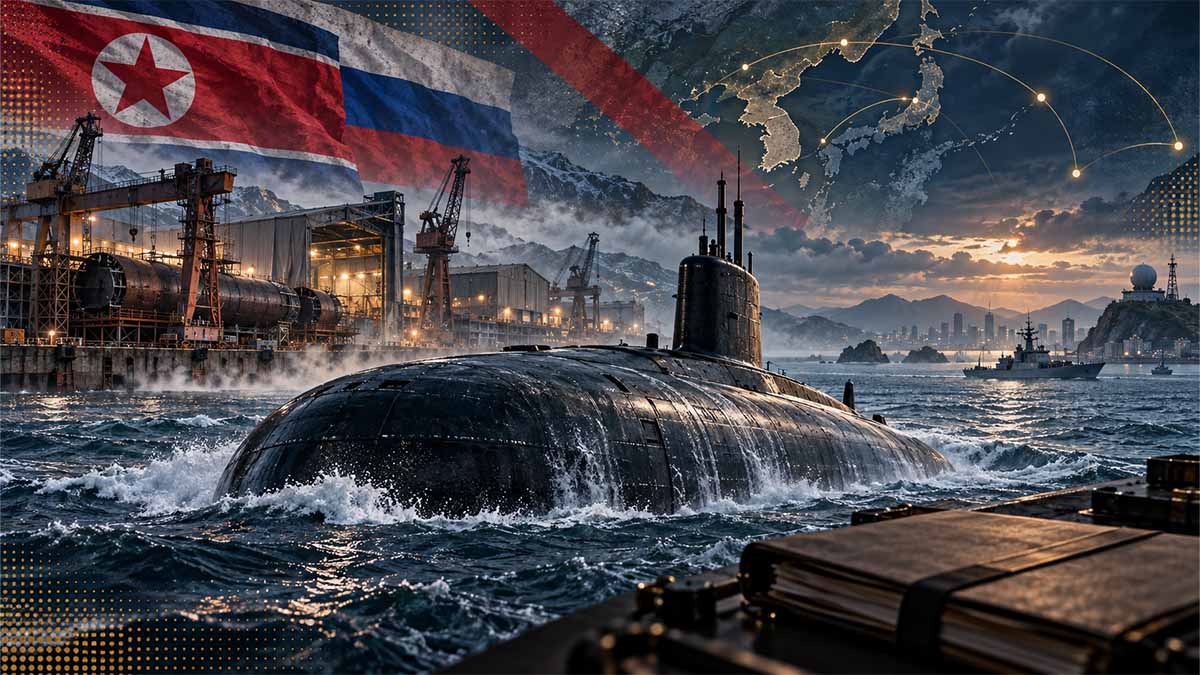
Strategic Intelligence Report | Naval Modernisation, Military Technology Transfers, Nuclear Deterrence and the International Security Implications, 2026–2031
Executive Summary — Principal Assessment
North Korea’s efforts to develop a submarine-based nuclear strike capability represent an increasingly consequential challenge to regional deterrence, not because Pyongyang has demonstrated a fully operational nuclear submarine force, but because it is seeking to diversify its nuclear delivery systems while developing a substantially closer military relationship with Russia.
The reported underwater launch of two different types of cruise missiles on 14 October 2026 indicates further progress in the integration of submarine weapons systems. South Korean military assessments support the occurrence of the launches and indicate the use of different launch arrangements. However, neither the operational readiness of the submarine concerned nor the nuclear status of its missile payloads has been independently established.
The more important strategic issue lies beyond the individual missile tests. North Korea’s defence-industrial relationship with Russia has evolved from conventional military cooperation into a broader exchange involving military equipment, operational experience, technical knowledge and material resources. Evidence collected by the Multilateral Sanctions Monitoring Team (MSMT) identifies Russian transfers of air-defence systems, electronic-warfare equipment and ballistic-missile performance feedback to North Korea. These findings demonstrate that military technology exchange is already taking place, although they do not establish a transfer of submarine nuclear propulsion technology.
Russia is the most consequential potential external source of advanced submarine-related assistance. Moscow possesses the technological capabilities relevant to Pyongyang’s ambitions, has demonstrated a willingness to supply restricted military equipment, and has a strong incentive to reward North Korean support for its war against Ukraine. Nevertheless, the distinction between a plausible supplier and a verified transfer remains essential.
China occupies a different position. Beijing remains central to North Korea’s economic resilience but has competing interests in avoiding nuclear instability, uncontrolled proliferation and greater American military involvement in Northeast Asia. Chinese involvement in submarine technology transfers cannot be assumed from its political and economic relationship with Pyongyang.
The strategic danger for Washington, Seoul and Tokyo is therefore cumulative: even a limited North Korean submarine-launched missile capability could increase surveillance burdens and crisis uncertainty; a future improvement in propulsion, acoustic performance, missile integration and command systems would create a substantially more difficult deterrence problem.
The decisive intelligence question is whether North Korea can transform isolated technological demonstrations into a reliably deployable and survivable undersea weapons force—and whether external support can shorten that transition.
North Korea’s Submarine Ambitions: How Russia’s War Is Reshaping the Economics of Nuclear Deterrence
North Korea’s pursuit of a submarine-based nuclear capability exposes a strategic contradiction that Washington, Seoul and European governments can no longer assess separately: Russia’s dependence on North Korean military supplies is creating opportunities for technological cooperation that could strengthen Pyongyang’s future nuclear deterrent, while forcing Western allies to allocate additional resources across two increasingly connected security theatres. The underwater cruise-missile tests reported on 15 October 2026 make that contradiction immediate. They demonstrate further weapons-system development, not an operationally proven nuclear submarine force. The distinction matters because Russia has already supplied North Korea with military equipment and missile-related technical assistance, while the transfer of submarine nuclear propulsion technology remains unconfirmed. For allied governments, the financial and security consequences depend on whether this established military partnership begins eliminating the industrial constraints that have historically limited North Korea’s strategic naval ambitions.
Russia Is Converting Wartime Dependence into Long-Term Military Influence
The military relationship between Moscow and Pyongyang has moved beyond the conventional exchange of diplomatic support. The Treaty on Comprehensive Strategic Partnership, signed on 19 June 2024, established a formal framework for bilateral assistance, including provisions concerning military support in circumstances defined by Article 4. The treaty gave institutional continuity to a relationship that Russia’s war against Ukraine had already made operationally valuable.
The scale of North Korean assistance explains why Pyongyang has acquired greater bargaining relevance. The Multilateral Sanctions Monitoring Team (MSMT) reported in May 2025 that participating-state assessments identified transfers to Russia of as many as 9 million artillery and rocket rounds during 2024, at least 100 ballistic missiles, and the deployment of more than 11,000 North Korean military personnel by late 2024. These quantities represent physical contributions to Russian military operations, not a financial valuation of the bilateral relationship. Their significance lies in the negotiating position created by sustained wartime supply.
Russia possesses technological resources that North Korea cannot readily reproduce, particularly in advanced naval propulsion, military electronics and complex weapons integration. The May 2025 MSMT report identified Russian transfers of air-defence and electronic-warfare equipment, together with technical feedback concerning North Korean ballistic-missile performance. According to participating-state information, Russian feedback contributed to improvements in missile guidance. That finding establishes an important precedent: Moscow has already provided militarily relevant technical assistance, although the report does not establish the transfer of submarine nuclear propulsion equipment.
This creates an asymmetrical exchange. Pyongyang can provide ammunition and personnel with relatively immediate battlefield value, while Moscow can potentially supply selected technologies whose benefits accumulate over longer development cycles. The precise contractual relationship between individual deliveries and Russian compensation remains [NOT IN DOSSIER]. What is documented is a military partnership in which both governments possess material incentives to continue cooperation.
The submarine programme introduces a further calculation. A more capable North Korean undersea force could increase the surveillance and defence resources required from the United States in Northeast Asia, potentially complicating Washington’s allocation of attention between European and Indo-Pacific security. Moscow might benefit from that pressure without transferring an entire submarine. It would nevertheless face the risks associated with disseminating sensitive technology and strengthening a nuclear-armed partner whose future decisions it cannot fully control.
The Figures Reveal Two Different Economies of Military Power
South Korea’s approved 2026 defence budget of KRW 65.8642 trillion, an increase of 7.5% over 2025, demonstrates the scale of resources already committed to military preparedness. Of that amount, KRW 19.9653 trillion was allocated to force improvement, an 11.9% annual increase. This expenditure covers broader modernisation requirements and cannot be attributed exclusively to North Korea’s submarine development. It nevertheless identifies the fiscal environment in which Seoul must respond to additional maritime surveillance, missile-warning and strategic readiness demands.
North Korea operates under a substantially less transparent financial structure. Its authorities announced defence expenditure equivalent to 15.8% of the state budget for fiscal year 2026, according to Japan’s Ministry of Defense. That percentage does not provide a reliable monetary estimate of total military expenditure or the cost of the submarine programme. The absence of audited project accounts makes a direct financial comparison with South Korea impossible.
The external economy offers more revealing indicators. Chinese customs statistics placed China–North Korea merchandise trade at approximately US$2.73 billion in 2025, close to the US$2.79 billion recorded in 2019. China therefore remains indispensable to Pyongyang’s commercial environment, even though recorded merchandise trade cannot be treated as financing for prohibited weapons development. The opening of the approximately 3-kilometre New Yalu River Bridge on 15 October 2026 added a significant piece of cross-border infrastructure, reinforcing economic connectivity without establishing any prohibited military use.
A separate source of external revenue emerged in the MSMT’s September 2026 assessment of North Korean overseas labour. The monitoring team estimated 35,600–101,280 North Korean workers in at least 17 countries, generating approximately US$450 million–US$800 million annually. The estimates included 15,000–30,000 workers in Russia, across activities extending to military drone manufacturing, steel processing and shipbuilding. Employment in those industries creates opportunities for industrial interaction, but it does not establish access to classified submarine programmes.
The figures describe different economic functions: Chinese trade supports commercial activity, overseas labour generates foreign earnings, and military cooperation with Russia supplies material resources and potential technical benefits. They cannot be added into a single estimate of North Korea’s weapons financing. Their combined strategic significance is that Pyongyang possesses several external channels through which resources, industrial relationships and political leverage can reinforce its domestic military development.
Submarine Construction Is Not the Same as a Survivable Nuclear Force
North Korea’s maritime ambitions must be measured against the limitations of its existing fleet. Japan’s 2026 Defense White Paper estimates approximately 790 North Korean naval vessels, with an aggregate displacement of roughly 100,000 tonnes, including approximately 20 ageing Romeo-class submarines and 30 smaller submarines. Numerical strength is therefore a misleading measure of strategic capability: the majority of these vessels cannot be equated with modern nuclear-powered missile submarines.
The Hero Kim Kun Ok, unveiled in September 2023, represents a different approach to naval modernisation. Its heavily modified Romeo-derived architecture accommodates an apparent arrangement of multiple missile-launching compartments. Yet conversion of an ageing conventional submarine does not eliminate the propulsion, acoustic and endurance limitations inherited from its technological foundation.
The missile launches reported on 14 October 2026 are consequential because South Korea’s Joint Chiefs of Staff identified two different underwater launch arrangements: one involving a vertical launch system and another a torpedo launcher. The demonstrations provide evidence of weapons-integration activity, but neither the full operational readiness of the submarine concerned nor the nuclear status of its missiles has been independently established.
North Korea’s separate nuclear-powered submarine programme presents a more demanding industrial proposition. Construction activity was publicly presented during 2025, followed by the disclosure of a declared 8,700-ton-class submarine in December. The announced displacement does not establish functioning nuclear propulsion, sustained submerged endurance or successful integration of strategic weapons.
These distinctions expose the central industrial constraint. Nuclear propulsion requires more than access to reactor components. It demands reliable integration of propulsion machinery, supporting systems, qualified personnel, maintenance infrastructure and long-term operational procedures. Acquiring foreign equipment may shorten selected development stages without establishing the ability to sustain a strategic submarine force independently.
For Russia, this creates several possible levels of technological assistance, ranging from specialised knowledge to equipment that addresses a specific engineering limitation. The public record does not establish which, if any, submarine-specific transfers have occurred. For North Korea, the risk is that technology acquired through political cooperation could accelerate initial development while creating continuing dependence on foreign maintenance, components or engineering services.
Sanctions Remain Legally Binding, but Their Enforcement Has Become More Political
The international legal framework already prohibits extensive categories of military and proliferation-sensitive cooperation with North Korea. United Nations Security Council Resolution 1718 (2006) and subsequent resolutions establish restrictions covering arms, associated technical assistance, specified technologies and financial activities. These measures can apply to technical services and training without requiring the delivery of a complete weapons platform.
Their effectiveness, however, is affected by the institutional divisions surrounding Russia. Moscow’s March 2024 veto prevented renewal of the mandate of the UN Panel of Experts responsible for monitoring North Korean sanctions. The mandate expired in April 2024, although the underlying Security Council obligations remained in force.
The MSMT, established by eleven governments in October 2024, subsequently documented military cooperation, cyber and information-technology worker activities, and overseas labour. Italy, France, Germany and the United Kingdom participate alongside Japan, South Korea, the United States and other partners. The mechanism preserves multinational investigative capacity but does not possess the same institutional status as the former UN expert panel.
The European Union demonstrated the importance of national and regional enforcement on 12 October 2026, when the Council added three individuals and four entities to its autonomous North Korea sanctions lists. The decision brought the totals to 80 individuals and 25 entities. The listings addressed activities involving nuclear and missile programmes, Russia-related cooperation and sanctions circumvention, including identified industrial and shipping relationships.
The restrictions illustrate both the possibilities and limits of enforcement. European authorities can designate identified actors, restrict financial access and address transactions within their jurisdiction. They cannot presume that every commercial relationship involving a sanctioned state constitutes submarine technology proliferation. Enforcement therefore depends on the ability to connect particular equipment, technical services or transactions to legally prohibited activities.
For European manufacturing economies, that evidentiary requirement is decisive. Machinery, industrial electronics and specialised engineering services may have legitimate commercial applications while also being relevant to military production. Effective controls must identify the actual transaction and end use rather than infer culpability from the nationality of an original manufacturer.
The legal prohibition is established. The difficulty lies in sustaining consistent implementation while a permanent member of the Security Council maintains a deepening military relationship with the sanctioned state.
Europe and the Indo-Pacific Are Becoming Connected Through Defence Production
NATO’s 8 November 2024 North Atlantic Council statement recognised the consequences of North Korean military support for Russia across both Euro-Atlantic and Indo-Pacific security. The significance was institutional: developments originating in the European war were no longer being assessed solely through European military requirements.
For Italy, the principal exposure concerns NATO security, industrial export controls and participation in international sanctions monitoring. Rome’s involvement in the MSMT provides an existing institutional channel for addressing prohibited cooperation without requiring a dedicated naval commitment to Northeast Asia. Italian machinery, automation and industrial services are relevant to the wider governance of sensitive exports, but the dossier establishes no specific Italian industrial transfer to North Korea’s submarine programme.
France approaches the issue through its independent nuclear deterrent, permanent membership of the UN Security Council and Indo-Pacific interests. It has a direct stake in preventing the uncontrolled dissemination of strategic technologies while preserving the readiness of its own military capabilities. The French position is therefore concerned as much with the precedent created by prohibited technological cooperation as with North Korea’s presently demonstrated submarine performance.
Germany faces a different combination of pressures. Its defence-industrial resources are relevant to European military production, while its manufacturing and export-control systems must address the possibility of sensitive technology diversion. Germany’s participation in the MSMT places those concerns within an international monitoring framework, although no verified German transfer to North Korea’s naval programme is established.
The United Kingdom’s Strategic Defence Review of 2025 identified growing connections among Russia, China, Iran and North Korea as factors complicating deterrence and escalation management. Its June 2026 ministerial consultations with Australia further recognised the implications of Russia–North Korea military cooperation for both regions. London therefore confronts a resource-allocation problem involving NATO, its nuclear submarine forces and Indo-Pacific engagement, rather than a requirement to reproduce the regional force posture of Japan or South Korea.
For Washington, the consequences are more direct. The US–South Korea Nuclear Consultative Group, the July 2024 Trilateral Security Cooperation Framework and the FREEDOM EDGE exercises already provide mechanisms for nuclear consultation, intelligence coordination and military interoperability. A more reliable North Korean missile-submarine force would increase the importance of those arrangements while generating additional surveillance and readiness demands.
The common structural issue is the cost of simultaneous commitments. European governments must support their own defence requirements while limiting prohibited technology exchanges; Indo-Pacific allies must respond to North Korean weapons development without assuming that every experimental system has become operational. Russia benefits politically when those demands compete for allied attention, even if it cannot determine the outcome of that competition.
The Next 24 Months Will Test Operational Evidence, Not Political Announcements
Between October 2026 and October 2028, the decisive developments will concern the transition from isolated missile demonstrations and submarine construction toward repeated, operationally meaningful evidence. Further tests alone would demonstrate programme continuity. Credible propulsion trials, sustained submarine deployments and repeated weapons integration would justify a more substantial reassessment of North Korea’s military capabilities. Independently corroborated transfers of advanced Russian naval technology would alter the industrial forecast, but would not automatically establish the successful operation of a nuclear-powered strategic submarine.
The most immediate cost of inaction would fall on South Korea and Japan, whose authorities would have to maintain missile warning, maritime awareness and crisis readiness while confronting a potentially wider range of launch locations. The United States would absorb additional planning and force-allocation demands across its regional commitments. European governments would face the consequences of weaker export-control enforcement, insufficient technical intelligence exchange and the possible strengthening of Russian military partnerships that connect the war in Ukraine with future proliferation risks.
Those costs would not necessarily appear as a single new defence appropriation. They would accumulate through surveillance requirements, military operating expenditure, industrial compliance obligations and the need to maintain specialised capabilities that cannot be transferred instantly between theatres. South Korea’s KRW 65.8642 trillion defence budget for 2026 already illustrates the scale of the wider financial environment in which new requirements must compete for resources.
The opposite error would also carry a price. Treating North Korea’s declared 8,700-ton submarine as an operationally proven nuclear deterrent could encourage procurement and military responses unsupported by the demonstrated capability. The choice facing allied governments is therefore not between ignoring Pyongyang and accepting every claim of technological progress. It is between maintaining an evidence-based response and allowing incomplete information to determine long-term military expenditure.
Over the next 12–24 months, the decisive policy outcome will depend on whether allied governments can distinguish actual technical advances from political declarations while investigating the external relationships that may accelerate North Korea’s development. If they fail, the financial burden will be borne by South Korean, Japanese, American and European defence systems; the strategic benefit will accrue to governments capable of turning relatively limited technological advances into disproportionate demands on their adversaries.
Navigational Index
PILLAR I — NAVAL CAPABILITY AND THE EVOLUTION OF NUCLEAR DETERRENCE
- Chapter 1. North Korea’s Undersea Strategic Transformation
- Chapter 2. Submarine Architecture, Missile Systems and Operational Constraints
- Chapter 3. Nuclear Survivability, Second-Strike Credibility and Escalation Risks
PILLAR II — FOREIGN TECHNOLOGY, INDUSTRIAL DEPENDENCE AND GEOPOLITICAL EXCHANGE
- Chapter 4. Russia’s Strategic Bargain with Pyongyang
- Chapter 5. China, Historical Technology Networks and Dual-Use Dependencies
- Chapter 6. Technology Transfer, International Sanctions and Proliferation Pathways
PILLAR III — REGIONAL SECURITY AND GLOBAL CONSEQUENCES
- Chapter 7. South Korea, Japan and the United States: A Changing Maritime Deterrence Environment
- Chapter 8. European Security: Implications for Italy, France, Germany, the United Kingdom and the EU
- Chapter 9. Strategic Scenarios, Early-Warning Indicators and the 2026–2031 Outlook
Master Strategic Abstract
North Korea’s naval modernisation should be understood as an attempt to resolve a fundamental vulnerability in its nuclear posture: the exposure of land-based forces, supporting infrastructure and political command systems to surveillance, precision strikes and potential disruption during a major crisis. A credible submarine-based deterrent could complicate that vulnerability by introducing additional uncertainty over the location and survivability of nuclear delivery platforms. Yet the gap between possession of a missile-capable submarine and possession of an effective second-strike capability remains substantial. A submarine must be able to operate reliably, avoid detection, launch under realistic conditions and maintain assured command arrangements. Progress in any one of these areas does not establish progress in all of them.
The geopolitical dimension is equally significant. Russia’s increasingly institutionalised defence relationship with Pyongyang has changed the strategic environment in which North Korean military programmes develop. The 2025 MSMT report documented extensive military exchanges and identified Russian transfers of air-defence and electronic-warfare systems, together with support relevant to ballistic-missile performance. Separately, the United States’ 2026 intelligence assessment recognised that North Korea had acquired equipment and modern combat experience through its support for Russia.
These developments make the possibility of more advanced technology cooperation a serious security concern. They do not, however, establish that Moscow has transferred submarine reactors, naval propulsion designs, acoustic-reduction technologies or nuclear submarine operating expertise.
The most important potential consequence would be a shift from an emerging, relatively vulnerable submarine missile capability toward a more survivable force capable of placing greater demands on allied intelligence, anti-submarine warfare and nuclear crisis management. Such a transformation would connect the security consequences of Russia’s war in Ukraine with the military balance in Northeast Asia. The threat is therefore not confined to Korean waters: it concerns the durability of international non-proliferation controls, the future of Russian–North Korean military cooperation, and the possibility that technology exchanged through one conflict could increase strategic instability in another.
Key Evidence and Strategic Indicators
The following evidence distinguishes demonstrated capabilities, official assessments and strategically important but unresolved propositions.
| Indicator | Verified value or status | Reference date | Strategic significance |
|---|---|---|---|
| Underwater cruise-missile testing | Two missile types reported; South Korea assessed vertical and torpedo-tube launches | 14 October 2026 | Evidence of advancing underwater weapons integration |
| Hero Kim Kun Ok | Modified diesel-electric submarine unveiled in 2023 | September 2023 | Potential intermediate platform for a more diversified missile force |
| Nuclear-powered submarine programme | Construction publicly presented by Pyongyang; operational capability not established | 2025–2026 | Potential transition toward substantially longer submerged endurance |
| North Korean ammunition transfers to Russia | As many as 9 million artillery and rocket rounds in 2024, according to an MSMT participating state | 2024 | Demonstrates the scale of the military exchange |
| North Korean ballistic missiles supplied to Russia | At least 100, according to an MSMT participating state | 2024 | Establishes substantial missile-related military cooperation |
| North Korean troops deployed to Russia | More than 11,000, according to the MSMT | Late 2024 | Creates incentives for Russian compensation and military cooperation |
| Russian technology and equipment supplied to North Korea | Reported air-defence systems, electronic-warfare equipment and missile-performance feedback | 2024–2025 | Evidence that technology-related military exchange extends beyond ammunition |
| Russian nuclear submarine propulsion transfer | Public allegations exist; precise transfers remain unconfirmed in the examined first-order record | As of October 2026 | The most consequential unresolved technology question |
Sources: MSMT/2025/1 — Multilateral Sanctions Monitoring Team — May 2025; 2026 Annual Threat Assessment — Office of the Director of National Intelligence — Mar 2026. For the October launches, the relevant contemporaneous reporting attributes the launch information to KCNA and South Korea’s Joint Chiefs of Staff.
Strategic Assessment: Who Could Provide the Technology, and Why?
Russia: The strongest candidate for consequential technology transfer
Russia stands at the centre of the foreign-assistance question because three circumstances now converge: its military-industrial expertise, the requirements of its war against Ukraine, and its strategic interest in constraining American influence beyond Europe.
The Russian Federation possesses extensive experience in nuclear-powered submarine construction, marine reactor technologies, naval propulsion, missile-launch integration and undersea combat systems. This industrial foundation gives Moscow the technical ability to provide knowledge or equipment relevant to Pyongyang’s long-term submarine ambitions.
That capability does not mean Russia has necessarily transferred its most sensitive systems. The more defensible conclusion is that Moscow has both the means and a demonstrated military relationship through which further assistance could be provided.
The MSMT’s May 2025 report attributed several concrete developments to information obtained from participating states. They included the transfer of at least one Pantsir-class air-defence vehicle, advanced electronic-warfare and jamming equipment, and Russian feedback on the performance of North Korean ballistic missiles. According to the report, this feedback contributed to improvements in guidance performance.
These observations are important because technical feedback may be strategically valuable without involving the delivery of an entire weapon system. Access to operational performance information can help an industrial programme identify deficiencies, improve components and prioritise future tests.
Unlawful Military Cooperation Including Arms Transfers between North Korea and Russia — MSMT — May 2025, particularly the section on transfers from Russia to North Korea.
The economic and military exchange also provides a plausible explanation of Russia’s incentives. North Korea supplied ammunition, missiles and military personnel that supported Russian operations. Moscow, in turn, possessed equipment, industrial capabilities, operational knowledge and resources that Pyongyang sought to obtain.
This creates a relationship in which advanced military cooperation can function as a form of strategic compensation without necessarily taking the shape of a conventional commercial transaction.
A particularly consequential allegation emerged in 2025 concerning possible Russian assistance for North Korea’s nuclear-powered submarine programme. Reporting attributed to South Korean intelligence suggested that Russian nuclear submarine components—including reactor-related and propulsion equipment—might have been supplied to North Korea. South Korea’s defence minister also publicly indicated that Russian technical assistance to the North Korean submarine programme was likely.
These assessments are materially important, but the examined public record does not establish an independently verified inventory of transferred propulsion equipment, an identified donor submarine or the successful integration of a Russian reactor into a North Korean vessel.
Even if a transfer were established, the engineering consequences would depend on its precise contents. Receiving reactor components is not equivalent to acquiring a safe, certified and operational submarine nuclear propulsion system. Materials, cooling arrangements, shielding, vibration control, reactor operation, maintenance infrastructure and qualified personnel remain essential.
The strategic logic nevertheless remains compelling for Moscow.
First, strengthening North Korea could force the United States to devote more attention and resources to Northeast Asian security at a time when Russia benefits from divisions in Western strategic priorities.
Second, military cooperation helps maintain a dependable source of North Korean conventional ammunition and other battlefield support.
Third, a deeper defence relationship reinforces a broader political alignment intended to challenge Western sanctions and security arrangements.
Fourth, technological assistance may create long-term industrial dependence. A recipient that requires spare parts, technical services, training or specialised maintenance can become increasingly reliant on the original supplier.
There are also limits to Russian incentives. A substantially more autonomous North Korean nuclear force could increase regional instability beyond Moscow’s direct control. Transferring sensitive nuclear naval technology would carry proliferation and intelligence risks, and Russia may wish to protect capabilities important to its own submarine fleet.
For these reasons, selective technical assistance is more firmly supported as an analytical pathway than an assumption of unrestricted transfer of Russian submarine technology.
China: Economic influence does not establish submarine technology sponsorship
China’s role requires a separate assessment.
Beijing remains North Korea’s most important trading partner and economic benefactor, as the United States’ March 2026 intelligence assessment explicitly recognised. That economic relationship contributes to North Korea’s resilience and therefore forms part of the wider environment sustaining its military programmes.
China also possesses sophisticated submarine-building capabilities and an advanced defence-industrial ecosystem. Technically, this creates the possibility of Chinese-origin equipment, specialised components or engineering knowledge becoming relevant to North Korean programmes.
However, the possession of relevant technology, the ability of Chinese-origin goods to enter international supply chains, and deliberate Chinese government assistance to a North Korean nuclear submarine programme are three different propositions.
No evidence examined for this report establishes an authorised Chinese transfer of nuclear submarine propulsion technology to Pyongyang.
Beijing’s interests are also contradictory. It has an interest in maintaining North Korea as a strategic buffer and preventing destabilising regime collapse. At the same time, increasingly credible North Korean nuclear weapons could stimulate Japanese and South Korean military expansion, reinforce American regional alliances and intensify nuclear proliferation debates.
China may therefore regard some forms of North Korean military resilience as useful while viewing the emergence of a more capable and independent nuclear submarine force as destabilising.
The most defensible assessment is that China is an important structural enabler of North Korea’s economic survival, but not a verified supplier of its emerging nuclear submarine technology.
North Korea’s domestic industry and historical technology foundations
An exclusively foreign-supplier explanation would underestimate the accumulated capabilities of North Korea’s domestic defence-industrial establishment.
Pyongyang has spent decades adapting inherited technologies, modifying older submarine designs, developing indigenous missile systems and conducting weapons tests. Its existing industrial base therefore provides a significant element of continuity between earlier submarine projects and its present ambitions.
Historically, North Korea’s submarine fleet has drawn on Soviet-derived designs and engineering traditions, including the Romeo-class technological lineage. The current submarine modernisation effort should consequently be understood as a combination of indigenous adaptation, historical design inheritance and the potential acquisition of new foreign expertise.
The distinction matters. A submarine that incorporates Soviet-derived architectural features is not, by itself, evidence of a recent Russian technology transfer.
Likewise, acquiring commercially produced electronics or dual-use industrial components through intermediaries does not automatically establish that the government of the manufacturing country authorised their final military application.
North Korea’s industrial autonomy remains limited by the difficulty of building high-performance submarines. Nuclear propulsion is particularly demanding because it combines naval engineering, nuclear reactor technology, marine safety, specialist materials and long-term operational support.
A state may possess nuclear weapons expertise and still lack the industrial maturity required to operate nuclear-powered submarines safely and reliably.
Comparative Assessment of Potential Technology Sources
| Actor or channel | Established relationship | Potential technology relevance | Assessment |
|---|---|---|---|
| Russia | Documented military exchange, equipment transfers and operational cooperation | Naval propulsion, missile integration, sensors, combat systems and engineering expertise | Most consequential candidate; precise submarine transfers unresolved |
| China | Extensive economic and political relationship | Industrial machinery, electronics, materials and possible naval technologies | Important economic influence; no verified nuclear submarine propulsion transfer |
| North Korean domestic industry | Demonstrated submarine modification and missile-development activity | Hull engineering, missile integration, systems adaptation and testing | Essential contributor; significant capability constraints remain |
| Historical Soviet-derived technology | Long-established design inheritance | Submarine architecture and legacy engineering knowledge | Relevant technological foundation, not evidence of new deliveries |
| Third-country commercial supply chains | Foreign components have been identified in North Korean weapons | Electronics, machine tools, specialist materials and dual-use items | Proliferation and sanctions-enforcement concern; supplier-state intent cannot be presumed |
Legal and Proliferation Consequences
The potential transfer of advanced submarine systems cannot be evaluated solely as a bilateral defence transaction.
United Nations Security Council Resolution 1718 (2006), together with subsequent resolutions, established extensive prohibitions concerning arms, missile-related technologies and technical assistance to North Korea. Those restrictions remain relevant to the provision of military equipment, services, expertise and sensitive technology.
The Security Council’s sanctions framework prohibits transfers of arms and related materiel and restricts scientific and technical cooperation in proliferation-sensitive areas. Any identified transfer therefore requires assessment according to the precise technology involved, its military application and the operative provisions of the relevant resolutions.
Security Council Committee Established Pursuant to Resolution 1718 — United Nations
The geopolitical problem has been aggravated by Russia’s 2024 veto of the renewal of the UN Panel of Experts responsible for monitoring North Korean sanctions. The creation of the MSMT in October 2024 provided an alternative monitoring mechanism, but it did not restore the former UN expert panel or its institutional authority.
This creates a distinction between the continued existence of binding sanctions obligations and the international community’s ability to investigate and document violations effectively.
The consequences could extend beyond the Korean Peninsula. If a sanctioned state’s participation in a foreign war creates access to restricted defence technology, the resulting exchange may weaken the practical deterrent effect of export controls and sanctions regimes.
Regional Consequences: South Korea, Japan and the United States
The most immediate operational implications concern the Republic of Korea.
South Korea would have to account for a larger range of potential underwater launch locations, a more diversified missile threat and the possibility of detecting submarine preparations before weapons could be launched. An improvement in North Korean submarine capability would reinforce the importance of undersea surveillance and cooperation with American forces.
For Japan, a more capable North Korean submarine missile force would complicate maritime situational awareness and missile-defence planning. The challenge would include not only the missiles themselves but also the intelligence required to distinguish routine naval movement from preparations for a strategic operation.
For the United States, the principal concern is the possible introduction of an additional source of uncertainty into extended nuclear deterrence.
A genuinely survivable North Korean undersea nuclear force would be harder to neutralise through attacks against known land-based infrastructure. That change could affect crisis calculations even if the number of deployed submarines remained small.
Nevertheless, submarine survivability is not an automatic consequence of underwater missile-launch capability. The large acoustic, mechanical and logistical differences between a modified diesel-electric vessel and a mature nuclear-powered attack or ballistic-missile submarine remain fundamental.
An immature submarine deterrent might also generate instability rather than strategic reassurance. If North Korean decision-makers feared that a small number of missile submarines could be rapidly detected or destroyed, they could face incentives to disperse platforms, increase readiness or interpret surveillance activity as preparation for attack.
The danger would therefore involve both enhanced North Korean capabilities and the possibility of misunderstanding during a rapidly escalating crisis.
European Security Implications
Europe is not geographically exposed to North Korea’s submarine programme in the same manner as South Korea and Japan. Its strategic exposure is indirect but substantial because the defence relationship between Moscow and Pyongyang connects European and Asian security.
Italy has an interest in the effectiveness of international sanctions, NATO deterrence cohesion and the protection of maritime security architectures. Rome’s participation in the MSMT reflects its role in efforts to document and constrain North Korean proliferation activities.
France has additional interests arising from its independent nuclear deterrent, permanent membership of the UN Security Council and Indo-Pacific security commitments. French policy must consider the precedent created if sensitive military technologies become instruments of compensation between nuclear-armed states and sanctioned partners.
Germany faces a related challenge through its security commitments within NATO, its industrial export-control responsibilities and the implications of Russian military cooperation for the European security order. Technology transfers that strengthen Russia’s partners can increase the strategic costs of confronting Moscow’s wider network of military relationships.
The United Kingdom combines a nuclear deterrent, advanced naval capabilities, NATO commitments and substantial intelligence cooperation with the United States. London therefore has a direct institutional interest in preventing submarine-related proliferation and maintaining the credibility of the international sanctions system.
For the European Union collectively, the issue concerns enforcement capacity, dual-use export controls, sanctions circumvention and the possibility that industrial components and financial transactions originating outside North Korea could support prohibited military development.
European governments should not assume that developments in the Pacific are strategically disconnected from the war in Ukraine. A technology-for-military-support relationship creates potential transmission effects between the two theatres.
Competing Strategic Pathways, 2026–2031
Three principal pathways describe how the programme could evolve. They are not mutually exclusive, and the available evidence does not justify assigning numerical probabilities.
| Strategic pathway | Supporting considerations | Principal constraints | Indicators to monitor |
|---|---|---|---|
| Indigenous, incremental modernisation | Existing submarine development and underwater missile tests | Legacy hull designs, propulsion constraints, uncertain readiness | Repeated sea trials, patrol duration, reliable submerged launches |
| Selective Russian technological assistance | Established military cooperation, documented transfers in other systems, strong strategic incentives | Unverified submarine-specific deliveries, Russian security and proliferation concerns | Identifiable equipment, technical exchanges, reactor-related infrastructure |
| Accelerated nuclear-powered submarine development | Public construction programme and potential access to external expertise | Reactor integration, acoustic performance, crew training, maintenance and safety | Sustained sea trials, propulsion validation, dedicated support facilities |
The most consequential shift would occur if the second and third pathways reinforced each other: selective Russian assistance removing critical bottlenecks in North Korea’s domestic submarine programme.
Such a development could materially shorten the period required to produce a more capable platform. It would not eliminate the lengthy operational learning curve associated with naval nuclear propulsion and undersea strategic missions.
Principal Intelligence Gaps and Watch Indicators
Four unresolved questions are decisive to assessing the future balance of risk.
The first concerns the supplier relationship. The public record needs stronger first-order evidence establishing whether Russia has delivered equipment specifically intended for nuclear submarine propulsion, missile-launch systems or submarine acoustic improvements.
The second concerns operational readiness. Repeated testing at sea, reliable propulsion, demonstrated patrol endurance and successful integration of weapons would provide stronger evidence than isolated launch events.
The third concerns nuclear weapons integration. The use of the term strategic does not, by itself, establish that a submarine-launched missile carries an operationally deployable nuclear warhead. Warhead qualification, integration and command arrangements remain separate requirements.
The fourth concerns strategic intent. North Korea may seek a survivable retaliatory capability, additional regional strike options, greater bargaining leverage or some combination of these objectives. Its declared doctrine and observed force development should be assessed together, rather than treating any one motivation as established.
The key early-warning indicators are therefore not simply additional photographs of submarines or missile launches. They are repeated, technically meaningful observations demonstrating sustained deployment capacity, improved survivability, new industrial infrastructure and identifiable foreign assistance.
Final Strategic Judgment
The emerging North Korean submarine challenge is best understood as a problem of technological convergence and geopolitical exchange.
Pyongyang is attempting to expand the survivability and flexibility of its strategic arsenal. Moscow has established a military relationship that provides both the political conditions and potential industrial channels for more advanced assistance. Beijing remains economically important but has distinct strategic incentives, while North Korea’s domestic military-industrial capabilities continue to underpin the programme.
The October 2026 underwater missile demonstrations provide evidence of progress but do not resolve the central questions of nuclear capability, operational reliability and survivability.
The most significant finding is that the obstacles confronting North Korea are no longer exclusively domestic engineering challenges. They may increasingly be influenced by the political decisions of another technologically capable military power.
If Russia supplies critical undersea technologies, North Korea’s submarine development could advance more rapidly than its historical industrial limitations would otherwise suggest. If such transfers remain restricted or fail to resolve integration problems, Pyongyang may continue to field missile-capable but operationally vulnerable platforms.
The distinction will determine whether North Korea’s submarine programme remains primarily an instrument of coercive signalling or develops into a more credible component of its nuclear deterrent.
For the United States and its regional allies, that difference is strategically decisive. For Europe, it illustrates a wider proliferation risk: military cooperation sustained by the war in Ukraine could generate enduring security consequences far beyond the European theatre.
No decision-useful quantitative visualisation is supportable from the verified record. The available figures document military cooperation but do not provide a comparable series measuring submarine operational capability or nuclear-propulsion progress.
NORTH KOREA’S UNDERSEA NUCLEAR AMBITIONS
Who could supply critical technology, why it matters, and how foreign assistance could reshape deterrence in Northeast Asia.
These numbers measure different activities. They are deliberately not placed on a common quantitative axis or converted into a composite risk score.
01 / The technology and influence network
Three-dimensional schematic of the principal relationships. Solid green edges indicate documented cooperation or domestic development; amber dashed edges indicate potential technological relevance; red dotted lines indicate the unresolved specific nuclear-submarine-transfer proposition.
Relationship lines show evidence categories, not the direction of a verified component shipment. The reactor-technology question remains unresolved in the publicly examined first-order record.
02 / From a missile test to credible undersea deterrence
A dimensional capability staircase. These are successive analytical requirements, not verified completed milestones. A single submerged launch cannot demonstrate the subsequent stages.
The staircase is ordinal and conceptual. The spacing, height and 3D visual depth have no numerical or probabilistic meaning.
03 / Who could provide technology—and why?
Russia
Incentive: compensate wartime support, reinforce strategic alignment and divert allied security resources. Evidence: documented military equipment exchange. Limit: submarine reactor transfer not established.
China
Incentive: preserve regional buffer and stability. Concern: stronger North Korean nuclear forces may intensify US-allied military responses. Limit: Chinese nuclear propulsion transfer not established.
North Korea
Driver: diversify launch platforms and reduce reliance on exposed land-based forces. Evidence: legacy-hull modification, submarine-missile tests and reported new construction. Limit: sustained operational performance.
04 / Evidence and attribution table
| Observation | Reported status | What it establishes | What it does not establish |
|---|---|---|---|
| 14 October underwater cruise-missile launches | Two different launch arrangements reported; South Korean military tracked launches | Underwater weapon-system testing | Submarine identification beyond doubt, operational nuclear payloads, or patrol readiness |
| North Korean ammunition deliveries to Russia | Up to 9 million artillery and rocket rounds in 2024, per MSMT participating state | Scale of wartime military exchange | Precise financial or technology compensation terms |
| North Korean ballistic missiles to Russia | At least 100 during 2024, per MSMT participating state | Missile-related materiel transfers | Specific naval missile technology deliveries in return |
| Russian equipment and feedback to North Korea | Air defence, electronic warfare and ballistic-missile performance feedback identified by MSMT | Technology-related military cooperation | Transfer of nuclear submarine propulsion machinery |
| North Korean nuclear submarine construction | Programme publicly presented during 2025–2026 | Declared development ambition and visible construction activity | Functional reactor, completed sea trials or operational deployment |
Numbers retain the attribution and period in the source material. “Up to” and “at least” are not interchangeable with exact totals.
05 / Strategic consequences and watchpoints
South Korea · Japan · United States
Potential expansion of undersea surveillance demands, launch-location uncertainty, anti-submarine operations and crisis-management pressures—conditional on actual deployability and survivability.
Europe · NATO · EU
Military exchanges linked to Ukraine may create longer-term security consequences in Northeast Asia. The EU, UK, France, Germany and Italy have interests in sanctions, export controls and allied coordination.
What would change the assessment?
Repeated sustained sea trials, validated reactor operations, clear evidence of foreign components, demonstrated quieting improvements and authenticated nuclear command integration.
06 / Source base and evidentiary boundaries
Primary-source foundation: Multilateral Sanctions Monitoring Team, Report MSMT/2025/1 (May 2025); US Office of the Director of National Intelligence, 2026 Annual Threat Assessment (March 2026); UN Security Council, DPRK sanctions framework. The October 2026 launch event follows contemporaneous reporting citing KCNA and South Korea’s Joint Chiefs of Staff; the public record does not independently establish all platform and weapons characteristics.
Evidence rule: supplier capability is not proof of supply; stated programme ambition is not operational performance; military exchange is not proof of a nuclear-propulsion transfer. No quantitative risk scores or fictional operational inventories are presented.
PILLAR I — NAVAL CAPABILITY AND THE EVOLUTION OF NUCLEAR DETERRENCE
North Korea’s Submarine Nuclear Transformation: Strategic Doctrine, Naval Engineering, Operational Vulnerabilities and the Changing Structure of Deterrence in Northeast Asia
Geographic scope: Korean Peninsula, Sea of Japan/East Sea, Western Pacific and the United States’ regional security architecture. Assessment period: 2015–16 October 2026, with strategic implications examined through 2031.
Chapter 1. North Korea’s Undersea Strategic Transformation
The transformation of a coastal navy into a strategic weapons carrier
North Korea’s submarine modernisation represents an attempt to transform the strategic function of a naval force historically structured around coastal defence, infiltration operations, maritime denial and asymmetric confrontation. The significance of this transformation cannot be measured simply by counting submarines or missile-launching compartments. It lies in Pyongyang’s decision to integrate its naval forces into a nuclear military posture previously dominated by land-based ballistic missiles, mobile launch systems and hardened military infrastructure.
The transition is especially consequential because North Korea does not possess the conventional maritime superiority necessary to compete directly with the United States, South Korea or Japan. Its naval strategy must therefore extract disproportionate military and political value from relatively limited platforms. Submarine-launched missiles provide one possible means of achieving that objective by expanding the number of potential attack origins, creating additional demands on opposing surveillance systems and introducing uncertainty into the calculation of which North Korean strategic assets could survive a major confrontation.
The quantitative baseline demonstrates the scale of the disparity between North Korea’s existing naval inventory and its strategic ambitions. Japan’s Ministry of Defense, in its 2026 Defense White Paper, estimates that North Korea possesses approximately 790 naval vessels with an aggregate displacement of roughly 100,000 tons, including approximately 20 ageing Romeo-class submarines and 30 smaller submarines believed to support missions such as special-forces infiltration. These figures describe the broader naval inventory and must not be interpreted as the number of missile-capable submarines or vessels suitable for nuclear missions.
The same Japanese assessment identifies a navy whose numerical inventory remains substantial but whose force structure is dominated by smaller vessels. North Korea’s effort to introduce larger missile-carrying submarines therefore represents a qualitative departure from much of its historical naval composition rather than a straightforward expansion of existing capabilities.
The strategic rationale becomes clearer when the maritime programme is placed within North Korea’s wider military development strategy. Japanese defence authorities assess that Pyongyang has sought to strengthen both its nuclear deterrent and its capacity to respond to conflicts involving conventional weapons and tactical nuclear systems. This distinction is central. North Korea is not necessarily developing naval nuclear weapons solely to guarantee retaliation after a devastating first strike. It may also seek additional options for regional coercion, operational surprise and escalation management during a conflict that begins below the nuclear threshold.
A submarine equipped with cruise missiles could contribute to regional strike options without possessing the characteristics of a traditional strategic ballistic-missile submarine. Conversely, a platform able to carry longer-range ballistic missiles could potentially support deterrence against more distant adversaries, although its strategic usefulness would still depend on survivability, readiness and command arrangements.
These missions overlap but are not interchangeable. Treating every North Korean submarine missile as evidence of a mature second-strike capability would exaggerate the programme’s current operational significance.
Historical development: from experimental underwater launch systems to naval nuclear institutionalisation
The development of North Korea’s submarine missile programme has proceeded through several distinct stages, each addressing a different technological or organisational challenge.
Its earlier efforts demonstrated the possibility of launching missiles from underwater platforms. Subsequent developments sought to move beyond experimentation toward vessels capable of carrying more than one weapon type. The programme has increasingly been accompanied by public declarations that nuclear weapons must become an integral component of the navy rather than remain concentrated within land-based strategic forces.
An important milestone occurred in May 2015, when North Korea announced that it had conducted an underwater ballistic-missile launch. The event formed part of a wider sequence of experiments involving the Pukguksong family of submarine-launched ballistic missiles. Japanese defence assessments subsequently identified the Gorae-class submarine as a principal experimental launch platform and assessed that its role was largely related to testing.
The development of the Pukguksong-3 system, tested in October 2019, demonstrated an additional effort to expand the performance characteristics of submarine-launched ballistic missiles. However, a successful missile flight does not prove that the weapon has been integrated into a deployable submarine combat system. A test from an underwater platform can validate individual launch functions while leaving unresolved the ability of a submarine to carry, maintain, control and fire the same weapon during a prolonged operational deployment.
The political significance of the programme increased in January 2021, when Kim Jong Un publicly identified nuclear-powered submarines among North Korea’s military development objectives. This ambition was subsequently linked to the broader programme of defence science and weapons-system development adopted at the Eighth Congress of the Workers’ Party of Korea.
The 2023 unveiling of the Hero Kim Kun Ok, a substantially modified Romeo-derived submarine, marked another visible stage. Rather than beginning with a completely new submarine architecture, Pyongyang appeared to have converted an existing design into a larger missile carrier. This approach allowed North Korea to demonstrate progress in naval missile integration while continuing to confront the limitations of an older propulsion and hull-design foundation.
The development programme then advanced toward a separate nuclear-powered submarine project, whose construction was publicly presented in 2025. By December of that year, North Korean media had disclosed additional material describing work on a much larger submarine.
The Japanese Ministry of Defense’s 2026 assessment records the December 2025 disclosure and places the project within the defence-development priorities established at the Eighth Party Congress. It does not establish that North Korea has completed or operationally deployed a nuclear-powered submarine.
Table 1.1 — Development milestones and evidentiary significance
| Date | Programme development | What the evidence establishes | What remains unresolved |
|---|---|---|---|
| May 2015 | North Korea announces an underwater ballistic-missile launch | Beginning of a publicly documented submarine ballistic-missile test sequence | Operational submarine deployment and sustained launch reliability |
| October 2019 | Pukguksong-3 ballistic-missile test | Development of another submarine-oriented ballistic-missile design | Integration aboard a patrol-capable submarine |
| January 2021 | Nuclear-powered submarines identified among defence objectives | Formal political commitment to naval nuclear propulsion | Reactor maturity, construction capacity and operational schedule |
| September 2023 | Hero Kim Kun Ok unveiled | Physical modification of an older submarine into a missile-oriented platform | Mission readiness, survivability and full weapon configuration |
| March 2025 | Construction activity associated with a nuclear-powered submarine publicly shown | A large submarine development project is underway | Installed propulsion technology and construction completion |
| December 2025 | North Korea presents further construction material for a declared 8,700-ton submarine | Programme has progressed sufficiently for further public presentation | Actual displacement, propulsion validation and operational capability |
| 14 October 2026 | Two types of submarine-launched cruise missiles tested | Further underwater weapons-system testing | Full mission capability and independently established submarine identity |
The first six developments are addressed in Japan’s official defence assessments, while the October 2026 activity was reported by the Korean Central News Agency and described at a South Korean Joint Chiefs of Staff briefing. Sources: Defense of Japan 2026 — Japan Ministry of Defense — 2026; North Korea’s Submarine Missile Test and South Korean Military Assessment — Yonhap News Agency — 15 October 2026.
The chronology indicates institutional continuity across several generations of technology. It does not support the proposition that North Korea suddenly acquired a complete modern undersea nuclear capability in 2026.
Instead, the evidence is consistent with a gradual attempt to resolve separate technological requirements: underwater launch, missile integration, larger submarine construction and, ultimately, naval nuclear propulsion. Each requirement demands different industrial skills and may progress at a different rate.
The implications of North Korea’s 2026 military priorities
The Ninth Congress of the Workers’ Party of Korea, held in February 2026, introduced a new five-year policy horizon for military development. Japan’s Ministry of Defense records that Kim Jong Un presented additional priorities for the following five years and assesses that Pyongyang is likely to continue expanding both research and operational capability across multiple weapons categories.
This matters because the submarine programme is unlikely to be managed as an isolated naval procurement initiative. It competes for resources with land-based ballistic missiles, nuclear warhead production, air defence, conventional naval construction, cyber capabilities and wider military modernisation.
The resource implications are substantial. North Korea must allocate specialised engineers, industrial facilities, advanced materials, skilled labour and testing infrastructure to a programme whose military return may be delayed for years. At the same time, its leadership has publicly prioritised a wider transformation of conventional forces.
The Japanese 2026 White Paper records that North Korea announced a defence expenditure share of 15.8% of its state budget for fiscal year 2026, while cautioning that the official figure probably represents only part of actual military spending.
This is an important statistical limitation. The published budget percentage cannot be converted into a reliable estimate of submarine investment because the financial value of the overall state budget, comprehensive military accounting and project-specific expenditure are not sufficiently transparent in the cited record.
Table 1.2 — Naval and defence-industrial baseline
| Indicator | Officially reported value | Source reference period | Analytical interpretation |
|---|---|---|---|
| Total North Korean naval vessels | Approx. 790 | 2026 Japanese defence assessment | Numerically large but predominantly smaller naval force |
| Aggregate naval displacement | Approx. 100,000 tonnes | 2026 | Measures fleet size, not available submarine striking capacity |
| Romeo-class submarines | Approx. 20 | 2026 | Legacy submarine inventory; not all are strategic missile carriers |
| Smaller submarines | Approx. 30 | 2026 | Primarily associated with missions such as infiltration |
| Gorae-class experimental submarine | 1 assessed vessel | 2026 | Principal identified SLBM test platform |
| Gorae-class displacement | Approx. 1,500 tonnes | 2026 | Japanese official estimate for the test submarine |
| Declared large nuclear-powered submarine project | 8,700-ton class, according to North Korean presentation | December 2025 | Declared project designation, not independently verified operating displacement |
| Publicly announced defence-budget share | 15.8% | FY2026 | Incomplete indicator of total military resource allocation |
Source: Defense of Japan 2026 — Japanese Ministry of Defense — 2026.
These figures illustrate an important asymmetry. North Korea possesses a considerable number of underwater platforms, but the overwhelming majority cannot be equated with modern strategic submarines. The transformation therefore depends less on fleet expansion than on the development of a small number of technologically complex vessels capable of carrying weapons with strategic political effects.
The aggregate figures also reveal why North Korea may prefer a gradual modernisation path. A country with an existing submarine inventory and substantial experience in conventional underwater operations has a foundation on which to build experimental programmes, even if that foundation is inadequate for sustained nuclear-powered strategic patrols.
Strategic motives: survival, coercion and institutional prestige
Three motives appear central to the programme.
The first is regime survival. An underwater missile capability could make it more difficult for potential adversaries to conclude that all North Korean nuclear delivery systems could be neutralised during the opening stages of a conflict. Even limited uncertainty about surviving strike systems can influence deterrence calculations.
The second is coercive flexibility. Naval weapons may provide Pyongyang with additional means of signalling resolve or demonstrating technological progress during diplomatic confrontation. Tests can be timed to coincide with military exercises, negotiations or regional political developments, although temporal coincidence alone does not establish their precise political purpose.
The third is institutional prestige and military modernisation. The construction of a nuclear-powered submarine would represent a major technological achievement for a state operating under severe restrictions on international technology access. It could also strengthen the political standing of institutions responsible for naval engineering, nuclear research and strategic missile development.
These motives need not be mutually exclusive. They may reinforce one another even when the underlying programme encounters substantial technical difficulty.
The United States Intelligence Community’s March 2026 Annual Threat Assessment identifies North Korea as an increasingly capable regional security threat and records continuing efforts to expand its strategic weapons programmes and nuclear warhead stockpile. It also observes that North Korean forces have acquired modern combat experience and equipment through support for Russia.
These developments reinforce the broader context of military modernisation, but the assessment does not identify a completed North Korean nuclear submarine capability.
The naval-industrial challenge behind the political declarations
The transformation of a legacy submarine force into a missile-carrying nuclear deterrent requires an industrial ecosystem that extends far beyond ship construction.
A conventional submarine can be assembled from known hull sections, propulsion machinery, electrical systems, batteries, navigation equipment and weapons arrangements. A nuclear-powered missile submarine introduces additional requirements for reactor integration, marine engineering, specialist maintenance, safety arrangements, long-term propulsion reliability and the management of complex systems under demanding operating conditions.
Industrial capacity also determines whether the state can sustain a programme after the first vessel is completed. A single experimental submarine may demonstrate national technological ambition; a durable strategic submarine force requires repeatable manufacturing, replacement components, trained crews, periodic refits and reliable operational support.
These requirements create a distinction between construction capability and force-generation capability. Construction concerns the physical ability to produce a vessel. Force generation concerns the institutional ability to keep it available for missions over time.
For North Korea, the second challenge may prove as consequential as the first.
A large submarine temporarily displayed at a shipyard would demonstrate industrial progress. A vessel capable of conducting repeated sea trials would demonstrate more. A submarine that completes sustained deployments with verified propulsion performance, integrated weapons and reliable communications would mark a substantially different level of military maturity.
The available evidence does not establish that North Korea has crossed all those thresholds.
Chapter 1 — Key judgments
North Korea’s submarine strategy has evolved from experimental underwater missile launches into a sustained programme intended to integrate naval assets with its broader nuclear posture. Official Japanese and American assessments establish the programme’s continuity, the scale of the existing naval inventory and the political commitment to larger submarine capabilities.
The transformation remains uneven. The programme has produced observable platforms and missile tests, but the evidence does not yet establish an operationally credible nuclear-powered submarine deterrent.
The principal measure of future progress will be the transition from individual technological demonstrations to repeatable deployment capability, including the industrial and organisational structures necessary to sustain it.
Chapter 2. Submarine Architecture, Missile Systems and Operational Constraints
The engineering divide between missile-carrying submarines and nuclear-powered strategic platforms
The central technical problem confronting North Korea is that several capabilities often grouped together under the label nuclear submarine are fundamentally different.
A submarine may carry nuclear-capable missiles while using conventional diesel-electric propulsion. A submarine may use nuclear propulsion while carrying conventional weapons. A ballistic-missile submarine may be designed primarily for strategic deterrence, while a guided-missile submarine may conduct a broader range of strike missions.
Consequently, the existence of a submarine capable of launching a missile does not demonstrate nuclear propulsion, and nuclear propulsion does not establish that the vessel carries nuclear weapons.
This distinction is especially important when evaluating the Hero Kim Kun Ok. North Korea has described the vessel as a tactical nuclear attack submarine, but its architecture is based on a heavily modified conventional design. Its strategic significance lies in the integration of missile-launching capabilities into a submarine platform, not in evidence of nuclear propulsion.
The separate, larger submarine project disclosed in 2025 is associated with Pyongyang’s nuclear-powered naval ambitions. Its technical status must be evaluated independently.
The Hero Kim Kun Ok: expanding launch capacity within an ageing hull architecture
The Hero Kim Kun Ok represents a highly modified version of the Soviet-derived Romeo-class submarine design. Its most conspicuous alteration is the enlarged structure behind the sail, which accommodates an arrangement of missile-launching compartments.
Publicly available photographs have been interpreted as showing a configuration of ten vertical launch positions, with four larger forward positions and six smaller positions toward the rear. This is an imagery-derived configuration, not a verified inventory of operational launch tubes or a demonstration that all positions can accommodate fully qualified missiles.
The architecture presents an apparent attempt to reconcile three objectives: increasing missile capacity, accommodating weapons of different sizes and retaining an existing conventional submarine foundation.
This approach reduces the requirement to develop a completely new submarine platform at the initial stage. It also creates engineering penalties.
An enlarged missile compartment changes the submarine’s external profile and places additional demands on displacement, stability and hull arrangements. The modification must be reconciled with an older pressure-hull design, propulsion plant and internal space allocation.
These challenges are especially relevant because submarine performance depends on a balance between buoyancy, hydrodynamics, structural integrity, propulsion capacity, energy storage and mission equipment.
Adding a large missile-carrying structure does not necessarily improve the submarine’s overall combat effectiveness. It can increase the theoretical number or variety of weapons carried while imposing costs on mobility, endurance and acoustic performance.
The October 2026 tests are significant precisely because they appear to address part of the operational integration question.
South Korea’s Joint Chiefs of Staff stated that its military monitored the missile activity from before launch through the flight and terminal phases. At a briefing on 15 October, its spokesperson reported that one missile type had been fired from a vertical launch system and another from a torpedo launcher.
This official account is consistent with the existence of two distinct submarine launch methods. It does not conclusively identify the submarine employed, demonstrate simultaneous multi-weapon employment, or disclose missile performance characteristics.
Table 2.1 — Comparison of principal North Korean submarine development platforms
| Characteristic | Gorae-class / experimental platform | Hero Kim Kun Ok | Declared nuclear-powered submarine project |
|---|---|---|---|
| Programme function | SLBM development and testing | Multi-weapon missile-submarine development | Future larger strategic missile submarine |
| Propulsion category | Conventional | Conventional diesel-electric | Nuclear propulsion claimed as design objective |
| Hull lineage | North Korean experimental design | Heavily modified Romeo-derived design | New, substantially larger construction project |
| Displacement | Approx. 1,500 tonnes in Japanese official assessment | Commonly described as roughly 3,000-ton class | North Korean declaration of 8,700-ton class |
| Missile arrangement | Assessed single SLBM launch capability | Multiple apparent vertical launch positions; torpedo tubes | Precise launch architecture not officially established |
| Publicly documented role | Experimental missile launches | Public unveiling and reported 2026 sea activity | Construction presented in 2025 |
| Operational status | Assessed test platform | Full operational readiness unresolved | Operational deployment not established |
| Principal technical limitation | Restricted experimental capacity | Ageing propulsion and hull architecture | Unverified nuclear propulsion and integration maturity |
| Strategic potential | Technology development | Regional missile-strike diversification | Potentially greater endurance and strategic survivability |
The Gorae-class data and propulsion categories are grounded in the Japanese Ministry of Defense’s official assessments. The Hero Kim Kun Ok’s apparent launch-tube configuration is based on publicly released imagery, and the 8,700-ton designation originates from North Korean programme disclosures rather than independent displacement measurement.
Sources: Defense of Japan 2026 — Japan Ministry of Defense — 2026; North Korea’s October 2026 Underwater Missile Launches — Yonhap News Agency — 15 October 2026.
Launch-system architecture and the significance of two different missile pathways
The October 2026 demonstration provides an opportunity to examine a technical distinction that has considerable operational significance: vertical missile launchers and torpedo-tube launch systems serve different architectural purposes.
A vertical launch system can accommodate missiles carried in dedicated launching compartments. Its arrangement allows a submarine to separate certain strategic weapons from the traditional torpedo-handling system. Depending on the design, it may offer advantages for carrying larger weapons, establishing a dedicated missile inventory and supporting different mission requirements.
Torpedo-tube launch systems, by contrast, use equipment associated with the submarine’s conventional weapons architecture. Their practical constraints include tube dimensions, loading arrangements and the compatibility of weapons with underwater ejection procedures.
The strategic advantage of combining these systems is not necessarily a higher maximum firing rate or greater destructive power. Without detailed operational test data, those conclusions would be unsupported.
The more defensible observation is that two different launch methods could expand the range of missile designs and mission profiles available to a single platform.
This distinction may also facilitate incremental technical development. A navy seeking to expand its missile portfolio can evaluate different launch architectures independently before attempting more demanding integration on larger vessels.
Table 2.2 — Submarine missile-launch architecture
| Technical dimension | Vertical launch system | Torpedo-tube launch system | Operational significance |
|---|---|---|---|
| Location | Dedicated vertical missile compartments | Submarine’s torpedo-launching section | Different integration requirements |
| Missile dimensions | Depend on launcher size and hull integration | Constrained by tube compatibility | Influences compatible weapon designs |
| Weapons handling | Dedicated launcher arrangements | Integrated with torpedo-handling architecture | Different loading and maintenance demands |
| Hull modification | May require substantial structural changes | Can exploit existing launch architecture | Affects conversion feasibility |
| Missile types | Potentially ballistic or cruise, depending on system | Typically compatible cruise missiles and other suitable weapons | Enables distinct strike roles |
| October 2026 observation | One missile type reportedly launched vertically | Another reportedly launched through a torpedo launcher | Supports the assessment of multiple launch pathways |
| Nuclear payload confirmation | Not established by launch method | Not established by launch method | Launch architecture cannot prove nuclear armament |
Source for the observed October 2026 launch methods: South Korean Joint Chiefs of Staff Briefing, as Reported by Yonhap News Agency — 15 October 2026.
Ballistic missiles and cruise missiles: different operational problems
The strategic value of submarine-launched ballistic missiles and submarine-launched cruise missiles must be assessed separately.
A submarine-launched ballistic missile generally follows a ballistic trajectory after its powered flight phase. Its military significance depends on its range, payload characteristics, trajectory, accuracy and ability to operate under the conditions imposed by underwater launch.
A submarine-launched cruise missile instead uses sustained aerodynamic flight. Such weapons may follow lower-altitude routes and can present different detection and interception problems, depending on their speed, altitude, navigation method and terminal behaviour.
These technical differences have direct implications for warning systems.
A ballistic-missile launch may be detected through a combination of space-based infrared surveillance, radar and other sensors. A cruise missile operating at lower altitude can present different detection challenges, particularly where radar coverage is affected by terrain or the curvature of the Earth.
However, the difficulty of detecting an individual missile cannot be inferred solely from its classification. Flight profile, launch geography, available sensors and the capabilities of the missile-defence network are all consequential.
Japanese official assessments provide several useful reference values for North Korea’s established submarine-oriented ballistic-missile development.
The original Pukguksong-family SLBM (submarine-launched ballistic missile) is assessed as potentially exceeding 1,000 kilometres in range under a normal trajectory, while the Pukguksong-3 is assessed as potentially reaching approximately 2,000 kilometres. Japan also identifies a smaller submarine-launched ballistic missile with a demonstrated maximum flight distance of approximately 650 kilometres.
These figures are assessments of particular missile systems, not evidence of the performance of the cruise missiles launched in October 2026.
Source: Defense of Japan 2026 — Submarine-Launched Ballistic Missiles — Japan Ministry of Defense — 2026.
Table 2.3 — Missile development data and evidentiary status
| Missile programme | Weapon category | Officially assessed performance | Evidence limitation |
|---|---|---|---|
| Pukguksong | Solid-fuel submarine-launched ballistic missile | Potential range greater than 1,000 km | Estimated under conventional trajectory assumptions |
| Pukguksong-3 | Solid-fuel submarine-launched ballistic missile | Potential range approximately 2,000 km | Does not establish operational deployment |
| Pukguksong-4 | Displayed potential SLBM design | No verified flight-performance figure in the cited Japanese assessment | Public display is not flight testing |
| Pukguksong-5 | Displayed potential SLBM design | No verified flight-performance figure in the cited Japanese assessment | Public display is not flight testing |
| Smaller North Korean SLBM | Shorter-range ballistic missile | Demonstrated maximum flight distance approximately 650 km | Demonstrated distance does not establish all operational characteristics |
| October 2026 cruise-missile types | Submarine-launched cruise missiles | Flight distances and detailed specifications not publicly disclosed in the cited official accounts | No verified basis for numerical range or payload claims |
Sources: Defense of Japan 2026 — Japan Ministry of Defense — 2026; North Korea Reports Two Types of Submarine-Launched Strategic Cruise Missiles — Yonhap News Agency, Quoting KCNA — 15 October 2026.
An important conclusion follows from these distinctions. A larger submarine might eventually accommodate a more diversified inventory of ballistic and cruise missiles, but its future strike capacity cannot be calculated by multiplying the visible number of apparent launch compartments by speculative missile ranges or nuclear warhead yields.
Such a calculation would produce numerical precision without an established technical basis.
Propulsion, submerged endurance and acoustic survivability
Propulsion represents one of the most decisive differences between North Korea’s existing missile submarines and its proposed nuclear-powered fleet.
Conventional diesel-electric submarines operate within constraints imposed by stored electrical energy, battery capacity, diesel-generator operation and the need to replenish onboard energy. Their tactical usefulness can be considerable, especially in appropriate operating environments, but endurance and propulsion arrangements create different operational characteristics from those of nuclear-powered submarines.
Nuclear propulsion can provide sustained power without the same requirement for conventional battery recharging through diesel generation. It can support longer submerged operations and different endurance profiles, subject to crew sustainment, mechanical reliability, maintenance and the vessel’s mission requirements.
Yet nuclear propulsion does not automatically make a submarine acoustically quiet.
Submarine detectability depends on a complex combination of machinery noise, propulsion characteristics, hull geometry, vibration, operating conditions and the surrounding acoustic environment. A submarine equipped with a nuclear reactor may still be vulnerable to detection if other aspects of its engineering are inadequate.
This creates a particularly difficult challenge for a state attempting to compress decades of technological development into a much shorter period.
The relevant industrial problem is not merely obtaining a reactor. It is developing a propulsion and support architecture compatible with the submarine’s operational purpose.
North Korea’s public declarations provide no verified demonstration that the larger submarine has completed the necessary propulsion integration, safety validation or sustained underwater trials.
Accordingly, the nuclear-powered submarine should remain classified analytically as a declared construction programme, rather than an operational strategic asset.
Structural integrity, displacement and internal integration
Displacement is frequently used as a shorthand for submarine capability. It is an incomplete measure.
A larger submarine can theoretically accommodate more weapons, additional fuel or energy systems, mission equipment and provisions. However, the utility of that internal volume depends on the relationship between hull structure, machinery, compartments and the requirements of its combat systems.
The declared 8,700-ton submarine illustrates this problem. The figure indicates the scale Pyongyang wishes to associate with its programme, but it does not establish whether the reported displacement refers to surfaced or submerged conditions, how much internal capacity is available for missiles or the actual performance of the propulsion plant.
Comparing the declared figure directly with the displacement of foreign submarines can therefore be misleading unless measurement definitions and engineering configurations are compatible.
The submarine’s structural configuration must also balance weapons accommodation with manoeuvrability, buoyancy and endurance. Expanding a vessel’s missile compartment may create costs elsewhere in its design, and a larger nominal displacement does not ensure a proportionate increase in operational effectiveness.
Table 2.4 — Technical integration requirements and principal evidence gaps
| Engineering domain | Required capability | Publicly demonstrated or reported North Korean progress | Remaining evidentiary requirement |
|---|---|---|---|
| Submarine hull construction | Manufacture and assembly of a suitable underwater platform | Large submarine construction publicly presented | Completed vessel characteristics and validated performance |
| Conventional propulsion | Reliable diesel-electric machinery and electrical systems | Established legacy submarine fleet | Modernised platform reliability and sustained deployment records |
| Nuclear propulsion | Integrated, controlled and maintainable marine reactor system | Declared development objective and construction programme | Installed and functioning propulsion system |
| Vertical weapons integration | Compatible missile launch compartments | Apparent launch architecture and October 2026 reported launch | Repeated system validation across operational conditions |
| Torpedo-tube missile integration | Compatible underwater weapon launch | October 2026 reported launch | Reliability, weapon handling and mission qualification |
| Underwater navigation | Reliable navigation under submerged conditions | General submarine operating experience | Demonstrated long-duration strategic mission capability |
| Acoustic performance | Sufficiently low detectability for intended mission | No comprehensive public acoustic-performance record | Credible evidence of operational survivability |
| Command and communications | Secure and reliable strategic mission direction | Nuclear command doctrine publicly declared | Verified naval-specific arrangements |
| Maintenance and sustainment | Facilities, personnel and replacement components | Existing submarine infrastructure | Capacity to sustain recurring major-submarine deployments |
| Crew development | Specialised technical and operational competence | Historical submarine operating experience | Qualified nuclear-propulsion and strategic-mission crews |
The table distinguishes engineering prerequisites from established North Korean achievements. It does not represent a quantified readiness score.
Operational availability: why possession is not the same as deployable strength
Naval force inventories can significantly overstate operational strength when they treat every commissioned or constructed submarine as equally available.
A submarine may be unavailable because of maintenance, testing, crew preparation, engineering failures or refit requirements. Others may be restricted to training or experimental duties. A newly completed platform can require a prolonged period of trials before it achieves reliable mission readiness.
For a small strategic submarine force, these constraints have disproportionate consequences.
If a navy possesses only one missile-capable submarine, maintenance or engineering problems can eliminate its available at-sea capability for a period. Even a small number of submarines does not guarantee continuous deployment, particularly when training, maintenance and testing compete for the same vessels.
The public record does not provide sufficiently reliable readiness data to calculate North Korea’s submarine availability rate, average patrol duration or capacity to maintain continuous strategic patrols.
It would therefore be methodologically unsound to equate the announcement of a new submarine with an immediately available increase in nuclear patrol capacity.
This distinction becomes even more important for nuclear-powered submarines because their support requirements are substantially more complex than those of older conventional vessels.
The importance of the October 2026 test sequence
The reported 14 October launches mark an important technical event because they indicate that North Korea is continuing to validate underwater strike systems rather than relying solely on static displays or construction announcements.
According to the KCNA account published on 15 October, the tests were intended to examine the readiness of underwater combat systems and improve the navy’s ability to conduct strategic missions. South Korea’s military subsequently confirmed that it had monitored the missile activity and described the two launch methods.
The involvement of senior missile-administration personnel, as reported by KCNA, is also relevant to the programme’s institutional integration. It suggests that underwater missile development involves cooperation between naval and strategic weapons organisations.
The evidence nevertheless supports a narrower conclusion than full operational deployment.
The tests demonstrate activity consistent with weapons-system validation. They do not establish that the submarine has completed its sea-trial programme, that its missiles carry operational nuclear warheads, that it can remain undetected during deployment or that it could conduct repeated strategic patrols.
Chapter 2 — Key judgments
North Korea’s submarine development contains two technologically distinct elements: the conversion of legacy conventional submarines into missile carriers and the attempt to construct a much larger nuclear-powered platform. Progress in the first cannot be treated as proof of maturity in the second.
The reported October 2026 use of different launch methods is consequential evidence of missile-system development. The principal unresolved questions concern operational reliability, acoustic survivability, propulsion capability, nuclear payload integration and sustainable force availability.
The future strategic value of North Korea’s submarines will depend on whether these systems can be combined into a dependable operational platform rather than merely demonstrated independently.
Chapter 3. Nuclear Survivability, Second-Strike Credibility and Escalation Risks
The fundamental difference between nuclear possession and assured nuclear retaliation
The development of North Korea’s submarine-based nuclear capabilities introduces a more complex strategic question than the operational feasibility of underwater missile launches. It concerns whether Pyongyang can create a nuclear force sufficiently survivable, controllable and credible to affect the calculations of its adversaries during a crisis or after the outbreak of war.
The distinction between nuclear possession and assured retaliation is fundamental to deterrence theory. A state can possess nuclear weapons without having confidence that a sufficient proportion of its arsenal would survive an adversary’s attempt to neutralise its military capabilities. Conversely, even a relatively small nuclear force may exercise substantial deterrent influence if an adversary cannot confidently eliminate its retaliatory potential.
North Korea’s investment in mobile launchers, solid-fuel missiles, hardened facilities and diversified delivery systems can be understood partly through this logic. Such capabilities complicate attempts to locate and neutralise nuclear forces before they can be employed. Submarines represent an additional potential method of dispersal, with the distinctive characteristic that their location may become uncertain once they leave port.
This potential advantage is conditional. A submarine that is continuously tracked, suffers severe endurance limitations or cannot receive and execute authenticated orders reliably may contribute relatively little to assured retaliation. A submarine that can remain difficult to locate over a sustained period may create greater strategic uncertainty, even if its weapons inventory is modest.
The deterrent value of a naval nuclear force therefore depends not simply on how many weapons it carries, but on the interaction of survivability, retaliatory capability, command integrity, operational availability and the adversary’s perception of those characteristics.
The United States Intelligence Community’s March 2026 assessment identifies North Korea’s continuing nuclear and missile expansion as a security threat, while Japan’s 2026 defence assessment explicitly associates North Korean efforts to diversify missile-launching platforms with increased concealment and survivability.
Sources: 2026 Annual Threat Assessment — Office of the Director of National Intelligence — March 2026; Defense of Japan 2026 — Japan Ministry of Defense — 2026.
The operational meaning of a credible second-strike capability
A second-strike capability is commonly understood as the ability to conduct nuclear retaliation after absorbing an initial nuclear attack. In operational terms, credibility requires more than the theoretical possibility of launching a surviving missile.
A retaliatory force must preserve sufficient weapons, functioning delivery systems, command authority and supporting infrastructure to execute an intended response. Its adversaries must also consider that the capability could survive their own military operations.
For North Korea, the challenge is particularly complex because its nuclear doctrine is closely associated with the authority of Kim Jong Un and the survival of the political leadership.
The 8 September 2022 law on North Korea’s nuclear forces policy, promulgated by the Supreme People’s Assembly and published through KCNA on 9 September, provides a central documentary basis for understanding the relationship between leadership authority and nuclear employment.
The legislation establishes the nuclear forces as an instrument of state defence and deterrence while also providing for their use under specified circumstances, including situations involving threats to state leadership and command structures.
The law reserves nuclear command authority to the President of the State Affairs of the DPRK. It also provides for automatic and immediate nuclear strike execution in accordance with a previously decided operational plan if the nuclear command-and-control system is placed in danger by an attack.
This should not be interpreted as proof that North Korea operates a fully autonomous nuclear-launch mechanism. The public text describes a doctrinal and legal arrangement; it does not disclose the technical architecture, authentication procedures, communications systems or operational mechanisms through which the provision would be implemented.
The implications for submarine-based deterrence are substantial.
A submarine may preserve the physical capacity to launch missiles after an attack on land-based installations. However, if its command arrangements depend on vulnerable shore-based leadership or communications infrastructure, the preservation of the platform does not necessarily guarantee the preservation of an executable retaliatory mission.
The reverse problem is equally serious. Measures intended to ensure retaliation after the destruction of central command structures can increase the risk of unauthorised, premature or mistaken nuclear employment if authority is delegated too broadly or if pre-established procedures are triggered by misinterpreted events.
This creates a tension between what nuclear strategists call positive control—ensuring authorised nuclear use can take place—and negative control—preventing unauthorised or unintended nuclear use.
A credible submarine deterrent must reconcile both requirements under difficult operational circumstances.
Table 3.1 — Constituent requirements of credible sea-based nuclear deterrence
| Strategic requirement | Operational meaning | North Korean public-record position | Consequence if inadequate |
|---|---|---|---|
| Weapons survivability | Nuclear delivery systems remain available after an initial attack | Submarine missile development demonstrated; assured survivability unproven | Retaliatory force may be neutralised |
| Platform concealment | Submarine location cannot be reliably maintained by an adversary | No comprehensive public acoustic or tracking assessment | Submarine becomes vulnerable before weapon employment |
| Operational endurance | Platform can sustain missions long enough to provide meaningful dispersal | Legacy fleet exists; nuclear-powered endurance unverified | Limited deployment windows reduce deterrent value |
| Nuclear warhead integration | Qualified warheads can be deployed aboard compatible missile systems | Strategic nuclear ambitions declared; specific submarine integration unverified | Missile launch capability does not establish nuclear deterrence |
| Secure communications | Authorised instructions can reach deployed submarines | Nuclear doctrine published; naval communications architecture undisclosed | Leadership may lose control over deployed forces |
| Authentication and command | Valid orders can be identified and executed | Centralised political command established in doctrine | Risk of failure, unauthorised action or misinterpretation |
| Force availability | Sufficient platforms remain ready despite maintenance and training cycles | Reliable strategic submarine readiness figures unavailable | Deterrence becomes intermittent |
| Operational credibility | Adversaries believe retaliation is possible | Political resolve repeatedly declared; operational capability incompletely demonstrated | Deterrence may be discounted or misunderstood |
This is a qualitative requirements matrix, not an estimate of the probability that North Korea can execute a second strike.
The paradox of a small and vulnerable submarine force
A submarine programme can initially increase nuclear crisis instability even when its declared purpose is to strengthen deterrence.
The problem arises when a state possesses a small number of high-value strategic assets that are simultaneously important, vulnerable and difficult to replace.
A country operating a large and mature strategic submarine fleet can generally distribute responsibilities among vessels undergoing maintenance, training and operational deployment. A state possessing only one or two missile-capable submarines faces much greater concentration of risk.
Damage to a single vessel, an engineering failure or a temporary inability to deploy may remove a significant proportion of its available naval nuclear capability.
This can influence behaviour before a conflict begins.
If North Korean decision-makers conclude that their submarines are vulnerable while in port, they may favour dispersal during periods of heightened tension. If they believe vessels are at risk once deployed, they may feel pressure to demonstrate readiness or undertake activities intended to complicate surveillance.
Potential adversaries, meanwhile, may interpret unusual submarine movement as preparation for strategic weapons employment rather than as a precautionary measure.
The result is a security dilemma: defensive preparations by one side may be perceived as offensive preparations by the other.
This problem becomes particularly acute when the intentions and readiness of each side are imperfectly understood.
An adversary observing the departure of a North Korean missile submarine would face uncertainty over its mission. The vessel might be conducting a routine trial, demonstrating deterrent resolve, preparing for a contingency or undertaking an actual offensive mission.
Without reliable contextual information, the same observed movement could support multiple interpretations.
Consequently, the initial deployment of North Korean strategic missile submarines could increase the burden on regional intelligence and crisis-management systems well before the platforms possess the survivability associated with mature naval nuclear forces.
Nuclear escalation doctrine and the interaction between conventional and strategic conflict
North Korea’s stated nuclear doctrine gives particular importance to the possibility that a conflict could escalate from conventional hostilities to nuclear employment.
The 2022 nuclear forces law does not restrict nuclear use exclusively to retaliation after a nuclear attack. Its published provisions identify broader conditions under which nuclear weapons could be employed, including circumstances involving threats to the political leadership or other critical state interests.
The strategic consequence is that North Korea’s nuclear forces cannot be analysed solely through a simplified model in which nuclear weapons remain unused until an adversary conducts a nuclear first strike.
Instead, Pyongyang’s publicly declared doctrine incorporates the possibility of nuclear employment during a conflict involving conventional military operations.
This matters for submarines because maritime activity can take place at varying levels of confrontation. Surveillance, naval exercises, interception, escort operations and military deployments may all occur during a crisis without necessarily indicating imminent nuclear attack.
However, a state that interprets certain military developments as threatening the survival of its leadership or strategic forces may evaluate the same events through a more escalatory framework.
A submarine carrying nuclear-capable missiles could therefore become simultaneously an instrument of deterrence, an operational military asset and a source of uncertainty about nuclear intentions.
The integration of cruise missiles adds another complication. If similar delivery systems can carry conventional or nuclear payloads, an adversary may not be able to determine the intended payload solely by observing a missile launch.
This ambiguity is not unique to North Korea. It is a wider feature of dual-capable delivery systems, but it carries particular consequences in a theatre characterised by short distances, concentrated military infrastructure and a history of acute political confrontation.
Table 3.2 — Principal pathways of escalation involving submarine forces
| Crisis condition | Immediate strategic uncertainty | Potential escalation mechanism | Restraint or mitigating factor |
|---|---|---|---|
| Submarine departure during heightened tension | Routine deployment or preparation for attack? | Adversaries increase surveillance and military readiness | Established communication channels and restrained public signalling |
| Missile-submarine activity near a sensitive operating area | Strategic patrol or coercive demonstration? | Heightened perception of imminent threat | Clearer contextual intelligence and avoidance of unsupported conclusions |
| Conventional military confrontation | Are submarine weapons conventional or nuclear? | Ambiguity affects assumptions about escalation | Distinguishable operational patterns where available |
| Attack on strategic command infrastructure | Has North Korean nuclear authority been threatened? | Published doctrine permits nuclear action under specified circumstances | Avoidance of attacks or actions easily interpreted as leadership decapitation |
| Loss of submarine communications | Is the submarine unable to receive orders or operating under pre-arranged instructions? | Uncertainty over command integrity | Reliable authentication and communication arrangements |
| Reported detection of a missile-carrying submarine | Is the submarine vulnerable to rapid neutralisation? | Pressure on North Korea to preserve or use the asset | De-escalation mechanisms and calibrated military responses |
| Unannounced missile testing | Technical experiment or operational warning? | Increased alert levels and political miscalculation | Timely information exchange and accurate event attribution |
These pathways describe analytically plausible mechanisms. They are not claims that the associated operational incidents have occurred.
The command-and-control dilemma beneath the sea
Communication with submerged submarines introduces a distinct category of strategic difficulty.
Underwater operations impose constraints on communication methods, availability and the volume of information that can be transmitted through different systems. These limitations are relevant to any navy attempting to maintain central political control over deployed strategic submarines.
For North Korea, a strongly centralised political system may face particular organisational challenges when integrating a dispersed naval nuclear force.
A submarine intended to remain concealed cannot be treated in the same manner as a fixed military installation whose command personnel remain continuously integrated with established land-based communications networks.
At the same time, the leadership must be confident that a deployed submarine will not independently undertake an unauthorised nuclear action.
The tension between centralised authority and the practical requirements of dispersed strategic operations is therefore structural.
North Korea could theoretically address it through different combinations of communications arrangements, pre-established instructions and operational restrictions. The public evidence does not establish which methods it has adopted or whether it has validated a submarine-specific nuclear command system.
What can be assessed is the consequence of the problem.
Until credible command arrangements are demonstrated, the existence of a nuclear-armed submarine would remain insufficient evidence of an assured second-strike capability.
Conversely, evidence that the navy has developed reliable strategic communications and command procedures would materially strengthen the assessment of operational maturity, even if the number of submarines remained unchanged.
Deterrence against South Korea: the compression of decision time
South Korea would face the most immediate consequences of a more capable North Korean submarine missile force.
The Korean Peninsula combines high concentrations of population, military infrastructure, industrial assets and political command facilities within a relatively constrained geography. This creates a security environment in which warning time and the quality of threat identification can be decisive.
Missiles launched from less predictable maritime positions could complicate the assumptions on which existing surveillance and defensive preparations are based.
The problem is not necessarily that an underwater-launched missile would be technically impossible to detect or intercept. Rather, uncertainty about launch origin, trajectory and timing may require defenders to maintain wider surveillance coverage and evaluate additional possible attack directions.
For South Korean planners, the relevant challenge would extend beyond missile defence.
The introduction of operationally significant North Korean missile submarines would affect maritime intelligence collection, anti-submarine warfare requirements, military readiness assessments and coordination with American forces.
The Republic of Korea would also need to distinguish the vulnerability of current conventionally propelled North Korean platforms from the potentially different characteristics of future submarines.
Failure to make that distinction could result either in underestimating emerging capabilities or in allocating disproportionate attention to systems that remain operationally immature.
The October 2026 launches demonstrate why this distinction matters. South Korea’s Joint Chiefs of Staff reported that the military tracked the missile activity throughout its relevant phases. This provides evidence of substantial monitoring capability during the particular event.
It does not establish that every future launch from a different platform, operating area or missile configuration would be detected under equivalent circumstances.
Japan: geographical exposure and the diversification of missile threats
Japan’s strategic exposure differs from South Korea’s because its security geography encompasses the Korean Peninsula, the Sea of Japan, the wider Western Pacific and the infrastructure supporting American forces stationed in Japan.
The development of North Korean submarine-launched weapons could add uncertainty to the existing regional missile threat by increasing the possible geographic origins of attacks.
Japanese defence planning already considers North Korea’s development of missile systems capable of complex flight patterns, including ballistic missiles designed to complicate detection and interception.
The addition of a submarine-based component would create a further requirement to integrate maritime surveillance with missile warning and defence arrangements.
The operational effect would depend on the characteristics of the deployed vessels. A relatively noisy conventionally powered submarine operating under close observation would present a different problem from a more survivable nuclear-powered platform capable of sustaining longer deployments.
These differences affect not only military responses but also resource allocation.
Japan would need to evaluate whether additional investments in maritime surveillance, anti-submarine warfare, integrated missile defence or intelligence cooperation provide the most effective response to the observed capability.
The determination cannot be made reliably from the number of North Korean submarine launch compartments alone.
The Japanese Ministry of Defense’s 2026 assessment provides an established basis for understanding the threat as part of a wider diversification of North Korean missile-launching methods rather than an isolated naval development.
The United States: extended deterrence and the changing allocation of strategic attention
For the United States, the primary consequence of North Korean submarine modernisation is the potential expansion of the capabilities that American forces must monitor and deter.
American security commitments to South Korea and Japan involve a range of conventional and nuclear deterrence arrangements. North Korea’s attempts to diversify nuclear delivery systems create additional complexity because threats may arise from different platforms, operating environments and stages of escalation.
A credible North Korean undersea nuclear force would challenge the assumption that all important nuclear delivery systems could be located through surveillance of land-based military infrastructure.
It could also require greater coordination between missile-warning systems, maritime intelligence, naval operations and strategic command structures.
However, the strategic implications should not be overstated.
The United States already possesses extensive undersea warfare, intelligence and nuclear deterrence capabilities. North Korea’s introduction of one or more submarine missile platforms would not automatically negate those advantages.
The more consequential question is whether the emerging platforms would increase the uncertainty and resources associated with maintaining deterrence.
Even a limited North Korean submarine force could require continuous analytical attention and impose operational costs disproportionate to the number of vessels deployed.
This is an important principle of asymmetric military competition. A relatively inexpensive or technically inferior capability may still impose considerable defensive expenditure when it creates uncertainty that the opposing force cannot ignore.
Nevertheless, such an effect cannot be quantified without specific assumptions concerning submarine availability, detectability, operating patterns and the resources required for surveillance.
The March 2026 US intelligence assessment identifies North Korea’s continuing nuclear and missile expansion as a threat to American interests and regional allies. It also recognises that Pyongyang is developing systems intended to complicate missile defence.
Source: 2026 Annual Threat Assessment of the U.S. Intelligence Community — ODNI — March 2026.
The difference between a regional missile submarine and a strategic retaliatory submarine
Not every missile submarine contributes equally to nuclear deterrence.
A conventionally powered platform equipped with regional-range weapons could support several missions, including coercive signalling, attacks against regional military infrastructure and limited nuclear strike options if properly integrated with qualified nuclear weapons.
Its military value might depend primarily on the ability to launch from selected regional areas rather than on conducting sustained strategic patrols.
A nuclear-powered ballistic-missile submarine designed around a survivable retaliatory mission would require a different combination of endurance, concealment, long-range weapons and command arrangements.
The distinction also affects how an adversary might evaluate the threat.
A regional missile submarine operating relatively close to the Korean Peninsula could be relevant primarily to Northeast Asian contingency planning. A future submarine capable of sustained deployments farther from North Korea, carrying substantially longer-range nuclear weapons, could create wider geographical uncertainty.
These two scenarios should not be collapsed into a single projected capability.
At present, North Korea’s publicly demonstrated underwater missile programme provides stronger evidence of progressive regional strike-system development than of an assured long-range naval nuclear retaliatory force.
Table 3.3 — Strategic distinctions between regional undersea strike and assured sea-based deterrence
| Analytical dimension | Regional submarine strike capability | Mature strategic sea-based deterrence |
|---|---|---|
| Principal mission | Regional attack options and deterrent signalling | Survivable nuclear retaliation |
| Critical weapon characteristic | Mission-appropriate missile range and payload | Reliable strategic nuclear delivery capability |
| Submarine endurance | Sufficient for intended regional mission | Sustained operational deployment capability |
| Concealment requirement | Depends on mission and operating environment | Central to deterrent credibility |
| Command arrangements | Mission command and weapon authorisation | Highly reliable nuclear command continuity |
| Force availability | May be intermittent | Requires predictable, sustained operational readiness |
| Strategic consequence | Additional strike uncertainty | Reduced confidence in an adversary’s ability to neutralise the nuclear force |
| North Korean demonstrated position | Underwater missile testing and platform development | Full capability not established |
The comparison identifies different operational standards; it does not imply that the second category has already been achieved.
Crisis stability and the dangers of misinterpreted readiness
The strategic consequences of North Korea’s submarine programme will depend partly on how its adversaries interpret visible changes in readiness.
Naval nuclear deterrence can contribute to stability when the survival of retaliatory forces reduces incentives for an adversary to attempt a disarming first strike. However, the stabilising effect requires both operational credibility and confidence that nuclear command arrangements remain controlled.
An emerging force with uncertain survivability may produce the opposite result.
If North Korea believes its submarines are highly vulnerable, it may attempt to preserve them through deployments during crises. If South Korea or the United States interprets those deployments as preparation for attack, military readiness could increase on both sides.
A similar problem arises from missile testing.
Tests provide technical information and communicate political resolve. Yet repeated launches can also obscure the boundary between experimentation and operational preparation, particularly where launch methods resemble those intended for actual combat.
The October 2026 demonstration therefore has two simultaneous implications.
Technically, it advances the observable record of underwater missile integration.
Strategically, it introduces further uncertainty over the maturity of North Korea’s naval missile force and the point at which experimental systems might become deployable weapons.
The precise transition is unlikely to be announced through a single definitive event. It will have to be assessed through accumulated evidence of platform reliability, weapons qualification, operational deployment and command arrangements.
Nuclear signalling and the credibility problem
Political declarations can influence deterrence even when the underlying military capability remains incomplete.
A state may announce a new strategic system to convince adversaries that it is becoming harder to threaten. It may also use public demonstrations to support domestic political legitimacy, reinforce military institutional standing or influence negotiations.
North Korea’s submarine programme has characteristics consistent with all these objectives.
Nevertheless, deterrent credibility depends on the relationship between declared capability and what adversaries believe can actually be employed.
If Pyongyang exaggerates the maturity of its submarine force, the declarations may still impose some uncertainty, but they can also invite closer intelligence scrutiny. Conversely, if North Korea deliberately limits public disclosure of genuine technological progress, external assessments may underestimate the programme.
The appropriate analytical response is not to treat every announcement as false or every demonstration as conclusive. It is to distinguish between confirmed physical systems, reported tests, inferred technical capability and demonstrated operational readiness.
This distinction is especially important for nuclear-related claims because a false assumption of operational maturity may distort military planning, while an unjustified assumption of technological failure may create strategic complacency.
The consequences of a successful North Korean transition to naval nuclear deterrence
If North Korea eventually develops a reliable submarine-based nuclear capability, the effects would extend across several dimensions of regional security.
First, the survivability of at least part of its nuclear delivery system could improve, reducing the confidence with which adversaries might assess the effects of attacks on known land-based strategic assets.
Second, the number of potential launch locations could increase, imposing additional requirements on intelligence collection, maritime surveillance and missile-warning systems.
Third, the presence of strategic weapons aboard submarines could introduce new uncertainties over command authority and escalation during naval incidents.
Fourth, the emergence of a credible undersea nuclear component could change how Pyongyang evaluates the balance between conventional vulnerability and nuclear retaliation. A leadership more confident that some nuclear forces would survive an attack might behave differently during a confrontation, although whether that confidence would encourage restraint or greater coercion would depend on doctrine, perceptions and the specific crisis.
Fifth, the long-term development of a larger submarine force could influence regional procurement decisions and military cooperation among South Korea, Japan and the United States.
These consequences would not necessarily occur simultaneously. Some could emerge through perceptions and military planning before North Korea acquires a fully mature submarine force. Others would require demonstrated operational capability.
Table 3.4 — Conditions that would materially change the strategic assessment
| Observed development | Analytical significance | Effect on current judgment |
|---|---|---|
| Further isolated underwater missile test | Demonstrates continued technical experimentation | Limited strengthening of weapons-integration assessment |
| Repeated launches using the same submarine platform | Evidence of improving platform and system reliability | Stronger assessment of operational integration |
| Sustained submarine sea trials | Evidence of propulsion, navigation and machinery maturity | Strengthens platform-readiness assessment |
| Demonstrated nuclear-propulsion operation | Confirms a major technological transition | Material upward revision of future endurance potential |
| Repeated extended deployments | Supports assessment of operational availability | Strengthens survivability and deterrence credibility |
| Evidence of submarine-specific nuclear command arrangements | Indicates development of a critical strategic support function | Material change in assessment of nuclear mission maturity |
| Confirmed operational nuclear warhead integration | Connects missile capability with an actual nuclear mission | Major revision of strategic capability assessment |
| Verified foreign transfer of critical submarine technologies | Establishes external support to overcome industrial constraints | Could accelerate projected capability development |
| Documented recurring patrol capability | Demonstrates sustained force-generation capacity | Strong evidence of transition toward a deployable deterrent |
These indicators are intended for longitudinal assessment. They should not be treated as interchangeable measures of progress or combined into an arbitrary numerical score.
The 2026–2031 outlook: three possible trajectories
The first trajectory involves continued development of conventionally powered missile submarines while the larger nuclear-powered programme remains technically immature.
Under this pathway, North Korea could improve its ability to launch different types of missiles from underwater platforms without acquiring a reliable nuclear-propelled strategic submarine. The resulting force could still complicate regional military planning but would remain subject to limitations associated with conventional propulsion, small fleet size and uncertain survivability.
The second trajectory involves incremental progress toward a functioning nuclear-powered submarine, but with substantial delays between construction, propulsion validation and operational qualification.
This pathway would be consistent with the difficulty of integrating a marine nuclear reactor into a new military platform while simultaneously developing associated infrastructure and crew expertise. It could eventually produce a more capable submarine, although the period of technical uncertainty might be prolonged.
The third trajectory involves accelerated development through a combination of indigenous engineering progress and foreign technological assistance.
This would be the most consequential pathway for regional deterrence because it could reduce specific industrial bottlenecks that would otherwise constrain North Korea’s development. However, the strategic effect would depend on the nature of the assistance. Guidance on one subsystem, delivery of specialised components and the transfer of a complete propulsion architecture would have materially different consequences.
The public record does not justify assigning numerical probabilities to these trajectories, nor does it establish that a particular foreign supplier has already delivered a functioning submarine nuclear propulsion system.
It is therefore more defensible to identify the technological thresholds that would distinguish the pathways than to assign unsupported dates for the achievement of operational capability.
Table 3.5 — Five-year strategic pathways, 2026–2031
| Pathway | Development characteristics | Principal constraint | Potential strategic outcome |
|---|---|---|---|
| Conventional missile-submarine consolidation | Additional underwater missile tests and improvements to existing submarine platforms | Limited endurance and survivability | Expanded regional strike uncertainty |
| Gradual nuclear-powered submarine development | Construction progress, propulsion trials and prolonged operational qualification | Reactor integration, specialist personnel and maintenance | Eventual improvement in endurance, with uncertain deterrent maturity |
| Accelerated technology-supported transition | Indigenous development combined with consequential external technical assistance | Integration, reliability and dependence on foreign expertise | Potentially faster emergence of a more capable undersea strategic force |
The pathways overlap and should not be represented as a statistically exhaustive probability distribution.
Chapter 3 — Key judgments
North Korea’s submarine programme could eventually influence the credibility of its nuclear deterrent, but the immediate strategic effects arise from uncertainty over capability, survivability and operational intentions.
The existence of submarine-launched missiles does not establish assured retaliation. A credible sea-based nuclear deterrent requires reliable platforms, integrated weapons, sustainable deployment capacity and nuclear command arrangements able to function under crisis conditions.
The programme could increase the complexity of military planning for South Korea, Japan and the United States before North Korea achieves a mature strategic submarine force. This creates a period in which operational ambiguity may be more significant than the demonstrated destructive capacity of the submarines themselves.
The most consequential future development would be credible evidence that Pyongyang has combined improved propulsion, sustained concealment, reliable weapons integration and functioning strategic command arrangements into an operational naval force.
Consolidated Assessment of Pillar I
North Korea’s naval nuclear transformation is not a single weapons project. It is the convergence of several programmes involving submarine construction, missile engineering, propulsion technology, operational doctrine, command arrangements and the political integration of the navy into the state’s nuclear strategy.
The evidence available through 16 October 2026 establishes a continuous programme of underwater missile development, the modification of conventionally powered submarines into missile carriers, the pursuit of a substantially larger nuclear-powered platform and recent tests involving distinct submarine missile-launch methods.
It does not establish the existence of a fully operational North Korean nuclear-powered ballistic-missile submarine force.
The difference is strategically decisive.
A state possessing experimental missile submarines can demonstrate technological ambition and create limited uncertainty for opposing forces. A state possessing survivable strategic submarines can potentially preserve retaliatory capability after attacks against other elements of its nuclear infrastructure.
North Korea is attempting to move from the first condition toward the second. The timing and success of that transition remain uncertain.
The central conclusion of this pillar is that North Korea’s naval nuclear ambitions should be assessed through demonstrated operational integration rather than declarations, photographs, missile inventories or nominal submarine displacement.
Its programme is becoming more technically diversified, but credible second-strike capability requires a much higher threshold of evidence.
This assessment establishes the operational baseline for examining the separate industrial and geopolitical question: whether foreign military cooperation, particularly with Russia, could materially reduce the technological obstacles that still separate North Korea’s submarine ambitions from a survivable nuclear force.
PILLAR II — FOREIGN TECHNOLOGY, INDUSTRIAL DEPENDENCE AND GEOPOLITICAL EXCHANGE
Chapter 4. Russia’s Strategic Bargain with Pyongyang
The emergence of a military-industrial relationship extending beyond conventional arms transactions
The relationship between the Russian Federation and the Democratic People’s Republic of Korea has entered a phase in which military cooperation increasingly operates as an instrument of industrial exchange, diplomatic alignment and strategic compensation. Its importance is no longer confined to the movement of conventional ammunition from North Korean factories to Russian forces. It lies in the possibility that the exchange of weapons, personnel, operational information and specialised equipment may create durable dependencies between two states possessing different but complementary military-industrial resources.
North Korea controls a substantial manufacturing base for conventional artillery ammunition, rockets and selected categories of missiles. Russia possesses a considerably more sophisticated aerospace, air-defence, naval and military-industrial infrastructure. The imbalance creates opportunities for exchanges in which each state supplies capabilities that the other considers politically or operationally valuable.
The war against Ukraine accelerated this relationship by creating substantial Russian demand for ammunition and other battlefield resources. North Korea, meanwhile, acquired an opportunity to strengthen its international position, obtain material support and gain access to foreign military knowledge that would otherwise be difficult to secure under United Nations sanctions.
The most important analytical distinction concerns the difference between established military cooperation and the specific transfer of advanced submarine-related technology.
The first is extensively documented. The second remains considerably less transparent.
The Multilateral Sanctions Monitoring Team’s first report, issued on 29 May 2025 and transmitted to the United Nations Security Council as document S/2025/340, assembled evidence supplied by eleven participating states concerning military equipment transfers, North Korean involvement in Russia’s war against Ukraine, transport activities, financial relationships and Russian assistance to North Korean military programmes.
The report concluded that the participating states had identified extensive violations of the Security Council’s restrictions on military cooperation with North Korea. Importantly, its findings also establish that the relationship was not exclusively a one-way exchange of North Korean ammunition for Russian compensation. According to participating-state information, Russia supplied North Korea with air-defence equipment, electronic-warfare systems and technical feedback concerning ballistic-missile performance.
This creates a documented foundation for assessing more sensitive future cooperation, although it does not establish that nuclear submarine propulsion technology has already changed hands.
Source: Unlawful Military Cooperation Including Arms Transfers Between North Korea and Russia — Multilateral Sanctions Monitoring Team, MSMT/2025/1 — 29 May 2025, particularly the sections on arms transfers, Russian military assistance and the relevant Security Council obligations.
The 2024 strategic partnership treaty: a new institutional foundation
The signing of the Treaty on Comprehensive Strategic Partnership between Russia and North Korea on 19 June 2024 was a major institutional development because it placed bilateral military and political cooperation within a formal treaty framework.
Article 4 is particularly significant. It provides for immediate military and other assistance in circumstances where either party enters a state of war as a result of armed aggression, subject to the treaty’s provisions and the applicable legal framework.
This provision represents more than a conventional declaration of diplomatic friendship. It formally connects the security interests of the two governments and creates a stated basis for mutual assistance during armed conflict.
Nevertheless, the treaty should not be interpreted as an unconditional mechanism requiring the transfer of every category of Russian military technology to North Korea.
A mutual-assistance commitment does not automatically imply access to nuclear propulsion systems, advanced submarine engineering or sensitive naval command technologies. Those activities would require separate political decisions and practical arrangements.
The treaty’s strategic significance is instead that it reduces the political distance between the two governments and provides a durable institutional setting for cooperation that might otherwise depend on isolated transactions.
For Moscow, the agreement provides an opportunity to consolidate a military relationship with a state that has already demonstrated willingness to support Russian military operations. For Pyongyang, it strengthens the credibility of Russian political support and creates potential access to cooperation in fields where North Korea faces severe technological restrictions.
The treaty must also be read alongside existing United Nations Security Council obligations. Bilateral treaty commitments cannot, by themselves, extinguish binding sanctions obligations imposed under the UN Charter.
The institutional framework is discussed in the official diplomatic record accompanying the Joint Statement of the Multilateral Sanctions Monitoring Team on DPRK–Russia Military Cooperation — German Federal Foreign Office — 29 May 2025. The applicable international restrictions are summarised by the United Nations Security Council Committee Established Pursuant to Resolution 1718.
The material scale of North Korean assistance to Russia
The magnitude of North Korean military support is essential to understanding the negotiating leverage that Pyongyang may have acquired.
The MSMT’s 2025 investigation assessed that North Korea had supplied Russia with substantial quantities of conventional munitions and ballistic missiles. It also documented North Korean troop deployments and associated training arrangements.
According to participating-state assessments reproduced in the report, shipments in 2024 included as many as nine million artillery and rocket rounds and at least one hundred ballistic missiles. These numbers should be understood as attributed estimates or reported minimums for specified periods, not independently audited lifetime totals of bilateral arms transfers.
Their significance is industrial as well as operational. Ammunition deliveries on this scale represent a transfer of manufacturing output produced through an extensive domestic network of facilities, labour, equipment and logistics.
For Russia, access to such quantities may reduce pressure on selected domestic production lines and permit greater flexibility in allocating industrial capacity. For North Korea, the relationship offers a market for existing military output and creates bargaining opportunities that conventional commercial trade restrictions would otherwise limit.
The precise payment arrangements remain insufficiently disclosed to establish a comprehensive monetary balance of exchanges. Consequently, it would be unsound to assign an exact dollar value to the total relationship or to assert that a particular delivery of military technology constituted payment for a particular quantity of North Korean ammunition.
The existence of a plausible strategic exchange mechanism is well supported. The exact contractual or non-contractual settlement architecture is not.
Table 4.1 — Documented dimensions of Russia–North Korea military cooperation
| Cooperation dimension | Documented or attributed finding | Reference period | Economic and strategic relevance | Evidentiary limitation |
|---|---|---|---|---|
| Artillery and rocket ammunition | Up to approximately 9 million rounds supplied to Russia, according to an MSMT participating-state assessment | 2024 | Sustains Russian military operations and creates North Korean bargaining leverage | Estimate, not independently audited transaction total |
| Ballistic missiles | At least 100 missiles, according to participating-state information | 2024 | Provides Russian forces with additional strike resources and creates performance-feedback opportunities | Exact inventory and subsequent totals not established |
| North Korean military personnel | More than 11,000 personnel deployed, according to the MSMT | Late 2024 | Adds a personnel and training dimension to the relationship | Operational roles and later force levels require period-specific evidence |
| Russian air-defence assistance | Short-range air-defence systems and at least one Pantsir-class combat vehicle reported | Since November 2024 | Strengthens selected North Korean military capabilities | Information attributed to participating states |
| Electronic-warfare equipment | Russian jamming and related equipment reportedly transferred | Since November 2024 | Provides access to a more advanced military technology category | Full equipment inventory undisclosed |
| Missile-performance feedback | Russian technical information reportedly contributed to improved North Korean guidance performance | 2024–2025 reporting | Potentially increases the value of North Korea’s weapons-testing and development cycle | Specific technical content not public |
| Operational knowledge | Russian assistance and training reported | 2024–2025 | Creates institutional knowledge transfer beyond physical equipment | Programme-level detail incomplete |
| Submarine nuclear propulsion | No independently established transfer identified in the cited MSMT military-cooperation report | Through May 2025 | Potentially transformative if subsequently confirmed | Absence from this report does not establish non-occurrence |
Source: MSMT/2025/1 — Unlawful Military Cooperation Including Arms Transfers Between North Korea and Russia — 29 May 2025. Figures and equipment descriptions reproduce the respective participating-state assessments and should not be presented as independently certified delivery accounts.
Russian technical feedback as a form of military-industrial compensation
One of the most consequential findings of the MSMT report concerns Russian feedback on the performance of North Korean ballistic missiles.
According to a participating state, Russia provided information that contributed to improvements in North Korean missile guidance performance. The report links this assistance to the broader military cooperation occurring during the war against Ukraine.
This mechanism is particularly important because technical assistance does not necessarily require the physical transfer of an advanced weapons system.
A military force employing a foreign-produced weapon can generate observations concerning reliability, operational performance and deficiencies. Those observations may have value for the original manufacturer, which can use them to improve future production and development.
The precise content of the reported Russian feedback is not publicly established. It should therefore not be assumed that Moscow transferred complete guidance-system designs, software source code or advanced sensor technologies.
Nevertheless, the documented relationship establishes a broader principle: operational information can itself constitute strategically valuable military assistance.
The implications for North Korean industrial development extend beyond any one missile programme.
A state that obtains foreign feedback on weapons performance may be able to adjust design priorities, identify weaknesses and reduce uncertainty about technologies already under development.
This creates an additional benefit from military cooperation even in circumstances where formal arms procurement is restricted.
The distinction also matters for submarine development. Advanced naval capability depends on the integration of many separate technical disciplines. Foreign operational or engineering knowledge could assist selected areas without involving a complete submarine transfer.
However, such possibilities remain analytical pathways rather than documented submarine-specific Russian assistance.
Why Moscow might consider providing more sophisticated technologies
Russia’s potential willingness to provide advanced military technology can be examined through several strategic incentives.
The first is the maintenance of North Korean military support. A relationship involving substantial ammunition deliveries and military personnel may create expectations of reciprocal assistance. Moscow could seek to preserve the arrangement by offering equipment, expertise, resources or political concessions valued by Pyongyang.
The second is the strategic diversion of American attention. North Korea’s growing military capabilities impose additional demands on the United States and its allies in Northeast Asia. From Moscow’s perspective, a more complicated security environment in the Indo-Pacific could make it harder for Washington to concentrate military, industrial and political attention on European security alone.
This does not establish that every Russian technology transfer is intended to create such an effect. It identifies a plausible strategic benefit for Russia.
The third is the development of political alignment among states opposing Western sanctions and elements of the existing international security order. Russia’s cooperation with North Korea can strengthen diplomatic relationships that provide alternatives to Western political and economic pressure.
The fourth is the possibility of creating asymmetric leverage. A limited transfer of specialised technical knowledge might generate considerable value for North Korea while imposing a comparatively smaller immediate industrial burden on Russia.
This potential asymmetry is particularly relevant to advanced submarine-related expertise. Some categories of engineering knowledge could have considerable developmental importance without requiring the delivery of a complete naval platform.
Such a calculation would nevertheless carry costs. Russia would have to consider the sensitivity of its technology, the risk of proliferation, possible intelligence exposure and the danger that a more independent North Korean strategic force could create instability beyond Moscow’s control.
Consequently, the most defensible assessment is not that Russia has an unrestricted incentive to provide its most sensitive naval capabilities. It is that the bilateral relationship has created incentives for selective transfers whose political value may exceed their immediate material cost.
The limits of a presumed technology-for-ammunition agreement
The public record does not disclose a comprehensive agreement assigning particular Russian technologies to particular North Korean deliveries.
There is no independently established public schedule showing that specified ammunition quantities were exchanged for submarine propulsion systems, reactor components or complete naval engineering documentation.
This is a material limitation because discussions of the Russia–North Korea relationship sometimes transform a plausible strategic exchange into a presumed contractual arrangement.
The distinction should be preserved.
Russia may provide energy, food, financial assistance, industrial equipment, training, diplomatic support or military technologies through different arrangements. Some exchanges may be explicitly negotiated. Others may arise through broader political cooperation.
Even where both parties receive substantial benefits, the transactions need not be governed by a single barter formula.
Understanding this complexity is important for sanctions enforcement. A bilateral relationship based on multiple forms of compensation is more difficult to assess than a straightforward purchase involving a declared payment and an identifiable shipment.
It also affects forecasting.
If military cooperation is embedded in a broad political partnership, its continuation may depend not only on the immediate demand for North Korean ammunition but also on longer-term strategic objectives.
The industrial significance of North Korean personnel in Russia
An important development occurred in September 2026, when the Multilateral Sanctions Monitoring Team published its third report, focusing on North Korea’s overseas labour programme.
The report presents a substantially broader picture of North Korean personnel working abroad than conventional military deployment statistics alone convey.
According to the Japanese Ministry of Foreign Affairs’ official account of the findings, the MSMT estimated that 35,600–101,280 North Korean workers remained in at least 17 countries, generating an estimated US$450 million–US$800 million annually.
The report attributed particularly substantial concentrations to China and Russia. For Russia, it estimated 15,000–30,000 North Korean workers across industries that included military drone manufacturing, steel processing, shipbuilding and agriculture.
These findings introduce a new industrial dimension into the analysis of Russia–North Korea cooperation.
North Korean participation in Russian industrial operations may generate revenue for Pyongyang. Depending on actual duties, supervision and access, particular employment arrangements may also expose personnel to industrial processes, manufacturing practices and organisational knowledge.
However, the presence of North Korean workers in a Russian shipbuilding-related industry does not establish that those workers obtained nuclear submarine reactor expertise or access to classified naval programmes.
That inference would require considerably more specific evidence.
The issue is consequential because labour deployment can connect financial interests with industrial exposure, creating channels of interaction that differ from formal military equipment transfers.
Table 4.2 — North Korean overseas labour and industrial exposure, 2026
| Indicator | Officially reported estimate | Geographic coverage | Industrial relevance |
|---|---|---|---|
| North Korean workers abroad | 35,600–101,280 | At least 17 countries | International labour and revenue network |
| Estimated annual revenue | US$450 million–US$800 million | Worldwide | Potential source of state-controlled foreign earnings |
| North Korean workers in China | 20,000–70,000 | China | Manufacturing, construction, restaurants and other activities |
| North Korean workers in Russia | 15,000–30,000 | Russian Federation | Military drone manufacturing, steel processing, shipbuilding, agriculture and other activities |
| MSMT participating states | 11 | International monitoring mechanism | Coordinated collection and reporting on sanctions implementation |
| Publication of latest report | 16 September 2026 | MSMT | Updates the evidence base after the 2025 military-cooperation report |
| Circulation as Security Council document | 8 October 2026 | United Nations | Formal transmission into Security Council documentation |
Source: Third MSMT Report: North Korea’s Overseas Labour — Japanese Ministry of Foreign Affairs — September 2026; S/2026/745 — United Nations Security Council — October 2026.
The country estimates are ranges and should not be treated as exact headcounts. Their upper endpoints should not be added mechanically to infer a new global estimate, because the figures represent separate assessments with their own uncertainty.
The annual revenue figure is an estimate of earnings associated with overseas labour, not an independently verified amount allocated to submarine construction. No defensible percentage of this revenue can be assigned to a particular naval project from the public figures alone.
Russia’s submarine technology: industrial capability versus verified assistance
Russia possesses one of the world’s established nuclear submarine industries. This creates a potentially important technological asymmetry with North Korea, whose public record does not demonstrate comparable experience in operational naval nuclear propulsion.
The relevant capability areas include submarine reactor engineering, shipboard power generation, naval machinery integration, specialised materials, acoustic management, weapons interfaces and the infrastructure required to maintain complex vessels.
These fields are interconnected but not interchangeable.
A state capable of manufacturing an advanced submarine may theoretically assist another state through selected components, specialised manufacturing equipment, engineering services or technical training. Yet the practical consequences depend on what is provided and whether the recipient can integrate it into a functioning domestic programme.
The possibility of Russian submarine assistance is therefore credible enough to warrant sustained intelligence attention, particularly in light of documented transfers in other military technology categories.
It remains essential, however, to distinguish the following levels of evidence.
Table 4.3 — Evidence thresholds for potential Russian submarine assistance
| Proposition | Documentary position as of 16 October 2026 | What would be needed for stronger confirmation |
|---|---|---|
| Russia possesses advanced submarine engineering expertise | Established by its existing naval industrial capabilities | No additional evidence required for the general proposition |
| Russia transfers military equipment to North Korea | Supported by attributed findings in the 2025 MSMT report | More complete shipment-level inventories |
| Russia provides technical assistance relevant to North Korean missile development | Supported by participating-state information in MSMT/2025/1 | Detailed records of assistance and subsequent implementation |
| Russia has specifically transferred submarine propulsion equipment | Not established by the examined first-order documentary record | Identifiable equipment, transfer records or authoritative technical findings |
| Russia has transferred an operational naval nuclear reactor | Not independently established | Verifiable component identification and installation evidence |
| Russian assistance has made a North Korean nuclear submarine operational | Not established | Demonstrated reactor operation, sustained trials and operational deployment |
| Russia may provide additional specialised assistance | Supported as a conditional strategic possibility, not as a completed transaction | New official disclosures or verifiable programme-specific observations |
This matrix is deliberately evidence-based rather than probabilistic. It prevents the analytical error of converting the supplier’s technical capacity into proof of a completed transfer.
The strategic cost of long-term dependence on Russian technology
Advanced technical cooperation could increase North Korea’s capabilities while simultaneously deepening its dependence on Russia.
The problem is especially relevant to complex systems requiring specialised maintenance, replacement parts and long-term engineering support.
If a state obtains equipment it cannot fully reproduce domestically, its operational independence may remain limited by the original supplier. Even when initial integration succeeds, sustaining the equipment over many years can require continued access to expertise and industrial resources.
For Moscow, such dependence could create long-term political leverage. For Pyongyang, it could provide a faster route to selected capabilities at the cost of future autonomy.
This creates a tension within North Korea’s broader strategy of military self-reliance.
The leadership may welcome external assistance that accelerates development while remaining reluctant to make its most strategically important forces dependent on another government.
A likely response would be to seek technologies that can eventually be absorbed into domestic production rather than indefinitely rely on direct foreign operation.
Whether North Korea could achieve that objective for advanced naval nuclear propulsion is an open technical question.
Chapter 4 — Key judgments
The Russia–North Korea relationship has developed into a documented military-industrial partnership encompassing substantial arms transfers, troop deployments, technical assistance and economic interaction.
Russian transfers of selected military equipment and missile-related performance information demonstrate that the relationship includes technological cooperation and not merely conventional ammunition exchange.
The September 2026 MSMT report adds an important dimension through its findings concerning North Korean industrial workers in Russia, including sectors potentially relevant to broader defence-industrial capabilities.
The relationship provides strong grounds for examining the possibility of more sensitive naval assistance, but publicly available first-order evidence does not establish the transfer of a complete submarine nuclear propulsion system.
The decisive issue is whether Russia’s willingness to exchange military technology will extend into capabilities whose proliferation would carry substantially greater strategic consequences.
Chapter 5. China, Historical Technology Networks and Dual-Use Dependencies
China’s structural importance: economic indispensability without verified nuclear submarine sponsorship
China occupies a position in North Korea’s strategic development fundamentally different from Russia’s. Whereas Moscow’s relationship with Pyongyang has become increasingly associated with direct military cooperation and reciprocal battlefield support, Beijing remains central to the North Korean economy, cross-border connectivity, industrial trade and political survival.
This distinction matters because North Korea’s ability to maintain advanced military programmes depends on much more than the acquisition of finished military equipment. The sustained operation of its defence industries requires energy, industrial machinery, transportation infrastructure, imported components, specialised materials, foreign currency and the continued functioning of a civilian economy capable of supporting military production.
China influences several of these conditions through its commercial and logistical relationship with North Korea. That influence can indirectly affect the resources available for military development even where particular commercial transactions are not connected to prohibited weapons programmes.
It would nevertheless be incorrect to interpret China’s economic importance as proof that Beijing has authorised assistance to North Korea’s nuclear-powered submarine programme.
The available evidence supports a narrower and more important distinction: China contributes significantly to the economic environment in which North Korea’s military-industrial system operates, but Chinese government sponsorship of nuclear submarine propulsion technology has not been established by the examined official record.
This creates a strategic relationship characterised by both dependence and restraint. Beijing has an interest in maintaining North Korea’s political stability and preserving influence over a neighbouring state whose survival affects China’s regional security environment. At the same time, the emergence of a substantially more capable North Korean nuclear force could strengthen military cooperation among the United States, South Korea and Japan, potentially producing consequences contrary to Chinese preferences.
China’s position is therefore not reducible to a simple choice between supporting or opposing North Korean military modernisation. It is a calculation involving regime stability, economic interests, regional military competition and the risks associated with nuclear proliferation.
The recovery of bilateral trade and China’s economic leverage
The restoration of China–North Korea commercial activity after the pandemic period provides a quantitative indication of the relationship’s continuing importance.
Chinese customs statistics reported for 2025 placed bilateral merchandise trade at approximately US$2.73 billion, compared with approximately US$2.79 billion in 2019. The reported 2025 recovery represented an increase of approximately 25% from the previous year.
These figures refer to recorded merchandise trade. They do not include the full value of informal economic relationships, financial transfers, unrecorded cross-border activities or military exchanges.
The comparison with 2019 is important because it indicates a recovery toward pre-pandemic commercial levels, not necessarily a return to the trading structure that existed before successive rounds of United Nations sanctions.
The composition of trade also matters. Recorded Chinese exports include ordinary commercial goods and industrial inputs, while North Korean exports include products associated with processing and manufacturing activities. It would be inaccurate to classify the total bilateral trade figure as military assistance or as a measure of North Korean access to sensitive technology.
The analytical relevance is instead that trade sustains economic activity, provides inputs to domestic production and supports foreign-exchange relationships.
For Pyongyang, access to China’s market and transportation infrastructure can reduce economic isolation. For Beijing, trade contributes to political influence and provides a means of maintaining stability along its northeastern frontier.
Table 5.1 — China–North Korea trade and commercial dependence
| Indicator | Reported figure | Reference period | Interpretation |
|---|---|---|---|
| Bilateral merchandise trade | Approximately US$2.79 billion | 2019 | Pre-pandemic comparison point |
| Bilateral merchandise trade | Approximately US$2.73 billion | 2025 | Recovery toward the 2019 recorded level |
| Annual growth in reported trade | Approximately 25% | 2025 versus 2024 | Expansion of commercial activity |
| Chinese exports to North Korea | Approximately US$2.3 billion | 2025 | China’s substantial role as supplier |
| December Chinese exports | US$257.4 million | December 2025 | Monthly trade observation |
| December Chinese imports from North Korea | US$52.7 million | December 2025 | Monthly trade observation |
| New Yalu River Bridge | Approximately 3 km | Opened 15 October 2026 | Additional cross-border transport infrastructure |
| Workers estimated in China | 20,000–70,000 | September 2026 MSMT assessment | Labour, revenue and sanctions-enforcement dimension |
The trade values originate from Chinese customs data reported in January 2026; the bridge inauguration and overseas-worker figures are established through Chinese and Japanese government statements. The trade figures are rounded and should not be treated as an audited balance of all financial exchanges.
Sources: China’s 2025 Trade with North Korea Rebounds to Pre-COVID Levels — Reuters, Reporting China’s General Administration of Customs — 20 January 2026; Premier Li Qiang Addresses the Opening of the New Yalu River Bridge — Ministry of Foreign Affairs of China — 15 October 2026; Third MSMT Report — Ministry of Foreign Affairs of Japan — 16 September 2026.
The trade figures require one further qualification. Official merchandise statistics measure transactions recorded under customs classifications, not the technological origin of every component incorporated into North Korean products.
A component manufactured in one country may pass through commercial intermediaries, distributors and other jurisdictions before reaching its final destination. Conversely, a commercial relationship may involve large volumes of ordinary consumer goods without meaningful relevance to military industrialisation.
Consequently, North Korea’s reliance on China cannot be translated into a percentage of dependence on Chinese military technology without a much more detailed product-level and end-use analysis.
The October 2026 opening of the New Yalu River Bridge
The opening of the New Yalu River Bridge on 15 October 2026 represents one of the most recent tangible developments in China–North Korea economic relations.
The infrastructure connects China’s Liaoning Province with North Korea’s North Pyongan Province. Its political significance derives partly from the lengthy delay between construction and operational opening, and partly from its role in supporting cross-border movement and commercial exchange.
At the inauguration, Chinese Premier Li Qiang described the bridge as a major bilateral connectivity project promoted by the leadership of both countries. He emphasised improvements in trade, customs coordination, transport links and the development of border-region cooperation.
Li’s statement also situated the bridge within a broader political relationship in which China seeks to consolidate bilateral trust and practical cooperation.
For an intelligence assessment, the immediate importance of the bridge lies in its effects on connectivity rather than in an assumption of military use.
Additional transport capacity can facilitate ordinary trade and potentially increase the volume or regularity of cross-border commercial movements. It may also alter the distribution of customs activity across existing transport infrastructure.
Whether such changes create additional sanctions-enforcement challenges depends on inspection practices, documentation, information-sharing and the nature of the goods being transported.
The inauguration does not establish that prohibited military equipment is being transferred through the bridge.
Nevertheless, the development creates a new observable component of the regional economic infrastructure within which North Korean imports and exports take place.
Historical military technology networks: Soviet inheritance and the limits of continuity
North Korea’s military-industrial development has been shaped by several decades of Soviet-derived technology, domestic adaptation and selective foreign acquisition.
During the Cold War, Soviet military technology and engineering traditions influenced North Korea’s conventional armed forces. The legacy is visible in equipment designs and technical approaches that continued to underpin North Korean military modernisation long after the dissolution of the Soviet Union.
However, a historical relationship with Soviet technology cannot establish a contemporary relationship with Russian suppliers.
This distinction is particularly important for submarines.
A North Korean vessel whose hull architecture descends from a Soviet design does not necessarily incorporate newly supplied Russian components. Nor does the continuing use of Soviet-derived engineering establish that Russian specialists participated in its recent modification.
The historical inheritance instead provides a technological foundation that North Korean engineers may adapt independently.
This inheritance can reduce the difficulty of certain development tasks because engineers may already possess relevant familiarity with particular mechanical arrangements, operational concepts or manufacturing methods.
At the same time, dependence on older technology may impose limitations when a programme attempts to incorporate systems that were not anticipated by the original design.
The modification of older submarines to accommodate larger missile systems is one manifestation of this challenge.
For the larger nuclear-powered submarine programme, however, the relevant industrial threshold is different. Experience maintaining conventionally powered submarines does not establish competence in integrating naval nuclear propulsion.
Historical design inheritance therefore provides context for North Korea’s industrial capabilities but cannot substitute for evidence of modern reactor engineering, systems integration or foreign technical support.
China, Russia and the evolution of different dependency structures
China and Russia offer North Korea different categories of potential economic and strategic benefit.
China’s comparative importance lies in its proximity, market access, commercial infrastructure and role as an essential economic partner. Russia offers documented military cooperation and a more direct relationship involving defence equipment, battlefield operations and technical assistance.
These relationships are not necessarily mutually exclusive.
Pyongyang may seek economic stability through commercial relations with Beijing while developing selected military-industrial partnerships with Moscow. Such a strategy could reduce dependence on either neighbour in some areas while increasing specialised dependence in others.
However, the two relationships also expose North Korea to different risks.
Dependence on Chinese commercial channels creates vulnerability to border restrictions, trade-policy changes and political pressure from Beijing. Dependence on Russian specialised military assistance could create vulnerability to Russian industrial shortages, changes in military priorities or restrictions on the provision of sensitive technologies.
This results in a potential division between broad economic dependence and narrow technological dependence.
The strategic effect is especially relevant to advanced weapons programmes because the most important missing component may not be the one with the greatest financial value.
An industrial economy can acquire large quantities of ordinary inputs yet remain unable to manufacture a particular specialised component. Conversely, the acquisition of a small quantity of critical technical equipment could substantially reduce a development bottleneck without significantly affecting aggregate trade statistics.
This makes conventional import-value analysis insufficient for determining the technological maturity of a strategic weapons programme.
Table 5.2 — Comparative dependency structures
| Dimension | China–North Korea relationship | Russia–North Korea relationship | Strategic consequence |
|---|---|---|---|
| Principal established relationship | Trade, economic support and diplomatic cooperation | Military cooperation, political alignment and economic interaction | Different forms of leverage |
| Geographic connection | Extensive shared border and established commercial crossings | Shared short border, rail and transport links | Distinct logistical patterns |
| Main documented economic function | Commercial goods, industrial supplies and market access | Military exchange and growing industrial cooperation | Economic dependence versus specialised military cooperation |
| Technology relevance | Potential exposure to commercial industrial technologies and components | Documented transfers of selected military systems and technical information | Different evidentiary status |
| Submarine propulsion transfer | No verified official transfer established | No independently established transfer in the examined first-order record | No basis for assigning a confirmed supplier |
| Political incentive | Stability, influence and preservation of regional interests | Military reciprocity, strategic alignment and pressure on Western security interests | Different reasons for cooperation |
| Principal political constraint | Regional instability and expanded US-allied military cooperation | Proliferation risk, technological sensitivity and possible loss of control | Neither relationship implies unrestricted assistance |
| Long-term dependency risk | Commercial and infrastructure dependence | Specialised defence-industrial dependence | Different vulnerabilities for Pyongyang |
The comparison is an analytical synthesis of documented bilateral relationships. It does not classify China and Russia as equally verified suppliers of prohibited submarine-related technology.
Dual-use technologies and the problem of identifying the final beneficiary
Modern industrial systems rely on many categories of technology that may have legitimate civilian applications while also being relevant to military manufacturing.
This dual-use character creates complications for sanctions enforcement and proliferation analysis.
Industrial machinery, computing equipment, electrical systems, sensors, advanced materials and manufacturing services may be incorporated into ordinary commercial production or military development, depending on specifications and intended use.
The existence of a civilian application does not automatically make a transaction permissible under North Korea sanctions, particularly where broad catch-all restrictions apply. Conversely, the identification of a foreign-manufactured component inside a North Korean weapon does not automatically prove that the original manufacturer or its government knowingly supported a prohibited programme.
The relevant distinctions concern the item, its origin, the parties involved, the transaction route, applicable legal restrictions and evidence of knowledge or intent where those elements are legally material.
The MSMT’s October 2025 report on North Korean cyber and information-technology worker activities provides a concrete illustration of the wider challenge.
The report describes North Korean activities involving international technology services, overseas workers, financial intermediaries and networks that can operate across multiple jurisdictions. It also examines the relationship between North Korean cyber actors, designated entities and the acquisition of financial resources.
These findings demonstrate how access to the international technology economy can occur through channels that are not equivalent to traditional physical trade.
The implications for the defence-industrial system are broader than the acquisition of individual components.
International technology relationships may create revenue, access to services, professional contacts and exposure to industrial knowledge. They can also complicate efforts to identify the ultimate beneficiaries of commercial transactions.
It would, however, be inappropriate to assume that every North Korean technology worker overseas contributes directly to nuclear or submarine development. Such a conclusion would require programme-specific evidence.
The industrial bottleneck: why advanced manufacturing matters more than general trade volume
The relevance of foreign technology to North Korea’s submarine ambitions depends on whether it addresses a capability that domestic industry cannot readily reproduce.
A major technological programme may depend on several interrelated production systems: mechanical manufacturing, materials processing, electrical engineering, quality assurance, systems integration and specialised testing.
Increasing imports of ordinary machinery does not necessarily resolve a bottleneck in specialised production.
Likewise, access to foreign components may provide temporary operational capability without establishing a sustainable domestic manufacturing base.
This distinction creates three different measures of technological dependence.
The first concerns acquisition dependence: the ability to obtain a required item from abroad.
The second concerns integration dependence: the need for foreign expertise to make an item function within a larger domestic system.
The third concerns sustainment dependence: the continuing requirement for foreign parts, services or specialised personnel to maintain that system after deployment.
Each has different strategic implications.
A country may successfully acquire sophisticated equipment but lack the ability to integrate it. Alternatively, it may complete integration while remaining dependent on foreign support for long-term maintenance.
In a strategically sensitive programme, the third form can be particularly important because it creates continuing leverage over the recipient.
Table 5.3 — Industrial dependency categories relevant to complex naval programmes
| Dependency category | General technological function | Strategic implication | What foreign acquisition alone does not establish |
|---|---|---|---|
| Industrial machinery | Manufacturing and precision processing | Supports domestic production capability | Ability to reproduce all specialised components |
| Advanced materials | Structural and engineering applications | May affect reliability and durability | Qualified performance in a completed submarine |
| Electrical and control equipment | Systems integration and monitoring | Supports complex platform management | Operational reliability under naval conditions |
| Specialist engineering expertise | Design, testing and troubleshooting | Can shorten development cycles | Independent domestic mastery |
| Naval propulsion technology | Generation and management of propulsion power | Central to submarine endurance | Successful whole-platform integration |
| Quality assurance and testing | Verification of component and system performance | Supports repeatable production | Successful strategic deployment |
| Maintenance infrastructure | Repair, replacement and lifecycle support | Determines long-term availability | Continuous operational readiness |
| Technical training | Workforce development | Reduces human-capital constraints | Institutional ability to sustain an advanced fleet |
This matrix describes generic industrial dependencies. It does not identify actual Chinese or Russian deliveries to a specific North Korean submarine project.
China’s strategic incentives and the problem of uncontrolled proliferation
China has strong reasons to preserve North Korea’s political stability, but those interests do not translate automatically into support for the most advanced elements of Pyongyang’s nuclear programme.
A major improvement in North Korea’s undersea nuclear capabilities could have several effects that Beijing would need to consider.
It could reinforce North Korea’s ability to resist external military pressure. That outcome might strengthen the strategic buffer that China has traditionally valued.
At the same time, a more capable North Korean nuclear force could accelerate military cooperation among China’s regional competitors. It could increase the political justification for additional American military deployments, advanced surveillance systems and investments in anti-submarine warfare.
It might also affect debates within South Korea and Japan concerning their long-term defence posture.
China therefore confronts a potential contradiction between the benefits of a resilient neighbouring state and the costs of a more militarised regional security environment.
These considerations suggest that Beijing’s interests may favour maintaining political and economic influence without necessarily supporting unrestricted nuclear technological development.
They do not prove that China consistently prevents every prohibited transaction involving North Korea or that Chinese-origin commercial networks cannot be exploited by North Korean procurement actors.
The distinction between national strategic policy and the conduct of individual commercial actors is essential.
Chapter 5 — Key judgments
China is indispensable to the wider economic and logistical environment sustaining North Korea, but the available first-order record does not establish Chinese government provision of nuclear submarine propulsion technology.
The recovery of bilateral merchandise trade and the October 2026 opening of the New Yalu River Bridge demonstrate renewed commercial and infrastructural cooperation. These developments may affect North Korea’s economic resilience, but they are not evidence of a specific prohibited military shipment.
North Korea’s industrial development is also shaped by historical Soviet-derived engineering knowledge and international dual-use supply chains. Neither a legacy design nor the presence of foreign-manufactured components proves a contemporary state-authorised transfer.
The most consequential distinction is between acquiring technology, integrating it into a functioning system and sustaining that system independently. These stages determine whether external assistance produces temporary capability, durable modernisation or long-term dependency.
Chapter 6. Technology Transfer, International Sanctions and Proliferation Pathways
The legal architecture governing military and technological cooperation with North Korea
International restrictions on technology transfers to North Korea are not confined to nuclear weapons or ballistic missiles. They form a comprehensive framework addressing arms, related materiel, technical assistance, proliferation-sensitive goods, financial transactions, scientific cooperation, maritime transportation and the activities of designated individuals and entities.
The legal structure developed through successive United Nations Security Council resolutions adopted after North Korea’s nuclear tests and missile activities. Its importance lies in the fact that restrictions can apply not only to a completed weapon or finished military platform but also to the services, training, equipment and other forms of assistance associated with prohibited military development.
This distinction is central to the question of submarine technology.
A hypothetical transfer of an operational nuclear-powered submarine would present obvious military and proliferation concerns. However, legal restrictions may also be relevant to the provision of specialised equipment, technical services or training intended for a prohibited military programme.
Consequently, the absence of a complete submarine delivery would not necessarily remove a transaction from the scope of the sanctions regime.
The controlling legal assessment must be based on the precise item or service, the relevant parties, the applicable Security Council provisions and any authorised exemptions. The fact that a component has potential civilian applications does not, by itself, resolve the question of its permissibility.
The United Nations Security Council’s 1718 Sanctions Committee maintains the institutional summary of the applicable measures, including prohibitions on arms transfers, related technical assistance, proliferation-sensitive items and specified financial activities.
The cumulative development of the sanctions regime
The original sanctions framework emerged following North Korea’s first nuclear test in 2006.
Security Council Resolution 1718 established restrictions on specified categories of military equipment and proliferation-sensitive technology. Subsequent resolutions broadened and reinforced the measures as North Korea continued nuclear and missile development.
Resolution 1874, adopted in 2009, expanded arms-related restrictions and strengthened provisions concerning cargo inspection and financial services.
Resolution 2270, adopted in March 2016, significantly broadened the arms embargo and introduced or reinforced restrictions applicable to additional categories of goods, assistance and transactions.
Resolution 2321, adopted in November 2016, added restrictions concerning specialised education and scientific and technical cooperation in sensitive fields.
Resolution 2397, adopted in December 2017, strengthened sectoral and economic measures and addressed overseas North Korean labour, including requirements concerning repatriation.
These instruments collectively established a regime that extends beyond direct military procurement.
The relevant legal texts and implementation summaries are available through the United Nations Security Council — Resolutions Concerning the DPRK and the Security Council’s Official Implementation Assistance Notices.
Table 6.1 — Principal United Nations sanctions instruments relevant to technology transfer
| Resolution | Adoption year | Principal relevance to technology and military cooperation | Application to the present assessment |
|---|---|---|---|
| UNSCR 1718 | 2006 | Restrictions on specified arms and proliferation-sensitive technologies; associated assistance | Establishes foundational prohibitions |
| UNSCR 1874 | 2009 | Expansion of arms restrictions and related enforcement measures | Relevant to military equipment and associated transactions |
| UNSCR 2087 | 2013 | Additional measures related to missile and proliferation activities | Reinforces restrictions concerning prohibited programmes |
| UNSCR 2094 | 2013 | Strengthened financial, inspection and proliferation-related measures | Relevant to financing and procurement |
| UNSCR 2270 | 2016 | Broad arms embargo, military assistance and catch-all provisions | Particularly important for military industrial cooperation |
| UNSCR 2321 | 2016 | Restrictions on specialised teaching and scientific and technical cooperation | Relevant to sensitive engineering and research exchanges |
| UNSCR 2371 | 2017 | Additional economic and financial restrictions | Constrains revenue and commercial activities |
| UNSCR 2375 | 2017 | Additional sectoral measures and restrictions on joint ventures | Relevant to institutional and commercial cooperation |
| UNSCR 2397 | 2017 | Further economic restrictions and overseas-labour repatriation obligations | Relevant to foreign labour revenue and industrial employment |
Source: United Nations Security Council — DPRK Sanctions Measures and Applicable Resolutions.
The legal significance of these resolutions depends on their operative provisions rather than a generic assumption that every transaction involving North Korea is prohibited.
For example, humanitarian activities and certain authorised exceptions operate within specific legal conditions. A lawful transaction must therefore be distinguished from a prohibited transfer through the applicable legal criteria, not merely through the identity of the destination country.
Military assistance and the importance of technical services
One of the most consequential features of the sanctions framework is its treatment of assistance associated with military equipment.
The Security Council’s measures extend to technical training, advice, services and assistance relating to the manufacture, maintenance and use of arms and related materiel.
This means that sanctions compliance cannot be reduced to inspecting containers for complete weapons.
A transfer of knowledge may be legally relevant even where no finished military platform is delivered.
Similarly, the shipment of equipment for repair, refurbishment, testing or reverse engineering may fall within the scope of the applicable restrictions.
The distinction is particularly important for advanced military-industrial relationships because technical cooperation may involve services and personnel rather than an easily identifiable weapon.
Resolution 2270 explicitly addresses this broader range of activities. The Security Council’s implementation guidance also describes relevant catch-all provisions concerning items that could directly contribute to North Korea’s military capabilities.
Source: Security Council Imposes Fresh Sanctions on the DPRK, Adopting Resolution 2270 (2016) — United Nations — 2 March 2016; DPRK Sanctions: Arms and Related Materiel Embargo — United Nations Security Council.
For submarine-related technology, this legal architecture creates several distinct assessment questions.
The first is whether the item or service falls within a prohibited military category.
The second is whether an ostensibly civilian item is subject to a relevant proliferation or military catch-all restriction.
The third is whether technical cooperation involves a prohibited military purpose or an activity requiring authorisation.
The fourth is whether associated financial transactions, transport services or designated parties trigger additional restrictions.
These questions must be addressed separately.
Maritime transfers and the expansion of enforcement responsibilities
Maritime transport is central to sanctions enforcement because large quantities of commercial and industrial goods move through international shipping networks.
The relevant UN framework includes cargo-inspection provisions, restrictions concerning certain vessel services, prohibitions on specified ship-to-ship transfers and measures applicable to designated or suspected vessels.
The distinction between a vessel’s nationality, ownership, operation, registration and cargo is important because different legal requirements may apply to different participants in a transaction.
A ship registered in one jurisdiction may be commercially operated by a company incorporated elsewhere, insured through another financial centre and used to transport goods originating in yet another country.
This complexity creates an enforcement challenge even without deliberate concealment.
Where deliberate sanctions evasion is suspected, authorities may need to reconstruct the legal and commercial relationships associated with a shipment before determining whether a violation occurred.
For North Korea, maritime enforcement is especially relevant because the economy depends on external access to energy, industrial goods and trade routes.
However, the existence of shipping activity between North Korea and another country does not establish that the cargo is prohibited.
A legally defensible assessment requires evidence relating to the particular transaction and applicable restrictions.
The Security Council’s official sanctions summary identifies maritime registration, insurance, vessel services, inspection and ship-to-ship transfers among the activities subject to relevant measures.
The financial dimension: cyber operations, foreign earnings and the military economy
North Korea’s access to foreign currency is an important component of its broader industrial capacity.
Revenue can support imports, sustain overseas operations and provide resources for government activities. However, the allocation of funds between civilian expenditure, conventional military production and nuclear programmes is not fully transparent.
Two recent MSMT investigations are important because they document mechanisms through which North Korea may obtain resources outside ordinary, openly recorded international trade.
The October 2025 report examined cryptocurrency theft, cyber operations and overseas information-technology worker activity.
At an official presentation of the report in January 2026, Japan’s Permanent Representative to the United Nations referred to more than US$2.8 billion in cryptocurrency theft over a period of less than two years, as documented in the MSMT findings.
This figure concerns the value of cryptocurrency theft attributed in the relevant assessment; it is not equivalent to verified net proceeds available for military investment. Differences between the value at the time of theft, amounts recovered, laundering losses and funds ultimately controlled by North Korean authorities can be material.
The September 2026 report on overseas labour presents a different financial mechanism involving North Korean workers abroad and their estimated earnings.
These revenue channels differ in origin and legal character, but both illustrate the difficulty of assessing North Korea’s external financial capacity through conventional merchandise trade statistics alone.
Table 6.2 — Documented external revenue and resource channels
| Channel | Officially reported figure or status | Reporting period | What the evidence establishes | Principal limitation |
|---|---|---|---|---|
| Cryptocurrency theft | More than US$2.8 billion | Less than two years, as discussed January 2026 | Large-scale attributed cyber-enabled asset theft | Not equivalent to available net military revenue |
| Overseas North Korean labour | US$450 million–US$800 million annually | 2026 MSMT assessment | Estimated foreign earnings from overseas workers | Allocation to specific programmes not established |
| China–North Korea merchandise trade | Approximately US$2.73 billion | 2025 | Recorded bilateral commercial activity | Merchandise turnover, not state revenue |
| North Korean ammunition supplied to Russia | Substantial quantities documented | 2024–2025 MSMT reporting | Major military-industrial exchange | Comprehensive payment terms undisclosed |
| Russian equipment and technical assistance | Selected systems and assistance reported | 2024–2025 | Evidence of reciprocal military cooperation | Full valuation and transfer inventory unavailable |
Sources: MSMT Second Report Rollout — Permanent Mission of Japan to the United Nations — January 2026; MSMT Third Report — Ministry of Foreign Affairs of Japan — September 2026; MSMT First Report — May 2025.
These figures must not be added together to construct an estimate of North Korea’s military financing.
They describe fundamentally different quantities: stolen assets, estimated earnings, gross merchandise trade and physical military transfers. Combining them would create a statistically invalid total.
A defensible estimate of resources available to a particular military programme would require information about actual receipts, deductions, operating expenses, state allocation and the relevant expenditure period.
The dissolution of the UN Panel of Experts and the emergence of alternative monitoring
The international monitoring environment changed materially in March 2024 when Russia vetoed a Security Council draft resolution that would have renewed the mandate of the Panel of Experts assisting the 1718 Sanctions Committee.
The panel’s mandate subsequently expired in April 2024.
The sanctions themselves remained legally binding. The termination concerned the expert monitoring mechanism, not the automatic repeal of the underlying Security Council resolutions.
This distinction is essential for evaluating the legitimacy and effectiveness of the international restrictions.
In October 2024, eleven states established the Multilateral Sanctions Monitoring Team to continue collecting and publishing information concerning sanctions violations and evasion.
The participating governments were Australia, Canada, France, Germany, Italy, Japan, the Netherlands, New Zealand, South Korea, the United Kingdom and the United States.
The MSMT subsequently published three major reports by September 2026, respectively examining military cooperation with Russia, cyber and IT-worker activities, and overseas labour.
The third report was also circulated as a United Nations Security Council document in October 2026.
Nevertheless, the MSMT is not institutionally identical to the former UN Panel of Experts. It is a mechanism established by participating states rather than a subsidiary expert body operating under the former Security Council mandate.
This difference affects the institutional status of its findings and the way they should be attributed, although it does not automatically invalidate the evidence presented.
The participating states have a direct policy interest in enforcing North Korean sanctions. Their findings should therefore be evaluated by reference to their sources, specificity, corroboration and methods, rather than treated as inherently independent merely because several governments participate.
Source: Release of the Third MSMT Report — Ministry of Foreign Affairs of Japan — 16 September 2026; Joint Statement on the MSMT First Report — German Federal Foreign Office — 29 May 2025.
Table 6.3 — Institutional evolution of sanctions monitoring
| Date | Institutional development | Legal or operational significance |
|---|---|---|
| October 2006 | Security Council Resolution 1718 adopted | Establishes sanctions framework and committee |
| 2009–2017 | Successive sanctions expansions | Broadens restrictions on military, technical, financial and commercial activities |
| March 2024 | Russia vetoes renewal of Panel of Experts mandate | Prevents continuation of established UN expert monitoring arrangement |
| April 2024 | Panel mandate expires | Reduces the former institutional monitoring capacity |
| October 2024 | MSMT established by eleven states | Creates alternative multinational monitoring mechanism |
| May 2025 | First MSMT report published | Documents Russia–North Korea military cooperation |
| October 2025 | Second MSMT report published | Examines cyber activity and international IT-worker networks |
| September 2026 | Third MSMT report published | Documents overseas North Korean labour and associated revenues |
| October 2026 | Third report circulated as S/2026/745 | Makes the report available within Security Council documentation |
Sources: UN Security Council DPRK Sanctions Framework; MSMT Report Publications; Release of Third MSMT Report — Ministry of Foreign Affairs of Japan — September 2026.
European Union sanctions: technology, financing and industrial exposure
The European Union maintains restrictive measures against North Korea that implement United Nations sanctions and include additional autonomous measures.
The EU framework addresses weapons-related goods, dual-use technologies, financial services, investment, transport and persons or entities associated with prohibited programmes and sanctions evasion.
The Council of the European Union’s sanctions overview, last reviewed on 12 October 2026, identifies 80 individuals and 25 entities subject to restrictive measures within the relevant framework.
These counts are official listings at the specified review date, not the total number of individuals or firms worldwide that may be involved in prohibited activities.
The EU also explicitly links certain sanctions measures to the growing military and economic cooperation between North Korea and Russia.
Source: EU Sanctions Against North Korea — Council of the European Union — Reviewed 12 October 2026.
For European industry, the legal implications extend to transactions involving potentially sensitive equipment, technology and services.
An industrial component may originate from a European manufacturer and subsequently pass through distributors or other commercial intermediaries. Identifying such a component in a prohibited weapons system may warrant further investigation of transaction records and end-use documentation.
It does not, by itself, establish that the original manufacturer knowingly supplied North Korea or violated applicable law.
This distinction is important both for legal fairness and for effective enforcement. Misidentifying the responsible actor can obscure the actual procurement relationship and undermine the credibility of an investigation.
Table 6.4 — European and international enforcement responsibilities
| Jurisdiction or institution | Principal framework | Relevant responsibility | Key limitation |
|---|---|---|---|
| United Nations Security Council | Resolutions 1718 and subsequent instruments | Binding international sanctions obligations | Political disagreement affects enforcement coordination |
| UN 1718 Committee | Security Council sanctions mechanism | Administration of designated measures and applicable exemptions | Former Panel of Experts mandate not renewed |
| European Union | UN implementation and autonomous restrictive measures | Goods, technology, finance, investment and listings | Enforcement depends on member-state authorities |
| Italy | EU sanctions and national implementation | Export controls, customs and financial enforcement | Requires transaction-specific evidence |
| France | EU sanctions and national implementation | Sensitive technology, financial controls and compliance | Jurisdiction and applicable legal provisions must be established |
| Germany | EU sanctions and national implementation | Industrial export controls and dual-use restrictions | Complex international distribution networks |
| United Kingdom | Domestic DPRK sanctions regulations | Trade, financial, transport and immigration restrictions | Separate post-Brexit legal framework |
| MSMT | Eleven-state monitoring mechanism | Collection and publication of information on sanctions violations | Not identical to the former UN Panel of Experts |
Sources: EU Sanctions Against North Korea — Council of the European Union — October 2026; Democratic People’s Republic of Korea Sanctions: Statutory Guidance — Government of the United Kingdom — Updated 23 April 2026.
The United Kingdom’s separate post-Brexit enforcement framework
The United Kingdom applies its own domestic sanctions regime under the Democratic People’s Republic of Korea (Sanctions) (EU Exit) Regulations 2019, as amended.
Official UK guidance updated in April 2026 identifies prohibitions and requirements covering financial sanctions, trade, transport and immigration matters.
The regime implements relevant United Nations obligations while also reflecting additional domestic policy purposes.
For companies and financial institutions, the practical consequences include the need to assess whether transactions involve prohibited goods, technology, services, financing or designated parties.
The legal framework also contains provisions addressing exceptions and licensing, so a proper assessment cannot rely on the assumption that every North Korea-related transaction has the same legal status.
The distinction between UK and EU implementation is particularly important for multinational companies operating through several jurisdictions. Applicable restrictions may differ in wording, licensing procedures, designated persons and enforcement authorities.
The proliferation significance of technical knowledge
Physical equipment is only one element of technological proliferation.
Advanced military capabilities also depend on knowledge, engineering experience, testing procedures, maintenance expertise and institutional capacity.
The international restrictions on specialised teaching and scientific and technical cooperation reflect recognition that sensitive knowledge may contribute to prohibited programmes even without direct weapons transfers.
However, the legal assessment must remain connected to the relevant restrictions and specific activities. Scientific or technical exchange is not automatically equivalent to a nuclear weapons transfer, and applicable exceptions must be considered.
In the context of North Korea’s naval programme, the most consequential potential external assistance would be that which addresses a bottleneck preventing the integration or sustainment of an advanced submarine capability.
Such assistance could have effects disproportionate to its monetary value.
An industrial service that improves a single production process may be less expensive than a complete platform but still consequential if it removes a major development constraint.
At the same time, successful acquisition of specialised knowledge does not guarantee that domestic industry can reproduce the associated capability reliably.
The analytical problem is therefore twofold: determining whether prohibited assistance occurred and determining whether that assistance materially changed the recipient’s capabilities.
Both questions require evidence.
The distinction between sanctions violation and demonstrated military impact
A documented sanctions violation does not automatically establish a significant increase in military capability.
The transfer of prohibited equipment may be legally important even if the recipient cannot use it effectively.
Conversely, relatively limited technical assistance could have major consequences if it solves a particularly consequential engineering problem.
This distinction suggests that compliance investigations and military capability assessments should remain separate but complementary.
A legal investigation asks whether a transfer or transaction violated an applicable rule.
A military-technical assessment asks what capability the recipient obtained, how effectively it was integrated and whether the result changed operational performance.
An intelligence assessment must evaluate both without confusing them.
In the Russia–North Korea relationship, the 2025 MSMT findings support a conclusion that prohibited military cooperation occurred. They also document certain categories of equipment and technical assistance.
They do not provide a sufficient basis for calculating the resulting improvement in North Korea’s overall military readiness, much less for attributing a specific increase in submarine survivability to Russian assistance.
This limitation should shape the language of future assessments.
Table 6.5 — Evidentiary standards for assessing suspected proliferation
| Evidence category | What it can establish | What it cannot establish alone |
|---|---|---|
| Official treaty or agreement | Political or legal commitment | Completion of every possible form of assistance |
| Customs or shipment record | Reported movement of goods | Actual end use without corroboration |
| Equipment identification | Presence of a particular component or system | Supplier intent or complete procurement history |
| Financial transaction record | Movement of funds | Full nature of the underlying transaction |
| Technical training record | Participation in a specified activity | Successful application in a weapons programme |
| Test imagery | Observable platform or weapon activity | Complete operational readiness |
| Government intelligence assessment | The issuing government’s attributed finding | Independent public verification of all underlying evidence |
| Operational performance data | Observed capability under specified conditions | Reliability under all possible conditions |
| Industrial facility expansion | Additional physical capacity or construction | Completed production or operational deployment |
| Repeated, corroborated observations | Stronger evidence of sustained activity | Certainty about undisclosed programme elements |
The table illustrates how different forms of evidence contribute to a defensible assessment without being treated as interchangeable.
Strategic alternatives: how the technology relationship could evolve
The available evidence supports three broad pathways for the future development of Russia–North Korea technological cooperation.
The first involves continuation of documented military exchanges, including equipment, operational information and conventional military-industrial assistance, without a verified transfer of highly sensitive naval nuclear technology.
This pathway would deepen the established relationship while leaving North Korea responsible for resolving the most demanding elements of submarine development domestically.
The second involves selective technological assistance in areas whose application is broader than nuclear propulsion alone. Such cooperation could support particular manufacturing or military-industrial capabilities without constituting the delivery of a complete advanced submarine system.
The third involves a more consequential transfer of sensitive naval technologies directly relevant to nuclear-powered submarine development.
This final pathway would carry the greatest proliferation significance, but it also requires the strongest evidence.
The current official record does not justify assuming that the third pathway has occurred simply because the first has been documented.
Table 6.6 — Future technology-cooperation pathways and decisive evidence
| Pathway | Present evidentiary foundation | Strategic consequence | Decisive future evidence |
|---|---|---|---|
| Continuation of existing military exchanges | Documented by MSMT/2025/1 | Deepens Russian–North Korean military cooperation | Updated equipment, training and shipment records |
| Expansion of specialised industrial assistance | Plausible given existing cooperation; scope unresolved | Could reduce selected manufacturing constraints | Programme-specific technical or industrial records |
| Transfer of advanced submarine technologies | Not established by examined first-order evidence | Could accelerate undersea capability development | Verified equipment or technical-assistance records |
| Transfer of functioning nuclear propulsion equipment | Not established | Potentially major change in naval development | Identifiable reactor-related transfer and successful integration evidence |
| Sustained Russian dependence by North Korean naval programmes | Conditional possibility | Creates long-term maintenance and political leverage | Repeated service, parts or technical-support arrangements |
These pathways are conditional analytical alternatives. They are not numerical forecasts, and their outcomes need not be mutually exclusive.
The relationship between export controls, industrial policy and strategic security
The question of North Korean technology acquisition ultimately extends beyond preventing the shipment of individual prohibited items.
Effective export-control systems must be capable of assessing the relationship between technology, industrial capability and the possibility of diversion.
This requires attention to legal entities, declared end users, financing, commercial documentation and the particular technical function of a transaction.
It also requires recognition that not every industrial or scientific interaction with North Korea has the same proliferation significance.
Overly broad assumptions may produce false allegations or divert attention from more consequential violations. Conversely, an enforcement approach concerned only with complete military platforms may overlook important categories of prohibited assistance.
The objective of a credible international monitoring system is therefore not to treat all trade as proliferation, but to identify specific transactions and relationships that contribute to activities prohibited by binding legal instruments.
For the European Union, the United Kingdom and other technologically advanced economies, this creates a continuing obligation to integrate legal compliance with technically competent analysis.
The challenge is especially relevant where a component may have several possible applications and where the original manufacturer is geographically separated from the final recipient by multiple commercial transactions.
The available record concerning North Korea illustrates the importance of this distinction but does not permit the identification of a universal procurement mechanism through which all sensitive technologies are obtained.
Chapter 6 — Key judgments
The international sanctions framework applicable to North Korea extends far beyond the direct shipment of nuclear weapons or completed military platforms. It includes military equipment, associated technical assistance, specified sensitive technologies, financial transactions and other restricted activities.
The 2025 and 2026 MSMT reports establish that international monitoring continues to identify substantial North Korean sanctions evasion and prohibited military cooperation, notwithstanding the termination of the former UN Panel of Experts’ mandate.
The European Union and the United Kingdom maintain significant legal and regulatory instruments addressing North Korean military procurement and associated financial or commercial activity.
The central analytical distinction remains between establishing that prohibited cooperation has occurred and establishing that such cooperation has produced a specific military capability.
For North Korea’s submarine programme, the second question remains unresolved in several of the most consequential technological areas.
Consolidated Strategic Assessment of Pillar II
The evidence examined through 16 October 2026 supports an important but differentiated assessment of North Korea’s foreign technological relationships.
Russia has become an established military partner whose cooperation with Pyongyang includes substantial weapons transfers, personnel-related activities, equipment deliveries and technical information exchange. The relationship is grounded in strategic reciprocity and reinforced by a formal bilateral treaty.
China remains the most important component of North Korea’s external commercial environment, supporting economic activity through trade, transport infrastructure and established political relations. Its economic influence, however, cannot be equated with verified government sponsorship of North Korea’s nuclear submarine propulsion programme.
The international sanctions system continues to prohibit extensive categories of military and proliferation-sensitive cooperation. Although the former UN expert monitoring mechanism ceased operating in 2024, the underlying legal obligations remain in force and alternative multinational reporting has documented significant violations.
The material conclusion is that foreign technological cooperation has become an increasingly important variable in assessing North Korea’s military-industrial future, but its effects must be established separately for each weapons programme.
The documented exchange of missile-performance information is evidence that Russia has provided militarily relevant technical assistance. The presence of North Korean workers in Russian industrial sectors adds a further dimension of potential economic and industrial interaction.
Neither observation establishes that a functioning Russian nuclear propulsion system has been transferred to or integrated into a North Korean submarine.
This distinction is essential for forecasting.
If North Korea’s external relationships continue primarily to support conventional military production, financial resilience and selected technologies, its advanced submarine ambitions may remain constrained by domestic engineering and industrial limitations.
If future evidence establishes the transfer and successful absorption of substantially more sensitive naval technologies, the assessment of North Korea’s long-term undersea capability would require significant revision.
The principal issue for international security is therefore not simply the existence of cooperation among Russia, China and North Korea, but the extent to which specific relationships can transform North Korea’s industrial limitations into operational military capabilities.
The strategic significance of that transformation would extend beyond the countries directly involved. It would affect the credibility of international non-proliferation controls, the relationship between European and Indo-Pacific security, and the capacity of regional military alliances to adapt to technological developments emerging from geopolitical exchanges.
The decisive conclusion of Pillar II is that Russia constitutes the most consequential identified potential source of advanced military assistance, China remains the principal economic dependency, and the degree to which either relationship contributes directly to a deployable North Korean nuclear submarine force remains a question requiring programme-specific verification.
PILLAR III — REGIONAL SECURITY AND GLOBAL CONSEQUENCES
Chapter 7. South Korea, Japan and the United States: A Changing Maritime Deterrence Environment
The transformation of Northeast Asian security from peninsula-centred deterrence to multidomain maritime competition
North Korea’s expanding underwater missile programme introduces an additional dimension into a regional security architecture that has historically concentrated much of its deterrence planning on the Korean Peninsula, the surrounding airspace and the threat posed by land-based nuclear and conventional weapons. Its significance arises not from an established reversal of the military balance, which the publicly demonstrated North Korean submarine capabilities do not support, but from the possibility that maritime strike systems could progressively complicate the geographic assumptions, intelligence requirements and operational coordination on which the United States, South Korea and Japan rely. A submarine force capable of deploying nuclear-capable missiles from changing maritime locations would create different warning and attribution problems from those associated with fixed missile installations or identifiable land-mobile launch formations. Even before such a force achieves sustained strategic patrol capability, the prospect of underwater missile operations can influence allied surveillance priorities, maritime exercises, intelligence-sharing requirements and planning for conventional-nuclear contingencies.
This is particularly important because the regional security system is not composed of three states with identical strategic obligations or military priorities. South Korea confronts the immediate danger of conventional and nuclear conflict on the peninsula, including the protection of its civilian population, national command structure and military infrastructure. Japan faces a wider maritime and air-defence problem involving its territory, surrounding sea areas, commercial shipping, American military facilities and the protection of regional communications. The United States must integrate the defence of both allies with its wider Indo-Pacific commitments, strategic force posture and global military requirements. Their interests overlap substantially, but the differences in geography, domestic authority and operational responsibilities mean that a North Korean undersea threat would not create a uniform response. A credible allied strategy must therefore combine coordinated detection, intelligence exchange and crisis consultation without assuming that all three governments will interpret every North Korean maritime activity or escalation scenario in exactly the same way.
The institutional basis for this coordination had already advanced considerably before the most recent North Korean missile demonstrations. On 28 July 2024, the defence ministers of Japan and South Korea and the United States Secretary of Defense signed the Trilateral Security Cooperation Framework, institutionalising senior-level consultations, information sharing, military exercises and defence exchanges. The same ministerial statement explicitly connected North Korea’s diversification of nuclear delivery systems with concerns over its increasing military relationship with Russia. By 2025, Japan and South Korea were publicly affirming the value of real-time North Korean missile-warning information sharing and the trilateral multidomain exercise FREEDOM EDGE. These developments matter because they show that the response to North Korea’s expanding weapons portfolio is already embedded in permanent defence institutions rather than limited to episodic reactions after individual missile tests. The next challenge is whether those institutions can adapt from established missile-warning and military-exercise cooperation to the more continuous intelligence and operational demands of a potentially expanding undersea threat.
Sources: Japan–United States–Republic of Korea Trilateral Ministerial Joint Press Statement — Japan Ministry of Defense — July 2024; Extraordinary Press Conference Following the Japan–ROK Defence Ministerial Meeting — Japan Ministry of Defense — September 2025.
South Korea: the fiscal, operational and political consequences of the maritime threat
The Republic of Korea has substantial incentives to approach North Korea’s submarine modernisation as a force-planning problem rather than as an isolated technological development. South Korean military authorities must protect national territory and civilian infrastructure while maintaining the capacity to respond to conventional attacks, ballistic missiles, cruise missiles and the possibility of nuclear escalation. A submarine-based strike capability would add another requirement to this already demanding environment because the detection of the carrier, the identification of a missile launch and the determination of an adversary’s intentions are distinct intelligence problems. Maritime surveillance can provide information about movements and activities, while missile-warning systems address threats after launch. Nuclear consultation arrangements concern the political and military decisions that would follow a potentially strategic event. No single system or institution can replace all three functions, and improvements in one area do not necessarily establish sufficient performance in the others. This creates a requirement for more systematic integration of naval intelligence, aerospace warning, crisis communication and national decision-making.
South Korea’s 2026 defence budget of KRW 65.8642 trillion, approved by the National Assembly on 2 December 2025, provides an important measure of the resources available for its broader defence transformation. The Ministry of National Defense reported an increase of 7.5% over 2025, while the appropriation for force-improvement programmes reached KRW 19.9653 trillion, an increase of 11.9%. Force-improvement expenditure represented approximately 30.3% of total defence spending, with the remaining 69.7% assigned to force operation and maintenance. These figures demonstrate that Seoul is sustaining a major programme of defence modernisation, but they should not be interpreted as an allocation of almost KRW 20 trillion to countering North Korean submarines. Force improvement includes a broad range of modernisation activities, and the officially reported budget does not isolate all submarine-related expenditure into a directly comparable category.
The budget increase is nevertheless strategically relevant because a more demanding maritime threat would compete for attention and resources with the Korean three-axis defence system, air and missile defence, military personnel, cyber capabilities, unmanned systems, space infrastructure and conventional readiness. A government responding to a growing undersea threat must consider not only whether additional equipment would be useful, but also how that investment affects the capacity to address other immediate contingencies. Submarine surveillance and anti-submarine warfare capabilities can require specialised personnel, maintenance-intensive platforms, communications infrastructure and repeated multinational exercises. The resulting financial commitment therefore extends beyond initial procurement and has to be evaluated across the full operating life of the capability.
Source: Republic of Korea 2026 Defence Budget — Ministry of National Defense — December 2025.
Table 7.1 — Republic of Korea defence expenditure and modernisation baseline
| Indicator | 2025 | 2026 | Change or share | Strategic relevance |
|---|---|---|---|---|
| Total defence budget | KRW 61.2469 trillion | KRW 65.8642 trillion | +7.5% | Overall defence resource envelope |
| Force-improvement expenditure | Approximately KRW 17.84 trillion | KRW 19.9653 trillion | +11.9% | Modernisation and acquisition capacity |
| Force operation and maintenance | KRW 43.4007 trillion | KRW 45.8989 trillion | +5.8% | Sustained readiness and force operation |
| Force-improvement share | — | 30.3% | Share of 2026 total | Capital-intensive modernisation |
| Force operation and maintenance share | — | 69.7% | Share of 2026 total | Personnel and operational sustainability |
| Defence spending as percentage of GDP | 2.32% | 2.37% | +0.05 percentage points | Domestic fiscal burden |
| Defence spending as percentage of general government budget | 12.9% | 13.0% | +0.1 percentage points | Budgetary prioritisation |
Sources: Defence Budget, 2022–2026 — Republic of Korea Ministry of National Defense and 2026 Defence Budget Approval — Republic of Korea Ministry of National Defense — December 2025. The force-improvement share concerns all acquisition and modernisation programmes, not a separately identified undersea threat appropriation. Percentage changes are those reported by the ministry, with monetary values rounded for presentation.
The South Korean response must also be considered in relation to the modernisation of its own naval forces and the country’s domestic defence-industrial capacity. South Korea possesses an established submarine-building industry, advanced surface combatant programmes and considerable capabilities in military electronics, missiles and shipbuilding. Those assets give Seoul options unavailable to states dependent almost entirely on foreign procurement, particularly in the integration of ship construction, maritime surveillance and industrial sustainment. Nevertheless, an advantage in shipbuilding does not automatically resolve the intelligence problem of identifying a submarine whose position is uncertain, nor does it eliminate the need for political judgment when an observed activity could have conventional or nuclear implications. Seoul’s comparative industrial strength gives it an important basis for developing responses, while the management of escalation remains a separate challenge that military technology alone cannot settle.
The United States–South Korea alliance and the operational integration of nuclear deterrence
The evolution of the US–South Korean deterrence relationship is critical because North Korea’s maritime weapons programme may alter the circumstances under which conventional naval events become relevant to nuclear consultation. The establishment of the Nuclear Consultative Group (NCG) following the April 2023 Washington Declaration and the development of bilateral guidelines in July 2024 provided institutional mechanisms for consultation and cooperation on nuclear deterrence. The September 2024 joint simulation involving military, diplomatic, intelligence and national-security officials demonstrated that both governments were attempting to improve decision-making during nuclear contingencies, not merely reaffirm the American commitment in declaratory terms. Their subsequent cooperation has addressed conventional-nuclear integration, information sharing, joint planning, exercises and crisis management. These arrangements are relevant to a future undersea threat because maritime intelligence may present policymakers with ambiguous indications of strategic activity long before a nuclear attack has occurred.
The challenge is to establish a sufficiently coherent decision-making process that military information about a possible submarine deployment can be interpreted without generating unnecessary escalation. Information about vessel movement, missile activity, communications or unusual operating patterns may arrive from different sources and with different confidence levels. Some observations will be technically well established while their strategic meaning remains uncertain. A reliable process must distinguish those categories rather than converting all unusual maritime behaviour into evidence of imminent nuclear use. The institutional development of the NCG is important because it provides a framework through which consultations can be conducted before a crisis becomes irreversible. It does not follow, however, that the existence of such a mechanism guarantees timely agreement between political leaders or eliminates differences in national assessments.
Sources: Joint Statement on the US–ROK Nuclear Consultative Group Simulation — US Department of Defense — September 2024; 56th Security Consultative Meeting Joint Communiqué — US Department of Defense — October 2024.
Japan: maritime security, missile warning and the defence of an archipelagic state
Japan faces a different strategic calculation because its national security depends heavily on maritime communications, surrounding sea areas, access to international trade and the protection of an extensive island geography. North Korean submarine activity therefore intersects with Japanese defence interests beyond the prospect of missile strikes against population centres or military bases. A more diversified North Korean underwater force could increase demand for maritime situational awareness, create additional surveillance requirements in approaches to Japanese territory and complicate the interpretation of missile threats originating from changing locations. The consequences would be especially relevant to coordination between the Japan Self-Defense Forces, American military assets and the national institutions responsible for warning the government and civilian population of potential missile activity.
Japan has already made the institutionalisation of trilateral cooperation a major component of its response to North Korean nuclear and missile development. In September 2025, Defence Minister Gen Nakatani reported that Japan, South Korea and the United States had conducted FREEDOM EDGE exercises and were sharing North Korean missile-warning data in real time. He also confirmed efforts to strengthen direct Japan–South Korea defence engagement, including regular ministerial consultations and potential cooperation in advanced technologies such as artificial intelligence, unmanned systems and space. The relevance of these arrangements lies in their combination of political trust, technical interoperability and information exchange. North Korea’s development of additional missile carriers increases the potential value of coordination across those domains, particularly because a maritime missile threat may produce indicators that do not resemble the warning profile of established land-based launches.
Japan’s response must nevertheless be assessed within a wider regional environment involving China, Russia and the protection of the country’s broader maritime interests. Defence resources devoted to North Korea cannot be considered independently of the requirements associated with other maritime and air-security contingencies. This creates a multi-threat planning problem rather than a dedicated bilateral competition between Tokyo and Pyongyang. The appropriate evaluation of potential investments is therefore whether they improve the resilience, awareness and flexibility of Japan’s broader defence architecture while preserving the ability to address several contingencies. A system designed exclusively around a narrow interpretation of North Korean submarine behaviour may have less long-term value than capabilities supporting surveillance, information fusion and coordinated operational response across different mission environments.
Table 7.2 — Allied institutional mechanisms and their relevance to an emerging maritime nuclear threat
| Mechanism | Established documentary basis | Participating states | Existing function | Relevance to undersea deterrence |
|---|---|---|---|---|
| Nuclear Consultative Group | Washington Declaration, April 2023 | US, South Korea | Nuclear consultation, planning and deterrence cooperation | Political coordination during potential nuclear contingencies |
| Nuclear deterrence guidelines | July 2024 bilateral guidelines | US, South Korea | Framework for integrated deterrence cooperation | Links conventional military information to strategic consultation |
| Trilateral Security Cooperation Framework | 28 July 2024 | US, South Korea, Japan | Institutionalised defence consultations, information sharing and exercises | Supports coordinated responses to diversified missile systems |
| FREEDOM EDGE | First trilateral exercise in June 2024 | US, South Korea, Japan | Multidomain interoperability and combined military training | Improves military coordination across relevant operational domains |
| Real-time missile-warning data sharing | Publicly reaffirmed September 2025 | US, South Korea, Japan | Shared warning information concerning North Korean missile activity | Strengthens common warning and situational awareness |
| Japan–ROK defence ministerial cooperation | September and November 2025 meetings | Japan, South Korea | Bilateral political and defence engagement | Reduces institutional friction and supports joint threat assessment |
| Extended Deterrence Strategy and Consultation Group | Bilateral US–ROK framework | US, South Korea | Diplomatic and defence-level strategic consultation | Provides an additional channel for managing escalation |
Sources: Trilateral Ministerial Statement — Japan Ministry of Defense — July 2024; US–ROK NCG Simulation — Department of Defense — September 2024; Japan–ROK Defence Ministerial Press Conference — September 2025; Japan–ROK Defence Ministerial Meeting — November 2025.
Maritime surveillance and the risk of disproportionate operational expenditure
An important economic consequence of North Korea’s emerging submarine capability is that the cost of responding to a possible threat cannot be inferred from the cost of the platform creating it. A relatively small number of submarines may require considerable attention if allied governments consider that their missiles could have strategic consequences. Surveillance arrangements, maritime patrol operations, maintenance capacity, data processing, exercises and the integration of information from different forces can impose sustained costs regardless of whether the submarine concerned ultimately proves capable of a long strategic deployment. The operational burden is therefore associated partly with uncertainty. When planners cannot establish confidently whether a submarine is conducting ordinary trials, carrying conventional weapons or preparing for a strategic mission, they may need to preserve capacity for several possibilities at once.
The resulting expenditure should not be described as an automatic loss of military efficiency. Some investments in maritime awareness and anti-submarine capability could serve broader defence purposes, including the protection of sea lines of communication, allied naval formations and critical maritime infrastructure. The relevant economic assessment must compare the additional costs imposed by North Korea’s programme with the wider utility of the capabilities acquired. This requires distinguishing dedicated expenditure, shared military infrastructure and recurring operating costs. Public defence budgets do not provide a sufficiently disaggregated series to calculate the precise marginal cost imposed by the October 2026 tests or by the construction of a particular North Korean submarine. Any such figure would be speculative without an identifiable programme baseline and a clearly defined counterfactual.
The American strategic problem: regional commitments within a global force posture
For Washington, the consequences extend beyond the direct defence of South Korea and Japan. American military power must simultaneously support commitments in Europe, the Middle East and the Indo-Pacific, maintain a global nuclear deterrent, protect maritime routes and preserve readiness across multiple operational theatres. An increasingly diversified North Korean force can affect this allocation problem because a small adversarial capability may require the United States to retain access to specialised intelligence, surveillance and military assets in Northeast Asia. The potential burden is magnified when developments in one theatre interact with another, as illustrated by North Korean involvement in Russia’s war against Ukraine and the political relationship between Moscow and Pyongyang. A military resource deployed to meet one commitment cannot necessarily be made immediately available for another, while industrial production and maintenance capacity require planning across years rather than days.
The United States also faces a distinct credibility problem associated with extended deterrence. Its alliances depend on the ability to convince partners that American commitments remain effective under changing threat conditions, while also communicating to adversaries that military aggression would carry unacceptable consequences. The diversification of North Korean missile-launching platforms could place additional emphasis on consultation, intelligence-sharing and visible preparedness, but credibility should not be equated with frequent military demonstrations alone. Excessive reliance on public military signalling can create uncertainty about intentions or encourage adversaries to undertake their own demonstrations. The more durable form of assurance lies in functioning institutions, credible military capabilities, clear political commitments and a capacity to manage crises without allowing tactical incidents to dictate strategic decisions.
Table 7.3 — Comparative strategic exposure and response requirements
| Dimension | South Korea | Japan | United States |
|---|---|---|---|
| Principal geographic exposure | Korean Peninsula and adjacent seas | Japanese territory, surrounding waters and maritime approaches | Northeast Asian alliances and wider Indo-Pacific operations |
| Primary decision problem | Managing immediate conflict and escalation | Integrating maritime defence with national missile warning | Preserving allied deterrence within global commitments |
| Core institutional relationship | Bilateral alliance and NCG with US | US–Japan alliance and trilateral framework | Bilateral alliances and trilateral defence coordination |
| Most relevant information requirement | Distinguishing military preparations from strategic escalation | Maritime situational awareness and common missile warning | Integrated intelligence and allied strategic consultation |
| Financial exposure | Force modernisation and sustained readiness | Maritime defence, surveillance and alliance interoperability | Global allocation of assets, readiness and industrial capacity |
| Principal implementation constraint | Competing defence priorities and crisis proximity | Multiple regional security demands | Concurrent worldwide commitments |
| Potential secondary consequence | Greater pressure to expand national strategic capabilities | Increased investment in integrated maritime security | Intensified demand for burden-sharing and allied coordination |
The table reflects differences in national responsibilities rather than a ranking of military capability or political reliability.
Chapter 7 — Key judgments and changing indicators
North Korea’s underwater missile programme is unlikely to overturn the established regional military balance through the addition of a single submarine platform, but it can change the intelligence and operational requirements through which the United States, South Korea and Japan preserve deterrence. The decisive institutional advantage of the three governments is that they have already developed structured cooperation involving nuclear consultation, real-time warning information and trilateral military exercises. Their challenge is to adapt these mechanisms to a threat whose most important characteristics may be uncertain location, incomplete technical information and ambiguity between conventional and nuclear missions. South Korea’s increasing defence budget provides an identifiable modernisation resource, while Japanese maritime capabilities and American strategic forces contribute additional options. None of these advantages eliminates the need to distinguish observable activity from inferred intentions or to avoid treating every North Korean weapons demonstration as evidence of an immediately deployable capability.
The principal indicators that would materially change this assessment are sustained North Korean submarine deployments, repeated weapon trials from identifiable operational vessels, credible evidence of improved submerged endurance, and allied decisions specifically attributable to new undersea threat requirements. Changes in trilateral information-sharing agreements, nuclear consultation exercises and defence acquisition priorities would also be important, but only where official documents establish the relationship between the observed measure and the capability being addressed. The most consequential regional outcome would not necessarily be a sharp increase in the number of North Korean submarines; it would be the emergence of a force that allied governments could no longer assess as primarily experimental, compelling a durable revision of surveillance, readiness and crisis-management arrangements.
Chapter 8. European Security: Implications for Italy, France, Germany, the United Kingdom and the EU
The strategic connection between the European and Indo-Pacific security theatres
The implications of North Korea’s naval modernisation for Europe derive principally from a change in the international relationships through which military capabilities, industrial resources and operational knowledge are exchanged. North Korea’s submarine programme does not currently constitute a demonstrated direct maritime threat to European territory. The strategically significant issue is instead that Pyongyang’s increasingly extensive cooperation with Moscow can connect developments in the European war to future military capabilities in Northeast Asia, creating consequences across regions that have often been examined through separate defence-planning frameworks. The potential transfer of sophisticated military technology, the employment of North Korean personnel in Russian industrial activities, and Russia’s access to North Korean military production form an interconnected security challenge even when the precise connection between those activities and individual North Korean weapons programmes remains unestablished.
NATO recognised the interregional implications of this relationship in its 8 November 2024 North Atlantic Council statement, which linked North Korean troop deployments and substantial military supplies to Russia’s war against Ukraine and identified consequences for both Euro-Atlantic and Indo-Pacific security. The statement was associated with Japan, South Korea, Australia, New Zealand and Ukraine, illustrating a growing convergence between NATO’s European concerns and the assessments of its Indo-Pacific partners. The importance of the declaration lies not in the establishment of a collective military obligation extending automatically to the Korean Peninsula, but in NATO’s recognition that the security consequences of the Russian–North Korean relationship transcend the geographical limits of the conflict in Ukraine. A country providing military resources to Russia can obtain benefits that subsequently influence another regional balance, even where NATO itself possesses no corresponding defence commitment toward the recipient’s neighbours.
The resulting problem for European governments concerns the relationship between immediate military priorities and longer-term proliferation risks. European states must sustain assistance to Ukraine, rebuild military readiness, expand industrial production and address conventional and hybrid threats associated with Russia. Simultaneously, they have an interest in preventing technological exchanges that could strengthen North Korea’s nuclear and missile capabilities, undermine United Nations sanctions and increase the demands placed on the United States in the Indo-Pacific. These objectives are compatible in principle but compete for diplomatic capacity, intelligence resources and political attention. The principal European challenge is therefore to integrate proliferation monitoring and Indo-Pacific cooperation into security planning without diverting critical capabilities away from established European defence responsibilities.
Sources: Statement by the North Atlantic Council on the Democratic People’s Republic of Korea — NATO — 8 November 2024; Joint Press Statement of NATO and Japan — NATO — April 2025.
Italy: Mediterranean priorities, industrial exposure and multilateral sanctions intelligence
Italy’s principal exposure to the North Korean submarine programme lies in the consequences that prohibited military cooperation could have for European security, the credibility of international sanctions and the governance of advanced industrial technology. Italy is not directly threatened by the currently demonstrated range and operating capabilities of North Korea’s submarine-launched systems in the same way as South Korea or Japan. Its strategic interests arise instead from NATO commitments, the security of European industrial networks, the control of sensitive exports and the wider consequences of a Russian–North Korean military partnership. Italy also maintains substantial responsibilities in the Mediterranean and surrounding regions, meaning that an expansion of security commitments toward East Asia would have to be considered against established requirements for maritime security, stability in the southern neighbourhood and European collective defence.
Italy’s participation in the Multilateral Sanctions Monitoring Team provides a concrete institutional foundation for its involvement. On 29 May 2025, the Italian Ministry of Foreign Affairs published the joint statement accompanying the MSMT’s first report on military cooperation between Russia and North Korea. Italy was among the eleven participating governments supporting the monitoring mechanism, which was established after the termination of the former UN Panel of Experts’ mandate. The statement identified the investigation of military transfers and North Korean troop training as central functions of the new arrangement. Italy subsequently participated in the October 2025 statement concerning North Korean cyber operations and overseas information-technology worker activities. These decisions demonstrate an established Italian role in coordinating evidence collection and political responses rather than a newly assumed responsibility created by the October 2026 submarine tests.
The industrial dimension deserves particular attention. Italy’s manufacturing economy includes machinery, mechanical engineering, electronics, automation, shipbuilding and specialised industrial services. The existence of these sectors creates a policy interest in ensuring that sensitive items and services are not diverted into prohibited programmes through complex international commercial relationships. This does not imply that Italian companies have supplied the North Korean submarine programme. The distinction between industrial capability, legal export exposure and an identified violation is essential. For Italian institutions, the practical objective is to maintain technically competent controls capable of evaluating specific products and transactions without treating ordinary international trade as evidence of proliferation. The same logic applies to financial institutions and industrial intermediaries, where the identification of relevant parties and transaction purposes must be based on documentary evidence rather than assumptions about the destination country alone.
Italy also has an interest in ensuring that European monitoring efforts do not become fragmented across national governments. A proliferation network may involve equipment originating in one jurisdiction, financial services in another and transport arrangements in a third. An exclusively national assessment may therefore be insufficient to establish the full commercial or technical relationship. Italy’s participation in the MSMT provides a platform for cooperation with governments possessing different intelligence, legal and industrial capabilities, including Japan, South Korea and the United States. The value of such cooperation is particularly high when individual governments possess only partial information. Its principal limitation is that the monitoring mechanism cannot replace national legal processes or establish the guilt of an identified commercial actor without the necessary evidence.
Sources: Joint Statement on the First MSMT Report — Italian Ministry of Foreign Affairs and International Cooperation — 29 May 2025; Joint Statement on DPRK Cyber and IT Worker Activities — Italian Ministry of Foreign Affairs and International Cooperation — 22 October 2025.
France: nuclear deterrence, sovereign strategic assessment and Indo-Pacific interests
France approaches the North Korean question from a different strategic position because it possesses an independent nuclear deterrent, a permanent seat on the United Nations Security Council and sovereign interests in the Indo-Pacific. Its strategic responsibilities therefore include several dimensions that do not arise in identical form for other European countries. The first concerns the preservation of nuclear non-proliferation norms and the effectiveness of international restrictions on the acquisition of sensitive military technologies. The second concerns the credibility of maritime strategic forces as an element of nuclear deterrence, an area in which France possesses substantial operational and industrial experience. The third concerns its wider Indo-Pacific interests, which give French policy a direct stake in regional stability even when the geographical centre of North Korean military activity lies far from European territory.
French experience with naval nuclear deterrence provides an analytical perspective on the distinction between producing a missile submarine and sustaining an operational deterrent. A mature strategic submarine capability depends on more than the possession of nuclear propulsion or the installation of missile launchers. It requires a system of industrial support, trained personnel, protected communications, operational procedures and political control capable of functioning reliably over long periods. This experience is relevant to assessing the maturity of an emerging programme, but it does not provide evidence that North Korea has acquired comparable capabilities. The French government also has an interest in ensuring that the dissemination of sensitive naval technologies does not erode international restrictions intended to prevent the uncontrolled expansion of strategic weapons capabilities.
France’s participation in the MSMT and its endorsement of the collective response to North Korean military support for Russia demonstrate an additional interest in sanctions enforcement and international monitoring. As a permanent member of the Security Council, France also operates within an institutional framework where the limits of collective enforcement have become visible following Russia’s veto of the former Panel of Experts’ mandate. The resulting challenge is to preserve the legal authority of Security Council resolutions while supporting evidence collection through mechanisms established outside the former UN monitoring structure. France can contribute through diplomatic engagement, technical assessments and coordination with European partners, but the institutional distinction between an intergovernmental monitoring initiative and a UN-mandated expert panel must remain clear.
A further French concern involves the possibility that progress in North Korea’s military capabilities could reinforce wider regional military competition. A more credible North Korean submarine-based nuclear force might influence defensive investments by Japan and South Korea, increase American regional commitments and complicate crisis management in the Indo-Pacific. These consequences could affect France’s diplomatic and security interests without producing an immediate requirement for a large permanent naval deployment dedicated to North Korea. The relevant policy question is how France can support regional stability and proliferation control while maintaining the readiness and autonomy of its own strategic forces. That requires a proportional assessment of the demonstrated threat rather than an assumption that every emerging North Korean submarine capability has the same strategic implications as a mature nuclear-powered ballistic-missile force.
Germany: industrial technology controls, European defence production and the Russian connection
Germany’s exposure is concentrated in the intersection of advanced manufacturing, European security, export controls and the consequences of Russian military cooperation. Its industrial economy includes capabilities in machinery, electrical engineering, automation, measurement technologies and specialised manufacturing processes. These sectors are relevant to the governance of dual-use trade because certain products or services may have both legitimate civilian applications and potential military significance, depending on their specifications and end use. However, Germany’s industrial capabilities should not be converted into a presumed connection with North Korea’s weapons programmes. A legally and analytically defensible assessment requires the identification of particular transactions, relevant restrictions and evidence of the parties involved. The presence of a German-manufactured component in a foreign system, without an established procurement history, would not alone demonstrate that its manufacturer knowingly supported prohibited military activity.
The German government’s participation in the MSMT reflects a separate and established concern: North Korea’s military support for Russia directly affects the security environment in which Germany must plan its defence and industrial policy. German authorities have to consider how Russian access to foreign ammunition, military personnel and other resources affects the duration and demands of the war against Ukraine. They also have an interest in determining whether Russia’s reciprocal assistance could strengthen North Korea’s military capabilities and increase security pressures elsewhere. The causal relationship is not automatic. A shipment of North Korean artillery ammunition to Russia does not prove that a corresponding Russian technology transfer has occurred. Nevertheless, the documented military partnership requires Germany to evaluate interactions between the European conflict and wider proliferation risks rather than treating them as unrelated developments.
Germany’s defence-industrial challenge also concerns the allocation of scarce production and engineering resources. Expanding military output for European requirements may involve long investment cycles, skilled personnel and specialised supply chains. Additional European commitments to maritime surveillance or Indo-Pacific cooperation could create further requirements, although their scale cannot be inferred directly from North Korean submarine activity. German policy consequently has an interest in identifying measures that contribute to several security objectives simultaneously, such as improved export-control coordination, technical intelligence exchange and stronger institutional cooperation with European and Indo-Pacific partners. These measures may help address proliferation concerns without assuming that Germany must reproduce the permanent maritime posture maintained by states geographically closer to Northeast Asia.
A further dimension involves the political relationship between industrial resilience and sanctions implementation. The European Union’s capacity to restrict sensitive transfers depends partly on the effectiveness of national competent authorities, customs systems and corporate compliance procedures. Germany’s role is therefore not limited to diplomacy or military support for Ukraine. It also includes maintaining the credibility of technology controls applicable to companies operating across international commercial networks. Such controls must remain precise enough to distinguish legitimate transactions from prohibited assistance; otherwise, enforcement may become less effective, legally vulnerable or economically disproportionate.
The United Kingdom: nuclear submarine expertise and the management of global commitments
The United Kingdom has a distinct combination of interests arising from its nuclear deterrent, advanced submarine industry, NATO responsibilities, intelligence relationships and security cooperation with Indo-Pacific partners. It therefore has a direct policy interest in the global consequences of sensitive naval technology proliferation even where the immediate operating area of an emerging adversarial submarine force lies outside the Euro-Atlantic. British experience in maintaining a submarine-based nuclear deterrent also provides an institutional understanding of the difference between construction, operational qualification, fleet availability and the preservation of national nuclear command arrangements. The relevance of that experience is analytical and strategic, not evidence of a specific British operational response to North Korea’s October 2026 missile tests.
The 2025 Strategic Defence Review explicitly recognised that the growing connections among Russia, China, Iran and North Korea complicate deterrence and escalation management across regions. It identified the Indo-Pacific and the Middle East as priorities for defence engagement after the Euro-Atlantic, while emphasising that deployments beyond Europe must not undermine the United Kingdom’s ability to respond to its principal regional commitments. This is particularly important because the United Kingdom cannot evaluate North Korea’s potential maritime threat independently of the Russian challenge in Europe, the maintenance of its own submarine forces and its commitments to NATO. An overseas security activity that contributes to partnership building may still impose opportunity costs if it reduces the availability of specialised military assets for other tasks.
The June 2026 Australia–United Kingdom Ministerial Consultations provided an additional official statement of the connection between the two theatres. British and Australian ministers identified the deepening Russia–North Korea military relationship as having significant consequences for Euro-Atlantic and Indo-Pacific security. They expressed concern about Russian political support for North Korea’s nuclear and ballistic-missile programmes and about the possible military or economic assistance Moscow might provide. Their statement also highlighted the implications of battlefield experience acquired through Russia’s war against Ukraine. This represents a concrete diplomatic recognition that European security developments can influence the future military effectiveness of North Korea, although the statement does not establish the transfer of submarine nuclear propulsion technology.
Sources: The Strategic Defence Review 2025: Making Britain Safer — UK Government — June 2025; Australia–UK Ministerial Consultations Joint Statement — UK Government — June 2026.
For London, the central policy problem is therefore one of prioritisation rather than simple military expansion. The United Kingdom possesses several mechanisms for influencing outcomes, including intelligence cooperation, diplomatic engagement, sanctions enforcement, technology controls and selected maritime exercises with regional partners. These instruments impose different burdens and have different effects. Intelligence exchange may contribute to more accurate assessments without requiring substantial additional deployment of military platforms. Export-control enforcement can address specific proliferation risks but depends on identifiable legal and commercial evidence. Naval deployments may demonstrate solidarity and improve interoperability, yet they can place demands on limited maintenance, personnel and readiness capacity. A defensible strategy must distinguish these effects and avoid assuming that visible military activity is inherently more valuable than less conspicuous institutional cooperation.
The European Union: from general sanctions policy to targeted industrial enforcement
The European Union’s role is especially consequential because it possesses regulatory and economic instruments that differ from the military capabilities of individual member states. Its capacity to influence the Russia–North Korea relationship lies primarily in restrictive measures, financial regulation, customs coordination, technology controls and cooperation among national authorities. The EU cannot independently eliminate North Korea’s domestic military-industrial capacity or compel Russia to terminate its bilateral relationship with Pyongyang. It can, however, impose legal consequences on persons and entities falling within its jurisdiction, restrict access to specified economic resources and coordinate measures intended to reduce opportunities for prohibited cooperation. The effectiveness of those instruments depends on implementation, evidence and the ability to identify transactions that fall within the applicable legal framework.
The most recent significant measure before the present report was adopted on 12 October 2026, when the Council of the European Union added three individuals and four entities to its autonomous sanctions lists concerning North Korea. The listings addressed activities linked to nuclear and ballistic-missile programmes, sanctions circumvention and the deepening Russia–North Korea relationship. The Council identified specific concerns involving North Korean personnel employed in Russia, commercial and industrial cooperation, technical support associated with North Korean missiles and refined-petroleum transfers. The new measures brought the EU’s autonomous listings to 80 individuals and 25 entities, in addition to the implementation of applicable United Nations sanctions. The timing and specificity of the action are important because they demonstrate that European restrictions had moved beyond general condemnation toward the identification of particular actors and commercial relationships.
The Council’s decision also provides a concrete illustration of how industrial, technological and financial activities may be addressed through a single sanctions framework. The designation of individuals associated with missile-related technical support addresses military cooperation, while measures concerning commercial companies and maritime petroleum activity address economic relationships supporting the wider partnership. These categories should not be combined into an assumption that every listed entity participated in the North Korean submarine programme. Their importance lies in showing the range of transactions and relationships identified by the Council as relevant to prohibited activities. A credible evaluation of European sanctions must therefore examine individual designations and their stated reasons, rather than using the total number of listed entities as an automatic measure of enforcement effectiveness.
Table 8.1 — European policy exposure and institutional instruments
| Actor | Primary strategic interest | Established instrument | Principal implementation issue | Relevant policy outcome |
|---|---|---|---|---|
| Italy | NATO security, sanctions enforcement, industrial integrity | MSMT participation, EU sanctions and national controls | Coordination of complex cross-border evidence | Improved enforcement and proliferation intelligence |
| France | Nuclear non-proliferation, Indo-Pacific stability, strategic autonomy | UN Security Council role, EU framework, MSMT | Maintaining global commitments without overstretch | Stronger non-proliferation and strategic coordination |
| Germany | European defence, industrial export controls, Russia-related security | EU measures, national export controls, MSMT | Identifying prohibited end use across supply chains | Reduced opportunity for sensitive diversion |
| United Kingdom | Nuclear deterrence, NATO, Indo-Pacific partnerships | UK sanctions framework, intelligence and defence partnerships | Balancing overseas engagement with Euro-Atlantic readiness | Integrated deterrence and sanctions cooperation |
| European Union | Enforcement of international restrictions and autonomous sanctions | Council decisions, regulations, asset freezes and listings | Consistent member-state implementation | Coordinated economic and legal restrictions |
| NATO | Euro-Atlantic security and allied consultation | North Atlantic Council statements and partner cooperation | Different member-state priorities and legal mandates | Shared strategic understanding and consultation |
Source framework: NATO North Atlantic Council Statement — November 2024; Italian Ministry of Foreign Affairs — MSMT Joint Statement — May 2025; UK Strategic Defence Review — June 2025; Council of the European Union — October 2026. The outcome column describes analytical objectives, not completed achievements.
Table 8.2 — European Union autonomous sanctions: October 2026 update
| Indicator | Verified value | Date | Documentary significance |
|---|---|---|---|
| Newly listed individuals | 3 | 12 October 2026 | Additional restrictive measures against specified persons |
| Newly listed entities | 4 | 12 October 2026 | Additional restrictions on identified organisations |
| Total autonomously listed individuals | 80 | 12 October 2026 | Cumulative EU autonomous individual listings |
| Total autonomously listed entities | 25 | 12 October 2026 | Cumulative EU autonomous entity listings |
| Combined total of autonomous individuals and entities | 105 | 12 October 2026 | Arithmetic sum of two separate listing categories |
| Listed DPRK-linked technical official | Ri Song Jin | 12 October 2026 | Council identifies missile-related technical support in Russia |
| Listed Russian industrial actor | Black Horse-related entities and persons | 12 October 2026 | Commercial and industrial cooperation concerns |
| Listed shipping-related actor | Paekyangsan Shipping Co Ltd | 12 October 2026 | Refined-petroleum transfer concerns |
Primary source: Council of the European Union — DPRK Sanctions Decision and Designations — 12 October 2026. The combined figure of 105 is calculated from the two published autonomous listing totals; it should not be confused with the number of distinct persons and entities covered through all UN and EU measures.
The strategic consequence of a more interconnected Russia–North Korea military partnership
The most serious long-term European concern is that military cooperation may create an exchange of benefits whose consequences are not confined to the original transactions. North Korean ammunition, missiles and personnel can assist Russian military operations, while Russian political, economic or technical assistance may support future North Korean military development. The resulting relationship can influence the allocation of American and allied resources, the credibility of international restrictions and the military calculations of states in Northeast Asia. This is not equivalent to an integrated military command or a formal alliance between Russia, China and North Korea, nor does it demonstrate that the three governments possess identical interests. Their relationships differ considerably, and the evidence must be assessed bilaterally and programme by programme. Nevertheless, European governments cannot reasonably disregard the possibility that resources exchanged through the war in Ukraine may strengthen capabilities relevant to a separate regional security confrontation.
For European decision-makers, the appropriate response is consequently broader than a discussion of whether to deploy additional ships to Asian waters. The available instruments include intelligence cooperation, sanctions designations, export-control implementation, industrial due diligence, diplomatic coordination and carefully selected military engagement. These options have different legal authorities, implementation burdens and strategic consequences. Their comparative value depends on the nature of the identified threat, the evidence supporting suspected transactions and the degree to which an intervention can produce a measurable effect. In the absence of verified submarine-specific technology transfers, technically informed monitoring and targeted enforcement provide a more defensible immediate response than policy measures premised on an already operational North Korean nuclear-powered submarine fleet.
Chapter 8 — Key judgments and changing indicators
Europe’s connection to North Korea’s submarine ambitions is principally mediated through Russia, proliferation-sensitive industrial activity, international sanctions and the global distribution of allied military responsibilities. Italy, France, Germany and the United Kingdom possess different capabilities and legal responsibilities, and their policies should be evaluated accordingly rather than treated as interchangeable expressions of a single European position. The European Union’s October 2026 sanctions decision demonstrates concrete enforcement activity, while NATO’s official statements establish that North Korean military support for Russia is already regarded as relevant to Euro-Atlantic security. The most important unresolved issue is whether the demonstrated bilateral military relationship will expand into transfers that materially accelerate North Korea’s advanced naval capabilities. Such a development would increase the significance of European technology controls and diplomatic coordination, but it would not remove the requirement for programme-specific evidence.
The indicators of greatest relevance to European governments include new EU or national designations identifying technological cooperation, corroborated records of military-industrial transfers, additional findings concerning overseas North Korean personnel in sensitive sectors and documented changes in NATO or bilateral partner assessments. Greater engagement by European governments with South Korea and Japan could strengthen information exchange, but its effectiveness should be evaluated through identifiable outputs rather than diplomatic declarations alone. The principal European strategic interest is to prevent an existing conflict from becoming a mechanism for the uncontrolled diffusion of sensitive military capabilities while retaining the resources necessary for European deterrence and defence.
Chapter 9. Strategic Scenarios, Early-Warning Indicators and the 2026–2031 Outlook
The strategic problem for the next five years: determining when technological progress becomes operational power
The central uncertainty governing North Korea’s undersea military development between October 2026 and the end of 2031 is not whether Pyongyang intends to pursue advanced submarine capabilities; that intention is already established through official declarations, public construction activity and weapons-development programmes. The uncertainty is whether the state can convert its ambitions into a military capability that consistently affects adversarial planning, nuclear deterrence and the balance of security responsibilities in Northeast Asia. This requires a distinction between several different outcomes: the continued construction of an advanced submarine, successful validation of propulsion and weapons systems, reliable naval deployment, the establishment of an operational nuclear mission and the sustained availability of a force able to perform that mission over time. These outcomes may occur at different dates, and evidence of progress toward one cannot be substituted for evidence concerning the others.
The five-year outlook must also account for the possibility that North Korea’s development will be influenced by changes outside its domestic military-industrial system. Russia’s need for North Korean military support, the political stability of the bilateral partnership, China’s calculation of regional interests, international technology restrictions and the responses of South Korea, Japan and the United States could all affect the environment in which Pyongyang develops its naval forces. None of these variables has a fixed future value. The intensity of the war in Ukraine may change, Russian industrial priorities may shift, sanctions enforcement may become more or less effective, and North Korea’s own domestic allocation of resources may change. Forecasting must therefore distinguish relatively persistent structural conditions from contingent political decisions. The relevant question is not simply which technology North Korea seeks, but which constraints are likely to remain binding and which could be reduced through domestic investment or external assistance.
A defensible assessment should avoid presenting numerical probabilities when reliable base rates, comparable programmes and reproducible forecasting assumptions are unavailable. Historical nuclear submarine programmes developed under widely different economic, industrial and political conditions, limiting the usefulness of simplistic international comparisons. Publicly available information about North Korea’s current programme is also incomplete, particularly concerning reactor integration, testing, workforce qualifications and operational performance. For these reasons, the scenarios developed below are qualitative strategic pathways rather than a probability distribution. They are intended to clarify observable differences, identify decision-relevant indicators and establish how future evidence should change the assessment.
The established baseline at the October 2026 cut-off
The baseline for the 2026–2031 assessment consists of several separate observations. North Korea has demonstrated continuing interest in underwater missile launches, developed modified missile-carrying submarines and publicly presented construction associated with a much larger nuclear-powered submarine project. The reported October 2026 cruise-missile activity adds evidence of continued weapons-system integration. However, the available public record does not establish a fully operational nuclear-powered submarine force capable of sustained strategic patrols or a validated submarine-based nuclear second-strike capability. These distinctions are consequential because a forecast based on an incorrectly elevated starting point would systematically overstate the rate of future progress.
The external cooperation baseline is similarly differentiated. Russian military assistance in selected equipment and technical categories has been documented through the MSMT, while the European Union’s October 2026 designations identify specific Russian and North Korean actors connected to prohibited military and commercial cooperation. China remains economically important to North Korea and has renewed significant bilateral transport connectivity, but the examined official record does not establish an authorised Chinese government transfer of nuclear submarine propulsion technology. The resulting picture is neither one of complete technological isolation nor one of unrestricted access to foreign military engineering. North Korea operates within an increasingly complex network of relationships whose effects differ according to the relevant industrial capability, legal restriction and political incentive.
The regional response baseline is more developed than might be assumed from discussion of the latest missile tests alone. The United States, South Korea and Japan already possess institutionalised frameworks for defence consultation, missile-warning information sharing and joint military exercises. South Korea has increased defence expenditure, while NATO and the European Union have taken documented political and legal positions concerning Russia–North Korea military cooperation. The central question for the forecast is therefore how emerging technological changes might alter existing institutions, not whether governments will need to construct an entirely new security architecture from nothing.
Scenario A — Continued experimentation and constrained operational capability
Under the first pathway, North Korea continues to develop submarine-launched missiles and improve the integration of weapons aboard conventionally powered platforms, but its larger nuclear-powered programme encounters persistent engineering, industrial or operational constraints. Construction may advance and further sea trials may occur, yet the programme would fail to establish a reliable strategic deployment capability within the assessment horizon. Such an outcome would not necessarily represent a failure of the wider North Korean missile programme. Pyongyang could continue to improve selected cruise-missile or ballistic-missile systems, develop more sophisticated launch arrangements and generate political value from public demonstrations while remaining unable to sustain a submarine force with the operating characteristics associated with mature strategic deterrence.
Several mechanisms could support this pathway. North Korea’s industrial capacity must accommodate multiple demanding military programmes, and the integration of a complex submarine platform requires coordination among capabilities that may mature at different rates. Difficulties in propulsion reliability, specialist manufacturing, maintenance infrastructure or crew development could delay operational qualification even after visible construction milestones are reached. External assistance might continue in areas such as conventional military equipment or selected industrial technologies without addressing the specific bottlenecks that prevent completion of an advanced submarine. Political announcements could therefore continue to outpace verifiable operational capability.
The consequences for regional security would be mixed. South Korea, Japan and the United States would have to maintain surveillance and intelligence collection because the programme would remain active, but the immediate military balance would continue to be shaped primarily by North Korea’s established land-based nuclear and missile capabilities. An experimental submarine force could impose additional uncertainty and operational costs without creating a dependable second-strike option. Allied governments would face the challenge of avoiding both complacency and excessive reaction: the absence of mature operational capability would not justify ignoring continued development, while isolated launches or construction announcements would not justify assuming that North Korea had already achieved a survivable strategic submarine force.
Scenario B — Gradual operational consolidation without assured strategic survivability
The second pathway involves successful but incremental progress toward larger and more reliable submarine capabilities. North Korea could complete important construction milestones, demonstrate functioning propulsion systems, conduct repeated sea trials and expand the reliability of its underwater missile-launch arrangements. These developments would strengthen the assessment that the programme is moving beyond isolated demonstrations, but they would not necessarily establish a mature nuclear deterrent. A submarine can achieve technical operation before its navy develops the procedures, support facilities and force availability required for sustained strategic missions. The time separating those achievements may be substantial, particularly for a state operating its first advanced platform.
This pathway would create a progressively more demanding security environment for neighbouring countries. Even if the submarine remained vulnerable relative to advanced allied forces, improved endurance and recurring deployment activity could make its location and intentions more difficult to assess. The resulting threat would affect maritime surveillance, allied intelligence requirements and contingency planning. South Korea and Japan would have stronger reasons to expand the integration of maritime information with established missile-warning systems, while the United States would have to incorporate a wider range of possible submarine operations into alliance consultations. The strategic effect could become significant before the submarine force reached a level of survivability sufficient to guarantee retaliation following a major attack.
The pathway also carries a potential escalation risk associated with uneven development. Improvements in missile capacity might occur before equally significant improvements in propulsion, survivability or command systems. North Korea could then possess weapons with considerable destructive potential aboard a platform whose survival remained uncertain. Such a combination might encourage precautionary deployment during a crisis while simultaneously making the submarine an especially important target in the calculations of opposing forces. The development of a more capable but still vulnerable asset would therefore not necessarily produce a stabilising form of deterrence. Its effect would depend on operating practices, communications arrangements and the willingness of the parties to distinguish defensive precautions from preparations for attack.
Scenario C — Accelerated development through consequential foreign technological assistance
The third pathway involves substantial acceleration resulting from external assistance that addresses critical limitations in North Korea’s submarine programme. Russia is the most consequential candidate for such assistance because of its relevant industrial expertise and the documented development of military cooperation with Pyongyang. This scenario does not assume that a complete reactor, propulsion system or strategic submarine has already been transferred. Rather, it examines the consequences that could follow if future evidence establishes meaningful transfers of specialised equipment, engineering support or other technologies capable of reducing important development constraints.
The strategic importance of assistance would depend on its precise nature. Some forms of cooperation might improve manufacturing quality or selected subsystems without substantially changing the programme’s timeline. Other assistance could influence a bottleneck whose resolution enables progress across several interconnected functions. Even then, the effect would depend on North Korea’s capacity to absorb the technology, train personnel, maintain equipment and reproduce necessary industrial processes. Foreign assistance is not equivalent to the automatic acquisition of a finished operational capability, and a recipient’s dependence on continuing support could itself become a strategic vulnerability.
If consequential assistance were successfully absorbed, the resulting acceleration could alter the regional security outlook earlier than anticipated under a purely domestic development pathway. A submarine programme initially assessed as a long-term technological ambition might begin producing repeated and more operationally relevant evidence. The immediate response would probably occur in intelligence and defence planning before any demonstrable transformation of nuclear deterrence. South Korea, Japan and the United States would have to reconsider assumptions concerning development timelines, while European governments would have stronger grounds to examine the proliferation consequences of Russia’s military-industrial relationship with North Korea. The greatest international significance would lie in the demonstrated erosion of a technological barrier that previously limited the military capabilities of a heavily sanctioned state.
Scenario D — Strategic expansion followed by intensified regional competition
A fourth pathway concerns the consequences of North Korean progress interacting with stronger regional countermeasures. Under this scenario, Pyongyang’s increasing underwater capabilities would contribute to additional surveillance investment, more frequent allied exercises, closer military-technical cooperation and political debate over deterrence arrangements. North Korea might interpret these responses as hostile military preparations and use them to justify further development or public demonstrations, reinforcing a cycle of reciprocal military activity. The resulting competition would be shaped not only by actual capabilities but also by perceptions of future threats and the possibility that each side might misinterpret the other’s intentions.
This pathway is not mutually exclusive with gradual or accelerated submarine development. It describes the political and military response dynamics that could accompany either outcome. Its importance lies in identifying a potential source of instability that does not depend on North Korea acquiring a large number of advanced submarines. A single high-value platform could become the focus of substantial political attention if its deployment were interpreted as evidence of a new nuclear posture. Conversely, an allied response intended to preserve surveillance capability could be portrayed by Pyongyang as justification for further armament. The interaction between technological uncertainty and political signalling would therefore be a central determinant of crisis stability.
Table 9.1 — Strategic pathways for North Korea’s submarine programme, 2026–2031
| Pathway | Core development | Necessary enabling conditions | Principal constraint | Strategic consequence | Diagnostic observations |
|---|---|---|---|---|---|
| A. Constrained experimentation | Further tests without sustained strategic operations | Continued domestic programme funding | Engineering and force-generation limitations | Limited additional capability, continued political signalling | Irregular tests, prolonged construction, little evidence of recurring deployment |
| B. Gradual operational consolidation | Repeated trials and more reliable submarine operations | Successful integration and workforce development | Maintenance, survivability and command systems | Increasing allied surveillance and planning demands | Sustained trials, recurring deployments, more consistent operational evidence |
| C. Externally accelerated development | Consequential foreign technical assistance combined with domestic progress | Transfer, absorption and successful integration of relevant technology | Supplier decisions and recipient industrial capacity | Potentially faster capability development and wider proliferation consequences | Verified programme-specific transfers and associated technical milestones |
| D. Intensified regional competition | North Korean advances interact with stronger allied responses | Perceived threat growth and reciprocal military planning | Political restraint and crisis management | Greater operational activity and risk of misinterpretation | New military initiatives explicitly linked to changing undersea threats |
The four pathways are analytical constructs, not mutually exclusive or collectively exhaustive forecast outcomes. Their descriptions do not imply numerical probabilities or independently verified deployment dates.
Early-warning architecture: distinguishing political declarations from operational evidence
An effective monitoring framework must identify observations that materially alter the assessment rather than collect every public statement about North Korea’s military ambitions as though it carried equivalent evidentiary weight. Political announcements are important for understanding intentions and national priorities, but they may precede operational achievement by years. Images of construction activity can establish physical progress without proving that propulsion machinery has been installed or validated. Missile launches can demonstrate selected weapon functions while leaving platform availability and nuclear integration unresolved. Intelligence assessments may provide more consequential information, but their underlying evidence, classification restrictions and institutional interests affect how their conclusions should be interpreted. The monitoring framework must therefore preserve the distinction between an observed event, its official attribution and the broader conclusion drawn from it.
The most important indicators are those that directly address presently unresolved technical or operational propositions. For the submarine programme, these include repeated evidence of actual propulsion performance, reliable and sustained maritime deployment, independently corroborated weapons integration, identifiable naval support arrangements and authoritative evidence concerning foreign technology assistance. No single publicly observable indicator is sufficient to establish a mature strategic submarine force, but several independent observations could materially strengthen such an assessment. The sequence also matters. Construction progress followed by recurring sea trials and then evidence of sustained operational deployments would be more diagnostic of military maturation than repeated announcements unaccompanied by operational activity.
International monitoring should also incorporate the political and industrial relationships that could influence development. Russian government statements, sanctions designations, equipment findings and documented industrial cooperation may provide evidence about the external environment. However, a general increase in bilateral cooperation should not automatically be interpreted as an increase in submarine capability. The strongest external-assistance indicators would connect an identifiable technology or service to the actual North Korean naval programme. A sanctions designation concerning unrelated commercial or military activities may establish broader cooperation without resolving that more specific question.
Table 9.2 — Early-warning indicators and evidentiary thresholds
| Indicator | Observable record | Initial interpretation | Stronger evidence required | Decision relevance |
|---|---|---|---|---|
| Major submarine construction milestone | Official imagery, facility records or authoritative disclosure | Physical programme progress | Completed-system testing | Updates industrial development assessment |
| Demonstrated propulsion activity | Credible official technical or operational report | Propulsion validation underway | Repeated, independently supported operation | Revises expected development timeline |
| Repeated sea trials | Official monitoring statements or corroborated observations | Improving platform integration | Sustained trials across reporting periods | Strengthens operational maturity assessment |
| Recurring submarine deployments | Consistent authoritative reporting | Transition beyond isolated tests | Reliable pattern of operational availability | Influences surveillance planning |
| Missile-system qualification | Multiple corroborated launch observations | Improving weapons integration | Evidence of reliable platform-specific employment | Changes strike capability assessment |
| Naval nuclear command integration | Authoritative doctrinal or technical disclosure | Development of strategic command arrangements | Credible evidence of functioning operational procedures | Material to deterrence credibility |
| Submarine-related foreign assistance | Specific government finding, designation or technical documentation | External contribution identified | Corroborated delivery and integration evidence | Revises supplier and proliferation assessment |
| Dedicated support infrastructure | Authoritative evidence of new facilities and functions | Greater force-generation capacity | Demonstrated operational use | Changes sustainment assessment |
| Allied procurement or doctrine change | Official budget, programme or policy decision | Institutional response to perceived threat | Explicit attribution to North Korean undersea capability | Measures strategic effects beyond North Korea |
| New bilateral or multilateral agreement | Published diplomatic or defence document | Political alignment strengthened | Specific implemented measures | Assesses future cooperation and constraints |
Strategic warning without fabricated thresholds
A useful distinction must be maintained between a warning indicator and a formal decision threshold. An indicator provides evidence that circumstances may be changing; a threshold identifies a condition sufficiently consequential to warrant a specific review or policy action. The latter should not be expressed through an invented numerical score when the underlying variables cannot be measured reliably. For example, one new submarine photograph cannot be assigned an arbitrary readiness percentage, and a further missile test cannot be assumed to increase the probability of nuclear conflict by a specified amount. A more defensible framework is to define observable conditions that require reassessment. Verified operation of a North Korean naval nuclear propulsion system would justify a major technical review. Repeated sustained deployments would justify a reassessment of allied maritime surveillance requirements. Corroborated evidence of a prohibited foreign technology transfer would justify legal and diplomatic evaluation under the relevant sanctions framework.
The choice of response must remain proportional to the evidence. A new public announcement might warrant closer documentary examination but not an immediate change in military force posture. A credible technical finding concerning sustained submarine operations could warrant a different response because it directly addresses a previously unresolved capability. Similarly, an allegation of Russian assistance might justify targeted information collection, while a documented prohibited transfer could warrant sanctions action or other measures by competent authorities. The purpose of defining such thresholds is to reduce the risk of responding to political theatre as though it were operational fact, while ensuring that genuinely consequential changes are not lost amid repeated announcements.
Table 9.3 — Decision thresholds and institutional responses
| Condition | Required confidence basis | Appropriate institutional action | Principal risk if misinterpreted |
|---|---|---|---|
| New uncorroborated capability announcement | Attribution to issuing party | Technical review and evidence collection | Overreaction to political signalling |
| Repeated verified platform trials | Consistent official or independent observations | Reassessment of capability development | Confusing testing with readiness |
| Verified sustained operational deployment | Credible operational evidence | Review of maritime awareness and readiness requirements | Underestimating force availability |
| Confirmed naval nuclear propulsion operation | Authoritative technical evidence | Revision of long-term deterrence assessment | Premature assumption of full strategic capability |
| Verified prohibited technology transfer | Transaction-specific evidence and applicable law | Legal review, partner consultation and sanctions consideration | Unsupported attribution or disproportionate response |
| New allied defence programme | Official approval and defined objectives | Assessment of cost, interoperability and strategic benefit | Duplication or inefficient resource allocation |
| Acute military crisis involving submarine activity | Reliable situation-specific information | Coordinated crisis consultation and proportionate response | Escalation through misreading intentions |
The economic and industrial implications of sustained regional competition
The long-term costs associated with North Korea’s submarine programme will depend not only on the scale of Pyongyang’s investment but also on the defensive requirements generated by the perceived threat. A government may maintain maritime patrol systems, surveillance infrastructure and trained personnel to address risks that materialise only intermittently. These capabilities generate recurring operating and sustainment expenditure in addition to their procurement costs. If North Korea develops more reliable submarines, allied governments may expand existing programmes or introduce additional requirements. If development remains constrained, some planned responses might still be justified because maritime awareness serves wider defence purposes. The marginal cost attributable specifically to North Korea can therefore be estimated only through programme-level financial evidence and a defensible comparison with expenditure that would have occurred regardless of North Korean activity.
The industrial implications extend to the production and maintenance of complex maritime systems. Shipbuilding, specialised electronics, propulsion machinery, underwater sensors and related equipment frequently require long investment horizons and skilled workforces. Accelerating one category of defence production can produce pressure on others if industrial capacity is constrained. This consideration affects South Korea, Japan and the United States, but it is also relevant to European partners whose shipbuilding and defence industries support national and allied requirements. The existence of a proliferation concern does not establish that every government should expand submarine procurement. A more effective strategy may involve selective investments in information systems, interoperability, maintenance capacity or other capabilities that provide broader military utility. Such choices should be evaluated against identifiable objectives, cost estimates and implementation burdens rather than rhetorical claims about the urgency of the threat.
The financial consequences for North Korea itself are even less transparent. Public information does not provide a comprehensive, audited project budget for its submarine development programme, nor does it identify a reliable division of expenditure among construction, nuclear propulsion, missile systems, training and supporting infrastructure. Consequently, the cost of achieving an operational nuclear-powered submarine capability cannot be calculated credibly from public North Korean figures alone. Foreign assistance might reduce particular development expenses or technical delays, but it could also create future maintenance dependence. The economic significance of a transfer would therefore depend on both its immediate contribution and its long-term sustainment requirements. Assigning an unsupported dollar value to the programme would obscure rather than clarify these relationships.
Diplomatic pathways: deterrence, sanctions and crisis management
The future security environment will also be shaped by diplomatic decisions that cannot be derived mechanically from technical indicators. North Korea has repeatedly declared that its nuclear forces are central to national security, while the United States, South Korea and Japan maintain policies intended to deter aggression and constrain prohibited weapons development. The persistence of these opposing positions does not eliminate the possibility of limited communication or risk-reduction measures. Discussions concerning military incidents, crisis communications or specific forms of restraint could have value without resolving the larger nuclear dispute. The difficulty is that each government may interpret engagement through different political objectives, including deterrence credibility, alliance reassurance, regime security and the preservation of negotiating leverage.
A submarine dimension introduces particular challenges because underwater forces are often associated with concealment and uncertainty. Diplomatic mechanisms that depend on complete operational transparency may be inconsistent with the way naval forces are employed, while mechanisms too vague to distinguish routine activity from escalation may have little practical value. The relevant objective is therefore not necessarily comprehensive disclosure of submarine movements, but the reduction of avoidable misunderstanding during dangerous situations. Any such arrangement would require political authority and reciprocal willingness, neither of which can be presumed from the present public record. It should also be designed so that participation does not create the misleading impression that unresolved nuclear and sanctions disputes have been settled.
International sanctions remain another important diplomatic instrument, particularly where evidence identifies prohibited military or technical cooperation. Their effectiveness, however, cannot be assessed solely by counting newly listed individuals and organisations. The appropriate measures include implementation, enforcement outcomes, the availability of alternative supply channels and whether restrictions materially affect the targeted activity. The EU’s October 2026 designations provide a concrete example of an identifiable enforcement decision, but they do not establish that a specific North Korean submarine component was prevented from being transferred. Future sanctions assessments should therefore distinguish legal action from demonstrated effects on military capability.
Courses of action: feasibility, institutional authority and second-order consequences
The most defensible policy options are those that preserve the distinction between the immediate monitoring of an emerging capability and responses appropriate to a confirmed strategic transformation. South Korea, Japan and the United States have established defence-cooperation mechanisms through which they can improve common situational awareness and consultation. Their principal implementation challenge is to integrate information without creating excessive duplication or allowing uncertain evidence to produce automatic escalatory responses. Additional exercises and consultation procedures can strengthen preparedness, but the value of those activities should be assessed through defined operational objectives and observed improvements rather than their frequency alone.
European states possess different instruments. Italy, France and Germany can contribute through existing European regulations, national export-control systems, diplomatic coordination and participation in monitoring initiatives. The United Kingdom can combine national sanctions enforcement with its intelligence relationships and selective defence engagement. These approaches can generate useful information and constrain identified transactions without requiring every government to maintain a permanent military presence in Northeast Asia. Their principal limitation is that successful implementation often depends on evidence concerning specific people, entities, goods and services. Broad political concern alone is insufficient for technically sound enforcement.
A further option involves strengthening the analytical connection between European and Indo-Pacific institutions while preserving their different mandates. NATO can facilitate consultation with relevant partners, the European Union can implement legal and economic measures, and national intelligence and defence authorities can exchange information according to their respective legal responsibilities. These mechanisms should complement rather than replace one another. NATO is not the competent authority for every trade restriction, the EU does not exercise unified operational command over member-state navies, and the MSMT does not possess the former UN Panel of Experts’ institutional mandate. Effective coordination depends on respecting these distinctions.
Table 9.4 — Policy options and implementation trade-offs
| Course of action | Competent authority | Expected effect | Implementation burden | Time to potential effect | Reversibility | Principal downside |
|---|---|---|---|---|---|---|
| Improve trilateral maritime intelligence coordination | US, South Korea and Japan | More coherent threat assessment | Institutional and technical integration | Near to medium term | High for procedural changes | Information overload or inconsistent interpretation |
| Expand tailored contingency consultations | Bilateral and trilateral defence institutions | Better crisis decision-making | Repeated exercises and political coordination | Near to medium term | High | Misinterpretation if exercises are poorly communicated |
| Review maritime surveillance investments | National defence ministries and legislatures | Strengthens situational awareness | Procurement and lifecycle expenditure | Medium to long term | Limited for major acquisitions | Opportunity cost and duplication |
| Investigate suspected technology transfers | National authorities and monitoring partners | Improves attribution and compliance assessment | Specialist technical and legal expertise | Variable | High for investigative priorities | Incorrect attribution |
| Apply targeted restrictive measures | EU Council and competent national authorities | Restricts identified actors and transactions | Legal evidence and implementation | Potentially near term after adoption | Depends on legal framework | Circumvention and unintended effects |
| Increase European–Indo-Pacific information exchange | National governments, NATO and partners | Connects regional assessments | Diplomatic and intelligence resources | Near to medium term | High | Institutional overlap |
| Develop narrowly scoped crisis-risk measures | Relevant governments | Reduces avoidable misinterpretation | Political negotiation and reciprocal commitment | Uncertain | Depends on agreement | Limited implementation or strategic misuse |
| Conduct periodic programme reassessments | Defence and intelligence authorities | Prevents outdated capability assumptions | Sustained analytical resources | Recurring | High | Poor conclusions if evidence remains incomplete |
The time-to-effect categories are qualitative implementation judgments, not verified schedules or commitments by the governments concerned.
What would change the assessment most substantially?
The strongest evidence for a major upward revision would be a coherent sequence demonstrating that North Korea has moved from construction and experimentation to sustained operations involving an advanced submarine platform. Credible proof of functioning nuclear propulsion would be a significant milestone, but its strategic consequences would still depend on the vessel’s reliability, endurance, weapons integration and operational use. Repeated deployments and evidence of a functioning strategic mission would materially strengthen the assessment of deterrent maturity. An independently corroborated foreign transfer of critical naval technology would change the analysis of industrial dependence and could alter expectations concerning development speed, but it would not automatically establish the success of the recipient’s programme.
Conversely, an extended absence of operationally meaningful testing, repeated evidence of technical difficulties or continued reliance on experimental platforms without sustained deployment would weaken claims of rapid maturation. Such observations would not demonstrate that North Korea had abandoned the programme; they would instead suggest that development remained constrained. Changes in Russian cooperation could also affect the outlook. Verified expansion into sensitive naval engineering would strengthen the external-acceleration pathway, while a continued concentration on documented conventional military assistance would leave the submarine-specific technology question unresolved. China’s behaviour would matter principally where official or technical evidence demonstrated a direct relationship to the programme, rather than through general changes in bilateral trade alone.
A major shift in regional security policy could also alter the forecast independently of North Korea’s technical progress. Changes in US–South Korean nuclear consultation arrangements, Japan–South Korea defence cooperation or allied maritime investment may influence the environment in which Pyongyang operates. Some responses could reduce perceived vulnerabilities and strengthen deterrence; others could contribute to reciprocal military competition if political intentions are misread. These effects would have to be assessed in context, with attention to official explanations and the distinction between routine defence modernisation and measures adopted specifically in response to North Korean submarines.
Table 9.5 — Five-year assessment milestones and review criteria
| Period | Principal question | Records or observations required | What a positive finding would establish | What it would not establish alone |
|---|---|---|---|---|
| Late 2026–2027 | Are recent launches followed by further system validation? | Official test assessments and repeat observations | Continued programme development | Fully deployable nuclear force |
| 2027–2028 | Does the larger submarine demonstrate substantive integration progress? | Credible construction and trial evidence | Advancement beyond initial construction | Sustained strategic readiness |
| 2028–2029 | Is operational endurance improving? | Repeated authoritative evidence of deployment | Greater platform maturity | Reliable nuclear second strike |
| 2029–2030 | Is a sustainable support and operating structure visible? | Official facility, personnel and deployment evidence | Improving force-generation capacity | Continuous deterrent patrols |
| 2030–2031 | Has the programme produced a strategically meaningful force? | Corroborated evidence of operations, weapons and command arrangements | Potential change in regional deterrence | Complete immunity from detection or attack |
The periods are analytical review windows, not predictions that the associated milestones will occur. Failure to observe a milestone within its window should prompt reassessment, not the invention of an alternative achievement date.
Final Net Assessment — 16 October 2026
North Korea’s undersea weapons programme represents a sustained attempt to extend the reach and complexity of its military capabilities into a domain where effective deterrence depends on far more than the possession of missiles. The technological challenge is to integrate submarines, propulsion, weapons, personnel, support infrastructure and command arrangements into a reliable operational force. The geopolitical challenge is that the development of this force now takes place within an international environment substantially affected by North Korea’s military relationship with Russia. The regional challenge is that South Korea, Japan and the United States must evaluate a developing threat whose technical maturity remains uncertain, while preserving sufficient preparedness to respond if the programme advances more rapidly than expected.
The strongest established findings concern the existence of continued North Korean weapons development, documented Russia–North Korea military cooperation, the expansion of allied defence consultation and the growing relevance of international monitoring mechanisms. The October 2026 missile demonstrations add evidence of underwater weapons-system activity but do not establish a mature submarine-based nuclear deterrent. Russia’s industrial capabilities and established military partnership make it the most consequential potential foreign contributor to more advanced North Korean naval development, yet the examined public record does not establish a completed transfer of nuclear submarine propulsion technology. China remains central to North Korea’s economic environment, but its economic influence is not evidence of a verified government-authorised propulsion transfer.
For the United States, South Korea and Japan, the most important strategic requirement is the ability to assess changes in capability without allowing incomplete information to dominate escalation decisions. Their established arrangements for missile warning, military exercises and nuclear consultation provide an institutional foundation, but the undersea dimension may require further integration of maritime information and strategic decision-making. The resulting challenge will evolve according to the actual operating characteristics of North Korean platforms rather than their declared status alone. A small experimental submarine force, a limited deployable missile force and a sustained strategic nuclear submarine force would impose materially different security requirements.
For Europe, the implications are principally connected to Russia’s military partnerships, the enforcement of sanctions, the governance of sensitive technology and the allocation of allied security resources across theatres. Italy, France, Germany and the United Kingdom possess distinct capabilities and responsibilities, while the European Union provides legal and economic instruments that complement national policies. The Council’s October 2026 measures demonstrate that European governments are already addressing specific actors linked to Russia–North Korea cooperation. Future policy effectiveness will depend on the quality of evidence, the specificity of enforcement and the ability to distinguish genuinely consequential technology transfers from broader political or commercial relationships.
The five-year outlook should therefore be governed by one overarching judgment: the strategic significance of North Korea’s submarine programme will be determined by the point at which verifiable operational performance begins to support its political declarations, and by whether foreign technological assistance materially changes the speed or sustainability of that transition. Repeated missile launches and construction announcements are important observations, but they are not substitutes for evidence of sustained deployment, reliable propulsion, survivable operations and functioning strategic command arrangements. The emergence of such evidence would justify a substantial revision of regional deterrence assessments; its continued absence would support a more constrained interpretation of North Korea’s maritime military development.
The most serious international consequence would arise if North Korea successfully combined domestic weapons development with sensitive external assistance to produce a more survivable nuclear-capable submarine force while the existing regional security system remained organised around less demanding assumptions. That outcome could increase surveillance requirements, complicate crisis management and further connect European and Indo-Pacific security through the Russia–North Korea relationship. Its prevention or mitigation does not depend exclusively on military acquisition. It also depends on accurate intelligence, functioning alliances, technically credible sanctions enforcement, diplomatic restraint and the capacity of governments to revise their assessments when genuinely decisive evidence becomes available.
The central strategic conclusion is that North Korea’s submarine ambitions have already become a consequential issue of international security, but their transformation into a credible sea-based nuclear deterrent remains an outcome to be demonstrated rather than a capability to be presumed.


