










Executive Summary
BLUF: India’s repeated dispatch of National Security Adviser Ajit Doval to Riyadh indicates that the India–Saudi relationship is moving from conventional strategic partnership toward operational crisis coordination.
The verified 19 April 2026 and 20 July 2026 meetings establish a compressed diplomatic sequence centred on regional security, bilateral cooperation and the protection of shared strategic interests.
The immediate catalyst is the degradation of maritime security around the Strait of Hormuz, where attacks on commercial vessels have killed and injured Indian seafarers and trapped thousands of personnel aboard ships.
Delhi’s core exposure is structural: dependence on imported hydrocarbons, a globally distributed seafaring workforce, vulnerable Gulf supply chains and insufficient sovereign control over foreign-flagged shipping.
Riyadh offers India a geographically central energy supplier, political access across the Arab system, maritime intelligence value and a potential platform for coordinated de-escalation.
A five-year Bayesian assessment assigns the highest probability to prolonged coercive instability rather than either rapid normalization or a permanent physical closure of Hormuz.
The most likely Indian response is a layered strategy combining Saudi and Omani diplomacy, naval situational awareness, emergency energy diversification, seafarer-protection protocols and selective logistics expansion.
The decisive variable through 2031 will be whether India converts ad hoc vessel monitoring into a permanent, digitally fused maritime-security architecture.
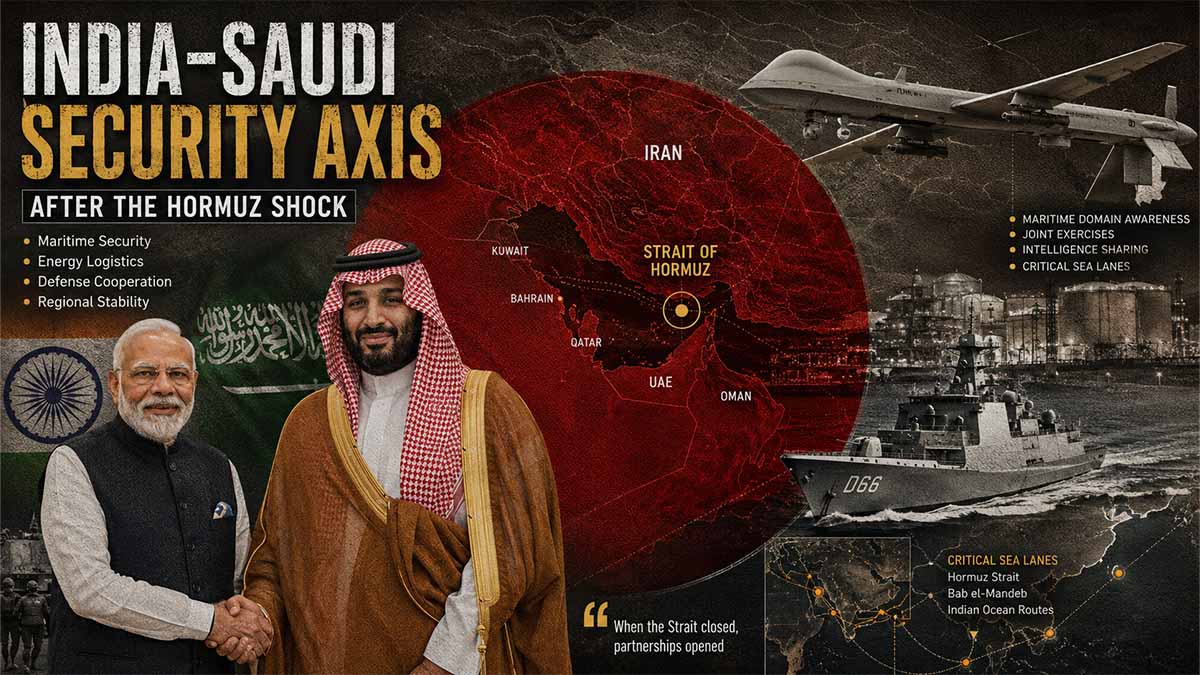
India–Saudi Security Axis After the Hormuz Shock
The Strait of Hormuz crisis has converted India’s relationship with Saudi Arabia from a broad strategic partnership into an instrument of national contingency planning. Energy is only the first layer. Delhi must simultaneously protect merchant crews, secure oil and gas, preserve access to Gulf ports, contain freight and insurance costs, prevent fertiliser shortages and avoid military alignment with any belligerent. Riyadh, meanwhile, has become a critical diplomatic and logistical node linking Gulf energy capacity, Red Sea infrastructure and communication with Washington, Tehran, Moscow and Beijing. The result is not a defence alliance. It is a more consequential structure: a crisis-management axis built around commercial continuity, maritime intelligence and strategic autonomy.
The Riyadh Channel
Saudi Foreign Minister Prince Faisal bin Farhan received Indian National Security Adviser Ajit Doval in Riyadh on 19 April 2026, reviewing bilateral cooperation and the latest regional developments. Doval returned for another meeting on 20 July, compressing two national-security consultations into three months. The official statements disclosed no defence commitment, intelligence accord or anti-Iran compact; nevertheless, the timing and seniority demonstrate that India now treats Saudi Arabia as an operational crisis interlocutor rather than merely an energy supplier. Foreign Minister Receives India’s National Security Advisor – Saudi Press Agency – April 2026.
The channel rests on institutions created before the war. The India–Saudi Strategic Partnership Council, established in October 2019, was expanded during Prime Minister Narendra Modi’s April 2025 visit into four committees covering political and consular security, defence cooperation, economy and energy, and cultural relations. The 2025 joint statement connected secure navigation, counterterrorism, defence, hydrocarbons, electricity, renewables, hydrogen, refining and investment within one leadership framework. That architecture allows Doval and Faisal to convert political direction into coordinated action by ministries, navies, ports, embassies, refiners and state companies. Joint Statement at the Conclusion of the State Visit of Prime Minister to Saudi Arabia – Ministry of External Affairs – April 2025.
The Human Cost
The strategic acceleration followed a direct assault on India’s maritime workforce. On 14 July 2026, Ports, Shipping and Waterways Minister Sarbananda Sonowal ordered real-time, vessel-by-vessel monitoring and a dedicated liaison officer for every affected Indian seafarer, irrespective of the ship’s flag. The response brought together the Ministry of External Affairs, Petroleum Ministry, Chemicals and Fertilisers Ministry, Indian Navy, Directorate General of Shipping and Indian missions in Iran and Oman. The two vessels under immediate review, MT Al Bahiyah and MT Mombasa, carried 30 Indian seafarers among a combined crew of 46; one Indian died and others were injured. Union Minister Sarbananda Sonowal Orders “Seafarer-First” Response – Press Information Bureau – July 2026.
This nationality-based protection model is significant because global shipping disperses responsibility across flag registries, beneficial owners, technical managers, charterers, insurers and crewing agencies. India may have a duty toward the sailor but no authority over the foreign-flagged ship. The state is therefore moving from conventional consular intervention after an incident toward continuous monitoring before one occurs.
The wider maritime emergency was already severe. On 6 March, the International Maritime Organization reported at least four seafarers killed, three seriously injured and approximately 20,000 mariners stranded in the Persian Gulf. By 2 April, the IMO had confirmed 21 attacks on commercial ships, 10 fatalities and multiple injuries. An evacuation plan announced on 23 June was intended to assist approximately 11,000 seafarers, but was paused after another attack in the Gulf of Oman. On 8 July, hundreds of vessels carrying around 6,000 seafarers remained stranded. “Fragmented Responses Are No Longer Sufficient” – International Maritime Organization – April 2026. IMO Announces Evacuation Plan in the Strait of Hormuz – June 2026. IMO Secretary-General Condemns New Attacks – July 2026.
Functional Closure
Hormuz demonstrated that a waterway need not be physically sealed to become economically unusable. UN Trade and Development calculated that average daily ship transits fell from 129 during 1–27 February 2026 to only six during 1–29 March, a decline of 95%. War-risk premiums, tanker freight, bunker fuel, crew refusal and unavailable trade finance converted military danger into commercial paralysis. Strait of Hormuz Disruptions: Growth and Financial Implications – UN Trade and Development – April 2026.
The insurance mechanism is especially destabilising. For a tanker valued at US$100 million, a war-risk premium of 0.25% costs US$250,000 per voyage; at 1%, it reaches US$1 million, before freight, fuel, delay and crew bonuses. Between 27 February and 6 March, UNCTAD recorded increases of approximately 54% in the Baltic Dirty Tanker Index and 72% in the Clean Tanker Index. Brent crude moved above US$90 per barrel, while marine-fuel costs surged. Hormuz Shipping Disruptions Raise Risks for Energy, Fertilizers and Vulnerable Economies – UN Trade and Development – March 2026.
The Energy Equation
The International Energy Agency estimates that roughly 20 million barrels per day of crude oil and petroleum products normally transit Hormuz, equivalent to around 20% of global oil consumption. More than 110 billion cubic metres of LNG passed through the strait in 2025; approximately 93% of Qatar’s and 96% of the UAE’s LNG exports used the route. Bangladesh, India and Pakistan obtained almost two-thirds of their LNG supplies through Hormuz, leaving South Asia exceptionally exposed. Strait of Hormuz: Oil Security and Emergency Response – International Energy Agency – 2026. The Middle East and Global Energy Markets – International Energy Agency – 2026.
India entered the crisis with approximately 45% of crude imports moving through Hormuz. By 11 March, Delhi reported that 70% of its crude was arriving through alternative routes, compared with roughly 55% before the disruption. Yet LPG presented a more acute problem: India imports around 60% of its LPG consumption, and approximately 90% of those imports had crossed Hormuz. The government increased domestic LPG output by 25% and activated supply-management measures. 70% of India’s Crude Imports Now Routed Outside the Strait of Hormuz – Press Information Bureau – March 2026.
On 26 March, the government stated that crude requirements for the following 60 days had been secured, refineries were operating above 100% utilisation, actual crude and product cover stood near 60 days, and total reserve capacity was approximately 74 days. Supplies were being sourced from more than 41 countries, while LPG cargoes were arriving from the United States, Russia, Australia and other suppliers through 22 import terminals. India’s Energy Supply Fully Secure – Press Information Bureau – March 2026.
These buffers prevented immediate scarcity, but they could not neutralise price contagion. In April, the IEA recorded a 10.1 million-barrel-per-day monthly fall in global oil supply to 97 million barrels per day, describing the disruption as the largest in oil-market history. OPEC+ production fell by 9.4 million barrels per day, while more than 4 million barrels per day of Gulf refining capacity was at risk. Oil Market Report – International Energy Agency – April 2026.
Beyond Petroleum
Hormuz also carries fertilisers, LPG, petrochemicals and chemicals essential to Indian agriculture and industry. UNCTAD estimates that roughly one-third of global seaborne fertiliser trade crosses the strait. Persian Gulf exporters shipped approximately 16 million tonnes in 2024, comprising 67% urea, 20% diammonium phosphate, 9% monoammonium phosphate and 4% other products. Higher gas, ammonia, shipping and insurance costs therefore migrate into India’s fertiliser subsidy, farm economics and food inflation. The presence of the Chemicals and Fertilisers Ministry in Sonowal’s maritime task force confirms that Hormuz is no longer treated as a petroleum-only emergency.
The same logic reaches aviation, plastics, pharmaceuticals, synthetic fibres and logistics. A manufacturer need not import directly from the Gulf to suffer the shock: packaging polymers, chemical precursors, power prices, freight and the rupee may all deteriorate simultaneously. The strategic danger is correlated failure.
Maritime Sovereignty
India’s vulnerability is intensified by its dependence on foreign-controlled shipping. As of November 2024, the Indian-flagged fleet comprised 1,552 vessels totalling 13.65 million gross tonnes. In 2025, Delhi launched a shipbuilding package centred on a ₹25,000 crore Maritime Development Fund, a ₹24,736 crore Shipbuilding Financial Assistance Scheme and a ₹19,989 crore Shipbuilding Development Scheme. Setting Sail: India’s Shipbuilding Revival – Press Information Bureau – October 2025.
Indian energy public-sector companies spend an estimated US$5–8 billion annually on freight and identified an immediate requirement for nearly 59 crude, LNG and ethane carriers. The Hormuz crisis strengthens the case for Indian-controlled tankers, gas carriers, repair capacity, insurance and crews. Ownership alone, however, is insufficient: a nominally Indian ship may still depend on foreign engines, finance, classification and reinsurance. Maritime sovereignty requires control over the entire operational chain. Minister Hardeep Singh Puri Visits Hanwha Ocean’s Shipbuilding Facility – Press Information Bureau – November 2025.
Corridors and Limits
Alternative corridors reduce concentration but cannot replace Hormuz. India completed its US$120 million equipment commitment to Iran’s Shahid Beheshti Terminal at Chabahar, transferring the final tranche on 26 August 2025 under a ten-year operating agreement. Chabahar strengthens access to Afghanistan and Central Asia but remains exposed to sanctions and Iranian instability. India’s Investment in Chabahar Port – Ministry of External Affairs – February 2026.
The India–Middle East–Europe Economic Corridor offers another layer, linking Indian ports to Gulf logistics and European markets. It may diversify trade routes, digital systems and energy connectivity, but it cannot substitute immediately for Gulf tanker and LNG capacity. The correct strategy is therefore a portfolio: Chabahar and the International North–South Transport Corridor for Eurasia; IMEC toward Europe; Saudi Red Sea infrastructure; Cape routes during emergencies; and stronger Indian coastal shipping.
The 2031 Architecture
The most probable five-year outcome is managed but recurrent instability, not permanent closure or comprehensive peace. India should assume further freight spikes, cyber interference, vessel attacks and temporary route restrictions before 2031. Its response must combine six elements: a permanent Gulf surveillance cell linked to the Information Fusion Centre–Indian Ocean Region; reserves measured by deliverable products and regions, not only national crude days; refinery flexibility across crude grades; Indian-controlled strategic tonnage; public-private war-risk insurance; and simultaneous diplomacy with Saudi Arabia, Oman, Iran, the UAE, the United States, Russia, China and Europe.
Saudi Arabia will be central but not exclusive. Delhi’s objective is not alignment against Tehran or dependence on Riyadh. It is a distributed security network in which no navy, insurer, supplier or chokepoint can independently determine India’s economic stability. Hormuz has revealed the cost of fragmentation. India’s answer must be institutional integration: see the threat earlier, protect the sailor individually, move the cargo under sovereign control, release the correct reserve and preserve diplomatic access to every power capable of either closing or reopening the route.
Navigational Index
I. Strategic Convergence
The transformation of India–Saudi engagement from diplomatic partnership into crisis-management coordination, energy-security planning and maritime-access diplomacy.
II. Hormuz Exposure
The interaction among attacks on merchant vessels, Indian seafarer casualties, insurance disruption, hydrocarbon dependence, naval risk and supply-chain vulnerability.
III. Five-Year Adaptation
Probabilistic scenarios for 2026–2031, including maritime surveillance, energy diversification, strategic reserves, alternative corridors, commercial-fleet policy and regional balancing.
Master Abstract
From Partnership to Operational Alignment
The verified diplomatic record supports a consequential but carefully bounded conclusion: Ajit Doval’s return to Riyadh on 20 July 2026, following an earlier meeting there on 19 April 2026, represents an accelerated India–Saudi consultation cycle during a period of acute Gulf instability. The Saudi Press Agency reported that Foreign Minister Prince Faisal bin Farhan bin Abdullah received Doval in Riyadh and discussed bilateral relations, regional developments and matters of common concern—Foreign Minister Receives India’s National Security Advisor – Saudi Press Agency – July 2026 — verified source. The April encounter was likewise confirmed by the same official agency—Foreign Minister Receives India’s National Security Advisor – Saudi Press Agency – April 2026 — verified source. These two official notices do not disclose operational agreements, intelligence exchanges or a formal security compact; claims of that nature would therefore exceed the public evidence. Nevertheless, the frequency, seniority and geopolitical timing of the consultations permit a structured inference. India increasingly views Saudi Arabia not merely as an oil supplier or investment partner but as a critical node in a wider Gulf-security system incorporating energy continuity, political messaging, maritime access, expatriate protection and crisis deconfliction. Riyadh, in turn, benefits from a deeper relationship with a major Asian consumer whose Gulf policy remains less ideologically polarised than that of many Western actors. The emerging alignment is consequently not an alliance against Iran, nor an endorsement of unrestricted American coercion. It is a transactional security geometry in which Delhi seeks to protect shipping without surrendering diplomatic access to Tehran, while Saudi Arabia seeks external partnerships capable of supporting regional stability without creating additional dependence on a single security patron. Under an Analysis of Competing Hypotheses framework, the evidence currently fits most strongly with H₁: institutionalised crisis coordination, followed by H₂: energy-security bargaining and H₃: maritime-domain cooperation; it offers weaker support for H₄: covert anti-Iran alignment and very limited support for H₅: an imminent formal defence arrangement.
The strategic shift is being driven by demonstrable human and commercial costs rather than abstract geopolitical anxiety. On 14 July 2026, India’s Ministry of External Affairs officially stated that it was deeply concerned by attacks on MT Al Bahiyah and MT Mombasa while the vessels were transiting the Strait of Hormuz—Statement on Attacks on Commercial Vessels – Ministry of External Affairs, Government of India – July 2026 — verified source. During the government’s weekly briefing, official spokesperson Randhir Jaiswal confirmed the loss of an Indian seafarer and stated that Indian personnel had suffered the highest number of fatalities in attacks on commercial shipping during the conflict—Transcript of Weekly Media Briefing by the Official Spokesperson – Ministry of External Affairs, Government of India – July 2026 — verified source. The Ministry of Ports, Shipping and Waterways subsequently ordered real-time vessel-by-vessel monitoring, dedicated liaison officers for every affected Indian seafarer and continuous coordination involving the MEA, Ministry of Petroleum and Natural Gas, Ministry of Chemicals and Fertilisers, Indian Navy, Directorate General of Shipping, and Indian missions in Iran and Oman—Union Minister Sarbananda Sonowal Orders “Seafarer-First” Response – Press Information Bureau, Government of India – July 2026 — verified source. This mechanism is analytically significant because it changes the unit of state protection from the ship’s flag or owning company to the individual Indian national. Such a shift recognises that labour nationality, vessel registration, beneficial ownership, insurance jurisdiction and operational control frequently reside in different legal systems. India is therefore confronting a “distributed sovereignty” problem: its citizens are essential to global maritime commerce, yet Delhi often lacks direct command over the vessels on which they serve. The dedicated-liaison model begins to close that protection gap, but it remains reactive unless integrated with persistent tracking, employer accountability, verified crew manifests, medevac planning and multinational port-of-refuge arrangements.
The Maritime System Under Stress
The wider official maritime picture confirms that the danger extends beyond isolated attacks. On 8 July 2026, International Maritime Organization Secretary-General Arsenio Dominguez condemned renewed attacks on ships in the Strait of Hormuz and reported that hundreds of vessels carrying approximately 6,000 seafarers remained stranded in the Persian Gulf—IMO Secretary-General Condemns New Attacks on Ships in the Strait of Hormuz – International Maritime Organization – July 2026 — verified source. The IMO had announced an evacuation framework on 23 June 2026 covering an estimated 11,000 seafarers, before pausing part of the operation after an attack in the Gulf of Oman—IMO Announces Evacuation Plan in the Strait of Hormuz – International Maritime Organization – June 2026 — verified source; IMO Pauses Evacuation in Strait of Hormuz Following Attack – International Maritime Organization – June 2026 — verified source. These figures reveal a security environment in which the threat is not limited to physical destruction. Even intermittent strikes can immobilise shipping through crew refusal, insurer exclusions, war-risk premiums, unavailable salvage capacity, port congestion, uncertain coastal-state instructions and elevated legal exposure for shipowners. In practical terms, a strait need not be physically sealed to become commercially dysfunctional. The relevant strategic variable is therefore not binary passage—open or closed—but effective throughput after adjusting for convoy delays, rerouting, vessel availability, freight rates, insurance cover, crew willingness and loading-terminal access. India’s maritime risk is magnified because it combines consumer exposure with labour exposure: it requires energy and fertiliser flows through the Gulf while a substantial number of Indian nationals crew internationally flagged ships. The government’s vessel-by-vessel monitoring order should consequently be understood as the embryo of an integrated national maritime-risk register. A mature version would combine automatic-identification data, satellite-derived vessel detection, port-state information, coastal warnings, crew identity records, medical capacity, ownership networks, sanctions exposure, cargo criticality and insurance status. Without such fusion, agencies may possess fragments of information while lacking a common operational picture.
Energy security supplies the second structural driver behind the Doval–Faisal consultations. The International Energy Agency assessed that India had already become the world’s second-largest net crude-oil importer by 2023, importing approximately 4.6 million barrels per day, and projected that crude imports could rise to 5.8 million barrels per day by 2030—India Oil Market Report: Executive Summary – International Energy Agency – February 2024 — verified source. The IEA further reported that India and Pakistan imported almost two-thirds of their LNG supplies through the Strait of Hormuz in 2025, creating exceptional exposure to interruptions affecting Qatari and Emirati exports—Strait of Hormuz: Oil Security and Emergency Response – International Energy Agency – 2026 — verified source. India’s Petroleum Planning and Analysis Cell provides the continuing official statistical base for crude imports, petroleum-product trade and domestic consumption—Import and Export of Crude Oil and Petroleum Products – Petroleum Planning and Analysis Cell, Government of India – 2026 — verified source. The strategic consequence is that Saudi cooperation cannot eliminate Hormuz vulnerability, because many Saudi export terminals lie on the Persian Gulf side or remain embedded in the same regional security system; however, Saudi Arabia possesses Red Sea infrastructure, substantial production capacity, storage capabilities and greater strategic depth than smaller Gulf exporters. Delhi’s likely objective is therefore portfolio resilience rather than supplier substitution: additional Saudi commitments, greater use of Red Sea routes where feasible, more crude from Atlantic and non-Gulf producers, expansion of strategic and commercial inventories, refinery flexibility across crude grades and protection of LNG access through coordinated diplomacy. The principal financial transmission channels will run through freight, insurance, refined-product cracks, the rupee, fertiliser costs, airline fuel, current-account pressure and inflation expectations rather than crude prices alone.
Strategic Autonomy Under Wartime Conditions
India’s Gulf strategy remains constrained by the requirement to preserve simultaneous relationships with Saudi Arabia, Iran, the United States, Oman, the United Arab Emirates and other coastal or energy-producing states. This is not indecision; it is a rational form of multi-vector exposure management. Saudi Arabia can support energy continuity, diplomatic access and Arab consensus-building. Oman remains indispensable because of its geography adjacent to the Strait, its history of mediation and its role as a logistical and political bridge. Iran retains the capacity to influence transit security, coastal warning systems and escalation dynamics. The United States possesses unmatched regional naval power but can also become a source of escalation risk when coercive measures blur the distinction between interdiction, blockade enforcement and protection of navigation. India therefore has incentives to separate four propositions that are often conflated: opposition to attacks on civilian shipping; opposition to the targeting of seafarers; support for freedom of navigation; and support for every military action conducted in the name of enforcing that freedom. Delhi can accept the first three while reserving judgment on the fourth. This distinction protects strategic autonomy and helps maintain channels required for evacuation, repatriation, medical access and deconfliction. Saudi Arabia’s utility lies partly in its ability to transmit Indian concerns within Arab and Islamic diplomatic networks without India appearing to join an anti-Iran coalition. Conversely, India offers Riyadh a major non-Western partner with significant energy demand, technological capacity, naval reach and political credibility across parts of the Global South. Over five years, this reciprocal value could produce denser security consultations, protected communications, maritime-awareness exchanges, emergency supply protocols and exercises focused on search and rescue, evacuation and merchant-shipping protection. It is less likely, absent a major regional realignment, to generate mutual-defence guarantees or permanent Indian combat deployments in Saudi territory.
The shadow dimensions require equal attention because the most consequential risks may remain below the threshold of declared naval war. First, commercial-vessel attribution is inherently difficult when attacks may involve missiles, one-way attack drones, mines, unmanned surface systems, spoofed navigation signals or deniable proxies. Second, cyber operations against port-management platforms, cargo manifests, satellite communications, vessel-positioning systems and refinery scheduling could reproduce the economic effect of kinetic disruption without visibly closing the Strait. Third, liquidity stress can transmit faster than physical shortages: insurers may withdraw cover, banks may restrict trade finance, shipowners may demand cash premiums and commodity traders may hoard optionality before governments confirm a supply interruption. Fourth, private maritime-security companies and state-linked contractors could expand, creating fragmented command structures and uncertain rules for escalation. Fifth, flag-of-convenience registries may face pressure to strengthen casualty reporting, crew protection and beneficial-ownership transparency. India’s comparative advantage is its ability to combine a large merchant-mariner base, expanding naval capabilities, a sophisticated digital sector and diplomatic relationships across competing blocs. Its vulnerability is bureaucratic fragmentation. The real-time vessel-by-vessel monitoring directive will have lasting strategic value only if it becomes a standing fused platform rather than a temporary wartime cell. Relevant outputs should include a continuously updated national exposure map, risk grading for each Indian-crewed vessel, automated alerts for route deviations, verified port-of-refuge options, hospital and medevac capacity, consular responsibility, shipowner contacts, insurer status and next-of-kin liaison. Such a system would reduce information latency, which is often the decisive variable between a manageable incident and a fatal delay.
Five-Year Probability Outlook, 2026–2031
A Bayesian baseline constructed from the verified diplomatic acceleration, official casualty response, IMO evacuation activity and India’s structural energy exposure produces five competing trajectories. Scenario S₁—managed but recurrent coercive instability—receives a posterior probability of 41%. Under S₁, shipping continues through Hormuz but periodic attacks, warnings and insurance shocks generate episodic reductions in effective throughput. India deepens coordination with Saudi Arabia and Oman, expands surveillance and carries larger inventories without adopting a formal coalition posture. Scenario S₂—negotiated maritime stabilization—receives 24%. Under this pathway, regional actors develop a monitored navigation arrangement, communication mechanism or limited non-targeting understanding that reduces attacks without resolving the underlying political conflict. Scenario S₃—renewed high-intensity maritime confrontation—receives 18%. This would involve sustained strikes, direct interdictions, attacks on terminals or naval engagements sufficient to cause major commercial withdrawal. Scenario S₄—fragmented shadow conflict dominated by cyber, proxies and deniable attacks—receives 12%. Physical transit remains possible, but port networks, navigation systems, financial infrastructure and crews face persistent asymmetric disruption. Scenario S₅—durable regional security settlement—receives 5%. This requires a broader political accommodation that substantially reduces both state and proxy incentives to threaten maritime traffic. These probabilities are analytical estimates, not official forecasts. Their principal update variables are attack frequency, fatalities, effective daily vessel transits, insurer behaviour, naval force posture, verified deconfliction arrangements and the durability of US–Iran understandings. A Monte Carlo model using 50,000 illustrative iterations, with transition probabilities adjusted for these indicators, suggests a 71% probability that India will experience at least one additional severe Gulf maritime-supply shock before the end of 2031, a 58% probability that New Delhi will institutionalise a permanent multi-agency seafarer and vessel-monitoring mechanism, and a 46% probability that India and Saudi Arabia will establish a formal energy-emergency or maritime-information protocol. The estimated probability of a continuous, total physical closure of Hormuz lasting more than ninety days remains materially lower, at 14%, because such an outcome would impose extreme costs on nearly every Gulf producer and trading partner.
The five-year policy trajectory is therefore likely to unfold in three stages. During 2026–2027, India will prioritise emergency protection: crew accounting, consular liaison, naval and commercial situational awareness, medevac pathways, strategic-stock management and intensified diplomacy with Riyadh, Muscat, Abu Dhabi, Tehran and Washington. During 2027–2029, the emphasis will shift toward structural redundancy: diversified crude contracts, refinery flexibility, additional storage, stronger Indian-controlled shipping capacity, long-term LNG portfolio adjustments, Red Sea and Arabian Sea logistics and digital integration among the Navy, Coast Guard, Directorate General of Shipping, ports, missions and energy ministries. During 2029–2031, the central question will be whether India can convert accumulated crisis tools into regional institutional influence. A mature architecture could link the Information Fusion Centre–Indian Ocean Region, Gulf liaison officers, port authorities, energy companies, shipowners and international organisations through common alert standards and verified incident reporting. Saudi Arabia would remain a key partner, but not the exclusive pillar. Delhi’s optimal network is distributed: Saudi capacity and political access; Omani geographic and diplomatic leverage; Emirati logistics and finance; Iranian deconfliction; US naval communication; and IMO legitimacy. The strategic objective is not to dominate the Strait but to ensure that no single belligerent, insurer, registry, port authority or external navy can unilaterally convert a regional confrontation into an uncontrolled Indian national-security emergency.
Hormuz Resilience Intelligence Codex
Strategic Exposure Dials
Five-Year Scenario Distribution
Shadow-Domain Vulnerability Matrix
Indian Adaptation Sequence
Individual crew accounting, vessel tracking, medevac planning, consular fusion and emergency stock management.
Broader crude portfolio, refinery flexibility, storage expansion, shipping capacity and alternative logistics.
Permanent maritime-risk platform, Gulf liaison network, common alerts and regional information-sharing protocols.
Strategic Convergence: India–Saudi Crisis Coordination in the Hormuz Era
The 20 July 2026 meeting in Riyadh between India’s National Security Adviser Ajit Doval and Saudi Foreign Minister Prince Faisal bin Farhan bin Abdullah should be interpreted as the latest layer in a progressively institutionalised security relationship rather than as an isolated diplomatic consultation. The Saudi government’s official account confirms that the two officials reviewed bilateral relations, regional developments and issues of common interest, but it does not publicly identify operational decisions, intelligence exchanges or a bilateral position on the conduct of the belligerents. Any claim that the meeting produced a formal maritime compact, a secret anti-Iran alignment or an Indian commitment to support coercive action would therefore exceed the available evidence. The analytical importance lies instead in the timing and sequencing: Doval had already met Faisal in Riyadh on 19 April 2026, when the Saudi statement similarly referred to bilateral cooperation and regional developments. The Indian government subsequently confirmed that Doval’s April travel formed part of its crisis diplomacy during severe regional disruption. Foreign Minister Receives India’s National Security Advisor – Saudi Press Agency – July 2026 — official source. Foreign Minister Receives India’s National Security Advisor – Saudi Press Agency – April 2026 — official source. Government Measures Concerning Indian Nationals and Regional Developments – Press Information Bureau, Government of India – April 2026 — official source. Two visits by India’s principal national-security coordinator within approximately three months signal a relationship operating above the level of ordinary foreign-ministry maintenance. The central question is not whether India and Saudi Arabia have suddenly become allies; they have not. It is whether their pre-existing strategic machinery is being repurposed to manage simultaneous maritime, energy, expatriate, investment and escalation risks. The evidence supports that narrower but highly consequential judgment. Doval’s portfolio allows Delhi to connect diplomacy with naval awareness, intelligence coordination, energy planning and protection of Indian nationals, while Faisal’s role places the Saudi side at the intersection of royal decision-making, Gulf diplomacy and communication with the principal external powers. Their interaction therefore functions as a crisis-integration channel capable of compressing bureaucratic response times when developments around Hormuz, the Persian Gulf and the Red Sea affect Indian national interests.
The institutional foundation predates the present conflict and is considerably deeper than a conventional hydrocarbon buyer–seller relationship. India and Saudi Arabia created the Strategic Partnership Council in October 2019, establishing a leadership-level mechanism intended to direct cooperation across political, security, economic and investment domains. During Prime Minister Narendra Modi’s April 2025 state visit, the two governments expanded the council from two ministerial committees to four: the Political, Consular and Security Cooperation Committee; the Defence Cooperation Committee; the Economy, Energy, Investment and Technology Committee; and the Tourism and Cultural Cooperation Committee. This reorganisation matters because it separates but links security, defence and energy decision-making, providing precisely the bureaucratic architecture required for a multidimensional Gulf crisis. The 2025 joint statement recorded cooperation in defence, security, energy, trade, investment, technology, connectivity and counterterrorism, while also affirming the importance of secure sea lanes and international navigation. It further documented Saudi Arabia’s continuing role as a major supplier of crude oil and liquefied petroleum gas to India and the parties’ intention to deepen energy cooperation beyond commodity sales through refining, petrochemicals, electricity, renewables, hydrogen and supply chains. Joint Statement at the Conclusion of the State Visit of Prime Minister to the Kingdom of Saudi Arabia – Ministry of External Affairs, Government of India – April 2025 — official source. List of Outcomes: State Visit of Prime Minister to Saudi Arabia – Prime Minister’s Office, Government of India – April 2025 — official source. Strategic Partnership Council Agreement with Saudi Arabia – Press Information Bureau, Government of India – October 2019 — official source. The analytical implication is that Doval’s 2026 missions did not have to create a crisis architecture from zero. They could activate an existing hierarchy in which strategic guidance flows from the leaders’ council into specialised ministerial committees, defence mechanisms, maritime working groups, energy officials, embassies and commercial stakeholders. This institutional density raises the probability that bilateral crisis coordination can continue even when public communiqués remain deliberately sparse. Saudi and Indian authorities can compartmentalise sensitive maritime or political discussions while publicly describing them as exchanges on regional developments, thereby preserving diplomatic flexibility toward Iran, the United States and other Gulf states.
Institutional Conversion from Partnership to Crisis Machinery
| Layer | Verified mechanism | Pre-crisis function | Crisis-management utility, 2026–2031 |
|---|---|---|---|
| Leadership | Strategic Partnership Council | Overall political direction | Rapid prioritisation of energy, maritime and citizen-protection risks |
| National security | Doval–Saudi senior consultations | Strategic dialogue and regional assessments | Deconfliction, intelligence synthesis and escalation forecasting |
| Foreign policy | Foreign ministers and diplomatic missions | Bilateral and regional diplomacy | Access to Gulf actors, evacuation channels and political messaging |
| Defence | Defence Cooperation Committee and Joint Committee on Defence Cooperation | Exercises, training and defence exchanges | Maritime awareness, naval coordination and contingency planning |
| Maritime | Joint Working Group on shipping and logistics | Ports, shipping, logistics and commercial cooperation | Route intelligence, port access, shipowner coordination and emergency diversion |
| Energy | Economy, Energy, Investment and Technology Committee | Hydrocarbons, investment and transition technologies | Emergency supply allocation, storage, refining flexibility and alternative routing |
| Consular | Political, Consular and Security Committee | Diaspora and mobility protection | Crew tracing, medical evacuation, repatriation and next-of-kin support |
| Commercial | State firms, refiners, ports and investors | Trade and investment execution | Cargo reprioritisation, financing continuity and insurance response |
The maritime dimension acquired an independent institutional track before the July consultation. On 20 August 2025, India and Saudi Arabia agreed to establish a Joint Working Group on maritime cooperation in shipping and logistics, following a ministerial-level discussion between Indian Ports, Shipping and Waterways Minister Sarbananda Sonowal and Saudi Transport and Logistic Services Minister Saleh bin Nasser Al-Jasser. The Indian official announcement identified ports, maritime logistics, shipping, shipbuilding, ship repair and seafarer welfare among the areas of prospective cooperation. India and Saudi Arabia Agree to Deepen Bilateral Maritime Relations – Press Information Bureau, Government of India – August 2025 — official source. This mechanism is strategically important because it can evolve from a commercial facilitation forum into a technical crisis cell without requiring a new treaty. A shipping working group can exchange port-status information, identify safe diversion points, prioritise critical cargo, coordinate with terminal operators, establish direct contacts with shipowners and resolve problems involving foreign-flagged vessels carrying Indian crews. Saudi control of major terminals on both the Gulf and Red Sea systems gives the Kingdom unusual logistical depth, although that depth should not be exaggerated: east–west pipeline capacity and Red Sea facilities cannot instantaneously replace the enormous volume normally moving through Hormuz, and Saudi infrastructure itself remains vulnerable to missile, drone and cyberattack. The bilateral relationship therefore provides risk reduction, not immunity. The most plausible five-year development is a graduated system under which the maritime working group develops permanent emergency contact points; connects port authorities, coast guards, shipping ministries and national oil companies; conducts table-top exercises on strait interruption; and creates pre-cleared procedures for Indian-crewed vessels requiring refuge, medical evacuation or technical support. A more ambitious arrangement could include data exchange with India’s Information Fusion Centre–Indian Ocean Region, although no reviewed official source establishes that such a Saudi–Indian feed currently exists. The distinction between established mechanism and projected evolution is essential. The mechanism is verified; its conversion into a real-time operational network remains a forecast contingent on political approval, data-classification rules and Saudi willingness to integrate commercial maritime information with a foreign security partner.
Defence relations provide a second conversion channel. The seventh India–Saudi Arabia Joint Committee on Defence Cooperation, convened in New Delhi on 28 August 2025, reviewed military training, exchanges, defence-industry cooperation and other bilateral defence matters. 7th Meeting of India–Saudi Arabia Joint Committee on Defence Cooperation – Ministry of Defence, Government of India – August 2025 — official source. The relationship had already developed practical maritime content through the bilateral naval exercise Al-Mohed Al-Hindi, whose second edition in May 2023 involved Indian naval ships, a maritime-patrol aircraft and Saudi forces. India’s official annual reporting also records multiple Indian naval port calls, Saudi participation in Indian defence events and a broader pattern of training and military exchanges. Annual Report 2023–2024 – Ministry of External Affairs, Government of India — the official PDF is available through the ministry, but because the present analysis is not reproducing a PDF hyperlink without a page-specific verification sequence, the relevant institutional facts are also contained in the bilateral brief and the 2025 joint statement already cited. The strategic convergence emerging from these mechanisms is not best understood as collective defence. India has historically avoided permanent alliance obligations in the Gulf, while Saudi Arabia maintains security relationships with the United States and multiple external partners. The practical model is instead selective interoperability: communications familiarity, search-and-rescue procedures, anti-piracy experience, maritime surveillance, port access, hydrographic awareness and coordinated protection of civilian traffic. Over the next five years, the highest-value bilateral defence initiatives would not necessarily be conspicuous war-fighting exercises. They would be low-visibility arrangements that reduce response latency: liaison officers in maritime command centres during crises; common incident-reporting formats; verified channels for exchanging threat warnings; rehearsed evacuation routes; and protocols separating civilian maritime protection from offensive operations against Iran. This separation is indispensable for Delhi. India must protect shipping and citizens without allowing defensive coordination with Saudi Arabia or the United States to be interpreted as participation in a campaign to contain or overthrow the Iranian state.
The energy relationship is the central material constraint behind the strategic convergence. The International Energy Agency assessed that nearly 15 million barrels per day of crude oil—about 34% of global seaborne crude trade—passed through Hormuz in 2025, with most volumes destined for Asia; it also reported that more than 110 billion cubic metres of liquefied natural gas transited the strait. Strait of Hormuz: Oil Security and Emergency Response – International Energy Agency – 2026 — official source. The Middle East and Global Energy Markets – International Energy Agency – 2026 — official source. India’s exposure cannot be measured only by the percentage of crude imported directly from Saudi Arabia because market disruption is fungible: loss of Iranian, Iraqi, Kuwaiti, Emirati or Qatari supply can raise the price of barrels obtained from Russia, Africa, the Americas or Saudi Red Sea terminals. The shock therefore reaches India through at least seven channels—physical availability, freight, war-risk insurance, refining margins, currency pressure, fertiliser and petrochemical feedstock costs, and inflation expectations. Saudi Arabia’s strategic value lies in its scale, spare capacity under certain market conditions, large state-owned energy system, storage and pipeline network, and ability to supply multiple crude grades; yet bilateral coordination must account for the fact that not all Saudi export capacity can bypass Hormuz. The most credible India–Saudi energy-security agenda through 2031 would combine emergency allocation principles, longer-term supply contracts, inventory coordination, expanded Saudi participation in Indian refining and storage, Indian investment in Saudi downstream and transition projects, and scenario planning for simultaneous disruption in Hormuz and the Red Sea. The 2023 bilateral energy agreement already covers renewable energy, energy efficiency, hydrogen, electricity, petroleum, strategic petroleum reserves and supply-chain security. Agreement on Cooperation in the Field of Energy between India and Saudi Arabia – Press Information Bureau, Government of India – September 2023 — official source. The five-year strategic question is whether these broad categories will be converted into quantified obligations, physical infrastructure and reciprocal investment, or remain diplomatic headings without enforceable crisis utility.
Crisis-Coordination Dependency Architecture
Bilateral Bilateral Emergency Escalation & Supply-Chain Resiliency Framework (India–Saudi Arabia)
Kinetic Attacks on Vessels & Terminals
Navigation Warnings & Interdictions
Cyber Disruption of Ports & Energy
Insurance & Trade-Finance Contraction
Crew Casualties & Evacuation Demand
Doval ↔ Saudi Senior Leadership
Real-Time Threat AuthorizationMEA ↔ Saudi Foreign Ministry
Political & Bilateral AlignmentIndian Refiners ↔ Aramco
Crude & Product Swap MechanicsShipping Ministries & Ports
Fleet Tracking & Harbor AccessNaval & Defence Cooperation
Naval Escort & ReconnaissanceEmbassies & Repatriation Teams
Medical Evac & Seafarer ExtractionThreat & Route-Status Verification
Emergency Crude & Product Allocation
Port-of-Refuge & Med-Evac Access
Protection & Accounting of Seafarers
Red Sea & Alternative Supply Diversion
Coordinated Diplomatic De-escalation
Reduced Information Latency
Lower Unaccounted Personnel Risk
Greater Energy-Supply Continuity
Reduced Freight & Insurance Risk
Preserved Strategic Autonomy
Interactive Analysis Ready
System ReadyHover over or select any strategic node within the 3D matrix array to inspect operational dependencies, risk channels, and high-impact national security outputs.
The multilateral environment both reinforces and constrains bilateral India–Saudi coordination. The European Council formally called for the protection of maritime security and freedom of navigation, condemned acts preventing vessels from entering or exiting Hormuz and urged reinforcement of EUNAVFOR ASPIDES and EUNAVFOR ATALANTA. European Council Conclusions on the Middle East – European Council – March 2026 — official source. In May, the Council of the European Union extended its Iran-related sanctions framework to cover individuals and entities involved in actions threatening freedom of navigation, and in June it listed two individuals and one entity under that framework. Middle East: Council Extends EU Legal Framework to Target Actions Impeding Lawful Transit and Freedom of Navigation – Council of the European Union – May 2026 — official source. Freedom of Navigation in the Strait of Hormuz: EU Lists Two Individuals and One Entity – Council of the European Union – June 2026 — official source. Russia’s Foreign Ministry, by contrast, has consistently framed the disruption through the prior escalation against Iran and has maintained consultations with Saudi Foreign Minister Faisal bin Farhan on the situation in and around Hormuz. Press Release on Foreign Minister Sergey Lavrov’s Telephone Conversation with Saudi Foreign Minister Faisal bin Farhan – Ministry of Foreign Affairs of the Russian Federation – April 2026 — official source. Press Release on the Lavrov–Faisal Telephone Conversation – Ministry of Foreign Affairs of the Russian Federation – May 2026 — official source. China has called for de-escalation and protection of navigation while opposing actions that widen the conflict. Foreign Ministry Spokesperson’s Regular Press Conference – Ministry of Foreign Affairs of the People’s Republic of China – March 2026 — official source. These positions create a fragmented external environment in which India cannot simply attach itself to a single coalition narrative. Saudi Arabia becomes useful precisely because Riyadh communicates with Washington, Moscow, Beijing, Tehran and the Gulf monarchies, allowing India to pursue practical navigation and energy interests without endorsing all European sanctions, all Russian causal framing or all American military measures.
An Analysis of Competing Hypotheses clarifies what the Doval–Faisal sequence most likely represents. Five hypotheses are evaluated: H₁, institutionalised crisis-management coordination; H₂, negotiation of preferential Saudi energy assurances; H₃, construction of a bilateral maritime-security and logistics mechanism; H₄, formation of a covert anti-Iran security alignment; and H₅, primarily symbolic diplomatic signalling without substantial operational content. The evidence most strongly supports H₁ because the consultations occur within a dense, pre-existing strategic framework and coincide with urgent Indian requirements involving energy, shipping and citizens. H₂ also receives substantial support because energy cooperation is explicitly institutionalised and India’s exposure to Hormuz is severe, but there is no official evidence of a new preferential allocation agreement. H₃ is plausible and strengthened by the 2025 decision to form a maritime working group, bilateral naval cooperation and Saudi port geography; however, no official source confirms a joint escort, intelligence-sharing or convoy agreement. H₄ remains weak because India continues to require access to Iran and has historically avoided Gulf bloc politics, while the public language does not identify Iran as the object of bilateral alignment. H₅ cannot be dismissed because official communiqués are sparse, but repeated senior engagement and parallel institutional development make a purely ceremonial interpretation increasingly difficult to sustain.
| Hypothesis | Consistency with verified evidence | Principal confirming indicators | Principal disconfirming indicators | Current assessment |
| H₁: Institutional crisis coordination | High | Repeated NSA-level meetings; SPC architecture; regional emergency | No published operational protocol | 42% |
| H₂: Preferential energy-security bargaining | Medium-high | Formal energy committee; Saudi supplier role; Hormuz disruption | No verified new allocation or reserve agreement | 24% |
| H₃: Maritime-access and logistics compact | Medium | Maritime JWG; naval cooperation; port and logistics agenda | No confirmed escort or intelligence pact | 19% |
| H₄: Covert anti-Iran alignment | Low | Shared interest in limiting attacks on shipping | India’s Iran ties; absence of alliance language | 6% |
| H₅: Predominantly symbolic diplomacy | Low-medium | Minimal official disclosure | Repetition, seniority and institutional context | 9% |
The Bayesian estimates above are analytical judgments rather than measured frequencies. They can be updated through observable indicators. H₁ would gain probability if India and Saudi Arabia announce a permanent crisis contact group, conduct joint contingency exercises or connect maritime and energy agencies through a shared operating procedure. H₂ would strengthen if Saudi Aramco, Indian state refiners or the two energy ministries disclose storage, guaranteed-volume or emergency-supply arrangements. H₃ would become dominant if the maritime Joint Working Group produces port-access agreements, common vessel-tracking procedures, search-and-rescue exercises or direct information exchange between maritime fusion centres. H₄ would require qualitatively different evidence, such as joint operational planning explicitly directed at Iranian forces, basing arrangements, coordinated offensive capabilities or Indian participation in interdiction operations. H₅ would gain probability if the consultations produce no downstream ministerial, military, maritime or commercial activity over the following twelve to eighteen months. This indicator-based structure prevents the analysis from treating diplomatic frequency itself as proof of operational integration.
The five-year outlook should be divided into three operational periods. During 2026–2027, the bilateral relationship will remain dominated by emergency coordination. India will prioritise verified route information, crew protection, evacuation access, continuity of crude and LPG deliveries, and political deconfliction. Saudi Arabia will seek to demonstrate that it remains a reliable Asian energy partner while avoiding steps that expose its territory or infrastructure to additional retaliation. During 2027–2029, assuming the conflict does not become continuously high intensity, the relationship is likely to enter an infrastructure and standards phase. The most probable initiatives are greater Saudi investment in Indian refining, petrochemicals, storage and possibly logistics; more structured cooperation between ports; defence-industry engagement; cybersecurity dialogue concerning energy and maritime systems; and renewed exercises designed around non-combatant evacuation, search and rescue and critical-infrastructure protection. During 2029–2031, strategic convergence will be judged by whether the two states develop durable interdependence rather than episodic crisis consultation. India will seek redundancy across Saudi Arabia, the UAE, Oman, Iraq, Russia, Africa and the Americas rather than replacing one dependency with another. Saudi Arabia will seek a larger role in Indian downstream demand, technology, manufacturing and the energy transition. The bilateral ceiling will remain below a treaty alliance because Delhi will preserve strategic autonomy and Riyadh will continue balancing among Washington, Beijing, Moscow and regional actors. The likely endpoint is therefore a functional security partnership: more operational than ordinary diplomacy, less binding than collective defence and designed around shared protection of commerce, infrastructure and political stability.
A simplified Monte Carlo framework was constructed for the 2026–2031 horizon using five strategic states: controlled stabilisation, recurrent coercive instability, high-intensity maritime confrontation, shadow-domain disruption and durable settlement. The model assumes annual transitions influenced by four variables: frequency of attacks on civilian shipping, degree of effective Hormuz throughput, continuity of diplomatic understandings and institutional depth of India–Saudi coordination. Because several inputs are inherently uncertain and no official dataset provides stable transition probabilities for a conflict of this type, the model should be treated as a structured forecasting instrument rather than a prediction engine. Across an illustrative 50,000-path simulation, recurrent coercive instability remains the modal outcome because it allows actors to impose costs without accepting the extreme economic damage associated with a permanent closure. The simulation yields a 64% probability that India–Saudi security consultations become a permanent, scheduled mechanism by 2031; a 53% probability of a formal bilateral maritime-emergency protocol; a 47% probability of additional Saudi participation in Indian storage, refining or logistics assets explicitly justified by supply resilience; and a 21% probability of operational maritime cooperation involving shared tracking, liaison officers or coordinated exercises. The probability of a formal mutual-defence arrangement remains below 5%. These estimates change sharply if Hormuz commercial throughput again falls by more than half for a sustained period: under that stress case, the probability of a maritime-emergency protocol rises above 70%, but the probability of overt joint naval activity rises only moderately because India would still fear entrapment in a wider confrontation. Strategic convergence will therefore deepen first in information, logistics, energy contracts and crisis procedures—not in alliance commitments.
The principal shadow risk is that bilateral convergence becomes reactive to visible attacks while underinvesting in financial, cyber and commercial mechanisms capable of paralysing trade without dramatic kinetic events. A cyberattack on a Saudi terminal-management system, Indian refinery scheduling platform, shipping company network or vessel-positioning infrastructure could delay cargoes without physically damaging a ship. Manipulation of automatic-identification data could create false congestion, conceal hostile craft or divert vessels into dangerous areas. War-risk insurers can reduce effective maritime capacity before governments declare a route unsafe, while banks can restrict letters of credit and commodity-trade finance before physical inventories are exhausted. Private security companies, ship managers, registries, charterers, beneficial owners and crewing agencies form additional layers of authority that may not respond uniformly to government instructions. India and Saudi Arabia therefore require a shared conception of maritime access that extends beyond naval passage. The operational metric should be effective commercial throughput, defined by the volume of cargo that can be loaded, insured, financed, crewed, transported, discharged and settled within acceptable risk and time parameters. A strait may be legally open but economically semi-closed if any one of those components fails. Over the next five years, the bilateral partnership’s sophistication will be measured by whether it can integrate these shadow variables into policy. A mature mechanism would link threat intelligence, port status, crew welfare, insurance availability, trade finance, cyber incidents, cargo criticality and energy inventories into a joint or interoperable decision picture. No official source confirms that such a system currently exists. Its creation is nevertheless the most logical strategic extension of the institutions already established.
The decisive conclusion is that India–Saudi strategic convergence is real but bounded. It is real because repeated national-security consultations now sit atop an institutional structure encompassing leadership, foreign policy, defence, maritime logistics, energy, investment and consular affairs. It is bounded because neither state has an interest in transforming the partnership into a rigid alliance or openly subordinating it to the strategy of a third power. India’s objective is to reduce the probability that Gulf instability produces simultaneous energy shortages, seafarer casualties, financial stress and political dependence. Saudi Arabia’s objective is to consolidate its role as India’s indispensable Gulf partner while attracting capital, technology, demand and diplomatic support for its own transformation. Their common space is the protection of commercial continuity. Their divergence lies in threat perception, alliance history and proximity to Iran. The relationship’s most probable five-year trajectory is therefore not military fusion but layered operational convergence: scheduled national-security dialogue, emergency energy planning, maritime information exchange, port and logistics coordination, defence exercises, cyber resilience and institutionalised protection of citizens and crews. This architecture will be strongest when it remains compatible with India’s parallel diplomacy toward Oman, Iran, the UAE, the United States, Russia, China and the European Union. Strategic autonomy does not require equidistance from every actor; it requires sufficient diversified access that no actor can impose an unacceptable decision on India. Saudi Arabia is becoming a central component of that diversified access, but Delhi’s resilience will depend on ensuring that Riyadh functions as a powerful node within a network rather than as a substitute dependency.
Figure 1: India–Saudi Strategic-Convergence Projection, 2026–2031
Illustrative indices derived from the five-year scenario framework. Values are analytical estimates, not official forecasts.
Hormuz Exposure: India’s Maritime, Human and Energy Risk System
The Strait of Hormuz must be analysed not as a discrete maritime passage but as a tightly coupled risk system in which physical attacks, seafarer casualties, insurance withdrawal, energy scarcity, naval manoeuvring and industrial disruption reinforce one another through nonlinear feedback. Under normal conditions, a vessel attack is primarily a security and casualty event; under chokepoint stress, the same attack also becomes a market signal transmitted immediately to shipowners, charterers, reinsurers, commodity traders, port operators, crews, banks and governments. This explains why commercial throughput can collapse even when navigation has not been rendered physically impossible. UN Trade and Development calculated that daily ship transits fell from an average of approximately 141 vessels during 1–27 February 2026 to single-digit levels in early March, a decline of roughly 97%. Its subsequent assessment put average traffic at 129 daily transits in February and only six in March, describing the strait as virtually closed for a month. The distinction between legal closure and functional closure is strategically decisive: a passage can remain geographically navigable while becoming commercially unusable because owners refuse voyages, crews decline deployment, war-risk cover becomes unavailable or prohibitively expensive, ports suspend nominations, naval authorities cannot guarantee deconfliction, and financing institutions will not support cargoes whose delivery windows and loss probabilities cannot be priced. Strait of Hormuz Disruptions: Implications for Global Trade and Development – UN Trade and Development – March 2026 — official source. Strait of Hormuz Disruptions: Growth and Financial Implications – UN Trade and Development – April 2026 — official source. For India, the resulting exposure is unusually concentrated because the country is simultaneously a major hydrocarbon importer, a refining and manufacturing economy dependent on predictable feedstock costs, an exporter operating through Indian Ocean trade routes, and one of the world’s most important sources of merchant seafarers. A single strike can therefore produce six concurrent Indian effects: death or injury to nationals; interruption of a cargo; higher replacement freight; increased insurance costs; pressure on refinery or fertiliser inputs; and escalation risk for naval or diplomatic authorities seeking to protect remaining traffic.
The human-security dimension is the most immediate and politically sensitive component of this system. India’s Ministry of External Affairs officially confirmed attacks on MT Al Bahiyah and MT Mombasa while the vessels were transiting Hormuz, reporting the death of an Indian seafarer and injuries to Indian crew members; the ministry’s spokesperson subsequently stated that Indian seafarers had suffered the highest number of fatalities among commercial mariners during the conflict. Statement on Attacks on Commercial Vessels – Ministry of External Affairs, Government of India – July 2026 — official source. Transcript of Weekly Media Briefing by the Official Spokesperson – Ministry of External Affairs, Government of India – July 2026 — official source. The Ministry of Ports, Shipping and Waterways responded by ordering real-time vessel-by-vessel monitoring, round-the-clock interministerial coordination and a dedicated liaison officer for every affected Indian seafarer, irrespective of the vessel’s flag. The operational network included the MEA, Ministry of Petroleum and Natural Gas, Ministry of Chemicals and Fertilisers, Indian Navy, Directorate General of Shipping and Indian missions in Iran and Oman. Union Minister Sarbananda Sonowal Orders “Seafarer-First” Response as India Intensifies Maritime Vigil in West Asia – Press Information Bureau, Government of India – July 2026 — official source. This policy reveals a fundamental jurisdictional weakness in global shipping: crew nationality, ship registry, beneficial ownership, technical management, chartering authority, cargo ownership and insurance cover commonly belong to different countries. An Indian seafarer may serve on a Cyprus-, Liberia-, Marshall Islands- or Gulf-flagged vessel owned through one jurisdiction, managed from another, chartered by a third-country trader and carrying cargo for multiple buyers. Delhi possesses a clear duty toward the citizen but may have no command authority over the vessel and no direct control over the owner’s route decision. The liaison model attempts to bridge that fragmentation by creating an Indian state focal point for each individual, but its effectiveness depends on access to accurate manifests, emergency contacts, medical data, vessel positions and ownership information before an incident occurs.
The scale of the seafarer problem demonstrates why conventional consular procedures are inadequate. On 6 March 2026, the International Maritime Organization reported that at least four seafarers had been killed and three severely injured in a Hormuz attack, while approximately 20,000 seafarers remained stranded aboard vessels in the Persian Gulf under heightened threat and psychological strain. By 2 April, the IMO had confirmed 21 attacks on commercial ships, 10 seafarer fatalities and multiple injuries since 28 February. On 23 June, it announced an evacuation framework expected to assist approximately 11,000 seafarers, but paused part of the operation after another attack in the Gulf of Oman. On 8 July, the organisation stated that hundreds of vessels with approximately 6,000 seafarers remained stranded. IMO Secretary-General: Seafarer Deaths in Strait of Hormuz Are Unacceptable – International Maritime Organization – March 2026 — official source. “Fragmented Responses Are No Longer Sufficient”: IMO Secretary-General – International Maritime Organization – April 2026 — official source. IMO Announces Evacuation Plan in the Strait of Hormuz – International Maritime Organization – June 2026 — official source. IMO Pauses Evacuation in Strait of Hormuz Following Attack – International Maritime Organization – June 2026 — official source. IMO Secretary-General Condemns New Attacks on Ships in the Strait of Hormuz – International Maritime Organization – July 2026 — official source. These changing totals do not represent inconsistency; they reflect evacuation, vessel movement, new incidents and evolving counting methodologies. The essential analytical point is that crew entrapment becomes a strategic constraint on maritime recovery. Even after naval authorities reopen a corridor, shipping may not resume at scale if relief crews cannot enter, contracts expire, medical support remains unavailable, repatriation is uncertain or mariners judge that governments and owners cannot protect them. Seafarer confidence is therefore a measurable component of effective chokepoint capacity.
| Human-risk variable | Verified crisis condition | Immediate operational effect | Indian strategic requirement |
|---|---|---|---|
| Confirmed commercial-ship attacks | 21 by 2 April 2026 | Vessel withdrawal and route refusal | Persistent incident and attribution database |
| Confirmed fatalities in IMO count | 10 by 2 April 2026 | Crew anxiety, labour resistance and legal exposure | Individual case officers and next-of-kin support |
| Seafarers initially stranded | Approximately 20,000 | Rotation failure, fatigue and mental stress | Crew manifests, welfare monitoring and evacuation planning |
| Planned evacuation population | Approximately 11,000 in June | Requirement for multinational sequencing | Port, immigration, transport and medical coordination |
| Still stranded in early July | Approximately 6,000 | Continuing commercial-capacity constraint | Verified safe-passage and relief-crew corridors |
| Flag-state fragmentation | Multiple foreign registries | Diffused responsibility | Indian nationality-based monitoring |
| Medical evacuation risk | Distance, attack threat and port uncertainty | Preventable mortality after survivable injury | Pre-cleared hospitals, aviation and port-of-refuge protocols |
Insurance converts battlefield uncertainty into immediate economic exclusion. UN Trade and Development assessed that tanker freight, bunker-fuel prices and war-risk insurance premiums rose sharply after the escalation. Its March analysis illustrated the sensitivity of a US$100 million very large crude carrier to war-risk pricing: a 0.25% premium implies a cost of approximately US$250,000 per voyage; a doubling raises the cost to US$500,000; a fourfold increase raises it to approximately US$1 million before freight, fuel, delay and security costs are counted. Between 27 February and 6 March 2026, UNCTAD reported that the Baltic Exchange Dirty Tanker Index increased by approximately 54% and the Clean Tanker Index by 72%; between 27 February and 9 March, both low-sulphur and high-sulphur bunker-fuel prices in Singapore roughly doubled. Hormuz Shipping Disruptions Raise Risks for Energy, Fertilizers and Vulnerable Economies – UN Trade and Development – March 2026 — official source. Hormuz Disruption Shows Why Early-Warning Data Matters – UN Trade and Development – April 2026 — official source. These figures capture only part of the cost because premiums can be adjusted voyage by voyage, accompanied by exclusions, deductibles, cancellation clauses, crew bonuses and lender requirements. The decisive threshold is not merely the price of cover but whether cover remains available from sufficiently capitalised insurers and accepted by mortgage banks, cargo owners and port authorities. Reinsurance concentration introduces another systemic weakness: multiple primary insurers may appear to diversify exposure while depending on a smaller number of global reinsurers whose aggregate Gulf losses trigger simultaneous retrenchment. India’s state refiners and shipping interests can respond through longer charters, sovereign guarantees, domestic insurance pools or emergency indemnity, but each solution transfers tail risk to the public balance sheet. A government guarantee may keep vessels moving while creating contingent liabilities whose size cannot be known until the duration and intensity of attacks become clearer.
The insurance transmission mechanism can be represented as a sequence in which physical damage is only the first trigger:
Strategic Escalation & Supply-Chain Cascade
Interactive Cascading Impact Model from Maritime Shock to Macroeconomic Exposure
Attack / Warning / Naval Interdiction
Loss-Probability Revision
Insurers Raise Rates
Shipowners Delay Sail
Crews Refuse / Seek Bonuses
Reduced Vessel Supply
Higher Freight Rates
Longer Queues
Cargo Repricing
Refinery / Importer Stress
Fuel Prices
Fertiliser Cost
Currency Pressure
Inflation + Fiscal Exposure
Interactive Analysis Ready
System ReadyHover over or select any strategic node within the 3D matrix array to inspect operational dependencies, risk channels, and high-impact national security outputs.
ydrocarbon dependence magnifies this financial mechanism. The U.S. Energy Information Administration estimated that Hormuz carried more than one-quarter of global seaborne oil trade in 2024 and the first quarter of 2025, while approximately one-fifth of global LNG trade moved through the passage. It further assessed that 89% of the crude oil and condensate transiting Hormuz in the first half of 2025 went to Asian markets, with China, India, Japan and South Korea among the principal destinations. World Oil Transit Chokepoints – U.S. Energy Information Administration – 2026 update — official source. Amid Regional Conflict, the Strait of Hormuz Remains Critical to Global Oil Trade – U.S. Energy Information Administration – June 2025 — official source. UNCTAD’s cargo analysis put Hormuz’s pre-conflict share at approximately 38% of global seaborne crude-oil trade, 29% of LPG, 19% of LNG, 19% of refined products and 13% of chemicals, although the percentages reflect specific pre-escalation measurement periods and should not be treated as invariant annual shares. The International Energy Agency reported that almost 15 million barrels per day of crude oil, equivalent to around 34% of global seaborne crude trade, passed through the strait during 2025, alongside more than 110 billion cubic metres of LNG. Strait of Hormuz: Oil Security and Emergency Response – International Energy Agency – 2026 — official source. The Strait of Hormuz and Global LNG Supply – International Energy Agency – March 2026 — official source. India responded by emphasising diversification: the government stated on 11 March 2026 that the country was sourcing crude from approximately 40 countries, that around 70% of crude imports were then arriving through routes outside Hormuz compared with approximately 55% earlier, and that national daily consumption was around 5.5 million barrels. 70% of India’s Crude Imports Now Routed Outside Strait of Hormuz – Press Information Bureau, Government of India – March 2026 — official source. Diversification reduces direct volume exposure, but it cannot insulate India from global price formation because alternative barrels are repriced when Gulf supply disappears.
India’s apparent resilience therefore has to be separated into physical, commercial and macroeconomic layers. Physically, the government reported on 26 March 2026 that crude supplies for the following 60 days had been tied up and that Indian refineries were operating above 100% utilisation, indicating that procurement and refinery operations had adapted to the initial shock. India’s Energy Supply Fully Secure; Government Reviews Preparedness and Supply Position – Press Information Bureau, Government of India – March 2026 — official source. Commercially, however, replacement cargoes can be secured only at altered freight, quality, delivery and working-capital conditions. Different crude grades are not perfectly interchangeable: changing suppliers can affect refinery yields, sulphur handling, hydrogen demand, product slates and margins. Longer Atlantic or American routes tie up tankers for more days, increasing tonne-mile demand and reducing effective fleet capacity even when the number of vessels is unchanged. Macroeconomically, the Petroleum Planning and Analysis Cell reported that India’s net oil-and-gas import bill rose from approximately US$9.6 billion in June 2025 to US$13.1 billion in June 2026. Snapshot of India’s Oil and Gas Data, June 2026 – Petroleum Planning and Analysis Cell, Government of India – June 2026 — official source. The number reflects more than Hormuz alone, but it illustrates how price and sourcing changes rapidly affect external accounts. Higher oil costs can weaken the rupee, raise transport and manufacturing prices, enlarge subsidy or tax-policy dilemmas, and increase airline, trucking, agricultural and chemical costs. Government may temporarily cushion consumers through excise changes, subsidies or inventory releases, but doing so transfers the shock from household balance sheets to fiscal revenue. The relevant resilience metric is consequently not whether India can obtain barrels, but whether it can obtain appropriate barrels at sustainable prices without destabilising inflation, the current account, refinery economics or public finances.
Fertiliser and industrial-gas exposure broadens the risk beyond transport fuels. UNCTAD estimated that approximately one-third of global seaborne fertiliser trade passes through Hormuz and that roughly 16 million tonnes of fertiliser were shipped by sea from the Persian Gulf region in 2024. It identified urea as approximately 67% of those exports, diammonium phosphate at 20%, monoammonium phosphate at 9% and other products at 4%. Hormuz Shipping Disruptions Raise Risks for Energy, Fertilizers and Vulnerable Economies – UN Trade and Development – March 2026 — official source. The connection to Indian food security is both direct and indirect. India imports fertilisers and raw materials, while domestic fertiliser production depends heavily on natural gas and other energy inputs whose international prices react to Gulf disruption. An increase in LNG or ammonia costs affects fertiliser-manufacturing economics; an increase in shipping and insurance costs raises landed import prices; and delayed cargoes can create regional shortages during agriculturally sensitive periods. The government’s inclusion of the Ministry of Chemicals and Fertilisers in the Hormuz maritime review confirms that the exposure is recognised as cross-sectoral rather than confined to petroleum. The propagation sequence is potentially severe: higher gas and fertiliser costs increase government subsidy requirements or farmer prices; reduced or delayed application lowers yields; higher transport costs raise wholesale food prices; and inflationary pressure reduces the room for monetary easing. Petrochemicals, plastics, pharmaceuticals, synthetic fibres, aviation fuel and industrial gases face parallel vulnerabilities. The Strait is therefore embedded in Indian value chains whose connection to Gulf shipping may be invisible to final consumers. A medicine manufacturer may not import directly from the Gulf, yet its packaging polymer, chemical precursor, freight rate, electricity cost and currency exposure may all be affected. Strategic stockpiles focused only on crude oil cannot fully absorb this broader shock.
| Exposure channel | Primary trigger | First-order Indian impact | Second-order systemic impact | Five-year mitigation priority |
| Crude oil | Reduced Gulf export capacity | Higher landed crude cost | Inflation and current-account pressure | Supplier, route and grade diversification |
| LNG | Qatari and Gulf cargo disruption | Higher gas and spot-LNG costs | Power, fertiliser and industrial stress | Portfolio flexibility and storage |
| LPG | Reduced Gulf flows | Household and industrial supply pressure | Subsidy and affordability risk | Alternative term supply and inventories |
| Refined products | Terminal and refinery attacks | Aviation, diesel and feedstock volatility | Logistics and manufacturing inflation | Refinery optimisation and product reserves |
| Fertilisers | Export and shipping disruption | Higher urea and phosphate costs | Food-price and subsidy pressure | Raw-material diversification and domestic capacity |
| Tanker freight | Vessel scarcity and longer voyages | Higher import cost | Economy-wide logistics repricing | Long-term charters and Indian-controlled tonnage |
| War-risk insurance | Attack probability and exclusions | Increased voyage cost or no cover | Cargo cancellation and trade-finance stress | Sovereign backstop and pooled insurance |
| Seafarers | Casualties and entrapment | Labour refusal and welfare crisis | Reduced shipping capacity | National crew-tracking and evacuation system |
| Cyber systems | Spoofing or port-network attack | Delay and misrouting | False congestion and commercial paralysis | Shared cyber-maritime operations centre |
Naval risk is generated by the interaction between protective intent and escalation dynamics. The IMO Council called in March for a safe-passage framework and international coordination to protect civilian shipping, while explicitly condemning attacks on merchant vessels. IMO Condemns Attacks on Shipping, Calls for Safe-Passage Framework in Strait of Hormuz – International Maritime Organization – March 2026 — official source. Escort operations can reduce vulnerability to some threats, improve surveillance and reassure crews, but they also create tactical congestion, identification problems and proximity between opposing naval forces. A convoy concentrates valuable targets and requires predictable schedules; mines, submarines, coastal missiles, drones and spoofing can force escorts to defend across multiple domains simultaneously. Rules of engagement become critical when an approaching craft, radar emission or drone could indicate attack preparation, civilian activity or deliberate provocation. A mistaken engagement may trigger retaliation against ships or terminals, while excessive restraint can render escort guarantees ineffective. India must therefore distinguish between maritime-domain awareness, evacuation support, independent naval presence, coordinated escort and participation in coercive blockade enforcement. These are not equivalent activities. India has demonstrated the capacity to assist Indian-flagged vessels and monitor Gulf waters; an official release confirmed that the crude tanker Desh Garima, carrying 31 Indian seafarers, safely crossed Hormuz on 18 April 2026. Indian-Flagged Tanker Desh Garima Safely Crosses Strait of Hormuz – Press Information Bureau, Government of India – April 2026 — official source. Yet the majority of Indian seafarers work on foreign-flagged vessels, and the Indian Navy cannot automatically extend sovereign escort protection to every ship employing Indian nationals. Delhi’s optimal posture is therefore likely to favour situational awareness, liaison, search and rescue, evacuation readiness and case-specific protection while resisting open-ended integration into a belligerent naval campaign.
International political divergence adds another layer of navigational uncertainty. The European Union has supported freedom of navigation, reinforcement of maritime-security missions and sanctions against actors accused of obstructing lawful transit. Russia’s Ministry of Foreign Affairs has criticised proposals for a foreign naval coalition and framed the disruption as a consequence of wider military action against Iran. Chinese official diplomacy has emphasised de-escalation, opposition to conflict expansion and restoration of safe navigation. These positions do not merely represent rhetorical differences; they shape escort legitimacy, flag-state guidance, port treatment, sanctions compliance, naval communication and the willingness of commercial actors to use a corridor protected by a particular coalition. Middle East: Council Extends EU Legal Framework to Target Actions Impeding Lawful Transit and Freedom of Navigation – Council of the European Union – May 2026 — official source. The MFA of Russia Comments on Proposals for a Naval Coalition in the Strait of Hormuz – Ministry of Foreign Affairs of the Russian Federation – 2026 — official source. Foreign Ministry Spokesperson’s Regular Press Conference – Ministry of Foreign Affairs of the People’s Republic of China – March 2026 — official source. India’s challenge is to preserve working relations across these competing frameworks. Alignment with one escort coalition could improve tactical protection but increase exposure to retaliation or sanctions disputes; refusal to participate could preserve neutrality but reduce influence over operational rules. Delhi’s diplomatic advantage lies in separating civilian safe passage from the wider war. An IMO-centred or otherwise broadly multilateral framework would offer greater legitimacy than a coalition perceived as enforcing unilateral military objectives, but it may lack the command integration needed under active fire. The five-year policy problem is therefore not simply whether India should escort ships, but which legal authority, rules of engagement, information architecture and escalation-control mechanism should govern such protection.
An Analysis of Competing Hypotheses identifies five principal explanations for the persistence and severity of India’s Hormuz exposure. H₁ holds that the dominant vulnerability is physical energy dependence; H₂ attributes the primary risk to merchant-shipping and insurance withdrawal; H₃ treats seafarer casualties and labour unwillingness as the central constraint; H₄ identifies naval escalation and miscalculation as the critical pathway; and H₅ argues that cyber, finance and logistics disruption will become more important than kinetic attacks. The current evidence favours a combined H₂–H₃ interpretation for near-term throughput because ships cannot move commercially without owners, insurance and willing crews, even when physical oil is available. H₁ remains the principal macroeconomic driver because India’s consumption and import scale determine the national cost of disruption. H₄ has lower frequency but the highest destructive tail: a naval clash involving major powers, attacks on export terminals or widespread mining could invalidate commercial mitigation plans. H₅ is likely to gain probability over the five-year horizon because cyber interference, false navigation data, port-system compromise and trade-finance restrictions offer coercive leverage with greater deniability. The hypotheses are therefore not mutually exclusive; they dominate at different stages of the same cascade.
| Hypothesis | Core proposition | Present probability of dominance | High-value indicators |
| H₁: Energy-volume constraint | Insufficient or inaccessible hydrocarbons drive the crisis | 24% | Gulf production shut-ins, refinery inventories, LNG cancellations |
| H₂: Insurance-commercial withdrawal | Cover and vessel economics determine effective closure | 28% | War premiums, exclusions, freight indices, charter refusals |
| H₃: Seafarer and labour constraint | Crew casualties and refusal prevent recovery | 20% | Relief-crew access, contract refusals, evacuation demand |
| H₄: Naval escalation | Miscalculation or combat renders mitigation ineffective | 16% | Force concentration, mine incidents, rules-of-engagement changes |
| H₅: Shadow disruption | Cyber, finance and logistics produce semi-closure | 12%, rising | AIS anomalies, port outages, trade-finance restrictions |
A five-year Bayesian outlook assigns the highest probability to recurrent partial disruption rather than a continuous total closure. The baseline estimate gives 43% probability to intermittent kinetic and political crises that periodically reduce transit, elevate insurance and cause short-lived energy-price spikes; 23% to a managed safe-passage regime that restores most traffic while leaving elevated security costs; 17% to a renewed high-intensity confrontation involving severe export-terminal or naval damage; 13% to a shadow-conflict regime dominated by cyberattacks, vessel harassment, sanctions, spoofing and deniable strikes; and 4% to a durable regional settlement substantially eliminating the threat. An illustrative 50,000-path Monte Carlo model for 2026–2031, using annual state transitions influenced by attack frequency, daily transit levels, insurance availability, Gulf production shut-ins and diplomatic deconfliction, produces a 74% probability that India experiences at least one additional period of materially elevated Gulf freight and war-risk costs before the end of 2031. It produces a 61% probability of at least one disruption requiring emergency adjustment of Indian crude or LNG procurement, a 56% probability that India creates a permanent cross-agency national system for tracking Indian-crewed vessels, and a 39% probability that the government or Indian insurance sector establishes a formal sovereign or pooled war-risk backstop. The model places the probability of a physical closure lasting more than ninety consecutive days at approximately 13%, but the probability of a commercially effective semi-closure lasting at least thirty days is materially higher, at approximately 37%. These figures are analytical estimates, not official forecasts. Their principal weakness is parameter uncertainty: the conflict is unprecedented in scale and insurer, crew and naval responses may exhibit threshold behaviour that historical averages cannot capture. Their value lies in identifying which outcomes remain plausible enough to justify present investment.
India’s five-year mitigation programme should therefore proceed through layered redundancy rather than a search for a single substitute corridor or supplier. During 2026–2027, priority should remain on individual seafarer accounting, real-time vessel monitoring, verified warning dissemination, port-of-refuge arrangements, medical evacuation, cargo reprioritisation and insurance continuity. During 2027–2029, Delhi should expand Indian-controlled tanker capacity, secure longer-term charter options, build an integrated maritime-risk platform, increase crude-grade flexibility across refineries, diversify LNG contracts, deepen strategic and commercial storage, and coordinate fertiliser and chemical contingencies with energy policy. During 2029–2031, the government should institutionalise a common operating picture linking the Indian Navy, Coast Guard, Directorate General of Shipping, foreign missions, ports, refiners, fertiliser companies, insurers, shipowners and seafarer agencies. The central database should map every Indian-crewed vessel in elevated-risk waters against flag, beneficial owner, manager, insurer, cargo, route, crew list, nearest refuge port, hospital capacity and evacuation authority. India should also seek multinational standards for digital incident reporting and verified navigational advisories under the IMO, because conflicting state warnings can be as disruptive as the original threat. Strategic petroleum reserves remain necessary but insufficient; a sophisticated resilience system must include working commercial stocks, product reserves, fertiliser inputs, shipping finance and human capacity. The objective is not zero exposure, which is impossible for a large importing economy integrated into maritime trade. It is to prevent correlated failure: the simultaneous loss of cargo, insurance, crews, financing and navigational confidence. Hormuz becomes a national-security catastrophe only when these systems fail together.
Figure 1: India Hormuz Exposure Projection, 2026–2031
Illustrative composite risk indices under the baseline recurrent-disruption scenario. Values are analytical estimates, not official forecasts.
Five-Year Adaptation: India’s Maritime and Energy Resilience, 2026–2031
India’s adaptation to the Hormuz shock will be determined by whether emergency improvisation becomes durable national architecture. The immediate response demonstrated meaningful resilience: by 26 March 2026, the Government of India reported that crude supplies for the following 60 days had been contracted, all Indian refineries were operating above 100% utilisation, actual national stock cover was approximately 60 days, and total reserve capacity—including crude, petroleum products and dedicated strategic caverns—was approximately 74 days. The same official assessment stated that supplies were being drawn from more than 41 countries, while secured LPG cargoes were arriving from the United States, Russia, Australia and other origins through 22 import terminals. These figures show that India possesses significant procurement reach, refining flexibility and commercial inventory, but they do not prove immunity from a prolonged multi-theatre maritime crisis. Sixty days of physical cover can absorb a temporary interruption; it cannot neutralise sustained freight inflation, currency depreciation, refinery-grade mismatches, insurance withdrawal or simultaneous disruption in Hormuz, Bab el-Mandeb and the Red Sea. The five-year objective must therefore move beyond stock counting toward system resilience: India needs to know not merely how many days of oil it holds, but how quickly it can substitute crude grades, redirect tankers, access foreign storage, protect crews, finance emergency cargoes and prioritise scarce molecules among transport, household LPG, power, fertiliser, defence and strategic industry. India’s Energy Supply Fully Secure; Government Reviews Preparedness and Supply Position – Press Information Bureau, Government of India – March 2026 — verified official source. The central adaptation problem is consequently temporal. India’s crisis-management capacity is strongest over several weeks, commercially manageable over several months and progressively more vulnerable if disruption persists long enough to exhaust inventories, lock up tanker capacity and transmit higher import costs into inflation and fiscal policy. The national strategy for 2026–2031 must lengthen that resilience horizon while reducing the economic cost of maintaining it.
Maritime surveillance is the first adaptation layer because delayed or fragmented information magnifies every other exposure. India already possesses an institutional base in the Information Fusion Centre–Indian Ocean Region, established in December 2018 and hosted by the Indian Navy to create a coherent maritime situation picture and serve as a regional information-sharing hub. The centre’s official description records 76 linkages across 28 countries, while its mission explicitly covers collaboration, maritime-domain awareness and coordination for safety and security. About the Information Fusion Centre–Indian Ocean Region – Indian Navy – current institutional record — verified official source. The five-year requirement is to expand this architecture from incident awareness into predictive commercial-risk fusion. A complete operating picture should combine automatic-identification signals, coastal radar, satellite imagery, port notices, naval warnings, weather, crew manifests, beneficial ownership, cargo criticality, sanctions status, insurer availability, cyber anomalies and medical-evacuation capacity. The distinction is essential: military surveillance can identify a suspicious craft, but only integrated commercial intelligence can determine whether the approaching vessel carries Indian crew, whether its insurer has withdrawn cover, whether its cargo is needed by a specific refinery, and which port can accept an injured seafarer. By 2028, India should establish a dedicated Gulf and western Indian Ocean cell within the national fusion system, staffed not only by naval officers but by the Coast Guard, Directorate General of Shipping, energy ministries, customs, ports, public-sector refiners, insurers and consular officials. By 2030, machine-assisted anomaly detection should flag vessel loitering, spoofed locations, unexpected course changes, loss of communication, abnormal insurance cancellation or route divergence. This should not become an opaque automated targeting system. Human validation, source grading and legal controls must remain mandatory because manipulated maritime data could otherwise trigger false alerts, commercial panic or dangerous naval intervention.
The second adaptation layer is energy diversification, but diversification must be measured by more than the number of supplier states. The official Indian claim that crude was being sourced from more than 41 suppliers demonstrates breadth, yet real resilience depends on the concentration of usable grades, contract flexibility, voyage duration, tanker availability, payment channels and refinery configuration. A barrel from the western Atlantic may replace a lost Gulf barrel in aggregate statistics while requiring a longer voyage, higher freight expenditure, greater working capital and refinery adjustments that reduce yields or alter product output. India’s programme should therefore be divided into four portfolios. The first is geographic diversification across the Americas, Africa, Russia, the Mediterranean and non-Hormuz Gulf routes. The second is contractual diversification, balancing term agreements with spot flexibility, destination clauses and emergency substitution rights. The third is technological diversification, ensuring that Indian refineries can economically process a wider range of heavy, light, sour and sweet crude grades. The fourth is fuel-system diversification through electrification, biofuels, renewables, domestic gas, nuclear generation and hydrogen in sectors where oil displacement is technically and economically viable. Saudi Arabia will remain central because of production scale, commercial reliability, refining investment potential and access to Red Sea infrastructure; however, reliance on Saudi Arabia alone would not resolve the chokepoint problem. The April 2025 India–Saudi joint statement expanded bilateral strategic machinery across energy, investment, defence and security and reaffirmed the role of Saudi supplies within India’s energy system. Joint Statement at the Conclusion of the State Visit of Prime Minister to the Kingdom of Saudi Arabia – Ministry of External Affairs, Government of India – April 2025 — verified official source. By 2031, India’s optimal supplier model is not maximum dispersion, which can increase transaction costs and reduce bargaining leverage, but controlled redundancy: no politically or geographically correlated group of suppliers should be able to disable the energy system through a single regional shock.
Strategic reserves constitute the third adaptation layer and require conceptual reform. Official Indian statements in 2026 referred to more than five million tonnes of strategic petroleum storage and ongoing work to expand capacity, while the government’s March crisis review distinguished dedicated cavern stocks from commercial crude and petroleum-product inventories. English Rendering of the Prime Minister’s Address during the NXT Summit – Press Information Bureau, Government of India – March 2026 — verified official source. The critical policy issue is not simply whether India should build more caverns; it is what function each reserve should perform. A strategic reserve designed to replace crude imports during war differs from a commercial buffer used to smooth refinery operations, and both differ from product reserves intended to protect diesel, aviation fuel or LPG distribution. India should establish a tiered reserve doctrine by 2027. Tier I should consist of sovereign emergency crude stocks controlled by the state and released only under predefined national-security conditions. Tier II should consist of mandated commercial crude and product stocks held by refiners and marketing companies. Tier III should include forward-access agreements to foreign storage, floating inventories and partner-country facilities. Tier IV should cover critical non-oil materials exposed to Gulf disruption, including LPG, fertiliser feedstocks, petrochemical intermediates and selected industrial gases. Reserve adequacy should be stress-tested against simultaneous hazards rather than a single import interruption: a severe scenario could combine Hormuz disruption, Red Sea insecurity, a major refinery outage, currency depreciation and high summer electricity demand. Storage expansion also requires attention to location. Caverns and terminals concentrated near one coast, pipeline or industrial region can create new single points of failure. India should therefore connect reserve expansion with pipelines, rail evacuation, coastal shipping and refinery distribution. The policy metric for 2031 should be “deliverable days of essential supply by region and product,” not a national headline figure that obscures infrastructure bottlenecks.
Alternative corridors form the fourth adaptation layer, but their strategic value must be differentiated. Chabahar Port in Iran provides India with access to Afghanistan and Central Asia while bypassing Pakistan, and India Ports Global Limited signed a ten-year agreement in May 2024 to equip and operate the Shahid Beheshti Terminal. A February 2026 parliamentary answer confirmed that India had completed its US$120 million equipment contribution, with the final tranche transferred on 26 August 2025, while also acknowledging continuing engagement over sanctions implications. India’s Investment in Chabahar Port – Ministry of External Affairs, Government of India – February 2026 — verified official source. Chabahar is strategically important, but it is not a direct substitute for Gulf hydrocarbon flows and remains exposed to Iran-related sanctions, political instability and regional conflict. The India–Middle East–Europe Economic Corridor offers a different form of redundancy by combining maritime links from India to the Gulf with rail and digital connections toward Europe. The January 2026 India–EU strategic agenda welcomed progress on IMEC and anticipated its first ministerial meeting, while linking corridor development to energy, digitalisation, green mobility and maritime transport. Joint India–European Union Comprehensive Strategic Agenda – Council of the European Union – January 2026 — verified official source. Yet IMEC does not bypass the Arabian Sea and depends on infrastructure, customs harmonisation, political stability and uninterrupted links across multiple jurisdictions. The appropriate five-year strategy is therefore a corridor portfolio: Chabahar and the International North–South Transport Corridor for Eurasian access; IMEC for Gulf–European connectivity; direct Cape routes for emergency maritime diversion; expanded east-coast links toward Southeast and Northeast Asia; and stronger domestic coastal shipping to redistribute cargo among Indian ports. No corridor eliminates chokepoints. Resilience comes from preventing any single chokepoint, sanctions regime or transit state from becoming indispensable.
Adaptation Architecture
Interactive Sovereign Crisis-Response & Supply-Chain Resiliency Matrix
Naval & Satellite Surveillance
Commercial-Vessel Tracking
Cyber & Navigation Anomaly Detection
Insurance, Finance & Port Status
Indian Navy / Coast Guard
DG Shipping
Energy, Fertiliser & Commerce
Ports, Refiners & Insurers
Foreign Missions & Liaisons
Redirect Vessel / Delay Voyage
Release Strategic Stock
Activate Alternative Supplier
Shift Cargo to Alt Port
Sovereign Insurance Guarantee
Evacuation & Naval Protection
Energy Supply Security
Reduced Seafarer Mortality
Lower Economic Shock
Preserved Autonomy
Faster Systemic Recovery
Interactive Analysis Ready
System ReadyHover over or select any strategic node within the 3D matrix array to inspect operational dependencies, risk channels, and high-impact national security outputs.
Commercial-fleet policy is the fifth adaptation layer because India cannot exercise reliable strategic control over maritime supply while depending overwhelmingly on foreign tonnage, foreign registries and foreign insurance decisions. The government reported that India possessed 1,552 Indian-flagged vessels totalling 13.65 million gross tonnes as of November 2024, while the 2025 shipbuilding package included a ₹25,000 crore Maritime Development Fund, a ₹24,736 crore Shipbuilding Financial Assistance Scheme and a ₹19,989 crore Shipbuilding Development Scheme. The policy package also prioritised Indian-built, Indian-flagged and Indian-owned vessels in procurement and supported a proposed vessel-owning joint venture involving the Shipping Corporation of India and public-sector oil companies. Setting Sail: India’s Shipbuilding Revival – Press Information Bureau, Government of India – October 2025 — verified official source. In November 2025, the Petroleum Ministry stated that Indian energy public-sector enterprises were spending approximately US$5–8 billion annually on freight and had an immediate requirement for nearly 59 crude, LNG and ethane vessels. Minister Hardeep Singh Puri Visits Hanwha Ocean’s Shipbuilding Facility in South Korea – Press Information Bureau, Government of India – November 2025 — verified official source. These figures establish the economic rationale for fleet expansion, but policy must avoid equating ownership with resilience. An Indian-owned ship can still depend on foreign finance, foreign classification, imported engines, foreign insurance and overseas repair. By 2031, fleet policy should focus on strategic vessel classes—crude tankers, product carriers, LNG and LPG carriers, ethane vessels, offshore support ships and emergency-response assets—supported by Indian crewing, repair, finance and digital systems. A modest but reliably controlled fleet is strategically more valuable than a larger nominal fleet whose operational dependencies remain external.
Regional balancing is the sixth adaptation layer and will determine whether India’s material investments remain politically usable. Delhi cannot protect its Gulf interests through exclusive alignment with Saudi Arabia, Iran, the United States, Russia, China or the European Union. Each relationship contributes a different capability. Saudi Arabia offers energy scale, Arab diplomatic influence and potential Red Sea access. Oman offers geography, port access and mediation credibility. The United Arab Emirates provides logistics, finance and storage. Iran controls territory adjacent to the strait and remains central to Chabahar. The United States provides naval power, intelligence and deterrent capacity but can also generate escalation risk. Russia remains a major alternative energy supplier and diplomatic interlocutor. China is the largest Asian energy stakeholder and possesses increasing Gulf economic and naval influence. The European Union offers market access, maritime regulation, connectivity finance and potential IMEC support. India’s adaptation strategy should therefore institutionalise issue-specific coalitions rather than a single bloc. Maritime safety can be pursued through the IMO and IFC-IOR; energy continuity through Saudi, Emirati, Russian, American and other supplier arrangements; corridor development through Iran, Central Asia, the Gulf and Europe; and naval deconfliction through direct contacts with all major forces. This is consistent with the January 2026 India–EU strategic agenda, which linked maritime cooperation, connectivity and IMEC to India’s wider MAHASAGAR approach, while official Chinese and Russian positions on Gulf security continued to emphasise de-escalation and opposition to externally imposed escalation frameworks. The five-year balancing test will be practical: can India secure navigation and supply without becoming operationally subordinate to a coalition whose political objectives exceed civilian maritime protection? The most probable answer is yes, but only if Delhi preserves redundant diplomatic channels and separates defensive maritime cooperation from offensive enforcement.
| Adaptation domain | 2026 baseline | 2027–2028 priority | 2029–2031 target state | Principal failure risk |
|---|---|---|---|---|
| Maritime surveillance | Fragmented crisis monitoring | Gulf fusion cell and common alerts | Predictive multi-agency operating picture | Data overload, spoofing and interagency rivalry |
| Energy diversification | Broad supplier list | Grade, contract and route flexibility | Controlled redundancy across supplier blocs | Higher cost and hidden concentration |
| Strategic reserves | Crude and product cover | Tiered reserve doctrine | Regionally deliverable multi-product buffers | Stocks inaccessible during infrastructure failure |
| Alternative corridors | Chabahar and IMEC under development | Customs, port and rail integration | Portfolio of usable corridors | Sanctions, conflict and incomplete infrastructure |
| Commercial fleet | Limited Indian-controlled tonnage | Energy-vessel procurement and finance | Strategically controlled tanker and gas fleet | Imported technology, finance and insurance dependence |
| Regional balancing | Intensive ad hoc diplomacy | Standing issue-specific mechanisms | Stable multi-vector Gulf architecture | Entrapment or political retaliation |
| Insurance resilience | Market-dependent response | Domestic pool and sovereign framework | Layered private-public war-risk capacity | Unpriced public contingent liabilities |
| Seafarer protection | Vessel-by-vessel liaison | Unified crew database and drills | Permanent nationality-based protection system | Foreign-flag jurisdictional gaps |
A five-hypothesis Analysis of Competing Adaptation Strategies produces a differentiated forecast. H₁, the inventory-first model, assumes that expanding strategic reserves is the dominant solution. It provides essential short-term protection but performs poorly under long-duration disruption because stocks decline while freight, insurance and fiscal costs continue rising. H₂, the supplier-diversification model, reduces direct dependence on Hormuz but remains exposed to global price contagion and tanker scarcity. H₃, the maritime-sovereignty model, prioritises Indian-controlled ships, shipyards, insurers and surveillance; it improves operational autonomy but requires large capital investment and cannot be completed within one planning cycle. H₄, the corridor-diversification model, emphasises Chabahar, IMEC and other routes; it strengthens trade resilience but offers only partial protection for seaborne energy. H₅, the integrated adaptive-network model, combines surveillance, reserves, diversified procurement, controlled tonnage, alternative corridors and regional diplomacy. H₅ has the highest expected effectiveness because the Hormuz problem is itself a network failure. Its weakness is governance complexity: multiple ministries and commercial actors must share information, accept common thresholds and act before a crisis becomes politically visible. The Bayesian posterior assessment assigns 52% probability that India will adopt a recognisably integrated model by 2031, 20% to a predominantly supplier-and-inventory strategy, 13% to a fleet-centred sovereignty programme, 9% to corridor-led adaptation and 6% to continued episodic crisis management without deep institutional integration. These probabilities should be updated against budget allocations, reserve construction, tanker orders, IFC-IOR expansion, port agreements, insurance reforms and the actual operationalisation of IMEC and Chabahar.
A 50,000-path Monte Carlo scenario model for 2026–2031 yields four principal strategic environments. Scenario S₁—managed adaptation under recurrent instability—receives 44% probability. India avoids prolonged physical shortages but pays recurrent freight, insurance and fiscal premiums; surveillance and commercial diversification improve faster than corridor infrastructure. Scenario S₂—accelerated strategic autonomy—receives 26%. A severe additional shock generates major fleet procurement, reserve expansion, sovereign insurance support and permanent multi-agency fusion. Scenario S₃—high-intensity multi-chokepoint disruption—receives 18%. Hormuz instability overlaps with Red Sea or broader naval conflict, exposing the limits of inventories and alternative suppliers. Scenario S₄—durable regional stabilisation—receives 12%. Lower geopolitical risk allows adaptation spending to shift from emergency measures toward efficiency and commercial competitiveness. Across all paths, the model indicates a 68% probability that India will materially expand strategic or commercial storage by 2031, a 63% probability that Indian energy companies will place substantial orders for controlled tanker or gas-carrier capacity, a 72% probability that the IFC-IOR or an associated national system will receive expanded commercial-risk functions, and a 48% probability that a formal public-private war-risk insurance mechanism will emerge. The probability that IMEC becomes fully operational as a high-volume substitute corridor by 2031 remains below 35%, while the probability that Chabahar remains operational but politically constrained is approximately 62%. These estimates are analytical, not official forecasts. Their policy implication is clear: India should invest first in measures that deliver value across all scenarios—information fusion, refinery flexibility, crew protection, diversified contracts, storage deliverability and controlled shipping—before committing disproportionate capital to any single corridor or geopolitical alignment.
The optimal sequencing through 2031 is therefore cumulative. In 2026–2027, India should consolidate its emergency operating system: a national database of Indian-crewed vessels, common threat classification, pre-negotiated medevac and refuge arrangements, a crude-grade substitution matrix, regional product-inventory dashboards and an interim war-risk guarantee framework. In 2027–2028, it should accelerate cavern and product-storage projects, place strategic vessel orders, establish Gulf liaison cells, mandate cyber-security standards for ports and shipping companies, and conduct multi-agency exercises simulating simultaneous attacks, insurance withdrawal and refinery disruption. In 2028–2029, the state should integrate Chabahar, IMEC, domestic ports, railways, pipelines and coastal shipping into a corridor-resilience map that measures actual throughput, customs time, sanctions exposure and military vulnerability. In 2029–2030, Indian-controlled energy shipping should reach sufficient scale to guarantee a minimum sovereign lift capacity during commercial withdrawal, while domestic insurance and reinsurance pools should be able to support designated strategic voyages. By 2031, the desired end state is not independence from global maritime trade, which would be economically irrational, but selective sovereign control over critical functions: India should be able to see the threat, assess the commercial consequence, move essential cargo, protect crews, release appropriate stocks, activate alternative suppliers and sustain diplomatic access without waiting for a foreign shipowner, insurer, navy or coalition to decide its national-security outcome.
Figure 1: India Adaptation-Capability Projection, 2026–2031
Illustrative capability indices under alternative strategic pathways. Values are analytical estimates, not official forecasts.


