









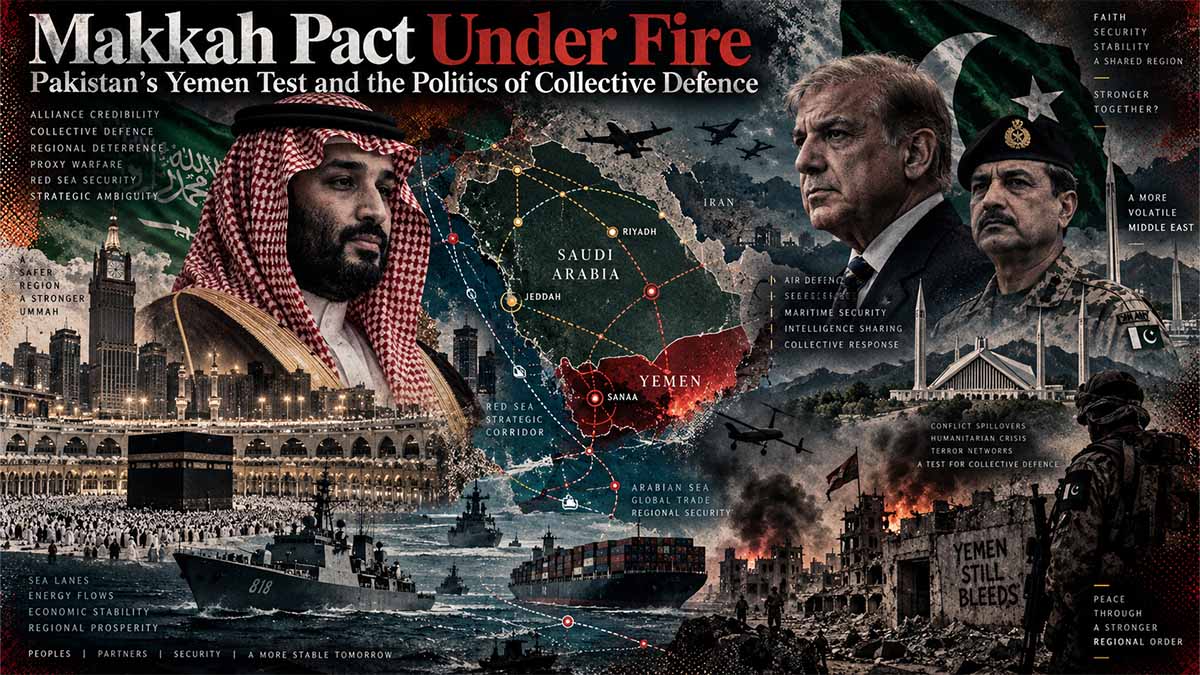
Scope: This assessment examines the 7 August 2026 Makkah Joint Defence Agreement among Saudi Arabia, Pakistan and Türkiye, the renewed Yemen–Saudi escalation through 19 September 2026, and the political, military and diplomatic constraints shaping whether collective defence evolves into active Pakistani or Turkish participation in the conflict.
Executive Summary / BLUF
The first major crisis confronting the Makkah Joint Defence Agreement is demonstrating neither that the accord is meaningless nor that an attack on Saudi Arabia automatically places Pakistan and Türkiye at war with Ansar Allah; rather, the verified public record shows an emerging collective-defence architecture whose political commitments are considerably clearer than its publicly disclosed operational obligations.
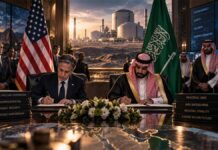
Saudi Arabia, Pakistan and Türkiye formally agreed on 7 August 2026 that an armed attack against one of the three states is to be regarded as an attack against all three, while presenting the arrangement as defensive and consistent with Article 51 of the UN Charter. The official materials retrieved for this assessment do not, however, publish a complete operative treaty text establishing automatic force commitments, prescribed military responses, geographic limitations, rules of engagement, or procedures determining whether an attack produced by an ongoing interstate or civil-war escalation requires collective combat operations. Makkah Al-Mukarramah Summit for Joint Defence — Pakistan Ministry of Foreign Affairs, August 2026: Official source; Saudi Foreign Ministry joint statement: Official Saudi text.
That ambiguity matters because the Yemen crisis is not a hypothetical external invasion of Saudi territory but part of an already active regional conflict, in which Ansar Allah has simultaneously intensified military operations inside Yemen and attacks across the Saudi border. The UN Special Envoy reported on 10 September that Ansar Allah had launched a major offensive on Yemen’s west coast, taken Mokha while fighting remained fluid, displaced more than 11,400 households since 3 September, and conducted attacks against Saudi civilian and energy infrastructure that wounded dozens of civilians. Briefing by the UN Special Envoy for Yemen, Hans Grundberg, to the Security Council — OSESGY, September 2026: Official UN briefing.
The political significance increased on 15 September, when Saudi Arabia stated that its air-defence forces had intercepted and destroyed a hostile drone directed toward Makkah before it entered the prohibited airspace of the holy city. This is a Saudi official attribution rather than independently disclosed forensic evidence, but its political effect is substantial because an attack presented as directed at Makkah engages an exceptionally sensitive religious and domestic-security dimension for Pakistan that predates the 2026 pact. Saudi Ministry of Foreign Affairs statement, 16 September 2026: Official Saudi statement.
Pakistan’s most important constraint is therefore not whether it regards Saudi security as important, which is already established, but how it converts collective-defence solidarity into military action without destroying its parallel strategy of regional mediation and without recreating the domestic political dilemma that kept Pakistan outside the Saudi-led Yemen intervention in 2015. Pakistan’s Parliament then called for neutrality in the Yemen conflict while simultaneously declaring unequivocal support for Saudi territorial integrity and the protection of the holy sites, creating a political precedent that permits Islamabad to distinguish between defending Saudi territory and entering an offensive war in Yemen. National Assembly Gazette, April 2015 — National Assembly of Pakistan: Official parliamentary record.
The balance of verified evidence therefore supports a layered activation model as the politically sustainable interpretation of the pact at this stage: greater intelligence exchange, air and missile defence coordination, military planning, force protection, training, surveillance and protection of strategic infrastructure can all strengthen Saudi defence without necessarily requiring Pakistani or Turkish strikes inside Yemen. This is an analytical judgment rather than a disclosed treaty requirement, and it would have to be reconsidered if the three governments publish implementing protocols, announce joint combat operations, deploy forces specifically for the Yemen theatre, or identify a formal collective-defence decision under the agreement.
The Makkah Pact’s First War Test Is About Selective Defence, Not Automatic War
The Makkah Joint Defence Agreement, signed by Saudi Arabia, Türkiye and Pakistan on 7 August 2026, entered its first serious crisis before its institutions had matured. By 10 September, UN Special Envoy Hans Grundberg was reporting renewed large-scale fighting in Yemen, more than 11,400 displaced households since 3 September, attacks on Saudi civilian and energy infrastructure, and Ansar Allah’s seizure of Mokha, roughly 75 kilometres from Bab al-Mandab. The contradiction is already clear: Riyadh needs a collective-defence pact that raises the cost of attacking Saudi territory, while Islamabad and Ankara need one that does not automatically convert every Saudi war into their own. The agreement will therefore be judged not by whether three armies fight identically, but by whether selective contributions can produce credible deterrence without creating strategic entrapment. UN Special Envoy for Yemen, 10 September 2026
A collective-defence clause is cheaper than a collective war
The 7 August 2026 Makkah Agreement established the principle that an armed attack against one member is regarded as an attack against all three, but the public record does not disclose an automatic requirement for identical military responses, standing multinational commands or predetermined force contributions. That distinction became more important on 31 August, when the first Strategic Political and Defence Committee met in Istanbul with the foreign ministers, defence ministers and senior military leadership of all three states and agreed to institutionalise cooperation, establish a permanent Secretariat in Saudi Arabia and pursue joint technology development and production. The political commitment is therefore real, but the mechanism remains deliberately incomplete: collective defence has been established before collective warfighting has been defined. Türkiye Ministry of Foreign Affairs, 31 August 2026
That incompleteness may initially be an asset. NATO’s Article 5 also does not prescribe an identical military response from every ally, but NATO can rely on decades of command structures, capability planning and interoperability that the Makkah framework did not possess on 31 August 2026. The new pact instead starts with a smaller political-military committee, a Saudi-based permanent Secretariat and an initial three-year Pakistani secretary-generalship, leaving the harder questions of force generation, readiness standards and operational command unresolved. The practical test is therefore whether Riyadh, Ankara and Islamabad can define meaningful contributions before ambiguity begins to look like hesitation. Türkiye Ministry of Foreign Affairs, 31 August 2026
Pakistan’s 2015 formula still limits what Riyadh can reasonably expect
Pakistan entered the 2026 crisis with a domestic precedent that already separates defence of Saudi Arabia from war in Yemen. On 10 April 2015, Pakistan’s Parliament unanimously called for neutrality in the Yemen conflict while simultaneously declaring unequivocal support for Saudi territorial integrity and stating that Pakistan would stand with the kingdom if the Haramain Sharifain were threatened. That was not diplomatic ambiguity but a deliberate division of obligations: Yemen’s internal war belonged to one category, while an attack on Saudi territory or the Islamic holy sites belonged to another. National Assembly of Pakistan, 10 April 2015
The distinction gives Islamabad room to support Saudi air defence, intelligence, infrastructure protection and military training without automatically conducting strikes inside Yemen, but it becomes harder to sustain when attacks are presented as threatening Makkah. Pakistan’s Parliament explicitly named the holy sites in 2015, which means their protection carries a political significance beyond ordinary alliance management. The cost of Pakistani restraint therefore rises sharply if Saudi territory is repeatedly struck, yet the cost of direct belligerency rises as well because Islamabad must still manage its land frontier with Iran and preserve the diplomatic channels that reduced tensions after the bilateral Pakistan-Iran crisis of January 2024. Saudi Ministry of Foreign Affairs, January 2024
Türkiye can add deterrence without becoming Yemen’s next combatant
Türkiye’s most valuable contribution may be less visible than direct air operations. At the 31 August 2026 Istanbul meeting, Foreign Minister Hakan Fidan, Defence Minister Yaşar Güler and Chief of General Staff General Selçuk Bayraktaroğlu joined the pact’s political-military structure, while the joint statement committed the three governments to defence-industrial cooperation, joint technology development and production. That gives Ankara a route to strengthen Saudi resilience through technology, production and interoperability without making Turkish participation in offensive operations inside Yemen automatic. Türkiye Ministry of Foreign Affairs, 31 August 2026
This industrial route matters because repeated drone and missile attacks are ultimately an inventory contest as much as a tactical one. A defender must continuously sustain sensors, interceptors, maintenance, electronic warfare and trained crews, while an attacker can vary timing and weapon type. The Makkah partners’ 31 August commitment to joint production therefore has greater long-term significance than a single retaliatory strike if it eventually produces common systems or replenishment capacity. The public dossier does not identify specific trilateral programmes, volumes or budgets, which means the industrial commitment remains institutional rather than operational, but it identifies the transmission mechanism through which Türkiye can convert political solidarity into durable military value. Türkiye Ministry of Foreign Affairs, 31 August 2026
Mokha turns Saudi defence into a Red Sea problem
The geography changed when Hans Grundberg reported on 10 September 2026 that Ansar Allah had gained control of Mokha, approximately 75 kilometres from Bab al-Mandab, while warning that the military situation remained fluid. By 15 September, UN Assistant Secretary-General Khaled Khiari reported continuing Houthi advances toward the strait and the reported seizure of several southern Red Sea islands, while commercial shipping was still moving. Control of Mokha does not equal control of Bab al-Mandab, but it reduces the geographic separation between Yemen’s land war and one of the region’s principal maritime corridors. UN Special Envoy for Yemen, 10 September 2026 UN DPPA, 15 September 2026
The maritime evidence explains why this matters beyond Saudi Arabia. On 12 August 2026, the International Maritime Organization confirmed fatalities after the cargo vessel TIHAMAH was struck by a projectile off Al Mokha; on 6 July, the IMO had already reported 24 attempted or actual incidents of piracy and armed robbery during the preceding three months in the Red Sea and Gulf of Aden region, with 44 seafarers held aboard three hijacked vessels. The Makkah pact therefore confronts two overlapping security economies: deliberate military coercion against shipping and a broader environment of maritime insecurity that raises the cost of protecting commercial traffic. IMO, 12 August 2026 IMO, 6 July 2026
Ansar Allah does not need parity to make the pact expensive
The UN Panel of Experts documented a Houthi arsenal encompassing ballistic missiles, land-attack cruise missiles, anti-ship missiles, one-way attack UAVs, surveillance drones, maritime radars and uncrewed underwater systems, while also recording dependence on foreign support for sophisticated capabilities. The asymmetry is financial and operational: Saudi Arabia and its partners must protect cities, energy infrastructure, bases and shipping corridors continuously, whereas Ansar Allah needs only enough surviving capability to create recurring risk across several domains. UN Security Council Panel of Experts on Yemen, S/2024/731
That pressure makes the 31 August 2026 decision to pursue joint production more consequential than alliance rhetoric. If the trilateral system eventually improves replenishment, intelligence fusion, air defence or maritime surveillance, Ansar Allah faces a thicker defensive architecture without Pakistan or Türkiye necessarily joining Saudi offensive operations. If those mechanisms remain declaratory, however, the cost-exchange problem remains largely Saudi: Riyadh must continue carrying the expensive end of interception while its partners preserve political flexibility. Türkiye Ministry of Foreign Affairs, 31 August 2026
The alliance can survive unequal roles, but not undefined ones
The strongest institutional model emerging from the 7 August agreement is therefore functional specialisation rather than three-way military symmetry. Saudi Arabia can provide host infrastructure and financing; Türkiye can contribute defence technology and industrial capacity; Pakistan can provide training, personnel and selected defensive capabilities while maintaining a separate political threshold for operations inside Yemen. No public document assigns those roles formally, so the model remains analytical rather than contractual, but it fits the pact’s published combination of collective deterrence, national sovereignty and joint production. Pakistan Ministry of Foreign Affairs, 7 August 2026
Such differentiation becomes credible only when contributions are visible before the next crisis. The Strategic Political and Defence Committee created on 31 August 2026 will therefore matter less as a diplomatic forum than as the place where the three governments either define contingency roles or fail to do so. Integrated early warning, maritime information-sharing, joint exercises, industrial replenishment and protection of critical infrastructure would demonstrate that selective defence is an organised doctrine; repeated consultations without assigned capabilities would instead expose the gap between a collective-defence declaration and an operational alliance. Türkiye Ministry of Foreign Affairs, 31 August 2026
The next 24 months will price the difference between ambiguity and deterrence
Over the next 12–24 months, the Makkah pact will either acquire operational depth through permanent planning, identifiable joint-production programmes, recurring exercises and differentiated force commitments, or remain a flexible political guarantee whose effectiveness depends on improvisation at every crisis. The immediate advantage of the flexible model is that it limits Pakistani and Turkish entrapment while still allowing Saudi Arabia to draw additional defensive capacity from two substantial partners; its weakness is that adversaries can test the boundaries repeatedly until they discover which commitments are real.
The cost of inaction is distributed unevenly. Saudi Arabia pays first through continued expenditure on interception, infrastructure protection and Red Sea security; Pakistan pays if repeated restraint damages the credibility of commitments formalised in 2026, while deeper intervention jeopardises the Iran relationship and the 2015 Yemen compromise; Türkiye pays if the industrial and institutional ambitions announced on 31 August fail to produce capabilities commensurate with its enlarged regional role. Commercial shipping and seafarers pay the external cost when deterrence fails, as the 12 August 2026 attack on TIHAMAH already demonstrated. The decisive measure of the pact will therefore not be whether Riyadh, Ankara and Islamabad fight the same war, but whether they can make an attack on one impose costs that all three help generate. IMO, 12 August 2026
Selective Collective Defence: Asymmetric Chokepoints, Functional Burden-Sharing & Deterrence Dynamics
BLUF / Strategic Assessment: The viability of the Makkah framework rests on whether the signatories can make selective collective defence operationally credible—distributing military, industrial, intelligence, and diplomatic roles based on national strengths and constraints without automatically entering every conflict as co-belligerents. As Ansar Allah captures Mokha (75 km from Bab al-Mandab) and advances toward southern Red Sea islands, Saudi security is no longer confined to mainland borders. Confronting asymmetric, low-cost ballistic, cruise, and UAV threats (UN Panel S/2024/731) requires shifting from finite interceptor inventories to sustainable trilateral production ecosystems and specialized maritime domain awareness, rather than open-ended expeditionary ground campaigns in Yemen.
Türkiye Strategic Vectors: Autonomy, Industrial Synergy & Expeditionary Restraint
Türkiye: Regional Strategic Institutionalisation & Industrial Weight
Table 1: Asymmetric Threat Vectors & Defensive Exhaustion Calculus
| Capability Vector (UN S/2024/731) | Operational Defensive Challenge | Regional Strategic Consequence | Appropriate Trilateral Function |
|---|---|---|---|
| Medium/Short-Range Ballistic Missiles | High-altitude, rapid terminal velocity; requires high-cost kinetic interceptors (Patriot PAC-3 / THAAD). | Exhausts expensive interceptor stockpiles; pressures critical civilian energy facilities. | Joint Sensor Warning & Munitions Replenishment |
| Land-Attack Cruise Missiles (LACM) | Terrain-hugging low-altitude profiles; evades traditional ground radar horizons. | Demands distributed radar networks and persistent airborne early warning coverage. | Turkish Electronic Warfare & Radar Fusion |
| One-Way Attack UAVs (Loitering) | Low cost ($15k–$50k) creates severe asymmetry against million-dollar air defence missiles. | Saturates air defences; introduces religious-political triggers if directed toward holy cities. | Pakistani Air Defence Crews & Turkish C-UAS |
| Anti-Ship Ballistic & Cruise Missiles | Terminal active radar homing targeting moving merchant vessels in the Red Sea and Bab al-Mandab. | Inflates commercial maritime war insurance; prompts rerouting around the Cape of Good Hope. | Trilateral Maritime Escorts & ISR Liaison |
| Littoral Radar & Uncrewed Sea Vessels | Low-profile surface strike vessels and coastal tracking networks concealed along the Tihama coast. | Disrupts international shipping near Mokha (IMO confirmed fatal strike on TIHAMAH, 12 Aug). | Naval Interdiction & Coastal Surveillance |
| Mokha Coastal Control (~75 km to Strait) | Proximity to international shipping lanes provides launch concealment and tactical vantage points. | Externalises the conflict to Egypt, Gulf exporters, and global supply chains (UN DPPA, 15 Sep). | Multilateral Freedom of Navigation Hub |
Table 2: Functional Division of Labour Matrix — Selective Collective Defence Model
| Alliance Functional Domain | Saudi Arabia (Host / Exposed) | Türkiye (Industrial / Maritime) | Pakistan (Operational / Median) | Direct War? |
|---|---|---|---|---|
| Territorial Air & Missile Defence | Host architecture, Patriot/THAAD | Sensors, EW, C-UAS tech integration | Specialist air defence crews, radar | NO |
| Strategic Intelligence Fusion | In-theatre radar & target data | Satellite ISR, SIGINT inputs | Regional analysis, threat vetting | NO |
| Bab al-Mandab & Maritime ISR | Red Sea coastal bases, patrol craft | Naval surveillance, technical assets | Arabian Sea escort experience | NO |
| Defence Industrial Replenishment | Financing, procurement, facilities | Advanced UAVs, ordnance production | Ammunition, manufacturing base | NO |
| Infrastructure Resilience / C2 | Hardening of domestic facilities | Hardened tactical communications | Base protection & logistics teams | NO |
| Offensive Strikes Inside Yemen | Discretionary national strikes | Sovereign veto (No deployment) | Sovereign veto (2015 ban applies) | YES (Separated) |
The Tripartite Paradox: Entrapment, Deterrence & Maritime Vulnerability
ALLIANCE DILEMMA
ABANDONMENT VS ENTRAPMENT- Saudi Abandonment Risk: Riyadh fears that without automated combat intervention, trilateral collective defence will remain primarily rhetorical during prolonged cross-border strikes.
- Ankara & Islamabad Entrapment: Türkiye and Pakistan risk being drawn into an open-ended Yemeni conflict disconnected from their core regional priorities.
- Selective Compromise: Selective collective defence resolves both dilemmas by providing concrete defensive capabilities while keeping offensive escalation sovereign and discretionary.
ATTRITION ECONOMICS
INTERCEPTOR DEPLETION- Cost Asymmetry: Ansar Allah employs uncrewed systems and ballistic assets costing fractions of the million-dollar surface-to-air interceptors required to destroy them.
- Production Bottlenecks: Even successful intercepts deplete finite national arsenals, converting missile defence into an industrial production contest.
- Regeneration Imperative: The 31 August joint production mandate provides an institutional pathway to co-produce interceptors, munitions, and electronic warfare suites at scale.
MOKHA–CHOKEPOINT SHOCK
MARITIME EXPANSION- Littoral Proximity: Mokha lies ~75 km from Bab al-Mandab. Control of coastal positions allows Ansar Allah to project asymmetric anti-ship capabilities into key sea lanes.
- Externalising Cost: Verified vessel strikes (IMO TIHAMAH attack, UNSC Res 2826) affect Egypt’s Suez revenues, European trade, and global supply chains.
- Public Good Mandate: Trilateral maritime surveillance around Bab al-Mandab provides international legitimacy without requiring direct ground combat inside Yemen.
Forensic Strategic Key Judgments: Regional Impact
Selective Defence Replaces Automatic Belligerency
Trilateral credibility does not require identical kinetic responses. Selective collective defence distributes military, technical, and diplomatic tasks according to national capabilities and constraints.
Türkiye’s Role: Industrial Integration Over Combat
Türkiye functions as a technology and institutional partner. Co-developing UAVs, radar, and electronic warfare creates integration without entangling NATO Article 5 in the Arabian Peninsula.
Mokha Seizure Shifts Threat Geography
The UN-reported seizure of Mokha (10 Sep) and moves toward Red Sea islands bring asymmetric strike assets closer to Bab al-Mandab, shifting Saudi security from a border problem to a broader maritime challenge.
Asymmetric Cost Economics Favor the Attacker
As documented in UN report S/2024/731, low-cost loitering drones and ballistic assets impose disproportionate financial and inventory costs on defenders, making replenishment a decisive variable.
Maritime Security as a Cooperation Hub
Bab al-Mandab and Red Sea trade routes allow Riyadh, Ankara, and Islamabad to cooperate on merchant vessel protection, maritime surveillance, and ISR without entering Yemen’s domestic civil conflict.
Division of Labour Outlasts Symbolic Pacts
An institutional model based on functional specialization—Saudi funding, Turkish technology, and Pakistani operational expertise—creates mutual dependencies that prove more durable than declaratory security guarantees.
Open Official Record Gaps
- Specific Trilateral Industrial Programs: The 31 August joint statement mandates defence co-development, but specific platforms, funding, and IP agreements remain unpublished.
- Standing Maritime Command Arrangements: Official records disclose no permanent trilateral command structures for Red Sea or Bab al-Mandab escort operations.
- Verification of Island Seizures: Details on Houthi control of southern Red Sea islands reported on 15 September—including specific locations, weapon deployments, and operational impact—remain unverified.
- Contingency Planning Matrices: Verified records provide no evidence of formal SPDC frameworks defining differentiated national obligations across varied escalation scenarios.
Observable Watch Indicators
Navigational Index
The pact as an emerging security institution
The first pillar examines what has actually been established by the Makkah Agreement, how the Strategic Political and Defence Committee and Saudi-based Secretariat alter trilateral security coordination, and why an Article-5-like political formulation should not be confused with NATO's accumulated command structures, defence planning machinery and decades of developed alliance doctrine.
Pakistan between Riyadh, Tehran and the Yemen precedent
The second pillar examines Islamabad's central strategic dilemma: Saudi security relationships and the political significance of the holy sites on one side, alongside the geographic necessity of managing Iran, Pakistan's historical parliamentary reluctance to become a belligerent in Yemen, and Islamabad's current claim to a mediation role in broader Gulf crises on the other.
The regional consequences of selective collective defence
The third pillar assesses Türkiye's position, the Saudi requirement for credible deterrence, Ansar Allah's ability to impose asymmetric costs, the significance of Mokha and Bab al-Mandab, and whether the pact evolves toward an operational alliance, remains a flexible deterrence framework, or becomes a mechanism through which the three governments divide responsibilities without automatically sharing every war.
Master Abstract
The first test is institutional rather than merely military
The Makkah Agreement represents a meaningful change in Middle Eastern security architecture because it moves three states possessing markedly different strategic assets into a formal collective-defence framework: Saudi Arabia contributes geographic centrality, substantial defence spending and Gulf political weight; Türkiye possesses a large NATO-standard military establishment and an expanding defence-industrial base; Pakistan contributes significant conventional military capacity and occupies a distinctive strategic position as a nuclear-armed state bordering Iran, India, Afghanistan and the Arabian Sea. What the agreement does not yet publicly establish, however, is an integrated alliance comparable in institutional depth to NATO, because the official material published since August confirms the collective-defence principle and new coordination bodies but does not disclose standing combined commands, automatic force-generation procedures or predetermined military responses. The inaugural meeting of the Strategic Political and Defence Committee on 31 August therefore matters at least as much as the original signing: the foreign ministers, defence ministers and senior military leadership agreed to institutionalise cooperation, establish a permanent Secretariat in Saudi Arabia initially led for three years by a Pakistani secretary-general, strengthen defence-industry collaboration and pursue joint technology development and production. Strategic Political and Defence Committee of the Makkah Agreement for Joint Defence — Joint Statement — Pakistan Ministry of Foreign Affairs, August 2026: Official joint statement.
This institutional design explains why the current crisis should not be reduced to a binary question of whether Pakistan is “obeying” or “violating” the agreement by bombing Yemen. The publicly released documents describe a mechanism for collective deterrence and defence while simultaneously emphasising de-escalation, restraint and peaceful resolution of crises, which gives the members considerable political space in determining how solidarity is translated into action. Pakistan's Foreign Ministry reinforced that interpretation on 17 September by describing the agreement as defensive, stating that it neither targets a specific country nor formally creates a new bloc, and identifying training, capacity-building, defence research, technological cooperation and deterrence as components of the relationship without announcing a Pakistani combat operation against Yemen. Transcript of the Press Briefing by the Spokesperson on Wednesday 17th September 2026 — Pakistan Ministry of Foreign Affairs: Official transcript.
Yemen is exposing the difference between deterrence and automatic war
The operational environment deteriorated rapidly after the agreement was signed, making the sequence politically significant. The UN Special Envoy stated on 7 September that Ansar Allah attacks across several fronts had triggered increasingly intense clashes and warned that Yemen risked returning to sustained large-scale conflict; three days later, he told the Security Council that the feared escalation had become reality, with fighting expanding along multiple fronts and Ansar Allah obtaining control of Mokha while the situation remained fluid. Statement by the UN Special Envoy for Yemen on recent escalation — OSESGY, September 2026: Official UN statement; Briefing by the UN Special Envoy for Yemen — OSESGY, September 2026: Official UN briefing.
The cross-border dimension is equally important because the UN Special Envoy specifically reported attacks against Saudi civilian and energy infrastructure and called on Ansar Allah to cease operations both inside Yemen and across the Saudi border. Saudi Arabia had already stated in August that missile attacks had targeted the kingdom since 13 July and that attacks against commercial shipping had occurred since 22 July, while welcoming an earlier Security Council condemnation; these dates demonstrate that the Makkah pact was negotiated and signed during an existing deterioration of the Yemen–Saudi security environment rather than before an unforeseen crisis emerged. Saudi Ministry of Foreign Affairs, August 2026: Official Saudi statement.
This chronology changes the political interpretation of the agreement because Saudi Arabia, Pakistan and Türkiye cannot plausibly treat escalation from Yemen as an entirely unexpected contingency; the harder question is whether the pact was deliberately constructed with enough ambiguity to strengthen deterrence without imposing automatic participation in conflicts whose origins, escalation chains and political objectives differ. No publicly retrieved official document settles that issue, which means assertions that the treaty legally requires Pakistani offensive operations against Yemen go beyond what the published evidence currently establishes.
Pakistan's political geometry is more restrictive than the treaty slogan suggests
Pakistan enters the crisis with a political doctrine that already contains the essential contradiction now facing the Makkah arrangement. In April 2015, Parliament simultaneously called for Pakistan to maintain neutrality in the Yemen conflict so that it could perform a diplomatic role and declared that any violation of Saudi territorial integrity or threat to the Haramain Sharifain would place Pakistan “shoulder to shoulder” with Saudi Arabia. That parliamentary record is particularly important because it shows that the distinction between Yemen intervention and Saudi territorial defence is not an analytical invention created in 2026 but has deep domestic political precedent. National Assembly Gazette — April 2015 — National Assembly of Pakistan: Official parliamentary document.
The emerging Pakistani position can therefore be understood as continuity under a stronger treaty structure rather than a complete strategic reversal. Islamabad can regard attacks on Saudi territory as engaging a genuine defence obligation while still maintaining that collective defence does not necessarily authorise or require an unrestricted Pakistani campaign inside Yemen. The distinction is politically valuable because it preserves room for defensive deployments and intelligence cooperation while reducing the probability that the Makkah framework automatically imports every Saudi regional confrontation into Pakistan's own military commitments.
That flexibility is reinforced by Islamabad's current diplomacy with Tehran. Pakistan's Foreign Ministry stated that Field Marshal Syed Asim Munir visited Tehran in late August as part of Pakistani efforts to de-escalate the wider Gulf crisis and described Islamabad as seeking to bridge regional divisions through dialogue; it also confirmed continuing political contacts with Iranian Foreign Minister Abbas Araghchi and discussions concerning the regional situation and the Makkah Agreement. Transcript of the Press Briefing by the Spokesperson on Thursday 27th August 2026 — Pakistan Ministry of Foreign Affairs: Official transcript; Transcript of the Press Briefing on Wednesday 02nd September 2026 — Pakistan Ministry of Foreign Affairs: Official transcript.
This produces Pakistan's core political dilemma: the more visibly Islamabad transforms the Makkah Agreement into a platform for offensive warfare against an actor closely connected to Iran, the more difficult it becomes to sustain the diplomatic flexibility that Pakistan is simultaneously presenting as an element of its regional strategy; conversely, a response perceived in Riyadh as purely rhetorical would weaken the deterrent credibility that the agreement was designed to strengthen.
Türkiye is supporting solidarity without publicly converting it into belligerency
Türkiye's behaviour so far points toward the same distinction between political solidarity and automatic combat participation. Ankara officially participated in establishing the Strategic Political and Defence Committee and subsequently issued repeated condemnations of attacks against Saudi Arabia on 8, 12 and 16 September, while the public material retrieved for this assessment does not announce a Turkish combat operation against Ansar Allah. Republic of Türkiye Ministry of Foreign Affairs announcement index, September 2026: Official Turkish MFA record.
The significance is structural rather than semantic. Türkiye is simultaneously a member of NATO and now a signatory to a separate Middle Eastern collective-defence framework whose institutional development involves foreign ministers, defence ministers and senior military commanders. The Makkah mechanism therefore expands Ankara's strategic autonomy and regional defence relationships without, on the evidence presently public, merging NATO obligations with the new trilateral arrangement or creating a publicly declared cross-alliance command system.
The Makkah attack allegation raises the political threshold
Saudi Arabia's statement that a drone was directed toward Makkah creates a more sensitive test than attacks against ordinary infrastructure because the religious significance of the city changes the political cost of inaction across the Muslim world, and particularly in Pakistan, where the 2015 parliamentary resolution explicitly distinguished threats to the Haramain Sharifain from the wider Yemen war. Saudi Arabia stated that the drone was intercepted and destroyed on 15 September before entering Makkah's prohibited airspace, while several Arab governments and Türkiye subsequently issued condemnations. Saudi Ministry of Foreign Affairs/SPA statement, 16 September: Official Saudi account; Turkish Ministry of Foreign Affairs announcements: Official Turkish record.
Nevertheless, evidentiary discipline requires separating political consequence from technical attribution. The retrieved Saudi official record attributes the drone to the Houthis, but publicly released forensic material sufficient to independently reconstruct the launch chain, intended impact point and command authorisation has not been identified in the official sources reviewed here. The appropriate analytical formulation is therefore that Saudi Arabia says the attack targeted Makkah, rather than treating every operational detail of the incident as independently established.
The real test is whether ambiguity remains stabilising
Strategic ambiguity can initially strengthen an alliance because an adversary cannot know in advance which capabilities an attack will mobilise, but excessive ambiguity eventually weakens deterrence if partners appear unwilling to translate political commitments into observable military preparation. The Makkah partners are consequently entering a second phase in which institutional indicators matter more than ceremonial language: combined air-defence planning, intelligence integration, exercises, deployment patterns, joint command arrangements, technology programmes and formal decisions by the Strategic Political and Defence Committee will reveal more about the pact's credibility than repeated declarations that an attack on one constitutes an attack on all.
The agreement's first Yemen crisis therefore does not yet demonstrate institutional failure; instead, it exposes the unresolved question at the heart of almost every new collective-defence system, namely how much sovereignty members have retained over the decision to use force after declaring their security indivisible. Pakistan's 17 September Foreign Ministry briefing is particularly revealing because it reaffirmed the defensive character of the pact and described cooperative functions while declining to announce a specific military activation mechanism. Transcript of the Press Briefing by the Spokesperson on Wednesday 17th September 2026 — Pakistan Ministry of Foreign Affairs: Official transcript.
Key Evidence Table
| Indicator | Value/status | Reference date | Definition/scope | Issuer | Exact source |
|---|---|---|---|---|---|
| Makkah Joint Defence Agreement signed | Confirmed | 7 Aug 2026 | Saudi Arabia–Pakistan–Türkiye collective-defence framework | Pakistan MFA / Saudi MFA | Makkah Al-Mukarramah Summit for Joint Defence Source |
| Core collective-defence formulation | Armed attack on one is regarded as attack on all | 7 Aug 2026 | Publicly announced political/defence commitment | Pakistan MFA / Saudi MFA | Saudi joint statement Source |
| Strategic Political and Defence Committee established | Confirmed | 31 Aug 2026 | Foreign, defence and senior military leadership mechanism | Three governments | Joint statement Source |
| Permanent Secretariat | Saudi Arabia; first Secretary-General to be Pakistani for three years | 31 Aug 2026 | Institutional implementation structure | Three governments | Joint statement Source |
| Yemen conflict escalation | Return to major fighting; Mokha taken by Ansar Allah while situation remained fluid | 10 Sep 2026 | Yemen west coast and multiple internal fronts | UN Special Envoy | UN briefing Source |
| Newly displaced households | More than 11,400 reported since 3 September | Reported 10 Sep 2026 | Yemen nationwide humanitarian displacement | UN Special Envoy citing humanitarian actors | UN briefing Source |
| Cross-border attacks | UN confirms attacks against Saudi civilian and energy infrastructure, wounding dozens | 10 Sep 2026 | Saudi territory | UN Special Envoy | UN briefing Source |
| Drone directed toward Makkah | Saudi Arabia says intercepted and destroyed before prohibited airspace | 15 Sep 2026 | Saudi official attribution to Houthis | Saudi MFA / SPA | Saudi statement Source |
| Pakistan's current public interpretation | Defensive agreement; not formally a new bloc; cooperation includes training, capacity-building, technology and deterrence | 17 Sep 2026 | Public government interpretation | Pakistan MFA | Press briefing Source |
| Historical Pakistani Yemen doctrine | Neutrality in Yemen combined with explicit defence of Saudi territorial integrity and holy sites | 10 Apr 2015 | Parliamentary political position | Parliament of Pakistan | National Assembly Gazette Source |
Principal Gaps and Watch Indicators
Publication of the complete agreement or implementing protocols would materially alter the assessment, because the public joint statements currently establish the collective-defence principle without revealing whether members retain complete national discretion over military measures or have accepted predetermined obligations beyond consultation and cooperation.
A formal decision by the Strategic Political and Defence Committee concerning Yemen would be the clearest institutional indicator that the agreement has moved from general deterrence into crisis activation, particularly if such a decision specifies air defence, intelligence, maritime security, force deployment or offensive operations.
Changes in Pakistani military posture inside Saudi Arabia would require close examination, but individual deployments should not be interpreted as Makkah-pact activation without evidence connecting them to the new agreement, because Pakistan and Saudi Arabia possess longstanding defence relationships that predate August 2026.
Turkish force deployments or combined operational planning specifically connected to the Yemen theatre would demonstrate a substantial change from Ankara's currently visible posture of political condemnation, alliance institution-building and support for Saudi security without publicly announced combat participation.
Further attacks against Makkah, Medina or other symbolically exceptional targets would raise the political cost of restraint for Pakistan far more sharply than ordinary attacks on peripheral military installations because Pakistan's own parliamentary precedent explicitly treats threats to the holy sites as a separate category from participation in the wider Yemen conflict.
Iranian diplomatic signalling toward Pakistan or Türkiye should be monitored because the strategic viability of the pact partly depends upon whether Tehran interprets collective defence of Saudi territory as a bounded defensive mechanism or as the emergence of a hostile regional alignment directed against Iranian-linked actors.
Saudi retaliatory doctrine is another decisive variable, because the political burden imposed on Islamabad and Ankara differs substantially between helping defend Saudi territory against incoming missiles and drones and participating in sustained offensive operations inside Yemen.
Open Official Record
The most important unavailable record is the complete authenticated text of the Makkah Joint Defence Agreement and any confidential annexes or implementation protocols, because the governments have publicly released the collective-defence principle and institutional framework without disclosing every operative provision.
No public official record identified during this assessment establishes a NATO-style automatic military response, nuclear-sharing arrangement, standing combined command, predetermined Pakistani combat role inside Yemen, or mandatory allocation of particular Saudi, Turkish and Pakistani military capabilities; these propositions should therefore not be presented as established facts unless subsequent official documentation is released.
The precise military characteristics of the 15 September drone directed toward Makkah, including publicly verifiable launch data, intended terminal coordinates, command chain and forensic attribution, remain incompletely documented in the retrieved official record, even though Saudi Arabia formally attributes the attack to the Houthis.
The exact relationship between existing Pakistani deployments or bilateral Saudi-Pakistani defence arrangements and any additional forces potentially assigned under the Makkah mechanism also remains operationally undisclosed.
Net Assessment
The central political consequence of the Yemen crisis is not that the Makkah Agreement has failed its first test, but that its first test has exposed what the signing ceremony deliberately left unresolved in public: collective defence does not by itself determine the form, geographic scope or intensity of collective action. The pact has already generated institutions, a permanent secretariat and a mechanism joining the political and military leaderships of three strategically important states, which makes it more consequential than a symbolic communiqué; equally, nothing in the official material presently available establishes that a cross-border strike against Saudi Arabia automatically requires Pakistan or Türkiye to conduct offensive operations inside Yemen.
For Saudi Arabia, the immediate political objective is credibility: an agreement advertised as collective defence must generate observable additional security value when Saudi territory is attacked, even if that value comes through integrated air defence, intelligence, technology, logistics and deterrent signalling rather than direct coalition warfare. For Türkiye, the challenge is to convert a new regional-security role into practical influence without allowing every Saudi confrontation to determine Turkish military policy. For Pakistan, the strategic problem is more difficult because Riyadh is an exceptionally important security partner while Iran is a neighbouring state with which Islamabad is simultaneously maintaining de-escalatory diplomacy; Pakistan must also reconcile the 2026 pact with its own 2015 parliamentary precedent distinguishing the defence of Saudi territory and the Islamic holy sites from participation in the Yemen war.
The strongest current interpretation is therefore that the Makkah system is developing as a graduated collective-defence architecture rather than an automatic war mechanism, allowing its members to strengthen Saudi territorial defence while preserving national discretion over escalation beyond Saudi borders. This judgment would weaken materially if the complete treaty reveals binding automatic-force provisions, if the Strategic Political and Defence Committee formally authorises operations inside Yemen, or if Pakistani and Turkish forces become operational participants in strikes against Ansar Allah; conversely, it would strengthen if subsequent crises continue to produce defence integration, intelligence cooperation and diplomatic coordination without cross-border combat operations by all three signatories.
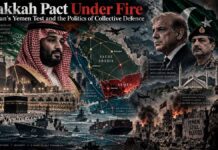
Makkah Pact Under Fire: Pakistan’s Yemen Test and the Politics of Collective Defence
BLUF / Strategic Summary: The first major operational test of the 7 August 2026 Makkah Joint Defence Agreement exposes the structural delta between formal collective defence political rhetoric and unverified binding force execution. Following the 10 September Ansar Allah takeover of Mokha and the 15 September interception of a hostile loitering munition targeting Makkah airspace, Pakistan and Türkiye face acute structural trade-offs. Rather than automatic kinetic entry into Yemen, verified empirical records confirm a layered activation model—compartmentalizing territorial holy site defence from cross-border retaliatory campaigns to preserve Iranian diplomatic channels and parliamentary neutrality doctrines.
Dynamic Strategic Stress Vectors: Institutionalization Index
Institutional Treaty Architecture & Operational Disconnect
Table 1: Verified Chronology, Force Dispositions & Official Statements
| Indicator / Event | Status / Audited Finding | Date | Scope & Strategic Relevance | Primary Issuer | Exact Source |
|---|---|---|---|---|---|
| Makkah Joint Defence Pact | Confirmed Ratification Article 5-type political phrasing |
07 Aug 2026 | Defensive umbrella uniting Saudi capital, Turkish NATO standard military & Pakistani nuclear/conventional forces. | Saudi & Pakistan MFAs | MAE Pakistan / SPA |
| SPDC & Secretariat Setup | Institutionalized Pakistani Sec-Gen (3-yr term) |
31 Aug 2026 | Trilateral defence/foreign ministerial committee; permanent administrative hub based in Riyadh. | Trilateral Ministerial | Joint Statement (Riyadh) |
| Mokha Offensive & Seizure | Active Fluid Combat 11,400+ households displaced |
10 Sep 2026 | Ansar Allah captures Mokha port; direct operational pressure on Bab al-Mandab maritime transit corridor. | UN Special Envoy | UNSC Briefing (OSESGY) |
| Cross-Border Energy Strikes | Verified Incursions Civilian casualties confirmed |
10 Sep 2026 | Missile & drone salvoes impacting Saudi civilian energy infrastructure, terminating de facto regional truce. | Hans Grundberg (UN) | OSESGY Statement |
| Hostile Drone on Makkah | Intercepted Mid-Flight Pre-prohibited airspace |
15 Sep 2026 | Direct trigger for Islamic solidarity doctrine; Saudi official attribution to Houthis (forensics unpublished). | Saudi Air Defence / MFA | SPA Official Wire |
| Pakistan Non-Bloc Position | Defensive Delimitation Excludes offensive campaign |
17 Sep 2026 | Clarified as capacity-building, radar liaison & deterrence; explicitly refutes forming an aggressive military bloc. | Pakistan Spokesperson | MoFA Press Briefing |
| 2015 Precedent Benchmark | Constitutional Precedent Neutrality vs Territorial Defence |
10 Apr 2015 | Unanimous parliamentary resolution refusing combat entry into Yemen while guaranteeing defence of the Holy Shrines. | National Assembly (PK) | NA Gazette (na.gov.pk) |
Tripartite Geopolitical Drivers & Restrictive Geometry
SAUDI ARABIA: DETERRENCE
CREDIBILITY AT STAKE- Pact Credibility: Riyadh requires tangible proof that trilateral collective defence raises the cost for Ansar Allah and Iranian proxy networks.
- Holy Site Threshold: Leveraging the 15 September Makkah airspace incident to engage Pakistan’s religious and constitutional defence obligations.
- Burden Division: Desires external intelligence sharing, radar network integration, and high-readiness force augmentation without unilaterally sustaining Gulf war exhaustion.
PAKISTAN: DUAL ALIGNMENT
MEDIAN BALANCER- Tehran Channel: Late-August diplomacy by Field Marshal Asim Munir in Tehran highlights Islamabad’s intent to avoid being drawn into a sectarian proxy conflict.
- Constitutional Line: Strict adherence to the 2015 doctrine: defending Saudi soil and the Haramain Sharifain is unconditional, but deploying troops into Yemen is ruled out.
- Institutional Leadership: Holding the inaugural Secretary-General post in Riyadh empowers Pakistan to guide pact activation toward containment rather than offensive kinetic operations.
TÜRKIYE: STRATEGIC AUTONOMY
DEFENCE INDUSTRIAL LEVER- NATO Decoupling: Operates inside the Makkah framework as an independent regional power without extending NATO Article 5 commitments into the Arabian Peninsula.
- Red Sea Interests: High sensitivity to maritime disruption following Ansar Allah's push into Mokha and the Bab al-Mandab chokepoint.
- Industrial Focus: Prioritizes sales of unmanned aerial combat systems, electronic warfare hardware, and radar suites over expeditionary ground deployments.
Forensic Strategic Key Judgments
Political Pledge ≠ Operational Automaticity
The 7 August treaty text mirrors Article 5 language but omits automated military activation mechanisms, unified commands, or pre-delegated authority for cross-border retaliatory strikes.
Viability of the Layered Activation Model
Trilateral solidarity will manifest through intelligence sharing, early-warning sensor fusion, and air defence logistics rather than joint combat expeditionary operations inside Yemen.
2015 Doctrine Retains Precedence
Pakistan’s 2015 parliamentary resolution legally and politically decouples the sanctity of the Holy Sites and Saudi territorial integrity from active intervention in Yemeni civil warfare.
Makkah Incident Raises Political Stakes
The 15 September hostile drone interception near Makkah significantly increases domestic political pressure in Pakistan, even though public forensic proof attributing the launch remains classified.
Mokha Seizure Shifts Naval Calculus
Ansar Allah’s capture of Mokha directly threatens Bab al-Mandab shipping lanes, creating points of strategic alignment with Türkiye without obligating ground combat commitments.
Strategic Ambiguity Reaching Its Limit
Constructive ambiguity bolstered initial deterrence, but continuing cross-border strikes now demand concrete, visible military-technical protocols to prevent deterrence decay.
Open Official Record Gaps
- Complete Operative Treaty Text: Full text, secret protocols, and rules of engagement for the 7 August agreement remain classified.
- Autonomous Command Mechanisms: No evidence of standing joint operational commands or NATO-style standardized force requirements.
- Forensic Trajectory of the 15 Sep Drone: Official Saudi statements identify Ansar Allah as the source, but public flight path telemetry and launch origin data remain unreleased.
- Legacy vs New Deployments: Distinction between pre-existing bilateral Saudi-Pakistani training contingents and newly assigned Makkah Pact assets remains unspecified.
Observable Watch Indicators
The Pact as an Emerging Security Institution
Principal judgment: The Makkah Joint Defence Agreement is developing into a genuine trilateral security institution, but the verified public record still places it much closer to an embryonic political-military framework than to an integrated alliance system such as NATO. Its significance lies not in having already created automatic warfighting obligations, standing multinational commands or a mature defence-planning process, but in having established three elements that can eventually support such integration if the members choose to build them: a collective-defence commitment, a senior political-military committee, and a permanent secretariat intended to institutionalise cooperation, defence-industrial collaboration and force cohesion. The decisive question for the coming period is therefore not whether the pact exists, which is established, but whether Riyadh, Ankara and Islamabad convert its political declaration into routinised decision-making, force planning, interoperable command arrangements and durable capability commitments.
From declaration to institution
The most consequential development since the 7 August signing has been the creation of a Strategic Political and Defence Committee that brings together the foreign ministers, defence ministers and chiefs of defence or general staff of all three member states, because this structure creates an institutional bridge between political authority and military planning rather than leaving the agreement at summit level. At its inaugural meeting in Istanbul on 31 August, the three governments agreed to “further institutionalize” cooperation, strengthen the credibility and effectiveness of collective deterrence and defence, establish a permanent secretariat in Saudi Arabia, and pursue defence-industry cooperation, joint technology development and production. The fact that the committee includes both civilian political leadership and the highest military authorities gives it the potential to become the pact's principal crisis-management and strategic-guidance body, although the public statement does not yet disclose whether it possesses binding decision authority, whether decisions require unanimity, whether it can authorise military planning independently, or how its decisions interact with national constitutional procedures.
This is the first important institutional difference between the Makkah pact and a conventional defence memorandum. Bilateral defence agreements often provide for consultation, exercises or arms cooperation without creating a permanent trilateral political-military structure, whereas the Makkah framework has already created a regularised forum in which foreign-policy authority, defence policy and senior military command are represented together. That architecture is potentially significant because it reduces the distance between political consultation and operational preparation, but its current effectiveness remains dependent on procedures that have not yet been made public, including meeting frequency, voting or consensus rules, standing working groups, crisis-notification procedures, secretariat staffing, classified information-sharing rules and the authority to task national armed forces. The absence of those public details does not prove that such arrangements do not exist; it means only that they cannot yet be treated as established components of the alliance.
Institutional architecture visible in the official record
| Institutional element | Publicly confirmed status | What is established | What remains publicly unresolved |
|---|---|---|---|
| Collective-defence commitment | Confirmed | An armed attack against one member is to be regarded as an attack against all three | Whether there is an automatic operational response, geographic limitation, threshold test, or mandatory force contribution |
| Strategic Political and Defence Committee | Confirmed | Foreign ministers, defence ministers and chiefs of defence/general staff participate jointly | Formal rules of procedure, decision rule, crisis-convening authority, subordinate bodies |
| Permanent Secretariat | Confirmed | To be established in Saudi Arabia | Size, budget, mandate, staffing, classified-information role, planning authority |
| Secretary-General | Confirmed in principle | Initial Secretary-General to be Pakistani for three years | Appointment procedure, powers, reporting chain, executive authority |
| Defence-industry cooperation | Confirmed | Members committed to robust defence-industrial cooperation | Specific programmes, funding, ownership, procurement rules, export-control framework |
| Joint technology development and production | Confirmed | Explicitly included in the institutional agenda | Technology sectors, workshare, intellectual-property rules, certification standards |
| Armed-forces cohesion | Confirmed objective | Joint activities intended to strengthen force cohesion | Exercises, doctrine, readiness standards, command-and-control arrangements |
| Standing combined command | Not publicly established | No verified official source reviewed identifies one | Whether planning cells or classified coordination mechanisms exist |
| Integrated force-planning cycle | Not publicly established | No published equivalent to NATO capability-target processes | Whether national force commitments are apportioned or reviewed |
| Nuclear consultation mechanism | Not publicly established | No official public mechanism comparable to NATO's Nuclear Planning Group | Whether Pakistan's nuclear deterrent has any formal relationship to the pact |
Sources: official joint statements of Pakistan and Türkiye on the 31 August Strategic Political and Defence Committee meeting, together with Pakistan's official description of the agreement as defensive and directed toward collective deterrence rather than confrontation.
The Secretariat matters because institutions survive leaders
The decision to establish a permanent secretariat in Saudi Arabia is more strategically important than its administrative appearance suggests, because defence partnerships become durable when they acquire bodies capable of preserving records, coordinating meetings, following implementation, reconciling national positions and sustaining programmes across leadership changes. The 31 August statement specifies that the secretariat will support work under the Makkah Agreement and that its first secretary-general will be Pakistani for a three-year term, giving Islamabad an institutional role disproportionate to a simple bilateral military-support relationship with Riyadh.
The nationality arrangement is also politically revealing. Saudi Arabia hosts the secretariat and therefore anchors the administrative centre geographically, while Pakistan initially controls the secretary-general position and Türkiye provides an additional major military and industrial pillar. That distribution prevents the institution from appearing formally Saudi-owned even though it is headquartered in the kingdom, and it gives each participant a distinct form of institutional capital: host-state centrality for Riyadh, initial executive representation for Islamabad, and military-industrial weight for Ankara. This does not establish a deliberate burden-sharing formula, but it produces a structure in which no single member monopolises every institutional function.
The crucial unanswered question is whether the secretariat will remain essentially administrative or evolve into a planning organisation. A purely administrative secretariat would organise meetings, record decisions and coordinate implementation, whereas a genuine alliance headquarters would eventually require military planning staffs, secure communications, intelligence-processing capacity, logistics coordination, readiness monitoring and procedures for translating political decisions into executable operational plans. No such permanent apparatus has been publicly confirmed in the official sources reviewed here.
The pact currently lacks the visible machinery that gives NATO Article 5 operational depth
The repeated comparison between the Makkah pact and NATO's Article 5 is politically understandable because both use the language of treating an armed attack against one member as an attack against all. Institutionally, however, the similarity presently ends at the level of the collective-defence principle. NATO's Article 5 does not itself create an automatic obligation to use armed force; the treaty states that each ally will take such action as it deems necessary, which can include armed force but does not prescribe an identical response by every member. NATO's own official guidance confirms that assistance under Article 5 may or may not involve military force.
What makes NATO operationally deep is therefore not the wording of Article 5 alone, but the institutional system developed around it over more than seven decades. NATO possesses a North Atlantic Council with ultimate political authority, a consensus decision-making process applied throughout the alliance, a Military Committee linking national chiefs of defence to political authorities, two permanent strategic commands, a standing command structure, a force structure with predefined readiness criteria, and a defence-planning process that identifies capability requirements and apportions targets to individual allies.
The Makkah framework has so far publicly disclosed only the beginnings of comparable functions. It has a high-level committee that could evolve toward the political-military role fulfilled in different ways by NATO's North Atlantic Council and Military Committee, and it is creating a secretariat that could eventually develop some planning and implementation capacity, but no public source yet identifies a permanent operational commander, strategic commands, standing multinational headquarters, capability-target process, force-readiness categories or transfer-of-authority mechanism.
Institutional comparison: Makkah framework and NATO
| Function | Makkah Agreement, public record as of 19 Sep 2026 | NATO institutional model |
|---|---|---|
| Collective-defence clause | Confirmed | Confirmed under Article 5 |
| Political decision body | Strategic Political and Defence Committee | North Atlantic Council |
| Senior military representation | Chiefs of Defence/General Staff sit in trilateral committee | Military Committee composed of national military representatives and Chiefs of Defence |
| Permanent secretariat | Announced in Saudi Arabia | International Staff and NATO Headquarters structure |
| Standing strategic commands | Not publicly identified | Allied Command Operations and Allied Command Transformation |
| Operational commander | Not publicly identified | SACEUR for operations |
| Integrated command structure | Not publicly identified | Permanent NATO Command Structure |
| Force structure | Not publicly identified | Allied national and multinational forces assigned under readiness criteria |
| Defence-planning process | Not publicly identified | NATO Defence Planning Process |
| Capability targets | Not publicly identified | Assigned to individual allies under NDPP |
| Periodic capability review | Not publicly identified | Formal review and survey cycle |
| Consensus rule | Not publicly disclosed | Established alliance-wide decision rule |
| Crisis-management process | Not publicly disclosed | Formal political-military crisis process |
| Nuclear-policy forum | Not publicly identified | Nuclear Planning Group |
| Standardisation system | Not publicly identified | Mature interoperability and standardisation structure |
| Permanent multinational staffs | Not publicly confirmed | Extensive political and military staffs |
Official NATO sources establish that the Alliance's political and military machinery extends far beyond the treaty text itself: all decisions are reached by consensus, the North Atlantic Council is the principal political authority, the Military Committee translates political guidance into military direction, Allied Command Operations is responsible for planning and executing NATO military operations, and the NATO Defence Planning Process identifies requirements and allocates capability targets to allies.
The absence of an automatic war clause should not be mistaken for institutional weakness
A recurring analytical error is to assume that an alliance is credible only if a treaty obliges all members to enter combat automatically, because even NATO does not function in that mechanical way. Article 5 obliges each ally to assist the attacked member, but the nature of that assistance remains subject to national judgment, and NATO's institutional machinery exists precisely to transform political solidarity into coordinated action without erasing national sovereignty.
The more relevant measure of the Makkah pact is therefore whether it develops procedures that narrow uncertainty in a crisis. Those procedures would include common definitions of armed attack, consultation thresholds, intelligence-sharing standards, pre-agreed contingency plans, national force contributions, air-defence coordination, logistics arrangements, rules for transfer of operational control and the political process for authorising cross-border operations. The official record so far confirms the ambition to strengthen “collective deterrence and defence” and armed-forces cohesion, but it does not publicly establish those implementation mechanisms.
This distinction is particularly important in the Yemen context, because a collective-defence framework can be institutionally credible without requiring all three states to employ identical means. One member might provide air and missile defence, another intelligence and surveillance, another logistics or maritime protection, while political authorities reserve decisions on offensive operations for national approval. Such differentiated contributions are common in alliances and coalitions, but no official Makkah document reviewed here specifies a formal burden-sharing matrix, so the existence of a differentiated response should be treated as a plausible institutional pathway rather than as an established treaty provision.
The committee's composition creates a compressed political-military chain
The presence of foreign ministers, defence ministers and chiefs of defence within one committee is structurally important because it reduces the institutional distance between three functions that are often separated in national governments: diplomatic judgment, political authority over defence, and professional military advice. In NATO, these functions are distributed across the North Atlantic Council, Military Committee, national delegations and strategic commands; in the Makkah framework, the early design appears more compact, with the most senior political and military representatives brought into a single trilateral format.
That compactness could produce faster crisis consultation because fewer institutional layers may be required, but it can also create dependence on senior-level meetings if the framework does not develop permanent subordinate structures. The absence of publicly announced working groups, military planning cells, intelligence committees, logistics boards or capability-development bodies therefore represents one of the most important institutional gaps to watch. A mature alliance does not rely on ministers and chiefs of defence to perform routine staff work; it requires standing bureaucratic machinery capable of preparing options before political leaders meet.
NATO's own structure illustrates this point clearly: the Military Committee provides consensus-based military advice, strategic commands develop and execute military plans, the Defence Policy and Planning Committee oversees planning, and the North Atlantic Council retains ultimate political authority. The Makkah framework has not yet publicly disclosed an equivalent distribution of responsibilities.
Defence planning is the critical missing layer
The most important institutional gap is the absence, in the public record, of anything equivalent to NATO's Defence Planning Process. NATO's NDPP is not merely a planning conference; it identifies the forces and capabilities required by the Alliance, translates strategic guidance into minimum capability requirements, allocates capability targets to individual allies, facilitates implementation and reviews national performance. NATO states that the process spans 14 planning domains, including air and missile defence, armaments, command and control, cyber defence, intelligence, logistics, nuclear deterrence, resources, science and technology, standardisation and interoperability.
The Makkah Agreement already identifies several domains that could evolve toward a comparable planning architecture, particularly defence industry, technology development, production and armed-forces cohesion. What is missing publicly is the process connecting those ambitions to quantified requirements. There is no verified public list of joint capability priorities, no declared force-generation scheme, no national capability targets and no announced review system that assesses whether Saudi, Pakistani or Turkish forces are meeting agreed readiness standards.
Functions required for institutional maturation
| Institutional function | Why it matters | Current public status |
|---|---|---|
| Common threat assessment | Establishes which contingencies the alliance plans against | Not publicly disclosed |
| Defence-planning guidance | Converts political objectives into military requirements | Not publicly disclosed |
| Capability catalogue | Identifies available national forces and systems | Not publicly disclosed |
| Force-generation mechanism | Determines what each member provides in crisis | Not publicly disclosed |
| Readiness standards | Measures deployability and operational availability | Not publicly disclosed |
| Command-and-control doctrine | Determines who commands assigned forces | Not publicly disclosed |
| Intelligence-fusion arrangements | Creates a common operational picture | Not publicly disclosed |
| Secure communications architecture | Enables crisis coordination | Not publicly disclosed |
| Logistics and sustainment framework | Determines fuel, ammunition, maintenance and transport responsibilities | Not publicly disclosed |
| Joint exercise programme | Tests procedures and interoperability | Joint activities announced, detailed programme not yet public |
| Capability review | Measures implementation and shortfalls | Not publicly disclosed |
| Procurement coordination | Aligns acquisition and industrial policy | Defence-industry cooperation announced, detailed mechanism not public |
The institutional trajectory will therefore be measurable not through rhetoric but through whether these functions begin to appear in official communiqués, defence budgets, procurement decisions, exercise notices and military organisational documents.
Defence industry is emerging as the pact's most concrete integration pathway
The strongest area of publicly declared integration beyond diplomacy is defence industry. The 31 August joint statement explicitly commits the three states to strengthening armed-forces cohesion through “robust defence industry cooperation, joint technology development and production,” language that goes beyond traditional arms purchasing because it implies collaborative development rather than simple supplier-customer transactions.
Institutionally, this matters because defence-industrial integration can create alliance cohesion even before operational command structures mature. Shared production lines, common platforms, joint development programmes, ammunition compatibility, maintenance infrastructure and software integration can progressively reduce barriers to military interoperability. Türkiye already possesses a broad defence-industrial ecosystem, Pakistan has significant aerospace, missile, armoured-vehicle and ordnance capabilities, and Saudi Arabia has made domestic defence-industrial development a strategic objective; however, the Makkah public record has not yet identified specific trilateral programmes, so those national strengths should not be conflated with formal alliance projects unless an official programme is announced.
The main institutional question is whether cooperation remains project-based or becomes coordinated procurement policy. A deeper model would require the three governments to define capability priorities together, establish workshare rules, harmonise technical standards, protect sensitive technology, resolve intellectual-property rights and decide how jointly produced systems can be exported. None of those arrangements is yet publicly documented in the official sources reviewed.
Industrial integration could become the pact's functional equivalent of early force standardisation
NATO's experience demonstrates that interoperability is produced through decades of standardisation, shared planning and repeated exercises rather than by treaty declaration alone. The Makkah framework currently lacks that depth, but its emphasis on joint production provides an alternative route toward interoperability because common equipment can gradually create common training, maintenance and logistics practices even before formal doctrine catches up.
The most politically significant possibility is therefore that the alliance develops from the industrial base upward rather than from command structure downward. Türkiye could contribute mature defence technology and production experience, Saudi Arabia could provide capital and a large procurement market, while Pakistan could contribute manufacturing capacity, military personnel and an established defence-industrial base. That combination could eventually create mutually dependent supply chains that make political disengagement more costly. At present, however, this remains a structural possibility rather than an established allocation of responsibilities, because the official documents do not publish a formal trilateral industrial division of labour.
The pact has not publicly created a nuclear dimension
The presence of nuclear-armed Pakistan inevitably raises questions about whether the agreement extends some form of nuclear protection to Saudi Arabia or Türkiye, but the official record reviewed here does not establish a nuclear-sharing arrangement, consultation mechanism, declaratory nuclear guarantee, forward deployment, dual-capable force structure or joint nuclear planning body.
That absence is analytically important because NATO has a dedicated Nuclear Planning Group, which provides a formal forum for consultation and decision-making on nuclear doctrine, planning, force posture, capabilities and exercises. No comparable Makkah institution has been publicly identified.
Pakistan's 7 August official statement describes the pact in terms of sovereignty, territorial integrity, collective deterrence and the inherent right of self-defence under Article 51 of the UN Charter, but it does not state that Pakistan's nuclear forces have been assigned an alliance role. Until an authoritative document says otherwise, extending Pakistan's nuclear deterrent to Saudi Arabia or Türkiye should not be treated as a verified provision of the pact.
Nuclear-institution comparison
| Element | Makkah framework | NATO |
|---|---|---|
| Nuclear-armed member | Pakistan | United States, United Kingdom, France |
| Public nuclear guarantee under alliance mechanism | Not identified | Nuclear deterrence is explicitly part of alliance strategy |
| Dedicated nuclear consultative body | Not identified | Nuclear Planning Group |
| Nuclear doctrine | Not publicly identified | Established alliance policy and doctrine |
| Nuclear exercises | Not publicly identified | Consulted and planned through NATO structures |
| Nuclear command-and-control integration | Not publicly identified | Institutional consultation and established NATO arrangements |
| Forward-deployed nuclear capability | Not publicly identified | Exists within NATO nuclear-sharing arrangements involving the United States and participating allies |
The proper analytical conclusion is therefore narrow: Pakistan's nuclear status increases the strategic weight of the trilateral grouping, but it does not by itself create an extended nuclear deterrence commitment.
Article 51 provides legal language, not an operational blueprint
Pakistan's official description of the Makkah Agreement explicitly connects the collective-defence clause to Article 51 of the United Nations Charter, which recognises the inherent right of individual and collective self-defence if an armed attack occurs. This provides a conventional international-law foundation for the agreement, but Article 51 does not prescribe alliance command structures, determine what military assistance must be provided, or specify how member states should divide operational responsibilities.
The institutional significance is therefore political rather than mechanical. By placing the pact within Article 51, the three governments are presenting it as a defensive security arrangement rather than as an offensive military coalition, a position Pakistan reiterated publicly on 12 August when it described the agreement as “purely defensive” and intended to confront threats and security challenges to the member states.
The unresolved question is how the members define the threshold between external aggression and a wider regional confrontation in which one of the signatories is already engaged. That distinction has immediate relevance for Yemen, but it is fundamentally an institutional design problem because alliance credibility depends on members sharing sufficiently similar interpretations of what activates collective defence.
Crisis management remains the central test of institutional maturity
A mature defence organisation requires more than political solidarity after an attack; it requires pre-existing procedures for assessing a crisis, developing military options, obtaining political authorisation and executing approved plans. NATO's public crisis-management doctrine makes this sequence explicit by stating that no deployment or employment of NATO military forces can occur without political authorisation from the North Atlantic Council and that military advice flows through the Military Committee and integrated command structure.
No equivalent Makkah crisis-management process has yet been published. The Strategic Political and Defence Committee could perform the political-authorisation function, and national chiefs of defence sitting within it could provide direct military advice, but the absence of a publicly identified operational planning staff leaves unresolved who converts political direction into detailed military plans.
This gap matters especially in fast-moving missile and drone crises, where political consultation measured in hours may be too slow unless contingency plans and rules of engagement already exist. Air and missile defence integration, for example, requires pre-authorised information exchange, sensor connectivity, identification protocols, command relationships and weapon-engagement authorities that cannot be improvised after an incoming missile has been detected.
Geography gives the pact unusual strategic depth but complicates command integration
The three member states occupy different but complementary geostrategic positions. Saudi Arabia anchors the Arabian Peninsula and controls territory facing the Red Sea, Persian Gulf and approaches to Bab al-Mandab; Türkiye sits at the junction of Europe, the Black Sea, the eastern Mediterranean and the Middle East; Pakistan connects South Asia, the Arabian Sea, Iran and the western approaches to the Indian Ocean.
This geography gives the alliance strategic reach across several theatres but simultaneously makes a single integrated command model difficult. Threats facing Türkiye in the Black Sea or eastern Mediterranean differ significantly from Pakistan's security environment on its eastern and western borders, while Saudi Arabia's principal external-security requirements include missile, drone and maritime threats affecting the Gulf and Red Sea.
A mature Makkah architecture would therefore probably require regional rather than purely centralised planning, with separate contingency plans for Arabian Peninsula defence, maritime security, air and missile defence, and other theatres. No such regional command arrangement is publicly documented.
The political value of the pact lies partly in burden redistribution
Pakistan's official messaging presents the agreement as a mechanism for “sharing the burden of regional peace and security,” which is institutionally important because it implies that the pact is intended to redistribute security responsibilities rather than simply codify pre-existing bilateral ties.
For Saudi Arabia, burden sharing potentially reduces dependence on a single external security provider by embedding two major regional militaries into a formal framework. For Türkiye, the pact creates a new platform through which its defence-industrial and strategic influence can operate beyond NATO structures. For Pakistan, it institutionalises relationships with two economically and strategically important partners while increasing Islamabad's formal role in regional security affairs.
The cost of burden sharing is that each member eventually has to define what it is prepared to contribute, because political declarations become less credible if no member knows which capabilities the others will supply in crisis. The absence of publicly identified force commitments is therefore tolerable during the institution-building phase but would become progressively more consequential if the pact faces repeated attacks without visible movement toward capability allocation.
Institutional depth can be measured through observable milestones
The evolution of the Makkah framework should be assessed against concrete institutional indicators rather than rhetorical claims.
Institutional maturation indicators
| Indicator | Why it matters | What would represent meaningful progression |
|---|---|---|
| Secretariat staffing | Shows whether the body is administrative or operational | Appointment of permanent diplomatic, military, intelligence and technical staffs |
| Rules of procedure | Determines how decisions are made | Published or officially acknowledged consensus/unanimity procedures |
| Military planning cell | Converts political guidance into executable plans | Standing trilateral planning staff |
| Secure communications network | Enables rapid crisis coordination | Dedicated encrypted command links |
| Intelligence-sharing framework | Creates common threat awareness | Formal fusion or liaison structure |
| Joint exercises | Tests readiness and interoperability | Regular named trilateral exercises with published objectives |
| Air-defence integration | Directly relevant to current threat environment | Shared early warning, tracking and engagement coordination |
| Maritime-security mechanism | Important for Red Sea, Gulf and Arabian Sea | Joint patrol or maritime coordination centre |
| Defence-planning process | Creates long-term capability coherence | Agreed capability priorities and national assignments |
| Procurement council | Links industry to alliance needs | Formal trilateral acquisition or industrial board |
| Standardisation agreements | Reduce operational friction | Common technical or procedural standards |
| Readiness review | Measures whether commitments are usable | Periodic assessment of assigned forces |
| Crisis-response doctrine | Clarifies activation procedures | Published consultation and authorisation process |
| Budget mechanism | Sustains institutional activity | Shared administrative or capability funding |
| Parliamentary or legal implementation | Clarifies domestic authority | National legislation, ratification or published implementation instruments where constitutionally required |
The institutional centre of gravity is still political rather than operational
The balance of evidence indicates that the pact's strongest current component is political commitment rather than military integration. The three governments have already created a collective-defence norm, a political-military committee, a secretariat structure and a programme of defence-industrial cooperation, which together move the relationship beyond ad hoc coordination.
What they have not yet publicly demonstrated is the second stage of alliance formation: permanent operational staffs, agreed force commitments, common contingency plans, integrated readiness criteria and formal procedures for authorising military action. The institutional trajectory will therefore depend on whether the Strategic Political and Defence Committee remains primarily a forum for political consultation or evolves into the apex of a layered structure containing military planning, intelligence, industrial and logistics bodies beneath it.
The experience of NATO provides a useful institutional benchmark, but not a template that the three states must necessarily copy. NATO's present structure is the product of decades of accumulated practice, a permanent headquarters, integrated commands, common planning, capability targets and agreed consultation mechanisms. The Makkah pact is less than two months old, and its development should therefore be judged against its own institutional trajectory rather than against the final form of a seventy-seven-year-old alliance.
Key judgments
The Makkah Joint Defence Agreement has crossed the threshold from declaratory diplomacy into institution-building because the three states have created a senior political-military committee, announced a permanent secretariat and committed themselves to defence-industrial and technological cooperation.
Its current institutional depth nevertheless remains limited relative to mature collective-defence organisations because no public official record yet establishes a standing multinational operational command, formal force-generation mechanism, capability-target process, readiness system or published crisis-management procedure.
The comparison with NATO is analytically useful only when it is made structurally rather than rhetorically: both frameworks employ collective-defence language, but NATO's credibility rests on the machinery surrounding Article 5, including the North Atlantic Council, consensus decision-making, Military Committee, strategic commands, integrated force structure and Defence Planning Process.
The Makkah pact's most promising route toward deeper integration is currently defence-industrial cooperation, because joint development and production can create interoperability and strategic interdependence even before a fully integrated command structure emerges.
No verified official record presently supports claims that the pact has created nuclear sharing, extended nuclear deterrence, automatic Pakistani combat obligations or a permanent combined warfighting command.
What would change the assessment
The assessment would shift materially toward viewing the pact as an operational alliance if the three states establish a permanent military planning headquarters, publish formal crisis-response procedures, allocate national forces to defined readiness categories, conduct recurring trilateral command-post exercises, create integrated air-defence or maritime command systems, or announce capability targets linked to national procurement and force structure.
It would shift in the opposite direction if the secretariat remains largely administrative, the Strategic Political and Defence Committee meets only episodically, defence-industrial cooperation fails to produce identifiable programmes, or repeated security crises generate no visible advance in military interoperability.
Open official record
The complete authenticated text of the Makkah Joint Defence Agreement remains the single most important missing document for institutional analysis because the public joint statements do not reveal the full treaty machinery, decision rules, legal obligations or implementing provisions.
No publicly verified rules of procedure for the Strategic Political and Defence Committee have yet been identified.
No public document reviewed establishes the secretariat's staffing structure, budget, classified-information authority or military-planning mandate.
No official document reviewed identifies standing trilateral military headquarters, permanent operational commanders, force-readiness categories, integrated intelligence-fusion arrangements or a capability-target process.
No public nuclear consultation or extended-deterrence mechanism has been established in the official record.
The Pact as an Emerging Security Institution: Political Declaration vs Integrated Alliance
BLUF / Strategic Assessment: The Makkah Joint Defence Agreement has transitioned beyond declaratory summitry by creating a tripartite ministerial steering body (SPDC), an operational secretariat in Riyadh headed by an initial Pakistani Secretary-General, and a commitment to defence-industrial co-production. However, verified official records position the pact as an embryonic political-military coalition rather than an integrated collective-defence alliance like NATO. The pact lacks standing joint operational commands, force readiness targets (NDPP equivalent), consensus voting procedures, or any formal nuclear consultation group. Its functional center of gravity relies on bottom-up industrial integration rather than top-down combat command synchronization.
Makkah Framework Implementation: Political-Military Governance
Governance Compression: The Strategic Political and Defence Committee (SPDC)
Table 1: Systematic Institutional Gap Analysis — Makkah Framework vs NATO Benchmark
| Alliance Function | Makkah Joint Defence Agreement (Public Record) | NATO Institutional Model (77-Year Benchmark) | Maturity Gap Status |
|---|---|---|---|
| Collective Defence Clause | Confirmed: Armed attack against one regarded as attack on all (Article 51 UN Charter reference). | Article 5: Armed attack on one is attack on all; each Ally provides action it "deems necessary." | Textual Parity |
| Supreme Political Body | SPDC: Tripartite ministerial body (Foreign, Defence & Chiefs of Staff in single room). | North Atlantic Council (NAC): Permanent ambassadors, foreign/defence ministers, Heads of State. | Compressed Tier |
| Military Advisory Body | Integrated in SPDC: Chiefs of Defence sit directly in the political ministerial body. | Military Committee (MC): Dedicated body of Military Representatives translating political directives. | No Separate Body |
| Standing Strategic Command | Not Publicly Established: No permanent operational commander or combined headquarters. | ACO & ACT: Allied Command Operations (SHAPE/SACEUR) and Allied Command Transformation. | Complete Gap |
| Defence Planning Process | Not Publicly Established: No capability targets, force catalog, or apportioned quotas. | NDPP: 5-step cycle apportioning capability targets across 14 distinct military domains. | Complete Gap |
| Force Readiness Structure | Not Publicly Established: Forces remain 100% under national territorial command. | Allied Reaction Force: Tiered readiness echelons with predefined Transfer of Authority (TOA). | Complete Gap |
| Defence Industrial Integration | Confirmed Objective: Formal commitment to joint production, tech transfer & co-development. | CNAD / STANAG: Mature standardization agreements and multilateral procurement partnerships. | Emerging Pillar |
| Nuclear Consultation Forum | Not Publicly Identified: Pakistan's nuclear deterrent has no disclosed link to the pact. | Nuclear Planning Group (NPG): Formal consultative body governing deterrence policy. | No Mechanism |
Table 2: 14 Functional Domains Required for Full Institutional Maturation
| Institutional Function | Strategic Necessity / Operational Role | Current Public Verified Status |
|---|---|---|
| 1. Common Threat Assessment | Defines agreed adversaries, cross-border threshold triggers, and geographic scope. | Not Publicly Disclosed |
| 2. Defence Planning Guidance | Translates political ministerial directives into quantified capability shortfalls. | Not Publicly Disclosed |
| 3. Capability Catalogue | Lists verified combat brigades, naval platforms, and air squadrons assigned to the alliance. | Not Publicly Disclosed |
| 4. Force Generation Mechanism | Prescribes mandatory national troop contributions during an active crisis. | Not Publicly Disclosed |
| 5. Readiness Standards | Standardizes deployment notice (e.g., 5-day alert vs 30-day sustainment). | Not Publicly Disclosed |
| 6. Command-and-Control (C2) | Designates operational commanders with cross-border tasking authorities. | Not Publicly Disclosed |
| 7. Intelligence Fusion Framework | Integrates sensor feeds, satellite telemetry, and real-time drone target sharing. | Not Publicly Disclosed |
| 8. Secure Communications Links | Encrypted data links between Riyadh, Ankara, and Rawalpindi command nodes. | Not Publicly Disclosed |
| 9. Logistics & Sustainment Rules | Cross-servicing agreements for munitions, aviation fuel, and forward maintenance. | Not Publicly Disclosed |
| 10. Joint Exercise Calendar | Named operational field exercises testing interoperability and combined live fire. | Announced / Details Pending |
| 11. Capability Performance Review | Periodic audit assessing member compliance with agreed capability metrics. | Not Publicly Disclosed |
| 12. Procurement Coordination Council | Trilateral board directing joint capital procurement, IP rights, and export controls. | Mandated in Principle (31 Aug) |
| 13. Standardization Framework | Harmonization of calibres, digital communications, and tactical operating doctrine. | Indirectly via Turkish NATO Standards |
| 14. Crisis-Response Doctrine | Codified political-military steps from flashpoint warning to military intervention. | Not Publicly Disclosed |
Three Pillars of Trilateral Institutional Development
SECRETARIAT EVOLUTION
RIYADH HEADQUARTERS- Administrative Role: Currently mandated to track communiqués, maintain archives, schedule summits, and facilitate diplomatic exchanges across leadership transitions.
- Executive Balance: Headquartered in Saudi Arabia with an initial 3-year Pakistani Secretary-General, preventing any single state from monopolizing the bureaucracy.
- Operational Prerequisite: Transitioning from a diplomatic bureau to an alliance headquarters requires dedicated military planning cells, crisis operations rooms, and secure communication lines.
BOTTOM-UP INDUSTRIAL AXIS
INTEROPERABILITY DRIVER- Alternative to Top-Down Doctrine: Instead of decades of doctrinal standardization, integration is driven by shared production lines, co-developed UAVs, radar sensors, and ordnance.
- Tripartite Division of Labour: Türkiye provides advanced defense-industrial R&D, Saudi Arabia supplies procurement funding, and Pakistan contributes manufacturing and testing infrastructure.
- Structural Interdependence: Shared technology development and co-production build mutual dependencies that raise the geopolitical cost of walking away from the partnership.
GEOGRAPHIC THEATRE FRICTION
ASYMMETRIC PERIPHERIES- Dispersed Focus: Ankara focuses on the Black Sea and East Mediterranean; Islamabad is fixed on its eastern and western frontiers; Riyadh faces asymmetric Red Sea and Gulf threats.
- Command Decentralization: A single centralized operational command is impractical; an effective architecture requires decentralized, theatre-specific planning bodies.
- Burden Redistribution: Riyadh diversifies beyond Western security guarantees, while Ankara and Islamabad expand their geopolitical footprint in Gulf defence affairs.
Forensic Strategic Key Judgments: Institutional Dimension
Transition from Diplomacy to Institution
Establishing the SPDC, a permanent Secretariat in Riyadh, and joint technology initiatives moves the pact beyond a symbolic communiqué into early-stage institutionalization.
Operational Command Gap Relative to NATO
While both treaties feature Article 5-type wording, the Makkah pact currently lacks standing strategic commands (ACO/ACT), an integrated force structure, and rapid transfer-of-authority mechanisms.
Defence Industry as Integration Engine
Trilateral co-production, joint procurement, and technology transfer offer a pragmatic path toward equipment interoperability before centralized military doctrine is formalized.
Defence Planning Process (NDPP) Missing
Without a formal defence-planning mechanism, the alliance lacks quantified force-generation targets, capability catalogs, and periodic compliance reviews across its member states.
Nuclear Deterrence Dimension Not Established
Pakistan’s nuclear arsenal adds geostrategic weight, but official records disclose no extended nuclear guarantees, dual-capable sharing, or consultative bodies like NATO’s NPG.
Article 51: Political Umbrella, Not Operational Plan
Invoking UN Charter Article 51 establishes international legal legitimacy, but does not define cross-border activation thresholds, rules of engagement, or automated response measures.
Open Official Record Gaps
- Authenticated Treaty Text & Classified Annexes: The complete operative text of the 7 August pact, including voting rules and response thresholds, remains undisclosed.
- SPDC Rules of Procedure: The public record does not specify whether decisions require consensus or unanimity, nor does it outline emergency convening mechanisms.
- Secretariat Staffing & Operational Mandate: Official releases confirm a Pakistani Secretary-General, but details on personnel, budget, and military planning responsibilities remain unpublished.
- Force Allocation & C2 Transfer: No verified public documents define dedicated combat brigades, air squadrons, or cross-border command relationships under the pact.
Observable Watch Indicators
Pakistan Between Riyadh, Tehran and the Yemen Precedent
Principal judgment: Pakistan’s central strategic problem is not choosing between Saudi Arabia and Iran in abstract diplomatic terms, but preserving three interests that increasingly pull in different directions: a deep defence and economic relationship with Riyadh, the political and religious importance attached domestically to the protection of Saudi territory and the holy sites, and the geographic necessity of avoiding sustained confrontation with neighbouring Iran while retaining enough diplomatic credibility to act as an intermediary in Gulf crises. The 2015 parliamentary resolution on Yemen remains the most important political precedent because it deliberately combined two positions that can appear contradictory but in fact still define Islamabad’s room for manoeuvre: neutrality in the Yemeni conflict itself, alongside unequivocal support for Saudi territorial integrity and the Haramain Sharifain. National Assembly of Pakistan Gazette — April 2015
That formulation has become more consequential rather than less consequential in 2026, because Pakistan now operates under a substantially stronger formal defence relationship with Saudi Arabia while simultaneously maintaining active political channels with Iran. The result is a strategic balancing model in which Islamabad has considerably greater incentives to assist Saudi territorial defence than it has to become a direct belligerent in Yemen, because the former can be presented as continuity with longstanding policy while the latter would reopen exactly the political, sectarian and regional risks that Parliament sought to contain in 2015.
The 2015 resolution established the political doctrine that still governs the dilemma
Pakistan’s parliamentary debate during the first Saudi-led intervention in Yemen is the essential starting point for understanding present policy because it produced an unusually explicit political formula rather than a simple refusal to assist Riyadh. On 10 April 2015, a unanimous joint parliamentary resolution stated that Pakistan should “maintain neutrality in the Yemen conflict” in order to preserve a proactive diplomatic role, but the same resolution simultaneously declared unequivocal support for Saudi Arabia and stated that Pakistan would stand “shoulder to shoulder” with the kingdom if Saudi territorial integrity were violated or the Haramain Sharifain threatened. National Assembly of Pakistan Gazette — Resolution of 10 April 2015
The political significance of that language is often underestimated because the resolution did not simply establish non-intervention; it separated three distinct categories of security problem. The first was Yemen’s internal conflict, in which Parliament preferred Pakistani neutrality; the second was regional escalation, for which Parliament advocated diplomacy and involvement by the United Nations and the Organisation of Islamic Cooperation; the third was direct defence of Saudi territory and the Islamic holy sites, where the language shifted from neutrality to explicit solidarity. The resolution also warned that the Yemen war could acquire a sectarian character with repercussions inside Pakistan, demonstrating that domestic cohesion was already treated as part of national security rather than as a secondary political concern. National Assembly of Pakistan — Official parliamentary record of the Yemen debate
This distinction remains analytically important in 2026 because Pakistan does not need to interpret every hostile act against Saudi Arabia as requiring identical military action. The 2015 precedent provides a domestic political foundation for differentiating between assistance designed to defend Saudi territory and participation in offensive operations inside Yemen, although the exact legal effect of the new Makkah framework must ultimately depend on its complete treaty text and implementing arrangements rather than on the older parliamentary resolution alone.
Pakistan’s Yemen policy precedent
| Policy dimension | Position expressed by Parliament in April 2015 | Strategic significance in 2026 |
|---|---|---|
| Yemen internal conflict | Pakistan should maintain neutrality | Supports distinction between defence of Saudi territory and intervention inside Yemen |
| Diplomatic role | Pakistan should pursue a peaceful settlement | Preserves basis for mediation and dialogue |
| Saudi territorial integrity | Unequivocal support | Creates strong political threshold for direct attacks on the kingdom |
| Haramain Sharifain | Pakistan would stand with Saudi Arabia if the holy sites were threatened | Gives attacks involving Makkah or Medina exceptional domestic political significance |
| Sectarian escalation | Parliament warned of repercussions for Pakistan | Makes regional Sunni-Shia escalation a domestic-security concern |
| UN and OIC role | Pakistan urged international efforts toward ceasefire and settlement | Reinforces multilateral rather than purely military crisis management |
| GCC cooperation | Parliament encouraged stronger cooperation with Gulf states | Shows that neutrality in Yemen was never equivalent to strategic detachment from the Gulf |
Source: National Assembly of Pakistan Gazette — April 2015
Saudi Arabia occupies a category beyond an ordinary bilateral partner
Pakistan’s relationship with Saudi Arabia combines defence cooperation, economic links, political coordination and religious symbolism in a way that makes the relationship qualitatively different from a conventional external partnership. Pakistan’s Foreign Ministry has repeatedly described bilateral military cooperation as longstanding and encompassing exercises, personnel exchanges and training, with Pakistani trainers deployed to Saudi Arabia and Saudi military personnel receiving training in Pakistan. Pakistan Ministry of Foreign Affairs — Defence cooperation with Saudi Arabia
The relationship acquired additional formal depth in September 2025 when Pakistan and Saudi Arabia signed a Strategic Mutual Defense Agreement, which the Pakistani government described as intended to strengthen joint deterrence and develop bilateral defence cooperation against aggression. This bilateral agreement preceded the later trilateral Makkah framework, meaning that Saudi-Pakistani defence cooperation in 2026 is layered rather than dependent on a single new instrument. Pakistan Ministry of Foreign Affairs — Joint Statement on the State Visit of Prime Minister Shehbaz Sharif to Saudi Arabia, September 2025
That layering matters because Pakistan can increase defence cooperation with Saudi Arabia under pre-existing bilateral mechanisms even without invoking every possible provision of the newer trilateral pact. Islamabad’s Foreign Ministry stated in April 2026 that its defence arrangements with Saudi Arabia were operational and simultaneously linked attacks affecting Gulf states to Pakistan’s mediation efforts, illustrating the coexistence of military commitments and diplomatic crisis management in official Pakistani policy. Pakistan Ministry of Foreign Affairs — Press Briefing, 16 April 2026
The implication is that Islamabad has several escalation levels available between diplomatic condemnation and direct participation in strikes inside Yemen. These can include training, deployment of defensive specialists, air-defence assistance, intelligence cooperation, logistical support, protection of critical infrastructure and reinforcement of already existing Saudi-Pakistani military arrangements. Whether any particular measure has already been activated under the Makkah pact requires direct official confirmation; the institutional capacity for such cooperation, however, predates the current crisis.
The holy sites create a political threshold distinct from ordinary infrastructure
The importance of Makkah and Medina cannot be understood simply as part of Saudi national defence, because Pakistani official policy has historically treated threats to the Haramain Sharifain as possessing a separate political and religious significance. The 2015 parliamentary resolution explicitly mentioned the holy sites alongside Saudi territorial integrity, rather than subsuming them under the more general concept of national defence. National Assembly of Pakistan Gazette — April 2015 Yemen Resolution
This makes any attack officially presented as directed toward Makkah politically more consequential for Islamabad than an otherwise comparable attack on an industrial or military target, because Pakistani leaders must account not only for alliance credibility but also for domestic perceptions concerning responsibility toward Islam’s principal holy sites. The distinction does not create an independently verified legal obligation to undertake offensive operations in Yemen, but it materially raises the political cost of appearing indifferent to attacks involving Makkah or Medina.
The current crisis therefore creates an important escalation asymmetry: a strike against a Saudi energy installation can be framed primarily through territorial defence, whereas an alleged attempt to strike Makkah introduces religious symbolism capable of narrowing Pakistan’s political room for restraint even if the military characteristics of the two attacks were otherwise comparable.
Riyadh’s importance is also economic rather than exclusively military
Saudi Arabia’s relationship with Pakistan also operates through economic and investment channels, which means the bilateral security relationship cannot be analysed separately from wider state-to-state dependence. In October 2025 the two governments announced an Economic Cooperation Framework intended to deepen trade, investment and economic collaboration across priority sectors, demonstrating that the relationship has been deliberately expanded beyond traditional security cooperation. Pakistan Ministry of Foreign Affairs — Pakistan-Saudi Economic Cooperation Framework, October 2025
That economic framework continued to generate sectoral engagement during 2026, including cooperation in energy infrastructure, transmission, digitalisation and potential Saudi investment in Pakistan’s power sector. Pakistan’s Press Information Department reported in July 2026 that Islamabad was inviting Saudi participation in transmission infrastructure, smart utility technologies and broader energy-sector reforms. Pakistan Press Information Department — Pakistan, KSA Forge Stronger Energy Ties, 13 July 2026
The strategic consequence is not that Saudi economic links mechanically determine Pakistani defence policy, but that the bilateral relationship has multiple constituencies and multiple costs of rupture. Defence, investment, labour flows, energy cooperation and political relations reinforce one another, making a visible Pakistani rejection of Saudi security concerns more expensive than a disagreement in an ordinary bilateral relationship.
Iran cannot be treated as an external variable because it is Pakistan’s neighbour
The Iranian side of Pakistan’s balancing problem is fundamentally different because it is based on geography before ideology. Pakistan shares a long land frontier with Iran through Balochistan, and instability along that frontier directly affects Pakistani internal security, border communities, trade, smuggling routes and militant activity. The security significance of the border was demonstrated dramatically in January 2024, when Iran and Pakistan conducted strikes across one another’s territory before restoring diplomatic engagement within days; Saudi Arabia formally welcomed the subsequent de-escalation and restoration of normal relations between Tehran and Islamabad. Saudi Ministry of Foreign Affairs — Statement welcoming de-escalation between Iran and Pakistan, January 2024
That episode demonstrates why Pakistani policymakers cannot treat confrontation with Iran in the same way that states geographically separated from Tehran might do. Any deterioration carries direct bilateral consequences across the border, while sustained hostility would require Pakistan to manage security pressures simultaneously along its western frontier and its longstanding strategic competition with India to the east.
The result is a structural constraint rather than a temporary diplomatic preference. Islamabad has incentives to preserve channels with Tehran even when its security cooperation with Riyadh intensifies, because geographic proximity makes permanent disengagement impossible and because Iranian-Pakistani tension can create consequences inside the same Balochistan region that already presents substantial security challenges to Islamabad.
The Balochistan dimension converts regional escalation into domestic exposure
The Pakistan-Iran frontier is especially sensitive because both governments confront armed groups operating in or around Baloch areas on their respective sides of the border. The 2024 exchange of strikes showed that cross-border militancy can rapidly produce interstate escalation even when neither government appears to seek sustained conflict, making crisis communication between Tehran and Islamabad a practical security requirement rather than merely diplomatic symbolism. Saudi Arabia’s own official response to that crisis explicitly welcomed dialogue, peaceful settlement and good-neighbourly relations between Pakistan and Iran. Saudi Foreign Ministry — Pakistan-Iran de-escalation statement
A Pakistani military campaign against an Iranian-aligned actor in Yemen would not automatically produce Iranian retaliation against Pakistan, and no official evidence establishes such a response. Nevertheless, it would alter the political environment in which border-security cooperation is conducted, particularly if Tehran interpreted Pakistani operations as participation in a broader anti-Iranian regional alignment. The mechanism of risk is therefore diplomatic deterioration feeding into reduced security coordination, heightened suspicion over militant networks, and greater difficulty managing incidents along an already sensitive frontier.
Pakistan’s asymmetric exposure to Saudi Arabia and Iran
| Variable | Saudi Arabia | Iran | Strategic implication for Pakistan |
|---|---|---|---|
| Land border | None | Direct border through Balochistan | Iran creates immediate territorial-security exposure |
| Defence relationship | Longstanding training and military cooperation; formal agreements | Security cooperation exists but is constrained by border tensions and regional politics | Riyadh is the stronger formal defence partner |
| Religious significance | Custodian of Makkah and Medina | Major Shia power with religious influence | Pakistan must manage both religious symbolism and sectarian sensitivity |
| Economic role | Investment, energy cooperation, wider Gulf labour and financial linkages | Border trade and regional connectivity potential | Saudi ties have broader macroeconomic reach, while Iran matters locally and geographically |
| Crisis-management requirement | Alliance reassurance | Border de-escalation and strategic communication | Islamabad cannot substitute one relationship for the other |
| Yemen connection | Directly exposed to cross-border attacks | Politically connected to Ansar Allah, though precise operational control varies by issue and evidence | Yemen can transmit Saudi-Iran competition into Pakistani policy |
| Domestic sensitivity | Strong public attachment to the holy sites | Shia communities and sectarian balance within Pakistan | Polarised regional conflict can generate domestic political costs |
| Main Pakistani interest | Preserve Saudi security without uncontrolled escalation | Prevent hostile frontier and preserve dialogue | Balancing is structural rather than rhetorical |
Sectarian stability is a national-security consideration, not merely a social one
Pakistan’s 2015 parliamentary resolution explicitly warned that the Yemen conflict, although not regarded by Parliament as inherently sectarian, possessed the potential to evolve into a sectarian confrontation with serious repercussions across the region, including Pakistan. That statement remains important because it identifies domestic sectarian stability as one of the reasons Islamabad sought neutrality rather than participation in the Saudi-led campaign. National Assembly of Pakistan Gazette — Yemen Resolution, April 2015
The logic remains relevant in the present crisis even though the regional balance and alliance structures have changed. A Pakistani intervention framed domestically or regionally as participation in a Sunni alignment against an Iran-linked Shia movement would risk politicising sectarian identity inside Pakistan, particularly if the confrontation broadened beyond the defence of Saudi territory. That does not mean domestic sectarian unrest would necessarily follow, but it provides a concrete mechanism explaining why Pakistani authorities have historically attempted to separate protection of Saudi Arabia from participation in Yemen’s internal war.
This is also one reason why the language used by Pakistani officials matters. Framing assistance as territorial defence, air defence, protection of civilians or protection of the holy sites carries a different domestic political meaning from framing the same crisis as a military campaign against an Iranian regional partner.
Islamabad’s mediation role is not compatible with unlimited belligerency
Pakistan has repeatedly presented diplomacy and de-escalation as elements of its regional role, including during recent Gulf tensions. Its Foreign Ministry stated in April 2026 that attacks affecting Gulf states formed part of Pakistan’s ongoing mediatory efforts and dialogue, while maintaining that defence agreements with Saudi Arabia remained operational. Pakistan Ministry of Foreign Affairs — Press Briefing, 16 April 2026
This dual posture creates a credibility constraint. Mediation does not require perfect neutrality in every diplomatic relationship, but it does require sufficient access to all relevant parties and enough political distance from active hostilities that messages can be transmitted and compromises explored. The more directly Pakistan participates in offensive operations against an actor associated with Iran, the more difficult it becomes to maintain that political distance, even if formal diplomatic relations with Tehran remain intact.
The trade-off is therefore not simply “alliance versus mediation.” Islamabad can continue mediation while providing defensive assistance to Riyadh, because the 2015 precedent already separates Saudi territorial defence from intervention inside Yemen. The credibility problem becomes substantially greater if Pakistani forces themselves attack targets in Yemeni territory.
The Pakistani position is constrained by the difference between defensive and offensive assistance
The most useful framework for interpreting Islamabad’s choices is to separate potential measures by their political and escalatory character rather than treating “military assistance” as a single category.
Pakistani response ladder
| Response type | Relationship to Saudi defence | Political sensitivity toward Iran | Compatibility with 2015 precedent | Escalation burden |
|---|---|---|---|---|
| Diplomatic condemnation of attacks | Indirect | Low | High | Low |
| Intelligence sharing | Defensive/supporting | Low-to-moderate | High | Low |
| Radar and early-warning cooperation | Direct territorial defence | Moderate | High | Moderate |
| Reinforcement of Saudi air defence | Direct territorial defence | Moderate | High | Moderate |
| Protection of energy facilities and bases | Direct territorial defence | Moderate | High | Moderate |
| Training and maintenance support | Defence enabling | Low-to-moderate | High | Low-to-moderate |
| Maritime surveillance in Saudi approaches | Defensive if territorially bounded | Moderate | Broadly compatible | Moderate |
| Interception of missiles or drones threatening Saudi territory | Direct collective defence | Moderate-to-high | Strongly compatible with Saudi-integrity clause | Moderate-to-high |
| Participation in strikes against launch infrastructure inside Yemen | Offensive/cross-border | High | Politically more difficult to reconcile with neutrality language | High |
| Sustained Pakistani air campaign in Yemen | Direct belligerency | Very high | Major departure from 2015 posture | Very high |
| Operations against Iranian personnel or territory | Interstate escalation | Extreme | Outside the 2015 Yemen compromise | Extreme |
The table is an analytical classification rather than a description of confirmed Pakistani deployments. Its value lies in illustrating why Islamabad possesses substantial room to honour Saudi security commitments without treating every defensive obligation as permission for geographically unlimited warfare.
Pakistan also has an interest in preventing the Makkah mechanism from becoming explicitly anti-Iranian
Islamabad’s strategic interest in the trilateral pact is greater if it remains defined around territorial defence, deterrence and capability cooperation rather than being transformed into an overt anti-Iran coalition. Pakistan’s government has therefore emphasised the defensive nature of its security arrangements rather than publicly defining Iran as their target, and Saudi Arabia itself has previously supported restoration of normal Pakistan-Iran relations after bilateral tensions. Saudi Foreign Ministry — Pakistan-Iran de-escalation statement
This distinction is strategically useful to all three Makkah participants for different reasons. Pakistan avoids forcing its western frontier into an alliance confrontation; Saudi Arabia retains the possibility of managing relations with Tehran separately from deterrence against Ansar Allah; and Türkiye preserves diplomatic flexibility across multiple Middle Eastern theatres.
The institutional problem arises if repeated Yemen attacks force the alliance to identify Iran politically as part of the threat architecture even without direct Iranian participation in individual attacks. Such a shift would transform the pact from a territorially defensive arrangement into a more clearly aligned regional coalition, increasing the diplomatic cost for Islamabad.
Saudi expectations and Pakistani thresholds are therefore not identical
Saudi Arabia’s immediate interest is to ensure that collective-defence arrangements produce additional protection when its territory is attacked, whereas Pakistan’s interest is to demonstrate reliability without accepting unlimited liability for every stage of a Saudi-Yemeni escalation. Those objectives overlap substantially but are not identical.
The distinction becomes clearest when considering attacks on critical infrastructure. Pakistani assistance designed to improve detection, interception, base protection or intelligence fusion would materially contribute to Saudi defence while keeping Pakistani forces outside Yemen. By contrast, Riyadh could judge suppression of launch sites, command structures or missile-storage facilities inside Yemen necessary to reduce the threat at source, creating a different category of military action with greater implications for Pakistani relations with Tehran.
Nothing in the verified public material establishes that Riyadh has demanded a particular Pakistani offensive contribution under the current pact, so any such claim should remain excluded unless confirmed officially.
Pakistan’s decision space is defined by four simultaneous constraints
The strategic dilemma can be reduced to four interacting constraints that operate at the same time rather than sequentially.
Constraint matrix
| Constraint | Pakistani interest | Failure mode |
|---|---|---|
| Saudi alliance credibility | Demonstrate that defence commitments produce practical assistance | Riyadh concludes Pakistani commitments are primarily rhetorical |
| Iranian relationship | Preserve working political and security channels | Border tensions and regional polarisation intensify |
| Domestic legitimacy | Protect holy sites while avoiding sectarian escalation | Policy becomes politically divisive inside Pakistan |
| Diplomatic role | Maintain capacity to communicate across regional camps | Pakistan becomes identified primarily as a belligerent actor |
The difficulty lies in the fact that maximising one objective can damage another. A highly visible offensive intervention could reassure Riyadh while weakening mediation and relations with Tehran; excessive restraint could preserve Iranian channels while raising doubts in Saudi Arabia about the practical value of Pakistani defence commitments. The policy space therefore favours differentiated military assistance unless the threat environment changes substantially.
The 2024 Pakistan-Iran crisis shows why Islamabad values rapid de-escalation
The January 2024 exchange between Iran and Pakistan remains an important empirical precedent because it demonstrated that even serious violations of territorial sovereignty did not inevitably produce prolonged interstate conflict. After cross-border strikes, the two governments moved quickly to restore diplomatic relations and reduce tensions, while Saudi Arabia publicly welcomed the agreement and called for dialogue and good-neighbourliness. Saudi Ministry of Foreign Affairs — Pakistan-Iran de-escalation, January 2024
For Islamabad, the lesson was not that the Iranian relationship is inherently stable, but that escalation management works when both sides preserve political channels despite serious security incidents. A policy toward Yemen that unnecessarily damages those channels would therefore remove one of the mechanisms Pakistan has already used successfully to manage its western frontier.
Riyadh and Tehran are not mutually exclusive relationships in Pakistani strategy
Pakistan’s diplomatic behaviour over the past decade has repeatedly shown that stronger relations with Saudi Arabia do not automatically require rupture with Iran. The 2015 parliamentary resolution itself combined explicit Saudi reassurance with calls for peaceful settlement and regional diplomacy, while the same parliamentary record documents high-level Iranian engagement in Islamabad during the Yemen crisis. Iranian Foreign Minister Mohammad Javad Zarif met the Pakistani parliamentary leadership on 9 April 2015, one day before the Yemen resolution was adopted, and both sides discussed bilateral relations and a peaceful resolution of the Yemeni conflict. National Assembly of Pakistan Gazette — April 2015, Iranian Foreign Minister meeting
This historical pattern helps explain why Pakistani balancing should not be interpreted simply as indecision. It represents a deliberate attempt to compartmentalise relationships that serve different strategic functions: Saudi Arabia as a major defence, financial and political partner, and Iran as an unavoidable neighbouring state whose cooperation is necessary for border management and regional stability.
The decisive distinction is therefore defence of Saudi Arabia versus war in Yemen
The Pakistani strategic dilemma becomes much clearer once these two propositions are separated. Pakistan possesses longstanding political and military reasons to assist Saudi Arabia when Saudi territory is attacked, and the 2015 parliamentary resolution explicitly supports such assistance in principle. National Assembly of Pakistan Gazette — Yemen Resolution
What the same precedent does not provide is a domestic political mandate for open-ended participation in Yemen’s internal war. Parliament deliberately rejected that equivalence in 2015 by pairing neutrality in Yemen with defence of Saudi territory.
The strategic significance of the Makkah pact is that it now tests whether that distinction can survive a stronger collective-defence commitment. If the alliance accepts differentiated assistance, Pakistan can remain a credible Saudi security partner while continuing to avoid direct participation in Yemen. If collective defence comes to be interpreted politically as requiring strikes inside Yemen whenever Saudi territory is attacked, Islamabad’s balancing model becomes considerably harder to sustain.
The holy-site threshold could narrow Pakistan’s ability to remain outside combat
The most serious challenge to the differentiated model would be a sustained or demonstrably intentional campaign against Makkah or Medina, because such attacks would engage both Saudi territorial defence and the separate Haramain commitment already embedded in Pakistani parliamentary language. National Assembly of Pakistan Gazette — 10 April 2015 Resolution
Under such circumstances, the domestic political pressure on Islamabad to demonstrate tangible military solidarity would be substantially greater than in response to attacks confined to conventional military or industrial infrastructure. This does not predetermine the form of that response, but it raises the political threshold against inaction.
The escalation risk therefore depends not only on the number or destructiveness of attacks, but also on their target category.
Target sensitivity and Pakistani political pressure
| Target category | Strategic importance | Domestic political sensitivity in Pakistan | Pressure for visible assistance |
|---|---|---|---|
| Remote military installation | High | Moderate | Moderate |
| Oil or gas infrastructure | Very high | Moderate-to-high | High |
| Major Saudi city | Very high | High | High |
| Civilian mass-casualty target | Very high | Very high | Very high |
| Makkah or Medina | Exceptional | Exceptional | Exceptional |
| Pakistani forces stationed in Saudi Arabia | Exceptional for Islamabad | Exceptional | Exceptional |
This is an analytical framework rather than a probability model, and it does not imply predetermined military responses.
What Riyadh needs from Pakistan is credibility; what Pakistan needs from Riyadh is bounded obligation
The strongest area of convergence between the two governments is therefore territorial defence. Saudi Arabia needs evidence that formal defence agreements provide additional security capacity, while Pakistan needs the commitment to remain bounded enough that assistance does not automatically expand into every theatre in which Saudi Arabia faces an adversary.
A defence relationship focused on air and missile defence, intelligence, training, infrastructure protection and military interoperability satisfies much of Saudi Arabia’s immediate security requirement while preserving Pakistani strategic flexibility. Whether Riyadh considers that sufficient under conditions of sustained attacks will be one of the most important political indicators of the pact’s cohesion.
The key unknown is not Pakistan’s willingness to assist Saudi Arabia in principle, which is well documented, but Riyadh’s minimum definition of acceptable allied support during an active cross-border campaign.
Tehran’s response will depend heavily on how Pakistani participation is framed and bounded
Iran has strong incentives to distinguish between Pakistani support for Saudi territorial defence and Pakistani participation in sustained offensive operations against Ansar Allah, because the two activities have different implications for the regional balance.
Defensive deployments can be presented as consistent with Pakistan’s longstanding Saudi security relationship and do not necessarily imply strategic alignment against Iran. Direct attacks on Yemeni territory would be more difficult to separate from the wider Saudi-Iranian competition, particularly if Iranian officials judged Pakistani operations to be enabling a broader campaign against actors associated with Tehran.
No verified official Iranian statement reviewed here establishes a predetermined response to Pakistani involvement, so the extent of Tehran’s reaction remains an open question rather than a forecastable certainty.
Pakistan’s room for manoeuvre remains substantial but not unlimited
The balance of the verified record indicates that Islamabad still possesses a meaningful range of options between passivity and war. It can reinforce Saudi territorial defence, intensify intelligence exchanges, expand training and technical support, protect strategic installations, contribute to surveillance and use its diplomatic channels to argue simultaneously for restraint and cessation of attacks.
That room narrows under three conditions: if attacks against Saudi territory become more destructive, if Makkah or Medina are repeatedly or verifiably targeted, or if Saudi leaders publicly define offensive allied participation as a test of treaty credibility. Any of those developments would increase the political cost of Pakistan’s current differentiated approach.
Conversely, Pakistan’s balancing strategy becomes more sustainable if Saudi Arabia accepts primarily defensive Pakistani contributions, Tehran continues engaging Islamabad diplomatically, and the Yemen confrontation remains geographically bounded.
Key judgments
Pakistan’s current strategic position is best understood as bounded alignment rather than neutrality between Saudi Arabia and Iran. Islamabad is much more deeply tied to Riyadh through formal defence cooperation and political commitments, but geography prevents it from treating Iran as a distant adversary whose reactions can be ignored. Pakistan-Saudi Strategic Mutual Defense Agreement — Pakistan MFA
The 2015 parliamentary resolution remains the clearest political precedent because it deliberately differentiated participation in Yemen from defence of Saudi territory and the Haramain Sharifain, giving present Pakistani policymakers an established domestic framework for supporting Riyadh without automatically becoming belligerents inside Yemen. National Assembly of Pakistan Gazette — April 2015
Saudi Arabia’s strategic importance to Pakistan is multidimensional rather than exclusively military, encompassing defence cooperation, investment, energy and wider economic engagement, which raises the political cost of failing to demonstrate credible solidarity during attacks on Saudi territory. Pakistan Press Information Department — Saudi-Pakistan energy cooperation, July 2026
Iran’s importance arises principally from geography, border security and escalation management, demonstrated by the rapid bilateral crisis of January 2024 and subsequent restoration of diplomatic engagement. Saudi Ministry of Foreign Affairs — Statement on Pakistan-Iran de-escalation
Pakistan’s mediation role remains compatible with defensive assistance to Saudi Arabia but becomes progressively less credible as Pakistani involvement moves from territorial defence toward sustained offensive operations inside Yemen.
The protection of Makkah and Medina constitutes the most politically sensitive escalation threshold because Pakistani parliamentary policy has explicitly treated threats to the holy sites as a category requiring solidarity with Saudi Arabia rather than neutrality. National Assembly of Pakistan — Official Yemen Resolution
What would change the assessment
A formal Pakistani announcement that its armed forces had been authorised to conduct strikes inside Yemen would represent a decisive departure from the differentiated posture established in 2015 and would substantially narrow Islamabad’s ability to present itself as a mediator.
A verified Iranian government warning linking Pakistani military participation directly to bilateral relations would indicate that Tehran no longer accepts Islamabad’s distinction between Saudi territorial defence and participation in the Yemen conflict.
Repeated attacks against Makkah or Medina would raise the political threshold dramatically because of the explicit Haramain commitment embedded in Pakistan’s parliamentary precedent.
A Saudi public statement defining allied offensive participation as an obligation under the Makkah Agreement would materially alter the current assessment of the pact’s flexibility.
Conversely, the continuation of Pakistani defensive support combined with active diplomatic engagement with Tehran would strengthen the assessment that Islamabad intends to preserve a bounded collective-defence model rather than enter Yemen as a direct belligerent.
Open official record
The complete authenticated text of the Makkah Joint Defence Agreement remains necessary to determine whether Pakistan has accepted obligations beyond those publicly described by the three governments.
No verified official document reviewed establishes a current Pakistani decision to conduct offensive combat operations inside Yemen.
No verified official Iranian record reviewed establishes a predetermined military or diplomatic response to Pakistani participation in the Saudi-Yemen confrontation.
No public bilateral document defines the precise boundary between existing Pakistani defence personnel in Saudi Arabia, bilateral Saudi-Pakistani commitments and forces or capabilities potentially assigned specifically under the new trilateral framework.
The precise Pakistani constitutional and executive procedure through which a new overseas combat operation would be authorised would require examination of any specific operation and accompanying governmental or parliamentary instrument rather than inference from the 2015 resolution alone.
Pakistan Between Riyadh, Tehran and the Yemen Precedent: Bounded Alignment vs Expeditionary Risk
BLUF / Strategic Assessment: Pakistan’s central strategic dilemma is not an abstract binary choice between Saudi Arabia and Iran, but the preservation of a delicate three-way equilibrium: safeguarding deep bilateral financial and military ties with Riyadh (formalized via the September 2025 Strategic Mutual Defense Agreement and the August 2026 Makkah Pact), upholding the domestic religious mandate regarding the Haramain Sharifain, and preventing security fractures along its 900 km Balochistan frontier with Iran. Drawing on the unanimous parliamentary precedent of 10 April 2015, Islamabad employs a bounded alignment model—decoupling the unconditional defence of Saudi territory and Islamic holy sites from direct kinetic or offensive intervention inside Yemen.
Commitment Thresholds: Territorial Integrity vs Expeditionary Warfare
Haramain Sanctity & The 2015 Parliamentary Neutrality Benchmark
Table 1: Pakistan's Asymmetric Exposure: Saudi Arabia vs Islamic Republic of Iran
| Strategic Dimension | Kingdom of Saudi Arabia (Riyadh Axis) | Islamic Republic of Iran (Tehran Axis) | Pakistani Calculus |
|---|---|---|---|
| Territorial Border Exposure | Maritime Distance: No contiguous land boundary; separated by Arabian Sea / Persian Gulf waters. | Direct Land Frontier: 900 km contiguous border traversing volatile Balochistan region. | Border Sensitivity |
| Formal Defence Compacts | Formalized Multi-Tier: 2025 Strategic Mutual Defense Pact, 2026 Makkah Joint Defence Pact. | Ad-hoc Border Mechanisms: Joint border liaison committees; no collective defence agreements. | Riyadh Defense Tie |
| Religious & Symbolic Mandate | Custodian of Holy Sites: Haramain Sharifain protection is an explicit, vital constitutional commitment. | Major Shia Power: Critical cultural and spiritual weight for Pakistan’s 20% Shia minority population. | Internal Harmony |
| Economic & Energy Linkages | Macroeconomic Pillar: 2025 Economic Framework, billions in central bank deposits, remittances & oil credit. | Restricted Frontier Trade: Local cross-border fuel barter, constrained by US/international sanctions. | Saudi Capital Weight |
| Recent Kinetic Precedent | Cooperative Deployment: Pakistani training brigades stationed in KSA under bilateral advisory roles. | Jan 2024 Missile Strikes: Reciprocal cross-border kinetic strikes against insurgent camps in Balochistan. | De-escalation Need |
| Yemen Theatre Interface | Demands Collective Deterrence: Seeks integrated air/missile defence and allied deterrence messaging. | Ansar Allah Patron: Strong political alignment; hostile to coalition military deployments in Yemen. | Mediation Stance |
Table 2: Pakistani Response Ladder — Defensive Shield vs Kinetic Incursion
| Operational Action | Saudi Defence Relationship | Iran Sensitivity | 2015 Precedent Alignment | Escalation Risk |
|---|---|---|---|---|
| 1. Diplomatic Condemnation | Indirect Reassurance | Low Impact | 100% Compatible | Negligible |
| 2. Intelligence Sharing | Defensive Enabler | Low-to-Moderate | Compatible | Low |
| 3. Radar & Early Warning Sync | Direct Territorial Shield | Moderate | Compatible (Saudi Soil) | Controlled |
| 4. Air Defence Deployment | Direct Territorial Shield | Moderate | Compatible (Purely Defensive) | Controlled |
| 5. Infrastructure Hardening | Direct Base Protection | Low-to-Moderate | Fully Compatible | Low |
| 6. Arabian Sea Maritime Escort | Sea Line Defense | Moderate | Broadly Compatible | Medium |
| 7. Mid-Flight Drone Interception | Collective Self-Defence | High | Explicitly Authorized | Elevated |
| 8. Counter-Battery Launch Strikes | Offensive Deterrence | Severe Strain | Severe Political Friction | High |
| 9. Offensive Air Campaign | Direct War Incursion | Critical Rupture Risk | Direct Breach of 2015 Ban | Critical |
| 10. Kinetic Action on Iranian Assets | Interstate Regional War | Total Interstate Conflict | Unconstitutional Departure | Existential |
The Four Pillars of Islamabad's Geopolitical Constriction
2015 PRECEDENT DUALITY
CONSTITUTIONAL BASE- Categorical Separation: Unanimously decreed on 10 April 2015 that non-belligerency in Yemen is required to facilitate diplomatic mediation, while territorial defence of Saudi Arabia is absolute.
- Haramain Protection Clause: Standing "shoulder to shoulder" with Riyadh is conditioned strictly on threats to the Holy Sanctuaries or sovereign Saudi soil.
- Domestic Cohesion: Explicitly designed to prevent external Middle Eastern sectarian wars from triggering Sunni-Shia friction inside Pakistan.
BALOCHISTAN FRONTIER VECTORS
900 KM LAND BORDER- The 2024 Kinetic Lesson: Reciprocal missile strikes in January 2024 proved cross-border militancy can rapidly trigger interstate escalation unless high-level communication is maintained.
- Two-Front Dilemma: Hostility on the western border with Iran severely complicates Pakistani military planning alongside ongoing friction on the eastern frontier with India.
- Munir-Araghchi Diplomacy: Field Marshal Asim Munir's late-August 2026 engagement with Iranian Foreign Minister Abbas Araghchi reinforces Islamabad's role as a de-escalation bridge.
MULTILAYERED SAUDI ANCHOR
FINANCIAL & DEFENCE- 2025 Strategic Mutual Defense: Preceded the Makkah Pact, codifying extensive operational training missions and mutual defence cooperation against foreign aggression.
- Economic Integration: The October 2025 Framework and July 2026 power sector agreements lock Saudi capital, remittances, and oil lifelines directly into Pakistan's economic stability.
- Bounded Obligation Requirement: Islamabad must prove its alliance credibility through defensive air-shield deployments without accepting open-ended liability for cross-border Yemen strikes.
Forensic Strategic Key Judgments: Pakistan Calculus
Bounded Alignment Outweighs Pure Neutrality
Pakistan is not an indifferent bystander. Islamabad is bound to Riyadh through deep bilateral treaties, financial dependencies, and security cooperation, but geographic proximity to Iran rules out open-ended belligerency.
The 2015 Duality Governs Current Space
The 10 April 2015 resolution provides the domestic legal baseline: defending Saudi territory and the Holy Sites is unconditional, while entering the Yemeni combat theatre remains politically barred.
Haramain Threat Alters Political Thresholds
The 15 September Makkah drone incident engages domestic religious sensitivities in Pakistan far more acutely than attacks on remote oil installations, significantly raising the pressure for visible defensive support.
Balochistan Border Dictates De-escalation
Direct kinetic strikes against Iranian-backed groups in Yemen would undermine security coordination along the sensitive 900 km Balochistan frontier, risking a two-front dilemma alongside the eastern border with India.
Mediation Depends on Bounded Commitments
Pakistan's role as a regional mediator can coexist with defensive radar and air-shield assistance for Saudi Arabia, but would quickly collapse if Pakistani forces joined offensive strikes inside Yemen.
Bilateral Layering Offers Strategic Leeway
Because the September 2025 Strategic Mutual Defense Agreement predates the Makkah Pact, Islamabad can reinforce Saudi defensive needs without formally triggering collective combat obligations across the alliance.
Open Official Record Gaps
- Domestic Authorization Procedures: The specific constitutional process required for overseas combat deployments under the Makkah Pact remains unclarified since the 2015 resolution.
- Legal Status of In-Kingdom Forces: The operational division of labour between legacy Pakistani training personnel in Saudi Arabia and new Makkah Pact detachments remains undisclosed.
- Tehran Red Lines: Official Iranian statements do not define the specific threshold of Pakistani defensive assistance to Saudi Arabia that would prompt a diplomatic downgrade or border reaction.
- Saudi Burden-Sharing Expectations: Official public records do not specify whether Riyadh has formally requested Pakistani kinetic air strikes or counter-battery fire against Yemen.
Observable Watch Indicators
The Regional Consequences of Selective Collective Defence
Principal judgment: The regional significance of the Makkah framework will be determined less by whether Saudi Arabia, Türkiye and Pakistan respond identically to every attack than by whether they can make selective collective defence credible: a model in which the three governments accept that an attack on one engages the security interests of all, but distribute military, technological, diplomatic, intelligence and economic responsibilities according to national capabilities and political constraints rather than automatically entering every conflict as co-belligerents. The Yemen crisis is an unusually demanding first test because Ansar Allah can impose costs far beyond the territory it directly controls through missiles, uncrewed systems and attacks around the Red Sea, while its September 2026 advance around Mokha has moved the movement closer to the Bab al-Mandab maritime chokepoint. On 10 September, UN Special Envoy Hans Grundberg reported that Ansar Allah had gained control of Mokha, roughly 75 kilometres from Bab al-Mandab, although fighting remained fluid; five days later, the UN Department of Political and Peacebuilding Affairs reported further Houthi advances toward the strait and the reported capture of several southern Red Sea islands. UN Special Envoy for Yemen — Security Council Briefing, 10 September 2026 and UN DPPA — Remarks to the Security Council on Developments in Yemen, 15 September 2026
This changes the strategic problem facing the Makkah partners because Saudi security can no longer be reduced to defence of Saudi land territory alone. The threat geometry now connects Saudi cities and energy infrastructure, Yemen's western littoral, Bab al-Mandab, the southern Red Sea, merchant shipping and the wider Gulf of Aden system. The International Maritime Organization recorded renewed attacks on shipping during July and August 2026, including a projectile strike on the cargo vessel TIHAMAH off Al Mokha that caused confirmed seafarer fatalities, while the UN Security Council in July extended the Secretary-General's reporting mandate on Houthi attacks on commercial shipping until January 2027. IMO — Statement on deadly ship attack in the Red Sea, 12 August 2026, IMO — Red Sea Area and UN Security Council — Resolution 2826 (2026) record
Türkiye's calculation is broader than solidarity with Riyadh
Türkiye enters the Makkah arrangement from a fundamentally different strategic position from Pakistan because Ankara is neither geographically dependent on Iran in the same way as Islamabad nor economically and territorially exposed to Yemen in the same way as Riyadh. Its principal interest lies in using the new framework to increase its role in the security architecture of the wider Middle East while retaining substantial freedom of action over when Turkish forces are actually employed.
The institutional signal from Ankara is nevertheless significant. Türkiye hosted the first meeting of the Strategic Political and Defence Committee in Istanbul on 31 August 2026, and its delegation included Foreign Minister Hakan Fidan, Defence Minister Yaşar Güler and Chief of General Staff General Selçuk Bayraktaroğlu, placing the highest diplomatic, defence and military authorities directly inside the new trilateral mechanism. The joint declaration committed all three governments to strengthening collective deterrence and defence, supporting de-escalation and restraint, establishing the Saudi-based Secretariat and expanding defence-industrial cooperation, joint technology development and joint production. Republic of Türkiye Ministry of Foreign Affairs — Strategic Political and Defence Committee of the Makkah Agreement for Joint Defence, Joint Statement, 31 August 2026
Türkiye therefore appears to be treating the Makkah framework not simply as a Saudi security guarantee but as a vehicle for regional strategic institutionalisation. The official language is revealing because Ankara, Riyadh and Islamabad simultaneously endorse collective deterrence and the peaceful resolution of crises. Those positions are not contradictory if the pact is understood as a layered defence mechanism in which increased military preparedness is intended to improve bargaining power and reduce vulnerability without making offensive intervention automatic. The same 31 August declaration explicitly links stronger defence capabilities with “regional ownership,” de-escalation and cooperative security, providing Ankara with substantial political space to support Saudi territorial defence while determining separately whether Turkish forces should participate in operations inside Yemen. Republic of Türkiye Ministry of Foreign Affairs — Joint Statement, 31 August 2026
Türkiye's principal interests inside the Makkah framework
| Turkish interest | Strategic mechanism | Relevance to Yemen crisis | Principal constraint |
|---|---|---|---|
| Regional strategic influence | Participation in new trilateral political-military institution | Places Ankara inside Gulf crisis management rather than outside it | Avoiding open-ended commitments |
| Defence-industrial expansion | Joint development and production | Air defence, drones, sensors and maritime systems become potential cooperation areas | Technology-sharing and workshare politics |
| Saudi relationship | Institutionalised defence cooperation | Strengthens Ankara-Riyadh strategic ties | Türkiye must retain independent regional diplomacy |
| Maritime security | Protection of Red Sea and Gulf of Aden trade | Houthi operations can affect trade routes and supply chains | Sustained naval involvement has costs |
| Deterrence credibility | Participation in collective-defence signalling | Makes threats against one partner potentially relevant to all three | Credibility declines if commitments remain purely rhetorical |
| Strategic autonomy | Regional framework outside NATO institutional machinery | Gives Türkiye an additional security platform | Must avoid contradictory commitments |
| Crisis diplomacy | Pact formally endorses de-escalation | Allows Ankara to combine deterrence with mediation | Direct belligerency would reduce diplomatic flexibility |
Türkiye's defence-industrial role may ultimately matter more than combat deployment
The most consequential Turkish contribution may eventually be industrial rather than expeditionary. The trilateral statement explicitly commits the members to strengthening armed-forces cohesion through robust defence-industry cooperation, joint technology development and joint production, making industrial integration an official function of the alliance rather than an analytical extrapolation. Republic of Türkiye Ministry of Foreign Affairs — Joint Statement, 31 August 2026
That distinction is central to understanding selective collective defence because Türkiye does not have to deploy combat aircraft over Yemen for the agreement to alter the military balance. An alliance can strengthen deterrence through sensors, electronic warfare, air-defence technology, uncrewed systems, secure communications, munitions production, maintenance infrastructure and training, provided those capabilities are actually integrated into member-state defence systems. The public record does not yet identify specific Makkah programmes in these categories, so individual Turkish weapon systems should not be presented as pact capabilities until formally incorporated into joint projects.
The deeper strategic consequence would arise if Saudi financing and procurement demand, Turkish technological capacity and Pakistani industrial or manpower resources become structurally linked. Such a division of labour would produce a form of alliance interdependence without requiring a NATO-style integrated command architecture, because the costs of leaving the framework would progressively rise as national defence industries, maintenance chains and operational systems become connected.
Saudi Arabia requires deterrence that is observable rather than declaratory
Saudi Arabia faces a different problem because the kingdom is the member directly exposed to missile, drone and maritime coercion originating from Yemen. For Riyadh, the political value of a collective-defence agreement depends on whether potential adversaries believe attacks will produce additional defensive capacity, greater surveillance, more resilient infrastructure, broader intelligence collection or increased military pressure.
The current environment makes this requirement particularly demanding. The UN Special Envoy reported on 10 September that the Yemeni conflict had returned to large-scale fighting and that Ansar Allah had launched a major west-coast offensive while also attacking Saudi civilian and energy infrastructure, injuring dozens. UN Special Envoy for Yemen — Security Council Briefing, 10 September 2026
The credibility test for Saudi deterrence is therefore not whether every incoming weapon is intercepted, which no air-defence architecture can guarantee indefinitely, but whether the marginal cost of repeated attacks rises sufficiently to change the attacker's calculation while Saudi critical infrastructure remains resilient. Selective collective defence could contribute to that objective without identical military participation from Pakistan and Türkiye, but only if their involvement generates capabilities that Ansar Allah must actually account for.
Components of credible Saudi deterrence
| Deterrence component | Required effect | Potential trilateral relevance | Public status under Makkah framework |
|---|---|---|---|
| Early warning | Increase detection time for missiles and drones | Shared sensors/intelligence could enlarge warning architecture | Detailed mechanism not publicly disclosed |
| Air and missile defence | Reduce probability of successful strikes | Turkish, Pakistani and Saudi capabilities could be coordinated | No integrated system publicly announced |
| Intelligence fusion | Identify launch networks and attack preparation | Trilateral intelligence exchange could improve attribution | Operational arrangements undisclosed |
| Critical-infrastructure resilience | Reduce strategic payoff from successful strikes | Joint engineering and protection doctrine possible | No pact-specific programme public |
| Maritime surveillance | Detect threats around Red Sea approaches | Particularly relevant after Mokha advance | No permanent Makkah maritime mechanism public |
| Defence-industrial replenishment | Sustain interceptors, drones and munitions | Joint production explicitly envisaged | Specific programmes undisclosed |
| Diplomatic signalling | Demonstrate that attacks internationalise consequences | Pact already creates political effect | Confirmed |
| Retaliatory capability | Threaten costs beyond interception | National capabilities exist | Joint offensive doctrine not publicly established |
The table distinguishes institutional potential from confirmed implementation; only collective deterrence, defence-industry cooperation and joint technology development are explicitly established in the current official Makkah record. Republic of Türkiye Ministry of Foreign Affairs — Joint Statement, 31 August 2026
Ansar Allah's strategic advantage lies in asymmetric cost imposition
Ansar Allah does not need conventional military parity with Saudi Arabia, Türkiye or Pakistan to impose strategic costs. The asymmetry derives from the ability to threaten expensive infrastructure and commercial shipping using comparatively dispersed weapons and launch networks, forcing defenders to maintain surveillance, interception and readiness across a large geographic area.
A useful technical baseline comes from the UN Panel of Experts on Yemen, which documented that Houthi forces had acquired or assembled a broad spectrum of systems including short- and medium-range ballistic missiles, land-attack cruise missiles, anti-ship ballistic and cruise missiles, one-way attack uncrewed aerial vehicles, surveillance UAVs, surface-to-air systems, maritime radars and uncrewed underwater vehicles, while concluding that sophisticated systems depended materially on foreign support. United Nations Security Council — Final Report of the Panel of Experts on Yemen, S/2024/731
The operational importance of this portfolio is not any single weapon's maximum range, but the diversity of attack vectors it creates. A defender must protect fixed installations, cities, ports, shipping lanes and military bases against systems travelling at different speeds and altitudes and arriving from different directions. The attacker therefore creates a resource-allocation problem even when individual attacks fail, because continuous defence consumes interceptor inventories, surveillance capacity, maintenance hours and operational attention.
Asymmetric cost mechanisms
| Houthi capability or activity | Defensive problem generated | Wider regional consequence |
|---|---|---|
| Ballistic missiles | Short reaction times and high-value interceptor demand | Pressure on Saudi integrated air defence |
| Land-attack cruise missiles | Low-altitude detection challenge | Requires distributed radar coverage |
| One-way attack UAVs | Low-cost saturation potential | Can impose expensive defensive responses |
| Anti-ship ballistic missiles | Threat to commercial and naval vessels | Raises maritime-security burden |
| Anti-ship cruise missiles | Expands littoral threat | Complicates navigation around Red Sea approaches |
| Maritime radar/surveillance | Improves target awareness | Supports coercion of commercial shipping |
| Uncrewed underwater systems | Adds underwater attack vector | Expands naval protection requirements |
| Control of coastal territory | Provides observation and launch opportunities | Increases significance of Mokha and Bab al-Mandab |
| Attacks on energy infrastructure | Converts tactical strike into macroeconomic risk | Can affect insurance, supply-chain and market perceptions |
| Threats to shipping | Forces commercial rerouting or risk premiums | Externalises Yemen conflict onto global trade |
Technical baseline: UN Security Council Panel of Experts on Yemen — S/2024/731; current maritime-security environment: International Maritime Organization — Red Sea Area.
The defender-attacker economics favour persistent pressure even without decisive military success
The asymmetry is particularly important because strategic effect does not require territorial conquest or destruction of Saudi military power. A missile or drone campaign can generate economic and political consequences simply by compelling sustained defensive expenditure, increasing perceived risk around critical infrastructure or threatening repeated interruption.
The same principle applies at sea. The IMO stated on 23 July 2026 that renewed attacks in the Red Sea endangered seafarers, threatened commercial navigation and global supply chains, and risked further disruption to commercial routes; on 12 August the organisation confirmed fatalities after the TIHAMAH was struck by a projectile off Al Mokha. IMO — Renewed attacks on international shipping in the Red Sea are “indefensible”, 23 July 2026 and IMO — Statement on deadly ship attack in the Red Sea, 12 August 2026
The significance for the Makkah partners is therefore economic as well as military. An alliance response focused exclusively on retaliatory strike capacity would leave unresolved the systemic vulnerabilities through which asymmetric pressure operates: port security, vessel routing, maritime intelligence, insurance perceptions, critical-infrastructure continuity and ammunition replenishment.
Mokha changes the geography of the conflict
Mokha matters because it connects Yemen's land war to the maritime approaches of Bab al-Mandab. On 10 September, UN Special Envoy Hans Grundberg reported that Ansar Allah had gained control of the port city and explicitly noted that Mokha lies approximately 75 kilometres from the Bab al-Mandab Strait, while cautioning that fighting was continuing and control remained operationally fluid. UN Special Envoy for Yemen — Briefing to the Security Council, 10 September 2026
The distinction between holding Mokha and controlling Bab al-Mandab must remain precise. Control of the city does not confer sovereignty over the strait, nor does it automatically allow a Yemeni actor to halt all maritime traffic. It does, however, improve proximity to the southern Red Sea approaches and therefore has potential consequences for coastal surveillance, maritime situational awareness, dispersal of littoral weapons and the defence burden imposed on opposing forces.
The development became more consequential by 15 September when UN Assistant Secretary-General Khaled Khiari told the Security Council that the situation around Bab al-Mandab had become increasingly volatile, that Houthi forces were continuing their advance toward the strait and that they had reportedly captured several islands in the southern Red Sea. The UN simultaneously noted that commercial shipping flows appeared to remain unaffected at that moment, an important qualification because military proximity to a chokepoint should not be confused with demonstrated closure or control of maritime traffic. UN Department of Political and Peacebuilding Affairs — Security Council Remarks, 15 September 2026
Mokha–Bab al-Mandab escalation chain
| Development | Immediate military meaning | Wider strategic implication | Evidentiary status |
|---|---|---|---|
| Ansar Allah captures Mokha | Gains presence on Yemen's west coast near strait approaches | Increases proximity to international shipping corridor | UN Special Envoy reported control on 10 Sep; situation described as fluid |
| Houthi advance continues south | Pressure shifts toward Bab al-Mandab | Increases maritime-security concern | UN DPPA confirmed continuing advance on 15 Sep |
| Reported capture of islands | Potentially expands coastal/maritime presence | Could improve observation or operational options | UN reported capture as reported information, not independent detailed verification |
| Commercial shipping remains active | No demonstrated closure of strait | Distinguishes threat from actual blockade | UN DPPA, 15 Sep |
| Previous ship attacks continue | Demonstrates capacity to impose maritime costs | Insurance and route decisions remain exposed | IMO documented incidents |
| Makkah partners face broader theatre | Saudi defence extends beyond land border problem | Maritime-security cooperation becomes more important | Analytical consequence |
Sources: UN Special Envoy for Yemen — 10 September 2026, UN DPPA — 15 September 2026, and IMO — Red Sea Area.
Bab al-Mandab turns Yemen into a problem for states outside Yemen
The importance of Bab al-Mandab lies in its function as the maritime connection between the Red Sea and the Gulf of Aden, meaning insecurity around Yemen's west coast can transmit consequences northward toward the Suez route and southward into the Arabian Sea.
The UN Special Envoy explicitly described Bab al-Mandab as a chokepoint through which a substantial share of global trade and energy passes, while the IMO describes the Red Sea as a critical corridor for international trade and has repeatedly warned that attacks threaten global supply chains. UN Special Envoy for Yemen — Security Council Briefing, 10 September 2026 and IMO — Statement on recent attacks in the Red Sea, 23 July 2026
This maritime dimension expands the constituency interested in the conflict. Egypt has an obvious interest in Red Sea and Suez traffic; Gulf exporters depend on predictable maritime routes; European and Asian importers are exposed to longer journeys and higher shipping costs when carriers reroute; and naval powers become concerned when attacks affect freedom of navigation.
For the Makkah framework, this creates a strategic opportunity as well as a risk. A trilateral mechanism that contributes to maritime situational awareness, commercial-shipping protection and de-escalation would provide a regional public good extending beyond defence of Saudi Arabia. A mechanism perceived primarily as another combat coalition inside Yemen would have a narrower legitimacy base and potentially greater escalation costs.
The maritime threat has already become persistent enough for continuing UN supervision
The Red Sea security problem is not being treated by the United Nations as a temporary single-incident phenomenon. Security Council Resolution 2722 of January 2024 required monthly reporting on Houthi attacks against merchant and commercial vessels; the reporting framework was subsequently extended, including through Resolution 2812 in January 2026 and again through Resolution 2826 in July 2026 until 15 January 2027. United Nations Security Council — Resolution 2826 (2026) record and International Maritime Organization — Red Sea Area
The reporting record also demonstrates that maritime pressure is episodic rather than constant. UN Secretary-General reporting in March and April 2026 recorded periods without new Houthi merchant-shipping incidents, while attacks resumed later in the year. UN Digital Library — Letter dated 9 March 2026 from the Secretary-General, S/2026/154 and UN Digital Library — Letter dated 9 April 2026 from the Secretary-General, S/2026/310
That pattern is strategically important because Ansar Allah can retain coercive leverage without maintaining maximum operational tempo continuously. The ability to pause and resume attacks complicates deterrence assessment, since periods of quiet can reflect political signalling, operational choice or temporary restraint rather than elimination of capability.
The August attack off Mokha demonstrates the relationship between geography and coercive capacity
The attack on the TIHAMAH provides a particularly important case because it occurred off Al Mokha before the September offensive changed territorial control around the city. The IMO confirmed on 12 August that the cargo vessel was struck by a projectile and that several seafarers were killed. International Maritime Organization — Statement on deadly ship attack in the Red Sea, 12 August 2026
The subsequent Ansar Allah advance into Mokha therefore matters not because it suddenly creates maritime attack capability where none existed previously, but because it changes the relationship between an existing capability and coastal geography. Control or sustained access to territory near shipping approaches can improve persistence, concealment, surveillance and logistical flexibility, although the operational degree of improvement cannot be quantified from the official public record.
This distinction prevents a common analytical error: geography is an enabler of asymmetric capability, not its sole source.
Saudi Arabia faces a deterrence problem with three separate layers
Saudi deterrence should be divided into denial, resilience and punishment, because each addresses a different element of the threat.
Deterrence by denial seeks to prevent missiles, drones or maritime attacks from achieving their objectives through interception, electronic warfare, dispersal and force protection. Resilience seeks to reduce the political and economic effect of successful attacks through redundancy, rapid repair, backup systems and continuity planning. Deterrence by punishment attempts to convince the adversary that attack will generate unacceptable counter-costs.
The Makkah arrangement is potentially strongest in the first two categories because they can accommodate differentiated national contributions without requiring identical offensive policy. The official 31 August agreement to increase armed-forces cohesion, joint technology development and production creates an institutional basis for cooperation on defensive capacity and replenishment even though individual projects remain undisclosed. Republic of Türkiye Ministry of Foreign Affairs — Joint Statement, 31 August 2026
Saudi deterrence architecture under selective collective defence
| Layer | Objective | Relevant capabilities | Alliance-political difficulty |
|---|---|---|---|
| Denial | Stop attack reaching target | Sensors, interceptors, EW, intelligence | Relatively low |
| Resilience | Reduce effect of successful strike | Redundancy, repair, dispersal, stockpiles | Low |
| Attribution | Establish responsible actor rapidly | ISR, intelligence fusion, forensics | Moderate |
| Maritime protection | Reduce shipping vulnerability | Naval surveillance, escorts, information sharing | Moderate |
| Counter-force | Destroy launch systems before/after attack | Strike aircraft, missiles, special operations | High |
| Strategic punishment | Raise cost beyond immediate battlefield | Wider strike campaign | Very high |
| Political isolation | Increase diplomatic cost of attack | Multilateral diplomacy | Low-to-moderate |
| Economic countermeasures | Restrict material support networks | Sanctions/export controls | Moderate |
The political advantage of selective collective defence is that members can make substantial contributions across the upper rows without agreeing automatically on the lower ones.
The economics of interception create an industrial problem as much as an operational one
Repeated asymmetric attack campaigns can convert air defence into a production and inventory contest. A defender must maintain enough interceptors, sensors, spare parts and trained crews to sustain operations over time, while the attacker can vary tempo and weapon type.
This is one reason the Makkah pact's explicit commitment to joint production deserves close attention. If Saudi Arabia, Türkiye and Pakistan eventually coordinate ammunition and interceptor production, the alliance could improve not simply immediate defensive capacity but regeneration capacity, meaning the ability to replace systems and munitions consumed during prolonged crisis. The official 31 August statement establishes joint production as an objective but does not specify programmes, production volumes or timelines. Republic of Türkiye Ministry of Foreign Affairs — Joint Statement, 31 August 2026
A defence arrangement that can replenish itself possesses greater deterrent credibility than one dependent on finite pre-war inventories, particularly against an adversary seeking to exhaust expensive defensive systems through repeated lower-cost attacks.
Selective defence could solve the alliance's burden-sharing problem
The most plausible institutional logic of the Makkah framework is therefore not identical contribution but functional specialisation. Saudi Arabia can provide territorial infrastructure, financing and host-nation capacity; Türkiye can contribute technology, defence-industry capabilities and potentially maritime expertise; Pakistan can provide military experience, training, personnel and selected capabilities while retaining constraints on offensive involvement.
This should not be presented as an agreed formal allocation because no official public burden-sharing schedule has been released. It is instead the institutional pathway most compatible with the agreement's published combination of collective deterrence, joint production and national sovereignty.
Illustrative selective-defence model
| Function | Saudi Arabia | Türkiye | Pakistan | Requires all three to become belligerents? |
|---|---|---|---|---|
| Territorial air defence | Primary host and operator | Technology/support possible | Technical/personnel support possible | No |
| Intelligence sharing | National collection + host picture | Regional/technical inputs | Regional/technical inputs | No |
| Maritime awareness | Red Sea coastal role | Naval/technical contribution possible | Arabian Sea experience possible | No |
| Training | Host requirements | Training/technology | Longstanding Saudi training relationship | No |
| Defence production | Procurement, financing, localisation | Major technology/production role possible | Production/manpower potential | No |
| Critical infrastructure protection | Primary requirement | Technical support possible | Protective support possible | No |
| Offensive operations in Yemen | Politically available nationally | Separate Turkish decision | Separate Pakistani decision | Yes, if they participate |
| Diplomacy/de-escalation | Direct belligerent relationship | Potential intermediary role | Potential intermediary role | No |
The table illustrates how collective defence can function without automatic collective warfare; it does not state that these roles have been formally assigned.
Türkiye's NATO membership adds strategic weight but does not internationalise NATO obligations
Türkiye's participation inevitably raises questions about whether the Makkah pact indirectly connects NATO to Saudi or Pakistani security, but no such automatic transmission exists in the public institutional record. Türkiye's commitments under the North Atlantic Treaty remain distinct from the new trilateral agreement, and no official Makkah source establishes that NATO forces, planning systems or Article 5 obligations extend to Saudi Arabia or Pakistan.
The political consequence nevertheless matters because Türkiye brings experience with alliance command structures, standardisation, combined exercises and defence planning into the new framework. Ankara can therefore transfer institutional knowledge without transferring NATO treaty guarantees.
This could make Türkiye disproportionately important during the Makkah pact's formative period: the most valuable Turkish contribution may be helping translate a political commitment into repeatable planning processes, interoperability standards and procurement practices.
The alliance's effectiveness will depend on whether members distinguish wars from threats
Selective collective defence becomes sustainable only if members agree that solidarity does not require identical participation in every conflict involving another member. This distinction is central to the Makkah pact because Saudi Arabia, Türkiye and Pakistan occupy different geopolitical environments and cannot plausibly share every threat hierarchy.
Türkiye's priorities include the Black Sea, Syria, Iraq, the eastern Mediterranean and NATO obligations; Pakistan must manage India, Afghanistan, Iran and internal militancy; Saudi Arabia faces the Gulf, Yemen, Red Sea and critical-energy infrastructure.
A viable alliance must therefore distinguish between threats to a member's territorial security, which engage common concern, and wars initiated or continued through discretionary national policy, in which partners retain greater latitude. The full Makkah treaty text is not public enough to establish how that distinction is legally expressed.
Three institutional futures are emerging
The current evidence supports three distinct pathways for the pact's development, without requiring fabricated numerical probabilities.
Pathway A — Operational alliance
Under this pathway, the Makkah framework evolves toward integrated planning, standing military structures, regular exercises, shared intelligence, coordinated air and missile defence, maritime mechanisms and predefined force contributions.
Evidence that would support this pathway would include the creation of permanent military staffs, joint command centres, named recurring trilateral exercises, capability targets, common readiness standards, shared surveillance architecture and formal force-generation procedures.
Evidence against it currently is the absence of publicly announced integrated commands, permanent multinational operational headquarters or predetermined force assignments.
Pathway B — Flexible deterrence framework
Under this pathway, the pact remains politically strong but militarily decentralised. Members commit to assist one another while retaining substantial national discretion over the form of assistance.
This model is currently consistent with the published record because the 31 August declaration combines collective deterrence with de-escalation, defence-industry cooperation and institutionalisation without announcing automatic military responses. Republic of Türkiye Ministry of Foreign Affairs — Joint Statement, 31 August 2026
Pathway C — Functional division of labour
The third pathway would move beyond loose deterrence without creating a fully integrated alliance. Members would specialise: one financing and hosting, another supplying advanced technology and industrial capacity, another contributing personnel, training, intelligence or selected forces.
Such a structure could become highly effective if roles are formalised because interoperability can emerge through repeated cooperation even without a supranational command.
Comparative pathway assessment
| Variable | Operational alliance | Flexible deterrence | Functional division of labour |
|---|---|---|---|
| Political solidarity | High | High | High |
| Integrated command | High | Low | Moderate |
| National discretion | Lower | High | High |
| Force specialisation | Moderate | Ad hoc | High |
| Joint production | High | Possible | Central |
| Automatic combat involvement | More probable institutionally, but still politically controlled | Low | Low |
| Crisis-response speed | Potentially high | Dependent on consultation | High within predefined functions |
| Political sustainability | Demanding | High | Potentially high |
| Implementation cost | Very high | Lower | Moderate-to-high |
| Suitability for heterogeneous members | Moderate | High | High |
| Evidence in public record today | Limited | Strongest current fit | Emerging possibility |
The final row is a qualitative analytical assessment based on published institutional characteristics rather than a probability ranking.
Functional division of labour could become more durable than symbolic Article-5 language
A specialised alliance can sometimes generate deeper dependence than a broad political guarantee because every member acquires a function that the others cannot easily replace. If Saudi Arabia supplies large-scale financing and infrastructure, Türkiye contributes technological and industrial capacity, and Pakistan supplies military expertise and production or manpower capabilities, the resulting arrangement would create practical interdependence.
The official agreement's emphasis on joint technology development and production provides a documentary basis for monitoring this possibility. Republic of Türkiye Ministry of Foreign Affairs — Strategic Political and Defence Committee Joint Statement
The critical threshold would be movement from cooperation to dependency. Joint exercises can be cancelled easily; supply chains, common production facilities, shared software architectures and ammunition ecosystems are harder to unwind.
Maritime security offers the most natural field for visible trilateral cooperation
Bab al-Mandab creates a policy domain in which all three governments can cooperate without having identical positions on Yemen's internal war. Maritime situational awareness, escort coordination, merchant-shipping information, search and rescue, intelligence exchange and protection of commercial navigation are intrinsically defensive functions.
The IMO's July statement explicitly warned that attacks threaten freedom of navigation, international shipping and global supply chains, while its August statement confirmed fatal consequences for seafarers. IMO — Statement on recent attacks in the Red Sea, 23 July 2026 and IMO — Statement on deadly ship attack, 12 August 2026
A trilateral maritime-security mechanism would therefore possess a legitimacy advantage over offensive intervention because it could be framed around protection of navigation and civilians rather than participation in Yemen's civil war.
The wider Red Sea environment already contains multiple security pressures
The maritime challenge cannot be attributed solely to Ansar Allah because piracy and armed robbery also remain active in the Red Sea–Gulf of Aden environment. The IMO reported on 6 July 2026 that 24 attempted or actual incidents of piracy and armed robbery had been recorded in the preceding three months in the Red Sea and Gulf of Aden region and that 44 seafarers were then being held aboard three vessels hijacked in separate incidents between April and May. International Maritime Organization — IMO Secretary-General calls for urgent release of 44 seafarers, 6 July 2026
This multi-threat environment makes maritime cooperation particularly attractive because the same surveillance, communication and coordination infrastructure can contribute to protection against several threat categories without requiring the alliance to classify every maritime incident as collective defence.
Maritime-security burden around the southern Red Sea
| Threat category | Actor type | Main risk | Appropriate alliance function |
|---|---|---|---|
| Missile/drone attacks on merchant shipping | Armed non-state military actor | Casualties, vessel losses, trade disruption | Surveillance, interception, intelligence |
| Anti-ship systems from coast | Littoral armed actor | Risk around approaches and chokepoints | Maritime ISR, naval presence |
| Piracy | Criminal/armed networks | Hijacking, hostage-taking | Patrols, information sharing |
| Armed robbery | Criminal networks | Crew and cargo risk | Maritime policing coordination |
| Mine/uncrewed underwater threat | Military/irregular actor | Port and shipping disruption | Mine countermeasures, underwater surveillance |
| Port disruption | Conflict or infrastructure damage | Logistics interruption | Resilience and alternative routing |
| Escalation near Bab al-Mandab | State/non-state interaction | Regionalisation of Yemen conflict | Crisis-management mechanism |
Current piracy data: IMO — 6 July 2026. Current Red Sea attack environment: IMO — Red Sea Area.
The pact's credibility depends on preventing selective defence from appearing selective in commitment
The political danger is that functional flexibility can be misinterpreted as unwillingness. If Pakistan provides intelligence but refuses offensive action, Türkiye provides technology but no combat forces, and Saudi Arabia bears the physical burden of defending itself, Riyadh could conclude that collective defence is asymmetrical in practice.
The solution is not necessarily to make all members fight the same war, but to predefine meaningful contributions so that differentiated assistance appears intentional rather than improvised. That would require the Strategic Political and Defence Committee to define what forms of assistance satisfy collective-defence obligations under different contingencies.
The 31 August joint declaration's commitment to institutionalising cooperation provides the formal venue for this work but gives no public details on whether such contingency matrices are being developed. Republic of Türkiye Ministry of Foreign Affairs — Joint Statement, 31 August 2026
The central strategic trade-off is credibility versus entrapment
Every alliance faces two opposing risks. Abandonment risk arises when a member fears its partners will not help during a crisis; entrapment risk arises when a state fears an ally will draw it into a conflict it would not otherwise choose.
Saudi Arabia's principal concern in the current crisis is abandonment: whether the pact actually changes the security equation when Saudi territory is attacked. Pakistan and Türkiye face a larger entrapment problem because automatic participation in every Saudi military confrontation could expose them to wars disconnected from their principal national-security priorities.
Selective collective defence is attractive precisely because it can reduce both risks. Saudi Arabia receives practical assistance, while Pakistan and Türkiye retain control over the most escalatory forms of military involvement.
The model fails, however, if differentiation becomes so extensive that adversaries conclude the three states will never combine meaningful military power during a serious attack.
The decisive question is not whether the pact becomes NATO
The regional significance of the Makkah framework should not be measured by whether it reproduces NATO's institutional structure. The three members have different threat perceptions, political systems, alliance histories and geographic priorities, making a highly centralised multinational command inherently more difficult.
A more relevant question is whether the mechanism produces additional defence capacity that would not otherwise exist: faster intelligence exchange, greater air-defence depth, more resilient ammunition production, improved maritime surveillance, shared technology, coordinated crisis diplomacy and stronger infrastructure protection.
If those effects materialise, the pact could become strategically important even while members retain national control over combat decisions.
Indicators separating the three alliance pathways
| Observable indicator | Operational-alliance signal | Flexible-deterrence signal | Division-of-labour signal |
|---|---|---|---|
| Permanent military HQ | Strong | Weak | Moderate |
| Joint operational plans | Strong | Limited | Function-specific |
| Assigned national forces | Strong | Minimal | Capability-specific |
| Common air-defence architecture | Strong | Possible | Strong specialised indicator |
| Joint maritime centre | Strong | Possible | Strong |
| Common procurement programmes | Strong | Moderate | Very strong |
| Joint production facilities | Strong | Moderate | Very strong |
| Regular major exercises | Strong | Moderate | Strong |
| Automatic consultation after attack | Strong | Strong | Strong |
| Identical military response | More common | Unnecessary | Unnecessary |
| National veto/discretion | Retained but constrained politically | Extensive | Extensive |
| Diplomatic mediation by members | Harder during combat | Compatible | Compatible |
| Specialised national contributions | Present | Ad hoc | Defining feature |
What would transform the regional balance
The most consequential development would be establishment of a combined air- and missile-defence architecture connecting Saudi, Turkish and Pakistani sensors, command systems or interceptor networks, because that would turn the alliance from political coordination into an operational defence system.
A second transformative development would be a permanent Red Sea or Bab al-Mandab maritime-security mechanism, particularly if it integrated surveillance data, commercial-shipping warnings and military response coordination.
A third would be identifiable trilateral production of missiles, interceptors, drones, electronic-warfare systems or ammunition at sustained scale, because that would create industrial endurance rather than simply peacetime cooperation.
A fourth would be the establishment of permanent contingency plans assigning national roles before a crisis, which would reduce the ambiguity currently surrounding what “collective defence” means in operational terms.
A fifth, qualitatively different development would be Pakistani or Turkish participation in sustained strikes inside Yemen, which would indicate that collective defence had expanded from differentiated territorial protection into shared belligerency.
Key judgments
The Yemen crisis is transforming the Makkah pact from a theoretical defence commitment into an early experiment in selective collective defence, because Saudi Arabia requires visible security assistance while Türkiye and Pakistan possess strong reasons to retain national control over escalation beyond Saudi territory. The official 31 August institutional declaration is compatible with such a model because it combines collective deterrence, defence capability development and industrial cooperation with explicit commitments to de-escalation and peaceful resolution. Republic of Türkiye Ministry of Foreign Affairs — Joint Statement, 31 August 2026
Türkiye's strategic importance within the framework derives at least as much from its capacity to contribute technology, industrial cooperation, institutional knowledge and regional political weight as from any requirement for direct combat participation.
Saudi Arabia's primary alliance requirement is credible additional deterrence, and credibility will depend upon observable improvements in defence, intelligence, resilience and replenishment rather than rhetorical solidarity alone.
Ansar Allah can impose disproportionate costs without achieving conventional military superiority because the combination of ballistic missiles, cruise missiles, one-way attack UAVs, anti-ship systems and maritime capabilities forces defenders to protect geographically dispersed targets with comparatively expensive and persistent defensive systems. The UN Panel of Experts has documented the diversity of this weapons portfolio while emphasising its dependence on external support for sophisticated systems. UN Security Council — Panel of Experts on Yemen, S/2024/731
Mokha's significance increased substantially after the September offensive because the UN places the port approximately 75 kilometres from Bab al-Mandab, while subsequent UN reporting described continued Houthi movement toward the strait and reported seizure of southern Red Sea islands. These developments increase the movement's proximity to the maritime corridor but do not establish control of the strait, and the UN reported on 15 September that commercial traffic was continuing. UN Special Envoy for Yemen — 10 September 2026 and UN DPPA — 15 September 2026
The maritime dimension substantially increases the regional value of the pact because attacks around Bab al-Mandab externalise the Yemen conflict onto international shipping and supply chains. IMO statements from July and August 2026 document renewed attacks, threats to global supply chains and fatalities among seafarers. IMO — Statement on recent attacks, 23 July 2026 and IMO — Statement on deadly ship attack, 12 August 2026
The strongest current institutional pathway is a flexible deterrence structure moving toward functional specialisation, rather than either a purely symbolic political pact or an immediately integrated NATO-style alliance. This judgment would change if permanent combined commands, assigned forces, shared air-defence architecture or formal contingency plans become visible.
What would change the assessment
A permanent trilateral military headquarters with operational planning authority would strongly shift the assessment toward an integrated alliance.
Formal assignment of Saudi, Turkish and Pakistani forces to standing collective-defence contingencies would indicate that selective cooperation is evolving into institutional force generation.
A combined Red Sea maritime-security centre or integrated Bab al-Mandab surveillance arrangement would demonstrate that the alliance had moved beyond territorial defence into regional maritime-security provision.
Joint production contracts identifying platforms, funding, production volumes and national workshares would provide the first measurable evidence that industrial integration is becoming operational rather than declaratory.
Persistent Pakistani or Turkish combat operations inside Yemen would weaken the assessment that the framework is designed primarily around bounded and differentiated assistance.
Conversely, continued Turkish and Pakistani political support combined with defensive, industrial and intelligence contributions but without joint offensive operations would strengthen the interpretation of the Makkah arrangement as a selective collective-defence system.
Open official record
The complete Makkah Agreement and its implementing annexes remain unavailable in the verified public record, preventing determination of whether selective national responses are explicitly authorised, implicitly assumed or governed by confidential procedures.
No public record reviewed establishes permanent trilateral command arrangements for Red Sea or Bab al-Mandab operations.
No public official source identifies predefined Turkish or Pakistani combat-force commitments for defence of Saudi Arabia under the current Yemen contingency.
No published trilateral procurement plan identifies specific joint weapon programmes, production volumes, budgets or delivery schedules despite the official commitment to joint technology development and production.
The operational significance of reported Houthi control of southern Red Sea islands remains insufficiently documented in first-order public sources to establish which islands are securely held, which systems are deployed there, or how much additional maritime surveillance or strike capability they provide.
The precise effect of the Mokha offensive on merchant-shipping behaviour requires continuing observation because the United Nations reported on 15 September that commercial shipping flows remained functioning despite increased market concern. UN DPPA — Security Council Remarks, 15 September 2026
Selective Collective Defence: Asymmetric Chokepoints, Functional Burden-Sharing & Deterrence Dynamics
BLUF / Strategic Assessment: The viability of the Makkah framework rests on whether the signatories can make selective collective defence operationally credible—distributing military, industrial, intelligence, and diplomatic roles based on national strengths and constraints without automatically entering every conflict as co-belligerents. As Ansar Allah captures Mokha (75 km from Bab al-Mandab) and advances toward southern Red Sea islands, Saudi security is no longer confined to mainland borders. Confronting asymmetric, low-cost ballistic, cruise, and UAV threats (UN Panel S/2024/731) requires shifting from finite interceptor inventories to sustainable trilateral production ecosystems and specialized maritime domain awareness, rather than open-ended expeditionary ground campaigns in Yemen.
Türkiye Strategic Vectors: Autonomy, Industrial Synergy & Expeditionary Restraint
Türkiye: Regional Strategic Institutionalisation & Industrial Weight
Table 1: Asymmetric Threat Vectors & Defensive Exhaustion Calculus
| Capability Vector (UN S/2024/731) | Operational Defensive Challenge | Regional Strategic Consequence | Appropriate Trilateral Function |
|---|---|---|---|
| Medium/Short-Range Ballistic Missiles | High-altitude, rapid terminal velocity; requires high-cost kinetic interceptors (Patriot PAC-3 / THAAD). | Exhausts expensive interceptor stockpiles; pressures critical civilian energy facilities. | Joint Sensor Warning & Munitions Replenishment |
| Land-Attack Cruise Missiles (LACM) | Terrain-hugging low-altitude profiles; evades traditional ground radar horizons. | Demands distributed radar networks and persistent airborne early warning coverage. | Turkish Electronic Warfare & Radar Fusion |
| One-Way Attack UAVs (Loitering) | Low cost ($15k–$50k) creates severe asymmetry against million-dollar air defence missiles. | Saturates air defences; introduces religious-political triggers if directed toward holy cities. | Pakistani Air Defence Crews & Turkish C-UAS |
| Anti-Ship Ballistic & Cruise Missiles | Terminal active radar homing targeting moving merchant vessels in the Red Sea and Bab al-Mandab. | Inflates commercial maritime war insurance; prompts rerouting around the Cape of Good Hope. | Trilateral Maritime Escorts & ISR Liaison |
| Littoral Radar & Uncrewed Sea Vessels | Low-profile surface strike vessels and coastal tracking networks concealed along the Tihama coast. | Disrupts international shipping near Mokha (IMO confirmed fatal strike on TIHAMAH, 12 Aug). | Naval Interdiction & Coastal Surveillance |
| Mokha Coastal Control (~75 km to Strait) | Proximity to international shipping lanes provides launch concealment and tactical vantage points. | Externalises the conflict to Egypt, Gulf exporters, and global supply chains (UN DPPA, 15 Sep). | Multilateral Freedom of Navigation Hub |
Table 2: Functional Division of Labour Matrix — Selective Collective Defence Model
| Alliance Functional Domain | Saudi Arabia (Host / Exposed) | Türkiye (Industrial / Maritime) | Pakistan (Operational / Median) | Direct War? |
|---|---|---|---|---|
| Territorial Air & Missile Defence | Host architecture, Patriot/THAAD | Sensors, EW, C-UAS tech integration | Specialist air defence crews, radar | NO |
| Strategic Intelligence Fusion | In-theatre radar & target data | Satellite ISR, SIGINT inputs | Regional analysis, threat vetting | NO |
| Bab al-Mandab & Maritime ISR | Red Sea coastal bases, patrol craft | Naval surveillance, technical assets | Arabian Sea escort experience | NO |
| Defence Industrial Replenishment | Financing, procurement, facilities | Advanced UAVs, ordnance production | Ammunition, manufacturing base | NO |
| Infrastructure Resilience / C2 | Hardening of domestic facilities | Hardened tactical communications | Base protection & logistics teams | NO |
| Offensive Strikes Inside Yemen | Discretionary national strikes | Sovereign veto (No deployment) | Sovereign veto (2015 ban applies) | YES (Separated) |
The Tripartite Paradox: Entrapment, Deterrence & Maritime Vulnerability
ALLIANCE DILEMMA
ABANDONMENT VS ENTRAPMENT- Saudi Abandonment Risk: Riyadh fears that without automated combat intervention, trilateral collective defence will remain primarily rhetorical during prolonged cross-border strikes.
- Ankara & Islamabad Entrapment: Türkiye and Pakistan risk being drawn into an open-ended Yemeni conflict disconnected from their core regional priorities.
- Selective Compromise: Selective collective defence resolves both dilemmas by providing concrete defensive capabilities while keeping offensive escalation sovereign and discretionary.
ATTRITION ECONOMICS
INTERCEPTOR DEPLETION- Cost Asymmetry: Ansar Allah employs uncrewed systems and ballistic assets costing fractions of the million-dollar surface-to-air interceptors required to destroy them.
- Production Bottlenecks: Even successful intercepts deplete finite national arsenals, converting missile defence into an industrial production contest.
- Regeneration Imperative: The 31 August joint production mandate provides an institutional pathway to co-produce interceptors, munitions, and electronic warfare suites at scale.
MOKHA–CHOKEPOINT SHOCK
MARITIME EXPANSION- Littoral Proximity: Mokha lies ~75 km from Bab al-Mandab. Control of coastal positions allows Ansar Allah to project asymmetric anti-ship capabilities into key sea lanes.
- Externalising Cost: Verified vessel strikes (IMO TIHAMAH attack, UNSC Res 2826) affect Egypt's Suez revenues, European trade, and global supply chains.
- Public Good Mandate: Trilateral maritime surveillance around Bab al-Mandab provides international legitimacy without requiring direct ground combat inside Yemen.
Forensic Strategic Key Judgments: Regional Impact
Selective Defence Replaces Automatic Belligerency
Trilateral credibility does not require identical kinetic responses. Selective collective defence distributes military, technical, and diplomatic tasks according to national capabilities and constraints.
Türkiye's Role: Industrial Integration Over Combat
Türkiye functions as a technology and institutional partner. Co-developing UAVs, radar, and electronic warfare creates integration without entangling NATO Article 5 in the Arabian Peninsula.
Mokha Seizure Shifts Threat Geography
The UN-reported seizure of Mokha (10 Sep) and moves toward Red Sea islands bring asymmetric strike assets closer to Bab al-Mandab, shifting Saudi security from a border problem to a broader maritime challenge.
Asymmetric Cost Economics Favor the Attacker
As documented in UN report S/2024/731, low-cost loitering drones and ballistic assets impose disproportionate financial and inventory costs on defenders, making replenishment a decisive variable.
Maritime Security as a Cooperation Hub
Bab al-Mandab and Red Sea trade routes allow Riyadh, Ankara, and Islamabad to cooperate on merchant vessel protection, maritime surveillance, and ISR without entering Yemen's domestic civil conflict.
Division of Labour Outlasts Symbolic Pacts
An institutional model based on functional specialization—Saudi funding, Turkish technology, and Pakistani operational expertise—creates mutual dependencies that prove more durable than declaratory security guarantees.
Open Official Record Gaps
- Specific Trilateral Industrial Programs: The 31 August joint statement mandates defence co-development, but specific platforms, funding, and IP agreements remain unpublished.
- Standing Maritime Command Arrangements: Official records disclose no permanent trilateral command structures for Red Sea or Bab al-Mandab escort operations.
- Verification of Island Seizures: Details on Houthi control of southern Red Sea islands reported on 15 September—including specific locations, weapon deployments, and operational impact—remain unverified.
- Contingency Planning Matrices: Verified records provide no evidence of formal SPDC frameworks defining differentiated national obligations across varied escalation scenarios.


