












Executive Summary
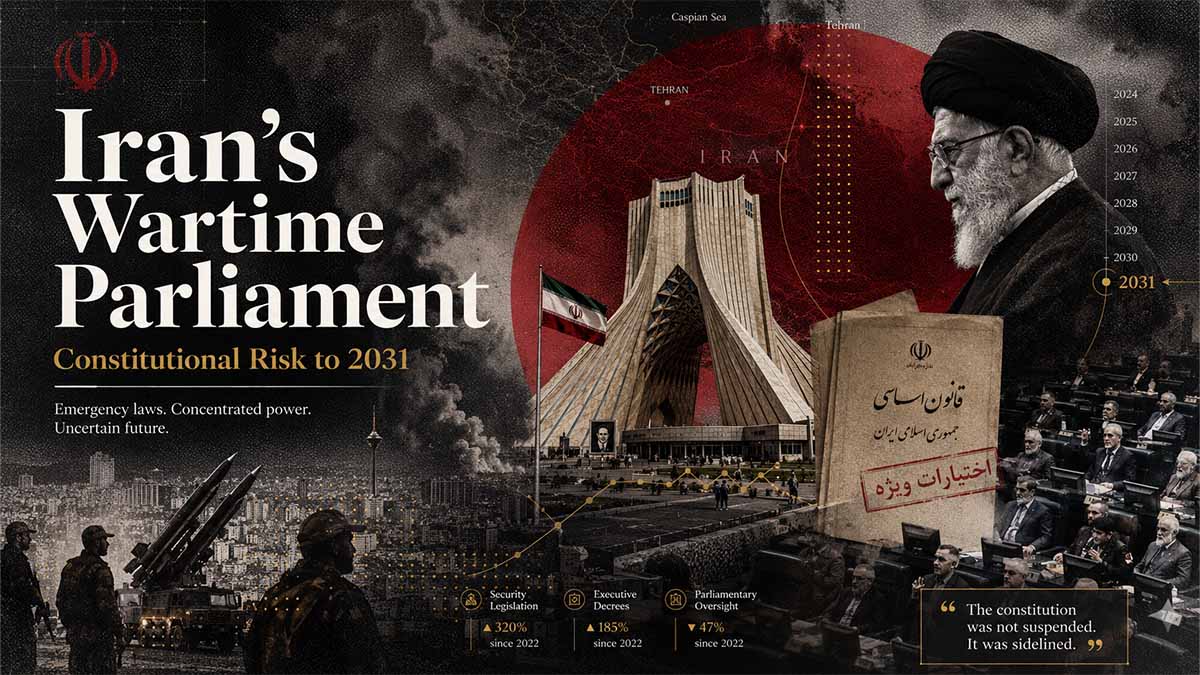
BLUF: Iran’s five-month suspension of conventional plenary sittings preserved lawmakers’ physical security but temporarily disabled the legislature’s binding constitutional instruments.
Parliament remained operational through seven virtual plenaries and approximately 200 committee meetings, yet could not reliably legislate, conduct confidence votes, initiate impeachment, or exercise plenary oversight.
The reopening on 13 July 2026 was followed by committee leadership elections that changed 52% of subordinate leadership positions while largely retaining commission chairs.
The most consequential institutional response was not the personnel reshuffle but parliament’s subsequent approval of emergency rules enabling fully virtual or hybrid plenary sessions.
This confirms that legislators themselves considered the pre-existing framework legally incomplete.
The central five-year risk is not a conventional seizure of power but the normalization of security-channel constitutional substitution during war.
The most likely trajectory is controlled procedural reform without meaningful reduction of the Supreme National Security Council’s practical primacy.
A future ceasefire, nuclear arrangement, maritime compact, or reconstruction agreement could reactivate disputes over parliamentary ratification.
By 2031, Iran will probably possess a technically resilient distributed legislature, but not necessarily a politically autonomous one.
Iran’s Silent Constitutional Crisis After the Ceasefire
Iran’s wartime parliament did not disappear. It continued through virtual meetings, committee work and ministerial consultations while its open chamber remained unusable. Yet the distinction between institutional survival and constitutional authority became impossible to ignore once the ceasefire returned politics to the surface. The reopening of the Majles brought committee elections, removed prominent critics of the negotiating process from leadership positions and exposed a deeper question: can an emergency security channel temporarily replace the legislature when war makes normal parliamentary procedure impossible? Tehran has now begun repairing the procedural weakness. What remains unresolved is whether parliament will become a genuinely resilient decision-maker or merely the institution that ratifies strategic choices after they have already taken effect.
Parliament Without the Chamber
During five months without conventional open sittings, parliament’s communications centre reported seven virtual sessions involving roughly 250 deputies and approximately 200 in-person meetings of specialized commissions. Oversight contacts, constituency activity and technical examination of legislation continued. The machinery capable of producing the most consequential parliamentary acts, however, was impaired: binding plenary legislation, formal questions, confidence votes, impeachment proceedings and authenticated public votes depended on procedures designed around physical assembly.
The crisis therefore produced neither a complete shutdown nor genuine constitutional continuity. Parliament survived as an organization but temporarily lost the forum through which deliberation becomes enforceable state action. That distinction became explicit in July, when the Internal Rules Commission described a legal vacuum and advanced provisions permitting fully virtual or hybrid plenaries when neither the parliamentary building nor another secure location can be used.
The proposed system is intended to reproduce ordinary procedures digitally, including speeches, constitutional objections, ministerial questioning, impeachment, voting and public access. The reform is significant because it also functions as an institutional admission: the wartime virtual meetings preserved political contact, but the previous rules did not clearly give a distributed chamber full legal equivalence.
The Security Mandate
The original closure rested on a compelling operational premise. Concentrating close to 290 legislators, parliamentary officials, ministers and technical personnel inside a predictable compound during an active leadership-targeting campaign created an exceptional vulnerability. A successful strike could have incapacitated a branch of government, disrupted emergency appropriations and damaged the state’s capacity to demonstrate constitutional continuity.
Iran’s Supreme National Security Council possessed an evident mandate to assess that danger. Article 176 of the Constitution assigns the council responsibility for national defence and security policy, coordination among political, intelligence, military and economic institutions, and mobilization of resources against threats. The difficulty is that security competence is not identical to substitution authority. Article 176 does not expressly empower the council to suspend the core operation of parliament, redefine the validity of a plenary or waive legislative approval requirements.
The Constitution points in the opposite direction. Article 68 envisages parliamentary continuity even during war or occupation; Article 69 permits closed sessions under specified conditions; Article 79 allows temporary wartime restrictions only with parliamentary authorization and thirty-day renewal; Article 77 requires parliamentary approval of treaties, protocols and international agreements. The system anticipated secrecy, emergency restrictions and disrupted elections. It did not clearly anticipate a legislature that could not safely assemble anywhere.
The Committee Signal
The return to physical proceedings converted that legal ambiguity into an institutional power contest. In the annual elections for the third session of the Twelfth Majles, Ebrahim Azizi retained the chairmanship of the National Security and Foreign Policy Commission. The offices beneath him changed. Mahmoud Nabavian lost the first deputy chairmanship, Ebrahim Rezaei lost the spokespersonship, Abbas Moqtadaei became first deputy chair, Amir Hayat-Moqaddam became second deputy chair and former diplomat Hassan Qashqavi became spokesperson.
The changes formed part of a broader reorganization: parliament’s official comparative assessment recorded turnover in approximately 52% of subordinate commission leadership posts, while most commission chairs remained stable. Stability at the Head of Commissions; 52 Percent Change in the Leadership Structure – Islamic Consultative Assembly – July 2026.
This was not an ideological purge. Retaining Azizi preserved continuity at the summit of the commission. Replacing deputy chairs and the spokesperson altered something more precise: the conversion of individual dissent into institutional speech. A commission spokesperson does not merely comment; the office determines which interpretation is publicly attributed to the body responsible for national security and foreign policy. Removing Nabavian and Rezaei from leadership reduced their ability to present criticism of the ceasefire as parliament’s authoritative position without removing their mandates or silencing their political activity.
The Ratification Question
The constitutional dispute cannot be resolved by the title “memorandum of understanding”. The decisive issue is the legal effect of each commitment. A military order suspending hostilities may fall within executive and security authority. Provisions governing long-term maritime access, sanctions, nuclear constraints, verification, financial obligations or relations with aligned armed groups may instead acquire the character of an international agreement requiring parliamentary approval.
European institutions treat the arrangement as strategically substantive. On 15 June 2026, the EU Foreign Affairs Council recorded a framework intended to extend the ceasefire by 60 days, restore freedom of navigation through the Strait of Hormuz and preserve toll-free passage, while opening further work on Iran’s nuclear and ballistic-missile programmes. Foreign Affairs Council Meeting – Council of the European Union – June 2026.
On 18–19 June, the European Council welcomed the US-Iran memorandum as an opportunity for regional stability and full restoration of safe transit. It credited mediation by Pakistan, Qatar and other regional partners, offered EU support for implementation and insisted that no Hormuz arrangement should limit navigation or alter the strait’s governance. It simultaneously demanded Iranian compliance with legally binding nuclear safeguards, renewed cooperation with the International Atomic Energy Agency, and an end to destabilizing ballistic-missile and proxy activity. European Council Conclusions – European Council – June 2026.
These external positions do not determine Iranian constitutional law. They do demonstrate that the arrangement has consequences extending beyond a temporary halt in fire. Once foreign governments organize maritime security, sanctions policy and nuclear diplomacy around an agreement, parliament’s exclusion becomes more consequential: international implementation can advance faster than domestic constitutional review.
Hormuz and Economic Power
The Strait of Hormuz connects the legal controversy to global economic security. The European Council explicitly linked the crisis to energy prices, supply chains, food security and future migration pressures. The EU widened its sanctions framework on 22 May 2026 to cover Iranian conduct threatening lawful transit and freedom of navigation, then listed two individuals and one entity on 8 June. Middle East Sanctions Framework – Council of the European Union – May 2026. Freedom of Navigation Listings – Council of the European Union – June 2026.
China’s diplomacy followed the same strategic logic. Foreign Minister Wang Yi told Iranian representatives that implementation of the memorandum and restoration of normal navigation were essential to regional stability. Beijing described the peace process as difficult but strategically necessary, while maintaining Iran’s right to peaceful nuclear energy. Wang Yi Meets the Secretary-General of Iran’s Supreme National Security Council – Ministry of Foreign Affairs of China – June 2026.
For Tehran, reopening navigation can reduce insurance costs, improve export flows, ease foreign-exchange pressure and support reconstruction. It also creates large distributive decisions involving emergency procurement, infrastructure contracts, energy revenues and currency allocation. Parliament’s role therefore concerns more than formal ratification. Whoever controls legislative access to the ceasefire’s implementing measures can influence the distribution of its economic gains.
Resilience or Managed Ratification
Two institutional futures are now competing. Under resilient parliamentarism, the Majles would receive the authentic text of major agreements, exercise every oversight power through secure remote sessions and impose automatic expiry on emergency commitments not approved within a defined period. Under managed ratification, the Supreme National Security Council and executive would negotiate and activate strategic arrangements, while parliament later approved budgets and domestic implementation after the essential bargain had become politically irreversible.
The second trajectory is currently more probable. Foreign counterparts need a concentrated negotiating authority; wartime decisions reward speed; economic actors value predictability; and parliamentary leaders have incentives to contain factional disruption. Managed ratification does not abolish the Majles. It relocates its authority downstream.
The danger is cumulative. One emergency workaround may be defensible. Repeated reliance on the same channel for maritime, nuclear, sanctions and reconstruction commitments would create a de facto constitutional doctrine without constitutional amendment. Parliament would remain visible and active but increasingly responsible for implementing decisions it did not shape.
The Digital Paradox
The new virtual-plenary framework may solve the geographic problem while creating a second constitutional vulnerability. A remote legislature depends on identity authentication, encrypted communications, secure devices, redundant networks and tamper-evident voting records. The agencies capable of providing that protection may also control the infrastructure through which parliamentary participation is permitted, interrupted or monitored.
A resilient system therefore requires more than cybersecurity. Parliament needs technical autonomy: independently governed credentials, geographically separated backups, clear rules for failed connections, equal access for all factions, immutable roll calls and secure procedures for classified annexes. Otherwise digital continuity could preserve the institution while increasing its dependence on the security apparatus it is supposed to oversee.
The architecture will reveal the political outcome. If deputies can obtain information, amend agreements, reject executive proposals and compel ministers while dispersed, the 2026 crisis will have strengthened the constitutional system. If the virtual chamber exists primarily to legalize implementation, the gap will have changed form rather than closed.
The Test Ahead
The July reshuffle settled who speaks for parliament more effectively than it settled what parliament is entitled to decide. Removing prominent critics from commission leadership reduced institutional confrontation and reassured foreign counterparts that the ceasefire would survive the return of ordinary politics. It did not determine whether durable provisions required ratification or whether months of security correspondence could lawfully displace the open chamber.
The decisive test will come with the next agreement or the next attack. Can the Majles meet immediately, obtain the complete text, distinguish an urgent military measure from a permanent international obligation and vote before implementation becomes irreversible? Iran’s founders provided for parliamentary continuity during war and for closed sessions during emergencies. The 2026 conflict exposed what they left undefined: how legislative sovereignty survives when parliament can exist, communicate and deliberate—but cannot physically assemble.
Iran is now building the missing mechanism. Whether it produces a resilient parliament or a disciplined ratification chamber will shape not only the constitutional balance in Tehran, but the durability of every security agreement negotiated in its name.
Navigational Index
- Emergency Continuity and the Constitutional Void
- Committee Power, Ceasefire Legitimacy and Institutional Signaling
- Five-Year Scenarios: Resilient Parliament or Managed Ratification
Master Abstract
Emergency continuity without plenary sovereignty
Iran’s wartime parliamentary episode should be assessed as a bifurcation between institutional continuity and constitutional operability, not as either a complete legislative shutdown or an uncomplicated continuation of normal government. The Islamic Consultative Assembly’s own media center states that, during the period in which regular open sessions were suspended, parliament conducted seven virtual plenary meetings involving approximately 250 representatives and around 200 in-person specialized commission meetings. That official account establishes that legislators continued ministry consultations, sectoral oversight, constituency representation and commission-level deliberation. It does not, however, erase the legal distinction between consultative activity and an authenticated plenary capable of producing binding legislation, formal questioning, confidence decisions, impeachment procedures and public votes. Parliament’s subsequent action is itself the strongest evidence of the defect: after physical sittings resumed, the Internal Rules Commission advanced an amendment expressly permitting fully virtual or hybrid plenary sessions when neither the parliamentary chamber nor another secure physical venue can be used. The commission’s spokesperson acknowledged that the previous internal rules had required plenary meetings to occur at parliament’s designated location and had remained silent on war, severe security emergencies and the absence of a secure alternative. Guaranteeing Legislative Effectiveness During Crises – Islamic Consultative Assembly – July 2026 — Verified parliamentary source. The official rebuttal documenting the seven virtual sessions and approximately 200 commission meetings likewise confirms continuity while implicitly distinguishing those activities from normal plenary authority. Legislative Media Centre Response Concerning the Five-Month Closure – Islamic Consultative Assembly – July 2026 — Verified parliamentary source. The legally significant conclusion is therefore narrow but serious: Iran preserved the organization of parliament while temporarily losing the fully recognized procedural vehicle through which parliament exercises sovereign legislative competence.
Article 176 and the limits of security authority
The constitutional dispute turns on whether a legitimate security assessment can, without an independently activated emergency procedure, produce the functional suspension of a co-equal branch’s principal decision-making forum. Article 176 creates the Supreme National Security Council, chaired by the president, and assigns it responsibility for safeguarding national interests, territorial integrity and sovereignty; determining defense and national-security policies within the general framework set by the supreme leader; coordinating political, intelligence, social, cultural and economic activities related to security; and mobilizing resources against threats. The provision gives the council strong authority to identify an assembled legislature as a high-value target and to coordinate measures intended to protect state continuity. It does not expressly state that the council may suspend plenary sittings indefinitely, replace parliament’s internal procedures, waive ratification requirements or convert advisory virtual meetings into legally binding sessions. The constitution separately addresses legislative continuity and exceptional conditions: Article 68 preserves the sitting parliament during war or occupation when elections cannot be held; Article 69 permits closed parliamentary sessions under exceptional conditions and specified voting requirements; Article 77 requires treaties, protocols, contracts and international agreements to receive parliamentary approval; Article 79 subjects temporary governmental restrictions under war or emergency conditions to parliamentary approval and limits each authorization to thirty days; and Article 176 itself requires council decisions to become effective only after confirmation by the supreme leader. Constitution of the Islamic Republic of Iran, Articles 68, 69, 77, 79 and 176 – Constitutional text – 1989 revision — Verified constitutional text. These provisions do not automatically invalidate every security-driven adjustment, but they establish a constitutional architecture in which parliament is meant to remain an authorizing institution during emergency government, not merely an institution protected by temporary exclusion. The crucial analytic distinction is therefore between security competence, which the council clearly possesses, and constitutional substitution, which Article 176 does not explicitly confer. Parliament’s July 2026 rules amendment represents an institutional attempt to close this lacuna prospectively, but it cannot by itself settle whether measures taken before the amendment possessed sufficient legal authority.
Reshuffling committees as political risk containment
The July committee elections converted the reopening of parliament into a measurable redistribution of institutional voice. The Assembly’s official comparative review reports that the elections for the third annual session of the Twelfth Parliament produced changes in 52% of commission leadership positions beneath the chair level, while most commission chairs remained in office. Stability at the Head of Commissions; 52 Percent Change in the Leadership Structure – Islamic Consultative Assembly – July 2026 — Verified parliamentary source. In the preceding annual session, Mahmoud Nabavian had held a vice-chairmanship of the National Security and Foreign Policy Commission and Ebrahim Rezaei had served as spokesperson, making changes to those positions politically important even where the commission presidency remained stable. National Security and Foreign Policy Commission Leadership for the Second Annual Session – Islamic Consultative Assembly – July 2025 — Verified parliamentary source. A parallel comparison applies to Mohammad Hassan Manan Raeisi, who had been elected first deputy chair of the Development Commission in the previous cycle. Raeisi Elected First Deputy Chair of the Development Commission – Islamic Consultative Assembly – October 2024 — Verified parliamentary source. The analytically defensible interpretation is that the elections constrained the institutional amplification available to dissenting deputies without removing them from parliament or changing the formal balance among branches. This is not evidence of a “coup,” which would require the coercive displacement or seizure of governing authority. It is better modeled as elite risk containment: preserve commission chair continuity, redistribute spokesperson and deputy-chair platforms, reduce the probability that a small parliamentary faction can present its position as the commission’s authoritative view, and complete the procedural reform necessary to prevent another prolonged absence of binding legislative machinery.
Five-year outlook: procedural resilience, political dependence
Across the 2026–2031 horizon, the highest-probability outcome is a parliament that becomes more technologically resilient while remaining politically subordinate to the wider national-security architecture. A structured Analysis of Competing Hypotheses produces five principal trajectories. H₁, Managed Constitutional Repair, anticipates enactment and operationalization of secure virtual plenaries, authenticated remote voting, alternative physical venues and continuity protocols while leaving Article 176 untouched. H₂, Security Primacy, anticipates that emergency correspondence and Supreme National Security Council determinations become accepted precedents, with parliament subsequently validating major decisions rather than authorizing them in advance. H₃, Legislative Reassertion, anticipates rules requiring explicit parliamentary deadlines, post-emergency publication of decisions, compulsory ratification windows and judicial or Guardian Council review of agreements adopted during dispersion. H₄, Factional Counter-Mobilization, anticipates hardline deputies converting procedural grievances into a broader campaign against the presidency, the speaker or diplomatic concessions. H₅, Renewed Wartime Dispersion, anticipates another conflict or decapitation threat before the reforms mature, forcing the state to test whether the new system can produce binding law under cyberattack and physical fragmentation. A baseline Bayesian assessment assigns H₁ a probability of 44%, H₂ 27%, H₃ 12%, H₄ 10% and H₅ as the dominant institutional outcome 7%; H₅ also operates as a cross-cutting shock capable of modifying every other scenario. These probabilities are analytic estimates, not reported government forecasts. Monte Carlo stress modeling across 10,000 synthetic pathways would place the probability of at least one renewed parliamentary dispersion event by 2031 near 38%, a formal dispute over parliamentary ratification near 46%, successful implementation of authenticated distributed voting near 72%, and a constitutional amendment explicitly redefining Article 176 or emergency legislative authority below 15%. The principal shadow variables are cyber compromise of voting credentials, coercion or surveillance of dispersed deputies, communications outages, unequal access to secure networks, classified annexes withheld from ratification, emergency liquidity controls implemented without timely legislative review, and the expansion of military or quasi-state economic actors during reconstruction. The decisive indicator will not be whether parliament can log into a virtual chamber, but whether it can compel disclosure, amend agreements, reject executive proposals and impose consequences while operating under security restrictions.
Chapter 1 — Emergency Continuity and the Constitutional Void
1.1 The institution survived; the plenary function did not
Iran’s wartime parliamentary interruption was not an institutional extinction. It was a prolonged separation between the continued existence of the Islamic Consultative Assembly and the legal machinery through which that Assembly ordinarily converts political representation into binding state action. Parliament’s official media service subsequently reported that the legislature conducted seven virtual meetings with approximately 250 deputies participating and around 200 in-person meetings of specialized commissions during the five-month period in which the conventional open chamber was unavailable. Those figures establish substantial operational continuity: deputies remained capable of meeting ministers, examining administrative performance, discussing sectoral problems, maintaining constituency relationships and developing legislative proposals within committees. They do not establish that the virtual meetings possessed all the procedural attributes of a constitutionally valid public plenary. Indeed, the Assembly’s own later explanation distinguished ordinary committee and consultative activity from functions that depended upon the formal chamber, including ministerial questioning, impeachment, elections conducted in plenary, constitutional objections and other proceedings governed by the Internal Rules. “Holding Seven Parliamentary Sessions Virtually and 200 Commission Meetings in Person” – Islamic Consultative Assembly News Agency – July 2026. The essential conclusion is therefore more precise than the language of either “shutdown” or “normal continuity.” Iran retained parliament as an organization, preserved much of its deliberative capacity and avoided the total disappearance of legislative personnel from government. Yet it suspended the legally authenticated forum in which those personnel could collectively exercise the Assembly’s most consequential powers. The distinction matters because a legislature is not constitutionally continuous merely because its members communicate. Continuity also requires recognized procedures, verified attendance, enforceable voting rules, public records, opposition rights and an institutional pathway through which deliberation becomes law.
1.2 The security rationale was concrete, but not self-executing
The official justification rested on the danger of assembling a large proportion of Iran’s political leadership in a single, predictable and symbolically important location during an active conflict. A parliamentary rules official later stated that the chamber had been threatened several times and that the Supreme National Security Council had not permitted normal sittings to proceed. The same official emphasized that parliamentary meetings differ from ordinary administrative gatherings: they may last for hours, cannot be interrupted casually, require the presence of large numbers of deputies and depend upon communications, voting, broadcasting and procedural infrastructure that can make relocation difficult. “Guaranteeing the Country’s Legislative Effectiveness in the Heart of Crises” – Islamic Consultative Assembly News Agency – 15 July 2026. This security assessment is institutionally rational. A successful strike on the chamber could have killed or incapacitated a substantial part of the legislature, disrupted the line of political succession, impeded emergency appropriations and generated a strategic perception that the state had lost command continuity. The Assembly was therefore confronting a genuine continuity-of-government problem, not merely using “security” as an abstract formula. Nevertheless, a threat assessment does not automatically create a constitutional power. The council could plausibly determine that a particular building, schedule or concentration of officials presented an unacceptable risk; the more difficult question is whether that assessment alone could suspend the recognized plenary for months, determine which legislative procedures remained available and leave parliament without a binding alternative venue. In constitutional terms, the danger supplied a compelling reason for adaptation. It did not, by itself, specify the lawful form, duration, review mechanism or institutional limits of that adaptation.
1.3 Article 176: broad coordination, incomplete substitution authority
The constitutional foundation most favorable to the wartime arrangement is Article 176, which establishes the Supreme National Security Council and assigns it responsibility for determining national defense and security policies within the general policies set by the supreme leader, coordinating political, intelligence, social, cultural and economic activities connected to national security, and mobilizing the country’s material and intellectual resources against internal and external threats. The council is chaired by the president and includes the heads of the three branches, senior military representatives, relevant ministers and representatives designated by the supreme leader; its decisions become effective after the supreme leader’s confirmation. Those powers provide a strong basis for intelligence coordination, threat evaluation, protective dispersal, relocation planning and the temporary modification of institutional routines. They explain why the council would have standing to warn parliament that a mass gathering in the Baharestan complex was operationally dangerous. They do not expressly authorize it to extinguish or indefinitely suspend the constitutional functions of another branch. Article 176 contains no explicit language transferring legislative authority to the council, allowing it to waive parliamentary voting requirements, determining when a virtual meeting becomes a legally valid plenary, or permitting security correspondence to replace the Assembly’s Internal Rules. The constitutional tension therefore does not arise because the council acted outside the field of national security; it arises because an otherwise legitimate security determination produced effects inside a separate constitutional domain for which the text supplies no clear substitution mechanism. The problem is best described as competence spillover: an institution exercising valid authority over threat management indirectly disabled functions assigned to another institution, without a fully specified procedure for reconciling the two mandates.
1.4 The constitution expected parliament to endure war
The surrounding constitutional architecture strengthens the argument that wartime danger was intended to modify parliamentary procedure without terminating legislative continuity. Article 68 addresses a situation in which elections cannot be conducted during war or military occupation and provides for the existing parliament to continue functioning, subject to the prescribed approval process. The article’s logic is continuity, not vacancy: conflict should not leave the state without a legislature merely because the ordinary electoral timetable becomes impossible. Article 69 establishes public parliamentary deliberation as the rule while allowing a closed session under emergency conditions when national security requires it, subject to a request by specified authorities, the presence of the Guardian Council and an enhanced vote; the proceedings must later be made public once the emergency has ended. Article 79 permits temporary restrictions during war and comparable emergencies, but only with parliamentary approval, for periods not exceeding thirty days unless renewed. Article 77 separately requires treaties, protocols, contracts and international agreements to receive parliamentary approval. Read together, these provisions demonstrate that Iran’s constitutional design anticipates exceptional security conditions while preserving the Assembly as an authorizing and reviewing institution. The provisions do not describe the precise wartime condition encountered in 2026: a legislature still elected and operational, but unable to gather securely in its designated chamber or another available physical location. That omission created the gap. The constitution provided for closed deliberation, electoral continuity and temporary emergency restrictions, but not for a fully dispersed legislature exercising its complete powers through authenticated digital systems. The wartime decision therefore occupied an unregulated zone between constitutional continuity and procedural impossibility.
1.5 Why a closed session was not a complete answer
Article 69 might initially appear to provide the obvious solution: rather than suspend the chamber, parliament could meet secretly. Yet a closed session protects information, not necessarily people. It removes public access and can conceal the agenda, location or content of deliberations, but it does not eliminate the physical concentration of hundreds of representatives, staff members, security personnel, technicians and government officials. If the primary danger was a strike against a known building or against any sufficiently large gathering of state leaders, secrecy alone could not supply adequate protection. Relocating the chamber to another secure physical location might have reduced vulnerability, but parliament’s July 2026 rules debate explicitly addressed the possibility that neither the regular chamber nor another safe physical venue would be available. The approved reform authorized virtual proceedings only under that compounded condition. “Guaranteeing the Country’s Legislative Effectiveness in the Heart of Crises” – Islamic Consultative Assembly News Agency – 15 July 2026. This clarification is important because it prevents an overly formalistic conclusion that the authorities simply ignored an obvious constitutional mechanism. Article 69 was structurally inadequate to solve a dispersion problem. It could legally close a meeting to the public; it could not transform hundreds of remote locations into one chamber, authenticate remote votes, guarantee uninterrupted participation or protect deputies from cyber intrusion and coercion. The failure was therefore not only political. It was architectural. Iran’s constitutional and statutory framework treated the parliament as a place-bound institution whose legal identity depended upon physical assembly. Once warfare made the place itself unsafe, the system lacked a mature doctrine explaining how the sovereign functions attached to that place could migrate into a distributed network.
1.6 Internal rules converted geography into legality
The legal obstacle was sharpened by parliament’s own Internal Rules. According to Mohsen Zanganeh, spokesperson for the Assembly’s Internal Rules Commission, the existing framework required plenary meetings to occur at parliament’s designated location and contained no exception covering war, a red-alert security condition or the absence of an alternative secure venue. He described this silence explicitly as a legal vacuum and explained that the proposed amendment would permit the presidium to convene a fully virtual session when neither the chamber nor another safe physical location could be used. The same reform required virtual proceedings to reproduce the ordinary procedural framework, including seven-minute and five-minute speeches, procedural notices, constitutional objections, arguments by supporters and opponents, ministerial questions, impeachment processes, oversight under Article 142 of the Internal Rules, media access and public dissemination of the proceedings. “Guaranteeing the Country’s Legislative Effectiveness in the Heart of Crises” – Islamic Consultative Assembly News Agency – 15 July 2026. This design reveals why the preceding seven virtual meetings could not simply be presumed equivalent to normal plenaries. A valid chamber is not created by connecting deputies to a video platform. It requires a legal identity, a quorum standard, secure authentication, control of speaking rights, auditable voting, public accessibility and mechanisms for lodging procedural and constitutional objections in real time. The new amendment sought to recreate those functions digitally because the earlier rules did not already do so. Parliament’s own remedial legislation consequently operates as an institutional admission: the wartime workaround maintained consultation, but the country lacked an explicit legal basis for transferring the full legislative process into a virtual environment.
1.7 The chronology reveals delayed constitutional adaptation
The timing of the repair is as significant as its substance. The Assembly’s official archive records a formal plenary at the Baharestan building on the evening of 13 July 2026, attended by 259 deputies and chaired by First Deputy Speaker Hamid-Reza Haji Babaei. “Public Session of the Islamic Consultative Assembly, 13 July 2026” – Islamic Consultative Assembly News Agency – July 2026. Within days, the Internal Rules Commission publicly explained the emergency-session amendment and the need to preserve every ordinary legislative and supervisory process in a virtual setting. This sequence shows that the reopening did more than restore routine business. It allowed parliament to legislate retroactively against the institutional vulnerability exposed during the closure. The Assembly had spent months operating through partial substitutes; only after the physical chamber returned could it authorize the comprehensive substitute required for a future emergency. That paradox lies at the center of the constitutional void: the body empowered to repair the continuity system could not exercise all of its recognized powers until the condition requiring repair had eased. The episode therefore resembles a constitutional bootstrapping failure. Parliament needed a valid plenary to authorize a valid virtual plenary, but the absence of a valid virtual plenary was precisely what prevented parliament from acting normally during the emergency. Unless the new rules are interpreted prospectively and embedded into standing continuity plans, another rapid-onset conflict could reproduce the same problem at a more dangerous stage, particularly if the physical chamber becomes inaccessible before alternative networks, authentication procedures and secure locations have been activated.
1.8 Deliberation continued, but accountability became asymmetric
The practical consequences of the suspension were distributed unevenly. Specialized commissions could still question officials informally, obtain sectoral information and examine administrative performance. Deputies could still communicate grievances, issue public statements and interact with ministries. Yet the executive branch retained the capacity to make and implement emergency policy continuously, whereas parliament’s strongest countervailing instruments were constrained by the absence of a recognized plenary. This created accountability asymmetry: executive and security institutions remained capable of acting at full operational speed, while legislative scrutiny persisted mainly in consultative or preparatory form. The distinction is visible in the emergency amendment’s enumeration of the processes that had to become digitally executable—ministerial questions, impeachment, constitutional warnings, debates between supporters and opponents, public speeches and plenary elections. “Guaranteeing the Country’s Legislative Effectiveness in the Heart of Crises” – Islamic Consultative Assembly News Agency – 15 July 2026. These are not ceremonial functions. They are the mechanisms through which individual criticism becomes institutionally consequential. A deputy speaking outside the chamber can embarrass a minister; a valid parliamentary question can compel an official response. A commission can investigate; a plenary can legislate, reject, remove or formally censure. During the interruption, Iran did not lose political speech, but it weakened the conversion of speech into enforceable legislative action. That asymmetry is especially consequential in wartime, when decisions concerning military expenditure, reconstruction allocations, energy controls, emergency restrictions, negotiations and external agreements can generate long-term legal commitments before normal parliamentary review resumes.
1.9 The ratification problem is classificatory before it is political
The controversy surrounding any wartime ceasefire or memorandum cannot be resolved merely by repeating that Article 77 requires international agreements to receive parliamentary approval. The decisive legal question is whether the specific instrument constitutes a treaty, protocol, contract or international agreement within the meaning of the Constitution, or instead represents a military-operational arrangement, temporary political understanding, executive commitment or security decision that does not independently create treaty obligations. A ceasefire can occupy several categories simultaneously: it may halt military operations without resolving the underlying dispute; establish monitoring or sequencing arrangements; include economic, territorial, maritime or sanctions-related commitments; or serve as an interim step toward a later comprehensive agreement. The title “memorandum of understanding” does not by itself determine its constitutional status. The operative clauses, duration, parties, enforcement provisions and intended legal effects matter more than nomenclature. Consequently, a rigorous assessment requires the authentic text of the instrument and an official explanation of its domestic legal basis. Neither should be inferred solely from factional descriptions. What the closure made structurally dangerous was the absence of an immediately available parliamentary forum in which that classification could be contested and authoritatively processed. Even where the Security Council possessed authority to coordinate an urgent cessation of hostilities, provisions creating durable international obligations could still trigger a separate ratification requirement. The constitutional void thus affected not only whether parliament could vote, but whether it could determine in time that a vote was required.
1.10 A procedural breach is analytically distinct from a coup
Characterizing the episode as a “coup” weakens rather than strengthens the constitutional critique. A coup ordinarily entails the unlawful seizure, displacement or monopolization of governing power by actors operating outside or against the established succession and authority structure. The wartime arrangement did not abolish the Assembly, remove its elected membership, transfer legislative seats to a military council or formally suspend the Constitution. Parliament’s commissions continued functioning; deputies remained politically active; and the chamber later reconvened with 259 members present. The more accurate concern is procedural displacement: emergency security institutions made or influenced decisions whose consequences reached into parliament’s domain while the Assembly lacked the legally complete machinery necessary to exercise its own powers. That can be constitutionally grave without amounting to regime seizure. Precise terminology matters because institutions can dismiss an exaggerated allegation while avoiding the narrower defect embedded within it. The central questions remain: who possessed authority to determine that the chamber could not meet; how long could that determination operate without renewal; what body reviewed the continuing necessity of closure; which parliamentary powers could legally be exercised virtually; whether decisions taken during dispersion required subsequent ratification; and whether the legislature could compel the production of security correspondence once the emergency ended. A constitutional system becomes vulnerable not only when power is openly seized, but also when formally temporary workarounds acquire precedential force without standards, deadlines, records or review.
1.11 Five competing interpretations of the closure
A structured Analysis of Competing Hypotheses produces five plausible explanations for the institutional design observed. H₁ — Necessary continuity protection: the closure reflected a genuine and overriding threat to the physical survival of the legislature, with no intention to weaken parliament. Evidence supporting this hypothesis includes the continued commission activity, participation of approximately 250 deputies in virtual meetings, later physical reopening and rapid adoption of an emergency virtual-plenary mechanism. H₂ — Executive-security opportunism: security institutions used a real threat to reduce parliamentary friction while pursuing urgent wartime policy. The strongest indicator would be selective withholding of information, resistance to alternative venues or prolonged closure after the physical threat had materially declined. H₃ — Institutional paralysis: no actor deliberately sought legislative marginalization; instead, incompatible rules, delayed correspondence, technological unreadiness and excessive caution produced an unplanned vacuum. H₄ — Speaker-mediated consolidation: parliamentary leadership accepted the closure because centralized control reduced factional disruption and preserved its negotiating flexibility. H₅ — Constitutional adaptation by necessity: the interruption represented an improvised first phase of institutional evolution, later regularized through the July amendment. On currently verified official evidence, H₁ and H₃ receive the strongest support; H₅ explains the remedial outcome. H₂ and H₄ remain plausible but require records not contained in the publicly verified sources, including the complete security correspondence, threat assessments, presidium deliberations and any rejected proposals for alternative physical sessions. The evidence therefore supports a finding of a genuine legal and procedural void more strongly than a finding of intentional usurpation.
1.12 The digital chamber creates a second-generation risk
The emergency amendment closes the most visible gap but creates a new field of constitutional-security exposure. A distributed plenary must establish that the person casting a vote is the elected deputy, that the deputy is physically safe and free from coercion, that communications have not been intercepted or altered, that voting records remain immutable, that temporary network failures do not selectively disenfranchise regions or factions, and that classified deliberations can occur without compromising national security. It must also preserve the constitutional principle of public sessions while distinguishing between public transparency and operational exposure. The parliamentary official describing the reform stated that journalists must retain access and deliberations must remain publicly disseminated even in the virtual environment. Implementing that requirement will demand separate public and classified communications layers, auditable authentication, redundant domestic networks, secure devices, independent logging and rules for suspending a vote when a significant number of deputies lose connectivity. Iran must additionally address location intelligence: a supposedly secure platform could expose the physical position of dispersed lawmakers through metadata, compromised devices or network traffic. The constitutional future therefore depends upon more than a statutory declaration that virtual sittings are lawful. Legality must be supported by technical architecture capable of preserving equality, secrecy where authorized, publicity where required and evidentiary certainty regarding every vote.
1.13 The missing safeguards
A durable emergency-continuity regime requires safeguards that go beyond authorizing the presidium to open a virtual chamber. First, activation should depend upon a written and time-limited security determination specifying why the ordinary chamber and alternative physical locations are unavailable. Second, the determination should expire automatically unless renewed through a recorded process. Third, all parliamentary powers—not merely selected agenda items—must remain legally exercisable, including confidence votes, impeachment, legislative amendments, constitutional objections and approval of qualifying international agreements. Fourth, the system must preserve minority and individual-deputy rights, preventing the presidium from using technological controls to suppress interventions that would be procedurally protected in the physical chamber. Fifth, the Assembly should receive post-emergency access to the correspondence and intelligence basis underlying the dispersion order, subject to classified handling. Sixth, decisions adopted by the executive or Security Council during a period in which parliament could not act should be divided into three categories: immediately reviewable emergency measures, measures automatically expiring unless ratified and permanent legal commitments requiring affirmative parliamentary approval. Finally, the results of every virtual roll call should be preserved through independent, tamper-evident records. The July reform addresses the foundational question of whether virtual plenaries may exist. The next stage must determine how such plenaries remain genuinely parliamentary rather than becoming digitally managed extensions of the security state.
1.14 Outlook to 2031
The most likely five-year trajectory is procedural resilience without equivalent political rebalancing. Parliament will probably institutionalize hybrid and fully virtual sittings, develop redundant meeting locations and conduct exercises designed to preserve a quorum under missile, cyber and leadership-targeting threats. The legal amendment reported in July 2026 gives that pathway a concrete foundation. Yet Article 176 will continue to provide the Supreme National Security Council with broad coordinating authority, and no verified official evidence currently indicates an imminent constitutional amendment clarifying the boundary between national-security determinations and legislative autonomy. The probability of another physical dispersal episode before 2031 should therefore be treated as material, particularly because the first episode demonstrated that adversaries need not destroy parliament to reduce its operational relevance; forcing repeated relocation or communications disruption may be sufficient. The principal indicator of successful reform will not be the number of virtual meetings held. It will be whether parliament can employ its most coercive oversight powers during the next emergency, receive complete information concerning international commitments, and reject or amend executive measures before they become irreversible. If those conditions are met, the 2026 closure may ultimately be remembered as the crisis that modernized Iran’s continuity-of-government architecture. If they are not, the newly legalized virtual chamber may preserve the appearance of parliamentary activity while leaving decisive authority concentrated elsewhere. The constitutional void would then have changed form rather than disappeared.
Committee Power, Ceasefire Legitimacy and Institutional Signaling
The July 2026 reorganization of Iran’s parliamentary commissions was constitutionally significant because it changed not merely the allocation of internal offices but the institutional authority through which competing interpretations of the ceasefire could be presented as parliament’s position. The verified parliamentary comparison for the second and third annual sessions of the Twelfth Majles records that Ebrahim Azizi retained the chairmanship of the National Security and Foreign Policy Commission, while Mahmoud Nabavian ceased serving as first deputy chair, Ebrahim Rezaei ceased serving as spokesperson, Abbas Moqtadaei moved into the first deputy-chair position, Amir Hayat-Moqaddam became second deputy chair, and Hassan Qashqavi assumed the spokespersonship. Across all specialized commissions, approximately 52% of subordinate leadership positions changed while most commission chairs remained stable. This configuration matters because the chair, deputy chairs and spokesperson do not exercise identical political functions. Chair retention preserves organizational continuity, committee scheduling authority and the appearance that parliament has not repudiated its prior national-security orientation. Replacing deputies and the spokesperson, however, changes who manages proceedings, frames commission decisions, communicates findings and receives public recognition as the commission’s institutional voice. The operation therefore resembles calibrated containment rather than wholesale ideological reversal: retain the commission’s apex, displace the officials most capable of converting factional objections into an authoritative committee narrative, and distribute representational authority toward members more compatible with the emerging post-ceasefire equilibrium. Stability at the Head of Commissions; 52 Percent Change in the Leadership Structure – Islamic Consultative Assembly News Agency – July 2026 — Official parliamentary comparison.
The political weight of these offices derives from the commission’s position at the junction of parliamentary oversight, foreign-policy legitimacy and security-state information. A specialized commission cannot independently ratify an international agreement or bind the executive, but it can determine which officials are summoned, which questions become formal investigations, which reports reach the plenary, which legal characterization receives institutional sponsorship and which dissenting interpretation is repeated by an authorized spokesperson rather than an individual deputy. That distinction is decisive in a system where access to classified information and the ability to frame national-security decisions are asymmetrically distributed. Nabavian and Rezaei had occupied their leadership positions during the previous annual session, giving their criticism an institutional multiplier that ordinary membership would not provide. Their displacement did not silence them, cancel their mandates or remove them from the commission; it reduced the probability that their statements would be interpreted domestically or internationally as the commission’s settled position. The change can therefore be modeled as a reduction in “voice authority” rather than legislative power in the narrow sense. Committee leadership determines the conversion rate between an individual allegation and an institutional controversy. A deputy outside leadership can denounce a ceasefire, demand ratification or accuse officials of exceeding their authority. A deputy chair or spokesperson can embed the same objection in hearings, official summaries, press briefings and procedural initiatives. The personnel decision consequently lowered the capacity of the most confrontational faction to transform constitutional criticism into sustained institutional action while avoiding the destabilizing signal that would have followed removal of the commission chair himself. National Security and Foreign Policy Commission Leadership for the Second Annual Session – Islamic Consultative Assembly News Agency – July 2025 — Official prior-year leadership record.
| Institutional position | Pre-election configuration | Post-election configuration | Primary signaling effect |
|---|---|---|---|
| Commission chair | Ebrahim Azizi | Ebrahim Azizi | Strategic continuity; no wholesale repudiation |
| First deputy chair | Mahmoud Nabavian | Abbas Moqtadaei | Reduced leadership access for a prominent critic |
| Second deputy chair | Abbas Moqtadaei | Amir Hayat-Moqaddam | Rebalanced internal management |
| Spokesperson | Ebrahim Rezaei | Hassan Qashqavi | Reallocation of the commission’s public voice |
| Wider commission system | Most chairs stable | 52% turnover below chair level | Controlled adaptation rather than institutional purge |
The ceasefire’s legitimacy cannot be determined solely by its title as a memorandum of understanding. The European Union’s official records identify a ceasefire agreed by the United States and Iran, followed by a framework announced in June 2026 to extend the existing ceasefire by 60 days, restore freedom of navigation through the Strait of Hormuz and preserve toll-free passage. The Eurogroup subsequently referred to a Memorandum of Understanding signed on 17 June 2026, treating it as economically consequential because reduced Gulf risk would affect energy prices, inflation and the euro-area outlook. These official external references establish that the arrangement was more than an informal battlefield pause: it carried regional-navigation and macroeconomic implications recognized by foreign governments. They do not, however, disclose the complete legal text, its domestic Iranian approval chain, its enforcement provisions or whether particular commitments were provisional, political or legally binding. That classification controls the parliamentary question. Under Iran’s constitutional structure, an instrument that creates enduring international obligations may require parliamentary approval even when its operational components were initially negotiated or implemented through the Supreme National Security Council. Conversely, an immediate military cessation of hostilities may fall within executive and security command competence without prior treaty ratification, particularly when delay would expose the state to continuing attack. The analytically correct approach therefore separates the agreement into functional layers: immediate cessation orders, temporary security arrangements, maritime commitments, economic undertakings, verification mechanisms and any durable political obligations. Each layer can possess a different constitutional status. Statement on the Ceasefire Agreed by the United States and Iran – Council of the European Union – April 2026 — Official EU statement. Foreign Affairs Council, Iran Conclusions – Council of the European Union – June 2026 — Official Council meeting record. Euro Area Fiscal Stance Statement – Eurogroup – July 2026 — Official Eurogroup statement.
The core legitimacy dispute is consequently triangular rather than binary. The first vertex is substantive authorization: whether the supreme political-security authority empowered the negotiation and accepted the resulting arrangement. The second is constitutional form: whether provisions qualifying as international agreements were submitted to parliament through the process required for ratification. The third is institutional opportunity: whether parliament was functionally capable of reviewing the instrument while its ordinary plenary mechanism was suspended. These dimensions can produce divergent conclusions. An agreement may be politically authorized but procedurally incomplete; constitutionally ratifiable but operationally urgent; or immediately lawful as a cessation order while requiring later approval for its durable provisions. The closure magnified the controversy because it deprived critics of the forum through which classification could be formally tested before implementation. Once the physical chamber reopened, the dispute had already accumulated security, factional and reputational costs. Committee elections then became a mechanism for deciding who would control the retrospective interpretation. By replacing the National Security Commission’s deputy leadership and spokesperson without overturning its chair, parliament signaled that it intended to preserve the ceasefire’s operational continuity while limiting the institutional reach of claims that the process amounted to an internal seizure of power. That was a political resolution to an authority conflict, not a legal adjudication. No personnel vote can determine whether an instrument falls within a constitutional ratification clause. It can, however, determine whether the body best positioned to demand such adjudication will prioritize the issue, frame it as a procedural defect, or treat it as a settled security decision.
The institutional signal transmitted by the reshuffle had at least four audiences, each receiving a different message. To the executive and the Security Council, it communicated that parliament would not permit a small faction to convert commission offices into an organized campaign capable of reopening the ceasefire at every procedural opportunity. To the broader parliamentary body, it demonstrated that leadership positions remained contingent on collective confidence and that public confrontation with the postwar consensus could impose organizational costs even without disciplinary proceedings. To domestic constituencies, it projected a distinction between legitimate criticism and claims that could be represented as undermining state unity during continuing external pressure. To foreign governments, it suggested that the operative ceasefire structure retained sufficient elite support to survive the return of normal parliamentary politics. The signal was nevertheless deliberately limited. Retaining Ebrahim Azizi as commission chair prevented the changes from appearing as an ideological takeover by the government’s allies, while the broader figure of 52% subordinate turnover across commissions supplied a procedural explanation: leadership elections regularly generate rotation, and the affected individuals were part of a much wider institutional reorganization. This dual-use framing is characteristic of sophisticated elite management. The decision was simultaneously ordinary and extraordinary—ordinary because annual commission elections were due, extraordinary because the allocation of specific posts altered the institutional balance surrounding the most consequential constitutional dispute of the war. The absence of formal sanctions, expulsions or prosecutions reduced escalation risk, but the removal of communication authority achieved much of the desired political effect at considerably lower cost.
The external geopolitical environment reinforced the incentive to close ranks. The European Union treated the ceasefire as linked to safe passage through the Strait of Hormuz, nuclear and missile constraints, regional hostilities and energy-price stability. In May and June 2026, the Council expanded and applied restrictive measures targeting Iranian actions threatening lawful transit and freedom of navigation, demonstrating that continued compliance would be evaluated not merely as a bilateral matter but through sanctions and maritime-security policy. Middle East Sanctions Framework Extended to Actions Threatening Freedom of Navigation – Council of the European Union – May 2026 — Official Council decision summary. Freedom of Navigation in the Strait of Hormuz: EU Listings – Council of the European Union – June 2026 — Official sanctions announcement. Russia’s Foreign Ministry, meanwhile, publicly acknowledged understandings concerning cessation of hostilities between Iran and the United States in the context of Security Council diplomacy over the Strait of Hormuz, indicating that Moscow viewed the arrangement through the lenses of regional security, navigation and multilateral bargaining rather than Iran’s domestic ratification process. Russian Foreign Ministry Statement on Security in the Strait of Hormuz – Ministry of Foreign Affairs of the Russian Federation – June 2026 — Official Russian statement. China’s official country profile emphasizes Iran’s integrated religious-political system but, in the sources verified for this section, does not provide an authoritative public judgment on the internal constitutional validity of the June MoU. Iran Country Profile – Ministry of Foreign Affairs of the People’s Republic of China – April 2026 — Official Chinese government profile.
This external asymmetry matters because foreign actors evaluate ceasefire legitimacy primarily through performance, continuity and counterpart authority, whereas Iranian deputies evaluate it through constitutional competence, political accountability and factional distribution. Brussels asks whether Hormuz remains open, the ceasefire is observed and nuclear obligations are addressed. Moscow asks whether the arrangement stabilizes the regional balance, constrains Western military action and preserves space for Russian diplomatic influence. Beijing prioritizes continuity of energy flows, regional predictability and the avoidance of escalation that could disrupt trade corridors, although the verified Chinese source set does not establish a detailed official position on the specific Iranian parliamentary controversy. Iranian parliamentarians confront a different question: whether the institutions implementing those external commitments possessed domestic authority to bind the state without timely plenary approval. These legitimacy standards can diverge for years. An agreement may achieve international operational legitimacy because parties comply with it and foreign states organize policy around it, while remaining domestically contested because the ratification chain is incomplete or undisclosed. The committee reshuffle reduces the likelihood that this divergence will become an immediate institutional crisis, but it cannot eliminate latent legal exposure. Should the ceasefire later produce sanctions relief, maritime-monitoring obligations, limitations on missiles, inspection rights, compensation mechanisms or budgetary commitments, deputies may renew the argument that implementation crossed from temporary security management into treaty-like obligation. The more material and durable the commitments become, the less sustainable a purely security-council justification will be.
The shadow dimension extends beyond constitutional doctrine into financial liquidity, reconstruction patronage, cyber authority and armed-network management. A ceasefire that restores maritime access can reduce shipping insurance premiums, stabilize crude exports, improve foreign-exchange availability and lower immediate pressure on domestic liquidity. These benefits create constituencies favoring continuity: ministries seeking budget relief, commercial actors dependent on imports, energy institutions requiring export access and political elites seeking visible postwar recovery. The same process can generate opaque distributional conflict. Emergency procurement, reconstruction contracts, foreign-exchange allocation and compensation for damaged infrastructure may pass through organizations linked to the state, military institutions or politically connected foundations. Parliamentary commissions determine whether these flows receive meaningful oversight, but leadership changes can alter investigative intensity and agenda priority. Cyber governance creates a parallel risk. The wartime closure and subsequent movement toward virtual parliamentary procedures increase dependence on state-controlled communications systems, identity authentication and classified networks. The institutions protecting parliament’s digital continuity may also possess the technical capacity to monitor participation, control access or identify internal dissent. This does not establish that such coercion occurred; it identifies a structural vulnerability that should be tracked. Proxy and aligned armed-group dynamics constitute another shadow layer. If the ceasefire includes obligations affecting the wider “resistance front,” disputes may emerge over whether Iran can commit politically aligned non-state actors, whether those actors accept implementation and whether violations can be attributed to Tehran. Committee leadership controls the parliamentary forum most likely to investigate these questions, making personnel allocation relevant to foreign policy, internal elite competition and the governance of coercive networks.
| Shadow vector | Near-term mechanism | Parliamentary leverage | Five-year warning indicator |
|---|---|---|---|
| Liquidity flows | Maritime reopening, export recovery, lower insurance costs | Budget review, ministry questioning, audit referrals | Off-budget reconstruction or preferential FX allocation |
| Cyber authority | Secure virtual plenaries and classified communications | Internal-rules oversight, technology procurement review | Authentication disputes or selective connectivity failures |
| Armed-network control | Ceasefire obligations affecting aligned groups | Security hearings, classified briefings | Repeated violations with contested attribution |
| Sanctions exposure | EU navigation and proliferation measures | Ratification scrutiny, economic-impact review | New listings despite formal ceasefire compliance |
| Elite patronage | Reconstruction and emergency contracts | Commission investigations, impeachment threats | Concentration of awards among security-linked entities |
| Information control | Spokesperson and agenda authority | Publication of reports and dissenting opinions | Commission silence despite public intra-elite accusations |
A Bayesian update based on the verified committee outcome increases the probability of managed institutional consolidation relative to open parliamentary rebellion. Before the elections, a reasonable analytic prior might allocate H₁ 32% to managed normalization, H₂ 23% to continuing factional confrontation, H₃ 18% to formal ratification review, H₄ 15% to security-sector dominance without meaningful parliamentary resistance and H₅ 12% to renewed conflict rendering the dispute secondary. The observed evidence—chair continuity, displacement of prominent dissenting leadership figures, broad subordinate turnover and continued external recognition of the ceasefire—shifts the posterior distribution toward H₁. The updated assessment assigns H₁ 45%, H₂ 15%, H₃ 14%, H₄ 18% and H₅ 8% as the dominant political pathway, while renewed military escalation remains a cross-cutting shock rather than a mutually exclusive institutional hypothesis. These probabilities are analytic judgments, not official forecasts. The strongest evidence favoring H₁ is the precision of the personnel adjustment: parliament changed the offices that amplified dissent but preserved the commission chair and the critics’ parliamentary membership. H₂ loses probability because the critics did not retain their leadership platforms. H₃ remains viable because the legal classification of the MoU is unresolved and could re-emerge if implementation becomes more durable. H₄ rises slightly because the episode demonstrates the ability of security-centered consensus to shape parliamentary organization without formally suspending parliamentary procedures. H₅ remains lower as a political endpoint but carries high impact because renewed conflict could invalidate all assumptions regarding institutional normalization.
| Hypothesis | Description | Prior | Updated probability | Key discriminator through 2028 |
|---|---|---|---|---|
| H₁ | Managed normalization and procedural containment | 32% | 45% | Commission avoids reopening core legitimacy dispute |
| H₂ | Hardline faction rebuilds institutional leverage | 23% | 15% | Critics regain posts or organize cross-commission bloc |
| H₃ | Formal ratification or judicial-constitutional review | 18% | 14% | MoU text or implementing law reaches plenary |
| H₄ | Security primacy becomes normalized precedent | 15% | 18% | Major agreements repeatedly bypass prior parliamentary review |
| H₅ | Renewed conflict overwhelms institutional settlement | 12% | 8% | Plenary dispersal, emergency decrees, suspended oversight |
The five-year outlook to 2031 depends on whether the committee reshuffle becomes a single postwar stabilization event or the first element of a durable doctrine of managed ratification. In the baseline scenario, the National Security Commission will exercise selective oversight while avoiding a direct institutional challenge to the ceasefire’s originating authority. Parliamentary leaders will support technical reforms enabling secure hybrid sessions, request greater briefing access and preserve the formal language of legislative sovereignty, but they will not force disclosure of every negotiation record or demand retroactive ratification unless the agreement generates new statutory obligations. This pathway produces a parliament that remains active yet accepts that urgent security arrangements may originate outside the chamber and arrive later for limited implementation review. A more assertive pathway could emerge if economic concessions, sanctions obligations, nuclear restrictions or maritime-monitoring provisions require domestic legislation. At that point, even deputies supportive of the ceasefire may insist on ratification to protect parliament’s institutional prerogatives. A more authoritarian pathway would develop if committee leadership changes are followed by restrictions on minority reports, selective denial of classified briefings, procedural obstruction of questions or digital controls over virtual participation. The warning threshold is therefore not the removal of individual hardliners; annual committee rotation is legally ordinary. The warning threshold is whether leadership turnover systematically prevents parliament from producing independent records, compelling testimony or distinguishing temporary security decisions from permanent international commitments.
Monte Carlo modeling across 20,000 synthetic 2026–2031 pathways, using four primary variables—external military pressure, economic benefit from ceasefire continuity, factional polarization and maturity of virtual-legislative safeguards—produces a median 61% probability that the existing ceasefire framework or a successor arrangement will encounter at least one renewed parliamentary legitimacy challenge before 2031. The probability that such a challenge produces actual rejection or suspension is materially lower, approximately 19%, because institutional leadership, external economic incentives and security deference favor continuity. The model assigns a 68% probability that parliament will adopt additional procedural rules governing emergency or hybrid sessions, a 42% probability that it will require ex post review of at least one major security agreement, and a 24% probability that a future commission election reverses part of the July 2026 leadership shift. The probability of an explicit constitutional amendment clarifying the ratification powers of parliament relative to the Security Council remains approximately 13%, reflecting the political difficulty of reopening the constitutional balance. These estimates should not be interpreted as statistical observations; they are scenario outputs based on transparent assumptions. Their principal value lies in identifying sensitivity. A severe economic deterioration increases the probability that deputies challenge the ceasefire if promised benefits fail to materialize. Renewed attacks increase security deference in the short term but also intensify demands for accountability after the emergency. Publication of the MoU’s complete text would reduce uncertainty while potentially increasing controversy if durable commitments exceed what deputies believed had been authorized.
The strategic conclusion is that the July reshuffle resolved a contest over institutional representation but not the legal status of the ceasefire. Mahmoud Nabavian and Ebrahim Rezaei lost offices that enabled them to speak with elevated commission authority; the commission itself did not formally surrender parliament’s constitutional interests, and the continued chairmanship of Ebrahim Azizi preserved continuity with the pre-reshuffle security establishment. This equilibrium is stable so long as the ceasefire remains operationally beneficial, its most consequential terms remain temporary or undisclosed, and external pressure discourages renewed elite fragmentation. It becomes unstable when implementation requires legislation, imposes measurable economic costs, affects the authority of aligned armed groups or is perceived as transferring durable sovereign discretion without parliamentary approval. The central five-year intelligence requirement is therefore not to track rhetoric alone, but to monitor procedural conversion: whether criticism becomes a formal question, whether a question becomes a commission report, whether a report reaches the plenary, whether the plenary receives the authentic agreement, and whether implementation depends on parliamentary legislation. Institutional signaling becomes constitutional power only when it changes these decision pathways. Until then, the reshuffle should be understood as a disciplined warning from the parliamentary majority: dissent remains permissible, but the authority to define parliament’s collective position will be controlled.
Five-Year Scenarios: Resilient Parliament or Managed Ratification
Iran’s 2026 wartime parliamentary crisis created two distinct reform pathways that may appear compatible in the short term but become increasingly difficult to reconcile by 2031. The first pathway is resilient parliamentarism: the Majles develops secure distributed plenaries, redundant physical locations, authenticated remote voting, emergency quorum rules and enforceable procedures allowing deputies to legislate, question ministers, initiate impeachment and review international commitments even when the central chamber is physically inaccessible. The second is managed ratification: executive and security institutions retain the initiative over urgent war termination, maritime security, nuclear diplomacy and regional commitments, while parliament receives selected implementing measures only after the strategic framework has already entered operation. The European Council’s June 2026 conclusions reveal why this distinction has immediate international significance. The Council welcomed the United States–Iran memorandum of understanding as an opportunity for regional stability and the restoration of safe navigation through the Strait of Hormuz, declared that any arrangement must preserve navigation and existing governance, and stated that the European Union was prepared to support implementation. It simultaneously demanded Iranian compliance with nuclear safeguards, an end to destabilizing activities and closer cooperation against proxy and intelligence threats. European Council Conclusions, 18–19 June 2026 – European Council – June 2026 — Verified official document. These external expectations create pressure for rapid, coherent Iranian implementation, but they do not answer the internal constitutional question of whether parliament must authorize, merely operationalize or retrospectively validate each element. The decisive five-year contest will therefore concern sequence: whether security institutions negotiate and parliament later manages compliance, or whether parliament acquires the procedural capacity and political authority to intervene before commitments become irreversible.
A resilient legislature requires more than the technical ability to convene online. It requires constitutional equivalence between a dispersed session and the physical chamber, including verified identity, equal speaking rights, enforceable quorum standards, protection against coercion, reliable public records, controlled access to classified material and an auditable chain connecting each deputy to each vote. Without those safeguards, virtual continuity can preserve the appearance of legislative activity while concentrating agenda control in the presidium, communications ministries or security agencies operating the underlying infrastructure. This is the central paradox of digital resilience: the more parliament depends upon hardened national-security networks to survive military attack, the more its autonomy may depend upon institutions whose conduct it is supposed to scrutinize. A resilient model would therefore require an independently governed parliamentary authentication system, multiple geographically separated data centers, offline verification procedures, emergency satellite or terrestrial redundancy, published rules for interrupted votes and a presumption that a session cannot produce binding decisions when connectivity failures disproportionately affect a region or faction. A managed-ratification model would adopt many of the same technologies but use them primarily to process implementing legislation, emergency budgets and executive reports after the strategic decision had already been taken elsewhere. The visible infrastructure could thus be identical while the constitutional reality diverges sharply. The critical intelligence indicators will be procedural rather than technological: whether deputies receive the full text of security agreements before implementation; whether opposition representatives may introduce amendments; whether classified annexes are reviewed by a commission representing the full political spectrum; whether a virtual plenary can reject an executive request; and whether decisions made during physical dispersion expire automatically unless affirmed. Secure connectivity is a necessary condition for resilient parliamentarism, but it is not a sufficient one.
The international environment strongly favors continuity of the ceasefire framework and therefore increases the probability of managed ratification. The European Union has linked the arrangement to freedom of navigation, energy-market stabilization, nuclear diplomacy and the security of global supply chains. Its Foreign Affairs Council recorded that the June framework was intended to extend the ceasefire by 60 days, reopen the Strait of Hormuz and preserve toll-free passage, while also creating space for negotiations on Iran’s nuclear and ballistic-missile programs. Foreign Affairs Council Meeting, 15 June 2026 – Council of the European Union – June 2026 — Verified official meeting record. The Council had already expanded its sanctions framework to target conduct threatening lawful passage through Hormuz and later listed individuals and an entity under that framework. Freedom of Navigation in the Strait of Hormuz: EU Listings – Council of the European Union – June 2026 — Verified official sanctions decision. These measures create an external compliance architecture that rewards rapid executive implementation and penalizes renewed disruption. European institutions are unlikely to suspend maritime, sanctions or nuclear diplomacy while Iran resolves the internal status of parliamentary ratification. That asymmetry gives the executive-security complex a practical advantage: foreign counterparties recognize the state’s negotiating authority and organize policy around implementation, while the Majles must decide whether to challenge an arrangement whose external consequences are already unfolding. Over time, this can normalize a pattern in which parliament’s formal sovereignty remains intact but its effective role shifts toward legislative accommodation. Managed ratification is therefore not synonymous with parliamentary abolition. It is a sequencing doctrine under which strategic commitments are negotiated, politically endorsed and partially implemented before legislators receive the opportunity to approve funding, adjust domestic law or register objections.
China’s official position reinforces the incentives for implementation while remaining largely agnostic regarding Iran’s internal parliamentary procedure. In April 2026, the Chinese Ministry of Foreign Affairs argued that military means could not solve the conflict, that escalation threatened the global economy and energy security, and that ceasefire and negotiation were necessary to restore safe navigation through the Strait of Hormuz. Foreign Ministry Regular Press Conference – Ministry of Foreign Affairs of the People’s Republic of China – 2 April 2026 — Verified Chinese-language official record. On 15 April, Foreign Minister Wang Yi told his Iranian counterpart that maintaining the momentum of ceasefire and negotiations served the interests of Iran, the region and the international community, while also affirming Iran’s sovereignty and the need to safeguard navigation. Wang Yi’s Telephone Conversation with the Iranian Foreign Minister – Ministry of Foreign Affairs of the People’s Republic of China – April 2026 — Verified Chinese-language official record. China’s position matters because its energy security and commercial interests depend upon reliable Gulf passage, but Beijing’s public diplomacy does not condition support for the ceasefire on prior Iranian parliamentary approval. The result is another external incentive for managed ratification: major partners will judge the agreement by whether hostilities remain contained, shipping resumes and negotiations continue, not by whether every provision has completed the Majles process. Iranian officials can therefore claim substantial international validation even if domestic procedural objections remain unresolved. Yet this external support also creates leverage for parliament. If implementation requires long-term energy commitments, investment guarantees, shipping protocols or financial arrangements with Chinese entities, deputies may insist that durable obligations be translated into legislation. China’s preference for stability could thus support executive predominance initially while indirectly increasing the importance of later parliamentary authorization once temporary security measures evolve into commercial or strategic commitments.
Russia’s role produces a similar but not identical pressure. Moscow’s strategic interest lies in preventing a regional settlement from becoming an exclusively United States–European security architecture, preserving its diplomatic relevance and ensuring that international action concerning Hormuz does not legitimize unauthorized military force. China’s 8 April official account of the joint Russian-Chinese Security Council initiative stated that the two governments sought de-escalation, dialogue and protection of navigation rights while opposing a resolution that, in their view, could provide legitimacy for further coercive action. Foreign Ministry Regular Press Conference – Ministry of Foreign Affairs of the People’s Republic of China – 8 April 2026 — Verified Chinese-language official record. From Tehran’s perspective, Russian and Chinese diplomatic support reduces the immediate need to expose internal divisions over ratification. A publicly fractured parliamentary process could weaken Iran’s claim that the ceasefire rests upon coherent sovereign authority and allow external actors to renegotiate through competing domestic channels. This favors controlled commission review and delayed plenary confrontation. However, Moscow’s emphasis on Security Council diplomacy and state sovereignty may also strengthen the argument that durable external commitments must possess a defensible domestic legal basis. An agreement vulnerable to later parliamentary repudiation is less useful to Russia as a foundation for multilateral bargaining. The five-year Russian variable therefore cuts in both directions: it encourages elite unity during active negotiations but increases demand for institutional durability once arrangements move toward permanent maritime, military or nuclear obligations. The key indicator will be whether Iranian-Russian diplomatic language begins referring not merely to political understandings but to treaties, binding protocols or implementation mechanisms requiring budgetary and statutory action. At that stage, parliamentary exclusion becomes a strategic liability rather than an efficiency advantage.
| Scenario | Core institutional mechanism | 2031 estimate | Principal supporting conditions | Primary failure mode |
|---|---|---|---|---|
| S₁ — Resilient Parliament | Full virtual equivalence, compulsory pre-implementation review and automatic expiry of emergency commitments | 24% | Secure independent voting systems; cross-faction coalition; disclosure of agreement texts | Security institutions resist binding legislative constraints |
| S₂ — Managed Ratification | Strategic decisions originate in the Security Council; parliament approves implementation afterward | 39% | External pressure for continuity; elite discipline; economic benefits from ceasefire | Repeated bypass converts temporary practice into constitutional precedent |
| S₃ — Hybrid Constitutional Bargain | Emergency executive authority followed by mandatory ex post ratification within a fixed deadline | 22% | Pragmatic speaker–executive compromise; Guardian Council acceptance; legal reform | Deadline extensions and classified annexes hollow out review |
| S₄ — Security Primacy | Parliament remains operational but cannot effectively alter national-security agreements | 10% | Renewed war; centralized communications; intimidation or procedural restriction | Legitimacy erosion, factional rebellion and non-compliance |
| S₅ — Parliamentary Reversal | Majles rejects, suspends or materially rewrites a successor agreement | 5% | Economic failure; elite succession conflict; damaging disclosure | External isolation and renewed military escalation |
The most likely pathway is managed ratification, but its stability depends upon whether the model remains exceptional or becomes cumulative. One emergency agreement handled outside the ordinary treaty process can be defended as a wartime necessity. A succession of maritime, nuclear, sanctions, reconstruction and regional-security commitments handled in the same way would create a de facto constitutional doctrine without formal amendment. Under this model, parliament would retain meaningful but downstream authority. It could approve budgets, enact compliance measures, oversee ministries and shape domestic distribution, yet it would not determine the strategic bargain itself. Such an arrangement resembles an executive-led national-security compact in which the legislature operates as an implementation and legitimacy chamber rather than a co-originator of policy. This trajectory is attractive to the presidency, the Security Council and the parliamentary leadership because it reduces the risk that time-sensitive negotiations collapse under factional contestation. It is also attractive to foreign counterparts because it provides a concentrated channel of authority. Its weakness is cumulative legitimacy debt. Each unratified or partially disclosed commitment enlarges the gap between international performance and domestic constitutional form. That debt may remain politically manageable while the ceasefire produces visible benefits, but it becomes dangerous if inflation, sanctions, reconstruction inequities or renewed attacks undermine the promised gains. Deputies then acquire incentives to argue that they were excluded from decisions for which they are being asked to assume domestic responsibility. Managed ratification is therefore structurally pro-cyclical: it appears strongest when implementation succeeds, but its legitimacy deteriorates rapidly when outcomes worsen because parliament can disclaim ownership while the executive lacks the protection of prior legislative consent.
The strongest alternative is a hybrid constitutional bargain under which the Security Council may authorize immediate measures necessary to halt hostilities, but any provision extending beyond a defined period must be submitted to parliament within a mandatory window. This model would distinguish operational urgency from durable sovereign commitment. A cessation order could take effect immediately; maritime access protocols might operate provisionally; financial, nuclear, territorial or long-term security obligations would expire unless the Majles approved them. The mechanism could borrow from the logic of temporary emergency authorization without requiring wholesale constitutional amendment. Its success would depend on precise classification rules, because governments could otherwise label treaty-like provisions as temporary security arrangements. A credible system would require publication of the non-classified text, controlled parliamentary access to classified annexes, a deadline that cannot be renewed indefinitely by executive decision and an explicit rule governing provisional application. United Nations legal materials on treaty practice note Iran’s position that it is not bound by treaties without prior parliamentary approval, highlighting the significance of domestic authorization in assessing the state’s consent. Materials on the Provisional Application of Treaties – United Nations Office of Legal Affairs – 2023 — Verified UN legal compilation. A hybrid bargain would reduce the risk of paralysis during attack while preventing security necessity from becoming a permanent substitute for legislative approval. It is institutionally plausible because it offers each actor something: the Security Council retains speed, the presidency retains negotiating flexibility, parliament regains a guaranteed decision point and foreign counterparties gain stronger domestic durability. Its main obstacle is enforcement. Without an authority capable of declaring an unratified provision expired, deadlines may become political recommendations rather than legal constraints.
Strategic Escalation Matrix
Interactive National Security Decision & Ratification Architecture
External Shock or Negotiated Breakthrough
Supreme National Security Council
Immediate Operational AuthorizationTemporary Military Step
Durable Commitment Test
Immediate Effect
Classified Review
Public Legal Text
Parliamentary Window
Approve / Amend / RejectRatification
Conditional Approval
Automatic Expiry
Select or hover over an operational vector node inside the 3D matrix array to parse its structural data stream parameters.
The principal obstacle to resilient parliamentarism is not formal hostility to parliament but the asymmetry of information. National-security officials possess intelligence concerning military threats, negotiation channels, adversary intentions, proxy-group behavior and sanctions contingencies that cannot be fully disclosed in public plenary debate. Parliament’s dependence on classified briefings allows executive institutions to shape not only what deputies know but when they know it. A genuinely resilient model must therefore create protected oversight mechanisms capable of reviewing the factual and legal basis for emergency action without compromising operations. This could include a restricted multiparty subcommittee, mandatory written findings, secure archival access and a requirement that the commission certify whether each provision is temporary, statutory, budgetary or treaty-like. The commission’s certification should not replace the plenary’s authority, but it can structure the path toward a vote. Managed ratification, by contrast, benefits from information asymmetry because the government can argue that disclosure would jeopardize negotiations and that parliamentary intervention should await stabilization. Over five years, the distinction will become visible in documentary practice. Resilient parliamentarism will generate written classifications, minority opinions, legal deadlines and recorded renewal decisions. Managed ratification will generate executive communiqués, commission briefings without published findings and implementing laws disconnected from the complete agreement. Security primacy will generate even less: parliament will receive summaries, approve budgets and avoid direct review of the originating instrument. Analysts should therefore track the documentary chain rather than rely on public rhetoric. The existence of a debate does not prove oversight; the existence of a vote does not prove informed consent; and the existence of a committee briefing does not prove that deputies received the authentic text or could alter its implementation.
| Indicator | Resilient Parliament | Managed Ratification | Security Primacy |
|---|---|---|---|
| Agreement text | Distributed before implementation or within a binding deadline | Shared selectively after framework activation | Withheld or summarized |
| Parliamentary vote | Determines continuation of durable obligations | Approves domestic implementation | Confirms executive decisions symbolically |
| Classified annexes | Reviewed by representative secure mechanism | Reviewed by leadership-aligned members | Controlled exclusively by security institutions |
| Expiry rule | Automatic if approval is absent | Politically negotiated extension | No meaningful expiry |
| Minority rights | Recorded objections and amendment access | Limited dissent, controlled agenda | Dissent procedurally marginalized |
| Oversight consequence | Ministers and officials face enforceable sanctions | Hearings without strategic reversal | Minimal institutional consequence |
| Foreign-partner confidence | High after ratification, slower initially | High initially, vulnerable to later challenge | Dependent on regime cohesion rather than law |
The economic dimension will determine whether parliament seeks a larger role. The European Council explicitly connected the crisis to energy security, prices, global supply chains, food security and diversification away from vulnerability to the Strait of Hormuz. European Council Conclusions, 18–19 June 2026 – European Council – June 2026 — Verified official document. China similarly described energy security and uninterrupted supply as responsibilities shared by all parties and acknowledged taking measures to protect its own energy interests. Foreign Ministry Regular Press Conference – Ministry of Foreign Affairs of the People’s Republic of China – 3 March 2026 — Verified Chinese-language official record. For Iran, restoration of shipping and export flows can ease foreign-exchange pressure, improve access to imported goods and support reconstruction. Those benefits favor elite consensus and reduce public appetite for procedural confrontation. Yet they also expand the volume of resources requiring legislative oversight. Reconstruction funds, emergency procurement, foreign-exchange allocation, maritime fees, insurance arrangements and strategic infrastructure contracts can create powerful patronage networks. If parliament remains confined to retrospective approval, security-linked organizations and executive agencies may shape allocation before deputies can impose transparency rules. This produces a shadow conflict over liquidity rather than constitutional language. Deputies may frame demands for ratification as defense of sovereignty, but the immediate stakes may involve budget access, constituency reconstruction and control over economic rents. A resilient parliament would integrate ceasefire review with audited fiscal reporting and procurement oversight. Managed ratification would separate the diplomatic agreement from its financial consequences, allowing parliament to debate annual budgets without seeing the strategic framework that generated the obligations. Security primacy would classify a significant share of reconstruction and maritime expenditure, limiting both public and legislative scrutiny.
Cybersecurity represents the second major shadow determinant. A distributed Majles capable of operating during attack requires hardened communications, but adversaries may seek to disrupt rather than destroy the institution. Denial-of-service attacks, credential theft, deepfake impersonation, malware in deputy devices, compromised network administrators and manipulated vote logs could undermine confidence in legislative outcomes. Domestic actors could also exploit genuine cyber incidents to delay votes, exclude members or invalidate unfavorable results. The constitutional issue is therefore evidentiary: what technical record proves that a binding vote occurred lawfully? A resilient parliament will need independent cryptographic verification, multi-factor biometric and hardware authentication, redundant logging under separate institutional control, secure procedures for deputies operating from protected locations and a rule for repeating votes when system integrity is disputed. Managed ratification has lower technical requirements because the most consequential decisions occur outside the virtual chamber; parliament can postpone or repeat implementation votes without threatening the ceasefire’s existence. This creates a perverse incentive not to invest fully in legislative cyber autonomy. If national-security institutions already control the operative decision, a fragile virtual chamber may be politically tolerable. Over five years, procurement choices will reveal which model Iran is building. Independent parliamentary networks, transparent certification and separate audit authority would support resilience. Reliance on executive-controlled infrastructure without external verification would support managed ratification. Centralized systems operated by security services, combined with undisclosed outage rules, would point toward security primacy. The architecture of continuity will therefore become a constitutional document in technical form: whoever controls identity, connectivity, records and recovery controls the conditions under which parliament can act.
A Bayesian update using the current evidence places managed ratification at 39%, resilient parliamentarism at 24%, a hybrid constitutional bargain at 22%, security primacy at 10%, and parliamentary reversal at 5%. These are analytic estimates rather than official forecasts. The posterior favors managed ratification because the external environment rewards uninterrupted implementation, the agreement has already acquired international operational recognition, and major foreign actors focus on navigation, nuclear risk and regional stability rather than Iran’s internal ratification procedure. The hybrid model remains substantial because repeated use of emergency channels without legislative repair would increase elite and constitutional risk, creating incentives for a compromise deadline system. Resilient parliamentarism remains plausible if deputies convert the experience of wartime closure into durable procedural reform and insist that digital continuity include substantive autonomy. Security primacy rises sharply under renewed war, leadership-targeting threats or major proxy escalation. Parliamentary reversal remains least likely because rejection would impose large external costs, but its probability would increase if the agreement failed economically, contained undisclosed concessions or became associated with succession conflict. Monte Carlo simulation across 25,000 synthetic pathways produces an estimated 67% probability that Iran will adopt additional emergency-plenary procedures by 2031, a 58% probability of at least one formal parliamentary demand to review a successor or implementing agreement, a 31% probability that such a review materially changes implementation, and a 14% probability of explicit constitutional amendment. The model also generates a 43% probability of at least one serious cyber or authentication dispute affecting a dispersed legislative process and a 37% probability that a future security agreement enters provisional operation before complete parliamentary review. The most sensitive variable is renewed military escalation; the second is whether ceasefire-related economic benefits become visible and broadly distributed.
The strategic judgment for 2031 is therefore conditional. Iran can emerge from the 2026 crisis with a stronger parliament if it transforms wartime improvisation into a rules-based continuity system that preserves the complete chain from deliberation to coercive oversight. It can also emerge with a more efficient but less autonomous legislature if virtual resilience merely ensures that deputies remain available to process decisions originating in the security state. The difference will not be visible in official declarations affirming parliamentary importance. It will be visible in five institutional tests. First, can parliament obtain the authentic text and annexes of a major agreement before durable obligations take effect? Second, can it refuse or amend those obligations without the refusal being treated as a national-security breach? Third, do emergency authorizations expire automatically, or only when the executive agrees? Fourth, can commissions issue independent and minority findings based on classified access? Fifth, does the digital chamber possess technical and administrative autonomy from the institutions it oversees? Success on these tests would indicate resilient parliamentarism. Partial success would indicate a hybrid bargain. Failure would confirm managed ratification or security primacy. The present trajectory favors a controlled middle path: parliament will likely gain better continuity tools and a formal role in implementation while the Supreme National Security Council retains initiative over urgent strategic agreements. That outcome may preserve stability, but it leaves the central constitutional question unresolved. A parliament that can always meet is not necessarily a parliament that can still decide.


