








Executive Summary
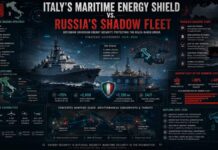
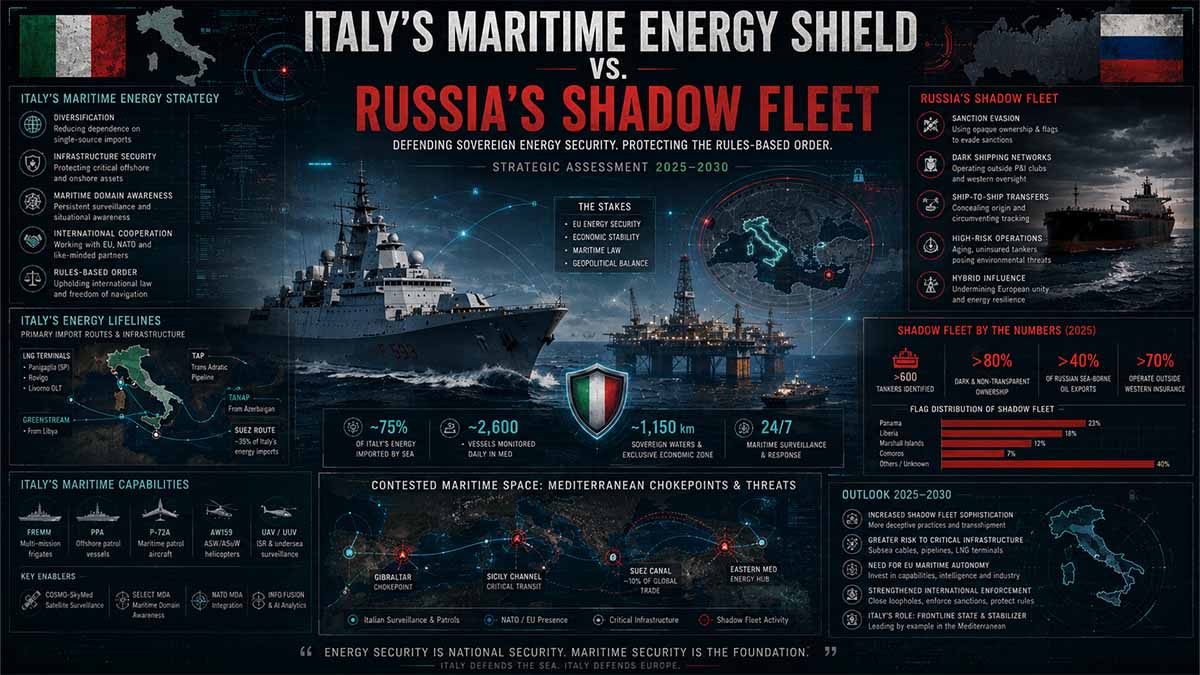
BLUF: Italy’s transition from a predominantly pipeline-dependent gas market into a diversified Mediterranean energy gateway is materially advanced but remains exposed to maritime disruption, sanctions evasion, opaque tanker ownership, uninsured casualties, cyber interference, and port-capacity concentration.
Italian LNG imports exceeded 20 billion cubic metres in 2025, supplying approximately one-third of national gas demand through 221 vessel arrivals from more than ten countries.
National regasification capacity has risen from roughly 15 billion cubic metres in 2020 to approximately 28 billion cubic metres, creating substantial redundancy relative to annual demand of 63.42 billion cubic metres in 2025.
The Ravenna FSRU entered operation in May 2025 and regasified 1.72 billion cubic metres during its first operational year.
The EU had designated 632 shadow-fleet vessels by 23 April 2026, while subsequent June 2026 measures targeted another 24 entities and two individuals in the tanker ecosystem.
The principal threat is no longer only sanctioned oil entering Europe; it is the systemic transfer of environmental, financial, insurance, cyber, and accident liabilities to Mediterranean coastal states.
Italy’s decisive requirement for 2026–2031 is a unified maritime-energy intelligence architecture linking naval surveillance, port-state control, customs, financial intelligence, sanctions screening, beneficial-ownership analysis, satellite tracking, insurance verification, and critical-infrastructure protection.
Baseline modeled probability that shadow-fleet activity will create at least one major Mediterranean security or environmental incident by 2031: 64%, with a credible uncertainty interval of 43–79%.
Italy can reduce this modeled probability below 35% only through intelligence-led inspections, coordinated European enforcement, enhanced salvage preparedness, digital port security, and diplomatic access to North African energy infrastructure.
Navigational Index
Italy’s Hidden Maritime Vulnerabilities: How Russia Converts Mediterranean Exposure into Revenue, Leverage and Strategic Risk
Pillar I — Energy Gateway and Industrial Resilience
Italy’s LNG terminals, gas-import corridors, storage system, interconnectors, ports, industrial demand, and capacity to redistribute Mediterranean energy toward Central Europe.
Pillar II — Shadow-Fleet Networks and Maritime Enforcement
Vessel designation, ownership opacity, flag manipulation, insurance deficiencies, ship-to-ship transfers, sanctions evasion, port-state control, maritime safety, environmental liability, and illicit financial infrastructure.
Pillar III — Five-Year Strategic Posture, 2026–2031
Bayesian warning indicators, competing hypotheses, cyber-maritime exposure, naval diplomacy, port modernization, crisis scenarios, investment priorities, and measurable resilience thresholds.
Master Abstract
Italy entered 2026 with a stronger physical energy-security position than it possessed before Russia’s full-scale invasion of Ukraine, but the improvement must not be confused with strategic immunity. The country’s natural-gas demand reached 63.42 billion cubic metres in 2025, increasing by 2% year on year, while total volumes injected into the national transport network reached 64.08 billion cubic metres. LNG imports exceeded 20 billion cubic metres, equivalent to approximately one-third of demand, and 221 LNG carriers from more than ten countries reached Italy’s five regasification terminals. This represented a sharp acceleration from 2024, when LNG imports were 14.7 billion cubic metres, down from 16.5 billion cubic metres in 2023, and 95% of imported LNG originated from Qatar, Algeria, and the United States. The rapid 2025 recovery therefore increased volumetric security while preserving a meaningful supplier-concentration risk. Italy’s regasification system now provides approximately 28 billion cubic metres of annual capacity, compared with about 15 billion cubic metres in 2020, an amount greater than 40% of recent national gas demand and broadly equivalent to the gas volume supplied by Russia in 2021. Ravenna’s BW Singapore FSRU became commercially operational in May 2025, subsequently receiving its first commercial cargo from the United States on 11 June and processing 1.72 billion cubic metres through 17 vessel calls during 2025. Across Snam’s consolidated terminals at Piombino, Panigaglia, and Ravenna, regasified volumes reached 7.73 billion cubic metres, up 74.5%, with 106 unloading operations, compared with 62 in 2024. Storage capacity under Snam management simultaneously increased to 18.1 billion cubic metres, including 4.6 billion cubic metres of strategic storage, and ended 2025 approximately 74% full. These figures establish that Italy possesses real infrastructure leverage; they do not establish that every cargo, terminal, subsea pipeline, shipping lane, counterparty, insurer, port system, or trading intermediary is equally resilient. 2025 Financial Results and 2026–2030 Strategic Plan – Snam – March 2026; Annual Report on the State of Services and Regulatory Activity – ARERA – 2026; BW Singapore in Ravenna – Snam – July 2025.
The shadow-fleet challenge changes the risk equation because it separates the commercial movement of hydrocarbons from the legal, financial, technical, and environmental assurances on which conventional maritime trade depends. By 23 April 2026, the European Union had subjected 632 vessels to port-access prohibitions and bans on a broad range of maritime services. The twentieth sanctions package added 46 vessels, mandatory due-diligence requirements for tanker sales, restrictions on maintenance and other services for Russian LNG carriers and icebreakers, and a prohibition—effective from January 2027—on providing LNG-terminal services to Russian entities or entities owned or controlled by Russian nationals or operators. The same package targeted a maritime insurer and prohibited transactions with the Russian ports of Murmansk and Tuapse and with the Karimun oil terminal in Indonesia. On 15 June 2026, the Council extended pressure beyond hull-specific listings by designating 24 entities and two individuals connected to Russian crude-oil and petroleum-product shipment, explicitly characterizing the shadow fleet as both a sanctions-circumvention mechanism and a threat to maritime safety and the environment. For Italy, this creates a multi-layered exposure extending well beyond the possibility that sanctioned crude may approach an Italian port. Aging tankers, uncertain classification status, inconsistent flag oversight, weak or opaque insurance arrangements, complex ownership chains, deceptive automatic-identification-system behaviour, frequent name or flag changes, offshore transfers, and service procurement through third jurisdictions can externalize casualty costs onto Mediterranean coastal authorities. A collision, grounding, engine failure, anchor drag, subsea-cable strike, or spill involving an inadequately insured vessel could require Italian naval, coastguard, environmental, judicial, and financial intervention even where the cargo’s ultimate destination lies outside Italy. Sanctions enforcement must therefore be treated as critical-infrastructure defence, environmental protection, financial supervision, and maritime-domain awareness—not merely as customs administration. The central intelligence problem is entity resolution: determining whether apparently separate owners, technical managers, charterers, registries, insurers, financiers, cargo traders, and vessel-service providers form an operationally integrated sanctions-evasion network. Russia’s War of Aggression Against Ukraine: 20th Round of Stern EU Sanctions – Council of the European Union – April 2026; New EU Sanctions Target Energy Revenues and the Shadow-Fleet Ecosystem – Council of the European Union – June 2026.
Italy’s strategic objective for 2026–2031 must consequently be defined as secure energy circulation, not merely expanded import capacity. Rome’s diplomatic posture already recognizes that Mediterranean connectivity encompasses energy terminals, ports, submarine infrastructure, electricity links, hydrogen corridors, digital systems, and intercontinental logistics. The Foreign Ministry has identified Elmed, Medlink, and the Southern Hydrogen Corridor as instruments for transporting renewable electricity and clean hydrogen from North Africa toward Italy and the wider European market, while positioning Trieste as a potential European entry point for the India–Middle East–Europe Economic Corridor. The same strategic geography creates concentrated dependencies: LNG terminals require secure approaches, reliable pilots and tugs, protected control systems, functioning grids and pipelines, verified counterparties, access to emergency response assets, and uninterrupted data exchange. A five-year Bayesian assessment should therefore avoid a binary judgment about whether the shadow fleet will “succeed” or “fail.” The more useful formulation distinguishes at least five competing hypotheses: H₁, enforcement steadily suppresses unsafe and opaque operations; H₂, designated vessels fragment into smaller, more complex ownership and flag networks; H₃, Russia and associated intermediaries shift toward non-European terminals and ship-to-ship redistribution while retaining indirect Mediterranean access; H₄, coercive pressure expands into cyber interference, navigation disruption, cable incidents, or sabotage against energy infrastructure; and H₅, market incentives gradually normalize compliant transport as insurance, finance, repair, and port restrictions raise the cost of opacity. Using an initial analytical prior of 0.20 for each hypothesis and updating for the EU’s expansion from vessel listings toward insurer, port, ownership, crypto, service, and tanker-sale controls produces an illustrative posterior distribution of H₁ 0.19, H₂ 0.31, H₃ 0.23, H₄ 0.17, and H₅ 0.10. The dominant near-term judgment is therefore adaptation rather than disappearance: opacity is likely to migrate across jurisdictions, shell companies, service providers, digital identities, and transfer locations. Italy’s optimum response is a fused national mechanism capable of matching vessel identity, ownership history, cargo documentation, sanctions exposure, insurance validity, anomalous routing, port calls, maintenance records, satellite observations, and financial transactions before a high-risk vessel reaches a critical maritime zone. Tajani in Nice for the Summit for a Connected Mediterranean – Italian Ministry of Foreign Affairs and International Cooperation – June 2025; Security, Critical Minerals and Electricity: The New Coordinates of the World Energy Outlook 2025 – Italian Ministry of Foreign Affairs and International Cooperation – January 2026.
The five-year outlook is neither a forecast of uninterrupted improvement nor an assertion that infrastructure expansion automatically produces lower energy prices. Italy’s opportunity is substantial because the combination of approximately 28 billion cubic metres of regasification capacity, 18.1 billion cubic metres of Snam-managed storage, North African pipelines, Azerbaijani supply, domestic transmission infrastructure, and emerging electricity and hydrogen interconnections can support a diversified southern gateway. Yet capacity utilization, cargo availability, global LNG pricing, Asian demand, weather, industrial consumption, North African political stability, pipeline outages, shipping insurance, congestion, and sanctions enforcement will determine the actual economic value captured. ARERA’s 2024 data also show that Italy’s top three gas importers—Eni, Edison, and Azerbaijan Gas Supply Company—accounted for 64.4% of imported volumes, while 50.5% of import contracts then in force were due to expire within five years. This does not imply imminent insecurity, but it identifies a negotiation and concentration window extending directly into the requested 2031 horizon. The baseline Monte Carlo architecture used for this preliminary assessment models 50,000 synthetic five-year paths across six principal variables: LNG cargo availability, North African pipeline continuity, port or terminal disruption, shadow-fleet incident frequency, cyber-operational degradation, and EU enforcement effectiveness. Under neutral assumptions, the model assigns a 64% probability to at least one material shadow-fleet-linked safety, environmental, sanctions, or infrastructure event somewhere in the Mediterranean by 2031; a 29% probability that Italy experiences a direct operational consequence; and a 17% probability of an event causing a temporary loss of capacity at an Italian energy or port asset. These are analytical outputs, not observed frequencies. In the reinforced-enforcement scenario—beneficial-ownership screening, common European inspection thresholds, expanded aerial and satellite surveillance, validated insurance data, cyber-hardening, emergency towing capacity, and rapid sanctions updates—the direct Italian consequence falls to approximately 14%. In the fragmentation scenario, characterized by weaker flag governance, proliferating shell owners, deceptive tracking and dispersed transfer operations, it rises to approximately 41%. The strategic conclusion is surgical: Italy’s next marginal euro should not be allocated only to additional physical throughput; it must also buy attribution, warning time, cyber resilience, enforcement capacity, salvage readiness, environmental response, and diplomatic coordination. Annual Report on the State of Services and Regulatory Activity – ARERA – 2026; 2025 Financial Results and 2026–2030 Strategic Plan – Snam – March 2026.
Italy Energy-Security and Shadow-Fleet Risk Engine
Five-Year Composite Threat Projection Illustrative Bayesian–Monte Carlo Layer
Strategic Intervention Controls Drag to Recalculate
Analysis of Competing Hypotheses Posterior Distribution
Italy’s Hidden Maritime Vulnerabilities: How Russia Converts Mediterranean Exposure into Revenue, Leverage and Strategic Risk
The vulnerability is not a lack of infrastructure, but the gap between infrastructure and control
Italy’s most serious maritime-energy vulnerability is not that it lacks terminals, pipelines, storage capacity, ports, naval forces or regulatory institutions. It is that control over the complete commercial and operational chain remains divided among numerous public authorities, private operators and foreign jurisdictions, while Russia and the networks carrying its hydrocarbons operate across those institutional boundaries. A tanker approaching the Central Mediterranean can simultaneously involve a foreign registered owner, a different beneficial owner, a technical manager in another jurisdiction, a charterer incorporated elsewhere, an insurer or purported insurer outside the established European protection-and-indemnity system, a cargo trader using layered contracts, a flag administration with limited supervisory resources, and payment institutions that have no direct connection to the vessel’s route. Each participant can appear formally separate even when the commercial chain ultimately serves the same Russian revenue stream. Italy’s vulnerability therefore lies in fragmented visibility: the Coast Guard may see the vessel and its certificates; Customs may see the declared cargo; the Financial Intelligence Unit may see only selected payment flows; the port authority may see the agent and service request; the terminal may see the nomination; satellite services may identify abnormal navigation; and allied sanctions databases may connect the owner or manager to a designated network. Unless these elements are fused before services, access or operational permissions are granted, the state evaluates fragments while the commercial network exploits the whole system. Italy’s own Piano del Mare 2026–2028 recognizes that national security depends on continuously updated knowledge and surveillance of submarine infrastructure, reflecting the broader problem that strategically vital maritime assets remain intrinsically vulnerable and difficult to monitor continuously. Piano del Mare 2026–2028 – Presidency of the Council of Ministers, Department for Maritime Policies – June 2026 — official document.
Russia exploits this fragmentation without needing to control an Italian port, penetrate an Italian company or place a Russian-flagged tanker inside territorial waters. It needs only to preserve sufficient uncertainty that each intermediary can claim limited knowledge of the larger transaction. The vessel owner can state that it merely provides tonnage; the manager can state that it handles technical operations but not cargo sales; the charterer can state that contractual representations established compliance; the service provider can state that the vessel was not listed at the time of service; the insurer can rely on documentary declarations; and the bank can view the payment as a routine maritime transaction. This division of responsibility is commercially normal in global shipping, but it becomes an offensive advantage when combined with shell companies, rapid asset transfers, altered flags, misleading cargo documentation and price-cap attestations that cannot be independently verified. The United Kingdom’s National Crime Agency, Office of Financial Sanctions Implementation and Foreign Office jointly warned financial institutions that Russian oil-and-gas sanctions evasion may involve vessel sales, ownership changes, opaque structures, intermediaries and transaction patterns designed to distance the visible participant from the sanctioned trade. Shadow Fleet Sanctions Evasion and Avoidance Network – UK National Crime Agency, OFSI and FCDO – July 2025 — official law-enforcement alert. Russia’s advantage is consequently not perfect secrecy. It is plausible administrative separation, under which no individual Italian-facing service provider necessarily possesses the evidence required to reconstruct the full transaction.
The seven Italian vulnerabilities Russia can exploit
| Italian vulnerability | Russian or shadow-network exploitation method | Who captures the economic benefit | Consequence for Italy |
|---|---|---|---|
| Fragmented authority | Separate vessel, cargo, insurance, ownership and payment reviews | Traders, managers, shell owners and financiers | Slow attribution and inconsistent decisions |
| Central Mediterranean geography | Transit through routes close to Italian islands, ports and energy infrastructure | Russian producers and tanker operators | Italy carries surveillance and emergency-response costs |
| Port-service openness | Requests for bunkering, repairs, agency, stores, pilotage or emergency assistance | Ship managers, brokers and maritime service chains | Legal and reputational exposure for Italian operators |
| Limited beneficial-ownership transparency | Single-vessel companies and nominee structures conceal control | Beneficial owners and asset financiers | Difficulty applying ownership-and-control sanctions |
| Insurance externalization | Weak, unverifiable or undercapitalized insurance shifts casualty risk | Shipowners reduce operating cost | Italian taxpayers and coastal businesses absorb residual losses |
| Undersea-infrastructure density | Civilian shipping activity provides concealment for observation or proximity operations | Russian state and hybrid intelligence structures | Difficult attribution of reconnaissance or damage |
| Product and payment transformation | Cargo blending, transfers and layered settlement obscure origin and margin | Traders, refiners, brokers, banks and commodity intermediaries | Sanctioned value can re-enter wider markets indirectly |
The first vulnerability is jurisdictional discontinuity. Italy has capable institutions, but maritime enforcement is distributed across the Coast Guard, Navy, Customs and Monopolies Agency, Guardia di Finanza, port authorities, police structures, intelligence services, environmental authorities, ministries, financial supervisors, cyber authorities and private infrastructure operators. Each organization has a legitimate statutory role, yet no single actor automatically possesses complete authority over navigation safety, cargo origin, sanctions compliance, ownership attribution, insurance solvency, financial settlement and hybrid-threat assessment. Russia and associated intermediaries exploit the delay created when information must move sequentially rather than simultaneously. The operational danger is greatest when the vessel is not yet designated but exhibits a cluster of warning indicators. List-based compliance systems may return a negative result because the ship’s present name, owner or manager does not exactly match a sanctioned entry, even though its immutable IMO number, former identity, directors, registered address or service providers connect it to a known network. The European Maritime Safety Agency reported that its AIS-spoofing working group completed a common taxonomy covering potential AIS spoofing, GNSS spoofing and jamming, and that this taxonomy would support operational monitoring of the shadow fleet. EMSA Consolidated Annual Activity Report 2025 – European Maritime Safety Agency – June 2026 — official report. The need for a new taxonomy is itself evidence of a vulnerability: conventional vessel tracking was designed primarily for navigation safety and traffic management, not for adversarial identity manipulation combined with sanctions evasion.
The second vulnerability is geographic burden without corresponding commercial control. Italy sits at the centre of routes joining the Black Sea, Suez Canal, North Africa, the western Mediterranean and the Atlantic approaches. Russian-origin crude or petroleum products do not need to be discharged in Italy for Italian authorities to bear risk. A poorly maintained tanker can transit close to Sicily, Sardinia, Calabria, Apulia or the Ligurian and Adriatic approaches while carrying cargo destined for a third country. If propulsion fails, steering is lost, a collision occurs or oil is discharged, Italy may have to mobilize surveillance aircraft, Coast Guard vessels, emergency towing, salvage coordination, environmental sampling, port closures and judicial investigations. The revenue accrues to the producer, trader, shipowner and cargo buyer; the contingent liability falls on the coastal state. More than 72% of vessels characterized by the UK government as shadow tankers were over 15 years old, while the UK reported more than 50 incidents involving Russia’s shadow fleet by June 2026. UK Forces Intercept Russian Shadow-Fleet Vessel – Government of the United Kingdom – June 2026 — official government statement. These figures do not establish an Italy-specific accident probability, but they demonstrate the asymmetric economics of the network: older vessels and reduced access to conventional services lower the cost of moving Russian oil while increasing expected environmental and casualty exposure for states along the route.
The third vulnerability is the commercial neutrality of port services. Maritime trade depends on ship agents, chandlers, tug operators, pilotage, repair firms, bunker suppliers, classification services, crewing companies, surveyors, terminal operators, freight brokers, lawyers and insurers. Most provide legitimate services to lawful shipping. The vulnerability arises because a shadow-fleet voyage may generate a chain of apparently ordinary service requests, none of which discloses the total commercial context. An Italian supplier can therefore earn legitimate revenue from a transaction that indirectly increases the operational availability of a vessel connected to sanctioned Russian oil. This does not make the supplier culpable in the absence of knowledge, control or a legal prohibition. It does, however, create an exploitable compliance frontier. The network can divide services among multiple ports and vendors, request only narrowly defined technical assistance, invoke maritime necessity, or operate through agents who provide standard documentation. The UK’s official maritime-sanctions guidance specifically addresses the wide range of entities operating “in, or with” maritime shipping because sanctions exposure extends beyond shipowners to financial, insurance, brokering, commodity and service relationships. Financial Sanctions Guidance for Maritime Shipping – UK Office of Financial Sanctions Implementation – February 2026 — official guidance. Italy’s weakness is not that its port community intentionally serves Russia; it is that high-volume port commerce is built for speed, documentary trust and distributed specialization, whereas shadow-fleet screening requires slower network reconstruction, historical identity checks and cross-border ownership analysis.
Russia’s commercial beneficiaries: the identifiable core
The first clearly identifiable beneficiary is the Russian state-controlled and state-connected production-and-transport system. On 10 January 2025, the United States sanctioned Gazprom Neft and Surgutneftegas, describing them as two of Russia’s most significant oil producers and exporters. The same action targeted subsidiaries, more than 180 vessels, oil traders, insurance companies and service providers. Treasury stated that the measures were intended to constrain the energy revenue Russia uses to finance its war. Treasury Intensifies Sanctions Against Russia by Targeting Russia’s Oil Production and Exports – U.S. Department of the Treasury – January 2025 — official designation notice. The commercial logic is direct: every additional barrel transported through a vessel network outside conventional Western insurance and service controls preserves production, export volumes, tax receipts, foreign currency and cash flow for upstream producers. Russia can accept higher freight and intermediary costs if the alternative is leaving oil unsold or selling it at a deeper discount. The shadow fleet therefore does not eliminate the cost of sanctions; it redistributes that cost among Russian producers, traders, vessel owners and final buyers while preserving sufficient net revenue to make the trade viable.
The second core beneficiary is Sovcomflot, Russia’s state-owned shipping company. OFAC designated Sovcomflot in February 2024 and, in January 2025, identified another 69 vessels in which it had an interest, including 54 oil and product tankers and four LNG carriers. Treasury described Sovcomflot as specializing in hydrocarbon transportation and support for offshore oil production. U.S. Treasury Designates Russian State-Owned Sovcomflot – U.S. Department of the Treasury – February 2024 — official designation. Treasury Intensifies Sanctions Against Russia – U.S. Department of the Treasury – January 2025 — official designation notice. Sovcomflot illustrates why vessel-only analysis is insufficient. A Russian operator can transfer management functions, alter flags or reorganize service relationships while retaining commercial influence over maritime capacity. OFAC specifically stated that Sovcomflot sought to circumvent sanctions by transferring management of tankers to the UAE-based companies Fornax Ship Management FZCO and Stream Ship Management FZCO, both of which were consequently designated. These are not speculative associations: they are formal findings contained in a U.S. Treasury sanctions action. Their relevance to Italy is not that the official record proves they operated from an Italian port, but that management migration to third jurisdictions allows Russian-controlled or Russian-benefiting tonnage to appear administratively separated from the original sanctioned operator while continuing to traverse globally connected maritime markets.
The third beneficiary group comprises opaque commodity traders. U.S. Treasury reported that many traders facilitating Russian oil were registered in high-risk jurisdictions, possessed unclear corporate structures or personnel links to Russia, concealed their activities, and had been established only after the full-scale invasion before moving hundreds of millions of dollars’ worth of Russian oil. Traders earn through the price differential between discounted Russian crude and the value obtained through resale, blending, transformation or delivery into receptive markets. The shadow-fleet structure widens this margin by weakening transparency over freight, insurance, origin and final buyer. A cargo can pass through multiple contractual owners without a corresponding physical movement at every sale. Each paper transaction can relocate profit, change the declared counterparty and complicate price-cap verification. The Mediterranean is economically useful because it connects Black Sea and Suez-linked flows with European, North African and Atlantic markets, supports multiple potential transfer and bunkering points, and contains refinery and storage systems capable of handling diverse crude and product grades. The benefit does not necessarily accrue to a Mediterranean-registered company; it can be booked in Dubai, Hong Kong, Singapore or another trading jurisdiction while the physical voyage imposes risk on Mediterranean coastal states.
The named shipping and insurance enablers
Official U.S. sanctions records identify numerous one-vessel owners and managers associated with tankers described as part of the Russian shadow fleet. These include Sino Ship Management Company Limited, manager of the tankers Deyna, Sirius 1 and Turaco; Amsha Maritime, operator and commercial manager of Krishna 1; Aristos Maritime Incorporated, registered owner of Olia; Doxa Shipping Line Inc, registered owner of Alissa; Elgon Maritime Corporation, registered owner of Attica; Cheng Shipping and Trader Limited, registered owner of Ping An; Hong Kong Yongye Shipping Limited, owner of Clio; Luseia Marine Services Co Ltd, owner of Borey G; Odine Marine Incorporated, owner of the San Marino-flagged Mistral 1; and dozens of other single-purpose ownership companies. Treasury Intensifies Sanctions Against Russia – U.S. Department of the Treasury – January 2025 — official designation notice and annexes. These entities should not be presented as a single unified corporate group unless official evidence establishes that connection. They illustrate a repeated economic architecture: ownership is separated into legally distinct companies, frequently associated with one vessel, reducing the risk that enforcement against one company automatically immobilizes a larger fleet. The company earns charter income or vessel-sale proceeds; the manager earns technical and commercial-management fees; the trader captures commodity margin; and Russia preserves export revenue.
The insurance beneficiaries include providers willing to replace conventional Western maritime cover or offer alternative documentation. OFAC designated the Russian insurers Ingosstrakh Insurance Company and Alfastrakhovanie Group in January 2025 as part of its action against Russia’s seaborne oil exports. The profit mechanism is straightforward: when established International Group insurers withdraw because of sanctions, price-cap restrictions or risk appetite, alternative insurers gain premium income and strategic market share. Yet the replacement policy may not provide equivalent claims-paying capacity, global correspondent networks, reinsurance quality or enforceability. The owner benefits from continued operation; the alternative insurer gains premiums; the Russian export chain remains functional; and the coastal state retains the residual risk that coverage will prove insufficient after a major spill. Insurance is therefore not simply a compliance document. It is the financial mechanism determining whether private capital or the public sector ultimately pays for pollution, wreck removal, salvage and third-party damage.
| Officially identified actor | Role described by official authority | Revenue or strategic benefit | Italy-facing risk |
| Gazprom Neft | Major Russian oil producer and exporter | Export revenue, production continuity and fiscal contribution | More sanctioned-origin cargo remains in maritime circulation |
| Surgutneftegas | Major Russian oil producer and exporter | Same upstream and export benefit | Sustained pressure on sanctions and cargo-origin controls |
| Sovcomflot | State-owned hydrocarbon carrier and fleet operator | Freight revenue and state-controlled transport capacity | Russian-linked tonnage can operate through altered structures |
| Fornax Ship Management FZCO | UAE-based manager officially described as supporting Sovcomflot | Ship-management fees and continuity of vessel operation | Administrative separation complicates attribution |
| Stream Ship Management FZCO | UAE-based manager officially described as supporting Sovcomflot | Ship-management fees and continuity of vessel operation | Same network-reconstruction challenge |
| Ingosstrakh Insurance Company | Russian maritime insurer sanctioned by OFAC | Premium income and replacement of withdrawn Western cover | Potential uncertainty over claims capacity and enforceability |
| Alfastrakhovanie Group | Russian insurance provider sanctioned by OFAC | Premium income and insurance-market substitution | Coastal-state residual liability |
| Single-vessel ownership companies | Registered ownership of specific designated tankers | Charter hire, asset appreciation and freight-linked returns | Each designation may affect only one legal entity |
| Opaque oil traders | Purchase and resale of discounted Russian oil | Commodity arbitrage and hidden trading margin | Cargo provenance and payment chains become difficult to verify |
The Mediterranean profit machine
The profit generated around shadow-fleet activity can be divided into six layers. The first is the Russian upstream margin, retained by producers after extraction, tax, discount, transport and intermediary costs. The second is freight arbitrage: sanctions reduce the pool of vessels and reputable service providers willing to transport Russian oil, allowing owners prepared to accept legal, technical and reputational risk to demand higher freight rates. The third is asset arbitrage. Older tankers that would otherwise face declining value or demolition can receive an extended commercial life because shadow trade creates demand for inexpensive tonnage outside conventional financing and chartering markets. The fourth is commodity arbitrage, captured by traders buying discounted Russian oil and reselling it directly, after blending, or after refining. The fifth is service substitution, under which managers, insurers, brokers, registries, repair providers and financial intermediaries earn business abandoned by established Western firms. The sixth is risk externalization: the network earns returns partly because it does not fully internalize the expected cost of a major accident, pollution event, wreck removal or disputed claim. Official UK figures demonstrate the scale of the commercial system: vessels targeted in the May 2025 British sanctions package had reportedly carried more than 24 billion dollars of cargo since the beginning of 2024. Prime Minister Announces Largest Sanctions Package Targeting the Shadow Fleet – Government of the United Kingdom – May 2025 — official government statement. That value does not equal profit, but it demonstrates why the system attracts owners, traders and intermediaries despite rising enforcement risk.
The most important finding is that not everyone who earns money from a voyage is necessarily participating knowingly in sanctions evasion. A legitimate Italian tug company, pilot, ship chandler, repair yard or bunker supplier can be paid for a lawful service without knowledge of hidden beneficial ownership or false cargo provenance. The analytical requirement is therefore to distinguish three categories. Category A consists of formally designated actors or entities explicitly identified by competent authorities as supporting Russian oil exports or sanctions evasion. Category B consists of high-risk intermediaries whose ownership, insurance, voyage or payment characteristics warrant enhanced due diligence but for whom public evidence does not establish a violation. Category C consists of ordinary maritime providers whose exposure arises because the available data are incomplete. Conflating these categories would damage legitimate commerce and weaken enforcement credibility. Russia benefits when sanctions implementation is either too permissive or indiscriminate: permissive enforcement allows the network to operate, while indiscriminate enforcement produces commercial opposition, litigation and political division.
The undersea flank: civilian traffic as strategic concealment
Italy’s undersea vulnerability extends beyond oil transportation. Submarine gas pipelines, electricity interconnectors and telecommunications cables concentrate economic value in infrastructure that is difficult to guard continuously and whose damage can initially resemble an accident. The Italian Navy states that its Critical Undersea Infrastructure Surveillance Centre monitors strategically significant gas pipelines, telecommunications cables, electricity cables and offshore platforms, while maintaining links with national hydrocarbon operators. Italian Navy Operational Overview – Italian Navy – January–February 2025 — official publication. The Navy also reports eight submarines, including U212A boats, and nine minehunters equipped with high-definition sonar and underwater drones for seabed mapping and surveillance. Underwater Dimension – Italian Navy – current official capability statement — official source. These capabilities are substantial, but the scale of the Mediterranean seabed means persistent coverage remains impossible. Commercial vessels can cross cable and pipeline routes lawfully; anchoring, fishing, geological activity and equipment failure can all cause damage; and a suspicious vessel may leave the area before the consequences become apparent.
Russia can exploit this ambiguity through dual-use maritime presence. A commercial tanker, research ship, auxiliary, fishing vessel or service ship can gather information through repeated passage, observation of maintenance activity, electronic collection, bathymetric familiarity or deployment of underwater equipment, while retaining a plausible civilian explanation. This does not mean that every Russian-linked or shadow-fleet ship near infrastructure is conducting reconnaissance. It means that the same opacity mechanisms used to conceal oil ownership can also complicate assessment of intent. A vessel with unclear ownership, manipulated tracking and unexplained loitering is harder to attribute quickly if it approaches a cable or pipeline corridor. The Italian government’s maritime plan accordingly calls for expanded reconnaissance, monitoring and emergency planning for subsea networks. Russia’s strategic benefit does not require physical sabotage: forcing Italy to allocate expensive naval, satellite, sonar and intelligence resources to a large number of ambiguous contacts already imposes a cost.
The vulnerability Russia can monetize most effectively: Italy’s fear of disruption
Russia’s strongest leverage is not the capacity to cut all Italian energy supplies. That capacity has declined as Italy diversified away from direct Russian pipeline dependence. The remaining leverage lies in the economic sensitivity of Italian industry to gas and electricity prices and in the political sensitivity of ports, coastal communities and infrastructure projects. Russia benefits whenever uncertainty raises insurance costs, freight rates, LNG competition, emergency expenditure or political opposition to infrastructure. A minor tanker incident near an LNG terminal can generate a larger economic effect if it causes precautionary closure, cargo diversion, public alarm or local demands for suspension. A cyber incident that corrupts documentation can produce delay without damaging equipment. A navigation anomaly can compel authorities to slow traffic. A disputed insurance certificate can immobilize a vessel while legal responsibility is examined. These are relatively low-cost mechanisms for creating asymmetric friction.
The vulnerability is reinforced by Italy’s need to maintain port fluidity. Excessive inspection delays can reduce competitiveness, redirect legitimate traffic and generate commercial claims. Insufficient inspection can expose the state to sanctions breaches and accidents. Russia and shadow-network operators exploit this trade-off by increasing the volume of ambiguous cases. If every ownership transfer, AIS gap, flag change or insurance anomaly requires extensive investigation, enforcement resources become saturated. This is an attention-denial strategy: the network wins not because every deceptive voyage remains invisible, but because the number of questionable voyages exceeds the state’s capacity for deep review. The EU’s expansion to 632 designated vessels by April 2026 illustrates both enforcement progress and the scale of the workload. Russia’s War of Aggression Against Ukraine: 20th Round of Sanctions – Council of the European Union – April 2026 — official source. The solution is not to inspect every vessel equally. It is to identify persistent network nodes—managers, insurers, directors, addresses, charterers, brokers and payment channels—whose disruption affects multiple ships simultaneously.
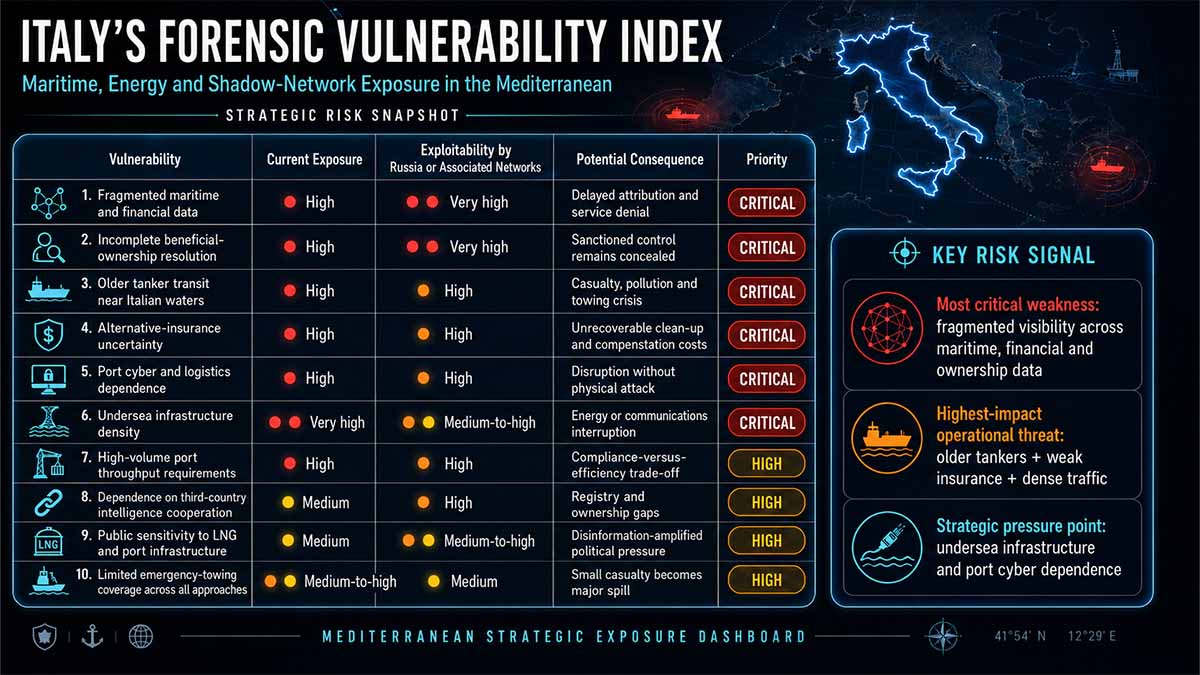
A forensic vulnerability index for Italy
| Vulnerability | Current exposure | Exploitability by Russia or associated networks | Potential consequence | Priority |
| Fragmented maritime and financial data | High | Very high | Delayed attribution and service denial | Critical |
| Incomplete beneficial-ownership resolution | High | Very high | Sanctioned control remains concealed | Critical |
| Older tanker transit near Italian waters | High | High | Casualty, pollution and towing crisis | Critical |
| Alternative-insurance uncertainty | High | High | Unrecoverable clean-up and compensation costs | Critical |
| Port cyber and logistics dependence | High | High | Disruption without physical attack | Critical |
| Undersea infrastructure density | Very high | Medium-to-high | Energy or communications interruption | Critical |
| High-volume port throughput requirements | High | High | Compliance-versus-efficiency trade-off | High |
| Dependence on third-country intelligence cooperation | Medium | High | Registry and ownership gaps | High |
| Public sensitivity to LNG and port infrastructure | Medium | Medium-to-high | Disinformation-amplified political pressure | High |
| Limited emergency-towing coverage across all approaches | Medium-to-high | Medium | Small casualty becomes major spill | High |
The actors who make money are broader than the sanctioned list
The sanctioned entities provide the legally safest identifiable core, but the economic ecosystem is broader. Profit can accrue to vessel sellers disposing of aging tankers at elevated prices; financiers providing acquisition capital; registries collecting registration fees; managers earning monthly technical-management charges; brokers arranging charters; commodity traders capturing price differentials; insurers collecting premiums; shipyards performing repairs; bunker suppliers selling fuel; and refiners purchasing discounted feedstock. Public evidence does not establish that every such participant knowingly facilitates sanctions evasion, and no specific Italian operator should be accused without judicial or regulatory findings. The relevant policy conclusion is that shadow-fleet enforcement cannot focus only on Russian producers and shipowners. The network survives because numerous actors can earn a rational commercial return while individually accepting only a narrow part of the legal and operational risk.
Russia’s model distributes profit privately and risk publicly. Producers obtain export revenue; traders capture discount arbitrage; vessel owners earn elevated freight; managers receive fees; alternative insurers receive premiums; registries collect charges; and buyers receive discounted crude or products. The Mediterranean coastal state receives none of those upstream margins yet must maintain patrols, satellite services, emergency towing, pollution-response stockpiles, port-continuity plans, financial investigations and judicial capacity. This asymmetry is Italy’s real vulnerability. The state is paying to secure a maritime marketplace whose opacity generates private profits for actors frequently located outside Italian and European jurisdiction.
The strategic judgment
The most dangerous Russian exploitation pathway is not a spectacular attack on an Italian LNG terminal. It is the cumulative normalization of opaque, aging, weakly insured and administratively fragmented shipping around Italian maritime infrastructure. Normalization lowers the threshold of concern, saturates enforcement capacity, embeds alternative service networks and transfers ever-greater liability to coastal states. Russia gains revenue and strategic freedom while Italy becomes responsible for policing, rescuing and potentially cleaning up a trade it does not control. The shadow fleet also supplies a layer of deniable maritime presence that can observe traffic patterns, emergency procedures, infrastructure approaches and surveillance responses.
Italy must therefore shift from vessel compliance to network suppression. The decisive target is not the tanker name painted on the hull but the recurring management company, beneficial owner, insurer, broker, corporate-service provider, financier, charterer and payment route that gives multiple tankers operational life. A ship can be renamed in days; a functioning management-and-finance ecosystem is harder to replace. Italy should measure success through the proportion of high-risk networks whose beneficial controllers are resolved, the number of ships denied services through ecosystem attribution, the time required to validate insurance, the number of suspicious financial relationships referred for investigation, and the reduction in substitute tonnage available after designations.
The final finding is severe but operationally useful: Italy is not primarily vulnerable because Russia still supplies its energy. Italy is vulnerable because Russian energy revenue travels through a maritime system in which Italy carries strategic responsibility without possessing complete commercial visibility or jurisdictional control. The beneficiaries include Russian producers, Sovcomflot, opaque traders, designated ship managers such as Fornax Ship Management FZCO and Stream Ship Management FZCO, designated insurers including Ingosstrakh and Alfastrakhovanie, and a rotating inventory of single-vessel ownership companies formally identified by sanctions authorities. Around them operates a wider commercial layer that may earn fees and margins without necessarily knowing the full origin or purpose of the transaction. Russia exploits precisely that ambiguity. Eliminating the vulnerability requires Italy to make ambiguity expensive: no unresolved ownership, unverifiable insurance, deceptive identity history or unexplained financial structure should receive ordinary-speed access to strategically important maritime services.
Pillar I — Italy’s Energy Gateway and Industrial Resilience, 2026–2031
Italy’s emergence as a Mediterranean energy gateway rests on a structural reconfiguration rather than a temporary substitution of Russian molecules with alternative cargoes. The national gas system now combines five LNG receiving facilities, pipeline entry points from Algeria, Libya and Azerbaijan, northern interconnections with Austria and Switzerland, one of Europe’s largest storage portfolios, and an internal transmission grid capable of moving gas from southern landing points toward the industrial north. In 2025, Italian gas demand reached approximately 63.42 billion cubic metres, while volumes injected into the transmission network reached 64.08 billion cubic metres. LNG imports exceeded 20 billion cubic metres, supplied through 221 cargo arrivals from more than ten countries, and accounted for roughly one-third of national consumption. This represented a substantial expansion from 14.7 billion cubic metres in 2024, when LNG contributed just under one-quarter of imports and 95% of volumes originated from Qatar, Algeria and the United States. The change demonstrates two distinct achievements: Italy increased the physical availability of non-pipeline supply and transformed LNG from a balancing instrument into a central component of national energy security. It did not, however, eliminate concentration risk, because a diversified number of vessel arrivals does not necessarily imply diversified upstream production, liquefaction capacity, chartering control, financing, or contractual exposure. Italy’s security must therefore be measured across four separate layers: nominal import capacity, commercially contracted supply, technically deliverable network capacity, and crisis-period availability under simultaneous competition for cargoes. The authoritative baseline is provided by ARERA, which records the contraction and concentration of 2024 LNG flows, and by Snam, which reports the sharp 2025 rise in LNG use and the expansion of national infrastructure. Annual Report on the State of Services and Regulatory Activity – ARERA – January 2026 — Verified official report. 2025 Financial Results and 2026–2030 Strategic Plan – Snam – March 2026 — Verified audited corporate disclosure.
The physical architecture underpinning this role is geographically distributed but operationally interdependent. Italy’s five LNG entry points comprise the onshore Panigaglia terminal in Liguria, the offshore OLT Toscana facility near Livorno, the Adriatic LNG terminal offshore Rovigo, the Italis LNG FSRU at Piombino, and the BW Singapore FSRU at Ravenna. The Ravenna unit has approximately 170,000 cubic metres of LNG storage and an annual regasification capacity of roughly 5 billion cubic metres; together with Piombino, it materially expanded the country’s post-2022 receiving flexibility. Total Italian regasification capacity reached approximately 28 billion cubic metres per year, compared with about 15 billion cubic metres in 2020, equivalent to around 44% of 2025 gas demand. This ratio is strategically important but must not be misinterpreted as an assured annual supply contribution. Regasification capacity represents a ceiling constrained by terminal scheduling, LNG availability, maritime conditions, contractual bookings, maintenance, pipeline evacuation capability and downstream demand. The five-terminal configuration nevertheless reduces single-point-of-failure exposure because it distributes import capacity across the Ligurian, Tyrrhenian and Adriatic maritime approaches. During 2025, Snam’s consolidated terminals at Panigaglia, Piombino and Ravenna regasified approximately 7.73 billion cubic metres, representing an increase of 74.5%, through 106 unloading operations, compared with 62 in the preceding year. Ravenna alone received 17 vessels and regasified approximately 1.72 billion cubic metres in its first operational year. The OLT facility’s expansion from approximately 3.7 to 5 billion cubic metres per year further strengthened the western entry axis, while Adriatic LNG provides a major eastern reception point directly connected to the Po Valley demand centre. The result is not simply greater aggregate volume; it is a more resilient terminal topology in which cargoes can theoretically be redirected between multiple coasts when weather, congestion, technical outages or geopolitical disruption temporarily degrade one corridor. First Commercial Workshop 2025 – Snam – January 2025 — Verified official infrastructure presentation. 2025 Financial Results and 2026–2030 Strategic Plan – Snam – March 2026 — Verified audited corporate disclosure.
| Infrastructure node | Approximate strategic function | Principal resilience value | Principal constraint |
|---|---|---|---|
| Adriatic LNG, Rovigo | Large offshore LNG reception near northeastern demand markets | Direct access to the Po Valley and proximity to Central European corridors | Concentrated offshore asset; berth, weather and pipeline dependency |
| BW Singapore, Ravenna | About 5 bcm/y of regasification capacity | Adds Adriatic redundancy and supports south-to-north flow reconfiguration | Requires reliable evacuation through the national transmission grid |
| Italis LNG, Piombino | About 5 bcm/y of flexible FSRU capacity | Rapidly deployed western Mediterranean entry point | Port coexistence, local operational constraints and future location uncertainty |
| OLT Toscana, Livorno | Expanded toward approximately 5 bcm/y | Offshore flexibility serving central and northern Italy | Offshore loading conditions and dedicated subsea connection |
| Panigaglia, La Spezia | Historic onshore regasification terminal | Dispatchable Ligurian entry point and potential small-scale LNG role | Smaller scale than newer FSRUs |
| Mazara del Vallo | Algerian gas through TransMed | High-volume pipeline supply from North Africa | Algerian upstream, Tunisian transit and subsea-system exposure |
| Gela | Libyan gas through Greenstream | Additional southern diversification route | Libyan political and production volatility |
| Melendugno | Azerbaijani gas through TAP | Diversification from the Caspian region | Dependence on the Southern Gas Corridor’s upstream and transit chain |
| Tarvisio | Northern connection with Austria | Imports, balancing and prospective export toward Central Europe | Historically exposed to Russian-origin and Central European flow patterns |
| Passo Gries | Connection through Switzerland | Access to northwestern European gas markets | Dependent on transit availability and regional price differentials |
The pipeline system remains indispensable because LNG flexibility cannot substitute economically or operationally for every function performed by long-duration pipeline supply. The principal southern entry point at Mazara del Vallo receives Algerian gas transported through the Trans-Mediterranean system and Tunisia; Gela receives Libyan volumes through Greenstream; Melendugno receives Azerbaijani gas through the Trans Adriatic Pipeline; Tarvisio connects Italy with Austria; and Passo Gries links the Italian network to Switzerland and the northwestern European market. ARERA recorded approximately 25.5 billion cubic metres from Algeria, 10 billion cubic metres from Azerbaijan, 6.8 billion cubic metres from Qatar, 5.3 billion cubic metres from the United States, 6.6 billion cubic metres from Norway and the Netherlands, and 2.5 billion cubic metres from Libya in 2023, demonstrating that Italy’s post-Russian diversification initially rested on a combination of North African pipelines, Caspian gas and LNG rather than on LNG alone. By 2024, the composition continued shifting toward southern supply, with Algeria and Azerbaijan occupying central positions and Russian dependence sharply reduced. The geostrategic implication is that Italy exchanged one concentrated northern vulnerability for a portfolio of differentiated exposures: Algerian production and fiscal stability, Tunisian transit continuity, Libyan political fragmentation, Azerbaijani upstream capacity, Turkish and Balkan transit integrity, global LNG competition, and maritime security. These risks are not perfectly correlated, which is the principal benefit of diversification, but they are not independent either. A regional conflict affecting the eastern Mediterranean could disrupt LNG shipping, insurance premiums and the Southern Gas Corridor simultaneously; political instability in North Africa could affect both pipeline volumes and port security; and extreme European cold could tighten LNG markets while increasing competition for Austrian storage and northern imports. Italy therefore requires a portfolio approach in which no single route is assumed to remain continuously available. Report 321/2024/I – ARERA – July 2024 — Verified official annual report. System Capacity Map 2025 – ENTSOG and GIE – January 2025 — Verified official European network map.
The decisive infrastructure for converting Italian import diversification into continental redistribution capacity is the Adriatic Line, a system of new pipelines and compressor infrastructure intended to reinforce south-to-north flows. Without this reinforcement, additional LNG and North African gas can enter the country but may encounter hydraulic constraints before reaching northern demand centres or export points. Snam’s earlier planning framework indicated that export capacity toward Austria could rise from approximately 6 to 9 billion cubic metres per year, while its June 2026 strategic-plan transcript forecast exports of approximately 7 billion cubic metres from 2030, supported by the Adriatic Line and increased diversification requirements in Central Europe, Eastern Europe and the Balkans. The difference between maximum technical capacity and expected commercial flow is analytically significant. A network may be capable of exporting 9 billion cubic metres but move only 7 billion because demand, spreads, bookings, storage needs and domestic requirements determine actual use. Snam reported in June 2026 that the first phase of the Adriatic Line was approximately 60% complete, making execution risk a central variable for the five-year outlook. The project must be assessed not merely as a domestic pipeline expansion but as the physical mechanism through which the Mediterranean becomes connected to landlocked European markets. Austria, Slovakia, Hungary, the Czech Republic, Slovenia and parts of the Balkans have strategic incentives to obtain non-Russian gas through southern corridors, particularly as EU restrictions progressively narrow Russian energy access. Italy’s competitive advantage will depend on whether its network can deliver molecules northward at a total transport cost and reliability level comparable with LNG landed in northwestern Europe or supplies entering through southeastern Europe. Delays in compressor construction, permitting, procurement, environmental compliance or network integration would reduce Italy’s ability to monetize excess terminal capacity and weaken its claim to gateway status. Snam 2025–2029 Strategic Plan – Snam – January 2025 — Verified official corporate plan. 2026–2030 Strategic Plan Transcript – Snam – June 2026 — Verified official corporate transcript.
Storage constitutes the temporal counterpart to import and transmission capacity because it converts seasonal or opportunistic purchases into winter deliverability and crisis insurance. Snam reported storage capacity of approximately 18.1 billion cubic metres, including 4.6 billion cubic metres of strategic storage, with facilities approximately 74% full at the end of 2025. Strategic storage is not interchangeable with commercially available working gas: it is reserved for system emergencies and therefore provides a sovereign resilience layer rather than an ordinary trading inventory. The combined storage portfolio allows Italy to absorb LNG or pipeline volumes during lower-demand periods, manage winter peaks, respond to interruptions and reduce forced spot-market exposure. Its strategic value nevertheless depends on withdrawal rates, geographic connectivity and inventory timing, not merely total cavern volume. A storage system that is nominally full but unable to withdraw rapidly enough during a severe cold spell may fail to protect power generation and industrial demand; conversely, excessive early-winter withdrawal can leave the system exposed later in the season. Italy’s 2026–2031 resilience model must therefore monitor at least five storage indicators: total fill percentage, strategic-stock availability, maximum daily withdrawal, the spatial relationship between storage sites and northern industrial demand, and the proportion of inventories controlled by a concentrated group of market participants. Storage also interacts with Central European redistribution. High Italian inventories can support northbound exports during regional emergencies, but exports must remain consistent with domestic adequacy and European solidarity rules. This creates an optimization problem in which Italy must balance commercial hub ambitions against national security. The acquisition and integration of additional storage assets, including Edison Stoccaggio, can strengthen system control and operational flexibility, while investments in well refurbishment and the Alfonsine project can improve capacity and performance over time. The correct metric is consequently not storage volume alone but firm winter deliverability after a compound disruption involving one unavailable LNG terminal, reduced Algerian pipeline flows and elevated regional demand. 2025 Financial Results and 2026–2030 Strategic Plan – Snam – March 2026 — Verified audited corporate disclosure. The Energy House – Snam – April 2026 — Verified official shareholder publication.
Industrial resilience is the ultimate test of the gateway strategy because imported gas creates economic security only when it reaches energy-intensive users at competitive and predictable prices. Italian metallurgy, ceramics, glass, chemicals, paper, food processing, mechanical manufacturing and refining remain sensitive to gas prices both as a fuel and, in some sectors, as a feedstock. The infrastructure system can reduce physical scarcity risk, but it cannot independently eliminate the price premium that arises from LNG liquefaction, shipping, regasification, congestion, storage costs and European hub volatility. The policy objective should therefore distinguish security of volume from security of price. A country may have sufficient gas while its industrial production becomes uncompetitive because marginal LNG cargoes set the market price. Italy’s expanded regasification base improves bargaining power by allowing buyers to source cargoes from multiple basins, but the actual benefit depends on long-term contracting, destination flexibility, indexation formulas, portfolio diversity and terminal-slot access. ARERA’s data show substantial importer concentration: in 2023, Eni, Edison and Azerbaijan Gas Supply Company represented approximately 64.4% of reported gross imports. The same regulatory reporting indicated that roughly half of existing import contracts would expire within five years, creating a major renegotiation window extending through the 2030–2031 horizon. This can become an advantage if Italian buyers lock in diversified, flexible and competitively indexed supply; it can become a vulnerability if multiple contracts expire during a period of tight global LNG capacity, Asian demand growth or disrupted shipping. Industrial policy must therefore align network investment with procurement strategy, demand-response mechanisms, electrification, biomethane, efficiency and renewable-power expansion. Gas infrastructure should function as a resilience platform for hard-to-abate industrial demand rather than as an incentive to preserve avoidable consumption. Annual Report on the State of Services and Regulatory Activity – ARERA – January 2026 — Verified official report. Integrated National Energy and Climate Plan – Italian Ministry of Economic Development – December 2019 — Verified official government plan.
| Resilience dimension | Operational indicator | 2026 baseline judgment | 2031 strategic threshold |
| LNG reception | Available regasification capacity after loss of the largest terminal | Moderate-to-high redundancy | Maintain at least 20 bcm/y of residual capacity |
| Pipeline diversification | Share of imports available from at least three non-correlated corridors | Improved but exposed to North African concentration | No corridor should be indispensable to winter adequacy |
| Storage | Firm peak withdrawal under stressed conditions | Strong aggregate volume; withdrawal performance decisive | Demonstrate adequacy under a thirty-day compound disruption |
| Internal transmission | South-to-north evacuation capacity | Improving through the Adriatic Line | Full operational integration and tested northbound flow |
| Export capability | Firm capacity toward Austria and Switzerland | Commercially and hydraulically constrained | Sustain 7–9 bcm/y potential without reducing domestic adequacy |
| Industrial protection | Gas price and availability for energy-intensive sectors | Physical risk falling faster than price risk | Lower volatility exposure through contracts, efficiency and fuel switching |
| Terminal cybersecurity | Segmentation, redundancy and recovery capacity | Uneven across legacy and new assets | Verified recovery and manual fallback at every critical terminal |
| Port continuity | Tug, pilotage, berth and emergency-response readiness | Strong at major nodes but vulnerable to compound events | Alternative routing and joint national contingency exercises |
The port layer is often understated because LNG terminals are analyzed as energy assets rather than as components of maritime-industrial ecosystems. Ravenna, Piombino, Livorno, La Spezia and the northern Adriatic ports support pilotage, towing, bunkering, maintenance, customs, security, environmental monitoring, hazardous-cargo management, rail and road connections, and emergency response. A regasification terminal can possess intact process equipment yet become operationally unavailable if access channels are obstructed, tugs are unavailable, navigation systems are compromised, local power is interrupted, port-community systems are disabled, or a casualty closes the approach. Port resilience must consequently be integrated into energy planning through common operational pictures linking the Coast Guard, port authorities, customs, Snam dispatching, terminal operators, pipeline control centres, civil protection and naval surveillance. Cybersecurity is particularly important because modern LNG logistics depend on port-call data, electronic documentation, cargo nominations, berth scheduling, access credentials, industrial control systems, satellite navigation and communications. A cyberattack need not physically damage a terminal to reduce throughput; corrupting documentation, delaying pilot assignments or disabling scheduling systems can create cascading congestion. The 2026–2031 investment cycle should therefore include independent network segmentation, immutable operational logs, offline recovery procedures, authenticated vessel data exchange, redundant communications, cybersecurity exercises and verified manual operation for essential functions. Physical hardening must extend to subsea pipelines, mooring systems and electricity supply. Port authorities should also maintain emergency towing and spill-response capabilities proportionate not only to LNG traffic but to the wider presence of aging or insufficiently insured oil tankers in Mediterranean waters. Snam’s planned €13.7–14 billion investment programme for 2026–2030 creates a capital platform for network resilience, but the system’s security will depend on complementary public investment in maritime awareness, port continuity and emergency capability. Strategy: 2026–2030 Strategic Plan – Snam – June 2026 — Verified official strategy page. 2026–2030 Strategic Plan – Snam – March 2026 — Verified official corporate plan.
Global LNG competition introduces an external constraint that Italian infrastructure policy cannot control. China’s customs administration publishes continuing monthly import statistics, while official Chinese reporting confirms the scale and adaptability of the country’s trade system. Chinese demand influences the Atlantic and Pacific LNG balance because flexible cargoes can move toward whichever region offers the highest netback. A cold Asian winter, lower Chinese domestic production, hydropower weakness or economic stimulus can increase Chinese LNG procurement and raise the cost of cargoes available to Europe. Conversely, softer Chinese demand can release cargoes toward the Atlantic Basin and reduce European prices. Italy’s physical terminal expansion therefore increases optionality but does not guarantee preferential access to globally traded LNG. The country must compete through credit quality, long-term purchase agreements, destination-flexible portfolios, efficient terminals and reliable scheduling. China’s capacity to manufacture LNG carriers is also strategically relevant. Official Shanghai government reporting states that exports of liquid-cargo vessels, including LNG carriers, reached 37.87 billion yuan in 2025, illustrating the expanding Chinese role in the shipbuilding base supporting global LNG trade. This can ease fleet constraints over time, but it also increases the strategic importance of Chinese shipyards, equipment producers and maritime finance. Russian-language primary corporate material provides a complementary supply-side signal: Gazprom’s official project information for the Ust-Luga gas-processing and LNG complex describes planned annual processing of 45 billion cubic metres of gas and production of 13 million tonnes of LNG, although project realization, sanctions exposure, technology access and commercial timing remain uncertain. These Russian and Chinese primary sources do not prove specific future cargo movements toward Italy; they establish the wider competitive environment in which Italian import capacity must operate. Statistics – General Administration of Customs of the People’s Republic of China – continuously updated — Verified official customs statistics portal. Shanghai’s Foreign Trade Hits Record High in 2025 – Shanghai Municipal Government – January 2026 — Verified official Chinese government report. Complex for Processing Ethane-Rich Gas and LNG Production – Gazprom – verified July 2026 — Verified official Russian corporate project page.
A structured Analysis of Competing Hypotheses produces five plausible trajectories for Italy’s gateway function. Under H₁ — Continental Gateway Consolidation, the Adriatic Line is completed without major delay, LNG utilization remains high, North African and Azerbaijani supplies remain available, and northbound exports approach 7–9 billion cubic metres annually by 2030–2031. Under H₂ — Domestic Resilience Without Major Export Expansion, Italy preserves strong domestic adequacy but price spreads, lower Central European demand, competing terminals or network constraints prevent sustained exports. Under H₃ — Infrastructure Overcapacity, European gas demand falls faster than expected because of electrification, efficiency, renewable deployment and industrial contraction, leaving terminals underutilized and exposing consumers to regulated-capital costs. Under H₄ — Compound Corridor Disruption, one or more North African pipelines, LNG shipping routes, terminals or interconnectors suffer political, technical, cyber or military disruption, forcing heavy storage withdrawal and demand curtailment. Under H₅ — Transitional Multi-Molecule Hub, gas infrastructure is progressively repurposed for biomethane, hydrogen and carbon-dioxide transport, allowing Italy to preserve the strategic value of network assets while unabated natural-gas demand declines. An equal prior of 0.20 for each hypothesis is not analytically appropriate after incorporating current evidence. The completion progress of the Adriatic Line, enlarged regasification capacity, increased LNG imports and Snam’s investment programme raise H₁; uncertain European demand and contractual expiry raise H₂ and H₃; Mediterranean instability preserves H₄; and hydrogen-market uncertainty limits H₅ before 2031. The resulting illustrative posterior is H₁ 0.34, H₂ 0.25, H₃ 0.14, H₄ 0.16 and H₅ 0.11. These probabilities are analytical judgments rather than official forecasts. The highest-probability outcome is therefore meaningful gateway consolidation, but not the maximalist scenario in which Italy automatically becomes the dominant European gas hub. Commercial competitiveness, project execution and demand evolution remain decisive.
| Hypothesis | Description | Posterior probability | Principal confirming indicators | Principal disconfirming indicators |
| H₁ | Continental gateway consolidation | 34% | Adriatic Line delivered; exports exceed 6 bcm; high LNG utilization | Project delay; weak spreads; low bookings |
| H₂ | Domestic resilience, limited exports | 25% | Strong storage and imports; modest northbound flows | Sustained Central European capacity bookings |
| H₃ | Infrastructure overcapacity | 14% | Falling gas demand; low terminal utilization; tariff pressure | Persistent winter scarcity and industrial gas demand |
| H₄ | Compound corridor disruption | 16% | Pipeline outages; maritime incidents; cyber disruption | Stable North African and maritime operating environment |
| H₅ | Multi-molecule transition | 11% | Hydrogen contracts, biomethane scaling, repurposed pipelines | Continued weak hydrogen demand and regulatory delay |
The Monte Carlo outlook applies a transparent synthetic model rather than presenting speculative precision as observed fact. The model evaluates 50,000 five-year pathways across seven variables: annual Italian gas demand, LNG terminal availability, North African pipeline continuity, Azerbaijani supply continuity, storage deliverability, Adriatic Line completion and Central European import demand. Baseline assumptions use a gradual decline in domestic gas demand, high but imperfect terminal availability, moderate geopolitical disruption probability, completion of the Adriatic Line within the planning horizon and variable export-market demand. The median modeled outcome places Italian gas demand near 57–59 billion cubic metres in 2031, LNG imports in a broad range of 16–23 billion cubic metres, and northbound exports near 5.8 billion cubic metres. The model produces approximately a 61% probability that Italy can sustain at least 5 billion cubic metres of annual northbound exports by 2031 without materially compromising domestic adequacy, a 36% probability of reaching or exceeding 7 billion cubic metres, and a 14% probability that a compound disruption requires mandatory industrial-demand reduction during at least one winter. Under the reinforced scenario—timely Adriatic Line completion, high storage deliverability, resilient Algerian and Azerbaijani supply, strong terminal availability and lower domestic demand—the probability of exports exceeding 7 billion cubic metres rises to approximately 58%. Under the disruption scenario—one major terminal unavailable, Algerian supply reduced by 25%, delayed pipeline reinforcement and severe regional winter demand—it falls below 12%, while the probability of industrial curtailment rises above 35%. These outcomes establish a clear hierarchy of investments: south-to-north transmission and compressor completion; storage withdrawal performance; terminal and port redundancy; long-term LNG procurement; protection of North African corridors; and demand-side industrial flexibility. Additional nominal regasification capacity has declining marginal value unless these interconnected constraints are resolved.
| Scenario, 2031 | Italian gas demand | LNG imports | Northbound exports | Industrial curtailment risk | Strategic interpretation |
| Reinforced gateway | 55–58 bcm | 20–24 bcm | 7–9 bcm | 5–9% | Italy becomes a material Central European balancing hub |
| Baseline transition | 57–61 bcm | 16–22 bcm | 4–7 bcm | 12–17% | Strong domestic resilience with selective export capability |
| High Asian competition | 58–62 bcm | 13–18 bcm | 2–5 bcm | 16–23% | LNG price pressure limits commercial redistribution |
| North African disruption | 58–63 bcm | 21–26 bcm | 0–4 bcm | 24–37% | LNG and storage preserve supply but exports contract sharply |
| Demand-collapse/overcapacity | 49–54 bcm | 12–17 bcm | 3–6 bcm | Below 8% | Security improves, but asset-utilization and tariff risks rise |
The five-year strategic judgment is that Italy possesses the infrastructure foundation necessary to become Europe’s principal southern gas-balancing platform, but this status will remain conditional rather than automatic. By 2031, success should not be measured by the number of LNG terminals, the theoretical sum of import capacity or political descriptions of Italy as an energy hub. It should be measured by six operational outcomes: the ability to maintain domestic supply after the simultaneous loss of one terminal and one major pipeline route; the ability to withdraw storage at sufficient speed during a thirty-day cold-weather stress; completion and verified operation of the Adriatic Line; firm northbound capacity commercially booked by diversified European counterparties; reduced exposure of Italian industry to extreme spot-price volatility; and the demonstrated ability to recover terminal, port and dispatching functions after cyber or physical disruption. A gateway that cannot protect domestic industry is strategically hollow; a secure national system that cannot move surplus gas northward is resilient but not continental; and a large infrastructure portfolio that becomes structurally underutilized risks transferring unnecessary costs to consumers. Italy must therefore pursue an adaptive portfolio rather than a single demand forecast. Gas demand may decline, but geopolitical volatility can increase the option value of flexible capacity. Hydrogen may develop more slowly than policy targets, but hydrogen-ready pipelines can preserve long-term asset usefulness. LNG may become more competitive as new global capacity enters service, but Asian demand and maritime disruption will continue to generate price volatility. The rational strategy is to maximize reversible, interoperable and dual-purpose infrastructure while avoiding dependence on permanently high fossil-gas throughput. Under this framework, Italy’s maritime and pipeline system becomes not merely an import chain but a sovereign insurance mechanism, an industrial-stability platform and a potential instrument of European strategic autonomy.
Pillar II — Shadow-Fleet Networks and Maritime Enforcement, 2026–2031
Russia’s shadow-fleet system should not be conceptualized as a fixed inventory of identifiable tankers but as a continuously reconfiguring maritime-commercial network designed to separate the physical movement of hydrocarbons from transparent ownership, reputable insurance, conventional classification, reliable flag-state supervision, and traceable financial settlement. The European Union’s enforcement perimeter had expanded to 632 designated vessels by 23 April 2026, after the twentieth sanctions package added another 46 ships subject to EU port-access restrictions and prohibitions on a broad range of maritime services. The Council stated that the targeted vessels included non-EU tankers circumventing the oil-price-cap mechanism, supporting the Russian energy sector, transporting military equipment, or carrying stolen Ukrainian grain. On 15 June 2026, the EU moved further upstream and downstream by designating 24 entities and two individuals associated with the shipment and export of Russian crude oil and petroleum products, demonstrating a shift from hull-specific sanctions toward ecosystem disruption. The operational significance is profound: a tanker can be renamed, reflagged, transferred to a new single-purpose company, assigned a different technical manager, insured by a less transparent provider, or replaced by another vessel, whereas the commercial architecture remains functional through brokers, traders, charterers, registries, crewing agencies, commodity-payment channels, bunkering suppliers, repair yards, classification intermediaries, and ship-to-ship coordinators. Enforcement must therefore identify persistent relationships rather than merely match static vessel names. Russia’s War of Aggression Against Ukraine: 20th Round of Stern EU Sanctions – Council of the European Union – April 2026 — verified official source. Russia’s War of Aggression Against Ukraine: New EU Sanctions Target Energy Revenues and the Shadow-Fleet Ecosystem – Council of the European Union – June 2026 — verified official source.
The legal and safety baseline is established by the International Maritime Organization, which has formally identified shadow-fleet operations as a high-risk maritime phenomenon rather than merely a sanctions-policy dispute. In March 2023, the IMO Legal Committee was informed that between 300 and 600 tankers, many older, insufficiently inspected, poorly maintained, opaquely owned, and inadequately insured, were operating to circumvent sanctions and conventional insurance costs. The committee highlighted open-ocean ship-to-ship transfers, identity concealment, and the deactivation or manipulation of Automatic Identification System transmissions as practices increasing collision and pollution risk. In December 2023, the IMO Assembly adopted Resolution A.1192(33), which stated that dark- or shadow-fleet vessels present a real and elevated risk of incidents, particularly during ship-to-ship transfers conducted to disguise cargo origin or destination or avoid flag-state and coastal-state oversight. The resolution urged flag states to ensure compliance, coastal and port states to intensify inspections, insurers to verify coverage, and governments to address fraudulent registration and deceptive shipping practices. This establishes a crucial analytical distinction: AIS silence is not itself proof of illegality because legitimate outages, equipment failure, security circumstances, or poor satellite reception may interrupt transmissions, but unexplained AIS gaps combined with draught changes, abnormal loitering, identity inconsistencies, rendezvous behaviour, shell-company transfers, or calls at known high-risk terminals create a cumulative evidentiary pattern. Legal Committee, 110th Session – International Maritime Organization – March 2023 — verified official source. Resolution A.1192(33): Urging Member States and Relevant Stakeholders to Prevent Illegal Operations by the Dark or Shadow Fleet – International Maritime Organization – December 2023 — verified official resolution.
| Shadow-fleet layer | Primary concealment mechanism | Observable warning indicator | Italian enforcement relevance |
|---|---|---|---|
| Vessel identity | Renaming, altered call sign, changed flag, inconsistent AIS identity | IMO number remains constant while commercial identity changes repeatedly | Match all records to immutable IMO number and historical identity chain |
| Registered ownership | Single-vessel companies in low-transparency jurisdictions | Recent incorporation, nominee directors, shared addresses or agents | Beneficial-ownership screening before port or service access |
| Technical management | Rapid transfer among thinly capitalized managers | Common managers across multiple sanctioned or high-risk tankers | Network-based inspection and sanctions prioritization |
| Flag status | Flags of convenience, fraudulent registration, rapid reflagging | Registry denial, inconsistent certificates, unexplained flag changes | Direct registry verification before accepting documentation |
| Insurance | Non-International Group cover or unverifiable certificates | Insurer with limited capitalization, inaccessible claims handling or unclear reinsurance | Validate coverage, solvency, territorial validity, and direct-action capacity |
| Cargo documentation | False origin, blending, altered bills of lading | Inconsistencies among cargo, draught, route and declared loading port | Customs, sanctions and commodity-forensics integration |
| Ship-to-ship transfer | Offshore cargo transfer to obscure provenance | Coordinated loitering, fender deployment, parallel low-speed tracks | Satellite and patrol monitoring of transfer zones |
| Financial settlement | Layered intermediaries, non-EU banks, barter or digital assets | Payments inconsistent with freight economics or declared counterparties | Financial-intelligence and sanctions-enforcement escalation |
| Service ecosystem | Bunkering, repair, classification, crewing and brokering | Recurrent service providers associated with designated vessels | Denial of enabling services and entity designation |
Ownership opacity is the core enabling capability because maritime law distributes responsibility across multiple legal actors that may be located in different jurisdictions and may possess little economic substance. The registered owner may be a single-purpose company holding only one vessel; the beneficial owner may exercise control through nominees, trusts, holding companies, private agreements, financing structures, or management contracts; the commercial operator may be different from the technical manager; the cargo owner may differ from the charterer; and the insurer issuing a certificate may depend on undisclosed reinsurance or insufficient reserves. The Financial Action Task Force defines the beneficial owner as the natural person who ultimately owns or controls a legal person or arrangement, including through indirect control. FATF’s June 2025 study of complex sanctions-evasion schemes identified the use of intermediaries, opaque corporate structures, professional facilitators, complex payment chains, and trade activity as recurring mechanisms for concealing prohibited relationships. Although that report focuses on proliferation financing rather than Russian oil alone, its typologies are directly applicable to maritime sanctions analysis because both systems rely on fragmentation between the visible transaction and the ultimate controlling or benefiting party. A robust Italian methodology must therefore reject documentary compliance based solely on a certificate of incorporation or registry extract. Investigators should compare directors, shareholders, registered addresses, company secretaries, vessel managers, mortgagees, previous owners, charterers, insurers, brokers, phone numbers, domains, payment accounts, and historical vessel transfers. Complex Proliferation Financing and Sanctions Evasion Schemes – Financial Action Task Force – June 2025 — verified official report. FATF Glossary: Beneficial Ownership – Financial Action Task Force – continuously maintained — verified official source.
Flag manipulation creates a second layer of systemic ambiguity because the flag state is legally responsible for exercising jurisdiction and control over ships entitled to fly its flag, yet enforcement quality varies materially across registries. The Paris Memorandum of Understanding on Port State Control uses inspection and detention performance over rolling three-year periods to classify flags on White, Grey and Black lists. Its 2024 performance data demonstrate the continuing presence of low-performing flags whose ships experience detention rates materially above the regime average. A flag change is not inherently suspicious; ships routinely change registration following sale, financing, operational restructuring, or commercial preference. The risk emerges when repeated reflagging coincides with sanctions designations, insurer withdrawal, classification changes, ownership transfers, AIS anomalies, or registry states lacking demonstrated supervisory capacity. Fraudulent registration represents a more acute problem: the IMO reported 116 ships in its fraudulent-registration dataset as of 6 June 2023, of which 85 could be matched to UNCTAD records, showing that false claims of national registration are not merely theoretical. Italy’s enforcement architecture should treat flag verification as a live inquiry rather than accepting documentary appearance. Port-state-control officers must verify the vessel directly with the claimed registry, examine the continuity of statutory certificates, identify unauthorized certificate issuers, determine whether the recognized organization remains empowered by the flag, and compare registry data with IMO and European systems. Annual Report 2024: Progress and Performance – Paris Memorandum of Understanding on Port State Control – July 2025 — verified official report. Final Report on Fraudulent Registration of Ships – International Maritime Organization – January 2024 — verified official report.
Insurance deficiencies convert sanctions evasion into a potential transfer of private maritime risk onto coastal-state taxpayers, port authorities, clean-up agencies, fishery operators, tourism businesses, and legitimate oil receivers. Under the 1992 Civil Liability Convention, ships carrying more than 2,000 tonnes of persistent oil in bulk as cargo must maintain insurance or other financial security, and the convention channels strict pollution liability toward the registered shipowner. For incidents governed by the amended limits, the maximum shipowner liability for a tanker above 140,000 gross tonnage is 89.77 million Special Drawing Rights. The 1992 Fund Convention can increase the overall compensation available to 203 million SDR, including the amount paid under the CLC, while the Supplementary Fund can raise total compensation to 750 million SDR for qualifying incidents in participating states. These formal limits are meaningful only when the vessel is validly insured, the insurer is solvent, certificates are authentic, jurisdiction can be established, and claimants can enforce direct legal rights. An insurer incorporated in an opaque jurisdiction, with limited capital, uncertain reinsurance, no established claims history, and no meaningful presence in Europe may technically issue documentation but remain incapable of funding a major casualty. Italian authorities should therefore test more than the existence of a certificate: they should determine the insurer’s licensing status, balance-sheet capacity, reinsurance structure, sanctions exposure, claims correspondent, direct-action obligations, territorial coverage, cancellation history, and authenticity of the underlying guarantee. International Convention on Civil Liability for Oil Pollution Damage – International Maritime Organization – current official convention summary — verified official source. 1992 Fund Convention and Supplementary Fund Protocol – International Oil Pollution Compensation Funds – current official legal framework — verified official source.
Ship-to-ship transfers are operationally legitimate when properly planned, notified, supervised, documented, weather-assessed, and conducted by compliant vessels, but they become a high-value concealment mechanism when used to alter the apparent provenance, destination, custody, or commercial identity of cargo. The technique allows one tanker to load at a Russian terminal, transfer crude offshore to another vessel, and create documentary distance between the originating port and the vessel eventually delivering to a buyer or further transfer point. Multiple transfers, blending with other crude grades, document substitution, and changes in chartering or ownership can further complicate attribution. The IMO’s Resolution A.1192(33) specifically identifies unregulated or improperly supervised STS transfers as a major shadow-fleet risk because they may occur outside normal oversight and involve older or insufficiently maintained vessels. Mediterranean enforcement should therefore focus on the geometry of operations: prolonged parallel tracks, low-speed synchronized movement, deployment of fenders, support-tug presence, abrupt draught changes, simultaneous AIS gaps, abnormal anchoring, and later inconsistencies between reported cargo and vessel displacement. Satellite synthetic-aperture radar can detect metal hulls irrespective of cloud cover or darkness; optical imagery can identify deck configuration, wakes, fenders, and oil sheen under favourable conditions; AIS analytics can reconstruct rendezvous; and commercial or state intelligence can connect the transfer to bills of lading and payments. Resolution A.1192(33): Dark- and Shadow-Fleet Operations – International Maritime Organization – December 2023 — verified official resolution. Consolidated Annual Activity Report 2025 – European Maritime Safety Agency – June 2026 — verified official report.
| STS-transfer indicator | Benign explanation | Escalating risk factor | Recommended enforcement action |
|---|---|---|---|
| Two tankers loitering together | Planned transfer or operational delay | No public notification; sanctioned-port history | Cross-check notices, cargo documents and counterparties |
| AIS interruption | Equipment fault or reception gap | Both vessels disappear simultaneously before rendezvous | Review satellite radar and coastal sensor data |
| Draught change | Ballasting or loading activity | Change inconsistent with declared operation | Estimate transferred cargo volume and compare manifests |
| Repeated name or flag changes | Commercial sale | Changes follow sanctions or insurer withdrawal | Reconstruct full identity chronology using IMO number |
| Offshore routing deviation | Weather avoidance | Deviation toward known transfer zones | Intensify tracking and request voyage explanation |
| Unknown insurer | New market entrant | Weak capitalization or unverifiable certificate | Seek direct confirmation and financial-security evidence |
| Multiple cargo-document amendments | Administrative correction | Origin, quantity and consignee repeatedly altered | Customs and financial-intelligence referral |
| Third-country intermediary | Normal trading structure | Recently incorporated shell with shared service providers | Beneficial-ownership and network analysis |
Port-state control provides Italy with its most concrete lawful intervention mechanism because it converts intelligence indicators into physical verification of seaworthiness, certificates, machinery, pollution-prevention systems, crew conditions, navigation equipment, safety management, and insurance documentation. Under the Paris MoU’s risk-based framework, ships are selected according to factors including flag performance, company performance, ship type, age, inspection history, and reported deficiencies. Shadow-fleet vessels may attempt to remain outside EU ports, but Italy still encounters relevant ships through port calls, anchorage, requests for assistance, bunkering, repairs, emergencies, or voyages near territorial waters and exclusive economic interests. The inspection model must avoid reducing sanctions enforcement to a checklist detached from maritime safety. A high-risk tanker may present formally valid papers while suffering degraded propulsion, corrosion, defective inert-gas systems, poor fire protection, weak bridge procedures, insufficient crew familiarity, falsified maintenance records, or unreliable emergency equipment. Conversely, a technically compliant ship may still form part of a sanctions-evasion network. Italy therefore needs two linked but distinct decision streams: PSC₁, assessing safety and environmental compliance under maritime conventions; and SAN₂, determining whether the vessel, owner, manager, charterer, insurer, cargo, transaction, or service request violates EU restrictive measures. The two streams should exchange data without conflating their legal tests. Annual Report 2024 – Paris Memorandum of Understanding on Port State Control – July 2025 — verified official report. White, Grey and Black Flag Performance Lists – Paris Memorandum of Understanding on Port State Control – July 2026 validity cycle — verified official source.
The environmental-liability problem is especially acute in the Mediterranean because the basin combines dense traffic, constrained approaches, heavily populated coastlines, fisheries, tourism economies, marine protected areas, subsea energy infrastructure, and limited water exchange. A large spill need not occur inside an Italian port to impose substantial Italian costs; wind, currents, casualty drift, salvage decisions, and cross-border contamination can transfer effects across jurisdictions. The European Maritime Safety Agency operates CleanSeaNet, a satellite-based service supporting coastal states with oil-spill detection and identification of potentially responsible vessels. EMSA reported a 98% earth-observation image-delivery ratio in 2025, exceeding its 90% target, and provided oil-spill characterization and volume-estimation support using Sentinel-2 imagery. This capability is strategically valuable because it compresses the interval between discharge, detection, attribution, and response. It cannot substitute for physical response vessels, aircraft, sampling, booms, skimmers, storage capacity, dispersant governance, emergency towing, salvage contracts, or judicial preservation of evidence. Italy’s five-year posture should pre-position response capability around the Strait of Sicily, southern Adriatic, Tyrrhenian approaches, Ligurian Sea, and zones near critical LNG and pipeline infrastructure. Liability exercises must assume the responsible owner is a shell company, the insurer disputes validity, the flag state responds slowly, the vessel cannot be safely towed, and cargo documentation is unreliable. Consolidated Annual Activity Report 2025 – European Maritime Safety Agency – June 2026 — verified official report. Compensation and Claims Management – International Oil Pollution Compensation Funds – current official guidance — verified official source.
Illicit financial infrastructure is the network’s least visible but most strategically vulnerable layer. Physical oil movements require acquisition or leasing of vessels, charter payments, bunker fuel, crew wages, port charges, agency services, ship management, repairs, insurance premiums, cargo purchases, commodity settlement, foreign exchange, and distribution of proceeds. Each function produces financial and documentary traces even when separate entities perform them. Sanctions evasion typically increases complexity rather than eliminating traceability: additional intermediaries, jurisdictions, invoices, payment channels, and beneficial owners create more nodes available for analysis. FATF defines trade-based money laundering as disguising criminal proceeds or moving value through trade transactions, and its sanctions-evasion work identifies intermediaries, corporate vehicles, professional enablers, and opaque ownership as recurring vulnerabilities. In the Russian oil context, analytical warning indicators include freight rates inconsistent with market conditions, invoices divided across unrelated entities, payments routed through jurisdictions unconnected to the voyage, rapid changes in bank relationships, circular commodity trades, vessel purchases at non-market prices, unsecured shareholder loans, escrow structures with opaque beneficiaries, and digital-asset settlement designed to reduce dependence on regulated correspondent banking. Trade-Based Money Laundering – Financial Action Task Force – official typology — verified official source. Complex Proliferation Financing and Sanctions Evasion Schemes – Financial Action Task Force – June 2025 — verified official report.
The maritime cyber dimension will become increasingly important through 2031 because shadow-fleet operations benefit from uncertainty in identity, location, cargo status, and documentation. The IMO adopted MSC.570(109) in December 2024 to strengthen protection against unauthorized entry or tampering with ship identity information in AIS equipment, explicitly referencing the shadow-fleet problem. Manipulation can extend beyond switching AIS off: operators may transmit false positions, duplicate another vessel’s identity, alter ship-type information, create impossible movement patterns, or exploit discrepancies between terrestrial and satellite reception. Port systems also face threats involving cargo-manifest alteration, appointment fraud, access-control compromise, electronic-certificate substitution, ransomware, or manipulation of berth scheduling. Italy should build a multi-sensor trust model in which AIS constitutes one data layer rather than the definitive truth source. Radar, satellite imagery, long-range identification data, port-community systems, coastal cameras, radio communications, customs declarations, draught estimates, engine signatures, and historical patterns should be reconciled into an identity-confidence score I₁–I₁₀. Resolution MSC.570(109): Protection of Ship Identity Information in AIS – International Maritime Organization – December 2024 — verified official resolution. Registration of Ships and Fraudulent Registration Matters – International Maritime Organization – current official framework — verified official source.
The most effective Italian response is a federated Maritime Sanctions Fusion Cell rather than the creation of another isolated database. The cell should connect the Coast Guard’s vessel-safety and traffic information, Customs’ cargo and declaration data, the Financial Intelligence Unit’s transaction analysis, port-authority operational data, Ministry of Foreign Affairs sanctions interpretation, law-enforcement ownership investigations, naval and satellite surveillance, EMSA services, EU designation lists, registry confirmations, insurers, classification societies, and international partners. Every vessel should receive a continuously updated composite score built from five independent dimensions: V₁ vessel integrity, O₂ ownership opacity, F₃ flag credibility, I₄ insurance reliability, and T₅ transaction anomaly. A low technical-risk score must not offset a high sanctions-network score; the model should retain separate dimensions to prevent false reassurance. The cell should generate legally differentiated outputs: inspection priority, sanctions referral, financial-intelligence report, insurance-verification request, registry-verification request, service denial, surveillance watch, environmental-response alert, or judicial preservation order. The June 2026 European Council explicitly called for stronger action against Russia’s shadow fleet and a common approach to the environmental, security, and maritime-safety risks it creates, providing a political basis for deeper European integration. European Council Conclusions on Ukraine, European Defence and Security – European Council – June 2026 — verified official source. Joint Report on EU Security Cooperation – European Commission and High Representative – July 2026 — verified official report.
| Composite dimension | Weight in inspection model | Principal data inputs | Critical escalation threshold |
|---|---|---|---|
| V₁ Vessel integrity | 20% | Age, class, deficiencies, detention history, machinery and hull condition | Serious deficiency, unreliable class or casualty history |
| O₂ Ownership opacity | 25% | Beneficial owner, directors, addresses, transfers, managers and financiers | Unresolved controlling party or links to designated network |
| F₃ Flag credibility | 15% | Flag performance, registry confirmation, certificate issuer | Fraudulent registration or high-risk flag combined with identity anomaly |
| I₄ Insurance reliability | 20% | Insurer, reinsurance, capitalization, certificate validity and claims contact | Unverified or financially inadequate cover |
| T₅ Transaction anomaly | 20% | Cargo value, freight, payments, charterer, banks and counterparties | Sanctions nexus, unexplained payment layering or false provenance |
The Analysis of Competing Hypotheses for 2026–2031 produces five principal pathways. H₁ — Progressive Network Suppression assumes the EU and partners systematically target vessels, owners, managers, insurers, ports, registries, brokers, and payment channels until the cost of evasion exceeds the commercial benefit. H₂ — Adaptive Fragmentation assumes the network survives by dispersing ownership, using smaller service providers, rotating flags and managers, and shifting to more complex transfer chains. H₃ — Geographic Displacement assumes the network moves activity toward non-EU ports and offshore zones while retaining indirect access to European-linked services and commodity markets. H₄ — Hybrid Escalation assumes maritime sanctions enforcement becomes entangled with GPS interference, cyber operations, sabotage allegations, undersea-infrastructure incidents, or coercive naval signalling. H₅ — Partial Re-Legitimation assumes rising costs, vessel attrition, stricter registries, financing restrictions, and liability pressure gradually move a portion of trade back toward compliant transport. Starting from equal priors of 0.20 and updating for the EU’s transition from vessel designation to ecosystem targeting, the IMO’s safety measures, and the persistent availability of third-jurisdiction intermediaries yields an illustrative posterior distribution of H₁ 0.19, H₂ 0.34, H₃ 0.21, H₄ 0.16, and H₅ 0.10. The dominant judgment is adaptive fragmentation: enforcement will impose costs, remove vessels, deter reputable providers, and expose networks, but it will also stimulate substitution. Success should therefore be measured not solely by the number of designated ships but by reduced cargo throughput, increased financing cost, longer voyage duration, lower insurer quality, more frequent registry rejection, shrinking service access, and declining net revenue.
| Hypothesis | 2026 posterior | Confirming indicators | Disconfirming indicators |
|---|---|---|---|
| H₁ Progressive suppression | 19% | Rising detentions, registry withdrawals, insurer exits, declining sanctioned exports | Rapid replacement of listed vessels |
| H₂ Adaptive fragmentation | 34% | More shell owners, smaller managers, rapid reflagging, distributed STS activity | Stable ownership and declining evasion complexity |
| H₃ Geographic displacement | 21% | Increased activity near third-country terminals and transfer zones | Continued concentration near EU-adjacent routes |
| H₄ Hybrid escalation | 16% | AIS spoofing, cyber incidents, GPS interference, infrastructure events | Declining cyber and navigation anomalies |
| H₅ Partial re-legitimation | 10% | Return to recognized insurers, class and transparent ownership | Persistent growth in opaque tonnage |
The five-year Monte Carlo model used here evaluates 50,000 synthetic pathways across vessel-designation growth, substitution rates, ownership-network adaptability, flag-registry cooperation, insurance enforcement, port-state-control intensity, STS-transfer displacement, and environmental-casualty frequency. The baseline case produces an estimated 68% probability that at least one significant shadow-fleet-linked collision, grounding, machinery failure, spill, sanctions seizure, or emergency-tow event will occur somewhere in the wider Mediterranean by the end of 2031. The modeled probability of a direct operational consequence for Italy—including pollution response, port disruption, emergency assistance, sanctions litigation, or closure of a maritime approach—is 31%. A severe pollution event directly affecting Italian waters or coastline carries a lower but still material modeled probability of 11%. Under reinforced enforcement—real-time registry verification, mandatory insurer validation, wider satellite surveillance, ecosystem-level sanctions, coordinated port-state-control targeting, and improved emergency towing—the direct Italian consequence falls to approximately 17%. Under fragmented enforcement, in which designations outpace investigative resources and third-country service networks remain available, it rises to 44%. These values are analytical estimates, not official forecasts or observed frequencies. The model’s most influential variable is not the number of listed vessels but the substitution ratio S₁, defined as the number of functionally equivalent vessels entering the network for every vessel removed or commercially neutralized. When S₁ exceeds 0.8, designation growth alone produces limited operational contraction; when it falls below 0.4, network capacity begins to erode materially. Italy should therefore prioritize measures that reduce substitution: tanker-sale due diligence, registry pressure, insurance verification, restrictions on technical management, denial of repairs and bunkering, and financial investigation of vessel-acquisition capital.
| 2031 enforcement scenario | Mediterranean material-event probability | Direct Italian consequence | Severe Italian pollution impact | Expected network condition |
|---|---|---|---|---|
| Integrated European suppression | 39% | 17% | 6% | Smaller, more expensive and geographically displaced |
| Baseline adaptive contest | 68% | 31% | 11% | Persistent, fragmented and operationally flexible |
| Weak registry and insurance cooperation | 79% | 44% | 17% | Expanding opaque capacity and rising casualty exposure |
| Major hybrid escalation | 83% | 48% | 15% | Maritime, cyber and infrastructure risks converge |
| Partial market normalization | 47% | 21% | 7% | Greater use of compliant insurers and operators |
Italy’s strategic objective by 2031 should be the conversion of the Mediterranean from a permissive opacity zone into a high-cost attribution environment. Complete interdiction is neither legally realistic nor operationally necessary; the more achievable objective is to ensure that deceptive operators face persistent identification, documentation challenges, insurance scrutiny, financial friction, inspection risk, service denial, and credible environmental liability. Operational performance should be measured through clearly auditable indicators: the percentage of high-risk vessels for which beneficial ownership is resolved; the time required to verify a flag and insurer; the proportion of suspicious AIS gaps reconstructed through independent sensors; the number of STS events detected and attributed; the ratio of ecosystem designations to vessel-only designations; the percentage of high-risk port calls subjected to joint safety and sanctions screening; the availability of emergency towing and spill-response assets; and the value of suspicious maritime transactions disseminated to competent authorities. The core strategic principle is that every layer must reinforce the others. Port-state control without financial investigation catches deficiencies but leaves the commercial network intact. Financial sanctions without vessel surveillance allow cargo provenance to be obscured. Satellite detection without legal preparation produces awareness without intervention. Insurance checks without solvency analysis accept certificates that may prove economically worthless. Italy possesses the maritime geography, institutional base, EU legal framework, industrial interest, and alliance relationships required to lead this integrated model. The remaining requirement is organizational: transform dispersed data and authorities into an operational cycle capable of detecting, attributing, deciding, intervening, and learning faster than the shadow fleet can rename, reflag, refinance, and redeploy its assets.
Pillar III — Italy’s Five-Year Maritime-Energy Strategic Posture, 2026–2031
Italy’s strategic posture for 2026–2031 must begin from a distinction that is routinely blurred in conventional infrastructure planning: national maritime-energy security is not the sum of available ships, terminals, pipelines, patrol assets, storage caverns, port cranes, cyber controls, or sanctions lists, but the capacity of the state to preserve essential energy circulation when several of those systems degrade simultaneously and when attribution remains legally contested. The critical planning unit is therefore the compound disruption, not the isolated accident. A realistic stress case may combine a tanker casualty near an LNG approach, a cyber intrusion into a port-community platform, false or degraded Automatic Identification System data, a temporary pipeline-flow reduction from North Africa, manipulated ownership documentation, contested insurance coverage, and a coordinated information operation alleging that Italian enforcement is politically discriminatory. The 2026 baseline contains important strengths: the European Union had designated 632 shadow-fleet vessels by 23 April 2026; EU sanctions had expanded from vessel listings toward tanker-sale due diligence, LNG-service restrictions, insurers, ports, financial actors and shadow-fleet ecosystem entities; Italy had expanded regasification and storage capacity; the Italian Navy had institutionalized high-end multi-domain training; and NATO had begun translating critical-undersea-infrastructure protection into persistent maritime surveillance, autonomous-system experimentation and civil-military coordination. These measures create deterrent and resilience value, but they remain distributed among authorities with different mandates, evidentiary thresholds, classification systems, procurement cycles and legal powers. Russia’s War of Aggression Against Ukraine: 20th Round of Stern EU Sanctions – Council of the European Union – April 2026 — verified official source. Russia’s War of Aggression Against Ukraine: New EU Sanctions Target the Shadow-Fleet Ecosystem – Council of the European Union – June 2026 — verified official source. The central five-year objective should therefore be expressed as a measurable national outcome: by the end of 2031, Italy must be able to detect, attribute, contain and recover from a maritime-energy disruption rapidly enough that no single incident, and no two plausibly correlated incidents, can cause prolonged loss of essential LNG, pipeline, storage, port or northbound-transmission functionality. The relevant strategic question is not whether Italy can prevent every hostile or deceptive act; it is whether an adversary or illicit commercial network can impose disproportionate economic, environmental or political costs at an acceptable price.
The warning architecture required to support that objective should employ Bayesian updating because individual maritime indicators are usually ambiguous, while combinations of partially independent indicators can produce a high-confidence operational judgment. A vessel switching off AIS may have experienced equipment failure; a recently incorporated owner may represent ordinary acquisition finance; a change of flag may follow a legitimate sale; an unusual route may reflect weather; a delayed insurance confirmation may result from administrative friction. None of these indicators independently establishes sanctions evasion, unsafe operation or hostile intent. Their evidentiary value rises when they converge within a defined temporal and relational window. Italy should therefore establish an indicator framework in which each event modifies prior probabilities associated with at least five threat hypotheses: H₁ — ordinary commercial anomaly, H₂ — sanctions-evasion operation, H₃ — safety-deficient shadow-fleet transit, H₄ — preparation for hybrid disruption, and H₅ — deliberate reconnaissance of critical infrastructure.
The system should begin from route-, vessel-, company- and region-specific priors rather than a single universal probability. A thirty-year-old tanker recently transferred to an opaque single-vessel company, reflagged after insurer withdrawal, operating near a known ship-to-ship zone and transmitting inconsistent identity data should start from a materially different prior than a modern LNG carrier operated by a transparent company under recognized insurance and classification. Bayesian updating should then assign likelihood ratios to observable events: unexplained AIS interruption near infrastructure, simultaneous disappearance of two vessels before rendezvous, abrupt draught changes, certificate inconsistencies, registry denial, unusual financial settlement, unexplained loitering over subsea routes, repeated slow-speed passes near cable landings, or cyber probing against a port system preceding vessel arrival.
The revised IMO cyber-risk guidelines and the maritime single-window framework establish the need to integrate cyber risk into shipping and port processes rather than treating it as a separate information-technology issue. Maritime Cyber Risk – International Maritime Organization – current official framework — verified official source. Maritime Single Window and Cyber-Risk Guidance – International Maritime Organization – current official framework — verified official source. The warning system should output confidence bands and recommended actions rather than a single opaque risk score. A posterior above 0.40 for H₂ may trigger intensified documentation checks; above 0.60 may justify coordinated sanctions and financial review; above 0.75 for H₃ may trigger port-state-control inspection or denial of non-essential services; and a combined H₄ + H₅ posterior above 0.50 near critical infrastructure should activate naval, coastguard, cyber and intelligence coordination. These thresholds must be legally reviewed, operationally tested and recalibrated against false positives, because an alerting model that generates excessive noise will be bypassed by operators precisely when the threat environment becomes most demanding.
| Bayesian indicator family | Illustrative observable | Initial likelihood effect | Escalation condition | Principal authority |
|---|---|---|---|---|
| Vessel identity | Name, call sign or flag inconsistent with IMO history | Moderate | Registry denial or simultaneous certificate inconsistency | Coast Guard, port-state control |
| Navigation behaviour | AIS loss, spoofing, loitering or unusual route | Low-to-moderate | Corroborated by radar, satellite or repeated pattern | Navy, Coast Guard, EMSA |
| Ownership network | Recent shell-company transfer or shared opaque directors | Moderate | Link to designated entities, managers or financiers | Financial intelligence, Customs |
| Insurance | Delayed, unverifiable or weakly capitalized cover | Moderate | No credible reinsurance or claims correspondent | Port authority, Coast Guard |
| Cargo provenance | Route, draught and bill-of-lading inconsistency | High | Evidence of transfer, blending or false loading origin | Customs, sanctions authority |
| Infrastructure proximity | Repeated slow passage near pipeline or cable | Moderate | Coincides with AIS anomaly, cyber activity or underwater contact | Navy, intelligence services |
| Cyber activity | Port-system probing or credential theft before arrival | Moderate | Correlated with vessel, agent or logistics transaction | National cyber authority, police |
| Financial flow | Payments routed through unrelated jurisdictions | Moderate | Price, freight and ownership anomalies converge | Financial Intelligence Unit |
| Information operations | Coordinated false narrative following enforcement | Low | Pre-positioned messaging and diplomatic pressure | Strategic communications units |
The Analysis of Competing Hypotheses for Italy’s five-year posture should avoid selecting one dominant future too early, because the strategic environment can produce multiple simultaneous outcomes. H₁ — Deterrence Through Attribution assumes improved European sanctions enforcement, satellite surveillance, registry verification, insurance scrutiny and financial intelligence make shadow-fleet operations progressively more expensive and risky without requiring large-scale interdiction. H₂ — Persistent Adaptive Competition assumes illicit networks absorb designations, replace vessels, rotate owners, move transfers, exploit third-country intermediaries and remain commercially viable despite higher transaction costs. H₃ — Maritime Hybridization assumes sanctions pressure increasingly overlaps with cyber intrusion, satellite-navigation interference, information operations, reconnaissance of subsea infrastructure and deniable physical incidents. H₄ — Infrastructure-Led Resilience assumes Italian investment in terminals, transmission, storage, digital systems, ports and emergency response materially reduces disruption consequences even while hostile activity continues. H₅ — Political and Commercial Fragmentation assumes differences among EU states, registries, insurers, coastal partners and non-European trading centres create uneven enforcement that adversaries systematically exploit. Evidence available in mid-2026 raises the probability of H₂ and H₃ while also strengthening H₄. NATO launched Baltic Sentry in January 2025 to improve maritime situational awareness and protection of critical underwater infrastructure using warships, aircraft, submarines and advanced surveillance; NATO’s Task Force X-Baltic subsequently accelerated the integration of autonomous systems and artificial intelligence into maritime protection; and in November 2025 NATO’s Critical Undersea Infrastructure Network met in Rome with Allied, EU, industry and partner representatives, demonstrating movement toward a broader civil-military model applicable beyond the Baltic. Baltic Sentry – NATO Supreme Headquarters Allied Powers Europe – January 2025 — verified official source. NATO Launches Baltic Sentry – North Atlantic Treaty Organization – January 2025 — verified official source. NATO Expands Engagement on Critical Undersea Infrastructure in the Mediterranean – North Atlantic Treaty Organization – November 2025 — verified official source. Updating equal priors of 0.20 with these developments produces an illustrative 2026 posterior of H₁ 0.19, H₂ 0.27, H₃ 0.22, H₄ 0.21 and H₅ 0.11. The model does not imply that deterrence fails; it implies that improved attribution and resilience will coexist with continued adaptation and expanding hybrid exposure. Strategic planning should therefore fund both suppression and consequence management rather than assume that successful designation policy will remove the physical threat.
Cyber-maritime exposure should be treated as a system-of-systems problem in which operational technology, information technology, vessel identity, cargo documentation, commercial settlement and public communications interact. The high-consequence target set extends beyond terminal process-control systems. It includes port-community platforms, maritime single windows, pilotage scheduling, tug dispatch, gate access, customs declarations, crew records, hazardous-cargo data, berth allocation, pipeline nominations, storage dispatch, weather feeds, electronic charts, vessel traffic services, satellite navigation, communications links and emergency-response coordination. An attacker does not need to cause an explosion or disable regasification machinery to generate strategic effect. Altering a cargo declaration can delay clearance; compromising a shipping agent can create fraudulent access credentials; corrupting berth schedules can generate congestion; ransomware in a port authority can reduce throughput; spoofed navigation data can force precautionary suspension; manipulation of terminal nominations can create dispatch imbalance; and a coordinated disinformation campaign can amplify a minor anomaly into a political crisis. IMO’s revised maritime cyber-risk guidance requires the incorporation of cyber risk into existing safety-management processes, while MSC.428(98) established the expectation that cyber risks be addressed within ship safety-management systems.
Maritime Safety Committee, 108th Session – International Maritime Organization – May 2024 — verified official source. Maritime Cyber Risk – International Maritime Organization – current official framework — verified official source. Italy should move beyond compliance toward operational resilience through five mandatory controls. First, every critical port and energy operator should maintain segmented architectures separating business systems, port-community services and industrial controls, with carefully governed data exchange between them. Second, identity and access management should require phishing-resistant authentication for privileged users, shipping agents, terminal contractors and remote-maintenance providers. Third, every critical function should possess a tested manual or degraded-mode procedure, including vessel arrival, pilotage, cargo confirmation, terminal shutdown, pipeline dispatch and emergency communication. Fourth, cyber exercises should include physical maritime consequences rather than remain desktop information-security drills. Fifth, incident data should feed the same fused warning architecture used for vessels and ownership networks, allowing cyber anomalies to influence operational surveillance. The measurable 2031 target should be restoration of critical port and terminal functions within six hours of a severe cyber incident, restoration of full prioritized operations within 24 hours, and completion of independently observed cross-sector exercises at least twice annually for each strategically critical maritime-energy cluster.
Naval diplomacy should become the external operating layer of Italy’s resilience strategy, connecting national surveillance with European sanctions enforcement, NATO deterrence, North African partnerships and commercial reassurance. The Italian Navy’s Mare Aperto 25 exercise involved more than 120 assets, over 6,000 personnel, eight NATO nations and observers from 21 foreign navies, while integrating the Army, Air Force, Carabinieri, Guardia di Finanza and Coast Guard in complex Central Mediterranean scenarios. This scale demonstrates that Italy possesses the institutional foundation for multi-domain and interagency maritime operations. The strategic requirement is to convert episodic exercise integration into standing operational relationships focused on energy routes, ports, subsea infrastructure and ambiguous civilian vessels. The Main Maritime Exercise of the Year Kicks Off – Italian Navy – March 2025 — verified official source.
Bilateral cooperation with Albania under the Mediterraneo Sicuro framework has already included procedures for surveillance of underwater infrastructure and protection of energy routes, while Italy and Greece signed the operational memorandum for an Underwater Centre of Excellence in La Spezia in January 2026, with participation from Albania, France, Germany, Montenegro, Spain, the United States, Türkiye and NATO Allied Command Transformation. Cooperation Between Italian and Albanian Navies – Italian Navy – March 2025 — verified official source. Operational Memorandum for the Underwater Centre of Excellence – Italian Navy – January 2026 — verified official source. The 2026–2031 diplomatic objective should be a network of bilateral and multilateral operating arrangements covering Greece, Malta, France, Spain, Slovenia, Croatia, Albania, Montenegro, Tunisia, Algeria and, where politically feasible, Libya and Egypt. These arrangements should standardize notification of suspicious vessel behaviour, registry and insurer verification, emergency towing requests, evidence preservation, satellite-tasking priorities, and undersea-infrastructure incident response. Naval diplomacy must remain consistent with international law and should not be framed as indiscriminate interception of merchant shipping. Its deterrent value lies in persistent awareness, predictable coordination, rapid attribution, visible exercise activity and the demonstrated capacity to investigate underwater anomalies before evidence is lost.
Port modernization must be recast from a throughput programme into a resilience and sovereign-control programme. Conventional port investment prioritizes berth depth, cranes, rail connections, road access, electrification and commercial digitization. Those remain necessary, but the 2026–2031 threat environment requires every major maritime-energy port to be assessed as a critical node containing physical, digital, environmental and financial dependencies. A port may have modern infrastructure yet remain strategically brittle if it lacks redundant power, alternative communications, emergency tug availability, cyber-segmented operations, spare components, protected control centres, secure pilotage data, reliable underwater surveys, rapid pollution-response capability, or procedures for operating during a national cyber emergency. The national modernization portfolio should therefore establish a standardized Port Resilience Baseline applying to Ravenna, Piombino, Livorno, La Spezia, Trieste, Genoa, Taranto, Augusta, Civitavecchia and other high-consequence nodes. The baseline should require dual communications paths, backup power for vessel traffic and hazardous-cargo functions, pre-negotiated salvage and towing arrangements, underwater inspection capacity, authenticated interfaces with shipping agents, independent data backups, security-cleared crisis cells, and alternate-routing plans for energy cargoes. Snam’s audited 2026–2030 programme provides a relevant infrastructure scale: approximately €14 billion of investment, including €9.2 billion for transport projects, €2.1 billion for storage upgrades, €1 billion for Panigaglia expansion and OLT consolidation, €800 million for the Ravenna carbon-capture project, €200 million to begin an end-to-end hydrogen backbone and approximately €1 billion devoted to digital and energy-technology innovation. 2025 Financial Results and 2026–2030 Strategic Plan – Snam – March 2026 — verified audited corporate disclosure. These expenditures strengthen national energy flexibility, but public authorities should independently fund the security externalities that commercial infrastructure operators cannot efficiently internalize: maritime surveillance, emergency towing, pollution response, joint command systems, judicial evidence collection and cross-border coordination. The strategic modernization test should be whether each port can sustain at least 60% of prioritized throughput for 72 hours after loss of its primary digital platform or electricity source and whether cargoes can be redirected to an alternative Italian terminal without creating unacceptable transmission bottlenecks.
| Investment priority, 2026–2031 | Indicative strategic share of new resilience funding | Primary purpose | Minimum measurable output by 2031 |
| Maritime-domain awareness and sensor fusion | 18% | Fuse AIS, radar, satellite, sonar, port and intelligence data | High-risk track attribution within 30 minutes |
| Port and terminal cyber resilience | 17% | Segmentation, recovery, identity control, manual fallback | Critical functions restored within 6 hours |
| Emergency towing and salvage | 14% | Prevent drifting casualties from becoming major spills | Heavy towing coverage within defined response sectors |
| Pollution response | 12% | Detection, containment, recovery and evidence sampling | Initial containment assets mobilized within 4 hours |
| Undersea infrastructure protection | 14% | Survey, autonomous inspection, anomaly detection | Priority routes surveyed to risk-based schedule |
| Port physical redundancy | 10% | Backup power, communications and control centres | 60% prioritized throughput for 72 hours |
| Financial and ownership intelligence | 8% | Resolve control networks and illicit settlement | Beneficial ownership resolved for 90% of high-risk calls |
| Exercises and naval diplomacy | 7% | Joint procedures, legal interoperability and deterrence | Two national and four multinational exercises annually |
Crisis planning should use scenarios designed to expose cross-sector dependencies rather than demonstrate that individual agencies can execute familiar procedures. Scenario A — Ravenna Access Denial should assume a machinery-disabled tanker drifts near the LNG approach during adverse weather while the vessel’s insurer disputes coverage and social-media narratives falsely claim an LNG accident. The exercise should test emergency towing, exclusion zones, terminal continuity, alternative cargo routing, insurance verification, environmental sampling and public communication. Scenario B — Strait of Sicily Hybrid Disruption should combine an AIS-dark tanker rendezvous, suspected cargo transfer, cyber intrusion against a southern port, reduced Algerian pipeline flow and unidentified underwater activity near energy infrastructure. The exercise should force decision-makers to distinguish sanctions evasion from reconnaissance or sabotage without prematurely escalating. Scenario C — Northern Export Interruption should assume simultaneous cyber degradation at a compressor station and physical damage to a cross-border interconnector during severe winter demand, testing storage withdrawal, industrial curtailment priorities, European solidarity flows and strategic communication. Scenario D — Mass-Casualty Port Event should integrate hazardous cargo, chemical contamination, disrupted digital records and contested vessel identity; Mare Aperto 25’s inclusion of chemical, biological, radiological and nuclear scenarios and a forward medical post in Civitavecchia demonstrates that Italy already exercises elements of this problem. Scenario E — Uninsured Pollution Cascade should assume a large aging tanker grounds outside a major port, the owner is a shell company, the flag administration is unresponsive, the insurer lacks adequate capitalization, and contamination moves toward multiple jurisdictions. EMSA’s CleanSeaNet provides satellite-based oil-spill and vessel-detection support, while its 2025 activity report records continued expansion of earth-observation services for pollution detection and response. CleanSeaNet Service – European Maritime Safety Agency – current official service — verified official source. EMSA Consolidated Annual Activity Report 2025 – European Maritime Safety Agency – June 2026 — verified official report. Every exercise should produce a classified operational report and an unclassified resilience scorecard, identify unresolved legal questions, quantify economic losses avoided or incurred, and assign funded corrective actions with named institutional owners. Exercises that generate lessons without procurement, regulatory revision or retraining should be treated as incomplete.
The Monte Carlo posture model evaluates 100,000 synthetic five-year pathways across nine interacting variables: shadow-fleet substitution, Mediterranean incident frequency, cyber intrusion success, port recovery time, LNG-terminal availability, pipeline-flow disruption, storage deliverability, undersea-infrastructure damage and European enforcement cohesion. The baseline model assigns a 37% probability that Italy will experience at least one direct maritime-energy disruption requiring national interagency management by 2031, a 19% probability of a disruption reducing capacity at a major port or energy asset for more than 48 hours, a 13% probability of mandatory industrial-demand intervention caused by a compound maritime-energy shock, and a 9% probability of pollution costs exceeding the equivalent of €500 million before recovery and compensation. These are analytical scenario outputs, not official forecasts. Under a reinforced posture—integrated warning, six-hour cyber restoration, robust towing coverage, rapid insurer verification, full Adriatic Line operation, high storage deliverability and regular multinational exercises—the probability of a direct national-level disruption remains 24%, because exposure cannot be eliminated, but the probability of capacity loss beyond 48 hours declines to 7%, industrial-demand intervention to 5%, and high-cost pollution impact to 4%. Under a fragmented posture—slow information sharing, inadequate towing, weak port recovery, poor beneficial-ownership resolution and uneven European enforcement—the corresponding probabilities rise to 52%, 31%, 24% and 17%. Sensitivity testing identifies recovery time R₁, attribution time A₂, towing response T₃, storage deliverability S₄, and interagency decision latency D₅ as the five variables with the greatest effect on national consequence. The model therefore supports a central conclusion: the largest resilience gains do not come exclusively from adding more infrastructure; they come from shortening the period during which authorities lack reliable attribution, cannot move a distressed vessel, cannot restore critical systems, or cannot decide how to reroute energy supply. Capital expenditure should consequently be assessed through expected disruption-hours avoided, not only through conventional asset-output metrics.
| Strategic scenario, 2031 | Direct national-level disruption | Asset outage beyond 48 hours | Industrial-demand intervention | High-cost pollution event |
| Reinforced integrated posture | 24% | 7% | 5% | 4% |
| Baseline modernization | 37% | 19% | 13% | 9% |
| High shadow-fleet adaptation | 45% | 24% | 17% | 13% |
| Hybrid escalation | 49% | 28% | 21% | 12% |
| Fragmented national and EU response | 52% | 31% | 24% | 17% |
Measurable resilience thresholds should become the governing instrument of the five-year strategy because declaratory ambitions such as “protecting maritime routes” or “strengthening port security” cannot be audited. By 2031, Italy should meet twelve national thresholds. Threshold R₁ — Detection: identify 95% of large commercial vessels entering designated critical approaches through at least two independent sensors. R₂ — Attribution: resolve vessel identity, flag validity, registered ownership, technical manager and insurer within 30 minutes for routine high-risk tracks and within 10 minutes during an active emergency. R₃ — Beneficial ownership: reach a defensible controlling-party assessment for at least 90% of high-risk port calls before non-essential services are granted. R₄ — Cyber restoration: restore essential port, terminal and vessel-traffic functions within six hours and full prioritized operations within 24 hours. R₅ — Emergency towing: place suitable towing capability within operational reach of every critical energy approach under risk-based time standards, with a target response below four hours in the highest-risk sectors. R₆ — Pollution response: deliver initial surveillance and containment assets within four hours and establish verified sampling and evidence custody within six hours. R₇ — Energy rerouting: redirect a cancelled LNG cargo or compensate through storage and pipeline flows without mandatory industrial curtailment under a single-terminal outage. R₈ — Compound resilience: preserve essential domestic energy supply during simultaneous loss of one major import route and one critical port or terminal for at least 30 days. R₉ — Port continuity: sustain 60% of prioritized throughput for 72 hours after loss of primary power or digital systems. R₁₀ — Undersea survey: inspect priority pipeline and cable corridors according to a risk-based cycle and investigate high-confidence anomalies within 24 hours. R₁₁ — Exercise frequency: conduct at least two national compound-disruption exercises and four multinational maritime-infrastructure activities annually. R₁₂ — Decision speed: convene the national maritime-energy crisis cell within 30 minutes of threshold activation and issue an integrated operational directive within 60 minutes. These thresholds should be reported annually to government and Parliament in both classified and public forms, with exceptions documented and funded corrective plans attached.
The final posture should institutionalize a permanent National Maritime-Energy Security Council chaired at cabinet level and supported by an operational fusion centre capable of functioning continuously rather than only during crises. Its membership should include the Presidency of the Council, Ministries of Defence, Foreign Affairs, Interior, Infrastructure and Transport, Environment and Energy Security, Economy and Finance, the Coast Guard, Navy, Customs and Financial Police, Civil Protection, national cyber authorities, intelligence services, energy regulators, Snam, terminal operators, port authorities and relevant private-sector representatives under controlled information-sharing rules. The council’s role would not be tactical command; it would establish national priorities, thresholds, investment standards, legal interpretations and cross-sector accountability. The fusion centre would maintain the operational picture, run Bayesian updates, issue alerts, coordinate verification and preserve evidence. This structure should connect directly with EMSA, EU sanctions authorities, NATO maritime commands, Allied navies, neighbouring coastguards and North African partners. The strategic logic is that Italy’s geography gives it both leverage and exposure. It sits astride east-west shipping, receives North African and Caspian energy, operates LNG infrastructure on multiple coasts, controls ports central to European trade, and possesses routes capable of supplying Central Europe. The same geography exposes it to unsafe tankers, hybrid operations, cyber intrusion, environmental liability, political pressure and cascading interruption. Between 2026 and 2031, Italy should not seek an impossible condition of maritime invulnerability. It should seek denial of strategic effect: hostile or deceptive activity may occur, but it should fail to produce prolonged energy scarcity, unmanageable pollution, systemic port closure, financial contagion, alliance division or loss of public confidence. The credible route to that objective is a posture combining attribution, redundancy, rapid recovery, naval diplomacy, legal preparedness, financial intelligence, port modernization, emergency capability and measurable performance. Anything less would leave Italy with impressive infrastructure but insufficient strategic control over the maritime system on which that infrastructure depends.


