













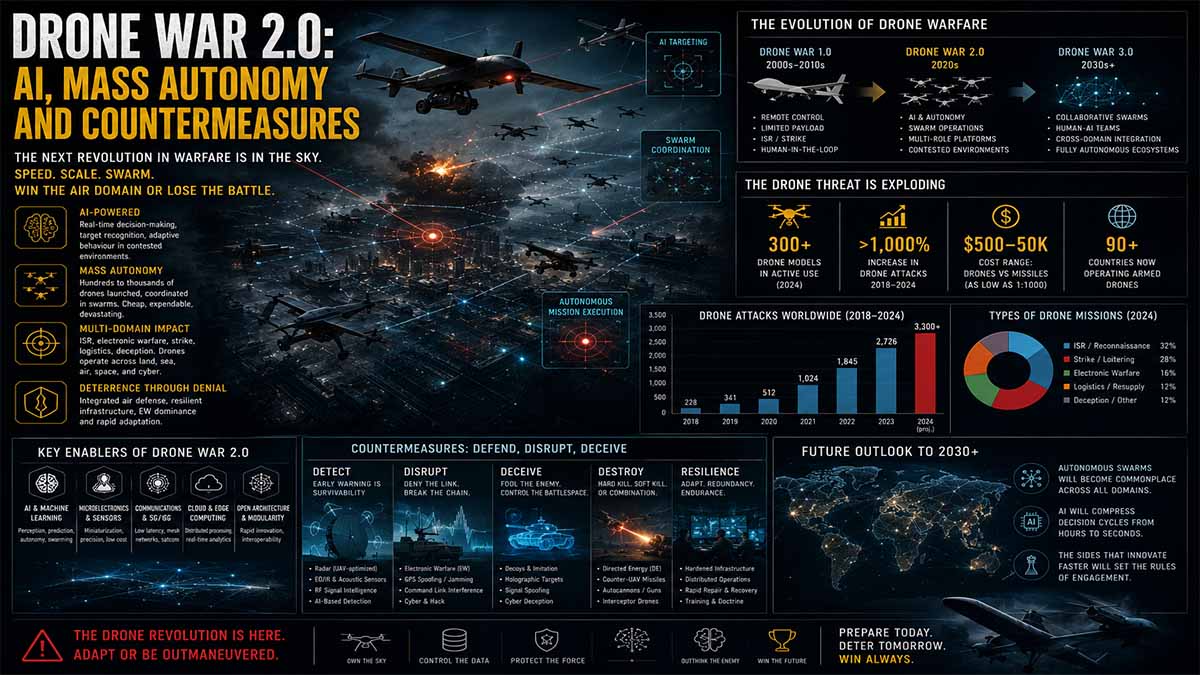
Executive Summary
Ukraine has transformed unmanned warfare from a specialist capability into an industrial system of mass-produced, software-defined precision effects.
The decisive metric is no longer the performance of an individual drone, but the cost, resilience and replenishment rate of the complete kill chain.
Ukraine’s industrial capacity expanded from a limited pre-2022 ecosystem to the declared ability to manufacture more than 8 million drones of multiple types annually, subject to financing.
Artificial intelligence is migrating from image enhancement and operator support toward autonomous navigation, target recognition, cooperative routing and machine-speed interception.
The likely five-year transition is not immediately to unrestricted “killer swarms,” but to bounded autonomy: human-defined missions executed by increasingly independent, networked and expendable machines.
Electronic warfare will remain critical, but satellite-independent navigation, visual positioning, frequency agility and onboard decision systems will progressively reduce the effectiveness of conventional jamming.
Counter-drone defence is evolving into a layered architecture combining passive detection, radar, electro-optical identification, electronic attack, interceptor drones, guns, missiles, lasers and high-power microwave systems.
Air, maritime-surface, undersea and terrestrial systems are converging into one multi-domain unmanned ecosystem, while space assets provide communications, navigation, weather data and intelligence.
The central strategic risk is the compression of detection, classification and engagement into an opaque algorithmic process in which accountability may become dispersed among commanders, software developers, data suppliers and autonomous platforms.
Between 2026 and 2031, the advantage will belong less to the state possessing the most sophisticated platform than to the actor operating the fastest learning, manufacturing and counter-adaptation cycle.
Drone War 2.0: Ukraine, AI and the New Industrial Balance
Ukraine has converted unmanned warfare from a specialist capability into an industrial system measured in millions of expendable platforms, billions of dollars of production capacity and software cycles compressed from years to weeks. The strategic unit is no longer the individual drone. It is the complete network linking sensors, artificial intelligence, operators, satellites, electronic warfare, factories, foreign capital and battlefield data. This transformation is changing military economics: inexpensive aircraft can threaten assets worth several orders of magnitude more, while defenders must combine jamming, interceptor drones, guns, missiles and directed energy without exhausting their magazines or budgets. Europe now faces a double decision. It must scale production fast enough to deter Russia, but also prevent collaboration with American, Turkish and other foreign manufacturers from becoming technological dependence. The battlefield laboratory is Ukrainian; the industrial and political consequences are global.
The Million-Drone Economy
Ukraine’s scale-up is unprecedented in modern European warfare. On 28 December 2024, the Ukrainian Defence Ministry reported that domestic systems represented 96.2% of all unmanned aircraft supplied to its forces and that more than 1.5 million FPV drones had been produced or assembled during the year. On 10 March 2025, procurement-policy director Glib Kanievskyi said national industry possessed capacity for approximately 4.5 million FPV drones and that more than UAH 110 billion had been allocated for drone procurement, including over UAH 102 billion through the Defence Procurement Agency. (Міністерство оборони України)
Delivery, however, matters more than theoretical capacity. On 24 December 2025, then Defence Minister Denys Shmyhal stated that the armed forces would receive 3 million FPV drones by year-end—about 2.5 times the previous year’s volume. The Defence Procurement Agency supplied 2.4 million, while another 200,000 were distributed through the DOT-Chain Defence digital system. Almost 15,000 ground robotic systems were also delivered. Three days later, the ministry reported that nearly 1,000 interceptor-drone systems per day were reaching combat units and that more than $6 billion in foreign financing had entered the Ukrainian defence industry. (Міністерство оборони України)
The industrial ceiling is higher still. On 24 June 2025, President Volodymyr Zelenskyy said Ukraine’s defence-production potential had exceeded $35 billion, covering almost one thousand product types, but that approximately 40% of that capacity remained unfunded. Ukraine, he said, could manufacture more than 8 million drones of different types annually if financing were available. (president.gov.ua) The critical distinction is therefore between nominal capacity, contracted production, completed systems and combat-effective output. A drone is not operational power until it is matched with batteries, communications, explosive payloads, ground stations, trained crews, targeting intelligence and a logistics chain capable of replacing losses.
AI Becomes the Weapon
The next stage is not simply more drones but fewer communications dependencies. First-generation battlefield FPVs rely heavily on a pilot and radio link. Drone War 2.0 transfers functions to the platform: object recognition, route adaptation, obstacle avoidance, terminal guidance, navigation after signal loss and coordination with other machines. The decisive innovation is bounded autonomy—a human defines the target category, geographic limits and mission, while the machine continues operating when satellite navigation or communications are degraded.
This changes the defender’s problem. Conventional jamming can disrupt radio control or satellite positioning, but it cannot reliably stop a fibre-optic drone, a vehicle using inertial and visual navigation or a platform that recognises terrain and targets onboard. Ukraine is increasingly treating battlefield data as an industrial resource. In April 2026, Defence Minister Mykhailo Fedorov reported that the Brave1 ecosystem included around 100 interceptor manufacturers, while more than 40 grants had been issued since 2024. On 8 April, the ministry claimed interceptor drones had destroyed more than 33,000 Russian UAVs during March—twice February’s figure—and announced EU4UA Defence Tech grants of up to €150,000 for systems capable of exceeding 450 kilometres per hour. (Міністерство оборони України)
Combat footage, telemetry and electronic-warfare encounters can be used to retrain detection and guidance models. This creates a strategic advantage only when data move rapidly from units to engineers and back into production. It also creates hidden vulnerabilities: corrupted datasets, false labels, cyber penetration, model overconfidence and dependence on privately controlled software. The most valuable company in the next drone cycle may not be the airframe manufacturer but the firm controlling mission data, autonomy code and secure command architecture.
The Multi-Domain Battlefield
The drone is no longer exclusively an aerial platform. Ukraine has demonstrated the strategic effect of unmanned surface vessels in the Black Sea; ground robots are already used for logistics, surveillance, explosive delivery and casualty evacuation; undersea systems will increasingly threaten ports, cables and offshore infrastructure. Space assets provide navigation, communications, weather data and wide-area intelligence. The operational structure is becoming one interconnected machine ecosystem.
The economic logic differs by domain. FPV aircraft are cheap, short-lived and produced at enormous scale. Long-range strike drones require larger engines, navigation systems and warheads. Maritime vehicles carry heavier payloads and operate for longer periods but depend on communications and coastal intelligence. Ground robots face mud, rubble, mines and broken radio links. Undersea systems must navigate without continuous satellite contact and communicate through slow, detectable acoustic channels. By 2031, the most mature autonomy will probably be found in navigation, reconnaissance, interception and logistics—not unrestricted machine selection of human targets.
Defence Becomes an Industrial Contest
No single countermeasure can defeat every unmanned threat. Radar may struggle with small, low-altitude objects; radio-frequency sensors cannot detect non-emitting systems; electro-optical devices are affected by darkness and weather; jamming loses value against autonomous or fibre-optic platforms; missiles create an unfavourable cost ratio; guns have limited range; lasers require line of sight, power and favourable atmospheric conditions.
Ukraine’s response is to industrialise interception. On 30 April 2026, the Defence Ministry ordered 8,000 Octopus interceptors, a Ukrainian system with automatic terminal guidance designed for Shahed-type drones. Production involves 29 licensed Ukrainian companies and the British government, with four manufacturers already under state contract. Fedorov set the policy objective at 100% detection and at least 95% neutralisation of hostile aerial targets. (Міністерство оборони України) These are targets, not guaranteed outcomes, but they show the direction of travel: counter-drone defence is becoming a manufacturing sector in its own right.
The defender’s real metric is not interception percentage but expected damage. A system that destroys 95 of 100 attackers allows five penetrations; at the same rate, a raid of 1,000 permits fifty. Attackers can mix decoys, reconnaissance drones, autonomous aircraft and conventional missiles to force the defender to reveal sensors and expend expensive ammunition. The winning architecture will assign the cheapest reliable effector: electronic warfare against vulnerable links, interceptor drones and guns against mass threats, missiles against high-value targets, and directed energy where power, weather and engagement geometry permit.
The European Commission recognised this shift in its 11 February 2026 Action Plan on Drone and Counter-Drone Security, which calls for production scale-up, a European industrial forum, a counter-drone centre of excellence, risk assessments of high-risk suppliers, an “EU trusted” label and testing of cellular networks—including 5G infrastructure—as detection systems. (Strategia Digitale Europea) This is as much an industrial-policy programme as a security initiative.
Europe’s Capital Enters the War
The financing architecture is moving from donations of finished foreign equipment toward direct investment in Ukrainian and European production. On 23 April 2026, the Council of the European Union completed the legal framework for a €90 billion Ukraine support loan for 2026–2027. The indicative allocation is €30 billion for economic support and €60 billion for military assistance and defence-industrial capacity. On 30 June 2026, the EU disbursed €3.9 billion specifically to finance drone procurement. (Consiglio dell’Unione Europea)
This capital can transform Ukraine from an aid recipient into a production partner integrated with the European defence market. It can also impose slower procurement, anti-corruption conditions, certification requirements and political controls. The central financial question is whether Europe is purchasing short-term battlefield output or acquiring a durable industrial position in autonomy, sensors, propulsion and counter-drone systems.
Europe’s broader defence expenditure provides the macroeconomic background. EU member-state defence spending reached €343 billion in 2024 and was estimated at €381 billion in 2025, equal to approximately 2.1% of GDP. Defence investment rose to €106 billion in 2024 and was projected to approach €130 billion in 2025. (Consiglio dell’Unione Europea) Drones are becoming one of the principal channels through which this spending is converted into industrial capacity, data ownership and geopolitical influence.
Allies, Suppliers and Future Rivals
NATO’s drone industry is not a single market. American groups dominate strategic systems: General Atomics supplies the MQ-9 family; Northrop Grumman provides the RQ-4D Phoenix and MQ-4C Triton; Boeing, Kratos and software-centred companies are developing carrier aircraft and collaborative combat platforms. Europe is building its own industrial alternatives through Airbus, Leonardo, Dassault, Saab, Rheinmetall, TEKEVER, WB Group and emerging autonomy firms.
The Eurodrone programme illustrates both sovereignty and complexity. The contract signed on 24 February 2022 covers 20 systems, comprising 60 aircraft and 40 ground-control stations, with Airbus Defence and Space Germany as prime contractor and Airbus Spain, Leonardo and Dassault as major subcontractors. (occar.int) Distributed production protects European know-how but also creates work-share disputes, certification burdens and delays that faster Turkish, Israeli and American platforms can exploit.
The most politically sensitive agreement is the Italy–Türkiye axis. Leonardo and Baykar signed their initial memorandum on 6 March 2025. The fourth Italy–Türkiye Intergovernmental Summit in Rome on 29 April 2025, led by Prime Minister Giorgia Meloni and President Recep Tayyip Erdoğan, incorporated the industrial relationship into a broader bilateral framework. On 16 June 2025, Leonardo CEO Roberto Cingolani and Baykar Chairman and CTO Selçuk Bayraktar announced LBA Systems, a 50:50 joint venture headquartered in Italy to design, develop, manufacture and maintain unmanned aircraft. Leonardo contributes sensors, electronic systems, certification, command integration, manned–unmanned teaming and swarm technologies; Baykar contributes its platform families and production experience. (leonardo.com)
On 30 June 2025, Baykar completed its acquisition of Piaggio Aerospace after Italian Golden Power approval. The ceremony included Enterprises and Made in Italy Minister Adolfo Urso and Baykar CEO Haluk Bayraktar. Piaggio’s plants are intended to remain a European hub for the P.180 Avanti Evo and Baykar unmanned aircraft. (baykartech.com) The opportunity is evident: jobs, investment, European certification and rapid access to proven Turkish platforms. The danger is equally clear. Italy may control factories and sensors while Türkiye controls airframes, algorithms and export priorities. A future dispute over the Eastern Mediterranean, Libya, Russia, Cyprus or a third-country sale could place the joint venture under contradictory political instructions.
Sovereignty Beyond Assembly
The decisive test is not where a drone is assembled but who controls its source code, encryption, mission data, engines, processors, satellite links, weapons integration and export licences. A domestic factory can remain dependent on a foreign design authority. A NATO-owned platform can still rely on American software. A European-labelled aircraft can contain Israeli intellectual property. A joint venture can share equity equally while one partner retains the irreplaceable technology.
Europe should therefore demand interoperability without captivity: sovereign cryptographic keys, government access to critical code, second-source components, emergency production rights, transparent ownership of training data and reciprocal export vetoes. Ukraine has proved that adaptation speed can matter more than technological elegance. The next phase will determine who captures the value created by that experience.
By 2031, drones will not have replaced artillery, aircraft, navies or soldiers. They will have become the connective tissue among them. The states that dominate will be those capable of financing millions of expendable systems, protecting critical components, learning from every mission and retaining political control over the algorithms that increasingly decide how warfare is conducted.
Navigational Index
Pillar I — Industrialised Attrition and the Ukrainian Laboratory
Production scaling, foreign financing, platform economics, battlefield adaptation, component dependencies and the conversion of combat data into industrial advantage.
Pillar II — AI, Autonomy and Multi-Domain Drone War 2.0
Machine perception, navigation without satellite signals, collaborative autonomy, human-machine command, aerial and maritime swarms, terrestrial robotics, undersea systems and space-enabled operations.
Pillar III — Countermeasures, Escalation and the 2026–2031 Balance
Detection-to-defeat architectures, electronic warfare, interceptor economics, directed energy, critical-infrastructure defence, ethical exposure, proliferation and five-year competing scenarios.
Pillar IV — Alliance by Contract, Rivalry by Design: NATO’s Unmanned-Systems Industrial Web
The unmanned-systems industrial base of NATO is not a unified arsenal controlled by a single political authority. It is a dense and increasingly interdependent network of national champions, transatlantic primes, specialist autonomy companies, electronics suppliers, state-backed investors, licensed-production partners and cross-border joint ventures whose interests overlap during procurement but may diverge sharply during diplomatic crises.
Master Abstract
The Ukrainian theatre has produced the first mature example of industrialised unmanned attrition, but the frequently repeated claim that Ukraine simply became “the world’s largest drone market” conceals the system’s deeper transformation. What emerged after February 2022 was not one weapons programme, one revolutionary aircraft or one centrally planned industry. It was an accelerated interaction among military units, volunteer engineering networks, formal manufacturers, commercial component suppliers, digital procurement systems, foreign governments and investors, operational-data platforms, electronic-warfare specialists and constantly changing Russian countermeasures. Official Ukrainian figures demonstrate the scale while also requiring careful differentiation between manufacturing capacity, contracted procurement, delivered systems and systems actually expended. In March 2025, Ukraine’s Ministry of Defence stated that domestic industry possessed capacity for approximately 4.5 million FPV drones during that year and that more than UAH 110 billion was planned for drone procurement. — Glib Kanievskyi: In 2025, the Ministry of Defence Plans to Procure 4.5 Million FPV Drones – Ministry of Defence of Ukraine – March 2025.
By December, the Ministry reported that the armed forces had received a record 3 million FPV drones, alongside more than 15,000 ground robotic systems; this delivered quantity is more analytically reliable than treating nominal industrial capacity as completed output. — $45 Billion from Partners, Over 3 Million Strike Drones, More Ukrainian Weapons – Ministry of Defence of Ukraine – December 2025. The National Security and Defence Council subsequently reported that Ukrainian industry entered 2026 with capacity exceeding 8 million FPV drones per year, while the presidency had already stated that the broader industrial base could produce more than 8 million drones of various types if sufficient financing were available. — Results of Ukraine’s Defense Industry in 2025: FPV Drones – National Security and Defense Council of Ukraine – January 2026; Our Defense Production Potential Already Exceeds $35 Billion – President of Ukraine – June 2025. These statements support the conclusion that Ukrainian drone warfare has crossed the threshold from experimental innovation to mass industrial replenishment, but they do not validate every public claim concerning individual long-range models, launch totals or interception rates. Specifications for systems such as FP-1 and AN-196 Liutyi remain partly manufacturer-declared, operationally sensitive or inconsistently documented; therefore, precise range, cost and annual launch claims should be treated as confidence-bounded estimates rather than settled facts unless corroborated by procurement documents, official technical publications or independently observable operational evidence.
The defining feature of Drone War 2.0 will be the conversion of unmanned platforms from remotely piloted vehicles into distributed nodes within an adaptive, software-mediated combat network. Contemporary FPV drones usually remain dependent on a human operator for terminal control, while larger reconnaissance and strike platforms may follow pre-programmed routes, use satellite navigation and execute automated flight-management functions. The next evolutionary layer replaces dependence on a continuous command link with combinations of inertial navigation, terrain matching, visual odometry, scene recognition, stored geospatial data and onboard machine inference. These technologies do not necessarily create a machine with unrestricted authority to select and kill any target. More plausibly, they create bounded autonomous agents that receive a human-defined mission, geographic constraint, target class, confidence threshold and engagement rule, then continue operating when communications or satellite-navigation signals are disrupted. NATO’s 2026 innovation challenge explicitly prioritises autonomous navigation, adaptation and swarm decision-making in contested, dynamic and GPS-denied environments, together with robust AI capable of responding to changing mission conditions. — Autonomy and Unmanned Systems: Challenge 2026 – NATO Defence Innovation Accelerator for the North Atlantic – 2025. The United States Department of Defense similarly assesses that unmanned systems will become progressively more affordable, autonomous and networked, with greater endurance and improved machine-to-machine communication. — Fact Sheet: Strategy for Countering Unmanned Systems – United States Department of Defense – December 2024. Chinese official military analysis describes intelligent warfare as the integration of cognitive, decision and action advantages, while China’s 2025 arms-control white paper acknowledges that unmanned combat clusters, intelligent weapons platforms and AI-assisted systems are producing major changes in operational methods. — Changes in the Methods of Winning Intelligent Warfare – Ministry of National Defense of the People’s Republic of China – September 2025; China’s Arms Control, Disarmament and Non-Proliferation in the New Era – Ministry of National Defense of the People’s Republic of China – November 2025. Russia’s official unmanned-aviation strategy likewise anticipated its strongest production growth during 2025–2027, while subsequent military publications described the formation of dedicated unmanned-systems forces. — Strategy for the Development of Unmanned Aviation – Government of the Russian Federation – June 2023; In Accordance with the Requirements of the Time – Russian Ministry of Defence – September 2025. Read together, these primary sources indicate a global shift toward systems in which aerial drones, unmanned surface vessels, undersea vehicles and ground robots share sensing, targeting, communications and logistical functions. Space is not a separate “space-drone” category in most present operations; it is the enabling layer supplying navigation, communications, reconnaissance, meteorological information and time synchronisation to the unmanned force below.
Counter-drone warfare will consequently become a contest between two adaptive systems rather than a simple confrontation between drone and jammer. The attacking chain seeks to reduce signature, disperse launch infrastructure, increase route unpredictability, harden communications, remove dependence on external signals and overwhelm the defender’s sensor and engagement capacity. The defensive chain must detect, classify, prioritise and defeat objects whose radar cross-section, thermal signature, speed, altitude, communication method and flight behaviour differ radically across FPV quadcopters, fixed-wing reconnaissance aircraft, one-way attack drones, autonomous interceptors, surface vessels and undersea vehicles. No single technology provides a universal answer. Radio-frequency detection is ineffective against systems that do not transmit; radar may struggle with extremely small or terrain-masked objects; electro-optical sensors depend on visibility and line of sight; electronic warfare loses value when the aircraft can navigate and recognise targets onboard; missiles impose an unfavourable cost exchange against mass-produced threats; guns require proximity and precise tracking; lasers are affected by atmospheric conditions and dwell-time constraints; and high-power microwave systems face range, discrimination and collateral-electromagnetic considerations. The European Commission’s February 2026 action plan therefore treats counter-drone security as a multi-domain industrial and operational problem covering airborne, terrestrial, maritime-surface and undersea systems, while specifically identifying advances in range, speed, payload, autonomy, swarming, AI integration, miniaturisation and electronic-warfare resistance. — Action Plan on Drone and Counter-Drone Security – European Commission – February 2026.
Ukraine offers early evidence of an emerging economically sustainable layer: the National Security and Defence Council reported 100,000 interceptor drones produced in 2025, more than 20 participating companies, and claimed effectiveness above 60%, while the Ministry of Defence reported supply approaching 1,000 interceptor systems per day by the end of that year. — Ukrainian Defense Industry: Scale, Effectiveness, Results – National Security and Defense Council of Ukraine – 2026; $45 Billion from Partners, Over 3 Million Strike Drones, More Ukrainian Weapons – Ministry of Defence of Ukraine – December 2025. The five-year balance will depend on whether defensive networks can reduce their cost per engagement faster than attackers reduce the cost and detectability of each penetrator. A structured Analysis of Competing Hypotheses yields five principal futures: H₁, operator-controlled mass remains dominant; H₂, bounded autonomy becomes the standard; H₃, cooperative swarms become operationally routine; H₄, counter-drone networks restore local defensive advantage; and H₅, proliferation produces chronic saturation without decisive technological superiority. The current Bayesian baseline assigns the greatest probability to H₂, followed by H₅ and H₄. Fully independent lethal swarms remain technically possible but institutionally, legally and operationally less probable than mixed human-machine formations because target ambiguity, adversarial deception, software brittleness and command accountability continue to impose constraints. The humanitarian consequence nevertheless remains severe: greater autonomy can shorten warning time, expand the geographic persistence of threats and obscure responsibility even before machines receive unrestricted lethal authority.
Drone-Warfare Evolution Engine
Interactive scenario model linking industrial scale, onboard autonomy, electronic-warfare pressure and defensive adaptation. Values are analytical scenario indices, not disclosed operational data.
Scenario Control Layer
Adjust the three structural drivers to test how autonomy, saturation and defence economics could evolve.
Systemic Escalation Meter
Composite index: autonomy × scale × defensive instability.
Five-Year Competing-Hypotheses Outlook
Illustrative Bayesian trajectory under the selected driver assumptions.
Multi-Domain Evolution Matrix
Select a domain to inspect projected 2031 capability maturity.
Industrialised Attrition: Ukraine’s Drone-War Laboratory, 2026–2031
Ukraine’s unmanned-systems economy has evolved beyond a conventional defence-production programme into an integrated mechanism of industrialised attrition: a wartime system designed to discover, manufacture, expend, evaluate and replace technological effects faster than an adversary can neutralise them. The distinction is fundamental. Traditional military-industrial planning seeks stable specifications, multiyear production runs and tightly controlled acceptance procedures; the Ukrainian model treats most tactical drones as continuously modified consumables whose useful technological life may be measured in months or even weeks. Official data illustrate the magnitude of this transition but must be separated into four categories that are frequently and incorrectly conflated in public reporting: theoretical manufacturing capacity, state procurement plans, completed production and confirmed delivery to combat formations. In March 2025, the Ministry of Defence of Ukraine stated that domestic industry possessed annual capacity for approximately 4.5 million FPV drones, that the ministry intended to procure that quantity and that more than UAH 110 billion had been allocated for drone procurement, including more than UAH 102 billion through the Defence Procurement Agency. The same official statement reported that Ukraine and the State Service of Special Communications and Information Protection had procured more than 1.5 million drones in 2024, with 96% of expenditure directed to Ukrainian manufacturers and suppliers. — Glib Kanievskyi: In 2025, the Ministry of Defence Plans to Procure 4.5 Million FPV Drones – Ministry of Defence of Ukraine – March 2025 — Verified official source. By December 2025, the ministry reported the delivery of 3 million FPV drones to the armed forces, together with more than 15,000 ground robotic systems. — $45 Billion from Partners, Over 3 Million Strike Drones, More Ukrainian Weapons – Ministry of Defence of Ukraine – December 2025 — Verified official source. The difference between nominal capacity, planned procurement and delivered equipment is not evidence of failure; it reveals the constraints governing the system: financing, component availability, testing throughput, explosive integration, operator training, ground-control equipment, logistics and the military’s ability to absorb rapidly changing designs. By January 2026, the National Security and Defence Council of Ukraine reported capacity exceeding 8 million FPV drones annually across more than 160 companies. — Results of Ukraine’s Defense Industry in 2025: FPV Drones – National Security and Defense Council of Ukraine – January 2026 — Verified official source. That figure should therefore be interpreted as a mobilisation ceiling, not as proof that eight million complete, accepted and combat-ready systems had already entered service.
| Industrial indicator | Verified official value | Analytical meaning | Principal caveat |
|---|---|---|---|
| Drone procurement during 2024 | More than 1.5 million | Transition from niche acquisition to mass replenishment | Includes multiple procuring authorities and drone categories |
| Ukrainian share of 2024 procurement expenditure | 96% | Strong domestic industrial multiplier | Ukrainian supplier status does not imply complete component localisation |
| 2025 FPV industrial capacity | Approximately 4.5 million | Large-scale manufacturing ceiling | Capacity is not equivalent to completed delivery |
| 2025 FPV deliveries | 3 million | Confirmed military absorption at unprecedented scale | Does not disclose losses, reserves or operational availability |
| 2026 FPV capacity | More than 8 million annually | Potential doubling of mass-production throughput | Dependent on contracts, finance, labour and imported inputs |
| Ukrainian FPV producers | More than 160 companies | Distributed and competitive industrial structure | Quality, scale and technological maturity vary substantially |
| 2025 ground robotic-system deliveries | More than 15,000 | Expansion beyond aerial platforms | Missions and readiness levels are not publicly disaggregated |
The economics of this system cannot be understood through unit prices alone because the relevant commodity is not the airframe but the complete probability-adjusted battlefield effect. A low-cost FPV drone has limited military value unless it is combined with trained crews, reliable batteries, compatible radio systems, antennas, repeaters, targeting intelligence, explosive payloads, maintenance capability, mission-planning software and a command structure able to assign targets without generating duplication or fratricide. Conversely, a platform that fails to strike may still produce value by forcing vehicles to remain concealed, interrupting logistics, exposing electronic-warfare positions or compelling the adversary to expend a more expensive interceptor. The correct analytical unit is therefore the cost per verified operational effect, not the catalogue price per drone. A simplified expected-value model can be written in plain form as E₁ = Pₗ × Pₙ × Pᵢ × Vₜ − Cₘ, where Pₗ is the probability of successful launch, Pₙ the probability of navigation into the target area, Pᵢ the probability of identification and impact, Vₜ the military value of the target or behavioural disruption created, and Cₘ the full mission cost. Every term is dynamic. Russian jamming may reduce Pₙ; fibre-optic guidance may restore it but increase weight, cost and logistical complexity; onboard vision may increase terminal resilience but introduce model-training and computing requirements; better Ukrainian reconnaissance may raise Pᵢ; hardened vehicles may reduce Vₜ; and mass production may reduce Cₘ while increasing quality variance. This explains why the Ukrainian drone economy behaves less like a traditional aerospace sector and more like a combination of consumer electronics, software development, battlefield logistics and high-frequency experimentation. The state’s decision to stimulate competition through procurement, grants, preferential loans and direct feedback can shorten development cycles, but excessive fragmentation can create incompatible frequencies, duplicated airframes, inconsistent components and difficult maintenance burdens. Ukraine’s 2025 defence-production potential was officially estimated above $35 billion, yet approximately 40% of that potential reportedly lacked financing; the same statement assessed that the country could manufacture more than 8 million drones of various types annually if sufficient funding were available. — Volodymyr Zelenskyy: Our Defense Production Potential Has Surpassed $35 Billion – President of Ukraine – June 2025 — Verified official source. Financing is therefore not merely an input into production. It determines whether latent capacity becomes contracted output, whether suppliers can secure components in advance, whether factories can disperse against attack and whether firms can survive the period between successful prototype testing and large-scale payment.
The foreign-financing architecture that supports this expansion represents one of the most consequential institutional innovations of the war. Rather than transferring only finished weapons manufactured abroad, partner governments increasingly finance procurement directly from Ukrainian producers, allowing external capital to purchase equipment designed, tested and manufactured close to the battlefield. This approach, commonly associated with the Danish model, compresses several delays inherent in conventional assistance: foreign requirement definition, export licensing, production in higher-cost Western facilities, transport and post-delivery modification. By late 2025, Ukraine reported more than $6 billion in foreign financing directed to its defence industry, UAH 5 billion in preferential development loans, more than UAH 1.5 billion to restore production damaged by Russian attacks and a state-backed syndicated loan agreement worth UAH 21.5 billion involving six Ukrainian banks. The same official summary stated that agreements had been concluded with the United Kingdom, Germany and the Netherlands for joint production of Ukrainian drones abroad, while 25 foreign defence companies were establishing facilities in Ukraine. — $45 Billion from Partners, Over 3 Million Strike Drones, More Ukrainian Weapons – Ministry of Defence of Ukraine – December 2025 — Verified official source. The European mechanism expanded further in 2026. The Council of the European Union reported a €90 billion Ukraine support loan for 2026–2027, with an indicative €60 billion intended to strengthen defence-industrial investment and procurement; between June and July 2026, €4.9 billion was disbursed specifically to finance drone procurement. The same framework includes a €300 million Ukraine Support Instrument intended to expand Ukrainian manufacturing capacity and incentivise cooperative procurement, while Ukrainian companies are eligible by default for projects under the EU’s SAFE common-procurement instrument. — EU Military Support for Ukraine – Council of the European Union – July 2026 — Verified official source. These structures convert Ukraine from a passive aid recipient into a partially integrated European manufacturing node. They also introduce risks: political conditionality, changing budget priorities, procurement audits, intellectual-property disputes, pressure to relocate production, dependence on external tranches and potential conflict between Ukraine’s need for rapid iteration and European requirements for standardisation, traceability and long-term certification.
Foreign Capital & Procurement Architecture
Analyze how international capital models route through specialized financing vehicles to scale production ecosystems, optimizing output via direct battlefield telemetry updates.
Strategic Financial Capital
Partner Governments & EU Financing Allocation
- Partner Government Direct Subsidies
- EU Joint Borrowing Operations
- Frozen Sovereign Asset Windfall Revenues
Direct Ukrainian Procurement
फ्रंटलाइन अनुबंध
- Contracts for Combat-Proven Equipment
Joint Production Lines
Extraterritorial Assembly Base
- Distributed Plant & Sub-Component Lines
European-Ukrainian R&D
Collaborative Engineering Tech
- Standards, Shared Data & Certification
Ukrainian Industrial Ecosystem
Integrated Defense Material Clusters
Operational Formations & Telemetry
Live Combat Output Validation loops
- Mission Outcomes & Live Combat Data Ingestion
- Dynamic Procurement Reprioritisation
- Immediate Architectural Design Modifications
Telemetry diagnostic updates route directly back to industrial clusters. Software patches, structural shell modifications, and asset allocations execute dynamically within days, optimizing next-run systems prior to battlefield manufacture loops.
Battlefield adaptation is the central mechanism through which Ukraine converts material expenditure into cumulative industrial knowledge. The most valuable output of a drone mission is not always the destroyed target; it may be the data generated about communications failure, battery performance, aerodynamic behaviour, target-recognition error, adversary jamming, interceptor response, environmental effects or operator workload. When that information is captured systematically and transferred to designers, a combat loss becomes an engineering input. Ukraine’s emerging advantage therefore rests on the speed and fidelity of the battlefield-to-factory feedback loop. The process begins with observation by units and technical teams, continues through mission logs, video, telemetry and after-action reporting, and culminates in changed hardware, firmware, frequencies, guidance logic or tactical procedures. This architecture is increasingly formalised. In April 2026, the Ukrainian Ministry of Defence reported that the Brave1 Dataroom was being used by more than 30 companies to test and train more than 50 AI models for detecting and intercepting aerial targets across different weather and illumination conditions. The same official release stated that Brave1 had awarded more than 40 grants to interceptor manufacturers since 2024 and had assembled approximately 100 interceptor-drone companies within its ecosystem. — A Record 33,000 Enemy UAVs Were Destroyed by Interceptor Drones in March – Ministry of Defence of Ukraine – April 2026 — Verified official source. The analytical importance of the Dataroom is greater than its numerical scale. Training data from real combat conditions can produce models better calibrated to clutter, deception, poor visibility and unusual flight profiles than laboratory datasets. Yet such data are also strategically sensitive and vulnerable to poisoning, leakage and overfitting. If adversaries infer the training distribution, they may alter signatures, routes or visual characteristics to reduce detection. If labels are inconsistent, models may learn battlefield artefacts rather than robust target features. If data access becomes concentrated among selected firms, the state may unintentionally create technological monopolies. The industrial advantage therefore depends on governance: secure storage, provenance tracking, representative sampling, independent validation, compartmented access and mechanisms that prevent a successful model from becoming a single point of failure across the force.
The component base remains the system’s most important structural vulnerability. Ukraine can localise assembly, airframes, antennas, software, explosive integration and selected electronics while remaining dependent on foreign-origin motors, electronic speed controllers, cameras, thermal sensors, radio-frequency modules, processors, navigation receivers, batteries, magnets, optical components and machine tools. “Domestic production” must therefore be interpreted as a spectrum rather than a binary category. At one end is final assembly from imported modules; at the other is vertically integrated manufacture of critical electronics and propulsion components. Wartime scale can conceal dependence because globally traded commercial components are initially abundant, substitutable and inexpensive. As demand grows and governments tighten controls, however, bottlenecks shift from airframe assembly to specialised chips, high-discharge cells, secure communications, thermal imaging, precision inertial sensors and industrial equipment. Ukraine’s own sanctions documentation identified Chinese suppliers associated with navigation receivers, motors, cameras, chips and other components used by Russian drone manufacturers, demonstrating that both belligerents rely on overlapping commercial and dual-use ecosystems. — Sanctions Against Russian Drone Producers and Foreign Component Suppliers – National Security and Defense Council of Ukraine – August 2025 — Verified official source. China’s official national-security doctrine simultaneously criticises “decoupling” and supply-chain fragmentation while affirming export controls on drones intended for military use. — China’s National Security in the New Era – Ministry of National Defense of the People’s Republic of China – May 2025 — Verified official source. The resulting strategic environment is paradoxical: Chinese industrial capacity remains essential to the global commercial-drone ecosystem, yet China has incentives to regulate exports, avoid direct attribution and preserve access to Western markets. Russia, Ukraine and their partners therefore compete not only for finished components but for supplier relationships, intermediaries, freight routes, customs classifications, advance-payment capacity and access to substitute designs. Over the next five years, industrial advantage will increasingly depend on identifying which components are merely convenient and which are genuinely irreplaceable. Motors and frames can often be substituted; high-quality thermal cores, radiation-resistant electronics, advanced optical sensors, specialised microprocessors and high-energy-density batteries present greater barriers. A credible resilience strategy must combine domestic production, European co-production, strategic inventories, modular architecture and deliberate multi-sourcing rather than pursuing economically unrealistic complete autarky.
| Component layer | Current exposure | Substitution difficulty | Strategic priority through 2031 |
|---|---|---|---|
| Frames, housings and simple mechanical parts | Moderate | Low | Distributed additive and conventional manufacturing |
| Motors and electronic speed controllers | High | Medium | Multiple suppliers, domestic winding and magnet access |
| Batteries and high-discharge cells | High | Medium–high | European cell supply, recycling and standardised packs |
| Daylight cameras and basic video links | Moderate | Medium | Modular interfaces and software-defined radios |
| Thermal and low-light sensors | High | High | Joint European production and protected inventories |
| Navigation receivers and inertial sensors | High | High | Multi-sensor navigation and domestic integration |
| AI processors and advanced semiconductors | Very high | Very high | Assured partner supply and model optimisation for lower-end chips |
| Radio-frequency components | High | Medium–high | Frequency agility, domestic antennas and open modular standards |
| Machine tools and test equipment | High | High | Protected industrial imports and distributed facilities |
| Explosives, fuzes and safety systems | Moderate–high | High regulatory burden | Scaled licensed production and standardised integration |
Russia’s adaptation demonstrates why Ukraine cannot treat its present lead as permanent. The Russian government’s official unmanned-aviation strategy extends to 2030 and prospectively to 2035, signalling a long-term effort to expand the national unmanned-aircraft ecosystem, industrial capacity, regulation, infrastructure and personnel base. — Strategy for the Development of Unmanned Aviation of the Russian Federation to 2030 and to 2035 – Government of the Russian Federation – June 2023 — Verified official source. Russian military publications subsequently reported the institutional formation of dedicated Unmanned Systems Forces, including regular regiments and battalions during 2025, while emphasising field repair, firmware modification, frequency adaptation, retransmission and real-time video integration into command posts. — In Accordance with the Requirements of the Time – Russian Ministry of Defence – September 2025 — Verified official source. Even allowing for propaganda and unverifiable effectiveness claims, the organisational signal is clear: Russia is attempting to convert dispersed volunteer and unit-level drone practice into a formal branch with doctrine, training pipelines, procurement authority and career structures. This creates an industrial race in which each side learns from the other’s solutions. Ukrainian fibre-optic drones stimulate Russian copies and countermeasures; Russian long-range attack patterns drive Ukrainian interceptor production; Ukrainian machine-vision experiments stimulate signature alteration and deception; improvements in electronic warfare accelerate navigation autonomy; and greater autonomy increases demand for detection and interception automation. The competition is therefore governed by adaptation velocity Aᵥ rather than static inventory. A useful conceptual expression is Aᵥ = Dᵣ × Fᵦ × Pₛ × Mᶠ, where Dᵣ represents the diversity of designs tested, Fᵦ the quality of operational feedback, Pₛ the probability that successful prototypes scale, and Mᶠ the availability of manufacturing finance. Ukraine presently performs strongly on design diversity and feedback quality, but Russia may possess advantages in access to strategic materials, missile integration, domestic explosives, centralised mobilisation and the ability to sustain larger industrial facilities at greater geographic depth. Ukraine’s advantage is strongest where rapid iteration outweighs heavy-industrial scale; Russia’s advantage grows where production requires large propulsion systems, specialised warheads, complex navigation or protected factories. The five-year contest will therefore divide into two overlapping economies: high-volume, rapidly changing tactical drones and lower-volume, more industrially demanding long-range and autonomous systems.
The conversion of combat data into industrial advantage also creates a new political economy of information. Every high-quality mission record can improve navigation, target classification, electronic-warfare mapping, component selection and operator training. The actor controlling the data may therefore capture more long-term value than the actor manufacturing the airframe. This produces tension among military formations, state agencies, domestic manufacturers, foreign investors and technology partners. Units may be reluctant to share telemetry that reveals tactics or exposes failure; companies may treat training data as proprietary; governments financing production may demand access to results; foreign partners may seek intellectual property or domestic manufacturing rights; and intelligence services may restrict dissemination of datasets containing sensitive locations, signatures or targeting methods. Ukraine’s declared Build with Ukraine and Build in Ukraine initiatives, joint production agreements and planned foreign facilities expand capital and resilience but may gradually externalise portions of the technological learning process. If joint plants abroad receive design documentation but not representative battlefield data, they may become efficient producers of outdated models. If they receive extensive data access, Ukraine risks transferring the most valuable element of its competitive advantage. The optimal model is therefore neither closed national control nor unrestricted sharing. It is tiered access based on mission need, contribution and security risk. Tactical telemetry can be sanitised; component-failure statistics can be aggregated; imagery can be geographically masked; model weights can be tested through controlled interfaces; and trusted partners can receive deeper access under reciprocal arrangements. This is also the point at which cyber operations become inseparable from industrial policy. Adversaries can target manufacturers’ enterprise systems, supplier databases, firmware repositories, test results and procurement plans without attacking a factory physically. The “shadow” battlefield includes false component shipments, poisoned software libraries, counterfeit chips, manipulated performance metrics, corrupt intermediaries and deliberate leakage intended to redirect investment toward ineffective designs. The financial dimension is equally vulnerable: firms surviving on irregular contracts can be acquired, coerced or forced to sell intellectual property; advance payments can be diverted; and opaque subcontracting can disguise foreign control. Ukraine’s long-term advantage depends on building a defence-technology governance structure able to protect innovation without suffocating it through secrecy and bureaucracy.
Combat-Data Value Chain & Adversarial Attack Surfaces
Analyze how live mission parameters feed advanced optimization architectures, identifying high-risk vulnerabilities and adversarial interception points across the hardware cycle.
Operational Combat Ingestion
Live Telemetry & Field Metrics Inflow
- Video and Imagery Feeds
- Navigation and Telemetry Output
- Electronic-Warfare Encounters
- Component Failures Log
- Target and Damage Assessment
- Operator Interventions Data
Data Ingestion and Classification Risks
Interception & Integrity Modification Surfaces
- Risk: False Classification Labels
- Risk: Missing Crucial Metadata Context
- Risk: Compromised Capture Devices
- Risk: Adversarial Data Injection Loops
Engineering and AI Analysis
Systemic Architecture Refinement & Adaptation
- Structural Hardware Redesign
- Hardened Firmware Modifications
- Neural Network Model Retraining
- Dynamic Tactical Adaptation
- Procurement Reprioritisation Matrices
Industrial Scaling Risks
Production Infiltration & Compromise Zones
- Risk: Supplier Network Infiltration
- Risk: Counterfeit Semiconductor Insertion
- Risk: Foreign Financial Corporate Capture
- Risk: Production-Site Kinetic Targeting
Hardened software architectures, optimized component geometries, and retrained threat classification weights merge into the next production cycle, releasing validated defense nodes to the operational grid within tight evolutionary parameters.
A structured Analysis of Competing Hypotheses produces five principal industrial futures for the 2026–2031 period. H₁, “Ukrainian sustained acceleration,” assumes foreign financing remains predictable, procurement becomes more transparent, critical components are diversified and the battlefield feedback loop continues to outperform Russian adaptation. H₂, “mutual industrial convergence,” assumes Russia closes much of the tactical-drone gap, producing a stable high-attrition equilibrium in which neither side gains durable technological dominance. H₃, “component chokepoint shock,” assumes export controls, Chinese restrictions, logistics disruption or semiconductor scarcity create severe production volatility for both belligerents. H₄, “European integration and standardisation,” assumes Ukrainian firms become embedded in EU financing, procurement and production networks, gaining capital and resilience but losing part of their rapid, decentralised character. H₅, “financial fragmentation,” assumes donor fatigue, competing European requirements or macroeconomic stress leaves substantial Ukrainian capacity unfunded, forcing consolidation and reducing experimentation. Using official capacity, financing and institutional data as the July 2026 evidence base, the Bayesian central estimate assigns H₂ the highest probability because Russian institutional adaptation is visible and because technological advantages in commercial-component warfare diffuse rapidly. H₁ remains plausible if Ukraine preserves superior feedback and finance; H₄ becomes increasingly probable after 2028 as EU instruments mature. H₃ is a lower-probability but high-impact branch because supply chains remain globally concentrated, while H₅ depends heavily on political decisions rather than technological performance. A Monte Carlo-style scenario model using uncertainty ranges for annual financing growth, component availability, factory disruption, procurement efficiency and design-cycle duration suggests that nominal Ukrainian output could rise substantially by 2031 while effective combat output grows more slowly. Quantity expansion will encounter diminishing returns unless operator training, command integration, spectrum management, target intelligence and counter-countermeasure capabilities scale simultaneously. The most decisive variable is not maximum production but the ratio Rₑ = effective missions divided by total systems delivered. A force producing ten million drones with weak communications, inconsistent components and fragmented control may generate less operational value than one producing six million systems within a disciplined data and targeting architecture.
| Hypothesis | Core mechanism | July 2026 posterior probability | 2031 strategic consequence |
|---|---|---|---|
| H₁ — Ukrainian sustained acceleration | Finance, data and decentralised innovation compound faster than Russian adaptation | 24% | Ukraine retains a measurable cost-exchange and adaptation advantage |
| H₂ — Mutual industrial convergence | Technologies diffuse and both sides institutionalise mass unmanned warfare | 32% | Persistent attrition; advantage shifts locally and temporarily |
| H₃ — Component chokepoint shock | Export controls or supply disruption constrain critical electronics and propulsion | 14% | Production volatility, redesign costs and greater state control |
| H₄ — European integration and standardisation | Ukrainian industry embeds within EU procurement, finance and production | 21% | Greater resilience and scale, but slower certification and iteration |
| H₅ — Financial fragmentation | External funding becomes irregular or politically constrained | 9% | Consolidation, unused capacity and reduced experimentation |
The five-year outlook is therefore best understood as a transition from emergency entrepreneurial mobilisation toward a hybrid Ukrainian-European defence-technology complex. During 2026–2027, the overriding challenge will be converting declared capacity into financed, tested and logistically supportable output while defending factories, data repositories and supplier networks against physical and cyber attack. During 2027–2028, consolidation is likely: firms with verified battlefield performance, secure component access and strong military relationships will absorb or displace weaker assemblers, while the state will attempt to reduce model proliferation and create common interfaces. During 2028–2029, European capital and procurement requirements will exert greater influence, stimulating joint production, quality assurance and export-oriented designs. During 2029–2030, competitive advantage will increasingly shift toward companies controlling software, secure communications, navigation resilience, sensor fusion and training data rather than basic airframe production. By 2030–2031, Ukraine could possess one of Europe’s largest combat-validated unmanned-systems sectors, but only if it avoids three strategic traps: confusing capacity announcements with sustainable throughput, allowing dependence on imported critical components to remain hidden beneath domestic assembly statistics, and transferring battlefield-derived intellectual capital without preserving reciprocal access and national control. The most likely industrial outcome is neither unrestricted exponential growth nor collapse. It is a layered market in which a small number of scaled integrators coexist with specialist software firms, component manufacturers, rapid prototyping companies and military-linked laboratories. Tactical drones will remain highly expendable, while long-range systems, interceptors, maritime drones and autonomous platforms become more capital-intensive and regulated. Foreign investment will increasingly be conditioned on governance, exportability and intellectual-property access. Ukraine’s strategic task is to preserve the wartime virtues of speed, distributed innovation and user feedback while adopting enough financial discipline, cybersecurity, standardisation and industrial protection to survive beyond the emergency phase. Success would convert battlefield necessity into a durable post-war economic and security asset. Failure would leave Ukraine with impressive nominal capacity but insufficient control over the financing, components, data and foreign production networks that determine who captures the long-term value.
Five-Year Ukrainian Drone-Industrial Scenario Projection
Probability-weighted analytical indices. Values represent scenario trajectories rather than disclosed production forecasts.
AI, Autonomy and Multi-Domain Drone War 2.0
The transition from remotely piloted drones to AI-enabled autonomous systems is not a single technological leap from human control to independent machine killing. It is a layered migration of functions from the operator to the platform: image stabilisation, object detection, route planning, obstacle avoidance, navigation recovery, target prioritisation, cooperative task allocation and, at the most consequential boundary, weapon release. Present systems occupy different points along this continuum, and the decisive operational distinction is not whether a platform is labelled “autonomous,” but which decisions it can execute without communication, how it responds to uncertainty and what authority remains with the human commander. A manually controlled FPV aircraft may contain automated flight stabilisation but remain tactically dependent on a pilot. A long-range system may follow a pre-programmed route without continuous supervision yet lack meaningful environmental understanding. A more advanced platform can compare live sensor data with a stored map, identify objects, modify its path around threats and continue a mission after losing its command link. The emerging Drone War 2.0 architecture therefore shifts combat power from the physical vehicle to a distributed cognitive stack composed of sensors, embedded processors, software models, navigation systems, communications, mission rules and data. The United States Department of Defense assesses that unmanned systems are becoming progressively more capable, affordable, autonomous and networked, while NATO’s 2026 innovation programme explicitly prioritises multi-domain autonomy, adaptation in contested environments, reduced operator burden and navigation where satellite signals are unavailable. — Fact Sheet: Strategy for Countering Unmanned Systems – United States Department of Defense – December 2024 — Verified official document; Autonomy and Unmanned Systems: Expanding Reach, Reducing Risk – NATO Defence Innovation Accelerator for the North Atlantic – June 2026 — Verified official source. This change alters the economics of command. A force can no longer assume that every platform requires a dedicated operator or continuous bandwidth. Instead, one supervisor may direct several machines, intervene only when necessary and manage mission objectives rather than flight controls. The resulting advantage is potentially nonlinear: autonomy does not merely replace labour but increases the number of simultaneous actions a formation can sustain under electronic attack.
| Autonomy layer | Machine function | Human role | Principal vulnerability |
|---|---|---|---|
| A₀ — Stabilised remote control | Flight stabilisation and basic safety | Continuous piloting | Link loss, jamming, operator workload |
| A₁ — Automated route execution | Follows waypoints and altitude profiles | Defines route and mission | GNSS spoofing, predictable trajectories |
| A₂ — Perception-assisted control | Detects objects and recommends actions | Confirms classification or manoeuvre | Misidentification, adversarial imagery |
| A₃ — Bounded mission autonomy | Replans routes and continues after link loss | Defines objective and constraints | Model error, uncertain rules of engagement |
| A₄ — Collaborative autonomy | Allocates tasks among multiple platforms | Supervises group mission | Coordination failure, network compromise |
| A₅ — Independent lethal selection | Detects, selects and engages without timely approval | Sets policy or mission envelope | Accountability, escalation, unlawful targeting |
Machine perception forms the first critical layer because autonomous movement and targeting require the platform to transform raw sensor inputs into operationally meaningful representations. Cameras, thermal imagers, acoustic sensors, radar, lidar, radio-frequency detectors and magnetic or inertial measurements do not directly “understand” a battlefield; they generate data that algorithms classify into objects, locations, motion estimates and confidence scores. A perception model may distinguish a vehicle from terrain, estimate whether an airborne object is hostile, track a moving target or compare a live scene against stored geographic imagery. Its battlefield reliability depends less on laboratory accuracy than on performance under camouflage, smoke, vibration, darkness, snow, damaged optics, deliberate decoys and adversarial manipulation. Ukraine’s Brave1 Dataroom illustrates the strategic importance of real operational data. In June 2026, the Ukrainian Ministry of Defence reported that more than 100 Ukrainian companies had access to the platform to train AI models on real-world data for counter-drone development. — Over 100 Ukrainian Companies Are Already Leveraging Brave1 Dataroom to Train AI Models – Ministry of Defence of Ukraine – June 2026 — Verified official source. The Dataroom model converts combat imagery and telemetry into a common training resource, potentially accelerating the improvement of interceptor guidance, object classification and terminal homing. The advantage, however, is inseparable from data-governance risk. Models trained predominantly on one drone type, season, terrain or camera may fail when the adversary changes shape, paint, altitude or flight behaviour. Mislabelled data may produce systematic false confidence. Adversarial actors may inject manipulated imagery, corrupted firmware or deceptive signatures designed to exploit the model’s learned assumptions. A system that reports 90% laboratory accuracy may remain operationally dangerous if its 10% error is concentrated among civilians, friendly aircraft or protected objects. Effective military perception therefore requires calibrated confidence, multisensor corroboration, uncertainty reporting and the ability to defer decisions when evidence falls below a defined threshold. The future battlefield will reward systems that know not only what they perceive, but when their perception is unreliable.
Satellite-independent navigation constitutes the second decisive layer because contemporary electronic warfare increasingly targets the assumptions on which commercial drone navigation was built. Conventional systems commonly combine GNSS, inertial sensors, barometric altitude estimates, magnetic heading and operator guidance. Jamming prevents the receiver from obtaining usable satellite signals; spoofing provides false signals that can displace the calculated position without immediately revealing the attack. The technical response is not one replacement technology but a hierarchy of mutually checking methods. Inertial navigation estimates movement from accelerometers and gyroscopes but accumulates drift. Visual odometry estimates movement by comparing consecutive camera frames but degrades in darkness, fog, featureless terrain or rapid vibration. Terrain-relative navigation compares observed features with stored maps, while scene matching compares buildings, roads, rivers or other landmarks against reference imagery. Radar or lidar can support obstacle avoidance and terrain measurement but add cost, weight and detectable emissions. Signals of opportunity may exploit radio, cellular or broadcast infrastructure, while cooperative navigation can allow several platforms to exchange relative positions even when none possesses reliable absolute coordinates. DARPA’s Rapid Experimental Missionized Autonomy programme was designed to allow commercially available drones to continue predefined missions autonomously when communication with the operator is lost, using a platform-independent autonomy subsystem and rapid software-development cycles. — DARPA Seeks Technology Solutions to Create Autonomous Capabilities for Commercial Drones – Defense Advanced Research Projects Agency – September 2023 — Verified official source. NATO’s 2026 technology cohort similarly includes systems for resilient GNSS-free navigation, autonomous undersea control and operation in satellite-denied environments. — 2026 Cohort of Companies – NATO Defence Innovation Accelerator for the North Atlantic – December 2025 — Verified official source. The likely five-year outcome is therefore not the disappearance of satellite navigation but a shift from GNSS dependence to GNSS opportunism: platforms will use satellite signals when trustworthy, compare them against inertial and visual estimates, reject anomalous inputs and continue with reduced precision when external positioning becomes unavailable. This transition increases resilience but also makes defensive jamming less decisive. The defender must increasingly disrupt several navigation modes simultaneously or attack the platform’s perception and computing rather than merely its radio link.
Multi-Modal Resilient Navigation Stack
Analyze the hardware-firmware redundancy framework filtering primary satellite streams through independent navigation modules to sustain positional processing under dense adversarial jamming fields.
Satellite Signals & Trust Evaluator
GNSS / Galileo Ingestion & Sanity Verification
- GNSS / Galileo Multi-Constellation Streams
- Trust Evaluator (Signal Integrity & Pseudorange Audits)
Inertial Estimate
Dead Reckoning Array
- MEMS Gyroscope & Accelerometer Integration
Visual Odometry
Optical Track Correlation
- High-Frame-Rate Ground Contrast Tracking
Terrain-Map Correlation
Geo-Spatial Profile Audits
- Radar Altitude & Digital Elevation Mapping
Sensor-Fusion Engine
Extended Kalman Filter (EKF) Matrix Aggregation
- Real-Time State Vector Computation
- Dynamic Covariance Innovation Weighting
Position Estimate
Kinematic Vector State
- Hardened Navigation Coordinates Output
Confidence Interval
Uncertainty Bounds
- Real-Time Error Ellipsoid Bounds Calculation
Spoofing / Anomaly Alert
Threat Classification
- Active Spectrum Jamming Flag Allocation
Mission Replanning
Dynamic Decision-Logic Realignment Continuum
Collaborative autonomy transforms individual drones into a coordinated system and is frequently misunderstood as requiring a dense, continuously communicating “swarm.” A true collaborative group can operate with intermittent connectivity, partial knowledge and local rules rather than a central controller issuing every movement. Each platform may maintain an estimate of its own fuel, damage, payload, sensor field and communication state; exchange information with nearby agents; and negotiate task allocation based on mission priorities. The group may divide an area for reconnaissance, relay communications, approach a target from multiple directions, assign one vehicle to suppress a sensor while another penetrates, or redistribute tasks when a member is destroyed. DARPA’s Collaborative Operations in Denied Environment programme defined collaborative autonomy as the ability of multiple unmanned aircraft to work together under one person’s supervisory control, continuously evaluating their own state and environment, recommending coordinated actions and allowing the mission supervisor to approve or reject major changes. — Collaborative Operations in Denied Environment – Defense Advanced Research Projects Agency – Official programme page — Verified official source. DARPA’s OFFensive Swarm-Enabled Tactics programme went further by exploring formations of up to 250 small aerial and ground systems in complex urban environments, with emphasis on swarm autonomy and human-swarm teaming. — OFFensive Swarm-Enabled Tactics – Defense Advanced Research Projects Agency – Official programme page — Verified official source. These programmes establish technical feasibility but should not be conflated with evidence that large, fully autonomous lethal swarms are already routinely deployed. Battlefield conditions impose severe constraints: communications are intermittent, members have different sensors and energy levels, map data are incomplete, collision avoidance consumes computing resources and adversaries deliberately create false targets. The practical 2026–2031 trajectory is likely to favour small collaborative cells of three to twenty platforms rather than hundreds of tightly coordinated vehicles. Such cells can combine reconnaissance, relay, decoy, electronic attack and strike functions while limiting bandwidth and failure propagation. Their effectiveness will depend on graceful degradation: a group must continue operating when leaders, relays or individual members are lost rather than collapsing as a centralised network.
Human-machine command will remain central because autonomy redistributes cognitive labour rather than eliminating command responsibility. The operator of an individual remotely piloted vehicle controls movement directly; the supervisor of autonomous systems defines objectives, constraints, priorities and intervention thresholds. This distinction creates a new command problem. As the number of machines increases, the human cannot inspect every sensor feed or approve every manoeuvre. The interface must therefore compress machine activity into intelligible recommendations, warnings and confidence estimates without hiding decisive uncertainty. Poor automation design can produce two opposite failures: excessive mistrust, in which the operator overrides useful machine decisions and nullifies the value of autonomy, or automation bias, in which the operator accepts recommendations because the system appears mathematically authoritative. The United States’ updated Directive 3000.09 requires autonomous and semi-autonomous weapon systems to be designed so commanders and operators can exercise appropriate levels of human judgment over the use of force, while the international Political Declaration on Responsible Military Use of Artificial Intelligence and Autonomy emphasises auditable systems, clearly defined uses, rigorous lifecycle testing, mechanisms to detect unintended behaviour and senior review of high-consequence applications. — DoD Updates Autonomy in Weapons System Directive – United States Department of Defense – January 2023 — Verified official source; U.S. Endorses Responsible AI Measures for Global Militaries – United States Department of Defense – November 2023 — Verified official source. The operational challenge is that “human in the loop,” “human on the loop” and “human out of the loop” are insufficient descriptions unless response time is included. A human formally authorised to intervene but given only two seconds, incomplete imagery and twenty simultaneous alerts may possess nominal authority without meaningful control. The relevant measure is therefore effective human control, determined by information quality, decision time, intervention capability, mission complexity and predictable system behaviour. Five-year development will increasingly focus on command interfaces that allow one operator to manage multiple platforms while highlighting exceptional cases rather than displaying every routine action.
| Command model | Human function | Machine authority | Operational advantage | Primary failure mode |
|---|---|---|---|---|
| Direct control | Pilots continuously | Minimal | Precision and contextual judgment | Operator overload, link dependence |
| Mission command | Defines route and target | Executes predetermined actions | Reduced workload | Inflexibility under change |
| Supervisory control | Approves major recommendations | Replans and coordinates locally | One human manages several assets | Automation bias |
| Exception management | Intervenes only on anomalies | Executes most bounded actions | High scaling potential | Hidden failure accumulation |
| Policy-level control | Defines rules before mission | Selects and acts independently | Maximum speed and scale | Accountability and escalation loss |
Aerial and maritime systems will increasingly function as a single operational network rather than separate categories. Aerial drones provide rapid reconnaissance, communications relay, terminal identification and limited payload delivery; unmanned surface vessels provide greater endurance, larger payload capacity and the ability to exploit coastal geography; crewed or autonomous ships can act as launch, recovery and command nodes. Maritime autonomy is technically distinct because the vehicle must manage collision avoidance, currents, waves, weather, machinery health, navigation and communications over much longer missions. Ukraine’s Black Sea operations have demonstrated the strategic value of relatively inexpensive unmanned surface attack craft, but the broader five-year significance lies in the conversion of the sea surface into a distributed sensor-and-effect network. The United States Navy identifies Sea Hunter and Seahawk as autonomous medium unmanned surface vessels used to determine how such systems can be integrated into fleet operations, while the Overlord programme supports distributed maritime operations through high-endurance, reconfigurable vehicles. — Medium Unmanned Surface Vessel – United States Navy – August 2025 — Verified official source; Overlord Unmanned Surface Vessels – United States Navy – August 2025 — Verified official source. In 2025, a U.S. Navy-sponsored autonomous vessel completed a solo transatlantic crossing in slightly more than two months, demonstrating that long-duration autonomous navigation is moving beyond short experimental routes. — Success at Sea: Unmanned Surface Vessel Completes Fastest Transatlantic Crossing – Naval Information Warfare Center Atlantic – November 2025 — Verified official source. The operational future is a mixed formation in which surface craft carry aerial drones, deploy sensors, act as communication gateways and approach contested coastlines without exposing crews. Collaborative maritime attack, however, will remain constrained by satellite communications, horizon limits, sea-state effects and the need to distinguish civilian traffic. Autonomy can reduce continuous control requirements, but maritime legal and safety conditions make unrestricted action particularly hazardous.
Terrestrial robotics will expand more slowly than aerial drones because the ground environment presents a more complex mobility problem. Aerial vehicles operate in three dimensions but can often avoid small obstacles; ground robots must cross mud, rubble, trenches, stairs, vegetation, mines and damaged infrastructure while maintaining traction and communications. Their most immediate military value therefore lies in missions where autonomy does not require sophisticated target selection: logistics, casualty evacuation, mine detection, explosive delivery, surveillance, engineering support and remote weapon carriage. Ukraine’s Ministry of Defence reported delivery of more than 15,000 ground robotic systems during 2025, indicating that these platforms had moved from isolated prototypes toward meaningful operational scale. — $45 Billion from Partners, Over 3 Million Strike Drones, More Ukrainian Weapons – Ministry of Defence of Ukraine – December 2025 — Verified official source. The same battlefield pressures driving aerial autonomy apply on land: electronic warfare breaks control links, terrain blocks radio signals and the exposed operator cannot continuously supervise a robot beyond line of sight. The platform must therefore recognise obstacles, estimate traversability, retrace routes and stop safely when confidence collapses. DARPA’s Learning Introspective Control programme addresses a deeper problem: autonomous physical systems encounter events not anticipated during design, and must recognise when their control model is failing, adapt where possible and provide meaningful situational awareness to a human or autonomous supervisor. The programme explicitly identifies ground vehicles, ships, drone swarms and robotic systems as relevant applications. — Learning Introspective Control – Defense Advanced Research Projects Agency – Official programme page — Verified official source. This ability to assess internal uncertainty may prove more important than nominal intelligence. A robot that stops and requests guidance when its terrain model becomes unreliable may be more valuable than one that continues confidently into a ditch or minefield. By 2031, the most mature ground systems will likely perform route-following, convoy support, evacuation and resupply with bounded autonomy, while independent offensive manoeuvre through complex terrain remains less reliable.
Undersea autonomy represents the most technically difficult and strategically opaque domain because seawater severely limits radio-frequency communication, satellite navigation is unavailable while submerged, acoustic communication is slow and detectable, and long-duration missions must cope with pressure, corrosion, biofouling, currents and energy constraints. An undersea vehicle must navigate through inertial systems, sonar, bathymetric maps, occasional surfacing or external reference points while maintaining a mission over days or months with little possibility of human intervention. DARPA’s Manta Ray programme seeks to demonstrate long-duration, long-range, payload-capable unmanned underwater vehicles capable of persistent operation with reduced dependence on manned vessels and ports; its technology areas include energy management, reliability, navigation, obstacle avoidance and mitigation of corrosion and biological growth. — Manta Ray – Defense Advanced Research Projects Agency – Official programme page — Verified official source; Manta Ray UUV Prototype Completes In-Water Testing – Defense Advanced Research Projects Agency – May 2024 — Verified official source. DARPA’s Angler programme similarly targets autonomous underwater systems capable of physical intervention in deep-ocean environments without reliance on GPS or continuous human control. — DARPA’s Angler Program Awards Contracts to Advance Autonomous Underwater Robotic Systems – Defense Advanced Research Projects Agency – November 2019 — Verified official source. Through 2031, undersea drones are likely to mature first in surveillance, seabed mapping, infrastructure inspection, mine countermeasures and persistent sensing rather than highly dynamic autonomous combat. Their strategic impact will nevertheless be disproportionate because subsea cables, pipelines, ports and offshore infrastructure are difficult to monitor continuously. A small number of persistent vehicles can impose large defensive burdens and create attribution problems. The most consequential “swarm” may therefore not be a visible mass attack but a dispersed field of undersea sensors and vehicles operating intermittently, sharing information when possible and remaining dormant for extended periods.
Space-enabled operations provide the connective and informational layer that allows multi-domain unmanned systems to function at operational depth. Satellites supply positioning, navigation and timing, long-range communications, weather data, terrain imagery, maritime awareness and strategic reconnaissance. They do not eliminate the need for onboard autonomy; they make autonomy scalable by providing reference information before and during a mission. A drone may receive a satellite-derived route, use Earth-observation imagery for scene matching, relay data through satellite communications and synchronise with other platforms through accurate timing. The European Space Agency’s work on smart and uncrewed shipping identifies satellite communications as a means of maintaining connectivity beyond terrestrial coverage, while its navigation programmes examine hybrid positioning architectures that supplement conventional GNSS and improve resilience against jamming, spoofing and terrestrial disruption. — Space for Smart and Uncrewed Shipping Downstream Services – European Space Agency – April 2021 — Verified official document; 6G Non-Terrestrial Networks White Paper – European Space Agency – November 2025 — Verified official document. The five-year vulnerability is that increasing reliance on commercial and military space infrastructure creates new attack surfaces: uplink jamming, downlink interference, spoofing, cyber compromise of ground stations, disruption of satellite terminals and attacks on data-processing chains. Resilient systems will therefore combine space support with terrestrial relays, aerial mesh networks, cached maps and local decision-making. Space will also support machine-learning pipelines by providing large-area imagery used to update terrain models and detect changes. The strategic distinction is between space-dependent autonomy, which fails when satellite support is lost, and space-enabled autonomy, which uses space assets to improve performance but can continue with degraded capability. By 2031, the most capable unmanned formations will be designed around the second model.
Multi-Domain Unmanned Operations Architecture
Analyze the joint robotic framework distributing strategic intent across aerospace, surface, undersea, and terrestrial domains via a real-time data fabric.
Space Layer
Orbital Constellation Support Networks
- Navigation & Absolute Timing Sync
- Resilient Satellite Communications
- Persistent Space ISR & Weather Monitoring
Air Domain
Aerospace Autonomous Assets
- Tactical ISR & Kinetic Strike
- Airborne Data Comms Relay Nodes
Surface Domain
Unmanned Fleet Craft
- Distributed Marine Sensing
- Modular Payload Integration Delivery
Undersea Domain
Subsurface Robotic Networks
- Acoustic Subsurface Sensing
- Bathymetric Seabed Mapping Arrays
Terrestrial Robotics
Autonomous Unmanned Ground Vehicles (UGVs)
- Tactical Logistics Supply Delivery
- Autonomous Casualty Evacuation Protocols
- Combat Engineering & Counter-Mine tasks
- Persistent Ground Sensor Seeding
Human-Machine Command
Supervised Mission Intent Authorization
- Mission Intent Definition Parameters
- Operational Rules & Geofence Constraints
- Human-in-the-Loop Lethal Action Approval
Shared Data Fabric
Distributed Common Operating Picture
- Dynamic Mapping & Track Aggregation
- Confidence Values & EW Conditions Logs
- Node Deficit & Attrition Resynchronisation
Collaborative Autonomy
Machine-to-Machine Optimization
- Dynamic Swarm Task Allocation
- Real-Time Trajectory Route Adaptation
- Cross-Domain Mutual Support Actions
Chinese and Russian official military discourse confirms that these developments are not confined to NATO or Ukraine. China’s November 2025 arms-control white paper stated that unmanned combat clusters, intelligent weapons platforms and AI-assisted systems were generating major changes in the forms and methods of warfare, while the country’s planning documents called for scaled, operational and systemic development of unmanned intelligent combat forces and countermeasure capabilities. — China’s Arms Control, Disarmament and Non-Proliferation in the New Era – Ministry of National Defense of the People’s Republic of China – November 2025 — Verified official source; Recommendations for Formulating the Fifteenth Five-Year Plan – Ministry of National Defense of the People’s Republic of China – October 2025 — Verified official source. Chinese military analysis has long framed intelligent warfare as a shift from platform-centred confrontation toward systems that integrate perception, decision and action, with autonomous clusters as a future operational form. — Military Intelligentisation Is Profoundly Affecting Future Warfare – Ministry of National Defense of the People’s Republic of China – September 2019 — Verified official source. Russian military development follows the same systemic logic, even where public technical detail is limited: unmanned forces are being institutionalised, tactical units increasingly integrate aerial and terrestrial systems, and the state’s unmanned-aviation strategy treats autonomy as an industrial and organisational sector rather than an isolated class of equipment. The convergent implication is that AI-enabled drone war is becoming a general military transformation rather than a Ukraine-specific anomaly. Ukraine remains the most intense operational laboratory, but the lessons are being absorbed globally. The principal divergence concerns governance and command philosophy. Western frameworks publicly emphasise testing, auditability and human judgment; Chinese doctrine places stronger emphasis on integrated intelligent systems and decision advantage; Russian practice prioritises rapid adaptation under combat conditions. These approaches may produce different interfaces and control structures, but all move toward shorter decision cycles, distributed machines and reduced dependence on continuous piloting.
An Analysis of Competing Hypotheses for 2026–2031 identifies five technologically plausible paths. H₁, “bounded autonomy dominance,” assumes machine perception, resilient navigation and local replanning spread widely while humans retain authority over high-consequence engagements. H₂, “collaborative-cell warfare,” assumes small groups of heterogeneous drones become routine, combining reconnaissance, relay, decoy and attack functions. H₃, “large-scale swarm breakthrough,” assumes coordination, communications and manufacturing improve sufficiently for formations of hundreds of autonomous agents to become operationally reliable. H₄, “counter-autonomy equilibrium,” assumes electronic warfare, deception, interceptor drones and AI-enabled defence prevent autonomy from producing a durable offensive advantage. H₅, “fragmented uncontrolled proliferation,” assumes commercial AI, open-source software and dual-use components spread capabilities faster than governance and countermeasures can respond. The July 2026 Bayesian baseline assigns H₁ the highest probability at 34%, followed by H₂ at 25%, H₄ at 20%, H₅ at 14% and H₃ at 7%. The low estimate for H₃ does not imply that large swarms are impossible; it reflects the difficulty of maintaining coordination, target discrimination, communication resilience, airspace deconfliction and legal control at scale. Monte Carlo-style scenario modelling using uncertain values for onboard computing cost, model reliability, GNSS-denied navigation success, communications availability, operator-to-platform ratios and defensive adaptation suggests that the most robust advantage comes from modular autonomy rather than maximal autonomy. A platform capable of completing a limited mission after link loss provides immediate value without requiring full machine authority. A formation that can redistribute reconnaissance sectors after losing one member gains resilience without needing unrestricted target selection. The highest-risk branch is H₅ because proliferation can occur through incremental commercial diffusion rather than a dramatic technical breakthrough. The most probable 2031 battlefield is therefore populated by heterogeneous systems with varying autonomy levels, not one universal swarm architecture.
| Hypothesis | 2026 posterior | Principal evidence | Key disconfirming indicator |
|---|---|---|---|
| H₁ — Bounded autonomy dominance | 34% | Rapid growth in perception, navigation and mission continuation | Persistent model failure under real combat conditions |
| H₂ — Collaborative-cell warfare | 25% | Mature human-swarm experimentation and lower coordination burden | Communications fragility prevents reliable task sharing |
| H₃ — Large-scale swarm breakthrough | 7% | Demonstrated experimental swarms and falling computing costs | Poor target discrimination and cascading coordination failures |
| H₄ — Counter-autonomy equilibrium | 20% | Fast growth of interceptors, EW and AI-enabled defence | Offensive autonomy consistently outpaces defensive adaptation |
| H₅ — Fragmented proliferation | 14% | Commercial components and software diffuse internationally | Strong export control and effective component traceability |
The decisive strategic variable over the next five years will be the relationship between autonomy and accountability. Increasing machine speed can reduce exposure to jamming and operator fatigue, but it also compresses the time available for legal review, contextual judgment and escalation control. The danger is not limited to a machine deliberately selecting a human target. Navigation software may redirect a platform into a civilian area; a perception model may confuse protected infrastructure with a military object; collaborative agents may amplify an initial classification error; an autonomous interceptor may engage friendly aircraft; and a command interface may present uncertain recommendations as definitive. These failures can arise without malicious design. Responsible architecture therefore requires multiple layers: mission-bounded geographic zones, target-class restrictions, confidence thresholds, independent sensor confirmation, abort logic, immutable event logging, cybersecurity, post-mission audit and clear command responsibility. Formal verification and testing can reduce risk but cannot reproduce the full variability of combat. DARPA’s work on Assured Autonomy specifically addresses methods for developing safety assurances for autonomous systems, reflecting the recognition that learning-enabled systems require more than conventional software testing. — Progressing Towards Assuredly Safer Autonomous Systems – Defense Advanced Research Projects Agency – January 2020 — Verified official source. The 2026–2031 contest will therefore be decided not simply by who deploys the most autonomous machines, but by who can build systems that remain predictable under deception, degrade safely under uncertainty and produce data that commanders can understand. Militaries that pursue autonomy only as a means of eliminating humans may create brittle forces. Those that use autonomy to extend human command, reduce routine workload and preserve decision quality are more likely to obtain sustainable operational advantage.
Five-Year Multi-Domain Autonomy Projection
Interactive capability indices for the baseline 2026–2031 scenario. Select a scenario to model accelerated autonomy, defensive adaptation or governance-constrained deployment.
Countermeasures, Escalation and the 2026–2031 Drone-Warfare Balance
The counter-drone problem has ceased to be a narrowly defined air-defence requirement and has become a continuously operating detection-to-defeat architecture spanning military formations, borders, airports, power plants, ports, telecommunications nodes, logistics centres and urban areas. The defender is no longer confronting one stable class of aircraft. It must discriminate among commercially derived quadcopters, fibre-optic FPV systems, fixed-wing reconnaissance vehicles, long-range one-way attack drones, autonomous interceptors, decoys, unmanned surface vessels and future undersea threats, often while conventional aircraft and missiles occupy the same battlespace. Each threat presents a different combination of size, altitude, velocity, thermal signature, radar cross-section, communications behaviour and payload. A sensor optimised for a large fixed-wing drone may fail against a low-flying quadcopter concealed by terrain; a radio-frequency detector may identify an actively transmitting control link but remain blind to a pre-programmed or fibre-optic system; an electronic jammer may disrupt satellite navigation yet have little effect on a drone using visual navigation or terminal machine perception. NATO’s February 2025 Integrated Air and Missile Defence Policy accordingly treats defence as a continuous network integrating surveillance, command and control, active defence, passive defence and multiple effectors rather than as an isolated interceptor battery. — NATO Integrated Air and Missile Defence Policy – North Atlantic Treaty Organization – February 2025 — Verified official source. In May 2026, NATO tested layered counter-drone capabilities in Romania as part of accelerated integration into its wider air-and-missile-defence architecture, while its Layered Counter-Unmanned Aircraft Systems Initiative was explicitly designed to introduce and operationally test emerging technologies under realistic conditions. — NATO Allies Test Layered Counter-Drone Defences in Romania – Supreme Headquarters Allied Powers Europe – May 2026 — Verified official source; Layered Counter Unmanned Aircraft Systems Initiative – NATO Allied Command Transformation – May 2026 — Verified official source. The strategic implication is that counter-UAS effectiveness must be evaluated across the entire chain: detection probability, track continuity, correct classification, command latency, weapon assignment, engagement probability and recovery time after saturation. A failure at any one stage can nullify otherwise advanced technology.
| Detection-to-defeat layer | Principal technologies | Operational purpose | Main failure mechanism |
|---|---|---|---|
| Surveillance | Radar, passive RF, electro-optical, infrared, acoustic sensors | Discover possible threats | Terrain masking, clutter, low signatures |
| Identification | Sensor fusion, identification databases, AI classification | Separate hostile, friendly and civilian objects | False positives, spoofed identity, incomplete data |
| Tracking | Multi-sensor correlation, predictive trajectory models | Maintain a continuous target-quality track | Track fragmentation, decoys, manoeuvre |
| Command and control | Common operating picture, automated prioritisation | Allocate the appropriate effector | Network delay, software incompatibility, overload |
| Non-kinetic defeat | Jamming, spoofing, protocol exploitation, cyber effects | Break command, navigation or mission logic | Autonomous or fibre-optic control |
| Kinetic defeat | Guns, missiles, interceptor drones, nets | Physically destroy or capture the platform | Cost asymmetry, ammunition depletion |
| Directed-energy defeat | High-energy laser, high-power microwave | Low marginal-cost repeated engagements | Weather, power, dwell time, range |
| Passive defence | Dispersion, camouflage, hardening, redundancy | Reduce consequences of penetration | Cost, operational disruption, incomplete coverage |
| Recovery and learning | Forensics, data collection, software updates | Adapt the defence after each attack | Delayed reporting, fragmented ownership |
Electronic warfare will remain one of the most economical counter-drone tools through 2031, but its role will shift from universal solution to one layer within a contested electromagnetic ecosystem. Conventional jamming attacks the communication or navigation link by raising interference above the receiver’s ability to recover the intended signal. Protocol-specific disruption may interfere with command channels more efficiently, while spoofing attempts to manipulate position or timing rather than merely denying it. These methods can force a drone to hover, land, return, deviate or lose terminal accuracy, depending on its design and fail-safe logic. Their attractiveness derives from repeatability: unlike a missile, a jammer does not consume a complete interceptor during each engagement. However, electronic attack creates its own constraints. Broad-spectrum jamming can interfere with friendly communications, navigation, emergency services and civilian systems; a powerful emitter may reveal its own location to enemy sensors; frequency-agile drones can move across bands; autonomy allows mission continuation after communication loss; and visual, inertial or terrain-relative navigation reduces dependence on satellite signals. Fibre-optic FPV drones are particularly disruptive because commands and video move through a physical cable rather than a radio channel. NATO’s 2025 Innovation Challenge on fibre-optic drones stated that standard counter-UAS systems dependent on jamming or spoofing had proved ineffective against such platforms, which combine small signatures, manoeuvrability and direct pilot control. — NATO’s 16th Innovation Challenge Counters Fibre-Optic Drones – NATO Allied Command Transformation – June 2025 — Verified official source. Ukraine’s Ministry of Defence similarly described Russian drones using verified satellite terminals as resistant to electronic warfare and capable of low-altitude, real-time control, illustrating the continuing interaction between communications innovation and countermeasure design. — Countering Russian Drones: Terminal Verification Measures – Ministry of Defence of Ukraine – February 2026 — Verified official source. The likely equilibrium is selective electronic warfare guided by better intelligence: systems will identify the specific waveform, protocol or navigation dependency of each threat and apply narrow, adaptive disruption rather than indiscriminate noise. Defenders will also use electronic surveillance to map launch areas, relay nodes and operator positions, turning the drone’s emissions into targeting intelligence even when immediate suppression fails.
Layered Detection-to-Defeat Decision Chain
Analyze the automated weapon engagement sequencing filtering prospective object returns into prioritized intercept variables.
Multi-Sensor Correlation
Cross-Domain Signal Feeds
- Radar Echoes & Active RF Emissions
- Electro-Optical & Infrared Imagery
- Subsurface Acoustic Wave Analysis
Classification Fork
Confidence Value Allocation
- Low Confidence: Observe & Cue Secondary Sensors
- Confirmed Threat: Release to Evaluation Umbrella
Threat Evaluation
Dynamic Signature Computation
- Altitude Layer Parameterization
- Velocity & Mach Step Calculations
- Estimated Payload Weight Profiles
- Predictive Infrastructure Destination Tracking
Effector Assignment
Layered Multi-Domain Weapon Allocation
Defeated Target Pathway
Successful Interception Mitigation
- Forensics, Learning Software & Tactics Updates
Penetration Pathway
Defensive Boundary Breach
- Passive Protection, Repair & Continuity Protocols
Interceptor drones are emerging as the central economic bridge between low-cost electronic warfare and expensive missile defence because they can pursue targets that cannot be jammed while preserving scarce surface-to-air missiles for higher-value threats. Their economics, however, must be calculated through cost per successful intercept, not purchase price. If an interceptor costs Cᵢ, requires an average of N launches per kill, depends on sensors and control infrastructure costing Cₛ per engagement, and produces an interception probability Pₖ, then the effective defensive cost can be expressed as Dₑ = N × Cᵢ + Cₛ, adjusted for the value of the protected target and the consequence of failure. A relatively cheap interceptor with poor reliability may consume several vehicles and still permit penetration; a more expensive autonomous interceptor may be economically superior if it reduces operator burden and maintains high effectiveness under electronic attack. Ukraine provides the clearest operational scaling evidence. By December 2025, the Ministry of Defence reported delivery approaching 1,000 interceptor systems per day to combat formations. — $45 Billion from Partners, Over 3 Million Strike Drones, More Ukrainian Weapons – Ministry of Defence of Ukraine – December 2025 — Verified official source. In April 2026, the ministry contracted 8,000 Octopus interceptors, describing the system as a Ukrainian-developed solution against Shahed-type attack drones with automatic terminal guidance; 29 Ukrainian companies and the United Kingdom had joined licensed production. — Ministry of Defence Procures 8,000 Octopus Interceptors – Ministry of Defence of Ukraine – April 2026 — Verified official source. Official Ukrainian reporting also claimed a March 2026 drone interception rate above 90%, with 5,833 of 6,463 recorded Shahed-type and other drone launches intercepted. — Ukraine’s Air Defence Intercepted Over 90% of Drones in March – Ministry of Defence of Ukraine – April 2026 — Verified official source. These figures are operational claims by a belligerent and should not be treated as independently audited performance, but they demonstrate the strategic direction: mass interceptor manufacture, automated terminal guidance and distributed licensing are becoming necessary to maintain a favourable exchange ratio.
The interceptor economy will impose a new form of triage on air-defence command. A defender cannot assign the same response to every target because the incoming system’s cost does not determine the value of the object it threatens. A low-cost drone approaching an empty field may warrant observation; the same platform approaching a transformer, aircraft shelter, ammunition depot or nuclear installation may justify an expensive missile. The correct decision therefore combines target confidence, trajectory, payload estimate, protected-asset value, available magazine depth and the probability that a cheaper effector will succeed before the engagement window closes. Automated command systems will increasingly rank threats and recommend effectors, but this creates a risk of optimisation against the wrong variable. A system focused exclusively on cost may delay engagement and permit catastrophic penetration; one focused exclusively on interception probability may exhaust high-end missiles against decoys. The attacker can exploit these rules by mixing reconnaissance vehicles, inexpensive decoys, one-way attack drones and conventional missiles in the same raid. The objective is not necessarily to overwhelm sensors numerically; it may be to force the defender to reveal radar locations, activate electronic systems, spend interceptors or delay engagement while classifications remain uncertain. NATO’s decision in October 2025 to expand counter-drone capability, followed by its January 2026 industry effort involving more than 100 representatives from allied governments and industry, reflects recognition that quantity, quality and defence economics are converging into one strategic problem. — NATO Secretary General Joins Industry During NATO’s C-UAS Week – North Atlantic Treaty Organization – January 2026 — Verified official source. Between 2026 and 2031, successful defenders will use a tiered engagement policy: passive measures and deception for low-confidence threats; electronic attack where communication dependencies are known; interceptor drones and guns against mass tactical targets; directed energy where environmental conditions permit; and missiles against high-speed, high-value or terminally dangerous threats. Magazine management will become as important as sensor performance.
| Threat condition | Preferred initial response | Escalation trigger | Strategic logic |
|---|---|---|---|
| Unknown low-speed object outside protected zone | Track and classify | Course turns toward critical asset | Avoid wasting effectors |
| Radio-controlled commercial drone | Protocol disruption or takeover | Link remains resilient | Exploit low-cost non-kinetic option |
| Fibre-optic FPV | Optical detection, interceptor or gun | Short terminal engagement window | Electronic warfare offers limited effect |
| GNSS-guided one-way attack drone | Navigation disruption plus interceptor | Autonomous continuation detected | Combine non-kinetic and kinetic layers |
| Autonomous visual-homing drone | Interceptor, gun or directed energy | Multiple simultaneous tracks | Attack platform physically |
| Mixed drone and missile raid | Automated prioritisation and layered response | Magazine stress or sensor saturation | Preserve high-end missiles for highest threats |
| Unmanned surface or undersea threat | Maritime sensors, barriers, patrol drones | Entry into harbour or infrastructure zone | Create detection depth before terminal defence |
Directed-energy systems—principally high-energy lasers and high-power microwave weapons—offer the most important prospective change in counter-drone economics, but their capabilities are frequently overstated. A laser concentrates energy on a specific point long enough to damage structure, sensors, propulsion or control components. Its principal advantages are precision, speed-of-light engagement and a low marginal cost per shot after the system is deployed and powered. Its limitations include atmospheric absorption, turbulence, smoke, dust, rain, fog, target motion, line-of-sight obstruction, beam dwell time, thermal management and the electrical power needed to sustain repeated engagements. High-power microwave systems produce electromagnetic effects across a broader area and may disrupt or damage multiple electronic targets, making them conceptually attractive against swarms. Their disadvantages include uncertain effects on heterogeneous electronics, range limitations, possible interference with friendly systems and the difficulty of confirming whether a target has been permanently disabled. The U.S. Army’s fiscal-year 2025 budget briefing identified investment in high-energy lasers for the small-UAS threat and high-power microwave prototypes designed to defeat swarm attacks. — Army Officials Hold a Press Briefing on the Fiscal Year 2025 Budget – United States Department of Defense – March 2024 — Verified official source. The Department’s fiscal-year 2026 research justification continued funding for high-energy-laser and high-power-microwave technologies, while U.S. defence officials in August 2025 described directed energy as a priority for countering drone attacks but stressed that production requires a ready industrial supply chain. — Department of Defense Fiscal Year 2026 Research, Development, Test and Evaluation Budget – United States Department of Defense – 2025 — Verified official document; Officials Aim to Field Critical Technologies Rapidly at Quantity – United States Department of Defense – August 2025 — Verified official source. Directed energy will therefore complement rather than replace guns, interceptors and electronic warfare through 2031. Its strongest role will be point defence of fixed sites with substantial power, clear lines of sight and integrated sensors, not universal mobile protection.
Critical-infrastructure defence requires a different architecture from frontline counter-drone warfare because the defender must protect civilian activity while minimising interference, debris, panic and legal liability. Airports, electrical substations, refineries, telecommunications facilities, transport hubs, ports and government centres cannot employ unrestricted jamming or kinetic weapons without considering aviation safety, public communications and collateral consequences. The defence must begin before an aircraft is detected. Protective measures include mapping vulnerable approach corridors, controlling vegetation and visual concealment, shielding critical components, dispersing redundant equipment, creating rapid-repair stocks, separating command networks, rehearsing continuity plans and sharing threat information among military, police, aviation, intelligence and infrastructure operators. The European Commission’s February 2026 Action Plan on Drone and Counter-Drone Security organised its approach around preparation, detection and response, including coordinated risk assessment of drone and counter-drone supply chains, enhanced situational awareness, testing, industrial scale-up and protection of critical infrastructure, borders and public spaces. — Action Plan on Drone and Counter-Drone Security – European Commission – February 2026 — Verified official source; Action Plan on Drone and Counter-Drone Security – European Commission – February 2026 — Verified official legal text. In July 2026, the Commission issued additional guidance on critical-entity resilience that specifically incorporated drone-related threats and emphasised implementation of the Critical Entities Resilience Directive. — Commission Issues Guidance to Strengthen Resilience of Critical Infrastructure – European Commission – July 2026 — Verified official source. The underlying strategic principle is that interception cannot guarantee protection. A layered architecture must assume some weapons will penetrate and reduce the consequence of those penetrations. This shifts investment from glamorous effectors toward redundancy, fire suppression, physical barriers, spare transformers, emergency communications and rapid restoration. In a prolonged campaign, the ability to restore infrastructure repeatedly may deter attacks more effectively than an expensive claim of perfect interception.
Critical-Infrastructure Resilience Model
Analyze the systemic defense framework processing intelligence indicators and structural dependencies to coordinate proactive protection across asset nodes.
Strategic Warning and Intelligence
Predictive Vectors Ingestion
- Strategic Indicators & Early Warnings
- Site-Specific Threat Model Adjustments
Prevention
Proactive Security Barriers
- Airspace Boundary Control
- Supply Security Verification
Detection
Real-Time Threat Tracking
- Multi-Sensor Ingestion Fusion
- Target Identification & Alerting
Consequence Reduction
Resilience & Absorption
- Hardening, Redundancy & Dispersion
- Emergency Engineering Repair Stocks
Coordinated Response Cell
Joint Multi-Domain Task Orchestration
Response Execution Spectrum
Graduated Mitigation Delivery
Recovery, Forensics and Adaptation
Systemic Learning Loops
- Physical & Digital Threat Forensics
- Structural Model Updates & Vulnerability Hardening
Escalation risk emerges from the interaction of machine speed, ambiguous attribution and defensive automation. A drone incursion may be deliberate, accidental, criminal, intelligence-gathering or the product of navigation failure; a defender may have only seconds to decide whether it represents an armed attack. Automated detection and classification can shorten response time but may also convert uncertainty into apparent precision. A confidence score of 80% does not explain whether the remaining 20% represents a harmless civilian aircraft, a friendly platform or a deliberate decoy. The problem becomes more acute when countermeasures cross geographic or functional boundaries. Jamming can spill into neighbouring airspace; a kinetic interceptor may produce debris outside the protected zone; cyber countermeasures may penetrate foreign infrastructure; and autonomous pursuit may carry a defensive platform beyond authorised limits. Ethical exposure therefore extends beyond lethal target selection. It encompasses false identification, disproportionate response, opaque software updates, inadequate testing, civilian-system disruption and the diffusion of responsibility among commanders, operators, engineers and data providers. The United Nations General Assembly adopted Resolution A/RES/79/62 on lethal autonomous weapons systems in 2024, while the Convention on Certain Conventional Weapons continued its Group of Governmental Experts sessions in March and September 2025 and again in March 2026. — Lethal Autonomous Weapons Systems, Resolution A/RES/79/62 – United Nations General Assembly – December 2024 — Verified official source; Group of Governmental Experts on Lethal Autonomous Weapons Systems – United Nations Office at Geneva – March and September 2025 — Verified official source; 2026 Group of Governmental Experts on Lethal Autonomous Weapons Systems – United Nations Office at Geneva – March 2026 — Verified official source. The continued negotiations demonstrate the absence of a universally agreed operational boundary. Through 2031, states are more likely to converge on requirements for predictability, human responsibility, testing and legal review than on a comprehensive prohibition covering every autonomous defensive or offensive function.
Proliferation will be driven less by the transfer of complete military systems than by the diffusion of components, software, datasets and manufacturing knowledge. Commercial radar, cameras, radio-frequency receivers, embedded processors, open-source computer-vision models, additive manufacturing and inexpensive airframes allow states and non-state groups to assemble increasingly capable systems without maintaining a traditional aerospace industry. Countermeasures diffuse through the same channels. A group that cannot afford radar-guided missiles may acquire acoustic sensors, commercial jammers, automatic weapons or interceptor drones; a state may integrate foreign components into a domestic system and obscure the origin of critical technology. China’s official arms-control white paper acknowledged that unmanned combat clusters, intelligent weapons platforms and AI-assisted military systems are changing operational methods, while also framing emerging technology within broader arms-control and non-proliferation concerns. — China’s Arms Control, Disarmament and Non-Proliferation in the New Era – Ministry of National Defense of the People’s Republic of China – November 2025 — Verified official source. Russia’s military publications have likewise treated counter-UAS systems, electronic warfare and organisational adaptation as enduring components of modern aerospace operations, while the Russian state’s long-term unmanned-aviation strategy institutionalises the industrial base from which both drones and countermeasures develop. — Air and Space Forces: Theory and Practice, No. 34 – Ministry of Defence of the Russian Federation – June 2025 — Verified official publication; Strategy for the Development of Unmanned Aviation to 2030 and Prospectively to 2035 – Government of the Russian Federation – June 2023 — Verified official document. The shadow market will include firmware modification, counterfeit electronics, illicit radio modules, sanctions evasion and battlefield-derived software. Export control can slow access to specialised thermal sensors, advanced semiconductors or high-performance radio components, but it cannot eliminate systems built around mass-market technology. The strategic response must therefore combine supply-chain controls with defensive abundance: more sensors, cheaper interceptors, interoperable software and rapid update cycles.
The five-year balance can be evaluated through six competing hypotheses rather than one deterministic forecast. H₁, layered defensive recovery, assumes integrated sensors, interceptor drones, guns and directed energy reduce the attacker’s economic advantage. H₂, offensive autonomy dominance, assumes GNSS-independent navigation, machine perception and saturation evolve faster than defensive systems. H₃, permanent adaptation equilibrium, assumes neither side achieves lasting superiority because innovations diffuse and countermeasures emerge within months. H₄, critical-infrastructure vulnerability, assumes military formations improve their defence while civilian systems remain unevenly protected and become the preferred targets. H₅, directed-energy breakthrough, assumes lasers or microwave systems achieve operational reliability and production scale sufficient to transform the cost exchange. H₆, proliferation cascade, assumes non-state actors and middle powers acquire autonomous and counter-autonomous capabilities faster than international governance can regulate them. The July 2026 Bayesian baseline assigns H₃ the highest probability at 31%, H₄ at 22%, H₁ at 19%, H₆ at 15%, H₂ at 9% and H₅ at 4%. The directed-energy probability is low not because the physics is invalid, but because military effectiveness requires power generation, cooling, environmental tolerance, targeting integration, maintenance and industrial volume simultaneously. NATO’s 2026 Latvian Innovation Range, which supports high-speed interceptor and electronic-warfare testing, and Ukraine–NATO counter-UAS grant programmes demonstrate that rapid testing and interoperability are becoming institutional priorities. — New NATO Innovation Range Starts Counter-Drone Technology Testing in Latvia – North Atlantic Treaty Organization – March 2026 — Verified official source; Combat Experience and Technological Adaptability: Ukraine’s Contribution to New Defence Standards – Ministry of Defence of Ukraine – April 2026 — Verified official source. These efforts increase the probability of H₁ but do not eliminate saturation, infrastructure and proliferation risks.
| Hypothesis | July 2026 posterior | Primary driver | Principal warning indicator for 2027–2031 |
|---|---|---|---|
| H₁ — Layered defensive recovery | 19% | Cheap interceptors and integrated command | Falling cost per successful defence |
| H₂ — Offensive autonomy dominance | 9% | Visual navigation, terminal AI, saturation | Sharp decline in jamming effectiveness |
| H₃ — Permanent adaptation equilibrium | 31% | Rapid reciprocal innovation | No technology remains dominant beyond one year |
| H₄ — Critical-infrastructure vulnerability | 22% | Uneven civilian protection | Repeated attacks on energy, ports and communications |
| H₅ — Directed-energy breakthrough | 4% | Reliable laser and microwave mass deployment | Operational use under adverse weather and sustained raids |
| H₆ — Proliferation cascade | 15% | Commercial diffusion and illicit supply chains | Rapid spread among non-state and secondary actors |
A Monte Carlo-style assessment of the 2026–2031 balance must model the campaign rather than a single engagement. The critical variables are attacker launch growth, percentage of autonomous or communication-independent systems, defender detection probability, number and cost of available interceptors, electronic-warfare success, directed-energy availability, repair capacity and the financial value of protected assets. Under a baseline distribution in which attacker volume grows faster than high-end missile inventories but interceptor-drone and gun capacity expands steadily, total interceptions can rise while the probability of at least one penetration during a large raid also increases. This apparent contradiction is central to saturation warfare. A defence intercepting 95% of 100 attackers permits five penetrations; the same rate against 1,000 permits fifty. The relevant objective is not a headline interception percentage but expected damage after accounting for target selection, decoys, protection and restoration. The attacker’s optimisation target is similarly broader than physical destruction. Repeated alerts can disrupt production, close airports, displace air-defence systems and impose labour and maintenance costs even when most drones are destroyed. Between 2026 and 2027, interceptor production and sensor integration will likely expand rapidly. During 2027–2028, autonomous terminal guidance and frequency-independent systems will erode the relative value of conventional jamming. During 2028–2029, European and NATO testing frameworks should improve interoperability, although civilian regulatory differences will continue to limit deployment. During 2029–2030, directed energy may become operationally relevant at selected fixed sites without becoming universal. By 2030–2031, the decisive advantage will belong to networks capable of assigning the cheapest reliable effector, maintaining service during saturation and updating software faster than the attacker can exploit weaknesses. The balance will therefore remain contested rather than decisively defensive or offensive.
The most durable countermeasure is organisational adaptation. Sensors, interceptors and lasers cannot produce strategic resilience if information remains fragmented among military air defence, police, aviation authorities, intelligence agencies and private infrastructure operators. A drone track must move from detection to authorised action within seconds, but legal responsibility, ownership and rules of engagement differ across military bases, public events, airports and energy facilities. Interoperability therefore includes more than data formats. It requires common threat definitions, shared alert thresholds, tested communications, pre-authorised response options and accountability after failure. The European Commission’s Joint Research Centre now supports operational testing and scientific evidence for drone, counter-drone and autonomous-system policy, reflecting the need to connect regulation, technology and user requirements. — Drones, Counter-Drones and Autonomous Systems – European Commission Joint Research Centre – 2026 — Verified official source. NATO’s multinational surface-based air-and-missile-defence command project similarly aims to reduce incompatible national systems and increase resilience through a common management layer. — Delivering Capabilities Through Multinational Cooperation – North Atlantic Treaty Organization – July 2026 — Verified official source. The 2031 balance will not be determined by one revolutionary weapon. It will be determined by whether defenders can create a resilient operating system for airspace and infrastructure protection: one that fuses imperfect sensors, preserves human responsibility, controls costs, survives cyber attack, supports civilian continuity and learns from every penetration. Any state that purchases effectors without building this command-and-learning architecture will possess equipment but not a counter-drone capability.
2026–2031 Counter-Drone Balance Projection
Interactive scenario indices comparing offensive saturation, layered defence, infrastructure resilience and escalation pressure. Values are analytical projections rather than disclosed operational forecasts.
Pillar IV — Alliance by Contract, Rivalry by Design: NATO’s Unmanned-Systems Industrial Web
The unmanned-systems industrial base of NATO is not a unified arsenal controlled by a single political authority. It is a dense and increasingly interdependent network of national champions, transatlantic primes, specialist autonomy companies, electronics suppliers, state-backed investors, licensed-production partners and cross-border joint ventures whose interests overlap during procurement but may diverge sharply during diplomatic crises. NATO’s July 2026 strategy for industry cooperation explicitly seeks deeper collaboration across the capability lifecycle, while multinational programmes are intended to aggregate demand, increase commonality and reduce costs. — Strategy for Industry–NATO Cooperation – North Atlantic Treaty Organization – July 2026 — Verified official source; Delivering Capabilities Through Multinational Cooperation – North Atlantic Treaty Organization – July 2026 — Verified official source. The political vocabulary surrounding this process—sovereignty, interoperability, resilience and burden sharing—can obscure a more difficult reality. Every joint drone programme distributes control over airframes, mission computers, engines, sensors, encryption, software updates, training data, certification, maintenance and export permissions among several corporations and governments. A system may be assembled domestically yet remain dependent on a foreign processor, proprietary flight-control code, imported thermal sensor, overseas satellite service or licence that can be suspended. An alliance partner may provide operational access in peacetime while retaining technical leverage through source-code custody, export restrictions or exclusive depot-level maintenance. “NATO-compatible” therefore does not automatically mean politically sovereign, technically interchangeable or available in every crisis. The industrial web is valuable because it allows rapid scale, access to mature technology and shared development costs; it is dangerous because the same web can transmit political disputes directly into operational readiness. The most important hidden variable is not who owns the final assembly line but who can legally, technically and practically prevent the platform from flying, being armed, receiving software updates or being exported to a third state.
The NATO Unmanned-Systems Manufacturing Map
The following atlas covers the principal publicly documented manufacturers and collaborative programmes shaping unmanned warfare within NATO countries. It does not claim that every small supplier or classified programme is visible in open sources; rather, it identifies the major industrial centres whose platforms, subsystems, investments or licensed-production arrangements materially affect alliance capability.
| Manufacturer or industrial grouping | NATO-country base | Principal publicly documented models | Primary purpose | Collaboration and production structure | Latent strategic danger |
|---|---|---|---|---|---|
| General Atomics Aeronautical Systems | United States | MQ-9A Reaper, MQ-9B SkyGuardian, SeaGuardian, Protector RG Mk1 | Persistent ISR, strike, maritime surveillance, anti-submarine support | European subsystems from the UK, Belgium, Spain, Denmark, Italy and the Netherlands; multinational support through NATO mechanisms | U.S. export control, proprietary sustainment, mission-data dependence and concentration around one platform family |
| Northrop Grumman | United States | RQ-4D Phoenix, MQ-4C Triton | High-altitude strategic and maritime ISR | NATO AGS fleet, prospective NATO Triton expansion, allied sensor and support infrastructure | Centralised intelligence dependency, high unit and support costs, strategic reliance on U.S.-controlled architecture |
| Boeing | United States | MQ-25A Stingray, Wave Glider through Liquid Robotics | Carrier-based autonomous refuelling, ISR, persistent maritime sensing | U.S. Navy production and autonomous carrier integration | Proprietary naval autonomy, platform lock-in and dependence on U.S. carrier doctrine |
| Kratos Defense | United States | XQ-58A Valkyrie | Attritable collaborative combat aircraft, EW, strike support, loyal-wingman functions | U.S. development with European mission-system integration, including Airbus cooperation | Rapid diffusion of autonomous combat concepts without common NATO command standards |
| Anduril Industries | United States | Ghost, Altius family, Fury and software-defined command systems | Tactical ISR, loitering effects, collaborative combat, autonomous sensing | Partnerships with U.S. and allied defence institutions and distributed production concepts | Closed software ecosystem, private control over sensor fusion and accelerated vendor concentration |
| Airbus Defence and Space | Germany, France, Spain and wider European base | Eurodrone, Flexrotor, Aliaca, Zephyr, Capa-X, U145, Bird of Prey | Strategic ISR, tactical reconnaissance, high-altitude persistence, logistics, interception | Eurodrone led by Airbus with Leonardo, Dassault and more than 50 European firms; cooperation with Kratos and other suppliers | Programme delay, national work-share disputes, certification complexity and competition with faster foreign systems |
| Leonardo | Italy and UK | Falco Xplorer, Falco EVO, Mirach targets, SkyISTAR mission suite, NATO AGS content | Persistent surveillance, tactical ISR, target simulation, sensors, mission systems and command integration | Eurodrone partner; 50:50 LBA Systems JV with Baykar; NATO AGS; K-SWARM with Baykar | Simultaneous dependence on competing European, Turkish and transatlantic programmes; control of sensitive mission-system integration |
| Baykar | Türkiye | Bayraktar TB2, TB3, Akıncı, Kızılelma | Tactical and strategic ISR-strike, carrier-capable operations, unmanned combat aviation | LBA Systems with Leonardo; Italian production through Piaggio Aerospace; crewed–uncrewed trials with Leonardo | Political divergence, export-policy leverage, technology-transfer asymmetry and acquisition of European industrial assets |
| Turkish Aerospace | Türkiye | ANKA, ANKA-S, Aksungur, ANKA III, Süper Şimşek | MALE ISR-strike, heavy payload, stealthier combat, decoy and EW missions | National programmes with export and foreign-production partnerships | National technology stack may compete with European programmes while remaining selectively integrated with NATO |
| STM | Türkiye | Kargu, Alpagu, Togan, Boyga, Alpagut | Loitering munitions, tactical reconnaissance, swarm and vehicle-integrated effects | Export to NATO and EU states, armoured-vehicle integration and battle-management software | Proliferation of low-cost autonomous strike systems and software-controlled engagement chains |
| Thales | France and UK | Watchkeeper, Watchkeeper X partnership content, Peregrine-related systems, counter-UAS and mission systems | Tactical ISR, maritime surveillance, command and sensor integration | Long-standing Watchkeeper cooperation with Elbit and U-TacS | Foreign-origin platform lineage beneath national branding; disputes over IP, sustainment and political exposure |
| Elbit Systems / Elbit Systems UK | Israel, with major UK and Romanian industrial presence | Hermes 450, Hermes 900, Hermes Starliner, Watchkeeper X | Tactical and MALE ISR, surveillance and strike support | U-TacS in the UK; Romanian production cooperation with Aerostar; technology transfer and local ground-control production | Non-NATO parent-country political exposure, technology-access constraints and dependence on Israeli design authority |
| Dassault Aviation | France | nEUROn demonstrator, Eurodrone participation, future collaborative combat work | Stealth UCAV technology, design authority and future combat-air integration | Eurodrone major subcontractor; European demonstrator cooperation | Protection of national fighter-aircraft sovereignty may conflict with deeper European pooling |
| Saab / UMS Skeldar | Sweden and Switzerland-linked JV structure | Skeldar V-200, V-150, R-350 | Maritime and land ISR, target acquisition, EW and autonomous VTOL operations | Joint venture between Saab and UMS Aero; NATO naval customers | Split ownership, specialist supplier dependence and vulnerability of maritime data links |
| TEKEVER | Portugal and UK, expanding in France and Estonia | AR3, AR5, ARX | Tactical ISR, maritime surveillance, AI-centric autonomous missions | NATO Innovation Fund investment, UK Overmatch programme, French and Estonian expansion | Private-investor influence, rapid geographic expansion and concentration of mission data within one software architecture |
| WB Group | Poland | Warmate, FlyEye, Gladius | Loitering attack, tactical reconnaissance and integrated strike complexes | Polish production and exports with growing European integration | Rapid proliferation, limited transparency over end users and dependence on electronics supply chains |
| Rheinmetall | Germany | Luna NG and autonomous mission-system integration | Tactical reconnaissance and networked land-force support | German industrial consolidation and broader Leonardo cooperation in adjacent defence sectors | Expansion of conglomerate control across platforms, sensors, vehicles and munitions |
| Helsing | Germany and wider European presence | HX-2 and AI-enabled autonomy software | Mass-produced strike drones and software-defined battlefield autonomy | European venture capital and defence partnerships | Algorithmic opacity, software dependence and private ownership of targeting-related intellectual property |
| Kongsberg | Norway | Remote weapon stations, maritime autonomy and C² integration rather than a dominant airframe family | Maritime control, sensor integration, autonomous mission support | NATO naval and missile-system integration | Data-link and command-layer concentration can create dependency even without airframe ownership |
| BAE Systems | United Kingdom | Taranis heritage, autonomous collaborative-platform research and future combat-air integration | Stealth autonomy, combat-air teaming and mission-system integration | GCAP/Edgewing and UK autonomy ecosystem | Proprietary future-combat architecture may remain divided from European FCAS and Turkish systems |
General Atomics Aeronautical Systems remains the most mature transatlantic provider of long-endurance remotely piloted aircraft, but the MQ-9 ecosystem demonstrates both the strength and danger of multinational supply-chain integration. MQ-9B was designed to meet NATO STANAG 4671 and civil-airspace requirements, while the SkyGuardian and maritime SeaGuardian variants support persistent intelligence, surveillance, reconnaissance and adaptable mission payloads. — MQ-9B SkyGuardian – General Atomics Aeronautical Systems – Official product page — Verified official source. European industrial participation is substantial: General Atomics states that MQ-9B incorporates British stabilisers, Dutch landing gear, Belgian SATCOM radomes, Spanish payload enclosures, British Leonardo radar and electronic-surveillance systems, Danish survivability and electronic-warfare management, and Italian sonobuoy dispensers. — GA-ASI Moves Sustainment Operations to Europe – General Atomics Aeronautical Systems – November 2020 — Verified official source. This distributed structure supports employment, interoperability and political buy-in, but it does not dissolve U.S. design authority. The central flight architecture, certification baseline, major software modifications and export approvals remain tied to an American prime. European participation can therefore create the appearance of sovereignty while leaving decisive control outside Europe. The United Kingdom’s Protector RG Mk1 and Belgium’s MQ-9B fleets improve NATO commonality, yet a common platform also creates correlated vulnerability: a software defect, supply-chain interruption or discovered cyber weakness can affect multiple allies simultaneously. Shared support arrangements reduce cost but may centralise spares and specialist knowledge in a limited number of depots. The hidden danger is monoculture risk. NATO gains interoperability by standardising around the MQ-9 family, but the more countries adopt the same architecture, the more valuable that architecture becomes as a target for electronic exploitation, cyber intrusion, sanctions pressure or political withholding.
The Northrop Grumman–NATO relationship illustrates an even higher level of strategic concentration. NATO’s RQ-4D Phoenix fleet supplies high-altitude, long-endurance alliance ground surveillance, while the MQ-4C Triton is designed for persistent maritime intelligence and surveillance across vast areas. — RQ-4D Phoenix – Northrop Grumman – Official product page — Verified official source; MQ-4C Triton – Northrop Grumman – Official product page — Verified official source. These aircraft are not mass attrition systems; they are expensive strategic sensors whose value lies in wide-area collection, persistence and integration with command networks. Their danger is not that they will be numerically exhausted like FPV drones but that they can create dependence on a small number of irreplaceable assets. If maintenance, mission planning or sensor processing remains tied to U.S.-controlled systems, European operators may possess access without full autonomy. The intelligence they generate also raises distribution questions: which ally controls raw data, which receives processed tracks, who determines collection priorities and what happens when national intelligence restrictions conflict with NATO operational needs? A platform can be physically owned by an alliance institution while the most sensitive technical knowledge remains corporate and national. High-altitude systems also encourage centralised intelligence models. If adversaries disrupt satellite communications, ground segments or data-processing nodes, several countries may lose access simultaneously. Thus, the strategic risk is not simply platform vulnerability; it is information-sovereignty asymmetry, in which alliance members contribute funding and basing but possess unequal access to the software, sensor calibration and exploitation architecture that turns collected data into military advantage.
Airbus, Leonardo, Dassault Aviation and more than fifty European aerospace and electronics companies represent the alternative model: a sovereign European programme deliberately designed to distribute industrial work across several states. The Eurodrone contract covers 20 systems, comprising 60 aircraft and 40 ground-control stations, with Airbus Defence and Space Germany as prime contractor, Airbus Spain, Leonardo and Dassault as major subcontractors, and France, Germany, Italy and Spain as participating states. — General Information: MALE RPAS Eurodrone – OCCAR – Official programme page — Verified official source. Airbus describes Eurodrone as a multi-mission platform for strategic ISTAR, early warning, naval operations and anti-submarine warfare; its open architecture is intended to support future mission and armament growth. — Eurodrone – Airbus Defence and Space – Official product page — Verified official source. The programme completed its critical design review in 2025 and is presented as an ITAR-free European capability. — Eurodrone Achieves Critical Design Review – OCCAR – October 2025 — Verified official source. Yet sovereign cooperation has its own hidden cost. Work-share agreements may allocate tasks according to political contribution rather than industrial efficiency. Certification for non-segregated European airspace adds technical and administrative burdens that battlefield-oriented competitors may avoid. Each national partner may seek control over mission systems, weapons integration and export decisions. The result can be a platform that is technologically sophisticated but arrives after lower-cost Turkish, Israeli or American systems have secured the market. Sovereignty can therefore become a euphemism for delay, and multinational equality can diffuse accountability when schedules or costs deteriorate.
The Italy–Türkiye Axis: LBA Systems, Piaggio Aerospace and Strategic Ambiguity
The Italy–Türkiye industrial accord is the most revealing example of how alliance cooperation can generate both immediate capability and future leverage. On 6 March 2025, Leonardo and Baykar signed a partnership agreement covering unmanned technologies and proposed production in Italy; at the fourth Italy–Türkiye Intergovernmental Summit on 29 April 2025, the governments formally referenced the Leonardo–Baykar head of terms within a wider bilateral declaration. — Leonardo and Baykar Sign a Partnership for Unmanned Technologies – Leonardo – March 2025 — Verified official source; Joint Declaration of the Fourth Italy–Türkiye Intergovernmental Summit – Government of Italy – April 2025 — Verified official document. In June 2025, the companies established LBA Systems as a 50:50 joint venture with legal and operational headquarters in Italy. Baykar was assigned the principal role in advanced unmanned-platform design; Leonardo was to contribute sensors, payloads, certification, multi-domain integration, manned–unmanned teaming and swarm capabilities. Leonardo identified Ronchi dei Legionari, Turin, Rome Tiburtina and Grottaglie as Italian sites participating in unmanned-system engineering, certification, digital integration and composite production. — Leonardo and Baykar Establish Joint Venture for Unmanned Technologies – Leonardo – June 2025 — Verified official source. The alliance moved beyond declarations in 2026, when Leonardo M-346 aircraft and Baykar’s Kızılelma unmanned combat aircraft conducted autonomous formation trials under the K-SWARM programme, using coordinated algorithms, data links and a Leonardo cyber-protection layer. — Successful First K-SWARM Live Trials – Leonardo – June 2026 — Verified official source.
| Italy–Türkiye industrial element | Publicly stated function | Immediate Italian advantage | Immediate Turkish advantage | Hidden strategic exposure |
|---|---|---|---|---|
| LBA Systems | Joint design, production and support of unmanned aircraft | Access to combat-proven platforms and faster market entry | Access to European certification, Leonardo sensors and EU customers | Equal ownership can create deadlock over exports, IP or political restrictions |
| Leonardo mission systems | Radar, electronic warfare, payloads, C⁴I and certification | Expands Leonardo’s role beyond airframe production | Raises sophistication and European acceptability of Baykar platforms | Turkish platforms may become dependent on Italian mission systems; Italy may become dependent on Turkish airframes |
| Baykar platform families | TB2, Akıncı, Kızılelma and related systems | Rapidly available platform base | Industrial entry into Europe | Product priorities may favour Baykar’s global strategy over Italian national requirements |
| Piaggio Aerospace | European production, maintenance and industrial capacity | Preserves employment and industrial facilities | Acquires established European aerospace infrastructure | Ownership transfers industrial leverage and production decisions to a foreign private group |
| K-SWARM | Crewed–uncrewed teaming between M-346 and Kızılelma | Positions M-346 within future combat-air operations | Gives Kızılelma access to Leonardo’s command and cyber architecture | Sensitive algorithms, data-link standards and flight-test data become jointly exposed |
| Italian certification base | Qualification for European airspace and markets | Strengthens Italy as European gateway | Reduces Baykar’s regulatory barriers | Italy may become the political guarantor for exports it does not fully control |
| Joint international marketing | Combined platform and sensor packages | Larger export market | European brand and institutional access | Divergent foreign-policy interests may produce disputes over end users |
Baykar’s simultaneous acquisition of Piaggio Aerospace transforms the agreement from a narrow joint venture into a deeper industrial foothold. Baykar stated that Piaggio facilities would produce the P.180 Avanti Evo as well as Bayraktar TB2 and Akıncı unmanned combat aircraft, following Italian approval under the national Golden Power mechanism. — Baykar Finalizes Acquisition of Piaggio Aerospace – Baykar – June 2025 — Verified official source. The acquisition may preserve jobs, recapitalise facilities and allow Italy to participate in a fast-growing market. It also creates a layered sovereignty problem. Baykar is not merely supplying a foreign product for Italian assembly; it controls an historic Italian aerospace company while separately sharing a joint venture with a state-influenced Italian defence prime. Manufacturing, maintenance, design access and export channels may therefore converge within a Turkish-led corporate ecosystem embedded on Italian territory. Golden Power approval gives Rome regulatory tools, but regulatory authority does not automatically translate into daily technical control. The critical questions are whether Italian engineers receive full design authority, whether source code and algorithms are jointly owned, whether components can be replaced without Baykar approval, whether Italy can export modified systems independently, and whether Piaggio facilities prioritise Italian requirements during a crisis. None of these dangers proves hostile intent. They are standard consequences of foreign control over strategic industry. The phrase “friends today, enemies tomorrow” should not be interpreted as a prediction of war between Italy and Türkiye; it is a warning that industrial arrangements must be robust against diplomatic divergence, export disputes and alliance fragmentation.
The concern is not theoretical because allies do not maintain identical strategic policies. Türkiye has been a NATO member since 1952 and remains essential to alliance geography and military capability. — Türkiye and NATO – North Atlantic Treaty Organization – Official historical overview — Verified official source. At the same time, the United States imposed CAATSA sanctions on Türkiye’s Presidency of Defence Industries in 2020 over the purchase of the Russian S-400 system, including restrictions on U.S. export licences. — The United States Sanctions Turkey Under CAATSA Section 231 – U.S. Department of State – December 2020 — Verified official source. The European Union has also maintained restrictive measures linked to unauthorised drilling activities in the Eastern Mediterranean, even while deepening selected economic and security engagement. — Statement on Restrictive Measures Concerning Türkiye’s Unauthorised Drilling Activities – Council of the European Union – December 2025 — Verified official source. These facts do not negate cooperation, but they prove that NATO membership does not eliminate sanctions, strategic disagreement or competing regional interests. A future dispute involving the Eastern Mediterranean, Libya, arms sales, Russia, Cyprus or an export customer could place Leonardo, Baykar and LBA Systems under contradictory national instructions. A jointly produced drone might include Italian electronics subject to EU controls, Turkish software governed by Ankara, American-origin components subject to U.S. law and operations dependent on commercial satellite providers. The airframe could remain physically available while becoming legally or technically unusable.
Platform Families, Purposes and Embedded Dependency
| Platform | Manufacturer | Class | Principal stated purpose | Collaborative dependency | Hidden danger |
|---|---|---|---|---|---|
| MQ-9B SkyGuardian | General Atomics | MALE RPAS | Persistent ISR and adaptable missions | European subsystems, U.S. design authority | Fleet-wide software and export dependence |
| SeaGuardian | General Atomics | Maritime MALE | Maritime surveillance and anti-submarine support | Allied maritime sensors and sonobuoy systems | Sensitive maritime intelligence may depend on proprietary processing |
| RQ-4D Phoenix | Northrop Grumman | HALE ISR | NATO-wide ground surveillance | Alliance basing with U.S. technology | Unequal access to raw data and mission-system knowledge |
| MQ-4C Triton | Northrop Grumman | Maritime HALE | Persistent ocean and coastal ISR | U.S. Navy architecture and allied integration | High-value centralised asset vulnerable to political and technical denial |
| MQ-25A Stingray | Boeing | Carrier unmanned aircraft | Autonomous aerial refuelling and limited ISR | U.S. Navy carrier-control system | Future combat-air dependence on proprietary carrier autonomy |
| XQ-58A Valkyrie | Kratos | Collaborative combat aircraft | Loyal wingman, EW and strike support | U.S.–European mission-system integration | Unclear cross-national authority over weapons and autonomous behaviour |
| Eurodrone | Airbus-led consortium | MALE RPAS | Strategic ISTAR, early warning and maritime missions | Airbus, Leonardo, Dassault, Avio Aero and multinational governments | Work-share complexity and delayed fielding |
| Falco Xplorer | Leonardo | MALE surveillance | Persistent multisensor strategic surveillance | Leonardo sensors and customer-selected communications | Export customers may remain dependent on Italian mission support |
| Falco EVO | Leonardo | Tactical/medium ISR | Surveillance and security operations | Leonardo control and payload ecosystem | Limited interoperability outside proprietary mission architecture |
| TB2 | Baykar | Tactical MALE/armed UAS | ISR and precision strike | Baykar software, payload integration and prospective Italian production | Political leverage over spares, weapons and software |
| TB3 | Baykar | Ship-capable armed UAS | Short-deck and maritime expeditionary operations | Turkish naval doctrine and Baykar control | Export creates carrier-like strike capability for smaller navies |
| Akıncı | Baykar | Heavy UCAV | Long-endurance ISR, strike and larger payloads | Engines, sensors and weapons from multiple suppliers | Supply-chain complexity and escalation through heavier armament |
| Kızılelma | Baykar | Jet unmanned combat aircraft | Crewed–uncrewed teaming and high-performance combat | K-SWARM cooperation with Leonardo | Joint algorithms and data links can expose future-combat doctrine |
| ANKA | Turkish Aerospace | MALE UAS | ISR, communications and strike | National architecture with export production | Competes with allied systems and complicates standardisation |
| Aksungur | Turkish Aerospace | Twin-engine MALE | Heavy payload, maritime and long-endurance missions | Turkish sensors, engines and weapons integration | Increased strike radius and export sensitivity |
| ANKA III | Turkish Aerospace | Low-observable UCAV | Penetrating strike and internal weapons carriage | National design and mission systems | Strategic ambiguity between demonstrator and operational strike platform |
| Kargu | STM | Rotary loitering munition | Tactical autonomous attack | Vehicle integration and battle-management software | Low-cost proliferation and compressed human decision time |
| Alpagu | STM | Fixed-wing loitering munition | Precision tactical strike | Export integration into NATO-state vehicles | Software-defined targeting can diffuse rapidly |
| Watchkeeper X | Elbit/U-TacS/Thales lineage | Tactical UAS | Dual-payload ISR | Israeli design lineage, UK manufacture and Romanian production | National branding can conceal foreign IP dependence |
| Hermes 900 | Elbit Systems | MALE UAS | Persistent ISR and multi-payload operations | Israeli design authority and foreign local-production structures | Political interruption or export limitation |
| Skeldar V-200 | Saab/UMS Skeldar | Rotary VTOL UAS | Maritime ISR, EW and target acquisition | Swedish–Swiss JV and customer payloads | Maritime deployment depends on specialised support and secure data links |
| AR3 | TEKEVER | Tactical UAS | Portable ISR with VTOL flexibility | AI software and NATO-backed investment | Private control of operational data and rapid export growth |
| AR5 | TEKEVER | Larger fixed-wing UAS | Maritime and wide-area surveillance | UK, Portuguese, French and EU industrial expansion | Software and maintenance dispersed across jurisdictions |
| Warmate | WB Group | Loitering munition | Tactical precision attack | Polish command architecture and exported payloads | End-user control and battlefield proliferation |
| FlyEye | WB Group | Tactical reconnaissance | Artillery support and battlefield ISR | Integrated Polish command systems | Data-format and command-system lock-in |
| Luna NG | Rheinmetall | Tactical ISR | Reconnaissance and network support | German land-system integration | Conglomerate dominance across vehicle, sensor and effect layers |
| HX-2 | Helsing | AI-enabled strike drone | Mass autonomous precision attack | Proprietary AI and software stack | Accountability and dependence on opaque commercial algorithms |
The Watchkeeper lineage demonstrates how national labels can disguise multinational technical ancestry. Watchkeeper X is derived from the Hermes family, manufactured through U-TacS in the United Kingdom and historically connected to cooperation between Elbit Systems and Thales. Romania’s acquisition framework includes planned domestic infrastructure, Aerostar involvement, technology transfer, ground-control-station production and lifecycle maintenance. — Elbit Systems Awarded Framework Contract for Watchkeeper X – Elbit Systems – December 2022 — Verified official source; Romanian Industrial Cooperation for Watchkeeper X – Elbit Systems – June 2023 — Verified official source. In January 2026, Elbit Systems UK completed full acquisition of U-TacS following regulatory approvals. — Elbit Systems Expands in Europe Through Full Acquisition of U-TacS – Elbit Systems – January 2026 — Verified official source. This produces a paradox: the platform can be built, supported and exported from NATO territory while ultimate corporate control rests with an Israeli parent. Israel is a close NATO partner but not a NATO member, and its foreign-policy and export-control decisions are not governed by alliance consensus. Romania may gain local assembly and maintenance yet remain dependent on foreign design data, authorised software updates or specialised components. The hidden danger is layered sovereignty, in which each state controls one visible portion of the system but no single European government controls the complete platform.
The new generation of smaller European companies introduces a different form of risk. TEKEVER has expanded the AR3 and AR5 family across Portugal, the United Kingdom and France, supported by a financing round involving the NATO Innovation Fund, while announcing a five-year £400 million UK programme to scale AI-driven defence production. — TEKEVER Raises €70 Million with NATO Innovation Fund Participation – TEKEVER – Official release — Verified official source; TEKEVER Announces £400 Million UK Overmatch Programme – TEKEVER – Official release — Verified official source. Helsing, Anduril and similar software-centric firms pursue architectures in which autonomy, sensor fusion and mission management become the principal product, while the airframe becomes replaceable. This reduces production barriers but transfers power from traditional aerospace engineering to proprietary software. Governments may purchase thousands of systems yet remain unable to inspect the full model-training pipeline, reproduce the autonomy stack or migrate operational data to another supplier. Venture-backed companies can grow faster than conventional primes, but their ownership, financing and strategic priorities may change through new investment rounds, mergers or political pressure. The hidden danger is software enclosure: a military force can appear materially sovereign because it owns the drones while remaining dependent on a private company for algorithm updates, threat libraries, cloud infrastructure and cryptographic credentials.
How Cooperation Begins—and How It Can Unravel
Sovereign Dependency & Procurement Matrix
Analyze how top-level national acquisition requirements cascade into industrial subdivisions and operational networks, creating hidden vulnerability friction tests during geopolitical crises.
State Requirement & Procurement Memorandums
Political Cooperation & Partnership Structuring
- Joint Ventures & Licensed Production
- Local Assembly & Work-Share Consortia
- Foreign Acquisition & Common Support Arrangements
Division of Industrial Authority
Segmented Manufacturing Ownership Frameworks
Operational Integration
Frontline Systems Implementation Arrays
Dependency Test During Crisis
Critical Friction Point Assessments
- Are export licences still valid?
- Is source code accessible?
- Are spare parts nationally controlled?
- Can weapons be integrated independently?
- Can software be updated without the prime?
- Can the system operate without foreign satellites?
- Can production continue if partners disagree?
True operational sovereignty is validated only under crisis friction. A defense platform may be domestically stationed, yet remain structurally paralyzed if export approvals, software logic changes, or manufacturing updates depend on foreign partner networks during high-intensity conflict segments.
Industrial cooperation normally begins because no single participant possesses every required capability. One company has a combat-proven airframe but lacks European certification; another controls radar, electronic warfare and secure communications but lacks a competitive platform; a third state offers manufacturing capacity, market access or political financing. The initial memorandum is therefore based on genuine complementarity. The danger appears later, when temporary complementarity becomes structural dependency. The partner responsible for certification can delay exports; the platform owner can withhold interface data; the sensor manufacturer can refuse integration with a competing mission system; the engine supplier can limit production; the software company can restrict updates; and the government controlling weapons can deny release authority. These risks are magnified by consolidation. Leonardo simultaneously participates in Eurodrone, NATO AGS, LBA Systems, K-SWARM and wider future-combat programmes. Airbus leads Eurodrone while cooperating with Kratos on European mission-system integration. Elbit operates through UK and Romanian structures. General Atomics inserts European suppliers into an American-controlled platform. Saab uses a joint venture for Skeldar. Each arrangement improves market access and distributes cost, but it also creates overlapping loyalties. A company may be required to protect one partner’s confidential technology while competing against that partner in another tender. Engineers may work on interfaces transferable across programmes. Governments may demand national preference after having encouraged cross-border integration. The industrial system is therefore vulnerable to cooperation fracture, a condition in which the hardware remains intact but contractual trust collapses.
| Fracture scenario | Trigger | Immediate effect | Long-term danger |
|---|---|---|---|
| Export-policy divergence | Partners disagree over customer state | Licence delay or blocked sale | Joint venture loses markets and trust |
| Sanctions event | One partner or subsystem becomes restricted | Component and software interruption | Forced redesign and fleet readiness decline |
| Regional political crisis | Allies support opposing actors | Maintenance or intelligence sharing curtailed | Industrial relationship becomes leverage |
| Source-code dispute | Government demands access beyond contract | Certification and updates delayed | Operational dependence becomes politically visible |
| IP leakage allegation | Technology appears in competing platform | Legal action and engineering separation | Collaboration collapses into litigation |
| Supply-chain shock | Engine, processor or sensor unavailable | Production slowdown | Hidden foreign dependence exposed |
| Acquisition or ownership change | Partner bought by third party | Governance priorities shift | Sensitive technology reaches unintended actor |
| Divergent military doctrine | Partners require different autonomy limits | Software forks and incompatible standards | NATO interoperability degrades |
| Wartime production prioritisation | Supplier government reserves output | Customer deliveries postponed | National sovereignty claims disproven |
| Cyber compromise | Shared repository or integration lab breached | Data and software contamination | Vulnerability spreads across several fleets |
The five-year balance between cooperation and rivalry can be represented through six competing hypotheses. H₁, managed interdependence, assumes NATO governments create enforceable safeguards for source-code access, component substitution, shared maintenance and emergency production. H₂, transatlantic platform dominance, assumes General Atomics, Northrop Grumman, Boeing, Kratos and American autonomy firms maintain technological leadership while European states accept partial dependency in exchange for speed. H₃, European sovereign consolidation, assumes Eurodrone, Leonardo, Airbus, Dassault, Saab, TEKEVER and emerging AI firms build a more autonomous continental stack. H₄, Turkish–European fusion, assumes LBA Systems, Piaggio production and Turkish platforms become central to Europe’s unmanned-market expansion. H₅, political fragmentation, assumes sanctions, regional disputes or export-policy conflicts interrupt multinational programmes. H₆, software-prime capture, assumes control shifts from airframe manufacturers to the companies owning autonomy, data and command software. The July 2026 Bayesian baseline assigns H₁ a probability of 28%, H₂ 22%, H₃ 18%, H₄ 14%, H₅ 10% and H₆ 8%. These estimates do not imply that only one outcome will occur; several can coexist. Europe may consolidate certain strategic platforms while remaining dependent on American high-altitude ISR and Turkish tactical systems. The decisive indicators will be contract clauses rather than public speeches: government rights to source code, mandated second suppliers, sovereign cryptographic control, emergency licensing, data-location requirements, export-dispute arbitration and the ability to sustain fleets without the original manufacturer.
The governing principle for NATO should therefore be interoperability without captivity. Cooperation is strategically rational when it creates genuine reciprocal dependence, diversified production and measurable access to technical knowledge. It becomes dangerous when one partner controls an irreplaceable layer and the others possess only assembly rights or market access. The Italy–Türkiye arrangement could become an example of successful European–Turkish integration if Italy secures source-code rights, independent sustainment, transparent IP governance, export veto symmetry and guaranteed wartime access to Piaggio production. It could become the opposite if Italian facilities merely manufacture Turkish-controlled platforms while Leonardo transfers certification, sensor and swarm expertise that can later strengthen competing Baykar products outside Italian influence. The same test applies to every alliance manufacturer. A Belgian radome on MQ-9B does not give Belgium sovereignty over MQ-9B. Romanian production of Watchkeeper X does not automatically give Romania control over its design. European work share on Eurodrone does not guarantee delivery discipline. NATO ownership of RQ-4D aircraft does not necessarily equal equal intelligence access. The wise conclusion is not to reject cooperation but to expose its conditions. Not all that glitters is gold; in defence industry, the brightest promise—shared production, sovereign capability, allied interoperability—may conceal the least visible dependency.
2026–2031 NATO Unmanned-Industry Dependency Projection
Interactive scenario indices comparing cooperation intensity, sovereign control, political-fracture risk and software dependence. Values are analytical estimates derived from publicly documented industrial structures.


