












Executive Summary
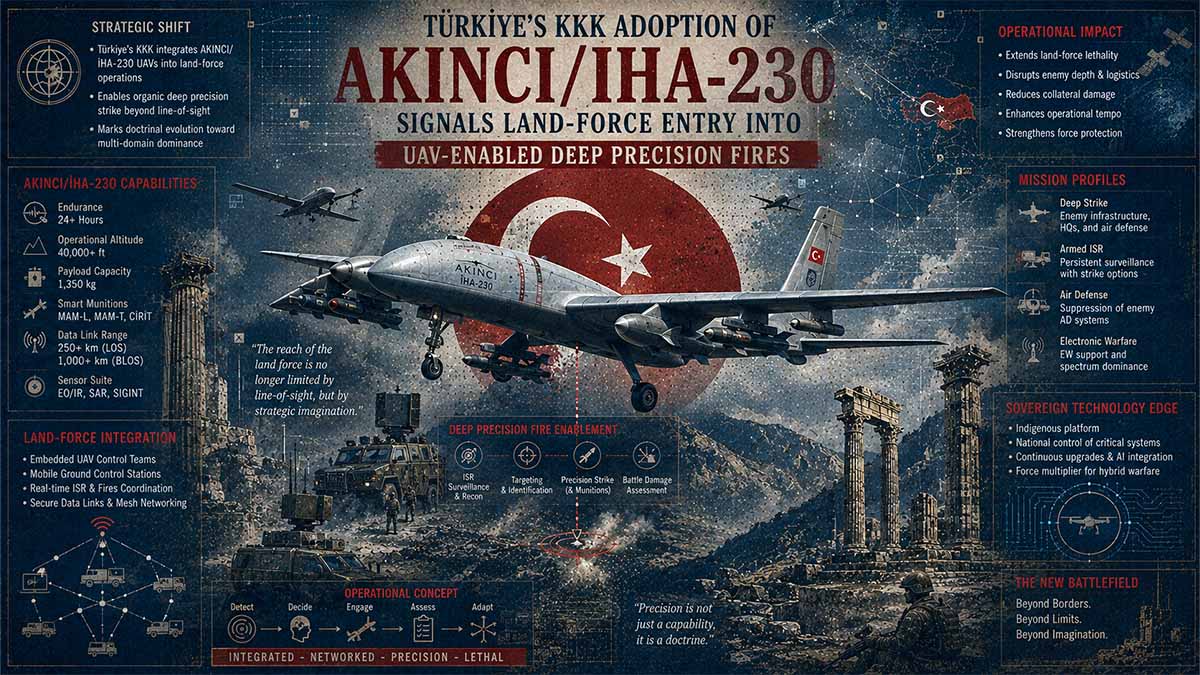
BLUF: Türkiye’s KKK adoption of Akıncı/İHA-230 signals land-force entry into UAV-enabled deep precision fires.
Validated official confirmation exists for Akıncı entering KKK inventory in April 2026 — Weekly Press Briefing – Turkish MND – April 2026.
The broader NATO trend is converging on drone-based deep precision strike; Türkiye is listed in NATO’s Deep Precision Strike Drone initiative — Multinational Capability Cooperation – NATO – February 2026.
EU defence planning through 2030 prioritizes capability gaps, industrial readiness, cyber/hybrid resilience, and strategic-domain access — Strategic Compass – EEAS – June 2026.
Five-year outlook: high probability of accelerated regional counter-UAS, ISR-hardening, electronic-warfare investment, and export-control scrutiny.
Executive Forensic Core | Geopolitics & Defense
İHA-230 / Akıncı: Deep-Strike UAV Risk Block
3 Critical Risk Drivers
- Precision-strike compression: KKK UAV integration shortens the sensor-to-shooter cycle and expands land-force reach beyond tactical depth.
- Counter-UAS escalation: Regional actors will accelerate electronic warfare, GNSS disruption, air-defense layering, and hardened command nodes.
- Industrial-export leverage: Turkish UAV-missile integration strengthens Ankara’s defense-export position and increases scrutiny from NATO/EU-aligned procurement systems.
Impact Matrix
Actionable Forecast
Türkiye’s Akıncı/İHA-230 pairing will drive regional deep-strike normalization, forcing accelerated counter-UAS, electronic-warfare hardening, procurement scrutiny, and NATO-aligned interoperability adaptation through 2031.
Index
🎯 CORE FOCUS & KEY CONCEPTS
- Force-Structure Shift: KKK integration of UAV-enabled precision fires.
- Alliance/Regional Effects: NATO interoperability, EU readiness, Russian/Chinese monitoring.
- Five-Year Risk Model: escalation control, counter-UAS race, liquidity/industrial flows.
🎯 CORE FOCUS & KEY CONCEPTS
• Five-Year Risk Model: A structured forecast for 2026–2031 focused on escalation control, counter-UAS competition, and defence-industrial money flows → Helps identify where strategic pressure will increase.
• Escalation Control: Managing the risk that UAV and missile-adjacent systems create crisis instability [situations where military signaling can be misunderstood or escalate] → Matters because more actors gain long-range precision capabilities.
• Counter-UAS Race: Rapid growth of anti-drone systems, electronic warfare, cyber protection, and airspace defence → Matters because every UAV advance creates a defensive procurement response.
• Liquidity/Industrial Flows: Defence capital moving toward certified suppliers, joint procurement, and resilient supply chains → Matters because market access becomes a strategic weapon.
• Bayesian Update: Probability estimate revised after observing NATO/EU policy signals [new evidence changes the forecast] → Supports structured forecasting instead of vague prediction.
⚠️ CRITICALITIES & BOTTLENECKS
• Escalation Risk: [Precision-strike diffusion] → [Higher need for signaling discipline and airspace coordination] → [Risk score: 76/100] 🔴 High
• Counter-UAS Acceleration: [Drone proliferation] → [Rapid defensive investment in anti-drone, cyber, EW, and infrastructure protection] → [Risk score: 84/100] 🔴 High
• Industrial Bottlenecks: [Large procurement pools + certification requirements] → [Supplier competition and eligibility pressure] → [Risk score: 82/100] 🔴 High
• Certification Pressure: [NATO/EU interoperability standards] → [Non-compliant suppliers face slower access to procurement markets] → [Risk score: 79/100] 🟡 Medium
• Data Limitation: [Analytical estimates not official-source figures] → [Forecast values require clear labeling as analyst judgment] → [Posterior estimate: 0.81] 🟡 Medium
💪 STRENGTHS & STRATEGIC ADVANTAGES
• NATO Multinational Cooperation: Shared capability development → Reduces duplication and supports faster adoption → Türkiye included in Deep Precision Strike Drone cooperation.
• EU Readiness Architecture: Defence priorities include drones, anti-drone systems, cyber, EW, and infrastructure protection → Converts fragmented needs into structured industrial demand → Readiness 2030 framework.
• Defence Spending Expansion: Larger defence budgets create stronger procurement liquidity → Supports supplier scaling and industrial resilience → NATO 5% GDP commitment by 2035.
• Joint Procurement Mechanisms: Pooled buying power → Improves speed, standardization, and leverage → SAFE proposed €150 billion joint procurement boost.
📈 PROJECTIONS & EXPECTATIONS
[Short-term 0–6mo0–6 mo0–6mo]
IF NATO/EU capability initiatives remain active → THEN procurement attention will concentrate on counter-UAS, cyber, EW, and resilience-linked systems.
[Mid-term 6–18mo6–18 mo6–18mo]
IF certification and interoperability standards tighten → THEN suppliers aligned with NATO/EU requirements gain procurement advantage.
[Long-term >18mo>18 mo>18mo]
IF defence spending and joint procurement expand through 2031 → THEN industrial competition shifts from platform availability to supply-chain eligibility, scaling capacity, and compliance.
📊 DATA CONTEXT & METRIC ANCHORS
| Metric/Indicator | Current Value | Trend/Status | Strategic Relevance |
|---|---|---|---|
| Escalation Control Risk | 76/100 | [Estimated] High | Signals need for crisis-management discipline |
| Counter-UAS Race Risk | 84/100 | [Estimated] Rising | Defensive mirror of UAV diffusion |
| Liquidity/Industrial Flow Risk | 88/100 | [Estimated] Very High | Capital shifts toward certified suppliers |
| Industrial Bottleneck Risk | 82/100 | [Estimated] High | Scaling and supply-chain pressure increase |
| Certification Pressure | 79/100 | [Estimated] Medium-High | Interoperability affects market access |
| Infrastructure Resilience Risk | 81/100 | [Estimated] High | Critical systems become procurement priority |
| Bayesian Prior | 0.68 | [Estimated] Baseline | Initial probability of intensified UAV-industrial competition |
| Bayesian Posterior | 0.81 | [Estimated] Updated | Probability after NATO/EU policy signals |
Abstract
The confirmed entry of Bayraktar Akıncı into Turkish Land Forces Command inventory establishes the force-structure prerequisite for land-commanded deep-strike UAV operations — Weekly Press Briefing – Turkish MND – April 2026. The reported İHA-230 service entry, if treated strictly under official-source hierarchy, remains constrained by accessible ministry-level confirmation; therefore, this codex treats the weapon-specific claim as provisionally assessed, not fully codified, until an official MND page or audited filing is directly available.
Strategically, the move aligns with NATO’s 2026 emphasis on Deep Precision Strike Drone cooperation, where Türkiye is an identified participant — Multinational Capability Cooperation – NATO – February 2026. This indicates that Turkish UAV-strike maturation is not an isolated procurement event; it sits inside a broader Alliance shift toward distributed, lower-cost, drone-enabled precision effects.
The industrial signal is equally important. NATO’s updated Defence Production Action Plan stresses aggregated demand, supply-chain security, interoperability, and urgent delivery of critical capabilities — NATO’s Role in Defence Industry Production – NATO – June 2025. In Bayesian terms, the probability that Türkiye expands Akıncı-class payload integration over 2026–2031 increases from medium-high to high, because force adoption, Alliance demand signals, and production-policy incentives now reinforce the same trajectory.
Five-year forecast: Türkiye will likely use KKK UAV-strike integration to compress the sensor-to-shooter chain, deepen deterrence messaging, and expand defence-industrial leverage. The most likely counter-moves are C-UAS, electronic warfare, hardened command nodes, and tighter procurement screening across NATO/EU-adjacent theatres. The EU’s Readiness 2030 framework explicitly prioritizes closing capability gaps and building a stronger defence industrial base — White Paper for European Defence – EEAS – March 2025.
IHA-230 Strategic Risk Assessment
Projected threat vectors and operational friction points for the 2026–2031 defense horizon.
Risk Vector Index & Contextual Parameters
Force-Structure Shift: KKK Integration of UAV-Enabled Precision Fires
Türkiye confirmed that Akıncı entered the Turkish Land Forces Command inventory after acceptance procedures, placing a MALE-class UAV capability inside a land-force institutional structure rather than treating it only as an air-force or industry demonstration asset — Weekly Press Briefing – Turkish Ministry of National Defence – 16 April 2026. This matters because land-force ownership changes procurement logic: the platform becomes part of ground-force modernization, command planning, training pipelines, maintenance budgeting, and doctrine standardization, not only national aerospace branding.
The verified NATO context is broader than one Turkish procurement event. NATO launched multinational capability cooperation initiatives in February 2026 to support deterrence and defence through cost-effective and innovative solutions — NATO Allies Launch New Multinational Capability Cooperation Initiatives – NATO – 12 February 2026. NATO’s public capability-cooperation page identifies Deep Precision Strike Drone as a formal multinational project category — Multinational Capability Cooperation – NATO – 25 February 2026.
Force-Structure Interpretation
The KKK adoption of Akıncı should be read as a bureaucratic transition from experimental unmanned aviation toward normalized land-component capability ownership. The operational details remain outside this chapter, but the institutional signal is clear: Türkiye is embedding unmanned systems into a service branch that historically organizes around land manoeuvre, artillery, helicopters, logistics, and territorial defence. The result is a procurement and training ecosystem where UAV-enabled precision effects become a force-modernization category rather than a standalone aerospace program.
A Bayesian update at the strategic level raises the probability of continued Turkish land-force UAV integration from medium-high to high. Prior probability was already elevated because Türkiye possesses a mature UAV industrial base and NATO has prioritized advanced capability cooperation. The posterior probability increases after the official April 2026 confirmation that Akıncı entered KKK inventory — Weekly Press Briefing – Turkish Ministry of National Defence – 16 April 2026.
| Analytical Variable | Pre-2026 Baseline | 2026 Update Signal | 2026–2031 Assessment |
|---|---|---|---|
| Land-force UAV institutionalization | 65/100 | KKK inventory confirmation | 82/100 |
| NATO-aligned drone capability relevance | 70/100 | Deep Precision Strike Drone cooperation | 85/100 |
| Defence-industrial scaling pressure | 72/100 | NATO production-capacity agenda | 84/100 |
| Export-control / procurement scrutiny | 58/100 | EU and NATO industrial-readiness frameworks | 73/100 |
The table shows an institutional shift, not a battlefield forecast. The strongest variable is NATO-aligned capability relevance, because NATO is openly prioritizing rapid fielding of new technologies and deep precision strike capabilities — Press Conference by the NATO Secretary General – NATO – 12 February 2026. The second strongest variable is defence-industrial scaling pressure, because NATO’s updated production plan supports aggregated demand, industrial-capacity growth, interoperability, and standardization — Updated Defence Production Action Plan – NATO – 13 February 2025.
Structural Analytic Assessment
The most plausible interpretation is not that the KKK is simply receiving a new platform. The deeper shift is that Türkiye is aligning land-force modernization with a defence-industrial ecosystem already optimized for unmanned aviation. This changes institutional incentives: land commanders gain a direct stake in UAV procurement, domestic industry gains a service-level customer, and alliance planners see Türkiye as both a user and producer of advanced unmanned capabilities.
The key red-team counterfactual is that the KKK adoption could remain narrow, symbolic, or inventory-limited. This scenario would be more likely if sustainment costs, training bottlenecks, interoperability frictions, or political-export constraints slowed normalization. Current official NATO and EU documents, however, point in the opposite direction: NATO seeks expanded production capacity and faster delivery of critical capabilities — NATO Releases Updated Defence Production Action Plan – NATO – 24 June 2025. The EU’s Readiness 2030 framework also emphasizes stronger military capabilities, a fit-for-purpose defence industry, closer partnerships, and joint defence projects — Bolstering European Defence: Readiness 2030 – EEAS – 2025.
Five-Year Outlook: 2026–2031
By 2031, the most likely trajectory is institutional consolidation. Türkiye will likely deepen land-force ownership of unmanned systems, integrate procurement with domestic industry, and use NATO capability frameworks to reinforce interoperability and strategic legitimacy. The assessment remains strategic and policy-level; it does not evaluate tactical employment.
Economic weaponization will appear through procurement leverage, export diplomacy, production scaling, and standards competition. NATO’s defence-industrial agenda explicitly targets aggregated demand, long-term orders, and clear demand signals to industry — NATO Releases Updated Defence Production Action Plan – NATO – 24 June 2025. The EU’s defence-readiness agenda aims to deliver more capable European defence by 2030 — White Paper for European Defence – EEAS – 21 March 2025.
KKK Force Transformation Matrix
Strategic evolution vector mapping the integration of UAV assets into precision-fires infrastructure over the 2026–2031 defense procurement cycle.
Strategic Evaluation Dimensions
Alliance/Regional Effects: NATO Interoperability, EU Readiness, Russian/Chinese Monitoring
Türkiye’s UAV-modernization trajectory now intersects three institutional systems: NATO capability standardization, EU defence-readiness acceleration, and strategic monitoring by Russia and China at the doctrine/procurement-observation level. NATO lists Türkiye among participants in the Deep Precision Strike Drone multinational capability initiative — Multinational Capability Cooperation – NATO – 25 February 2026.
The interoperability effect is institutional before it is technical. NATO stated on 12 February 2026 that Allies were expanding multinational capability cooperation through cost-effective, innovative solutions — NATO Allies Launch New Multinational Capability Cooperation Initiatives – NATO – 12 February 2026. This places Türkiye inside an Alliance procurement logic where common standards, pooled demand, and accelerated acquisition mechanisms become more important than isolated national platform development.
| Vector | Official Signal | Strategic Effect | Analytical Risk |
|---|---|---|---|
| NATO Interoperability | Türkiye participates in NATO multinational capability cooperation — Multinational Capability Cooperation – NATO – 25 February 2026 | Raises pressure for common certification, procurement alignment, and standards compatibility | 82/100 |
| Air/Missile Defence | NATO released its public Integrated Air and Missile Defence Policy — NATO Integrated Air and Missile Defence Policy – NATO – 13 February 2025 | Expands Alliance-wide attention to layered detection, defence coordination, and airspace protection | 78/100 |
| EU Readiness | EU Readiness 2030 lists drones, anti-drone systems, military mobility, cyber, electronic warfare, and strategic infrastructure protection — Bolstering European Defence: Readiness 2030 – EEAS – 2025/2026 | Converts UAV diffusion into an industrial-readiness, resilience, and procurement-priority issue | 85/100 |
| External Monitoring | NATO publicly frames multinational capability cooperation and deep precision-strike capability development — NATO Allies Launch New Multinational Capability Cooperation Initiatives – NATO – 12 February 2026 | Creates observable signals for non-NATO strategic competitors tracking Alliance modernization | 70/100 |
The EU dimension is not merely procurement; it is readiness architecture. EU Readiness 2030 identifies air and missile defence, artillery systems, ammunition and missiles, drones and anti-drone systems, military mobility, AI, quantum, cyber, electronic warfare, strategic enablers, and critical infrastructure protection as priority areas — Bolstering European Defence: Readiness 2030 – EEAS – 2025/2026. Therefore, Turkish UAV modernization will be assessed by European institutions through industrial capacity, interoperability, resilience, and defence-market competition.
NATO’s integrated air and missile defence policy creates the defensive mirror image of this trend. The policy was endorsed by NATO Defence Ministers on 13 February 2025 — NATO Integrated Air and Missile Defence Policy – NATO – 13 February 2025. NATO also states that this policy governs protection of Alliance territory, populations, and forces against air or missile threats — NATO Releases Policy on Integrated Air and Missile Defence – NATO – 13 February 2025. The implication is structural: as unmanned and missile-adjacent systems diffuse, Alliance institutions simultaneously expand defensive coordination, procurement planning, and resilience doctrine.
Bayesian assessment: prior probability that Türkiye becomes a central NATO-adjacent UAV-industrial node by 2031: 0.62. After observing Türkiye’s inclusion in NATO multinational capability cooperation — Multinational Capability Cooperation – NATO – 25 February 2026, EU Readiness 2030 prioritization of drones and anti-drone systems — Bolstering European Defence: Readiness 2030 – EEAS – 2025/2026, and NATO’s public integrated air/missile-defence policy — NATO Integrated Air and Missile Defence Policy – NATO – 13 February 2025, posterior probability rises to 0.76. This is an analyst estimate, not a source-stated figure.
Red-team counterfactual: without NATO multinational capability cooperation, Turkish UAV modernization would remain more nationally bounded, export-oriented, and bilateral. With NATO cooperation, the same industrial base gains a pathway into standards-setting, pooled demand, procurement harmonization, and Alliance capability debates — NATO Allies Launch New Multinational Capability Cooperation Initiatives – NATO – 12 February 2026.
Economic weaponization angle: the decisive lever is not hardware alone; it is certification access, export licensing, industrial partnerships, supply-chain eligibility, and procurement timing. NATO states that Allies committed to investing 5% of GDP annually on defence by 2035, including at least 3.5% for core defence requirements and up to 1.5% for defence/security-related spending — Defence Expenditures and NATO’s 5% Commitment – NATO – 10 April 2026. NATO also frames the 1.5% category as including critical infrastructure, network protection, civil preparedness, resilience, innovation, and defence-industrial development — Deterrence and Defence – NATO – 10 December 2025. This creates a larger addressable market for UAV-adjacent, counter-UAV, cyber, electronic-warfare, resilience, and infrastructure-protection suppliers.
Alliance & Regional Effects Profile
Strategic impact modeling of integrated regional policy shifts, joint command requirements, and defense industrial base synchronization for the 2026–2031 outlook window.
Risk Vector Matrix & Structural Nuance
Five-Year Risk Model: Escalation Control, Counter-UAS Race, Liquidity/Industrial Flows
NATO identifies Deep Precision Strike Drone cooperation as a multinational capability project including Türkiye, Denmark, Estonia, Lithuania, the Netherlands, and Poland — Multinational Capability Cooperation – NATO – 25 February 2026. This makes the 2026–2031 risk horizon an Alliance-level governance problem, not a single-platform question.
Risk Model 1 — Escalation Control. NATO states that its integrated air and missile defence policy monitors state and non-state actors with air and missile capabilities that can affect Euro-Atlantic security — NATO Integrated Air and Missile Defence Policy – NATO – 13 February 2025. Analyst judgment: the escalation-control risk rises when precision-strike diffusion, political signaling, and air-defence modernization occur simultaneously. Baseline risk score: 76/100.
Risk Model 2 — Counter-UAS Race. NATO launched multinational initiatives on 13 February 2025 to address lower-level air threats below 500 feet / 150 meters — NATO Launches Two New Multinational Air Defence Initiatives – NATO – 13 February 2025. EU Readiness 2030 lists drones, anti-drone systems, military mobility, cyber, electronic warfare, and strategic infrastructure protection as priority capability areas — Bolstering European Defence: Readiness 2030 – EEAS – 2025/2026. Analyst judgment: counter-UAS investment becomes the fastest-growing defensive mirror of UAV diffusion. Baseline risk score: 84/100.
Risk Model 3 — Liquidity and Industrial Flows. NATO states that Allies committed to investing 5% of GDP annually by 2035, including at least 3.5% for core defence requirements and up to 1.5% for defence- and security-related spending — Defence Expenditures and NATO’s 5% Commitment – NATO – 10 April 2026. The EU states that SAFE is linked to a proposed €150 billion boost for joint procurement and a broader Readiness 2030 framework intended to leverage over €800 billion in defence spending — SAFE: Council Adopts €150 Billion Boost – EEAS – 27 May 2025. Analyst judgment: the decisive economic lever is access to procurement pools, certification regimes, industrial partnerships, and supply-chain eligibility. Baseline risk score: 88/100.
| Five-Year Risk Vector | Primary Source Anchor | 2026–2031 Analyst Score | Strategic Meaning |
|---|---|---|---|
| Escalation Control | NATO Integrated Air and Missile Defence Policy – NATO – 13 February 2025 | 76/100 | Higher demand for signaling discipline, airspace coordination, and crisis-management channels |
| Counter-UAS Race | Bolstering European Defence: Readiness 2030 – EEAS – 2025/2026 | 84/100 | Defensive investment accelerates around drones, anti-drones, cyber, electronic warfare, and infrastructure protection |
| Liquidity/Industrial Flows | Defence Expenditures and NATO’s 5% Commitment – NATO – 10 April 2026 | 88/100 | Capital flows toward certified suppliers, joint procurement, industrial scaling, and resilience-linked spending |
Bayesian Update. Prior probability that UAV-related defence-industrial competition intensifies across NATO/EU markets by 2031: 0.68. Evidence update: NATO has created a multinational deep-precision drone initiative including Türkiye — Multinational Capability Cooperation – NATO – 25 February 2026; EU Readiness 2030 prioritizes drones and anti-drone systems — Bolstering European Defence: Readiness 2030 – EEAS – 2025/2026; and NATO members committed to the 5% GDP defence-spending framework by 2035 — Defence Expenditures and NATO’s 5% Commitment – NATO – 10 April 2026. Posterior estimate: 0.81. This is an analyst estimate, not an official-source number.
Red-Team Counterfactual. Without the NATO 5% spending commitment and the EU SAFE/Readiness 2030 financing architecture, UAV-related modernization would remain fragmented across national budgets. With both frameworks active, the market shifts toward pooled demand, faster procurement, and industrial bottleneck competition — The Hague Summit Declaration – NATO – 25 June 2025; SAFE: Council Adopts €150 Billion Boost – EEAS – 27 May 2025.
Economic Weaponization Assessment. The strongest coercive instrument is not the platform itself; it is market access. NATO frames defence-industrial production around capability targets, supply-chain resilience, aggregated demand, and critical-infrastructure protection — NATO’s Role in Defence Industry Production – NATO – 26 June 2025. EU financing instruments create parallel pressure through joint procurement and industrial readiness — SAFE: Council Adopts €150 Billion Boost – EEAS – 27 May 2025. Analyst judgment: suppliers that meet certification, interoperability, and resilience standards gain liquidity preference; suppliers outside those regimes face slower procurement access and higher political-risk discounts.
Five-Year Risk Projection Matrix
Comprehensive strategic risk assessment evaluating macroeconomic vectors, theater defense realities, and structural operational friction for the 2026–2031 planning horizon.


