









Executive Summary
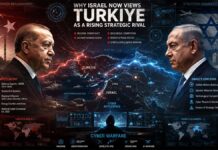
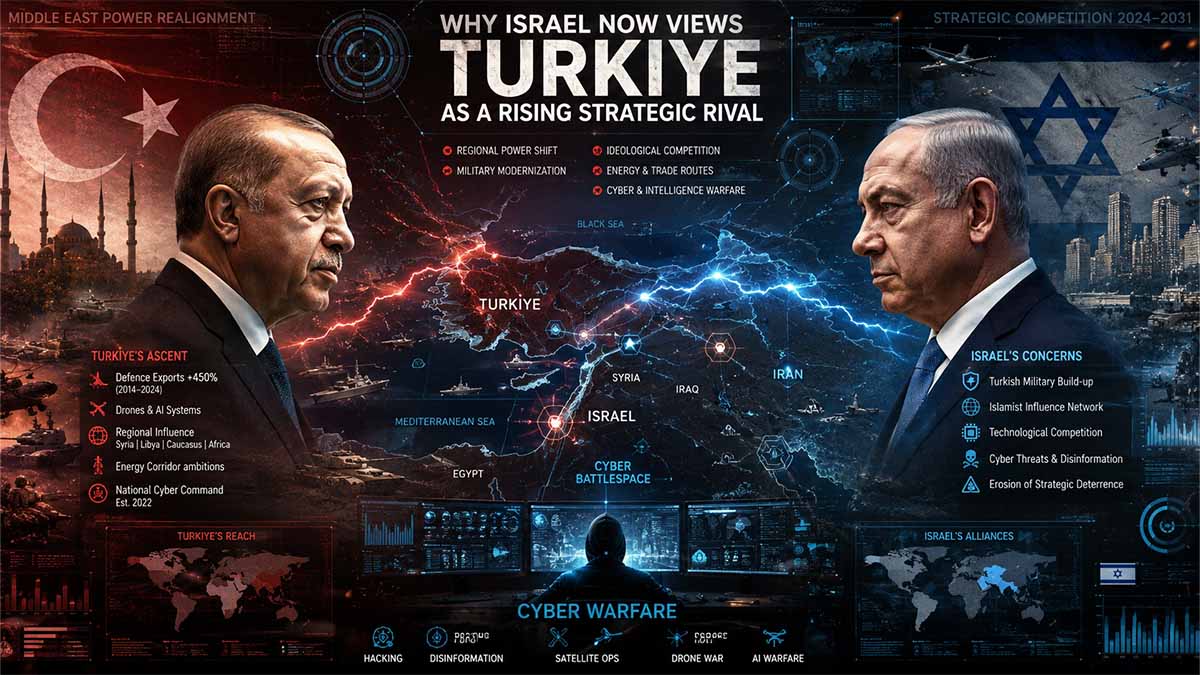
- Israeli officials and analysts — including former PM Naftali Bennett and JCFA’s Dan Diker — have begun explicitly labeling Turkiye a strategic threat, with Bennett calling it “the new Iran” in February 2026. FDD
- The friction is concentrated in Syria, where Israel worries a Turkish-aligned Damascus and Turkish air-defense deployments could constrain IDF freedom of action against Iranian targets.
- Trade and economic warfare have escalated: Turkiye halted direct trade with Israel in May 2024 and tightened it further in February 2026.
- Gaza reconstruction is a live flashpoint — Israel has ruled out any Turkish military role there.
- The rivalry is playing out through corridors and alliances (Hejaz Railway vs. IMEC, Greece-Cyprus-Israel alignment) rather than direct confrontation.
- Washington is trying to manage both relationships simultaneously, visible at the July 7-8, 2026 NATO Ankara summit.
- Neither side wants or currently risks a direct war; competition is structural, not imminent.
Turkiye and Israel: NATO’s Indispensable Rivals Redraw the Middle East
Two states each other’s oldest regional partner have become the alliance’s most consequential unresolved rivalry. Turkiye, NATO’s second-largest military and a rising defense exporter, and Israel, Washington’s foremost security partner in West Asia, now openly describe each other in existential terms. The friction runs through Syria’s post-Assad reconstruction, competing trade corridors worth tens of billions, and a $9 billion trade relationship reduced to zero by government decree. Neither Ankara nor Jerusalem wants war. Both are already fighting one — economically, diplomatically, and increasingly by airstrike — while Washington tries to hold both inside the same security architecture. The July 2026 NATO summit in Ankara exposed exactly how fragile that architecture has become.
The Strategic Reversal
On 17 February 2026, former Israeli prime minister Naftali Bennett told American Jewish organizations in Jerusalem that Turkiye had become “the new Iran.” The institutional apparatus followed the rhetoric: the Nagel Committee, established by Prime Minister Benjamin Netanyahu in January 2025, formally identified a Turkish-aligned Syrian state as a threat potentially exceeding Iran’s, warning explicitly of a possible direct Turkish-Israeli confrontation. This marks a reversal of seven decades of alignment. Turkiye was the first Muslim-majority state to recognize Israel, in 1949, and the two built a Cold War partnership under Ben-Gurion’s “periphery doctrine.” A 23 February 1996 military accord formalized transfer of military technology and joint training, and Israel subsequently upgraded more than fifty Turkish Air Force F-4 Phantoms. That cooperation survived the 2010 Mavi Marmara raid, in which Israeli forces killed nine Turkish citizens aboard an aid flotilla, and the 2018 rupture over Gaza border deaths coinciding with the US embassy’s relocation to Jerusalem. It has not survived October 2023. FDD + 6
The Numbers Behind the Rupture
Bilateral trade is the clearest quantitative signal of the collapse. Turkish-Israeli trade rose from $1.41 billion in 2002 to a record $8.91 billion in 2022, according to Turkey’s Statistical Institute (TÜİK). On 9 April 2024 Ankara halted exports of 1,019 products across 54 categories; on 2 May 2024 it imposed a total ban covering all exports, imports, and transit trade. Officially, trade is now zero. In practice: UN Comtrade data show Turkey remained Israel’s fifth-largest supplier in 2024, with $2.86 billion in exports reaching Israel despite the ban, largely rerouted through third markets — Turkish exports to Greece rose 71% year-on-year in May 2024, to $375 million, with goods re-exported to Israel without altered certificates of origin. Ankara tightened the embargo further in February 2026, removing customs exemptions for Turkish goods routed via Europe. A genuine economic interdependence built over three decades is being unwound in real time, at measurable cost to Turkish exporters and Israeli importers alike. Türkiye Today + 4
Syria: The Line Israel Will Not Let Ankara Cross
The rivalry’s military center of gravity is Damascus. After Assad’s fall, Turkiye moved to anchor its influence in the new Syrian state; Israel moved to prevent it. In the weeks before late March 2025, Turkish military teams inspected the T-4 and Palmyra airbases in Homs and the main airfield in Hama, evaluating runways and hangars for potential deployment, according to a regional intelligence official and Syrian military sources. Israel struck five locations within a 30-minute window, nearly destroying the Hama base; Defense Minister Israel Katz called it a warning that “we will not allow the security of the State of Israel to be harmed,” while Foreign Minister Gideon Sa’ar accused Ankara of seeking a “Turkish protectorate.” A follow-up Turkish inspection scheduled for 25 March was cancelled after the strikes. Israel escalated again that summer: on 16 July 2025, Israeli jets struck the Syrian Defense Ministry headquarters and the area near the presidential palace in Damascus, killing three and injuring 34, officially to protect the Druze minority amid clashes in Sweida. Turkish officials believe those strikes decisively shaped the Syrian Democratic Forces’ reluctance to implement the 10 March 2025 merger agreement with the new Syrian army, stalling a US-backed integration process central to Syria’s stabilization. Wikipedia + 5
The Corridor War
Beneath the military friction lies a contest over which power controls the next generation of regional trade infrastructure. The India-Middle East-Europe Economic Corridor (IMEC), launched at the 2023 G20 summit in New Delhi, routes trade from the Gulf through Israel and Cyprus to Greece — bypassing Turkish territory entirely; Ankara was excluded from the founding memorandum. On 1 May 2026, US Senators Cory Booker and Dave McCormick introduced the Eastern Mediterranean Gateway Act to formalize American backing for IMEC infrastructure across the region. Turkiye’s countermove is explicit: on 9–10 June 2026, Turkiye and Saudi Arabia signed memoranda reviving the Ottoman-era Hejaz Railway through Syria and Jordan toward Oman, with the Turkey-Aleppo segment alone valued at roughly $100 million; Turkey’s Trade Minister stated openly that the project aims at “reducing Israel’s influence in the region.” Israel has responded by deepening a maritime bloc that excludes Ankara: a trilateral Joint Action Plan among Greece, Cyprus, and Israel, alongside a 2026 Greece-Israel Military Cooperation Program, reinforced by a 2019 Turkish-Libyan maritime jurisdiction memorandum, registered with the United Nations, that legally intersects the planned EastMed pipeline route — Turkiye’s own instrument for contesting a corridor it was never invited to join. Begin-Sadat Center for Strategic Studies + 4
Washington’s Impossible Balance
The United States is managing this rivalry through overlapping, occasionally contradictory channels. Tom Barrack, confirmed as US Ambassador to Turkiye on 14 May 2025, was named Special Envoy for Syria eight days later and, on 31 May 2026, was additionally appointed Special Presidential Envoy for Iraq — a single official simultaneously managing Ankara, Damascus, and Baghdad. He has faced criticism from Senate Republicans and Israeli officials for comments at the Antalya Diplomacy Forum viewed as pro-Ankara and critical of Israeli policy, underscoring how difficult neutral brokerage has become. The structural test came at the alliance level: the NATO summit held in Ankara on 7–8 July 2026 focused on defense-spending delivery, industrial production, and Ukraine support, while also managing President Trump’s criticisms of alliance cohesion. Allies pledged €70 billion in Ukraine assistance for 2026–2027, and only five of 32 members — led by Lithuania at 5.33% of GDP — were on track to meet the 3.5% core-defense spending target for 2026. Turkiye’s defense-industrial weight was on full display: June 2026 alone brought a first-ever Turkish warship sale to NATO member Romania and a $10 billion, 48-aircraft KAAN fighter deal with Indonesia. Washington cannot afford to alienate a NATO power central to Black Sea, Caucasus, and Levant strategy, nor can it afford to unsettle its primary regional security partner — a contradiction the Ankara summit could contain but not resolve. Fox News + 4
The Domestic Ceiling on Escalation
What keeps this rivalry from crossing into direct confrontation is measurable Turkish public opinion, not diplomatic goodwill. A MetroPoll survey in March 2026 found 68.1% of Turkish respondents favored strict neutrality in the wider regional conflict, versus just 2.1% supporting alignment with the United States and Israel. This gives Erdoğan latitude for maximalist rhetoric — he has compared potential intervention against Israel to Turkish operations in Libya and Nagorno-Karabakh — without commensurate political cover for actual military engagement. Analysts converge on the same read: both governments recognize that neither regional nor international conditions currently favor a direct clash, even as competition intensifies through diplomatic pressure, economic measures, and rival alliances. JISS + 2
The Cost of Inaction
For institutional and financial audiences, the relevant conclusion is not whether Ankara and Jerusalem go to war — they will not, absent miscalculation over Syrian airspace or a fatal incident at sea. It is that a $9 billion trade relationship has already been zeroed out by political decree, that two competing multi-billion-dollar transit corridors are now under simultaneous construction across the same geography, and that NATO’s own July 2026 summit host is simultaneously the subject of a formal Israeli threat assessment. Capital allocated to Eastern Mediterranean energy, Syrian reconstruction, or IMEC-linked infrastructure must now be priced against a structural, not cyclical, rivalry between two of Washington’s most important regional partners — one that neither side, and perhaps not even the United States, currently has the tools to resolve.
Navigational Index
- Roots of a Rivalry: From Quiet Partnership to Open Rhetoric
- The Syrian Fault Line and the Corridor War
- Washington’s Balancing Act and the NATO Constraint
Master Abstract
Roots of a Rivalry: From Quiet Partnership to Open Rhetoric
The Turkish-Israeli relationship’s current hostility obscures just how recent — and how reversible — the rupture actually is. As your own framing correctly notes, Turkiye recognized Israel in March 1949, and for decades the two states maintained deep military, intelligence, and tourism ties, including Israeli Air Force training on Turkish soil that continued until 2010. Israeli Air Force training in Turkey until 2010 and intelligence cooperation against Palestinian, Iranian, and Kurdish terrorism reinforced ties, with Turkey viewing Israel as a pragmatic partner against Islamist radicalism. That foundation began eroding under Erdoğan from 2008 onward, but analysts trace the sharpest acceleration to the Gaza war that began in October 2023. Turkey’s hostility toward Israel traces to 2008, when Erdogan began dismantling a once-trust-based partnership anchored in intelligence sharing, military cooperation, tourism, and trade. By 2026 the rhetorical temperature had risen sharply: Erdoğan has begun describing Israel not merely as a regional threat but as a global one, and told his AKP faction on June 10 that Turkish national security extends across the broader Middle East, including Beirut, Damascus, and Aleppo. On the Israeli side, the framing has become explicit and personal. Former Israeli PM Naftali Bennett described Turkey as “the new Iran” in a February 2026 address to American Jewish organizations in Jerusalem, and Dan Diker of the Jerusalem Center for Security and Foreign Affairs has said Israel views Turkey as a strategic threat rather than a neutral actor. Analysts caution that some of this rhetoric may be politically instrumental — Bennett and Netanyahu, despite being rivals, share a belief in pushing Israeli regional hegemony, and critics argue talk of a “Turkish threat” serves that agenda as much as it reflects genuine alarm. Economic ties have followed the rhetoric downward: Turkey suspended all trade with Israel in May 2024 over the war in Gaza, then tightened restrictions further in February 2026 by removing customs exemptions for Turkish goods routed through Europe. Congress.gov + 6
The Syrian Fault Line and the Corridor War
Syria has become the most concrete arena of friction. With Assad gone, Turkiye has emerged as Damascus’s principal external patron, and Israel fears that a Turkish-aligned Syrian state could functionally become a forward platform against Israeli interests. Israel’s Nagel Committee, established by Netanyahu in January 2025, formally defined the Turkish threat as a new and significant danger that could emerge if the Syrian regime became, in practice, a Turkish proxy, warning this could increase the risk of a direct Turkish-Israeli confrontation. The operational concern is specific: the deployment of Turkish air-defense systems inside Syria could constrain IDF operational freedom, particularly regarding operations against Iranian assets, and a growing Turkish military presence raises the risk of accidental aerial encounters absent effective deconfliction mechanisms. Stimson Center analysis frames Turkish red lines symmetrically: Turkish officials believe Israeli strikes on Syria’s Presidential Palace and Defense Ministry shaped the SDF’s reluctance to merge with the new Syrian army, and Ankara has adopted a three-layered strategy — encouraging a Damascus-Israel security mechanism, supporting active U.S. mediation, and shifting toward gradualism. Beyond the military dimension, the two states are now racing over infrastructure and trade corridors. In June 2026, Turkey and Saudi Arabia signed memoranda to revive the Ottoman-era Hejaz Railway through Syria and Jordan toward Oman, with Turkey’s Trade Minister stating openly that reducing Israel’s regional influence was part of the rationale. This directly challenges the American-backed IMEC corridor concept, which envisions Israel as a transit hub; Turkey’s rivalry with Israel has become a structural constraint shaping nearly every regional file — Syria, the Eastern Mediterranean, Washington lobbying, and the Red Sea-Horn of Africa corridor — while a new Greece-Cyprus-Israel alignment tightens around Ankara in the Mediterranean. Gaza adds a further layer: Israel has made clear it will not allow Turkish armed forces to operate inside Gaza, viewing Ankara as a destabilizing actor despite Turkish efforts to present itself as a reconstruction partner, even as Turkish sources say Ankara is focused on aid and infrastructure rather than troop deployment. Competition has even spread to the Horn of Africa: Turkey views Israel’s growing ties with Somaliland and reports of possible Israeli military facilities near the Bab el-Mandeb Strait as direct challenges to Somali territorial integrity. Center for Strategic and International Studies + 6
Washington’s Balancing Act and the NATO Constraint
Both governments remain embedded in a shared American security architecture that neither wants to jeopardize, which is precisely why the rivalry stays rhetorical and competitive rather than kinetic. Turkish public opinion reinforces caution: a March 2026 MetroPoll survey found 68.1% of Turkish respondents wanted neutrality regarding the wider regional conflict, with only 2.1% favoring alignment with the U.S. and Israel. Analysts broadly converge on the same conclusion: Israel perceives Turkey’s expanding regional influence and military partnerships as an emerging strategic threat, but direct military confrontation remains unlikely, since Turkey recognizes neither regional nor international conditions currently favor war, while Israel understands that confronting a powerful NATO member carries serious military and political risk. This is the backdrop against which Washington hosted its own alliance-management exercise: the NATO summit held in Ankara on July 7-8, 2026. NATO Secretary General Mark Rutte outlined three core priorities for the summit — continuing to increase allied defense investment, bolstering transatlantic defense industrial production, and supporting Ukraine — while allied leaders were also expected to address President Trump’s criticisms of NATO and concerns over alliance cohesion. The summit reaffirmed collective defense commitments while showcasing Turkiye’s rising industrial weight: Allies reaffirmed their commitment to Article 5 collective defense, and the Ankara Summit Declaration was issued at the close of the gathering. Turkiye’s defense-export momentum underscores why Washington needs Ankara even as Israel grows wary of it: Turkish arms exports broke records in June 2026, including the first-ever warship sale to a NATO member (Romania) and a $10 billion KAAN fighter jet deal with Indonesia for 48 aircraft. A Turkish government-linked intelligence assessment captures Ankara’s own posture toward the rivalry: a National Intelligence Academy report published May 20, 2026 recommended stronger air and missile defenses, protection of critical infrastructure, enhanced security for senior officials, and continued dialogue with Israel amid escalating geopolitical tensions. The net picture, as Brookings summarizes, is of a rivalry that has become load-bearing rather than episodic: Israel is trying to limit a greater Turkish footprint in Syria while a tightening Greece-Cyprus-Israel alignment presses on Ankara from the Mediterranean, with Syria remaining the central test of Turkey’s regional influence going forward. JISS + 5
Turkiye–Israel: 2024–2026 Escalation Timeline
Roots of a Rivalry: From Quiet Partnership to Open Rhetoric
The periphery-doctrine origins (1949–1980)
Turkiye’s recognition of Israel was never sentimental — it was Cold War geometry. In 1949 Turkey became the first Muslim country to formally recognize Israel, and initial relations were confined to trade and transportation, functioning as a partnership to counter pan-Arab influence emanating from the United Arab Republic. Turkey’s first diplomatic mission in Israel opened on January 7, 1950, when its first Chief of Mission presented credentials to President Chaim Weizmann, though the legation was downgraded to Chargé d’Affaires level after the 1956 Suez Crisis. Two years later the relationship acquired its strategic architecture: in 1958, Israeli PM David Ben-Gurion and Turkish PM Adnan Menderes met secretly to discuss a “peripheral pact” covering public relations campaigns, intelligence exchange, and military support. This was Ben-Gurion’s doctrine in practice — non-Arab states on the region’s rim (Turkiye, Iran under the Shah, Ethiopia) aligning quietly against the Arab core, with Turkey’s recognition rooted in its drive to align with the West and pursue NATO membership. The first cooling came over Jerusalem: diplomatic relations cooled following Israel’s reunification of Jerusalem in 1967, and ties fell further after the Knesset passed a law on Jerusalem’s unification in 1980, prompting Ankara to downgrade its diplomatic representation. Foreign Policy Research Institute + 4
The “golden years” — post-Cold War military alignment (1991–2000)
The collapse of the Soviet threat freed Ankara to formalize what had been informal. In 1991 diplomatic relations were restored to full ambassadorial level; in 1993 the two states signed a free trade agreement; and this culminated on 23 February 1996 in a comprehensive military accord covering transfer of military technology, joint training in both countries, and coordinated efforts toward regional peace. The defense-industrial component was substantial and specific: the February 1996 training and cooperation deal gave Israeli fighter jets access to Turkish airbases and airspace for training, and was followed in August 1996 by a Defence Industry Cooperation Agreement under which Israel upgraded and modernized Turkey’s aging American-made F-4 Phantom II jets and M-60 Patton tanks. That August 1996 technical-exchange agreement specifically enabled Israeli upgrading of more than fifty Turkish air force F-4 Phantoms, followed by a wave of senior mutual visits — including Turkish Chief of Staff İsmail Hakkı Karadayı’s 1997 visit to Israel and a reciprocal visit by Israeli FM David Levy. Crucially, this cooperation survived a change of government that might have been expected to kill it: Necmettin Erbakan, Turkey’s first Islamist prime minister, had criticized close relations with Israel as incompatible with Turkish identity while in opposition, but avoided disrupting bilateral ties once in office, and the February 1996 military cooperation agreement went ahead regardless. Domestically the alignment was not uncontested — Turkish President Süleyman Demirel survived an assassination attempt in May 1996 by a man angered specifically by the Israel cooperation. Historians frame the 1990s as the relationship’s high-water mark: joint air and naval exercises, intelligence sharing, and arms modernization reflected deep strategic alignment, aided by an Oslo-era regional environment in which Israel’s security cooperation with Turkey could develop without political complication. Jewish Virtual Library + 5
Rupture: Davos, Mavi Marmara, and the “lost decade” (2008–2016)
The turn began with Gaza, not general ideology. Following Israel’s 2008–2009 Gaza operation, Erdoğan publicly criticized Israeli policy, and relations then plunged to their lowest point since 1949 after the Mavi Marmara incident in May 2010. Ankara’s response was comprehensive: it recalled its own ambassador, expelled Israel’s ambassador, suspended military cooperation, and demanded an apology for nine Turkish deaths, compensation, and an end to the Gaza blockade. Yet even through this rupture, commerce proved stickier than diplomacy: trade between the two countries steadily increased through what analysts call Turkish-Israeli relations’ “lost decade,” even surviving the Mavi Marmara fallout and the 2017 US recognition of Jerusalem as Israel’s capital. Springer + 2
Davos, January 2009 — the first public break
The rhetorical rupture predates Mavi Marmara by 16 months. At the World Economic Forum’s “Gaza: The Case for Middle East Peace” panel on 29 January 2009, weeks after Israel’s Operation Cast Lead, Israeli President Shimon Peres delivered a fiery defense of the Gaza offensive, at one point raising his voice and pointing his finger at Erdoğan and asking what Turkey would do if rockets fell nightly on Istanbul. When moderator David Ignatius, a Washington Post columnist, tried to limit Erdoğan’s rebuttal, Erdoğan repeated “one minute… one minute… one minute” before telling Peres: “You kill people… I remember the children who died on beaches… I remember two former prime ministers in your country who said they felt very happy when they were able to enter Palestine on tanks.” When Ignatius twice tried to end the exchange for dinner, Erdoğan said “thank you very much” three times and declared he would not return to Davos. He received a hero’s welcome at Istanbul’s Atatürk Airport, with crowds waving Turkish and Palestinian flags and chanting “Turkey is proud of you,” while Erdoğan told reporters it was “a matter of the esteem and prestige of my country.” Analysts treat this moment as the hinge: the “One Minute” incident was a sign of what was coming, though the flotilla incident sixteen months later produced far more severe consequences. gulfnews + 4
Mavi Marmara, May 2010 — from rhetoric to bodies
On 31 May 2010, Israeli naval forces stormed the Mavi Marmara, part of a flotilla attempting to break Israel’s Gaza blockade, killing nine Turkish citizens (a tenth activist, a dual US-Turkish citizen, later died of wounds sustained in the raid). Ankara’s response was total rupture: ambassadors withdrawn on both sides, military cooperation frozen, and a standing Turkish demand for apology, compensation, and an end to the blockade. Resolution took years and came in stages: Israel apologized in March 2013, specifically for the deaths of the nine Turkish citizens aboard the Mavi Marmara. Full normalization followed three years after that: the June 2016 normalization agreement included a $20 million transfer to a fund for the families of those killed in the incident. Under that deal Israel appointed Eitan Na’eh as ambassador, who took up his post in December 2016. Al Jazeera + 3
Restoration and re-rupture (2016–2023)
Ties were formally patched in 2016 and then upgraded again in 2022, only to snap a third time after October 2023. In 2022, Israel and Turkey restored full diplomatic ties and reappointed ambassadors, driven partly by Turkey’s economic difficulties and a broader regional rapprochement, alongside shared strategic interest in countering Iran. The reconciliation was economically real, not cosmetic — trade hit its historic peak in that window. Then October 7 broke it again: Turkey’s ambassador to Israel, in office since October 2022, was recalled by the Turkish president in October 2023 over the humanitarian crisis stemming from the Gaza war, and Erdoğan delivered an impassioned public speech at Istanbul Airport on October 28, 2023, using religious-nationalist rhetoric against Israel despite the two states’ historically close ties. Türkiye TodayThe Times of Israel
May 2018 — the Jerusalem embassy rupture
Normalization lasted under two years. The trigger was the Trump administration’s relocation of the US embassy to Jerusalem, timed to coincide with violence on the Gaza frontier. On 14 May 2018 — the day the US formally moved its embassy from Tel Aviv to Jerusalem — Israeli forces killed 60 Palestinians and injured over 2,700 more during Hamas-organized protests along the Gaza border, with the IDF stating at least 24 of the dead belonged to Hamas or Islamic Jihad. Turkey and Israel expelled each other’s envoys the following day: Ankara ordered Israeli Ambassador Eitan Na’eh to leave for “consultations,” and Israel reciprocated by ordering out Turkey’s consul-general in Jerusalem, Hüsnü Gürcan Türkoğlu. The diplomatic theater turned personal and public: Turkish press filmed Na’eh undergoing a security pat-down at Istanbul’s airport that required him to remove his shoes, prompting Israel to summon Turkey’s chargé d’affaires in Tel Aviv for a televised “dressing down.” Erdoğan called Israel a “terrorist state” committing “genocide,” and Turkey had already broken off relations once before, in 2010, restored them in 2016, and now soured again in the 2018 embassy-move aftermath — establishing the rupture-restore-rupture rhythm that would repeat once more after October 2023. The Washington Post + 3
The 2022 restoration and its limits
On 17 August 2022, Israel and Turkey announced they would restore full diplomatic ties and return ambassadors, following a visit to Turkey by Israeli President Isaac Herzog in March 2022 and subsequent visits by both countries’ foreign ministers. Turkey had appointed Ufuk Ulutaş — a Hebrew University-trained, self-described “very pro-Palestinian” Israel and Iran specialist — as ambassador back in December 2020, part of an effort to improve relations ahead of the Biden administration taking office. This 2022 restoration is the peak the current rupture is measured against: trade hit its historic high the same year, only to collapse after October 2023 through the mechanism already detailed in the trade table above. Fox News
Consolidated ruptures table
| Rupture | Trigger | Duration | Resolution |
|---|---|---|---|
| Jan 2009 (Davos) | Cast Lead war rhetoric | Rhetorical only | No ambassadors withdrawn |
| May 2010 (Mavi Marmara) | Flotilla raid, 9–10 dead | 2010–2016 (6 yrs) | 2013 apology + 2016 deal with $20M compensation fund Al Jazeera |
| May 2018 | Gaza border deaths / Jerusalem embassy move | 2018–2022 (4 yrs) | Aug 2022 full restoration Fox News |
| Oct 2023–present | Hamas attack / Gaza war | Ongoing (2023–2026+) | Unresolved; trade and rhetoric both escalating |
The pattern across four decades is consistent: each rupture is triggered by a Gaza-related casualty event, each is initially absorbed by underlying strategic and commercial interest, and each takes progressively longer to repair. The current rupture is now the longest of the four and, unlike its predecessors, is compounding with a new structural layer — the Syria contest — that didn’t exist in 2010 or 2018.
Trade as the real barometer
Numbers tell the rupture more precisely than rhetoric does:
| Year | Bilateral trade volume | Turkish exports to Israel | Notes |
|---|---|---|---|
| 2002 | $1.41 billion Türkiye Today | — | Post-recognition baseline (TÜİK) |
| 2022 | $8.91 billion Türkiye Today (also cited as $10 billion The Times of Israel and $8 billion The Times of Israel depending on source/methodology) | $7.03 billion Raseef22 | Historic peak, post-2022 normalization |
| 2023 | $6.8 billion (also cited as $5.7 billion) The Times of Israel | $5.4 billion Wikipedia | Gradual decline pre-ban; Turkey says trade fell ~30% between Oct 7, 2023 and May 2, 2024 INSS |
| May 2024– | Official: $0 direct trade | Official: $0 | Turkey halted exports of 1,019 products across 54 categories on April 9, 2024, then imposed a full halt on all exports, imports, and transit trade on May 2, 2024 INSS |
| 2024 (actual, per UN Comtrade) | — | $2.86 billion — making Turkey Israel’s 5th-largest supplier despite the official ban New Arab | Rerouted via third countries |
The rerouting pattern is itself an OSINT-relevant data point: Turkish exports to Greece rose 71% in May 2024 year-on-year, reaching $375 million, with goods reportedly re-exported from Greek ports to Israel without altering certificates of origin. Ankara disputes the framing but not the underlying figures: the Turkish Trade Ministry states it voluntarily renounced $9.5 billion in 2022-basis trade with Israel, including $7 billion in exports, and insists trade with Israel has been zero since May 2, 2024. New ArabINSS
From trade dispute to civilizational rhetoric
By 2024–2026 the register shifted from economic grievance to existential framing on both sides. Erdoğan declared in July 2024 that Turkey might intervene in the Gaza war by entering Israel, explicitly comparing the scenario to Turkish interventions in Libya and the South Caucasus, and in September called on Islamic states to form an alliance against what he termed Israeli “expansionism.” On the Israeli side, the shift was institutionalized rather than merely rhetorical: the Nagel Committee, established by the Israeli government, has warned that Israel’s military must prepare for a possible direct confrontation with Turkey, stating the Turkish-backed threat from Syria “could evolve into something even more dangerous than the Iranian threat.” Wilson CenterWilson Center
Summary timeline table
| Date | Event |
|---|---|
| 1949 | Turkey becomes first Muslim-majority state to recognize Israel Middle East Forum |
| 1958 | Secret Ben-Gurion–Menderes “peripheral pact” talks Wilson Center |
| 1980 | Ankara downgrades diplomatic representation over Jerusalem law Foreign Policy Research Institute |
| 1991 | Relations restored to full ambassadorial level Jewish Virtual Library |
| 1996 (Feb/Aug) | Military training/cooperation accord, then Defence Industry Cooperation Agreement (F-4 and M-60 upgrades) Wilson Center |
| 2008–09 | Erdoğan publicly criticizes Israel’s Gaza operation Springer |
| May 2010 | Mavi Marmara raid; ambassadors expelled, military cooperation suspended Springer |
| 2016 | Partial diplomatic reconciliation |
| 2022 | Full diplomatic restoration; ambassadors reappointed; trade hits historic peak Türkiye Today |
| Oct 2023 | Turkish ambassador recalled after Hamas attack and Gaza war outbreak |
| Apr–May 2024 | Turkey halts, then fully bans, direct trade with Israel INSS |
| Feb 2026 | Turkey tightens restrictions further; Bennett calls Turkey “the new Iran” FDD |
The Syrian Fault Line and the Corridor War
The military dimension — Israel pre-empts a Turkish foothold
The clearest evidence that this rivalry has moved from rhetoric to operations sits in central Syria in spring 2025. After Assad’s fall, Ankara began quietly scouting basing options to anchor its influence over the new Syrian state. Israeli intelligence caught it happening: in the weeks before the strikes, Turkish military teams visited the T-4 and Palmyra airbases in Homs province and the main airport in Hama province, evaluating runways, hangars, and other infrastructure, according to a regional intelligence official and Syrian military sources (Times of Israel, April 2025). Israel struck first: Syria’s foreign ministry said Israel hit five separate areas within a 30-minute window in late March 2025, nearly destroying the Hama base and wounding dozens; Defense Minister Israel Katz called the strikes a warning that “we will not allow the security of the State of Israel to be harmed,” while Foreign Minister Gideon Sa’ar accused Ankara of seeking a “Turkish protectorate” in Syria. A second planned Turkish inspection visit to T-4 and Palmyra, scheduled for March 25, was cancelled after Israel struck both bases. This is corroborated by the Israeli defense-planning process itself: the Nagel Committee, established by Netanyahu in January 2025, explicitly flagged the risk of Turkish air-defense systems being deployed inside Syria as something that could constrain IDF operational freedom against Iranian targets, and warned that growing Turkish military presence raises the risk of accidental aerial encounters absent effective deconfliction. Wikipedia + 3
Israel escalated again that summer, this time over the Druze rather than Turkey directly, but the target set is the same seat of power Ankara has been courting. On 16 July 2025, Israel struck Damascus, hitting the Syrian Defense Ministry headquarters and an area near the presidential palace, with the IDF saying it was intervening to protect the Druze minority in southern Syria after government forces joined Bedouin militias in clashes with Druze armed groups in Sweida. Syrian officials reported three killed and 34 injured in what was one of the most direct Israeli strikes on the heart of the Syrian capital in years. Al Jazeera’s framing captures the read from the Turkish-Syrian side: analysts said the assault signaled Israel had chosen “military hegemony” over potential cooperation in the region. Al Jazeera + 2
The Stimson Center’s Syria-specific analysis lays out Turkey’s own three-part response strategy, and where its red lines sit: Ankara believes Israeli strikes on the Presidential Palace and Defense Ministry decisively shaped the SDF’s reluctance to implement the March 10, 2025 merger agreement with the new Syrian army, and Turkish officials consider two scenarios unlikely but still classified as red lines — large-scale Israeli occupation of southern Syria, and any action that would fracture the emerging Syrian state. Ankara’s own approach layers three tracks: encouraging Damascus to establish a security mechanism with Israel, supporting active US mediation, and shifting toward gradualism rather than confrontation. BrookingsBrookings
Table 1 — Syria military flashpoints (2025–2026)
| Date | Event | Source |
|---|---|---|
| Jan 2025 | Netanyahu establishes the Nagel Committee, formally naming a Turkish-proxy Syria as a strategic danger | ICT |
| Mar 10, 2025 | SDF–new Syrian army merger agreement signed (later stalls) | Stimson Center |
| Late Mar 2025 | Turkish teams scout T-4, Palmyra, Hama airbases for potential basing | Times of Israel |
| Late Mar–early Apr 2025 | Israel strikes T-4, Hama, Homs-area bases; second Turkish inspection visit cancelled | Times of Israel |
| 16 Jul 2025 | Israel strikes Syrian Defense Ministry HQ and presidential-palace area in Damascus over Sweida/Druze clashes | NPR |
| 11 May 2026 | Turkish warship TCG Meltem makes first-ever visit to Latakia port | Alma Center |
The corridor war — Hejaz Railway vs. IMEC
Parallel to the military friction, both states are racing to build the transit infrastructure that will define who controls regional trade flows for the next generation. The American-backed vision, IMEC, was designed with Israel — not Turkiye — as its Mediterranean anchor. The current IMEC framework bypasses Turkish territory entirely, connecting Gulf states to Israel and Greece without an overland segment through Türkiye; Ankara was not included in the original 2023 G20 memorandum that established the corridor. The route as currently conceived runs from India through the UAE, Saudi Arabia, and Jordan to Israel, then to Cyprus, and on into Europe via Greece. Washington is actively institutionalizing this: US Senators Cory Booker and Dave McCormick introduced the Eastern Mediterranean Gateway Act on May 1, 2026, seeking to formalize US support for strategic infrastructure, ports, and digital corridors across the Eastern Mediterranean as part of IMEC. Begin-Sadat Center for Strategic Studies + 2
Turkiye’s countermove is the Hejaz Railway revival, and its own officials are not being subtle about the intent. Turkey and Saudi Arabia signed memoranda of understanding on June 9–10, 2026 to revive the Ottoman-era Hejaz Railway — which once linked Istanbul to the Arabian Peninsula — running through Syria and Jordan with a planned extension to Oman, with the Turkey-Aleppo segment alone valued at roughly $100 million in investment. At the signing ceremony, Turkey’s Trade Minister stated plainly that “reducing Israel’s influence in the region, along with consolidating political and economic solidarity between us, will bring economic prosperity.” A regional-analysis outlet put the strategic logic bluntly: the Hejaz corridor creates a direct overland route from Turkey through Syria and Jordan to Saudi Arabia that directly competes with Israel as IMEC’s intended regional transit hub. Carnegie Endowment for International Peace + 2
The Greece-Cyprus-Israel trilateral and the maritime dimension
Israel’s answer to Turkish overland leverage has been to deepen a maritime and diplomatic bloc that pointedly excludes Ankara. Recent agreements include a trilateral Joint Action Plan among Greece, Cyprus, and Israel, along with a Military Cooperation Program between Greece and Israel for 2026. Israel functions as the technology and infrastructure catalyst within this “Mediterranean Arc” framework, anchoring collaboration in missile systems, unmanned platforms, cybersecurity and AI, with Haifa Port intersecting directly with IMEC’s westward logic. The alignment has an explicit naval-planning dimension too: proposals for regular naval deployments linking Souda Bay, Cyprus, and Haifa, and expanded use of the NATO Maritime Interdiction Operational Training Centre, are treated as core elements of the emerging security architecture along the corridor. Turkiye is not standing still against this: it used a 2019 legal maneuver to physically interpose itself in the map. Turkey’s most critical countermove was its 2019 memorandum of understanding with Libya delimiting maritime jurisdiction, which created a legal intersection with the planned EastMed pipeline route and has been read by analysts as a deliberate balancing strategy against the region’s energy projects; Turkish drilling and seismic research activity continued through 2025 and 2026 to demonstrate it will not accept a unilateral change to the maritime status quo. That 2019 Turkey-Libya maritime demarcation agreement was formally registered with the United Nations, marking a procedural advance for Ankara’s position. MEPEI + 4
The EastMed gas pipeline itself remains the most contested — and most stalled — piece of this puzzle. EastMed has stalled and is being reconsidered due to technical, financial, and territorial difficulties: the Nitzana pipeline to Egypt has been delayed to 2028, the Arab Gas Pipeline is constrained by Syria-related sanctions, and Cyprus itself is now looking to Egyptian LNG infrastructure as an alternative export gateway. Even so, the trilateral bloc keeps convening at head-of-state level: Netanyahu, Cyprus President Nikos Christodoulides, and Greek PM Kyriakos Mitsotakis held a trilateral summit in Jerusalem on 22 December 2025, and a Greek commentary outlet frames the widening bloc — now pulling in India and the UAE — starkly: the Greece-Israel-India-UAE-Cyprus axis is described in Greek reporting as “Turkey’s strategic nightmare,” extending beyond military affairs into trade, technology, energy security, digital connectivity and AI. New ArabTA NEA
Table 2 — Competing corridor architecture
| Project | Backers | Route | Turkiye’s position |
|---|---|---|---|
| IMEC | US, India, Israel, Greece, Cyprus, UAE, Saudi Arabia | India → Gulf → Israel → Cyprus → Greece → Europe | Excluded from original 2023 G20 memorandum Begin-Sadat Center for Strategic Studies |
| Hejaz Railway revival | Turkiye, Saudi Arabia | Istanbul → Aleppo → Syria/Jordan → Arabian Peninsula → Oman | Turkish-led, explicitly framed as reducing Israeli regional influence Carnegie Endowment for International Peace |
| EastMed pipeline | Israel, Cyprus, Greece (US-backed historically) | Israeli/Cypriot gas fields → Cyprus → Crete → mainland Greece | Contested by Turkey via 2019 Libya maritime MOU; project largely stalled New Arab |
| Greece-Cyprus-Israel “MedArc” | Greece, Cyprus, Israel, India (associate) | Naval/security + digital-infrastructure alignment | Explicitly framed by regional press as anti-Turkish containment |
The throughline across both the military and corridor dimensions is the same: Israel is using pre-emptive strikes and a widening maritime bloc to deny Turkiye a forward foothold in post-Assad Syria and to keep Ankara off the IMEC map, while Turkiye is using Syrian reconstruction access, a rail corridor through Damascus, and its 2019 Libya maritime claim to make both projects structurally dependent on Turkish acquiescence. Neither side has walked back a position since early 2025 — which is why analysts increasingly describe this as a structural rivalry rather than a passing diplomatic spat.
Washington’s Balancing Act and the NATO Constraint
One envoy, three files: the Barrack experiment
Washington’s management of the Turkiye-Israel rivalry runs disproportionately through a single, unusually empowered official. Tom Barrack was confirmed as US Ambassador to Turkey on May 14, 2025, and was appointed Special Envoy for Syria on May 23, 2025 — a title that expired on May 29, 2026, after which he was immediately reappointed to cover both Syria and Iraq. Trump announced on 31 May 2026 that Barrack would serve as Special Presidential Envoy for both Syria and Iraq while remaining ambassador to Turkey, with Secretary of State Marco Rubio describing him as “a central interlocutor on Syria, and key trusted hand on Iraq.” His actual portfolio has been broader still: Barrack oversaw sanctions easing, reconstruction efforts and counter-ISIS cooperation, brokered talks between Damascus and Kurdish-led forces, and backed President Ahmad al-Sharaa’s administration as part of deeper US diplomatic outreach after years of isolating Damascus — while also, per the Wilson Center/JISS framing referenced above, working to keep the SDF-integration and Turkish-Syrian tracks from colliding with Israeli red lines in southern Syria. Fox News + 3
This concentration of authority has made Barrack a lightning rod precisely because of the rivalry this report is tracking. In April 2026, Barrack faced fresh condemnation from two Senate Republicans and conservative commentators for comments at the Antalya Diplomacy Forum in which he repeatedly criticized Israel and praised Ankara, and he has been criticized by some in Israel who view him as overly sympathetic to Ankara and Damascus, having at times appeared to criticize Israeli policy in Syria. That criticism is itself an OSINT signal: it shows how directly a single US official’s balancing act between Ankara and Jerusalem has become a visible flashpoint rather than quiet diplomacy. WikipediaThe National
Table 1 — Barrack’s overlapping mandate
| Role | Assumed | Status (Jul 2026) | Source |
|---|---|---|---|
| US Ambassador to Turkiye | 14 May 2025 | Active | Wikipedia |
| Special Envoy for Syria | 23 May 2025 | Formal title expired 29 May 2026, then folded into new dual envoy role | The National |
| Special Presidential Envoy, Syria + Iraq | 31 May 2026 | Active | Al Arabiya |
The domestic constraint on Ankara — why rhetoric outruns action
Turkish public opinion is a hard ceiling on how far Erdoğan can actually go, and it’s measurable. A MetroPoll survey conducted in March 2026 found that 68.1% of Turkish respondents wanted Turkey to remain neutral in the wider regional conflict, with only 2.1% supporting alignment with the United States and Israel — a number that makes both open confrontation and open reconciliation politically costly for Ankara at once. Brookings frames the structural bind this creates: Turkey’s rivalry with Israel has become a structural constraint shaping nearly every regional file — Syria, the Eastern Mediterranean, Washington lobbying, and the Red Sea-Horn of Africa corridor — even as Turkey has achieved its core objectives in the post-Assad era. JISSJISS
NATO Ankara, 7–8 July 2026 — alliance management under strain
The summit Washington held in the middle of this dispute was ostensibly about defense spending, but it doubled as a venue for managing the Turkiye-Israel file inside a wider alliance under its own strain. NATO Secretary General Mark Rutte outlined three core priorities for Ankara: continuing to increase allied defense investment, bolstering transatlantic defense industrial production, and supporting Ukraine, while allied leaders were also expected to address President Trump’s criticisms of NATO and concerns from some members about alliance cohesion. Rutte told a pre-summit press conference on 6 July 2026 that European Allies and Canada were already investing around 4% of GDP in defense and security just one year into the ten-year push toward 5%, calling it “impressive.” The summit’s Defence Industry Forum, held 7 July 2026, focused on turning that spending increase into actual defense production, cooperation and joint procurement, and the closing Ankara Summit Declaration reaffirmed allies’ “ironclad commitment to collective defence under Article 5.” Forbes + 3
Turkiye’s own defense-industrial weight was on display at exactly the moment Israel was framing it as a threat. Turkish arms exports broke records in June 2026, including the first-ever warship sale to a NATO member (Romania, June 20) and a $10 billion KAAN fighter jet export deal with Indonesia for 48 aircraft, signed in June 2025. NATO allies also pledged €70 billion in military assistance to Ukraine for 2026 and 2027 at the Ankara summit, with Reuters reporting that only five of NATO’s 32 members were projected to meet the 3.5%-of-GDP core defense target in 2026 — Lithuania (5.33%), Estonia (5.1%), Latvia (4.92%), Poland (4.68%) and Greece (3.65%). Carnegie Endowment for International PeaceNATO
Table 2 — NATO Ankara Summit, key facts
| Item | Detail | Source |
|---|---|---|
| Dates | 7–8 July 2026 | NATO |
| Location | Beştepe Presidential Complex, Ankara | NATO |
| Spending target reaffirmed | 5% of GDP by 2035 (3.5% core defense + 1.5% broader security) | CSIS |
| 2025 baseline (2% target) | All 32 allies met 2% of GDP in 2025, up from 3 allies in 2014 | Congress.gov/CRS |
| Ukraine pledge | €70 billion in military assistance for 2026–2027 | Forbes |
| Top spenders (% GDP, core defense) | Lithuania 5.33%, Estonia 5.1%, Latvia 4.92%, Poland 4.68%, Greece 3.65% | Forbes |
| Second Turkish-hosted NATO summit | First was Istanbul 2004 | NATO |
Why Washington keeps both relationships alive rather than picking a side
The strategic logic from the US side, as laid out in your source document, is that Ankara has become too structurally valuable across the Black Sea, Caucasus, Central Asia, Eastern Mediterranean, and Levant theaters to sacrifice for Israel’s comfort — while Israel remains indispensable on Iran policy. The result is visible policy incoherence rather than a clean choice: an ambassador simultaneously managing Ankara, Damascus, and Baghdad while being publicly attacked by Israel-aligned voices in Washington for tilting Turkish; a NATO summit that reaffirms collective defense with Turkiye as host, days after Israeli strikes hit targets Ankara had scouted for its own basing; and a defense-spending framework that funnels billions toward Turkish industry (the Romania warship sale, the Indonesia KAAN deal) even as Israeli officials formally designate Turkish capability growth a national-security risk. Turkish domestic opinion — that 68.1% neutrality figure — is the safety valve keeping this manageable for now; it gives Erdoğan cover to escalate rhetorically without needing to escalate militarily, which is precisely the equilibrium Washington needs to hold both relationships together into 2027.


