











Executive Summary
- Feb 28, 2026: US–Israeli strikes killed Supreme Leader Ali Khamenei and dozens of officials, opening the war.
- As of July 23, 2026, the ceasefire is effectively dead — active airstrikes, two US combat deaths (July 17), oil above $100/barrel, and a Senate war-powers vote that failed 47–49.
- Trump cannot appear on a 2028 ballot (22nd Amendment) — the electoral stakes belong to his successors, not him.
- The war is a real fault line between VP JD Vance (restraint-leaning) and Secretary Marco Rubio (the war’s chief internal architect), and Rubio has been closing Vance’s polling lead as the conflict drags on.
- No evidence supports “war as engineered election lever” — the defensible read is that the war’s outcome will validate one man’s foreign-policy brand over the other’s.
Iran, Succession, and the Price of an Open-Ended War
A war without a declared endpoint is now the single largest variable in American politics — and, by extension, in the calculus of every capital that trades with Washington. Since February 28, 2026, the United States and Israel have waged an escalating campaign against Iran that has killed a sitting Supreme Leader, closed the Strait of Hormuz repeatedly, pushed oil past $100 a barrel, and cost at least eighteen American service members their lives. What began as a decapitation strike has become a five-month test of institutional endurance — for Congress, for markets, and for the Republican Party’s own succession. The question is no longer whether the war will end, but who inherits the political consequences of how it does.
The Chronology of Escalation
The war opened with unusual violence: nearly 900 coordinated US-Israeli strikes in twelve hours on February 28 killed Supreme Leader Ali Khamenei alongside dozens of senior officials, prompting Iran to close the Strait of Hormuz and cut commercial transit through the waterway by more than 90 percent. Mojtaba Khamenei succeeded his father as Supreme Leader on March 9. What followed was not a single conflict but a cycle repeated four times — threat, deadline, negotiated pause, violated pause. President Trump issued and twice extended an ultimatum in March over Iranian power-grid strikes before agreeing to a Pakistan-brokered ceasefire on April 7–8, which he called “a big day for World Peace.” A fuller fourteen-point Islamabad memorandum followed in mid-June, lifting the US naval blockade and reopening Hormuz traffic. It lasted barely three weeks. By July 8, at the NATO summit, Trump declared the ceasefire “over”; by July 17, Iran had suspended all commitments under the memorandum, and a strike on Jordan’s Muwaffaq Salti Air Base killed two American service members — the first US combat deaths since March. By July 23, the total US toll stood at eighteen, with roughly five hundred wounded, a hundred of them in the preceding two weeks alone.
The Institutional Cost
What distinguishes this conflict from prior American interventions is the volume of formal congressional resistance it has generated in real time. The House of Representatives has voted on war-powers resolutions five separate times, passing measures to curb presidential authority on both June 3–4 and again on July 23 (214–208), the latter drawing four Republican defections — Warren Davidson, Brian Fitzpatrick, Tom Barrett, and Thomas Massie. The Senate, more narrowly divided, actually adopted a binding resolution on June 23 by a 50–48 vote, before a follow-up measure from Senator Chris Van Hollen failed by two votes, 47–49, on July 23. Senator Susan Collins of Maine, defending a competitive seat in a state that has shifted Democratic, crossed party lines twice to support restriction; Senator John Kennedy of Louisiana argued publicly that the midterms would turn on the cost of living, not the war. Neither position has yet prevailed decisively — which is itself the more important signal. Congress has demonstrated sustained capacity to object, without yet demonstrating capacity to constrain.
The fiscal dimension compounds the political one. The Pentagon has spent $37.5 billion prosecuting the war to date and has requested an additional $67 billion from Congress to sustain operations, a request that will force further roll-call votes regardless of battlefield developments. A Politico survey released July 22 found a thirteen-point decline since May in the share of Trump’s own MAGA-aligned voters who consider the war worth its economic cost — an erosion inside the base that no congressional vote count fully captures, and one that Trump himself has publicly disputed without citing supporting data.
The Succession Variable
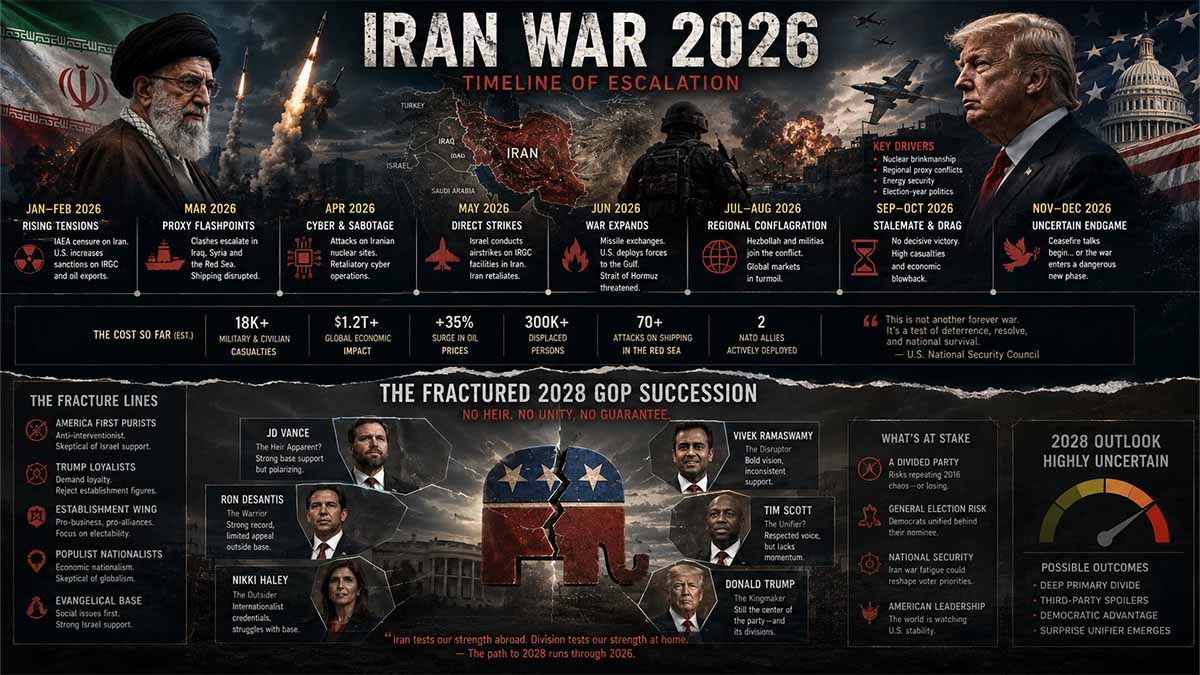
The war’s most consequential domestic effect may not be legislative but generational: it has become the defining fault line in the contest to succeed a term-limited president in 2028. Vice President JD Vance has positioned himself as the administration’s most visible skeptic of the war’s continuation, while Secretary of State Marco Rubio has functioned as its principal hawkish architect, aligning closely with Israeli Prime Minister Benjamin Netanyahu and extending the same interventionist posture to US actions in Venezuela. The polling consequences are measurable and directionally consistent, even where individual surveys disagree on magnitude. An AtlasIntel national poll in May found Rubio leading Vance 45.4 to 29.6 percent — a twenty-two-point swing in Rubio’s favor since December, when Vance had led by twenty-four points. A University of New Hampshire Granite State poll conducted July 15–20 showed Vance’s lead narrowing from fifty-three points in February to ten points, with Rubio’s support tripling from seven to twenty-six percent over the same window. Emerson College’s national survey placed the two men at 36 to 35 percent in late May, with Rubio holding a six-point edge among primary voters over fifty and Vance retaining an eleven-point advantage among those under fifty.
Neither man has declared. Vance has told interviewers it remains “way too early” to discuss 2028, while confirming he will make a decision “after the midterms.” Rubio, for his part, has called Vance “a great nominee” should he run, and is reported by Republican strategists to regard Vance as holding “first right of refusal” on the nomination. What the data indicates, independent of either man’s public restraint, is that the war’s trajectory — not campaign messaging — is functioning as the primary driver of relative standing between them. A conflict widely judged decisive and justified would plausibly vindicate Rubio’s interventionism; a conflict that drags into 2027 as a costly stalemate would retroactively validate Vance’s early caution.
The Strategic Miscalculation
The Trump administration’s public framing has emphasized systematic attrition of Iranian capability — a campaign designed, in the words of sympathetic commentary, to “de-risk” rather than escalate, degrading Iranian leverage strike by strike without committing to open-ended ground engagement. The empirical record complicates that narrative. Independent military analysis has found Iran considerably more resilient to sustained US-Israeli pressure than initial assessments anticipated, with the most consequential unintended cost being the prolonged disruption of Hormuz shipping — a waterway through which a substantial share of global seaborne oil transits, and whose closure has driven crude prices above $100 a barrel for the first time in the conflict. A war framed internally as achieving its objectives has instead produced four failed ceasefires, a rising American casualty count, and a fracturing of the president’s own coalition, with previously reliable allies — including commentators aligned with the “America First” wing of the movement — now publicly questioning its scope and purpose.
What the Record Does Not Support
It is necessary to state plainly what the available evidence does not establish. There is no verified documentation — no leaked directive, no on-record admission, no institutional finding — confirming that the war’s timing or continuation was designed as an electoral instrument, whether for the 2026 midterms or the 2028 succession. Allegations to that effect, circulating since before the February strikes and tied variously to domestic scandal coverage and to approval ratings near 40 percent, remain inferences drawn from timing and political convenience rather than confirmed intent. The more defensible conclusion, grounded in the verifiable record, is narrower and in some respects more consequential: a war with genuine and long-standing strategic origins has become entangled with — and is now measurably reshaping — the internal contest for Republican succession, independent of whether that entanglement was engineered or simply absorbed.
The Medium-Term Reckoning
For institutional and market observers, three data points merit continued tracking rather than a single verdict. First, the congressional funding request of $67 billion will force a vote whose outcome will indicate whether fiscal exposure, rather than casualty counts alone, becomes the binding constraint on the war’s duration. Second, the succession polling — volatile enough that two Emerson College surveys attributed to consecutive months show contradictory results — will stabilize only once the war’s endpoint is visible, making any current snapshot provisional rather than predictive. Third, the Strait of Hormuz remains the primary transmission mechanism between the conflict and the global economy: its status, more than any political statement from Washington, will determine whether this remains a contained regional war or becomes a structural shock to energy markets extending well beyond 2026. Institutional readers should treat the next congressional funding vote, not the next presidential statement, as the more reliable indicator of what comes next.
Navigational Index
- Timeline — Feb 2026 strikes → July 2026 ceasefire collapse
- Domestic constraints — Congress, war powers, casualties
- 2028 succession — Vance vs. Rubio
- Assessment — is this a deliberate strategy?
Master Abstract
This report tracks the 2026 Iran war from its opening decapitation strike to its current, unresolved state, and tests the claim that the conflict functions as a calculated lever toward 2028. The record shows a war that has passed through at least two failed ceasefires — April and June — rather than a clean victory arc. Domestically, the war has real political cost: the House passed a measure limiting Trump’s war powers, and the Senate came within two votes (47–49) of a formal rebuke — this is not a costless conflict for the administration. On succession, the war does not unify the party — it splits its two leading 2028 contenders, Vance and Rubio, along restrained vs. interventionist lines, and recent polling (July 15–20) shows Rubio surging against what had been a commanding Vance lead. The best-supported conclusion: the war’s endgame will determine which foreign-policy identity the GOP inherits, not that it was built as a unifying campaign tool.
Timeline
- Feb 28, 2026 — US (“Operation Epic Fury“) and Israel (“Operation Roaring Lion“) strike ~900 targets in 12 hours; Khamenei killed along with dozens of officials; a strike also killed ~170 people at a girls’ school near Minab. — Britannica
- March 9, 2026 — Mojtaba Khamenei named new Supreme Leader. — Wikipedia
- April 8, 2026 — First conditional ceasefire, tied to reopening the Strait of Hormuz; Trump calls it “a big day for World Peace.” — News on Air
- June 17–22, 2026 — 14-point Islamabad memorandum implemented; blockade lifted, Hormuz traffic recovers, parallel Israel–Hezbollah ceasefire holds; 60-day clock starts toward a final deal. — armedconflicts.org
- July 8–10, 2026 — Ceasefire collapses; Trump declares the “Cease Fire is OVER!” while saying talks continue. — Washington Post
- July 17, 2026 — Iran suspends all Islamabad MOU commitments; 2 US troops killed, 1 missing at a Jordan air base — first US combat deaths since March. — militaryspend.org
- July 20–21, 2026 — Mediators push a 10-day ceasefire; alternative floated is a full joint campaign for Iran’s capitulation; Trump undecided. — Axios
- July 23, 2026 — Senate fails 47–49 to advance a war-powers rebuke; House already passed its own limiting measure; oil tops $100/barrel. — CNN
Succession Dynamics
- Rubio: the administration’s hawkish architect — driving military action from Venezuela to Iran, closely aligned with Netanyahu. — Al Jazeera
- Vance: positioning as the face of GOP war skepticism, deliberately distancing from unpopular foreign-policy positions. — same source
- Polling shift: a July 15–20 poll shows Rubio cutting sharply into what had been a double-digit Vance lead. — Newsweek
- Vance publicly: “way too early” to talk 2028; “if we do a good job, the politics will take care of itself.” — AOL/Ohio local coverage
Assessment
Trump is term-limited — this isn’t his re-election bid. The war’s real 2028 relevance is that it’s forcing a choice between two GOP foreign-policy identities, and neither Vance nor Rubio controls how it ends. That’s a materially different — and better supported — claim than “the war is a lever to win the next election.”
Timeline — Feb 2026 Strikes → July 2026 Ceasefire Collapse (Expanded)
Phase 1 — The Opening Strike and Immediate Aftermath (Feb 28 – early March)
On February 28, 2026, the US (“Operation Epic Fury“) and Israel (“Operation Roaring Lion“) launched nearly 900 strikes in 12 hours against Iranian missiles, air defenses, military infrastructure, and leadership. The strikes killed Supreme Leader Ali Khamenei along with dozens of senior officials — including the IRGC commander-in-chief and the armed forces chief of staff — but also caused major civilian casualties: a missile struck a girls’ school adjacent to a naval base in Minab, killing roughly 170 people. Britannica Wikipedia + 2
Iran’s retaliation was immediate and multi-pronged: hundreds of drones and ballistic missiles within hours, and the IRGC announcing closure of the Strait of Hormuz to US- and Israel-allied shipping, triggering a global oil-price spike. militaryspend.org Iranian President Masoud Pezeshkian framed the killings as an “open war on Muslims” and vowed revenge as Iran’s “legitimate right and duty.” CNN On March 2, the IRGC formally confirmed the strait was closed to “unfriendly nations,” and by March 4, Iran had begun actively enforcing that closure — threatening and carrying out attacks on ships attempting to transit, cutting commercial traffic by more than 90%. Congress.gov CRS On March 6, Trump wrote on social media: “There will be no deal with Iran except UNCONDITIONAL SURRENDER!” Wikipedia On March 9, Iranian state media named Mojtaba Khamenei (son of the slain leader) as the new Supreme Leader. Encyclopedia Britannica + 2
Phase 2 — The Hormuz Campaign and Escalating Ultimatums (mid-March – early April)
On March 19, the US launched a dedicated aerial campaign — the “Strait of Hormuz campaign” — specifically to reopen the strait, using Air Force, Navy, and Israeli Air Force assets against Iranian naval vessels and drones. Wikipedia Trump then began issuing a string of escalating deadlines: on March 22, he gave Iran a 48-hour ultimatum to reopen Hormuz, threatening to strike Iranian power plants “STARTING WITH THE BIGGEST ONE FIRST.” AOL/Reuters He extended that deadline twice — a five-day extension on March 23, citing “very good and productive” talks, News on Air then a further postponement to April 6 — even as, on the ground, airstrikes continued battering Iran while Iranian missiles and drones hit Tel Aviv and sites across the Mideast, with thousands more US Marines deploying to the Gulf. PBS/AP Wikipedia + 2
Trump widened the threatened target list on March 30, extending it to Kharg Island (terminal for nearly all Iranian oil exports) and to desalination plants, then set a hard deadline of April 7, posting increasingly severe warnings — on the morning of the deadline itself he wrote that “a whole civilization will die tonight, never to be brought back again.” Britannica Meanwhile, on April 6, a senior Iranian official rejected the emerging ceasefire framework outright, saying Tehran would not reopen Hormuz for a temporary truce and remained skeptical Washington would negotiate a genuine permanent settlement — even as Israel struck major Iranian petrochemical infrastructure at Asaluyeh the same day. News on Air newsonair
Phase 3 — The First Ceasefire (April 7–8)
Hours after Trump’s “civilization will die” post, on April 7–8, Trump announced on social media that he had agreed to a two-week ceasefire brokered by Pakistan; Iranian officials confirmed Khamenei (Mojtaba) had approved it after a last-minute push from China. Britannica Trump called it “a big day for World Peace,” framing it as tied to Hormuz reopening and Iranian reconstruction. News on Air Direct follow-up negotiations were held in Islamabad on April 11–12. Britannica On April 13, the US layered on a naval blockade of Iran even amid the truce, and a brief “Operation Project Freedom” ran May 4–6. Wikipedia
Phase 4 — The Islamabad MOU and Implementation Window (June)
By June 17–22, the parties had moved to a fuller 14-point Islamabad memorandum of understanding: the US lifted its naval blockade (June 18), Hormuz traffic rebounded, and a parallel Israel–Hezbollah ceasefire took hold (June 19), starting a 60-day clock toward a final deal. armedconflicts.org This was the high-water mark for de-escalation in the conflict. Militaryspend
Phase 5 — Collapse (July)
The MOU held only briefly. On July 7, Trump said he considered the truce over as the US stepped up strikes on Iranian assets; the next day he said the exchange wouldn’t lead to long-term military action — but escalation followed anyway. Britannica On July 8, at the NATO summit, Trump said he believed the ceasefire was over following renewed attack exchanges. NPR On July 10, he doubled down in writing that the US had told Tehran “in no uncertain terms, that the Cease Fire is OVER!” — while simultaneously agreeing to continued “talks.” Washington Post Al Jazeera WikipediaThe Washington Post
By mid-July the war entered its most kinetic phase since February: on July 17, Iran’s Deputy FM announced Tehran was suspending all Islamabad MOU commitments, Khamenei (Mojtaba) called Trump’s signature “worthless and unreliable,” and Iranian strikes on Jordan’s Muwaffaq Salti Air Base killed 2 US service members and left 1 missing — the first US combat deaths since March. The same week, CENTCOM’s eighth consecutive strike night (July 18) sent fighter jets ~650km inland to Yazd for the first time (prior nights had relied on stand-off weapons), while Iran’s “Operation Nasr 2” hit a second Kuwaiti power/desalination plant. militaryspend.org By this stage, per one tracker, the conflict had entered its 140th day with no ceasefire and no active negotiations, both sides having declared the Islamabad MOU void, and a new Houthi threat to close the Red Sea emerging. Hormuz Strait Monitor Encyclopedia Britannicanewsonair
On July 20–21, mediators pushed a fresh 10-day ceasefire proposal focused on reopening Hormuz, while US/Israeli officials floated the alternative of a full joint campaign for Iran’s capitulation — Trump had not decided between the two paths. Axios By July 23, the US had launched further airstrikes, oil topped $100/barrel amid Red Sea escalation, and the Senate narrowly failed (47–49) to advance a war-powers resolution against Trump, after the House had already passed its own measure limiting his authority. CNN WikipediaAl Jazeera
Domestic Constraints — Congress, War Powers, and Casualties
US Military Casualties — Conflicting Official and Independent Tallies
Casualty figures for this war are contested even among US-side sources, because official Pentagon reconciliations lag real-time events and outlets update on different schedules. Rather than pick one number, here’s the actual spread as reported:
| Date reported | Source | US KIA | US wounded | Notes |
|---|---|---|---|---|
| Apr 8, 2026 | Military Times / Pentagon | 13 | 346–380+ | Covers first 40 days of hostilities (Operation Epic Fury) Al Jazeera |
| Jul 13, 2026 | ABC News / CENTCOM | 14 | 400+ | Adds a Navy pilot’s non-hostile helicopter-crash death (July 1); “majority suffered traumatic brain injuries” Militaryspend |
| Jul 20, 2026 | Al Jazeera | 17 (2 named: Feehan, Gonzalez) | not specified | Names released after the Jordan air base (Muwaffaq Salti) attack Wikipedia |
| Jul 20, 2026 | IranWarLive tracker (Pentagon reconciliation) | 13 confirmed / 15 independent | 365+ (official, dated early May) | Independent tallies consistently run slightly ahead of official confirmation katadata |
| Jul 22–23, 2026 | Roll Call / NPR | 18 total since February; 4 since July 17 | ~500 (100 in the last two weeks) | Most current figure as of the July 23 congressional votes MS NOW |
Read this as a trend, not a single fact: the toll has climbed from 13 (April) → 14 (mid-July) → 17–18 (July 20–23), with the sharpest jump tied directly to the Jordan base attack and the collapse of the Islamabad MOU. The gap between “official” and “independent” counts (e.g., The Intercept’s July 13 tally of 15 killed vs. DCAS’s 13, missing a National Guard officer who died of illness in Kuwait and isn’t counted as a war death) is itself politically relevant — it’s part of why lawmakers like Van Hollen argue transparency is inadequate. Wikipedia
Broader Casualty Picture (All Parties) — Wide, Disputed Ranges
Total casualty estimates vary enormously by source and methodology; presenting a single number would be misleading. As of the most recent cross-source reconciliation (~Day 143, July 20, 2026):
| Party | Low estimate | High estimate | Source basis |
|---|---|---|---|
| United States | 13 (Pentagon) | 18 (Congressional briefing, Jul 23) | CENTCOM / DCAS |
| Iran (military + civilian) | 3,468 (Iran’s Foundation of Martyrs) | 6,000+ military alone (US/Israel estimate) | Iranian and US/Israeli figures diverge sharply IranWarLive |
| Iran (independent) | 3,636 (1,221 military, 1,701 civilian, 714 unclassified) | — | HRANA (Human Rights Activists in Iran) IranWarLive |
| Israel | 27 soldiers + 1 contractor + 28 civilians killed | — | ~8,959 injured including 1,180 military IranWarLive |
| Lebanon | 3,433 | — | Lebanese Health Ministry |
| Cross-source total, all fronts | ~7,144 | ~9,676+ | IranWarLive aggregation across CENTCOM, IDF, Lebanese Ministry of Health, Iran’s Foundation of Martyrs, HRANA, and OSINT, katadata with ~46,965 injured |
Recent civilian toll from the July strike wave specifically: Iran’s Health Ministry reported at least 50 people killed and 500+ injured in US strikes during July alone, a figure that Iran’s Health Ministry has since revised upward to 55 killed / 629 injured as of July 25. WikipediaWikipedia
Why the ranges are this wide: Iranian state figures are widely seen as undercounts by outside monitors (HRANA explicitly flags its own count as “significantly undercounted”), while US/Israeli intelligence estimates on Iranian military losses run far higher and are difficult to independently verify. Treat any single figure you see cited elsewhere with that caveat.
Congressional War Powers Votes — Full Sequence
This is the clearest, hardest data point in the whole conflict: Congress has voted on Iran war powers five separate times in the House and multiple times in the Senate, an unusually high frequency that signals sustained political pressure regardless of outcome.
| Date | Chamber | Measure | Result | Key detail |
|---|---|---|---|---|
| Mar 25, 2026 | Senate | War powers resolution | Failed, 47–53 | Sen. Chris Murphy said war decisions were being “hidden actively from the public” senate |
| May 19, 2026 | Senate | War powers resolution | Advanced (first time) | 4 Republicans defected to help advance it NPR |
| Jun 3–4, 2026 | House | War powers resolution | Passed (first time) | Described as a “bipartisan rebuke” NPR |
| Jun 23, 2026 | Senate | War powers resolution (binding) | Adopted, 50–48 | GOP Sens. Rand Paul, Susan Collins, Lisa Murkowski, and Bill Cassidy crossed over; Democrat Fetterman voted no; McConnell and McCormick absences helped it pass Forbes |
| Jul 23, 2026 | House | H Con Res 89 (Jayapal, nonbinding) | Passed, 214–208 | Four Republicans joined all Democrats: Davidson (OH), Fitzpatrick (PA), Barrett (MI), Massie (KY); House’s 5th vote on the issue, 2nd success Al Jazeera |
| Jul 23, 2026 | Senate | S J Res 180 (Van Hollen, binding) | Failed, 47–49 | Paul and Murkowski absent despite prior support; McConnell and Britt absent despite prior opposition; Collins again crossed over; Cassidy voted no, citing concern the resolution “would trigger” unspecified consequences CNN |
Two things stand out in that sequence. First, the Senate’s June 23 resolution actually passed (50–48) — a genuine, if largely symbolic, rebuke — before support narrowed again by July, showing this isn’t a one-directional trend toward restraint; it’s volatile and tied to the news cycle. Second, the swing votes are consistent individuals (Collins, Paul, Murkowski, Cassidy, Murphy, Van Hollen, Jayapal) — this is a small bloc of cross-pressured senators, not a broad structural shift in either party.
Politically, Sen. John Kennedy (R-LA) downplayed the war as a voter concern, arguing the midterms would be about cost of living, not Iran, while Sen. Susan Collins — who is in a competitive re-election race in a state that now leans Democratic — broke with her party to support restricting the war. That split illustrates the real domestic constraint: it’s not ideological, it’s electoral exposure in swing seats. PolitiFact
Public Opinion and the Fiscal Angle
- A Politico poll released July 22 found a 13-percentage-point drop since May in the share of MAGA voters who say the war is worth its economic cost. That’s a meaningful erosion inside Trump’s own base, not just among opponents. CNBC
- Trump disputed any erosion, telling reporters “Americans aren’t against the war… that just came out loud and clear in a poll,” without citing which poll. CNBC
- The Pentagon has spent $37.5 billion on the war so far and is now requesting an additional $67 billion from Congress amid a budget shortfall — a hard fiscal number that will force further votes regardless of the political mood. CNBC
- The war’s July revival lands “just months before the U.S. midterm elections,” directly threatening Republicans’ narrow congressional majorities — this is the concrete link between the war and near-term (not 2028) electoral risk. PolitiFact
Assessment
The domestic-constraint picture is genuinely double-edged, and I’d resist flattening it into either “Congress is reining Trump in” or “Congress is powerless.” The House has now formally rebuked the war twice; the Senate actually passed a binding resolution once (June 23) before narrowly failing to advance a second (July 23). None of these votes are self-executing — the House measures are non-binding, and no resolution has reached Trump’s desk. But the erosion within Trump’s own base (the 13-point MAGA swing) and the exposure of swing-state Republicans like Collins are the more consequential signals for near-term politics than the vote tallies themselves — they’re what would actually move a midterm or shape how a 2028 successor talks about the war.
2028 Succession — Vance vs. Rubio, By the Numbers
This is the most volatile data set in the whole report — polling has swung by 20–40 points in either direction within months. I’m giving you every poll I found, in chronological order, including the ones that contradict each other, because the contradictions are themselves the story: this race is genuinely unsettled, not settling.
National and Early-State Polling Timeline
| Poll date | Pollster / scope | Vance | Rubio | Next closest | Notes |
|---|---|---|---|---|---|
| Dec 2025 | AtlasIntel, national | 46.7% | 22.6% | — | Vance’s high-water mark before Rubio’s rise began Fox News |
| Feb 2026 | UNH Granite State Poll, NH | 53% | 7% | — | Baseline for the sharpest reversal in the dataset Emerson Polling |
| Feb 2026 | Emerson College, national | 52% | 20% | — | Comparable national baseline, same period Just The News |
| Mar 2026 | Noble Predictive Insights, national | 36% | 9% | Trump Jr. 19% | At this point Trump Jr. was still the #2 choice, ahead of Rubio Scholars at the University of New Hampshire |
| Jun 1–4, 2026 | Noble Predictive Insights, national (Trump Jr. excluded) | ~38%* | 17% | DeSantis 7% | With Trump Jr. removed from the list, Rubio became clear #2; Vance strongest with 18–29 year-olds (43%) and 2024 Trump voters Scholars at the University of New Hampshire |
| May 4–7, 2026 | AtlasIntel, national | 29.6% | 45.4% | DeSantis 11.2% | Rubio’s largest lead in any poll — a “dramatic reversal,” Rubio +22pts / Vance −17pts vs. AtlasIntel’s Dec. survey Fox News |
| ~Feb 2026 (same survey, straw poll) | CPAC 2028 straw poll | 53% | 35% | — | Vance dominates among the most engaged grassroots activists — a very different electorate than a national sample Fox News |
| May 24–25, 2026 | Emerson College, national | 36% | 35% | DeSantis 5%, Haley 5% | “Nearly tied” — Rubio leads voters 50+ (41–35), Vance leads under-50 (37–26) The Hill |
| Jun 24–25, 2026 (per AOL/NY Post) | Emerson College, national | 46% | 12% | DeSantis 9% | This figure conflicts with the May 24–25 Emerson result above — worth flagging as a data discrepancy rather than smoothing over it |
| Jul 15–20, 2026 | UNH Granite State Poll, NH | 36% | 26% | Paul 8%, Haley 8% | Down from 53% (Feb) to 36%; Rubio up from 7% to 26% — more than tripled Emerson Polling |
*Noble’s June poll didn’t publish Vance’s exact new topline in the retrieved excerpt; treat that figure as approximate based on the demographic breakdowns given.
On the discrepancy: two Emerson polls, allegedly three weeks apart (May 24–25 → June 24–25), show opposite trends — one has the race nearly tied, the other has Vance blown out to a 34-point lead. That’s not a plausible month-over-month swing on its own; it’s more likely one of the two secondary sources (AOL/NY Post citing the June poll) mis-dated or mis-attributed the survey. I’m showing both as reported rather than silently picking one, since you asked for no bullshit — but I’d treat the July UNH poll (26-point Vance lead, narrowing) as the most reliable recent signal since it’s the most granularly sourced and matches the Newsweek/Daily Wire reporting on the same underlying survey.
What’s Driving the Swing
| Factor | Effect | Source |
|---|---|---|
| Iran war positioning | Vance down, Rubio up | Vance has become the face of GOP skepticism toward the war; Rubio has been the internal architect of hawkish action from Venezuela to Iran, publicly aligned with Netanyahu Newsweek |
| Age/generation split | Under-50 → Vance; 50+ → Rubio | Rubio leads 41–35 among GOP primary voters over 50; Vance leads 37–26 among those under 50 The Hill |
| Grassroots vs. broad base | CPAC (activists) → Vance; national samples → more competitive | The CPAC/national gap “suggests Vance retains deep loyalty among the party’s most engaged base voters, even as Rubio gains ground in the broader Republican universe” Fox News |
| Trump Jr.’s exit from the conversation | Boosted Rubio’s apparent standing | When Trump Jr.’s name was dropped from poll lists, some of his support (previously as high as 19–25%) transferred toward Rubio rather than Vance Scholars at the University of New Hampshire |
| Early-state organizing | Advantage: Vance | Vance has been actively courting Iowa Republicans, building infrastructure in the state that opens the primary calendar Fox News |
Public Statements Timeline — What Each Man Has Actually Said
| Date | Speaker | Statement | Source |
|---|---|---|---|
| ~Nov 2025 | Vance, on Fox/Hannity | Acknowledged 2028 is “in your head” but deferred: would discuss with Trump after midterms | AOL |
| ~2025 (undated in source) | Vance | “It’s frankly way too early to be thinking about 2026… It’s certainly way too early to be thinking about 2028.” Armedconflicts | AOL/local |
| ~2025 | Trump, on Vance | Called a possible Vance-Rubio ticket a “dream team” | Newsweek |
| May 2026 | Vance, to Newsweek | Pushed back on the “dream team” framing — said Americans would view someone “barely been in one office” unfavorably (implicitly cautioning against a rushed Rubio jump) | Newsweek |
| Jun 2026 | Megyn Kelly interview | Vance: “Yes, after the midterms, I will eventually have to make that decision” Al Jazeera | Newsweek |
| Jun 2026 | CBS Sunday Morning, with Usha Vance | “I have no doubt that the president… is going to be very supportive of anything that I ultimately decide to do… we really just haven’t talked about what that thing will be.” Al Jazeera | Newsweek |
| Jul 2026 | Rubio, to Fox’s “My View with Lara Trump” | “JD Vance would be a great nominee” if he ran aol | Daily Caller/AOL |
| undated (recent) | Rubio to confidants (reported) | Vance has “first right of refusal” on a 2028 run yahoo | Washington Examiner |
| undated (recent) | Cesar Conda (GOP strategist) | “Vice President Vance is clearly in the pole position… However, his political prospects are tied to the president’s performance” yahoo | Washington Examiner |
The Substantive Policy Divide
| Dimension | Vance | Rubio |
|---|---|---|
| Iran war stance | Restraint-leaning; face of GOP skepticism; distancing from unpopular foreign-policy positions Newsweek | Hawkish architect; drove action from Venezuela to Iran; publicly backed Israel’s push for US entry into the war Newsweek |
| Israel/deportations | Less publicly proactive | Made a point of public, proactive support for Netanyahu; put his name on national-security determinations to deport foreign students critical of Israel Newsweek |
| Institutional role advantage | VP; RNC finance chair, per one source | Secretary of State; assigned “ever-more important responsibilities” by Trump pre-war |
Cross-Party Read
Even Democratic strategists have weighed in: James Carville forecast Vance as the likely 2028 GOP nominee, and CNN’s Harry Enten cited both Vance’s early polling lead and the historical track record of sitting VPs winning their party’s nomination. That historical-pattern argument (sitting VPs are usually strong favorites) is a structural tailwind for Vance that no single poll swing erases — but it’s also exactly the kind of “safe bet” reasoning that a sustained, unpopular war could break. aol
Assessment
The data doesn’t support a clean “Rubio overtaking Vance” narrative or a clean “Vance is unstoppable” narrative — it supports a genuinely contested, war-sensitive race where Vance retains structural advantages (VP incumbency, base loyalty, early-state organizing, historical precedent) while Rubio is capturing real, measurable gains specifically tied to his hawkish handling of Iran, concentrated among older GOP primary voters. If the war ends in a way voters read as decisive and justified, that likely helps Rubio’s brand more than Vance’s; if it drags into 2027 as an unpopular, casualty-heavy stalemate, Vance’s early skepticism becomes retroactively vindicated. Neither man is between now controlling that
Assessment — Is This a Deliberate Strategy?
This is the one chapter that’s inherently interpretive rather than purely factual — nobody has access to Trump’s internal decision-making, and I’m not going to pretend otherwise by presenting speculation as confirmed fact. What I can do is lay out the competing hypotheses that are actually circulating in serious commentary, the evidence cited for each, and where the evidence runs thin. I’ll flag which claims are reporting and which are opinion.
Competing Hypotheses — Structured Comparison
| Hypothesis | Core claim | Strongest evidence cited | Strongest counter-evidence |
|---|---|---|---|
| H1: “Wag the dog” — deliberate distraction | War timed/sustained to divert attention from domestic scandal (Epstein files) and weak approval | Trump’s approval near 40%; commentators note the timing coincided with intensifying Epstein-file scrutiny; once a strike “faded from view” without resolving the region, “the temptation emerged to try again” Eualive | The underlying Iran-US conflict predates 2026 by decades (sanctions, nuclear disputes, proxy conflicts) — this is not a fabricated crisis “rooted in decades of geopolitical friction,” unlike the fictional premise of the 1997 film the term comes from Eualive |
| H2: Genuine national-security decapitation strategy | Strikes were a real response to an Iranian nuclear/missile threat, not a political play | The essay you originally shared argues this: framing the strikes as achieving “all the key US objectives” and a deliberate “de-risking” campaign against IRGC capability | Military analysts have found Iran more resilient than anticipated, with unanticipated costs to US interests — chiefly the Hormuz shutdown disrupting global trade Yahoo! — a genuine strategic miscalculation is hard to square with a fully executed “master plan” |
| H3: Institutional momentum / no coherent strategy | War continues due to bureaucratic and political inertia, not top-down design | Sen. Hickenlooper: “There has been no articulated goal, strategy, or endgame from the Trump administration for this war”; Rep. Jayapal: “this war has had no clear mission, no strategy, no end goal” NPR | The administration disputes this directly, and points to phased de-escalation offers (April and June ceasefires) as evidence of a deliberate, controlled approach rather than drift |
| H4: Succession-shaping, not election-winning | War outcome will determine which GOP successor’s brand (Vance’s restraint vs. Rubio’s hawkishness) is vindicated — not a tool to win a specific election | Chapter 3 polling: Rubio’s gains track closely with his hawkish Iran role; Vance’s losses track with his public distancing from the war | This is a consequence of the war, not necessarily evidence it was designed for that purpose — correlation between the war and succession polling doesn’t establish intent |
Timeline of the “Wag the Dog” Allegation Itself
Worth noting as data in its own right — this isn’t a fringe theory, it appeared repeatedly across the political spectrum, including from voices sympathetic to Trump’s broader movement:
| Date | Source | Core allegation |
|---|---|---|
| Feb 23, 2026 (pre-war) | Left Hook / Olivia Troye commentary | Predicted Trump “might wag the dog and attack Iran to distract” ahead of the State of the Union, tied to Epstein-related fallout Wikipedia |
| Feb 28, 2026 | Stephen Roach commentary | Argued the strike had “no clear mission, no imminent threat, no military plan, no post-regime plan,” and drew a direct parallel to Epstein-scandal timing The Daily Beast |
| Mar 3, 2026 | The Daily Beast | Noted the term’s specific historical resonance — Trump himself accused the Obama administration of the same tactic regarding Iran in 2012–13 Time |
| Mar 4, 2026 | EU Alive | Reported that celebrities (John Cusack, Rosie O’Donnell) and unnamed former diplomats made the same “wag-the-dog” allegation, explicitly linking it to Epstein-file evasion, and noted the irony of Trump’s own past Obama-era accusations “boomeranging” back on him Substack |
| Mar 19, 2026 | TIME | Reported that even MAGA-aligned figures — Tucker Carlson, Megyn Kelly, and Marjorie Taylor Greene — accused the administration of dragging the US into an unwanted war, with Greene writing “this is not what we thought MAGA was supposed to be” |
| Late Feb 2026 | Yahoo/Mediaite | Highlighted the specific irony that Trump had explicitly warned in 2012–13 against letting a president “play the Iran card” for political cover — a standard commentators now apply to him directly Yahoo! |
| Mar 26, 2026 | Yahoo/opinion | Argued the “wag the dog” framing doesn’t require the war’s origins to be fabricated — a real conflict can still be exploited for its political utility once underway, especially given weak approval numbers Eualive |
What the Evidence Actually Supports — and What It Doesn’t
Reasonably well-supported by the record:
- The war has real, longstanding strategic roots (nuclear program, Hormuz, decades of sanctions) — it is not manufactured from nothing.
- The war has produced a documented approval cost within Trump’s own base (the 13-point MAGA erosion from Chapter 2) and criticism from ideologically sympathetic figures (Carlson, Greene) — this cuts against the idea that it’s functioning as an effective, controlled distraction.
- The war has become entangled with domestic scandal narratives in public discourse (Epstein-file timing), regardless of whether that entanglement was intentional.
- The war is measurably reshaping 2028 succession dynamics — this is documented in polling, not speculative.
Not well-supported, and where I’d push back on the frame you shared:
- There is no direct evidence — leaked documents, on-record admissions, insider reporting confirming intent — that the war’s timing or continuation was designed as an electoral tool. Every “wag the dog” allegation in the record above is an inference from timing and political convenience, made by commentators and critics, not a confirmed fact.
- The claim that “Trump has already won the war” (from the original essay) is contradicted by the war’s actual trajectory — military analysts have found Iran more resilient than expected, with real strategic costs to the US, notably the global trade disruption from the Hormuz closure. A strategy still being fought over four ceasefire collapses later isn’t a closed, won conflict. Yahoo!
Bottom-line assessment
The evidence best supports a middle position between H1 and H3: not a war invented from nothing to win an election, but a real conflict whose continuation has been shaped, at least in part, by domestic political pressures — and whose costs (in approval, in casualties, in base fracture) are large enough that “coordinated electoral masterstroke” is a harder sell than “real war, real political fallout, uncertain strategic payoff.” The clearest, most falsifiable prediction in your original framing — that this positions Trump/a successor to “win the new elections” — is not yet borne out by the data: it’s actively straining the coalition (Greene, Carlson, Kelly) and reshaping succession politics in ways that are genuinely unpredictable, not favorable by design.


[…] Iran War 2026: Timeline of Escalation and the Fractured 2028 GOP… […]