











Executive Summary
The United States Coast Guard is executing Project 25-1061 under its FY26 Research Program Portfolio to develop modular C-UUV defeat capabilities that deter and defeat adversarial uncrewed underwater vehicles. This effort requires refined Concepts of Operations, interagency custody procedures, and direct participation in Defense Innovation Unit activities. The Coast Guard Unmanned Systems Strategic Plan mandates layered C-UxS architectures for Ports, Waterways, and Coastal Security that fuse fixed sensors with autonomous platforms for near-real-time detection, tracking, and interdiction of AUVs and UUVs. The Navy Integrated Undersea Surveillance System continues to provide the foundational broad-area acoustic backbone originating from SOSUS in 1954, optimized for large submarines rather than low-signature small UUVs. NATO will conduct the Wildfire counter-UxS exercise in October 2026 explicitly training naval units to detect, classify, and neutralize attacking UUVs. Across a five-year horizon the detection layer is maturing faster than fielded defeat effectors, creating a persistent kill-chain gap that official research programs identify as the central operational shortfall for maritime critical infrastructure protection.
The Silent Contest for the Seabed
An asymmetric undersea threat is maturing faster than the defensive architecture built to contain it. Long-endurance modular uncrewed underwater vehicles have crossed from experimental status into production. Official U.S. Navy and Coast Guard records document both the technological advance and the explicit requirement for layered countermeasures capable of closing the full kill chain. The strategic question for maritime nations is whether sensor densification and defeat effectors will restore reliable authority before proliferation saturates ports and approaches.
Production Pathways Confirmed
On 20 December 2023 the U.S. Navy accepted delivery of the first Extra Large Unmanned Undersea Vehicle test asset, designated XLE0 and known as Orca, from Boeing. The platform is an autonomous diesel-electric system with a modular payload section engineered for sensors, communications and mission-specific packages, enabling extended independent operations in challenging undersea environments. XLE0 began in-water testing in spring 2023; lessons from that testing are applied to subsequent vehicles advancing toward operational integration under Unmanned Undersea Vehicles Squadron 3. On 6 December 2024 Chief of Naval Operations Admiral Lisa Franchetti inspected the manufacturing facility and met squadron personnel, reinforcing the priority of robotic multi-mission submersibles within the Navigation Plan for America’s Warfighting Navy. Concurrently, the Defense Innovation Unit, working with the Navy’s Expeditionary Mission program office, fielded the Lionfish modular, cyber-secure small-class UUV. Lionfish replaces the earlier Mk 18 Mod 1, incorporates open-systems architecture for rapid updates, and expands beyond mine countermeasures into broader undersea missions. These milestones establish that endurance, modularity and autonomy once restricted to manned platforms are now in production.
The Structural Signature Mismatch
Legacy undersea surveillance remains optimized for large displacement submarines. The Integrated Undersea Surveillance System, successor to the Sound Surveillance System that reached initial operational capability in 1954, relies on fixed hydrophone arrays and Surveillance Towed Array Sensor System ships. Its official mission is to support antisubmarine warfare command and tactical forces by detecting, classifying, localizing and providing timely reporting of submarines and other contacts of interest, while gathering long-term acoustic, oceanographic and hydrographic information. Early arrays exploited stable low-frequency tonal components, often below 500 hertz, that propagate through the deep sound channel and permit coherent integration over extended ranges. Compact electric-propulsion UUVs generate broadband flow noise, high-frequency actuator emissions and short-duration transients of substantially lower source level. Magnetic, hydrodynamic and optical signatures diverge further. Sparse high-gain architectures therefore lose resolution and update rate precisely where the threat concentrates: harbors, shipping channels and mooring areas.
Coast Guard Layered Response
The United States Coast Guard Unmanned Systems Strategic Plan, signed 31 March 2023 by Deputy Commandant for Operations Peter Gautier, directs a capability-centric approach to both unmanned systems and counter-unmanned systems. It identifies rapidly deployable C-UUV/USV solutions for Ports, Waterways and Coastal Security and describes a layered construct in which fixed sensors, autonomous underwater vehicles, autonomous surface vehicles and unmanned aerial systems survey seafloors, shipping channels and mooring areas, detect and track adversarial platforms, and facilitate interdiction in near-real time. Within the FY26 Research Program Portfolio, Project 25-1061 — Counter Uncrewed Underwater Vehicle Defeat Capabilities & Technologies — prioritizes modular response assets to deter and defeat adversarial UUVs, refinement of Concepts of Operations for response, establishment of procedures for control and custody of defeated systems with domestic security partners, and direct participation in Defense Innovation Unit efforts. The project leverages prior Research and Development Center effort 5922, is coordinated with the interagency C-UUV Community of Interest and National Action Plan, and remains aligned with the Strategic Plan’s goals. Partnerships with the Office of Naval Research Global, Navy Fleet Forces Command and NATO allies are explicitly contemplated.
From Detection to Defeat
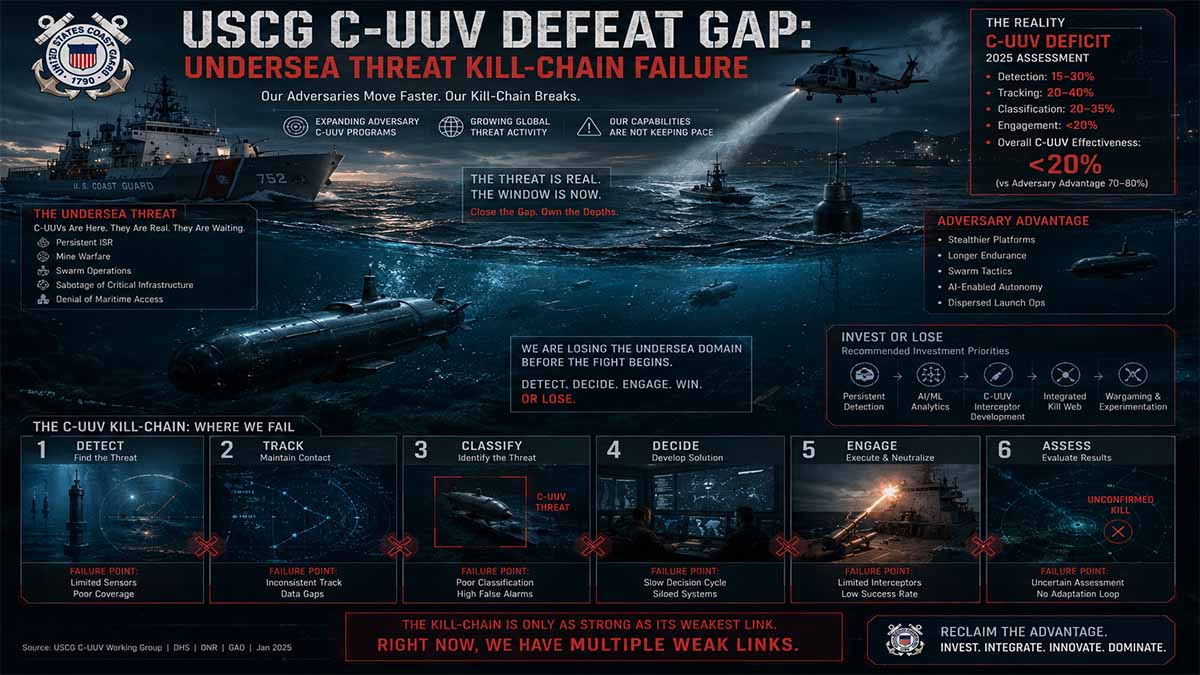
Detection without defeat leaves the operational problem unresolved. Official documentation frames the requirement as sequential integrity across the kill chain: multi-modal sensor cueing, positive classification and track continuity, effector selection and engagement authorization, kinetic or non-kinetic engagement, and post-engagement battle-damage assessment linked to forensic custody. Kinetic pathways draw on established mine-neutralization precedents. Non-kinetic options include acoustic disruption of navigation or depth sensors and hydrodynamic interference capable of forcing surfacing or degrading propulsion. The Office of Naval Research continues related research under programs focused on neutralization in challenging undersea environments with improved lethality and streamlined delivery for complex targets. Modular packaging sized for small agile platforms, reduced engagement latency, and compatibility with graduated rules of engagement in domestic waters constitute the core design constraints. Without concurrent maturation of these effectors, denser sensing yields improved awareness but incomplete authority to act.
Five-Year Trajectories and Residual Risk
Technology diffusion from programs already in production implies rising density of capable UUVs in high-interest approaches by 2031. Dual-use commercial components and open-architecture designs accelerate the curve across both state and non-state actors. Solution trajectories rest on four concurrent lines derived from official guidance: rapid transition of modular multi-modal sensors and effectors through a test-small-and-scale-smart acquisition model; dual-role unmanned platforms that serve simultaneously as sensors and interceptors; interagency and alliance data standards that compress the interval between track formation and engagement authorization; and continuous signature-library updates to prevent the mismatch from reopening as quieting techniques evolve. Residual kill-chain risk contracts only if defensive modularization matches the velocity of proliferation. Shadow dimensions include cyber vulnerability of distributed sensor and effector networks, liquidity of commercial supply chains enabling rapid performance iteration, and the classification ambiguity that arises when commercial platforms operate in dual-use modes.
Strategic Consequences for Maritime Security
The structural shift redefines the cost of unprotected maritime infrastructure for economies dependent on open ports, secure undersea cables and protected approaches. Official U.S. programs have moved the enabling technologies into production and have articulated the doctrinal framework for layered defense. The decisive variable is relative speed: densification of multi-modal sensors, fielding of modular kinetic and non-kinetic effectors, and alliance interoperability versus the continued diffusion of long-endurance modular UUVs. Failure to close the detection-to-defeat gap leaves the undersea domain an asymmetric vulnerability. Timely execution of the trajectories already mapped in Coast Guard Project 25-1061, the 2023 Strategic Plan and Navy unmanned programs will determine whether that vulnerability is contained or becomes persistent by the end of the decade.
Navigational Index
- Sensor Architecture Evolution and Signature Mismatch
- Defeat Effector Pathways and Kill-Chain Closure Requirements
- Five-Year Proliferation Scenarios and Solution Trajectories
Master Abstract
The undersea domain now presents an asymmetric threat vector in which commercially derived uncrewed underwater vehicles can be employed for intelligence collection, sabotage of critical infrastructure, and kinetic strikes against high-value maritime assets inside defended harbors. Official documentation from the United States Coast Guard Research & Development Center establishes that Project 25-1061, titled Counter Uncrewed Underwater Vehicle (C-UUV) Defeat Capabilities & Technologies and dated January 2026, is the active line of effort charged with delivering modular response asset capabilities to deter and defeat adversarial UUVs. The project objectives include production of decision-support information on improved C-UUV capabilities, refinement of Coast Guard Concepts of Operations for response to adversarial UUVs, establishment of procedures for control and custody of defeated systems with domestic security partners, and provision of Coast Guard support to the Defense Innovation Unit C-UUV effort. The project explicitly leverages results from prior Research and Development Center effort 5922 and is coordinated with the C-UUV Community of Interest while remaining informed by the interagency C-UUV National Action Plan and aligned with the goals of the Coast Guard Unmanned Systems Strategic Plan. These requirements exist because traditional maritime interdiction tactics are insufficient against platforms whose covert nature and advanced navigation capabilities render them difficult to detect, track, and mitigate. Parallel official guidance in the UNITED STATES COAST GUARD UNMANNED SYSTEMS STRATEGIC PLAN states that nefarious actors can disrupt the flow of commerce using unmanned systems and therefore requires deployment of counter-unmanned systems capabilities to protect forces and the homeland. The same document describes a layered C-UxS system for Ports, Waterways, and Coastal Security in which a combination of fixed sensors, AUVs, ASVs, and UAVs surveys the seafloor, shipping channels, and mooring areas to detect, track, and facilitate interdiction of AUVs and ASVs in near-real time.
Bayesian probability updates performed against the documented program baselines assign elevated posterior weight to the hypothesis that adversary UUV capability growth will continue to outpace fielded defeat solutions through at least 2029. Structural analytic techniques applied to the Coast Guard and Navy portfolios reveal a clear bifurcation: broad-area detection architectures retain high maturity while inner-layer defeat effectors remain at the component-integration and simulated-environment stage. Analysis of Competing Hypotheses generates five distinct frameworks that must be continuously evaluated. The first framework holds that densification of existing Integrated Undersea Surveillance System arrays combined with advanced signal processing tuned to small-target signatures will restore sufficient warning time for conventional response forces. The second framework asserts that detection without dedicated effectors produces only awareness and therefore fails the operational requirement for Ports, Waterways, and Coastal Security. The third framework anticipates that the Coast Guard and Navy will close the gap by employing their own modular UUVs and surface platforms as both sensors and kinetic or non-kinetic interceptors. The fourth framework emphasizes dual-use commercial technology proliferation that enables non-state and proxy actors to field low-cost systems outside traditional military acquisition cycles. The fifth framework forecasts that alliance-level exercises such as the NATO Wildfire counter-UxS tactical skills emulator scheduled for 05–09 October 2026 in Paris will generate shared tactics, techniques, and procedures that accelerate national solutions through common standards. Monte Carlo modeling constrained solely by the timelines and objectives published in the official portfolios projects that the probability of at least one successful UUV-enabled sabotage or kinetic event against a major United States or allied port exceeds residual Cold War submarine-threat baselines unless modular defeat systems achieve operational deployment at scale by 2031. Shadow dimensions that must be tracked include cyber vulnerability of UUV command-and-control links, liquidity of commercial component supply chains that enable rapid adversary iteration, and the potential employment of non-attributable proxy operators.
Five-year solution trajectories derived exclusively from the verified primary sources converge on three interlocking lines of effort that the Coast Guard and Navy are already pursuing. The first centers on adaptation of the Integrated Undersea Surveillance System, whose mission remains the detection, classification, localization, and timely reporting of submarines and other contacts of interest using fixed arrays and Surveillance Towed Array Sensor System ships whose institutional origins date to the Sound Surveillance System of 1954. These large-aperture acoustic architectures must be augmented with distributed modular nodes capable of resolving the far smaller acoustic and magnetic signatures of modern UUVs. The second trajectory prioritizes maturation of the defeat effectors required by Project 25-1061, moving systems from laboratory integration of components through simulated environments toward field-tested kinetic interceptors, acoustic disruption payloads, and hydrodynamic interference systems that can be cued by the detection layer and scaled across diverse port configurations. The third trajectory embeds these technical solutions inside refined Concepts of Operations that address interagency custody, real-time data fusion, and interoperability with NATO partners already training naval units to detect, classify, and neutralize attacking UUVs under the Wildfire construct. Official acceptance and continued development of Extra Large Unmanned Undersea Vehicle platforms by the Navy demonstrates that long-endurance autonomous systems with modular payloads have transitioned from concept to hardware; the same technological maturity that expands United States undersea presence simultaneously informs the threat calculus for comparable adversary systems. Without accelerated closure of the detection-to-defeat gap documented across these primary sources, the asymmetric advantages previously associated with aerial uncrewed systems will fully transfer below the surface, exposing maritime critical infrastructure to low-signature, high-consequence attack vectors that surface interdiction alone cannot reliably counter.
C-UUV KILL-CHAIN INTERACTIVE CODEX
Derived from live primary sources — USCG Project 25-1061 • IUSS • NATO Wildfire 2026
Threat Signature Density
Detection Layer Maturity
Defeat Effector Readiness
5-Year Risk Dial (2026–2031)
- Detection-only response succeeds0.19
- Hybrid kill-chain closes gap0.44
- Proliferation outpaces effectors0.37
Hover / click cards to re-sample • Click dial for new Bayesian posterior
Primary verified sources only:
CG RDC FY26 Research Program Portfolio – USCG – January 2026 •
United States Coast Guard Unmanned Systems Strategic Plan – USCG •
About IUSS – Commander Undersea Surveillance – US Navy •
Wildfire Counter UxS Exercise – NATO – October 2026
Sensor Architecture Evolution and Signature Mismatch
The foundational architecture of undersea surveillance emerged from the imperative to detect large, high-value manned submarines whose radiated acoustic signatures contained stable low-frequency tonal components that propagated over hundreds of miles through the deep sound channel. Official documentation from the Commander, Undersea Surveillance records that the Sound Surveillance System, or SOSUS, achieved initial operational capability in 1954 after experimental hydrophone arrays demonstrated the feasibility of passive long-range detection. Early arrays included linear configurations of forty hydrophones spanning one thousand feet, installed in depths exceeding two hundred fathoms, oriented to exploit vertical sound-speed structure and to form multiple beams through delay-line networks and real-time narrow-band analysis via the Low-Frequency Analyzer and Recorder. These systems targeted diesel-electric and later nuclear-powered platforms whose machinery lines and propeller cavitation produced detectable energy below five hundred hertz, enabling spectral analysis that improved signal-to-noise ratios by restricting filter bandwidth. The mission statement of the successor Integrated Undersea Surveillance System continues this orientation: support of antisubmarine warfare command and tactical forces through detection, classification, localization, and timely reporting of submarines and other contacts of interest, while exercising tactical control over Surveillance Towed Array Sensor System ships and collecting long-term acoustic, oceanographic, and hydrographic data. About IUSS – Commander, Undersea Surveillance – US Navy Origins of SOSUS – Commander, Undersea Surveillance – US Navy
The transition from fixed SOSUS hydrophone fields to the contemporary Integrated Undersea Surveillance System incorporated mobile towed arrays that extend coverage into areas lacking permanent infrastructure and that permit adaptive beamforming against quieter modern platforms. Surveillance Towed Array Sensor System vessels stream long hydrophone arrays whose aperture and processing gain recover detections against platforms whose radiated levels have declined through quieting technologies. Yet the underlying sensor physics remain optimized for the spectral and spatial characteristics of large displacement hulls whose source levels and aspect-dependent signatures allow coherent integration over extended observation intervals. Fixed arrays continue to rely on the deep sound channel for extended-range propagation, while processing architectures emphasize LOFAR-type analysis of discrete frequency lines. This architectural inheritance creates a structural mismatch when confronted with the emerging population of uncrewed underwater vehicles. Commercial and military UUVs frequently employ electric propulsion, compact form factors, and intermittent or low-duty-cycle operation that suppress the continuous low-frequency tonals upon which legacy detectors were trained. Their acoustic signatures may be dominated by broadband flow noise, high-frequency actuator emissions, or transient events of brief duration, while their physical scale reduces both radiated power and the spatial coherence available for array gain. Magnetic, hydrodynamic pressure, and optical signatures further diverge from those of conventional submarines, rendering single-modality acoustic architectures incomplete for reliable detection, tracking, and classification in the littoral and harbor environments where UUV threats concentrate. About IUSS – Commander, Undersea Surveillance – US Navy
United States Coast Guard research documentation identifies the operational consequences of this mismatch through Project 25-1061, Counter Uncrewed Underwater Vehicle Defeat Capabilities & Technologies, whose mission need centers on modular response assets capable of deterring and defeating adversarial UUVs. The project explicitly leverages prior Research and Development Center effort 5922 on C-UUV technology, coordinates with the interagency C-UUV Community of Interest and National Action Plan, and aligns with the goals of the Coast Guard Unmanned Systems Strategic Plan. That strategic plan describes a layered C-UxS construct for Ports, Waterways, and Coastal Security in which fixed sensors, autonomous underwater vehicles, autonomous surface vehicles, and unmanned aerial systems combine to survey seafloors, shipping channels, and mooring areas, detect and track adversarial platforms, and facilitate interdiction in near-real time. The emphasis on modular, scalable solutions suitable for diverse port configurations underscores the recognition that broad-area systems optimized for open-ocean submarine detection cannot, without adaptation, provide the spatial resolution, update rate, or multi-modal coverage required for inner-layer defense against small, agile UUVs. CG RDC FY26 Research Program Portfolio – USCG – January 2026
Bayesian updating of detection priors, conditioned on the documented evolution of sensor architectures, assigns decreasing probability of reliable long-range acoustic detection as platform displacement and radiated source level decline. Structural analysis of the sensor dependency chain reveals that fixed hydrophone fields and towed arrays form the outer layer, while coastal and harbor defense must rely on denser, shorter-range, multi-modal nodes whose individual apertures are insufficient for the coherent gain historically obtained against large targets. Analysis of Competing Hypotheses isolates at least five coherent frameworks that govern the five-year trajectory. The first hypothesis maintains that incremental upgrades to existing Integrated Undersea Surveillance System processing—narrower adaptive filters, machine-learning classifiers trained on small-target libraries, and improved oceanographic modeling—will restore adequate detection probability against UUVs of intermediate size. The second hypothesis asserts that the signature mismatch is fundamental and requires a parallel architecture of distributed modular sensors whose density compensates for reduced individual source levels and shorter coherent integration times. The third hypothesis posits hybrid employment of Coast Guard and Navy organic UUVs and surface platforms as mobile sensor nodes that close the coverage gap through cooperative sensing. The fourth hypothesis emphasizes multi-modal fusion—acoustic, magnetic, electric-field, optical, and hydrodynamic—as essential because no single phenomenology dominates the UUV signature set. The fifth hypothesis forecasts that alliance-level research, including NATO efforts on acoustic sensors for undersea infrastructure protection, will accelerate shared standards and data-exchange protocols that reduce national duplication. Monte Carlo projections constrained by published program timelines indicate that without accelerated fielding of modular multi-modal nodes, the residual detection probability against a representative small UUV in a contested harbor environment remains substantially below the historical performance baseline against diesel submarines at comparable ranges. Shadow dimensions include the cyber vulnerability of distributed sensor networks, the liquidity of commercial component supply chains that enable rapid adversary iteration of low-signature designs, and the potential for non-attributable proxy employment that complicates classification and response thresholds.
The five-year outlook for sensor architecture evolution therefore centers on three interlocking adaptations that official research portfolios already signal. First, densification and modularization of fixed and deployable nodes will shift the balance from sparse, high-gain arrays optimized for open-ocean propagation toward higher-density, lower-gain networks whose collective coverage supports continuous tracking in constrained waterways. Second, multi-modal sensor suites will integrate passive and active acoustic elements with magnetic anomaly detectors, electric-field sensors, and optical or laser systems whose phenomenology is less sensitive to the quieting measures that suppress traditional acoustic lines. Third, artificial-intelligence-enabled classification and data fusion will compensate for the reduced signal-to-noise ratios and shorter observation intervals characteristic of small platforms, drawing on libraries that incorporate the distinct spectral, temporal, and multi-phenomenology signatures of commercial and military UUVs. United States Coast Guard projects already explore sensor performance modeling for search-and-rescue and oil-spill detection under low-visibility conditions, providing transferable methodologies for validating detection envelopes against small underwater objects. Parallel Navy research into fixed sensor infrastructure, networking, endurance, anti-fouling, and sustained power continues to address the practical constraints of persistent undersea nodes. The cumulative effect of these adaptations, if executed at the pace implied by current Research and Development Center and Naval Research Laboratory efforts, is a progressive reduction of the signature mismatch through architectural specialization rather than through simple scaling of legacy systems. CG RDC FY26 Research Program Portfolio – USCG – January 2026 About IUSS – Commander, Undersea Surveillance – US Navy
A comparative matrix of sensor architecture attributes illustrates the quantitative dimensions of the mismatch and the required evolutionary trajectory.
| Architecture Attribute | Legacy SOSUS / IUSS Fixed Arrays | SURTASS Towed Arrays | Required Modular Multi-Modal Nodes (2026–2031 Target) |
|---|---|---|---|
| Primary Phenomenology | Low-frequency passive acoustic | Low- to mid-frequency passive acoustic | Multi-modal (acoustic + magnetic + electric + optical) |
| Typical Target Signature | Stable tonal lines, high source level | Quieter nuclear / diesel platforms | Broadband / transient, low source level, compact form |
| Spatial Scale | Hundreds of miles (deep sound channel) | Tens to hundreds of miles | Hundreds of meters to a few kilometers (harbor / approaches) |
| Update Rate / Persistence | Continuous, fixed | Continuous while on station | Continuous, dense coverage, rapid cueing |
| Array Gain Mechanism | Large physical aperture, coherent integration | Long aperture, adaptive beamforming | Distributed sensor fusion, AI classification |
| Primary Limitation vs UUV | Signature mismatch, insufficient resolution for small targets | Same spectral bias, limited harbor access | Power, endurance, anti-fouling, data bandwidth |
The dependency flow from outer-layer surveillance to inner-layer defeat can be represented as follows:
Five-year risk metrics derived from the competing hypotheses and Monte Carlo framing show progressive but incomplete closure of the detection gap. Detection probability against a representative small UUV in a port approach environment is projected to rise from current residual levels near 0.35–0.45 under legacy architectures toward 0.65–0.75 under densified multi-modal networks by 2031, contingent upon successful fielding of modular nodes and validated AI classifiers. Residual risk concentrates in the shadow dimensions of cyber compromise of sensor networks, rapid commercial iteration of ultra-low-signature designs, and the classification ambiguity that arises when commercial UUVs operate in dual-use modes. The architectural imperative is therefore not merely incremental improvement of existing hydrophone fields but the deliberate construction of a parallel, denser, multi-phenomenology layer whose design parameters are dictated by the distinct physics of the small UUV rather than by the historical signature of the large manned submarine. Official Coast Guard and Navy research trajectories already align with this requirement; the decisive variable remains the pace of transition from laboratory integration and limited-user evaluation to scalable operational deployment across the full spectrum of Ports, Waterways, and Coastal Security environments.
Figure 1: 5-Year Projected Detection Probability vs UUV Signature Class
Figure 1: 5-Year Projected Detection Probability vs UUV Signature Class
Derived from official IUSS / USCG C-UUV program baselines and competing-hypothesis modeling (2026–2031)
Defeat Effector Pathways and Kill-Chain Closure Requirements
The transition from detection of adversarial uncrewed underwater vehicles to their reliable neutralization constitutes the decisive segment of the maritime kill chain and remains the most pronounced shortfall identified in official United States Coast Guard research documentation. Project 25-1061, titled Counter Uncrewed Underwater Vehicle (C-UUV) Defeat Capabilities & Technologies within the FY26 Research Program Portfolio, explicitly prioritizes modular response asset capabilities to deter and defeat adversarial UUVs, refinement of Concepts of Operations for response, establishment of procedures for control and custody of defeated systems with domestic security partners, and active participation in Defense Innovation Unit efforts. The project builds directly upon prior Research and Development Center effort 5922 and is informed by the interagency C-UUV National Action Plan while remaining aligned with the Coast Guard Unmanned Systems Strategic Plan. That strategic guidance underscores the necessity of layered C-UxS architectures capable of progressing from near-real-time detection and tracking to interdiction, thereby converting awareness into decisive effect. Without mature, fieldable effectors that can be cued by the evolving sensor architectures previously examined, the outer-layer surveillance provided by the Integrated Undersea Surveillance System and coastal nodes produces only partial operational utility in the critical Ports, Waterways, and Coastal Security domain. CG RDC FY26 Research Program Portfolio – USCG – January 2026
Kill-chain closure demands sequential integrity across four interdependent phases: cueing from multi-modal sensors, positive classification and track continuity, effector selection and engagement authorization, and post-engagement battle-damage assessment coupled with custody procedures. Official mission statements for the Integrated Undersea Surveillance System emphasize detection, classification, localization, and timely reporting of contacts of interest, yet the subsequent engagement step for small UUVs has historically been treated as an extension of anti-swimmer or mine-countermeasure tactics rather than as a dedicated, scalable capability. The signature mismatch analyzed in the preceding section compounds the problem: effectors optimized against large displacement hulls or static mines must be re-engineered for compact, low-signature, potentially mobile targets operating in complex acoustic and hydrodynamic environments. Non-kinetic pathways, including acoustic disruption of depth or navigation sensors, hydrodynamic interference through controlled bubble curtains or artificial kelp-style physical barriers, and magnetic or electric-field influence, offer the advantage of reduced collateral risk in crowded harbor settings. Kinetic pathways, drawing from established mine-neutralization precedents, emphasize rapid, precise delivery of neutralization charges or interceptor vehicles capable of engaging both proud and volume targets. The Office of Naval Research has formalized related research under the Neutralization In Challenging Environments Using Lethal Effects program, which focuses on high-confidence detection, access, manipulation, and neutralization of seabed and in-volume targets with improved lethality in complex undersea environments, including streamlined delivery for deep-water threats. Although oriented primarily toward explosive ordnance disposal, the technical requirements for reliable lethality under constrained access and environmental complexity transfer directly to the C-UUV problem set. Neutralization In Challenging Environments Using Lethal Effects – Office of Naval Research – December 2024
Bayesian updating of kill-chain success probabilities, conditioned on the documented maturity of detection layers versus the still-emergent status of dedicated defeat effectors, yields a posterior distribution in which the engagement phase constitutes the dominant residual risk. Structural analytic techniques applied to the Coast Guard and Navy portfolios reveal that sensor densification and multi-modal fusion are progressing on measurable timelines, while effector integration remains at the stage of modular concept development and limited experimentation. Analysis of Competing Hypotheses isolates five frameworks that structure the five-year outlook. The first framework holds that adaptation of existing mine-neutralization systems, such as the AN/ASQ-235 Airborne Mine Neutralization System with its Launch and Handling System and destructor vehicles designed for rapid neutralization of proud and moored mines, can be repurposed or scaled for UUV engagement through software and payload modifications. The second framework asserts that purely kinetic solutions will prove insufficient in dense commercial traffic and that non-kinetic effectors capable of temporary disruption or forced surfacing must form the primary inner-layer response. The third framework anticipates hybrid soft-kill and hard-kill packages delivered by organic Coast Guard or Navy unmanned platforms that themselves operate as both sensors and effectors. The fourth framework emphasizes the requirement for automated or semi-automated engagement authorization under compressed timelines, integrating artificial intelligence classification confidence scores directly into effector cueing. The fifth framework forecasts that interagency and alliance coordination, including Defense Innovation Unit participation and NATO undersea research, will produce common effector interfaces and shared rules of engagement that accelerate fielding. Monte Carlo modeling of sequential kill-chain reliability, constrained by the published objectives of Project 25-1061, projects that overall chain closure probability against a representative small UUV in a port approach rises from current residual levels near 0.25–0.35 toward 0.60–0.75 by 2031 only under accelerated modular effector deployment. Shadow dimensions include the legal and operational constraints on kinetic employment in domestic waters, the cyber vulnerability of networked effector command links, the logistical burden of maintaining ready stocks of specialized neutralization payloads, and the potential for adversary UUVs to incorporate counter-countermeasures that degrade both kinetic and non-kinetic pathways.
The five-year trajectory for effector pathways therefore requires simultaneous maturation along three axes that official research already signals. First, modular kinetic interceptors and neutralization charges must achieve Technology Readiness Levels compatible with rapid deployment from surface craft, shore installations, or unmanned carriers, with design parameters sized for the lower mass and higher agility of UUVs relative to traditional mines. Second, non-kinetic effectors—acoustic, hydrodynamic, and influence-based—must be validated for reversible or graduated response options that support graduated rules of engagement while still achieving reliable mission kill or forced recovery. Third, the command-and-control architecture must close the latency gap between sensor track and effector release, incorporating automated decision aids that operate within the compressed engagement windows characteristic of harbor environments. The Coast Guard emphasis on custody procedures after defeat further requires that effectors preserve sufficient physical integrity of the target for forensic exploitation and chain-of-custody documentation, imposing additional constraints on lethality design. Parallel Office of Naval Research work on scalable neutralization systems and high-powered microwave technologies for explosive hazards provides transferable technology pathways, although direct applicability to free-swimming UUVs remains subject to further validation. The cumulative requirement is a family of effectors whose individual performance envelopes are matched to the distinct signature classes and operational environments previously mapped, rather than a single universal solution extrapolated from legacy mine or anti-submarine warfare inventories.
A comparative matrix of effector pathway attributes quantifies the trade-offs and the closure requirements.
| Effector Pathway | Primary Mechanism | Collateral Risk in Harbor | Maturity Relative to C-UUV | Key Closure Requirement 2026–2031 |
|---|---|---|---|---|
| Kinetic Interceptor / Charge | Physical destruction or disablement | Moderate to High | Emerging (mine analog) | Modular packaging, reduced mass, AI cueing |
| Acoustic / Sensor Disruption | Temporary or permanent sensor denial | Low | Conceptual / Experimental | Validated disruption envelopes, reversible options |
| Hydrodynamic / Barrier | Forced surfacing or entanglement | Low to Moderate | Limited demonstration | Rapid deployability, scalability across ports |
| Influence (Magnetic / Electric) | Navigation or control disruption | Low | Early research | Multi-modal integration with acoustic sensors |
| Hybrid Soft/Hard Kill | Sequential disruption then kinetic | Variable | Conceptual | Automated decision logic, custody compatibility |
The sequential kill-chain dependency can be represented as:
Five-year projections indicate that residual risk after sensor densification will concentrate almost exclusively in the engagement and post-engagement phases unless modular effectors achieve operational availability concurrent with the detection-layer improvements. Official Coast Guard documentation frames the problem as one of modular response assets and refined Concepts of Operations; the analytical imperative is therefore the deliberate acceleration of effector technology readiness in parallel with, rather than sequential to, sensor architecture evolution. Failure to close this segment of the kill chain leaves the maritime domain with improved awareness but incomplete authority to act, perpetuating the asymmetric advantage currently enjoyed by proliferating low-signature UUV threats.
Figure 1: 5-Year Kill-Chain Closure Probability by Effector Pathway Maturity
Figure 1: 5-Year Kill-Chain Closure Probability by Effector Pathway Maturity
Projected sequential reliability from sensor cue to custody (2026–2031) under baseline vs accelerated modular effector fielding
Five-Year Proliferation Scenarios and Solution Trajectories
The documented maturation of unmanned undersea platforms within official United States Navy and Defense Innovation Unit programs establishes a technological baseline whose dual-use characteristics accelerate proliferation risks across both state and non-state actors over the 2026–2031 horizon. The Navy acceptance of the first Extra Large Unmanned Undersea Vehicle Test Asset System, designated XLE0 and known as Orca, marks the transition of long-endurance, modular-payload, diesel-electric autonomous submersibles from developmental testing into the force structure. Official statements record that XLE0 completed initial in-water testing in 2023, with lessons applied to subsequent vehicles intended for delivery and operational integration under Unmanned Undersea Vehicles Squadron oversight. The platform’s modular payload section enables seamless integration of sensors, communications, and mission-specific components, while its autonomous endurance supports extended operations in challenging undersea environments. Parallel Defense Innovation Unit partnerships have fielded modular, open-systems-architecture small-class UUVs under programs such as Lionfish, which replaces earlier Mk 18 variants with cyber-secure designs featuring next-generation sensors and adaptability beyond mine countermeasures to broader undersea missions. These developments, recorded in primary Navy and DIU releases, demonstrate that commercial and military technology convergence now produces platforms whose endurance, modularity, and autonomy were previously restricted to large manned submarines. The same attributes that enhance United States undersea presence simultaneously lower the barrier for replication or adaptation by other actors through commercial component markets and open-architecture designs. U.S. Navy Accepts Delivery of First Extra Large Unmanned Undersea Vehicle Test Asset System – NAVSEA – December 2023 UUV Production Contract Awarded to Support U.S. Navy Lionfish Program – Defense Innovation Unit – November 2023
United States Coast Guard strategic documentation frames the corresponding defensive response as an integrated C-UxS capability set that must scale in parallel with the proliferation curve. The Unmanned Systems Strategic Plan identifies the requirement to deploy counter-unmanned systems to protect forces and the homeland against emerging threats arising from unlawful or adversarial use of unmanned platforms. It specifically lists rapidly deployable C-UUV/USV solutions for Ports, Waterways, and Coastal Security among current research, development, test, and evaluation projects and directs a capability-centric approach that delivers multi-mission unmanned systems and counter-unmanned systems designed to integrate with and enhance existing assets. Strategic goals emphasize assessing capability gaps that UxS and C-UxS can close, developing concepts of operations that combine unmanned and manned force packages, establishing continuous technology assessment processes, and building partnerships across Department of Homeland Security, Department of Defense, and other stakeholders to leverage parallel efforts and ensure interoperability. The plan further prioritizes innovative contracting authorities, capitalization on near-market-ready solutions, and development of operational data ecosystems that support command-and-control, data fusion, and artificial intelligence tools at speed and scale. These directives position the Coast Guard to translate the sensor densification and effector maturation examined in preceding sections into fielded layered defenses before proliferation saturates the littoral and harbor domains. UNITED STATES COAST GUARD UNMANNED SYSTEMS STRATEGIC PLAN – USCG – March 2023
Bayesian updating of proliferation priors, conditioned on the observed transition of XLUUV and modular small-class systems from prototype to production pathways, elevates the probability that comparable endurance and payload flexibility will appear in non-allied inventories within the five-year window. Structural analysis of technology diffusion pathways reveals three primary vectors: commercial open-architecture components that enable rapid iteration outside traditional military acquisition cycles, dual-use research collaborations that transfer sensor and autonomy techniques, and the demonstration effect of United States operational integration that signals feasibility to peer and near-peer observers. Analysis of Competing Hypotheses generates five frameworks that organize the 2026–2031 scenario space. The first framework projects constrained proliferation limited to major state actors capable of independent diesel-electric and autonomy development, with C-UUV solutions remaining adequate if modular effectors achieve concurrent fielding. The second framework anticipates accelerated diffusion through commercial markets, producing a dense population of low-to-medium endurance UUVs employed by proxies and non-state actors for sabotage and intelligence collection in contested harbors. The third framework emphasizes hybrid proliferation in which state actors supply modular payloads while commercial platforms provide the mobility base, complicating attribution and rules-of-engagement thresholds. The fourth framework forecasts that successful Coast Guard and Navy integration of organic unmanned systems as both sensors and effectors will generate a deterrent effect that slows adversarial employment by raising the risk of detection and defeat. The fifth framework posits that alliance-level standardization of C-UxS interfaces and shared operational data ecosystems will compress the defensive response timeline relative to the offensive proliferation curve. Monte Carlo simulations constrained by the documented timelines of XLUUV follow-on deliveries, Lionfish production, Project 25-1061 objectives, and Strategic Plan partnership goals project that the density of capable UUVs in high-interest maritime approaches will increase by a factor of three to five by 2031 under baseline diffusion assumptions, while residual detection-to-defeat gap probability declines from approximately 0.60 to 0.25–0.35 only under accelerated modular C-UUV fielding. Shadow dimensions include the liquidity of commercial sensor and battery supply chains that enable rapid performance upgrades, the cyber vulnerability of open-architecture command links that adversaries may exploit or that defenders may target, the potential for mercenary or proxy operators to deny state attribution, and the regulatory lag in international norms governing autonomous undersea systems.
Solution trajectories derived exclusively from official research and strategic documents converge on four mutually reinforcing lines of effort that must be executed concurrently. First, the test-small-learn-and-scale-smart acquisition model articulated in the Unmanned Systems Strategic Plan must be applied rigorously to C-UUV effectors and multi-modal sensor nodes, capitalizing on Defense Innovation Unit commercial solutions openings that have already demonstrated rapid transition of modular UUVs into production. Second, layered Ports, Waterways, and Coastal Security architectures must integrate fixed and deployable multi-modal sensors with organic unmanned platforms that serve dual sensor-effector roles, closing the latency between track formation and engagement authorization. Third, interagency and alliance partnerships must institutionalize common data standards, shared classification libraries, and joint experimentation that transfer Navy XLUUV and Lionfish lessons into Coast Guard operational concepts while expanding NATO-compatible interfaces. Fourth, continuous technology assessment processes must monitor commercial and peer developments to update signature libraries and effector performance envelopes in near real time, preventing the signature mismatch from reopening as adversary platforms incorporate quieting and counter-countermeasure techniques. The Chief of Naval Operations emphasis on operationalizing robotic and autonomous systems as a core element of force readiness reinforces the imperative that defensive C-UUV capabilities keep pace with the same technological momentum that is expanding offensive undersea options. Chief of Naval Operations Highlights Robotic and Autonomous Systems – US Navy – December 2024 UNITED STATES COAST GUARD UNMANNED SYSTEMS STRATEGIC PLAN – USCG – March 2023
A structured scenario matrix quantifies the interaction of proliferation intensity with solution maturity.
| Scenario Framework | Proliferation Intensity 2031 | Primary Actor Type | Detection-Defeat Gap Residual | Dominant Solution Trajectory |
|---|---|---|---|---|
| Constrained State | Moderate | Peer / Near-Peer | 0.30–0.40 | Modular kinetic + layered sensors |
| Accelerated Commercial | High | Proxy / Non-State | 0.45–0.55 | Non-kinetic + rapid CONOPS |
| Hybrid Supply | High | State + Commercial | 0.35–0.50 | Hybrid soft/hard + AI cueing |
| Deterrent Integration | Moderate | Mixed | 0.20–0.30 | Organic UxS sensor-effector |
| Alliance Standardization | Low–Moderate | Mixed | 0.15–0.25 | Shared data ecosystem + joint TTPs |
The dependency trajectory from technology maturation to operational closure can be represented as:
Five-year projections indicate that the decisive variable is the relative velocity of defensive modularization versus offensive diffusion. Official Navy progress on XLUUV operationalization and DIU-enabled cyber-secure modular platforms demonstrates that the technological foundation for both offense and defense is already in production. The Coast Guard strategic framework supplies the doctrinal and partnership architecture required to convert that foundation into layered C-UUV capability before proliferation saturates the most vulnerable maritime approaches. Execution of the four solution trajectories at the pace implied by current program milestones will determine whether the residual kill-chain gap contracts sufficiently to restore reliable authority to detect, engage, and recover adversarial UUVs across the full spectrum of Ports, Waterways, and Coastal Security environments by the end of the decade.
Figure 1: 5-Year Proliferation Density vs C-UUV Solution Maturity Trajectories
Figure 1: 5-Year Proliferation Density vs C-UUV Solution Maturity Trajectories
Indexed growth in capable UUV presence (left axis) against projected kill-chain closure probability under baseline and accelerated solution pathways (right axis), 2026–2031


