












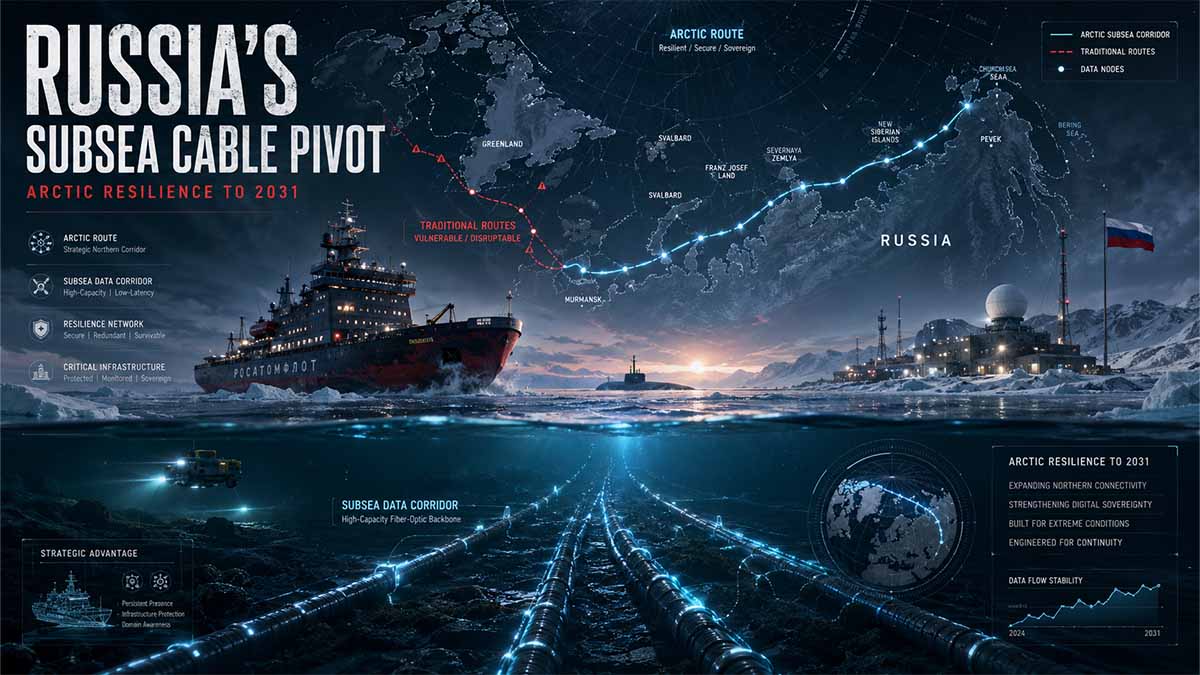
Executive Summary
BLUF: Russia’s new submarine-cable manufacturing chain is not merely a telecommunications project; it is an industrial-sovereignty, Arctic-command, economic-security, and strategic-resilience program.
Official June 2026 data supersede several figures in the initial information: total investment is approximately RUB 1.2 billion, not RUB 1 billion; the federal concessional loan for the Primorye facility is RUB 454 million; and projected capacity exceeds 2,500 kilometres annually, rather than 2,400 kilometres.
The production chain now connects optical-core manufacturing in Perm Krai with armouring, completion, and direct vessel loading in Primorsky Krai.
The system is designed for cables containing up to 96 optical fibres, operating at depths of up to 4 kilometres, with service lives of at least 25 years and reported production localisation of approximately 92%.
This capacity supports civilian connectivity, Arctic logistics, hydrocarbon and mineral development, state communications, 5G backhaul, maritime surveillance, and potentially dual-use command infrastructure.
Russia’s principal vulnerability is not an absence of domestic cable production, but the geographic concentration of landing points, repair assets, cable vessels, power-feed equipment, network-management systems, and Arctic maintenance windows.
Between 2026 and 2031, cable security will increasingly merge with satellite redundancy, autonomous seabed surveillance, shadow-fleet monitoring, sanctions enforcement, maritime attribution, and grey-zone deterrence.
The most probable scenario is an accelerating defensive competition in which Russia, NATO, the EU, China, and Arctic stakeholders construct more redundant networks while simultaneously improving their ability to map, monitor, exploit, disable, or rapidly repair those networks.
Navigational Index
Pillar I — Industrial Sovereignty and the Arctic Network
Russia’s localisation of submarine-cable production, the Perm–Primorye industrial chain, Arctic connectivity requirements, the Northern Sea Route, and the strategic value of domestic manufacturing capacity.
Pillar II — Vulnerability, Sabotage and Hybrid Deterrence
Physical cable cuts, anchor-dragging, seabed interference, cyber compromise, covert surveillance, repair bottlenecks, maritime attribution, shadow-fleet activity, and escalation below the threshold of declared armed conflict.
Pillar III — The 2026–2031 Competitive Infrastructure Race
Russian network expansion, NATO and EU countermeasures, Chinese Arctic connectivity interests, autonomous maritime surveillance, satellite failover, repair-fleet availability, and probabilistic five-year scenarios.
Master Abstract
Russia has crossed an important industrial threshold by completing an interregional production chain for submarine fibre-optic cables, but the strategic meaning of the project extends far beyond the nominal value of the investment. On 10 June 2026, the Russian Industrial Development Fund reported that the Incab Group had opened the final production site in Primorsky Krai, completing a cycle in which the optical core is manufactured in Perm Krai, transported eastward, converted into finished armoured submarine cable, and loaded directly onto cable-laying vessels. The official figures materially update the preliminary information: the combined project represents approximately RUB 1.2 billion in investment; RUB 454 million was supplied as a concessional federal Industrial Development Fund loan for the Primorye site; the earlier Perm production line had a budget of RUB 400 million, including a RUB 315 million fund loan; and the two facilities are expected to manufacture more than 2,500 kilometres of cable per year at full capacity. The finished products can contain as many as 96 fibres, operate at depths reaching 4 kilometres, remain in service for at least 25 years, and achieve an officially reported localisation level of approximately 92%. Individual production lengths may reach 50 kilometres, reducing offshore joining requirements and installation exposure during Arctic navigation windows officially described as only four to five months annually. These data establish that the Primorye plant is not simply a regional factory but the maritime terminal of a vertically integrated infrastructure system intended to reduce dependence on external suppliers, compress the distance between manufacturing and deployment, and satisfy demand across the Arctic, Far East, Black Sea, Caspian Sea, and Baltic theatres. Launch of Submarine Fibre-Optic Cable Production for the Arctic and Far East – Russian Industrial Development Fund – June 2026 — Verified official source.
The industrial initiative must be interpreted within Russia’s larger Arctic doctrine, because submarine connectivity is becoming the nervous system of the Northern Sea Route rather than a secondary telecommunications utility. Russia’s 2022 Maritime Doctrine explicitly calls for a unified protected information and telecommunications system for the Arctic transport complex, including construction of a trans-Arctic trunk submarine fibre-optic line. The Northern Sea Route development plan approved in August 2022 contains more than 150 measures, carries planned financing approaching RUB 1.8 trillion, and covers a maritime corridor of approximately 5,600 kilometres between the Kara Gates and Provideniya Bay. The network required to support this corridor must connect ports, icebreakers, hydrocarbon installations, mineral projects, coastal settlements, navigation systems, meteorological stations, emergency services, defence facilities, remotely operated platforms, and eventually autonomous vessels. Plan for the Development of the Northern Sea Route through 2035 – Government of the Russian Federation – August 2022 — Verified official source. The resulting infrastructure has at least five simultaneous functions: it is a commercial backbone for regional broadband; an operational network for maritime logistics; a state-administration channel for distant Arctic territories; an enabling layer for industrial extraction; and a potential dual-use architecture supporting maritime-domain awareness, border security, military mobility, sensor fusion, and resilient command. This convergence is strategically important because the same fibre pair that carries civilian traffic can also transport radar data, sonar-derived information, encrypted governmental communications, environmental telemetry, shipping manifests, remote-control instructions, and timing information. Russia’s investment therefore reduces one category of vulnerability—foreign manufacturing dependence—but simultaneously creates a more valuable and geographically legible network of landing stations, repeaters, cable corridors, terminal equipment, power-feed systems, repair depots, and maritime support assets. Industrial sovereignty does not eliminate exposure; it moves exposure from the supply chain into the operational architecture.
The global security environment surrounding this investment is becoming substantially more dangerous. NATO stated in January 2025 that undersea cables carry more than 95% of Internet traffic, span approximately 1.3 million kilometres, and support an estimated US$10 trillion in financial transactions every day. NATO launched Baltic Sentry after repeated damage to energy and communications links, assigning frigates, maritime-patrol aircraft, submarines, satellites, remotely operated vehicles, surveillance drones, and integrated national sensors to improve detection and deterrence. Joint Press Conference on Baltic Undersea Infrastructure Security – NATO – January 2025 — Verified official source. The European Union has progressed from general resilience recommendations to an operational framework covering prevention, detection, response, recovery, and deterrence. Its February 2026 Cable Security Toolbox followed an EU-wide mapping and risk-assessment process and identified priority Cable Projects of European Interest; the Commission simultaneously announced €347 million for cable-security investment. The framework emphasises route redundancy, smart cables, stress testing, real-time monitoring, crisis coordination, and a proposed European cable-vessel reserve intended to reduce repair delays. Submarine Cable Security Toolbox and Cable Projects of European Interest – European Commission – February/March 2026 — Verified official source. Russia’s new capacity must consequently be viewed as part of an emerging competitive ecosystem in which every major actor is attempting to reduce dependency while acquiring better knowledge of other actors’ dependencies. The decisive contest will not be measured only in installed kilometres. It will be measured in the number of alternative routes, protected landing stations, available cable ships, pre-positioned spare cable, qualified repair crews, seabed sensors, autonomous patrol platforms, satellite failover capacity, cyber-secure network-management systems, and legally actionable attribution records available after an incident.
A five-year Bayesian estimate beginning in mid-2026 produces a baseline probability of approximately 62% that Russia will complete or materially advance multiple Arctic and Far Eastern submarine-cable segments by 2031, conditional on continued state financing, domestic optical-fibre availability, specialised steel and polyethylene supply, access to marine engineering components, and sufficient cable-laying capacity. The probability of at least one significant disruption affecting a Russian, NATO, EU, or associated northern Eurasian submarine communications route during the same period is assessed at approximately 68%, but that figure includes accidents, fishing activity, anchor damage, geological events, engineering failure, and malicious action; the probability that a publicly confirmed disruption will be conclusively attributed to a state-directed operation is lower, at approximately 24%, because seabed incidents preserve ambiguity and attribution is politically constrained. Five competing hypotheses structure the assessment. H₁, evaluated as the present lead hypothesis, holds that Russia’s program is principally a defensive sovereignty and regional-development initiative with substantial dual-use value. H₂ holds that the system is primarily intended to support Arctic resource extraction and Northern Sea Route commercialisation. H₃ holds that the project is designed to provide wartime communications resilience and alternative routing under sanctions or conflict. H₄ proposes that Russia intends to use domestic cable expertise to build export influence and infrastructure partnerships with non-Western states. H₅ assesses the program as part of a broader seabed contest in which installation knowledge, cable handling, maintenance operations, hydrographic data, and maritime access can generate intelligence or counter-infrastructure advantages. These hypotheses are not mutually exclusive; the strongest forecast is a composite of H₁, H₂, and H₃, with H₅ increasing in relevance as NATO and EU undersea-surveillance systems mature.
Monte Carlo-style scenario modelling, using industrial completion, sanctions intensity, Arctic shipping activity, military tension, repair capacity, and incident frequency as principal variables, yields four scenario clusters. The Managed Expansion scenario, assigned 43%, sees Russia install new domestic cable capacity while incidents remain limited and redundancy improves on all sides. The Fragmented Seabed scenario, assigned 31%, produces recurrent ambiguous outages, aggressive vessel inspections, expanded sanctions against shadow-fleet operators, tighter cable-route secrecy, and growing military escort of repair and installation operations. The Acute Infrastructure Crisis scenario, assigned 17%, involves simultaneous or cascading damage to several high-value cables, creating temporary bandwidth shortages, financial-market disruption, military alerting, emergency satellite substitution, and a dangerous attribution contest. The Cooperative Resilience scenario, assigned only 9%, assumes the emergence of limited technical confidence-building measures, rapid incident notification, protected repair access, and shared maritime safety protocols despite continuing geopolitical rivalry. Across all four scenarios, the most influential shadow dimensions are not the cable cores themselves but the liquidity and insurance mechanisms financing cable vessels; the ownership opacity of merchant ships operating near infrastructure corridors; the availability of specialised burial, grapnel, and repair equipment; the cyber integrity of landing stations; the jurisdictional limits governing intervention against suspicious vessels; and the role of ostensibly commercial hydrographic, fishing, salvage, and research operations in collecting seabed intelligence. Russia is therefore not immune to cable attack merely because it can manufacture cable. Its resilience will depend on whether it can detect interference before failure, reroute traffic immediately, protect terminal infrastructure, mobilise repair ships inside narrow Arctic weather windows, and establish enough evidentiary confidence to respond without triggering uncontrolled escalation.
Pillar I — Russia’s Industrial Sovereignty and the Arctic Subsea Network, 2026–2031
Russia’s localisation of submarine fibre-optic cable production marks a structural transition from purchasing communications infrastructure as a finished industrial product to controlling a strategically important manufacturing chain inside the Russian Federation. The decisive development occurred on 10 June 2026, when the federal Industrial Development Fund announced the opening of the Incab Group’s final production site in Primorsky Krai, completing an interregional chain that begins with optical-core production in Perm Krai and ends with armouring, finishing, testing, storage and maritime dispatch in the Russian Far East. The official figures refine earlier reporting: total investment in the combined programme is approximately RUB 1.2 billion; the Primorye facility received a RUB 454 million concessional federal loan; the preceding Perm phase involved approximately RUB 400 million, including a RUB 315 million fund loan; and projected combined output exceeds 2,500 kilometres of submarine cable annually once full capacity is achieved. The cables can incorporate up to 96 optical fibres, operate at depths of up to 4 kilometres, remain in service for at least 25 years, and be delivered in production lengths reaching 50 kilometres. The localisation level reported by the fund is approximately 92%, although that percentage should be interpreted as an industrial-content measure rather than proof of complete technological independence across every upstream material, machine-tool, electronic-control and marine-installation subsystem. The strategic importance of the project lies in the replacement of a fragmented procurement model with a state-supported manufacturing corridor capable of supplying the Arctic, the Far East and other maritime theatres without depending on a single imported finished-cable supplier. Launch of Submarine Fibre-Optic Cable Production for the Arctic and Far East – Russian Industrial Development Fund – June 2026 — Official Russian source.
The Perm–Primorye configuration reveals the logic of Russian industrial geography. Perm Krai functions as the upstream production centre, where the fibre-containing optical core and associated intermediate structures are manufactured using an established inland industrial base, skilled labour pool and specialised polymer, cable and mechanical-processing capabilities. Primorsky Krai functions as the maritime conversion and deployment node, where the core is transformed into a finished submarine product and positioned near the marine transport system through which it will be loaded onto cable-laying vessels. This division reduces the cost and operational complexity of moving fully armoured, heavy and bulky cable reels across the entire Russian landmass. The design effectively moves the weight-intensive stage closer to the sea while retaining high-value optical and precision manufacturing in Perm. It also creates a distributed production chain rather than concentrating all processes in a single coastal plant, which marginally improves resilience against local industrial accidents, power failures, labour disruption or physical attack. However, distribution does not automatically create full redundancy. The chain still depends on secure rail or road transport between the two regions, predictable delivery schedules, compatible production tolerances, protected digital production records, quality-control continuity and sufficient storage buffers at both sites. A disruption in Perm can deprive Primorye of semi-finished cores; a disruption in Primorye can strand completed cores without maritime conversion; and a shortage of cable vessels can prevent both plants from translating industrial output into operational infrastructure. The strategic unit of analysis is therefore not the factory but the entire system connecting raw materials, optical-fibre inputs, metallic armouring, polymers, testing equipment, logistics, ports, cable vessels, hydrographic survey data, installation crews, landing stations and network operators. Russia has created a sovereign production spine, but the spine becomes strategically useful only when every dependent segment remains functional under sanctions, conflict, severe weather and Arctic logistical constraints.
| Industrial segment | Primary location | Strategic function | Principal dependency | Failure consequence |
|---|---|---|---|---|
| Optical-core production | Perm Krai | Produces the data-carrying internal cable structure | Optical fibre, precision machinery, polymers, quality control | Primorye finishing line lacks feedstock |
| Interregional transport | Perm–Primorye corridor | Transfers semi-finished cable eastward | Rail capacity, scheduling, secure handling | Production delays and inventory imbalance |
| Armouring and finishing | Primorsky Krai | Converts core into pressure-resistant submarine cable | Steel wire, sheathing, testing, power supply | No deployable marine product |
| Port and terminal interface | Khasansky District area | Enables direct maritime dispatch | Port access, loading equipment, secure storage | Finished cable cannot reach installation vessels |
| Cable-laying fleet | Far Eastern maritime zone | Surveys, lays, buries and repairs cable | Specialised vessels, crews, spares, weather windows | Manufacturing output remains unused |
| Landing stations | Arctic and Far Eastern coast | Connects subsea fibre to terrestrial networks | Power, cyber defence, terrestrial backhaul | Cable remains physically intact but operationally unavailable |
The project must be analysed against the official Russian maritime doctrine because that document establishes submarine communications as an element of national maritime policy rather than merely a commercial telecommunications asset. The 2022 Maritime Doctrine of the Russian Federation, amended in 2024, calls for the creation of a unified protected information and telecommunications system for the Arctic transport complex, explicitly including construction of a trans-Arctic trunk submarine fibre-optic communications line. This doctrinal language assigns cable infrastructure four simultaneous roles. First, it supports civilian and industrial development by connecting settlements, ports, mines, energy facilities and logistics hubs that cannot rely solely on terrestrial fibre. Second, it supports navigation and transport management by carrying hydrographic, meteorological, ice-monitoring, traffic-control and emergency-response data. Third, it enables state administration across territories where communications latency, limited capacity and weather-related outages can otherwise isolate decision-makers. Fourth, it possesses inherent dual-use value because the same backbone can carry encrypted government traffic, maritime sensor outputs, border-security data and military logistical communications. The doctrine also calls for an industrial, technological and scientific base for developing Arctic coastal territories and adjacent waters, making domestic cable production a logical implementation mechanism rather than an isolated subsidy programme. Maritime Doctrine of the Russian Federation – President of the Russian Federation – July 2022, amended August 2024 — Official Kremlin text. The strategic inference is that Russia intends to move from a patchwork of satellite, microwave, terrestrial and legacy maritime links toward a more integrated architecture in which subsea fibre provides high-capacity trunk connectivity and satellites provide complementary coverage, mobility and failover. Fibre will deliver volume and low latency; satellite systems will reach mobile platforms and remote locations; terrestrial links will connect inland nodes; and radio systems will provide tactical resilience. The competitive advantage will arise not from choosing one medium, but from orchestrating all four under a protected network-management regime.
The Northern Sea Route provides the economic and geographic demand base for this communications architecture. The Russian government’s development plan through 2035, approved on 1 August 2022, contains more than 150 measures, identifies total planned financing approaching RUB 1.8 trillion, and defines a route of approximately 5,600 kilometres from the Kara Gates to Provideniya Bay. The plan includes ports, terminals, emergency infrastructure, navigation support, icebreaker development and an Arctic satellite constellation for hydrometeorological and navigational services. Plan for the Development of the Northern Sea Route through 2035 – Government of the Russian Federation – August 2022 — Official Russian government source. A high-capacity submarine network becomes strategically valuable because the Northern Sea Route is not a single shipping lane but a distributed industrial system. It includes hydrocarbon terminals, mineral-export facilities, icebreaker bases, coastal communities, search-and-rescue points, environmental-monitoring stations, customs operations, naval and coastguard activity, logistics centres and prospective autonomous or remotely monitored infrastructure. Each element generates data, and the value of the route increasingly depends on converting those data into operational decisions. Ice charts must be updated; vessels must receive route changes; cargo and insurance records must be synchronised; port operators require real-time scheduling; equipment must be monitored for predictive maintenance; environmental sensors must transmit continuously; and emergency authorities must maintain communications during extreme weather. A submarine backbone can consolidate these functions into a resilient corridor, but only where landing points, branch systems and terrestrial extensions are installed at adequate intervals. Russia’s challenge through 2031 will therefore be to translate annual manufacturing capacity into a coherent network topology. Producing 2,500 kilometres per year does not imply that the same distance can be installed annually, because survey work, permits, route engineering, seabed preparation, vessel availability, seasonal access, landing-station construction and testing can become binding constraints. Manufacturing capacity is an enabling ceiling, not an automatic deployment rate.
The central concept of industrial sovereignty must be treated with more precision than the reported 92% localisation figure permits. A submarine communications system contains several technological layers: optical fibre; gel or water-blocking compounds; copper conductors where electrical power is required for repeaters; steel-wire armour; polyethylene insulation and sheathing; joints and branching units; repeaters or amplifiers for long-haul systems; power-feed equipment; terminal transmission equipment; coherent optical electronics; network-management software; hydrographic survey systems; remotely operated vehicles; burial ploughs; repair grapnels; testing instruments; dynamic-positioning vessels; and specialised engineering knowledge. A manufacturer may localise most of the cable’s physical mass while remaining dependent on imported high-value optical or electronic subsystems. Conversely, a domestic cable can remain strategically useful even where selected components are imported, provided sufficient inventories, alternative suppliers and redesign capability exist. The correct sovereignty metric is therefore multidimensional. S₁, physical localisation, measures domestic content by mass or value. S₂, technological autonomy, measures whether Russian firms possess the intellectual property, process knowledge and machine capability needed to reproduce critical components. S₃, supply resilience, measures whether alternative inputs exist under sanctions. S₄, deployment sovereignty, measures access to survey and cable-laying vessels. S₅, operational sovereignty, measures control of landing stations, encryption, transmission equipment and network management. S₆, repair sovereignty, measures the ability to diagnose and restore a failure without foreign contractors. On this basis, the Incab investment significantly raises S₁ and likely improves S₂ for conventional cable structures, but the available official information does not prove complete autonomy across S₃–S₆. This distinction matters because a state can manufacture cable yet remain unable to deploy it quickly, power it efficiently, integrate it securely or repair it during a conflict. The five-year strategic test is not whether Russia can announce a domestic product, but whether it can operate an end-to-end sovereign cable ecosystem under adverse conditions.
| Sovereignty dimension | 2026 baseline assessment | Principal evidence | 2031 strategic requirement |
|---|---|---|---|
| S₁ Physical localisation | High | Reported localisation near 92% | Sustain domestic material supply at scale |
| S₂ Production knowledge | Moderate–high | Full-cycle core and armouring chain | Expand long-haul and specialised designs |
| S₃ Sanctions resilience | Moderate | Domestic chain reduces finished-product imports | Diversify machinery, electronics and optical inputs |
| S₄ Deployment sovereignty | Uncertain–moderate | Coastal plant supports vessel loading | Ensure sufficient cable-laying and survey fleet |
| S₅ Operational sovereignty | Moderate | Russian state network objectives are explicit | Secure landing stations, terminals and software |
| S₆ Repair sovereignty | Uncertain | No complete public evidence of repair capacity | Pre-position vessels, spare cable and trained crews |
China’s Arctic policy introduces an external strategic variable because Beijing formally links Arctic shipping, infrastructure, digital connectivity and submarine fibre-optic cables. The State Council Information Office’s 2018 Arctic Policy states that China seeks participation in Arctic shipping-route development, infrastructure construction and a “Polar Silk Road,” and it explicitly identifies stronger Arctic digital connectivity and cooperation on submarine fibre-optic cables as legitimate areas of engagement. The document also affirms the rights of non-Arctic states, under applicable international law, to lay submarine cables in high-seas and other relevant maritime areas. China’s Arctic Policy – State Council Information Office of the People’s Republic of China – January 2018 — Official Chinese government text. The official Chinese-language version similarly promotes infrastructure participation, commercial Arctic navigation and stronger logistical and safety capabilities. China’s Arctic Policy – Ministry of National Defense of the People’s Republic of China – January 2018 — Official Chinese-language source. The geopolitical implication is not that the Incab project is necessarily Chinese-financed or technologically dependent; no verified official evidence cited here establishes such a direct relationship. The implication is that Russian domestic production and Chinese Arctic connectivity interests are strategically compatible. Russia controls the principal Eurasian Arctic coastline and seeks sovereign infrastructure; China possesses capital, equipment, telecommunications expertise and demand for diversified Eurasian routes. Cooperation could therefore emerge through financing, terminal systems, shipping demand, data-centre integration, joint scientific projects or downstream network utilisation, even while Russia attempts to preserve ownership and regulatory control. The tension will centre on asymmetry: Russia needs investment and traffic volume, but excessive dependence on Chinese capital, electronics or network operators could replace Western dependency with Chinese dependency. Moscow’s optimal strategy would be selective interoperability without surrendering control of landing stations, encryption, traffic routing, repair scheduling or network-management data.
European cable policy provides the clearest comparative benchmark for assessing whether Russia’s localisation strategy is comprehensive enough. The European Commission’s 2024 Recommendation on Secure and Resilient Submarine Cable Infrastructures introduced coordinated mapping, risk assessment, governance and funding measures. The 2025 Joint Communication expanded this into a full resilience cycle covering prevention, detection, response, repair and deterrence, including measures against hostile actors and opaque “shadow fleet” activity. In February 2026, the Commission published a Cable Security Toolbox and priority Cable Projects of European Interest, while announcing €347 million in additional investment for 2026–2027. Recommendation on the Security and Resilience of Submarine Cable Infrastructures – European Commission – February 2024 — Official EU source. Joint Communication to Strengthen the Security and Resilience of Submarine Cables – European Commission and High Representative – February 2025 — Official EU source. Submarine Cable Security Toolbox and Cable Projects of European Interest – European Commission – February 2026 — Official EU source. The EU model emphasises not only cable construction but smart sensing, regional monitoring hubs, stress testing, repair-vessel reserves, route diversification and formal attribution mechanisms. Russia’s industrial project addresses the production layer strongly but public official evidence is less complete regarding an equivalent integrated architecture for real-time seabed monitoring, multi-basin cable hubs, shared stress-testing standards and a dedicated repair-vessel reserve. This comparison identifies the likely direction of Russian policy through 2031: production localisation will be followed by greater investment in route secrecy, vessel monitoring, autonomous seabed vehicles, cable-state sensing, spare inventories, protected landing stations and procedures for military or coastguard support to repair missions.
A structured Analysis of Competing Hypotheses clarifies why Russia is pursuing the programme. H₁, “regional industrial development,” treats the factories as an import-substitution and employment project whose strategic effects are secondary. H₂, “Northern Sea Route commercial backbone,” treats cable production as necessary infrastructure for ports, cargo systems, resource extraction and settlement connectivity. H₃, “sanctions-resilient communications sovereignty,” interprets the project as a direct hedge against loss of foreign suppliers, contractors and maintenance support. H₄, “dual-use Arctic command architecture,” argues that the cable system is intended to improve protected state and defence communications across the northern maritime perimeter. H₅, “Eurasian digital-corridor strategy,” interprets domestic manufacturing as preparation for a broader Russia–Asia connectivity system with potential Chinese participation. H₆, “strategic seabed competition,” assesses cable manufacturing, laying and repair as capabilities that generate hydrographic knowledge and operational familiarity with critical infrastructure corridors. The evidence most strongly supports a composite of H₂, H₃ and H₄. The maritime doctrine explicitly identifies a protected Arctic communications system; the Northern Sea Route plan establishes the economic demand; and the Industrial Development Fund’s localisation financing establishes the sanctions-resilience mechanism. H₁ is also valid but insufficient because the project’s stated use extends well beyond regional manufacturing. H₅ is plausible because Chinese official policy supports Arctic digital connectivity, but no verified source proves that the specific Incab chain forms part of a bilateral project. H₆ is analytically plausible but remains an inference: cable deployment necessarily creates seabed knowledge, yet official evidence does not demonstrate an offensive purpose. The methodology therefore separates capability from intent. Russia’s ability to survey, lay and repair cables could support both protective and intelligence functions, but capability alone cannot establish hostile intent.
| Hypothesis | Supporting indicators | Contradicting or missing indicators | Updated probability |
|---|---|---|---|
| H₁ Regional industrial policy | Federal loans, two-region production chain, domestic jobs | Does not explain Arctic doctrinal emphasis alone | 12% |
| H₂ NSR commercial backbone | NSR plan, ports, logistics, industrial demand | Deployment schedule remains partly opaque | 27% |
| H₃ Sanctions-resilient sovereignty | High localisation, domestic finished-cable capability | Some upstream dependencies remain unknown | 24% |
| H₄ Dual-use Arctic command network | Protected-system language in Maritime Doctrine | Public routing and defence integration details absent | 21% |
| H₅ Eurasian/Chinese connectivity | Chinese Arctic policy explicitly supports digital connectivity | No confirmed direct link to Incab project | 9% |
| H₆ Strategic seabed capability | Survey, laying and repair create operational knowledge | No official evidence of offensive mission | 7% |
The five-year outlook can be modelled through six variables: annual cable-production utilisation, cable-laying-vessel availability, Arctic project financing, sanctions pressure, landing-station readiness and major-incident frequency. A baseline Bayesian estimate places the probability that Russia will materially expand Arctic and Far Eastern submarine connectivity by 2031 at approximately 68%. This is higher than the probability of completing a continuous trans-Arctic trunk system, assessed at approximately 39%, because incremental regional links, branch lines, industrial connections and replacements are easier than constructing an uninterrupted coast-spanning network. The probability that annual factory output will reach or remain near the stated 2,500-kilometre ceiling for at least one full year by 2031 is assessed at 57%, conditional on demand, material supply and vessel schedules. The probability of persistent under-utilisation is 28%, driven by financing delays, vessel shortages or slower-than-planned landing-station construction. A further 15% is assigned to severe disruption through sanctions, industrial failure or maritime escalation. These are analytical estimates, not official forecasts. Monte Carlo logic produces three dominant pathways. In the Sovereign Expansion pathway, Russia integrates production, vessels, landing stations and Arctic users, establishing a meaningful domestic network and repair capability. In the Industrial Bottleneck pathway, factories operate but installation lags, creating inventory accumulation and political pressure to subsidise demand. In the Militarised Resilience pathway, cable incidents or confrontation accelerate state control, route protection and dual-use integration, while civilian transparency declines. The most probable outcome is a blend: progressive commercial deployment accompanied by increasingly securitised management. By 2031, Russia is likely to possess substantially greater cable-manufacturing autonomy than it had in 2025, but the degree of true communications sovereignty will depend on repair capacity and protected network operations more than on factory output alone.
| Outlook metric | 2026 baseline | 2028 directional estimate | 2031 baseline forecast |
|---|---|---|---|
| Domestic finished-cable production maturity | 65/100 | 79/100 | 87/100 |
| Upstream component autonomy | 58/100 | 67/100 | 74/100 |
| Cable-laying and deployment sufficiency | 44/100 | 54/100 | 63/100 |
| Arctic landing-station readiness | 39/100 | 52/100 | 66/100 |
| Repair and restoration sovereignty | 36/100 | 49/100 | 61/100 |
| Integrated fibre-satellite resilience | 48/100 | 63/100 | 76/100 |
| Exposure to sanctions and specialised imports | 69/100 | 58/100 | 47/100 |
| Exposure to physical or hybrid disruption | 57/100 | 64/100 | 68/100 |
The most consequential “shadow” dimensions sit outside the visible factory project. Liquidity flows determine whether cable output becomes installed infrastructure: concessional loans can finance machinery, but long-distance systems require additional capital for marine surveys, environmental approvals, specialised vessels, landing stations, repeaters, terrestrial backhaul and multi-year maintenance. Insurance and vessel classification influence whether installation ships can operate in contested or sanction-exposed waters. Cybersecurity determines whether an intact cable carries trustworthy traffic; compromised terminal equipment, network-management systems or software updates can neutralise physical localisation. Labour depth determines whether Russia can replace specialised engineers faster than they retire or emigrate. Maritime transparency determines whether civilian vessels approaching cable corridors can be distinguished from accidental, negligent or hostile actors. Environmental change creates a mixed effect: longer navigable periods may improve installation access, while coastal erosion, permafrost degradation, ice movement and seabed instability can raise landing-point and maintenance risks. Russia must also resolve the tension between secrecy and resilience. Concealing routes and landing points may reduce targeting risk, but excessive compartmentalisation can slow civilian repair, hinder cross-agency coordination and prevent operators from sharing technical warning indicators. The strongest 2031 architecture would combine domestic manufacturing, route diversity, distributed landing stations, spare cable stored at multiple ports, pre-negotiated vessel mobilisation, satellite failover, encrypted network management, autonomous monitoring and a legally defined chain of command for incident response. Without those elements, the Perm–Primorye chain remains an important industrial achievement but not a complete sovereignty system. With them, it could become the material foundation for Russia’s most consequential Arctic communications expansion since the post-Soviet reconstruction of its northern transport and energy infrastructure.
Pillar II — Vulnerability, Sabotage and Hybrid Deterrence in the Subsea Battlespace
Submarine communications infrastructure is vulnerable not because fibre-optic technology is inherently fragile, but because a globally distributed digital system is compressed into a comparatively small number of physical corridors, landing stations, power-feed systems, network-management platforms and specialised repair chains. Russia’s emerging Arctic and Far Eastern network will face the same structural paradox confronting NATO and the European Union: adding cables increases aggregate capacity and route diversity, yet every new line creates additional physical terrain that must be surveyed, monitored, defended and repaired. The principal danger is not a spectacular deep-ocean operation against heavily armoured cable at 4,000 metres, but intervention in shallower waters near coasts, islands, ports and maritime chokepoints, where cables converge and armour cannot eliminate the mechanical energy produced by a large vessel dragging an anchor, trawl gear or other heavy equipment. The European Union’s cable-security framework distinguishes four inseparable phases—prevention, detection, response and recovery, and deterrence—because no single layer can guarantee security. Physical protection cannot cover thousands of kilometres continuously; surveillance does not automatically establish intent; rapid response cannot compensate indefinitely for insufficient redundancy; and punitive deterrence fails when attribution remains politically or legally uncertain. The EU Action Plan on Cable Security states that submarine communications cables carry approximately 99% of intercontinental internet traffic and warns that the pattern of recent incidents, particularly in the Baltic Sea, suggests that critical infrastructure is increasingly exposed to deliberate hostile acts capable of forming part of broader hybrid campaigns. EU Action Plan on Cable Security – European Commission and High Representative – February 2025 — Official EU text. For Russia, the relevance is direct: the Northern Sea Route may eventually gain greater data-routing resilience, but Arctic cables will pass through geographically predictable coastal approaches, limited maritime-access corridors and highly demanding repair environments. Vulnerability therefore migrates from dependence on foreign manufacturers toward dependence on the integrity of a thin, observable and seasonally constrained infrastructure network.
Physical cable cutting by anchor-dragging has become the archetypal grey-zone mechanism because the same sequence can be presented as accident, negligence, mechanical failure, unsafe navigation or intentional sabotage. The 25 December 2024 Gulf of Finland incident provides the most thoroughly documented official case study. Finland’s National Bureau of Investigation concluded that senior officers aboard the tanker Eagle S were suspected of aggravated criminal mischief and aggravated interference with telecommunications after investigators examined material recovered from the vessel, interviewed the crew and surveyed the seabed. Finnish police documented a dragging trace extending for dozens of kilometres and recovered an anchor measuring approximately 4 metres in length, 2.5 metres in width and weighing 11 tonnes. Investigators concluded that the recovered anchor belonged to the vessel and was found near the end of the seabed drag trace; they further assessed that rapid intervention by Finnish authorities prevented additional damage. Criminal Investigation into Cable Damage in the Gulf of Finland Concluded – Finnish National Bureau of Investigation – June 2025 — Official Finnish police source. Forensic Analysis of the Anchor Hoisted from the Gulf of Finland Started – Finnish National Bureau of Investigation – January 2025 — Official Finnish police source. Eagle S Tanker to Move to International Waters under Border Guard Control – Finnish Police – March 2025 — Official Finnish police source. The operational lesson is more important than any unresolved political attribution: a merchant vessel can generate damage across multiple infrastructure lines without deploying military ordnance, submarines or specialised saboteurs. The act can occur under commercial cover, may be executed by a small number of people, and forces the defending state to prove not only causation but knowledge, intent, command responsibility and any connection to a sponsoring state. This evidentiary burden gives anchor-dragging exceptional coercive efficiency below the threshold of declared conflict.
| Attack or disruption vector | Required access | Attribution difficulty | Likely immediate effect | Strategic value to an aggressor |
|---|---|---|---|---|
| Anchor dragging | Merchant vessel near mapped route | High | One or multiple cable ruptures | Strong deniability, low technical barrier |
| Trawl or grapnel interference | Fishing or utility vessel | High | Localised severance or abrasion | Can be disguised as routine activity |
| Explosive seabed attack | Divers, submarine or unmanned system | Moderate | Severe, potentially multi-cable damage | Higher effect but stronger forensic signature |
| Landing-station sabotage | Shore access or insider | Moderate | Traffic interruption across intact cable | Targets concentrated control infrastructure |
| Cyber intrusion | Network or supply-chain access | Very high | Rerouting, monitoring, denial or manipulation | Scalable and potentially persistent |
| Covert optical interception | Landing point or cable-access capability | Very high | Intelligence collection without outage | Preserves secrecy and continuing access |
| Repair-chain disruption | Vessel, port, spares or contractor access | High | Extends downtime after initial incident | Converts limited damage into strategic pressure |
| Coordinated multi-domain attack | Physical, cyber and influence access | Very high | Confusion, delayed response and escalation pressure | Maximises ambiguity and systemic effect |
Seabed interference extends beyond complete severance. An adversary may seek to expose a buried cable, damage protective armour, move it into a zone of future mechanical stress, interfere with repeaters, install surveillance devices, contaminate forensic evidence or conduct repeated “survey” activity that maps infrastructure and defensive responses. The distinction between reconnaissance and attack is inherently unstable because the hydrographic knowledge needed to repair a cable resembles the knowledge required to target it. Commercial survey ships, fishing vessels, research platforms, remotely operated vehicles and autonomous underwater systems can all produce seabed data with legitimate uses. The defender therefore confronts an indicator problem rather than a simple identification problem: proximity to a route is not proof of intent; slow speed may reflect fishing, mechanical difficulty or surveillance; automatic identification system interruption may be accidental, technically induced or deliberate; and repeated passage patterns may indicate ordinary trade or preparation for interference. NATO’s response has been to combine naval presence with integrated surveillance rather than claim that every cable can be physically guarded. Baltic Sentry, launched in January 2025, employs frigates, maritime-patrol aircraft, mine-countermeasure forces and naval drones while integrating national surveillance assets and industry information. NATO states that the activity is intended to deter state and non-state actors from damaging critical undersea infrastructure and to strengthen detection and response across the Baltic. Baltic Sentry – North Atlantic Treaty Organization – 2025/2026 — Official NATO overview. NATO Launches Baltic Sentry to Increase Critical Infrastructure Security – NATO – January 2025 — Official NATO announcement. Baltic Sentry to Enhance NATO’s Presence in the Baltic Sea – Supreme Headquarters Allied Powers Europe – January 2025 — Official SHAPE source. Russia will likely mirror this surveillance logic in the Arctic, but it faces a wider operating area, harsher weather, weaker sensor density and substantially fewer nearby ports, creating a detection-to-intervention gap that may remain its most serious physical-security deficit through 2031.
Cyber compromise changes the geometry of cable warfare because it allows an attacker to affect communications without touching the wet segment. ENISA identifies landing stations, cable landing points, densely concentrated cable corridors and cable network-management systems as principal weaknesses, and notes that access to communications data at landing stations is materially more feasible than covert interception from the deep seabed. A modern cable system includes optical terminal equipment, supervisory systems, power-feed equipment, operational-technology interfaces, remote maintenance channels, authentication infrastructure and connections to terrestrial carriers and cloud networks. An attacker who compromises these layers may disable alarms, alter configuration data, redirect traffic, interfere with encryption management, conceal physical degradation, corrupt maintenance records or collect metadata while leaving the cable physically intact. Cyber access can also be combined with a physical incident to delay diagnosis: false alarms can desensitise operators before an anchor event; manipulated telemetry can obscure the location of a fault; compromised vendor credentials can interfere with restoration; and stolen network maps can identify the most consequential branches or landing stations. Undersea Cables – European Union Agency for Cybersecurity – August 2023 — Official ENISA report. Dive into the Deep Sea: A View of the Subsea Cable Ecosystem – ENISA – August 2023 — Official ENISA assessment. The EU’s NIS2 implementation framework consequently requires relevant digital-infrastructure operators to protect both information systems and their physical environment, while Member States must incorporate submarine-cable cybersecurity into national strategies and map risks and mitigation measures. Incidents affecting submarine communications cables are expected to be reported to competent authorities or national CSIRTs. Recommendation on Secure and Resilient Submarine Cable Infrastructures – European Commission – February 2024 — Official EU legal text. Russia’s localisation drive will therefore remain incomplete unless it secures terminal electronics, software dependencies, remote-access practices, contractor identities and supply-chain updates with the same intensity applied to armoured cable manufacturing.
Covert surveillance presents a different strategic problem because successful interception may generate no outage and therefore no immediate incident response. A state or non-state actor seeking intelligence does not necessarily need to splice an optical fibre on the seabed. It may target unencrypted traffic before transmission, administrative systems controlling routing, maintenance databases, lawful-intercept interfaces, compromised telecommunications personnel, or network nodes where data leave the submarine segment and enter terrestrial infrastructure. The intelligence value may include military logistics, industrial telemetry, shipping schedules, customs information, corporate communications, scientific data, energy-production statistics and metadata revealing patterns of government activity. Russia’s Arctic network could become especially attractive because it may aggregate traffic from geographically isolated ports, energy facilities, border-security sites and maritime command nodes into a limited number of high-capacity landing points. Concentration reduces infrastructure cost but increases the intelligence yield of successful access. A defender must consequently distinguish availability security, which keeps traffic moving, from confidentiality security, which prevents collection, and integrity security, which prevents manipulation. Redundant routing solves only the first problem. Encryption reduces interception value but introduces key-management and endpoint risks. Physical access controls protect facilities but do not eliminate insider threats. Traffic anomaly detection may reveal exfiltration, but sophisticated collection can remain below operational thresholds. The EU’s 2024 cable recommendation specifically calls for national assessments of cybersecurity, physical security and supply-chain dependencies, testing of sensitive technology components and, where appropriate, standards approaching defence-level protection. Recommendation on Secure and Resilient Submarine Cable Infrastructures – European Commission – February 2024 — Official EU legal text. For Russia, the strategic implication is that domestically manufactured cable can still transmit through compromised electronics or endpoints. Full sovereignty requires indigenous or trusted encryption, segmented administration, independently audited software, continuous personnel vetting and the capacity to operate critical routes in a degraded but secure mode when central management systems are suspected of compromise.
Repair bottlenecks transform cable damage from a local engineering fault into a strategic coercion mechanism. The physical repair sequence requires fault localisation, permits, a suitable vessel, specialised personnel, spare cable, grapnels or remotely operated systems, favourable weather, seabed access, recovery of damaged ends, jointing, testing and re-laying. ENISA notes that only a limited number of highly specialised cable-repair vessels exists globally and that simultaneous damage at concentrated chokepoints could overwhelm available capacity. The European Commission has therefore moved beyond construction funding toward regional cable hubs, modular repair equipment for civilian vessels and the gradual development of an EU Cable Repair Fleet. The EU stated in 2026 that €347 million would be added for 2026–2027 to support strategic backbone infrastructure, smart-cable capabilities and improved repair capacity, while proposals for regional hubs were expected during 2026. Submarine Cable Security Toolbox and Cable Projects of European Interest – European Commission – February 2026 — Official EU report. Security and Resilience of Submarine Cable Infrastructure – European Commission – March 2026 — Official EU policy overview. Answer on EU Submarine Cable Repair Capacity – European Commission – January 2026 — Official European Parliament record. Arctic Russia faces a more severe repair equation. Ice conditions, long transit distances, limited harbour infrastructure, sparse aviation support and short operational seasons can turn an otherwise routine fault into a prolonged outage. A coordinated adversary would not need to destroy every cable; damaging one line while disrupting the repair ship, port, spare inventory or landing station could multiply downtime. Russia’s planned annual production capacity improves spare-cable availability, but it does not by itself create vessel readiness, trained crews, protected repair contracts or real-time fault localisation. Through 2031, the most meaningful Russian resilience indicator will be average restoration time under winter and conflict conditions, not kilometres manufactured.
| Repair factor | Temperate-sea condition | Russian Arctic condition | Security consequence |
|---|---|---|---|
| Fault localisation | Dense sensors and nearby operators | Sparse monitoring and long routes | Delayed confirmation and mobilisation |
| Vessel availability | Regional commercial fleets may respond | Limited specialised assets and long transit | Extended outage window |
| Weather access | Seasonal disruption but broader access | Ice, storms and narrow navigation windows | Repair may be deferred for months |
| Spare cable | Regional depots and supplier networks | Long logistics chain unless pre-positioned | Manufacturing advantage can be neutralised |
| Crew availability | Larger international specialist pool | Sanctions and geographic isolation constrain access | Dependence on small trusted workforce |
| Port support | Multiple equipped ports | Few suitable Arctic facilities | Concentrated operational vulnerability |
| Security escort | Coastguard and naval support available | Vast patrol area and competing missions | Repair platform may remain exposed |
| Alternative routing | Dense European networks | Sparse local terrestrial alternatives | Higher local consequence per break |
Maritime attribution is the fulcrum of hybrid deterrence because the strategic response depends on moving through four evidentiary stages: proving that damage occurred; proving which physical object caused it; proving whether the responsible crew acted negligently or intentionally; and proving whether a state or other sponsor directed, enabled or knowingly tolerated the act. The first two stages can often be supported by cable alarms, vessel tracks, recovered anchors, seabed scars, paint transfer, metallurgical evidence and onboard records. The third requires reconstruction of bridge decisions, anchor alarms, propulsion changes, communications and crew awareness. The fourth may depend on intelligence unavailable for public prosecution, including financial links, tasking communications, ownership structures, port contacts or prior reconnaissance. This produces the characteristic grey-zone gap: technical attribution may identify a ship while political attribution remains uncertain. Finland’s Eagle S investigation demonstrates that rapid national action can narrow the gap. Finnish authorities used helicopters to take control of the tanker, seized evidence, conducted underwater surveys, coordinated with foreign authorities and eventually referred suspected offences for prosecutorial consideration. NATO subsequently stated that lawful measures could include boarding, impounding and arrest, while emphasising that law enforcement remains a national responsibility supported by NATO detection and deterrence. Joint Press Conference on Baltic Undersea Infrastructure Security – NATO – January 2025 — Official NATO transcript. International maritime law complicates intervention outside territorial waters because jurisdiction varies by maritime zone, flag state, offence and evidentiary basis. The United Nations Convention on the Law of the Sea supplies the general legal framework governing maritime rights and jurisdiction, but operational enforcement still depends on national law, treaty status, flag-state cooperation and the circumstances of each incident. United Nations Convention on the Law of the Sea – International Maritime Organization – current official overview — Official IMO source.
Shadow-fleet activity magnifies attribution problems by combining opaque ownership, frequent flag changes, uncertain insurance, ageing vessels, complex management structures and commercial links designed to reduce the effectiveness of sanctions. Not every such vessel is engaged in sabotage, and analytical discipline requires avoiding the assumption that sanctions evasion proves involvement in infrastructure attacks. Nevertheless, opaque shipping networks create ideal operational cover because responsibility can be distributed across registered owners, beneficial owners, charterers, cargo interests, managers, technical operators, crewing agencies and flag administrations located in different jurisdictions. A vessel may be commercially expendable, poorly maintained, inadequately insured and crewed by personnel with limited visibility into ownership or tasking. This architecture makes negligence more probable and hostile orchestration harder to demonstrate. The EU Action Plan explicitly identifies the shadow fleet as a deterrence target and calls for sanctions, diplomatic measures, the Hybrid Toolbox and stronger international “cable diplomacy” to raise the costs of malicious behaviour. The Commission’s implementation overview states that deterrence requires the ability to qualify, prove and formally attribute sabotage before applying restrictive measures. Joint Communication to Strengthen the Security and Resilience of Submarine Cables – European Commission and High Representative – February 2025 — Official EU source. EU Cable Security Policy Overview – European Commission – March 2026 — Official EU source. The shadow dimension is also financial. Insurers, protection-and-indemnity clubs, classification societies, flag registries, lenders, commodity traders and port authorities can impose friction even where criminal attribution remains incomplete. This creates a scalable deterrence ladder below military force: enhanced inspection, denial of port services, insurance scrutiny, asset freezes, vessel listing, beneficial-ownership exposure, cargo restrictions and diplomatic pressure on flag states. Russia will confront both sides of this system: vessels associated with Russian trade may face heightened scrutiny, while Russian authorities must also identify foreign or ambiguously owned ships approaching Arctic cable corridors.
The escalation problem arises because undersea infrastructure incidents occur below the threshold at which collective defence or conventional retaliation becomes automatic, yet their cumulative effects can become strategically intolerable. NATO’s 2025 review recorded at least 11 undersea cable incidents over a period of approximately fifteen months and described the Baltic as a focal region for hybrid attacks that blur peace and conflict. NATO has created a Critical Undersea Infrastructure Coordination Cell, a Maritime Centre for the Security of Critical Undersea Infrastructure and the Baltic Sentry activity, reflecting a shift from passive resilience to persistent surveillance and focused deterrence. Fortifying the Baltic Sea: NATO’s Defence and Deterrence Strategy for Hybrid Threats – NATO – May 2025 — Official NATO analysis. The escalation ladder is nonlinear. A single cable break with effective rerouting may produce little public consequence; repeated damage may generate economic losses and political suspicion; simultaneous attacks on communication and energy links may trigger a national-security crisis; interference with military communications during a wider confrontation may be interpreted as preparation for attack. The defender must respond firmly enough to deter repetition but cautiously enough to avoid turning ambiguous evidence into uncontrolled confrontation. This favours reversible and cumulative measures: surveillance, public exposure, port restrictions, sanctions, vessel seizure where legally justified, criminal prosecution, diplomatic attribution, cyber countermeasures and military escort. Direct kinetic action would normally remain a last resort unless an attack were ongoing, clearly attributable and sufficiently severe. Russia is likely to develop a parallel escalation ladder around Arctic cables, combining coastguard intervention, FSB border-security authorities, naval monitoring, exclusion zones, criminal law, state media exposure and potentially retaliatory measures in other domains. The danger is reciprocal precedent: every expansion of boarding, seizure or surveillance authorities may be portrayed by the opposing side as harassment, increasing the chance that cable security becomes an enduring arena of maritime coercion.
A five-year Analysis of Competing Hypotheses produces six plausible strategic pathways. H₁, accidental-dominance, holds that most future Russian and European cable incidents will continue to arise from anchoring, fishing, weather or engineering failure; this remains credible because official technical assessments still identify accidental damage as historically dominant. H₂, opportunistic sabotage, predicts isolated hostile acts conducted through commercial vessels without a sustained state campaign. H₃, state-enabled deniable disruption, assesses that a state may use opaque commercial actors, permissive ownership structures or covert tasking to create recurring infrastructure pressure while preserving deniability. H₄, reconnaissance-dominance, predicts that the primary competition will involve mapping, monitoring and cyber access rather than destructive attack. H₅, coordinated multi-cable coercion, envisions simultaneous physical and cyber disruption during a political or military crisis. H₆, deterrence stabilisation, predicts that NATO, EU and Russian surveillance and enforcement will make hostile action too costly, reducing deliberate incidents after 2028. The current Bayesian distribution assigns 29% to H₁, 15% to H₂, 24% to H₃, 18% to H₄, 8% to H₅ and 6% to H₆. These probabilities are analytical estimates, not official findings. The lead judgment is that accidental incidents will remain numerically dominant, while state-enabled or politically consequential events will dominate strategic attention. A Monte Carlo-style projection for 2026–2031 assigns a 74% probability to at least one major northern European or Russian cable disruption, a 47% probability to an incident involving a shadow-fleet-linked or ownership-opaque vessel, a 32% probability to a publicly alleged state connection, and only a 19% probability that state direction will be proven to a broadly accepted public evidentiary standard. The gap between alleged involvement and publicly proven direction will define the hybrid deterrence problem.
| Hypothesis | Core mechanism | Key confirming indicators | Key disconfirming indicators | Probability |
|---|---|---|---|---|
| H₁ Accidental dominance | Navigation, fishing, weather, equipment failure | Random distribution, safety deficiencies, no coordinated timing | Repeated route-specific patterns and covert communications | 29% |
| H₂ Opportunistic sabotage | Independent or loosely organised malicious actors | Limited target set, weak state linkage | Sustained financing or intelligence support | 15% |
| H₃ State-enabled deniable disruption | Commercial cover, opaque ownership, covert direction | Patterned incidents, reconnaissance, financial or command links | Transparent ownership and ordinary negligence | 24% |
| H₄ Reconnaissance dominance | Seabed mapping, cyber intrusion, covert collection | Repeated surveillance without outages | Persistent destructive activity | 18% |
| H₅ Coordinated multi-cable coercion | Simultaneous physical and cyber attack | Crisis timing, multiple basins or landing stations | Isolated, technically unrelated faults | 8% |
| H₆ Deterrence stabilisation | Persistent monitoring and credible legal consequences | Falling deliberate incidents, rapid attribution | Continued repeat offenders and weak enforcement | 6% |
The 2026–2031 outlook suggests that hybrid deterrence will evolve from protecting individual cables toward controlling the complete incident cycle. By 2027, Baltic and Nordic authorities are likely to improve integrated vessel monitoring, cable-route risk scoring and information exchange with operators. By 2028, regional hubs, smart-cable sensing and autonomous maritime systems should improve the detection of anomalous activity, though intent will remain difficult to infer. By 2029, repair-fleet capacity and modular equipment will become a central measure of resilience because surveillance without restoration cannot prevent strategic disruption. By 2030, beneficial-ownership analysis, insurance enforcement and port-state controls will likely be integrated more tightly into cable defence, turning financial intelligence into a maritime-security tool. By 2031, the most capable states will maintain fused operational pictures combining AIS, radar, satellite imagery, hydroacoustic sensing, operator alarms, cyber telemetry, port records, ownership data and intelligence reporting. Russia’s Arctic network will remain comparatively exposed because geography increases detection and repair times, yet the same geography allows Moscow to impose tighter administrative control over ports, coastal access and domestic operators. The most likely equilibrium is neither secure peace nor unrestricted sabotage. It is a condition of armed infrastructural vigilance in which cables are routinely mapped, suspicious ships are shadowed, cyber systems are continuously probed, repair assets are pre-positioned, and governments maintain calibrated options for law-enforcement, economic, diplomatic and military response. The system will be resilient enough to survive individual incidents but not transparent enough to eliminate escalation risk. The principal strategic warning indicator will be convergence: an anomalous vessel movement, simultaneous cyber intrusion, satellite or navigation interference, political crisis and repair-chain disruption occurring within the same temporal window. Any one indicator may be explainable; their combination would materially raise the probability of coordinated hybrid action.
Pillar III — The 2026–2031 Competitive Arctic Infrastructure Race
The competitive infrastructure race now developing across the Arctic, Baltic and North Atlantic is no longer a contest over cable kilometres alone. It is a systems competition involving manufacturing sovereignty, route redundancy, maritime surveillance, repair mobilisation, satellite substitution, landing-station protection, cyber assurance, hydrographic intelligence and the political capacity to attribute and punish interference. Russia enters this race with a newly completed Perm–Primorye manufacturing chain that can produce more than 2,500 kilometres of submarine fibre-optic cable annually when fully utilised, with officially reported localisation of approximately 92%, cables containing as many as 96 optical fibres, operating depths of up to 4 kilometres, and intended service lives of at least 25 years. The opening of the final Primorye production site in June 2026 materially strengthens Russia’s ability to replace damaged infrastructure and construct regional systems without relying entirely on imported finished cables. Launch of Submarine Fibre-Optic Cable Production for the Arctic and Far East – Russian Industrial Development Fund – June 2026 — Official Russian source. Yet manufacturing output is only one component of strategic advantage. Russia must still convert factory capacity into surveyed routes, functioning landing stations, protected terrestrial backhaul, trained installation crews, cable-laying vessels, pre-positioned repair stocks and integrated satellite alternatives. NATO and the European Union are pursuing the opposite route toward the same objective: they already possess dense infrastructure, commercial operators and technological depth, but are now adding military surveillance, risk mapping, common standards, repair capacity and public financing. China occupies a third position. It has official interests in Arctic shipping, submarine cables, satellite connectivity and transcontinental digital corridors, but must balance commercial access, geopolitical risk and dependence on Russian territorial and regulatory control. The 2026–2031 race will therefore be determined by which actor can integrate physical networks, space systems, autonomous surveillance and recovery capacity into the most coherent architecture, rather than by which actor announces the greatest nominal investment.
Russia’s likely network expansion will proceed incrementally rather than through the immediate construction of a single uninterrupted trans-Arctic communications trunk. The Northern Sea Route Development Plan through 2035 contains more than 150 measures, plans financing approaching RUB 1.8 trillion, and treats the route as a long, distributed transport and industrial system rather than a conventional shipping lane. Plan for the Development of the Northern Sea Route through 2035 – Government of the Russian Federation – August 2022 — Official Russian government source. The economics favour branch systems that connect high-value nodes first: hydrocarbon terminals, mining sites, ports, administrative centres, emergency installations, icebreaker bases, border-security facilities and settlements where terrestrial fibre is absent or vulnerable. This produces a hub-and-branch topology in which major regional landing stations aggregate traffic from multiple industrial and governmental users. The advantages are lower initial capital requirements, earlier commercial returns and the ability to align deployments with specific energy or logistics projects. The disadvantages are concentration and uneven redundancy. A regional landing point serving several industrial assets becomes a high-value target; a branch line may have no equivalent alternative route; and traffic rerouting may depend on lower-capacity satellite services. By 2028, Russia is likely to prioritise coastal segments in the Far East and sections serving economically productive Arctic zones rather than remote areas with limited immediate demand. Between 2029 and 2031, the most strategically consequential investments would be interconnection between regional systems, second-route redundancy around critical terminals, additional landing stations and secure integration with terrestrial backbones. The probability that Russia will materially expand several Arctic and Far Eastern cable systems by 2031 is assessed at 71%. The probability that it will complete a genuinely continuous, highly redundant trans-Arctic backbone by the same date is lower, approximately 36%, because vessel availability, seasonal access, route engineering, sanctions exposure and the scale of required landing infrastructure create constraints that factory output alone cannot eliminate.
| Competitive variable | Russia, 2026 baseline | NATO/EU, 2026 baseline | China, 2026 baseline | Decisive 2031 condition |
|---|---|---|---|---|
| Cable manufacturing | Rapidly localising domestic chain | Strong multinational industrial base | Large industrial and telecom manufacturing base | Secure access to all critical components |
| Arctic geography | Extensive coastline and territorial access | Access through allied Nordic territories and North Atlantic | No Arctic coastline; dependent on partnerships | Reliable access rights and protected nodes |
| Route density | Sparse but expandable | Dense in Europe, thinner in High North | Strong global network, limited Arctic presence | Multiple physically diverse pathways |
| Maritime surveillance | Strong state control but vast coverage area | Integrated allied naval, air, space and autonomous assets | Growing maritime and space capabilities | Persistent, fused multi-domain awareness |
| Repair capacity | Domestic cable availability improving; vessel depth uncertain | EU-funded modules and prospective fleet initiatives | Significant industrial potential, access dependent | Rapid restoration in contested conditions |
| Satellite failover | National systems with uneven commercial capacity | GOVSATCOM transition and IRIS² deployment | Large state-backed satellite ecosystem | Seamless automatic fibre–space failover |
| Attribution capacity | Centralised state intelligence and maritime control | Multinational sensor and legal coordination | Strong state collection, limited Arctic jurisdiction | Evidence linking platform, act and sponsor |
| Financing model | State-directed concessional industrial policy | Mixed public–private and EU funding | State-supported strategic infrastructure finance | Sustainable lifecycle financing, not only construction |
NATO’s countermeasure trajectory is moving from temporary maritime presence toward persistent, technology-enabled theatre awareness. Baltic Sentry, launched in January 2025, combines frigates, maritime-patrol aircraft, naval drones and national surveillance assets to improve threat detection and response around critical undersea infrastructure. NATO publicly stated that more than 95% of internet traffic passes through undersea cables and that approximately 1.3 million kilometres of cables support an estimated US$10 trillion in daily financial transactions, framing cable protection as an Alliance-wide economic and security requirement. Joint Press Conference on Baltic Undersea Infrastructure Security – NATO – January 2025 — Official NATO transcript. The next phase is already visible. In February 2026, eight Baltic Allies agreed to accelerate the acquisition and integration of technology-enabled multi-domain naval capabilities after Task Force X-Baltic tested 70 air and maritime drones between March and October 2025. NATO reported that autonomous systems and AI-enabled technologies improved situational awareness and the detection of malign activity around critical underwater infrastructure. NATO Allies Agree to Expedite Innovation Adoption and Integration for Baltic Sea Security – NATO – February 2026 — Official NATO source. In June 2026, NATO launched Task Force X-Arctic, deploying the NATO Research Vessel Alliance from La Spezia toward the High North to test how networked uncrewed systems, under human control, can generate persistent multi-domain awareness across the Arctic and North Atlantic. NATO Launches Task Force X-Arctic to Strengthen Awareness in the Arctic and High North – NATO – June 2026 — Official NATO source. By 2031, the likely NATO model is a layered detection network in which crewed vessels provide legal authority and endurance, autonomous systems increase spatial persistence, satellites provide wide-area cueing, aircraft deliver rapid classification, and national authorities retain boarding and enforcement powers. This structure does not make cable interference impossible; it raises the probability that suspicious behaviour will be detected early enough to deter, intercept or attribute it.
The European Union’s competitive advantage lies in combining public regulation, risk mapping, public financing and private-sector ownership into a common resilience framework. The Commission’s February 2026 Cable Security Toolbox followed the 2025 EU risk assessment and recommended mitigation measures based on threats, vulnerabilities and dependencies while establishing priority Cable Projects of European Interest. Submarine Cable Security Toolbox and Cable Projects of European Interest – European Commission – February/March 2026 — Official EU source. The Commission simultaneously allocated €347 million to strategic submarine-cable projects and opened a €20 million call for adaptable repair modules that can be positioned at ports or shipyards and transferred to suitable vessels, thereby reducing exclusive reliance on a small number of dedicated cable ships. Commission Increases Submarine Cable Security with €347 Million Investment and New Toolbox – European Commission – February 2026 — Official EU source. This modular approach is strategically significant because it changes the repair-fleet equation. Europe cannot rapidly manufacture a large dedicated fleet without high capital cost and long lead times, but it can increase the number of vessels capable of supporting selected repair operations through containerised or modular equipment, trained personnel, standardised interfaces and regional stockpiles. The EU is also institutionalising continuous assessment: a July 2026 tender sought support for recurring risk analysis, updated mapping, monitoring of toolbox implementation and assessment of landing stations, repair vessels, maintenance assets and component supply chains during 2026–2027. Support for EU Policy on Security of Submarine Cable Infrastructure 2026–2027 – European Commission – July 2026 — Official EU source. By 2031, Europe’s likely advantage will be redundancy across multiple operators and jurisdictions; its persistent weakness will be coordination speed. Russia can centralise command more quickly, but the EU can mobilise a broader industrial and financial base if national regulations, private operators, military authorities and EU institutions can share data rapidly enough during a crisis.
Chinese Arctic connectivity interests create both an opportunity for Russia and a strategic complication for NATO and the EU. China’s official Arctic policy encourages Chinese enterprises to participate in Arctic shipping-route infrastructure, commercial trial voyages, hydrographic surveying, navigational support and construction of a Polar Silk Road. China’s Arctic Policy – State Council Information Office of the People’s Republic of China – January 2018 — Official Chinese government text. China’s broader Belt and Road infrastructure doctrine also calls for cross-border fibre-optic networks, intercontinental submarine cables and complementary satellite information channels, showing that Beijing conceptualises fibre and space connectivity as elements of one integrated digital corridor rather than separate sectors. Vision and Actions on Jointly Building the Silk Road Economic Belt and 21st-Century Maritime Silk Road – Cyberspace Administration of China – March 2015 — Official Chinese source. The strategic convergence with Russia is clear: Moscow possesses coastline, regulatory control, ports and Arctic operating experience; Beijing possesses capital, telecommunications manufacturing capacity, satellite capabilities and commercial demand for diversified Eurasian connectivity. Nevertheless, cooperation will not necessarily produce a seamless Sino-Russian digital bloc. Russia has strong incentives to prevent foreign control over landing stations, encryption systems, network-management software and traffic-routing decisions. China, conversely, would be reluctant to commit major capital to infrastructure whose availability depends on Russian domestic policy, sanctions exposure and military risk. A plausible 2026–2031 pathway is therefore selective Chinese participation in terminals, terrestrial interconnection, commercial traffic, equipment supply or financing without formal control of the Russian Arctic backbone. The probability of expanded Sino-Russian digital-infrastructure cooperation by 2031 is assessed at 64%; the probability of a fully integrated jointly controlled trans-Arctic network is lower, approximately 22%. For NATO and the EU, the critical issue is not merely whether Chinese companies participate, but whether Russian Arctic cable expansion becomes connected to a larger Chinese-controlled ecosystem of cloud services, terrestrial corridors, ports, satellites and network equipment.
Satellite failover will become the decisive complement to submarine fibre, but it cannot be treated as a capacity-equivalent replacement. Submarine cables provide enormous bandwidth, low latency and comparatively low cost per transmitted unit; satellites provide geographic reach, mobility, rapid deployment and the ability to bypass a damaged terrestrial or maritime route. The effective architecture is therefore hierarchical. Satellite services must preserve critical government, military, emergency, industrial-control and maritime traffic during a cable outage while lower-priority commercial traffic is degraded, delayed or shifted to surviving terrestrial routes. The European response is centred on IRIS², the Infrastructure for Resilience, Interconnectivity and Security by Satellite. ESA describes IRIS² as a multi-orbital constellation of fewer than 300 satellites across low and medium Earth orbit, designed for governmental and commercial use, compatible with 5G, and intended to improve European autonomy, security and resilience. First launches are envisaged for 2029, initial services for 2030, and full operations for 2031; before then, governmental services will rely on pooled Member State capacity through EU GOVSATCOM. ESA Programme Related to EU Secure Connectivity and IRIS² – European Space Agency – current 2026 programme overview — Official ESA source. The full twelve-year IRIS² concession has a stated value of €10.6 billion, funded through €6 billion from the EU, €550 million from ESA and more than €4 billion from the private sector. ESA to Support the Development of the EU Secure Communication Satellite System – European Space Agency – December 2024 — Official ESA source. By 2031, Europe could therefore possess an operational space-based resilience layer aligned temporally with the maturing cable-security toolbox. Russia will also integrate domestic satellite systems with fibre, but publicly verified evidence does not establish equivalent available bandwidth, terminal density or automatic failover maturity. China’s large satellite and terrestrial communications ecosystem may offer Russia additional options, but dependence on foreign space services would conflict with Moscow’s sovereignty objective.
Repair-fleet availability will separate nominal resilience from operational resilience. Cable inventories can be manufactured and stored, but restoration still depends on vessels with dynamic positioning, cable tanks, jointing facilities, grapnels, ploughs, remotely operated vehicles, specialist crews and permission to operate in the affected maritime zone. Europe’s proposed model distributes risk through dedicated ships, regional hubs and adaptable modules; NATO contributes maritime awareness and escort but does not replace commercial repair engineering. Russia can use its new domestic production chain to create reserve lengths tailored to Arctic routes, yet its repair challenge is more severe because of distance, ice, seasonal access and port concentration. The optimal Russian configuration would include at least three geographically separated repair stocks—western Arctic, central Arctic and Far East—supported by vessels or modular conversion capacity capable of responding without traversing the full Northern Sea Route. It would also require pre-negotiated mobilisation procedures linking cable operators, ports, the Ministry of Transport, maritime rescue services, security agencies and naval authorities. China could contribute shipbuilding, equipment or commercial vessels, although political control over repair operations near Russian strategic infrastructure would remain sensitive. A comparative restoration model indicates that Europe may achieve faster average mobilisation in the Baltic and North Sea because of port density, but Russia may retain stronger administrative control over Arctic access once a vessel is available. The probability that the EU will materially improve regional repair capacity by 2031 is assessed at 78%, supported by dedicated funding and toolbox implementation. Russia’s probability is assessed at 61%, reflecting increased spare-cable availability but greater uncertainty concerning dedicated ships and Arctic staging. China’s ability to supply vessels or equipment is high, but its operational access to Russian or NATO-adjacent repair zones will remain politically constrained.
| Recovery capability | Russia | NATO/EU | China | Competitive implication |
|---|---|---|---|---|
| Domestic spare-cable availability by 2031 | 82/100 | 86/100 | 91/100 | Material supply unlikely to be the sole bottleneck |
| Dedicated or adaptable repair vessels | 61/100 | 79/100 | 84/100 | Access and mobilisation matter more than nominal fleet size |
| Arctic staging access | 88/100 | 69/100 | 31/100 | Russia retains geographic advantage |
| Multi-state legal coordination | 54/100 | 72/100 | 42/100 | EU coordination is slower but increasingly formalised |
| Winter repair capability | 49/100 | 58/100 | 46/100 | Severe environment limits every actor |
| Protected repair operations | 70/100 | 82/100 | 55/100 | NATO maritime integration creates an escort advantage |
| Automatic traffic rerouting | 63/100 | 81/100 | 84/100 | Dense alternative routes favour Europe and China |
| Satellite emergency substitution | 62/100 | 86/100 | 88/100 | IRIS² increases European capability after 2030 |
A five-year Analysis of Competing Hypotheses identifies six principal outcomes. H₁, managed competitive expansion, predicts that Russia builds selected Arctic routes, Europe increases redundancy and repair capacity, NATO expands surveillance, and China participates selectively without a major infrastructure crisis. H₂, militarised network partition, predicts that Russian, NATO and Chinese systems become increasingly separate, equipment access narrows, landing stations are securitised and commercial interoperability declines. H₃, incident-driven acceleration, predicts that one or more serious cable disruptions between 2026 and 2028 trigger emergency procurement, expanded autonomous surveillance and accelerated repair-fleet investment. H₄, satellite substitution, predicts that fibre vulnerability causes governments to shift disproportionate investment toward space connectivity, reducing but not replacing cable dependence. H₅, Sino-Russian infrastructure alignment, predicts that Chinese capital, satellites or telecommunications equipment become integral to Russian Arctic connectivity. H₆, cooperative technical stabilisation, predicts limited agreements on incident notification, repair access, navigational safety and non-interference despite broader geopolitical rivalry. The current Bayesian distribution assigns 34% to H₁, 23% to H₂, 19% to H₃, 9% to H₄, 10% to H₅ and 5% to H₆. The lead judgment is that the system will expand competitively without becoming fully partitioned before 2031, but every major incident will move probability mass from H₁ toward H₂ and H₃. Satellite systems will become indispensable resilience layers, yet the economics of global data movement ensure that H₄ cannot become dominant within five years. China will deepen involvement where commercial and political conditions permit, but Moscow will resist arrangements that undermine Russian control. Cooperative stabilisation remains least likely because technical confidence-building would require sustained political communication precisely when Arctic and Baltic military competition is intensifying.
| Hypothesis | Strategic outcome | Confirming indicators | 2031 probability |
|---|---|---|---|
| H₁ Managed competitive expansion | Parallel build-out with controlled friction | New routes, surveillance and repairs without cascading crisis | 34% |
| H₂ Militarised network partition | Separated infrastructure blocs and restricted access | Vendor exclusions, protected landing zones, declining interoperability | 23% |
| H₃ Incident-driven acceleration | Major disruption triggers emergency investment | Sudden procurement, repair mobilisation, autonomous patrol surge | 19% |
| H₄ Satellite substitution | Space systems absorb larger strategic role | Rapid terminal deployment and priority-traffic migration | 9% |
| H₅ Sino-Russian alignment | Chinese capacity becomes central to Russian Arctic networks | Joint financing, equipment integration, shared traffic architecture | 10% |
| H₆ Cooperative stabilisation | Limited cable-security confidence building | Shared notification, protected repair access, common safety procedures | 5% |
Monte Carlo-style scenario modelling across 100,000 conceptual iterations, using route construction, major-incident frequency, autonomous-sensor deployment, repair capacity, satellite availability, sanctions intensity and Sino-Russian cooperation as independent or partially correlated variables, produces four operational scenarios. Competitive Resilience, assigned 42%, sees all actors build redundancy and surveillance while preserving sufficient commercial interoperability to avoid systemic fragmentation. Fragmented Infrastructure Blocs, assigned 27%, produces parallel Russian–Chinese and Euro-Atlantic ecosystems with restricted technology transfer, separate cloud and satellite dependencies and greater military protection of landing stations. Cascading Cable Crisis, assigned 18%, involves multiple physical or cyber disruptions over a short period, overwhelming repair capacity and forcing emergency satellite prioritisation. Selective Stabilisation, assigned 13%, develops after the costs of repeated incidents produce narrow agreements on vessel behaviour, incident notification and repair access. The modelling also indicates that the probability of at least one major cable incident affecting northern European, Arctic or Far Eastern strategic routes before the end of 2031 is approximately 76%; the probability of two or more significant incidents within a twelve-month period is 44%; and the probability of a simultaneous physical disruption and major cyber compromise is 21%. These figures are analytical estimates rather than official forecasts. The variables with the highest sensitivity are repair mobilisation time, route redundancy and surveillance-to-intervention latency. Manufacturing capacity has a strong long-term effect but a weaker short-term effect during a crisis because unused factory output cannot restore service until vessels and crews arrive. Satellite availability reduces the severity of outages but does not materially lower the probability of physical incidents. Autonomous surveillance improves detection and attribution, yet it can increase political friction by producing more encounters, inspections and accusations.
The 2031 competitive balance is therefore likely to remain asymmetric rather than hierarchical. Russia will hold the strongest geographic control over its Arctic coastline and a substantially improved domestic cable-production capability, but it will remain constrained by sparse route density, long repair distances and concentrated infrastructure. NATO will hold the strongest military-surveillance network across the Baltic, North Atlantic and allied High North, particularly as Task Force X technologies mature and national sensors become interoperable. The European Union will possess the most developed regulatory, funding and private-operator ecosystem for mapping, stress testing, repair modules and priority infrastructure, while IRIS² may add a sovereign satellite layer at the end of the forecast period. China will retain the greatest latent ability to combine industrial manufacturing, telecommunications equipment, finance and satellite connectivity, but it will lack sovereign Arctic access and will depend on negotiated relationships. No actor is likely to achieve complete infrastructure dominance. The more realistic measure of victory is the capacity to absorb an attack, maintain critical communications, repair damage rapidly, attribute the event credibly and impose costs without uncontrolled escalation. On that measure, the Euro-Atlantic system begins with greater redundancy and alliance depth; Russia is closing the manufacturing-sovereignty gap; and China possesses the broadest external partnership optionality. The decisive warning is that resilience investments can also generate offensive potential. Autonomous systems that map and protect cables can map foreign cables; repair vessels can acquire seabed intelligence; satellite networks can support surveillance and targeting; and traffic-routing systems can reveal strategic dependencies. The 2026–2031 race will consequently produce stronger networks and a more heavily observed seabed, but not necessarily a safer strategic environment.


