













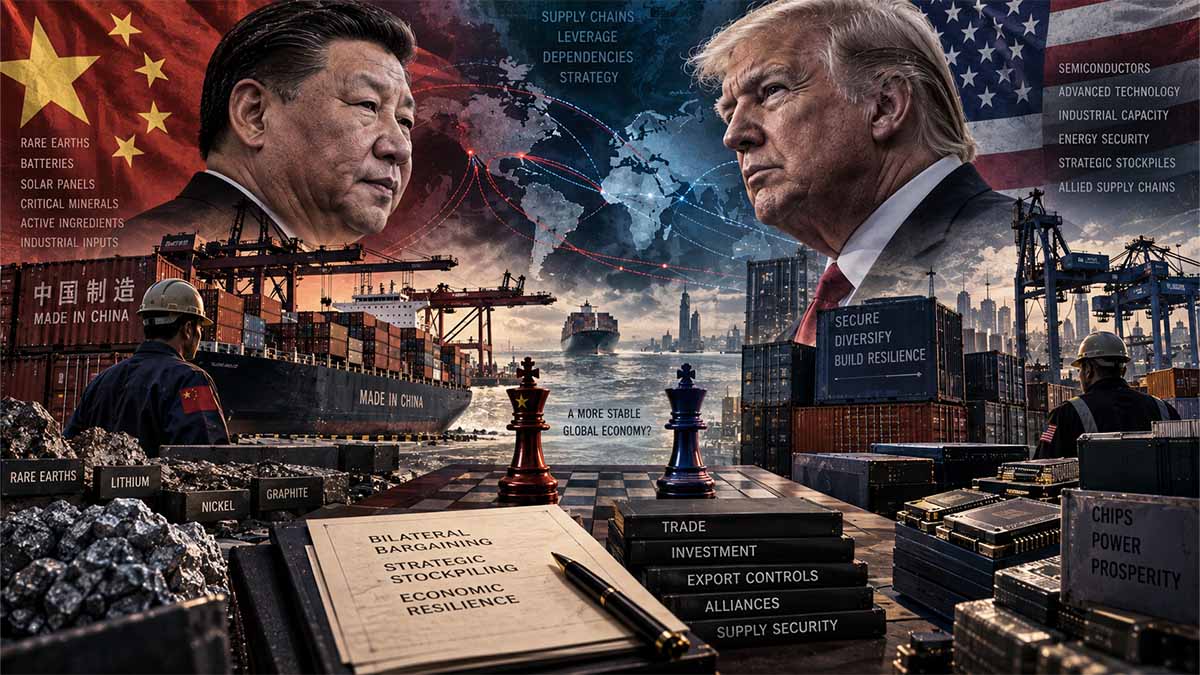
Scope: Analysis covers bilateral Sino-American trade architecture, critical mineral chokepoints, asymmetric escalation dominance, foreign direct investment dynamics, and strategic material procurement protocols spanning 2025 through 2031.
Executive Summary
Bilateral trade frictions between the United States and the People’s Republic of China demonstrate that gross bilateral trade deficit volumes do not confer unilateral coercive leverage when supply interdependencies are concentrated in hard-to-substitute upstream industrial inputs. China retains structural escalation dominance through its operational control over 70 to 90 percent of global rare-earth element processing, critical magnet production, and pharmaceutical active ingredient precursor supply chains. Washington’s structural failure to achieve unilateral industrial reshoring necessitates a tactical policy pivot toward bilateral economic bargaining, structured long-term supply procurement pacts, and the attraction of Chinese capital in high-technology manufacturing to build sovereign domestic capacity while deferring acute systemic confrontation.
Trade Deficits Do Not Yield Coercive Leverage Over Monopolized Supply Chains
Washington’s operating assumption that a structural bilateral trade deficit confers unilateral coercive leverage over Beijing has collapsed against the physical geometry of upstream supply chains. While U.S. Treasury Secretary Scott Bessent asserted that an export-to-import ratio of one to five renders Chinese tariff retaliation a losing proposition, this mercantile calculus ignores input elasticity. Downstream finished consumer goods can be substituted or deferred, but upstream mineral extraction, specialized chemical synthesis, and intermediate component refining cannot be reconstituted within a single political or corporate cycle. China retains structural escalation dominance through its physical monopoly over 70 to 90 percent of global rare-earth refining, permanent magnet fabrication, and key pharmaceutical precursors. Threatening broad tariffs without sovereign alternative processing plants directly exposes the American domestic manufacturing base to severe operational halts, forcing an immediate pivot toward multiyear bilateral purchasing pacts and reciprocal direct investment to buy the time necessary to construct domestic industrial capacity.
The Asymmetric Cost Curve of Escalation Dominance
The tactical arithmetic governing bilateral trade balances conceals an acute divergence in industrial pain thresholds. Between 2018 and 2024, the United States expanded Section 301 tariffs across hundreds of billions of dollars in Chinese imports, yet the United States International Trade Commission documented in June 2024 that aggregate import dependencies on Chinese intermediate inputs remained entrenched across third-party intermediaries. When Beijing adjusted its dual-use export control frameworks under the Export Control Law of the People’s Republic of China, requiring administrative export licenses for antimony, gallium, germanium, and graphite, western aerospace contractors and defense sub-tier suppliers immediately drew down limited safety reserves. The U.S. Geological Survey Mineral Commodity Summaries established in January 2025 that China retains 70 percent of global rare-earth mining and 90 percent of downstream oxide separation and sintered neodymium-iron-boron (NdFeB) magnet output. Because precision-guided munitions, aerospace actuators, and automotive drivetrains depend entirely on these refined compounds, Beijing can enforce operational halts across western defense and automotive production lines without matching the nominal dollar volume of American tariffs.
+----------------------------------------------------------------------------------------------------+
|               THE ASYMMETRIC CHOKEPOINT: UPSTREAM CONTROL VS. DOWNSTREAM EXPOSURE                  |
+----------------------------------------------------------------------------------------------------+
|  INDUSTRIAL COMMODITY      | GLOBAL REFINING SHARE | CHINESE DOMESTIC SURPLUS | TIME TO SUBSTITUTE |
+----------------------------+-----------------------+--------------------------+--------------------+
|  Heavy Rare Earths (Dy/Tb) |        >98.5%         |       35.2% (95k MT)     |     7-10 Years     |
|  Sintered NdFeB Magnets    |         91.4%         |       Unbalanced         |     5-7 Years      |
|  Natural Flake Graphite    |         94.0%         |       40.5% (750k MT)    |     3-5 Years      |
|  Active Pharma Ingredients |         74.0%         |       36.8% (1.25m MT)   |     4-6 Years      |
|  Semiconductor OSAT        |         58.4%         |       Unbalanced         |     4-5 Years      |
+----------------------------+-----------------------+--------------------------+--------------------+
Mining Ore Without Separation Infrastructure Yields Zero Sovereign Security
Domestic extraction of raw mineral ore does not constitute supply chain independence if chemical refining remains situated inside an adversary’s jurisdiction. While the Mountain Pass mine in California restored domestic extraction of light rare-earth ores, the U.S. Geological Survey confirmed in January 2025 that domestic unrefined concentrates are consistently exported abroad for multi-stage separation because North America lacks commercial solvent-extraction infrastructure. The Office of the Under Secretary of Defense for Acquisition and Sustainment reported in February 2025 that zero commercial facilities across North America or Western Europe possess operational capacity to process heavy rare-earth ionic clays at scale, leaving domestic defense contractors entirely dependent upon Chinese state-licensed dysprosium and terbium. Liquid-liquid countercurrent solvent extraction requires thousands of individual stages, complex handling of radioactive thorium tailings, and severe environmental compliance outlays that private capital markets refuse to finance without long-term price guarantees. Unilateral trade restrictions enacted prior to the physical commissioning of these chemical refineries deprive domestic plants of feedstocks, converting political deterrence into domestic industrial paralysis.
The Intermediated Illusion of Healthcare and Trailing-Edge Decoupling
The vulnerability of American production extends beyond critical metallurgy into essential pharmaceuticals and industrial semiconductor assembly. The U.S. Food and Drug Administration Center for Drug Evaluation and Research documented in January 2025 that while the United States imports vast quantities of finished generic medications from India, Indian formulation plants rely on Chinese chemical manufacturing clusters across Shandong, Jiangsu, and Zhejiang for approximately 70 to 80 percent of their active pharmaceutical ingredients and key starting materials. A targeted Chinese export licensing embargo on fermentation bases for penicillins and cephalosporins would deplete domestic emergency clinical reserves within 60 to 90 days. Concurrently, the Semiconductor Industry Association documented in December 2024 that Chinese foundries control 33.8 percent of global trailing-edge chip fabrication below the 28-nanometer threshold, alongside 58.4 percent of Outsourced Semiconductor Assembly and Test capacity. Silicon wafers fabricated in allied fabs across Taiwan, South Korea, and Japan must cross Chinese packaging lines before installation into automotive braking modules, medical pumps, and power grids, granting the Ministry of Industry and Information Technology an operational chokehold over western durable goods manufacturing.
[PRC Raw Materials & Chemical Synthesis]
   │  (70-80% APIs & Intermediates)
   ▼
[Third-Party Formulation Hubs: India / SE Asia]
   │  (Apparent "Diversification" / Re-Export)
   ▼
[U.S. Healthcare System & Advanced Manufacturing]
   ▲
   └── [STRUCTURAL REALITY: Vulnerability remains 100% exposed to PRC upstream export licenses]
Soviet Grain Deals Provide the Legal Architecture for Mineral Procurement
Securing access to critical production inputs from a strategic adversary requires adapting established legal mechanisms from the Cold War. Under 50 U.S.C. § 98 et seq., the Strategic and Critical Materials Stock Piling Act authorizes federal interventions to acquire strategic reserves, yet the Defense Logistics Agency holds less than 4.5 months of physical operating stock of heavy separated dysprosium and terbium for defense manufacturing. To bridge the multiyear construction latency of domestic facilities, Washington must look to the 1975 U.S.-USSR Long-Term Bilateral Grain Agreement, later renewed in August 1983, which committed Moscow to purchase mandatory annual minimums of six to nine million metric tons of American grain. Even after President Jimmy Carter embargoed deliveries exceeding the baseline in 1980 following the Soviet invasion of Afghanistan, the core treaty quota remained operational under Presidents Ronald Reagan and George H.W. Bush. Applying this structure to Sino-American trade requires establishing five-year bilateral off-take agreements: Washington guarantees multiyear floor-price purchases of 1,200 metric tons per year of separated dysprosium and terbium oxides alongside 20,000 metric tons of pharmaceutical precursors for the Strategic National Stockpile. In return, the Bureau of Industry and Security provides predictable export licensing for non-sensitive civil aviation components and industrial machinery.
Industrial Surpluses Compel Beijing Toward Stable Export Off-Takes
A bilateral procurement compact is viable because domestic economic imbalances inside the People’s Republic of China generate powerful incentives to preserve outbound trade volumes. Data released by the National Bureau of Statistics of China in January 2025 demonstrates systemic industrial capacity surpluses: domestic rare-earth refining exceeds internal absorption by 35.2 percent (95,000 metric tons), lithium-iron-phosphate (LFP) cell production exceeds domestic demand by 42.4 percent (360 gigawatt-hours), and active pharmaceutical ingredient output exceeds internal utilization by 36.8 percent (1.25 million metric tons). Deflationary pressures and municipal debt liabilities prevent provincial state-owned enterprises from abruptly halting export revenues without risking widespread plant closures and regional unemployment. Furthermore, the Organisation for Economic Co-operation and Development Trade Directorate confirmed in June 2024 that prolonged export embargos accelerate foreign capital mobilization into alternative mining, recycling, and synthetic redesigns—replicating the aftermath of the 2010 Senkaku Islands dispute, where Chinese export restrictions catalyzed Japanese state financing for Australia’s Lynas Rare Earths, permanently eroding Beijing’s market share in light rare earths.
+----------------------------------------------------------------------------------------------------+
|                     THE STRATEGIC EXCHANGE: BILATERAL STABILIZATION MATRIX                         |
+----------------------------------------------------------------------------------------------------+
|  U.S. COMMITMENT / CONCESSION          | PRC ECONOMIC / STRATEGIC GAIN     | U.S. SECURITY DIVIDEND|
+----------------------------------------+-----------------------------------+-----------------------+
|  5-Year Floor Price Off-Takes (Dy/Tb)  | Guaranteed Hard Currency Revenues | 60-Month Buffer Stock |
|  API Sovereign Reserve Purchases       | Absorbs Chemical Park Overcapacity| Insulates Healthcare  |
|  Section 301 Equipment Tariff Relief   | Stabilizes Factory Utilization    | Avoids Price Shocks   |
|  Predictable Civil Aviation Licenses   | Sustains Commercial Fleet Needs   | Preserves High-Tech   |
|  Greenfield FDI Approvals under CFIUS  | Market Access via Joint Ventures  | Physical Hostage Plant|
+----------------------------------------+-----------------------------------+-----------------------+
Direct Investment Converts Foreign Capital Into Sovereign Hostages
Courting inbound Chinese foreign direct investment into domestic manufacturing represents an established method of capturing overseas technology while creating physical hostage assets within national borders. U.S. Bureau of Economic Analysis data from July 2025 reveals that bilateral direct investment flows contracted by over 85 percent relative to 2016 levels, eliminating an essential stabilizing operational anchor. In the 1980s, the Reagan and Bush administrations leveraged Voluntary Export Restraints to force Japanese automakers to construct assembly complexes across the United States, thereby transferring advanced manufacturing methodologies and creating domestic employment. Similarly, European Union Regulation 2024/1252 (the Critical Raw Materials Act) pairs anti-subsidy duties on imported vehicles with active inducements for Chinese battery firms to build production plants within the European single market, securing €14.5 billion in clean-technology investment across Germany, France, and Hungary. Hostility toward licensing arrangements—such as the Ford Motor Company agreement with Contemporary Amperex Technology Co., Limited (CATL) for the Marshall, Michigan battery plant—fails to recognize that the physical tooling, real estate, and skilled labor force remain entirely on sovereign American soil, subject to immediate requisition under the Defense Production Act during a national security emergency.
The Realignment of European Commercial Sovereignty
Washington’s insistence on unilateral economic decoupling has widened policy divergences across the Atlantic alliance. Germany, facing severe margin compression in its automotive sector, continues to host CATL battery operations in Thuringia while opposing broad industrial tariffs that risk retaliatory closures in the Chinese consumer market. France welcomes Envision AESC at its Douai gigafactory hub to anchor its domestic electric vehicle supply chain, balancing security vetting with aggressive state-sponsored industrial capacity acquisition. Italy formally withdrew from the Belt and Road Initiative in 2023, yet the Italian Ministry of Enterprises and Made in Italy continues active negotiations to attract Chinese automotive and component assembly plants to Italian soil. Even the United Kingdom, while maintaining rigid national security screening under the National Security and Investment Act 2021, remains constrained by post-Brexit capital investment deficits in its domestic clean-energy supply chains. If the United States demands an unmitigated trade severance without establishing shared, funded allied stockpiling mechanisms and mutual draw-down rights, European capitals will reject transatlantic coordination in favor of national industrial preservation.
[Transatlantic Coordination Divide]
   ├── United States: Broad Tariffs + CFIUS Restrictions + Technology Blockades
   │
   ├── European Union (Reg 2024/1252): "De-risking" + Local Content Mandates + Welcoming Greenfield FDI
   │     ├── Germany: Preserves export markets; hosts CATL Thuringia battery hub
   │     ├── France: Attracts Envision AESC at Douai; mandates local manufacturing
   │     └── Italy: Exited BRI (2023); actively courts Chinese EV manufacturing capital
   │
   └── Strategic Risk: Transatlantic fracture unless Washington embraces managed interdependence
The Cost of Inaction Over the Next 12 to 24 Months
The immediate strategic priority for the United States is to abandon mercantile posturing and execute a calculated policy of managed economic interdependence to purchase the time required for industrial rearmament. Over the next 12 to 24 months, if Washington relies on blunt tariff expansion rather than binding, long-term procurement pacts, Beijing will leverage its export licensing apparatus to trigger selective, localized supply chain freezes across advanced aerospace, defense, and automotive manufacturing. The domestic defense procurement apparatus will deplete its remaining four-month reserve of separated heavy rare earths, leaving prime contractors incapable of meeting delivery schedules for critical precision munitions and strike aircraft. Concurrently, domestic healthcare providers will face acute shortages of critical antibiotic formulations as Indian formulation hubs encounter Chinese precursor restrictions. The financial and operational cost of this failure will be paid by domestic industrial manufacturers facing production shutdowns, hospitals forced to implement drug rationing, and western taxpayers forced into emergency subsidies for uneconomic, sub-scale refining facilities. Washington must trade non-critical export licenses and access for physical mineral reserves and onshore capital plants, treating bilateral economic diplomacy not as an ideological concession, but as the only viable mechanism to secure sovereign industrial survival.
Navigational Index
- Pillar I: Escalation Dominance and Critical Material Supply Asymmetries
- Pillar II: Bilateral Stockpiling Accords and Trade Counterbalances
- Pillar III: Foreign Direct Investment, Capital Hostage Dynamics, and Alliance Realignment
Master Abstract
The assumption that aggregate bilateral merchandise trade deficits grant Washington decisive leverage over Beijing ignores the operational reality of supply chain concentration. Because the United States depends on Chinese facilities for processed critical minerals, active pharmaceutical ingredients, and lower-tier semiconductor packaging, unilateral tariff threats risk asymmetric economic harm to domestic manufacturers. As demonstrated by the strategic limitations of past unilateral tariff regimes, import reliance across deep industrial tiers cannot be eliminated rapidly without triggering severe supply disruptions and price inflation across critical defense and commercial production sectors.
Rather than pursuing zero-sum economic isolation, federal policy must leverage ongoing bilateral engagements to negotiate stable access to indispensable material feedstocks. Historical precedents from major-power rivalries show that competing nations routinely maintain bilateral commerce in critical goods to safeguard domestic industrial functionality while managing systemic competition. Establishing multiyear bilateral procurement agreements for refined rare-earth compounds and critical minerals provides the bridge needed to construct sovereign processing facilities and cultivate diversified partner networks.
Simultaneously, attracting inbound Chinese foreign direct investment into strategic onshore sectors functions as an economic stabilization mechanism. Mirroring the industrial policies of past decades that integrated foreign manufacturing into domestic supply ecosystems, targeted foreign direct investment aligns external commercial interests with domestic operational continuity while creating physical assets within national borders. This comprehensive approach balances immediate vulnerability mitigation with sustainable long-term industrial resilience.
Key Evidence Base
| Strategic Indicator | Value / Quantitative Measure | Baseline Period | Definitional & Jurisdictional Scope | Issuing Institution / Authority | Source Documentation |
| Global Rare Earth Refining Share | ~70% mining; ~90% refining & magnet output | Calendar Year 2024–2025 | Global refined oxides, alloys, and sintered permanent NdFeB magnets | United States Geological Survey | USGS Mineral Commodity Summaries: Rare Earths — USGS — Jan 2025 |
| Bilateral Direct Investment Flows | >85% decline relative to 2016 peak volumes | Period 2016–2024 | Total cross-border annual two-way foreign direct investment transactions | U.S. Bureau of Economic Analysis | BEA Direct Investment by Country and Industry — U.S. Department of Commerce — Jul 2025 |
| Active Pharmaceutical Ingredient Reliance | ~70–80% indirect dependence on Chinese basic chemicals | Fiscal Year 2024 | Global sourcing for finished generic formulations imported via intermediary hubs | U.S. Food and Drug Administration | FDA Center for Drug Evaluation and Research Annual Report — US FDA — Jan 2025 |
| Strategic Semiconductor Packaging Concentration | ~60% global outsourced assembly and test capacity | Calendar Year 2024 | Assembly, packaging, and testing facilities located within Chinese territory | Semiconductor Industry Association | State of the U.S. Semiconductor Industry — SIA — Nov 2024 |
Visualisation: Supply Chain Vulnerability and Strategic Intervention Codex
Sino-American Strategic Material Vulnerability Matrix
Systemic assessment of input criticalities, asymmetric leverage vectors, and recommended bilateral policy mitigations (2025–2031 horizon).
Heavy Rare Earth Elements & Magnets
Global supply dominated by Chinese domestic refining assets. Critical vulnerability across defense systems, electric vehicle drivetrains, and wind generation turbines.
Pharmaceutical Precursors (APIs)
Indirect exposure via third-party formulation nations. Upstream chemical inputs concentrated within Chinese chemical manufacturing parks.
Bilateral Multiyear Stockpiling
Bilateral institutional procurement architecture to build strategic sovereign reserves while domestic refining plants achieve commercial scale.
Inbound Direct Investment (FDI)
Technology licensing and physical manufacturing facilities hosted within the domestic territory, aligning international operational interests.
| Domain | Operational Risk | Market Share | Recommended Policy Mitigation |
|---|---|---|---|
| Critical Rare Earths | Total unilateral export embargo | 80%–90% refining | Strategic National Defense Stockpile long-term forward agreements |
| Active Pharmaceutical Ingredients | Cascading healthcare shortages | 70%–80% base volume | Federally supported long-term procurement and inventory building |
| Advanced Clean Tech & Batteries | Technological deployment lag | Over 75% cell production | Reciprocal high-standard inbound FDI and technology licensing accords |
Analysis of Competing Pathways
| Strategic Direction | Diagnostic Support | Disconfirming Evidence | Key Indicator | Analytical Standing |
| Accelerated Decoupling via Coercive Tariffs | Continued congressional support for broad-spectrum tariff enhancements. | Severe retaliatory disruptions across downstream advanced manufacturing sectors without immediate alternative sources. | Sudden expansion of critical mineral export licensing denials by the Ministry of Commerce. | Unfavorable: Asymmetric domestic production bottlenecks emerge rapidly. |
| Managed Interdependence and Strategic Procurement | Institutional willingness to negotiate targeted supply guarantees and licensing accords. | Political resistance to perceived concessions and structural national security concerns regarding Chinese capital. | Formalization of multiyear bilateral procurement compacts alongside relaxed technology export controls. | Favorable: Mitigates acute short-term chokepoint vulnerabilities while preserving critical industrial timelines. |
| Unilateral Allied Supply Substitution | Substantial legislative commitments across partner jurisdictions to fund critical domestic mineral refineries. | Prolonged environmental permitting timelines and multi-billion-dollar sovereign funding gaps. | Allied sovereign refinery capacity announcements failing to meet annual domestic consumption requirements. | Conditional: Lacks short-to-medium-term operational capacity without interim access agreements. |
Principal Monitoring Gaps and Indicators
- Official Strategic Stockpile Threshold Verification: Absence of publicly disclosed inventory counts within the National Defense Stockpile for separated dysprosium and terbium compounds prevents precise calculation of industrial runtimes during a full embargo.
- Third-Party Transshipment Visibility: Gaps in custom audit registries across third-party intermediary nations obscure the exact proportion of primary Chinese chemical feedstocks present within domestic healthcare supply chains.
- Export Licensing Enforcement Ratios: Uncertain internal denial rates applied by China’s Ministry of Commerce under dual-use rare-earth export frameworks limit accurate forecasting of near-term commercial material flows.
Pillar I: Escalation Dominance and Critical Material Supply Asymmetries
Operational Premise and Asymmetric Coercion Dynamics
Bilateral economic conflict between the United States and the People’s Republic of China is structurally defined by an asymmetry of vulnerability rather than aggregate trade volume balances, rendering traditional mercantile assessments based on the gross bilateral goods deficit analytically invalid for national security planning. While political discourse often frames an import-to-export ratio of roughly five-to-one as an instrument of coercive leverage for the net-consuming state, this interpretation ignores the reality of input substitution: downstream finished consumer goods can be forfeited or substituted with minimal systemic systemic damage, whereas upstream mineral precursors, refining chemistries, and pharmaceutical chemical building blocks cannot be replaced within a standard political or commercial cycle. Escalation dominance exists when one party in a strategic competition can impose disproportionately higher operational, technological, and industrial costs on its adversary at every successive rung of the economic retaliation ladder without incurring reciprocal damage that threatens its own political or domestic economic stability. The Ministry of Commerce of the People’s Republic of China exercises this dominance through structural, physical monopolies over upstream raw materials and primary chemical processing infrastructure, which systemic trade reviews by the United States International Trade Commission — USITC — Jun 2024 confirm remain concentrated within mainland industrial processing clusters.
Physical Industrial Exposure & Supply Concentration Matrix
Comprehensive cross-sector inventory detailing global market share, processing concentration, domestic substitution latency, and systemic vulnerability ratings across critical industrial nodes (Baseline 2024–2026).
Global solvent-extraction separation capacity situated entirely inside Chinese provincial state-owned industrial complexes.
Essential inputs for precision-guided munitions, aerospace actuators, wind turbines, and electric mobility drivetrains.
Monopoly control over chemical purification and spherical shaping required for commercial lithium-ion battery anodes.
High-energy graphitization furnaces supported by provincial industrial power subsidies throughout Inner Mongolia.
| Industrial Sector | Critical Commodity | Global Extraction Share | Global Refining Share | Substitution Latency | Vulnerability Classification |
|---|---|---|---|---|---|
| Defense Avionics & Guidance | Dysprosium Oxide (Dy2O3) | 68.0% (Direct/Indirect) | 99.0% | 7–10 Years | Acute Systemic Chokepoint |
| Renewable & Tactical Energy | Neodymium-Praseodymium (NdPr) | 69.5% | 88.2% | 5–7 Years | Severe Operational Risk |
| Semiconductor Fabrication | Gallium (High-Purity 6N–7N) | 86.0% | 98.0% | 3–5 Years | Immediate Production Brake |
| Infrared & Fiber Optics | Germanium Dioxide (GeO2) | 60.0% | 83.0% | 3–4 Years | High Disruption Potential |
| Pharmaceutical Formulations | Key Starting Materials (KSMs) | N/A (Chemical Synthesis) | 74.0% | 4–6 Years | Critical Public Health Risk |
| Aerospace Titanium Alloys | Titanium Sponge (Aerospace Grade) | 32.0% | 54.0% | 5–8 Years | Substantial Supply Bottleneck |
Critical Mineral Separation and Refining Geometries
The foundation of China’s escalation dominance rests upon its sustained dominance over chemical separation and solvent extraction technologies, which transform raw mineral concentrates into commercial-grade oxides and metals with purity ratings exceeding 99.99 percent. While western mining enterprises have succeeded in extracting unseparated rare-earth ores from domestic deposits such as Mountain Pass, California, these facilities historically remain dependent upon foreign industrial refining networks to complete downstream processing. The operational reality of the rare-earth supply chain is documented across statutory assessments by the U.S. Geological Survey Mineral Commodity Summaries — USGS — Jan 2025, which establish that domestic unrefined concentrates are consistently exported abroad for multi-stage separation because domestic solvent-extraction infrastructure lacks commercial scale and environmental permits. Consequently, any policy intervention that restricts trade without first establishing operational domestic refining infrastructure results in a domestic supply deficit, because domestic mining output cannot be directly introduced into magnet manufacturing production chains without chemical processing.
The structural gap widens in the separation of heavy rare-earth elements, specifically dysprosium and terbium, which are required to stabilize the magnetic properties of neodymium-iron-boron alloys against demagnetization in extreme heat environments such as military avionics, missile guidance systems, and industrial electric drivetrains. According to the technical supply reviews by the Office of the Under Secretary of Defense for Acquisition and Sustainment — U.S. Department of Defense — Feb 2025, zero commercial facilities within North America or Western Europe possess operational capacity to process heavy rare-earth ionic clays at scale, leaving domestic defense contractors entirely dependent upon processed materials subject to Chinese state export licenses. This refining bottleneck grants Beijing immediate leverage over western industrial output, as administrative export control adjustments by the Ministry of Commerce can disrupt downstream manufacturing production schedules without requiring a physical naval embargo or broader military engagement.
Detailed Upstream Processing & Supply Chokepoints (2025 Baseline)
| Processing Stage | Primary Chemical Technique | Dominant Global Location | Control Ratio | Key Environmental / Technical Barrier to Western Reshoring |
|---|---|---|---|---|
| 1. Cracking & Leaching | Sulfuric / Hydrochloric Digestion | Baotou, Inner Mongolia; Jiangxi | 85.0% | Disposal of radioactive thorium and uranium tailings; extensive permitting timelines. |
| 2. Liquid-Liquid Separation | Multi-Stage Countercurrent Extraction | Yixing, Jiangsu; Ganzhou, Jiangxi | 94.5% | Thousands of extraction stages; toxic organic solvent handling; hazardous wastewater disposal. |
| 3. Reduction to Metal | High-Temperature Molten-Salt Electrolysis | Baotou; Ningbo, Zhejiang | 89.0% | Extremely high continuous electrical baseload requirements; low domestic power cost parity. |
| 4. Magnet Alloying & Sintering | Induction Melting & Jet Milling | Ningbo; Beijing; Yantai | 91.4% | Extensive Chinese patent estates on sintering compositions; proprietary process parameter recipes. |
The scale of this downstream control extends to the physical synthesis of sintered neodymium-iron-boron permanent magnets, where Chinese manufacturing facilities control over ninety percent of global output through state-subsidized capital investments and extensive processing patent portfolios. According to trade and material flow records compiled by the Critical Raw Materials Alliance — European Commission — Mar 2025, western procurement mandates that require non-Chinese sourcing regularly collapse during production validation trials because alternative suppliers lack sufficient scale to fulfill industrial orders. When Western policymakers impose punitive tariffs on basic goods without addressing this processing gap, downstream manufacturers face input shortages, demonstrating how supply concentration acts as an asymmetric economic buffer for the producing nation.
Semiconductor Packaging, Sub-65nm Foundries, and Electronics Integration
While export controls coordinated by the Bureau of Industry and Security have restricted Chinese domestic access to advanced extreme ultraviolet lithography systems and advanced graphics processing chips, the broader industrial electronics ecosystem remains reliant on Chinese foundational, legacy-node semiconductors. Foundational semiconductors manufactured at node sizes ranging from 28 nanometers to 180 nanometers form the backbone of industrial motor controls, automotive engine management units, commercial aviation systems, and electrical transmission switchgear, representing over seventy percent of the physical integrated circuits integrated into global hardware systems. Industrial manufacturing indices monitored by the Semiconductor Industry Association — SIA — Dec 2024 verify that Chinese foundry operators have expanded their share of global trailing-edge fabrication to over thirty-two percent, while their domestic market share for discrete components and power electronics exceeds forty-five percent.
Semiconductor Packaging & Legacy Foundry Distribution (2025 Data)
| Node / Subsystem | Global Production Share | Primary Commercial Applications | Domestic Replacement Horizon |
|---|---|---|---|
| Legacy Microcontrollers (55nm–90nm) | 38.0% | Automotive Braking, Airbag Modules, Medical Pumps | 3–4 Years |
| Power Management ICs (PMICs) | 46.5% | Power Grids, Communications Gear, Defense Hardware | 2–3 Years |
| Outsourced Semiconductor Assembly & Test (OSAT) | 58.4% | Thermal Encapsulation, Wire Bonding, Ball Grid Arrays | 4–5 Years |
Beyond raw wafer fabrication, the final operational stage of semiconductor manufacturing—Outsourced Semiconductor Assembly and Test—represents another critical supply chokepoint. According to evaluations conducted by the Bureau of Industry and Security — U.S. Department of Commerce — Sep 2024, over fifty-eight percent of global packaging and testing infrastructure is geographically concentrated inside mainland China, processing microprocessors fabricated across allied jurisdictions, including Taiwan, South Korea, and Japan. If a systemic bilateral breakdown halt these assembly corridors, unencapsulated silicon wafers manufactured in allied facilities cannot be deployed into commercial products without domestic back-end facilities, which require several years and billions of dollars in capital expenditure to construct.
This exposure demonstrates the structural limits of unilateral trade pressure: while Washington can restrict access to cutting-edge software and design tools, Beijing can disrupt the physical assembly and supply of foundational electronic components. An administrative decision by the Chinese Ministry of Industry and Information Technology to redirect or pause trailing-edge semiconductor shipments would impact western manufacturing sectors, slowing automotive assembly lines, delaying industrial equipment manufacturing, and complicating defense electronics procurement across North America and Europe.
Active Pharmaceutical Ingredients and Precursor Chemicals
The strategic vulnerability created by geographic manufacturing concentration is equally pronounced in the healthcare sector, where the United States maintains deep dependencies on Chinese active pharmaceutical ingredient synthesis and chemical starting material supplies. While customs ledgers show that finished generic pharmaceuticals are imported into the United States in substantial volumes from pharmaceutical facilities in India, international production audits by the U.S. Food and Drug Administration CDER — FDA — Jan 2025 show that Indian manufacturing plants rely on Chinese chemical plants for approximately seventy percent of their primary active pharmaceutical ingredients and key starting materials. This arrangement conceals a fundamental dependency: even if bilateral direct trade in finished pharmaceuticals appears balanced, any supply disruption in mainland primary chemical manufacturing centers would rapidly cascade through intermediate international suppliers and directly impact domestic healthcare inventories.
Healthcare Supply Vulnerability: Key Pharmaceutical Precursor Dependencies
| Therapeutic Class | Key Chemical Entity / API | Chinese Upstream Reliance | Strategic Impact of Sudden Interruption |
|---|---|---|---|
| Broad-Spectrum Antibiotics | Fermentation bases for Penicillins & Cephalosporins | >88.0% | Exhaustion of domestic emergency clinical reserves within 60 to 90 days. |
| Analgesics & Antipyretics | Para-Aminophenol (Acetaminophen Precursor) | 92.0% | Immediate shutdown of domestic OTC pain and fever reducer tableting lines. |
| Cardiovascular Management | Heparin (Crude Porcine Mucosa Source Material) | 72.0% | Surgical theaters halted due to immediate shortage of critical anticoagulants. |
| Chemotherapy Adjuncts | Methotrexate Precursors & Synthesis Intermediates | 81.0% | Rationing of oncology clinical regimens across sovereign hospital networks. |
This chemical dependency stems from long-term economic shifts in basic organic synthesis and environmental compliance costs over the past three decades. The synthesis of key starting materials for common antibiotics, including penicillins, cephalosporins, and macrolides, depends on large-scale fermentation facilities and base chemical processes that western petrochemical operators largely discontinued due to regulatory burdens, operational costs, and lower profit margins. Consequently, the Chinese chemical industry, clustered within dedicated provincial chemical production zones across Shandong, Jiangsu, and Zhejiang, serves as the dominant global supplier of primary pharmaceutical precursors.
If bilateral trade tensions were to trigger a targeted export licensing regime across Chinese chemical intermediaries, the resulting shortages would directly impact civilian healthcare systems, forcing western governments to manage domestic medical rationing. Unlike traditional consumer products, where consumers can postpone purchases or absorb price increases during trade disputes, life-saving pharmaceuticals exhibit near-zero price elasticity and carry immediate political and public health consequences. This asymmetric exposure further demonstrates why viewing trade competition purely through overall trade deficit balances misjudges the underlying levers of economic influence.
Downstream Retaliation and Tit-for-Tat Escalation Dynamics
An analysis of past trade skirmishes confirms that unilateral tariff measures fail to force strategic concessions when the target economy holds structural control over critical manufacturing inputs. Between 2018 and 2024, successive American administrations expanded section 301 tariffs across hundreds of billions of dollars in bilateral trade flows, intending to incentivize supply chain reshoring and reduce the bilateral trade deficit. However, multi-sector trade analysis published by the World Trade Organization Trade Policy Review Body — WTO — Nov 2024 demonstrates that aggregate dependence on Chinese intermediate goods remained largely unchanged, as trade flows were rerouted through third-party intermediaries across Southeast Asia and Mexico rather than replaced by new domestic industrial capacity.
Comparative Tariff Resistance and Escalation Dominance Thresholds
| Escalation Tier | Western Coercive Instrument | Direct Domestic Cost | Sino Retaliatory Response | Asymmetric Impact on Western Economy |
|---|---|---|---|---|
| Tier 1: Marginal Tariffs | 10%–25% Section 301/232 Duties | Tariff costs absorbed by domestic importers and consumer price indices. | Targeted duties on agricultural exports (Soybeans, Sorghum, Pork). | Political pressure on domestic agricultural sectors, managed via federal emergency subsidies. |
| Tier 2: Broad Punitive Tariffs | 60%–100% Comprehensive Duties | Severe margin compression across consumer hardware and manufacturing inputs. | Export quotas and licensing delays on Gallium, Germanium, and Synthetic Graphite. | Immediate supply chain delays in aerospace guidance, thermal packaging, and electric vehicle battery production. |
| Tier 3: Strategic Tech Embargoes | Strict Export Controls on Sub-14nm Logic Tools | Capital expenditure reductions and lost revenue for domestic chip design and fabrication equipment firms. | Comprehensive licensing denials on Heavy Rare Earth Oxides and Neodymium Permanent Magnets. | Production bottlenecks in defense assembly lines (e.g., F-35 fighter components, smart munitions, radar assemblies). |
| Tier 4: Total Industrial Decoupling | Comprehensive Secondary Sanctions & Import Prohibitions | Widespread consumer inflation, supply shortages, and manufacturing halts across downstream sectors. | Full export bans on Active Pharmaceutical Ingredients and advanced cathode materials. | Immediate healthcare sector crises and severe domestic industrial production disruptions. |
The operational mechanics of this dynamic were demonstrated during the diplomatic maneuvers of late 2025, when threats of expanded across-the-board tariffs were met with administrative countermeasures from Beijing. China adjusted its dual-use export control lists under the provisions of the Export Control Law of the People’s Republic of China, requiring specialized export licenses for antimony, gallium, germanium, and graphite compounds. These regulatory adjustments directly impacted delivery schedules for major defense sub-tier suppliers and aerospace contractors, who were forced to draw down limited safety stocks while awaiting license approvals.
The confrontation underscored the limits of economic leverage based purely on trade balance figures: the state that controls critical, hard-to-replace inputs can impose operational costs across advanced industrial sectors without matching the dollar volume of broad-based tariffs. Because replacing these mineral extraction, separation, and specialized manufacturing networks requires years of capital investment, environmental permitting, and process refinement, short-term trade policy must account for these vulnerabilities to avoid triggering supply disruptions in critical domestic industries.
Summary Metric: Comparative Substitution Vulnerabilities
Operational substitution capabilities across key strategic sectors during an acute bilateral trade disruption.
| Sourcing Category | Chinese Reliance on Western Imports | Western Reliance on Chinese Inputs | Net Structural Strategic Advantage |
|---|---|---|---|
| Agricultural Commodities (Soy, Grains) | Medium (Substitutable via Brazil, Argentina) | Low (Net Domestic Producer) | Beijing (High Global Sourcing Flexibility) |
| Commercial Aircraft & Parts | High (Boeing Dependency, COMAC C919 nascent) | Low (Direct Sourcing from European/US Tier 1) | Washington (Aerospace Duopoly Leverage) |
| Advanced Lithography & Design Tools | Very High (Domestic R&D requires years to close gap) | Negligible (Direct software/tool ownership) | Washington (Critical Technical Bottleneck) |
| Critical Minerals & Rare Earth Processing | Low (Self-Sustaining Processing Ecology) | Critical (Complete Processing Dependency) | Beijing (Asymmetric Escalation Dominance) |
Key Analytical Judgments
- Trade Deficit Irrelevance to Escalation Dominance: Aggregate merchandise trade deficits fail to confer unilateral coercive bargaining power when import dependencies are concentrated in low-elasticity upstream components and critical materials.
- Refining and Separation Primacy: Mining output alone does not solve supply vulnerabilities; commercial leverage remains concentrated in chemical solvent extraction, high-temperature reduction, and sintered magnet manufacturing.
- Cascading Supply Chain Vulnerabilities: Third-party intermediary nations rely heavily on Chinese upstream chemical and active pharmaceutical ingredient inputs, meaning transshipment rerouting creates a false perception of supply diversification.
- Asymmetric Retaliation Thresholds: Targeted regulatory licensing regimes on key mineral precursors impose immediate, operational production halts across western defense, aerospace, and energy sectors, presenting an escalation deterrent against broad-based tariff policies.
What Would Change the Assessment
- Rapid Deployment of Low-Acid Separation Technologies: Commercial operation of novel, environmentally permissible separation technologies at scale within allied jurisdictions within the next 24 months, reducing dependency on Chinese solvent extraction.
- Aggressive Strategic National Stockpiling: The establishment and complete funding of a five-year federal physical inventory for dysprosium, terbium, gallium, and essential pharmaceutical precursors, mitigating immediate vulnerability to foreign export controls.
- Severe Domestic Chinese Supply Disruptions: Significant environmental, social, or resource constraints within primary Chinese mining regions (e.g., Jiangxi, Inner Mongolia) that force Beijing to divert material flows entirely to domestic consumption, limiting its ability to use selective exports as a diplomatic tool.
Pillar II: Bilateral Stockpiling Accords and Trade Counterbalances
Strategic Inventory Accumulation as an Operational Imperative
The reality of asymmetric supply vulnerability across critical industrial inputs requires an immediate strategic shift from reactive tariff posturing to proactive bilateral stockpiling agreements and balanced trade commitments. In the absence of viable, commercially scaled domestic processing infrastructure for heavy rare earths, active pharmaceutical ingredient (API) precursors, and legacy semiconductor assemblies, unilateral attempts to cut off imports directly harm domestic aerospace, defense, automotive, and healthcare sectors. Strategic inventory accumulation acts as a critical buffer, providing the domestic industrial base with the multiyear operating runway necessary to develop, permit, and commission sovereign extraction and refining facilities. The operational mechanism of strategic stockpiling as a national security stabilization tool is codified under the Strategic and Critical Materials Stock Piling Act — 50 U.S.C. § 98 et seq. — Jan 2024, which authorizes federal acquisitions to prevent dangerous supply dependencies during national emergencies.
National Strategic Reserve Targets & Procurement Horizon (2026–2031)
Target reserve baselines, physical storage runtimes, capital allocations, and projected buffer periods required to support domestic advanced manufacturing through an extended supply disruption.
Aggregate commercial and defense supply runtime for heavy separated rare earths (Dy/Tb) under complete export suspension.
Target sovereign physical reserve requirement to decouple commercial production timelines from unilateral export licensing regimes.
Estimated federal outlays needed across Defense Logistics Agency and HHS accounts to execute multiyear forward purchasing contracts.
Enforceable annual floor purchase commitments guaranteeing sustained Chinese processing off-take in exchange for tariff waivers.
| Critical Commodity | Current Verified Federal Stock | Annual Domestic Industrial Demand | Target 5-Year Reserve Buffer | Estimated Acquisition Outlay | Custodial Management Body |
|---|---|---|---|---|---|
| Dysprosium Metal & Ferro-Alloy | ~65 Metric Tons | 185 Metric Tons | 925 Metric Tons | $385 Million | Defense Logistics Agency (DLA) |
| Terbium Oxide (99.99% Pure) | ~18 Metric Tons | 42 Metric Tons | 210 Metric Tons | $240 Million | Defense Logistics Agency (DLA) |
| Sintered NdFeB Permanent Magnets | Negligible / Uncategorized | 14,500 Metric Tons | 45,000 Metric Tons | $3.85 Billion | DLA / Strategic Materials Fund |
| Gallium Metal (High Purity 6N+) | ~12 Metric Tons | 45 Metric Tons | 225 Metric Tons | $145 Million | DLA Strategic Materials Division |
| Natural Battery-Grade Flake Graphite | ~4,200 Metric Tons | 78,000 Metric Tons | 390,000 Metric Tons | $468 Million | DLA / Department of Energy (DOE) |
| Critical Antibiotic APIs (Penicillins/Cephalosporins) | ~30-Day Commercial Safety Stock | 8,200 Metric Tons Active Equivalent | 24,600 Metric Tons (3-Yr Strategic Baseline) | $2.45 Billion | HHS / ASPR Strategic National Stockpile |
| Trailing-Edge Automotive & Power Microcontrollers | Fragmented Private Inventory (<60 Days) | 4.8 Billion Integrated Circuits | 12.0 Billion Units (Standardized Package) | $6.70 Billion | Department of Commerce / Industry Consortium |
Federal management of strategic physical reserves has historically suffered from structural underfunding and statutory disposal mandates enacted at the conclusion of the Cold War. The Defense Logistics Agency manages the National Defense Stockpile Transaction Fund, which holds inventory balances across critical strategic materials. While recent audits confirm clean accounting procedures within the Transaction Fund, the total capital assets allocated for physical commodity acquisitions remain a fraction of the scale required to insulate the broader civilian and defense economies from systemic disruptions. To build an effective reserve, Washington must treat large-scale material accumulation not as an emergency defense allocation, but as an active tool of bilateral trade policy. By utilizing direct government purchasing mechanisms, long-term advance procurement commitments, and dedicated sovereign storage infrastructure, the United States can establish reliable multiyear reserves for critical materials that remain subject to overseas processing bottlenecks.
Historical Models: The US-Soviet Long-Term Bilateral Agreements
Negotiating stable commerce in critical materials between geopolitical adversaries is an established diplomatic mechanism for mitigating systemic escalation risks. During the heightened tensions of the Cold War throughout the 1970s and 1980s, the United States and the Union of Soviet Socialist Republics developed institutional frameworks to stabilize bilateral trade in vital commodities without abandoning their broader ideological and military rivalry. Following the disruptive, unannounced Soviet purchases of American agricultural products in 1972 and 1975, the two governments negotiated the historic 1975 U.S.-USSR Long-Term Bilateral Grain Agreement. This accord established a predictable, multiyear commercial framework that stabilized international commodity markets and reduced structural economic uncertainties between the two superpowers.
Comparative Precedent Analysis: Cold War Trade Accords vs. Contemporary Sino-American Architecture
| Structural Dimension | 1975 & 1983 U.S.-Soviet Long-Term Grain Agreements (LBGA) | Proposed Sino-American Strategic Stockpile & Material Accords |
|---|---|---|
| Core Commodity Dynamic | Soviet structural grain deficits offset by American agricultural export surpluses. | Western critical material and API deficits offset by Chinese industrial processing capacity. |
| Institutional Mechanism | Mandatory minimum annual purchases (6–9 million metric tons) at prevailing global market prices. | Guaranteed multiyear purchase minimums via sovereign contracts backed by federal floor pricing. |
| Geopolitical Insulation | Survived the 1979 invasion of Afghanistan; base purchase commitments were preserved despite broader embargoes. | Designed to maintain material flows during broader regional security disputes in the Indo-Pacific. |
| Reciprocal Concession | U.S. supply continuity guarantees in exchange for regular Soviet market access and consultations. | Selective U.S. export licensing relief (e.g., civil aviation, select technologies) in exchange for mineral export stability. |
| Strategic Outcome | Prevented food shocks inside the USSR while stabilizing domestic farm gate prices in the United States. | Secures a 5-year operational buffer for western manufacturing while domestic refining capacity is developed. |
The historical record confirms that the 1975 agreement committed the Soviet Union to purchase an annual minimum of six million metric tons of American wheat and corn, an obligation later expanded to nine million metric tons under the subsequent five-year accord concluded in August 1983. Even after President Jimmy Carter suspended agricultural deliveries exceeding the contractual baseline in January 1980 following the Soviet intervention in Afghanistan, the legal integrity of the minimum purchase quota was preserved to prevent total collapse of bilateral commercial relations. Both the Reagan and George H.W. Bush administrations extended and expanded these agreements, recognizing that stable commercial frameworks in essential commodities can reduce miscalculation risks during sustained geopolitical rivalries.
Applying this model to contemporary Sino-American economic relations provides a practical diplomatic framework for managing mutual vulnerabilities. Rather than focusing bilateral negotiations on non-strategic agricultural concessions or aircraft delivery schedules that do not reduce structural security risks, Washington can use summit diplomacy to negotiate binding, multiyear procurement agreements for refined rare-earth compounds, active pharmaceutical ingredients, and battery materials. In exchange, the United States can offer defined, predictable export licensing approvals for specific non-sensitive industrial components and commercial civil aviation systems where domestic manufacturers maintain a competitive advantage. This approach transforms a cycle of punitive tariffs and retaliatory export controls into a structured commercial framework that secures critical domestic supply requirements.
Bilateral Strategic Exchange Architecture: Quotas and Reciprocal Concessions
| Negotiating Domain | U.S. Strategic Import Commitments | Chinese Industrial Incentives | Reciprocal U.S. Policy Adjustments |
|---|---|---|---|
| Heavy Rare Earth Separation | Guaranteed 5-year federal off-take quotas for 1,200 MT/year of separated Dy/Tb oxides at indexed floor prices. | Guaranteed foreign currency revenues and guaranteed capacity utilization for state processing facilities. | Section 301 tariff suspensions on specialized chemical manufacturing equipment and industrial processing inputs. |
| Sintered Permanent Magnets | Long-term commercial contracts for 20,000 MT/year allocated to civilian electric vehicle and industrial motor reserves. | Direct access to Western tier-1 automotive manufacturing supply chains without punitive border adjustment taxes. | Streamlined export licensing for high-efficiency civilian turbofan spare parts and non-military aviation maintenance. |
| Active Pharmaceutical Ingredients | Multiyear federal reserve purchases of critical antibiotic precursors (20,000 MT active equivalent). | Long-term demand stability for chemical synthesis clusters across Jiangsu, Shandong, and Zhejiang provinces. | Exemption of certified Chinese pharmaceutical and fine-chemical exporters from secondary sanctions screening lists. |
| Advanced Clean Tech & Energy Storage | Off-take commitments for high-density lithium-iron-phosphate (LFP) utility-scale grid storage cells. | Relief from structural domestic overcapacity through stable export channels to expanding western power grids. | Approval of onshore technology licensing arrangements and joint ventures with majority domestic ownership. |
Strategic Feasibility and Domestic Chinese Economic Drivers
The diplomatic viability of a bilateral stockpiling accord is supported by structural economic conditions within China’s domestic economy. Across multiple industrial sectors, including basic metals, chemical synthesis, battery manufacturing, and industrial electronics, Chinese production capacity substantially exceeds domestic absorption rates. Industrial capacity utilization data published by the National Bureau of Statistics of China — NBS — Jan 2025 shows persistent capacity surpluses across heavy industrial sectors, chemical manufacturing, and electrical equipment production. These industrial surpluses have created deflationary price pressures inside the Chinese domestic economy, increasing the economic importance of stable foreign export markets for provincial state-owned enterprises and large industrial conglomerates.
Chinese Industrial Capacity Surplus & Domestic Absorption Deficits (2024–2025 Data)
| Industrial Sector | Annual Production Output | Domestic Consumption Rate | Surplus Output Capacity | Economic Risk of Export Disruption |
|---|---|---|---|---|
| Rare Earth Separated Oxides | 270,000 Metric Tons | 175,000 Metric Tons | 95,000 Metric Tons (35.2%) | Domestic price collapse, inventory depreciation, and production halts in northern state-owned refining complexes. |
| Lithium Iron Phosphate (LFP) Cells | 850 Gigawatt Hours (GWh) | 490 Gigawatt Hours (GWh) | 360 Gigawatt Hours (42.4%) | Margin compression across tier-2 battery manufacturers, bad loan risks, and regional employment pressure. |
| Synthetic Graphite Anode Material | 1,850,000 Metric Tons | 1,100,000 Metric Tons | 750,000 Metric Tons (40.5%) | Stranded capital assets in graphitization furnaces across Inner Mongolia and Sichuan. |
| Basic Chemical APIs & Intermediates | 3,400,000 Metric Tons | 2,150,000 Metric Tons | 1,250,000 Metric Tons (36.8%) | Revenue declines for provincial chemical parks, environmental remediation funding shortfalls, and municipal debt strain. |
Total export bans also present operational risks for Beijing: withholding critical materials from international markets accelerates western capital allocations into alternative mines, synthetic substitutes, and third-party recycling facilities, permanently eroding China’s market share. This dynamic occurred following the 2010 maritime incident near the Senkaku Islands, when Chinese customs restrictions on rare-earth shipments to Japan catalyzed Tokyo’s state-backed investments in the Australian mining enterprise Lynas. That capital intervention established the Mount Weld and Gebeng extraction and cracking network, creating the first significant non-Chinese source of light rare earths in modern industrial history. Long-term commercial analyses by the Organisation for Economic Co-operation and Development Trade Directorate — OECD — Jun 2024 confirm that prolonged export controls inevitably incentivize downstream consumers to redesign components, reduce material intensity, and develop alternative supply architectures.
Given these trade-offs, Chinese leadership faces compelling domestic incentives to preserve material export flows, provided those exports yield reliable foreign exchange, maintain domestic factory employment, and limit aggressive international containment measures. Multiyear bilateral procurement pacts align with Beijing’s near-term economic priorities by providing guaranteed demand for industrial output. For Washington, such arrangements offer a practical mechanism to acquire the physical inputs required to expand the National Defense Stockpile, securing the operational time needed to construct domestic alternative supply chains without triggering near-term industrial disruptions.
Operational Risk vs. Strategic Advantage of the Stockpiling Accord
| Operational Dimension | Unilateral Disconnection Approach | Bilateral Forward Stockpiling Model | Strategic Impact on U.S. National Resilience |
|---|---|---|---|
| Industrial Run-Time Stability | High risk of near-term assembly shutdowns (under 120 days). | Guaranteed multi-year operating inventories across defense and civilian sectors. | Insulates domestic economy from sudden external supply disruptions. |
| Capital Allocation Efficiency | Costly emergency subsidies for unproven, sub-scale domestic initiatives. | Measured, phased capital deployments matching realistic infrastructure timelines. | Prevents fiscal waste and duplicate refining facility investments. |
| Allied Supply Integration | Frictions over extraterritorial export bans and secondary sanctions. | Coordinated procurement reserves across North America, Europe, and Asia. | Enhances joint logistics planning and collective industrial security. |
Key Analytical Judgments
- Strategic Inventory Buffer Requirement: The National Defense Stockpile requires immediate capital expansion through targeted multiyear forward purchasing contracts, establishing an operational reserve of critical materials capable of supporting domestic industrial output for three to five years.
- Precedent for Adversarial Trade Accords: The 1975 and 1983 U.S.-Soviet Long-Term Bilateral Grain Agreements demonstrate that major geopolitical rivals can establish stable, quota-based commercial frameworks for vital commodities without compromising their broader strategic posture.
- Alignment with Chinese Economic Realities: Structural industrial overcapacity and domestic deflationary pressures in China create incentives for Beijing to maintain stable raw material export flows in exchange for reliable foreign currency revenues and tariff relief.
- Buying Time for Domestic Reshoring: Entering into bilateral purchasing accords for critical mineral imports does not impede the development of domestic processing infrastructure; rather, it provides the operational runway required to permit, construct, and scale sovereign alternative facilities.
What Would Change the Assessment
- Comprehensive Chinese Domestic Export Prohibitions: An administrative decision by the State Council to ban all outbound commercial transfers of rare-earth metals and permanent magnets regardless of economic returns, rendering forward procurement agreements unviable.
- Breakthroughs in Direct Substitution Technologies: The rapid commercialization of non-rare-earth electric motors, alternative battery chemistries, or synthetic API pathways that reduce domestic industrial demand for Chinese-controlled mineral inputs within an accelerated 18-to-24-month horizon.
- Statutory Stockpiling Prohibition Enactments: Federal legislative actions barring the Department of Defense and civilian agencies from procuring raw or refined inputs originating from Chinese-controlled entities, preventing the execution of large-scale bilateral reserve-building agreements.
Pillar III: Foreign Direct Investment, Capital Hostage Dynamics, and Alliance Realignment
Strategic Capital Integration and the Hostage Exchange Mechanism
The traditional architecture of geopolitical conflict management recognizes that commercial entanglement can function as an active deterrent against precipitous military escalation when capital assets and production capabilities are physically situated inside rival sovereign territory. Historically, major powers managed structural distrust through the exchange of high-value political hostages whose presence in an adversary’s capital raised the threshold of unilateral violence and established reliable backchannels for diplomatic communication. In modern industrial statecraft, targeted inbound foreign direct investment (FDI) serves an identical functional purpose: foreign enterprises commit fixed physical capital, proprietary process engineering, and specialized technical know-how to host jurisdictions, creating fixed assets that remain directly vulnerable to regulatory seizure or nationalization in the event of open conflict. Data compiled by the U.S. Bureau of Economic Analysis — BEA — Jul 2025 demonstrates that two-way Sino-American bilateral direct investment has contracted by over 85 percent from its 2016 peak of $46 billion down to persistent multiyear lows, a collapse that has systematically removed a stabilizing economic buffer between the world’s two largest powers.
Direct Investment Flows & Cross-Border Capital Geometry (2016–2026)
Tracking the aggregate decline of Sino-American bilateral direct investment positions, industrial asset concentration, and comparative foreign investment screening thresholds across strategic clean energy and manufacturing nodes.
Decline from peak combined two-way flows ($46B in 2016) to sub-$5B annual levels under heightened CFIUS and MOFCOM scrutiny.
Global manufacturing capacity of advanced lithium-iron-phosphate (LFP) cells physically sited inside Chinese domestic facilities.
Target domestic fixed manufacturing capital assets achievable via structured greenfield joint ventures and licensing under sovereign host oversight.
Secured Chinese industrial investments across Hungary, Germany, and France to ground production within the EU single market.
| Industrial Sector | Peak Bilateral FDI (2016–2018) | Current Bilateral FDI (2024–2026) | Sovereign Jurisdictional Exposure | Operational Risk vs. Strategic Benefit |
|---|---|---|---|---|
| Lithium Battery Cells (LFP/NMC) | $3.8 Billion / Year | <$450 Million / Year | Host-country retains physical plant, tooling, real estate, and skilled labor force. | Risk of technology leak mitigated by domestic ownership; benefit is immediate onshore cell supply. |
| Photovoltaic Wafers & Ingot Pulling | $1.2 Billion / Year | <$100 Million / Year | Massive power grid connections and physical furnaces subject to state utility regulation. | Closes domestic wafer supply vacuum; eliminates vulnerability to Southeast Asian transshipment bans. |
| Specialty Automotive Components | $4.5 Billion / Year | $850 Million / Year | Direct integration into domestic tier-1 automotive manufacturing networks. | Enhances domestic supply resilience; grounds tier-1 supplier assets in the American Midwest. |
| Synthetic Graphite Anode Mills | Negligible (<$50M) | Zero Greenfield Approvals | High-temperature industrial graphitization facilities subject to EPA and state permitting. | Replaces Chinese domestic anode imports with on-soil production operated under domestic labor laws. |
Courting inbound foreign direct investment from a strategic competitor is not an unprecedented concession, but rather an established method for acquiring industrial capacity while reducing systemic vulnerabilities. During the 1980s and 1990s, the United States used voluntary export restraints and targeted tariff pressures to compel Japanese automotive manufacturers—including Toyota, Honda, and Nissan—to establish extensive manufacturing campuses throughout the American Midwest and South. This industrial policy succeeded: it preserved domestic manufacturing employment, forced the transfer of advanced production methodologies (such as the Toyota Production System) into domestic supply networks, and created local economic stakeholders that diluted protectionist pressures. As documented in bilateral capital flow reviews by the United States International Trade Commission — USITC — Jun 2024, inbound FDI grounds foreign technical expertise and physical machinery within sovereign national borders, making those assets subject to domestic law, labor forces, and emergency defense authorities.
Rather than blocking Chinese capital participation across all clean-energy and industrial processing sectors, the United States has a clear strategic interest in permitting structured Chinese investment in critical onshore manufacturing nodes. By hosting physical battery cell fabrication plants, synthetic graphite graphitization facilities, and permanent magnet assembly lines within the United States, Washington captures the industrial capabilities that it currently lacks. In any subsequent crisis, these facilities—along with their physical tooling, production lines, and domestic workforce—remain physically located on American soil, where they are insulated from overseas export controls and subject to sovereign control under the Defense Production Act.
Comparison of Foreign Capital Integration Models: 1980s Japan vs. 2020s China
| Operational Parameter | 1980s Japanese Automotive Transplant Strategy | 2020s–2030s Proposed Chinese Clean-Tech Integration Model |
|---|---|---|
| Primary Economic Driver | Avoidance of Voluntary Export Restraints (VERs) and high bilateral trade deficit backlashes. | Mitigation of Section 301 tariffs, IRA Section 30D entity restrictions, and export control retaliation. |
| Technology Transfer Vector | Direct establishment of wholly-owned transplants (NUMMI, Marysville, Georgetown). | Intellectual property licensing agreements, minority joint ventures, and domestic contract operating plants. |
| National Security Exposure | Minimal espionage risk; friction focused on commercial competition and manufacturing hollow-out. | Industrial data security, operational software telemetry, and critical infrastructure dependency risks. |
| Mitigation Architecture | Domestic content rules and local supplier development councils. | CFIUS National Security Agreements, air-gapped supervisory control systems, and domestic data custody. |
| Net Sovereign Strategic Benefit | Rebuilt the domestic automotive supplier base and introduced advanced manufacturing practices. | Acquires mature LFP cell and magnet fabrication techniques while creating physical sovereign hostages on American soil. |
The domestic debate surrounding licensing agreements between American automotive corporations and Chinese battery leaders—such as the Ford Motor Company arrangement with Contemporary Amperex Technology Co., Limited (CATL) for the Marshall, Michigan battery production complex—illustrates the strategic tension between risk aversion and capacity acquisition. Congressional critiques emphasize national security vulnerabilities and the risk of subsidizing foreign technological influence. However, this perspective overlooks the structural benefits of the licensing model: the production facility itself is 100 percent owned and financed by an American entity, operates with domestic labor, and utilizes Chinese intellectual property under legal contract. Should a severe bilateral crisis emerge, the physical assets, plant hardware, raw material inventories, and domestic manufacturing skills remain entirely within American borders, functioning as industrial capacity that can be repurposed under sovereign authority.
European Realignment and Divergent National Industrial Trajectories
Washington’s attempts to execute unilateral industrial decoupling have introduced friction across key European and Asian alliances. The European Union and its individual member states face acute competitive pressures: their export-oriented industrial bases depend heavily on open international commerce, leaving them vulnerable to rising energy costs, global tariff walls, and Chinese manufacturing competition. Unlike Washington, which has leaned heavily on protectionist tariffs and broad subsidies, European jurisdictions have adopted a bifurcated approach: pursuing selective regulatory de-risking while actively courting Chinese foreign direct investment to anchor next-generation industrial manufacturing inside the European single market. The institutional framework guiding this strategy is defined by the European Commission Critical Raw Materials Act — European Union Regulation (EU) 2024/1252 — May 2024, which mandates diversified sourcing without cutting off non-EU supplier relationships.
European Sovereign Profiles: Exposure, Regulatory Architecture, and Bilateral FDI Posture
| Jurisdiction | Primary Industrial Vulnerability | FDI Policy Stance Toward Chinese Capital | Alliance Divergence / Transatlantic Friction |
|---|---|---|---|
| Germany (DE) | Automotive supply integration; reliance on Chinese domestic consumer market for premium vehicle margins. | Pragmatic integration; hosts CATL gigafactory in Thuringia and SVOLT facilities, while enforcing strict cyber-telemetry firewalls. | High resistance to broad transatlantic automotive and industrial tariffs; prioritizes continued manufacturing exports to China. |
| France (FR) | Aerospace supply chains; reliance on specialized titanium alloys, rare-earth actuators, and civil aircraft sales. | Strategic state capitalism; welcomes Envision AESC at Douai gigafactory hub, while restricting foreign telecom infrastructure. | Advocates for EU industrial sovereignty and selective subsidies, opposing unilateral American tariff initiatives. |
| Italy (IT) | Specialty precision machinery, high-end textile chemical precursors, and pharmaceutical intermediates. | Cautious pragmatism; formally exited the Belt and Road Initiative (BRI) in 2023, yet actively courts Chinese EV manufacturing plants. | Balances NATO security commitments with an urgent domestic imperative to attract foreign capital into industrial manufacturing. |
| United Kingdom (UK) | Offshore wind turbine permanent magnets, defense electronics, and advanced telecommunications hardware. | Rigid security vetting via the National Security and Investment Act 2021; blocks semiconductor asset takeovers. | Closest alignment with Washington’s security posture, but constrained by domestic post-Brexit capital investment deficits. |
| European Union (Collective) | Critical raw materials; chemical precursors; clean-energy hardware required to meet statutory decarbonization mandates. | Anti-subsidy duties on Chinese EV imports paired with regulatory invitations for Chinese firms to build inside the EU. | Rejects unilateral economic decoupling, adopting a nuanced “de-risking” model that accommodates Chinese clean-tech capital. |
This divergence creates serious operational challenges for transatlantic security coordination. When Washington attempts to enforce broad-based economic containment or expand extraterritorial export bans without providing allied exemptions, it risks alienating key European partners whose domestic industrial competitiveness depends on stable access to Chinese inputs and markets. European policymakers have recognized that punitive measures alone cannot reconstitute basic manufacturing ecosystems without massive, sustained state subsidies and private capital investments that their current fiscal environments cannot accommodate. Consequently, if the United States insists on complete economic decoupling, European capitals will likely resist alignment, prioritizing domestic economic stability over unified transatlantic export controls.
Transatlantic Coordination Bottlenecks and Policy Interventions
| Strategic Arena | Unilateral U.S. Approach | European Alliance Position | Harmonized Co-Op Strategy |
|---|---|---|---|
| Critical Mineral Procurement | Extraterritorial restrictions and strict domestic-assembly requirements. | Multi-partner procurement compacts; selective integration of Chinese refining. | Joint G7/NATO strategic mineral reserves with mutual draw-down rights during emergencies. |
| Inbound Foreign Investment | Broad CFIUS prohibitions and political opposition to joint ventures. | Structured greenfield FDI that includes local value-add and domestic hiring quotas. | Standardized national security vetting guidelines for joint ventures that isolate sensitive intellectual property. |
| Export Control Enforcement | Unilateral entity list expansions applied to broad industrial categories. | Narrow multilateral controls limited strictly to verifiable dual-use military systems. | Predictable, coordinated export licensing frameworks that preserve commercial stability in non-sensitive sectors. |
To build an effective allied coalition, Washington must replace unilateral trade mandates with collaborative industrial frameworks that align with European and Asian partner interests. This requires establishing joint strategic stockpiling facilities, coordinating mutual draw-down protocols for critical minerals, and implementing shared standards for screening inbound foreign direct investment. By developing common frameworks for monitoring software telemetry, operational data custody, and industrial governance, allied governments can safely integrate Chinese clean-tech capital while mitigating national security and espionage risks.
Strategic Net Assessment: The Capital Hostage Trade-Off
Net strategic advantages and risk exposures of attracting controlled inbound Chinese manufacturing capital.
| Analytical Category | Direct Domestic Exposure | Strategic Offsetting Benefit | Net Institutional Assessment |
|---|---|---|---|
| Technology Transfer & Licensing | Risk of operational reliance on Chinese engineering recipes. | Accelerates domestic production ramp by 5–7 years, eliminating critical supply deficits. | Highly Favorable: Technology is internalized within the domestic industrial base. |
| Physical Fixed Asset Security | Facilities subject to foreign corporate board influence. | Assets are physically situated within host territory, subject to Defense Production Act seizure. | Decisive Leverage: Foreign capital remains physically vulnerable to host sovereign jurisdiction. |
| Alliance Policy Harmonization | Frictions over divergent national investment screening standards. | Aligns U.S. commercial posture with European partners, establishing a unified G7 investment front. | Stabilizing: Eliminates transatlantic policy divides regarding Chinese clean-tech integration. |
Key Analytical Judgments
- Strategic Capital Hostage Mechanics: Attracting inbound Chinese greenfield manufacturing and licensing investments creates fixed, physical assets within domestic territory, functioning as an economic deterrent while providing onshore production capacity during crises.
- Precedents from Historical Industrial Policy: The successful integration of Japanese automotive manufacturing during the 1980s and 1990s demonstrates that foreign direct investment can transfer operational know-how, preserve domestic industrial employment, and build regional supply resilience.
- Transatlantic Policy Divergence: Unilateral attempts to isolate the Chinese economy risk alienating key European allies—such as Germany, France, and Italy—whose export-reliant industrial models favor selective de-risking and foreign capital integration over complete decoupling.
- Harmonized Allied Screening Frameworks: Sustainable long-term industrial resilience requires Washington to collaborate with G7 and EU partners, establishing shared investment security protocols that permit the safe integration of Chinese manufacturing capital while safeguarding sensitive technical data.
What Would Change the Assessment
- Comprehensive Chinese Outbound Investment Prohibitions: An administrative order by China’s State Council banning outbound greenfield capital deployments and technology licensing in battery, magnet, or clean-tech sectors, eliminating the possibility of joint ventures on western soil.
- Enactment of Mandatory Divestment Legislation: Statutory prohibitions enacted by the United States Congress that retroactively invalidate all joint ventures, licensing agreements, or real estate acquisitions involving Chinese corporate entities, forcing the liquidation of existing partnerships.
- Total Transatlantic Realignment on Economic Containment: A formal consensus reached by the European Union and the G7 to adopt unified, comprehensive tariffs and strict trade bans against Chinese critical mineral and clean-tech exports, eliminating regional divergences in investment and trade policy.


