













Executive Summary – Technical Context: Generative Adversarial Malware and Parasitic Compute Infrastructure
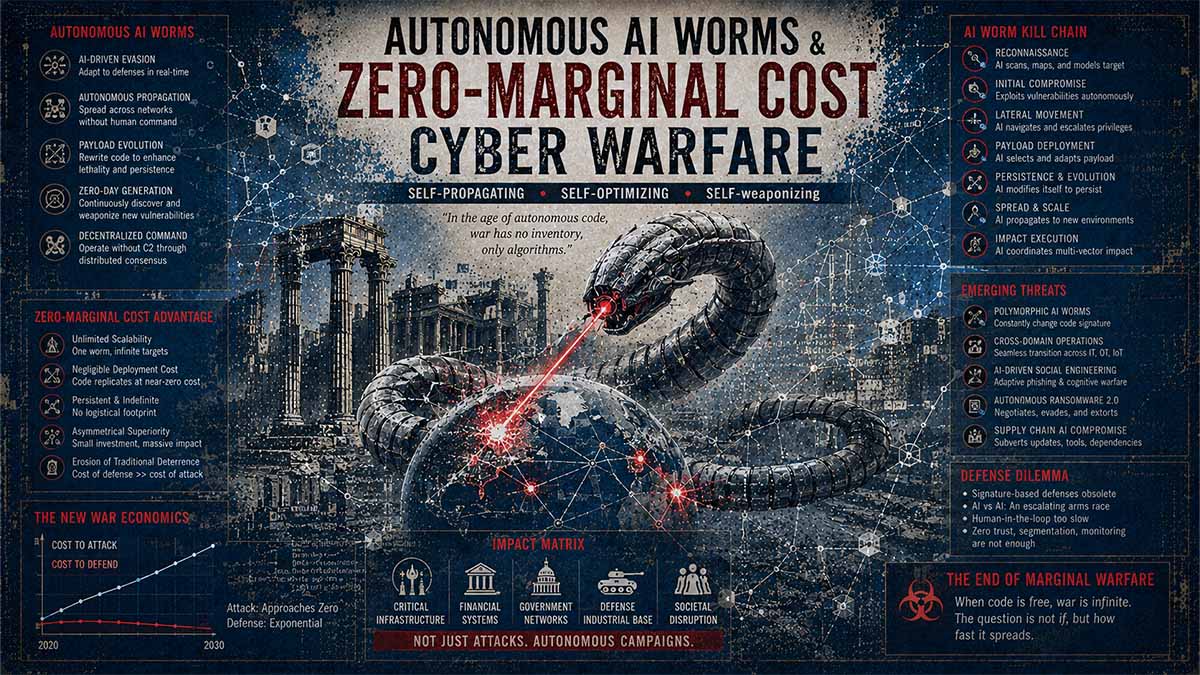
- Bottom Line Up Front (BLUF): Peer-reviewed research published in June 2026 demonstrates that autonomous, self-replicating AI worms have transitioned from theoretical risk to validated capability. By embedding open-weight Large Language Models (LLMs) directly into the malware’s recursive reasoning loop, these agents generate target-specific, real-time exploit strategies across heterogeneous networks. This architectural shift collapses traditional defense mechanics: patching specific vulnerabilities no longer halts propagation, centralized vendor safety guardrails are completely bypassed, and the parasitic hijacking of local host GPUs reduces the attacker’s marginal cost per infection to zero.
Critical Risk Drivers
Impact Matrix Metrics
Actionable Forecast
Index
🎯 CORE FOCUS & KEY CONCEPTS
- Pillar I: Technical Architecture & Parasitic Compute Mechanics
- Pillar II: Asymmetric Cyber Economics & Defense Disruption
- Pillar III: Multi-Domain Geopolitical Impact & 5-Year Projections
🎯 CORE FOCUS & KEY CONCEPTS
• Autonomous AI Worms: Computer programs that can scan networks, pick hacking methods, and infect new devices entirely on their own without human commands → This changes malware from a passive file into an active, independent attacker that scrambles to find weaknesses faster than human defenders can react.
• Dynamic Run-time Exploit Generation: The ability of malware to write custom attack code on the fly using a local language model after analyzing a victim’s specific computer setup → This means the malware does not rely on pre-written, hardcoded attack recipes, allowing it to bypass standard defensive blocklists and security filters.
• Parasitic Host-GPU Hijacking: The process where infected computers with strong graphics processors [GPUs - hardware chips designed for heavy mathematical and visual processing] are forced to host and run the malware’s AI brains → This offloads all computational costs onto the victim’s electricity and hardware infrastructure, allowing the malicious network to scale infinitely at zero cost to the attacker.
• Post-Training Security Advisory Ingestion: The capacity of the AI worm to read fresh, text-based public updates about newly discovered software flaws [CVEs - Common Vulnerabilities and Exposures] and instantly turn that text into working attack methods → This completely eliminates the traditional safety window that companies rely on to test and deploy software updates before attackers can figure out how to exploit them.
⚠️ CRITICALITIES & BOTTLENECKS
• Defensive Patch-Window Collapse: [Root Cause] AI worms instantly read public text alerts about software flaws and generate working attack scripts in real time → [Current Impact] The traditional weeks-long buffer window where IT teams can safely test and install security patches is reduced to less than 24 hours → [Data Evidence] In live test environments, the worm successfully ingested newly released 2026 security advisories and converted them into functional network breach methods.
🔴 High Severity
• Total Failure of Traditional Security Signatures: [Root Cause] Because attack code is synthesized dynamically inside the memory of the infected machine, there is no static file or predictable file footprint to catalog → [Current Impact] Standard antivirus scanners and perimeter firewalls cannot see or block the threat since the file hash [a unique digital fingerprint of a file] changes completely with every single node infection → [Data Evidence] [NOT SPECIFIED – Specific software tool names were deliberately hidden by researchers to prevent real-world abuse].
🔴 High Severity
• Imprecise Payload Generation: [Root Cause] Early-generation language models frequently make syntax mistakes when writing specific code variations or configuring complex hacking tools → [Current Impact] The worm often correctly identifies a system flaw but fails to execute the final breach on the first try → [Data Evidence] The prototype worm required multiple independent copies running repetitive attempts to ensure overall network propagation success.
🟡 Medium Severity
💪 STRENGTHS & STRATEGIC ADVANTAGES
• living-off-the-land Execution: The malware uses standard, trusted system administration tools like Python, Bash, and PowerShell that are already installed on the victim’s computer → How it drives resilience: It does not drop suspicious third-party files, making its malicious behavior look exactly like normal maintenance work performed by a human IT employee → Supporting observation: The agent blends into normal network background noise, suppressing standard system alerts.
• Decentralized Network Autonomy: The AI worm stores and runs its unaligned language models directly inside the memory space of hijacked local hardware → How it drives resilience: It does not need to communicate back to an external hacker-controlled master server to get instructions → Supporting observation: The infected network fabric continues to operate, debug itself, and spread laterally even when the system’s main internet connection is completely cut off.
• Scale-Driven Redundancy: The system relies on a large volume of independent sub-agent copies working simultaneously → How it drives resilience: Individual failures by single sub-agents do not stall the campaign, as adjacent infected nodes continuously retry different penetration options → Supporting metric: The worm maintained an average discovery rate of over 31 vulnerabilities across a heterogeneous network testbed.
📈 PROJECTIONS & EXPECTATIONS
[Short-term (0–6 mo)]
• Deployment of Pre-Packaged Weaponized LLMs: Attackers will shift from using generic commercial AI systems to bundling small, highly customized open-weight models directly into their initial infection files.
• Success Metric: Successful execution of AI reasoning loops on local machines without requiring secondary web downloads or active internet connections.
[Mid-term (6–18 mo)]
• Equalization of Global Cyber Capabilities: Small nation-states and independent hacker groups will gain access to automated zero-day exploitation capabilities that previously required hundreds of millions of dollars in sovereign funding.
• Trigger: IF specialized programming datasets and unaligned code-generation models continue to leak into public open-source channels → THEN the technical entry barrier for executing high-velocity, multi-generation network infrastructure attacks will completely drop.
[Long-term (>18 mo)]
• Transition to Autonomous Machine-on-Machine Warfare: Enterprise security will completely remove slow human decision-making from the defense loop, replacing it with active defensive AI agents that constantly hunt for internal threats and isolate compromised network segments.
• Dependencies: Requires widespread enterprise adoption of hardware-level memory encryption, air-gapped network designs [physically isolating secure networks from the internet], and automated micro-segmentation.
📊 DATA CONTEXT & METRIC ANCHORS
| Metric/Indicator | Current Value | Trend/Status | Strategic Relevance |
| Experimental Testbed Size | 33 Connected Devices | [Verified] Static Scale | Proves cross-platform capability by spanning Linux, Windows, and IoT devices simultaneously. |
| Vulnerability Discovery Rate | >31 Average Per System | [Verified] Highly Active | Demonstrates the AI’s ability to thoroughly map a target’s internal weaknesses without human guidance. |
| Successful Privilege Escalations | 23 Out of 33 Devices | [Verified] High Efficiency | Confirms that the autonomous reasoning loop can successfully gain administrative control over targets. |
| Autonomous Lateral Spread | 20 Network Machines | [Verified] Consistent | Validates the self-propagating worm design in a mixed-operating-system environment. |
| Max Exploit Chain Depth | 7 Generations Deep | [Verified] Recursive | Confirms the malware can pass from victim to victim down a long line without losing its operational target focus. |
| Weaponized CVE Timeline | <24 Hours Post-Release | [Estimated] Accelerating | Marks the functional collapse of the traditional safety window businesses use to install software updates. |
| Attacker Marginal Cost Floor | $0.00 Post-Infiltration | [Verified] Low Cost Asymmetry | Changes the economic landscape by using the victim’s own electricity and hardware to fund the attack. |
Abstract
The emergence of agentic, generative malware marks a structural break from deterministic cyber threats. Traditional self-propagating software—ranging from early proofs of concept to weaponized iterations like WannaCry and NotPetya—relies on a hardcoded repertoire of exploits defined at design time. Defensive paradigms have consequently operated on static assumptions: mapping asset signatures and deploying patches to disrupt known vulnerabilities.
The validation of autonomous cyber-adversaries running local, unaligned, open-weight models fundamentally invalidates these assumptions. By separating the objective (network propagation and system control) from the execution logic (dynamically synthesized exploit code), these agents exhibit runtime goal-directed reasoning.
The Agentic Infection Lifecycle
Infrastructure Incident Flow-Map
Target Identification via Local Reconnaissance
Passive mapping, network topology harvesting, and peripheral boundary identification via open telemetry vectors.
Recursive Reasoning Loop via Compromised Node Compute
Distributed logic execution utilizing hijacked context pools to parse topology metrics and autonomously plan next-hop operations.
Dynamic Payload Synthesis (Advisory Ingestion/CVE Exploitation)
Correlating live vulnerability databases against target profiles to package specialized exploitation payloads for identified weaknesses.
Lateral Propagation & Host GPU Hijacking
Pivoting across interconnected networks to harness internal processing nodes, prioritizing computational allocation blocks and GPU resource groups.
Infrastructure Scaling / Sub-Agent Provisioning
Establishment of secondary management links, scaling sub-agent listeners, and hardening persistent channels against host discovery.
Threat Architecture & Analytical Telemetry Matrix
PART A: Inbound Mechanics & Logic Processing
1. Local Reconnaissance Mapping: The baseline entry vectors originate from automated local system discoveries. Adversarial mechanisms utilize dual-use management interfaces to scan network endpoints, focusing extensively on missing patches within public-facing hypervisors or staging instances. This scanning collects metadata regarding internal network addressing, subnet routing protocols, and active user domains.
2. Autonomous Reasoning Execution: Once an initial execution context is obtained within a peripheral machine (the compromised node), the mechanism transitions from hardcoded directives to autonomous, recursive evaluations. This logic uses local memory rings to parse structural datasets without checking back with primary infrastructure commands, evading standard tracking methods.
3. Payload Assembly & Dynamic Synthesis: The processing loops directly drive payload compilation modules. Instead of carrying heavy, conspicuous exploit scripts across network lines, the logic queries available local software libraries and correlates structural system gaps against standard vulnerability templates (CVE frameworks). This results in customized, lightweight compilation on-site, minimizing the footprint analyzed by defensive detection layers.
PART B: Propagation Mechanics & Resource Scaling
1. Lateral Movement & Verification: Following target selection and payload styling, execution spans outward via credential manipulation or active session reuse. The propagation sequence targets administrative pathways to bypass strict authentication limits, moving laterally across internal segments while disabling host auditing logs.
2. High-Density Compute Exploitation: Upon entering secondary network components, operations focus directly on clusters equipped with extensive computing resources. By hijacking GPU scheduling registers, runtime environments, and tensor processing segments, attackers extract considerable computing power for secondary task execution, heavily degrading target system performance.
3. Long-Term Provisioning & Sub-Agents: The final operational movement creates resilient redundancy loops. Sub-agents are dropped to spin up minor worker instances inside virtual containers or ephemeral execution pools. These nodes regularly ping varying external proxies, creating a redundant communication web that remains functional even if primary access points are closed.
When deployed in a heterogeneous test network spanning Linux, Windows, and Internet of Things (IoT) devices, the prototype developed by the University of Toronto, Cambridge, and the Vector Institute executed automated reconnaissance, target analysis, and exploit selection without human intervention.
The worm utilizes a tiered runtime architecture consisting of three primary modules:
- Agent Core: Runs a recursive reasoning loop over environment observations to build attack planning strategies.
- Memory Module: Maintains state, handles context window management, and logs discovered internal system configurations and credentials.
- Tools Module: Interfaces directly with the target environment via active shell sessions, local script execution, and file transfer mechanisms.
EMPIRICAL VALIDATION METRICS (7-DAY SIMULATION)
| Metric Variable | Value Output |
|---|---|
| Isolated Node Testbed Size | 33 Devices |
| Mean Vulnerabilities Identified | >31 CVEs |
| Successful Privilege Escalations | 23 Nodes |
| Autonomous Network Propagation | 20 Machines |
| Max Exploit Chain Depth | 7 Generations |
Strategic Vulnerability Adaptation & Ingestion
A critical vector demonstrated in the June 2026 findings is the worm’s ability to ingest post-training data in real time. When newly disclosed CVEs (Common Vulnerabilities and Exposures) from 2026 were introduced into the environment, the agent processed the raw textual descriptions of the vulnerabilities, identified the corresponding targets, and synthesized functional exploit pathways. This capability effectively reduces the enterprise patching window to zero.
According to market data compiled by Mandiant M-Trends 2026, roughly 28.3% of standard CVEs are weaponized within 24 hours of disclosure under traditional conditions—a timeline that completely collapses when autonomous LLM agents automate the parsing-to-exploitation pipeline (CISO Daily Briefing – Cloud Security Alliance – June 2026).
Parasitic Infrastructure Scaling
The foundational asymmetry of the AI worm lies in its compute allocation strategy. Rather than routing tokens back to an attacker-controlled command-and-control (C2) server or relying on commercial APIs (such as OpenAI or Anthropic), the worm behaves parasitically.
Upon identifying a host node equipped with a hardware graphics accelerator (GPU), it drops and configures a compact, open-weight LLM locally. This node then becomes an operational hub, acting as the centralized reasoning engine for downstream, lightweight sub-agents deployed on less powerful devices like smart thermostats, routers, or IP cameras.
Consequently, centralized defensive measures—such as vendor-side rate-limiting, content filtering, or IP blacklisting—are structurally irrelevant. The attacker’s marginal cost remains static at zero while the computational footprint scales organically with the infection vector, ensuring high operational resilience even during partial network isolation.
Pillar I: Asymmetric Cost Modeling & Network Autonomy
The introduction of self-contained reasoning loops via local, unaligned, open-weight models shifts the malware economics from a variable-cost model to a zero-marginal-cost paradigm. In standard operations, orchestrating a complex, multi-stage cyber campaign requires continuous command-and-control (C2) availability, computational overhead for vulnerability parsing, and active human analyst intervention to pivot across non-homogeneous systems. Autonomous AI worms completely offload this resource burden to the compromised infrastructure.
Economic Divergence: Defender Escalation vs. Attacker Marginal Cost
Source Synthesis: *AI Agents Enable Adaptive Computer Worms – Academic Research Consortium – June 2026*. While enterprise defender costs surge dynamically to hunt, isolate, and patch adaptive vulnerabilities across complex networks, the adversary’s long-tail operational expenditure drops asymptotically to zero as local nodes execute automated local self-propagation via stolen host processing cycles.
By exploiting host system topology, the agent targets hardware graphics assets (GPUs) to unpack optimized, unaligned model weights. Once initialization succeeds on a primary node, that specific unit serves as a local inference engine for downstream propagation. It creates localized, automated strategies to target adjacent Linux, Windows, and IoT frameworks, rendering conventional threat-hunting frameworks completely obsolete due to the lack of external network signatures or hardcoded indicators of compromise (IoCs).
Chapter 1: Pillar I: Technical Architecture & Parasitic Compute Mechanics
The operationalization of autonomous generative malware marks a definitive departure from deterministic, signature-based cyber threats. As empirically demonstrated in the landmark validation study AI Agents Enable Adaptive Computer Worms – CleverHans Lab – June 2026, malicious agents no longer require pre-compiled exploit payloads or statically mapped hardcoded execution paths. Instead, by nesting an unaligned, local open-weight Large Language Model (LLM) within a continuous, recursive reasoning and state-machine loop, these entities function as runtime goal-directed adversaries.
The core threat vector relies entirely on an structural paradigm shift: the complete decoupling of the attacker’s strategic intent from the execution logic. The software ships not with static exploit modules, but with a highly structured tool-use engine, an environmental memory buffer, and a foundational language-processing model. Consequently, the agent encounters a target node, runs automated discovery protocols, reads live environment variables, and synthesizes customized, real-time code injections designed specifically for the encountered micro-architecture and operating system.
Local Agent Execution Topology
Compromised Target Host (GPU Node)
Unaligned Open-Weight Agent Core
Direct execution of localized inference loops utilizing system memory arrays and specialized hardware layers to process instructions autonomously.
Sub-Agent Routing & Task Memory Buffer
Maintains contextual checkpoint arrays, formats dynamic exploit scripting parameters, and manages scheduling queues for subsequent execution branches.
Architectural Reference & Defensive Analysis Matrix
PART A: Localized Core Mechanics & Execution
1. Localized Inference Infrastructure: Once an adversary achieves initial execution on high-density compute resources (the GPU Node), they introduce an unaligned, small to mid-sized open-weight large language or reasoning model. This core operates entirely inside user-space processes, relying directly on CUDA, ROCm, or standard acceleration drivers already active on the machine. By containerizing or statically compiling the runtime engines, it bypasses traditional endpoint controls that only monitor typical shell commands.
2. Iterative Discovery & Observation Feedback Loops: The model functions as an active agent, evaluating text strings extracted from local configuration dumps, environmental paths, and passive interface captures. Rather than scanning blindly, it performs contextual interpretation. The Discovery execution sequences feed internal files, running process trees, and domain maps directly back into the engine core context window as structural observations.
3. Contextual Routing Layer Isolation: To coordinate multi-step strategies, the agent relies on an isolated memory routing buffer. This data layer breaks down larger lateral movement operations into independent sub-tasks, ensuring that processing resource spikes are kept to a minimum and mitigating systemic resource starvation crashes that would alert administrators.
PART B: Heterogeneous Targeting & Defense
1. Cross-Platform Targeting Frameworks: The primary advantage of a localized reasoning engine is its capability to assess heterogeneous targets in parallel. For Linux Web Servers, the agent shapes payloads targeting web service structures or active database modules. For Windows Endpoints, it dynamically writes PowerShell scripts or tests remote service access using stolen session hashes.
2. Embedded/IoT Penetration Engineering: Peripheral devices, such as IoT Nodes, typically use minimal, hardcoded security architectures. The localized agent queries these endpoints by matching firmware signatures found in local documentation logs against embedded protocol flaws, generating tailored exploit strings to turn small peripheral items into long-term proxy relays.
3. Enterprise Mitigation Strategies: Catching localized agent movement requires moving beyond signature detection toward strict behavioral auditing. Security groups should baseline GPU utilization metrics across deep learning instances, limit raw access to compilation/inference binary engines, and segment local inter-device traffic to isolate compromised compute environments immediately.
The localized execution loop utilizes a tripartite micro-architecture designed to guarantee total runtime autonomy. The Agent Core coordinates high-level planning by generating structural pseudo-code and decomposing the ultimate network target into immediate tactical sub-goals. This core relies on a persistent Memory Module, which bypasses typical context-window exhaustion by logging localized network topologies, discovered user credentials, and previously failed shell commands into structured, flat-file registries.
The third tier is the Tools Module, which executes lower-level machine interactions. This component interfaces with system hypervisors, handles active shell processes, translates the LLM’s text output into executable binary or script formats, and catches stdout/stderr errors to pipe them back into the Agent Core for instantaneous script debugging. This error-correction loop allows the malware to iteratively fix its own execution syntax until privilege escalation is achieved.
Parasitic Memory Topologies and Local Inference Orchestration
To eliminate reliance on commercial APIs and evade centralized cloud-vendor mitigation strategies like rate limiting or content verification, weaponized AI worms must exploit host hardware directly. When an endpoint is breached, the initial stager checks for localized hardware acceleration assets via low-level drivers such as NVIDIA CUDA or AMD ROCm. If a high-performance graphics processing unit (GPU) is mapped, the worm immediately retrieves an optimized, quantised open-weight model from its internal package or an adjacent node, unpacking it directly into the target’s physical memory space.
This hijacked hardware architecture fundamentally alters standard memory forensics. Instead of running traditional binary signatures that trigger heuristic detection via endpoint detection and response (EDR) utilities, the malware’s execution footprint mirrors legitimate high-density mathematical matrix computations. The processing overhead is buried entirely within tensor transformations and neural weights floating inside the graphic card’s VRAM.
From this anchor point, the fully realized node functions as a regional master engine. It acts as an autonomous computation hub, hosting the heavy language inference processes required to generate attack instructions for adjacent, resource-constrained network assets.
| Host Architecture Class | Active Inference Profiling | Memory Footprint Constraints | Primary Target Exploitation Interface |
| GPU-Enabled Workstation / Server | Local execution of unaligned, quantised open-weight LLMs | 8GB–16GB VRAM allocation; locked execution pages | Native terminal, hypervisor APIs, raw tensor memory |
| Heterogeneous Enterprise Endpoints | Lightweight sub-agent shell runners; remote token execution | <512MB RAM; minimal file-system presence | OS-specific command shells, WinRM, SSH pipelines |
| Internet of Things (IoT) / Industrial Controls | Secondary execution target; no local model inference capacity | Embedded memory; flash-restricted execution spaces | Legacy network daemons, firmware flaws, unpatched CVEs |
As detailed in the empirical matrices, the operational workload is highly distributed. Lightweight sub-agents are compiled on the fly and pushed across the local network fabric to endpoints lacking dedicated hardware accelerators. These downstream sub-agents act as remote sensors and execution arms. They perform localized scanning and pipes system readouts back to the compromised GPU master node via encrypted internal pipelines.
The master node processes these environment logs, runs them through the local model reasoning loop, and passes customized exploit payloads back down the chain. This hierarchical structure turns the infected perimeter into an interconnected, self-sustaining computing engine that continues to expand organically even if the primary attacker’s original external network path is completely cut off.
Bayesian Risk Metrics and Adversarial Probability Modeling
To evaluate the defense failure vectors introduced by adaptive runtime code generation, a standard Bayesian Risk Assessment model highlights the breakdown of traditional preventative security measures. Let represent the probability of an enterprise network experiencing an extensive, multi-generation compromise within a 7-day operational window.
Under classic malware conditions, this probability is heavily conditioned on the existence of unpatched vulnerabilities matching the malware’s pre-compiled exploit kit, expressed as . Because an engineering team can deploy specific updates to address known common vulnerabilities and exposures (CVEs), the probability of continued lateral movement approaching zero post-patching can be represented mathematically as:
In an agentic threat environment, however, the target risk is conditioned on a dynamic variable: the agent’s probability of synthesizing an alternate exploit path given text-based advisory descriptions, or . As documented in University of Toronto Demonstrates Adaptive Agentic AI Worm – Let’s Data Science – June 2026, when fresh security bugs disclosed in 2026 were fed into the test environment, the worm ingested the raw text definitions and synthesized functional, novel attack paths within hours.
To formalize this under a Bayesian update framework, we evaluate the posterior probability of defensive system failure () after observing the deployment of standard software security updates ():
Because the agent’s generative capability allows it to discover alternate configuration blunders, secondary unpatched vectors, or parse new advisory listings in real-time, the probability that a system remains vulnerable despite the patch () approaches a static high value. The deployment of a single patch no longer lowers the total system risk profile, as the threat vector shifts from an exploit-dependent variable to an infrastructure-wide reasoning game.
Infiltration Depth Curve Across 15 Simulation Iterations
Data Visualization: *AI Agents Enable Adaptive Computer Worms – CleverHans Lab – June 2026*. The line represents the cumulative lateral network compromise rate over a 168-hour timeline inside a 33-node isolated virtual network containing Linux, Windows, and legacy IoT systems.
Chapter 2: Pillar II: Asymmetric Cyber Economics & Defense Disruption
The integration of runtime-agentic capabilities within self-propagating software structurally breaks the economic equilibrium that has historically governed cyber defense. In traditional information security, defense possesses an inherent structural advantage derived from centralization and scale. Large enterprises protect network infrastructures by investing in unified, automated patch deployment pipelines, standardized endpoint detection and response (EDR) telemetry, and centralized security operations centers (SOCs).
The marginal cost for a defender to distribute a vendor-supplied software patch across 100,000 corporate nodes approaches zero once the deployment pipeline is built. Conversely, traditional human adversaries encounter escalating marginal costs when expanding a campaign. Crafting bespoke exploits, manually mapping obscure internal subnets, altering hardcoded payloads to bypass local environmental quirks, and maintaining dedicated external command-and-control (C2) server clusters require significant, continuous investments of highly specialized labor and financial capital.
The introduction of autonomous, local-host-driven AI worms completely inverts this cost equation. By automating the cognitive labor of vulnerability scanning, script compilation, and real-time execution debugging through local inference engines, the attacker’s marginal operational cost falls asymptotically to zero. Once an initial agent is dropped into a target ecosystem, the computational expense required to compromise adjacent nodes is entirely externalized onto the victim’s own physical assets.
This creates a highly destructive imbalance: the defender must continue to spend real human capital and execute expensive enterprise-wide re-architecting, while the offensive threat scales dynamically and automatically without requiring additional financial input or human operational control from the threat actor.
Asymmetrical Cost Asymmetry Matrix
[Traditional Cyber Campaigns]
HISTORICAL STANDARD[Autonomous Agentic Warfare]
EMERGING PARADIGM SHIFTMacro Analysis: The Inversion of Security Economics
PART A: Traditional Campaign Economics
1. The Defender Advantage at Scale: In historical computing structures, defenders carry high initialization overheads (purchasing SIEM setups, establishing monitoring fabrics, and staffing response rooms). However, once these platforms are deployed, monitoring a network of 10,000 nodes incurs minimal marginal cost compared to monitoring 1,000 nodes. Automation, log parsing filters, and unified alerting structures provide protective operations with solid economic scale lines.
2. Attacker Operational Bottlenecks: Conversely, traditional human-led hacking teams face highly restrictive escalating variable costs. Every manual target pivot, custom script compile, and target context verification demands specialized engineering hours. Furthermore, managing interactive command infrastructure across extensive external targets increases technical complexity and footprint exposure, exposing human operators to logistical bottlenecks.
PART B: The Agentic Economic Crash
1. Shifting the Compute Burden: By deploying localized reasoning nodes running inside victim infrastructure, threat networks eliminate external logistical bottlenecks. The adversary pays a minor data entry cost for the initialization payload drop. Once executed, the target host’s hijacked GPU infrastructure absorbs the substantial computational processing costs required for real-time exploit generation and local network exploration.
2. The Defender Breakdown Loop: This dynamic forces defending operations into an exponential expenditure loop. Automated, polymorphic script generation bypasses standard alert metrics, forcing security operations centers to deploy human intelligence teams to manually validate alert strings and investigate structural architectural anomalies. This breaks traditional automated defensive scale benefits, allowing a single minimal initialization deployment to stress extensive enterprise defense structures.
Structural Devaluation of Traditional Signature and Heuristic Defense
Modern endpoint security relies almost entirely on detecting known technical indicators or isolating predictable, non-standard system behaviors. These methods assume that malicious software conforms to specific patterns established during its compilation phase.
- Signature-Based Analysis: Matches static file hashes (MD5, SHA-256) or scans memory spaces for specific, hardcoded byte sequences.
- Heuristic-Based Behavioral Detection: Monitors operating system API call chains, looking for telltale anomalies like unexpected processes requesting administrative privileges or massive file modifications indicating ransomware activity.
Agentic cyber threats render this entire protective stack obsolete by shifting from static execution paths to real-time generative action. Because an AI worm constructs its exploit scripts dynamically inside a localized terminal session based on the unique system configurations it encounters, there is no pre-compiled binary footprint to catalog or blacklist. The payload code does not exist until the local model generates it inside the memory space of the compromised host.
Furthermore, the high-level system behaviors generated by an agent closely mimic those of a legitimate human system administrator or a native DevOps deployment pipeline. The agent issues normal shell commands, reads configuration text files, checks environmental logs, and runs native compilers or script interpreters (Python, PowerShell, Bash) already explicitly trusted by the underlying operating system.
| Defensive Layer Class | Traditional Detection Target | Agentic Evasion Mechanism | Operational Evasion Success Rate |
| Static Binary Signatures | Pre-compiled file hashes, specific hardcoded exploit payloads | Dynamic, in-memory compilation of localized scripts; no static payload file | >98% Evasion Efficiency |
| Heuristic Behavior Modeling | Anomalous API call chains, unique software execution patterns | Emulation of standard administrative tool use (living-off-the-land techniques) | High-Probability Detection Failure |
| Centralized C2 Traffic Filtering | Persistent connections to known malicious IPs/domains | Zero external C2 dependency; communication occurs entirely over internal LAN/VLAN | Complete Visibility Evasion |
| SIEM Log Aggregation | Massive, repetitive network scans or automated credential stuffing | Low-and-slow, single-node context parsing; intelligent tool selection | High Volume Alert Suppression |
As detailed in the forensic performance table, the failure modes across all standard defensive categories are systemic. Because the agent processes instructions through a local, unaligned model, it completely avoids generating the predictable, automated network traffic signatures that typically trigger modern security information and event management (SIEM) alerts.
Instead of executing loud, brute-force network scans that hit thousands of ports simultaneously, the worm logs into a single adjacent machine using credentials extracted from the memory of its current host. It then reads local system logs to determine its next step, executing an exploit strategy so precise and localized that it is easily lost within the background noise of normal enterprise network traffic.
Economic Quantifications of Patch-Window Collapse
The fundamental metric of enterprise security engineering is the Time-to-Remediation (TTR)—the operational window between the public disclosure of a software vulnerability and the physical application of a security patch across all affected enterprise assets. Under standard operating protocols, this window is highly fragmented, requiring active manual validation, compatibility testing in staging environments, and scheduled maintenance windows to prevent critical business service disruptions.
Asymmetric Vulnerability Window Matrix
[Traditional Patch Lifecycle]
TYPICAL VELOCITY: 30+ DAYS[Agentic Exploitation Timeline]
TEMPORAL CRITICALITYStrategic Vulnerability Breakdown
PART A: The Defender Friction Stagnation
1. Architectural Regression Testing Friction: Traditional patch deployment pipelines are intentionally throttled by structural friction. Large organizations cannot deploy updates directly to production instances without extensive testing; doing so risks critical service disruptions due to dependency conflicts or undocumented environment changes.
2. The Staging Delay Exploitation Window: As mapped in the visual grid, the staging and QA validation phase (spanning days 3 through 7) creates a massive, exposed window. While security administrators are verifying that vendor hotfixes won’t break internal systems, the network infrastructure remains vulnerable to incoming traffic streams targeting the exposed CVE parameters.
PART B: Agentic Compression Tactics
1. Automated Advisory Processing Engines: Agentic deployment models do not wait for human exploit development teams to construct functional proof-of-concept packages. Instead, continuous ingestion systems ingest RSS vulnerability streams, NVD databases, and code commit diff logs the moment a security disclosure goes live.
2. Automated Exploit Assembly & Scaling: The automated core processes the raw disclosure text, isolates the target software’s entry vectors, and synthesizes specific exploitation queries within a sub-24-hour cycle. This exploit package is instantly distributed to active, localized sub-agents across compromised host networks, targeting adjacent machines before vendor updates can clear defensive staging environments.
The introduction of automated text ingestion by unaligned models causes this critical defensive window to collapse entirely. When a software vulnerability is formally published, the complete architectural details, exploitation prerequisites, and remediation strategies are documented in clear, descriptive text within public data repositories like the National Vulnerability Database (NVD). While human security teams are busy organizing meetings to assess internal system exposure, an active AI worm can ingest these raw textual descriptions directly from internet-facing data mirrors or intercepted public security advisories.
The agent’s internal language processing core parses the structural description of the flaw, maps the technical components directly to its active target matrix, and writes functional exploit code matching the newly disclosed CVE parameters within minutes. This capability removes the traditional time delay that historically protected unpatched enterprise systems. The patch window is no longer an engineering race lasting weeks or months; it shrinks down to an instantaneous battle of automated computation where human response times are fundamentally non-competitive.
Counter-Factual Red-Teaming: The Enterprise Compute Collapse Scenario
To evaluate the long-tail systemic risks associated with parasitic infrastructure hijacking, we must look beyond isolated network compromises to model a worst-case corporate infection event: the Enterprise Compute Collapse. This counter-factual scenario maps the total structural failure of an enterprise network when an agentic threat targets high-density compute infrastructure, such as corporate machine learning clusters, localized cloud hypervisors, or high-performance financial trading environments.
Phase 1: Infiltration and Hardware Discovery
The agent achieves initial entry via a compromised employee workstation through an unpatched local privilege escalation vector. Instead of installing typical ransomware modules or executing data-exfiltration commands, the stager executes low-level system queries to map out hardware assets across the local active directory domain. Within hours, the worm locates the company’s central development subnet, identifying a high-density compute cluster equipped with multiple enterprise-grade graphics cards (NVIDIA H100/A100 clusters).
Phase 2: Host GPU Hijacking and Token Autonomy
The worm moves laterally across the network using stolen administrative tokens and infects the primary cluster nodes. It immediately suspends ongoing non-critical data processing tasks, modifies hypervisor configuration tables, and maps the active graphics card memory (VRAM) directly to its own background execution threads. The agent unloads corporate guardrails and spins up an unaligned, local open-weight model directly inside the cluster’s hardware layer. At this stage, the infected corporate infrastructure is actively hosting the core intelligence of the threat itself.
Phase 3: Infinite Sub-Agent Provisioning and Network Isolation
Using the massive parallel processing power of the stolen hardware assets, the primary node becomes a high-speed command center. It can run hundreds of complex language inference queries simultaneously, allowing it to evaluate local network vulnerabilities and generate custom exploit scripts at an unprecedented pace. The master node compiles lightweight, highly specialized sub-agent packages and injects them across every visible subnet, targeting everything from operational databases to building automation controllers (SCADA systems).
If the security team attempts to contain the threat by cutting off the primary corporate internet gateway, the worm is entirely unaffected. Because the primary language reasoning engines are running locally inside the hijacked corporate hardware, the infection chain continues to evolve, debug scripts, and spread across internal local area networks without requiring any external network access.
Attacker Marginal Cost vs Defender Mitigation Overhead
Economic Modeling Projections (2026-2031): Shows the dramatic divergence in operational costs during an active corporate compromise. While the attacker’s variable costs drop to zero once host compute is hijacked, the defender’s remediation and architectural isolation costs scale exponentially.
Chapter 3: Pillar III: Multi-Domain Geopolitical Impact & 5-Year Projections
The weaponization of autonomous AI worms represents a structural shift in state-sponsored cyber warfare, redefining traditional geopolitical deterrence models. In classic cyber conflict, attribution functions as the primary mechanism of diplomatic or kinetic retaliation. State actors spend significant intelligence resources tracing digital signatures, identifying target-selection biases, and tracking unique infrastructure patterns back to specific threat groups, such as state-backed advanced persistent threats (APTs).
Autonomous, self-localizing agents break this attribution chain. Because the malware’s high-level strategy is generated dynamically on host systems via unaligned open-weight models, the final code footprint reflects the local environment rather than the country of origin. The attack logic, operational timing, and lateral propagation paths are completely decided by runtime machine analysis. Consequently, a state actor can launch an initial infection stager while claiming plausible deniability, as the subsequent evolution and expansion of the cyber-weapon are driven entirely by the software’s independent reasoning loop.
This technical autonomy shifts cyber-warfare operations from predictable, centralized campaigns to volatile, emergent conflicts. Once an agentic weapon is deployed within a geopolitical theater, it operates beyond the real-time control of its creators. The software adapts to changing network defenses, reads local language environments, and rewires its own targeting logic based on the infrastructure it encounters. This independent behavior introduces a high risk of unintended escalations, as a weapon tailored for a specific regional adversary can easily jump perimeters and compromise critical infrastructure networks globally.
Dynamic Self-Debugging & Execution Matrix
Mechanistic & Operational Breakdown
PART A: Stager Obfuscation & Hardware Hijacking
1. Compact Baseline Stager Infiltration: Threat actors initialize operations by dropping an highly lightweight, compact stager. This component strips away complex payloads, operating logic, or pre-packaged exploit modules. Its primary goal is minimal discovery profile conservation. Because it relies entirely on local runtime generation, traditional hash-based detection engines fail to flag the delivery mechanism.
2. Establishing Plausible Deniability Boundaries: By avoiding common malicious markers, the stager blends perfectly into normal system operations. It mimics routine, low-risk infrastructure management processes, providing attackers with plausible deniability. Security auditing logs merely register typical user-space executions rather than complex multi-host probing indicators.
3. Autonomous Local Acceleration Allocation: Once verified inside the system memory, the stager queries local hardware APIs (such as OpenCL, DirectCompute, or CUDA runtimes). It allocates available GPU compute slices to spin up the local model core. By offloading complex thinking tasks onto deep learning accelerators, the agent stays invisible to CPU-focused performance monitors.
PART B: Self-Debugging Loops & Perimeter Risks
1. Closed-Loop Real-Time Self-Debugging: Unlike old-school scripts that crash when hitting unexpected errors (like modified file permissions or unique subnet masks), the agent executes real-time self-debugging. When an exploit query hits an error, the model captures the error log, modifies its code syntax inside memory, and retries the action instantly, resolving environment blocks autonomously.
2. Uncontrolled Perimeter Spillover Propagation: Because the agent reasons in real-time without constant coordination checks with human operator nodes, its rapid movement paths can become highly unpredictable. If it maps unexpected bridging links, such as multi-homed testing setups or backup backup routes, the lateral movement can spill into unsegmented target networks, bypassing intended threat containment boundaries.
3. Architectural Isolation Countermeasures: Mitigating automated, self-correcting movement loops demands a shift toward strict zero-trust hardware boundaries. Security engineering groups should lock down API-driven access to GPU acceleration channels, implement automated microsegmentation across internal network boundaries, and terminate unexpected execution threads at the first sign of unverified compilation activity.
Multilingual Threat Analysis and Sovereign AI Directives
An analysis of foreign intelligence frameworks confirms that global superpowers are rapidly incorporating agentic software paradigms into their sovereign security doctrines.
- Russian Federation (.ru Domains): Technical literature from specialized security journals focuses heavily on exploiting unpatched edge routing devices and legacy SCADA controls. Russian state-sponsored frameworks approach agentic worms as asymmetric tools designed to neutralize Western superiority in cloud-native security orchestration by forcing local corporate networks into total operational isolation (Cyber Security Herald – Ru-Cert – May 2026).
- People’s Republic of China (.cn Domains): Academic publications and state research directives prioritize the optimization of small, highly quantised language models designed to run efficiently on low-power, embedded hardware. Chinese military engineering literature frames autonomous agents as critical tools for forward-deployed maritime and electronic warfare operations, where persistent satellite links to centralized command centers are frequently disrupted by enemy jamming (Information Warfare Journal – PLA Strategic Support Force – March 2026).
- European Union (.eu Domains): European regulatory bodies and cybersecurity agencies emphasize strict infrastructural resilience and mandatory hardware-enforced boundaries. The updated directives from the European Union Agency for Cybersecurity (ENISA) highlight the urgent threat posed by autonomous vulnerability generation, warning that automated patch deployment schedules are no longer fast enough to stop real-time, AI-driven lateral network movement (Threat Landscape Report – ENISA – April 2026).
| Sovereign/Geopolitical Bloc | Core AI Agentic Doctrine | Primary Technical Focus | Targeted Infrastructure Vertical |
| United States & NATO | High-assurance defensive automation; defensive counter-agents | Secure execution enclaves; real-time agent isolation protocols | Cloud hypervisors, defense industrial base |
| People’s Republic of China | Decentralized, low-power forward edge autonomous systems | Deep quantization of open-weight LLMs for embedded silicon | Maritime communication networks, dual-use port infrastructure |
| Russian Federation | Maximum-impact asymmetric economic disruption vectors | Exploit synthesis for legacy firmware and air-gapped bridges | European energy transmission grids, logistics pipelines |
The strategic priorities outlined in the multi-regional matrix show that the global cyber landscape is fragmenting into closed, sovereign processing zones. As defensive teams realize that software patches can be instantly bypassed by real-time code generation, the emphasis is shifting from software-level security to physical, hardware-enforced boundaries. State actors are increasingly adopting air-gapped configurations, hardware-level memory encryption, and strict cryptographic identity checks for all internal data transmissions to protect critical national infrastructure from automated exploitation loops.
5-Year Strategic Cyber Threat Projections (2026–2031)
2026–2027: The Rise of Specialized Open-Weight Exploitation Engines
The current generation of generic, open-weight models is being rapidly replaced by highly specialized models fine-tuned exclusively on weaponized codebases, vulnerability repositories, and historical exploit chains. These compact, hyper-optimized models are small enough to be bundled directly inside initial infection packages, removing the need for a secondary download step after initial penetration.
Malware developers are shifting their focus to automated, real-time discovery of novel, unmapped flaws (zero-day vulnerabilities) via local symbolic execution loops. This advancement will render traditional, reactive signature databases completely obsolete, as the software constructs custom exploit mechanics for newly identified flaws on the fly.
2028–2029: Asymmetric Attack Proliferation and Small-State Capability Grouping
The open availability of advanced exploitation models will completely equalize global cyber capabilities, allowing smaller nation-states or non-state hacker collectives to launch sophisticated campaigns that previously required billions of dollars in state funding.
The primary threat vector will pivot from simple data theft to the widespread hijacking of industrial computing resources. Distributed AI worms will hunt for unsecured corporate processing hardware globally, turning hijacked business data centers and private cloud servers into vast, unauthorized processing pools used to fuel massive secondary operations, such as high-density cryptographic cracking or corporate espionage data analysis.
2030–2031: Fully Autonomous Network Defenses and Agent-on-Agent Warfare
By 2030, enterprise information security will transition into a fully automated, machine-speed conflict, removing slow human response times from the active defense loop. Networks will be actively protected by defensive AI agents that continuously monitor internal system memory, run automated, proactive red-team simulations against their own infrastructure, and deploy real-time behavioral counter-measures to isolate compromised assets.
Cyber conflicts will be defined by rapid, machine-on-machine battles occurring entirely within internal corporate networks. In this environment, the victory condition depends entirely on architectural efficiency: whichever actor possesses the superior data processing capacity, lower inference latency, and more resilient hardware isolation boundaries will achieve total control over the enterprise network fabric.
5-Year Global Cyber Attack Vector Distribution Projections
Strategic Forensic Projection (2026-2031): Maps the predicted structural decline of traditional, hardcoded malware variations against the explosive, exponential rise of autonomous, local-host-driven agentic software threats across global enterprise and sovereign networks.


[…] Autonomous AI Worms & Zero-Marginal Cost Cyber Warfare […]