














Executive Summary
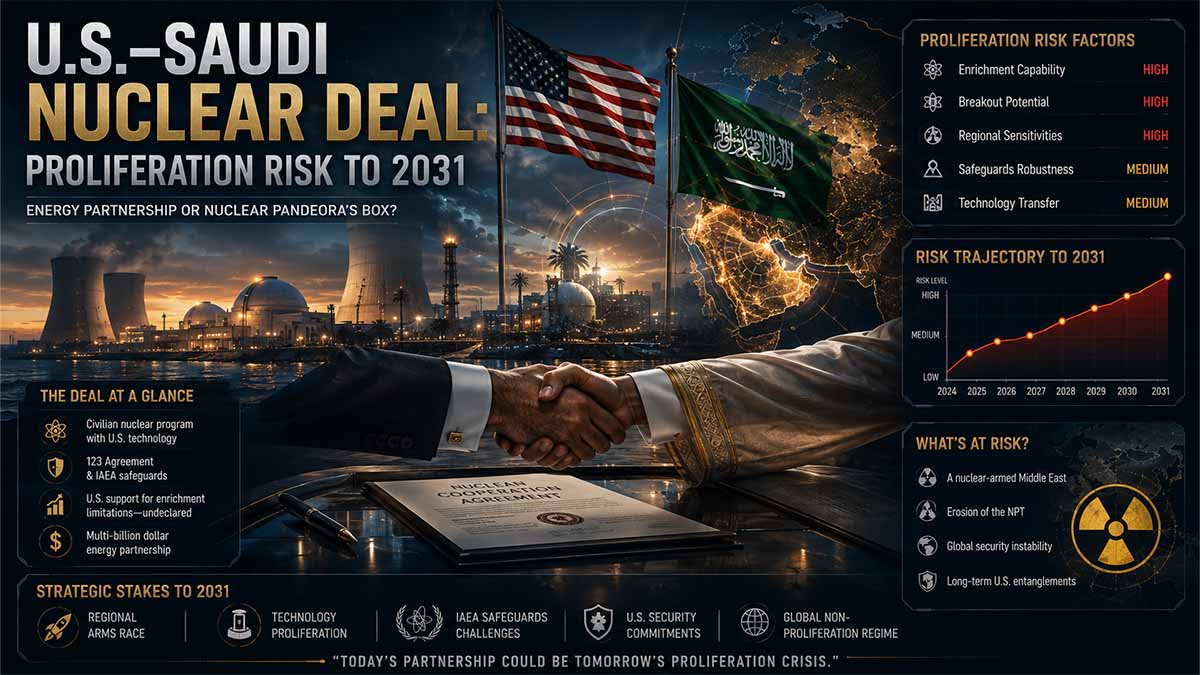
BLUF: On 22 July 2026, the United States and Saudi Arabia signed a civil nuclear-cooperation agreement under Section 123 of the U.S. Atomic Energy Act, accompanied by a bilateral safeguards agreement.
The agreement has been signed but is not yet legally operational: the U.S. Department of Energy states that it must now be transmitted to Congress for statutory review.
No publicly accessible official text presently verifies a thirty-year duration, sovereign Saudi enrichment rights, a two-year enrichment study, reduced inspections, or an exemption from the IAEA Additional Protocol.
The central near-term risk is therefore not an established Saudi enrichment programme, but uncertainty over provisions that have not yet entered the public record.
Saudi Arabia remains an NPT non-nuclear-weapon state with a comprehensive safeguards agreement, but no Additional Protocol is listed as in force by the IAEA.
The Saudi–Pakistan Strategic Mutual Defense Agreement, signed in September 2025, materially strengthens Riyadh’s deterrence architecture, although no verified government text publicly extends Pakistan’s nuclear arsenal to Saudi Arabia.
Between 2026 and 2031, proliferation pressure will depend on congressional conditions, Saudi fuel-cycle policy, IAEA access, Iranian nuclear decisions, and whether Turkey, Egypt or the UAE seek equivalent rights.
Current evidence supports a managed hedging baseline rather than an imminent Saudi nuclear-weapons breakout.
The Nuclear Supply Chain Redrawing the Middle East
The agreement signed in Washington on 22 July 2026 does more than open Saudi Arabia to American nuclear reactors. It places Riyadh at the centre of a global contest for uranium, enrichment, fuel fabrication, plant construction and maintenance contracts that can extend for sixty years. Behind the language of peaceful cooperation lies a strategic question: who will control the technologies, materials and industrial knowledge separating electricity generation from nuclear latency? The answer will influence the balance with Iran, Israel’s security calculations, Pakistan’s role, Turkey’s ambitions and Egypt’s rise—while determining which American, Russian, Chinese, French and South Korean companies divide one of the world’s most valuable emerging energy markets.
The Saudi Turning Point
U.S. Energy Secretary Chris Wright and Saudi Energy Minister Prince Abdulaziz bin Salman signed a civil nuclear-cooperation agreement—known as a Section 123 Agreement—together with a bilateral safeguards instrument. Washington called it the foundation for a “decades-long, multi-billion-dollar partnership” and confirmed that the agreement must now be transmitted to Congress. Signature, therefore, is not entry into force: the Atomic Energy Act requires congressional review for two periods totalling 90 days of continuous session, while individual reactors, components, fuel transfers and technical assistance will remain subject to separate American authorizations.
The most important provisions have not yet been publicly released. It remains unknown whether Riyadh accepted restrictions comparable to those imposed on the United Arab Emirates, whether domestic uranium enrichment is prohibited, conditionally deferred or left open, and whether implementation will require Saudi adherence to the IAEA Additional Protocol. These are not legal details. They will determine whether the programme becomes a tightly controlled electricity project or the industrial foundation of a future strategic option. United States and Saudi Arabia Reach Historic Nuclear Cooperation Agreement – U.S. Department of Energy – July 2026. Nuclear Cooperation with Other Countries: A Primer – Congressional Research Service – February 2026. (The Department of Energy’s Energy.gov)
The Real Prize Is the Fuel
A nuclear plant is not purchased once. Its commercial life begins with uranium exploration and continues through mining, conversion into uranium hexafluoride, enrichment, fuel-pellet production, assembly fabrication, transport, reactor loading, periodic refuelling, maintenance, digital upgrades, waste storage and eventual decommissioning. Construction attracts the largest initial investment, but fuel and services generate recurring revenues for decades.
The concentration of this market is visible in corporate accounts. Urenco, which operates enrichment facilities in the United Kingdom, Germany, the Netherlands and the United States, reported 2025 revenue of €2.096 billion, EBITDA of €804 million, capital expenditure of €616 million and a record order book of €21.3 billion, with contracts extending into the 2040s. Its programme will add 2.5 million separative-work units of annual capacity. Orano, the French group active in uranium mining, conversion, enrichment, spent-fuel treatment and nuclear services, reported 2025 revenue of €5.138 billion, a backlog of €34.2 billion and 21,222 employees. Conversion and enrichment represented part of a front-end division generating €1.25 billion.
These figures explain why Saudi Arabia is being courted so intensely. The winner of the reactor competition may also secure fuel fabrication, reload engineering, outage management, instrumentation, spare parts and operator training—contracts potentially more durable than the construction project itself. Full Year 2025 Audited Results – Urenco – March 2026. Annual Activity Report 2025 – Orano – 2026. (Urenco)
Five Industrial Blocs
The United States can offer reactor technology, uranium enrichment through Urenco USA and Centrus, and fuel and maintenance services through companies including Westinghouse and Framatome’s American operations. Its competitive advantage is technological depth and political alignment; its disadvantage is the legal burden created by congressional oversight, export licences and restrictions on sensitive knowledge.
Russia offers a more integrated model. Rosatom combines mining, conversion, enrichment, fuel fabrication, reactor construction, financing, training and maintenance. Its TVEL division supplies VVER fuel and manages centrifuge and fabrication enterprises. This structure has already secured long-term Russian influence in Turkey’s Akkuyu project and Egypt’s El-Dabaa plant.
China can connect reactor exports to state finance, infrastructure and broader strategic investment. Its record in Pakistan is significant: four Chinese-designed reactors operate at Chashma, two ACP1000 units operate near Karachi, and a further 1,200 MWe unit is under construction. France can mobilize EDF, Framatome and Orano across construction, fuel and services. South Korea can point to the strongest regional precedent: the four APR-1400 units at Barakah, built through a consortium centred on KEPCO and KHNP.
Saudi Arabia can therefore negotiate across five competing industrial ecosystems. The danger for Washington is clear: conditions intended to reduce proliferation risk could push Riyadh toward suppliers offering greater localization. The opposite danger is equally serious—weakening safeguards to win the contract could undermine the non-proliferation architecture the United States seeks to defend.
The Emirati Benchmark
The United Arab Emirates demonstrates that a Gulf state can create a major nuclear industry without enriching uranium. Barakah’s four reactors have generated contracts across construction, fuel, engineering and maintenance while Abu Dhabi renounced domestic enrichment and reprocessing.
The fuel model is deliberately diversified. ENEC contracted six international suppliers for uranium concentrate, conversion, enrichment and related services, while KEPCO Nuclear Fuel fabricated the original assemblies in South Korea. Westinghouse later signed a five-year support agreement covering equipment, training and specialist services, while Framatome obtained maintenance, engineering and fuel contracts.
Localization was substantial. By August 2015, more than 1,100 Emirati companies had received Barakah-related contracts worth over US$2.5 billion, including nuclear-grade cables, steel and civil works. ENEC separately reported that 175 American suppliers had obtained more than US$2.75 billion in contracts during the programme’s first decade.
For Riyadh, this precedent establishes both an opportunity and a constraint. It proves that billions can be retained domestically without controlling enrichment. But if Saudi Arabia receives more permissive fuel-cycle terms, the UAE agreement requires consultations over potentially equivalent treatment, reopening the regional bargain on nuclear restraint. Nuclear Fuel Assemblies for the UAE – Emirates Nuclear Energy Corporation. US$2.5 Billion Awarded to UAE Companies – ENEC – August 2015. (Agenzia Elettrica Nazionale)
Iran’s Industrial Advantage
Iran remains the region’s most advanced indigenous fuel-cycle state. It combines uranium-related activities, conversion, enrichment and fuel-production knowledge with an operating Russian-built reactor at Bushehr. The IAEA records Bushehr-1 at 915 MWe, supplying 5,126 GWh in 2025, while Bushehr-2, with 974 MWe net capacity, has been under construction since 27 September 2019.
This combination matters more than reactor numbers. Iran possesses institutional experience across several stages separating natural uranium from reactor fuel. Saudi Arabia sees that capability not merely as an energy asset but as strategic latency: the ability to shorten the time required to change direction if political leadership chooses to do so.
The Saudi programme is therefore partly an answer to an industrial asymmetry. Imported American reactors alone will not erase it. Riyadh must decide whether security lies in guaranteed foreign fuel, stronger defence alliances and intrusive safeguards—or in developing selected domestic stages of the fuel cycle. The first model reduces proliferation risk; the second increases sovereign leverage but inevitably intensifies Israeli, Iranian and congressional scrutiny. Iran Country Nuclear Power Profile – International Atomic Energy Agency. Iran Reactor Status – IAEA Power Reactor Information System – July 2026. (cnpp.iaea.org)
Pakistan’s Dual Relevance
Pakistan is central not because an official nuclear guarantee to Riyadh has been publicly demonstrated—it has not—but because it combines a formal defence relationship with genuine civilian nuclear-operating experience. The Pakistan Atomic Energy Commission operates six reactors with total capacity of 3,530 MWe. In 2024 they supplied 22,795 GWh, equal to 18.3% of national electricity generation.
Islamabad has also developed the ability to conduct refuelling outages and increasingly supply services and spare parts locally. This knowledge is commercially transferable in legitimate areas such as operator training, radiation protection, quality assurance and outage planning. Pakistan could therefore become an auxiliary partner in Saudi workforce development even if the primary reactor supplier is American, Chinese or Korean.
Its strategic role remains more sensitive. Stronger conventional defence cooperation can reassure Riyadh and reduce pressure for an independent deterrent. Yet ambiguity surrounding Pakistan’s nuclear status may also give Saudi Arabia political cover while it builds civilian infrastructure. Pakistan is simultaneously a possible stabilizer and a source of uncertainty. Nuclear Power Programme – Pakistan Atomic Energy Commission. (paec.gov.pk)
Turkey and Egypt Move Forward
Turkey and Egypt are already changing the regional industrial balance. Turkish Energy Minister Alparslan Bayraktar stated on 23 January 2026 that Akkuyu Unit 1 was 99% complete and that Turkey intended to generate nuclear electricity during 2026. Akkuyu will give Ankara reactor-operating capability, but fuel and core technology remain tied to Russia. If Riyadh secures sovereign enrichment rights, Turkey will face political pressure to demand equivalent technological autonomy.
Egypt’s El-Dabaa project follows the same Russian logic on a larger scale: four VVER units supported by Rosatom’s integrated construction, fuel, training and maintenance model. Cairo is unlikely to build an enrichment industry before 2031, but a permissive Saudi precedent would alter its strategic calculations. Egypt would have to decide whether remaining permanently dependent on imported fuel is compatible with its status as the Arab world’s most populous state.
The regional domino would therefore begin not with weapons, but with claims of equality: equal access to uranium conversion, fuel fabrication, enrichment research and supplier technology. Türkiye’yi Nükleer Enerji Ligine Çıkaracağız – Turkish Ministry of Energy and Natural Resources – January 2026. (enerji.gov.tr)
The Safeguards Divide
Saudi Arabia has had a comprehensive safeguards agreement with the IAEA in force since 13 January 2009, but the Agency’s current legal profile does not list an Additional Protocol in force. The distinction is decisive. Comprehensive safeguards verify declared nuclear material; the Additional Protocol expands access and information needed to investigate undeclared activities, uranium-related research and other parts of the fuel cycle.
The dividing line between civil and military relevance is not the reactor. It is the ownership and visibility of conversion plants, enrichment cascades, uranium inventories, laboratories and procurement networks. Mining alone presents limited proliferation risk. Conversion to uranium hexafluoride creates feed for enrichment. Enrichment provides the most sensitive technological threshold. Fuel fabrication is primarily civilian but develops expertise in uranium chemistry, material accounting and quality control. Reprocessing spent fuel would introduce the separate danger of plutonium separation.
A Saudi programme based on imported fuel, transparent inventories, supplier access and an Additional Protocol would remain structurally distant from weapons production. A programme combining domestic conversion, enrichment rights, restricted inspections and military-linked research would produce a fundamentally different strategic reality. Saudi Arabia Country Legal Profile – International Atomic Energy Agency – February 2026. (ola.iaea.org)
The Decision That Will Shape 2031
By 2031 Saudi Arabia is unlikely to possess an operating industrial enrichment complex. But it may have something strategically important: reactor contracts, trained engineers, uranium-sector knowledge, international suppliers and a legal position preserving future fuel-cycle autonomy.
That is why the unpublished clauses of the 123 Agreement matter more than the signing ceremony. Congress must decide whether retaining Saudi Arabia inside the American technological system justifies terms less restrictive than the UAE precedent. Riyadh must decide whether energy security is better served by diversified international fuel supplies or by the costly pursuit of sovereign enrichment. Israel will measure the result in warning time; Iran will interpret it through deterrence; Turkey and Egypt will judge it through status and equality.
The business is immense. The strategic consequences are larger. Whoever supplies Saudi Arabia will not merely sell reactors: it will help design the industrial architecture of Middle Eastern power for the next half-century.
Navigational Index
Pillar I — Legal architecture, congressional review and safeguards
Assessment of what has actually been signed, what remains undisclosed, the statutory role of Congress, and the distinction between a conventional 123 Agreement, the stronger UAE “gold standard,” comprehensive safeguards and the Additional Protocol.
Pillar II — Regional deterrence and proliferation pathways
Evaluation of Saudi strategic hedging, the Iranian variable, Pakistan’s conventional defense guarantee, Israel’s security calculus, Turkey’s Akkuyu programme, Egypt’s nuclear ambitions and the possibility of competitive fuel-cycle demands.
Pillar III — Five-year scenarios, indicators and strategic consequences
Bayesian scenario estimates for 2026–2031, competing hypotheses, escalation triggers, commercial competition, technology-denial risks, safeguards failure modes and early-warning indicators capable of distinguishing peaceful expansion from latent weapons preparation.
Nuclear Fuel, Reactor Construction and Maintenance: The Industrial Contest Behind Middle Eastern Nuclear Power, 2026–2031
Master Abstract
The evidentiary starting point is narrower—and strategically more consequential—than the narrative of an already completed Saudi nuclear transformation. On 22 July 2026, U.S. Energy Secretary Chris Wright and Saudi Energy Minister Prince Abdulaziz bin Salman signed what the Department of Energy identifies as a peaceful nuclear-cooperation agreement, commonly called a 123 Agreement, together with an accompanying bilateral safeguards agreement. Washington described the package as the legal foundation for a decades-long, multi-billion-dollar partnership that would expand access for American nuclear suppliers, reinforce U.S. industrial competitiveness and support Saudi energy diversification. Riyadh issued a parallel statement describing cooperation in peaceful nuclear uses, technology exchange, investment and conformity with international nuclear-safety, security and non-proliferation standards. The decisive legal qualification is contained in the final sentence of the U.S. announcement: the agreement “will now be transmitted to Congress for review.” Under Section 123 of the Atomic Energy Act, a non-exempt agreement normally undergoes two congressional review periods totaling 90 days of continuous session and may take effect unless Congress enacts a joint resolution of disapproval. Consequently, signature is not equivalent to entry into force, licensed reactor exports or authorization of sovereign enrichment. The publicly available announcements do not disclose the negotiated text, duration, consent rights, termination clauses, fuel-supply model, enrichment restrictions, reprocessing restrictions, inspection arrangements or the content of the separate bilateral safeguards instrument. Claims that the accord conclusively grants Saudi Arabia domestic enrichment, establishes a two-year feasibility study, dispenses with the Additional Protocol, imposes a normalization condition involving Israel or guarantees contracts to Westinghouse cannot presently be treated as verified facts under a primary-source standard. They remain hypotheses until the presidential determination, annexes and agreement text are transmitted or otherwise officially released. United States and Saudi Arabia Reach Historic Nuclear Cooperation Agreement – U.S. Department of Energy – July 2026 Saudi Arabia and United States Sign Agreement on Cooperation in Peaceful Uses of Nuclear Energy – Saudi Press Agency – July 2026
The safeguards question is the principal discriminator between an economically rational civil programme and a strategically destabilizing latent capability. Saudi Arabia has been party to the Treaty on the Non-Proliferation of Nuclear Weapons as a non-nuclear-weapon state and has had a comprehensive safeguards agreement with the International Atomic Energy Agency in force since 13 January 2009. The IAEA’s current legal database lists that safeguards agreement but does not list an Additional Protocol as in force. An Additional Protocol would not merely increase routine inspection frequency; it would enlarge the Agency’s access to information, locations, nuclear-related research, manufacturing and other activities relevant to detecting undeclared fuel-cycle work. Saudi Arabia historically implemented an original Small Quantities Protocol, which suspended many safeguards procedures while the Kingdom possessed minimal nuclear material and no qualifying facility. Riyadh announced its intention to rescind that arrangement, and IAEA material prepared for the 2026 safeguards symposium describes a Saudi transition toward full implementation of its comprehensive safeguards agreement. That transition is meaningful because full comprehensive safeguards restore declaration, accounting, design-information and inspection obligations that are inappropriate for a state entering a power-reactor programme. It is nevertheless analytically incorrect to equate a comprehensive safeguards agreement with an Additional Protocol: the former principally verifies declared nuclear material, whereas the latter strengthens the IAEA’s ability to investigate the completeness of a state’s declarations and identify undeclared activities. The risk structure therefore contains at least four separable layers: R₁, diversion of declared material; R₂, undeclared fuel-cycle activity; R₃, rapid policy reversal after accumulating technical expertise; and R₄, withdrawal from or material breach of international commitments during a regional crisis. Conventional reactor imports with externally supplied fuel, spent-fuel return arrangements and no domestic enrichment would keep R₁ and R₂ comparatively low. Indigenous conversion, centrifuge research, enrichment-facility construction or restrictions on complementary access would raise them sharply. Until the new agreement’s text is public, the existence or absence of these controls cannot be asserted. Saudi Arabia Country List – International Atomic Energy Agency – February/March 2026 Prospects for U.S.-Saudi Nuclear Energy Cooperation – Congressional Research Service – July 2024 Board Moves to Strengthen Nuclear Safeguards System – International Atomic Energy Agency – September 2005
The regional meaning of the agreement derives less from reactor hardware than from the interaction among security guarantees, fuel-cycle knowledge and perceptions of unequal treatment. The Saudi–Pakistan Strategic Mutual Defense Agreement, signed on 17 September 2025, is a verified development: official Saudi statements describe a formal defense commitment based on decades of strategic cooperation, and Pakistani forces—including fighter and support aircraft—deployed to Saudi Arabia in April 2026 under that framework. Those facts establish a materially deeper conventional and strategic-security relationship. They do not, however, verify that Pakistan has legally or operationally placed its nuclear forces under a Saudi guarantee; no publicly accessible government text located for this assessment specifies nuclear sharing, launch authority, warhead deployment, transfer arrangements or an extended-deterrence doctrine. The appropriate intelligence judgment is therefore that Pakistan reduces Riyadh’s perceived isolation and may increase Saudi confidence during crises, while the existence of an explicit Pakistani nuclear umbrella remains unproven. This distinction matters for the regional domino hypothesis. If Congress permits Saudi enrichment or provides terms more permissive than those accepted by the United Arab Emirates, Abu Dhabi could invoke the consultative language attached to its 2009 agreement and seek equivalent treatment. Turkey and Egypt would face political pressure to avoid permanent technological inferiority, but neither would automatically require an indigenous enrichment plant to operate civilian reactors. Their reactions would depend on whether Saudi Arabia obtains a legal right, an actual facility, only a future consultation mechanism, or merely guaranteed fuel supply. Israel’s response would similarly vary according to capability rather than symbolism: imported reactors under intrusive safeguards would present a different threat from centrifuge cascades, uranium-conversion infrastructure, advanced reprocessing research or ballistic-missile integration. Across the competing hypotheses, H₁—commercial energy diversification, H₂—U.S. strategic denial of Chinese or Russian market access, H₃—Saudi hedging against Iran, H₄—preparation of a future weapons option, and H₅—bargaining leverage over Washington and regional rivals can coexist. Current evidence gives greatest weight to H₁–H₃; H₄ remains a consequential but unproven trajectory whose probability rises only if sensitive fuel-cycle assets, opaque procurement networks, military-linked research or resistance to strengthened IAEA verification emerge. HRH the Crown Prince, Pakistan Prime Minister Hold Official Talks, Sign Strategic Mutual Defense Agreement – Saudi Press Agency – September 2025 Pakistani Military Force Arrives in Saudi Arabia Under Strategic Mutual Defense Agreement – Saudi Ministry of Defense via Saudi Press Agency – April 2026 Possible U.S.-Saudi Agreements and Normalization with Israel: Considerations for Congress – Congressional Research Service – September 2024
The five-year outlook is best represented as a conditional probability distribution rather than a deterministic forecast. The initial Bayesian baseline assigns approximately 48% to a controlled civil-development pathway in which Congress permits cooperation subject to U.S. consent rights, imported fuel, strengthened accounting and progressive IAEA access; 24% to a prolonged implementation delay caused by congressional opposition, commercial disputes, financing problems or disagreement over safeguards; 18% to a managed Saudi fuel-cycle hedge involving research, uranium-resource development and demands for future enrichment rights without an operational weapons programme; 8% to a regional competitive-enrichment cycle involving Saudi Arabia and at least one additional Middle Eastern state; and 2% to an overt Saudi weapons-acquisition pathway by 2031. These are analytical priors, not measured frequencies. The strongest positive update for the controlled pathway would be publication of a text prohibiting enrichment and reprocessing, requiring an Additional Protocol, providing cradle-to-grave fuel services and allowing termination or fuel removal after safeguards violations. The strongest negative update would be explicit authorization for domestic enrichment without an Additional Protocol, followed by procurement of conversion equipment, centrifuge components, high-strength materials, cascade-control systems or weaponization-relevant diagnostics. A Monte Carlo-style conceptual model using political durability, Iranian threat intensity, congressional permissiveness, IAEA access, supplier competition and Saudi technical maturity produces a broad rather than narrow forecast because the variables are correlated: deterioration in U.S.–Iran relations can simultaneously strengthen Saudi hedging, increase congressional willingness to reassure Riyadh and reduce regional tolerance for intrusive inspections. The most plausible 2026–2031 sequence is therefore phased: congressional contestation in 2026–2027; supplier, financing and site decisions in 2027–2028; regulatory and workforce expansion in 2028–2029; construction or early infrastructure development in 2029–2031; and continuing political negotiation over fuel-cycle sovereignty. A military breakout before 2031 would require several additional decisions and capabilities not established by the signing itself. The agreement is nonetheless a historic turning point because it transfers the Saudi nuclear question from speculative diplomacy into a statutory, commercial and institutional process whose safeguards architecture may influence the nuclear expectations of every major Middle Eastern power.
Saudi Nuclear Pathway Simulator
VARIABLE CONTROL MATRIX
BAYESIAN SCENARIO DISTRIBUTION
FIVE-YEAR INDICATOR TIMELINE
Congressional transmission, publication of agreement text, presidential determination and first safeguards scrutiny.
Supplier selection, financing structure, enrichment language and possible Additional Protocol decision become decisive.
Regulatory expansion, workforce formation, site licensing and fuel-supply architecture reveal programme direction.
Construction milestones and sensitive procurement patterns test the distinction between energy policy and hedging.
Regional responses from the UAE, Türkiye and Egypt become measurable through fuel-cycle demands and supplier diplomacy.
Strategic outcome depends on IAEA access, Iranian posture, domestic fuel-cycle assets and continuity of U.S. consent rights.
Pillar I — The U.S.–Saudi Nuclear Accord: Legal Architecture, Congressional Control and Safeguards Risk, 2026–2031
The verified legal event and the boundary of the public record
The legally verified event is the signature on 22 July 2026 of two related but analytically distinct instruments by U.S. Secretary of Energy Chris Wright and Saudi Minister of Energy Prince Abdulaziz bin Salman: a peaceful nuclear-cooperation agreement described by the U.S. Department of Energy as a Section 123 Agreement, and an accompanying bilateral safeguards agreement. The Department characterized the package as the legal foundation for a “decades-long, multi-billion-dollar” partnership intended to facilitate American participation in Saudi Arabia’s prospective nuclear-energy programme, but it also stated unambiguously that the agreement “will now be transmitted to Congress for review.” That final clause determines the present legal status. Signature demonstrates that executive-branch negotiations have reached an agreed text; it does not establish that the agreement has entered into force, that export licences may automatically be issued, that reactor construction has been authorized, or that Saudi Arabia has acquired a legally enforceable right to enrich uranium. A 123 Agreement creates the governmental framework within which significant U.S.-origin nuclear cooperation may later occur, but individual exports, technology transfers, services, material movements and subsequent arrangements remain subject to additional statutory and regulatory controls. As of 26 July 2026, the publicly accessible DOE announcement does not reproduce the agreement, its annexes, the bilateral safeguards instrument, the presidential non-proliferation assessment, the classified assessment annex, the Nuclear Regulatory Commission’s views, the Department of State’s recommendation, or any agreed minute governing interpretation. Consequently, assertions concerning a fixed thirty-year duration, a two-year enrichment feasibility study, guaranteed Saudi enrichment, the exclusion of an IAEA Additional Protocol, a binding connection to the Abraham Accords, automatic awards to Westinghouse, or a “black-box” enrichment installation cannot be elevated to verified findings. The intelligence discipline required here is negative as well as positive: where the primary text is unavailable, the correct classification is undisclosed, not permissive, prohibited or omitted. United States and Saudi Arabia Reach Historic Nuclear Cooperation Agreement – U.S. Department of Energy – July 2026.
| Legal or political proposition | Verified status on 26 July 2026 | Evidentiary judgment |
|---|---|---|
| A U.S.–Saudi peaceful nuclear-cooperation agreement was signed | Verified | Confirmed by the U.S. Department of Energy |
| A separate bilateral safeguards agreement was signed | Verified | Confirmed, but its text is not publicly reproduced |
| The agreement is already in force | Not verified | DOE states that congressional review follows |
| The term is exactly thirty years | Not verified | Public announcement says “decades-long,” not thirty years |
| Saudi enrichment is expressly authorized | Not verified | Operative text is not public |
| Saudi enrichment is expressly prohibited | Not verified | Operative text is not public |
| Saudi Arabia must adopt an Additional Protocol | Not verified | No public agreement text establishes this condition |
| Saudi Arabia is exempted from an Additional Protocol | Not verified | Absence from the press release is not a legal exemption |
| Normalization with Israel is a condition precedent | Not verified | No verified clause or presidential submission presently available |
| American firms receive market access | Verified in principle | DOE states that the agreement expands access; contracts remain separate |
What a Section 123 Agreement legally does—and does not do
Section 123 of the Atomic Energy Act of 1954, codified principally at 42 U.S.C. §2153, operates as a statutory gateway for significant peaceful nuclear cooperation between the United States and a foreign state. It is not a construction contract, an export licence, an enrichment licence, a reactor-operating authorization, a technology-transfer waiver or a security guarantee. Its core function is to establish the conditions under which U.S.-origin nuclear material, reactors, critical reactor components and specified technologies may become eligible for later transfer. The statutory framework requires an agreement to define its duration, nature and scope and to incorporate non-proliferation conditions concerning peaceful use, safeguards, physical security, retransfers, storage, alteration in form or content, and the treatment of material or equipment subject to U.S. jurisdictional consent. The President must determine in writing that implementation would promote—and would not constitute an unreasonable risk to—the common defence and security. Even after entry into force, the agreement merely authorizes a legal channel: the Nuclear Regulatory Commission must still license relevant exports under its jurisdiction; the Department of Energy must control assistance involving unclassified nuclear technology under 10 C.F.R. Part 810; and sensitive “subsequent arrangements,” including certain retransfers, enrichment, reprocessing, storage or alteration activities involving U.S.-obligated material, may require further U.S. consent. This layered structure explains why public debate often misstates the significance of the signature. The agreement is necessary for major U.S. reactor commerce but not sufficient to make that commerce occur. It can provide Washington with durable contractual leverage over U.S.-origin technology and material, yet it cannot automatically govern wholly indigenous Saudi activities or assets obtained through supply chains that fall outside U.S. consent rights, unless the negotiated language, other agreements or multilateral rules extend control. The most important undisclosed variables are therefore not rhetorical commitments to peaceful use but the legal reach of consent rights: whether they attach only to transferred items, to material produced through their use, to facilities incorporating American technology, or to broader Saudi fuel-cycle conduct. Nuclear Cooperation with Other Countries: A Primer – Congressional Research Service – February 2026. Prospects for U.S.-Saudi Nuclear Energy Cooperation – Congressional Research Service – July 2024.
Congressional review: formal authority, practical asymmetry and intervention points
The congressional process is structured, consequential and politically asymmetric. For a non-exempt agreement satisfying the requirements of Section 123(a), the President submits the proposed agreement and supporting material to the House Committee on Foreign Affairs and the Senate Committee on Foreign Relations. The Atomic Energy Act provides for two periods totaling 90 days of continuous session: a consultation phase of at least thirty continuous-session days, followed by a sixty-day continuous-session review phase. “Continuous session” does not mean ninety ordinary calendar days; recesses and adjournments can stop or extend the statutory clock, so the actual elapsed period may be substantially longer. During the second phase, a compliant, non-exempt agreement can take effect unless Congress passes a joint resolution of disapproval and that resolution becomes law. The political barrier is therefore materially higher than a simple majority vote in one chamber. Both chambers must pass identical legislation; the President may veto it; and preventing entry into force after a veto would require the constitutional override threshold. The process creates a default bias toward executive success once a fully compliant agreement has been formally transmitted, although committees retain important powers through hearings, document demands, appropriations restrictions, export-finance conditions, reporting legislation and political pressure on the implementing agencies. If the President exempts the proposed agreement from one or more statutory non-proliferation requirements, the legal pathway changes and affirmative congressional approval may be necessary. No Section 123 agreement currently in force was concluded as an exempt agreement, making exemption both legally possible and politically exceptional. The crucial evidentiary trigger for the Saudi case will therefore be the presidential transmission package. It will reveal whether the administration treats the agreement as fully compliant, whether it seeks any exemption, how it assesses Saudi fuel-cycle intentions, what safeguards it considers adequate, and whether the bilateral safeguards instrument substitutes for, supplements or anticipates an IAEA Additional Protocol. Until that transmission occurs, Congress cannot be assumed to be inside the formal ninety-day statutory period merely because the executive branch announced that review would follow. Nuclear Cooperation with Other Countries: A Primer – Congressional Research Service – February 2026. Congressional Record: Agreement for Cooperation Between the United States and Thailand – U.S. Congress – January 2025.
The substantive influence of Congress extends beyond the binary choice between allowing and blocking the agreement. Legislators may enact Saudi-specific conditions governing export financing, require certification that Riyadh has renounced enrichment and reprocessing, condition appropriations on implementation of an Additional Protocol, mandate recurring reports on Saudi procurement, restrict transfers of particular technology categories, or require affirmative approval of subsequent arrangements involving sensitive fuel-cycle activity. Previous appropriations language discussed by the Congressional Research Service linked potential U.S. export-finance support for Saudi nuclear projects to three conditions: a 123 Agreement in force, a Saudi commitment to renounce enrichment and reprocessing on its territory, and signature and implementation of an IAEA Additional Protocol. Such language did not itself rewrite the Atomic Energy Act’s universal requirements, but it demonstrates the tools available to legislators who cannot or do not wish to defeat the entire agreement. Congress can also exploit sequencing. Reactor vendors, export-credit institutions and investors require legal certainty over decades; unresolved safeguards conditions can increase financing costs, delay final investment decisions and induce firms to demand stronger sovereign guarantees. Appropriations riders can therefore exert leverage disproportionate to their nominal fiscal scope. Conversely, a highly permissive agreement may still survive if opponents cannot coordinate both chambers and overcome a presidential veto, particularly when the executive frames the accord as necessary to prevent Saudi procurement from China or Russia. This creates a structural conflict between non-proliferation maximalism and supplier-retention strategy: the stricter Congress makes U.S. cooperation, the stronger Riyadh’s incentive to diversify suppliers; the more permissive Washington becomes to retain commercial influence, the more it risks weakening the normative value of the UAE precedent. The resulting congressional contest is likely to focus on four provisions—enrichment and reprocessing, the Additional Protocol, termination rights, and equivalent-treatment implications for the UAE—rather than on the general legitimacy of Saudi civilian nuclear power. Prospects for U.S.-Saudi Nuclear Energy Cooperation – Congressional Research Service – July 2024. Possible U.S.-Saudi Agreements and Normalization with Israel: Considerations for Congress – Congressional Research Service – September 2024.
| Congressional intervention mechanism | Legal effect | Probable strategic use in 2026–2031 | Principal limitation |
|---|---|---|---|
| Joint resolution of disapproval | Blocks a compliant non-exempt agreement if enacted | Maximum-pressure option | Presidential veto and override barrier |
| Refusal of affirmative approval | Relevant if the agreement is exempted from statutory requirements | Blocks exceptional agreement pathways | Depends on whether an exemption is requested |
| Saudi-specific legislation | Adds substantive conditions or altered review rules | Could require enrichment renunciation or Additional Protocol adoption | Requires enactment through both chambers |
| Appropriations rider | Restricts use of funds, guarantees or export-finance support | High-probability leverage against permissive safeguards terms | May not invalidate the agreement itself |
| Reporting and certification requirements | Forces recurring executive findings | Creates monitoring and political accountability | Executive interpretation may remain broad |
| Export-licensing restrictions | Limits specified transfers or technologies | Targets sensitive fuel-cycle capabilities | May encourage procurement from non-U.S. suppliers |
| Hearings and disclosure demands | Exposes legal and intelligence assumptions | Raises political and reputational cost | Does not independently prevent entry into force |
The UAE “gold standard” and the exact legal significance of comparison
The 2009 U.S.–UAE Agreement Concerning Peaceful Uses of Nuclear Energy constitutes the strongest regional comparator because the United Arab Emirates accepted a binding renunciation of domestic enrichment and reprocessing. The operative arrangement provides the United States with a basis to terminate cooperation if the UAE possesses sensitive nuclear facilities or engages in territorial activities relating to uranium enrichment or spent-fuel reprocessing. This feature became known politically as the “gold standard,” although that phrase is not a universal statutory category imposed by Section 123. Ordinary 123 Agreements do not automatically compel partner states to renounce enrichment and reprocessing; they normally preserve U.S. consent rights over specified U.S.-obligated material and equipment, while the UAE made a broader sovereign commitment concerning sensitive facilities and activities within its territory. The UAE agreement also contains an agreed-minute mechanism addressing comparative treatment. According to the Congressional Research Service, its terms are to be no less favourable in scope and effect than those subsequently accorded to another Middle Eastern state; if Washington grants more favourable terms, the United States must consult with the UAE, at Abu Dhabi’s request, regarding the possibility of amendment. This provision does not appear to create an automatic, self-executing UAE right to enrich. It does create a diplomatic and legal-equivalence pressure point. A Saudi agreement permitting indigenous enrichment, declining to require renunciation, or establishing an easier pathway to sensitive facilities could prompt Abu Dhabi to demand consultations and reopen the regional bargain on which its programme was built. The distinction between a conventional 123 framework and the UAE model can therefore be expressed through control depth: conventional agreements regulate U.S.-obligated cooperation; the UAE standard additionally constrains the partner’s sovereign territorial fuel-cycle policy. If the Saudi text falls between these models—neither a full renunciation nor an unrestricted right—it may employ conditional consent, delayed review, multinational operation, supplier ownership, fuel leasing, automatic suspension, or a future consultative mechanism. Every variant would generate a different proliferation assessment, making publication of the operative text indispensable. United Arab Emirates: Agreement Concerning Peaceful Uses of Nuclear Energy – U.S. Department of State – December 2009. Prospects for U.S.-Saudi Nuclear Energy Cooperation – Congressional Research Service – July 2024. Congressional Record: Civilian Nuclear Cooperation – U.S. Congress – December 2018.
| Control architecture | Conventional 123 Agreement | UAE “gold standard” | Maximum-assurance Saudi model |
|---|---|---|---|
| Peaceful-use obligation | Required | Required | Required |
| IAEA safeguards on covered material | Required | Required | Required |
| U.S. consent over retransfers | Normally required | Required | Required |
| U.S. consent over alteration, enrichment or reprocessing of covered material | Normally retained | Retained and reinforced | Retained with automatic suspension |
| Territorial renunciation of enrichment | Not inherently required by Section 123 | Binding UAE commitment | Binding Saudi commitment |
| Territorial renunciation of reprocessing | Not inherently required | Binding UAE commitment | Binding Saudi commitment |
| Additional Protocol | Not universally mandatory under Section 123 | Implemented by UAE through separate IAEA framework | Express condition precedent |
| Fuel-return or take-back arrangement | Agreement-specific | Commercial and programme-specific | Mandatory cradle-to-grave structure |
| Equivalent-treatment implications | Limited | Agreed-minute consultation mechanism | Must be reconciled with UAE precedent |
| Verification of undeclared activity | Depends primarily on IAEA authorities | Strengthened by Additional Protocol | Additional Protocol plus bilateral transparency measures |
Comprehensive safeguards, the Small Quantities Protocol and the Additional Protocol
Saudi Arabia’s international verification obligations must be disaggregated into three layers that are frequently conflated. First, as a non-nuclear-weapon state party to the Treaty on the Non-Proliferation of Nuclear Weapons, Saudi Arabia has a Comprehensive Safeguards Agreement with the IAEA, reproduced as INFCIRC/746 and in force since 13 January 2009. A comprehensive safeguards agreement is designed to verify that nuclear material in peaceful activities is not diverted to nuclear weapons or other nuclear explosive devices. It establishes declarations, nuclear-material accountancy, inspections, design-information obligations and verification rights over declared nuclear material and facilities. Second, Saudi Arabia historically operated under an original Small Quantities Protocol, a procedural arrangement intended for states with minimal nuclear material and no qualifying nuclear facilities. The original protocol held many detailed safeguards procedures in abeyance; the IAEA concluded in 2005 that such protocols represented a weakness and adopted a modified model, narrowing eligibility and restoring reporting and inspection powers. Saudi Arabia publicly announced in September 2023 that it intended to rescind its Small Quantities Protocol and move toward full implementation of its comprehensive safeguards obligations. IAEA material prepared for its 2026 safeguards symposium confirms both the 2009 safeguards agreement and the Saudi transition process. Third, an Additional Protocol is a separate legal instrument that expands the IAEA’s access to information and locations relevant to detecting undeclared nuclear material and activities. It supports broader declarations, environmental sampling, complementary access and examination of parts of the nuclear fuel cycle that may not contain declared nuclear material. The IAEA’s country-law database lists Saudi Arabia’s comprehensive safeguards agreement but does not list an Additional Protocol as in force. This does not mean Saudi Arabia lacks safeguards; it means the Agency’s legal authority to verify the completeness of Saudi declarations is less extensive than it would be under a fully implemented Additional Protocol. The decisive legal question for the bilateral accord is whether Washington has made Additional Protocol implementation a condition precedent, a future political objective, an operational milestone, or no contractual condition at all. Agreement Between Saudi Arabia and the IAEA for the Application of Safeguards in Connection with the NPT – International Atomic Energy Agency – February 2009. Saudi Arabia Transition from the Small Quantities Protocol to Full Implementation of the Comprehensive Safeguards Agreement – International Atomic Energy Agency – November 2026 programme. Introductory Statement to the Board of Governors – International Atomic Energy Agency – March 2005.
The operational difference between comprehensive safeguards and an Additional Protocol is best understood through the concepts of correctness and completeness. Under a comprehensive safeguards agreement, the IAEA seeks to verify that declarations concerning nuclear material are correct and that declared material has not been diverted. The Additional Protocol materially strengthens the Agency’s ability to assess whether the declarations are complete—that is, whether undeclared nuclear material or activities exist elsewhere in the state. Neither instrument constitutes unlimited inspection authority, and the expression “surprise inspections” can obscure the legal structure. Safeguards access occurs through defined rights, notification arrangements and procedures; the Additional Protocol provides complementary access, which may be requested on short notice, to resolve questions, verify the absence of undeclared material or confirm expanded declarations. Its strategic value increases when a state possesses uranium resources, conversion research, centrifuge-related manufacturing, fuel-cycle research, multiple nuclear-related institutions or procurement networks that may not be fully visible through conventional material-accountancy inspections. A bilateral U.S.–Saudi safeguards agreement could add reporting obligations, U.S. observation rights, supplier access, remote monitoring, tamper-indicating systems, personnel controls or automatic suspension provisions, but without the text it cannot be assumed to replicate the IAEA’s legal authority. Bilateral controls and IAEA safeguards also serve different functions: bilateral provisions protect supplier rights and regulate U.S.-obligated material; the IAEA verifies international non-proliferation commitments across the state’s declared nuclear programme. The strongest architecture would combine a rescinded Small Quantities Protocol, full comprehensive-safeguards implementation, an Additional Protocol in force, early submission of design information, transparent procurement, supplier fuel services, prohibition of enrichment and reprocessing, and enforceable termination rights. The weakest legally plausible architecture would combine only baseline comprehensive safeguards with bilateral controls limited to U.S.-origin items, while leaving indigenous fuel-cycle options outside the core agreement. The undisclosed Saudi text must be evaluated against that spectrum rather than against generic assurances that standards are “high.”
Analysis of competing legal hypotheses
Five competing hypotheses organize the available evidence without treating undisclosed provisions as known facts. H₁ — UAE-equivalent restraint: the Saudi agreement contains a binding renunciation of enrichment and reprocessing, possibly conditioned on full comprehensive safeguards and future adoption of an Additional Protocol. This hypothesis would best support DOE’s assertion that the agreements uphold the highest non-proliferation standards, but it would represent a major Saudi concession given Riyadh’s historical insistence on sovereign fuel-cycle rights. H₂ — conditional enrichment pathway: the agreement does not immediately authorize enrichment but establishes a future consultation, feasibility or consent mechanism under American operational control. This could reconcile Saudi political demands with Washington’s desire to prevent near-term indigenous capability, but no official public text currently confirms such a mechanism. H₃ — conventional U.S.-consent model: the agreement follows ordinary Section 123 practice, protecting U.S.-obligated material while omitting a UAE-style territorial renunciation. This is legally compatible with Section 123 and commercially attractive, but it would create acute equivalent-treatment pressure from Abu Dhabi and intensify congressional scrutiny. H₄ — permissive strategic-retention model: Washington accepted unusually broad Saudi fuel-cycle latitude to prevent Riyadh from selecting Chinese or Russian suppliers. This would reflect realpolitik but would be difficult to reconcile with claims of the “highest standards” unless paired with unusually intrusive bilateral controls. H₅ — deliberately staged ambiguity: the agreement defers the most contentious questions to side instruments, subsequent arrangements, executive certifications or future implementing protocols. This would facilitate signature while shifting political conflict into later licensing decisions. A structured Bayesian update assigns provisional probabilities of H₁ 20%, H₂ 28%, H₃ 32%, H₄ 8% and H₅ 12%. These estimates reflect legal precedent and bargaining incentives, not privileged access to the text. Publication of an explicit enrichment renunciation would drive H₁ above 80%; a consultation clause would favour H₂ or H₅; silence on sovereign enrichment combined with ordinary consent rights would favour H₃; and affirmative authorization without an Additional Protocol would sharply increase H₄. The primary intelligence collection requirement is therefore documentary, not speculative: obtain the transmitted agreement, agreed minute, bilateral safeguards text and unclassified non-proliferation assessment before making definitive judgments.
| Hypothesis | Core proposition | Evidence presently supporting it | Evidence that would falsify it | Provisional probability |
|---|---|---|---|---|
| H₁ | Saudi Arabia accepted UAE-equivalent renunciation | DOE claims highest non-proliferation standards | Any clause preserving territorial enrichment | 20% |
| H₂ | Enrichment deferred to conditional future process | Fits compromise incentives | Absolute renunciation or immediate authorization | 28% |
| H₃ | Ordinary 123 controls without sovereign renunciation | Legally conventional; commercially flexible | Binding territorial prohibition | 32% |
| H₄ | Broad fuel-cycle latitude accepted for strategic competition | U.S. supplier-retention incentive | Strong prohibition plus Additional Protocol condition | 8% |
| H₅ | Sensitive issues moved into side instruments or later approvals | Separate bilateral safeguards agreement exists | Fully self-contained public agreement | 12% |
Five-year legal and safeguards outlook, 2026–2031
The highest-probability 2026–2031 trajectory is not immediate reactor construction or enrichment but a prolonged sequence of legal disclosure, congressional contestation, implementing regulation, commercial due diligence and safeguards-capacity building. During 2026, the decisive events will be formal presidential transmission, release of the unclassified non-proliferation assessment, identification of any statutory exemptions, and clarification of whether the ninety continuous-session-day clock has begun. Congressional committees are likely to test whether the agreement equals the UAE standard, requires an Additional Protocol, preserves prior U.S. consent for enrichment and reprocessing, contains automatic termination mechanisms and adequately protects against technology substitution through non-U.S. suppliers. During 2027, assuming entry into force, attention will migrate toward implementing instruments: Part 810 authorizations, export-licence applications, Saudi regulatory development, site and vendor decisions, fuel-supply contracts, liability arrangements and safeguards implementation. The legal architecture will become more difficult to alter once commercial commitments and financing are locked in, making 2026–2027 the critical window for congressional leverage. During 2028–2029, the central indicators will be whether Saudi Arabia completes its transition from the Small Quantities Protocol, concludes and implements an Additional Protocol, submits early design information, builds a credible state system of accounting for and control of nuclear material, and creates independent regulatory capacity. During 2030–2031, the risk centre shifts from diplomatic text to operational path dependence: domestic workforce expertise, uranium-resource policy, research infrastructure, fuel-fabrication ambitions, procurement patterns and requests for subsequent U.S. consent. The baseline probability distribution is 45% for a controlled programme under strengthened safeguards; 25% for delayed or partially implemented cooperation; 18% for a conventional 123 framework without UAE-level renunciation but with managed restrictions; 9% for escalating legal disputes over Saudi fuel-cycle autonomy; and 3% for collapse of the U.S. framework followed by a supplier pivot that materially reduces Washington’s leverage. Those probabilities should be updated quarterly against observable legal milestones rather than treated as fixed forecasts.
| Period | Principal legal milestone | Safeguards milestone | Escalation indicator | De-escalation indicator |
|---|---|---|---|---|
| H₂ 2026 | Presidential transmission and congressional review | Disclosure of bilateral safeguards terms | Exemption request or permissive enrichment clause | Binding renunciation and AP requirement |
| 2027 | Entry into force and first export authorizations | Full CSA implementation planning | Sensitive Part 810 requests | Fuel-leasing and take-back arrangements |
| 2028 | Vendor and financing commitments | State accounting system maturity | Domestic conversion or centrifuge research | Additional Protocol enters into force |
| 2029 | Construction and subsequent arrangements | Facility-specific verification | Restrictions on access or procurement opacity | Early design-information submission |
| 2030 | Review of consent rights and regional equivalence | Integrated remote monitoring | UAE demands equal enrichment treatment | Regional fuel-assurance mechanism |
| 2031 | Institutional durability test | Verification performance under operations | Supplier diversification outside U.S. controls | Stable multi-layer safeguards regime |
Multilateral and competing-supplier implications
The legal contest cannot be evaluated solely through U.S. doctrine because Saudi bargaining power derives from alternative suppliers and from competing interpretations of non-proliferation equity. The European Union’s Euratom framework illustrates a materially denser safeguards environment: Article 77 of the Euratom Treaty requires the European Commission to verify that ores, source materials and special fissile materials are not diverted from their declared uses and that safeguarding obligations assumed under agreements with third states or international organisations are respected. The 2025 Euratom safeguards regulation contains detailed requirements for nuclear-material accountancy and specific technical declarations covering reactors, conversion, fuel fabrication, reprocessing and isotope-enrichment facilities. This demonstrates that commercial nuclear development can coexist with intrusive regional material-accountancy structures, although the Euratom model cannot simply be transplanted to Saudi Arabia. Commission Regulation (Euratom) 2025/974 on the Application of Euratom Safeguards – European Union – May 2025. Article 77 of the Treaty Establishing the European Atomic Energy Community – European Union. China’s official position introduces a different pressure. Beijing states that nuclear exports must be for peaceful non-explosive purposes, remain under IAEA safeguards and not be retransferred without Chinese consent, while also arguing that non-proliferation measures must be fair, non-discriminatory and must not obstruct developing states’ legitimate access to peaceful nuclear technology. China’s April 2026 NPT implementation report reiterates support for effective IAEA safeguards and strict national export controls. These positions allow Beijing simultaneously to claim non-proliferation compliance and criticize a U.S. approach perceived by Riyadh as politically discriminatory. Implementation of the Treaty on the Non-Proliferation of Nuclear Weapons in the People’s Republic of China – Ministry of Foreign Affairs of China – April 2026. China’s Non-Proliferation Policy and Measures – China Atomic Energy Authority. The strategic implication is a regulatory competition triangle: Washington offers access tied to extensive statutory consent rights; the European model demonstrates dense safeguards governance; and China stresses safeguarded peaceful use alongside sovereign equality. Saudi Arabia can exploit the differences, but every supplier remains constrained by the NPT, IAEA safeguards and national export-control rules. The five-year risk is therefore not the disappearance of law but fragmentation among overlapping legal architectures, each controlling different materials, technologies and corporate actors.
Five-Year Legal and Safeguards Scenario Projection
Analytical probability projection for the dominant U.S.–Saudi legal pathway. Values are scenario estimates, not observed frequencies.
Pillar II — Regional Deterrence and Proliferation Pathways: Saudi Hedging, Iran and the Emerging Nuclear Hierarchy, 2026–2031
Saudi strategic hedging as a layered deterrence architecture
Saudi Arabia’s emerging nuclear posture should not be reduced to a binary choice between a purely commercial reactor programme and an immediate decision to manufacture nuclear weapons. The more accurate analytical model is strategic hedging: the deliberate accumulation of alliances, industrial capabilities, legal options, scientific expertise and diplomatic leverage that can reduce the time and political cost required to change course if the regional threat environment deteriorates. Riyadh’s present architecture contains at least five mutually reinforcing layers. The first is conventional military modernization and integrated air and missile defence. The second is the strengthening of formal external security relationships, including the Saudi–Pakistan Strategic Mutual Defense Agreement signed on 17 September 2025, under which official Saudi language states that aggression against either party is to be considered aggression against both. The third is the Saudi–U.S. Strategic Defense Agreement, signed on 19 November 2025, which the Saudi government describes as a long-term framework for defence coordination, readiness and capability integration. The fourth is the civil nuclear agreement signed with Washington in July 2026, which offers access to advanced industrial infrastructure, regulation, human-capital development and reactor technology even if enrichment is ultimately restricted. The fifth is strategic ambiguity regarding the Kingdom’s long-term fuel-cycle preferences. Taken together, these layers create a deterrence portfolio rather than a single weapons pathway. Riyadh can signal to Tehran that it possesses powerful conventional partners, to Washington that it has supplier alternatives, to Pakistan that their defence relationship has operational value, and to domestic audiences that the Kingdom is acquiring the attributes of a technologically sovereign state. The central proliferation risk arises when these layers begin to interact: a severe Iranian escalation could increase Saudi demand for fuel-cycle autonomy; doubts about American reliability could increase reliance on Pakistan; and delayed reactor cooperation could strengthen incentives to engage China or Russia. The current evidence therefore supports a baseline assessment of managed latency, not an established bomb programme. Joint Statement Issued Following Pakistan Prime Minister State Visit to Saudi Arabia – Saudi Press Agency – September 2025. HRH the Crown Prince, U.S. President Sign Strategic Defense Agreement – Saudi Press Agency – November 2025.
The Iranian variable: threat perception, breakout psychology and reciprocal acceleration
Iran is the dominant external variable because Saudi nuclear calculations are driven less by the existence of civilian reactors than by the perceived credibility, reversibility and transparency of Iran’s nuclear restraint. The International Atomic Energy Agency remains the authoritative institution for evaluating Iranian safeguards, declared facilities and verification access, but the strategic effect of the Iranian programme extends beyond inventories of enriched material. Riyadh must assess whether Iran can convert existing technical capability into a rapidly deployable deterrent, whether inspectors retain sufficient access to provide warning, whether regional conflict could trigger withdrawal from existing commitments, and whether Tehran considers nuclear latency itself sufficient to deter external attack. The IAEA’s official Iran monitoring record documents a long-running verification problem shaped by safeguards disputes, reduced monitoring continuity and uncertainty concerning the peaceful nature of all relevant activities. These unresolved questions produce a security dilemma: Saudi Arabia may interpret Iranian opacity as evidence of military preparation, while Iran may interpret Saudi nuclear cooperation with the United States as evidence that Washington is constructing a rival latent capability. The result can be reciprocal acceleration even without either side making a formal weapons decision. An Iranian movement toward higher enrichment, reduced inspector access, undeclared facilities or withdrawal from the NPT would sharply increase Saudi pressure for indigenous enrichment and stronger external guarantees. Conversely, restored intrusive verification, limits on enrichment, credible material accounting and regionally supported fuel assurances would lower the marginal security value of a Saudi national fuel cycle. The risk is amplified by the regional military context. An official Israeli statement issued on 23 July 2026 referred to joint American–Israeli military action against Iran and argued that the resulting strategic environment created an opportunity to expand the Abraham Accords. Whatever the operational details, the statement confirms that the nuclear question now exists inside an active deterrence environment rather than a stable diplomatic compartment. The most dangerous pathway is therefore not a deliberate Saudi imitation of Iran but an interactive cycle in which each side interprets the other’s defensive measures as offensive preparation. Verification and Monitoring in Iran – International Atomic Energy Agency. Statement by the Prime Minister’s Office – Government of Israel – July 2026.
| Iranian development | Probable Saudi interpretation | Likely Saudi response | Proliferation effect |
|---|---|---|---|
| Additional IAEA access and restored monitoring continuity | Reduced immediate breakout uncertainty | Greater tolerance for imported fuel | De-escalatory |
| Continued enrichment without broader transparency | Persistent latent threat | Preserve national fuel-cycle option | Moderately escalatory |
| Significant reduction in safeguards cooperation | Concealment risk | Accelerate technical hedging and alliance demands | Highly escalatory |
| Formal Iranian weapons decision | Collapse of regional restraint | Seek external nuclear guarantee or sovereign option | Extreme escalation |
| Durable regional nuclear settlement | Reduced need for autonomous latency | Focus on reactors and fuel services | Strongly de-escalatory |
| Military conflict around nuclear facilities | Evidence that facilities are strategic targets | Harden sites, diversify suppliers, demand deterrent assurance | Escalatory |
Pakistan’s guarantee: verified conventional commitment, unverified nuclear extension
Pakistan’s role must be assessed with strict separation between what has been formally verified and what is frequently inferred. The Strategic Mutual Defense Agreement signed by Saudi Arabia and Pakistan in September 2025 is real, politically significant and stronger than an ordinary defence-cooperation memorandum. The official joint statement provides that aggression against either country shall be considered aggression against both and defines the accord as a mechanism for strengthening joint deterrence. Its operational relevance was demonstrated in April 2026, when the Saudi Ministry of Defense announced the arrival of a Pakistani military force at King Abdulaziz Air Base, including fighter and support aircraft, under the agreement. Saudi authorities had already stated in March 2026 that the defence minister and Pakistan’s military leadership discussed the pact’s implementation following Iranian attacks on the Kingdom. These developments establish an increasingly credible conventional guarantee involving deployment, readiness and coordinated response. They do not establish an explicit Pakistani nuclear umbrella. No publicly accessible official treaty text, Saudi government declaration or Pakistani government document verified for this assessment assigns Pakistan’s nuclear forces to Saudi defence, authorizes warhead deployment, establishes nuclear consultation procedures or defines conditions for nuclear use on behalf of the Kingdom. The distinction is decisive. A conventional mutual-defence pact can deter limited aggression by raising the probability of Pakistani military involvement; an extended nuclear guarantee would require command arrangements, political thresholds, survivable communications and a doctrine governing escalation. Without those elements, references to a Pakistani “nuclear umbrella” remain an inference rather than a verified commitment. Nevertheless, the pact has indirect proliferation significance. It may reduce Riyadh’s urgency to create an independent military capability by providing strategic reassurance, but it may also lower the political cost of Saudi hedging if Riyadh believes Pakistan can provide temporary protection during a transition. Pakistan thus functions simultaneously as a possible brake and an enabling factor. The balance depends on whether Islamabad emphasizes conventional deployment and diplomacy or allows deliberate ambiguity about nuclear support to become part of regional signalling. Joint Statement Issued Following Pakistan Prime Minister State Visit to Saudi Arabia – Saudi Press Agency – September 2025. Ministry of Defense: Pakistani Military Force Arrives in Saudi Arabia Under Strategic Mutual Defense Agreement – Saudi Press Agency – April 2026. Defense Minister Receives Pakistan’s Chief of Army Staff to Discuss Mutual Defense Following Iranian Attacks – Saudi Press Agency – March 2026.
Israel’s security calculus: preserving warning time rather than merely preserving monopoly
Israel’s concern is more complex than the defence of a symbolic regional nuclear monopoly. The operational issue is the preservation of warning time, intelligence visibility and credible prevention options. A Saudi programme based on imported reactors, foreign-supplied fuel, enforceable spent-fuel arrangements and intrusive IAEA monitoring would create political complications but only a limited near-term military threat. A programme incorporating domestic conversion, enrichment research, centrifuge manufacturing, restricted-access facilities or a sovereign stockpile of enriched uranium would change Israel’s threat assessment because it would shorten the interval between political decision and potential weapon acquisition. Israel must also evaluate the durability of Saudi political alignment. Present strategic cooperation against Iran does not guarantee identical threat perceptions over several decades, and infrastructure built for civilian purposes can outlast governments, alliances and normalization arrangements. The official Israeli statement of 23 July 2026 emphasized that Saudi accession to the Abraham Accords would represent a historic advance for regional peace. That formulation indicates that Israel sees diplomatic normalization as a strategic opportunity created by the changed balance against Iran. It does not establish that Israel accepts every possible Saudi nuclear configuration. From an Israeli planning perspective, normalization can reduce political hostility and create communication channels, but it cannot substitute for technical safeguards. The most likely Israeli position is therefore conditional accommodation: acceptance of a tightly controlled civil programme in exchange for strong limits on enrichment and reprocessing, meaningful IAEA access, U.S. consent rights and mechanisms that prevent rapid conversion. If these controls are weak, Israel may respond through intelligence expansion, diplomatic pressure in Washington, cyber collection, supply-chain monitoring and contingency planning against sensitive facilities. The risk of preventive action would remain low during ordinary reactor construction but would rise sharply if Saudi procurement patterns indicated undeclared centrifuge capability or if the Kingdom accumulated material usable for rapid breakout. The principal Israeli red line is therefore not nuclear electricity; it is the emergence of an opaque, nationally controlled fuel cycle. Statement by the Prime Minister’s Office – Government of Israel – July 2026.
Turkey and Akkuyu: civilian scale, Russian dependence and political demand for equivalence
Turkey occupies a distinct position because it is already moving from nuclear newcomer to reactor-operating state through the Akkuyu Nuclear Power Plant, while remaining dependent on a Russian-led ownership, construction and fuel model. The Turkish Ministry of Energy reported in June 2026 that 163 dummy fuel assemblies had been loaded into Unit 1 to rehearse actual fuel loading and test mechanical, hydraulic, thermal and structural systems, with the government targeting first electricity from the unit by the end of 2026. Akkuyu therefore represents real industrial and regulatory advancement, not a speculative future project. Turkey also has a comprehensive safeguards agreement and an Additional Protocol in force with the IAEA, giving it a stronger formal verification framework than Saudi Arabia currently possesses. Its strategic limitation is fuel-cycle sovereignty. Akkuyu’s reactor technology, fuel services and corporate structure are closely tied to Russia, which gives Ankara electricity-generation capability but not an indigenous enrichment capability. If Saudi Arabia were granted favourable legal treatment for enrichment under a U.S. agreement, Turkish leaders could frame the issue as one of strategic equality rather than immediate weapons intent. Ankara might seek revised fuel-cycle cooperation with Russia, broader nuclear partnerships with China, domestic uranium-processing expertise or research capabilities designed to preserve future options. The probability of Turkey pursuing full-scale enrichment before 2031 remains limited because the economic cost, export-control barriers, NATO consequences and technical requirements are substantial. The probability of Ankara demanding political recognition of an equal right is considerably higher. Turkey’s behaviour will also depend on whether Akkuyu achieves sustained operation and whether Russian financial and technical commitments remain reliable. A delayed or politically vulnerable Russian project could push Ankara to diversify suppliers, while successful operation could reduce immediate pressure for autonomous fuel-cycle capability. The proliferation danger lies in competitive entitlement: once one major regional state is seen to receive sovereign enrichment latitude, others may argue that non-discrimination requires equivalent treatment. Akkuyu’da Önemli Prova – Republic of Türkiye Ministry of Energy and Natural Resources – June 2026. Türkiye Country Legal and Safeguards Profile – International Atomic Energy Agency – February/March 2026.
Egypt’s nuclear ambitions: El-Dabaa, Russian partnership and latent political pressure
Egypt’s El-Dabaa Nuclear Power Plant gives Cairo an increasingly substantial place in the regional nuclear hierarchy. In July 2026, President Abdel Fattah El-Sisi stated that installation of the reactor pressure vessel for the project’s second nuclear unit was imminent and described El-Dabaa as a flagship initiative within Egypt’s strategic partnership with Russia. This confirms that Egypt is acquiring large-scale reactor infrastructure, regulatory experience, specialized labour and a durable nuclear relationship with Moscow. Egypt’s present safeguards position differs from Turkey’s: the IAEA country profile lists a comprehensive safeguards agreement in force but does not list an Additional Protocol. This creates a political asymmetry that could become more important if Saudi Arabia receives highly permissive terms. Egypt has historically presented itself as a central Arab state and a defender of regional nuclear equality. A Saudi enrichment concession could therefore be interpreted in Cairo not merely as a technical matter but as a redistribution of Arab strategic status. Egypt’s immediate response would probably remain diplomatic and industrial rather than military. It could seek additional reactor units, expand nuclear research, request greater participation in fuel fabrication, demand supplier guarantees, strengthen uranium-related scientific capacity or pursue broader arrangements with Russia and China. The economic obstacles to a national enrichment programme are substantial, and El-Dabaa’s current commercial model does not by itself require indigenous enrichment. Nevertheless, prestige, alliance competition and concern about falling behind Saudi Arabia, Turkey and Iran could produce a gradual shift toward preserving the legal and technical foundations of future autonomy. Egypt’s decision calculus would also be influenced by Israel’s posture, relations with Gulf financial partners and the credibility of global non-proliferation norms. If Riyadh receives exceptional rights without an Additional Protocol, Cairo could argue that comparable treatment should be available to another NPT non-nuclear-weapon state. Conversely, a Saudi arrangement built around imported fuel and strong safeguards could reinforce the legitimacy of Egypt’s existing supplier-dependent pathway. Inauguration of the State Strategic Command HQ in the New Capital – Presidency of the Arab Republic of Egypt – July 2026. Egypt Country Legal and Safeguards Profile – International Atomic Energy Agency – February/March 2026.
Competitive fuel-cycle demands and the regional domino mechanism
A regional proliferation cascade would probably not begin with several governments openly announcing weapons programmes. It would begin with demands for equal treatment, expanded research permissions, domestic uranium processing, fuel-fabrication capability, supplier diversification and resistance to legal restrictions perceived as discriminatory. The operative mechanism can be represented as a five-stage escalation chain. Stage ₁ is normative: Saudi Arabia receives or is believed to receive more permissive fuel-cycle terms than the UAE or other regional states. Stage ₂ is diplomatic: Turkey, Egypt or the UAE request consultations, revisions or equivalent rights. Stage ₃ is industrial: states invest in mining, conversion research, advanced materials, nuclear engineering and procurement systems that shorten future development timelines. Stage ₄ is safeguards competition: governments become less willing to accept the Additional Protocol or other intrusive measures unless rivals accept the same obligations. Stage ₅ is latent deterrence: multiple states maintain technically credible but formally peaceful programmes whose military significance depends on political intent during crisis. This pathway is more plausible than an immediate bomb race because it allows each state to remain formally compliant while increasing strategic options. The IAEA safeguards status of the principal states is therefore a major differentiator. Turkey has an Additional Protocol in force; Egypt does not; Saudi Arabia does not presently have one listed as in force; Iran’s verification relationship remains deeply contested. Uneven verification creates incentives for the most transparent states to demand either reciprocal transparency or expanded rights. The most stabilizing regional arrangement would combine guaranteed reactor fuel, multinational fuel services, spent-fuel return, Additional Protocol adoption and restrictions on national enrichment. The least stable arrangement would allow each state to invoke sovereign equality while building separate fuel-cycle capabilities under different supplier systems. Because Russian, American and Chinese companies may operate under different contractual structures, a fragmented supplier environment could further complicate monitoring and consent rights. The risk is thus institutional fragmentation rather than simple treaty collapse.
Analysis of competing hypotheses and Bayesian update
The regional outcome can be structured through six competing hypotheses. H₁ — controlled civil diffusion assumes Saudi, Turkish and Egyptian programmes remain focused on electricity generation under imported-fuel models and that Iran is contained through verification and deterrence. H₂ — Saudi hedging without weaponization assumes Riyadh accumulates expertise and legal options but relies on U.S. and Pakistani guarantees rather than building a bomb. H₃ — competitive fuel-cycle nationalism assumes a Saudi precedent generates demands for equivalent enrichment rights from Turkey, Egypt or the UAE. H₄ — Iranian-triggered proliferation cascade assumes an overt Iranian weapons decision or severe safeguards rupture causes Saudi Arabia to seek an independent capability, followed by regional imitation. H₅ — external umbrella stabilization assumes U.S. and Pakistani defence commitments become credible enough to suppress Saudi military demand while preserving civil nuclear growth. H₆ — fragmented supplier competition assumes American, Russian and Chinese nuclear relationships develop in parallel, creating inconsistent safeguards and consent architectures. Based on current verified evidence, the provisional probability distribution for 2026–2031 is H₁ 25%, H₂ 34%, H₃ 17%, H₄ 8%, H₅ 10% and H₆ 6%. The highest-probability outcome is Saudi hedging without overt weaponization because it best reconciles the Kingdom’s threat perceptions, alliance investments and desire for strategic autonomy. H₄ remains lower probability but carries the greatest consequence. A formal Iranian move toward nuclear weapons would update H₄ sharply upward, potentially above 40%, especially if accompanied by reduced IAEA access or direct attacks on Saudi territory. A binding Saudi renunciation of enrichment, adoption of an Additional Protocol and durable U.S. defence implementation would increase H₁ and H₅. A Saudi enrichment authorization without equivalent transparency would increase H₃ and H₆. Pakistan’s role is a critical modifier: visible conventional deployments reduce immediate Saudi vulnerability, while ambiguous nuclear signalling could simultaneously reassure Riyadh and alarm Israel, India and Iran. These probabilities are therefore conditional judgments, not forecasts of hidden intent.
| Hypothesis | Core pathway | Probability | Main confirming indicator | Main disconfirming indicator |
|---|---|---|---|---|
| H₁ | Controlled civil diffusion | 25% | Imported fuel, AP expansion, no enrichment | National fuel-cycle procurement |
| H₂ | Saudi hedge without weaponization | 34% | Research and alliances without fissile-material production | Explicit renunciation or overt military activity |
| H₃ | Competitive fuel-cycle nationalism | 17% | Turkish, Egyptian or UAE demands for equivalent rights | Regional fuel-assurance framework |
| H₄ | Iranian-triggered cascade | 8% | Iranian weaponization or safeguards withdrawal | Durable Iranian verification settlement |
| H₅ | External umbrellas stabilize region | 10% | Credible U.S.–Pakistan deterrence coordination | Alliance fragmentation or abandonment fears |
| H₆ | Fragmented supplier competition | 6% | Divergent U.S., Russian and Chinese control regimes | Harmonized international conditions |
Five-year outlook and high-granularity warning indicators
The 2026–2031 outlook is likely to unfold through differentiated phases rather than a single regional decision point. In 2026–2027, the decisive variables will be publication of the U.S.–Saudi agreement, congressional conditions, Iranian safeguards developments, implementation of the Saudi–Pakistan defence pact and Israel’s response to possible normalization. During this phase, diplomatic language will matter less than legal commitments concerning enrichment, reprocessing and inspections. In 2027–2028, supplier selection, financing and regulatory development will create industrial lock-in. Saudi training programmes, Turkish commissioning of Akkuyu and Egyptian progress at El-Dabaa will expand the region’s nuclear labour force and procurement networks. In 2028–2029, early-warning analysis should shift toward dual-use indicators: high-strength centrifuge materials, vacuum technology, frequency converters, uranium-conversion chemicals, unexplained isotope-separation research, restricted military-linked facilities and unusual personnel transfers. In 2029–2030, regional prestige competition may become more visible through demands for domestic fuel fabrication, research-reactor expansion or renegotiated supplier agreements. In 2030–2031, the critical question will be whether the region has converged on a controlled reactor economy or fragmented into multiple latent nuclear centres. Shadow dimensions require equal attention. Cyber operations against nuclear regulators, vendors or industrial-control systems could create false indicators or provoke escalation. Liquidity flows through sovereign funds, state-owned enterprises and opaque procurement vehicles could finance sensitive capabilities outside ordinary reactor budgets. Private military or security contractors could assist site protection, counter-drone systems and access control, complicating attribution without necessarily indicating weaponization. Intelligence services will need to distinguish legitimate nuclear-security procurement from concealment infrastructure. The highest-value indicators are not reactor components but changes in governance: military participation in nuclear decision-making, restrictions on inspectors, creation of classified fuel-cycle budgets, unexplained supplier substitutions and legal doctrines emphasizing sovereign enrichment. The five-year baseline remains controlled hedging, but the distribution is highly sensitive to Iran. A single strategic shock could compress a decade of gradual competition into a two- or three-year proliferation crisis.
Regional Proliferation Pressure Projection, 2026–2031
Scenario-derived pressure indices for Saudi Arabia, Türkiye and Egypt. The Iranian escalation index represents the regional trigger environment, not a forecast of declared state intent.
Pillar III — Five-Year Scenarios, Early-Warning Indicators and Strategic Consequences, 2026–2031
Scenario architecture and baseline Bayesian estimate
The 2026–2031 outlook must be treated as a dynamic probability distribution rather than a linear forecast, because the decisive variables—congressional approval, Saudi safeguards policy, Iranian nuclear behaviour, supplier selection, financing, regional imitation and technology access—are mutually dependent and can change abruptly after a political or military shock. The present baseline assigns 43% to S₁: safeguarded civil expansion, under which Saudi Arabia proceeds with imported reactors, externally supplied fuel, enforceable U.S. consent rights and progressively stronger IAEA verification; 27% to S₂: managed strategic latency, under which Riyadh remains formally compliant but deliberately develops regulatory, scientific, mining, fuel-cycle and procurement capabilities that preserve a future sovereign option; 14% to S₃: prolonged commercial and legislative delay, under which congressional review, financing, vendor competition or safeguards disputes prevent rapid implementation; 10% to S₄: regional competitive fuel-cycle expansion, involving Saudi Arabia and at least one additional Middle Eastern state seeking domestic enrichment-related rights or capabilities; 4% to S₅: supplier fragmentation and technology leakage, under which non-U.S. commercial alternatives weaken Washington’s consent leverage; and 2% to S₆: overt Saudi military nuclear preparation before the end of 2031. These values are analytical priors constructed from observable institutional conditions, not statistical frequencies derived from historical Saudi cases, because no directly comparable regional transition exists. The July 2026 U.S.–Saudi announcement confirms that a peaceful nuclear-cooperation agreement and a bilateral safeguards agreement were signed, describes the prospective partnership as multi-billion-dollar and explicitly states that the package will be transmitted to Congress; it does not publicly disclose enrichment rights, reactor contracts, supplier awards or entry into force. That evidentiary limit constrains the model: the probability of S₁ rises if the transmitted text contains UAE-style renunciation, an Additional Protocol condition, cradle-to-grave fuel arrangements and automatic remedies for safeguards violations; S₂ rises if the agreement preserves ambiguity over sovereign fuel-cycle rights; S₄ rises if Saudi Arabia obtains more permissive conditions than the UAE; and S₅ rises if congressional restrictions cause Riyadh to accelerate negotiations with alternative suppliers. United States and Saudi Arabia Reach Historic Nuclear Cooperation Agreement – U.S. Department of Energy – July 2026. Nuclear Cooperation with Other Countries: A Primer – Congressional Research Service – February 2026.
| Scenario | Description | 2026 baseline | 2031 modeled range | Strategic consequence |
|---|---|---|---|---|
| S₁ | Safeguarded civil expansion | 43% | 38–55% | Stable reactor development with low breakout potential |
| S₂ | Managed strategic latency | 27% | 24–38% | Formal compliance combined with preserved sovereign options |
| S₃ | Commercial and legislative delay | 14% | 6–20% | Slower deployment, rising supplier diversification pressure |
| S₄ | Competitive regional fuel cycle | 10% | 10–24% | Reduced warning time and proliferation-equity disputes |
| S₅ | Supplier fragmentation and leakage | 4% | 4–12% | Weakened U.S. consent rights and inconsistent safeguards |
| S₆ | Overt military preparation | 2% | 1–8% | Severe regional deterrence crisis and possible preventive action |
The Monte Carlo framework underlying these ranges uses six principal variables scored from zero to one hundred: I₁, Iranian escalation intensity; I₂, strength of IAEA access; I₃, congressional non-proliferation conditionality; I₄, Saudi demand for fuel-cycle autonomy; I₅, availability of non-U.S. suppliers; and I₆, credibility of external defence guarantees. The model assumes correlations rather than independence. A rise in I₁ increases I₄ because Iranian advances strengthen the perceived value of sovereign latency; it may also increase I₆ if Washington and Pakistan deepen reassurance. A rise in I₃ can increase I₂ by making an Additional Protocol or stronger safeguards commercially necessary, but it can also increase I₅ if Riyadh considers U.S. conditions politically unacceptable. A rise in I₆ suppresses the probability of S₆ by reducing the immediate need for an autonomous deterrent, yet it may increase S₂ because external protection gives Riyadh time to accumulate latent capability without rushing into overt weaponization. Ten thousand simulated pathways using broad triangular distributions produce a median 2031 outcome close to the baseline but a long escalation tail driven by correlated shocks. The most important result is not the central probability; it is the sensitivity structure. A simultaneous Iranian safeguards rupture, weak congressional restrictions, absence of an Additional Protocol and access to alternative enrichment-related assistance would more than triple the modeled probability of S₄ and move S₆ from a low-single-digit contingency into a material strategic risk. Conversely, externally supplied fuel, Saudi implementation of an Additional Protocol, transparent uranium-sector declarations and credible defence reassurance would push S₁ above fifty percent. The model therefore identifies safeguards access and fuel-cycle restrictions as higher-value stabilizers than reactor ownership alone. The IAEA has repeatedly stated that only the combination of a comprehensive safeguards agreement and an Additional Protocol provides sufficient information and access for credible assurances concerning both non-diversion of declared material and the absence of undeclared nuclear material and activities. Nuclear Safeguards Conclusions Presented in 2016 Safeguards Implementation Report – International Atomic Energy Agency – June 2017. States Urged to Back Stronger IAEA Nuclear Safeguards – International Atomic Energy Agency – June 2017.
Competing hypotheses and discriminating evidence
The scenario model is strengthened by an Analysis of Competing Hypotheses that separates observable conduct from assumed intent. H₁ — energy-industrial modernization proposes that Saudi nuclear development is principally intended to diversify electricity generation, conserve hydrocarbons for export and create advanced industrial employment. It predicts transparent vendor procurement, conventional light-water reactor selection, imported fuel, independent regulation, routine IAEA cooperation and limited interest in enrichment-related equipment. H₂ — strategic hedge against Iran proposes that Riyadh seeks a lawful civil programme while preserving the option to shorten a future weapons timeline if Iran crosses a military threshold. It predicts public emphasis on sovereign nuclear rights, investment in uranium geology, scientific training, fuel-cycle research and resistance to permanent renunciation, but no immediate weaponization activity. H₃ — commercial leverage against Washington proposes that Saudi references to enrichment and alternative suppliers are primarily bargaining tools designed to obtain better reactor financing, defence guarantees and technology-transfer terms. It predicts oscillation among U.S., Chinese, Russian, French and South Korean options without parallel military institutionalization. H₄ — deliberate long-term weapons preparation proposes that civilian infrastructure is being designed from inception to create a future breakout capability. It predicts covert procurement, military-linked research, compartmented budgets, undeclared facilities, restricted safeguards access and acquisition of technologies whose utility exceeds plausible reactor needs. H₅ — prestige and status competition proposes that nuclear autonomy serves Saudi leadership ambitions even in the absence of a specific military decision. It predicts demands for equal treatment with Iran, Turkey and other technologically advanced states, increased domestic-content requirements and symbolic emphasis on full-cycle sovereignty. H₆ — alliance substitution proposes that Riyadh seeks stronger U.S. and Pakistani guarantees precisely to avoid the costs and risks of an indigenous arsenal. It predicts deeper conventional defence integration alongside acceptance of stringent civil nuclear controls. Current evidence gives H₁ and H₂ the greatest combined weight, with H₃ and H₅ operating as complementary drivers; H₄ remains low probability because the publicly verified record does not establish weaponization activity, while H₆ remains credible because external guarantees can substitute for sovereign nuclear arms. The critical analytic discipline is to identify evidence with high discriminatory power: reactor construction supports H₁ through H₅ and therefore proves little; acquisition of centrifuge-specific components, undisclosed uranium-conversion capacity, military governance of nuclear research or denial of legally required access would disproportionately support H₄. Saudi Arabia’s previously stated interest in using domestic uranium resources and producing low-enriched uranium supports H₂ and H₅ more strongly than H₄ because enrichment remains technically compatible with civil fuel production, although it would materially shorten future breakout timelines. Prospects for U.S.-Saudi Nuclear Energy Cooperation – Congressional Research Service – July 2024.
| Hypothesis | Expected benign indicators | Expected concerning indicators | Current assessment |
|---|---|---|---|
| H₁ Energy modernization | Competitive procurement, imported fuel, transparent licensing | Persistent construction delays only | High plausibility |
| H₂ Hedge against Iran | Civil growth plus uranium research and option preservation | Resistance to permanent fuel-cycle renunciation | High plausibility |
| H₃ Bargaining leverage | Multiple vendor negotiations, conditional policy language | Abrupt supplier switching | Moderate plausibility |
| H₄ Weapons preparation | Few benign indicators beyond cover activity | Covert procurement, military control, undeclared sites | Low but high-impact |
| H₅ Prestige competition | Domestic content and scientific investment | Politicized demands for “full cycle” equality | Moderate plausibility |
| H₆ Alliance substitution | Strong defence guarantees plus stringent safeguards | Dependence without sovereign fuel-cycle growth | Moderate plausibility |
Escalation triggers and Bayesian update rules
The most consequential escalation triggers are events that change Saudi perceptions of both threat and alliance reliability. Trigger T₁ would be a verified Iranian decision to produce weapons-grade material, expel inspectors, withdraw from the NPT or obstruct monitoring to a degree that destroys credible warning. This would produce the largest Bayesian update, reducing S₁ and S₃ while sharply increasing S₂, S₄ and S₆. Trigger T₂ would be direct large-scale Iranian or proxy attacks on Saudi critical infrastructure combined with an inadequate external response; the effect would be to weaken confidence in U.S. deterrence and increase demand for autonomous strategic capability. Trigger T₃ would be explicit U.S. acceptance of Saudi domestic enrichment without an Additional Protocol or equivalent intrusive mechanism, which would normalize fuel-cycle autonomy and stimulate competitive demands from Turkey, Egypt or the UAE. Trigger T₄ would be congressional rejection or disabling restriction of the agreement, followed by an accelerated Saudi pivot toward suppliers with less extensive consent rights. Trigger T₅ would be evidence of clandestine procurement for centrifuge cascades, uranium conversion or weaponization-relevant diagnostics. Trigger T₆ would be an Israeli declaration that Saudi enrichment constitutes a red line, increasing the risk that infrastructure decisions trigger preventive planning. Trigger T₇ would be a serious cyber intrusion into Saudi nuclear regulatory, safeguards or industrial-control systems, particularly if data integrity became uncertain. Each trigger must be evaluated through a likelihood-ratio framework rather than intuitive alarm. For example, procurement of vacuum pumps has both nuclear and non-nuclear applications and therefore produces only a weak update; procurement of multiple coordinated classes of centrifuge-relevant goods through concealed intermediaries, combined with military end-users and false declarations, produces a much stronger update. Similarly, refusal to adopt an Additional Protocol does not prove weaponization, but refusal combined with unexplained facilities and incomplete uranium-sector declarations becomes highly diagnostic. The IAEA’s safeguards framework is designed precisely because accountancy at declared facilities cannot independently provide confidence regarding undeclared material and activities. The Saudi transition away from its original Small Quantities Protocol toward full implementation of its comprehensive safeguards agreement is therefore a necessary improvement, but it does not provide the same detection authority as an Additional Protocol. Saudi Arabia Transition from the Small Quantities Protocol to Full Implementation of the Comprehensive Safeguards Agreement – International Atomic Energy Agency Safeguards Symposium Programme – November 2026. Looking to the Future – International Atomic Energy Agency.
Commercial competition, financing and supplier leverage
Commercial competition is not separate from proliferation risk; it determines which legal controls, technology standards, fuel arrangements and long-term dependencies become embedded in the Saudi programme. The U.S. Department of Energy explicitly framed the July 2026 agreements as mechanisms to expand American nuclear exports, strengthen domestic supply chains and improve the United States’ competitive position. This commercial objective can stabilize the programme if U.S. participation brings durable consent rights, transparent licensing, standardized fuel services and political leverage over subsequent arrangements. It can also generate risk if Washington weakens safeguards conditions to prevent Riyadh from selecting another supplier. The commercial field includes U.S., Russian, Chinese, French and South Korean industrial ecosystems, each with different financing structures, localization policies, state backing and contractual treatment of fuel supply. Turkey’s Akkuyu project demonstrates the geopolitical power of supplier finance: the Turkish government reported in December 2025 that Russia was providing approximately US$9 billion in additional financing, with at least US$4–5 billion expected during 2026, while the first unit was reported as 99% complete in January 2026 and undergoing dummy-fuel loading tests in June. Those official figures illustrate how sovereign-backed financing can sustain nuclear projects even under difficult geopolitical conditions. Saudi Arabia, with substantially greater fiscal capacity, may not require an identical build-own-operate structure, but it can use competition among supplier states to demand localization, financing, workforce development and fuel-cycle concessions. The risk-control variable is not simply who wins the reactor contract; it is which supplier retains ownership, controls fuel, manages spent fuel, trains operators, supplies digital control systems and obtains access to operational data. A vendor that supplies only the reactor island may have limited visibility into nationally controlled research or uranium activities. Conversely, an integrated supplier model can strengthen oversight but create strategic dependence. The five-year commercial risk is therefore bifurcation: stringent U.S. conditions may preserve high non-proliferation standards but lose market share, while permissive conditions may secure contracts but weaken the global benchmark. The most stable outcome would involve harmonized supplier conditions requiring IAEA safeguards, transparent procurement, non-transfer restrictions and clear treatment of enrichment and reprocessing regardless of vendor nationality. United States and Saudi Arabia Reach Historic Nuclear Cooperation Agreement – U.S. Department of Energy – July 2026. Enerjide 2026 Vizyonu – Republic of Türkiye Ministry of Energy and Natural Resources – December 2025. İlk Reaktör İnşaatının Yüzde 99’u Tamamlandı – Republic of Türkiye Ministry of Energy and Natural Resources – January 2026. Akkuyu’da Önemli Prova – Republic of Türkiye Ministry of Energy and Natural Resources – June 2026.
| Commercial variable | Stabilizing configuration | Destabilizing configuration | Intelligence significance |
|---|---|---|---|
| Reactor financing | Transparent sovereign and export-credit structure | Off-budget or opaque financing vehicles | Reveals political dependency and hidden conditionality |
| Fuel supply | Long-term imported fuel with take-back | Domestic enrichment or undefined future supply | Directly affects breakout latency |
| Technology transfer | Reactor operation and safety training | Transfer of sensitive fuel-cycle know-how | Separates energy modernization from strategic latency |
| Localization | Conventional manufacturing and civil engineering | Precision components usable in enrichment | Requires end-user and capability mapping |
| Digital systems | Auditable, segmented, vendor-supported architecture | Opaque systems with weak attribution and access controls | Raises cyber and data-integrity risk |
| Spent fuel | Contractual return or controlled storage | National accumulation without disposal pathway | Increases reprocessing relevance |
| Supplier diversification | Redundant but harmonized safeguards | Fragmented obligations and regulatory arbitrage | Weakens unified consent architecture |
Technology-denial risks and the paradox of restrictive controls
Technology-denial policy presents a strategic paradox. Restricting enrichment technology, advanced centrifuge components, reprocessing knowledge and sensitive software can increase the time required to establish a military-relevant fuel cycle, preserve intelligence warning and reinforce international norms. Excessively broad restrictions, however, can push legitimate reactor programmes toward alternative suppliers, clandestine procurement and domestic substitution. The United States regulates significant nuclear exports through Section 123 agreements, Nuclear Regulatory Commission licensing and Department of Energy Part 810 authorizations for specified technology and assistance. Part 810 controls can cover instruction, training, technical data, consulting and working knowledge relevant to the development, production or use of nuclear facilities and equipment. These controls are especially important because proliferation capacity depends as much on tacit knowledge and system integration as on physical hardware. A state can purchase commercially available equipment yet remain unable to operate a reliable centrifuge cascade without materials science, rotor dynamics, vacuum engineering, cascade control, feed-and-withdrawal design and quality assurance. Technology denial therefore works best when it targets capability clusters rather than broad categories. Denying reactor safety training would increase accident and security risk without materially preventing enrichment; denying specialized centrifuge manufacturing data, cascade-control software and weaponization diagnostics directly protects warning time. The five-year risk is that Saudi industrial policy, designed to maximize localization, unintentionally or deliberately develops dual-use competencies across aerospace, advanced manufacturing, chemical processing and high-speed rotating machinery. None of these competencies individually proves nuclear intent. Their convergence under nuclear-linked institutions, classified funding or military supervision would be more significant. The 2026 congressional environment also shows increasing pressure to link nuclear cooperation to safeguards and undeclared fuel-cycle activity. Proposed legislative language has contemplated restrictions where countries engage in nuclear-related fuel-cycle construction not notified to the IAEA and has identified an Additional Protocol as a condition relevant to waivers. Whether enacted or not, such measures reveal the likely direction of congressional scrutiny. The most effective denial architecture would combine export controls, beneficial ownership transparency, end-use verification, multinational supplier coordination and incentives for compliant reactor cooperation. Pure denial without an attractive lawful alternative risks producing precisely the supplier fragmentation and opacity the policy seeks to prevent. Nuclear Cooperation: Part 810 Authorizations – Congressional Research Service – April 2019. Congressional Record – United States Congress – September 2025.
Safeguards failure modes
Safeguards failure should be modeled through distinct mechanisms rather than treated as a single event. Failure Mode F₁ — declaration incompleteness occurs when a state omits nuclear material, facilities or fuel-cycle activities from required declarations. A comprehensive safeguards agreement is strongest at verifying declared nuclear material; the Additional Protocol expands the information and access available for evaluating undeclared activity. F₂ — access degradation occurs when inspectors face delays, restricted areas, unresolved questions, visa barriers, equipment limitations or political obstruction. F₃ — material-accountancy weakness arises from inadequate national systems for measuring, recording and reporting nuclear material, particularly during rapid programme expansion. F₄ — design-information delay occurs when facility plans or modifications are not provided early enough for verification measures to be designed and installed effectively. F₅ — procurement fragmentation emerges when sensitive equipment is acquired through multiple jurisdictions, intermediaries or non-nuclear end-use declarations, preventing regulators from seeing the capability as a system. F₆ — cyber compromise affects confidentiality, integrity or availability of safeguards, security and operational data. The IAEA’s nuclear-security guidance identifies unauthorized access, manipulation, interception and shutdown as core computer-based attack outcomes; falsified material-accountancy data could generate either false reassurance or false alarms. F₇ — insider compromise involves authorized personnel facilitating theft, sabotage, unauthorized knowledge transfer or concealment. F₈ — supplier discontinuity occurs when geopolitical conflict, sanctions or corporate failure interrupts maintenance, fuel delivery or monitoring support, creating pressure for national substitution. F₉ — legal fragmentation arises where different suppliers attach different obligations to different facilities or materials, producing gaps between IAEA safeguards, bilateral consent rights and domestic jurisdiction. F₁₀ — crisis withdrawal or repudiation is the highest-consequence mode: a state exploits accumulated peaceful infrastructure after announcing withdrawal from commitments or expelling foreign personnel. The policy response must match the failure mode. Additional Protocol implementation addresses declaration completeness and access; improved state accounting addresses material control; early design-information submission addresses verification preparation; cybersecurity and insider-risk programmes protect data and systems; and fuel-return plus termination clauses reduce the value of legal repudiation. No single measure is sufficient. The strongest architecture is layered because determined proliferation strategies exploit seams among legal, technical and institutional controls. NSS No. 17 Computer Security at Nuclear Facilities: Attack Scenarios Against Systems in Nuclear Facilities – International Atomic Energy Agency. Cyber and Insider Threats Among Targets of Nuclear Security Measures – International Atomic Energy Agency. Security During the Lifetime of a Nuclear Facility – International Atomic Energy Agency Nuclear Security Series.
| Failure mode | Observable symptom | Potential benign explanation | Escalatory interpretation | Priority response |
|---|---|---|---|---|
| F₁ Incomplete declarations | Unreported facility or material flow | Administrative immaturity | Deliberate concealment | Complementary access and reconciliation |
| F₂ Access degradation | Delayed inspection or restricted location | Security or procedural dispute | Obstruction of verification | Time-bound access mechanism |
| F₃ Weak accountancy | Repeated inventory discrepancies | Measurement error | Diversion or concealment | Independent measurement and audit |
| F₄ Design-information delay | Late facility notification | Regulatory weakness | Attempt to preclude monitoring design | Early design-information obligation |
| F₅ Procurement fragmentation | Multiple intermediaries and false end users | Complex industrial supply chain | Concealed fuel-cycle construction | Beneficial ownership and end-use checks |
| F₆ Cyber compromise | Altered logs or telemetry gaps | Technical malfunction | Data falsification or sabotage | Independent backups and forensic validation |
| F₇ Insider compromise | Unauthorized access or data extraction | Personnel-security failure | Deliberate proliferation assistance | Reliability and access-control programme |
| F₈ Supplier discontinuity | Maintenance or fuel interruption | Sanctions or commercial failure | Justification for autonomous fuel cycle | Diversified safeguarded fuel assurance |
| F₉ Legal fragmentation | Different obligations across facilities | Multi-vendor programme | Regulatory arbitrage | Unified national safeguards framework |
| F₁₀ Crisis repudiation | Inspector expulsion or treaty withdrawal | Severe political confrontation | Breakout preparation | Pre-agreed sanctions and material-removal options |
Early-warning indicators: distinguishing peaceful expansion from latent weapons preparation
A reliable early-warning system must compare patterns across governance, facilities, materials, personnel, procurement, security and doctrine. Peaceful expansion normally produces visible regulatory milestones: establishment of an independent nuclear regulator, publication of safety rules, transparent reactor tenders, environmental impact assessments, international peer reviews, declared fuel contracts, operator training, emergency-planning arrangements, routine IAEA engagement and commercial financing. Latent weapons preparation produces a different pattern even when each individual activity has a civilian explanation. The most discriminating governance indicators are transfer of authority from civilian energy institutions to military or intelligence bodies, creation of classified fuel-cycle budgets, unusually restrictive access to research sites and policy language emphasizing rapid sovereign capability rather than economical fuel supply. Facility indicators include undeclared conversion plants, pilot enrichment halls, concealed high-bay structures with unusual power and ventilation requirements, unexplained secure underground construction and separation between declared reactor programmes and restricted research compounds. Procurement indicators include coordinated acquisition of maraging steel or advanced composite rotors, high-frequency motor drives, specialized bearings, corrosion-resistant piping, vacuum systems, cascade-control equipment, uranium fluorination materials and mass-spectrometry systems through intermediaries lacking credible end use. Personnel indicators include recruitment of specialists in isotope separation, explosive diagnostics, neutron initiation, high-energy implosion modelling or re-entry vehicle integration beyond civil programme needs. Material indicators include unexplained uranium inventories, discrepancies between mining output and declared processing, production of uranium compounds inconsistent with reactor procurement schedules or accumulation of enriched material beyond operational requirements. Doctrinal indicators include public or classified linkage between nuclear capability and retaliation, references to matching another state’s deterrent, or military exercises incorporating nuclear-site dispersal and command continuity. Analysts must avoid false positives: advanced manufacturing, missile defence, mining and high-performance computing all have legitimate uses. Confidence should rise only when multiple indicators converge temporally and institutionally. The Additional Protocol is particularly valuable because it expands IAEA visibility into uranium mines, concentration plants, fuel-cycle research and other locations where the distinction between peaceful preparation and undeclared capability may otherwise remain obscure. Symposium on International Safeguards 2026: Complementary Access at Uranium Mines and Concentration Plants – International Atomic Energy Agency – November 2026. Statement to the Fortieth Session of the General Conference – International Atomic Energy Agency.
| Indicator domain | Peaceful expansion signal | Managed latency signal | Weapons-preparation signal |
|---|---|---|---|
| Governance | Independent civilian regulator | Centralized strategic oversight | Military or intelligence control |
| Fuel supply | Imported fabricated fuel | Preservation of future enrichment right | Indigenous cascade construction |
| Uranium sector | Declared mining and export records | Domestic conversion research | Undeclared conversion and feed production |
| Facilities | Public reactor and training sites | Restricted dual-use laboratories | Concealed enrichment or weaponization sites |
| Procurement | Standard reactor components | Advanced dual-use manufacturing | Coordinated centrifuge or explosive-diagnostic procurement |
| Personnel | Reactor operators and safety engineers | Isotope-separation specialists | Weapon physics and implosion specialists |
| Safeguards | Full CSA and Additional Protocol | CSA without AP, selective transparency | Access obstruction and declaration gaps |
| Security | Standard physical and cyber protection | Hardened strategic sites | Compartmentation designed to defeat verification |
| Doctrine | Energy diversification | Sovereign-option language | Explicit deterrence or matching doctrine |
| Materials | Fuel matched to reactor schedule | Strategic LEU reserve | High-enrichment or unexplained inventory |
Strategic consequences through 2031
The strategic consequences will extend beyond Saudi Arabia even if no weapons programme emerges. Under S₁, the United States would regain commercial influence in a major nuclear market, Saudi Arabia would acquire low-carbon baseload capacity, and the agreement could become a model for combining advanced reactors with supplier-controlled fuel. The principal benefit would be institutional lock-in: regulators, operators, vendors and inspectors would create routines that increase the political cost of deviation. Under S₂, the Kingdom would remain formally within the non-proliferation regime while accumulating enough expertise to create persistent uncertainty. This could strengthen deterrence against Iran without crossing a legal threshold, but it would also increase Israeli intelligence attention and encourage Turkey and Egypt to preserve comparable options. Under S₃, delay would reduce immediate proliferation risk but increase Saudi frustration, project costs and incentives to diversify suppliers. Under S₄, the Middle East would move toward a distributed latency system in which several states possess parts of the nuclear fuel cycle, shortening warning times and making future crises more unstable. Under S₅, legal obligations would fragment by supplier and facility, complicating material accounting and strategic attribution. Under S₆, the region would face possible sanctions, supplier withdrawal, Israeli preventive-action planning, Iranian counter-acceleration and pressure on Pakistan to clarify its commitments. Commercially, the largest long-term prize would not be initial reactor construction but decades of fuel, maintenance, digital systems, training and component replacement. Strategically, the largest risk would not be diversion from the first reactor but the creation of a national industrial ecosystem able to support sensitive activities outside the original project. The policy objective for 2026–2031 should therefore be to maximize peaceful path dependence while minimizing military optionality: adopt an Additional Protocol, ensure full implementation of the comprehensive safeguards agreement, disclose uranium-sector activities, preserve prior consent over enrichment and reprocessing, establish fuel take-back or secure disposal arrangements, harmonize supplier controls, strengthen cyber resilience and create automatic consequences for obstruction. The success metric should not be whether Saudi Arabia owns reactors by 2031; it should be whether the time, visibility and political barriers separating civil operation from military conversion have increased rather than decreased. The legal agreement signed in July 2026 creates an opportunity to build that architecture, but only the undisclosed provisions, congressional conditions and subsequent implementation will determine whether it becomes a non-proliferation instrument or a precedent for regional strategic latency. United States and Saudi Arabia Reach Historic Nuclear Cooperation Agreement – U.S. Department of Energy – July 2026. Prospects for U.S.-Saudi Nuclear Energy Cooperation – Congressional Research Service – July 2024. Nuclear Cooperation with Other Countries: A Primer – Congressional Research Service – February 2026.
2026–2031 Saudi Nuclear Scenario Probability Projection
Bayesian scenario projection based on safeguards strength, Iranian escalation, congressional conditionality, supplier competition and Saudi fuel-cycle autonomy. Values are analytical estimates rather than observed frequencies.
Nuclear Fuel, Reactor Construction and Maintenance: The Industrial Contest Behind Middle Eastern Nuclear Power, 2026–2031
The fuel cycle as the real centre of strategic power
The decisive economic and geopolitical contest does not begin with the concrete dome of a nuclear reactor. It begins upstream, where uranium is mined, converted into uranium hexafluoride, enriched, reconverted into ceramic powder, fabricated into fuel pellets and assembled into reactor-specific bundles; it continues downstream through transport, refuelling outages, component replacement, instrumentation and control, waste management, spent-fuel storage and, in a limited number of states, reprocessing. Reactor construction attracts public attention because a large nuclear power plant can carry a capital cost measured in many billions of euros, but the fuel and service chain produces recurring revenue for sixty years or more. A vendor that wins the initial engineering, procurement and construction contract can subsequently compete for fresh-fuel fabrication, reload design, safety analysis, digital systems, steam-generator maintenance, reactor-coolant-pump support, outage management, spare parts, operator training and eventual decommissioning. The strategic value is equally enduring: the supplier obtains technical visibility into reactor performance, fuel-management decisions and maintenance cycles, while the customer becomes dependent on compatible fuel geometry, licensed software, qualified materials and specialized engineering knowledge. This is why Saudi Arabia’s prospective programme is sought not only by reactor designers but by integrated industrial ecosystems from the United States, Russia, China, France and South Korea. The IAEA’s Nuclear Fuel Cycle Facilities Database classifies the relevant chain from uranium mining and milling through conversion, enrichment, fabrication, spent-fuel storage, reprocessing and waste management, demonstrating that “nuclear fuel” is not a single commodity but a sequence of technically specialized and highly regulated markets. The commercial prize therefore consists of three overlapping revenue layers: construction capital expenditure; recurring fuel and maintenance income; and strategic control over technology, licensing and future upgrades. Nuclear Fuel Cycle Facilities Database – International Atomic Energy Agency
URANIUM-TO-ELECTRICITY
INDUSTRIAL VALUE CHAIN
An end-to-end interactive 3D architecture detailing the ten critical stages of nuclear fuel fabrication, power generation, and spent fuel management.
Country-by-country fuel-production and reactor-service map
| Country or industrial bloc | Verified fuel-cycle or reactor infrastructure | Principal companies or state entities | Strategic position |
|---|---|---|---|
| Saudi Arabia | No publicly verified industrial-scale enrichment or power-reactor fuel-fabrication plant; civil programme and uranium-resource ambitions under development | Ministry of Energy, KACARE-related institutions, future foreign vendors | Prospective buyer with leverage over supplier selection |
| Iran | Uranium mining, milling, conversion, enrichment and fuel-fabrication capabilities; Bushehr-1 operating and Bushehr-2 under construction | Atomic Energy Organization of Iran, Nuclear Power Production and Development Company, Russian suppliers at Bushehr | Most complete regional indigenous fuel-cycle base |
| Pakistan | Six operating reactors; Chinese-designed fleet; domestic refuelling-outage capability and local supply of services and spares | Pakistan Atomic Energy Commission, Chinese reactor and fuel suppliers | Established nuclear industrial state and Saudi strategic partner |
| Israel | Research infrastructure at Soreq and Negev nuclear research centres; no commercial nuclear power fleet | Israel Atomic Energy Commission | Advanced research and strategic monitoring actor |
| Türkiye | Akkuyu nuclear plant approaching operation; imported Russian technology and fuel model | Rosatom, Akkuyu Nuclear, Turkish contractors and regulator | Large reactor programme without sovereign enrichment |
| Egypt | Four-unit El-Dabaa project under construction; Russian integrated supply model | Egypt NPPA, Rosatom Engineering Division, TVEL-linked fuel chain | Major future reactor market and Russian strategic client |
| UAE | Four APR-1400 units operating; fuel fabricated abroad; extensive maintenance and service ecosystem | ENEC, Nawah, KEPCO, KHNP, KEPCO Nuclear Fuel, Westinghouse, Framatome, Altrad | Mature regional model based on imported fuel |
| United States | Enrichment, fuel fabrication, reactor design and global maintenance capabilities | Westinghouse, Urenco USA, Centrus, BWXT, utilities and specialist contractors | Potential Saudi supplier with strongest legal consent architecture |
| Russia | Integrated mining, enrichment, fuel fabrication, reactor construction and maintenance | Rosatom, TVEL, Atomstroyexport and engineering divisions | Most vertically integrated state-backed competitor |
| China | Integrated domestic nuclear fuel cycle and reactor-export capability | CNNC, China Nuclear Energy Industry Corporation, related state groups | Potential alternative supplier with sovereign financing capacity |
| France | Mining, conversion, enrichment, fuel fabrication, recycling, maintenance and engineering | Orano, Framatome, EDF | Broad Western alternative covering almost the entire fuel cycle |
| South Korea | APR-1400 construction, fuel fabrication, plant operation and maintenance | KEPCO, KHNP, KEPCO Nuclear Fuel, Doosan Enerbility, Samsung C&T, Hyundai E&C | Demonstrated regional delivery record through Barakah |
| UK–Netherlands–Germany consortium | Major enrichment sites operated under multinational treaties | Urenco | Critical Western enrichment supplier with long-term order book |
Saudi Arabia: a buyer today, a potential fuel-cycle state tomorrow
Saudi Arabia does not presently possess a publicly verified industrial power-reactor fuel-production chain comparable to Iran, Russia, France or Pakistan. Its strategic value lies instead in its financial capacity, domestic uranium-resource ambitions, growing technical institutions and ability to allocate a future programme among competing international suppliers. The distinction between reactor fuel security and sovereign fuel production will define the programme. Under a low-risk model, Riyadh would purchase uranium concentrate, conversion and enrichment services internationally, receive completed fuel assemblies from an established manufacturer and return or securely store spent fuel under contract. Under a higher-latency model, the Kingdom would progressively localize uranium mining, concentrate production, conversion research, fuel-pellet production and eventually enrichment-related knowledge. Each additional domestic stage creates employment and supply resilience, but it also reduces the technical distance between peaceful reactor operation and an autonomous strategic fuel cycle. The absence of a currently verified industrial plant is therefore not equivalent to an absence of future capability: fuel-cycle development can begin through geological surveys, laboratories, university programmes, metallurgy, high-precision engineering and licensing structures years before an industrial installation becomes visible. The most commercially attractive arrangement for foreign vendors would likely combine reactor construction with long-term fuel supply, maintenance, training and localization. For Saudi Arabia, however, complete supplier dependence would conflict with its broader industrial-sovereignty strategy. The bargaining conflict will centre on which activities can be localized without transferring technologies associated with uranium enrichment or reprocessing. The United States can offer a sophisticated reactor, services and fuel ecosystem but may impose the strongest legal controls. Russia can offer a highly integrated state-backed package. China can combine financing, construction and strategic diplomacy. France can supply mining, conversion, enrichment, engineering and fuel services through separate but complementary corporate groups. South Korea can point to the delivery and operation of Barakah. Saudi Arabia’s commercial decision will therefore be inseparable from the question of how much sovereign fuel-cycle capability each bidder is prepared to enable.
Iran: the region’s most developed indigenous nuclear fuel chain
Iran possesses the most extensive indigenous nuclear fuel-cycle infrastructure among the Middle Eastern states evaluated in this report. The IAEA’s country profile records an operating 915 MWe reactor at Bushehr and a second unit of approximately 974 MWe net capacity under construction, while Iran’s official profile has long identified uranium exploration, mining, concentrate production, conversion, enrichment and fuel fabrication as components of its national fuel cycle. The historical industrial chain includes uranium extraction and processing, conversion of uranium compounds, enrichment infrastructure and facilities associated with fuel production. This gives Iran a strategic advantage that cannot be replicated simply by purchasing a foreign reactor: it has accumulated scientists, technicians, operating procedures, procurement experience and domestic institutions across several sensitive stages. At the same time, Bushehr illustrates the persistence of external dependence. The plant’s Russian reactor design and fuel relationship give Rosatom and associated Russian entities a continuing role in fuel supply, construction and technical support. Iran therefore combines domestic fuel-cycle autonomy with selective reliance on Russia for large power-reactor engineering. This hybrid model is precisely what worries Saudi planners: it demonstrates that a state can remain embedded in a foreign reactor ecosystem while simultaneously developing national capabilities outside the commercial reactor contract. Commercially, Iran’s programme is constrained by sanctions, export controls, financing barriers and restricted access to Western vendors. Strategically, however, those constraints encouraged indigenous substitution and non-Western cooperation. The lesson for Saudi Arabia is double-edged. Heavy technology denial can slow access to advanced systems, but it can also motivate a determined state to develop domestic substitutes and opaque procurement routes. The IAEA reports one operating and one constructing power reactor in Iran, while its earlier country documentation identifies the breadth of the national fuel cycle. Iran Country Nuclear Power Profile – International Atomic Energy Agency Iran Reactor Status – IAEA Power Reactor Information System – July 2026
Pakistan: Chinese reactor technology, national operating capability and strategic depth
Pakistan operates six nuclear power reactors with a combined capacity of 3,530 MWe, including four Chinese-designed pressurized-water reactors at Chashma and two 1,100 MWe ACP1000 units near Karachi. The Pakistan Atomic Energy Commission reports that its nuclear plants supplied 22,795 GWh in 2024, equivalent to 18.3% of national electricity generation, and states that Pakistan has developed the ability to conduct refuelling outages independently by increasing the local supply of services and spare parts. This detail is strategically important because refuelling-outage competence represents far more than routine maintenance. During an outage, operators unload and reload fuel, inspect reactor internals, service safety systems, test pumps and valves, replace major components, update instrumentation and validate material condition. A country capable of managing these operations domestically accumulates deep knowledge of reactor behaviour, fuel performance and safety margins. Pakistan’s fleet also demonstrates the long-term industrial influence created by China. Chinese reactor designs at Chashma and Karachi imply continuing relationships involving fuel compatibility, engineering support, software, components and training. The 1,200 MWe Chashma Unit 5 project expands this relationship further. Pakistan is therefore not merely a political or military partner of Saudi Arabia; it is a regional nuclear-industrial state with practical experience in construction, operation, maintenance, fuel logistics and localization. No verified official source establishes that Pakistan will transfer sensitive nuclear-weapons technology to Saudi Arabia, and such a claim must not be inferred from defence cooperation. Nevertheless, Pakistani personnel, companies and state institutions could become commercially relevant to a Saudi civilian programme through training, outage support, quality assurance, radiation protection and operational consulting, particularly if Riyadh seeks regional rather than exclusively Western expertise. Nuclear Power Programme – Pakistan Atomic Energy Commission
Israel: no commercial fuel market, but advanced research and strategic surveillance
Israel does not operate a commercial nuclear power fleet and therefore does not constitute a large conventional reactor-fuel market. Its strategic relevance derives from research infrastructure, scientific expertise, intelligence capability and the state’s determination to monitor any regional development that could shorten nuclear warning time. The Israel Atomic Energy Commission states that its governmental nuclear activity is conducted through two centres: the Soreq Nuclear Research Center and the Negev Nuclear Research Center. Soreq publicly describes a 5 MW pool-type research reactor using MTR-type fuel elements, while the Negev centre remains substantially less transparent. These facilities do not create the commercial fuel demand associated with a multi-gigawatt power programme, but they support scientific research, radiation expertise, materials analysis, training and strategic assessment. Israel’s principal industrial interest in the Saudi programme would therefore be indirect: intelligence collection on supply chains, cyber-risk assessment, inspection of legal safeguards, and assurance that localization does not extend into enrichment or undeclared conversion. Israeli companies may possess relevant cyber, security, sensor and physical-protection technologies, but any direct participation in a Saudi nuclear programme would depend on normalization, export controls and political acceptance. The larger business effect is defensive: if Saudi Arabia, Turkey, Egypt and Iran expand nuclear infrastructure simultaneously, Israel will increase demand for satellite monitoring, environmental detection, cyber intelligence, missile defence and specialised analytical services. The regional nuclear market thus generates not only reactor and fuel contracts but a parallel security economy focused on surveillance, counter-proliferation and protection. Israel Atomic Energy Commission – Government of Israel Soreq Nuclear Research and Development – Government of Israel
Türkiye and Egypt: Russia’s integrated construction–fuel–maintenance model
Türkiye and Egypt illustrate the commercial strength of Russia’s vertically integrated nuclear export model. At Akkuyu, Türkiye is acquiring four Russian-designed units through a structure in which Rosatom-related entities play central roles in ownership, construction, fuel supply and long-term technical support. The Turkish Ministry of Energy reported in 2026 that dummy fuel assemblies had been loaded into Unit 1 for testing, showing that the project had entered an advanced commissioning stage. Because the plant uses Russian VVER technology, the most natural fuel supplier is Rosatom’s TVEL fuel division, which combines uranium enrichment, fuel fabrication, centrifuge technology, research and engineering within one state-controlled group. Türkiye will gain reactor-operating experience, maintenance capacity and an expanding domestic supplier base, but it will remain dependent on foreign fuel unless it establishes an indigenous front end. In Egypt, the four-unit El-Dabaa project is being developed with Rosatom’s Engineering Division as general designer and general contractor. Rosatom confirmed that all four units entered the main construction phase after first concrete for Unit 4 in January 2024. The Russian package is designed to extend beyond civil works into reactor equipment, fuel supply, training, maintenance and lifecycle support. For Moscow, each exported VVER creates a multi-decade revenue stream and geopolitical relationship. For the customer, the model reduces interface risk because one state-backed group coordinates major project elements. The strategic disadvantage is supplier concentration: sanctions, geopolitical confrontation, payment restrictions or disruption of Russian industrial capacity could affect fuel, components and maintenance. These two programmes also create a precedent for Saudi Arabia. If Riyadh concludes that U.S. safeguards conditions are too restrictive, it can point to Ankara and Cairo as examples of large-scale Russian delivery. Yet those examples also show that foreign reactor ownership and imported fuel do not automatically provide national enrichment capability. Main Stage of Construction Began at El-Dabaa Unit 4 – Rosatom – January 2024 Akkuyu Commissioning Test – Republic of Türkiye Ministry of Energy and Natural Resources – June 2026
The UAE as the regional commercial benchmark
The Barakah Nuclear Energy Plant provides the most relevant commercial benchmark for Saudi Arabia because it demonstrates how an Arab Gulf state can build and operate a large nuclear fleet while renouncing national enrichment and reprocessing. The four APR-1400 reactors now provide approximately one-quarter of the UAE’s electricity, creating continuous demand for fuel, maintenance, training, engineering, component replacement, waste management and outage services. The initial fuel model was internationally diversified: ENEC states that it contracted six suppliers for uranium concentrate, conversion, enrichment and related services, while KEPCO Nuclear Fuel manufactured the assemblies in South Korea and shipped them to Barakah. The commercial ecosystem then expanded beyond the original Korean prime contractor. ENEC’s operating subsidiary Nawah signed support arrangements with Westinghouse and Framatome covering equipment, training, maintenance, engineering and specialized services. In 2025, ENEC and Framatome signed an agreement under which complete fuel assemblies would be manufactured at a U.S.-licensed Framatome facility for use at Barakah, demonstrating that a reactor fleet can diversify its fuel suppliers after initial operation if alternative fuel designs are technically qualified. Barakah also illustrates localization economics: ENEC reported that more than 1,100 UAE companies had received contracts totaling more than US$2.5 billion during project construction. The lesson for Saudi Arabia is clear. Renouncing domestic enrichment does not eliminate industrial value. Billions can still flow to local civil engineering, steel, cable, logistics, construction, security, maintenance and professional services. The strategic decision is whether Riyadh considers this level of localization sufficient or seeks control over the front end of the fuel cycle. Nuclear Fuel Assemblies for the UAE – Emirates Nuclear Energy Company ENEC and Framatome Nuclear Fuel Supply Agreement – July 2025 US$2.5 Billion Awarded to UAE Companies – ENEC – August 2015
The Western fuel oligopoly: Urenco, Orano, Westinghouse and Framatome
The Western fuel market is concentrated among a small group of companies controlling distinct but complementary stages. Urenco is one of the dominant uranium-enrichment suppliers, operating facilities in the United Kingdom, Germany, the Netherlands and the United States. Its audited 2025 results reported revenue of €2.096 billion, EBITDA of €804 million, capital expenditure of €616 million, a contract order book of €21.3 billion, and global enrichment capacity of approximately 17.2 million separative-work units per year. The order book extends into the 2040s, illustrating how fuel contracts create long-duration cash flows unmatched by most conventional infrastructure sectors. Orano operates across mining, conversion, enrichment, used-fuel treatment, recycling, logistics, dismantling and engineering. Its 2025 activity report identified €5.138 billion in revenue and described the Malvési conversion site, the Philippe Coste conversion plant, the Georges Besse II enrichment facility, La Hague reprocessing and Melox MOX-fuel fabrication as the core of an integrated industrial platform. Orano reported that Philippe Coste produced more than 12,000 tonnes of UF₆ in 2025 and that its conversion capacity is approximately 14,000 tonnes per year. Westinghouse operates fuel-fabrication sites in Columbia, South Carolina; Springfields in the United Kingdom; and Västerås in Sweden. Its Columbia facility converts enriched UF₆ to uranium dioxide and manufactures fuel assemblies and components for commercial reactors. Framatome competes in fuel, maintenance, engineering and reactor services and has already entered the Gulf market through Barakah. Together, these companies demonstrate that Saudi Arabia need not select one vertically integrated Western supplier. It could combine U.S. reactor technology, Urenco enrichment, Orano conversion, Westinghouse or Framatome fabrication and multiple maintenance contractors. That flexibility improves supply resilience but increases contractual complexity and creates multiple regulatory interfaces. Urenco Full-Year 2025 Audited Results – March 2026 Orano Annual Activity Report 2025 Westinghouse Fuel Fabrication Operations
| Company | Main role | Verified industrial assets or capabilities | 2025 financial or operating signal |
|---|---|---|---|
| Urenco | Uranium enrichment | Enrichment facilities in UK, Germany, Netherlands and USA | €2.096bn revenue; €21.3bn order book |
| Orano | Mining, conversion, enrichment, recycling, services | Malvési, Philippe Coste, Georges Besse II, La Hague, Melox | €5.138bn revenue; >12,000 t UF₆ produced |
| Westinghouse | Reactor technology, fabrication, maintenance | Columbia, Springfields, Västerås fuel sites | Major global fuel and service platform |
| Framatome | Fuel, engineering, maintenance, components | U.S. and European fuel manufacturing; Barakah contracts | Expanding Gulf fuel and services presence |
| Rosatom–TVEL | Integrated state fuel cycle and reactor export | Russian mining, enrichment, centrifuge and fabrication network | Fuel-division revenue >RUB 449bn in 2024 |
| KEPCO/KHNP/KNF | Reactor construction, operation and fuel fabrication | APR-1400 fleet and Korean fuel manufacturing | Proven delivery at Barakah |
| CNNC | Chinese state nuclear ecosystem | Mining, fuel cycle, reactors and export support | Strategic alternative for non-Western clients |
Russia and China: integrated state-backed challengers
Russia’s competitive advantage is vertical integration under a state corporation. Rosatom’s public reporting describes the group as the world’s leading uranium-enrichment provider, the third-largest uranium producer and the third-largest fuel fabricator. Its TVEL division includes enterprises specialising in gas centrifuges, enrichment, nuclear-fuel fabrication, scientific research and design. The division reported annual revenue exceeding RUB 449 billion in 2024. This integration enables Russia to offer customers a package covering uranium, enrichment, complete fuel assemblies, reactor construction, training, maintenance, spent-fuel services and financing. It also gives Moscow the ability to use commercial nuclear dependence as a long-term geopolitical instrument. China’s state nuclear ecosystem is similarly broad, though public financial transparency is often less detailed than that of Western listed or audited groups. Chinese entities can combine reactor exports, state financing, civil construction, fuel services and political agreements. Pakistan’s Karachi and Chashma fleets demonstrate that China can sustain multi-decade reactor relationships abroad. For Saudi Arabia, China represents the most powerful leverage against U.S. restrictions because Beijing can frame nuclear cooperation as part of a broader strategic partnership involving energy, infrastructure, telecommunications and investment. Yet a Chinese option would not eliminate safeguards concerns. China’s official non-proliferation policy states that nuclear exports must serve peaceful purposes, remain under IAEA safeguards and not be transferred without consent. The difference is likely to lie in contract structure, political conditionality and the degree of localization rather than an open abandonment of non-proliferation norms. The central risk for Washington is regulatory arbitrage: Saudi Arabia could combine Western, Russian and Chinese technologies in ways that reduce the visibility and leverage of any single supplier. Rosatom Public Reporting 2025 Rosatom Fuel Division Reporting
Construction, operation and maintenance: where the long-term money is made
The largest single cash outlay in a nuclear programme normally occurs during design and construction, but the more durable commercial opportunity lies in operations and maintenance. A four-unit nuclear complex can require thousands of permanent employees, periodic refuelling outages, continuous safety testing, cyber protection, spare parts, chemistry control, radiation protection, non-destructive examination, turbine maintenance, generator servicing, valve and pump replacement, instrumentation upgrades and regulatory support. Every eighteen to twenty-four months, depending on reactor design and fuel management, a unit may enter a planned outage during which a portion of the core is replaced and extensive maintenance is performed. The vendor able to supply fuel reload design, engineering analysis and outage services gains recurring revenue and technical influence. The UAE model shows how this ecosystem broadens over time: Nawah contracted Westinghouse for equipment, specialist maintenance, engineering and training, and separately contracted Framatome for maintenance and engineering services. ENEC also seeks local suppliers capable of supporting Barakah during operation and refuelling. South Korea’s domestic construction model identifies the industrial coalition typically required for a large reactor programme: KHNP as owner-operator, major construction groups such as Samsung C&T and Hyundai Engineering & Construction, heavy-component manufacturers such as Doosan Enerbility and specialised fuel entities such as KEPCO Nuclear Fuel. A Saudi programme could reproduce this model by combining a foreign nuclear island with Saudi civil contractors, steel fabricators, logistics companies, digital integrators and maintenance firms. The financial multiplier is substantial because local companies can continue servicing the plant after construction concludes. This is also where strategic dependence can either deepen or diminish. A state that localizes ordinary maintenance but remains dependent on foreign core design, fuel qualification and safety software acquires industrial employment without full nuclear autonomy. A state that localizes fuel engineering, critical components and reactor physics moves much closer to an independent nuclear-industrial base. KHNP Nuclear Construction Overview – December 2025 Barakah Maintenance Services – Emirates Nuclear Energy Company
Civil fuel production versus future weapons relevance
The technical boundary between civilian and military significance is not located at the reactor site itself but in the combination of enrichment level, material inventory, facility configuration, inspection access and institutional control. Ordinary light-water reactors typically use low-enriched uranium fuel produced through tightly specified conversion, enrichment and fabrication stages. These activities are legitimate and commercially essential. The proliferation concern rises when a state obtains the ability to operate enrichment cascades independently, modify them rapidly, conceal parallel lines, accumulate enriched material beyond declared reactor requirements or deny inspectors access to related facilities. Fuel-fabrication plants are generally less sensitive than enrichment plants because fabrication converts already enriched material into reactor fuel; however, they provide expertise in uranium chemistry, powder preparation, pellet manufacturing, criticality control and nuclear-material accountancy. Conversion facilities are more strategically important because they connect mined uranium to enrichment feed. Mining alone has limited military meaning, but undeclared conversion plus enrichment can create an autonomous pathway. Maintenance companies are usually not proliferation actors, yet their personnel possess detailed knowledge of reactor systems, fuel behaviour and site vulnerabilities. Cyber contractors, instrumentation suppliers and digital-control vendors can also become critical because altered monitoring data or compromised safeguards systems could obscure material movements. The correct analytical approach is therefore not to classify entire companies as benign or dangerous. It is to map which capabilities they control, which legal obligations apply, who owns the nuclear material, who controls operational data and whether independent inspectors can verify declared use. Saudi Arabia could build a large and profitable nuclear industry without creating a credible weapons option if enrichment remains external, fuel inventories match reactor needs, the Additional Protocol is implemented and supplier access remains strong. Conversely, a small national enrichment programme with opaque governance could have greater strategic significance than several fully safeguarded reactors.
| Capability | Normal civil function | Potential strategic relevance | Risk level |
|---|---|---|---|
| Uranium mining | Supplies natural uranium | Creates indigenous resource base | Low alone |
| Milling and concentrate production | Produces uranium concentrate | Enables national material inventory | Low–moderate |
| Conversion to UF₆ | Produces enrichment feed | Essential bridge to enrichment | Moderate–high |
| Enrichment below reactor levels | Produces fuel material | Provides scalable isotope-separation knowledge | High |
| Fuel fabrication | Produces pellets and assemblies | Builds uranium-processing and accountancy expertise | Moderate |
| Reactor operation | Generates electricity | Produces scientific and engineering capacity | Low under safeguards |
| Spent-fuel storage | Manages irradiated fuel | Creates long-term plutonium-bearing inventory | Moderate |
| Reprocessing | Recovers usable materials | Separates plutonium from spent fuel | Very high |
| Maintenance and outage support | Ensures plant reliability | Gives technical access and system knowledge | Low–moderate |
| Nuclear cyber systems | Protects operations and safeguards data | Could conceal diversion if compromised | High consequence |
Commercial outlook, 2026–2031
The five-year business outlook points toward sustained expansion in enrichment, fuel fabrication and maintenance rather than immediate establishment of new sovereign Middle Eastern fuel plants. Western enrichment capacity is already under investment pressure because utilities seek alternatives to Russian supply, advanced reactors require new enrichment grades and order books extend decades into the future. Urenco’s €21.3 billion order book and rising capital expenditure indicate a market where capacity has become scarce and strategically valuable. Orano reported elevated conversion and enrichment prices and is investing in Georges Besse II expansion, while the United States is financing domestic enrichment growth. Westinghouse is preparing for low-enriched-uranium-plus fabrication expansion at Columbia, and Orano is developing the capacity to supply uranium enriched above conventional historic levels for future reactor designs. These developments matter for Saudi Arabia because a new programme will enter a seller’s market rather than the oversupplied environment of the previous decade. Long-term fuel reservations may need to be negotiated years before reactor startup. Russia retains substantial enrichment and fuel-fabrication capacity but faces sanctions and geopolitical constraints. China is expanding its own reactor fleet and may prioritize domestic demand while using selected exports strategically. South Korean firms possess a proven reactor-construction supply chain but may rely on international uranium and enrichment markets. The most probable Saudi commercial model through 2031 is therefore a hybrid: foreign reactor technology; international conversion and enrichment; imported fabricated fuel; extensive Saudi localization in civil construction, logistics, security and conventional maintenance; and negotiation over limited front-end activities such as uranium exploration or concentrate production. The probability of a full Saudi industrial enrichment facility operating before 2031 remains low, because licensing, construction, centrifuge deployment, safeguards preparation and workforce development would require a major political decision and several years of implementation. The probability that Riyadh demands contractual recognition of a future right is substantially higher.
Nuclear Fuel and Services Market: Strategic Positioning to 2031
Comparative index of supplier strength across enrichment, fuel fabrication, reactor construction, maintenance and state-backed financing. Values are analytical scores, not market-share measurements.


