














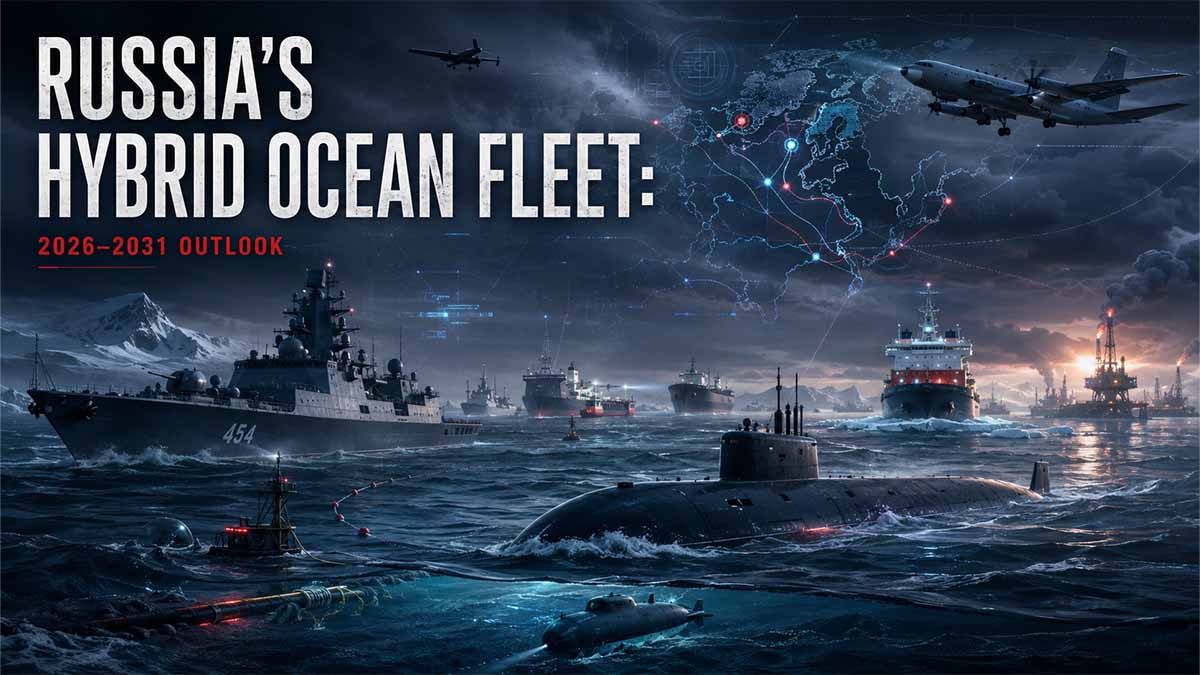
Executive Summary
BLUF: Russia is attempting to transform its navy from a predominantly platform-centric force into a distributed manned–unmanned maritime combat system built around nuclear submarines, long-range missile ships, autonomous sensors and expendable surface and underwater vehicles.
The reported Northern Fleet unmanned-systems regiment would represent an important organizational change, but its composition, readiness and inventory remain unconfirmed by publicly accessible Russian government documentation.
The proposed 9,500-ton ocean-going combatant is best assessed as a developmental successor or complement to Project 22350, not yet as a funded, construction-ready class.
Russia’s most credible near-term naval power remains its submarine force, particularly the Borei/Borei-A, rather than large surface combatants vulnerable to industrial delays and precision attack.
The reported 500-ton unmanned antisubmarine vessel could materially expand persistent surveillance, but autonomy, acoustic performance, communications resilience and production scale remain decisive unknowns.
The return of Admiral Nakhimov would increase missile capacity and strategic signaling, yet impose exceptional maintenance, escort and force-protection requirements.
By 2031, Russia is more likely to field heterogeneous “robotic reconnaissance-strike complexes” than large homogeneous fleets of fully autonomous warships.
The principal threat is not any single platform, but an integrated kill chain linking seabed sensors, satellites, electronic intelligence, submarines, uncrewed vehicles and long-range weapons.
NATO is already developing a competing persistent-surveillance architecture through Task Force X-Baltic and Task Force X-Arctic.
The central 2026–2031 contest will concern maritime sensing, data fusion and decision speed—not hull numbers alone.
Russia’s Robotic Navy Is Redrawing the North Atlantic
Russia’s next naval transformation will not be measured only by the number of submarines launched or missiles installed. Its real significance lies in the attempt to combine nuclear deterrence, large ocean-going combatants, unmanned surface and underwater vehicles, seabed sensors and electronic warfare into a single reconnaissance-and-strike architecture. The reported formation of an unmanned-systems regiment in the Northern Fleet and the concept of a 9,500-ton combatant point in the same direction: Moscow wants to defend its Arctic strategic bastion while recovering an ability to operate beyond it. The obstacle is industrial. The opportunity is technological compression. Autonomous systems can extend surveillance without replicating the cost of a conventional fleet. Over the next five years, the balance in the North Atlantic will therefore depend less on hull counts than on who can detect first, preserve track continuity and keep command networks functioning under cyber-electromagnetic attack.
The Architecture of Survival
The Northern Fleet is not simply another Russian naval formation. It protects the bases, departure routes and operating areas associated with Russia’s sea-based nuclear deterrent on the Kola Peninsula. The Borei and Borei-A ballistic-missile submarines, equipped with Bulava submarine-launched ballistic missiles, provide Moscow with a retaliatory capability designed to survive a first strike. Their strategic value does not depend solely on the number of missiles carried. It depends on whether submarines can leave port undetected, reach protected patrol areas, receive authenticated orders and remain beyond reliable adversary tracking.
This explains Russia’s interest in unmanned surface and underwater formations. Their most important mission is unlikely to be independent combat. It is persistent surveillance: mine reconnaissance, passive acoustic collection, seabed inspection, route sanitisation, decoy deployment and the detection of NATO submarines or autonomous systems approaching Russian bastion areas. The unmanned vehicle becomes the outer layer of a system that connects coastal stations, satellites, naval aviation, crewed submarines and long-range weapons.
The Russian Government’s updated shipbuilding strategy, approved on 12 May 2025, explicitly requires new construction positions for combat ships intended for distant maritime and oceanic zones. It also calls for full execution of the state defence order, modernization of existing shipyards and technological sovereignty in critical equipment. Shipbuilding Industry Development Strategy to 2036 and Outlook to 2050 – Government of the Russian Federation – May 2025. (Governo Russo)
The 9,500-Ton Test
The proposed 9,500-ton ocean-going warship should not be treated as a larger version of the approximately 5,000-ton Project 22350 frigate. At that displacement, Russia would effectively be designing a destroyer-scale command and strike platform, regardless of the formal classification eventually chosen. It could carry a larger missile inventory, more powerful air-defence sensors, expanded antisubmarine systems, helicopters and mission facilities for unmanned vehicles. It could also serve as a command node for distributed robotic formations operating beyond line of sight.
Yet displacement magnifies integration risk. A larger radar requires more electrical power and cooling. Additional missile cells alter weight distribution and survivability requirements. Unmanned-vehicle control demands secure communications, data fusion, mission-planning software and dedicated launch-and-recovery equipment. Each subsystem competes for space, power and electromagnetic compatibility.
The real question is therefore not whether Russian designers can draw the ship, but whether the industrial system can qualify its propulsion, stabilize the design, integrate the combat system and produce the class serially. Russia’s own strategy acknowledges that current capacity cannot satisfy projected national shipbuilding demand under any scenario. It identifies large-scale modernization of Severnaya Verf, new Far Eastern capacity and a transition toward large-block construction as necessary measures. The strategy’s baseline scenario envisages more than 1,600 civilian vessels and marine systems by 2036, creating direct competition for skilled labour, machinery, suppliers and investment. Updated Shipbuilding Strategy – Government of the Russian Federation – May 2025. (Governo Russo)
The Industrial Arithmetic
Moscow has set ambitious numerical targets. Utilisation of existing shipbuilding capacity is intended to rise to 61% by 2036 and 73% by 2050. The share of serially produced vessels is planned to increase from 30% to 50% by 2036, then to 80% by 2050. Domestic shipboard components should account for 50% by 2036 and 80% by 2050. The sector’s workforce is expected to grow from approximately 166,000 to 190,000 employees by 2036, an increase of about 15%. Russian Government Updates the Shipbuilding Strategy – Government of the Russian Federation – May 2025. (Governo Russo)
These targets reveal both commitment and weakness. Governments do not order such increases unless existing production, labour and component availability are inadequate. A new ocean-going combatant must compete with nuclear-submarine construction, Project 22350 frigates, repair work, icebreakers, Arctic support ships and the renewal of an ageing civilian fleet. The opportunity cost is substantial: the same precision machinists, designers, gearbox specialists and combat-system engineers cannot be allocated simultaneously without reducing throughput elsewhere.
The most probable outcome by 2031 is therefore not a squadron of 9,500-ton ships. It is a completed design, shore-based testing of major systems and, at most, a lead hull under construction or early trials. Russia is more likely to generate operational effects sooner through unmanned systems, which can be introduced incrementally and replaced more cheaply than a complex surface combatant.
The Undersea Advantage
Russia’s strongest naval-industrial competence remains nuclear-submarine construction. The Borei-A force offers a mature strategic rationale, established infrastructure and a missile system capable of supporting deterrence from waters closer to Russian protection. This reduces the need for ballistic-missile submarines to penetrate deeply into the Atlantic merely to place targets within range.
The parallel development of Poseidon, a nuclear-powered unmanned underwater system, adds a more ambiguous layer. Its strategic purpose is not simply destructive power. It complicates warning and defence by introducing a non-ballistic underwater delivery route whose mission may be difficult to identify after launch. Open official material does not disclose its verified acoustic signature, operational depth, communications architecture, deployment doctrine or warhead configuration. That uncertainty is itself strategically relevant: NATO must allocate surveillance resources without knowing whether a detected carrier or underwater contact represents testing, patrol activity or nuclear preparation.
Poseidon also exposes the unresolved tension between autonomy and political control. Underwater communications offer limited bandwidth and can reveal position. A long-endurance vehicle must therefore rely heavily on pre-programmed navigation, intermittent updates and onboard fault management. The more autonomous the mission, the more difficult it becomes to guarantee recall, retasking and positive control during a rapidly changing crisis.
NATO’s Counter-Network
NATO is responding by building its own distributed maritime architecture. On 11 February 2026, Secretary General Mark Rutte announced Arctic Sentry, bringing Allied activities in the High North under a more coherent operational approach. NATO identifies the Arctic as a gateway to the North Atlantic and a corridor for trade, communications and military reinforcement. Finland and Sweden’s membership has expanded Allied access to airfields, ports, sensors and Arctic-trained forces, while Joint Force Command Norfolk provides the relevant transatlantic command structure. Arctic Security – NATO – June 2026. (NATO)
On 6 June 2026, the NATO research vessel Alliance departed La Spezia to begin Task Force X-Arctic, an eighteen-month programme testing networked unmanned systems under ultimate human control. The first phase was organised around Iceland, with Allied Command Transformation, the Centre for Maritime Research and Experimentation, DIANA and Allied Maritime Command dividing responsibility for innovation, technical execution and operational integration. A full-scale demonstration is planned for summer 2027. NATO Launches Task Force X-Arctic – NATO – June 2026. (NATO)
The programme builds on Task Force X-Baltic, which employed more than 70 air, surface and underwater unmanned systems over three weeks in 2025. NATO has increased its 2026 investment in CMRE for Arctic-specific partnerships by 18%. Testing around Iceland is being followed by integration work at REPMUS 2026 in Portugal and further experiments in spring 2027. Task Force X-Arctic Programme – NATO Allied Command Transformation – 2026. (NATO ACT)
The GIUK Contest
The Greenland–Iceland–United Kingdom gap remains central because geography compresses the routes between Russia’s northern bases and the wider Atlantic. It does not make submarines automatically detectable. It gives NATO a narrower area in which to combine satellites, maritime patrol aircraft, attack submarines, sonar-equipped surface vessels and autonomous sensors.
The decisive variable is track continuity. NATO may observe preparations at a Russian base, detect a submarine entering the Norwegian Sea and still lose it before the Atlantic. A later contact near the GIUK gap may be probable but not conclusively linked to the original sortie. Russia will exploit this discontinuity through timing, acoustic conditions, decoys, civilian traffic and electronic deception.
Autonomous systems can narrow the gaps, but they cannot repeal ocean physics. Temperature, salinity, seabed composition, ice and shipping noise alter sonar performance. More sensors will produce more contacts, not necessarily more certainty. The strategic advantage will belong to the side that transforms heterogeneous observations into a verified track faster than the opponent can corrupt, confuse or break it.
The Invisible Battlefield
Cyber-electromagnetic warfare is becoming the cheapest way to attack an expensive naval network. A jammer does not need to sink an unmanned vessel if it can isolate it from satellite communications. A cyber operation does not need to destroy a sonar array if it can corrupt timing data and displace the calculated position of a submarine. Software supply-chain compromise could create common-mode failures across an entire fleet of autonomous systems.
For NATO, resilience will require redundant navigation, independent timing, signed software, hardware roots of trust and the capacity to operate when cloud or satellite connectivity disappears. For Russia, the same vulnerabilities affect unmanned regiments, seabed nodes and strategic systems. The contest will increasingly concern the integrity of the operational picture: whether commanders can trust what their networks are telling them.
This is also the principal escalation risk. A corrupted sensor feed near a ballistic-missile submarine base could be interpreted as preparation for attack. A NATO underwater vehicle discovered near Russian strategic infrastructure could be classified as reconnaissance, sabotage or counterforce targeting. Autonomous systems reduce human exposure, but by making intrusive missions politically cheaper they may increase their frequency—and therefore the probability of collision, capture or miscalculation.
The Sanctions Variable
European sanctions will not automatically prevent Russian naval modernization, but they raise its cost, delay delivery and increase quality risk. On 23 July 2026, the European Union adopted its twenty-first sanctions package, listing 48 individuals and 170 entities, banning port access for 41 additional shadow-fleet vessels, imposing transaction prohibitions on 33 more Russian financial institutions and 14 crypto-related platforms, and tightening dual-use export controls for 51 additional entities, including firms outside Russia. EU Sanctions Packages Timeline – Council of the European Union – July 2026. (Consiglio Europeo)
For shipbuilding, the cumulative effect matters more than any single listing. Advanced marine electronics, precision machine tools, navigation systems, processors, industrial software and specialized materials can often be substituted or acquired indirectly, but with longer lead times, higher prices and less consistent quality. The bottleneck may emerge not in hull construction but in gearboxes, control electronics, sensors, testing equipment or lifecycle support.
The Five-Year Balance
The base-case outlook to 2031 is a hybrid and increasingly contested equilibrium. Russia is likely to expand unmanned surveillance and antisubmarine formations faster than it can regenerate a large surface fleet. Borei-A submarines will remain the most credible element of its maritime deterrent. Poseidon will add uncertainty and consume NATO surveillance resources, but its sustained patrol doctrine and command architecture will remain difficult to verify. The 9,500-ton combatant is more likely to be a lead-ship programme than the foundation of a serial ocean fleet.
NATO, meanwhile, is likely to move from experimentation toward selective permanent deployment of autonomous systems around Iceland, the Norwegian Sea and critical seabed corridors. Its advantage will come from coalition geography, commercial technology and aggregate sensor capacity. Its vulnerability will be interoperability: a multinational network can acquire data faster than it can necessarily secure, standardise and interpret it.
A probability-weighted assessment assigns roughly 60% to a managed but intensifying sensor competition, 25% to a prolonged hybrid crisis involving cables, cyber operations or maritime coercion, and 15% to a severe confrontation triggered by activity around strategic nuclear assets. The percentages are less important than the asymmetry behind them: building reliable deterrence requires every major component to function, while escalation can begin with one misclassified contact.
The Cost of Misreading the Ocean
The North Atlantic is not becoming transparent. It is becoming more observable, more automated and more vulnerable to false confidence. Russia’s naval wager is that robotic systems can compensate for limited conventional hull numbers and protect the nuclear force that matters most. NATO’s counter-wager is that distributed sensing can expose movement, protect infrastructure and preserve reinforcement routes without placing a frigate over every cable or an aircraft over every patrol area.
The strategic competition will be decided by endurance: industrial endurance, software endurance and political endurance under ambiguity. A new Russian warship may dominate headlines, but the more consequential change is occurring beneath the surface, where sensors, algorithms and autonomous vehicles are compressing the time available to distinguish routine deterrence from preparation for war.
Navigational Index
- Force Architecture and Industrial Feasibility — unmanned regiments, the 9,500-ton combatant, shipyard capacity, propulsion, weapons integration and lifecycle constraints.
- Undersea Deterrence and Robotic Warfare — Borei-class submarines, Poseidon, autonomous antisubmarine systems, seabed infrastructure and North Atlantic operations.
- Five-Year Strategic Competition — NATO counter-networks, Arctic and GIUK dynamics, cyber-electromagnetic warfare, sanctions, escalation pathways and probability-weighted outcomes.
Master Abstract
Russia’s emerging naval concept should be understood as an effort to construct a layered maritime system in which scarce high-value crewed platforms are supported by larger numbers of distributed sensors, unmanned vehicles, coastal weapons and information-processing nodes. The assertion attributed to Navy Commander-in-Chief Admiral Alexander Moiseyev that the Northern Fleet already possesses a regiment equipped with unmanned surface and underwater vehicles is operationally significant because a regiment implies more than experimental prototypes: it suggests permanent command structures, training pipelines, maintenance arrangements, communications elements and a doctrine for coordinated employment. Nevertheless, no accessible Russian presidential, defence-ministry or navy document verified during this research session specifies the regiment’s order of battle, platform inventory, personnel strength, readiness level or command relationship. The claim must therefore remain classified as officially attributed but independently uncorroborated in primary documentation. What can be verified is the direction of Russian policy. At a Kremlin naval-development meeting on 26 June 2024, President Vladimir Putin called for remote threat-detection systems, improved monitoring of the surface and underwater environment, electronic intelligence, electronic warfare and protection against maritime robotic systems at greater distances from naval bases. Meeting on the Development of the Navy – President of Russia – June 2024 Russia’s 2022 maritime-policy framework also directs the development of robotic maritime complexes, autonomous observation stations and systems communicating through satellite and hydroacoustic channels. Decree No. 512 on the Maritime Doctrine – President of Russia – July 2022 Taken together, these documents support a high-confidence judgment that Russia is institutionalizing unmanned maritime operations, even though they do not validate every reported detail. The Northern Fleet is the logical initial theater because it protects the Kola Peninsula’s strategic-submarine bases, controls access toward the Barents and Norwegian Seas, supports bastion defence and sits astride the routes leading to the Greenland–Iceland–United Kingdom gap. An unmanned regiment positioned there could conduct harbor defence, mine reconnaissance, antisubmarine barrier operations, acoustic and electromagnetic surveillance, deception, hydrographic preparation and inspection of critical seabed infrastructure. Its decisive value would derive not from autonomous vehicles operating individually but from integration into a Russian reconnaissance-strike network connecting shore stations, naval aviation, submarines, satellites, over-the-horizon sensors and missile units. The principal uncertainty is whether Russia possesses the secure communications, reliable autonomy, low-noise propulsion, high-quality sonar processing and industrial production capacity required to turn organizational announcements into persistent combat power under Arctic conditions.
The proposed 9,500-ton ocean-going surface combatant must similarly be evaluated as an ambition constrained by engineering and industrial realities. A ship of that displacement would sit well above existing Project 22350 frigates and approach the size, endurance and weapons capacity normally associated with a large destroyer or small cruiser, irrespective of its formal Russian classification. The strategic rationale is coherent: Russia requires ships able to remain deployed for extended periods, escort strategic assets, carry expanded vertical-launch inventories, host larger command-and-control facilities, support helicopters and unmanned aircraft, and operate beyond protected coastal zones. Such a hull could potentially accommodate a larger Poliment-Redut air-defence architecture, additional universal launch cells for Kalibr-, Oniks- or Tsirkon-family weapons, improved antisubmarine systems, greater electrical-generation capacity and dedicated facilities for unmanned vehicles. Yet displacement alone does not create an oceanic navy. Russia would need to solve interdependent challenges involving propulsion availability, radar and combat-system integration, shipyard throughput, high-quality marine components, crew generation, replenishment ships, overseas access and maintenance capacity. The correct analytic comparison is not simply between a 5,000-ton and a 9,500-ton hull, but between declared design intent and the full industrial ecosystem required to deliver a combat-ready class in serial numbers. Even the United States, with a much larger naval-industrial base, has suffered severe frigate delays when construction began before design maturity, according to the U.S. Government Accountability Office. Navy Frigate: Unstable Design Has Stalled Construction and Compromised Delivery Schedules – U.S. Government Accountability Office – May 2024 That experience does not mechanically predict Russian performance, but it illustrates a general systems-engineering constraint: a new combatant becomes vulnerable to cascading delay when weight margins, propulsion, software, sensors and mission systems are not stabilized before production. Consequently, the Bayesian estimate used in this assessment assigns a 65% probability that Russia will complete detailed design or formally designate the project by the end of 2028, a 40% probability that a lead hull will be laid down by 2029, and only a 20% probability that an operationally credible lead ship will enter fleet service by the end of 2031. A more probable outcome is continued construction of Project 22350 derivatives while the larger design functions as a technology accumulator and post-2030 force objective. The surface fleet’s transformation will therefore depend less on a single flagship project than on whether Russia can combine incremental frigate production with unmanned escorts, off-board sensors and long-range weapons.
The undersea dimension is substantially more consequential because it builds on Russia’s strongest surviving naval-industrial and operational competencies. The Borei/Borei-A strategic ballistic-missile submarine force, armed with Bulava submarine-launched ballistic missiles, is designed to sustain sea-based nuclear deterrence for decades, while the reported operational introduction of a Poseidon carrier adds a separate, opaque layer of nuclear signaling and escalation risk. The Kremlin has publicly described Poseidon as a nuclear-powered unmanned underwater system with intercontinental reach and has connected infrastructure development to its carriers. Presidential Address to the Federal Assembly – President of Russia – March 2018 Meeting with Senior Defence Officials – President of Russia – December 2023 Public official material does not reveal the system’s verified operational range, acoustic signature, command architecture, warhead configuration, patrol doctrine or survivability against future detection networks. Poseidon should therefore be treated neither as invulnerable nor as a conventional torpedo; it is better modeled as a strategic autonomous delivery system intended to complicate adversary warning, attribution, targeting and arms-control calculations. The reported construction of a 500-ton unmanned antisubmarine vessel is strategically different but potentially more relevant to routine operations. At that size, a vessel could possess endurance, power generation and payload capacity far exceeding small uncrewed boats, potentially supporting towed arrays, variable-depth sonar, deployable sonobuoys, unmanned-underwater-vehicle handling and satellite communications. Its operational purpose would likely be persistent barrier surveillance rather than independent submarine destruction: detecting or classifying contacts, maintaining tracks and transferring targeting data to submarines, aircraft, helicopters or crewed surface combatants. NATO is moving in an analogous direction. During a three-week 2025 experiment, Task Force X-Baltic employed more than 70 air, surface and subsurface uncrewed systems for surveillance, choke-point monitoring and protection of critical underwater infrastructure; NATO reports that the uncrewed coverage cost approximately one-third as much as comparable frigate-based coverage. Task Force X-Baltic – NATO Allied Command Transformation – 2025/2026 NATO has subsequently extended the concept toward the High North through Task Force X-Arctic, combining autonomous systems with AI-assisted space-based maritime awareness. Task Force X-Arctic – NATO Allied Command Transformation – 2026 The resulting 2026–2031 security environment will be characterized by competing sensor webs operating around submarine bastions, maritime chokepoints, energy routes and communications cables. This creates a paradox: autonomous systems can improve transparency and warning, but dense networks of dual-use sensors, ambiguous unmanned contacts, cyber interference and nuclear-capable undersea platforms may shorten decision time and increase the probability that technical incidents are interpreted as preparations for strategic attack.
Russian Hybrid Fleet Evolution
Five-Year Capability Trajectory
Normalized index: 2026 baseline = observed and officially supported capability direction.
Composite Maritime Disruption Index
Weighted interaction of undersea reach, unmanned persistence, long-range fires and escalation ambiguity.
ACH Confidence Matrix
Force Architecture and Industrial Feasibility: Russia’s Manned–Unmanned Fleet, 2026–2031
From experimental vehicles to a permanent unmanned force structure
The reported establishment of a Northern Fleet regiment equipped with unmanned surface and underwater vehicles would mark a doctrinal transition more consequential than the acquisition of any individual drone, because a permanent regiment converts a collection of prototypes into an enduring military institution with command authority, personnel establishments, training standards, maintenance chains, protected communications, operational planning cells and recurring procurement requirements. Publicly accessible Russian primary documentation does not disclose the regiment’s numerical strength, platform composition, basing arrangement or operational readiness, so the precise claim cannot be independently validated beyond its attribution to Navy Commander-in-Chief Alexander Moiseyev. The wider policy direction, however, is strongly supported. At the Kremlin’s June 2024 shipbuilding meeting, President Vladimir Putin explicitly demanded development of remote maritime-threat detection, continuous monitoring of the surface and underwater environment, electronic intelligence, electronic warfare and the ability to defeat maritime robotic systems before they approach Russian bases. Official Title: Совещание по вопросам развития кораблестроения – President of Russia – June 2024 — Meeting on Shipbuilding Development. The updated Russian shipbuilding strategy likewise calls for construction facilities capable of producing new combatants for the distant maritime and oceanic zones, while assigning full execution of the state defence order as a formal target. Official Title: Стратегия развития судостроительной промышленности на период до 2036 года и на дальнейшую перспективу до 2050 года – Government of the Russian Federation – May 2025 — Russian Shipbuilding Industry Development Strategy. The likely purpose of the Northern Fleet unit is therefore not massed autonomous attack in isolation, but the creation of a distributed reconnaissance, surveillance, mine-warfare and antisubmarine layer protecting the Kola Peninsula, the Barents Sea bastion, naval bases and approaches to strategic-submarine patrol areas. In force-design terms, the regiment should be modeled as an enabling formation inside a larger sensor-to-shooter architecture, not as a direct equivalent of a conventional surface-ship regiment. Its operational effectiveness will depend on whether Russia can connect unmanned platforms to shore-based command centers, naval aviation, crewed submarines, surface ships, coastal missile units and space-based or over-the-horizon sensors without creating a communications architecture vulnerable to jamming, cyber penetration, acoustic interception or satellite denial. The key intelligence gap is therefore not the number of unmanned hulls, but the degree of integration, autonomy and mission persistence achieved under contested Arctic conditions.
Data Fusion and Targeting Chain
Unmanned Surface Vehicles (USVs)
- Radar / EO-IR / Electronic Warfare (EW) Payloads
- Communications relay bridge
- Decoy and deception systems
Unmanned Underwater Vehicles (UUVs)
- Passive sonar and mine search
- Seabed inspection and tracking
- Acoustic reconnaissance
Naval Aviation
Airborne platforms for rapid strike and ASWCrewed Submarines
Stealth engagement and deep strikeSurface Combatants
Missile launch and fleet defenseThe 9,500-ton combatant as a systems-integration problem
A 9,500-ton ocean-going combatant would represent a qualitative departure from Project 22350 rather than a straightforward enlargement, because doubling displacement changes almost every major engineering relationship: propulsion power, electrical generation, shaft-line design, radar aperture, stability margins, heat rejection, signature management, ammunition storage, crew accommodation, aviation support and maintenance burden. Russian terminology may retain a frigate classification for political or doctrinal reasons, but a ship at approximately 9,500 tons would function operationally as a destroyer-scale command and strike platform. Its plausible mission set would include area air defence, long-range land and maritime strike, antisubmarine warfare, escort of strategic assets, command of unmanned formations and persistent deployment in the North Atlantic, Arctic, Mediterranean or Indo-Pacific. Yet the critical feasibility question is not whether Russian designers can produce a conceptual hull form; it is whether Russian industry can mature the complete combat system and manufacture it repeatedly. The Government’s revised strategy openly acknowledges that existing capacity does not satisfy projected demand even across civilian shipbuilding scenarios, that major modernization of shipyards remains necessary, and that the industry must overcome shortages in production space, domestic equipment, workforce and repair infrastructure. Official Title: Стратегия развития судостроительной промышленности на период до 2036 года и на дальнейшую перспективу до 2050 года – Government of the Russian Federation – May 2025 — Russian Shipbuilding Industry Development Strategy. The same document identifies the need to create building positions specifically for new ocean-zone combatants, which is indirect evidence that current yard geometry, outfitting infrastructure or production organization is not automatically sufficient for a new class of this size. Consequently, the 9,500-ton program should be analyzed through five sequential gates: requirements stabilization, preliminary and detailed design, propulsion qualification, combat-system integration and yard production readiness. Failure at any gate would cascade into redesign, weight growth and delivery delay. The most probable 2026–2031 outcome is therefore not a mature operational squadron, but a phased program in which Russia completes design definition, assigns a formal project number, constructs shore-based test facilities, orders long-lead machinery and possibly lays down a lead hull late in the forecast period. A first ship could exist physically before 2031 without being operationally representative; combat-system trials, propulsion debugging and weapons certification could continue for several years after launch.
| Development gate | Core requirement | Principal failure mechanism | 2031 assessment |
|---|---|---|---|
| Mission definition | Stable air-defence, strike, ASW and unmanned-control requirements | Requirement inflation and displacement growth | Medium confidence |
| Detailed design | Mature weight, stability and compartmentation model | Construction begins before design freezes | Medium–high risk |
| Propulsion | Qualified high-output domestic plant | Gearbox, turbine or diesel bottlenecks | High risk |
| Combat system | Radar, vertical launch, EW and command-system integration | Software and electromagnetic incompatibility | High risk |
| Yard readiness | Covered construction, block assembly and heavy outfitting | Modernization delay and labor shortages | Medium–high risk |
| Serial production | Repeatable suppliers and stable financing | One-off flagship economics | Very high risk |
Shipyard capacity and the competition between military and civilian priorities
Russia’s shipbuilding capacity cannot be assessed solely by counting slipways, because effective capacity is the product of usable construction space, crane lift, block-fabrication efficiency, skilled labor, design maturity, equipment availability, supplier timing and the financial ability to sustain parallel programs. The updated Russian industrial strategy establishes a target of increasing utilization of existing facilities to 61% by 2036 and 73% by 2050, while the baseline scenario anticipates more than 1,600 civilian vessels and marine systems by 2036 and requires the workforce to rise by at least 15%, to approximately 190,000 employees. Official Title: Правительство актуализировало Стратегию развития судостроительной промышленности – Government of the Russian Federation – May 2025 — Updated Shipbuilding Strategy. Official Title: Government Meeting on the Updated Shipbuilding Strategy – Government of the Russian Federation – May 2025 — Russian Government Shipbuilding Priorities. These targets expose a structural resource competition: shipyards and upstream suppliers must simultaneously satisfy naval procurement, Arctic shipping, icebreakers, tankers, fishing vessels, support ships and domestic replacement of imported equipment. A destroyer-scale surface combatant would consume disproportionate design talent, precision machining, cable installation, combat-system integration and specialized outfitting capacity compared with a commercial hull. Severnaya Verf is the natural candidate because of its Project 22350 experience, but that experience also creates congestion: the same yard must complete existing frigates while absorbing modernization and preparing any larger successor. Large commercial capacity at Zvezda does not automatically solve the problem because a yard optimized for tankers and offshore structures does not instantly possess the classified integration environment, specialized combat-system workforce or supplier interfaces needed for a sophisticated warship. Russia’s official strategy calls for large-block construction, automation, digitalization and modernization precisely because traditional production methods limit throughput. The most important 2026–2031 indicator will therefore be not a ceremonial keel-laying but evidence that a yard has completed covered building facilities, digital design integration, heavy-lift modernization and modular outfitting lines. The strategic risk is a “portfolio crowding” effect: urgent wartime repair, submarine priorities, Project 22350 continuation and civilian fleet replacement may collectively delay the 9,500-ton ship even if political authorization exists. A rational Russian allocation hierarchy would place nuclear submarines and strategic systems above a new large surface combatant; therefore, the new ship is vulnerable whenever budgets, labor or propulsion components become scarce.
Propulsion: domestic recovery does not equal scale-free capability
Propulsion constitutes the most consequential industrial bottleneck because Russia has successfully restored part of the marine gas-turbine supply chain after losing Ukrainian inputs, but a 9,500-ton combatant would demand a higher level of output, redundancy and lifecycle support than the current Project 22350 installation. United Engine Corporation, part of Rostec, states that the Project 22350 frigates use the M55R diesel-gas-turbine aggregate incorporating the 20 MW M90FR turbine and that the first domestically produced sets were supplied to Severnaya Verf for Admiral Golovko, followed by units for Admiral Isakov. Official Title: ОДК представляет разработки на Международном военно-морском салоне 2021 – United Engine Corporation – June 2021 — M90FR and M55R Marine Propulsion Program. Rostec also reports that development of M90FR and related engines accelerated after Ukraine terminated deliveries, and that later Project 22350 ships employ Russian-produced marine propulsion systems. Official Title: Ростех для фрегатов «адмиральской» серии – Rostec – December 2020 — Domestic Propulsion for Project 22350 Frigates. These achievements reduce one category of foreign dependency, but they do not prove that Russia can produce, integrate and maintain the power plant required for a substantially heavier ship at an acceptable rate. A 9,500-ton vessel could employ multiple M90FR-class turbines, a combined gas-and-gas arrangement, an enlarged diesel-gas architecture or an integrated electric solution. Each option introduces tradeoffs. Multiple turbines increase gearbox complexity and fuel demand; combined diesel-gas arrangements require sophisticated cross-connection and transmission systems; integrated electric propulsion would provide power flexibility for future sensors and weapons but demand high-capacity generators, converters, motors and electromagnetic management. Rostec has publicly discussed a potential 25 MW derivative based on M90FR and a longer-term engine range extending toward approximately 35,000 horsepower, but public announcements do not establish production maturity, gearbox readiness or shipboard certification for a new combatant. Official Title: Полный вперед: новые морские двигатели для российского флота – Rostec – October 2021 — Russian Marine Gas-Turbine Development. The highest-risk component may not be the turbine itself but the reduction gear, control software, precision metallurgy and endurance-testing infrastructure. A realistic five-year plan would require land-based integration testing of the entire propulsion train before hull installation. Without such testing, the lead ship risks lengthy post-launch remediation, restricted power settings and reduced operational availability.
| Propulsion pathway | Advantages | Industrial liabilities | Relative probability |
|---|---|---|---|
| Enlarged diesel–gas turbine | Builds on M55R experience; efficient cruise | Gearbox scaling, diesel availability, integration complexity | 45% |
| Combined gas turbine | High speed and simpler operating concept | Fuel consumption, turbine quantity, transmission burden | 30% |
| Integrated electric propulsion | Supports sensors, unmanned systems and future high-energy loads | Converters, motors, cooling and electromagnetic qualification | 15% |
| Hybrid or undisclosed architecture | Design flexibility | Highest development uncertainty | 10% |
Weapons, sensors and combat-system integration
Weapons integration will determine whether the proposed ship becomes an operationally coherent combatant or merely a large missile carrier. The most plausible configuration would combine a larger number of universal vertical-launch cells for Kalibr-, Oniks- and Tsirkon-family weapons with an expanded Poliment-Redut air-defence system, close-in defence, antisubmarine weapons, electronic warfare, decoys, helicopters and dedicated unmanned-vehicle support. However, every additional launcher, radar panel and mission bay competes for displacement, electrical power, cooling, data bandwidth and topside geometry. A destroyer-scale ship designed for area air defence requires more than additional interceptors: it requires sustained multi-function radar coverage, high-quality tracking, engagement scheduling, identification, cooperative targeting and resistance to saturation, deception and electronic attack. The integration burden expands further if the vessel is intended to command unmanned surface and underwater systems. It would need mission-planning software, secure bidirectional communications, data compression, autonomous behavior management, sensor-fusion tools and facilities for launch, recovery, charging and maintenance. The Russian government’s 2024 shipbuilding guidance specifically links future naval development to remote sensing, underwater awareness, electronic intelligence and defence against robotic systems, indicating that information architecture is becoming a formal design requirement rather than an auxiliary capability. Official Title: Совещание по вопросам развития кораблестроения – President of Russia – June 2024 — Meeting on Shipbuilding Development. Yet the software and electromagnetic integration problem is likely to be harder than physical launcher installation. Multiple active radars, satellite terminals, electronic-support receivers, jammers and unmanned-vehicle datalinks can interfere with each other unless antenna placement, frequency management and combat-system software are designed as a single system. Russia must also decide whether to prioritize arsenal depth or survivability. A very large missile load increases combat persistence but concentrates weapons in a high-value hull susceptible to submarine attack, long-range precision weapons and unmanned swarms. The optimal architecture may therefore distribute sensors and decoys across unmanned adjuncts while keeping the crewed ship farther from the highest-threat zone. This would transform the 9,500-ton combatant into a command, air-defence and weapons node inside a wider formation rather than a self-contained Soviet-style cruiser successor.
Power Generation and Primary Services Architecture
Power Generation
Primary power node for sensors, computing, and weapon systems
Lifecycle feasibility: availability, maintenance and hidden fleet costs
The decisive measure of feasibility is not whether Russia can launch one technologically impressive ship, but whether it can sustain the platform through a thirty-year lifecycle while maintaining crew proficiency, ammunition stocks, spares, propulsion overhauls, software updates, dock access and operational availability. Large combatants impose nonlinear costs because their complex sensors, weapons and propulsion systems require specialized maintenance teams, shore-based test equipment and long periods of planned overhaul. The modernization history of major Russian surface ships demonstrates the danger of creating strategically impressive but maintenance-intensive assets whose availability remains episodic. A new 9,500-ton class would require a complete lifecycle support system from its first design phase: digital configuration control, component obsolescence management, repair documentation, domestic spare production, depot-level maintenance capacity and cybersecurity support for decades of software modification. Russia’s revised shipbuilding strategy explicitly identifies repair centers, spare-parts logistics, technological sovereignty and replacement of foreign shipboard equipment as core industrial priorities. Official Title: Government Meeting on the Updated Shipbuilding Strategy – Government of the Russian Federation – May 2025 — Russian Government Shipbuilding Priorities. This official emphasis implies that sustainment remains a recognized vulnerability rather than a solved problem. Unmanned regiments create a parallel lifecycle burden. Small and medium unmanned vehicles may be cheaper per hull, but fleets of them consume batteries, propellers, acoustic transducers, navigation units, satellite terminals, secure processors and software-maintenance resources at scale. Saltwater corrosion, Arctic icing, pressure cycling and repeated launch-and-recovery operations will generate attrition even without enemy action. Autonomy software must also be updated against changing environmental models and adversary countermeasures, creating a continuous verification problem: every new software release can introduce navigation, classification or safety defects. Russia will therefore need a “fleet software factory” able to test mission code, cyber hardening and human-machine interfaces across multiple vehicle families. The lifecycle risk is that procurement favors visible hull numbers while underfunding training, simulators, spares and depot support. Under that scenario, the Northern Fleet could possess a nominal regiment but only a fraction of its vehicles would be mission-capable at any given time. For intelligence assessment, readiness indicators should include exercise tempo, recovery vessels, storage facilities, maintenance shelters, satellite-terminal density, tender ships and recurring evidence of software or payload upgrades.
Comparative industrial context: China, Europe and the widening production gap
The multilingual comparison with Chinese official planning highlights the scale of Russia’s industrial challenge without implying direct equivalence between civilian and military shipbuilding. China’s Smart Shipping 2030 Action Plan, issued jointly by the Ministry of Transport, Ministry of Industry and Information Technology, the state-assets authority and market regulator, targets more than 100 smart vessels by 2027, multiple pilot regions and routes, and comprehensive mastery of core smart-shipping technologies by 2030. Official Title: 智能航运2030行动计划 – Ministry of Transport of the People’s Republic of China – March 2026 — China Smart Shipping 2030 Action Plan. Shanghai’s official Changxing Island implementation plan goes further by targeting output above 120 billion yuan by 2027, attracting 100 key supporting enterprises, creating full three-dimensional digital ship design, complex-system digital twins and intelligent production-management systems, while advancing ship–shore–cloud autonomous-navigation testing. Official Title: Implementation Plan of Shanghai Municipality for Building Changxing Island into a World-Class Modern Shipbuilding Base (2025–2027) – Shanghai Municipal Government – December 2025 — Changxing Island Shipbuilding Implementation Plan. These Chinese targets show what an integrated shipbuilding ecosystem looks like: concentrated final assembly, specialized suppliers, digital design, automated welding, propulsion development, standards and large serial production. Russia’s strategy contains many of the same ambitions, but from a smaller and more constrained industrial base. The European Union adds an external pressure vector by maintaining export controls and sanctions against Russian defence, shipbuilding and machine-building entities, including restrictions affecting dual-use technology and technological enhancement of Russia’s military-industrial sector. Official Title: Russia’s War Against Ukraine: EU Sanctions – Council of the European Union – July 2026 — EU Sanctions Against Russia. Official Title: Russia’s Military Aggression Against Ukraine: Fourth EU Package of Sectoral and Individual Measures – Council of the European Union – March 2022 — EU Measures Affecting Shipbuilding and Dual-Use Supply. The combined implication is that Russia must develop advanced ships while facing restricted access to high-end machine tools, marine electronics, industrial software and specialized components, whereas China is scaling a broad commercial-industrial ecosystem around smart vessels and digital shipbuilding. Russian cooperation with Chinese suppliers could mitigate selected component shortages, but China has strong incentives to control exposure to secondary sanctions and protect its own technology advantages. Therefore, Chinese industrial capacity should not be treated as automatically transferable to Russian military programs.
Analysis of Competing Hypotheses and Bayesian five-year outlook
Five competing hypotheses explain the Russian force-development trajectory. H₁, Arctic bastion reinforcement, holds that unmanned regiments and new surface ships are principally designed to protect strategic-submarine operating areas, bases and northern infrastructure. H₂, oceanic navy regeneration, interprets the 9,500-ton ship as the beginning of a broader effort to restore persistent blue-water presence. H₃, distributed robotic sea denial, argues that Russia will compensate for limited surface-fleet numbers through unmanned surveillance, mining, deception and targeting networks. H₄, prestige-led industrial signaling, treats major announcements as instruments for sustaining domestic political confidence and deterring adversaries despite limited delivery probability. H₅, hybrid portfolio strategy, expects selective realization: submarines and unmanned systems advance, Project 22350 continues, and the 9,500-ton class develops slowly as a post-2030 program. Current evidence most strongly supports H₅, followed by H₁ and H₃. The official prioritization of underwater awareness, robotic systems and ocean-zone construction supports genuine transformation, but capacity shortages, workforce targets, import substitution and yard modernization reduce the probability of rapid serial surface-ship production. Using a Bayesian baseline derived from Russian program history, current industrial declarations and propulsion maturity, this assessment assigns a 72% probability that the Northern Fleet unmanned formation will expand or formalize operational doctrine by 2031; a 60% probability that a Pacific Fleet counterpart will exist in at least initial operational form; a 67% probability that the 9,500-ton project will reach detailed design or formal program status; a 43% probability that a lead hull will be laid down by the end of 2031; and a 17% probability that a fully operational lead ship will enter service within the same period. Monte Carlo-style scenario reasoning, based on interacting variables for financing, yard modernization, propulsion qualification, supplier resilience and combat-system maturity, produces a median outcome in which Russia fields increasingly capable unmanned maritime units and additional Project 22350-family ships while the larger combatant remains under construction or in early trials. The principal upside scenario requires simultaneous success across propulsion, yard modernization and systems integration; the downside scenario requires only one or two major bottlenecks. This asymmetry is critical: complex warship programs fail conjunctively because all essential subsystems must work, whereas delay can be caused by a single unavailable gearbox, radar component, software baseline or shipyard milestone.
| Hypothesis | Core proposition | Evidence consistency | 2031 posterior probability |
|---|---|---|---|
| H₁ | Arctic bastion defence dominates | High | 68% |
| H₂ | Broad oceanic fleet regeneration | Medium–low | 29% |
| H₃ | Robotic sea denial substitutes for hull numbers | High | 64% |
| H₄ | Announcements exceed executable capacity | Medium–high | 57% |
| H₅ | Selective hybrid modernization | Very high | 76% |
Strategic judgment for 2026–2031
The most credible Russian force architecture by 2031 is a hybrid fleet in which nuclear submarines, Project 22350 frigates, coastal aviation, long-range missiles, fixed sensors and unmanned vehicles form a distributed network, while the proposed 9,500-ton combatant remains a limited, high-prestige and high-risk program rather than the foundation of a regenerated mass ocean fleet. The unmanned regiment is industrially more feasible than the large warship because Russia can introduce heterogeneous vehicles incrementally, modify payloads and accept attrition without waiting for a single fully integrated platform. Yet unmanned-force scalability remains constrained by batteries, acoustic payloads, communications, autonomy software, maintenance and operator training. The large combatant faces the opposite problem: its value depends on comprehensive integration from the outset, making it vulnerable to cumulative engineering delay. Russian industry has restored domestic marine gas-turbine capability for Project 22350, but propulsion scaling, gearbox production, electrical generation and lifecycle support remain material risks. Shipyard modernization and labor expansion are official strategic priorities, which demonstrates state commitment but also confirms that capacity is insufficient today. The five-year outlook should therefore distinguish program visibility from combat availability. Russia may announce the project, display models, cut steel or lay down a hull well before it can generate a deployable ship with reliable propulsion, mature radar software, certified weapons and sustainable maintenance. The strategic danger to NATO lies less in the delivery date of the 9,500-ton vessel than in the faster integration of unmanned sensors, seabed surveillance and targeting networks around the Northern Fleet. Those capabilities could improve Russian warning, complicate allied submarine access and create persistent pressure against critical underwater infrastructure at lower industrial cost than conventional fleet expansion. The highest-value intelligence indicators through 2031 will be full-scale propulsion test rigs, gearbox contracts, modernization milestones at Severnaya Verf, evidence of unmanned-vehicle tenders and support ships, recurring Northern Fleet exercises involving coordinated surface and underwater drones, new satellite or acoustic communications infrastructure, and verified construction of enlarged combat-system test facilities. A shift in several of these indicators simultaneously would justify a substantial upward revision of the probability that Russia can convert its declared architecture into operational power.
Figure 1: Russian Naval Industrial Feasibility, 2026–2031
Probability-weighted analytical projection; values represent assessed capability maturity, not official Russian performance data.
Undersea Deterrence and Robotic Warfare: Russia’s Borei–Poseidon Architecture in the North Atlantic, 2026–2031
The strategic architecture: deterrence is migrating from platforms to networks
Russia’s undersea posture is evolving from a force centered primarily on ballistic-missile submarines into a layered architecture combining Borei-A SSBNs, nuclear-powered autonomous vehicles, attack submarines, fixed or relocatable seabed sensors, unmanned antisubmarine platforms, space-enabled communications and shore-based command nodes. The central strategic objective remains the preservation of an assured nuclear second-strike capability, but the operational mechanism is changing. Rather than relying exclusively on the acoustic discretion of an individual submarine, Moscow is attempting to create protected maritime operating zones in which adversary submarines, unmanned vehicles and intelligence platforms can be detected, classified, disrupted or forced to operate more cautiously. Russian official reporting confirms that the Borei-A Knyaz Pozharsky, armed with Bulava submarine-launched ballistic missiles, entered the Navy in 2025 and that two further submarines of the type remained under construction. Official Title: Расширенное заседание коллегии Министерства обороны – President of Russia – December 2025 — Expanded Meeting of the Russian Defence Ministry Board. Earlier Russian presidential statements identify the lead Borei-A, Knyaz Vladimir, as a submarine equipped with Bulava missiles and systems intended to penetrate missile defences, while Russian official statements describe Borei-A as having greater stealth and reliability than the preceding design. Official Title: Расширенное заседание коллегии Министерства обороны – President of Russia – December 2020 — Russian Strategic Forces Modernisation. Official Title: Расширенное заседание коллегии Министерства обороны – President of Russia – December 2018 — Borei-A Development and Strategic Naval Forces. These statements support a high-confidence conclusion that Russia intends Borei-A to remain the backbone of its maritime nuclear deterrent for decades. They do not, however, disclose patrol rates, acoustic signatures, reactor performance, missile reliability, communication arrangements or the number of submarines simultaneously available for combat duty. The correct analytical unit is therefore not the nominal submarine count but the complete deterrence system: submarine availability, missile load, crew proficiency, protected departure routes, communications survivability, attack-submarine support, antisubmarine barriers, naval aviation coverage, shore infrastructure and the ability to survive a coordinated NATO surveillance campaign.
| Layer | Principal Russian asset | Operational function | Primary vulnerability |
|---|---|---|---|
| Strategic strike | Project 955/955A Borei/Borei-A | Assured nuclear retaliation through Bulava SLBMs | Acoustic tracking, base surveillance, maintenance bottlenecks |
| Strategic autonomous strike | Poseidon and carrier submarines | Alternative nuclear delivery axis; warning and defence complication | Communications, navigation, detection, command-and-control ambiguity |
| Bastion defence | Attack submarines, aviation, surface escorts | Protect SSBN ingress, egress and patrol areas | NATO ASW concentration and persistent sensing |
| Distributed sensing | Fixed seabed sensors, UUVs, USVs, hydroacoustic nodes | Detect and classify submarines or unmanned systems | Sabotage, spoofing, data-link disruption, false contacts |
| Command and communication | Shore stations, satellite links, ELF/VLF systems | Transmit orders and maintain strategic control | Cyberattack, jamming, physical attack, atmospheric and ionospheric effects |
| Infrastructure support | Bases, tunnels, piers, weapons handling and repair facilities | Sustain patrol generation and reload cycles | Geographic concentration around the Kola Peninsula |
Borei-A and the mathematics of survivable second strike
The Borei-A force derives strategic value from survivability rather than from simple missile volume. A ballistic-missile submarine contributes to deterrence only when an adversary cannot confidently locate and neutralize it before or during a nuclear exchange. This produces an availability chain in which the number of commissioned submarines must be discounted for maintenance, modernization, crew certification, transit exposure and patrol-cycle requirements. A hypothetical force of ten SSBNs does not imply ten continuously survivable launch platforms; a realistic operational model separates boats undergoing deep maintenance, boats in short maintenance, boats training, boats preparing to deploy, boats transiting and boats on protected patrol. Russia’s concentration of its Northern Fleet strategic infrastructure around the Kola Peninsula increases logistical efficiency but also creates geographic observability: NATO can monitor access routes, air activity, support-ship movement and changes in shore-based force protection. Russia therefore has strong incentives to conduct “bastion” operations in the Barents and Arctic seas, where proximity to Russian aviation and shore-based systems reduces exposure and where complex oceanographic conditions complicate antisubmarine warfare. Russian official statements confirm that strategic nuclear submarines conduct planned combat service in assigned ocean areas, but do not identify patrol zones or deployment frequency. Official Title: Расширенное заседание коллегии Министерства обороны – President of Russia – December 2022 — Russian Strategic Submarine Combat Service. The Bulava missile provides the submarine with long-range strategic reach, allowing patrols closer to defended Russian waters rather than requiring penetration deep into the western Atlantic. That geographic flexibility is operationally important because every additional transit chokepoint increases detection probability. The Borei-A architecture must consequently be evaluated through the probability of at least one secure retaliatory platform surviving, not through comparisons of launch-cell totals. A simplified model can be expressed without classified assumptions as Pₛ = 1 − Π(1 − pᵢ), where pᵢ represents the independent survivability probability of each deployed submarine. In reality, survivability is correlated: if NATO compromises a communications protocol, acoustic signature library or departure-monitoring architecture, the probability of survival falls across multiple boats simultaneously. Russia’s investment in unmanned sensing and seabed infrastructure is therefore best interpreted as an attempt to reduce those correlated vulnerabilities by pushing detection and warning farther from SSBN operating areas.
| Borei-A deterrence variable | Why it matters | Observable OSINT indicator | Confidence |
|---|---|---|---|
| Patrol generation rate | Determines how many submarines are survivable at sea | Tug, auxiliary, aviation and security activity near bases | Medium |
| Acoustic discretion | Determines adversary track quality | Not directly observable; inferred from exercises and NATO ASW behavior | Low |
| Crew duality | Two crews per submarine can increase availability | Personnel rotations and training cycles | Low |
| Bulava reliability | Determines credible salvo and second-strike performance | Official test announcements and launch patterns | Medium |
| Base hardening | Protects submarines and command systems before deployment | Construction imagery, tunnels, shelters, air defence activity | Medium–high |
| Escort and sanitization | Reduces risk during departure and return | ASW aircraft, minesweepers, attack submarines and surface escorts | Medium |
| Secure communications | Enables command without exposing the submarine | VLF/ELF activity, satellite launches, communications exercises | Low–medium |
Poseidon as an escalation-management and warning problem
Poseidon is strategically important not because every Russian performance claim can be independently confirmed, but because its existence creates a distinct class of deterrence and warning problem. In November 2025, the Russian president stated that Russia possessed the nuclear-powered Poseidon unmanned underwater vehicle and that successful tests had been conducted; a subsequent official statement described Poseidon as already in service and subject to continued development. Official Title: Presenting Awards to Developers of the Burevestnik Cruise Missile and Poseidon Unmanned Submersible – President of Russia – November 2025 — Poseidon Developer Awards Ceremony. Official Title: Expanded Meeting of the Defence Ministry Board – President of Russia – December 2025 — Russian Statement on Poseidon Testing and Service. Those official declarations establish political attribution and a claimed operational status; they do not independently disclose verified speed, endurance, operational depth, warhead yield, acoustic characteristics, target set, patrol doctrine, command links or launch procedures. Poseidon should therefore be modeled as a strategic nuclear-powered autonomous or semi-autonomous delivery platform whose principal strategic function is to complicate adversary planning. It potentially creates a non-ballistic axis of nuclear attack that may not follow the warning signatures associated with intercontinental ballistic missiles or submarine-launched ballistic missiles. This can impose additional surveillance costs on NATO by requiring persistent monitoring of potential carrier submarines, launch zones, deep-ocean transit routes and terminal approaches. It also creates serious command-and-control questions. A system capable of very long-duration underwater movement cannot depend continuously on high-bandwidth communications, because seawater attenuates most radio-frequency signals. It must either operate through pre-programmed navigation and decision rules, receive intermittent low-data-rate updates, surface or deploy an antenna, communicate acoustically through relays, or combine several methods. Each solution creates vulnerabilities. Autonomous navigation may be affected by seabed-map errors or inertial drift; acoustic communication may reveal position or be jammed; satellite reception requires exposure; and pre-programmed mission logic creates escalation risks if strategic circumstances change after launch. Poseidon therefore expands deterrence options but may reduce crisis stability if NATO cannot determine whether a detected large unmanned underwater vehicle is conducting testing, reconnaissance, transit or a nuclear mission.
Strategic Mission Chain
Operational Parameters
- Target package
- Navigation corridor
Control and Safety
- Rules for retasking or abort
- Authentication architecture
Autonomous Navigation
- Inertial navigation
- Bathymetric / terrain correlation
Operational Management
- Environmental sensing
- Intermittent communication
- Autonomous fault management
NATO Countermeasures & Detection Barriers
- NATO fixed sensors (SOSUS/IUSS)
- SSNs and maritime patrol aircraft
- UUV barriers
- Seabed sensor arrays
- Space-enabled cueing
Poseidon carrier architecture and force-generation constraints
The operational relevance of Poseidon depends on its carrier and support ecosystem, not merely on the vehicle. A specialized carrier must transport, maintain, launch and potentially communicate with a system that combines nuclear propulsion, autonomous navigation, strategic command-and-control and a nuclear payload. That requirement creates a larger technical footprint than a conventional torpedo. The carrier submarine must integrate specialized handling structures, launch interfaces, mission-planning systems, safety systems and possibly dedicated communications or diagnostic equipment. Shore infrastructure must support nuclear maintenance, security, environmental monitoring, warhead custody, software loading, mission authentication and personnel training. This infrastructure is inherently difficult to conceal completely because it requires construction, specialized vessels, restricted zones, logistics movements and recurring technical activity. The concentration of such facilities in northern Russia would create targets for IMINT, MASINT, hydroacoustic collection and long-term pattern-of-life analysis. Russia may reduce exposure by dispersing parts of the support chain, but dispersal increases complexity and security costs. The most important unresolved issue is whether Poseidon is intended for continuous patrol, crisis deployment, launch only after strategic warning or storage aboard carriers during peacetime. Continuous patrol would maximize strategic unpredictability but impose reactor, maintenance, communication and safety burdens. Crisis deployment would preserve vehicle life but create observable warning indicators. Launch after confirmed attack would support retaliation but would depend on surviving command systems and carrier availability. A pre-delegated autonomous mission could improve survivability but would create extraordinary political and technical risks. The 2026–2031 outlook should therefore treat declared operational service as different from sustained operational readiness. Russia may possess carrier and vehicle combinations capable of testing or limited deployment while still lacking a mature patrol doctrine, a high-confidence abort mechanism and a production pipeline sufficient for routine strategic operations. Bayesian assessment assigns a 75% probability that Russia conducts additional Poseidon-related operational testing by 2031, a 55% probability of periodic deployment aboard an assigned carrier, a 35% probability of a recurring strategic patrol pattern, and less than a 25% probability that open-source evidence will establish a large serial inventory within the five-year period.
| Poseidon force element | Technical requirement | Principal uncertainty | 2031 maturity estimate |
|---|---|---|---|
| Nuclear propulsion module | Long endurance, thermal management, radiation safety | Reactor life and acoustic signature | Medium |
| Navigation package | Inertial, bathymetric and environmental correction | Accuracy over intercontinental distances | Medium–low |
| Strategic communications | Secure low-data-rate update or abort functionality | Penetration of seawater and emissions control | Low |
| Carrier integration | Launch, storage, diagnostics and crew procedures | Number of qualified carriers and reload cycles | Medium |
| Warhead custody | Secure handling and authorization | Deployment doctrine and peacetime configuration | Low |
| Mission autonomy | Fault management and route adaptation | Reliability, target discrimination and escalation control | Low |
| Industrial production | Specialized reactor, hull and control-system supply | Serial rate and quality assurance | Low–medium |
Autonomous antisubmarine warfare: from individual drones to distributed acoustic fields
Russia’s reported development of a 500-ton unmanned antisubmarine vessel should be understood as part of a wider shift from episodic platform-based ASW toward persistent, distributed sensing. Traditional antisubmarine warfare depends on expensive crewed ships, maritime patrol aircraft, helicopters and submarines that cannot cover every approach continuously. An unmanned vessel of several hundred tonnes could carry more power, fuel, communications equipment and acoustic payload than a small uncrewed boat, allowing deployment of a towed array, variable-depth sonar, sonobuoys, expendable sensors, communication relays or smaller unmanned underwater vehicles. Its primary contribution would probably be detection and track maintenance rather than autonomous weapons release. The highest-value concept would pair a low-cost persistent sensor platform with crewed shooters: the unmanned vessel detects an acoustic anomaly, combines it with environmental data, passes a confidence-scored contact to a command node, and cues an aircraft, helicopter, surface combatant or attack submarine. This architecture reduces the need for a high-value frigate to remain continuously inside a surveillance box. Chinese Ministry of National Defense analysis describes a similar conceptual trajectory in which unmanned surface and underwater systems conduct persistent search, identification, tracking and antisubmarine support, while fixed hydrophones and UUVs form long-duration underwater surveillance networks. Official Title: 作战无人蜂群:振翅欲飞 知向谁边 – Ministry of National Defense of the People’s Republic of China – April 2020 — Chinese Defence Analysis of Unmanned Swarm Warfare. A later Chinese official defence publication describes deep-sea warfare as an integrated system connecting underwater reconnaissance, unmanned vehicles, satellites, aircraft, surface ships and submarines, while emphasizing seabed bases and pre-positioned systems. Official Title: 呼之欲出的深海空间作战 – Ministry of National Defense of the People’s Republic of China – March 2023 — Chinese Defence Analysis of Deep-Sea Operations. These Chinese sources are not evidence of Russian equipment, but they provide a useful doctrinal cross-reference: major maritime powers increasingly conceptualize the undersea domain as a networked sensor and pre-positioning problem rather than a contest solely between submarines.
| Autonomous ASW function | Candidate sensor or payload | Data product | Likely Russian use |
|---|---|---|---|
| Broad-area detection | Passive towed array | Bearing and acoustic anomaly | Screen approaches to bastion areas |
| Depth-adaptive search | Variable-depth sonar | Range–depth contact estimate | Counter thermoclines and Arctic water layers |
| Classification | Multi-static acoustic processing | Contact probability and class estimate | Distinguish submarines, UUVs and biologics |
| Localization | Distributed sonobuoys or seabed nodes | Track solution | Cue aircraft, submarines or weapons |
| Communications relay | Satellite, line-of-sight and acoustic links | Fused tactical picture | Connect submerged sensors to fleet command |
| Mine and seabed search | Synthetic-aperture sonar | High-resolution seabed map | Detect emplaced devices or intruding UUVs |
| Deception | Acoustic emitters and decoys | False signatures | Disrupt NATO classification and tracking |
| Environmental preparation | Temperature, salinity and current sensors | Sound-velocity profile | Improve sonar prediction and route planning |
The technical battle over sound propagation and data fusion
Autonomous ASW does not eliminate the physics that makes submarine detection difficult. Sound propagation varies with temperature, salinity, pressure, seabed composition, ice cover, biological activity and shipping noise. In the Norwegian and Barents seas, seasonal and geographic changes can create surface ducts, convergence zones, shadow zones and complex reverberation. An unmanned ASW network must therefore measure the environment continuously and adapt sensor depth, waveform, geometry and processing thresholds. A fixed detection probability cannot be assigned to a sonar without specifying target speed, aspect, depth, background noise, sensor aperture, frequency and propagation conditions. Russia’s most credible technical pathway is multi-static sensing, in which one platform transmits and several spatially separated receivers listen. This geometry complicates submarine countermeasures because the target may minimize its return toward one receiver but remain exposed to another. It also creates data-fusion demands: clocks must be synchronized, platform positions must be accurate, sound-speed models must be updated, and false contacts must be filtered across multiple sensors. Machine learning can assist classification, but training data may be sparse, environment-specific or deliberately manipulated by adversary decoys. An automated system could produce excessive false alarms, causing human operators either to distrust it or to allocate scarce ASW assets inefficiently. The critical metric is therefore not raw detection count but the ratio of tactically useful tracks to false or ambiguous contacts. Russian unmanned systems operating near strategic bastions would likely apply conservative rules: persistent surveillance and cueing may be delegated to automation, while weapons release remains under human authority. NATO’s own Task Force X-Arctic adopts a comparable principle, describing networked uncrewed systems operating under ultimate human control and capable of persistent multi-domain awareness and real-time retasking. Official Title: NATO Launches Task Force X-Arctic to Strengthen Awareness in the Arctic and High North – NATO – June 2026 — Task Force X-Arctic Launch. NATO ACT states that the program will test surface and subsurface target detection around Iceland, validate connectivity during REPMUS 2026, and conduct a full-scale demonstration in summer 2027. Official Title: Task Force X-Arctic – NATO Allied Command Transformation – June 2026 — Task Force X-Arctic Programme.
Seabed infrastructure as sensor network, strategic asset and target set
The seabed has become simultaneously a military sensing environment, an economic infrastructure corridor and a contested intelligence space. Submarine cables, energy pipelines, offshore installations, sensor arrays and future seabed power or data nodes create both targets and opportunities. Russia can use seabed infrastructure defensively by deploying hydrophones, magnetic sensors, pressure sensors, communication nodes or charging stations around submarine approaches and strategic facilities. It can use mobile UUVs to inspect those nodes, search for adversary devices and update high-resolution bathymetric maps. Conversely, NATO and commercial operators can use similar technologies to detect suspicious activity, monitor cable routes and identify changes on the seabed. NATO states that approximately 95% of global data flows pass through undersea cables and that undersea infrastructure is central to Allied security, economic activity and military mobility. Official Title: Resilience, Civil Preparedness and Article 3 – NATO – updated 2024–2026 — NATO Critical Infrastructure Resilience. NATO created a Critical Undersea Infrastructure Coordination Cell after the Nord Stream sabotage, established a network bringing together governments and industry, and developed a Maritime Centre for the Security of Critical Undersea Infrastructure at MARCOM Northwood. Official Title: NATO Holds First Meeting of Critical Undersea Infrastructure Network – NATO – May 2024 — NATO Critical Undersea Infrastructure Network. This institutional development matters because seabed surveillance is no longer treated only as naval intelligence; it increasingly combines military sensor data, commercial cable information, maritime traffic analysis, satellite imagery and operator maintenance records. The resulting surveillance environment may expose Russian activity, but it can also create attribution problems. A cable failure may result from fishing, anchoring, geological events, poor maintenance, covert state action or autonomous-system malfunction. Attribution requires combining physical evidence, vessel tracks, seabed imagery, communications intelligence and behavioral analysis. Russia can exploit this ambiguity below the threshold of armed conflict, while NATO can use persistent unmanned surveillance to reduce the anonymity on which such operations depend.
Seabed Monitoring and Integration Flow
Sensor Vectors and Data Sources
- Satellite imagery and RF detection
- Maritime patrol aircraft
- Surface ships and submarines
- Fixed seabed sensors
- USVs and UUVs
- Industry-maintenance observations
Naval Behavior
- Vessel loitering
- Transponder discontinuity
Physical and Network Signals
- Unexplained seabed change
- Acoustic or magnetic anomaly
- Cable performance degradation
North Atlantic operations and the GIUK surveillance contest
The North Atlantic contest is governed by geography. Russian submarines moving from northern bases toward the open Atlantic encounter a series of increasingly monitored maritime corridors extending from the Barents Sea through the Norwegian Sea toward the Greenland–Iceland–United Kingdom gap. The GIUK region is not an impermeable barrier, but it provides NATO with geographic compression: surveillance assets can focus on a smaller number of probable transit routes than would be possible in the open ocean. NATO’s Intelligence, Surveillance and Reconnaissance Force described the GIUK gap in 2025 as a strategically important transit corridor and early-warning zone, and conducted an RQ-4D Phoenix mission from Finland to extend surveillance coverage into the area. Official Title: Less Transit, More Surveillance: NISRF Extends GIUK Mission from the High North – NATO Intelligence, Surveillance and Reconnaissance Force – July 2025 — NATO RQ-4D GIUK Surveillance Mission. The strategic effect of such airborne ISR is indirect: high-altitude radar cannot independently track deeply submerged submarines, but it can map surface escorts, support vessels, aircraft activity and operational patterns that cue maritime patrol aircraft, satellites, surface ships or undersea assets. Finland and Sweden’s integration into NATO expands operating locations, sensor coverage and air-maritime coordination across the Nordic region. Russia can respond by varying departure timing, using deceptive surface activity, deploying decoys, operating beneath ice, increasing shore-based air defence and using unmanned systems to detect NATO submarines or sensor deployments near its approaches. The contest is therefore a sequence of reconnaissance and counter-reconnaissance actions rather than a simple submarine pursuit. Russia seeks to create an exclusion zone around its bastions and obscure the moment when an SSBN transitions from protected waters into a patrol area. NATO seeks to identify departures, maintain contact continuity and distinguish strategic submarines from attack submarines, special-purpose platforms and decoys. By 2031, persistent autonomous networks around Iceland and the High North may increase NATO’s coverage, but no public evidence supports the conclusion that the ocean will become transparent. Detection will remain probabilistic, environmentally variable and dependent on fusion across multiple domains.
| North Atlantic operational zone | Russian objective | NATO objective | Dominant technical contest |
|---|---|---|---|
| Kola base approaches | Secure submarine departure and return | Detect sortie preparation and establish initial contact | Pattern analysis, hydroacoustics, mine countermeasures |
| Barents Sea | Protect SSBN bastions and sanitize patrol areas | Penetrate defensive layers and collect signatures | SSN operations, maritime patrol aircraft, UUV sensing |
| Norwegian Sea | Break contact or create ambiguity | Maintain track continuity | Multi-static sonar, sonobuoy fields, space-enabled cueing |
| GIUK region | Transit without reliable classification | Compress search geometry and establish warning | Fixed/mobile sensors, aircraft, UUVs and surface escorts |
| North Atlantic | Threaten reinforcement routes and preserve strategic options | Protect sea lines and prevent covert positioning | Wide-area surveillance and ASW task groups |
| Seabed corridors | Inspect, monitor or potentially exploit infrastructure | Protect cables and attribute interference | Autonomous inspection, anomaly detection, forensic recovery |
NATO’s autonomous counter-network and the emerging Arctic sensor web
NATO’s response is moving toward the same fundamental architecture that Russia is attempting to build: a persistent, data-centric network of crewed and uncrewed systems capable of detecting surface and subsurface activity, sharing data and reallocating sensors in real time. Task Force X-Arctic, launched in June 2026, is designed to test networked uncrewed systems across the North Atlantic, Arctic and High North, with Iceland serving as an initial experimentation area and NATO’s Centre for Maritime Research and Experimentation acting as technical lead. Official Title: NATO Launches Task Force X-Arctic to Strengthen Awareness in the Arctic and High North – NATO – June 2026 — NATO Task Force X-Arctic. NATO ACT reports an 18% increase in its 2026 investment in CMRE for Task Force X-Arctic-specific partnerships and describes a sequence of Iceland trials, REPMUS validation, spring 2027 experiments and a summer 2027 full-scale demonstration. Official Title: Task Force X-Arctic – NATO Allied Command Transformation – 2026 — NATO ACT Arctic Autonomous Systems Programme. This follows Task Force X-Baltic, where NATO deployed more than 70 air, surface and undersea uncrewed systems during a three-week 2025 experiment. The Baltic experience demonstrated that autonomous systems and AI-enabled technologies could improve awareness and the detection of suspicious activity around critical infrastructure. Official Title: NATO Allies Agree to Expedite Innovation Adoption and Integration for Baltic Sea Security – NATO – February 2026 — Task Force X-Baltic Acquisition and Integration. The North Atlantic application will be more difficult because distances, sea states, ice, communications gaps and deep-water acoustics impose greater endurance and navigation requirements. NATO must also standardize data formats, mission-control interfaces, cyber protections and legal rules across multiple national systems. Russia may exploit interoperability gaps by introducing acoustic decoys, spoofed navigation signals, cyber intrusions or behavior designed to overwhelm anomaly-detection systems. The decisive measure will not be the number of drones deployed but whether NATO can convert heterogeneous sensor observations into reliable, timely track confidence without saturating commanders with false positives.
Cyber, communications and autonomy failure modes
The robotic undersea competition introduces attack surfaces that traditional naval deterrence models understate. Every autonomous vehicle contains software, navigation models, sensor-processing algorithms, cryptographic keys, mission data and hardware interfaces that can be corrupted, spoofed or exploited. A UUV relying on inertial navigation may periodically correct its position through acoustic beacons, terrain matching or satellite fixes obtained near the surface; each correction method creates an opportunity for deception or interception. An ASW network that fuses acoustic, magnetic, optical and satellite observations may be attacked through data poisoning rather than direct physical destruction. An adversary could inject false acoustic signatures, manipulate commercial vessel data, interfere with timing, compromise a maintenance terminal or exploit a software update. The strategic effect may be more severe than the loss of a single vehicle because corrupted data can contaminate the shared operational picture. Russia and NATO must therefore design “zero-trust” maritime architectures in which sensor reports are authenticated, cross-checked and assigned confidence scores rather than accepted automatically. Communications remain especially vulnerable. Underwater acoustic channels are low bandwidth, subject to multipath propagation and potentially detectable. Satellite links require an antenna above or near the surface and can be jammed or geolocated. Fiber-optic tethering offers high bandwidth but limits mobility and creates a physical vulnerability. Autonomous systems may consequently operate for long periods without communication, increasing the importance of mission rules and onboard decision-making. For strategic systems such as Poseidon, the need for autonomy conflicts with the political requirement for positive control over nuclear weapons. A robust architecture would require authenticated abort or retasking options, resistance to spoofing, safe behavior after loss of communication and fail-secure handling of navigation uncertainty. No public Russian source establishes how these problems have been solved. The appropriate analytic judgment is therefore that Poseidon’s propulsion and hydrodynamic engineering may mature earlier than its fully trusted strategic command-and-control architecture. Between 2026 and 2031, the most likely operational use of autonomous undersea systems will remain surveillance, mine warfare, infrastructure inspection and tactical cueing, where mission failure is costly but does not carry the same escalation consequences as autonomous nuclear delivery.
| Failure mode | Affected system | Operational consequence | Mitigation requirement |
|---|---|---|---|
| GNSS spoofing | USV or surfaced UUV | Navigation error or route diversion | Inertial and terrain-correlation cross-check |
| Acoustic deception | ASW network | False submarine tracks | Multi-sensor classification and persistence checks |
| Data poisoning | AI classification model | Systematic misidentification | Curated datasets and adversarial testing |
| Key compromise | Command network | Unauthorized access or data manipulation | Hardware roots of trust and rapid key revocation |
| Timing disruption | Multi-static sonar | Localization error | Independent clocks and synchronization validation |
| Satellite jamming | USV/UUV relay | Loss of command and sensor reporting | Autonomous fallback and alternative links |
| Software supply-chain attack | Fleet-wide unmanned systems | Common-mode failure | Signed builds, isolated testing and configuration control |
| Physical capture | Small UUV or seabed node | Technology and key exploitation | Tamper resistance and data zeroization |
Five-year scenario model and Analysis of Competing Hypotheses
The 2026–2031 outlook is best structured around six competing hypotheses. H₁—Bastion consolidation predicts that Russia prioritizes Borei-A survivability within defended Arctic and Barents operating zones, using unmanned systems primarily for early warning and route sanitization. H₂—Poseidon operational normalization predicts that Poseidon transitions from testing and political signaling into recurring patrol or deployment cycles. H₃—Distributed robotic ASW predicts rapid expansion of Russian USV, UUV and seabed-sensor networks as substitutes for insufficient numbers of crewed ASW ships and aircraft. H₄—North Atlantic penetration revival predicts increased Russian attempts to deploy strategic, attack and special-purpose submarines beyond the GIUK region. H₅—Industrial and software constraint predicts that reactor, sensor, communications, maintenance and autonomy problems prevent announced systems from generating sustained readiness. H₆—Competitive sensor saturation predicts that both Russia and NATO deploy large numbers of autonomous sensors, but neither achieves decisive transparency because deception, cyberattack, ocean variability and false alarms offset gains in coverage. Current evidence most strongly supports a blended H₁–H₃–H₆ outcome. Borei-A construction is verifiable, Russian leadership publicly identifies Poseidon as a strategic system, and NATO is investing in autonomous Arctic surveillance. Yet no public evidence demonstrates that Russia or NATO can maintain continuous, high-confidence tracking of advanced submarines across the full North Atlantic. The Bayesian posterior used here assigns 78% probability to intensified Russian bastion defence by 2031, 67% to substantial growth in Russian unmanned ASW and seabed surveillance, 52% to recurring Poseidon deployments of some kind, 39% to a mature continuous Poseidon patrol model, 63% to NATO operational deployment of a persistent autonomous Arctic surveillance network, and only 24% to either side achieving near-continuous reliable tracking across the entire GIUK–Arctic system. Monte Carlo sensitivity analysis identifies communications resilience, acoustic classification quality, vehicle endurance, maintenance availability and environmental modeling as the most influential variables. The model also shows strong asymmetry: it is easier to create uncertainty about a submarine’s location than to establish a legally and operationally sufficient track for engagement.
| Hypothesis | Key confirming indicators | Key disconfirming indicators | 2031 posterior |
|---|---|---|---|
| H₁ Bastion consolidation | More Arctic sensor nodes, ASW exercises and protected patrol activity | Frequent deep-Atlantic SSBN patrol evidence | 78% |
| H₂ Poseidon normalization | Recurring carrier deployments and dedicated shore-support activity | Continued one-off tests without patrol pattern | 52% |
| H₃ Distributed robotic ASW | Regiment growth, tenders, support vessels and multi-platform exercises | Persistent prototype-only status | 67% |
| H₄ Atlantic penetration revival | Increased GIUK transits and coordinated attack-submarine activity | Concentration inside Barents bastion | 46% |
| H₅ Industrial/software constraint | Low readiness, long repair cycles and limited serial production | Regular large-scale autonomous deployments | 58% |
| H₆ Competitive sensor saturation | More sensors but continued contact ambiguity | Demonstrated persistent high-confidence tracking | 72% |
Strategic judgment: the decisive contest is track continuity, not platform novelty
By 2031, Russia is likely to possess a more survivable and technologically diverse undersea deterrent, but not an invulnerable one. Borei-A will remain the most credible component because it builds on an established strategic-submarine lineage, a deployed missile system and an existing base-and-crew structure. Poseidon will add strategic ambiguity and impose additional surveillance and planning costs, yet its real contribution will depend on operational doctrine, communications reliability, carrier readiness and the ability to maintain positive political control. Autonomous ASW systems will probably expand faster than strategic autonomous weapons because they can be introduced incrementally, used in peacetime surveillance and tolerated when individual vehicles fail. Russia’s likely operational design will combine fixed sensors near key approaches, mobile UUVs for classification and seabed inspection, larger USVs for persistent acoustic surveillance, aircraft and submarines for localization, and human-controlled platforms for weapons employment. NATO will attempt to counter this architecture with Task Force X-Arctic, Nordic basing, GIUK surveillance, commercial space data, maritime patrol aircraft and a growing critical-infrastructure network. The resulting North Atlantic will become more densely sensed but not transparent. Both sides will generate more contacts, more environmental data and more anomaly alerts; the strategic advantage will belong to the actor that can maintain track continuity, distinguish real targets from deception, preserve cyber integrity and communicate securely under Arctic conditions. The greatest escalation risk arises when a sensor network produces incomplete but alarming evidence around a strategic submarine or nuclear-capable autonomous vehicle. A false classification, corrupted data stream or unexplained loss of communication could be interpreted as preparation for attack. Therefore, the most strategically significant 2026–2031 development may not be a new hull or weapon, but the emergence of automated decision-support systems influencing nuclear and antisubmarine judgments at operational speed. Intelligence monitoring should prioritize repeated Poseidon-carrier deployments, Borei-A patrol-generation indicators, dedicated unmanned support facilities, seabed-node construction, multi-static sonar exercises, Arctic satellite communications, undersea vehicle recovery operations, NATO Task Force X-Arctic milestones and evidence that either side is delegating classification or targeting authority to autonomous software.
Figure 1: North Atlantic Undersea Competition, 2026–2031
Interactive probability-weighted maturity projection. Values are analytical estimates derived from observable program direction, not classified performance measurements.
Five-Year Strategic Competition: NATO Counter-Networks and Russia’s Arctic–Atlantic Contest, 2026–2031
The competitive system: a contest between reconnaissance-strike networks
The strategic competition in the Arctic, the High North and the Greenland–Iceland–United Kingdom gap is no longer adequately described as a contest between Russian submarines and NATO antisubmarine platforms. It is becoming a competition between interconnected reconnaissance, command and effects networks in which satellites, seabed sensors, crewed aircraft, submarines, unmanned surface vessels, autonomous underwater vehicles, cyber capabilities, electronic warfare systems and commercial infrastructure produce a continuously updated but inevitably incomplete operating picture. Russia’s central objective is to preserve the survivability of its Northern Fleet, secure the Kola Peninsula and its ballistic-missile-submarine approaches, prevent NATO from sustaining reliable tracks on strategic assets, and retain the ability to project attack submarines or special-purpose platforms into the North Atlantic. NATO’s objective is not necessarily to make the entire ocean transparent—an unrealistic standard—but to increase the probability of detecting force generation, identifying departures, preserving track continuity through geographic chokepoints, protecting transatlantic reinforcement routes and raising the expected cost of hostile operations against critical undersea infrastructure. NATO formally launched Arctic Sentry in February 2026 as a multi-domain activity led by Joint Force Command Norfolk, integrating existing exercises and national activities into a broader Arctic operational approach. Official Title: NATO Secretary General Outlines New Activity—Arctic Sentry—Ahead of Defence Ministers Meeting – NATO – February 2026 — NATO Arctic Sentry announcement. NATO subsequently launched Task Force X-Arctic on 6 June 2026 to test how networked uncrewed systems, operating under ultimate human control, can provide persistent multi-domain situational awareness across the North Atlantic, Arctic and High North. The program began with an eighteen-month experimentation cycle involving the NATO research vessel Alliance, Icelandic waters, technologies sourced through DIANA, technical leadership by CMRE, and operational integration by MARCOM. Official Title: NATO Launches Task Force X-Arctic to Strengthen Awareness in the Arctic and the High North – NATO – June 2026 — NATO Task Force X-Arctic launch. The strategic implication is that NATO is attempting to shift from intermittent patrol coverage toward persistent, software-mediated surveillance, while Russia is attempting to degrade the same surveillance through maneuver, concealment, counter-reconnaissance, electronic interference and potentially cyber exploitation.
| Competitive layer | NATO objective | Russian objective | Decisive metric by 2031 |
|---|---|---|---|
| Strategic warning | Detect preparation and departure of high-value platforms | Conceal force generation and create false indicators | Warning time and confidence |
| Arctic surveillance | Sustain multi-domain coverage despite weather and distance | Exploit environmental gaps and infrastructure scarcity | Sensor persistence |
| GIUK tracking | Preserve contact continuity across compressed routes | Break or confuse tracks before entering the Atlantic | Probability of continuous classification |
| Seabed security | Detect interference with cables and sensors | Preserve freedom for covert inspection or disruption | Attribution speed |
| Cyber defence | Protect data, platforms and command networks | Corrupt, delay or manipulate the common picture | Data integrity |
| Electromagnetic control | Maintain communications, navigation and sensing | Jam, deceive, geolocate and isolate platforms | Mission continuity under degradation |
| Industrial endurance | Field replaceable autonomous systems and munitions | Sustain submarines, sensors and countermeasures | Replenishment rate |
NATO’s counter-network: persistence, fusion and economical force multiplication
The most important characteristic of NATO’s emerging counter-network is not autonomy by itself but the combination of persistence, distributed sensing and economical substitution. Traditional maritime surveillance depends heavily on scarce and expensive assets such as nuclear attack submarines, frigates, maritime patrol aircraft and high-altitude surveillance platforms. These assets remain indispensable for classification and response, but their limited numbers prevent continuous concentration across every Arctic approach, undersea cable corridor and North Atlantic transit route. NATO’s Task Force X framework seeks to use comparatively inexpensive unmanned systems as forward sensors that keep conventional assets in reserve until a contact or anomaly warrants investigation. Allied Command Transformation states that Task Force X-Baltic deployed more than 70 air, surface and undersea uncrewed systems for three weeks in 2025 and that the Arctic successor will combine autonomous maritime systems, networked crewed and uncrewed assets, space-derived products, cloud-based command-and-control and real-time platform retasking. ACT also reports an 18% increase in its 2026 investment in CMRE for Task Force X-Arctic partnerships, initial testing around Iceland during June and July 2026, planned connectivity validation at REPMUS 2026, additional experimentation in spring 2027 and a full-scale demonstration in summer 2027. Official Title: Task Force X-Arctic – NATO Allied Command Transformation – June 2026 — Task Force X-Arctic program architecture. NATO’s July 2026 industry strategy defines Task Force X as a mechanism for rapidly acquiring, integrating and deploying new technology alongside conventional forces, with Task Force X-Baltic focused on persistent surveillance of critical underwater infrastructure and Task Force X-Arctic focused on awareness across the North Atlantic and High North. Official Title: Strategy for Industry–NATO Cooperation – NATO – July 2026 — NATO industry cooperation strategy. By 2031, the likely NATO architecture will include nested layers rather than a single integrated fleet: commercially derived sensors providing broad anomaly detection; military unmanned vehicles maintaining local tracks; aircraft, submarines and ships conducting high-confidence classification; and joint headquarters assigning response assets. The central challenge will be interoperability. Vehicles produced by different nations and companies will use different message formats, navigation solutions, payload architectures, cybersecurity assumptions and autonomy frameworks. Unless NATO establishes common data models, time synchronization, confidence scoring, identity management and cross-domain access rules, the network may accumulate observations without producing an operationally reliable track. The five-year contest will therefore turn on software architecture and data governance as much as sonar performance.
Federated Surveillance and Response Flow
Airborne ISR
- RQ-4D / National ISR assets
- Maritime patrol aircraft (P-8A Poseidon)
- Airborne electronic support measures
Maritime Sensor Layer
- USVs / UUVs / Sonobuoys
- Fixed or deployable seabed nodes
- Commercial vessel tracking data
Tracking Response
Dynamic shadowing and multi-domain target maintenanceInfrastructure Protection
Seabed cable, energy, and communication securityOperational Deterrence
Forward presence and strategic readiness postureArctic geometry, Nordic accession and the operational compression of Russia’s northern flank
NATO’s strategic position in the High North has improved through the accession of Finland and Sweden, but the resulting geography should not be interpreted as automatic military dominance. Their membership expands access to airfields, ports, national sensors, Arctic-trained forces and land lines of communication, while tightening the operational relationship between the Baltic, Scandinavia, the Norwegian Sea and the North Atlantic. NATO’s official Arctic security assessment states that the region is a gateway to the North Atlantic, hosts essential trade, transport and communications links, and has become an area of intensified competition because of Russian military activity and growing Chinese interest. NATO identifies new and reopened Russian Arctic facilities, deep-water ports, airfields and novel weapons systems, while listing intelligence, surveillance and reconnaissance, the NORTHLINK satellite project, ice-capable ships and uncrewed systems among Allied capability priorities. Official Title: Arctic Security – NATO – June 2026 — NATO Arctic security posture. The same official account notes the establishment of Forward Land Forces Finland, led by Sweden, with a battlegroup in Boden and a multinational staff element in Rovaniemi under the command chain connecting SACEUR, Joint Force Command Norfolk and the Multi-Corps Land Component Command Northwest in Mikkeli. The operational benefit is multidimensional: NATO gains greater ability to disperse aircraft and sensors, shorten transit routes into the Norwegian and Barents approaches, protect reinforcement corridors through Scandinavia and connect maritime awareness with land- and air-domain warning. Russia, however, retains significant geographic advantages close to the Kola Peninsula. It can operate under layered shore-based air defence, exploit proximity to naval aviation and maintenance infrastructure, deploy ground-based electronic warfare and use Arctic weather, sea ice and bathymetric complexity to degrade NATO sensor performance. The strategic contest is therefore asymmetric. NATO possesses a wider coalition, more access points and potentially larger aggregate sensor capacity; Russia possesses shorter internal lines, established northern bases and the ability to concentrate force near its strategic-submarine infrastructure. By 2031, the Arctic is likely to resemble a layered surveillance frontier rather than a stable boundary. Both sides will maintain routine military activity, but the increasing density of sensors will make exercises, maintenance movements and communications anomalies more visible. Visibility can reinforce deterrence when intentions are understood, yet it can also intensify threat perception if routine activity is interpreted through worst-case assumptions.
| Geographic node | NATO operational value | Russian countervailing advantage | Five-year significance |
|---|---|---|---|
| Northern Norway | Maritime patrol access and proximity to Barents routes | Exposure to long-range strike and EW | Very high |
| Finland | Sensor depth, dispersal and northern land access | Long frontier vulnerable to pressure and jamming | High |
| Sweden | Air-maritime integration and Baltic–Arctic continuity | Dependence on resilient reinforcement infrastructure | High |
| Iceland | GIUK surveillance, air operations and unmanned testing | Limited local military depth and harsh weather | Very high |
| Greenland | Space, air and North Atlantic warning geography | Vast distances and infrastructure scarcity | High |
| United Kingdom | ASW command, aircraft, submarines and Northwood infrastructure | High-value fixed nodes and cable exposure | Very high |
| Kola Peninsula | Central Russian SSBN and Northern Fleet base complex | Geographic concentration and observable chokepoints | Critical |
GIUK dynamics: track continuity rather than an impermeable barrier
The GIUK gap remains strategically important because geography concentrates probable movement between the Arctic–Norwegian Sea system and the wider Atlantic, but it is not a physical barrier capable of guaranteeing submarine detection. NATO’s Intelligence, Surveillance and Reconnaissance Force describes GIUK as an important transit corridor, an early-warning zone and an area vital to Alliance freedom of operation. In July 2025, NATO conducted its first RQ-4D Phoenix mission into the gap from Finland, demonstrating that Nordic operating locations could reduce transit and extend high-altitude surveillance into the North Atlantic approaches. Official Title: Less Transit, More Surveillance: NISRF Extends GIUK Mission from the High North – NATO Intelligence, Surveillance and Reconnaissance Force – July 2025 — NATO RQ-4D GIUK surveillance mission. High-altitude radar cannot independently track a deeply submerged submarine, but it contributes to the broader reconnaissance problem by identifying surface escorts, support vessels, unusual aircraft activity, emissions patterns and maritime traffic anomalies that can cue underwater or airborne antisubmarine assets. The future GIUK architecture will probably combine wide-area space and airborne surveillance with deployable acoustic fields, maritime patrol aircraft, attack submarines, unmanned surface vessels carrying passive or active sonar, and autonomous underwater vehicles searching selected corridors. Russia will seek to break the resulting chain at several points. It can manipulate departure signatures, generate decoy activity, exploit civilian maritime traffic, use electronic deception, move through unfavorable acoustic conditions, deploy unmanned vehicles to investigate NATO sensors and coordinate submarine movements with surface or air activity designed to saturate collection. The decisive metric is track continuity: NATO may detect a departure near Russian waters but still lose classification in the Norwegian Sea; it may reacquire an acoustic contact near GIUK without proving that it is the same platform; or it may maintain a probable track that remains insufficient for operational action. By 2031, improved sensing will reduce the size and duration of some information gaps, but it will not eliminate uncertainty. The likely result is a higher-frequency cycle of detection, contact loss, reacquisition and confidence revision. This can increase deterrence by making covert penetration harder, but it also increases escalation risk because commanders may treat fleeting sensor evidence as the last opportunity to act before a contact disappears.
| GIUK tracking stage | Required NATO capability | Russian defeat mechanism | Principal uncertainty |
|---|---|---|---|
| Departure warning | Pattern-of-life, satellite and base monitoring | Deception, routine-activity masking | Was a strategic sortie initiated? |
| Initial localization | Submarines, aircraft and local acoustic sensors | Quiet transit, environmental concealment | Which platform departed? |
| Norwegian Sea tracking | Multi-static sonar and persistent sensor relay | Decoys, maneuver and noise exploitation | Can contact identity be preserved? |
| Gap crossing | Compressed sensor geometry and rapid response | Route variation and timing | Is the detected contact genuine? |
| Atlantic continuation | Wide-area coordination and allied handoff | Dispersal into larger search area | Has the submarine broken contact? |
| Return transit | Long-duration pattern correlation | Alternative route or delayed return | Which contact corresponds to the original sortie? |
Cyber-electromagnetic warfare: attacking the operational picture rather than the hull
Cyber and electromagnetic warfare will become the most scalable means of degrading the opposing maritime network because disabling or corrupting its information architecture can produce effects disproportionate to the physical effort required. NATO’s Electronic Warfare Advisory Committee stated in November 2025 that electromagnetic warfare has become essential across air, land, maritime, space and cyber domains, encompassing radar attack, communications and navigation jamming, electronic masking, probing, reconnaissance and intelligence collection. The committee emphasized that EW is intertwined with cybersecurity, space technologies and information dominance and endorsed further work for 2026. Official Title: The NATO Electronic Warfare Advisory Committee Convened in Istanbul – NATO – November 2025 — NATO electromagnetic warfare priorities. NATO’s cyber policy states that cyberspace is continuously contested and that malicious cumulative cyber activities could, under certain circumstances and on a case-by-case basis, be considered an armed attack leading the North Atlantic Council to consider Article 5. It also notes the establishment of the NATO Integrated Cyber Defence Centre and the use of political, diplomatic and military tools in collective responses. Official Title: Cyber Defence – NATO – July 2024 — NATO cyber-defence policy. In July 2025, the North Atlantic Council formally condemned malicious cyber activity attributed by several Allies to Russia’s GRU, including operations against government entities and critical infrastructure, and stated that NATO would use the full range of capabilities to deter, defend against and counter cyber threats at a time and in a manner of its choosing. Official Title: Statement of Condemnation by the North Atlantic Council Concerning Russian Malicious Cyber Activities – NATO – July 2025 — North Atlantic Council cyber statement. In the maritime context, the highest-value attack may target the integrity of the common operational picture rather than individual vehicles. Manipulating timing signals could corrupt multi-static sonar localization; compromising a commercial satellite-data feed could generate false vessel associations; inserting malicious code into autonomous mission software could create fleet-wide failure; and jamming satellite links could isolate unmanned platforms and force them into predictable fallback behavior. Defensive resilience will require signed software, hardware roots of trust, redundant navigation, cross-sensor authentication, independent clocks, segmented networks and the ability to continue operating when cloud connectivity is unavailable.
| Cyber-electromagnetic vector | Targeted dependency | Potential operational effect | Required resilience |
|---|---|---|---|
| GNSS jamming or spoofing | USV navigation and sensor geolocation | Track displacement, collision or mission abort | Inertial, celestial and terrain-based alternatives |
| Satellite-link disruption | Remote command and data relay | Platform isolation and delayed reporting | Edge autonomy and alternate communications |
| Acoustic-channel interference | UUV command or underwater relay | Lost retasking and false commands | Authentication and mission-safe fallback |
| Radar deception | Air and surface surveillance | False targets or masked movement | Multi-band and multi-source correlation |
| Timing attack | Distributed sonar network | Incorrect localization | Independent precision clocks |
| Software supply-chain compromise | Common autonomous platform code | Correlated fleet-wide failures | Reproducible builds and isolated validation |
| Data poisoning | AI classification systems | Systematic false positives or missed contacts | Adversarial testing and confidence calibration |
| Emissions geolocation | Maritime command nodes | Targeting of relays and operators | Low-probability-of-intercept communications |
Sanctions as a friction mechanism, not a binary denial instrument
The sanctions dimension affects the five-year competition through cumulative industrial friction rather than through a deterministic prohibition on Russian naval development. European Union restrictions prohibit the sale, supply, transfer or export of listed maritime navigation goods and technology to Russia or for installation aboard Russian-flagged vessels, together with related technical assistance and services. Official Title: Council Regulation (EU) No 833/2014, Consolidated Version – European Union – December 2025 — EU prohibition on maritime navigation goods and technology. The EU’s eighteenth sanctions package, adopted on 18 July 2025, added 105 vessels to port-access and maritime-services restrictions, bringing the total at that point to 444, targeted military-industrial suppliers, placed tighter export restrictions on additional entities involved in dual-use procurement, and introduced more than €2.5 billion in additional export bans. Official Title: Russia’s War of Aggression Against Ukraine: EU Adopts 18th Package of Economic and Individual Measures – Council of the European Union – July 2025 — EU eighteenth sanctions package. In April 2026, additional EU measures extended restrictions to 46 vessels, reinforced safeguards for tanker sales and added Russian and third-country ports linked to circumvention. Official Title: Statement on Alignment Concerning Council Decision (CFSP) 2026/508 – Council of the European Union – May 2026 — EU 2026 shadow-fleet restrictions. The Council’s sanctions timeline records a twenty-first package adopted on 23 July 2026, including restrictions on 41 more shadow-fleet vessels, transaction prohibitions affecting financial institutions and crypto-related platforms, and tighter controls on LNG-tanker sales. Official Title: Timeline—Packages of Sanctions Against Russia Since February 2022 – Council of the European Union – July 2026 — EU sanctions package timeline. These measures matter to naval competition by increasing the cost and uncertainty of obtaining precision machine tools, marine electronics, navigation components, high-performance processors, specialized materials and financial or shipping services. Russia can substitute domestic production, redesign systems, use third-country intermediaries or accept reduced performance, but each workaround introduces delays, quality variation and traceability risks. Sanctions are therefore most effective when combined with enforcement against circumvention networks, end-user verification and restrictions on the industrial equipment needed to reproduce controlled components.
Escalation pathways: from ambiguous contact to strategic confrontation
The most dangerous escalation pathways do not begin with an overt attack on a ballistic-missile submarine. They begin with ambiguity: an unmanned vehicle detected near a strategic base, a cable failure coinciding with unusual vessel activity, a navigation anomaly affecting multiple autonomous platforms, an acoustic contact classified as a Poseidon carrier, or a cyber intrusion that appears to be preparing the battlespace for kinetic action. Because the Arctic and North Atlantic contain both strategic nuclear assets and critical civilian infrastructure, the same behavior can carry several interpretations. A Russian special-purpose submarine near a cable route may be conducting hydrographic survey, intelligence collection, sensor maintenance or preparation for sabotage. A NATO UUV near a Russian bastion could be conducting environmental research, surveillance or pre-conflict targeting support. The presence of autonomous systems reduces direct risk to crews but may lower the political threshold for intrusive operations because governments can deploy expendable platforms into areas where they would hesitate to send crewed vessels. This creates an autonomy paradox: lower human exposure can increase operational frequency, and higher operational frequency increases the probability of collision, capture, misclassification or retaliatory action. NATO’s current approach retains ultimate human control over Task Force X systems, an important limitation on automated escalation. Official Title: Strategy for Industry–NATO Cooperation – NATO – July 2026 — NATO human-control requirement for Task Force X. Nonetheless, human control does not eliminate risk when operators depend on algorithmically generated confidence scores and compressed timelines. A hostile cyber operation that corrupts the maritime picture could prompt commanders to deploy forces, increase readiness or illuminate sensors, thereby revealing information and triggering reciprocal action. The highest-risk chain is one in which Russia interprets persistent NATO tracking of an SSBN as preparation for counterforce operations, while NATO interprets Russian cyber or electronic attacks against its sensor network as evidence that a submarine operation has transitioned from routine deterrence to offensive positioning. Crisis-management mechanisms must therefore distinguish surveillance from attack preparation, but neither side has an incentive to disclose the operational thresholds, sensor capabilities or command procedures required to make that distinction fully reliable.
| Escalation pathway | Initial event | Misinterpretation risk | Potential endpoint | Five-year likelihood |
|---|---|---|---|---|
| E₁ | UUV detected near strategic base | Preparatory targeting or sabotage | Capture, destruction or regional force alert | 42% |
| E₂ | Cable failure with ambiguous vessel activity | State-directed hybrid attack | Sanctions, interdiction or military escort | 58% |
| E₃ | Cyber compromise of maritime C2 | Pre-conflict network preparation | Counter-cyber action and readiness escalation | 46% |
| E₄ | Loss of track on strategic submarine | Imminent covert positioning | Intensive ASW surge | 51% |
| E₅ | Poseidon-related detection | Test, deployment or nuclear mission unclear | Strategic warning escalation | 24% |
| E₆ | EW disrupts civilian navigation | Military action or uncontrolled spillover | Diplomatic crisis and countermeasures | 63% |
| E₇ | Autonomous collision or capture | Deliberate attack or intelligence operation | Limited retaliation and deployment expansion | 37% |
Probability-weighted scenarios and Bayesian updating
The five-year forecast is structured around five competing scenarios rather than a single linear projection. S₁—Managed sensor competition assumes that NATO and Russia expand surveillance, conduct intrusive but bounded operations and preserve political control despite recurring incidents. S₂—NATO counter-network advantage assumes that Task Force X-Arctic, Nordic integration, space-enabled awareness and GIUK deployments mature into a resilient system that significantly reduces Russian freedom of movement. S₃—Russian disruption advantage assumes that cyber-electromagnetic warfare, deception, Arctic geography and counter-sensor operations prevent NATO from converting additional coverage into persistent track confidence. S₄—Hybrid infrastructure crisis assumes that repeated cable, pipeline or seabed incidents generate sanctions, maritime escorts, vessel interdictions and reciprocal operations below the threshold of declared conflict. S₅—Strategic undersea escalation assumes that activity involving an SSBN, Poseidon-related carrier, strategic communications network or nuclear command system is interpreted as preparation for attack, producing a rapid escalation cycle. Based on official program milestones, NATO’s growing Arctic structure, Russia’s geographic and strategic incentives, and the technical limitations of persistent underwater sensing, the posterior distribution used in this assessment assigns 39% to managed sensor competition, 21% to a meaningful NATO counter-network advantage, 17% to Russian disruption advantage, 18% to a sustained hybrid infrastructure crisis and 5% to strategic undersea escalation before the end of 2031. These probabilities are not mutually descriptive of every event; they identify the dominant strategic condition of the period. The model’s greatest sensitivities are NATO data interoperability, Russian cyber access, unmanned-platform endurance, the frequency of seabed incidents, political willingness to attribute ambiguous activity and the survivability of space and communications links. Evidence of successful NATO full-scale Arctic demonstrations in 2027, multinational procurement after testing and routine operational deployment would increase S₂. Evidence of repeated network outages, unresolvable false contacts or compromised autonomous platforms would increase S₃. Multiple attributable attacks on undersea infrastructure would increase S₄. Activity suggesting that either side is targeting strategic nuclear command links or persistently trailing SSBNs at close range would sharply increase S₅ even if the absolute probability remained low.
| Scenario | 2026 prior | 2031 posterior | Principal confirming indicators |
|---|---|---|---|
| S₁ Managed sensor competition | 42% | 39% | More deployments and incidents without sustained crisis |
| S₂ NATO counter-network advantage | 17% | 21% | Operational TFX-Arctic procurement, reliable data fusion, Nordic basing |
| S₃ Russian disruption advantage | 16% | 17% | Persistent jamming, cyber compromise and contact-breaking success |
| S₄ Hybrid infrastructure crisis | 20% | 18% | Repeated cable incidents, vessel listings, escorts and interdictions |
| S₅ Strategic undersea escalation | 5% | 5% | Nuclear-platform ambiguity, command-network attacks or close SSBN tracking |
Five-year timeline and indicators that would change the forecast
The most probable development sequence begins with experimentation and network standardization in 2026–2027, moves toward selective operational adoption in 2027–2029 and culminates in a more persistent but still incomplete Arctic–GIUK surveillance architecture by 2030–2031. During 2026, Task Force X-Arctic is scheduled to test connectivity, surface and subsurface target detection, cloud infrastructure, space-derived awareness and interoperability around Iceland and at REPMUS. In summer 2027, NATO expects a full-scale demonstration of a digitized, data-centric awareness capability; this milestone will be more significant if it is followed by actual multinational procurement rather than another experimentation cycle. Official Title: Task Force X-Arctic – NATO Allied Command Transformation – June 2026 — NATO Arctic experimentation timeline. Between 2028 and 2029, the main question will be whether NATO can transition from episodic exercises to standing sensor detachments, recurring UUV patrol areas, shared mission software and operational tasking under Joint Force Command Norfolk. Russia will probably respond with more aggressive counter-reconnaissance, decoys, navigation interference, cyber probing and deployment of its own unmanned maritime units. By 2030–2031, the strategic balance will depend on replacement rates and software adaptation rather than initial procurement. Autonomous systems deployed in Arctic waters will experience corrosion, icing, battery degradation, sensor fouling and loss; networks will require constant security updates; and adversaries will learn to exploit predictable routes and classification logic. The most important warning indicators will therefore include NATO framework contracts for large numbers of systems, hardened communications sites in Iceland and Nordic territories, persistent commercial-space integration, Russian deployment of dedicated counter-UUV systems, recurring Russian jamming patterns near northern operating areas, attacks on software supply chains, seabed-node discovery and changes in SSBN sortie procedures. The forecast should be revised upward toward confrontation if cyber operations increasingly target nuclear command-and-control, if autonomous platforms are armed and given broader release authority, or if either side attempts to establish continuous close tracking of strategic submarines. It should be revised downward if operational transparency mechanisms, incident-notification protocols or geographically bounded experimentation reduce ambiguity.
| Period | NATO trajectory | Likely Russian response | Critical decision point |
|---|---|---|---|
| 2026 | TFX-Arctic trials, Arctic Sentry consolidation, Nordic integration | Collection against trials, EW probing, counter-network mapping | Can NATO connect heterogeneous sensors reliably? |
| 2027 | Full-scale Arctic demonstration | Decoys, cyber testing and tactical adaptation | Does experimentation become procurement? |
| 2028 | Selective standing deployments and shared data environments | Expanded unmanned regiments and counter-UUV activity | Can NATO maintain readiness outside exercises? |
| 2029 | Broader GIUK–Arctic integration | Efforts to fracture alliance data sharing and track continuity | Which side adapts software faster? |
| 2030 | Persistent but contested sensor layers | More sophisticated deception and infrastructure pressure | Does surveillance improve attribution? |
| 2031 | Mature competitive network environment | Hybrid combination of submarines, drones, EW and cyber | Can escalation remain politically controlled? |
Strategic judgment
The dominant 2026–2031 outcome will probably be neither NATO maritime transparency nor unrestricted Russian freedom of action, but a dense and unstable competitive environment in which both sides possess more sensors, more autonomous platforms and more data without achieving complete certainty. NATO holds structural advantages in alliance geography, Nordic access, aggregate space and maritime assets, commercial innovation and the capacity to distribute surveillance across multiple states. Russia retains major advantages in proximity, established Arctic infrastructure, strategic concentration around the Northern Fleet, familiarity with local operating conditions and the ability to combine military, intelligence, cyber and electronic actions under centralized political direction. NATO’s principal operational opportunity is to turn Task Force X-Arctic from a successful demonstration into a persistent, standardized and replaceable capability that frees submarines, aircraft and frigates for high-confidence response missions. Its principal vulnerability is that a heterogeneous multinational network may be easier to expand than to secure, synchronize and command under attack. Russia’s principal opportunity is to exploit ambiguity, attack the integrity of the data layer and force NATO to expend expensive assets on false contacts or infrastructure protection. Its principal vulnerability is industrial and technological attrition: sanctions, constrained access to maritime technology, production quality and the demands of simultaneous military programs can slow replacement and modernization. The strategic risk will rise as autonomous systems operate closer to nuclear assets and critical infrastructure because the distinction between surveillance, preparation and attack becomes increasingly difficult to determine. NATO’s official cyber posture preserves the possibility of collective response to significant cumulative malicious activity, while Russian doctrine and force posture place exceptional importance on the survivability of strategic systems. The most consequential policy requirement is therefore not simply more hardware. It is resilient attribution: the capacity to determine what happened, who was responsible, whether the effect was intentional and whether the event belongs to espionage, coercion, sabotage or armed attack. Without that capability, the network designed to improve warning could paradoxically accelerate escalation by presenting political leaders with more alerts than reliable explanations.
Figure 1: Arctic–GIUK Strategic Competition, 2026–2031
Interactive probability-weighted projection. Indices reflect analytical maturity, pressure and escalation exposure rather than disclosed operational performance.


