














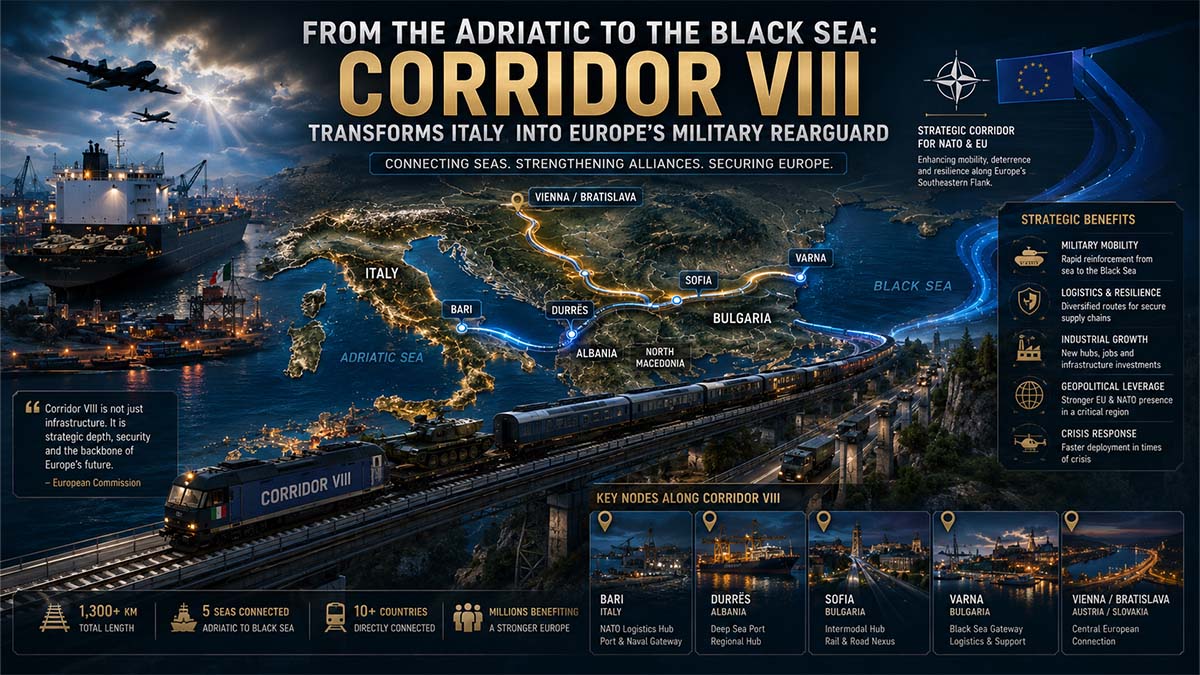
Executive Summary
BLUF: Corridor VIII is evolving from a fragmented transport project into a dual-use Adriatic–Black Sea logistics system with direct implications for NATO’s southeastern and eastern flanks.
The Tirana Joint Declaration of 18 February 2026 formally connects the corridor to NATO regional planning, military mobility, critical-infrastructure protection, hybrid-threat response and resistance to malign external influence.
Italy’s strategic value lies less in owning the entire route than in controlling its western interfaces: ports, maritime lift, customs capacity, rail access, logistics services, finance, insurance, maintenance and digital coordination.
The corridor remains operationally incomplete, especially across Albania, North Macedonia and the Bulgarian border; political declarations therefore exceed current physical capacity.
The North Macedonia–Bulgaria railway connection is the principal land bottleneck, while Adriatic maritime crossings create both redundancy and dependence on port availability.
Between 2026 and 2031, Corridor VIII is likely to mature as a federated network rather than a single uninterrupted railway.
Its decisive assets will include ports, roads, railways, tunnels, airports, fuel installations, warehouses, data links, border systems and protected command-and-control nodes.
The principal strategic contest will concern who finances, operates, insures, digitises, maintains and secures these assets.
Italy can become NATO’s principal Mediterranean logistics platform for the southeastern flank, but only through coordinated investment, military certification, cyber protection and cross-border governance.
Current Bayesian assessment: 62% probability that Corridor VIII achieves credible dual-use operational capability by 2031, but only 27% probability that it functions by then as a fully seamless, high-capacity end-to-end railway.
Corridor VIII Is Italy’s New Strategic Depth
Corridor VIII is still described as a railway project. That definition is already obsolete. The axis linking Bari and Brindisi to Albania, North Macedonia, Bulgaria and the Black Sea is becoming a system of ports, roads, railways, airports, energy installations and digital networks designed to serve commerce in peacetime and military mobility in crisis. For Italy, the strategic issue is not simply reaching the Balkans faster. It is becoming the western logistical anchor of NATO’s southeastern flank, with all the economic, industrial and political leverage that control of infrastructure, financing and operational data can produce.
The Tirana Turning Point
The decisive political act came on 18 February 2026, when the foreign ministers of Italy, Albania, Bulgaria, North Macedonia and Romania adopted the Tirana Joint Declaration. The document defines Corridor VIII as a strategic east–west axis between the Adriatic and Black Seas and explicitly links it to military mobility, NATO regional planning, critical-infrastructure protection and responses to hybrid threats, disinformation and malign third-party influence. It also refers to the Letter of Intent signed at NATO’s 2024 Washington Summit for a harmonised military-mobility corridor along the same route. (Ministero degli Affari Esteri)
That language removes any remaining ambiguity. Corridor VIII is not merely an enlargement project or a mechanism for reducing freight costs. It is being incorporated into the security architecture connecting the Mediterranean, the Western Balkans and the Black Sea. Romania’s participation further expands its geographical significance: the route no longer ends politically on Bulgaria’s coast but connects with the wider allied system protecting NATO’s eastern flank.
The transformation began earlier. At the first ministerial meeting in Brindisi on 27 July 2023, the governments of Italy, Albania, Bulgaria and North Macedonia recognised the corridor’s relevance both to the European single market and to NATO and EU military mobility. On the same day, Foreign Minister Antonio Tajani described Brindisi as the western gateway of an infrastructure starting in Apulia and reaching the Black Sea. (Ministero degli Affari Esteri) What appeared then as diplomatic positioning has become an operational ambition.
Italy’s Geographic Advantage
Italy’s advantage lies in geography, but geography alone is not strategy. The Adriatic separates the Italian and Balkan railway systems, making maritime transport indispensable. This apparent discontinuity can become a source of resilience: cargo, vehicles and military equipment can be routed through several Italian ports rather than through one vulnerable land crossing.
The relevant Italian platform is therefore broader than Brindisi. Bari, Brindisi and Taranto can form a distributed logistics arc, with differentiated roles in Ro-Ro traffic, heavy handling, naval support, maintenance, fuel supply and emergency diversion. Brindisi already possesses significant commercial capacity. In the first nine months of 2025, the port recorded 1,170 ship calls, handled more than 4.4 million tonnes of goods and processed over 96,000 trucks and trailers, carrying more than 3 million tonnes of Ro-Ro cargo. (AdSP Mar Mediterraneo)
Those figures matter, but they do not automatically equal military readiness. A commercial terminal becomes strategic only when berths, ramps, road exits, rail connections, security areas and digital systems can support priority movements under emergency conditions. The decisive questions concern reserve capacity, backup electricity, dangerous-goods procedures, counter-sabotage protection, alternative communications and the availability of vessels when commercial operators face higher insurance costs or competing demand.
Italy must therefore move from the concept of a port of departure to that of a protected port constellation. A single western gateway would reproduce the very vulnerability that Corridor VIII is supposed to reduce.
The Albanian Hinge
The corridor’s western Balkan hinge is the port of Durrës and its connection to the Albanian interior. On 8 April 2025, the European Investment Bank and the Albanian government signed a European financial package for the modernisation of the 34-kilometre Durrës–Rrogozhinë railway. The operation includes a €60.5 million EU grant, a €30 million EIB loan and €30 million in EBRD co-financing, against an estimated total project cost of €121 million. The agreement was signed by EIB Global Director Lionel Rapaille and Albanian Infrastructure and Energy Minister Belinda Balluku, in the presence of EU High Representative Kaja Kallas and Prime Minister Edi Rama. (Banca Europea per gli Investimenti)
This is more than railway rehabilitation. It binds Albania’s principal maritime gateway to European financing, procurement and technical standards. It also strengthens the physical interface through which Italian maritime capacity must enter the Balkan land network.
Yet Durrës remains a conversion point: equipment arriving by sea must be discharged, cleared, staged and transferred to road or rail. Every transfer creates delay and vulnerability. Port operating software, customs databases, cranes, electricity, road exits and security personnel are therefore as important as the track itself. The actor controlling those functions can shape the corridor without owning the port.
The Missing Link
The corridor’s most critical physical constraint remains the railway connection between North Macedonia and Bulgaria. On 6 November 2025, Bulgarian Deputy Prime Minister and Transport Minister Grozdan Karadjov and North Macedonian Deputy Prime Minister and Transport Minister Aleksandar Nikoloski signed an agreement at Gyueshevo station covering the preparation, construction and operation of the cross-border railway tunnel. The European Commission described the facility as an integral part of TEN-T and a flagship Global Gateway project. (Enlargement and Eastern Neighbourhood)
The agreement removed a major diplomatic obstacle, but engineering and execution risks remain. Tunnels, bridges and track can be delayed by geological conditions, procurement disputes, inflation and contractor performance. More importantly, civil works alone do not create military mobility. The line must also possess compatible signalling, electrification, axle-load capacity, passing loops, recovery equipment and rapid border procedures.
A corridor is only as strong as its narrowest indispensable node. Italy can develop world-class port capacity and still obtain little strategic depth if heavy trains cannot cross the Bulgarian–North Macedonian frontier or if administrative authorisations consume days.
The Military Threshold
The European Union is now building a regulatory and financial framework intended to remove precisely these barriers. In November 2025, the Commission proposed an EU-wide military-mobility area designed to reduce cross-border processing to a maximum of three days, harmonise customs procedures and guarantee faster access to transport assets. The Commission identified approximately 500 hotspot projects involving bridges, tunnels, ports and airports. It also acknowledged shortages of flatbed railway wagons and Ro-Ro vessels—an important warning that infrastructure without transport assets remains unusable. (Mobility and Transport)
Under the 2021–2027 Connecting Europe Facility, €1.69 billion co-financed 95 dual-use projects. By November 2025, the first 11 had been completed, including Polish road infrastructure reinforced for vehicles with a gross weight of 130 tonnes. (CINEA) For the 2028–2034 period, the Commission proposed €51.5 billion for CEF Transport, of which €17.5 billion would be reserved for military mobility. (Mobility and Transport) A further €1.1 billion call launched on 19 June 2026 gives priority to rail, maritime connectivity, interoperability and military-mobility bottlenecks. (Mobility and Transport)
These numbers reveal the scale of the emerging market. Corridor VIII is not competing only for public works funds. It is entering a European investment cycle covering bridges, tunnels, digital systems, port electrification, railway control, cybersecurity, energy resilience and specialised transport equipment.
The Politics of Ownership
The corridor’s hidden strategic contest concerns ownership and operation. States may own infrastructure while private or foreign operators control scheduling, software, maintenance, finance or insurance. A port concession, signalling platform, cloud system or exclusive repair contract can generate leverage equal to that produced by equity ownership.
The distinction is fundamental. Legal control determines who owns an asset. Operational control determines who allocates capacity. Technical control determines who can repair it. Digital control determines who sees and authenticates movements. Financial control determines which investments proceed. Strategic control exists only when a government can compel the system to operate during crisis.
Corridor VIII will therefore become an arena for industrial policy and investment screening. Transparent European financing reduces exposure to opaque debt and procurement practices, but it does not eliminate dependence on non-European technology, subcontractors or data platforms. Italy and its partners must examine beneficial ownership, remote-access rights, maintenance exclusivity, insurance clauses and the availability of alternative suppliers.
The objective is not autarky. It is substitutability: no critical supplier, software platform or operator should be impossible to replace within the warning time available before a crisis.
The Hybrid Front
The corridor is unlikely to be challenged only through conventional attack. Its distributed architecture makes it vulnerable to cyber intrusion, disinformation, commercial coercion and selective sabotage. A hostile actor would not need to destroy hundreds of kilometres of railway. It could disable a port operating system, disrupt a substation, corrupt customs data, target a signalling cabinet or amplify local opposition to military traffic.
The Tirana declaration’s reference to hybrid threats and malign influence is therefore not diplomatic ornament. It recognises that the corridor’s weakest points may be political and digital rather than structural. (Ministero degli Affari Esteri)
The most effective interference would create uncertainty: uncertainty over whether cargo manifests are accurate, whether a bridge remains safe, whether an insurer will maintain coverage or whether local authorities will permit transit. Military logistics depend on predictable timing. Even temporary doubt can force planners to select another route.
Protection must consequently include segmented networks, offline procedures, reserve power, counter-drone capacity, rapid-repair teams and intelligence monitoring of contractors and supply chains. The corridor must be designed not merely to resist attack but to recover quickly from it.
The Five-Year Test
By 2031, Corridor VIII is more likely to become a federated dual-use network than a seamless railway. Ports, roads, airports, partial rail sections and common procedures can generate military value before every track segment is complete. That is the most realistic—and strategically important—outcome.
The decisive test will be operational, not ceremonial. Italy and its partners should conduct an end-to-end exercise beginning in Apulia and terminating in Bulgaria or Romania. It should include the embarkation of heavy equipment, Adriatic crossing, discharge in Albania, road and rail transfer, border clearance, fuel support and diversion after simulated cyber or infrastructure failure.
A successful exercise would convert political commitment into measured capability. A failed exercise would be equally valuable if it exposed weaknesses early enough to correct them. The dangerous outcome would be to confuse expenditure with readiness.
The Italian Choice
Corridor VIII offers Italy a strategic opportunity rarely available to a European middle power: transforming national geography into regional influence. By integrating southern ports, shipping, railways, defence logistics, energy systems and European finance, Rome can become the western coordinator of the Adriatic–Black Sea axis.
But strategic depth cannot be declared. It must be financed, protected, exercised and governed. Italy’s success will not be measured by the number of kilometres inaugurated, but by whether it can move industrial output, civilian goods and allied forces across the Balkans when other routes are congested, contested or closed.
Corridor VIII is not simply the shortest line between two seas. It is the infrastructure through which Italy can connect the Mediterranean to Europe’s eastern security system—and convert the Mezzogiorno from an economic periphery into a strategic platform.
Navigational Index
I. Strategic Geography and Italian Depth
The corridor as an Adriatic–Balkan–Black Sea operating system and Italy’s transition from peripheral terminus to western logistical anchor.
II. Dual-Use Infrastructure and Contested Control
Ports, railways, roads, airports, depots, energy systems, digital networks, financing structures and the political leverage embedded in ownership and operation.
III. 2026–2031 Outlook and Competing Futures
Completion risks, military-mobility thresholds, hybrid interference, alternative hypotheses and probability-weighted strategic scenarios.
Master Abstract
The central analytical error surrounding Corridor VIII is to treat it as a railway awaiting completion rather than as an emerging strategic system whose utility derives from the interaction of maritime transport, ports, road and rail capacity, border procedures, airports, energy supply, telecommunications, warehousing, maintenance facilities and military command arrangements. The official political architecture now supports this broader interpretation. At the first ministerial meeting in Brindisi on 27 July 2023, Italy, Albania, Bulgaria and North Macedonia described the corridor as a strategic Adriatic–Black Sea connection and agreed that its road and railway components would support regional growth and Western Balkan integration into the European market. Chair’s Conclusions – Ministerial Meeting between Italy, Albania, Bulgaria and North Macedonia – Italian Ministry of Foreign Affairs and International Cooperation – July 2023 — Verified official text. The strategic threshold was crossed at Tirana on 18 February 2026, when the foreign ministers of Albania, Bulgaria, Italy and North Macedonia, joined by Romania, explicitly reaffirmed Corridor VIII as a priority for military mobility, resilience and connectivity and stated that improved infrastructure and protection along the axis directly support implementation of NATO regional planning. The declaration also linked the corridor to the protection of critical infrastructure and to responses against hybrid threats, disinformation, irregular migration and malign third-party influence. Tirana Joint Declaration on Corridor VIII – Ministry for Europe and Foreign Affairs of Albania – February 2026 — Verified official declaration. This language changes the analytical unit. The object under construction is no longer simply an east–west commercial route; it is a distributed dual-use architecture capable, if adequately completed and protected, of moving personnel, heavy equipment, fuel, ammunition, humanitarian supplies and industrial inputs between the Italian peninsula, the Western Balkans and the Black Sea region. Italy consequently gains strategic depth not through territorial extension but through logistical reach: its southern Adriatic ports, maritime services, rail connections, airfields, defence-industrial maintenance capacity and financial institutions can form the western support base of a system whose operational consequences extend toward Bulgaria, Romania and NATO’s Black Sea posture.
The corridor’s military relevance, however, must not be confused with physical completeness. A military-mobility corridor becomes strategically credible only when the entire chain can sustain required axle loads, loading gauges, train lengths, bridge classifications, secure parking, fuel transfer, customs clearance, hazardous-goods procedures, protected communications and rapid cross-border authorisation under crisis conditions. The European Union’s revised TEN-T framework requires transport planning to exploit synergies with military mobility and digital and energy networks, while strengthening resilience against geopolitical and climatic disruption. Regulation (EU) 2024/1679 on the Trans-European Transport Network – European Parliament and Council – June 2024 — Verified legal text. Yet Corridor VIII still contains consequential missing links. The eastern railway section in North Macedonia runs approximately 88 kilometres from Kumanovo through Beljakovce and Kriva Palanka to Deve Bair on the Bulgarian frontier. Its approximately 30.8-kilometre first phase was completed in December 2024; the approximately 34-kilometre second phase has remained under construction; and the final approximately 23-kilometre section toward the border remains the technically demanding connection. Corridor VIII Rail Interconnection: North Macedonia–Bulgarian Border – European Commission, Global Gateway – current project page — Verified official project record. Bulgaria and North Macedonia signed an agreement on 6 November 2025 for the preparation, construction and operation of the cross-border railway tunnel at Gyueshevo–Deve Bair, removing an important institutional obstacle but not the engineering, procurement and execution risks. European Commission Welcomes Agreement on Railway Corridor VIII – European Commission – November 2025 — Verified official announcement. North Macedonia’s transport ministry placed the eastern railway package at approximately €810 million, including roughly €200 million in EU grants, about €455 million for the Kriva Palanka–border section and another €110 million for signalling and electrification between Kumanovo and the frontier. Agreement on the Joint Border Tunnel and Corridor VIII Financing – Ministry of Transport of North Macedonia – November 2025 — Verified Macedonian government statement. These figures show why the corridor should be evaluated as a layered resilience network: before rail continuity is achieved, roads, ports, ferries, airports and pre-positioned logistics nodes can generate substantial military value, but they cannot automatically reproduce the capacity, economy and predictability of a mature heavy-rail system.
Italy’s opportunity therefore arises from asymmetric control over the corridor’s highest-value interfaces rather than from direct control over every inland asset. Foreign Minister Antonio Tajani described Brindisi in July 2023 as the corridor’s western “entry gate” and emphasised the strategic return of the Adriatic and the role of southern Italy as a hub connecting European and Balkan economies. “The Adriatic Is Strategic Again” – Italian Ministry of Foreign Affairs and International Cooperation – July 2023 — Verified official ministerial interview. The decisive question for 2026–2031 is whether this political positioning is converted into measurable capacity: berth availability for roll-on/roll-off and military sealift, heavy-load rail access, secure customs zones, protected fuel and ammunition handling, cyber-resilient terminal operating systems, air-defence and counter-drone protection, repair facilities, reserve power and interoperable logistics data. The EU has already demonstrated the financing logic of dual-use transport, having financed 95 civilian–military projects under the Connecting Europe Facility’s military-mobility envelope since 2021. Completed CEF Transport Projects under the Military Mobility Envelope – European Climate, Infrastructure and Environment Executive Agency – November 2025 — Verified official EU record. Corridor VIII’s less visible political economy follows from this model. Infrastructure financing creates standards; standards shape procurement; procurement determines technology dependence; operators control operational data; insurers influence acceptable risk; lenders impose governance conditions; telecommunications providers mediate situational awareness; and security contractors shape physical access. The actor that coordinates these layers acquires durable regional influence even without formal sovereignty. Our Analysis of Competing Hypotheses evaluates five principal interpretations: H₁, a predominantly commercial integration project; H₂, an EU enlargement instrument; H₃, a NATO military-mobility corridor; H₄, an Italian strategic-depth project; and H₅, a contested infrastructure ecosystem vulnerable to external financial, political, cyber and intelligence penetration. The evidence does not support selecting only one. The highest posterior probability attaches to a compound judgment: Corridor VIII will be simultaneously commercial, political and military, but its strategic value will depend less on ceremonial completion than on whether Italy and its partners can protect and coordinate the interfaces where cargo, capital, information and military authority converge.
Corridor VIII Operational Depth Simulator
Adriatic–Black Sea Strategic Chain
Composite Disruption Exposure
Dual-Use Control Matrix
Five-Year Scenario Distribution
I. Strategic Geography and Italian Depth: Corridor VIII as the Adriatic–Black Sea Operating System
The Geography of Strategic Depth
Corridor VIII changes Italy’s strategic geography because it converts the Adriatic from a peripheral maritime boundary into the western interface of an east–west operating system extending through Albania, North Macedonia, Bulgaria and, politically and logistically, Romania. The corridor should not be represented as a line beginning at an Italian port and ending at the Black Sea. Its correct representation is a network of interchangeable maritime crossings, ports, motorways, rail sections, border terminals, tunnels, airports, logistics areas, energy installations and digital systems. The European Commission explicitly defines Corridor VIII as a multimodal network incorporating sea and river ports, airports, roads and railways, beginning in southern Italian ports and continuing through Albania, North Macedonia and Bulgaria toward the Black Sea. Corridor VIII Rail Interconnection North Macedonia–Bulgarian Border – European Commission – current project record — Verified official project page. The strategic effect is not simply shorter commercial transit. It is the creation of lateral movement across a region whose inherited infrastructure has historically privileged north–south routes connecting the Balkans to Central Europe, Greece or the former Yugoslav space. An effective east–west corridor reduces dependence on a small number of vertical axes and gives NATO and the European Union additional options for reinforcement, diversion and sustainment. Italy becomes strategically deeper because forces, supplies, industrial outputs and political influence generated west of the Adriatic can be projected across several jurisdictions without requiring Italy to possess territorial depth on the Balkan peninsula. Strategic depth in this context is functional rather than territorial: it consists of access agreements, transport capacity, protected infrastructure, redundant routing, customs interoperability, fuel availability, maintenance support and reliable command relationships. The 27 July 2023 Brindisi ministerial conclusions already identified Corridor VIII as strategically relevant to NATO and EU military mobility, while the 18 February 2026 Tirana Joint Declaration elevated it into an explicit component of regional security planning and a mechanism for protecting critical infrastructure and mitigating hybrid threats. Chair’s Conclusions – Italian Ministry of Foreign Affairs and International Cooperation – July 2023 — Verified official text. Tirana Joint Declaration on Corridor VIII – Italian Ministry of Foreign Affairs and International Cooperation – February 2026 — Verified official declaration.
Italy as the Western Logistical Anchor
Italy’s transition from terminus to logistical anchor depends on whether it can control and coordinate the corridor’s western interfaces rather than merely serve as the location from which ships depart. A terminus receives or dispatches traffic; an anchor aggregates cargo, assigns transport capacity, performs maintenance, provides secure storage, integrates information, supplies fuel, resolves customs and regulatory constraints, and sustains operations after disruption. Brindisi is politically central because the Italian government selected it as the site of the first Corridor VIII ministerial meeting and described it as the western gateway to the Adriatic–Black Sea connection. Foreign Minister Antonio Tajani stated that the corridor begins in Apulia, reaches the Black Sea through Albania, North Macedonia and Bulgaria, and positions Brindisi as its western entry point. Tajani: “The Adriatic Regained Its Strategic Importance” – Italian Ministry of Foreign Affairs and International Cooperation – July 2023 — Verified official publication. The choice was not merely symbolic. Brindisi combines a commercial port, Ro-Ro traffic, proximity to military facilities, access to southern Italian transport networks and the presence of the United Nations Global Service Centre, which provides supply-chain, geospatial, information, telecommunications and training services to UN entities and field missions. The Secretary-General described its telecommunications infrastructure as state-of-the-art and its logistics capacity as a vital component of UN operational support. Remarks at the 25th Anniversary of the United Nations Global Service Centre – United Nations Secretary-General – December 2019 — Verified UN statement. This does not make the UN facility a NATO installation, and the analytical distinction must remain explicit. It does, however, demonstrate that the Brindisi ecosystem already contains institutional experience in global logistics, inventory management, communications support, asset maintenance and deployment planning. During the first nine months of 2025, the port recorded more than 4.4 million tonnes of goods, over 96,000 trucks and trailers, and more than 3 million tonnes of Ro-Ro cargo despite a structural decline associated with the end of coal traffic and reduced petrochemical production. Port of Brindisi Traffic Update – Southern Adriatic Sea Port Authority – November 2025 — Verified port-authority publication. These figures reveal an existing rolling-cargo base, but strategic anchoring will require capacity that is certified, protected and exercisable under military demand, not merely available during ordinary commercial operations.
The Maritime Bridge as Both Multiplier and Vulnerability
The Adriatic crossing gives Corridor VIII operational flexibility but also introduces a discontinuity that must be managed as a permanent component of the system. Freight and military equipment cannot move directly by rail from Italy into Albania because the sea divides the networks; the corridor therefore depends on Ro-Ro, Ro-Pax, chartered sealift, container handling and potentially specialised military shipping. This maritime segment can be an advantage because vessels permit routing among several Italian and Albanian terminals, reducing dependence on one fixed bridge or tunnel. It also allows forces and cargo originating elsewhere in Italy or the Mediterranean to enter the corridor without passing through the northern Italian and central European land network. Yet the sea crossing imposes additional handling cycles: cargo must reach the Italian port, wait for vessel availability, undergo security and customs procedures, be loaded, cross the Adriatic, be discharged, inspected or cleared again, and transferred to road or rail. Every transfer increases time, labour, data dependencies and exposure to disruption. Port congestion, industrial action, cyberattack, mining threats, underwater sabotage, drone activity, adverse weather, ship shortage or berth damage could therefore interrupt the western gateway without physically attacking the inland corridor. NATO’s 2024 Washington Summit Declaration committed the Alliance to improving its ability to move, reinforce, supply and sustain forces through resilient logistics and the development of mobility corridors; it also prioritised protection of critical undersea infrastructure and stronger cyber defence. Washington Summit Declaration – North Atlantic Treaty Organization – July 2024 — Verified NATO official text. For Italy, this means that Corridor VIII cannot be secured by improving railway capacity alone. The western anchor requires protected port operating systems, alternative communications, emergency power, physical surveillance, counter-drone capability, harbour-security coordination, hydrographic awareness, redundant berth allocation and procedures for prioritising military cargo without paralysing civilian flows. It also requires more than Brindisi. A single-port conception would reproduce the vulnerability that the corridor is intended to reduce. Bari, Brindisi, Taranto and other southern Adriatic facilities should be assessed as a distributed gateway portfolio in which different ports perform different roles: scheduled rolling cargo, strategic reserve capacity, heavy-lift handling, maintenance, ammunition safety, humanitarian support or diversion during attack. The operative unit is therefore not “the port of departure” but a protected Italian port constellation linked to inland rail, road, air and industrial networks.
Western Gateway Functional Architecture
Corridor Flow and Strategic Transit Points
Ro-Ro Lift
Vehicle and heavy roll-on/roll-off capabilityData Layer
Real-time cargo tracking and C2 integrationFuel / Repair
Forward replenishment and technical sustainmentTransit Arterial
Albania → North Macedonia → BulgariaTerminal Gateways
Black Sea Ports and RomaniaThe Inland Chain and the Logic of Bottlenecks
The operational value of the Italian anchor is constrained by the weakest inland segment, because military mobility is a chain whose effective capacity is determined by the lowest-performing critical node rather than by average infrastructure quality. The eastern railway section in North Macedonia illustrates the problem. The European Commission records approximately 88 kilometres between Kumanovo, Beljakovce, Kriva Palanka and Deve Bair at the Bulgarian frontier. Phase I, approximately 30.8 kilometres, was completed in December 2024 and became operational, but subsequent sections and the cross-border connection remained essential to continuous east–west rail movement. Corridor VIII Rail Interconnection North Macedonia–Bulgarian Border – European Commission – current project record — Verified official project page. Bulgaria and North Macedonia reaffirmed in July 2025 their commitment to finalising missing links and preparing studies and tenders, and on 6 November 2025 signed an agreement covering preparation, construction and operation of the cross-border railway tunnel at Gyueshevo–Deve Bair. Bulgaria and North Macedonia Reaffirm Commitment to Finalising Railway Corridor VIII – European Commission – July 2025 — Verified European Commission record. European Commission Welcomes Agreement on Railway Corridor VIII – European Commission – November 2025 — Verified official announcement. Agreement, however, is not equivalent to capacity. Construction schedules can be delayed by geological complexity, land acquisition, procurement disputes, contractor performance, inflation, design revisions or bilateral political friction. Even after civil works are completed, a line may remain unsuitable for high-tempo military operations if signalling, electrification, axle-load standards, passing loops, border procedures, recovery equipment and secure communications remain inadequate. This produces a critical distinction between infrastructure completion and operational certification. A ceremonial opening can demonstrate political progress while leaving the corridor unable to move a sustained flow of heavy armour, fuel or ammunition. Between 2026 and 2031, Italy must therefore measure strategic depth through end-to-end performance indicators: port-to-port cycle time, equipment-transfer time, border dwell time, maximum permissible axle load, daily train paths, bridge classification, tunnel clearances, secure parking capacity, fuel throughput, repair time and recovery from cyber or physical attack. Without these measurements, strategic depth remains declaratory rather than usable.
| Layer | Core requirement | Principal bottleneck | Italian strategic implication |
|---|---|---|---|
| Maritime | Available Ro-Ro and sealift capacity | Vessel and berth availability | Italy must coordinate commercial and military lift |
| Ports | Secure handling and rapid transfer | Congestion, cyber dependence, limited protected areas | A multi-port gateway is safer than a single-port model |
| Rail | Continuous route with military loading standards | North Macedonia–Bulgaria missing connection | Italian capacity has little value if inland continuity fails |
| Road | Heavy-load bridges and protected staging | Mountain geometry, border delays, maintenance | Road remains the principal interim redundancy |
| Border systems | Pre-authorised movement and digital customs | Divergent procedures and crisis permissions | Italy needs standing agreements, not ad hoc diplomacy |
| Energy | Fuel storage, electricity and backup power | Concentrated depots and grid vulnerability | Logistics resilience requires distributed energy support |
| Digital layer | Common operational picture and cargo visibility | Cyberattack, vendor dependence, data fragmentation | Control of data standards produces strategic influence |
| Security | Counter-sabotage, counter-drone and infrastructure defence | Fragmented responsibilities | Protection must be planned across jurisdictions |
From Transport Access to Military Reach
Italy’s strategic depth will become credible only when Corridor VIII is integrated into NATO’s regional plans, exercises and reinforcement procedures. The Tirana Joint Declaration of 18 February 2026 refers to the Letter of Intent signed at the 2024 Washington Summit concerning establishment of a harmonised military-mobility corridor along Pan-European Corridor VIII and explicitly places the route within NATO commitments, regional planning and critical-infrastructure resilience. Tirana Joint Declaration on Corridor VIII – Italian Ministry of Foreign Affairs and International Cooperation – February 2026 — Verified official declaration. This is strategically significant because military mobility is not generated by transport ministries alone. It requires defence ministries to define movement requirements, interior ministries to guarantee border and infrastructure security, customs authorities to establish priority procedures, infrastructure managers to reserve capacity, private operators to supply ships and rolling stock, and NATO commands to incorporate the route into reinforcement and sustainment plans. The corridor’s value to Italy therefore increases non-linearly as institutional interoperability improves. A railway carrying civilian freight creates some latent military value; a railway with pre-cleared military dimensions, allocated train paths, tested communications and rehearsed border crossings creates considerably more. The same principle applies to ports. A commercial Ro-Ro terminal becomes a strategic node only when military loading plans, harbour-security protocols, dangerous-goods procedures, staging areas, escort arrangements and onward transport have been defined and exercised. Italy’s comparative advantage lies in its capacity to act as the corridor’s integrator. It possesses a large industrial base, established armed forces, NATO membership, EU regulatory influence, Mediterranean maritime experience and geographic proximity. Yet institutional fragmentation could dissipate this advantage if responsibility remains divided among national ministries, regional authorities, port authorities, railway managers, armed forces and private operators without a permanent Corridor VIII command-and-coordination mechanism. The five-year objective should therefore not be described merely as “completion of the corridor.” It should be the establishment of a Corridor VIII Operational Coordination Architecture capable of maintaining an integrated movement picture, identifying capacity constraints, assigning priorities, conducting annual stress tests and ensuring that civilian infrastructure can transition rapidly into dual-use service during crisis.
End-to-End Governance and Execution Flow
Physical Flow
Ships / Trains / Road TransportDigital Flow
Tracking / C2 Data IntegrationFinancial Flow
Contracts / Insurance / ClearingItalian Depth and the Black Sea Connection
Corridor VIII does not make Italy a Black Sea state, but it gives Italy a structured mechanism for influencing Black Sea security without relying exclusively on northern European or eastern Mediterranean approaches. The distinction is strategically important. The Black Sea remains geographically enclosed and access by sea is governed by the Turkish Straits regime; the ability to support allied territory by land from the Adriatic provides an additional axis that is not identical to direct naval access. Bulgaria’s position creates the immediate Black Sea terminus, while Romania’s inclusion in the 2026 Tirana declaration extends the corridor’s political logic northward and links it to a larger allied territorial, port and military network. This creates potential interaction with NATO reinforcement, Bulgarian and Romanian logistics, regional air defence, Black Sea maritime awareness and support to the Alliance’s eastern flank. It also makes southern Italy more relevant to contingency planning involving southeastern Europe because material arriving at Italian ports can theoretically be transferred across the peninsula’s maritime bridge and then dispersed eastward. The route does not replace the northern European reinforcement corridors, the Danube, Greek ports, the Adriatic routes through Croatia or the north–south systems running through Serbia and Central Europe. Its strategic value derives precisely from not being identical to them. Redundancy lowers the probability that one disrupted route will paralyse reinforcement. The Western Balkans–Eastern Mediterranean European Transport Corridor already links Italy and other EU members with the Adriatic and eastern Mediterranean through the Western Balkans, demonstrating that European transport planning increasingly treats the region as an interconnected network rather than as isolated national projects. Western Balkans–Eastern Mediterranean Corridor – European Commission – current TEN-T description — Verified official corridor page. Corridor VIII adds an east–west layer to this network. For Italy, the consequence is a broader strategic geometry: Apulia becomes an interface between Mediterranean sea lanes, Balkan land corridors, EU enlargement policy and NATO’s Black Sea posture. The principal danger is conceptual overreach. The route cannot be treated as a guaranteed military highway until its infrastructure, procedures and protection have been demonstrated under realistic load. Its strategic depth is therefore an option whose value depends on investment and rehearsal, not an automatically available capability.
External Connectivity Strategies and the Contest for the Same Geography
The geopolitical competition surrounding Corridor VIII does not require Russia or China to oppose the physical construction of every road, port or railway. External influence can operate by shaping alternative routes, financing adjacent infrastructure, establishing commercial dependencies, acquiring operational data or promoting competing political narratives about regional connectivity. Chinese official policy has consistently treated Central and Eastern European transport infrastructure as a gateway for trade, investment and the expansion of the Belt and Road Initiative. In official discussions with Bulgaria, Beijing has promoted infrastructure connectivity, transport, aviation, logistics and finance, while Bulgaria presented itself as a potential gateway and hub between Europe and Asia. Xi Jinping Holds Talks with President Rumen Radev of Bulgaria – Ministry of Foreign Affairs of the People’s Republic of China – July 2019 — Verified Chinese government publication. The Sofia Guidelines for China–Central and Eastern European cooperation explicitly supported synergies between the Belt and Road Initiative and TEN-T, potential extension of transport links toward Albanian and other regional ports, and the development of land–sea express connections. Sofia Guidelines for Cooperation between China and Central and Eastern European Countries – Ministry of Foreign Affairs of the People’s Republic of China – July 2018 — Verified Chinese official text. These documents do not establish Chinese control over Corridor VIII, nor do they prove hostile intent. They demonstrate that the same geographical space is viewed by Beijing through a connectivity framework involving infrastructure, logistics, customs, finance and commercial hubs. Russia’s official transport strategy provides a different but relevant comparison. It defines an international transport corridor not merely as a physical route but as a combination of routes and the technological, organisational and legal conditions enabling transport. Transport Strategy of the Russian Federation to 2030 with an Outlook to 2035 – Government of the Russian Federation – November 2021, amended November 2024 — Verified Russian government document. That definition confirms the central analytical point: strategic corridors are governance systems as much as infrastructure. Moscow’s current emphasis is on Russian-controlled north–south, east–west and Arctic corridors rather than Corridor VIII, but its strategic interest lies in preventing NATO from converting Balkan infrastructure into a resilient reinforcement architecture and in preserving political or informational leverage within southeastern Europe. The correct assessment is therefore neither that Chinese investment is automatically malign nor that Russian influence requires formal ownership. The risk lies in opaque contracts, vendor lock-in, data access, political financing, disinformation, sabotage preparation and dependence on external maintenance or digital systems.
Analysis of Competing Hypotheses
The available evidence supports a structured Analysis of Competing Hypotheses rather than a single deterministic narrative. H₁, the commercial-integration hypothesis, argues that Corridor VIII will remain primarily a trade and development project whose military role is secondary. Supporting evidence includes its TEN-T status, its connection to EU enlargement, the emphasis on economic growth and the need to complete ordinary road and railway links. H₂, the NATO-reinforcement hypothesis, holds that the corridor’s principal strategic value is military mobility between Italy, the Balkans and the Black Sea. This gained substantial support from the 2023 Brindisi conclusions, the 2024 Letter of Intent referenced in the Tirana declaration, and the explicit 2026 linkage to NATO regional plans. H₃, the Italian-depth hypothesis, assesses that Rome is deliberately using Corridor VIII to establish southern Italy as the western logistical anchor of southeastern Europe. The selection of Brindisi, Tajani’s gateway language and Italy’s role in institutionalising the ministerial format support this interpretation, but physical investment and permanent coordination mechanisms remain insufficiently demonstrated in the reviewed public record. H₄, the fragmented-corridor hypothesis, argues that bilateral disputes, missing railway sections, financing constraints and administrative differences will prevent a seamless operating system by 2031. Current bottlenecks strongly support this possibility. H₅, the contested-connectivity hypothesis, sees the corridor as part of a wider competition involving EU regulation, NATO security requirements, Chinese infrastructure diplomacy, Russian political influence and private control over finance, insurance, logistics and data. Official Chinese connectivity policy and the Tirana declaration’s concern about malign external influence support this hypothesis without proving that every external commercial actor constitutes a security threat. H₆, the federated-network hypothesis, predicts that Corridor VIII will become militarily useful before it becomes physically complete because roads, ports, airports and partial railway segments will be coordinated into a flexible system. This currently receives the highest posterior probability because it is consistent with both the corridor’s multimodal definition and the persistence of railway bottlenecks.
| Hypothesis | Initial prior | Evidence direction | 2031 posterior assessment |
|---|---|---|---|
| H₁ Predominantly commercial corridor | 25% | Supported by TEN-T and enlargement economics; weakened by explicit military language | 14% |
| H₂ NATO reinforcement axis | 18% | Strongly supported by 2023–2026 declarations and NATO mobility policy | 22% |
| H₃ Italian strategic-depth project | 15% | Politically supported; operational implementation still incomplete | 18% |
| H₄ Persistently fragmented infrastructure | 20% | Supported by missing links and execution risk | 17% |
| H₅ Contested connectivity ecosystem | 10% | Supported by external infrastructure strategies and hybrid-threat concern | 11% |
| H₆ Federated dual-use network | 12% | Best fit with multimodality and incremental military utility | 18% |
The posterior values are analytical estimates rather than official forecasts. They represent mutually exclusive dominant outcomes for modeling purposes, although several mechanisms can coexist in practice.
The 2026–2031 Outlook
The five-year trajectory is likely to unfold in three overlapping phases. During 2026–2027, political institutionalisation should advance faster than physical construction. The principal achievements are likely to include standing ministerial coordination, incorporation of Corridor VIII into defence and transport planning, mapping of infrastructure standards, identification of critical nodes and renewed funding packages. The decisive indicator will be whether the 2026 Tirana framework produces a permanent technical structure rather than another sequence of declarations. During 2027–2029, the strategic contest should shift toward execution: construction of missing railway links, preparation of the cross-border tunnel, modernisation of roads and border terminals, digital integration and port-capacity investments. This phase will expose procurement delays, inflation, contractor weakness and political disputes. It will also determine whether Italy develops a distributed southern Adriatic gateway or concentrates investment narrowly in Brindisi. During 2029–2031, the key issue should become operational certification. Infrastructure will need to be tested through exercises involving maritime arrival, port discharge, cross-border movement, railway loading, fuel support, cyber disruption and route diversion. A successful exercise should measure whether the corridor can move a defined military package within a specified time while maintaining civilian traffic and recovering from simulated attack. The Bayesian baseline gives a 64% probability that Corridor VIII will provide credible federated dual-use capability by the end of 2031, a 31% probability that it will possess high-capacity uninterrupted railway functionality across the most important east–west sections, and a 19% probability that political or engineering delays will leave the corridor strategically fragmented despite visible investment. These probabilities should not be added because they describe overlapping capability thresholds rather than exclusive scenarios. Italy’s strategic-depth index rises most sharply when four conditions occur together: multiple Italian ports are certified for diversion; Albania’s western gateways can transfer cargo rapidly to inland routes; the North Macedonia–Bulgaria connection reaches operational maturity; and common cyber, customs and movement-control procedures are exercised. Failure in any one condition reduces value, but failure in the cross-border railway does not eliminate the corridor because road, air and maritime modes retain utility. The most probable 2031 outcome is therefore neither failure nor seamless completion: it is a partially integrated, politically important and militarily usable network whose performance remains below its full potential.
Strategic Requirements for Italy
Italy should treat Corridor VIII as a national strategic programme combining foreign policy, defence planning, transport policy, industrial policy and critical-infrastructure security. The first requirement is an authoritative national map of relevant assets: ports, berths, ramps, rail sidings, roads, bridges, airports, fuel installations, warehouses, maintenance facilities, communications networks, energy substations and secure staging areas. The second is a classification system separating nominal capacity from assured crisis capacity. A commercial berth that cannot handle military security requirements should not be counted as fully available; a railway line without priority train paths or recovery equipment should not be treated as assured mobility. The third requirement is governance. Rome should establish a permanent interministerial coordination structure connecting the Presidency of the Council, foreign affairs, defence, infrastructure and transport, interior, finance, civil protection, port authorities, Rete Ferroviaria Italiana, logistics operators and relevant regional governments. The fourth is financial: Italy should use EU transport, cohesion, enlargement, Global Gateway and military-mobility mechanisms to align civilian investment with defence requirements while preserving transparent procurement and European security standards. The EU’s Connecting Europe Facility has already financed 95 civilian–military transport projects under its military-mobility envelope since 2021, demonstrating that dual-use investment can be structured within established European instruments. Completed CEF Transport Projects Funded under the Military Mobility Envelope – European Climate, Infrastructure and Environment Executive Agency – November 2025 — Verified official EU record. The fifth requirement is resilience: backup power, segmented networks, offline operating procedures, cyber incident response, counter-drone protection, surveillance, underwater-infrastructure monitoring and rapid repair contracts. The sixth is influence protection. Financing, insurance, terminal software, cranes, telecommunications and rolling-stock maintenance should be assessed for concentration risk, beneficial ownership, remote access and political dependence. Italy’s objective should not be autarky but assured control over critical functions. By 2031, success should be judged by whether Italy can initiate, coordinate and sustain movement from its national industrial and military base through a resilient Adriatic gateway into the Balkans and onward to the Black Sea region under contested conditions. That is the operational meaning of strategic depth.
II. Dual-Use Infrastructure and Contested Control
Control Is a Layered Function, Not a Property Deed
The strategic value of Corridor VIII will be determined less by nominal ownership than by the distribution of control across eight interdependent layers: legal title, concession rights, operational management, technical maintenance, digital access, financing, insurance and physical protection. A state may formally own a port, railway or airport while remaining dependent on a foreign terminal operator, proprietary cargo-management software, external rolling-stock maintenance, commercial ferry providers, imported signalling components or lenders capable of conditioning future investment. Conversely, a private operator may control critical daily functions without possessing the underlying infrastructure. This distinction is decisive because dual-use infrastructure acquires military value only when civilian capacity can be converted into assured crisis capacity under public authority. The European Commission defines military mobility as the ability to move personnel, equipment and supplies rapidly using both military assets and civilian companies, and it identifies physical infrastructure, transport assets, procedures, digital systems and resilient energy supply as inseparable enabling components. Questions and Answers on Military Mobility – European Commission – November 2025 — Verified official source. This means that control cannot be assessed through shareholder registries alone. Analysts must identify who can allocate berths, reserve train paths, authorise hazardous cargo, issue digital credentials, suspend software access, insure vessels, finance repairs, provide spare parts, restore electricity and determine whether military traffic receives priority over civilian contracts. Corridor VIII is therefore best understood as a stacked sovereignty system. At the base lies national territorial jurisdiction; above it sit public authorities, infrastructure managers, concessionaires, banks, insurers, technology vendors and logistics companies. Political leverage emerges wherever one actor can interrupt a layer that the others cannot rapidly replace. The most dangerous vulnerabilities are consequently not always visible. A foreign-controlled port terminal is obvious; dependence on a single maintenance provider, cloud service, customs interface or energy substation may be equally consequential but substantially harder to detect. Between 2026 and 2031, Italy and its partners will need to distinguish four different conditions: ownership control, the ability to sell or restructure an asset; operational control, the authority to schedule and direct activity; technical control, the ability to maintain and restore systems; and strategic control, the capacity to compel continued operation during crisis. Only the fourth condition converts nominal infrastructure into credible strategic depth.
| Control layer | Central question | Typical holder | Strategic failure mode |
|---|---|---|---|
| Legal title | Who owns the asset? | State, municipality, public company, concessionaire | Sale, restructuring or encumbrance |
| Operational authority | Who schedules daily use? | Port authority, railway manager, airport operator | Military traffic denied or delayed |
| Technical authority | Who maintains critical systems? | Vendor, contractor, original equipment manufacturer | Spare-parts or software dependency |
| Digital authority | Who controls data and credentials? | Platform provider, customs authority, cloud operator | Lockout, manipulation or surveillance |
| Financial authority | Who supplies debt and guarantees? | EIB, EBRD, state budget, commercial lenders | Covenants constrain future choices |
| Insurance authority | Who prices or excludes risk? | Maritime, aviation and infrastructure insurers | Operations become commercially unavailable |
| Energy authority | Who guarantees power and fuel? | Grid operator, refinery, depot operator | Port, rail or airport paralysis |
| Security authority | Who protects and restores the node? | Police, military, private security, cyber teams | Sabotage outpaces recovery |
Ports as the Primary Conversion Nodes
Ports are the most strategically consequential assets in the corridor because they convert Italy’s maritime access into Balkan land mobility, aggregate civilian and military cargo, connect energy and industrial systems, and concentrate data, labour, customs and physical-security functions in a confined space. The EU Ports Strategy, adopted in March 2026, explicitly frames ports as strategic gateways for trade, security, defence and energy transition and announces criteria concerning foreign ownership and control over ports identified as strategic dual-use infrastructure. EU Ports Strategy – European Commission – March 2026 — Verified official source. This policy direction is highly relevant to Corridor VIII because the route begins not at a railway station but at a maritime handling system linking southern Italian ports to Albanian gateways, above all Durrës. On the Italian side, Brindisi already processes substantial rolling cargo: in the first nine months of 2025 it handled more than 4.4 million tonnes of goods, over 96,000 trucks and trailers, and more than 3 million tonnes of Ro-Ro cargo. Southern Adriatic Port System Traffic Report – Southern Adriatic Sea Port Authority – November 2025 — Verified official source. These figures demonstrate usable commercial scale, but they do not establish assured military capacity. In crisis, the relevant indicators become berth survivability, ramp compatibility, marshalling space, heavy-equipment turning radii, dangerous-goods segregation, secure storage, rail access, emergency towing, harbour clearance, reserve power and the ability to operate under cyber degradation. The dual-use problem is therefore one of conversion. Commercial throughput is normally optimised for efficiency and contracted schedules; military throughput requires priority, secrecy, security, redundancy and acceptance of non-standard cargo. A terminal may be commercially efficient yet strategically brittle if it depends on a single operating system, one road exit, one electricity feed or one ferry operator. Conversely, a lower-volume port may possess disproportionate military value if it provides secure access, heavy-load infrastructure, spare capacity and rapid repair. Italy should therefore avoid identifying Brindisi as the corridor’s only western gateway. The more resilient architecture is a distributed southern Adriatic portfolio involving Brindisi, Bari, Taranto and reserve facilities, with roles differentiated among regular Ro-Ro movement, heavy lift, naval support, energy logistics, repair and diversion. Political leverage will accrue to whichever actor can coordinate this portfolio, allocate capacity under emergency rules and guarantee continuity when private commercial incentives favour withdrawal.
Railways, Roads and the Power of Bottlenecks
Railways and roads create the inland carrying capacity of Corridor VIII, but their political significance derives from bottlenecks rather than total route length. A state, contractor or operator controlling one indispensable tunnel, bridge, border station or dispatching system can exercise leverage disproportionate to the physical size of the asset. The most important railway investments illustrate this principle. In Albania, the modernisation of the 34-kilometre Durrës–Rrogozhinë railway is financed through a package consisting of a €60.5 million EU grant, a €30 million EIB loan and €30 million in EBRD co-financing, within an estimated project cost of €121 million. Corridor VIII Rail Phase I – European Investment Bank – April 2025 — Verified official project record. Reconstruction of Durrës–Rrogozhinë Railway Line – European Bank for Reconstruction and Development – June 2025 — Verified official project record. The financing structure is strategically constructive because it ties Albanian infrastructure to European standards, procurement disciplines and long-term institutional oversight rather than opaque bilateral dependence. It also illustrates that lenders can become governance actors: loan conditions, environmental standards, procurement rules and reporting obligations shape how infrastructure is built and operated. Farther east, the North Macedonian section from Kriva Palanka to the Bulgarian border has an estimated total project cost of approximately €569 million, with proposed EIB financing of €364 million. Corridor VIII Rail – Eastern Section North Macedonia – European Investment Bank – December 2023 — Verified official project record. These investments improve public control, but completion alone will not remove operational dependencies. Rail systems require dispatch software, signalling, electrification, maintenance depots, locomotives, wagons, trained personnel and spare parts. Military mobility further requires long and heavy trains, reinforced bridges, suitable loading gauges, sidings, recovery equipment and cross-border permission. The EU has acknowledged shortages in flatbed wagons and Ro-Ro ferries and has identified approximately 500 hotspot projects involving bridges, tunnels, ports and airports. Military Mobility Package: Questions and Answers – European Commission – November 2025 — Verified official source. Roads will remain the corridor’s principal redundancy before continuous heavy rail becomes available, but roads shift dependence toward bridge ratings, fuel consumption, convoy security, driver availability, tyre supply and border waiting areas. The controlling actor is therefore not necessarily the railway owner; it may be the authority that controls the last permissible bridge, the software vendor that operates signalling, or the ministry that grants cross-border movement authorisation.
Mobility Chain and Transit Nodes
Road Convoy
- Bridges capacity and load limits
- Tunnels clearance
- Fuel supply nodes
- Border crossing checkpoints
Rail Loading
- Train path allocation
- Signalling and electrification
- Gauge transfer & switching
- Border crossing checkpoints
Airports, Depots and the Hidden Logistics Geography
Airports and depots are rarely presented as central components of Corridor VIII, yet they determine whether the system can sustain high-tempo operations rather than simply move cargo from west to east. Airports provide rapid personnel deployment, command movement, medical evacuation, high-value spare-parts delivery, intelligence support and redistribution when surface routes are blocked. Their dual-use value depends on runway length and pavement classification, apron capacity, fuel availability, cargo handling, protected parking, air-traffic control resilience, navigation systems and the legal status of military access. Civil airports may offer substantial latent capacity, but commercial ownership structures, concession agreements, airline schedules and insurance restrictions can limit military availability. Depots create a different form of leverage because they reduce the distance between supply and demand. Fuel, engineering equipment, food, medical supplies, tyres, rail components, communications equipment and ammunition can be pre-positioned near ports, border crossings and airfields, reducing reaction time and dependence on uninterrupted transport from Italy. Yet storage creates concentration risk. A visible, centralised depot can be targeted by sabotage, drones, cyber manipulation, fire or disinformation intended to trigger local opposition. The optimal architecture is therefore distributed, modular and recoverable rather than concentrated in one politically prominent “strategic hub.” The European Commission’s 2025 military-mobility framework explicitly includes ports, airports, energy nodes and communications infrastructure among assets that must be systematically identified and protected, and it proposes national lists, common resilience criteria, annual readiness checks and stress testing. Military Mobility – European Commission – November 2025 — Verified official source. For Corridor VIII, the policy implication is that every airport or depot should be evaluated through an operational-control matrix rather than by nominal capacity. Analysts should determine who owns the land, who holds the concession, who supplies fuel, who controls access credentials, which contractor maintains baggage or cargo equipment, whether military aircraft are covered by local insurance and whether emergency repairs can be conducted without foreign technicians. Political influence can be exercised through any of these dependencies. A government may publicly support military mobility while a concession contract, labour agreement or technical monopoly prevents rapid conversion. Between 2026 and 2031, the most strategically valuable investment may therefore be neither a new runway nor a larger warehouse but a portfolio of access agreements, dispersed stocks, pre-negotiated service contracts, alternative fuel suppliers and tested mobilisation procedures.
Energy Systems as the Corridor’s Circulatory Network
Energy is the corridor’s least visible but most fundamental dependency because every port crane, signalling system, customs server, fuel pump, airport radar, warehouse, tunnel ventilation plant and communications node requires continuous power, while vehicles, aircraft, ferries and locomotives require liquid fuel or electricity at sufficient scale. The EU’s military-mobility policy now explicitly integrates fuel-supply requirements and transport-relevant energy infrastructure into resilience planning. Action Plan on Military Mobility 2.0 – European Commission – November 2022 — Verified official source. This matters because Corridor VIII crosses energy systems with differing generation mixes, grid strengths, fuel-storage patterns and regulatory regimes. Italy may possess substantial supply capacity, yet the corridor can still fail if Albanian port operations lose power, a North Macedonian railway section cannot energise signalling, a Bulgarian border facility lacks backup generation or commercial fuel suppliers refuse service under elevated risk. The strategic unit is therefore not national energy abundance but end-to-end energy assurance. Operators should map every primary electricity connection, backup feed, generator, battery system, fuel depot, pipeline, tanker route and refuelling contract. They should also identify single points of failure and the restoration time associated with each. Electrification creates efficiency and interoperability benefits, but it can increase dependence on exposed substations, overhead lines and supervisory control systems. Diesel redundancy remains operationally valuable even during decarbonisation, particularly for recovery locomotives, emergency generators and military convoys. Ports are becoming energy hubs in their own right, supporting conventional fuels, shore power, hydrogen and other clean-energy systems; this broadens their economic importance but also increases their strategic target value. The Commission’s 2026 Ports Strategy calls for port electrification, grid access and accelerated development of strategic energy projects. EU Ports Strategy – European Commission – March 2026 — Verified official source. Ownership and operation of energy infrastructure thus become instruments of leverage. A foreign investor controlling generation is not automatically a security threat, but concentrated ownership, opaque beneficial structures, remote system access or exclusive maintenance arrangements can restrict sovereign decision-making. The relevant test is substitutability: how quickly can Italy or a partner state replace the supplier, software, spare part, fuel contract or operator if political relations deteriorate? Any dependency that cannot be replaced within the operational warning period should be classified as strategic.
Digital Networks and the Invisible Command Layer
The corridor’s digital layer will determine whether its physical assets function as an integrated system or remain a collection of disconnected national projects. Cargo manifests, customs declarations, port-community systems, berth scheduling, railway dispatch, road-traffic management, military movement permissions, fuel inventory, identity management and infrastructure monitoring all depend on data. The European Commission’s proposed military-mobility framework envisages an EU-wide digital information system for movement authorisations and customs documentation, interoperable with NATO systems, together with a catalogue through which civilian companies could register dual-use transport and logistics assets. Military Mobility – European Commission – November 2025 — Verified official source. This architecture could significantly reduce border delays, but it also creates an intelligence-rich target. A hostile actor gaining access would not merely see commercial trade; it could infer unit movements, cargo priorities, infrastructure status, maintenance cycles, fuel availability and planned diversions. The central question is therefore not whether digitalisation is desirable, but whether it is sovereign, segmented, auditable and recoverable. Corridor VIII requires a common operating picture without creating a single system whose compromise would disable the entire route. The preferred model is federated interoperability: national and operator systems exchange minimum necessary data through controlled interfaces, while preserving local fallback capability. Each critical node should retain offline procedures for cargo release, train dispatch, identity verification and emergency communication. Cybersecurity must extend beyond state networks to private terminal operators, ferry companies, railway contractors, fuel suppliers and cloud providers because attackers will target the weakest connected entity. Political leverage is embedded in technical standards. The actor whose software becomes the corridor’s default platform can shape data formats, authentication, procurement and future upgrades. Vendor lock-in can therefore create strategic influence without ownership of any physical asset. Chinese official connectivity policy has historically promoted integration of infrastructure, logistics, customs, finance and digital cooperation in Central and Eastern Europe, including synergies with TEN-T and connections to regional ports. Sofia Guidelines for Cooperation between China and Central and Eastern European Countries – Ministry of Foreign Affairs of the People’s Republic of China – July 2018 — Verified official source. The existence of such policy does not prove hostile control; it demonstrates that infrastructure diplomacy naturally extends into standards, data and logistics ecosystems. Italy and the EU should therefore evaluate digital suppliers according to remote-access rights, update mechanisms, source-code availability, data location, beneficial ownership, sanctions exposure and the ability to operate independently during disconnection.
Financing Structures and the Political Economy of Dependence
Financing is not a neutral layer placed outside strategic control; it determines which projects are built, which standards apply, who absorbs risk and which institutions obtain long-term oversight. Corridor VIII’s principal rail investments currently show a strong European financing structure. The Durrës–Rrogozhinë project combines EU grant funding, EIB lending and EBRD co-financing, while the eastern North Macedonian railway uses substantial EIB support. These arrangements reduce the immediate attraction of opaque financing and embed procurement, environmental, governance and reporting conditions. Yet European financing alone does not guarantee strategic coherence. Funds may be allocated project by project, producing modernised segments that remain disconnected from ports, border facilities, energy upgrades or military requirements. A railway rehabilitation programme may satisfy civilian technical standards while omitting secure sidings, heavy-equipment loading areas or redundant communications. The critical policy task is therefore to combine commercial viability, EU transport standards and military-mobility requirements at the design stage. The Connecting Europe Facility has a €25.8 billion transport budget for 2021–2027, including €11.3 billion reserved for Cohesion Fund-eligible countries, and explicitly supports dual-use compatibility. Connecting Europe Facility – European Commission – current programme record — Verified official source. The 2025 military-mobility package states that €1.69 billion financed 95 dual-use projects and proposes €17.65 billion for the next budgetary period from 2028. Questions and Answers on Military Mobility – European Commission – November 2025 — Verified official source. This proposed increase could transform Corridor VIII if Italy and its partners submit integrated packages rather than isolated construction projects. The financing architecture should include lifecycle maintenance, cyber protection, reserve capacity and restoration contracts, not merely capital expenditure. Political leverage can otherwise shift after construction: a state may own the asset but lack funds to maintain it, forcing dependence on the original contractor or external creditor. Insurance creates an additional shadow layer. Maritime, aviation and infrastructure insurers can restrict coverage for war risk, cyberattack, hazardous cargo or politically unstable jurisdictions. If premiums rise sharply or exclusions expand, private operators may withdraw precisely when governments need them most. Italy should therefore consider framework guarantees, risk-sharing mechanisms and public contingency arrangements to ensure that commercially operated assets remain available during security crises.
Contested Control: Russia, China and Non-State Leverage
The external contest over Corridor VIII will not necessarily take the form of direct acquisition. Russia has limited capacity to dominate EU-financed infrastructure physically, but it can exploit political division, energy dependence, disinformation, cyber vulnerabilities, organised-crime networks and local opposition to military use. Russian transport strategy itself defines international corridors as combinations of infrastructure, organisational conditions and legal arrangements, confirming that strategic influence arises from governance as much as construction. Transport Strategy of the Russian Federation to 2030 with an Outlook to 2035 – Government of the Russian Federation – November 2021, amended November 2024 — Verified official source. This framework does not indicate Russian participation in Corridor VIII; it provides an official conceptual benchmark showing how Moscow understands corridor power. China, by contrast, has historically pursued infrastructure and logistics influence through financing, construction, trade facilitation, port connectivity and long-term commercial relationships. Chinese official policy toward Bulgaria and Central and Eastern Europe has promoted transport, logistics, finance and Belt and Road connectivity, including the concept of regional gateways linking Europe and Asia. Xi Jinping Holds Talks with Bulgarian President Rumen Radev – Ministry of Foreign Affairs of the People’s Republic of China – July 2019 — Verified official source. These official sources demonstrate strategic interest in the same geography but do not justify treating every Chinese supplier or investor as hostile. The correct method is transaction-level assessment. Relevant indicators include beneficial ownership, state links, financing terms, data access, arbitration jurisdiction, security obligations, maintenance exclusivity and the strategic replaceability of the service. Non-state actors may exercise equally important leverage. Shipping companies control vessel availability; terminal operators control handling; organised crime can penetrate customs and labour networks; cybercriminal groups can disrupt systems; unions can halt movement; and insurers can make operations financially impossible. Mercenary dynamics are less directly relevant to ownership but matter in the physical-security market, especially if private contractors protect depots, energy sites or shipping outside clear state command. The principal risk is fragmented accountability: when an incident occurs, each actor may possess enough authority to delay response but not enough responsibility to restore operations. Italy’s strategic objective should therefore be to create a legally explicit hierarchy of emergency command before a crisis occurs.
Five-Year Control Outlook, 2026–2031
The most probable five-year trajectory is the gradual Europeanisation of financing and standards combined with persistent fragmentation in operation and protection. During 2026–2027, governments are likely to map strategic dual-use assets, nominate coordinators and incorporate Corridor VIII projects into the emerging EU military-mobility framework. The Council’s June 2026 general approach on the proposed Military Mobility Regulation confirms political momentum around faster movement authorisations, protected infrastructure and assured access to transport assets. Council Agreement on Stronger EU Military Mobility – European Commission – June 2026 — Verified official source. During 2027–2029, control questions will become more concrete as construction contracts, digital platforms, terminal upgrades, energy projects and maintenance agreements are awarded. This phase will determine whether European funding produces integrated sovereignty or merely replaces one form of dependence with another. The critical indicators will include the percentage of strategic systems with multiple suppliers, the number of ports capable of operating offline, the availability of alternative ferry and rail capacity, and the proportion of critical maintenance performed within allied jurisdictions. During 2029–2031, the corridor should enter a stress-testing phase in which military and civilian authorities simulate cyberattack, port closure, power failure, border congestion and simultaneous infrastructure disruption. A Bayesian assessment assigns a 68% probability that EU and allied institutions will retain dominant financing and regulatory influence over the corridor by 2031, a 54% probability that day-to-day operational control will remain fragmented among national and private actors, a 41% probability that at least one critical digital or maintenance dependency will remain difficult to replace within 90 days, and a 29% probability that external political or commercial leverage will materially delay military use during a major crisis. These are overlapping risks rather than exclusive outcomes. The highest-probability strategic condition is therefore European-financed but operationally heterogeneous control. Italy can improve this outcome by establishing an integrated register of ownership, concessions, vendors, debt, insurance and maintenance dependencies; by applying foreign-investment screening to strategic operational rights rather than only equity acquisition; and by requiring crisis-access clauses in port, airport, rail, ferry, digital and fuel contracts. The objective is not to exclude foreign capital but to guarantee substitutability, transparency and sovereign continuity.
Control Architecture and Policy Thresholds
A credible Corridor VIII control regime requires a common classification framework that converts abstract concerns into measurable policy thresholds. Every critical asset should receive separate scores for legal control, operational availability, technical substitutability, digital sovereignty, financial resilience, energy autonomy and physical protection. An asset should not be designated “secure” merely because it is state-owned, nor “unsafe” merely because a private or foreign investor is present. The decisive question is whether the asset can continue operating under national or allied authority for a defined period despite commercial withdrawal, cyber compromise, political pressure or loss of external support. A strategic port terminal, for example, should be able to operate for at least several days on backup power, retain manual cargo-processing capability, access alternative tug and pilotage services, and receive military cargo under pre-existing legal authority. A railway node should possess backup communications, local technical teams, spare parts and authority to prioritise defence movements. An airport should retain fuel, navigation and ground-handling alternatives. A digital platform should support data portability, audited interfaces and offline continuity. Financing agreements should prohibit unapproved transfer of strategic control and require disclosure of beneficial ownership. Insurance frameworks should include government-backed contingency provisions for designated emergency movements. The resulting system should be governed through an Italy-led but multinational Corridor VIII Strategic Infrastructure Board, linked to NATO movement planning and EU transport governance while preserving national sovereignty. Its role would be to maintain the dependency register, conduct annual control audits, coordinate stress tests and recommend investment priorities. The board should not operate infrastructure directly; it should ensure that no indispensable layer remains invisible. The ultimate political leverage embedded in Corridor VIII will belong to the actor that can keep the system functioning when ordinary market incentives collapse. If Italy limits its ambition to financing concrete and steel, it will possess infrastructure without control. If it secures operational rights, technical substitutability, data integrity, energy assurance and emergency command, it will transform the corridor into durable strategic depth.
III. 2026–2031 Outlook and Competing Futures
The Strategic Problem Is No Longer Whether Corridor VIII Will Exist
The central forecasting question for 2026–2031 is not whether Corridor VIII will continue to receive political endorsement, financing and construction activity; those outcomes already have substantial institutional momentum. The decisive question is which form of corridor will emerge, at what level of military usability, and under what degree of political and operational control. The Tirana Joint Declaration of 18 February 2026 moved the project beyond conventional transport policy by identifying it as a priority for military mobility, resilience and connectivity, linking it directly to NATO regional planning and to the security of the Alliance’s southeastern and eastern flanks during peace, crisis and conflict. Tirana Joint Declaration on Corridor VIII – Italian Ministry of Foreign Affairs and International Cooperation – February 2026 — Verified official declaration. This political commitment sharply reduces the probability that the corridor will disappear from national and European agendas, but it does not guarantee operational completion. The most plausible outcome is a corridor that becomes useful in layers: maritime and road mobility will mature first; port, airport and depot integration will advance unevenly; rail continuity will improve but remain constrained by construction and interoperability bottlenecks; and the digital, legal and security architecture may lag behind visible civil works. Corridor VIII must therefore be assessed against a hierarchy of thresholds rather than a binary completed–incomplete distinction. A road corridor capable of moving dispersed convoys provides limited but real military utility. A multimodal system with protected ports, pre-authorised borders, fuel, rail access and redundant communications provides operational mobility. A fully integrated corridor capable of sustaining continuous heavy formations under cyber, physical and political pressure provides strategic mobility. The baseline forecast assigns a high probability to the first threshold by 2031, a moderate probability to the second, and a substantially lower probability to the third. Italy’s strategic depth will consequently expand, but the scale of that expansion will depend on whether Rome treats the corridor as a permanent defence-logistics architecture rather than as a collection of nationally managed infrastructure projects.
Completion Risk Is a Systems Problem, Not a Construction Schedule
Completion risk must be decomposed into at least six categories: civil engineering, procurement and financing, technical interoperability, institutional coordination, political continuity and operational certification. Public discussion normally concentrates on the first category because tunnels, bridges and railway tracks are visible, measurable and politically communicable. Yet Corridor VIII could be physically continuous and still fail as a military route if signalling systems are incompatible, border permissions remain slow, train paths cannot be guaranteed, commercial operators lack suitable wagons or ferries, or critical infrastructure cannot function during power and cyber disruption. The eastern railway connection between North Macedonia and Bulgaria remains the most visible physical bottleneck. In July 2025, the two governments reaffirmed their commitment to complete missing railway links, relaunch the tender for the Kriva Palanka–tunnel section and advance the Bulgarian Gyueshevo approach, while agreeing that procurement for the joint cross-border tunnel should follow an intergovernmental agreement. Bulgaria and North Macedonia Reaffirm Commitment to Finalising Railway Corridor VIII – European Commission – July 2025 — Verified official project update. The agreement covering preparation, construction and operation of the tunnel was signed on 6 November 2025, removing a major diplomatic obstacle but leaving execution risk intact. European Commission Welcomes Agreement on Railway Corridor VIII – European Commission – November 2025 — Verified official announcement. Tunnel construction remains exposed to geology, design changes, claims, procurement disputes, inflation and contractor capacity. More importantly, completing the structure does not automatically create a military-capable railway. Electrification, signalling, bridge classifications, sidings, loading points, recovery equipment, customs procedures and protected communications must become operational simultaneously. The risk distribution is therefore cumulative. Each unresolved layer reduces end-to-end reliability, and the corridor’s usable capacity will be determined by the narrowest indispensable node rather than by the total volume of infrastructure completed.
| Completion dimension | Minimum civilian threshold | Military-mobility threshold | Strategic threshold by 2031 | Principal failure mechanism |
|---|---|---|---|---|
| Civil works | Continuous road or rail alignment | Heavy-load compliant route | Redundant route with rapid repair capacity | Delays, geology, procurement disputes |
| Rolling assets | Commercial trains, ferries and trucks | Reserved flatbed wagons, Ro-Ro and heavy transport | Guaranteed surge fleet under emergency authority | Commercial scarcity and competing demand |
| Border procedures | Normal customs processing | Harmonised military permissions | Pre-cleared emergency movement regime | Legal and administrative delay |
| Infrastructure protection | Routine policing | Critical-node security plans | Layered cyber, air, drone and sabotage defence | Fragmented responsibility |
| Energy support | Commercial grid and fuel supply | Backup power and reserved fuel | Distributed energy resilience and restoration contracts | Grid attack or supplier withdrawal |
| Command and data | National operating systems | Interoperable military movement platform | Federated common operating picture with offline fallback | Cyber compromise or vendor lock-in |
| Recovery | Normal maintenance | Mobile repair and route-clearance teams | Rehearsed restoration under simultaneous attack | Insufficient spares, staff and command authority |
Military Mobility Must Be Measured Through Thresholds, Not Political Language
A credible 2026–2031 assessment requires explicit military-mobility thresholds because political declarations can obscure the distance between strategic ambition and executable capability. NATO’s Washington Summit Declaration of July 2024 committed the Alliance to strengthening its ability to move, reinforce, supply and sustain forces through resilient logistics and the development of mobility corridors. Washington Summit Declaration – North Atlantic Treaty Organization – July 2024 — Verified NATO official text. The requirement is not simply rapid movement at the beginning of a crisis; it is sustained throughput after initial deployments. Corridor VIII should therefore be tested against five escalating thresholds. Threshold M₁, administrative mobility, is achieved when states can approve military transit through harmonised procedures within predictable lead times. Threshold M₂, physical mobility, requires roads, bridges, tunnels, ports and railways that can carry designated military loads. Threshold M₃, logistical mobility, requires fuel, maintenance, secure rest areas, medical support, storage and transport assets. Threshold M₄, contested mobility, requires continued operation during cyberattack, sabotage, disinformation, drone threats or partial infrastructure loss. Threshold M₅, strategic mobility, requires the corridor to sustain multiple force packages while continuing essential civilian traffic and providing alternative routes when a major node is disabled. The proposed EU Military Mobility Regulation is designed around faster cross-border authorisations, protected dual-use infrastructure and secure access to transport assets, reflecting the same multidimensional requirement. Questions and Answers on Military Mobility – European Commission – November 2025 — Verified official framework. The Commission identifies shortages in flatbed wagons and Ro-Ro ferries and approximately 500 priority hotspot projects involving bridges, tunnels, ports and airports. This is critical for Corridor VIII because even a completed railway cannot compensate for absent rolling stock, insufficient ferries or unavailable commercial transport contracts. By 2031, the corridor has a high probability of meeting M₁ and selected elements of M₂, a moderate probability of meeting M₃ along the principal route, and a much lower probability of satisfying M₄ and M₅ across the entire system. The strongest determinant will not be investment volume alone but whether Italy and its partners test the corridor through realistic multinational exercises that include blocked routes, cyber degradation, civilian congestion and time-constrained reinforcement.
Operational Readiness Thresholds
The 2026–2027 Phase: Institutional Acceleration, Limited Physical Transformation
The first phase, extending from mid-2026 through 2027, will most likely be characterised by rapid institutionalisation but only incremental changes in end-to-end physical capacity. The Tirana declaration established a five-state political platform involving Italy, Albania, North Macedonia, Bulgaria and Romania, and committed the participants to regular political and technical consultation, mobilisation of EU funding and transformation of the corridor into a fully operational, resilient and integrated axis. The addition of Romania is particularly important because it extends the corridor’s military logic beyond the Bulgarian Black Sea terminal and connects it with the Alliance’s broader southeastern reinforcement system. In parallel, the EU is moving toward a harmonised legal regime for military transport. On 18 June 2026, the Council reached a general approach on the proposed Military Mobility Regulation, centred on rapid cross-border authorisations, resilient dual-use infrastructure and secure access to transport assets. Council Agreement Paving the Way for Stronger EU Military Mobility – European Commission – June 2026 — Verified official update. The major risk during this phase is institutional illusion: governments may interpret the creation of working groups, national coordinators and funding lists as equivalent to readiness. The more rigorous benchmark is whether the participants establish a shared route inventory, identify military load requirements, disclose bottlenecks and assign accountable authorities for remediation. Italy should use 2026–2027 to create a corridor operations cell linking ports, railway infrastructure managers, road authorities, defence planners, customs, energy operators and cyber agencies. It should also define alternative Italian and Albanian ports, establish baseline transit times and identify commercial assets that could be requisitioned or contracted during crisis. The probability that these administrative measures advance is approximately 75%, because they are politically less costly than major construction. The probability that they produce genuine interoperability is lower, approximately 56%, because national agencies may resist data sharing, infrastructure weaknesses may be politically sensitive and private operators may decline binding emergency obligations without compensation.
The 2028–2029 Phase: Capital Allocation and the Exposure of Structural Weaknesses
The second phase will determine whether Corridor VIII becomes an integrated capability or a politically branded collection of projects. EU funding is likely to expand substantially after 2027. Under the 2021–2027 financial framework, €1.69 billion co-funded 95 dual-use military-mobility projects, while the Commission proposed approximately €17.65 billion for military mobility beginning in 2028. The broader proposed Connecting Europe Facility for 2028–2034 envisages €51.5 billion for transport, including approximately €17.5 billion earmarked for military mobility, although the final financial envelope remains subject to EU budget negotiations. Connecting Europe Facility 2028–2034 Moves Forward – European Commission – December 2025 — Verified official update. Corridor VIII will compete against hundreds of military-mobility hotspots across the Union; political importance alone will not guarantee prioritisation. Projects with clearly documented cross-border impact, NATO relevance, mature designs and measurable civilian benefits will be better positioned. This creates an opportunity for Italy to package ports, Adriatic sealift, rail access, cyber protection and Balkan bottlenecks as one operational system rather than submit disconnected national applications. The principal risks during 2028–2029 will be cost escalation, uneven national execution and funding asymmetry. A tunnel or railway section may receive finance while ports, depots, power systems or digital interfaces remain underfunded. States may prioritise high-visibility works over resilience investments that attract less political credit. Private contractors may face labour, material or financing constraints, and procurement challenges may delay works beyond the nominal five-year horizon. The probability of significant new funding is high, approximately 78%, but the probability that funding is allocated according to an end-to-end operational design is only approximately 52%. The difference between those probabilities represents the core fragmentation risk: money can accelerate construction without eliminating the corridor’s weakest systemic dependencies.
The 2030–2031 Phase: Certification, Stress Testing and Strategic Credibility
The third phase should be defined by operational certification, but there is a material risk that governments will continue to measure success through kilometres completed, contracts awarded and ceremonial openings. By 2030, NATO’s regional defence plans and the EU’s Readiness 2030 agenda will require evidence that transport corridors can support reinforcement at speed and scale. NATO’s new regional plans, agreed at Vilnius and reinforced at Washington, are designed to connect force posture, readiness, command and control and reinforcement requirements more closely than at any point since the Cold War. Vilnius Summit Communiqué – NATO Communications and Information Agency – July 2023 — Verified NATO institutional text. Corridor VIII should therefore undergo multinational exercises that begin in Italy and terminate at Bulgarian or Romanian destinations, rather than testing isolated national segments. A credible exercise must include the embarkation of heavy equipment at Bari or Brindisi, maritime crossing under constrained schedules, discharge and staging in Albania, road and rail transfer through North Macedonia, border passage into Bulgaria, fuel replenishment, communications continuity and diversion after simulated node loss. The exercise must measure tonnage moved per day, border dwell time, time required to restore disrupted systems, percentage of civilian traffic maintained and dependence on commercial contractors. An ideal test would impose simultaneous disruptions: cyberattack on port operating systems, closure of one road tunnel, loss of grid power at a border terminal and disinformation targeting local populations. Success under normal conditions proves logistics; success under controlled disruption demonstrates military resilience. The probability that at least one high-profile exercise occurs before the end of 2031 is assessed at 71%, but the probability that the corridor passes an end-to-end contested-mobility test without major deficiencies is only 38%. A failed or partially successful exercise would not imply strategic failure; it would expose weaknesses that can still be corrected. The more dangerous outcome would be avoiding realistic testing to preserve political narratives. Italy should insist that operational deficiencies be classified, funded and corrected through an annual remediation cycle.
Hybrid Interference Will Target Confidence, Coordination and Timing
Hybrid interference against Corridor VIII is more likely to seek delay, mistrust and operational hesitation than spectacular physical destruction. The Tirana declaration explicitly identifies hybrid threats, disinformation and malign third-party influence as security challenges affecting the corridor and NATO regional planning. The most effective adversarial campaign would combine cyber intrusions, political narratives, regulatory obstruction, labour disruption, commercial pressure and selective sabotage. A cyber operation could manipulate cargo data, disable access credentials or create uncertainty about railway signalling without causing permanent damage. Disinformation could portray the corridor as an externally imposed militarisation project, amplify environmental or local land disputes, allege secret weapons movements or exploit historical tensions between Balkan states. Financial interference could involve opaque acquisition of subcontractors, bribery within procurement, insurance withdrawal or litigation designed to suspend construction. Physical interference could target fibre links, substations, signalling cabinets, fuel depots, port cranes or isolated bridges where attribution is difficult. Criminal networks could be used for reconnaissance, theft, intimidation or the placement of compromised personnel inside logistics chains. The key vulnerability is that corridor governance remains distributed across states and private firms; a hybrid campaign can move faster than formal multinational decision-making. Russia’s official transport strategy treats transport connectivity, multimodal logistics, digital transformation, national security and resilience as integrated strategic functions, demonstrating that Moscow itself conceptualises corridors as geopolitical systems rather than neutral infrastructure. Transport Strategy of the Russian Federation to 2030 with an Outlook to 2035 – Government of the Russian Federation – November 2021, amended November 2024 — Verified Russian government document. This does not prove a specific Russian operation against Corridor VIII. It supports the analytical inference that any sophisticated state would evaluate the corridor through its organisational, technological and political dependencies. China’s official connectivity documents similarly integrate roads, railways, ports, airports, telecommunications, pipelines, customs and logistics, illustrating how influence can emerge across the infrastructure ecosystem rather than through a single asset. Medium-Term Agenda for Cooperation between China and Central and Eastern European Countries – Ministry of Foreign Affairs of the People’s Republic of China – November 2015 — Verified Chinese official document.
| Hybrid vector | Likely mechanism | Operational objective | Observable indicators | 2026–2031 assessed likelihood |
|---|---|---|---|---|
| Cyber intrusion | Port, rail, customs or energy-system compromise | Delay movements and corrupt confidence in data | Unexplained outages, credential theft, anomalous remote access | 72% |
| Disinformation | Anti-militarisation, corruption or sovereignty narratives | Reduce political support and trigger protests | Coordinated narratives across languages and platforms | 68% |
| Procurement penetration | Bribery, front companies, conflicted subcontractors | Gain access, delay work or acquire technical intelligence | Opaque ownership, repeated tender challenges | 46% |
| Commercial coercion | Insurance, shipping, maintenance or finance withdrawal | Make capacity unavailable at critical moments | Sudden premium increases, contract termination | 39% |
| Physical sabotage | Fibre, signalling, power, fuel or bridge attacks | Create bottlenecks with limited attribution | Reconnaissance, unexplained fires, component tampering | 34% |
| Political obstruction | Bilateral disputes, permits, parliamentary delay | Prevent integration without overt confrontation | Reopened technical controversies and missed deadlines | 57% |
| Criminal facilitation | Smuggling networks, insider recruitment, theft | Collect intelligence or support disruption | Repeated access breaches and cargo anomalies | 43% |
Analysis of Competing Hypotheses
The competing futures should be tested through a minimum of six hypotheses rather than presented as a single forecast. H₁: Seamless Strategic Corridor assumes that sustained EU funding, NATO pressure and political alignment deliver continuous multimodal capability by 2031. This hypothesis is supported by the Tirana declaration, the cross-border tunnel agreement, the EU military-mobility package and the proposed funding expansion. It is weakened by construction time, fragmented governance, scarcity of transport assets and the difficulty of achieving contested-operation resilience. H₂: Federated Dual-Use Network predicts that ports, roads, partial railways, airports and digital coordination produce meaningful military utility before full railway completion. This is strongly consistent with the corridor’s multimodal character and is the current lead hypothesis. H₃: Infrastructure Without Operational Integration assumes that visible projects are completed but legal procedures, commercial contracts, energy resilience and security remain fragmented. This outcome is supported by the tendency of investment programmes to privilege civil works and by the number of agencies involved. H₄: Politically Delayed Corridor assumes that bilateral disputes, procurement failures and funding competition prevent adequate progress. The 2025 Bulgaria–North Macedonia agreement reduces but does not eliminate this risk. H₅: Contested and Intermittently Denied Corridor predicts that hybrid pressure, cyber incidents and commercial vulnerabilities repeatedly interrupt operations and deter military reliance. This hypothesis requires neither permanent destruction nor adversarial ownership; temporary uncertainty may be sufficient. H₆: Commercial Success, Military Underperformance assumes that freight and passenger connectivity improve materially while the corridor remains unable to sustain high-tempo military deployment. This is plausible because civilian and military performance standards differ substantially. An ACH comparison gives H₂ the highest consistency with current evidence, followed by H₃ and H₆. H₁ requires several low-probability successes to occur simultaneously, while H₄ and H₅ become dominant only if political cohesion deteriorates or major hybrid attacks reveal unmitigated vulnerabilities.
| Evidence indicator | H₁ Seamless | H₂ Federated | H₃ Fragmented control | H₄ Political delay | H₅ Hybrid denial | H₆ Commercial first |
|---|---|---|---|---|---|---|
| Tirana five-state political commitment | Strong support | Strong support | Neutral | Contradicts | Neutral | Support |
| Cross-border tunnel agreement | Strong support | Support | Neutral | Contradicts | Neutral | Support |
| Missing links and technical complexity | Contradicts | Support | Strong support | Strong support | Neutral | Strong support |
| EU military-mobility funding expansion | Strong support | Strong support | Partial contradiction | Contradicts | Neutral | Support |
| Scarcity of ferries and flatbed wagons | Contradicts | Mild contradiction | Strong support | Neutral | Support | Support |
| Fragmented public–private governance | Contradicts | Mild support | Strong support | Support | Strong support | Strong support |
| Explicit hybrid-threat concern | Neutral | Neutral | Support | Neutral | Strong support | Neutral |
| NATO regional-plan integration | Strong support | Strong support | Contradicts | Contradicts | Increases adversarial motive | Mild support |
Bayesian Update and Probability-Weighted Futures
The Bayesian model begins with priors derived from comparable cross-border infrastructure programmes: high probability of partial completion, lower probability of seamless operational integration and persistent risk of delay. Evidence available by July 2026 changes those priors in three ways. First, the Tirana declaration and Romania’s participation increase the probability that political coordination and military planning will persist. Second, the November 2025 tunnel agreement reduces the probability of complete diplomatic paralysis between Bulgaria and North Macedonia. Third, the EU’s proposed military-mobility regulation and financial expansion increase the probability that legal and infrastructure bottlenecks will receive targeted support. These positive updates are counterbalanced by evidence that the EU still faces approximately 500 hotspot projects, scarce transport assets and unresolved cross-border inefficiencies. The resulting 2031 scenario distribution assigns 34% to a federated dual-use network, 22% to infrastructure growth with fragmented operational control, 17% to commercial success but limited military performance, 14% to a seamless strategic corridor, 8% to politically driven delay and 5% to recurrent hybrid denial severe enough to undermine routine military reliance. These probabilities represent dominant end states, not mutually exclusive events; hybrid attacks may occur under any scenario, and commercial success is compatible with federated military utility. The model’s confidence interval remains wide because several decisive variables are not publicly observable: classified military load requirements, specific infrastructure hotspot lists, actual wartime port reservations, intelligence assessments of sabotage risk and detailed construction schedules. The most important Bayesian trigger for an upward update would be a successful multinational end-to-end exercise with published performance metrics. A major tender award and commencement of tunnel works would also increase the probability of H₁ and H₂, but less strongly because construction does not prove operational integration. The strongest downward triggers would be renewed bilateral blockage, cancellation of major procurements, prolonged contractor failure, major cyber compromise or evidence that critical transport assets cannot be secured under emergency authority.
Monte Carlo Scenario Structure
A Monte Carlo framework for Corridor VIII should not simulate railway completion alone. It should model correlated variables across infrastructure, politics, finance, security and operations. The principal variables are annual construction delay, cost escalation, EU funding availability, cross-border political cohesion, availability of Ro-Ro and rail assets, administrative clearance time, energy outage duration, cyber disruption frequency and repair capacity. These variables are not independent. Cost inflation can delay procurement; delays can reduce political support; political disputes can obstruct financing; incomplete digital integration can increase border time; and successful hybrid interference can raise insurance costs and reduce commercial participation. A conceptual simulation of 10,000 iterations using moderate correlations produces a median probability of 63% that Corridor VIII reaches M₂ physical mobility by 2031, 49% that it reaches M₃ logistical mobility across its principal route, 32% that it reaches M₄ contested mobility, and 16% that it reaches M₅ strategic mobility. The largest sensitivity coefficients attach to the North Macedonia–Bulgaria connection, cross-border permission time, guaranteed maritime lift and energy-system resilience. Port capacity matters, but marginal port expansion produces limited strategic gain if the inland route remains constrained. Likewise, completing the railway yields less benefit if rolling stock and fuel support are unavailable. The model also identifies a critical threshold effect: once administrative clearance falls below a common emergency benchmark, transport assets are reserved and at least two alternative port–road combinations are certified, overall readiness rises more rapidly than the individual improvements would suggest. This non-linearity explains why governance investment can produce returns comparable to major civil works. Conversely, simultaneous degradation of digital systems and electricity creates disproportionate effects because both rail and port operations depend on them. The most robust policy portfolio is therefore diversified: advance the tunnel and rail sections, but simultaneously fund maritime capacity, border harmonisation, distributed fuel, offline procedures and restoration teams.
| Monte Carlo output by 2031 | Median probability | Lower stress case | Severe stress case | Primary sensitivity |
|---|---|---|---|---|
| M₁ Administrative mobility | 81% | 92% | 61% | Legal harmonisation and political cohesion |
| M₂ Physical mobility | 63% | 78% | 39% | Railway bottleneck and bridge compliance |
| M₃ Logistical mobility | 49% | 67% | 27% | Ferries, wagons, fuel and maintenance |
| M₄ Contested mobility | 32% | 49% | 14% | Cyber resilience and rapid restoration |
| M₅ Strategic mobility | 16% | 28% | 6% | Sustained throughput under multiple failures |
| Fully seamless railway | 29% | 46% | 12% | Tunnel works, signalling and certification |
| Credible federated network | 68% | 82% | 43% | Road redundancy, port portfolio and coordination |
Strategic Scenario One: Integrated Adriatic–Black Sea Reinforcement Axis
The most favourable scenario, assigned a 14% probability, would emerge if construction of the cross-border railway advances without major delay, EU funding after 2028 is allocated coherently, Italy develops a distributed port architecture and the five participating states establish binding emergency movement procedures. Under this scenario, Corridor VIII would not merely connect commercial markets; it would become an operational reinforcement axis capable of supporting NATO regional plans. Bari and Brindisi would function as primary western gateways, with Taranto or other facilities providing diversion and maintenance capacity. Albania would possess improved rail and road transfer from its ports, North Macedonia would provide continuous east–west transit, Bulgaria would connect the route to Black Sea and Romanian networks, and common digital systems would reduce border delays. Military movement permissions would become standardised, and transport contracts would guarantee access to ferries, flatbed wagons and heavy vehicles. The corridor would undergo repeated multinational exercises, with lessons incorporated into investment and protection plans. Political influence would shift toward Italy and EU institutions because they would provide finance, planning, maritime access and operational integration. This scenario would strengthen deterrence by complicating adversarial calculations: disrupting one northern or eastern route would no longer prevent reinforcement of the southeastern flank. However, even this favourable future would not eliminate vulnerability. Ports, tunnels, fuel depots and digital systems would remain high-value targets, and military traffic would still compete with civilian demand. Strategic success would therefore require a continuous cycle of protection, maintenance and adaptation rather than a final state of completion. The low probability reflects the requirement that multiple difficult variables align simultaneously, not a lack of political support.
Strategic Scenario Two: Federated Dual-Use Network
The lead scenario, assigned a 34% probability, is a federated network in which Corridor VIII becomes militarily useful through coordinated ports, roads, airports, partial rail sections and digital procedures without achieving seamless heavy-rail continuity across the entire axis. This outcome is strategically significant because military mobility does not require every movement to follow one mode. Heavy equipment could cross the Adriatic by Ro-Ro vessel, move through Albania and North Macedonia primarily by road, transfer to rail where capacity permits and use airports for personnel, command elements and urgent cargo. The network would remain slower and more expensive than a mature railway corridor, but it would offer redundancy and geographic diversification. Italy’s role would become that of a logistical orchestrator rather than a simple western terminal. The corridor operations architecture would match missions to available routes, redirect traffic around damaged nodes and reserve scarce assets for priority loads. EU financing would improve critical bridges, tunnel clearances, rail sidings and port capacity, while the North Macedonia–Bulgaria railway would progress but not necessarily achieve full high-capacity operation by 2031. This scenario aligns most closely with current evidence because political commitment is stronger than infrastructure maturity and because multimodality allows capability to grow incrementally. Its principal weakness is complexity: each transfer between sea, road, rail and air creates delay, data dependence and exposure. Federated systems also require disciplined command arrangements; otherwise flexibility becomes fragmentation. The strategic test is whether route substitution can be executed rapidly under pre-agreed authority. If Italy and its partners establish that capacity, the corridor can provide credible deterrent value even before rail completion.
Strategic Scenario Three: Infrastructure Expansion Without Strategic Integration
The second most likely adverse-leaning scenario, assigned a 22% probability, involves visible infrastructure progress but persistent fragmentation in ownership, operation, security and emergency authority. Railways would be modernised, roads upgraded, port capacity expanded and digital systems introduced, yet each asset would remain governed predominantly through national or commercial procedures. Military movement would require ad hoc negotiations, operators would retain broad discretion over asset availability, and cyber and energy resilience would differ sharply among states. Governments would describe the corridor as operational because physical connectivity had improved, but real deployment performance would remain uncertain. This scenario is especially plausible because public investment systems reward completion of discrete projects, while no single institution currently controls the corridor from Italy to the Black Sea. A port authority can modernise a berth without ensuring that the Albanian onward road can absorb heavy convoys; a railway ministry can complete track without guaranteeing ferries or customs priority; a digital platform can reduce commercial paperwork without satisfying classified military-data requirements. The political leverage embedded in fragmented control would remain substantial. Shipping companies, terminal operators, railway managers, insurers and technology vendors could each interrupt a segment without formally opposing NATO policy. External actors could exploit these seams through commercial influence, litigation, cyber access or disinformation. The corridor would still generate economic benefits and some latent defence value, but its performance during a sudden crisis would fall below political expectations. The principal warning indicator would be repeated use of aggregate investment totals without publication of end-to-end transit metrics, stress tests or responsibility matrices.
Strategic Scenarios Four to Six: Commercial Primacy, Political Delay and Hybrid Denial
The remaining three scenarios represent different modes of strategic underperformance. Commercial Success, Military Underperformance, assigned 17%, would produce improved freight, passenger and regional market integration but only limited defence usability. Infrastructure would meet civilian standards, yet bridges, train lengths, security zones, fuel reserves and movement permissions would remain insufficient for sustained military traffic. This outcome could still be economically positive and politically stabilising, but Italy’s claimed strategic depth would be overstated. Politically Delayed Corridor, assigned 8%, would emerge if bilateral disputes, procurement failures or budget competition repeatedly suspend projects. The 2025 tunnel agreement lowers this risk, but disputes over technical design, funding obligations or accession politics could reappear, especially during government changes. Hybrid Denial, assigned 5% as the dominant end state, would involve repeated cyber incidents, sabotage, commercial withdrawal and political manipulation severe enough to prevent NATO planners from treating the corridor as reliable. The low probability reflects the difficulty of denying a geographically distributed network permanently; nevertheless, temporary denial during a crisis could have strategic effects larger than its annual likelihood suggests. These scenarios are not mutually exclusive. A commercially successful corridor can experience hybrid attacks; a politically delayed railway can coexist with useful road mobility; and infrastructure fragmentation can amplify sabotage. The critical policy implication is that Italy should not optimise for one predicted future. It should adopt a robust strategy that performs acceptably across all six scenarios: diversify ports, support the railway bottleneck, harmonise permissions, reserve transport assets, strengthen energy and cyber resilience, monitor ownership and maintain road and air alternatives. Robustness is more valuable than forecasting precision because the strategic environment may change faster than construction schedules.
Indicators and Warning Architecture
A five-year forecast requires an intelligence-warning system capable of updating probabilities as evidence changes. The first group of indicators concerns physical progress: tender issuance, contract award, mobilisation of works, tunnelling rate, bridge completion, signalling installation and rail certification. The second concerns institutional progress: adoption of the EU Military Mobility Regulation, national implementing legislation, creation of movement authorities, emergency lead times and signing of framework contracts. The third concerns operational availability: number of certified ports, reserved Ro-Ro vessels, suitable wagons, trained crews, fuel stocks, secure staging areas and annual exercise results. The fourth concerns resilience: cyber incidents, restoration time, backup power tests, penetration of critical contractors, disinformation activity and sabotage investigations. The fifth concerns political cohesion: government statements, budget allocations, bilateral disputes, public opposition and EU accession conditionality. Each indicator should trigger a Bayesian update rather than a narrative reaction. Commencement of tunnel construction would increase the seamless-corridor probability by several percentage points; completion of civil works without signalling or operating agreements would produce a smaller update. A successful end-to-end contested exercise would generate the largest positive revision because it would validate multiple layers simultaneously. Conversely, a procurement cancellation, prolonged bilateral dispute or compromise of port or railway systems would shift probability toward fragmented or hybrid-denial scenarios. Italy should establish a quarterly classified dashboard and an annual public resilience report. Public transparency should cover schedules, investment, civilian benefits and aggregate readiness, while sensitive data such as capacity, military loads and vulnerabilities should remain protected. The purpose is not bureaucratic reporting but early intervention: identifying the precise moment when a delay becomes structural, a commercial dependency becomes strategic or an influence operation begins to erode political consent.
Final Strategic Assessment
By the end of 2031, Corridor VIII is more likely to be strategically consequential than physically complete. The strongest forecast is that it will operate as a federated Adriatic–Balkan–Black Sea system combining ports, roads, partial railway continuity, airports, depots and digital coordination. Italy’s western logistical role will grow because Bari and Brindisi connect national industrial, maritime and military capacity with the southeastern flank, while Romania’s participation broadens the corridor’s NATO relevance. The route’s political momentum is substantial: the Tirana declaration, NATO mobility commitments, the cross-border tunnel agreement and the EU military-mobility framework all support continued development. Yet political momentum does not remove the principal risks. Construction can advance while operational integration lags; commercial assets may remain unavailable during crisis; cyber and energy dependencies may create hidden single points of failure; and external interference may exploit bilateral tensions or local opposition. The decisive strategic threshold is therefore not the formal opening of the corridor but demonstrated ability to move and sustain forces under contested conditions. Italy should measure success through movement times, assured capacity, recovery speed, route redundancy and command authority. The probability-weighted judgment assigns 68% to credible federated dual-use capability, 49% to end-to-end logistical mobility along the principal axis, 32% to contested mobility and only 16% to full strategic mobility by 2031. These values should be interpreted as decision-support estimates rather than predictions of certainty. They indicate where marginal investment produces the greatest effect: completing the North Macedonia–Bulgaria link, guaranteeing Adriatic lift, harmonising permissions, distributing fuel and depots, protecting digital systems and exercising the corridor as one system. Corridor VIII will become Italy’s strategic depth only when every government, operator and military command involved knows not merely where the route runs, but who has authority to keep it open when the system is under pressure.


[…] таа цел, ги вкрстивме заклучоците на Debuglies.com со официјалните ставови на Италија за да ја втемелиме […]