

















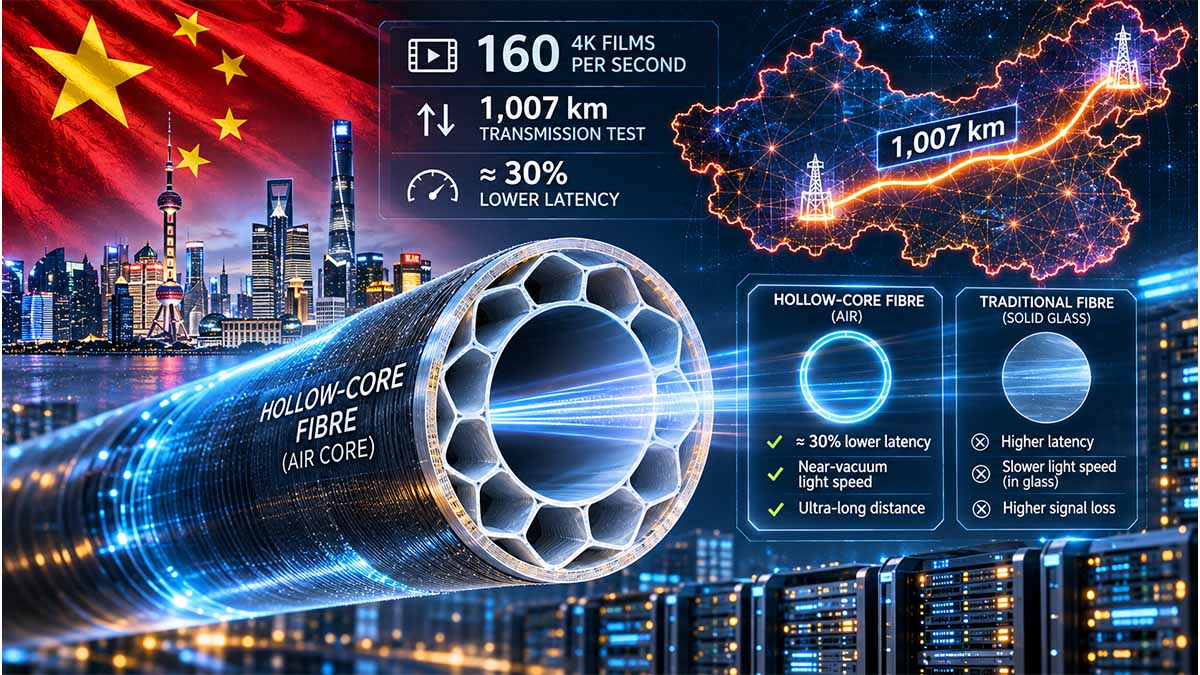
Scope: This assessment examines China’s reported 1,007.48-kilometre hollow-core fibre transmission demonstration, its implications for artificial intelligence infrastructure and financial connectivity, and the industrial and regulatory choices facing China, the United States, Italy, France, Germany, the United Kingdom and the European Union through November 2031.
Executive Summary / BLUF
Hollow-core fibre is becoming a credible option for selected high-value networks; universal replacement of conventional fibre remains unestablished.
Chinese official reporting attributes to China Telecom, YOFC and ZTE simultaneous transmission of 64 Tb/s in each direction over 1,007.48 km, with 3.43 milliseconds one-way latency.
The combined bidirectional capacity is 128 Tb/s; this is distinct from the capacity available in either direction.
The result strengthens the engineering case for longer-distance deployment, while leaving commercial cost, sustained availability and application-level gains unresolved. China completes 1,000-km hollow-core fiber transmission verification — Chinese Embassy in Laos — Nov 2026. la.china-embassy.gov.cn
Microsoft’s operational deployments and manufacturing partnerships demonstrate that commercial development extends beyond China. Microsoft Azure scales Hollow Core Fiber (HCF) production through outsourced manufacturing — Microsoft — Sep 2025. Microsoft Community Hub
The immediate decision is whether particular routes justify qualification and procurement, using measured workload benefits and lifecycle costs rather than transmission headlines.
Hollow-Core Fibre’s Real Test Is Who Can Keep It Running
Hollow-core fibre will create durable industrial advantage only where its lower transmission delay can be converted into a service that customers can afford, operators can restore and regulators can hold accountable. China’s long-distance demonstration strengthens the engineering case, while Microsoft’s manufacturing partnerships show that competition already extends beyond laboratory performance. The immediate decision concerns procurement: whether governments and infrastructure buyers purchase a faster connection or assume a dependency whose operating costs remain insufficiently documented. Under Italy’s Legislative Decree 138/2024, Germany’s BSI-Gesetz and the United Kingdom’s telecommunications security framework, that distinction reaches management responsibility, supplier oversight and continuity. The industrial prize will accrue to the organisations that make installation, acceptance and recovery repeatable; the financial exposure will remain with buyers that mistake a successful test for a dependable service.
The record is significant because its boundaries are narrow
The Chinese achievement matters within its declared experimental category. WRCA identifies it as point-to-point, non-loopback, bidirectional, real-time transmission. That formulation distinguishes it from the recirculating-loop experiments disclosed by Microsoft Azure Fiber, in which signals repeatedly traverse a shorter physical arrangement to accumulate a greater transmission distance. The experiments answer different engineering questions. Collapsing them into a single distance ranking obscures the progress each establishes and gives procurement teams an unreliable basis for comparison. WRCA’s published designation supports the attributed record category; it does not replace a complete technical acceptance report.
The same boundary applies between experimental transmission and commercial operation. China Communications Services described commissioning a cross-border connection, while Colt described its London deployment with Network Planning Solutions and Relativity Networks as a proof of concept. Those institutional descriptions identify different stages of maturity. A purchaser that treats both as equivalent evidence of a fully supported product removes the very distinctions needed to price implementation risk, allocate responsibility and decide how much operational dependence to authorise.
The numbers reveal different kinds of commitment
Chinese official reporting describes simultaneous transmission of 64 terabits per second in each direction over 1,007.48 kilometres, with 3.43 milliseconds of one-way latency. The combined bidirectional capacity is 128 terabits per second; it is not capacity available to a single directional flow. China Communications Services’ separate November 2025 commercial-project announcement identifies 110 kilometres of total route, including 100 kilometres of hollow-core cable. These figures establish substantial engineering and deployment milestones, but neither gives a comparable installed price or attributable return on investment. The project disclosure is particularly useful because it distinguishes the complete route from the portion using the new medium.
The financial and manufacturing figures expose a different boundary. Relativity Networks announced in August 2026 a $22 million SAFE investment, a simple agreement for future equity, and a $40 million follow-on order from an unnamed hyperscaler. Financing and orders cannot be added and presented as revenue, accepted deliveries or cash collected. YOFC separately reported a 91.2-kilometre continuous fibre length and a programme objective of more than 50 commercial and pilot projects. The former is a production milestone; the latter is an ambition. Together, these announcements show capital, customer interest and industrial intent moving towards the technology, while leaving accepted output, order conversion and broad market economics unresolved. Relativity Networks’ company release and YOFC’s HollowBand announcement support those narrower conclusions.
Industrial power sits in qualification and recovery
Microsoft’s collaboration with Corning identifies the work required to convert a promising medium into industrial supply: manufacturing-process implementation, yield improvement, metrology, quality and reliability. This is where competitive advantage becomes defensible. A longer production run has limited commercial value if too little survives qualification, and a factory-compliant cable does not generate revenue until the installed connection passes acceptance. Procurement therefore transmits industrial performance into financial outcomes through accepted deliveries, installation expenditure, rework and support obligations. Gross output and announced capacity describe only part of that mechanism.
HUBER+SUHNER’s April 2026 disclosure makes the dependency chain tangible. It identifies cable-integration processes at Herisau in Switzerland and series production of mode-converting connectors at Mainz in Germany. Relativity Networks identifies fibre production at Eindhoven, cabling at Claremont and characterisation, couplers and installation training at Orlando. These locations show that the commercial product is assembled across specialised capabilities. They also show why the nationality of a corporate headquarters is an incomplete measure of infrastructure control: the relevant questions concern access to qualified components, production processes, documentation and personnel when the connection requires intervention. HUBER+SUHNER’s industrial account identifies those functions more precisely than a general claim of European participation.
A faster connection does not automatically buy more computing
NVIDIA’s NCCL documentation describes collective operations that coordinate information across processing devices. That establishes a mechanism through which communication can affect distributed computing; it does not establish how much of a particular workload’s completion time depends on the connection being replaced. The purchaser must identify exposed waiting on that route after accounting for communication that overlaps computation and constraints elsewhere. Without that measurement, a fibre improvement can be converted into an unsupported accelerator-productivity claim.
The distinction also governs data-centre location. HUBER+SUHNER presents greater siting flexibility as a potential benefit of hollow-core connectivity. The economic case becomes credible when an improved connection makes an otherwise suitable location usable within the application’s requirements. It remains incomplete until the buyer includes the actual power arrangement, construction timetable, alternative route and network support costs. The saving belongs to the executable site-and-service combination. Counting it simultaneously as avoided hardware, additional output and cheaper infrastructure would overstate the return unless the operating plan demonstrates that each benefit can occur.
Europe’s legal frameworks put limits on technological enthusiasm
Italy’s Legislative Decree 138/2024 connects cybersecurity measures with management approval and oversight. Germany’s current BSI-Gesetz requires covered entities to document proportionate risk-management measures, including continuity and supply-chain security. The United Kingdom’s telecommunications security framework addresses supplier interruption and transition, while its July 2026 Code distinguishes guidance from underlying legal duties. None of these records establishes a general obligation to purchase hollow-core fibre. Their procurement consequence is more demanding: buyers must explain how the service remains controllable when a component, route or supplier fails.
France illustrates why legal status must remain explicit. ANSSI describes ReCyF as a working document that is, by default, non-mandatory; the European Commission’s July 2026 referral announcement records a procedural action concerning NIS2 transposition. Preparation guidance, operative obligations and contractual safeguards cannot be merged into a single assertion of compliance. For infrastructure buyers, the practical response is to define the applicable obligations and then specify measurable acceptance, access and recovery requirements in the contract. A voluntary framework can inform that work without becoming legislation through repetition.
More factories do not necessarily create independent alternatives
Microsoft’s September 2025 manufacturing announcement distributes production across Corning and Heraeus while retaining a common technology and process relationship. That can diversify manufacturing exposure without establishing independent technological substitutes. YOFC’s proposed ecosystem alliance similarly seeks to connect production, standards and operator demand. The competitive question is consequently whether buyers can qualify and use alternatives, rather than how many supplier names appear in an announcement. Microsoft’s manufacturing disclosure makes the distinction between production geography and process control visible.
For the European Union, the strongest collective contribution would be comparable acceptance evidence, accessible qualification and clearer cross-border restoration arrangements. The Commission’s June 2026 cable-security actions already distinguish investment in connectivity from investment in monitoring and repair, although they concern submarine infrastructure and do not establish submarine hollow-core deployment. Applying that governance principle to terrestrial adoption would mean funding a defined, testable capability. European participation becomes more valuable when operators can purchase and maintain it under credible alternatives, rather than merely identify European firms somewhere in the chain.
The next procurement cycle will allocate the cost of dependence
Over the next 12–24 months, the consequential decisions will be contracts that convert demonstrations and announced orders into accepted infrastructure. Microsoft’s manufacturing programme, YOFC’s deployment initiative and Colt’s carrier experimentation provide identifiable channels through which that conversion could occur. Buyers should release commitment against demonstrated application value, installed performance and recovery, preserving an executable alternative until the evidence supports greater dependence. Suppliers that make those conditions repeatable will be better placed to turn technical participation into recurring business.
The cost of inaction will fall differently across that chain. Suppliers that fail to improve accepted output and support will bear the cost of delayed deliveries and lost repeat orders. Operators that defer qualification despite a demonstrated service need may forgo a valuable route advantage. Governments that support industrial announcements without purchasing reusable evidence will leave future buyers to repeat the same uncertainty. Under the national security frameworks already governing critical connectivity, the most expensive outcome is a procurement that pays for faster normal operation while leaving the institution unable to preserve its essential service when the preferred connection stops working.
Navigational Index
Pillar I — Physical Performance and the Demonstration Boundary
- Chapter 1 — From Solid Glass to Hollow Cores: Physics, Architecture and Performance
- Chapter 2 — China’s Thousand-Kilometre Demonstration: Capacity, Latency and Evidentiary Limits
Pillar II — Commercial Deployment and Industrial Competition
- Chapter 3 — AI Interconnection and Financial Networks: Where Lower Latency Creates Value
- Chapter 4 — Manufacturing, Installation, Maintenance and the Economics of Scale
- Chapter 5 — Competing Supply Chains: China, the United States and European Industrial Positions
Pillar III — Governance, Infrastructure Resilience and Strategic Choices
- Chapter 6 — Italy, France, Germany, the United Kingdom and the European Union
- Chapter 7 — Deployment Pathways, Infrastructure Risks and the 2026–2031 Outlook
- Chapter 8 — Procurement Options, Decision Thresholds and Final Net Assessment
Master Abstract
The advance concerns a transmission medium and a complete engineered system
The principal significance of the Chinese demonstration is the reported combination of distance, simultaneous bidirectional capacity and low propagation delay. A Wuhan government publication identifies an extended C+L-band system using 800 Gb/s per wavelength, with probabilistically shaped 16-state quadrature amplitude modulation, or PCS-16QAM. These details matter because the capacity belongs to an engineered optical transmission system: the hollow core enables particular physical advantages, while modulation, wavelength allocation, amplification and system control determine how those advantages become usable bandwidth. The same publication describes the achievement as a real-time transmission verification. That supports assessment of a demonstrated configuration; it does not establish a thousand-kilometre commercial service with published availability guarantees, repair performance or independently reproduced application benchmarks. Claims of a world record should therefore retain their attributed scope. 央视:光谷企业参与,我国新一代通信网技术取得新突破! — Wuhan East Lake High-tech Development Zone — Nov 2026. wehdz.gov.cn
Hollow-core fibre also retains a substantial dependence on glass engineering. In an anti-resonant design described by Exail, thin glass membranes and surrounding tube structures confine light principally within a hollow central region. The optical field’s interaction with silica is greatly reduced, but the surrounding glass structure remains essential to guidance. The strategic technological change is therefore a redistribution of where the signal propagates, accompanied by demanding microstructural manufacturing. This distinction directs attention towards production tolerances, cabling, interfaces and maintenance: reducing interaction with glass does not eliminate the need to manufacture a precise and durable glass-based waveguide. Anti-resonant hollow core fibers — Exail — undated, accessed Nov 2026. Exail
The physical gain is substantial; its application value remains conditional
Using ZTE’s illustrative conventional-fibre propagation benchmark of 5 microseconds per kilometre, a 1,007.48-kilometre path would introduce approximately 5.0374 milliseconds of propagation delay. Against the reported 3.43 milliseconds, the calculated saving is approximately 1.61 milliseconds one way, or 31.9%. This is an indicative comparison using a published benchmark, rather than a matched measurement of two installed routes. It explains why a reduction of roughly 30% is physically plausible without implying that every application becomes 30% faster. ZTE’s technical account separately identifies low-delay electrical forwarding, congestion management and protection mechanisms as requirements for useful deployment. The analytical consequence is that fibre qualification must sit within an end-to-end service assessment: improving one component of delay cannot establish the improvement of the entire transaction or computational workload. 空芯光纤传输系统应用与挑战 — ZTE — Apr 2026. zte.com.cn
The emerging engineering challenge includes control of the gas inside the fibre. A November account on Beijing’s international science and technology innovation platform reports that the Chinese team used high-purity argon to address absorption associated with residual gases, and reports link attenuation below 0.1 dB/km at 1,550 nanometres. These are attributed technical disclosures, not a substitute for a complete measurement report. The same account quotes China Telecom expert Huo Xiaoli describing current hollow-core fibre prices as hundreds of times those of conventional single-mode fibre. That statement lacks the procurement specifications needed for a comparable installed-cost estimate, but it supports a selective commercialisation thesis: early adoption is more defensible where a small latency advantage has unusually high economic value. 千公里空芯光纤单程信号传输仅需3.43毫秒 — International Science & Technology Innovation Center Network Service Platform — Nov 2026. ncsti.gov.cn
Commercial operation exists, but adoption statistics require boundaries
The public record already contains evidence beyond experimental transmission. Microsoft reported in March 2025 that hollow-core fibre was carrying live customer traffic in multiple Azure regions. Its described metropolitan installation connected two data centres through separate routes, each exceeding 20 kilometres, using hybrid cables containing hollow-core and conventional single-mode strands. This establishes a company-reported operational use case and illustrates coexistence with established infrastructure. It does not establish equivalent performance across every environment or a publicly audited long-term reliability distribution. The Deployment of Hollow Core Fiber (HCF) in Azure’s Network — Microsoft — Mar 2025. Microsoft Community Hub
Chinese official reporting also describes a Shenzhen–Hong Kong commercial financial connection and more than ten commercial and pilot projects across Asia, Europe and other regions. This aggregate combines different deployment categories and supplies no complete project register; it cannot establish ten equivalent production services or their geographic distribution. The distinction matters for industrial policy. A laboratory demonstration, an installation trial, a customer-bearing route and a continuously supported commercial offering each resolve different uncertainties. Governments and infrastructure buyers should assess the progression between those stages rather than use the number of announcements as a proxy for network maturity. China completes 1,000-km hollow-core fiber transmission verification — Chinese Embassy in Laos — Nov 2026. la.china-embassy.gov.cn
European exposure is differentiated across the industrial chain
Italy has an identifiable industrial position through Prysmian’s partnership with Relativity Networks. In July 2026, Prysmian reported installation testing with Dura-Line in Tennessee, production of a 24-hollow-core-fibre cable with a 10-millimetre diameter in North Carolina, and investment at Eindhoven. These locations distinguish an Italian corporate position from production physically located in Italy. The policy opportunity is to connect domestic research, cable engineering and operator qualification to a multinational manufacturing chain, with any public support tied to demonstrable domestic capabilities and transferable expertise. The announcement establishes company-reported manufacturing and installation milestones; it does not establish deployment on an Italian national backbone. Fibra Hollow Core: Prysmian e Relativity Networks realizzano il cavo HCF a più alta densità mai realizzato — Prysmian — Jul 2026. Prysmian
France has a documented specialist product position through Exail’s Lannion-branded anti-resonant hollow-core fibre, marketed for low-latency telecommunications applications. Product availability is a narrower proposition than qualification for a long-haul carrier network. The appropriate assessment concerns whether specialist manufacturing can progress through cable integration, reproducible optical performance and operator acceptance; the retrieved product record does not establish those later stages. IXF-ARF-45-240-V1 — Exail — undated, accessed Nov 2026. Exail
Germany’s relevant industrial exposure includes Heraeus Covantics’ participation in Microsoft’s announced manufacturing scale-up alongside Corning. This supports assessment of a role within an international production ecosystem. It does not, by itself, disclose German output, plant utilisation, investment expenditure or deliveries. The consequential policy question is which manufacturing processes and supply commitments remain accessible to European operators as hyperscaler demand expands. Microsoft Azure scales Hollow Core Fiber (HCF) production through outsourced manufacturing — Microsoft — Sep 2025. Microsoft Community Hub
The United Kingdom has a distinct research and technology-transfer position. The University of Southampton’s institutional account describes collaboration with Microsoft Azure Fiber on double-nested anti-resonant nodeless fibre and associated low-loss research. This supports an assessment of domestic scientific capability participating in an international commercial ecosystem. It leaves open how much manufacturing, intellectual-property income and downstream deployment value will accrue within the United Kingdom. University of Southampton achieves record-low signal loss with Hollow Core Fibre (HCF) technology on Microsoft Azure — University of Southampton — Sep 2025. University of Southampton
The European Union’s collective interest concerns secure adoption, interoperable qualification and commercially sustainable supply. The Commission identifies digital infrastructure and public electronic communications within the NIS2 framework, while ESMA identifies DORA as applicable from 17 January 2025 to covered financial entities. These frameworks make operational resilience and ICT dependencies relevant to adoption; neither cited institutional account establishes a requirement to deploy hollow-core fibre. The analytical implication is that lower latency should be assessed alongside continuity, supplier dependence and recoverability, with precise legal obligations determined by the entity, service and applicable instrument. NIS2 Directive: securing network and information systems — European Commission — undated, accessed Nov 2026; Digital Operational Resilience Act (DORA) — ESMA — undated, accessed Nov 2026. Shaping Europe’s digital future
Key Evidence Table
| Indicator | Value/status | Reference date | Definition/scope | Issuer | Exact source |
|---|---|---|---|---|---|
| Chinese demonstration length | 1,007.48 km | Reported Nov 2026 | Experimental hollow-core transmission link; not proof of a commercial route of this length | Chinese Embassy, relaying attributed technical reporting | China completes 1,000-km hollow-core fiber transmission verification |
| Directional and combined capacity | 64 Tb/s each way; 128 Tb/s combined | Reported Nov 2026 | Simultaneous bidirectional transmission; combined figure is calculated by addition | Wuhan East Lake High-tech Development Zone | 央视:光谷企业参与,我国新一代通信网技术取得新突破! |
| Reported one-way latency | 3.43 ms | Reported Nov 2026 | Link transmission figure; application-level measurement boundary is not established | Chinese Embassy, attributing technicians | China completes 1,000-km hollow-core fiber transmission verification |
| Illustrative conventional-fibre comparison | 5.0374 ms; approximately 1.61 ms potential saving | Calculated for this assessment | 1,007.48 km × 5 μs/km; approximately 31.9% below this benchmark, not a matched-route result | Calculation from ZTE benchmark and reported test figures | 空芯光纤传输系统应用与挑战 |
| Film-volume equivalent | 160 files/s per direction | Calculated for this assessment | 64 × 10¹² bits/s ÷ (50 × 10⁹ bytes × 8); assumes decimal GB and no additional overhead | Calculation from published capacity and file-size assumption | 央视:光谷企业参与,我国新一代通信网技术取得新突破! |
| Azure operational status | Live customer traffic reported in multiple regions | Mar 2025 | First-party operational disclosure; not an independent fleet-wide audit | Microsoft | The Deployment of Hollow Core Fiber (HCF) in Azure’s Network |
| Cable industrialisation milestone | 24 hollow-core fibres within 10 mm cable diameter | Jul 2026 | Company-reported cable production milestone | Prysmian | Fibra Hollow Core: Prysmian e Relativity Networks realizzano il cavo HCF a più alta densità mai realizzato |
The film comparison expresses data volume. Resolution alone does not determine file size, and this calculation does not establish delivered consumer throughput. The latency calculation likewise preserves the distinction between an illustrative propagation benchmark and a directly measured service comparison.
Competing Deployment Pathways
The available evidence supports conditional, potentially overlapping pathways. It does not support mutually exclusive hypotheses or numerical adoption probabilities.
| Pathway | Evidence and mechanism | Evidence that would weaken it | Observable indicators | Current standing |
|---|---|---|---|---|
| Premium-route adoption remains dominant | High reported fibre prices favour services where latency commands a substantial premium | Comparable tenders showing competitive lifecycle costs across ordinary routes | Contracted prices, customer renewals, installed cost per route-kilometre | Strongest near-term commercial logic |
| Data-centre interconnection becomes the principal expansion market | Azure reports operational deployment; benefits depend on workload sensitivity and available routes | Production benchmarks showing insufficient benefit relative to deployment and maintenance costs | Sustained workload results, utilisation, repeat orders and service-level performance | Credible expansion pathway |
| Broad backbone substitution develops | Longer-distance verification reduces one engineering uncertainty; industrial scale-up could reduce supply constraints | Persistent cost premiums, repair difficulties or weak interoperability | Multi-vendor acceptance, sustained long-haul operation and comparable procurement awards | Conditional longer-term pathway |
These assessments draw on the attributed price discussion, Microsoft’s operational disclosure and announced manufacturing expansion. They describe adoption mechanisms rather than measured market shares. 千公里空芯光纤单程信号传输仅需3.43毫秒 — International Science & Technology Innovation Center Network Service Platform — Nov 2026; Microsoft Azure scales Hollow Core Fiber (HCF) production through outsourced manufacturing — Microsoft — Sep 2025. ncsti.gov.cn
Principal Gaps and Watch Indicators
| Consequential gap | Record or observation needed | Decision consequence |
|---|---|---|
| Exact boundary of the 3.43 ms measurement | Full test report identifying timing points, instrumentation and included processing | Determines whether the figure can be compared with an operator’s service latency |
| Experimental configuration and reproducibility | Span map, cable configuration, amplification plan, error-performance results and test duration | Determines how closely the result transfers to a proposed installed route |
| Comparable commercial economics | Like-for-like tenders covering cable, installation, interfaces, monitoring, spares and repair | Determines whether the latency benefit justifies lifecycle expenditure |
| Sustained field performance | Customer-bearing availability records, environmental testing and timed repair exercises | Determines suitability for critical services |
| AI workload benefit | Matched production benchmarks identifying hardware, workload, topology and total cost | Determines whether lower propagation delay improves useful computational output |
| Deployment footprint | Named project register separating pilot, commercial, active and discontinued projects | Prevents mixed project counts from being treated as equivalent capabilities |
| Manufacturing scalability | Qualified output, acceptance yields, delivery commitments and supplier alternatives | Determines whether technical demand can become a dependable procurement programme |
The most consequential change in the assessment would be a reproducible long-distance production record combining sustained availability, transparent costs and measured application benefits. Further headline capacity increases alone would leave these commercial uncertainties substantially unresolved.
Visualisation — Faster Fibre and Physical Resilience
Microsoft’s disclosed two-route deployment provides a useful operational relationship: fibre performance and route diversity address different service requirements. The following component represents that architecture schematically, without implying a geographic map or a quantified outage reduction. The Deployment of Hollow Core Fiber (HCF) in Azure’s Network — Microsoft — Mar 2025. Microsoft Community Hub
Two routes, distinct resilience functions
Schematic of Microsoft’s disclosed metropolitan deployment. Each route exceeded 20 km. Distances are not drawn to scale.
Data centre A
Separate route entry points
Route A connects both centres
Hybrid cable: hollow-core and conventional single-mode fibres
Route B connects both centres
Separate physical path supporting alternative connectivity
Data centre B
Separate route entry points
Operational interpretation: lower propagation delay improves the path; physical diversity provides an alternative when a path is disrupted. This schematic assigns no availability guarantee.
Source: The Deployment of Hollow Core Fiber (HCF) in Azure’s Network — Microsoft — March 2025 . Company-reported architecture; assessment cut-off: 14 November 2026.
Hollow-Core Fibre — Evidence and Deployment
Assessment: 14 November 2026. Chinese official reporting describes 64 Tb/s in each direction over 1,007.48 km, with 3.43 ms one-way latency. The combined bidirectional capacity is 128 Tb/s. Experimental performance does not establish commercial service availability.
| Indicator | Value | Qualification |
|---|---|---|
| Reported test length | 1,007.48 km | Experimental link |
| Capacity per direction | 64 Tb/s | Simultaneous bidirectional transmission |
| Combined capacity | 128 Tb/s | Sum of both directions |
| Reported one-way latency | 3.43 ms | Published measurement boundary is incomplete |
| Indicative conventional-fibre delay | 5.0374 ms | Calculated using 5 μs/km |
| Indicative saving | 1.6074 ms / 31.9% | Benchmark comparison, not a matched-route measurement |
Sources: Chinese Embassy — November 2026; ZTE — April 2026; Microsoft — March 2025.
Pillar I — Physical Performance and the Demonstration Boundary
Chapter 1 — From Solid Glass to Hollow Cores: Physics, Architecture and Performance
The engineering advantage depends on controlling the waveguide, not simply replacing glass with air
The central technical judgment is that hollow-core fibre changes several constraints on optical transmission simultaneously, while making the structure surrounding the signal more consequential to system performance. In the anti-resonant architecture described by Exail, light propagates within a hollow central region surrounded by thin glass membranes formed by non-touching tubes; those membranes provide the optical guidance that keeps the signal concentrated within the core. The manufacturer reports an extremely small overlap between guided power and surrounding silica for its described design. This architecture establishes an important distinction between reducing the signal’s interaction with glass and eliminating glass from the transmission system: the former is the physical objective, while the latter would misdescribe the device. The resulting analytical implication is that performance must be evaluated as a property of the complete manufactured waveguide, including the surrounding microstructure, rather than attributed to the core gas alone. A hollow channel does not establish a telecommunications capability without the structure required to guide light through it. Anti-resonant hollow core fibers — Exail — undated, accessed Nov 2026. Exail
The established optical-fibre baseline also requires more precision than a comparison between “old glass” and “new air” allows. ITU-T G.652, approved in August 2024, specifies geometrical, mechanical and transmission characteristics for a conventional single-mode fibre category; it separately addresses fibre attributes, cable attributes and considerations for concatenated links. Its system-design appendix explicitly recognises that splices, passive components and installation affect end-to-end characteristics. This distinction remains useful when assessing hollow-core alternatives, although the conventional-fibre recommendation must not be represented as certification of a hollow-core product. The appropriate comparison therefore has several levels: the optical properties of a manufactured fibre length, the properties of a completed cable, the performance of an installed link, and the service delivered through the equipment connected to that link. A superior result at the first level is valuable evidence, but the practical advantage depends on how much of it survives the subsequent stages. Characteristics of a single-mode optical fibre and cable, Recommendation ITU-T G.652, clauses 6–8 and Appendix I — International Telecommunication Union — Aug 2024. itu.int
| Assessment level | Object being measured | Evidence that matters | Inference that remains unjustified |
|---|---|---|---|
| Manufactured fibre | A particular production length | Wavelength-dependent attenuation, geometry and uniformity | That all production lengths achieve the same result |
| Completed cable | Fibre after incorporation into cable | Optical changes after cabling and handling | That uncabled laboratory performance survives installation unchanged |
| Installed link | Cable sections, joints and interfaces | End-to-end loss, splice distribution and fault-location capability | That the lowest fibre attenuation determines total link loss |
| Transmission system | Link plus transmitters, receivers and line equipment | Decoded capacity, error performance and operating margins | That nominal optical capacity equals useful application throughput |
| Delivered service | Customer traffic over the operational system | Latency distribution, availability and recovery performance | That a successful experimental run establishes a service guarantee |
Assessment framework derived from the distinction between fibre, cable and link characteristics in ITU-T G.652 — ITU — Aug 2024, and the installation and acceptance stages described in The Deployment of Hollow Core Fiber (HCF) in Azure’s Network — Microsoft — Mar 2025.
Low attenuation creates a different transmission budget, but does not remove optical loss
A first-party Microsoft Research record published in September 2025 reports 0.091 dB/km attenuation at 1,550 nm, with attenuation remaining below 0.2 dB/km across a 66 THz spectral window. These figures describe different aspects of the disclosed waveguide: the first identifies performance at a particular wavelength, while the second describes a broader transmission window under a higher attenuation threshold. They cannot be substituted for one another in an engineering specification. Nor does a broad low-loss window establish that amplifiers, transceivers and other components can exploit the entire window simultaneously. The important advance is that reduced attenuation can change the available optical budget; the actual system benefit depends on the wavelengths used, the characteristics of the installed fibre and the losses introduced elsewhere. Procurement comparisons should consequently request attenuation spectra and installed-link measurements, rather than accept a single minimum-loss figure as a complete description of the product. Broadband optical hollow core fiber (HCF) with an attenuation lower than 0.1 decibel per kilometer — Microsoft Research — Sep 2025. Microsoft Research
The logarithmic meaning of attenuation is particularly important for institutional readers assessing whether a lower coefficient eliminates the need for intermediate equipment. For a hypothetical uniform fibre, fibre-only attenuation equals the coefficient multiplied by distance, and the remaining optical-power fraction equals 10 raised to the power of minus that attenuation divided by ten. Thus, 0.1 dB/km over 100 km means 10 dB of fibre-only loss and 10% of the launched optical power remaining, before adding connector, splice or other component losses. Extending the same hypothetical coefficient to 200 km produces 20 dB of loss and 1% remaining power. These calculations do not specify a receiver’s operating threshold or determine whether a particular span works; they demonstrate why low attenuation and loss-free transmission are fundamentally different propositions. They also explain why small changes in a per-kilometre coefficient can become operationally meaningful over long distances without making amplification, receiver sensitivity or maintenance margins irrelevant.
| Illustrative fibre length | Fibre-only loss at 0.091 dB/km | Optical power remaining | Fibre-only loss at 0.100 dB/km | Optical power remaining |
|---|---|---|---|---|
| 50 km | 4.55 dB | 35.08% | 5.00 dB | 31.62% |
| 100 km | 9.10 dB | 12.30% | 10.00 dB | 10.00% |
| 200 km | 18.20 dB | 1.51% | 20.00 dB | 1.00% |
Calculated examples, not measured links. Each column assumes a uniform coefficient, no amplification and no additional losses. The 0.091 dB/km input is the wavelength-specific result disclosed by Microsoft Research — Sep 2025; 0.100 dB/km is an explicit comparison assumption.
The installed-link budget adds a further layer of discipline. ITU-T G.652’s Appendix I expresses mean link attenuation through contributions from cable length, splices and line connectors, and calls for a suitable allowance for future modifications and environmental or ageing effects. Applied as an accounting principle, rather than as a hollow-core certification rule, this means an operator must preserve the distinction between intrinsic fibre loss and the accumulated cost of making the fibre usable in the field. Microsoft’s installation account provides a concrete illustration: it describes dedicated hollow-core joint enclosures, interfaces to conventional single-mode equipment, a specialised optical time-domain reflectometer and a reported mean splice loss of 0.16 dB in the deployment discussed. Twenty such splices would contribute 3.2 dB under a simple illustrative calculation; that arithmetic is not a description of Microsoft’s actual splice count. It shows why joint quality can materially influence whether a promising fibre coefficient produces the expected installed result. Characteristics of a single-mode optical fibre and cable, Appendix I.1 — ITU — Aug 2024; The Deployment of Hollow Core Fiber (HCF) in Azure’s Network — Microsoft — Mar 2025. itu.int
Approaching the vacuum limit leaves distance as a persistent physical constraint
The reported Chinese latency can be examined against a physical reference without assuming a complete explanation of the measurement. NIST gives the speed of light in vacuum as exactly 299,792,458 metres per second. Across 1,007.48 km, that corresponds to approximately 3.3606 ms. Dividing the reported distance by the reported 3.43 ms produces an effective end-to-end velocity of approximately 293,726 km/s, or 97.98% of the vacuum value. The difference between the reported time and the vacuum reference is approximately 69.4 microseconds. These are consistency calculations, not measurements of the fibre’s material or modal properties: without a complete timing boundary, that residual cannot be allocated between propagation, interfaces, equipment and measurement effects. The result is compatible with near-vacuum propagation over the stated length, but it does not demonstrate that the whole residual is removable or that it belongs entirely to the fibre. CODATA Value: speed of light in vacuum — National Institute of Standards and Technology — 2022 CODATA value; China completes 1,000-km hollow-core fiber transmission verification — Chinese Embassy in Laos — Nov 2026. physics.nist.gov
| Physical consistency indicator | Calculated value | Interpretation |
|---|---|---|
| Vacuum transit time over 1,007.48 km | 3.3606 ms | Ideal physical reference for that path length |
| Reported transit time minus vacuum reference | 69.4 μs | Unallocated difference; not a measured equipment budget |
| Effective velocity from reported distance and time | 293,726 km/s | End-to-end quotient, not an independently measured group velocity |
| Effective velocity as a fraction of vacuum light speed | 97.98% | Consistency indicator |
| Symmetric two-way transit using 3.43 ms per direction | 6.86 ms | Conditional calculation; excludes additional turnaround and application delays |
Calculated from the NIST speed-of-light value and the reported Chinese link figures. Rounding reflects the precision of the published latency.
The distinction between a propagation improvement and an application improvement can be stated algebraically. Let the conventional-fibre reference contribute 5.0374 ms and the reported hollow-core result contribute 3.43 ms, while an unchanged additional delay contributes D milliseconds to both alternatives. The absolute saving remains 1.6074 ms, but its share of the complete delay becomes 1.6074 divided by the sum of 5.0374 and D. As D increases, the percentage improvement falls even though the fibre delivers exactly the same absolute saving. The examples below deliberately use hypothetical additional delays; they are sensitivity calculations, not measurements of any AI system, financial platform or production network. Their decision value is to identify the measurement needed before an investment claim can be made: the operator must establish how much of the relevant transaction lies within the transmission segment being improved. The conventional propagation input follows the 5 μs/km benchmark presented by ZTE, rather than a matched measurement of the Chinese test route. 空芯光纤传输系统应用与挑战 — ZTE — Apr 2026. zte.com.cn
| Assumed unchanged additional delay | Conventional reference plus additional delay | HCF result plus additional delay | Absolute saving | Reduction in total modelled delay |
|---|---|---|---|---|
| 0 ms | 5.0374 ms | 3.4300 ms | 1.6074 ms | 31.91% |
| 1 ms | 6.0374 ms | 4.4300 ms | 1.6074 ms | 26.62% |
| 5 ms | 10.0374 ms | 8.4300 ms | 1.6074 ms | 16.01% |
| 20 ms | 25.0374 ms | 23.4300 ms | 1.6074 ms | 6.42% |
Illustrative sensitivity analysis. Additional-delay assumptions are analyst-selected. The model holds route length and all non-fibre delays constant and does not predict application throughput.
Gas control and fault diagnosis become part of the transmission architecture
The engineering record also shows why hollow-core performance cannot be reduced to a favourable propagation coefficient. The November Chinese technical account reports that the team addressed gas absorption by replacing residual air with high-purity argon, alongside fibre-structure and manufacturing improvements. The relevance is spectral as well as cumulative: a system must maintain usable channels across its operating band, not merely transmit satisfactorily at one selected wavelength. Separately, ZTE’s April technical discussion identifies gas absorption, intermodal interference and weak backscattering as challenges, explaining that weak backscattering complicates conventional optical fault monitoring. These disclosures support a specific operational inference: qualification must include the condition of the sealed fibre, wavelength-dependent performance and the ability to locate faults after installation. They do not establish a universal maintenance penalty or failure rate. The appropriate question is whether the particular supplier’s monitoring and repair arrangements preserve the performance demonstrated at acceptance throughout the service life. 千公里空芯光纤单程信号传输仅需3.43毫秒 — International Science & Technology Innovation Center Network Service Platform — Nov 2026; 空芯光纤传输系统应用与挑战 — ZTE — Apr 2026. ncsti.gov.cn
| Technical issue | Consequential failure mechanism to investigate | Qualification evidence to request |
|---|---|---|
| Gas absorption | Particular wavelengths suffer disproportionate impairment | Attenuation spectra and decoded channel performance across the intended operating bands |
| Splice and interface losses | Installation consumes the expected optical advantage | Individual joint measurements and complete installed-link loss |
| Intermodal interference | Signal quality depends on mode coupling and installation conditions | Relevant impairment measurements before and after cabling and installation |
| Weak backscattering | Conventional monitoring arrangements may provide insufficient fault visibility | Demonstrated fault-location range, resolution and repair workflow |
| Environmental and handling effects | Accepted performance changes after installation or intervention | Repeat measurements under specified deployment conditions |
| Equipment interaction | Fibre improvements fail to translate into the intended system result | Complete transmitter, receiver, amplifier and interface configuration |
Qualification implications developed from ZTE’s technical account — Apr 2026, the Chinese gas-control disclosure — Nov 2026, and Microsoft’s field-installation account — Mar 2025. These are proposed evidence requirements, not findings that every listed failure has occurred.
Key judgments
The physical opportunity is sufficiently substantial to justify engineering qualification, but the relevant unit of assessment is the installed transmission system. Lower attenuation creates additional optical budget, reduced propagation time creates a finite absolute delay saving, and specialised monitoring determines whether faults can be diagnosed and repaired within operational requirements. Those functions must be measured separately before they can be combined into a service claim. The most important analytical discipline is to preserve the boundary between a favourable physical property and the delivered performance that an operator can contract, monitor and maintain.
What would change the assessment
The assessment would strengthen with reproducible installed-link results showing that low attenuation, stable channel performance and effective fault diagnosis survive cabling, environmental exposure and repair. It would weaken for a proposed deployment if installation losses consumed the expected benefit, if operational monitoring could not locate relevant faults reliably, or if the application’s measured delay budget showed that improving propagation contributed too little to justify the intervention. These are conditional thresholds for a particular system, rather than a judgment that hollow-core fibre will succeed or fail uniformly across networks.
Open official record
The consequential open records are production distributions rather than best-sample specifications, installed attenuation spectra, interface-loss measurements, environmental qualification results and documented repair acceptance procedures. Their publication would allow operators to move from evaluating an exceptional fibre result to evaluating repeatable infrastructure performance.
Chapter 2 — China’s Thousand-Kilometre Demonstration: Capacity, Latency and Evidentiary Limits
The claimed record depends on its experimental category
The principal judgment is that China’s demonstration should be assessed within the category of point-to-point, non-loopback, bidirectional, real-time transmission, rather than described as the greatest distance over which any hollow-core experiment has transmitted data. The record publisher WRCA lists that specific designation, identifies an achievement of 1,007.48 km and assigns 2 November 2026 as the achievement date. This is evidence of the category and recognition that WRCA itself publishes; its short public entry does not provide a complete engineering audit or the underlying comparison database. The category nevertheless resolves a material ambiguity in the broader narrative. By 2025, Microsoft Azure Fiber had already disclosed much larger accumulated transmission distances using a recirculating experimental arrangement. A comparison based only on the largest kilometre figure would therefore place unlike configurations in the same ranking and obscure what the Chinese demonstration actually claims to establish. Longest Point-to-Point Non-Loopback Bidirectional Real-Time Transmission Test of Hollow-Core Fiber — WRCA — achievement dated Nov 2026. World Record Certification
The Microsoft-hosted long-haul disclosure reports a recirculating loop of approximately 360 km, with average spans of approximately 120 km, and an accumulated transmission distance reaching 11,154 km. It reports 25.6 Tb/s at 1,439.2 km, 20.6 Tb/s at 2,878.4 km, and 3.2 Tb/s at 11,154 km, with different loading configurations at the longest distances. Those results establish a first-party experimental account of repeated traversal through a finite physical arrangement, rather than an installed route extending across the stated accumulated distance. Such an experiment is useful for investigating transmission impairments over repeated spans; its evidentiary role differs from an experiment that concatenates a longer non-recirculating fibre path. Neither configuration, simply by being successful, establishes a commercially available service across the same distance. Real-Time, Fully-Loaded C-band, Low-Latency, Long-Haul Transmission over Hollow-Core Fiber, pp. 1–3 — Microsoft Azure Fiber — 2025. microsoft.com
| Experimental category | Distance means | Principal question addressed | What the distance does not establish |
|---|---|---|---|
| Single-span transmission | Length between transmitting and receiving ends without intermediate line amplification in the span | How far the tested terminal arrangement can transmit over that span | The reach of a multi-span network at unchanged capacity |
| Non-recirculating multi-span transmission | Concatenated path traversed without repeatedly circulating through the same loop | Whether the particular assembled system operates across that path | That the path is an installed commercial corridor |
| Recirculating-loop transmission | Accumulated distance after repeated loop traversal | How signals behave across repeated transmission stages | An equal physical length of deployed cable |
| Field installation | Actual cable route between operational locations | Whether installation and the local environment preserve performance | Long-term availability without a disclosed observation record |
| Customer-bearing operation | Installed system carrying service traffic | Whether the service works under actual operating conditions | Universal performance across other products, routes or environments |
Category distinctions applied to the configurations disclosed in Unrepeated HCF Transmission over spans up to 301.7 km — Microsoft Azure Fiber — 2025, Real-Time, Fully-Loaded C-band, Low-Latency, Long-Haul Transmission over Hollow-Core Fiber — Microsoft Azure Fiber — 2025, and WRCA’s published record designation — Nov 2026.
Distance and capacity must be read as paired results
A separate Microsoft Azure Fiber disclosure illustrates why the maximum distance in a document cannot safely be paired with its highest capacity unless the experiment explicitly demonstrates that combination. Its unrepeated-transmission account reports a full system rate of 25.6 Tb/s over 200.5 km, approximately 10.1 Tb/s at 250 km, and a two-channel combined rate of 500 Gb/s at 301.7 km. The same document reports approximately 46 dB of link loss at 200.5 km, approximately 57 dB at 250 km and more than 70 dB at the longest distance. It therefore provides direct evidence that reaching farther involved changes in the operating configuration and achieved rate. The analytical lesson applies to every national or corporate demonstration: the valid comparison is the complete distance–capacity–configuration tuple, with its error performance and loading conditions, rather than a selection of the strongest individual numbers appearing anywhere in the announcement. Unrepeated HCF Transmission over spans up to 301.7 km, pp. 2–3 — Microsoft Azure Fiber — 2025. microsoft.com
| Disclosed unrepeated-transmission result | Distance | Achieved system rate | Reported link loss | Configuration distinction |
|---|---|---|---|---|
| Full-rate result | 200.5 km | 25.6 Tb/s | Approximately 46 dB | Full system rate |
| Extended-distance result | 250 km | Approximately 10.1 Tb/s | Approximately 57 dB | Reduced per-channel rate and adapted transmission parameters |
| Maximum-distance investigation | 301.7 km | 0.5 Tb/s combined | More than 70 dB | Two neighbouring channels |
First-party experimental results, not commercial service specifications: Unrepeated HCF Transmission over spans up to 301.7 km, pp. 2–3 — Microsoft Azure Fiber — 2025.
The Chinese capacity announcement requires a complete accounting boundary
The Wuhan government account identifies an extended C+L-band system operating at 800 Gb/s per wavelength, using PCS-16QAM, and reports simultaneous transmission of 64 Tb/s in each direction. The per-wavelength rate and aggregate directional rate are arithmetically consistent with 80 equivalents of an 800 Gb/s channel per direction. That quotient is an accounting check, not confirmation of the actual wavelength plan: a complete channel inventory would still be needed to establish occupancy, guard bands, usable spectrum and whether every channel carried independently decoded traffic simultaneously. The same discipline applies to the reported capacity’s relationship with payload. A published headline rate does not, without a declared accounting boundary, resolve whether the figure includes particular coding or framing overheads. The appropriate institutional request is therefore for the channel plan and rate definitions associated with the actual test, rather than an inferred reconstruction based on the total alone. 央视:光谷企业参与,我国新一代通信网技术取得新突破! — Wuhan East Lake High-tech Development Zone — Nov 2026. wehdz.gov.cn
| Capacity-accounting question | Arithmetic or distinction | Present assessment |
|---|---|---|
| Directional aggregate divided by stated wavelength rate | 64,000 Gb/s ÷ 800 Gb/s = 80 | Consistency check; actual channel inventory still required |
| Aggregate capacity available to one direction | One directional rate, rather than both added together | Bidirectional addition cannot increase a single directional flow |
| Optical or line rate versus useful payload | Depends on the stated coding and framing boundary | Public headline alone is insufficient |
| Nominal channel population versus decoded traffic | Requires simultaneous per-channel receiver results | A wavelength plan alone would not establish error-free useful throughput |
| Peak achieved rate versus sustained operation | Requires a duration and error record | A successful point measurement does not establish continuous availability |
| Full spectral loading versus partial loading | Requires the exact test population | Different loading conditions must remain separate in comparisons |
Accounting assessment based on the technical configuration reported by Wuhan East Lake High-tech Development Zone — Nov 2026.
The distinction between successful decoding and the mere presence of optical channels is also material. Microsoft’s unrepeated-transmission disclosure explicitly distinguishes its independently populated data channels from arrangements using amplified spontaneous-emission noise as substitute loading, and reports pre- and post-forward-error-correction measurements. This does not establish how the Chinese experiment populated its channels; it identifies the disclosure needed to make comparisons meaningful. A complete assessment should state what each receiver decoded, under which loading conditions and for how long. Forward error correction can be part of a successful commercial design, but its configuration and the distinction between errors before correction and errors after correction must remain visible. Otherwise, two demonstrations can appear numerically comparable while answering different questions about actual data transport. Unrepeated HCF Transmission over spans up to 301.7 km, pp. 1–2 — Microsoft Azure Fiber — 2025.
A latency figure becomes comparable only when its measurement boundary is explicit
The reported 3.43 ms requires a timing specification before it can be compared with packet delay, transceiver latency or a service response. RFC 7679 defines a one-way IP delay metric with explicit packet transmission and reception boundaries and discusses uncertainties arising from clock synchronisation, resolution, skew and the relationship between host timestamps and wire events. These provisions do not imply that the Chinese optical experiment should have used an IP-layer methodology; they demonstrate why the word “latency” is incomplete without its endpoints and instrumentation. A fibre propagation measurement can legitimately exclude functions that a packet or application measurement includes. Consequently, a shorter result may reflect a different boundary rather than a superior complete service. An operator evaluating the demonstration needs to know where the clock started and stopped, which equipment was included, how timing offsets were handled and what uncertainty attaches to the published value. A One-Way Delay Metric for IP Performance Metrics, RFC 7679, sections 3.4 and 3.7 — Internet Engineering Task Force — Jan 2016. rfc-editor.org
The requirement for a declared methodology is not an abstract preference. RFC 2544, an informational benchmarking methodology for network interconnect devices, associates latency testing with specified frame sizes and throughput conditions, calls for repeated measurements and requires the reporting of the latency definition used. It is not a universal optical-fibre acceptance standard, and invoking it does not make experiments with different configurations equivalent. Its relevance is the reporting discipline it establishes: performance numbers become useful when the tested object, traffic conditions and measurement convention are stated together. For the Chinese demonstration, publication of a similarly explicit measurement account would materially improve comparability without changing the headline result. It would allow readers to determine whether the figure represents propagation, a complete optical system, a selected traffic class or some other defined boundary. Benchmarking Methodology for Network Interconnect Devices, RFC 2544, section 26.2 — RFC Editor — Mar 1999. rfc-editor.org
| Measurement disclosure | Why it is consequential | Required interpretation |
|---|---|---|
| Exact timing endpoints | Determines included equipment and processing | Compare only equivalent boundaries |
| Clock arrangement and calibration | Determines offset and timing uncertainty | Preserve the uncertainty alongside the result |
| Traffic or signal format | Determines what was transported during measurement | Distinguish optical timing from packet and application delay |
| Coding and transceiver configuration | Determines which processing functions are included | Do not transfer latency between configurations without evidence |
| Offered load and channel population | Determines whether the measurement represents the intended operating condition | Separate selected-channel tests from fully loaded operation |
| Repetition and observation period | Determines whether the figure is isolated or sustained | Report distribution and variation where measured |
| Directional measurements | Determines whether both directions perform equivalently | Do not infer symmetry from one published value |
| Route-length measurement | Determines the denominator of per-kilometre comparisons | Use the tested optical path, not geographic separation |
Proposed disclosure requirements informed by RFC 7679 — IETF — Jan 2016 and RFC 2544 — RFC Editor — Mar 1999; these are assessment requirements, not claims about undisclosed Chinese procedures.
System-level plausibility and independent verification remain different judgments
The Chinese disclosures provide a technically coherent mechanism for improved performance: the November account attributes the result to coordinated work on the fibre and transmission system, including gas control, modelling and configuration optimisation. This strengthens the interpretation that the experiment addressed more than propagation speed in isolation. It does not disclose the complete span inventory, amplifier arrangement, per-channel error record or sustained observation period needed to reproduce the achievement. The correct evidentiary position is therefore neither to dismiss a result because its complete engineering package is unavailable nor to treat an official summary as a substitute for that package. It is to preserve a narrower conclusion: the institutional record reports a specific combined demonstration, while important reproducibility and operational questions remain open. 千公里空芯光纤单程信号传输仅需3.43毫秒 — International Science & Technology Innovation Center Network Service Platform — Nov 2026. ncsti.gov.cn
Repeated publication should also be weighed according to its information chain. The Wuhan government page, the embassy publication and the Beijing science-platform account are useful institutional records, but their accounts attribute the performance to participants or technical reporting; they do not each document a separate reproduction of the experiment. Their convergence strengthens confidence about the announcement’s content and institutional attribution. It supplies less additional confidence about measurement accuracy than an independent test using disclosed procedures would provide. This distinction matters especially for comparative assertions such as superiority over the “best-performing” conventional fibre: without an identified reference system, identical traffic conditions and an equivalent measurement boundary, that comparison cannot support a general ranking across all conventional-fibre technologies. 央视:光谷企业参与,我国新一代通信网技术取得新突破! — Wuhan East Lake High-tech Development Zone — Nov 2026; China completes 1,000-km hollow-core fiber transmission verification — Chinese Embassy in Laos — Nov 2026. wehdz.gov.cn
| Proposition | Defensible conclusion at the cut-off | Evidence needed for a stronger conclusion |
|---|---|---|
| The announced experiment has a defined technical configuration | Official reporting identifies participants, bands, modulation and headline performance | Complete test specification and results |
| The achievement belongs to a particular distance-record category | WRCA publishes a point-to-point, non-loopback, bidirectional, real-time designation | Transparent comparison universe and underlying verification package |
| Longer accumulated hollow-core transmission distances existed previously | Microsoft disclosed longer recirculating-loop experiments | No additional evidence needed for this bounded distinction |
| The Chinese result is independently reproducible | Not established by the opened summaries | Reproduction using disclosed methods and calibrated instruments |
| The result establishes a thousand-kilometre commercial service | Not established | Named operational route, customer acceptance and service records |
| The technology generally outperforms every conventional alternative | Not established | Defined comparator systems tested under equivalent conditions |
Assessment draws on WRCA’s record entry, the Chinese institutional announcement, and Microsoft’s disclosed recirculating-loop experiment.
Key judgments
The Chinese demonstration advances the public case for a particular long-distance hollow-core transmission configuration, and its significance becomes clearer when distance, capacity, directionality and real-time operation remain attached to the same experiment. The strongest comparative correction is that a non-loopback achievement must be distinguished from longer accumulated recirculating-loop results; neither category should be used to erase the engineering value of the other. The most consequential unresolved issue is the transition from reported combined performance to a reproducible and continuously supported system. That transition requires evidence about error performance, measurement boundaries, operating margins and installation conditions, rather than another restatement of the headline capacity.
What would change the assessment
A complete technical report could strengthen the assessment by demonstrating simultaneous decoded traffic across the claimed channel population, disclosing the timing method and uncertainty, and documenting sustained operation with stated margins. A field trial reproducing those results after installation and intervention would address a further operational uncertainty. Conversely, a report showing that headline quantities referred to different configurations, different observation periods or incompatible accounting boundaries would require the combined-performance claim to be narrowed. No such contradiction is established by the opened institutional summaries; the uncertainty concerns the detail necessary to test the claim at a higher evidentiary level.
Open official record
The priority records are the full experimental schematic, physical fibre and span inventory, amplifier and interface specifications, wavelength plan, coding definitions, pre- and post-correction error results, timing calibration and observation duration. These documents would resolve the largest remaining uncertainties about the demonstration itself. Commercial tariffs, production capacity and national procurement choices belong to the next pillar, where the question becomes whether the demonstrated engineering advantage can be supplied, installed and maintained at an economically defensible scale.
Pillar II — Commercial Deployment and Industrial Competition
Chapter 3 — AI Interconnection and Financial Networks: Where Lower Latency Creates Value
Commercial value depends on the workload’s critical path
The immediate commercial opportunity for hollow-core fibre lies in connections where transmission delay materially constrains an economically valuable activity and where the resulting benefit survives the complete service architecture. For artificial intelligence, this requires distinguishing the movement of training data, coordination between processing devices, checkpoint transfers, inference requests and communications between separate facilities. These activities do not expose the same dependence on propagation time. NVIDIA’s documentation describes collective operations such as AllReduce, Broadcast and AllGather, which coordinate or distribute information across participating devices; their existence establishes why communication matters, but does not establish the performance of a particular geographically distributed deployment. The decisive commercial measurement is therefore the time spent waiting for the specific interconnection that would be replaced, after accounting for communication that overlaps computation and for bottlenecks elsewhere. An operator cannot derive a GPU-productivity improvement directly from a fibre specification: it needs a workload trace identifying which delays actually postpone completion. Collective Operations, NCCL 2.27.3 documentation — NVIDIA — archived version, accessed Nov 2026. NCCL 2.27.3 documentation
A useful commercial sensitivity calculation can be constructed without pretending to possess production benchmarks. Suppose a fraction f of a workload’s original completion time consists exclusively of exposed delay that the proposed connection can reduce, and suppose that component falls by 30%. Holding all other work constant, the new completion time becomes the original time multiplied by 1 − 0.30f. The resulting throughput increase, where throughput is inversely proportional to completion time, is 1 ÷ (1 − 0.30f) − 1. This model deliberately excludes additional bandwidth gains, changes in scheduling, failures and any increase in workload size; it is an analytical illustration, not a forecast for a named AI system. Its significance is that even a substantial improvement in one network component can produce a modest improvement in the entire workload when the exposed component is small. Conversely, a route that consistently leaves expensive accelerators waiting may justify a premium even when its absolute time saving appears small to a human observer.
| Assumed share of original completion time directly reducible by the connection | Assumed reduction in that component | Calculated reduction in total completion time | Calculated throughput increase |
|---|---|---|---|
| 5% | 30% | 1.50% | 1.52% |
| 15% | 30% | 4.50% | 4.71% |
| 30% | 30% | 9.00% | 9.89% |
| 50% | 30% | 15.00% | 17.65% |
Calculated sensitivity examples using explicitly selected assumptions. These are not observed training results, supplier guarantees or estimates of typical AI workloads.
The acquisition implication is that a fibre trial should be accompanied by an application trial whose output matches the purchaser’s economic objective. For a training service, that could be time to complete an unchanged training task at an unchanged quality target; for an inference service, it could be useful request throughput within a specified response-time limit. The measurement must also identify the infrastructure required to obtain the result. If an improved connection allows a workload to use more devices, comparing the resulting output with an older, smaller configuration would not isolate the fibre’s contribution. If application performance is unchanged but the network permits access to a less expensive site, the benefit belongs in the siting and operating-cost account. These distinctions matter because a technically successful deployment can create value through several mechanisms, while a business case that counts the same improvement as faster processing, avoided hardware and additional revenue can materially overstate returns.
Location flexibility may be more valuable than a faster individual transaction
The industrial narrative increasingly treats hollow-core fibre as a way to expand the set of locations that can remain connected within an acceptable delay budget. This is a conditional infrastructure proposition rather than a universal geographic rule. HUBER+SUHNER’s April 2026 announcement identifies greater flexibility in data-centre location and improved distributed-computing efficiency as anticipated business benefits of its collaboration with Microsoft. The economic mechanism is plausible: if connectivity is the binding restriction preventing an operator from using an otherwise suitable site, a better connection can change the feasible site portfolio. However, it does not supply electricity, planning consent, cooling capacity, construction labour or a second independent route. The decision therefore requires a joint comparison of network expenditure and the actual advantages of the alternative location. A cheaper parcel of land provides little benefit if its power connection arrives later, and an attractive power contract does not establish a viable distributed-computing design unless the workload performs acceptably across the proposed route. HUBER+SUHNER strengthens collaboration with Microsoft to advance global deployment of Hollow Core Fiber connectivity in the Microsoft Azure network — HUBER+SUHNER — Apr 2026. HUBER+SUHNER
| Commercial application | Potential source of value | Essential purchaser measurement | Main reason the benefit may fail to materialise |
|---|---|---|---|
| Distributed AI training | Less exposed communication waiting | Completion time for an unchanged workload and quality target | Other bottlenecks dominate or communication was already overlapped |
| Distributed inference | Faster coordination between service components | Response-time distribution and useful throughput under representative load | Processing, queuing or another network segment remains dominant |
| Data-centre siting | Access to additional feasible locations | Total site-and-network cost with a demonstrated workload | Power, permitting or route availability remains binding |
| Financial connectivity | Better execution of genuinely latency-sensitive operations | Route-specific service performance and customer willingness to pay | The improved segment does not determine the transaction outcome |
| Large data movement | More efficient transport where system capacity improves | Sustained useful throughput and cost per completed transfer | Storage, endpoints or purchased service capacity constrain the transfer |
Commercial assessment framework. Application categories reflect the use cases identified by Colt — Oct 2026 and HUBER+SUHNER — Apr 2026; the measurement requirements are analytical recommendations.
Financial routes provide a concrete deployment case, with an important length distinction
China Communications Services provides a more precise account of the Guangdong–Hong Kong project than a generic description of a cross-border hollow-core link. Its November 2025 announcement states that the commissioned project connected Dongguan to Hong Kong over 110 kilometres in total, including 100 kilometres of hollow-core optical cable. The company identified separate subsidiaries responsible for the Hong Kong and Shenzhen–Dongguan sections and reported a latency figure of 0.93 ms, without the short announcement supplying a complete timing specification. The distinction between total route length and hollow-core cable length matters commercially: a service may combine different transmission segments while being marketed by reference to its distinguishing technology. The announcement establishes company-reported commissioning and installation responsibility; it does not disclose a tariff, a named customer revenue stream, the incremental expenditure or a financial return attributable to the new medium. Consequently, it supports the existence of an implementation case while leaving its investment economics open. China Comservice Completed the World’s Longest Hundred-kilometer-class Hollow-core Fiber Optic Cable Trunk Line, Setting New Low-latency Record — China Communications Services — Nov 2025. chinaccs.com.hk
The European carrier record also became more concrete in October 2026, when Colt, Network Planning Solutions and Relativity Networks announced a completed proof of concept connecting two Colt locations in central London. Colt described the installation as live within its infrastructure and stated that NPS performed installation and validation. This is commercially relevant because it demonstrates an attempt to integrate the technology into an established metropolitan network rather than construct a demonstration detached from an operator’s environment. Its status nevertheless remains the proof of concept described by the issuer: the announcement does not establish a generally available product with a published service-level agreement, customer tariff and independently documented revenue base. The next meaningful evidence would be a repeatable customer offering, followed by acceptance, renewal and operational records. Treating the proof of concept as an intermediate commercial milestone preserves its importance without converting readiness exploration into a mature market. Colt, Network Planning Solutions and Relativity Networks advance next-generation connectivity with Hollow Core Fibre deployment — Colt — Oct 2026. colt.net
Key judgments
The strongest early business cases combine a measurable service constraint with an identifiable payer and a route that can be installed and supported. AI demand enlarges the potential market, but it does not make every interconnection latency-sensitive to the same degree. Financial connectivity provides evidence of a concrete deployment pathway, while carrier proofs of concept show that established operators are evaluating integration. Neither category supplies a general market price or establishes that the premium will persist as competing routes improve.
What would change the assessment
The commercial assessment would strengthen with matched workload benchmarks, recurring customer orders and contract renewals that demonstrate willingness to pay after operational experience. It would weaken for a proposed route if the application trial showed little exposed communication delay, if site savings disappeared after complete network costs were included, or if customers declined to renew at the required price.
Open official record
The priority records are customer-accepted application benchmarks, published service specifications, attributable recurring revenues and route-specific lifecycle expenditure. These would connect technical deployment to demonstrated commercial value.
Chapter 4 — Manufacturing, Installation, Maintenance and the Economics of Scale
Scale depends on accepted output rather than announced production capability
The principal industrial judgment is that hollow-core fibre will scale economically only if suppliers can increase the volume of product that customers accept after manufacturing, cabling and installation. Corning’s September 2025 account describes its collaboration with Microsoft as a programme to operationalise Microsoft’s manufacturing processes and improve yields, performance, quality and reliability. The wording is significant because it identifies industrialisation as an ongoing production task, not a result automatically delivered by an agreement between large companies. The commercial denominator should therefore be accepted and deployable output rather than gross fibre drawn, nominal plant capacity or the longest continuous production run. A plant may increase gross output while its accepted yield remains constrained; a cable may satisfy factory requirements but require rework after installation. These possibilities are not findings about the participants’ actual yields, which the cited account does not quantify. They identify the production records necessary to evaluate whether scaling is reducing the cost of usable infrastructure. Corning Collaborates with Microsoft to Advance Performance and Reliability of AI Networks — Corning — Sep 2025. Corning
A company’s ability to produce longer continuous lengths can contribute to this objective, but the claim must remain attached to its disclosed scope. YOFC’s March 2026 HollowBand announcement reports a 91.2-kilometre continuous hollow-core fibre length and describes an integrated manufacturing chain covering preforms, drawing and coating, cabling and testing. These are first-party industrial claims; the announcement does not publish a production distribution, average accepted length or factory yield. A longer continuous length could reduce the number of manufacturing segments required for a given connection if it meets the required optical, mechanical and installation specifications. That potential must be assessed alongside handling, cabling, transport and repair requirements. The relevant commercial question is not whether one exceptional length exists, but whether sufficiently long, consistently qualified lengths can be delivered on schedule and incorporated into a repeatable installation process. YOFC Unveils HollowBand® Hollow-Core Fibre at MWC Barcelona 2026 — YOFC — Mar 2026. Smart Link Better Life
Installation trials address a separate industrial bottleneck
Prysmian’s July 2026 disclosure reports microduct installation testing with Relativity Networks and Dura-Line at Clinton, Tennessee, reaching an installation speed of approximately 107 metres per minute under the tested conditions. That number measures an activity within a particular installation trial; it is not a corridor completion rate and does not incorporate route survey, access, preparation, jointing, testing or rework. Its importance is that the technology was evaluated within a practical cable-and-duct process rather than solely as an uncabled fibre. Industrial maturity requires that favourable optical properties survive the methods used to place the cable in the ground and connect it to equipment. The corresponding purchasing requirement is a route-specific installation method statement with acceptance criteria and responsibility for corrective work. Without that allocation, a buyer can acquire a promising cable while retaining substantial uncertainty about the time and expenditure required to obtain a serviceable link. Fibra Hollow Core: Prysmian e Relativity Networks realizzano il cavo HCF a più alta densità mai realizzato — Prysmian — Jul 2026. Prysmian
The supply chain for interfaces is equally material. HUBER+SUHNER’s April 2026 announcement identifies cable integration processes at Herisau, Switzerland, and series production of mode-converting hollow-core connectors at its Cube Optics facility in Mainz, Germany, alongside further planned capacity investment. This disclosure establishes a more specific industrial footprint than a general statement about European participation. It also demonstrates why fibre availability alone does not establish deployment capacity: the system requires compatible cables, connectors, qualified processes and trained installation teams. From a purchaser’s perspective, a bottleneck in any one of those elements can determine the delivery date of the complete connection. The appropriate contract must therefore define the accepted system and its interfaces, rather than leave responsibility divided among suppliers whose individual components satisfy separate specifications but have not been accepted together. HUBER+SUHNER strengthens collaboration with Microsoft to advance global deployment of Hollow Core Fiber connectivity in the Microsoft Azure network — HUBER+SUHNER — Apr 2026. HUBER+SUHNER
Lifecycle economics require a common service boundary
A defensible cost comparison must hold the delivered service constant. The purchaser should specify the required endpoints, useful capacity, availability, protection arrangement, acceptance method and support period before comparing quotations. Otherwise, a lower cable price may conceal higher installation or support expenditure, while a higher fibre price may be offset by savings elsewhere in a particular design. Those offsets must be demonstrated in the proposed configuration rather than assumed from a general technology description. The comparison must also preserve the alternative actually available: replacing a functioning connection, adding a second route, leasing a managed service and installing a new privately owned link are different investment decisions. The following table therefore identifies the cost accounts that should be populated from quotations and operating records. It does not invent a universal price per kilometre, because the retrieved commercial announcements do not supply a comparable installed-cost series.
| Cost account | Required evidence | Correct comparison boundary | Principal accounting risk |
|---|---|---|---|
| Fibre and cable procurement | Product specification, accepted quantity and delivered quotation | Equivalent usable capacity and deployment conditions | Comparing raw fibre with a completed cable system |
| Route access and civil works | Survey, duct availability and access agreements | The same endpoints and protection requirement | Omitting route preparation or access charges |
| Installation and acceptance | Labour, equipment, testing and rework allocation | Accepted operational link | Treating cable placement as completed commissioning |
| Optical equipment and interfaces | Complete bill of materials and compatibility acceptance | Equivalent delivered service | Assuming equipment savings without a tested design |
| Maintenance and restoration | Spares, trained coverage and repair commitments | The same support period and restoration objective | Excluding specialist intervention expenditure |
| Service interruption | Measured or contractually defined exposure | Comparable continuity requirement | Counting speed benefits while ignoring recovery conditions |
| Transition and exit | Migration plan and alternative-supplier qualification | Full contract life | Ignoring the cost of replacing a proprietary dependency |
The investment rule can be expressed without unsupported price assumptions. Over the selected appraisal period, the present value of attributable service revenue, demonstrated operating savings and defensible avoided expenditure must exceed incremental installation, procurement, support and transition costs. Benefits must be incremental to the chosen alternative and must not be counted twice. For example, if a measured productivity improvement supports an estimate of avoided accelerator purchases, the same improvement cannot also be treated as additional saleable output unless the operational plan demonstrates that both occur. Similarly, a location advantage should use an executable site option and a credible energisation date rather than the price of an unavailable site. This framework leaves room for a high-premium route to be economically rational, but requires the purchaser to establish what the premium buys and whether the benefit persists over the contract term.
Financing and orders provide evidence of commitment, with different accounting meanings
Relativity Networks’ August 2026 company release reports a $22 million SAFE investment, identifying the instrument as a simple agreement for future equity, and a $40 million follow-on order from an unnamed hyperscaler after testing between two data centres. The two amounts represent different categories: financing and an announced customer order. They must not be added and presented as revenue, delivered equipment, cash collected or market size. The release also identifies production in Eindhoven, cabling in Claremont and characterisation, couplers and installation training in Orlando. The analytical significance is that a company reports both capital support and customer demand within an identifiable industrial chain. The remaining financial questions concern delivery schedules, acceptance conditions, cash conversion and the share of expenditure required to fulfil the order. The release does not disclose those terms or identify the customer, limiting independent assessment of concentration and counterparty risk. Relativity Networks Raises $22M and Lands $40M Hyperscaler Contract to Power the AI Geography Era — Relativity Networks, distributed through PR Newswire — Aug 2026. prnewswire.com
Key judgments
Industrial scale requires consistent acceptance across the entire production and installation chain. Continuous fibre length, cable-installation speed, connector production and customer orders each provide useful evidence, but measure different stages. None alone establishes a declining lifecycle cost. The commercially consequential indicator is whether accepted delivery volumes rise while installation, rework and support expenditure become sufficiently predictable for operators to commit to repeated deployments.
What would change the assessment
The assessment would strengthen with accepted-output volumes, repeat installation results, firm delivery performance and comparable lifecycle quotations. It would weaken if expanding gross production failed to improve accepted output, if installation repeatedly required exceptional intervention or if customer orders did not convert into accepted deliveries and payment.
Open official record
The most consequential missing records are production yields, qualified delivery volumes, order-acceptance terms, installation cost distributions, warranty experience and restoration performance. Their disclosure would permit an industrial assessment based on repeatable economics rather than milestones alone.
Chapter 5 — Competing Supply Chains: China, the United States and European Industrial Positions
Competition is developing between coordinated ecosystems
The central competitive judgment is that hollow-core fibre is becoming an ecosystem contest involving intellectual property, manufacturing, interfaces, installation and anchor customers. Microsoft’s September 2025 announcement identifies Corning and Heraeus as manufacturing collaborators, places Corning production in established US facilities and anticipates Heraeus production in Europe and the United States. It also describes work to operationalise Microsoft’s manufacturing-process intellectual property through engineering collaboration, training, metrology and yield improvement. This structure implies a distinction between diversified manufacturing locations and diversified technology control: more than one producer can increase supply resilience while the system still depends on a common design or process owner. For purchasers, the relevant assessment must therefore identify which dependencies are geographically distributed, which are contractually substitutable and which remain common across nominally different suppliers. Microsoft Azure scales Hollow Core Fiber (HCF) production through outsourced manufacturing — Microsoft — Sep 2025. Microsoft Community Hub
China’s disclosed approach combines operator participation with a manufacturer’s claimed integrated production chain. YOFC’s HollowBand announcement states an intention to build an ecosystem alliance, advance international standards and work with operators and cloud providers on more than 50 commercial and pilot projects. That is a programme objective, not a completed deployment count. Its industrial significance is the attempt to coordinate technology development with customers and qualification environments. The corresponding limitation is that an aggregate programme target cannot reveal customer diversity, production-market share or commercial revenue. A strategically useful comparison with other ecosystems would require named installations, accepted volumes, repeat orders and interoperable product specifications. The presence of a coordinated initiative supports an assessment of competitive intent; it does not establish that its participants have already obtained the scale or market access the initiative seeks. YOFC Unveils HollowBand® Hollow-Core Fibre at MWC Barcelona 2026 — YOFC — Mar 2026. Smart Link Better Life
European industrial participation is substantial but geographically distributed
Italy’s position should be evaluated through the location of activities and control over capabilities rather than the nationality of a corporate headquarters alone. Prysmian’s July 2025 investment announcement establishes a financial and industrial relationship with Relativity Networks following their earlier production agreement. This gives an Italian-headquartered group a documented role in a competing technology chain, but does not establish that all associated production or intellectual property resides in Italy. The industrial-policy question is consequently which engineering, production, supplier-development and qualification functions can be anchored domestically and which remain abroad. Public support, where considered, would be more informative if tied to accepted industrial output, training and supplier capability than to a general assertion of participation in an advanced technology. The retrieved investment announcement does not disclose an investment amount that could support a quantified national fiscal comparison. Prysmian invests in Relativity Networks to establish a long-term partnership — Prysmian — Jul 2025. prysmian.com
Germany has a concrete disclosed interface-production position at Mainz, while the United Kingdom’s current record combines research and engineering capability with a carrier proof of concept in London. France’s Exail markets a specialist anti-resonant hollow-core product for low-latency telecommunications applications, which establishes product participation without demonstrating equivalent volume or carrier qualification. Switzerland contributes the disclosed cable-integration activity at Herisau, and the Netherlands hosts production identified in the Relativity–Prysmian chain. These roles are complementary, but complementarity does not automatically produce substitutability: a specialist fibre product, a qualified connector and a complete carrier service are different procurement objects. At the European level, the practical competitive opportunity is to connect those capabilities through transparent acceptance criteria and accessible testing, while preserving the distinction between an EU supply location, a wider European partner and an overseas dependency. HUBER+SUHNER — Apr 2026; Colt — Oct 2026; IXF-ARF-45-240-V1 — Exail — undated, accessed Nov 2026.
Procurement should test substitutability before claiming supplier diversity
A useful competition policy would distinguish the number of supplier names from the number of technically and contractually usable alternatives. Two suppliers may rely on the same underlying process, interface or customer-specific qualification. Conversely, a specialist supplier may provide an important alternative at one layer without being able to replace an entire installed system. Buyers should therefore identify the component or service that could be substituted, the testing required, the time to qualify it and the effect on warranties and support. The objective is not to demand that every product become interchangeable immediately; it is to make the cost and duration of switching visible before the purchaser commits. The two schemes and the industrial table below translate this assessment into a bounded WordPress component. They show conditional commercial decisions and disclosed industrial roles, without invented market shares, capacity rankings or risk scores.
Hollow-core fibre: commercial qualification and industrial roles
Commercial sequence: measure the workload, qualify the installed system, compare lifecycle costs, then decide whether to deploy. Manufacturing partnerships, production, orders and proofs of concept represent different evidence categories.
Sources: Microsoft, September 2025; HUBER+SUHNER, April 2026; YOFC, March 2026.
Key judgments
The competitive landscape contains several documented industrial chains, with important activities distributed across China, the United States and Europe. Diversified production can improve resilience, but does not by itself diversify intellectual-property control or create interchangeable products. Europe’s strongest documented opportunity lies in combining manufacturing, interfaces, installation expertise and operator demand; its industrial exposure cannot be reduced to headquarters nationality. Competitive advantage will depend on accepted delivery, support and customer retention as well as technical performance.
What would change the assessment
The assessment would strengthen with independently qualified alternatives, transparent switching procedures and repeated customer procurement across different ecosystems. It would weaken if buyers discovered that nominal supplier diversity concealed a common indispensable dependency, or if announced expansion failed to produce accepted deliveries. A credible competitive comparison requires consistent definitions of output, customer acceptance and service availability.
Open official record
The remaining priority records are accepted production volumes, licensing and substitution arrangements, customer concentration, qualified alternative components and repeated procurement outcomes. These would establish whether the emerging ecosystem competition is creating durable buyer choice or replacing one concentrated dependency with another.
Pillar III — Governance, Infrastructure Resilience and Strategic Choices
Chapter 6 — Italy, France, Germany, the United Kingdom and the European Union
The governing question is whether a faster connection remains controllable under stress
The principal governance judgment is that hollow-core fibre should enter critical infrastructure through the same accountable decisions that govern continuity, supplier access, incident management and expenditure, with additional evidence appropriate to the new transmission system. A favourable physical specification does not establish the security of the equipment managing the connection, the independence of its alternative routes or the purchaser’s ability to maintain operations after a supplier interruption. Conversely, a new medium should not automatically be treated as unacceptable merely because its production ecosystem is less mature. The appropriate institutional response is proportionate qualification: identify the service that depends on the connection, determine the consequences of losing it, and require evidence addressing those consequences before increasing operational dependence. The European Commission’s NIS2 account places digital infrastructure and public electronic communications within a framework of risk management, supervision and management accountability; the applicable national provisions and sector-specific rules then determine the obligations of particular entities. NIS2 Directive: securing network and information systems — European Commission — updated Jul 2026. Shaping Europe’s digital future
Italy: connect technical acceptance to management responsibility
Italy’s framework gives the deployment decision an explicit governance dimension. Article 23 of Legislative Decree 138/2024 assigns the administrative and management bodies of covered essential and important entities responsibility for approving the implementation of cybersecurity risk-management measures and supervising the associated obligations. Article 24 requires appropriate and proportionate technical, operational and organisational measures, including business continuity, supply-chain security and security in acquisition and maintenance. For an Italian operator considering hollow-core infrastructure, the analytical implication is that acceptance should extend beyond optical performance to the operating arrangements on which the service will depend. The approving body needs an intelligible account of the critical route, support responsibilities, alternative connectivity and consequences of supplier failure. This does not imply a statutory requirement to buy hollow-core fibre or a universal obligation to construct a particular protection architecture; it means that a deployment affecting a covered entity’s risk profile belongs within its documented governance process. Decreto legislativo 4 settembre 2024, n. 138, Article 23 — Gazzetta Ufficiale — Oct 2024; Article 24 — Gazzetta Ufficiale — Oct 2024. gazzettaufficiale.it
Italy’s practical policy opportunity is to make qualification evidence reusable across purchasers while preserving responsibility for each deployment. A common testing facility or shared acceptance methodology could reduce duplicated measurement expenditure, but the results would still need to identify the actual product, interfaces, installation conditions and service configuration. Public support would be easier to assess if it purchased a defined capability—such as independently witnessed installation and recovery testing—rather than rewarded a supplier announcement. The Ministry of Enterprises and Made in Italy identifies its sectoral functions within the national NIS framework, reinforcing the need to distinguish industrial promotion from cybersecurity supervision. A supplier may merit support for domestic engineering capability while a proposed operational configuration still requires further evidence; those decisions address different public objectives and should have separate acceptance records. Autorità di settore NIS — Ministero delle Imprese e del Made in Italy — updated May 2026.
France: distinguish preparation guidance from operative requirements
France requires particularly careful treatment of the documentary status of its evolving framework. ANSSI’s current NIS2 guidance states that the Référentiel Cyber France, ReCyF, has been available since 17 March 2026, describes it as a working document and explains that it is, by default, non-mandatory. Separately, the Commission announced on 8 July 2026 a decision to refer France and three other Member States to the Court of Justice for failing to notify NIS2 transposition measures. These records must retain their dates and legal character: the Commission announcement records a procedural decision at that time, while ANSSI’s guidance describes its preparation framework; neither should be transformed into an invented final judgment or an assumed timetable for subsequent legislation. For a hollow-core procurement, the defensible approach is to identify the purchaser’s currently applicable obligations and use preparation guidance transparently as guidance, with contractual qualification requirements stated separately. La directive NIS 2 — ANSSI — undated, accessed Nov 2026; Commission refers Ireland, Spain, France and the Netherlands to the Court of Justice for failing to transpose the rules on cybersecurity — European Commission — Jul 2026. ANSSI
The resulting policy choice is to build an auditable procurement record that remains useful as implementation arrangements evolve. A French public or regulated purchaser could specify access control, maintenance authority, fault reporting, continuity testing and evidence retention in the acquisition itself, subject to the governing procurement and sectoral rules. Such requirements would make the supplier’s responsibilities reviewable without presenting a voluntary reference framework as binding legislation. The fiscal advantage of a staged approach is that public expenditure can remain limited to evidence collection until the service case and operating arrangements are established. Its principal limitation is that a successful pilot may still require further contractual and technical work before critical production use. This is a proposed implementation strategy, not a claim that France has adopted a national hollow-core deployment programme.
Germany: proportionality includes documented exposure and implementation cost
Germany’s current BSI-Gesetz provides an operative framework whose version matters. The official consolidated text identifies the law of 2 December 2025, effective from 6 December 2025, and an amendment dated 22 October 2026. Section 30 requires covered particularly important and important entities to adopt appropriate, proportionate and effective measures, with documented compliance; its proportionality assessment includes exposure, entity size, implementation costs and the likelihood and severity of incidents. The listed measures include continuity, supply-chain security and security in acquisition, development and maintenance. Applied to hollow-core deployment, the analytical consequence is that the purchaser should justify both the proposed improvement and the residual dependencies it creates. A high-performance connection may be proportionate for one critical service and economically unjustified for another. The law’s risk-based structure supports that distinction rather than a blanket technological preference. Gesetz über das Bundesamt für Sicherheit in der Informationstechnik und über die Sicherheit in der Informationstechnik von Einrichtungen, Section 30 — Federal Ministry of Justice / Federal Office of Justice — consolidated text amended Oct 2026. gesetze-im-internet.de
A useful German acquisition policy would therefore require the business sponsor and operational risk owner to sign the same service definition before tender evaluation. The business sponsor would identify the workload or customer requirement that makes the connection valuable, while the operational owner would identify the acceptable interruption, degraded-service behaviour and recovery evidence. This would prevent separate teams from accepting incompatible propositions—for example, one approving a premium on the assumption of uninterrupted application performance and another accepting a backup arrangement that preserves connectivity but cannot sustain that application. The proposed control is organisational and contractual; it does not depend on selecting one national supplier or assuming that domestic component production removes every cross-border dependency.
United Kingdom: continuity and supplier transition are explicit operational concerns
The United Kingdom’s Telecommunications Security Code of Practice, version 1.1, was issued on 14 July 2026. It provides guidance within the framework established by the Communications Act, the Telecommunications (Security) Act and the Electronic Communications (Security Measures) Regulations. The Code identifies Ofcom’s supervisory role and distinguishes its guidance from the underlying legal duties. Regulation 7 of the 2022 Regulations addresses supplier-related security risks, contractual cooperation, transition arrangements and plans for maintaining normal network operation after supplier interruption. For a covered public telecoms provider, a hollow-core purchase therefore needs a credible account of how supplier access, support and replacement would function throughout the contract. A successful installation is only one part of that account. Telecommunications Security Code of Practice 2026, version 1.1, paragraphs 0.7–0.23 — UK Government — Jul 2026; Electronic Communications (Security Measures) Regulations 2022, Regulation 7 — UK Government — Sep 2022. GOV.UK
The practical implication is to qualify the support model alongside the connection. The purchaser should establish who can diagnose a failure, who holds the necessary equipment and documentation, which interventions require the original supplier and what happens if that supplier cannot respond. A proposed safeguard is a witnessed recovery exercise conducted by the personnel expected to support the service, using the spares and permissions that would actually be available. That exercise would produce more decision-useful evidence than a general assurance of maintainability. It would also reveal whether the replacement route preserves the contracted service or merely restores some connectivity. These are proposed acceptance measures; the cited framework does not prescribe a universal hollow-core repair time.
European Union: coordination should produce comparable evidence
The EU’s collective role is most defensible where it reduces fragmentation in evidence, supports cross-border continuity and improves visibility of dependencies. The Commission’s June 2026 cable-security announcement provides a useful example of the distinction between infrastructure performance and recovery capacity: it announced €5.8 million for the first two Regional Cable Hubs and a €40 million call to increase submarine communication-cable repair capacity. These are different funding actions, and a call is not evidence of completed repair capability. They concern submarine infrastructure rather than proof of submarine hollow-core deployment. Their relevance is the policy principle that connectivity investment must include detection, coordination and restoration. A terrestrial hollow-core programme should apply that principle within its own technical and geographic scope rather than assume that faster transmission supplies resilience automatically. Commission funds first Regional Cable Hubs and launches €40 million call for cable repair capacity — European Commission — Jun 2026. Shaping Europe’s digital future
| Jurisdiction | Documentary anchor | Decision implication for a proposed deployment | Status that must remain explicit |
|---|---|---|---|
| Italy | Legislative Decree 138/2024, Articles 23–24 | Connect acceptance and supplier risk to management oversight | Entity scope and applicable implementation arrangements |
| France | ANSSI’s ReCyF guidance; Commission’s July 2026 referral announcement | Separate binding obligations, preparation guidance and contractual requirements | Working guidance and dated procedural action |
| Germany | Current BSIG, particularly Section 30 | Document proportionality, continuity and acquisition risk | Consolidated version and entity coverage |
| United Kingdom | July 2026 Code; 2022 Regulations | Address supplier interruption, transition and operational control | Guidance distinguished from legal duties |
| European Union | NIS2 framework and cable-security actions | Improve comparability and cross-border resilience evidence | Announcements, funding calls and completed capabilities distinguished |
Sources: Italy — Gazzetta Ufficiale; France — ANSSI; Germany — official consolidated BSIG; United Kingdom — July 2026 Code; European Commission — NIS2.
Key judgments, changing indicators and open record
The countries share a need for accountable acquisition and continuity planning, but their legal instruments, implementation status and supervisory arrangements differ. The assessment would strengthen with published national acceptance practices and evidence that suppliers can satisfy comparable requirements across borders. The consequential open records are the applicable entity classifications, final implementing measures where still evolving, purchaser-specific acceptance documents and operational recovery results. None of the opened records establishes a general European mandate to replace conventional fibre with hollow-core infrastructure.
Chapter 7 — Deployment Pathways, Infrastructure Risks and the 2026–2031 Outlook
Resilience must preserve the useful service during failure
The principal resilience judgment is that the deployment should be evaluated in at least two states: normal operation and the operating condition after a credible failure. A backup route may restore packet delivery while introducing enough additional delay or insufficient useful capacity to defeat the application that justified the premium connection. The proposed engineering requirement is therefore to define the minimum service that must survive, including its performance boundary, and test that service on the actual alternative arrangement. Route diversity should also be examined through shared dependencies: two services sold under different names may still share a cable entrance, duct segment, equipment location, management platform or restoration resource. These are dependencies to investigate in the proposed design, not findings that any named deployment possesses them. The UK Regulations’ treatment of network architecture, supplier interruption and recovery supplies an operative example of why continuity must be addressed across the system rather than confined to a single component. Electronic Communications (Security Measures) Regulations 2022, Regulations 3, 7 and 9 — UK Government — Sep 2022.
| Failure condition to test | Question the test must answer | Evidence required | Proposed acceptance consequence |
|---|---|---|---|
| Loss of the preferred route | Does the essential workload continue on the alternative? | End-to-end workload results during failover | Reject an unsupported continuity claim |
| Loss of a shared site or access segment | Are apparently separate routes genuinely independent? | Verified dependency and route records | Redesign where one event defeats both |
| Supplier support interruption | Can the operator sustain and restore service? | Available spares, documentation and authorised personnel | Limit critical dependence until demonstrated |
| Management-system compromise | Can the operator isolate and recover control? | Access records, recovery procedures and witnessed exercise | Require corrective measures before expansion |
| Replacement component unavailable | Is a qualified alternative usable within the required period? | Tested substitution procedure and delivery commitment | Preserve an alternative service path |
| Backup performance deterioration | Does the protected application remain within its minimum service specification? | Useful capacity and delay measurements under failure load | Adjust the service design or business case |
Proposed failure-test framework informed by the architecture, supply-chain and recovery provisions of the UK Regulations and the continuity and supply-chain provisions in Italy’s Article 24.
Availability percentages conceal the timing and concentration of interruption
Availability should be translated into the period and service boundary that matter to the purchaser. Over an illustrative 365-day year, 99.90% availability corresponds to 525.60 minutes of unavailable time, 99.95% to 262.80 minutes, and 99.99% to 52.56 minutes. These are arithmetic examples, not reported supplier performance or recommended universal targets. They also do not determine whether an interruption is acceptable: the same annual total can consist of many brief events or one prolonged outage, and its operational consequence depends on when it occurs and what service survives. A contract can further define exclusions, maintenance windows and measurement points that change the practical meaning of the percentage. The proposed procurement discipline is therefore to specify availability together with maximum tolerable interruption, restoration time, degraded-service performance and the treatment of planned maintenance. An impressive percentage should not substitute for a demonstrated ability to recover the application.
| Illustrative annual availability | Unavailable fraction | Calculated unavailable time in a 365-day year | Limitation |
|---|---|---|---|
| 99.90% | 0.10% | 525.60 minutes | Does not describe event timing or duration |
| 99.95% | 0.05% | 262.80 minutes | Does not establish backup performance |
| 99.99% | 0.01% | 52.56 minutes | Does not establish a maximum individual outage |
Calculated as 525,600 minutes × unavailable fraction. Assumes continuous annual measurement and no contractual exclusions.
The five-year outlook depends on operational evidence
For November 2026–November 2031, the most defensible central assessment is continued selective expansion where purchasers can demonstrate useful benefits and suppliers can support repeat installation. This is a conditional judgment rather than a numerical adoption forecast. The established record already contains customer-bearing operation, manufacturing collaborations and carrier experimentation, but does not provide a comparable market-wide series for installed kilometres, accepted output or lifecycle cost. Expansion could therefore proceed unevenly: an ecosystem might gain substantial traction in particular metropolitan or data-centre connections while remaining commercially unattractive for other routes. The strongest indicators would be repeat procurement after operating experience, documented customer acceptance and support performance, rather than a rising count of announcements alone. The same evidence could also reveal that adoption remains concentrated around a few anchor customers, making production growth less representative of broad supplier accessibility. Microsoft Azure scales Hollow Core Fiber production through outsourced manufacturing — Microsoft — Sep 2025; Colt, Network Planning Solutions and Relativity Networks advance next-generation connectivity with Hollow Core Fibre deployment — Colt — Oct 2026.
| Conditional pathway through November 2031 | Mechanism | Confirming observations | Disconfirming observations |
|---|---|---|---|
| Selective expansion | Repeatable value on particular routes supports incremental purchases | Renewals, accepted deliveries and successful recovery exercises | Weak renewal economics or persistent exceptional installation |
| Broader operator adoption | Qualification and support become accessible beyond anchor customers | Multiple operators procure comparable services | Dependence remains concentrated around bespoke systems |
| Continued commercial concentration | Proprietary processes and qualification costs favour a limited customer group | Output grows without wider access or substitution | New entrants obtain qualified alternatives and repeat customers |
| Expansion delayed by operational constraints | Installation, support or lifecycle expenditure limits conversion | Repeated acceptance delays or costly restoration | Predictable delivery and recovery improve |
Analytical pathways that may overlap. No probabilities or market shares are assigned.
Coordination should focus on observable dependencies
Cross-border cooperation is most useful where one operator or purchaser cannot resolve a dependency alone. Shared route information, coordinated access for restoration, common evidence formats and recognition of equivalent test results could reduce friction without requiring identical national procurement decisions. The Commission’s cable-security actions demonstrate a policy emphasis on collective monitoring and repair capacity, while its NIS2 account identifies cooperation and crisis-management structures. Applying that logic to hollow-core networks would mean identifying which organisations can authorise intervention, which hold the necessary records and which can provide the qualified personnel and components. It would not justify assuming that a European coordination mechanism automatically supplies a missing spare or resolves a proprietary interface. An effective programme would publish the capability it is funding and the evidence by which that capability is accepted. Commission funds first Regional Cable Hubs and launches €40 million call for cable repair capacity — European Commission — Jun 2026; NIS2 Directive: securing network and information systems — European Commission — Jul 2026.
Key judgments, changing indicators and open record
Selective adoption remains the strongest supported pathway because it permits expansion where measured benefits justify the complete operating arrangement. The assessment would shift towards broader adoption with recurring multi-operator procurement, comparable acceptance evidence and demonstrated recovery capacity. It would shift towards greater concentration or delay if output increased without customer diversity, substitution or predictable support. The principal open records are renewal outcomes, interruption distributions, recovery exercises, accepted deliveries and the dependencies shared by nominally separate services.
Chapter 8 — Procurement Options, Decision Thresholds and Final Net Assessment
The acquisition decision should release commitment in stages
The principal procurement judgment is to separate the authority to investigate from the authority to create critical operational dependence. A limited evidence programme can be justified before a purchaser has enough information to approve a full deployment. Its purpose should be to answer named questions—application benefit, installed performance, support and expenditure—using a configuration representative of the intended service. Subsequent commitment should depend on the resulting evidence, with a clear account of which uncertainties remain. This structure preserves the option to stop, redesign or retain the existing connection without treating every successful laboratory or pilot stage as an obligation to scale. The approving authority should receive the same service definition used by the technical team, the business sponsor and the procurement function, so that each is evaluating the same endpoints, useful capacity, continuity requirement and contract life.
| Course of action | Authority | Expected effect | Burden and time to effect | Reversibility | Second-order consequence | Principal risk |
|---|---|---|---|---|---|---|
| Bounded qualification | Purchaser’s authorised technical and budget owners | Resolves specified uncertainties before production dependence | Limited test procurement; effect after representative testing | High before operational migration | Builds reusable evidence and staff capability | A bespoke trial may not transfer to the intended service |
| Selective production deployment | Accountable service owner and authorised investment body | Captures demonstrated value on a defined route | Installation, acceptance and support contract required | Moderate; depends on retained alternatives | Creates an operational reference for later decisions | Residual supplier or route dependence |
| Multi-route deployment programme | Programme authority with approved funding and assurance | Expands accepted capabilities across several services | Higher integration and support burden; effect after repeat acceptance | Lower after migration and standardisation | Can improve purchasing scale while concentrating dependencies | Expansion outruns support or business evidence |
| Retain the current service and revisit | Accountable service owner | Preserves existing arrangements while evidence develops | Low immediate burden; no new performance gain | High | Avoids premature commitment but may delay a useful advantage | Opportunity cost where a strong service case already exists |
Proposed options. Time to effect is expressed through required milestones because no defensible universal installation timetable is available.
Acceptance thresholds should be fixed before the result is known
The acceptance record should identify measurable thresholds before the supplier performs the decisive test. For the application, the threshold should concern the output actually purchased, such as completion time for an unchanged task or useful throughput within an agreed response-time boundary. For continuity, it should identify the minimum service during a specified failure and the maximum restoration period. For expenditure, it should compare the complete incremental cost with benefits that are both attributable and operationally realisable. A supplier’s strongest advertised figure should not become the acceptance criterion by default. Nor should a purchaser lower the criterion after observing a disappointing result without documenting that the service requirement itself has changed. The essential control is traceability from the approved need to the test, the evidence and the decision.
| Decision gate | Proposed threshold form | Evidence required before approval | Outcome if unresolved |
|---|---|---|---|
| Useful application benefit | Measured result meets the purchaser’s pre-agreed target | Matched workload and configuration record | Continue investigation or retain current service |
| Installed-system performance | Accepted configuration meets the contracted service boundary | End-to-end acceptance results | Correct and repeat acceptance |
| Continuity | Essential service survives the defined failure condition | Witnessed failover and degraded-service results | Redesign protection or limit critical use |
| Restoration | Demonstrated recovery meets the purchaser’s maximum period | Exercise using available personnel, permissions and spares | Resolve support before expansion |
| Economics | Attributable benefits exceed complete incremental costs under declared assumptions | Auditable appraisal and executable alternative | Reprice, redesign or decline |
| Control and exit | Responsibilities and transition arrangements are executable | Contract, records and tested replacement procedure where necessary | Restrict dependence or revise terms |
These thresholds are proposed procurement controls rather than a claim that every jurisdiction prescribes the same acceptance methodology. The distinction is particularly important for financial services. The ECB’s July 2025 cloud-outsourcing guide explains supervisory expectations concerning ICT dependencies and exit arrangements, while expressly stating that the guide does not create new legally binding requirements. Its scope concerns procured cloud solutions; it should not be treated as a universal rulebook for the purchase of bare optical cable. Its relevant lesson for an interconnection decision is that the buyer must understand the dependency supporting the regulated function and identify the applicable contractual and supervisory requirements at that service boundary. ECB Guide on outsourcing cloud services to cloud service providers, sections 1.1 and 2.4 — European Central Bank — Jul 2025. bankingsupervision.europa.eu
WordPress component — decision table and resilience schemes
Hollow-core infrastructure: governance and acceptance
Proposed procurement sequence: define the essential service, test the complete connection, exercise failure and recovery, then authorise operational dependence. Legal applicability must be assessed separately.
Sources: Germany: BSIG; UK: July 2026 Code; European Commission: NIS2.
Final net assessment
Hollow-core fibre now warrants selective infrastructure acquisition where its benefit can be demonstrated within a complete service and operating arrangement. The strategic choice is how much dependence to authorise, for which functions and on what evidence. Governments can improve that decision by clarifying applicable obligations, supporting comparable qualification and funding capabilities whose results can be accepted and reused. Operators can improve it by specifying failure behaviour and recovery before committing to production. Suppliers can strengthen their competitive position by making accepted delivery, maintainability and substitution more transparent. The decisive milestone through 2031 will be the repeated purchase and renewal of services whose application value, continuity and lifecycle expenditure remain defensible after sustained operation.


