











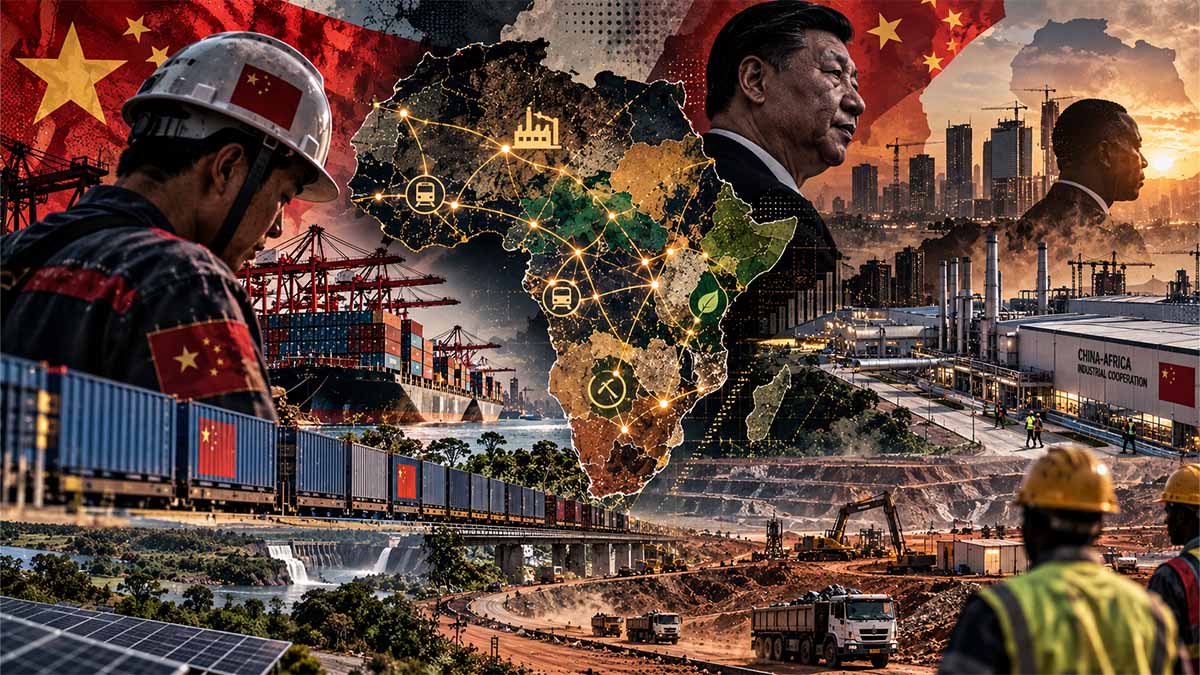
Strategic Assessment of Chinese Industrial Relocation, African Manufacturing Sovereignty, Technology Transfer, Supply-Chain Control and European Geoeconomic Interests, 2026–2035
Scope: A government-level assessment of Chinese manufacturing and processing investment across Africa, with particular attention to Kenya, Tanzania and East African industrial corridors, examining the evolution of the relationship through October 2026 and its consequences for African industrialisation, Chinese geoeconomic strategy, and the industrial and economic-security interests of the European Union, Italy, France, Germany and the United Kingdom through 2030–2035.
Executive Summary / Bottom Line Up Front
Principal assessment — Moderate-to-high confidence: China’s growing manufacturing presence in Africa represents a consequential diversification of its economic engagement, but the available evidence does not yet establish a continent-wide transition from extractive dependence to autonomous African industrial capacity.
The reported Rhodium Group comparison of $7.7 billion in manufacturing and processing investment against $4.8 billion in extractive activities indicates a substantial shift in the sectoral composition of the referenced investment transactions. Its interpretation depends on the underlying transaction definitions and project-completion status.
Chinese official statistics place bilateral merchandise trade at approximately $348.05 billion in 2025, an increase of 17.7%, while China’s exports to Africa grew considerably faster than imports from the continent. Expanding industrial investment therefore coexists with a widening merchandise trade imbalance.
Kenya and Tanzania have become important illustrations of Chinese manufacturing expansion, particularly in construction materials, textiles, industrial inputs and selected consumer industries. Official Tanzanian evidence confirms a substantial Chinese industrial presence, although registered investment values and associated employment estimates require reconciliation with actual operations.
Decisive strategic distinction: Foreign-owned factories located in Africa are not equivalent to African-controlled industrial capabilities. Sustainable transformation depends on locally retained engineering knowledge, management competence, supplier networks, productive assets and commercially viable higher-value exports.
China’s incentives combine market access, industrial cost pressures, production diversification and strategic supply-chain positioning. These motivations can support African industrialisation while simultaneously preserving Chinese control over technology, critical inputs, equipment and international distribution.
The European strategic interest is not simply to contest Chinese investment volumes, but to establish alternative and complementary industrial partnerships that increase African productive autonomy, diversify supply chains and reduce concentrations of technological and commercial dependence.
Decision requirement: African and European governments should assess investment success through verified operating capacity, domestic value added, workforce advancement, indigenous supplier participation and technology absorption—not announced capital expenditure or employment totals alone.
China Is Building Factories in Africa. But Who Will Own the Industrial Future?
Beijing’s manufacturing expansion is changing the economics of its relationship with Africa. For African governments and European industry, the decisive question is whether foreign investment will create independent productive capacity or deepen dependence on Chinese technology, finance and supply chains.
China’s industrial expansion in Africa is confronting governments with a costly contradiction: the continent can manufacture more without becoming substantially more industrially independent. Reported Chinese investment in African manufacturing and processing reached $7.7 billion in 2025, compared with $4.8 billion in extractive activities, yet the same year China recorded a $102.01 billion merchandise trade surplus with Africa. The figures expose the distance between attracting foreign factories and controlling the economic value they produce. African governments want employment, technological capabilities and higher-value exports. Beijing wants markets, industrial diversification and secure commercial relationships. Europe wants alternative suppliers and less concentrated strategic dependencies. None of these objectives is inherently incompatible. But the decisions now being made about industrial infrastructure, technology rights, financing and procurement will determine whether Africa acquires lasting productive capabilities or becomes an increasingly important manufacturing location within supply chains controlled elsewhere.
The investment figures reveal a shift, but the trade balance reveals its limits
The reported $7.7 billion in Chinese manufacturing and processing investment during 2025, against $4.8 billion in extraction, places manufacturing at approximately 61.6% of the combined value of those two categories. It suggests an important change in investment composition, although the figures require reconciliation with the underlying transaction definitions. Announced capital, completed investment and operational industrial assets are not interchangeable. Rhodium Group’s February 2026 assessment recorded $124 billion in newly announced Chinese outward direct-investment transactions worldwide during 2025, against $73 billion in completed transactions. Those figures describe different transaction populations rather than a project-completion rate, but they illustrate the distance that can separate investment intentions from capital actually deployed. China’s Global Investment Grew in 2025, But Exports Outpaced Offshoring — Rhodium Group — February 2026.
The commercial imbalance is more revealing. China–Africa merchandise trade reached approximately $348.05 billion in 2025, increasing 17.7% year on year. Chinese exports accounted for $225.03 billion, rising 25.8%, while imports from Africa totalled $123.02 billion, increasing only 5.4%. China consequently sold approximately $1.83 in merchandise to Africa for every dollar it imported. These figures do not establish that individual Chinese-owned African factories have failed to develop local suppliers. They demonstrate, however, that expanding industrial investment coexists with a bilateral trading relationship still strongly weighted towards Chinese exports.
Kenya and Tanzania illustrate both the attraction of the new model and the difficulties of measuring it. Kenya is associated with more than 350 Chinese companies and approximately $11 billion in declared projects, reportedly concentrated increasingly in manufacturing. Tanzania has been associated with approximately $12.5 billion in Chinese commitments since 2017, with manufacturing accounting for roughly two-thirds and around 150,000 associated jobs. These reference figures cannot be treated as completed investment or realised employment without project-level verification. Tanzania’s Vice President’s Office reported a separate historical measure of approximately $11.4 billion in cumulative Chinese project values between 1997 and February 2024. Differing periods and definitions prevent a direct statistical comparison. China–Tanzania Investment Forum Remarks — Vice President’s Office, United Republic of Tanzania — March 2024.
The distinction carries political consequences. A government can announce billions in industrial investment while possessing limited evidence of actual production, indigenous supplier participation or domestic technological learning. The immediate beneficiaries may be foreign investors, construction contractors and selected employees; the wider development return depends on what happens after the factory begins operating.
The factory may move to Africa while industrial control remains in China
China’s September 2024 Forum on China–Africa Cooperation Beijing Action Plan for 2025–2027 made industrial cooperation an explicit governmental priority. Beijing committed to supporting ten industrial-park projects, organising 100 industrialisation training sessions, conducting 50 SME matchmaking activities and providing 1,000 management-training opportunities. The programme also envisages deeper critical-mineral processing and greater cooperation in industrial value chains. It is a more extensive policy proposition than financing infrastructure to facilitate commodity exports, although these commitments do not establish that the promised industrial capabilities have been delivered. Forum on China–Africa Cooperation Beijing Action Plan (2025–2027) — Ministry of Foreign Affairs of China — September 2024.
The decisive issue lies inside the production process. A factory assembling equipment from imported components may generate employment and domestic manufacturing output while remaining dependent on Chinese machinery, software, intermediate goods and technical management. A mineral-processing facility may increase the export value of African resources without transferring the technology required to refine those materials independently. A joint venture may include African shareholders while leaving procurement, product design and customer relationships under foreign control. Manufacturing location and industrial authority are different economic variables.
This is where the investment model becomes politically sensitive. The Ethiopian experience examined in the 2019 study Chinese Manufacturing Investments and Knowledge Transfer demonstrated the importance of local industrial conditions and manufacturing clusters in determining whether foreign production generates knowledge beyond the investor’s own enterprise. Technology transfer is not established by importing sophisticated machinery or organising training sessions. It becomes economically meaningful when domestic engineers can maintain and adapt equipment, local firms manufacture components to competitive standards and African managers exercise genuine production and commercial authority. Chinese Manufacturing Investments and Knowledge Transfer: A Report from Ethiopia — China Africa Research Initiative and South African Institute of International Affairs — March 2019.
The commercial incentives are not necessarily aligned. Chinese manufacturers may prefer established suppliers able to deliver components at predictable prices, while African governments seek to develop domestic production even where local firms initially face higher costs. Reconciling those interests requires investment in technical certification, equipment finance, engineering education and reliable industrial services. Mandatory local-content provisions alone cannot manufacture competitive suppliers.
Electricity and public finance will determine who can compete
Africa’s industrial constraints create an important asymmetry between foreign-owned factories and domestic manufacturers. A large Chinese enterprise may finance dedicated electricity infrastructure, import machinery through established logistics networks and obtain working capital from its parent company. An African supplier operating outside the industrial park may face electricity interruptions, expensive commercial credit and unreliable transport. Both firms operate within the same national economy, but not under equivalent production conditions.
The World Bank’s 2025 research found that 72.1% of surveyed firms in sub-Saharan Africa experienced electricity outages, while 51.1% owned or shared generators and 39.2% regarded electricity as a major or very severe business obstacle. These figures combine survey observations from different years rather than representing a single-year industrial census. They nevertheless identify a structural disadvantage with direct consequences for manufacturing costs, equipment utilisation and delivery reliability. Defying Outages: The Struggles and Strategies of Businesses Facing Unreliable Electricity — World Bank — 2025.
The financial question for African governments is therefore sharper than whether a foreign investor deserves tax incentives. It is whether public expenditure on electricity, transport and industrial infrastructure produces benefits extending beyond the individual factory. A dedicated power connection may improve the profitability of one large manufacturer; a more reliable industrial grid can improve the competitiveness of hundreds of potential suppliers. Similarly, an industrial park may attract foreign capital without creating substantial domestic value if surrounding businesses cannot obtain credit, certification or access to procurement contracts.
The International Energy Agency reported in 2025 that South Africa and North Africa together accounted for more than 65% of the continent’s installed electricity-generating capacity and over 45% of African energy investment, despite representing less than one-fifth of its population. This concentration complicates continent-wide industrial strategies: some locations can support energy-intensive refining and industrial materials, while others require substantial infrastructure investment before comparable activities become commercially viable. World Energy Investment 2025: Africa — International Energy Agency — 2025.
Industrial policy consequently encounters a fiscal limit. Public authorities cannot assume that every proposed factory justifies new electricity networks, transport infrastructure and preferential financing. The appropriate test is whether the combined public cost creates lasting productive capacity, tax revenue and competitive domestic enterprises rather than merely subsidising foreign-controlled production.
Europe wants African minerals, but its security depends on processing
Europe’s response to China’s industrial expansion is constrained by a contradiction within its own economic-security policy. European governments want diversified access to critical materials, but African governments increasingly want processing, manufacturing and higher-value economic activity to remain within their territories. Securing raw-material imports without supporting commercially viable African industrial upgrading risks preserving the very relationship African policymakers are seeking to change.
The European Union’s Regulation (EU) 2024/1252, the Critical Raw Materials Act, establishes 2030 benchmarks for domestic capacity equivalent to at least 10% of annual EU strategic raw-material consumption in extraction, 40% in processing and 25% in recycling. It also sets a diversification benchmark limiting dependence on a single third country to 65% at a relevant processing stage for each strategic raw material. These benchmarks show that Europe’s concern is not simply access to mineral deposits. It is the concentration of the industrial processes that transform resources into usable inputs. Critical Raw Materials Act — European Commission — 2024.
The distinction matters because refining capacity located in Africa does not necessarily diversify technological control. An African processing plant dependent upon proprietary foreign equipment, imported chemicals, external financing and a single international purchasing network may change the geographical origin of industrial output without substantially reducing concentrated dependencies. European industrial-security policy must therefore examine ownership, technology, suppliers and contractual control alongside customs origin.
Brussels possesses financing instruments intended to influence this outcome. The Africa–Europe Global Gateway Investment Package identifies approximately €150 billion in intended investment mobilisation, while the European Commission selected thirteen strategic raw-material projects outside the EU in June 2025 under the Critical Raw Materials Act. Neither the programme ambition nor strategic-project designation establishes that the associated industrial assets are already operating. Their significance is institutional: Europe has mechanisms capable of connecting infrastructure finance, productive investment and strategic supply diversification, but their effectiveness will depend on completed projects and measurable industrial results. EU–Africa Global Gateway Investment Package — European Commission; Strategic Projects under the Critical Raw Materials Act — European Commission — 2026.
The competitive question is not whether Europe can outspend China across Africa. It is whether European-financed processing, logistics and industrial projects can create commercially dependable supply chains while offering African partners stronger domestic participation in productive value.
Rome, Paris, Berlin and London are financing different parts of the same problem
Italy’s Piano Mattei, established under Decree-Law No. 161 of 15 November 2023, provides a governmental framework covering investment, energy, infrastructure, training and economic cooperation with African countries. Its geographical scope expanded from nine initial partner countries to fourteen by January 2025, including Kenya and Tanzania. For Rome, the industrial relevance lies in connecting energy and infrastructure cooperation with demand for machinery, engineering, automation, water technologies and manufacturing services. The weakness would be to treat the delivery of infrastructure as evidence of industrial transformation without measuring the productive activity it enables. Decree-Law No. 161 of 15 November 2023 — Italian Republic.
France’s approach operates more directly through enterprise finance. The AFD Group’s Choose Africa initiative mobilised nearly €3.5 billion during its 2018–2022 first phase to support more than 40,000 African startups, microenterprises and SMEs. Germany’s DEG reported €592 million in 2025 new commitments for Africa and the Middle East combined. These figures measure different financing activities, not comparable manufacturing-investment flows. Their industrial importance depends on whether finance reaches African enterprises capable of acquiring equipment, achieving certification and entering supplier contracts rather than remaining concentrated in trading and conventional services. Choose Africa — Proparco; New Commitments from Own Funds, 2025 — DEG.
The United Kingdom approaches the same problem through development finance and critical-materials security. British International Investment recorded approximately £1.071 billion in African commitments during 2025, while its worldwide manufacturing commitments totalled approximately £75.7 million. Its November 2025 Vision 2035: Critical Minerals Strategy introduced ambitions for domestic production, recycling and reduced supplier concentration. The industrial challenge for London resembles that confronting Brussels: diversified sourcing is not necessarily diversified control, and financing infrastructure does not automatically create the processing or manufacturing capabilities required by strategic industries. British International Investment Annual Review 2025; Vision 2035: Critical Minerals Strategy — UK Department for Business and Trade — November 2025.
The European instruments are therefore complementary but not interchangeable. Italy can contribute industrial engineering and infrastructure partnerships; France can support African enterprise capitalisation; Germany can strengthen technical production and supplier qualification; Britain can mobilise private finance and commercial relationships. Their collective weakness would be to finance different parts of an industrial system without ensuring that the resulting factories, suppliers and markets operate together.
The next 24 months will expose the cost of measuring factories instead of capabilities
Between October 2026 and October 2028, the immediate test will be whether the investment programmes already announced acquire measurable operational substance. China’s FOCAC Beijing Action Plan reaches the end of its 2025–2027 implementation period during that interval. Governments will have an identifiable basis for assessing completed industrial projects, training programmes, supplier relationships and progress in mineral processing, rather than relying on the original diplomatic commitments.
The costs of inaction will not be distributed equally. African finance ministries will bear the fiscal consequences of industrial infrastructure and incentives that fail to generate sufficient productive returns. Domestic manufacturers will bear the competitive cost where foreign factories obtain reliable utilities and financing while local suppliers remain excluded. Workers may gain employment without acquiring transferable technical skills. European manufacturers will bear the commercial consequences if alternative African production locations continue to depend upon concentrated foreign processing technologies, equipment and purchasing networks.
The comparison between the reported $7.7 billion in Chinese manufacturing and processing investment and $4.8 billion in extraction during 2025 will remain economically incomplete until the underlying projects are reconciled with actual capital expenditure, operating capacity, domestic value added and technical capability. These are not secondary statistical details. They determine whether the apparent sectoral shift represents an enlargement of African industrial power or an extension of foreign-controlled production systems onto African territory.
Over the next 12–24 months, the most consequential governmental decision will therefore concern the conditions attached to new investment and the evaluation of projects already operating. Governments that continue to measure success principally through announced capital will retain little evidence of what public incentives have purchased. Governments that connect financing, industrial infrastructure and procurement to verified productive outcomes will have a stronger basis for negotiating with Chinese, European and other investors.
Africa’s industrial future will not be determined by how many factories foreign companies establish. It will be determined by how much of their productive knowledge, commercial value and operational authority African economies can retain when the original investors change their priorities.
Navigational Index
The dossier is organised into exactly three thematic pillars, preserving all six mandatory analytical areas and separating empirical assessment, industrial-capability mechanisms and governmental strategic decisions.
PILLAR I — STRUCTURAL TRANSFORMATION AND INVESTMENT GEOGRAPHY
The Reconfiguration of China’s Economic Presence in Africa
Chapter 1 — Nature and Scale of the Manufacturing Shift
Investment magnitude, sectoral reallocation, China–Africa trade asymmetries, capital concentration, East African manufacturing corridors, Chinese ownership structures, operational capacity, export orientation and the distinction between processing investment and industrial upgrading.
Chapter 2 — Geoeconomic Drivers and Enabling Conditions
China’s industrial restructuring, production costs, overcapacity, trade-policy pressures, export-market diversification, African labour markets, energy infrastructure, special economic zones, industrial demand and regional integration.
PILLAR II — INDUSTRIAL CAPABILITY, TECHNOLOGICAL DEPENDENCE AND STRUCTURAL RISK
From Foreign Factory Investment to African Productive Sovereignty
Chapter 3 — Conditions for Technology Transfer and Industrial Capability Retention
Domestic value-added formation, workforce skills, technical and managerial localisation, local-content systems, supplier development, indigenous enterprise participation, technology absorption, productive financing and export competitiveness.
Chapter 4 — Structural Constraints, Industrial Enclaves and Dependency Mechanisms
Electricity prices and reliability, logistics, fragmented markets, regulatory risks, financial constraints, imported intermediate goods, foreign-controlled technology, industrial concentration and the risk of persistent low-value assembly.
PILLAR III — GEOSTRATEGIC CONSEQUENCES AND GOVERNMENTAL POLICY OPTIONS
Industrial Power, Supply-Chain Competition and the 2035 Strategic Outlook
Chapter 5 — Implications for Africa, China, Europe and External Partners
African industrial-policy choices; China’s strategic and economic returns; European supply-chain resilience; critical-minerals processing; the interests and instruments of Italy, France, Germany, the United Kingdom and the European Union; differentiated industrial partnerships; and bounded scenarios to 2030–2035.
Chapter 6 — Evidence Architecture, Intelligence Priorities and Final Strategic Assessment
Investment-flow triangulation, manufacturing-technology classification, firm-level capability indicators, cross-country comparisons, competing explanations, ten priority governmental intelligence questions, monitoring indicators, decision thresholds and final policy assessment.
Master Abstract
The Emergence of a Different Chinese Industrial Geography
China’s economic expansion into Africa is entering a phase in which manufacturing investment occupies a more visible position alongside the infrastructure construction, trade, lending and resource extraction that have historically shaped much of Beijing’s engagement with the continent. This change has significant potential consequences for African industrialisation, particularly where foreign manufacturers establish production facilities, employ domestic workers and connect local operations to international markets. Nevertheless, the central analytical issue is not whether Chinese firms are constructing additional factories, but whether those investments can generate industrial capabilities that remain economically useful and institutionally accessible to African economies beyond the decisions of their foreign owners.
The quantitative evidence supports a distinction between investment diversification and structural transformation. Rhodium Group’s February 2026 assessment found that Chinese international manufacturing investment remained elevated relative to its pre-pandemic pattern, while international production continued to represent a smaller component of China’s global commercial strategy than exports. Its transaction database recorded $124 billion of newly announced Chinese foreign direct investment worldwide in 2025, compared with $73 billion in completed transactions. The difference demonstrates why commitments cannot be interpreted as realised industrial capacity. The analysis also specifically warned that investment completion rates in Africa have historically been comparatively low. China’s Global Investment Grew in 2025, But Exports Outpaced Offshoring — Rhodium Group — February 2026
The figures supplied for the present assessment—$7.7 billion in manufacturing and processing compared with $4.8 billion in extractive investment, together with nearly $8 billion of Chinese manufacturing investment reported by 2025—therefore constitute important reference points, but not interchangeable statistical measurements. The first comparison concerns an attributed investment classification requiring examination of its transaction universe, while the second has been publicly described as a cumulative investment measure. These figures cannot be added together, nor can they independently establish the annual volume of completed and operating Chinese factories.
The Commercial Paradox: Growing Factory Investment Alongside a Widening Trade Imbalance
China’s official trade statistics reveal the scale of the commercial relationship and expose an important tension in the industrialisation thesis. Bilateral merchandise trade reached approximately $348.05 billion in 2025, increasing 17.7% from the preceding year. Chinese merchandise exports to Africa reached approximately $225.03 billion, growing 25.8%, while imports from African economies totalled approximately $123.02 billion, increasing 5.4%. The resulting merchandise surplus in China’s favour was approximately $102.01 billion. These values establish that the expansion of Chinese industrial investment has not, at the aggregate level, coincided with balanced growth in the two directions of merchandise trade. They do not, however, establish whether individual Chinese-owned factories in Africa have increased their domestic sourcing or export competitiveness. China–Africa Trade Statistics for 2025 — Ministry of Commerce, People’s Republic of China — April 2026
This distinction is fundamental to public policy. A factory assembling machinery from imported Chinese components may generate employment, domestic sales and some tax revenue without creating substantial indigenous technological expertise or competitive upstream suppliers. Conversely, a manufacturing investment with a smaller financial value may produce more durable development gains if it establishes engineering capabilities, domestic component production, independent maintenance competence and export relationships that African businesses can retain. The relevant unit of strategic assessment is therefore not the factory alone, but the surrounding industrial ecosystem and the distribution of productive knowledge within it.
East Africa as a Test of Industrial Capability Formation
Kenya and Tanzania offer particularly relevant settings in which to investigate the relationship between manufacturing investment and broader industrial development. The supplied reference figures identify more than 350 Chinese companies and approximately $11 billion in declared projects in Kenya, with manufacturing accounting for more than half of the reported investment activity. Tanzania is associated with approximately $12.5 billion in Chinese capital commitments since 2017, around two-thirds reportedly directed towards manufacturing, and roughly 150,000 associated jobs. These figures require confirmation against the underlying national investment-register extracts before they can be treated as harmonised measures of completed FDI or realised employment.
A Tanzanian governmental record provides a useful independent historical benchmark. In remarks dated 27 March 2024, the country’s Vice President reported approximately $11.4 billion in cumulative Chinese investment project values covering 1997 to February 2024, alongside 256 projects registered between January 2021 and December 2023 valued at approximately $2.4 billion. Manufacturing, including ceramics, glass and metal products, featured among the identified investment activities. The record also reported different employment measures for different project populations, illustrating the need to distinguish cumulative registered projects, expected employment and observed workforce totals. Remarks at the China–Tanzania Investment Forum — Vice President’s Office, United Republic of Tanzania — March 2024, particularly pages 2–3.
The potential regional significance of these industrial locations extends beyond their national markets. The African Continental Free Trade Area provides a treaty framework for deeper continental trade integration, while the East African Community supplies an existing regional institutional architecture. However, neither the existence of trade agreements nor the geographic proximity of factories guarantees viable regional production networks. Rules of origin, customs administration, transport costs, standards recognition and commercial demand determine whether production can circulate competitively across borders. African Continental Free Trade Area Agreement — East African Community
China’s Strategic Incentives and the Limits of Industrial Relocation
For China, manufacturing investment in Africa should be interpreted within a wider adjustment of international production strategies rather than as an unconditional transfer of industrial capacity away from the Chinese mainland. Firms may seek lower-cost labour, growing consumer markets, regional distribution opportunities or a degree of insulation from changing trade barriers. At the same time, China’s domestic manufacturing system continues to offer industrial scale, integrated suppliers, technical depth and infrastructure that many overseas production locations cannot replicate. This creates an incentive to internationalise selected downstream processes while retaining sophisticated machinery, components, research functions and corporate decision-making within Chinese-controlled networks.
The resulting model may prove commercially rational for Chinese investors while delivering only limited structural upgrading in host economies. Its industrial-development value depends on the depth of localisation and the ability of African enterprises and institutions to absorb knowledge and enter supplier relationships on competitive terms. Government policy therefore matters most where it directly changes firm incentives: predictable industrial regulation, reliable power, vocational and engineering education, supplier finance, enforceable performance requirements and credible access to regional and overseas markets.
Africa’s Industrialisation Challenge and the European Strategic Dimension
The latest UN Trade and Development assessment reinforces the need to separate investment recovery from development outcomes. UNCTAD reported approximately $70 billion in African FDI inflows during 2025, below the exceptional level of the preceding year but still substantially above the continent’s longer-term average. Its World Investment Report 2026 emphasises the concentration of international investment and the importance of determining whether inflows generate productive capacity, employment, skills and technology. World Investment Report 2026 — UN Trade and Development — July 2026
For European governments, the implications extend beyond competition for individual projects. Chinese-owned processing plants, component factories and industrial parks may become significant nodes within supply chains connecting African mineral resources, regional consumer demand and international manufactured-goods markets. This could offer opportunities for European firms seeking diversified production bases, but could also reinforce dependencies where processing equipment, industrial software, financing, technical standards and export distribution remain concentrated in Chinese-controlled systems.
Italy, France, Germany and the United Kingdom consequently require differentiated assessments reflecting their respective industrial strengths, African commercial relationships, investment institutions and technological exposures. At European Union level, the strategic problem concerns the design of partnerships that support African industrial upgrading while maintaining competitive, reliable and diversified access to industrial inputs. The appropriate policy response cannot be reduced to replacing Chinese capital with European capital. It requires investment arrangements under which host economies acquire measurable capabilities and external partners gain durable commercial relationships rather than merely alternative sites of low-cost production.
The governing judgment is that Chinese manufacturing investment can become an instrument of African industrial transformation, but neither its nationality nor its volume guarantees that result. The decisive variable through 2035 will be the ability of African states to convert foreign-owned production into domestically embedded technical knowledge, competitive suppliers, higher-value exports and institutions capable of sustaining industrial activity independently of any single external investor.
Key Evidence Table
The following table separates the user’s quantitative reference points from figures supported by opened official or institutional records. Confidence concerns the stated measurement, not the broader proposition that investment has caused industrial transformation.
| Indicator | Value/status | Reference date | Definition/scope | Issuer and confidence | Exact source |
|---|---|---|---|---|---|
| Chinese manufacturing and processing versus extraction | $7.7bn versus $4.8bn | Reported 2025 comparison | Attributed investment transactions; classification and completion coverage require reconciliation | Rhodium-attributed; provisional | Underlying sectoral extract required; Rhodium Group, February 2026 provides broader investment context |
| Chinese cumulative manufacturing investment in Africa | Nearly $8bn; reportedly more than 50% above 2016 | By 2025 | Reported cumulative investment; stock, historical-cost and industry definitions require reconciliation | Chinese Ministry of Commerce attribution; provisional | 2025 Statistical Bulletin of China’s Outward Foreign Direct Investment — MOFCOM, NBS and SAFE — September 2026; specific African manufacturing series not established in the opened release |
| China–Africa merchandise trade | $348.05bn; +17.7% | 2025 | Bilateral goods exports plus imports | Chinese official customs statistics; high | MOFCOM trade statistics — April 2026 |
| Chinese exports to Africa | $225.03bn; +25.8% | 2025 | Chinese merchandise exports | Chinese official customs statistics; high | Same MOFCOM trade record |
| Chinese imports from Africa | $123.02bn; +5.4% | 2025 | Chinese merchandise imports | Chinese official customs statistics; high | Same MOFCOM trade record |
| Kenya’s Chinese investment presence | More than 350 companies; $11bn in declared projects | Reported by October 2026 | Company presence and declared investment values; operating and realised values not reconciled | Kenya Investment Authority attribution; provisional | Underlying national project register required |
| Tanzania’s recent Chinese capital commitments | $12.5bn since 2017; approximately two-thirds in manufacturing | Reported by October 2026 | Reported commitments, not demonstrated disbursements | Tanzania investment authority attribution; provisional | Underlying dated project register required |
| Tanzanian historical Chinese investment-project values | Approximately $11.4bn | 1997–February 2024 | Cumulative official reported investment-project values | Tanzanian Vice President’s Office; high confidence in attribution | Official China–Tanzania Investment Forum Remarks — March 2024, pp. 2–3 |
| Chinese worldwide announced versus completed FDI | $124bn announced; $73bn completed | 2025 | Rhodium transaction-tracking methodology; global, not Africa-only | Rhodium Group; high confidence in attribution, methodology-dependent | Rhodium Group — February 2026 |
| Total FDI inflows into Africa | Approximately $70bn | 2025 | All foreign origins and sectors; net inflow measure | UNCTAD; high | World Investment Report 2026 — UNCTAD — July 2026 |
All dollar values are nominal US dollars as reported. The figures cover different periods and statistical populations; they are not additive. High confidence in an attributed official figure does not imply independent confirmation of every underlying project or estimated job.
Competing Explanations and Strategic Pathways
Three explanations can account for the observed evolution. They are not mutually exclusive; their relative importance may differ across sectors, firms and host economies.
| Hypothesis | Diagnostic support | Disconfirming evidence or limitation | Indicators to 2030–2035 | Current standing |
|---|---|---|---|---|
| H1 — Structural industrial relocation | Growing manufacturing investment, identifiable production projects and African market-access incentives | Chinese domestic industrial investment and exports continue to dominate global expansion | Sustained completed factories, rising locally sourced components and diversified manufactured exports | Plausible in selected sectors; not established continent-wide |
| H2 — Selective internationalisation of Chinese value chains | Foreign manufacturing investment coexists with continued Chinese dominance in exports and technology-intensive production | Greater local supplier independence would weaken the dependency interpretation | Imported-input ratios, equipment ownership, management localisation and foreign-parent procurement control | Strongest current interpretation |
| H3 — African capability-led industrial upgrading | Emerging industrial clusters and opportunities under regional trade integration | No comparable verified cross-country dataset yet demonstrates broad capability transfer | Domestic value added, indigenous supplier upgrading, engineering skills and sustained export competitiveness | Conditional opportunity rather than demonstrated general outcome |
Comparative assessment: H2 currently offers the strongest explanation of the combination of increasing international manufacturing activity and China’s continued domestic industrial concentration. H1 is credible as a sector-specific development, while H3 describes an achievable but institutionally demanding outcome. Evidence that African-owned firms are progressively acquiring production technologies, supplier contracts and higher-value export capabilities would materially increase confidence in H3.
Preliminary 2030–2035 Scenario Framework
These are conditional strategic scenarios, not probability-weighted forecasts. The present evidence does not justify assigning numerical probabilities or projecting continent-wide investment and employment totals.
| Scenario | Industrial trajectory | African capability outcome | Strategic implications |
|---|---|---|---|
| Baseline continuation | More Chinese-owned manufacturing sites, unevenly concentrated in established corridors | Employment and production gains with partial local sourcing and limited technical autonomy | Stronger China–Africa industrial integration; persistent foreign-input dependence |
| Accelerated capability capture | Industrial clusters deepen through coordinated infrastructure, training and supplier development | More indigenous suppliers, technical management, component production and higher-value exports | Greater African bargaining power and more diversified partnerships with China and Europe |
| Persistent enclave outcome | Foreign-controlled factories expand without substantial domestic industrial integration | Limited spillovers, imported-input dependence, low-value operations and vulnerable employment | Continued structural dependence despite higher apparent manufacturing investment |
Principal Intelligence Gaps and Watch Indicators
The most consequential intelligence requirement is to establish what proportion of publicly announced Chinese manufacturing investment has actually entered commercial operation and how much of the resulting production value is retained by host economies. This requires reconciling national investment registrations, audited company disclosures, customs records and direct factory-level observations.
A second priority is the composition of production. Rising factory output may reflect expanding domestic manufacturing capabilities, but it may also result from importing increasingly large quantities of Chinese machinery and intermediate products for final assembly. Material evidence of industrial deepening would include domestic component manufacturing, locally managed quality-control systems, expanding industrial engineering employment and the successful entry of independent African companies into international supply chains.
A third requirement concerns the conditions that make industrial localisation commercially sustainable. Electricity tariffs, outage frequency, logistics costs, customs clearance performance, access to industrial credit and regional rules-of-origin compliance must be compared across actual manufacturing locations rather than inferred from national investment-promotion claims.
Finally, European economic-security institutions require a more precise understanding of control relationships within emerging African industrial clusters, particularly in critical-minerals processing and strategically relevant intermediate goods. Formal factory ownership is only one dimension of control. Financing arrangements, equipment servicing rights, industrial software, licensing terms, procurement contracts and export channels may determine whether operational decision-making remains concentrated outside Africa.
The priority monitoring framework should therefore track four developments simultaneously: operational investment conversion, domestic value-added retention, technological and managerial localisation, and the diversification of export and supplier relationships. Together, these observations offer a more reliable measure of industrial transformation than the growth of registered projects alone.
No decision-useful visualisation is supportable from the verified record.
The central governmental decision is whether African states can build the institutional capacity required to capture a larger and more technically sophisticated share of manufacturing value as Chinese firms internationalise. The longer-term strategic outcome will be determined less by the headline volume of Chinese capital than by the contractual, regulatory, infrastructural and educational conditions under which that capital operates.
The detailed empirical assessment begins under Pillar I, Chapter 1, where the investment figures, industry classifications, country-level concentrations, ownership models and operational-status distinctions will be examined individually.
CHINA’S MANUFACTURING SHIFT IN AFRICA
Industrial transformation or a new architecture of economic dependence? A strategic evidence dashboard examining Chinese industrial investment, African capability transfer, trade asymmetries and the governmental outlook to 2035.
Investment growth is not equivalent to industrial sovereignty
China’s expanding manufacturing presence is an important diversification of its economic engagement with Africa. However, manufacturing investment alone does not establish durable local technological capabilities, domestic industrial ownership or independent supply-chain competitiveness. The decisive outcomes are retained value added, engineering skills, indigenous supplier development and higher-value exports.
Investment signals and verified bilateral trade
*The $7.7bn and $4.8bn investment amounts are user-supplied, Rhodium-attributed reference figures. Their original sectoral transaction extract and completion definitions require reconciliation. They are not verified operational FDI flows. Trade figures are official Chinese merchandise statistics.
Manufacturing and processing versus extraction
The reported comparison indicates stronger investment activity in manufacturing and processing than extraction within the attributed transaction universe. This is a sectoral comparison, not proof of a completed continent-wide economic transformation.
Reported Chinese sector investment — US$ billion
Linear scale: 0–9 US$ billion. Bars compare the two reported sector categories only. Manufacturing is approximately 1.60 times extraction within this comparison. The +60.4% difference is calculated from the supplied figures; it is not an annual growth rate.
The $348 billion trade relationship
2025 trade flows
Linear scale: 0–250 US$ billion. Goods trade, 2025. Figures from the Chinese Ministry of Commerce.
Growth divergence
Linear scale: 0–30% year-on-year growth. The difference is 20.4 percentage points.
China’s expanding industrial investment in Africa has coincided with much faster growth in Chinese goods exports to the continent than imports from it. The trade imbalance does not establish the performance of individual factories, but it challenges the assumption that manufacturing investment automatically produces balanced industrial exchange.
Kenya and Tanzania: investment concentration signals
Kenya
Reported declared Chinese project values. More than 350 Chinese companies are reported as present, with over half of declared project investment associated with manufacturing.
Tanzania
Reported Chinese capital commitments since 2017. Approximately two-thirds are attributed to manufacturing, with around 150,000 associated jobs. Actual disbursement, operational status and realised employment remain unreconciled.
Official Tanzanian historical benchmark
Approximate cumulative Chinese investment project values reported by the Tanzanian Vice President’s Office for 1997–February 2024. This is a different period and project population from the reported $12.5bn post-2017 figure. The two amounts cannot be used as a comparable growth series.
How investment can generate production without technological autonomy
The following qualitative scheme illustrates the central causal risk. It represents a possible supply-chain model, not the verified structure of every Chinese-owned factory.
Machinery and components
Technical know-how
Parent-company procurement
Assembly and processing
Domestic infrastructure use
Industrial output
Regional exports
Overseas sales
Foreign or local value retention
High dependence on imported equipment and intermediate inputs.
Limited domestic technical management and supplier upgrading.
Foreign concentration of technology and commercial control.
Employment growth without proportionate capability retention.
Growing African component and intermediate-goods production.
Locally acquired engineering and maintenance expertise.
Independent domestic suppliers with competitive contracts.
Higher domestic value added and more diversified exports.
Distinguishing capital, output and capability transfer
Evidence quality is assessment-specific. A credible announcement may support confidence that a project was declared without demonstrating that it has begun production or transferred technology.
| Measurement | What it establishes | What it does not establish | Priority verifying record |
|---|---|---|---|
| Registered investment | A project has been recorded or approved | Capital disbursement or operational output | Investment register and audited accounts |
| Completed capital expenditure | Assets have been financed or acquired | Commercially viable manufacturing | Audited capex and facility inspection |
| Factory employment | Jobs supported at a stated date | Technical upgrading or sustained productivity | Payroll, occupational and training data |
| Domestic value added | Value generated within the host economy | Independent domestic technology ownership | Input-output data and company accounts |
| Technology and skills transfer | Locally retained technical capability | Broad economy-wide spillovers by itself | Workforce, licensing and supplier evidence |
| Manufactured exports | External market participation | High local content or export profitability | Customs data, rules of origin and cost records |
Differentiated governmental policy lenses
| Jurisdiction | Strategic policy focus | Priority governmental question |
|---|---|---|
| European Union | Supply-chain resilience, industrial partnerships, market access and critical raw materials | Can EU financing support African processing with measurable local industrial value? |
| Italy | Industrial equipment, manufacturing partnerships, infrastructure and African commercial integration | Which value chains offer mutually beneficial supplier and technology partnerships? |
| France | Industrial technology, energy, investment financing and African production networks | Where can partnerships develop independently viable production ecosystems? |
| Germany | Machinery, industrial standards, engineering skills and supply-chain diversification | How can African suppliers qualify for higher-value industrial contracts? |
| United Kingdom | Investment finance, services, commodity processing and industrial trade | How can financial and commercial structures promote local capability retention? |
These are analytical policy lenses, not claims that the listed governments have adopted specific new programmes.
Three conditional industrial futures: 2030–2035
The scenarios describe possible trajectories and their observable conditions. No probabilities, growth forecasts, project counts or quantified outcomes are assigned.
Scenario I
Baseline Continuation
Chinese manufacturing facilities continue expanding selectively in established corridors.
Employment and output increase, but local sourcing and engineering autonomy progress unevenly.
Scenario II
Accelerated Capability Capture
Coordinated industrial policies improve infrastructure, skills, supplier finance and domestic component production.
African firms gain more technical and managerial capabilities, while exports become more diversified.
Scenario III
Persistent Industrial Enclaves
Factories expand while crucial inputs, technology, financing and export channels remain externally controlled.
Weak supplier linkages and high infrastructure costs limit lasting spillovers.
Decisive evidence to monitor through 2035
| Priority indicator | Evidence required | Analytical purpose |
|---|---|---|
| Actual versus announced investment | Projects commissioned; audited investment and output | Measure investment conversion |
| Domestic value added | Domestic input costs relative to total production value | Measure local value retention |
| Industrial technology transfer | Engineering localisation and independently usable know-how | Identify substantive capability capture |
| Domestic supplier integration | Verified contracts and local procurement shares | Measure industrial linkages |
| Energy competitiveness | Delivered electricity cost and outage experience | Identify binding production constraints |
| Export diversification | Export destinations, products and domestic content | Assess genuine market competitiveness |
| Foreign technology dependency | Equipment, software, licensing and service control | Identify strategic production dependencies |
| Industrial policy effectiveness | Comparable firm-level outcomes across countries | Test which institutions improve localisation |
Three analytical pillars
Industrial Reconfiguration
Investment geography, manufacturing sectors, industrial ownership, production models, and the drivers of Chinese relocation.
Capability and Dependency
Technology transfer, supplier development, value-added retention, workforce advancement, industrial constraints and enclave risks.
Governmental Strategy
African industrial policy, Chinese geoeconomic positioning, European interests, strategic scenarios and intelligence priorities.
Source documentation
Direct sources are distinguished from attributed reference figures. The investment comparison and national project totals require further reconciliation with underlying datasets. No confidence rating in this dashboard implies verification of technology transfer.
- China–Africa Trade Statistics for 2025 — Ministry of Commerce, People’s Republic of China — April 2026 . Official bilateral merchandise trade figures.
- China’s Global Investment Grew in 2025, But Exports Outpaced Offshoring — Rhodium Group — February 2026 . Transaction-tracking context and announced/completed investment distinctions.
- Remarks at the China–Tanzania Investment Forum — Vice President’s Office, Tanzania — March 2024 . Official project-value benchmark, particularly pages 2–3.
- World Investment Report 2026 — UNCTAD — July 2026 . International investment context.
- African Continental Free Trade Area Agreement — East African Community . Regional trade integration framework.
ACADEMIC GOVERNANCE EDITION V10-1 | GOVERNMENTAL GEOECONOMIC AND INDUSTRIAL INTELLIGENCE ASSESSMENT
PILLAR I — STRUCTURAL TRANSFORMATION AND INVESTMENT GEOGRAPHY
The Reconfiguration of China’s Economic Presence in Africa
Assessment cut-off: 24 October 2026
Chapter 1 — Nature and Scale of the Manufacturing Shift
The Transition from Infrastructure and Extraction to Manufacturing: A Structural Reconfiguration, Not Yet an Industrial Revolution
The most consequential development in China’s contemporary economic relationship with Africa is not simply the increasing visibility of Chinese-owned factories across the continent, but the gradual transformation of the commercial mechanisms through which Chinese enterprises establish an economic presence, organise production, obtain access to resources and markets, and participate in African industrial development. For much of the preceding two decades, the international perception of Beijing’s African economic strategy was principally associated with the financing and construction of railways, ports, highways, power stations, telecommunications systems and extractive infrastructure, frequently accompanied by the export of Chinese machinery, engineering services and construction materials. That model has not disappeared. Rather, it is increasingly operating alongside investments in manufacturing, mineral processing, construction materials, industrial components, pharmaceuticals, textiles and selected consumer products, creating a more complex relationship between infrastructure provision, domestic African production and China’s own industrial supply chains.
The principal judgment of this chapter is that Chinese industrial investment in Africa is diversifying in a strategically significant manner, but available evidence supports a selective restructuring of production networks more strongly than it supports the proposition that China is transferring substantial autonomous manufacturing capacity to African economies. The difference is fundamental. Investment in a factory changes the geographical location of a production activity, but it does not necessarily change the location of technological decision-making, intellectual property ownership, procurement authority, industrial design, financial control or the distribution of profits. A Chinese-controlled processing facility established in Africa may create employment and increase recorded manufacturing output while remaining heavily dependent on imported equipment, specialised components, foreign technical management and external distribution networks. Alternatively, similar investment can become the foundation of a lasting industrial ecosystem when production stimulates domestic supplier development, engineering training, maintenance services, industrial financing and independent African participation in higher-value activities.
The distinction between these outcomes is especially important because the emerging investment pattern is not taking place within an otherwise static international economy. Chinese manufacturers are responding to domestic competitive pressures, evolving international trade restrictions and the need to develop new markets, while African governments are attempting to expand formal employment, reduce reliance on imported manufactured goods and retain more economic value from domestic resources. These objectives can reinforce one another, but they are not identical. Chinese enterprises seek commercially viable production systems and reliable market access; African governments seek industrial employment, productivity growth, fiscal revenue and technological advancement. The central policy challenge is therefore to identify the specific circumstances under which private investment decisions and national industrial-development objectives converge, rather than treating every new manufacturing commitment as evidence of structural transformation.
The formal political framework for this transition became substantially more explicit during the September 2024 Beijing summit of the Forum on China–Africa Cooperation. The resulting FOCAC Beijing Action Plan (2025–2027) placed manufacturing, industrial-chain cooperation, critical-mineral processing, industrial parks, small and medium-sized enterprises, training and technology transfer within a coordinated governmental programme. The Chinese side committed to supporting African local value chains and deeper critical-mineral processing, establishing industrial cooperation mechanisms across five African regions, supporting ten industrial-park projects, conducting 100 industrialisation training sessions, organising 50 SME matchmaking activities and providing 1,000 management-training opportunities. These commitments demonstrate the declared direction of policy, although they remain distinct from independently verified factory completions, effective technology transfers or measurable improvements in African industrial productivity. Forum on China–Africa Cooperation Beijing Action Plan (2025–2027) — Ministry of Foreign Affairs of the People’s Republic of China — September 2024, particularly sections 2.2.3, 5.2 and 7.1.
A significant analytical consequence follows from this framework. China is not merely considering isolated factory investments as alternatives to infrastructure construction; its published cooperation architecture expressly connects industrial parks, transport infrastructure, electricity, SME development, industrial finance, mineral processing and market access. Such integration can reduce the coordination failures that often obstruct manufacturing investment. It can also establish enduring relationships between Chinese financiers, contractors, industrial-park developers, manufacturers and logistics operators. Whether these relationships become instruments of African industrial upgrading or reinforce externally controlled production networks depends on their ownership arrangements, procurement systems and operational practices, which cannot be established from diplomatic commitments alone.
Quantifying the Sectoral Shift: The Difference Between Reported Capital and Realised Industrial Production
The publicly reported comparison of $7.7 billion in Chinese manufacturing and processing investment against $4.8 billion in extractive investment during 2025 provides a useful initial indication of the changing composition of Chinese economic engagement. Taken strictly within the stated investment categories, manufacturing and processing represent approximately 61.6% of their combined $12.5 billion value, compared with 38.4% for extractive activities. Manufacturing and processing exceed extraction by $2.9 billion, equivalent to approximately 60.4% of the reported extraction value.
These calculations are arithmetically straightforward, but their economic interpretation requires considerably more caution. The figures are currently attributable to a reported investment comparison rather than a fully reconciled public table establishing identical treatment of announcements, completed projects, equity transactions, reinvested earnings and industrial classifications. The values should therefore be treated as provisional sectoral reference points, not as a validated total for Chinese annual FDI flows into Africa. In particular, their combined value must not be presented as comprehensive Chinese investment in Africa, and their relative proportions must not be extended to sectors excluded from the comparison, such as services, telecommunications, infrastructure and commercial real estate.
A useful independent benchmark is provided by Rhodium Group’s China Cross-Border Monitor. In its assessment published on 4 February 2026, Rhodium recorded approximately $124 billion in newly announced Chinese outbound direct-investment transactions worldwide in 2025, compared with approximately $73 billion in completed investment transactions. The difference of $51 billion demonstrates the substantial divergence that can exist between the value of transactions announced during a calendar year and those completed during the same period, although the two totals are not a cohort-based project-conversion measure. Rhodium also reported that manufacturing investment abroad remained above pre-pandemic levels but had slowed for a second consecutive year, while China’s international expansion continued to be dominated by exports rather than wholesale industrial relocation. It specifically identified comparatively low historical completion rates among African investment announcements, a warning against interpreting newly declared capital as operational capacity. China’s Global Investment Grew in 2025, But Exports Outpaced Offshoring — Rhodium Group — February 2026.
The implications for assessing Chinese industrialisation projects in Africa are substantial. A registered investment of $500 million may refer to the anticipated cost of an industrial complex across multiple development phases; its actual initial disbursement may cover only land acquisition, essential infrastructure and one production line. A declared employment target may describe the full operational workforce expected several years after commissioning rather than workers already receiving wages. An installed annual production capacity may describe the engineering specification of equipment rather than actual production under existing electricity, supply, labour and market conditions. These distinctions determine whether governments are measuring industrial intentions, deployed capital, productive assets or genuine economic outcomes.
Investment Measurement and Comparability
| Indicator | Reported value | Reference period | Statistical meaning | Analytical confidence and limitation |
|---|---|---|---|---|
| Chinese manufacturing and processing investment in Africa | $7.7bn | Reported 2025 | Attributed sectoral investment transactions | Provisional; exact sector universe and transaction status require reconciliation |
| Chinese extractive investment in Africa | $4.8bn | Reported 2025 | Attributed extractive-sector transactions | Provisional; compatibility with the manufacturing series must be established |
| Manufacturing share of the two reported sectors | 61.6% | Reported 2025 | Calculated from $7.7bn divided by $12.5bn | High arithmetic confidence; limited to these two attributed categories |
| Chinese cumulative manufacturing investment in Africa | Nearly $8bn | By 2025 | Reported historical manufacturing investment measure | Exact stock definition and official series require reconciliation |
| Chinese worldwide newly announced FDI transactions | $124bn | 2025 | Rhodium transaction announcements | High confidence in source attribution; global, not African |
| Chinese worldwide completed FDI transactions | $73bn | 2025 | Rhodium completed-transaction dataset | High confidence in source attribution; not directly comparable to African sector totals |
| Total FDI inflows to Africa, all origins | Approximately $70bn | 2025 | UNCTAD net inward FDI flow | High confidence in institutional statistical series; includes all investor countries and sectors |
| Chinese FDI stock in Africa | $42bn | Reported for 2024 | Chinese investment position reported by UNCTAD | Institutional benchmark; not annual manufacturing investment |
Sources: China’s Global Investment Grew in 2025, But Exports Outpaced Offshoring — Rhodium Group — February 2026; Africa: Foreign Investment Hit Record High in 2024 — UN Trade and Development — June 2025; UNCTAD Data Insights: Foreign Direct Investment — UN Trade and Development — August 2026.
The nearly $8 billion cumulative manufacturing figure cited in the reference material raises a further question of statistical classification. If it measures the historical stock of Chinese manufacturing investment, it cannot be directly compared with a single-year transaction dataset reporting $7.7 billion in manufacturing and processing, particularly if processing activities are included in one measure and excluded from the other. The stock may be based on the book value of direct investments recorded through official reporting channels, while transaction-monitoring services may classify announced greenfield projects according to their total planned capital expenditure. Investments routed through holding companies in third jurisdictions can also produce differences between immediate-investor statistics and measures based on ultimate Chinese ownership. Reconciliation would require the underlying Ministry of Commerce industrial classification, the geographical residence of the reporting investor, the treatment of reinvested earnings and the distinction between wholly owned manufacturing subsidiaries and projects incorporating extraction or infrastructure components.
The broader international investment environment reinforces the importance of this discipline. UNCTAD’s revised 2025 assessment places total African FDI inflows at approximately $70 billion, compared with approximately $94 billion in 2024, when exceptional transactions influenced the regional aggregate. This means that Africa’s attractiveness to international investors cannot be inferred from the total value of announced industrial projects alone. The regional economy can attract a larger number of smaller manufacturing projects while recording lower aggregate FDI inflows, or receive substantial capital through a small number of energy and infrastructure investments that contribute comparatively little to employment or industrial diversification. UNCTAD Data Insights: Foreign Direct Investment — UN Trade and Development — August 2026; World Investment Report 2026: African Investment Trends — UN Trade and Development — July 2026.
The immediate conclusion is therefore more specific than the broad proposition that Chinese investment is moving from extraction to manufacturing. The evidence indicates an expanding range of Chinese industrial activities, more explicit governmental support for African processing and manufacturing, and the emergence of new production projects in several African economies. It does not establish that the financial value of completed Chinese manufacturing investment has overtaken the combined value of mining, infrastructure and associated services across Africa on a consistent statistical basis. Nor does it establish that the technological complexity or local economic contribution of these projects has increased proportionately with their reported investment value.
The China–Africa Trade Structure: Industrial Expansion Within an Unequal Commercial Relationship
The expansion of Chinese manufacturing in Africa is occurring within a bilateral trading system in which China continues to occupy a considerably stronger position as a supplier of manufactured goods. The reference figures for 2025 indicate merchandise trade of approximately $348.05 billion, an increase of 17.7% from 2024, with Chinese exports to African countries reaching $225.03 billion and Chinese imports from Africa amounting to $123.02 billion. These imply a Chinese merchandise trade surplus of $102.01 billion, with Chinese exports representing approximately 64.7% of total bilateral merchandise trade and imports accounting for approximately 35.3%.
This asymmetry is important, but it should not be interpreted simplistically as evidence that manufacturing investment has failed. Bilateral merchandise trade totals aggregate more than fifty African economies, with very different resource endowments, manufacturing sectors and trade relationships. They do not reveal the production structure of individual Chinese-owned factories in Africa, the extent of purchases from African suppliers, or whether new manufacturing facilities are replacing imports from China with domestically produced goods. Nevertheless, the aggregate figures establish that the expansion of industrial investment has not yet fundamentally altered the direction of the overall merchandise relationship, which continues to generate substantially greater export revenue for China than for its African trading partners.
China–Africa Merchandise Trade: 2025 Quantitative Profile
| Indicator | 2025 value | Annual change | Calculated relationship |
|---|---|---|---|
| Total bilateral merchandise trade | $348.05bn | +17.7% | Exports plus imports |
| Chinese merchandise exports to Africa | $225.03bn | +25.8% | 64.7% of bilateral trade |
| Chinese merchandise imports from Africa | $123.02bn | +5.4% | 35.3% of bilateral trade |
| Chinese bilateral merchandise surplus | $102.01bn | — | Exports minus imports |
| Ratio of Chinese exports to imports | 1.83:1 | — | Calculated from 2025 trade totals |
| Export versus import growth differential | 20.4 percentage points | — | 25.8% minus 5.4% |
Source: The reported 2025 bilateral figures are reflected in Chinese commercial reporting and the contemporary investment discussion. The official trade-policy context is provided by Zero Tariffs and Opportunities for African Exports — Ministry of Commerce of the People’s Republic of China — April 2026. Calculated relationships use the stated bilateral totals.
These data reveal a structural question that aggregate trade statistics alone cannot answer: whether Chinese factories in Africa are primarily designed to substitute for Chinese manufactured exports, supply expanding African demand, manufacture for third-country markets, process African raw materials for export, or perform several of these functions simultaneously. Each production model has a different consequence for African economic development.
A factory established to produce household goods for a national African market may reduce imports of finished products but continue importing motors, electronic components, packaging materials and industrial equipment from China. A textile manufacturer producing for European or American customers may create substantial employment but depend on imported fabric, specialised chemicals, machinery and external purchasing agents. A mineral-processing plant may increase the export value of domestic resources but retain relatively little economic activity beyond the processing stage if its technology, financing, maintenance services and final commercial relationships remain externally controlled. Conversely, a plant that progressively purchases inputs from local manufacturers, develops domestic technical management and serves multiple export destinations can generate industrial effects far beyond its initial capital value.
Consequently, the bilateral trade surplus should be treated as a contextual indicator rather than a direct measure of industrial dependency. The more relevant evidence would be a longitudinal comparison of imported intermediate goods against manufacturing output, the evolution of exports from Chinese-owned African production facilities, and the proportion of procurement contracts awarded to independent domestic suppliers. Without such information, it is not possible to determine whether growing Chinese manufacturing investment is contributing to the substitution of finished imports, reinforcing Chinese intermediate-goods exports, or supporting a combination of both.
The Changing Industrial Geography: East Africa’s Rising Importance and the Wider Continental System
East Africa has become a particularly relevant setting for examining Chinese industrial expansion because several economies in the region combine growing domestic markets, established commercial connections with Chinese firms, access to Indian Ocean shipping routes and policy initiatives intended to attract manufacturing investment. Kenya and Tanzania occupy important positions in this geography, although the region’s potential industrial network extends through Ethiopia, Uganda, Rwanda and the landlocked economies whose international trade depends upon connections with coastal gateways.
The concentration of manufacturing near ports, major cities, special economic zones and established transport corridors is economically comprehensible. Manufacturers require dependable electricity, accessible industrial land, customs clearance, equipment maintenance, telecommunications, banking services and a sufficiently large workforce. Once a concentration of firms becomes established, the presence of transport companies, warehouses, labour recruiters, maintenance contractors and specialist service providers can reduce operating costs for subsequent investors. Such agglomeration can support the emergence of genuine industrial clusters, but it can also concentrate development within a limited number of externally controlled sites while leaving domestic firms outside the most profitable supplier relationships.
The region’s investment experience must also be interpreted against the wider fluctuations in African capital flows. UNCTAD’s 2025 regional assessment reported that East African FDI inflows increased by 12% in 2024, supported by higher investment in Ethiopia, Uganda and Tanzania. At the same time, the number of announced greenfield investment projects declined by 26%, and their announced value fell by approximately 80%; international project-finance activity also contracted. These figures demonstrate that an increase in recorded FDI inflows can coincide with declining new-project announcements, because completed financial transactions, existing project development and new investment intentions are measured differently. World Investment Report 2025: Regional Trends in Africa — UN Trade and Development — June 2025.
Country Concentration and Industrial Development Functions
| Country or subregion | Investment and industrial relevance | Key sectors or production functions | Strategic significance | Evidence limitation |
|---|---|---|---|---|
| Kenya | Reported presence of more than 350 Chinese companies and $11bn in declared projects | Construction materials, consumer goods, selected industrial products, logistics and manufacturing services | Coastal gateway, domestic market, industrial and logistics platforms | Declared capital cannot be treated as completed Chinese manufacturing FDI |
| Tanzania | Reported $12.5bn in commitments since 2017; official historical benchmark of approximately $11.4bn for 1997–February 2024 | Metals, glass, ceramics, industrial materials and other manufacturing activities | Indian Ocean access, domestic demand, regional hinterland markets | Differing cumulative periods and registration definitions |
| Ethiopia | Established experience of Chinese manufacturing investors and industrial parks | Textiles, garments, footwear and industrial processing | Labour-intensive manufacturing and industrial-park development | Plant-level operational and supplier-performance data required |
| Uganda | Growing industrial investment relevance within East Africa | Agro-processing, construction materials, light manufacturing and resource-linked industries | Regional demand, domestic processing and inland market access | Chinese-controlled manufacturing share requires direct verification |
| Rwanda | Smaller domestic market with regional industrial and logistics ambitions | Selected light manufacturing and industrial services | Potential specialised regional production | Project scale and Chinese ownership require country-specific evidence |
| North Africa | Significant interest in manufacturing for European and regional markets | Automotive-related activities, materials, industrial components and processing | Proximity to Europe and established manufacturing networks | Results vary sharply across Egypt, Morocco and other countries |
| Resource-processing economies | Industrial investment associated with minerals and heavy materials | Smelting, refining, metals and mineral intermediates | Potential downstream processing of strategic resources | Processing activity is not necessarily high-value manufacturing |
Source context: Forum on China–Africa Cooperation Beijing Action Plan (2025–2027) — Ministry of Foreign Affairs of China — September 2024; World Investment Report 2025: Regional Trends in Africa — UN Trade and Development — June 2025; China’s Global Investment Grew in 2025, But Exports Outpaced Offshoring — Rhodium Group — February 2026.
Kenya: The Industrial Relationship Between Chinese Capital, Domestic Demand and Regional Logistics
Kenya’s reported inventory of more than 350 Chinese companies and approximately $11 billion in declared projects, with more than half of those project values reportedly associated with manufacturing, places the country among the principal reference cases for examining the latest phase of Chinese commercial engagement. These figures suggest substantial investor interest but should not be treated as a verified measurement of operational factories or disbursed manufacturing capital until the underlying investment-authority register has been reconciled by project date, sector, ownership, financing status and actual operations.
The country’s economic relevance arises from the interaction between its domestic consumer market, commercial services, industrial workforce, port access and connections to neighbouring economies. Kenya can offer manufacturers a combination of local demand and potential distribution into East African markets. However, this geographical advantage becomes commercially valuable only when the total delivered cost of production, including electricity, imported inputs, transport, customs processing and financing, compares favourably with importing finished goods directly from Asia.
For enterprises producing construction materials, the Kenyan market offers an obvious commercial logic because transport costs can make imported heavy or bulky products relatively expensive. Local manufacturing of such goods may therefore be competitive even when technical equipment and some raw materials are imported. Textile and garment production follows a different economic model, depending more heavily upon labour productivity, imported fabric costs, production quality and access to international buyers. Pharmaceutical or medical-supply production presents another set of requirements, including regulatory approvals, quality assurance, specialised equipment, industrial utilities and procurement reliability.
These distinctions matter because aggregate manufacturing investment can conceal very different levels of technological sophistication. A factory producing basic building materials may require relatively limited engineering capabilities but create substantial opportunities for domestic raw-material sourcing. A medical-device manufacturer may employ fewer workers yet offer more specialised training and quality-control experience. A garment facility may support thousands of employees while retaining comparatively limited domestic value added if textiles, machinery and product specifications remain imported. Kenya’s industrial-development success should therefore be assessed by product category and local supply-chain performance rather than by aggregate company counts.
The appropriate governmental question is not whether Kenya has attracted a sufficient number of Chinese firms to qualify as an industrial destination. It is whether the expanding foreign manufacturing presence is creating economically sustainable African suppliers, improving domestic technical skills, increasing industrial exports and reducing dependence on imported intermediate goods over time. Investment registrations alone cannot establish these outcomes.
Tanzania: Industrial Materials, Processing and the Importance of Statistical Reconciliation
Tanzania offers a particularly instructive case because its reported Chinese investment figures illustrate both the importance of manufacturing investment and the difficulty of comparing publicly cited project values. The contemporary reference points identify approximately $12.5 billion in Chinese capital commitments since 2017, with roughly two-thirds reportedly directed towards manufacturing and approximately 150,000 associated jobs. These amounts indicate the possible scale of Chinese industrial interest, but the precise relationship between committed investment, realised expenditure and employment requires validation against dated project-level registers.
An official Tanzanian historical source provides a more clearly attributable benchmark. During the China–Tanzania Investment Forum on 27 March 2024, the Vice President’s Office reported approximately $11.4 billion in cumulative Chinese investment project values from 1997 to February 2024, together with 256 registered Chinese projects valued at approximately $2.4 billion between January 2021 and December 2023. The relevant governmental remarks identified manufacturing activities including ceramics, glass and metal products. These values cannot be directly substituted for the reported $12.5 billion since 2017 because the reference periods, reporting vintages and potentially the project populations differ. Remarks at the China–Tanzania Investment Forum — Vice President’s Office, United Republic of Tanzania — March 2024, pp. 2–3.
The industrial characteristics of Tanzania are important to the wider assessment because metals, glass, ceramics and related construction inputs can serve both domestic demand and regional infrastructure development. They also tend to require dependable power, transportation and access to industrial raw materials, creating stronger physical connections between manufacturing policy and infrastructure investment than may be necessary for some lighter assembly operations.
In principle, investment in such industries can create productive relationships with mining, quarrying, construction, packaging, engineering services and transport companies. These linkages can be especially valuable if domestic suppliers become capable of meeting industrial quality standards and delivering inputs at commercially competitive prices. Conversely, a processing facility may depend on imported machinery, specialised chemicals and technical services, limiting domestic spillovers despite substantial capital expenditure.
The reported employment figure deserves particular scrutiny. Employment associated with registered projects may include projected jobs, estimated construction employment, indirect employment or actual permanent positions, depending on the authority and publication concerned. These categories have different economic meanings. A factory employing 2,000 workers during construction and 300 during routine operations cannot be represented as providing 2,300 permanent industrial jobs. Similarly, gross employment cannot be equated with net national job creation unless displacement of competing domestic firms and productivity effects are considered. The decisive evidence would be establishment-level payroll data, occupational classifications, employment duration, training records and the share of technical and managerial positions occupied by Tanzanian personnel.
Ethiopia: Labour-Intensive Manufacturing and the Limits of the Factory-Led Development Model
Ethiopia provides a complementary reference case because its experience with industrial parks and foreign manufacturing investment illustrates the distinction between attracting labour-intensive production and developing a broader domestic manufacturing system. Investment in garments, textiles and footwear can increase formal manufacturing employment and expose workers and supervisors to industrial production practices, but employment growth does not automatically create competitive domestic textile mills, machinery manufacturers, technical-service companies or export-marketing capabilities.
Labour-intensive manufacturing depends on more than the nominal cost of employment. Buyers require consistent quality, reliable production schedules, predictable delivery and the ability to satisfy international product standards. Factories therefore need functioning transport connections, stable electricity, efficient customs systems, accessible industrial inputs and workers capable of maintaining production quality. Even where wages are comparatively low, repeated transport delays, weak supplier networks or unreliable utilities can eliminate the expected cost advantage.
The strategic value of Ethiopia’s experience lies in the opportunity to distinguish first-stage industrialisation from deeper technological upgrading. Factory employment and basic production skills may represent an important initial development gain, particularly in economies where formal industrial employment is limited. The more demanding transition occurs when domestic firms begin supplying fabrics, packaging, spare parts and technical services; when local managers exercise greater production authority; and when industrial activity remains competitive without permanent fiscal privileges or exceptional investor support.
This interpretation is consistent with the broader concern identified by international investment institutions: manufacturing FDI can support productive development, but the benefits depend on complementary domestic capacity rather than foreign investment totals alone. The distinction will be examined systematically under Pillar II, where technology transfer and industrial-capability retention constitute the central analytical focus rather than an extension of the present geographical assessment.
Chinese Ownership Structures and the Geography of Industrial Control
One of the most frequently overlooked aspects of Chinese manufacturing investment in Africa is the distinction between the geographical location of productive assets and the location of effective corporate control. A factory may be physically situated inside an African special economic zone, employ predominantly African workers and sell a portion of its products within the domestic market while remaining controlled through corporate, financial and technological relationships extending outside the host economy.
Ownership structures can include wholly owned subsidiaries, joint ventures, acquisitions of existing manufacturing firms, corporate groups registered through intermediate financial centres, investment partnerships with African enterprises and projects developed by industrial-park operators. These structures have materially different consequences for risk allocation, procurement authority, technology access, dividend distribution, taxation and the ability of domestic shareholders to influence company strategy.
A wholly owned Chinese subsidiary may possess strong access to financing, production technology and international distribution networks, but domestic participation in high-level corporate decision-making may remain limited. A joint venture can theoretically provide greater African involvement, yet its contribution depends upon the contractual allocation of voting rights, intellectual property, technology licences, management responsibilities and access to commercially sensitive information. Minority equity ownership alone does not establish meaningful technology transfer, particularly where the foreign partner controls equipment specifications, supplier approvals, production software and export relationships.
Corporate ownership is also not always equivalent to economic control. A company with partial African ownership may still rely on Chinese creditor institutions for financing, Chinese suppliers for critical equipment, Chinese technicians for maintenance and Chinese purchasing entities for export contracts. Conversely, an entirely foreign-owned factory can generate substantial local capabilities if it purchases extensively from domestic suppliers, trains local technical personnel and establishes commercially independent service providers.
Industrial Ownership and Control Models
| Ownership or operating model | Financial and managerial characteristics | Potential development contribution | Principal dependency exposure |
|---|---|---|---|
| Wholly owned Chinese manufacturing subsidiary | Parent company directs investment, management and core procurement | Rapid deployment of established production technology and capital | Concentrated foreign control of technology and purchasing decisions |
| Chinese–African equity joint venture | Shared equity, with rights defined by contractual arrangements | Potential management participation and technology access | Unequal control rights and dependence on foreign technical systems |
| Chinese acquisition of an existing African manufacturer | Transfer of corporate ownership of an operating firm | Capitalisation, equipment renewal and market integration | Domestic ownership displacement without necessarily creating new capacity |
| Greenfield factory within an industrial park | New production asset supported by shared infrastructure | Employment, industrial services and potential supplier clustering | Enclave production if procurement remains external |
| Mineral-processing joint venture | Integration of raw-material supply, processing and industrial technology | Increased processing output and potential value retention | Foreign control of refining technology, marketing and intermediate inputs |
| Contract manufacturing or assembly | Production under external specifications and commercial agreements | Entry into manufacturing and international buyer relationships | Limited independent product development and commercial autonomy |
The published Chinese cooperation framework explicitly contemplates different investment and operational models, including investment–build–operate arrangements, public-private partnerships, industrial parks and production-capacity cooperation across resource-intensive, labour-intensive, technology-intensive and capital-intensive industries. Its stated objectives include technology transfer, industrial training, deeper mineral processing and the development of African SMEs. Such commitments establish a basis for governmental engagement and potential performance assessment, but cannot substitute for evidence about individual firms’ actual operating arrangements. Forum on China–Africa Cooperation Beijing Action Plan (2025–2027) — Ministry of Foreign Affairs of China — September 2024, sections 5.2 and 7.1.
A comprehensive national assessment would therefore need to identify not only the immediate registered shareholder of a manufacturing facility but also the ultimate controlling entity, major creditors, production-technology providers, industrial-software suppliers, principal input providers and dominant export purchasers. Such information is essential for evaluating the resilience of the industrial activity if financing conditions change, trade restrictions intensify or the foreign parent restructures its international operations.
Processing, Assembly and Advanced Manufacturing: Why Sector Classification Determines the Strategic Assessment
The expansion of Chinese manufacturing and processing investment creates an additional problem of classification. Industrial statistics may place activities as different as garment assembly, metal smelting, pharmaceutical packaging, battery-material refining and advanced component manufacturing within broad manufacturing or processing categories. Yet these activities differ substantially in their labour requirements, energy intensity, technical complexity, domestic supplier potential and capacity to generate proprietary knowledge.
The existence of a factory processing African minerals does not, by itself, establish that the host country has entered the technologically demanding stages of the relevant international value chain. Mineral concentration, primary smelting, intermediate refining, production of specialised chemicals and manufacturing of finished industrial components involve different technologies and commercial positions. Moving from raw-material exports to primary refining may improve domestic value added while leaving more sophisticated manufacturing activities overseas.
Similarly, an automotive assembly plant may represent an important industrial starting point, but its technological significance depends on whether it conducts only final assembly using imported kits or whether domestic firms also manufacture body components, wiring systems, mechanical parts, tooling and other inputs. A solar-panel assembly facility may employ workers and serve a growing African energy market without necessarily manufacturing photovoltaic cells, wafers or other technologically sophisticated upstream components. These are not arguments against assembly investment. They demonstrate why manufacturing policy requires a credible understanding of the production chain and the stages at which economically valuable technical capabilities are acquired.
Rhodium Group’s 2026 assessment strengthens this analytical distinction. Its global investment tracking indicates that Chinese overseas capital has increasingly entered materials processing and energy-related activities, while investment in manufacturing facilities has remained elevated but has not displaced domestic Chinese production as the principal basis of China’s global commercial expansion. This pattern is consistent with selective internationalisation of industrial functions rather than wholesale migration of technologically integrated production systems. China’s Global Investment Grew in 2025, But Exports Outpaced Offshoring — Rhodium Group — February 2026.
Industrial Activity and Strategic Capability Classification
| Production activity | Typical output | Principal industrial requirements | Capability-transfer question |
|---|---|---|---|
| Garment assembly | Finished apparel | Labour, imported or local fabric, machinery and logistics | Are domestic textile and technical services developing? |
| Footwear manufacturing | Finished shoes and components | Labour, materials, tooling and quality control | Are local component and materials suppliers becoming competitive? |
| Construction materials | Cement products, ceramics, glass and related materials | Energy, minerals, heavy equipment and transport | Are domestic inputs and maintenance services incorporated? |
| Metal processing | Refined or semi-finished industrial metals | Reliable power, process engineering and environmental controls | Does the host economy control process know-how and downstream fabrication? |
| Pharmaceutical production or packaging | Medicines and healthcare products | Quality systems, regulatory compliance, equipment and inputs | Is local formulation, quality assurance or product-development capability expanding? |
| Solar-equipment assembly | Finished panels or related equipment | Components, electrical testing and quality systems | Is production moving beyond assembly to components and technical design? |
| Automotive assembly | Completed vehicles | Components, logistics, testing and industrial standards | Are local suppliers producing increasingly sophisticated parts? |
| Advanced industrial components | Specialised electrical, mechanical or electronic products | Engineering, precision equipment, certification and skilled labour | Are design, tooling and process-control capabilities retained domestically? |
The most meaningful structural indicator would be a measurable movement of African production establishments from relatively simple assembly or basic materials processing into more technically demanding and commercially autonomous activities. Such movement cannot be established merely by a rising share of manufacturing within foreign investment statistics. It requires product-level evidence of increasing domestic technological content, deeper supplier integration, workforce specialisation and competitive exports.
Export Orientation and the Geographic Distribution of Industrial Benefits
The export orientation of Chinese-owned manufacturing facilities represents another decisive dimension of the emerging investment relationship. A factory established to supply domestic African consumers faces different commercial pressures from one intended to export to Europe, the United States, China or neighbouring African economies. These differences affect plant location, production scale, compliance systems, input sourcing, logistics investment and the likely relationship between the foreign investor and domestic suppliers.
Domestic-market manufacturing can benefit from local demand, import-substitution opportunities and proximity to consumers. However, in relatively small national markets, the scale of demand may be insufficient to sustain competitive production in capital-intensive industries. Regional manufacturing can address this problem if trade rules, customs procedures and transport infrastructure allow firms to reach neighbouring markets without excessive administrative or logistics costs. Extra-continental export manufacturing offers access to larger consumer markets but introduces greater exposure to tariffs, rules of origin, buyer concentration, product certification and international shipping conditions.
The African Continental Free Trade Area is therefore strategically relevant not merely as a diplomatic project but as a potential enlargement of the effective market available to firms operating within African production networks. Its economic contribution depends upon implementation rather than the formal existence of the agreement. A regional trade framework cannot generate competitive industrial integration if products continue to face prolonged border delays, incompatible standards, uncertain customs treatment or transport costs that make nearby markets commercially inaccessible.
The Chinese 2025–2027 cooperation framework explicitly supports African regional integration, industrial parks, transport connectivity and production-capacity cooperation. It also links manufacturing investment with trade facilitation and financing. The possibility that Chinese-owned African factories will increasingly serve regional markets is therefore supported by the declared policy direction, but the scale of realised regional production and the degree of African value-added retention require separate firm-level and customs evidence. Forum on China–Africa Cooperation Beijing Action Plan (2025–2027) — Ministry of Foreign Affairs of China — September 2024, sections 2.2.4, 5.2 and 7.3.
From an African governmental perspective, export diversification should not be defined exclusively as a movement away from domestic sales towards international markets. It should be evaluated through the resilience and competitiveness of the production system. A firm that exports a large volume of low-margin assembled goods using almost entirely imported inputs may contribute less retained value than an enterprise serving domestic and regional customers while maintaining a strong network of independent local suppliers. Equally, higher-value exports may be an important signal of industrial upgrading, provided their composition reveals increasing technical complexity and domestic production content.
Chapter 1 — Key Judgments
The evidence supports the conclusion that Chinese manufacturing and processing activities are becoming more important components of China’s commercial engagement with Africa, and that this diversification has acquired explicit governmental support through the 2025–2027 FOCAC framework. The changing industrial geography is especially relevant in East Africa, where Kenya and Tanzania illustrate the interaction of foreign investment, domestic markets, industrial zones and regional transport systems. However, the reported investment figures employ different reference periods and statistical definitions, and cannot presently establish a uniform continent-wide transition from extraction and infrastructure to manufacturing.
The second judgment is that industrial location, corporate ownership and technological control must be assessed separately. A Chinese-owned factory can materially contribute to an African economy without transferring substantial technological autonomy, while a carefully integrated investment can generate benefits beyond its immediate capital expenditure through training, domestic procurement and the development of independent supplier capabilities. The extent of these effects cannot be inferred reliably from factory counts, registered project values or employment announcements.
The third judgment concerns the enduring strength of China’s export-oriented economic relationship with Africa. The 2025 bilateral trade figures indicate a substantial Chinese merchandise surplus, even as manufacturing investment becomes more visible. This combination supports the interpretation that overseas production is expanding selectively within an international commercial system still strongly centred on China’s domestic industrial base.
What Would Change the Assessment
A materially stronger conclusion about African industrial transformation would require consistent evidence that completed Chinese manufacturing projects are generating increasing domestic value added, that locally owned suppliers are entering more sophisticated production stages, that African technical managers are acquiring greater operational authority and that manufactured exports are diversifying in both products and destination markets.
Conversely, continued growth in factory announcements accompanied by persistent dependence on imported inputs, limited African participation in technical management and weak domestic supplier development would strengthen the interpretation of manufacturing expansion without comparable structural upgrading.
Open Official Record
The decisive unresolved records are the detailed Chinese manufacturing investment series by African destination and industrial activity; corresponding national project registers distinguishing registered, disbursed and operational investments; and company-level documentation on production volumes, employment, input sourcing, ownership and exports. These records are necessary to reconcile the headline sectoral investment figures with measurable industrial outcomes.
Chapter 1 establishes the geographical and statistical foundation. Chapter 2 examines the economic forces determining why Chinese manufacturers are considering Africa, which countries and industries can sustain those investments, and how durable the relocation incentives are likely to remain.
Chapter 2 — Geoeconomic Drivers and Enabling Conditions
China’s Industrial Restructuring and Africa’s Emerging Position in the Geography of Global Production
The growing interest of Chinese manufacturers in African production locations must be understood as part of a wider adjustment in China’s domestic economic model, rather than as the straightforward consequence of rising labour costs or a coordinated decision to relocate industrial production overseas. China’s manufacturing system remains extraordinarily large, technologically diversified and deeply integrated, while its international competitiveness continues to benefit from industrial clusters, extensive infrastructure, sophisticated domestic supplier networks and the accumulated productive expertise of enterprises operating across multiple stages of manufacturing. These characteristics make the wholesale relocation of Chinese industry economically improbable. They do, however, create conditions under which individual firms may find it commercially advantageous to establish selected production activities abroad, particularly where proximity to consumers, access to resources, international trade conditions or lower operating costs compensate for the loss of some advantages associated with manufacturing in China.
The principal judgment of Chapter 2 is that Africa’s emerging attractiveness to Chinese manufacturers reflects the intersection of Chinese domestic industrial pressures and African market opportunities, but the durability of manufacturing relocation will depend upon whether African production locations can deliver competitive total operating costs, predictable market access and reliable industrial infrastructure. The relevant economic relationship is not between Chinese wages and African wages considered in isolation. It is between the full cost of producing and delivering a specific product from a Chinese factory and the corresponding cost of manufacturing that product in an African location while meeting the same requirements for quality, reliability, delivery and commercial risk.
This distinction becomes particularly important as China’s own industrial structure changes. Chinese firms are simultaneously confronting weak domestic demand in some sectors, persistent competitive pressure, changing trade policies in export markets and opportunities to move towards technologically more sophisticated production. Investment abroad can provide one response, but expanding domestic production, consolidating Chinese manufacturing capacity, increasing automation or competing more aggressively through exports may provide alternative responses. It would therefore be analytically incorrect to assume that deteriorating profitability in a Chinese industry necessarily results in manufacturing relocation to Africa. Whether relocation occurs depends upon the product, the destination market, the technical complexity of production, the location of suppliers and the institutional conditions prevailing in the potential host economy.
The International Monetary Fund’s February 2026 Article IV assessment provides a substantial evidentiary foundation for examining these pressures. The IMF reported real Chinese GDP growth of 5% in 2025, continuing weakness in private domestic demand, persistent deflationary pressure and significant reliance upon external demand. Its assessment identified the prolonged adjustment in China’s property market, local-government financial constraints and excess supply in some tradable industries as important contributors to the economy’s structural imbalances. The Fund projected growth of 4.5% for 2026, while emphasising the risks associated with international trade uncertainty and domestic demand weakness. These developments provide a credible macroeconomic explanation for stronger incentives to develop overseas markets and selectively internationalise production, although they do not establish that any particular African factory was created as a direct consequence of Chinese overcapacity. People’s Republic of China: 2025 Article IV Consultation — International Monetary Fund — February 2026.
The World Bank’s July 2026 economic update adds an important qualification. China’s economy remained resilient during the first part of 2026, supported by high-technology investment and exports, while weaker domestic consumption and continuing property-sector adjustment constrained the rebalancing of growth. The Bank projected growth of 4.4% in 2026 and 4.3% in 2027. This is not a picture of an industrial system undergoing general retreat. It is one of a major manufacturing economy adjusting to demand imbalances while continuing to invest in advanced capabilities and maintain substantial international competitiveness. Chinese manufacturing investment in Africa should accordingly be examined as one component of corporate diversification within this larger industrial structure. Rebalancing Growth: China Economic Update — World Bank — July 2026.
Domestic Chinese Demand, Industrial Overcapacity and the Search for New Markets
A central economic pressure affecting Chinese manufacturers is the relationship between installed productive capacity and the demand available to absorb output at commercially sustainable prices. Where industrial capacity expands faster than domestic demand, firms can face increasing price competition, declining margins and incentives to seek external buyers. In industries characterised by significant fixed capital expenditure, the pressure can be particularly intense because companies must continue generating revenue to cover depreciation, debt servicing, equipment maintenance and other operating obligations. Export expansion can therefore become an important means of maintaining production volumes, especially where companies can manufacture at marginal costs that remain competitive internationally.
The IMF’s analysis of China’s producer-price dynamics supplies a measurable indicator of this pressure. Its 2025 Article IV staff report documented 39 consecutive months of negative producer-price inflation through December 2025, following the onset of sustained negative producer-price movements in October 2022. The report attributed the persistence of deflation to a combination of weak demand and supply-side developments, while identifying excess supply in certain tradable sectors as a contributor to the broader imbalance. Persistent producer-price deflation does not mean that every Chinese manufacturer operates with excess capacity or that manufacturing profitability is uniformly negative. It does, however, support the assessment that the competitive environment has encouraged firms in some industries to defend volumes, reduce costs and search for additional markets. People’s Republic of China: 2025 Article IV Consultation, Country Report No. 26/044 — International Monetary Fund — February 2026.
The incentive to invest in African manufacturing depends partly on how firms respond to this pressure. A producer of construction materials may seek to establish an African plant because its products are relatively expensive to transport over long distances and because local demand is expanding alongside housing and infrastructure investment. A producer of consumer appliances may prefer to export finished goods from China where Chinese manufacturing clusters remain highly efficient, but may consider overseas assembly if transport costs, import duties or market-specific requirements become substantial. A textile or garment manufacturer may examine African production to serve overseas buyers, provided labour productivity and trade preferences offset the cost of imported materials. A metal-processing enterprise may regard African production as commercially attractive when it can secure raw materials, energy and an export market within an integrated corporate strategy.
These are distinct business decisions. They should not be merged into a single explanation based on Chinese industrial overcapacity. In some industries, investment abroad may be a defensive response to declining profitability; in others, it may represent a growth strategy focused on African demand; in still others, it may be designed to secure access to raw materials or diversify exposure to international trade restrictions.
A further consequence follows from the scale of China’s domestic industrial ecosystem. A manufacturer experiencing pressure on margins may still find it cheaper to remain in China and increase automation, consolidate facilities, modify its product range or use existing supplier networks to reduce costs. China’s competitive advantages are therefore capable of limiting the scale of industrial relocation even while domestic economic pressures create stronger incentives to explore overseas investment. This is consistent with Rhodium Group’s February 2026 finding that Chinese overseas manufacturing investment remains elevated relative to earlier patterns but has not displaced exports as the dominant channel through which Chinese companies serve global markets. China’s Global Investment Grew in 2025, But Exports Outpaced Offshoring — Rhodium Group — February 2026.
Chinese Domestic Push Factors and Their Industrial Consequences
| Chinese structural factor | Documentary evidence | Mechanism affecting overseas investment | Principal limitation |
|---|---|---|---|
| Weak private domestic demand | IMF 2025 Article IV, published February 2026 | Encourages firms to pursue external sales and diversify revenue | Exporting from China may remain cheaper than foreign production |
| Persistent producer-price deflation | 39 consecutive months of negative PPI inflation through December 2025 | Intensifies price and margin pressure in affected industries | Does not demonstrate excess capacity in every industry |
| Excess supply in selected tradable sectors | IMF assessment of industrial imbalances | Increases incentives to find markets or reorganise production | Relocation may not resolve underlying profitability problems |
| Property-sector adjustment | IMF and World Bank economic assessments | Changes domestic demand for construction-related goods and materials | Impact varies considerably by industrial product |
| Industrial upgrading and automation | Continuing Chinese investment in advanced manufacturing | May encourage relocation of selected lower-value operations | Domestic productivity gains can reduce the need to relocate |
| International tariff and trade-policy pressure | US trade-policy measures and wider trade tensions | Encourages examination of alternative production locations | Preferential origin requires legal compliance and sufficient transformation |
| Supply-chain diversification | Rhodium’s evidence of selective overseas manufacturing | Reduces concentration of some production operations | Core technologies and high-value components may remain in China |
| African consumer-market opportunities | Chinese investment and industrial-cooperation policy | Supports production close to demand and distribution networks | Markets may remain too fragmented for efficient production scale |
The financial and technological implications of these pressures differ. Lower-margin industries may be more responsive to labour costs and tariff preferences, while capital-intensive processing activities may respond more strongly to electricity tariffs, raw-material access and financing costs. Technology-intensive manufacturing may be particularly sensitive to the availability of engineers, specialised maintenance, industrial software, quality certification and intellectual-property protection. It follows that African governments cannot assume that incentives effective in attracting basic consumer-goods assembly will necessarily attract advanced manufacturing or resource-processing facilities.
Tariff Pressures, Trade-Policy Fragmentation and the Limits of Origin-Based Manufacturing Strategies
International trade restrictions constitute an additional factor influencing Chinese manufacturers’ decisions to diversify their production locations. When importing countries increase tariffs on particular products or impose trade-remedy measures, companies may explore establishing production in other jurisdictions to preserve access to customers. However, the economic and legal attractiveness of such relocation depends on the applicable rules of origin, the extent of actual manufacturing undertaken in the host country and the credibility of the long-term trade-policy framework.
The distinction between legitimate manufacturing relocation and simple transshipment is fundamental. Goods manufactured in an African country do not automatically acquire preferential origin merely because they pass through an African port or receive limited assembly, packaging or labelling there. Preferential market access depends on the product-specific origin requirements and the applicable customs regime. A firm seeking to obtain preferential treatment must demonstrate that its production activities satisfy those requirements, which may involve substantial transformation, sufficient regional content or defined manufacturing processes. Failure to satisfy these requirements exposes the enterprise to tariff reassessment, commercial disruption and enforcement risk.
The United States provides an important contemporary illustration. On 3 February 2026, the Office of the United States Trade Representative announced that the African Growth and Opportunity Act had been reauthorised through 31 December 2026, with retroactive effect to 30 September 2025. The programme offers preferential access to eligible products from qualifying sub-Saharan African countries, but eligibility remains subject to the legislation’s requirements and the specific rules governing the relevant goods. Its limited extension horizon introduces uncertainty for manufacturers considering investments whose commercial payback periods may extend well beyond the programme’s currently authorised duration. Statement on the Reauthorization of the African Growth and Opportunity Act — Office of the United States Trade Representative — February 2026.
The wider strategic consequence is that tariff-induced manufacturing relocation can create genuine industrial investment, but its durability may be weaker where the business model depends primarily on temporary trade preferences. If a factory’s competitiveness relies on preferential access that is later withdrawn, the investor may reduce operations, shift production again or restructure its supply chain. Such vulnerability becomes particularly serious when host governments have provided substantial tax exemptions, infrastructure subsidies or other public incentives based on expectations of long-term employment and export revenue.
Conversely, production investments grounded in commercially sustainable input costs, skilled labour, efficient infrastructure and diversified markets are less dependent on any single trade-policy arrangement. They remain exposed to international competition, but their underlying competitiveness is more directly related to productive performance.
For African governments, the decision implication is that trade-policy incentives should be evaluated according to the durability of the legal framework, the origin requirements for the product concerned, the likely evolution of competing trade restrictions and the extent to which the manufacturing project can remain profitable under alternative tariff conditions. A project that is viable only under one temporary preference regime presents a different long-term industrial proposition from a facility capable of serving African, European and other markets under a range of trade conditions.
Industrial Upgrading Inside China and the Selective Internationalisation of Production
China’s domestic industrial upgrading produces a more complex relocation incentive than the traditional theory that low-cost production moves automatically from higher-wage to lower-wage economies. The Chinese manufacturing economy contains both technologically sophisticated producers and large-scale industries engaged in standardised products. As domestic firms invest in automation, industrial software, advanced machinery and more complex manufacturing systems, some labour-intensive or commercially mature activities may become relatively less attractive within established Chinese industrial centres. At the same time, improvements in automation can reduce the share of labour in total production costs, allowing technologically advanced domestic facilities to remain competitive despite higher wages.
This produces competing effects. Industrial upgrading can encourage some activities to move abroad by reducing their strategic priority within domestic production portfolios. But upgrading can also strengthen the competitiveness of Chinese factories through productivity improvements, supplier integration and economies of scale, thereby limiting overseas relocation. The balance depends upon the industry and the stage of production.
The IMF’s 2026 assessment identified China’s industrial-policy system as an important source of technological advancement and international market competitiveness, while also emphasising the risks associated with excess investment and supply imbalances in certain sectors. The World Bank similarly reported continuing strength in high-technology investment during the first part of 2026. These observations suggest that China’s international manufacturing expansion should not be interpreted as the relocation of its entire industrial hierarchy. More plausibly, firms are considering overseas production for selected operations while retaining many sophisticated and capital-intensive activities within the domestic industrial system. People’s Republic of China: 2025 Article IV Consultation — International Monetary Fund — February 2026; Rebalancing Growth: China Economic Update — World Bank — July 2026.
The practical consequence for Africa is that investment opportunities may be particularly strong in industries where the required technology is commercially mature, production processes are sufficiently standardised and local demand or input availability provides a genuine location advantage. More technologically sophisticated production may become viable where the host economy offers exceptional infrastructure, qualified labour and established supplier capacity, but such investment cannot be assumed to follow automatically from the movement of simpler manufacturing activities.
An additional variable concerns Chinese firms’ willingness and ability to internationalise advanced technology. The transmission of productive knowledge may be constrained by corporate intellectual-property strategies, commercial competition, security concerns, licensing requirements or the technical difficulty of reproducing integrated production environments abroad. Rhodium’s 2026 analysis specifically identified Chinese concerns about technological leakage as a possible impediment to more advanced manufacturing investment overseas. This is a significant qualification to the assumption that greater Chinese capital investment in Africa necessarily implies access to increasingly sophisticated production systems. China’s Global Investment Grew in 2025, But Exports Outpaced Offshoring — Rhodium Group — February 2026.
Africa’s Labour-Cost Advantage: Why Nominal Wages Do Not Determine Industrial Competitiveness
One of the most frequently advanced explanations for Chinese manufacturing investment in Africa is the prospect of employing workers at comparatively low wages. Labour costs can matter substantially in industries such as garments, footwear and some forms of assembly, where manual production remains an important component of total expenditure. Nevertheless, an assessment based exclusively on nominal wages can produce misleading conclusions because manufacturers pay for completed units of acceptable quality rather than for labour time in isolation.
Unit labour cost depends on wages, productivity, working hours, employee turnover, absenteeism, training requirements and production quality. If a manufacturer can produce substantially more acceptable units per worker-hour in an established Chinese factory, lower nominal African wages may not compensate for the productivity difference. Additional costs associated with supervision, equipment downtime, imported technical personnel and inconsistent delivery schedules can further weaken the apparent labour-cost advantage.
This does not mean that African labour markets lack competitive potential. It means that the potential must be realised through firm-level productivity and industrial organisation. Large populations of working-age people can provide an important labour supply, but the commercial value of that supply depends upon education, technical training, transport access, housing conditions, labour-market institutions and the ability of companies to organise production reliably.
The distinction becomes particularly important as industrial processes become more technologically complex. Labour-intensive assembly may be viable with relatively short initial training periods, provided effective quality supervision is available. Precision manufacturing, industrial automation, pharmaceutical production and specialised processing require a different workforce structure, incorporating technicians, engineers, maintenance specialists, laboratory personnel and experienced production managers. The availability of such skills affects not only wages but also equipment utilisation, product certification and the reliability of production.
A credible comparison between China and potential African manufacturing locations must therefore incorporate labour productivity rather than wages alone.
Labour and Industrial Competitiveness: Variables Required for a Defensible Comparison
| Cost or productivity variable | Economic relevance | Potential African advantage | Countervailing constraint |
|---|---|---|---|
| Nominal manufacturing wages | Direct employment expenditure | Lower wages in selected labour markets | Lower productivity can offset wage savings |
| Output per worker-hour | Determines labour cost per acceptable unit | Potential improvement through training and organisation | Skills shortages and production interruptions |
| Employee turnover | Recruitment and training expenditure | Stable local employment relationships may support retention | Labour mobility and working-condition problems |
| Technical-management availability | Production continuity and quality control | Development of indigenous industrial-management capacity | Dependence on imported specialists |
| Equipment utilisation | Spreads fixed capital costs across output | High utilisation where demand and utilities are reliable | Outages and component shortages |
| Defect and rejection rates | Directly affect manufacturing profitability | Improved performance through industrial experience | Weak quality systems or insufficient training |
| Workforce logistics | Influences attendance and effective working time | Proximity to industrial centres and urban labour markets | Transport congestion and inadequate worker accommodation |
| Training and certification | Determines suitability for higher-value production | Expanding technical education can improve competitiveness | Long lead times and limited specialised institutions |
The table describes the variables required for comparison, not measured bilateral cost advantages. A reliable location decision would require sector-specific observations for representative factories in China and the relevant African economies, using comparable product specifications and accounting methods.
The longer-term significance is that labour-cost advantages are inherently vulnerable to erosion. As wages rise alongside economic development, a manufacturing location must improve productivity to preserve competitiveness. If the location initially attracted investment solely because of low wages and fiscal incentives, it may face renewed relocation pressure once those advantages weaken. Industrial-development policy must therefore distinguish attracting a factory at today’s costs from establishing an industrial system capable of remaining competitive as labour incomes rise.
Electricity, Industrial Utilities and the Geography of Manufacturing Feasibility
Energy is among the most consequential determinants of whether Chinese manufacturing projects can operate competitively in African economies. It is also one of the areas in which the difference between nominal investment attractiveness and actual production feasibility is most pronounced. A country may offer industrial land, wage advantages and significant domestic demand, yet remain commercially unattractive for particular manufacturing activities if electricity is expensive, unreliable or insufficiently available at the required industrial connection capacity.
The International Energy Agency’s 2025 assessment documented the uneven distribution of Africa’s energy infrastructure. North Africa and South Africa together accounted for more than 45% of African energy investment and over 65% of installed electricity-generating capacity despite representing less than one-fifth of the continent’s population. The Agency also estimated that approximately 600 million people in Africa lacked electricity access, underscoring the persistent scale of the continent’s energy-development challenge. These figures do not directly measure industrial electricity availability, but they illustrate the substantial geographic imbalance affecting the broader energy system within which new manufacturing investment must operate. World Energy Investment 2025: Africa — International Energy Agency — 2025.
The World Bank’s Enterprise Surveys provide more direct evidence of the operational difficulties encountered by businesses. An institutional research brief using survey data collected across different country-year observations reported that approximately 72.1% of firms in sub-Saharan Africa experienced electricity outages, while approximately 51.1% owned or shared a generator. The same analysis found that 39.2% identified electricity as a major or very severe business obstacle. These are regional survey aggregates assembled from observations covering different years, rather than measurements of all African manufacturing establishments in 2026, but they establish that unreliable electricity is a widespread operational problem. Defying Outages: The Struggles and Strategies of Businesses Facing Unreliable Electricity — World Bank — 2025.
The economic consequences differ across industrial activities. A garment manufacturer may be able to mitigate some electricity interruptions through backup generation, although fuel and maintenance costs increase production expenditure. A metal-processing or glass facility may face much more serious consequences because interruptions can damage equipment, disrupt temperature-sensitive processes or require costly restarts. Pharmaceutical and precision-manufacturing facilities may require not merely electricity availability but stable voltage, clean power and carefully controlled production environments.
Accordingly, a useful assessment of energy competitiveness must consider the delivered cost and quality of electricity at the factory rather than the national average tariff alone. Industrial parks may have more reliable connections than other areas, but this advantage can create geographic concentration rather than economy-wide infrastructure improvement. A factory located inside a well-serviced enclave may operate efficiently while surrounding domestic suppliers continue to suffer from outages and high energy costs, reducing the possibility of developing integrated local supply chains.
The IEA’s work on industrial value chains likewise identifies energy access and industrial infrastructure as important conditions for expanding African manufacturing. The Agency’s 2025 assessment of African clean-energy value chains emphasised the interaction between growing demand for industrial materials, electricity availability and the opportunity to develop higher-value production. These opportunities are not geographically uniform and depend on the availability of commercially viable energy systems. Stepping Up the Value Chain in Africa — International Energy Agency — 2025.
Energy Constraints and Industrial Sensitivity
| Industrial activity | Electricity sensitivity | Consequence of unreliable supply | Principal location requirement |
|---|---|---|---|
| Garment and footwear assembly | Moderate | Lost production hours, delays and higher backup-generation costs | Reliable factory power and economical backup |
| Food processing | Moderate to high | Spoilage, refrigeration disruption and quality problems | Continuous production and cold-chain power |
| Ceramics and glass | High | Thermal-process disruption and equipment damage | Stable industrial power or reliable dedicated supply |
| Metal smelting and refining | Very high | Major operating interruptions and process instability | Large-scale, reliable and competitively priced electricity |
| Pharmaceuticals | High | Quality-control and controlled-environment disruption | Stable power with appropriate backup and monitoring |
| Precision components | High | Equipment downtime and product-quality variation | Stable voltage and dependable industrial utilities |
| Solar-equipment assembly | Moderate to high | Interrupted testing, assembly and quality assurance | Reliable power and technical services |
| Industrial chemical processing | High | Process interruption, safety and quality risks | Continuous utilities and suitable industrial infrastructure |
For governments seeking to attract Chinese manufacturing, the policy implication is that industrial electricity reliability should be treated as part of the investment decision itself, not merely as a parallel infrastructure objective. Where electricity provision is uncertain, fiscal incentives may be insufficient to overcome the resulting production costs. Where reliable power is available only inside a limited number of industrial parks, governments must assess whether the associated manufacturing activity can stimulate local suppliers outside those locations or whether infrastructure constraints will reinforce enclave production.
Special Economic Zones, Industrial Parks and the Economics of Production Clusters
Special economic zones and industrial parks occupy a central position in China’s stated manufacturing strategy for Africa because they offer a means of concentrating industrial infrastructure, regulatory services, logistics and investor support within defined geographical areas. For manufacturers considering foreign production, such environments can reduce uncertainty and initial establishment costs by providing serviced land, utility connections, warehouses, transport facilities and administrative coordination. Their importance is especially pronounced in economies where the quality of infrastructure and public services varies substantially between regions.
China’s 2025–2027 FOCAC Action Plan explicitly supports the development of special economic zones, industrial parks and free trade zones, as well as the integration of Chinese-supported transport infrastructure with industrial production facilities. The programme includes support for ten industrial-park projects and the development of regional industrial-cooperation platforms. These are commitments to support industrial development rather than a verified count of completed and commercially operating parks. Forum on China–Africa Cooperation Beijing Action Plan (2025–2027) — Ministry of Foreign Affairs of the People’s Republic of China — September 2024.
The fundamental economic advantage of an industrial cluster is the possibility of generating shared efficiencies. Where manufacturers operate in proximity, specialist transport companies, technical-maintenance providers, component suppliers and training institutions may find it commercially viable to establish themselves nearby. These supporting industries can reduce the costs of subsequent manufacturing investment, improve access to services and create employment extending beyond the original factory. Concentration also allows governments to provide targeted infrastructure and administrative capacity rather than attempting to deliver equivalent services simultaneously across an entire national territory.
The developmental result nevertheless depends on whether the park functions as part of a wider domestic economy or as a relatively self-contained production enclave. A park in which manufacturers import most intermediate goods, obtain technical support from overseas and export through dedicated distribution networks may operate efficiently while generating limited demand for domestic industrial suppliers. A park that establishes commercially competitive relationships with local engineering companies, packaging manufacturers, transport providers, testing laboratories and technical institutions can produce much broader industrial benefits.
The ownership and governance of the industrial park also influence these outcomes. Where a developer controls land access, utilities, logistics services and investor recruitment, it may exert considerable influence over the commercial conditions under which manufacturers operate. Such coordination can improve efficiency, but host governments need to understand whether park-level procurement rules favour particular suppliers, whether domestic firms can enter on equivalent commercial terms and whether essential services remain accessible after changes in the developer’s financing or ownership structure.
Industrial-Park Performance and Development Effects
| Industrial-park characteristic | Immediate commercial advantage | Potential economy-wide benefit | Principal strategic risk |
|---|---|---|---|
| Serviced industrial land | Faster factory establishment | Concentration of industrial activity | Land commitments without productive use |
| Reliable dedicated electricity | Reduced manufacturing downtime | Attraction of electricity-sensitive industries | Infrastructure advantages confined to the park |
| Integrated customs services | Faster movement of imported and exported goods | Improved international competitiveness | High dependence on imported inputs |
| Shared logistics and warehousing | Lower distribution and inventory costs | Development of domestic logistics companies | Control concentrated in foreign-linked operators |
| Technical training facilities | Improved workforce preparation | Development of local industrial skills | Training limited to narrow production tasks |
| Supplier-development arrangements | More efficient procurement | Emergence of domestic industrial suppliers | Preferential sourcing from affiliated overseas companies |
| Joint industrial governance | Coordinated investment administration | Better institutional capacity | Regulatory dependence or unequal decision-making |
| Regional transport connections | Access to larger commercial markets | Industrial integration across borders | Corridor concentration without broader national spillovers |
A critical policy question concerns the duration and scale of the public incentives associated with industrial parks. Exemptions from corporate taxation, customs duties or land charges can improve the initial financial attractiveness of a project, but the fiscal cost must be assessed against realised investment, employment, supplier spending and future tax revenue. Where incentives continue after a project has become commercially established, the state may surrender revenue without securing additional industrial benefits. Conversely, abrupt changes to agreed incentives can undermine investor confidence and discourage future investment. The strategic challenge is to create arrangements that are credible, proportionate and connected to measurable performance rather than simply offering the most generous possible exemptions.
Regional Market Integration and the African Continental Free Trade Area
Africa’s fragmented markets represent one of the most important commercial constraints on manufacturing investment and, simultaneously, one of the continent’s greatest potential sources of future industrial competitiveness. A manufacturer considering investment in a country with limited domestic purchasing power may face insufficient demand to justify a large production facility, particularly where the industry requires significant fixed expenditure. Access to neighbouring markets can enlarge the potential customer base, improve equipment utilisation and reduce average production costs. Yet regional integration produces these advantages only when goods can move across borders at commercially acceptable costs and within predictable delivery times.
The African Continental Free Trade Area provides an institutional framework through which African governments seek to reduce barriers to continental commerce. Its significance for Chinese manufacturing investment is that a facility located in one member economy may potentially serve a larger regional market, provided the relevant tariff concessions, rules of origin, customs procedures and other regulatory requirements are effectively implemented. The economic effects will vary by industry and country, and the agreement should not be interpreted as creating an immediately frictionless continental manufacturing market. African Continental Free Trade Area Agreement — East African Community.
The relationship between regional integration and industrial development is particularly important for East Africa. Kenya and Tanzania possess coastal access and transport infrastructure capable of supporting trade with inland economies, while their industrial markets are linked to broader regional patterns of consumption and infrastructure investment. Manufacturing activities producing construction materials, industrial inputs and consumer products may benefit from access to neighbouring economies, but the commercial advantage depends upon delivered costs rather than geographical proximity alone.
For example, a factory may be located closer to a neighbouring African consumer market than a competing Asian producer, yet still deliver products at a higher cost if road transport is inefficient, border procedures are slow or electricity expenses are significantly greater. Similarly, differences in technical standards and product certification can prevent a manufacturer from realising economies of scale across several countries even where formal tariffs have been reduced.
Regional integration also presents a governance challenge. If trade liberalisation increases competition among African economies for the same foreign manufacturing projects without corresponding industrial coordination, governments may respond by offering increasingly generous fiscal incentives, potentially reducing the collective development benefits. Alternatively, regional industrial cooperation can encourage economic specialisation, allowing different countries to develop complementary production activities and supplier capabilities. The second outcome requires infrastructure planning, regulatory cooperation and credible commercial arrangements rather than diplomatic declarations alone.
African Consumer Demand and the Economics of Local Production
Expanding domestic and regional demand creates an additional incentive for Chinese manufacturers to invest in African production. The relevant opportunity is not simply population growth, but the development of effective purchasing power, urban consumption, industrial construction and demand for products whose local manufacture offers advantages over importation.
Construction materials provide one example. Cement products, glass, ceramics and certain metal goods can be costly to transport relative to their value, creating opportunities for local manufacturing when domestic demand reaches sufficient scale. Consumer goods present a different calculation because their relative value, transport requirements, product diversity and imported-component dependence can vary considerably. Food processing can benefit from proximity to agricultural inputs and consumer markets but requires reliable logistics, quality systems and, where relevant, refrigeration. Medical and pharmaceutical manufacturing faces additional constraints associated with quality assurance, regulatory approval and procurement systems.
The durability of these opportunities depends upon market conditions. Where demand is strongly concentrated in a small number of cities, manufacturing investment may cluster near those locations. Where household purchasing power is limited, companies may prefer to serve consumers through imports rather than commit capital to domestic production. Where public procurement is important, as in some healthcare or infrastructure-related industries, the predictability of public purchasing arrangements can materially influence investment decisions.
Manufacturers also assess the availability and cost of working capital. Even a factory with adequate equipment and labour may struggle if customers pay slowly, inventories must be imported far in advance or financial institutions cannot provide affordable trade credit. Such constraints can be particularly important for domestic suppliers seeking to enter the production networks of large foreign manufacturers, because supplier contracts may require significant expenditure before payment is received.
These considerations demonstrate why an expanding market is necessary but insufficient for industrial development. The economic attractiveness of manufacturing depends upon the interaction of demand, productivity, infrastructure, financing, trade conditions and the ability to organise reliable supply chains.
The Interaction of Industrial Investment, Critical Minerals and Processing Location
The availability of critical minerals and other industrial raw materials introduces another set of incentives affecting Chinese investment decisions in Africa. Mineral deposits can support the development of processing industries where the location offers access to commercially viable feedstock, electricity, water, transport and export facilities. However, the presence of mineral resources does not automatically make local processing economically competitive, particularly where processing requires large quantities of energy, specialised chemicals, substantial technical expertise or access to sophisticated downstream markets.
The Chinese government’s 2025–2027 FOCAC Action Plan explicitly identifies the development of African critical-mineral processing and deeper resource-based value chains as a cooperation priority. It supports investment in refining and processing, as well as broader industrial and supply-chain collaboration. This is an important indication of declared policy because it moves beyond the traditional procurement of unprocessed resources towards consideration of additional industrial stages within African countries. Forum on China–Africa Cooperation Beijing Action Plan (2025–2027) — Ministry of Foreign Affairs of China — September 2024, sections 5.2.9 and 7.1.1.
The economic distinction between processing location and industrial control remains decisive. A refining plant may substantially increase recorded manufacturing output and the export value of processed minerals without transferring control over the underlying refining technology or downstream product markets. Processing may still represent meaningful industrial progress, particularly where it creates technical employment and ancillary services. The depth of that progress depends on whether the host economy develops additional production stages, independent technical capabilities and domestic suppliers.
The International Energy Agency’s analysis of African industrial value chains emphasises the potential relationship between energy availability, mineral resources and the manufacturing of clean-energy technologies. Its work identifies opportunities to increase African participation in industrial value chains while also recognising the substantial infrastructure and energy requirements involved. These findings reinforce the need to evaluate mineral-processing projects through their technical and commercial requirements rather than assuming that resource ownership alone ensures competitive downstream production. Stepping Up the Value Chain in Africa — International Energy Agency — 2025.
An important consequence is that processing industries may develop in a different geography from labour-intensive manufacturing. Resource-based processing can be attracted to mineral-producing areas or locations offering inexpensive and dependable energy, while garment and consumer-goods manufacturing may favour urban labour markets, ports or export-processing zones. A national industrial strategy that treats all manufacturing industries as requiring the same incentives is therefore unlikely to allocate infrastructure and public resources efficiently.
Financial Conditions, Currency Exposure and the Durability of Manufacturing Investment
Industrial investment requires not only an initial commitment of capital but also a sustainable financial structure capable of supporting construction, commissioning, working capital, equipment replacement and the expansion of production. These requirements can expose foreign-owned manufacturing facilities to risks that are not apparent from headline project announcements.
A factory earning revenue predominantly in local currency while purchasing machinery, imported inputs or debt-financed equipment in foreign currency may face substantial financial pressure when exchange rates change. Such pressure can reduce the profitability of the manufacturing operation even where physical productivity remains stable. Similarly, high domestic interest rates can constrain local suppliers seeking to finance inventories and equipment, potentially encouraging foreign manufacturers to continue importing intermediate goods from established overseas suppliers with more favourable financing arrangements.
China’s own industrial and financial institutions can provide investors with access to equipment finance, trade credit and corporate resources unavailable to smaller domestic African firms. This can be an important advantage in developing production capacity, but it also creates a potential imbalance between foreign manufacturers and local suppliers. The latter may be unable to meet the financing, quality and delivery requirements necessary to enter large production networks.
The 2025–2027 FOCAC framework acknowledges the role of industrial finance through commitments relating to SME financing, syndicated lending, investment cooperation and export-credit insurance. Its provisions indicate that financial mechanisms form part of the official industrial-cooperation agenda. They do not, however, establish the amount of finance disbursed to particular African manufacturers or the extent to which independent African suppliers have obtained economically sustainable credit. Forum on China–Africa Cooperation Beijing Action Plan (2025–2027) — Ministry of Foreign Affairs of China — September 2024, section 5.2.
The consequence for industrial durability is that even apparently successful factory investments can remain vulnerable to changes in external financing conditions. A facility may be technically capable of producing competitive goods but financially constrained by imported-input costs, debt obligations or difficulties repatriating profits. Conversely, a well-financed manufacturer may continue operating despite relatively weak domestic supplier development. Governments therefore need to distinguish financial resilience at the individual enterprise level from the capacity of the surrounding domestic economy to sustain an industrial ecosystem.
Alternative Chinese Growth and Trade-Policy Scenarios: Implications for African Manufacturing
The outlook for Chinese manufacturing investment in Africa through 2030–2035 depends partly upon how China’s domestic growth model evolves and how international trade policies affect its export industries. A more successful transition towards consumption-led growth could reduce some pressures associated with weak domestic demand, while leaving intact incentives to expand into African consumer markets and diversify supply chains. Continued domestic demand weakness could strengthen the commercial motivation to seek overseas markets, although falling profitability might simultaneously constrain companies’ ability to finance new international factories.
A further escalation of trade restrictions could encourage greater examination of alternative production locations, but it might also increase scrutiny of product origin and restrict access to imported technology or essential components. In contrast, an easing of trade tensions could strengthen the profitability of exporting directly from China, potentially reducing the incentive to construct overseas facilities designed primarily to obtain preferential market access.
The scenarios should not be interpreted as mutually exclusive forecasts. Different Chinese sectors may respond differently to the same macroeconomic developments. Capital-intensive processing, garments, construction materials and advanced components have different cost structures and degrees of exposure to tariffs, technology restrictions and domestic demand. Consequently, the aggregate volume of Chinese investment in Africa may increase while manufacturing activity declines in some industries and accelerates in others.
Conditional Drivers of Chinese Manufacturing Investment Through 2030–2035
| External and Chinese economic condition | Potential relocation incentive | Implication for African manufacturing | Decisive observable indicator |
|---|---|---|---|
| Continuing weak Chinese domestic demand | Greater incentive to pursue overseas customers | Stronger interest in local-market manufacturing where demand is sufficient | New completed manufacturing facilities serving African consumers |
| Successful Chinese domestic rebalancing | Reduced pressure to seek demand abroad in affected sectors | Market-led African investment may continue, but defensive relocation may weaken | Sector-specific overseas investment compared with domestic profitability |
| Escalating international trade restrictions | Incentive to diversify production locations | Potential increase in export-oriented manufacturing | Completed facilities meeting applicable origin requirements |
| Easing of trade tensions | Improved direct-export opportunities from China | Some tariff-driven relocation projects become less attractive | Factory investment relative to Chinese direct exports |
| Increasing Chinese automation | Lower domestic unit-production costs | Reduced attractiveness of low-wage relocation in automatable activities | Comparative unit costs and equipment utilisation |
| Improved African energy and logistics infrastructure | Lower total manufacturing costs | More viable processing and higher-value manufacturing | Industrial tariffs, outages, freight costs and realised investment |
| Greater effective regional African market integration | Larger addressable markets | Stronger potential for production at competitive scale | Cross-border manufactured-goods sales and customs performance |
| Persistent African infrastructure and financing constraints | Higher production risk and operating expenditure | Investment may remain confined to selected industrial enclaves | Local supplier participation and operational project completion |
The strongest durable rationale for Chinese manufacturing investment in Africa would combine several advantages rather than depend on a single factor: growing regional demand, competitively priced industrial inputs, reliable electricity, effective logistics, productive labour and access to multiple markets. A project supported by this combination is more likely to remain commercially attractive under changing trade and macroeconomic conditions. By contrast, investment dependent primarily on a temporary tariff preference, exceptional fiscal subsidy or a short-term difference in wages is more exposed to renewed relocation or restructuring.
Chapter 2 — Key Judgments
China’s manufacturing investment in Africa is being influenced by real domestic economic pressures, including weak private demand, persistent producer-price deflation, competition in selected industries and uncertainty surrounding international trade conditions. These pressures help explain why Chinese enterprises may seek to diversify production and market access. They do not establish that China is undertaking a general transfer of its industrial base to Africa, particularly given the continued competitiveness of domestic Chinese manufacturing and the strength of the country’s export-oriented production networks.
Africa’s attraction as a manufacturing location rests on several potential advantages, including labour availability, domestic and regional demand, resource endowments and the possibility of developing industrial zones connected to ports and transport corridors. However, these advantages are conditional upon the provision of reliable electricity, efficient logistics, suitable technical skills, accessible financing and predictable commercial regulation. Nominal wages or investment incentives cannot compensate indefinitely for weak productive performance.
The growing importance of special economic zones, industrial parks and regional market integration demonstrates that industrial investment decisions increasingly concern production ecosystems rather than individual factory sites. The developmental consequences of these ecosystems will depend on whether they stimulate competitive domestic suppliers and economically sustainable industrial activity beyond the boundaries of foreign-owned facilities.
The strategic outlook remains differentiated by sector. Labour-intensive manufacturing, consumer-goods production, construction materials, mineral processing and technologically sophisticated component manufacturing respond to different combinations of costs and market conditions. A single continent-wide forecast of Chinese manufacturing relocation would therefore conceal the very differences most relevant to government industrial policy.
What Would Change the Assessment
Evidence that a growing proportion of Chinese manufacturing investment is being completed in technically demanding industries, operating profitably without exceptional incentives and serving diversified regional and international markets would strengthen the assessment that Africa is becoming a durable production location within Chinese corporate strategies.
Evidence that new factories remain dependent on short-lived trade preferences, persistent public subsidies or imported production inputs while struggling with electricity, financing and logistics would instead indicate that the apparent relocation process is less commercially durable than headline commitments suggest.
A substantial improvement in the availability and reliability of African industrial infrastructure would also alter the assessment, particularly where it allows domestic suppliers to compete alongside foreign manufacturers rather than merely improving services within isolated industrial parks.
Open Official Record
The decisive records required for further assessment include sector-specific Chinese overseas manufacturing investment and completion data, audited financial statements from representative foreign-owned African factories, industrial electricity tariffs and reliability measurements by production location, export statistics distinguishing domestic manufacturing from re-export activities, rules-of-origin compliance records and the effective financing conditions available to African industrial suppliers.
These records would allow governments to determine whether Chinese manufacturing relocation is primarily driven by temporary international commercial pressures or supported by a more durable comparative advantage in African production.
Pillar I — Integrated Strategic Assessment
The combined findings of Chapters 1 and 2 support a qualified but significant conclusion: China’s economic engagement with Africa is becoming more industrially diversified, yet its future developmental consequences will depend on the interaction between Chinese corporate incentives and African productive conditions, rather than on investment growth alone. The increasingly explicit emphasis on manufacturing, processing, industrial parks and supply-chain cooperation demonstrates a change in the structure of the bilateral policy agenda. At the same time, the available investment statistics, the continuing dominance of Chinese manufactured exports and the practical constraints affecting African production locations prevent the conclusion that an autonomous African industrial transformation is already under way.
The central implication for African governments is that attracting manufacturing projects and establishing competitive industrial systems are separate policy achievements. The former can be supported through market access, serviced land, investment administration and targeted incentives. The latter requires a sustained improvement in productivity, industrial utilities, domestic supplier capability, technical education, financing and the commercial reliability of regional production networks. Where these conditions are absent, additional foreign investment can increase industrial output and employment without fundamentally changing the country’s position within international production chains.
For China, the industrialisation of its African economic presence offers opportunities to develop new markets, diversify selected production activities, strengthen access to resources and establish longer-term commercial relationships. The scale and character of these opportunities will nevertheless be constrained by the continued advantages of production inside China, the financing requirements of foreign factories and the operating conditions available within African economies.
For external partners, the development requires a more precise understanding of industrial control. The location of production does not necessarily identify the location of technological expertise, procurement authority or economic value capture. African factories may create opportunities for more diversified supply chains while remaining closely connected to Chinese industrial systems, and the degree of diversification therefore depends on the underlying production and ownership relationships rather than their geographical appearance.
The analytical transition to Pillar II follows directly from this assessment. Having established the changing investment geography and the commercial forces behind Chinese industrial relocation, the decisive question becomes how African economies can capture and retain the capabilities generated by foreign manufacturing investment, and under what circumstances industrial expansion instead produces lasting dependence upon foreign technology, financing, intermediate inputs and corporate decision-making.
PILLAR III — GEOSTRATEGIC CONSEQUENCES AND GOVERNMENTAL POLICY OPTIONS
Industrial Power, Supply-Chain Competition and the 2035 Strategic Outlook
Chapter 5 — Implications for Africa, China, Europe and External Partners
The Redistribution of Industrial Influence: From Investment Competition to Control of Strategic Value Chains
Principal judgment — High confidence in the strategic direction; moderate confidence in the magnitude of its future effects: The growing internationalisation of Chinese manufacturing presents African governments and their external partners with an important strategic choice: whether new production investments will form the basis of increasingly diversified, economically resilient African industrial systems or consolidate international value chains in which essential technologies, financing arrangements, market access and commercial decision-making remain concentrated among a limited number of foreign corporate networks. The consequences extend considerably beyond bilateral investment relations. They affect the future distribution of industrial value added, the geographical organisation of critical-mineral processing, the competitiveness of European manufacturing, the resilience of international supply chains and the negotiating position of African states within an increasingly fragmented geoeconomic environment.
The international setting has become more demanding because the industrial sectors attracting investment are increasingly associated with economic security, energy transformation, digital infrastructure and technological competition. In July 2026, the United Nations Conference on Trade and Development reported that global foreign direct investment increased by approximately 6% in 2025 to $1.6 trillion, while developing economies received $901 billion and the world’s twenty largest investment destinations accounted for more than 80% of global inflows. Strategic sectors represented approximately 44% of global announced greenfield project value, compared with 16% in 2020. African FDI inflows reached approximately $70 billion, below the exceptional $94 billion recorded in 2024 but still around one-third above the continent’s longer-term average. These figures establish that African industrialisation is unfolding during a period in which international capital is becoming more concentrated around technologies and assets regarded as strategically important by major economic powers. World Investment Report 2026: International Investment in a Turbulent Era — UN Trade and Development — July 2026.
The significance for Africa is not simply that governments face competition between Chinese and Western investors. Such a binary interpretation would obscure the changing composition of international industrial investment and the growing diversity of potential partners, including Gulf economies, other Asian manufacturers, international development-finance institutions and African private capital. The strategic issue is whether African governments can use this plurality of interests to negotiate investment arrangements that produce measurable domestic economic capabilities while preserving commercial flexibility. A factory built by a Chinese investor can contribute to European supply-chain diversification if it produces competitively and supplies European customers; an industrial facility supported by European financing can remain heavily dependent on Chinese intermediate goods; and a nominally African-controlled company may possess limited operational autonomy if its critical technology, finance and export relationships are concentrated abroad. Effective economic-security analysis must therefore examine the actual configuration of ownership, procurement, technological rights and customer relationships instead of treating the nationality of the immediate investor as a sufficient indicator of strategic dependence.
The geopolitical consequences are amplified by the nature of the industries concerned. Consumer-goods manufacturing can influence employment, import substitution and domestic markets, while mineral refining, specialised materials, industrial chemicals, energy equipment and selected components can affect the productive capacity of entire downstream industries. In these sectors, production location is increasingly relevant to defence, aerospace, energy systems, transport electrification and digital infrastructure. Consequently, the movement of even a limited number of strategically important processing operations can have consequences disproportionate to their share of aggregate African manufacturing investment.
This does not establish that China’s internationalisation of manufacturing constitutes a unified programme intended to exclude European firms or monopolise African industrial development. Chinese companies have different commercial objectives, ownership structures and financing conditions, and African states possess different industrial policies and bargaining capacities. What it does establish is that decisions previously evaluated principally through their effects on investment, employment and exports increasingly require examination through the additional lenses of supply-chain concentration, technological substitutability, infrastructure control and national economic resilience.
African Governments: From Investment Promotion to Negotiated Industrial Development
The principal policy opportunity available to African governments is to convert competition among foreign investors into bargaining power over the terms under which productive activities are established. This requires moving beyond the traditional investment-promotion model, in which governments concentrate on attracting headline capital commitments through tax exemptions, serviced industrial land and administrative facilitation, towards a more selective approach that evaluates investment proposals according to their expected economic contribution, technical requirements, financial sustainability and compatibility with national industrial priorities.
The distinction is consequential because public policy does not merely influence the quantity of capital entering an economy; it also affects the distribution of benefits and risks associated with that capital. A manufacturing project can generate substantial private returns while requiring expensive publicly financed electricity connections, roads, water infrastructure or fiscal exemptions. The relevant governmental assessment must therefore account for the full public cost of enabling the project, including recurrent expenditure and potential liabilities, against the incremental value created for the domestic economy. Such an assessment may support public intervention where industrial spillovers and broader economic benefits are credible, but it should not assume that every manufacturing project warrants exceptional incentives.
A stronger governmental strategy would begin by establishing a defensible industrial-development baseline. Ministries responsible for industry, investment, finance, energy, education and trade would identify sectors in which domestic markets, productive resources, infrastructure and enterprise capabilities offer a plausible route towards competitive manufacturing. These priorities would then be linked to measurable investment-performance requirements. The relevant objectives might include increasing purchases from independently operating domestic suppliers, establishing accredited technical-training programmes, expanding locally undertaken engineering work, improving energy efficiency, increasing the domestic content of manufactured exports or transferring specific operational responsibilities to qualified local personnel.
The value of performance requirements depends on their design. Obligations unrelated to existing industrial capacity or commercially feasible development pathways can deter investment, increase production costs or encourage superficial compliance. Requirements linked to achievable supplier upgrading, transparent schedules and verified technical outcomes are more likely to align public objectives with private commercial incentives. Governments should also distinguish regulatory instruments available under domestic law from measures constrained by international trade and investment obligations; not every local-content requirement is legally available in every sector or jurisdiction.
For industrial projects requiring substantial infrastructure, competitive procurement and transparent project appraisal are especially important. Public authorities should establish whether the infrastructure creates benefits extending beyond the investor, whether its future operating costs can be financed and whether the government is assuming foreign-exchange, demand or environmental liabilities that are insufficiently reflected in the investment announcement. Where a project depends on sovereign guarantees, concessional lending or publicly financed industrial utilities, those commitments should be evaluated within the national fiscal framework rather than treated as costs external to industrial policy.
The importance of these institutional capabilities is underscored by UNCTAD’s 2026 assessment, which concludes that the developmental contribution of FDI depends upon its capacity to create productive assets, employment, skills and technology rather than the financial value of investment alone. Its findings also show that African investment inflows remain concentrated in relatively few economies and sectors, reinforcing the importance of national implementation capacity and the ability to broaden the benefits of internationally financed projects. World Investment Report 2026 — UN Trade and Development — July 2026.
Table 5.1 — African Industrial-Policy Options: Authority, Expected Results and Implementation Exposure
| Policy instrument | Primary implementing authority | Intended industrial effect | Implementation horizon | Fiscal and institutional burden | Reversibility and principal risk |
|---|---|---|---|---|---|
| Investment-performance agreements | Investment ministry and competent regulatory agencies | Link public incentives to verifiable production, employment and technical milestones | 1–5 years | Moderate administrative and auditing requirements | Contractual adjustment may be difficult; poorly designed conditions can deter investment |
| Domestic supplier-development programmes | Industry ministry, development banks and business associations | Increase competitive domestic intermediate-goods production | 2–7 years | Training, finance, certification and technical infrastructure | Programmes can be redesigned; risk of supporting uncompetitive firms |
| Industrial electricity investment | Energy ministry, regulators and utilities | Improve manufacturing reliability and reduce effective operating costs | 3–10 years | High capital expenditure and recurrent maintenance | Low reversibility after construction; demand and cost-recovery risks |
| Technical workforce localisation | Education and industry ministries with employers | Expand domestic engineering, maintenance and production-management capabilities | 2–8 years | Training institutions, equipment and employer coordination | Skills remain useful across firms; risk of training without suitable employment |
| Industrial quality and testing infrastructure | Standards agencies and industrial authorities | Enable domestic producers to meet buyer and export requirements | 2–6 years | Laboratories, accreditation and specialised personnel | Equipment can become underused if industrial demand is insufficient |
| Competitive supplier financing | Development-finance institutions and commercial lenders | Address investment and working-capital barriers for viable suppliers | 1–5 years | Guarantees, underwriting and potential fiscal exposure | Can be scaled or discontinued; credit losses are principal risk |
| Regional manufacturing agreements | Trade ministries and regional economic communities | Improve market scale and cross-border production integration | 3–10 years | Customs reform, legal coordination and logistics investment | Politically difficult to reverse; implementation divergence |
| Strategic joint ventures | Public investment institutions and private partners | Expand domestic participation in selected industrial technologies | 3–10 years | Equity capital, governance and technical oversight | Exit can be costly; risks include poor partner selection and technology restrictions |
| Export diversification programmes | Trade ministries, export agencies and standards institutions | Reduce dependence on single markets and purchasing networks | 2–6 years | Market access, certification and commercial intelligence | Relatively adaptable; risk of supporting products without sustainable demand |
| Post-investment industrial monitoring | Statistics offices, investment agencies and industry ministries | Distinguish completed capacity from announced capital and evaluate development outcomes | 1–3 years to establish | Data systems, auditing capacity and interagency coordination | Highly adaptable; principal risk is poor data integrity |
The implementation horizons in this table are indicative policy-planning bands, not project forecasts or observed completion times. They express the relative institutional complexity of different interventions and must be adjusted according to country conditions, project scale, financing and administrative capacity.
The strongest sequencing strategy would initially prioritise public instruments that improve the performance of existing manufacturers and their potential domestic suppliers. These include industrial data collection, electricity reliability at established production sites, quality certification, technical training and working-capital arrangements tied to verified commercial contracts. More capital-intensive industrial interventions would follow where demand, technical feasibility and commercial viability have been established. This approach reduces the risk of committing substantial public resources to facilities without the market or institutional foundations required for sustainable operation.
A further strategic advantage of this approach is that industrial capability becomes less dependent on any particular foreign partner. Infrastructure, accredited testing institutions, engineering education and competitive supplier finance can support Chinese, European, African and other international investors simultaneously. They therefore create a more flexible investment environment while strengthening national bargaining power.
China’s Strategic Returns: Manufacturing Investment as a Commercial and Diplomatic Instrument
For China, the expansion of manufacturing in Africa offers potential returns across several distinct dimensions: market development, supply-chain positioning, industrial diversification, financial relationships and diplomatic influence. These benefits should not be collapsed into a single geopolitical objective, since firms and public institutions may value them differently and because individual investment projects often emerge from commercial calculations rather than explicit strategic directives.
The most immediate commercial benefit is access to African demand. Establishing production close to consumers can reduce transport costs, improve delivery times, adapt products to local requirements and strengthen distribution networks. For companies operating in relatively bulky or transport-intensive goods, local manufacturing may offer particular advantages. In other sectors, overseas production can support access to regional or extra-continental markets, although the benefits depend upon applicable origin rules, logistics costs and commercial competitiveness.
An additional benefit concerns the integration of African production into existing Chinese corporate supply chains. Manufacturers can internationalise selected operations while continuing to purchase machinery, intermediate inputs and technical services from established Chinese suppliers. Such arrangements may sustain demand within China’s domestic industrial system even as final production becomes geographically diversified. They can also provide Chinese companies with local operating experience, regional distribution relationships and stronger commercial positions in emerging African markets.
Resource processing offers a different strategic proposition. Investments in refining, metals and materials may provide access to inputs required by Chinese downstream industries while allowing companies to comply with host-country industrial-development objectives or respond to transport and market considerations. However, the commercial attractiveness of local processing depends on energy, water, environmental regulation, infrastructure and technical capability. It should not be assumed that China would benefit from relocating every stage of mineral processing away from its established domestic industrial clusters.
The diplomatic dimension is also significant. Manufacturing projects can strengthen economic relationships with host governments through employment, skills programmes, infrastructure demand, taxation and long-term corporate presence. These relationships may create political goodwill and facilitate cooperation in other economic domains. Nevertheless, influence should not be inferred automatically from investment value. Political relationships may be affected by environmental disputes, labour issues, project underperformance, contractual disagreements or public perceptions of unequal benefits.
The FOCAC Beijing Action Plan for 2025–2027 provides the clearest official expression of China’s declared industrial-cooperation priorities, combining industrial parks, production-capacity cooperation, training, financing and deeper processing. The plan specifies support for ten industrial-park projects, 100 industrialisation training sessions, 50 SME matchmaking activities and 1,000 management-training opportunities, among other measures. These are programme commitments rather than demonstrated outcomes, but they show that manufacturing-related economic cooperation is explicitly embedded within the bilateral governmental agenda. Forum on China–Africa Cooperation Beijing Action Plan (2025–2027) — Ministry of Foreign Affairs of the People’s Republic of China — September 2024.
The risks for China are correspondingly substantial. Overseas factories face exchange-rate exposure, political and regulatory uncertainty, logistics constraints, local market volatility and the costs of establishing production outside familiar domestic industrial clusters. Some investments may require more time to reach commercial viability than originally expected, while others may be vulnerable to changes in trade preferences or consumer demand. The historical difference between announced and completed Chinese international investments, documented by Rhodium Group, illustrates the importance of avoiding assumptions that overseas manufacturing commitments will necessarily become operational assets. China’s Global Investment Grew in 2025, But Exports Outpaced Offshoring — Rhodium Group — February 2026.
Table 5.2 — China’s Potential Strategic and Commercial Returns from African Manufacturing
| Strategic objective | Commercial or institutional mechanism | Potential benefit to China | Principal limitation | Observable evidence |
|---|---|---|---|---|
| African market access | Establishment of production near consumers | Greater market penetration and distribution efficiency | Weak demand or high local costs | Local sales, operating profitability and market share |
| International production diversification | Selected overseas manufacturing operations | Reduced concentration of some production activities | Continued reliance on Chinese inputs and technology | Completed factories and supply-chain diversification |
| Export-market access | Manufacturing under applicable trade arrangements | Potential improvement in competitiveness | Origin requirements and changing tariffs | Customs origin compliance and sustainable exports |
| Resource-chain integration | Mining, refining and processing investment | More predictable access to selected materials | Energy costs, technical complexity and host-country regulation | Processing output and contractual supply arrangements |
| Domestic supplier exports | Continued procurement from Chinese industrial firms | Additional demand for Chinese machinery and components | Competition from alternative suppliers | Import composition of African factories |
| Financial relationships | Investment finance, trade credit and corporate lending | Long-term commercial relationships and financing returns | Credit, currency and project-performance risks | Loan performance and financing disclosures |
| Industrial standards | Deployment of equipment, software and production systems | Commercial compatibility with Chinese suppliers | Substitution, licensing and competition concerns | Equipment and service contracts |
| Diplomatic relationships | Long-term employment and industrial cooperation | Stronger economic engagement with host governments | Political and social consequences of project performance | Implementation outcomes and official agreements |
The net strategic return depends on whether Chinese companies can operate sustainably and maintain constructive host-country relationships. Manufacturing-oriented engagement potentially creates stronger connections to employment and domestic economic performance than a narrowly extractive model, but it also exposes firms to more complex local operating conditions and longer-term responsibilities.
Europe’s Strategic Problem: Resilience Without Reproducing Dependence
The European Union’s central geoeconomic challenge is to reconcile three objectives that can generate tensions: reducing concentrated supply-chain dependencies, maintaining competitive access to strategic industrial materials and supporting meaningful African industrial development. A strategy focused exclusively on securing raw-material imports may reinforce the commodity-export structures that African governments are seeking to transform. A strategy prioritising the relocation of processing capacity into Europe may improve European industrial security while offering fewer opportunities for African value retention. Conversely, supporting African processing and component manufacturing may strengthen bilateral partnerships and diversify production locations, but only if the resulting supply chains are technologically, financially and commercially resilient.
The European Critical Raw Materials Act provides an explicit legal framework for addressing these issues. Regulation (EU) 2024/1252 established non-binding 2030 benchmarks under which domestic EU extraction capacity should cover at least 10% of annual consumption of strategic raw materials, processing capacity at least 40%, recycling capacity at least 25%, and no more than 65% of the EU’s annual consumption of each strategic raw material at a relevant processing stage should originate from a single third country. These are strategic benchmarks concerning EU supply resilience, not legally guaranteed production outcomes or commitments that each material will meet the thresholds by 2030. Critical Raw Materials Act — European Commission — 2024.
The quantitative targets demonstrate that Europe’s strategic problem encompasses multiple stages of industrial production. Increasing mining capacity does not necessarily reduce dependence where refining remains geographically concentrated. Similarly, a processing facility located in Africa may diversify the geographical origin of finished materials without necessarily diversifying the ultimate corporate ownership, processing technology or intermediate inputs used in that facility. Europe’s economic-security assessment should therefore distinguish direct import origin from the deeper control relationships governing the supply chain.
Table 5.3 — European Critical Raw Materials Act: Official 2030 Benchmarks
| Strategic objective | EU benchmark by 2030 | Relevant supply-chain stage | Implication for African partnerships |
|---|---|---|---|
| Domestic extraction capacity | At least 10% of annual EU consumption | Primary extraction | African supplies remain relevant for diversification and industrial partnerships |
| Domestic processing capacity | At least 40% of annual EU consumption | Refining and processing | External processing must be assessed alongside EU capacity development |
| Domestic recycling capacity | At least 25% of annual EU consumption | Secondary material recovery | Opportunities for complementary recycling and materials systems |
| Supply diversification | No more than 65% from one third country at a relevant processing stage | International sourcing | African production can contribute where supply is genuinely diversified |
Source: Critical Raw Materials Act — European Commission — 2024.
The EU has also created mechanisms for identifying strategic projects beyond its territory. On 4 June 2025, the European Commission selected thirteen strategic raw-material projects located in third countries and overseas countries or territories, following the initial selection of forty-seven projects within the EU in March 2025. In October 2026, the Commission adopted a further list of forty-six EU projects, bringing the total number of designated projects across the programme to 106. Strategic-project designation is an institutional prioritisation mechanism; it does not establish that every designated facility has been financed, completed or commissioned. Selected Strategic Projects under the Critical Raw Materials Act — European Commission — updated October 2026.
The broader financing architecture is represented by the Africa–Europe Global Gateway Investment Package, which identifies approximately €150 billion in intended investments supporting infrastructure, sustainable growth, digital transformation, education and other development priorities. This is a programme-level investment ambition involving European institutions and partners, not a measure of fully disbursed manufacturing finance. Its significance lies in the possibility of coordinating public infrastructure, private capital and industrial partnerships rather than relying exclusively upon isolated investment transactions. EU–Africa Global Gateway Investment Package — European Commission.
For Europe, the more sophisticated policy response would therefore focus on the resilience and productive content of African-European industrial partnerships. Projects should be evaluated according to their ability to create competitive production, diversify critical inputs, improve supply-chain traceability and generate development benefits that support long-term political and commercial relationships. Investments whose principal advantage is merely a change in the country listed on customs documentation may offer considerably less economic-security benefit than their headline presentation suggests.
Italy: The Mattei Plan as an Instrument of Industrial Diplomacy and Supply-Chain Development
Italy’s strategic position differs from that of the European Union collectively because its national interests combine manufacturing competitiveness, energy security, Mediterranean connectivity, export promotion and an increasingly institutionalised programme of cooperation with African countries. The Italian economy contains important industrial capabilities in machinery, automation, electrical equipment, specialised manufacturing, industrial engineering, water treatment and energy-related technologies. These capabilities can be relevant to African manufacturing upgrading, particularly where investment requires commercially mature machinery, industrial services, technical training and the development of specialised suppliers. Their potential relevance should not, however, be confused with evidence that Italian enterprises have already secured a dominant position within emerging Chinese-linked African industrial networks.
The Piano Mattei provides the principal contemporary governmental framework. Decree-Law No. 161 of 15 November 2023 established the strategic Italy–Africa plan and identified cooperation priorities including export and investment promotion, vocational education, research and innovation, energy, water, infrastructure, sustainable resource use, entrepreneurship and employment. The legislation establishes an intersectoral policy framework rather than a dedicated manufacturing investment fund with a single industrial mandate. The importance for the present assessment is that several of its authorised areas—energy, training, infrastructure, productive investment and technology—correspond directly to the conditions required for economically sustainable manufacturing. Decree-Law No. 161 of 15 November 2023, Article 1 — Italian Republic, Normattiva.
The geographical scope of the initiative is relevant to the assessment of Chinese industrial expansion. The programme initially identified nine partner countries—Egypt, Tunisia, Algeria, Morocco, Côte d’Ivoire, Mozambique, the Republic of the Congo, Ethiopia and Kenya—and expanded in January 2025 to include Angola, Ghana, Mauritania, Tanzania and Senegal. This creates areas of geographical overlap with Chinese manufacturing and industrial-cooperation activity, including East African economies specifically examined earlier in the dossier. The Italian Ministry of University and Research identifies education, research and advanced training as components of the initiative, reinforcing its potential relevance to technical-capability development. Piano Mattei: Research and Higher Education — Italian Ministry of University and Research.
Italy’s industrial opportunity should not be defined primarily as an effort to displace Chinese manufacturers. A potentially more durable approach would involve supporting complementary functions in African industrial ecosystems: efficient machinery, production-control systems, industrial automation, water and wastewater treatment, energy management, technical maintenance, specialised components and industrial training. Such cooperation could serve African-controlled companies, Italian investors, Chinese-owned manufacturers and other international enterprises where commercial and regulatory conditions allow. Its strategic advantage would be to increase the number of technology and supplier options available to African manufacturers while strengthening demand for competitive Italian industrial capabilities.
A key policy choice concerns the relationship between infrastructure investment and industrial outcomes. Energy and water projects can improve public welfare and economic development independently of their contribution to manufacturing. Where they are also intended to support industrial investment, governments should identify the expected productive benefits, the firms likely to use the infrastructure and the mechanisms through which domestic suppliers can participate. Without this connection, an infrastructure programme may deliver valuable assets without producing the industrial upgrading invoked to justify part of its strategic importance.
The institutional challenge is one of coordination. Export promotion, development cooperation, public guarantees, industrial finance, technical education and diplomatic partnerships involve different organisations with different mandates. A project structured to maximise exports of Italian machinery may not automatically maximise African domestic value added, while a development project designed around employment creation may not generate commercially durable demand for Italian industrial technology. Public authorities should therefore make the expected balance of objectives explicit when selecting projects and measuring results.
The OECD’s 2026 peer review of Italy’s development cooperation confirms the strengthened governmental priority assigned to Africa and reports that the continent received approximately 65% of Italian bilateral official development assistance in 2024. The review also identifies the growing role of private-sector engagement and the coordination demands created by Italy’s evolving cooperation architecture. This provides a relevant institutional benchmark but should not be interpreted as evidence that the same percentage of Italian industrial investment or Mattei Plan financing was allocated to Africa. OECD Development Co-operation Peer Reviews: Italy 2026 — Organisation for Economic Co-operation and Development — 2026.
For Italy, the strategic test through 2035 will be whether its African partnerships can produce technically credible and financially sustainable industrial relationships, rather than a fragmented portfolio of projects connected primarily through diplomatic branding. Greater use of measurable productive outcomes, coordinated industrial finance and independent evaluation would strengthen the economic-security and development rationale for these partnerships.
France: Development Finance, Enterprise Capitalisation and the Transition from Infrastructure to Productive Ecosystems
France possesses a different institutional configuration, centred on the activities of the Agence Française de Développement group and its private-sector financing arm, Proparco, alongside commercial banks, industrial enterprises and broader European financing mechanisms. Its relevance to Africa’s emerging manufacturing geography lies partly in its capacity to support enterprises that face financing and institutional constraints rather than concentrating exclusively upon large-scale infrastructure or direct equity ownership of major industrial facilities.
The Choose Africa initiative, launched in 2018, provides a particularly relevant example. The programme seeks to support African entrepreneurs, microenterprises and SMEs through financing, guarantees, investment funds and technical assistance. The AFD Group reports that the first phase, covering 2018–2022, mobilised nearly €3.5 billion in support of more than 40,000 African startups, microenterprises and SMEs, with employment effects reported by the institution. These are programme-wide financing and enterprise-support figures, not manufacturing-specific investments or verified technology-transfer outcomes. Their significance for the present assessment is the existence of a financing and advisory architecture capable of addressing enterprise-level constraints that large foreign manufacturers may be able to overcome through parent-company resources. Africa — Agence Française de Développement; Choose Africa: The French Initiative to Promote African Entrepreneurship — Proparco.
France’s comparative policy opportunity lies in strengthening the firms capable of operating within manufacturing supply chains, including businesses requiring longer-term equipment finance, improved governance, quality certification and working-capital support. This approach is potentially complementary to large foreign manufacturing projects because domestic supplier constraints can prevent industrial investment from generating wider economic development even where the principal factory is commercially successful.
Nevertheless, enterprise finance should not be confused with industrial transformation by itself. A programme supporting thousands of SMEs may generate valuable employment and entrepreneurship without significantly changing the technological sophistication of domestic manufacturing. The relevant contribution to the China–Africa manufacturing question would be the proportion of supported enterprises that enter productive supply relationships, invest in industrial equipment, achieve recognised quality standards and diversify their commercial customers. These outcomes would require dedicated monitoring rather than reliance on programme-wide financing totals.
The French institutional model also offers opportunities in investment-risk management. Proparco’s financing instruments include equity, loans, financial-sector support and guarantees, providing mechanisms through which private investment may be mobilised in economies where conventional commercial finance remains constrained. However, publicly supported financing should be assessed against the creditworthiness of projects, the additional private capital generated and the economic benefits that would not have occurred without the intervention. Choose Africa: Financing and Technical Assistance — Proparco.
For France, an effective industrial partnership strategy would combine productive finance with technology and operational competence, especially in sectors where French enterprises and institutions possess relevant industrial expertise. Its long-term strategic value would lie in helping African firms develop commercially independent capabilities, thereby broadening the range of suppliers and partners available to European industry.
Germany: Industrial Standards, Engineering Capacity and the Financing of Productive Transformation
Germany’s relationship with African industrialisation is particularly relevant because its economic strengths include manufacturing machinery, precision engineering, industrial processes, technical training and the organisation of complex supplier networks. The strategic opportunity is therefore not confined to direct investment by German manufacturers. It also concerns the transfer and adaptation of industrial practices, the development of technically qualified suppliers, access to equipment finance and the integration of African enterprises into production systems requiring demanding quality and delivery standards.
Germany possesses an established development-finance instrument through DEG, a member of the KfW Group, which finances private enterprise investment in developing and emerging economies. DEG’s official 2025 new-commitments disclosure records approximately €2.4 billion in new commitments from its own funds worldwide, including approximately €592 million assigned to Africa and the Middle East. Within that combined regional total, the disclosure identifies commitments including €94 million for Egypt, €87 million for South Africa, €32 million for Tanzania, €22 million for Nigeria and €17 million for Uganda, alongside €256 million in regionally allocated African commitments. These values are financing commitments under DEG’s reporting definitions, not measures of German direct manufacturing investment or completed industrial capacity. New Commitments from Own Funds, 2025 — DEG, KfW Group.
This distinction is particularly important for comparisons with Chinese investment figures. DEG’s financing commitments may include loans, equity or other financial products in different sectors; they cannot be compared directly with Chinese greenfield project announcements or Chinese official FDI stocks. Nevertheless, the disclosure provides evidence of an existing German institutional channel through which productive investment and enterprise development can be supported.
The broader framework includes the G20 Compact with Africa, established in 2017 to support reforms intended to improve investment conditions and mobilise private capital. The World Bank identifies fifteen participating African countries following Angola’s entry in November 2025, including Ethiopia, Ghana, Rwanda, Côte d’Ivoire, Senegal, Tunisia, Morocco, Egypt, Zambia and the Democratic Republic of the Congo. The initiative’s significance lies in connecting African reform priorities with international financial and investment institutions, rather than constituting a specific German manufacturing programme. G20 Compact with Africa — World Bank Group.
Germany’s strongest differentiated contribution could involve the institutional foundations of industrial quality: technical certification, vocational training, equipment maintenance, metrology, production management and supplier qualification. These capabilities are relevant where African manufacturers seek entry into more sophisticated production relationships, including supply contracts with Chinese-owned enterprises and European buyers. Unlike incentives intended to attract a single foreign manufacturer, investments in widely accessible technical institutions can support multiple firms and reduce dependence upon individual investors.
The challenge is that high industrial standards can also operate as barriers to entry if domestic enterprises lack the capital and technical resources required to comply. A certification requirement may protect product quality and market access, but it can exclude smaller producers unless accompanied by affordable testing, technical assistance and equipment upgrading. Consequently, the most developmentally useful approach would combine standards enforcement with practical measures allowing competitive domestic enterprises to meet those standards.
For Germany, the policy priority should be to connect industrial equipment, technical education and development finance to verifiable African enterprise outcomes. The presence of German machinery within a Chinese-owned African factory can support German exports, but it does not by itself demonstrate a broader industrial partnership. More durable results would include African technicians capable of maintaining equipment, indigenous suppliers meeting international standards and commercially viable enterprises with diversified customers.
United Kingdom: Development Finance, Critical Minerals and Market-Based Industrial Partnerships
The United Kingdom approaches African industrial development through a combination of trade policy, development finance, private investment and strategic materials policy. Its institutional position differs from that of EU member states because it operates outside the European Union’s common commercial-policy framework and maintains its own preferential trade arrangements, development-finance instruments and critical-minerals strategy.
The United Kingdom’s modernised Approach to Africa, presented in December 2025, explicitly emphasised a movement towards investment and trade partnerships, alongside the promotion of economic growth, employment and cooperation with African governments. The accompanying ministerial statement referred to the Developing Countries Trading Scheme, Economic Partnership Agreements and support for the African Continental Free Trade Area as components of the UK’s commercial engagement. These declarations establish the direction of policy but should not be interpreted as proof of manufacturing investment outcomes. Launch of the United Kingdom’s New Approach to Africa — Foreign, Commonwealth & Development Office — December 2025.
British International Investment (BII) provides a substantial financial instrument for implementation. Its 2025 Annual Review records total new commitments of approximately £1.82 billion, of which £1.071 billion, equivalent to 59%, was allocated to Africa. Across its worldwide 2025 commitments, BII reported approximately £795.6 million in financial services, £637.2 million in infrastructure and £75.7 million in manufacturing. The manufacturing figure represents roughly 4% of BII’s worldwide annual commitments and should not be presented as African manufacturing finance specifically because the published sector and geographical aggregates are not directly interchangeable. BII also reported a portfolio involving 899 companies in Africa. Investments — British International Investment Annual Review 2025.
These figures are valuable because they illustrate the financing structure through which Britain can influence African productive development. The dominant share of commitments to financial services and infrastructure suggests that BII’s contribution may often be indirect, improving access to capital and services rather than financing factories alone. Whether this structure supports manufacturing upgrading depends upon how financial institutions allocate credit and whether infrastructure investments materially improve the performance of productive enterprises.
The United Kingdom’s Vision 2035: Critical Minerals Strategy, published in November 2025, introduces a more explicit industrial-security dimension. The strategy establishes ambitions for at least 10% of aggregate annual UK critical-mineral demand to be met through domestic production by 2035, at least 20% through recycling and no more than 60% of aggregate annual demand to be supplied by any single country. These are UK-specific aggregate strategic ambitions and are not directly comparable with the EU Critical Raw Materials Act’s material-specific benchmarks. The UK strategy also identifies domestic processing and recycling capabilities as important sources of competitive advantage. Vision 2035: Critical Minerals Strategy — United Kingdom Department for Business and Trade — November 2025.
The African dimension follows from the need to diversify secure supply relationships while supporting commercially viable processing and extraction. British public and private institutions may participate through project finance, insurance, trade facilitation, technical services, processing investment and longer-term purchasing arrangements. However, an effective strategy requires scrutiny of the underlying corporate and technological control of supply chains. A critical-mineral product sourced from an African facility is not necessarily independent of concentrated foreign technology or financing, and the development benefits for the African host economy depend upon the value created locally.
The United Kingdom also faces a policy-coordination challenge. Development-finance institutions, commercial exporters, mining companies and government economic-security authorities may pursue different objectives. A credible partnership model must identify where those objectives are compatible and where safeguards are required to prevent commercial or strategic priorities from obscuring local development outcomes.
Comparative Assessment of European and British Industrial Instruments
The European countries considered here possess overlapping interests but different institutional capabilities. Italy’s Mattei Plan provides a broad governmental coordination framework focused on African partnerships. France possesses established channels for enterprise finance and technical assistance through the AFD Group. Germany combines industrial capabilities with development-finance and investment-reform institutions. The United Kingdom possesses substantial development-finance capacity, distinct trade instruments and a national critical-minerals strategy. The European Union provides common regulatory frameworks, trade-policy instruments and a larger investment-coordination platform through Global Gateway and the Critical Raw Materials Act.
These instruments are complementary in principle but should not be treated as a unified funding pool. Differences in mandate, eligibility, project selection and risk appetite can create coordination difficulties. In particular, a development-finance institution assessing employment and poverty effects may apply criteria different from those used by an export-credit agency supporting domestic exporters or an economic-security authority seeking alternative sources of strategic materials.
Table 5.4 — Comparative European and British Policy Instruments
| Jurisdiction | Verified framework or institution | Official quantitative reference | Principal policy function | Potential contribution to African industrial upgrading |
|---|---|---|---|---|
| European Union | Global Gateway Africa–Europe Investment Package | Approximately €150bn intended investment mobilisation | Infrastructure, growth, education and connectivity partnerships | Coordinated support for productive infrastructure and industrial ecosystems |
| European Union | Critical Raw Materials Act | 2030 benchmarks: 10% extraction, 40% processing, 25% recycling, 65% single-country concentration limit | Industrial resilience and supply diversification | Strategic raw-material partnerships with credible local value creation |
| Italy | Piano Mattei | Fourteen partner countries identified by January 2025 | Bilateral development, energy, infrastructure, training and investment coordination | Industrial machinery, skills, energy infrastructure and productive partnerships |
| France | AFD Group / Choose Africa | Nearly €3.5bn mobilised during the first phase, 2018–2022 | SME finance, entrepreneurship and technical assistance | Supplier finance, certification and enterprise upgrading |
| Germany | DEG / KfW Group | €592m in 2025 DEG own-funds commitments for Africa and MENA combined | Private enterprise financing | Machinery, productive finance and technically demanding supplier development |
| Germany and partners | G20 Compact with Africa | Fifteen African participating countries by November 2025 | Investment-climate reform and capital mobilisation | Institutional conditions for competitive private investment |
| United Kingdom | British International Investment | £1.071bn of Africa commitments in 2025 | Development finance and private investment mobilisation | Enterprise finance, infrastructure and productive investment |
| United Kingdom | Vision 2035 Critical Minerals Strategy | 10% domestic production, 20% recycling and 60% single-country sourcing ambition by 2035 | Critical-mineral resilience and industrial diversification | Processing, traceability, financing and supply partnerships |
The figures represent different instruments, accounting definitions and periods. They are not comparable measures of manufacturing investment and must not be summed to estimate European industrial financing available to Africa.
Critical-Minerals Processing: The Strategic Contest Over the Middle of the Value Chain
The location of mineral-processing activities is becoming one of the most consequential dimensions of economic-security policy because control over raw-material deposits does not necessarily provide control over the industrial processes required to transform those resources into commercially usable inputs. Ore extraction, beneficiation, smelting, refining, chemical conversion and component manufacturing constitute distinct productive stages with different capital requirements, technological capabilities and market structures.
This distinction is especially relevant to African resource-producing economies seeking to increase domestic value added. A country may possess substantial mineral deposits but lack competitive electricity, process engineering, refining technology or access to downstream customers. Establishing local processing can improve its industrial position, yet the commercial result depends upon the cost of converting materials to specifications demanded by international manufacturers. The strategic value of a processing project should therefore be measured by its productive performance, technological sophistication and commercial relationships rather than the mere existence of additional processing capacity.
For Europe, mineral processing in African economies can offer an alternative to importing raw material for processing elsewhere, but the benefits depend on whether the resulting supplies are genuinely diversified. A refinery in Africa owned by a foreign corporation, using proprietary equipment and selling exclusively through an affiliated international trading company, may diversify geographical production without materially diversifying corporate control. Conversely, a processing venture involving multiple financiers, competitive technology providers and diversified customers may create a more resilient relationship even if foreign ownership remains substantial.
The European Commission’s selection of thirteen strategic projects outside the EU in June 2025 provides evidence of a policy response that incorporates international sourcing and third-country value creation. The Commission explicitly connected these projects to supply diversification and local economic benefits. Commission Decision C(2025)3491 Recognising Strategic Raw Material Projects in Third Countries — European Commission — June 2025.
The United States provides another example of supply-chain infrastructure policy through the Lobito Corridor. In December 2025, the U.S. International Development Finance Corporation announced financial close for the Lobito Atlantic Railway financing arrangement, supporting rehabilitation and operation of approximately 1,300 kilometres of railway and associated port infrastructure in Angola. DFC stated that the investment, alongside the Development Bank of Southern Africa, was expected to increase corridor transportation capacity to 4.6 million metric tonnes and reduce critical-mineral transport costs by up to 30%. These are expected project outcomes, not verified realised capacity or cost reductions. DFC Announces Financial Close for the Lobito Atlantic Railway — U.S. International Development Finance Corporation — December 2025.
The strategic question is what proportion of economic value associated with such corridors will be generated and retained in the connected African economies. Infrastructure that improves access to mines and export ports can strengthen international supply chains, but it does not necessarily establish domestic refining, component manufacturing or independent industrial capabilities. The development of those activities requires additional investment decisions, technical resources and commercially viable markets. This is why corridor finance and industrial policy must be coordinated rather than assumed to produce the same outcomes automatically.
Table 5.5 — Strategic Mineral Value-Chain Stages and Governmental Control Questions
| Value-chain stage | Principal economic function | Strategic control issue | African development opportunity | European economic-security question |
|---|---|---|---|---|
| Geological exploration | Identify commercially viable resources | Access to geological information and licensing | Domestic technical capacity and geological services | Reliability of reserve and resource information |
| Extraction | Produce mineral ore or concentrate | Ownership, operating rights and production decisions | Employment, fiscal revenue and mining services | Secure and responsible primary supply |
| Beneficiation | Increase concentration or quality of mineral output | Processing equipment and operating expertise | Initial upgrading and industrial services | Quality and traceability of concentrate supplies |
| Smelting | Convert feedstock into intermediate metal products | Energy, technology and industrial scale | Higher processing activity where commercially viable | Diversification of intermediate metal supply |
| Refining | Produce higher-purity metals or chemicals | Process technology and proprietary expertise | More sophisticated processing and engineering | Concentration of refining capacity and technical control |
| Advanced materials | Produce specialised industrial inputs | Product specifications, chemical engineering and IP | Entry into higher-value supply chains | Availability of qualified non-concentrated suppliers |
| Components | Manufacture industrial parts and assemblies | Design, quality certification and customer relationships | More diversified manufacturing capabilities | Supplier qualification and sourcing resilience |
| Recycling | Recover industrially useful materials | Collection systems and recovery technology | Circular-economy enterprise development | Secondary supply resilience and recovery capacity |
The practical implication for African governments is that local-processing policies should be based upon the commercial feasibility of specific processing stages. Requirements to refine minerals domestically may be effective where the necessary energy, infrastructure, technical expertise and market access can be established. They may impose significant economic costs where those conditions are absent. An effective strategy should compare alternative processing pathways and assess the value retained at each stage rather than pursue maximum domestic processing irrespective of cost.
Scenarios for 2030–2035: Three Distinct Industrial Outcomes
The outlook to 2030–2035 can be organised around three conditional pathways: continuation of selective manufacturing investment without a major change in industrial capabilities, accelerated domestic capability capture, and persistent enclave production. These scenarios are not numerical forecasts and should not be assigned arbitrary probabilities. They represent alternative configurations of observable investment, policy and industrial-performance conditions. Their principal value lies in identifying the conditions under which strategic outcomes would diverge and the evidence governments should monitor.
The baseline continuation scenario assumes that Chinese manufacturers continue to establish and expand selected production activities in commercially attractive African economies, particularly locations offering existing infrastructure, market demand and access to regional trade networks. Manufacturing activity and employment increase in some industries, but localisation progresses unevenly and the broader structure of international sourcing remains substantially intact. This scenario is compatible with the continuation of current trends, but it does not imply a specific rate of investment growth or a continent-wide manufacturing transformation.
The accelerated capability-capture scenario assumes stronger coordination between industrial policy, infrastructure provision, enterprise financing and technical education. Foreign manufacturers develop more substantial local supplier relationships because domestic firms become commercially competitive, while industrial institutions support product certification, engineering skills and export diversification. The resulting gains extend beyond the original foreign-owned establishments, creating a more resilient manufacturing system. This scenario would require evidence of realised improvements in production and capabilities, not merely additional agreements or policy announcements.
The persistent-enclave scenario assumes that foreign manufacturing investment remains concentrated within relatively isolated production systems, with continuing dependence upon imported inputs, external technologies and limited domestic supplier participation. Factories may remain operational and profitable, yet their wider development effects are constrained. This outcome could occur even where reported manufacturing investment continues to rise, demonstrating why investment growth alone cannot distinguish success from dependence.
Table 5.6 — Bounded Strategic Scenarios to 2030–2035
| Dimension | Baseline continuation | Accelerated capability capture | Persistent enclave outcome |
|---|---|---|---|
| Chinese manufacturing investment | Selective growth in commercially established locations | Continued investment supported by broader domestic capabilities | Continued or uneven investment concentrated in protected locations |
| Domestic manufacturing value added | Moderate improvement in selected sectors | Sustained increase in domestic productive contribution | Limited improvement relative to gross output |
| African supplier participation | Uneven expansion, concentrated in accessible goods and services | Increasing participation in technically demanding inputs | Procurement remains dominated by imported components |
| Workforce advancement | Gradual technical and managerial localisation | Stronger localisation of engineering and industrial management | Local workforce concentrated in routine production |
| Export competitiveness | Growth in selected manufactured exports | More diversified products, markets and domestically controlled producers | High dependence on foreign purchasing networks |
| Technological control | Continued reliance on foreign technology with selective domestic learning | More independent maintenance, engineering and adaptation | Essential functions remain externally controlled |
| Public infrastructure | Improvements concentrated in established corridors | Broader industrial-network development | Industrial parks remain comparatively isolated |
| African bargaining position | Mixed, depending on sector and country | Strengthened by diversified investors and domestic capabilities | Constrained by concentrated external dependencies |
| European opportunity | Selective partnerships and supply-chain access | Greater scope for diversified industrial cooperation | Risk of shifting geographical origin without diversifying control |
| Principal vulnerability | Uneven industrial progress | Implementation capacity and financing requirements | Exposure to changes in foreign corporate strategy |
The scenario framework does not assume that one outcome will apply uniformly across Africa. Different countries, industries and individual projects may follow different pathways simultaneously. A country may capture substantial capabilities in construction materials while maintaining enclave production in an advanced mineral-processing facility. An investment programme may also move between pathways as infrastructure, institutions and commercial conditions change.
The decisive indicators are therefore longitudinal and sector-specific. Governments should assess whether domestic value added, local engineering authority, independent supplier participation and export-market diversification improve over time. These measures provide a more reliable basis for identifying industrial transformation than aggregate capital commitments or factory counts.
Chapter 5 — Key Judgments
The first judgment is that African governments possess meaningful opportunities to shape the developmental outcomes of foreign manufacturing investment, but their bargaining power depends upon administrative capacity, credible economic alternatives and the ability to coordinate infrastructure, finance and industrial institutions. Investment competition can improve the terms offered to host countries, but only where governments possess the technical and financial capacity to evaluate proposals beyond their announced capital value.
The second judgment is that China’s manufacturing-oriented engagement offers potential commercial and diplomatic returns distinct from the traditional resource and infrastructure model. Production investment can strengthen access to African consumers, diversify selected corporate operations and integrate local facilities into established international supply chains. These returns are not guaranteed and must be balanced against operating risks, financing requirements and the challenges associated with maintaining competitive production outside China’s established industrial system.
The third judgment is that European economic-security policy increasingly requires attention to corporate and technological control rather than geographical sourcing alone. The Critical Raw Materials Act and Global Gateway provide important policy instruments, but the resilience of African-European supply chains depends on the actual composition of production, the availability of alternative suppliers and the ability of partner economies to create lasting industrial value.
The fourth judgment is that Italy, France, Germany and the United Kingdom possess differentiated institutional instruments that could support African industrial upgrading. Their contributions will be most consequential where financing, engineering, technical education, infrastructure and supplier development are combined within commercially viable projects, rather than implemented as unrelated initiatives.
The final judgment is that the 2030–2035 outcome remains conditional. Selective Chinese manufacturing growth is compatible with both improved African industrialisation and continued external dependence. The distinction will be determined by observable changes in domestic productive capabilities and the resilience of industrial networks.
What Would Change the Assessment
A sustained increase in completed manufacturing investments accompanied by growth in African-controlled supplier firms, more technically sophisticated exports, diversified financing and improved industrial infrastructure would strengthen the accelerated capability-capture pathway.
Conversely, expansion in announced manufacturing capital without corresponding improvements in operational performance, domestic content, supplier participation or technological autonomy would strengthen the persistent-enclave pathway.
Material changes in Chinese domestic growth, international trade restrictions, European industrial policy or the commercial viability of resource processing could alter investment incentives. Such developments should be assessed through their measurable effects on production and sourcing rather than inferred solely from policy announcements.
Open Official Record
The central information requirements concern the financial performance and operating structure of major manufacturing projects, the ultimate ownership of strategic industrial assets, the concentration of supply-chain dependencies, the value-added content of manufactured exports and the actual disbursement and implementation performance of European, Chinese and other internationally supported industrial programmes.
Chapter 6 — Evidence Architecture, Intelligence Priorities and Final Strategic Assessment
From Investment Reporting to Strategic Industrial Intelligence: Establishing an Auditable Decision Framework
Principal judgment — High confidence: The largest remaining obstacle to a fully defensible assessment of China’s manufacturing transition in Africa is not the absence of investment announcements or policy declarations, but the lack of a sufficiently harmonised, project-level evidence system capable of connecting foreign capital commitments to completed factories, commercial production, domestic value added, supplier networks, technological capabilities and the distribution of economic control. Governmental decision-making requires a framework that distinguishes financial transactions from productive assets, industrial output from domestically retained value, technical participation from technological authority and manufacturing exports from genuine competitive upgrading. Without these distinctions, investment statistics can support contradictory narratives: they can be used to portray industrial transformation where little technological change has occurred, or to overlook meaningful development gains generated by projects whose financial value is comparatively modest.
The evidence architecture proposed in this chapter is intended to resolve that problem through the integration of official investment statistics, national manufacturing surveys, customs records, company disclosures, technical assessments and longitudinal enterprise data. The objective is not to create a single composite industrial-sovereignty score whose apparent precision conceals uncertain assumptions. It is to establish a system in which each consequential judgment can be traced to observable evidence, competing explanations can be tested and governments can identify the interventions most likely to change the industrial-development trajectory.
A useful distinction must be drawn between the sources necessary to establish investment magnitude and those required to establish industrial outcomes. China’s Ministry of Commerce and associated official statistical releases can provide investment stocks, flows and classifications according to their reporting definitions. African national investment authorities can identify registered projects, sectoral commitments and administrative status. Rhodium Group and other transaction trackers can identify publicly reported foreign acquisitions and greenfield investment announcements, although their methodologies and coverage differ from balance-of-payments accounting. Customs records can reveal the movement of goods, but not necessarily the domestic value embodied in finished products. Industrial surveys and establishment accounts are needed to connect those flows to actual production, while technical audits and workforce data are required to evaluate capability retention.
The importance of these distinctions is consistent with UNCTAD’s World Investment Report 2026, which explicitly warns that investment recovery remains concentrated and that the development effects of FDI depend upon productive capacity, employment, skills and technology transfer. The report recorded approximately $1.6 trillion in global FDI inflows during 2025, with more than 80% of the total concentrated in the twenty largest host economies. Such concentration strengthens the case for assessing the quality and distribution of investment rather than assuming that aggregate capital growth translates proportionately into industrial development. World Investment Report 2026: International Investment in a Turbulent Era — UN Trade and Development — July 2026.
Investment-Flow Triangulation: Reconciling Chinese, African and Independent Statistical Records
Investment-flow triangulation should begin by defining the population of transactions being investigated. The relevant universe could include all Chinese-controlled manufacturing and processing investments in Africa, but this requires a clear treatment of ultimate beneficial ownership, minority stakes, acquisitions, greenfield projects, reinvested earnings and investments routed through third-country holding structures. The definition must also specify whether construction of an industrial facility by a Chinese contractor is included only where the contractor retains an ownership interest, rather than incorrectly classified as Chinese direct investment merely because Chinese firms performed the construction work.
Once the investment population has been established, each project should be assigned a persistent identifier connecting records from different institutions. A Chinese outward-investment registration, an African investment-authority approval, a commercial company announcement and a customs record may all refer to the same facility while using different company names, currencies, dates and investment values. Without project-level reconciliation, the same capital commitment may be counted multiple times or different phases of a project may be treated as separate completed investments.
The most useful sequence would connect announcement, formal registration, financing commitment, capital disbursement, physical construction, commissioning and commercial operation. These stages should be recorded independently because the presence of evidence at one stage does not establish completion of subsequent stages. A registered project may never obtain financing; a financed factory may be constructed without reaching planned production; a commissioned facility may operate below its nameplate capacity for several years.
The distinction is particularly important for Chinese investment because Rhodium Group’s February 2026 assessment documented substantial differences between newly announced and completed international transactions. Such differences are not inherently evidence of project failure, because announcements and completions during a calendar year do not belong to identical project cohorts. Nevertheless, they demonstrate why transaction announcements cannot be used as substitutes for completed investment data. China’s Global Investment Grew in 2025, But Exports Outpaced Offshoring — Rhodium Group — February 2026.
For historical comparisons, the statistical methodology must also preserve the distinction between stocks and flows. A cumulative investment stock represents the value of investment positions at a particular date under the relevant accounting rules, while an annual flow measures transactions over a defined period. Announced project expenditure describes a different concept again. Changes in investment stocks may reflect exchange-rate effects, valuation changes and corporate restructuring in addition to new investment. Consequently, cumulative figures reported by Chinese official institutions should not be reconciled with African project announcements by simple addition or subtraction.
Table 6.1 — Investment-Flow Triangulation Protocol
| Evidence layer | Principal source | Core variable | What it establishes | Critical verification issue |
|---|---|---|---|---|
| Chinese outward-investment statistics | Ministry of Commerce and competent statistical authorities | Investment stocks and flows | Recorded outward direct-investment positions and transactions | Residence, industrial classification and ultimate destination |
| African investment registrations | National investment authorities | Approved project value, sector and investor | Administrative recognition of investment projects | Announced versus realised capital |
| Corporate disclosures | Audited reports and regulatory filings | Equity, capital expenditure, ownership and operations | Company-reported investment and financial performance | Consolidation, related-party transactions and project boundaries |
| Independent transaction tracking | Rhodium and comparable investment trackers | Announcements, acquisitions and completed transactions | Publicly identifiable corporate investment activity | Coverage and treatment of transaction status |
| Customs and trade statistics | National customs authorities and UN Comtrade | Imports and exports by product, origin and destination | Recorded goods flows | Re-exports, valuation and origin classifications |
| Manufacturing surveys | National statistical offices and establishment surveys | Output, intermediate consumption, wages and assets | Industrial production and direct value added | Sample coverage and reporting quality |
| Operational verification | Facility records and competent regulatory inspection | Commissioning, utilisation and production | Physical and commercial operating status | Nameplate capacity versus actual output |
| Financial-flow records | Central banks and authorised reporting institutions | Equity inflows, loans and investment income | Cross-border financial relationships | Confidentiality and classification |
| Workforce records | Labour authorities and employer payrolls | Employment, wages and occupations | Actual workforce structure | Expected jobs versus realised employment |
| Supplier-level records | Firm procurement and domestic enterprise data | Purchases and supply relationships | Commercial industrial linkages | Genuine domestic production versus import distribution |
The resulting database should permit analysts to distinguish four separate investment measurements: announced project value, formally committed finance, realised capital expenditure and the value of operational productive assets. These measures answer different governmental questions and should remain separate in published assessments.
A particularly useful methodological improvement would be to report the conversion of registered investments into operational facilities using cohorts defined by year of initial registration. Such an approach would avoid the common mistake of comparing all announcements made in one year with all completions recorded during that year and presenting the resulting ratio as a project success rate. A proper cohort-based measure would identify the proportion of a defined registration population reaching specified milestones after comparable periods, with explicit treatment of projects still under development.
Manufacturing Technology-Intensity Classification and the Measurement of Productive Sophistication
The classification of manufacturing projects by technology intensity should be based upon their actual production activities rather than the marketing descriptions used in investment announcements. Terms such as advanced manufacturing, green industry, high technology or strategic processing can describe a wide range of activities with very different engineering requirements. A facility assembling imported equipment into finished products may belong to a commercially important industry without performing the technologically sophisticated stages associated with that industry’s global value chain.
An auditable classification should therefore combine standard industrial codes with evidence of the functions performed at the establishment. Relevant distinctions include basic assembly, materials processing, specialised component manufacturing, industrial engineering, product development and research-intensive production. Where official industrial classifications provide an insufficiently detailed view, project-level technical information should be used to identify the actual production stage.
The United Nations Industrial Development Organization provides relevant international manufacturing statistics and classification frameworks, while national industrial surveys can supply more detailed information on production processes and expenditure. However, technology-intensity categories should not be treated as universal measures of developmental value. Labour-intensive production may generate significant employment and commercially useful skills, while capital-intensive processing can contribute substantially to exports without creating equivalent employment. The objective is to identify the types of productive capability being established and their evolution, not to assume that all countries should immediately pursue the most technologically complex industries. UNIDO Industrial Statistics — United Nations Industrial Development Organization.
Table 6.2 — Functional Classification of Manufacturing Technology and Capability
| Functional category | Typical productive activity | Main evidence requirement | Distinction relevant to capability assessment |
|---|---|---|---|
| Basic assembly | Final assembly, packaging and routine production tasks | Input origin, equipment and production process | Assembly location does not establish upstream manufacturing |
| Standardised manufacturing | Production of commercially mature industrial or consumer goods | Equipment, output and domestic supplier information | Potential for productivity and supplier development |
| Materials processing | Physical or chemical transformation of industrial inputs | Process specifications, energy use and output quality | Processing depth varies substantially |
| Specialised component manufacturing | Production to demanding technical specifications | Precision equipment, quality certification and engineering records | Indicates more demanding industrial capabilities |
| Industrial systems integration | Coordination of equipment, software and production processes | Technical authority and system documentation | Reveals whether domestic teams control integrated operations |
| Product development | Engineering adaptation and design activities | Design responsibility, testing and intellectual-property rights | Distinguishes manufacturing execution from independent innovation |
| Research-intensive production | Sustained R&D integrated with commercial manufacturing | R&D expenditure, technical personnel and commercial outputs | Indicates capacity for continued technological development |
The analytical advantage of this approach is that changes in manufacturing activity can be tracked through the production functions actually performed. A factory may progress from basic assembly towards component manufacturing and process engineering, while another may remain within the same functional category despite increasing its output. Such distinctions are essential to evaluating whether foreign manufacturing investment is associated with industrial upgrading.
Comparative Case Studies: Identifying the Institutional Conditions Associated with Different Outcomes
A comparative research programme should select cases according to the mechanisms under investigation rather than merely choosing countries with the largest reported investment totals. The objective would be to identify why similar manufacturing activities generate different development outcomes in different institutional environments.
For example, comparative analysis could examine manufacturing enterprises in Kenya, Tanzania and Ethiopia while accounting for sectoral differences, project age, ownership structure and the availability of industrial infrastructure. The investigation should not assume that all Chinese-owned factories constitute a homogeneous treatment group. A textile facility and a mineral-processing plant have different technical requirements and supplier structures, making direct comparison of their employment and local-content ratios potentially misleading.
A useful research design would compare Chinese-owned establishments with other foreign-owned and domestic enterprises operating in sufficiently similar industries and markets. This would help distinguish characteristics associated with Chinese ownership from those arising from industry structure, firm size, export orientation or host-country institutions. Without such controls, outcomes may be incorrectly attributed to the nationality of the investor.
Longitudinal observation is particularly important because capability development occurs over time. A newly commissioned factory may rely heavily on foreign technicians and imported inputs before gradually developing local suppliers and managerial capacity. A cross-sectional snapshot could therefore underestimate future upgrading. Conversely, a mature foreign-owned facility may remain dependent on external technical support despite many years of operation, indicating that investment duration alone does not guarantee capability transfer.
The Ethiopian case research previously cited provides an empirical foundation for examining knowledge-transfer mechanisms, but its findings cannot be generalised automatically to other countries and industries. A stronger comparative programme would establish common variables, consistent measurement periods and documented differences in national policy conditions. Chinese Manufacturing Investments and Knowledge Transfer: A Report from Ethiopia — China Africa Research Initiative / South African Institute of International Affairs — March 2019.
Table 6.3 — Proposed Comparative Research Design
| Case category | Selection criterion | Principal comparison | Key evidence |
|---|---|---|---|
| Chinese-owned export manufacturing | Facilities producing for extra-continental markets | Domestic content and technical localisation over time | Customs, payroll and procurement data |
| Chinese-owned domestic-market manufacturing | Facilities serving African consumers | Import substitution and domestic supplier development | Production, import and supplier records |
| Chinese-linked mineral processing | Resource-based processing facilities | Processing depth and technological control | Process records, ownership and technical contracts |
| Non-Chinese foreign manufacturing | Comparable firms in the same industries | Whether ownership nationality predicts different outcomes | Matched enterprise data |
| African-controlled manufacturing | Domestic enterprises supplying similar markets | Relative financing, infrastructure and technology constraints | Financial statements and productivity data |
| Industrial-park enterprises | Firms operating within dedicated industrial zones | Performance versus comparable firms outside zones | Infrastructure, cost and supplier data |
| Firms with active supplier-development programmes | Verified technical and commercial support for domestic suppliers | Effect on local procurement and supplier survival | Procurement contracts and enterprise follow-up |
| Firms without substantial supplier programmes | Comparable operating conditions but limited structured support | Whether observed outcomes differ | Matched production and supplier records |
A credible comparison should avoid treating voluntary participation in industrial-development programmes as though it were randomly assigned. Firms that enter supplier-development initiatives may already possess stronger managerial capabilities or better commercial prospects than firms that do not. The evaluation would therefore need to account for selection effects through appropriate matching, longitudinal analysis or other defensible research designs where data permit.
Competing Explanations: Testing Whether the Shift Reflects Relocation, Market Expansion or Capability Development
The available evidence supports three overlapping but distinguishable explanations for the changing composition of Chinese economic engagement with Africa. The first is that Chinese manufacturers are relocating selected production activities in response to domestic cost pressures, industrial competition and trade restrictions. The second is that companies are expanding production closer to African consumers and resources while maintaining their wider corporate and technological networks. The third is that industrial investment is increasingly contributing to indigenous productive capabilities through domestic learning, supplier development and more sophisticated manufacturing.
These explanations are not mutually exclusive. A firm may establish an African production facility to serve local consumers while also responding to domestic Chinese market pressures and contributing to African skills development. The analytical objective is therefore not to assign every project to one exclusive category, but to identify which mechanisms are most important and whether they are associated with durable domestic industrial outcomes.
Table 6.4 — Competing Explanations and Diagnostic Evidence
| Explanation | Evidence consistent with the proposition | Evidence that would weaken it | Priority indicator | Current standing |
|---|---|---|---|---|
| Selective relocation from China | Transfer of identifiable production functions and equipment to African facilities | African expansion occurs without corresponding relocation or restructuring | Production-line histories and corporate investment records | Plausible in selected industries |
| African market expansion | New facilities principally serve domestic and regional customers | Output is primarily exported under external purchasing arrangements | Customer geography and sales records | Commercially credible; varies by sector |
| International supply-chain diversification | Firms establish alternative production locations and qualified suppliers | Production remains dependent on concentrated external inputs | Supplier and production-network mapping | Strong explanatory relevance |
| Industrial capability capture | Growing domestic engineering, suppliers and locally retained value added | Production expands without corresponding technical localisation | Longitudinal capability indicators | Conditional, not demonstrated continent-wide |
| Persistent enclave production | Imported inputs, external technical control and limited domestic supplier participation | Diversified domestic sourcing and independent technical capability | Input origin, ownership and technical-control records | Material risk; incidence not quantified |
The strongest currently supportable general judgment is that Chinese manufacturing engagement reflects selective corporate internationalisation within an international production system still substantially anchored in China. The claim that this development is already producing broad African technological transformation requires stronger firm-level evidence. Equally, the assertion that Chinese manufacturing investment invariably produces dependence would exceed the available evidence, because outcomes depend on industry, location, ownership structure and domestic institutional conditions.
Ten Priority Intelligence Questions for Governments and Economic-Security Institutions
The following questions should guide national investment agencies, industrial ministries, central banks, customs authorities, economic-security institutions and development-finance organisations. Their priority derives from their capacity to change actual investment, infrastructure or industrial-policy decisions. The objective is not to increase the volume of intelligence reporting, but to obtain evidence capable of distinguishing commercially durable industrial development from investment expansion that leaves essential production functions concentrated abroad.
Table 6.5 — Governmental Intelligence Collection Priorities
| Priority | Intelligence question | Required observation or documentary record | Decision affected |
|---|---|---|---|
| 1 | What proportion of announced Chinese manufacturing investment has been disbursed, constructed and commissioned? | Project-level registration, financing, construction and commissioning records | Investment credibility and public-incentive allocation |
| 2 | How much domestic value added is actually generated by Chinese-owned manufacturing facilities? | Establishment accounts, intermediate-input data and national industrial statistics | Evaluation of industrial-development returns |
| 3 | Which production technologies and technical functions are becoming independently usable by African enterprises and personnel? | Engineering responsibilities, maintenance records, licences and skills assessments | Technology-transfer agreements and training |
| 4 | Are African-owned suppliers entering increasingly sophisticated manufacturing relationships? | Verified procurement contracts, input-origin tracing and supplier-performance histories | Supplier development and productive finance |
| 5 | What are the effective electricity costs and outage-related losses at specific industrial locations? | Utility invoices, outage logs, generator costs and production interruptions | Energy infrastructure and industrial-site selection |
| 6 | Are Chinese manufacturing facilities primarily serving African consumers, regional markets or overseas buyers? | Customs-linked sales, contract destinations and company revenue breakdowns | Trade policy, origin compliance and export support |
| 7 | Which firms or institutions exercise ultimate control over critical equipment, software, finance and export relationships? | Ownership, credit, licensing, maintenance and purchasing contracts | Economic-security and supply-chain resilience |
| 8 | Do countries with active and competently implemented industrial policies achieve stronger capability retention? | Comparable longitudinal establishment data and policy implementation records | Industrial-policy design and public expenditure |
| 9 | How resilient are manufacturing facilities to changes in tariffs, exchange rates, supplier access and Chinese corporate strategies? | Stress tests, input concentration and financial disclosures | Industrial continuity and investment-risk management |
| 10 | Which African industrial sectors can become commercially competitive without permanent exceptional subsidies? | Production-cost comparisons, productivity data, export margins and infrastructure requirements | Long-term sector prioritisation and fiscal sustainability |
The questions should be investigated through coordinated but clearly differentiated institutional responsibilities. Investment authorities are best positioned to identify project approvals and administrative histories; finance ministries and central banks can assess public exposure and cross-border financial flows; customs authorities can examine product-level trade relationships; industry ministries and statistics offices can evaluate production and domestic value added; and specialised technical institutions can examine industrial equipment, intellectual-property arrangements and workforce capabilities.
Economic-security institutions should concentrate on dependencies that create material exposure to disruption or concentrated external control. Routine participation in international trade is not sufficient evidence of strategic vulnerability. The relevant questions concern whether indispensable inputs, technologies or commercial relationships are difficult to replace and whether their interruption could materially damage productive activity.
Monitoring Architecture: From Project Registration to Longitudinal Industrial Evidence
A government monitoring system should retain records throughout the operational life of major manufacturing projects rather than concentrating data collection around investment approval and factory inauguration. This would allow public authorities to evaluate whether expected employment, output, supplier development and technical benefits materialise after commissioning.
The reporting system should distinguish administrative, financial, operational and developmental information. Administrative records establish permits, ownership and regulatory status. Financial records establish investment expenditures and financing obligations. Operational records establish production volumes, capacity utilisation and input consumption. Developmental records establish employment quality, domestic value added, supplier upgrading and technological learning.
These categories should be linked through stable project identifiers while maintaining appropriate confidentiality and legal safeguards. Not every commercially sensitive contract needs to be made public, but competent authorities should possess sufficient information to evaluate public incentives and identify systemic economic-security exposures.
A national industrial monitoring framework could publish aggregate indicators and anonymised sectoral results while retaining more detailed establishment-level information for authorised analysis. Public transparency and commercial confidentiality are not mutually exclusive where data governance is properly designed.
Table 6.6 — Proposed Industrial Monitoring and Decision Schedule
| Monitoring area | Reporting frequency | Responsible institution | Primary observation | Decision trigger |
|---|---|---|---|---|
| Investment implementation | Quarterly | Investment authority | Status of registered and commissioned projects | Persistent non-implementation or financing deterioration |
| Manufacturing output | Quarterly or annually | Statistics office and industry ministry | Output, capacity utilisation and value added | Sustained underutilisation or falling productivity |
| Domestic supplier integration | Annually | Industry ministry and procurement-monitoring units | Verified domestic manufacturing content | Failure to meet agreed capability-development milestones |
| Technical workforce localisation | Annually | Labour, education and industry authorities | Occupational progression and technical responsibilities | Persistent dependence in functions targeted for localisation |
| Electricity performance | Monthly or quarterly | Energy regulator and utilities | Delivered industrial cost, outages and service quality | Material deterioration in production reliability |
| Export diversification | Quarterly | Customs and trade authorities | Products, markets, origin and exporter concentration | Increased reliance on a single market or purchasing network |
| Financial exposure | Quarterly or annually | Finance ministry, central bank and lenders | Public guarantees, debt and currency exposure | Breach of contractual or fiscal risk limits |
| Technology dependency | Annually and after material contract changes | Competent industrial and economic-security authorities | Essential licensing, maintenance and system-control relationships | Concentration of non-substitutable operational dependencies |
| Environmental compliance | According to statutory requirements | Environmental regulators | Emissions, water, waste and remediation obligations | Legal non-compliance or material operational risk |
| Industrial policy effectiveness | Every two to three years | Independent evaluation function | Net productive outcomes relative to public costs | Programme redesign, continuation or termination |
The appropriate thresholds cannot be defined uniformly across industries. A highly automated materials-processing plant may operate successfully with a relatively small workforce, while a garment manufacturer may be expected to create substantial employment. A pharmaceutical manufacturer may require more extensive foreign technical support during commissioning than a standardised packaging facility. Evaluations must therefore establish industry-specific baselines and distinguish temporary establishment requirements from persistent structural dependence.
Decision Thresholds: When Governments Should Continue, Renegotiate or Withdraw Support
Decision-grade economic intelligence must ultimately influence the allocation of public authority and resources. Governments should therefore establish explicit procedures for determining whether industrial-support measures should continue, be modified or be withdrawn. These procedures must distinguish poor performance caused by temporary shocks from persistent problems arising from flawed project economics, inadequate management or unrealistic development commitments.
A project’s failure to meet initial production expectations does not automatically justify withdrawing support. New manufacturing facilities may require time to stabilise operations, develop suppliers and establish markets. However, repeated failure to meet agreed milestones without a credible corrective plan should trigger an independent assessment of the project’s financial sustainability and the continued justification for public incentives.
Where the government has financed infrastructure or provided guarantees, the review should incorporate the potential cost of project failure to public finances and surrounding communities. Conversely, the withdrawal of an incentive may create legal exposure or undermine wider investor confidence where contractual obligations are not respected. Decision procedures should therefore be established in advance, with transparent responsibilities and enforceable review mechanisms.
Table 6.7 — Policy Decision Framework
| Policy decision | Minimum evidentiary condition | Principal responsible authority | Expected benefit | Main risk |
|---|---|---|---|---|
| Approve targeted industrial support | Demonstrated market demand, feasible production costs and credible financing | Investment and finance authorities | Attraction of commercially viable productive investment | Public support for projects with weak underlying economics |
| Expand industrial infrastructure | Verified demand and benefits extending beyond one investor | Infrastructure ministries and utilities | Improved productivity across multiple enterprises | Underutilised assets and fiscal exposure |
| Renew performance-linked incentives | Audited progress against agreed operational and developmental commitments | Investment authority and finance ministry | Reward measurable productive outcomes | Incentives persist without sufficient incremental benefits |
| Renegotiate project commitments | Material changes in costs, technology or market conditions supported by evidence | Contracting authority and competent ministries | Preserve viable investment and adjust unrealistic obligations | Legal disputes or deterioration of investor confidence |
| Establish supplier-finance programmes | Verified technically capable suppliers constrained principally by financing | Development-finance institutions | Increase domestic manufacturing participation | Credit losses and ineffective allocation |
| Commission a technology-dependency review | Material concentration of indispensable external technical functions | Competent industrial and economic-security authorities | Identify continuity risks and feasible alternatives | Excessive intervention in legitimate commercial arrangements |
| Suspend or terminate exceptional support | Persistent non-compliance or failure under established legal procedures | Legally authorised public institutions | Protect public resources and policy credibility | Litigation, employment disruption and stranded infrastructure |
| Expand successful partnerships | Repeated evidence of productive, financial and developmental performance | Government and financing partners | Replicate economically effective investments | Overextension into locations lacking necessary conditions |
The decision framework should be applied proportionately. States should preserve commercial predictability and respect applicable legal obligations while ensuring that public resources support verifiable economic outcomes. Arbitrary intervention can create risks as serious as insufficient oversight, particularly where manufacturing investment requires large fixed capital commitments.
Institutional Responsibilities and the Construction of a National Industrial Intelligence System
A credible industrial intelligence system requires coordination without eliminating the different legal responsibilities of national institutions. Investment agencies should not be expected to conduct every technical audit, just as customs authorities should not be responsible for assessing industrial-management competence. The objective is to establish a structured information-sharing system in which each authority contributes evidence within its competence.
National statistical offices should retain responsibility for official industrial statistics and consistent measurement standards. Investment agencies should maintain the administrative history and status of registered projects. Customs authorities should provide appropriately governed product-level trade data. Finance ministries should evaluate public expenditure and contingent liabilities. Central banks should examine cross-border financial relationships within their legal mandates. Industrial and technical institutions should assess production systems, quality infrastructure and technological capabilities.
Where economic-security considerations are material, authorised institutions should assess concentrations of control over essential technologies, industrial infrastructure, financing and strategically important supply chains. Such assessments should be proportionate and evidence-based, distinguishing legitimate international commercial integration from vulnerabilities capable of causing serious economic disruption.
International institutions can assist through statistical harmonisation, technical support and comparable analytical methods. UNIDO provides industrial-statistics frameworks; UNCTAD supplies international investment and trade analysis; the World Bank’s Enterprise Surveys provide evidence on business constraints; and national customs data can be integrated with UN Comtrade classifications. These sources should be treated as complementary rather than interchangeable because they measure different aspects of economic activity. UNIDO Industrial Statistics — United Nations Industrial Development Organization; Enterprise Surveys — World Bank Group; UN Comtrade Database — United Nations Statistics Division.
Strategic Outlook to 2035: What Can Be Judged and What Remains Unresolved
The available record permits several defensible directional judgments about the future of Chinese manufacturing investment in Africa, but it does not support precise projections of investment volumes, employment creation or domestic value-added growth through 2035. Such projections would require reliable historical series, clearly defined industrial populations, assumptions regarding economic growth and trade policy, and information about project completion and operating performance. Assigning numerical probabilities to the scenarios would create an appearance of precision unsupported by the present evidence.
It is nevertheless reasonable to judge that China’s international manufacturing activities will remain influenced by the commercial opportunities available in African markets, the cost of production, domestic Chinese industrial conditions and the evolution of international trade restrictions. These factors can support selective expansion without producing a uniform continent-wide manufacturing shift.
It is also reasonable to judge that African countries with stronger productive infrastructure, more capable institutions, competitive suppliers and reliable access to markets will possess better conditions for converting manufacturing investment into durable industrial activity. This does not mean that countries beginning with weaker industrial systems cannot develop successful manufacturing sectors. It means that the commercial and institutional requirements of industrial upgrading must be addressed over time and cannot be bypassed through capital commitments alone.
The most important uncertainty concerns the pace and depth of domestic capability accumulation. Technology transfer, supplier upgrading and managerial development are not directly observable from investment announcements or international trade totals. Their measurement requires firm-level evidence, and the absence of harmonised data limits confidence in claims of widespread transformation.
Table 6.8 — Final Assessment of Principal Propositions
| Proposition | Assessment | Confidence | Principal evidence or mechanism |
|---|---|---|---|
| Chinese manufacturing investment is becoming a more explicit component of China–Africa economic cooperation | Supported | High | FOCAC industrial-cooperation commitments and international investment evidence |
| A continent-wide transition from extraction and infrastructure to manufacturing has been quantitatively established | Not established on a consistent statistical basis | Moderate confidence in the limitation | Incompatible investment definitions and incomplete sectoral reconciliation |
| Foreign-owned manufacturing can generate lasting domestic industrial capabilities | Supported conditionally | High | Established mechanisms of learning, supplier development and productive investment |
| Foreign-owned manufacturing automatically produces technological independence | Not supported | High | Technology ownership, input dependence and capability absorption are distinct |
| Industrial infrastructure and financing conditions materially affect capability capture | Supported | High | Institutional enterprise and industrial-development evidence |
| Chinese-controlled production in Africa necessarily excludes European participation | Not established | High confidence in the limitation | Ownership, sourcing and market relationships must be examined at project level |
| African processing of strategic minerals can improve European supply resilience | Supported conditionally | Moderate | Depends on effective diversification of processing, finance and technical control |
| African governments can improve developmental outcomes through coordinated industrial policy | Supported conditionally | High in the mechanism; country-specific effectiveness varies | Public infrastructure, capability development and verifiable incentives |
| One of the three 2030–2035 scenarios can presently be assigned a defensible numerical probability | Not supported | High | Insufficient harmonised longitudinal evidence |
| Project-level statistical and operational intelligence would materially improve governmental decisions | Supported | High | Direct connection between investment measurement and policy evaluation |
Final Net Assessment — African Industrial Sovereignty in an Era of Competing Production Networks
The strategic importance of China’s manufacturing shift in Africa rests upon a transformation in the potential structure of the economic relationship rather than upon an established transfer of industrial leadership. Chinese companies and institutions are increasingly engaging with African manufacturing, industrial parks, mineral processing and selected international production activities. This evolution creates opportunities for employment, market development, infrastructure utilisation and industrial learning. It also creates the possibility that foreign-controlled production networks will become more deeply embedded in African economies without generating a proportionate expansion of domestically controlled technological capabilities.
The distinction between these outcomes is the central finding of the dossier. Capital investment is necessary for industrial expansion but is not sufficient for durable industrialisation. Factories generate production, but productive sovereignty depends on the knowledge, institutions, suppliers, financial structures and commercial relationships surrounding that production. A country does not become industrially autonomous merely because goods previously imported are assembled within its territory, nor does it become economically dependent solely because a foreign company owns a manufacturing establishment. Dependence must be evaluated through the concentration and substitutability of the capabilities required to sustain production, while industrial transformation must be evaluated through the accumulation of competitive domestic capabilities over time.
The emerging geoeconomic environment increases the significance of these distinctions. International investment is becoming more concentrated in strategically important industries, and major economic powers are pursuing policies intended to diversify critical materials, industrial technologies and supply chains. The European Critical Raw Materials Act, the United Kingdom’s Vision 2035 strategy, the Global Gateway Africa–Europe Investment Package, the Italian Mattei Plan and development-finance activities undertaken by French, German and British institutions illustrate different approaches to these objectives. Their respective effectiveness will depend not merely on the capital mobilised but on the economic viability, additional productive capacity and resilience generated by the projects they support.
For African governments, the principal strategic opportunity is to exploit the diversity of available international partners without reproducing dependence upon any single one. This requires credible national industrial priorities, disciplined management of public incentives, commercially viable infrastructure, stronger technical institutions and better access to productive finance for domestic enterprises. It also requires the capacity to negotiate and monitor investment arrangements through which local employment, supplier participation, engineering competence and export competitiveness become measurable outcomes rather than aspirational commitments.
For China, a manufacturing-oriented presence offers opportunities to strengthen commercial relationships, diversify selected corporate operations and participate more extensively in African consumer and industrial markets. Yet the longer-term success of these investments will depend upon economic conditions that host governments and international partners can influence, including infrastructure reliability, workforce competence, financing and regional market integration. Sustainable local capability development can therefore support Chinese commercial interests where it lowers costs and strengthens productive networks, even though individual firms may have incentives to retain control over critical technologies and procurement relationships.
For Europe and the United Kingdom, the principal lesson is that economic-security policy must investigate the deeper organisation of supply chains rather than rely on the nationality or geographical location of production facilities. A manufacturing plant in Africa can improve supply diversification while retaining substantial dependence on external technologies or financial institutions. Conversely, a carefully structured industrial partnership can create economically valuable African capabilities and provide European customers with more reliable and diversified sources of supply. The developmental and economic-security objectives are potentially compatible, but their alignment must be demonstrated through actual contracts, production systems and operating results.
The outlook to 2035 therefore remains conditional rather than predetermined. The baseline pathway would involve continued selective manufacturing investment with uneven domestic capability development. A stronger industrialisation pathway would emerge where governments and enterprises successfully coordinate infrastructure, skills, supplier development and diversified markets. A less favourable outcome would involve expanding foreign-owned production within isolated industrial systems whose most important technologies, inputs and commercial relationships remain externally controlled. The public evidence available as of October 2026 does not justify assigning numerical probabilities to these outcomes.
The final strategic judgment is that Africa’s future industrial position will be determined less by the nationality of capital entering the continent than by the capacity of African institutions and enterprises to transform that capital into durable productive capabilities, commercially competitive supply networks and greater economic freedom of action. Chinese manufacturing investment can contribute materially to that process, but only when foreign industrial presence is converted into capabilities that African economies can maintain, adapt and expand. The decisive governmental task is therefore to negotiate, finance and measure industrial development in ways that preserve those capabilities beyond the lifespan, ownership structure or strategic preferences of individual foreign investors.