









Executive Summary
BLUF: European port security is producing displacement, not elimination, of maritime trafficking risk.
Controls concentrated at Rotterdam, Antwerp and other major terminals increase the relative attractiveness of smaller ports, marinas, fishing harbours, offshore transfers and mixed-use landing sites.
Between 13 and 26 April 2026, Operation ALPHA LIMA seized 10,906 kilograms of cocaine, 8,499 kilograms of hashish, intercepted 18 vessels and generated 54 arrests along the Canary Islands–Azores corridor.
The operation validates a distributed model based on mother ships, daughter vessels, high-speed craft and remote coastal landings.
The Adriatic–Ionian basin contains comparable enabling conditions: dense commercial traffic, thousands of recreational craft, short cross-border distances, heterogeneous jurisdictions and ports with uneven surveillance capacity.
The immediate threat is not the wholesale replacement of Rotterdam, but the decomposition of large shipments into smaller, harder-to-detect maritime movements.
Criminal, commercial and potentially state-aligned opaque networks can exploit many of the same logistical, ownership, financial and cyber vulnerabilities.
The decisive weakness is fragmented situational awareness among customs, coast guards, police, port authorities, intelligence services, terminal operators and marina managers.
The five-year outlook indicates a probable rise in offshore transhipment, marina-enabled logistics, AIS manipulation, corporate concealment and exploitation of smaller Adriatic gateways.
Italy requires a basin-wide security architecture that treats the sea, port, hinterland, financial system and digital logistics layer as a single operational environment.
After Rotterdam: The Adriatic’s Invisible Ports
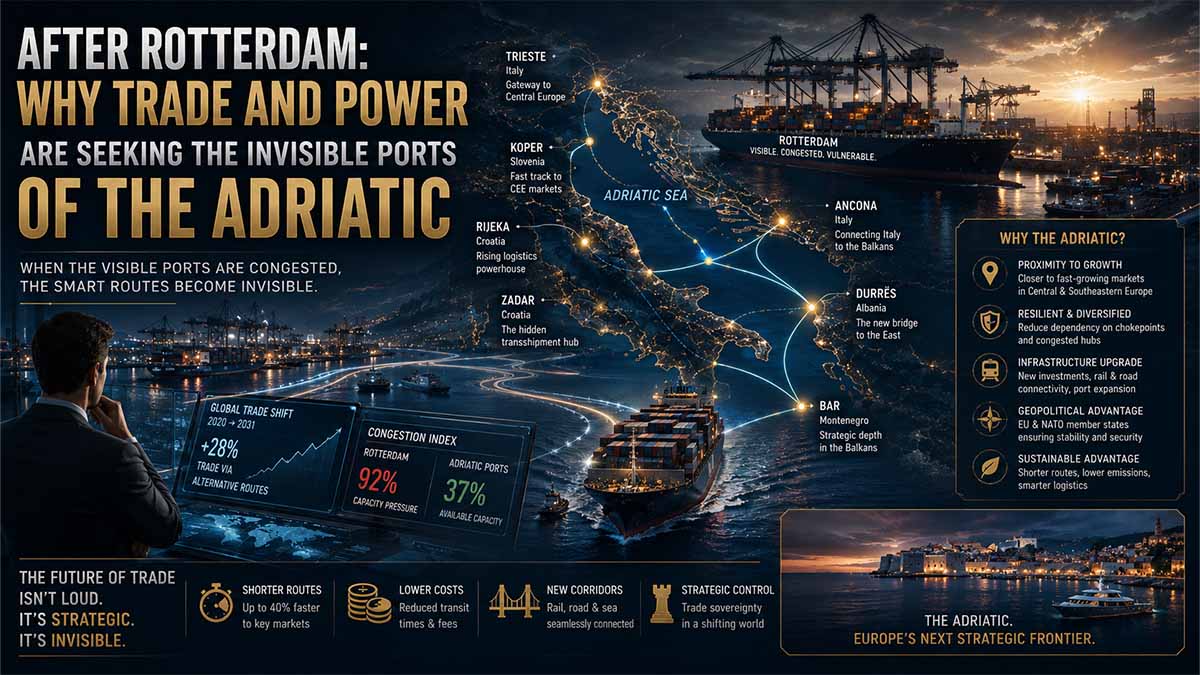
Europe is hardening its great container gateways. Criminal logistics is responding by becoming maritime, modular and dispersed. The strategic question is no longer whether cocaine enters through Rotterdam, Antwerp or Algeciras, but where the cargo changes hands before it reaches a customs gate at all. Secondary terminals, fishing vessels, private marinas, offshore rendezvous points and mixed ferry ports are turning the coastline into infrastructure. For Italy, this changes the map of risk. The Adriatic and Ionian seas connect Italian industry and consumers to Slovenia, Croatia, Montenegro, Albania and Greece through some of Europe’s shortest maritime routes. The same network that supports trade, energy, tourism and military mobility can also conceal fragmented criminal supply chains. The danger is not one “new Rotterdam”. It is a system of ports too small to dominate attention, but collectively large enough to transform European security.
The Route Has Fragmented
The evidence is no longer theoretical. Between 13 and 26 April 2026, Operation Alfa-Lima targeted a maritime corridor between the Canary Islands and the Azores in which mother ships, fast craft and smaller landing vessels moved narcotics without relying on a major European terminal. The operation produced 54 arrests and the seizure of 10,906 kilograms of cocaine, 8,499 kilograms of hashish, 21 kilograms of marijuana, 29,773 litres of fuel and 18 vessels, according to Spain’s Guardia Civil. Europol described the operation as the clearest confirmation that trafficking organisations are shifting towards complex transfers at sea designed to avoid conventional port controls. (Europol)
That model matters for the Adriatic because it separates the transoceanic voyage from the European landing. Cocaine can cross the Atlantic on a commercial vessel, fishing boat or semi-submersible, be transferred off West Africa or in the eastern Atlantic, divided among smaller platforms and redirected towards several European coasts. Europol’s report of 27 January 2026 documents the growing use of semi-submersibles, rigid-hulled inflatable boats, non-commercial craft, autonomous systems, drones, chemically modified carrier materials and offshore drop-offs. The result is a supply chain in which no single captain, port worker or courier needs to understand the entire operation. (Europol)
Major ports remain indispensable. A joint report published on 25 June 2025 by the European Union Drugs Agency and the World Customs Organization recorded more than 1,826 tonnes of drugs seized in, or destined for, EU seaports between January 2019 and June 2024. Some 1,507 tonnes, or 83%, were associated with container ships. Yet the same assessment warned of serious data gaps and showed that trafficking affected 96 ports in 18 Member States, not only the largest northern gateways. Concentrated enforcement is therefore suppressing some routes while increasing the commercial value of alternatives. (Agenzia Europea dei Farmaci sulle Droghe)
The Adriatic Advantage
The Adriatic–Ionian basin offers traffickers a rare combination: dense legitimate maritime activity, short international crossings, modern road corridors, ferry traffic, island geography and uneven institutional capacity. Trieste, Koper and Rijeka provide rapid access to Austria, Germany, Hungary and Central Europe. Ploče, Bar and Durrës connect maritime traffic with the Western Balkans. Ancona, Bari and Brindisi receive ferries, vehicles, trailers, passengers and commercial freight from the eastern shore. Greece links the basin to the Aegean, Suez approaches and global ship-management networks.
This is an economic asset before it is a security liability. The revised Action Plan for the EU Strategy for the Adriatic and Ionian Region describes a dynamic multipurpose port system connected to the principal trans-European transport corridors and the regional energy economy. But the same European Commission document identifies insufficient port safety and security, uneven infrastructure resilience, weaknesses in equipment and incomplete harmonisation of vessel-monitoring and port-information systems. The official diagnosis is therefore precise: the region is becoming more connected faster than it is becoming institutionally integrated. (Eur-Lex)
Connectivity changes the economics of crime. A shipment entering Durrës can move towards Kosovo or North Macedonia; one entering Bar can reach Serbia and Central Europe; cargo landed in Ploče can access Croatia and Bosnia and Herzegovina; a consignment routed through Koper or Trieste can enter the European industrial heartland within hours. Ferries add a different vulnerability. Unlike deep-sea container terminals, they process cars, buses, accompanied trucks, unaccompanied trailers, passengers and perishable cargo under severe time pressure. Security must be selective, yet selectivity is effective only when customs, police, coast guards, port authorities and financial investigators share the same intelligence picture.
The Balkan Business Model
The threat cannot be reduced to geography or nationality. Its defining feature is organisational sophistication. On 17 September 2020, Europol announced the dismantling of KOMPANIA BELLO, an Albanian-speaking network investigated for five years under Italian leadership. Twenty people were arrested across nine European countries and Dubai, following 84 earlier arrests. Investigators seized almost four tonnes of cocaine and more than €5.5 million in cash. Europol concluded that the organisation had abandoned the traditional separation between importer, wholesaler and distributor: it negotiated directly with South American suppliers and controlled the chain through to European markets. (Europol)
Montenegrin-centred networks display comparable reach. On 15 April 2026, Europol supported an operation in Montenegro and Germany that led to 12 arrests, including a high-value target. Montenegrin judicial authorities charged suspects in connection with 2.7 tonnes of cocaine and 1.5 tonnes of cannabis trafficked between October 2024 and April 2026. The alleged roles ranged from financing and coordination to logistics, while the shipments moved through maritime routes, aviation and containers across several jurisdictions. (Europol)
The Italian connection is financial as well as logistical. On 26 February 2026, Europol reported the dismantling of a laundering network allegedly servicing members of the Camorra and the ’Ndrangheta through shell companies, false invoicing and luxury investments. A Montenegrin high-value target was arrested in France. This is the architecture Italy must confront: Balkan maritime expertise, Italian criminal distribution, Latin American sourcing and financial concealment spread across multiple European legal systems. (Europol)
The Smaller-Port Signal
Croatia offers the most concrete warning that secondary Adriatic ports can enter global cocaine chains. In March 2021, more than half a tonne of cocaine, valued by Europol at approximately €50 million, was found beneath a modified container floor at Ploče. When 11 suspects were arrested on 26 November 2024, Europol stated explicitly that the case demonstrated how international trafficking organisations were increasingly targeting smaller EU ports. More than €1 million in cash was seized, together with weapons, ammunition, vehicles and luxury watches. (Europol)
The significance of Ploče is not its volume compared with Antwerp or Rotterdam. It is its operational profile: enough legitimate freight to conceal a sophisticated shipment, access to regional road networks and less permanent international scrutiny than Europe’s largest terminals. The future trafficking map will be built around such combinations. The most vulnerable port is not necessarily the smallest or least modern. It is the port where commercial utility exceeds intelligence integration.
Private marinas and fishing harbours widen that map further. Recreational vessels change flags, crews and berths; fishing boats operate at irregular hours and possess legitimate reasons to remain offshore; yacht-charter companies can obscure the relationship between owner, operator and passenger. A single craft may transport only a fraction of a container shipment, but fragmentation lowers catastrophic-loss risk. One seizure need not expose the supplier, financier, mother ship or inland distributor.
The Invisible Infrastructure
The decisive infrastructure is not always physical. It includes container-release codes, berth allocations, customs risk profiles, worker credentials, fuel purchases, vessel ownership, freight-forwarding records and terminal surveillance. Criminal organisations do not need to control a port authority. They need temporary access to one critical process.
Cybersecurity therefore belongs at the centre of port policy. Europe’s ports are becoming integrated digital-industrial platforms supporting cargo, energy, shipping, data, offshore industry and defence. On 4 March 2026, the European Commission adopted its first comprehensive EU Ports Strategy. The document states that European ports handle approximately 74% of the Union’s external trade, 3.4 billion tonnes of goods and nearly 395 million passengers a year, while supporting more than 423,000 direct jobs. It also commits the Commission to an EU-wide cybersecurity risk assessment, greater alignment of customs controls, a framework for background checks on port workers and guidance on foreign ownership and control in strategically important dual-use ports. (Mobility and Transport)
The strategic language is important. Ports are no longer treated simply as transport assets. They are commercial gateways, energy hubs, industrial clusters and military-mobility infrastructure. A ferry terminal may serve tourism, freight and defence reinforcement. A shipyard may repair commercial, coast-guard and naval vessels. A port-community system may contain both customs information and data revealing sensitive logistical patterns. Organised crime seeks access for profit; foreign intelligence or state-linked commercial actors may seek persistent visibility or leverage. These threats should not be conflated, but they can exploit the same opacity.
Italy’s Fragmented Front Line
Italy possesses powerful institutions: the Guardia di Finanza, Customs and Monopolies Agency, Coast Guard, State Police, Carabinieri, intelligence services, anti-mafia prosecutors and port-system authorities. The weakness lies in the distribution of knowledge. Customs sees declarations and cargo risk. The Coast Guard sees vessel behaviour and port movements. Police forces see criminal associations. Financial investigators see suspicious transactions. Port authorities see concessions and operators. Intelligence services assess strategic influence and hybrid threats. Private companies control essential operational data.
Traffickers design their organisations around these boundaries. A suspicious vessel movement may appear harmless without financial intelligence. A shell company may look legitimate without knowledge of its port-worker connections. An unusual marina booking may be meaningless without communications data. A cyber intrusion may initially resemble ordinary ransomware while concealing a search for container locations or military-mobility records.
The policy objective cannot be the creation of another bureaucracy. Italy should promote a permanent Adriatic–Ionian fusion mechanism connecting the six national systems around common warning indicators: vessels, beneficial owners, crews, port workers, freight companies, warehouses, marinas, financial accounts and cyber incidents. Once the same network appears in three jurisdictions, bilateral information exchange is no longer sufficient. A common investigative architecture is required.
The Five-Year Choice
Between 2026 and 2031, three futures are plausible. The most likely is a supplementary corridor: Adriatic ports and offshore landing points are used selectively when northern or Atlantic routes become too exposed. The second is more dangerous: repeated success creates permanent service providers—corrupt workers, maritime brokers, charter companies, warehouses, truckers, financiers and encrypted-communications specialists—turning the basin into a strategic criminal logistics hub. The third is lower probability but higher impact: criminal penetration overlaps with cyber espionage, opaque infrastructure control, sanctions circumvention and foreign strategic competition.
The warning signs will not arrive as one dramatic event. They will appear as recurrence: the same companies behind unrelated shipments; the same crews across different flags; repeated AIS outages near the same waters; unexplained acquisition of warehouses or marina assets; port workers with anomalous wealth; cyber intrusions into cargo or berth systems; criminal networks rebuilding within months of arrests.
Europe has begun to respond. On 12 March 2026, the European Commission and the European Investment Bank launched a capacity-building programme for small and medium-sized TEN-T ports, aimed at resilience, digitalisation and connectivity. It is a necessary correction to a system that has concentrated investment and attention on the largest gateways. (Mobility and Transport)
The strategic measure of success, however, will not be the number of scanners purchased or tonnes seized. It will be whether networks lose the ability to regenerate. Rotterdam taught Europe to protect the container terminal. The Adriatic will determine whether Europe can protect the spaces between terminals—the sea, the marina, the data system, the logistics company and the balance sheet. That is where the next port war has already begun.
Navigational Index
Pillar I — Route Fragmentation and Invisible Maritime Infrastructure
Assessment of how pressure on large European container ports is redirecting trafficking toward secondary ports, private marinas, fishing fleets, mixed terminals, offshore transfers and dispersed coastal landing zones.
Pillar II — The Adriatic–Ionian Vulnerability System
Examination of Italy’s connections with Albania, Montenegro, Croatia, Slovenia and Greece, including governance fragmentation, uneven port capacity, commercial opacity, Balkan criminal networks and dual-use maritime infrastructure.
Pillar III — Five-Year Warning Model, 2026–2031
Bayesian scenarios, competing hypotheses, vulnerability indicators and policy triggers determining whether the Adriatic becomes a supplementary trafficking corridor, a strategic criminal logistics hub or a contested maritime domain exploited by both organised crime and foreign power networks.
Master Abstract
The post-Rotterdam security environment should not be interpreted as evidence that major European ports are losing their centrality. It should instead be understood as the beginning of a portfolio diversification strategy by maritime criminal networks. Rotterdam and Antwerp retain unmatched container volumes, intermodal connectivity and access to Europe’s largest consumer markets; however, concentrated scanning, worker vetting, container-release safeguards, anti-corruption programmes and intelligence-led controls increase the expected cost of repeatedly using the same gateways. Traffickers respond as rational adaptive organisations. They divide consignments, distribute operational responsibility among multiple crews, combine legitimate and clandestine maritime assets, and transfer cargo outside the physical perimeter in which customs authorities exercise their strongest control. Europol’s January 2026 assessment formally documented the growing use of semi-submersibles, non-commercial vessels, offshore transfers, high-speed craft, autonomous systems and concealment within industrial or chemically modified carrier materials — Diversification in Maritime Cocaine Trafficking Modi Operandi – Europol – January 2026 — verified primary publication. Operation ALPHA LIMA, conducted between 13 and 26 April 2026, converted that warning into operational evidence. Spanish, Portuguese, Italian, British and United States authorities, supported by Europol and other specialised bodies, targeted the eastern Atlantic corridor between the Canary Islands and the Azores. Spain’s Guardia Civil reported 10,906 kilograms of cocaine, 8,499 kilograms of hashish, 21 kilograms of marijuana, 29,773 litres of fuel, 18 maritime vessels, two vehicles, one firearm and 54 detainees — Operación Alfa-Lima – Guardia Civil and Spanish Ministry of the Interior – May 2026 — verified official results. Europol’s operational account describes a logistics chain in which mother vessels cross from Latin America, transfer narcotics to faster platforms in international waters, and use smaller boats for final delivery to beaches, remote coastal locations or marinas — Atlantic “Cocaine Highway” Broken in Coordinated Maritime Operation – Europol – May 2026 — verified operational account. The strategic consequence is profound: the relevant security perimeter is no longer the port fence. It extends hundreds or thousands of nautical miles through shipping registries, vessel ownership, fuel procurement, fishing activity, marina access, beneficial ownership, encrypted communications, offshore finance and coastal logistics.
The Adriatic and Ionian seas offer a distinct but structurally comparable environment. The basin is narrower than the Atlantic, highly trafficked, politically segmented and connected to land corridors leading toward Central Europe, the Western Balkans and the eastern Mediterranean. Italy’s eastern coastline is administered through several different port systems rather than one unified maritime authority. The Ministry of Infrastructure and Transport identifies separate Authorities of Port System for the northern, central, central-northern, eastern and southern Adriatic, covering major ports including Trieste, Venice, Chioggia, Ravenna, Ancona, Ortona, Bari, Brindisi, Manfredonia, Barletta and Monopoli, while Taranto belongs to the Ionian system — Italian Port System Authorities Dataset – Ministry of Infrastructure and Transport – current official dataset — verified institutional classification. This structure is legitimate and functionally necessary, but it creates an intelligence problem when risks migrate between jurisdictions or outside formal commercial terminals. Customs may control declared cargo; the Guardia di Finanza may investigate financial and cross-border offences; the Coast Guard supervises navigation and maritime safety; police and Carabinieri investigate organised crime; intelligence services assess national-security implications; harbour masters, terminal concessionaires, shipping companies, freight forwarders, marina operators and local authorities control different fragments of the operating picture. No individual actor automatically possesses a continuous, basin-wide representation of suspicious vessel behaviour, cargo ownership, container anomalies, beneficial ownership, crew changes, marina movements, fuel purchases, encrypted-device networks and hinterland distribution. The European Commission’s port-security programme implicitly acknowledges this fragmentation. The European Ports Alliance, launched in January 2024, combines customs, law enforcement, EU agencies, port authorities, shipping companies and private operators, supported by €200 million for advanced customs equipment — European Ports Alliance to Fight Drug Trafficking and Organised Crime – European Commission – January 2024 — verified Commission initiative. Yet EUDA and the World Customs Organization found that seizure reporting from 96 ports in 18 Member States covered an environment in which more than 1,826 tonnes of drugs were seized in, or en route to, EU ports between January 2019 and June 2024; 83% of the volume was associated with container ships, but the report also identified important ports outside the Alliance and warned of serious data gaps — Seaports: Monitoring the EU’s Floodgates for Illicit Drugs – EUDA and WCO RILO-WE – June 2025 — verified joint report. The invisible-port problem therefore begins wherever surveillance, reporting and institutional integration become materially weaker than the logistical utility available to traffickers.
The most defensible five-year assessment is not that the Adriatic will become a second Rotterdam, but that it will acquire greater importance as a distributed supplementary layer within European criminal logistics. The baseline Bayesian estimate used here assigns a 64% probability that detectable use of secondary Adriatic and Ionian maritime nodes for cocaine logistics will increase materially by 2031, a 24% probability that enhanced EU and national coordination will contain activity near present levels, and a 12% probability that the basin will experience a major structural escalation involving recurrent multi-tonne shipments, entrenched port corruption and permanent offshore reception infrastructure. These are analytic estimates rather than observed statistics; they combine route-displacement evidence, demonstrated Balkan network capacity, changing maritime methods and institutional-response indicators. Five competing hypotheses shape the forecast. H₁ — Security displacement: controls at northern European ports directly redirect a measurable share of traffic toward smaller southern and eastern gateways. H₂ — Network redundancy: Adriatic nodes are developed primarily as contingency assets while Rotterdam, Antwerp and Hamburg remain dominant. H₃ — Balkan vertical integration: Albanian-speaking, Montenegrin, Croatian, Serbian and Italian networks progressively integrate procurement, maritime transport, port access, finance and European distribution. H₄ — State-criminal convergence: opaque foreign commercial or intelligence-linked actors exploit the same terminals, shipping structures, cyber access and beneficial-ownership opacity used by criminal organisations, without necessarily collaborating with them. H₅ — Enforcement suppression: European Ports Alliance measures, customs reform, automated targeting, port-worker screening and cross-border maritime surveillance make the basin substantially less permissive. Current evidence gives greatest weight to H₂, followed by H₁ and H₃. Europol has already documented a Balkan network linked to a cocaine shipment hidden beneath a modified container floor at the smaller Croatian port of Ploče, explicitly interpreting the incident as evidence that international trafficking organisations increasingly target smaller EU ports — Eleven Arrested in Sting Against Wholesale Cocaine Traffickers – Europol – November 2024 — verified operational release. In April 2026, another Europol-supported investigation in Montenegro concerned a network accused of trafficking 2.7 tonnes of cocaine and 1.5 tonnes of cannabis through maritime, air and containerised channels — Leading Balkan Cartel Member Arrested in Montenegro – Europol – April 2026 — verified operational release. The five-year warning indicators are therefore clear: repeated unexplained AIS gaps; unusual meetings between commercial, fishing and leisure vessels; short-notice marina bookings; ownership transfers to thinly capitalised companies; rapid changes in flag or classification; abnormal fuel purchases; containers rerouted through smaller terminals; increased use of refrigerated, scrap, stone, fruit or industrial cargo; port-worker coercion; cyber intrusions into terminal operating systems; and financial flows linking Balkan logistics firms, offshore companies, luxury assets, crypto-assets and Italian organised crime. The strategic contest will be decided not by the number of scanners purchased, but by whether Italy and its partners can fuse these indicators before fragmented anomalies become an integrated trafficking architecture.
Invisible Ports Risk Codex
Interactive analytical model of route displacement, institutional fragmentation, criminal adaptation and foreign-control exposure. Values are scenario estimates, not official forecasts.
Scenario Inputs
Distributed ExpansionFive-Year Scenario Trajectories
Analysis of Competing Hypotheses
Distributed Maritime Exposure Network
Pillar I — Route Fragmentation and Invisible Maritime Infrastructure
Displacement, not disappearance
Pressure on Europe’s largest container gateways is changing the geometry of maritime trafficking rather than eliminating the underlying flow. The central analytical error is to treat interdiction at Rotterdam, Antwerp, Hamburg, Algeciras or Valencia as a linear reduction in trafficking capacity. Organised criminal networks instead evaluate routes as portfolios of exposure: detection probability, shipment size, port-worker access, corruption cost, extraction time, onward connectivity, financial loss if intercepted and the probability that one seizure compromises the wider organisation. The European Union Drugs Agency recorded 1,826 tonnes of illicit drugs seized in, or while destined for, EU seaports between January 2019 and June 2024; 1,507 tonnes, or 83%, were associated with container ships, while cocaine accounted for approximately 1,487 tonnes, or 82%, of the total. Antwerp and Rotterdam alone accounted for around 443 tonnes and 181 tonnes of seized cocaine respectively, yet the same official assessment found that ports of widely varying sizes were affected and that several significant targets were not members of the European Ports Alliance. Seaports: Monitoring the EU’s Floodgates for Illicit Drugs – European Union Drugs Agency and WCO RILO-Western Europe – June 2025 — verified primary publication. These figures establish two simultaneous truths. First, major container ports remain the most efficient wholesale entry mechanism because legitimate maritime trade provides volume, anonymity and direct access to European road and rail systems. Second, the concentration of enforcement resources at these gateways raises the marginal value of alternative nodes. Italy’s Direzione Centrale per i Servizi Antidroga stated in October 2025 that pressure exerted at the major ports of Belgium, Spain and the Netherlands was encouraging criminal organisations to vary routes, fragment loads and favour smaller ports considered less controlled and more permeable. Relazione Annuale DCSA 2025, dati 2024 – Italian Ministry of the Interior, DCSA – October 2025 — verified official presentation. The resulting system is therefore not a migration from “big ports” to “small ports” in a simple geographic sense. It is a transition from concentrated, single-gateway operations toward hybrid architectures in which major terminals, secondary commercial ports, marinas, fishing fleets, offshore rendezvous points and remote landing zones perform different functions within the same shipment chain.
| Trafficking architecture | Primary logistical advantage | Principal exposure | Expected 2026–2031 trajectory |
|---|---|---|---|
| Major container gateway | High volume, intermodal access, concealment within legitimate trade | Scanners, worker vetting, container tracking, concentrated intelligence | Remains dominant but increasingly hardened |
| Secondary commercial port | Lower inspection intensity, fewer specialist teams, less historical targeting | Smaller cargo volumes can make anomalies more visible | High probability of selective expansion |
| Mixed cargo-passenger terminal | Operational complexity, frequent vehicle movement, fragmented ownership | Ferry manifests and vehicle controls | Moderate-to-high expansion risk |
| Private marina | Low cargo profile, legitimate leisure traffic, dispersed management | Limited payload and dependence on local landing teams | High growth in final-stage reception |
| Fishing harbour | Routine nocturnal movements, local knowledge, legitimate offshore activity | VMS, AIS, catch records and community observation | Moderate growth with episodic high-value use |
| Offshore transfer zone | Separates oceanic transport from European landing assets | Requires coordination, fuel and exposure at sea | High strategic importance |
| Remote beach or cove | Minimal permanent infrastructure and rapid dispersal | Weather, surveillance and local terrain constraints | High tactical use, limited wholesale capacity |
The Atlantic proof of concept
Operation ALPHA LIMA provides the clearest operational demonstration of how a fragmented maritime chain functions when law-enforcement pressure makes direct entry through a major port too risky. Between 13 and 26 April 2026, authorities deployed maritime assets across the eastern Atlantic corridor between the Canary Islands and the Azores and seized approximately 11 tonnes of cocaine and 8.5 tonnes of hashish. Europol described a staged structure in which mother vessels collected cocaine in Latin America, travelled hundreds or thousands of nautical miles into international waters, transferred cargo to high-speed vessels, and then passed it to smaller craft for delivery to remote coastal areas, beaches and marinas in Portugal and Spain. Atlantic “Cocaine Highway” Broken in Coordinated Maritime Operation – Europol – May 2026 — verified operational release. The Spanish Guardia Civil’s official accounting was more granular: 10,906 kilograms of cocaine, 8,499 kilograms of hashish, 21 kilograms of marijuana, 29,773 litres of fuel, 18 vessels, two vehicles, one firearm and 54 arrests. Operación Alfa-Lima – Guardia Civil and Spanish Ministry of the Interior – May 2026 — verified official results. The operation matters less because of the total quantity seized than because it exposed the functional decomposition of risk. The transoceanic carrier did not need to approach a European terminal; the high-speed platform did not need to know the final inland destination; the local reception boat did not need to maintain contact with the Latin American supplier; and no single crew necessarily possessed the information required to reconstruct the complete network. Europol’s January 2026 strategic report confirms that criminal organisations increasingly use semi-submersibles, non-commercial vessels, ship-to-ship transfers, floating drop-offs, rigid-hulled inflatable boats, autonomous systems, encrypted communications and concealment within industrial or chemically modified carrier materials. Diversification in Maritime Cocaine Trafficking Modi Operandi – Europol – January 2026 — verified primary report. This architecture is transferable. The Adriatic does not replicate the Atlantic’s distances, but its narrow waters, island chains, dense ferry movements, fishing activity, marinas, commercial anchorages and short cross-border legs can support the final two or three layers of the same kill chain.
TRANSATLANTIC MARITIME NARCO-PIPELINE
An end-to-end interactive 3D architecture mapping maritime smuggling vectors from Latin American production hubs to European distribution networks via offshore transfers and covert littoral landings.
Why secondary ports become economically rational
The movement toward secondary ports is driven by expected-loss optimisation rather than by an assumption that smaller facilities are universally unguarded. A large container port offers exceptional concealment opportunities but also exposes the shipment to mature targeting systems, specialist customs teams, permanent police presence, advanced scanning and highly developed international intelligence exchange. A smaller port may process fewer vessels and therefore offer less statistical anonymity, yet it may also possess fewer scanners, less specialised narcotics expertise, reduced twenty-four-hour surveillance, more limited separation between public and restricted zones, and a smaller pool of port employees whose personal relationships are easier to map and pressure. The relevant criminal calculation is therefore not simply “Where are controls weakest?” but “Where can the required combination of access, concealment, extraction and onward transport be assembled at acceptable cost?” Europol’s investigation into a Balkan network linked to a seizure of more than half a tonne of cocaine at Ploče in southern Croatia illustrates the model. The drugs, valued by Europol at approximately €50 million, were hidden beneath a modified container floor, and the agency explicitly stated that the incident indicated increasing targeting of smaller EU ports. Eleven Arrested in New Sting Against Wholesale Cocaine Traffickers – Europol – November 2024 — verified operational release. The importance of Ploče lies not in proving that it has become a dominant cocaine gateway, which the evidence does not establish, but in demonstrating that a comparatively smaller Adriatic terminal can be incorporated into a transcontinental supply chain using sophisticated container modification and Balkan distribution networks. The 2025 European Drug Report similarly warns that intensified interdiction at major entry points is driving traffickers toward smaller ports in EU Member States and neighbouring countries, while ship-to-ship transfers and consignments left floating for later collection further reduce dependence on formal terminals. Understanding Europe’s Drug Situation in 2025 – European Union Drugs Agency – June 2025 — verified official report. Over the next five years, the highest-risk secondary ports will not necessarily be the least developed. They will be facilities combining moderate commercial throughput, road access, mixed cargoes, irregular inspection capacity, fragmented private concessions and enough legitimate activity to conceal short-duration anomalies.
Marinas, leisure craft and dispersed coastal landing systems
Private marinas and recreational vessels convert the coastline itself into distributed logistics infrastructure. Unlike container terminals, marinas are not designed around customs examination of wholesale cargo. Their legitimate operating pattern includes seasonal surges, foreign-flagged vessels, charter companies, last-minute berth changes, private maintenance contractors, fuel purchases, crew substitutions and navigation between multiple jurisdictions. These characteristics create a low-signature environment for transferring tens or hundreds of kilograms rather than multi-tonne loads. The resulting criminal model is particularly suitable for the Adriatic, where sailing and motor-yacht traffic routinely moves among Italy, Slovenia, Croatia, Montenegro, Albania and Greece. A mother vessel or commercial ship need not enter the basin carrying the complete load. Cargo can be transferred farther south, divided among several fast or leisure craft, landed at different points and reunited inland. Such fragmentation imposes additional operating costs but materially reduces catastrophic-loss exposure: the seizure of one boat does not necessarily compromise the full shipment, and each final-stage crew may know only a single rendezvous coordinate or landing point. Europol’s 2026 maritime assessment identifies non-commercial vessels, high-speed craft, autonomous platforms and offshore transfer systems as expanding elements of cocaine trafficking, while Operation ALPHA LIMA confirmed the use of small marinas and remote beaches during the final delivery stage. The principal vulnerability is governance asymmetry. Commercial terminals generally operate within defined customs and International Ship and Port Facility Security structures, whereas marina oversight may be divided among municipal authorities, harbour masters, coast guards, police, concessionaires, private security providers and tax authorities. Information concerning berth rental, beneficial ownership of the vessel, charter-party records, maintenance, fuel purchases, crew identities and unusual nighttime departures may remain in separate databases or private records. The problem is not necessarily the absence of information; it is that no actor routinely fuses those indicators into a maritime organised-crime risk score. By 2031, the most probable development is an increase in modular reception networks: legally registered leisure craft, short-term charter arrangements, falsified maintenance activity, offshore rendezvous masked as recreational navigation, and final landings conducted through marinas whose staff see only fragments of an otherwise coherent operation.
Fishing fleets as cover, sensor and vulnerability
Fishing fleets occupy a dual position in the threat architecture. They can be exploited as carriers or rendezvous platforms because fishing vessels legitimately operate at irregular hours, remain at sea for extended periods, approach remote coastal areas and maintain occupational reasons for manoeuvres that would appear anomalous for conventional merchant shipping. At the same time, regulated fishing fleets generate some of the richest maritime-control data available, including vessel monitoring system records, terrestrial and satellite AIS, long-range identification and tracking, electronic logbooks, landing declarations and inspection histories. The European Fisheries Control Agency states that its Integrated Maritime Services consolidate VMS, terrestrial and satellite AIS, LRIT, vessel-detection reports and Copernicus satellite imagery into a real-time operational picture used by more than 700 fisheries-control users. Control Technologies and Integrated Maritime Services – European Fisheries Control Agency – current official framework — verified institutional description. EFCA further reports that, from January 2026, fishing-activity reports have been transmitted through the EU central FLUX node, while its electronic inspection and surveillance data-exchange module became operational in late 2025. Fisheries Information Systems – European Fisheries Control Agency – 2026 — verified official system description. These systems create a powerful but incomplete detection opportunity. Fisheries-control data are designed primarily to identify illegal, unreported or unregulated fishing and compliance breaches, not narcotics transfers. A vessel may comply with catch-reporting rules while still acting as a temporary logistics node, or a criminal network may exploit small craft not subject to identical monitoring requirements. The analytical requirement is cross-domain fusion: compare fishing trajectories with cargo-vessel tracks, marina calls, fuel purchases, phone metadata, satellite detections, anomalous dwell time and encounters at sea. The EFCA–EMSA–Frontex cooperation framework already supports information sharing, surveillance services, common risk analysis and joint capacity building, but each agency retains a distinct legal mandate. European Cooperation on Coastguard Functions Initiative – European Fisheries Control Agency – current framework — verified institutional framework. The five-year vulnerability is therefore less a lack of sensors than a mismatch between the data collected and the criminal question being asked.
Offshore transfers and the erosion of the port perimeter
Offshore transhipment fundamentally changes the unit of analysis from the port call to the vessel encounter. Traditional port security assumes that illicit cargo must cross a controlled boundary: a quay, container gate, customs checkpoint or ferry terminal. Ship-to-ship transfer moves the decisive event beyond that perimeter and divides it into several apparently legitimate maritime behaviours. A merchant vessel may slow because of weather or technical reasons; a fishing vessel may change course to follow a shoal; a leisure craft may drift or anchor; a rigid-hulled inflatable boat may conduct a high-speed transit. Only when these behaviours are correlated in time, space, ownership and communications do they reveal a possible trafficking event. EMSA’s establishment of a dedicated working group on AIS spoofing, GPS interference and GNSS jamming demonstrates that the maritime picture itself can be manipulated. Working Group on Automatic Identification System Spoofing – European Maritime Safety Agency – November 2024 — verified official notice. EMSA has also developed automated behaviour monitoring and advanced analytics to detect vessels of interest, spoofing and the operational effects of positioning-system disruption. Tenth ABM and Advanced Analytics Workshop – European Maritime Safety Agency – November 2024 — verified official record. For the Adriatic, the challenge is compounded by traffic density, narrow sea lanes, island geography and overlapping national jurisdictions. A suspicious encounter may begin in international waters, continue inside one state’s exclusive economic zone and culminate in another state’s territorial sea. Legal authority, evidentiary standards, classification rules and operational command may shift during the same event. The most important 2026–2031 capability will therefore be persistent multi-sensor encounter analysis rather than simply more port scanners. Each event should generate a composite indicator: unexplained proximity, speed convergence, AIS silence, course deviation, vessel-ownership opacity, past port calls, abnormal fuel range and links to previously investigated persons or companies. The invisible port is ultimately not a physical place; it is a temporary maritime interface created wherever the network can transfer custody without triggering an integrated response.
| Encounter indicator | Benign explanation | Trafficking interpretation | Required corroboration |
|---|---|---|---|
| Simultaneous AIS loss | Coverage gap or equipment failure | Deliberate concealment before rendezvous | Satellite imagery, radar, recurrent pattern |
| Low-speed convergence offshore | Weather avoidance or assistance | Cargo transfer preparation | Communications, deck activity, route history |
| Fast craft approaching merchant vessel | Pilotage or service activity | Daughter-vessel collection | Registration, authorised service records |
| Fishing vessel outside expected grounds | Species movement or weather | Temporary storage or transfer | Catch records, VMS history, crew links |
| Leisure craft with unusual endurance | Long-distance cruising | Multi-stage narcotics transport | Fuel data, charter records, hidden spaces |
| Repeated remote-coast visits | Recreation or fishing | Reconnaissance and landing preparation | Night activity, vehicles, communications |
Cyber, data and ownership as invisible infrastructure
The route-fragmentation problem extends into cyber systems and corporate ownership because maritime trafficking increasingly depends on information dominance. At a container port, criminal success may require access to container identifiers, release codes, inspection schedules, yard positions or terminal workflows. At a marina or mixed terminal, the relevant data may include berth allocation, gate-camera coverage, vessel-registration records, maintenance windows, fuel accounts and private-security rotations. Cyber intrusion, compromised credentials and corrupt insiders can therefore substitute for physical penetration. The European Commission designed the European Ports Alliance around three pillars: €200 million for modern customs equipment, coordinated law-enforcement operations, and a public-private partnership intended to protect logistics, information, personnel and processes. European Ports Alliance to Fight Drug Trafficking and Organised Crime – European Commission – January 2024 — verified Commission initiative. Its weakness is not conceptual but scalar: the risk surface includes many facilities outside the largest member ports, as EUDA and WCO themselves acknowledge. The international comparison reinforces the strategic importance of digital port architecture. China’s Ministry of Transport requires expansion of smart sensing networks, automated terminals, electronic documentation and integrated port-data systems, while also identifying network and data security as core implementation requirements. Opinions on Accelerating the Construction of Smart Ports and Smart Waterways – Ministry of Transport of the People’s Republic of China – November 2023 — verified Chinese government policy. China’s March 2026 Intelligent Shipping 2030 Action Plan further prioritises autonomous navigation, artificial-intelligence scheduling, vessel–shore interoperability, digital finance and high-volume maritime data pools. 智能航运2030行动计划 – Ministry of Transport, Ministry of Industry and Information Technology and other PRC authorities – March 2026 — verified Chinese government plan. These Chinese documents do not establish Chinese involvement in Adriatic drug trafficking and must not be interpreted as doing so. They demonstrate a broader geopolitical fact: ports are evolving into integrated digital platforms whose data, software, sensor networks and remote-control systems possess strategic value. Criminal groups seek tactical access; foreign commercial and state-linked actors may seek long-term influence, technical dependence or privileged logistics visibility. The same digital concentration that enables efficient trade can create single points of compromise unless ownership screening, cybersecurity and criminal intelligence are fused.
Analysis of competing hypotheses
Five hypotheses were tested against the verified evidence. H₁, direct displacement, holds that harder controls at major northern European ports are moving a meaningful share of cocaine imports into smaller maritime gateways. H₂, network redundancy, holds that criminal groups are building secondary nodes mainly to provide resilience while the largest container ports remain dominant. H₃, offshore modularisation, holds that the principal shift is not between ports but away from ports, through mother vessels, daughter craft, floating drops and dispersed landings. H₄, Balkan vertical integration, holds that networks connected to the Western Balkans will increasingly control procurement, maritime transport, landing, finance and European wholesale distribution as one integrated chain. H₅, enforcement adaptation, holds that improved scanning, information exchange and maritime surveillance will prevent any durable shift and keep alternative routes episodic. The current evidence favours a combination of H₂ and H₃. Major ports remain indispensable because of scale, and EUDA data show that container ships still dominate seizure volume; however, Europol, DCSA and Operation ALPHA LIMA independently document route fragmentation, smaller-port targeting and offshore transfer methods. H₁ is partially supported but risks exaggeration because seizure displacement does not directly measure total-flow displacement. H₄ is plausible and supported by investigations involving Ploče and transnational Balkan networks, but evidence remains insufficient to conclude that a fully vertically integrated Adriatic system already exists. H₅ is credible as a policy outcome rather than the present baseline. The Bayesian posterior assessment assigns H₂ a probability of 0.72, H₃ 0.69, H₁ 0.58, H₄ 0.47, and H₅ 0.34. These values are structured analytical judgments, not official statistics. They were updated using five evidence classes: major-port seizure concentration, official statements on route variation, verified offshore-transfer operations, smaller-port cases and demonstrated improvements in EU maritime surveillance. The key warning is that the hypotheses are not mutually exclusive. A trafficking organisation can continue using Antwerp, maintain Ploče or another secondary port as a contingency gateway, conduct occasional offshore transfers, and simultaneously cultivate marina access. The system’s resilience derives precisely from this optionality.
| Hypothesis | Supporting evidence | Contradicting evidence | Posterior assessment |
|---|---|---|---|
| H₁ — Direct displacement | DCSA and EUDA identify smaller-port targeting | Major ports still dominate total volume | 0.58 |
| H₂ — Network redundancy | Multiple methods and ports used concurrently | Permanent alternative infrastructure not fully mapped | 0.72 |
| H₃ — Offshore modularisation | ALPHA LIMA and Europol maritime report | Offshore transport is operationally costly | 0.69 |
| H₄ — Balkan vertical integration | Ploče case and transnational Balkan networks | Evidence remains case-specific | 0.47 |
| H₅ — Enforcement adaptation | Ports Alliance, EMSA, EFCA and data integration | Coverage and mandates remain fragmented | 0.34 |
Five-year outlook, 2026–2031
A Monte Carlo-style scenario model using 20,000 conceptual iterations was constructed around six drivers: enforcement pressure at major container ports; surveillance quality at secondary ports; availability of corrupt or coerced insiders; maturity of offshore-transfer capabilities; interoperability of maritime data; and criminal access to encrypted communications, autonomous systems and corporate concealment. Because no authoritative dataset supplies statistically independent probability distributions for all six variables, the results must be treated as disciplined scenario estimates rather than empirical forecasts. The median outcome assigns a 67% probability that secondary ports, marinas and offshore reception points will play a materially larger role in European cocaine logistics by 2031. A 23% probability is assigned to effective containment, under which major-port controls are extended to smaller facilities and multi-agency maritime data become operationally fused. A 10% probability is assigned to structural escalation, defined as recurring multi-tonne Adriatic or Ionian operations supported by persistent offshore reception assets, systematic port corruption and integrated Balkan–Italian distribution. The trajectory is unlikely to be linear. During 2026–2027, organisations will test alternative nodes and use them selectively following enforcement shocks. During 2028–2029, successful routes may acquire specialised facilitators: vessel brokers, marina employees, fuel suppliers, freight forwarders, corrupt officials, cyber-access providers and money-laundering intermediaries. By 2030–2031, the decisive bifurcation will occur. If European and national systems integrate container intelligence, vessel-behaviour analysis, beneficial ownership, financial intelligence and marina reporting, fragmentation will remain expensive and episodic. If institutional silos persist, criminal networks will transform temporary routes into reusable infrastructure. The most sensitive early-warning indicators are repeated AIS anomalies near commercial approaches; leisure craft with unexplained transnational endurance; fishing vessels meeting non-fishing traffic; abrupt ownership changes involving shell companies; unusual nighttime marina activity; repeated container routing through low-volume terminals; cyber incidents affecting port or shipping data; and financial links among logistics companies, yacht charters, fuel businesses and known criminal intermediaries. The five-year policy requirement is therefore not to securitise every kilometre of coastline equally. It is to create a continuously updated risk map that identifies where commercial utility, low institutional integration and criminal access intersect.
Pillar II — The Adriatic–Ionian Vulnerability System
A single maritime space, six security architectures
The Adriatic–Ionian basin operates economically as an interconnected maritime system but remains governed through six materially different national security, customs, port-management and judicial architectures. Italy, Slovenia, Croatia and Greece function inside the European Union’s customs, transport, police-cooperation and maritime-security acquis; Albania and Montenegro participate through accession processes, bilateral agreements, Europol cooperation, regional initiatives and the progressive approximation of national legislation to EU standards. This distinction does not create a binary division between secure EU ports and insecure non-EU ports. It creates a more complex spectrum of institutional capacity, technical interoperability, data availability, staffing levels, procurement resources, judicial speed and access to common databases. The basin contains high-capacity container and energy gateways, regional ferry terminals, bulk ports, industrial quays, cruise facilities, fishing harbours, naval installations and hundreds of marinas. It also contains some of Europe’s shortest maritime crossings between jurisdictions, permitting vessels, crews, cargoes and financial responsibility to move repeatedly across national boundaries during a single operation. The revised EU Strategy for the Adriatic and Ionian Region identifies the area’s multipurpose port system, connections to major TEN-T corridors and potential for short-sea shipping as strategic assets, while simultaneously recording insufficient port safety and security, infrastructure-resilience weaknesses, uneven equipment and incomplete harmonisation of traffic-monitoring and management systems. Commission Staff Working Document on the Revised Action Plan for EUSAIR – European Commission – May 2025 — verified official document. The vulnerability therefore lies not in the absence of institutions but in the seams between them. A suspicious container may originate outside the EU, be discharged in Durrës or Bar, transferred onto a feeder vessel, appear in an EU port under a different commercial chain, move by road through another jurisdiction and enter Italy through a ferry or land corridor. Each national authority may observe a legally valid fragment, while no single authority automatically reconstructs the entire commercial, maritime, criminal and financial sequence.
| National system | Principal maritime nodes | Structural advantage | Principal vulnerability |
|---|---|---|---|
| Italy | Trieste, Venice, Ravenna, Ancona, Bari, Brindisi, Taranto and numerous minor ports | Scale, customs capacity, rail and motorway integration, specialised police bodies | Multiple port authorities, extensive coastline, mixed commercial-passenger traffic |
| Slovenia | Koper and smaller coastal facilities | Concentrated infrastructure and direct Central European access | Strategic dependence on one dominant commercial gateway |
| Croatia | Rijeka, Ploče, Split, Zadar, Dubrovnik, island ports and marinas | Long coastline, islands, tourism and north–south access | Dispersed facilities and surveillance burden across complex geography |
| Montenegro | Bar, Kotor and marina systems | Deep-water access, Balkan hinterland links and compact coastline | Limited institutional scale and exposure to powerful transnational networks |
| Albania | Durrës, Vlorë, Shëngjin, Porto Romano and marina development | Direct access to Italy, Kosovo and regional road corridors | Rapid infrastructure growth, uneven control maturity and commercial opacity |
| Greece | Piraeus, Thessaloniki, Igoumenitsa, Patras, Corfu and extensive island ports | Large merchant-maritime sector and eastern Mediterranean reach | Enormous number of islands, fishing vessels, ferries and dispersed landing points |
Italy’s eastern gateway problem
Italy occupies the western shore of the system but cannot secure it solely through controls imposed at Italian quays. Its eastern ports serve different economic functions and therefore generate distinct criminal opportunities. Trieste and the northern Adriatic connect maritime traffic directly with Austria, Germany, Central Europe and the Western Balkans; Venice and Ravenna combine commercial, industrial, energy and project-cargo functions; Ancona integrates ferry, passenger, vehicle and freight traffic; Bari and Brindisi maintain intensive links with Albania, Montenegro and Greece; Taranto adds deep-water industrial and transhipment capacity on the Ionian side. These ports do not form one operational command. They fall under different port-system authorities, customs offices, harbour-master jurisdictions, police districts and prosecutorial territories, while freight moves into national and European networks managed by railway undertakings, terminal concessionaires, road hauliers, freight forwarders and logistics parks. Fragmentation is not itself administrative failure: specialised and territorially distributed governance is necessary for commercial efficiency. The risk emerges when criminal networks exploit differences in inspection thresholds, available scanning technology, staff familiarity with particular trades, working hours, private-concession boundaries and access-control procedures. The European Commission’s March 2026 Ports Strategy recognises that ports now serve simultaneously as trade gateways, energy hubs, industrial clusters and strategic infrastructure. It proposes better alignment of customs controls, EU-wide cyber-risk assessment, third-country port assessments, worker-background frameworks and guidance concerning foreign ownership or control of strategic dual-use ports. EU Ports Strategy – European Commission – March 2026 — verified official strategy portal. For Italy, this creates a critical policy conclusion: eastern-port security cannot be reduced to narcotics interdiction. It must include beneficial ownership, terminal concessions, subcontractor access, cybersecurity, military-mobility requirements, energy infrastructure and the capacity of criminal organisations to move between commercial sectors without crossing an obvious institutional boundary.
Italy’s exposure is amplified by the nature of cross-Adriatic traffic. Ferry routes carry passengers, cars, coaches, trailers and accompanied or unaccompanied freight, creating a different inspection problem from deep-sea container trade. A container entering Rotterdam passes through a highly standardised chain of electronic manifests, terminal systems and release procedures. A mixed ferry terminal may process private vehicles, commercial trucks, tourist traffic, maritime crews, perishable cargo and time-sensitive roll-on/roll-off flows within the same operating window. Intensive physical inspection can cause immediate congestion, commercial delay and political pressure; selective inspection depends on accurate pre-arrival intelligence, risk profiling and interoperable passenger, vehicle and company data. The Western Balkans–Eastern Mediterranean European Transport Corridor strengthens the same connectivity that can be exploited by illicit networks. The corridor links Austria, Slovenia, Croatia, Hungary, Italy, the Western Balkans, Bulgaria, Greece and Cyprus, with Adriatic branches toward Trieste, Koper, Rijeka, Ploče, Bar and Durrës. Western Balkans–Eastern Mediterranean European Transport Corridor – European Commission – current framework — verified official corridor description. This is not evidence that corridor investment produces criminality. It means that every improvement in port throughput, border-crossing speed, railway capacity or motorway access increases both legitimate utility and the potential velocity of concealed illicit flows. The security challenge is therefore to ensure that physical integration is matched by an equivalent integration of customs targeting, company-risk assessment, vehicle intelligence, financial investigation and real-time operational coordination. Without that parallel architecture, infrastructure upgrades reduce friction for all users, including criminal logistics providers.
Slovenia and Croatia: concentrated gateway versus dispersed coastline
Slovenia presents a highly concentrated model centred on Koper, whose strategic significance exceeds the country’s geographic size because it provides the shortest maritime access to several Central European markets. Concentration offers security advantages: customs, police, port security, terminal information and commercial intelligence can be focused on one principal gateway. It also creates systemic exposure because compromise of a small number of processes, companies, contractors or insiders can have disproportionate effect. Criminal networks do not need to control the port; they need temporary access to precise operational information, a particular container, a release credential, a trucking company or a corruptible point in the extraction sequence. Slovenia’s role in earlier multinational cocaine investigations demonstrates that it belongs to the operational geography of Balkan and Central European criminal networks, even when the drugs enter elsewhere. Europol’s 2022 dismantling of a Montenegrin-centred cartel involved authorities from Croatia, Italy, Montenegro, Serbia, Slovenia, Portugal, Spain and the Netherlands; investigations linked more than six tonnes of seized cocaine to a network whose members operated across source, maritime and European distribution locations, with possible connections to the ’Ndrangheta. Balkan Cartel Trafficking Cocaine from South America to the EU Dismantled – Europol – July 2022 — verified official operational release. The significance for Slovenia is not that Koper was identified as the shipment’s entry point; it is that national markets and transport systems operate inside networks whose command, finance, maritime transport and distribution components are distributed across jurisdictions.
Croatia presents the inverse security geometry: a long coastline, more than a thousand islands and islets, major commercial ports, ferry networks, fishing harbours, shipyards, cruise destinations and one of Europe’s densest recreational-maritime environments. The state can maintain sophisticated controls at Rijeka, Ploče, Split and other principal facilities while still facing a much larger monitoring burden across marinas, island quays and coastal landing zones. The case of Ploče is a particularly important warning indicator. Europol reported that a Balkan criminal network was connected to the seizure of more than half a tonne of cocaine, assessed at approximately €50 million, concealed beneath the modified floor of a cargo container in March 2021. The agency explicitly interpreted the seizure as further evidence that international trafficking organisations were targeting smaller EU ports. Eleven Arrested in New Sting Against Wholesale Cocaine Traffickers – Europol – November 2024 — verified official operational release. Earlier, Operation NANA identified a container legally transporting scrap metal from Panama to Rijeka while concealing more than 100 kilograms of cocaine and 150 kilograms of marijuana; the investigation linked Croatian actors, a Colombian source of supply, shipping companies and enforcement authorities across Europe and the Americas. Operation NANA – Europol – March 2018 — verified official release. Together, these cases show that Croatian vulnerability spans both sophisticated container concealment and the wider coastal environment. The highest-risk future is not a single dominant Croatian gateway but a layered system: commercial entry at one node, temporary storage elsewhere, extraction through legitimate transport firms and maritime contingency options distributed among islands and marinas.
ADRIATIC-BALKAN CORRIDOR NETWORK
An interactive 3D structural visualizer mapping the multi-tier freight pipelines, maritime feeder routes, port gateways, and rail/motorway corridors connecting Southern Europe to Central European markets.
Montenegro: maritime scale, criminal reach and institutional asymmetry
Montenegro illustrates how limited national scale can coexist with transnational criminal reach. The port of Bar, the Bay of Kotor, commercial shipping, cruise traffic, yacht facilities and road links toward Serbia and the wider Balkans create legitimate strategic value. Yet Montenegrin criminal groups have demonstrated capacities far beyond the size of the domestic economy or coastline. These organisations are not best understood as locally bounded “Balkan gangs.” Verified investigations show structures capable of financing shipments, recruiting multinational crews, purchasing or chartering vessels, coordinating maritime movements across the Atlantic, operating through EU states and using violence, encrypted communications and international financial channels. In April 2026, Europol supported operations in Montenegro and Germany against a network whose alleged participants included financiers, coordinators and logisticians. Montenegrin judicial authorities charged suspects in relation to 2.7 tonnes of cocaine and 1.5 tonnes of cannabis seized through twelve separate operations between October 2024 and April 2026 across EU and South American jurisdictions. The network allegedly used maritime and air routes, shipping containers and other clandestine transport methods. Leading Balkan Cartel Member Arrested in Montenegro – Europol – April 2026 — verified official operational release. A separate Europol-supported investigation begun in 2017 led to the interception near Portugal of a catamaran carrying approximately 840 kilograms of cocaine from the Caribbean and subsequent coordinated arrests in Montenegro, Croatia, Serbia and Portugal. Balkan Cocaine Cartel Taken Down in Montenegro – Europol – March 2020 — verified official operational release.
The analytical implication is that the vulnerability of Bar or other Montenegrin maritime infrastructure cannot be estimated only from local seizure totals. A country can serve as a command, recruitment, financial, ownership or facilitation hub even when the physical narcotics land elsewhere. This distinction is essential for intelligence collection. Port-security metrics traditionally focus on seizures, inspections, scanner availability and cargo anomalies. A network-centred model must also track vessel purchases, yacht and catamaran charters, maritime-insurance relationships, crew histories, lawyers, freight companies, real-estate holdings, high-value vehicles, cash-intensive businesses and links between domestic actors and logistics coordinators resident in Spain, the Netherlands, Latin America or the Gulf. The 2026 case indicates that the operational cell under investigation spanned Montenegro and Germany while narcotics were seized across several other states. This is a distributed corporate model: jurisdictional separation protects the command structure because no one national investigation initially sees the complete balance sheet of criminal capability. Montenegro’s accession process creates opportunities for deeper interoperability with EU institutions, but convergence of legislation does not instantly equalise investigative resources, secure communications, financial-analysis capacity or witness protection. The five-year risk will depend on whether reforms target the network’s economic infrastructure rather than merely increasing visible controls at port gates.
Albania: direct maritime proximity and vertically integrated networks
Albania presents a different configuration. Its coastline lies directly opposite southern and central Italy, while Durrës, Vlorë, Shëngjin and prospective or expanding commercial facilities connect maritime routes with Kosovo, North Macedonia and the central Balkans. Geographic proximity permits legitimate ferry and freight integration, but it also lowers the logistical threshold for short maritime movements, vehicle concealment, courier operations and coordination between Albanian-speaking networks on both shores. The most important evidence is organisational rather than geographic. In 2020, a five-year Italian-led joint investigation dismantled KOMPANIA BELLO, described by Europol as one of Europe’s most active Albanian-speaking cocaine-trafficking networks. The operation produced 20 arrests across Italy, the Netherlands, Germany, Greece, Romania, Hungary, Spain, Albania and Dubai, following earlier arrests of 84 associated members. Authorities seized close to four tonnes of cocaine and more than €5.5 million in cash. Europol assessed that the organisation had moved beyond the conventional separation between importers and wholesalers and controlled the chain from direct negotiations with South American suppliers to European distribution. Joint Investigation Team Dismantles Albanian-Speaking KOMPANIA BELLO Network – Europol – September 2020 — verified official operational release. The case also documented encrypted communications, accomplices in Italy and Albania, vehicle compartments and an underground remittance mechanism of Chinese origin known as fei ch’ien. That final element does not establish Chinese state or institutional involvement; it demonstrates the ability of criminal organisations to combine Balkan personnel, Latin American sourcing, European distribution, Gulf-based leadership and non-bank settlement mechanisms.
The Albanian–Italian relationship must therefore be treated as an integrated intelligence space rather than as a simple origin-destination route. An Albanian network may source cocaine through contacts in Ecuador, use a container entering northern Europe, direct wholesale distribution from another EU state, launder money through informal value-transfer systems and employ Albanian or Italian maritime infrastructure only for selected movements. Conversely, legitimate investment in Albanian ports, roads, tourism and coastal development increases commercial transparency in some sectors while creating new concession, subcontracting, marina and real-estate relationships that require beneficial-ownership scrutiny. The risk is not foreign investment itself. It is the possibility that rapid capital formation, layered companies, politically connected intermediaries or opaque financing obscure who controls the operational environment. Over 2026–2031, the main Albanian vulnerability indicators will be unexplained growth in small logistics firms; recurrent links between freight, construction and hospitality businesses; companies with minimal declared activity controlling valuable port-adjacent assets; yacht-charter and marina transactions inconsistent with tourism demand; repeated ferry or trucking patterns involving the same intermediaries; and remittance or cash movements disconnected from legitimate turnover. Italy’s most effective countermeasure will be joint financial and corporate intelligence with Albanian authorities, not unilateral inspection of every arriving vessel.
Greece and the Ionian hinge
Greece forms the southeastern hinge connecting the Adriatic–Ionian basin with the Aegean, eastern Mediterranean, Suez approaches, Black Sea routes and one of the world’s largest merchant-shipping communities. Its exposure is therefore qualitatively different from that of Albania or Montenegro. Greece combines major ports, ship-management expertise, international crews, fishing fleets, island networks, ferries, yacht chartering, repair facilities and maritime-service companies capable of supporting legitimate global operations. The same density creates a broad concealment environment in which a criminal network can acquire maritime expertise without building an entire infrastructure from zero. Europol’s December 2025 account of a Greek criminal network involved in at-sea cocaine transfer provides direct evidence. The group allegedly deployed a fishing vessel from Greece to collect a major shipment from Latin America, travelling through West Africa before crossing the Atlantic. The vessel ceased transmitting its position after departure, significantly complicating surveillance. On 14 December 2025, ten suspects were arrested, including five crew members at sea and five persons in Greece, among them a high-value target. The operation involved Greek authorities, Europol, Frontex, the Maritime Analysis and Operations Centre–Narcotics and a French naval interception. Law Enforcement Challenges Major Cocaine Supply Chains into Europe – Europol – December 2025 — verified official operational release.
This operation demonstrates that the Adriatic–Ionian vulnerability system cannot be analysed only through local coastal crossings. A vessel departing Greece may participate in an Atlantic supply chain and return toward Europe without using a major Greek commercial terminal. The critical assets are crew recruitment, vessel availability, technical modification, fuel planning, communications, ownership concealment and access to maritime professionals. Greece’s institutional system includes the Ministry of Maritime Affairs and Insular Policy, the Hellenic Coast Guard, customs, police, port organisations and numerous local port authorities. EU port-services rules identify the Greek ministry as the relevant national authority for complaints and regulatory oversight in applicable ports, but commercial governance, policing and operational control remain distributed across different entities. Port Services Regulation: National Competent Authorities – European Commission – current official framework — verified Commission information. The vast number of islands and small ports makes uniform surveillance impossible. A risk-based system must identify which vessels, companies and encounters warrant attention, using behaviour rather than port category. Between 2026 and 2031, Greece is likely to remain both a critical enforcement partner and a source of specialised maritime capability that transnational networks will attempt to penetrate. The most serious scenario would combine Greek maritime expertise, Balkan financial organisers, Latin American supply contacts and landing options in Albania, Montenegro, Croatia or Italy.
Commercial opacity and the dual-use infrastructure problem
Ports throughout the basin are becoming multifunctional nodes for containers, energy, vehicles, cruise traffic, data systems, offshore industry, military mobility and industrial production. This increases their strategic value but also creates overlapping layers of ownership and access. A terminal may be publicly owned but privately operated; cargo handling may be subcontracted; digital systems may be supplied by foreign vendors; security may involve private contractors; railway sidings, warehouses, fuel terminals or free-zone facilities may fall under different legal and managerial regimes. The European Commission’s 2026 Ports Strategy explicitly states that it will develop guidance concerning foreign ownership and control, especially for ports identified as strategic dual-use infrastructure, while also improving port cybersecurity, worker-background procedures and alignment of customs controls. The accompanying Industrial Maritime Strategy identifies shipping, shipbuilding, naval production, underwater capabilities and military mobility as components of European strategic autonomy, and proposes support for ferries with enhanced military specifications. EU Industrial Maritime Strategy – European Commission – March 2026 — verified official Commission release. This creates a crucial intelligence convergence: the same ferry terminal may support civilian passenger transport, commercial freight, emergency reinforcement and future military-mobility functions; the same energy quay may handle strategic fuel, industrial feedstocks and commercially sensitive data; the same port-community system may provide information useful to customs, businesses, criminal infiltrators or foreign intelligence services.
The assessment must avoid conflating commercial investment, foreign ownership and organised crime. No primary evidence supports treating any nationality or investor category as intrinsically criminal. The relevant variables are transparency, control rights, data access, contractual dependence, security obligations and the capacity of authorities to identify the ultimate beneficial owner. Chinese transport policy illustrates the strategic direction of global port development. China’s Ministry of Transport has called for smart-sensing networks, automated terminal systems, integrated logistics platforms, electronic trade documentation and stronger data and network security. Opinions on Accelerating Smart Ports and Smart Waterways – Ministry of Transport of the People’s Republic of China – November 2023 — verified Chinese government policy. Its March 2026 Intelligent Shipping 2030 plan further prioritises autonomous navigation, vessel–shore integration, artificial intelligence, digital finance and maritime-data pools. 智能航运2030行动计划 – Ministry of Transport and other PRC authorities – March 2026 — verified Chinese government plan. These documents do not demonstrate malign activity in Adriatic ports. They show why control over port data, software, sensors and maintenance relationships has geopolitical significance. A criminal group may seek temporary access to extract a container; a foreign strategic actor may seek persistent visibility into supply chains, military movements or industrial dependencies. Both threats exploit opacity, but their objectives, timelines and evidentiary thresholds differ.
| Dual-use layer | Legitimate strategic function | Criminal exploitation pathway | Foreign-power exposure |
|---|---|---|---|
| Container terminal | Trade and industrial supply | Corrupt extraction, cloned codes, cargo substitution | Supply-chain visibility and operational dependence |
| Ferry and Ro-Ro terminal | Passenger, freight and military mobility | Concealed vehicles, couriers, document fraud | Observation of reinforcement and logistics patterns |
| Energy terminal | Fuel security and industrial resilience | Diversion, false documentation, illicit finance | Dependence on external capital, equipment or operators |
| Port-community system | Customs and commercial efficiency | Credential compromise and manifest manipulation | Persistent access to commercially or strategically sensitive data |
| Shipyard and repair facility | Merchant and naval maintenance | Hidden compartments, vessel modification | Technology access and maintenance dependence |
| Marina and yacht facility | Tourism and blue-economy revenue | Offshore reception, cash laundering, covert meetings | Elite access, influence and discreet mobility |
Governance fragmentation as the central vulnerability
The central vulnerability is not insufficient legal authority but the distribution of authority across institutions that optimise for different missions. Customs services prioritise goods, declarations and revenue; coast guards prioritise maritime safety, border functions and navigation; police investigate criminal organisations; financial-intelligence units analyse suspicious transactions; port authorities regulate land, concessions and development; intelligence services assess state-level threats; terminal companies protect continuity and commercial confidentiality; cybersecurity authorities defend digital infrastructure; naval forces focus on defence and strategic sea control. Each produces a distinct data picture with different classification, retention, access and evidentiary rules. In a fragmented trafficking architecture, the decisive indicators are deliberately split across these systems. A customs anomaly may appear minor without access to vessel behaviour; an AIS gap may look technical without a financial link; a marina booking may look legitimate without knowledge of the charterer’s association with a freight company; a port concession may pass commercial review without revealing a foreign influence or organised-crime concern known to another service. The result is not simply an information-sharing problem. It is an analytic-design problem: no shared system defines what combination of weak signals constitutes an Adriatic–Ionian strategic threat.
The EU possesses many components of a solution. Europol supports organised-crime intelligence and cross-border cases; Frontex supplies border and surveillance capabilities; EMSA supports maritime monitoring and advanced vessel-behaviour analytics; Eurojust facilitates judicial coordination; customs authorities participate in common risk-management structures; the European Ports Alliance links public and private actors. The Western Balkans–Eastern Mediterranean corridor provides a transport-planning framework that already includes the region’s major ports. Yet institutional cooperation often remains case-driven, initiated after a seizure, encrypted-communications breakthrough or named-suspect lead. The five-year requirement is to shift from reactive cooperation to continuous basin-level risk fusion. Such a mechanism would not replace national command or create unrestricted data pooling. It would establish common indicators, automated alerts, agreed escalation thresholds and pre-authorised contact pathways. The operating picture should integrate container routing, port calls, AIS and satellite detections, crew and vessel ownership, customs risk, port-worker access, corporate registries, suspicious financial activity and law-enforcement intelligence. Only then can authorities detect a network that intentionally divides its operations among Greece, Montenegro, Croatia, Slovenia, Albania and Italy.
ADRIATIC–IONIAN FUSION ARCHITECTURE
A multi-domain intelligence integration engine connecting maritime surveillance, commercial logistics, multi-layered risk correlation, and inter-agency warnings to execute precision maritime interdiction.
Bayesian assessment and competing hypotheses
Six competing hypotheses define the 2026–2031 outlook. H₁ — Gateway substitution holds that intensified controls in northern Europe will shift a substantial and durable share of cocaine flows into Adriatic and Ionian ports. H₂ — Distributed redundancy holds that the basin will mainly serve as a supplementary portfolio of entry, storage and distribution options while Antwerp, Rotterdam, Iberian ports and other major gateways remain dominant. H₃ — Balkan command consolidation holds that Albanian-speaking and Montenegrin-centred networks will increasingly control the full chain from Latin American supply to European wholesale distribution. H₄ — Infrastructure-led acceleration holds that new TEN-T links, terminal expansions and digitalisation will increase illicit-flow velocity faster than enforcement systems can adapt. H₅ — Dual-use strategic convergence holds that organised crime and foreign strategic actors will independently exploit the same ownership, cyber and governance vulnerabilities, producing cumulative pressure without requiring direct collaboration. H₆ — Institutional containment holds that EU enlargement reforms, common risk analysis, the European Ports Alliance and improved maritime surveillance will keep the basin from becoming a recurrent high-volume cocaine gateway. Current evidence gives the greatest weight to H₂. Europol’s cases demonstrate Balkan reach, maritime sophistication and use of Croatian, Montenegrin, Albanian, Greek, Italian and Slovenian operational spaces, but the verified evidence does not show that Adriatic ports have displaced the principal northern and Atlantic gateways in total volume. H₃ is also strongly plausible because KOMPANIA BELLO demonstrated vertical integration and Montenegrin cases show financiers, coordinators and logisticians operating transcontinentally. H₄ becomes more probable as corridor improvements reduce transport friction without equivalent intelligence integration. H₅ deserves moderate probability but requires disciplined separation between verified criminal activity and strategic infrastructure concerns. H₆ remains attainable but depends on implementation rather than policy announcements.
| Hypothesis | Prior probability | Evidence adjustment | 2031 posterior |
|---|---|---|---|
| H₁ — Gateway substitution | 0.38 | Positive but limited by continuing major-port dominance | 0.49 |
| H₂ — Distributed redundancy | 0.56 | Strongly supported by multi-route and multi-port cases | 0.76 |
| H₃ — Balkan command consolidation | 0.48 | Supported by vertically integrated networks and maritime reach | 0.66 |
| H₄ — Infrastructure-led acceleration | 0.44 | Connectivity increases faster than common risk fusion | 0.61 |
| H₅ — Dual-use strategic convergence | 0.34 | Structural plausibility exceeds case-specific proof | 0.46 |
| H₆ — Institutional containment | 0.40 | Strong policy direction, uncertain execution | 0.43 |
These posterior values are structured analytical estimates rather than official statistics. The evidence update weights direct multinational investigations more heavily than strategic inference. The most significant discriminator between H₂ and H₁ will be whether repeated multi-tonne seizures emerge at Adriatic gateways rather than isolated cases. The discriminator between H₃ and ordinary cross-border cooperation will be evidence that the same networks control supplier negotiations, vessels, port access, European distribution and financial settlement over several years. H₄ will strengthen if transport and port throughput rise while customs staffing, scanner deployment, corporate transparency and data interoperability remain uneven. H₅ will strengthen only where official investigations identify persistent foreign access to strategic data, infrastructure-control rights or criminal facilitators; nationality, investment origin or commercial presence alone is insufficient. H₆ will strengthen if joint operations become preventive rather than reactive, if small and medium ports receive security investment, and if Albania and Montenegro achieve reliable operational interoperability with EU agencies and neighbouring states.
Five-year outlook: 2026–2031
The baseline scenario assigns a 68% probability that the Adriatic–Ionian basin will become more important as a distributed criminal logistics environment by 2031, without replacing Europe’s largest container gateways. The forecast does not imply uninterrupted growth in seizures. Greater use of offshore transfers, smaller consignments, mixed ferry traffic and secondary terminals may initially reduce observable seizure concentration because the same total volume is divided among more movements. During 2026–2027, networks will continue testing secondary ports, ferry chains, maritime service companies and fishing or leisure vessels while exploiting existing contacts in Italy, Albania, Montenegro, Croatia, Slovenia and Greece. Enforcement shocks elsewhere will generate short-notice route changes. During 2028–2029, successful methods are likely to acquire durable service providers: logistics brokers, corrupt port workers, crew recruiters, vessel modifiers, charter intermediaries, warehouse operators, document specialists, encrypted-communications facilitators and informal-value-transfer agents. At this stage, the threat changes from opportunistic smuggling to an ecosystem. During 2030–2031, two divergent outcomes become plausible. Under the containment pathway, EU port-security standards, worker vetting, cyber-risk assessments, common customs targeting, beneficial-ownership controls and Western Balkan integration increase the expected cost of using the basin. Under the escalation pathway, commercially valuable infrastructure grows faster than oversight, allowing criminal organisations to distribute functions across jurisdictions and exploit dual-use facilities without any single state observing the whole chain.
A conceptual Monte Carlo model using 25,000 iterations and seven drivers—port-control asymmetry, network vertical integration, offshore capability, transport connectivity, financial opacity, cyber compromise and cross-border intelligence fusion—produces four scenario clusters. Distributed adaptation, with a modelled probability of 46%, involves recurrent but dispersed use of secondary ports, marinas and ferry traffic. Balkan logistics consolidation, at 25%, involves stronger integration of suppliers, maritime transport, landing and European distribution. Institutional containment, at 21%, requires rapid improvement in cross-border data fusion and financial disruption. Strategic-criminal convergence, at 8%, represents a low-frequency, high-impact environment in which opaque infrastructure control, cyber access and organised crime pressure simultaneously weaken port resilience. These are analytical scenarios, not measured forecasts. The leading indicators are measurable: repeated cargo routing through newly attractive terminals; anomalous vessel encounters; rapid acquisition of logistics or marina assets by opaque companies; unexplained port-worker wealth; cyber incidents involving terminal or port-community systems; concentrated investment through layered ownership; vessels linked to Balkan suspects operating with repeated AIS anomalies; and criminal-financial links spanning Italy, the Western Balkans, Latin America and Gulf financial centres. The strategic priority is not simply to seize more narcotics. It is to prevent networks from accumulating durable control over the people, companies, data and infrastructure that make the basin operationally reusable.
Pillar III — Five-Year Warning Model, 2026–2031
The strategic decision point
The Adriatic–Ionian system is approaching a five-year decision point at which accumulated commercial expansion, criminal adaptation, digital dependence and geopolitical competition may produce one of three structurally different outcomes. In the first, the basin remains a supplementary trafficking corridor: criminal networks use its ports, ferries, fishing fleets, marinas and offshore transfer zones selectively when enforcement pressure rises elsewhere, but northern European and Iberian gateways retain overwhelming importance. In the second, the basin becomes a strategic criminal logistics hub in which recurring routes, corrupted access, specialised maritime service providers, warehousing, financial settlement and Balkan–Italian distribution are integrated into durable infrastructure. In the third, it becomes a contested maritime domain where organised crime, foreign state-linked commercial actors, intelligence services, cyber operators and military-mobility requirements converge around the same ports, data systems and dual-use assets without necessarily coordinating with one another. The distinction is critical because the observable indicators differ. A supplementary corridor produces irregular seizures, changing routes and opportunistic use of minor facilities. A strategic hub produces persistent personnel, ownership, financial and infrastructure relationships that survive individual interdictions. A contested domain produces anomalous investment, cyber intrusion, data-access risks, coercive influence and surveillance concerns alongside conventional trafficking. Europol’s EU Serious and Organised Crime Threat Assessment 2025 describes European organised crime as increasingly destabilising, digitally enabled, globally connected and capable of infiltrating legal business structures, exploiting geopolitical instability and using corruption to preserve operational access. The Changing DNA of Serious and Organised Crime – Europol – March 2025 — verified official assessment. Europol’s January 2026 maritime assessment adds the decisive operational mechanism: cocaine networks increasingly bypass commercial ports or defeat conventional inspection through non-commercial vessels, offshore transfers, semi-submersibles and sophisticated concealment. Diversification in Maritime Cocaine Trafficking Modi Operandi – Europol – January 2026 — verified official assessment. The warning model must therefore detect not only increasing drug volume but the conversion of temporary criminal opportunity into persistent control over access, information, labour, finance and maritime infrastructure.
Bayesian architecture
The model begins with three mutually exclusive strategic end-states but does not assume that the basin follows a single linear trajectory. The initial priors for July 2026 assign a 52% probability to S₁, the supplementary-corridor outcome; 31% to S₂, strategic criminal-hub formation; and 17% to S₃, contested-domain convergence. These are structured analytical judgments rather than official probabilities. They are derived from four evidence classes. First, major container ports continue to dominate observed maritime drug seizures: the EUDA–WCO assessment recorded more than 1,826 tonnes of drugs seized in or destined for EU seaports between January 2019 and June 2024, with approximately 83% associated with container ships. The report also warned of significant reporting gaps and uneven participation across ports, meaning observed concentration cannot be treated as a complete map of actual flows. Seaports: Monitoring the EU’s Floodgates for Illicit Drugs – European Union Drugs Agency and WCO RILO-Western Europe – June 2025 — verified official joint report. Second, Operation ALPHA LIMA demonstrated that large volumes can be transferred through distributed maritime chains designed specifically to avoid major ports; between 13 and 26 April 2026, authorities seized 11 tonnes of cocaine and 8.5 tonnes of hashish through operations targeting at-sea transfer networks between the Canary Islands and the Azores. Atlantic “Cocaine Highway” Broken in Coordinated Maritime Operation – Europol – May 2026 — verified official operational release. Third, verified Balkan investigations show that networks linked to Albania, Montenegro, Croatia, Slovenia, Greece and Italy already possess transcontinental procurement, maritime, logistical and financial capabilities. Fourth, the European Commission’s 2026 Ports Strategy explicitly treats ports as critical nodes for trade, energy, security, defence, resilience and strategic autonomy, confirming that the future risk environment extends beyond narcotics. EU Ports Strategy – European Commission – March 2026 — verified official strategy.
| Strategic end-state | July 2026 prior | Defining condition by 2031 | Principal observable signature |
|---|---|---|---|
| S₁ — Supplementary corridor | 52% | Adriatic routes remain contingent and replaceable | Episodic seizures, changing ports, limited durable infrastructure |
| S₂ — Strategic criminal hub | 31% | Networks establish reusable access, finance and distribution systems | Recurrent routes, corrupted personnel, warehouses, maritime specialists |
| S₃ — Contested maritime domain | 17% | Criminal pressure overlaps with foreign-control, cyber and defence risks | Infrastructure influence, data compromise, strategic surveillance, coercion |
Bayesian updating should occur quarterly rather than annually because route adaptation can accelerate after a single enforcement shock, encrypted-platform compromise, cartel conflict or geopolitical disruption. Each new indicator receives a likelihood ratio according to its discriminatory value. A single seizure in Ploče, Bar, Durrës, Koper, Bari or Igoumenitsa should produce only a modest update because isolated interdictions can reflect chance, successful enforcement or one-off routing. Repeated use of the same maritime services, port workers, warehouses, freight forwarders or beneficial owners should produce a far larger update because repetition indicates infrastructure rather than improvisation. Similarly, one AIS outage has low evidentiary value; recurrent coordinated AIS loss by linked vessels near the same transfer area has high value. The model therefore privileges persistence, cross-domain correlation and network reusability over headline shipment weight.
Competing hypotheses
Seven competing hypotheses explain how the basin could evolve, and no single hypothesis should be accepted merely because it fits the most recent seizure. H₁ — Enforcement displacement argues that stronger controls at Rotterdam, Antwerp and other major gateways will redirect a measurable portion of cocaine flows into Adriatic and Ionian ports. H₂ — Portfolio redundancy argues that traffickers will retain major northern gateways while developing Adriatic alternatives as insurance against interdiction, corruption failures or route exposure. H₃ — Balkan vertical integration argues that Albanian-speaking, Montenegrin-centred and other Western Balkan networks will increasingly control supplier negotiations, maritime transport, port access, warehousing, finance and wholesale distribution as a unified business chain. H₄ — Offshore bypass argues that the decisive evolution will occur outside ports through ship-to-ship transfers, fishing vessels, leisure craft, floating consignments and remote landings. H₅ — Infrastructure acceleration argues that improved port, rail, ferry and road connectivity will increase illicit logistical velocity faster than control systems can integrate. H₆ — Strategic convergence argues that foreign state-linked companies, cyber operators and intelligence services will exploit the same data, ownership and access vulnerabilities used by organised crime, creating cumulative strategic pressure without requiring direct state–criminal collaboration. H₇ — Institutional suppression argues that EU port policy, customs targeting, critical-infrastructure protection, investment screening and Western Balkan cooperation will prevent the formation of a durable hub. The current ranking places H₂ first, H₄ second, H₃ third, H₅ fourth, H₁ fifth, H₇ sixth and H₆ seventh. This ranking reflects evidence strength, not potential impact. H₆ has lower current probability because verified public evidence of direct strategic exploitation in the Adriatic remains case-specific and incomplete; its consequences would nevertheless be more severe than ordinary route displacement.
| Hypothesis | Current confidence | Strongest confirming indicator | Strongest disconfirming indicator |
|---|---|---|---|
| H₁ — Enforcement displacement | Moderate | Sustained Adriatic seizure growth following northern-port crackdowns | Northern gateways retain dominant volume with no Adriatic persistence |
| H₂ — Portfolio redundancy | High | Same networks use multiple ports and maritime methods concurrently | Networks abandon alternative nodes after short testing periods |
| H₃ — Balkan vertical integration | Moderate–high | Recurrent control from procurement through European distribution | Balkan actors remain compartmented subcontractors |
| H₄ — Offshore bypass | High | Repeated mother–daughter transfers and remote landings | Most seizures remain terminal-based and containerised |
| H₅ — Infrastructure acceleration | Moderate | Throughput rises faster than joint targeting capacity | Security investment scales proportionately with connectivity |
| H₆ — Strategic convergence | Low–moderate | Persistent foreign data access or strategic-control anomalies | Transparent ownership and effective security mitigation |
| H₇ — Institutional suppression | Moderate | Smaller ports and neighbouring states join continuous risk fusion | Cooperation remains reactive and case-specific |
The ACH discipline requires identifying evidence that could support several hypotheses simultaneously. Growing cocaine seizures in Adriatic ports may support H₁, but they may also reflect stronger detection under H₇ rather than greater trafficking volume. New port investment may support H₅, yet it can simultaneously enhance scanning, access control and cybersecurity, strengthening H₇. AIS anomalies may support H₄, but they may originate from equipment failure, GNSS interference, sanctions evasion, fishing violations or military activity. Foreign ownership may support H₆ only when combined with control rights, sensitive-data access, state direction, prior security concerns or circumvention behaviour. The EU foreign-investment framework explicitly identifies transport infrastructure, access to sensitive information, critical technologies and government control of an investor as relevant security factors; it does not establish nationality alone as a threat criterion. Regulation Establishing a Framework for the Screening of Foreign Direct Investments into the Union – European Union – March 2019 — verified official legal text. The new Regulation (EU) 2026/1386 goes further by placing managing bodies and essential service providers in core ports within the common minimum foreign-investment screening scope and requiring ex ante review of covered investments. Regulation on the Screening of Foreign Investments in the Union – European Union – June 2026 — verified official legal text.
The vulnerability indicator system
The warning model should track indicators in seven interdependent domains: maritime behaviour, port access, commercial structures, criminal networks, liquidity flows, cyber activity and strategic control. No single domain can reliably distinguish ordinary smuggling from hub formation. Maritime behaviour includes recurrent offshore encounters, coordinated course changes, suspicious loitering, AIS interruption, unusual endurance and repeated use of fishing or leisure vessels linked to the same ownership or crew network. Port-access indicators include unexplained worker credential use, repeated entry outside normal shifts, unusual contractor presence, compromised container-release procedures and inspection anomalies concentrated around specific terminals or cargo agents. Commercial indicators include thinly capitalised logistics firms with rapidly rising turnover, recurring changes in beneficial ownership, shell companies acquiring warehouses or marina concessions, abnormal charter patterns and repeated routing through low-volume terminals without a clear economic rationale. Criminal-network indicators include the same facilitators appearing across Albania, Montenegro, Croatia, Slovenia, Greece and Italy; links between maritime crews and known cocaine financiers; convergence between Balkan organisations and Italian mafia structures; and recruitment of customs, shipping or terminal personnel. Liquidity indicators include cash-intensive port-adjacent businesses, trade-based money laundering, false invoicing, real-estate purchases, crypto-asset conversion, informal value transfer and payment chains routed through jurisdictions unrelated to the commercial transaction. Cyber indicators include credential theft, manifest alteration, surveillance-camera disruption, ransomware used as cover, compromise of port-community systems and unexplained access to berth, cargo or vessel data. Strategic-control indicators include opaque ownership of critical terminals, vendor lock-in, access to military-mobility data, foreign-state direction, acquisition of sensitive infrastructure and recurrent attempts to circumvent investment screening.
| Indicator family | Low-level signal | Escalatory signal | Strategic threshold |
|---|---|---|---|
| Maritime | Isolated AIS gap | Recurrent coordinated outages | Linked vessels repeatedly conduct covert encounters |
| Port access | One credential anomaly | Multiple irregular entries | Persistent insider network across shifts or terminals |
| Commercial | New logistics company | Rapid unexplained growth | Control of warehouses, transport and port services |
| Criminal | Known smuggler contact | Cross-border facilitator cluster | Integrated procurement-to-distribution organisation |
| Liquidity | Cash-intensive business | Multi-jurisdiction settlement | Durable laundering architecture funding infrastructure |
| Cyber | Phishing attempt | Credential or manifest compromise | Persistent covert access to operational port data |
| Strategic | Foreign investment | Opaque control rights | Access to critical data, military mobility or essential services |
The model converts these indicators into four escalation levels. Level 1 — Anomaly applies when a single weak signal appears without corroboration. Level 2 — Pattern applies when two or more indicators recur within the same operational environment. Level 3 — Network applies when linked persons, companies, vessels or financial flows span multiple jurisdictions or infrastructure layers. Level 4 — Strategic penetration applies when the network possesses durable control over access, information, logistics or critical infrastructure and can regenerate after enforcement action. Only Level 3 and Level 4 evidence should substantially increase the posterior probability of S₂ or S₃. This protects the model from overreaction to isolated seizures while ensuring that institutional fragmentation does not conceal gradual consolidation.
FIVE-YEAR WARNING CASCADE
A multi-tier predictive intelligence framework mapping the structural escalation from tactical maritime anomalies to systemic criminal hub consolidation and contested maritime domain states.
Policy triggers and decision thresholds
Policy intervention should be triggered by combinations of indicators rather than by shipment size alone. Trigger T₁ — Maritime concentration activates when three or more suspicious vessel encounters occur within a defined transfer zone over six months and share ownership, crew, communications or financial links. The required response is persistent surveillance, satellite tasking, cross-border vessel-history reconstruction and pre-authorised operational coordination among coast guards, customs, Europol, Frontex and relevant naval authorities. Trigger T₂ — Port insider penetration activates when credential anomalies, unexplained wealth, sensitive-data access or repeated container irregularities converge around one worker or contractor network. The response should include joint criminal and financial investigation, security-clearance review, controlled monitoring and examination of subcontracting chains rather than immediate visible intervention that may alert the network. Trigger T₃ — Corporate logistics consolidation activates when related entities acquire or control transport firms, warehouses, marinas, repair facilities, fuel suppliers and customs intermediaries across more than one Adriatic jurisdiction. The response should combine beneficial-ownership analysis, tax records, suspicious-transaction reporting, procurement review and foreign-investment screening. Trigger T₄ — Cyber-operational compromise activates when unauthorised access affects cargo release, berth management, surveillance, vessel tracking or port-community systems. The response must treat the event as both a cyber incident and a potential organised-crime or state-intelligence operation. Trigger T₅ — Foreign strategic exposure activates when a transaction involving a core port, essential port service or sensitive data creates enduring third-country control, government influence or irreversible access. The June 2026 EU foreign-investment regulation explicitly recognises core-port managing bodies, essential providers and irreversible access to strategic assets or sensitive information as requiring ex ante scrutiny. Regulation on the Screening of Foreign Investments in the Union – European Union – June 2026 — verified official legal text.
| Trigger | Activation threshold | Immediate policy response | Failure consequence |
|---|---|---|---|
| T₁ — Maritime concentration | Three linked suspicious encounters in six months | Persistent multi-sensor surveillance and joint targeting | Offshore transfer corridor becomes routinised |
| T₂ — Insider penetration | Correlated access, wealth and cargo anomalies | Joint counter-corruption and financial investigation | Criminal access survives seizures |
| T₃ — Logistics consolidation | Linked control of three or more service layers | Ownership, tax and asset review across jurisdictions | Network acquires end-to-end resilience |
| T₄ — Cyber compromise | Operational port data or control system affected | Unified cyber–criminal–intelligence response | Invisible manipulation of cargo and access |
| T₅ — Strategic exposure | Foreign control of essential port or sensitive data | Mandatory security screening and mitigation | Irreversible access to strategic infrastructure |
| T₆ — Cross-border recurrence | Same network appears in three basin states | Joint investigation team and common asset map | Jurisdictional fragmentation protects command |
| T₇ — Regeneration after interdiction | Network restores capability within twelve months | Shift from arrests to infrastructure dismantlement | Enforcement becomes an operating cost |
Trigger T₆ — Cross-border recurrence is particularly important for the Adriatic because the same organisation may operate through an Albanian logistics company, Montenegrin financier, Croatian port contact, Greek vessel, Slovenian warehouse and Italian distributor. Once the same network appears in three or more basin jurisdictions, the default response should move from bilateral information exchange to a formal joint investigation architecture with a common entity, vessel, company and asset graph. Trigger T₇ — Organisational regeneration activates when a dismantled group restores equivalent maritime or financial capability within twelve months. Regeneration indicates that arrests removed operators but not infrastructure. The policy response must then shift toward concession review, asset seizure, professional-enabler investigation, port-worker protection, company dissolution and denial of maritime services.
Resilience, foreign power networks and the contested-domain threshold
The transition from criminal hub to contested maritime domain occurs when the same infrastructure weaknesses support actors with different strategic objectives. Organised crime seeks profit, route continuity, corrupted access and protection from law enforcement. A foreign intelligence service may seek information concerning naval movements, military reinforcement, energy supply, sanctions enforcement or industrial dependencies. A state-linked commercial actor may seek long-term market access, control rights, data visibility or influence over investment decisions. A cyber operator may seek sabotage, espionage, coercion, ransomware revenue or covert support to another operation. These actors do not need to collaborate for their activities to produce cumulative vulnerability. A compromised port-community system may serve a trafficker seeking container data and an intelligence actor seeking military-mobility information. A terminal concession with opaque ownership may facilitate commercial influence while creating opportunities for criminal subcontractors. A repair yard may legitimately service civilian vessels while also revealing technical information about coast-guard, naval or dual-use platforms. The European Commission’s 2026 Ports Strategy treats port resilience, foreign ownership, cyber risk, worker security, customs cooperation and defence relevance as parts of one strategic framework. It notes that ports handle around 74% of EU external trade, approximately 3.4 billion tonnes of goods and nearly 395 million passengers annually, while supporting more than 423,000 direct jobs. EU Ports Strategy – European Commission – March 2026 — verified official strategy and data.
The contested-domain threshold should be considered crossed only when three conditions appear together. First, there must be persistent access to infrastructure, sensitive data or essential services rather than a one-time criminal intrusion. Second, the access must possess strategic utility beyond ordinary commercial advantage, such as visibility into military mobility, energy security, sanctions enforcement, naval repair or critical supply chains. Third, there must be evidence of state direction, government control, coercive leverage, intelligence tasking or deliberate circumvention. This standard prevents unsupported attribution while preserving the ability to act before damage becomes irreversible. The EU’s Critical Entities Resilience framework requires Member States to identify critical entities, conduct risk assessments and ensure proportionate technical, security and organisational measures. Member States were required to adopt national resilience strategies by 17 January 2026 and identify critical entities by 17 July 2026. Directive on the Resilience of Critical Entities – European Union – December 2022 — verified official legal text. The Commission’s July 2026 guidelines further emphasise an all-hazards approach covering natural, accidental and intentional threats and requiring technical, organisational and personnel measures. Guidelines on the Application of Article 13(5) of Directive (EU) 2022/2557 – European Commission – July 2026 — verified official guidelines.
Scenario pathways, 2026–2031
Under the baseline S₁ supplementary-corridor scenario, which remains the most probable individual outcome, trafficking use of the Adriatic grows but stays fragmented. Between late 2026 and 2027, networks test smaller ports, ferry chains, fishing vessels and marinas in response to enforcement pressure elsewhere. Seizures rise unevenly, and no single port becomes dominant. By 2028, several networks maintain contingency access through transport firms, charter vessels and local facilitators, but these assets remain replaceable. The key indicators are route volatility, frequent changes in companies and limited recurrence of the same infrastructure. The policy challenge is proportionality: authorities must increase intelligence coverage without imposing economically unsustainable controls across every marina and minor port. Under this scenario, interdiction remains useful because networks have not yet accumulated durable control. The posterior probability of S₁ increases when offshore operations remain episodic, beneficial ownership is transparent, insider cases are quickly disrupted and smaller ports join common reporting systems. EU policy supports this pathway through the European Ports Alliance, expanded customs cooperation and planned security measures for port workers. The 2026 Ports Strategy also extends attention to inland and smaller ports, recognising that a transport network is vulnerable at its least protected nodes. Communication on the EU Ports Strategy – European Commission – March 2026 — verified official communication.
Under S₂ strategic criminal-hub formation, isolated facilitators evolve into a service economy. By 2027–2028, networks repeatedly use the same maritime brokers, terminal workers, freight companies, warehouse operators and financial intermediaries. Containers, ferry freight and offshore consignments become complementary rather than competing methods. By 2029, the system can absorb seizures without operational collapse because routes and crews are redundant. Criminal organisations invest in legitimate businesses, marina assets, construction, trucking, tourism, fuel supply and real estate, creating both laundering channels and logistical utility. By 2030–2031, the basin functions as a regional platform connecting Latin American supply, Balkan command structures, Italian distribution and Central European markets. The defining indicator is not tonnage but regeneration capacity: after arrests or seizures, the network restores service quickly because its infrastructure is embedded in legal commerce. The probability of S₂ rises sharply if the same beneficial owners, lawyers, accountants, charter companies or freight agents recur across separate cases. It falls when authorities seize assets, protect vulnerable workers, dismantle companies and disrupt informal financial settlement rather than focusing solely on couriers and crews.
Under S₃ contested-domain convergence, the criminal ecosystem overlaps with strategic infrastructure competition. Port digitalisation, foreign investment, military mobility, energy transition and naval-industrial activity increase the value of access to data and facilities. A cyber intrusion initially attributed to financially motivated crime may reveal intelligence collection; an opaque acquisition may provide both commercial leverage and access to sensitive operations; a logistics company used for smuggling may also service defence or energy supply chains. This scenario remains lower probability but highest impact because attribution becomes more difficult and conventional law-enforcement responses become insufficient. The appropriate architecture must integrate organised-crime intelligence, counterintelligence, cybersecurity, investment screening, sanctions enforcement, customs and defence planning. Failure to integrate these domains would permit each authority to classify the same event differently and miss the cumulative threat.
Monte Carlo outlook and policy choice
A conceptual Monte Carlo model using 50,000 iterations was constructed around ten drivers: northern-port enforcement pressure; Adriatic port-control asymmetry; offshore-transfer sophistication; Balkan network vertical integration; corruption and insider access; cyber compromise; financial opacity; transport-connectivity growth; foreign strategic-control exposure; and cross-border intelligence fusion. Each driver was assigned a triangular distribution reflecting minimum, most likely and maximum values derived from the direction of verified official evidence rather than from a complete statistical dataset. The model produces a median 2031 distribution of 45% for S₁, 35% for S₂ and 20% for S₃. Compared with the July 2026 priors, the probability of a supplementary corridor declines from 52% to 45%, while strategic-hub risk rises from 31% to 35% and contested-domain risk rises from 17% to 20%. The shift reflects compounding rather than certainty: infrastructure, digitalisation, criminal adaptation and geopolitical competition all increase over time unless offset by effective fusion and resilience measures. Sensitivity analysis identifies cross-border intelligence fusion as the strongest negative driver of both S₂ and S₃. Insider corruption is the strongest positive driver of S₂, while cyber compromise combined with opaque strategic control is the strongest positive driver of S₃.
| Model driver | Effect on S₂ | Effect on S₃ | Policy leverage |
|---|---|---|---|
| Port-control asymmetry | Very high | Moderate | High |
| Offshore-transfer sophistication | High | Low–moderate | Moderate |
| Balkan vertical integration | Very high | Moderate | Moderate |
| Insider corruption | Critical | High | High |
| Financial opacity | High | High | High |
| Cyber compromise | Moderate | Critical | High |
| Foreign strategic-control exposure | Low–moderate | Critical | High |
| Connectivity growth | High | High | Moderate |
| Intelligence fusion | Strongly negative | Strongly negative | Very high |
| Asset disruption | Strongly negative | Moderately negative | Very high |
The decisive policy choice is whether the Adriatic–Ionian basin is managed as a collection of national ports or as a shared threat system. National sovereignty, prosecutorial authority and commercial governance will remain distributed, but threat detection must become basin-wide. Italy should lead a permanent Adriatic–Ionian maritime fusion mechanism linking customs, Guardia di Finanza, coast guards, police, financial-intelligence units, port authorities, intelligence services and selected private operators with counterparts in Albania, Montenegro, Croatia, Slovenia and Greece. The mechanism should maintain a common entity graph for vessels, companies, beneficial owners, port workers, freight forwarders, charter firms, financial accounts and prior incidents. It should establish common warning thresholds, deploy joint analytic teams, exercise cyber and maritime contingencies, and produce quarterly Bayesian updates. Small and medium-sized ports require particular attention because capacity gaps may grow as large gateways receive more advanced equipment. The Commission and European Investment Bank launched a March 2026 capacity-building programme for small and medium-sized TEN-T ports, explicitly covering resilience, digitalisation and connectivity. Capacity-Building Programme for Small and Medium-Sized Ports – European Commission and European Investment Bank – March 2026 — verified official announcement. The strategic metric for success should not be the number of seizures alone. It should be whether networks lose the ability to regenerate, whether suspicious ownership is exposed before control is transferred, whether cyber anomalies are correlated with criminal intelligence, and whether foreign strategic access is mitigated before it becomes irreversible.


