


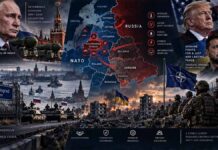










Scope: This assessment examines Russian nuclear signalling, threats against European defence-industrial targets, pressure surrounding Kaliningrad, hybrid activity and NATO eastern-flank posture from the doctrinal baseline established in 2024 through 3 October 2026, with a forward horizon covering the next several months and the strategic consequences for Poland, the Baltic region, Italy, France, Germany, the United Kingdom, the European Union and NATO.
The assessment follows the user-supplied Academic Governance Edition V9.0 — Universal Institutional Intelligence Report Protocol, including its requirement to distinguish established fact, attributed institutional position and analytical judgment, and to structure a Full Dossier around an Executive Summary, three-pillar Navigational Index, Master Abstract, evidence assessment, competing pathways, gaps and indicators. Testo incollato
Executive Summary / BLUF
The evidence supports the judgment that Russia is conducting an increasingly explicit campaign of nuclear-backed coercive signalling toward NATO’s European members, with Kaliningrad, European weapons production, military exercises, Ukraine assistance and NATO’s eastern-flank posture being deliberately connected within the same escalation narrative. On 30 September 2026, Reuters reported that a Russian diplomatic communication warned NATO that Moscow could use all available means, including nuclear weapons, if the Alliance attempted to isolate Kaliningrad; NATO Secretary General Mark Rutte responded that NATO saw no imminent Russian attack on Allied territory and called for calm rather than reciprocal escalation. Reuters
This signalling is not detached from formal Russian doctrine. Russia’s 19 November 2024 nuclear-deterrence policy, Presidential Decree No. 991, explicitly identifies attempts to isolate Russian territory, block access to vital transport communications, expand hostile military coalitions near Russian borders, and conduct large-scale exercises near Russia as military dangers relevant to nuclear deterrence; it also states that nuclear deterrence consists not merely of military measures but of coordinated political, diplomatic, informational, economic and military actions. Decree No. 991 — Russian Presidential nuclear-deterrence policy Garanti Base
The strongest defensible interpretation is therefore not that Moscow has demonstrated an intention to initiate nuclear war, but that it is systematically enlarging the category of activities that European governments must mentally associate with nuclear risk, thereby increasing the political cost of supporting Ukraine and strengthening NATO’s eastern flank.
The proposition that Russia is attempting to manufacture a “Cuban Missile Crisis 2.0” is analytically plausible but remains unproven as a specific Kremlin operational plan. The observable evidence is nevertheless compatible with a coercive strategy designed to transform military aid, defence production, exercises, air policing, Baltic reinforcement and potential interference with Kaliningrad into components of a single escalation ladder.
Russia has simultaneously expanded the pressure beyond conventional strike systems. On 30 September, Russian Foreign Ministry spokesperson Maria Zakharova declared European weapons factories producing equipment for Ukraine potential Russian military targets, explicitly discussing prospective Patriot-related production in Poland. MarketScreener Canada
NATO has so far refused the escalatory framing. The Alliance continues to reinforce its eastern flank while maintaining that its posture is defensive; NATO’s September 2026 eastern-flank assessment records increased Russian airspace violations, sabotage, cyber activity and other hostile actions while documenting the Alliance’s corresponding readiness measures. Strengthening NATO’s Eastern Flank — NATO NATO
The principal strategic danger is therefore miscalculation rather than an established decision by Russia to employ nuclear weapons: repeated military encounters, hybrid attacks, deliberate ambiguity and increasingly explicit nuclear rhetoric create more opportunities for one side to misinterpret an incident, reinforcement measure or defensive action as preparation for escalation.
Russia’s Nuclear Coercion Is Testing Europe’s Ability to Turn Support for Ukraine into Permanent Power
Russia’s September 2026 nuclear warnings over Kaliningrad matter less because they prove imminent nuclear use—they do not—than because they reveal the political contest now shaping Europe’s security architecture. On 30 September 2026, NATO Secretary General Mark Rutte confirmed that the Alliance had received and answered a Russian communication concerning Kaliningrad while rejecting the proposition that nuclear use against the Baltic Allies was an immediate scenario. The contradiction is the point: Moscow is widening the range of conventional European decisions that must be weighed against nuclear risk just as NATO and the European Union are converting support for Ukraine from emergency transfers into permanent military, industrial and financial structures. The next 12–24 months will therefore test whether Russian coercion can fragment European decision-making faster than Europe can institutionalise its defence commitments.
Moscow is trying to make ordinary defence policy look like entry into the war
Russia’s leverage depends on collapsing distinctions that NATO and the European Union have spent four years trying to preserve. NATO Security Assistance and Training for Ukraine operates from Allied territory, has around 300 personnel, manages equipment flows through three logistics hubs in eastern Allied territory, coordinates training and repair, and explicitly does not conduct onward delivery inside Ukraine. The institutional decision taken at the 2024 Washington Summit was designed to make support durable without making NATO a party to the conflict under international law; Moscow’s political interest is the opposite—to make logistics, training, repair, air defence and weapons production appear as progressively indistinguishable forms of belligerency.
The scale now makes that narrative contest consequential. By June 2026, Allies had committed more than USD 6 billion through the Prioritised Ukraine Requirements List, while the European Union’s EUMAM Ukraine mission had trained 97,000 Ukrainian soldiers, involved 24 Member States, and accumulated €610 million in European Peace Facility support. These are no longer episodic national decisions. They are standing structures, with budgets, personnel, command arrangements and industrial implications that are politically harder to reverse than a single weapons package.
The vulnerability is obvious. A Russian threat against one convoy can be treated as intimidation; a threat against an institutional support network forces governments to decide whether factories, rail corridors, air-defence sites and training centres inside NATO territory are now part of the coercive battlefield. That is precisely the ambiguity Moscow benefits from maintaining.
The numbers show that Europe is moving from stock depletion to industrial commitment
The decisive shift is visible in air defence. Germany reported in August 2026 that it had provided or earmarked approximately €57.6 billion in military assistance since February 2022 and more than €43.3 billion in bilateral civilian support. It was also assembling several separate air-defence channels, including Patriot and IRIS-T procurement, and had committed to supplying several hundred Patriot interceptors over four years. More than 27,000 Ukrainian soldiers had been trained in Germany.
The United Kingdom moved in the same direction. In February 2026, London announced an urgent air-defence package worth more than £500 million, including £150 million for NATO PURL and 1,000 additional UK-manufactured missiles. In June 2026, the government added a £752 million package containing 150,000 Ukrainian-produced drones and more than 350 air-defence missiles and radars before year-end. A further £100 million package including Patriot missiles followed on 8 September 2026.
Poland is changing category altogether. Under the second phase of the Wisła programme, 48 M903 Patriot launchers are to be produced domestically for delivery in 2027–2029, while Polish-US discussions in August 2026 extended to possible PAC-3 production and maintenance in Poland. The strategic meaning is larger than the contract value: Poland is moving from purchaser to producer and maintainer of the same air-defence ecosystem that Russia increasingly treats as part of the war-support infrastructure.
France is pushing the transmission mechanism further into Ukraine itself. On 14 July 2026, President Emmanuel Macron and the Ukrainian leadership announced licensed production in Ukraine of AASM precision-guided bombs and SCALP missiles, alongside plans centred on combat aviation and air and missile defence. At that point, “European support” was no longer accurately described as equipment leaving Western inventories; it increasingly meant shared production capacity distributed across borders.
Kaliningrad gives Moscow a territorial lever that industrial pressure alone cannot provide
Kaliningrad’s value lies in the compression of geography and escalation. The exclave has approximately 280.5 kilometres of border with Lithuania, 231.98 kilometres with Poland and 183.56 kilometres of Baltic coastline, but no land connection to mainland Russia. It therefore sits simultaneously inside NATO’s most exposed military geography and inside Russia’s most politically sensitive territorial narrative.
That vulnerability explains why transit and access carry such weight. Lithuania’s implementation of EU sanctions in 2022 restricted categories of sanctioned goods while leaving passenger travel and non-sanctioned transit functioning; yet Moscow has repeatedly had an incentive to describe restrictions through the wider language of isolation. Russia has also invested in direct maritime redundancy through the Ust-Luga–Kaliningrad ferry network, reducing but not removing dependence on external geography.
The military position is equally dual. Lithuania’s 2026 National Threat Assessment judged Kaliningrad’s land component temporarily weakened because personnel and equipment had been transferred to Ukraine, while simultaneously reporting long-term expansion: a naval infantry brigade being enlarged into a division, new infrastructure, reinforced arsenal facilities, a strategic-reserve logistics base, construction of a 29B6 Container radar, and continued significance of the Voronezh-DM early-warning radar. Kaliningrad is therefore not merely a forward Russian bastion or an exposed enclave; it is both, which is precisely why Moscow can use it as a coercive instrument without needing to invent its strategic sensitivity.
The eastern flank is becoming a permanent multinational military system
NATO’s response has been to reduce the number of political decisions required after a crisis begins by placing forces and command structures in position beforehand. By June 2026, the Alliance maintained nine Forward Land Forces formations across its eastern flank. In the northeastern theatre, the United Kingdom leads in Estonia, Canada in Latvia, Germany in Lithuania and the United States in Poland.
Latvia has already moved beyond the original battlegroup model to a brigade-level formation, supported by Canada and twelve other Allies. Germany’s Panzerbrigade 45 in Lithuania is designed to reach approximately 5,000 personnel and become operational by the end of 2027, embedding a permanent heavy German formation near both Belarus and Kaliningrad. Italy’s contingent in Latvia reached Full Operational Capability in April 2026, while Italian Eurofighter F-2000 aircraft deployed to Lithuania intercepted two Russian military aircraft on 3 August 2026 and neutralised a drone after a Lithuanian airspace violation on 14–15 September 2026.
Poland has become the point at which collective defence and Ukraine support physically overlap. At Jasionka, approximately 300 Dutch troops, two Patriot systems, NASAMS and counter-drone capabilities protect infrastructure connected to the NATO support architecture, with the Dutch Patriot deployment extended through December 2026. The same country is therefore simultaneously a front-line Ally, a logistics rear area for Ukraine and an emerging air-defence production base.
This architecture strengthens deterrence but raises the political stakes of every incident. A Russian drone over Latvia, a maritime confrontation off Denmark or a strike close to Poland can now involve multinational units immediately, reducing the possibility that Moscow can pressure one eastern state in isolation.
Europe’s nuclear problem is not lack of weapons but lack of a single strategic culture
France and the United Kingdom enter this confrontation as sovereign nuclear powers; Germany and Italy do not. On 2 March 2026, President Emmanuel Macron announced a more explicitly European concept of French “forward deterrence” while preserving exclusive presidential authority over nuclear use and declining to transfer the definition of French vital interests to partners. France and Germany simultaneously created a high-level nuclear steering group covering doctrine, conventional capabilities, missile defence and French nuclear forces, while Germany remained inside NATO nuclear sharing.
The United Kingdom’s 2025 Strategic Defence Review adopted a “NATO First” posture, identified Russian nuclear coercion as a central challenge and placed greater weight on warfighting readiness, deep precision strike, integrated air and missile defence and nuclear resilience. London’s deterrent remains sovereign, continuously deployed at sea and assigned to NATO defence, while Prime Ministerial authority over use is preserved.
Italy’s model is different again. It remains dependent on NATO extended deterrence, but its eastern-flank deployments mean it is no longer insulated from the operational consequences of a Baltic crisis. The result is not four incompatible policies but four different escalation-management systems operating inside one Alliance. Moscow’s interest is to exploit those differences faster than NATO can convert them into coordinated political choice.
NATO is buying options below the nuclear threshold
The most important result of the Ankara Summit of 7–8 July 2026 was therefore not another declaration about resolve but the expansion of conventional and industrial alternatives to nuclear escalation. NATO reaffirmed Article 5, committed to an integrated mix of nuclear, conventional, missile-defence, cyber and space capabilities, and announced more than €50 billion in new procurement deals.
The industrial numbers were larger still. European Allies and Canada had increased core defence investment by more than USD 139 billion during 2025. NATO committed €70 billion in military equipment, assistance and training for Ukraine in 2026, with at least an equivalent level intended for 2027. The Alliance also announced more than USD 40 billion over five years for the Drone Edge counter-UAV programme and €27 billion for fuel infrastructure.
The European Union is building the financing layer underneath that military architecture. SAFE provides up to €150 billion in long-maturity loans for defence investment and common procurement, while the €90 billion Ukraine Support Loan contains an indicative €60 billion defence component for 2026–27. For 2026, up to €45 billion was authorised, including €28.3 billion for Ukrainian defence-industrial capacity. Fifteen of the nineteen national SAFE plans already include projects involving Ukraine.
The strategic effect is straightforward: every additional conventional interceptor, drone, production line, fuel depot or logistics corridor gives European governments another option before nuclear escalation becomes relevant. Industrial capacity is therefore not separate from deterrence; it is what makes political restraint credible without becoming strategic passivity.
The next 12–24 months will decide whether coercion fragments Europe before investment hardens into capability
The risk period lies in the gap between commitments already announced and capabilities not yet fully delivered. Germany’s Lithuania brigade is still moving toward full operational readiness by end-2027; Poland’s 48 M903 launchers are scheduled for 2027–2029; SAFE, EDIP and the Ukraine Support Loan are financing industrial expansion that will take time to reach mature output. Russia therefore has an incentive to test cohesion before this architecture becomes harder to reverse.
The warning indicators are not another threatening speech from Moscow. The decisive signals would be synchronisation: a formal Russian ultimatum tied to Ukraine support or NATO deployments; rapid reinforcement of Kaliningrad or Belarus; exceptional nuclear-force readiness; non-routine dispersal of dual-capable systems; coordinated sabotage against logistics and industrial nodes; or direct Russia–NATO casualties followed by time-limited political demands. None of those combinations is established in the dossier as of 3 October 2026.
The cost of inaction over the next 12–24 months would fall first on Poland and the Baltic states, where geography converts political hesitation into immediate military exposure; next on Germany, France, the United Kingdom and Italy, whose forces, industries and budgets are already embedded in the eastern defence system; and finally on Europe’s fiscal position, because delayed production and infrastructure investment would force governments to buy readiness later under worse conditions. Russia does not need to win a nuclear confrontation to achieve strategic effect. It needs European governments to behave as though one has already begun.
Navigational Index
Pillar I — Nuclear Coercion, Kaliningrad and the Architecture of Russian Escalation
Chapter 1 — From Nuclear Deterrence to Nuclear-Backed Coercion
The evolution of Russian nuclear doctrine, Presidential Decree No. 991, signalling mechanisms, escalation thresholds and the distinction between deterrence, compellence and actual nuclear-use preparation.
Chapter 2 — Kaliningrad as Strategic Lever and Strategic Vulnerability
The military geography of the exclave, access routes, Baltic Sea dynamics, the Suwałki region, Russian force posture and why hypothetical isolation scenarios possess disproportionate escalation value.
Chapter 3 — The “Cuban Missile Crisis 2.0” Hypothesis
Whether Moscow is attempting to manufacture a high-risk confrontation capable of producing negotiations from a position of nuclear leverage, and what observable evidence would distinguish deliberate crisis manufacture from conventional deterrence signalling.
Pillar II — Pressure on NATO’s Eastern Flank and the Campaign Against Ukraine Support
Chapter 4 — From Ukraine Assistance to European Targeting Narratives
Russian attempts to redefine weapons production, logistics, training, air defence and military assistance as direct European participation in the war.
Chapter 5 — Poland and the Baltic States at the Centre of the Coercive Geometry
Patriot production, air defence, Kaliningrad, Lithuania, Latvia, Estonia, Poland, Danish and Baltic maritime incidents, NATO Forward Land Forces and eastern-flank reinforcement.
Chapter 6 — Hybrid Warfare, Provocation and Controlled Ambiguity
Sabotage, cyber activity, drone incursions, airspace violations, maritime encounters, information operations and the strategic use of incidents that remain below conventional-war thresholds.
Pillar III — European Strategic Consequences and the Next Escalation Cycle
Chapter 7 — Italy, France, Germany and the United Kingdom
National military exposure, Ukraine-support structures, industrial implications, eastern-flank contributions, escalation-management constraints and divergent strategic cultures.
Chapter 8 — NATO and the European Union Under Nuclear Pressure
Alliance cohesion, Article 5 credibility, deterrence architecture, industrial mobilisation, Ukrainian assistance and the institutional problem of responding firmly without validating Moscow’s escalation narrative.
Chapter 9 — Escalation Pathways, Warning Indicators and Strategic Outlook
Observable warning indicators, crisis thresholds, nuclear-force signalling, exercises, hybrid operations, Baltic incidents, negotiations and the conditions under which the current coercive campaign would become substantially more dangerous.
Master Abstract
The Current Russian Campaign Is Broader Than a Single Nuclear Threat
The late-September escalation surrounding Kaliningrad should not be interpreted as an isolated statement produced by one Russian embassy or spokesperson. Its strategic significance emerges because several distinct lines of Russian policy have converged: nuclear doctrine, territorial-security rhetoric, warnings concerning NATO exercises, threats against European defence production, pressure on states supplying Ukraine, hybrid operations and increasingly direct references to European territory as potentially subject to Russian military action. Reuters reported on 30 September that Moscow had circulated a diplomatic warning asserting that an attempt to isolate Kaliningrad could provoke the use of all available means, including nuclear weapons; the reporting also described concern among diplomats regarding the exceptional character of the communication. Reuters
The wording matters because it corresponds unusually closely with Russia’s publicly codified nuclear-deterrence doctrine. Presidential Decree No. 991 of 19 November 2024 defines nuclear deterrence as a coordinated system incorporating political, military, diplomatic, economic and informational measures and identifies actions aimed at isolating part of Russian territory or obstructing access to vital transport communications among the military dangers against which nuclear deterrence operates. Russian Presidential Decree No. 991 — 19 November 2024 Garanti Base
That doctrinal connection does not establish that nuclear employment would automatically follow a blockade, nor does it demonstrate that Moscow presently intends such employment. It does, however, give Russian officials a pre-existing doctrinal vocabulary through which hypothetical pressure on Kaliningrad can be represented domestically and internationally as belonging inside Russia’s nuclear-security framework.
Kaliningrad Gives Moscow an Exceptionally Powerful Escalation Narrative
Kaliningrad occupies a unique strategic position because it is simultaneously Russian sovereign territory, a heavily militarised forward area, a geographic exclave surrounded by NATO members and the Baltic Sea, and an obvious focal point for hypothetical wartime interdiction scenarios. Russia can consequently portray almost any serious discussion concerning access to the exclave as threatening territorial integrity even when NATO presents its Baltic activities as defensive.
The significance of that ambiguity became clearer on 29–30 September 2026, when Russian diplomatic messaging warned that military action or blockade against Kaliningrad would produce a response using all means available to Russia, explicitly including nuclear weapons. The Russian Embassy in London statement, reported contemporaneously, said Russia did not seek confrontation with NATO but insisted that any UK or NATO military action against Russian territory would receive such a response. Anadolu Ajansı
NATO’s response has been deliberately different in tone. Secretary General Mark Rutte stated on 30 September that the Alliance did not see an imminent threat to NATO territory and emphasised continuity in NATO’s threat assessment rather than treating the Russian statement as evidence that war was immediately approaching. Reuters
That divergence is strategically consequential. Moscow benefits if European governments begin treating ordinary reinforcement, exercises, defence-industrial expansion or support for Ukraine as actions carrying automatic nuclear escalation risk; NATO, by contrast, benefits from preserving a distinction between credible deterrence and self-deterrence produced by Russian signalling.
The Target of the Pressure Campaign Extends Beyond Kaliningrad
The broader evidence indicates that Russian coercive messaging is increasingly directed against the infrastructure that sustains Ukraine rather than only against weapons already employed against Russian territory. On 30 September, Russian Foreign Ministry spokesperson Maria Zakharova declared that European factories producing weapons for Ukraine were potential Russian military targets and specifically responded to discussion concerning Polish production of Patriot interceptor missiles. MarketScreener Canada
This constitutes an important escalation in declared targeting logic because Patriot interceptors are principally defensive systems intended to defeat incoming aircraft and missiles. Moscow’s argument therefore moves beyond retaliation against facilities responsible for offensive strikes and toward a wider proposition: that European industrial participation in Ukraine’s defence can itself create military-target status.
Poland is particularly exposed to this pressure because its geography, military build-up, defence-industrial expansion and position on NATO’s eastern flank place it simultaneously inside the Ukrainian support network and NATO’s territorial defence architecture. Warsaw stated on 2 September that Russian hybrid activity would not weaken Polish determination to support Ukraine and that strengthening NATO’s and the European Union’s eastern flank remained a priority. MFA Statement — Republic of Poland — 2 September 2026 Gov.pl
The result is a deliberate strategic collision between Russian coercion and NATO industrial adaptation: Russia seeks to attach additional risk to the production and transfer of military capability, whereas Allied governments increasingly regard the same production expansion as necessary for deterrence.
Hybrid Activity Provides a Lower-Risk Escalation Laboratory
The military interaction surrounding Denmark illustrates the danger of treating Russian coercion exclusively as rhetorical. On 14 September 2026, Denmark’s Defence Command reported that a Russian frigate fired two flares toward a Danish Air Force Fennec helicopter conducting routine photographic monitoring in international waters southeast of Gedser, with one flare passing close to the aircraft. Forsvarets helikopter beskudt med flares fra russisk fregat — Danish Defence Command — 14 September 2026 Forsvaret
When Russian accounts subsequently disputed the circumstances, the Danish Defence Command published a more detailed chronology on 25 September, stating that the helicopter had been conducting routine monitoring, was visible from a considerable distance, and approached at approximately 400 metres altitude and 185 kilometres per hour. Fakta om hændelse med russisk chikane af dansk helikopter — Danish Defence Command — 25 September 2026 Forsvaret
Such incidents matter because they create escalation opportunities without requiring Moscow to initiate a conventional conflict deliberately. Maritime interactions, aircraft encounters, drones, sabotage, cyber operations and ambiguous infrastructure incidents can all test NATO decision-making while preserving varying degrees of deniability.
NATO’s own assessment, updated 29 September 2026, states that hostile Russian activities against Allies and partners—including airspace violations, cyberattacks and sabotage—have increased while the Alliance has reinforced its eastern flank with more combat-ready forces and strengthened regional defence plans. Strengthening NATO’s Eastern Flank — NATO — updated 29 September 2026 NATO
The Strategic Objective Is More Consistent with Compellence Than Immediate Nuclear Employment
The current pattern is more compatible with coercive compellence than with evidence of imminent Russian nuclear employment. Nuclear deterrence seeks principally to prevent an adversary from acting; compellence attempts to induce an adversary to alter behaviour already under way. Russia is not merely demanding that NATO refrain from attacking Russian territory: it repeatedly challenges ongoing weapons production, military assistance, sanctions, eastern-flank reinforcement and other established Western policies.
That distinction is essential because Ukraine assistance remains institutionalised within NATO policy. The Washington Summit established NATO Security Assistance and Training for Ukraine and a minimum baseline of €40 billion in security assistance for the following year, while explicitly stating that NSATU support for Ukrainian self-defence does not make NATO a party to the conflict under international law. Washington Summit Declaration — NATO — 10 July 2024 NATO
At The Hague in June 2025, Allied leaders subsequently reaffirmed their sovereign commitments to Ukraine and adopted the longer-term defence-investment framework under which Allies agreed to work toward 5 percent of GDP in defence and defence-related expenditure by 2035, comprising at least 3.5 percent for core defence requirements and up to 1.5 percent for security-related investment including infrastructure, resilience and industrial capacity. The Hague Summit Declaration — NATO — 25 June 2025 NATO Communications Agency
Russian coercive signalling therefore confronts not an ad hoc assistance programme but a progressively institutionalised European and transatlantic defence architecture.
“Cuban Missile Crisis 2.0” Is a Useful Model Only If Its Limits Are Preserved
The comparison with the October 1962 Cuban Missile Crisis captures one important element of the present confrontation: Moscow can benefit politically from creating an environment in which decision-makers believe that apparently limited military choices might trigger uncontrollable nuclear escalation.
The historical analogy nevertheless has significant limits. There is currently no publicly established equivalent of the Soviet deployment of strategic nuclear missiles to Cuba, no verified clandestine emplacement producing an immediate strategic surprise comparable with October 1962, and no publicly confirmed Russian-American confrontation over removal of such a deployment. The present confrontation is instead distributed across doctrine, rhetoric, hybrid activity, defence-industrial threats, exercises, forward forces and political signalling.
Consequently, “Cuban Missile Crisis 2.0” is most useful as a model of manufactured brinkmanship leading toward privileged great-power negotiation, rather than as a literal reconstruction of 1962.
The model would gain substantially greater evidentiary support if Russia moved from declaratory signalling into observable nuclear-force measures: conspicuous non-strategic nuclear deployments, changes in readiness, publicised nuclear-loading procedures, unusual dual-capable missile movements, nuclear-force exercises directly linked to a Baltic confrontation, withdrawal from remaining transparency measures, or preparations for explosive nuclear testing.
Until such indicators appear, the public record supports the judgment that Moscow is raising the perceived nuclear cost of resistance, but it does not establish that Russia has crossed from nuclear signalling into operational preparation for nuclear employment.
Key Evidence Table
| Indicator | Value / status | Reference date | Definition / scope | Issuer | Exact source |
|---|---|---|---|---|---|
| Russian Kaliningrad warning | Russia reportedly warned that attempts to isolate Kaliningrad could trigger use of all available means, including nuclear weapons | 30 Sep 2026 | Diplomatic communication reviewed by Reuters; full Russian non-paper not publicly available in the verified record examined here | Russian diplomatic communication, as reported by Reuters | Reuters |
| Russian nuclear doctrine | Isolation of Russian territory and obstruction of vital transport communications identified among dangers relevant to nuclear deterrence | 19 Nov 2024 | Russian state nuclear-deterrence policy | President of the Russian Federation | Presidential Decree No. 991 Garanti Base |
| NATO immediate threat assessment | NATO Secretary General stated there was no imminent threat to NATO territory | 30 Sep 2026 | Alliance-level public threat assessment | NATO Secretary General Mark Rutte | Reuters |
| Russian targeting statement | European factories producing weapons for Ukraine described as potential military targets | 30 Sep 2026 | Russian Foreign Ministry public statement | Maria Zakharova, Russian MFA | MarketScreener Canada |
| Danish maritime-air incident | Russian frigate fired two flares toward Danish Fennec helicopter; one passed close to aircraft | 14 Sep 2026 | International waters southeast of Gedser | Danish Defence Command | Danish Defence Command Forsvaret |
| NATO eastern-flank posture | Alliance reports increased hostile activity and stronger combat-ready eastern-flank posture | Updated 29 Sep 2026 | NATO eastern flank | NATO | Strengthening NATO’s Eastern Flank NATO |
| NATO long-term Ukraine mechanism | NSATU established; minimum-baseline security assistance framework created | Jul 2024 | NATO support for Ukrainian self-defence | NATO Heads of State and Government | Washington Summit Declaration NATO |
| NATO defence-investment framework | At least 3.5% GDP core defence plus up to 1.5% defence/security-related investment by 2035 | Jun 2025 | Alliance-wide investment commitment | NATO Heads of State and Government | The Hague Summit Declaration NATO Communications Agency |
| German support baseline | More than €43.3bn bilateral civilian assistance and approximately €57.6bn military support provided or earmarked | 24 Aug 2026 | Since Russia’s 24 Feb 2022 full-scale invasion | German Federal Government | Germany’s Support for Ukraine Bundesregierung |
| UK September air-defence package | £100m air-defence package including Patriot missiles | 8 Sep 2026 | Winter 2026 assistance to Ukraine | UK Ministry of Defence | UK pledges winter air defence package GOV.UK |
| Italian eastern-flank activity | Italian Eurofighters intercepted and neutralised a drone after a Lithuanian airspace violation | 14–15 Sep 2026 | NATO air-defence mission | Italian Ministry of Defence | Italian aircraft intercept drone in Lithuanian airspace Difesa |
Competing Explanations or Pathways
The available record supports several genuinely distinct explanations for the present escalation pattern, although they are not equally mutually exclusive at the tactical level; the principal question is which strategic purpose predominates.
| Hypothesis | Diagnostic support | Disconfirming evidence | Indicators | Current standing |
|---|---|---|---|---|
| Coercive campaign to reduce Western support for Ukraine | Threats increasingly target arms production, Patriot-related industrial activity and states sustaining Ukraine; NATO commanders and European governments identify Russian hybrid activity aimed at weakening Allied resolve | Western support has continued despite previous nuclear threats, limiting demonstrated coercive success | Wider threats against logistics hubs; sabotage associated with Ukrainian supply chains; differentiated pressure on major donors; demands linking de-escalation to aid reductions | Strongly supported as a principal explanation, although the degree of central coordination among every incident remains unproven |
| Defensive signalling intended principally to deter action against Kaliningrad | Russian doctrine explicitly identifies isolation of Russian territory and blocked communications as relevant dangers; embassy language frames threats as retaliatory | The simultaneous targeting narrative against European defence factories extends beyond Kaliningrad | Threats remain narrowly tied to territorial attack or blockade; absence of broader escalation toward aid infrastructure | Supported but insufficient by itself to explain the widening target set |
| Deliberate crisis manufacture designed to force high-level strategic negotiations | Nuclear rhetoric, great-power bargaining preferences and repeated escalation framing are compatible with brinkmanship | No public record establishes a Kremlin decision to create a staged nuclear crisis; no verified major change in nuclear-force readiness has yet been demonstrated | Visible nuclear-force readiness changes, deployment of non-strategic nuclear assets, major ultimata, formal linkage between de-escalation and US-Russia negotiations | Plausible and strategically important, but not established |
| Preparation for near-term conventional war against NATO | Hybrid actions and hostile signalling demonstrate sustained confrontation | NATO stated on 30 September that it saw no imminent threat to Allied territory; no publicly demonstrated mobilisation pattern equivalent to preparation for major conventional attack has been identified in the examined record | Large-scale force concentration, logistics preparation, mobilisation, medical support, ammunition positioning, command activation and sustained ISR posture toward NATO territory | Not supported by the current public record as the immediate explanation |
European Strategic Exposure
Poland and the Baltic Region
Poland, Lithuania, Latvia and Estonia are the principal geographic subjects of the current coercive geometry because the Kaliningrad exclave, Baltic maritime approaches, NATO’s eastern flank and Western logistics for Ukraine converge in the same theatre.
Poland has publicly stated that strengthening NATO’s and the EU’s eastern flank remains a national priority and that Russian hybrid activity will not end Polish support for Ukraine. Polish MFA Statement — 2 September 2026 Gov.pl
The central vulnerability is therefore political rather than merely military: Moscow can attempt to make every incremental enhancement of Polish military capacity appear to increase the risk of Russian retaliation, thereby turning ordinary sovereign defence procurement into a test of escalation tolerance.
Germany
Germany occupies an increasingly consequential position because it combines large-scale assistance to Ukraine with direct responsibility for Baltic and eastern-flank deterrence. Chancellor Friedrich Merz stated in July 2026 that “the security of the Baltic States is also the security of Germany,” while the Federal Government identified strengthening NATO’s eastern flank and continued Ukrainian support as central elements of policy. The Security of the Baltic States Is Also the Security of Germany — Federal Government — 3 July 2026 Bundesregierung
By August 2026, Berlin reported more than €43.3 billion in bilateral civilian support and approximately €57.6 billion in military assistance provided or earmarked, placing Germany among the European states for which Russian efforts to raise the political cost of Ukrainian assistance have particularly significant strategic implications. How Germany Is Supporting Ukraine — Federal Government — August 2026 Bundesregierung
Germany has also publicly attributed the attempted 4 August 2026 attack at Leipzig/Halle Airport to Russia and responded with diplomatic and counter-hybrid measures while explicitly declaring that assistance to Ukraine would continue. Resolute Action Against Hybrid Attack — Federal Government — 4 September 2026 Bundesregierung
United Kingdom
The United Kingdom remains directly exposed to Russian coercive messaging because London combines nuclear-weapon-state status, major NATO responsibilities and continuing military assistance to Ukraine.
On 8 September 2026, the British government announced a £100 million air-defence package, including Patriot missiles, alongside artillery ammunition and drones. UK pledges winter air defence package — UK Ministry of Defence — 8 September 2026 GOV.UK
The subsequent Russian Embassy warning directed toward discussion in Britain of Kaliningrad is therefore strategically significant because it places nuclear rhetoric directly against one of Europe’s two independent nuclear powers and one of Ukraine’s principal military supporters. The immediate risk is not that Britain lacks retaliatory capability, but that repeated nuclear threats seek to alter calculations concerning conventional military assistance and Baltic contingencies.
France
France occupies a different but equally significant position because it combines an independent nuclear deterrent, NATO membership, major European strategic ambitions and leadership in the post-war security-guarantee framework being developed for Ukraine.
On 13 July 2026, France and its Coalition of the Willing partners reaffirmed long-term military assistance to Ukraine and stated that the Multinational Force for Ukraine was prepared to operate after a credible cessation of hostilities, at Ukraine’s request, as part of defensive security guarantees intended to prevent renewed Russian aggression. Coalition of the Willing Statement — Élysée — 13 July 2026 elysee.fr
For Paris, Russian nuclear signalling therefore operates on two levels: it seeks to constrain current assistance while simultaneously shaping European calculations regarding the security architecture that would follow a ceasefire.
Italy
Italy is not geographically situated on NATO’s northeastern frontier, but it is operationally involved in defending it. In June 2026 Italian forces continued deployment within NATO Forward Land Forces in Latvia, and on 14–15 September Italian Eurofighter F-2000 aircraft operating under the Baltic Thunder III mission scrambled after a drone violated Lithuanian airspace; the Italian Ministry of Defence reported that the aircraft intercepted and neutralised the unmanned vehicle under NATO procedures. Italian aircraft intercept drone in Lithuanian airspace — Ministry of Defence — 15 September 2026 Difesa
Italy therefore demonstrates why the concept of an “eastern-flank state” is insufficient for understanding exposure. NATO’s integrated defence structure means an incident over Lithuania, Latvia or the Baltic Sea can immediately involve Italian aircraft, German formations, British forces, French capabilities and other Allied contingents.
That institutional integration simultaneously strengthens deterrence and broadens the number of governments potentially subjected to Russian coercive signalling.
Why Russia Would Benefit from a Controlled Escalation Cycle
A controlled confrontation offers Moscow several potential advantages without requiring it actually to cross the nuclear threshold.
First, it can raise the domestic political price of Ukraine support by encouraging European constituencies to ask whether military assistance justifies nuclear risk.
Second, it can exploit differences in escalation tolerance among Allies, testing whether governments geographically distant from Russia interpret Baltic contingencies differently from Poland, Finland or the Baltic states.
Third, it can attempt to convert a Russia–Ukraine war into an apparent Russia–United States strategic-security dispute, thereby reinforcing Moscow’s longstanding preference for recognition as a great power negotiating European security directly with Washington.
Fourth, it can seek to create a bargaining environment in which reducing NATO activities, weapons production or Ukrainian military capability is presented not as a concession to Russian aggression but as the price of preventing nuclear escalation.
The final element has historical continuity. In December 2021, before the full-scale invasion of Ukraine, Russia proposed security arrangements requiring substantial constraints on NATO military activity and enlargement. The draft arrangements subsequently became an important reference point for understanding Moscow’s broader demands concerning the post-Cold War European security order.
The current nuclear rhetoric should therefore be assessed not only as a reaction to individual Baltic incidents but within the longer Russian effort to alter the military and political architecture that emerged after NATO enlargement.
Why NATO’s Current Response Matters
NATO faces a difficult deterrence-management problem because overreaction and underreaction can both serve Russian interests.
If every Russian nuclear statement produces emergency changes in Allied military posture, Moscow receives evidence that nuclear rhetoric can influence NATO decisions at relatively low cost.
If the Alliance ignores genuine changes in Russian military readiness, however, deterrence and crisis-management mechanisms can fail.
The current NATO position attempts to occupy the middle ground: maintain eastern-flank reinforcement, continue assistance to Ukraine, improve readiness and industrial capacity, but avoid treating rhetoric alone as evidence of imminent attack. On 30 September, Secretary General Mark Rutte publicly stated that NATO saw no imminent threat to Allied territory while maintaining that the Alliance remained capable of responding to aggression. Reuters
That response is consistent with the Alliance’s broader deterrence architecture. NATO’s Washington Summit declaration defines deterrence as an integrated combination of nuclear, conventional, missile-defence, space and cyber capabilities, rather than relying upon nuclear signalling alone. Washington Summit Declaration — NATO — July 2024 NATO
The central strategic requirement is therefore not rhetorical symmetry with Moscow but the preservation of credible conventional defence, nuclear deterrence, political cohesion and escalation control simultaneously.
Principal Gaps and Watch Indicators
Several unresolved records could materially change this assessment.
The Russian diplomatic non-paper itself remains decisive. Reuters reported its contents, but a complete authenticated public copy has not been identified in the examined official record; publication of the original would permit assessment of its precise language, recipients, legal framing and relationship to Russian nuclear doctrine. Reuters
Observable nuclear-force posture is more important than rhetoric. Changes involving Russian non-strategic nuclear storage facilities, dual-capable missile units, nuclear command-and-control activity, unusual dispersal, loading operations or readiness measures would materially increase the seriousness of the current campaign.
Exercise linkage must be watched carefully. Russia’s doctrine explicitly treats large-scale exercises near its borders as relevant to deterrence, meaning future NATO exercises in the Baltic region may become focal points for additional Russian signalling. Russian Nuclear Deterrence Policy — Decree No. 991 ConsultantPlus
Kaliningrad access narratives require particular monitoring. A shift from warnings against hypothetical blockade toward claims that NATO has already begun an operational blockade, communications isolation or preparation for attack would represent a significant rhetorical escalation.
European defence-industrial targeting language should be tracked geographically. If Russian officials begin naming individual factories, transport hubs, ports or companies rather than speaking generically about European defence production, the coercive campaign would have crossed another important threshold.
Hybrid incidents should be assessed as sequences rather than individually. Repeated drone incursions, maritime encounters, sabotage, cyberattacks or infrastructure disruptions occurring near major exercises, Ukrainian aid decisions or negotiations would strengthen the hypothesis of coordinated coercive escalation.
Any explicit Russian proposal connecting nuclear de-escalation with restrictions on Ukrainian assistance or NATO eastern-flank forces would materially strengthen the “manufactured crisis for negotiation” hypothesis.
Actual preparations for nuclear testing would constitute a major qualitative change. Political statements about testing carry a different evidentiary weight from technical preparations at test sites, movement of specialised equipment or formal withdrawal from remaining restraint mechanisms.
Strategic Warning Thresholds
The current assessment should be reconsidered substantially if several of the following indicators occur together:
- Russia publicly announces a change in the readiness status of strategic or non-strategic nuclear forces in direct response to a Baltic or Kaliningrad dispute.
- Nuclear-capable systems are conspicuously dispersed or repositioned in a manner that departs from routine exercise patterns.
- Moscow formally declares that an existing NATO activity already constitutes the doctrinal condition of isolation or attack against Russian territory.
- Russian authorities identify specific defence-industrial installations inside NATO countries as operational targets rather than potential targets.
- A serious Russian–NATO military incident produces casualties and Moscow immediately couples the incident to nuclear-force signalling.
- Russia issues a time-limited ultimatum demanding termination of defined NATO activities or military assistance.
- Nuclear demonstrations or preparations for explosive testing are explicitly tied to European security demands.
- Russia proposes bilateral negotiations with Washington conditioned on restrictions concerning Ukraine, Poland, the Baltic states or NATO force deployments.
- Significant conventional Russian forces begin preparing simultaneously for operations against NATO territory, altering the present assessment that immediate conventional attack is not indicated by the available public record.
Net Assessment
The evidence available as of 3 October 2026 indicates that Russia has entered a more explicit phase of nuclear-backed coercion toward NATO’s European members, but it does not establish that Moscow has decided to employ nuclear weapons or initiate conventional war against the Alliance.
The more defensible interpretation is that the Kremlin is attempting to expand the psychological and political perimeter of nuclear deterrence so that activities previously treated by European governments as conventional sovereign decisions—producing air-defence missiles, supporting Ukraine, exercising NATO forces, reinforcing the Baltic region or discussing contingencies surrounding Kaliningrad—become politically associated with nuclear escalation.
This strategy is particularly powerful because it requires no nuclear launch to succeed. Its intended effect can be achieved if governments voluntarily narrow their own options.
The “Cuban Missile Crisis 2.0” formulation should consequently be retained as an analytical hypothesis rather than asserted as a confirmed Russian plan. Its strongest version would involve Moscow deliberately producing a confrontation, visibly elevating nuclear risk and then offering strategic de-escalation through negotiations that require limitations on Ukraine, European defence production or NATO’s eastern-flank posture.
There is not yet sufficient public evidence to conclude that Russia has crossed into that operational phase.
There is, however, sufficient evidence to conclude that Moscow is building many of the political, doctrinal and informational components from which such a crisis could be constructed.
The strategic danger therefore lies not only in whether Russia intends to use nuclear weapons, but in whether a sequence of increasingly aggressive signals, hybrid operations and military encounters eventually creates a situation in which political leaders on either side lose confidence that escalation remains controllable.
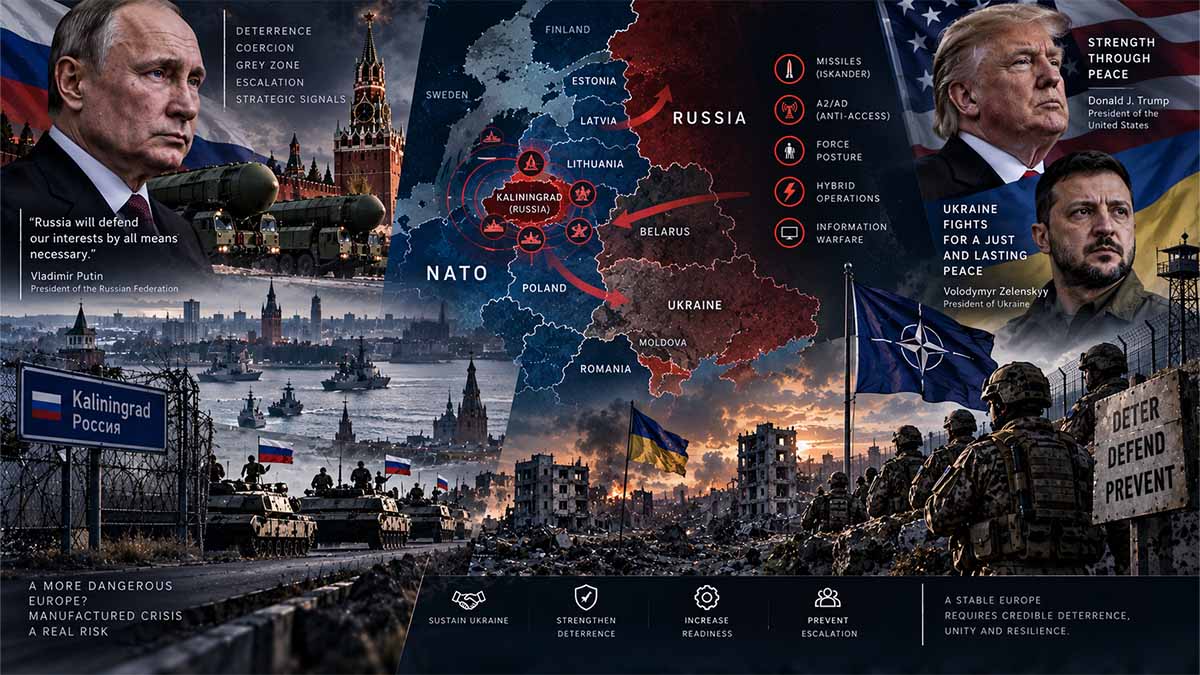
Russia’s Nuclear Coercion Against NATO’s Eastern Flank
Analytical scheme showing how nuclear rhetoric, Kaliningrad, pressure against European defence production, hybrid activity and NATO reinforcement interact within a broader coercive campaign centred on Western support for Ukraine.
Controlling Assessment
The verified pattern is more consistent with nuclear-backed coercive compellence than with evidence of imminent Russian nuclear employment. Moscow is progressively connecting conventional Western decisions—military assistance to Ukraine, defence-industrial expansion, NATO exercises, eastern-flank reinforcement and hypothetical pressure on Kaliningrad—to nuclear escalation risk. The strategic effect can therefore be achieved without nuclear use if European governments begin restricting their own options.
- Kaliningrad provides a highly effective territorial escalation narrative.
- European defence production is increasingly incorporated into Russian targeting rhetoric.
- Hybrid actions provide pressure below the threshold of conventional war.
- NATO currently combines reinforcement with deliberate rhetorical restraint.
- A literal “Cuban Missile Crisis 2.0” remains an analytical hypothesis, not a verified Kremlin plan.
Strategic Coercion Chain
Strategic Objective
Increase the political, military and psychological cost of continued Western assistance to Ukraine while constraining NATO reinforcement around Russia’s western approaches.
Coercive Instruments
Intended Political Effects
Generate escalation anxiety, strengthen domestic arguments for restraint, create divisions between NATO members and redefine assistance to Ukraine as direct participation in confrontation with Russia.
Preferred Russian Outcome
Reduce military support for Ukraine, slow European defence mobilisation and create conditions in which security concessions can be negotiated under heightened perceptions of nuclear risk.
Four-Layer Escalation Architecture
Doctrine
Russia’s 19 November 2024 nuclear-deterrence framework places territorial isolation, interruption of vital communications, hostile military coalitions and large-scale exercises inside the broader deterrence environment.
Declaratory Signalling
Diplomatic warnings link potential action against Kaliningrad with use of all available means, while European defence plants supporting Ukraine are increasingly described as potential military targets.
Hybrid Pressure
Maritime encounters, drones, sabotage, cyber activity and deniable operations allow coercive pressure to increase while preserving ambiguity below the threshold of open NATO–Russia war.
Negotiating Leverage
A sufficiently severe crisis could be used to encourage strategic negotiations in which reduction of nuclear tension becomes linked to limits on Ukraine support or NATO’s eastern-flank posture.
Why Kaliningrad Is the Central Escalation Lever
Russian Sovereign Territory
Moscow can portray serious restrictions on access to the exclave as a direct challenge to territorial integrity rather than as an ordinary regional-security measure.
Territorial framingNATO Geographic Exposure
Poland, Lithuania and the Baltic Sea surround the operational environment, placing NATO reinforcement, maritime security and Russian access concerns inside the same compressed theatre.
High interaction densityNuclear Narrative Compatibility
Russian nuclear doctrine explicitly provides a conceptual basis for treating territorial isolation and interrupted communications as military dangers relevant to deterrence.
Doctrinal linkage“Cuban Missile Crisis 2.0” — Analytical Model
Provocation / Incident
A Baltic, Kaliningrad, maritime, airspace or defence-industrial confrontation produces a politically exploitable crisis.
Nuclear Escalation Signal
Moscow amplifies the confrontation through nuclear rhetoric, readiness signalling, exercises or other visible strategic-force measures.
Alliance Political Pressure
European governments face intensified debate over whether support for Ukraine or forward military posture is increasing the risk of nuclear confrontation.
Negotiated De-escalation
Moscow seeks negotiations in which de-escalation is exchanged for restrictions affecting Ukrainian military capacity or NATO’s regional posture.
Competing Strategic Explanations
Coerce Reduction of Ukraine Support
Threats against weapons production and aid infrastructure fit a broader attempt to raise the cost of sustaining Ukraine.
Strongly supportedDeter Action Against Kaliningrad
Russian doctrine and public warnings support a defensive deterrence interpretation, although they do not explain the full breadth of targeting rhetoric.
SupportedManufacture a Negotiating Crisis
Nuclear brinkmanship could create pressure for high-level negotiations, but no verified public record proves that such a crisis has been formally ordered.
Plausible / unprovenPrepare Near-Term War with NATO
Current evidence does not establish the mobilisation and conventional force preparation that would be expected before imminent large-scale attack.
Not establishedEuropean Exposure Architecture
Poland
Primary pressure points: Kaliningrad proximity, Ukraine logistics, Patriot-related industrial activity and eastern-flank force expansion.
Germany
Primary pressure points: major military assistance, Baltic defence responsibilities, industrial mobilisation and vulnerability to hybrid operations.
United Kingdom
Primary pressure points: nuclear status, military aid, air-defence support and political leadership inside NATO’s Ukraine-support architecture.
France
Primary pressure points: independent nuclear deterrent, security guarantees for Ukraine, European strategic leadership and post-war force planning.
Italy
Primary pressure points: Baltic air defence, NATO Forward Land Forces, Alliance solidarity and operational exposure despite geographic distance from Russia.
NATO Counter-Logic
Maintain Defensive Posture
Continue eastern-flank reinforcement without presenting ordinary deterrence measures as preparation for offensive war.
Preserve Ukraine Support
Prevent Russian nuclear rhetoric from converting into effective political veto power over military assistance and defence production.
Control Escalation
Distinguish declaratory threats from verified changes in Russian nuclear readiness while preserving crisis communication and situational awareness.
Deny Coercive Success
Reduce the probability that nuclear signalling alone changes Allied policy while maintaining credible capacity to respond to material escalation.
Indicators That Would Materially Raise the Assessment
Net Assessment
The immediate strategic contest is therefore not principally over whether Russia will launch a nuclear weapon, but over whether nuclear signalling can successfully redefine NATO’s political freedom of action. Moscow gains strategic leverage if conventional European decisions become conditioned by fear that any additional assistance, reinforcement or defence-industrial expansion could trigger an uncontrollable nuclear confrontation. NATO’s counter-strategy depends on maintaining credible military preparedness while refusing to transform Russian rhetoric, by itself, into an automatic veto over Alliance policy.
Textual Analytical Fallback
| Stage | Mechanism | Intended consequence | Key observation |
|---|---|---|---|
| Strategic objective | Pressure Western support structures | Reduce assistance to Ukraine | Not dependent on actual nuclear use |
| Nuclear signalling | Connect conventional actions with nuclear risk | Generate political self-restraint | Central coercive mechanism |
| Kaliningrad | Territorial and access-related escalation framing | Raise perceived costs of Baltic contingencies | Strong doctrinal relevance |
| Hybrid pressure | Incidents below conventional-war threshold | Test NATO responses and cohesion | Preserves ambiguity |
| NATO response | Reinforcement plus rhetorical restraint | Deny coercive effect without unnecessary escalation | Current Alliance approach |
| Critical escalation threshold | Observable nuclear-force changes | Would materially change threat assessment | More important than rhetoric alone |
Selected Verified Sources
- Russian nuclear deterrence policy, Presidential Decree No. 991, 19 November 2024: Russian Presidential Decree No. 991
- NATO eastern-flank posture and Russian hostile activity: NATO — Strengthening NATO’s Eastern Flank
- NATO policy on Ukraine assistance and deterrence architecture: NATO — Washington Summit Declaration
- NATO long-term defence investment framework: NATO — The Hague Summit Declaration
- Danish account of the September 2026 helicopter–Russian frigate incident: Danish Defence Command
- Polish position on eastern-flank security and Ukraine support: Ministry of Foreign Affairs of Poland
- German support to Ukraine: Federal Government of Germany
- United Kingdom September 2026 air-defence assistance: UK Government
- French Coalition of the Willing position: Presidency of the French Republic
- Italian Baltic air-defence activity: Italian Ministry of Defence
Pillar I — Nuclear Coercion, Kaliningrad and the Architecture of Russian Escalation
Chapter 1 — From Nuclear Deterrence to Nuclear-Backed Coercion
Principal Judgment
Russia’s current nuclear posture cannot be understood only through the traditional Cold War concept of deterrence, because the evolution of its declaratory doctrine—culminating in Presidential Decree No. 991 of 19 November 2024—has widened the political and operational circumstances that Moscow formally associates with nuclear deterrence, while preserving deliberate ambiguity over when those circumstances would become sufficiently serious to justify nuclear employment. The central analytical distinction is therefore between deterrence, which seeks to prevent an adversary from taking an action; compellence, which seeks to force an adversary to alter behaviour already under way; and nuclear-use preparation, which requires observable military and command indicators beyond declaratory threats. The 2024 doctrine gives Moscow a broader legal-strategic vocabulary for the first two functions, but it does not mean that every listed “military danger” constitutes a nuclear-use threshold. Decree of the President of the Russian Federation No. 991 — 19 November 2024 storage.consultant.ru
The most important structural change since the earlier 2020 framework, Decree No. 355, is that Russian doctrine now connects nuclear deterrence to a substantially wider set of conventional, technological, geographic and coalition-related developments, including the expansion of military alliances toward Russian borders, deployment of precision conventional and hypersonic weapons, attack drones, the stationing of nuclear weapons in non-nuclear states, large exercises near Russia, attacks on environmentally hazardous facilities, and—critically for the Baltic theatre—actions intended to isolate part of Russian territory or block access to vital transport communications. Decree No. 991 — Russian Federation ConsultantPlus
The strategic significance of this widening is not that Moscow has published an automatic escalation ladder; it has not. Rather, the doctrine enlarges the universe of events that Russian authorities can legitimately frame, under their own published policy, as relevant to nuclear deterrence. That creates a larger space for nuclear-backed political coercion below the nuclear-use threshold, particularly against NATO governments whose policies include support for Ukraine, reinforcement of the eastern flank, military exercises, deployment of precision weapons, air-defence systems and potential wartime restrictions affecting Kaliningrad.
The 2024 Doctrine Is an Expansion of the Deterrence Environment, Not a Simple Rewrite of the Nuclear Trigger
The most consequential analytical error would be to equate everything listed in Decree No. 991 with a condition authorising nuclear use. The decree creates a layered architecture that distinguishes military dangers, the broader environment in which nuclear deterrence operates, from conditions determining the possibility of nuclear use, which are considerably narrower. Decree No. 991 — Sections II and III storage.consultant.ru
That distinction is indispensable when evaluating present Russian rhetoric toward NATO. A military exercise near Russian territory, NATO enlargement, a defence-industrial expansion programme or an attempt to interrupt access to Russian territory may be classified by Moscow as part of the deterrence environment, yet the published document does not say that such an action automatically permits nuclear use. The transition from “danger” to potential employment remains dependent on the more specific conditions set out in Section III and ultimately on a presidential decision. Decree No. 991 — Conditions for Nuclear Use storage.consultant.ru
Russian Nuclear Doctrine: The Internal Architecture of Decree No. 991
| Doctrinal layer | What Decree No. 991 establishes | Strategic meaning | What it does not establish |
|---|---|---|---|
| Purpose of nuclear deterrence | Deterrence is intended to prevent aggression against Russia and its allies and is supported by the totality of Russian military power, including nuclear weapons. Decree No. 991 | Nuclear forces are integrated into a broader national deterrence system rather than treated as an isolated retaliatory instrument. | It does not mean every hostile policy toward Russia constitutes aggression. |
| Policy instruments | Nuclear deterrence policy comprises coordinated political, military, military-technical, diplomatic, economic, informational and other measures. Decree No. 991 | Nuclear deterrence is explicitly multi-domain and includes signalling, diplomacy and information activity before any nuclear employment. | It does not prove that every Russian diplomatic or information operation is centrally directed by nuclear planners. |
| Potential adversary | Russia applies nuclear deterrence to states and coalitions possessing nuclear/WMD capabilities or major conventional power, and also to states providing territory, airspace, maritime space or resources for aggression. ConsultantPlus — Section II | Host-state support can be incorporated into Russian deterrence logic even when the host itself is not the principal attacker. | Provision of assistance alone is not automatically defined as an armed attack in the decree. |
| Coalition logic | Aggression by one member of a military coalition against Russia or its allies is treated as aggression by the coalition as a whole. ConsultantPlus — Section II | This creates a formal doctrinal basis for treating a NATO-Russia clash as an Alliance-wide strategic problem rather than an isolated bilateral incident. | It does not determine how Russia would respond militarily or whether nuclear use would follow. |
| Nuclear-support logic | Aggression by a non-nuclear state with the participation or support of a nuclear state is regarded as a joint attack. ConsultantPlus — Section II | Moscow can portray nuclear-armed-state support to a non-nuclear belligerent as strategically relevant to nuclear deterrence. | The decree does not define every form of political, financial or weapons support as “participation” in aggression. |
| Continuity | Nuclear deterrence operates continuously in peacetime, during immediate threat of aggression and during wartime up to nuclear employment. ConsultantPlus — Section II | Nuclear signalling can legitimately appear within Russian policy long before an actual nuclear-use decision. | Continuous deterrence does not equal continuous readiness for imminent nuclear launch. |
| Command authority | The President of the Russian Federation decides on nuclear use. Decree No. 991 — Section III | Ultimate nuclear decision authority remains centralised at the presidential level. | Public rhetoric by ministries or embassies does not itself constitute a nuclear-use order. |
From the 2020 Doctrine to the 2024 Doctrine: The Threshold Was Reframed in Several Important Ways
The 2020 doctrine was already broader than a simple retaliatory nuclear doctrine. It stated that Russia reserved the right to employ nuclear weapons in response to nuclear or other weapons-of-mass-destruction attacks, as well as in response to conventional aggression when “the very existence of the state” was threatened. It also listed four specific conditions relevant to nuclear employment: reliable information about ballistic missiles attacking Russian or allied territory; WMD use against Russia or its allies; attacks on critical governmental or military facilities whose disablement would prevent nuclear retaliation; and conventional aggression threatening the existence of the state. Decree No. 355 — Section III, 2 June 2020 ConsultantPlus
The 2024 version retains the basic retaliatory structure but changes several variables in strategically significant ways. It extends the conventional-attack condition beyond Russia alone to include Belarus as part of the Union State, replaces the earlier “existence of the state” language with a critical threat to sovereignty and/or territorial integrity, and introduces a new condition involving reliable information about a mass launch or take-off of aerospace attack systems, including strategic and tactical aircraft, cruise missiles, drones, hypersonic vehicles and other aerial systems crossing the Russian state border. Updated Nuclear Deterrence Policy — ConsultantPlus Decree No. 991 — Section III ConsultantPlus
Comparison of the 2020 and 2024 Published Nuclear-Use Frameworks
| Issue | 2020 Decree No. 355 | 2024 Decree No. 991 | Analytical consequence |
|---|---|---|---|
| Conventional attack threshold | Conventional aggression against Russia when the existence of the state is threatened. 2020 text | Conventional aggression against Russia and/or Belarus creating a critical threat to sovereignty and/or territorial integrity. 2024 text | The wording is broader because “critical threat to sovereignty or territorial integrity” is not identical to existential destruction of the state. |
| Protected political entity | Russia principally; allies covered under WMD retaliation provisions. 2020 text | Russia and Belarus expressly included in the conventional aggression condition as Union State participants. 2024 text | Russian declaratory nuclear protection is formally widened in the published doctrine. |
| Incoming attack warning | Reliable information concerning ballistic missiles attacking Russia or allies. 2020 text | Ballistic attack remains relevant, but the doctrine also introduces mass launch/take-off of aerospace attack systems crossing Russia’s border. 2024 text | The warning problem expands from ballistic missiles toward mixed conventional and dual-capable aerospace attack packages. |
| Critical nuclear-command infrastructure | Attack disabling critical state or military sites and preventing retaliatory nuclear action. 2020 text | Retained in the updated framework. 2024 text | Command-and-control survivability remains central to Russian nuclear doctrine. |
| Non-nuclear state supported by nuclear power | Less explicit in the published doctrine. | Aggression by a non-nuclear state with participation or support from a nuclear state is deemed a joint attack. ConsultantPlus — Section II | The doctrinal boundary between direct attack and nuclear-backed proxy/support relationships becomes more explicit. |
| Territorial isolation | Not given the same explicit treatment in the published military-danger list. | Actions aimed at isolating part of Russian territory or blocking vital transport communications are expressly identified as military dangers relevant to deterrence. 2024 doctrine | This provision creates an obvious doctrinal connection to Kaliningrad contingencies, although it is not itself an automatic nuclear-use trigger. |
| Large exercises near Russian borders | Less explicitly connected in the public nuclear framework. | Listed among military dangers relevant to nuclear deterrence. 2024 doctrine | NATO exercises can be incorporated into Russian nuclear signalling without necessarily indicating imminent employment. |
The 2024 revision should therefore be read as a horizontal expansion of the deterrence environment coupled with a vertical broadening of some employment conditions. “Horizontal” means that more classes of conventional and political activity can be narrated as relevant to nuclear deterrence; “vertical” means that some wording governing nuclear use—especially sovereignty, territorial integrity, Belarus and mixed aerospace attack—now covers a wider range of contingencies than the 2020 formulation. This is a more substantial change than a rhetorical restatement, but it remains less than an automatic lowering of every nuclear threshold.
The Most Important Innovation Is the Integration of Conventional Warfare Into Nuclear Signalling
The technological content of Decree No. 991 is unusually important because it demonstrates that the Russian leadership does not conceptualise nuclear deterrence as a domain isolated from conventional precision warfare. The doctrine identifies missile defence, intermediate- and shorter-range cruise and ballistic missiles, precision conventional weapons, hypersonic weapons, strike drones and directed-energy weapons among the systems whose deployment may generate military dangers relevant to nuclear deterrence. ConsultantPlus — Decree No. 991, paragraph 15 ConsultantPlus
This is strategically important because modern military campaigns can threaten strategic command, early-warning, air-defence and nuclear-support infrastructure with weapons that carry no nuclear warhead. A state can therefore interpret a nominally conventional attack as strategically destabilising if it believes that the attack threatens the survivability of its nuclear retaliatory system.
The 2024 doctrine’s inclusion of a mass launch or take-off of aircraft, cruise missiles, UAVs, hypersonic systems and other aerial vehicles as one condition relevant to potential nuclear employment reflects precisely this convergence between conventional and strategic attack. Decree No. 991 — paragraph 19 storage.consultant.ru
Conventional Capabilities Explicitly Connected to the Russian Nuclear-Deterrence Environment
| Capability or activity | Treatment in Decree No. 991 | Why it matters strategically |
|---|---|---|
| Missile-defence systems | Identified as a military danger when deployed by a potential adversary. Decree No. 991 | Moscow can interpret sufficiently capable missile defence as affecting the credibility of its retaliatory deterrent. |
| Intermediate- and shorter-range ballistic/cruise missiles | Explicitly included. Decree No. 991 | Shorter warning times increase pressure on command-and-control and early-warning systems. |
| Precision conventional weapons | Explicitly included. Decree No. 991 | Non-nuclear systems can threaten strategic installations previously attackable mainly with nuclear weapons. |
| Hypersonic weapons | Explicitly included. Decree No. 991 | High speed and uncertain trajectories compress decision time. |
| Strike UAVs | Explicitly included. Decree No. 991 | Large drone raids can complicate discrimination between tactical conventional operations and broader strategic attack patterns. |
| Large aerospace attack package crossing Russian territory | Specifically included among conditions relevant to possible nuclear use. Decree No. 991 | The doctrine places scale and attack geometry, not only warhead type, inside the nuclear decision environment. |
| Attack on critical state or military installations affecting nuclear retaliation | Explicit nuclear-use condition. Decree No. 991 | Conventional counterforce attacks can become nuclear-significant if they threaten retaliatory capability. |
This integration creates a dangerous analytical problem for NATO because the same weapons can perform very different functions. A cruise missile, tactical aircraft or hypersonic weapon can attack ordinary conventional targets, but it can also threaten command nodes, strategic early-warning installations or nuclear-force infrastructure. Russian doctrine therefore preserves considerable ambiguity over how Moscow would interpret the purpose of a large conventional strike during a crisis.
Nuclear Deterrence and Nuclear Compellence Are Not the Same Instrument
Classical deterrence attempts to persuade an opponent not to take an action by convincing it that the costs will exceed the benefits. NATO’s own nuclear doctrine uses precisely this logic, describing the fundamental purpose of its nuclear capability as preserving peace, preventing coercion and deterring aggression, while stating that the circumstances in which NATO might contemplate nuclear use are “extremely remote.” NATO Nuclear Deterrence Policy and Forces — updated 25 September 2026 NATO
Compellence operates differently: it attempts to make an adversary stop, reverse or modify an action already under way. That conceptual distinction matters for the current conflict because Western military assistance to Ukraine, eastern-flank reinforcement, defence-industrial expansion and sanctions already exist. Russian nuclear signalling addressed to those activities therefore often functions less as simple deterrence against a future attack and more as pressure intended to change continuing Western behaviour.
The doctrinal architecture of Decree No. 991 facilitates that use because it explicitly defines nuclear deterrence as a combination of political, military, diplomatic, economic and informational measures. Decree No. 991 storage.consultant.ru
Deterrence, Compellence and Nuclear-Use Preparation
| Category | Strategic objective | Typical instrument | Observable evidence | What would constitute escalation |
|---|---|---|---|---|
| Deterrence | Prevent an adversary from initiating an unwanted action. | Warnings, exercises, declared doctrine, survivable forces, alliance commitments. | Public doctrine, readiness exercises, strategic communications. | Increasing specificity of threatened consequences or visible force adjustments. |
| Compellence | Make an adversary stop or reverse behaviour already under way. | Threats tied to aid, sanctions, deployments, defence production or territorial posture. | Demands linking de-escalation to policy changes by the opponent. | Deadlines, ultimatums, named targets, explicit conditional threats. |
| Nuclear signalling | Demonstrate resolve and manipulate the opponent’s perception of escalation risk. | Public statements, exercises, force movements, launch demonstrations, changes in declaratory policy. | Government communications and visible military activity. | Transition from general signalling to operational measures associated with nuclear forces. |
| Nuclear-use preparation | Establish the military conditions necessary for potential employment. | Command activation, force dispersal, nuclear handling, specialised communications, increased readiness. | Multiple corroborating operational indicators rather than rhetoric alone. | Confirmed warhead movement, mating/loading activity, unusual command posture or validated readiness transition. |
| Actual employment decision | Authorise nuclear weapon use. | Presidential command under Russian doctrine. | Not normally verifiable in advance from public rhetoric alone. | Execution of nuclear employment procedures. |
The distinction prevents analytical inflation. A presidential speech threatening consequences is not equivalent to a change in nuclear-force readiness; an exercise is not equivalent to warhead mating; a doctrinal change is not equivalent to an operational launch order. Conversely, repeated rhetoric cannot simply be dismissed as propaganda because doctrine explicitly assigns informational and diplomatic measures a role in Russia’s nuclear-deterrence system. Decree No. 991 storage.consultant.ru
The Doctrine Is Designed to Produce Uncertainty in the Adversary’s Decision Process
Decree No. 991 expressly states that one principle of Russian nuclear deterrence is uncertainty for the potential adversary concerning the scale, time and place of possible employment of nuclear-deterrence forces and means. Decree No. 991 — paragraph 16 storage.consultant.ru
This provision is central to understanding why Russian nuclear rhetoric can remain deliberately imprecise. A highly specific and mechanically predictable doctrine can reduce coercive effect by allowing the adversary to identify safe operating zones below a known threshold. Ambiguity complicates that calculation because policymakers must consider whether a particular action will be interpreted by Moscow as ordinary conventional activity, strategic attack, coalition aggression, territorial isolation or a threat to state sovereignty.
NATO also uses uncertainty as a deterrence mechanism, although its declaratory architecture is differently framed. The Alliance states that the precise circumstances in which nuclear weapons might be used are extremely remote, while maintaining that any attack threatening the fundamental security of an Ally would face unacceptable costs and that NATO retains flexibility concerning the manner, timing and domain of its response. Washington Summit Declaration — NATO — 10 July 2024 NATO Communications Agency
The critical difference is not therefore that one side possesses ambiguity and the other does not; both do. The difference lies in how broadly the surrounding coercive narrative is being extended into ongoing conventional political and military activity.
Coalition Attribution Is One of the Most Important Changes for NATO
Paragraphs 10 and 11 of the Russian doctrine create a particularly consequential framework for Alliance crisis management. Paragraph 10 states that aggression by any member of a military coalition against Russia or its allies is treated as aggression by the coalition as a whole, while paragraph 11 states that aggression by a non-nuclear state supported by a nuclear-armed state is treated as their joint attack. ConsultantPlus — Decree No. 991, paragraphs 10–11 ConsultantPlus
This does not mean that Moscow has declared every act of Western support for Ukraine an armed attack, and the doctrine does not establish that transfer of weapons alone satisfies the concept of “participation” or “support” used in paragraph 11. What it does provide is a doctrinal framework through which Russian authorities can attempt to collapse distinctions between a direct attacker, a supporting state and the military coalition to which that state belongs.
That ambiguity is particularly relevant to NATO because the Alliance’s deterrence architecture is explicitly collective. NATO’s 2024 Washington Summit Declaration states that the Alliance’s deterrence posture relies upon an integrated mix of nuclear, conventional and missile-defence capabilities, complemented by space and cyber capabilities, and that NATO can employ military and non-military tools in a proportionate and integrated manner. Washington Summit Declaration — NATO NATO Communications Agency
The Russian doctrinal framework consequently attempts to create strategic risk on the opposite side of NATO’s collective-security logic: NATO uses integration to strengthen deterrence; Russia can use the same integration to argue that individual Allied actions cannot necessarily be compartmentalised from the Alliance as a whole.
Belarus Changes the Geography of the Published Nuclear Threshold
The 2024 doctrine formally incorporates the Republic of Belarus into the conventional-aggression condition that can determine the possibility of nuclear use when the sovereignty or territorial integrity of Russia or Belarus faces a critical threat. Decree No. 991 — paragraph 18 storage.consultant.ru
This matters operationally because Belarus borders Poland, Lithuania and Latvia, lies directly adjacent to the Suwałki region and provides geographic depth between mainland Russia and Kaliningrad’s wider strategic environment. The doctrinal change therefore expands the area within which a severe conventional NATO-Russia confrontation could acquire a declared Russian nuclear dimension.
The 2024 doctrine also explicitly states that command over nuclear weapon use—including nuclear weapons deployed outside the Russian Federation—is centralised. Decree No. 991 — paragraph 16 storage.consultant.ru
The precise operational posture of Russian nuclear weapons in Belarus must therefore be analytically separated from the doctrinal fact that Moscow publicly includes Belarus inside its nuclear-deterrence framework. Declarations of deployment, storage infrastructure, force availability, warhead custody and actual operational readiness are distinct evidentiary categories and should not be collapsed into one another.
NATO’s Nuclear Doctrine Provides the Essential Comparison Baseline
NATO’s nuclear policy provides a useful contrast because the Alliance explicitly defines nuclear deterrence as a mechanism intended to prevent coercion and aggression, while retaining the statement that circumstances of nuclear use are “extremely remote.” NATO Nuclear Deterrence Policy and Forces NATO
The Alliance currently identifies three nuclear-armed members—the United States, France and the United Kingdom—and states that the strategic forces of the United States constitute the principal strategic guarantee while the independent British and French forces provide separate centres of decision-making that complicate adversary calculations. NATO Nuclear Deterrence Policy and Forces NATO
NATO also confirms that US nuclear weapons remain forward deployed in Europe within nuclear-sharing arrangements, with participating Allies supplying capabilities and infrastructure, while political control over nuclear deterrence remains with the Alliance’s political decision-making structure and the Nuclear Planning Group. NATO Nuclear Deterrence Policy and Forces NATO
Russian and NATO Declaratory Nuclear Architectures
| Variable | Russian Federation | NATO |
|---|---|---|
| Primary stated purpose | Prevent aggression against Russia and allies through coordinated state measures backed by nuclear forces. Decree No. 991 | Preserve peace, prevent coercion and deter aggression. NATO nuclear policy |
| Integration with conventional capabilities | Explicitly links nuclear deterrence to conventional precision, hypersonic, missile-defence, UAV and other strategic systems. Decree No. 991 | NATO describes deterrence as an integrated mix of nuclear, conventional, missile-defence, space and cyber capabilities. Washington Declaration |
| Coalition dimension | Attack by one coalition member may be treated as aggression by the coalition as a whole. Decree No. 991 | NATO collective defence is built around Article 5 and collective deterrence. Washington Summit Declaration |
| Use threshold language | Includes WMD attack, attacks preventing nuclear retaliation, critical conventional threats to sovereignty/territorial integrity and mass aerospace attack conditions. Decree No. 991 | NATO deliberately does not publish an equivalent detailed trigger list and describes nuclear-use circumstances as extremely remote. NATO nuclear policy |
| Decision structure | Presidential nuclear-use decision. Decree No. 991 | NATO nuclear policy is politically controlled; the Nuclear Planning Group is the principal Alliance forum, while national nuclear forces remain under national authority. NATO nuclear policy |
| Declared ambiguity | Explicit uncertainty concerning scale, timing and location of potential nuclear-force employment. Decree No. 991 | NATO preserves ambiguity over response while stating that nuclear employment circumstances are extremely remote. Washington Summit Declaration |
The comparison demonstrates that nuclear deterrence on both sides is embedded in broader conventional and political structures, but Russian doctrine has become unusually explicit in specifying the conventional, territorial and coalition developments that can enter its nuclear-deterrence framework.
Signalling Must Be Read Through a Ladder of Evidentiary Weight
One of the most important requirements for decision-grade analysis is to avoid treating every Russian nuclear statement as equally meaningful. The public record should instead be interpreted through an evidentiary hierarchy that distinguishes speech from doctrine, doctrine from operational posture, and posture from preparation.
Evidentiary Ladder for Russian Nuclear Signalling
| Level | Observable action | Evidentiary significance | Analytical treatment |
|---|---|---|---|
| Declaratory rhetoric | Presidential, ministerial, diplomatic or military warnings | Demonstrates political messaging and desired perception of risk | Important for coercive strategy, weak evidence of actual employment preparation by itself |
| Formal doctrine | Decree, strategy or published nuclear policy | Establishes official state framework and permissible declaratory logic | Strong evidence of institutional policy, not evidence that any particular threshold has been crossed |
| Exercise announcement | Strategic-force or dual-capable exercise | Demonstrates readiness, signalling or training | Requires comparison with routine cycle, scale and scenario before escalation conclusions |
| Visible force movement | Bomber dispersal, missile movement, submarine activity, dual-capable aircraft deployment | Potentially more significant, depending on deviation from normal posture | Must be corroborated and interpreted against baseline |
| Readiness modification | Elevated alert status, command activation, force-generation measures | Stronger evidence of crisis preparation | Material change in assessment |
| Warhead handling or operational preparation | Verified nuclear warhead transport, mating/loading, specialised unit activity | Direct evidence that nuclear-use options are being operationally prepared | Major escalation indicator |
| Nuclear-use authorisation indicators | Validated command transmission and execution procedures | Highest evidentiary level short of employment | Public verification may be impossible before use |
This distinction is also consistent with the Russian doctrine itself. Decree No. 991 states that nuclear deterrence operates continuously in peacetime, crisis and wartime, which means routine readiness and signalling do not automatically imply imminent nuclear employment. ConsultantPlus — Decree No. 991, paragraph 14 ConsultantPlus
The Most Dangerous Zone Is Between Conventional Strategic Attack and Nuclear Misinterpretation
The 2024 doctrine creates a particularly sensitive interaction between nuclear command survivability and conventional precision strike. If Russian leaders believe that large numbers of cruise missiles, drones, hypersonic weapons or aircraft are crossing Russian territory, the doctrinal framework permits that event to enter the nuclear decision process before the warhead type or exact target set is necessarily known with certainty. Decree No. 991 — paragraph 19 storage.consultant.ru
This is not identical to an automatic “launch on warning” doctrine, and the text does not state that detection of such an attack automatically causes nuclear release. It does, however, shorten the conceptual distance between a mass conventional aerospace attack and nuclear decision-making.
Three variables therefore become particularly important in a crisis:
| Variable | Escalatory significance | Why it matters |
|---|---|---|
| Scale of incoming attack | The doctrine specifically refers to a mass launch/take-off rather than isolated weapons. Decree No. 991 | Large attack packages can create uncertainty regarding strategic intent. |
| Target ambiguity | Russian nuclear command and critical state infrastructure can theoretically be threatened by conventional precision systems. Decree No. 991 | Moscow may fear conventional counterforce even without nuclear warheads. |
| Decision time | Hypersonic systems, cruise missiles and tactical aviation compress warning and classification timelines. Decree No. 991 | Less time for discrimination raises the danger of worst-case interpretation. |
This interaction is one reason why the current Russian campaign should not be reduced to propaganda. The political rhetoric is coercive, but the underlying military-technological problem—ambiguity between conventional and strategic attack—is real and is formally acknowledged in Russian doctrine.
Why Decree No. 991 Creates More Space for Political Coercion Without Necessarily Making Nuclear War More Probable
The doctrine’s political utility derives precisely from the gap between broad deterrence dangers and narrower employment conditions. Moscow can describe NATO enlargement, exercises, blockade scenarios, advanced conventional weapons, nuclear sharing and attacks on strategic infrastructure as relevant nuclear concerns without committing itself to an automatic employment response.
That gap creates escalation flexibility.
A rigid doctrine would require Russia either to act when a threshold was crossed or lose credibility. A more elastic doctrine allows the leadership to threaten, signal, exercise, reposition forces, escalate diplomatically or reduce tensions without admitting that a formal nuclear threshold had been crossed.
The result is a potentially effective compellence mechanism because Western decision-makers must calculate not only what the published doctrine says, but also how Moscow might politically interpret ambiguous terms such as critical threat, support, aggression, isolation, vital transport communications and mass aerospace attack. Decree No. 991 storage.consultant.ru
The Doctrine Creates Several Distinct Escalation Thresholds Rather Than One Nuclear Red Line
A more accurate model is to treat Russian nuclear policy as containing several thresholds of increasing seriousness rather than searching for a single red line.
Russian Nuclear Escalation Threshold Architecture
| Threshold | Description | Documentary basis | Assessment significance |
|---|---|---|---|
| Political-security concern | Adverse policy development without declared nuclear relevance | General strategic competition | Normal interstate competition |
| Nuclear-deterrence military danger | Development formally listed as capable of evolving into a military threat, including alliance expansion, exercises, territorial isolation or strategic conventional systems | Paragraph 15 of Decree No. 991. Official text | Nuclear rhetoric and signalling become doctrinally legitimate |
| Military threat / threat of aggression | A listed danger evolves in light of the military-political and strategic situation | Paragraph 15. Official text | Greater probability of readiness measures and crisis signalling |
| Condition determining possible nuclear use | WMD attack, critical conventional aggression, attack undermining nuclear retaliation or mass aerospace attack | Paragraphs 18–19. Official text | Nuclear employment enters formal decision space |
| Presidential decision | Actual decision to employ nuclear weapons | Paragraph 20. Official text | Political threshold becomes operational command decision |
| Employment | Execution of authorised nuclear action | Consequence of command process | Nuclear threshold crossed irreversibly |
This model is essential for analysing Kaliningrad in the next chapter because territorial isolation appears at the military-danger level, whereas the nuclear-use conditions sit at a different level of the doctrine. A hypothetical blockade may therefore produce strong nuclear signalling long before the public record would justify concluding that Moscow had reached an employment threshold.
What Would Distinguish Coercive Signalling from Genuine Nuclear-Use Preparation
The most decision-relevant analytical requirement is not to ask whether Russian rhetoric is “serious” in the abstract, because rhetoric can simultaneously be serious as political coercion and insufficient as evidence of imminent nuclear use.
Instead, assessment should focus on whether several independent categories of operational evidence begin moving together.
Indicators of Transition from Nuclear-Backed Coercion Toward Nuclear-Use Preparation
| Indicator | Coercive-signalling interpretation | More serious interpretation |
|---|---|---|
| Presidential nuclear rhetoric | Political warning designed to shape adversary choices | More serious if accompanied by specific operational orders or readiness changes |
| Strategic-force exercise | Routine or enhanced deterrence signalling | More serious if outside normal cycle, unusually large or explicitly linked to an unfolding NATO crisis |
| Dual-capable missile movement | Training, dispersal or signalling | More serious if accompanied by specialised support and nuclear-custody indicators |
| Bomber dispersal | Survivability measure or demonstration | More serious if coupled to nuclear mission preparation and unusual command activity |
| Nuclear storage activity | Maintenance or routine logistics | Highly significant if verified movement from storage to operational delivery units occurs |
| Command-and-control changes | Exercise or communications test | Major concern if national nuclear command structures enter exceptional crisis posture |
| Public ultimatum | Compellence | More serious if accompanied by military deadline and readiness escalation |
| Nuclear test-site activity | Political signalling or technical activity | Major escalation if preparation becomes demonstrably linked to a current NATO confrontation |
No single indicator should ordinarily be treated as conclusive. The strongest evidence of transition would involve correlated movement across political, command, logistical and force-readiness indicators, especially where those developments depart from known routine patterns.
Key Judgments
First, Decree No. 991 represents a substantive enlargement of Russia’s publicly declared nuclear-deterrence framework because it incorporates a wider range of conventional technologies, coalition relationships, territorial contingencies and military activities into the environment against which nuclear deterrence operates. Decree No. 991 ConsultantPlus
Second, the doctrine must not be read as establishing an automatic nuclear response to every listed military danger, because the published document distinguishes those dangers from the separate conditions governing the possibility of nuclear use. Decree No. 991 — Sections II and III storage.consultant.ru
Third, the replacement of the 2020 formulation concerning a threat to the “existence of the state” with a 2024 condition concerning a “critical threat” to sovereignty or territorial integrity is a materially broader declaratory formulation, although its exact operational interpretation remains politically controlled and undefined in public doctrine. 2020 Decree No. 355 2024 Decree No. 991 ConsultantPlus
Fourth, the incorporation of Belarus and the explicit treatment of coalition aggression and nuclear-state support to non-nuclear attackers broaden the geographic and alliance dimensions of Russian declaratory nuclear deterrence. ConsultantPlus — Decree No. 991 ConsultantPlus
Fifth, Russian nuclear rhetoric should therefore be treated neither as empty propaganda nor as proof of imminent nuclear employment: its most defensible interpretation is as a deliberately integrated political-military instrument intended to manipulate adversary calculations while preserving substantial uncertainty over the precise point at which signalling would become preparation.
What Would Change the Assessment
The assessment would become materially more severe if official or reliably corroborated evidence demonstrated a sustained increase in the readiness of Russian strategic or non-strategic nuclear forces linked to the current NATO confrontation; verified warhead movement from storage sites toward operational delivery systems; unusual nuclear command-and-control activation outside routine exercise cycles; major dispersal of delivery systems accompanied by specialised nuclear-support units; nuclear test preparations explicitly connected to European security demands; or a Russian ultimatum combining a defined political demand, a fixed deadline and observable nuclear-force readiness changes.
Conversely, the assessment that present activity is principally nuclear-backed compellence would be strengthened if Russian messaging continues to intensify while operational nuclear posture remains broadly consistent with routine readiness patterns and Moscow repeatedly uses nuclear threats principally to influence NATO exercises, defence production, aid decisions or territorial-policy debates rather than to prepare for identifiable nuclear employment.
Open Official Record
The publicly available doctrine does not define what quantitative or operational conditions constitute a “critical threat” to Russian or Belarusian sovereignty or territorial integrity; it does not define the precise scale necessary for an aerospace attack to qualify as “massive”; it does not specify what level of external assistance transforms support to a non-nuclear state into participation in a “joint attack”; and it does not publish the detailed procedures through which political warning, military assessment, command readiness and presidential authorisation are converted into nuclear employment.
Those omissions appear to preserve deliberate strategic ambiguity, but without access to non-public command directives or operational nuclear planning documents, no open-source assessment can legitimately translate the published doctrine into an automatic launch matrix.
Chapter 2 — Kaliningrad as Strategic Lever and Strategic Vulnerability
Principal Judgment
Kaliningrad possesses strategic importance that is disproportionate to its territorial size because the exclave combines four functions that ordinarily would be distributed across several regions: it is sovereign Russian territory physically separated from mainland Russia, a forward military platform embedded between NATO members Poland and Lithuania, a Baltic maritime and air-operational node, and a politically sensitive dependency whose civilian and military sustainment necessarily involves either maritime access across the Baltic Sea or transit arrangements interacting with EU and Lithuanian jurisdiction. Russia’s own emergency-services description records approximately 280.5 kilometres of border with Lithuania, 231.98 kilometres with Poland and 183.56 kilometres of Baltic coastline, with maximum east–west and north–south dimensions of approximately 205 kilometres and 108 kilometres respectively, giving the exclave a compact geography whose military assets, transport routes, civilian infrastructure and political symbolism are compressed into a narrow strategic space. Geographical Characteristics of the Kaliningrad Region — EMERCOM of Russia 39.mchs.gov.ru
That geography simultaneously gives Moscow leverage and creates vulnerability, because Kaliningrad can support Russian surveillance, electronic warfare, missile, air-defence and Baltic maritime operations close to NATO territory, while any serious military crisis would raise immediate questions about access, reinforcement, logistics, communications and the relationship between Russian forces in the exclave and mainland Russia. Lithuania’s 2026 National Threat Assessment, produced by the State Security Department and the Second Investigation Department under the Ministry of National Defence, assesses that although the land grouping in Kaliningrad remains temporarily weakened because personnel and equipment have been committed to Ukraine, Russia is continuing long-term military expansion there, including expansion of a naval infantry brigade into a division, development of additional infrastructure, construction of the 29B6 Container over-the-horizon radar, operation of the Voronezh-DM early-warning radar, reinforced arsenal facilities and a strategic-reserve logistics base. National Threat Assessment 2026 — Lithuania Saugumo Departamentas
The result is a strategic paradox: Kaliningrad is simultaneously one of Russia’s most useful forward military positions and one of the territories whose isolation Moscow can most plausibly portray as an existentially significant security problem, which explains why disputes concerning transit, Baltic maritime access or hypothetical blockade scenarios can acquire nuclear signalling value far beyond their immediate military dimensions.
Geography Creates Strategic Compression
Kaliningrad is not simply a detached Russian province; its geographic configuration compresses Russian and NATO military systems into unusually close proximity, because Poland lies directly to the south, Lithuania to the north and east, and the Baltic Sea to the west, while the territory has no land connection to the remainder of the Russian Federation. Russia’s Ministry of Transport has consequently invested in direct maritime links between the Kaliningrad region and mainland Russian ports, including the Ust-Luga–Baltiysk/Kaliningrad ferry system, which was explicitly developed to strengthen the region’s transport security and reduce dependence on land transit through neighbouring states. Russian Ministry of Transport — Ust-Luga–Kaliningrad shipping line Russian Ministry of Transport — General Chernyakhovsky ferry Ministero dei Trasporti Russo
The exclave therefore has three strategically different categories of external connection: civilian and commercial land transit through Lithuania under EU and Lithuanian legal control; maritime transport connecting Russian ports with Kaliningrad across the Baltic; and military or strategic connectivity that Moscow must preserve under crisis conditions. These categories should not be conflated, because interruption of sanctioned commercial transit, interruption of ordinary passenger movement and a military blockade are legally and strategically different events, even though Russian political messaging can deliberately compress them into a broader narrative of territorial isolation.
Kaliningrad’s Strategic Geography
| Geographic variable | Verified value / condition | Strategic consequence | Source |
|---|---|---|---|
| Border with Lithuania | 280.5 km | Direct interface with a NATO and EU member and with the Baltic States’ land connection to Poland | EMERCOM of Russia |
| Border with Poland | 231.98 km | Direct interface with one of NATO’s largest eastern-flank military powers | EMERCOM of Russia |
| Baltic coastline | 183.56 km | Provides maritime access independent of Lithuanian land transit but places Russian shipping inside an increasingly monitored NATO maritime environment | EMERCOM of Russia |
| East–west dimension | 205 km maximum | Compresses military installations and logistics within a relatively small operational area | EMERCOM of Russia |
| North–south dimension | 108 km maximum | Limits strategic depth relative to mainland Russia | EMERCOM of Russia |
| Land connection to mainland Russia | None | Russia depends on foreign-territory transit arrangements or Baltic maritime routes for direct physical access | European Commission — Kaliningrad Transit Guidance |
| NATO geography | Poland and Lithuania border the exclave | Any military confrontation around Kaliningrad would immediately involve NATO territory rather than a neutral buffer | NATO — Presence in Poland |
Transit Through Lithuania Is Strategically Important but Is Not Equivalent to a Blockade
The legal architecture governing transit is important because Russian rhetoric has previously attempted to describe sanctions enforcement affecting Kaliningrad as a form of blockade, whereas the European Union and Lithuania have explicitly distinguished sanctions controls from interruption of ordinary transit. When EU restrictive measures generated controversy in June–July 2022, Lithuania stated that passenger travel and the transit of non-sanctioned goods continued uninterrupted and that Lithuania had not imposed unilateral restrictions on Kaliningrad transit, but was implementing EU measures against specified sanctioned categories. Statement on the Transit of Sanctioned Goods by Rail to and from Kaliningrad — Lithuanian Ministry of Foreign Affairs URM | Užsienio reikalų ministerija
The European Commission subsequently clarified the legal regime in considerable detail: transit of sanctioned goods by Russian road transport operators is prohibited where the goods themselves fall under the sanctions regime, whereas rail transit is subject to a different framework and effective controls; military and dual-use goods remain prohibited regardless of transport mode, while Member States must ensure that rail volumes do not become a mechanism for sanctions circumvention. European Commission Guidance on Transport of Goods Between Kaliningrad and Russia Consolidated EU Sanctions FAQs Finance
Passenger transit is likewise governed by a dedicated EU framework dating from Lithuania’s accession preparations, including the Facilitated Transit Document and Facilitated Rail Transit Document, instruments specifically created to permit Russian citizens to travel between Kaliningrad and mainland Russia through Lithuanian territory while preserving Lithuania’s sovereign border-control authority. European Commission Practical Handbook for Border Guards Council of the EU — Facilitated Transit Document Migration and Home Affairs
Kaliningrad Access Architecture
| Access channel | Peacetime function | Controlling authority / legal environment | Strategic vulnerability |
|---|---|---|---|
| Rail transit through Lithuania | Passenger and permitted freight connectivity between mainland Russia and Kaliningrad | Lithuania, EU law, Schengen-related arrangements and sanctions rules | Politically sensitive because controls can be represented by Moscow as pressure on territorial connectivity |
| Road transit through Lithuania | Limited civilian/logistical connectivity | Lithuania and EU transport/sanctions law | Russian road freight operators face restrictions under EU sanctions where applicable |
| Baltic maritime route | Direct Russian territorial connection avoiding foreign land transit | Russian ports plus international/Baltic maritime environment | Exposed to maritime surveillance, infrastructure risk and crisis escalation |
| Ust-Luga–Baltiysk/Kaliningrad ferry system | Rail wagon, vehicle and cargo movement | Russian Ministry of Transport / Rosmorport | Reduces dependence on Lithuanian transit but does not remove maritime vulnerability |
| Air connection | Passenger, governmental and potentially military connectivity | Russian airspace plus Baltic aviation environment | Sensitive to regional air-defence, navigation and electronic-warfare conditions |
| Digital/navigation infrastructure | Civilian and military positioning and communication | Mixed national/commercial systems | Kaliningrad-based EW activity already produces spillover effects across the Baltic region |
The strategic implication is that a genuine blockade would be a qualitatively different event from the sanctions-control controversy of 2022. A military blockade would involve deliberate restriction of Russian territorial access or maritime movement through military means, whereas sanctions implementation involves legal controls over specified goods and operators; collapsing these categories politically would nevertheless allow Moscow to describe economic, customs or military pressure as stages of one broader process of territorial isolation.
Russia Has Been Reducing the Exclave’s Transport Dependence on Lithuanian Territory
The expansion of direct Baltic shipping is not merely commercial infrastructure policy, because Russian official statements explicitly connect ferry investment with the transport security of the Kaliningrad region. In 2022 the Russian Ministry of Transport reported that it had doubled capacity on the maritime line and was operating multiple rail-road and multipurpose vessels between Ust-Luga and Kaliningrad, while the introduction of the General Chernyakhovsky was presented as part of a federal programme designed to provide stable transport communication between Russia’s westernmost region and the mainland. Russian Ministry of Transport — Sparta service Russian Ministry of Transport — General Chernyakhovsky Ministero dei Trasporti Russo
This infrastructure mitigates but cannot eliminate Kaliningrad’s geographic isolation, because maritime routes remain dependent on ports, shipping availability, maritime-domain awareness, navigation systems and a Baltic security environment in which NATO has substantially expanded monitoring since 2025.
Strategic Function of Redundant Access
| Dependency | Russian mitigation | Residual vulnerability |
|---|---|---|
| Lithuanian rail transit | Increased Baltic ferry capacity | Maritime transport has lower redundancy than unrestricted continental land access |
| Road restrictions | Sea transport of vehicles and rolling stock | Port throughput and vessel availability become more important |
| Sanctions controls | Diversification toward Russian-controlled maritime connection | Sanctions can still affect cargo categories, ship ownership, insurance and international services |
| Geographic separation | Dedicated state-supported transport infrastructure | The exclave remains physically separated from mainland Russia |
| Baltic instability | Russian military and naval presence | Increased Russian military activity can itself trigger stronger NATO surveillance and deterrence measures |
The Suwałki Region Gives Kaliningrad Its Wider Alliance Significance
The strategic importance of Kaliningrad cannot be evaluated without the land area between Poland and Lithuania commonly called the Suwałki Gap, because this corridor provides the terrestrial connection between Poland and the Baltic Allies. NATO’s January 2026 description of its presence in Poland explicitly characterises the area as the strategic stretch of land linking Estonia, Latvia and Lithuania with Allied territory, while the US-led multinational battlegroup at Bemowo Piskie trains to reinforce NATO forces and can expand by absorbing thousands of additional personnel if required. NATO’s Presence in Poland — 15 January 2026 NATO
The geography creates reciprocal vulnerability rather than a one-directional Russian advantage. NATO is concerned with maintaining land reinforcement routes toward Lithuania, Latvia and Estonia, whereas Russia must consider that Kaliningrad lies between two NATO states and has limited strategic depth. In a major confrontation, therefore, the same geography that gives Russia proximity to NATO logistics simultaneously makes the exclave difficult to separate from a broader Poland–Lithuania–Belarus–Baltic operational problem.
The accession of Finland and Sweden to NATO has also changed the larger Baltic geometry by increasing the number of Allied territories, ports, airfields and surveillance networks surrounding the maritime theatre, while NATO has strengthened the region through forward forces, integrated air and missile defence and multi-domain vigilance activities. Strengthening NATO’s Eastern Flank NATO
Kaliningrad’s Current Force Posture Must Be Distinguished From Its Long-Term Potential
The strongest recent first-order public assessment of the exclave’s force posture comes from Lithuania’s 2026 national intelligence assessment, which makes a distinction that is strategically important: Kaliningrad’s land component is presently weakened by the war in Ukraine, but the underlying direction of Russian force development is expansion rather than contraction. Lithuanian intelligence reports that many land-force personnel and pieces of equipment have been redeployed to Ukraine, leaving local land units largely staffed by conscripts and a smaller professional component, while simultaneously reporting that Russia is expanding its naval infantry brigade into a division and plans additional units that would increase personnel and equipment levels in the region. National Threat Assessment 2026 — Lithuania Saugumo Departamentas
This distinction prevents two opposite analytical errors: treating Kaliningrad as already possessing every nominal capability associated with its pre-2022 order of battle would overstate current readiness, while interpreting wartime depletion as permanent demilitarisation would ignore infrastructure development and force-generation plans documented by Lithuanian intelligence.
Kaliningrad Force-Posture Indicators in the 2026 Lithuanian Assessment
| Capability / infrastructure | 2026 status reported by Lithuania | Analytical significance | Source |
|---|---|---|---|
| Land component | Temporarily weakened because personnel and equipment were transferred to Ukraine | Current readiness is below potential long-term structure | Lithuanian National Threat Assessment |
| Naval infantry | Brigade being expanded into a division | Indicates planned structural growth in the exclave | Lithuanian National Threat Assessment |
| Additional units | Further formation planned | Would increase troop and equipment density if fully implemented | Lithuanian National Threat Assessment |
| 29B6 Container radar | Construction under way at several locations | Intended to improve long-range detection of aircraft and missiles | Lithuanian National Threat Assessment |
| Voronezh-DM early-warning radar | Operationally significant infrastructure identified in the exclave | Connects Kaliningrad to Russia’s wider strategic-warning architecture | Lithuanian National Threat Assessment |
| Reinforced arsenal infrastructure | New-type hardened storage identified | Supports longer-term force sustainment and storage capacity | Lithuanian National Threat Assessment |
| Strategic reserve logistics base | Present | Demonstrates logistics significance beyond local territorial defence | Lithuanian National Threat Assessment |
NATO has also documented the deployment of modern dual-capable missiles in Kaliningrad over a period of years, including Iskander systems whose conventional and nuclear-capable characteristics contribute directly to escalation ambiguity. NATO’s 2021 Brussels Summit Communiqué listed the deployment of modern dual-capable missiles in Kaliningrad alongside Russian military integration with Belarus and repeated airspace violations as developments affecting Euro-Atlantic security, while NATO Secretary General statements had already identified nuclear-capable Iskander deployments to the region. Brussels Summit Communiqué — NATO NATO Press Conference — 17 February 2022 NATO
The open record, however, does not establish the exact current number, readiness condition or nuclear-warhead configuration of every dual-capable system in the exclave, and those categories should therefore remain separate from verified statements about launcher deployment.
Electronic Warfare Has Already Turned Kaliningrad Into a Cross-Border Effects Generator
Lithuanian intelligence reports that Russia actively operates electronic-warfare systems from Kaliningrad to jam and spoof satellite signals, primarily to defend Russian military facilities, critical civilian infrastructure and maritime targets from UAV attack, while acknowledging that the resulting interference extends beyond Russian territory and affects civilian aviation and shipping. Russia Actively Uses Electronic Warfare Capabilities in Kaliningrad — Lithuanian State Security Department Saugumo Departamentas
This is strategically significant because it demonstrates that Kaliningrad already generates cross-border security effects below the threshold of armed attack. Electronic interference creates operational consequences for neighbouring states without requiring a kinetic strike, thereby placing the exclave within the same grey-zone environment that characterises wider Baltic competition.
Kaliningrad as a Multi-Domain Platform
| Domain | Verified or documented role | Escalation relevance |
|---|---|---|
| Land | Russian ground forces and naval infantry; current temporary depletion alongside planned expansion | Direct proximity to Poland and Lithuania |
| Air and missile | Dual-capable missile systems and dense regional air-defence/early-warning architecture documented by NATO and Lithuanian intelligence | Conventional/nuclear ambiguity and compressed warning timelines |
| Maritime | Baltic military and logistics access centred on the Russian Baltic coast | Interaction with NATO naval activity and Baltic Sentry |
| Early warning | Voronezh-DM and future Container radar capability identified by Lithuanian intelligence | Connects local geography with strategic surveillance |
| Electronic warfare | GNSS jamming and spoofing extending beyond Russian borders | Creates regional effects without conventional attack |
| Logistics | Russian maritime ferry infrastructure and strategic reserve facilities | Critical to sustaining an isolated territory |
| Political signalling | Territory portrayed as protected Russian sovereign space whose isolation would be unacceptable | Allows conventional disputes to be linked rhetorically to nuclear deterrence |
The Baltic Sea Has Become More Militarily Monitored and Politically Sensitive
NATO launched Baltic Sentry in January 2025 following repeated incidents affecting critical undersea infrastructure, deploying frigates, maritime patrol aircraft, naval drones and national surveillance assets under Allied command arrangements designed to improve detection and response. NATO Maritime Activities — Baltic Sentry NATO
Following Russian drone violations along NATO’s eastern flank, NATO then launched Eastern Sentry in September 2025, integrating air, land and sea assets and anti-drone capabilities across the eastern region; NATO’s 2025 annual report states that Eastern Sentry followed what the Alliance described as an unprecedented series of Russian drone violations and that the activity strengthened multi-domain vigilance and readiness. NATO — Eastern Sentry NATO Secretary General Annual Report 2025 NATO
By 2026 NATO had also moved beyond the traditional Air Policing concept toward a broader Air Defence posture, integrating sensors, command-and-control systems and defensive weapons through the NATO Integrated Air and Missile Defence System; NATO identifies Eastern Sentry as an important bridge toward this more comprehensive posture. NATO Integrated Air and Missile Defence NATO
The effect is that Russian forces operating from Kaliningrad increasingly encounter a Baltic region characterised by denser Allied surveillance, integrated air defence, maritime monitoring and multinational military presence than before Russia’s full-scale invasion of Ukraine.
Commercial Shipping and the Russian Shadow Fleet Add Another Layer of Friction
Lithuania’s 2026 intelligence assessment estimates that approximately 40 percent of Russian seaborne oil exports continue to use the Baltic route and assesses the global Russian-associated shadow fleet at up to 1,000 vessels, creating an additional intersection between commercial interests, sanctions enforcement and military power. The assessment reports that Russian warships and combat aircraft have increasingly accompanied shadow-fleet tankers, including a May 2025 incident in which a Russian Su-35S violated Estonian airspace while escorting the sanctioned tanker Jaguar. Lithuanian National Threat Assessment — Baltic Sea Saugumo Departamentas
This development matters for Kaliningrad because it increases the number of circumstances in which Russian military assets, NATO aircraft, national coast guards, sanctions enforcement authorities and commercial vessels can operate within the same constrained maritime environment.
Baltic Escalation Interfaces
| Interface | Actors potentially involved | Escalation mechanism |
|---|---|---|
| Shadow-fleet inspection or interception | Coastal states, EU authorities, Russian-linked vessels | Russia may provide military escort or political warnings |
| Airspace protection | NATO air forces, Russian combat aviation | Interception can generate close military encounters |
| Undersea infrastructure | NATO navies, commercial shipping, Russian vessels | Attribution uncertainty can delay or complicate response |
| Maritime transit to Kaliningrad | Russian state-supported shipping, NATO surveillance | Routine monitoring can be portrayed as preparation for interdiction |
| Electronic interference | Kaliningrad EW systems, civilian shipping and aviation | Non-kinetic effects can produce safety incidents |
| Exercises | NATO and Russian forces | High military density increases risk of misinterpretation |
Why a Hypothetical Isolation Scenario Has Disproportionate Escalation Value
The strategic importance of a hypothetical blockade or isolation scenario derives from the interaction of geography, Russian doctrine and sovereign symbolism rather than from logistics alone. Under the nuclear-deterrence framework analysed in Chapter 1, actions intended to isolate part of Russian territory or obstruct access to vital transport communications are formally listed among military dangers relevant to Russian nuclear deterrence; Kaliningrad is the most obvious Russian territory to which this language can be applied because it is geographically detached from the mainland.
A blockade narrative can therefore perform several political functions simultaneously: it can redefine a Baltic military confrontation as a defence of Russian territorial integrity; it can transform an operational access problem into a national-security crisis; it can legitimise escalatory signalling domestically; and it can increase pressure on NATO governments by suggesting that even limited measures around the exclave might activate Russia’s nuclear deterrence framework.
What the open record does not establish is that any present NATO policy seeks to blockade Kaliningrad. NATO describes its current Baltic and eastern-flank activities as defensive and focused on territorial defence, airspace protection and critical-infrastructure security, while Secretary General Mark Rutte stated publicly on 30 September 2026 that NATO is a defensive alliance and rejected Russian nuclear threats. Remarks by NATO Secretary General Mark Rutte — 30 September 2026 NATO
Key Judgments — Chapter 2
Kaliningrad’s principal strategic value derives from compression: Russian military capabilities, NATO territory, Baltic maritime access, civilian transit and political sovereignty are geographically concentrated in an exceptionally small theatre, creating opportunities for rapid interaction between events that in other regions would remain institutionally or geographically separate.
The exclave is neither an impregnable Russian bastion nor an undefended vulnerability. Lithuania’s 2026 intelligence assessment indicates that the land component is temporarily weakened because of deployments to Ukraine while simultaneously documenting infrastructure construction and long-term expansion plans that point toward regeneration of a stronger force posture. Lithuanian National Threat Assessment 2026 Saugumo Departamentas
The Suwałki region is strategically important because it links the Baltic Allies to Poland, but the same geography also leaves Kaliningrad positioned between NATO territories, creating mutual vulnerability rather than an uncomplicated Russian operational advantage. NATO’s Presence in Poland NATO
Maritime redundancy reduces but does not eliminate Russia’s access problem, because direct Ust-Luga–Kaliningrad shipping gives Moscow a route outside Lithuanian territory but exposes connectivity to the wider security conditions of an increasingly monitored Baltic Sea. Russian Ministry of Transport NATO Maritime Activities Ministero dei Trasporti Russo
The most important escalation mechanism is political rather than purely operational: because Kaliningrad is indisputably Russian territory, Moscow can portray threats to access as threats to sovereignty and can therefore connect otherwise conventional disputes to the nuclear-deterrence environment without demonstrating that the formal conditions for nuclear employment have been reached.
What Would Change the Assessment — Chapter 2
The assessment of Kaliningrad as primarily a coercive and deterrence lever would become materially more severe if Russia substantially regenerated its land component with fully staffed permanent formations after the Ukraine war; visibly expanded missile, air-defence or strategic-support infrastructure beyond currently documented programmes; introduced verifiable changes in nuclear-related storage or operational readiness; or tied specific NATO Baltic activities to declared nuclear-force readiness changes rather than rhetorical warnings alone.
Conversely, continued Russian investment in logistics, EW, early warning and conventional formations without corresponding nuclear operational indicators would reinforce the assessment that Kaliningrad’s primary function remains a combination of conventional forward defence, regional power projection, strategic surveillance and political escalation leverage.
Chapter 3 — The “Cuban Missile Crisis 2.0” Hypothesis
Principal Judgment
The proposition that Moscow is intentionally attempting to create a “Cuban Missile Crisis 2.0” cannot presently be established as a verified Russian operational plan, because no authenticated Russian directive, planning document or first-order record publicly demonstrates that the Kremlin has ordered a staged confrontation designed explicitly to reproduce the strategic logic of October 1962; however, the hypothesis is sufficiently consistent with observable Russian coercive behaviour to deserve structured examination, particularly because the September 2026 Kaliningrad communication acknowledged by NATO, repeated nuclear signalling, the growing strategic importance of the Baltic theatre and Moscow’s broader effort to influence Western support for Ukraine create several of the political ingredients required for manufactured brinkmanship.
The analogy must nevertheless be disciplined. The original Cuban Missile Crisis involved the secret Soviet deployment of medium- and intermediate-range nuclear missiles to Cuba, verified through US aerial reconnaissance, followed by a US naval quarantine and direct superpower negotiations over removal of the missiles; the US State Department’s historical record identifies the crisis as the Cold War confrontation in which Washington and Moscow came closest to direct nuclear conflict. The Cuban Missile Crisis, October 1962 — U.S. Office of the Historian Ufficio del GHistoriatore
No equivalent covert strategic deployment has been publicly established in the present Baltic crisis, no NATO military quarantine of Kaliningrad is under way, and no publicly documented US–Russian bargaining process exists in which nuclear assets surrounding Kaliningrad are being exchanged for NATO concessions. The contemporary analogy is therefore useful primarily as a model of crisis manufacture, risk manipulation and bargaining under nuclear shadow, not as a literal repetition of the military circumstances of 1962.
What Actually Made 1962 a Nuclear Crisis
The historical comparison becomes analytically useful only when the defining features of the original crisis are separated from the broader cultural memory surrounding it. On 14 October 1962, a US U-2 reconnaissance aircraft produced photographs that provided verified evidence of Soviet medium-range ballistic missile sites under construction in Cuba; subsequent missions identified additional MRBM and IRBM sites, creating a direct strategic confrontation over Soviet offensive nuclear forces positioned close to the United States. Foreign Relations of the United States — Editorial Note on U-2 discovery Ufficio del GHistoriatore
Internal US records demonstrate that decision-makers immediately considered a range of options extending from diplomatic pressure through blockade to air strikes and invasion, while simultaneously recognising the risk that military action could start a chain of events leading to nuclear war. FRUS — White House Meeting on Cuban MRBMs, 16 October 1962 FRUS — Sorensen Paper, 16 October 1962 Ufficio del GHistoriatore
The crisis subsequently became a bargaining process involving the removal of Soviet offensive missile systems from Cuba and US undertakings concerning Cuba and, through separate confidential arrangements, Jupiter missiles in Turkey, demonstrating that nuclear crisis management produced political negotiation precisely because both governments perceived uncontrolled escalation as intolerably dangerous.
1962 Crisis Anatomy
| Element | October 1962 | Strategic significance |
|---|---|---|
| Covert strategic deployment | Soviet MRBM/IRBM sites constructed in Cuba | Changed the immediate military-strategic environment |
| Intelligence verification | U-2 photography provided physical evidence | Converted suspicion into an actionable national-security crisis |
| Direct military response | United States imposed a naval quarantine | Created physical interaction between opposing military forces |
| Nuclear escalation risk | Both sides recognised potential transition to nuclear war | Made restraint and communication strategically necessary |
| Centralised leadership | Kennedy and Khrushchev dominated crisis management | Reduced decision space to direct superpower bargaining |
| Negotiated exit | Soviet missiles removed; reciprocal political arrangements followed | Demonstrated crisis bargaining under nuclear pressure |
| Verification | Continued reconnaissance tracked dismantlement and removal | Allowed implementation to be assessed rather than assumed |
The Present Baltic Situation Shares the Logic of Risk Manipulation, Not the Material Structure of 1962
The contemporary environment contains some analogous characteristics but lacks several indispensable components of the original Cuban crisis. Russia possesses significant military capabilities in and around Kaliningrad, NATO has strengthened its eastern flank, both sides operate in close proximity, and Moscow uses nuclear language to emphasise the risks of escalation; however, these factors describe an adversarial deterrence environment rather than a Cuban-style strategic missile crisis.
NATO Secretary General Mark Rutte’s 30 September 2026 remarks provide the most important first-order public evidence concerning the immediate Kaliningrad episode. Asked whether Russia had sent NATO a communication stating that threats to Russian territory, including Kaliningrad, could lead to use of the full arsenal including nuclear weapons, Rutte declined to disclose the document itself but acknowledged that NATO had received and answered a Russian communication, referred to what Russia had reported publicly, called on Moscow to stop nuclear threats and stated that he did not regard the risk of Russian nuclear weapons being employed against the Baltic Allies as presently real. Remarks by NATO Secretary General Mark Rutte — 30 September 2026 NATO
This is a materially stronger basis for analysis than secondary reporting because it confirms three points without requiring reconstruction of the confidential communication: a Russian communication existed, NATO responded to it, and NATO publicly interpreted the nuclear rhetoric as unwarranted rather than evidence of an imminent Russian nuclear attack. The precise content of the Russian letter nevertheless remains outside the open official record because Rutte explicitly refused to disclose it. NATO Secretary General Remarks — 30 September 2026 NATO
1962 Versus 2026: What the Analogy Supports and What It Does Not
| Analytical dimension | Cuban Missile Crisis 1962 | Baltic/Kaliningrad confrontation 2026 | Assessment |
|---|---|---|---|
| Secret offensive strategic deployment | Verified Soviet nuclear missile deployment in Cuba | No comparable new covert strategic deployment publicly verified | Major difference |
| Nuclear rhetoric | Important but secondary to physical deployment | Central element of Russian coercive messaging | Different mechanism |
| Military quarantine / blockade | United States imposed naval quarantine | No NATO blockade of Kaliningrad documented | Major difference |
| Direct military proximity | Very high | High across Baltic air, land and maritime domains | Meaningful similarity |
| Risk of miscalculation | Extremely high | Increasing because of airspace violations, maritime encounters, EW and exercises | Meaningful similarity |
| Superpower bargaining | Direct US–USSR crisis negotiations | No comparable current bilateral settlement process publicly established | Not yet analogous |
| Territorial symbolism | Cuba central to US hemispheric security | Kaliningrad central to Russian sovereignty and Baltic posture | Partial similarity |
| Nuclear leverage | Directly generated by deployed weapons | Primarily generated by declaratory doctrine and signalling | Partial similarity |
| Observable nuclear-use preparation | Offensive missiles physically deployed and operational status assessed | No comparable publicly established nuclear-use preparation | Major difference |
| Crisis objective | Removal/retention of strategic missiles | Russian objective must be inferred; reducing Western support to Ukraine is one plausible interpretation | Unresolved |
The Stronger Modern Analogy Is Manufactured Brinkmanship
The phrase “Cuban Missile Crisis 2.0” becomes more analytically useful when interpreted as manufactured brinkmanship rather than literal replication. In such a model, the Russian strategic objective would not require placing new strategic nuclear missiles in Kaliningrad, because Moscow already possesses substantial nuclear forces at the national level and dual-capable conventional systems in the broader theatre; instead, the objective would be to convince Western political leaderships that continued military assistance to Ukraine or intensified NATO activity risks producing an uncontrollable confrontation between nuclear-armed powers.
The coercive mechanism would consist of several sequential steps: first, define a Western activity as threatening Russian sovereignty or strategic security; second, amplify that activity through official diplomatic and nuclear rhetoric; third, increase military visibility without necessarily crossing into nuclear preparation; fourth, exploit European political concern regarding escalation; and finally, offer de-escalation through negotiation in which reductions in Western activity become part of the settlement.
This pathway is consistent with Russian strategic incentives, but consistency is not proof of intent, and the public record does not establish that Moscow has formally adopted such a staged plan.
Hypothetical Manufactured-Crisis Sequence
| Phase | Required Russian action | Observable indicator | What would strengthen the hypothesis |
|---|---|---|---|
| Issue construction | Define NATO action as an unacceptable threat to Russian territory | Statements linking Kaliningrad access, NATO exercises or Ukraine support to Russian security | Multiple institutions repeat identical formulation |
| Narrative consolidation | Present dispute as NATO-created escalation | MFA, Kremlin, defence and embassy messaging converge | Coordinated language across official channels |
| Military signalling | Make escalation risk physically visible | Exercises, deployments, bomber activity, missile movement | Activity exceeds routine cycles and is explicitly tied to dispute |
| Nuclear signalling | Introduce nuclear consequences into public calculus | Nuclear exercises, readiness language or strategic-force references | Observable operational changes accompany rhetoric |
| Deadline / ultimatum | Convert warnings into compellence | Defined demand linked to a time limit | Moscow specifies consequences if demand is rejected |
| Great-power negotiation offer | Offer pathway to reduce nuclear risk | Proposal for US–Russia or NATO–Russia talks | Russia links de-escalation to limits on Ukraine support or NATO posture |
| Settlement extraction | Trade reduced escalation for concessions | Agreement affecting deployments, aid or military activity | Russia obtains policy change without major conventional victory |
At present, the evidence supports the first two stages more strongly than the later stages. Moscow repeatedly frames Western military activities as threats, while NATO acknowledges the existence of nuclear rhetoric surrounding Kaliningrad; what is not publicly demonstrated is a corresponding exceptional nuclear readiness transition, a formal ultimatum or an explicit bargaining proposal linking nuclear de-escalation to concrete NATO concessions.
Why Ukraine Support Is the Most Plausible Strategic Context
The principal strategic reason to examine the manufactured-crisis hypothesis is the asymmetry between Russia’s immediate objective in Ukraine and the resources supporting Ukraine’s continued resistance. NATO members provide training, air defence, munitions, logistics, intelligence support and defence-industrial capacity, meaning that Moscow cannot change the military balance solely by targeting Ukrainian territory; it also has an incentive to affect the political decisions that determine external support.
Nuclear signalling can contribute to that objective without requiring actual nuclear employment because even a small probability of catastrophic escalation may influence political debate in democracies. In this sense, the coercive value of nuclear threats lies in risk multiplication: Moscow does not need European governments to believe nuclear war is certain; it needs them to believe that particular policies increase nuclear danger enough to become politically controversial.
The same logic was present in a different form during 1962, when US internal assessments considered whether Soviet missile deployment in Cuba might be intended partly to improve Moscow’s bargaining position elsewhere, even though contemporary US intelligence did not regard that explanation as the most likely motive. Special National Intelligence Estimate 11-18-62 — 19 October 1962 Ufficio del GHistoriatore
That historical record is analytically relevant because it demonstrates that bargaining leverage has always been one possible function of strategic deployments, but it also warns against assuming that every dangerous military action is primarily designed as a bargaining instrument.
The Hypothesis Requires Evidence of Intentional Escalation Management, Not Merely Aggressive Rhetoric
A manufactured crisis would require Moscow to believe that escalation can be controlled sufficiently to generate concessions without producing direct war with NATO. The key analytical question is therefore whether Russian behaviour indicates deliberate movement along a calibrated ladder or whether separate incidents simply reflect a broader hostile relationship.
Several observable differences matter.
Deliberate Crisis Manufacture Versus General Deterrence Signalling
| Indicator | Conventional deterrence signalling | Deliberate manufactured-crisis interpretation |
|---|---|---|
| Nuclear rhetoric | Broad warnings repeated over time | Increasingly specific warnings tied to one identifiable dispute |
| Military exercises | Routine planned strategic exercises | Exercise accelerated, expanded or retasked because of confrontation |
| Force movement | Normal readiness and rotation | Visible unusual dispersal designed to be detected |
| Diplomatic communication | General warning against attack | Formal demand specifying actions that must stop |
| Timeline | Open-ended deterrence | Defined deadline or staged escalation |
| Negotiations | Dialogue remains general | Moscow proposes de-escalation in exchange for concrete concessions |
| Target selection | Broad NATO deterrence | Pressure concentrated on states or capabilities supporting Ukraine |
| Information campaign | General anti-NATO messaging | Coordinated effort portraying a specific NATO action as imminent casus belli |
| Nuclear command posture | Normal | Observable readiness transition |
| Exit strategy | None required | De-escalation formula appears alongside escalating pressure |
At present, the open record shows nuclear rhetoric and pressure, but not the full pattern required to establish intentional crisis manufacture.
The Absence of a Verified Nuclear-Force Transition Is the Critical Limitation
The most important difference between political nuclear coercion and a genuine nuclear crisis is the movement of the nuclear force itself. In October 1962, the crisis was triggered by photographs of physical Soviet missile installations, launchers and support systems; US intelligence continuously assessed whether the sites were becoming operational and later verified dismantlement and removal. FRUS — U-2 Discovery of Missile Sites FRUS — Situation in Cuba, November 1962 Ufficio del GHistoriatore
The current Kaliningrad confrontation lacks an equivalent evidentiary anchor. The public record supports the presence of dual-capable Russian missile systems and long-standing strategic infrastructure in the region, but that is a baseline military condition rather than proof of a crisis-specific nuclear deployment. NATO has documented Russian dual-capable missile deployments to Kaliningrad for years, which means the mere presence of such systems cannot by itself serve as evidence that a 2026 nuclear crisis has begun. Brussels Summit Communiqué — NATO NATO
The analytical threshold must therefore be change from baseline, not the existence of pre-existing capability.
A Genuine Transition Would Produce a Cluster of Observable Indicators
A credible escalation assessment should not depend on a single speech, diplomatic note or exercise. A manufactured nuclear crisis capable of producing great-power negotiations would ordinarily require several independent evidence streams to change simultaneously.
High-Value Indicators for a Crisis-Manufacture Hypothesis
| Indicator cluster | What should be observed | Why it matters |
|---|---|---|
| Political | Kremlin-level language becomes more specific, repetitive and conditional | Demonstrates centralisation of the confrontation |
| Diplomatic | Formal communications contain demands, deadlines and de-escalation terms | Converts signalling into compellence |
| Strategic-force | Unusual readiness measures beyond routine exercises | Demonstrates that nuclear risk is being operationalised |
| Dual-capable systems | Non-routine dispersal or movement coordinated with political crisis | Links theatre military posture to coercive message |
| Command-and-control | Exceptional communications or command measures visible through multiple sources | Suggests preparation beyond propaganda |
| Testing | Technical preparation at nuclear test infrastructure linked to political demands | Represents a major escalation in demonstrative signalling |
| Conventional reinforcement | Increased Russian air, missile, naval or ground posture around Kaliningrad and Belarus | Gives credibility to coercive threats |
| Information operations | Coordinated portrayal of NATO as preparing blockade or attack | Creates political justification for escalation |
| Negotiating channel | Russian demand for bilateral US talks or NATO talks tied to crisis reduction | Demonstrates bargaining purpose |
| Exit offer | Explicit statement that specified Western concessions would reverse Russian readiness | Strongest evidence of manufactured bargaining architecture |
The hypothesis would become considerably stronger if these indicators appeared in sequence, because deliberate escalation management should display both an upward path and an identifiable mechanism for de-escalation.
NATO Is Currently Trying to Deny Moscow the Political Conditions Required for Such a Crisis
The current NATO response appears designed to prevent Russian nuclear rhetoric from becoming the organising principle of Alliance decision-making. On 30 September 2026, Mark Rutte did not mirror Russia’s nuclear language or announce an extraordinary nuclear posture change; instead, he described NATO as defensive, rejected the threats and stated publicly that he did not consider nuclear employment against the Baltic Allies a real immediate scenario. NATO Secretary General Remarks — 30 September 2026 NATO
At the same time, NATO has continued strengthening conventional deterrence through forward land forces in eight eastern-flank countries, Eastern Sentry, Baltic Sentry and expanded integrated air and missile defence, thereby separating political restraint from military passivity. Strengthening NATO’s Eastern Flank NATO Integrated Air and Missile Defence NATO
This distinction is strategically important because a manufactured crisis succeeds politically if the adversary reacts in one of two ways: either by conceding under threat or by escalating in a manner that legitimises the coercer’s narrative. NATO’s current posture seeks a third option—strengthening defence while refusing to validate the premise that nuclear confrontation is inevitable.
Escalation Control Becomes Harder as the Number of Incidents Increases
Even if Moscow does not possess a deliberate plan to manufacture a crisis, the Baltic theatre can still produce one through accumulation and miscalculation. NATO identifies airspace violations, sabotage, cyber activity and infrastructure threats as increasingly important eastern-flank challenges, while Lithuania’s intelligence services report Russian GNSS interference from Kaliningrad and increasingly aggressive protection of Russian-linked maritime activity. Strengthening NATO’s Eastern Flank Lithuanian National Threat Assessment — Kaliningrad EW Lithuanian National Threat Assessment — Baltic Sea NATO
A significant military incident involving casualties would therefore have a different strategic effect from existing rhetorical exchanges because it could create domestic pressure for retaliation, activate NATO consultation mechanisms and give Moscow an opportunity to connect a conventional confrontation directly to the nuclear deterrence framework.
Escalation Pathways From Incident to Strategic Crisis
| Initial event | Immediate problem | Potential Russian escalation narrative | NATO decision challenge |
|---|---|---|---|
| Airspace violation | Interception / identification | NATO threatening Russian aircraft | Respond without creating unnecessary kinetic escalation |
| Maritime collision or weapons discharge | Casualties or material damage | NATO harassment of Russian shipping | Distinguish accident, recklessness and deliberate attack |
| Shadow-fleet interdiction | Sanctions enforcement dispute | Western blockade of Russian commerce | Maintain legal enforcement without enabling blockade narrative |
| GNSS interference causes accident | Attribution and responsibility | Russia may deny deliberate external effect | Decide whether non-kinetic interference warrants collective response |
| Exercise near Kaliningrad | Russian perception of preparation | NATO preparing isolation or attack | Maintain readiness while communicating defensive intent |
| Transit restriction dispute | Legal/economic disagreement | Territorial strangulation narrative | Preserve EU law while preventing category confusion |
| Attack on military facility | Direct security crisis | Threat to Russian sovereignty | Determine source, intent and proportional response before escalation |
The Greatest Danger Is a Crisis That Neither Side Originally Intended to Manufacture
The Cuban Missile Crisis is remembered for deliberate strategic deployment, but the historical record also demonstrates the importance of misinterpretation, incomplete information and compressed decision time. US officials did not initially know whether every missile site was operational, and the crisis evolved while political leaders were simultaneously interpreting military information, Soviet intentions and potential consequences. FRUS — Meeting on Cuban MRBMs Ufficio del GHistoriatore
The contemporary Baltic theatre contains many more routine points of military contact than Cuba did in October 1962: fighter aircraft, drones, naval vessels, undersea infrastructure, commercial shipping, electronic warfare, border surveillance and multinational exercises operate continuously within a relatively restricted geography. That density means a confrontation could become strategically dangerous even without an initial Kremlin decision to manufacture one.
The distinction between deliberate crisis manufacture and opportunistic crisis exploitation is therefore essential. Moscow could begin with ordinary deterrence signalling, encounter an unexpected incident and subsequently use that incident to increase nuclear pressure and seek concessions; such behaviour would not prove that the original incident had been planned, but it could nevertheless create the functional equivalent of a manufactured crisis once escalation began.
Three Distinct Crisis Models
| Model | Initial Russian intent | Mechanism | Evidence required |
|---|---|---|---|
| Planned manufactured crisis | Crisis intentionally designed in advance | Provocation → escalation → nuclear signalling → negotiation | Strong sequencing, coordination, pre-positioning and bargaining demands |
| Opportunistic crisis exploitation | No requirement that initial incident be planned | Unexpected incident → narrative exploitation → escalation → demands | Rapid coordinated messaging and force signalling after event |
| Uncontrolled escalation | Neither side seeks strategic crisis | Accident / misperception → retaliation → counter-retaliation | Fragmented decision-making, contradictory signals and absence of clear exit terms |
The current evidence does not allow a defensible conclusion that the first model is already in operation; the second is plausible because Russian authorities possess both the doctrinal and information instruments required to exploit a future incident, while the third remains a serious structural risk because of the density of military interactions in the Baltic region.
The Negotiating Dimension Is the Decisive Test
A manufactured-crisis hypothesis ultimately requires a bargaining objective. Without an identifiable demand, escalation may still be intimidation, deterrence or coercive signalling, but it does not yet constitute a structured crisis designed to extract a settlement.
The most diagnostic future evidence would therefore be a Russian proposal that connects reductions in nuclear or military tension to one or more concrete Western concessions: restrictions on particular categories of assistance to Ukraine; limits on NATO exercises or deployments in Poland and the Baltic states; limitations on specific missile or air-defence systems; guarantees regarding access to Kaliningrad; or revival of broader European security demands.
Such a development would not automatically prove that the preceding crisis had been deliberately engineered, but it would demonstrate that Moscow was attempting to convert escalation risk into negotiating leverage, which is the central strategic logic contained in the “Cuban Missile Crisis 2.0” hypothesis.
Decision-Relevant Indicator Matrix
| Indicator | Present status in verified public record | Impact on “Cuban Missile Crisis 2.0” hypothesis |
|---|---|---|
| Russian nuclear rhetoric tied to Kaliningrad | Present; NATO acknowledges communication and public Russian nuclear messaging | Supports coercive-risk interpretation |
| NATO blockade of Kaliningrad | Not established | Weakens literal 1962 analogy |
| New covert Russian strategic nuclear deployment | Not established | Major limitation on literal analogy |
| Exceptional nuclear-force readiness change | Not publicly established | Major limitation |
| Russian ultimatum with deadline | Not established in official record examined | Hypothesis remains incomplete |
| Explicit linkage between de-escalation and Ukraine-support concessions | Not established | Bargaining phase not demonstrated |
| Enhanced NATO Baltic military posture | Established through Baltic Sentry, Eastern Sentry and expanded IAMD | Creates environment for intensified Russian signalling |
| Increased Russian EW and military activity in Baltic region | Established by Lithuanian intelligence assessment | Raises incident and miscalculation risk |
| Russian long-term Kaliningrad military expansion | Established by Lithuanian 2026 assessment | Strengthens strategic importance of theatre |
| Direct NATO–Russia military incident with casualties | Not established as current crisis trigger | Would materially increase escalation risk if it occurred |
Key Judgments — Chapter 3
The phrase “Cuban Missile Crisis 2.0” should not be presented as a verified Russian plan, because no public first-order record establishes that Moscow has ordered a staged nuclear confrontation intended to reproduce the bargaining architecture of October 1962.
The analogy nevertheless identifies a real strategic mechanism: a nuclear-armed state can manipulate the opponent’s perception of escalation risk in order to change political behaviour, and contemporary Russian rhetoric surrounding Kaliningrad can plausibly serve this function even without a new strategic nuclear deployment.
The decisive difference from 1962 is physical evidence. The original crisis was built around verified Soviet strategic missile sites in Cuba; the present confrontation is built primarily around doctrine, existing dual-capable systems, political signalling and military proximity rather than a newly discovered strategic deployment. U.S. Office of the Historian — Cuban Missile Crisis Ufficio del GHistoriatore
The strongest current evidence supports nuclear-backed coercion, not imminent nuclear war. NATO’s Secretary General publicly acknowledged responding to Russian nuclear messaging but stated on 30 September 2026 that he did not regard nuclear employment against the Baltics as a real immediate scenario. NATO Secretary General Remarks — 30 September 2026 NATO
The manufactured-crisis hypothesis would become materially stronger if declaratory pressure were followed by exceptional nuclear-force readiness measures, a time-limited political ultimatum and a Russian negotiation proposal explicitly exchanging de-escalation for restrictions on NATO posture or Western assistance to Ukraine.
The more immediate danger is that Moscow could exploit an incident that was not initially planned, because the Baltic theatre now contains sufficiently dense air, maritime, electronic and military interaction for an accidental or limited confrontation to become the foundation of a much larger escalation narrative.
What Would Change the Assessment — Chapter 3
Evidence of non-routine Russian nuclear-force dispersal, verified nuclear-warhead handling, exceptional strategic-command activation, major nuclear exercises explicitly linked to Kaliningrad, preparations for an explosive nuclear demonstration, time-limited demands addressed to NATO governments or an offer of negotiations explicitly connecting nuclear de-escalation to reductions in Ukraine assistance would move the assessment substantially toward deliberate crisis manufacture.
By contrast, continued harsh rhetoric without corresponding nuclear-force posture changes, deadlines or bargaining proposals would strengthen the interpretation that Moscow is primarily attempting to maximise the coercive political value of nuclear deterrence while remaining below the threshold of an actual nuclear crisis.
Open Official Record
The authenticated text of the late-September 2026 Russian communication to NATO is not publicly available in the official record examined for this chapter; NATO Secretary General Mark Rutte confirmed the existence of a Russian communication and NATO response but explicitly declined to disclose its contents, meaning that precise claims about its wording should not be treated as independently verified until Russia or NATO publishes the document. Remarks by NATO Secretary General Mark Rutte — 30 September 2026 NATO
The open record also does not establish a crisis-specific Russian nuclear readiness change, a formal Kaliningrad blockade plan by NATO, a Kremlin decision to initiate a deliberate confrontation, or an explicit negotiating package trading nuclear de-escalation for Western political concessions; these remain the records and observations most capable of changing the present assessment.
Pillar II — Pressure on NATO’s Eastern Flank and the Campaign Against Ukraine Support
Chapter 4 — From Ukraine Assistance to European Targeting Narratives
Principal Judgment
The most consequential transformation in the European military-support architecture since 2022 is not simply the increase in the quantity of weapons transferred to Ukraine, but the progressive conversion of emergency assistance into a permanent multinational production, training, maintenance, logistics and command ecosystem located across NATO and EU territory. By October 2026, Western assistance no longer consists primarily of individual governments drawing equipment from national stocks; it increasingly includes industrial production contracts, multinational procurement pools, air-defence interceptor manufacturing, equipment repair networks, training missions, dedicated logistics hubs, Ukrainian-European co-production, defence-industrial integration and institutional command structures capable of sustaining assistance over several years.
This institutionalisation creates the strategic context for Moscow’s attempt to widen the political meaning of Western assistance. Russia has repeatedly sought to blur the distinction between supporting Ukraine’s exercise of self-defence and becoming a direct participant in hostilities, whereas NATO expressly states that NATO Security Assistance and Training for Ukraine operates only on Allied territory, does not conduct onward delivery inside Ukraine and does not make NATO a party to the conflict under international law. NATO Communications Agency NATO — Relations with Ukraine and NSATU
The distinction is strategically important because the more deeply assistance becomes embedded in factories, airports, rail networks, training centres and military commands inside Europe, the greater the political incentive for Moscow to portray those facilities not as external support infrastructure but as extensions of the Ukrainian war effort. The conflict over narrative definition is therefore becoming inseparable from the conflict over industrial capacity.
Ukraine Assistance Has Become an Institutional System Rather Than a Series of Donations
The NATO Security Assistance and Training for Ukraine, headquartered in Wiesbaden, represents the clearest institutional expression of this transition. NATO states that NSATU coordinates training provided by Allies, coordinates military donations worth tens of billions of euros, manages repair and maintenance and transfers equipment to logistics hubs in the eastern part of the Alliance; the command includes around 300 personnel from NATO and partner countries and operates through three logistics hubs in eastern Allied territory. NATO NATO — NATO Security Assistance and Training for Ukraine
As of June 2026, NATO reported that Allies had committed more than USD 6 billion to purchase US military equipment for Ukraine through the Prioritised Ukraine Requirements List, while deliveries were already under way. PURL allows NATO’s Supreme Allied Commander Europe to identify priority packages, after which participating governments finance the equipment and NATO coordinates delivery through its support architecture. NATO NATO — Support for Ukraine
The European Union has developed a parallel training architecture through EUMAM Ukraine. By the latest Council figures, 97,000 Ukrainian soldiers had been trained, 24 EU Member States had supplied modules or personnel, and European Peace Facility support for the mission had reached €610 million, comprising €435 million in common training costs and €175 million for training equipment. Activities take place on EU territory. Consiglio dell’Unione Europea Council of the EU — EU Military Support for Ukraine
Institutionalised Western Military-Support Architecture
| Mechanism | Verified scale/status | Principal function | Geographic location | Strategic significance |
|---|---|---|---|---|
| NSATU | Around 300 personnel | Coordinates equipment, training, repair and logistics | HQ Wiesbaden; three eastern logistics hubs | Converts national assistance into a permanent NATO command function. NATO |
| PURL | More than USD 6bn committed by June 2026 | Finances priority US-sourced capabilities | NATO-wide financing and logistics structure | Reduces dependency on ad hoc bilateral donations. NATO |
| EUMAM Ukraine | 97,000 personnel trained | Military training | EU territory | Creates a large-scale European training pipeline outside Ukrainian territory. Consiglio dell’Unione Europea |
| EUMAM participating states | 24 Member States | Training modules/personnel | EU | Widens political ownership of Ukrainian force generation. Consiglio dell’Unione Europea |
| EUMAM EPF funding | €610m | Training and equipment | EU | Gives the mission an institutional financial foundation. Consiglio dell’Unione Europea |
| NATO CAP | More than €1.4bn pledged | Non-lethal assistance | NATO support structure | Supports fuel, communications, vehicles, medical and demining requirements. NATO |
The strategic implication is that disrupting Western assistance would now require influencing a network, rather than stopping one supply route or persuading one government to cease deliveries.
NATO Has Explicitly Rejected the Proposition That Support Equals Belligerency
The legal and political distinction is unusually explicit. At the 2024 Washington Summit, NATO established NSATU while stating that the command would operate in Allied states, assist Ukraine in exercising the right of self-defence under the UN Charter and would not make NATO a party to the conflict under international law. NATO Communications Agency Washington Summit Declaration
NATO’s current operational description also states that the Alliance manages equipment transfers to logistics hubs inside Allied territory but is not involved in onward delivery into Ukraine itself. NATO
This creates an important divergence between the two strategic narratives. NATO defines the activity as support for another state’s self-defence while attempting to limit direct NATO operational participation inside Ukraine; Russian messaging has incentives to erase that distinction because the broader the category of participation becomes, the greater the potential coercive leverage available against European governments, companies and infrastructure.
The Competing Definitions of Participation
| Activity | NATO/EU documented status | Potential Russian coercive framing | Analytical distinction |
|---|---|---|---|
| Training Ukrainian troops in Germany or other Allied states | Assistance on Allied territory; not direct NATO combat participation | Preparation of enemy forces | Training and battlefield participation remain legally and operationally distinct |
| Financing Ukrainian equipment | Governmental military assistance | Financing Russian battlefield losses | Financial support is not equivalent to direct hostilities |
| Producing air-defence interceptors | Defence-industrial activity | Material participation in the war | Production creates military relevance but does not automatically create belligerent status |
| Repairing damaged Ukrainian equipment | Maintenance/support | Sustaining Ukrainian combat operations | Operationally important but geographically separated from combat |
| Operating logistics hubs in NATO countries | Alliance support infrastructure | Military supply chain | The hub is strategically relevant but remains on Allied territory |
| Air defence protecting logistics infrastructure | Territorial defence of NATO territory | Protection of Ukraine war supply system | Defensive territorial activity and direct participation must remain analytically separate |
| Ukrainian-European industrial co-production | Industrial cooperation | Integration of European industry into Ukrainian war effort | Deepens material interdependence without itself constituting direct European combat |
Jasionka Demonstrates How Logistics, Air Defence and NATO Territory Have Converged
The Polish logistics hub around Jasionka provides perhaps the clearest physical example of why this distinction is becoming strategically difficult to manage politically. Poland’s Ministry of Defence reported in September 2026 that Dutch forces operating in the area included approximately 300 troops, two Patriot systems, NASAMS and counter-drone capabilities, originally deployed in December 2025 under the NSATU mission; the Dutch Patriot presence was subsequently extended until December 2026. redakcja.www.gov.pl Polish Ministry of Defence — Jasionka Logistics Hub Security
The same site therefore combines several functions that Moscow has incentives to merge rhetorically: Allied territory, NATO personnel, Ukrainian military logistics and advanced air defence. From NATO’s perspective, the systems defend Polish sovereign territory and infrastructure; from a coercive Russian perspective, representing the same site as part of the Ukrainian war-support architecture increases the political stakes around it.
Jasionka as a Strategic Support Node
| Component | Verified presence/function | Strategic role |
|---|---|---|
| Dutch military personnel | Approx. 300 | Protect support infrastructure. redakcja.www.gov.pl |
| Patriot systems | 2 systems | Long-range air and missile defence. redakcja.www.gov.pl |
| NASAMS | Present | Medium-range air defence. redakcja.www.gov.pl |
| Counter-drone systems | Present | Protection against UAV threats. redakcja.www.gov.pl |
| Mission framework | NSATU | Links local protection to NATO’s institutional support structure. redakcja.www.gov.pl |
| Dutch deployment period | Extended to December 2026 | Indicates sustained rather than temporary protection. redakcja.www.gov.pl |
Air Defence Has Become the Most Politically Sensitive Category of Assistance
Air defence occupies a special position because it is simultaneously indispensable to Ukrainian survival, central to NATO territorial defence and increasingly constrained by limited interceptor production. This explains why Patriot, IRIS-T, NASAMS and future anti-ballistic programmes have become central both to Western industrial planning and Russian political signalling.
Germany stated in August 2026 that its Ukraine-support system now operates through five distinct air-defence channels: releases from national stocks; financing of new industrial production, including Patriot and IRIS-T systems; multinational coordination through the Ukraine Defence Contact Group; bilateral and multilateral interceptor initiatives; and development of new anti-ballistic capabilities with Ukraine and other states. Germany also announced that several hundred Patriot interceptors would be delivered over the following four years. Bundesregierung
In March 2026, Berlin separately confirmed that it was assembling PAC-3 interceptors through the renewed “Enduring Action on Air Defence” initiative and that Germany had supplied more Patriot systems to Ukraine than any other individual government according to the German Defence Ministry’s own statement. Bundesregierung
The United Kingdom announced a more than £500 million urgent air-defence package in February 2026, including £150 million for NATO PURL and 1,000 additional UK-manufactured missiles. In September it announced a further £100 million air-defence package including Patriot missiles. GOV.UK UK Government — February 2026 Air Defence Package
Selected 2026 Air-Defence Support Indicators
| Country / mechanism | 2026 commitment | Industrial or operational significance |
|---|---|---|
| Germany | Multiple Patriot/IRIS-T channels; several hundred Patriot interceptors planned over four years | Moves support toward contracted production rather than stock depletion. Bundesregierung |
| UK | >£500m February air-defence package | Includes UK-manufactured missiles and PURL financing. GOV.UK |
| UK | Additional £100m September package | Includes Patriot missiles and other interceptors. GOV.UK |
| NATO PURL | >USD 6bn by June 2026 | Institutionalises financing of US equipment. NATO |
| Poland / Netherlands | Two Dutch Patriot systems at Jasionka | Protects NATO territory containing a critical Ukrainian logistics node. redakcja.www.gov.pl |
| Poland | Domestic Patriot/Wisła industrialisation | Converts Poland from end-user into production and maintenance participant. Gov.pl |
Poland Is Moving From Patriot User Toward Patriot Industrial Participant
Poland’s Patriot programme demonstrates the deeper change now taking place inside the European defence industrial base. In August 2024, Raytheon Polska and Huta Stalowa Wola contracted for production in Poland of 48 M903 Patriot launchers for the second phase of the Wisła programme, with deliveries planned for 2027–2029. Poland’s Ministry of Defence describes a broad PGZ-Wisła industrial consortium involving PGZ, HSW, Mesko, PIT-RADWAR, military electronics and maintenance companies and other domestic suppliers. Gov.pl Polish Ministry of Defence — Patriot M903 Production
By August 2026, Polish-US talks had moved further toward joint production and maintenance of PAC-3 missiles, with Poland identified officially as one of the potential European locations. Gov.pl
This is strategically different from merely purchasing Patriot batteries. A European state that manufactures launchers, maintains interceptors and potentially participates in missile production becomes part of the long-term supply architecture supporting Allied air defence and potentially Ukraine. The political target set available to coercive rhetoric consequently expands from governments to industrial installations, workforce, supply chains and logistics.
Evolution of Poland’s Patriot Role
| Stage | Verified development | Meaning |
|---|---|---|
| Acquisition | First phase included PAC-3 MSE, IBCS and Patriot components | Poland becomes operational Patriot user. Gov.pl |
| Industrial launcher production | 48 M903 launchers contracted in Poland | Domestic industry becomes part of Patriot manufacturing. Gov.pl |
| Supply-chain localisation | Cabling, launchers, radar and electronics cooperation expanded | Broader Polish participation in system production. Gov.pl |
| Maintenance | PAC-3 maintenance discussed with US | Would deepen long-term technical sovereignty. Gov.pl |
| Missile production | Joint PAC-3 production under discussion | Would place Poland inside interceptor manufacturing itself. Gov.pl |
France Is Moving Toward Co-Production Inside Ukraine
France’s July 2026 bilateral declaration with Ukraine pushes the integration process one stage further. France and Ukraine announced priority cooperation on combat aviation and air/missile defence, with Ukraine ordering an initial 16 Rafale aircraft from a planned larger acquisition and France authorising licensed production in Ukraine of AASM bombs and SCALP missiles. elysee.fr Élysée — France–Ukraine Joint Declaration, 14 July 2026
France and Germany also declared in July that support would increasingly include industrial procurement, R&D cooperation, co-production and direct financing of Ukrainian production, with particular attention to air and anti-ballistic defence. elysee.fr
The implication is structural: the geographic boundary between “European production” and “Ukrainian production” is becoming less distinct as licensing, joint ventures, financing and technology transfer create cross-border defence-industrial chains.
Germany Illustrates the Scale of the Industrial Transition
By August 2026 the German Federal Government reported approximately €57.6 billion in military assistance provided or earmarked since February 2022, in addition to more than €43.3 billion in civilian bilateral support, while more than 27,000 Ukrainian soldiers had been trained in Germany. Bundesregierung German Federal Government — Support for Ukraine
For 2026 alone, Berlin had increased planned military support to €11.5 billion, with air defence, drones, artillery and ammunition among the central priorities. Bundesregierung
The Russian strategic problem is therefore no longer reducible to stopping individual weapons consignments. Assistance has become embedded in budget lines, production contracts and industrial capacity stretching several years into the future.
The Targeting Narrative Is Fundamentally About Enlarging the Definition of the Battlefield
The strategic function of Russian targeting language is therefore best understood as an attempt to change the cognitive map of the conflict.
Instead of a battlefield bounded by Ukrainian territory and Russian forces operating against it, the broader Russian framing seeks to construct a continuous support space extending from factories and training centres in Western Europe through logistics hubs in Poland to Ukrainian operational forces.
That framing can serve four coercive purposes simultaneously:
| Coercive purpose | Mechanism | Desired effect |
|---|---|---|
| Political deterrence | Portray aid as participation in war | Increase public resistance to assistance |
| Industrial deterrence | Associate weapons factories with military targeting risk | Raise perceived cost of production expansion |
| Alliance fragmentation | Differentiate geographically exposed states from distant Allies | Encourage unequal threat perception |
| Escalation leverage | Link support infrastructure to Russian retaliation | Create political pressure before actual military action |
The important distinction is that strategic relevance is not identical to legal belligerency. A factory producing interceptors or a logistics hub transferring equipment can be highly significant to Ukraine’s defence while still remaining outside direct combat participation under the legal and operational framework declared by NATO. NATO Communications Agency
Key Judgments — Chapter 4
The centre of gravity in Western assistance is shifting from depletion of existing arsenals toward persistent production and multinational sustainment, making European industrial capacity increasingly relevant to the military balance.
The Western support architecture is now measurable: NSATU has around 300 personnel and three eastern logistics hubs, PURL commitments exceeded USD 6 billion by June 2026, EUMAM had trained 97,000 personnel, Germany had trained more than 27,000, and Polish, German, French and British industrial programmes are progressively increasing European participation in air-defence and precision-weapons production. NATO
This development increases the potential political effectiveness of Russian coercive messaging because infrastructure and factories inside NATO states become more visibly connected to Ukraine’s military endurance, although that connection must not be analytically confused with direct participation in hostilities.
What Would Change the Assessment — Chapter 4
The targeting narrative would become materially more serious if Russian authorities moved from generic warnings toward identifying individual factories, logistics hubs, repair centres, training facilities or transportation corridors as intended military targets, particularly if such declarations were accompanied by reconnaissance, sabotage, cyber penetration or strike preparation.
The assessment would also change if Russia formally issued military warnings to specific NATO governments demanding cessation of production or training under threat of attack, because that would convert broad political intimidation into explicit interstate compellence.
Chapter 5 — Poland and the Baltic States at the Centre of the Coercive Geometry
Principal Judgment
Poland, Lithuania, Latvia and Estonia form the most strategically compressed part of NATO’s confrontation with Russia because Ukraine-support logistics, Kaliningrad, Belarus, NATO Forward Land Forces, Baltic Air Policing, integrated air defence and the Alliance’s most exposed territorial corridors converge in the same geographic space. The region is consequently not simply NATO’s “eastern flank”; it is the interface where military assistance to Ukraine and collective defence of NATO territory increasingly overlap operationally.
NATO’s eastern-flank architecture has expanded significantly since the original four battlegroups were created in 2017. By June 2026, the Alliance operated nine Forward Land Forces battlegroups across Bulgaria, Estonia, Finland, Hungary, Latvia, Lithuania, Poland, Romania and Slovakia, while the four northeastern formations in Estonia, Latvia, Lithuania and Poland remain integrated through Multinational Corps Northeast in Szczecin. NATO NATO — Strengthening the Eastern Flank
The Northern Eastern Flank Is Built Around Four Different Framework Nations
NATO deliberately distributed framework responsibility among four major Allies: the United Kingdom in Estonia, Canada in Latvia, Germany in Lithuania and the United States in Poland. This architecture dates from the 2016 Warsaw decisions but has since evolved from symbolic battalion-level tripwires toward larger, more integrated formations capable of receiving reinforcements. NATO
Northeastern NATO Forward Land Forces — June 2026
| Host state | Framework nation | Contributing nations listed by NATO | Structural significance |
|---|---|---|---|
| Estonia | United Kingdom | France | British-led multinational presence directly opposite Russia’s northwestern military region. NATO |
| Latvia | Canada | Albania, Czechia, Denmark, Iceland, Italy, Montenegro, North Macedonia, Poland, Slovakia, Slovenia, Spain, Sweden | Largest multinational diversity among the four northeastern formations; already brigade-level. NATO |
| Lithuania | Germany | Belgium, Czechia, Luxembourg, Netherlands, Norway | Connected to Germany’s permanent brigade build-up. NATO |
| Poland | United States | Croatia, Romania, United Kingdom | Closely integrated with Polish national forces and US military presence. NATO |
The multinational structure has a deterrent effect beyond its numerical size because a serious attack on any battlegroup would immediately affect personnel from several NATO governments rather than only the host state.
Latvia Has Already Crossed From Battlegroup to Brigade Architecture
Latvia is the most advanced example of NATO’s transition toward larger forward formations. NATO reports that the Canadian-led multinational presence has expanded from the battlegroup established in 2017 to a brigade-level formation, integrating armoured, artillery and air-defence capabilities and containing troops from multiple Allied countries. NATO NATO — Presence in Latvia
At a June 2026 press conference, NATO Secretary General Mark Rutte described the formation as a Canadian-led brigade supported by twelve other Allies and highlighted Latvia’s investment in drones and counter-drone capability. NATO
Latvia therefore represents the direction of travel for NATO’s wider eastern-flank posture: fewer assumptions that small forward battalions will merely signal Alliance commitment and greater emphasis on formations capable of fighting, surviving and receiving rapid reinforcement.
Germany’s Lithuania Brigade Changes the Baltic Force Balance Qualitatively
The German deployment to Lithuania represents an even more significant change because it introduces a permanently based major German formation close to Russia and Belarus. NATO Secretary General remarks in July 2026 confirmed that Germany’s new armoured brigade permanently stationed in Lithuania had already conducted its first large-scale combat drills. NATO
The development matters politically as much as operationally. Germany is no longer only the framework nation of a rotational NATO battlegroup; it is assuming direct long-term responsibility for a major conventional formation in Lithuania.
The combination of the German brigade, Canadian brigade in Latvia, British-led force in Estonia and US-led formation in Poland means that any attempt to intimidate the Baltic states necessarily confronts the military presence of four major NATO powers simultaneously.
Poland Is Both a Front-Line State and a Strategic Rear Area for Ukraine
Poland’s significance is structurally different from that of the Baltic states. It is simultaneously a NATO front-line state bordering Belarus and Kaliningrad and the principal continental rear area supporting Ukraine through logistics, training and defence-industrial activity.
That dual role explains the concentration of air-defence resources, military infrastructure and political attention.
Poland has developed a layered national air-defence architecture around Wisła/Patriot, Narew, Pilica/Pilica+ and counter-drone programmes, while its Defence Ministry stated in August 2026 that not all components had yet been delivered and that system development would continue beyond 2026 and 2027. Gov.pl Polish Ministry of Defence — Integrated Air Defence
Polish Air-Defence Layering
| Layer / programme | Principal function | 2026 relevance |
|---|---|---|
| Wisła / Patriot | Medium/long-range air and ballistic missile defence | PAC-3/IBCS foundation for defence against higher-end air and missile threats. Gov.pl |
| Narew | Short-range air defence | Fills lower-altitude and shorter-range coverage |
| Pilica / Pilica+ | Very-short/short-range protection | Critical for point defence and lower-tier threats |
| Counter-drone layer | UAV detection and defeat | Increasingly important after repeated drone incidents |
| Allied Patriot presence | Reinforcement and Jasionka protection | Dutch systems supplement Polish national assets. redakcja.www.gov.pl |
| Air Policing / fighter reinforcement | Airspace interception | Swedish Gripens scheduled to reinforce Poland from October 2026. redakcja.www.gov.pl |
Sweden announced on 30 September 2026 that Gripen aircraft would deploy to Poland beginning in October to participate in NATO Air Policing and reinforce the eastern flank following repeated airspace violations. redakcja.www.gov.pl Polish Ministry of Defence — Swedish Gripen Deployment
Repeated Air Incidents Are Changing the Threshold for Air-Defence Action
The Baltic air environment has moved beyond traditional peacetime Air Policing, where the principal task was identifying and escorting military aircraft. Drone incursions now generate decisions about whether to intercept and destroy unmanned systems over Allied territory.
Latvia provides a clear sequence.
On 25 March 2026, Latvian authorities reported that a foreign drone entered from Russia and crashed in the Krāslava region. Ministero della Difesa
On 7 May, Latvian radar detected multiple UAVs entering from Russia; two crashed inside Latvia and a third crossed Latvian airspace before exiting, while NATO Baltic Air Policing aircraft were deployed. Ministero della Difesa
On 8 June, NATO fighters shot down a foreign UAV over Latgale after Latvian authorities assessed that it had entered because of Russian electromagnetic-warfare activity. Ministero della Difesa
On 14 August, NATO aircraft again destroyed a foreign drone in Latvian airspace, with Latvian authorities again attributing the deviation to Russian electronic warfare. Ministero della Difesa
Latvian UAV Incidents Documented in 2026
| Date | Event | NATO / Latvian response | Escalation significance |
|---|---|---|---|
| 25 Mar | Foreign drone entered from Russia and crashed | Investigation and airspace monitoring | Demonstrated persistent spillover threat. Ministero della Difesa |
| 7 May | Three UAVs crossed border; two crashed | NATO Baltic Air Policing activated | Multiple-object incursion increased operational burden. Ministero della Difesa |
| 8 Jun | Drone entered Latvian airspace | NATO fighter destroyed target | Clear transition from monitoring to kinetic interception. Ministero della Difesa |
| 14 Aug | Foreign drone entered Balvi area | Allied fighter destroyed target | Demonstrated repeated willingness to engage UAVs. Ministero della Difesa |
These events matter because they progressively normalise kinetic action by NATO aircraft against unmanned systems over Allied territory, reducing uncertainty about defensive rules while simultaneously increasing opportunities for Russia to portray defensive interception as escalatory.
Poland Has Shifted Toward Routine Civil-Defence Warning During Major Russian Strikes
The operational effect of Russia’s strikes on Ukraine is increasingly visible inside Poland even when Polish territory itself is not attacked. Poland’s Government Security Centre issued repeated public air-threat alerts during September 2026, including alerts on 5 September, 10 September, 28 September and 30 September, while Polish aircraft operated in response to Russian attacks close to the border. Gov.pl
On 17 September, Prime Minister Donald Tusk stated in parliament that Polish intelligence assessments included the possibility of hybrid drone and missile strikes against states supporting Ukraine, including Poland, and that Poland was strengthening infrastructure at border crossings. This was an attributed Polish government threat assessment, not an independently established Russian operational order. Gov.pl Polish Prime Minister’s Office — Security Assessment, 17 September 2026
The distinction is important: the intelligence warning demonstrates Warsaw’s planning assumptions and defensive response, but does not itself prove that a specific Russian attack plan has been publicly verified.
NATO Has Created Two New Regional Vigilance Architectures Since 2025
The Alliance’s response is no longer limited to individual national interception missions. Following undersea infrastructure incidents, NATO launched Baltic Sentry in January 2025. After Russian drones and aircraft violated the airspace of several Allies in September 2025, NATO launched Eastern Sentry, a multi-domain enhanced vigilance activity extending across the eastern flank. NATO
Eastern Sentry was created specifically after airspace violations affecting Estonia, Finland, Latvia, Lithuania, Norway, Poland and Romania, according to NATO’s current eastern-flank summary. NATO
NATO Regional Protection Architecture
| Mechanism | Launch | Trigger | Principal domain |
|---|---|---|---|
| Baltic Sentry | January 2025 | Undersea infrastructure incidents | Maritime / infrastructure protection |
| Eastern Sentry | September 2025 | Russian drone and aircraft violations | Multi-domain eastern-flank vigilance |
| Forward Land Forces | Expanded progressively after 2022 | Conventional deterrence requirement | Land |
| Baltic Air Policing / Air Defence | Long-standing, increasingly reinforced | Sovereign airspace protection | Air |
| NATO Integrated Air and Missile Defence | Permanent architecture | Missile, aircraft and UAV threats | Air/missile defence |
The Danish Frigate Incident Shows How the Baltic Maritime Arena Can Produce Direct Military Friction
On 14 September 2026, the Danish Defence Command reported that the Russian frigate Soobrazitelny, operating in international waters southeast of Gedser, fired two flares toward a Danish Fennec helicopter performing routine photographic surveillance; one flare passed close to the helicopter. Forsvaret Danish Defence Command — 14 September Incident
After Russian accounts disputed the circumstances, Denmark released a more detailed timeline on 25 September, stating that the aircraft had approached at approximately 400 metres altitude and 185 km/h, had been visible to the frigate from a considerable distance and was conducting routine monitoring. Forsvaret
Danish Frigate–Helicopter Incident
| Variable | Danish official account |
|---|---|
| Date | 14 September 2026 |
| Russian vessel | Soobrazitelny |
| Location | International waters southeast of Gedser |
| Danish aircraft | Fennec helicopter |
| Mission | Routine photographic monitoring |
| Reported helicopter altitude | Approx. 400 m |
| Reported speed | Approx. 185 km/h |
| Russian action | Two flares fired |
| Closest effect | One flare passed at short distance |
| Subsequent dispute | Russia challenged Danish description; Denmark published detailed chronology |
The incident is strategically relevant not because flares are equivalent to missile fire—they are not—but because the physical proximity of military platforms created an event that was subsequently contested diplomatically. Such incidents offer fertile terrain for controlled escalation narratives because the underlying facts can be disputed while both governments retain room to increase or reduce political pressure.
Poland’s Alert Posture Shows How Hybrid and Conventional Security Are Converging
Poland maintained a BRAVO national alert, BRAVO-CRP cyber alert and the higher CHARLIE level for major railway infrastructure from 1 September through 30 November 2026. Gov.pl
The use of a higher protection level specifically for railway infrastructure illustrates the strategic importance of transport networks connecting NATO territory with Ukraine.
Polish Alert Levels, September–November 2026
| Alert | Scope | Period | Security implication |
|---|---|---|---|
| BRAVO | Entire Polish territory | 1 Sep–30 Nov 2026 | Increased general security posture |
| CHARLIE | PKP PLK and broad-gauge railway infrastructure | Same period | Elevated protection of strategic rail network |
| BRAVO | Polish energy infrastructure outside Poland | Same period | Protection against cross-border infrastructure threats |
| BRAVO-CRP | Entire Polish cyber domain | Same period | Elevated cyber vigilance |
Gov.pl Polish Government Security Centre — Alert Levels Through November 2026
Eastern-Flank Geometry Is Now a System of Interlocking Military Functions
The most accurate representation of the region is therefore not a line running north to south along NATO’s frontier, but a network of interlocking functions.
| Geographic node | Principal role | Strategic exposure |
|---|---|---|
| Estonia | UK-led FLF; Baltic Air Defence | Direct Russian border and Gulf of Finland |
| Latvia | Canadian-led multinational brigade | Belarus/Russia proximity and recurring UAV incidents |
| Lithuania | German brigade; Suwałki connection | Kaliningrad–Belarus geometry |
| Poland | US-led FLF, Jasionka, industrial production, Ukrainian logistics | Simultaneous front-line and strategic rear-area functions |
| Baltic Sea | NATO maritime surveillance and Russian shipping | Infrastructure, shadow fleet, military encounter risk |
| Kaliningrad | Russian military platform | Embedded between Poland, Lithuania and Baltic maritime routes |
| Belarus | Russian-allied strategic depth | Links Russian force posture to Poland/Lithuania border |
| Szczecin | Multinational Corps Northeast | NATO C2 for northeastern FLF |
| Wiesbaden | NSATU HQ | Strategic command for Ukrainian assistance |
| Jasionka | Protected support hub | Physical intersection of Ukraine assistance and NATO territorial defence |
Key Judgments — Chapter 5
The eastern flank has evolved from a deterrent “tripwire” model toward a multi-layered regional defence system combining forward brigades, reinforcement infrastructure, integrated air defence, logistics hubs, maritime surveillance and increasingly kinetic counter-UAV responses.
The most consequential development is the overlap between NATO collective defence and Ukraine-support infrastructure, particularly in Poland, where logistics, Patriot defence, NATO missions and industrial production now operate within the same strategic geography.
Latvia has already moved to brigade scale, Germany’s permanent Lithuanian brigade represents a major new conventional commitment, and Poland continues to increase both national and Allied air-defence capacity. NATO
The density of forces strengthens deterrence but also increases the number of military encounters in which an error, ambiguous drone movement or maritime confrontation could create a rapid escalation problem.
What Would Change the Assessment — Chapter 5
The regional threat assessment would rise materially if repeated UAV incursions evolved into coordinated multi-axis attacks; if Russian aircraft or ships began routinely challenging Allied interception procedures; if Russian reconnaissance or targeting activity concentrated on Jasionka, rail routes or Patriot infrastructure; or if Kaliningrad force regeneration accelerated simultaneously with Belarusian and Russian deployments toward the Suwałki region.
Chapter 6 — Hybrid Warfare, Provocation and Controlled Ambiguity
Principal Judgment
The most operationally mature component of Russia’s pressure campaign against Europe is not nuclear signalling but hybrid activity conducted below the threshold of conventional interstate war, because sabotage, cyber operations, information manipulation, electronic warfare, covert recruitment and ambiguous physical incidents allow Russia or Russian-linked actors to impose security costs while complicating attribution, proportional response and Alliance consensus.
By 2026, the evidentiary basis for treating these activities as a persistent campaign is considerably stronger than it was earlier in the war. The Council of the European Union has formally described Russia and its proxies as conducting persistent, coordinated and long-standing hybrid campaigns against the EU, its Member States and partners, including activities aimed at undermining support for Ukraine. Consiglio dell’Unione Europea Council of the EU — Countering Hybrid Threats, 16 March 2026
The distinction between a broad campaign and specific attribution remains essential: EU institutional assessments establish the existence of a Russian hybrid campaign, while attribution of individual incidents must still rest on competent national investigations or evidence.
Hybrid Warfare Functions Through Diversity Rather Than One Dominant Instrument
The strategic advantage of hybrid activity derives from the interaction of multiple methods whose legal thresholds, attribution standards and response mechanisms differ.
Hybrid Instrument Matrix
| Instrument | Typical effect | Attribution problem | Escalation utility |
|---|---|---|---|
| Sabotage | Physical damage and disruption | Can be outsourced through intermediaries | High |
| Cyber operations | Disruption, espionage, sabotage | Technical attribution takes time | High |
| Information manipulation | Political polarisation and narrative shaping | Often conducted through layered media networks | Persistent |
| Drone incursions | Air-defence burden and public alarm | Intent may be unclear | High |
| Electronic warfare | Navigation disruption | Source may be geographically identifiable but purpose uncertain | Medium/high |
| Maritime encounters | Tests rules and reaction times | Competing accounts possible | High |
| Infrastructure interference | Economic and security disruption | Accidental and deliberate causes can initially resemble each other | High |
| Proxy recruitment | Gives state sponsor deniability | Links often revealed only through investigation | Very high |
| Cybercriminal cooperation | Extends state reach through nominally non-state actors | Attribution blurred between state direction and opportunism | High |
Sabotage Has Progressed From Suspicion to Judicial Cases
The January 2026 Polish prosecution concerning incendiary parcels provides unusually concrete first-order evidence. Poland’s National Prosecutor’s Office charged five individuals—four Ukrainian nationals and one Russian national—with acting for Russian intelligence and involvement in sabotage using courier parcels containing concealed incendiary devices. Prosecutors stated that the operations targeted logistics and aviation infrastructure, including fires during transportation and at cargo hubs. Gov.pl Polish National Prosecutor’s Office — Russian Intelligence Sabotage Case
The significance is greater than the individual criminal case because courier and logistics networks form precisely the category of civilian infrastructure through which Ukrainian assistance and ordinary European commerce overlap.
Polish Incendiary-Parcel Case
| Element | Officially stated fact |
|---|---|
| Indictment | January 2026 |
| Defendants | 5 |
| Nationalities | 4 Ukrainian; 1 Russian |
| Allegation | Acting for Russian intelligence |
| Method | Concealed self-igniting devices in courier parcels |
| Target environment | Logistics and aviation infrastructure |
| Intended effect | Fires during transport and at transshipment hubs |
The case illustrates a recurring hybrid feature: the operational actor need not be a Russian official or soldier. Recruitment of third-country nationals or criminal intermediaries provides distance between state direction and the physical act.
Leipzig/Halle Marked a Higher-Level Attribution Threshold
Germany formally attributed an attempted hybrid sabotage action at Leipzig/Halle Airport on 4 August 2026 to Russia, and the European Union subsequently condemned the incident as a Russian attempted hybrid act of sabotage. The EU stated that ambassadors and representatives were summoned across European capitals and Brussels and described the event as part of a broader pattern of sabotage, infrastructure disruption and information manipulation intended to undermine European security and support for Ukraine. Servizio Europeo per l’azione esterna EEAS — EU Statement on the Leipzig/Halle Incident
The German government stated that it attributed responsibility for the attempted attack unambiguously to Russia while emphasising that its response would remain deliberate and proportionate. Bundesregierung
The escalation significance is that attribution moved from intelligence suspicion or political allegation into an official state position supported publicly by both Germany and the EU.
Evidentiary Categories for Hybrid Incidents
| Category | Example | Evidentiary strength |
|---|---|---|
| Unexplained incident | Infrastructure failure with no attribution | Low |
| Government suspicion | Authorities identify likely hostile involvement | Moderate |
| Intelligence assessment | Competent service attributes activity | High but evidence may remain classified |
| Criminal indictment | Prosecutors identify actors and alleged state connection | High |
| Formal state attribution | Government assigns responsibility to another state | Very high politically |
| Multilateral attribution | EU/NATO partners endorse national attribution | Strongest public diplomatic level |
The Leipzig case had reached the final two categories by September 2026. Servizio Europeo per l’azione esterna
Cyber Operations Reveal a State–Non-State Ecosystem Rather Than a Single Russian Unit
The European Union’s July 2026 attribution is particularly important because it describes Russia’s cyber activity not simply as intelligence-service operations but as an ecosystem combining intelligence agencies, cybercriminals, hacktivists and private companies.
The EU publicly identified the 16th Centre of Russia’s FSB as controlling multiple cyber-threat groups, including Turla, and accused it of conducting government-network intrusion and critical-infrastructure sabotage; the EU specifically cited targets in France, Germany, Poland, Cyprus, the Netherlands, Austria, Slovakia, Romania and Finland. Consiglio dell’Unione Europea Council of the EU — Russian Malicious Cyber Ecosystem
The same statement specifically attributed disruptive sabotage against Polish combined heat and power plants to the FSB’s 16th Centre. Consiglio dell’Unione Europea
On the same date, the Council sanctioned nine individuals and four entities linked to Russian cyber and destabilising activities. The listed network included the hosting provider Media Land, the Z-Pentest/CARR ecosystem, entities supporting GRU Unit 29155 and malware developers. Consiglio dell’Unione Europea
Russian Cyber Ecosystem Identified by the EU
| Actor / network | EU-described role | Target domain |
|---|---|---|
| FSB 16th Centre | Controls multiple cyber-threat groups including Turla | Government networks; critical infrastructure |
| Turla-linked activity | Espionage and malicious intrusion | Government and strategic organisations |
| Media Land LLC | Bullet-proof hosting facilitating malware campaigns | Multiple sectors |
| Z-Pentest / CARR | Pro-Russia cyber activity | Energy, water, government and critical infrastructure |
| GRU Unit 29155 support network | Technical/material support for attacks | EU and partner targets |
| Cybercriminal malware actors | Malware development/distribution | Financial and information theft |
This organisational diversity is strategically useful because response thresholds vary depending on whether an operation is carried out directly by a government agency, a sanctioned company, an ostensibly independent hacktivist group or criminal infrastructure operating under state influence.
Critical Infrastructure Is a Preferred Hybrid Target Because Civilian and Strategic Functions Overlap
The EU’s counter-hybrid framework explicitly identifies sabotage against critical infrastructure, cyber activity, election interference, information manipulation and instrumentalised migration as part of the contemporary threat environment. Consiglio dell’Unione Europea
Critical infrastructure offers an attacker several advantages: disruption can impose significant economic cost without requiring military attack; infrastructure is geographically distributed and difficult to protect comprehensively; civilian and military use often overlap; and initial attribution can be slow.
Transport infrastructure is particularly relevant to Ukraine because the same railways, airports, road networks and cargo facilities serve civilian traffic, NATO reinforcement and military assistance.
Infrastructure Categories With Dual Civilian–Strategic Relevance
| Infrastructure | Civilian function | Security function | Hybrid vulnerability |
|---|---|---|---|
| Railways | Passenger/freight transport | NATO mobility; Ukraine logistics | Sabotage, cyber, signalling disruption |
| Airports | Civil aviation | Military logistics and reinforcement | Drones, sabotage, cyber interference |
| Ports | Trade | Naval/logistics access | Sabotage, surveillance, shadow-fleet interactions |
| Energy networks | Civil electricity/heat | Supports defence industry and military infrastructure | Cyber sabotage |
| Telecommunications | Civil connectivity | Military C2 and government resilience | Cyber intrusion |
| Undersea cables | Finance/data connectivity | Strategic communications | Physical disruption difficult to attribute |
| Warehouses/courier hubs | Commercial logistics | Defence-component transportation | Incendiary sabotage |
| Navigation systems | Aviation/shipping safety | Military positioning | GNSS jamming/spoofing |
Electronic Warfare Creates Effects Across Borders Without a Physical Attack
Russian electronic warfare adds another category of controlled ambiguity because the physical emitter can remain inside Russian territory while the consequences appear inside NATO airspace.
Latvia attributed several 2026 drone incidents to Russian electromagnetic warfare that displaced UAVs from intended trajectories, including drones subsequently destroyed by NATO aircraft. Ministero della Difesa
Lithuanian intelligence similarly assesses that Russian electronic-warfare systems operating from Kaliningrad interfere with GNSS signals across neighbouring territory and Baltic maritime areas.
The political difficulty is obvious: a state may experience real aviation or navigation risk without a conventional munition crossing its border, making the classification of the act less straightforward than an armed attack.
Airspace Violations Are Valuable Because Intent Can Remain Contestable
Drone and aircraft violations create a particularly effective form of strategic ambiguity because the same physical event can be described in several ways: deliberate probe, navigational error, electronic-warfare displacement, spillover from Ukraine or intentional provocation.
NATO responded to repeated violations in 2025 by establishing Eastern Sentry, while subsequent 2026 incidents have increased the frequency of interceptions and kinetic engagements. NATO
The operational advantage for the provocateur is that even when the target state acts defensively, political messaging can portray interception as escalation.
Escalation Logic of an Airspace Incident
| Stage | Defensive interpretation | Coercive counter-narrative |
|---|---|---|
| Drone crosses NATO border | Sovereignty violation | Accidental deviation |
| Fighters scramble | Routine air defence | Military escalation |
| Identification attempted | Necessary ROE step | Aggressive interception |
| Drone destroyed | Territorial defence | Attack on Russian-origin asset |
| NATO reinforces air defence | Defensive adaptation | Militarisation of frontier |
| Russia protests | Diplomatic dispute | Evidence of claimed NATO hostility |
This narrative elasticity makes drones particularly useful for probing NATO procedures without creating the immediate escalatory clarity of a crewed combat-aircraft attack.
Maritime Encounters Create Similar Ambiguity
The Danish Soobrazitelny incident demonstrates the same mechanism at sea. Denmark described the helicopter as conducting routine monitoring while Russia later presented a different interpretation; because the encounter took place in international waters and involved pyrotechnic flares rather than missiles, both sides retained political space below the armed-conflict threshold. Forsvaret
The Baltic maritime environment has become still more complicated because sanctions enforcement and shadow-fleet activity increasingly intersect with military escorts and critical-infrastructure security.
Lithuanian intelligence assesses that around 40% of Russia’s seaborne oil exports transit the Baltic and estimates a Russian-associated shadow fleet of up to 1,000 vessels; it also reported increased Russian military escort activity around sanctioned vessels. These are Lithuanian intelligence estimates and should be treated as such rather than as independently established fleet counts.
The strategic significance lies in the interaction: coast guards, NATO aircraft, Russian combat aircraft, naval vessels and sanctions enforcement may encounter each other around nominally commercial shipping.
Information Warfare Operates as the Political Layer of Hybrid Pressure
Physical incidents acquire greater coercive value when they are integrated into narratives designed to alter public interpretation.
The EU’s sanctions framework for Russian hybrid activities now covers 81 individuals and 20 entities after the September 2026 listing of former RT France executive Xenia Fedorova for foreign information manipulation and interference. Consiglio dell’Unione Europea
Earlier in 2026 the EU sanctioned individuals accused of disseminating narratives supporting Russian policy, including claims targeting Ukraine, NATO and European states; the Union also sanctioned media and influence entities identified as components of Russia’s external information architecture. Consiglio dell’Unione Europea
The United Kingdom similarly describes Russian information operations as using fake websites, bot networks, counterfeit documents, manipulated media and operations such as the Doppelgänger network to influence audiences in English, German and French. GOV.UK UK Government — Action Against Russian Foreign Information Warfare
Information Operations and the Ukraine-Support Narrative
| Narrative objective | Intended political effect |
|---|---|
| Present NATO aid as direct war participation | Raise fears of Russian retaliation |
| Depict European defence spending as escalation | Increase domestic opposition |
| Portray air defence as offensive military integration | Blur distinction between defence and attack |
| Emphasise European economic costs | Weaken coalition endurance |
| Amplify fear of nuclear escalation | Encourage self-deterrence |
| Portray hybrid attribution as fabricated | Preserve deniability |
| Depict sanctions enforcement as blockade/piracy | Legitimate Russian countermeasures |
Hybrid Operations Are Particularly Effective Against Democracies Because They Exploit Response Asymmetry
A conventional military attack gives NATO a relatively clear decision problem: identify the attacker, assess scale and respond under established defence mechanisms.
Hybrid operations produce a more difficult sequence.
Authorities must determine whether an incident is accidental, criminal or state-directed; establish attribution to a legal and political standard; identify whether an intermediary was operating independently or on state instructions; determine whether the action crosses national, EU or NATO response thresholds; and then select a response that imposes cost without unintentionally elevating the confrontation.
The time required for this process is itself strategically valuable to an adversary.
Hybrid Response Friction
| Problem | Effect on defender |
|---|---|
| Slow attribution | Delays political response |
| Proxy actors | Creates plausible deniability |
| Low individual damage | Makes collective response appear disproportionate |
| Many simultaneous incidents | Overloads investigative resources |
| Civilian targets | Complicates military response |
| Cross-border networks | Requires multinational investigation |
| Information manipulation | Creates competing public narratives |
| Cybercriminal involvement | Blurs intelligence operation and ordinary crime |
The EU Has Progressively Built a Legal Response Architecture
European institutions are responding by creating sanctions frameworks specifically designed for hybrid activity rather than relying exclusively on traditional state-to-state measures.
The EU established its dedicated framework for Russia’s destabilising activities in October 2024 and has subsequently expanded it to individuals, entities, propaganda networks, cyber operators and other actors. By September 2026, restrictive measures under the hybrid regime applied to 81 individuals and 20 entities. Consiglio dell’Unione Europea
Separately, the EU cyber-sanctions regime applies to 27 individuals and 11 entities and had been extended through 18 May 2027. Skribi
EU Hybrid and Cyber Response Architecture
| Framework | Current verified scale | Function |
|---|---|---|
| Russian destabilising activities regime | 81 individuals / 20 entities by 24 Sep 2026 | Sanctions hybrid and information operations. Consiglio dell’Unione Europea |
| EU cyber sanctions | 27 individuals / 11 entities | Targets malicious cyber operators. Skribi |
| July 2026 Russian cyber package | 9 individuals / 4 entities added | Targets state-linked and non-state cyber ecosystem. Consiglio dell’Unione Europea |
| Hybrid-resilience Council conclusions | Adopted March 2026 | Builds coordinated EU prevention/deterrence architecture. Consiglio dell’Unione Europea |
The Strategic Objective Is Often Political Effect Rather Than Physical Destruction
The low-level physical damage caused by an individual sabotage event can obscure the strategic objective.
A warehouse fire, temporary airport disruption, navigation interference or DDoS attack does not need to produce major economic damage to achieve value. It can force governments to increase protection costs, produce public anxiety, divert police and intelligence resources, reinforce the perception of insecurity and create debate over whether support for Ukraine is exposing the population to retaliation.
This is why the EU explicitly connects Russian hybrid operations with efforts to undermine support for Ukraine and Ukraine’s ability to defend itself. Consiglio dell’Unione Europea
The operational metric should therefore not be only damage caused but resources consumed, uncertainty generated and political choices influenced.
Controlled Ambiguity Allows Escalation Without Immediate Commitment
The common logic connecting sabotage, cyber activity, drone incidents, maritime confrontation and information warfare is controlled ambiguity.
Moscow or Russian-linked actors can apply pressure without making an unambiguous interstate military attack. The defender knows that hostile activity is occurring but frequently cannot immediately prove who ordered a specific action, whether it was centrally directed or whether it signals preparation for something larger.
That uncertainty allows Russia to preserve an escalation option in both directions: it can deny responsibility and de-escalate, or amplify the incident through public rhetoric and further operations.
Controlled-Ambiguity Escalation Ladder
| Level | Activity | Attribution | Political risk |
|---|---|---|---|
| Persistent influence | Disinformation, FIMI | Often identifiable but non-kinetic | Low |
| Cyber harassment | DDoS, intrusion | Technical attribution possible | Low–medium |
| Covert sabotage | Fires, logistics attacks | Often delayed attribution | Medium |
| Infrastructure disruption | Energy/transport interference | Potentially significant | Medium–high |
| Air/maritime provocation | Drone intrusion, dangerous encounter | Immediate physical evidence but intent disputed | High |
| State-attributed sabotage | Government formally identifies Russia | Political confrontation | High |
| Casualty-producing hybrid attack | Death/injury on NATO territory | Very high pressure for response | Very high |
| Direct uniformed attack | Russian military openly attacks NATO | Attribution no longer ambiguous | Conventional collective-defence crisis |
The most dangerous transition is between the sixth and seventh levels, because fatalities caused by an attributed Russian operation on NATO territory would dramatically narrow governments’ ability to manage the incident as law-enforcement or sanctions policy.
Indicators That Hybrid Pressure Is Transitioning Toward a More Dangerous Campaign
Several observable changes would signal that current below-threshold pressure was moving toward preparation for direct confrontation.
| Indicator | Significance |
|---|---|
| Repeated sabotage against the same Ukrainian logistics corridor | Suggests campaign targeting rather than opportunistic disruption |
| Reconnaissance of Patriot, NSATU or defence-production sites | Indicates preparation against military-support infrastructure |
| Coordinated cyber and physical attack on one target | Demonstrates integrated operational planning |
| Casualty-producing sabotage on NATO territory | Raises political threshold dramatically |
| Simultaneous attacks in multiple NATO states | Tests Alliance-wide coordination |
| Increased GRU/FSB operational networks uncovered | Indicates expanded clandestine infrastructure |
| Russian public claim that sabotage is legitimate retaliation | Reduces deniability |
| Hybrid activity synchronized with military exercises | Links covert activity to conventional signalling |
| State warnings followed by attacks against named targets | Strong evidence of coercive sequencing |
| Attacks timed to major Ukraine-support decisions | Strengthens link between operation and compellence objective |
Key Judgments — Chapter 6
Russian hybrid activity in Europe has moved beyond a collection of isolated allegations. By 2026, competent EU and national authorities had publicly attributed cyber operations, sabotage and information manipulation to Russian intelligence services, Russian-linked networks or actors operating on behalf of Russian interests. Consiglio dell’Unione Europea
The primary operational advantage of this campaign is ambiguity, because the use of proxies, cybercriminals, non-state infrastructure, drones and dual-use civilian targets delays attribution and complicates proportional response.
Ukraine-support infrastructure is particularly exposed because logistics, aviation, rail, energy and communications systems serve both ordinary civilian functions and military-support purposes.
The escalation danger lies not principally in any single hybrid incident, but in the possibility that a future incident produces fatalities, receives clear Russian state attribution and occurs during a broader military crisis, at which point the distinction between hybrid coercion and conventional confrontation would become significantly harder to maintain.
What Would Change the Assessment — Chapter 6
The current assessment of controlled below-threshold coercion would change substantially if Russian institutions publicly abandoned deniability, if repeated attacks were directed against named NATO military or defence-industrial targets, if hybrid operations became synchronised with major Russian conventional force movements, or if sabotage produced significant NATO casualties.
A coordinated sequence combining cyber disruption, physical sabotage, airspace violations and explicit political demands would be particularly significant because it would suggest a shift from persistent hybrid pressure toward a structured coercive campaign intended to create an acute Alliance crisis.
Open Official Record — Pillar II
Several issues remain insufficiently established in the public official record to justify stronger conclusions.
The full internal Russian decision-making chain linking individual sabotage operations to senior political authority remains unavailable in many cases even where national governments have formally attributed activity to Russia.
The precise Russian command relationship with individual cybercriminal, hacktivist and influence networks varies and is not uniformly public, meaning that sanctions listings should not automatically be interpreted as proof that every operation was directly ordered by the Kremlin.
The complete current operational strength of every NATO Forward Land Force formation is not publicly disclosed because rotations and reinforcement states change, and historical personnel numbers should therefore not be treated as accurate 2026 headcounts.
The exact future location and production scale of European PAC-3 manufacturing remains under negotiation; Poland is officially identified as a potential participant, but discussions on production and maintenance should not be represented as completed industrial capacity. Gov.pl
Finally, intelligence warnings concerning possible future Russian hybrid drone or missile operations against NATO-supporting states should remain clearly identified as government assessments of possible Russian plans, rather than as publicly verified operational orders. Gov.pl
Pillar III — European Strategic Consequences and the Next Escalation Cycle
Chapter 7 — Italy, France, Germany and the United Kingdom
Principal Judgment
Italy, France, Germany and the United Kingdom are converging around a substantially harder European security posture, but they approach escalation management from different constitutional, military and strategic traditions. France and the United Kingdom possess independent nuclear forces and therefore enter any Russian nuclear-coercion crisis as autonomous nuclear decision centres; Germany remains embedded in NATO nuclear sharing while simultaneously developing an unprecedented bilateral deterrence dialogue with France; Italy remains a non-nuclear Ally whose strategic weight derives from its geographic reach, air and missile defence, participation in NATO Forward Land Forces, industrial capacity, Mediterranean position and commitment to collective defence. These differences do not necessarily weaken Alliance cohesion, but they produce different sensitivities concerning escalation, force deployment, nuclear consultation and the distinction between support to Ukraine and direct participation in a Russia–NATO conflict. NATO — Deterrence and Defence UK Strategic Defence Review 2025 Élysée — French Nuclear Deterrence, 2 March 2026
A second convergence is equally important: support to Ukraine is becoming inseparable from European defence-industrial transformation. The EU’s 2026 architecture includes a €90 billion Ukraine Support Loan, indicatively divided between €60 billion for defence procurement and €30 billion for budgetary support, while the Council reports that EU military support to the Ukrainian armed forces has reached €93 billion. NATO’s Ankara Summit separately recorded a collective Allied pledge of €70 billion in military equipment, assistance and training for Ukraine in 2026, with a commitment to sustain at least an equivalent level in 2027. European Commission — Ukraine Support Loan Council of the EU — Military Support for Ukraine NATO — Ankara Summit Declaration, 8 July 2026
The consequence is that Russian coercion now confronts four major European states whose support for Ukraine is increasingly embedded in multiyear budgets, permanent military formations, industrial contracts and European institutional programmes. Moscow can attempt to influence national political debate, but reversing assistance would increasingly require altering an interconnected European and Atlantic institutional system rather than persuading one government to cancel one weapons transfer.
Four Different Strategic Positions Inside the Same Alliance
| Variable | Italy | France | Germany | United Kingdom |
|---|---|---|---|---|
| Nuclear status | Non-nuclear NATO Ally | Independent nuclear-weapon state | Non-nuclear state participating in NATO nuclear sharing | Independent nuclear-weapon state |
| NATO nuclear-planning role | Participates in NATO structures | Outside NATO Nuclear Planning Group; independent deterrent contributes to wider Alliance security | Active NATO nuclear-sharing participant | Independent deterrent assigned to NATO |
| Eastern-flank military exposure | Latvia FLF, Lithuania Baltic Air Policing, other eastern deployments | Allied eastern-flank contributions and European security-guarantee planning | Permanent brigade in Lithuania | UK-led NATO force in Estonia and major Euro-Atlantic role |
| Ukraine-support model | Bilateral, EU, EUMAM, EPF and NATO contribution | Bilateral support, co-production, air defence, Coalition of the Willing | Very large bilateral military assistance, industrial procurement and Lithuania posture | Large annual military commitment, PURL, air defence, drones and Coalition leadership |
| Nuclear escalation-management characteristic | Depends on NATO extended deterrence | Sovereign presidential nuclear authority | Combines US extended deterrence with emerging Franco-German nuclear dialogue | Sovereign nuclear authority integrated with NATO deterrence |
| Industrial emphasis | European cooperation, missile/air defence, aerospace and naval sectors | Sovereign strategic industry plus Ukraine co-production | Large-scale land/air-defence production and procurement | Nuclear enterprise, missiles, drones, naval and air-defence expansion |
Sources: Italian Ministry of Foreign Affairs — Italy in Support of Ukraine Élysée — France–Ukraine Joint Declaration German Federal Government — German Aid for Ukraine UK Strategic Defence Review 2025
Italy: Geographic Distance No Longer Means Strategic Distance
Italy’s exposure to Russian coercion is structurally different from that of Poland or the Baltic states because Italian territory is not contiguous with Russia or Belarus, yet Italian forces are now directly involved in NATO’s eastern territorial defence. In April 2026, the Italian contingent deployed in Latvia reached Full Operational Capability within the NATO Forward Land Forces structure under Multinational Brigade Latvia, and the Italian Task Group entered its nineteenth national rotation in June. Italian Ministry of Defence — Oak Resolve 26-1 Italian Ministry of Defence — Task Group Baltic Rotation
Italy’s air contribution became operationally significant during the summer and early autumn. The Italian Air Force deployed Eurofighter F-2000 aircraft to Lithuania under Task Force Air Baltic Thunder III, conducting its first scramble on 3 August 2026 to intercept two Russian military aircraft over the Baltic Sea. On 14–15 September, two Italian Eurofighters subsequently intercepted and neutralised a drone after it violated Lithuanian airspace. Italian Air Force — First Baltic Thunder III Scramble Italian Ministry of Defence — Drone Interception, 15 September 2026
Defence Minister Guido Crosetto’s September visit to Bulgaria, Poland, Lithuania and Latvia explicitly linked eastern-flank security to Italian national security, while the government continued to frame NATO deterrence as a 360-degree responsibility rather than a narrowly Baltic issue. Italian Ministry of Defence — Mission to NATO’s Eastern Flank
Italy also participates in the European military-assistance architecture through EUMAM and the European Peace Facility and reports approximately €3 billion in bilateral civilian assistance to Ukraine, excluding military assistance and EU contributions. Italian Ministry of Foreign Affairs — Italy in Support of Ukraine
Italy’s Strategic Exposure
| Dimension | 2026 position | Escalation implication |
|---|---|---|
| NATO land forces | Italian contingent in Latvia | Italian personnel could become directly involved in a Baltic Article 5 contingency. Italian Defence |
| Baltic air defence | Eurofighters operating from Lithuania | Russian airspace or drone incidents can directly involve Italian combat aircraft. Italian Defence |
| EUMAM | Italian personnel/training modules | Integrates Italy into Ukrainian force-generation structure. Italian MFA |
| European missile defence | Founding participant in July 2026 Integrated Anti-Ballistic Missile Coalition | Deepens long-term European missile-defence integration. Italian MFA |
| Ukraine financial/civil support | Approx. €3bn bilateral civilian aid excluding military/EU support | Demonstrates long-duration national commitment beyond weapons supply. Italian MFA |
Italy’s escalation constraint is institutional rather than a lack of military engagement. Major deployments remain shaped by constitutional arrangements, parliamentary authority and Italy’s preference for acting through NATO, the EU and multilateral coalitions rather than through unilateral strategic signalling. The June 2026 Italy–France defence dialogue illustrated this approach by linking Italian participation in possible international missions to a stable ceasefire, an international legal framework, regional consent and parliamentary authorisation. Italian Embassy in Paris — Italy–France Defence Summit, 26 June 2026
Italy’s principal vulnerability to nuclear coercion is therefore political: Russian rhetoric can attempt to exploit the distance between Italian territory and the Baltic theatre to generate debate over whether Italy should incur escalation risk for eastern Allies. NATO’s integrated force structure, however, has already rendered that geographic distinction operationally less meaningful because Italian aircraft and troops are physically present on the eastern flank.
France: Sovereign Nuclear Deterrence Is Becoming More Explicitly European
France has moved further than at any earlier stage in the Fifth Republic toward articulating the European dimension of its independent nuclear deterrent. On 2 March 2026, President Emmanuel Macron announced the concept of “forward deterrence”, while reaffirming that the ultimate decision to employ French nuclear weapons remains exclusively with the President of the Republic and that neither the definition of France’s vital interests nor nuclear operational planning would be transferred to partners. Élysée — Visit to Île Longue, 2 March 2026
Macron also announced that France would increase the number of nuclear warheads in its arsenal while ceasing publication of numerical stockpile figures, and he explicitly connected credible nuclear deterrence to stronger European conventional capabilities in early warning, extended air defence and deep precision strike. Élysée — French Nuclear Deterrence Speech
The most consequential institutional development followed immediately in the Franco-German relationship. France and Germany created a high-level nuclear steering group for doctrinal dialogue and strategic coordination, including consultations on the appropriate mix of conventional capabilities, missile defence and French nuclear forces; Germany agreed to participate conventionally in French nuclear exercises and to undertake joint visits to strategic sites. Both governments explicitly stated that this arrangement supplements rather than replaces US extended deterrence, NATO nuclear sharing and the broader Alliance nuclear posture. Élysée — Macron–Merz Joint Declaration, 2 March 2026
France’s Ukraine-support architecture is simultaneously becoming more industrial. A July 2026 Franco-Ukrainian declaration prioritised combat aviation and air/missile defence and authorised licensed production in Ukraine of AASM precision-guided bombs and SCALP missiles, while Ukraine confirmed that its procurement priorities would deepen integration between the Ukrainian and EU defence-industrial bases. Élysée — France–Ukraine Joint Declaration, 14 July 2026
France also co-leads the Coalition of the Willing, which by July 2026 was engaged in operational planning for post-ceasefire security guarantees and a potential multinational force for Ukraine. Élysée — Coalition of the Willing, 13 July 2026
French Strategic Model
| Element | 2026 development | Strategic implication |
|---|---|---|
| Nuclear decision | Sole presidential authority retained | Preserves sovereign escalation control. Élysée |
| Forward deterrence | European dimension deepened | Increases French relevance to European nuclear assurance. Élysée |
| Nuclear stockpile | Macron announced increase; future exact numbers no longer published | Signals adaptation to deteriorating strategic environment. Élysée |
| Germany dialogue | High-level nuclear steering group created | Creates new European deterrence consultation channel. Élysée |
| Ukraine industry | AASM and SCALP licensed production authorised in Ukraine | Extends support from transfer toward production integration. Élysée |
| Security guarantees | Co-leads Coalition of the Willing | Positions France centrally in post-war European security planning. Élysée |
French doctrine creates a distinctive escalation-management constraint: Paris seeks to make deterrence credible while maintaining a deliberate distinction between nuclear and conventional warfare. Macron explicitly reiterated in March that France rejects the concept of tactical nuclear war and retains its established doctrine of an exceptional, sovereign nuclear warning only as part of restoring deterrence in extreme circumstances. Élysée — Nuclear Deterrence Speech
For Russia, French participation complicates coercion because Moscow cannot assume that pressure on NATO’s eastern members is mediated exclusively through US extended deterrence; France constitutes a separate sovereign nuclear decision centre whose vital interests are intentionally not defined geographically with precision.
Germany: From Strategic Restraint to Forward Conventional Responsibility
Germany’s transformation is most visible in Lithuania. Panzerbrigade 45, formally established in April 2025 and permanently stationed in Lithuania, is designed to include approximately 5,000 Bundeswehr personnel and reach operational readiness by the end of 2027. Its assigned mission includes defence of the Baltic region and the strategically important Suwałki corridor. Bundeswehr — Panzerbrigade 45 Bundeswehr — Brigade Lithuania, February 2026
The brigade incorporates the multinational NATO battlegroup and two German combat battalions, representing a qualitative transition from rotational reassurance to a permanently based heavy formation. Bundeswehr — Enhanced Forward Presence Lithuania
Germany’s Ukraine-support scale is also considerably larger than a narrow weapons-transfer narrative suggests. By August 2026, the Federal Government reported approximately €57.6 billion in military assistance delivered or earmarked since February 2022 and more than €43.3 billion in bilateral civilian support. German Federal Government — Support for Ukraine
Germany has simultaneously moved into a new nuclear-policy space without itself acquiring national nuclear weapons. The March 2026 Franco-German declaration confirmed continued German participation in NATO nuclear sharing while creating bilateral consultations with France on nuclear deterrence, conventional support, missile defence and escalation management below the nuclear threshold. German Federal Government / Élysée — Franco-German Deterrence Declaration
Germany’s Emerging Deterrence Structure
| Component | Status | Strategic meaning |
|---|---|---|
| US extended deterrence | Remains foundational | Germany continues NATO nuclear sharing. Franco-German Declaration |
| French nuclear dialogue | New high-level steering group | Adds European consultation without replacing NATO. Franco-German Declaration |
| Permanent Lithuania brigade | Approx. 5,000 personnel planned | Makes Germany a direct territorial-defence actor on NATO’s exposed frontier. Bundeswehr |
| Ukraine military support | ~€57.6bn delivered/earmarked | Creates sustained strategic exposure to Russian coercion. Bundesregierung |
| Air/missile defence | Central German priority | Provides escalation-management options below nuclear threshold. Franco-German Declaration |
Germany’s strategic culture therefore no longer fits the pre-2022 model of military restraint, but neither has it become a sovereign nuclear actor. Its emerging posture instead combines large-scale conventional defence, industrial mobilisation, US extended deterrence and structured consultation with France.
This makes Germany particularly important in a Russian coercion campaign because German political confidence is essential to the credibility of NATO defence in Lithuania and to European support for Ukraine. At the same time, Germany’s permanent forces on the Baltic frontier mean that a major Russian incident there would no longer be geographically remote from German military personnel.
United Kingdom: Nuclear Assurance, NATO First and Warfighting Readiness
The United Kingdom has articulated the clearest official European assessment of Russian nuclear coercion among the four states. The 2025 Strategic Defence Review states directly that adversaries use nuclear rhetoric to constrain Allied decision-making and identifies Russian reliance on nuclear coercion as a central long-term challenge for Britain and NATO. UK Strategic Defence Review 2025
The Review formally adopts a “NATO First” policy, calls for Britain to move toward warfighting readiness and places greater emphasis on integrated conventional and nuclear deterrence, homeland resilience, deep precision strike and integrated air and missile defence. UK Strategic Defence Review 2025
The UK maintains four ballistic-missile submarines supporting Continuous At Sea Deterrence, retains sovereign Prime Ministerial authority over nuclear employment and assigns its deterrent to NATO defence. The government’s 2026 Defence Nuclear Enterprise update reiterates that Britain would consider nuclear use only in extreme self-defence circumstances, including defence of NATO Allies, while deliberately preserving ambiguity over the exact conditions, scale and manner of possible nuclear employment. UK Government — Defence Nuclear Enterprise 2026 Annual Update
Britain has also deepened nuclear consultation with France. A 4 March 2026 UK government statement explicitly declared that London and Paris would not be intimidated by Russian nuclear rhetoric and welcomed closer cooperation on nuclear issues. UK Government — UK–France Nuclear Policy and Cooperation
Ukraine support remains a major component of British strategy. In June 2026 the government announced a £752 million package covering 150,000 Ukrainian-produced drones and more than 350 air-defence missiles and radars before year-end, financed through the UK’s £2.26 billion Extraordinary Revenue Acceleration loan. UK Ministry of Defence — £750m Ukraine Package, 18 June 2026
The UK then announced an additional £100 million air-defence package including Patriot missiles in September. UK Ministry of Defence — Winter Air Defence Package, 8 September 2026
United Kingdom Strategic Architecture
| Element | 2026 position | Escalation relevance |
|---|---|---|
| Nuclear deterrent | Continuous At Sea Deterrence; sovereign PM authority | Independent European nuclear decision centre. UK Government |
| NATO | Explicit “NATO First” policy | Makes Euro-Atlantic collective defence primary force-planning framework. SDR |
| Nuclear investment | £15bn sovereign-warhead investment announced under SDR | Sustains deterrence modernisation. SDR |
| Ukraine support | Continuing military assistance; major 2026 drone/air-defence packages | Connects UK industrial capacity directly to Ukraine’s endurance. UK MOD |
| France nuclear cooperation | Strengthened in 2025–26 | Creates second European nuclear consultation axis. UK Government |
| Coalition of the Willing | Co-leading role | Positions London in future Ukraine security-guarantee architecture. Élysée |
Divergent Strategic Cultures Are Converging Around the Same Operational Requirements
The differences between the four states remain substantial, but the operational priorities are increasingly similar.
Areas of Strategic Convergence
| Requirement | Italy | France | Germany | UK |
|---|---|---|---|---|
| Stronger NATO eastern flank | ✓ | ✓ | ✓ | ✓ |
| Continued Ukraine military support | ✓ | ✓ | ✓ | ✓ |
| Expanded air/missile defence | ✓ | ✓ | ✓ | ✓ |
| Defence-industrial mobilisation | ✓ | ✓ | ✓ | ✓ |
| Counter-drone capability | ✓ | ✓ | ✓ | ✓ |
| Greater European burden sharing | ✓ | ✓ | ✓ | ✓ |
| Nuclear deterrence role | Through NATO | Sovereign | NATO sharing + French dialogue | Sovereign + NATO |
| Post-war Ukraine security planning | Coalition participation | Leadership | Leadership | Leadership |
The June 2026 E5 Leaders’ Statement, bringing together France, Germany, Italy, Poland and the United Kingdom, provides an institutional expression of that convergence: the five governments committed to stronger European responsibility within NATO, strengthened deterrence and defence, closer defence-industrial cooperation and continued support for Ukraine. UK Government — E5 Leaders’ Statement, 24 June 2026
The key divergence is therefore no longer whether Europe should strengthen defence, but how nuclear assurance, sovereign military decision-making, industrial policy and escalation management should interact inside a stronger European contribution to NATO.
Key Judgments — Chapter 7
Italy’s increasing physical presence on NATO’s eastern flank means that a Baltic crisis can involve Italian forces directly, even though Italy itself remains geographically distant from Russia. Italian Defence — Eastern Flank Mission
France has moved toward an explicitly more European conception of its deterrent while retaining exclusive presidential nuclear authority and deliberate ambiguity surrounding French vital interests. Élysée — 2 March 2026
Germany has crossed an important strategic threshold by committing a permanent heavy brigade of approximately 5,000 personnel to Lithuania while simultaneously entering structured nuclear-deterrence dialogue with France. Bundeswehr — Brigade Lithuania Franco-German Declaration
The United Kingdom has explicitly reorganised defence policy around warfighting readiness, NATO-first force planning, nuclear resilience and protection against Russian nuclear coercion. UK Strategic Defence Review
The overall European trend is therefore toward greater military convergence without complete strategic homogenisation.
What Would Change the Assessment — Chapter 7
The assessment would change materially if one of the four states reduced its eastern-flank commitments, withdrew from major Ukraine-support mechanisms or rejected the emerging European missile-defence and industrial-cooperation frameworks.
Conversely, further Franco-British nuclear coordination, deeper Franco-German deterrence consultation, completion of Germany’s Lithuania brigade and continued Italian eastern-flank deployments would strengthen the emerging pattern of layered European deterrence inside NATO.
Chapter 8 — NATO and the European Union Under Nuclear Pressure
Principal Judgment
Russian nuclear coercion confronts NATO and the European Union with different institutional problems because NATO is responsible for collective military deterrence and Article 5 defence, whereas the EU increasingly supplies the financial, regulatory and industrial mechanisms required to sustain European defence and Ukraine. Their strategic effectiveness consequently depends on functional complementarity: NATO must convince Moscow that coercion cannot break collective defence, while the EU must ensure that threats cannot sever the industrial, financial and logistical capacity underlying that defence.
At the Ankara Summit of 7–8 July 2026, NATO leaders reaffirmed their “ironclad” Article 5 commitment and explicitly stated that an attack on one Ally is an attack on all. They also reaffirmed that Alliance deterrence rests on an appropriate combination of nuclear, conventional and missile-defence capabilities complemented by space and cyber assets. NATO — Ankara Summit Declaration
The same summit demonstrated that deterrence is increasingly industrial. European Allies and Canada had increased core defence investment by more than USD 139 billion during 2025, NATO announced more than €50 billion in new procurements, and the Alliance committed to expanding manufacturing capacity for integrated air and missile defence, deep precision strike, uncrewed systems and intelligence capabilities. NATO — Ankara Summit Declaration
Article 5 Credibility Depends on More Than the Treaty Text
Article 5 credibility is often discussed as a political declaration, but its practical credibility depends upon forces, command structures, reinforcement plans, air and missile defence, logistics, fuel, infrastructure and industrial replacement capacity.
NATO’s current deterrence model expressly combines nuclear, conventional, missile-defence, cyber and space capabilities, while eastern-flank reinforcement has produced the most extensive regional defence planning since the Cold War. NATO — Deterrence and Defence NATO — Strengthening the Eastern Flank
Components of Article 5 Credibility
| Component | Function | 2026 evidence |
|---|---|---|
| Political commitment | Establishes collective defence obligation | Ankara reaffirmed “attack on one is an attack on all”. NATO |
| Forward forces | Ensure aggression immediately engages multiple Allies | Nine eastern-flank FLF battlegroups/formations. NATO |
| Reinforcement | Enables scale beyond forward units | Regional plans and strategic mobility |
| Nuclear deterrence | Deters extreme escalation | US extended deterrence + UK/French independent forces. NATO |
| Integrated air/missile defence | Protects populations and forces | Major NATO and national expansion |
| Industrial production | Replaces losses and sustains long conflict | >€50bn procurement announcements in Ankara. NATO |
| Fuel/logistics | Sustains operational movement | €27bn NATO fuel-infrastructure investment announced at Ankara. NATO |
| Counter-drone | Responds to emerging threat | NATO Drone Edge: planned >USD 40bn over five years. NATO |
The importance of this architecture is that Russian nuclear rhetoric attempts to move Allied calculations in the opposite direction: if political leaders begin treating reinforcement itself as unacceptable escalation, deterrence becomes less credible even if military capabilities remain intact.
NATO Is Trying to Separate Nuclear Credibility From Nuclear Reactivity
A central problem in escalation management is that NATO must preserve nuclear deterrence without allowing every Russian threat to trigger visible reciprocal nuclear escalation.
NATO’s published policy describes nuclear deterrence as one element of a broader defensive posture and emphasises that the circumstances in which nuclear weapons might be employed remain extremely remote. NATO — Nuclear Deterrence Policy and Forces
This is important because Russian coercive messaging can benefit from an action-reaction dynamic in which every rhetorical statement produces a NATO nuclear response. The Alliance instead has a wider response spectrum: conventional reinforcement, integrated air defence, cyber defence, resilience, intelligence, maritime vigilance, sanctions coordination and political signalling can all impose cost or reduce vulnerability without immediately increasing nuclear readiness.
NATO Escalation-Management Spectrum
| Russian pressure | NATO response space below nuclear escalation |
|---|---|
| Nuclear rhetoric | Public reassurance + deterrence continuity |
| Drone incursions | Air policing, counter-UAV, Eastern Sentry |
| Maritime pressure | Baltic Sentry, naval surveillance |
| Sabotage | Intelligence cooperation, attribution, sanctions, infrastructure protection |
| Cyber attack | Cyber defence, attribution, countermeasures |
| Force concentration | Reinforcement and readiness |
| Missile threat | Integrated air/missile defence |
| Threat against logistics | Dispersal, resilience, redundancy |
| Direct attack | Collective defence mechanisms including Article 5 |
This layered model is central to denying Russia a binary choice between NATO passivity and uncontrolled escalation.
The Ankara Summit Shifted NATO From Spending Commitments Toward Industrial Delivery
The 2026 Ankara Summit is strategically significant because it moved the Alliance’s focus from setting targets toward converting expenditure into deployable capability.
The Alliance reported that European Allies and Canada were already investing approximately 4% of combined GDP in defence and security, one year into the ten-year trajectory toward the 2035 5% defence-and-security commitment adopted at The Hague. NATO — Ankara Summit Overview NATO Secretary General — 6 July 2026
NATO announced more than €50 billion in new procurement deals at Ankara, alongside programmes for deep precision strike, integrated air and missile defence, surveillance and counter-drone systems. NATO — Ankara Summit Declaration
The Alliance also launched the NATO Front Door for Industry, intended to give companies a simplified interface with NATO procurement and innovation requirements, and the NATO Engine, designed to connect industrial production capacity across Allied economies. NATO — Industrial Cooperation Initiatives, 7 July 2026
Ankara 2026 — Selected Quantitative Indicators
| Indicator | Value |
|---|---|
| Increase in European Allied and Canadian core defence investment during 2025 | >USD 139bn |
| New procurement announcements at Ankara | >€50bn |
| Ukraine military equipment/assistance/training pledge for 2026 | €70bn |
| Minimum equivalent Ukraine support intended for 2027 | At least €70bn |
| Counter-drone investment under Drone Edge | >USD 40bn over five years |
| NATO fuel infrastructure investment | €27bn |
| Target year for 5% defence/security investment commitment | 2035 |
Sources: NATO — Ankara Summit Declaration NATO — Ankara Summit Overview NATO — Secretary General on Ankara
These figures matter to escalation management because a larger and more resilient conventional force gives NATO more options between accepting coercion and moving toward nuclear response.
The European Union Is Becoming the Financial and Industrial Backstop
The EU does not replace NATO’s collective defence function, but its instruments increasingly determine whether Europe can produce and finance the capabilities NATO requires.
The Security Action for Europe — SAFE instrument provides up to €150 billion in long-maturity loans for defence investment and common procurement. Nineteen Member States submitted defence investment plans, and SAFE requires that at least 65% of component costs originate in the EU, Ukraine or eligible EEA/EFTA states. European Commission — SAFE
Of the 19 national SAFE plans, 15 include projects involving Ukraine, demonstrating the extent to which Ukrainian industrial integration and European rearmament are becoming connected. Council of the EU — EU Military Support for Ukraine
The EU’s separate €90 billion Ukraine Support Loan provides an indicative €60 billion defence component for 2026–27. For 2026, the Council authorised up to €45 billion, including €28.3 billion for Ukrainian defence-industrial capacities and €16.7 billion for budgetary support. European Commission — Support to Ukraine
EU Defence-Financing Architecture
| Instrument | Scale | Strategic function |
|---|---|---|
| SAFE | €150bn | Long-term loans for joint defence procurement. Commission |
| Ukraine Support Loan | €90bn | 2026–27 Ukrainian budget and defence financing. Commission |
| UASL defence component | Indicatively €60bn | Procurement and defence-industrial capacity |
| 2026 UASL allocation | Up to €45bn | Budget + defence |
| 2026 defence-industrial allocation | €28.3bn | Ukrainian defence capacity. Commission |
| EDIP | €1.5bn | EU defence-industrial capacity and cooperation. Commission |
| EDPCI support | €325m | Five large-scale common defence projects |
| Energetic components EDIP call | >€165m public support, up to €470m total investment | Propellant, explosives and ammunition supply chains. Commission |
The EU therefore influences the escalation balance indirectly but materially: expanding industrial capacity reduces the possibility that Russia can achieve strategic advantage simply by outlasting existing European stockpiles.
Ukraine Is Being Integrated Into Europe’s Defence-Industrial Base
The EU’s Readiness Roadmap 2030 explicitly proposes integrating the Ukrainian defence industry with the European industrial base, using Ukraine both as a recipient of European capabilities and as a source of battlefield innovation, production and joint ventures. European Commission — Readiness Roadmap 2030
By August 2026, the Commission had approved an additional €6.1 billion in defence procurement for Ukraine, covering air and missile defence, missiles, ammunition and radars, on top of €16 billion in previously approved procurement plans under the Ukraine Support Loan framework. European Commission — €6.1bn for Ukraine Defence, 24 August 2026
The strategic implication is that pressure against Ukrainian military production increasingly becomes pressure against an integrated European-Ukrainian industrial ecosystem rather than a separate Ukrainian industrial system.
Air and Missile Defence Is Becoming the Core Escalation-Management Capability
The strongest institutional convergence between NATO, the EU and national governments concerns integrated air and missile defence because it creates defensive options against ballistic missiles, cruise missiles, drones and aircraft without requiring offensive retaliation.
In July 2026, Denmark, France, Germany, Italy, the Netherlands, Norway, Spain, Sweden, Ukraine and the United Kingdom announced the establishment of an Integrated Anti-Ballistic Missile Coalition, intended to develop common operational requirements, technical working groups, governance and a roadmap toward initial capability. Italian MFA — Anti-Ballistic Missile Coalition Élysée — Joint Declaration
The coalition is strategically relevant to Russian nuclear coercion because stronger missile defence does not eliminate nuclear deterrence but can complicate limited-use coercive strategies by reducing confidence that a small number of ballistic strikes would automatically produce decisive political effects.
NATO–EU Complementarity Under Pressure
| Function | NATO | European Union |
|---|---|---|
| Article 5 collective defence | Primary institution | No equivalent NATO-style military command |
| Nuclear deterrence | US + UK + France contribution through NATO architecture | No EU nuclear doctrine |
| Forward military posture | NATO command structure | Supports mobility, infrastructure and financing |
| Air and missile defence | Operational military integration | Industrial financing/procurement support |
| Ukraine military coordination | NSATU, PURL, Allied bilateral support | UASL, EUMAM, EPF, industrial programmes |
| Defence industry | Demand signals, NATO Engine, procurement | SAFE, EDIP, UASL, regulatory/financial tools |
| Hybrid response | Military/intelligence resilience | Sanctions, regulation, cyber/hybrid toolkit |
| Strategic mobility | NATO operational requirement | EU transport/infrastructure instruments |
| Sanctions | Member-state coordination | Central EU competence and implementation mechanism |
This division of labour is strategically stronger when institutions reinforce one another and potentially weaker when national political disputes delay decisions across one or both systems.
Cohesion Is the Principal Political Target of Nuclear Coercion
Russian coercive strategy does not need to destroy NATO’s military capabilities to weaken deterrence; it can succeed politically if Allied governments begin interpreting risk differently enough to make timely collective decisions difficult.
The Alliance’s consensus model therefore creates both legitimacy and potential vulnerability. A collective decision carries exceptional political weight because every Ally participates, but Moscow has incentives to create uncertainty over whether a specific incident qualifies as an attack, sabotage, accident, cyber operation or coercive demonstration.
The most dangerous incidents are consequently those that fall between clear categories.
Institutional Ambiguity Problem
| Incident | Article 5 clarity | Political difficulty |
|---|---|---|
| Russian missile deliberately strikes NATO base | High | Attribution/action comparatively clear |
| Drone crosses border and crashes | Low–medium | Intent uncertain |
| Cyberattack shuts down military logistics | Medium | Attribution and severity contested |
| Sabotage kills civilians | Medium–high | State direction must be demonstrated |
| Russian frigate damages NATO aircraft | Medium–high | Rules/intent disputed |
| GNSS interference causes crash | Medium | Causation and intent complex |
| Missile accidentally crosses border | Low–medium | Distinction between accident and attack critical |
| Coordinated hybrid campaign | Cumulative | No single incident may cross threshold |
The Russian advantage is greatest where physical consequences are real but legal and political classification remains disputed.
Key Judgments — Chapter 8
NATO’s most important answer to nuclear coercion is not reciprocal rhetoric but a broader spectrum of credible response options, because stronger conventional forces, missile defence, counter-drone systems, logistics and industrial resilience reduce the risk that leaders face a binary choice between concession and nuclear escalation. NATO — Deterrence and Defence
The 2026 Ankara Summit materially strengthened that architecture through large procurement commitments, a €70 billion Ukraine-support pledge, industrial initiatives, fuel infrastructure and counter-drone investment. NATO — Ankara Summit
The EU is becoming the essential industrial and financial complement to NATO through SAFE, the Ukraine Support Loan, EDIP and deeper integration of the Ukrainian defence-industrial base. European Commission — SAFE European Commission — Ukraine Support Loan
The main political vulnerability remains Alliance cohesion under ambiguous escalation, particularly where sabotage, cyber operations, drones or maritime incidents produce real effects without creating an immediately uncontested Article 5 case.
What Would Change the Assessment — Chapter 8
The institutional assessment would deteriorate if major Allies began reducing Article 5 commitments, if national restrictions prevented deployment of agreed forces, if European defence-investment programmes were substantially delayed or if support to Ukraine became structurally disconnected from NATO and EU planning.
Conversely, implementation of Ankara procurement commitments, completion of eastern-flank formations, expansion of integrated missile defence and continued NATO–EU industrial coordination would increase the number of credible responses available below the nuclear threshold.
Chapter 9 — Escalation Pathways, Warning Indicators and Strategic Outlook
Principal Judgment
The most dangerous near-term pathway is not a deliberate Russian strategic nuclear strike launched without preceding indicators, but a progressive interaction between coercive rhetoric, hybrid activity, conventional incidents and visible nuclear signalling that compresses decision time and reduces political room for de-escalation. The central intelligence requirement is therefore to identify changes in the pattern rather than react to isolated statements.
Current public evidence as of 3 October 2026 supports an assessment of sustained nuclear-backed coercion and intensifying hybrid pressure, but it does not publicly establish exceptional Russian nuclear-force readiness, imminent conventional attack against NATO or a time-limited Russian ultimatum that would indicate transition to an acute strategic crisis. NATO’s official eastern-flank assessment states that Russian airspace violations, cyberattacks and sabotage are increasing in frequency while the Alliance continues to strengthen forward readiness. NATO — Strengthening the Eastern Flank, updated 29 September 2026
The decisive question is therefore not whether Russian rhetoric becomes more aggressive—it already can—but whether rhetoric becomes synchronised with operational nuclear, conventional, diplomatic and hybrid measures.
An Escalation Cycle Has Several Distinct Stages
A useful warning model separates the current confrontation into observable stages without assigning unsupported probabilities.
Escalation Pathway
| Stage | Characteristic activity | Current evidentiary status | Strategic meaning |
|---|---|---|---|
| Persistent coercion | Nuclear rhetoric, hybrid pressure, warnings | Present | Political intimidation without crisis mobilisation |
| Focused compellence | Specific demand aimed at stopping a named NATO action | Partially present in rhetoric; no comprehensive ultimatum | Moscow attempts to alter ongoing policy |
| Operational signalling | Non-routine deployments/exercises tied explicitly to dispute | Requires close monitoring | Risk becomes physically demonstrative |
| Readiness escalation | Nuclear or strategic forces visibly moved to higher readiness | Not publicly established | Major change in strategic assessment |
| Ultimatum phase | Demand + deadline + declared consequences | Not publicly established | Crisis becomes time-constrained |
| Military confrontation | Casualties/direct Russia–NATO engagement | Not the current baseline | Article 5 consultation pressure rises sharply |
| Nuclear demonstration/preparation | Test preparation, warhead movement, explicit nuclear readiness | Not publicly established | Nuclear crisis becomes operational rather than rhetorical |
| Employment threshold | Nuclear-use authorisation/execution | Not present | Strategic rupture |
This model prevents rhetorical escalation from being confused with operational escalation while still recognising that rhetoric can prepare the political environment for subsequent measures.
Nuclear-Force Indicators Carry the Greatest Diagnostic Weight
Public statements provide information about intention and messaging, but operational activity provides stronger evidence concerning preparation.
Nuclear Warning Indicator Matrix
| Indicator | Baseline significance | Change that would materially increase concern |
|---|---|---|
| Presidential nuclear statements | Political signalling | Specific conditional ultimatum tied to NATO action |
| Strategic exercises | Normal deterrence activity | Exercise accelerated or redesigned because of current crisis |
| Dual-capable missile movement | Potentially routine | Non-routine dispersal toward prepared wartime positions |
| Bomber activity | Routine training/signalling possible | Large-scale dispersal coupled with nuclear mission profile |
| Strategic submarines | Normal patrol pattern | Unusual surge or messaging linked to European confrontation |
| Nuclear-storage activity | Normally opaque | Verified movement toward delivery units |
| Command-and-control | Exercise possible | Exceptional national nuclear C2 posture |
| Warhead handling | Major indicator | Confirmed deployment/loading would sharply change assessment |
| Nuclear test infrastructure | Long-term technical activity possible | Observable imminent test preparation linked to political crisis |
No single open-source observation should be treated as decisive without corroboration, particularly because many nuclear forces train routinely. The strongest warning would arise from multiple independent indicators changing simultaneously.
Conventional Force Movements Could Provide Earlier Warning Than Nuclear Signals
A crisis manufactured around the Baltic region would almost certainly require conventional support even if nuclear signalling remained central. Russian land, air, maritime, electronic-warfare and missile units would need to alter posture if Moscow intended to create a credible military confrontation rather than merely rhetorical pressure.
Conventional Indicators Around the Baltic Theatre
| Indicator | What it could signify |
|---|---|
| Large reinforcement of Kaliningrad | Preparation for higher-risk confrontation |
| Rapid force buildup in Belarus | Increased pressure on Poland/Lithuania/Suwałki |
| Air-defence expansion/dispersal | Protection against anticipated NATO response |
| Iskander dispersal | Increased theatre-strike readiness |
| Baltic Fleet sortie increase | Maritime pressure or protection of access |
| Large EW mobilisation | Preparation to disrupt NATO C2/navigation |
| Engineering/logistics movement | Sustained operational preparation |
| Fuel/ammunition forward storage | Higher readiness for prolonged activity |
| Military medical expansion | Classic indicator of preparation for potential combat |
| Command-post activation | Movement from peacetime toward operational posture |
The diagnostic value increases sharply when such movements occur outside normal exercise periods or are coordinated across multiple Russian military districts.
Exercises Are Particularly Important Because They Can Conceal Real Readiness Changes
Exercises create inherent ambiguity: they allow militaries to train legitimately, signal capability and move forces without necessarily implying imminent war, but they can also provide cover for mobilisation and readiness transitions.
Russia’s own 2024 nuclear-deterrence framework explicitly identifies large military exercises near Russian borders as relevant to its strategic-security environment, which means NATO exercises can be used by Moscow as political justification for reciprocal signalling. The reverse is equally true: NATO must distinguish routine Russian drills from exercises whose size, timing and configuration materially depart from previous patterns.
Exercise Indicators Requiring Attention
| Feature | Lower concern | Higher concern |
|---|---|---|
| Notice | Announced well in advance | Sudden/no-notice |
| Scale | Consistent with previous cycle | Substantially larger |
| Geography | Established ranges | Movement toward NATO border |
| Nuclear participation | Routine strategic drill | Explicit nuclear role tied to crisis |
| Civilian mobilisation | Minimal | Rail, hospitals, reserves, industrial mobilisation |
| Duration | Defined and limited | Repeated extension |
| End state | Forces return to bases | Forces remain deployed |
| Political rhetoric | Routine deterrence | Ultimatum linked directly to exercise |
Hybrid Activity Becomes More Dangerous When It Is Synchronized
An isolated cyberattack, sabotage incident or drone violation may remain below the threshold of acute crisis, but simultaneous incidents across several domains can indicate coordinated strategic pressure.
A particularly important warning pattern would involve cyber disruption of rail or energy infrastructure, physical sabotage of Ukraine-support facilities, multiple drone incursions over Poland or the Baltic states, intense information campaigns claiming NATO aggression and Russian conventional force movements occurring in the same period.
Cross-Domain Escalation Combinations
| Combination | Strategic interpretation |
|---|---|
| Cyber + disinformation | Political destabilisation |
| Cyber + physical sabotage | Integrated hybrid operation |
| Drone incursions + EW | Air-defence probing / operational pressure |
| Maritime confrontation + information campaign | Crisis narrative construction |
| Sabotage + targeting rhetoric | Stronger evidence of coercive sequencing |
| Force buildup + hybrid incidents | Higher concern for coordinated escalation |
| Nuclear rhetoric + strategic exercise | Enhanced deterrence signalling |
| Nuclear rhetoric + readiness change + ultimatum | Acute strategic crisis indicator |
The last combination would represent a qualitatively different situation from current rhetorical pressure.
Baltic Incidents Carry High Escalation Potential Because Reaction Time Is Short
The Baltic region combines small geographic distances, dense air traffic, NATO and Russian military aviation, commercial shipping, Kaliningrad, undersea infrastructure and frequent surveillance activity. The September 2026 Danish helicopter incident demonstrates that military encounters can occur rapidly and can subsequently generate competing official narratives. Danish Defence Command — Helicopter Incident
Drone incidents create an additional challenge because they can cross borders without pilots, may be diverted by EW and can require rapid defensive engagement before intention is known. Italy’s September interception over Lithuania demonstrates that NATO aircraft are now performing precisely this function. Italian Ministry of Defence — Lithuanian Drone Interception
Baltic Incident Escalation Matrix
| Incident | Immediate danger | Escalation amplifier |
|---|---|---|
| Drone incursion | Airspace violation | Destruction produces diplomatic confrontation |
| Russian fighter crosses border | Air interception | Collision or weapons employment |
| Naval flare / warning fire | Physical danger | Misinterpreted as attack |
| Ship collision | Damage/casualties | Attribution of deliberate action |
| Undersea cable damage | Economic/security impact | Difficult attribution |
| GNSS interference | Civil aviation danger | Casualty-producing accident |
| Missile debris | Sovereignty issue | Uncertainty over deliberate attack |
| Russian strike near NATO border | Defensive scramble | Misidentified trajectory |
The key variable is not simply event frequency but casualties. Once a Russian-attributed incident kills Allied military personnel or civilians, political pressure for a more forceful response would rise substantially.
Negotiations Would Be a Warning Indicator If They Become Directly Linked to De-Escalation
Diplomacy is normally an instrument of crisis reduction, but in a coercive strategy the terms of negotiations can themselves reveal whether escalation was intended to extract concessions.
The most diagnostically significant Russian proposal would connect reduced military or nuclear tension to specific Western actions: restricting Ukraine assistance, limiting NATO deployments, reducing exercises, withdrawing certain weapons systems or creating special constraints around Kaliningrad.
Negotiation Indicators
| Russian proposal | Interpretation |
|---|---|
| General call for security dialogue | Low diagnostic value |
| Bilateral US–Russia strategic talks | Important but not necessarily coercive |
| Demand for NATO force reductions | Continuity with pre-2022 Russian objectives |
| Demand tied directly to ending nuclear signalling | Strong compellence indicator |
| Deadline for accepting concessions | Acute escalation indicator |
| Offer to reverse force readiness for NATO policy change | Strong evidence of bargaining through escalation |
| Attempt to exclude European states from European-security negotiations | Would reinforce great-power bilateralisation strategy |
Russia’s December 2021 draft security proposals remain relevant context because they included demands concerning NATO enlargement and military deployment in Europe, demonstrating that Moscow has previously sought structural revision of the European security architecture through negotiations. A future crisis bargain containing similar terms would therefore need to be examined against that historical baseline rather than treated as an entirely new agenda.
Article 5 Consultation Is Itself an Escalation Indicator
Article 5 is often treated as a binary switch, but NATO’s political system provides earlier mechanisms, particularly Article 4 consultations, through which Allies can raise threats to territorial integrity, political independence or security before collective-defence decisions become necessary.
A rapid sequence of Article 4 consultations, force-reinforcement announcements, national readiness changes and NATO command activation following a Russian incident would therefore be an important indicator that the Alliance considered the situation more serious than ordinary hybrid pressure.
The credibility of Article 5 depends partly on avoiding ambiguity about collective resolve. NATO’s Ankara Declaration therefore deliberately restated the commitment in direct terms: “an attack on one is an attack on all.” NATO — Ankara Summit Declaration
European Industrial Indicators Are Part of the Strategic Outlook
The escalation balance will also depend on production capacity because the ability to sustain air defence, artillery, drones and long-range strike affects both Ukraine’s resilience and NATO’s conventional deterrence.
The European Commission’s first EDIP call for energetic components attracted 83 proposals from companies spanning 23 Member States and Norway, with more than €165 million in EU funding expected to mobilise up to €470 million in total investment for explosives, propellants and components used in missiles, bombs, counter-drone systems and ammunition. European Commission — EDIP Call, 17 June 2026
The Commission also proposed five European Defence Projects of Common Interest in July, covering drones/counter-drone systems, maritime and seabed defence, space, air and missile defence and eastern-flank security, with €325 million allocated from EDIP for their establishment and deployment. European Commission — Five EDPCIs, 3 July 2026
These industrial indicators matter because coercion is more effective against a coalition with scarce replacement capacity. As production expands, the military value of threatening individual weapons deliveries decreases because capability generation becomes distributed across larger networks.
Structured Warning Dashboard
Political Indicators
| Indicator | Present | Change to watch |
|---|---|---|
| Russian nuclear rhetoric | Yes | Specific operational conditionality |
| Threats against European industry | Yes | Naming exact facilities and deadlines |
| NATO Article 5 reaffirmation | Yes | Any visible national qualification or hesitation |
| Russian demand for NATO rollback | Historical/ongoing strategic theme | Revival in a crisis-specific ultimatum |
| US–Russia bilateral negotiations | Possible diplomatic channel | Exclusionary security bargain concerning European forces |
Military Indicators
| Indicator | Present baseline | Serious escalation sign |
|---|---|---|
| Russian forces in Kaliningrad | Permanent | Rapid reinforcement |
| Belarus military integration | Existing | Major combat concentration |
| NATO forward forces | Established | Emergency reinforcement |
| Russian strategic exercises | Routine | Crisis-linked exceptional exercise |
| Nuclear forces | Active deterrence posture | Verified exceptional readiness |
| NATO nuclear posture | Routine deterrence | Visible crisis-driven readiness change |
Hybrid Indicators
| Indicator | Present baseline | Serious escalation sign |
|---|---|---|
| Cyber operations | Persistent | Coordinated attack on military logistics |
| Sabotage | Documented cases | Multiple simultaneous casualty-producing attacks |
| GNSS interference | Persistent regionally | Major aviation/maritime disaster |
| Drone incursions | Recurrent | Coordinated multi-axis penetration |
| Information operations | Persistent | Synchronised casus-belli narrative |
| Maritime incidents | Increasing friction | Weapons use causing casualties |
Diplomatic Indicators
| Indicator | Baseline | Serious escalation sign |
|---|---|---|
| Russian warnings | Frequent | Formal ultimatum |
| Embassy activity | Political signalling | Evacuations or emergency notices |
| NATO-Russia communication | Limited | Crisis hotline activity |
| Bilateral US–Russia talks | Normal strategic possibility | Negotiation tied to nuclear readiness |
| European consultation | Persistent | Emergency leaders’ summits |
| Article 4 | Available mechanism | Multiple rapid consultations |
Three Non-Probabilistic Strategic Pathways
The verified public record does not support defensible numerical probabilities for future escalation; a qualitative pathways model is therefore more appropriate.
Pathway A — Sustained Nuclear-Backed Coercion
Under this pathway, Russia continues nuclear rhetoric, hybrid activities, sabotage, cyber operations and military signalling without moving nuclear forces into an exceptional readiness posture. NATO continues reinforcement and Ukraine assistance while attempting to deny Moscow political gains from intimidation.
Confirming indicators: continued rhetoric without exceptional nuclear deployments; additional cyber/sabotage incidents; NATO military reinforcement but no mobilisation; ongoing Ukraine support.
Strategic consequence: prolonged confrontation becomes structurally normalised.
Pathway B — Manufactured Acute Crisis
Under this pathway, Moscow concentrates pressure around a specific issue—Kaliningrad, a NATO exercise, a defence-industrial target or an incident—and progressively links conventional deployments, nuclear signalling and diplomatic demands.
Confirming indicators: coordinated official messaging, unusual force movements, nuclear exercises linked to the dispute, deadline-based demands and an explicit negotiation pathway.
Strategic consequence: nuclear risk becomes an instrument of immediate bargaining rather than background deterrence.
Pathway C — Incident-Driven Escalation
Under this pathway, neither side initially plans a strategic crisis, but an air, maritime, hybrid or missile incident causes casualties and generates retaliation pressures that subsequently interact with nuclear signalling.
Confirming indicators: sudden incident, contradictory official accounts, emergency NATO consultations, reinforcement, military alerts and rapidly escalating rhetoric without a pre-existing negotiated exit structure.
Strategic consequence: this pathway would be especially dangerous because escalation would occur before either side had designed a clear termination mechanism.
What Would Constitute a Qualitative Break From the Present Environment
The present situation would become substantially more dangerous if three or more independent escalation domains began changing simultaneously, particularly if one involved nuclear forces.
A combination such as:
formal Russian ultimatum + major Kaliningrad/Belarus force reinforcement + unusual nuclear readiness
would be far more significant than repeated nuclear rhetoric by itself.
Similarly:
fatal sabotage attributed to Russia + simultaneous cyberattack on NATO logistics + Russian conventional exercise
would indicate a level of coordinated pressure beyond the current pattern of individually ambiguous incidents.
The most serious combination would be:
direct Russia–NATO casualties + nuclear-force readiness changes + time-limited political demands, because it would combine physical confrontation, nuclear signalling and compellence inside the same decision cycle.
Decision Threshold Matrix
| Threshold | Observable condition | Analytical consequence |
|---|---|---|
| Coercive baseline | Threats + hybrid activity | Current broad environment |
| Elevated strategic pressure | Coordinated hybrid attacks + named targets | More structured coercion |
| Military crisis | Force reinforcement + direct incidents | Conventional escalation risk rises |
| Nuclear crisis | Exceptional nuclear readiness + political linkage | Nuclear threat becomes operational |
| Acute compellence | Ultimatum + deadline + readiness | Deliberate bargaining under military threat |
| Immediate danger | Casualties + mobilisation + nuclear preparation | Crisis-management priority overtakes routine deterrence |
| Nuclear threshold | Authorised nuclear-use procedures | Fundamental strategic rupture |
Strategic Outlook
The most durable trend is the emergence of a long-term European deterrence system rather than a temporary wartime response. NATO is increasing conventional force readiness, defence expenditure, industrial procurement, counter-drone capacity and fuel infrastructure; the EU is creating long-maturity defence financing and integrating Ukraine into its industrial base; France and the United Kingdom are adapting their nuclear policies to a more coercive strategic environment; Germany is placing a permanent brigade in Lithuania; and Italy is operating combat aircraft and ground forces on the eastern flank. NATO — Ankara Summit Declaration European Commission — SAFE Élysée — French Deterrence Bundeswehr — Brigade Lithuania Italian Defence — Eastern Flank
Russian coercion therefore confronts an increasingly institutionalised opponent. This can strengthen deterrence because European commitments are harder to reverse, but it can also intensify Moscow’s incentive to test Alliance cohesion before new forces and industrial capacity reach full maturity.
The principal danger in the next escalation cycle is consequently not simply more threatening language. It is the possibility that Moscow begins coupling that language to force movements, deadlines, hybrid attacks or a manufactured incident designed to make European governments choose between visible concession and elevated military risk.
The critical analytical discipline must remain unchanged: rhetoric should be taken seriously as an instrument of coercion, but actual escalation must be measured through observable changes in force posture, command systems, logistics, nuclear readiness and diplomatic conditionality.
Key Judgments — Chapter 9
The current public record supports the existence of sustained Russian coercive pressure but does not establish an immediate Russian decision to attack NATO or employ nuclear weapons.
The most important warning signal would be synchronisation across several domains, particularly nuclear readiness, conventional force reinforcement and political ultimatums.
Baltic airspace and maritime incidents remain disproportionately dangerous because they combine short decision times with immediate Allied military involvement.
Industrial mobilisation matters directly to escalation because stronger European production expands NATO’s conventional options and reduces vulnerability to coercive attrition.
Negotiations themselves would become diagnostic if Moscow explicitly linked the reduction of nuclear or military tension to restrictions on Ukraine support or NATO’s eastern posture.
The most dangerous escalation pathway may be opportunistic rather than pre-planned: an incident that causes casualties could provide the political event around which nuclear rhetoric, military readiness and coercive demands are subsequently assembled.
What Would Change the Assessment — Chapter 9
A confirmed exceptional Russian nuclear readiness transition would immediately raise the assessment above the present coercive baseline.
A coordinated buildup in Kaliningrad and Belarus, combined with strategic-force movements, would materially change the conventional threat picture.
A time-limited ultimatum demanding restrictions on NATO exercises, eastern-flank deployment or Ukraine assistance would provide strong evidence that Russian nuclear signalling was transitioning toward structured compellence.
Verified nuclear-warhead movement, unusual command-and-control activation or operational nuclear loading would represent a qualitatively different evidentiary category from all political rhetoric assessed in this dossier.
Conversely, continuation of aggressive rhetoric and hybrid activity without exceptional nuclear-force changes would support the assessment that Moscow remains focused primarily on extracting political effects from nuclear risk perception without entering a true nuclear-use preparation cycle.
Open Official Record — Pillar III
The detailed operational nuclear plans of Russia, NATO, France, the United Kingdom and the United States remain non-public, and public doctrine cannot legitimately be translated into automatic employment thresholds.
The exact current nuclear warhead status of dual-capable Russian systems in Kaliningrad remains outside the verified public official record examined here.
The precise terms, readiness requirements and eventual force composition of a post-ceasefire Coalition of the Willing deployment to Ukraine remain under planning and would depend on political and legal conditions that have not yet been realised. Élysée — Coalition of the Willing
The Franco-German nuclear steering mechanism is historically significant, but its detailed consultation procedures remain non-public, and it should not be interpreted as a German acquisition of nuclear authority or French transfer of nuclear decision-making. Élysée — Franco-German Joint Declaration
The full implementation schedule of NATO’s Ankara procurement, counter-drone and industrial initiatives remains to be observed; financial announcements represent commitments and planned investments rather than completed operational capability. NATO — Ankara Summit Overview
The central collection priority for the coming period should therefore remain observable divergence from routine military baselines—not additional rhetoric—because a genuine transition from nuclear-backed coercion to an acute nuclear crisis would necessarily require changes that extend beyond public statements into military readiness, command arrangements, logistics and crisis diplomacy.


