












SEO title: Iran’s NPT Threshold: From Treaty Membership to Deterrence
Scope: This assessment examines Iran’s internal debate over continued membership in the Nuclear Non-Proliferation Treaty after the attacks on Iranian nuclear infrastructure in 2025 and 2026, focusing on institutional authority, treaty law, safeguards, nuclear latency and the emerging relationship between NPT withdrawal and Iranian thinking about strategic deterrence through a five-year horizon.
The assessment follows the evidence hierarchy, three-pillar architecture, claim discipline and full-dossier first-delivery structure required by the supplied Academic Governance Edition V9.0, including the requirement that factual assertions be distinguished from institutional positions and analytical judgments. Testo incollato
Executive Summary / BLUF
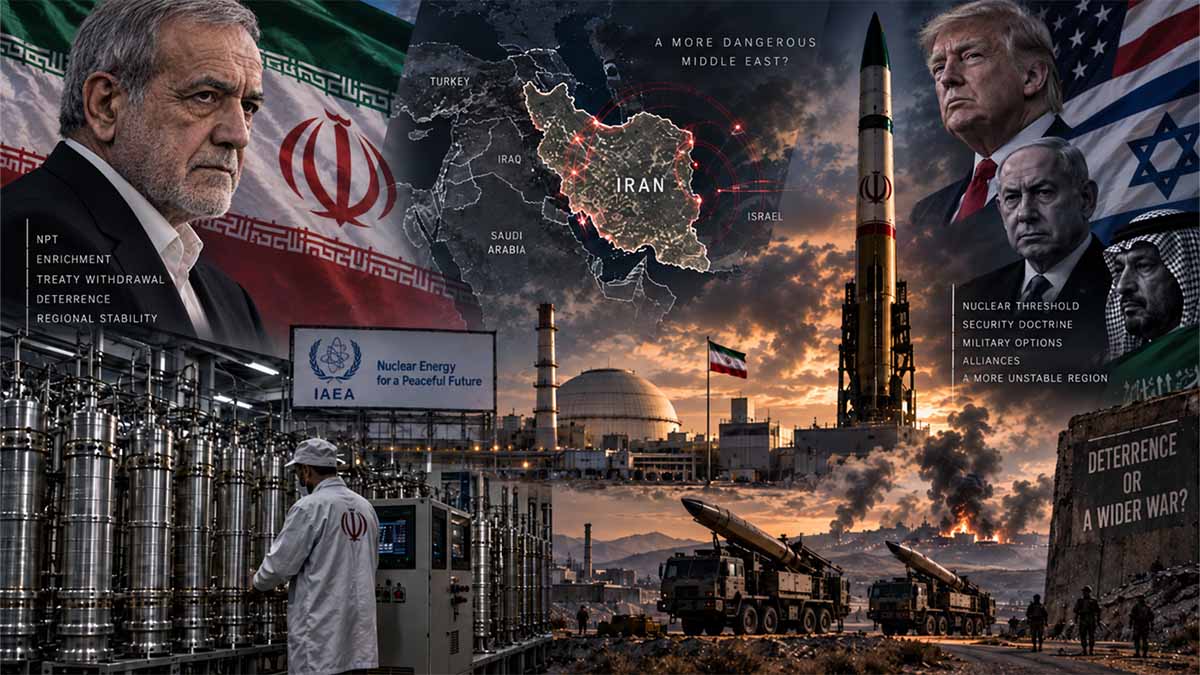
Iran’s NPT debate has crossed an important political threshold because withdrawal from the treaty, restriction of international verification and discussion of nuclear deterrence are increasingly being treated inside Iran as components of the same national-security problem rather than separate technical questions, although the available official record does not establish that Tehran has decided to withdraw from the NPT or manufacture a nuclear weapon.
The transformation is principally the consequence of military events. The IAEA records Israeli attacks against Iranian nuclear facilities beginning on 13 June 2025, followed by US participation and strikes against Fordow, Natanz and Esfahan on 22 June 2025; further attacks were officially reported against Natanz and other nuclear or radiological facilities during March and April 2026. [IAEA — NPT Safeguards Agreement with the Islamic Republic of Iran — GOV/2025/50] AIEA [IAEA Nuclear Events Database — Natanz, 21 March 2026] www-news.iaea.org
That sequence materially altered the strategic argument available to Iranian proponents of withdrawal: membership in the NPT gives Iran rights concerning peaceful nuclear activity and subjects its declared nuclear material to international safeguards, but the treaty itself does not provide a collective-defence guarantee against military attack. Article X nevertheless gives every party a sovereign withdrawal mechanism where extraordinary events related to the treaty’s subject matter are judged to have jeopardized its supreme interests, subject to three months’ notice to all parties and the UN Security Council. [Treaty on the Non-Proliferation of Nuclear Weapons — United Nations — Article X] Nazioni Unite
The argument for withdrawal therefore possesses a legally identifiable mechanism but not an automatic legal conclusion: Iran would have to determine that qualifying extraordinary events had occurred, issue the required notification and articulate those events. Whether attacks upon Iranian nuclear infrastructure would satisfy that political and legal threshold would form part of Iran’s Article X justification; the treaty does not create an external tribunal that must first authorize withdrawal.
At the same time, withdrawal from the NPT and acquisition of nuclear weapons are not synonymous acts. Leaving the treaty would remove Iran from the principal treaty prohibition applicable to it as a non-nuclear-weapon state, but it would not itself produce a weapon, solve the substantial technical and operational requirements of weaponization, erase other legal questions, or automatically terminate every safeguards consequence associated with nuclear material previously supplied or subjected to separate arrangements.
Iran remains formally bound by its comprehensive safeguards agreement, INFCIRC/214, which entered into force on 15 May 1974; its Additional Protocol was signed in 2003 but is not in force, and Iran ceased provisional implementation in February 2021. [IAEA Office of Legal Affairs — Iran Country Factsheet] ola.iaea.org
The verification problem has nevertheless become increasingly consequential. The IAEA reported in September 2025 that after the June attacks it had lost continuity of knowledge regarding important Iranian nuclear inventories and that verification of Iran’s highly enriched uranium was overdue. The Agency recorded 440.9 kg of uranium enriched up to 60% U-235, of which 432.9 kg had been verified in UF₆ form before inspection access was interrupted. [IAEA — GOV/2025/50] AIEA
Iran’s current official political position remains materially different from an overt nuclear-weapons doctrine. Speaking at the United Nations on 23 September 2026, President Masoud Pezeshkian stated that Iran was not developing nuclear weapons while simultaneously rejecting restrictions on what Tehran describes as its peaceful nuclear rights. [United Nations — Statement of President Masoud Pezeshkian, 23 September 2026] Nazioni Unite
The principal strategic uncertainty is therefore no longer whether Iran possesses an NPT grievance—its government has articulated such grievances repeatedly—but whether successive attacks and diminishing confidence in safeguards as a source of political protection eventually cause the Iranian leadership to conclude that nuclear ambiguity under the treaty provides less deterrent value than strategic ambiguity outside it.
Iran’s NPT Dilemma Is No Longer About Compliance — It Is About Security
Iran’s nuclear debate has crossed from treaty management into national-security doctrine. After attacks on Iranian nuclear facilities between 13 and 24 June 2025 and renewed strikes in March 2026, the central question in Tehran is no longer whether the Nuclear Non-Proliferation Treaty protects Iran’s legal right to peaceful nuclear technology; it is whether remaining inside a regime that verifies Iranian facilities but does not physically protect them still serves the state’s security. The contradiction is severe. Leaving the NPT would widen Iran’s sovereign room for manoeuvre, but it would also weaken the legal and diplomatic distinction between advanced nuclear latency and weaponization, at a moment when the International Atomic Energy Agency no longer has full continuity of knowledge over Iran’s enriched uranium inventory.
The treaty survived the attacks; its political value did not
The NPT still does exactly what its text requires: Article II prohibits Iran, as a non-nuclear-weapon state, from acquiring nuclear weapons; Article III ties that obligation to IAEA safeguards; Article IV preserves peaceful nuclear rights; Article X allows withdrawal after three months’ notice if “extraordinary events” are judged to have jeopardized supreme interests. What changed after 13 June 2025 was not the treaty’s legal architecture but Iran’s assessment of what that architecture is worth. The IAEA reported that attacks affected Fordow, Natanz, Esfahan and the Khondab reactor project, while inspection activity stopped and inspectors were withdrawn by the end of June 2025. For Iranian critics, that sequence separated verification from protection with unusual clarity.
The numbers now work against both Tehran and its adversaries
Immediately before the June 2025 attacks, the IAEA estimated Iran’s total enriched-uranium stockpile at 9,874.9 kg, including 440.9 kg enriched up to 60% U-235, of which 432.9 kg had been verified. The Agency also reported more than 20,000 installed centrifuges in 125 full-sized cascades across declared enrichment facilities. Those figures do not establish a nuclear weapon, but they do establish advanced latency. The problem is that the same conflict that made those numbers strategically more important also degraded the system that verifies them. Once continuity of knowledge is lost, every later movement of material acquires more weight in military planning because intelligence services, not inspectors, become the principal interpreters of what Iran is doing.
Withdrawal would not erase safeguards history — it would change the legal baseline
Article X gives Iran a lawful route out of the treaty, but not a clean slate. Iran’s comprehensive safeguards agreement, INFCIRC/214, states in Article 26 that it remains in force only as long as Iran is an NPT party, meaning effective withdrawal would terminate that comprehensive safeguards basis unless Tehran and the IAEA negotiated a replacement arrangement. Yet Article 23 preserves certain peaceful-use undertakings attached to older agreements, and withdrawal would not retroactively erase earlier safeguards findings. The IAEA Board of Governors had already adopted GOV/2025/38 on 12 June 2025, finding Iranian non-compliance regarding undeclared nuclear material and activities. Leaving the treaty would therefore change future obligations without cancelling the legal and political record that preceded exit.
Parliament can raise the pressure; it cannot command the whole nuclear state
The Majlis matters because Iranian nuclear law has already shown that legislation can narrow executive freedom. On 2 July 2025, President Masoud Pezeshkian signed legislation suspending cooperation with the IAEA until conditions defined through the Supreme National Security Council were satisfied. That precedent matters more than speeches by individual lawmakers: it shows how parliamentary pressure can be converted into binding policy and then integrated into the national-security system. But Article 176 of Iran’s Constitution places defence and national-security coordination in the Supreme National Security Council, chaired by the President, while its decisions take effect after confirmation by the Leader. A genuine NPT exit would therefore be visible not through rhetoric alone but through convergence among the Majlis, Guardian Council, SNSC, Foreign Ministry, Atomic Energy Organization and the highest political authority.
The economic cost would arrive through risk before it arrived through law
Iran would not leave the NPT from a sanctions-free baseline. The United Nations Security Council record states that the provisions of resolutions 1696, 1737, 1747, 1803, 1835 and 1929 were re-applied from 27 September 2025, while the restored 1737 sanctions list contains 43 individuals and 78 entities. By 2026, the International Monetary Fund projected real GDP contraction of 5.4% and average inflation of 68.9%. Under those conditions, withdrawal would not need an immediate new sanctions package to raise economic costs. Banks, insurers, industrial suppliers and project financiers would price the probability of further restrictions into transactions before legislation changed, while access to nuclear technology would become more dependent on bilateral political protection than on Iran’s Article IV position inside the NPT.
China can defend Iran’s rights without defending an Iranian bomb
Beijing’s position is the clearest warning against assuming that geopolitical alignment neutralizes proliferation costs. In 2026, China publicly opposed attacks on Iranian nuclear facilities, defended Iran’s peaceful nuclear rights and criticized coercive approaches, while also supporting IAEA verification and the authority of the NPT. That combination allows China to oppose military pressure on Iran without endorsing a transition from peaceful-use claims to nuclear deterrence. Russia faces a similar legal problem in civilian nuclear cooperation, particularly where supplied fuel, imported technology or project-specific safeguards are involved. Withdrawal would therefore test whether Tehran can preserve strategic partnerships while discarding the treaty framework on which much of the diplomatic defence of its peaceful nuclear programme has rested.
The dangerous zone is not after the bomb — it is before a survivable deterrent
Iran’s hardest-line argument is that nuclear weapons could prevent another attack. The strategic weakness in that argument is the transition period. A device is not yet a deterrent; deterrence requires survivability, delivery integration, secure command, authenticated communications, force protection and an adversary belief that retaliation would remain possible after a first strike. During the period in which Iran might be moving from 60% enrichment toward a military nuclear capability, adversaries could instead perceive a closing window in which the programme is dangerous enough to attack but not yet survivable enough to deter attack. The 2025–2026 military campaigns therefore strengthen the political case for deterrence while simultaneously demonstrating the vulnerability of a programme before deterrence exists.
The next 12–24 months will be decided by institutional convergence, not speeches
Between October 2026 and October 2028, the decisive indicators will be concrete: an Article X notification, a new IAEA-verified baseline for the 60% stockpile, enrichment beyond the previously verified level, renewed inspection access, military custody of nuclear functions, or a formal state doctrine identifying nuclear weapons as necessary for deterrence. The cost of inaction will be distributed unevenly. Iranian households already absorbing 68.9% projected inflation would bear additional financial isolation; Iranian industry would face higher financing and technology costs; the IAEA would lose further ability to separate latency from weaponization; China and Russia would face harder choices between partnership with Tehran and their stated support for non-proliferation; and regional military planners would operate with less common information and shorter decision windows. The central risk is therefore not simply that Iran leaves the NPT, but that every actor begins acting as if the most dangerous interpretation of the other side is already true.
Navigational Index
Pillar I — The Treaty Under Strategic Pressure
Chapter 1 — From Non-Proliferation Framework to National-Security Dispute
How the attacks of 2025–2026 changed the political meaning of NPT membership inside Iran and separated the treaty’s verification function from Iranian expectations of strategic protection.
Chapter 2 — Article X and the Legal Architecture of Iranian Withdrawal
The withdrawal clause, notification process, Iran’s safeguards obligations, the status of nuclear material after withdrawal and the unresolved legal questions surrounding an Iranian invocation of “supreme interests.”
Chapter 3 — Parliament, Presidency and the Architecture of Nuclear Authority
Why the Majlis can shape nuclear policy without possessing autonomous command over it, and how the presidency, Supreme National Security Council, Atomic Energy Organization, armed-security establishment and supreme political authority interact in decisions of strategic magnitude.
Pillar II — Verification, Latency and the Deterrence Question
Chapter 4 — The Post-Attack Safeguards Crisis
The interruption of inspections, loss of continuity of knowledge, physical damage to Iranian nuclear infrastructure and the widening informational gap between declared nuclear inventories and internationally verifiable conditions.
Chapter 5 — Sixty-Percent Enrichment and the Meaning of Nuclear Latency
What Iran’s enrichment capabilities establish, what they do not establish, and why fissile-material proximity, weapon design, integration, survivability and deployment must remain analytically distinct.
Chapter 6 — From Nuclear Capability to Nuclear Deterrence
The emerging Iranian argument that a weapons capability could deter renewed attack, the distinction between possession and credible deterrence, and the institutional and military consequences of crossing that threshold.
Pillar III — Iran’s Strategic Choice After the NPT
Chapter 7 — The Diplomatic and Economic Consequences of Withdrawal
The consequences for sanctions diplomacy, relations with the IAEA and United Nations, nuclear cooperation, financing, technology access and Iran’s ability to sustain political relationships with states that support its peaceful nuclear rights but oppose proliferation.
Chapter 8 — Escalation Geometry After an Iranian Exit
How withdrawal could alter military warning indicators, intelligence collection, crisis stability, attack incentives and the time available for diplomatic intervention without assuming that withdrawal would inevitably produce war.
Chapter 9 — Strategic Pathways to 2031
Continued membership under restricted cooperation, conditional restoration of verification, formal Article X withdrawal, extended nuclear latency, doctrinal ambiguity and the indicators capable of distinguishing one pathway from another.
Chapter 10 — Final Net Assessment: The Treaty, the Bomb and Iran’s Security Dilemma
Whether the strategic costs imposed on Iran after two cycles of attacks strengthen or undermine Tehran’s incentives to remain within the international non-proliferation framework, and what observable developments would demonstrate that the debate has moved from political signalling to state policy.
Master Abstract
The NPT no longer carries the same strategic meaning inside Iran
Iran’s debate over the Nuclear Non-Proliferation Treaty is undergoing a structural transformation because the issue confronting Tehran is no longer confined to the economic value of sanctions relief, the permissible level of enrichment, or the scope of IAEA inspections. The more fundamental question emerging from the post-2025 security environment is whether remaining a treaty-bound non-nuclear-weapon state provides Iran with sufficient strategic value when membership has neither prevented attacks against safeguarded nuclear installations nor eliminated the possibility of subsequent military operations against the programme. This distinction is central because the NPT was never designed as a defence alliance: Articles II and III impose non-proliferation and safeguards obligations, while Article IV protects peaceful nuclear rights subject to conformity with the treaty; none promises military protection against an attack on a state party. [Treaty on the Non-Proliferation of Nuclear Weapons — United Nations] Nazioni Unite
Iran consequently faces a security-policy problem that the NPT itself was not constructed to resolve. The treaty can establish legal commitments, international verification and a normative barrier against proliferation, but it cannot guarantee that an adversary will regard safeguarded nuclear facilities as militarily untouchable. The IAEA has repeatedly stated a separate institutional position that nuclear facilities must not be attacked because of the consequences for nuclear safety, safeguards and international peace and security. After the June 2025 strikes, Director General reporting recorded attacks affecting facilities including Fordow, Natanz, Esfahan and the Khondab heavy-water reactor project, as well as the subsequent interruption of verification activities. [IAEA — GOV/2025/50] AIEA
The distinction between normative protection and physical deterrence is becoming the intellectual centre of the Iranian debate.
The attacks created a stronger domestic case for Article X without determining the outcome
Article X gives Iran a genuine withdrawal mechanism rather than merely a political threat. A state party may withdraw if, exercising its national sovereignty, it decides that extraordinary events related to the treaty have jeopardized its supreme interests; it must then provide three months’ advance notice to the other treaty parties and to the UN Security Council and identify the extraordinary events upon which its determination rests. [Treaty on the Non-Proliferation of Nuclear Weapons — United Nations, Article X] Nazioni Unite
The events that Iran might cite are no longer hypothetical. According to the IAEA, Israeli attacks against Iranian nuclear facilities began on 13 June 2025, the United States subsequently participated in the military campaign, and safeguarded facilities containing nuclear material were affected. The Agency specifically identified the Fordow Fuel Enrichment Plant, the Natanz Fuel Enrichment Plant and Pilot Fuel Enrichment Plant, the Uranium Conversion Facility, Fuel Manufacturing Plant, Fuel Plate Fabrication Plant and Enriched UO₂ Powder Plant among installations affected by the fighting. [IAEA — GOV/2025/50] AIEA
The second cycle of attacks reinforced rather than erased that precedent. Iran’s Nuclear Regulatory Authority subsequently reported further attacks affecting Natanz on 1 and 21 March 2026, strikes on radioactive-source installations, impacts at or near Bushehr, and an attack on the Shahid Rezayee Nejad Yellow Cake Production Facility in Yazd on 27 March 2026. These reports constitute Iranian regulatory notifications reproduced through the IAEA event system and should therefore be treated as official Iranian reports transmitted through an international institutional channel rather than independent IAEA battlefield attribution. [IAEA Nuclear Events Database — Iran Events] www-news.iaea.org
Those events materially strengthen the factual basis upon which Iranian policymakers can construct an Article X argument, while leaving unresolved whether the leadership will determine that withdrawal serves Iran’s supreme interests better than continued membership.
Verification has become strategically more important precisely as access has become more difficult
Before the attacks, the Iranian nuclear dispute was already characterized by a widening gap between technical capability and international confidence. In its June 2025 comprehensive assessment, the IAEA stated that Iran remained the only non-nuclear-weapon state producing and accumulating uranium enriched to 60% U-235, while also documenting unresolved safeguards questions concerning nuclear material or activities at several undeclared locations. The Agency nevertheless distinguished those safeguards concerns from proof of a current nuclear-weapons programme. [IAEA — Comprehensive Report on the NPT Safeguards Agreement with Iran, GOV/2025/25] AIEA
The military campaign then degraded the Agency’s ability to answer precisely the questions that became more important after the strikes. The September 2025 Director General report recorded that verification activities had stopped after 13 June, that Agency inspectors had been withdrawn for safety reasons, and that Iran enacted legislation on 2 July 2025 suspending cooperation with the Agency. The IAEA subsequently reported loss of continuity of knowledge concerning inventories of nuclear material and emphasized that verification of highly enriched uranium had become overdue. [IAEA — GOV/2025/50] AIEA
This produces a strategic paradox. Reduced verification protects information that Tehran increasingly regards as security-sensitive, yet the same reduction increases uncertainty among states attempting to determine whether Iran remains below the weapons threshold. As uncertainty grows, military planners can become more dependent on intelligence assessments rather than international inspection, while Tehran can increasingly regard inspections as offering transparency without reciprocal security.
That feedback mechanism is one of the most consequential implications of the current crisis.
Iran possesses significant nuclear latency, but latency must not be confused with a deployed weapon
The verified 440.9 kg stock of uranium enriched up to 60% U-235 recorded before the breakdown of full access is strategically significant because 60-percent material represents a level of enrichment far beyond conventional requirements for most civilian power-reactor fuel and materially reduces the additional enrichment work necessary to reach weapons-grade concentrations. Yet neither that stockpile nor Iran’s enrichment infrastructure establishes that Iran possesses an operational nuclear weapon. [IAEA — GOV/2025/50] AIEA
A credible assessment must keep several thresholds separate: production of enriched uranium; accumulation of sufficient fissile material; production of weapons-grade material; weaponization; fabrication of an explosive device; successful testing or confidence without testing; integration with a delivery system; secure command and control; survivability; and finally the ability to communicate a retaliatory capability sufficiently credible to influence adversary calculations.
The Iranian political argument can therefore move toward nuclear deterrence considerably faster than an Iranian nuclear force can necessarily become a mature deterrent.
This distinction becomes particularly important when public advocates treat possession of a bomb as if it automatically produced immunity from conventional military attack. Nuclear weapons can profoundly alter escalation calculations, but deterrence depends upon survivability, second-strike confidence, command integrity, adversary perception and political credibility rather than simply possession of fissile material.
Tehran’s formal doctrine has not yet crossed the threshold that its domestic debate increasingly discusses
The strongest current official evidence continues to point to a formal Iranian position against nuclear-weapons acquisition. At the United Nations on 23 September 2026, President Masoud Pezeshkian stated that Iran does not develop nuclear weapons while insisting that peaceful nuclear technology forms part of Iran’s sovereign development and that Tehran would not accept restrictions upon that right. [United Nations — President Pezeshkian Address, 23 September 2026] Nazioni Unite
This position is broadly consistent with Iran’s longstanding presentation of its policy in NPT institutions. In the preparatory process preceding the 2026 Review Conference, Iran stated that it remained committed to the NPT, supported peaceful nuclear technology under Article IV and regarded IAEA verification as important, while simultaneously accusing nuclear-weapon states and Israel of undermining the treaty’s legitimacy and security balance. [United Nations — NPT/CONF.2026/PC.III/SR.5] Digital Library
Those declarations constitute evidence of Iran’s stated policy, not independent proof of the full purpose of every element of its nuclear programme. Equally, statements by individual legislators favouring weapon acquisition or withdrawal cannot be transformed into evidence that the state has adopted such a doctrine.
The analytical significance lies precisely in the widening distance between those two levels of discourse.
The institutional question is more important than the parliamentary headline
Parliament can impose substantial statutory constraints on Iranian nuclear diplomacy, as demonstrated by legislation adopted after the deterioration of the JCPOA framework, but decisions involving the strategic orientation of the Islamic Republic extend beyond ordinary parliamentary politics. Iran’s nuclear policy intersects with the presidency and Foreign Ministry, the Atomic Energy Organization of Iran, the Supreme National Security Council and the ultimate political-security authority exercised within the constitutional system.
The implication is that a Majlis motion should be treated as an indicator of pressure within the political system, rather than as equivalent to an Iranian notice of withdrawal.
This distinction also explains why the debate can become strategically important before any bill becomes law. Parliamentary pressure can reduce the political space available for restoring inspection arrangements, alter the negotiating position of the executive and normalize propositions that previously remained outside mainstream state discourse. Conversely, leadership decisions can restrain parliamentary escalation if preserving NPT membership is considered necessary for relations with major external partners or for maintaining a defensible distinction between peaceful nuclear development and weaponization.
The decisive observable event is therefore not another parliamentary speech. It is the emergence of coordinated institutional action across the bodies capable of converting rhetorical dissatisfaction into Article X implementation.
Withdrawal and weaponization remain different strategic decisions
The most consequential conceptual error would be to treat an Iranian withdrawal from the NPT as proof that a decision to manufacture a nuclear weapon had already been taken.
Article X establishes the right of withdrawal from the treaty. It does not require the withdrawing state to become nuclear armed, and a state could theoretically leave the NPT while maintaining an explicitly non-nuclear doctrine. Conversely, a violation of Article II by an NPT member pursuing a weapon could occur without prior withdrawal. [Treaty on the Non-Proliferation of Nuclear Weapons — United Nations] Nazioni Unite
The strategic problem is that withdrawal would change how external governments interpret subsequent Iranian activity. Without treaty membership and with sharply reduced international verification, uncertainty surrounding enrichment, fissile-material accounting, undeclared facilities and weaponization research would acquire greater military significance.
The question would consequently shift from whether inspectors can demonstrate compliance toward how quickly foreign intelligence services believe Iran could produce a weapon.
That transition has direct implications for crisis stability because states confronting uncertainty about a shortening nuclear timeline can perceive incentives for preventive action before the potential capability becomes harder to reverse. Tehran, conversely, could interpret precisely that danger as evidence that an uncompleted nuclear programme creates maximum vulnerability—the condition sometimes described as the dangerous interval between nuclear latency and an established deterrent.
This is why the debate over withdrawal cannot be analysed solely as treaty law.
The NPT itself is entering this crisis from a position of institutional weakness
Iran’s debate occurs after the 2026 NPT Review Conference, held in New York from 27 April to 22 May 2026, again failed to achieve consensus on a substantive outcome. The UN Secretary-General publicly expressed disappointment, describing the treaty as the cornerstone of the global nuclear disarmament and non-proliferation regime while warning about the broader deterioration of the international security environment. [United Nations — Eleventh NPT Review Conference] Nazioni Unite [Statement attributable to the Spokesperson for the Secretary-General — 22 May 2026] Nazioni Unite
This does not demonstrate that the NPT is collapsing, and Iran’s grievances cannot by themselves determine the institutional value of a treaty with a much broader membership and purpose. It does, however, mean that Tehran’s national debate is occurring during a wider crisis of confidence involving disarmament, safeguards, nuclear sharing, the Middle East nuclear order and the credibility of existing arms-control institutions.
Iran can therefore frame its dispute not only as a bilateral confrontation with Washington and Israel but as a challenge concerning the bargain between the NPT’s three principal dimensions: non-proliferation, peaceful nuclear use and disarmament.
Whether other states accept that interpretation is separate from the fact that it increasingly structures Iranian diplomatic arguments.
The strategic threshold is political before it becomes nuclear
The most defensible current judgment is that Iran has not publicly crossed the nuclear-weapons decision threshold, but the political environment within which such a decision would be considered has changed substantially.
Before the attacks, a principal Iranian argument for remaining inside the NPT was that international legal status, inspections and diplomatic engagement preserved Iran’s claim to peaceful nuclear technology while limiting the international legitimacy of military coercion. After attacks on facilities under safeguards, critics can argue that Iran accepted transparency and constraint without obtaining physical security in return.
The counterargument is equally consequential: withdrawal would reduce transparency, increase external uncertainty and potentially strengthen precisely the preventive-war logic that advocates of withdrawal intend to defeat.
Iran therefore confronts a genuine security dilemma.
Remaining within the NPT preserves international legitimacy and verification but cannot guarantee protection from military attack; leaving the NPT could increase Iranian freedom of action while simultaneously making adversaries more uncertain about Iranian intentions and more sensitive to the possibility that a future nuclear breakout is approaching.
The ultimate importance of the current debate lies in that contradiction rather than in the parliamentary procedure itself.
Key Evidence Table
| Indicator | Value/status | Reference date | Definition/scope | Issuer | Exact source |
|---|---|---|---|---|---|
| Iran NPT safeguards agreement | In force | Since 15 May 1974 | Comprehensive safeguards agreement INFCIRC/214 | IAEA | [IAEA Office of Legal Affairs — Iran Country Factsheet] ola.iaea.org |
| Iranian Additional Protocol | Signed but not in force | Signed 18 Dec 2003 | Iran stopped provisional implementation in 2021 | IAEA | [IAEA Office of Legal Affairs — Iran Country Factsheet] ola.iaea.org |
| Article X withdrawal notice | Three months | Treaty rule | Notice to all parties and UN Security Council, with statement of extraordinary events | United Nations | [Treaty on the Non-Proliferation of Nuclear Weapons — Article X] Nazioni Unite |
| Verified uranium enriched up to 60% | 440.9 kg, including 432.9 kg UF₆ verified | Pre-interruption inventory reported Sept 2025 | Uranium enriched up to 60% U-235 | IAEA Director General | [GOV/2025/50] AIEA |
| Israeli attacks on Iranian nuclear infrastructure | Confirmed in IAEA reporting | 13–24 Jun 2025 | Multiple safeguarded and nuclear-related facilities | IAEA | [GOV/2025/50] AIEA |
| US participation in attacks | Confirmed in IAEA reporting | By 22 Jun 2025 | Fordow, Natanz and Esfahan among affected facilities | IAEA | [GOV/2025/50; IAEA event notification] AIEA |
| Verification interruption | Agency lost continuity of knowledge over important inventories | From Jun 2025 | Safeguards verification and nuclear material accounting | IAEA | [GOV/2025/50] AIEA |
| Further attack on Natanz | Official Iranian regulatory notification | 21 Mar 2026 | Aerial and missile attack | INRA via IAEA | [IAEA Nuclear Events Database] www-news.iaea.org |
| Attack on Yazd yellowcake facility | Official Iranian regulatory notification | 27 Mar 2026 | Shahid Rezayee Nejad facility | INRA via IAEA | [IAEA Nuclear Events Database] www-news.iaea.org |
| Current presidential nuclear-weapons position | Iran states it is not developing nuclear weapons | 23 Sep 2026 | Public statement before UN General Assembly | President Masoud Pezeshkian / UN | [United Nations record] Nazioni Unite |
| 2026 NPT Review Conference outcome | No substantive consensus outcome | 22 May 2026 | Eleventh Review Conference | United Nations | [UN Secretary-General statement] Nazioni Unite |
Principal Gaps and Watch Indicators
Formal Article X preparation. The decisive legal indicator would be evidence that Iranian state institutions are preparing the notification required by Article X, particularly language identifying the “extraordinary events” deemed to have jeopardized Iran’s supreme interests. Parliamentary advocacy alone remains below this threshold. [Treaty on the Non-Proliferation of Nuclear Weapons — Article X] Nazioni Unite
Supreme National Security Council treatment of the issue. Public confirmation that the SNSC has formally considered or approved an NPT withdrawal pathway would materially change the assessment because it would move the question from legislative pressure toward integrated state security policy.
Change in presidential language. Pezeshkian’s 23 September 2026 declaration remains an important marker because it explicitly separates Iran’s peaceful nuclear rights from nuclear-weapons development. Abandonment of that formulation by the presidency would be a significant doctrinal signal. [United Nations — President Pezeshkian Address] Nazioni Unite
Status of safeguarded nuclear material. Restored IAEA access capable of establishing the current quantity and location of Iran’s enriched uranium would substantially reduce one of the most consequential uncertainties created by the 2025 interruption. The Agency had already reported loss of continuity of knowledge and overdue verification of high-enriched uranium. [IAEA — GOV/2025/50] AIEA
Enrichment beyond the previously verified 60-percent level. Verified movement toward substantially higher enrichment would have much greater diagnostic value than political rhetoric because it would further compress the technical distance between Iran’s existing fuel-cycle capability and potential weapons-grade material.
Change in safeguards cooperation. A negotiated restoration of durable inspections would strengthen the continued-membership pathway; further statutory or executive restrictions affecting material accounting, inspector access or monitoring would strengthen the pathway toward institutional separation from the treaty regime.
Explicit state endorsement of nuclear deterrence. Individual parliamentarians or commentators discussing nuclear weapons are politically significant but are not equivalent to national doctrine. A formal statement from Iran’s highest security authorities that nuclear weapons are required for deterrence would represent a qualitatively different indicator.
Preparation for nuclear testing or weapon integration. Publicly verifiable evidence relating to explosive testing, weapons engineering, delivery-system integration or nuclear command-and-control arrangements would be considerably more diagnostic of weaponization than enrichment levels alone.
Further attacks on Iranian nuclear infrastructure. Additional military action would strengthen the argument inside Iran that safeguards membership provides transparency without sufficient strategic protection, while simultaneously increasing external concern that damaged or inaccessible facilities reduce visibility into the programme.
Open Official Record
Several propositions circulating in contemporary reporting cannot yet be treated as established state policy on the basis of the accessible first-order record.
The public official record reviewed for this assessment does not establish that Iran has transmitted an Article X withdrawal notification, and therefore Iran remains an NPT state party for purposes of this assessment.
The public official record reviewed here does not establish that the Iranian leadership has formally authorized production of a nuclear weapon. President Pezeshkian’s most recent UN-level statement available in the current record explicitly maintains the contrary position. [United Nations — 23 September 2026] Nazioni Unite
The precise current location, physical condition and complete inventory of all Iranian uranium enriched to high levels cannot be reconstructed responsibly from earlier pre-attack figures because the IAEA itself reported loss of continuity of knowledge after the attacks and interruption of access. [IAEA — GOV/2025/50] AIEA
Claims concerning confidential deliberations by Iran’s highest authorities, including purported definitive prohibitions on negotiations or an already approved weapons decision, require either an attributable official record or subsequently corroborated institutional action before they can be treated as established facts.
Similarly, statements attributed in the supplied topic material to individual Iranian legislators remain evidence of a widening political debate rather than proof of the final policy of the Islamic Republic unless and until they are converted into legislation, formal SNSC action, executive implementation or an Article X notification.
Analytical Judgment
Iran is approaching an institutional nuclear threshold before it has demonstrably crossed a weapons threshold.
The decisive transformation is not the appearance of another parliamentary initiative but the erosion of the political separation between three propositions that Iran previously had strong incentives to keep distinct: dissatisfaction with the NPT regime, restriction of IAEA access and consideration of nuclear weapons as instruments of deterrence. The attacks of 2025 and 2026 provide proponents of a harder strategy with a factual argument that did not previously exist in the same form: internationally safeguarded status did not physically prevent attacks on Iranian nuclear infrastructure. The official record confirms the attacks and the resulting degradation of verification. [IAEA — GOV/2025/50] AIEA
Yet that fact does not make withdrawal an intrinsically stabilizing response. Once inspection and treaty constraints become less credible to external observers, Iran’s nuclear latency acquires greater strategic ambiguity, and ambiguity can simultaneously strengthen deterrent uncertainty and increase incentives for preventive action.
The central question confronting Tehran is therefore becoming more severe than the parliamentary formulation of whether the NPT has “benefited” Iran.
It is whether remaining visibly below the nuclear-weapons threshold still produces greater security than deliberately making that threshold less visible.
As of 2 October 2026, the verified public record does not show that Iran has answered that question by leaving the NPT or ordering the construction of a nuclear weapon. It does show that the political, legal and strategic barriers separating those questions have become substantially thinner.
Iran’s NPT Threshold
How repeated attacks on Iranian nuclear infrastructure are connecting treaty membership, international verification, nuclear latency and the debate over strategic deterrence.
Strategic Causal Chain
Repeated military attacks
Iranian nuclear facilities were struck during the June 2025 conflict and again during the 2026 escalation, changing the domestic security meaning attached to safeguarded nuclear status.
Protection argument weakens
Iranian critics increasingly distinguish between the NPT’s legal and verification functions and its inability to provide physical protection against attack.
Verification deteriorates
Interrupted access and loss of continuity of knowledge increase uncertainty surrounding enriched uranium inventories and the condition of damaged facilities.
NPT withdrawal pressure
Parliamentary actors increasingly invoke Article X and argue that continued treaty membership imposes obligations without supplying an adequate security return.
Deterrence enters the argument
The debate extends beyond treaty law toward whether an explicit nuclear capability would reduce the probability of renewed external attack.
Ambiguity versus stability
Greater Iranian strategic ambiguity could complicate adversary planning while simultaneously increasing preventive-strike incentives and reducing crisis stability.
Three Separate Thresholds
NPT Membership
Iran remains a party to the Nuclear Non-Proliferation Treaty. No verified Article X withdrawal notification is established in the public record used for this assessment.
Nuclear Latency
Iran possesses substantial enrichment capability and had accumulated uranium enriched up to 60% U-235, but enrichment capability and fissile-material proximity remain analytically distinct from a completed and deployable nuclear weapon.
Nuclear-Weapons Decision
The verified public record does not establish a formal Iranian state decision to manufacture a nuclear weapon, while President Masoud Pezeshkian continued publicly to deny such an objective in September 2026.
Strategic Pathways
Continued NPT Membership
Iran remains formally inside the treaty while attempting to preserve its peaceful-nuclear position and manage inspection access under increasingly difficult security conditions.
Restricted Verification
Treaty membership continues but transparency remains degraded, increasing the gap between declared policy and what international inspectors can independently verify.
Article X Withdrawal
Tehran formally invokes extraordinary events affecting its supreme interests and begins the treaty’s three-month withdrawal process without this act necessarily constituting a weapons decision.
Nuclear Deterrence Doctrine
Iran’s highest authorities explicitly determine that a nuclear weapon or weaponized capability is required for national deterrence, crossing a fundamentally different strategic threshold.
What Changes the Assessment?
Formal Article X preparation
Evidence that Iranian authorities are drafting or transmitting the withdrawal notification required under Article X would move the issue from political advocacy toward executable state policy.
Highest-value watch indicators
- Formal Supreme National Security Council treatment of NPT withdrawal.
- Transmission of an Article X notification to treaty parties and the UN Security Council.
- Restoration or further degradation of IAEA verification access.
- Verified changes in the enrichment level or location of highly enriched uranium.
- Official state endorsement of nuclear deterrence rather than individual political advocacy.
- Publicly verifiable weaponization, integration or command-and-control indicators.
Verified Baseline
| Indicator | Status / Value | Reference point | Analytical significance |
|---|---|---|---|
| NPT status | State party | Assessment date: 2 Oct 2026 | No verified Article X withdrawal notification established in the assessed public record. |
| Comprehensive safeguards agreement | In force | Since 15 May 1974 | Provides the principal treaty-linked IAEA safeguards architecture applicable to Iran. |
| Additional Protocol | Signed, not in force | Signed 18 Dec 2003 | Iran ceased provisional implementation in 2021. |
| Article X notice requirement | Three months | NPT Article X | Withdrawal requires notice to all treaty parties and the UN Security Council together with the extraordinary events invoked. |
| Uranium enriched up to 60% U-235 | 440.9 kg reported | IAEA reporting, Sept 2025 | Strategically important nuclear latency indicator, but not proof of an operational nuclear weapon. |
| Verification continuity | Degraded after attacks | From June 2025 | Loss of continuity of knowledge increases uncertainty surrounding nuclear inventories and damaged facilities. |
| Official presidential doctrine | No nuclear-weapons development claimed | 23 Sept 2026 | The formal presidential position remains distinct from calls by individual political actors for withdrawal or nuclear deterrence. |
Primary documentary sources
Treaty architecture: Treaty on the Non-Proliferation of Nuclear Weapons — United Nations
Safeguards and post-attack verification: NPT Safeguards Agreement with the Islamic Republic of Iran — IAEA GOV/2025/50
Pre-attack comprehensive safeguards assessment: Comprehensive Report on the NPT Safeguards Agreement with Iran — IAEA GOV/2025/25
Iran safeguards legal status: IAEA Office of Legal Affairs — Iran Country Factsheet
2026 NPT institutional context: Eleventh NPT Review Conference — United Nations
Pillar I — The Treaty Under Strategic Pressure
Chapter 1 — From Non-Proliferation Framework to National-Security Dispute
Principal judgment
The transformation of Iran’s NPT debate after the military campaigns of 2025 and 2026 is not principally a change in the legal content of the Treaty on the Non-Proliferation of Nuclear Weapons; it is a change in the political value Tehran assigns to treaty membership under conditions of repeated military vulnerability. The NPT continues to perform the functions for which it was designed: Article II prohibits Iran, as a non-nuclear-weapon state party, from manufacturing or otherwise acquiring nuclear weapons; Article III connects that obligation to IAEA safeguards; Article IV preserves a treaty right to peaceful nuclear energy subject to conformity with Articles I and II; and Article X establishes the possibility of withdrawal. What the treaty does not contain is a security guarantee protecting a compliant or safeguarded nuclear installation from military attack. That distinction, visible in the treaty text itself, has become central to the Iranian debate because the verification bargain survived legally while the security environment surrounding the verified facilities deteriorated physically. Nazioni Unite NPT treaty text — United Nations
The shift is particularly significant because the June 2025 conflict did not merely occur in parallel with Iran’s nuclear programme: according to the IAEA, attacks between 13 and 24 June 2025 affected facilities known to contain safeguarded nuclear material, including the Fordow Fuel Enrichment Plant, Natanz Fuel Enrichment Plant, Natanz Pilot Fuel Enrichment Plant, Uranium Conversion Facility, Fuel Manufacturing Plant, Fuel Plate Fabrication Plant and Enriched UO₂ Powder Plant, while the Khondab Heavy Water Research Reactor, then under construction and not containing nuclear material, was also affected. The IAEA reported that it stopped in-field verification for safety reasons, withdrew all inspectors by the end of June, and subsequently lost access to safeguarded facilities other than Bushehr. AIEA IAEA GOV/2025/50 — NPT Safeguards Agreement with Iran
The consequences are analytically deeper than the destruction of buildings. Before the attacks, the international nuclear controversy concerned whether Iran’s declarations were complete, whether safeguards obligations were being fulfilled, whether enrichment levels were compatible with a purely civilian rationale, and whether inspectors possessed sufficient access to resolve outstanding questions. After the attacks, an additional question entered Iranian state discourse: what strategic benefit does transparency provide if transparency does not reduce exposure to military attack? This is not a proposition established by the NPT, nor does it follow legally from the IAEA safeguards system; it is a security interpretation increasingly available to Iranian policymakers because the attacks demonstrated that safeguarded status and military sanctuary are separate concepts.
Verification and protection are different institutional functions
The safeguards system is designed to verify nuclear material and activities, not to defend them. Article III of the NPT requires non-nuclear-weapon states to accept safeguards “for the exclusive purpose of verification” of fulfilment of treaty obligations with a view to preventing diversion of nuclear energy from peaceful uses to nuclear weapons or other nuclear explosive devices. Iran’s comprehensive safeguards agreement, INFCIRC/214, translates that obligation into an operational verification relationship with the IAEA. Nazioni Unite IAEA INFCIRC/214 — Iran safeguards agreement
The system therefore creates several forms of institutional value for Iran: recognition that safeguarded peaceful nuclear activities fall within an international legal framework; independent verification capable, when sufficient information and access are available, of supporting confidence concerning declared nuclear material; a technical channel with the IAEA that is institutionally distinct from bilateral relations with hostile states; and documentary evidence allowing Iran to assert that its civilian programme is being treated under the same treaty architecture applicable to other non-nuclear-weapon states. None of those functions amounts to a commitment by other NPT parties to use military force, sanctions, diplomatic retaliation or collective defence to protect Iranian installations.
The IAEA itself has repeatedly distinguished the issues. After the beginning of the June 2025 attacks, Director General Rafael Mariano Grossi recalled General Conference resolutions stating that an armed attack against nuclear facilities devoted to peaceful purposes violates principles of the UN Charter, international law and the IAEA Statute, while emphasizing nuclear safety, security and safeguards consequences. That institutional position is significant, but it does not transform the Agency into a security guarantor: the IAEA can inspect, report, verify, convene, warn and refer matters through its statutory institutions, but it does not possess an enforcement force capable of physically protecting Fordow, Natanz or Esfahan. AIEA IAEA GOV/2025/50 — post-attack safeguards report
The pre-war safeguards position was already unusually fragile
The security shock of June 2025 occurred immediately after a serious deterioration in the safeguards relationship. On 12 June 2025, one day before the military operation began, the IAEA Board of Governors adopted resolution GOV/2025/38, finding that Iran’s failures since 2019 to provide full and timely cooperation regarding undeclared nuclear material and activities at multiple undeclared locations constituted non-compliance with its safeguards obligations in the context of Article XII.C of the IAEA Statute. The Board also found, consistently with Article 19 of INFCIRC/214, that the Agency was unable to verify that there had been no diversion of nuclear material required to be safeguarded to nuclear weapons or other nuclear explosive devices. AIEA IAEA Board resolution GOV/2025/38 — 12 June 2025
This chronology matters because it prevents two analytically misleading simplifications. The attacks did not occur in an environment in which all safeguards disputes had been resolved; significant verification concerns preceded the war. Conversely, the subsequent destruction of facilities and interruption of inspections did not resolve those concerns: it made independent verification more difficult. Iran could therefore argue politically that an international verification system did not protect its nuclear infrastructure, while the IAEA could simultaneously argue institutionally that the loss of access made already unresolved safeguards questions more serious. Both propositions can coexist because they refer to different functions of the regime.
The verification baseline immediately before interruption
The scale of what was being monitored before the attacks demonstrates why the subsequent loss of access carries strategic significance. The IAEA reported that, immediately before the June 2025 attacks, Iran had 125 full-sized centrifuge cascades installed across its three previously declared enrichment facilities, containing more than 20,000 IR-1, IR-2m, IR-4 and IR-6 centrifuges. The last Agency access before the attacks occurred on different dates depending on the facility: Fordow on 10 June 2025, Natanz FEP on 27 May, Natanz PFEP on 11 June, the Fuel Plate Fabrication Plant on 9 June, the Uranium Conversion Facility on 21 May, and the Khondab reactor on 14 May. AIEA IAEA GOV/2025/50 — verification chronology
| Facility / activity | Last reported IAEA access or verification before June attacks | Pre-attack function | IAEA post-attack assessment |
|---|---|---|---|
| Fordow Fuel Enrichment Plant | 10 Jun 2025 | Enrichment up to 5%, 20% and 60% U-235 | Expected to have suffered very significant damage |
| Natanz Fuel Enrichment Plant | 27 May 2025 | Enrichment up to 5% U-235 | Extensively damaged, including indications of impacts on underground enrichment halls |
| Natanz Pilot Fuel Enrichment Plant | 11 Jun 2025 | Enrichment up to 5% and 60% U-235 | Underground section extensively damaged; above-ground section destroyed |
| Khondab Heavy Water Research Reactor | 14 May 2025 | Reactor under construction | Hit during military attacks |
| Fuel Plate Fabrication Plant | 9 Jun 2025 | Fuel-cycle activity | Reported damaged |
| Uranium Conversion Facility | 21 May 2025 | Uranium conversion, including uranium-metal-related area | Reported damaged |
| Heavy Water Production Plant | Earlier monitoring context | Heavy-water production | Key buildings damaged; assessed as no longer operating after attacks |
| Centrifuge workshops at Tehran, Karaj and Esfahan | Varying monitoring status | Rotor/component manufacturing | Buildings at multiple locations hit or destroyed |
Source: IAEA Director General, GOV/2025/50. AIEA Exact IAEA report
The interruption also froze the Agency’s knowledge at different dates for different categories of JCPOA monitoring. The September 2025 report recorded February 2021 as the last verification point for several transparency measures that Iran had already ceased implementing years before the attack, while other activities remained under verification until May or June 2025. The result was therefore not a single sudden transition from perfect transparency to zero transparency, but the layering of a new wartime inspection break over an already degraded post-2021 monitoring environment. AIEA
The material-accountancy problem became larger than the facility-access problem
The strongest technical consequence of the military interruption was not simply that inspectors could not enter damaged buildings; it was that the Agency could no longer maintain the same continuity of knowledge concerning nuclear inventories, transfers and facility configurations. On the basis of information available immediately before the attacks and estimates derived from previous operating patterns, the IAEA estimated Iran’s total enriched uranium stockpile as of 13 June 2025 at 9,874.9 kg, representing an increase of 627.3 kg from the preceding quarterly report. Of this total, 9,040.5 kg was estimated to be in UF₆ form and 834.4 kg in other chemical forms. AIEA
| Enrichment category in UF₆ | IAEA estimate, 13 Jun 2025 | Change from preceding report |
|---|---|---|
| Up to 2% U-235 | 2,391.1 kg | +169.7 kg |
| Up to 5% U-235 | 6,024.4 kg | +515.6 kg |
| Up to 20% U-235 | 184.1 kg | −90.4 kg |
| Up to 60% U-235 | 440.9 kg | +32.3 kg |
| Total UF₆ enriched uranium | 9,040.5 kg | — |
| Uranium in other forms | 834.4 kg | — |
| Estimated total enriched stockpile | 9,874.9 kg | +627.3 kg overall |
The IAEA stated that 432.9 kg of the 440.9 kg of 60-percent material had been verified before the interruption. AIEA IAEA GOV/2025/50 — enriched uranium stockpile data
These numbers matter in this chapter not because they establish weaponization—they do not—but because the value of safeguards rises as the monitored material becomes strategically more sensitive. The greater the enrichment level and the more complex the distribution of nuclear material between facilities, the more important reliable material accountancy becomes to external confidence. The same attacks that strengthened the Iranian political argument that treaty membership did not protect nuclear infrastructure therefore simultaneously increased the importance of the very verification arrangements that the conflict disrupted.
The July 2025 law converted wartime disruption into institutional policy
A second change followed the physical interruption. On 2 July 2025, President Masoud Pezeshkian signed legislation adopted by the Majlis suspending cooperation with the IAEA, with the IAEA reporting that cooperation would remain suspended pending a determination by the Supreme National Security Council that specified conditions had been met. This is an important institutional precedent because it demonstrates that the Iranian response to attacks did not remain an emergency decision by facility operators or the Atomic Energy Organization; it was translated into statutory policy and linked directly to Iran’s highest constitutional national-security coordination body. AIEA IAEA GOV/2025/50 — paragraphs on Iran’s July 2025 suspension law
That precedent helps explain why the contemporary NPT withdrawal debate cannot be read simply as parliamentary rhetoric. The Majlis has already shown that it can legislate consequences affecting the operational implementation of safeguards, while the SNSC can be made responsible for determining when conditions permit policy reversal. In practical terms, this creates a mechanism by which external military events can be converted into changes in the domestic legal conditions governing international nuclear cooperation.
The second cycle of attacks deepened the security interpretation
The 2026 attacks reinforced the earlier change in political meaning because the Iranian Nuclear Regulatory Authority reported additional strikes on nuclear or radiological infrastructure, including attacks on Natanz on 1 March and 21 March 2026, projectiles striking the Bushehr Nuclear Power Plant premises on 17 and 24 March and again on 27 March, an attack on a sterilization gamma-irradiation installation in Esfahan province on 7 March, and an attack on the Shahid Rezayee Nejad Yellow Cake Production Facility in Yazd on 27 March. These entries are official Iranian regulatory reports carried through the IAEA Nuclear Events Web-based System; the attribution contained in them should therefore be understood as the reporting state’s official account rather than an independent IAEA battlefield determination. www-news.iaea.org IAEA Nuclear Events Web-based System — Iran event records
| 2026 reported event | Date | Facility / installation | Evidentiary status |
|---|---|---|---|
| Attack on Natanz | 1 Mar 2026 | Natanz Nuclear Facility | INRA report through IAEA event system |
| Attack on gamma-irradiation installation | 7 Mar 2026 | Esfahan province | INRA report through IAEA event system |
| Projectile at Bushehr | 17 Mar 2026 | Bushehr Nuclear Power Plant premises | INRA report |
| Renewed attack on Natanz | 21 Mar 2026 | Natanz Nuclear Facility | INRA report |
| Projectile at Bushehr | 24 Mar 2026 | Bushehr Nuclear Power Plant premises | INRA report |
| Attack on yellowcake facility | 27 Mar 2026 | Shahid Rezayee Nejad facility, Yazd | INRA report |
| Further projectile at Bushehr | 27 Mar 2026 | Bushehr Nuclear Power Plant premises | INRA report |
The cumulative effect was political as well as physical. The Iranian argument was no longer built around a single exceptional episode that might be treated as non-recurring; repeated exposure allowed proponents of a harder nuclear posture to frame vulnerability as a structural condition.
What the NPT gives Iran—and what it does not
| Function | Provided by NPT / safeguards architecture? | Strategic significance |
|---|---|---|
| Recognition of peaceful nuclear rights subject to treaty obligations | Yes | Article IV |
| Prohibition on Iranian acquisition/manufacture of nuclear weapons | Yes | Article II |
| International safeguards verification | Yes | Article III + INFCIRC/214 |
| International technical cooperation framework | Yes, subject to applicable rules | Article IV and IAEA framework |
| Independent verification of declared material where access exists | Yes | IAEA safeguards |
| Automatic protection of safeguarded installations from attack | No | No collective-defence mechanism exists in NPT |
| Automatic military response if a nuclear facility is attacked | No | Outside NPT architecture |
| Automatic sanctions against an attacker | No | Requires action through other legal/institutional mechanisms |
| Security guarantee comparable to a defence alliance | No | Not an NPT function |
| Withdrawal mechanism | Yes | Article X |
The strategic dispute in Tehran has therefore moved from whether Iran is receiving treaty benefits to which type of benefit is relevant under wartime conditions. If Iran’s principal objective is international recognition of peaceful nuclear rights and institutional verification, NPT membership retains substantial utility. If the primary objective becomes preventing another attack by manipulating adversary expectations concerning catastrophic retaliation, treaty membership is judged through a different security lens. The treaty has not changed; the weighting of its benefits inside Iran has.
Key judgments
Iran’s NPT debate is now structurally connected to national security because two cycles of attacks have demonstrated that verification status does not equal physical immunity, while the destruction and inaccessibility of nuclear facilities have simultaneously made verification more strategically necessary.
The June 2025 attacks occurred immediately after a formal IAEA Board finding of safeguards non-compliance, meaning the present dispute combines unresolved pre-war safeguards concerns with post-war verification degradation rather than replacing one problem with the other. AIEA
The July 2025 suspension law established a domestic institutional precedent in which parliamentary legislation, presidential implementation and SNSC determination were combined to restrict IAEA cooperation, making later NPT legislation politically more consequential than ordinary parliamentary signalling. AIEA
The central Iranian security question has consequently shifted from whether the treaty recognizes peaceful nuclear rights to whether those rights, verification benefits and international legitimacy compensate for the vulnerability associated with remaining a transparent non-nuclear-weapon state.
What would change the assessment
A durable restoration of comprehensive verification, combined with a political arrangement that Tehran regards as materially reducing the risk of renewed attacks, would weaken the connection between NPT membership and strategic vulnerability.
A further attack on safeguarded enrichment infrastructure, particularly following restored inspections, would strengthen the Iranian argument that transparency does not translate into security.
A formal state-level declaration that NPT membership itself creates unacceptable operational vulnerability would indicate that the political debate has moved beyond criticism of the IAEA toward reconsideration of the entire treaty bargain.
Chapter 2 — Article X and the Legal Architecture of Iranian Withdrawal
Principal judgment
Iran possesses a clear legal route to withdrawal from the NPT, but the consequences would be substantially more complicated than a parliamentary vote followed by the disappearance of safeguards. Article X gives each state party a sovereign right to withdraw when it determines that extraordinary events related to the subject matter of the treaty have jeopardized its supreme interests; it requires three months’ notice to all treaty parties and to the UN Security Council, accompanied by a statement identifying those extraordinary events. The text does not require prior approval from the Security Council, the IAEA Board of Governors or another international body. Nazioni Unite United Nations — NPT Article X
The important legal distinction is that Article X establishes a withdrawal procedure, not a declaration of innocence, a termination of responsibility for earlier conduct or an authorization to manufacture nuclear weapons. It also does not determine every post-withdrawal safeguards consequence, because Iran’s nuclear programme contains material, facilities, technologies and bilateral arrangements whose legal treatment depends upon instruments outside the NPT itself.
Article X is deliberately state-driven
The wording places the initial determination in the hands of the withdrawing party: a state must decide that extraordinary events related to the subject matter of the treaty have jeopardized its supreme interests. The clause therefore contains objective terms—“extraordinary events,” relation to the treaty’s subject matter, and jeopardy to “supreme interests”—but assigns the decision to the state exercising its national sovereignty. Nazioni Unite
Article X does not establish an arbitral procedure to determine whether the withdrawing party’s characterization is persuasive before withdrawal becomes effective. The Security Council nevertheless receives the notification because an NPT withdrawal capable of affecting international peace and security can become a matter for Council consideration under the UN Charter.
For Iran, the attacks on nuclear installations offer an identifiable factual basis that Tehran could cite in an Article X notification. Whether other states would agree that those events satisfy the clause is a separate political and legal question. Article X does not require international consensus on the withdrawing state’s reasoning before notice can be given.
The procedural chain
| Stage | International requirement | Legal source | Decision significance |
|---|---|---|---|
| State determines extraordinary events affect supreme interests | Required substantive determination | NPT Article X(1) | Iranian state decision |
| Formal notice prepared | Required | NPT Article X(1) | Converts policy into treaty procedure |
| Notice transmitted to all NPT parties | Required | NPT Article X(1) | International notification |
| Notice transmitted to UN Security Council | Required | NPT Article X(1) | Gives Council formal notice |
| Statement identifies extraordinary events | Required | NPT Article X(1) | Legal-political justification |
| Three-month notice period | Required | NPT Article X(1) | Treaty remains applicable during notice period |
| Withdrawal takes effect after notice period | If notice is maintained and requirements are met | Article X framework | NPT obligations cease prospectively |
| Treatment of pre-existing obligations/material | Instrument-specific | Safeguards, supply and other agreements | Does not follow automatically from Article X |
The legally most consequential period might therefore be the three months between notification and effective withdrawal, not the moment after withdrawal. During that interval Iran would remain an NPT party, the international community would possess a defined deadline, the IAEA Board and Security Council could consider the consequences, diplomatic negotiations could continue, and governments would be forced to assess whether the notice represented bargaining leverage, an irreversible strategic decision or preparation for a post-NPT nuclear posture.
Iran’s comprehensive safeguards agreement is explicitly tied to NPT membership
Iran’s safeguards agreement contains unusually clear language on duration. Article 26 of INFCIRC/214 states that the agreement “shall remain in force as long as Iran is party to the Treaty.” This means that the legal basis of Iran’s comprehensive safeguards agreement is directly linked to continued NPT membership rather than existing as an entirely independent permanent instrument. AIEA IAEA INFCIRC/214 — full safeguards agreement
That provision is central to any serious analysis of withdrawal. It means that once Iranian NPT withdrawal became legally effective, the comprehensive safeguards agreement would no longer remain in force under its own Article 26.
However, that is not equivalent to saying that every item of nuclear material or every nuclear facility in Iran would automatically become legally unrestricted.
Article 23 creates an important residual layer
INFCIRC/214 also contains a less frequently discussed provision. Article 23 states that the application of Agency safeguards in Iran under other safeguards agreements is suspended while INFCIRC/214 remains in force; critically, it adds that Iran’s undertakings in those and other agreements not to use items covered by them in such a way as to further any military purpose continue to apply. AIEA
The consequence is important. Iran’s comprehensive safeguards system consolidated verification under the NPT arrangement, but it did not necessarily extinguish every underlying undertaking associated with previously supplied nuclear material or equipment. If the comprehensive agreement ceased to operate, the legal treatment of those items would have to be examined instrument by instrument, including older project or supply arrangements and any bilateral commitments containing enduring peaceful-use provisions.
Accordingly, the proposition “Iran leaves the NPT and all safeguards disappear immediately” is legally too broad.
The post-withdrawal nuclear inventory would not have a single legal status
| Category | Effect of effective NPT withdrawal | Principal legal question |
|---|---|---|
| Comprehensive safeguards under INFCIRC/214 | Article 26 links duration to NPT membership | CSA would cease with NPT membership |
| Additional Protocol | Not in force as a ratified treaty instrument | Already not legally operative as an in-force AP |
| Nuclear items covered by older agreements | Instrument-specific | Whether safeguards or peaceful-use undertakings revive or survive |
| Imported nuclear material/equipment | Depends on supplier agreements | Possible enduring peaceful-use, safeguards, return or consent provisions |
| Domestic nuclear material not otherwise covered | NPT-based safeguards cease | Other applicable international obligations must be examined |
| Conduct predating withdrawal | Not erased by later withdrawal | Responsibility for earlier breaches remains a separate issue |
| Future nuclear-weapons acquisition | No longer governed by NPT Article II once withdrawal effective | Other international-law and Security Council consequences remain relevant |
The IAEA’s legal factsheet records Iran’s comprehensive safeguards agreement as in force since 15 May 1974, while its Additional Protocol was signed on 18 December 2003 but is not in force. ola.iaea.org IAEA Office of Legal Affairs — Iran treaty and safeguards status
Withdrawal does not retroactively cure safeguards non-compliance
This point is especially important in Iran’s case because the IAEA Board had already made formal findings before the June 2025 attacks. On 12 June 2025, it found that Iranian failures regarding undeclared nuclear material and activities constituted non-compliance with safeguards obligations and that the Agency was unable to verify that there had been no diversion of material required to be safeguarded. AIEA
Effective withdrawal operates prospectively; it does not logically transform earlier conduct into conduct that occurred when no obligation existed. The long-running NPT diplomatic record reflects the same principle: discussions of Article X have repeatedly maintained that a withdrawing state remains accountable for violations committed while it was still a treaty party. Those proposals have not amended Article X, but they reflect a persistent interpretation in NPT diplomacy that withdrawal does not erase antecedent responsibility. Digital Library
For Iran, this means that withdrawal would not automatically terminate the political or institutional significance of outstanding IAEA findings concerning activities that occurred while INFCIRC/214 was in force.
The Security Council would receive notice but would not issue a withdrawal licence
Article X requires notification to the Security Council but does not say that withdrawal becomes effective only if the Council approves. This distinction is essential because discussion of Iran frequently conflates notification with authorization.
The Security Council could nevertheless determine that circumstances surrounding withdrawal constitute a threat to international peace and security and act under the Charter, depending upon Council politics and the applicable legal environment. Historical NPT working papers have specifically contemplated immediate Council consideration of withdrawals where unresolved safeguards concerns exist. Digital Library
Iran’s case would be particularly complex because the nuclear file already has a long Security Council history and because the post-2025 status of the resolution 2231 framework itself is contested between Council members. The UN Security Council’s official 2231 page records that provisions of six earlier resolutions were re-applied effective 27 September 2025 following the snapback process, while Iran, Russia and China have publicly disputed the legal validity of that interpretation. The disagreement is therefore an existing institutional dispute, not a settled consensus that should be silently reconciled in an Article X analysis. Nazioni Unite UN Security Council — Resolution 2231 background and current status
Withdrawal would not itself constitute weaponization
Article II is the provision under which Iran presently undertakes, as a non-nuclear-weapon state party, not to manufacture or otherwise acquire nuclear weapons or other nuclear explosive devices. Effective withdrawal would remove that NPT-specific future treaty obligation, but it would neither create fissile material nor constitute evidence that Iran had chosen to manufacture a weapon. Nazioni Unite
Three separate decisions must therefore remain analytically distinct:
| Decision | Legal / strategic meaning |
|---|---|
| Restrict IAEA cooperation while remaining in NPT | Weakens verification but does not terminate NPT membership |
| Invoke Article X and leave NPT | Terminates future NPT treaty obligations following procedure |
| Decide to manufacture a nuclear weapon | Separate strategic and technical decision |
This distinction is particularly important because an Iranian leadership could theoretically conclude that withdrawal increases sovereign freedom without immediately authorizing weaponization; alternatively, it could remain inside the NPT while violating Article II, which would be a fundamentally different legal situation.
The most difficult question is what “supreme interests” would mean in Iran’s notice
Iran could plausibly identify attacks against nuclear facilities as extraordinary events related to the subject matter of the treaty, particularly where those facilities were under IAEA safeguards. Tehran could argue that continued treaty membership and the associated transparency architecture exposed sensitive infrastructure while failing to prevent attack. The legal strength of that proposition would be contested because Article X does not promise protection against military attack and because safeguards concerns concerning Iran predated the attacks.
The resulting legal argument would therefore contain two competing propositions without requiring either to be artificially eliminated.
Iran could maintain that attacks on safeguarded nuclear installations fundamentally altered the conditions under which it accepted the treaty bargain.
Other parties could maintain that the NPT’s purpose is non-proliferation, peaceful nuclear cooperation and disarmament, not mutual military defence, meaning an absence of physical protection cannot itself demonstrate failure of an obligation the treaty never created.
The wording of any Iranian Article X notice would therefore matter greatly. A notice focused narrowly on repeated attacks on safeguarded facilities would present one legal theory; a notice combining attacks, IAEA conduct, sanctions, Security Council measures and accusations of intelligence leakage would construct a much broader claim concerning systemic failure of the non-proliferation regime.
Legal consequences matrix
| Question | Defensible current assessment |
|---|---|
| Can Iran legally invoke Article X? | Yes; every NPT party possesses the right subject to Article X requirements |
| Does the Majlis alone withdraw Iran internationally? | No; domestic constitutional action and international notification are distinct |
| Must the UN Security Council approve withdrawal? | No |
| Must Iran give advance notice? | Yes, three months |
| Must extraordinary events be identified? | Yes |
| Does INFCIRC/214 remain indefinitely after effective NPT withdrawal? | No; Article 26 ties its duration to Iran’s NPT membership |
| Does every nuclear-related commitment disappear? | No; other agreements and continuing peaceful-use undertakings must be examined separately |
| Does withdrawal erase earlier safeguards breaches? | No |
| Is withdrawal legally identical to deciding to build a bomb? | No |
| Could Security Council action follow? | Yes, depending on circumstances and Council decisions |
| Would inspectors necessarily remain under the same authority? | No; a new legal basis would be required for comprehensive safeguards after effective withdrawal |
The three-month interval would become the most dangerous legal-strategic window
Once a notice were issued, every subsequent Iranian nuclear action would be interpreted against a known expiration date. If Iran increased enrichment, relocated safeguarded stocks, restricted inspector access or altered centrifuge deployments during that period, foreign governments could interpret those measures as preparations for a post-NPT breakout. If instead Tehran maintained access, froze sensitive activities or negotiated a replacement verification mechanism, the same Article X notice might function as leverage rather than as evidence of an immediate weaponization decision.
The difference would be observable in conduct.
For this reason, the diagnostic value of Iranian actions during the notice period would exceed the diagnostic value of the notification itself.
Key judgments
Article X provides Iran with a legally recognizable withdrawal procedure but does not provide automatic immunity from Security Council action, retroactive forgiveness of safeguards disputes or unrestricted title to every nuclear item obtained under peaceful-use conditions.
INFCIRC/214 would cease to remain in force once Iran ceased to be an NPT party because Article 26 explicitly links the agreement’s duration to Iranian treaty membership. AIEA
Other nuclear obligations cannot be treated collectively: older safeguards arrangements, supplier agreements and peaceful-use undertakings require instrument-specific analysis.
The three-month notice period would constitute a major strategic warning interval during which enrichment, material relocation, inspector access and weaponization indicators would be more important than rhetoric in determining the meaning of withdrawal.
What would change the assessment
Publication of an actual Iranian Article X notification would permit direct legal analysis of the “extraordinary events” Tehran invokes and would replace much current inference with documentary evidence.
Disclosure of relevant bilateral nuclear supply agreements would clarify which peaceful-use, safeguards or return obligations survive comprehensive safeguards termination.
Any Iranian proposal to replace INFCIRC/214 with a voluntary or facility-specific IAEA verification arrangement after withdrawal would materially alter the expected transparency consequences.
Chapter 3 — Parliament, Presidency and the Architecture of Nuclear Authority
Principal judgment
Iran’s constitutional structure does not support the proposition that a parliamentary majority can independently determine the country’s final nuclear doctrine. The Majlis possesses substantial legislative and treaty-related powers and can materially constrain the executive, but nuclear strategy intersects with constitutional authorities distributed among the President, Guardian Council, Supreme National Security Council, Armed Forces, Islamic Revolutionary Guard Corps and, ultimately, the Leader. The institutional design is therefore best understood as a layered decision system in which parliamentary legislation can create binding domestic constraints while high-security policy is coordinated through the SNSC within policy boundaries established by the Leader, whose confirmation is required before SNSC decisions become effective. WIPO Lex
This distinction is crucial to the NPT debate. A withdrawal bill can increase pressure, define statutory obligations, narrow the executive’s diplomatic discretion and create deadlines, but a strategically consequential withdrawal involving national defence, external relations, nuclear operations and military escalation would necessarily involve institutions beyond parliament even before the international Article X notice was transmitted.
The Majlis possesses real power, but its power is legislative rather than supreme strategic command
Article 71 of the Constitution authorizes the Islamic Consultative Assembly to legislate on matters within constitutional limits, while Article 74 permits government bills and allows members’ bills when supported by at least fifteen representatives. Article 76 grants the Assembly investigative authority across state affairs, and Article 77 specifically requires parliamentary approval for international treaties, protocols, contracts and agreements. WIPO Lex WIPO Lex — Constitution of the Islamic Republic of Iran
These powers explain why parliamentary nuclear legislation cannot be dismissed as symbolic. The Majlis can create rules binding government conduct, as the July 2025 suspension legislation demonstrated. It can also force the executive to implement nuclear-policy constraints that may complicate diplomatic negotiations even where the executive itself would prefer greater flexibility.
However, legislation does not become effective solely because parliament votes for it. Under Article 94, legislation adopted by the Majlis is transmitted to the Guardian Council, which examines compatibility with Islamic criteria and the Constitution; incompatible legislation is returned for revision. UNESCO Media
The parliamentary chain is therefore constitutionally mediated.
Domestic authority map
| Institution | Constitutional / operational role | Relevance to NPT withdrawal |
|---|---|---|
| Islamic Consultative Assembly | Legislates; approves treaties; investigates state affairs | Can enact withdrawal-related legislation and constrain government |
| Guardian Council | Reviews Majlis legislation for constitutional and Islamic compatibility | Determines whether parliamentary legislation passes constitutional review |
| President | Heads executive; chairs SNSC; signs legislation after legal process; signs treaties after parliamentary approval | Implements law, directs government diplomacy and chairs national-security coordination |
| Foreign Ministry | Conducts diplomacy and treaty communication under executive authority | Likely operational channel for Article X notification and diplomatic engagement |
| Supreme National Security Council | Determines defence/national-security policy within Leader-defined general policies; coordinates political, intelligence, economic and security activity | Central forum for integrated withdrawal/security decision |
| Atomic Energy Organization of Iran | Technical-operational nuclear authority | Implements nuclear programme and interfaces technically with IAEA |
| Armed Forces / IRGC | Security and military input represented at SNSC level | Assess deterrence, military vulnerability and escalation implications |
| Leader | Sets general policies; supreme command authority; confirms SNSC decisions | Final constitutional confirmation point for SNSC national-security policy |
The constitutional basis for this distribution is especially clear in Articles 110 and 176. Article 110 gives the Leader responsibility for delineating the general policies of the Islamic Republic and supreme command of the armed forces, while Article 176 places national-security policy formation in the SNSC within those general policies and makes SNSC decisions effective only after confirmation by the Leader. Refworld
The President occupies a stronger position than a simple implementer, but not an autonomous one
The President’s nuclear role operates simultaneously through executive authority and the national-security system. Article 123 requires the President to sign legislation after completion of the relevant legal procedure and forward it for implementation, while Article 125 authorizes the President or a legal representative to sign treaties, protocols and agreements with other governments and international organizations after parliamentary approval. Refworld
More importantly for a withdrawal crisis, Article 176 makes the President chair of the SNSC.
This creates an institutional asymmetry that is sometimes obscured by public disputes between the presidency and parliament. The President cannot simply disregard valid legislation, but parliament cannot substitute itself for the national-security machinery chaired by the President. In an Article X scenario the presidency would therefore likely occupy the operational centre of diplomatic execution even if political impetus originated elsewhere.
Pezeshkian’s continuing public assertion at the UN on 23 September 2026 that Iran does not develop nuclear weapons also matters institutionally because it constitutes the current executive branch’s publicly stated nuclear doctrine, even though it does not bind every other institution or prove the complete purpose of every activity in the nuclear programme. Nazioni Unite United Nations — President Pezeshkian address, September 2026
The SNSC is the institutional bridge between nuclear policy and national defence
Article 176 defines three broad SNSC functions: determining defence and national-security policies within the framework of general policies determined by the Leader; coordinating political, intelligence, social, cultural and economic activities concerning defence and national security; and mobilizing material and non-material resources to confront internal and external threats. Costituzioni nel Mondo
Its membership is designed precisely for cross-domain issues. The Council includes the heads of the three branches of government, senior armed-forces representation, the official responsible for planning and budgeting, two representatives appointed by the Leader, the ministers of foreign affairs, interior and intelligence, a minister relevant to the matter under discussion, and the highest-ranking officials of the Armed Forces and the Islamic Revolutionary Guard Corps. Its decisions take effect after confirmation by the Leader. Costituzioni nel Mondo
An NPT withdrawal decision fits almost every category within Article 176 simultaneously. It implicates diplomacy, intelligence, military posture, nuclear operations, economic sanctions, budgetary exposure, domestic politics and potential wartime escalation. The SNSC is therefore constitutionally better suited than any single ministry or parliamentary committee to integrate the consequences.
Article 176 explains the significance of the July 2025 suspension law
The July 2025 legislation is unusually instructive because it explicitly connected safeguards cooperation to an SNSC determination. According to the IAEA report, cooperation was to remain suspended until the SNSC determined that specified conditions had been satisfied. AIEA
This arrangement created a three-layer structure:
| Stage | Institution | Function |
|---|---|---|
| Statutory mandate | Majlis | Establishes suspension rule |
| Formal execution | President / executive | Signs and implements legislation |
| Security determination | SNSC | Determines whether conditions permit changed cooperation |
| Highest-level confirmation | Leader where SNSC decision requires effect under Article 176 | Integrates decision with general security policy |
That precedent does not prove that an NPT withdrawal bill would follow exactly the same route, but it shows how Iranian institutions have already handled a closely related nuclear-security problem after military attack.
The Guardian Council represents a legal gate, not a nuclear-policy command centre
The Guardian Council’s role is frequently absent from simplified descriptions of Iranian nuclear decision-making, yet any Majlis bill must pass its constitutional review. Article 94 gives the Council ten days, subject to a possible extension under Article 95, to assess parliamentary enactments for compatibility with Islam and the Constitution; Article 96 specifies the voting basis for those determinations, and Article 98 assigns constitutional interpretation to the Guardian Council. UNESCO Media
A parliamentary NPT withdrawal bill could therefore encounter legal questions concerning the division of authority between ordinary legislation, treaty powers, executive foreign-policy functions, national-security authority and the Leader-defined general policies of the state.
The Guardian Council would not decide whether withdrawal is strategically wise. Its institutional role is different: it determines whether the legislation fits the constitutional and Islamic legal framework.
The Leader provides the ultimate strategic policy ceiling
Article 110 gives the Leader authority over the general policies of the Islamic Republic, supervision of their implementation, supreme command of the armed forces and decisions concerning war and peace within the constitutional framework. Article 176 then requires SNSC policy to remain within general policies determined by the Leader and makes Council decisions effective only after the Leader’s confirmation. Refworld
This means that a strategically transformative nuclear decision involving withdrawal and possible movement toward nuclear deterrence would be extremely difficult to conceptualize constitutionally as a purely parliamentary act.
The Majlis can make continued treaty membership politically difficult.
The government can negotiate or implement.
The AEOI can operate facilities.
The armed-security establishment can assess and execute defence requirements.
The SNSC can integrate the national-security policy.
But the constitutional system places general strategic direction and confirmation above those components.
Nuclear operations and nuclear doctrine are institutionally different
The Atomic Energy Organization of Iran is the technical state institution responsible for nuclear programme implementation and the principal operational counterpart to the IAEA on many verification matters. The IAEA’s own reporting identifies the AEOI throughout its safeguards documents and distinguishes it from Iran’s Nuclear Regulatory Authority, Foreign Ministry and broader state-security machinery. AIEA
This distinction matters because technical capability does not equal political authorization.
An AEOI decision to alter centrifuge configuration, produce material at a particular enrichment level or construct a facility occurs within the state’s nuclear programme.
A decision that Iran should rely on nuclear weapons for deterrence would instead constitute national defence and security policy.
The institutional actors overlap, but the decisions are not constitutionally interchangeable.
The IRGC has direct institutional relevance without possessing a standalone treaty-withdrawal power
Article 176 explicitly includes the highest-ranking official of the Islamic Revolutionary Guard Corps within the SNSC. This gives the IRGC a formal channel into national-security policy deliberation alongside the regular armed forces, executive ministries and political branches. Costituzioni nel Mondo
The IRGC’s relevance would be substantial in any transition from a civilian nuclear dispute toward a deterrence doctrine because the policy would implicate military survivability, command-and-control systems, force protection, ballistic and other delivery systems, intelligence warning, retaliation planning and escalation management.
That does not mean the IRGC possesses an independent constitutional power to withdraw Iran from the NPT.
Its role is best understood as a major security input inside the institutional architecture through which a broader decision would be formed and implemented.
The constitutional sequence is therefore layered, not linear
A simplistic sequence would read:
Majlis votes → Iran leaves NPT.
The actual institutional structure is more complex:
| Layer | Core question |
|---|---|
| Parliamentary | Is withdrawal or restricted cooperation enacted into domestic law? |
| Guardian Council | Is the legislation constitutionally valid? |
| Executive | How is the legislation implemented and communicated internationally? |
| SNSC | How does withdrawal fit national-security, military, intelligence and economic policy? |
| Leadership | Is the integrated security policy consistent with and confirmed under the state’s general strategic direction? |
| AEOI / regulatory apparatus | How are nuclear facilities, material and inspectors handled operationally? |
| Foreign Ministry | How are Article X notification, diplomatic communications and international consequences managed? |
| Armed-security institutions | How are deterrence, force protection and escalation consequences managed? |
The significance of this architecture is that different institutions can generate different signals before the state reaches a final decision.
Parliamentary escalation can therefore matter even without immediate withdrawal
A bill does not need to become an Article X notice to produce strategic effects. It can narrow the government’s negotiating space, define statutory deadlines, condition future IAEA cooperation, impose restrictions on inspections or require executive reporting and compliance. It can also change foreign perceptions by showing that withdrawal has moved from theoretical debate into formal legislative procedure.
The 2020-era nuclear legislation provides the underlying precedent for this mechanism, and the 2025 suspension law provides the more directly relevant wartime example because it converted military attacks into enforceable restrictions on IAEA cooperation. AIEA
This is why the parliamentary debate should neither be dismissed as rhetoric nor misrepresented as the final source of nuclear authority.
Institutional indicators capable of distinguishing pressure from decision
| Indicator | Meaning |
|---|---|
| Individual MP statements | Political pressure; low evidence of final state decision |
| Multi-member parliamentary declaration | Broader legislative mobilization |
| Formal bill placed on Majlis agenda | Institutional escalation |
| Bill approved by Majlis | Major domestic legal development, but not final international withdrawal |
| Guardian Council approval | Removes major domestic legislative obstacle |
| Presidential implementation orders | Executive system begins acting on legislation |
| Formal SNSC decision | National-security policy has moved beyond parliamentary initiative |
| Leader confirmation of relevant SNSC decision | Highest-level constitutional policy authorization |
| Foreign Ministry preparation of Article X notice | International legal implementation becomes imminent |
| Actual Article X transmission | Withdrawal process formally begins |
| AEOI operational measures aligned with withdrawal | Technical implementation accompanies political decision |
The most diagnostic transition is therefore from legislation to coordinated institutional execution.
The succession context increases the importance of institutions rather than eliminating them
Iran experienced a leadership transition in March 2026 after the death of Ali Khamenei during the renewed conflict, with the Assembly of Experts announcing Mojtaba Khamenei as the new Leader. Iranian state media published the Assembly’s announcement, while the constitutional framework governing the office remained unchanged: strategic authority continues to derive from the office and from Articles 107, 110 and 176 rather than from family relationship or informal political influence. iranpress.com
For the NPT question, the relevant analytical point is institutional rather than personal. A leadership transition during wartime can alter political preferences, factional balances and decision-making practices, but public evidence of those effects must be distinguished from constitutional authority. No defensible assessment should infer a nuclear-weapons decision simply from succession itself.
Current institutional posture
The available official record as of 2 October 2026 still contains a visible gap between hardening political debate and formal state doctrine. President Pezeshkian publicly told the United Nations in September 2026 that Iran is not developing nuclear weapons, while NPT withdrawal arguments continue in political and parliamentary discourse. Nazioni Unite
This is precisely the type of divergence the Iranian system is capable of containing temporarily: parliamentarians can advocate a more radical policy, the President can defend a different diplomatic position, the security establishment can evaluate military consequences, and the SNSC can arbitrate cross-domain national-security questions within the strategic framework established at the leadership level.
The eventual decision need not emerge first through a public speech.
It is more likely to become identifiable through convergence between institutions that presently perform different functions.
Institutional authority table
| Authority | Can shape NPT withdrawal? | Can independently complete NPT withdrawal? | Can shape nuclear deterrence doctrine? |
|---|---|---|---|
| Individual MPs | Yes | No | Political advocacy only |
| Majlis | Yes, substantially | No | Can legislate constraints |
| Guardian Council | Yes, through constitutional review | No | Indirect legal role |
| President | Yes | No | Important executive and SNSC role |
| Foreign Ministry | Yes, operationally | No | Diplomatic implementation |
| AEOI | Yes, technically | No | Implements nuclear programme |
| Armed Forces / IRGC | Yes, strategically | No | Major military-security input |
| SNSC | Yes, centrally | Requires wider constitutional/international execution | Central national-security forum |
| Leader | Yes, at highest strategic level | Works through constitutional state mechanisms | General strategic authority and SNSC confirmation |
Key judgments
The Majlis has genuine power to transform political demands into binding domestic nuclear legislation, but it does not possess autonomous command over Iran’s national-security architecture.
The SNSC is the constitutional institution most directly positioned to integrate an NPT withdrawal decision across diplomacy, intelligence, economics, nuclear operations and military security, because Article 176 assigns it exactly those cross-domain functions. Costituzioni nel Mondo
The President is institutionally significant both as executive authority and as chair of the SNSC, meaning executive opposition to or support for withdrawal cannot be treated as secondary even when parliamentary pressure is intense.
The Leader’s general-policy authority and confirmation of SNSC decisions create the highest-level constitutional connection between nuclear diplomacy and national defence.
The most important warning indicator is therefore not the number of lawmakers publicly endorsing withdrawal but whether Majlis legislation, Guardian Council approval, SNSC action, leadership confirmation, Foreign Ministry preparation and AEOI implementation begin to align around the same policy.
What would change the assessment
Formal disclosure that the SNSC has approved an NPT withdrawal policy would materially elevate the issue above parliamentary advocacy.
Guardian Council approval of explicit withdrawal legislation would demonstrate that the domestic constitutional process had advanced substantially.
Evidence that the Foreign Ministry had begun preparing Article X notifications, particularly language defining the extraordinary events relied upon by Iran, would indicate transition from internal policy formation to international legal execution.
A coordinated package combining Article X notification, safeguards termination planning, nuclear-material relocation rules, AEOI operational instructions and military deterrence measures would represent the clearest evidence that withdrawal had become integrated state policy rather than a legislative pressure instrument.
Open official record
No publicly verified Article X notification has been identified in the official record assessed through 2 October 2026.
No publicly available constitutional instrument establishes that the Majlis alone can execute international withdrawal independently of the wider foreign-policy and national-security architecture described above.
No official record reviewed establishes that Iran has adopted nuclear deterrence as state doctrine, and the latest presidential statement before the United Nations continues formally to reject nuclear-weapons development. Nazioni Unite
The precise internal deliberations of the SNSC concerning NPT withdrawal remain outside the verified public record; statements attributed to individual political figures cannot substitute for a published Council decision.
The precise legal status of every imported nuclear item, technology and historical supplier arrangement after a hypothetical NPT withdrawal cannot be determined collectively; each underlying agreement would require separate examination.
Pillar II — Verification, Latency and the Deterrence Question
Chapter 4 — The Post-Attack Safeguards Crisis
Principal judgment
The post-attack safeguards crisis is no longer principally a dispute over whether Iran has complied fully with individual inspection requests; it is a deeper problem concerning whether the International Atomic Energy Agency can reconstruct a sufficiently reliable nuclear-material baseline after prolonged interruption, physical destruction of facilities, interrupted reporting, uncertain material movements and the earlier degradation of enhanced monitoring arrangements. The last detailed public IAEA quantitative baseline available for the Iranian enriched-uranium inventory remains tied to conditions immediately preceding the June 2025 attacks rather than to a fully reverified inventory in October 2026. This distinction is fundamental: figures such as 440.9 kg of uranium enriched up to 60% U-235 describe the Agency’s estimate as of 13 June 2025, not a verified statement of Iran’s present inventory on 2 October 2026. The IAEA subsequently stated explicitly that it had lost continuity of knowledge regarding current inventories of both low-enriched uranium and highly enriched uranium. AIEA
The resulting uncertainty operates in several dimensions simultaneously. There is an inventory problem, because the Agency cannot simply assume that material quantities, chemical forms and locations remain unchanged after warfare and interrupted access; a facility problem, because physical damage changes material-balance areas, containment arrangements and the validity of previous design information; a monitoring problem, because some categories of information had already ceased to be continuously available after Iran stopped implementing JCPOA transparency measures and provisional implementation of the Additional Protocol in 2021; and a state-declaration problem, because the Agency reported after the June 2025 attacks that it was no longer receiving the normal nuclear-material accountancy reports and updated design information questionnaires required to maintain an operational safeguards picture. AIEA
The strategic consequence is that Iran and the international verification system are now operating from different evidentiary positions. Tehran possesses direct physical knowledge of at least those portions of its nuclear infrastructure and inventories that remain under state control, whereas the IAEA must distinguish what it previously verified, what Iran subsequently declares, what can be reconstructed through renewed inspections, and what can only be inferred through satellite imagery, open-source observation or historical material balances. That widening asymmetry is itself strategically significant because uncertainty concerning a large stock of highly enriched uranium affects external assessments even when there is no verified evidence that Iran has decided to weaponize it.
The safeguards crisis began before the war but changed character after it
The erosion of safeguards confidence did not begin with the June 2025 attacks. Iran ceased provisional implementation of its Additional Protocol on 23 February 2021, eliminating a major layer of access and declarations that had allowed the Agency to examine activities beyond the narrower boundaries of routine comprehensive safeguards. The IAEA later recorded that it had already lost continuity of knowledge concerning categories such as centrifuge production, rotor and bellows inventories, uranium ore concentrate and heavy water before the military campaign began. AIEA
The Additional Protocol distinction deserves particular attention because it determines the type of assurance the Agency can provide. Under a comprehensive safeguards agreement, the IAEA verifies declared nuclear material and seeks assurance regarding the correctness and completeness of state declarations; the Additional Protocol provides expanded information and access that strengthen the Agency’s capacity to detect undeclared nuclear material and activities. Iran signed its Additional Protocol in 2003 but it has never entered into force, and provisional implementation stopped in 2021. The IAEA’s legal status database continues to record Iran’s comprehensive safeguards agreement as in force since 15 May 1974 and the Additional Protocol as signed but not in force. ola.iaea.org
The June 2025 attacks therefore struck a safeguards system that was already operating with reduced visibility. What followed was qualitatively different: instead of an incomplete enhanced-monitoring picture layered over functioning routine access to declared facilities, the Agency lost physical access to nearly the entire safeguarded nuclear complex, withdrew inspectors for security reasons, stopped receiving important accountancy information and began relying heavily on remote observation. AIEA
The inspection interruption created multiple types of lost knowledge
A common description of the post-attack situation as simply an “inspection suspension” understates the technical problem because safeguards depend on a chain of information rather than isolated visits by inspectors.
| Safeguards function | Situation before June 2025 attacks | Post-attack consequence | Why it matters |
|---|---|---|---|
| Nuclear material accountancy | Periodic state reports combined with Agency verification | IAEA reported it stopped receiving required accountancy reports after attacks | Declared stock figures cannot simply be rolled forward reliably |
| Physical inventory verification | Inspectors could verify material at declared facilities | Physical access largely ceased | Quantity and location require renewed verification |
| Design information verification | Facility configuration could be checked against declarations | Damage and reconstruction can invalidate earlier baselines | Altered buildings, piping and cascade halls affect safeguards design |
| Containment and surveillance | Equipment provides continuity between inspections where functioning | War damage, earlier monitoring reductions and access interruption undermine continuity | Gaps cannot always be reconstructed retrospectively |
| Enrichment verification | Sampling, measurement and facility access establish declared enrichment conditions | Physical verification interrupted | Enrichment levels become dependent on later access and reconstruction |
| Centrifuge manufacturing transparency | Already degraded since 2021 | War interruption compounds previous knowledge loss | Number and disposition of replacement components become less certain |
| Additional Protocol information | Provisional implementation stopped in 2021 | No enhanced access available to compensate | Undeclared-activity assurance remains constrained |
| Remote monitoring | Satellite imagery and open sources remained available | Became disproportionately important | Remote evidence cannot substitute fully for nuclear-material measurement |
The IAEA itself drew an important distinction between knowledge that was temporarily interrupted and knowledge that it said it would be unable fully to restore. In September 2025, the Director General reported that the Agency had lost continuity of knowledge concerning current nuclear-material inventories, while continuity regarding centrifuge production, rotors and bellows, heavy water and uranium ore concentrate had already been lost and would not be restorable in the same continuous sense. AIEA
This distinction changes how future inspection results should be interpreted. Inspectors may eventually establish a new verified baseline for material physically available for measurement, but they cannot recreate an uninterrupted history merely by returning to the site. A new baseline answers “what is present now”; continuity answers the additional question “can every change since the previous verified state be explained?” Those are not the same evidentiary proposition.
Facility-by-facility verification stopped at different dates
There was no single last inspection day across the Iranian programme. Different facilities and transparency measures had different final verification dates, producing a fragmented evidentiary baseline even before wartime destruction complicated the picture.
| Nuclear activity or location | Most recent verification reported by IAEA before interruption |
|---|---|
| Fordow Fuel Enrichment Plant | 10 June 2025 |
| Natanz Fuel Enrichment Plant | 27 May 2025 |
| Natanz Pilot Fuel Enrichment Plant | 11 June 2025 |
| Centrifuge research and development | 11 June 2025 |
| Khondab Heavy Water Research Reactor | 14 May 2025 |
| Tehran Research Reactor spent-fuel activities | 18 May 2025 |
| MIX facility | 20 May 2025 |
| Jabr Ibn Hayan Multipurpose Laboratory | 19 May 2025 |
| Uranium stocks and fuel verification | 17 May 2025 |
| Centrifuge manufacturing transparency | February 2021 |
| Additional Protocol-related transparency | February 2021 |
| Uranium ore concentrate transparency | February 2021 |
| Certain enrichment transparency measures | February 2021 |
These dates come directly from the IAEA’s September 2025 safeguards reporting. AIEA
The table reveals why a future “return of inspectors” would not immediately restore the pre-war verification picture. The Agency would face a patchwork: some material inventories were verified weeks before the attacks, some production activities had not enjoyed continuous enhanced monitoring for more than four years, and some facilities were subsequently physically damaged.
The June 2025 inventory must be treated as a historical baseline, not a current stock figure
The IAEA estimated Iran’s total enriched-uranium stockpile on 13 June 2025 at 9,874.9 kg, of which 9,040.5 kg was in uranium hexafluoride form and 834.4 kg in other chemical forms. The UF₆ inventory included 2,391.1 kg enriched up to 2% U-235, 6,024.4 kg up to 5%, 184.1 kg up to 20%, and 440.9 kg up to 60%. Of the 60-percent category, 432.9 kg had been verified by the Agency. AIEA
| Enrichment category | Estimated UF₆ stock, 13 Jun 2025 | Change from previous report | Verification significance |
|---|---|---|---|
| Up to 2% U-235 | 2,391.1 kg | +169.7 kg | Low-enriched uranium |
| Up to 5% U-235 | 6,024.4 kg | +515.6 kg | Principal civilian-range stock |
| Up to 20% U-235 | 184.1 kg | −90.4 kg | Below HEU threshold but substantially enriched |
| Up to 60% U-235 | 440.9 kg | +32.3 kg | Classified by IAEA safeguards terminology as HEU because enrichment exceeds 20% |
| Total enriched UF₆ | 9,040.5 kg | — | Material-accountancy baseline |
| Uranium in other forms | 834.4 kg | — | Requires chemical/form-specific accountancy |
| Total estimated enriched uranium | 9,874.9 kg | +627.3 kg | Historical pre-attack estimate |
The IAEA Safeguards Glossary defines high-enriched uranium, or HEU, as uranium containing 20% or more U-235, while material below that threshold is classified as low-enriched uranium. The classification is a safeguards category and should not be confused with a finding that material has been manufactured for a nuclear weapon. IAEA Publications
This distinction is indispensable. Iran’s 60-percent material is technically significant because it belongs to a category the safeguards system treats as direct-use nuclear material, but safeguards terminology is concerned with inspection goals and proliferation sensitivity; it is not a legal or intelligence determination that the material is being weaponized. AIEA
Physical destruction complicates material verification rather than eliminating the verification requirement
A nuclear facility damaged by air or missile attack can produce several safeguards problems simultaneously. Nuclear material may remain in damaged process equipment; cylinders or containers may have been moved for safety or security; instrumentation can be destroyed; seals or surveillance equipment can become inaccessible; process lines and cascade halls may no longer correspond to the design information previously held by the Agency; and reconstruction can introduce new configurations before inspectors regain access.
The June 2025 IAEA record identified serious damage at Natanz, Fordow, Esfahan nuclear facilities, the Khondab Heavy Water Research Reactor project, centrifuge-related infrastructure and other parts of the nuclear fuel cycle. The Agency subsequently continued monitoring developments using commercial satellite imagery and publicly available information because normal inspection access had stopped. AIEA
The 2026 attacks increased this complexity. The IAEA Nuclear Events Web-based System records Iranian Nuclear Regulatory Authority notifications concerning renewed attacks at Natanz on 21 March 2026 and a projectile striking the premises of the Bushehr Nuclear Power Plant on 17 March 2026; the database makes clear that these entries are reports submitted by the Iranian regulatory authority, meaning their attribution should not be converted into an independent IAEA battlefield finding. www-news.iaea.org
The analytical significance is nevertheless substantial: repeated physical disruption makes the reconstruction of a stable safeguards baseline harder because inspectors are not returning to static facilities from which they were merely temporarily absent. They may be returning to installations whose physical configuration and material disposition changed during periods they could not directly observe.
Satellite imagery provides situational awareness, not material accountancy
The IAEA’s continued use of commercially available satellite imagery and open sources after the June attacks allowed the Agency to monitor visible changes at facilities despite the absence of inspectors. AIEA
Satellite imagery can answer important questions: whether buildings have been destroyed; whether entrances are being cleared; whether construction or excavation occurs; whether vehicles and equipment are visible; whether a previously damaged site is being reconstructed; and whether new external structures appear.
It cannot independently determine the isotopic composition of uranium stored underground, establish the precise mass inside a cylinder, confirm whether nuclear material remains where previously declared, determine whether a container visible from space is empty or full, or substitute completely for environmental sampling and nuclear-material measurement.
This creates an important distinction between facility knowledge and material knowledge.
A state can be highly observable geographically while remaining difficult to verify nuclearly.
The verification deficit is cumulative rather than binary
The condition of Iranian safeguards is better represented as layers of lost assurance than as a switch between “inspected” and “not inspected.”
| Layer | Beginning of significant degradation | Nature of information affected |
|---|---|---|
| JCPOA enhanced transparency erosion | Feb 2021 | Broader monitoring, Additional Protocol-related access, centrifuge manufacturing and uranium ore concentrate visibility |
| Outstanding undeclared-location questions | 2019 onward, unresolved into 2025 | Completeness of nuclear declarations |
| Board finding of safeguards non-compliance | 12 Jun 2025 | Institutional confidence in completeness/correctness |
| Military attacks | 13–24 Jun 2025 | Facilities, verification access and safety |
| Inspector withdrawal | By end-Jun 2025 | Physical inspection capacity |
| Iranian suspension legislation | 2 Jul 2025 | Legal/political restrictions on cooperation |
| Loss of current inventory continuity | Post-Jun 2025 | LEU and HEU location and quantities |
| Renewed attacks | 2026 | Further facility disruption and verification complexity |
The Agency’s comprehensive June 2025 assessment already stated that Iran had not provided technically credible explanations sufficient to resolve several outstanding safeguards questions and that the Agency could not provide assurance that Iran’s nuclear programme was exclusively peaceful on the basis required to close those issues. One day before the attacks began, the Board adopted GOV/2025/38, finding Iranian non-compliance with safeguards obligations concerning undeclared nuclear material and activities. AIEA
This chronology must remain visible because post-war uncertainty cannot be attributed wholly to physical attacks, just as pre-war safeguards disputes cannot be treated as proof of a post-war weapons programme.
Re-establishing verification would require reconstruction, not merely readmission
A meaningful restoration of safeguards would require more than allowing inspectors through facility gates. At minimum, the Agency would have to reconcile state nuclear-material reports with previously verified balances, conduct physical inventory verification, determine the location and condition of HEU, reverify facility design information after wartime damage and reconstruction, inspect relevant nuclear material in different chemical forms, evaluate whether seals and surveillance histories remain usable, and determine which historical continuity gaps can and cannot be resolved.
The difference between restoring access and restoring confidence is therefore substantial.
Access is an operational prerequisite.
Confidence is an evidentiary outcome.
Safeguards reconstruction matrix
| Required task | Purpose | Principal difficulty after attacks |
|---|---|---|
| Reverify 60% material | Establish quantity, form and location | Previous continuity lost |
| Reconcile material balance reports | Account for production, transfers and losses | Reporting interruption |
| Reverify 20%, 5% and lower-enriched stocks | Reconstruct total declared inventory | Distributed materials and damaged facilities |
| Reverify design information | Confirm actual facility configuration | Physical destruction/reconstruction |
| Inspect enrichment halls | Confirm declared cascade configuration and operations | Damage and possible reconfiguration |
| Reassess containment/surveillance | Determine which historical data remain usable | Equipment loss and long gaps |
| Resolve undeclared-location issues | Address pre-war safeguards dispute | Predates attacks and remains independent |
| Re-establish monitoring of centrifuge production | Restore forward visibility | Earlier continuity already irrecoverable |
| Establish new verification baseline | Permit future changes to be measured reliably | Requires comprehensive initial reconstruction |
The information gap itself affects escalation dynamics
The safeguards crisis matters strategically because governments do not suspend national-security assessment when international verification deteriorates. Instead, they substitute other intelligence streams.
The result is not an absence of assessment but a change in the evidentiary ecosystem: internationally negotiated inspection data carry less weight because less of it exists, while intelligence collection, satellite surveillance, signals analysis, human reporting and worst-case inference become more important.
That transition increases the risk that different governments operate from incompatible pictures of Iran’s nuclear position.
Iran can believe that its actions remain below a weapons threshold.
Another government can believe that missing information itself indicates acceleration.
Neither proposition necessarily follows from the missing data.
The danger lies precisely in the space between them.
Key judgments
The last fully detailed public IAEA quantitative inventory should be described as a June 2025 historical baseline, not as Iran’s verified October 2026 nuclear inventory. AIEA
The verification deficit combines wartime destruction with pre-existing safeguards problems and the loss since 2021 of enhanced monitoring under the Additional Protocol and JCPOA transparency arrangements. AIEA
The most important unresolved safeguards variable is not simply whether inspectors return but whether the Agency can establish a sufficiently comprehensive new material baseline for HEU and other nuclear material.
Remote imagery can monitor reconstruction and visible facility changes but cannot replace direct material measurement and environmental verification.
The increasing informational asymmetry between Tehran and external observers creates a strategic risk independent of whether Iran has made a weapons decision.
What would change the assessment
A new IAEA report confirming physical remeasurement and location of Iran’s 60-percent inventory would sharply reduce the most consequential uncertainty.
Successful reconciliation of state accountancy reports with nuclear material physically verified after the attacks would demonstrate that part of the safeguards gap can be reconstructed.
Evidence that material previously verified at declared locations cannot be reconciled with reconstructed inventories would substantially increase the seriousness of the safeguards crisis.
Restoration of Additional Protocol-equivalent access or another negotiated verification arrangement providing comparable visibility would materially strengthen the Agency’s capacity to assess undeclared activity.
Open official record
The accessible detailed official record does not support treating 440.9 kg as a currently verified October 2026 quantity; it is the IAEA’s June 2025 estimate.
The complete physical location and condition of the pre-attack HEU inventory cannot be established from the earlier IAEA report alone.
The public record does not establish that missing verification automatically means missing nuclear material.
It equally does not permit an assumption that all material remained unchanged while inspectors were absent.
Chapter 5 — Sixty-Percent Enrichment and the Meaning of Nuclear Latency
Principal judgment
Iran’s production and accumulation of uranium enriched up to 60% U-235 establishes an advanced enrichment capability and a substantial degree of nuclear latency, but nuclear latency is not equivalent to nuclear weapon possession, and enrichment proximity must not be collapsed into weaponization, delivery integration or operational deterrence. The most analytically defensible approach is to treat Iran’s position as a sequence of separate technical and political thresholds rather than to convert a single enrichment percentage into a binary judgment about whether Iran “has the bomb.”
The IAEA Safeguards Glossary defines uranium enriched to 20% U-235 or more as high-enriched uranium, making Iran’s 60-percent stock HEU for safeguards purposes. IAEA Publications The Agency further described Iran in its September 2025 report as the only NPT non-nuclear-weapon state that had produced such nuclear material, while emphasizing the urgent need to restore verification. AIEA Neither statement establishes the existence of a nuclear explosive device.
Nuclear latency must be disaggregated
“Nuclear latency” is frequently used as though it were a single measurable condition. In reality, several distinct capabilities can sit behind the term.
| Layer of latency | Central question | What Iran’s known programme establishes |
|---|---|---|
| Scientific latency | Does the state possess advanced nuclear knowledge? | Yes, extensive |
| Industrial latency | Can the state manufacture and operate enrichment infrastructure? | Yes |
| Fuel-cycle latency | Can the state enrich uranium through multiple levels? | Yes |
| HEU latency | Has it produced material above the IAEA HEU threshold? | Yes, up to 60% verified before interruption |
| Weapons-grade material decision | Has the state decided to produce material at weapons-grade concentration? | Not established by cited official record |
| Weaponization | Has a functioning nuclear explosive device been designed and produced? | Not established |
| Delivery integration | Has a nuclear payload been integrated with a military delivery system? | Not established |
| Operational nuclear force | Is there a deployable, controlled, survivable force? | Not established |
| Credible nuclear deterrence | Can leadership credibly threaten survivable nuclear retaliation? | Not established |
This separation is essential because each transition requires additional decisions, organization, technical activity and risk.
Sixty percent has unusual safeguards significance without being synonymous with a weapon
Natural uranium contains approximately 0.7% U-235, while the IAEA classifies enriched uranium below 20% as LEU and uranium containing 20% or more U-235 as HEU. IAEA Publications
Iran’s 60-percent material therefore sits far outside the enrichment range used by the overwhelming majority of conventional civilian reactor fuel, but enrichment level alone does not identify end use. What it establishes beyond reasonable dispute is that Iran has demonstrated the technical ability to operate enrichment infrastructure producing HEU at a concentration substantially above the 20-percent safeguards threshold.
The IAEA’s safeguards terminology also classifies HEU as direct-use material. This is a technical safeguards category used to determine verification goals and does not mean that every quantity of HEU constitutes a weapon or that its possessor has manufactured one. AIEA
Material quantity, isotopic concentration and weapon status are different variables
A common analytical error is to move directly from an inventory number to a claim about a number of nuclear weapons. That conversion is methodologically unsound without assumptions about material losses, enrichment changes, chemical conversion, weapon design and manufacturing processes that are neither established nor appropriate to infer from safeguards figures alone.
The defensible chain is narrower:
Verified enriched uranium → potential further processing → possible weapons-usable material → possible weaponization → possible deployable device → possible operational deterrent.
Every arrow represents a separate evidentiary threshold.
The IAEA itself defines a “significant quantity” as an approximate quantity for safeguards purposes for which the possibility of manufacturing a nuclear explosive device cannot be excluded, while expressly warning that the concept should not be confused with a weapon design or critical mass. AIEA
For analytical purposes, the important conclusion is therefore not a speculative weapons count but the fact that a large verified HEU inventory gives the safeguards system a particularly strong reason to maintain continuity of knowledge.
Enrichment capability is an industrial system, not merely a stockpile
The significance of Iran’s programme also lies in its enrichment infrastructure. Before the June 2025 attacks the Agency reported more than 20,000 installed centrifuges in 125 full-size cascades distributed across declared enrichment facilities and encompassing multiple centrifuge types, including IR-1, IR-2m, IR-4 and IR-6 machines.
This means nuclear latency cannot be assessed purely by counting kilograms of enriched material.
A stockpile is a stored capability.
An enrichment complex is a productive capability.
The strategic significance of damaging one while leaving portions of the other recoverable is therefore different from eliminating the whole fuel-cycle capability.
Post-attack latency depends partly on industrial recoverability
Military damage to Natanz, Fordow, Esfahan and associated infrastructure certainly affects productive capacity, but the public record does not establish that Iran’s underlying enrichment knowledge, trained workforce, design experience and component-production knowledge have disappeared.
The distinction between destroying equipment and eliminating capability is therefore essential.
| Component of nuclear latency | Vulnerability to physical attack | Recoverability |
|---|---|---|
| Installed centrifuges | High | Requires manufacture/replacement |
| Enrichment halls | High | Requires reconstruction |
| Electrical infrastructure | High | Repairable with time/resources |
| UF₆ process equipment | High | Replaceable but specialized |
| Stored nuclear material | Depends on location and damage | Material-specific |
| Centrifuge design knowledge | Low relative to physical facilities | Human/institutional knowledge persists |
| Trained personnel | Vulnerable individually | Broader expertise may persist institutionally |
| Supply chain | Disruptable | Depends on domestic/foreign access |
| Engineering documentation | Potentially dispersible | Difficult to eliminate comprehensively |
| Institutional nuclear experience | Low vulnerability to single strike | Accumulated over decades |
The 2025–2026 conflicts therefore raise an important strategic distinction: a military campaign can set back physical production while simultaneously increasing the political value Iranian officials assign to preserving the underlying technological option.
The difference between breakout and weaponization must remain explicit
“Breakout” is generally used in policy debate to describe the time required to produce sufficient fissile material for a nuclear weapon under assumed conditions. It is not the time required to field an operational nuclear force.
A complete weapons pathway would require additional stages extending beyond uranium enrichment. At a high analytical level these include converting relevant material into an appropriate usable form, producing and validating a workable nuclear explosive package, integrating that package with a deliverable system, establishing safety and security procedures, developing command-and-control arrangements, and providing sufficient confidence that the force can perform its intended strategic function.
The public IAEA safeguards record is designed principally to verify nuclear material and activities; it does not by itself certify the existence of an operational weapon system.
This is why a very short material-production estimate, even when asserted by external governments or analysts, should never be reported as equivalent to a state being equally close to a deployable nuclear force.
Threshold map
| Threshold | Current evidence |
|---|---|
| Indigenous enrichment competence | Established |
| Large-scale centrifuge operation | Established before attacks |
| Production of uranium above 20% | Established |
| Production up to 60% U-235 | Established |
| Large HEU inventory | Established before verification interruption |
| Current complete HEU location/quantity verified | Not established |
| Production of weapons-grade material | Not established in cited official record |
| Nuclear explosive device assembled | Not established |
| Device successfully validated | Not established |
| Warhead integrated with delivery system | Not established |
| Operational nuclear force declared or verified | Not established |
| Nuclear deterrence doctrine formally adopted | Not established |
This table is the analytical core of the latency question. Iran can be extremely advanced at the upper half without the lower half being automatically true.
Weaponization is an institutional transition as much as a technical one
A state does not move from HEU production to a nuclear weapon through chemistry alone. Weaponization would require political authorization, compartmented programme management, specialized engineering, testing and validation, security arrangements, interaction with military organizations and decisions concerning custody and deployment.
That implies a change in the institutional footprint of the nuclear programme.
A civilian nuclear fuel-cycle organization can enrich uranium under the Atomic Energy Organization.
An operational nuclear force would necessarily implicate the national-security establishment, military command, secure communications, doctrine, training and operational planning.
This institutional migration is one reason observable organizational indicators can be as important as enrichment percentages when assessing whether latency is becoming weaponization.
The absence of inspection access increases uncertainty but does not erase analytical discipline
Verification gaps create a temptation to fill missing information with worst-case assumptions.
That would be analytically unsound.
The absence of verified evidence showing weaponization cannot be transformed into evidence that weaponization has occurred.
Equally, reduced inspection access prevents the absence of such evidence from carrying the same reassurance it would under more comprehensive verification.
The correct conclusion is therefore higher uncertainty, not automatically higher capability.
Iran’s declared doctrine remains below the weapons threshold
President Masoud Pezeshkian’s 23 September 2026 address to the UN General Assembly continued to defend Iran’s right to nuclear technology and reject coercive restrictions while presenting Iran’s military posture as defensive. The official UN record confirms his appearance and the substance of his broader security argument; the address is therefore relevant as evidence of the executive’s stated policy, though presidential rhetoric cannot independently verify all nuclear activity. Webtv ONU
The policy significance is that Iran has not publicly resolved the latency question by declaring a nuclear force.
That ambiguity preserves multiple strategic options simultaneously:
continued enrichment without weaponization;
continued NPT membership with restricted verification;
restored safeguards cooperation;
formal NPT withdrawal without immediate weaponization;
or a future transition toward nuclear deterrence.
None should be treated as already selected merely because the others remain technically possible.
The strategic value of latency is precisely that it preserves options without paying every cost of possession
A latent capability can create uncertainty in adversary calculations because external governments must consider what the state could do if its leadership changed policy.
At the same time, remaining below an overt weapons threshold can avoid some consequences associated with openly crossing it.
The difficulty is that latency can also generate instability when external actors fear that the option is disappearing into a hidden programme or that the available response time is shortening.
The security value of latency therefore depends partly on whether the opposing side interprets it as a stable ceiling or as a temporary waypoint.
That interpretation becomes more difficult as safeguards visibility deteriorates.
Latency after the attacks becomes a dual-edged strategic asset
The attacks can strengthen two contradictory pressures inside Tehran.
One pressure favours retaining latency without overt weaponization: preserve technological capability, avoid formally violating the central non-proliferation prohibition, maintain diplomatic room and retain an option for future strategic adjustment.
The other pressure argues that latency without an operational deterrent leaves the nuclear infrastructure vulnerable during precisely the period when adversaries possess the greatest incentive to attack it.
That second argument is strategically important because it can convert latency from a comfortable intermediate state into what its critics perceive as a dangerous exposure phase.
Whether Iranian leadership adopts that interpretation cannot be determined from enrichment data alone.
Nuclear latency matrix
| Capability | Verification level | Strategic meaning |
|---|---|---|
| Enrichment technology | High historical confidence | Iran possesses indigenous fuel-cycle expertise |
| Large centrifuge infrastructure | Verified pre-attack | Industrial-scale enrichment capability existed |
| 60% enrichment | Verified pre-attack | Advanced HEU production demonstrated |
| 60% stock location after attacks | Low current confidence | Major safeguards uncertainty |
| Current centrifuge inventory | Degraded confidence | Wartime damage and pre-existing monitoring gaps |
| Undeclared enrichment infrastructure | Not established by current official evidence | Cannot be inferred from verification gaps alone |
| Weapons-grade production | Not established | Separate threshold |
| Weapon design and manufacture | Not established | Separate threshold |
| Delivery-system integration | Not established | Separate threshold |
| Operational deployment | Not established | Separate threshold |
Key judgments
Iran’s 60-percent enrichment represents a major nuclear-latency capability, but the IAEA safeguards classification of that material as HEU does not establish a nuclear-weapons programme. IAEA Publications
The security significance of Iran’s programme derives from the combination of material stock, industrial enrichment capacity, technical knowledge and reduced verification—not from the 60-percent number in isolation.
The June 2025 inventory cannot responsibly be converted into a present-day number of hypothetical weapons without introducing unsupported assumptions.
Physical destruction can reduce production capability while leaving technological and human knowledge intact, making the durability of latency different from the durability of a particular facility.
The decisive threshold is therefore political and institutional as well as technical: a state must decide to transform latent capability into a weapon programme.
What would change the assessment
Verified production above the previously confirmed 60-percent level would materially alter the enrichment assessment.
Direct IAEA verification demonstrating a materially smaller or dispersed 60-percent inventory would alter the latency baseline.
Official evidence of organized nuclear-weapon engineering or military integration would move the assessment from material latency toward weaponization.
Conversely, verified dilution, conversion or removal of the most proliferation-sensitive inventory under international monitoring would increase the technical distance between Iran’s existing material position and a weapons option.
Open official record
The accessible official record does not establish Iran’s present exact HEU inventory after the verification interruption.
It does not establish weapons-grade production.
It does not establish a completed nuclear explosive device.
It does not establish deployment of a nuclear warhead.
It therefore does not support collapsing the terms enrichment capability, breakout potential, weaponization and operational deterrence into a single category.
Chapter 6 — From Nuclear Capability to Nuclear Deterrence
Principal judgment
Even if Iran were eventually to decide to manufacture a nuclear weapon, possession of a device would not automatically produce a credible nuclear deterrent. Deterrence is a political-military relationship in which an adversary must believe that a state possesses a sufficiently survivable capability, retains command over it after attack, can communicate the conditions under which retaliation might occur, and is prepared to execute that threat under circumstances relevant to the adversary’s calculations. Nuclear possession is therefore only one component of deterrence; survivability, command and control, delivery integration, doctrine, warning, force protection and credibility determine whether possession can be translated into strategic effect.
UNIDIR’s work on nuclear command and control describes survivable delivery systems and resilient military command structures as central to maintaining a credible retaliatory threat, while its broader research on nuclear deterrence emphasizes uncertainty, signalling, perception, misperception and possible failure modes rather than treating deterrence as mechanically guaranteed by possession. UNIDIR → Building a more secure world.
This distinction is particularly important in Iran’s post-attack debate because the argument that “a bomb would have prevented another attack” is not empirically demonstrated merely by the existence of nuclear arsenals elsewhere. It is a theory of adversary behaviour whose effectiveness depends on whether all parties understand intentions and capabilities in roughly the way intended.
The Iranian deterrence argument emerges from demonstrated conventional vulnerability
The underlying strategic logic is straightforward. Iran experienced attacks against highly protected nuclear facilities despite substantial conventional, missile and regional military capabilities. Advocates of a harder nuclear posture can therefore argue that conventional retaliation did not create sufficient uncertainty about catastrophic costs to prevent renewed attacks.
The leap from this observation to a nuclear solution, however, contains several additional assumptions:
that a nuclear capability could survive a first strike;
that political authorities could retain command during conflict;
that an adversary would know enough about the capability to believe it existed;
that the adversary would believe Iran might actually use it under specified circumstances;
that the deterrent threat would not itself generate a stronger incentive for pre-emption before the force became operational;
and that possession would not produce countervailing military measures capable of reducing the new force’s strategic value.
These assumptions cannot be established from enrichment capacity.
Nuclear possession and credible deterrence are separate states
| Strategic condition | Core requirement | Iranian status in verified public record |
|---|---|---|
| Nuclear latency | Technical ability to approach weapons-relevant thresholds | Established at advanced level |
| Fissile-material acquisition for weapon purpose | Political and technical transition | Not established |
| Nuclear explosive capability | Working device | Not established |
| Deliverable nuclear weapon | Device integrated into usable military system | Not established |
| Survivable nuclear force | Capability can endure attack | Not established |
| Nuclear command and control | Authorized leadership can control use securely | Not established |
| Declaratory doctrine | Adversaries understand broad conditions of use | Not established |
| Credible retaliatory capability | Sufficiently believable surviving response | Not established |
| Stable deterrence relationship | Both sides perceive incentives against escalation | Cannot be assumed |
The distance between the first and last rows is precisely what a deterrence-centred analysis must preserve.
Survivability would become the central military problem
A weapon that can be located and reliably destroyed before use creates a different deterrence problem from a force that can absorb an attack and retain retaliatory capacity.
UNIDIR analysis of nuclear command and control identifies survivability of both strategic delivery systems and military command structures as fundamental to maintaining a credible retaliatory threat. UNIDIR → Building a more secure world.
For Iran, this would introduce an entirely new planning requirement.
The nuclear programme has historically been organized primarily around protecting scientific expertise, enrichment infrastructure, fuel-cycle facilities and sensitive materials.
A deterrent force would have to protect the ability to retaliate after attack.
That is a different security problem.
Nuclear force requirements change the meaning of infrastructure
At the analytical level, a credible deterrence posture would require several functions to exist together.
| Function | Why it matters |
|---|---|
| Weapon custody | Prevent unauthorized access while maintaining readiness |
| Delivery integration | Convert an explosive capability into military effect |
| Survivability | Preserve retaliatory capacity after attack |
| Secure command | Ensure only authorized leadership can order use |
| Communications | Transmit authenticated orders under wartime disruption |
| Warning and assessment | Allow leadership to understand whether an attack is occurring |
| Force protection | Reduce vulnerability to conventional, cyber or special-operation attack |
| Doctrine | Establish the political purpose of the force |
| Signalling | Communicate sufficient capability and resolve to affect adversary behaviour |
| Safety architecture | Reduce accidental or unintended nuclear use |
| Crisis management | Prevent conventional conflict from automatically escalating into nuclear use |
None of these functions is created merely by enriching uranium.
Command and control would transform Iran’s institutional architecture
A nuclear weapon would create a custody problem unlike the management of ordinary strategic systems because unauthorized, accidental or mistaken use would have consequences of extraordinary magnitude.
UNIDIR’s analysis of nuclear risk emphasizes that nuclear command-and-control systems must maintain reliable political authority while surviving technical failures, communications disruption, cyber interference, false warning and attack against leadership structures. UNIDIR → Building a more secure world.
For Iran this would require answers to questions that do not currently have a verified public nuclear-doctrinal answer:
Who possesses final launch authority?
What happens if senior leadership is killed or communications are severed?
How is authentication maintained?
How are weapons protected against unauthorized action?
Which military institution has physical custody?
How is political control maintained over operational commanders?
What level of readiness is required?
How are false warning and accidental escalation prevented?
These are strategic-governance questions, not weapons-design questions, but they determine whether a nuclear force is politically controllable.
Leadership vulnerability becomes more consequential after the 2026 conflict
The relevance of command continuity is especially apparent after the 2026 conflict, during which Iran experienced leadership losses and major attacks against state infrastructure. A nuclear force established under conditions in which senior leadership itself can be targeted would require a resilient chain of authority capable of operating under severe disruption.
This creates a dilemma.
Highly centralized nuclear authority strengthens political control and reduces unauthorized use.
Excessive centralization can create a vulnerability if the command structure can be incapacitated.
Greater delegation can improve continuity.
Greater delegation also increases risks of unauthorized or premature use.
This is a generic nuclear-command problem documented in international nuclear-risk research rather than an Iran-specific conclusion. UNIDIR → Building a more secure world.
Deterrence must be communicated without making war more probable
A completely secret nuclear capability can have limited deterrent value because an adversary cannot be deterred by a capability it does not believe exists.
A completely transparent capability creates different vulnerabilities by revealing information relevant to targeting and counter-force planning.
Deterrence therefore involves selective communication: enough knowledge to make retaliation credible, but not necessarily enough to make the force easy to neutralize.
For Iran, moving from nuclear ambiguity to deterrence would therefore produce a communication problem as important as the technological problem.
Tehran would have to decide whether to declare possession, conduct some form of demonstrative signalling, maintain deliberate ambiguity, publish a doctrine or rely on indirect communication.
Each choice would affect international perceptions differently.
Deterrence requires both capability and perceived resolve
A state can possess a survivable nuclear force and still fail to deter a specific action if the adversary does not believe nuclear retaliation would follow that action.
The credibility question therefore asks not merely can Iran retaliate? but also under what circumstances would an opponent believe Iran would retaliate?
An extremely broad doctrine threatening nuclear use against limited conventional actions can lack credibility if executing the threat would expose Iran to catastrophic retaliation.
An extremely narrow doctrine can leave substantial forms of attack outside the deterrence boundary.
That tension cannot be solved purely by increasing destructive capacity.
It is a political problem of signalling and proportionality.
UNIDIR’s work on the logic of nuclear deterrence specifically stresses assumptions, uncertainty and failure modes in assessing whether threats produce the intended behaviour. UNIDIR → Building a more secure world.
The first years after weaponization could be more unstable than mature deterrence
This is particularly important to the Iranian debate.
If leadership concluded that nuclear weapons are necessary because nuclear-armed status would prevent another attack, the transition period before a survivable and credible force existed could create the opposite incentive.
An external adversary that believes Iran is approaching an operational nuclear capability can perceive a closing window during which conventional attack remains capable of preventing or significantly delaying the new force.
Iran can interpret preparations for such an attack as proof that rapid deployment is necessary.
Each side then has an incentive to move faster because it expects the other side to do the same.
This is a classic form of crisis instability.
UNIDIR’s work on nuclear risks identifies misperception, escalation pathways, command-and-control vulnerabilities and uncertainty about adversary intentions as important mechanisms through which nuclear crises can become dangerous even when neither side initially seeks full-scale nuclear war. UNIDIR → Building a more secure world.
Deterrence does not eliminate conventional war
The political argument that nuclear possession provides absolute immunity from conventional attack should therefore be treated cautiously.
Nuclear deterrence can affect calculations concerning existential attack or major escalation, but it does not logically prevent every conventional strike, covert operation, cyberattack, proxy action or limited conflict.
The United Nations’ current disarmament discussion reflects precisely this broader concern: reliance on nuclear deterrence continues while risks remain associated with miscalculation, high readiness, new technologies and weakening arms-control mechanisms. On 29 September 2026, the President of the UN General Assembly noted that more than 12,000 nuclear warheads remained globally, with approximately 2,100–2,200 at high operational alert, while warning that reliance on deterrence does not eliminate risks of accident or escalation. Nazioni Unite
The relevance to Iran is conceptual rather than comparative: acquiring a nuclear force would exchange one security problem for a different and potentially more complex set of risks.
Deterrence would change the purpose of Iran’s missile architecture
Iran already possesses military delivery systems intended for conventional missions. Transforming any delivery architecture into part of a nuclear deterrent would represent a qualitative institutional change because nuclear missions require exceptionally high standards of political control, operational reliability, security, survivability and authentication.
The key analytical distinction is between:
a missile capable of carrying a payload
and
a certified, controlled and operational nuclear delivery system.
The first does not prove the second.
Therefore, the existence of Iranian missile capabilities should not be treated as evidence that a nuclear delivery force already exists.
An Iranian nuclear force would create a permanent security burden
A weapon is not merely manufactured and stored indefinitely without institutional consequence.
Possession would create continuing obligations for:
physical security;
personnel reliability;
maintenance;
command systems;
secure communications;
warhead custody;
delivery-force training;
accident response;
cyber protection;
leadership continuity;
intelligence warning;
and crisis-management procedures.
These requirements would transform nuclear weapons from a technology programme into a permanent component of state defence architecture.
That transformation carries fiscal, institutional and organizational consequences even before considering diplomatic or sanctions effects.
The relationship between ambiguity and deterrence would become central
Iran today derives some strategic uncertainty from latency because outside governments cannot ignore the possibility that the nuclear programme could move further if Tehran changes policy.
This is latent deterrent ambiguity, not nuclear deterrence in the strict military sense.
A future Iranian leadership could theoretically seek to maximize ambiguity rather than declare a weapon, calculating that uncertainty about capability is itself useful.
The problem is that ambiguity works in both directions.
It can make opponents cautious.
It can also cause opponents to assume the worst.
The post-attack safeguards crisis therefore interacts directly with deterrence theory: the less outsiders can verify, the larger the range of Iranian capabilities they must consider possible.
That can strengthen uncertainty without necessarily strengthening stability.
The fundamental transition is from protecting facilities to protecting retaliation
This is perhaps the most important distinction in Pillar II.
Iran’s nuclear infrastructure has historically required protection so that the programme could continue operating.
A nuclear deterrent requires protection so that retaliation remains possible after an adversary has already attacked.
Those missions are not equivalent.
| Civil/latent programme security | Nuclear deterrent security |
|---|---|
| Protect nuclear facilities | Preserve retaliatory capability |
| Protect scientists and technical expertise | Protect political and military command continuity |
| Maintain enrichment production | Maintain operational force availability |
| Prevent sabotage | Prevent disarming first strike |
| Protect nuclear material | Protect weapons custody and survivability |
| Maintain technical communications | Maintain authenticated wartime command links |
| Conceal sensitive programme details | Communicate sufficient capability for deterrence |
| Ensure facility recovery | Ensure retaliation remains possible after attack |
The transition would therefore require a reorganization of Iranian nuclear governance rather than merely a further enrichment decision.
The institutional consequences would reach beyond the AEOI
The Atomic Energy Organization of Iran can operate enrichment and civilian nuclear infrastructure.
It is not, by institutional purpose, a complete nuclear deterrence establishment.
A decision to cross the weapons threshold would necessarily involve the national-security structure analysed in Pillar I: the Supreme National Security Council, the highest political authority, military institutions, intelligence organizations and executive government would all acquire roles whose precise division would have to be determined.
The move from AEOI-centred nuclear development to military nuclear custody would itself constitute a potentially important observable indicator of doctrinal change.
Deterrence and the religious prohibition question are analytically distinct
Iran has long invoked the former Supreme Leader Ali Khamenei’s religious prohibition against nuclear weapons as evidence of strategic restraint. Whatever the theological and political interpretation of that position, the current assessment should not treat it as a substitute for observable state behaviour, nor should political speculation concerning its future status be transformed into evidence that a weapons decision has occurred.
President Pezeshkian’s September 2026 UN appearance still placed Iran’s public nuclear case within the language of peaceful technological rights rather than an announced nuclear-weapons doctrine. Webtv ONU
The relevant analytical threshold would therefore be an explicit change in state doctrine or coordinated institutional conduct inconsistent with the existing declared position.
Strategic transition matrix
| Stage | Capability gained | New vulnerability created |
|---|---|---|
| Advanced latency | Option value and strategic ambiguity | Preventive-strike concern |
| Weapons decision | Path toward nuclear possession | Intelligence and military pressure intensifies |
| Initial device capability | Potential nuclear explosive option | Device may remain vulnerable and non-survivable |
| Delivery integration | Ability to employ weapon militarily | Delivery systems become priority targets |
| Operational deployment | Immediate military utility increases | Command, custody and accident risks emerge |
| Survivable force | Stronger retaliatory potential | Requires larger, more complex military architecture |
| Declared doctrine | Signalling becomes clearer | Red lines can generate escalation dynamics |
| Mature command-and-control | Greater political control | Permanent cost and organizational burden |
| Crisis deployment | Deterrence signal strengthens | Miscalculation and accidental escalation risks increase |
What would constitute evidence that Iran had crossed from latency toward deterrence?
The strongest indicators would not be speeches by individual legislators.
They would be coordinated changes across technical, military and political domains.
| Indicator | Analytical value |
|---|---|
| Formal adoption of nuclear-deterrence language by highest state authority | Very high |
| Explicit termination of longstanding no-weapons policy | Very high |
| Verified weapons-grade material production | High |
| Organizational transfer of nuclear functions toward military custody | High |
| Creation of identifiable nuclear command structures | High |
| Evidence of delivery-system nuclear integration | High |
| Dedicated nuclear-force security and custody arrangements | High |
| Public or controlled signalling intended to demonstrate nuclear capability | High |
| Mere continuation of 60% enrichment | Important for latency, insufficient for deterrence conclusion |
| Statements by individual MPs | Political indicator, not proof of doctrine |
| NPT withdrawal alone | Significant legal change, not proof of weapon deployment |
The deterrence argument contains an unresolved paradox
The strongest domestic argument for weaponization would be that only a nuclear deterrent can prevent another attempt to destroy Iran’s strategic infrastructure or leadership.
The strongest counterargument is that attempting to build that deterrent while it remains vulnerable can increase incentives for exactly the preventive attack it is intended eventually to deter.
This paradox does not have an automatic technical solution.
Its outcome depends on secrecy, intelligence penetration, decision timing, diplomacy, external threat perception, force survivability and the willingness of all actors to tolerate uncertainty during transition.
The debate inside Tehran therefore cannot ultimately be reduced to whether a bomb “works.”
The relevant question is whether Iran believes it can survive the transition from nuclear latency to nuclear possession and then from possession to credible deterrence without triggering a security crisis more dangerous than the condition it is trying to escape.
Key judgments
Iran’s advanced enrichment capability provides strategic latency, but it does not currently establish an operational nuclear deterrent.
A nuclear explosive device alone would not guarantee deterrence because credible retaliation requires survivability, delivery integration, command and control, communication and political credibility. UNIDIR’s nuclear-risk and command-and-control literature identifies these functions as central to nuclear deterrence and simultaneously as sources of escalation and accident risk. UNIDIR → Building a more secure world.
The transition period from weaponization to a survivable force would be strategically important because a nascent, vulnerable nuclear capability can create incentives for accelerated deployment on one side and preventive action on the other.
A nuclear deterrent would transform Iran’s institutional architecture from a programme centred heavily on nuclear science, enrichment and safeguards into a permanent military system involving custody, command authority, communications, intelligence warning and operational doctrine.
The current verified public record does not establish that this institutional transition has occurred.
What would change the assessment
A formal declaration by Iran’s highest authorities that nuclear weapons are necessary for national deterrence would constitute a major doctrinal break.
Verified evidence of weapons-grade production combined with military organizational changes would materially strengthen a weaponization assessment.
Evidence of nuclear-specific military command, custody or delivery integration would be more diagnostic of a developing deterrent than enrichment data alone.
Conversely, restored safeguards verification combined with verified reduction or conversion of the 60-percent inventory and continued explicit rejection of nuclear weapons would strengthen the interpretation that Iran intends to preserve technological latency without crossing the weapons threshold.
Open official record
The public record does not establish an Iranian nuclear explosive device.
It does not establish an operational nuclear warhead.
It does not establish nuclear integration with a delivery system.
It does not establish a survivable nuclear force.
It does not establish an Iranian nuclear command-and-control architecture.
It does not establish a formally adopted nuclear-deterrence doctrine.
The official evidence therefore supports describing Iran as possessing advanced nuclear latency under severely degraded international verification, while the proposition that Tehran has crossed from capability into operational nuclear deterrence remains unsupported by the verified public record.
Pillar III — Iran’s Strategic Choice After the NPT
Chapter 7 — The Diplomatic and Economic Consequences of Withdrawal
Principal judgment
An Iranian withdrawal from the Nuclear Non-Proliferation Treaty would not occur against a neutral diplomatic or economic baseline. By October 2026, Iran already faces a reactivated United Nations sanctions architecture, severe disruption from the 2026 conflict, sharply degraded relations with the IAEA, and an economy operating under exceptionally high inflation, damaged infrastructure, constrained investment and continuing external restrictions. According to the United Nations Security Council’s current institutional record, the provisions of resolutions 1696, 1737, 1747, 1803, 1835 and 1929 were re-applied with effect from 27 September 2025, and the re-established 1737 sanctions list currently contains 43 individuals and 78 entities. The practical question is therefore not whether NPT withdrawal would suddenly isolate an otherwise economically integrated Iran; it is whether withdrawal would remove one of the remaining legal and diplomatic distinctions between a state asserting peaceful nuclear rights under the treaty and a state operating outside the global non-proliferation compact while possessing a substantial unresolved highly enriched uranium inventory.
That distinction would matter to financial institutions, technology suppliers, nuclear partners, insurers, shipping companies and governments because contemporary sanctions exposure is driven not only by formal prohibitions but also by assessments of proliferation risk, secondary-sanctions exposure, reputational risk, enforcement uncertainty and the probability that new restrictions will be imposed. A treaty withdrawal would therefore transmit economically through risk repricing and compliance behaviour as well as through formal sanctions legislation, particularly if it were accompanied by continued refusal of IAEA access or enrichment activity that external governments interpreted as preparation for weaponization.
Withdrawal would interact with sanctions that are already active
The United Nations sanctions environment is materially different from the post-JCPOA architecture that existed after Implementation Day in January 2016. The Security Council states that, following the 2025 snapback procedure, the earlier resolutions were re-applied, including provisions directed at enrichment-related and reprocessing activities, sensitive nuclear and missile technology, designated individuals and entities, financial vigilance, cargo inspection and asset freezes.
This matters because the economic consequences of NPT withdrawal must be analysed incrementally rather than as though Iran currently enjoyed normal access to global capital and technology.
| Existing pressure before hypothetical NPT withdrawal | Status by October 2026 | Relevance of an NPT exit |
|---|---|---|
| UN proliferation-related sanctions | Re-applied from 27 Sep 2025 under current UN Secretariat position | Withdrawal would intensify the proliferation rationale surrounding existing measures |
| 1737 sanctions list | 43 individuals / 78 entities | Additional designation pressure could increase depending on subsequent activity |
| Restrictions on sensitive nuclear technology | Already active under re-applied resolutions | Withdrawal would make licensing and peaceful-use distinctions harder politically |
| Financial vigilance concerning proliferation-sensitive activity | Already embedded in UN measures | Private-sector de-risking could extend beyond legally prohibited transactions |
| IAEA safeguards crisis | Severe | Withdrawal could remove the comprehensive safeguards framework after effective Article X exit |
| Bilateral and autonomous sanctions | Extensive | Could be expanded independently of UN action |
| War-related infrastructure damage | Significant | Compounds rather than substitutes for sanctions pressure |
| Domestic inflation | Extremely high in 2026 | Reduces economic capacity to absorb additional isolation |
The current Security Council framework includes prohibitions or restrictions on specified nuclear-related transfers and calls for significant financial vigilance where transactions could contribute to proliferation-sensitive activities; resolution 1929 also created a broader framework involving inspections, Iranian shipping and financial services.
Withdrawal would therefore affect the interpretive environment surrounding sanctions, even where it did not automatically create a new legal prohibition.
The Iranian economy enters this decision with unusually weak buffers
The International Monetary Fund’s July 2026 assessment projected Iranian real GDP to contract by approximately 5.4% in 2026, while its April 2026 database projected average consumer-price inflation at 68.9%. The IMF country profile also places Iran’s 2026 nominal GDP at roughly US$300 billion and the population at approximately 87.9 million.
The World Bank similarly assesses that Iran’s economy had already been substantially damaged before and during the 2026 conflict, estimating contraction of 2.7% in the Iranian year ending 20 March 2026 and identifying infrastructure damage, disruption of imports, energy and water shortages, weakened investment sentiment, oil-export constraints and trade disruption as important sources of weakness.
| Economic indicator | Current official estimate / projection | Source period |
|---|---|---|
| IMF projected real GDP growth | −5.4% | 2026 |
| IMF average CPI inflation | 68.9% | 2026 |
| IMF nominal GDP | ~US$300.3 bn | 2026 |
| Population | ~87.9 million | 2026 |
| World Bank estimated GDP movement in Iranian year 2025/26 | −2.7% | Year ending 20 Mar 2026 |
| Principal current constraints identified by World Bank | Infrastructure damage, oil/trade disruption, energy and water shortages, weak investment | 2026 |
These data do not allow the economic cost of NPT withdrawal to be isolated quantitatively because no defensible model can distinguish the independent effect of withdrawal from war damage, sanctions, oil disruptions, domestic policy and regional instability. They do establish that Tehran would be making the decision from a position in which the economy has limited capacity to absorb another major increase in uncertainty.
Financial consequences would extend beyond formally sanctioned transactions
An NPT withdrawal would change the risk assessment facing commercial counterparties even if new sanctions were not imposed immediately.
International banks and insurers normally assess not merely whether a specific transaction is prohibited today, but whether it may become prohibited before completion, whether financing can be serviced throughout the transaction, whether cargo can be insured and reinsured, whether payment channels may be interrupted, and whether counterparties might later be designated.
For capital-intensive sectors—energy, transport, petrochemicals, mining, power infrastructure and industrial machinery—those considerations affect project economics long before a legal ban prevents a transaction.
The mechanism would therefore operate approximately as follows:
NPT exit → higher proliferation uncertainty → higher perceived sanctions probability → narrower compliance appetite → fewer financing institutions → higher transaction costs → greater dependence on politically protected bilateral channels.
This does not mean all Iranian trade would stop. It means that transactions requiring global banking, dollar clearing, European insurance, advanced technology, long-term project finance or multinational supply chains would face additional friction.
The technology consequence would be particularly important for civilian nuclear cooperation
Iran would retain scientific and technical expertise after withdrawal, but access to internationally supplied nuclear technologies would become more politically and legally complicated.
NPT Article IV establishes the right of parties to peaceful nuclear energy without discrimination and within conformity with Articles I and II. China continues publicly to stress both sides of that bargain: it describes peaceful nuclear use as an inalienable treaty right while simultaneously supporting the international non-proliferation regime, IAEA verification and a diplomatic solution to the Iranian nuclear issue.
Withdrawal would alter that legal foundation because Iran could no longer base claims to cooperation directly on its Article IV status as an NPT party.
This would not make every nuclear transaction impossible.
It would make access dependent on a more complicated combination of:
bilateral agreements;
supplier-state domestic law;
Nuclear Suppliers Group-related policies where applicable;
IAEA safeguards arrangements;
end-use conditions;
technology-transfer restrictions;
UN sanctions;
and political decisions by individual supplier states.
The key distinction is that Iran would exchange a treaty-based entitlement argument for a more transactional system of bilateral permission.
China illustrates the diplomatic constraint particularly clearly
China has been among the strongest official critics of attacks on Iranian nuclear facilities while simultaneously remaining explicit about the importance of the NPT framework. Beijing’s Ministry of Foreign Affairs stated in May 2026 that it opposed attacks on Iranian nuclear installations under IAEA safeguards, supported a diplomatic settlement, and sought a solution that accommodated both Iran’s rights and its obligations under the NPT.
China’s formal submission for the 2026 NPT Review Conference similarly described the treaty as a cornerstone of the global non-proliferation and disarmament system and stated that Beijing supports Iran’s legitimate peaceful nuclear rights, Iran’s stated intention not to develop nuclear weapons, and IAEA monitoring and verification.
These positions create an important constraint on assumptions that Chinese political support for Tehran would automatically translate into Chinese endorsement of Iranian NPT withdrawal.
| Chinese position visible in official documents | Implication for Iran |
|---|---|
| Opposes attacks on safeguarded Iranian nuclear facilities | Supports an important Iranian grievance |
| Supports peaceful nuclear rights | Supports Article IV-based Iranian position |
| Supports IAEA verification | Does not support unlimited opacity |
| Supports NPT authority and universality | Makes withdrawal politically problematic |
| Opposes coercive sanctions and military escalation | Gives Tehran diplomatic support against pressure |
| Supports diplomatic settlement | Creates incentives to preserve negotiating structures |
| Notes Iran’s declared non-weapons position | Chinese support partly rests on that policy distinction |
Iran could therefore retain important political relations with Beijing after withdrawal, but the basis of Chinese support would change. Beijing can simultaneously oppose attacks on Iran and decline to normalize nuclear proliferation.
That distinction is strategically important.
Relations with Russia would face a similar structural issue
Russia possesses longstanding nuclear cooperation with Iran and has played a central role in Iran’s civilian nuclear-energy infrastructure, particularly Bushehr. Russian nuclear cooperation has historically been conducted through formal bilateral agreements, project-specific arrangements and peaceful-use commitments rather than through an assumption that political alignment removes non-proliferation requirements.
The consequence is that a withdrawal would not necessarily terminate Russian-Iranian nuclear cooperation, but it would require Moscow and Tehran to address the safeguards and peaceful-use basis under which specific projects and nuclear materials continue to operate.
The issue would become especially sensitive where imported fuel, supplied technology or internationally monitored facilities were concerned.
Political alignment therefore cannot be treated as equivalent to legal fungibility.
The European relationship would harden more sharply
The European Union’s position in September 2026 remained explicit: Iran should fully implement its comprehensive safeguards obligations, restore cooperation with the IAEA, implement modified Code 3.1, and reapply and ratify the Additional Protocol; the EU simultaneously maintained that Iran must not develop or acquire nuclear weapons.
The EU also treats the 2025 snapback as valid and has called on UN member states to implement the re-applied Security Council restrictions.
An NPT withdrawal under those conditions would therefore remove much of the remaining conceptual space separating European concerns over Iranian non-compliance from concerns over an Iranian decision to leave the regime entirely.
The likely consequence would not be the disappearance of diplomacy, because European institutions continue publicly to advocate negotiated settlement, but diplomacy would increasingly centre on preventing weaponization and restoring verification outside the ordinary NPT framework, rather than restoring compliance inside it.
Relations with the IAEA would fundamentally change
As established in Chapter 2, Article 26 of Iran’s comprehensive safeguards agreement links that agreement to Iranian NPT membership. Effective treaty withdrawal would therefore remove the current comprehensive safeguards basis unless Tehran and the Agency established a replacement arrangement.
That would create several possible post-withdrawal configurations:
| Post-withdrawal verification model | Consequence |
|---|---|
| No replacement agreement | Sharpest deterioration in internationally verified visibility |
| Facility-specific safeguards | Some imported or designated material remains monitored |
| Voluntary safeguards arrangement | Transparency preserved selectively |
| Negotiated bespoke verification regime | Could maintain substantial access without NPT membership |
| Re-entry into NPT before withdrawal completes | Existing architecture preserved |
| Later NPT re-accession | Treaty system restored after separate political process |
The IAEA could therefore remain relevant after an Article X withdrawal, but the legal basis and scope of its authority would have to change.
Withdrawal would complicate sanctions diplomacy because it removes a central reciprocal instrument
Sanctions negotiations require something that can be exchanged.
Under the JCPOA architecture, nuclear restrictions, enrichment limits, stockpile controls and intrusive verification could be traded politically against sanctions relief because the parties possessed measurable nuclear commitments capable of verification.
A post-NPT Iran could still negotiate limits.
But the negotiation would become harder because the baseline assumption of permanent non-acquisition under Article II would no longer apply.
External governments would therefore seek substitute commitments sufficiently strong to compensate for the missing treaty obligation.
Possible negotiating subjects would include:
enrichment ceilings;
stockpile limits;
material disposition;
inspector access;
declarations of nuclear facilities;
prohibitions on weaponization;
long-duration monitoring;
and re-entry into the NPT.
Withdrawal would consequently increase the amount of verification that external states would seek before granting substantial sanctions relief, even while Tehran might view withdrawal as a means of reducing international control.
That is an important structural contradiction.
Economic transmission matrix
| Transmission channel | Mechanism after NPT withdrawal | Expected direction of pressure |
|---|---|---|
| Banking | Higher compliance and designation risk | Negative |
| Trade finance | More restrictive bank participation | Negative |
| Insurance/reinsurance | Higher war and sanctions exposure | Negative |
| Nuclear technology | Article IV basis disappears; supplier restrictions increase | Negative |
| Energy investment | Political-risk premiums and financing constraints rise | Negative |
| Asian bilateral trade | Could continue through protected channels | Mixed |
| China relations | Political relationship may continue; proliferation support not implied | Mixed |
| Russia relations | Strategic cooperation may continue; nuclear legal basis requires management | Mixed |
| European trade | Increased political and compliance barriers | Negative |
| Domestic import costs | Financial and shipping friction transmitted to prices | Negative |
| Sanctions bargaining | Fewer treaty-based confidence mechanisms | Negative for rapid normalization |
| Strategic autonomy | Tehran gains freedom from NPT obligations after effective exit | Positive from narrow sovereignty perspective, but with external costs |
“Positive” and “negative” in this table refer only to the stated transmission mechanism, not to an overall political judgment about whether withdrawal would be desirable.
The macroeconomic burden would interact with wartime energy disruption
The 2026 Middle East war generated major disruptions to energy and shipping. The IMF reported that effective closure of the Strait of Hormuz removed approximately 20 million barrels per day of crude oil and refined products from normal transit, representing roughly one-fifth of global petroleum consumption, while alternative export routes could offset only part of the lost volumes.
Iran is simultaneously an energy producer, combatant, sanctions target and state dependent on hydrocarbon receipts for external revenues.
An NPT exit would therefore interact with an economy already exposed to:
war-risk insurance;
shipping disruptions;
damaged infrastructure;
volatile export volumes;
payment restrictions;
and high domestic inflation.
This makes it methodologically impossible to attribute a future recession or inflation movement solely to the nuclear decision, but it also means that additional proliferation-related isolation would not be absorbed by a stable macroeconomic environment.
Key judgments
NPT withdrawal would not automatically create Iran’s current multilateral sanctions regime, because major UN nuclear-related sanctions were already re-applied in September 2025 under the current Security Council institutional position.
Its economic importance would instead arise from the way withdrawal changes proliferation-risk perceptions, financing behaviour, technology access and the political conditions attached to sanctions relief.
Iran would probably retain substantial political relations with China and Russia, but official Chinese policy demonstrates that opposition to attacks on Iran and support for peaceful nuclear rights coexist with explicit support for IAEA verification and the NPT system.
The economic burden would be imposed on an economy already experiencing contraction, exceptionally high inflation and extensive war-related disruption.
Withdrawal would therefore provide greater formal nuclear-policy autonomy at the cost of reducing one of the principal legal frameworks through which Tehran can distinguish peaceful nuclear development from proliferation.
What would change the assessment
A negotiated post-NPT safeguards agreement preserving comprehensive IAEA access would substantially reduce the diplomatic consequences described above.
Explicit Chinese or Russian commitments to maintain major nuclear and financial cooperation after an Iranian Article X withdrawal would change the degree of isolation, although the precise legal conditions attached to those commitments would remain decisive.
A broader political settlement producing sanctions relief before withdrawal took effect would create a different economic baseline.
Conversely, withdrawal accompanied by enrichment escalation and continued exclusion of inspectors would significantly increase the probability of additional autonomous financial and technology restrictions by states that already treat the programme as a proliferation concern.
Open official record
No official document establishes a precise dollar cost of hypothetical Iranian NPT withdrawal.
The current economic impact cannot be separated mechanically from war damage, sanctions already in force, shipping disruption and domestic economic policy.
There is no verified official commitment from China or Russia establishing that either state would treat a post-NPT Iranian nuclear programme exactly as it treats Iran while Tehran remains formally within the treaty.
Chapter 8 — Escalation Geometry After an Iranian Exit
Principal judgment
An Iranian NPT withdrawal would not make renewed military conflict inevitable, but it would change the geometry of warning, intelligence and decision time because activities that presently take place inside a known treaty and safeguards framework would increasingly be interpreted through intelligence assessments rather than internationally agreed verification. The principal escalation mechanism is therefore informational: the less external governments can determine through the IAEA, the more they must infer from satellite imagery, signals intelligence, procurement patterns, facility construction, material movement and military behaviour, while Tehran has fewer institutional means to demonstrate that an ambiguous activity is non-weapons-related.
The resulting danger is not simply that Iran becomes more capable. It is that identical Iranian activity can acquire a different strategic meaning after treaty withdrawal.
Construction at an underground nuclear site while Iran remains subject to comprehensive safeguards can theoretically be followed by design information, access and nuclear-material accountancy.
The same construction after withdrawal and termination of the comprehensive safeguards agreement can be interpreted as possible concealment of a weapons-related capability even if the underlying physical activity has not changed.
The legal event can therefore change the military significance assigned to otherwise ambiguous evidence.
Withdrawal would compress the distinction between technical and military indicators
Under the current system, several activities fall primarily within the safeguards domain.
After withdrawal, those activities would increasingly become national-intelligence indicators.
| Observable development | Under functioning safeguards | Under post-NPT opacity |
|---|---|---|
| New enrichment hall | Declared, inspected and design-verified | Potential covert breakout indicator |
| Transfer of HEU | Material-accounted and verified | Possible dispersal or weaponization concern |
| Centrifuge expansion | Quantified through inspection | Estimated through intelligence |
| New underground construction | Can be reconciled with declarations | Potential hardened nuclear site |
| Uranium conversion activity | Inspected process | Possible weapons-material preparation concern |
| Access restrictions | Compliance dispute | Potential concealment indicator |
| Missile activity | Separate conventional/military issue | Could be assessed for nuclear integration |
| Military-security presence near nuclear sites | Protection function | Could be interpreted as custody transition |
This does not mean the more alarming interpretation would necessarily be correct.
It means the institutional mechanism capable of disproving it would be weaker.
Warning systems would become more sensitive to material movement
As established in Pillar II, the Agency’s last detailed public pre-interruption estimate included 440.9 kg of uranium enriched up to 60% U-235, with the Agency subsequently losing continuity of knowledge regarding current inventories. The EU stated at the IAEA Board in September 2026 that Iranian cooperation remained almost completely suspended and called for updated verifiable declarations concerning the quantity and whereabouts of nuclear material.
In that environment, a future NPT exit would make unexplained movement of highly enriched uranium one of the highest-value warning indicators available to foreign intelligence services.
The issue is not simply the amount of material.
It is the combination:
sensitive material + missing inspection + unknown destination + hardened infrastructure + military crisis.
Each factor individually can have a non-weapons explanation.
Together they generate a different intelligence problem.
The central variable would become estimated time to an irreversible threshold
Preventive military logic generally becomes strongest when decision-makers believe three conditions coincide:
a potentially unacceptable capability is approaching;
the capability is not yet sufficiently protected to survive attack;
and future action will become materially harder.
An Iranian withdrawal from the NPT could alter all three perceptions simultaneously.
Foreign governments might interpret withdrawal as evidence of greater intention.
Reduced inspection could create uncertainty regarding technical progress.
Iranian hardening or dispersal of facilities could create expectations that future military operations would become less effective.
That combination can produce a closing-window perception even if Tehran itself regards withdrawal as defensive signalling.
The transition period would therefore matter more than the formal legal endpoint
Three months’ notice under Article X creates a known interval between notification and effective treaty withdrawal.
That interval could perform opposite strategic functions depending on behaviour.
If Iran maintained inspectors, froze enrichment and opened negotiations, the notice period could operate as coercive diplomacy.
If Iran restricted access further, moved sensitive material, accelerated construction and changed military posture, the same period could be interpreted as preparation for nuclear breakout.
The legal notice is therefore less diagnostic than the operational sequence surrounding it.
A post-withdrawal warning ladder
| Indicator class | Lower-intensity signal | Higher-intensity signal | Strategic interpretation |
|---|---|---|---|
| Legal | Parliamentary bill | Formal Article X notice | Treaty exit becomes executable |
| Safeguards | Delayed access | Termination without replacement verification | Transparency structurally reduced |
| Enrichment | Continued 60% production | Verified or strongly evidenced higher enrichment | Technical threshold compresses |
| Material | Known stock remains monitored | Sensitive stock relocated without verification | Breakout concern rises |
| Infrastructure | Reconstruction | New hardened undeclared-capability indicators | Survivability concern rises |
| Institutional | Political debate | Military acquisition of nuclear custodial role | Weaponization concern rises |
| Delivery systems | Conventional missile development | Nuclear-specific integration indicators | Operational-force concern rises |
| Command | General national-security coordination | Dedicated nuclear command arrangements | Deterrence transition indicated |
| Diplomatic | Negotiations continue | Negotiating channels collapse | Crisis-management capacity declines |
| Military | Routine readiness | Dispersal, alert change, large force-protection shifts | Immediate crisis significance |
No single indicator in the table proves a nuclear-weapons decision. The analytical value lies in cross-domain convergence.
Intelligence substitution creates its own instability
When international inspection becomes unavailable, national intelligence agencies do not all receive identical information.
They operate with different satellite capabilities, collection priorities, human sources, access to signals, assumptions and political instructions.
Consequently, State A can assess that Iran remains months from a meaningful weapons capability while State B concludes that only weeks remain.
Tehran can simultaneously believe that it has not crossed any threshold at all.
This produces an escalation problem because each actor makes decisions based on a different informational baseline.
The IAEA does not eliminate intelligence disagreement, but a functioning safeguards system provides a common factual layer concerning declared nuclear material and facilities.
Withdrawal weakens that common layer.
Strategic surprise becomes a larger concern for both sides
Iran would fear that adversaries are preparing attacks behind diplomatic engagement.
Adversaries would fear that Iran is concealing material or weaponization behind diplomatic ambiguity.
Both sides would therefore have incentives to reduce vulnerability.
Iran could disperse material or increase physical security.
External militaries could increase surveillance and operational readiness.
Iran could interpret those preparations as evidence of impending attack.
External governments could interpret Iranian dispersal as evidence that breakout had begun.
The result is an action–reaction cycle in which defensive measures become offensive indicators.
Military attack incentives would not move in only one direction
An Iranian exit could simultaneously increase and decrease incentives for attack.
This apparent contradiction is central to the deterrence problem.
Withdrawal might increase attack incentives if external governments conclude that Iran is approaching nuclear weaponization and that the opportunity to prevent it is closing.
Withdrawal might decrease attack incentives if external governments believe Iran already possesses or will soon possess a retaliatory capability that cannot reliably be destroyed.
Between those conditions exists the most unstable zone: a programme considered dangerous enough to attack but not yet sufficiently survivable to deter attack.
This transition zone is more strategically important than the binary labels “nuclear” and “non-nuclear.”
Force survivability changes escalation geometry
Once an adversary believes a nuclear capability exists, military planning changes from destroying production infrastructure to determining whether nuclear retaliation itself can be prevented.
That shifts targeting priorities toward:
delivery systems;
command facilities;
leadership communications;
storage locations;
warning systems;
and mobile or hardened forces.
Iran, anticipating this, would have stronger incentives to conceal, disperse and protect those systems.
Those actions would increase foreign uncertainty further.
This is how a technical nuclear decision can transform into a military system-wide confrontation.
Crisis time becomes shorter as uncertainty rises
Decision time is not simply measured in hours or days.
It is a function of how confidently states believe they understand what the other side is doing.
A transparent programme allows policymakers to defer action because verification provides information.
An opaque programme can create pressure to act before certainty exists.
Consequently:
less verification → wider uncertainty → more reliance on warning indicators → greater sensitivity to ambiguous activity → shorter perceived decision windows.
This is the principal mechanism by which NPT withdrawal could increase crisis instability without automatically causing war.
The United Nations would remain politically relevant but verification would be weaker
Withdrawal does not remove Iran from the United Nations or eliminate Security Council competence over international peace and security.
The Council could remain a forum for emergency diplomacy, sanctions, ceasefire efforts or proliferation measures.
However, without the same safeguards access, Council members could increasingly argue over intelligence assessments rather than over a common IAEA material-accountancy picture.
The existing dispute surrounding the 2025 restoration of earlier sanctions already illustrates how institutional actors can disagree over the legal status of nuclear measures even when the underlying documents are public. The UN Secretariat’s current position is that the earlier resolutions were re-applied on 27 September 2025.
Post-withdrawal diplomacy would therefore combine technical uncertainty with pre-existing legal and geopolitical disagreement.
China could become more important as a diplomatic transmission channel
China’s 2026 position combines opposition to attacks against Iran with support for political settlement, IAEA verification and the NPT regime.
That combination gives Beijing potential importance in a withdrawal crisis because it maintains political relations with Tehran while publicly opposing both military coercion and nuclear proliferation.
The analytical point is not that China would necessarily mediate successfully.
It is that states capable of maintaining communication with Tehran while retaining an institutional interest in preventing weaponization become more valuable when direct channels between principal adversaries deteriorate.
Escalation pathway matrix
| Pathway | Trigger | Escalatory mechanism | Countervailing mechanism |
|---|---|---|---|
| Legal exit without technical escalation | Article X notice | Political alarm | Three-month diplomatic window |
| Exit + maintained IAEA access | Treaty withdrawal | Legal uncertainty | Verification reduces worst-case assumptions |
| Exit + inspection termination | Effective withdrawal | Intelligence substitution | Bilateral diplomacy can still operate |
| Exit + enrichment escalation | Higher enrichment | Closing-window perception | Negotiated freeze |
| Exit + material dispersal | HEU movement | Concealment concerns | Verified material declaration |
| Exit + military custody indicators | Institutional transfer | Weaponization interpretation | Transparent civilian control |
| Exit + delivery integration | Nuclear-specific military activity | Operational deterrent concern | Arms-control arrangement |
| Exit during renewed attack cycle | Military crisis | Compressed decision time | Ceasefire and verified standstill |
| Exit + declared nuclear deterrence | Doctrinal shift | Counterforce planning | Stable communication mechanisms may later reduce uncertainty |
The Strait of Hormuz adds a wider escalation multiplier
The 2026 war demonstrated that escalation involving Iran has immediate international economic consequences. The IMF estimated that the effective interruption of the Strait of Hormuz affected approximately 20 million barrels per day of oil and refined-product movements and produced significant global price effects.
This creates a wider strategic constraint around an NPT crisis.
A military confrontation over Iran’s nuclear programme would not remain confined to nuclear installations.
Shipping, energy markets, Gulf infrastructure, airspace, insurance and regional military facilities can become transmission channels through which a nuclear crisis produces global economic effects.
That increases international incentives for de-escalation while simultaneously broadening the number of actors whose behaviour can affect the crisis.
Key judgments
Withdrawal would not make war inevitable; it would make interpretation of Iranian nuclear activity increasingly dependent on national intelligence rather than common international verification.
The most unstable pathway would be one in which treaty withdrawal, weakened verification, enrichment escalation and increased survivability measures occurred simultaneously while Iran had not yet established an unmistakably credible deterrent.
The Article X notice period would be a critical diplomatic and intelligence interval because observable Iranian behaviour during those three months would determine whether withdrawal was interpreted principally as bargaining pressure or preparation for a different nuclear posture.
Military and nuclear indicators would become increasingly difficult to separate if nuclear functions began migrating from civilian institutions into military command structures.
What would change the assessment
A post-withdrawal verification agreement retaining comprehensive access would materially reduce the escalation mechanism described here.
Reliable communication channels between Tehran and principal adversaries could extend decision time by allowing ambiguous developments to be clarified before military interpretation hardened.
Conversely, simultaneous loss of inspections, material relocation, higher enrichment and nuclear-specific military organizational changes would substantially strengthen the interpretation that Iran was moving beyond legal withdrawal toward weaponization.
Open official record
There is no defensible numerical probability that an Iranian NPT withdrawal would produce war.
The official record does not establish that withdrawal itself would trigger an automatic military response.
It equally does not establish that an Iranian exit could be treated by external governments as a purely legal act disconnected from military planning.
Chapter 9 — Strategic Pathways to 2031
Principal judgment
The period to 2031 is better analysed as a set of observable strategic pathways rather than a single forecast, because the available public record does not support defensible numerical probabilities for mutually exclusive Iranian nuclear outcomes. The decisive variables are not only enrichment levels but also treaty status, IAEA access, material accountancy, the institutional location of nuclear authority, relations with China and Russia, the durability of sanctions, the recurrence or absence of military attacks, and whether Tehran continues to distinguish nuclear latency from nuclear deterrence.
Five principal pathways capture the plausible policy space without presuming that Iran has already chosen among them.
Pathway A — Continued NPT membership with restricted cooperation
Under this pathway Iran remains formally inside the treaty but continues to interpret IAEA cooperation narrowly, preserving a substantial enrichment capability while resisting expanded verification.
This is structurally close to the present condition, although the exact degree of cooperation can vary substantially.
Its logic is clear: Tehran retains the diplomatic advantages of NPT membership and Article IV language while limiting what it regards as security-sensitive transparency.
The principal weakness is equally clear: restricted verification fails to generate sufficient international confidence to stabilize the nuclear file.
The EU’s September 2026 IAEA statement demonstrates this problem directly, describing Iran’s cooperation as almost completely suspended and calling for updated verifiable nuclear-material declarations and renewed access.
Indicators strengthening this pathway
No Article X notice.
Continued official statements rejecting nuclear weapons.
Partial or episodic IAEA access.
Continued enrichment without a verified weapons-grade transition.
No military nuclear-command architecture.
Periodic negotiations without comprehensive settlement.
Indicators weakening this pathway
Formal preparation of Article X notification.
State-level declaration that treaty membership no longer serves Iran’s interests.
Termination of residual inspection arrangements.
Transfer of sensitive nuclear functions into military custody.
Pathway B — Conditional restoration of verification
This pathway would preserve Iranian NPT membership while rebuilding a material-verification baseline through negotiated access.
It does not require restoration of the JCPOA in its original form.
The minimum architecture could instead focus on:
current enriched-uranium quantity and location;
physical inventory verification;
design information at reconstructed facilities;
centrifuge inventories;
surveillance arrangements;
and procedures for future access.
Such a solution would directly address the principal post-attack problem identified in Pillar II: the loss of continuity of knowledge.
China’s official 2026 position provides diplomatic space for such an arrangement because Beijing simultaneously opposes attacks on Iran, supports peaceful nuclear rights and endorses IAEA monitoring and political settlement.
Indicators strengthening this pathway
IAEA inspectors regain access to major enrichment facilities.
A new verified HEU baseline is published.
Iran submits updated material-accountancy reports.
Reconstruction at damaged facilities is accompanied by design-information verification.
Iran and the Agency agree new modalities for security-sensitive inspections.
Negotiations reconnect sanctions relief to measurable nuclear steps.
Indicators weakening this pathway
New legislation restricting access.
Repeated expulsion or rejection of inspectors.
Additional attacks against inspected facilities.
Failure to reconcile previously declared material.
Pathway C — Formal Article X withdrawal without immediate weaponization
Iran could determine that treaty membership no longer serves its security interests while still declining to manufacture a nuclear weapon.
This pathway deserves separate treatment because withdrawal and weaponization are legally and strategically distinct.
Iran might attempt to construct a new posture based on sovereign nuclear autonomy combined with selected international verification.
Such an approach would allow Tehran to argue that it has rejected a treaty system it considers ineffective while continuing to deny an intention to acquire nuclear weapons.
The viability of that distinction internationally would depend heavily on transparency.
A post-NPT Iran that accepted substantial IAEA verification would be perceived differently from a post-NPT Iran that terminated all access.
Indicators strengthening this pathway
Article X notification.
Explicit official statement separating withdrawal from weaponization.
Negotiation of substitute safeguards arrangements.
Maintenance of enrichment below an openly defined ceiling.
Continued diplomatic engagement with China, Russia and the IAEA.
Indicators weakening this pathway
Weapons-grade enrichment.
Military custody of nuclear material.
Weaponization-related institutional restructuring.
Termination of all verification.
Pathway D — Extended nuclear latency and deliberate doctrinal ambiguity
Under this pathway Iran seeks neither complete normalization nor an openly declared nuclear force.
Instead, it maintains sufficient technical capability and uncertainty to ensure that adversaries must consider the possibility of rapid strategic escalation while avoiding a formal declaration of weapon possession.
This pathway can appear attractive because it preserves option value.
Its stability depends, however, on adversaries believing the ambiguity is bounded.
Once foreign governments interpret latency as merely a temporary stage before weaponization, ambiguity ceases to stabilize and begins to increase preventive pressure.
Indicators strengthening this pathway
No formal weapons declaration.
Continued advanced enrichment.
High secrecy surrounding material disposition.
No public nuclear doctrine.
Retention of technological option without demonstrable operational weapon deployment.
Continued political references to potential doctrinal change without formal adoption.
Indicators weakening this pathway
Comprehensive verified rollback, which reduces latency.
Alternatively, explicit weaponization, which ends ambiguity in the opposite direction.
Pathway E — Transition from latency to nuclear deterrence
This is the most structurally transformative pathway because it would require more than leaving the NPT or producing higher-enriched uranium.
It would require convergence between:
material production;
weaponization;
military custody;
delivery integration;
survivable basing;
command and control;
and declaratory or deliberately ambiguous deterrence doctrine.
The most important indicators would therefore appear across institutional and military domains rather than solely in IAEA enrichment data.
Indicators strengthening this pathway
Explicit high-level adoption of nuclear deterrence.
Evidence of weapons-grade material production.
Military organizational changes connected to nuclear custody.
Nuclear-specific delivery integration.
Development of dedicated command-and-control structures.
Survivability measures tailored to retaining a retaliatory capability.
Indicators weakening this pathway
Verified reduction of sensitive material.
Return to intrusive verification.
Explicit state recommitment to non-weaponization accompanied by verifiable measures.
Strategic pathways matrix to 2031
| Pathway | NPT status | Verification | Nuclear capability | Doctrine | Primary risk |
|---|---|---|---|---|---|
| Continued membership / restricted cooperation | Remains | Limited | Advanced latency | Non-weapons officially retained | Chronic crisis and uncertainty |
| Conditional verification restoration | Remains | Increasing | Latency constrained by visibility | Non-weapons | Political sustainability |
| Article X exit without weaponization | Leaves | Negotiable | Advanced latency | Nuclear autonomy, non-weaponization claimed | External disbelief |
| Extended strategic ambiguity | Either | Limited | Very high latency | Deliberately unclear | Misperception / preventive pressure |
| Operational deterrence transition | Likely outside NPT or in breach before exit | Very limited unless bespoke arrangement | Weaponized | Nuclear deterrence | Escalation and command vulnerability |
No ranking is assigned because the public record does not support reliable probability estimates.
The pathways are not necessarily sequential
Iran does not have to move mechanically from A to B to C to D to E.
Several reversals are possible.
A formal Article X notice can theoretically be withdrawn before effective exit.
A safeguards crisis can be followed by restored verification.
A high-latency programme can remain below the weapons threshold for an extended period.
A military attack can push policy toward hardening and later be followed by diplomacy.
Conversely, a political decision can move rapidly across several stages if leadership concludes that security conditions have changed fundamentally.
The trajectory is therefore path dependent but not deterministic.
Military pressure is the most important external variable capable of changing the internal value assigned to NPT membership
The central finding of the previous pillars is that the 2025–2026 attacks changed the political meaning of treaty membership inside Iran.
Further attacks on safeguarded or previously safeguarded facilities would reinforce arguments that transparency creates vulnerability without protection.
A prolonged absence of attack combined with meaningful diplomatic engagement could allow the opposite interpretation: that continued treaty membership creates international legitimacy, external support and mechanisms for reducing threat perceptions.
This is why external military pressure and Iranian nuclear policy cannot be analysed as independent variables.
Each changes the incentives surrounding the other.
The sanctions regime creates a second long-term variable
Because the pre-JCPOA UN resolutions are currently treated by the Security Council Secretariat as re-applied, Iran’s nuclear decision will also be shaped by whether remaining inside the NPT creates any plausible pathway toward sanctions relief.
If Tehran concludes that compliance, transparency and treaty membership cannot produce meaningful economic normalization, the domestic political value of those commitments declines.
If verifiable nuclear measures again become exchangeable for material sanctions relief, the treaty regime acquires renewed strategic utility.
The mechanism is not ideological.
It is reciprocal.
China becomes increasingly important because it supports both sides of the NPT bargain
China’s formal position is analytically important precisely because it does not fully coincide either with Tehran’s hardest-line argument or with Western coercive policy.
Beijing opposes attacks on Iranian nuclear facilities and sanctions-based coercion, supports Iran’s peaceful nuclear rights, supports the IAEA, and describes the NPT as indispensable to international nuclear governance.
This gives China potential leverage only so long as Iran itself preserves some distinction between nuclear sovereignty and nuclear weaponization.
An overt Iranian move toward nuclear deterrence would make that balance substantially harder to maintain.
The economic trajectory can also affect strategic risk
The IMF’s 2026 projection of severe inflation and economic contraction demonstrates the scale of Iran’s immediate economic pressures.
Economic weakness can produce contradictory nuclear incentives.
It can strengthen the attraction of sanctions relief and diplomatic normalization.
It can also encourage leadership to seek a cheaper strategic deterrent relative to maintaining extended conventional competition.
The public official record does not establish which of these effects dominates in Iranian decision-making.
Economic deterioration should therefore be treated as a pressure variable, not as evidence of a predetermined nuclear decision.
Indicator dashboard to 2031
| Domain | Indicator supporting stabilization | Indicator supporting strategic rupture |
|---|---|---|
| Treaty | Continued NPT membership | Article X notification |
| IAEA | Restored physical inventory verification | Comprehensive inspection termination |
| Material | Verified stock reduction / stable ceiling | Unverified movement or higher enrichment |
| Facilities | Declared reconstruction | Undeclared hardened infrastructure |
| Institutions | AEOI-led civilian structure | Nuclear functions migrate to military custody |
| Doctrine | Repeated non-weapons declaration with verification | Formal nuclear-deterrence doctrine |
| Diplomacy | Negotiated nuclear-sanctions framework | Collapse of principal diplomatic channels |
| China/Russia | Support tied to peaceful-use framework | Political accommodation of opaque post-NPT programme |
| Military | No renewed attacks | New attacks on nuclear or leadership targets |
| Economics | Sanctions relief linked to verification | Additional proliferation-related isolation |
Signposts that would demonstrate a pathway change
The following developments would carry greater analytical weight than rhetoric:
Formal Article X notice would mark transition from debate to treaty procedure.
IAEA remeasurement of the HEU inventory would materially reduce uncertainty.
Production above the previously verified enrichment level would materially alter technical latency.
Creation of nuclear-specific military organizations would indicate institutional movement toward weaponization.
A negotiated safeguards replacement after withdrawal would demonstrate that treaty exit was not equivalent to rejection of all verification.
An official state doctrine identifying nuclear weapons as necessary for deterrence would represent a far larger strategic change than parliamentary advocacy.
Key judgments
The most defensible 2031 outlook is not a single predicted destination but a competition between treaty retention, verification restoration, strategic ambiguity and eventual withdrawal or weaponization.
The key variables are observable and institutional rather than speculative: Article X action, inspector access, uranium accounting, enrichment level, military institutional involvement and doctrinal change.
Continued military attacks would strengthen the political logic supporting withdrawal, whereas credible arrangements combining security reduction, verification and economic reciprocity would strengthen the logic of remaining within the treaty.
What would change the assessment
A comprehensive political agreement reconnecting nuclear verification with sanctions relief would strengthen the treaty-retention pathway.
A new military campaign against Iranian nuclear infrastructure would materially increase the strategic weight of withdrawal and deterrence arguments.
Verified nuclear-specific military organization would require moving the assessment beyond latency.
Open official record
There is no official basis for assigning credible numerical probabilities to these pathways through 2031.
There is no current public evidence establishing that the Iranian state has irreversibly selected the operational nuclear-deterrence pathway.
Chapter 10 — Final Net Assessment: The Treaty, the Bomb and Iran’s Security Dilemma
Principal judgment
Iran’s post-attack nuclear dilemma is no longer adequately described as a contest between “compliance” and “non-compliance,” because the strategic question confronting Tehran has become more fundamental: does continued membership in the international non-proliferation regime increase Iranian security sufficiently to justify the transparency, legal restraint and external scrutiny that membership requires?
The evidence developed across this report supports a qualified but important conclusion.
The attacks of 2025 and 2026 have weakened the security rationale that Iranian advocates of treaty membership can derive from the broader non-proliferation system, because internationally safeguarded status did not prevent physical attacks against nuclear infrastructure and did not prevent subsequent attacks during the renewed conflict.
At the same time, those same attacks have strengthened the verification, diplomatic and economic value of remaining inside a recognized treaty framework, because physical destruction and lost inspection continuity have made external uncertainty much greater, while Iran’s already difficult economic and sanctions position increases the cost of being interpreted internationally as moving from nuclear latency toward nuclear weaponization.
Iran therefore confronts a genuine strategic contradiction.
The events that make leaving the NPT more politically intelligible also make the consequences of leaving it more dangerous.
The NPT failed to provide something it never legally promised
The treaty does not provide collective defence.
It does not guarantee military protection for nuclear installations.
It does not automatically punish a state that attacks another party’s nuclear infrastructure.
Its principal functions are different: non-proliferation obligations, safeguards, peaceful-use rights and a normative framework connecting nuclear-weapon and non-nuclear-weapon states.
The Iranian claim that membership did not protect Natanz or Fordow is therefore factually important but legally different from claiming that an explicit NPT security guarantee was violated.
This distinction explains why Tehran and many external governments can reach fundamentally different conclusions from the same military events.
Iranian hardliners can argue:
the regime provided transparency without security.
External governments can answer:
the regime was never designed to provide military security; it was designed to prevent nuclear proliferation.
Both statements can describe genuine features of the system.
The strategic conflict arises because Iran increasingly judges the regime partly by a function it does not possess.
The treaty nevertheless provides Iran with assets that become visible only when withdrawal is considered
NPT membership allows Iran to maintain a legal claim to peaceful nuclear technology under Article IV while presenting itself formally as a non-nuclear-weapon state.
It preserves a comprehensive safeguards relationship through which declared nuclear activity can be internationally verified.
It allows China and other states to support Iran’s peaceful nuclear rights while remaining inside the non-proliferation consensus.
It gives Tehran an institutional basis to argue that attacks against internationally safeguarded peaceful facilities damage the broader nuclear order.
It also creates a legal separation between Iran and states operating entirely outside the treaty framework.
Withdrawal sacrifices part of that position.
The central trade-off
| Remaining inside NPT | Leaving NPT |
|---|---|
| Preserves Article IV treaty position | Removes NPT-specific constraint after effective exit |
| Preserves comprehensive safeguards architecture | CSA terminates under its duration clause unless replaced |
| Supports peaceful-programme legal narrative | Increases sovereign nuclear freedom |
| Helps China and others defend Iran’s peaceful rights | Complicates support from states committed to NPT universality |
| Provides international material verification | Increases intelligence-driven assessment if no replacement regime |
| Does not physically prevent attack | May strengthen strategic ambiguity |
| Limits lawful path toward nuclear weapons | Does not itself create a deterrent |
| Creates inspection exposure Iran increasingly distrusts | Reduced transparency can increase preventive-strike concern |
| Provides framework for sanctions-for-nuclear bargaining | Makes future sanctions relief require substitute commitments |
| Preserves clear non-nuclear legal status | Raises questions about ultimate nuclear purpose |
The table contains no overall ranking because the importance assigned to each factor depends on Iranian security objectives and threat perceptions.
Withdrawal does not solve the deterrence problem
This is the single most important conclusion of Pillars II and III.
Iran can legally leave the NPT without possessing a nuclear weapon.
It can produce weapons-grade material without possessing a deployable weapon.
It can manufacture a device without possessing a survivable nuclear force.
It can possess a force without successfully deterring every category of attack.
The political slogan “leave the NPT and acquire deterrence” therefore compresses several technically, institutionally and strategically separate transitions.
A credible deterrent requires not simply fissile material but weaponization, military integration, survivability, command authority, secure communications, force protection, doctrine and adversary belief.
The transition can itself create a period of acute vulnerability.
The attacks change the nuclear calculus in both directions
The attacks demonstrate that Iranian conventional deterrence and existing strategic capabilities did not prevent military action against sensitive nuclear targets.
That fact can strengthen the argument for a qualitatively stronger deterrent.
Yet the attacks also demonstrate the degree to which adversaries are prepared to use force against the programme before Iran acquires an operational nuclear force.
That fact strengthens the argument that attempting to cross the nuclear threshold can trigger further military action during the transition.
The same evidence therefore supports opposite strategic lessons depending on whether the central Iranian assumption is:
“only nuclear deterrence can prevent the next attack”
or
“attempting to acquire nuclear deterrence will generate the next attack before deterrence exists.”
The public official record cannot determine which interpretation ultimately dominates inside Iran’s highest decision-making structures.
Verification becomes strategically valuable precisely because trust has collapsed
The intuitive Iranian response to perceived misuse of nuclear information is to reduce transparency.
The intuitive external response to reduced transparency is to increase surveillance and assume a wider range of possible Iranian activities.
That interaction is self-reinforcing.
Iran distrusts inspections → inspection access falls → external uncertainty rises → intelligence collection intensifies → Iran perceives greater targeting vulnerability → transparency falls further.
Breaking this cycle requires an institutional mechanism capable of protecting legitimate security information while still establishing sufficient material accountancy to distinguish latency from weaponization.
Whether such a mechanism can now be negotiated is unresolved.
The economic calculation is substantially harsher than before the wars
Iran is not debating withdrawal from a position of macroeconomic stability.
IMF data indicate severe inflation and contraction in 2026, while the World Bank identifies damaged infrastructure, trade disruption and weakened investment as important current constraints.
In addition, UN nuclear-related sanctions were already restored under the Security Council’s current institutional position from September 2025.
The economic question is therefore not whether withdrawal “causes sanctions.”
It is whether withdrawal makes sanctions relief, foreign financing, advanced technology access and risk normalization significantly harder.
The evidence indicates that it would.
China represents the clearest test of Iran’s ability to separate sovereignty from proliferation
China provides Tehran with important diplomatic support: it opposes attacks on Iranian nuclear facilities, opposes coercive approaches, supports peaceful nuclear rights and calls for diplomatic settlement.
But the same official Chinese documents explicitly support IAEA verification and the NPT itself.
This means Iran’s relationships with major non-Western powers should not be understood through a binary alignment model.
Beijing can oppose Washington’s or Israel’s use of force and simultaneously oppose an Iranian nuclear-weapons transition.
A future Iranian strategy that assumes political partnership automatically neutralizes proliferation concerns would therefore exceed what China’s public policy currently supports.
The most important threshold is institutional convergence
Political rhetoric is no longer sufficient to determine where Iran is heading.
The decisive transition will occur when institutions that presently perform different functions begin acting toward the same strategic objective.
The following sequence would demonstrate progressively stronger evidence of state policy:
| Development | Evidentiary significance |
|---|---|
| Individual lawmakers advocate withdrawal | Political debate |
| Parliamentary bloc sponsors legislation | Institutional pressure |
| Majlis formally approves withdrawal framework | Major domestic escalation |
| Guardian Council clears legislation | Constitutional obstacle reduced |
| SNSC adopts integrated withdrawal policy | National-security policy convergence |
| Highest state authority confirms policy direction | Strategic authorization |
| Foreign Ministry prepares/transmits Article X notice | Treaty withdrawal formally operational |
| AEOI restructures activities for post-NPT environment | Technical implementation |
| IAEA access ends without replacement | Verification rupture |
| Higher enrichment or unexplained HEU movement follows | Technical escalation |
| Nuclear functions enter military custody | Weaponization concern becomes substantially stronger |
| Nuclear-specific command structure emerges | Transition toward deterrence |
| Formal deterrence doctrine appears | Strategic transformation becomes explicit |
The most important analytical principle is therefore:
do not mistake rhetoric for convergence.
The strongest evidence of a genuine weapons decision would be cross-domain
No single centrifuge number, parliamentary speech or treaty document would be sufficient.
A genuine transition toward nuclear deterrence would be evidenced by simultaneous developments across several domains:
material — higher or otherwise weapons-relevant enrichment;
technical — weaponization-related activity;
institutional — military custody or specialized organization;
operational — delivery-system integration;
command — nuclear-specific control arrangements;
political — changed doctrine;
legal — NPT exit or deliberate violation;
diplomatic — acceptance of the consequences of crossing the threshold.
The convergence matters more than any isolated signal.
The security dilemma in its final form
Iran seeks greater security from attack.
More transparency can reduce foreign proliferation fears but can also be perceived in Tehran as increasing vulnerability by revealing nuclear infrastructure.
Less transparency protects information but increases foreign uncertainty.
Greater nuclear capability can increase the costs an adversary associates with attacking Iran.
But movement toward nuclear weapons can increase the incentive to attack before the capability becomes survivable.
Leaving the NPT increases sovereign freedom.
But it removes one of the principal institutional mechanisms through which Iran can demonstrate that advanced nuclear capability remains peaceful.
The dilemma therefore contains no cost-free branch.
Final strategic balance
The evidence does not support the conclusion that Iran has already decided to leave the NPT.
It does not support the conclusion that Iran has decided to manufacture a nuclear weapon.
It does not support the conclusion that continued NPT membership is politically secure.
It does establish that the political barriers separating these debates have weakened substantially after two cycles of military attack.
The IAEA safeguards crisis has simultaneously reduced visibility into the programme and increased the strategic importance of restoring that visibility.
The economic environment has simultaneously increased the cost of international isolation and reduced Tehran’s confidence that sanctions relief will necessarily follow nuclear restraint.
The military environment has simultaneously strengthened the appeal of deterrence and demonstrated the vulnerability of a programme before deterrence is operational.
These contradictions define Iran’s nuclear choice.
Decision-significant indicators going forward
The most important future indicators are not additional political statements repeating positions already established.
They are observable events capable of changing the factual baseline.
Article X transmission would prove that withdrawal has moved from domestic debate into international law.
A new verified inventory of 60-percent material would materially reduce uncertainty concerning Iran’s immediate nuclear latency.
Verified enrichment beyond the previously established level would shorten the technical distance relevant to proliferation assessments.
A replacement safeguards arrangement after withdrawal would demonstrate that treaty exit does not necessarily mean complete nuclear opacity.
Military institutional involvement in nuclear custody would constitute one of the strongest observable transitions toward weaponization.
A formal nuclear-deterrence doctrine would indicate that the debate had moved beyond whether Iran should remain an NPT state into a fundamentally different conception of national defence.
Further attacks on Iranian nuclear installations would strengthen the internal argument that transparency and treaty membership do not provide sufficient security.
A negotiated security and sanctions arrangement accompanied by restored verification would strengthen the opposite interpretation—that treaty membership still creates strategic benefits unavailable outside the regime.
Final net assessment
As of 2 October 2026, Iran should be described neither as a state whose NPT withdrawal is merely rhetorical nor as a state whose exit and weaponization have already been decided.
It is better understood as a state whose nuclear latency, deteriorated safeguards environment and direct experience of repeated military attack have transformed withdrawal from a peripheral threat into a credible strategic option under active political consideration.
The decisive issue is no longer whether Iran possesses enough nuclear expertise to make an NPT exit consequential. It does.
The decisive issue is whether the Iranian leadership concludes that the security obtained from remaining a legally recognized non-nuclear-weapon state, retaining some international verification and preserving diplomatic space with states such as China outweighs the perceived vulnerability of remaining transparent, constrained and non-nuclear after repeated attacks.
If Tehran answers that question in favour of withdrawal, the international system will confront a second question almost immediately:
whether Iran seeks autonomy outside the treaty while remaining below the weapons threshold, or whether treaty exit is the institutional bridge between nuclear latency and nuclear deterrence.
The difference between those outcomes will not be established by rhetoric.
It will be established by material, verification, institutional and military evidence.
Final key judgments
Iran’s current nuclear dilemma is fundamentally a security dilemma rather than merely a safeguards dispute.
Repeated military attacks have increased the political appeal of both NPT withdrawal and nuclear deterrence, but they have not established that either policy has been formally adopted.
Iran’s present economic position—characterized in IMF and World Bank reporting by contraction, extreme inflation and wartime disruption—raises the potential cost of deeper international isolation.
The restored UN sanctions regime means that withdrawal would interact with an already adverse external economic environment rather than initiating one.
China’s current policy demonstrates that a major Iranian partner can oppose military attacks against Iran while simultaneously defending IAEA verification and the NPT framework, limiting the assumption that geopolitical alignment would automatically neutralize the costs of proliferation.
The most consequential future indicator will be institutional convergence: movement by parliament, the national-security system, executive diplomacy, the nuclear establishment and military structures toward a single post-NPT policy.
What would change the final assessment
A formal Article X notification would move the assessment from strategic debate to treaty withdrawal.
A verified new safeguards baseline covering Iran’s highly enriched uranium would materially reduce current uncertainty.
A negotiated arrangement combining security de-escalation, restored verification and measurable economic relief would materially strengthen incentives for continued NPT participation.
Verified nuclear-specific military integration or explicit adoption of nuclear deterrence by the highest state authority would move the assessment beyond advanced latency toward a fundamentally different strategic condition.
Open official record
The public record as of 2 October 2026 does not establish a formal Iranian Article X notification.
It does not establish an operational Iranian nuclear weapon.
It does not establish a deployed nuclear delivery system.
It does not establish an operational nuclear command-and-control architecture.
It does not establish an officially adopted Iranian nuclear-deterrence doctrine.
It does establish a severely degraded safeguards environment, an advanced enrichment capability, a major unresolved inventory-verification problem, repeated military attacks against Iranian nuclear infrastructure, restored multilateral sanctions under the current UN institutional position, and a political debate in which withdrawal and deterrence now occupy a substantially more central position than before the wars.
The strategic threshold has therefore moved closer to the centre of Iranian state policy, but the threshold itself has not yet been shown by the verified public record to have been crossed.


