












Scope
This assessment examines Iran’s Janfadaa-ye Iran mobilization from its emergence in spring 2026 through 24 September 2026, focusing on whether the reported registration of more than 31 million citizens, the September mass mobilization in Tehran, the commencement of training and the announced organization of at least 1,000 national-resistance battalions indicate the formation of a durable civilian-military mobilization architecture capable of strengthening territorial defense, civil resilience and internal-security capacity during a prolonged external conflict.
Executive Summary / BLUF
Iran is moving Janfadaa beyond a mass declaration of civilian willingness to serve and toward an organized national-resistance structure integrated with the Basij, the Islamic Revolutionary Guard Corps and the broader armed-forces training system; the decisive development is therefore not the headline claim of more than 31 million registrants, which remains an Iranian campaign figure rather than an independently audited mobilization count, but the transition from registration to selection, training and battalion-level organization.
Iranian campaign spokesman Sasan Zare stated on 16 September that the registry comprised approximately 31 million people, including 32 percent women and 68 percent men, with more than 60 percent below 46 years of age; he further reported that 26 percent selected military or security activity, 20 percent relief and rescue, 20 percent social services, 17 percent cultural, artistic or media activity, 13 percent continuing financial support and 5 percent other activities. ۶۰ درصد داوطلبان «جانفدای ایران» زیر ۴۶ سال هستند — Mehr News Agency — Sep 2026
The operational transition became visible before the 18 September Tehran mobilization, when the Greater Tehran IRGC command publicly detailed a planned 313,000-person Janfadaa exercise and presented it as a combined demonstration of organized Janfadaa elements and broader civilian participation. اعلام جزئیات رزمایش 313 هزار نفری جانفدایان؛ رژه پرچمداران در تهران — Tasnim News Agency — Sep 2026
During the 18 September drill, Basij chief Hossein Taeb stated that the current phase involves incorporating Janfadaa participants into defense battalions, completing basic preparation and subsequently conducting more advanced training across land, air and naval fields, while Iranian reporting stated that participants were already appearing in organized 72-person formations and that the model was intended to expand from Greater Tehran to other cities. ‘Nightmare for enemies’: Iran launches mass ‘Sacrifice for Iran’ drill — Press TV — Sep 2026
The most consequential institutional step is the announced formation and training of 1,000 national-resistance battalions, because this converts Janfadaa from a politically significant registry into a potential force-generation mechanism through which the state can extract smaller, trained and geographically distributed subsets from a much larger civilian pool.
The emerging structure is not best understood as a conventional parallel army; the verified public description instead indicates a multi-role mobilization architecture spanning military and security support, rescue, emergency assistance, social functions, information and cultural activity, and financial support, which would permit professional forces to remain concentrated on higher-value external military tasks while selected civilian formations absorb rear-area and territorial functions.
The principal uncertainty is operational rather than numerical: the public record does not yet establish standardized battalion size, equipment tables, command relationships, readiness standards, geographic allocation, mobilization timelines or the percentage of registered volunteers who will actually complete training and become deployable.
The central assessment is therefore that Janfadaa is moving from symbolic mass participation toward institutionalized societal defense, but its real military significance will be determined by conversion rates from registry to trained formations rather than by the 31-million registration figure itself.
Iran’s Janfadaa Bet: Deterrence Through a Society Built to Absorb War
Iran’s most important recent experiment in national defence is not another missile programme or weapons platform, but an attempt to reorganise civilian society as a reserve of security, emergency, administrative and territorial capacity. By September 2026, the Janfadaa campaign claimed roughly 31 million registrants and had moved from mass enrolment toward training, geographic segmentation and the announced creation of 1,000 national-resistance battalions. The strategic wager is straightforward: if civilian auxiliaries can absorb local security, rescue, infrastructure-support and continuity functions during prolonged conflict, the Islamic Republic can preserve scarce military and technical personnel for missions that civilians cannot perform. The issue is therefore not whether Iran has created an army of 31 million. It has not. The real question is whether even a small fraction can be converted into reliable, disciplined and territorially embedded capacity.
The number that matters is not 31 million
The scale of Janfadaa has political value, but the underlying data already show why raw registration should not be confused with force strength. In May 2026, campaign officials reported 31.3 million registrants between the ages of 12 and 70, with 65 per cent men and 35 per cent women; by September, the reported profile had shifted to approximately 68 per cent men and 32 per cent women, with more than 60 per cent below the age of 46.
Those revisions matter because they reveal a registry still being refined rather than a fixed military roll. More important is what the campaign is now collecting: geography, occupation, specialist skills, education, previous military training, willingness to receive further instruction and availability for service.
The September breakdown gives the first indication of how Tehran intends to use that information. Some 26 per cent of respondents selected military or security activity, 20 per cent rescue and relief, 20 per cent social services, 17 per cent cultural, artistic or media work, 13 per cent continuing financial support and 5 per cent other activities. The categories total 101 per cent, indicating rounding or an unresolved methodological issue, but their strategic meaning is clear: Janfadaa is not being designed as a single infantry reserve.
The movement is becoming a manpower database.
Training capacity, not enthusiasm, is the first bottleneck
The announcement of 1,000 national-resistance battalions is more consequential than the aggregate registry because it marks the point at which political participation begins to encounter institutional limits.
Campaign spokesman Sasan Zare said in September that the first 1,000 formations reflected available training capacity and that the number could increase if additional infrastructure became available. Registration for that initial tranche was reportedly filled in less than 100 minutes.
That is a revealing constraint. Iran does not currently appear short of willing participants; it is short of the instructors, facilities, equipment, command cadres and time required to transform that willingness into usable capability.
The training model is correspondingly tiered. Janfadaa has announced basic, complementary and advanced instruction covering local security, wartime preparedness, observation and surveillance, use of generally accessible equipment, rescue and emergency response. Delivery is designed around civilian schedules, including one-day weekend courses and modular training spread across several days.
This is not the architecture of a conventional mass army. It is a filtering system intended to expose large numbers to basic preparation while selecting smaller cohorts for higher-value functions.
Force substitution is where the military payoff begins
The most credible military value of Janfadaa lies in what it can remove from the workload of professional forces.
Iranian passive-defence officials have already identified personnel fatigue at sensitive infrastructure nodes as an operational risk and have described the use of specialised Basij manpower to replace exhausted personnel. Janfadaa potentially expands that logic from an existing volunteer structure into a much larger national reserve.
The mechanism is simple. A professional soldier guarding a static installation cannot simultaneously perform a higher-priority military task. A communications technician managing perimeter access is not repairing communications equipment. A medical specialist organising basic casualty movement is not delivering advanced care.
If trained auxiliaries can absorb observation, access control, logistics, local reporting, basic first aid, casualty movement and community support, professional personnel remain available for functions whose substitution cost is much higher.
The gain is not additional combat power in the conventional sense. It is released capacity.
That distinction is central to understanding why Janfadaa can matter even if only a small percentage of its registry becomes operational.
Civil resilience is becoming part of deterrence
Iranian passive-defence doctrine formally links continuity of essential functions with deterrence. The concept is not based on preventing every attack from succeeding, but on making successful attacks less decisive.
Energy, water, telecommunications, transport, health and financial systems have all been identified by Iranian passive-defence authorities as critical sectors whose disruption can generate wider economic, security and social consequences. The response increasingly emphasises backup systems, alternative centres, geographic dispersion and recovery capacity.
Janfadaa adds human redundancy to that model.
The significance is greatest after the initial strike. Damaged infrastructure still requires access control, local reporting, emergency logistics, population guidance, casualty support and continuity assistance while professional engineers and technicians focus on restoration.
The strategic effect is to increase the amount of pressure required to turn physical destruction into systemic paralysis.
That is deterrence by denial of rapid strategic effect. Janfadaa does not itself need to threaten an adversary’s territory. Its value lies in reducing the political and operational return obtained from attacking Iranian territory.
The Red Crescent shows what scalable civilian preparation can look like
Iran already possesses emergency-training infrastructure that Janfadaa can potentially exploit rather than recreate.
In Kurdistan, the provincial Red Crescent reported that 20,388 people received public emergency training through 39 courses during the first three months of the Iranian year 1405. In Markazi province, 859 first-aid courses produced 39,772 certificate recipients during the previous year, while 144 specialist courses trained another 3,313 participants.
During wartime activity, Markazi also used nighttime gatherings, mosques, Red Crescent community houses and Basij bases as distributed training locations. Semnan, meanwhile, deployed 80 trained rescuers to Tehran in four 20-person teams for debris removal and casualty rescue.
These figures are not Janfadaa personnel statistics, and they should not be merged with the campaign’s registration numbers. Their importance is institutional: Iran already has channels capable of training civilians at scale and separating basic public instruction from specialist rescue qualification.
That distinction should be preserved. Janfadaa can increase first-response capacity, but it cannot cheaply reproduce certified rescue teams, advanced medicine, high-voltage repair crews or hazardous-material specialists.
The efficient model is complementarity, not replacement.
Internal security is the system’s unavoidable second function
The most politically consequential feature of Janfadaa is that the same architecture useful for civil defence also has domestic-security value.
Its announced training includes local security, observation and surveillance. Those capabilities are relevant to infrastructure protection, counter-sabotage and rear-area defence, but they can also increase the state’s ability to monitor domestic space during unrest.
The evidence does not establish that Janfadaa has been given a nationwide protest-control mandate, arrest authority or independent policing powers. Any such claim would go beyond the available record.
But dual-use potential is already visible.
Basij leadership has repeatedly framed internal cohesion as a security requirement, while Iranian security institutions describe external pressure, sabotage, information operations and domestic instability as interconnected threats. The Ministry of Intelligence has publicly reported alleged hostile cells transmitting coordinates of military and Basij sites and planning attacks on infrastructure; these remain Iranian government claims, but they illustrate the threat environment for which distributed observation networks are being justified.
The distinction between capability and employment will therefore matter more as Janfadaa matures. Observation can protect a power station or monitor a political gathering. The technology is not what determines the political function; command authority does.
The Ministry of Interior gives the project territorial depth
Janfadaa is not developing solely inside military structures.
Interior Minister Eskandar Momeni, ministry deputies, provincial governors, county governors and district governors publicly joined the campaign at an early stage, when Momeni referred to more than 12 million declared participants in less than ten days.
The Interior Ministry matters because its hierarchy connects central government to Iran’s territorial administration. In June 2026, a nationwide government gathering involved more than 4,000 officials across approximately 700 locations, including governors, county governors, district officials, mayors and deputies.
Those officials are not Janfadaa personnel. Their significance is that they provide an existing civilian-administrative network through which manpower, information and crisis priorities can potentially be distributed.
A mass volunteer organisation becomes strategically useful only when somebody can receive it, allocate it and command its interaction with existing institutions.
This is why the unresolved question is no longer recruitment. It is interoperability between Janfadaa, Basij, the IRGC, police, provincial government, passive-defence structures, utilities and professional emergency services.
The next 12–24 months will reveal whether Janfadaa is a force or a statistic
The next phase will be determined by operational metrics rather than political spectacle.
Iran has not yet published standard battalion strength, permanent command structures, mobilisation times, communications architecture, unit-level equipment, rotation standards or verified numbers completing basic, complementary and advanced training. Nor has it disclosed measurable effects on recovery time, professional-force workload or the number of simultaneous incidents that local formations can support.
Those are the figures that matter now.
If the 1,000 battalions acquire permanent geographic assignments, recurring training cycles, defined command relationships and specialist interfaces with utilities, provincial authorities and emergency services, Janfadaa will become a durable component of Iran’s prolonged-war architecture.
If those elements do not appear, the 31 million registrations will remain politically impressive but operationally shallow.
The cost of failure would fall first on the institutions Janfadaa is supposed to relieve: professional soldiers diverted to rear-area security, police committed to static duties, technicians performing non-technical work, medical personnel handling preventable overload and provincial administrations forced to improvise under simultaneous crises.
The cost of success would be different. Iran would gain greater endurance under attack, but also a denser security and administrative presence inside civilian society. Over the next 12–24 months, the decisive question will therefore not be whether Janfadaa grows larger, but whether Tehran can make it more capable without making its command architecture more fragmented and its domestic-security role more expansive than the public record currently establishes.
Navigational Index
Mass Mobilization, Selection and Institutional Conversion
This pillar examines the movement from a national registry measured in tens of millions toward a much smaller but potentially operationally meaningful pool of selected volunteers, with particular attention to demographic composition, declared areas of service, the significance of the 1,000-battalion program and the difference between political registration, training status and actual deployable capability.
Territorial Defense, Civil Resilience and Force Substitution
This pillar examines how Janfadaa can operate as a distributed manpower layer for military-security support, rescue, infrastructure protection, emergency response, information activity and local territorial defense, thereby reducing the requirement to divert regular Army, IRGC, police or specialist personnel toward functions that can be performed by trained auxiliaries during a prolonged conflict.
Deterrence, Internal Security and the Architecture of Prolonged War
This pillar assesses Janfadaa as part of Iran’s broader attempt to increase the state’s absorptive capacity under sustained military pressure, complicate adversary expectations of rapid internal disruption, preserve domestic functionality while external military operations continue, and create a nationwide mobilization infrastructure whose dual military-civilian character also has implications for internal security and political control.
Master Abstract
The Janfadaa-ye Iran campaign is developing into one of the most important experiments in mass societal mobilization undertaken by the Islamic Republic since the institutionalization of the Basij, not because the Iranian government has demonstrated the existence of thirty-one million combat-ready personnel, which it has not, but because it is constructing a mechanism capable of converting an exceptionally broad declaration of civilian willingness into progressively narrower layers of registered, categorized, trained and potentially deployable manpower. Iranian reporting dates the campaign’s emergence to Farvardin 1405, corresponding to March-April 2026, and describes it as having developed after the major US-Israeli conflict earlier in the year; by September, campaign authorities were claiming that more than 31 million people had entered the registry, while Press TV separately reported a figure above 31.5 million before the major Tehran exercise. 313,000-strong ‘Jan-Fada’ drill signifies Iran’s popular mobilization and social readiness amid war — Press TV — Sep 2026 The figure must remain attributed because no publicly available official population-registry audit, individual-level verification dataset or independently validated mobilization roll has been identified that would establish the number as equivalent to confirmed active personnel.
The more analytically valuable evidence lies in the structure beneath that headline figure. Sasan Zare, spokesman for the campaign’s popular headquarters, reported that the approximately 31 million registrants comprised 32 percent women and 68 percent men, with more than 60 percent under 46, while respondents had been categorized by declared area of contribution: 26 percent military or security, 20 percent rescue and relief, 20 percent social services, 17 percent cultural, artistic or media work, 13 percent continuing financial support and 5 percent miscellaneous activity. ۶۰ درصد داوطلبان «جانفدای ایران» زیر ۴۶ سال هستند — Mehr News Agency — Sep 2026 Those percentages should not automatically be converted into exact manpower totals because the published categories sum to 101 percent, which indicates either rounding or an unreported survey-definition issue; nevertheless, the categories establish that Janfadaa was designed from the outset as something broader than an infantry-recruitment mechanism and that its organizers are attempting to map the civilian population into differentiated defense-support functions.
The 18 September 2026 mobilization in Tehran then demonstrated the transition from registry to organized physical presence. The Greater Tehran IRGC commander, Brigadier General Hassan Hassanzadeh, had publicly announced a 313,000-person exercise, describing it not only as a Basij formation but as a broader mobilization involving organized Janfadaa participants and civilians across the capital. اعلام جزئیات رزمایش 313 هزار نفری جانفدایان؛ رژه پرچمداران در تهران — Tasnim News Agency — Sep 2026 During the event, participants were reported in 72-member formations, while Basij commander Hossein Taeb stated that Janfadaa participants were entering a phase of incorporation into defensive battalions followed by basic and advanced training, including training connected to ground, air and maritime defense. ‘Nightmare for enemies’: Iran launches mass ‘Sacrifice for Iran’ drill — Press TV — Sep 2026 These statements establish announced intent and an initial organizational transition, but they do not yet establish how many participants have completed a military syllabus, what weapons or communications equipment they will receive, whether units have permanent command cadres or whether the formations have achieved any recognized operational-readiness standard.
The announcement of 1,000 national-resistance battalions is therefore more strategically consequential than the aggregate registration figure because it provides the first measurable organizational bridge between societal enthusiasm and force structure. The public call issued by the campaign headquarters stated that coordination had been undertaken with the armed forces and that the necessary preparations had been made for military and emergency-relief training before volunteers were organized into Janfadaa popular battalions. Iranian reporting after registration opened for the first battalion tranche further stated that the capacity assigned to the initial 1,000 formations was filled in less than 100 minutes, although the published record does not yet establish the validated number of individuals represented by that administrative capacity. ۶۰ درصد داوطلبان «جانفدای ایران» زیر ۴۶ سال هستند — Mehr News Agency — Sep 2026
From a military-planning perspective, such a structure has potential value even if only a small fraction of the headline registry ultimately becomes operational. A one-percent conversion of a 31-million-person claimed registry would theoretically produce approximately 310,000 individuals, while a three-percent conversion would produce approximately 930,000; these are arithmetic illustrations calculated from the Iranian registration claim rather than forecasts of actual manpower, and their purpose is to demonstrate why Tehran does not need to convert anything approaching the full registry for Janfadaa to become strategically consequential. The relevant intelligence question is therefore not whether Iran possesses a literal thirty-million-person reserve, but whether it can repeatedly identify, train, equip, command and sustain several hundred thousand personnel across differentiated military, civil-defense and support functions without degrading command coherence or diverting excessive resources from its regular armed forces.
The mechanism also addresses a central problem of prolonged modern warfare: the increasing manpower burden of the rear area. Long-range missile and drone attacks, sabotage, infrastructure damage, communications disruption, mass casualties and local security incidents create requirements that extend far beyond conventional combat, because hospitals, energy systems, transport corridors, industrial facilities, warehouses, ports, telecommunications networks and municipal services require protection and recovery while professional military forces remain engaged elsewhere. The declared Janfadaa categories indicate that Iranian planners are deliberately building around this problem rather than treating every volunteer as a combatant, with military-security participation positioned alongside rescue, social support and other civilian functions. ۶۰ درصد داوطلبان «جانفدای ایران» زیر ۴۶ سال هستند — Mehr News Agency — Sep 2026 If implemented coherently, this creates a force-substitution effect in which lower-complexity but manpower-intensive functions can be transferred to territorially embedded auxiliaries, preserving better-trained Army, IRGC, police, engineering and specialist formations for missions where professional capability cannot easily be replaced.
The Basij is the critical institutional bridge because Janfadaa does not need to create a national mobilization network from zero. Iran already possesses a nationwide volunteer organization with neighborhood-level presence and institutional links to the IRGC, while the September drill itself was explicitly connected to the Basij command and the IRGC’s Greater Tehran Mohammad Rasoulollah Corps. Press TV reported that Taeb characterized the current phase as the incorporation of Janfadaa personnel into defense battalions and the extension of the mobilization from Greater Tehran to other cities, demonstrating that the announced model is designed for geographic replication rather than confinement to a capital-city demonstration. ‘Nightmare for enemies’: Iran launches mass ‘Sacrifice for Iran’ drill — Press TV — Sep 2026 The organizational advantage is significant because existing Basij and IRGC command infrastructure provides recruitment channels, physical facilities, training cadres, communications relationships and local knowledge that a newly created civilian-defense organization would otherwise require years to construct.
The implications extend beyond conventional force generation. By building a large civilian registry, classifying volunteers by potential function and then organizing selected participants territorially, the Iranian state is increasing its ability to absorb the domestic consequences of future strikes while reducing the probability that military pressure alone can rapidly create administrative paralysis. This is a form of societal resilience as strategic depth: the state seeks not merely to survive the destruction of individual military assets but to maintain the circulation of personnel, emergency services, information, logistics and local security after attacks occur. The deterrent value, if the system becomes credible, would derive not from the individual lethality of Janfadaa units but from the increased difficulty of translating physical damage into systemic collapse, because an adversary would have to account for a larger distributed manpower base capable of replacing damaged local capacity and supporting recovery.
The same architecture, however, carries a substantial dual-use internal-security dimension. A territorially organized network trained for infrastructure security, communications, observation, local protection and military-support functions could also reinforce the state during domestic instability, especially if external military pressure and internal unrest occur simultaneously; this analytical implication follows from the roles being assigned to the organization and from its integration with institutions already responsible for both external defense and domestic security, although the public record reviewed to date does not establish a formal nationwide Janfadaa doctrine for protest control or internal coercive deployment. The distinction is important because the evidence supports an expanding defense and security role, but not the assertion that all future battalions are intended primarily or uniformly for internal repression.
The principal judgment therefore depends on what happens after the September demonstrations. If the announced 1,000 battalions acquire defined geographic areas, identifiable cadres, standardized training requirements, communications equipment, logistics support and recurring exercises, Janfadaa will have crossed the threshold from mass political mobilization into a durable component of Iran’s national-defense architecture. If, by contrast, the system remains dominated by registration statistics, parades and episodic training without enduring command structures or readiness requirements, its military value will remain considerably below the political symbolism attached to it. The public record as of 24 September establishes that the organizational transition has begun; it does not yet establish how far that transition has progressed.
Key Evidence Table
| Indicator | Value/status | Reference date | Definition/scope | Issuer | Exact source |
|---|---|---|---|---|---|
| Claimed Janfadaa registration | Approximately 31 million; Press TV separately reported more than 31.5 million | September 2026 | Campaign registrations; not equivalent to trained or deployable personnel and not independently audited in the reviewed public record | Janfadaa campaign / Iranian media | ۶۰ درصد داوطلبان «جانفدای ایران» زیر ۴۶ سال هستند — Mehr News Agency — Sep 2026; ‘Nightmare for enemies’: Iran launches mass ‘Sacrifice for Iran’ drill — Press TV — Sep 2026 |
| Female participation in registry | 32% women; 68% men | 16 September 2026 reporting | Demographic breakdown announced by campaign spokesman | Janfadaa popular headquarters | ۶۰ درصد داوطلبان «جانفدای ایران» زیر ۴۶ سال هستند — Mehr News Agency — Sep 2026 |
| Age profile | More than 60% below age 46 | 16 September 2026 reporting | Registered campaign participants | Janfadaa popular headquarters | ۶۰ درصد داوطلبان «جانفدای ایران» زیر ۴۶ سال هستند — Mehr News Agency — Sep 2026 |
| Military/security volunteering | 26% | September 2026 | Declared preferred area of participation, not proof of training or military assignment | Janfadaa popular headquarters | ۶۰ درصد داوطلبان «جانفدای ایران» زیر ۴۶ سال هستند — Mehr News Agency — Sep 2026 |
| Relief/rescue volunteering | 20% | September 2026 | Declared preferred area of participation | Janfadaa popular headquarters | ۶۰ درصد داوطلبان «جانفدای ایران» زیر ۴۶ سال هستند — Mehr News Agency — Sep 2026 |
| Planned national-resistance formations | At least 1,000 battalions | September 2026 | Announced training and organizational program; battalion TOE and national distribution not yet publicly established | Janfadaa / Basij-linked mobilization authorities | ‘Nightmare for enemies’: Iran launches mass ‘Sacrifice for Iran’ drill — Press TV — Sep 2026 |
| Major Tehran mobilization | 313,000 planned participants | 18 September 2026 | Exercise and mass public mobilization centered on Tehran | Greater Tehran IRGC Mohammad Rasoulollah Corps | اعلام جزئیات رزمایش 313 هزار نفری جانفدایان؛ رژه پرچمداران در تهران — Tasnim News Agency — Sep 2026 |
| Small-unit organization visible in drill | 72-person formations | 18 September 2026 | Exercise grouping reported during Tehran drill; not established as final battalion organization | Iranian defense reporting | ‘Nightmare for enemies’: Iran launches mass ‘Sacrifice for Iran’ drill — Press TV — Sep 2026 |
| Training transition | Basic training followed by more advanced preparation across ground, air and naval fields announced | 18 September 2026 | Announced training pathway; completion numbers and readiness certification not publicly established | Basij chief Hossein Taeb | ‘Nightmare for enemies’: Iran launches mass ‘Sacrifice for Iran’ drill — Press TV — Sep 2026 |
Principal Gaps and Watch Indicators
Conversion from registration to operational manpower. The single most important missing quantity is not the total number of registrations but the number of individuals who complete recognized military, security, rescue or civil-defense training and are subsequently assigned to permanent formations; publication of training-completion numbers, qualification standards or mobilization rolls would materially change the present assessment because it would permit the first defensible estimate of usable Janfadaa manpower rather than declared participation.
Battalion establishment and actual strength. Iranian authorities have announced at least 1,000 national-resistance battalions, but the accessible official and first-party record reviewed for this assessment does not establish a single standardized personnel establishment, command structure, weapons allocation or communications package; evidence of named battalions with identifiable commanders, permanent bases and defined areas of responsibility would be a major indicator that the initiative is becoming institutional rather than episodic.
Command-and-control architecture. The September drill establishes involvement by the Basij and the Greater Tehran IRGC command, while the campaign describes coordination with the armed forces, but the formal hierarchy between Janfadaa headquarters, Basij territorial organizations, IRGC provincial commands, Artesh formations, police, civilian emergency services and provincial authorities has not been published in sufficient detail to determine wartime command authority.
Geographic replication beyond Tehran. Iranian officials have stated that the model will expand from Greater Tehran to other cities and provinces. ‘Nightmare for enemies’: Iran launches mass ‘Sacrifice for Iran’ drill — Press TV — Sep 2026 Confirmation of recurrent exercises in multiple provinces, especially strategically sensitive areas around the Persian Gulf coast, the Strait of Hormuz, border provinces, major industrial centers and critical energy or transport nodes, would strengthen the assessment that Janfadaa is evolving into a genuine territorial-defense network.
Equipment and specialized training. Public statements refer to military, security and rescue training, while Iranian reporting during the September mobilization connected the campaign to progressively more advanced preparation; the appearance of standardized communications equipment, protective gear, transport, medical kits, drone training, anti-drone training or specialized infrastructure-protection syllabi would indicate a transition from manpower mobilization toward functional operational capability.
Female military formations. Women constitute a reported 32 percent of the registry, and women were visibly present in the September drill; whether this participation develops principally into medical, logistical, cultural and civil-defense roles or also results in permanent armed female units will be an important indicator of the actual breadth of the mobilization model. 313,000-strong ‘Jan-Fada’ drill signifies Iran’s popular mobilization and social readiness amid war — Press TV — Sep 2026
Civil-defense integration. The declared composition of the registry shows substantial interest in rescue, social support and non-combat activity, but the decisive evidence will be formal integration with emergency-response agencies, hospitals, provincial crisis-management bodies, utilities and transport authorities; such integration would confirm that Janfadaa is being designed not merely as an armed reserve but as a system for maintaining state functionality after sustained attacks.
Duration and institutional persistence. A mass movement generated under wartime conditions can rapidly lose operational value if training, command and administrative structures are not sustained after the immediate crisis; recurring annual or quarterly training cycles, formal budgetary allocations, dedicated facilities and permanent registration-maintenance procedures would indicate that Janfadaa is becoming a lasting institution within Iran’s security architecture.
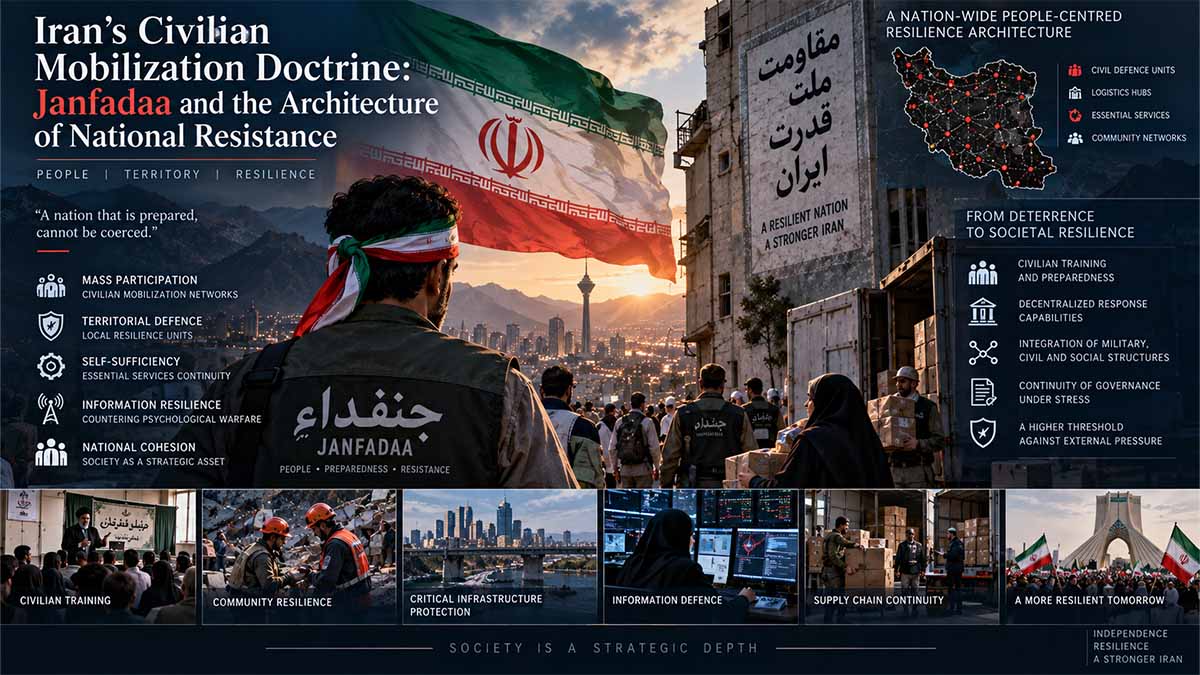
Iran’s Janfadaa Mobilization: From Mass Civilian Registration to a Distributed National-Resistance Architecture
The principal analytical judgment is that Janfadaa is moving beyond mass political registration toward an institutionalized civilian-military mobilization structure integrated with the Basij and the Islamic Revolutionary Guard Corps, with the announced creation of at least 1,000 national-resistance battalions representing a more strategically significant development than the headline claim of more than 31 million registrants. The central intelligence question is therefore not whether Iran possesses a literal thirty-million-person military reserve, but whether it can convert a small percentage of that registry into trained, geographically distributed and repeatedly exercised formations capable of supporting territorial defense, civil resilience, emergency response and rear-area security during a prolonged external conflict.
Mass Mobilization and Institutional Conversion
The 31-million registration figure is strategically relevant only as a reservoir from which smaller trained subsets can be drawn; the decisive transition is the creation of categorized, selected and trained formations rather than the registry itself.
Verified Indicators and Declared Force-Generation Data
| Indicator | Value / Status | Reference Date | Definition / Scope | Issuer | Source |
|---|---|---|---|---|---|
| Claimed Janfadaa registration | ~31–31.5 million | September 2026 | Campaign registrations; not equivalent to trained or deployable personnel. | Janfadaa campaign / Iranian media | Mehr News |
| Gender profile | 32% women / 68% men | September 2026 | Reported demographic composition of registered participants. | Janfadaa popular headquarters | Mehr News |
| Age profile | More than 60% below 46 | September 2026 | Reported age distribution among registrants. | Janfadaa popular headquarters | Mehr News |
| Military / security preference | 26% | September 2026 | Declared preferred activity; not proof of completed military assignment. | Janfadaa popular headquarters | Mehr News |
| Relief / rescue preference | 20% | September 2026 | Declared preferred activity within the civilian-resilience layer. | Janfadaa popular headquarters | Mehr News |
| National-resistance battalions | At least 1,000 announced | September 2026 | Announced force-generation program; standardized battalion establishment remains publicly incomplete. | Janfadaa / Basij-linked authorities | Press TV |
| Tehran mass mobilization | 313,000 planned participants | 18 September 2026 | Large-scale exercise and public mobilization centered on Tehran. | Greater Tehran IRGC Mohammad Rasoulollah Corps | Tasnim News Agency |
| Training pathway | Basic + advanced preparation announced | 18 September 2026 | Ground, air and maritime training referenced; certified completion numbers remain undisclosed. | Basij leadership | Press TV |
How the Janfadaa Architecture Converts Society into Strategic Depth
The registry creates a population-level database of individuals expressing willingness to contribute and allows the state to classify them by age, gender and preferred function before full wartime mobilization becomes necessary.
The strategically decisive step is the filtering of registrants into military, rescue, logistics, social and information functions followed by structured training and permanent or semi-permanent assignment.
The announced 1,000-battalion structure is designed to convert national participation into geographically embedded formations able to operate close to local infrastructure, population centers and crisis zones.
If lower-complexity rear-area functions are transferred to trained civilian formations, professional Army, IRGC, police, engineering and specialist personnel can remain concentrated on missions where their capabilities cannot easily be substituted.
Six Decision-Relevant Conclusions
- No public standardized figure for trained, certified and deployable Janfadaa personnel.
- No complete published table of organization and equipment for the announced 1,000 battalions.
- Formal wartime command relationships between Janfadaa, Basij, IRGC, Artesh, police and civilian agencies remain incomplete in the public record.
- Geographic allocation of permanent battalions outside Greater Tehran is not yet sufficiently established.
- Standardized equipment, communications packages, mobilization timelines and readiness certification remain undocumented publicly.
Mass Mobilization, Selection and Institutional Conversion
Principal judgment
The strategically important feature of Janfadaa is not the absolute size of the registry but the emergence of a progressively more sophisticated selection and force-generation mechanism beneath it, because the evidence now available shows that Iranian organizers are no longer collecting only declarations of loyalty or generic willingness to serve: they are collecting age, gender, location, educational level, occupation, professional specialization, previous military training, willingness to undertake additional military training, availability for service and preferred operational function, while simultaneously creating differentiated training pathways and organizational containers through which selected participants can be transferred from a political registry into structured territorial formations. The official exercise-registration interface itself is revealing because it asks participants for province, city and Tehran district, occupation, specialist skills, previous participation, professional attire, prior military experience, type of training and level of experience, followed by an explicit question on willingness to undertake military instruction; those fields demonstrate that the registry is capable, at least administratively, of functioning as a human-capability inventory rather than merely a petition or mass-signature campaign. Janfadaa 313,000-person exercise registration system
The transition became substantially clearer on 16 September 2026, when campaign spokesman Sasan Zare stated that the first national operational use of the registry would be the training and organization of 1,000 “popular national resistance battalions”, explaining that the number reflected the training capacity then available rather than an announced ceiling on future expansion; he further stated that the armed forces would provide the training and the environment in which those acquired skills would subsequently be employed, while instruction would be divided into basic, complementary and advanced levels and would include local-security provision, general wartime preparedness, observation and surveillance, use of equipment available to the general public, and emergency-response skills. This is the most consequential shift yet visible in the public record: Janfadaa is moving from measuring willingness to building a process capable of sorting willingness by utility, time availability, geography and skill, and then connecting selected civilians to an institutional training provider.
The registry is becoming a manpower database
The structure of the official registration system provides unusually concrete evidence about what Iranian planners are trying to extract from mass participation. The dedicated portal for the 313,000-person exercise divides registration into four stages covering personal details, participation, occupation and professional profile, and military training, while the fields request gender, educational attainment, date of birth, province, city, Tehran district and neighborhood, exercise attendance, number of accompanying participants, previous participation, occupation, specialist skills, professional presentation, interest in military training, prior military training, type of previous course and level of experience. This architecture matters because an undifferentiated mass registry is militarily weak: it establishes enthusiasm but provides little information about who can perform which function, where they can be reached or how quickly they can be activated; a registry containing geographic, occupational and training variables, by contrast, can support the creation of local manpower pools, specialist lists, training cohorts and task-specific formations.
The distinction is particularly important in a country seeking to mobilize beyond conventional conscription. A conventional reserve system begins with individuals whose military records, prior units and specialist qualifications are already known to the state, whereas Janfadaa attempts to create an additional pool containing citizens whose relationship with the formal armed forces may be minimal or nonexistent; the system therefore needs a filtering mechanism capable of separating a medically trained volunteer from a communications technician, a driver, an engineer, a person with prior weapons training, an individual available only during a declared emergency and another prepared to participate for several hours every day. The current registration architecture does not prove that Iran has already created an integrated manpower-management platform at national military standards, but it establishes that the data being collected are compatible with such a function, and the campaign’s own September statements indicate that organizers are explicitly moving toward network-building and neighborhood-level activity rather than treating registration as the final objective.
What the registration system actually captures
| Data layer | Variables publicly visible in the registration process | Potential organizational use | What remains unverified |
|---|---|---|---|
| Identity and demographic profile | Name, gender, educational level, date of birth | Cohort segmentation, age profile, educational filtering | Identity-validation methodology and duplicate-control process |
| Geographic profile | Province, city, Tehran district, neighborhood | Territorial allocation, local training, neighborhood mobilization | National geospatial integration and permanent unit allocation |
| Participation history | Attendance, companions, previous exercise participation | Identification of repeat participants and mobilization reliability | Whether attendance is subsequently verified against registration |
| Occupational profile | Occupation/profession, specialist skill | Specialist manpower mapping and task assignment | Whether occupations are independently verified |
| Training profile | Interest in military training, previous military training, type of course, experience level | Selection for basic, complementary or advanced tracks | Certification standards and equivalence between previous courses |
| Availability profile | Separate campaign data identify daily, weekend and crisis-only availability | Activation planning and reserve-tier design | Whether availability is stored at individual level and dynamically updated |
Source: official Janfadaa exercise registration interface, accessed 24 September 2026.
The presence of occupational and specialization fields is especially significant because it suggests an organizational logic that is potentially broader than forming armed infantry-style units. The most efficient use of a mass civilian registry in prolonged conflict would not involve converting every suitable participant into a rifle-bearing territorial fighter; it would involve identifying people whose existing civilian skills can substitute for scarce wartime manpower across communications, transport, logistics, medical support, engineering, observation, public information, infrastructure recovery and emergency management. The public interface does not reveal the complete list of professional categories or the algorithms, if any, used to match registrants with tasks, so no claim can yet be made that Janfadaa possesses an integrated national skills-matching system; nevertheless, the decision to collect profession, expertise and military-experience variables means that the administrative foundation for differentiated assignment is already present.
The dataset itself is evolving — and the revisions matter
The Janfadaa figures have changed materially between spring and September, and those changes should not be treated as trivial inconsistencies because they reveal how the campaign’s data collection has evolved. On 2 May 2026, Tasnim reported campaign spokesman Sasan Zare as saying that 31.3 million people between the ages of 12 and 70 had registered, of whom 65 percent were men and 35 percent women, while approximately half reportedly possessed university education. By 16 September, after organizers said they had collected additional information from participants, Zare gave a rounded total of 31 million, with 68 percent men and 32 percent women, and stated that more than 60 percent were younger than 46.
These two official campaign descriptions cannot simply be merged into a single statistical series, because the gender composition changes by three percentage points while the headline population moves from 31.3 million to a rounded 31 million; the September briefing itself provides a plausible procedural explanation by distinguishing earlier information derived from an initial opinion survey from later data obtained after additional information was collected, but it does not provide a technical reconciliation of the two datasets, state whether records were removed or reclassified, or publish the denominator used for each percentage. The most defensible interpretation is therefore that the campaign’s dataset is iterative rather than static, with later collection producing a revised profile, while the exact statistical methodology remains outside the public record.
Evolution of published Janfadaa registry data
| Published point | Registry figure | Gender profile | Other demographic information | Evidentiary significance |
|---|---|---|---|---|
| 23 April 2026 reporting | More than 30 million | Not specified in the cited announcement | Campaign described as continuing to accept registrations | Establishes very rapid early accumulation of registrations |
| 2 May 2026 briefing | 31.3 million | 65% men / 35% women | Ages 12–70; approximately half reported as university educated | First detailed demographic profile reported publicly |
| 16 September 2026 briefing | Approximately 31 million | 68% men / 32% women | More than 60% below age 46 | Later profile following collection of additional participant information |
| September operational phase | Registry used for training and battalion organization | Women explicitly included in training plans | Availability, functional preference and geographical profile disclosed | Marks transition from descriptive statistics toward force-generation use |
Sources: Tasnim reporting on the campaign reaching 30 million registrations in April; campaign spokesman’s May briefing on 31.3 million registrants; September briefing on the expanded data profile.
The age range reported in May is itself analytically important. A registry covering participants from 12 to 70 years old cannot logically be interpreted as a combat-ready military reserve, because it deliberately includes age groups that would ordinarily be excluded from many combat assignments; instead, it reinforces the assessment that Janfadaa was conceived as a whole-of-society participation mechanism whose military component is only one subset of a much wider mobilization universe. The September data make that differentiation explicit because only 26 percent of respondents selected military or security functions, whereas other participants selected rescue, social service, cultural activity, financial support and miscellaneous roles.
Availability is as important as willingness
One of the most useful new data points disclosed in September concerns time availability, because willingness to participate becomes operationally meaningful only when planners know how often individuals can actually be called upon. According to Zare, 27 percent of respondents said they could provide several hours of service every day, 18 percent indicated that they could participate only at weekends, and 34 percent said they would become available during events and crises. These categories do not add to 100 percent and the public account does not specify the remaining category or categories, so the figures should not be reconstructed into a complete distribution; however, they provide the first public evidence that Janfadaa organizers are distinguishing between different degrees of availability rather than assuming a homogeneous reserve.
This creates the possibility of an implicit tiered manpower model. Individuals available for several hours daily are theoretically suitable for persistent neighborhood-level functions, recurring training, observation, logistical support or static security duties; weekend-only participants are more compatible with recurrent preparation and scheduled exercises; crisis-only volunteers resemble a surge reserve intended to be activated when a defined threshold is reached. Such an architecture would be significantly more useful than a single undifferentiated list because the administrative cost of mobilization is reduced when the state already knows who can serve continuously, who requires scheduled activation and who should be held for emergency demand. This interpretation remains analytical rather than formally doctrinal because no published Janfadaa document has yet defined explicit reserve tiers, but the availability data provide a credible basis for monitoring whether such differentiation becomes institutionalized.
Declared availability profile
| Availability category publicly reported | Share of respondents | Operational implication | Limitation |
|---|---|---|---|
| Several hours every day | 27% | Potential persistent local-support pool | Exact hours and duration not published |
| Weekends only | 18% | Suitable for scheduled training and periodic duties | Does not establish wartime availability |
| During events or crises | 34% | Potential surge reserve | Trigger conditions not defined publicly |
| Other / not specified in public account | Not established | Cannot be assessed | Published percentages do not form a complete distribution |
Source: campaign spokesman Sasan Zare, 16 September 2026.
The existence of daily and crisis-only categories also changes how the 31-million figure should be analyzed. The registry is increasingly better understood as a labor-and-capability pool with varying activation thresholds, rather than a military reserve counted according to a single readiness standard. For operational planning, the difference between those concepts is substantial: a reserve force is normally measured by unit assignment, training status and mobilization time, while Janfadaa presently contains participants ranging from individuals expressing broad social support to those seeking advanced military instruction. Treating them as one manpower category would therefore obscure rather than clarify the real structure.
Geographic distribution creates the basis for territorial assignment
The September briefing provides the first meaningful public picture of the geographic distribution of registrations. Zare stated that participation existed in all provinces and all cities, although the campaign had not yet been able to measure the situation in villages; in absolute participant numbers, Tehran, Razavi Khorasan, Khuzestan, Fars, Isfahan and East Azerbaijan were identified among the leading provinces, whereas the ranking changed when participation was considered relative to provincial population, with Gilan, Kohgiluyeh and Boyer-Ahmad, Qom, Lorestan and Ardabil placed at the top.
This distinction between absolute volume and population-adjusted participation is highly relevant to force generation. Large provinces naturally provide more registrants and therefore offer deeper personnel pools, but high participation relative to population can indicate communities in which recruitment density, social penetration or willingness to engage is stronger, potentially reducing the cost of forming locally concentrated units. The published information does not provide actual provincial counts, denominators or participation rates, so it is impossible to calculate battalion-generation capacity by province without inventing data; nevertheless, the campaign has clearly begun analyzing the registry geographically rather than treating national participation as a single aggregate.
Geographic distribution disclosed by the campaign
| Analytical lens | Provinces identified by campaign spokesman | What the measure indicates | Missing data |
|---|---|---|---|
| Highest absolute participation | Tehran; Razavi Khorasan; Khuzestan; Fars; Isfahan; East Azerbaijan | Largest reported pools of registered participants | Exact provincial totals |
| Highest participation relative to provincial population | Gilan; Kohgiluyeh and Boyer-Ahmad; Qom; Lorestan; Ardabil | Higher reported participation density | Actual participation ratios and denominator year |
| National urban coverage | All provinces and all cities reported represented | Broad geographic penetration | City-level totals |
| Rural coverage | Not yet measured adequately | Dataset limitation | Village-level participation |
Source: Sasan Zare briefing on training and organization of the first 1,000 battalions.
The absence of village-level measurement is more significant than it first appears, because Iran’s territorial-security requirements are not confined to metropolitan areas and because dispersed infrastructure, transport routes, energy installations and border regions create defensive requirements outside major urban centers. Until the campaign demonstrates reliable rural coverage, claims of a truly universal territorial network remain premature. Conversely, if subsequent registration and training data begin to identify village-level or district-level formations, that would represent an important institutional deepening because it would indicate that Janfadaa is evolving from a national political registry into a geographically granular mobilization system.
The 1,000 battalions are a training-capacity statement, not yet a force-strength statement
The expression “1,000 battalions” carries an obvious military connotation, but the public record does not yet disclose the personnel establishment of a Janfadaa battalion and therefore does not permit multiplication of the number of formations by any assumed battalion strength. This distinction is essential because Iranian campaign officials explicitly described the initial figure of 1,000 as the number for which the training infrastructure was currently available, adding that the number could rise if additional training capacity became available. The original campaign announcement similarly stated that coordination had been completed with the armed forces and that the required preparations for the training and organization of 1,000 national-resistance battalions had been established, inviting volunteers to register for military and emergency instruction.
The numerical ceiling is therefore constrained first by the throughput of the training system, not by the raw size of the registry. This is analytically important because the bottleneck in mass mobilization usually shifts rapidly from recruitment to conversion: once the pool of willing volunteers exceeds available instructors, facilities, equipment and command cadres, additional registrations no longer generate proportional increases in capability. Janfadaa appears to have reached precisely that phase. Zare stated that the available capacity for the first 1,000 battalions was filled in less than 100 minutes after the registration system opened, after which authorities allowed additional registrations to continue but placed later participants in a queue whose training would require more time.
That statement provides one of the clearest indicators of the program’s current constraint. Demand, according to the campaign’s own account, exceeded immediate training capacity by a wide margin; therefore, the strategic variable to monitor is no longer the willingness of additional citizens to register but the state’s ability to expand training throughput, instructor availability, facilities, equipment and unit cadres without reducing instructional quality.
Force-generation pipeline now visible in the public record
| Stage | Evidence currently available | Status | Principal bottleneck |
|---|---|---|---|
| Mass registration | Tens of millions claimed registered | Established as campaign claim | Independent audit absent |
| Supplemental data collection | Demographic, occupational, geographic and training variables collected | Directly visible in official system | Verification methodology unclear |
| Functional segmentation | Military/security, rescue, social, cultural, financial and other preferences published | Established as campaign data | Categories contain rounding/definition issues |
| Availability segmentation | Daily, weekend and crisis participation categories published | Established as campaign data | Full distribution not published |
| Training enrolment | Registration opened for initial battalion cohort | Established | Capacity limited |
| Training curriculum | Three levels announced: basic, complementary, advanced | Announced and partially specified | Completion standards unpublished |
| Unit organization | 1,000 battalions announced as first national operation | Organizational transition underway | Battalion establishment unpublished |
| Deployment/readiness | No standardized nationwide readiness data publicly available | Not established | Command, equipment, certification and recurring exercise evidence required |
Sources: Janfadaa registration system and September training briefing.
Training design reveals the intended operational profile
The publicly announced curriculum is more revealing than the battalion label because it shows what organizers believe civilians should be able to do. Zare identified local-security provision, general wartime preparedness, observation and surveillance, use of equipment available to the public, and emergency-response instruction as components of the training program, while separate emergency and rescue formations were also planned beyond the first battalion operation. This curriculum is consistent with a territorial-support model centered on distributed observation, basic local security, emergency response and civilian defense rather than an attempt to create thousands of formations equivalent to conventional maneuver battalions.
The three-tier structure further suggests that organizers intend to separate mass-access instruction from more demanding capabilities. Basic training can serve as a common foundation for a very large civilian population; complementary modules can develop role-specific competence; advanced instruction can then be directed toward a smaller subset whose prior experience, availability or demonstrated aptitude makes further investment worthwhile. Zare also stated that instruction would be adapted to civilian schedules, with one-day weekend courses for some participants and modular training spread across several days and several-hour blocks for others, while women would also have access to dedicated training arrangements.
This training model solves one of the main practical problems inherent in civilian mass mobilization: requiring long continuous periods of instruction would immediately exclude a large portion of employed adults, students, caregivers and other participants whose civilian obligations continue during preparation. Modularization lowers the entry cost, widens the training base and allows the organizers to expose large numbers to foundational skills before identifying the subset willing or able to progress to more demanding levels.
Announced training architecture
| Training dimension | Publicly announced arrangement | Strategic implication |
|---|---|---|
| Levels | Basic, complementary, advanced | Enables progressive filtering rather than uniform training |
| Content | Local security, wartime preparedness, observation, surveillance, publicly usable equipment, emergency training | Indicates territorial and civil-defense orientation |
| Delivery | One-day weekend courses plus modular several-hour sessions | Reduces civilian participation cost |
| Geography | Initial rollout in Tehran, later expansion nationwide | Supports scalable territorial model |
| Facilities | Armed-forces training centers plus temporary and high-access local locations | Expands training throughput beyond permanent bases |
| Mobile delivery | Training teams planned for organizations, schools and complexes on request | Brings instruction to civilian institutions |
| Women | Participation in relevant training explicitly planned | Broadens usable manpower beyond conventional male reserve |
| Further specialization | Separate national operation for independent rescue formations announced | Suggests function-specific formations beyond the first 1,000 battalions |
Source: Tasnim account of the 16 September 2026 Janfadaa press briefing.
The use of temporary military-training sites is another significant organizational detail. Zare stated that some instruction in Tehran would occur in armed-forces facilities, while other training would be delivered in specially equipped and accessible locations, including temporary military-training compounds, and that mobile teams could provide instruction directly inside organizations, schools and residential or institutional complexes if requested. Such an approach is consistent with a system designed to increase throughput rapidly by distributing instruction rather than relying exclusively on formal military bases, but it also creates a quality-control problem because decentralized training requires standardized curricula, instructor certification and consistent assessment if the resulting manpower is to have predictable operational value.
Selection will determine whether mass becomes capability
The operational challenge is therefore becoming one of selection efficiency. A 31-million-person declared pool is so large that the state gains little by attempting to train everyone to the same level; the rational institutional objective is to identify comparatively small subsets that offer the highest combination of suitability, availability, geographic utility, civilian specialization and willingness to undertake additional instruction. The public system already collects several variables needed for such selection, and the campaign’s own statistics distinguish not only role preference but also time availability and location, meaning that a future activation process could theoretically prioritize, for example, volunteers with relevant technical occupations who live close to a critical site and have prior training, rather than relying on undifferentiated mass mobilization.
This is also why the headline number should become progressively less important as the organization matures. During the movement’s political phase, the aggregate registry served as evidence of mass participation; during the institutional phase, more relevant indicators are training enrolment, completion, retention, specialist qualification, geographic allocation, unit attachment and mobilization time. None of those latter metrics has yet been published comprehensively, which prevents a defensible calculation of effective force strength, but the public record now provides enough evidence to conclude that Iranian organizers are actively building the administrative steps required to move in that direction.
A second organizational layer is already emerging beyond the battalions
The September briefing also shows that the 1,000 battalions are not intended to exhaust the uses of the registry. Zare described the battalion program as the first national Janfadaa operation, stated that part of the population would participate continuously in neighborhood-level popular activities, announced that a separate national operation would create independent rescue and emergency units, and disclosed the formation of a dedicated media battalion for media professionals with specialized training.
This materially changes the institutional picture because it suggests a model based on multiple functional networks rather than a single military formation type. If implemented, Janfadaa would contain at least three different organizational logics: territorial resistance battalions; independent emergency and rescue formations; and profession-specific formations such as the announced media battalion. Such differentiation is precisely what would be expected if the state intends to use the registry as a broad national-capability reserve rather than as a conventional auxiliary infantry pool.
The concept of a media battalion is especially illustrative because it demonstrates that “mobilization” in this system extends into the information domain. Public reporting does not yet establish its curriculum, command relationship or operational authorities, so its actual role cannot be determined; nevertheless, its announcement confirms that organizers are matching some participants to their existing civilian profession rather than attempting to homogenize every volunteer into the same defense role. That principle, if expanded to medicine, transport, engineering, communications and other specialist domains, would significantly increase the potential utility of the registry without requiring equivalent military training for all participants.
Data quality remains the central analytical constraint
The more detailed the Janfadaa dataset becomes, the more important it is to distinguish information richness from verified accuracy. The campaign has released numerous percentages, but the functional-preference categories reported in September total 101 percent, which is consistent with rounding but could also reflect overlapping categories or survey-design effects; the availability percentages do not constitute a complete distribution; May and September gender shares differ; the headline registry total is variously reported as 31.3 million, 31 million and more than 31.5 million in different campaign-linked accounts; and no technical methodology has been published describing identity verification, duplicate detection, eligibility validation, weighting or treatment of incomplete registrations.
These limitations do not invalidate the existence of a very large registration campaign or the verified transition toward training, but they prevent precise measurement of the effective population from which military and civil-defense manpower can actually be drawn. The correct analytical approach is therefore to treat the aggregate figures as campaign-administered registry data, not as audited military personnel statistics, while assigning greater evidentiary weight to observable organizational developments such as functioning registration portals, specified training levels, published curriculum elements, training-capacity limits, named geographic rollout plans and the establishment of actual formations.
Reliability assessment of the principal quantitative fields
| Dataset | Publicly reported value | Confidence in existence of the reported dataset | Confidence in exact operational meaning |
|---|---|---|---|
| Total registration | ~31–31.3 million in campaign briefings | Moderate | Low-to-moderate |
| Gender distribution | 65/35 in May; 68/32 in September | Moderate | Moderate, but dataset reconciliation absent |
| Age profile | >60% below 46 in September | Moderate | Moderate |
| May eligibility range | Ages 12–70 | Moderate | High as description of campaign registration universe |
| Functional preference | 26% military/security; 20% rescue; 20% social; 17% cultural; 13% financial; 5% other | Moderate | Moderate; totals require caution |
| Time availability | 27% daily; 18% weekends; 34% crisis/events | Moderate | Moderate; incomplete distribution |
| Provincial leadership | Six provinces by absolute volume; five by relative participation | Moderate | Low-to-moderate because underlying counts are unpublished |
| 1,000 battalion capacity | Initial training capacity announced | High as an announced program | Low regarding actual battalion strength/readiness |
| Training levels | Basic, complementary, advanced | High as announced structure | Operational completion data absent |
| Capacity filled in <100 minutes | Campaign statement | Moderate | Cannot independently verify number of valid trainees represented |
Key judgments
The mobilization system has passed beyond simple political registration. The official portal now captures geographic, occupational, educational and military-training variables, while campaign officials publicly describe the use of supplemental information to refine their understanding of the participant pool; this establishes a materially more sophisticated administrative architecture than a generic national pledge.
Training capacity, not recruitment demand, is emerging as the near-term constraint. The campaign’s statement that the first 1,000-battalion registration capacity was filled in less than 100 minutes, combined with the decision to queue later applicants, indicates that the supply of willing participants currently exceeds the infrastructure available to process them into trained formations.
The 1,000-battalion figure should not be converted into manpower without evidence. No standardized Janfadaa battalion establishment has been published, and the number 1,000 was explicitly linked to available training capacity rather than a disclosed national table of organization; calculations based on assumed conventional battalion sizes would therefore create false precision.
The organization is developing a tiered rather than uniform training model. Basic, complementary and advanced training, combined with one-day and modular delivery formats, strongly indicates that organizers intend to expose a large population to foundational preparation while filtering a smaller group toward higher-level roles.
The registry has a broader function than combat mobilization. Separate rescue formations, neighborhood networks and a dedicated media battalion are already being discussed alongside national-resistance battalions, indicating that Janfadaa is evolving toward a portfolio of role-specific civilian-defense networks rather than a single militia category.
Data quality remains insufficient for a deployable-force estimate. The registry is large and organizational conversion is observable, but the absence of validated completion numbers, standardized readiness definitions, equipment data and unit-level personnel establishments prevents any defensible estimate of effective combat or support strength.
What would change the assessment
The assessment would strengthen materially if Iranian authorities publish verified numbers for completed basic, complementary and advanced training; identify permanent battalion commanders and geographic assignments; disclose standardized personnel establishments; document recurring exercises after initial training; establish specialist units beyond the currently announced categories; or release evidence of formal activation procedures linking the Janfadaa registry to IRGC, Basij, Artesh, police, emergency-management and provincial command structures.
The assessment would weaken if the initial 1,000-battalion initiative fails to progress beyond enrollment, if subsequent training remains primarily ceremonial, if unit identities and cadres do not persist after the September mobilization cycle, if the training backlog grows without corresponding expansion of instructor and facility capacity, or if registration data cease to be updated and the movement returns primarily to symbolic rallies and political messaging.
Open official record
The public record still does not establish the exact number of validated unique registrants; the methodology used to reconcile the May and September demographic datasets; the number enrolled in each of the first 1,000 battalions; the standardized strength of a Janfadaa battalion; selection criteria for progression from basic to advanced training; medical and age eligibility standards for military roles; weapons-access rules; equipment tables; communications architecture; readiness categories; command relationships; mobilization timelines; retention requirements; disciplinary status; insurance or compensation arrangements; or the legal basis governing the employment of trained civilian formations during internal-security or wartime operations.
These records are now more important than further headline registration totals because they would determine whether Janfadaa develops into a durable reserve architecture or remains a politically powerful but operationally shallow mobilization system.
Mass Mobilization, Selection and Institutional Conversion
The strategically significant development inside Janfadaa is not the absolute scale of the claimed national registry but the emergence of an administrative mechanism capable of filtering a population measured in tens of millions by geography, age, gender, education, occupation, specialist skill, previous military training, availability and declared field of service, before progressively transferring selected participants into training pathways and organized formations. The available evidence therefore points toward an evolving human-capability inventory whose ultimate military value will depend on conversion efficiency, training throughput, retention, specialist allocation, command integration and the transition from nominal registration to permanent or semi-permanent unit assignment.
The Registry Is Becoming a Manpower Database
The official registration architecture collects variables compatible with the creation of specialist manpower pools, territorial cohorts and differentiated training pathways, moving the system beyond a simple declaration of patriotic willingness.
Published Registry and Selection Data
| Indicator | Published Value | Reference Point | Operational Meaning | Limitation | Source |
|---|---|---|---|---|---|
| Campaign registry | ~31–31.3 million | May–September 2026 | Large national reservoir from which smaller cohorts can be selected. | Not equivalent to trained or deployable strength. | Tasnim News Agency |
| Gender profile — May | 65% men / 35% women | 2 May 2026 | Early demographic profile of registered participants. | Later September dataset differs. | Tasnim News Agency |
| Gender profile — September | 68% men / 32% women | 16 September 2026 | Revised profile after collection of additional participant information. | No published technical reconciliation with May data. | Tasnim News Agency |
| Age concentration | More than 60% below 46 | September 2026 | Indicates a substantial working-age component inside the registry. | Exact age-band distribution unpublished. | Tasnim News Agency |
| Age eligibility universe | 12–70 years | May 2026 | Shows that the registry is broader than a conventional combat reserve. | Registration eligibility does not equal military eligibility. | Tasnim News Agency |
| Military / security preference | 26% | September 2026 | Declared interest in military or security activity. | Preference is not assignment, qualification or readiness. | Tasnim News Agency |
| Relief / rescue preference | 20% | September 2026 | Potential civil-defense and emergency-response manpower pool. | Training completion unknown. | Tasnim News Agency |
| Daily availability | 27% | September 2026 | Several hours of service per day declared. | Duration and persistence not published. | Tasnim News Agency |
| Weekend availability | 18% | September 2026 | Compatible with scheduled exercises and modular training. | Does not establish crisis mobilization availability. | Tasnim News Agency |
| Crisis-only availability | 34% | September 2026 | Potential surge reserve activated during crisis conditions. | Activation threshold undefined. | Tasnim News Agency |
| Initial battalion program | 1,000 battalions | September 2026 | First national training and organization operation. | Battalion personnel establishment not published. | Tasnim News Agency |
How the Published Registry Changed Between Spring and September
| Published Point | Registry Figure | Gender Profile | Additional Profile | Analytical Meaning |
|---|---|---|---|---|
| 23 April 2026 | >30 million | Not specified | Registration campaign still expanding | Demonstrates very rapid early accumulation of registrations. |
| 2 May 2026 | 31.3 million | 65% / 35% | Ages 12–70; approximately half reported university educated | First detailed demographic characterization. |
| 16 September 2026 | ~31 million | 68% / 32% | >60% below 46; role and availability data disclosed | Registry becomes a more differentiated manpower dataset. |
| September operational phase | Registry activated for selection | Women explicitly included | Training, geography and battalion organization | Transition from demographic measurement toward force-generation use. |
From Political Registration to Usable Capability
Tens of millions of claimed registrations create the broadest possible recruitment universe, but at this stage willingness remains more important than military utility.
Geography, profession, skills, training history and availability allow the state to identify potentially useful subsets and assign different levels of priority.
Basic, complementary and advanced training create successive filters through which only part of the original registry acquires usable operational competence.
The first 1,000 battalions provide an organizational container, but their personnel establishment, equipment, command structure and readiness standards remain unpublished.
Three-Level Conversion Model
| Training Dimension | Publicly Announced Arrangement | Strategic Significance |
|---|---|---|
| Levels | Basic • Complementary • Advanced | Allows progressive filtering rather than imposing one uniform training standard on the entire registry. |
| Content | Local security, wartime preparedness, observation, surveillance, publicly usable equipment, emergency response | Points toward territorial-support and civil-defense functions rather than conventional maneuver warfare. |
| Delivery model | Weekend one-day courses + modular multi-day sessions | Reduces participation cost for employed adults, students and civilian specialists. |
| Facilities | Armed-forces centers, temporary training sites and locally accessible facilities | Expands training throughput beyond permanent military bases. |
| Mobile instruction | Training teams for organizations, schools and residential or institutional complexes | Brings training directly into civilian institutions and increases geographic reach. |
| Female participation | Dedicated participation arrangements announced | Broadens the usable manpower pool beyond a traditional male reserve structure. |
| Further specialization | Independent rescue units and specialist media battalion announced | Indicates a multi-network architecture extending beyond territorial-security battalions. |
Territorial Distribution and Recruitment Density
Tehran, Razavi Khorasan, Khuzestan, Fars, Isfahan and East Azerbaijan were identified among the provinces producing the largest absolute numbers of registrants.
Gilan, Kohgiluyeh and Boyer-Ahmad, Qom, Lorestan and Ardabil ranked highly when participation was considered relative to provincial population.
Campaign officials reported registrations across all provinces and cities, indicating broad urban penetration of the mobilization network.
The campaign acknowledged that village-level participation had not yet been adequately measured, preventing a complete assessment of nationwide territorial depth.
Six Conclusions on Institutional Conversion
Quantitative Confidence and Operational Meaning
| Dataset | Published Value | Confidence in Dataset Existence | Confidence in Operational Meaning |
|---|---|---|---|
| Total registration | ~31–31.3 million | Moderate | Low–Moderate |
| Gender distribution | 65/35 May • 68/32 September | Moderate | Moderate |
| Age profile | >60% below 46 | Moderate | Moderate |
| Functional preference | 26 / 20 / 20 / 17 / 13 / 5% | Moderate | Moderate — rounding / definition caution |
| Availability profile | 27 / 18 / 34% | Moderate | Moderate — incomplete distribution |
| 1,000-battalion capacity | Initial program | High as announced program | Low regarding actual strength/readiness |
| Training levels | Basic / complementary / advanced | High as announced structure | Completion data absent |
- Validated number of unique registrants after duplicate and identity checks.
- Methodology reconciling May and September demographic datasets.
- Exact personnel strength assigned to each of the first 1,000 battalions.
- Selection criteria for progression from basic to complementary and advanced training.
- Weapons access, equipment tables and communications packages.
- Permanent command relationships between Janfadaa, Basij, IRGC, Artesh and civilian emergency institutions.
- Readiness categories, mobilization timelines and retention requirements.
- Medical and age eligibility standards for military assignments.
Territorial Defense, Civil Resilience and Force Substitution
Principal judgment
The next stage of Janfadaa should be assessed not principally through the number of civilians who can be placed under arms, but through the amount of rear-area military and civil-security workload that a distributed auxiliary system can absorb without requiring Iran to divert professional Army, IRGC, police, engineering, medical and emergency personnel from higher-value missions. The publicly announced Janfadaa syllabus already points toward this division of labor: beyond basic wartime preparedness, campaign officials have identified local security, observation and surveillance, use of generally accessible equipment, emergency assistance, rescue and treatment of casualties as training fields, while the campaign has separately announced that independent rescue formations will follow the initial 1,000 national-resistance battalions. The critical analytical implication is that Janfadaa is being positioned to occupy the organizational space between the professional security apparatus and unorganized civilian society, creating a potentially scalable layer of territorially embedded personnel capable of undertaking low-to-medium complexity functions that become manpower-intensive during sustained conflict.
This model is consistent with a broader change visible in Iranian passive-defense planning after recent wartime experience, in which officials have increasingly emphasized continuity of essential services, protection of critical infrastructure, geographic dispersion, replacement capacity and the mobilization of specialized civilian and Basij resources rather than relying solely on physical protection of installations. In Tehran province, for example, the provincial passive-defense director stated in May 2026 that a program was being implemented to use specialized Basij capacity to replace exhausted specialist personnel at sensitive bottlenecks, explicitly identifying prolonged human workload as an operational risk and personnel substitution as part of the resilience solution. Janfadaa potentially expands the manpower universe available for precisely this kind of substitution, although the public record does not yet establish the formal degree of integration between the campaign and the national passive-defense command system.
Force substitution is the central military value
The military relevance of civilian auxiliary formations is easiest to understand through opportunity cost. A professional soldier, IRGC specialist, police officer, communications technician, combat engineer or trained emergency responder assigned to static infrastructure security, checkpoint duty, local observation, traffic control, basic casualty movement or routine logistical support cannot simultaneously perform the more specialized tasks for which that individual was originally trained. During a short crisis, this trade-off can be absorbed; during a prolonged conflict involving repeated attacks, infrastructure disruption and local security incidents, the cumulative manpower burden becomes strategically consequential.
Iranian passive-defense officials have already identified precisely this problem in relation to critical nodes. The Tehran provincial passive-defense leadership stated that keeping specialists continuously at work for prolonged periods increases operational risk and described the use of specialized Basij manpower as a replacement mechanism designed to reduce error and preserve resilience at sensitive chokepoints. The significance for Janfadaa is not that every volunteer can replace a technical specialist, but that a much larger auxiliary population can absorb perimeter security, observation, basic logistical functions, casualty support, local reporting and other tasks around those specialists, reducing the number of trained professionals consumed by secondary duties.
The result is a classic force-multiplier mechanism. If professional personnel remain concentrated on functions that demand military or technical expertise while trained auxiliaries undertake tasks whose complexity threshold is lower, Iran increases the effective availability of its regular forces without increasing the professional establishment by an equivalent amount. In manpower terms, the strategic gain therefore lies in released capacity, not merely added headcount.
A layered territorial-defense model is becoming visible
The available evidence supports an emerging architecture containing several distinct layers rather than a single undifferentiated volunteer force.
| Territorial-defense layer | Principal function | Likely institutional relationship | Evidence currently visible | Main unresolved issue |
|---|---|---|---|---|
| Professional combat layer | External and high-intensity military operations | Artesh and IRGC | Existing formal armed forces | Outside Janfadaa scope |
| Territorial-security layer | Local security, observation, surveillance, protection support | Janfadaa / Basij / IRGC-linked structure | Training fields publicly announced | Command authority and equipment |
| Infrastructure-support layer | Site security, manpower replacement around critical facilities, reporting | Potential Janfadaa/Basij interface with passive-defense structures | Iranian passive-defense authorities already describe specialist Basij substitution | Formal Janfadaa integration not yet documented |
| Emergency-response layer | Rescue, casualty assistance, first response | Janfadaa + Iranian Red Crescent and other emergency bodies | Rescue training announced; separate rescue units planned | Certification and operational command |
| Community-support layer | Local assistance, information, basic logistics, continuity support | Neighborhood networks and civilian institutions | Janfadaa describes broader neighborhood activity | Task allocation not yet standardized |
| Specialist civilian layer | Media, technical, medical, engineering or other profession-based support | Function-specific formations | Media battalion announced; professional data collected | Scale of specialist-unit expansion |
The importance of this structure is that the lower layers can absorb growing volumes of wartime work without demanding equivalently large increases in professional military manpower. The public record does not yet establish a formal Janfadaa table of organization containing all of these layers, so the table distinguishes between documented activities and analytical function rather than treating the architecture as a completed doctrine; nevertheless, the announced training program, independent rescue-unit concept and specialized formations indicate that the movement is already moving away from a single-role territorial militia model.
Civil resilience begins with continuity rather than protection
Iranian passive-defense doctrine in 2026 increasingly emphasizes that resilience does not require preventing every strike from succeeding, an objective that is technically unrealistic against modern precision attack, but rather ensuring that the loss or temporary degradation of individual facilities does not interrupt essential state and civilian functions across a wider system. A June 2026 assessment by the Qom provincial passive-defense director explicitly identified energy, water, communications, transport, health and financial services as critical sectors whose disruption can generate wider social, economic and security consequences, and argued that resilience requires backup systems, alternative centers and continuity arrangements alongside physical protection.
That distinction creates an obvious manpower requirement. Redundant equipment has little value if there are insufficient personnel to operate alternative facilities, establish temporary distribution points, conduct damage assessment, secure damaged sites, support emergency movement, maintain communications with affected populations or relieve exhausted technical crews. Janfadaa’s potential contribution therefore sits downstream of physical infrastructure protection: its value would emerge after an attack, when the system must preserve functions despite damage.
A similar principle was articulated by South Khorasan authorities in July, where provincial officials described geographic dispersion and avoidance of unnecessary concentration as central passive-defense requirements because critical services should continue with minimal interruption during crisis conditions. Distributed manpower is the human equivalent of distributed infrastructure: a territorially dispersed pool of trained civilians reduces dependence on centrally deployable professional responders and can shorten the period between disruption and initial local response.
Infrastructure resilience creates a manpower problem before it creates an equipment problem
Iran’s energy and water systems illustrate the limits of infrastructure protection and the importance of recovery capacity. A wartime assessment published in April concluded that absolute protection of power-generation facilities against modern attack is impossible, while resilience depends instead on geographic and technological dispersion, emergency and alternative generating capacity, and the industrial ability to reconstruct or replace damaged equipment. The same analysis noted that damage to key components of major power plants can require lengthy and expensive restoration and that sensitive components in water infrastructure may be especially difficult to replace quickly.
From a Janfadaa perspective, these technical vulnerabilities create at least four manpower-intensive support requirements that do not necessarily require professional military personnel: local site access control, perimeter observation, logistical movement of supplies and personnel, and basic population-support functions around service interruptions. More specialized technical repair would remain the responsibility of trained utility personnel, engineers and contractors; however, removing non-specialist burdens from those teams can materially increase their effective repair capacity.
This is where force substitution becomes economically as well as militarily relevant. A country experiencing repeated infrastructure attacks faces a scarcity not only of equipment but of human time: technicians cannot repair systems while simultaneously securing sites, controlling civilian movement, distributing emergency supplies and performing routine administrative tasks. A territorially embedded auxiliary network can increase the proportion of specialist labor devoted to specialist work.
Critical infrastructure resilience and potential auxiliary functions
| Infrastructure domain | Principal wartime vulnerability identified in Iranian passive-defense reporting | Professional capability that cannot be substituted easily | Functions potentially transferable to trained auxiliaries | Strategic effect of substitution |
|---|---|---|---|---|
| Electricity | Damage to generation and network nodes; dependence on centralized systems | Electrical engineering, grid control, high-voltage repair | Perimeter support, reporting, logistics, local population guidance | Keeps technical crews focused on restoration |
| Water | Damage to pumping, distribution and sensitive components | Hydraulic engineering, treatment and system control | Site support, emergency distribution assistance, reporting | Reduces non-technical burden during outages |
| Telecommunications | Physical and cyber disruption | Network engineering, cyber response, switching operations | Local reporting, physical-site support, message distribution | Preserves scarce communications expertise |
| Transport | Route disruption, congestion, damaged infrastructure | Engineering, traffic-network management, heavy recovery | Local traffic assistance, route observation, movement support | Improves access for military and emergency responders |
| Health | Casualty surges and infrastructure disruption | Physicians, advanced clinical staff, specialist emergency medicine | Basic first aid, casualty movement, logistics and non-clinical support | Expands effective clinical capacity |
| Energy/fuel logistics | Damage to facilities and distribution nodes | Technical operations, hazardous-material expertise | Access control, logistics support, observation | Protects specialist manpower from secondary duties |
| Public administration | Disruption of normal service delivery | Senior management and specialist administrators | Local information, registration, community assistance | Supports institutional continuity |
This matrix describes function-substitution logic rather than a confirmed Janfadaa deployment plan; the public record establishes the broader Iranian emphasis on infrastructure continuity and the Janfadaa training fields, but has not yet published a comprehensive infrastructure-protection mission list for individual battalions.
Rescue and emergency response are becoming a parallel Janfadaa structure
The clearest documented civil-resilience function concerns rescue. Campaign spokesman Sasan Zare stated in September that Janfadaa training includes rescue, casualty assistance and emergency-response skills, while also announcing a separate national initiative to establish independent rescue and relief formations rather than confining such personnel inside the first 1,000 national-resistance battalions. This distinction is operationally important because it suggests that emergency response is being treated as a specialist force-generation track with its own organizational needs rather than merely as an additional lesson delivered to security-oriented volunteers.
There is also evidence that Janfadaa-associated training in this domain began before the September national reorganization. Tasnim documented women participating in Janfadaa training in Golestan province in May 2026, where instruction included both rescue activities and weapons handling, demonstrating at least one provincial example in which civil-defense and security preparation were already being combined at participant level. The case should not be generalized into nationwide readiness, but it demonstrates that the campaign’s dual rescue-security character existed operationally before the national battalion initiative was publicly formalized.
The advantage of creating a broad first-response layer is not that lightly trained volunteers can replace professional rescuers. They cannot. The advantage is that they can increase the number of people capable of performing immediate low-complexity lifesaving actions before specialized teams arrive, while also assisting with casualty movement, crowd management, logistics and basic support after professional responders take control.
Iran already possesses an emergency-training infrastructure that Janfadaa can potentially exploit
Janfadaa is not entering an empty institutional environment. Iran’s Red Crescent already operates provincial training systems capable of teaching large numbers of civilians and maintaining specialized rescue cadres, meaning that Janfadaa can potentially draw on existing instructional infrastructure rather than building all civil-defense capacity independently.
The scale is visible even in individual provinces. In Kurdistan, the provincial Red Crescent reported that 20,388 people received public emergency training through 39 courses during the first three months of the Iranian year 1405, accompanied by three practical emergency exercises and specialist instructor programs. In Markazi province, the Red Crescent reported 859 first-aid courses producing 39,772 certificate recipients during the previous year, plus 144 specialist courses for 3,313 participants and 20 instructor-training courses; during the 40-day wartime period referenced by the provincial organization, it additionally conducted 189 courses at nighttime gatherings, 216 in mosques, 45 in Red Crescent community houses and 40 at Basij bases, reaching thousands of participants through a distributed training model.
Those figures are not Janfadaa personnel statistics and should not be merged with the campaign registry. Their relevance is institutional: they demonstrate that Iran already possesses training channels operating through Red Crescent facilities, mosques, local houses and Basij bases, which can deliver civilian emergency instruction at considerable scale.
Existing emergency-training capacity relevant to Janfadaa integration
| Location / program | Publicly reported activity | Participants / scale | Relevance to Janfadaa |
|---|---|---|---|
| Kurdistan, first three months of 1405 | 39 public/general emergency-training courses | 20,388 people | Demonstrates large-scale civilian instruction capacity |
| Kurdistan | 3 practical emergency exercises | Not specified | Provides exercise infrastructure beyond classroom instruction |
| Markazi, previous year | 859 first-aid courses | 39,772 certificate recipients | Shows ability to certify large civilian cohorts |
| Markazi | 144 specialist courses | 3,313 participants | Provides pathway from general to specialist preparation |
| Markazi wartime period | 189 courses at nighttime gatherings | Part of 10,442-person combined grouping | Demonstrates rapid wartime outreach |
| Markazi wartime period | 216 courses in mosques | Part of 10,442-person combined grouping | Uses community infrastructure |
| Markazi wartime period | 45 courses in Red Crescent houses | 1,732 participants | Localized civilian-response training |
| Markazi wartime period | 40 courses in Basij bases | 2,086 participants | Direct precedent for rescue training through Basij-linked facilities |
Sources: provincial Red Crescent reporting in Kurdistan and Markazi.
The strategic consequence is that Janfadaa does not need every battalion to contain a fully independent rescue organization. A more efficient model would connect local volunteer formations to existing Red Crescent instructional and operational networks, allowing Janfadaa to provide the mass while established emergency organizations provide standards, instructors and specialist escalation. Whether such a formal nationwide integration agreement exists has not been established in the reviewed public record, so this remains a pathway rather than a confirmed command arrangement.
Wartime rescue experience provides a concrete benchmark
Recent Iranian emergency operations illustrate the difference between professional rescue capability and auxiliary mass support. During wartime operations in Tehran, the Semnan provincial Red Crescent deployed 80 trained rescuers organized into four 20-person teams to support debris removal and casualty rescue in affected areas of the capital, with provincial authorities reporting that the teams deployed with complete equipment under pre-established plans. This represents a professional or trained specialist response model: small teams, specific equipment, defined tasks and planned deployment.
A Janfadaa system would be most useful if it expands what can happen around such specialist teams rather than attempting to replace them. Hundreds of locally available auxiliaries could support access control, casualty movement, information gathering, family assistance, supply movement and basic first response, allowing trained 20-person rescue teams to concentrate on technical extraction and hazardous operations. In this model, the force multiplier arises through task separation.
The same principle is reinforced by Red Crescent qualification practices in other provinces. In Fars, 605 rescuers participated in standardized physical and skills evaluations for rescue qualification, while Gilan conducted centralized rescue-grade assessments involving personnel from multiple branches and explicitly evaluated physical capability, specialist rescue knowledge and practical operational techniques. These systems demonstrate that meaningful rescue capability requires certification and recurring assessment, a standard that cannot be inferred from Janfadaa registration or basic training alone.
Reaction time is a critical variable in territorial resilience
The operational advantage of distributed civilian capacity becomes particularly visible when response time is considered. During wartime emergency activity, the Markazi Red Crescent reported that teams in incidents under its responsibility were reaching affected locations in approximately four to six minutes depending on distance, compared with a stated Tehran benchmark of eight to twelve minutes, while county-level personnel and equipment were maintained on alert. These are provincial self-reported operational figures rather than a national audited response-time dataset, but they demonstrate why geography matters: response capacity becomes more valuable when it is positioned close to the point of impact.
Janfadaa could extend this principle from professional responders to trained first responders. A civilian who is already present in the affected district does not require mobilization from a central base before performing observation, reporting, first aid or evacuation support. The strategic advantage is therefore not necessarily higher technical capability but lower latency.
Response hierarchy under a distributed resilience model
| Time after incident | Most valuable capability | Appropriate personnel layer | Janfadaa potential |
|---|---|---|---|
| First minutes | Alerting, observation, basic lifesaving action, initial evacuation | Local civilians / trained auxiliaries | Potentially high |
| Early response | First aid, casualty movement, perimeter management, access support | Trained local auxiliaries + emergency services | High if training standardized |
| Specialist intervention | Technical rescue, hazardous access, advanced medical treatment | Red Crescent specialists, firefighters, medical teams | Janfadaa should support, not substitute |
| Stabilization | Logistics, shelter, community assistance, information | Local authorities + auxiliaries | Potentially high |
| Recovery | Infrastructure repair, service restoration, reconstruction | Engineers, utility specialists, contractors | Primarily support functions |
| Extended crisis | Rotation, local security, reporting, community continuity | Territorial auxiliaries + state institutions | Potentially significant |
This sequencing is analytical rather than an officially published Janfadaa incident-command doctrine, but it identifies the operational niche most consistent with the training functions that Iranian authorities have publicly described.
Local security and observation create a separate substitution pathway
Janfadaa’s stated training in local security, observation and surveillance introduces a second set of missions that are distinct from rescue. Static security and observation are among the most manpower-intensive military-support tasks because they require physical presence over long periods but do not necessarily require advanced combat training at every position.
For infrastructure defense, this can create a layered model in which professional forces retain responsibility for high-threat response while auxiliaries undertake lower-tier perimeter observation, access monitoring and reporting. The principal benefit is again substitution: every low-risk observation task transferred to an auxiliary can preserve a professional security officer or soldier for a task involving higher threat or greater technical complexity.
Iranian passive-defense officials have explicitly emphasized that modern conflict threatens not only military systems but people, infrastructure and national capacities across cyber, economic, cultural and information domains, while stressing the need to maintain electricity, water and communications during war. A distributed observer network therefore has value not solely as an armed security mechanism but as a system for detecting damage, disruption, suspicious activity or service failure and transferring information to competent authorities.
The public record does not yet establish what surveillance technologies, communications systems, reporting protocols or rules of engagement Janfadaa units would receive. Without these elements, observation remains a generic skill rather than an integrated security capability.
The decisive variable is command integration
The greatest organizational risk is not lack of manpower but fragmentation of authority. A major urban strike or infrastructure failure can simultaneously involve the IRGC, Artesh, Law Enforcement Command, municipal authorities, firefighters, emergency medical services, Red Crescent, utilities, provincial crisis-management organizations, passive-defense bodies and local volunteer formations. Adding Janfadaa personnel without clearly defined command relationships could increase confusion rather than resilience.
The public record currently establishes that the armed forces are expected to participate in Janfadaa training and that the campaign is organizing battalion structures, while rescue and emergency functions are being developed as a separate strand. What remains unresolved is which institution commands a Janfadaa formation after activation, whether command changes according to mission, how volunteers are handed from mobilization authorities to technical agencies, and whether civilian emergency bodies can task Janfadaa personnel directly.
This is where mature territorial-defense architecture differs from mass mobilization. A volunteer force becomes operationally useful only when the receiving institution knows who is available, what that person is qualified to do, who can issue orders, what communications channel is used, and where legal responsibility lies.
Command-and-control questions that determine operational value
| Requirement | Why it matters | Public status as of 24 Sep 2026 | Effect if unresolved |
|---|---|---|---|
| Activation authority | Determines who can mobilize personnel | Not publicly defined comprehensively | Delayed or competing mobilization |
| Mission authority | Determines which agency can assign tasks | Incomplete public record | Duplication and command friction |
| Unit command | Provides internal discipline and accountability | Battalions announced; full structure unpublished | Weak unit cohesion |
| Communications | Links auxiliaries to professional responders | Standard system not publicly identified | Reporting failure and congestion |
| Qualification registry | Prevents untrained personnel from undertaking specialist tasks | Training system announced; certification architecture incomplete | Safety and liability risks |
| Geographic assignment | Places manpower near expected mission areas | National expansion planned | Slow deployment if not preassigned |
| Logistics | Sustains food, water, PPE, transport and equipment | Not publicly detailed | Rapid degradation during prolonged operations |
| Rotation | Prevents fatigue and preserves reliability | No Janfadaa standard published | Reduced performance over time |
Janfadaa also addresses personnel endurance
One of the less visible constraints in prolonged war is fatigue. Infrastructure operators, emergency crews, police personnel and military specialists cannot operate continuously without increasing error rates and reducing decision quality, and the Tehran passive-defense director’s explicit discussion of replacing specialist personnel at sensitive bottlenecks reflects recognition of this human limitation. Janfadaa potentially creates a much larger reserve from which support shifts can be formed, reducing the requirement for scarce personnel to perform secondary functions continuously.
This can be modeled as a simple workload substitution problem rather than a troop-strength problem. If a technical team requires ten specialists and ten additional personnel for security, movement, reporting and administrative support, then replacing the second group with trained auxiliaries does not create ten new technicians; it does, however, eliminate the need to source twenty specialist or security personnel to keep the function operating. Across hundreds of facilities, this type of substitution can create substantial aggregate manpower savings.
The public record is not sufficient to quantify those savings nationally because neither Janfadaa staffing standards nor infrastructure-site manpower requirements have been published. The mechanism, however, is directly consistent with Iran’s stated passive-defense emphasis on specialist replacement and continuity.
Civil resilience and territorial defense converge at the neighborhood level
The most effective unit of civilian resilience is often smaller than the province or city because the first consequences of disruption are local. Power loss, damaged housing, interrupted water supply, blocked roads, communications failure and casualties initially affect individual neighborhoods before national institutions can redistribute resources. Janfadaa’s neighborhood-oriented mobilization therefore creates a potential link between national defense policy and immediate community response.
Iranian passive-defense officials have increasingly framed civilian participation as part of the broader national resilience architecture, describing public activity outside the conventional battlefield as part of non-active defense and emphasizing social and information resilience alongside physical security. This official framing does not establish the exact operational duties of Janfadaa battalions, but it demonstrates that Iranian planners conceptualize civilian presence, community organization and social continuity as components of wartime defense rather than as activities wholly separate from the security system.
The distinction matters because Janfadaa can produce strategic effect even when most volunteers never engage an enemy. A neighborhood capable of performing basic first aid, reporting damage, organizing vulnerable residents, supporting evacuation, distributing verified information and assisting emergency responders places a smaller burden on central authorities than one requiring professional intervention for every function.
Information activity is part of resilience, not an auxiliary afterthought
The previously announced creation of a specialist media battalion indicates that Janfadaa planners also regard information activity as a distinct mobilization function rather than a secondary public-relations activity. The logic aligns with Iranian passive-defense assessments that identify cognitive and narrative warfare alongside cyber, economic and physical threats.
In practical resilience terms, information capacity has at least three functions: transmitting emergency instructions, reducing uncertainty during service disruption, and countering false or contradictory information that can increase demand on emergency services. A population that does not know whether water is safe, whether a road is open, where medical assistance is available or whether an evacuation order is genuine can create secondary congestion and panic even when the underlying physical damage is limited.
The public record does not yet establish the mandate, training or editorial control of the announced media battalion, so no conclusion should be drawn about its operational sophistication. Its existence is nevertheless evidence that the Janfadaa architecture is being designed across physical, humanitarian and information domains rather than exclusively around territorial combat.
The Red Crescent interface creates both opportunity and institutional risk
The Iranian Red Crescent brings established training standards, instructors, rescue qualifications and field experience, while Janfadaa brings scale and potentially dense local penetration. The two systems are therefore complementary, but only if role boundaries remain clear.
Professional rescue capability requires standards that cannot be reproduced through short mass courses. The Fars and Gilan qualification systems show that Iranian rescuers are assessed through physical and technical testing and receive grades only after meeting established thresholds. If Janfadaa emergency volunteers are used primarily as first responders and support personnel, this distinction can increase total capacity; if basic Janfadaa training is treated as equivalent to professional rescue qualification, the system would instead risk lowering operational quality.
The optimal force-substitution architecture therefore requires complementarity rather than replacement: auxiliaries replace professional personnel only in tasks that do not require professional qualification, thereby releasing specialists rather than attempting to reproduce them cheaply.
Substitution boundary by mission complexity
| Mission | Auxiliary substitution potential | Professional requirement | Assessment |
|---|---|---|---|
| Basic first aid | High after standardized training | Professional escalation for serious trauma | Appropriate Janfadaa niche |
| Casualty movement | High with training | Medical oversight in complex cases | Appropriate support function |
| Crowd / access assistance | High | Police command where coercive authority required | Strong substitution potential |
| Site observation | High | Professional response to confirmed threat | Strong substitution potential |
| Basic logistics | High | Specialist management for hazardous material | Strong substitution potential |
| Technical debris rescue | Low | Certified rescue personnel and equipment | Support only |
| Advanced medical care | Very low | Physicians, nurses, EMS specialists | No meaningful substitution |
| Grid restoration | Very low | Electrical engineers and utility crews | Security/logistics support only |
| Water-system repair | Very low | Technical utility personnel | Support only |
| Bomb disposal / high-threat response | None for ordinary auxiliaries | Specialist military or police units | No substitution |
| Cyber restoration | Low unless volunteers are verified specialists | Certified technical personnel | Potential specialist-reserve exception |
The infrastructure-security effect will be uneven across Iran
Territorial defense cannot be evaluated nationally as though every province has the same infrastructure density, population geography and threat profile. Tehran combines political command, dense population, industrial facilities, transportation nodes and major communications infrastructure; Khuzestan concentrates strategically important oil and energy assets; Persian Gulf provinces contain ports, petrochemical installations and maritime infrastructure; border provinces face different combinations of smuggling, armed-group activity, difficult terrain and long communications lines.
Janfadaa’s value will therefore depend on mission-specific provincial organization, not merely nationwide numerical distribution. A battalion assigned near a petrochemical complex requires different training and protective arrangements from one designed for urban rescue, border observation or support to a major transport corridor. The September campaign statements establish the intention to expand nationally, but the public record does not yet provide a province-by-province mission architecture.
This is one of the most important indicators to monitor because territorialization becomes militarily meaningful only when organization follows the geography of risk.
Force substitution can increase military endurance without changing the balance of combat power
Janfadaa should not be interpreted as creating conventional combat power equivalent to professional formations, nor does the current evidence establish that its battalions can conduct maneuver warfare, complex combined-arms operations or high-threat offensive missions. Its more credible strategic effect is indirect: it can increase the endurance of the forces that already possess those capabilities.
That mechanism operates through three channels.
First, auxiliaries can reduce the number of professional personnel committed to rear-area duties.
Second, civilian first-response capacity can reduce the emergency workload generated by attacks on cities and infrastructure.
Third, local observation and continuity functions can reduce the need for central authorities to deploy personnel into every affected area immediately.
In each case, Janfadaa contributes not by replacing the Army or IRGC in combat but by reducing the amount of military and security capacity consumed by the domestic consequences of combat.
Strategic force-substitution matrix
| Wartime burden | Without distributed auxiliaries | With functioning Janfadaa layer | Principal strategic gain |
|---|---|---|---|
| Static site support | Professional security personnel retained locally | Partly transferred to trained auxiliaries | Releases professional manpower |
| Initial damage reporting | Central teams must assess multiple locations | Local observers provide first reports | Improves situational awareness |
| Basic casualty response | Professional responders face larger initial burden | Local trained personnel initiate basic response | Reduces early medical pressure |
| Evacuation support | Police/emergency agencies supply most manpower | Auxiliaries support movement and local organization | Preserves specialist responders |
| Community information | Central authorities manage local messaging | Local trained networks relay instructions | Reduces confusion and service demand |
| Logistics around repair teams | Technical organizations supply support staff | Auxiliaries perform basic movement/support tasks | More specialist time available for repair |
| Long-duration security | Professional personnel accumulate fatigue | Rotational auxiliary manpower absorbs lower-tier duties | Improves endurance |
| Simultaneous incidents | Central surge capacity becomes saturated | Distributed local personnel absorb low-complexity tasks | Raises multi-incident tolerance |
Limits of the model
The first constraint is training quality. Mass participation is useful only if individual competencies are predictable, which requires standardized instruction, certification and periodic refreshers rather than one-time exposure.
The second constraint is communications. A distributed force without resilient communications can generate large volumes of unverified reporting while receiving inconsistent instructions, creating information congestion precisely when command systems are under pressure.
The third constraint is logistics. Volunteers still require transportation, food, water, protective equipment, identification, medical support and in some missions communications devices; mass mobilization therefore creates its own logistical demand.
The fourth constraint is command. Auxiliaries become useful when they can be subordinated rapidly to the organization responsible for the incident, whereas overlapping Basij, IRGC, police, municipal, Red Crescent and passive-defense chains can reduce efficiency.
The fifth constraint is specialist substitution. There is a hard ceiling beyond which civilian manpower cannot compensate for destroyed equipment or lost expertise: volunteers cannot replace high-voltage transformers, telecommunications switching equipment, advanced medical personnel or specialist industrial components simply through greater numerical presence. Iranian energy-sector assessments themselves acknowledge that destruction of sensitive infrastructure components can require lengthy restoration and that some systems are difficult to replace quickly.
The sixth constraint is duration. A volunteer system that performs adequately for several days may face declining participation, fatigue and economic pressure during a conflict lasting weeks or months; no public Janfadaa record presently establishes sustained rotation or compensation arrangements sufficient to evaluate long-duration retention.
Key evidence table
| Indicator | Verified / attributed observation | Date | Significance for territorial resilience | Evidentiary limitation |
|---|---|---|---|---|
| Janfadaa local-security curriculum | Local security, wartime preparedness, observation and surveillance included | Sep 2026 | Establishes territorial-support role | Does not establish operational readiness |
| Janfadaa emergency curriculum | Rescue and casualty-response instruction included | Sep 2026 | Provides basis for first-response layer | Completion data absent |
| Independent rescue formations | Separate national rescue-unit initiative announced | Sep 2026 | Indicates specialist civil-resilience track | Scale and command not yet published |
| Golestan women’s training | Rescue and weapons training documented | May 2026 | Provincial evidence of dual security/rescue preparation | Cannot be generalized nationally |
| Specialist personnel replacement | Tehran passive-defense authorities describe specialist Basij substitution at sensitive nodes | May 2026 | Direct evidence of force-substitution logic | Not formally attributed to Janfadaa |
| Kurdistan public training | 20,388 persons trained in 39 courses in first three months of 1405 | 2026 | Demonstrates civilian emergency-training throughput | Provincial, not national |
| Markazi first-aid training | 39,772 certificates from 859 courses in previous year | Reported May 2026 | Demonstrates high-volume training infrastructure | Separate from Janfadaa |
| Markazi specialist training | 3,313 participants across 144 specialist courses | Reported May 2026 | Shows progression beyond basic public instruction | Separate institutional dataset |
| Semnan deployment to Tehran | 80 trained rescuers in four teams | 2026 wartime operations | Demonstrates specialist-team model Janfadaa could support | Professional responders, not Janfadaa |
| Markazi reported incident response | 4–6 minutes depending on distance | Reported May 2026 | Shows importance of distributed response capacity | Provincial self-reported figure |
| Passive-defense priority sectors | Energy, water, communications, transport, health and financial services identified | Jun 2026 | Defines infrastructure continuity requirement | Provincial passive-defense assessment |
Sources for the evidence matrix:
Key judgments
Janfadaa’s most plausible military value lies in manpower substitution rather than direct combat expansion. The documented training fields correspond closely to functions that consume substantial manpower during wartime but do not always require professional soldiers or specialists, creating an avenue through which Iran can preserve higher-skill personnel for missions with higher substitution costs.
Infrastructure continuity creates a larger civilian-defense requirement than physical protection alone. Iranian passive-defense assessments explicitly prioritize continuity across energy, water, communications, transport, health and financial systems, meaning that resilience depends on recovery, replacement and local support after physical defense fails.
Iran already possesses a substantial emergency-training ecosystem capable of supporting a Janfadaa expansion. Provincial Red Crescent programs demonstrate the capacity to train tens of thousands of civilians, run specialist courses and use mosques, Red Crescent houses and Basij facilities as distributed instructional infrastructure.
Rescue integration will be effective only if Janfadaa remains complementary to professional emergency services. Iranian Red Crescent qualification systems show that specialist rescue requires recurring physical and technical assessment, which means short-form civilian training should expand first-response capacity rather than be treated as equivalent to professional certification.
The local-security and observation functions create an additional territorial-defense layer around infrastructure and population centers. These tasks can absorb manpower on a continuous basis and therefore offer one of the strongest mechanisms for releasing professional military and police personnel from static responsibilities.
The central unresolved problem is command integration rather than manpower availability. A force measured in hundreds of thousands becomes operationally valuable only if activation authority, mission control, communications, qualification, logistics and geographic responsibility are defined in advance.
What would change the assessment
The assessment would strengthen substantially if Iranian authorities publish formal agreements connecting Janfadaa formations to the Red Crescent, provincial crisis-management bodies or the national passive-defense structure; identify infrastructure-protection battalions with defined geographic assignments; publish standardized first-response or site-security qualifications; demonstrate recurrent joint exercises involving Janfadaa, utilities and professional emergency responders; or reveal permanent communications and mobilization systems through which local units can be activated within minutes of an incident.
Evidence that specific Janfadaa formations are preassigned to energy facilities, ports, transport corridors, hospitals, telecommunications sites or municipal crisis zones would be particularly important because it would demonstrate that territorial organization has moved from generic national mobilization toward mission-oriented defense of critical systems.
The assessment would weaken if rescue and infrastructure functions remain confined to public messaging without recurring exercises, if the 1,000 battalions are not connected to civilian emergency structures, if volunteers receive only short ceremonial training without competency assessment, or if command relationships remain sufficiently ambiguous that professional institutions cannot task Janfadaa formations rapidly during simultaneous incidents.
Open official record
The public record does not yet establish a formal nationwide command agreement between Janfadaa and the Iranian Red Crescent; a published Janfadaa role inside Iran’s national passive-defense architecture; lists of critical infrastructure assigned to volunteer formations; standardized infrastructure-security training; incident-command procedures; emergency communications channels; identification systems for activated volunteers; rules governing access to sensitive installations; liability arrangements during rescue operations; standardized casualty-response qualifications; personal protective-equipment requirements; logistics and resupply arrangements; compensation or insurance; rotation standards for prolonged deployment; or the legal distinction between volunteers operating in humanitarian, territorial-security and coercive internal-security functions.
The most consequential missing evidence is therefore no longer another participation total but an operational interface document showing how a Janfadaa battalion is activated, who commands it, which institution receives it, what missions it is permitted to perform, how its members communicate and what level of training is required before they can substitute for professional manpower. Until such evidence emerges, the public record supports the conclusion that Iran is building the personnel layer required for distributed territorial resilience, but it does not yet establish that the layer has matured into a fully integrated national incident-response and infrastructure-defense system.
Territorial Defense, Civil Resilience and Force Substitution
The principal analytical judgment is that Janfadaa’s most credible strategic value does not lie in creating a conventional parallel army, but in absorbing low-to-medium complexity rear-area functions that would otherwise consume professional military, police, engineering, medical and emergency-response manpower. The relevant mechanism is force substitution: trained auxiliaries can support local security, observation, access control, casualty movement, emergency logistics, infrastructure protection and neighborhood continuity, thereby preserving scarce specialists for missions where civilian substitution is either inefficient or impossible.
Force Substitution Is the Core Strategic Mechanism
Janfadaa creates value when lower-complexity, manpower-intensive tasks are transferred away from scarce professional personnel, thereby increasing the effective availability of existing military, police, engineering and emergency specialists without requiring equivalent expansion of the professional establishment.
Territorial Resilience and Emergency-Response Evidence
| Indicator | Published Evidence | Reference Date | Operational Significance | Limitation | Source |
|---|---|---|---|---|---|
| Local-security curriculum | Local security, observation, surveillance, wartime preparedness | September 2026 | Supports territorial-security and infrastructure-protection roles. | Readiness and equipment standards unpublished. | Tasnim News Agency |
| Emergency curriculum | Rescue, casualty assistance, emergency-response skills | September 2026 | Provides basis for distributed first-response capacity. | Professional rescue equivalence not established. | Tasnim News Agency |
| Independent rescue formations | Separate national rescue-unit initiative announced | September 2026 | Indicates a specialist civil-resilience track beyond security battalions. | Unit scale and command structure not yet public. | Tasnim News Agency |
| Women’s provincial training | Rescue + weapons instruction documented in Golestan | May 2026 | Shows combined security and civil-defense preparation at provincial level. | Cannot be generalized nationally. | Tasnim Media |
| Specialist-personnel substitution | Specialized Basij capacity used to replace exhausted personnel at sensitive nodes | May 2026 | Directly demonstrates force-substitution logic in passive defense. | Not formally attributed to Janfadaa. | Tasnim News Agency |
| Kurdistan public emergency training | 20,388 people / 39 courses | First 3 months of 1405 | Shows provincial capacity for high-volume civilian instruction. | Separate institutional dataset from Janfadaa. | Tasnim News Agency |
| Markazi first-aid training | 39,772 certificates / 859 courses | Previous year, reported May 2026 | Demonstrates scalable public first-aid instruction. | Not a Janfadaa count. | Tasnim News Agency |
| Markazi specialist training | 3,313 participants / 144 specialist courses | Reported May 2026 | Shows progression from mass instruction to specialist preparation. | Separate Red Crescent structure. | Tasnim News Agency |
| Semnan specialist deployment | 80 rescuers / 4 teams of 20 | 2026 wartime operations | Provides benchmark for specialist rescue teams auxiliaries could support. | Professional responders, not Janfadaa. | Tasnim News Agency |
| Reported Markazi response time | Approx. 4–6 minutes | Reported May 2026 | Illustrates value of geographically distributed response capacity. | Provincial self-reported figure. | Tasnim News Agency |
Five-Layer Territorial Resilience Architecture
High-intensity combat, specialist military operations and external defense remain functions that mass civilian formations cannot replace.
Local observation, reporting, access support and lower-tier static security offer the strongest immediate substitution opportunities.
Auxiliaries can absorb perimeter support, logistics, local reporting and community interface around damaged or threatened infrastructure.
Basic first aid, casualty movement, evacuation support and non-technical rescue assistance can reduce pressure on professional responders.
Local information, vulnerable-person support, distribution assistance and basic coordination reduce the burden placed on central institutions.
Where Auxiliary Manpower Can and Cannot Substitute
| Infrastructure Domain | Core Vulnerability | Non-Substitutable Specialist Capability | Auxiliary Functions | Force-Substitution Effect |
|---|---|---|---|---|
| Electricity | Generation and grid-node damage | Electrical engineering, grid control, high-voltage repair | Perimeter support, logistics, reporting, access control | Preserves technical crews for restoration |
| Water | Pumping, treatment and distribution disruption | Hydraulic engineering, treatment operations | Emergency distribution, site support, population guidance | Reduces non-technical burden during outages |
| Telecommunications | Physical and cyber disruption | Network engineering, switching, cyber response | Physical-site support, local reporting, message relay | Protects scarce communications expertise |
| Transport | Route damage, congestion and access disruption | Heavy recovery, engineering, network management | Traffic support, route observation, movement assistance | Improves access for military and emergency teams |
| Health | Casualty surge and facility overload | Physicians, nurses, advanced EMS | Basic first aid, casualty movement, logistics | Increases effective clinical capacity |
| Fuel / Energy Logistics | Facility and distribution-node disruption | Hazardous-material and technical operations | Observation, access support, logistics | Protects specialists from secondary tasks |
| Public Administration | Service disruption and local information gaps | Senior management and specialist administration | Registration, local information, community assistance | Supports institutional continuity |
Existing Civil-Response Infrastructure Relevant to Janfadaa
First three months of 1405.
Previous year, reported in 2026.
Evidence of progression beyond mass first-aid instruction.
Professional specialist-response benchmark.
Where Distributed Manpower Adds Operational Value
| Incident Phase | Priority Capability | Primary Personnel Layer | Janfadaa Utility |
|---|---|---|---|
| First minutes | Alerting, observation, basic lifesaving action, initial evacuation | Local civilians + trained auxiliaries | High |
| Early response | First aid, casualty movement, perimeter management | Auxiliaries + emergency services | High if standardized |
| Specialist intervention | Technical rescue, advanced medical care, hazardous access | Professional responders | Support only |
| Stabilization | Logistics, shelter, community assistance, information | Local authorities + auxiliaries | High |
| Recovery | Infrastructure repair and service restoration | Engineers, utility specialists, contractors | Logistics / security support |
| Extended crisis | Rotation, local security, community continuity | Territorial auxiliaries + state institutions | Potentially significant |
Where Civilian Auxiliaries Stop Being a Substitute
| Mission | Auxiliary Substitution Potential | Professional Requirement | Assessment |
|---|---|---|---|
| Basic first aid | High | Professional escalation for major trauma | Appropriate auxiliary niche |
| Casualty movement | High | Medical oversight for complex cases | Strong support function |
| Site observation | High | Professional response to confirmed threat | Strong substitution potential |
| Technical debris rescue | Low | Certified rescue specialists + equipment | Support only |
| Advanced medical care | Very low | Physicians, nurses, EMS specialists | No meaningful substitution |
| Grid restoration | Very low | Electrical engineers and utility crews | Security / logistics support only |
| Bomb disposal / high-threat response | None | Specialist military or police teams | No substitution |
Six Decision-Relevant Conclusions
- No published nationwide command agreement between Janfadaa and the Iranian Red Crescent.
- No complete public Janfadaa role inside Iran’s national passive-defense architecture.
- No published list of critical infrastructure assigned to individual Janfadaa formations.
- No standardized incident-command procedures visible in the public record.
- No common emergency communications architecture publicly identified.
- No standardized infrastructure-security or first-response certification thresholds published.
- No public rotation, resupply, compensation or insurance model for prolonged deployment.
- No clear legal boundary publicly documented between humanitarian, territorial-security and coercive internal-security functions.
Deterrence, Internal Security and the Architecture of Prolonged War
Principal judgment
Janfadaa is becoming strategically relevant to Iran not because civilian mobilization can substitute for conventional military power, but because it can expand the absorptive capacity of the state under prolonged pressure, reducing the probability that repeated military strikes, infrastructure disruption, information operations, local security incidents and administrative overload will combine into a wider loss of state functionality. This logic closely corresponds to the formal Iranian conception of passive defense, whose published statutory definition includes reducing vulnerability, increasing national stability, facilitating crisis management, maintaining essential functions and generating what the statute itself calls defensive deterrence; the same statute assigns the national Passive Defense Organization responsibilities encompassing public and specialist training, monitoring threats, increasing national resistance, facilitating crisis management and preserving essential national functions.
Janfadaa potentially adds a mass civilian layer to that architecture. The campaign’s September training program explicitly includes local security, wartime preparedness, observation and surveillance, while the broader Iranian passive-defense discourse increasingly describes contemporary conflict as extending simultaneously across military, cyber, economic, cultural, cognitive and narrative domains. The strategic implication is therefore broader than territorial defense: Iran is attempting to make the relationship between external pressure and internal political or administrative breakdown less direct by distributing selected security, continuity, information and support functions across a much larger social base.
This does not establish that Janfadaa has already become an integrated nationwide internal-security force, nor does the public record justify treating every volunteer battalion as a domestic-control formation. What the evidence does establish is that the movement sits at the intersection of institutions whose responsibilities include external defense, local security, provincial administration, social organization and crisis continuity, creating a dual-use architecture whose value during prolonged war derives precisely from its ability to operate across the boundary between military rear-area support and domestic stability.
Deterrence by increasing the amount of damage required to produce strategic effect
The conventional measure of military damage is physical: destroyed facilities, degraded systems, lost equipment and casualties. The strategic measure is different because physical destruction matters only to the extent that it changes an adversary’s ability or willingness to continue operating. Iran’s emerging resilience architecture appears designed to widen the distance between those two outcomes by making physical damage less likely to generate immediate systemic failure.
Iranian passive-defense doctrine explicitly connects continuity of essential activities to deterrence, defining passive defense as measures that increase national stability, facilitate crisis management and maintain essential functions while contributing to defensive deterrence. More recent provincial guidance has translated that concept into operational priorities, emphasizing backup systems, alternative centers, continuity of critical services and revised governance mechanisms after wartime experience demonstrated the vulnerability of energy, water, communications, transport, health and financial systems.
Janfadaa potentially adds human redundancy to the same model. Infrastructure redundancy provides alternative equipment, sites and networks; civilian mobilization provides alternative personnel, local support capacity, observation networks and administrative depth. The strategic effect is cumulative: an attacker must not only damage the original system but also overcome substitute capacity, local recovery networks and distributed personnel capable of sustaining basic functions while professional forces continue higher-priority operations.
This mechanism is analytically closer to deterrence through denial of rapid strategic effect than to deterrence through direct retaliation. Janfadaa itself does not need to threaten an adversary’s homeland to influence strategic calculations; it only needs to make the expected political return from attacks on Iranian society, infrastructure or rear areas smaller, slower or more uncertain.
Deterrence pathway created by societal resilience
| Adversary objective | Immediate pressure mechanism | Resilience mechanism relevant to Janfadaa | Intended strategic effect | Principal limitation |
|---|---|---|---|---|
| Overload internal security | Simultaneous local incidents and wider military pressure | Distributed observation, local-security support, neighborhood presence | Reduces demand for centrally deployed professional forces | Command authority remains incompletely documented |
| Paralyze essential services | Repeated attacks on infrastructure | Auxiliary continuity and local support around professional repair teams | Shortens functional disruption and preserves specialist labor | Cannot replace destroyed specialist equipment |
| Generate administrative overload | Multiple incidents across provinces | Distributed provincial and local manpower | Reduces dependence on central surge capacity | Requires pre-assigned command and logistics |
| Amplify public uncertainty | Communications disruption and conflicting narratives | Local information and organized community networks | Reduces information vacuum | Accuracy and command discipline are essential |
| Create cumulative personnel fatigue | Prolonged operational tempo | Larger rotation and substitution pool | Preserves professional readiness over time | Long-duration retention arrangements remain unclear |
| Convert military pressure into domestic fragmentation | Simultaneous external attack and social tension | Mobilized social and administrative networks | Raises resistance to cascading disruption | Social effects cannot be inferred directly from registration totals |
The crucial point is that none of these effects requires thirty million operational volunteers. The system becomes strategically relevant if relatively small subsets can repeatedly absorb tasks that would otherwise fall on finite military, police, emergency and administrative establishments. Iran’s own passive-defense authorities have already described specialist-personnel exhaustion as an operational risk and reported plans to use specialized Basij capacity to replace personnel at sensitive bottlenecks in order to reduce error and maintain resilience. Janfadaa enlarges the pool from which such support can potentially be generated.
Prolonged war changes the meaning of manpower
In short wars, manpower calculations concentrate on combat formations, readiness and replacement losses; in prolonged conflict, the state must also maintain ministries, provincial administrations, utility networks, hospitals, transport systems, communications, police functions, emergency services and basic social organization for weeks or months while absorbing repeated disruption. The decisive manpower problem therefore becomes one of simultaneity: too many institutions may need additional personnel at the same time.
Iranian communications officials described the recent conflict as a test not merely of technical network survivability but of the ability to preserve daily life, public services and economic and social continuity during attacks on vital infrastructure. Passive-defense officials have similarly framed contemporary war as a multidomain contest in which electricity, water and communications must continue functioning while cyber, economic, cultural, cognitive and military pressures occur simultaneously.
Janfadaa can be understood as an attempt to create manpower elasticity for this environment. A conventional bureaucracy has a relatively fixed number of trained personnel. A mobilization architecture creates an external reserve that can be activated selectively as workload rises. Its value therefore increases with duration because the longer conflict persists, the more significant fatigue, rotation, local replacement, administrative support and dispersed incident management become.
Short-war versus prolonged-war manpower logic
| Variable | Short-duration crisis | Prolonged conflict | Janfadaa relevance |
|---|---|---|---|
| Professional force concentration | High priority | Must be sustained despite domestic workload | Auxiliaries can absorb secondary duties |
| Personnel fatigue | Manageable for limited periods | Becomes cumulative operational risk | Rotation and substitution become increasingly valuable |
| Infrastructure incidents | Limited number can be centrally reinforced | Repeated and geographically dispersed incidents can saturate specialists | Local manpower reduces surge demand |
| Public information | Central communication may remain sufficient | Persistent disruption increases local information requirements | Neighborhood networks become more useful |
| Emergency response | Existing surge capacity may suffice | Repeated casualties can exhaust professional responders | Trained auxiliary support increases endurance |
| Provincial administration | Temporary emergency measures | Sustained coordination across multiple sectors required | Territorial networks can increase administrative depth |
| Internal security | Can be reinforced temporarily | Reinforcement competes directly with other wartime requirements | Auxiliary local-security functions become more consequential |
| Economic burden | Short interruptions may be absorbed | Long mobilization creates labor and fiscal costs | Volunteer sustainability becomes a critical constraint |
The transformation is therefore temporal as much as organizational. A civilian auxiliary structure that contributes only marginally during the first hours of a war can become much more important after several weeks if professional forces and infrastructure personnel are operating under sustained workload.
The Ministry of Interior connection expands Janfadaa beyond a purely military structure
One of the most consequential pieces of evidence regarding Janfadaa’s institutional breadth emerged early in the campaign when Interior Minister Eskandar Momeni, ministry deputies, provincial governors, county governors and district governors publicly joined the initiative. At that stage, Momeni referred to more than 12 million declared participants in less than ten days and emphasized the role of governors in supporting activity at provincial and street level.
The importance of this development is institutional rather than numerical. Iran’s Ministry of Interior provides the administrative chain linking central government to provinces, counties and districts, while the minister separately stated in June that decisions taken by the national government are implemented in the provinces through governors who coordinate across ministries. A mobilization system that is politically and administratively connected to this structure gains access to a territorial network extending well beyond purely military command channels.
This creates the potential for Janfadaa to become compatible with provincial crisis administration, because the administrative geography of governors, county governors and district authorities overlaps with the geography in which local-security, emergency and continuity tasks would actually have to be performed.
The public record does not yet establish that Interior Ministry officials possess operational command over Janfadaa battalions, and political participation in the campaign should not be converted into an assumption of formal command authority. The evidence nevertheless demonstrates that Janfadaa has been embedded politically across both security and civilian-administrative institutions from an early stage.
Administrative depth is itself a component of prolonged-war resilience
Iranian wartime governance increasingly places strong emphasis on provincial coordination. The Interior Ministry has described governors as the principal coordinators responsible for implementing central-government decisions across provinces and maintaining relationships with multiple ministries. During a nationwide government gathering in June, Interior Ministry officials reported participation by more than 4,000 officials, including governors, county governors, district officials, mayors and deputies, connected across approximately 700 locations, illustrating the geographic density of the administrative structure available to central government.
Those officials are not Janfadaa personnel, but their distribution matters because any national auxiliary architecture ultimately requires local receiving institutions. A battalion cannot contribute meaningfully to civil continuity if no provincial or municipal authority has responsibility for allocating it; similarly, a volunteer observation or emergency network has limited utility if reports cannot reach an administrative node capable of acting upon them.
Janfadaa’s potential strategic significance therefore lies partly in its ability to plug into a pre-existing territorial governance system rather than functioning as an autonomous mass organization.
Institutional depth relevant to prolonged-war mobilization
| Institutional level | Existing function visible in public record | Potential relationship with Janfadaa | Evidence status |
|---|---|---|---|
| National government | Sets national policy and emergency priorities | Defines mobilization priorities | General governance structure established |
| Interior Ministry | Coordinates territorial administration | Possible civilian-administrative interface | Ministry leadership publicly joined campaign |
| Provincial governors | Coordinate government implementation across provinces | Provincial allocation and crisis coordination | Governors publicly associated with campaign |
| County governors | Local government coordination | Local reception and task organization | Participation announced |
| District authorities | Sub-provincial administration | Neighborhood and district-level interface | Participation announced |
| Basij / IRGC | Security organization, mobilization and training | Security and territorial-defense backbone | Direct Janfadaa involvement established |
| Passive Defense Organization | Resilience, threat monitoring, continuity and civil defense | Doctrinal and planning interface | Formal Janfadaa integration not yet public |
| Red Crescent / emergency bodies | Professional rescue and relief | Specialist escalation and certification | Janfadaa rescue interface announced but full agreement not public |
The architecture becomes substantially more powerful if these institutions operate through common activation procedures, but the existence of overlapping territorial networks can also generate duplication unless authority is clearly defined.
Internal security is the most consequential dual-use dimension
The inclusion of local security, observation and surveillance in Janfadaa’s publicly announced curriculum makes domestic security impossible to exclude from assessment. These skills are relevant to wartime infrastructure protection, detection of sabotage, local reporting and rear-area defense, but the same organizational capabilities can also strengthen state surveillance and territorial control during domestic unrest.
The analytically important distinction is between capability and demonstrated employment. The public record supports the conclusion that Janfadaa is acquiring capabilities that have internal-security utility; it does not yet establish a nationwide operational directive ordering Janfadaa battalions to perform crowd-control or protest-suppression functions. Conflating those propositions would overstate the evidence.
The dual-use potential nevertheless deserves close attention because Janfadaa is institutionally connected to the Basij, whose leadership openly discusses national cohesion and domestic stability as security priorities. On 12 September, Basij chief Hossein Taeb argued that maintaining internal cohesion was necessary to resist what he described as US efforts to create divisions inside Iran, while linking popular presence during recent conflict to increased internal resilience. The statement is evidence of the Basij leadership’s threat perception and strategic framing; it is not independent proof of foreign intent.
The distinction matters because the organization’s concept of the “home front” includes more than physical infrastructure. It includes social cohesion, public order, information and the ability of state institutions to continue functioning without major internal fragmentation.
Iranian threat perception links external attack with domestic disruption
Iranian official and security narratives increasingly portray external military pressure, information operations, sabotage and internal unrest as parts of a single conflict continuum. Passive-defense officials describe the threat environment as extending beyond military action into cyber, economic, cultural, cognitive and narrative domains, with infrastructure and the population themselves considered targets.
This threat perception directly influences how a civilian mobilization system is designed. If planners consider the domestic rear area potentially contested during external war, local volunteers become useful not only for emergency relief but also for surveillance, reporting, protection of sensitive locations and maintaining a visible security presence.
A September statement attributed to Iran’s Ministry of Intelligence illustrates the type of threat Tehran claims to be confronting: the ministry reported disrupting three operational cells allegedly connected to hostile groups, including one case in which suspects were accused of transmitting coordinates of military and Basij sites and another involving an alleged plan to attack important infrastructure in Bam. These are Iranian government allegations and should be treated as such unless independently corroborated, but they demonstrate the operational scenarios that Iranian security institutions use to justify distributed observation and public reporting.
The ministry’s statement also explicitly requested citizens to report suspicious activity through official channels, illustrating a pre-existing model in which civilian observation feeds state security institutions. A trained Janfadaa network could institutionalize and expand that relationship, although the public record does not yet establish a dedicated Janfadaa-to-intelligence reporting architecture.
The architecture creates a detection network as well as a manpower reserve
A large local-security network produces value not only because personnel can physically guard sites but because distributed human presence expands the number of potential observation points inside the state.
This effect is especially important against sabotage, covert infiltration or localized attacks because such threats do not necessarily require large hostile formations; they depend on concealment, access and the ability to operate before professional security authorities identify the activity.
Janfadaa’s announced observation and surveillance training therefore has a different strategic logic from conventional territorial defense. Its potential value depends on density rather than firepower. Thousands of locally embedded observers can create a wider detection surface even if individual participants possess limited tactical capability.
The relationship can be represented as a detection-to-response chain:
| Security stage | Potential auxiliary role | Professional state role | Strategic value |
|---|---|---|---|
| Anomaly detection | Observe unusual activity or damage | Establish reporting standards | Enlarges detection surface |
| Initial reporting | Transmit basic information | Validate intelligence | Shortens warning time |
| Local confirmation | Provide location-specific observation | Fuse multiple reports | Improves situational awareness |
| Site isolation | Support access control where authorized | Police / security command | Reduces interference |
| Threat response | No independent specialist role implied | Police, IRGC, intelligence, military | Preserves professional responsibility |
| Post-incident support | Logistics, observation, community information | Investigation and technical response | Reduces specialist workload |
The central limitation is information quality. Large civilian reporting systems can generate false positives, duplication and politically motivated accusations unless reporting standards and professional validation are robust. No public Janfadaa material reviewed to date establishes the quality-control architecture required to manage this risk.
Social cohesion is treated by Iranian planners as a security variable
Iranian passive-defense discourse does not treat public morale and social cohesion as merely political questions. Officials have explicitly described social resilience and resistance to psychological and cognitive pressure as components of national security, arguing that contemporary hybrid warfare targets perceptions and public confidence in addition to military systems.
A March passive-defense statement from Qom similarly framed popular participation as part of non-active defense and emphasized social resilience and media resistance as components of defending society during hybrid conflict. In June, a Tasnim strategic commentary linked the Janfadaa concept specifically to maintaining cohesion under hybrid warfare, presenting social fragmentation as a major vulnerability. The latter is analytical commentary rather than an authoritative government document and therefore establishes the existence of this strategic narrative rather than proving its empirical accuracy.
The relevance to Janfadaa is significant because the campaign creates a participatory security identity: civilians are not framed simply as populations requiring protection but as actors participating in the maintenance of national continuity.
That can strengthen resilience if participation creates usable networks for emergency response, information distribution and community support. It can also deepen the penetration of security institutions into civilian space. Both possibilities arise from the same organizational characteristic.
Mobilization produces political effects even before operational deployment
A mass mobilization system can influence wartime political stability even when only a minority of its members perform formal security functions. Participation signals organization, creates repeated contact between citizens and state institutions, establishes communication networks and gives authorities mechanisms for rapidly reaching self-identified supporters or volunteers.
This creates what can be described analytically as latent mobilization capacity. The state does not need every participant to be continuously active; it needs to know which people can be contacted, where they are located and which tasks they are willing to undertake when conditions deteriorate.
The early association of the Interior Ministry’s territorial hierarchy with the Janfadaa campaign reinforces this interpretation because the ministry’s administrative network reaches through governors, county governors and district authorities, while Basij structures provide parallel neighborhood-level organization. The result is a potentially dense state-society interface extending from national leadership through provincial administration to local volunteer networks.
The public record does not establish how interoperable these databases and institutional networks actually are. That question is decisive: symbolic parallel structures create political presence, whereas interoperable systems create operational capacity.
The prolonged-war model seeks to prevent cascading failure
The most serious threat to state resilience is rarely the failure of a single system; it is a cascade in which one disruption produces another. Loss of electricity affects communications and water pumping; communications failure complicates emergency dispatch; transport disruption delays repair crews; public uncertainty increases demand on government institutions; simultaneous security incidents consume police resources while military forces remain committed externally.
Iranian passive-defense guidance increasingly focuses on precisely these interdependencies, emphasizing backup systems, replacement centers, continuity plans and integrated governance following recent wartime experience. Isfahan passive-defense authorities have similarly described resilience planning around three elements—response planning, continuity guarantees and rapid recovery—while identifying a broad group of national infrastructures through which government itself continues to function.
Janfadaa can add a human buffer between individual disruption and systemic cascade. Its value lies in absorbing the secondary consequences of failure before they propagate into additional institutions.
Cascading-failure interruption matrix
| Initial disruption | Potential secondary effect | Potential tertiary effect | Auxiliary intervention point | Remaining professional requirement |
|---|---|---|---|---|
| Electricity outage | Communications and pumping affected | Public-service disruption | Local reporting, logistics, population guidance | Grid repair and engineering |
| Communications disruption | Emergency coordination slows | Public uncertainty and duplicated movement | Local message relay and physical reporting | Network restoration |
| Transport blockage | Repair teams delayed | Infrastructure outage prolonged | Route observation and local movement support | Heavy engineering and traffic command |
| Casualty surge | Medical facilities overloaded | Reduced ability to treat later casualties | First aid, casualty movement, logistics | Professional medicine |
| Sabotage incident | Security forces diverted | Other sites receive less protection | Observation and low-tier site support | Professional investigation and response |
| Administrative disruption | Local services slow | Public demand rises | Community information and basic support | Government authority and decision-making |
| Multiple simultaneous incidents | Central surge capacity exhausted | System-wide response delay | Distributed local response | National prioritization and specialist deployment |
This is the clearest connection between Janfadaa and prolonged-war deterrence: the organization can increase the number of disruptions Iran must suffer before separate failures combine into a national-system failure.
The architecture also creates coercive capacity
Any assessment of Janfadaa that addresses resilience while ignoring coercive potential would be incomplete. A trained network with local-security functions, observation capability, territorial organization and links to the Basij can strengthen not only national defense but also the state’s ability to monitor and control domestic space.
The same participant who observes suspicious activity near an electricity substation during wartime could, under a different tasking framework, observe political gatherings or identify individuals considered security risks. The technical capability does not determine the political use.
This dual-use character creates a significant governance question: what legal and institutional boundaries separate civil defense from domestic coercion?
The reviewed public record does not provide a comprehensive Janfadaa-specific answer. It does not establish dedicated arrest powers, independent policing authority, a nationwide crowd-control mandate or a published legal status equivalent to law-enforcement personnel. Assertions that Janfadaa already possesses those powers would therefore exceed the evidence.
What is established is that its parent institutional environment includes bodies with domestic-security functions and that its training encompasses local security and surveillance. That combination warrants continued monitoring because organizational structures created under wartime conditions can persist after the immediate external threat has diminished.
Dual-use security matrix
| Capability | Defensive wartime application | Internal-security application | Public evidence of Janfadaa capability | Public evidence of domestic deployment |
|---|---|---|---|---|
| Observation | Detect damage, sabotage or suspicious access | Monitor local activity | Training announced | Not established nationwide |
| Local security | Protect neighborhoods or infrastructure | Support territorial control | Training announced | Dedicated Janfadaa doctrine not public |
| Communications network | Relay emergency information | Rapid mobilization / reporting | Organizational network emerging | Formal security-reporting chain not public |
| Geographic organization | Local incident response | Local state presence | Nationwide expansion planned | Specific coercive assignments not established |
| Information activity | Emergency communication and narrative continuity | Influence public perceptions | Specialist media unit announced previously | Mission details incomplete |
| Mobilization database | Identify skills and availability | Rapid identification of willing local participants | Registry system established | Access rules and institutional sharing unclear |
| Basij integration | Security training and force organization | Domestic-security utility | Direct organizational relationship | Extent of Janfadaa-specific use unresolved |
The principal analytical conclusion is therefore not that Janfadaa is either a civil-defense organization or an internal-security organization. It is that its architecture permits both types of use, with mission assignment and command authority determining which function predominates in any specific crisis.
Information resilience is part of the prolonged-war architecture
Physical resilience alone does not preserve state functionality if the population loses access to reliable instructions or confidence in basic services. Iranian security and passive-defense officials repeatedly frame information and cognitive activity as integral components of contemporary conflict, with national resilience dependent partly on the population’s ability to resist rumor, psychological pressure and manipulation.
This gives the information component of Janfadaa a more serious function than conventional propaganda alone. During infrastructure disruption, information networks can communicate shelter locations, road closures, service restoration, medical availability and emergency instructions. At the same time, information organization can be used to reinforce state narratives and marginalize competing interpretations of events.
The distinction again depends on governance rather than technology. A distributed communication network is operationally valuable during emergencies but politically powerful because it gives the state a mechanism for rapidly projecting preferred information through organized local participants.
The strategic advantage during prolonged conflict is straightforward: information vacuums become shorter, reducing the probability that physical disruption immediately produces behavioral disruption.
The real deterrent metric is recovery time
Registration totals and battalion counts are politically visible but strategically incomplete. For resilience-based deterrence, one of the most meaningful metrics is time to functional recovery after disruption.
If a strike closes a service for several days, the effect differs fundamentally from the same strike causing a months-long outage. If local security incidents require large professional redeployments, the effect differs from incidents contained largely through local auxiliary support. If information disruption creates hours of uncertainty rather than days of confusion, the political consequences can be substantially different.
The relevant Janfadaa performance indicators should therefore eventually include:
| Operational metric | Why it matters for deterrence | Public Janfadaa data currently available |
|---|---|---|
| Mobilization time | Determines how rapidly auxiliary manpower appears | Not standardized publicly |
| Local incident-reporting time | Influences warning and response | Not published |
| Percentage of trained volunteers activated | Measures usable rather than nominal manpower | Not published |
| Duration personnel remain deployable | Determines prolonged-war utility | Not published |
| Reduction in professional personnel required per incident | Direct measure of force substitution | Not published |
| Infrastructure-support response time | Determines contribution to continuity | Not published |
| Number of simultaneous incidents supported | Measures distributed absorptive capacity | Not published |
| Recovery-time improvement with auxiliary support | Direct resilience effect | Not published |
| False-report / error rate | Measures surveillance-network quality | Not published |
| Rotation sustainability | Determines performance after weeks of conflict | Not published |
The absence of these metrics explains why current Janfadaa registration totals should not be converted into a quantitative deterrence estimate. The architecture is visible; its measured effect on recovery remains largely unreported.
Deterrence succeeds only if the system survives the attack
A resilience network itself becomes a target once it materially contributes to wartime continuity. Centralized command posts, volunteer databases, communications hubs, training facilities and logistics depots can all become vulnerable if an adversary identifies them as essential to the mobilization system.
Iranian passive-defense planning explicitly emphasizes the problem of concentration and promotes backup systems and alternative centers as mechanisms for maintaining essential functions. The same principle must apply to Janfadaa if it is to become genuinely resilient: a distributed volunteer network connected to a single fragile communications platform or centralized database would create the appearance of redundancy without actual systemic resilience.
This creates several technical requirements whose public status remains unclear: offline mobilization procedures, redundant communications channels, distributed identity and qualification records, fallback command locations and local authority to operate when central connectivity is interrupted.
Without such arrangements, the network could become broad but brittle.
Political control and resilience are structurally intertwined
The most important political implication of Janfadaa is that national-resilience institutions inherently increase state penetration into society. A government that knows where volunteers live, what skills they possess, when they are available and which security or support functions they accept has a more detailed mobilization relationship with its population than a government relying solely on professional institutions.
This can strengthen legitimate civil-defense capability during external attack while simultaneously increasing the state’s organizational reach during internal political crises.
The two effects cannot be cleanly separated at the institutional-design stage because both depend on the same capabilities: local organization, data, communication, rapid mobilization and command.
The analytical requirement is therefore to assess use rather than label. An organization described as civil defense can exercise coercive functions; an organization linked to the security apparatus can provide genuine humanitarian support. Janfadaa’s significance lies precisely in this overlap.
Strategic stress test: what Janfadaa changes during simultaneous external and internal pressure
The most demanding scenario for the Iranian state would not be a conventional military attack alone but a combination of external strikes, infrastructure disruption, cyber or communications incidents, localized sabotage, casualty surges, economic disruption and domestic unrest occurring over the same period.
Under such conditions, the limiting resource becomes professional attention.
Simultaneous-pressure stress matrix
| Pressure | Professional institution principally affected | Without auxiliary depth | With functioning auxiliary architecture |
|---|---|---|---|
| External military attack | Artesh / IRGC | Professional forces may be diverted to rear-area duties | Greater concentration on external operations |
| Sabotage at critical sites | Intelligence / police / IRGC | Multiple incidents consume security personnel rapidly | Local observation expands detection and site support |
| Infrastructure outages | Utilities / crisis management | Specialists diverted to logistics and public interface | Auxiliaries absorb secondary workload |
| Casualty surge | Health / Red Crescent | Professional responders become saturated | Trained civilians provide low-level support |
| Communications disruption | ICT authorities / government | Central information channels overloaded | Local networks provide physical and community relay |
| Public uncertainty | Government / media / municipalities | Central institutions face rising information demand | Distributed communication reduces some local demand |
| Domestic unrest | Police / Basij / provincial government | Reinforcement competes with other wartime missions | Local-security network increases available manpower |
| Long-duration operations | All institutions | Fatigue accumulates simultaneously | Larger rotation pool improves endurance |
This table does not assert that Janfadaa has already achieved every capability listed; it identifies the mechanism through which the announced architecture would affect Iran’s ability to handle simultaneous pressures if institutionalization proceeds.
The system can change adversary calculations without changing military superiority
Janfadaa cannot independently alter air superiority, missile-defense ratios, precision-strike capacity or conventional force balance. Its potential strategic contribution lies elsewhere: it can change the conversion ratio between external military effort and internal political effect.
If the same quantity of physical damage produces less service disruption, requires fewer military redeployments, creates less administrative overload and results in faster local stabilization, an attacker must apply greater or longer pressure to achieve the same systemic outcome.
This produces three deterrent consequences.
The first is higher required campaign duration.
The second is greater uncertainty about political effect.
The third is greater resource expenditure required to keep previously damaged systems suppressed after they begin recovering.
Resilience therefore does not prevent attack in the same way as retaliation. It changes the expected efficiency of attack.
A prolonged conflict can also expose the weaknesses of mass mobilization
The same duration that increases Janfadaa’s value can expose its weaknesses. Civilian volunteers have employment, families and economic obligations; training standards may diverge across provinces; equipment and communications must be sustained; political motivation can decline; and a system built rapidly during national emergency can suffer administrative inflation as numbers grow faster than competent command structures.
The risk is therefore that a very large nominal network becomes operationally thin.
A prolonged war would test at least five dimensions simultaneously: retention, rotation, logistics, discipline and legitimacy.
Long-duration vulnerability matrix
| Vulnerability | Mechanism | Effect on Janfadaa | Observable warning sign |
|---|---|---|---|
| Volunteer fatigue | Repeated mobilization interferes with civilian life | Declining attendance and readiness | Falling exercise participation |
| Economic opportunity cost | Volunteers leave jobs or businesses temporarily | Mobilization becomes financially costly | Demand for compensation or exemptions |
| Uneven training | Decentralized expansion reduces standardization | Capability varies sharply by province | Divergent curricula and qualification |
| Equipment shortage | Personnel growth exceeds supply | Units exist nominally but lack operational tools | Uneven PPE, communications or transport |
| Command inflation | New units exceed cadre availability | Weak discipline and reporting | Temporary or inexperienced commanders |
| Information overload | Thousands of observers generate excessive reporting | Professional validation systems become saturated | Delayed verification and false alarms |
| Political overreach | Security functions expand beyond wartime needs | Public support may decline | Increasing controversy over domestic role |
| Institutional duplication | Multiple bodies claim similar functions | Slower crisis response | Conflicting activation orders |
Janfadaa’s long-term strategic value will therefore depend less on its maximum theoretical size than on its ability to remain selective, disciplined and institutionally sustainable.
The state is building resilience across three mutually reinforcing domains
The public evidence supports a model in which Iranian planners increasingly conceptualize national endurance through three interconnected forms of resilience.
Physical resilience concerns infrastructure redundancy, alternative centers and rapid restoration, priorities repeatedly identified by passive-defense authorities after recent conflict.
Institutional resilience concerns the ability of ministries, provincial governments, security forces and emergency organizations to continue functioning while redistributing manpower and responsibility across a decentralized territorial system; Interior Ministry statements concerning the coordinating role of governors illustrate the administrative foundation for this layer.
Social resilience concerns cohesion, public organization, local participation and resistance to information or psychological disruption, themes repeatedly emphasized in Iranian passive-defense and Basij discourse during 2026.
Janfadaa is strategically interesting because it potentially intersects all three layers simultaneously.
Strategic architecture of prolonged resistance
| Resilience domain | Existing Iranian institution | Janfadaa contribution | Strategic purpose |
|---|---|---|---|
| External military resistance | Artesh / IRGC | Releases professional manpower from rear-area tasks | Preserve combat concentration |
| Passive defense | Passive Defense Organization | Distributed civilian support and observation | Maintain essential functions |
| Provincial governance | Interior Ministry / governors | Local manpower and community networks | Preserve territorial administration |
| Internal security | Police / Basij / intelligence | Observation and local-security support | Reduce security-force overload |
| Emergency response | Red Crescent / health services | First-response and logistics support | Increase casualty-management depth |
| Infrastructure continuity | Utilities / ministries / crisis bodies | Site support and local manpower | Accelerate restoration |
| Information resilience | Government and media institutions | Local information and specialist media participation | Reduce informational disruption |
| Social continuity | Municipal and neighborhood institutions | Community assistance and mobilization | Reduce cascading social disruption |
Key judgments
Janfadaa’s contribution to deterrence is primarily resilience-based rather than retaliatory. Iran’s own passive-defense framework explicitly links national stability, continuity of essential functions and crisis management to defensive deterrence, while Janfadaa potentially supplies a new civilian manpower layer through which those objectives can be pursued during prolonged conflict.
The organization is strategically most important under simultaneous external and internal pressure. A distributed reserve becomes valuable when conventional forces, infrastructure specialists, police, emergency services and administrators are all experiencing increased demand at the same time, because auxiliaries can absorb selected tasks that would otherwise compete for the same professional personnel.
The Ministry of Interior connection materially expands the campaign’s territorial reach. Participation by the minister, deputies, governors, county governors and district officials demonstrates political penetration of the administrative hierarchy through which provincial crisis management would occur, although the record does not establish formal Interior Ministry operational command over Janfadaa units.
Janfadaa possesses clear dual-use internal-security potential. Local-security, observation and surveillance training can support legitimate rear-area defense and counter-sabotage while also increasing the state’s capacity for domestic monitoring; no public nationwide doctrine reviewed here establishes that the movement has already been assigned generalized protest-control powers.
Iranian planners increasingly treat social cohesion and information resilience as components of national security rather than purely political variables. Basij and passive-defense statements repeatedly frame internal cohesion, public morale and resistance to cognitive or psychological operations as central to wartime resilience.
The real deterrence metric will be recovery and substitution performance, not registrations. Mobilization time, personnel rotation, simultaneous-incident capacity, reduction in specialist workload and improvement in restoration times would provide more meaningful evidence of strategic effect than aggregate membership totals, but those indicators are not yet publicly available.
The same architecture that increases resilience also increases state penetration into civilian society. This is not an incidental side effect but a structural consequence of collecting local data, organizing volunteers territorially, creating communication networks and training civilians for security-related functions, making legal boundaries and command authority increasingly important as the system matures.
What would change the assessment
The assessment that Janfadaa is becoming part of Iran’s prolonged-war resilience architecture would strengthen substantially if official records establish permanent coordination arrangements between Janfadaa, provincial governors, passive-defense structures, police, intelligence authorities and emergency organizations; if battalions are given explicit territorial-security and continuity missions; if joint exercises simulate simultaneous external attack, infrastructure disruption and internal-security incidents; or if after-action reporting demonstrates measurable reductions in professional-force diversion or restoration time.
Evidence of redundant Janfadaa communications, offline activation procedures, pre-positioned equipment and distributed command nodes would also materially strengthen the conclusion because resilience depends on the mobilization architecture remaining functional when national communications themselves are degraded.
The internal-security assessment would strengthen if formal directives grant Janfadaa units arrest, crowd-control, checkpoint or protest-management functions, or if verified operational evidence demonstrates repeated employment in such missions.
It would weaken if local-security training remains largely ceremonial, if Janfadaa personnel are consistently restricted to humanitarian or logistical work, or if domestic policing continues to remain institutionally separated from Janfadaa formations.
The deterrence assessment would weaken if prolonged mobilization produces rapid volunteer attrition, substantial command disorder, inadequate equipment or persistent inability to integrate local units with professional institutions.
Open official record
The decisive unresolved documents now concern governance rather than recruitment: the public record does not establish a comprehensive Janfadaa command doctrine for simultaneous external and internal crises; formal subordination rules between Janfadaa, Basij, IRGC, police and provincial government; Janfadaa-specific arrest or coercive authority; intelligence-reporting procedures; safeguards governing civilian surveillance; rules for information sharing between the volunteer registry and security bodies; activation thresholds during civil disturbances; procedures for maintaining operations during communications loss; fallback command centers; mobilization-duration limits; disciplinary jurisdiction; demobilization procedures; or postwar rules determining whether battalions remain active after the external emergency ends.
These questions will ultimately determine whether Janfadaa remains primarily a wartime civil-defense reserve, evolves into a permanent territorial-security institution, or develops into a broader hybrid structure whose military, emergency and internal-security functions become difficult to separate.
The evidence available as of 24 September 2026 supports a narrower but strategically important conclusion: Iran is attempting to reduce the vulnerability of the state to prolonged multidomain pressure by increasing the number of people, institutions and territorial nodes capable of sustaining basic security and continuity functions while professional forces remain committed elsewhere. Janfadaa’s deterrent value therefore lies less in what its volunteers can destroy than in what their mobilization may make harder to disrupt, exhaust or paralyze.
Deterrence, Internal Security and the Architecture of Prolonged War
Janfadaa is strategically relevant because it can increase Iran’s absorptive capacity under sustained multidomain pressure, reducing the probability that repeated military strikes, infrastructure disruption, information pressure, localized security incidents and administrative overload translate rapidly into systemic failure. Its deterrent contribution is therefore resilience-based rather than retaliatory: the architecture seeks to increase the amount, duration and complexity of pressure required to produce a political or institutional breakdown, while its integration with local-security, observation, administrative and community networks gives the same system clear dual-use implications for domestic control.
Deterrence Through Denial of Rapid Strategic Effect
Janfadaa’s contribution is indirect but strategically relevant: if distributed manpower can sustain local security, administrative continuity, emergency response and infrastructure support, then physical damage becomes less likely to translate rapidly into national paralysis.
How Societal Resilience Changes the Conversion of Damage into Strategic Effect
| Adversary Objective | Pressure Mechanism | Janfadaa-Relevant Resilience Mechanism | Strategic Effect | Limitation |
|---|---|---|---|---|
| Overload internal security | Simultaneous local incidents and external military pressure | Observation, local-security support, neighborhood presence | Reduces professional-force diversion | Operational command not fully public |
| Paralyze essential services | Repeated attacks on infrastructure | Continuity support around professional repair teams | Shortens functional disruption | Cannot replace specialist equipment or expertise |
| Generate administrative overload | Multiple crises across provinces | Distributed territorial manpower | Reduces central surge demand | Requires pre-assigned roles and logistics |
| Amplify public uncertainty | Communications disruption and competing narratives | Local information networks | Reduces information vacuum | Accuracy and command discipline essential |
| Create personnel fatigue | Prolonged operational tempo | Larger rotation and substitution pool | Preserves professional readiness | Retention mechanisms remain unclear |
| Convert external attack into domestic fragmentation | Simultaneous external and internal pressure | Community, administrative and security networks | Raises resistance to cascading disruption | Social effect cannot be inferred from registration totals |
Why Duration Changes the Strategic Value of Civilian Mobilization
| Variable | Short Crisis | Prolonged Conflict | Janfadaa Relevance |
|---|---|---|---|
| Professional-force concentration | Temporary diversion manageable | Domestic workload competes continuously with external missions | Auxiliaries absorb secondary duties |
| Personnel fatigue | Limited accumulation | Becomes a cumulative operational risk | Rotation pool becomes more valuable |
| Infrastructure incidents | Central reinforcement often feasible | Repeated incidents can saturate specialist capacity | Local manpower reduces surge demand |
| Emergency response | Existing surge may suffice | Repeated casualties exhaust professionals | Auxiliary first-response layer improves endurance |
| Provincial administration | Temporary emergency governance | Continuous multi-sector coordination required | Territorial networks increase administrative depth |
| Internal security | Temporary reinforcement feasible | Reinforcement competes with other wartime requirements | Local-security manpower becomes increasingly consequential |
Territorial Governance as a Mobilization Backbone
National institutions define emergency priorities, legal frameworks and strategic mobilization direction.
Ministry participation connects the mobilization concept to Iran’s provincial and local administrative hierarchy.
Governors provide the receiving administrative layer through which national decisions can be implemented territorially.
Existing local organization, training and security networks provide the primary structure for transforming civilian participation into organized units.
Defensive Utility and Domestic-Control Potential
| Capability | Wartime Defensive Use | Internal-Security Use | Public Capability Evidence | Public Domestic-Deployment Evidence |
|---|---|---|---|---|
| Observation | Damage, sabotage and suspicious-access detection | Monitoring local activity | Training announced | Not established nationwide |
| Local security | Neighborhood and infrastructure protection | Territorial control support | Training announced | Dedicated doctrine not public |
| Communications network | Emergency information relay | Rapid mobilization and reporting | Network emerging | Formal security chain unclear |
| Geographic organization | Distributed incident response | Expanded state presence | National expansion planned | Specific coercive assignments unresolved |
| Information activity | Emergency and continuity messaging | Narrative influence | Specialist media unit announced | Mission details incomplete |
| Mobilization database | Rapid skills and availability identification | Rapid identification of willing local participants | Registry established | Institutional sharing rules unclear |
How Distributed Human Presence Expands the State’s Detection Surface
Observe unusual activity, damage or suspicious access.
Transmit initial location and incident information.
Professional authorities confirm and fuse local reporting.
Support access restriction or site management when authorized.
Police, intelligence, military or specialist teams undertake threat response.
Where Human Redundancy Can Prevent Local Disruption from Becoming Systemic Failure
| Initial Disruption | Secondary Effect | Tertiary Risk | Auxiliary Intervention Point | Professional Requirement |
|---|---|---|---|---|
| Electricity outage | Communications and pumping affected | Public-service disruption | Local reporting, logistics, public guidance | Grid repair and engineering |
| Communications disruption | Emergency coordination slows | Public uncertainty increases | Physical reporting and message relay | Network restoration |
| Transport blockage | Repair teams delayed | Outages prolonged | Route observation and movement support | Heavy engineering and traffic command |
| Casualty surge | Medical facilities overloaded | Later casualties harder to treat | First aid, casualty movement, logistics | Professional medicine |
| Sabotage incident | Security personnel diverted | Other sites underprotected | Observation and low-tier site support | Professional investigation and response |
| Multiple simultaneous incidents | Central surge capacity exhausted | System-wide response delays | Distributed local support | National prioritization and specialist deployment |
The Indicators That Would Actually Measure Deterrent Effect
Would measure how rapidly local manpower becomes usable after activation.
Would directly measure force-substitution performance.
Would show whether auxiliary support shortens service disruption.
Would measure endurance after weeks rather than days.
What Can Degrade a Mass Mobilization System Over Time
| Vulnerability | Mechanism | Operational Effect | Observable Warning Sign |
|---|---|---|---|
| Volunteer fatigue | Repeated mobilization conflicts with civilian life | Declining readiness and participation | Falling exercise attendance |
| Economic opportunity cost | Work and business interrupted | Mobilization becomes harder to sustain | Demand for compensation or exemptions |
| Uneven training | Rapid decentralization reduces standardization | Capability varies by province | Divergent qualification systems |
| Equipment shortage | Personnel growth exceeds supply | Nominal units lack usable tools | Uneven communications and PPE |
| Command inflation | Unit creation exceeds cadre availability | Weak discipline and reporting | Temporary or inexperienced commanders |
| Political overreach | Security functions expand beyond wartime need | Potential erosion of public support | Growing controversy over domestic role |
Six Decision-Relevant Conclusions
- No comprehensive Janfadaa doctrine for simultaneous external and internal crises.
- No complete public subordination rules between Janfadaa, Basij, IRGC, police and provincial government.
- No published Janfadaa-specific arrest or coercive authority.
- No public intelligence-reporting procedure or safeguards governing civilian surveillance.
- No published rules governing data sharing between the volunteer registry and security bodies.
- No standardized activation threshold during domestic disturbances.
- No public fallback communications and offline activation doctrine.
- No clear postwar demobilization or battalion-retention framework.


