











Scope: This assessment examines the emerging India–CELAC economic and development relationship, with particular attention to trade, market-access architecture, investment and development cooperation, technology and critical-resource complementarities, and the institutional capacity required to convert the political commitment expressed at the September 2026 India–CELAC Foreign Ministers’ Meeting into durable economic integration, using a five-year analytical horizon through 2031.
Executive Summary / BLUF
India’s September 2026 call for a stronger partnership with the Community of Latin American and Caribbean States represents a substantive extension of an economic relationship that has already moved beyond diplomatic symbolism, although the available official record indicates that the relationship remains considerably more developed at the bilateral and sub-regional levels than through CELAC itself, which therefore functions primarily as a political coordination platform rather than as a unified trade regime.
External Affairs Minister S. Jaishankar stated at the India–CELAC Foreign Ministers’ Meeting in New York on 22 September 2026 that annual India–CELAC trade had exceeded US$50 billion, while the Government of India’s Department of Commerce separately records US$39.19 billion in merchandise trade with its own 43-country Latin America and Caribbean statistical grouping during Indian FY2024–25, consisting of US$15.17 billion of Indian exports and US$24.02 billion of imports; these values should not be treated as mutually inconsistent without reconciliation because CELAC membership, the Department of Commerce’s 43-country LAC grouping, reporting periods and potentially the coverage of transactions differ. [EAM Dr S Jaishankar pushes for stronger Global South cooperation amid conflicts, trade and climate challenges — Akashvani News — Sep 2026] Official report of the ministerial statement [Latin America and Caribbean — Department of Commerce, Government of India — accessed Sep 2026] Official Department of Commerce LAC trade record
The economic case for closer engagement is based on identifiable complementarity rather than simply diplomatic preference, because India’s official trade documentation describes its exports to the region as concentrated in manufactured and higher-value-added categories including pharmaceuticals, agrochemicals, petroleum products, motorcycles and three-wheelers, automobiles, automotive components, organic chemicals and industrial machinery, whereas Indian imports from the region include crude petroleum, gold, vegetable oils, sugar, bulk minerals and ores, copper, coal and other resource-intensive products. [Annual Report 2025–26 — Department of Commerce, Government of India — 2026] Official Department of Commerce Annual Report 2025–26
The principal constraint is therefore not an absence of commercial complementarity but the incompleteness and fragmentation of the enabling architecture, because India is simultaneously negotiating a broader agreement with Peru, pursuing a Comprehensive Economic Partnership Agreement with Chile, and seeking expansion of the existing India–MERCOSUR Preferential Trade Agreement, while CELAC itself does not provide a common tariff or market-access regime capable of substituting for those negotiations. [Annual Report 2025–26 — Department of Commerce, Government of India — 2026] Official trade-negotiation record
Development cooperation provides a second, less commercially visible layer to the relationship, because the Ministry of External Affairs records approximately US$811 million in Government of India Lines of Credit allocated to Latin America as of August 2024, while earlier MEA reporting identified 34 Lines of Credit to LAC countries and 22 completed projects, demonstrating an established development-finance channel upon which broader infrastructure, digital and capacity-building cooperation can be constructed. [Lines of Credit for Development Projects — Ministry of External Affairs — Aug 2024] Official MEA development-finance record [Annual Report 2023 — Ministry of External Affairs] Official MEA development-cooperation record
The evidence therefore supports a principal judgment that the 2026 India–CELAC initiative is best understood as an attempt to connect several already-operating bilateral, sub-regional and development-cooperation channels into a more coherent strategic economic relationship, rather than as the creation of an entirely new relationship, with the outcome through 2031 depending particularly on whether political declarations are converted into completed trade agreements, greater business connectivity, improved settlement and logistics mechanisms, and measurable investment projects.
India–CELAC: the next test is execution, not diplomacy
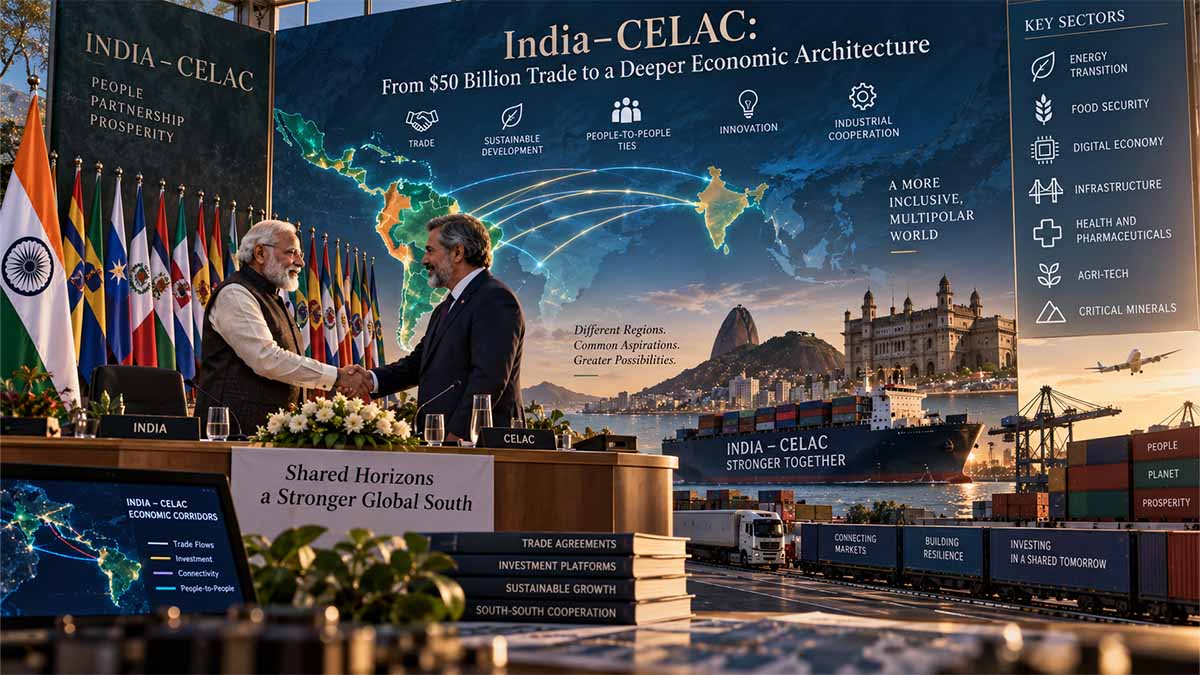
India’s latest push toward the Community of Latin American and Caribbean States is no longer primarily a diplomatic exercise. External Affairs Minister S. Jaishankar told the India–CELAC Foreign Ministers’ Meeting in September 2026 that annual trade had crossed US$50 billion, but the more important development is institutional: a Joint Commission agreed in September 2024, expanding bilateral mechanisms, deeper business participation and new cooperation in digital payments, pharmaceuticals, critical minerals and development finance are beginning to connect what was previously a fragmented relationship. The stakes are commercial and strategic at once. India wants diversified suppliers, new export markets and greater influence across the Global South; CELAC states want capital, technology, healthcare, infrastructure and access to a fast-growing Asian economy. The question now is whether the political architecture can produce contracts, projects and regulatory execution.
The US$50 billion headline conceals a less integrated commercial structure
Jaishankar’s US$50 billion-plus India–CELAC figure signals political scale, but India’s Department of Commerce separately recorded US$39.19 billion in merchandise trade with its 43-country Latin America and Caribbean grouping in FY2024–25, consisting of US$15.17 billion of Indian exports and US$24.02 billion of imports. The two datasets use different geographic and temporal definitions and therefore cannot be merged mechanically, but together they describe the same underlying problem: trade has become economically relevant without yet becoming institutionally integrated.
The longer series confirms the structural change. India–LAC merchandise trade stood at approximately US$1.5 billion in FY2000–01, rose to US$22.4 billion in FY2010–11, reached US$41 billion in FY2012–13, and returned to US$39.19 billion in FY2024–25 after a volatile period shaped by commodity prices and uneven manufactured exports. The scale has increased dramatically, but dependence on resource imports remains pronounced.
India’s export basket contains pharmaceuticals, agrochemicals, petroleum products, vehicles, automotive components, organic chemicals and industrial machinery, while imports include crude petroleum, gold, vegetable oils, sugar, copper, coal and other mineral products. The relationship therefore connects Indian manufacturing capability with Latin American resource depth, but it does not yet resemble a deeply integrated production system.
Chile and Peru are becoming the laboratories of a different model
The most important shift is occurring below the CELAC level, where bilateral agreements are becoming more ambitious than the regional political mechanism itself.
Chile already grants tariff preferences to 2,099 Indian products, while India grants preferences to 1,110 Chilean products under the existing preferential framework. Bilateral merchandise trade reached US$3.843 billion in 2024, up 35.4%, with Chilean exports to India rising 71.7% to US$2.575 billion. By January–August 2026, Chilean exports to India had reached US$4.254 billion, supported by copper, gold, iodine, lithium hydroxide and agricultural products.
The proposed Comprehensive Economic Partnership Agreement would go much further. By August 2026, Chilean authorities reported that most chapters had been closed, while market access and critical minerals remained among the principal unresolved issues. The commercial stakes are material: Chile reported an average tariff of 16.2% on its goods entering India and 36.7% for agro-industrial products, while only 171 Chilean products, equivalent to roughly 4.1% of its export basket, were being sold into the Indian market.
Peru represents a parallel model. Bilateral goods trade reached a record US$5.8 billion in 2024, while nine negotiating rounds had been completed by November 2025. The prospective agreement covers goods, services, rules of origin, sanitary measures, technical barriers, customs, movement of persons, trade remedies, dispute settlement and cooperation. This is not simply tariff diplomacy; it is an attempt to reduce the regulatory and institutional costs that still separate two distant markets.
Development cooperation is moving from assistance toward economic infrastructure
The second structural change lies in development finance. India’s Ministry of External Affairs recorded approximately US$811 million in Lines of Credit allocated to Latin America, with 34 LAC Lines of Credit and 22 completed projects reported in its development portfolio.
Guyana shows how this model can widen beyond a single project. Indian support has included a US$50 million Line of Credit for the East Bank–East Coast road linkage, a ferry project supported by credit and grant financing, irrigation and drainage equipment, solar systems and earlier public infrastructure projects. By 2024, the relationship had broadened into hydrocarbons, agriculture, medical regulation, India Stack and discussion of a UPI-like payment system.
Cuba provides a different configuration. India reported five Lines of Credit worth approximately US$243 million across agriculture, agro-food and renewable energy, while it also supplied 80 tonnes of Active Pharmaceutical Ingredients valued at €10 million and supported an India–Cuba Knowledge Centre that trained more than 1,900 professionals.
These are still modest numbers relative to the financing deployed by larger global actors in the region, but their importance lies in how they are structured: credit, equipment, training and technology can create durable institutional relationships rather than one-off commodity transactions.
Digital infrastructure may scale faster than physical infrastructure
The fastest-moving layer may be digital public infrastructure because it requires less capital than ports, railways or energy systems and can be deployed through technical and regulatory cooperation.
By the end of 2024, India’s Ministry of External Affairs recorded India Stack-related agreements with Suriname, Antigua and Barbuda, Trinidad and Tobago, Cuba, Colombia, St Kitts and Nevis and Jamaica. Peru entered the first commercial LAC agreement for a UPI-like real-time payments system, while Trinidad and Tobago followed with a comparable arrangement. Jamaica signed both a broader digital public infrastructure memorandum and an agreement involving NPCI International Payments Limited, while Guyana added India Stack and payment cooperation to its bilateral portfolio.
The distinction between signatures and deployment matters. An India Stack memorandum does not mean that a national platform is operational, and a commercial agreement for a UPI-like system still requires regulatory integration, cybersecurity, banking participation and sustained transaction use. The strategic significance lies in the possibility of embedding Indian-origin digital architecture into public and financial systems across multiple CELAC states, not in the number of memoranda signed.
Critical minerals are turning diplomacy into upstream industrial policy
India’s resource relationship with Latin America is also moving beyond spot purchases. Khanij Bidesh India Limited obtained exploration and exclusivity rights over five lithium-brine blocks covering approximately 15,703 hectares in Catamarca Province, Argentina, and field exploration began in October 2024 with geological mapping and sampling.
The distinction is important. This is verified upstream participation, but it is not yet a producing mine, a proven commercial reserve or a secured lithium supply stream.
Latin America nevertheless offers the resource base India increasingly needs. Identified lithium resources include approximately 23 million tonnes in Argentina, 23 million tonnes in Bolivia, 11 million tonnes in Chile, 1.7 million tonnes in Mexico, 1.3 million tonnes in Brazil and 1 million tonnes in Peru. Copper is equally important because electrification, grids, electric vehicles and renewable-energy systems are copper-intensive.
The relationship therefore contains an emerging negotiation over value addition. India wants reliable access to strategic inputs, while Latin American governments increasingly seek domestic processing, refining and industrial activity rather than remaining exporters of raw materials. The eventual structure of investment, processing and offtake agreements will determine whether the relationship develops into shared industrial capacity or reproduces a conventional commodity-for-manufactures pattern.
CELAC can convene the relationship, but national institutions still execute it
The most important institutional step came on 27 September 2024, when India and CELAC agreed to establish an India–CELAC Joint Commission. The decision potentially moves the relationship beyond periodic foreign-minister meetings, which had already taken place since the first formal gathering in New Delhi on 7 August 2012.
But CELAC remains a political coordination mechanism among 33 sovereign states, not a supranational commercial authority. Its rotating Presidency Pro Tempore means that regional leadership changes periodically, as demonstrated by Colombia’s assumption of the presidency in April 2025 and its transfer to Uruguay in March 2026. Tariffs, pharmaceutical regulation, customs, digital policy, investment approvals and standards continue to be decided primarily by national governments or sub-regional structures.
India has partly addressed this problem through a denser diplomatic and bilateral network. By September 2024 it had 17 resident missions in LAC, while joint commissions, Foreign Office Consultations and economic committees operate with individual governments. The first India–Costa Rica Joint Economic and Trade Committee in July 2026, for example, addressed standards, accreditation, food safety, pharmaceutical regulation, certification, investment and digital technology — precisely the technical issues that ministerial diplomacy cannot resolve by itself.
Business diplomacy now has enough scale to be judged by conversion
The 10th CII India–LAC Conclave, held in March 2025 with support from India’s foreign and commerce ministries, brought together more than 600 participants from 23 LAC countries, including 15 ministers, while CII reported more than 400 business-to-business meetings.
Those numbers demonstrate reach, not economic success.
The next institutional test is whether those meetings become due-diligence processes, contracts, financed projects and operating investments. Attendance, memoranda and letters of intent are weak indicators of integration unless they move through a commercial pipeline toward financial close and implementation.
The same logic applies to institutional cooperation with development banks. The CII–CAF relationship creates a bridge between Indian firms and a major Latin American development-finance institution, but its strategic value will depend on whether that relationship produces project preparation, financing and investment rather than another layer of dialogue.
The next 24 months will determine whether the architecture becomes economic infrastructure
Between now and 2028, the India–CELAC relationship will be judged less by the frequency of ministerial meetings than by whether existing mechanisms begin producing measurable institutional outputs.
A concluded India–Chile CEPA would provide the clearest evidence that political intent can become enforceable commercial architecture. A completed India–Peru agreement would extend that model. Operational UPI-type payment systems in Peru, Trinidad and Tobago, Jamaica or Guyana would demonstrate that digital cooperation can move from memoranda to infrastructure. KABIL’s Argentina exploration programme would acquire strategic weight if geological work progresses toward commercially viable development. The Joint Commission itself would become meaningful if it acquires a defined work programme, recurring technical meetings, sector coordinators and a mechanism for transferring commitments from one CELAC Presidency Pro Tempore to the next.
The cost of inaction is therefore not diplomatic embarrassment. India would continue trading with the region, and CELAC governments would continue selling commodities into Asian markets, but the relationship would remain fragmented, transaction-heavy and vulnerable to competing partners with deeper financing, logistics and institutional presence. The parties that would bear that cost are Indian manufacturers seeking market access, Latin American exporters facing tariff and regulatory barriers, governments seeking diversified capital and technology, and firms on both sides still paying the premium imposed by distance, weak connectivity and incomplete institutional coordination.
Navigational Index
Trade, market access and productive complementarity — the commercial foundation of the relationship, the distinction between headline CELAC trade and India’s official LAC statistical series, and the significance of the Peru, Chile and MERCOSUR negotiating tracks.
Development, technology and strategic resources — India’s development-finance instruments, digital public infrastructure engagement, pharmaceuticals and technology capabilities, and Latin America and the Caribbean’s energy, agricultural and mineral-resource base.
Institutionalisation and the 2026–2031 trajectory — the role of the India–CELAC mechanism, the India–CELAC Joint Commission, business-to-business connectivity, implementation constraints and observable indicators capable of determining whether the present diplomatic momentum produces structural economic integration.
Master Abstract
The relationship has crossed an important scale threshold, but its measurement requires discipline
The significance of Jaishankar’s September 2026 intervention lies less in the isolated announcement that India–CELAC trade has exceeded US$50 billion annually than in the political decision to frame Latin America and the Caribbean as part of India’s wider economic strategy toward the Global South, because the minister explicitly associated future expansion with diversified trade, investment, stronger business relationships, improved connectivity and more predictable market access rather than with diplomatic consultation alone. India’s public broadcaster reported the minister’s statement during the UN High-Level Week and also recorded his argument that India brings capabilities in technology, pharmaceuticals, skilled human resources and digital systems while the CELAC region offers complementary opportunities in critical minerals, sustainable energy, agriculture and food resources. [EAM Dr S Jaishankar pushes for stronger Global South cooperation amid conflicts, trade and climate challenges — Akashvani News — Sep 2026] Official account of the India–CELAC meeting
The US$50 billion figure nevertheless requires a definitional qualification if it is to be used in a certified analytical document, because the Department of Commerce currently states that India’s total trade with the 43-country Latin America and Caribbean region was US$39.19 billion in FY2024–25, comprising US$15.17 billion of exports and US$24.02 billion of imports, and its underlying trade-statistics infrastructure was updated during 2026 with monthly data extending into that year. [Latin America and Caribbean — Department of Commerce, Government of India] Official regional trade page [TRADESTAT — Department of Commerce, Government of India — data updated Jul 2026] Official Indian monthly foreign-trade database
The appropriate analytical treatment is therefore to preserve Jaishankar’s figure as the Indian Foreign Minister’s declared current India–CELAC aggregate while separately retaining the Department of Commerce’s FY2024–25 LAC merchandise series, because the available public records do not yet provide a common methodological note demonstrating that the two aggregates use identical members, periods and coverage, and converting this difference into a purported statistical contradiction would therefore exceed the evidence.
Commercial complementarity is already visible in the composition of trade
India’s Department of Commerce describes the trade relationship as structurally complementary, with Indian exports to Latin America and the Caribbean dominated by drug formulations, agrochemicals, petroleum products, two- and three-wheelers, automobiles, automotive parts, organic chemicals and industrial machinery, while imports include gold, crude petroleum, vegetable oils, sugar, minerals and ores, iron and steel, copper products, coal and inorganic chemicals; the same official assessment identifies pharmaceuticals and chemicals, machinery, electrical equipment, transportation equipment, electronics and software as areas of substantial unrealised Indian export potential. [Annual Report 2025–26 — Department of Commerce, Government of India] Official trade-composition assessment
This composition explains the strategic logic behind the emphasis on diversification, because the prospective relationship is not limited to exchanging Indian manufactured products for Latin American commodities, even though resource flows remain important, and instead increasingly intersects with industrial supply-chain security, healthcare, digital infrastructure, energy transition and critical minerals. The clearest documented example is Chile, where India launched negotiations for a Comprehensive Economic Partnership Agreement in April 2025, completed three negotiating rounds by the end of October 2025, and identified critical and strategic minerals as a significant Indian negotiating interest, indicating that market-access policy and resource-security policy are becoming increasingly connected. [Annual Report 2025–26 — Department of Commerce, Government of India — 2026] Official record of India–Chile CEPA negotiations
Market-access architecture remains fragmented rather than region-wide
The principal institutional limitation is that CELAC is not a customs union or common commercial jurisdiction, meaning that political agreement at India–CELAC level cannot itself remove tariffs, harmonise standards or guarantee predictable market access across the region, while meaningful liberalisation continues to depend upon bilateral and sub-regional negotiations. India already has a Preferential Trade Agreement with Chile dating from 2006 and expanded in 2016, maintains a Preferential Trade Agreement with MERCOSUR, and is negotiating a trade agreement with Peru covering goods and services, for which nine negotiating rounds had been completed by November 2025. [Latin America and Caribbean — Department of Commerce, Government of India] Official inventory of India’s LAC trade agreements [Annual Report 2025–26 — Department of Commerce, Government of India] Official status of Peru, Chile and MERCOSUR negotiations
The MERCOSUR track is particularly consequential because the Department of Commerce records renewed Indian and Brazilian interest in deepening the existing PTA during the 7th India–Brazil Trade Monitoring Mechanism meeting on 7 October 2025 and a subsequent ministerial meeting on 16 October, with technical dialogue envisaged through the Joint Administration Committee. [Annual Report 2025–26 — Department of Commerce, Government of India] Official MERCOSUR-expansion record
The evidence consequently indicates that CELAC’s economic importance to India should be understood as an umbrella enabling political coordination across a geographically extensive market while substantive commercial rules continue to be negotiated through different treaty tracks, and the strongest indicator of genuine economic deepening would therefore be not another declaration of intent but measurable completion and implementation of these market-access instruments.
Development cooperation gives the relationship an existing institutional base
India’s economic engagement also extends beyond conventional trade because its Ministry of External Affairs administers concessional Lines of Credit through the Indian Development and Economic Assistance Scheme in cooperation with the Export-Import Bank of India, and the ministry records more than 300 Lines of Credit worth approximately US$32 billion globally, including approximately US$811 million allocated to Latin America as of August 2024. [Lines of Credit for Development Projects — Ministry of External Affairs — Aug 2024] Official Government of India LOC programme
Earlier MEA reporting provides additional regional detail by recording 34 Lines of Credit extended to LAC countries, with 22 projects completed, which establishes that India possessed a functioning development-finance presence in the region before the current diplomatic initiative and that future cooperation need not begin institutionally from zero. [Annual Report 2023 — Ministry of External Affairs] Official MEA LAC development-cooperation record
The significance of these instruments is wider than their aggregate financial value because Indian Lines of Credit are designed to finance infrastructure and development projects while facilitating participation by Indian contractors and suppliers, meaning that development cooperation can simultaneously create local productive assets, support Indian project exports and establish longer-term technical relationships, although individual projects must be evaluated separately rather than assuming that every credit line generates equivalent developmental or commercial effects.
Digital cooperation is emerging as a second institutional channel
The Ministry of External Affairs’ 2024 annual reporting records that India and CELAC agreed to institutionalise cooperation through the establishment of an India–CELAC Joint Commission, while also documenting a widening digital relationship in which Suriname, Antigua and Barbuda, Trinidad and Tobago, Cuba, Colombia, Saint Kitts and Nevis, and Jamaica had signed India Stack-related agreements, with Peru becoming the first country in the region to enter into a commercial UPI-related agreement with India and Trinidad and Tobago following. [Annual Report 2024 — Ministry of External Affairs] Official MEA record of India–CELAC institutional and digital cooperation
This digital layer is analytically important because it creates a potential route toward economic integration that does not depend exclusively upon traditional tariff negotiations, particularly if cooperation eventually extends into interoperable payments, identity architecture, public-service platforms, fintech and commercial settlement systems, although the existence of agreements must not be confused with region-wide operational interoperability, which is not established by the present public record.
India’s domestic economic scale increases the commercial significance of the initiative
Jaishankar’s argument that India’s expanding economic weight increases its capacity to contribute to growth across the Global South is directionally consistent with multilateral macroeconomic assessments, although the ministerial statement itself should remain attributed rather than treated as an independent economic finding. The IMF’s July 2026 update places India’s projected real GDP growth for 2026 at 6.4%, which means that the country remains one of the faster-growing large economies and consequently offers an expanding demand market as well as a growing outward commercial and technological base. [India and the IMF — International Monetary Fund — Jul 2026 data] IMF India country data
The relevant implication for CELAC economies is not simply that India represents another export destination, but that a sufficiently mature relationship would permit Latin American and Caribbean producers to diversify demand exposure while allowing Indian firms to diversify sources of energy, food, minerals and industrial inputs, with the reciprocal benefits depending upon transportation costs, regulatory compatibility, trade finance, logistics capacity and the actual preferential access created by future agreements.
Key Evidence Table
| Indicator | Value/status | Reference date | Definition/scope | Issuer | Exact source |
|---|---|---|---|---|---|
| India–CELAC annual trade | Above US$50bn, according to EAM Jaishankar | 22 Sep 2026 | Ministerial India–CELAC aggregate; methodology not published in the retrieved statement | Government of India / EAM statement reported by Akashvani | [Official account] Akashvani News |
| India trade with LAC | US$39.19bn | FY2024–25 | 43-country Department of Commerce LAC grouping; merchandise trade | Department of Commerce | [Official regional record] Department of Commerce |
| Indian exports to LAC | US$15.17bn | FY2024–25 | Merchandise exports within Department of Commerce LAC grouping | Department of Commerce | [Official regional record] Department of Commerce |
| Indian imports from LAC | US$24.02bn | FY2024–25 | Merchandise imports within Department of Commerce LAC grouping | Department of Commerce | [Official regional record] Department of Commerce |
| India–Peru trade negotiations | 9 rounds completed | Nov 2025 | Goods and services trade agreement negotiations | Department of Commerce | [Annual Report 2025–26] Department of Commerce annual report |
| India–Chile CEPA | Negotiations launched Apr 2025; 3 rounds completed by Oct 2025 | Oct 2025 | Proposed comprehensive economic partnership; critical minerals identified as Indian interest | Department of Commerce | [Annual Report 2025–26] Department of Commerce annual report |
| India–MERCOSUR PTA | Expansion under discussion | Oct 2025 | Existing preferential agreement; discussions on deeper coverage | Department of Commerce | [Annual Report 2025–26] Department of Commerce annual report |
| Government of India LOC allocation to Latin America | US$811m | Aug 2024 | Concessional development Lines of Credit | Ministry of External Affairs | [Lines of Credit for Development Projects] MEA official record |
| LAC Lines of Credit | 34 LOCs; 22 completed projects | MEA 2023 reporting | India’s development partnership with LAC | Ministry of External Affairs | [Annual Report 2023] MEA annual report |
| India–CELAC institutional mechanism | Joint Commission agreed | Sep 2024 | Political/institutional cooperation mechanism | Ministry of External Affairs | [Annual Report 2024] MEA annual report |
| India real GDP growth | 6.4% projected | 2026 | Real GDP annual percentage change | IMF | [India and the IMF] IMF country data |
Principal Gaps and Watch Indicators
The most important unresolved quantitative issue is the reconciliation of the US$50 billion India–CELAC annual-trade figure announced on 22 September 2026 with the Department of Commerce’s separately defined US$39.19 billion FY2024–25 LAC merchandise aggregate, because the public records retrieved for this assessment do not provide the country list, reporting period or commodity-and-services coverage behind the ministerial figure, and a formal MEA or Department of Commerce statistical annex would materially improve auditability.
The first decisive implementation indicator will be whether the India–Peru Trade Agreement, India–Chile CEPA and India–MERCOSUR PTA expansion advance from negotiations to concluded legal texts, because signed and implemented market-access commitments would represent a considerably stronger measure of integration than ministerial communiqués, while prolonged negotiations without concluded tariff, services, standards or investment provisions would indicate that political ambition remains ahead of commercial architecture. [Annual Report 2025–26 — Department of Commerce] Official negotiation status
The second indicator will be whether the India–CELAC Joint Commission, whose establishment was recorded by the Ministry of External Affairs after the September 2024 ministerial meeting, develops an identifiable work programme, meeting cycle and measurable portfolio covering trade facilitation, digital cooperation, development finance, connectivity or sectoral investment, because institutionalisation becomes analytically meaningful only when political dialogue produces recurrent implementation mechanisms. [Annual Report 2024 — Ministry of External Affairs] Official India–CELAC institutional record
The third indicator will be the evolution of the trade composition itself, particularly whether Indian exports expand beyond established pharmaceuticals, engineering products, vehicles and chemicals while Latin American and Caribbean exports to India diversify beyond energy, minerals and agricultural commodities, because broader two-way participation would reduce concentration risk and provide stronger evidence of the diversified partnership explicitly sought by Jaishankar. [Annual Report 2025–26 — Department of Commerce] Official sectoral trade assessment
The fourth indicator concerns investment and connectivity rather than merchandise trade alone, because the minister specifically identified stronger business-to-business relations, connectivity and predictable market access as requirements for future growth, meaning that direct investment announcements, shipping and air-connectivity improvements, trade-finance arrangements and corporate supply-chain commitments should be monitored separately from headline trade turnover. [EAM Dr S Jaishankar pushes for stronger Global South cooperation amid conflicts, trade and climate challenges — Akashvani News — Sep 2026] Official account of Jaishankar’s remarks
The fifth indicator will be whether India’s existing development partnership is enlarged beyond its established Lines of Credit into a broader portfolio of digital public infrastructure, healthcare, capacity-building, disaster resilience and commercially sustainable infrastructure projects, because the combination of development instruments and private-sector investment offers a plausible mechanism for transforming diplomatic engagement into longer-duration economic interdependence, although individual programmes will require project-level assessment rather than aggregate assumptions regarding effectiveness. [Development Partnerships — Ministry of External Affairs] MEA development-partnership framework
India–CELAC: From Expanding Trade to a Deeper Economic Architecture
India’s 2026 diplomatic initiative toward the Community of Latin American and Caribbean States is best understood as an effort to connect an already significant commercial relationship with bilateral trade negotiations, development finance, digital cooperation and resource partnerships, while the present public record still shows a fragmented architecture rather than a single region-wide economic framework.
The quantitative baseline requires two separate statistical lenses
External Affairs Minister S. Jaishankar stated during the September 2026 India–CELAC Foreign Ministers’ Meeting that annual India–CELAC trade had crossed US$50 billion, while India’s Department of Commerce separately reports US$39.19 billion of merchandise trade with its own 43-country Latin America and Caribbean grouping during FY2024–25; because the geographic definitions, reporting periods and possible transaction coverage are not demonstrated to be identical, these values should be displayed separately rather than merged into a single time series.
Annual trade figure stated by External Affairs Minister S. Jaishankar at the India–CELAC Foreign Ministers’ Meeting during UN High-Level Week 2026.
Total merchandise trade with the Department of Commerce’s 43-country LAC grouping during Indian FY2024–25.
Government of India Lines of Credit allocated across Latin America as recorded by the Ministry of External Affairs in August 2024.
India’s FY2024–25 LAC merchandise trade was import-heavy
Within the Department of Commerce’s 43-country LAC statistical grouping, Indian exports amounted to US$15.17 billion and imports to US$24.02 billion in FY2024–25, producing total merchandise trade of US$39.19 billion; the bars below therefore show the composition of that specific official aggregate rather than the separate India–CELAC figure announced in September 2026.
Scale: each bar expresses its share of the US$39.19 billion FY2024–25 Department of Commerce merchandise-trade aggregate; calculated shares are approximately 38.71% exports and 61.29% imports.
The relationship rests on identifiable productive complementarity
Market access is advancing through bilateral and sub-regional tracks rather than a CELAC-wide trade regime
CELAC provides a political framework for regional engagement, but the legally operative commercial architecture continues to develop through separate negotiating channels with Peru, Chile and MERCOSUR, making implementation of these agreements a more meaningful measure of economic integration than political declarations alone.
Nine negotiating rounds had been completed by November 2025, covering trade in goods and services.
Negotiations were launched in April 2025, with three rounds completed by the end of October 2025; critical and strategic minerals are identified as a significant Indian interest.
India and Brazil expressed interest in deepening the existing preferential framework during formal trade discussions in October 2025.
Development cooperation provides an institutional bridge beyond merchandise trade
Aggregate Lines of Credit allocated across Latin America under India’s development cooperation framework as recorded in August 2024.
The Ministry of External Affairs reported that India had extended thirty-four Lines of Credit to countries in Latin America and the Caribbean.
Twenty-two projects under those LAC Lines of Credit had been completed according to the Ministry of External Affairs’ 2023 reporting.
The emerging India–CELAC economic architecture is multi-layered
The verified record supports an integration pathway in which political coordination creates negotiating momentum, trade agreements reduce selected market-access barriers, business and investment channels broaden economic participation, development cooperation establishes durable project relationships, and resource and technology partnerships deepen strategic interdependence.
The 2026–2031 outcome should be judged through observable implementation indicators
| Indicator | What would strengthen the assessment | What would weaken the assessment | Analytical relevance |
|---|---|---|---|
| Trade agreements | Conclusion and implementation of Peru, Chile or expanded MERCOSUR arrangements | Repeated negotiations without concluded market-access commitments | Tests whether political intent is becoming legally operative commercial architecture |
| Trade diversification | Broader manufactured, digital, pharmaceutical, industrial and resource flows in both directions | Persistent concentration in a limited number of commodities or markets | Measures whether the relationship is becoming structurally deeper rather than merely larger |
| Investment | Verified projects, productive investment and supply-chain commitments | Predominantly declaratory memoranda without implementation | Indicates whether commercial ties are acquiring long-duration productive assets |
| Connectivity | Improved shipping, aviation, trade finance, payments and logistics mechanisms | Persistent transport and transaction-cost bottlenecks | Directly affects the economic viability of expanded trade |
| Development cooperation | New implemented projects with identifiable financial and operational structures | New announcements without project completion or financing | Tests whether political partnership creates durable institutional relationships |
Evidence register
| Proposition | Status | Value / position | Reference period | Issuing body |
|---|---|---|---|---|
| India–CELAC annual trade | Official assertion | Above US$50 billion | Statement made 22 September 2026 | External Affairs Minister, reported by Akashvani |
| India–LAC merchandise trade | Official statistic | US$39.19 billion | FY2024–25 | Department of Commerce |
| Indian exports to LAC | Official statistic | US$15.17 billion | FY2024–25 | Department of Commerce |
| Indian imports from LAC | Official statistic | US$24.02 billion | FY2024–25 | Department of Commerce |
| India–Peru negotiations | Negotiating process | 9 rounds completed | Through November 2025 | Department of Commerce |
| India–Chile CEPA | Negotiating process | 3 rounds completed | Through October 2025 | Department of Commerce |
| Latin America Lines of Credit allocation | Official record | US$811 million | As of August 2024 | Ministry of External Affairs |
| LAC Lines of Credit / completed projects | Official record | 34 LOCs / 22 completed projects | Reported in 2023 | Ministry of External Affairs |
Net analytical assessment
The balance of the verified official evidence indicates that India and CELAC are not constructing a new relationship from zero, but are attempting to connect an already material trade relationship, multiple bilateral and sub-regional negotiating tracks, development-finance instruments and emerging strategic-sector cooperation into a more coherent economic architecture; the decisive test through 2031 will therefore be whether ministerial commitments are converted into concluded market-access agreements, implemented investment and development projects, improved connectivity and demonstrably broader two-way trade.
Official and first-order sources
- Akashvani News — EAM Dr S. Jaishankar remarks concerning India–CELAC cooperation, September 2026
- Department of Commerce, Government of India — Latin America and Caribbean regional trade record
- Department of Commerce, Government of India — Annual Report 2025–26
- Ministry of External Affairs — Lines of Credit for Development Projects
- Ministry of External Affairs — Annual Report 2023
- Department of Commerce — TRADESTAT Monthly Foreign Trade Statistics System
Units are nominal US dollars unless otherwise specified, with reference periods retained exactly as reported by the issuing institution; ministerial statements are identified as attributed assertions rather than treated as independently harmonised statistical series.
Trade, Market Access and Productive Complementarity
Principal judgment
The commercial relationship between India and Latin America and the Caribbean has moved beyond the stage at which its importance can be measured only by aggregate trade turnover, because the deeper structural question is now whether complementary production systems can be connected through preferential market access, regulatory facilitation, sector-specific supply chains and investment channels capable of reducing the considerable distance between existing trade and the much larger potential identified by both Indian and Latin American authorities. India’s Department of Commerce describes the LAC relationship as one in which Latin America’s endowment of minerals, agricultural commodities and other natural resources intersects with Indian strengths in engineering goods, pharmaceuticals, information technology, textiles and manufacturing, while the same department explicitly identifies tariff barriers, sanitary and phytosanitary requirements, technical barriers to trade and other market-access constraints as subjects requiring government intervention. Foreign Trade — Latin America and Caribbean — Department of Commerce, Government of India
The commercial architecture nevertheless remains highly asymmetric across countries, because Mexico already constitutes a large destination for Indian manufactured exports without a preferential trade agreement, Chile possesses a long-standing partial preferential regime that is now being transformed into negotiations for a much broader Comprehensive Economic Partnership Agreement, Peru is negotiating an ambitious agreement covering both tariff and non-tariff disciplines after bilateral goods trade reached a record US$5.8 billion in 2024 according to the Peruvian government, while Brazil and the other MERCOSUR members remain linked to India through an older and comparatively limited preferential framework whose expansion has again become an explicit policy objective. Annual Report 2025–26 — Department of Commerce, Government of India Perú e India concluyen novena ronda de negociaciones — Ministerio de Comercio Exterior y Turismo del Perú — Nov 2025
The evidence therefore indicates that India’s principal commercial challenge in CELAC is no longer identifying theoretical complementarity, but converting fragmented national opportunities into commercially usable arrangements, because tariffs, rules of origin, customs procedures, sanitary approvals, technical standards, transport costs and product-specific sensitivities remain determined by individual states or regional trade blocs rather than by CELAC itself.
The regional market is large, but commercially concentrated
India’s official statistics show that its LAC trade relationship expanded substantially over the longer term, with the Department of Commerce recording total bilateral merchandise trade of approximately US$1.5 billion in FY2000–01, US$22.4 billion in FY2010–11, US$41.0 billion in FY2012–13, US$39.6 billion in FY2022–23 and US$35.7 billion in FY2023–24, while preliminary April–November FY2024–25 trade amounted to US$25.6 billion before the completed FY2024–25 figure subsequently reached US$39.19 billion. Annual Report 2024–25 — Department of Commerce, Government of India Foreign Trade — Latin America and Caribbean — Department of Commerce, Government of India
Evolution of India–LAC merchandise trade
| Indian financial year | Exports from India | Imports into India | Total merchandise trade | Structural observation |
|---|---|---|---|---|
| 2000–01 | US$0.8bn | US$0.7bn | US$1.5bn | Commercial relationship remained marginal |
| 2006–07 | US$3.7bn | US$5.3bn | US$9.1bn | Resource imports were becoming increasingly significant |
| 2010–11 | US$9.3bn | US$13.0bn | US$22.4bn | Relationship entered a materially larger scale |
| 2012–13 | US$13.5bn | US$27.5bn | US$41.0bn | Strong import-led expansion produced a substantial imbalance |
| 2014–15 | US$11.5bn | US$27.0bn | US$38.5bn | High resource-import exposure persisted |
| 2018–19 | US$9.7bn | US$20.5bn | US$30.3bn | Trade remained below the earlier peak |
| 2020–21 | US$10.1bn | US$12.5bn | US$22.6bn | Pandemic-period contraction altered both flows |
| 2021–22 | US$14.9bn | US$21.7bn | US$36.7bn | Strong post-pandemic recovery |
| 2022–23 | US$17.7bn | US$21.9bn | US$39.6bn | Indian exports reached a high level within the reported series |
| 2023–24 | US$14.5bn | US$21.2bn | US$35.7bn | Both flows moderated |
| 2024–25 | US$15.17bn | US$24.02bn | US$39.19bn | Imports again generated most of total trade |
Source: Annual Report 2024–25 — Department of Commerce, completed FY2024–25 value from the Department of Commerce LAC Division.
The long-run record reveals a relationship that has grown dramatically but not linearly, because commodity prices, energy requirements, precious-metal imports and other resource-intensive flows materially influence the aggregate, while Indian manufactured exports have followed a different pattern and therefore should not be interpreted simply by reference to total trade growth. The Department of Commerce’s current Trade Intelligence and Analytics portal, based on DGCI&S data, records LAC exports from India of US$17.78 billion in 2022, US$14.81 billion in 2023, US$14.82 billion in 2024 and US$16.16 billion in 2025, although these calendar-oriented portal values should not be mixed mechanically with Indian fiscal-year statistics because their reference periods differ. Trade Intelligence and Analytics Portal — Department of Commerce
India’s LAC export series in the Department of Commerce analytics portal
| Reported year | Indian exports to LAC | Year-on-year movement shown by portal |
|---|---|---|
| 2022 | US$17.782bn | +24.81% |
| 2023 | US$14.806bn | −16.74% |
| 2024 | US$14.819bn | +0.09% |
| 2025 | US$16.159bn | +9.04% |
| 2026 available period | US$10.389bn | Incomplete-year figure; not comparable with completed annual periods |
Source: Trade Intelligence and Analytics Portal — Department of Commerce, sourced from DGCI&S.
The underlying policy implication is that the relationship possesses significant scale but still lacks the consistency characteristic of a deeply integrated production system, because fluctuations in resource purchases and individual commodity cycles can substantially move the bilateral aggregate without necessarily implying corresponding changes in industrial integration.
The export and import structures are economically complementary but qualitatively different
India’s exports into the region are disproportionately composed of finished or processed products, including drug formulations, agrochemicals, petroleum products, two- and three-wheelers, passenger vehicles, automotive components, organic chemicals and industrial machinery, while imports are dominated by crude petroleum, gold, vegetable oils, sugar, bulk minerals and ores, copper and copper products, iron and steel, coal, coke, wood products and inorganic chemicals. Annual Report 2025–26 — Department of Commerce
This configuration creates a genuine productive complementarity, although it also produces an important asymmetry because India often sells technology-intensive or manufactured products while purchasing inputs whose value can be heavily influenced by commodity prices, meaning that nominal bilateral trade balances can change substantially even when physical trade patterns remain broadly stable.
Core productive complementarities
| Indian supply capability | LAC supply capability or demand | Commercial mechanism | Main constraint |
|---|---|---|---|
| Pharmaceutical formulations | Healthcare and generic-medicine demand | Finished pharmaceutical exports and regulatory approvals | Registration procedures, health regulation and procurement rules |
| Agrochemicals | Large agricultural production systems | Crop-protection and agricultural-input exports | Environmental, SPS and registration requirements |
| Motorcycles and three-wheelers | Urban and commercial mobility demand | Finished vehicles, components and dealer networks | Tariffs, local standards and competition |
| Passenger vehicles and auto components | Expanding automotive markets | Vehicle exports, aftermarket components and assembly possibilities | Tariff structures and local industrial policies |
| Industrial machinery | Agriculture, mining, food processing and manufacturing | Capital-equipment exports and project supply | Financing, after-sales support and logistics |
| IT and software | Digitalisation and public/private-sector technology demand | Services exports and technology partnerships | Market access for services and professional mobility |
| Pharmaceutical and engineering manufacturing | Regional demand diversification | Import substitution from existing suppliers | Certification and procurement access |
| Indian energy demand | LAC petroleum and energy supply | Crude and petroleum trade | Freight economics and commodity-price volatility |
| Indian metallurgical demand | Copper, gold and mineral resources | Mineral and concentrate imports | Commodity cycles and investment access |
| Indian food and vegetable-oil demand | Agricultural and food-export capacity | Soybean oil, sugar, pulses, fruit and other agricultural trade | SPS rules, seasonal competition and tariffs |
| Energy-transition manufacturing | Copper, lithium and other critical-mineral resources | Long-term supply, processing and investment partnerships | Resource policy and value-addition requirements |
Source framework: commodity composition and identified untapped potential from the Department of Commerce Annual Report 2025–26, with regulatory responsibilities described by the Department of Commerce LAC Division.
The most significant policy shift is that critical minerals are increasingly moving from the background of bilateral commodity trade into the explicit architecture of trade negotiations, most visibly in the India–Chile CEPA process, where Chilean authorities reported in August 2026 that most negotiating chapters had already been closed and that remaining work was concentrated principally on market-access conditions, critical minerals and other outstanding areas. Subsecretaria Estévez recibe a secretario de Comercio de la India — SUBREI — Aug 2026
Mexico demonstrates that large trade can develop even without a preferential agreement
Mexico occupies a distinctive position because it is one of India’s largest commercial partners in Latin America despite the absence of a preferential trade agreement comparable with the Chilean or MERCOSUR arrangements, with India’s Department of Commerce reporting US$8.62 billion of bilateral merchandise trade in FY2024–25, while Indian exports rose from US$5.32 billion in FY2023–24 to US$5.75 billion in FY2024–25, representing official growth of approximately 7.98%. Annual Report 2025–26 — Department of Commerce, Government of India
India–Mexico merchandise relationship
| Indicator | FY2023–24 / comparison period | FY2024–25 | Apr–Oct 2025 | Interpretation |
|---|---|---|---|---|
| Indian exports | US$5.32bn | US$5.75bn | US$3.17bn | Mexico is a major market for Indian manufactured exports |
| Indian imports | Not specified in the cited passage | Approx. US$2.87bn calculated from total | US$1.15bn | Bilateral structure produces a substantial Indian merchandise surplus |
| Total trade | — | US$8.62bn | US$4.32bn | Scale is significant despite absence of a PTA |
| Export growth | — | +7.98% | Lower than Apr–Oct 2024 comparison | Demonstrates underlying market penetration independent of preferential tariff treatment |
Source: Annual Report 2025–26 — Department of Commerce. The FY2024–25 import estimate of approximately US$2.87 billion is calculated from the official US$8.62 billion total less US$5.75 billion of exports and is therefore a derived value rather than a separately quoted government statistic.
Mexico therefore provides an important analytical counterweight to the assumption that preferential agreements are a prerequisite for high trade volumes, because commercial scale can also emerge through competitive industrial products, established distribution networks and demand structures, while the absence of preferential arrangements can nevertheless leave additional tariff and regulatory gains unrealised.
Chile is becoming the most developed test of a deeper economic architecture
India and Chile already possess a preferential framework, but the current CEPA process represents a qualitative change in ambition because the original Partial Scope Agreement entered into force in 2007 and was expanded in 2017, after which Chile granted tariff preferences to 2,099 Indian products and India granted preferences to 1,110 Chilean products according to Chile’s official trade authority. India y Chile acordaron los términos de referencia para las negociaciones del CEPA — SUBREI — May 2025
Chile’s official figures further show that bilateral goods trade reached US$3.843 billion in 2024, increasing 35.4% from the previous year, with Chilean exports to India reaching US$2.575 billion, an increase of 71.7%, while Chilean imports from India reached US$1.268 billion, declining 5.3%. India y Chile acordaron los términos de referencia para las negociaciones del CEPA — SUBREI
India–Chile commercial baseline before a full CEPA
| Indicator | 2024 | Change from 2023 | Official implication |
|---|---|---|---|
| Total bilateral merchandise trade | US$3.843bn | +35.4% | India became Chile’s seventh-largest trading partner |
| Chilean exports to India | US$2.575bn | +71.7% | Resource and commodity demand drove strong growth |
| Chilean imports from India | US$1.268bn | −5.3% | Indian access remained substantial but did not grow with Chilean exports |
| Chilean products receiving Indian preferences under existing agreement | 1,110 tariff products | Existing arrangement | Current agreement remains materially narrower than proposed CEPA |
| Indian products receiving Chilean preferences | 2,099 tariff products | Existing arrangement | Existing preferential architecture already provides a negotiating base |
Source: Subsecretaría de Relaciones Económicas Internacionales de Chile — May 2025.
The negotiating agenda has also broadened considerably beyond tariffs, because Chile’s official CEPA process identifies negotiating groups covering market access, rules of origin, critical minerals, services, legal and institutional issues and cooperation, which demonstrates that the intended framework is designed to alter the operating conditions of bilateral commerce rather than merely extend the number of preferential tariff lines. Proceso de Negociación del CEPA entre Chile e India — SUBREI
India–Chile CEPA progression
| Stage | Date | Development | Evidentiary significance |
|---|---|---|---|
| Political launch | 1 Apr 2025 | Presidents/prime ministers announced start of CEPA negotiations | Raised relationship beyond existing partial agreement |
| Terms of Reference signed | 8 May 2025 | Negotiating mandate agreed | Established formal scope and procedure |
| First round | 26–30 May 2025 | Detailed review of proposed texts | Technical negotiations formally operational |
| Second round | Aug 2025 | Conducted virtually | Continued textual negotiation |
| Third round | 27–30 Oct 2025 | Santiago | Substantive progress reported |
| Fourth round | Dec 2025 | New Delhi | Market access, rules of origin, minerals, services, legal matters and cooperation addressed |
| Further political engagement | Apr–May 2026 | Ministers renewed commitment | Political mandate for conclusion preserved |
| Senior technical review | 26 Aug 2026 | Most chapters reported closed | Negotiations entered advanced phase |
| Outstanding core issues | Aug 2026 | Market access and critical minerals remained central | Final settlement depends on commercially sensitive concessions |
| Stated objective | End-2026 | Both governments sought completion before year-end | Political target, not evidence of completed agreement |
Sources: SUBREI negotiating record, SUBREI August 2026 update, and SUBREI December 2025 fourth-round record.
The commercial importance of the unresolved access negotiations becomes clearer from Chile’s August 2026 disclosure that its exports entering India faced an average tariff of 16.2%, while the average affecting agro-industrial products reached 36.7%, and that only 171 Chilean products were then exported to India, corresponding to approximately 4.1% of Chile’s national export basket. Subsecretaria Estévez recibe a secretario de Comercio de la India — SUBREI — Aug 2026
Chilean market-access constraints identified during the CEPA negotiation
| Indicator | Current official value | Why it matters |
|---|---|---|
| Average tariff faced by Chilean goods in India | 16.2% | Indicates material remaining preference margin |
| Average tariff on Chilean agro-industrial products | Up to 36.7% average reported for the sector | Creates a particularly high barrier for food-sector diversification |
| Number of Chilean products exported to India | 171 | Demonstrates narrow utilisation of Chile’s broader export capability |
| Share of Chilean export basket represented | 4.1% | Shows large theoretical diversification space |
| Chapters described as largely closed by Aug 2026 | Majority | Indicates advanced negotiations |
| Major outstanding issues | Market access, critical minerals and other sensitive matters | These areas determine much of the commercial value of a final agreement |
Source: SUBREI — 26 August 2026.
The economic incentives intensified during 2026, because Chilean exports to India reached US$2.871 billion in the first six months of 2026, representing growth of 109% compared with the same period in 2025, while by January–August 2026 they had risen further to US$4.254 billion, more than doubling year on year, with copper, gold, iodine, walnuts, fresh apples, seeds and lithium hydroxide among the products explicitly identified by Chilean authorities as contributors. Exportaciones chilenas semestrales superan por primera vez los US$60.000 millones — SUBREI — Jul 2026 Exportaciones chilenas crecen 19% y se diversifican — SUBREI — Sep 2026
This development is strategically significant because it shows that trade is expanding before conclusion of the CEPA, meaning that a future agreement would operate upon a rapidly strengthening commercial base rather than attempting to create bilateral demand artificially.
Peru represents a different model: resource intensity combined with a comprehensive negotiating agenda
Peru and India resumed negotiations after the pandemic interruption and had completed nine negotiating rounds by 5 November 2025, while Peru’s Ministry of Foreign Trade and Tourism reported that bilateral goods trade had reached a record US$5.8 billion during 2024. Perú e India concluyen novena ronda de negociaciones — MINCETUR — Nov 2025
The agreement under negotiation is considerably broader than a simple tariff schedule, because the Peruvian government identifies negotiating areas including trade in goods, services, movement of persons, rules of origin, sanitary and phytosanitary measures, technical barriers to trade, customs procedures and trade facilitation, legal and institutional provisions, exceptions, dispute settlement, trade remedies and cooperation, while its dedicated trade-agreement portal additionally characterises the prospective accord as covering investment-related issues. Acuerdo Comercial Perú–India — Ministerio de Comercio Exterior y Turismo Perú e India concluyen novena ronda de negociaciones — MINCETUR
India–Peru negotiation architecture
| Negotiating field | Commercial function |
|---|---|
| Trade in goods | Tariff reductions and product access |
| Rules of origin | Determines which products qualify for preferences |
| Sanitary and phytosanitary measures | Critical for agriculture and food exports |
| Technical barriers to trade | Addresses standards and conformity procedures |
| Customs procedures | Reduces border processing costs |
| Trade facilitation | Improves predictability and clearance |
| Trade in services | Opens non-merchandise commercial opportunities |
| Movement of persons | Facilitates temporary professional and business mobility |
| Investment-related provisions | Creates framework for longer-term commercial presence |
| Trade remedies | Governs safeguards and defensive instruments |
| Dispute settlement | Provides formal enforcement mechanisms |
| Cooperation | Creates channels for capacity-building and implementation |
Sources: Peru’s official India trade-agreement portal and MINCETUR ninth-round communiqué.
Chronology of India–Peru negotiations
| Round | Date | Location |
|---|---|---|
| I | 8–11 Aug 2017 | New Delhi |
| II | 9–12 Apr 2018 | Lima |
| III | 4–7 Dec 2018 | New Delhi |
| IV | 11–15 Apr 2019 | Lima |
| V | 20–22 Aug 2019 | New Delhi |
| Pandemic interruption | 2020–2023 | Negotiations suspended |
| Special reactivation round | Oct 2023 | Virtual |
| VI | 12–14 Feb 2024 | Lima |
| VII | 8–11 Apr 2024 | New Delhi |
| VIII | 2025 | Negotiating process continued |
| IX | 3–5 Nov 2025 | Lima |
Sources: Peru official India agreement portal, Department of Commerce Annual Report 2025–26, and Department of Commerce November 2025 achievement record.
The Peruvian track is commercially important because its structure reveals that both governments understand the principal obstacles to bilateral trade as extending beyond tariffs, particularly where agricultural access, mining-related trade, services and customs processes are concerned, while Peru’s official record also identifies minerals and food exports as areas in which it sees itself as a potential long-term supplier to India. Perú e India concluyen novena ronda de negociaciones — MINCETUR
The sharp rise in India’s imports from Peru deserves separate attention
India’s Department of Commerce Trade Intelligence and Analytics portal currently shows Peru among India’s major suppliers, reporting approximately US$8.87 billion of imports from Peru in the displayed 2026 reporting dataset, alongside approximately US$1.15 billion of Indian exports, with the portal recording import growth of 78.08% and export growth of 14.65% in its corresponding comparison. Because the portal’s displayed 2026 period and update methodology should not be assumed to represent a completed full financial year without additional extraction from the underlying database, these values are best treated as current portal observations rather than annualised totals. Trade Intelligence and Analytics Portal — Department of Commerce
This sharp increase is analytically important because it suggests that Peru’s relevance to India is becoming heavily concentrated on the supply side, meaning that an eventual agreement would need to be assessed not only by its effect on total trade but by whether it produces reciprocal diversification and greater Indian export penetration rather than simply amplifying existing mineral or commodity imports.
MERCOSUR remains institutionally important but commercially underdeveloped relative to its potential
India’s preferential agreement with MERCOSUR represents the principal sub-regional trade framework linking India to South America, while India’s Department of Commerce continues to list the India–MERCOSUR PTA and associated framework arrangements among its principal formal trade instruments for the LAC region. Foreign Trade — Latin America and Caribbean — Department of Commerce
The strategic limitation is that the existing arrangement is materially less comprehensive than the newer agreements India is negotiating elsewhere, which explains the renewed official interest in expanding it, while India and Brazil used the 7th India–Brazil Trade Monitoring Mechanism meeting in October 2025 and subsequent ministerial engagement to discuss deepening the preferential framework in order to promote additional trade and investment. Major Achievements of Department of Commerce — October 2025
Brazil matters disproportionately within this architecture because it combines a large domestic market with industrial capacity, agricultural exports, energy production and mineral resources, while the India–Brazil Trade Monitoring Mechanism gives the two governments an institutional mechanism for identifying tariff and non-tariff obstacles even before a wider MERCOSUR negotiation is completed. Foreign Trade — Latin America and Caribbean — Department of Commerce
Current architecture of India’s principal market-access channels in LAC
| Partner/framework | Existing instrument | Current development | Breadth | Strategic commercial function |
|---|---|---|---|---|
| Chile | Expanded Partial Scope / Preferential Agreement | CEPA negotiation in advanced stage | Moving toward comprehensive framework | Tariffs, services, rules of origin, critical minerals, cooperation |
| Peru | No modern comprehensive agreement in force | Nine negotiation rounds completed | Broad prospective agreement | Goods, services, SPS, TBT, customs, mobility, cooperation |
| MERCOSUR | Preferential Trade Agreement | Expansion under renewed discussion | Currently limited relative to a modern FTA | Wider access to major South American markets |
| Brazil | MERCOSUR PTA plus bilateral Trade Monitoring Mechanism | Active dialogue | Bilateral institutional overlay | Resolving practical trade barriers and supporting investment |
| Mexico | No comparable preferential agreement | Commercial cooperation continues | WTO/non-preferential framework | Large Indian manufactured-export market |
| Argentina | Trade agreement and Joint Trade Commission mechanisms | Continuing institutional channel | Bilateral cooperation | Agriculture, industrial goods and resource trade |
| Ecuador | Joint Economic and Trade Committee | Institutional cooperation | Bilateral mechanism | Market-access problem solving |
| Costa Rica | Joint Economic and Trade Committee | Institutional cooperation | Bilateral mechanism | Trade promotion and regulatory engagement |
| Dominican Republic | JETCO mechanism | Institutional cooperation | Bilateral mechanism | Trade and investment facilitation |
Source: Department of Commerce LAC Division, supplemented for the 2025 MERCOSUR expansion process by the Department of Commerce October 2025 record.
The presence of multiple institutional mechanisms reveals an important characteristic of India’s regional strategy, because New Delhi is not attempting to replace bilateral or sub-regional trade diplomacy with a CELAC-wide commercial agreement but is instead operating through overlapping channels whose legal depth varies considerably from country to country.
Rules of origin will determine whether preferences create genuine new trade
Tariff concessions cannot be evaluated independently of rules of origin, because preferential access becomes commercially meaningful only when producers can satisfy the originating-content requirements attached to the agreement, while excessively restrictive origin rules can substantially reduce utilisation even when headline tariff reductions appear generous.
This issue is particularly significant for Indian sectors such as automobiles, engineering equipment, electronics and pharmaceuticals, where supply chains frequently incorporate intermediate goods from multiple jurisdictions, while it is equally relevant for processed food and mineral-derived products exported from Latin America, where transformation thresholds and regional cumulation rules can determine whether a product receives preferential treatment.
The fact that rules of origin remain a dedicated negotiating group in the India–Chile CEPA process demonstrates that both governments treat them as a substantive commercial issue rather than an administrative detail. Proceso de Negociación del CEPA Chile–India — SUBREI
Market-access architecture beyond headline tariffs
| Instrument | Economic function | Principal commercial risk if unresolved |
|---|---|---|
| Tariff schedule | Directly lowers border cost | Preferences remain too narrow or sensitive products remain excluded |
| Rules of origin | Defines eligibility for preferential tariffs | Firms cannot use preferences despite nominal tariff reductions |
| SPS measures | Governs animal, plant and food access | Agricultural products remain commercially blocked |
| TBT disciplines | Addresses standards and conformity assessment | Engineering and manufactured exports face duplicated certification |
| Customs procedures | Determines clearance cost and predictability | Long-distance trade becomes less competitive |
| Trade facilitation | Reduces procedural friction | Administrative costs offset tariff benefits |
| Services commitments | Provides access for IT, professional and business services | Goods trade deepens without corresponding services integration |
| Temporary movement provisions | Supports deployment of specialists and professionals | Firms encounter implementation and maintenance constraints |
| Dispute settlement | Creates legal mechanism for enforcement | Commercial commitments become less predictable |
| Cooperation chapters | Supports implementation and institutional dialogue | Technical barriers persist despite formal agreement |
Official negotiating basis: Peru’s India trade-agreement negotiation record and Chile’s CEPA negotiation record.
Sanitary and technical regulation is likely to matter most for diversification into new products
The Department of Commerce explicitly identifies the reduction or elimination of SPS measures, technical barriers to trade, tariffs and other non-tariff barriers as a responsibility of its LAC division, which indicates that these constraints are sufficiently material to form part of India’s formal regional trade-management architecture. Foreign Trade — Latin America and Caribbean — Department of Commerce
The mechanism is particularly important in agriculture and food products, because an agreement can reduce customs duties without automatically conferring sanitary approval for meat, fruit, grains or processed food, while technical standards and certification requirements similarly affect machinery, electrical equipment, automotive products and pharmaceuticals.
For this reason, the economic significance of an India–Chile or India–Peru agreement should eventually be measured not solely by the number of tariff lines receiving concessions but by actual preference utilisation, new product approvals, export diversification and reductions in regulatory transaction costs.
Distance remains a structural commercial disadvantage
Geography imposes a constraint that cannot be eliminated through tariff negotiations, because major South American markets are substantially farther from Indian industrial centres than many Asian, Middle Eastern or European trading partners, creating higher maritime transport costs, longer inventory cycles and greater working-capital requirements.
The commercial consequence is that products with a high value-to-weight ratio, specialised industrial inputs, pharmaceuticals, automotive components, software-enabled services and strategic minerals can tolerate distance more effectively than low-margin bulky manufactures, while commodities whose global pricing already internalises long-distance shipping can remain economically viable under different conditions.
This geographical reality strengthens the importance of customs simplification, trade finance, predictable port handling and consolidated logistics, because regulatory or documentation delays impose disproportionately high costs when supply chains are already geographically extended.
The bilateral trade imbalance should not automatically be treated as a policy failure
India recorded imports of US$24.02 billion and exports of US$15.17 billion within the Department of Commerce’s 43-country LAC grouping during FY2024–25, creating a merchandise deficit of approximately US$8.85 billion, but that imbalance must be interpreted in relation to its commodity structure because a significant share of Indian imports consists of energy, metals, vegetable oils and other industrial or consumption inputs rather than products directly displacing equivalent Indian manufactured exports. Foreign Trade — Latin America and Caribbean — Department of Commerce
India–LAC FY2024–25 merchandise balance
| Measure | Value |
|---|---|
| Indian exports to LAC | US$15.17bn |
| Indian imports from LAC | US$24.02bn |
| Total merchandise trade | US$39.19bn |
| Calculated Indian merchandise balance | −US$8.85bn |
| Export share of total trade | 38.7% |
| Import share of total trade | 61.3% |
Source: Department of Commerce LAC Division; balance and shares calculated directly from the official values.
The more decision-relevant question is therefore whether imports enhance Indian energy, food and industrial security while exports progressively diversify into higher-value sectors, because a bilateral deficit generated by economically necessary inputs has a different policy meaning from a deficit generated by persistent loss of domestic competitiveness.
Market access and critical minerals are becoming increasingly interconnected
Chile provides the clearest evidence that mineral security is moving directly into trade-policy architecture, because its government reported in August 2026 that the remaining CEPA negotiations were concentrated partly on critical minerals, while Chilean exports to India during January–August 2026 were being driven by copper, gold, iodine and lithium-related products alongside agricultural exports. SUBREI — 26 August 2026 SUBREI — 16 September 2026
The relationship can consequently evolve from conventional commodity purchasing toward more complex arrangements involving long-term offtake, mining investment, processing, industrial partnerships and technology cooperation, although none of those outcomes should be inferred automatically from the existence of a CEPA negotiation and would require project-level evidence.
Chile’s public transparency records nevertheless demonstrate concrete commercial interest from India, including a May 2026 meeting involving Coal India representatives concerning a diversification strategy that contemplated establishing a subsidiary in Chile to explore and develop lithium projects, while another recorded meeting concerned the future relationship between Chile and an Indian corporate group importing Chilean copper; these records establish corporate engagement but do not establish completed investment projects. SUBREI transparency register — 2026
The emerging commercial geography is therefore differentiated rather than uniform
The evidence supports a regional structure in which different countries perform distinct commercial roles rather than forming a homogeneous CELAC market, because Mexico is a major destination for Indian manufactured exports, Chile is emerging as a critical-minerals and diversified market-access partner, Peru is increasingly important as a supplier and prospective comprehensive-agreement partner, Brazil anchors the MERCOSUR and industrial relationship, while smaller markets can be commercially relevant in pharmaceuticals, automobiles, agricultural inputs, digital services and project exports.
Functional geography of India’s principal LAC commercial relationships
| Market | Present commercial role | Main Indian interest | Main partner interest | Principal institutional route |
|---|---|---|---|---|
| Mexico | Major manufactured-export market | Autos, engineering, chemicals, pharmaceuticals, technology | Access to Indian market and technology ties | Bilateral commercial mechanisms |
| Brazil | Large diversified economy and MERCOSUR anchor | Market access, energy, agriculture, minerals, industrial cooperation | Indian market and investment | MERCOSUR PTA + Trade Monitoring Mechanism |
| Chile | Mineral supplier and rapidly growing export partner | Copper, lithium-related resources, market access | Diversification into India | CEPA negotiation |
| Peru | Large resource-supply relationship | Minerals, food supply and broader trade access | Indian consumer and industrial market | Comprehensive trade negotiation |
| Argentina | Agriculture and resource complementarity | Food, minerals, energy and market diversification | Industrial and pharmaceutical trade | Joint Trade Commission + MERCOSUR |
| Colombia | Diversified regional market | Vehicles, pharmaceuticals, engineering and services | Indian market access and investment | Bilateral cooperation framework |
| Caribbean states | Smaller markets with sectoral opportunities | Pharmaceuticals, vehicles, digital systems and project exports | Development and technology cooperation | Bilateral arrangements + CELAC diplomacy |
This differentiated structure means that a single India–CELAC trade strategy cannot substitute for country-specific commercial diplomacy, because the barriers affecting Chilean fruit exports, Peruvian mineral access, Brazilian industrial trade and Mexican automotive commerce are institutionally and economically different even when all form part of the same wider regional relationship.
Commercial integration should therefore be measured through utilisation rather than announcements
The strongest evidence of deeper India–LAC economic integration over the next five years would not be a further increase in the number of diplomatic declarations but a measurable expansion in preferential tariff coverage, actual utilisation of those preferences, additional product lines traded, more firms participating in bilateral commerce, completed SPS approvals, shorter customs processing, increased service exports, investment projects connected to supply chains and a broader geographic distribution of trade.
Decision-useful commercial indicators for 2026–2031
| Indicator | Current verified baseline | Evidence of structural deepening | Evidence that integration remains shallow |
|---|---|---|---|
| Chile CEPA | Advanced negotiations; most chapters reported closed by Aug 2026 | Signed, ratified and implemented agreement | Continued unresolved market-access negotiations |
| Peru agreement | Nine rounds completed by Nov 2025 | Agreement concluded with meaningful goods and services coverage | Repeated rounds without closure |
| MERCOSUR PTA | Existing limited preferential architecture | Significant expansion of tariff and sectoral coverage | No substantive expansion |
| Chilean tariff burden in India | Average 16.2%; agro-industrial 36.7% according to Chile | Material reduction through CEPA | Sensitive sectors largely excluded |
| Chilean product penetration | 171 products exported to India | Significant increase in product diversity | Growth remains concentrated in minerals |
| India–Mexico exports | US$5.75bn FY2024–25 | Continued diversification of manufactured exports | Concentration in a narrow industrial base |
| LAC share of Indian trade | About 3% in Department of Commerce reporting | Sustained increase supported by multiple countries | Growth dependent principally on commodity prices |
| Non-tariff barriers | SPS/TBT explicitly identified as policy issues | Measurable approvals and regulatory simplification | Tariffs fall but commercial access remains blocked |
| Critical-mineral relationship | Active negotiating and corporate interest | Investment, offtake or processing arrangements implemented | Relationship remains spot commodity trade |
| Business participation | Multiple forums and institutional channels | Broader SME and corporate participation | Trade remains concentrated among major incumbent firms |
Sources: Department of Commerce LAC Division, Department of Commerce Annual Report 2025–26, SUBREI August 2026 India–Chile update, and MINCETUR India–Peru ninth-round record.
Key judgments
India’s trade relationship with Latin America and the Caribbean has already achieved sufficient scale to justify a transition from broad trade promotion toward detailed market-access engineering, because the remaining barriers increasingly concern tariffs, rules of origin, sanitary access, technical standards, customs procedures and commercial logistics rather than basic absence of demand.
Chile has become the most advanced institutional test of this transition because an existing preferential agreement is being transformed into a comprehensive framework at the same time that Chilean exports to India are accelerating sharply, with January–August 2026 shipments reaching US$4.254 billion and including copper, gold, iodine, agricultural products and lithium hydroxide. Exportaciones chilenas crecen 19% y se diversifican — SUBREI — Sep 2026
Peru represents a second strategically important pathway because the prospective agreement explicitly addresses both tariffs and non-tariff barriers across goods, services, customs, SPS, TBT and mobility, while bilateral trade reached US$5.8 billion in 2024 according to Peru’s government and India’s more recent trade portal indicates rapidly increasing Indian imports from the country. MINCETUR — Nov 2025 Department of Commerce Trade Intelligence and Analytics Portal
Mexico demonstrates that preferential agreements are not the only route to commercial scale because bilateral merchandise trade reached US$8.62 billion in FY2024–25, with India exporting US$5.75 billion, although the absence of a preferential framework means that this relationship provides a useful benchmark against which the incremental value of the Chile, Peru and MERCOSUR negotiations can eventually be assessed. Annual Report 2025–26 — Department of Commerce
The regional trade deficit recorded by India should not by itself be interpreted as evidence of an unbalanced relationship because the import structure contains energy, minerals, metals, agricultural commodities and industrial inputs that perform different economic functions from consumer manufactures, while the more relevant policy test is whether these imports strengthen supply security and whether Indian exports diversify simultaneously into higher-value sectors.
The principal structural constraint remains fragmentation, because CELAC does not itself provide the tariff schedules, origin rules, SPS regimes or customs regulations governing market access, meaning that the political India–CELAC framework can coordinate strategy but substantive commercial integration still depends upon bilateral agreements, MERCOSUR arrangements and national regulatory decisions.
What would change the assessment
The assessment would strengthen materially if India and Chile conclude and implement the CEPA with substantial new tariff coverage and workable rules of origin, if the India–Peru agreement moves from negotiation into legal implementation, if India and MERCOSUR significantly expand the existing PTA, and if measurable trade diversification follows in products other than traditional minerals, fuels and established manufactured exports.
The assessment would weaken if high-level political engagement continues without corresponding legal agreements, if Chilean and Peruvian exports to India become increasingly concentrated in a small number of commodities, if unresolved SPS and TBT barriers prevent agricultural and manufactured diversification, or if preference utilisation remains low after agreements are implemented.
Open official record
The public official record still does not provide, in one harmonised source, a complete 2026 country-by-country India–CELAC trade matrix using a single definition and reporting period, while the Department of Commerce’s TRADESTAT and Trade Intelligence systems contain the underlying country and commodity data but present different annual, fiscal-year and partial-year views that should be extracted on a common methodological basis before constructing a definitive CELAC-wide ranking. Trade Statistics Annual — Department of Commerce TRADESTAT — Department of Commerce
The final tariff schedules, origin requirements and exclusions for an India–Chile CEPA remain unavailable because negotiations had not been concluded in the latest official record retrieved on 26 August 2026, while the same limitation applies to the prospective India–Peru agreement and any expanded India–MERCOSUR arrangement, meaning that sector-specific winners, tariff savings and preference utilisation cannot yet be calculated defensibly. SUBREI — 26 August 2026
India–Latin America Commercial Architecture: From Trade Expansion to Market Integration
The commercial relationship between India and Latin America and the Caribbean has reached a scale at which the decisive question is no longer whether bilateral trade exists, but whether fragmented national markets, preferential agreements, regulatory systems, mineral supply chains and industrial complementarities can be converted into a more integrated and predictable economic architecture.
Long-run trade growth has been substantial but highly non-linear
India’s official trade series shows that merchandise trade with Latin America and the Caribbean rose from approximately US$1.5 billion in FY2000–01 to almost US$40 billion in recent years, although the path was shaped by commodity cycles, energy demand, mineral imports and changing levels of Indian manufactured exports rather than by a continuous linear integration process.
| Indian financial year | Exports from India | Imports into India | Total trade | Commercial interpretation |
|---|---|---|---|---|
| 2000–01 | US$0.8bn | US$0.7bn | US$1.5bn | Regional trade remained marginal in India’s overall external commerce. |
| 2006–07 | US$3.7bn | US$5.3bn | US$9.1bn | Resource imports began to assume greater weight. |
| 2010–11 | US$9.3bn | US$13.0bn | US$22.4bn | The relationship entered a materially larger commercial scale. |
| 2012–13 | US$13.5bn | US$27.5bn | US$41.0bn | Import-led expansion created a large merchandise imbalance. |
| 2018–19 | US$9.7bn | US$20.5bn | US$30.3bn | Trade remained substantial but below the earlier commodity-driven peak. |
| 2021–22 | US$14.9bn | US$21.7bn | US$36.7bn | Strong post-pandemic recovery became visible. |
| 2022–23 | US$17.7bn | US$21.9bn | US$39.6bn | Indian exports reached one of their highest levels in the reported series. |
| 2023–24 | US$14.5bn | US$21.2bn | US$35.7bn | Both flows moderated relative to the previous year. |
| 2024–25 | US$15.17bn | US$24.02bn | US$39.19bn | Import growth again became the dominant contributor to total trade. |
Source: Department of Commerce annual reports and LAC Division statistics. Values retain the Indian financial-year convention used by the issuing institution.
The FY2024–25 trade structure was import-heavy, but the deficit is economically heterogeneous
Productive complementarity links Indian manufacturing to Latin American resources and demand
The regional commercial geography is differentiated rather than uniform
Mexico
Large destination for Indian manufactured exports, particularly vehicles, engineering goods, chemicals and pharmaceuticals, despite the absence of a comparable preferential trade agreement.
Chile
Critical-mineral and diversified market-access partner whose relationship with India is moving from an expanded partial agreement toward a comprehensive CEPA framework.
Peru
Resource-intensive partner whose prospective trade agreement addresses goods, services, SPS, technical standards, customs, mobility and cooperation.
Brazil
MERCOSUR anchor combining a large internal market with industrial capacity, energy, agriculture and mineral resources, supported by a bilateral Trade Monitoring Mechanism.
Argentina
Significant agriculture, food, energy and resource complementarity with India, mediated partly through MERCOSUR institutions and bilateral mechanisms.
Caribbean markets
Smaller but potentially important markets for pharmaceuticals, vehicles, digital systems, project exports and development-linked commercial activity.
Mexico shows that high commercial scale can develop without preferential tariff architecture
FY2024–25 according to India’s Department of Commerce.
Up from US$5.32 billion in FY2023–24.
Derived from the official total less official Indian exports.
Chile is the most advanced test of deeper market-access integration
| Indicator | 2024 / latest official value | Change or status | Commercial significance |
|---|---|---|---|
| Total bilateral merchandise trade | US$3.843bn | +35.4% | India became Chile’s seventh-largest trading partner. |
| Chilean exports to India | US$2.575bn | +71.7% | Resource exports were the main driver of growth. |
| Chilean imports from India | US$1.268bn | −5.3% | Indian access remained substantial but did not grow at the same pace. |
| Chilean products receiving Indian preferences | 1,110 tariff products | Existing arrangement | Current preference coverage remains narrower than the proposed CEPA. |
| Indian products receiving Chilean preferences | 2,099 tariff products | Existing arrangement | Provides a negotiating base for deeper liberalisation. |
Reported by Chile during the 2026 CEPA negotiation process.
Indicates particularly high barriers in selected food and agriculture categories.
Equivalent to about 4.1% of Chile’s national export basket.
India–Chile CEPA negotiations have moved from political launch to advanced technical bargaining
| Stage | Date | Development | Analytical significance |
|---|---|---|---|
| Political launch | 1 Apr 2025 | Decision to begin CEPA negotiations | Raised bilateral ambition beyond the existing partial preferential regime. |
| Terms of Reference | 8 May 2025 | Formal negotiating mandate agreed | Defined scope and procedure. |
| First round | 26–30 May 2025 | Detailed textual negotiations began | Technical process became operational. |
| Second round | Aug 2025 | Virtual negotiations continued | Textual work broadened. |
| Third round | 27–30 Oct 2025 | Santiago negotiations | Substantive progress reported. |
| Fourth round | Dec 2025 | New Delhi discussions | Market access, origin, minerals, services and legal provisions advanced. |
| Advanced review | 26 Aug 2026 | Most chapters reported closed | Negotiation entered final sensitive phase. |
| Outstanding issues | Aug 2026 | Market access and critical minerals remained central | Commercial value of final CEPA still depends on unresolved concessions. |
Chilean exports to India accelerated sharply during 2026
Up 109% from the same period in 2025.
More than doubled year on year according to Chilean authorities.
Peru combines large resource flows with a broad trade-negotiation agenda
Record value reported by Peru’s Ministry of Foreign Trade and Tourism.
Completed by November 2025.
Goods, services, SPS, TBT, customs, mobility, remedies, cooperation and legal provisions.
| Negotiating field | Commercial function |
|---|---|
| Trade in goods | Tariff reduction and product access. |
| Rules of origin | Determines which products qualify for preferential treatment. |
| SPS measures | Critical for food, agricultural and animal-product access. |
| Technical barriers to trade | Addresses standards and conformity requirements. |
| Customs procedures | Reduces border-processing costs and delays. |
| Trade in services | Expands commercial opportunities beyond merchandise flows. |
| Movement of persons | Supports temporary mobility of professionals and specialists. |
| Trade remedies | Provides safeguards against import injury and unfair trade claims. |
| Dispute settlement | Creates formal enforcement architecture. |
| Cooperation | Supports implementation and capacity-building. |
MERCOSUR remains strategically important but institutionally shallower than newer negotiating tracks
India’s existing preferential agreement with MERCOSUR gives New Delhi a formal sub-regional access mechanism, but the agreement is less comprehensive than the modern frameworks being pursued with Chile and Peru, which explains renewed bilateral and ministerial interest in expanding its coverage.
Market-access outcomes depend on more than tariff cuts
| Instrument | Economic function | Commercial risk if unresolved |
|---|---|---|
| Tariff schedule | Directly lowers border costs. | Sensitive products remain commercially excluded. |
| Rules of origin | Defines eligibility for preferences. | Firms cannot use concessions despite headline tariff reductions. |
| SPS measures | Controls access for food, agriculture and animal products. | Tariff preferences become unusable where sanitary approval is absent. |
| TBT disciplines | Addresses standards and conformity procedures. | Manufacturers face duplicated testing and certification. |
| Customs procedures | Reduces border-processing time and cost. | Geographic distance becomes more commercially burdensome. |
| Trade facilitation | Improves predictability and documentation. | Administrative friction offsets tariff gains. |
| Services commitments | Creates access for IT, finance, professional and business services. | Integration remains concentrated in goods. |
| Mobility provisions | Supports temporary movement of specialists. | Project implementation and after-sales support remain constrained. |
| Dispute settlement | Creates enforceable legal process. | Commercial commitments become less predictable. |
Critical minerals are becoming embedded directly in trade-policy architecture
Chile provides the clearest documented example because critical minerals remain one of the principal unresolved elements of the CEPA negotiation, while Chilean exports to India have been increasingly supported by copper, gold, iodine and lithium-related products.
Strategic industrial and electrification input with established bilateral trade relevance.
Increasingly linked to battery and energy-transition supply-chain considerations.
Among the products identified in Chile’s recent export expansion to India.
Commercial integration should be judged by utilisation and implementation rather than declarations
| Indicator | Current verified baseline | Evidence of deeper integration | Evidence of shallow integration |
|---|---|---|---|
| Chile CEPA | Advanced negotiations, most chapters reportedly closed by Aug 2026 | Signed, ratified and implemented agreement | Persistent disagreement over sensitive market-access issues |
| Peru agreement | Nine rounds completed | Comprehensive agreement enters into force | Negotiations continue without closure |
| MERCOSUR PTA | Existing limited preferential architecture | Substantial expansion of tariff and sectoral coverage | No material change to existing arrangement |
| Chile product penetration | 171 products exported to India | Broader number of export lines and higher utilisation | Growth remains concentrated in a narrow mineral basket |
| India–Mexico trade | US$8.62bn in FY2024–25 | Continued manufactured-export diversification | Concentration in a small number of product categories |
| Non-tariff barriers | SPS and TBT explicitly identified as policy issues | New approvals and measurable reduction in regulatory friction | Tariffs decline but commercial access remains blocked |
| Critical-mineral relationship | Negotiating and corporate interest established | Implemented investment, processing or offtake arrangements | Relationship remains limited to spot commodity trade |
Net assessment
The verified evidence indicates that India–LAC trade has already reached a scale at which aggregate turnover is no longer the most useful measure of strategic depth, because the decisive commercial variables are now preference utilisation, product diversification, rules of origin, SPS and technical approvals, logistics efficiency, services access and the conversion of mineral trade into longer-term industrial relationships.
Chile represents the most advanced test of this transformation because trade is expanding rapidly before the conclusion of the CEPA, while Peru provides a second comprehensive negotiating pathway and Mexico demonstrates that major bilateral trade can emerge without preferential architecture; MERCOSUR, by contrast, remains strategically important but institutionally shallower and therefore offers potentially significant room for expansion if its existing preferential framework is widened.
The principal structural constraint is fragmentation, because CELAC itself does not determine tariffs, origin rules, sanitary procedures, customs systems or national industrial policies, meaning that the regional political framework can support strategic coordination but commercial integration will continue to depend on country-specific and sub-regional legal instruments.
Official sources
- Department of Commerce, Government of India — Latin America and Caribbean Division
- Department of Commerce, Government of India — Annual Report 2025–26
- Department of Commerce, Government of India — Annual Report 2024–25
- Department of Commerce — Trade Intelligence and Analytics Portal
- Government of Chile, SUBREI — Chile–India CEPA Negotiation Process
- Government of Chile, SUBREI — India–Chile CEPA Negotiation Update, August 2026
- Government of Chile, SUBREI — Chilean Export Performance, September 2026
- Government of Peru, MINCETUR — Ninth Round of Peru–India Trade Negotiations
- Government of Peru — Official Peru–India Trade Agreement Negotiation Portal
Monetary values are nominal US dollars unless otherwise stated; fiscal-year, calendar-year and partial-year values are kept distinct and are not combined into a single trend without a common reporting basis.
Development, Technology and Strategic Resources
Principal judgment
India’s development relationship with Latin America and the Caribbean is becoming materially more strategic because it increasingly connects concessional finance, digital public infrastructure, pharmaceutical and healthcare capabilities, technical training, renewable-energy cooperation, critical-mineral access and food-security complementarities within a single development-oriented framework, while the most important distinction for policy analysis is between instruments that already produce physical or operational outcomes and instruments that remain at the memorandum, pilot, exploration or negotiating stage. India’s Ministry of External Affairs records 34 Lines of Credit to Latin American and Caribbean countries, with 22 projects completed, while its broader development-finance framework allocates approximately US$811 million in Lines of Credit to Latin America; at the same time, seven LAC countries had formally signed India Stack agreements by the end of 2024, Peru had entered the region’s first commercial agreement for a UPI-like payment platform, Trinidad and Tobago followed with a similar arrangement, and subsequent bilateral agreements expanded the model further to Guyana and Jamaica. Annual Report 2023 — Ministry of External Affairs Lines of Credit for Development Projects — Ministry of External Affairs Annual Report 2024 — Ministry of External Affairs
The strategic-resource dimension is equally concrete, because India’s state-backed Khanij Bidesh India Limited has moved beyond dialogue into physical lithium exploration in Argentina, where it obtained exploration and exclusivity rights over five adjacent lithium-brine blocks covering approximately 15,703 hectares in Catamarca Province and began geological mapping and sampling in October 2024, while Chile has become an increasingly important interlocutor for copper, lithium and other strategic minerals and Latin America as a whole possesses globally significant reserves of lithium, copper, graphite, molybdenum and other transition minerals. New Achievements/Ventures of KABIL — Khanij Bidesh India Limited Recent Updates — KABIL Critical minerals for the energy transition and electromobility — ECLAC
The balance of evidence therefore supports a judgment that development cooperation is becoming one of the principal mechanisms through which India can deepen its presence in LAC without reproducing a conventional donor-recipient model, because the operative instruments increasingly involve technology transfer, project finance, capacity development, payment infrastructure, healthcare systems, resource partnerships and sectoral co-development; nevertheless, the strength of this architecture should be measured by completed projects, operational payment systems, functioning digital platforms, regulatory adoption, exploration results and investment commitments rather than by the number of announced agreements.
Development finance has moved from symbolic assistance toward project-based infrastructure
India’s development-finance architecture is built primarily around Government of India-supported concessional Lines of Credit administered through the Export-Import Bank of India under the Indian Development and Economic Assistance Scheme, and the programme differs from conventional untied development lending because financed projects generally require a substantial Indian procurement component, with Exim Bank stating that at least 75% of the value of goods and services covered by these credit-financed contracts must normally be sourced from India, subject to limited case-by-case relaxation. This structure creates a dual mechanism in which partner countries obtain concessional project financing while Indian engineering, technology, equipment and service providers receive access to long-duration overseas projects. Lines of Credit — Export-Import Bank of India Lines of Credit for Development Projects — Ministry of External Affairs
Architecture of India’s development-finance model in LAC
| Component | Function | Development effect | Indian-side effect | Principal implementation test |
|---|---|---|---|---|
| Government-supported Line of Credit | Concessional project financing | Enables infrastructure or equipment procurement | Supports Indian project exports | Contract execution and asset completion |
| Grant assistance | Finances non-repayable development components | Reduces burden on recipient country | Supports diplomatic and technical cooperation | Physical delivery and local use |
| Project preparation | Converts policy concepts into bankable projects | Improves feasibility and implementation | Creates structured procurement pipeline | Completed DPR and procurement process |
| Indian sourcing requirement | Links credit to Indian goods and services | Access to technology and equipment | Supports Indian exporters | Competitive procurement and delivery |
| Technical assistance | Provides training, maintenance and knowledge transfer | Builds local operational capacity | Extends institutional relationships | Local skills retained after project closure |
| Impact assessment | Evaluates results after completion | Tests development effectiveness | Improves future programme design | Measurable social/economic outcomes |
Sources: Exim Bank India — Lines of Credit and MEA — Development Partnerships.
The regional aggregate remains smaller than India’s development-finance exposure in Africa or South Asia, but it is sufficiently developed to constitute an established institutional instrument rather than an experimental mechanism, with the Ministry of External Affairs recording US$811 million in Lines of Credit allocated to Latin America as of August 2024 and separately reporting 34 LAC Lines of Credit and 22 completed projects in its 2023 annual reporting. Lines of Credit for Development Projects — Ministry of External Affairs Annual Report 2023 — Ministry of External Affairs
India’s LAC development-finance baseline
| Indicator | Official value | Reference period | Interpretation |
|---|---|---|---|
| Government of India LOC allocation to Latin America | US$811m | As of Aug 2024 | Regional concessional-finance envelope |
| LAC Lines of Credit reported by MEA | 34 | Reported in 2023 | Demonstrates recurring use of the instrument |
| Completed projects under LAC LOCs | 22 | Reported in 2023 | Shows that part of the portfolio has moved through implementation |
| Countries explicitly listed by MEA as LOC beneficiaries in LAC | Bolivia, Cuba, Guyana, Honduras, Jamaica, Nicaragua, Suriname | Government list | Indicates geographic concentration of formal concessional lending |
| Global GOI LOC portfolio | More than 300 LOCs / US$32bn | Aug 2024 | Provides scale context for regional programme |
Sources: MEA — Lines of Credit for Development Projects, MEA — List of Countries to which LoC has been extended, and MEA Annual Report 2023.
Guyana demonstrates the breadth of the development-finance model
Guyana provides one of the clearest examples of the transition from isolated assistance toward multi-sector development cooperation because Indian credit and grant support has covered transport, agriculture, drainage, health infrastructure, renewable energy and public services over multiple project cycles, while the bilateral development relationship has subsequently widened into hydrocarbons, pharmaceuticals, agriculture and digital systems. An MEA bilateral brief records Indian concessional support for the modernisation of sugar plants, construction of the Georgetown cricket stadium, installation of solar traffic lights, irrigation and drainage pumps, the East Bank–East Coast road-link project, acquisition of an ocean-going passenger and cargo ferry, healthcare facilities and related infrastructure. India–Guyana Bilateral Brief — Ministry of External Affairs
The financing architecture was already visible in the original Georgetown stadium arrangement, under which India provided a US$6 million grant together with a US$19 million concessional Line of Credit, demonstrating that grants and credit could be combined within a single project structure, while later Exim Bank documentation reported that nine Government of India-supported Lines of Credit to Guyana had reached a combined US$117.17 million by 2021. Agreement on Financial Grant for Construction of a Cricket Stadium in Georgetown — Ministry of External Affairs Exim Bank India Quarterly Newsletter — December 2021
Selected India-supported development projects in Guyana
| Project | Financing / value | Sector | Verified status or function |
|---|---|---|---|
| Georgetown cricket stadium | US$6m grant + US$19m LOC | Sports infrastructure | Grant and concessional-credit model |
| East Bank–East Coast Road Linkage | US$50m LOC | Transport | Phase-based implementation after project redesign |
| Ocean-going passenger/cargo ferry | US$10m LOC + US$8m grant offered; final GRSE contract about US$12.73m | Maritime connectivity | MV Ma Lisha inaugurated in April 2023 |
| High-capacity irrigation/drainage pumps | US$4m LOC | Flood mitigation/agriculture | Procurement and installation project |
| Solar home lighting systems | US$7.29m LOC | Renewable energy / rural access | Designed for 30,000 hinterland homes |
| Solar traffic systems | Indian credit-supported project | Urban infrastructure | Earlier project in Guyana portfolio |
| Health-centre upgrades | LOC-supported | Healthcare | Included in Exim Bank project portfolio |
Sources: India–Guyana Bilateral Brief — MEA, Exim Bank India — December 2021, and India–Guyana Stadium Agreement — MEA.
The Guyana case is strategically relevant because development assistance has evolved alongside the country’s emergence as an important hydrocarbons producer, while India and Guyana signed a dedicated hydrocarbons cooperation memorandum in November 2024 covering crude sourcing, natural gas cooperation, infrastructure development, capacity building and knowledge sharing across the hydrocarbon value chain, together with agreements on agriculture, medical-product regulation, India Stack cooperation and exploration of a UPI-like payment system. List of Outcomes: State Visit of Prime Minister to Guyana — Press Information Bureau — Nov 2024
Cuba shows how development finance can combine agriculture, energy, health and technology
India’s development relationship with Cuba operates across a different sectoral configuration because the Ministry of External Affairs reports five Lines of Credit worth approximately US$243 million covering agriculture, agro-food and renewable-energy projects, while additional bilateral assistance has included tractors, medicines, information-technology training, rice financing and pharmaceutical inputs. India–Cuba Bilateral Relations — Ministry of External Affairs — Jan 2025
The health component became particularly tangible in 2024 when India supplied 80 tonnes of Active Pharmaceutical Ingredients valued at €10 million to Cuba as the grant component associated with a €100 million short-term credit arrangement for rice, with the APIs delivered to Mariel Port and formally transferred to BioCubaFarma in August 2024; the same bilateral record notes that India and Cuba signed an MoU between India’s CDSCO and Cuba’s CECMED in October 2024 to cooperate on medical-products regulation. India–Cuba Bilateral Relations — Ministry of External Affairs
India–Cuba development instruments
| Instrument / project | Scale | Sector | Strategic significance |
|---|---|---|---|
| Five Government of India LOCs | Approx. US$243m | Agriculture, agro-food, renewable energy | Long-term project finance |
| API donation | 80 tonnes / €10m | Pharmaceuticals | Direct healthcare-production support |
| Rice-related short-term credit | €100m arrangement cited by MEA | Food security | Supports essential commodity availability |
| 60 tractors donated | 2018 | Agriculture | Agricultural mechanisation support |
| India–Cuba Knowledge Centre | More than 1,900 professionals trained | ICT | Human-capital and technology transfer |
| Special AI programme | 20 Cuban IT specialists, Feb–Mar 2025 | Artificial intelligence | Advanced technical capacity-building |
| Medical-product regulation MoU | Signed Oct 2024 | Pharmaceuticals regulation | Institutionalises regulator-to-regulator cooperation |
| India Stack MoU | Signed Jan 2024 | Digital public infrastructure | Framework for digital transformation cooperation |
Source: India–Cuba Bilateral Relations — Ministry of External Affairs.
The Cuba example demonstrates that India’s development model can connect sovereign credit, commodity support, pharmaceutical inputs, regulatory cooperation and technical training within one bilateral relationship, but it also illustrates why project-level distinctions remain necessary because a credit agreement, a donated input, a completed training programme and an operational infrastructure asset represent different levels of development implementation.
Capacity building remains a separate strategic instrument from infrastructure lending
India’s technical cooperation programmes create institutional relationships that do not depend upon large capital projects, principally through the Indian Technical and Economic Cooperation programme, scholarships, customised training and specialist exchanges, while the Ministry of External Affairs reported globally that capacity-building training and scholarships reached 177,782 participants between 2014 and March 2026 across its wider diplomatic programme. Ministry of External Affairs — institutional statistics, Mar 2026
Country-level records show substantial cumulative participation within LAC, with more than 800 Guyanese nationals having benefited from ITEC programmes by the date of the MEA bilateral brief, more than 500 ITEC slots used by Suriname, and approximately 340 Jamaican nationals trained in India under ITEC according to the relevant bilateral records. India–Guyana Bilateral Brief — MEA India–Suriname Bilateral Relations — MEA India–Jamaica Bilateral Relations — MEA
Selected capacity-building evidence
| Partner | Verified participation / programme | Focus |
|---|---|---|
| Guyana | More than 800 nationals benefited from ITEC | Public administration, agriculture, forensics, media and specialised technical training |
| Suriname | More than 500 ITEC slots used | Broad professional and governmental capacity building |
| Jamaica | About 340 nationals trained through ITEC | IT, banking, finance, accounting and audit among other areas |
| Cuba | Dedicated AI course for 20 specialists in 2025 | Advanced digital skills |
| Cuba | India–Cuba Knowledge Centre trained 1,900+ professionals | ICT |
| Jamaica | Indian-supported IT Centre trained 1,000+ Jamaicans | Digital and technical skills |
| CARICOM / Suriname-linked programmes | Specialised customs training | Public administration and border-management capability |
Sources: India–Guyana Bilateral Brief, India–Suriname Bilateral Relations, India–Jamaica Bilateral Relations, and India–Cuba Bilateral Relations.
This instrument is strategically different from capital lending because its primary output is institutional capability rather than infrastructure, while its long-term value depends upon whether training is translated into durable administrative, regulatory, technical or commercial competence within partner-country institutions.
Digital public infrastructure has become one of the fastest-growing areas of cooperation
India’s digital relationship with LAC has expanded more rapidly than its traditional physical infrastructure footprint because digital public infrastructure can be transferred through modular software architectures, technical cooperation, regulatory design and payment-system partnerships without requiring capital-intensive transport or energy projects, while the Ministry of External Affairs recorded by the end of 2024 that Suriname, Antigua and Barbuda, Trinidad and Tobago, Cuba, Colombia, St Kitts and Nevis, and Jamaica had signed agreements related to India Stack. Annual Report 2024 — Ministry of External Affairs
India’s own policy description defines the underlying architecture around interoperable identity, payment and data-sharing systems rather than a single exportable application, while the Government of India’s broader DPI strategy explicitly positions population-scale digital systems as adaptable public infrastructure that can be shared with partner states rather than imposed as fixed proprietary platforms. India’s Digital Public Infrastructure — Press Information Bureau — Mar 2026 Finance Ministers’ Session — Voice of Global South Summit — Ministry of External Affairs
Verified India Stack and payment-system engagement in LAC
| Country | Verified instrument | Date / status | Operational significance |
|---|---|---|---|
| Suriname | India Stack cooperation MoU | Signed by 2024 | Framework for sharing population-scale digital solutions |
| Antigua and Barbuda | India Stack MoU | Signed 2023 | Cooperation on digital solutions at population scale |
| Trinidad and Tobago | India Stack agreement + NIPL payment-platform agreement | Sep 2024 onward | Development of real-time payments platform modelled on UPI |
| Cuba | India Stack MoU | Jan 2024 | Digital-transformation cooperation |
| Colombia | India Stack agreement | Confirmed by MEA 2024 | Framework-level DPI cooperation |
| St Kitts & Nevis | India Stack agreement | Confirmed by MEA 2024 | Framework-level DPI cooperation |
| Jamaica | DPI cooperation MoU + NIPL/Egov Jamaica MoU | Oct 2024 | Digital transformation and payment-system cooperation |
| Peru | Commercial NIPL–Central Reserve Bank agreement | Jun 2024 | First LAC agreement for a UPI-like real-time payments system |
| Guyana | India Stack MoU + UPI-like-system MoU | Nov 2024 | Capacity building, pilots and possible real-time-payment deployment |
Sources: MEA Annual Report 2024, List of Outcomes: Jamaica — PIB, List of Outcomes: Guyana — PIB, and MEA Annual Report 2024 treaty/outcomes annex.
Peru is particularly important because the June 2024 agreement between NPCI International Payments Limited and the Central Reserve Bank of Peru concerned the replication of a retail payments platform similar to India’s Unified Payments Interface, making Peru the first LAC country identified by India’s Ministry of External Affairs as having entered a commercial agreement of this type, while Trinidad and Tobago subsequently became the first Caribbean country to adopt a UPI-modelled platform through an agreement with its Ministry of Digital Transformation. Annual Report 2024 — Ministry of External Affairs India–Trinidad and Tobago Relations — Ministry of External Affairs
The distinction between framework cooperation and operational deployment is essential, because an India Stack MoU establishes political and technical intent but does not establish that a national identity, payment or data-exchange system has entered production, while a commercial payment-platform agreement represents a more advanced stage but still requires technical implementation, regulatory integration, cybersecurity governance, bank participation and sustained transaction volumes before it can be described as a functioning national payment rail.
Jamaica demonstrates the transition from general DPI cooperation toward specific financial infrastructure
Jamaica’s October 2024 agreements are analytically important because the bilateral outcome list separately records an intergovernmental memorandum on sharing successful digital public infrastructure aimed at promoting financial inclusion and social and economic transformation and a second memorandum between NPCI International Payments Limited and Egov Jamaica Limited, which indicates that the relationship distinguishes between policy-level DPI cooperation and the institutional actors responsible for prospective payment implementation. List of Outcomes: Official Visit of Prime Minister Andrew Holness to India — Press Information Bureau
This builds upon a much older technology-development relationship because India had already established an IT Centre in Jamaica in 2009, supplied hardware, software and training capability and trained more than one thousand Jamaicans before that programme ended in 2011, illustrating a progression from conventional technical assistance toward digital infrastructure architecture. India–Jamaica Bilateral Relations — Ministry of External Affairs
The regional opportunity for DPI is broader than India’s existing agreements
The regional demand-side case is reinforced by multilateral assessments because the UN Development Programme identifies digital public infrastructure as a foundational system for the movement of people, money and information and is itself building a dedicated DPI service offer across Latin America and the Caribbean spanning governance, justice, social protection, health and disaster-risk reduction, while the OECD identifies scalable and secure digital public infrastructure as a core component of modern government capability across the region. Digital Public Infrastructure — UNDP Latin America and the Caribbean Developing scalable and secure digital public infrastructure — OECD
India therefore enters an environment where demand for interoperable public digital systems already exists independently of Indian diplomacy, which increases the potential relevance of its technology but also means that future adoption will depend on interoperability with national systems, data-protection law, digital sovereignty requirements, cybersecurity standards and local institutional governance rather than on technical replication alone.
Pharmaceuticals provide India with a development capability that differs from conventional infrastructure
India’s pharmaceutical relevance to LAC is based on scale, manufacturing depth and affordability rather than development finance, with the Government of India reporting pharmaceutical exports of approximately US$30.47 billion in FY2024–25, representing growth of 9.4%, while a subsequent government assessment records exports to 191 countries, a global ranking of eleventh by value and a production position of third globally by volume. Commerce Secretary Assures Full Government Support for Pharma Exports Growth — PIB — Apr 2026 India’s Pharma Edge: Scaling Manufacturing and Exports — PIB — Aug 2026
Government reporting further identifies Brazil and Mexico among the markets receiving expanding Indian pharmaceutical exports, while official trade-development material notes that Latin America and the Caribbean remain among India’s key regional pharmaceutical destinations, demonstrating that health-sector engagement is supported by an established commercial manufacturing base rather than only by aid programmes. Strengthening India’s Pharmaceutical Sector — Press Information Bureau Drug formulations & biologicals keep India’s pharma exports healthy in Q1 — IBEF, Ministry of Commerce-linked export data
India’s healthcare-industrial capability relevant to LAC
| Indicator | Verified value / status | Development relevance |
|---|---|---|
| Pharmaceutical exports FY2024–25 | US$30.47bn | Demonstrates industrial scale |
| Global pharmaceutical export destinations | 191 countries | Shows broad regulatory and distribution reach |
| Global rank by production volume | 3rd | Large-scale manufacturing capacity |
| Pharmaceutical export rank by value | 11th | Significant global supplier position |
| Medical-device exports FY2024–25 | Approximately US$4.1bn | Expands health cooperation beyond medicines |
| Pharma PLI cumulative investment by Sep 2025 | ₹40,294 crore | Supports higher-value production capacity |
| PLI-supported pharmaceutical exports to Sep 2025 | ₹1,98,509.49 crore cumulative | Indicates industrial export capability |
| API/KSM/DIs being produced under PLI | 726 | Strengthens supply-chain depth |
| First-time domestically manufactured API/KSM/DI products under PLI | 191 | Evidence of import-substitution capability |
Sources: PIB — Pharmaceutical Exports and Industrial Capability, PIB — Department of Pharmaceuticals achievements, and PIB — India’s Pharma Edge.
The developmental value of this capacity becomes greater when regulatory institutions cooperate directly, because India signed medical-products regulatory arrangements with both Cuba and Guyana in 2024, while Trinidad and Tobago signed an MoU on the Indian Pharmacopoeia in July 2025, creating mechanisms through which pharmaceutical standards, regulatory dialogue and access conditions can potentially move closer together without assuming automatic mutual recognition. India–Cuba Bilateral Relations — MEA State Visit to Guyana: List of Outcomes — PIB State Visit to Trinidad and Tobago: List of Outcomes — PIB
Critical minerals create the most direct link between development cooperation and India’s industrial strategy
Latin America’s critical-mineral relevance to India is structural because electrification, grid expansion, battery manufacturing, renewable energy and advanced industrial production require increasing volumes of lithium, copper, nickel, graphite and related materials, while ECLAC identifies Chile, Peru, Brazil, Mexico and other regional states as possessing significant deposits or reserves across several of these categories. Critical minerals for the energy transition and electromobility — Economic Commission for Latin America and the Caribbean
The resource concentration is particularly strong in lithium, with the U.S. Geological Survey’s 2025 Mineral Commodity Summaries estimating global identified lithium resources of approximately 115 million tonnes, including 23 million tonnes in Argentina, 23 million tonnes in Bolivia, 11 million tonnes in Chile, 1.7 million tonnes in Mexico, 1.3 million tonnes in Brazil and approximately 1 million tonnes in Peru, although identified resources and economically recoverable reserves are distinct categories and should not be conflated. Mineral Commodity Summaries 2025 — U.S. Geological Survey
Selected LAC lithium resources reported by USGS
| Country | Identified lithium resources | Strategic relevance to India |
|---|---|---|
| Argentina | 23 million tonnes | Direct Indian state-backed exploration already underway |
| Bolivia | 23 million tonnes | Extremely large resource base; project economics and extraction remain decisive |
| Chile | 11 million tonnes | Major producer with growing India–Chile minerals dialogue |
| Mexico | 1.7 million tonnes | Significant geological resource, subject to national policy framework |
| Brazil | 1.3 million tonnes | Emerging hard-rock lithium and industrial potential |
| Peru | 1.0 million tonnes | Adds diversification potential to broader mineral relationship |
Source: USGS Mineral Commodity Summaries 2025. Values represent identified resources, not necessarily economically recoverable reserves.
The most important difference from earlier India–LAC resource relations is that India is now beginning to participate upstream rather than relying exclusively upon commodity imports, because KABIL’s January 2024 agreement with Catamarca Minera y Energética Sociedad del Estado gave the Indian state-backed company exploration and exclusivity rights over five adjacent lithium-brine blocks covering approximately 15,703 hectares, and KABIL began field exploration activities on 4 October 2024. New Achievements/Ventures — KABIL Recent Updates — KABIL
KABIL’s Argentina lithium project
| Element | Verified status |
|---|---|
| Indian entity | Khanij Bidesh India Limited |
| Ownership structure | JV of NALCO, Hindustan Copper and MECL |
| Argentine partner | CAMYEN SE, Catamarca provincial state enterprise |
| Agreement date | 15 January 2024 |
| Number of lithium blocks | 5 |
| Approximate area | 15,703 hectares |
| Location | Catamarca Province |
| Rights obtained | Exploration and exclusivity rights |
| Field exploration start | 4 October 2024 |
| Initial field activities | Geological mapping and sampling |
| Development stage | Exploration, not established commercial production |
Sources: KABIL — New Achievements and KABIL — Recent Updates.
This project is strategically more important than a simple memorandum because exploration work is physically underway, but it should not yet be described as an operational Indian lithium mine or a secured lithium supply stream, because no public evidence cited here establishes commercial reserves, mine development, production volumes or long-term exports to India.
Chile and Argentina represent different critical-mineral models
Argentina currently represents the clearest upstream Indian asset-exploration model, while Chile represents a more mature supplier and policy-partnership model because it combines existing mineral production with a highly developed mining sector, large copper and lithium endowments and a bilateral agenda in which critical minerals have become a formal subject of economic cooperation. India’s Ministry of Mines has explicitly stated that KABIL has pursued strategic-mineral engagement with Argentina and Chile, while its broader mandate is to identify, acquire, develop and commercialise overseas mineral assets for supply to India. Annual Report — Ministry of Mines KABIL — CEO’s Desk
The strategic distinction is therefore important: Argentina offers direct project participation and potential upstream ownership, while Chile offers access to a mature mining ecosystem where the highest-value cooperation could eventually include long-term supply arrangements, processing, technology, investment or industrial partnerships, although these outcomes should not be treated as completed unless project-specific contracts become public.
Latin America’s copper position is equally important to India’s electrification trajectory
Lithium attracts disproportionate attention because of battery applications, but copper is potentially more systemically important because it is required across electricity grids, renewable generation, electric vehicles, industrial motors and transmission infrastructure, while ECLAC identifies Chile and Peru as major copper-resource jurisdictions and explicitly treats copper alongside lithium and other minerals as central to the energy transition. Critical minerals for the energy transition and electromobility — ECLAC
The relevance for India extends beyond conventional commodity procurement because India’s expansion of renewable generation, grid infrastructure, electric mobility and manufacturing increases the strategic value of diversified copper supply, while Latin American producers simultaneously seek greater domestic processing and value capture, creating a potential tension between India’s interest in reliable input availability and producer-country objectives to move downstream within mineral value chains.
Energy cooperation extends beyond critical minerals
Latin America and the Caribbean remain significant hydrocarbon producers even as renewable-energy deployment accelerates, with OLACDE reporting that the region accounted for approximately 11% of global oil production and nearly 6% of natural-gas production in 2025, while Brazil, Mexico, Colombia, Venezuela, Argentina, Guyana and Ecuador together represented approximately 87% of regional hydrocarbon output. Outlook 2025: Production and Foreign Trade of Oil and Natural Gas in LAC — OLACDE
Regional oil production increased by approximately 20% in 2025 according to OLACDE, driven particularly by Guyana’s expansion and Brazil’s continued production growth, while around 46% of regional oil output was exported, making the region potentially relevant to India not merely because of existing suppliers but because new Atlantic Basin production can widen the universe of available crude sources. Outlook 2025 — OLACDE
LAC hydrocarbon baseline
| Indicator | 2025 regional value / status |
|---|---|
| Share of global oil production | Approx. 11% |
| Share of global natural-gas production | Nearly 6% |
| Oil production change vs 2024 | Approx. +20% |
| Share of oil production exported | Approx. 46% |
| Seven leading hydrocarbon producers’ share of regional output | Approx. 87% |
| Main production centres | Brazil, Mexico, Colombia, Venezuela, Argentina, Guyana, Ecuador |
| Share of regional oil exports sent to China | Approx. 31% |
| Share sent to United States | Approx. 18% |
| Share sent to European Union | Approx. 15% |
Source: OLACDE — Outlook 2025: Production and Foreign Trade of Oil and Natural Gas in LAC.
Brazil, Guyana and Argentina have become particularly important to the global supply outlook, with the U.S. Energy Information Administration estimating that crude-production growth from those three countries accounted for approximately 28% of global crude-oil production growth in 2025, while Brazil’s output was estimated at approximately 3.8 million barrels per day in 2025 and projected by the EIA to average approximately 4.0 million barrels per day in 2026. Brazil, Guyana, and Argentina support forecast crude oil growth in 2026 — U.S. Energy Information Administration
For India, the strategic significance lies in supplier diversification rather than exclusive dependence on any one LAC source, and the Guyana hydrocarbons MoU illustrates this logic by explicitly covering crude sourcing, natural gas, infrastructure and knowledge transfer instead of focusing solely upon spot crude purchases. List of Outcomes: State Visit to Guyana — PIB
Renewable energy creates an additional cooperation layer
Latin America and the Caribbean combine hydrocarbon resources with an electricity system that already has an unusually high renewable share, because OLACDE reported that approximately 67% of regional electricity available in 2025 came from clean sources, while renewable generating capacity increased approximately 7% during the year and wind and solar represented approximately 61% of new installed capacity. Latin America and the Caribbean Energy Outlook 2025 — OLACDE
The region also had approximately 1.7 GW of installed battery-storage capacity according to OLACDE’s 2025 assessment, while natural-gas generating capacity increased as a firming resource and coal- and oil-based generation capacity declined, indicating that the regional transition is developing through a mixed system of renewables, storage and dispatchable generation rather than through a simple replacement of hydrocarbons. Latin America and the Caribbean Energy Outlook 2025 — OLACDE
Regional energy-transition indicators
| Indicator | 2025 value / change |
|---|---|
| Electricity from clean sources | 67% |
| Renewable-generation capacity growth | +7% |
| Wind and solar share of new capacity | 61% |
| Wind and solar output growth | +19% |
| Installed battery capacity | 1.7 GW |
| Final electricity consumption growth | +3.7% |
| Per-capita electricity consumption growth | +2.6% |
| Gas-fired generation capacity | +12% |
| Coal-based generation capacity | −21% |
| Oil-based generation capacity | −31% |
Source: OLACDE — Latin America and the Caribbean Energy Outlook 2025.
India already possesses an institutional bridge into this transition through the International Solar Alliance, which was originally conceived by India and France and now includes a substantial group of Latin American and Caribbean members such as Argentina, Brazil, Chile, Guyana, Peru, Suriname, Trinidad and Tobago, Venezuela, Jamaica, Barbados, Cuba, Grenada and several other Caribbean states. International Solar Alliance — Member Countries International Solar Alliance — Background
The International Solar Alliance should nevertheless be understood as a multilateral platform rather than an India-controlled bilateral financing mechanism, because its practical value to India–LAC relations lies in providing a common institutional environment for project development, regulatory knowledge, capacity building and investment mobilisation rather than granting India automatic commercial access to member-country energy markets.
Agriculture creates a second strategic-resource relationship beyond minerals and hydrocarbons
Latin America and the Caribbean’s agricultural base gives the relationship a food-security dimension because FAO describes the region as the principal net food exporter in the world, producing enough food for approximately 1.3 billion people, while regional agriculture benefits from a large share of global land, water and biodiversity resources. FAO in Latin America and the Caribbean
FAO reports that LAC accounts for approximately 14% of global crop production, possesses around 30% of global arable land and 30% of fresh-water resources, while agricultural exports represent approximately 18.4% of global agricultural exports in one recent regional assessment and generate a positive agrifood trade balance of approximately US$238 billion annually. FAO / CAF Agriculture Strategy for Latin America and the Caribbean — Mar 2025
LAC agrifood strategic-resource indicators
| Indicator | Regional value |
|---|---|
| Population that regional production can feed | Approx. 1.3bn people |
| Share of global crop production | Approx. 14% |
| Share of global arable land | Approx. 30% |
| Share of global fresh water | Approx. 30% |
| Share of world agricultural exports | Approx. 18.4% |
| Estimated positive agrifood trade balance | Approx. US$238bn annually |
| Share of global cattle / related livestock base cited by FAO | Approx. 28% |
| Share of global beef exports | Approx. 44% |
| Share of global agricultural and fisheries production, 2021–23 | Approx. 13% |
| Share of global agricultural and fisheries exports, 2021–23 | Approx. 18% |
Sources: FAO — Agriculture Strategy for Latin America and the Caribbean, FAO Regional Office, FAO — Sustainable Livestock Farming, and FAO — Generation of opportunities.
The strategic significance for India is therefore broader than purchasing individual commodities, because the region can contribute to diversification of edible oils, pulses, animal feed, sugar, fruit, fisheries and other food inputs while India can contribute agricultural machinery, digital agriculture, agrochemicals, irrigation technology, processing equipment and technical capacity, although food-security cooperation must remain sensitive to producer-country domestic food requirements, climate exposure and commodity-price volatility.
Food security and agricultural development can also be integrated with development finance
The development relationship is already beginning to combine agriculture with infrastructure and technology, as illustrated by Indian-supported irrigation and drainage projects in Guyana, tractor assistance to Cuba and the US$1 million agro-processing machinery handover to Trinidad and Tobago announced in July 2025, while Guyana and India also signed a dedicated agriculture and allied-sectors cooperation memorandum in November 2024. List of Outcomes: State Visit to Trinidad and Tobago — PIB List of Outcomes: State Visit to Guyana — PIB
This creates a pathway through which agricultural trade and development cooperation can become mutually reinforcing, because irrigation, mechanisation, crop-processing equipment, digital systems and agricultural research can increase production and local value addition while also creating commercial opportunities for Indian equipment, services and technology providers.
Development cooperation is becoming increasingly sector-integrated
The most significant transformation is therefore not the expansion of any single instrument but the increasing overlap among instruments, because Guyana now combines Indian infrastructure finance, digital-payment cooperation, medical-products regulation, agriculture and hydrocarbons; Cuba combines Lines of Credit, agriculture, renewable energy, pharmaceutical inputs, regulator cooperation and India Stack; Trinidad and Tobago combines UPI-related payments cooperation, pharmacopoeia collaboration, agricultural machinery and small grant projects; and Argentina combines strategic-mineral exploration with broader bilateral science and economic cooperation.
Emerging country-level development architectures
| Partner | Finance / infrastructure | Digital | Health / pharma | Strategic resources | Agriculture / energy |
|---|---|---|---|---|---|
| Guyana | Roads, ferry, pumps, health centres, solar | India Stack + UPI-like system | Medical-products regulatory MoU | Hydrocarbons | Agriculture MoU, irrigation, solar |
| Cuba | Five LOCs, approx. US$243m | India Stack, ICT training | 80t APIs, regulatory MoU | Energy cooperation | Agriculture, agro-food, renewable energy |
| Trinidad & Tobago | Quick Impact Projects | UPI-model payment system | Indian Pharmacopoeia MoU | Hydrocarbon economy offers future scope | US$1m agro-processing machinery |
| Jamaica | Historic technical assistance | DPI MoU + NIPL cooperation | Potential healthcare platform not yet established in cited record | Limited critical-resource role | Capacity-building focus |
| Argentina | Limited LOC relevance in cited record | Cooperation potential | Pharmaceutical market opportunity | KABIL lithium exploration | Major agricultural and energy-resource base |
| Chile | Commercial rather than LOC-led | DPI dialogue at political level | Pharmaceutical market potential | Copper, lithium, iodine | Major renewable-energy potential |
| Peru | Trade/development institutional dialogue | UPI-like payments agreement | Healthcare market opportunity | Copper, lithium and other minerals | Major agricultural/export potential |
The matrix shows that India is not applying a single regional model, because its engagement adapts to different partner capabilities: small Caribbean states are more suitable for digital platforms, capacity building and targeted development projects, while South American resource economies offer larger-scale opportunities in minerals, energy, agriculture and industrial partnerships.
The strategic-resource relationship contains a potential value-addition tension
A deeper India–LAC resource partnership will eventually confront the question of where processing and manufacturing occur, because India has an interest in securing affordable and reliable access to lithium, copper, hydrocarbons and agricultural inputs, while Latin American governments increasingly seek domestic processing, refining, battery production, mineral-based industry and other forms of local value addition rather than remaining exporters of unprocessed commodities.
This does not necessarily create a zero-sum relationship because joint ventures, local processing, technology transfer and long-term procurement contracts can distribute value across both sides, but the arrangement becomes materially more complex once cooperation moves from commodity trading to investment in extraction, refining or manufacturing, requiring assessments of taxation, environmental regulation, local-content requirements, infrastructure capacity and community consent.
Digital infrastructure creates an analogous sovereignty issue
India Stack cooperation similarly cannot be understood solely as technology export because national identity systems, payments infrastructure and data-exchange layers are core sovereign systems, meaning that adoption requires partner governments to determine data localisation, cybersecurity, privacy, institutional accountability, competition rules and the balance between public and private operators.
The Indian model has international appeal partly because it is framed around interoperable digital public infrastructure rather than proprietary platform lock-in, while India’s 2023 G20 presidency also launched the Global Digital Public Infrastructure Repository to facilitate voluntary sharing of population-scale digital solutions and best practices. Prime Minister announces Global Digital Public Infrastructure Repository — PIB
The practical measure of success in LAC should therefore be whether partner countries deploy locally governed systems that achieve interoperability, security, financial inclusion or public-service efficiency, rather than whether they simply sign an India Stack memorandum.
Pharmaceutical cooperation faces the same implementation test
India’s ability to supply generic medicines, APIs, vaccines and medical devices creates a strong development proposition, but the decisive constraints are regulatory because pharmaceutical products cannot move freely merely because bilateral political relations are strong, while national regulators retain responsibility for registration, pharmacovigilance, manufacturing standards and import authorisation.
The regulator-to-regulator agreements with Cuba and Guyana and the pharmacopoeia arrangement with Trinidad and Tobago are consequently more significant than generic political declarations because they create institutional channels through which technical standards can be compared and regulatory frictions potentially reduced, although the agreements should not be represented as automatic mutual-recognition regimes unless the operative texts establish such recognition.
The most mature development relationships share one characteristic: multiple instruments operate simultaneously
The strongest bilateral development architectures are emerging where India has moved beyond a single project or commodity relationship and established several mutually reinforcing channels, because infrastructure finance can create physical connectivity, technical cooperation can build local skills, DPI can improve financial and administrative systems, pharmaceutical cooperation can strengthen health security, and mineral or energy partnerships can establish long-duration commercial interdependence.
Development-depth framework
| Development layer | Early stage | Intermediate stage | Advanced evidence |
|---|---|---|---|
| Finance | Announcement / proposed LOC | Signed credit and procurement | Completed asset and impact evidence |
| Digital | India Stack MoU | Technical pilot / commercial agreement | National operational platform with transaction use |
| Healthcare | Political cooperation | Regulator / pharmacopoeia agreement | Sustained procurement, production or regulatory interoperability |
| Critical minerals | Dialogue / MoU | Exploration and due diligence | Commercial reserve, investment, production and offtake |
| Energy | Cooperation declaration | Supply or project agreement | Sustained physical supply or operating infrastructure |
| Agriculture | Technical MoU | Equipment / irrigation / processing project | Measurable production, processing or supply-chain effect |
| Capacity building | Training offer | Recurrent programmes | Institutional capability retained locally |
This framework makes clear why Argentina’s lithium project currently ranks above a simple critical-minerals memorandum in evidentiary maturity, while it remains below commercial extraction, and why Peru’s UPI agreement is more advanced than a general DPI memorandum but should not yet be treated as proof of a fully operational national payment system without implementation evidence.
Key judgments
India has established a genuine development-finance presence in LAC rather than a purely diplomatic programme, with 34 Lines of Credit and 22 completed projects recorded by the Ministry of External Affairs and approximately US$811 million allocated to Latin America under the wider Government of India credit framework. MEA Annual Report 2023 MEA Lines of Credit for Development Projects
The development relationship is increasingly differentiated by partner capability, because Caribbean and smaller states are particularly suited to targeted infrastructure, digital systems, capacity building and healthcare cooperation, while Argentina, Chile, Brazil, Peru and Guyana offer larger strategic opportunities in mining, energy, agriculture and industrial supply chains.
Digital public infrastructure has become one of the most institutionally expansive elements of India’s LAC engagement, with at least seven countries recorded by MEA as India Stack partners by the end of 2024 and additional country-level arrangements in Peru, Jamaica, Trinidad and Tobago and Guyana creating specific pathways toward real-time payments and digital-government architecture. MEA Annual Report 2024
India’s pharmaceutical capability is significant because it combines industrial scale with regulatory cooperation and targeted development assistance, while the most substantive current evidence includes regulator-to-regulator agreements, pharmacopoeia cooperation and Cuba’s receipt of 80 tonnes of Indian APIs valued at €10 million rather than merely commercial export statistics. India–Cuba Bilateral Relations — MEA
Critical minerals constitute the most strategically consequential resource dimension because India has moved beyond political engagement into physical lithium exploration in Argentina, where KABIL controls exploration and exclusivity rights over five blocks covering approximately 15,703 hectares, while Chile and the wider region possess additional globally significant mineral resources. KABIL — New Achievements
Hydrocarbons remain strategically relevant despite energy-transition policy because LAC produced approximately 11% of world oil and nearly 6% of natural gas in 2025, while Brazil, Guyana and Argentina are contributing materially to new global crude supply growth. OLACDE — Oil and Natural Gas Outlook 2025 U.S. EIA — Brazil, Guyana and Argentina production growth
Renewable energy offers a parallel strategic opportunity because approximately 67% of regional electricity came from clean sources in 2025, wind and solar accounted for approximately 61% of new capacity, and many CELAC members participate in the India-initiated International Solar Alliance. OLACDE — Energy Outlook 2025 International Solar Alliance — Member Countries
Agriculture provides an equally important strategic resource base because LAC is the world’s principal net food-exporting region, produces food for approximately 1.3 billion people, accounts for roughly 18% of global agricultural and fisheries exports in recent FAO data and possesses unusually large land and freshwater resources. FAO Regional Office for Latin America and the Caribbean FAO — Generation of Opportunities
What would change the assessment
The assessment of India–LAC development integration would strengthen materially if Peru, Trinidad and Tobago, Jamaica or Guyana move from payment-system agreements into verified national UPI-model platform operations; if India Stack cooperation produces operational identity, data-exchange or digital-government systems; if KABIL publishes commercial exploration results leading to mine development in Argentina; if Indian and Latin American companies establish mineral-processing or battery-material projects; if development Lines of Credit produce additional completed infrastructure assets; and if health-regulatory agreements translate into greater pharmaceutical procurement, local production or formally documented regulatory convergence.
The assessment would weaken if Lines of Credit accumulate without execution, if India Stack agreements remain indefinitely at memorandum stage, if mineral cooperation produces exploration expenditure without commercially viable resources, if pharmaceutical partnerships remain dependent upon emergency supply rather than institutional market access, or if resource-rich LAC states increasingly restrict raw-material access without corresponding investment structures acceptable to Indian companies.
Open official record
The public official record does not yet provide a single current project-level inventory reconciling all 34 India-supported LAC Lines of Credit with individual values, disbursements, contractors, completion dates and post-completion impact measurements, which prevents a fully audited regional project-performance comparison even though MEA and Exim Bank publish substantial portions of the underlying information. MEA Development Partnerships Exim Bank India — Lines of Credit
The official record also does not yet establish operational transaction volumes for every LAC payment-platform arrangement, which means Peru, Trinidad and Tobago, Jamaica and Guyana should be distinguished carefully according to agreement, development, deployment and operational-use stages rather than grouped automatically as countries already operating UPI itself.
KABIL has confirmed exploration activity in Argentina, but no public first-order record cited here establishes an economically recoverable reserve, final mine-development decision, planned annual production, downstream processing location or contracted lithium delivery to India, and those data would materially alter the assessment of strategic-resource security. KABIL — Recent Updates
Similarly, the presence of extensive lithium, copper, hydrocarbon and agricultural resources across LAC establishes strategic potential but not guaranteed Indian access, because resource nationalism, environmental licensing, local-content requirements, infrastructure bottlenecks, competing buyers, commodity-price cycles and domestic industrial policy can substantially alter the commercial availability of those resources.
India–LAC Development Architecture: Finance, Digital Systems, Health and Strategic Resources
India’s development engagement with Latin America and the Caribbean increasingly combines concessional finance, capacity building, digital public infrastructure, pharmaceutical cooperation, renewable energy, agricultural technology and strategic-resource access, creating a multi-layered architecture whose credibility depends on the transition from memoranda and announced cooperation toward completed projects, operational systems, verified exploration and measurable institutional outcomes.
Development finance is project-based rather than purely concessional
Government of India-supported Lines of Credit operate through the Indian Development and Economic Assistance framework and the Export-Import Bank of India, linking concessional financing with procurement, project delivery and technical participation by Indian firms.
| Component | Primary function | Development effect | Indian-side effect | Implementation test |
|---|---|---|---|---|
| Government-supported LOC | Concessional project finance | Enables infrastructure and equipment procurement | Supports Indian project exports | Contract execution and completed assets |
| Grant assistance | Non-repayable project support | Reduces recipient-country financing burden | Supports technical and diplomatic cooperation | Physical delivery and local use |
| Indian sourcing requirement | Links credit to Indian goods and services | Transfers equipment and technical capability | Expands Indian export participation | Procurement and delivery performance |
| Technical assistance | Training and operational support | Builds local capability | Creates durable institutional relationships | Post-project capability retention |
| Impact assessment | Tests post-completion outcomes | Measures development effect | Improves future project design | Verified socioeconomic results |
The regional development-finance footprint is established but still smaller than India’s global LOC portfolio
Government of India-supported allocation recorded by MEA as of August 2024.
Regional LOC count reported in MEA annual documentation.
Projects recorded as completed in the LAC LOC portfolio.
More than 300 Lines of Credit globally, providing scale context for the regional programme.
Guyana illustrates a multi-sector development-finance model
| Project / instrument | Value | Sector | Verified role |
|---|---|---|---|
| Georgetown cricket stadium | US$6m grant + US$19m LOC | Public infrastructure | Combined grant and concessional-credit project |
| East Bank–East Coast road linkage | US$50m LOC | Transport | Major connectivity project |
| Ocean-going passenger/cargo ferry | US$10m LOC + US$8m grant offer; contract about US$12.73m | Maritime connectivity | MV Ma Lisha inaugurated in 2023 |
| Irrigation and drainage pumps | US$4m LOC | Agriculture / flood resilience | Supports drainage and irrigation capacity |
| Solar home systems | US$7.29m LOC | Renewable energy | Designed for 30,000 hinterland homes |
Cuba combines sovereign credit, pharmaceuticals, agriculture and technology transfer
Approximate combined value of US$243 million across agriculture, agro-food and renewable-energy projects.
Active Pharmaceutical Ingredients valued at approximately €10 million.
Professionals trained through the India–Cuba Knowledge Centre.
| Instrument | Scale | Sector | Development function |
|---|---|---|---|
| Five LOCs | Approx. US$243m | Agriculture, agro-food, renewables | Long-duration project finance |
| API donation | 80 tonnes / €10m | Healthcare | Supports pharmaceutical production capacity |
| Rice credit arrangement | €100m cited by MEA | Food security | Supports essential commodity access |
| AI training | 20 specialists | Advanced digital skills | Targeted technical capacity building |
| India Stack MoU | Framework agreement | Digital public infrastructure | Digital transformation cooperation |
Capacity building creates institutional depth without requiring large capital projects
| Partner | Verified participation | Primary focus | Institutional significance |
|---|---|---|---|
| Guyana | More than 800 beneficiaries | Public administration, agriculture, forensics, media and technical fields | Broad public-sector capability building |
| Suriname | More than 500 ITEC slots used | Professional and government training | Long-running institutional relationship |
| Jamaica | About 340 nationals trained | IT, banking, finance, accounting and audit | Supports administrative and private-sector capability |
| Cuba | 1,900+ professionals through Knowledge Centre | ICT | Deep technology-transfer relationship |
| Cuba | 20 IT specialists | Artificial intelligence | Higher-value technical training |
| Jamaica | 1,000+ trainees through IT Centre | Information technology | Earlier foundation for present DPI cooperation |
Digital public infrastructure is becoming one of the fastest-expanding cooperation channels
| Country | Verified instrument | Status | Operational significance |
|---|---|---|---|
| Suriname | India Stack cooperation MoU | Framework | Population-scale digital solutions cooperation |
| Antigua and Barbuda | India Stack MoU | Framework | Digital transformation cooperation |
| Trinidad and Tobago | India Stack + NIPL payment-platform agreement | Implementation pathway | UPI-model real-time payment architecture |
| Cuba | India Stack MoU | Framework | Digital public-infrastructure cooperation |
| Colombia | India Stack agreement | Framework | DPI cooperation |
| St Kitts and Nevis | India Stack agreement | Framework | DPI cooperation |
| Jamaica | DPI MoU + NIPL/Egov Jamaica MoU | Implementation pathway | Digital transformation and payments cooperation |
| Peru | NIPL–Central Reserve Bank agreement | Commercial agreement | Development of UPI-like retail payment architecture |
| Guyana | India Stack + UPI-like system MoU | Framework + pilot pathway | Digital government and payments cooperation |
India’s pharmaceutical capability gives the relationship an industrial-health dimension
Demonstrates scale of India’s export-oriented pharmaceutical industry.
Countries receiving Indian pharmaceutical products.
India’s global position by pharmaceutical production volume.
Extends health-sector cooperation beyond medicines alone.
| Country / mechanism | Instrument | Strategic role |
|---|---|---|
| Cuba | CDSCO–CECMED regulatory MoU | Creates regulator-to-regulator pharmaceutical cooperation |
| Guyana | Medical-products regulatory cooperation | Builds institutional channel for pharmaceutical access |
| Trinidad and Tobago | Indian Pharmacopoeia MoU | Supports convergence around pharmaceutical standards |
| Cuba | 80 tonnes of APIs | Direct support to pharmaceutical production |
Critical minerals create the strongest direct link between development cooperation and India’s industrial strategy
| Country | Identified lithium resources | Strategic significance |
|---|---|---|
| Argentina | 23 million tonnes | Direct Indian state-backed exploration is already underway |
| Bolivia | 23 million tonnes | Very large resource base; project economics remain decisive |
| Chile | 11 million tonnes | Major producer and strategic minerals partner |
| Mexico | 1.7 million tonnes | Significant geological potential subject to domestic policy framework |
| Brazil | 1.3 million tonnes | Emerging hard-rock lithium and industrial potential |
| Peru | 1.0 million tonnes | Diversifies wider minerals relationship |
USGS figures represent identified resources, not automatically economically recoverable reserves.
Argentina is the most advanced example of Indian upstream participation
Adjacent lithium-brine blocks in Catamarca Province.
Approximate combined area covered by KABIL rights.
Agreement signed with CAMYEN SE.
Geological mapping and sampling activities commenced.
The strategic-resource relationship also extends to hydrocarbons
Regional estimate for 2025.
Regional estimate for 2025.
Increase reported for 2025.
Indicates significant external-supply orientation.
| Indicator | 2025 value / status |
|---|---|
| Seven leading hydrocarbon producers’ share of regional output | Approx. 87% |
| Main production centres | Brazil, Mexico, Colombia, Venezuela, Argentina, Guyana and Ecuador |
| Share of regional oil exports to China | Approx. 31% |
| Share to United States | Approx. 18% |
| Share to European Union | Approx. 15% |
Renewable energy creates a parallel development and investment pathway
Regional share reported for 2025.
Annual increase in regional renewable-generation capacity.
Indicates dominant role of variable renewables in new additions.
Regional battery-storage capacity reported in the 2025 outlook.
Agriculture gives the relationship a food-security and processing dimension
FAO estimate of the food-production capacity of LAC.
Reflects the region’s agricultural production weight.
Indicates exceptional agricultural-resource endowment.
Annual positive regional agrifood balance cited by FAO.
| Regional agrifood indicator | Approximate value |
|---|---|
| Share of global fresh water | 30% |
| Share of world agricultural exports | 18.4% |
| Share of global cattle / livestock base cited by FAO | 28% |
| Share of global beef exports | 44% |
| Share of agricultural and fisheries exports, 2021–23 | Approx. 18% |
The development model differs by partner rather than following a single regional template
Guyana
Roads, ferry infrastructure, drainage, solar systems, healthcare, India Stack, payment cooperation, agriculture and hydrocarbons form one of the broadest bilateral portfolios.
Cuba
Lines of Credit, agriculture, renewable energy, APIs, regulator cooperation, ICT training and India Stack create a mixed finance-technology-health architecture.
Trinidad and Tobago
UPI-model payment cooperation, Indian Pharmacopoeia collaboration, agro-processing machinery and small development projects dominate current engagement.
Argentina
Lithium exploration represents India’s clearest upstream strategic-resource presence, complemented by agricultural and energy potential.
Chile
Copper, lithium, iodine, renewable energy and a sophisticated mining ecosystem make strategic-resource cooperation more commercially mature than development-finance driven.
Peru
UPI-model payment cooperation combines with large mineral resources and broader prospects in agriculture, healthcare and digital systems.
Implementation maturity differs sharply across development instruments
| Development layer | Early stage | Intermediate stage | Advanced evidence |
|---|---|---|---|
| Finance | Proposed LOC or announcement | Signed credit and procurement | Completed asset and impact evidence |
| Digital | India Stack MoU | Technical pilot or commercial agreement | Operational national platform with verified use |
| Healthcare | Political cooperation | Regulatory or pharmacopoeia agreement | Sustained procurement, production or regulatory interoperability |
| Critical minerals | Dialogue or MoU | Exploration and due diligence | Commercial reserve, investment, production and offtake |
| Energy | Cooperation declaration | Supply or project agreement | Sustained physical supply or operating infrastructure |
| Agriculture | Technical MoU | Equipment, irrigation or processing project | Measured production or supply-chain impact |
| Capacity building | Training offer | Recurring programmes | Institutional capability retained locally |
The emerging architecture links finance, technology and strategic resources into one development system
Net assessment
India’s development relationship with Latin America and the Caribbean is no longer best understood as a collection of isolated assistance programmes, because the strongest bilateral relationships now combine multiple instruments whose effects reinforce one another, including project finance, technical training, digital platforms, pharmaceutical cooperation and resource-security partnerships.
The most mature elements are completed infrastructure assets, established capacity-building programmes, direct pharmaceutical supply and KABIL’s physical lithium exploration in Argentina, while digital public infrastructure and payment cooperation occupy an intermediate stage in which formal agreements have advanced rapidly but operational adoption must still be verified country by country.
The strategic-resource relationship is potentially the most consequential over the next five years because Latin America combines globally important lithium and copper resources, major hydrocarbon production, a rapidly decarbonising electricity system and the world’s largest net food-exporting base, while India brings growing demand, industrial capacity, project finance, digital systems and pharmaceutical manufacturing; the central policy challenge will be converting these complementarities into shared value-added structures rather than reproducing a simple raw-material-for-manufactures exchange.
Official and first-order sources
- Ministry of External Affairs — Lines of Credit for Development Projects
- Ministry of External Affairs — Annual Report 2023
- Ministry of External Affairs — Annual Report 2024
- Export-Import Bank of India — Lines of Credit
- Ministry of External Affairs — India–Guyana Bilateral Brief
- Ministry of External Affairs — India–Cuba Bilateral Relations
- Government of India — List of Outcomes, State Visit to Guyana
- Government of India — List of Outcomes, Jamaica Visit
- Khanij Bidesh India Limited — New Achievements and Ventures
- Khanij Bidesh India Limited — Recent Updates
- U.S. Geological Survey — Mineral Commodity Summaries 2025
- ECLAC — Critical Minerals for the Energy Transition and Electromobility
- OLACDE — Outlook 2025: Production and Foreign Trade of Oil and Natural Gas in LAC
- OLACDE — Latin America and the Caribbean Energy Outlook 2025
- FAO — Latin America and the Caribbean Regional Office
Values are retained in the units and reference periods used by the issuing institution; identified mineral resources are not treated as economically recoverable reserves, framework MoUs are not treated as operational systems, and exploration activity is not treated as commercial production.
Institutionalisation and the 2026–2031 Trajectory
Principal judgment
The decisive institutional question for India–CELAC relations between 2026 and 2031 is no longer whether sufficient political interest exists, because ministerial engagement has now accumulated across more than a decade and the September 2024 decision to establish an India–CELAC Joint Commission represents an explicit attempt to move the relationship from episodic summit diplomacy toward a recurrent governance mechanism; the unresolved question is whether that mechanism acquires a permanent work programme, designated senior officials, sectoral implementation groups, measurable deliverables and continuity across the rotating CELAC presidency, because without those elements the relationship will remain dependent upon annual ministerial encounters and bilateral initiatives rather than operating as a genuinely institutionalised economic partnership. India’s Ministry of External Affairs records that External Affairs Minister S. Jaishankar and Honduras’s then Foreign Minister Enrique Reina co-chaired the India–CELAC Foreign Ministers’ Meeting in New York on 27 September 2024, where the parties explicitly decided to institutionalise cooperation through an India–CELAC Joint Commission, while the September 2026 ministerial meeting renewed the emphasis on stronger economic, commercial and development ties and more predictable market access. Annual Report 2024 — Ministry of External Affairs EAM Dr S Jaishankar pushes for stronger Global South cooperation amid conflicts, trade and climate challenges — Akashvani News — Sep 2026
The institutional architecture nevertheless remains incomplete because the official record available as of 23 September 2026 establishes the political decision to create the Joint Commission but does not yet disclose a detailed constitutive document defining its membership, secretariat arrangements, meeting frequency, sectoral working groups, reporting procedures, implementation deadlines or monitoring framework, which means that institutionalisation has formally begun without yet reaching the operational maturity visible in some of India’s more developed regional partnerships. This gap is particularly important because CELAC is composed of 33 sovereign states, operates through a rotating Presidency Pro Tempore, and functions principally as a political coordination mechanism rather than as a supranational economic organisation possessing autonomous tariff, regulatory or enforcement powers; India therefore needs a governance model capable of surviving annual changes in CELAC leadership while simultaneously coordinating with national governments and sub-regional structures whose competences remain decisive for implementation. Community of Latin American and Caribbean States — Ministry of External Affairs
Institutionalisation has evolved through three distinct phases rather than through one continuous mechanism
India’s engagement with CELAC began as a political dialogue architecture rather than as an economic institution, with the decision to initiate an India–CELAC dialogue emerging in 2011 and the first ministerial meeting taking place in New Delhi on 7 August 2012 in a Troika format involving India, Chile, Venezuela and Cuba; that inaugural phase was already more ambitious than a conventional diplomatic consultation because the participants agreed to establish an India–CELAC Business Council, CEO Forum, Agricultural Expert Group, Energy Forum and Science Forum, creating an early blueprint for sector-specific implementation even though the subsequent institutional record does not demonstrate that all of those mechanisms developed into continuously operating bodies. Annexure on India–CELAC deliberations — Ministry of External Affairs
The dialogue then developed through recurrent ministerial encounters, with India’s Ministry of External Affairs recording India–CELAC Foreign Ministers’ Meetings in 2014, 2015, 2016 and 2017, followed by a renewed ministerial engagement in 2022, when both sides reviewed the relationship across trade, commerce, agriculture, food security, energy security, health, vaccine production, traditional medicine and logistics. Community of Latin American and Caribbean States — Ministry of External Affairs Annual Report 2022 — Ministry of External Affairs
The third phase began in September 2024 with the decision to establish the Joint Commission, because that step potentially changes the relationship from a sequence of foreign-minister meetings into an institutional structure able to manage cross-sector implementation between ministerial sessions, while the 2026 political emphasis on business connectivity, investment, diversification and market predictability indicates that the economic agenda is now expected to carry a larger share of the mechanism’s practical workload. Annual Report 2024 — Ministry of External Affairs
Evolution of the India–CELAC institutional architecture
| Stage | Date / period | Institutional development | Function | Present evidentiary status |
|---|---|---|---|---|
| Dialogue initiation | 2011 | India and CELAC agree to initiate structured dialogue | Establishes political channel | Completed |
| First Foreign Ministers’ Meeting | 7 Aug 2012 | First formal India–CELAC ministerial meeting in New Delhi | Creates political roadmap | Completed |
| Proposed implementation mechanisms | 2012 | Business Council, CEO Forum, Agricultural Expert Group, Energy Forum, Science Forum envisaged | Intended sectoral implementation architecture | Original decision verified; continuous operation of every mechanism is not established |
| Ministerial continuity | 2014–2017 | Recurrent India–CELAC Foreign Ministers’ Meetings | Maintains political dialogue | Verified by MEA |
| Renewed substantive agenda | Sep 2022 | Trade, food, energy, health, vaccines, traditional medicine and logistics reviewed | Broadens policy content | Verified by MEA |
| Institutionalisation decision | 27 Sep 2024 | India–CELAC Joint Commission agreed | Creates prospective permanent coordination mechanism | Decision verified |
| Economic implementation emphasis | Mar 2025 | 10th CII India–LAC Conclave links government and business engagement | Strengthens non-government commercial channel | Event verified |
| Regional diplomatic expansion | 2024–26 | India maintains 17 resident missions in LAC and intensifies high-level country engagement | Builds implementation capacity outside CELAC itself | Verified |
| Renewed India–CELAC ministerial political mandate | Sep 2026 | Stronger trade, investment, business links and market access emphasised | Reaffirms economic agenda | Ministerial position verified |
| Full Joint Commission operating framework | As of 23 Sep 2026 | Detailed work programme, permanent sectoral groups and public monitoring architecture | Would convert political agreement into institutional machinery | Not yet publicly established in retrieved official record |
Sources: MEA CELAC brief, MEA Annual Report 2022, MEA Annual Report 2024, and MEA parliamentary annex on the first India–CELAC meeting.
The Joint Commission matters because CELAC itself has limited executive capacity
CELAC’s institutional design creates both the rationale for and the central difficulty of an India–CELAC Joint Commission, because the organisation represents 33 sovereign governments but does not operate as a supranational authority comparable with a customs union, a common market or the European Commission, while its political and administrative coordination is organised principally through a rotating Presidency Pro Tempore and associated Troika arrangements. India’s own official CELAC brief describes the Presidency Pro Tempore as the mechanism’s institutional, technical and administrative support body, meaning that institutional continuity depends heavily upon handovers between successive national presidencies rather than upon a large permanent supranational bureaucracy. Community of Latin American and Caribbean States — Ministry of External Affairs
This feature became particularly visible during 2025–26, when Colombia assumed the CELAC Presidency Pro Tempore on 9 April 2025, used its presidency to pursue multiple regional and extra-regional agendas, and transferred the presidency to Uruguay in March 2026, after which Colombia remained involved through the CELAC Troika to support continuity of previously adopted initiatives. Colombia asume la presidencia pro tempore de la CELAC — Cancillería de Colombia Misión cumplida de Colombia en CELAC — Presidencia de Colombia — Mar 2026 Colombia respalda el inicio de la presidencia de Uruguay en la CELAC — Cancillería de Colombia — Apr 2026
The institutional implication is substantial because India–CELAC cooperation must simultaneously maintain a stable long-term agenda and adapt every year to a different presidency’s administrative priorities, political emphasis and implementation capacity, while individual CELAC governments remain responsible for most national regulatory, investment, customs, technology, health and infrastructure decisions.
Governance characteristics affecting India–CELAC implementation
| Institutional characteristic | Practical consequence for India | Implementation requirement |
|---|---|---|
| 33 sovereign CELAC members | Policy priorities differ widely between members | Flexible rather than uniform cooperation architecture |
| Rotating Presidency Pro Tempore | Primary interlocutor changes periodically | Formal handover mechanism for India–CELAC work programme |
| Troika participation | Previous and future presidencies can support continuity | Use Troika to reduce annual agenda discontinuity |
| No unified CELAC tariff regime | Trade negotiations remain national or sub-regional | Coordinate CELAC political agenda with bilateral and bloc-level agreements |
| Diverse regulatory systems | Health, digital, agricultural and technical approvals vary nationally | Sector-specific regulator networks |
| Different economic structures | Caribbean small states and South American industrial/resource economies require different instruments | Country clustering rather than one-size-fits-all programming |
| Multiple languages and legal traditions | Administrative transaction costs increase | Multilingual technical secretariat and documentation |
| Limited central executive authority | CELAC cannot directly implement many commitments | National ministries must own deliverables |
| Consensus-oriented political coordination | Broad political legitimacy can coexist with slow implementation | Narrow technically executable agendas are more sustainable |
Institutional basis: MEA CELAC brief, supplemented by the Colombian Foreign Ministry’s record of the 2026 CELAC presidency transition.
The central institutional deficit is the absence of a publicly visible implementation layer beneath ministerial diplomacy
A durable India–CELAC architecture would normally require at least three levels of governance: ministerial political direction, senior-official coordination and technical implementation groups, while the official record currently provides strong evidence for the first level but only partial public evidence for a permanent second and third layer operating specifically under the new India–CELAC Joint Commission. The 2012 decision already contemplated sectoral institutions in business, agriculture, energy and science, while the 2022 agenda broadened the cooperation universe substantially and the 2024 decision introduced the Joint Commission, but the available record does not yet establish whether those earlier sectoral mechanisms have been formally incorporated into the Commission, replaced by new working groups or remain separate historical initiatives. MEA parliamentary annex MEA Annual Report 2022 MEA Annual Report 2024
This distinction is critical because ministerial meetings are capable of producing strategic direction but cannot themselves process technical matters such as conformity-assessment recognition, payment-system interoperability, pharmaceutical registration, customs digitisation, project preparation, mineral exploration procedures, development-finance pipelines or standards cooperation, all of which require recurrent contact among ministries, regulators, development banks, technical agencies and businesses.
Institutional architecture required to translate political decisions into execution
| Governance level | Principal actors | Necessary function | Observable evidence of maturity |
|---|---|---|---|
| Political level | India EAM, CELAC Presidency Pro Tempore, CELAC foreign ministers | Strategic direction and political mandate | Regular ministerial meetings and adopted work programme |
| Senior-official level | MEA, CELAC national coordinators, foreign ministries | Convert political priorities into tasks and deadlines | Designated coordinators and recurring senior-official meetings |
| Trade and economic level | Department of Commerce, economy/trade ministries | Market-access and business facilitation | Structured trade agenda and bottleneck register |
| Regulatory level | Health, standards, customs, digital and financial regulators | Resolve technical implementation barriers | Named sectoral technical groups |
| Finance level | Exim Bank India, regional development institutions, national development banks | Build investable projects and financing pipelines | Project preparation and financing portfolio |
| Business level | CII, FICCI, chambers, sector associations and firms | Generate commercial transactions and investment leads | B2B meetings followed by verified projects |
| Knowledge level | Universities, think tanks, technical institutes | Produce evidence, feasibility studies and technical cooperation | Joint research and sectoral policy outputs |
| Monitoring level | Joint Commission secretariat / coordinators | Track commitments against deadlines | Public or internally formalised implementation matrix |
The absence of a publicly released India–CELAC implementation matrix does not establish that no internal mechanism exists, but it does mean that the public record does not yet allow external verification of whether ministerial commitments have been translated systematically into assigned responsibilities and deadlines.
India’s diplomatic footprint has expanded the capacity to implement a regional strategy
The institutionalisation of India–CELAC relations is supported by a larger Indian diplomatic presence than existed during the mechanism’s early years, because the Ministry of External Affairs reported in its 2024 annual review that India had reached 17 resident missions in the LAC region, including the opening of a new resident mission in La Paz, Bolivia, on 17 September 2024. Annual Report 2024 — Ministry of External Affairs
This expansion matters institutionally because regional diplomacy cannot be implemented exclusively from New Delhi or through the CELAC Presidency Pro Tempore, while resident missions provide the local capacity needed to identify government counterparts, resolve company-specific obstacles, support ministerial visits, follow regulatory changes, cultivate chambers of commerce, assist investment projects and maintain continuity when regional political leadership rotates.
The wider diplomatic network is reinforced by India’s Ministry of External Affairs organisational structure, which assigns Central American and Caribbean states to a dedicated Central America Division, while other LAC states are managed through corresponding territorial structures, demonstrating that regional diplomacy is supported by administrative specialisation inside the ministry rather than being treated as an incidental extension of another geographic bureau. MEA Organisation Structure — Ministry of External Affairs
Institutional implementation capacity visible in the official record
| Instrument | Verified status | Function |
|---|---|---|
| Resident Indian missions in LAC | 17 by Sep 2024 | Local diplomatic and economic implementation |
| New resident mission in Bolivia | Opened 17 Sep 2024 | Expands direct South American representation |
| Central America Division in MEA | Operational | Dedicated country-level administrative responsibility |
| Foreign Office Consultations with Colombia | Held in 2024 | Senior-official bilateral coordination |
| Foreign Office Consultations with Uruguay | Held in 2024 | Relevant because Uruguay became CELAC Presidency Pro Tempore in 2026 |
| Foreign Office Consultations with Argentina | Held in 2024 | Supports major South American relationship |
| Secretary-level Joint Commission with Peru | Held in 2024 | Bilateral implementation mechanism |
| India–Brazil Joint Commission | 9th meeting, 27 Aug 2024 | Broad intergovernmental coordination |
| India–Argentina Joint Commission | 7th meeting, 8 Oct 2024 | Broad bilateral institutional coordination |
| India–Suriname Joint Commission | Meeting held 6 May 2026 | Continued Caribbean institutional engagement |
| India–Costa Rica JETCO | First meeting 6–7 Jul 2026 | Trade and regulatory implementation mechanism |
Sources: MEA Annual Report 2024, India–Brazil Bilateral Brief — MEA, MEA speeches and statements, May 2026, and India–Costa Rica First JETCO Meeting — PIB — Jul 2026.
The multiplication of bilateral commissions is not a substitute for India–CELAC institutionalisation, but it gives the regional mechanism an implementation network through which politically agreed regional priorities can potentially be translated into country-level action without expecting CELAC itself to acquire supranational executive powers.
The Costa Rica JETCO provides a useful model of the level at which implementation becomes operational
The first India–Costa Rica Joint Economic and Trade Committee, held virtually on 6–7 July 2026, illustrates the difference between broad diplomatic declarations and operational economic governance because the meeting addressed standards, accreditation, certification, food safety, pharmaceutical regulation, export certification, investment, digital technology, manufacturing and innovation, while both sides explicitly agreed to strengthen business-to-business engagement and regular contact among ministries, regulators and industry. The Government of India describes the JETCO as the principal institutional mechanism for reviewing bilateral trade and investment relations and resolving matters of mutual interest, which demonstrates the type of specialised implementation structure that a successful India–CELAC Joint Commission would need to connect rather than replicate. India and Costa Rica hold the First Joint Economic and Trade Committee Meeting — Press Information Bureau — Jul 2026
This model is analytically useful because it operates below foreign-minister level and concentrates on technically actionable barriers, while its virtual format demonstrates that regular institutional coordination does not require costly annual summits if mandates, counterpart agencies and deliverables are clearly defined.
What the Costa Rica JETCO illustrates for a future India–CELAC operating model
| JETCO function | Regional lesson |
|---|---|
| Review bilateral trade and investment | Joint Commission requires periodic performance review |
| Standards cooperation | CELAC-level political priorities require national regulator implementation |
| Accreditation and conformity assessment | Regulatory interoperability needs specialist officials |
| Food-safety discussion | Agricultural integration cannot be handled solely by trade ministries |
| Pharmaceutical regulation | Healthcare cooperation requires competent national regulators |
| Export certification | Administrative barriers require procedural rather than political solutions |
| Digital and innovation cooperation | Technology engagement needs cross-ministerial coordination |
| B2B engagement | Government dialogue should produce firm-level interaction |
| Regular ministry contact | Continuity requires activity between high-level summits |
Business-to-business connectivity has become the principal non-state implementation channel
The 10th CII India–LAC Conclave, held in New Delhi on 19–20 March 2025 in collaboration with India’s Ministry of External Affairs and Ministry of Commerce and Industry, demonstrated that India–LAC engagement has acquired a significant business-facing institutional layer, with the Indian government using the platform to call for expanded cooperation across engineering, healthcare, renewable energy, critical minerals, tourism, agriculture, gems and jewellery, digital services, transport infrastructure and customs digitalisation. India-Latin America & Caribbean partnership holds immense potential for economic and trade expansion — Press Information Bureau — Mar 2025
CII, as the event organiser, reports that the conclave brought together more than 600 participants from India and LAC, representation from 23 LAC countries and 15 ministers, while a CII country report records more than 400 business-to-business meetings conducted during the event; these figures should be treated as organiser-reported event metrics rather than independent government statistics, but they demonstrate that the conclave has evolved into a substantial transaction-generation platform rather than remaining exclusively a policy conference. CII Annual Report 2025–26 From Andes to Himalayas: Scaling New Heights in India–Peru Business Relations — CII — 2025
Business-connectivity architecture around the 10th India–LAC Conclave
| Indicator | Reported outcome | Evidentiary character |
|---|---|---|
| Event dates | 19–20 Mar 2025 | Officially verified |
| Participants | More than 600 | CII organiser-reported |
| LAC countries represented | 23 | CII organiser-reported |
| LAC ministers / ministerial-level participation | 15 in CII annual reporting | Organiser-reported |
| B2B meetings | More than 400 | CII organiser-reported |
| Plenary / sectoral coverage | Trade, agriculture, automotive, healthcare, pharma, infrastructure, logistics, mining, critical minerals and related fields | CII first-party event record |
| Government participation | MEA and Ministry of Commerce & Industry | Officially verified |
| CII–CAF cooperation | MoU signed during conclave | CII first-party record |
| CII–Fecomércio-GO cooperation | MoU signed during conclave | CII first-party record |
The significance of the B2B architecture should nevertheless be assessed through conversion rather than attendance, because the number of meetings or participating firms measures opportunity generation but not realised investment, contracts, joint ventures or market entry, while the more decision-useful institutional metric would track how many business contacts progress through defined stages from initial meeting to due diligence, commercial agreement, financing and operational implementation.
The missing metric is B2B conversion rather than B2B activity
The current public record contains extensive evidence of business forums, delegations and B2B meetings but considerably less standardised public information about the commercial conversion rate of those interactions, which means that institutional success can easily be overstated if participation numbers are treated as equivalent to investment outcomes.
A more rigorous India–CELAC business-monitoring system would distinguish between contacts generated, commercial leads, memoranda, due-diligence processes, financing approvals, contracts signed, projects reaching financial close and operating investments, because these stages represent materially different levels of economic commitment.
Proposed evidence hierarchy for measuring B2B effectiveness
| Commercial stage | What it establishes | Evidentiary weight |
|---|---|---|
| Business forum attendance | Interest and exposure | Low |
| B2B meeting | Direct firm-to-firm contact | Low–moderate |
| Letter of intent | Preliminary commercial interest | Moderate but non-binding |
| MoU | Defined cooperation intention | Moderate |
| Due-diligence process | Resource commitment to evaluate project | Moderate–high |
| Contract | Legally defined commercial commitment | High |
| Financing secured | Project becomes financially executable | High |
| Financial close | Investment structure completed | Very high |
| Construction / deployment | Physical implementation underway | Very high |
| Operational asset / recurring commercial flow | Structural economic integration | Highest |
This distinction should become central to the Joint Commission’s monitoring architecture if the purpose is to establish whether India–CELAC economic relations are becoming structurally deeper rather than simply more diplomatically active.
Development banks could become the bridge between political ambition and investable projects
One of the institutional weaknesses of many interregional partnerships is the gap between governments identifying sectors and firms finding projects that possess sufficiently developed technical, legal and financial structures to attract capital, which makes project preparation and development-finance intermediation particularly important.
The 2025 CII India–LAC Conclave produced an institutional link between CII and the Development Bank of Latin America and the Caribbean, CAF, while the presence of CAF representatives in the conclave indicates a potential bridge between Indian business networks and a regional development institution capable of understanding local infrastructure, sustainability and financing conditions. 10th CII India–LAC Conclave — Confederation of Indian Industry
The potential institutional architecture is therefore considerably broader than India–CELAC diplomacy itself, because projects can involve Indian government agencies, national LAC authorities, Exim Bank India, CAF or other development institutions, domestic regulators and private investors, while the Joint Commission could perform a pipeline-identification and coordination role without becoming a financing institution itself.
Institutional actors required for project conversion
| Actor | Core institutional function |
|---|---|
| India–CELAC Joint Commission | Political coordination and sector prioritisation |
| CELAC Presidency Pro Tempore | Regional convening and agenda continuity |
| Indian MEA | Diplomatic coordination |
| Indian Department of Commerce | Trade and market-access implementation |
| National LAC ministries | Domestic approval and policy execution |
| Exim Bank India | Export-linked and project financing |
| CAF / regional financial institutions | Regional financing and project structuring |
| National development banks | Local financial participation |
| Export-credit agencies | Commercial-risk mitigation |
| Chambers of commerce | Business identification and matchmaking |
| Sector regulators | Licensing and technical approvals |
| Companies | Capital deployment and operational execution |
The evidence does not yet establish that such an integrated project-pipeline mechanism operates systematically under the India–CELAC Joint Commission, but the relevant institutional components already exist separately.
Connectivity remains an institutional problem as much as a physical one
The Government of India’s March 2025 LAC policy statement explicitly identified enhanced shipping routes, direct air connectivity and digitalised customs procedures as necessary components of deeper commercial relations, which is important because geographic distance becomes commercially more restrictive when combined with fragmented documentation, limited transport frequency, transshipment dependency and weak information flows. India-Latin America & Caribbean partnership holds immense potential for economic and trade expansion — PIB — Mar 2025
Physical connectivity therefore cannot be separated from institutional connectivity, because customs digitisation, electronic certificates, advance cargo information, standards documentation and predictable border procedures can reduce some of the economic disadvantages created by distance without requiring entirely new physical transport corridors.
Connectivity constraints requiring institutional responses
| Constraint | Mechanism of economic friction | Institutional response required |
|---|---|---|
| Long maritime distance | Raises freight and inventory costs | Logistics optimisation and higher-frequency shipping links |
| Transshipment dependence | Adds delay and uncertainty | Carrier and port coordination |
| Limited direct air links | Constrains business travel and high-value cargo | Bilateral aviation arrangements and commercial route development |
| Customs documentation | Raises administrative cost | Digital customs and interoperable documentation |
| Certification differences | Delays market entry | Regulator and standards cooperation |
| Language diversity | Increases transaction complexity | Multilingual commercial and legal support |
| Limited SME market knowledge | Raises entry costs for smaller firms | Chambers, missions and trade-promotion platforms |
| Trade-finance constraints | Increases counterparty and payment risk | Banking, export credit and development-finance instruments |
| Sparse after-sales networks | Weakens machinery and technology exports | Local partners, service centres and training networks |
Regional institutionalisation must coexist with strong bilateral mechanisms
India’s relationship with Brazil demonstrates the scale of institutional density that can eventually underpin a mature partnership because the bilateral architecture includes a Foreign Minister-level Joint Commission, Strategic Dialogue, Foreign Office Consultations, Trade Monitoring Mechanism, Economic and Financial Dialogue, consular and mobility dialogue, Joint Defence Committee, Joint Committee on Science and Technology and an India–Brazil Business Leaders’ Forum, while a Cyber Dialogue has also been added. India–Brazil Bilateral Brief — Ministry of External Affairs — Jan 2026
Argentina similarly operates through a Joint Commission and associated sectoral engagement, while its 7th Joint Commission Meeting on 8 October 2024 was accompanied by a 17-member business delegation representing mining, agriculture, pharmaceuticals, biotechnology and nuclear energy, illustrating how political dialogue and business implementation can be linked within the same institutional cycle. Annual Report 2024 — Ministry of External Affairs
These bilateral systems demonstrate that regional institutionalisation should not attempt to replace functioning national mechanisms, because the more realistic role of an India–CELAC Joint Commission is to identify region-wide priorities, standardise information flows, accelerate cross-country cooperation where feasible and direct technical problems toward the bilateral or sub-regional institutions actually competent to resolve them.
The relationship therefore resembles a network rather than a hierarchy
Institutionally, India–CELAC relations are developing as a distributed network composed of CELAC political dialogue, rotating regional leadership, Indian diplomatic missions, national ministries, bilateral joint commissions, trade committees, business chambers, development-finance institutions, regulatory agencies and firms, which differs fundamentally from a hierarchical integration structure possessing a central executive authority.
The effectiveness of such a network depends less upon creating a single powerful institution than upon making its separate components interoperable, particularly by ensuring that political commitments are assigned to competent agencies, technical issues have a clear escalation path, business problems can be transmitted from firms to governments and completed actions are recorded across successive CELAC presidencies.
Functional division of labour
| Institutional layer | What it should do | What it cannot realistically substitute for |
|---|---|---|
| CELAC | Political coordination among 33 members | National regulatory authority |
| CELAC Presidency Pro Tempore | Convene and manage annual regional agenda | Permanent supranational executive |
| India–CELAC Joint Commission | Maintain bilateral-regional work programme | National trade negotiations |
| Indian MEA | Diplomatic coordination | Commercial execution by firms |
| Commerce ministries | Trade facilitation and market access | Sector regulator decisions |
| Bilateral JCM/JETCO mechanisms | Resolve country-specific implementation issues | Region-wide political coordination |
| Regulators | Standards, health, customs, financial implementation | High-level strategic direction |
| Business platforms | Generate projects and commercial contacts | Public regulatory authority |
| Development banks | Structure and finance investable projects | Political mandate |
| Companies | Invest, trade and operate assets | Intergovernmental coordination |
The 2026–2031 trajectory should be measured through institutional outputs rather than diplomatic frequency
The current level of political momentum would become evidence of structural integration only if the institutional architecture begins producing recurrent outputs that survive changes in governments and CELAC presidencies, while a continued sequence of meetings without technical implementation would demonstrate diplomatic continuity but not institutional depth.
No numerical probability is warranted because the public record does not provide a defensible base rate for forecasting the maturation of this specific institutional relationship, but the 2026–2031 trajectory can be assessed through observable signposts grouped into three distinct pathways.
Structural-integration pathway
Under this pathway, the India–CELAC Joint Commission acquires a formal work programme containing a limited number of measurable priorities, CELAC and India designate recurring senior-official coordinators, technical working groups are activated for selected sectors, business forums produce a documented project pipeline, development-finance institutions participate in project preparation, and continuity mechanisms allow agreed programmes to survive changes in the CELAC Presidency Pro Tempore.
The decisive evidence would not be another ministerial declaration but official records demonstrating assigned responsibilities, dates, technical meetings, project financing, implemented regulatory arrangements and measurable commercial conversion.
Managed but fragmented expansion pathway
Under this pathway, political relations and bilateral trade continue expanding, while implementation remains concentrated in stronger bilateral relationships such as Brazil, Argentina, Chile, Peru, Mexico, Costa Rica, Suriname and selected Caribbean states; the India–CELAC Joint Commission provides political coordination but does not become the principal operational mechanism, meaning that regional engagement grows through overlapping national agreements and business initiatives rather than through a consolidated CELAC architecture.
This pathway is fully compatible with economic expansion because bilateral mechanisms can produce substantial results even in the absence of strong region-wide institutionalisation, but it would mean that CELAC functions mainly as a convening and agenda-setting platform.
Diplomatic-continuity pathway
Under this pathway, Foreign Ministers continue meeting and both sides continue affirming strategic partnership, while the Joint Commission remains lightly institutionalised, sectoral mechanisms meet irregularly, business events produce limited documented conversion and different CELAC presidencies repeatedly alter priorities, resulting in political visibility without a corresponding increase in institutional execution.
The distinction between these pathways should be determined empirically through the indicators below rather than through speculative probability assignments.
A decision-useful indicator system can test whether institutionalisation is actually occurring
Core institutional indicators for 2026–2031
| Indicator | Baseline as of Sep 2026 | Evidence of structural deepening | Warning sign |
|---|---|---|---|
| India–CELAC Joint Commission | Creation agreed in Sep 2024 | Formal meetings, agenda, minutes and implementation schedule | Commission remains largely declaratory |
| CELAC presidency continuity | Presidency rotates annually; Uruguay succeeded Colombia in 2026 | Formal handover of India work programme between presidencies | Priorities repeatedly reset |
| Senior-official coordination | Not fully visible in public India–CELAC record | Named coordinators and recurring meetings | Ministerial contacts dominate without implementation layer |
| Sectoral working groups | Historical mechanisms proposed in 2012 | Active groups with deliverables | Mechanisms exist only in historical communiqués |
| Resident Indian missions | 17 reported in LAC by Sep 2024 | Missions increasingly support project pipelines and regulator contact | Diplomatic expansion does not translate into implementation |
| Bilateral economic mechanisms | Multiple JCM, FOC and JETCO channels | Regional agenda routed efficiently through bilateral mechanisms | Duplication and fragmented follow-up |
| B2B interaction | 600+ conclave participants and 400+ organiser-reported B2B meetings in 2025 | Contracts, investment and financial close traceable to engagement | High attendance without conversion data |
| Development-bank engagement | CII–CAF institutional cooperation established | Project-preparation and co-financing pipeline | No identifiable financed projects |
| Regulatory cooperation | Numerous bilateral discussions | Mutual or streamlined processes in defined sectors | Repeated dialogue without procedural change |
| Logistics | Connectivity deficiencies officially identified | New routes, frequency or customs digitisation | Distance-related costs remain unchanged |
| Private-sector participation | Established chambers and conclaves | Recurring sector councils and SME participation | Engagement dominated by large firms and officials |
| Data transparency | Multiple separate national and Indian datasets | Harmonised India–CELAC dashboard | Persistent definitional inconsistencies |
| Project monitoring | No unified public portfolio identified | Commission tracks commitments and implementation stage | Announcements cannot be distinguished from execution |
Data governance will become increasingly important as the relationship expands
One of the less visible institutional constraints is the absence of a single harmonised India–CELAC statistical framework, because India’s Department of Commerce publishes LAC data according to its own geographic and financial-year conventions, individual partner countries use their respective statistical classifications, CELAC political statements can employ a different membership or reporting basis, and commercial institutions may rely on calendar-year databases.
The previously identified difference between the ministerial US$50 billion-plus India–CELAC trade figure and India’s separately defined LAC merchandise series demonstrates why institutionalisation requires common statistical definitions, because an implementation mechanism cannot reliably measure progress if its baseline, geographic coverage and reporting period change from one document to another.
A Joint Commission data protocol would therefore need to specify membership, fiscal or calendar period, goods versus services coverage, investment definitions, project status, currency conversion and revision policy, although the current public record does not establish such a harmonised framework.
Minimum data architecture needed for institutional monitoring
| Dataset | Required common definition |
|---|---|
| Merchandise trade | Country coverage, period, customs basis and currency |
| Services trade | Mode and sector coverage |
| FDI | Flow versus stock, ultimate versus immediate investor |
| Development finance | Commitment, approval, disbursement and completion |
| Business pipeline | Lead, MoU, contract, financing and operation stages |
| Regulatory agreements | Signed versus implemented |
| Digital systems | MoU, development, deployment and active use |
| Infrastructure | Announced, contracted, under construction and completed |
| Critical-mineral projects | Exploration, resource, reserve, investment, production and offtake |
| B2B outcomes | Meetings, active negotiations, contracts and operating ventures |
SMEs represent a test of whether integration extends beyond large incumbents
Large companies can absorb the fixed costs associated with linguistic differences, legal due diligence, long-distance logistics, standards compliance and market-entry research, while small and medium-sized enterprises face disproportionately high transaction costs, meaning that an India–CELAC institutional architecture dominated by ministerial diplomacy and major corporations would not necessarily produce broad commercial integration.
The business layer therefore requires more than large annual conclaves and should eventually provide country-specific regulatory information, vetted commercial counterparts, sector-specific market intelligence, dispute referral channels, export-credit information and digital matchmaking, while Indian missions and national chambers can act as local nodes.
The first India–Costa Rica JETCO’s explicit agreement to strengthen B2B engagement alongside ministry, regulator and industry interaction provides evidence that this multi-actor model is already emerging at the bilateral level. India–Costa Rica JETCO — PIB — Jul 2026
Institutional continuity will ultimately be tested by presidential rotation inside CELAC
The transfer of the CELAC Presidency Pro Tempore from Colombia to Uruguay in 2026 provides an immediate real-world test of whether extra-regional partnerships can maintain continuity across rotating leadership, because Colombia’s foreign ministry explicitly emphasised continuity when Uruguay convened its first CELAC National Coordinators meeting in April 2026 and noted that Colombia would remain involved through the Troika in following commitments adopted under its presidency. Colombia respalda el inicio de la presidencia de Uruguay en la CELAC — Cancillería de Colombia — Apr 2026
This institutional design suggests that the Troika offers a practical mechanism through which India–CELAC commitments could be transferred across presidencies, while a structured India work programme maintained jointly by the outgoing, incumbent and incoming presidencies would reduce the risk that annual political transitions repeatedly reopen already agreed priorities.
A five-year architecture would require sequencing rather than indiscriminate expansion
The existing India–CELAC agenda is already broad enough to exceed the implementation capacity of a lightly institutionalised mechanism, because it encompasses trade, investment, agriculture, food security, energy, healthcare, pharmaceuticals, digital infrastructure, critical minerals, logistics, science, technology, capacity building and wider Global South cooperation.
The principal institutional risk is therefore agenda proliferation rather than lack of possible cooperation, because adding additional sectors without creating administrative ownership can produce a growing inventory of commitments whose implementation becomes progressively harder to monitor.
A defensible 2026–2031 institutional trajectory would consequently be observable through sequencing, with a small number of priorities moving from political agreement into technical implementation before additional sectors are incorporated, although the choice of those priorities remains a political decision for the participating governments rather than an analytical conclusion.
Implementation sequence that would demonstrate institutional maturity
| Phase | Observable institutional output |
|---|---|
| Political mandate | Joint Commission mandate publicly confirmed |
| Governance | India and CELAC identify coordinators and meeting cycle |
| Prioritisation | Limited set of sectoral priorities selected |
| Technical organisation | Working groups and competent regulators designated |
| Baseline | Harmonised data and implementation register established |
| Business interface | Sector-specific business councils connected to government mechanism |
| Project preparation | Investable projects and financing requirements identified |
| Regulatory execution | Standards, customs, payment, health or other procedural issues addressed |
| Commercial conversion | Contracts, joint ventures or investments recorded |
| Monitoring | Progress reviewed against dated milestones |
| Presidency transition | Work programme formally transferred to next CELAC Presidency Pro Tempore |
| Five-year evaluation | Outputs assessed against baseline rather than number of meetings |
The critical institutional test is whether agreements survive political cycles
Structural integration cannot depend entirely upon individual ministers, individual CELAC presidencies or one annual business conclave, because the durability of an economic relationship is ultimately determined by whether ministries, regulators, businesses and financing institutions continue operating when political leadership changes.
The strongest available evidence that India’s relationship with LAC is moving in this direction comes from the multiplication of bilateral commissions, the establishment of the India–CELAC Joint Commission, India’s expanded diplomatic footprint, recurring business conclaves and the increasing participation of specialised regulators and development-finance actors, while the principal missing evidence remains a clearly documented India–CELAC implementation structure integrating these different layers.
Key judgments
The India–CELAC Joint Commission decision of September 2024 is institutionally more significant than another ministerial communiqué because it creates the possibility of moving the relationship toward recurrent governance, but the public record does not yet demonstrate that the Commission has acquired the detailed operating architecture necessary to manage a multi-sector economic programme. Annual Report 2024 — Ministry of External Affairs
India–CELAC cooperation already possesses a longer institutional history than the Joint Commission itself, because the first ministerial mechanism was established in 2012, when the parties also proposed a Business Council, CEO Forum, Agricultural Expert Group, Energy Forum and Science Forum, while additional ministerial meetings continued across subsequent years and a broad substantive agenda was renewed in 2022. MEA parliamentary annex MEA Annual Report 2022
The rotating CELAC presidency creates a structural continuity challenge, because Colombia held the Presidency Pro Tempore during 2025–26 before transferring it to Uruguay in March 2026, while continuity depends partly upon Troika cooperation and effective handover of ongoing external partnerships. Presidencia de Colombia — Mar 2026 Cancillería de Colombia — Apr 2026
Business connectivity has achieved meaningful scale, with the 10th CII India–LAC Conclave functioning as a government-supported commercial platform and CII reporting more than 600 participants, 23 LAC countries and more than 400 B2B meetings, while the next stage of institutional maturity should be evaluated through contracts, investment commitments, financing and operating projects rather than attendance figures alone. Government of India account of the 10th CII India–LAC Conclave CII India–Peru Report 2025
India’s 17 resident missions in LAC, together with bilateral Joint Commissions, Foreign Office Consultations and economic mechanisms such as the new Costa Rica JETCO, create a decentralised implementation network that can compensate partly for CELAC’s limited central executive powers, while the regional Joint Commission can add value by coordinating rather than replacing those instruments. MEA Annual Report 2024 India–Costa Rica JETCO — PIB
The central 2026–2031 question is therefore whether India–CELAC relations develop from a political network containing many bilateral implementation mechanisms into an integrated network possessing common priorities, handover procedures, sector coordinators, project pipelines and monitoring, while additional declarations without these mechanisms would represent diplomatic continuity rather than structural institutionalisation.
What would change the assessment
The assessment would strengthen materially if the India–CELAC Joint Commission begins meeting on a predictable cycle, publishes or formally adopts a multi-year work programme, designates senior officials and sectoral groups, connects business councils and development banks to a verified project pipeline, establishes common statistical baselines, and demonstrates that programmes continue across successive CELAC presidencies without being repeatedly renegotiated.
The assessment would strengthen further if the annual India–LAC business architecture begins reporting commercial conversion rather than participation alone, including contracts, joint ventures, financing commitments and operating investments, because this would demonstrate that the political-institutional network is generating measurable economic outcomes.
The assessment would weaken if the Joint Commission remains principally declaratory, if successive CELAC presidencies repeatedly change the agenda, if regional and bilateral mechanisms operate without information sharing, if business forums generate extensive meetings but little documented conversion, or if the absence of harmonised statistics makes progress increasingly difficult to verify.
Open official record
The most important missing instrument is the detailed constitutive and operating framework of the India–CELAC Joint Commission, including membership, co-chairing arrangements, secretariat responsibility, meeting frequency, sectoral structure and monitoring procedure, because the official Indian record confirms the decision to establish the Commission but the retrieved public sources do not yet provide this level of implementation detail. Annual Report 2024 — Ministry of External Affairs
The public record also does not establish whether the Business Council, CEO Forum, Agricultural Expert Group, Energy Forum and Science Forum envisaged at the first India–CELAC ministerial meeting in 2012 are all currently active, whether some have been superseded by newer structures or whether they will be incorporated into the Joint Commission, and clarification of their present institutional status would materially improve assessment of continuity. MEA parliamentary annex on the first India–CELAC meeting
A second important gap concerns B2B conversion, because organiser records provide participation and meeting counts but no complete public database links those contacts to subsequent contracts, investments, joint ventures or project implementation, while a standardised post-conclave tracking system would allow the economic effectiveness of the business architecture to be audited rather than inferred.
The third gap concerns data governance, because no single official India–CELAC statistical framework currently reconciles country coverage, calendar and fiscal years, trade in goods and services, investment stocks and flows, development financing and project implementation, while a harmonised dashboard would substantially improve the ability of governments and businesses to distinguish structural integration from fluctuations in individual sectors or commodities.
India–CELAC Institutional Architecture: From Ministerial Momentum to Structural Integration
The decisive institutional question for India–CELAC relations is whether the political momentum accumulated through recurring foreign-minister meetings, the 2024 decision to establish an India–CELAC Joint Commission, expanding diplomatic representation and stronger business engagement can be converted into a durable implementation network capable of surviving rotating CELAC presidencies, national political cycles and differing regulatory jurisdictions.
Institutionalisation has developed through successive political and implementation layers
| Stage | Date / period | Institutional development | Function | Status |
|---|---|---|---|---|
| Dialogue initiation | 2011 | India and CELAC agree to establish structured dialogue | Creates political channel | Verified |
| First Foreign Ministers’ Meeting | 7 Aug 2012 | First formal ministerial meeting in New Delhi | Creates political roadmap | Completed |
| Sectoral mechanisms proposed | 2012 | Business Council, CEO Forum, Agriculture, Energy and Science mechanisms envisaged | Sectoral implementation | Continuity unclear |
| Recurring ministerial dialogue | 2014–2017 | Foreign Ministers’ Meetings continue | Political continuity | Verified |
| Expanded substantive agenda | Sep 2022 | Trade, food, energy, health, vaccines and logistics reviewed | Broadens cooperation universe | Verified |
| Joint Commission decision | 27 Sep 2024 | India and CELAC agree to institutionalise cooperation through a Joint Commission | Creates prospective permanent coordination mechanism | Verified |
| B2B expansion | Mar 2025 | 10th CII India–LAC Conclave scales business engagement | Commercial interface | Verified |
| Renewed ministerial mandate | Sep 2026 | Trade, investment, business connectivity and predictable access prioritised | Reinforces economic implementation agenda | Verified |
| Full Joint Commission operating framework | As of Sep 2026 | Detailed mandate, work programme and sectoral architecture not publicly visible | Would convert political mandate into operating governance | Open record |
CELAC’s governance model creates a continuity challenge for external partnerships
CELAC represents thirty-three sovereign governments and operates primarily through political coordination and a rotating Presidency Pro Tempore rather than through a large permanent supranational executive, which means that India–CELAC institutional durability depends heavily upon structured handovers and national-level implementation.
| Institutional characteristic | Practical consequence | Required response |
|---|---|---|
| 33 sovereign member states | Economic and regulatory priorities vary substantially | Flexible, country-sensitive cooperation structure |
| Rotating Presidency Pro Tempore | Primary regional interlocutor changes periodically | Formal transfer of work programme between presidencies |
| Troika mechanism | Outgoing and incoming presidencies can preserve continuity | Use Troika to protect multi-year programmes |
| No supranational tariff regime | CELAC cannot itself implement market access | Route issues toward national and sub-regional mechanisms |
| National regulatory sovereignty | Health, digital, standards and customs rules remain decentralised | Build regulator-to-regulator networks |
| Diverse economic structures | Caribbean and South American priorities differ materially | Cluster cooperation by economic function |
| Consensus-oriented coordination | Political legitimacy may exceed implementation speed | Keep technical agenda narrow and executable |
The Colombia-to-Uruguay presidency transition provides a real institutional continuity test
Colombia took over the Presidency Pro Tempore with an agenda focused on regional integration.
Uruguay succeeded Colombia as Presidency Pro Tempore.
Colombia remained involved to support follow-up on commitments adopted under its presidency.
A functioning Joint Commission requires multiple governance levels below ministerial diplomacy
| Governance level | Principal actors | Necessary function | Observable maturity indicator |
|---|---|---|---|
| Political | India EAM, CELAC Presidency Pro Tempore, CELAC foreign ministers | Set strategic priorities and political mandate | Regular meetings and adopted work programme |
| Senior officials | MEA, CELAC coordinators and foreign ministries | Translate priorities into tasks and deadlines | Named coordinators and recurring meetings |
| Trade and economic | Commerce and economy ministries | Manage economic bottlenecks | Formal issue register and action tracking |
| Regulatory | Customs, health, standards, financial and digital regulators | Resolve technical barriers | Sector-specific working groups |
| Finance | Exim Bank India, CAF, national development institutions | Turn policy priorities into bankable projects | Project preparation and financing pipeline |
| Business | CII, chambers, sector associations and firms | Generate commercial transactions | B2B contacts converting into contracts and investment |
| Knowledge | Universities, think tanks and technical institutions | Provide evidence and feasibility work | Joint research and sectoral analysis |
| Monitoring | Joint Commission coordinators | Track commitments and implementation | Dated implementation matrix |
The relationship functions as a distributed implementation network rather than a hierarchy
India’s expanded diplomatic footprint strengthens regional implementation capacity
Reported by the Ministry of External Affairs by September 2024.
Resident mission opened in La Paz on 17 September 2024.
Ninth India–Brazil Joint Commission meeting held in August 2024.
First Joint Economic and Trade Committee meeting held in July 2026.
| Institutional mechanism | Verified status | Implementation function |
|---|---|---|
| India–Brazil Joint Commission | 9th meeting, 27 Aug 2024 | Broad intergovernmental coordination |
| India–Argentina Joint Commission | 7th meeting, 8 Oct 2024 | Political, economic and sectoral coordination |
| India–Suriname Joint Commission | Meeting held 6 May 2026 | Caribbean bilateral implementation |
| India–Costa Rica JETCO | First meeting, 6–7 Jul 2026 | Trade, regulation and B2B implementation |
| Foreign Office Consultations | Used with Colombia, Uruguay, Argentina and other partners | Senior-official diplomatic continuity |
Costa Rica provides a model for operational economic governance beneath ministerial level
| JETCO workstream | Operational purpose | Lesson for India–CELAC architecture |
|---|---|---|
| Standards | Reduce technical barriers | Regional priorities require specialist agencies |
| Accreditation | Improve recognition of conformity systems | Trade facilitation is regulator-intensive |
| Food safety | Address sanitary requirements | Agricultural integration requires competent authorities |
| Pharmaceutical regulation | Improve market-entry procedures | Healthcare cooperation requires technical regulators |
| Export certification | Reduce administrative delays | Implementation depends on documentation interoperability |
| Digital technology | Support technology and innovation cooperation | Requires cross-ministerial coordination |
| B2B engagement | Link government action to firm-level transactions | Political dialogue must connect to commercial execution |
Business-to-business connectivity is now large enough to require conversion metrics
CII organiser-reported participation in March 2025.
Reflects broad geographic participation.
Reported in CII annual documentation.
Organiser-reported bilateral business interactions.
B2B effectiveness should be measured as a conversion pipeline rather than an event total
| Commercial stage | What it establishes | Evidentiary weight |
|---|---|---|
| Forum attendance | General market interest | Low |
| B2B meeting | Direct firm-to-firm contact | Low–moderate |
| Letter of intent | Preliminary commercial interest | Moderate |
| Memorandum of Understanding | Defined but often non-binding cooperation | Moderate |
| Due diligence | Resources committed to project evaluation | Moderate–high |
| Commercial contract | Defined legal commitment | High |
| Financing secured | Project becomes financially executable | High |
| Financial close | Investment structure completed | Very high |
| Construction or deployment | Physical implementation underway | Very high |
| Operational asset or recurring trade | Durable economic integration | Highest |
Development institutions can bridge the gap between policy priorities and investable projects
| Institutional actor | Primary role | Contribution to project conversion |
|---|---|---|
| India–CELAC Joint Commission | Political coordination | Identifies strategic sectors and cross-regional priorities |
| CELAC Presidency Pro Tempore | Regional convening | Maintains annual political agenda |
| MEA | Diplomatic coordination | Connects bilateral and regional mechanisms |
| Department of Commerce | Trade implementation | Addresses market-access and business constraints |
| Exim Bank India | Export and project finance | Supports bankable cross-border projects |
| CAF | Regional development finance | Provides regional knowledge and potential co-financing |
| National development banks | Local financing | Anchors projects within domestic financial systems |
| Business chambers | Matchmaking and market intelligence | Generates commercial pipeline |
| Companies | Capital and operations | Deliver final investment and trade outcomes |
Connectivity constraints require institutional as well as physical solutions
| Constraint | Economic mechanism | Institutional response |
|---|---|---|
| Long maritime distance | Raises freight, inventory and working-capital costs | Shipping optimisation and higher-frequency services |
| Transshipment dependence | Adds delay and uncertainty | Port and carrier coordination |
| Limited direct air links | Constrains business travel and high-value cargo | Bilateral aviation and commercial route development |
| Customs paperwork | Raises administrative costs | Digital customs and electronic documentation |
| Certification differences | Delays product entry | Standards and regulator cooperation |
| Language diversity | Raises transaction costs | Multilingual legal and commercial support |
| SME information gaps | Raises market-entry barriers | Missions, chambers and digital market intelligence |
| Trade-finance risk | Restricts firm participation | Export credit and development-finance mechanisms |
Regional institutionalisation depends on dense bilateral mechanisms rather than replacing them
Brazil
A dense institutional architecture includes the Joint Commission, Strategic Dialogue, Foreign Office Consultations, Trade Monitoring Mechanism, Economic and Financial Dialogue, Business Leaders’ Forum, science and technology cooperation and additional sector mechanisms.
Argentina
Joint Commission meetings combine government dialogue with sector-specific business participation, including mining, agriculture, pharmaceuticals, biotechnology and nuclear energy.
Costa Rica
JETCO provides a more technical implementation mechanism focused on standards, regulation, certification, investment, technology and B2B engagement.
Suriname
Joint Commission machinery supports a smaller but highly institutionalised Caribbean relationship across development and economic cooperation.
Uruguay
Bilateral diplomatic mechanisms gain additional relevance while Uruguay holds the CELAC Presidency Pro Tempore.
Regional level
The India–CELAC Joint Commission can coordinate priorities and transfer issues toward whichever bilateral or national mechanism possesses the authority to implement them.
A common data protocol is necessary for credible implementation monitoring
| Dataset | Definition that must be standardised | Why it matters |
|---|---|---|
| Merchandise trade | Country coverage, period, customs basis and currency | Prevents incompatible trade totals |
| Services trade | Sector and mode coverage | Captures digital and professional services |
| FDI | Flow versus stock and immediate versus ultimate investor | Prevents misleading investment comparisons |
| Development finance | Commitment, approval, disbursement and completion | Separates announcements from delivered finance |
| Business pipeline | Lead, MoU, contract, financing and operation | Measures B2B conversion |
| Regulatory agreements | Signed versus implemented | Distinguishes political agreement from operational effect |
| Digital systems | MoU, pilot, deployment and active use | Prevents overstating implementation |
| Infrastructure | Announced, contracted, under construction and completed | Tracks actual delivery |
| Strategic-resource projects | Exploration, reserve, investment, production and offtake | Measures resource-security maturity |
SME participation is an important test of whether integration extends beyond large incumbents
The 2026–2031 trajectory can be assessed through three observable institutional pathways
Structural integration
The Joint Commission acquires a work programme, sector coordinators and implementation tracking, technical groups remain active across presidencies, business contacts convert into investment, and development institutions create a visible project pipeline.
Managed but fragmented expansion
Political and commercial relations continue growing, but most implementation occurs through bilateral mechanisms with Brazil, Argentina, Chile, Peru, Mexico, Costa Rica, Suriname and other individual partners rather than through a consolidated CELAC structure.
Diplomatic continuity
Ministerial meetings and political statements continue, while technical groups remain weak, business conversion is poorly documented and successive CELAC presidencies repeatedly reset implementation priorities.
Observable indicators can distinguish institutional depth from diplomatic activity
| Indicator | Baseline as of Sep 2026 | Evidence of structural deepening | Warning sign |
|---|---|---|---|
| India–CELAC Joint Commission | Creation agreed in Sep 2024 | Regular meetings, work programme and implementation schedule | Remains primarily declaratory |
| Presidency continuity | Annual rotation continues | Formal handover of India work programme | Priorities repeatedly reset |
| Senior-official coordination | Not fully visible publicly | Named coordinators and recurring meetings | Ministerial level dominates |
| Sector working groups | Historically proposed | Active groups with measurable deliverables | Exist only in earlier communiqués |
| Resident Indian missions | 17 reported by Sep 2024 | Missions generate project and regulatory pipelines | Diplomatic growth without implementation effect |
| B2B interaction | 600+ participants and 400+ meetings reported in 2025 | Contracts, financing and operating projects | Participation without conversion data |
| Development-bank engagement | CII–CAF relationship established | Joint project preparation and financing | No identifiable project pipeline |
| Regulatory cooperation | Multiple bilateral channels | Procedural simplification and mutual recognition where legally feasible | Repeated dialogue without implementation |
| Logistics | Connectivity gaps officially recognised | Improved routes, customs and documentation | Distance-related transaction costs persist |
| Data transparency | Fragmented datasets | Harmonised India–CELAC statistical dashboard | Persistent definitional inconsistency |
| Project monitoring | No unified public portfolio identified | Commitment tracking by implementation stage | Announcements cannot be separated from execution |
Institutional maturity would be demonstrated through sequencing rather than agenda proliferation
Net assessment
India–CELAC relations now possess sufficient political history, bilateral institutional density, diplomatic representation and private-sector engagement to support a more durable regional architecture, while the establishment of the Joint Commission creates the first clear institutional route for converting this network into a recurring multi-year governance mechanism.
The principal constraint is not lack of possible cooperation but the absence of a publicly visible implementation layer connecting ministerial decisions to senior officials, sector regulators, project financiers, business organisations and measurable deadlines, while CELAC’s rotating presidency further increases the importance of formal handover procedures and a limited, prioritised work programme.
The most decision-relevant measure of progress through 2031 will therefore be whether the relationship begins producing institutional outputs that survive political cycles, including functioning working groups, common data standards, documented B2B conversion, investable project pipelines, regulatory implementation and continuity across successive CELAC presidencies, rather than simply a higher frequency of diplomatic meetings.
Official and first-party institutional sources
- Ministry of External Affairs — Annual Report 2024
- Ministry of External Affairs — Community of Latin American and Caribbean States Brief
- Ministry of External Affairs — Annex on the First India–CELAC Ministerial Meeting
- Ministry of External Affairs — Annual Report 2022
- Ministry of Foreign Affairs of Colombia — Colombia Assumes CELAC Presidency Pro Tempore
- Ministry of Foreign Affairs of Colombia — Continuity under Uruguay’s CELAC Presidency
- Government of India — 10th CII India–LAC Conclave
- Confederation of Indian Industry — Annual Report 2025–26
- Confederation of Indian Industry — India–Peru Business Report 2025
- Government of India — First India–Costa Rica Joint Economic and Trade Committee Meeting
- Ministry of External Affairs — India–Brazil Bilateral Brief
- Akashvani News — India–CELAC Foreign Ministers’ Meeting, September 2026
Participation counts from the India–LAC Conclave are identified as organiser-reported rather than independent government statistics, while the absence of a publicly available Joint Commission operating framework is treated as an evidentiary gap rather than evidence that no internal implementation mechanism exists.


