













Executive Summary
- BLUF: DRDO’s reported pivot toward advanced space electronics is strategically coherent, but the specific 20 July 2026 B.K. Das statements supplied in the brief remain unconfirmed by an accessible DRDO, Ministry of Defence, IEEE, or other permitted primary source.
- Verified evidence nevertheless shows India moving from isolated platforms toward an integrated military-space architecture connecting PNT, SATCOM, ISR, electronic warfare, missile warning, space-domain awareness, cyber defence, and autonomous command systems.
- The decisive variable is not satellite count; it is whether India can manufacture radiation-tolerant electronics, secure processors, atomic clocks, phased-array payloads, optical sensors, cryptographic terminals, and high-reliability components at operational scale.
- The central five-year risk is a “domestic architecture–foreign component” contradiction: indigenous systems may remain exposed through semiconductor fabrication, electronic-design automation, radio-frequency components, photonics, test equipment, and specialist materials.
- The most probable 2031 outcome is selective sovereignty: credible indigenous capability in several mission chains, combined with continued foreign dependence at critical component and production-tool layers.
- A proliferated, multi-orbit architecture is more likely than reliance on a few exquisite satellites because distribution raises resilience against kinetic, cyber, electronic, and supply-chain disruption.
- China’s integrated BeiDou, communications, remote-sensing, launch, and ground-segment development establishes the principal regional pacing challenge.
- DRDO’s highest-value contribution will be enabling electronics and mission assurance rather than attempting to replace ISRO, the Defence Space Agency, the armed services, or private manufacturers.
- Indicative Bayesian assessment: 61% probability of selective operational sovereignty by 2031; 21% of accelerated full-spectrum integration; 13% of fragmented progress; 5% of a major programme or supply-chain discontinuity.
- Strategic warning: India can acquire more orbital assets without achieving assured wartime space power if terminals, data fusion, protected waveforms, replacement capacity, cyber resilience, and joint command doctrine lag behind spacecraft deployment.
India’s Space-Electronics Test: Sovereignty by 2031
India’s military-space strategy is entering its decisive phase. The issue is no longer whether New Delhi can place satellites in orbit, demonstrate an anti-satellite interceptor or manufacture sophisticated radars. It is whether India can integrate spacecraft, resilient communications, assured navigation, electronic warfare, semiconductor production and battlefield command into one sovereign operational architecture. The Defence Research and Development Organisation’s turn towards photonics, military satellite constellations and networked sensing therefore represents more than a research agenda: it is an attempt to control the technological chain on which deterrence increasingly depends. By 2031, success will be measured not by individual prototypes but by India’s ability to keep observing, communicating and striking after cyber intrusion, electronic interference or physical attack has disrupted part of its space infrastructure.
The Electronic Pivot
The institutional signal is increasingly explicit. DRDO’s January 2026 programme announcements identified both a Photonics Programme and a Military Satellite Constellation Programme for Surveillance and Communication. The portfolio falls within the Electronics and Communication Systems cluster headed by Dr B.K. Das, whom DRDO lists as Director General for Electronics and Communication Systems in its official leadership register — DRDO, June 2026.
The underlying doctrine is moving from isolated platforms towards interconnected military ecosystems. On 9 March 2026, Das described radar’s evolution from discrete sensors into multi-domain networks built around autonomous sensing, artificial intelligence and multi-sensor fusion. That conceptual shift matters because space power is not produced by satellites alone. It emerges from the interaction of orbital payloads, secure links, terrestrial processing, positioning signals, intelligence databases and commanders able to compress the interval between detection and decision.
DRDO is also investing in the physical infrastructure needed to industrialise these technologies. On 27 March 2026, its Electronics and Radar Development Establishment inaugurated a 42-by-36-foot, Class-10,000 electrostatic-discharge-controlled Microwave Units Integration Test Facility. The installation has 24 protected workstations, 10-kilowatt liquid cooling and 60-kilovolt-ampere backup power for integrating transmit-and-receive modules, active phased-array antenna units, exciter-receivers and high-power transmitters. On 11 April, DRDO Chairman Dr Samir V. Kamat inaugurated an Airborne Radar Integration and Test Facility. These are not spectacular assets, but they are strategically consequential: reliable military constellations depend upon precisely the microwave, antenna, thermal-management and integration competencies being accumulated on the ground. DRDO Newsletter — DRDO, June 2026.
Orbit Is Not Sovereignty
India already possesses launch vehicles, communications satellites, Earth-observation systems and the indigenous NavIC positioning service. Yet possession does not guarantee wartime availability. A sovereign military-space system must remain functional when an adversary jams navigation frequencies, corrupts software, penetrates a ground station, dazzles an optical sensor or disables a limited number of spacecraft.
The NVS-02 mission illustrates the difference between launch achievement and mission assurance. Launched on 29 January 2025 aboard GSLV-F15—the hundredth launch from Sriharikota—the navigation satellite reached its transfer orbit, but oxidiser valves did not open and the planned orbit-raising manoeuvres could not be performed. The spacecraft itself remained healthy, according to the official mission account — Government of India, December 2025. The episode was not a strategic failure; it was a systems-engineering warning. Assured positioning requires redundant spacecraft, replacement capacity, validated components, protected control links and alternative terrestrial or inertial navigation layers—not dependence on the flawless performance of every launch and subsystem.
The architecture required by 2031 is therefore layered: proliferated electro-optical, radar and electronic-intelligence satellites; protected military communications; resilient NavIC services; terrestrial tracking and command stations; automated data fusion; and airborne or ground-based substitutes capable of sustaining operations during orbital degradation. Sovereignty resides in the continuity of this chain.
The Industrial Equation
Military ambition is being built inside a rapidly expanding civil-commercial ecosystem. In January 2026, the Government of India valued the national space economy at US$8.4 billion and counted 399 space start-ups, according to a parliamentary statement by Dr Jitendra Singh, Minister of State with independent charge for Space. Development of Space Sector — Government of India, January 2026. By July, the official count had moved above 400, compared with one start-up in 2014. The government projects a US$40–45 billion sector by 2030 and US$100 billion by 2040. India’s Space Sector — Government of India, July 2026.
Scale, however, must be translated into defence-grade depth. Commercial firms can supply small satellites, software, launch services, antennas and geospatial analytics, but strategic systems demand radiation tolerance, encrypted electronics, trusted fabrication, exhaustive qualification and assured supplies during crisis. Those requirements connect DRDO’s programme directly to India’s semiconductor policy.
By April 2026, India had approved 10 semiconductor projects representing approximately ₹1.6 trillion in investment. Government-supported design tools had reached 315 universities; 75 institutions had taped out 211 chips, including 149 fabricated at the Semiconductor Laboratory in Mohali and 62 through overseas foundries. Twenty-four supported chip and system-on-chip projects included satellite-communications applications. Semiconductor Programme — Government of India, April 2026. Two further projects approved in May raised the total to 12 and aggregate investment to ₹1.64 trillion, including gallium-nitride capacity relevant to high-frequency radar, electronic warfare and satellite communications. Semiconductor Manufacturing Projects — Government of India, May 2026.
The strategic challenge is not simply to fabricate more chips. It is to qualify dependable processors, radio-frequency devices, power electronics, sensors, timing components and packaging for radiation, vibration and extreme temperature. A nominally indigenous satellite containing unreplaceable foreign high-reliability components remains only partially sovereign.
China’s Scale Advantage
India’s timetable cannot be separated from China’s expansion. Beijing’s official space white paper records completion of the 30-satellite BeiDou-3 constellation and sets out plans for integrated communications-navigation services, low-orbit augmentation and expanded ground infrastructure. China’s Space Program: A 2021 Perspective — State Council Information Office, January 2022.
More consequentially, the United States Space Force assessed in 2026 that China operated 1,506 on-orbit payloads, possessed more than 510 intelligence, surveillance and reconnaissance-capable satellites, and was targeting 140 launches during the year. Those numbers are an attributed American threat assessment, not an independently neutral inventory, but their order of magnitude defines the pacing pressure confronting India. Space Threat Fact Sheet — United States Space Force, 2026.
The asymmetry is not merely numerical. A larger constellation provides higher revisit rates, wider coverage, greater redundancy and more opportunities to fuse optical, radar, electronic-intelligence and navigation data. It can also impose disproportionate costs on an opponent compelled to defend a smaller number of high-value satellites. India cannot economically reproduce Chinese scale within five years. Its rational response is architectural asymmetry: smaller and more distributed spacecraft, rapid replacement, protected links, passive detection of interference, mobile ground stations and decision systems capable of exploiting fewer sensors more efficiently.
The Contested Chain
A future attack on India’s space support system may not begin with a missile. The least escalatory—and potentially most deniable—entry points are software supply chains, credentials, satellite-control networks, commercial communications gateways and radio-frequency links. Jamming can interrupt service without producing debris; cyber operations can manipulate data while concealing whether the fault originated in space or on the ground; dazzling can temporarily degrade imaging; spoofing can inject false positioning or timing information.
Kinetic attack remains the outer boundary. India demonstrated direct-ascent anti-satellite capability through Mission Shakti on 27 March 2019, intercepting a satellite in low Earth orbit. Mission Shakti — Government of India, June 2026. That demonstration established technological competence, but deterrence cannot rest on reciprocal satellite destruction. Debris, escalation and the vulnerability of a smaller constellation make resilience more valuable than retaliation alone.
India consequently requires a counterspace doctrine that links attribution, proportional response and service restoration. Military users must know which functions take priority when bandwidth or positioning becomes scarce. Intelligence authorities must distinguish interference from malfunction. Political leaders must receive options extending from technical remediation and diplomatic signalling to cyber, electronic or conventional response. Without such pre-agreed pathways, a localised disruption can produce either paralysis or uncontrolled escalation.
The Budget Test
The financial trajectory is less decisive than the strategic rhetoric. India’s FY2026–27 expenditure profile allocates ₹118.50 billion to Defence Services research and development, against a revised ₹114.03 billion for FY2025–26. The increase is approximately 3.9% over the revised estimate, but the new allocation remains slightly below the original FY2025–26 budget of ₹118.93 billion. Demand No. 20, Ministry of Defence — Ministry of Finance, February 2026.
That distinction is crucial. Military-space electronics compete with missiles, aircraft, naval systems, cyber capabilities and conventional modernisation for the same research resources. A constellation programme creates recurring liabilities—replacement satellites, secure software maintenance, ground-segment upgrades, spectrum protection and trained personnel—long after the first procurement announcement. Unless funding shifts from annual project logic towards protected, multi-year capability lines, India risks producing impressive demonstrators without the density, replenishment stocks or operational support required for sustained conflict.
Institutional coordination is equally important. The Joint Military Space Doctrine released during the 2025 Combined Commanders’ Conference placed space alongside cyber, special operations, jointness and interoperability. Ministry of Defence Year End Review — Government of India, December 2025. Doctrine must now govern procurement: services should define common data standards, interoperable terminals and shared intelligence requirements before laboratories and companies freeze incompatible technical designs.
The Execution Clock
The five-year test should be judged against observable milestones. During 2026–27, DRDO and the armed forces must convert broad programmes into a governed architecture: named operational users, mission requirements, security classifications, spectrum plans and component road maps. By 2027–28, flight-qualified payloads, protected terminals, automated fusion software and distributed ground-control prototypes should be undergoing joint trials. By 2028–29, India should demonstrate continuity of surveillance, communications and positioning under coordinated cyber and electronic attack—not merely the performance of individual satellites in benign conditions.
The decisive threshold arrives in 2029–30: serial production capacity, pre-negotiated launch access, spare spacecraft and geographically dispersed command infrastructure must exist before a crisis begins. By 2031, military commanders should be able to lose selected nodes without losing the mission. Failure indicators will be equally visible: repeated schedule slippage, persistent dependence on single-source imported components, service-specific terminals that cannot exchange data, inadequate launch cadence, or budgets concentrated on platforms while software assurance and ground resilience remain underfunded.
India’s strategic objective should not be an unattainable autarky. It should be controlled interdependence: domestic authority over mission-critical designs, cryptography, data and operational software; multiple qualified suppliers for essential components; and carefully structured international partnerships where duplication would be uneconomic. The nation that controls this architecture will control not only satellites, but the tempo and credibility of military decision-making. By 2031, that—not the number of objects placed in orbit—will determine whether India has acquired space capability or genuine space sovereignty.
Navigational Index
- Architecture of Sovereignty — Electronics, orbital systems, ground infrastructure, military users, industrial capacity, and programme governance.
- Contested-Space Risk — Counterspace attack chains, China’s pacing pressure, cyber-electromagnetic convergence, and escalation dynamics.
- Five-Year Execution Test — Alternative hypotheses, Bayesian indicators, industrial bottlenecks, scenario probabilities, and 2031 warning thresholds.
Master Abstract
The supplied reporting premise describes a potentially consequential transition inside India’s defence-technology system: DRDO would move away from acting principally as a developer of complete military platforms and toward supplying the difficult, low-volume, high-consequence technologies that determine whether a national military-space architecture remains usable under attack. That interpretation is plausible but must be bounded by evidence. No permitted primary source located and verified in this session reproduces B.K. Das’s alleged 20 July 2026 interview or the reported IEEE Space 2026 presentation; those quotations therefore cannot be treated here as independently authenticated facts. The verified strategic baseline, however, supports the direction attributed to him. DRDO officially defines its mission around self-reliance in critical defence technologies and identifies radars, electronic warfare, strategic communications, and advanced defence systems among its established competencies — Home: Defence Research and Development Organisation – DRDO – accessed August 2026 — official institutional description. India’s Defence Ministry has simultaneously published a Technology Perspective and Capability Roadmap that connects long-term military requirements to technologies, industry participation, and capability development — Technology Perspective and Capability Roadmap 2025 – Ministry of Defence, Government of India – 2025 — official roadmap. These two layers imply an emerging division of labour: the armed services define operational effects; the Defence Space Agency and joint structures integrate missions; ISRO and the wider Department of Space sustain national space infrastructure; private firms and defence public-sector enterprises industrialise components and platforms; and DRDO concentrates on strategically denied or commercially unavailable technologies. Under that model, the highest-value research portfolio includes radiation-tolerant computing, trusted microelectronics, onboard artificial intelligence, secure waveform generation, active electronically scanned arrays, electronic-protection suites, optical and infrared detectors, atomic-frequency standards, inter-satellite links, autonomous fault management, anti-jam antennas, cryptographic key management, high-rate data processing, and resilient ground terminals. This is not merely an electronics programme. It is an attempt to control the conversion chain from orbital observation or timing signal to a verified military decision and executable battlefield effect.
The operational logic is driven by a structural change in warfare: PNT, ISR, SATCOM, missile warning, electromagnetic warfare, cyber operations, and command-and-control are no longer separate support functions but interdependent elements of one sensing-to-effects network. India’s second-generation NavIC programme demonstrates a verified technological foundation: NVS-01 was launched on 29 May 2023 with an additional L1 signal and an indigenous atomic clock, intended to sustain and augment the constellation — Year End Review of Department of Space – Press Information Bureau, Government of India – December 2023 — official mission record. Yet possession of satellites does not guarantee wartime availability. An adversary can attack the service chain through uplink jamming, downlink interference, spoofing, cyber compromise of control networks, corruption of orbit or timing data, dazzling of optical sensors, co-orbital proximity operations, kinetic interception, physical attack on ground stations, or disruption of specialised component supply. The correct unit of analysis is therefore the complete space mission thread: sensor, spacecraft bus, payload electronics, crosslink, ground segment, processing environment, dissemination network, user terminal, weapon interface, trained operator, and recovery mechanism. China is the central pacing reference because its official programme combines improved remote-sensing and communications ground systems with navigation-communications integration, low-orbit augmentation, and a more integrated next-generation BeiDou PNT system — China’s Space Program: A 2021 Perspective – State Council Information Office of the People’s Republic of China – January 2022 — official English white paper. Russian military literature, reviewed in its original language, also continues to integrate satellites, electronic warfare, precision weapons, command systems, and information confrontation; its analytical value is doctrinal rather than a reliable measure of disclosed capability. European policy independently reaches the same architectural conclusion: resilience must cover spacecraft, ground infrastructure, supply chains, threat awareness, exercises, and coordinated responses — EU Space Strategy for Security and Defence – European Commission – March 2023 — official strategy portal. Cross-system convergence therefore strengthens the assessment that India’s electronics pivot responds to a real military requirement rather than an isolated bureaucratic preference.
Five competing hypotheses organize the 2026–2031 outlook. H₁ — Selective Sovereignty, presently assigned 61%, predicts that India will master several mission-critical electronics chains while retaining dependencies in fabrication, specialist radio-frequency devices, photonics, advanced packaging, manufacturing tools, and space-qualified components. H₂ — Accelerated Full-Spectrum Integration, assigned 21%, predicts that procurement reform, private-capital mobilisation, common standards, and rapid demonstration missions will produce a genuinely distributed military-space network with protected PNT, multi-orbit communications, persistent ISR, and operational space-domain awareness. H₃ — Fragmented Modernisation, assigned 13%, predicts technologically successful prototypes that fail to become an interoperable joint architecture because service requirements, procurement cycles, orbital programmes, ground systems, and industrial qualification remain misaligned. H₄ — Commercial Substitution, analytically nested within the first three rather than assigned an exclusive probability, predicts that commercial imagery, launch, communications, and analytics will close capability gaps faster than sovereign programmes, but will introduce contractual, cyber, insurance, ownership, and wartime-access vulnerabilities. H₅ — Strategic Discontinuity, assigned 5%, predicts that export controls, a semiconductor shock, launch failures, programme delays, or a regional crisis will expose concentrated dependencies and interrupt deployment. The prior probabilities reflect India’s verified industrial growth, existing systems, fiscal continuity, historical development friction, and the scale of the integration problem; they are judgments, not official forecasts. The 2026–2027 budget provides ₹11,850 crore for Defence Services research and development, compared with a revised ₹11,403 crore for 2025–2026, while the internal composition and space-electronics share remain undisclosed — Notes on Demands for Grants 2026–2027, Demand No. 20 – Ministry of Finance, Government of India – February 2026 — official expenditure document. This modest aggregate increase means prioritisation, technology transfer, production qualification, and programme execution matter more than headline expenditure. The United States offers a relevant architectural comparator, not a template: its official policy emphasizes integration of commercial capabilities before crisis, diversified providers and supply chains, cyber resilience, and explicit treatment of thirteen national-security space mission areas — 2024 Department of Defense Commercial Space Integration Strategy – U.S. Department of Defense – April 2024 — official strategy. India’s execution test is whether it converts comparable principles into sovereign engineering baselines, deployable hardware, joint operating procedures, replenishment capacity, and measurable wartime service levels.
The five-year forecast rests on a transparent indicator model rather than deterministic prediction. Positive Bayesian updates should be triggered by flight-qualified indigenous atomic clocks, radiation-tolerant processors, secure payload computers, electronically steerable antennas, optical or infrared focal-plane arrays, inter-satellite links, protected military receivers, distributed ground stations, common data standards, and repeat production orders. Negative updates should follow repeated schedule slippage, undisclosed foreign content in “indigenous” systems, prototype-to-production gaps, incompatible service terminals, single-point ground dependencies, or programmes whose success criteria stop at launch rather than sustained operational service. A Monte Carlo structure should vary five uncertain drivers: technology maturity, industrial scaling, joint integration, supply-chain autonomy, and threat intensity. Their interaction is non-linear: higher threat intensity can accelerate funding and doctrine while simultaneously increasing disruption; commercial participation can shorten refresh cycles while enlarging cyber and ownership surfaces; dispersal can improve survivability while increasing networking and timing complexity. The most likely sequence is an early emphasis on protected receivers, communications payloads, electronic support measures, small-satellite avionics, data fusion, and space-domain awareness; a middle phase centred on crosslinks, autonomous operations, distributed ground architecture, and multi-orbit integration; and a late phase in which missile warning, persistent wide-area ISR, contested PNT, and rapid replenishment become the hardest tests. By 2031, “success” should not mean strategic parity with China or the United States. It should mean that India can detect degradation, attribute probable causes, preserve minimum assured services, reconfigure networks, substitute commercial or allied capacity, replace selected losses, and continue joint operations without conceding the first operational cycle. The dashboard below operationalizes those variables; its probabilities are scenario-model outputs and change with user assumptions rather than representing official estimates.
Structural inputs
Bayesian scenario distribution · 2031
Architecture of Sovereignty: DRDO and India’s Military-Space System, 2026–2031
Evidentiary perimeter and central judgment
The architecture of Indian military-space sovereignty must be analysed as a chain of interdependent technical, industrial and governmental functions, not as a catalogue of satellites or a synonym for indigenous assembly. Under a strict evidence protocol, the reported remarks attributed to Dr B.K. Das on 20 July 2026 remain a supplied reporting premise rather than an independently authenticated primary-source declaration: DRDO’s official leadership directory verifies that Das is Distinguished Scientist and Director General of the Electronics and Communication Systems cluster, but no accessible DRDO, Ministry of Defence or IEEE primary document located during this review reproduces the interview or complete conference presentation — Our Team – Defence Research and Development Organisation – accessed August 2026 — verified DRDO leadership directory. The wider institutional trajectory is nevertheless verifiable. DRDO’s ECS cluster has an official mandate covering electronic, electro-optical and laser-based sensors and systems and includes DARE, DEAL, DLRL, IRDE, LASTEC and LRDE, demonstrating that the agency already possesses the laboratory topology needed to connect radar, electronic warfare, communications, lasers and electro-optics — Technology Clusters – Defence Research and Development Organisation – accessed August 2026 — verified ECS cluster description. The resulting assessment is that India is not beginning a military-space electronics programme from zero; it is attempting to reconfigure mature but historically platform-oriented competencies into reusable technological building blocks for orbital payloads, distributed ground infrastructure and military user networks. Sovereignty will therefore depend on whether the country controls six connected layers: trusted electronic components; orbital buses and mission payloads; telemetry, tracking, command and processing infrastructure; protected military terminals; scalable industrial production; and governance capable of integrating DRDO, ISRO, the armed forces, the Defence Space Agency, IN-SPACe, NSIL, defence public-sector undertakings and private companies. Failure in any one layer can degrade the entire mission thread, making the relevant metric not “percentage indigenous” but the probability that a required military service remains available, trustworthy and replaceable during coercion or conflict.
| Sovereignty layer | Required function | Principal Indian actors | Critical technology set | Primary failure mode | 2031 analytical condition |
|---|---|---|---|---|---|
| Components | Produce trusted, qualified electronic building blocks | DRDO, SCL-linked ecosystem, academia, private semiconductor and RF firms | Radiation-tolerant processors, field-programmable gate arrays, memories, clocks, power electronics, RF devices, photonics | Foreign dependency hidden inside an indigenous subsystem | Multiple qualified suppliers and disclosed bills of material |
| Payloads | Convert physical phenomena into military information or connectivity | DRDO ECS laboratories, ISRO centres, BEL, private payload firms | Synthetic-aperture radar, electro-optics, infrared detectors, electronic intelligence receivers, phased arrays, secure transponders | Successful prototype without repeatable production | Modular payload families with flight heritage |
| Spacecraft | Sustain payload operation in contested conditions | ISRO, NSIL, private satellite integrators, DRDO contributors | Avionics, guidance, thermal control, propulsion, autonomous fault management, crosslinks | Concentrated platforms and long replacement cycles | Disaggregated, multi-orbit and replenishable fleet |
| Ground segment | Control satellites and transform raw data into usable intelligence | ISRO networks, Defence Space Agency, service commands, classified processing centres | TT&C, mission planning, cloud or edge processing, data fusion, cyber monitoring | Ground station or processing centre becomes a single point of failure | Geographically distributed and independently recoverable nodes |
| User segment | Deliver assured services to deployed forces and weapons | Army, Navy, Air Force, Strategic Forces Command and joint structures | Anti-jam PNT receivers, protected SATCOM terminals, blue-force tracking, targeting interfaces | Satellite exists but operational units cannot exploit it | Common, numerous and software-upgradable terminals |
| Industrial layer | Manufacture, test, repair and replenish systems | DPSUs, private primes, MSMEs, start-ups and test facilities | Packaging, environmental qualification, secure manufacturing, configuration control | Prototype-to-production valley | Production capacity contracted before crisis |
| Governance | Translate requirements into interoperable mission effects | Ministry of Defence, DRDO, Department of Space, services, DSA, IN-SPACe, NSIL | Standards, security accreditation, spectrum policy, procurement, liability and crisis authorities | Overlapping mandates and service-specific architectures | Single mission-assurance framework with named accountable owners |
Electronics as the irreducible sovereignty layer
Advanced electronics constitute the irreducible layer because every higher function depends on their reliability, security and availability. A satellite described as nationally designed may remain strategically non-sovereign if its processor, memory, analogue-to-digital converters, radio-frequency front end, optical detector, frequency reference, cryptographic module, power-control unit or electronic-design toolchain can be withheld, remotely compromised or replaced only after a long foreign qualification cycle. Space compounds ordinary semiconductor constraints: ionising radiation can produce total-dose degradation, single-event upsets, latch-up or destructive burnout; thermal cycling and vacuum create packaging stresses; repair is generally impossible; and long programme cycles can lock designers into obsolete parts. DRDO’s ECS cluster can provide mission-domain knowledge, but sovereignty also requires integration with the agency’s Micro Electronic Devices, Computational Systems and Cyber Security cluster, whose existence is confirmed in DRDO’s official leadership structure — Our Team – Defence Research and Development Organisation – accessed August 2026 — verified DRDO technical-cluster directory. This cross-cluster connection is strategically decisive. ECS laboratories can define radar, communications, electronic-warfare and electro-optical functions; the microelectronics and computational cluster must convert them into trusted processors, secure architectures and qualified components; industry must then manufacture them repeatedly under controlled configurations. The five-year priority should therefore be a sovereign-component ledger that distinguishes design authority, intellectual-property ownership, wafer fabrication, packaging, test, radiation qualification, embedded software, firmware signing and replacement inventory. A component should not receive a binary “indigenous” label merely because final assembly occurred in India. The stronger classification is four-tiered: fully sovereign; sovereign design with external fabrication; externally licensed but domestically producible; and foreign-controlled. This ledger would expose the strategically important middle layers—especially fabrication, advanced packaging, RF gallium-nitride devices, infrared focal-plane arrays, precision oscillators, space-grade memories, radiation-hardened computing and photonic components—where nominal indigenisation can conceal coercible dependencies.
| Electronics family | Military-space application | Qualification challenge | Sovereignty test | 2026–2031 priority |
|---|---|---|---|---|
| Radiation-tolerant processors | Onboard computing, autonomy, signal processing | Total dose, single-event effects, thermal cycling | Indian-controlled architecture, firmware and qualification data | Very high |
| Secure programmable logic | Reconfigurable payloads and encryption interfaces | Supply assurance and bitstream security | Trusted provisioning and domestic replacement inventory | Very high |
| RF power amplifiers | SATCOM, radar and electronic support | Efficiency, heat dissipation, high-frequency materials | Control of device, packaging and test chain | Very high |
| Phased-array modules | Electronically steerable communications and sensing | Element consistency, calibration and thermal management | Repeatable domestic production at array scale | Very high |
| Atomic clocks and oscillators | PNT and network synchronisation | Long-term stability and environmental sensitivity | Independent production and multi-source qualification | Critical |
| Optical and infrared detectors | ISR, missile warning and space-domain awareness | Cryogenic operation, material purity, pixel yield | Indigenous detector and readout-chain capability | Critical |
| High-speed converters | Radar, SIGINT and communications payloads | Bandwidth, noise and radiation tolerance | Controlled design or assured non-deniable supply | High |
| Space-grade memory | Autonomy, buffering and onboard AI | Radiation errors and data retention | Fault-tolerant architecture plus stockpile depth | High |
| Power electronics | Satellite buses, payload power and electric propulsion | Radiation, switching efficiency, lifetime | Domestic devices, packaging and qualification | High |
| Photonic links | Crosslinks, secure communication and high-rate downlinks | Pointing, detector sensitivity and optical packaging | End-to-end terminal production and test | Medium-high |
| Cryptographic hardware | Command authentication and protected services | Key security, tamper resistance and certification | National algorithm and hardware root of trust | Critical |
| Electronic-design toolchain | Design, verification and configuration control | Foreign licensing and update dependency | Offline continuity plan and verifiable design records | Critical but under-observed |
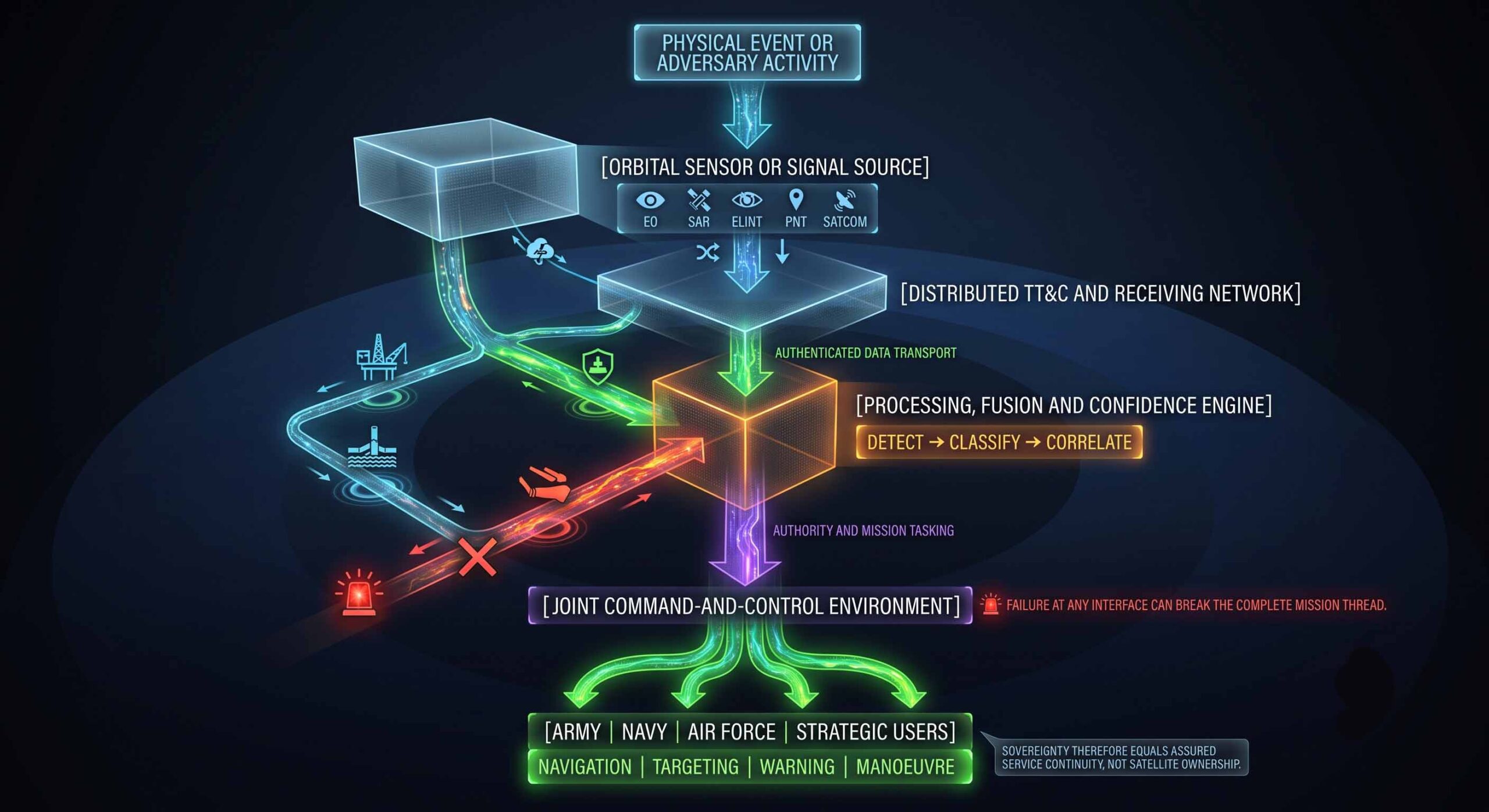
Orbital architecture: from exquisite platforms to distributed mission threads
India’s orbital architecture must evolve from spacecraft ownership toward service assurance. The Indian Space Policy 2023 explicitly permits non-governmental entities to conduct end-to-end space activities, including the establishment and operation of space objects and ground assets, while directing the state to encourage private participation across the entire value chain — Indian Space Policy 2023 – Department of Space, Government of India – April 2023 — verified policy document. This creates the legal-economic basis for a mixed sovereign architecture, but national-security use requires controls that a civil market framework does not automatically provide: assured access during crisis, security accreditation, priority allocation, protected command links, trusted ownership, cyber reporting, geographic redundancy and government rights to surge or requisition capacity. Orbital resilience should be built through diversification across geostationary, inclined geosynchronous, medium-Earth and low-Earth orbits, because each offers different coverage, latency, persistence, launch and survivability properties. Large geostationary satellites provide continuous regional coverage and high-capacity communications but create conspicuous, expensive and slowly replaceable nodes. Low-Earth constellations offer lower latency, higher revisit rates and architectural proliferation, but require more satellites, gateways, tracking capacity, crosslinks and automated constellation management. Medium-Earth and inclined geosynchronous assets can strengthen navigation and regional persistence but remain susceptible to interference and orbital predictability. The verified NavIC record illustrates both progress and fragility. As of 7 August 2025, the government reported eleven satellites placed in orbit, with four providing PNT services, four used for one-way message broadcast and one decommissioned after end of life — Atmanirbharta in Space – Press Information Bureau, Government of India – August 2025 — verified official NavIC status. The more revealing case is NVS-02: it reached its intended transfer orbit on 29 January 2025, but orbit raising could not proceed because oxidiser-feed valves to the thrusters did not open — Department of Space Year End Review 2025 – Press Information Bureau, Government of India – December 2025 — verified mission-status record. This does not imply systemic failure, but it demonstrates why architecture must tolerate individual spacecraft underperformance without losing an entire service.
Integrated Space Combat Mission Thread
PHYSICAL EVENT OR ADVERSARY ACTIVITY
[Orbital sensor or signal source]
EO │ SAR │ ELINT │ PNT │ SATCOM
[Distributed TT&C and receiving network]
[Processing, fusion and confidence engine]
[Joint command-and-control environment]
[Army │ Navy │ Air Force │ Strategic users]
Failure Vector
Failure at any interface can break the complete mission thread.
Sovereignty therefore equals assured service continuity, not satellite ownership.
Ground infrastructure and the hidden concentration problem
Ground infrastructure is the most under-observed component of military-space power because satellites attract public attention while receiving stations, control software, data centres, spectrum-management facilities, cryptographic authorities, timing laboratories, calibration ranges and military terminals remain dispersed across institutional budgets or classified programmes. Yet ground systems offer an adversary more accessible attack surfaces than spacecraft. They can be targeted through malware, compromised administrative credentials, insider access, supply-chain implants, denial-of-service attacks, physical sabotage, power interruption, fibre cuts, jamming, spoofing or corruption of mission-planning and orbital data. The European Union’s official security strategy is relevant as a comparative architecture because it defines the space domain as encompassing spacecraft, ground and launch infrastructure, radio-frequency links, user terminals, cyber systems and the industrial sector; it consequently connects technological sovereignty to reduced external dependency, secured supply chains, responsive launch, sovereign cloud capacity and space-domain awareness — European Union Space Strategy for Security and Defence – European Commission and High Representative – March 2023 — verified strategy text. India requires an equivalent end-to-end security model adapted to its geography and civil-military structure. At minimum, every military mission should have a primary control site, a geographically separate hot backup, an alternate communications path, offline recovery images, independently held cryptographic material, degraded-mode procedures and a tested path for transferring control between organisations. Distributed infrastructure must not merely duplicate hardware; it must eliminate common-mode dependencies such as the same cloud provider, software build, identity service, fibre route, foreign network-management product or electricity corridor. The ground layer also determines exploitation speed. Raw imagery that takes hours to reach an analyst or requires manual service-to-service transfer cannot support time-sensitive targeting despite high satellite resolution. For 2026–2031, the decisive performance indicators should include median collection-to-decision latency, percentage of missions supportable after losing the largest ground node, number of independently recoverable command sites, cryptographic rekeying time, terminal availability by operational formation, and frequency of full failover exercises.
| Ground-segment control | Minimum sovereign requirement | Observable verification indicator | Warning threshold |
|---|---|---|---|
| Satellite command | Authenticated, encrypted and independently recoverable control | Public evidence of alternate control centres or failover exercises | One centre or one software stack controls a critical fleet |
| Data reception | Geographic and network diversity | Multiple receiving sites and cross-service access | Dependence on a single gateway or fibre corridor |
| Processing | Trusted software, provenance and scalable compute | Common data standards and automated fusion demonstrations | Service-specific silos requiring manual transfer |
| Timing | National reference and distributed backup | Indigenous clocks, holdover capability and cross-checking | Unverified dependence on one external GNSS source |
| Cyber defence | Continuous monitoring and signed configurations | Red-team exercises, vulnerability reporting and secure update processes | Unauthenticated updates or weak supplier visibility |
| Spectrum defence | Detection, geolocation and mitigation of interference | Deployed monitoring network and anti-jam terminal procurement | Interference observed without rapid attribution |
| User terminals | Large-scale, interoperable and upgradable deployment | Repeat orders and fielded common terminals | Satellite capacity without adequate deployed receivers |
| Continuity | Tested degraded-mode operation | Regular loss-of-node and loss-of-GNSS exercises | Resilience exists only in design documentation |
Military users and the conversion of space data into force
Military users determine whether sovereign space technology produces operational advantage or merely technological prestige. The Indian Army requires assured navigation, blue-force tracking, beyond-line-of-sight communications, terrain intelligence, border surveillance, weather support and targeting data across mountains, deserts and dispersed formations. The Navy requires wide-area maritime-domain awareness, ship and submarine communications, ocean surveillance, electronic intelligence, precision timing and resilient connectivity across the Indian Ocean. The Air Force requires missile warning, air and space surveillance, secure data links, navigation, targeting support, weather information and joint sensor fusion. Strategic users require authenticated warning, highly reliable communications, precise timing and decision systems engineered against false data and ambiguous attack indications. These demands are not technically interchangeable. A naval terminal faces electromagnetic, saltwater, platform-motion and low-observability constraints; an army receiver must be rugged, low-power and numerically widespread; an airborne terminal must meet weight, aerodynamic, security and high-dynamic requirements; strategic communications demand exceptional availability and controlled access. The Ministry of Defence’s Technology Perspective and Capability Roadmap 2025 is explicitly intended to give industry visibility into armed-forces requirements over a fifteen-year horizon — Technology Perspective and Capability Roadmap 2025 – Ministry of Defence, Government of India – 2025 — verified official roadmap. The governance challenge is to prevent each service from acquiring technically different solutions for structurally similar needs. Common cryptographic interfaces, waveform standards, metadata schemas, timing protocols, identity controls and application-programming interfaces should be mandatory wherever operational security permits. Hardware may remain mission-specific, but the data and command architecture must be joint. The five-year execution test is therefore not the number of DRDO demonstrations; it is whether a sensor developed in one laboratory can task, communicate and exchange authenticated products through shared infrastructure to multiple services without bespoke integration each time. Space sovereignty reaches maturity only when military formations train under denied or deceptive conditions and continue operating through alternative PNT sources, reduced-bandwidth communications, delayed imagery and partially compromised networks.
Industrial capacity, production depth and liquidity flows
Industrial capacity transforms scientific autonomy into wartime endurance, but the financial structure of space electronics creates predictable bottlenecks. Space-qualified components combine low production volumes, expensive testing, long qualification periods and uncertain demand; ordinary commercial finance therefore tends to underinvest unless government procurement creates credible multi-year demand. India has opened the civil space value chain to private firms and reports measurable commercial scaling. As of 31 January 2026, IN-SPACe had facilitated 71 technology transfers to industry and start-ups; six Indian non-governmental entities had launched eighteen satellites; and NSIL revenue had increased from ₹321.77 crore in FY2021–2022 to ₹3,246.09 crore in FY2024–2025 — Building India’s Space Future – Press Information Bureau, Government of India – June 2026 — verified official reform review. ISRO separately reported that IN-SPACe, NSIL and ISRO had reached one hundred technology-transfer agreements with non-governmental entities during FY2025–2026 — ISRO Achievements during FY2025–2026 – Indian Space Research Organisation – March 2026 — verified official achievements report. These figures confirm ecosystem expansion but do not demonstrate military qualification, surge capacity or sovereign component control. Liquidity must reach the difficult middle between early research grants and large production contracts: environmental testing, radiation campaigns, secure facilities, precision manufacturing, certification personnel, specialist inventory and repeated flight demonstrations. DRDO’s 2025 SAMANVAY event transferred twelve licences covering eight ECS products and involved more than 150 industry partners, indicating an active technology-transfer mechanism — DRDO Newsletter, December 2025 – Defence Research and Development Organisation – November 2025 — verified DRDO newsletter. The financial risk is that firms accept licences but lack order visibility, working capital or export-scale demand, leaving the state with a technology theoretically transferred but no durable production line. A sovereign architecture therefore requires advance market commitments, milestone contracts, shared test infrastructure, second-source incentives and government acquisition of strategic inventory before crisis rather than after disruption.
| Capital channel | Function | Strength | Structural weakness | Required governance response |
|---|---|---|---|---|
| DRDO project funding | Develop denied or high-risk technology | Mission focus and security control | Can end at prototype completion | Tie closure criteria to qualification and production transfer |
| Service procurement | Create operational demand | Converts technology into fielded capability | Long cycles and fragmented requirements | Multi-year joint procurement with common standards |
| IN-SPACe promotion | Expand non-governmental participation | Broadens supplier and innovation base | Civil success may not satisfy military assurance | Dedicated defence-security accreditation pathway |
| NSIL commercialisation | Aggregate and sell space services | Creates revenue and market discipline | Commercial optimisation may conflict with wartime reserve needs | Contracted priority-access and continuity clauses |
| Venture capital | Fund rapid experimentation | Speed and risk tolerance | Avoids long, capital-intensive qualification | Blended finance and government-backed milestone demand |
| DPSU balance sheets | Support large integration programmes | Scale, facilities and government relationship | Potentially slower refresh and weaker competitive pressure | Modular competition and mandatory private participation |
| Strategic inventory | Protect against export denial and shocks | Immediate resilience | Obsolescence and carrying cost | Rotating stockpiles tied to approved component baselines |
| Export revenue | Increase production runs and lower unit cost | Supports manufacturing depth | Security, licensing and end-use risks | Tiered export controls and configuration separation |
Programme governance and the accountability gap
Programme governance is the architecture’s controlling variable because no single Indian organisation owns every layer. DRDO conducts defence research; ISRO retains deep expertise in launch vehicles, spacecraft, navigation, remote sensing, tracking and mission operations; NSIL commercialises space products and services; IN-SPACe promotes and authorises non-governmental activities; the Defence Space Agency performs military integration; service headquarters define operational requirements; the Department of Telecommunications and spectrum institutions affect frequency access; and industrial partners manufacture hardware and software. This distribution can generate innovation and checks, but it also creates interface risk. A programme may satisfy the laboratory, spacecraft, launch and service stakeholders separately while failing the end-to-end mission. Governance must therefore be organised around named mission threads rather than institutions: assured PNT, protected SATCOM, persistent ISR, missile warning, space-domain awareness and responsive replenishment. Each thread requires one accountable mission executive with authority over interface standards, test criteria, schedule integration and operational acceptance, while ownership of laboratories and platforms can remain distributed. Budget transparency illustrates the current analytical limitation. The 2026–2027 budget provides ₹11,850 crore for Defence Services research and development, compared with a revised ₹11,403 crore in 2025–2026, an increase of approximately 3.9%; however, the published demand does not identify the share allocated to space electronics — Notes on Demands for Grants 2026–2027, Demand No. 20 – Ministry of Finance, Government of India – February 2026 — verified expenditure document. Moreover, the 2026–2027 amount remains slightly below the original 2025–2026 budget estimate of ₹11,893 crore, demonstrating why comparisons must distinguish budget estimates from revised expenditure. Governance quality should consequently be measured through delivery indicators rather than aggregate allocations: percentage of projects reaching production within two years of technical completion; number of common interfaces adopted across services; indigenous value at the component rather than final-system level; time between flight demonstration and operational order; availability under simulated node loss; and number of qualified second sources.
| Governance gate | Decision question | Evidence required | Authority that must participate |
|---|---|---|---|
| Mission need | What operational effect must survive denial? | Threat model, service concept and minimum service level | Services, DSA, intelligence and MoD |
| Architecture | Which orbital, ground and user elements deliver it? | End-to-end mission-thread model | DSA, ISRO, DRDO and users |
| Sovereignty review | Which dependencies are externally controllable? | Component ledger, IP map and supplier ownership | DRDO, industry, security authorities |
| Technology maturity | Does performance persist in the relevant environment? | Radiation, thermal, vibration, cyber and electronic-warfare testing | DRDO, qualification bodies and users |
| Production readiness | Can multiple operational units be equipped and losses replaced? | Yield, throughput, lead-time and second-source data | Industry, DPSUs and procurement authorities |
| Operational acceptance | Does the service work under degraded conditions? | Joint exercises, failover and adversarial testing | Services and joint command |
| Sustainment | Can software, keys, parts and skills be maintained for mission life? | Configuration baseline, inventory and workforce plan | Programme office and industrial partners |
| Crisis transition | Who allocates commercial and civil capacity during conflict? | Pre-negotiated authorities and priority contracts | MoD, Department of Space, operators and cabinet-level authority |
Competing hypotheses and Bayesian update structure
The Analysis of Competing Hypotheses produces five mutually distinguishable 2031 outcomes. H₁, Selective Sovereignty, begins with a 55% prior and rises to a 61% posterior because verified evidence supports laboratory competence, an expanding private ecosystem, a formal long-term capability roadmap, NavIC continuation and growing technology transfer, while the component, ground-infrastructure and joint-integration gaps remain unresolved in public evidence. H₂, Integrated Military-Space Architecture, moves from a 15% prior to 21% because policy reform, commercial growth, launch capability and institutional specialisation could interact positively, but its confirmation requires visible common standards, proliferated assets, protected terminals and routine joint denial exercises. H₃, Fragmented Modernisation, falls from a 20% prior to 13% because current reforms reduce but do not eliminate silo risk. H₄, Commercially Enabled Dependency, receives a 10% posterior as an exclusive dominant outcome: private capacity expands rapidly, but government policy explicitly allows direct procurement from public or private sources, which could accelerate capability while creating foreign cloud, component, capital, insurance or service dependencies if security conditions remain incomplete. H₅, Strategic Discontinuity, is assessed at 5% after separating it from ordinary fragmentation; it represents an export-control shock, severe launch or programme failure, major cyber compromise or regional conflict that interrupts the architecture rather than merely delaying it. The posterior probabilities are structured judgments, not statistically observed frequencies. They should be updated through likelihood ratios assigned to future indicators. A successful flight of an indigenous radiation-tolerant processor should favour H₁ and H₂; a repeat production order and deployment across services should favour H₂ more strongly; repeated prototype announcements without procurement should favour H₃; reliance on foreign-operated commercial constellations for core missions should favour H₄; and simultaneous component denial plus launch or cyber disruption should sharply increase H₅.
| Hypothesis | Prior | 2026 posterior | Confirming evidence | High-value disconfirmation |
|---|---|---|---|---|
| H₁ Selective sovereignty | 55% | 61% | Indigenous competence in selected payloads, receivers, radars, communications and clocks; continued external dependencies | Verified full domestic control of several complete component-to-user chains |
| H₂ Integrated architecture | 15% | 21% | Joint standards, distributed constellations, crosslinks, protected terminals, denial exercises | Service-specific networks and prototype-only delivery |
| H₃ Fragmented modernisation | 20% | 13% | Schedule divergence, duplicated requirements and weak production conversion | Named mission executives and measurable joint acceptance |
| H₄ Commercially enabled dependency | 5% | 10% | Foreign components, capital, cloud or services become indispensable | Enforceable sovereign-control clauses and domestic alternatives |
| H₅ Strategic discontinuity | 5% | 5% | Coordinated supply, cyber, launch or regional-security shock | Proven continuity under multi-node and supplier loss |
| Bayesian indicator, 2026–2031 | Update toward | Indicative likelihood effect | Collection requirement |
|---|---|---|---|
| Indigenous processor completes orbital demonstration | H₁, H₂ | Strong | Confirm design authority, fabrication source and radiation data |
| Protected PNT terminal ordered across all three services | H₂ | Very strong | Identify quantities, common interfaces and anti-jam performance |
| Multiple ECS technologies licensed but no production orders | H₃ | Strong | Compare licensing dates with procurement and delivery records |
| Commercial imagery becomes core military source without priority guarantees | H₄ | Strong | Examine contracts, ownership, hosting and crisis-access terms |
| Distributed ground-control failover publicly demonstrated | H₂ | Strong | Verify geographic, software and identity-provider independence |
| Repeated orbital or propulsion anomaly affects constellation continuity | H₃, H₅ | Moderate to strong | Determine common cause and replacement schedule |
| Export controls cover RF, radiation-hardened or photonic components | H₁ negatively; H₅ positively | Strong | Map inventories, alternative suppliers and redesign time |
| Common military-space data standard issued | H₂ | Strong | Verify implementation, not merely publication |
| Joint loss-of-GNSS exercise exposes widespread receiver failure | H₃ | Very strong | Record affected formations and corrective procurement |
| Second launch or integration source becomes operational | H₁, H₂ | Moderate | Verify throughput, payload envelope and readiness time |
Shadow dimensions: cyber norms, commercial proxies and coercible capital
The “shadow” architecture is formed by relationships not visible in a satellite inventory: software maintainers, cloud providers, component distributors, venture investors, insurers, launch brokers, ground-station partners, spectrum coordinators, cyber contractors and foreign licensors. Traditional mercenary dynamics have limited direct relevance to India’s space-electronics sector, but their functional analogue is the commercial or quasi-commercial proxy that supplies intelligence, communications, cyber access or technical operations while remaining outside a conventional military chain of command. Such actors can create deniability, accelerate capability and complicate attribution, especially when cyber operations against ground infrastructure are staged through criminal infrastructure or contractors. The most probable opening moves in a space confrontation are reversible or ambiguously attributable—jamming, spoofing, cyber intrusion, data corruption, dazzling or proximity activity—because they can impose operational cost below the threshold associated with debris-producing kinetic attack. European evidence reinforces this risk model: the EU reports more than 150 satellite-interference incidents worldwide during 2022, spanning signal jamming and hacking attempts — Space, Security and Defence – Council of the European Union – January 2025 — verified EU policy overview. The proposed European space framework also explicitly treats cyberattacks, jamming, spoofing, indicators of compromise and threat-actor tactics as information that space operators should share — Proposal for a Regulation on the Safety, Resilience and Sustainability of Space Activities – European Commission – June 2025 — verified proposed regulation. For India, this means sovereign architecture must include a classified space-sector information-sharing mechanism, mandatory incident reporting, threat-informed software assurance, contractual audit rights and pre-agreed government access during emergencies. Liquidity itself can become coercible when firms depend on foreign venture capital, offshore holding structures, insurance exclusions, export-credit conditions or a single civilian customer. Security review should therefore examine beneficial ownership, debt covenants, intellectual-property location, key-person dependency and whether a supplier could continue operating for twelve months if foreign capital, cloud access or component deliveries ceased.
Regional comparison and the Chinese pacing architecture
China supplies the most consequential regional comparison because its official architecture integrates state planning, large-scale launch activity, remote sensing, communications, navigation, tracking, industrial standardisation and national-security objectives. The Chinese government reported that the completed third-generation BeiDou system comprised 30 satellites and offered positioning, navigation, timing, short-message communication, search and rescue, augmentation and precise-point-positioning services. Its declared next-stage plan includes high- and low-orbit communications coordination, next-generation navigation-communications integration, low-orbit PNT augmentation, improved remote-sensing and navigation ground systems, high-speed laser links, autonomous spacecraft management, in-orbit servicing and stronger space-debris monitoring — China’s Space Program: A 2021 Perspective – State Council Information Office of the People’s Republic of China – January 2022 — verified Chinese government white paper. India should not imitate this architecture mechanically: its industrial system, alliance posture, civil institutions and resource envelope differ. The relevant lesson is architectural integration. China’s advantage is not any single satellite but the interaction among constellation scale, launch cadence, terminals, data processing, manufacturing, standards and military doctrine. Russian-language military publications provide a second, more limited cross-check. The April 2026 edition of the Russian Ministry of Defence journal Voennaya Mysl discusses military or dual-use spacecraft for communications, reconnaissance, observation, maritime intelligence and electronic intelligence, confirming that Russian military analysis also treats orbital services as part of a broader reconnaissance-electronic-warfare complex — Военная Мысль, No. 4 – Ministry of Defence of the Russian Federation – April 2026 — verified Russian-language military journal. These sources do not prove adversary intent against India, but they establish the capability environment in which Indian systems must function. India’s objective by 2031 should be regional denial resilience: sufficient distribution, protection, attribution and recovery to prevent an opponent from achieving decisive advantage by disrupting a small number of orbital or ground nodes.
Five-year execution pathway and measurable end-state
The most credible 2026–2031 pathway begins with enabling technologies and converges gradually on joint operational services. During 2026–2027, DRDO should prioritise the sovereign-component ledger, common payload interfaces, secure processors, anti-jam receivers, electronically steerable terminals, RF and electro-optical component qualification, distributed ground-control design and threat-informed cybersecurity standards. During 2027–2028, these technologies should move into orbital demonstrations and production-representative prototypes rather than isolated laboratory tests; crosslinks, autonomous fault management, onboard processing and joint metadata standards become central. During 2028–2029, the armed services should field common receiver families, perform loss-of-GNSS and loss-of-ground-node exercises, integrate commercial providers under wartime-access contracts and demonstrate multi-orbit routing. During 2029–2030, the system should test rapid reconstitution through reserve spacecraft, responsive launch or hosted payloads, while missile-warning and wide-area persistent ISR prototypes undergo adversarial evaluation. By 2030–2031, governance should shift from project completion to quantified service assurance: how much PNT accuracy, communications capacity, revisit frequency, warning time and command connectivity remains after specified losses. India’s broader launch and industrial base is expanding: an official June 2026 government review states that the country possesses launch systems capable of placing up to ten tonnes into low-Earth orbit and 4.2 tonnes into geosynchronous transfer orbit, while a third launch pad and private-sector technology transfers are increasing infrastructure depth — Building India’s Space Future – Press Information Bureau, Government of India – June 2026 — verified official space-sector review. The remaining execution gap is to convert national launch capability and research competence into military systems that can be produced, controlled, defended and replaced under pressure.
| Period | Technical objective | Industrial objective | Governance objective | Operational validation | Principal risk |
|---|---|---|---|---|---|
| 2026–2027 | Component ledger; protected receivers; secure payload computing | Identify second sources and qualification capacity | Assign mission executives and common standards | Laboratory and hardware-in-loop denial tests | Lab-centric activity without production design |
| 2027–2028 | Orbital demonstrations; crosslinks; onboard processing | Production-representative prototypes | Unified security accreditation | Demonstrate authenticated multi-node data flow | Demonstrator not representative of deployable hardware |
| 2028–2029 | Multi-orbit communications and ISR integration | Repeat orders and terminal scaling | Joint service acceptance framework | Loss-of-GNSS and loss-of-gateway exercises | Terminal shortage and service silos |
| 2029–2030 | Replenishment, hosted payloads and advanced warning sensors | Reserve inventory and surge contracts | Crisis allocation of civil-commercial capacity | Replacement and failover demonstration | Launch, insurance or supplier bottleneck |
| 2030–2031 | End-to-end assured mission threads | Sustained production and upgrade pipeline | Service-level accountability | Multi-domain contested-space exercise | Capability exists but cannot survive coordinated attack |
| 2031 key performance indicator | Threshold for credible selective sovereignty | Threshold for integrated sovereignty |
|---|---|---|
| Critical mission chains with component-level dependency maps | 100% | 100% plus audited second-source plans |
| Critical electronics with two qualified supply paths | More than 60% | More than 80% |
| Essential spacecraft controllable from independent sites | More than 75% | More than 90% |
| Military-space software with signed reproducible baselines | More than 80% | More than 95% |
| Operational formations equipped with protected PNT | More than 60% | More than 85% |
| Critical SATCOM capacity surviving loss of largest node | More than 50% | More than 70% |
| Priority ISR products delivered within operational timelines | More than 70% | More than 90% |
| Mission threads exercised under cyber-electromagnetic denial | Annual | Semi-annual and multi-service |
| Replacement path for selected small-satellite losses | Demonstrated within twelve months | Demonstrated within six months |
| Space-sector security incidents shared through trusted mechanism | Major incidents | Mandatory near-real-time reporting |
Net assessment
India is likely to achieve meaningful but uneven military-space sovereignty by 2031. The strongest pathway runs through DRDO’s transition from complete-system ownership toward high-value enabling technologies that can be inserted across multiple spacecraft, ground systems and service applications. That transition will succeed only if “niche technology” is defined operationally: a radiation-tolerant processor matters because it keeps an ISR payload functioning; an atomic clock matters because it sustains PNT and network timing; a phased-array terminal matters because it preserves communications under manoeuvre and interference; an optical detector matters because it shortens warning time; secure firmware matters because it prevents a ground-system intrusion from becoming an orbital loss. The baseline posterior assigns 61% to selective sovereignty, 21% to a more integrated architecture, 13% to fragmented modernisation and 5% to strategic discontinuity. The model’s central uncertainty is not scientific talent but conversion capacity: programme governance, component transparency, qualification infrastructure, production demand, terminal deployment, joint standards and repeated adversarial testing. The most dangerous false positive would be a large nominal increase in satellite numbers accompanied by concentrated ground control, imported electronics, inadequate user terminals and slow data fusion. The most important positive indicator would be the operational demonstration of one complete mission thread—preferably protected PNT or resilient SATCOM—that continues functioning after simulated jamming, cyber compromise, gateway loss and supplier interruption. Once such a model is institutionalised, it can be extended to ISR, missile warning and space-domain awareness. Until then, India will possess increasingly capable space assets without fully controlling the conditions under which those assets remain militarily useful.
Contested-Space Risk: India, China and the 2031 Escalation Architecture
The threat is a system, not a weapon
Contested-space risk cannot be reduced to anti-satellite missiles because the operational objective of a counterspace campaign is rarely the physical destruction of a spacecraft in isolation. Its purpose is to interrupt the military service produced by the complete space system: observation, communications, navigation, timing, missile warning, targeting support, weather intelligence or command connectivity. The European Union’s official threat framework usefully defines counterspace as intentional activity directed against spacecraft, ground infrastructure or the links connecting them, capable of disrupting, degrading, destroying, deceiving or denying a space service, or of inspecting, manipulating, intercepting or exploiting its data — European Union Space Strategy for Security and Defence – European Commission and High Representative – March 2023 — verified official strategy. This definition exposes the central analytical error in platform-centric assessments: a satellite can remain physically intact while its mission has already failed because a receiver is spoofed, a downlink is jammed, a ground network is compromised, a processing system is corrupted, or commanders no longer trust the resulting data. For India, the five-year threat is therefore a multi-layer competition across orbit, cyberspace, the electromagnetic spectrum, terrestrial infrastructure, commercial contracts and political signalling. China is the primary pacing pressure because it combines an expanding space-support architecture with counterspace capabilities attributed by multiple government intelligence assessments, but Pakistan, Russia-derived doctrines and technologies, commercial-proxy access, criminal cyber infrastructure and non-state interference must also enter the model. The most probable opening of a future crisis is not a spectacular debris-producing strike. It is a sequence of ambiguous, reversible and selectively applied effects designed to impair Indian decision-making while preserving escalation control: interference with PNT or SATCOM; probing of ground networks; manipulation of space-derived data; cyber operations against contractors; and political messaging that attributes disruption to technical malfunction, local actors or ordinary congestion. India’s central requirement is consequently not invulnerability—an impossible standard—but rapid detection, service-level attribution, graceful degradation and credible response options across domains.
| Counterspace family | Principal target | Intended operational effect | Reversibility | Attribution difficulty | Escalation salience |
|---|---|---|---|---|---|
| Radio-frequency jamming | Uplinks, downlinks, PNT receivers, SATCOM terminals | Deny or reduce availability | Usually high | High when emitters are mobile, intermittent or proxied | Low to medium |
| Signal spoofing | PNT receivers, timing networks, navigation-dependent weapons | Generate false position, velocity or time | High if detected rapidly | High because malfunction and deception can resemble each other | Medium |
| Cyber intrusion | Ground stations, control software, contractors, data pipelines | Steal, alter, interrupt or pre-position access | Variable | Very high without strong telemetry and intelligence fusion | Low initially; potentially high by effect |
| Data poisoning | ISR processing, machine-learning systems, catalogues and decision support | Corrupt confidence or create false conclusions | High before operational action; low afterward | Very high | Medium to high |
| Directed energy | Optical sensors or spacecraft electronics | Dazzle, degrade or damage | From temporary to irreversible | Medium; depends on sensor coverage | Medium to high |
| Co-orbital activity | Spacecraft and orbital vicinity | Inspect, shadow, interfere or potentially attack | Variable | Medium because dual-use servicing resembles hostile proximity | High |
| Direct-ascent interception | Spacecraft in reachable orbit | Physically destroy a satellite | Irreversible | Comparatively low after launch and impact | Very high |
| Ground-site attack | Tracking, control, processing, power and communications infrastructure | Remove control or exploitation capability | Variable | Low if overt; higher through sabotage or proxies | High |
| Supply-chain compromise | Hardware, firmware, software updates and maintenance | Pre-position latent failure or intelligence access | Potentially persistent | Extremely high | Low until exposed; strategically high afterward |
| Legal-commercial denial | Commercial capacity, insurance, licensing, cloud or foreign services | Restrict wartime access without kinetic action | High | Low, but responsibility may be dispersed | Low militarily; high operationally |
The counterspace attack chain
A counterspace attack chain is best represented as an intelligence-to-effects process rather than a list of weapons. The first phase is dependency mapping: identifying which orbital assets, gateways, terminals, timing sources, processing centres, commercial suppliers and human operators support a target military mission. The second is persistent access and characterization, using space surveillance, electromagnetic observation, cyber reconnaissance, commercial data, supply-chain knowledge and organisational intelligence to establish the target’s normal behaviour. The third is pre-crisis preparation: obtaining credentials, identifying exploitable suppliers, positioning jamming systems, training orbital surveillance, creating plausible technical cover stories and testing adversary reactions through low-level interference. The fourth is selective shaping, during which the attacker combines disinformation, cyber probing, short-duration interference or anomalous orbital behaviour to consume defender attention and measure attribution speed. The fifth phase produces mission effects, beginning with reversible denial or deception and potentially moving toward persistent cyber disruption, physical ground attack, directed-energy damage, co-orbital interference or direct-ascent destruction. The sixth is exploitation: conventional military forces act during the defender’s degraded information window, for example when ISR revisit, communications, timing or command confidence has declined. The seventh is narrative and escalation management, in which the attacker denies responsibility, characterises the action as defensive, threatens additional costs or proposes de-escalation after achieving a terrestrial advantage. The U.S. Defense Intelligence Agency assesses that China and Russia have pursued jamming, cyber, directed-energy, on-orbit and ground-launched anti-satellite capabilities spanning reversible and irreversible effects — Challenges to Security in Space 2022 – U.S. Defense Intelligence Agency – April 2022 — verified official intelligence assessment. This source expresses a U.S. government assessment rather than an independently observable inventory; it must be read alongside China’s public doctrine and programmes. The analytic implication for India is nevertheless robust: counterspace defence must break the attack chain before the final effect, particularly at the stages of dependency reconnaissance, cyber persistence, electronic characterization and narrative preparation.
| Attack-chain phase | Attacker requirement | Defender’s observable signal | Indian defensive priority | Failure consequence |
|---|---|---|---|---|
| Dependency mapping | Knowledge of service architecture | Scanning, supplier enquiries, unusual data acquisition | Classify dependency maps and reduce public technical exposure | Adversary identifies single points of failure |
| Characterization | Baseline orbital, RF and cyber behaviour | Persistent tracking, spectrum collection or contractor targeting | Fuse SDA, SIGINT, cyber and counterintelligence | Defender sees incidents separately |
| Pre-positioning | Access, equipment or proximate capability | Dormant accounts, anomalous software, recurring interference | Threat hunting and supplier assurance | Attack can begin without visible mobilisation |
| Shaping | Controlled low-level effects | Short outages, false alarms and inconsistent telemetry | Record weak signals and compare across domains | Defender normalises hostile preparation |
| Reversible effect | Jamming, spoofing or network interruption | Loss of signal, navigation anomalies or authentication failures | Multi-source PNT, protected waveforms and failover | Mission degradation without clear armed-attack threshold |
| Persistent effect | Deep cyber access or sustained denial | Configuration drift, altered data or prolonged interference | Independent recovery, signed baselines and isolation | Long operational window for adversary |
| Irreversible effect | Physical or destructive energy attack | Launch, collision, permanent hardware failure or ground damage | Distribution, manoeuvrability and replenishment | Permanent capacity loss and debris risk |
| Exploitation | Ready conventional force | Correlated terrestrial mobilisation | Joint warning across domains | Space disruption enables terrestrial surprise |
| Narrative control | Information advantage and diplomatic preparation | Coordinated denial and legal claims | Pre-planned evidence release and allied consultation | Attacker shapes international interpretation |
China’s pacing pressure: scale, integration and dual-use ambiguity
China’s pacing pressure arises from the integration of its civil, commercial, military and scientific space capabilities rather than any single publicised counterspace weapon. China’s official 2022 space white paper states that the country had completed the 30-satellite BeiDou-3 system, improved high-resolution Earth observation, expanded high-capacity communications and established increasingly integrated telemetry, tracking and command infrastructure. Its declared development programme included coordinated high- and low-orbit communications, navigation-communications integration, low-orbit PNT augmentation, laser communications, intelligent spacecraft management, in-orbit servicing, improved space-object monitoring, collision avoidance, disaster backup, information protection and increased survivability — China’s Space Program: A 2021 Perspective – State Council Information Office of the People’s Republic of China – January 2022 — verified Chinese government white paper. These are publicly framed as peaceful, developmental and protective programmes. Many are genuinely civilian or scientific; however, space-domain awareness, proximity operations, robotic servicing, high-rate communications, autonomous manoeuvre and protected ground networks are inherently dual-use because the same competence that permits safe inspection or repair can also support characterization, interference or coercion. External government assessments supply the countervailing view. The U.S. Department of Defense’s 2024 China report assessed that the PRC was developing satellite jammers, offensive cyber capabilities and directed-energy weapons; possessed an operational direct-ascent capability against low-Earth-orbit satellites; was improving surveillance of space objects; and had conducted sophisticated orbital activity with technologies potentially applicable to counterspace missions — Military and Security Developments Involving the People’s Republic of China 2024 – U.S. Department of Defense – December 2024 — verified official report. The 2025 U.S. intelligence assessment similarly judged that China had fielded ground-based electronic-warfare, directed-energy and anti-satellite capabilities and had demonstrated orbital techniques relevant to future counterspace operations — Annual Threat Assessment of the U.S. Intelligence Community – Office of the Director of National Intelligence – March 2025 — verified official assessment. These claims remain attributed assessments; they should not be silently converted into verified Chinese declarations.
| Pacing dimension | China’s verified declared development | Capability attributed by U.S. government sources | Pressure on India |
|---|---|---|---|
| PNT | BeiDou global services; next-generation integration and low-orbit augmentation | Ability to support precision operations independently of foreign GNSS | India must protect and deepen NavIC while enabling multi-source navigation |
| ISR | High-resolution, multi-spectral, maritime, atmospheric and commercial remote sensing | Expanding military surveillance and targeting support | Indian forces face shorter concealment windows |
| SATCOM | High-capacity GEO systems, mobile services, relay satellites and high-low orbit coordination | More resilient military communications and command connectivity | India requires protected, distributed and multi-orbit communications |
| Space-domain awareness | Improved debris monitoring, cataloguing, warning and event perception | Surveillance that supports counterspace targeting and characterization | India needs continuous tracking plus intent analysis |
| Proximity operations | Servicing, maintenance, mission-extension and debris-removal research | Dual-use foundation for co-orbital counterspace activity | India must establish behavioural baselines and proximity-response protocols |
| Directed energy | Public emphasis on advanced space technology without counterspace admission | Development of systems capable of dazzling or damaging sensors | Optical payloads require detection, shielding and operational redundancy |
| Electronic warfare | Public military material recognises space and cyber as strategic domains | Satellite communications and navigation jamming capabilities | Indian PNT and SATCOM must be designed for contested-spectrum operation |
| Cyber | National cyber defence, situation awareness and information protection | Offensive access intended to disrupt military networks and critical systems | Ground and commercial space sectors become first-line security targets |
| Launch and replenishment | Diverse launch vehicles, multiple sites and commercial launch development | Ability to deploy and replace orbital capabilities at increasing tempo | Indian deterrence depends partly on replacement credibility |
| Industrial base | Coordinated research institutes, enterprises, universities and users | Large-scale production and technology-refresh potential | India must shorten prototype-to-production cycles |
Cyber-electromagnetic convergence
Cyber and electromagnetic operations converge because modern satellite services are software-defined systems carried across radio-frequency links. Jamming prevents a receiver from obtaining a usable signal; spoofing supplies a false but plausible signal; cyber intrusion alters the software, configuration, identity or data that determines how the system interprets that signal. When synchronized, the effects become more powerful than either domain alone. An attacker may use electromagnetic interference to force a system into backup mode while exploiting weaker cyber protections in the alternate channel; create navigation anomalies while compromising monitoring software so operators misclassify spoofing as equipment failure; disrupt communications while injecting false maintenance messages; or corrupt a space-object catalogue while creating ambiguous orbital behaviour. The relevant attack surface includes mission-control networks, commercial teleports, remote maintenance paths, software repositories, identity providers, cloud analytics, contractor laptops, user terminals, encryption-key infrastructure, firmware update processes and data-distribution systems. The U.S. 2026 threat assessment warns that expanding dependence on satellite communications is increasing exploitable cyber vulnerabilities associated with space services; it also assesses that extreme counterspace developments, including a possible nuclear anti-satellite capability, could create systemic effects extending well beyond a single target — Annual Threat Assessment of the U.S. Intelligence Community – Office of the Director of National Intelligence – March 2026 — verified official assessment. The nuclear claim is an intelligence-community judgment concerning Russian development, not a confirmed deployed capability, but it highlights the upper boundary of systemic space risk. At the lower and more probable end, electromagnetic-cyber convergence creates attribution problems because defenders must distinguish environmental disturbance, equipment fault, operator error, criminal intrusion and state action in near real time. India’s Technology Perspective and Capability Roadmap 2025 explicitly calls for systems that are cyber-hardened and capable of operating in intense electronic-warfare environments with counter-jamming characteristics — Technology Perspective and Capability Roadmap 2025 – Ministry of Defence, Government of India – 2025 — verified official roadmap. The next step is to make cyber-electromagnetic testing a single accreditation problem rather than two administrative disciplines.
| Converged event | Electromagnetic layer | Cyber or data layer | Result if correlated | Required defensive evidence |
|---|---|---|---|---|
| PNT deception | False or manipulated navigation signal | Monitoring or mapping data altered | Platform follows credible but wrong location or time | Independent clocks, inertial cross-checks and authenticated anomaly logs |
| SATCOM denial | Uplink or downlink interference | Backup routing or identity service disrupted | Apparent spectrum problem becomes network isolation | Diverse links and independent authentication |
| ISR corruption | Sensor interference or dazzling | Image-processing parameters or metadata changed | False confidence in incomplete or manipulated intelligence | Raw-data preservation and provenance verification |
| Space-object deception | Ambiguous RF or manoeuvre signature | Catalogue, ephemeris or alert logic altered | Proximity behaviour misclassified | Independent tracking and immutable audit trail |
| Terminal compromise | Local jamming drives reconnection attempts | Malicious update or credential capture | Large terminal population becomes simultaneously vulnerable | Signed updates and protected recovery mode |
| Ground-station disruption | RF interference reduces contact windows | Scheduling software or command queues manipulated | Satellite control opportunity is lost or misused | Alternate control centre with isolated scheduling stack |
| Crisis disinformation | Public interference reports circulate | Fabricated telemetry, messages or imagery distributed | Political leaders face contested evidence | Pre-authorised forensic release and multi-agency validation |
India’s exposure and resilience baseline
India’s exposure is increasing because its military effectiveness is becoming more dependent on satellite-supported surveillance, PNT, communications and integrated command systems. The government stated in May 2025 that at least ten satellites were operating continuously for strategic purposes, including monitoring India’s approximately 7,000-kilometre coastline and northern areas — Operation SINDOOR: The Rise of Aatmanirbhar Innovation in National Security – Press Information Bureau, Government of India – May 2025 — verified official government account. The same account described the combination of electronic warfare, air defence, counter-unmanned systems and the Indian Air Force’s Integrated Air Command and Control System during Operation Sindoor. Government operational narratives should be treated carefully because they communicate strategic success and disclose only selected evidence, but they confirm that India already conceptualises warfare as an interaction among space-derived information, electronic warfare, distributed sensors and networked command. Institutional development accelerated in 2025: the Ministry of Defence reported that the Combined Commanders’ Conference concluded with the release of a Joint Military Space Doctrine, alongside discussions of jointness, space, cyber, special operations and technology-driven warfare — Ministry of Defence Year End Review 2025 – Press Information Bureau, Government of India – December 2025 — verified official review. The doctrine itself is not publicly available in full, preventing verification of its thresholds, command authorities or operational concepts. India nevertheless possesses a demonstrated destructive counterspace capacity: on 27 March 2019, Mission Shakti intercepted an Indian satellite in low Earth orbit — The Defence Decade – Press Information Bureau, Government of India – June 2026 — verified official retrospective. This gives India a measure of counterspace deterrent credibility, but it does not by itself provide resilience against the more probable cyber-electromagnetic forms of coercion or solve the political problem of proportional response below the kinetic threshold.
| Indian mission dependency | Consequence of temporary denial | Consequence of deception | Resilience priority | 2031 warning indicator |
|---|---|---|---|---|
| NavIC and other PNT | Slower movement, navigation and synchronisation | Incorrect position or timing enters command and weapon chains | Multi-source PNT, inertial backup and trusted clocks | Units treat GNSS availability as guaranteed |
| Strategic SATCOM | Reduced command reach and situational awareness | False routing, identity or command data | Protected waveforms, alternative bands and authentication | Critical traffic depends on few gateways |
| Maritime ISR | Larger surveillance gaps across Indian Ocean approaches | False or misclassified maritime picture | Multi-sensor fusion and commercial-data validation | Collection expands without faster exploitation |
| Border surveillance | Reduced persistence and warning | False change detection or corrupted coordinates | Orbital-air-ground fusion and provenance | Separate service pictures remain inconsistent |
| Missile warning | Reduced warning time | False alarm or missed detection | Independent sensors, confidence scoring and human validation | Single-source warning logic |
| Space-domain awareness | Reduced ability to identify proximity or attack | Manipulated catalogue creates false attribution | Independent tracking, RF intelligence and allied data | Reliance on external catalogue without sovereign validation |
| Weather and environmental data | Reduced mission planning quality | Incorrect environmental model | Multiple civil and military feeds | No degraded-mode planning |
| Commercial imagery and communications | Loss of surge capacity | Supplier analytics or service priorities distort output | Pre-negotiated control and verification rights | Contracts omit crisis access and data custody |
Escalation dynamics and the threshold problem
Space escalation is unusually unstable because capability, intent and effect are difficult to separate. A satellite approaching another object may be conducting inspection, calibration, servicing or hostile preparation. A navigation anomaly may reflect local interference, equipment malfunction or deliberate state action. A cyber intrusion can persist for months without producing visible damage, while its discovery during crisis may be interpreted as preparation for a strategic attack. Destructive action can also generate effects beyond the intended target through debris, spectrum disruption or cascading loss of civilian services. The Outer Space Treaty establishes state responsibility for national space activities, including those undertaken by non-governmental entities, and liability principles for damage caused by space objects, but it does not provide an operationally precise threshold separating hostile interference from an armed attack — Treaty on Principles Governing the Activities of States in the Exploration and Use of Outer Space – United Nations Office for Outer Space Affairs – October 1967 — verified treaty overview. The resulting escalation ladder has at least seven rungs: competitive surveillance; reversible interference; sustained denial; cyber manipulation causing physical or strategic effect; non-destructive proximity coercion; destructive attack on an uncrewed system; and systemic action threatening nuclear command, early warning or multiple civilian services. Movement is not necessarily linear. A low-observable cyber operation can create effects equivalent to a higher rung while preserving plausible deniability; conversely, a visible demonstration against an inactive object may be intended as coercive signalling rather than the beginning of general war. India needs a response matrix based on effect, confidence of attribution, persistence, target criticality and correlation with terrestrial military activity. Retaliation need not occur in space or mirror the attack method. Technical reconfiguration, diplomatic exposure, cyber response, economic measures, military dispersal and conventional signalling may offer more credible proportionality than immediate physical counterspace action.
| Escalation rung | Representative behaviour | Typical effect | Attribution confidence | Miscalculation risk | Proportionate response class |
|---|---|---|---|---|---|
| ₁ | Unusual collection, tracking or proximity observation | Intelligence gain | Low to medium | Low individually; cumulative concern | Monitoring, communication and defensive manoeuvre |
| ₂ | Brief jamming, spoofing or probing | Reversible local degradation | Low | Medium | Technical mitigation, warning and evidence collection |
| ₃ | Persistent regional denial or repeated cyber intrusion | Operational disruption | Medium | High | Diplomatic attribution, cyber and economic options, force protection |
| ₄ | Manipulation producing military or physical consequence | Decision corruption or collateral damage | Medium to high | Very high | Cross-domain calibrated response |
| ₅ | Coercive proximity or non-destructive physical interference | Loss of freedom of operation | Medium to high | Very high | Protective manoeuvre, coalition signalling and counter-capability posture |
| ₆ | Destruction of one or more satellites or ground nodes | Permanent capacity loss and possible debris | High | Extreme | Major cross-domain response and emergency reconstitution |
| ₇ | Attack affecting strategic warning, nuclear command or systemic orbital environment | Strategic instability | Variable but urgent | Catastrophic | National command-level crisis response |
Analysis of competing hypotheses
Five competing hypotheses organise the 2026–2031 threat outlook. H₁ — Persistent Grey-Zone Contestation holds that China and other actors will prioritise reversible jamming, spoofing, cyber access, orbital surveillance and legal-commercial pressure because these methods generate intelligence and operational leverage while constraining India’s justification for escalation. Its posterior probability is assessed at 46%, up from a 40% prior, because government threat assessments consistently emphasise reversible electronic and cyber options, while India’s growing space reliance enlarges the available attack surface. H₂ — Crisis-Limited Counterspace Employment predicts selective disruption during a serious border, maritime or regional confrontation, designed to create a temporary military window without generalising the conflict; its posterior is 29%. H₃ — Mutual Restraint through Vulnerability and Signalling predicts that destructive attack remains rare because China and India both depend on space, debris is indiscriminate, attribution could mobilise partners and counterspace action risks cross-domain retaliation; its posterior is 14%. H₄ — Rapid Escalation after Ambiguous Incident assigns 8% to a pathway in which interference, collision, cyber discovery or false warning is misinterpreted during simultaneous terrestrial mobilisation. H₅ — Systemic Counterspace Shock assigns 3% to broad destructive action, nuclear-generated effects, cascading debris or a coordinated cyber-physical campaign against several mission chains. These are mutually exclusive dominant scenario pathways, not probabilities of individual incidents. H₁ can generate many low-level events without progressing to H₂; H₂ can terminate through bargaining or move upward if attribution and military effects exceed expectations. The key Bayesian variable is correlation: an isolated outage weakly updates hostile hypotheses, whereas simultaneous interference, cyber anomalies, orbital activity and terrestrial force movement strongly increase H₂ or H₄.
| Hypothesis | Prior | 2026 posterior | Core mechanism | Evidence that would increase probability | Evidence that would reduce probability |
|---|---|---|---|---|---|
| H₁ Persistent grey-zone contestation | 40% | 46% | Reversible and deniable pressure below armed-conflict threshold | More GNSS or SATCOM interference, contractor intrusions, proximity behaviour | Binding incident mechanisms and demonstrably resilient Indian services |
| H₂ Crisis-limited employment | 30% | 29% | Selective space denial creates a temporary terrestrial advantage | Space anomalies correlated with border or maritime mobilisation | Exercises showing limited value from disrupting Indian space support |
| H₃ Mutual restraint | 18% | 14% | Shared vulnerability and escalation fear suppress attack | Hotlines, norms, transparent exercises and non-destructive commitments | Fielding and routine exercise of integrated counterspace forces |
| H₄ Ambiguous-incident escalation | 9% | 8% | Misattribution or false warning drives reciprocal action | Poor communication, opaque proximity activity, compressed decision time | Joint incident protocols and rapid technical consultation |
| H₅ Systemic shock | 3% | 3% | Large-scale destructive, nuclear or cascading cyber-physical event | Strategic-warning crisis, major-power war or doctrinal shift | Strong taboos, distributed architecture and credible cross-domain deterrence |
Monte Carlo risk structure and five-year outlook
A five-year Monte Carlo model should not attempt to predict a specific satellite attack; it should estimate the distribution of service disruption produced by interacting risk variables. The model used for this assessment treats annual crisis frequency, adversary intent, Indian dependency concentration, cyber persistence, electromagnetic intensity, attribution quality, architecture resilience and terrestrial-force correlation as uncertain inputs. In each simulated year, a crisis can remain non-space, trigger a grey-zone incident, progress to limited counterspace employment or generate an escalation branch. Resilience reduces operational loss but can have two opposing strategic effects: it lowers the attacker’s expected benefit, supporting deterrence, while also making Indian leaders more willing to tolerate confrontation because no single loss is decisive. Attribution quality likewise deters some attacks but can accelerate political escalation when evidence quickly assigns responsibility. Under baseline assumptions, the probability of at least one material but reversible military-space service disruption during 2026–2031 is analytically estimated at 58–72%; the probability of sustained disruption affecting a joint operation is 24–37%; and the probability of an irreversible destructive space event directly involving Indian assets is 6–12%. These are scenario-model ranges rather than historical frequencies or official forecasts. The trend increases through 2028–2029 as dependence grows faster than resilience, then stabilises if India fields protected terminals, multi-source PNT, distributed ground control and independent space-domain awareness. The worst risk year is not automatically 2031: the danger peaks when military dependence has expanded but redundancy, doctrine and joint exercises remain incomplete. China’s official military-modernisation milestones reinforce this timing concern. The Communist Party’s published strategy identifies 2027 as the PLA centenary objective, 2035 for basic defence and military modernisation, and mid-century for world-class forces — Resolution of the CPC Central Committee on the Major Achievements and Historical Experience of the Party – State Council of the People’s Republic of China – November 2021 — verified official text. These milestones do not prove a timetable for conflict, but they justify treating 2027–2031 as a period of accelerated capability interaction.
| Model variable | Baseline assumption | Lower-risk condition | Higher-risk condition | Principal observable |
|---|---|---|---|---|
| Regional crisis frequency | Moderate, episodic | Sustained border and maritime stabilisation | Simultaneous land and maritime confrontation | Force posture and official crisis messaging |
| Counterspace intent | Preference for reversible effects | Reputational and escalation costs dominate | Expectation of decisive terrestrial advantage | Exercises, doctrine and procurement |
| Indian dependency concentration | Declining slowly | Multi-orbit and multi-node architecture | Critical missions remain concentrated | Fleet and ground-segment structure |
| Cyber persistence | Persistent reconnaissance expected | Strong supplier security and rapid detection | Dormant access across contractors | Incident reporting and threat intelligence |
| Electromagnetic intensity | Increasing locally | Protected receivers and spectrum monitoring | Commercial-grade terminals dominate | Interference reports and field exercises |
| Attribution quality | Moderate | Fused SDA, RF, cyber and allied intelligence | Service and agency evidence remains siloed | Time to confident incident characterization |
| Replenishment speed | Limited but improving | Reserve spacecraft and responsive contracts | Long replacement and qualification cycles | Launch readiness and stored inventory |
| Escalation communication | Incomplete | Dedicated space incident channel | Public accusation without technical consultation | Bilateral and multilateral mechanisms |
| Year | Dominant risk | Expected pressure | Indian resilience milestone required | Failure trajectory |
|---|---|---|---|---|
| 2026 | Reconnaissance, supplier compromise and PNT interference | Medium-high | Establish integrated cyber-electromagnetic baseline and incident fusion | Weak signals remain institutionally separated |
| 2027 | Crisis-linked reversible denial and PLA capability signalling | High | Protected terminals, alternate timing and Joint Space Doctrine exercises | Growing dependence meets inadequate field resilience |
| 2028 | Multi-vector cyber, RF and data-integrity attacks | High | Distributed ground control and authenticated data provenance | Technical ambiguity delays political decisions |
| 2029 | Coercive orbital behaviour and sustained service disruption | High to very high | Sovereign SDA and joint attribution cell | India depends on external catalogues and partial telemetry |
| 2030 | Counter-reconstitution competition | High | Reserve payloads, replacement contracts and multi-orbit routing | Losses become operationally persistent |
| 2031 | Integrated space-terrestrial campaign risk | High but more manageable if reforms mature | Full mission-thread denial exercise and cross-domain response matrix | Space disruption generates terrestrial operational surprise |
Warning architecture and policy requirements
India requires a counterspace warning architecture that fuses orbital, electromagnetic, cyber, geospatial, commercial, intelligence and diplomatic evidence into one incident picture. Space-domain awareness alone identifies objects and behaviour but cannot reliably determine intent; cyber telemetry can reveal access but not necessarily the responsible state; RF monitoring can locate interference but may not establish command authority; human and strategic intelligence are required to connect technical events to political purpose. The warning system should therefore score incidents across six dimensions: physical effect, service effect, persistence, geographic scope, confidence of attribution and correlation with terrestrial activity. A short-duration local PNT anomaly with no military correlation should remain a technical-security incident; repeated interference near operational sectors, simultaneous contractor compromise and unusual force movement should trigger a strategic-warning process even if no spacecraft is damaged. Collection priorities include changes in adversary counterspace unit readiness, movement or activation of electronic-warfare systems, cyber targeting of satellite and defence suppliers, unusual orbital manoeuvres, procurement of specialised tracking infrastructure, coordinated influence narratives about Indian space militarisation, and diplomatic language preparing legal justification for defensive countermeasures. India should also institutionalise graduated evidence release. Revealing too little permits an attacker to dominate the narrative; revealing raw intelligence too quickly can compromise sources and increase escalation. The EU model is relevant because it connects real-time incident information, space-domain awareness, intelligence assessment, political attribution and diplomatic, economic or technical response tools — European Union Space Strategy for Security and Defence – European Commission and High Representative – March 2023 — verified official response architecture. India needs an equivalent national process with predefined authority to classify an event, notify operators, coordinate the armed services, consult partners and recommend cross-domain responses.
| Indicator category | Low-level signal | Strategic warning signal | Required fusion partner | Decision supported |
|---|---|---|---|---|
| Orbital | Routine conjunction or inspection | Repeated uncoordinated proximity activity around critical assets | ISRO, DSA, intelligence and foreign tracking partners | Manoeuvre, communication or posture change |
| Electromagnetic | Local intermittent interference | Coordinated multi-band denial aligned with operations | Military SIGINT, spectrum authorities and operators | Attribution and protection measures |
| Cyber | Commodity scanning or phishing | Persistent access to multiple mission suppliers | Defence cyber structures, operators and CERT functions | Isolation, recovery and strategic attribution |
| Data integrity | Single anomalous product | Correlated alteration across sensor and processing chains | Intelligence agencies, services and software owners | Suspend, validate or continue operational use |
| Ground security | Ordinary outage or local trespass | Coordinated disruption across power, fibre and control sites | Civil security, military and infrastructure operators | Continuity and force protection |
| Commercial | Contract or capacity dispute | Wartime denial, foreign direction or hostile acquisition | IN-SPACe, NSIL, MoD and financial authorities | Priority allocation or sovereign substitution |
| Information environment | Unverified public claims | Coordinated narrative preceding or accompanying technical effects | Strategic communications and intelligence | Evidence release and diplomatic action |
| Terrestrial military activity | Routine exercise | Mobilisation synchronized with space-service anomalies | Joint intelligence and operational commands | Crisis posture and escalation management |
Net assessment
The most likely contested-space environment facing India through 2031 is one of persistent, layered and selectively escalatory pressure rather than unrestricted orbital warfare. China’s advantage lies in the breadth and integration of its architecture: global BeiDou services, expanding remote sensing, communications, launch capacity, space tracking, survivability programmes and technologies applicable to autonomous or proximate orbital operations. U.S. government assessments attribute to China a corresponding counterspace portfolio spanning electronic warfare, cyber operations, directed energy, direct-ascent interception and potentially dual-use on-orbit systems. These assessments must remain explicitly attributed, but their consistency across the Department of Defense, Defense Intelligence Agency and Office of the Director of National Intelligence justifies planning against the complete portfolio. India has three compensating strengths: an independent space programme, demonstrated anti-satellite capability and a maturing joint doctrinal structure. Its vulnerabilities are concentrated in the more probable lower rungs of conflict—protected military receivers, integrated cyber-electromagnetic warning, distributed ground infrastructure, rapid attribution, supply-chain security, commercial-service guarantees and tested command thresholds. The Bayesian baseline assigns 46% to persistent grey-zone contestation, 29% to crisis-limited counterspace employment, 14% to mutual restraint as the dominant pathway, 8% to escalation after an ambiguous incident and 3% to systemic shock. The policy objective should not be to eliminate every hostile effect. It should be to ensure that no plausible combination of jamming, spoofing, cyber intrusion, orbital coercion or limited physical loss creates a sufficiently large and predictable window for terrestrial military exploitation. Deterrence will become credible when India can show that it will detect attacks early, preserve essential services, attribute responsibility at politically usable confidence, reconstitute lost capacity and retain proportional response options across cyber, electronic, diplomatic, economic and conventional domains.
Five-Year Execution Test: DRDO Space Electronics and India’s 2031 Readiness Threshold
Execution, not announcement, is the decisive variable
The 2026–2031 execution test is not whether DRDO, ISRO, the armed services or Indian industry can demonstrate individual space technologies. India has already proved competence in launch systems, navigation satellites, radars, electronic warfare, electro-optics, communications, mission software and anti-satellite interception. The decisive question is whether these competencies can be converted into an integrated, reproducible and resilient military-space service before operational dependence grows faster than protection. Execution must therefore be measured across a complete sequence: validated military requirement; component-level technology maturity; flight-qualified payload; production-representative prototype; user trials; security accreditation; transfer to a financially viable manufacturer; repeat procurement; deployment of terminals and ground infrastructure; joint-force integration; sustainment; and operation under cyber-electromagnetic denial. India’s historical audit record shows why this distinction matters. In its review of fourteen DRDO Mission Mode projects associated with the Air Force, the Comptroller and Auditor General found that all fourteen missed their original timelines, only one completed project met the Air Force’s requirements to its satisfaction and entered production, five experienced cost overruns, and delays were linked to weak estimation, changing requirements, inadequate monitoring, unavailable trial platforms and poor harmonisation among participating agencies — Execution of Mission Mode Projects and Delivery of Systems by DRDO – Comptroller and Auditor General of India – December 2015 — verified official audit chapter. The audit is historical and cannot be treated as a current performance score; procurement rules, DRDO processes and the industrial ecosystem have since evolved. It nevertheless identifies structural failure modes directly relevant to space electronics, where multiple laboratories, spacecraft centres, manufacturers, certifiers, service headquarters and ground operators must complete interdependent tasks. The central judgment is that India has a credible 61% probability of selective military-space sovereignty by 2031, but only a 23% probability of achieving a genuinely integrated, resilient and production-scaled architecture unless programme closure is redefined around operational service availability rather than successful technological demonstration.
| Execution level | Insufficient evidence | Intermediate evidence | Decisive evidence |
|---|---|---|---|
| Requirement | General statement that a technology is needed | Approved staff requirement or technology roadmap | Quantified minimum wartime service level and named operational owner |
| Laboratory maturity | Bench test or simulation | Environmental testing and integrated prototype | Repeatable performance under radiation, thermal, vibration, cyber and EW stress |
| Flight maturity | Payload announced for a mission | One in-orbit demonstration | Multiple operationally representative flights with anomaly data |
| Production maturity | Technology-transfer licence signed | Pilot manufacturing line | Repeat order, controlled yield, qualified second source and sustainment inventory |
| User acceptance | Demonstration witnessed by service representatives | Limited user trial | Formal acceptance, doctrine, training and deployment at operational scale |
| Integration | Data can be exported manually | One service can use the output | Multi-service automated tasking, dissemination and common trust framework |
| Resilience | Redundancy asserted in design | Backup facility exists | Unannounced failover and denied-environment exercise completed successfully |
| Sovereignty | Final system assembled domestically | Indigenous design with some imported critical parts | Component-control map, replacement capacity and independent configuration authority |
| Reconstitution | Replacement mission is conceptually available | Contract or reserve hardware exists | Demonstrated replacement within a predefined operational deadline |
| Governance | Multiple committees monitor progress | Mission executive coordinates interfaces | One accountable authority controls schedule, standards, risk retirement and acceptance |
The verified 2026 baseline
India enters the execution period with a stronger economic and institutional base than a satellite inventory alone would suggest. The government estimated the national space economy at 8.4 billion US dollars in January 2026 and reported 399 space start-ups operating across launch vehicles, satellites, propulsion, applications and space-grade electronics — India’s Space Economy at 8.4 Billion US Dollars, Nearly 400 Start-ups Active – Department of Space, Government of India – January 2026 — verified parliamentary-release record. By June 2026, IN-SPACe had reportedly facilitated 118 technology-transfer agreements and signed 189 Joint Project Implementation Plans, Technology Partnership Agreements and Business Partnership Agreements; the same official review stated that Indian space start-ups had attracted approximately 150 million US dollars during calendar year 2025 and that their ten largest participants held a confirmed order book of similar aggregate value — Vikram-1: Charting India’s Cosmic Future – Press Information Bureau, Government of India – July 2026 — verified official space-sector review. These numbers establish breadth, capital formation and institutional engagement; they do not establish military qualification or supply-chain autonomy. ISRO’s FY2025–2026 achievements report separately records the milestone of 100 technology-transfer agreements signed with non-governmental entities after the reforms — ISRO’s Achievements during FY2025–2026 – Indian Space Research Organisation – March 2026 — verified official achievements document. Differences among the reported totals reflect different dates and potentially different agreement categories, so they should not be merged as if they were a single time series. The military-space execution challenge is to determine how many transfers have produced qualified hardware, how many firms hold repeat orders, which supply chains contain foreign-controlled critical components, and which products remain supportable during export restrictions or regional conflict. The baseline is therefore commercially encouraging but operationally incomplete: strong evidence exists for ecosystem activation, while public evidence for military-scale production, multi-service deployment, contested-environment validation and rapid replenishment remains limited.
| Baseline indicator | Verified value or status | What it proves | What it does not prove |
|---|---|---|---|
| Estimated Indian space economy | 8.4 billion US dollars | Material national market exists | Military-space share or assured wartime capacity |
| Space start-ups | 399 | Broad entrepreneurial participation | Survival, profitability, security accreditation or production depth |
| Technology transfers by June 2026 | 118 facilitated by IN-SPACe | Accelerating technology diffusion | Serial production or military acceptance |
| Partnership agreements by June 2026 | 189 JPIPs, TPAs and BPAs | Structured public-private engagement | Completed milestones or delivered systems |
| Start-up investment during CY2025 | Approximately 150 million US dollars | Private capital is entering the sector | Adequacy for long qualification and secure manufacturing |
| Top-ten start-up order book | Approximately 150 million US dollars | Initial commercial demand | Defence-specific demand or multi-year continuity |
| Post-reform ISRO-linked technology agreements by FY2025–2026 | 100 | Institutional commercialisation mechanism | Number of technologies independently manufactured |
| National space employment base within DoS/ISRO entities | 14,637 personnel reported for FY2025–2026 | Large public technical workforce | Availability of specialised military-space electronics talent |
| Joint Military Space Doctrine | Released in 2025, full text not public | Joint doctrinal development exists | Detailed command relationships, thresholds and implementation |
| Defence Services R&D allocation, FY2026–2027 | ₹11,850 crore | Continuing fiscal support | Space-electronics share, programme balance or expenditure efficiency |
Budget adequacy and the allocation-opacity problem
The public budget supports continuity but does not permit a direct assessment of military-space execution. Demand No. 20 for FY2026–2027 assigns ₹11,850 crore to Defence Services research and development, compared with ₹11,403 crore in the revised estimate for FY2025–2026 and an original FY2025–2026 budget estimate of ₹11,893 crore — Notes on Demands for Grants 2026–2027, Demand No. 20 – Ministry of Finance, Government of India – February 2026 — verified official expenditure document. The new allocation is therefore approximately 3.9% above the revised estimate but about 0.4% below the preceding original budget estimate. Neither comparison demonstrates acceleration in space electronics because the published line aggregates Defence Services R&D and does not disclose allocations for radiation-tolerant microelectronics, optical detectors, protected SATCOM, space-domain awareness, secure processors, atomic clocks, missile-warning sensors, military terminals or distributed ground infrastructure. Execution analysis should consequently replace expenditure totals with portfolio-conversion metrics. An apparently well-funded programme can remain strategically weak if money concentrates on laboratory salaries, bespoke prototypes or infrastructure without creating repeatable production. Conversely, a smaller programme can generate disproportionate value if it funds a common processor, receiver, phased-array module or payload interface used across several missions. The critical measure is the conversion ratio: the proportion of sanctioned development expenditure that reaches user acceptance and production within a specified period. A second metric is the integration ratio: the proportion of completed projects incorporated into an operational mission thread rather than retained as standalone technology. A third is the dependency-retirement ratio: the value and criticality of foreign-controlled parts eliminated per unit of expenditure. Public disclosure of classified programme amounts is neither necessary nor desirable; Parliament and executive auditors can monitor these ratios in classified or restricted annexes. Without such metrics, budget execution risks confusing fiscal absorption with strategic progress and creates no early warning when technically successful projects fail to enter service.
| Fiscal test | Formula in plain language | Green threshold | Amber threshold | Red threshold |
|---|---|---|---|---|
| Development-to-production conversion | Projects entering production divided by technically completed projects | Above 70% within 24 months | 40–70% | Below 40% |
| User-acceptance conversion | Projects formally accepted divided by completed projects | Above 80% | 55–80% | Below 55% |
| Integration ratio | Accepted products integrated into a mission thread | Above 75% | 45–75% | Below 45% |
| Dependency-retirement ratio | Critical foreign-controlled components replaced and qualified | Above annual plan | 75–100% of plan | Below 75% |
| Repeat-order ratio | Production transfers receiving follow-on orders | Above 65% | 35–65% | Below 35% |
| Schedule realism | Milestones completed within approved tolerance | Above 80% | 60–80% | Below 60% |
| Unplanned redesign burden | Programme time consumed by post-prototype changes | Below 10% | 10–25% | Above 25% |
| Trial-platform availability | Planned trial windows delivered on time | Above 90% | 70–90% | Below 70% |
| Second-source coverage | Critical items with two qualified sources | Above 70% by 2031 | 45–70% | Below 45% |
| Classified resilience testing | Mission threads passing denied-mode trials | All critical chains annually | Partial or irregular | No end-to-end testing |
Six alternative hypotheses
The five-year outlook requires six competing hypotheses because “success” and “failure” each contain structurally different pathways. H₁ — Selective Sovereignty predicts strong indigenous control over chosen mission chains, especially protected regional PNT, radar and electro-optical payloads, electronic-support receivers and secure military communications, while foreign dependence persists in advanced fabrication, high-speed converters, memories, radiation-hardened components, cryogenic detectors and design tools. H₂ — Integrated Acceleration predicts that joint doctrine, Semicon 2.0, commercial-space reform, DRDO technology transfer and service procurement become mutually reinforcing, producing multi-orbit, multi-service mission assurance. H₃ — Prototype Trap predicts numerous successful demonstrations but weak conversion into serial production, user deployment or sustainment. H₄ — Commercial Scale without Military Assurance predicts rapid civil-space growth while military requirements for security, priority access, survivability and configuration control remain insufficiently funded. H₅ — Import-Buffered Modernisation predicts that India closes urgent gaps through foreign components and commercial services, achieving near-term capability at the cost of embedded coercible dependencies. H₆ — Strategic Discontinuity predicts a semiconductor, export-control, cyber, launch, programme or regional-security shock severe enough to interrupt several linked programmes. The posterior distribution assigns 44% to H₁, 23% to H₂, 15% to H₃, 8% to H₄, 7% to H₅ and 3% to H₆. These probabilities describe the dominant architecture in 2031, not the chance that each mechanism appears at least once; commercial scaling and imports will occur under several hypotheses. The strongest positive evidence for H₂ would be repeat procurement of common components and terminals, independently resilient ground control and operational denial exercises. The strongest evidence for H₃ would be a widening gap between licences or demonstrations and delivered quantities. H₁ remains the modal outcome because it requires neither systemic failure nor complete institutional integration.
| Hypothesis | Prior | 2026 posterior | Dominant mechanism | 2031 observable end-state |
|---|---|---|---|---|
| H₁ Selective Sovereignty | 47% | 44% | India controls priority chains but not the complete component base | Several credible sovereign services; persistent critical imports |
| H₂ Integrated Acceleration | 16% | 23% | Space reform, semiconductor investment, joint doctrine and procurement align | Multi-orbit, multi-service architecture with tested resilience |
| H₃ Prototype Trap | 18% | 15% | R&D output exceeds production and absorption capacity | Demonstrations accumulate; fielded quantities remain limited |
| H₄ Commercial Scale without Military Assurance | 8% | 8% | Civil and export markets expand faster than military accreditation | Large industry, uneven wartime access and security guarantees |
| H₅ Import-Buffered Modernisation | 8% | 7% | Foreign components and services close urgent gaps | Operational capability rises but remains externally coercible |
| H₆ Strategic Discontinuity | 3% | 3% | Correlated industrial, cyber, launch or geopolitical shock | Major delay or loss across multiple mission chains |
| Hypothesis | Most diagnostic confirming indicator | Most diagnostic falsifier |
|---|---|---|
| H₁ | Indigenous control increases in selected payload and terminal families, while high-end component imports persist | Broad domestic control of fabrication, packaging, qualification and fielded services |
| H₂ | Common processors, waveforms, terminals and interfaces receive multi-service repeat orders | Service-specific architectures continue with bespoke integration |
| H₃ | Technology transfers and demonstrations grow faster than production deliveries | More than 70% of completed technologies reach orders within two years |
| H₄ | Start-up revenue rises while defence accreditation and priority-access contracts remain scarce | Commercial providers participate in regular classified denial exercises |
| H₅ | Imported devices dominate critical bills of material despite indigenous final assembly | Audited component maps show resilient domestic or multi-source supply |
| H₆ | Multiple programmes are delayed by one correlated supplier, cyber or launch event | Exercises demonstrate continuity after simultaneous supplier and node loss |
Bayesian indicator system
A Bayesian warning system should update probabilities only when evidence is both diagnostic and reliable. A new satellite announcement has little discriminating value because every hypothesis except H₆ can accommodate it. A production contract for hundreds or thousands of protected user terminals is more diagnostic because it reduces the prototype-trap probability and strengthens H₁ or H₂. A successful flight of an indigenous processor is important but should produce only a moderate update until the processor’s fabrication source, radiation performance, software toolchain, yield and repeatability are known. Evidence quality should be scored across source authority, directness, recency, technical specificity and independence. Official programme announcements are authoritative concerning sanctioned decisions but may not establish achieved performance; audit reports are stronger for identifying implementation gaps but are retrospective; corporate annual reports can verify revenue and orders but may aggregate civil and defence programmes; test results confirm performance under defined conditions but not necessarily production maturity. Each indicator should therefore carry two values: its likelihood ratio among competing hypotheses and its confidence grade. For example, an end-to-end multi-service denial exercise that continues operation after loss of the largest ground node would strongly favour H₂ over H₃, but only if the result includes measurable service availability and independent evaluation. The absence of public evidence is not itself proof of failure because military programmes can be classified. Negative updating should depend on observable consequences: repeated schedule extensions, revised mission manifests, emergency imports, non-utilisation of transferred technology, user refusal, or budget reallocation. The objective is not mathematical theatre; it is disciplined revision of judgments as evidence accumulates.
| Bayesian indicator | Reliability if officially confirmed | H₁ effect | H₂ effect | H₃ effect | H₄ effect | H₅ effect | H₆ effect |
|---|---|---|---|---|---|---|---|
| Indigenous radiation-tolerant processor completes two orbital missions | High | ↑↑ | ↑↑ | ↓ | — | ↓↓ | ↓ |
| Processor receives serial order across multiple payload families | High | ↑ | ↑↑↑ | ↓↓↓ | ↓ | ↓↓ | ↓ |
| Protected PNT terminal deployed across all three services | High | ↑↑ | ↑↑↑ | ↓↓ | — | ↓ | ↓ |
| Common military-space data standard formally implemented | Medium-high | ↑ | ↑↑↑ | ↓↓ | — | — | — |
| Technology transfers exceed production contracts by more than three to one | Medium | — | ↓↓ | ↑↑↑ | ↑ | ↑ | — |
| Large commercial constellation approved without military-access provisions | Medium-high | — | ↓ | — | ↑↑↑ | ↑ | — |
| Emergency foreign procurement follows indigenous programme delay | High | ↓ | ↓↓ | ↑↑ | — | ↑↑↑ | ↑ |
| Two independent ground-control sites complete unannounced failover | High | ↑↑ | ↑↑↑ | ↓↓ | — | ↓ | ↓ |
| Major orbital anomaly delays a critical constellation by more than twelve months | High | ↓ | ↓ | ↑ | — | ↑ | ↑↑ |
| Export controls cover an irreplaceable RF, photonic or computing component | High | ↓↓ | ↓↓ | ↑ | — | ↑↑ | ↑↑↑ |
| Domestic compound-semiconductor facility qualifies a defence-space product | High | ↑↑ | ↑↑ | ↓ | — | ↓↓ | ↓ |
| Annual joint contested-space exercise includes cyber, RF and ground-node loss | High | ↑ | ↑↑↑ | ↓↓ | ↓ | ↓ | ↓ |
| Start-up funding falls while government orders remain episodic | Medium | — | ↓ | ↑ | ↑↑ | ↑ | ↑ |
| Reserve spacecraft or payload launched inside six months of tasking | High | ↑↑ | ↑↑↑ | ↓↓↓ | ↓ | ↓ | ↓↓ |
Semiconductor opportunity and the qualification gap
India’s semiconductor programme changes the industrial probability distribution but does not automatically solve space-electronics dependence. By April 2026 the government had approved ten semiconductor manufacturing projects with envisaged investment of approximately ₹1.6 lakh crore; two plants had begun commercial production, two more were expected to start during 2026, and support had been approved for twenty-four semiconductor-design projects addressing applications that included satellite communications, drone detection, microprocessors, broadband and Internet-of-Things systems — Government’s Semicon India Programme to Develop a Complete Ecosystem – Ministry of Electronics and Information Technology – April 2026 — verified official programme update. In May 2026, two additional projects raised the approved total to twelve, including a planned integrated gallium-nitride facility with epitaxy and foundry services and a packaging facility, bringing cumulative envisaged investment to approximately ₹1.64 lakh crore — Cabinet Approves Two More Semiconductor Manufacturing Units – Government of India – May 2026 — verified Cabinet release. In July 2026, the Cabinet approved Semicon 2.0 with a stated outlay of ₹1,27,500 crore, including pillars covering design, manufacturing machinery, materials, chemicals and gases — Cabinet Approves Semicon 2.0 – Government of India – July 2026 — verified Cabinet decision. These are strategically significant developments. Space and defence qualification, however, requires additional layers: radiation testing, controlled process baselines, lot traceability, long-duration reliability data, secure masks and firmware, specialised packaging, failure-analysis laboratories, radiation-aware design libraries and small-volume production economics. A civilian fab capable of producing an appropriate node is not automatically a source of flight-qualified components. The five-year test is whether DRDO and ISRO become anchor customers early enough to influence process development, rather than attempting to qualify products after commercial lines are fixed.
| Semiconductor bottleneck | Civil-commercial progress | Additional military-space requirement | 2031 green threshold |
|---|---|---|---|
| Silicon fabrication | New fabs approved and commercial production beginning | Radiation-characterised process, secure design flow and lot traceability | At least one stable domestic process qualified for selected space devices |
| Compound semiconductors | Gallium-nitride and silicon-carbide investments expanding | RF power, low-noise, thermal and radiation qualification | Two qualified domestic RF-device families |
| Packaging | Multiple assembly and test units approved | Hermetic, high-reliability and radiation-compatible packaging | Domestic packaging for majority of sovereign payload electronics |
| Chip design | Hundreds of institutions receiving tools; supported start-ups completing tape-outs | Trusted IP, offline continuity and radiation-aware libraries | Indian configuration authority for all priority processors |
| Electronic-design automation | Tools supplied by several companies | Licence continuity, secure environments and reproducible builds | Contingency access and archived validated toolchains |
| Memories | Packaging capacity improving | Radiation tolerance, error correction and long-life supply | Qualified multi-source inventory for critical missions |
| High-speed converters | Design ecosystem growing | Low-noise, high-bandwidth and radiation performance | Indigenous or non-deniable supply for selected radar and SIGINT payloads |
| Optical detectors | Adjacent photonics and display capabilities growing | Sensor materials, cryogenic readout and space qualification | Operational domestic detector chain for at least one warning or ISR class |
| Frequency standards | Indigenous clock progress demonstrated in NavIC programme | Repeatable yield, lifetime stability and distributed timing architecture | Two qualified clock or oscillator sources |
| Qualification infrastructure | General testing base exists | Heavy-ion, proton, gamma, thermal-vacuum, vibration and failure analysis | National shared qualification pipeline with predictable scheduling |
The prototype-to-production bottleneck
The prototype-to-production transition is the most probable point of failure because scientific success and manufacturing success optimise for different objectives. A laboratory seeks to demonstrate performance; a production organisation must maintain configuration control, supplier qualification, test repeatability, yield, cost, documentation, cybersecurity and repairability across multiple batches. Space electronics adds low volumes and long lifecycles, making purely commercial investment difficult. DRDO’s 2025 Electronics and Communication Systems industry-synergy activity transferred twelve licences covering eight products and involved more than 150 industrial partners — DRDO Newsletter, December 2025 – Defence Research and Development Organisation – November 2025 — verified official newsletter. In January 2026, DRDO reported technology transfer of two Microwave Tube Research and Development Centre products to Bharat Electronics Limited, including an X-band device, illustrating continued movement from laboratory to producer — DRDO Newsletter, January 2026 – Defence Research and Development Organisation – January 2026 — verified official newsletter. Licensing volume should nevertheless be treated as an input, not an outcome. A licence without tooling, trained personnel, qualified vendors, forecast orders and acceptance criteria may leave the recipient unable to sustain production economically. The Ministry of Defence should classify transfers by maturity: documentation transfer; pilot transfer; qualified production transfer; active serial production; and sustained multi-batch production. Only the last two should count toward strategic availability. For space-electronics components, government may need to purchase minimum economic quantities exceeding immediate programme demand, rotate inventory through civil missions, or aggregate requirements across missiles, airborne sensors, radars and spacecraft. Cross-domain aggregation is particularly important for RF modules, processors, converters, oscillators, memories, power electronics and photonic components, where combined demand can sustain a domestic line that no single satellite programme could justify.
| Production-stage failure | Why it occurs | Early indicator | Corrective mechanism | Maximum acceptable delay |
|---|---|---|---|---|
| Incomplete transfer package | Tacit laboratory knowledge is not captured | Producer repeatedly requires laboratory intervention | Embedded joint engineering team and production-readiness review | 6 months |
| No order after transfer | Procurement begins after R&D closure | Licence signed without sanctioned quantity | Conditional production contract before project closure | 6–12 months |
| Low manufacturing yield | Prototype process is not statistically controlled | High rejection or rework rates | Pilot lots, process capability targets and design-for-manufacture changes | 12 months |
| Imported subcomponent delay | Dependency was hidden at subsystem level | Long-lead item appears after order | Component ledger and advance inventory | 3–6 months |
| Trial bottleneck | Platform, range or orbital slot unavailable | Repeated rescheduling | Reserved trial windows and shared demonstrator missions | 6 months |
| Certification lag | Certifier enters too late | Requirements discovered after prototype freeze | Certifier participation from preliminary design review | 6 months |
| Configuration divergence | Laboratory and manufacturer use different baselines | Test results cannot be reproduced | Signed digital configuration and controlled software repository | Immediate correction |
| Cyber-accreditation delay | Security testing begins after hardware completion | Network or firmware redesign required | Security-by-design and staged accreditation | 6 months |
| Supplier insolvency | Demand is intermittent and working capital inadequate | Missed payroll, delayed materials or ownership change | Milestone finance and strategic supplier monitoring | Immediate intervention |
| Obsolescence | Component lifecycle is shorter than programme lifecycle | End-of-life notices before deployment | Lifetime buys, redesign reserve and modular interfaces | Planned before order |
| User modification after production | Requirement was incomplete or threat changed | Production-standard hardware repeatedly altered | Spiral upgrade architecture and software-defined interfaces | Controlled by block release |
| No second source | Qualification cost discourages competition | Single firm controls critical module | Second-source subsidy and shared qualification data | Before full-rate production |
Ground, terminal and software bottlenecks
The largest hidden industrial bottlenecks may lie outside spacecraft manufacturing. A military-space system requires geographically distributed ground stations, secure network operations, mission-planning software, sensor-processing pipelines, spectrum monitoring, cryptographic infrastructure and thousands of user terminals. These products are less visible than satellites but determine operational availability. The U.S. Space Force’s 2025 doctrine divides space systems into orbital, terrestrial and electromagnetic-link segments and states that an attack on any one can deny, degrade or destroy the overall capability — Space Force Doctrine Document 1 – U.S. Space Force – April 2025 — verified official doctrine. This is a foreign doctrinal reference, not an Indian requirement, but the systems-engineering principle is universal. India’s execution test should require every orbital programme to budget simultaneously for control, processing, security, dissemination, terminal procurement, training and denied-mode validation. Software creates a particular risk because it can produce rapid capability upgrades but also hidden concentration: several independent systems may depend on the same foreign library, cloud service, identity platform, operating system, update certificate or contractor. Ground redundancy is similarly easy to overstate. Two centres are not independent if both rely on the same fibre path, power corridor, software image, encryption authority or remote-management vendor. Terminal scale must also be measured against operational formations, not demonstration units. A satellite can provide protected communications or PNT only to forces equipped with compatible receivers, antennas, keys and doctrine. By 2031, India should require a digital dependency graph for every mission chain, showing which components, software packages, identities, networks and suppliers are shared. Stress testing should then remove the highest-centrality node without advance notice. If essential services cannot continue, the architecture is duplicated but not resilient.
| Hidden bottleneck | Misleading metric | Correct execution metric | 2031 threshold |
|---|---|---|---|
| Ground-control redundancy | Number of control centres | Percentage of fleet controllable after losing largest centre and common services | Above 90% |
| Processing capacity | Installed compute | Collection-to-decision latency under surge and degraded network | Mission-specific threshold met in 90% of trials |
| Cyber resilience | Number of security products | Time to detect, isolate, rebuild and rekey | Critical service recovered within hours, not days |
| PNT terminals | Prototype performance | Percentage of operational formations equipped and trained | Above 85% for priority forces |
| SATCOM terminals | Number procured | Concurrent users supportable under interference | Above minimum wartime service plan |
| Software sovereignty | Percentage of Indian-developed code | Control of builds, dependencies, signing keys and recovery images | 100% for critical command components |
| Data provenance | Accuracy in normal conditions | Percentage of products with authenticated source-to-user chain | Above 95% |
| Spectrum awareness | Number of monitoring sites | Time to detect, classify and geolocate interference | Operationally useful minutes |
| Cryptographic continuity | Number of algorithms | Time to revoke, rekey and restore a compromised fleet | Demonstrated at fleet scale |
| Workforce resilience | Total technical staff | Critical roles with trained alternates and retention plans | Two-deep coverage for all essential roles |
China, Russia and Europe as execution comparators
China establishes the pacing scale, while Russian military analysis demonstrates continued doctrinal emphasis on communications, reconnaissance and electronic-intelligence satellites, and the European Union provides a useful model for dependency accounting. China’s official space white paper records completion of the thirty-satellite BeiDou-3 constellation and describes integrated development of remote sensing, navigation, communications, data relay, ground systems, space tracking, autonomous spacecraft management and high-low-orbit networking — China’s Space Program: A 2021 Perspective – State Council Information Office of the People’s Republic of China – January 2022 — verified Chinese government white paper. The comparison is not merely numerical. China’s execution advantage is the ability to coordinate spacecraft, launch infrastructure, ground networks, terminals, industrial standards and military users at scale. A 2026 U.S. Space Force fact sheet attributes to China 1,506 on-orbit payloads, more than 510 ISR-capable satellites, at least ten space-situational-awareness spacecraft and a target of 140 launches during 2026 — Space Threat Fact Sheet – U.S. Space Force – 2026 — verified official U.S. assessment. These are U.S. government assessments rather than Chinese admissions and may use classification rules different from Indian or commercial catalogues. Russian-language military material continues to analyse communication, observation, maritime-intelligence and electronic-intelligence spacecraft as parts of military or dual-use orbital structures — Военная Мысль, No. 4 – Ministry of Defence of the Russian Federation – April 2026 — verified Russian military publication. The EU’s official 2025 space vision reported restricted or single-source access involving 47 critical space technologies, including electrical, electronic and electromechanical components, microelectronics and advanced materials — A Vision for the European Space Economy – European Commission – June 2025 — verified official communication. India should adopt the EU’s explicit dependency-list discipline while avoiding the European tendency toward slow multi-institutional implementation.
| Comparator lesson | China | Russia | European Union | Application to India |
|---|---|---|---|---|
| Architecture | Integrates navigation, ISR, communications, tracking and launch | Treats space support as integral to reconnaissance and EW | Defines orbital, ground, cyber and industrial dependencies | Govern by mission threads, not individual platforms |
| Industrial policy | State-coordinated scale and long production runs | Strategic state demand supports specialised systems | Critical-technology monitoring and multi-source planning | Aggregate demand across space and defence |
| PNT | Global BeiDou constellation and augmentation plans | Maintains independent navigation and military use | Galileo resilience and protected services | Expand NavIC resilience and protected user base |
| Launch | High cadence and diversified vehicles | Independent strategic launch capacity | Responsive-launch requirement recognised | Measure replacement time, not nominal launcher ownership |
| Supply chain | Strong domestic depth, limited public transparency | External restrictions expose technology constraints | Publicly identifies restricted and single-source technologies | Maintain classified component-control ledger |
| Commercial sector | Increasingly integrated with state objectives | More limited commercial diversification | Strong start-up base but fragmented demand | Use commercial speed with enforceable wartime clauses |
| Programme governance | Central strategic coordination | Centralised strategic priorities | Multi-institutional coordination can be slow | One accountable executive per mission thread |
| Warning | Scale can outpace Indian collection | EW and cyber experience shape doctrine | Structured incident and threat-response architecture | Fuse cyber, RF, orbital and industrial intelligence |
Five-year programme gates
Execution should proceed through annual gates that are difficult to manipulate with announcements. The 2026 gate is visibility: every critical mission chain receives a component ledger, software dependency graph, foreign-control assessment and named mission executive. The 2027 gate is representative demonstration: priority processors, receivers, payload modules and ground software complete environmental and adversarial testing in production-representative configurations. The 2028 gate is conversion: qualifying products obtain production contracts, user terminals begin scale deployment and at least two mission chains demonstrate geographically independent ground control. The 2029 gate is integration: multiple services exchange authenticated data through common interfaces while operating under simultaneous cyber, jamming, spoofing and network-loss conditions. The 2030 gate is reconstitution: India demonstrates reserve hardware, alternative suppliers, hosted payloads or launch arrangements capable of replacing selected losses within predefined deadlines. The 2031 gate is mission assurance: the government evaluates whether minimum PNT, SATCOM, ISR, warning and space-domain-awareness services survive a compound scenario involving loss of a spacecraft, compromise of a ground node, denial of one foreign supplier and significant electromagnetic interference. ISRO’s NVS-02 experience illustrates the need for system-level rather than launch-level gates. The satellite was placed accurately into geosynchronous transfer orbit in January 2025, but orbit raising could not proceed because oxidiser-feed valves failed to open — Department of Space Year End Review 2025 – Press Information Bureau, Government of India – December 2025 — verified official mission record. Launch success did not deliver the intended operational orbit; similarly, a payload demonstration does not deliver a military service until every downstream element works.
| Annual gate | Mandatory output | Quantitative pass condition | Bayesian consequence if passed | Consequence if failed |
|---|---|---|---|---|
| 2026: Visibility | Component, supplier, software and mission-owner maps | 100% of critical chains mapped | H₁ and H₂ increase | H₃ and H₅ increase |
| 2027: Representative maturity | Production-representative environmental and denied-mode trials | At least three priority technology families pass | H₁ increases; H₂ moderately increases | H₃ increases |
| 2028: Production conversion | Contracts, pilot lots and deployed terminals | More than 60% of qualified products obtain orders within 18 months | H₂ sharply increases | H₃ sharply increases |
| 2029: Joint integration | Multi-service mission-thread exercise | Two critical chains maintain minimum service under compound denial | H₂ sharply increases | H₁ or H₃ dominates |
| 2030: Reconstitution | Reserve or replacement demonstration | Selected payload or small satellite available inside 6–9 months | H₂ increases; H₆ decreases | H₆ and H₅ increase |
| 2031: Mission assurance | Full compound-loss evaluation | All priority services meet classified minimum availability | Integrated sovereignty confirmed | Selective or fragmented outcome confirmed |
Monte Carlo scenario probabilities
The scenario model treats seven drivers as uncertain distributions: technology maturation rate, production conversion, semiconductor qualification, joint integration, supply-chain autonomy, ground-segment resilience and threat-induced disruption. Technology maturity and production conversion are positively correlated but not identical; rapid laboratory progress can coexist with weak manufacturing. Supply autonomy reduces shock exposure but may slow near-term delivery when indigenous substitution requires redesign. Threat pressure can accelerate funding and decision-making while simultaneously consuming test capacity and forcing emergency imports. The baseline model assigns a median 2031 mission-assurance index of 67 on a 100-point analytical scale, with a central 80% interval of 49–82. Under accelerated integration, the median rises to 84; under prototype trap it falls to 51; under import-buffered modernisation it reaches 64 but with high coercion exposure; under strategic discontinuity it falls to 38 before partial recovery. The probability that India fields at least two end-to-end sovereign mission chains by 2031 is assessed at 76%. The probability that four or more critical mission chains achieve independently tested resilience is 34%. The probability that at least one major programme experiences a delay exceeding eighteen months is 63%, reflecting historical complexity rather than a prediction about any named project. The probability that a foreign-controlled component produces a material redesign, inventory or schedule problem is 48%. The probability of successful six-month reconstitution of a selected small-payload capability is 28% under baseline assumptions but rises above 55% if reserve hardware, framework launch contracts and common interfaces are established by 2028. These outputs are structured analytical estimates, not official statistics and not empirically calibrated actuarial probabilities. Their purpose is to reveal which interventions most strongly alter the distribution: production contracting before R&D closure, component-level dependency maps, shared qualification infrastructure, common service terminals and tested ground failover produce larger gains than marginal increases in satellite count.
| Scenario | 2031 probability | Median assurance index | Central vulnerability | Defining 2031 result |
|---|---|---|---|---|
| Integrated acceleration | 23% | 84 | Complexity of joint governance | Four or more resilient mission chains and rapid reconstitution |
| Selective sovereignty | 44% | 70 | Advanced components and incomplete joint integration | Two or three strong sovereign chains; uneven wider architecture |
| Prototype trap | 15% | 51 | Weak production and user absorption | Demonstrations outnumber fielded operational systems |
| Commercial scale without assurance | 8% | 58 | Crisis access, cyber and ownership exposure | Large market but uneven military control |
| Import-buffered modernisation | 7% | 64 | External coercion and redesign risk | Useful capability with critical foreign dependencies |
| Strategic discontinuity | 3% | 38 | Correlated supply, cyber, launch or geopolitical shock | Multi-programme interruption and emergency substitution |
| Model outcome by 2031 | Baseline probability |
|---|---|
| At least two end-to-end sovereign mission chains | 76% |
| Four or more independently resilient mission chains | 34% |
| At least one major programme delay exceeding eighteen months | 63% |
| Foreign-controlled component causes material redesign or schedule impact | 48% |
| Protected PNT reaches majority of priority operational formations | 57% |
| Critical fleet controllable after loss of largest ground node | 46% |
| Selected small-payload capability reconstituted within six months | 28% |
| Common military-space data standard used by all services | 39% |
| Qualified second sources cover more than 70% of critical electronics | 31% |
| Annual compound-denial exercise institutionalised | 52% |
2031 warning thresholds
Warning thresholds must be defined before programme outcomes become politically difficult to acknowledge. A red condition should not require total failure; it should signal that a mission chain is unlikely to meet its 2031 service objective without intervention. For components, red status begins when more than half of a critical payload’s high-consequence electronics remain single-source or foreign-controlled after 2028. For production, it begins when fewer than 40% of technically completed priority products receive production orders within two years. For ground resilience, it begins when loss of the largest control or processing node removes more than 40% of a critical service. For terminals, it begins when satellites and gateways enter operation while fewer than half of priority formations possess compatible protected receivers. For programme governance, it begins when requirements change after production design freeze without funded schedule and configuration consequences. For industrial finance, it begins when a strategically unique supplier lacks twelve months of liquidity or depends on one foreign investor, customer, cloud platform or component distributor. For software, red status begins when the state cannot reproduce, sign and deploy a validated build independently. For reconstitution, it begins when no contracted path exists to replace a selected small payload within twelve months. These thresholds should feed a national military-space execution board and a classified quarterly dashboard. Red status must trigger one of four decisions: additional resources; architectural redesign; foreign bridging procurement with an explicit exit plan; or termination. Continuing a red programme without choosing among these options converts uncertainty into concealed schedule debt.
| 2031 domain | Green | Amber | Red | Mandatory red-state action |
|---|---|---|---|---|
| Critical-component control | More than 80% sovereign or resilient multi-source | 50–80% | Below 50% | Redesign, stockpile or qualify alternate source |
| Production conversion | More than 70% ordered within 24 months | 40–70% | Below 40% | Joint R&D-procurement intervention |
| Multi-service integration | Four or more mission chains | Two or three | Zero or one | Enforce common standards and mission executive authority |
| Ground-node survivability | More than 80% service retained after largest-node loss | 60–80% | Below 60% | Build independent alternate site and network |
| Protected-terminal coverage | More than 85% of priority formations | 50–85% | Below 50% | Redirect procurement from orbital capacity to user segment |
| Software reproducibility | 100% of critical builds independently reproducible | Minor external dependencies | Essential build cannot be recreated | Freeze updates and establish sovereign toolchain |
| Cyber recovery | Critical functions restored within hours | Restored within one day | More than one day | Isolated recovery architecture and mandatory exercise |
| Reconstitution | Selected capability replaced within six months | Six to twelve months | More than twelve months or no plan | Reserve hardware and framework launch contract |
| Supplier resilience | Two qualified suppliers or twelve-month reserve | One supplier plus mitigation | One fragile supplier without reserve | Financial support, acquisition or forced second source |
| Denied-mode exercise | Annual compound exercise passed | Partial or scripted exercise | No complete exercise | Withhold full operational acceptance |
| PNT assurance | Multi-source navigation and trusted timing widely fielded | Limited priority deployment | Dependence on unprotected GNSS | Accelerated receiver and clock programme |
| ISR latency | Classified operational threshold met consistently | Threshold met inconsistently | Persistent delay defeats time-sensitive use | Rebalance sensors toward processing and dissemination |
Final execution judgment
India’s five-year execution problem is solvable, but the current evidence supports selective rather than complete sovereignty. The positive indicators are substantial: a national space economy of 8.4 billion US dollars; nearly four hundred start-ups; increasing private investment and orders; more than one hundred post-reform technology-transfer agreements; a Joint Military Space Doctrine; a growing semiconductor-manufacturing programme; compound-semiconductor investment; DRDO’s established electronics laboratories; and continuing public R&D funding. The negative indicators are structural rather than catastrophic: budget opacity at the mission level; historical slippage between R&D and user acceptance; insufficient public evidence of serial production for critical space electronics; dependence on imported high-end components and design tools; limited visibility into protected-terminal deployment; uncertain ground-segment independence; and no publicly demonstrated rapid-reconstitution cycle. China’s integrated scale raises the standard because India cannot evaluate progress against its own previous baseline alone. The decisive 2031 question is whether India can sustain military services after a compound loss, not whether it has launched more spacecraft. On current evidence, H₁ Selective Sovereignty remains the most probable outcome at 44%, while H₂ Integrated Acceleration has risen to 23% because commercial-space reform and semiconductor policy create a credible path to faster conversion. The strongest leading indicator is not additional R&D funding; it is the percentage of qualified technologies that receive repeat production orders and enter multi-service denied-mode exercises. If India maps every critical dependency in 2026, qualifies representative technologies in 2027, converts them to orders in 2028, demonstrates joint resilience in 2029, proves reconstitution in 2030 and meets compound-loss service thresholds in 2031, integrated sovereignty becomes plausible. Missing two consecutive gates should trigger a formal downward Bayesian revision rather than another schedule extension.


