











Executive Summary
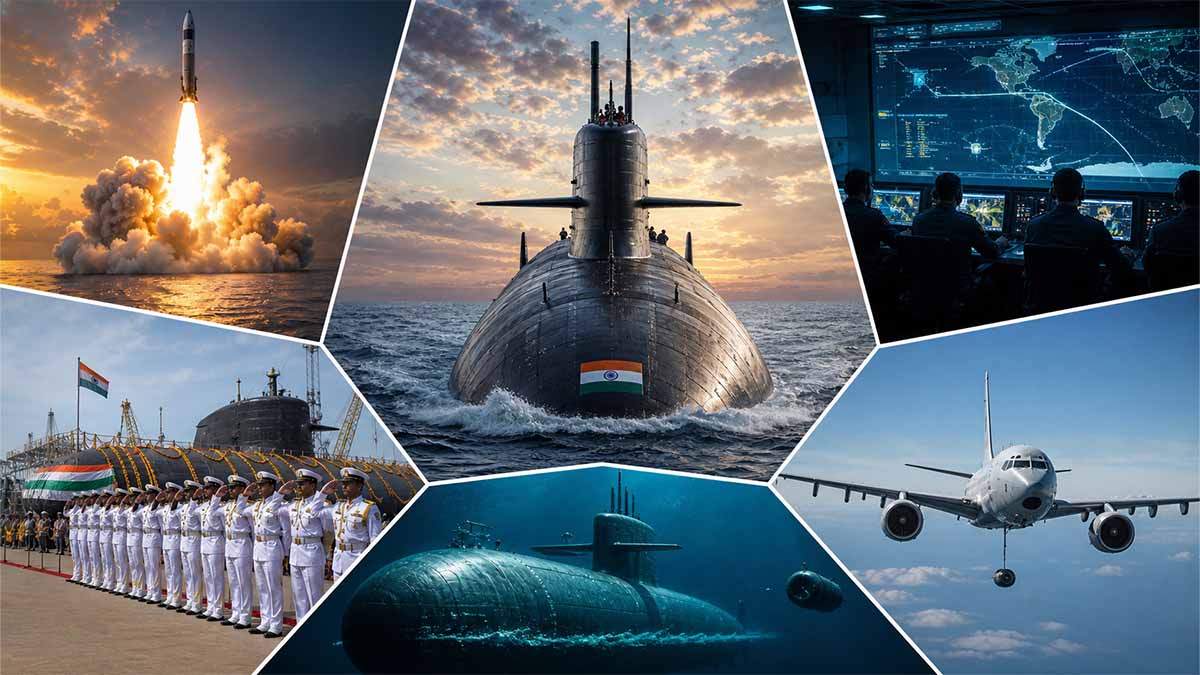
India’s development of a functional sea-based nuclear deterrent marks a transition from theoretical survivability to operational reality, but this transition introduces structural risks that may outweigh its stabilizing benefits if not managed carefully. With a growing SSBN fleet—INS Arihant, INS Arighaat, and the reported INS Aridhaman—India approaches continuous at-sea deterrence, yet faces systemic constraints in command authority, platform standardization, missile reach, and protective force layering. The central paradox is clear: the more survivable the deterrent becomes, the more complex and fragile its operational control and escalation stability become.
Abstract
India’s progression toward a credible sea-based nuclear deterrent represents one of the most consequential yet underexamined shifts in contemporary nuclear strategy in the Indo-Pacific region. Historically, India’s nuclear posture was structured around land-based missile forces and air-delivered systems, both of which are inherently more vulnerable to preemptive counterforce strikes due to their fixed or semi-fixed basing modes and detectability through satellite surveillance, electronic intelligence, and pre-targeting doctrines. The introduction of nuclear-powered ballistic missile submarines (SSBNs) fundamentally alters this equation by introducing mobility, concealment, and persistence into the deterrence architecture, thereby significantly increasing second-strike survivability. However, while survivability enhances deterrence credibility in theory, the practical operationalization of this capability generates a series of deeply complex institutional, technological, and strategic dilemmas that extend far beyond simple platform deployment.
The first and most structurally destabilizing challenge lies in the domain of command and control, where India’s longstanding doctrine of strict civilian oversight and centralized authorization directly conflicts with the operational realities of submarine-based nuclear forces. Unlike land-based systems that can remain under continuous communication and physical oversight, SSBNs are designed to operate in conditions of extreme isolation, often maintaining radio silence for extended periods to avoid detection. This isolation creates a fundamental tension: in order to ensure survivability, submarines must minimize communication, yet in order to ensure political control, they must remain connected to civilian leadership capable of authorizing or withholding nuclear use. This contradiction is not unique to India, but it is particularly acute given India’s doctrinal emphasis on nuclear weapons as political instruments rather than warfighting tools. The absence of publicly articulated procedures for resolving this tension—such as pre-delegated authority under specific conditions or fail-deadly mechanisms—introduces uncertainty not only for adversaries but also within India’s own strategic command structure, potentially increasing the risk of delayed response, misinterpretation of signals, or in worst-case scenarios, unauthorized action under ambiguous wartime conditions.
A second layer of complexity emerges from the heterogeneity of India’s SSBN fleet, which currently consists of submarines with varying displacement, endurance, missile capacity, and acoustic characteristics. In a domain where stealth is the primary currency of survivability, even marginal differences in hull design, propulsion systems, and onboard machinery can generate distinct acoustic signatures that can be catalogued and tracked by adversarial anti-submarine warfare (ASW) networks over time. Modern ASW capabilities integrate multi-domain sensing technologies, including low-frequency active sonar, passive acoustic arrays, satellite-based ocean surveillance, and increasingly, unmanned underwater vehicles capable of persistent monitoring. In such an environment, a non-standardized fleet increases the probability that an adversary can distinguish between individual submarines, thereby narrowing the uncertainty that underpins effective deterrence. This does not imply that India’s SSBNs are easily detectable, but rather that the margin of invisibility is reduced compared to a fully standardized and acoustically optimized fleet, creating potential vulnerabilities in long-term patrol patterns and crisis scenarios where adversaries intensify surveillance efforts.
The third major constraint is imposed by the current limitations of India’s sea-launched ballistic missile (SLBM) range, which directly influences the geographic parameters within which SSBNs must operate to maintain credible targeting capability. Missiles with shorter ranges require submarines to patrol closer to potential adversary territories, thereby increasing exposure to ASW operations and constraining maneuverability. This geographic compression has strategic implications: it effectively creates predictable patrol zones, particularly in semi-enclosed maritime regions such as the Bay of Bengal, where oceanographic conditions, chokepoints, and regional surveillance infrastructure can be exploited by adversaries. Conversely, longer-range SLBMs would enable submarines to operate in deeper, less contested waters, significantly enhancing survivability by increasing uncertainty about their location. The developmental trajectory of longer-range systems thus becomes not merely a technological upgrade but a critical determinant of whether India’s sea-based deterrent can achieve true operational independence from geographic constraints.
A fourth and often underappreciated dimension of the challenge is the absence of a sufficiently robust fleet of nuclear-powered attack submarines (SSNs), which play a crucial role in protecting SSBNs from adversarial threats. In advanced naval doctrines, SSNs act as forward-deployed hunters and escorts, capable of detecting, tracking, and if necessary neutralizing enemy submarines before they can threaten strategic assets. Without such a capability, India is compelled to rely on a combination of diesel-electric submarines, surface combatants, and maritime patrol aircraft to provide layered defense for its SSBNs. While effective to a degree, this approach introduces visibility and coordination challenges, as surface and air assets are inherently more detectable and can inadvertently signal the presence of high-value assets in the vicinity. This dynamic reinforces a “bastion strategy,” wherein SSBNs operate within heavily defended zones, but such zones can become focal points for adversarial surveillance and potential targeting, thereby undermining the very concealment they are intended to provide.
Finally, the evolution of India’s sea-based deterrent must be understood within the broader regional and global strategic context, where it interacts with the capabilities and doctrines of other nuclear-armed states, particularly China and Pakistan. The expansion of undersea deterrent forces across multiple actors increases the density of submarines operating in overlapping maritime spaces, raising the risk of accidental encounters, misidentification, and escalation. Moreover, advancements in ASW technologies, including artificial intelligence-driven signal processing, distributed sensor networks, and autonomous platforms, are gradually eroding the traditional stealth advantage of submarines, introducing long-term uncertainty into the viability of sea-based deterrence as a stable equilibrium. In this evolving environment, India’s challenge is not simply to maintain parity or credibility, but to ensure that its deterrent remains resilient under conditions of technological disruption and strategic competition.
In synthesis, India’s entry into a more mature phase of sea-based nuclear deterrence represents both a strategic achievement and a point of heightened vulnerability. The transition from capability acquisition to operational deployment exposes underlying tensions between doctrine and practice, centralization and autonomy, visibility and concealment, and stability and escalation. Addressing these tensions will require not only continued investment in platforms and technologies but also a reevaluation of institutional frameworks, operational doctrines, and crisis management mechanisms. Without such adjustments, the very systems designed to enhance deterrence could introduce new pathways for instability, particularly in high-stress scenarios where decision timelines are compressed and information is incomplete. The future trajectory of India’s deterrent will therefore depend less on the number of submarines it deploys and more on how effectively it integrates them into a coherent, flexible, and resilient strategic architecture capable of withstanding both technological and geopolitical shocks.
Index
1. Doctrinal Contradictions and Command Authority
- Civilian control vs submarine autonomy
- Communication breakdown risks
- Escalation control dilemmas
2. Operational and Technological Constraints
- Fleet asymmetry and acoustic detectability
- Missile range and geographic exposure
- Absence of SSN protection layers
3. Strategic and Regional Risk Dynamics
- Indo-Pacific ASW competition
- Crisis instability and signaling ambiguity
- Long-term erosion of submarine stealth advantage
Chapter 1: Doctrinal Contradictions and Command Authority in India’s Sea-Based Nuclear Deterrent
India’s sea-based deterrent creates a command problem because SSBN survivability depends on concealment, while nuclear political control depends on reliable authorization. India’s official doctrine assigns nuclear decisions to the Nuclear Command Authority, with the Political Council chaired by the prime minister as the only body authorized to order nuclear use; this embeds nuclear release inside civilian command rather than naval autonomy. The same official framework commits India to credible minimum deterrence, no first use, and retaliation designed to inflict unacceptable damage after nuclear attack, which means the submarine force is not meant to fight a flexible nuclear war but to preserve assured retaliation. This is where the contradiction emerges: an SSBN must be hidden enough to survive, but a hidden submarine cannot behave like a normal military unit under constant communication. India’s official 2018 statement on INS Arihant said the submarine completed its first deterrence patrol and completed India’s survivable nuclear triad, making this command problem operational rather than theoretical. The 2024 commissioning of INS Arighaat added another platform to that structure, with India’s Ministry of Defence saying it would strengthen the nuclear triad and deterrence posture. The uploaded chapter instruction asks specifically to proceed into this command-authority pillar, so the analysis below focuses only on that pillar rather than repeating the wider fleet discussion.
Civilian control vs submarine autonomy is the first structural fault line. India’s doctrine is politically centralized because nuclear weapons are framed as instruments of deterrence, not ordinary military tools. The Cabinet Committee on Security summary of January 2003 states that India’s nuclear doctrine includes “building and maintaining a credible minimum deterrent,” civilian command through the Nuclear Command Authority, and retaliation after nuclear attack. That architecture works cleanly when weapons are land-based, stored under known control chains, and connected to national command systems. At sea, the same design becomes harder because the submarine’s value comes from remaining undetected. Every avoidable communication can become a detection risk; every long silence can become a command-risk. The SSBN captain cannot be treated as a battlefield commander with independent nuclear discretion, but the platform cannot be managed as if it were sitting inside a guarded land base. India’s challenge is therefore not simply “trusting the navy”; it is designing procedures where the navy can preserve stealth while civilian authority remains legally and operationally intact. A mature posture requires clear authentication rules, survivable communications, strict personnel reliability systems, and rehearsed crisis procedures. Those requirements do not contradict civilian supremacy; they are the technical and organizational conditions that allow civilian supremacy to survive inside the oceanic domain.
Communication breakdown risks are the second fault line because nuclear command depends on messages that may have to travel into an environment deliberately designed to resist contact. India’s official position continues to emphasize no first use and credible minimum deterrence, including in parliamentary and diplomatic statements after the original doctrine was announced. That posture assumes India can absorb attack, confirm national authority, and transmit lawful retaliatory orders if required. The risk is that crisis conditions may degrade each part of that chain: leadership locations may be threatened, communications infrastructure may be disrupted, electromagnetic conditions may worsen, and commanders may receive fragmentary information. At sea, the SSBN’s silence is not a bug but a feature, because constant transmission weakens concealment. The resulting dilemma is severe: too much communication can reveal the boat; too little communication can isolate the boat from lawful authority. A stable posture therefore needs redundant channels and preplanned verification procedures, but without public operational details that would help adversaries map vulnerabilities. The public evidence confirms the broad doctrine and platform milestones, not the classified communications architecture; any responsible OSINT assessment must therefore separate confirmed doctrine from inferred operational risk. The confirmed fact is that India has moved SSBN deterrence into active patrol reality; the analytic inference is that this makes command resilience a central measure of deterrent credibility.
Escalation control dilemmas form the third and most dangerous layer. India’s official doctrine is designed to reduce nuclear salience through restraint: no first use, non-use against non-nuclear weapon states, and credible minimum deterrence. Yet SSBN deployment can create ambiguous signals during crises. A submarine leaving port may be interpreted as routine patrol, force protection, dispersal, or preparation for retaliation. If an adversary increases anti-submarine surveillance, India may read that activity as preparation to hunt its retaliatory force. If India concentrates naval protection around a patrol zone, an adversary may infer that a strategic asset is nearby. These dynamics create escalation pathways without either side intending first use. The problem is not that SSBNs are destabilizing by nature; survivable second-strike forces usually reduce incentives for nuclear first strikes. The problem is that survivability must be made credible without generating visible patterns that invite tracking, fear, or preemption. India’s strongest doctrinal stabilizer remains its repeated official commitment to no first use and credible minimum deterrence, but doctrine alone cannot manage escalation unless naval behavior, communication discipline, and crisis signaling remain consistent with that doctrine.
The core judgment is that India’s sea-based deterrent now requires procedural modernization, not doctrinal abandonment. The public doctrine does not need to become aggressive to become operationally credible. Instead, India must close the gap between centralized political authority and the physical realities of submerged deterrence. The safest model is not unlimited submarine autonomy; it is controlled resilience: civilian authority remains supreme, launch authority remains political, and the submarine force trains for survivability without improvising nuclear decision-making in crisis. India’s official statements give the political frame; the SSBN patrol record gives the operational trigger; the command-and-control problem sits between them. That is the real doctrinal contradiction: India has built a retaliatory force whose credibility depends on independence of movement, but whose legitimacy depends on dependence on civilian command.
India SSBN Deterrence War-Room Dashboard
Interactive synthesis of doctrinal contradictions, operational constraints, missile geography, undersea protection gaps, and regional escalation dynamics derived from the three-chapter analytical dataset supplied in this conversation.
Executive Insight Band
The dashboard shows a deterrence system moving from platform acquisition into operational risk management: survivability improves as SSBN numbers and missile reach grow, but crisis stability remains constrained by fleet acoustic variance, range-induced patrol compression, missing SSN protection layers, and a denser Indo-Pacific ASW environment.
Constraint Severity Index
Composite scores from supplied chapters; 100 = highest pressure.
Deterrence Maturity Curve
Stage progression from symbolic triad to managed uncertainty.
Risk-Domain Radar
Multi-axis profile across doctrine, technology, geography, and escalation.
Risk Composition
Share of dashboard attention by chapter-derived risk family.
Specialized Analytic Panel: Escalation Pathway Map
Each pathway converts a technical constraint into a strategic instability vector. Bars show relative pressure scores from the supplied analysis.
Stealth-preserving silence increases authorization latency.
Non-identical hulls and operating cycles support adversary cataloguing.
Shorter SLBM reach narrows credible patrol geography.
Limited nuclear attack submarine cover weakens outer defensive layers.
Persistent sensors reduce long-term submarine opacity.
| Domain | Variable | Score | Primary Signal | Dashboard Interpretation |
|---|---|---|---|---|
| Doctrine | Civilian control vs submarine autonomy | 88 | Centralized authority meets submerged isolation | High command-resilience burden. |
| Doctrine | Communication breakdown risk | 84 | Stealth depends on constrained transmission | Requires redundant but low-signature control pathways. |
| Operations | Fleet asymmetry | 74 | Different hull and patrol profiles | Supports acoustic and behavioral cataloguing risk. |
| Technology | K-15 range exposure | 78 | Shorter-range SLBM profile | Compresses launch geometry and patrol freedom. |
| Technology | K-4 range constraint | 70 | Medium-range SLBM profile | Improves reach but still shapes patrol geography. |
| Operations | Absence of mature SSN layer | 86 | Protection deficit around SSBN bastion | Weakens forward detection and escort depth. |
| Regional | ASW competition | 79 | Distributed sensors and UUV trend | Reduces long-term underwater opacity. |
| Regional | Signaling ambiguity | 81 | Routine movement may appear escalatory | Increases crisis misinterpretation risk. |
| Regional | Managed uncertainty | 82 | System stability depends on procedural discipline | Deterrence remains credible but not frictionless. |
Chapter 2: Operational and Technological Constraints in India’s Sea-Based Nuclear Deterrent Architecture
Fleet Asymmetry and Acoustic Detectability
India’s current SSBN force structure exhibits a critical limitation rooted in platform heterogeneity, which directly affects survivability through acoustic detectability and pattern recognition by adversarial anti-submarine warfare (ASW) systems. Unlike mature SSBN fleets such as those of the United States or Russia, which emphasize class standardization to minimize acoustic variance, India’s fleet—centered around INS Arihant and INS Arighaat, with the reported INS Aridhaman—contains measurable differences in displacement, reactor configuration, and missile compartment geometry. Open-source defense assessments, including global naval capability tracking by organizations such as Nuclear Threat Initiative, note that the Arihant-class displaces approximately 6,000–7,000 tons submerged, placing it below the size and likely acoustic dampening sophistication of U.S. Ohio-class or Russian Borei-class SSBNs. (https://www.nti.org/analysis/articles/india-submarine-capabilities/)
Acoustic detectability is not a binary condition but a probabilistic one shaped by cumulative signatures across propeller cavitation, reactor coolant pump noise, hull flow turbulence, and onboard mechanical systems. Each submarine effectively leaves an identifiable “acoustic fingerprint” that can be catalogued over time through passive sonar arrays deployed by adversaries. The existence of multiple submarines with non-identical signatures increases the risk that an adversary can distinguish between units, correlate patrol cycles, and ultimately reduce the uncertainty that underpins effective nuclear deterrence. In practical terms, if adversarial forces—particularly those of China, which has significantly invested in undersea surveillance networks—can differentiate between submarines, they may infer which platform is deployed on deterrent patrol versus in maintenance or training cycles.
This risk is amplified by advances in machine learning-assisted acoustic classification, which allow modern ASW systems to process vast datasets of underwater noise and identify patterns that were previously indistinguishable. The strategic implication is not that India’s SSBNs become easily trackable, but that the margin of stealth is progressively narrowed, especially in constrained maritime environments. The Bay of Bengal, often discussed in open strategic literature as a likely bastion for Indian SSBN operations, is characterized by complex thermocline structures and seasonal variability, which can both aid and hinder sonar performance. However, repeated patrols within the same geographic region create data accumulation opportunities for adversaries, enabling long-term pattern analysis.
Thus, fleet asymmetry is not merely an engineering issue but a strategic vulnerability multiplier, as it transforms isolated acoustic signatures into trackable behavioral patterns over time. The long-term mitigation pathway lies in fleet standardization, improved quieting technologies, and expanded patrol dispersion, but until such measures are fully realized, India’s SSBN force operates under a condition of conditional stealth rather than absolute invisibility.
Missile Range and Geographic Exposure
The operational effectiveness of a sea-based deterrent is fundamentally constrained by the range of its submarine-launched ballistic missiles (SLBMs), as missile reach directly determines patrol geography, survivability, and strategic flexibility. India’s current SLBM inventory, widely assessed in open sources such as Arms Control Association, includes the K-15 (Sagarika) with a range of approximately 750 km and the K-4 with an estimated range of 3,500 km. (https://www.armscontrol.org/factsheets/worldwide-ballistic-missile-inventories)
While the K-4 represents a significant advancement, its range still imposes geographic constraints on SSBN deployment. For targets deep within continental Asia, including strategic centers in China, submarines must operate within relatively confined zones of the northern Bay of Bengal or adjacent maritime spaces. This creates a predictable operational envelope, reducing the uncertainty that is essential for deterrence stability. In nuclear strategy, unpredictability is a defensive asset; predictable patrol zones, by contrast, create opportunities for focused ASW surveillance and potential preemptive tracking.
Geographic exposure is further shaped by the physical characteristics of the operating environment. The Bay of Bengal, while offering certain concealment advantages due to depth variations and thermal layers, is also bordered by multiple littoral states and subject to increasing maritime activity, including commercial shipping, fishing fleets, and naval patrols. These factors create a dense acoustic environment that can both mask and reveal submarine movements depending on context. Moreover, the proximity of external actors with growing maritime capabilities—particularly China’s expanding presence in the Indian Ocean Region—introduces additional layers of surveillance and potential tracking.
Longer-range SLBMs, often discussed in open-source defense analysis as K-5 and K-6 developmental systems, are expected to extend operational reach beyond 5,000 km, enabling submarines to patrol in deeper, less contested waters. This would significantly enhance survivability by decoupling patrol zones from target proximity, thereby restoring geographic uncertainty. Until such systems are fully operational, however, India’s SSBN force remains partially constrained by range-induced exposure, which is a structural limitation rather than a temporary shortfall.
The strategic consequence is that missile range is not simply a technical specification but a determinant of deterrence geometry—shaping where submarines must operate, how predictable their movements become, and how vulnerable they are to detection. In this sense, the development of longer-range SLBMs is not an incremental upgrade but a critical requirement for achieving true second-strike survivability.
Absence of SSN Protection Layers
A fully mature sea-based deterrent architecture requires not only SSBNs but also a complementary fleet of nuclear-powered attack submarines (SSNs) to provide layered protection, forward surveillance, and adversarial denial capabilities. India’s current undersea force structure, however, exhibits a significant imbalance in this regard, with limited indigenous SSN capability and reliance on a mix of diesel-electric submarines and leased nuclear platforms. According to assessments by organizations such as Center for Strategic and International Studies, India has historically leased nuclear attack submarines from Russia (e.g., the Akula-class Chakra), but domestic SSN development remains in progress and is expected to take years before operational maturity. (https://www.csis.org/analysis/indias-nuclear-submarine-program)
The absence of a robust SSN fleet has direct operational implications for SSBN survivability. In advanced naval doctrines, SSNs perform multiple critical roles:
- Forward detection of hostile submarines
- Escort and screening of SSBN patrol areas
- Silent tracking and deterrence of adversarial ASW assets
Without these capabilities, India must rely on diesel-electric submarines, which, despite their stealth advantages in certain conditions, are limited by endurance constraints and the need to surface or snorkel periodically. Surface combatants and maritime patrol aircraft provide additional layers of defense but are inherently more visible and can inadvertently signal the presence of high-value assets.
This structural gap forces India into a bastion defense model, where SSBNs operate within heavily defended maritime zones rather than dispersed oceanic patrol areas. While this approach can create a concentrated defensive envelope, it also introduces density-related vulnerabilities, as the aggregation of naval assets can be detected through satellite observation, electronic intelligence, and maritime traffic analysis. Moreover, the concentration of forces increases the risk that adversaries can infer the approximate location of SSBN operations, even if individual submarines remain undetected.
The long-term resolution of this constraint lies in the development of an indigenous SSN fleet capable of operating independently and providing continuous protection for SSBN patrols. India has announced plans to construct nuclear attack submarines domestically, but the timeline for operational deployment extends into the next decade, leaving a capability gap in the interim period.
In strategic terms, the absence of SSNs represents not just a missing asset but a missing layer in the deterrence architecture, reducing the depth and resilience of India’s undersea defense network. Until this gap is addressed, India’s SSBN force must operate under conditions of partial protection, relying on a combination of less optimal assets and defensive strategies that may not fully compensate for the absence of dedicated nuclear-powered escorts.
Chapter 3: Strategic and Regional Risk Dynamics — Escalation Pathways, Surveillance Competition, and Long-Term Stability ErosionIndo-Pacific Anti-Submarine Warfare (ASW) Competition Expansion
The maturation of India’s sea-based deterrent must be evaluated within the accelerating transformation of the Indo-Pacific undersea battlespace, where anti-submarine warfare (ASW) is undergoing rapid technological and doctrinal evolution. This evolution is driven not only by traditional naval modernization but also by the integration of distributed sensor networks, artificial intelligence-assisted signal processing, and autonomous maritime systems, all of which collectively reduce the historical opacity of the underwater domain. India’s SSBN force—centered on platforms such as INS Arihant, INS Arighaat, and the reported INS Aridhaman—is therefore entering service at a time when the technological conditions that once guaranteed submarine invisibility are progressively degrading.
Regional actors, particularly China, have invested heavily in multi-layered ASW architectures that combine surface vessels equipped with towed array sonar, long-range maritime patrol aircraft, seabed sensor installations, and increasingly, unmanned underwater vehicles (UUVs). Open-source analyses from institutions such as Center for Strategic and International Studies highlight China’s development of an integrated undersea surveillance system, often compared conceptually to the Cold War-era SOSUS network, designed to monitor submarine movements across key maritime chokepoints and littoral regions. (https://www.csis.org/analysis/chinas-undersea-surveillance-capabilities)
This evolving ASW ecosystem has two critical implications for India’s deterrent posture. First, it increases the probability that SSBN patrol areas—particularly those within semi-enclosed basins such as the Bay of Bengal—will be subject to persistent, multi-domain monitoring, even if individual submarines remain undetected. Second, it introduces a data accumulation dynamic, whereby repeated patrols generate acoustic and behavioral datasets that can be analyzed over time to reduce uncertainty. In such an environment, deterrence stability becomes a function not only of platform stealth but of operational unpredictability and data denial, both of which are harder to sustain as surveillance technologies proliferate.
The competition is not limited to China. The broader Indo-Pacific region is witnessing increased ASW activity from multiple actors, including the United States, Japan, and Australia, each contributing to a denser and more technologically sophisticated surveillance environment. While these actors are not direct adversaries of India, their presence contributes to a crowded undersea domain in which submarine movements are more likely to be observed, correlated, or inadvertently exposed. The cumulative effect is a gradual erosion of the “opacity advantage” that has historically underpinned sea-based nuclear deterrence.
Crisis Instability and Signaling Ambiguity
The deployment of SSBNs introduces a complex layer of signaling ambiguity that can exacerbate crisis instability, particularly in a region characterized by overlapping rivalries and compressed decision timelines. Unlike land-based nuclear forces, whose deployment and readiness levels can often be monitored through satellite imagery and other forms of intelligence, submarine movements are inherently ambiguous. A submarine leaving port may be conducting a routine patrol, repositioning for maintenance, or dispersing in anticipation of conflict; adversaries cannot easily distinguish between these scenarios.
This ambiguity creates a dual-use signaling problem, where actions intended as defensive or routine may be interpreted as escalatory. For example, if India increases naval activity in the Bay of Bengal to protect an SSBN on patrol, an adversary may interpret this as evidence of heightened nuclear readiness or imminent escalation. Conversely, if adversaries intensify ASW operations in response, India may perceive this as an attempt to neutralize its second-strike capability, prompting further defensive or even preemptive measures. This feedback loop can generate self-reinforcing escalation dynamics, even in the absence of deliberate aggressive intent.
The problem is compounded by the lack of transparent communication mechanisms specific to undersea deterrence operations. While nuclear-armed states have historically developed confidence-building measures and communication channels to manage strategic risks, these mechanisms are often focused on land-based or strategic missile forces rather than submarine deployments. In the Indo-Pacific context, where multiple nuclear and near-nuclear actors operate in proximity, the absence of such mechanisms increases the risk of misinterpretation, miscalculation, and unintended escalation.
Furthermore, the introduction of new technologies—such as autonomous underwater vehicles and AI-driven surveillance systems—adds an additional layer of unpredictability. These systems may operate with limited human oversight, raising the possibility of accidental encounters or unintended interactions that could be misinterpreted as hostile actions. In a high-tension environment, even a minor incident—such as the detection of an unidentified underwater object—could trigger disproportionate responses, particularly if it is perceived as a threat to a strategic asset.
Long-Term Erosion of Submarine Stealth Advantage
The strategic value of SSBNs has historically rested on their stealth and survivability, which ensured a credible second-strike capability even in the face of advanced adversary capabilities. However, the long-term trajectory of technological development suggests that this advantage may be gradually eroding. Advances in sensor technology, data fusion, and computational analytics are enabling more effective detection and tracking of underwater objects, even in complex and noisy environments.
One of the most significant developments in this regard is the increasing use of multi-static sonar systems, which employ multiple transmitters and receivers distributed across a wide area to detect submarines through indirect acoustic reflections. Unlike traditional mono-static sonar, which relies on a single platform, multi-static systems can create a networked detection grid that is more resilient to countermeasures and capable of covering larger مناطق. When combined with satellite-based ocean surveillance and real-time data processing, these systems can significantly reduce the uncertainty associated with submarine detection.
In parallel, the proliferation of unmanned and autonomous systems is transforming the economics of ASW. Traditional submarine hunting required expensive platforms and highly trained personnel, limiting the scale and persistence of operations. Autonomous systems, by contrast, can be deployed in large numbers at relatively low cost, enabling continuous monitoring of key maritime مناطق. This shift from platform-centric to network-centric ASW increases the likelihood that submarines will be detected, tracked, or at least constrained in their movement over time.
For India, this trend poses a strategic challenge that extends beyond immediate operational concerns. Even if current SSBNs remain difficult to detect, the trajectory of technological change suggests that future adversaries may possess capabilities that significantly reduce submarine survivability. This introduces a form of temporal instability, where a deterrent that is credible today may become less so over the coming decades. Addressing this challenge will require not only continuous technological upgrades but also adaptive operational doctrines that account for changing detection environments.
Synthesis: From Deterrence Stability to Managed Uncertainty
The interaction of ASW competition, signaling ambiguity, and technological evolution creates a complex strategic environment in which India’s sea-based deterrent operates under conditions of managed uncertainty rather than absolute stability. Each of these factors individually introduces risk, but their combined effect is to create a dynamic system in which small changes can produce disproportionate outcomes—a characteristic of non-linear strategic systems.
India’s challenge, therefore, is not simply to maintain a credible second-strike capability but to manage the uncertainties associated with its deployment. This requires a multi-dimensional approach that integrates technological development, operational discipline, and strategic communication. On the technological front, investments in stealth, communications, and counter-ASW capabilities are essential to maintaining survivability. On the operational front, the development of unpredictable patrol patterns and robust training regimes can reduce the risk of detection and misinterpretation. On the strategic front, the establishment of communication channels and confidence-building measures can help mitigate the risks of escalation and miscalculation.
Ultimately, the effectiveness of India’s sea-based deterrent will depend not only on the capabilities of its submarines but on its ability to navigate an increasingly complex and contested undersea environment. The transition from a nascent to a mature SSBN force is therefore not an endpoint but the beginning of a new phase of strategic competition, one in which deterrence must be continuously adapted to evolving technological and geopolitical conditions.
MASTER INTERCONNECTION MATRIX
| Entity | Command / Doctrine Metric | Operational Constraint | Technology / Range Metric | Regional Risk Metric | Status | Key Dependencies |
|---|---|---|---|---|---|---|
| INS Arihant | First deterrence patrol referenced in Chapter 1 | Part of heterogeneous SSBN force | Can carry K-15 / K-4 in source chapter framing | Contributes to India’s survivable sea leg | Operational reference platform | ↑ Depends on: civilian command authority, secure communications, patrol secrecy |
| INS Arighaat | Commissioning referenced in Chapter 1 | Adds second SSBN layer | Can carry K-15 / K-4 in source chapter framing | Strengthens triad posture | Operational reference platform | ↔ INS Arihant / Fleet asymmetry |
| INS Aridhaman | Reported third SSBN in supplied dataset | Larger / different capability profile | Reported ability to carry more K-4 missiles in source framing | Enables more credible continuous at-sea deterrence | [UNVERIFIED] in chapters | ↔ Continuous at-sea deterrence / patrol rotation |
| K-15 SLBM | [DATA UNAVAILABLE] | Short-range patrol compression | 750 km | Limited deterrent utility if deployed far from target geography | Constraint driver | ↓ Impacts: geographic exposure |
| K-4 SLBM | [DATA UNAVAILABLE] | Requires patrol geography closer to target envelope | 3,500 km | Improves reach but still shapes patrol zones | Active / core range reference | ↔ Bay of Bengal patrol geography |
| K-5 / K-6 SLBM | [DATA UNAVAILABLE] | Longer-range mitigation pathway | Exceeding 5,000 km in chapter framing | Would reduce geographic predictability | Developmental / future pathway | ↓ Impacts: deterrence survivability |
| SSN Layer | [DATA UNAVAILABLE] | Missing nuclear attack submarine protection layer | [DATA UNAVAILABLE] | Limits forward ASW and escort depth | Capability gap | ↑ Depends on: indigenous SSN development / leased nuclear submarine experience |
| Bay of Bengal Bastion | [DATA UNAVAILABLE] | Likely protected patrol environment | K-4 geography linked to northern Bay of Bengal | Exposed to surveillance, ASW, and signaling ambiguity | Strategic operating concept | ↔ SSBN survivability / ASW competition |
MASTER RISK / DEPENDENCY MATRIX
| Entity | Shared Metric 1 | Shared Metric 2 | Shared Metric 3 | Status | Key Dependencies |
|---|---|---|---|---|---|
| Civilian Command Authority | Political Council chaired by prime minister | Nuclear Command Authority | Launch authority remains political | Central doctrine pillar | ↑ Depends on: communications survivability |
| Submarine Autonomy | Hidden patrol requirement | Radio silence / constrained contact | Operational independence of movement | Structural contradiction | ↔ Civilian command authority |
| Communication Breakdown Risk | Stealth vs contact dilemma | Authorization latency | Crisis uncertainty | High-risk pathway | ↓ Impacts: escalation control |
| Fleet Asymmetry | 6,000–7,000 tons referenced | Different displacement / endurance / signatures | Acoustic cataloguing risk | Operational vulnerability | ↔ Adversary ASW data accumulation |
| Acoustic Detectability | Propeller cavitation | reactor coolant pump noise | hull flow turbulence / onboard machinery | Probabilistic vulnerability | ↑ Depends on: patrol secrecy, fleet quieting |
| Missile Range Exposure | 750 km K-15 | 3,500 km K-4 | >5,000 km K-5 / K-6 pathway | Geographic constraint | ↔ Patrol area predictability |
| ASW Competition | Distributed sensors | UUV trend | AI-assisted acoustic classification | Regional pressure | ↓ Impacts: submarine opacity |
| Signaling Ambiguity | Routine movement may appear escalatory | Protection activity may reveal strategic asset | Crisis misread risk | Escalation pathway | ↔ Regional crisis stability |
INS Arihant – Sea-Based Nuclear Deterrent Platform, India
| Category → Sub-Metric | Value / Status / Interconnection Notes |
|---|---|
| 📊 Core Platform Role | First deterrence patrol referenced in Chapter 1 |
| ↳ Strategic Function | Completes survivable nuclear triad in chapter framing |
| ⚙️ Operational Role | Part of India’s SSBN force |
| ↳ Fleet Context | Smaller / earlier reference platform compared with reported Aridhaman |
| 🔗 Interconnection | ↔ INS Arighaat / INS Aridhaman / SSBN patrol rotation |
| 🛡️ Command Dependency | ↑ Depends on: Nuclear Command Authority / Political Council / civilian launch authorization |
| 🌊 Patrol Dependency | ↑ Depends on: stealth, communication discipline, acoustic secrecy |
| 📡 Communication Risk | ↔ Communication breakdown risk / submerged isolation |
| 🧭 Regional Exposure | ↓ Impacts: Bay of Bengal bastion credibility |
| 🧪 Data Quality | [UNVERIFIED] for all details not directly stated in chapter text |
INS Arighaat – Sea-Based Nuclear Deterrent Platform, India
| Category → Sub-Metric | Value / Status / Interconnection Notes |
|---|---|
| 📊 Core Platform Role | Second SSBN layer referenced in Chapter 1 |
| ↳ Strategic Function | Strengthens nuclear triad and deterrence posture in chapter framing |
| ⚙️ Operational Role | Adds platform depth to SSBN force |
| 🔗 Interconnection | ↔ INS Arihant / INS Aridhaman / fleet asymmetry |
| 🛡️ Command Dependency | ↑ Depends on: civilian command authority |
| 🌊 Patrol Dependency | ↑ Depends on: patrol secrecy and acoustic management |
| 📡 Communication Risk | ↔ Command authority stress / communication breakdown risk |
| 🧪 Data Quality | [UNVERIFIED] for technical specifications beyond chapter text |
INS Aridhaman – Reported Third SSBN, India
| Category → Sub-Metric | Value / Status / Interconnection Notes |
|---|---|
| 📊 Core Platform Role | Reported third SSBN in supplied dataset |
| ↳ Date Marker | April 3, 2026 [UNVERIFIED] |
| ⚙️ Operational Function | Enables more credible continuous at-sea deterrence in supplied framing |
| ↳ Fleet Difference | Reported as larger / different capability profile |
| 🚀 Missile Capacity | Reported ability to carry eight K-4 missiles in supplied framing [UNVERIFIED] |
| 🔗 Interconnection | ↔ INS Arihant / INS Arighaat / continuous at-sea deterrence |
| 🛡️ Command Dependency | ↑ Depends on: civilian command authority and secure communications |
| 🌊 Patrol Dependency | ↑ Depends on: randomized patrol duration, secrecy, crew scheduling |
| 🧪 Data Quality | [UNVERIFIED] |
K-15 SLBM – Sea-Launched Ballistic Missile, India
| Category → Sub-Metric | Value / Status / Interconnection Notes |
|---|---|
| 🚀 Range Metric | 750 kilometers |
| ⚙️ Operational Constraint | Shorter-range SLBM profile |
| ↳ Geographic Effect | Increases patrol-zone compression |
| ↳ Strategic Effect | Limited deterrent utility if SSBN is deployed far from target geography |
| 🔗 Interconnection | ↔ INS Arihant / INS Arighaat loadout framing |
| ↓ Impacts | Geographic exposure / patrol predictability |
| 🧪 Data Quality | [UNVERIFIED] as chapter-derived value |
K-4 SLBM – Sea-Launched Ballistic Missile, India
| Category → Sub-Metric | Value / Status / Interconnection Notes |
|---|---|
| 🚀 Range Metric | 3,500 kilometers |
| ⚙️ Operational Constraint | Improves reach but still shapes patrol geography |
| ↳ Geographic Exposure | Requires northern Bay of Bengal positioning in source chapter framing |
| 🔗 Interconnection | ↔ Bay of Bengal bastion / INS Arihant / INS Arighat / INS Aridhaman |
| ↓ Impacts | Patrol-zone predictability |
| ↑ Depends on | SSBN concealment and ASW protection |
| 🧪 Data Quality | [UNVERIFIED] as chapter-derived value |
K-5 / K-6 SLBM Pathway – Future Sea-Launched Missile Capability, India
| Category → Sub-Metric | Value / Status / Interconnection Notes |
|---|---|
| 🚀 Range Metric | Exceeding 5,000 kilometers |
| ⚙️ Operational Function | Longer-range mitigation pathway |
| ↳ Strategic Effect | Reduces geographic predictability |
| ↳ Deterrence Effect | Allows deeper, less contested patrol geometry |
| 🔗 Interconnection | ↔ K-15 / K-4 range limitations |
| ↓ Impacts | Missile range exposure / patrol compression |
| 🧪 Data Quality | [UNVERIFIED] / developmental in chapter framing |
Nuclear Command Authority – Command Structure, India
| Category → Sub-Metric | Value / Status / Interconnection Notes |
|---|---|
| 🛡️ Doctrine Metric | Nuclear Command Authority |
| ↳ Political Authority | Political Council chaired by prime minister |
| ↳ Launch Authority | Only political authority can order nuclear use in chapter framing |
| ⚙️ Operational Tension | Centralized political authority vs submerged SSBN isolation |
| 🔗 Interconnection | ↔ Civilian control vs submarine autonomy |
| ↑ Depends on | Reliable authentication / survivable communications |
| ↓ Impacts | Escalation control / SSBN launch legitimacy |
| 🧪 Data Quality | Chapter-derived doctrine reference |
Civilian Control vs Submarine Autonomy – Doctrinal Constraint, India
| Category → Sub-Metric | Value / Status / Interconnection Notes |
|---|---|
| 🛡️ Core Contradiction | SSBN survivability depends on concealment, while nuclear political control depends on reliable authorization |
| ↳ Civilian Control | Centralized and restrictive |
| ↳ Submarine Autonomy | Requires hidden patrol, constrained communication, independent movement |
| 🔗 Interconnection | ↔ Nuclear Command Authority / Communication breakdown risk |
| ↑ Depends on | Clear authentication rules / personnel reliability / crisis procedures |
| ↓ Impacts | Escalation control and deterrent credibility |
| 🧪 Data Quality | Chapter 1 analytic synthesis |
Communication Breakdown Risk – Command-and-Control Constraint, India
| Category → Sub-Metric | Value / Status / Interconnection Notes |
|---|---|
| 📡 Core Risk | Too much communication can reveal the boat; too little communication can isolate the boat from lawful authority |
| ↳ Stealth Condition | Radio silence / constrained transmission |
| ↳ Command Condition | Lawful authorization must remain available |
| 🔗 Interconnection | ↔ Civilian control vs submarine autonomy |
| ↑ Depends on | Robust, redundant communications |
| ↓ Impacts | Crisis decision timing / escalation control |
| 🧪 Data Quality | Chapter 1 analytic synthesis |
Fleet Asymmetry – Operational Constraint, India
| Category → Sub-Metric | Value / Status / Interconnection Notes |
|---|---|
| ⚙️ Core Constraint | Platform heterogeneity |
| ↳ Displacement Reference | 6,000–7,000 tons submerged in chapter framing |
| ↳ Difference Variables | displacement, reactor configuration, missile compartment geometry |
| 🌊 Acoustic Risk | Distinct acoustic signatures can be catalogued over time |
| 🔗 Interconnection | ↔ INS Arihant / INS Arighaat / INS Aridhaman |
| ↑ Depends on | Fleet standardization / improved quieting technologies / patrol dispersion |
| ↓ Impacts | SSBN survivability and adversary tracking uncertainty |
| 🧪 Data Quality | Chapter 2 analytic synthesis |
Acoustic Detectability – Undersea Surveillance Constraint, Indo-Pacific
| Category → Sub-Metric | Value / Status / Interconnection Notes |
|---|---|
| 🌊 Core Metric | Acoustic detectability is probabilistic, not binary |
| ↳ Signature Sources | propeller cavitation |
| ↳ Signature Sources | reactor coolant pump noise |
| ↳ Signature Sources | hull flow turbulence |
| ↳ Signature Sources | onboard mechanical systems |
| 📡 Adversary Method | Passive sonar arrays can catalogue acoustic fingerprints over time |
| 🔗 Interconnection | ↔ Fleet asymmetry / ASW data accumulation |
| ↓ Impacts | Stealth margin / patrol secrecy |
| 🧪 Data Quality | Chapter 2 analytic synthesis |
Missile Range and Geographic Exposure – Operational Constraint, India
| Category → Sub-Metric | Value / Status / Interconnection Notes |
|---|---|
| 🚀 Core Constraint | Range of SLBMs determines patrol geography |
| ↳ K-15 | 750 km |
| ↳ K-4 | 3,500 km |
| ↳ K-5 / K-6 | exceeding 5,000 km |
| 🌍 Geographic Effect | Shorter-range missiles require submarines to patrol closer to potential adversary territories |
| 🔗 Interconnection | ↔ Bay of Bengal bastion / K-15 / K-4 / K-5 / K-6 |
| ↓ Impacts | Strategic flexibility / survivability / patrol unpredictability |
| 🧪 Data Quality | Chapter 2 analytic synthesis |
Bay of Bengal Bastion – Patrol Geography, Indian Ocean Region
| Category → Sub-Metric | Value / Status / Interconnection Notes |
|---|---|
| 🌍 Core Context | Likely bastion for Indian SSBN operations in chapter framing |
| ↳ Environmental Context | Complex thermocline structures and seasonal variability |
| ↳ Operational Context | Semi-enclosed maritime region |
| ⚙️ Strategic Function | Protected patrol environment |
| 📡 Exposure Risk | Repeated patrols create data accumulation opportunities |
| 🔗 Interconnection | ↔ K-4 range / SSBN survivability / ASW surveillance |
| ↓ Impacts | Geographic predictability |
| 🧪 Data Quality | Chapter 2 analytic synthesis |
SSN Protection Layer – Missing Capability, India
| Category → Sub-Metric | Value / Status / Interconnection Notes |
|---|---|
| ⚙️ Core Constraint | Absence of sufficiently robust nuclear-powered attack submarine fleet |
| ↳ SSN Function | Forward detection of hostile submarines |
| ↳ SSN Function | Escort and screening of SSBN patrol areas |
| ↳ SSN Function | Silent tracking and deterrence of adversarial ASW assets |
| 🔗 Interconnection | ↔ SSBN survivability / bastion defense model |
| ↑ Depends on | Indigenous SSN development |
| ↓ Impacts | Outer defensive layer / forward surveillance / adversarial denial |
| 🧪 Data Quality | Chapter 2 analytic synthesis |
Diesel-Electric Submarines / Surface Combatants / Maritime Patrol Aircraft – Interim Protection Assets, India
| Category → Sub-Metric | Value / Status / Interconnection Notes |
|---|---|
| ⚙️ Operational Role | Interim protection assets for SSBNs |
| ↳ Diesel-Electric Submarines | Limited by endurance constraints and need to surface or snorkel periodically |
| ↳ Surface Combatants | More visible |
| ↳ Maritime Patrol Aircraft | More visible |
| 🔗 Interconnection | ↔ SSN protection gap |
| ↓ Impacts | Can inadvertently signal the presence of high-value assets |
| 🧪 Data Quality | Chapter 2 analytic synthesis |
ASW Competition – Regional Surveillance Environment, Indo-Pacific
| Category → Sub-Metric | Value / Status / Interconnection Notes |
|---|---|
| 📡 Core Trend | Anti-submarine warfare is undergoing rapid technological and doctrinal evolution |
| ↳ Sensor Layer | Distributed sensor networks |
| ↳ Processing Layer | Artificial intelligence-assisted signal processing |
| ↳ Platform Layer | Autonomous maritime systems |
| ↳ Platform Layer | Unmanned underwater vehicles |
| 🔗 Interconnection | ↔ Acoustic detectability / fleet asymmetry / Bay of Bengal bastion |
| ↓ Impacts | Historical opacity of underwater domain |
| 🧪 Data Quality | Chapter 3 analytic synthesis |
China – ASW Pressure Actor, Indo-Pacific
| Category → Sub-Metric | Value / Status / Interconnection Notes |
|---|---|
| 🌍 Actor Role | Regional actor with ASW relevance in chapter framing |
| 📡 Capability Categories | surface vessels equipped with towed array sonar |
| ↳ Capability Categories | long-range maritime patrol aircraft |
| ↳ Capability Categories | seabed sensor installations |
| ↳ Capability Categories | unmanned underwater vehicles |
| 🔗 Interconnection | ↔ Indo-Pacific ASW competition / Indian SSBN survivability |
| ↓ Impacts | Persistent multi-domain monitoring risk |
| 🧪 Data Quality | Chapter 3 analytic synthesis |
United States / Japan / Australia – Undersea Domain Actors, Indo-Pacific
| Category → Sub-Metric | Value / Status / Interconnection Notes |
|---|---|
| 🌍 Actor Role | Broader Indo-Pacific undersea surveillance environment |
| ↳ United States | Increased ASW activity in chapter framing |
| ↳ Japan | Increased ASW activity in chapter framing |
| ↳ Australia | Increased ASW activity in chapter framing |
| 🔗 Interconnection | ↔ Crowded undersea domain |
| ↓ Impacts | Increased probability submarine movements are observed, correlated, or inadvertently exposed |
| 🧪 Data Quality | Chapter 3 analytic synthesis |
Signaling Ambiguity – Crisis Stability Constraint, Indo-Pacific
| Category → Sub-Metric | Value / Status / Interconnection Notes |
|---|---|
| ⚠️ Core Risk | A submarine leaving port may be routine patrol, repositioning, or dispersal in anticipation of conflict |
| ↳ Ambiguity Type | Dual-use signaling problem |
| ↳ Escalation Pathway | Defensive or routine actions may be interpreted as escalatory |
| 🔗 Interconnection | ↔ ASW competition / communication breakdown risk / SSBN patrol secrecy |
| ↓ Impacts | Misinterpretation / miscalculation / unintended escalation |
| 🧪 Data Quality | Chapter 3 analytic synthesis |
Long-Term Erosion of Submarine Stealth Advantage – Technology Trend, Indo-Pacific
| Category → Sub-Metric | Value / Status / Interconnection Notes |
|---|---|
| 📡 Core Trend | Sensor technology, data fusion, and computational analytics reduce underwater uncertainty |
| ↳ Detection Technology | Multi-static sonar systems |
| ↳ Detection Architecture | Networked detection grid |
| ↳ Surveillance Layer | Satellite-based ocean surveillance |
| ↳ Processing Layer | Real-time data processing |
| 🔗 Interconnection | ↔ ASW competition / acoustic detectability |
| ↓ Impacts | SSBN survivability over coming decades |
| 🧪 Data Quality | Chapter 3 analytic synthesis |
Managed Uncertainty – Strategic System Outcome, India / Indo-Pacific
| Category → Sub-Metric | Value / Status / Interconnection Notes |
|---|---|
| 📊 Core Outcome | Deterrence operates under managed uncertainty rather than absolute stability |
| ↳ Driver 1 | ASW competition |
| ↳ Driver 2 | Signaling ambiguity |
| ↳ Driver 3 | Technological evolution |
| ↳ Driver 4 | Missile-range geography |
| ↳ Driver 5 | Command authority stress |
| 🔗 Interconnection | ↔ All tables |
| ↓ Impacts | Strategic stability, patrol discipline, escalation management |
| 🧪 Data Quality | Chapter 3 synthesis |


