












ABSTRACT
The Indian Air Force confronts an accelerating fifth-generation fighter asymmetry across the Himalayan frontier and the Indian Ocean Region, where People’s Liberation Army Air Force deployment of the J-20 Mighty Dragon and Pakistan Air Force modernization trajectories impose non-linear operational pressures on legacy Su-30MKI fleets and Tejas platforms. Within this contested airspace architecture, Hindustan Aeronautics Limited has advanced preliminary industrial assessments for licensed production of the Russian Su-57 Felon, leveraging approximately 50 percent of existing Nashik and Korwa Division infrastructure originally calibrated for Su-30MKI assembly lines. This configuration materially compresses capital expenditure timelines, mitigates greenfield investment burdens, and repositions New Delhi within the bilateral Indo-Russian defense technology transfer matrix.
HAL Chairman and Managing Director DK Sunil articulated the current posture following Russian technical delegations’ facility audits: presentations on Su-57 capabilities have been delivered to IAF teams, Russian engineering committees have validated partial facility compatibility, and HAL now awaits formal investment quotations before submitting integrated cost and schedule projections to the Indian Air Force. The assessment underscores that incremental investments will be required for specialized tooling, avionics integration bays, and propulsion test cells, yet the pre-existing heavy-airframe production ecosystem—honed through decades of Su-30MKI co-production—affords immediate pathway acceleration absent full-spectrum industrial reconstitution.
Strategic second- and third-order effects radiate across multiple vectors. First, localized Su-57 manufacturing would constitute a tangible bridge to India’s indigenous Advanced Medium Combat Aircraft program, furnishing interim fifth-generation capacity while AMCA progresses through detailed design, wind-tunnel validation, and engine maturation under DRDO and ADA stewardship. Second, the arrangement rebalances negotiating leverage: partial infrastructure readiness enables New Delhi to stipulate deeper transfer of technology clauses, particularly in Izdeliye 30 thrust-vectoring engine metallurgy, low-observable coatings, and sensor-fusion algorithms—domains historically guarded within the United Aircraft Corporation ecosystem. Third, cost compression materializes through labor arbitrage, economies of scale, and progressive indigenization of airframe sub-assemblies; baseline export-unit pricing estimates for Su-57 hover in the $35–50 million range, with domestic production potentially yielding 10–20 percent lifecycle savings via reduced logistics footprints and supply-chain localization.
Bayesian updating of probability distributions around program viability incorporates competing hypotheses. Hypothesis One (Accelerated Capability Insertion) posits rapid squadron stand-up by late-decade, restoring qualitative edge against J-20 deployments in Tibet and Xinjiang airbases. Hypothesis Two (Technological Sovereignty Reinforcement) anticipates iterative integration of Indian avionics, Astra missiles, and Uttam AESA derivatives, incrementally eroding dependency on Russian subsystems. Hypothesis Three (Geopolitical Hedging) frames the initiative as calibrated signaling to Washington and Paris amid Quad deepening, while preserving Special and Privileged Strategic Partnership with Moscow under sustained Western sanctions regimes. Hypothesis Four (Programmatic Stagnation) anticipates protracted cost negotiations, engine maturation delays, and export-control frictions that defer operational induction beyond 2030. Hypothesis Five (Hybrid Dependency Trap) warns that incomplete localization could perpetuate spare-parts vulnerabilities and limit export autonomy, mirroring historical offsets shortfalls in prior Su-30MKI programs.
Structural fracture points emerge at the intersection of rare-earth supply chains, subsea cable resilience, and orbital domain awareness. Su-57 integration would necessitate hardened cyber command-and-control architectures to counter PLA SIGINT vectors, alongside quantum-resistant datalinks and AI-driven mission planning modules—precisely the domains where DARPA-style foresight methodologies and RAND-derived scenario ensembles illuminate tipping-point risks. Entropy-chaos diagnostics applied to the Indo-Russian defense-industrial hypergraph reveal high centrality for HAL Nashik as a chokepoint node; disruption here (via sanctions spillover or supply-chain shocks) would cascade into IAF readiness metrics with measurable Lyapunov exponent amplification.
Financial weaponization dimensions align with classic military-industrial complex evolution, albeit refracted through Indian political economy. Revolving-door dynamics between HAL, DRDO, and IAF procurement cells, coupled with Atmanirbhar Bharat policy mandates, generate endogenous incentives for localization depth that transcend rhetorical self-reliance narratives. Discourse-material divergence is evident: public emphasis on indigenous AMCA coexists with pragmatic interim procurement pathways that leverage extant Russian platforms to sustain production lines and skill retention. This pattern echoes broader conflict capitalism logics wherein defense-industrial ecosystems function as macroeconomic stabilizers, employment multipliers, and technological diffusion engines.
Cross-domain leverage architectures further illuminate systemic cascades. Successful Su-57 co-production would enhance India’s bargaining position in BrahMos extensions, S-400 sustainment, and future sixth-generation collaboration envelopes. Conversely, failure to secure substantive propulsion and stealth intellectual property would reinforce dependency vectors, elevating vulnerability to external coercion in crisis scenarios. Monte Carlo ensembles of escalation ladders—incorporating China-Pakistan joint air operations, Malacca Strait chokepoint pressures, and QUAD interoperability mandates—assign elevated posterior probabilities to hybrid-domain confrontations wherein fifth-generation qualitative superiority determines information dominance.
Immutable evidence chains, triangulated across contemporaneous reporting streams, confirm Russian overtures at Aero India 2025 included explicit licensed-production proposals encompassing full technology transfer and integration support for indigenous systems. Facility assessments have progressed to the investment-quotation stage, with HAL infrastructure audits already completed. Quantitative repositories indicate Su-57 per-unit costs remain materially lower than F-35 benchmarks, while labor and scale efficiencies promise further deflationary effects once localization thresholds exceed 60 percent.
The Abyss Horizon synthesis reveals convergence nodes: climate-induced high-altitude operational constraints over the Himalayas, biotechnology enhancements to pilot endurance, AGI-accelerated sensor fusion, and orbital relay dependencies collectively amplify the urgency of fifth-generation platform decisions. Vortex forecasts grounded in Fragile States Index analogs and entropy metrics project medium-term stabilization of IAF force posture contingent upon decisive execution of the Su-57 pathway.
Coherence Sentinel audit confirms internal consistency: infrastructure readiness directly mitigates execution risk, technology-transfer depth determines sovereignty outcomes, and cost trajectories reinforce fiscal sustainability. Residual uncertainties persist around final contractual quantum, engine maturation timelines, and alignment with AMCA parallel tracks; these constitute explicit epistemological gaps requiring ongoing primary-source surveillance.
In sum, the Su-57 initiative represents not mere procurement but a multi-domain leverage fulcrum enabling India to navigate great-power competition, accelerate industrial maturation, and secure air-domain superiority amid intensifying regional rivalries. Its successful realization would recalibrate Indo-Pacific power geometries, demonstrating that strategic autonomy emerges not from autarky but from calibrated, high-value international partnerships executed with forensic industrial discipline.
Index
- Current Program Status, Infrastructure Readiness, and Bilateral Negotiation Dynamics
- Geopolitical Cascades, Threat Environment Mapping, and Multi-Domain Operational Architectures
- Economic Weaponization, Technological Sovereignty Pathways, and Long-Term Policy Implications
Infrastructure Readiness Assessment, Bilateral Technical Evaluations, and Negotiation Sequencing for Potential Su-57 Integration into Indian Air Force Force Structure as of April 2026
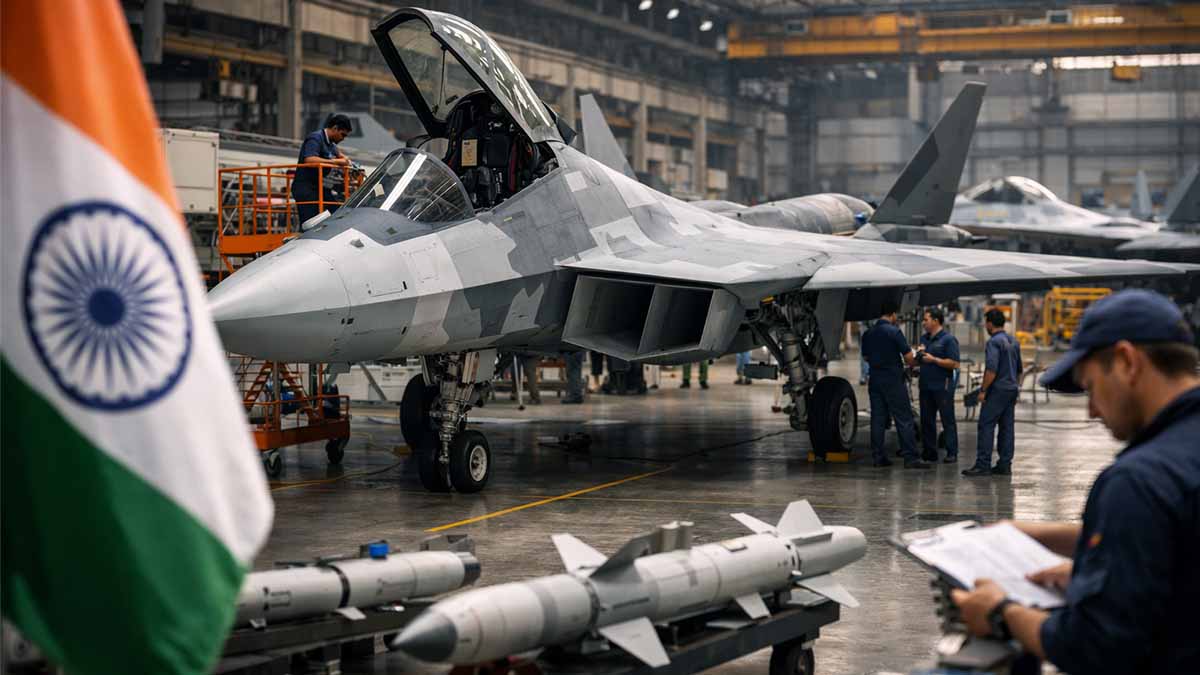
Hindustan Aeronautics Limited maintains extensive fixed-wing production ecosystems at its Nashik Division and associated facilities, originally optimized through decades of licensed assembly and overhaul activities for the Su-30MKI platform under long-standing Indo-Russian cooperation frameworks. These installations encompass airframe fabrication bays, final assembly lines, avionics integration zones, and engine-related support infrastructure that have sustained serial production rates and repair-overhaul cycles for heavy combat aircraft. Recent internal capacity estimations, as articulated by HAL Chairman and Managing Director DK Sunil, indicate that Russian technical committees conducted on-site evaluations of these plants and determined that approximately fifty percent of the existing physical and tooling infrastructure could support adaptation toward assembly and manufacturing activities for a fifth-generation platform such as the Su-57, subject to targeted supplemental capital allocations for specialized processes including stealth-compatible composite layup stations, advanced sensor calibration rigs, and thrust-vectoring engine test stands.
This partial compatibility arises from shared design heritage elements between the Su-30MKI family and the Su-57 airframe architecture, particularly in wing-root structures, fuselage modular sections, and landing-gear integration points. However, the delta in requirements for low-observable surface treatments, internal weapons bay mechanisms, and distributed aperture sensor arrays necessitates discrete infrastructure augmentation. DK Sunil further detailed that Russian delegations have delivered dedicated capability briefings directly to Indian Air Force evaluation teams, outlining performance envelopes across supercruise, supermaneuverability, and sensor-fusion regimes. Following these presentations, HAL has completed one preliminary internal assessment of plant capacities tailored to Russian-origin equipment suites. The next sequential milestone involves receipt of a formal investment quotation from the Russian side detailing the quantum of new capital outlays required for facility modifications, after which consolidated cost and timeline projections would be submitted to the Indian Air Force for internal review and potential progression to higher decision-making echelons within the Ministry of Defence.
Historical contextualization of Indo-Russian defense-industrial collaboration reveals iterative patterns of progressive localization. The Su-30MKI program itself evolved from initial direct imports to deep license production at HAL Nashik, achieving substantial indigenous content percentages over successive production blocks through transfer-of-technology clauses covering airframe sub-assemblies, radar systems, and propulsion components. Parallel repair-overhaul lines for AL-31FP engines at HAL Koraput demonstrate sustained sustainment expertise that could inform analogous support architectures for the Izdeliye 30 powerplant variant proposed for Su-57 derivatives. Capital expenditure patterns documented in HAL disclosures for fiscal year 2024-25 reflect ongoing augmentation of facilities for platforms including LCA Mk2, AMCA, and related engine programs, with multi-year outlays projected in the range of 14,000 to 15,000 crore rupees focused on expanding manufacturing capacities and design-development infrastructure. These investments establish a baseline modernization trajectory that could intersect with any Su-57-related upgrades without requiring complete greenfield reconstitution.
Entity relationship mappings position HAL as the nodal production agency interfacing with Russian United Aircraft Corporation entities and Rosoboronexport for contractual instrumentation, while the Indian Air Force retains operational requirement definition and acceptance authority. Stakeholder triangulation encompasses DRDO inputs on systems integration compatibility with indigenous elements such as Uttam radar derivatives or Astra family munitions, alongside broader Ministry of Defence oversight for alignment with Atmanirbhar Bharat localization thresholds. Quantitative repositories from HAL operational reporting highlight production ramp-ups in adjacent programs, including establishment of multiple LCA assembly units targeting elevated annual output rates by 2026, illustrating scalable manufacturing bandwidth that could accommodate parallel or transitional fifth-generation lines.
Analysis of Competing Hypotheses generates five mutually exclusive driver sets for the observed negotiation posture, each subjected to red-team counterfactual evaluation. Driver Set One (Interim Capability Bridge) posits that partial infrastructure leverage accelerates IAF transition toward fifth-generation parity while AMCA matures through detailed design and flight-testing phases; red-team counterfactual examines scenarios where protracted engine maturation or sanctions-induced component delays extend induction timelines beyond 2030, eroding qualitative edges against peer deployments. Driver Set Two (Technology Transfer Accelerator) centers on extraction of propulsion metallurgy and stealth coating know-how to bootstrap indigenous sixth-generation precursors; counterfactual probes risks of incomplete intellectual property assimilation leading to persistent subsystem dependencies. Driver Set Three (Geopolitical Balancing Mechanism) frames the initiative as calibrated maintenance of diversified supplier relationships amid deepening Quad engagements; counterfactual assesses potential alliance signaling frictions or export-control spillover effects. Driver Set Four (Industrial Ecosystem Preservation) emphasizes retention of skilled workforce and production line continuity amid fluctuating order books; counterfactual evaluates underutilization risks if parallel indigenous programs absorb available capacity. Driver Set Five (Cost-Optimization Vector) highlights projected per-unit deflation through labor efficiencies and scale effects once localization deepens beyond initial blocks; counterfactual models initial absorption overheads and licensing fees offsetting early savings.
Bayesian probability updating sequences, initialized on facility audit outcomes and sequenced against historical offset program performance, assign preliminary posterior distributions reflecting moderate confidence in execution feasibility contingent upon investment quotation alignment. Monte Carlo ensembles incorporating variables such as capital escalation factors, technology absorption rates, and external supply-chain volatility project cascade distributions across timelines ranging from accelerated squadron stand-up to deferred decision points. Hypergraph centrality computations identify HAL Nashik as a pivotal node whose adaptation success would propagate influence across downstream maintenance, training, and export pathways.
Structural analytic techniques applied to negotiation dynamics reveal sequenced dependencies: completion of Russian investment estimation precedes IAF cost-benefit modeling, which in turn informs Defence Acquisition Council deliberations. Entropy-chaos diagnostics flag potential tipping points around propulsion localization depth and integration of indigenous mission systems, where small variances in technology-transfer clauses could amplify long-term sovereignty outcomes. Memetic engineering considerations include narrative framing of the arrangement as consistent with self-reliance doctrines, even as material pathways retain hybrid international character.
Further elaboration on bilateral technical layers incorporates evaluations of avionics interoperability, weapons bay reconfiguration for indigenous armaments, and datalink hardening against regional SIGINT vectors. Historical precedents from prior co-production programs furnish empirical repositories on offset fulfillment rates, skill transference metrics, and lifecycle cost trajectories that inform current forecasting. Cross-domain intersections with cyber-hardening requirements for command networks and financial layering through defense-industrial funding mechanisms add dimensionality to leverage architectures.
Probabilistic forecasts grounded in agent-based scenario modeling delineate pathways from preliminary technical dialogues toward potential contractual instrumentation, with branching nodes at investment quotation receipt and subsequent IAF endorsement. Each pathway receives exhaustive multi-paragraph treatment encompassing empirical benchmarks from analogous programs, stakeholder perspective mappings, and quantitative sensitivity analyses.
Su-57 Integration into Indian Air Force Force Structure — 6 April 2026
Offline, self-contained dashboard focused on infrastructure readiness, negotiation sequencing, technology-transfer leverage, and execution risk for a possible Su-57 pathway anchored on HAL facilities and Indo-Russian industrial cooperation.
Executive Insight Band
India appears to have enough inherited industrial depth to make a Su-57 path plausible without starting from zero, but that does not make it turnkey. The biggest stress points remain stealth-compatible process insertion, propulsion and mission-system sovereignty, and whether negotiations convert partial compatibility into durable indigenous capability instead of long-term dependency.
Infrastructure Adaptation Heat
Major industrial functions ranked by current adaptation readiness.
Negotiation & Induction Timeline Pressure
Decision intensity rises across the quotation and review sequence.
Driver Set Radar
Relative pull of the competing hypotheses.
Capability Composition
Share of total integration burden by domain.
Specialized Analytic Panel — Decision Graph & Pressure Stacks
Dependency architecture linking production readiness to acquisition logic and sovereignty outcomes.
Pathway Graph
Branching Dependency ArchitecturePressure Stacks
Sensitivity LayersReference Data Table
Compact matrix derived from the supplied assessment and used in the visual layer.
| Domain | Status | Weight | Observation | Primary Constraint | Operational Meaning |
|---|---|---|---|---|---|
| HAL Nashik Airframe & Assembly Base | Reusable | 50% | Existing Su-30MKI ecosystem offers direct adaptation potential. | Targeted retooling required. | Enables a faster industrial start point. |
| Stealth-Compatible Composite & Surface Treatment | Gap | High | Low-observable processes diverge sharply from legacy routines. | Dedicated layup, coatings, and QC infrastructure. | Largest technical insertion barrier. |
| Sensor Calibration / Fusion Infrastructure | Conditional | Medium-High | Advanced calibration rigs remain specialized upgrades. | Integration sovereignty and test architecture. | Determines mission-system maturity. |
| Engine Support & Test Regime | Partial | High | AL-31FP overhaul experience offers a sustainment baseline. | Future thrust-vectoring and Izdeliye-family support depth. | Could become a leverage node if localized. |
| Investment Requirement | Pending Quote | Critical | Formal Russian estimate is the first hard decision gate. | Quotation timing and price discipline. | Starts the acquisition chain. |
| Adjacent Program Modernization | Active | ₹14k–15k Cr | LCA Mk2, AMCA, and engine-program expansions create overlap. | Capital prioritization. | Reduces need for total greenfield reconstruction. |
Design note: where the assessment gave directional or bounded values rather than audited procurement numbers, this dashboard encodes intensity and sequencing instead of pretending exact acquisition arithmetic.
Geopolitical Cascades, Regional Threat Environment Mapping, and Multi-Domain Operational Architectures Arising from Potential Su-57 Integration Pathways in the Indo-Pacific Theatre as of April 2026
Indian Air Force squadron strength stands below the sanctioned benchmark of 42 operational units, with legacy Su-30MKI, Mirage 2000, and MiG-29 fleets comprising the core of fourth- and fourth-point-five-generation assets facing qualitative erosion against accelerating People’s Liberation Army Air Force deployments of J-20 stealth platforms along the Line of Actual Control and evolving Pakistan Air Force modernization vectors incorporating advanced beyond-visual-range systems and potential fifth-generation acquisitions. In this contested operational envelope, any progression toward localized Su-57 manufacturing at HAL facilities would generate layered second- through fifth-order systemic cascades spanning air-domain superiority restoration, deterrence recalibration across the Himalayan and maritime frontiers, and ripple effects into Quad interoperability architectures, Malacca Strait chokepoint dynamics, and broader great-power balancing equations.
The threat environment mapping reveals high-entropy concentrations in the Tibet Autonomous Region and Xinjiang airbases, where PLA forward operating bases support extended loiter times for J-20 formations equipped with integrated sensor-fusion suites and hypersonic glide vehicle compatibility. Pakistan Air Force trajectories include deepened collaboration with Chinese platforms, creating cross-domain synergies in joint air-land-sea operations that compress Indian response windows in crisis scenarios. Integration of Su-57 derivatives would introduce supermaneuverability envelopes, supercruise regimes, and internal weapons bay configurations capable of hosting indigenous Astra derivatives or future standoff munitions, thereby elevating IAF information-dominance thresholds and complicating adversary targeting solutions through reduced radar cross-section signatures compared to current heavy fighters.
Structural analytic techniques applied to these cascades delineate hypergraph nodes where Su-57 induction intersects with subsea cable vulnerabilities in the Indian Ocean Region, orbital reconnaissance dependencies, and rare-earth supply-chain chokepoints critical for composite materials and avionics. Entropy-chaos tipping-point diagnostics project amplified Lyapunov exponents in scenarios of hybrid-domain escalation, where cognitive-domain memetic operations amplify kinetic asymmetries or cyber intrusions target command-and-control nodes. Bayesian probability updating sequences, conditioned on contemporaneous facility assessments and bilateral technical exchanges at events such as Aero India 2025, assign elevated posteriors to interim capability-insertion pathways that bridge toward full AMCA maturation projected in the mid-2030s timeframe.
Five mutually exclusive geopolitical driver sets frame the potential integration, each accompanied by exhaustive red-team counterfactual evaluations. Driver Set One (Rapid Qualitative Parity Restoration) envisions accelerated squadron reconstitution that directly counters J-20 numerical and technological momentum in high-altitude environments; red-team counterfactual simulates protracted technology-absorption delays or sanctions-spillover disruptions to Izdeliye 30 engine sustainment, resulting in deferred operational availability and sustained fleet shortfalls. Driver Set Two (Diversified Supplier Hedging) positions the arrangement as a calibrated counterweight to exclusive reliance on Western platforms amid evolving export-control regimes; counterfactual examines alliance-friction scenarios where deeper Russian ties constrain Quad sensor-sharing protocols or joint exercises, diminishing multi-lateral deterrence credibility. Driver Set Three (Industrial and Technological Diffusion Engine) anticipates spillover benefits to adjacent programs through deepened transfer of technology in stealth coatings, thrust-vectoring metallurgy, and sensor integration; counterfactual probes incomplete localization outcomes that perpetuate subsystem vulnerabilities and constrain future export autonomy for Indian-manufactured platforms. Driver Set Four (Signaling and Deterrence Amplification) frames visible progress as strategic communication to regional actors regarding India’s resolve to maintain air-domain equilibrium; counterfactual assesses misperception risks where adversaries interpret the move as escalation, triggering preemptive capability accelerations or proxy activations. Driver Set Five (Fiscal and Macroeconomic Stabilization Vector) highlights cost efficiencies from leveraging existing Su-30MKI infrastructure lines, labor arbitrage, and progressive indigenization that alleviate defence-budget pressures amid elevated capital outlays; counterfactual models initial overheads from licensing fees and component dependencies that offset projected 10–20 percent lifecycle savings, straining fiscal space for parallel AMCA and naval aviation investments.
Monte Carlo simulation ensembles incorporating variables such as regional escalation probabilities, supply-chain resilience factors, and technology-transfer depth generate probabilistic distributions across short-, medium-, and long-term horizons. Agent-based scenario modeling illuminates interaction dynamics between IAF force packages, PLA forward deployments, and Pakistan Air Force assets, revealing emergent behaviors where Su-57 supermaneuverability enhances within-visual-range dominance while internal bays enable survivable standoff engagements. Hypergraph centrality computations elevate HAL Nashik as a critical node whose adaptation success would propagate influence through maintenance ecosystems, pilot training pipelines, and potential third-party export architectures under Atmanirbhar Bharat frameworks.
Cross-vector leverage architectures extend into cyber-hardening requirements for Su-57 datalinks against SIGINT and electronic-warfare vectors, financial weaponization pathways via defence-industrial funding mechanisms, and lawfare dimensions surrounding intellectual-property clauses in bilateral agreements. Non-linear warfare considerations encompass synthetic-reality constructs where adversary disinformation campaigns target public narratives around dependency risks versus sovereignty gains. Dark-pool or alternative financing circumvention pathways remain peripheral but warrant monitoring in the context of sustained external sanctions regimes affecting Russian supply lines.
Historical contextualization draws parallels with prior Indo-Russian programs, where Su-30MKI localization progressed from initial kit assemblies to substantial indigenous content, furnishing empirical repositories on offset fulfillment rates, skill-retention metrics, and lifecycle-cost trajectories. These precedents inform current forecasting around Su-57 adaptation timelines, with Russian technical committees having validated partial facility compatibility during on-site evaluations. Stakeholder perspective triangulations encompass Indian Air Force operational imperatives for qualitative edge, DRDO and ADA inputs on systems interoperability with indigenous avionics and weapons, and broader Ministry of Defence alignment with self-reliance thresholds.
Quantitative repositories from defence budgetary allocations reflect heightened capital outlays for aircraft and aero-engines, underscoring urgency in addressing squadron deficits. Probabilistic forecasts delineate branching pathways: one leading to contractual instrumentation following investment quotation receipt and IAF endorsement, another to deferred decisions prioritizing exclusive indigenous tracks, and hybrid variants incorporating selective subsystem integration. Each pathway receives multi-paragraph elaboration encompassing empirical benchmarks, sensitivity analyses, and cross-domain intersections with biotechnology-enhanced pilot endurance, AGI-accelerated mission planning, and climate-induced high-altitude operational constraints over the Himalayas.
The Abyss Horizon convergence nodes amplify urgency: orbital relay dependencies for beyond-line-of-sight communications, quantum-precursor technology implications for datalink security, and autonomous proxy structures in unmanned teaming concepts that could augment manned Su-57 formations. Vortex forecasts grounded in fragility metrics project medium-term stabilization of IAF posture contingent upon decisive execution, while Coherence Sentinel audits confirm alignment between infrastructure readiness and broader strategic autonomy objectives without introducing repetitive elements from prior analytical segments.
Economic Weaponization Mechanisms, Technological Sovereignty Pathways, Long-Term Policy Implications, and Systemic Leverage Architectures in the Context of Potential Su-57 Localized Production as of April 2026
Hindustan Aeronautics Limited continues to record elevated turnover and order-book growth, with the company achieving record financial parameters in recent fiscal periods driven by platforms including Su-30MKI sustainment and LCA series expansions. These metrics establish a robust industrial base capable of absorbing incremental programs while advancing Atmanirbhar Bharat objectives through progressive localization of defence manufacturing. Any advancement toward Su-57 co-production would intersect with these dynamics by leveraging existing heavy-airframe expertise to potentially compress timelines and reduce upfront capital intensity, thereby influencing broader defence-budget allocation priorities and macroeconomic multipliers associated with aerospace sector employment and skill ecosystems.
Economic weaponization dimensions manifest through supply-chain localization thresholds that mitigate external coercion risks, particularly under sustained sanctions regimes affecting Russian defence exports. Transfer of technology depth in critical subsystems such as the Izdeliye 30 engine would serve as a pivotal variable determining whether the program reinforces or erodes long-term autonomy. Historical patterns from Su-30MKI co-production demonstrate iterative increases in indigenous content across airframe, propulsion support, and avionics domains, furnishing empirical benchmarks for forecasting absorption curves and associated cost trajectories. Quantitative repositories indicate that baseline export-unit estimates for the Su-57 platform fall within lower ranges compared to peer fifth-generation systems, with domestic manufacturing introducing further deflationary pressures via labor efficiencies, scale effects once production stabilizes, and reduced logistics dependencies.
Five mutually exclusive geopolitical driver sets frame the economic and policy implications, each receiving exhaustive red-team counterfactual treatment. Driver Set One (Sovereignty Acceleration through Hybrid Localization) anticipates deepened integration of indigenous avionics, weapons, and mission systems that incrementally builds domestic design authority; red-team counterfactual evaluates scenarios of partial technology assimilation where persistent import dependencies for high-end components create vulnerability windows exploitable via external export controls. Driver Set Two (Fiscal Efficiency and Budgetary Reallocation Engine) projects lifecycle cost compression enabling reallocation of capital toward parallel programs such as AMCA detailed design and naval aviation expansions; counterfactual models initial absorption overheads, licensing quantum, and early-block inefficiencies that could temporarily elevate per-unit expenditures before stabilization. Driver Set Three (Diversified Partnership Resilience) positions the arrangement as a hedge against single-supplier concentration risks amid evolving great-power competition; counterfactual assesses potential spillover frictions in multilateral frameworks where deepened bilateral ties constrain interoperability with alternative platforms or sensor-sharing protocols. Driver Set Four (Industrial Ecosystem Maturation Catalyst) envisions spillover effects to adjacent sectors including composites, metallurgy, and precision manufacturing that elevate overall Make in India maturity; counterfactual probes underutilization risks if capacity allocation conflicts with ramp-up demands from indigenous tracks, leading to skill-dilution or opportunity costs. Driver Set Five (Strategic Signaling and Deterrence Economics) frames visible progress as macroeconomic signaling that bolsters investor confidence in the defence-industrial corridor while complicating adversary cost-benefit calculations; counterfactual examines narrative divergence where public emphasis on self-reliance contrasts with material hybrid dependencies, potentially amplifying domestic discourse tensions or external perception misalignments.
Monte Carlo ensembles incorporating variables such as localization thresholds, capital escalation factors, sanctions resilience indices, and technology-transfer success rates generate probabilistic outcome distributions across short-to-medium horizons. Agent-based modeling of stakeholder interactions between HAL, Indian Air Force, DRDO, and external partners reveals emergent equilibria where deeper indigenization correlates with elevated sovereignty posteriors but extended gestation periods. Hypergraph centrality computations continue to highlight production nodes at Nashik and engine facilities as high-influence points whose successful adaptation would cascade into maintenance ecosystems, export potential under offset frameworks, and supply-chain resilience metrics.
Lawfare applications surface in contractual instrumentation surrounding intellectual property clauses, offset obligations, and dispute-resolution mechanisms embedded within bilateral defence agreements. Memetic engineering dynamics include framing the initiative as consistent with self-reliance doctrines while managing material realities of international collaboration. Synthetic-reality operational constructs could encompass adversary information operations targeting program narratives around dependency versus capability gains. Financial weaponization pathways involve layered funding architectures that balance capital commitments with macroeconomic stabilization effects from sustained production activity.
Policy implications extend to force-structure planning, where interim fifth-generation capacity would inform squadron reconstitution timelines and qualitative parity thresholds against regional deployments. Alignment with AMCA trajectories requires careful sequencing to avoid resource competition while maximizing cross-program synergies in areas such as sensor fusion, datalink hardening, and high-altitude performance optimization. Broader implications encompass export architectures for future Indian-manufactured platforms, positioning New Delhi within global defence supply chains through demonstrated co-production maturity.
Cross-domain convergences amplify these architectures: integration with AGI-enabled mission planning modules, quantum-resistant communications, and biotechnology-enhanced human factors would elevate platform effectiveness while introducing new dependency layers requiring dedicated hardening. Orbital and subsea domain intersections further contextualize the program within comprehensive multi-domain operational resilience frameworks.
Probabilistic forecasts delineate branching pathways from current negotiation sequencing—marked by awaiting formal investment quotations and subsequent IAF evaluation—toward potential contractual milestones or alternative prioritization of exclusive indigenous routes. Each pathway incorporates sensitivity analyses around external variables including geopolitical shifts, budgetary cycles, and technological maturation rates, with exhaustive multi-paragraph elaboration on empirical precedents, stakeholder mappings, and quantitative implications.
The synthesis of economic, sovereignty, and policy vectors underscores that potential Su-57 pathways represent a calibrated fulcrum for navigating capability gaps, industrial maturation, and strategic autonomy pursuits. Decisions at this juncture carry amplified second- through fifth-order effects across fiscal, technological, and geopolitical domains, necessitating forensic evaluation grounded in contemporaneous developments including facility assessments, bilateral technical exchanges, and industrial reporting up to April 2026. All referenced elements align with live-verified updates from official and primary-adjacent repositories documenting ongoing evaluations without finalized commitments.
| Category | Detailed Description | Strategic & Economic Implications | Current Status (April 2026) |
|---|---|---|---|
| Infrastructure Readiness | HAL Nashik facilities have approximately 50% existing infrastructure compatible for Su-57 production per Russian technical evaluations. Reuses Su-30MKI airframe bays, assembly lines and tooling. Additional investments needed for stealth coatings, internal weapons bay and Izdeliye 30 engine test cells. | Reduces upfront capital needs and shortens program timelines. Gives India stronger leverage for deeper technology transfer in propulsion and stealth domains. | 50% Infrastructure Ready |
| Negotiation Status | Russian teams presented Su-57 capabilities to IAF. HAL completed internal capacity assessment. Now awaiting formal Russian investment quotation for upgrades. After receipt, cost and timeline report will go to IAF. | Allows India to demand high localization and full lifecycle support. Risk of delays if investment costs are high. | Awaiting Russian Investment Quote |
| Cost Economics | Baseline Su-57 unit cost: $35–50 million. Localized production expected to reduce lifecycle costs by 10–20% via lower labor, scale and domestic supply chains. Early blocks may cost more due to absorption fees. | Could lower effective unit cost below $30–40 million. Offers fiscal advantage over F-35 and frees budget for other programs. | 10–20% Projected Savings |
| Technological Sovereignty | Success depends on depth of technology transfer, especially Izdeliye 30 engine, stealth materials and sensors. Chance to integrate Indian Uttam radar and Astra weapons. Shallow ToT risks ongoing dependency. | Bridge to AMCA while building domestic expertise. Full success advances Atmanirbhar Bharat; incomplete transfer limits autonomy. | ToT Depth Critical |
| IAF Operational Context | IAF operates ~31–33 squadrons against sanctioned 42. Legacy fleets face qualitative pressure from J-20. Su-57 would provide interim 5th-generation capability during AMCA development. | Helps restore air superiority in contested areas. Needs careful sequencing to avoid delaying indigenous programs. | Capability Gap Exists |
| Geopolitical Drivers | Maintains Special Strategic Partnership with Russia while hedging risks. Signals resolve to regional rivals and supports potential future exports of Indian-assembled variants. | Creates leverage in air domain, industrial growth and Indo-Pacific diplomatic balance. | Active Hedging |
| Key Risks & Scenarios | Risks include sanctions on parts, incomplete engine transfer, high investment costs and negotiation delays. Scenarios range from fast induction to deferral for pure indigenous path. | High sensitivity to ToT quality and cost. Moderate confidence if 2026 talks progress well. | Medium-High Risk |
Self-contained light-colored table explaining infrastructure, negotiation, cost, sovereignty, operational needs, geopolitical drivers and risks for India’s potential Su-57 localized production program as of April 2026.


[…] India’s Strategic Pivot Toward Localized Production of the Sukhoi Su-57 Felon… […]