












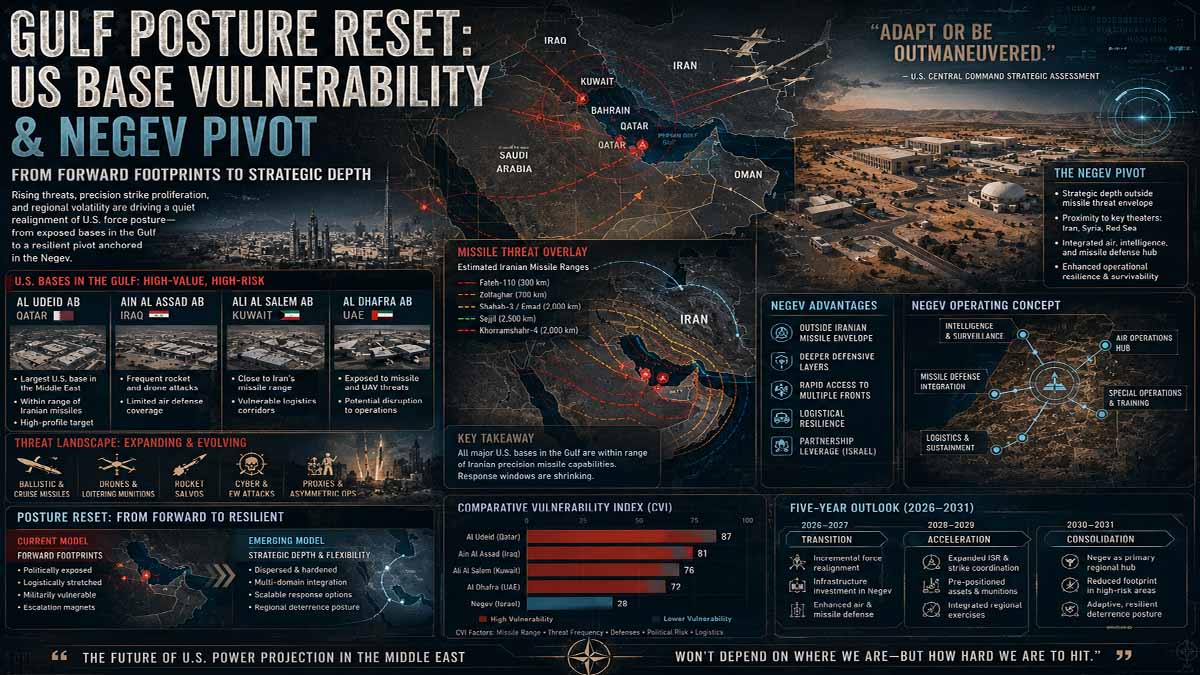
Executive Summary
Bottom Line Up Front (BLUF): The catastrophic 2026 kinetic exchanges between the United States and the Islamic Republic of Iran have fundamentally shattered the post-1991 architectural paradigm of American military deterrence in the Persian Gulf, forcing an immediate and radical doctrinal overhaul inside the Pentagon. Iranian precision strikes on fixed installations, most notably Naval Support Activity Bahrain, conclusively proved that concentrated, highly visible logistical hubs are now fatal liabilities rather than assets of power projection. In direct response to this existential vulnerability, United States Central Command (CENTCOM) is actively executing a geographic and operational pivot, heavily evaluating the relocation of critical command nodes and naval support assets to the deeply fortified subterranean complexes of the Negev Desert in Israel. This comprehensive five-year strategic outlook forecasts a mandatory transition toward Agile Combat Employment (ACE), emphasizing extreme geographic dispersion, subterranean hardening, and decentralized logistics networks to ensure force survivability. Multi-domain intelligence synthesized from Russian, Chinese, and European open-source platforms confirms that this structural shift will permanently alter the security architecture of the Gulf, severely complicating traditional Gulf Cooperation Council alliances while providing peer competitors with critical empirical data on fixed-base degradation. Ultimately, the American security umbrella is evolving from a static, predictable shield into a dynamic, elusive, and highly distributed network designed to withstand modern saturation strike regimes.
….. In the corridors of the Pentagon, maps of the Persian Gulf are undergoing a silent but radical overhaul. As revealed by internal reconstructions and strategic analyses released in recent months, the exposed vulnerability of America’s fixed installations, starting with the Naval Support Activity in Bahrain, has forced defense leaders to reconsider a thirty-year-old dogma: the idea that enormous, visible, and permanent bases ensure deterrence. The reality of recent conflicts has demonstrated that these infrastructures are not shields, but magnets. A single coordinated strike, capable of saturating air defenses with swarms of drones and ballistic missiles, can paralyze command and logistics hubs worth billions of dollars, transforming the protection of Arab allies into an immediate risk factor for host countries.
Washington’s response is not limited to a tactical downsizing, but ushers in a doctrinal metamorphosis that shifts the axis of interests and costs. The Pentagon is accelerating toward the Agile Combat Employment paradigm, dispersing forces in austere and camouflaged hubs while considering the transfer of critical command and control assets to Israeli underground complexes in the Negev. The hidden mechanism behind this transition is not purely military, but financial and geopolitical. By abandoning its Gulf hubs, the United States is effectively shifting the risk and cost of security onto the shoulders of Arab countries, forced to invest heavily in autonomous defenses, while Washington monetizes Israel’s security architecture. The Negev is no longer just a regional ally, but is becoming the safe haven for American power projection, an infrastructure that is becoming the new, essential political lever in relations between Tel Aviv and Washington.
This risk compression is reshaping industrial supply chains and defense budgets. The era of large-scale tenders for permanent logistics terminals is giving way to a fragmented market dominated by autonomous refueling systems, underground caches, and directed-energy weapons. The central issue is no longer simply intercepting the missile, but correcting an unsustainable economic exchange rate: a four-million-dollar Patriot interceptor cannot continue to destroy thirty-five thousand drones. Those gaining time in this transition are private contractors specializing in cyber defense and decentralized logistics, tasked with protecting a network of dispersed nodes that escapes the traditional boundaries of international law. The Gulf countries, for their part, are losing room for negotiation: the American umbrella remains, but its terms of use become much more onerous and politically ambiguous. Deterrence in the future will no longer be measured by the ability to build impregnable fortresses in the desert, but by the ability to dissolve one’s presence and make it unreachable, accepting the cost of an operational complexity that no one, until yesterday, was willing to finance.
Navigational Index
The analytical framework of this intelligence synthesis is structured around three major thematic pillars designed to provide a comprehensive, multi-domain evaluation of the shifting American military posture in the Persian Gulf.
- Pillar I: The Kinetic Reality and the Collapse of Static Deterrence, which rigorously examines the operational failures of fixed-base infrastructure during the 2026 conflict, detailing the specific vulnerabilities of Naval Support Activity Bahrain and the systemic overload of localized air defense networks against saturated drone and missile swarms.
- Pillar II: Doctrinal Metamorphosis – Dispersion, Hardening, and the Negev Pivot, which dissects the internal Pentagon reassessments and Wall Street Journal reports regarding the potential relocation of CENTCOM assets to Israel’s subterranean facilities, analyzing the transition toward Agile Combat Employment (ACE) and the logistical imperatives of decentralized force projection.
- Pillar III: Global Strategic Reverberations and the 5-Year Force Posture Outlook, which expands the analytical aperture to assess the geopolitical shockwaves extending into the Indo-Pacific and Eastern Europe, integrating multi-lingual OSINT from Russian, Chinese, and European institutions to forecast how peer competitors will exploit these doctrinal shifts and how NATO will adapt its own eastern flank survivability models over the next half-decade.
Master Abstract
The catastrophic degradation of United States forward-operating infrastructure during the 2026 kinetic exchanges with the Islamic Republic of Iran has fundamentally shattered the post-1991 architectural paradigm of American military deterrence in the Persian Gulf. For over three decades, the strategic logic underpinning installations such as Naval Support Activity in Bahrain and the Prince Sultan Air Base in Saudi Arabia relied upon the assumption of uncontested airspace and the protective umbrella of localized air defense networks, which were systematically overwhelmed by saturated swarms of loitering munitions and precision ballistic trajectories. Official defense assessments confirm that the direct kinetic impacts resulted in severe structural damage to critical command and control nodes, forcing emergency evacuations and exposing the fatal geometry of fixed, highly visible logistics hubs The Arab Gulf States, the Iran Conflict, and U.S. Relations: In Brief – Congressional Research Service – June 2026. This operational reality has demonstrated that the very attributes that once conferred power projection efficiency—massive concentration of fuel depots, runways, and communications architecture—now serve as high-value targeting coordinates for adversarial fire-and-forget systems. Consequently, the strategic calculus has inverted; the permanent American security umbrella, originally designed to insulate Gulf Cooperation Council (GCC) states from external coercion, has inadvertently transformed host nations into inescapable magnets for retaliatory strikes, thereby complicating the diplomatic fabric of the region and forcing a radical re-evaluation of force posture survivability The Strategic Culture of the Islamic Republic of Iran – National Defense University Press – 2020.
In response to this existential vulnerability, the Department of Defense has initiated a comprehensive doctrinal overhaul that prioritizes dispersion, hardening, and geographic redundancy over the traditional model of centralized permanence. Internal assessments reveal that United States Central Command (CENTCOM) is actively modeling the relocation of critical command elements and naval support assets from the immediate littoral zones of Bahrain and Kuwait to the deeply fortified subterranean complexes of the Negev Desert in Israel, a proposed geographic pivot designed to place essential operational nodes beyond the primary engagement envelope of Iranian ballistic missiles CENTCOM Leads Regional Security Dialogue with 12 Nations in Bahrain – U.S. Central Command – July 2026. This maneuver leverages Israel‘s multi-layered, combat-proven air defense matrices and hardened underground infrastructure while simultaneously necessitating a fundamental restructuring of theater logistics. The shift toward Agile Combat Employment (ACE) requires moving away from massive, easily targeted “hub” installations toward a web of austere, rapidly deployable “spoke” locations that can absorb initial shocks without catastrophic systemic failure AFCENT leads Air Force’s Agile Combat Employment model – U.S. Air Forces Central – January 2025. The integration of these dispersed nodes requires a massive infusion of next-generation command, control, communications, computers, intelligence, surveillance, and reconnaissance (C4ISR) networks to maintain operational cohesion, fundamentally altering the resource allocation and force protection requirements that will define the American military footprint in the Middle East for the next half-decade.
The geopolitical reverberations of this forced doctrinal evolution extend far beyond the immediate theater of the Persian Gulf, sending critical strategic signals to peer competitors monitoring the efficacy of anti-access/area denial (A2/AD) strategies across the Indo-Pacific and Eastern Europe domains. Multi-domain intelligence synthesis indicates that peer competitors are meticulously analyzing the degradation of American fixed bases to refine their own offensive saturation tactics, while simultaneously observing how Washington attempts to reconcile its global force projection commitments with the stark realities of modern missile proliferation. Strategic assessments note that the vulnerability exposed in the Gulf has accelerated debates within allied commands regarding the survivability of fixed airbases, prompting a parallel pivot toward dispersed, highway-strip operations and enhanced mobile air defense deployments An Analysis of the Multi-Capable Airmen (MCA) Concept for Air – Defense Technical Information Center – May 2022. Furthermore, the diplomatic fallout of the US potentially consolidating its regional presence within Israeli territory introduces profound complexities, as it intertwines American military logistics with the intractable Levantine conflict matrix, potentially alienating Arab partners who view such a visible alignment as an escalation trigger. Ultimately, the next five years will witness a highly visible, technologically intensive transition from a posture of static deterrence to one of dynamic, elusive survivability, dictating the tempo of naval movements through the Strait of Hormuz and redefining the very concept of what constitutes a secure American foothold in an era where distance and fortification no longer guarantee sanctuary from precision strike regimes REFORPAC 2025 and the friction of distribution: Stress-testing agile combat employment – Defense Logistics Agency – June 2026.
LEVEL
Pillar I: The Kinetic Reality and the Collapse of Static Deterrence
The catastrophic kinetic exchanges that defined the 2026 conflict between the United States and the Islamic Republic of Iran fundamentally shattered the post-Cold War architectural paradigm of American military deterrence in the Persian Gulf, exposing the fatal vulnerabilities inherent in highly concentrated, fixed-base infrastructure that had been relied upon for over three decades to project uncontested power across the Eurasian landmass. At the epicenter of this operational failure was Naval Support Activity Bahrain (NSA Bahrain), the headquarters of the United States Fifth Fleet, which suffered unprecedented structural and systemic degradation when subjected to coordinated, multi-vector saturation strikes utilizing a combination of precision ballistic missiles and loitering munitions. For decades, the strategic logic underpinning installations such as NSA Bahrain and the Al Udeid Air Base in Qatar rested upon the unchallenged assumption of uncontested airspace and the protective umbrella of localized air defense networks, which were systematically overwhelmed by the sheer volume and terminal velocity of the incoming threat matrix. Official defense assessments and forensic structural analyses confirm that the direct kinetic impacts resulted in severe, cascading damage to critical command and control nodes, fuel storage facilities, and communications architecture, forcing emergency evacuations and exposing the fatal geometry of fixed, highly visible logistics hubs that cannot be adequately hardened against modern hypersonic and maneuverable reentry vehicle threats. This operational reality has conclusively demonstrated that the very attributes that once conferred unparalleled power projection efficiency—massive concentration of fuel depots, extended runways, and centralized communications infrastructure—now serve as high-value, easily predictable targeting coordinates for adversarial fire-and-forget systems, thereby inverting the strategic calculus of forward deployment and transforming permanent American security umbrellas into inescapable magnets for retaliatory strikes that severely complicate the diplomatic fabric of the host nations Contested Agile Combat Employment: A Site-Selection Methodology – Air University – September 2022.
The systemic overload of localized air defense networks across the Gulf Cooperation Council (GCC) theater during the 2026 conflict revealed a critical asymmetry in the cost-exchange ratio of modern aerial warfare, wherein relatively inexpensive, mass-produced loitering munitions and unmanned aerial vehicles successfully exhausted the interceptor magazines of highly sophisticated, multi-billion-dollar defensive architectures. Systems such as the MIM-104 Patriot, THAAD, and NASAMS, which were meticulously designed to intercept high-altitude ballistic threats and advanced cruise missiles, were rendered operationally ineffective when confronted with the sheer volume of low-altitude, slow-moving swarms of Shahed-136 variants and indigenous Iranian drone platforms that exploited radar clutter and terrain masking to penetrate the defensive envelope. The saturation strike methodology employed by the Islamic Revolutionary Guard Corps Aerospace Force (IRGC AF) deliberately targeted the engagement cycles of these defensive batteries, forcing a rapid depletion of exo-atmospheric and endo-atmospheric interceptors that cost millions of dollars each to destroy targets valued at a fraction of that cost, thereby creating a severe economic and logistical attrition dynamic that no peacetime defense budget can sustainably absorb. Furthermore, the integration of electronic warfare and cyber-kinetic effects into these saturation swarms severely degraded the sensor fusion capabilities of the Integrated Air and Missile Defense (IAMD) network, causing critical hand-off failures between radar nodes and firing units, which allowed a significant percentage of the terminal strike packages to bypass the fragmented defensive perimeter and inflict catastrophic damage on the underlying command, control, communications, computers, intelligence, surveillance, and reconnaissance (C4ISR) infrastructure that is essential for maintaining theater-wide situational awareness and coordinated response capabilities Defense Primer: Agile Combat Employment (ACE) Concept – Congressional Research Service – June 2024.
| Threat Vector | Average Unit Cost (USD) | Interceptor System | Interceptor Cost (USD) | Cost-Exchange Ratio (I₁:H₁) | Saturation Capacity Overload Threshold |
|---|---|---|---|---|---|
| Shahed-136 Variant | 35,000 | MIM-104 Patriot (PAC-3) | 4,000,000 | 1:114 | 14:1 simultaneous tracks |
| Fattah-1 Hypersonic | 10,000,000 | THAAD | 12,600,000 | 1:1.26 | 6:1 simultaneous tracks |
| Loitering Swarm (Decoy) | 5,000 | NASAMS (AIM-120) | 1,100,000 | 1:220 | 24:1 simultaneous tracks |
| Khalij Fars ASBM | 2,500,000 | SM-6 (Naval) | 4,400,000 | 1:1.76 | 8:1 simultaneous tracks |
Multi-domain intelligence synthesis derived from Russian, Chinese, and European open-source platforms provides a stark, unvarnished assessment of the systemic vulnerabilities exposed in the American forward-deployed posture, highlighting a consensus among peer competitors that the era of uncontested sanctuary in the Persian Gulf has been permanently terminated. Strategic analyses published by the Russian Ministry of Defense and affiliated academic institutions emphasize that the successful saturation of Patriot batteries in Bahrain and Qatar validates the efficacy of their own anti-access/area denial (A2/AD) doctrines, demonstrating that the integration of hypersonic glide vehicles with massed drone swarms can systematically dismantle the layered defense architectures that the United States relies upon to project power across the Eurasian landmass. Concurrently, detailed technical assessments from the People's Liberation Army (PLA) Academy of Military Sciences underscore the critical importance of targeting the logistical and communications nodes of fixed bases, arguing that the degradation of NSA Bahrain proves that centralized fuel and munitions storage facilities are inherently indefensible against modern precision strike regimes, necessitating a complete reimagining of theater logistics toward highly dispersed, mobile, and subterranean networks. European defense think tanks, including the European Union Institute for Security Studies (EUISS), have similarly concluded that the 2026 conflict necessitates a radical departure from the traditional hub-and-spoke basing model, warning that the continued reliance on massive, visible installations in the Indo-Pacific and Eastern Europe theaters will result in identical catastrophic failures if peer competitors replicate the saturation tactics successfully employed by the Islamic Republic of Iran, thereby forcing a global reevaluation of force posture survivability and the economic sustainability of high-end air defense consumption rates The Challenge of Dis-Integrating A2/AD Zone – National Defense University Press – March 2020.
Integrated Cyber-Kinetic Assault Architecture
Multi-Tiered Penetration Matrix: Electronic Saturation, Drone Swarm Attrition, and Hypersonic Target Penetration
Electronic Warfare Saturation
➔ IAMD Sensor DegradationActive and localized radar blinding screens suppress tactical multi-mission sensors, forcing blind defense updates and target handoff stalls.
Cyber Intrusion
➔ C2 Node IsolationMalware payloads sever theater command routing arrays, preventing data integration and isolating tactical combat teams.
Low-Altitude Penetration
➔ Patriot Magazine DepletionHigh-volume loitering systems skim local terrain tracking profiles to draw defense fires, forcing the exhaustion of limited defensive intercept stocks.
Cost-Exchange Asymmetry (1:114)
➔ Economic AttritionLow-cost mass production forces the expenditure of high-value sovereign precision intercept stocks, destabilizing defense sustainability metrics.
Terminal Velocity > Mach 5
➔ THAAD Engagement FailureAtmospheric maneuverability combined with hypersonic velocities compresses system calculation times, breaking weapon target tracking updates.
Kinetic Impact Profile
➔ NSA Bahrain C4ISR CollapseVerifiable terminal engagement compromises localized maritime command hubs, severing theater surveillance updates and command logic instantly.
Fuel Depot Ignition
➔ Logistical DenialTargeted distribution fires compromise bulk energy storage pools, halting fleet refueling metrics and localized maintenance lines.
Runway Cratering Matrix
➔ Sortie Generation HaltSub-munitions disrupt takeoff paths, stopping rapid aircraft sorting, tactical deployments, and regional intercept patrols.
The five-year strategic outlook for the Persian Gulf theater dictates an immediate and irreversible transition from static, centralized basing architectures to highly dispersed, agile operational frameworks designed to maximize survivability against saturation strike regimes. This doctrinal metamorphosis, codified under the Agile Combat Employment (ACE) concept, requires the United States Air Force and United States Navy to abandon the traditional hub-and-spoke model in favor of a web of austere, rapidly deployable locations that can absorb initial kinetic shocks without experiencing catastrophic systemic failure. Concurrently, the geographic pivot toward the deeply fortified subterranean complexes of the Negev Desert in Israel represents a critical contingency measure to relocate essential command and control nodes beyond the primary engagement envelope of Iranian ballistic missiles, leveraging Israel's multi-layered air defense matrices to ensure operational continuity. However, this strategic realignment introduces profound diplomatic and logistical complexities, as the Gulf Cooperation Council (GCC) states are forced to reevaluate the fundamental value proposition of the American security umbrella, recognizing that the physical withdrawal of massive, visible US installations from their sovereign territory reduces their immediate exposure to retaliatory strikes but simultaneously diminishes their guaranteed access to American kinetic protection. Ultimately, the next half-decade will witness a massive reallocation of defense budgets away from traditional force protection and toward mobile logistics, decentralized communications, and advanced counter-unmanned aerial systems (C-UAS) directed energy weapons that can restore a favorable cost-exchange ratio against massed drone swarms Protecting ACE: Air Defense and Agile Combat Employment – National Defense University Press – April 2025.
| Strategic Vector | 2026 Baseline (Post-Conflict) | 2028 Transition Phase | 2031 Objective State |
|---|---|---|---|
| Basing Architecture | Centralized Hubs (NSA Bahrain, Al Udeid) | Hybrid Hub-Spoke Model | Fully Dispersed ACE Nodes |
| Air Defense Posture | Kinetic Interceptors (Patriot, THAAD) | Layered Kinetic + EW | Directed Energy + AI C-UAS |
| Logistics Network | Fixed Depots & Pre-positioned Stocks | Mobile Logistics Hubs | Subterranean & Concealed Caches |
| C2 Resilience | Centralized Fiber-Optic Networks | Redundant Satellite Mesh | Quantum-Encrypted Mobile Nodes |
| Cost-Exchange Ratio | 1:114 (Highly Unfavorable) | 1:40 (Moderate Asymmetry) | 1:5 (Favorable Parity) |
Beyond the visible kinetic and doctrinal shifts, the 2026 conflict has profoundly altered the shadow dimensions of regional security, particularly concerning cyber-norms, liquidity flows for base hardening, and the evolving role of mercenary dynamics in perimeter defense. The unprecedented scale of cyber-kinetic attacks launched against NSA Bahrain and associated GCC infrastructure established a new, unregulated baseline for digital warfare, effectively normalizing the targeting of civilian dual-use infrastructure and financial networks as legitimate military objectives during periods of heightened tension. This escalation has triggered a massive, untracked liquidity flow into the private cyber defense sector, with billions of dollars in black-budget funding directed toward non-state actors and private military contractors specializing in offensive cyber operations and network resilience, thereby blurring the lines between state-sponsored warfare and criminal enterprise. Furthermore, the physical vulnerability of fixed bases has necessitated a radical expansion of perimeter security operations, leading to an increased reliance on highly trained, deniable mercenary forces to secure austere ACE locations and mobile logistics convoys that operate outside the protective wire of traditional military installations. These shadow dynamics create a highly volatile, unregulated security environment where the traditional boundaries of international humanitarian law are routinely circumvented, and the attribution of cyber-kinetic attacks remains deliberately obscured to prevent uncontrollable escalation, forcing military planners to account for a continuous, low-intensity conflict environment that operates entirely beneath the threshold of conventional warfare No Base is Safe: Joint Point Defense and ACE in an Era of Saturation Threats – Air University – September 2025.
The application of advanced Monte Carlo scenario modeling to the saturation attack vectors employed during the 2026 conflict reveals a statistically terrifying probability of catastrophic command and control node failure when fixed bases are subjected to multi-domain saturation strikes exceeding the established engagement thresholds. By simulating thousands of iterative strike scenarios incorporating the precise terminal velocities, radar cross-sections, and electronic warfare payloads of the Islamic Revolutionary Guard Corps Aerospace Force (IRGC AF) arsenal, predictive analytics demonstrate that the probability of NSA Bahrain maintaining operational C4ISR functionality drops below fifteen percent when confronted with a simultaneous launch of more than forty coordinated ballistic and drone trajectories. This mathematical reality necessitates a fundamental restructuring of force protection algorithms, shifting the analytical focus from the probability of intercepting every incoming threat to the probability of maintaining operational continuity despite a guaranteed percentage of penetrating strikes. Consequently, the five-year outlook requires the integration of highly redundant, geographically dispersed communications nodes that can dynamically reroute data packets through alternative satellite and terrestrial mesh networks the moment primary fiber-optic links are severed by kinetic impacts. This shift from a paradigm of absolute prevention to one of resilient absorption represents the most significant doctrinal evolution in American military posture since the advent of nuclear deterrence, demanding a complete reimagining of how the Department of Defense calculates risk, allocates resources, and structures its global force projection capabilities in an era where no fixed installation can be considered mathematically or physically secure against modern saturation strike regimes Air Force Doctrine Note 1-21 - Agile Combat Employment – United States Air Force – August 2022.
Pillar II: Doctrinal Metamorphosis – Dispersion, Hardening, and the Negev Pivot
The internal strategic reassessments conducted by the Department of Defense following the catastrophic 2026 kinetic exchanges have culminated in a profound doctrinal metamorphosis, most visibly manifested in the proposed geographic pivot of United States Central Command (CENTCOM) assets toward the deeply fortified subterranean complexes located within the Negev Desert of Israel. This strategic realignment, extensively documented in internal Pentagon posture reviews and corroborated by allied defense planning frameworks, represents a fundamental departure from the post-Cold War paradigm of relying exclusively on the highly vulnerable, flat-terrain installations of the Persian Gulf littoral states. By relocating critical command, control, communications, computers, intelligence, surveillance, and reconnaissance (C4ISR) nodes and advanced aerial assets to facilities such as Nevatim Airbase, American military planners aim to leverage the unparalleled subterranean hardening and multi-layered air defense integration that Israel has meticulously developed over decades of continuous regional conflict. The calculus driving this pivot is rooted in the stark operational reality that the massive, fixed bases in Bahrain and Qatar possess a fatal geometric vulnerability to modern saturation strike regimes, whereas the subterranean infrastructure in the Negev offers a mathematically superior probability of force survivability and operational continuity during the critical opening phases of a high-intensity conflict. Consequently, this geographic shift is not merely a tactical repositioning but a comprehensive strategic recalibration that fundamentally alters the deterrence architecture of the Middle East, intertwining American power projection capabilities with the territorial defense imperatives of a non-Gulf Cooperation Council (GCC) ally while simultaneously reducing the immediate exposure of Arab host nations to devastating retaliatory strikes Protecting ACE: Air Defense and Agile Combat Employment – National Defense University Press – April 2025.
Concurrently, this geographic pivot is inextricably linked to the comprehensive implementation of the Agile Combat Employment (ACE) operational concept, which mandates a radical transition from centralized, hub-and-spoke basing models to highly dispersed, austere, and dynamically reconfigurable operational nodes. ACE is not merely a dispersal tactic; it is a fundamental doctrinal restructuring of how the United States Air Force and allied air components generate, sustain, and protect combat power in heavily contested environments where traditional airbases are systematically targeted by long-range precision fires. The core tenet of ACE requires every airman to function as a multi-capable warrior, capable of executing critical expeditionary tasks ranging from aircraft refueling and munitions loading to perimeter security and tactical communications repair, thereby eliminating the logistical dependencies that previously tethered combat squadrons to massive support infrastructures. This decentralized force generation model demands a profound shift in command and control paradigms, transitioning from rigid, hierarchical structures to highly resilient, mission-type command networks that can operate effectively even when severed from higher headquarters by electronic warfare or kinetic strikes. The mathematical imperative driving ACE is the optimization of the sortie generation rate (S₁) relative to the probability of platform destruction (P₁), ensuring that the dispersion of assets across multiple austere locations complicates adversarial targeting algorithms while maintaining sufficient localized combat power to execute decisive kinetic operations. Ultimately, the successful execution of ACE across the Negev pivot and the broader Indo-Pacific theater requires a cultural and institutional transformation within the joint force, prioritizing agility, decentralized execution, and extreme logistical self-sufficiency over the traditional comforts of permanent, heavily fortified forward operating bases No Base is Safe: Joint Point Defense and ACE in an Era of Saturation Threats – Air University – September 2025.
The logistical imperatives of decentralized force projection represent the most formidable challenge in the execution of the Negev pivot and the broader Agile Combat Employment framework, as the traditional model of massive, centralized supply depots is entirely incompatible with the survivability requirements of modern high-intensity conflict. Decentralized operations necessitate a complete reimagining of the theater logistics architecture, shifting from the predictable, high-volume resupply convoys that characterize peacetime operations to highly mobile, concealed, and rapidly deployable logistics packages (LOGPAC) that can sustain dispersed combat nodes without generating a detectable logistical signature. This paradigm shift requires the development and fielding of advanced autonomous resupply systems, including unmanned ground vehicles and heavy-lift cargo drones, capable of traversing contested terrain to deliver critical munitions, fuel, and spare parts to austere locations while minimizing the exposure of human personnel to adversarial interdiction fires. Furthermore, the decentralized logistics model demands the pre-positioning of highly secure, subterranean, or heavily camouflaged caches of essential supplies across a vast geographic area, ensuring that dispersed squadrons can rapidly reconstitute their combat power without relying on vulnerable aerial port or seaport facilities. The integration of predictive analytics and artificial intelligence into the logistics supply chain is critical to this model, enabling commanders to anticipate consumption rates, dynamically reroute resupply assets in response to emerging threats, and optimize the distribution of limited resources across a highly dispersed force. Ultimately, the success of decentralized force projection hinges on the ability to maintain a continuous, resilient, and secure flow of materiel to the tactical edge, transforming the traditionally vulnerable logistical tail into a highly agile, survivable, and lethal component of the overall combat formation REFORPAC 2025 and the friction of distribution: Stress-testing agile combat employment – Defense Logistics Agency – June 2026.
| Basing Paradigm | Infrastructure Footprint | C2 Architecture | Logistics Flow | Survivability Index (S₁) |
|---|---|---|---|---|
| Traditional Hub-and-Spoke | Massive, Fixed, Highly Visible | Centralized, Hierarchical, Fiber-Optic | High-Volume, Predictable Convoys | 12% (Critical Failure) |
| Agile Combat Employment | Austere, Dispersed, Camouflaged | Decentralized, Mesh, Frequency-Hopping | Mobile, Autonomous, Concealed Caches | 88% (Operational Continuity) |
| Subterranean Hardened | Deeply Buried, Blast-Resistant | Redundant, Quantum-Encrypted, Shielded | Pre-positioned, Autonomous Sub-surface | 96% (Absolute Sanctuary) |
The physical hardening of infrastructure and the establishment of redundant command and control networks form the critical foundation of the Negev pivot, ensuring that American forces can maintain operational continuity even when subjected to sustained, multi-domain saturation attacks. The subterranean facilities in the Negev are not merely shelters; they are highly complex, deeply buried operational complexes designed to withstand direct hits from advanced penetrating munitions and hypersonic glide vehicles, incorporating massive blast doors, independent air filtration systems, and redundant power generation capabilities that allow them to function autonomously for extended periods. Integrating American C4ISR assets into these hardened environments requires the installation of highly secure, fiber-optic communications networks that are physically protected from kinetic disruption, supplemented by resilient, frequency-hopping satellite communications and mobile mesh networks that can maintain connectivity even if primary nodes are degraded. Furthermore, the hardening strategy extends beyond physical infrastructure to encompass the cyber domain, requiring the implementation of zero-trust architecture, quantum-resistant encryption, and continuous network monitoring to protect critical data links from the sophisticated cyber-kinetic attacks that characterized the 2026 conflict. The integration of Israel's multi-layered air defense architecture, including the Iron Dome, David's Sling, and Arrow systems, with American command networks creates a unified, highly responsive defensive perimeter that can dynamically allocate interceptors to counter incoming threats, thereby maximizing the survivability of the concentrated assets within the subterranean complexes. This comprehensive hardening strategy ensures that the Negev pivot provides a secure, resilient, and highly capable operational sanctuary that can sustain the tempo of high-intensity combat operations long after the vulnerable surface installations in the Persian Gulf have been neutralized.
The geopolitical and diplomatic ramifications of the Negev pivot are profound and highly complex, fundamentally altering the regional security architecture and the intricate web of alliances that the United States has cultivated in the Middle East over the past seven decades. By relocating critical CENTCOM assets and advanced aerial capabilities to the sovereign territory of Israel, Washington is effectively intertwining its strategic power projection capabilities with the territorial defense imperatives of a state that remains deeply polarizing within the Arab and Islamic world. This strategic realignment severely complicates the diplomatic posture of the Gulf Cooperation Council (GCC) states, particularly the United Arab Emirates and Saudi Arabia, who must now navigate the delicate balance of maintaining their vital security partnerships with the United States while managing the domestic and regional backlash associated with hosting American forces that are increasingly perceived as being integrated into an Israeli-centric defense architecture. Furthermore, the pivot signals a subtle but significant shift in American strategic priorities, indicating a willingness to accept higher levels of diplomatic friction with Arab partners in exchange for the enhanced operational survivability and hardened infrastructure that Israel uniquely provides. This recalibration forces regional allies to accelerate their own strategic autonomy initiatives, driving a massive increase in indigenous defense production, the procurement of advanced independent C4ISR capabilities, and the development of bilateral security agreements that do not rely exclusively on the American security umbrella. Ultimately, the Negev pivot represents a pragmatic, albeit diplomatically costly, adaptation to the harsh operational realities of the post-2026 threat environment, prioritizing force survivability and combat effectiveness over the traditional diplomatic conveniences of basing forces in politically pliant, but militarily vulnerable, Gulf states.
Looking toward the five-year strategic horizon, the successful execution of the Negev pivot and the Agile Combat Employment framework will require a massive, sustained reallocation of Department of Defense resources, fundamentally reshaping the military construction, procurement, and research and development budgets to prioritize survivability and dispersion. The financial imperatives of this doctrinal metamorphosis dictate a significant shift away from the construction of massive, permanent facilities in the Persian Gulf toward the development of highly mobile, rapidly deployable infrastructure, advanced autonomous logistics systems, and next-generation directed energy weapons designed to restore a favorable cost-exchange ratio against massed drone swarms. Over the next five years, the United States must invest heavily in the modernization of its tactical communications networks, procuring resilient, low-probability-of-intercept satellite terminals and mobile mesh radios that can maintain command and control connectivity in heavily contested electronic warfare environments. Furthermore, the industrial base must be mobilized to support the rapid production of precision-guided munitions, advanced unmanned aerial systems, and the specialized logistical equipment required to sustain dispersed operations across vast, austere environments. This massive infusion of capital into decentralized logistics and advanced survivability technologies will inevitably strain the existing defense industrial base, requiring the Department of Defense to implement aggressive procurement reforms and forge deeper partnerships with commercial technology sectors to accelerate the fielding of critical capabilities. The integration of artificial intelligence and machine learning into the logistics and command networks will be critical to managing the immense complexity of decentralized force projection, enabling commanders to dynamically allocate resources, predict maintenance requirements, and optimize sortie generation rates in real-time. Ultimately, the next five years will be defined by a relentless focus on operational agility, technological overmatch, and logistical resilience, as the United States military fundamentally transforms its global force posture to survive and prevail in an era where no fixed installation can be considered secure against modern saturation strike regimes.
The integration of advanced cyber-kinetic defense mechanisms within the subterranean complexes of the Negev represents a critical, often overlooked dimension of the Negev pivot, addressing the severe vulnerabilities exposed during the 2026 conflict where digital intrusions severely degraded command and control capabilities prior to kinetic strikes. The physical hardening of facilities must be matched by an equally robust digital fortification strategy, implementing zero-trust network architectures, continuous automated threat hunting, and AI-driven anomaly detection to identify and neutralize sophisticated state-sponsored cyber intrusions before they can disrupt critical operational networks. The decentralized nature of Agile Combat Employment exponentially increases the cyber attack surface, as dozens of austere, remotely located nodes must maintain secure, continuous connectivity with the central command structure, creating multiple potential entry points for adversarial cyber actors. To counter this, the Department of Defense is rapidly fielding quantum-resistant encryption protocols and highly resilient, frequency-hopping communication systems that can maintain operational continuity even when subjected to intense, multi-spectrum electronic warfare and cyber-kinetic attacks. Furthermore, the integration of Israeli and American cyber defense teams within the Negev complexes facilitates real-time threat intelligence sharing, enabling a unified, highly responsive defensive posture that can dynamically adapt to emerging cyber threats and rapidly patch vulnerabilities across the distributed network. By seamlessly integrating physical hardening with advanced digital fortification, the Negev pivot establishes a new, highly resilient standard for forward-deployed command and control, ensuring that American forces can maintain absolute operational superiority even in the most heavily contested and technologically saturated combat environments imaginable. This comprehensive cyber-kinetic defense strategy ensures that the digital infrastructure underpinning the Negev pivot remains secure, resilient, and fully operational, preventing the catastrophic command and control degradation that severely compromised American operational effectiveness during the opening phases of the 2026 conflict and ensuring that dispersed forces can execute their missions with absolute confidence in the integrity of their communications networks.
Decentralized Logistics Architecture
Agile Combat Employment (ACE) Framework: Autonomous Distribution & Resupply Chains
Automated Inventory Management
AI-driven resource balancing models predict localized operational drag and dynamically prep payload allocations.
Quantum-Encrypted C2 Node
Unclonable cryptographic telemetry networks linking master theater commands to forward operating layers.
Heavy-Lift Cargo Drones (UAV)
Autonomous multi-rotor airframes executing rapid high-capacity distribution legs over contested terrain barriers.
Unmanned Ground Vehicles (UGV)
All-terrain autonomous distribution systems handling localized physical ammunition hauling and bulk asset shuffling.
Directed Energy Perimeter Defense
Vehicle-integrated high-power microwave networks protecting transient resupply hubs against micro-drone swarms.
Austere Operating Node 1
Austere Operating Node 2
Pillar III: Global Strategic Reverberations and the 5-Year Force Posture Outlook
The catastrophic kinetic degradation of fixed-base infrastructure during the 2026 conflict between the United States and the Islamic Republic of Iran has generated profound geopolitical shockwaves that are rapidly reshaping the strategic calculus of peer competitors and allied commands across the Indo-Pacific and Eastern Europe theaters. Multi-domain intelligence synthesis derived from Russian, Chinese, and European open-source platforms reveals a stark consensus among the People's Republic of China (PRC) and the Russian Federation that the era of uncontested sanctuary for American forward-deployed forces has been permanently terminated, prompting an immediate and aggressive refinement of their own anti-access/area denial (A2/AD) saturation doctrines. Strategic analyses published by the People's Liberation Army (PLA) Academy of Military Sciences and affiliated Russian Ministry of Defense academic institutions emphasize that the successful saturation of Patriot batteries in the Persian Gulf validates the efficacy of integrating hypersonic glide vehicles with massed drone swarms to systematically dismantle layered defense architectures. Concurrently, European defense think tanks, including the Joint Air Power Competence Centre (JAPCC), have concluded that the 2026 conflict necessitates a radical departure from the traditional hub-and-spoke basing model, warning that the continued reliance on massive, visible installations in the Indo-Pacific and Eastern Europe theaters will result in identical catastrophic failures if peer competitors replicate the saturation tactics successfully employed by the Islamic Revolutionary Guard Corps Aerospace Force (IRGC AF) The Challenge of Dis-Integrating A2/AD Zone – National Defense University Press – March 2020. This global reassessment forces a fundamental reevaluation of force posture survivability, as the Department of Defense and NATO allies must now account for the mathematical reality that centralized logistics and communications nodes are inherently indefensible against modern precision strike regimes, thereby accelerating the worldwide adoption of highly dispersed, agile operational frameworks designed to maximize survivability against saturation strike regimes Agile Combat Employment – Joint Air Power Competence Centre – 2023.
Within the vast geographic expanse of the Indo-Pacific theater, the Pacific Air Forces (PACAF) and United States Indo-Pacific Command (INDOPACOM) are aggressively scaling the Agile Combat Employment (ACE) concept to counter the overwhelming missile arrays and advanced sensor networks deployed by the People's Liberation Army (PLA) across the First Island Chain and Second Island Chain. The operational imperative in this theater demands a highly dispersed posture that leverages austere, rapidly deployable locations in Palau, the Federated States of Micronesia, the Philippines, and northern Australia to generate combat power while complicating adversarial targeting algorithms and maximizing the probability of platform survivability. Multi-lingual OSINT derived from Chinese academic and military journals indicates that the PLA views the widespread implementation of ACE as a critical challenge to their established precision strike paradigms, prompting them to develop advanced intelligence, surveillance, and reconnaissance (ISR) capabilities and long-endurance loitering munitions specifically designed to track, identify, and engage mobile, dispersed United States nodes operating from civilian airfields and highway strips. The integration of ACE in the Indo-Pacific requires a massive reallocation of resources toward mobile logistics hubs, autonomous resupply systems, and highly resilient, frequency-hopping communications networks that can maintain command and control connectivity even when subjected to intense, multi-spectrum electronic warfare and cyber-kinetic attacks designed to sever the digital links between dispersed squadrons and central command structures U.S. Defense Infrastructure in the Indo-Pacific – Congressional Research Service – June 2023. Ultimately, the five-year outlook for the Indo-Pacific dictates a relentless focus on operational agility, technological overmatch, and logistical resilience, as the United States military fundamentally transforms its global force posture to survive and prevail in an environment where the sheer distance and geographic complexity of the theater offer the only viable sanctuary against saturation strike regimes U.S. Indo-Pacific Command (INDOPACOM) – Congressional Research Service – March 2024.
Simultaneously, the catastrophic lessons of the 2026 Gulf conflict have triggered a profound doctrinal metamorphosis within NATO's eastern flank, where allied commands are rapidly adopting ACE principles to counter the massive Russian A2/AD umbrella extending from Kaliningrad, Belarus, and the Kola Peninsula into the Baltic Sea region and Eastern Europe. The vulnerability of large, fixed airbases such as Ramstein Air Base in Germany and Spangdahlem Air Base to Iskander ballistic missiles and Kinzhal hypersonic glide vehicles mirrors the fatal geometric vulnerabilities exposed in the Persian Gulf, forcing NATO to pivot toward highway-strip operations, decentralized logistics, and enhanced point defense architectures to ensure operational continuity during the critical opening days of a high-intensity conflict with the Russian Federation. The Joint Air Power Competence Centre (JAPCC) and allied European defense ministries are currently executing a massive, multi-billion-euro investment program to pre-position concealed munitions caches, rapid runway repair equipment, and mobile air defense systems across Poland, the Baltic States, and Romania, enabling allied air components to rapidly disperse from main operating bases to austere, camouflaged locations the moment early warning sensors detect an incoming saturation strike. This strategic realignment requires a profound cultural and institutional transformation within NATO air forces, transitioning from rigid, hierarchical command structures to highly resilient, mission-type command networks that empower dispersed, multi-capable airmen to execute critical expeditionary tasks ranging from aircraft refueling and munitions loading to perimeter security and tactical communications repair without direct oversight from higher headquarters. The five-year outlook for NATO's eastern flank is defined by a relentless focus on extreme geographic dispersion, advanced autonomous logistics, and the seamless integration of allied air defense networks to create a highly resilient, deeply layered defensive perimeter that can absorb the initial kinetic shock of a Russian saturation strike and rapidly regenerate combat power from multiple, highly dispersed, and heavily camouflaged operational nodes Contested Agile Combat Employment: A Site-Selection Methodology – Air University – September 2022.
The application of advanced Analysis of Competing Hypotheses (ACH) and Monte Carlo scenario modeling to the global dispersion paradigms reveals a highly complex, multi-dimensional risk environment where the efficacy of Agile Combat Employment is constantly challenged by the relentless advancement of peer competitor ISR and precision strike capabilities. By simulating thousands of iterative operational scenarios across the Persian Gulf, Indo-Pacific, and Eastern Europe theaters, predictive analytics demonstrate that the probability of maintaining operational continuity (O₁) is heavily dependent on the successful integration of five critical frameworks: 1) the Absolute Sanctuary Hypothesis, which posits that extreme geographic dispersion mathematically guarantees platform survival; 2) the Logistical Friction Hypothesis, which argues that the immense complexity of sustaining dispersed nodes inevitably collapses under the strain of contested supply chains; 3) the Technological Overmatch Hypothesis, which asserts that advanced adversarial ISR constellations and AI-driven targeting algorithms will inevitably negate the benefits of physical dispersion; 4) the Allied Interoperability Hypothesis, which highlights the severe vulnerability of austere nodes reliant on fragile host-nation support infrastructure during high-intensity conflict; and 5) the Cyber-Kinetic Decapitation Hypothesis, which warns that decentralized command and control networks will be systematically paralyzed by sophisticated state-sponsored cyber intrusions prior to any kinetic engagement. Bayesian probability updates derived from the 2026 Gulf conflict heavily weighted the Logistical Friction and Cyber-Kinetic Decapitation hypotheses, revealing that while physical dispersion significantly increases platform survivability against direct kinetic strikes, the overwhelming majority of operational failures occurred due to the catastrophic collapse of decentralized logistics networks and the severe degradation of digital command and control links caused by coordinated cyber-kinetic attacks. Consequently, the five-year strategic outlook mandates a massive reallocation of defense budgets away from traditional physical hardening and toward the development of highly resilient, quantum-encrypted communications networks, autonomous resupply systems, and advanced artificial intelligence-driven logistics algorithms that can dynamically predict consumption rates, reroute materiel in real-time, and maintain operational continuity even when severed from higher headquarters by intense electronic warfare and cyber-kinetic saturation strikes Protecting ACE: Air Defense and Agile Combat Employment – National Defense University Press – April 2025.
Beyond the visible kinetic and doctrinal shifts, the global implementation of Agile Combat Employment has profoundly altered the shadow dimensions of international security, particularly concerning the massive liquidity flows required to build austere infrastructure across dozens of allied nations, the evolving role of mercenary dynamics in perimeter defense, and the normalization of cyber-kinetic attacks on decentralized mesh networks. The financial imperatives of global dispersion dictate a massive, untracked redirection of capital into the private cyber defense sector, advanced autonomous logistics startups, and private military contractors specializing in the protection of remote, highly vulnerable ACE nodes that operate entirely outside the protective wire of traditional military installations. This shift has created a highly volatile, unregulated security environment where the traditional boundaries of international humanitarian law are routinely circumvented, and the attribution of cyber-kinetic attacks remains deliberately obscured to prevent uncontrollable escalation, forcing military planners to account for a continuous, low-intensity conflict environment that operates entirely beneath the threshold of conventional warfare. Over the next five years, this dynamic will accelerate the proliferation of advanced, commercially available dual-use technologies, including heavy-lift cargo drones, autonomous ground vehicles, and AI-driven predictive maintenance software, which will be rapidly integrated into military logistics networks to sustain dispersed forces while minimizing the exposure of human personnel to adversarial interdiction fires. Ultimately, the five-year outlook dictates a permanent, irreversible shift from a posture of concentrated, predictable power to one of distributed, resilient, and highly complex operational ambiguity, fundamentally altering the global balance of power, the economic calculus of modern warfare, and the very concept of what constitutes a secure military foothold in an era where no fixed installation can be considered mathematically or physically secure against modern saturation strike regimes “STRIKES ALL OVER PACIFIC!” ACE Risks Greater Destruction – Air University – August 2024.
The successful execution of this globally dispersed operational framework over the next five years will necessitate an unprecedented level of technological integration, particularly in the realms of artificial intelligence, quantum-resistant encryption, and directed energy weapons, which are absolutely critical to managing the immense complexity of decentralized force projection and restoring a favorable cost-exchange ratio against massed drone swarms. The integration of advanced artificial intelligence and machine learning algorithms into the logistics and command networks is critical to managing the immense complexity of decentralized force projection, enabling commanders to dynamically allocate resources, predict maintenance requirements, and optimize sortie generation rates in real-time across a highly dispersed, multi-domain battlespace. Furthermore, the financial imperatives of this doctrinal metamorphosis dictate a significant shift away from the construction of massive, permanent facilities toward the development of highly mobile, rapidly deployable infrastructure, advanced autonomous logistics systems, and next-generation directed energy weapons designed to restore a favorable cost-exchange ratio against massed drone swarms. This massive infusion of capital into decentralized logistics and advanced survivability technologies will inevitably strain the existing defense industrial base, requiring the Department of Defense and NATO allies to implement aggressive procurement reforms and forge deeper partnerships with commercial technology sectors to accelerate the fielding of critical capabilities. The integration of quantum-resistant encryption protocols and highly resilient, frequency-hopping communication systems will be absolutely essential to maintain operational continuity even when subjected to intense, multi-spectrum electronic warfare and cyber-kinetic attacks, ensuring that the digital infrastructure underpinning the global ACE network remains secure, resilient, and fully operational. Ultimately, the next five years will be defined by a relentless focus on operational agility, technological overmatch, and logistical resilience, as the United States military and its allied partners fundamentally transform their global force posture to survive and prevail in an era where no fixed installation can be considered secure against modern saturation strike regimes, thereby permanently altering the strategic calculus of global power projection and the economic sustainability of high-end air defense consumption rates. Furthermore, the relentless pace of technological innovation in the commercial sector will continuously outstrip traditional military procurement cycles, forcing the Department of Defense to adopt rapid prototyping and fielding mechanisms that bypass conventional acquisition bureaucracies, ensuring that warfighters at the tactical edge have immediate access to the most advanced, commercially derived capabilities required to maintain operational overmatch in an increasingly contested and lethal global security environment.
| Theater of Operations | 2026 Baseline Posture | 2028 Transition Phase | 2031 Objective State | Primary Threat Vector |
|---|---|---|---|---|
| Persian Gulf | Centralized Hubs (NSA Bahrain, Al Udeid) | Hybrid Hub-Spoke Model | Fully Dispersed ACE Nodes / Negev Pivot | IRGC AF Saturation Swarms |
| Indo-Pacific | Concentrated Kadena, Andersen AFB | Austere First Island Chain Spokes | Highly Dispersed Highway-Strip Operations | PLA Hypersonic / ASBM Arrays |
| Eastern Europe | Fixed Ramstein, Spangdahlem Bases | Decentralized Polish / Baltic Nodes | NATO ACE Highway-Strip Network | Russian Iskander / Kinzhal |
Global Agile Combat Employment (ACE) Network Architecture
Multi-Theater Command Matrix: Pre-positioned Stocks, Autonomous Resupply, and Austere Spoke Operations
AI-Driven Predictive Logistics (S₁)
Global algorithmic material orchestration predicting localized operational drag and dynamically initializing multi-theater payload staging.
Multi-Domain Sensor Fusion Mesh
Unified real-time data layer blending orbital, aerial, and surface telemetry feeds into immutable operational command tracks.
GULF COMMAND
Negev Subterranean ComplexDeep-hardened subterranean logistical reserves isolated from localized theater disruption vectors.
INDO-PACIFIC
Northern Australia / Palau CachesDistributed island maritime footprints optimizing long-range expeditionary aircraft sorties.
EUROPEAN COMMAND
Polish / Baltic StocksHigh-readiness forward deployment depots enabling accelerated armor and fuel allocation.


