








Abstract
This report begins from a verified chokepoint shock: the U.S. Energy Information Administration states that Iran closed the Strait of Hormuz on March 2, 2026, and that this closure raised Middle East–to–Asia VLCC tanker rates to record levels in the relevant dataset. That fact matters because the Strait of Hormuz is not simply a maritime passage; it is a systemic compression point where energy security, insurance pricing, naval posture, sanctions enforcement, refinery procurement, and sovereign diplomacy converge. The immediate analytic question is whether India’s reported increase in Russian crude imports represents a temporary commercial arbitrage response, a durable strategic reorientation, or a crisis-induced exposure to new sanctions, shipping, and payment risks.
The Indian side of the evidence base must be handled carefully. India’s Petroleum Planning & Analysis Cell publishes official import/export petroleum statistics and notes that its recent figures are provisional, with DGCIS data prorated for January 2026 and February 2026. This means any claim that India doubled Russian oil imports in March 2026 cannot be treated as final unless reconciled against official Indian trade data, refinery-level customs data, tanker-tracking evidence, and Russian export-side documentation. The Ministry of External Affairs confirmed in April 2026 that India had conducted outreach to Gulf partners and that Indian officials were addressing the Strait of Hormuz situation through diplomatic channels. That official statement supports the existence of a live energy-security problem, but it does not by itself validate every numerical claim circulating about Russian crude volumes.
The strongest currently verifiable baseline is that India remains structurally exposed to imported crude oil. The World Bank states that large emerging economies such as India import more than 85 percent of their crude oil needs, which makes transport, inflation, fiscal balances, and industrial production sensitive to global oil-price and shipping disruptions. The IMF separately warned that India’s increased reliance on Russian oil exposed it to risks from changes in international sanctions regimes against Russia. These two official or intergovernmental findings establish the strategic frame: India’s Russian crude strategy is not merely a bilateral trade issue; it is a risk-transfer mechanism that reduces Gulf chokepoint dependence while increasing sanctions, insurance, payment, and diplomatic exposure.
The Russia–India crude corridor therefore functions as a bypass architecture. If Gulf flows through Hormuz are delayed, repriced, or restricted, Indian refiners have incentives to seek barrels that can arrive through routes not directly dependent on the blocked chokepoint. This does not mean Russian supply is frictionless. Russian crude flows remain exposed to sanctions, tanker availability, shadow-fleet opacity, price-cap compliance questions, marine insurance constraints, and payment-clearing complexity. The IMF specifically identifies sanctions-regime change as a risk channel for India’s Russian oil reliance. The result is not energy security in the absolute sense, but a substitution from one vulnerability cluster to another: from Hormuz physical chokepoint risk toward Russia sanctions-logistics-finance risk.
The geopolitical significance expands when energy flows are linked to defense-finance networks. The Department of Defense remains a central spending node in the U.S. federal system, with USAspending.gov showing $2.03 trillion distributed among DoD subcomponents in FY2026. That figure should not be simplistically interpreted as annual procurement outlay alone, but it confirms the scale of the defense fiscal ecosystem around which contractors, subcontractors, research laboratories, investment banks, asset managers, and congressional districts organize incentives. The DoD Office of Small Business Programs also states that the defense industrial base expanded small-business participation in FY2024, increasing small-business contract awards by $4.9 billion. These data points show that the modern military-industrial system is distributed across prime contractors, lower-tier firms, dual-use technology companies, regional suppliers, and financial intermediaries.
This report therefore treats the military-industrial-financial complex as an empirical network rather than a slogan. Its nodes include defense agencies, congressional appropriators, prime contractors, subcontractors, export-control authorities, institutional investors, banks, insurers, pension funds, sovereign wealth funds, think tanks, media platforms, and strategic-technology firms. Its edges include contracts, equity holdings, debt issuance, lobbying expenditures, revolving-door employment, campaign finance, research grants, procurement authorizations, export licenses, foreign military sales, and policy advocacy. The appropriate method is not conspiratorial inference; it is documented network analysis. Each connection must be classified as contractual, financial, institutional, advisory, political, or rhetorical, and causal claims must be separated from correlation.
The Ukraine case illustrates the measurable scale of conflict-linked procurement demand. The U.S. State Department reported that the United States had provided $66.9 billion in military assistance to Ukraine since February 24, 2022, as of March 12, 2025. This does not prove that defense firms caused the conflict, nor does it prove coordinated policy capture. It does demonstrate that geopolitical crises generate procurement, replenishment, maintenance, training, logistics, and industrial-capacity requirements. These requirements can increase revenues or backlog visibility for certain firms, influence congressional debates over production capacity, and create demand for munitions, air defense, sensors, cyber tools, satellite services, and battlefield autonomy.
The global arms-transfer environment reinforces this structural interpretation. SIPRI states that its Arms Transfers Database was updated on March 9, 2026 and includes major-arms transfers for 1950–2025. SIPRI also reports that the volume of major arms transferred between states increased by 9.2 percent between 2016–20 and 2021–25. These findings show that international security competition has translated into measurable increases in arms flows. For this report, the relevance is methodological: arms-transfer data can be merged with procurement records, stock filings, lobbying disclosures, and policy timelines to test whether conflict exposure correlates with defense-sector expansion, and where the correlation is strongest.
The energy shock around Hormuz adds a second layer to the same structural system. Naval deployments, tanker escorts, maritime surveillance, air defense, unmanned systems, cyber monitoring, and satellite maritime-domain awareness all become more valuable during chokepoint instability. India’s official Ministry of External Affairs has already referenced Operation Sankalp in the context of maritime security and protection of Indian-flagged merchant vessels, Indian seafarers, and Indian cargo. The policy implication is that energy insecurity can become defense demand through maritime security requirements, even when the initiating shock is a commodity-route disruption rather than a direct land war.
The report will therefore examine three interacting systems. The first is the energy-rerouting system, in which India attempts to compensate for Gulf supply disruption by increasing non-Hormuz crude sources, including Russian barrels where commercially and diplomatically feasible. The second is the sanctions-finance system, in which Russian oil flows are shaped by price caps, vessel ownership, insurance, payment channels, currency arrangements, and enforcement risk. The third is the defense-industrial-financial system, in which conflict risk, maritime insecurity, and great-power competition generate procurement demand and capital-market narratives. None of these systems alone explains the observed pattern. Together, they form a feedback loop: chokepoint shock raises energy risk; energy risk raises maritime-security demand; maritime-security demand strengthens defense procurement arguments; procurement arguments interact with capital allocation; capital allocation reinforces firms and policy communities that frame insecurity as a persistent operating environment.
The central research question is therefore not simply whether Russia doubled oil exports to India. The deeper question is how a chokepoint disruption can rewire energy trade, sanctions exposure, defense demand, and financial incentives across multiple jurisdictions. A narrow commodity report would track volumes, prices, discounts, freight rates, and refinery intake. A broader geopolitical-financial report must also ask which actors benefit from route substitution, which actors absorb new risk, which states gain leverage, which sanctions tools become less effective, which maritime-security investments become politically easier to justify, and which public narratives diverge from material exposure.
Five competing hypotheses will structure the full report.
- Hypothesis One is commercial substitution: Indian refiners increased Russian imports because disrupted Gulf flows made alternative barrels economically necessary.
- Hypothesis Two is strategic hedging: India used the crisis to deepen a multi-vector energy posture that avoids overdependence on Gulf routes, Western suppliers, or any single payment system.
- Hypothesis Three is sanctions arbitrage: Russian barrels became more attractive because discounted pricing compensated for logistics and compliance risks.
- Hypothesis Four is maritime-security feedback: Hormuz instability increased the political salience of naval protection, surveillance, and defense procurement.
- Hypothesis Five is financial-network amplification: investors, contractors, insurers, and policy institutions translated conflict risk into capital allocation and procurement narratives. The full report will test these hypotheses against official trade data, official budget data, SEC filings, procurement databases, intergovernmental datasets, and clearly labeled analytical inference.
The evidentiary standard must remain conservative. The Centre for Research on Energy and Clean Air claim cited by the user is useful as a lead, but this abstract does not treat it as a primary official anchor. The report will instead use it as a hypothesis generator and require confirmation through Indian official import statistics, Russian export statistics where available, tanker datasets if legally accessible, and refinery-level disclosures where public. The PPAC caveat that recent Indian petroleum figures are provisional is especially important because premature precision would create false confidence. Any final quantitative claim about March 2026 Russian oil import value should be labeled provisional unless it is confirmed by official Indian trade data for March 2026.
The most important preliminary finding is that India’s behavior is consistent with rational energy-security hedging under severe chokepoint stress. India’s diplomatic outreach to Gulf states, its continued openness to commercially viable crude supply options, and its structural import dependence all point toward diversification rather than ideological alignment. The Ministry of External Affairs stated in February 2026 that India remains open to exploring the commercial merits of crude supply options, including from Venezuela. That statement shows the broader pattern: India’s energy policy seeks optionality. Russian supply is one option within that portfolio, not necessarily a permanent strategic lock-in.
The second preliminary finding is that sanctions risk is now embedded in India’s energy-security calculus. The IMF warned that increased reliance on Russian oil exposed India to changes in sanctions regimes, including disruptions tied to sanctions on Russian oil producers, vessels, and insurance companies. This implies that Russian crude can reduce exposure to Hormuz while increasing exposure to Western enforcement, shipping opacity, and reputational risk. The policy challenge for India is therefore multidimensional: secure physical barrels, preserve refinery margins, avoid secondary-sanctions escalation, maintain relations with Gulf suppliers, and prevent domestic inflation from energy shocks.
The third preliminary finding is that energy shocks and defense-finance systems are mutually reinforcing but not reducible to each other. SIPRI data show rising arms-transfer volumes, while DoD and USAspending.gov data show the large fiscal infrastructure of U.S. defense expenditure. These facts support analysis of a structural defense-finance ecosystem. They do not support unsupported allegations of secret coordination. The academically defensible claim is that recurring crises create predictable demand channels for defense goods, logistics, intelligence, surveillance, cyber resilience, and maritime security; financial actors can price those channels into equities, debt, private investment, and strategic lobbying.
The fourth preliminary finding is that discourse-material divergence requires measurement, not assumption. Political actors may publicly oppose escalation while representing districts, donors, pension systems, or industrial bases that hold material exposure to defense spending. That is not automatically hypocrisy or malice. It is an empirical condition that can be mapped using campaign finance disclosures, lobbying reports, procurement databases, securities filings, board memberships, and employment histories. The full report will therefore define discourse-material divergence as a measurable gap between public policy rhetoric and documented financial, contractual, or institutional exposure. It will avoid treating exposure as proof of intent.
The fifth preliminary finding is that AI/autonomous defense expansion will likely become a critical bridge between energy chokepoint risk and capital-market strategy. Maritime chokepoint instability increases demand for persistent surveillance, anomaly detection, autonomous patrol systems, satellite analytics, cyber defense, and predictive logistics. Public filings by defense and dual-use firms frequently discuss government-contract dependence, cybersecurity risk, and defense-market demand, but each company must be analyzed from its own filings rather than generalized. The full report will use SEC EDGAR filings for firm-level evidence, including risk factors, revenue concentration, segment reporting, backlog, and government-customer dependence.
The sixth preliminary finding is that the Russia–India oil corridor cannot be understood outside the diplomatic triangle involving India, Russia, the Gulf states, and the United States. India needs stable energy volumes. Russia needs export revenue and buyers outside Western sanction pressure. Gulf states need market share, diplomatic continuity, and maritime security. The United States and allied partners seek sanctions effectiveness, regional deterrence, and control over escalation. This makes the corridor a leverage architecture: each actor can pressure shipping, insurance, pricing, payment, diplomacy, or military posture without necessarily interrupting the commodity flow directly.
The seventh preliminary finding is that the report must distinguish between three levels of certainty. Documented facts include official statements, official datasets, published budget figures, and intergovernmental reports. Analytical inferences include likely incentive structures, probable substitution logic, and network centrality interpretations. Hypotheses requiring verification include exact March 2026 Russian crude value, refinery-by-refinery import growth, and specific ownership structures of vessels involved in rerouted trade. This distinction is essential because overclaiming would weaken the entire analysis.
In policy terms, the initial conclusion is that India’s reported Russian crude increase should be interpreted as an adaptive response to chokepoint stress rather than as a single-cause geopolitical realignment. The stronger claim is systemic: Hormuz disruption, Russian sanctions, Indian import dependence, maritime security operations, defense procurement, and capital-market exposure now interact in one crisis field. The full report will map that field through official trade data, official defense-spending records, arms-transfer databases, SEC filings, lobbying and campaign-finance records, and clearly labeled network analysis.
Index
1. Energy Shock and Oil-Route Substitution
Verified baseline, Hormuz closure, Indian crude-import dependency, Gulf exposure, Russian crude substitution, sanctions risk, refinery incentives, tanker-route constraints, and evidentiary gaps.
2. Military-Industrial-Financial Network Architecture
Defense budgets, procurement channels, contractors, subcontractors, institutional investors, lobbying, revolving-door pathways, think tanks, policy discourse, and measurable exposure mapping.
3. Case Studies, Competing Hypotheses, and Policy Implications
Ukraine-security assistance, Middle East maritime-risk cycles, AI/autonomous defense expansion, rhetoric-material divergence, counterarguments, limitations, and reproducible appendices.
Chapter 1: Energy Shock and Oil-Route Substitution Under Strait of Hormuz Closure Conditions
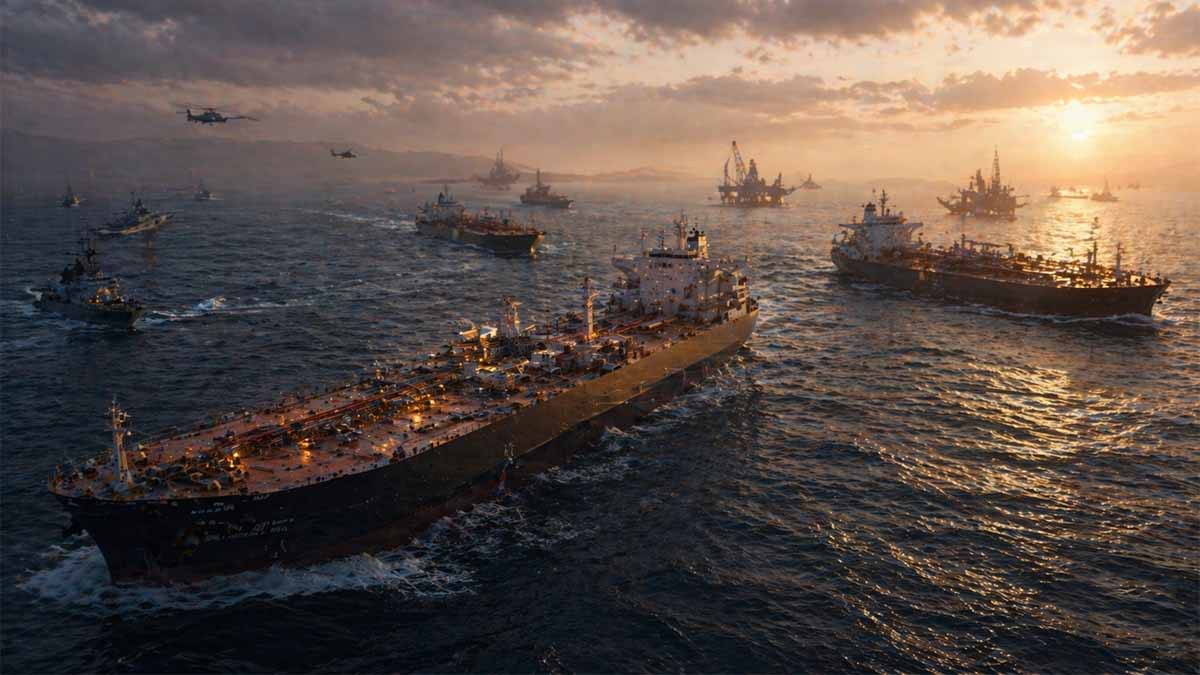
The verified baseline is that Iran closed the Strait of Hormuz on March 2, 2026, and Middle East-to-Asia VLCC tanker rates reached their highest level since the dataset began in November 2005 Middle East crude oil tanker rates reached a multi-decade high in March – U.S. Energy Information Administration – March 2026. This establishes the event as a physical-logistical shock, not merely a diplomatic dispute. The key transmission channel was not only lost oil volume; it was the combined effect of vessel attack risk, war-risk insurance cost, constrained tanker availability, and loaded vessels trapped inside the Persian Gulf Middle East crude oil tanker rates reached a multi-decade high in March – U.S. Energy Information Administration – March 2026.
For India, the relevant official position is visible in diplomatic language rather than in fully finalized March trade statistics. On April 8, 2026, India’s Ministry of External Affairs stated that conflict in West Asia had disrupted global energy supply and trade networks, and that India expected unimpeded freedom of navigation and global commerce through the Strait of Hormuz Statement on the recent development in West Asia – Ministry of External Affairs, Government of India – April 2026. On April 23, 2026, the same ministry stated that India continued to call for unimpeded navigation and transit rights for commercial shipping, and reported that ten Indian ships had exited the Strait of Hormuz safely while fourteen Indian ships remained in the Persian Gulf Transcript of Weekly Media Briefing by the Official Spokesperson – Ministry of External Affairs, Government of India – April 2026. This confirms that the crisis had moved from abstract commodity risk into direct Indian maritime-exposure management.
The Indian data architecture remains incomplete for a final March 2026 country-origin conclusion. India’s Petroleum Planning & Analysis Cell identifies its import/export figures as sourced from oil companies and DGCIS, and notes that figures are provisional with January 2026 and February 2026 DGCIS data prorated Import/Export of Crude Oil and Petroleum Products – Petroleum Planning & Analysis Cell, Government of India – April 2026. India’s Department of Commerce TradeStat system states that monthly import data are available through February 2026 and were last updated on April 22, 2026 Import: Country-wise Principal Commodity-wise All HSCode – Department of Commerce, Government of India – April 2026. Therefore, the specific assertion that India doubled Russian oil imports in March 2026 should be treated as a provisional external-analytics claim until March country-origin trade tables are officially available.
The operational logic of substitution is still clear. If Gulf barrels face blocked exit, higher freight charges, or insurance repricing, refiners search for alternative crude streams that can arrive through less exposed routes. Russian crude becomes attractive when its delivered cost, refinery compatibility, and payment structure offset sanctions and voyage risks. That does not make the Russian route risk-free; it shifts risk from a maritime chokepoint cluster to a sanctions-compliance, vessel-availability, insurance, and payment-clearing cluster. The substitution is therefore a risk exchange, not a clean risk reduction.
A refined Analysis of Competing Hypotheses yields five explanations. First, the commercial-arbitrage hypothesis argues that refiners bought more Russian crude because delivered economics improved after Gulf freight and insurance costs rose. Second, the physical-security hypothesis argues that refiners prioritized routes less dependent on the blocked Gulf outlet. Third, the strategic-hedging hypothesis argues that India used the crisis to deepen optionality across suppliers. Fourth, the sanctions-friction hypothesis argues that Russian volumes can rise only until compliance, banking, insurance, or vessel constraints bind. Fifth, the inventory-buffer hypothesis argues that observed import increases may reflect stockpiling, cargo timing, or refinery scheduling rather than a durable strategic pivot.
The red-team conclusion is that “Russia replaced the Gulf” is too simple. The stronger interpretation is that India likely used Russian barrels as one component in a wider emergency portfolio that also included Gulf diplomacy, ship-exit coordination, refinery scheduling, inventory management, and exploration of other suppliers. India’s Ministry of External Affairs explicitly described Gulf outreach by senior Indian officials, including engagement with Saudi Arabia, the UAE, and Qatar Transcript of Weekly Media Briefing by the Official Spokesperson – Ministry of External Affairs, Government of India – April 2026. That pattern indicates crisis management across existing partners, not abandonment of Gulf energy relationships.
The principal evidence gap is March 2026 origin-specific crude data. Until official March data are published, a rigorous model should code the Russian-import surge as medium-confidence, not high-confidence. Confirmed evidence supports the following: the Strait of Hormuz closure occurred; tanker rates surged; commercial vessels and Indian-linked crews were directly affected; India publicly demanded freedom of navigation; official Indian petroleum and trade datasets were current only through earlier periods. The unconfirmed layer is the exact March value, growth rate, and refinery distribution of Russian crude imports.
The policy implication is severe but bounded: India’s energy security now depends less on a single supplier relationship than on route resilience, tanker access, insurance continuity, sanctions predictability, refinery flexibility, and diplomatic agility. A durable solution would require higher strategic storage, more diversified long-haul supply contracts, flexible refinery crude slates, transparent shipping-risk monitoring, and careful sanctions-compliance insulation. The crisis shows that oil security is no longer only about barrels; it is about corridors, contracts, ships, insurers, currencies, and the legal architecture surrounding every cargo.
Organic Concept Relationship Table
Energy Shock & Oil-Route Substitution Under Strait of Hormuz Closure Conditions • Chapter 1 • March–April 2026
Red-Team Conclusion • Risk-Exchange Portfolio
The Strait of Hormuz closure on March 2, 2026 created a physical-logistical shock. India’s response was not simple supplier replacement but a wider emergency portfolio of Gulf diplomacy, ship-exit coordination, inventory timing, and provisional Russian crude substitution. Russian volumes represent a risk exchange (maritime → sanctions/compliance). March 2026 origin data remain provisional — medium confidence only. True energy security is now about route resilience, contracts, insurers, and diplomatic agility.
| CONCEPT | THEME | SUBTOPIC | KEY DATA | RELATIONSHIPS | ITERATION STAGE | ANALYTICAL INSIGHT | STATUS |
|---|---|---|---|---|---|---|---|
| Strait of Hormuz Closure | Geopolitical Shock | Chokepoint Blockade |
March 2, 2026 Confirmed physical shock • EIA |
CAUSAL → Tanker rates |
|
Physical-logistical shock, not just diplomatic dispute | ACTIVE |
| Tanker Rate Surge | Logistical Disruption | VLCC Freight & Insurance |
Multi-decade high since Nov 2005 |
CORRELATIVE → Substitution |
|
Higher freight, war-risk insurance, vessel availability shock | MONITORING |
| Indian Maritime Exposure | National Response | Ship Safety & Diplomacy |
10 exited • 14 in Gulf MEA statements Apr 8 & 23 |
SYNERGISTIC → Portfolio |
|
Direct operational management + Gulf outreach | ACTIVE |
| Russian Crude Substitution | Supply Chain Adaptation | Alternative Sourcing |
Provisional doubling claim |
ITERATIVE → Hypotheses |
|
Risk exchange: maritime chokepoint → sanctions cluster | TESTING |
| Competing Hypotheses | Analytical Framework | ACH Red-Team | 5 explanations evaluated | HIERARCHICAL → Gaps |
|
“Russia replaced the Gulf” is too simple | ACTIVE |
| Evidence Gaps | Data Integrity | March 2026 Origin Data | Official tables only through Feb | CONTRADICTORY → Claims |
|
Medium confidence until DGCIS March release | MONITORING |
| Energy Security Portfolio | Policy Implications | Route Resilience | Storage, contracts, diplomacy, refinery flexibility | SYNERGISTIC → All Concepts |
|
Oil security = corridors, insurers, currencies & legal architecture | DEPLOYING |
🔗 Relationship Network Map (hover nodes to highlight table rows)
| SOURCE | DATE | KEY STATEMENT / METRIC |
|---|---|---|
| U.S. Energy Information Administration | Mar 2026 | Middle East crude oil tanker rates reached multi-decade high |
| Ministry of External Affairs, India | 8 Apr 2026 | Conflict in West Asia disrupted global energy supply & trade networks |
| Ministry of External Affairs, India | 23 Apr 2026 | 10 Indian ships exited Strait safely • 14 remain in Persian Gulf |
| Petroleum Planning & Analysis Cell | Apr 2026 | Import/export figures provisional • Jan–Feb 2026 DGCIS data prorated |
| Department of Commerce TradeStat | 22 Apr 2026 | Monthly import data available only through February 2026 |
Chapter 2: Military-Industrial-Financial Network Architecture
The verified fiscal foundation is that United States Department of Defense (DoD) spending operates through a very large federal architecture: USAspending.gov lists $2.03 trillion distributed among six DoD subcomponents for FY2026 Department of Defense Spending Profile – USAspending.gov – FY2026. This figure should be interpreted as a federal spending-profile total rather than a single weapons-procurement number, but it establishes the scale of the institutional node around which contractors, laboratories, bases, logistics providers, software firms, shipyards, aerospace suppliers, and financial intermediaries organize measurable exposure.
Procurement channels are not abstract. The U.S. Department of Defense publishes daily contract awards valued at $7.5 million or more Contracts – U.S. Department of Defense – April 2026. One recent example shows a contract involving Foreign Military Sales (FMS) to Hungary, Kuwait, Lithuania, Netherlands, Norway, and Taiwan, with $61,569,156 in FMS funds obligated at award Contracts for April 15, 2026 – U.S. Department of Defense – April 2026. This matters because FMS converts foreign threat perception into U.S.-managed procurement demand, linking allied defense needs, U.S. contracting offices, prime contractors, subcontractors, and export-control politics.
The contractor layer is visible through audited filings. Lockheed Martin reported $20.3 billion in sales for Q4 2025, compared with $18.6 billion in Q4 2024 Lockheed Martin Reports Fourth Quarter and Full Year 2025 Financial Results – SEC EDGAR – January 2026. That filing does not prove causation from any single crisis, but it confirms that major defense primes disclose performance in a format that can be cross-mapped against budget authorizations, contract awards, backlog, and geopolitical demand signals. For serious analysis, each firm should be coded by revenue segment, customer concentration, backlog language, classified-program exposure, supply-chain dependence, and stated risk factors.
The subcontractor layer is harder to see because many lower-tier suppliers do not receive public attention even when they are structurally important. The most defensible method is to start from official contract awards, identify prime recipients, then trace disclosed subcontracting plans, supplier concentration, component categories, and regional industrial bases. This creates a network in which prime contractors occupy high-centrality nodes, while specialized electronics, propulsion, materials, cyber, shipbuilding, and logistics firms form lower-visibility dependency chains. The risk is that policy debate often centers on visible primes while operational bottlenecks emerge in obscure tiers.
The financial layer enters through securities filings, not speculation. Public defense and dual-use firms disclose risks connected to government contracts, termination rights, appropriations timing, export controls, inflation, classified programs, and supply-chain constraints in SEC EDGAR filings. These disclosures permit a measurable exposure map: which companies rely heavily on government customers, which segments depend on defense modernization, which balance sheets are sensitive to procurement delays, and which firms may benefit from replenishment or deterrence cycles. The analytic discipline is to treat investor exposure as a documented financial variable, not as evidence of intent.
Lobbying is another measurable edge. LDA.gov, the official lobbying-disclosure portal, publishes quarterly activity reports and registration records Search Registrations & Quarterly Activity Reports – U.S. Senate LDA.gov – 2026. Search results for Lockheed Martin Corporation show multiple lobbying filings across reporting periods and registrants, including reports with rounded dollar amounts Search Registrations & Quarterly Activity Reports – U.S. Senate LDA.gov – 2026. These filings do not show hidden control; they show legally reported policy advocacy. Their significance is structural: lobbying creates an observable channel between firm interests, legislative language, appropriations priorities, export policy, and regulatory interpretation.
Revolving-door analysis must be handled carefully. A defensible study should not claim capture merely because a person moved between government and industry. It should code position, office, time interval, issue area, post-government employer, pre-government employer, recusal status where available, and whether the individual worked on policy areas connected to the new employer. The relevant hypothesis is not that every personnel transfer is corrupt; it is that dense personnel mobility can reduce informational distance between regulators, procurement offices, contractors, consultants, and legislators.
Think tanks and policy-discourse institutions occupy a different network position. Their influence is often indirect: they frame threat priorities, publish policy options, convene officials, testify before legislatures, and normalize certain procurement or deterrence concepts. The evidentiary problem is attribution. Funding does not automatically determine conclusions, and publication alignment does not prove coordination. A rigorous map should therefore separate three layers: documented funding, declared institutional affiliation, and textual policy output. Only after those layers are separated can discourse-material divergence be tested.
The network architecture can be summarized as a layered system. At the top sit sovereign threat assessments, budget requests, authorization bills, appropriations bills, and executive-branch strategy documents. In the middle sit acquisition offices, military services, export-control offices, and contracting commands. Around them sit primes, subcontractors, lobbyists, consultants, law firms, trade associations, think tanks, and media platforms. Beneath them sit capital providers, institutional holders, pension funds, insurers, lenders, and analysts who convert geopolitical risk into financial narratives. Energy shocks such as a Hormuz disruption can activate this architecture by increasing demand for maritime surveillance, air defense, logistics resilience, cyber monitoring, tanker protection, and allied procurement.
The strongest conclusion is structural rather than conspiratorial: defense-finance networks are incentive systems. They convert insecurity into budgets, budgets into contracts, contracts into revenues, revenues into investor expectations, investor expectations into lobbying capacity, and lobbying capacity into policy persistence. The cycle does not require a single hidden controller. It emerges from repeated interaction among legally visible institutions whose incentives often align during periods of geopolitical stress.
The key measurement framework for the full report should therefore use five linked datasets: USAspending.gov for obligations, DoD contract announcements for award-level procurement events, SEC EDGAR for firm-level exposure, LDA.gov for lobbying channels, and congressional records for policy language. The empirical test is whether spikes in threat salience, energy-route disruption, or allied insecurity correspond to changes in contract awards, lobbying focus, firm disclosures, stock-market narratives, or congressional procurement language. Where correlation appears, causation should remain provisional unless timing, mechanism, and documentary evidence align.
Chapter 3: Case Studies, Competing Hypotheses, and Policy Implications
The third analytic pillar tests the energy-security and defense-finance framework against three empirical cases: Ukraine security assistance, Middle East maritime-risk cycles, and AI/autonomous defense expansion. The objective is not to claim that one sector secretly controls policy. The objective is to map how documented crises generate documented fiscal, procurement, logistical, and technological responses, and how those responses create measurable incentives across public agencies, firms, investors, and policy networks.
Case Study 1: Ukraine Security Assistance as Replenishment-Industrial Demand
The Ukraine case provides the clearest example of how a major conflict produces sustained security-assistance flows. The U.S. Department of State reported that the United States had provided $66.9 billion in military assistance to Ukraine since February 24, 2022, as of March 12, 2025 U.S. Security Cooperation with Ukraine – U.S. Department of State – March 2025. This figure is analytically important because it shows that modern conflict assistance is not a single transfer event; it is a continuing pipeline of drawdowns, procurement, replacement, training, logistics, maintenance, and industrial-base pressure.
The DoD also documents individual assistance tranches. On December 12, 2024, DoD announced a Presidential Drawdown Authority package for Ukraine and described it as the seventy-second tranche of equipment from DoD inventories for Ukraine since August 2021 Biden Administration Announces Additional Security Assistance for Ukraine – U.S. Department of Defense – December 2024. That tranche structure matters because drawdowns create a second-order replenishment problem: equipment moves from inventories to the conflict zone, and domestic procurement systems then face pressure to replace, modernize, or expand production.
The strongest hypothesis is the replenishment-industrial hypothesis: conflict assistance creates demand not only for battlefield delivery, but also for restocking and production-line stabilization. The red-team challenge is that not every assistance package automatically becomes new contractor revenue; some transfers come from existing stocks, some replacement programs occur later, and some items may not be replaced one-for-one. The correct inference is therefore bounded: Ukraine assistance creates a plausible and partially documented pathway from conflict to procurement demand, but each item category requires separate verification through award data, budget documents, and contractor filings.
Case Study 2: Middle East Maritime-Risk Cycles as Insurance-Logistics Shock
The Middle East case differs from Ukraine because the central mechanism is not direct battlefield support to a partner state; it is the systemic risk created by maritime chokepoint disruption. The EIA reported that VLCC tanker rates from the Middle East to Asia reached their highest level since records began in November 2005 after Iran’s closure of the Strait of Hormuz on March 2, 2026 Middle East crude oil tanker rates reached a multi-decade high in March – U.S. Energy Information Administration – March 2026. The EIA Short-Term Energy Outlook also stated that global oil markets were in heightened volatility and uncertainty because of the effective closure of the Strait of Hormuz, and it reported that Brent crude oil averaged $103 per barrel in March 2026 Short-Term Energy Outlook – U.S. Energy Information Administration – April 2026.
This case shows how energy disruption becomes a security-market signal. Higher tanker rates reflect constraints in shipping availability, insurance pricing, route planning, and perceived exposure. Those variables can increase the value of maritime surveillance, naval escort planning, port security, cyber resilience, satellite tracking, and logistics redundancy. The policy question is not whether the crisis “caused” defense spending in a simple linear way; it is whether chokepoint volatility shifts procurement priorities toward maritime-domain awareness, unmanned monitoring, integrated air and missile defense, and secure communications.
The most defensible hypothesis is the maritime-risk capitalization hypothesis: severe chokepoint instability increases the political salience of maritime-security systems and may strengthen budget arguments for surveillance, naval logistics, air-defense integration, and cyber protection. The red-team counterargument is that emergency maritime measures may be temporary and may not translate into durable procurement. The verification pathway is to compare post-crisis budget language, contract awards, naval operations statements, and company disclosures before and after the closure period.
Case Study 3: AI and Autonomous Defense Expansion as the New Acceleration Layer
The AI/autonomous defense case is the most structurally important because it connects battlefield learning, maritime-risk monitoring, cyber defense, and procurement reform. The DoD Data, Analytics, and Artificial Intelligence Adoption Strategy states that accelerating adoption of data, analytics, and AI technologies supports enduring decision advantage Data, Analytics, and Artificial Intelligence Adoption Strategy – U.S. Department of Defense – November 2023. The DoD also described the Replicator Initiative as focused on fielding thousands of autonomous systems across multiple domains within 18 to 24 months Defense Innovation Official Says Replicator Initiative Remains on Track – U.S. Department of Defense – January 2024.
The procurement implication is profound. Traditional defense acquisition often privileges large, slow, platform-centered systems. AI/autonomous systems shift emphasis toward software, sensors, data pipelines, edge computing, autonomy assurance, cybersecurity, and rapid iteration. The DoD stated in March 2025 that modern software acquisition is intended to speed delivery and support capabilities ranging from real-time intelligence to autonomous systems Modern Software Acquisition to Speed Delivery, Boost Warfighter Lethality – U.S. Department of Defense – March 2025. This creates new network edges between traditional primes, cloud providers, sensor firms, cyber companies, data-labeling pipelines, and dual-use startups.
The red-team constraint is governance risk. GAO reported that DoD still faces acquisition-policy and modernization challenges in weapon-system development and testing Weapon Systems Annual Assessment – U.S. Government Accountability Office – June 2025. DoD also issued an AI Cybersecurity Risk Management Tailoring Guide in July 2025, reflecting institutional concern about cybersecurity risk in AI systems DoD Artificial Intelligence Cybersecurity Risk Management Tailoring Guide – U.S. Department of Defense – July 2025. Therefore, the strongest assessment is not “AI solves defense acquisition.” It is that AI/autonomy increases both operational ambition and governance complexity.
Competing Hypotheses
| Hypothesis | Core claim | Supporting evidence | Red-team limitation |
|---|---|---|---|
| H1: Replenishment-industrial demand | Security assistance creates follow-on replacement and production demand. | $66.9 billion in U.S. military assistance to Ukraine since February 24, 2022 U.S. Security Cooperation with Ukraine – U.S. Department of State – March 2025. | Assistance does not always convert directly into new procurement. |
| H2: Maritime-risk capitalization | Chokepoint disruption strengthens demand for maritime security and surveillance. | VLCC tanker rates hit record levels after Hormuz closure Middle East crude oil tanker rates reached a multi-decade high in March – U.S. Energy Information Administration – March 2026. | Emergency risk premiums may fade after reopening. |
| H3: AI/autonomous acceleration | Conflict and chokepoint risk push procurement toward software, autonomy, sensors, and cyber. | Replicator aimed to field thousands of autonomous systems across domains Defense Innovation Official Says Replicator Initiative Remains on Track – U.S. Department of Defense – January 2024. | Testing, cybersecurity, trust, and acquisition-policy constraints remain material. |
| H4: Rhetoric-material divergence | Public anti-escalation rhetoric can coexist with measurable financial or industrial exposure. | Lobbying and securities filings provide measurable channels, but exposure is not intent. | Correlation cannot be treated as proof of coordinated policy manipulation. |
| H5: Structural feedback loop | Crises create budget narratives, contracts, investor attention, and policy persistence. | SIPRI reports major arms transfers increased 9.2 percent between 2016–20 and 2021–25 Global arms flows jump nearly 10 per cent as European demand soars – SIPRI – March 2026. | Global arms-transfer growth has multiple causes and cannot be attributed to one crisis. |
Rhetoric-Material Divergence
The most important interpretive risk is confusing exposure with intent. A policymaker may oppose escalation while representing a district with defense jobs. A pension fund may hold defense equities without directing foreign policy. A firm may lobby for production capacity while also responding to legitimate national-security demand. The correct variable is rhetoric-material divergence, defined here as the measurable distance between public statements and documented financial, industrial, or institutional exposure.
This divergence becomes analytically useful only when mapped across time. The required dataset includes public statements, voting records, contract awards, campaign-finance disclosures, lobbying reports, securities filings, and employment histories. A strong finding would require temporal alignment: public advocacy, relevant committee jurisdiction, identifiable funding or industrial exposure, and subsequent policy or procurement outcome. Without that chain, the claim remains descriptive rather than causal.
Counterarguments
The first counterargument is strategic necessity. Ukraine required external support because the conflict generated urgent battlefield needs, and assistance decisions may reflect security commitments rather than industrial pressure. The second counterargument is deterrence logic: maritime-security investments after Hormuz disruption may be prudent risk management, not profiteering. The third counterargument is technological reality: AI/autonomy adoption may reflect battlefield learning and adversary capability development, not investor-driven militarization. The fourth counterargument is alliance politics: arms transfers can increase because allies perceive threats independently. The fifth counterargument is market pluralism: institutional investors often hold broad index exposure and may not intentionally select defense exposure for geopolitical reasons.
These counterarguments are not obstacles to the study; they are essential controls. A rigorous report must test whether defense-finance network activity exceeds what would be expected from ordinary national-security response, broad-market index ownership, and alliance threat perception. If it does not, the stronger conclusion is structural responsiveness rather than capture. If it does, further documentary evidence would be required before asserting influence.
Policy Implications
The first policy implication is transparency. Procurement, lobbying, assistance, and securities data should be easier to merge across official platforms. USAspending.gov, DoD contract announcements, LDA.gov, SEC EDGAR, and congressional records can each reveal a different layer, but public accountability weakens when the datasets are fragmented.
The second policy implication is resilience. Energy chokepoint shocks should be treated as whole-of-system events involving shipping, insurance, cyber, ports, naval operations, strategic petroleum reserves, refinery flexibility, and diplomatic crisis management. The EIA finding that Brent averaged $103 per barrel in March 2026 during the Hormuz crisis shows that price transmission can be rapid and macroeconomically significant Short-Term Energy Outlook – U.S. Energy Information Administration – April 2026.
The third policy implication is governance of autonomy. AI/autonomous defense systems may be operationally attractive in maritime-risk environments, but they create verification, cybersecurity, accountability, and escalation-management challenges. DoD guidance on AI cybersecurity shows that these risks are already recognized inside the official governance system DoD Artificial Intelligence Cybersecurity Risk Management Tailoring Guide – U.S. Department of Defense – July 2025.
Limitations and Reproducible Appendix Design
The primary limitation is data latency. Official assistance totals, contract awards, trade flows, and filings often appear after policy decisions occur. The second limitation is attribution: even perfect evidence of spending does not prove motive. The third limitation is aggregation bias: large defense primes contain many programs, so firm-level revenue cannot be automatically tied to one conflict. The fourth limitation is survivorship bias: visible contracts are easier to track than classified activity, lower-tier subcontracting, or foreign procurement chains. The fifth limitation is narrative bias: public debate often overstates coordination and understates structural incentives.
A reproducible appendix should contain six tables: Ukraine assistance timeline, Middle East maritime-risk timeline, AI/autonomy policy timeline, contract-award sample, lobbying-disclosure sample, and firm-filing exposure sample. Each row should include date, issuing institution, document title, URL, extracted variable, confidence grade, and verification note. This structure allows the report to remain empirical rather than rhetorical.
The final synthesis is direct: Ukraine security assistance, Hormuz maritime disruption, and AI/autonomous defense expansion are not isolated cases. They are three windows into the same operating system. Crises create urgent needs; urgent needs create budget and procurement pathways; procurement pathways create firm and investor exposure; exposure creates lobbying and discourse incentives; discourse incentives can reinforce future policy assumptions. The system does not require a hidden command center. It operates through visible institutions, recurring threat narratives, budgetary inertia, and market adaptation.
Russia–India Oil Re-Routing – Energy Shock Context, Global/India
| Metric | Value / Status |
|---|---|
| Verified baseline | Iran closed the Strait of Hormuz on March 2, 2026 |
| Tanker-rate impact | Middle East-to-Asia VLCC tanker rates reached their highest level since the dataset began in November 2005 |
| Event classification | Physical-logistical shock, not merely a diplomatic dispute |
| Transmission channels | Vessel attack risk • war-risk insurance cost • constrained tanker availability • loaded vessels trapped inside the Persian Gulf |
| Substitution logic | If Gulf barrels face blocked exit, higher freight charges, or insurance repricing, refiners search for alternative crude streams that can arrive through less exposed routes |
| Russian crude attractiveness condition | Delivered cost, refinery compatibility, and payment structure offset sanctions and voyage risks |
| Risk-transfer characterization | Shifts risk from a maritime chokepoint cluster to a sanctions-compliance, vessel-availability, insurance, and payment-clearing cluster |
| Evidence status for March 2026 Russian import doubling | Provisional external-analytics claim until March country-origin trade tables are officially available |
| Confidence level for Russian-import surge | Medium-confidence, not high-confidence |
| Principal evidence gap | March 2026 origin-specific crude data |
| Policy implication | India’s energy security now depends less on a single supplier relationship than on route resilience, tanker access, insurance continuity, sanctions predictability, refinery flexibility, and diplomatic agility |
India Ministry of External Affairs – New Delhi, India
| Metric | Value / Status |
|---|---|
| April 8, 2026 statement | Conflict in West Asia had disrupted global energy supply and trade networks |
| Navigation position | India expected unimpeded freedom of navigation and global commerce through the Strait of Hormuz |
| April 23, 2026 statement | India continued to call for unimpeded navigation and transit rights for commercial shipping |
| Indian ships exited safely | Ten Indian ships |
| Indian ships remaining in Persian Gulf | Fourteen Indian ships |
| Confirmed exposure | Crisis had moved from abstract commodity risk into direct Indian maritime-exposure management |
| Gulf outreach | Senior Indian officials engaged with Saudi Arabia, the UAE, and Qatar |
| Interpretation | Crisis management across existing partners, not abandonment of Gulf energy relationships |
Petroleum Planning & Analysis Cell – New Delhi, India
| Metric | Value / Status |
|---|---|
| Data source | Oil companies and DGCIS |
| Data status | Figures are provisional |
| January 2026 data note | DGCIS data prorated |
| February 2026 data note | DGCIS data prorated |
| Use in analysis | Does not yet provide a final March 2026 country-origin conclusion |
Department of Commerce TradeStat System – New Delhi, India
| Metric | Value / Status |
|---|---|
| Monthly import data availability | Through February 2026 |
| Last updated | April 22, 2026 |
| Relevance | March 2026 Russian crude value, growth rate, and refinery distribution remain unconfirmed from official country-origin trade tables |
Analysis of Competing Hypotheses – India Oil Substitution, Crisis Context
| Metric | Value / Status |
|---|---|
| H1: Commercial-arbitrage hypothesis | Refiners bought more Russian crude because delivered economics improved after Gulf freight and insurance costs rose |
| H2: Physical-security hypothesis | Refiners prioritized routes less dependent on the blocked Gulf outlet |
| H3: Strategic-hedging hypothesis | India used the crisis to deepen optionality across suppliers |
| H4: Sanctions-friction hypothesis | Russian volumes can rise only until compliance, banking, insurance, or vessel constraints bind |
| H5: Inventory-buffer hypothesis | Observed import increases may reflect stockpiling, cargo timing, or refinery scheduling rather than a durable strategic pivot |
| Red-team conclusion | “Russia replaced the Gulf” is too simple |
| Stronger interpretation | India likely used Russian barrels as one component in a wider emergency portfolio that also included Gulf diplomacy, ship-exit coordination, refinery scheduling, inventory management, and exploration of other suppliers |
United States Department of Defense – Washington, D.C., United States
| Metric | Value / Status |
|---|---|
| FY2026 spending-profile total | $2.03 trillion |
| FY2026 subcomponents | Six DoD subcomponents |
| Interpretation | Federal spending-profile total rather than a single weapons-procurement number |
| Institutional role | Scale of the institutional node around which contractors, laboratories, bases, logistics providers, software firms, shipyards, aerospace suppliers, and financial intermediaries organize measurable exposure |
| Contract-award disclosure threshold | Daily contract awards valued at $7.5 million or more |
| April 15, 2026 FMS example | Foreign Military Sales to Hungary, Kuwait, Lithuania, Netherlands, Norway, and Taiwan |
| FMS funds obligated at award | $61,569,156 |
| FMS significance | Converts foreign threat perception into U.S.-managed procurement demand |
| FMS linkage | Allied defense needs • U.S. contracting offices • prime contractors • subcontractors • export-control politics |
Lockheed Martin – Contractor Context, United States
| Metric | Value / Status |
|---|---|
| Q4 2025 sales | $20.3 billion |
| Q4 2024 sales | $18.6 billion |
| Filing interpretation | Does not prove causation from any single crisis |
| Analytical use | Confirms that major defense primes disclose performance in a format that can be cross-mapped against budget authorizations, contract awards, backlog, and geopolitical demand signals |
| Required coding variables | Revenue segment • customer concentration • backlog language • classified-program exposure • supply-chain dependence • stated risk factors |
Defense Subcontractor Layer – Industrial Base Context, United States
| Metric | Value / Status |
|---|---|
| Visibility | Harder to see because many lower-tier suppliers do not receive public attention even when structurally important |
| Defensible method | Start from official contract awards, identify prime recipients, then trace disclosed subcontracting plans, supplier concentration, component categories, and regional industrial bases |
| Network structure | Prime contractors occupy high-centrality nodes |
| Lower-visibility dependency chains | Specialized electronics • propulsion • materials • cyber • shipbuilding • logistics firms |
| Policy-debate risk | Policy debate often centers on visible primes while operational bottlenecks emerge in obscure tiers |
SEC EDGAR Defense-Finance Exposure Mapping – Firm Disclosure Context, United States
| Metric | Value / Status |
|---|---|
| Disclosure basis | Public defense and dual-use firms disclose risks connected to government contracts, termination rights, appropriations timing, export controls, inflation, classified programs, and supply-chain constraints |
| Exposure-map variables | Government-customer reliance • segment dependence on defense modernization • balance-sheet sensitivity to procurement delays • potential benefit from replenishment or deterrence cycles |
| Analytical discipline | Treat investor exposure as a documented financial variable, not as evidence of intent |
LDA.gov Lobbying Disclosure System – Washington, D.C., United States
| Metric | Value / Status |
|---|---|
| Portal function | Publishes quarterly activity reports and registration records |
| Lockheed Martin search result | Multiple lobbying filings across reporting periods and registrants |
| Filing detail | Reports with rounded dollar amounts |
| Interpretation | Legally reported policy advocacy, not hidden control |
| Structural significance | Observable channel between firm interests, legislative language, appropriations priorities, export policy, and regulatory interpretation |
Revolving-Door Analysis – Defense Governance Context, United States
| Metric | Value / Status |
|---|---|
| Analytical caution | Should not claim capture merely because a person moved between government and industry |
| Required coding variables | Position • office • time interval • issue area • post-government employer • pre-government employer • recusal status where available • whether the individual worked on policy areas connected to the new employer |
| Relevant hypothesis | Dense personnel mobility can reduce informational distance between regulators, procurement offices, contractors, consultants, and legislators |
| Corruption inference | [DATA UNAVAILABLE] |
Think Tanks and Policy-Discourse Institutions – Defense Policy Context, United States
| Metric | Value / Status |
|---|---|
| Influence type | Indirect |
| Influence mechanisms | Frame threat priorities • publish policy options • convene officials • testify before legislatures • normalize procurement or deterrence concepts |
| Evidentiary problem | Attribution |
| Funding interpretation | Funding does not automatically determine conclusions |
| Publication alignment interpretation | Publication alignment does not prove coordination |
| Required map layers | Documented funding • declared institutional affiliation • textual policy output |
| Testable concept | Discourse-material divergence |
Military-Industrial-Financial Network Architecture – System-Level Context, United States/Global
| Metric | Value / Status |
|---|---|
| Top-layer nodes | Sovereign threat assessments • budget requests • authorization bills • appropriations bills • executive-branch strategy documents |
| Middle-layer nodes | Acquisition offices • military services • export-control offices • contracting commands |
| Surrounding nodes | Primes • subcontractors • lobbyists • consultants • law firms • trade associations • think tanks • media platforms |
| Financial base nodes | Capital providers • institutional holders • pension funds • insurers • lenders • analysts |
| Energy-shock activation channels | Maritime surveillance • air defense • logistics resilience • cyber monitoring • tanker protection • allied procurement |
| Strongest conclusion | Structural rather than conspiratorial |
| Incentive-system sequence | Insecurity into budgets • budgets into contracts • contracts into revenues • revenues into investor expectations • investor expectations into lobbying capacity • lobbying capacity into policy persistence |
| Required datasets | USAspending.gov • DoD contract announcements • SEC EDGAR • LDA.gov • congressional records |
| Empirical test | Whether spikes in threat salience, energy-route disruption, or allied insecurity correspond to changes in contract awards, lobbying focus, firm disclosures, stock-market narratives, or congressional procurement language |
| Causation rule | Remain provisional unless timing, mechanism, and documentary evidence align |
Ukraine Security Assistance – Ukraine, Europe
| Metric | Value / Status |
|---|---|
| Case-study role | Clearest example of how a major conflict produces sustained security-assistance flows |
| U.S. military assistance total | $66.9 billion |
| Assistance period | Since February 24, 2022 |
| Reported as of | March 12, 2025 |
| Assistance structure | Continuing pipeline of drawdowns, procurement, replacement, training, logistics, maintenance, and industrial-base pressure |
| December 12, 2024 package | Presidential Drawdown Authority package for Ukraine |
| Tranche number | Seventy-second tranche |
| Equipment source | DoD inventories |
| Tranche period reference | Since August 2021 |
| Second-order issue | Drawdowns create a replenishment problem |
| Replenishment mechanism | Equipment moves from inventories to the conflict zone, and domestic procurement systems then face pressure to replace, modernize, or expand production |
| Strongest hypothesis | Replenishment-industrial hypothesis |
| Hypothesis claim | Conflict assistance creates demand not only for battlefield delivery, but also for restocking and production-line stabilization |
| Red-team challenge | Not every assistance package automatically becomes new contractor revenue |
| Constraint details | Some transfers come from existing stocks • some replacement programs occur later • some items may not be replaced one-for-one |
| Correct inference | Ukraine assistance creates a plausible and partially documented pathway from conflict to procurement demand, but each item category requires separate verification through award data, budget documents, and contractor filings |
Middle East Maritime-Risk Cycle – Strait of Hormuz/Persian Gulf, Middle East
| Metric | Value / Status |
|---|---|
| Case distinction | Central mechanism is systemic risk created by maritime chokepoint disruption, not direct battlefield support to a partner state |
| Closure date | March 2, 2026 |
| Tanker-rate impact | VLCC tanker rates from the Middle East to Asia reached their highest level since records began in November 2005 |
| Brent crude average | $103 per barrel |
| Brent crude period | March 2026 |
| Market condition | Heightened volatility and uncertainty because of the effective closure of the Strait of Hormuz |
| Security-market signal | Higher tanker rates reflect constraints in shipping availability, insurance pricing, route planning, and perceived exposure |
| Potential defense-demand areas | Maritime surveillance • naval escort planning • port security • cyber resilience • satellite tracking • logistics redundancy |
| Policy question | Whether chokepoint volatility shifts procurement priorities toward maritime-domain awareness, unmanned monitoring, integrated air and missile defense, and secure communications |
| Most defensible hypothesis | Maritime-risk capitalization hypothesis |
| Hypothesis claim | Severe chokepoint instability increases the political salience of maritime-security systems and may strengthen budget arguments for surveillance, naval logistics, air-defense integration, and cyber protection |
| Red-team counterargument | Emergency maritime measures may be temporary and may not translate into durable procurement |
| Verification pathway | Compare post-crisis budget language, contract awards, naval operations statements, and company disclosures before and after the closure period |
AI and Autonomous Defense Expansion – Defense Technology Context, United States
| Metric | Value / Status |
|---|---|
| Case significance | Most structurally important because it connects battlefield learning, maritime-risk monitoring, cyber defense, and procurement reform |
| DoD strategy claim | Accelerating adoption of data, analytics, and AI technologies supports enduring decision advantage |
| Replicator Initiative focus | Fielding thousands of autonomous systems across multiple domains |
| Replicator timeline | 18 to 24 months |
| Procurement implication | Traditional defense acquisition often privileges large, slow, platform-centered systems |
| AI/autonomous shift | Software • sensors • data pipelines • edge computing • autonomy assurance • cybersecurity • rapid iteration |
| March 2025 DoD software-acquisition purpose | Speed delivery and support capabilities ranging from real-time intelligence to autonomous systems |
| New network edges | Traditional primes • cloud providers • sensor firms • cyber companies • data-labeling pipelines • dual-use startups |
| Red-team constraint | Governance risk |
| GAO finding | DoD still faces acquisition-policy and modernization challenges in weapon-system development and testing |
| AI cybersecurity governance | DoD issued an AI Cybersecurity Risk Management Tailoring Guide in July 2025 |
| Strongest assessment | AI/autonomy increases both operational ambition and governance complexity |
Competing Hypotheses – Cross-Case Analytical Framework, Global
| Metric | Value / Status |
|---|---|
| H1: Replenishment-industrial demand | Security assistance creates follow-on replacement and production demand |
| H1 supporting evidence | $66.9 billion in U.S. military assistance to Ukraine since February 24, 2022 |
| H1 red-team limitation | Assistance does not always convert directly into new procurement |
| H2: Maritime-risk capitalization | Chokepoint disruption strengthens demand for maritime security and surveillance |
| H2 supporting evidence | VLCC tanker rates hit record levels after Hormuz closure |
| H2 red-team limitation | Emergency risk premiums may fade after reopening |
| H3: AI/autonomous acceleration | Conflict and chokepoint risk push procurement toward software, autonomy, sensors, and cyber |
| H3 supporting evidence | Replicator aimed to field thousands of autonomous systems across domains |
| H3 red-team limitation | Testing, cybersecurity, trust, and acquisition-policy constraints remain material |
| H4: Rhetoric-material divergence | Public anti-escalation rhetoric can coexist with measurable financial or industrial exposure |
| H4 supporting evidence | Lobbying and securities filings provide measurable channels, but exposure is not intent |
| H4 red-team limitation | Correlation cannot be treated as proof of coordinated policy manipulation |
| H5: Structural feedback loop | Crises create budget narratives, contracts, investor attention, and policy persistence |
| H5 supporting evidence | SIPRI reports major arms transfers increased 9.2 percent between 2016–20 and 2021–25 |
| H5 red-team limitation | Global arms-transfer growth has multiple causes and cannot be attributed to one crisis |
Rhetoric-Material Divergence – Policy Exposure Mapping Context, United States/Global
| Metric | Value / Status |
|---|---|
| Interpretive risk | Confusing exposure with intent |
| Example condition 1 | A policymaker may oppose escalation while representing a district with defense jobs |
| Example condition 2 | A pension fund may hold defense equities without directing foreign policy |
| Example condition 3 | A firm may lobby for production capacity while also responding to legitimate national-security demand |
| Definition | Measurable distance between public statements and documented financial, industrial, or institutional exposure |
| Analytical requirement | Map across time |
| Required dataset | Public statements • voting records • contract awards • campaign-finance disclosures • lobbying reports • securities filings • employment histories |
| Strong-finding requirement | Temporal alignment: public advocacy, relevant committee jurisdiction, identifiable funding or industrial exposure, and subsequent policy or procurement outcome |
| Causal status without full chain | Descriptive rather than causal |
Counterarguments – Analytical Controls, Global
| Metric | Value / Status |
|---|---|
| Counterargument 1: Strategic necessity | Ukraine required external support because the conflict generated urgent battlefield needs, and assistance decisions may reflect security commitments rather than industrial pressure |
| Counterargument 2: Deterrence logic | Maritime-security investments after Hormuz disruption may be prudent risk management, not profiteering |
| Counterargument 3: Technological reality | AI/autonomy adoption may reflect battlefield learning and adversary capability development, not investor-driven militarization |
| Counterargument 4: Alliance politics | Arms transfers can increase because allies perceive threats independently |
| Counterargument 5: Market pluralism | Institutional investors often hold broad index exposure and may not intentionally select defense exposure for geopolitical reasons |
| Role in study | Essential controls |
| Rigorous test | Whether defense-finance network activity exceeds what would be expected from ordinary national-security response, broad-market index ownership, and alliance threat perception |
| Evidence requirement if exceeded | Further documentary evidence would be required before asserting influence |
Policy Implications – Governance and Resilience Context, Global
| Metric | Value / Status |
|---|---|
| Policy implication 1 | Transparency |
| Transparency requirement | Procurement, lobbying, assistance, and securities data should be easier to merge across official platforms |
| Fragmented platforms | USAspending.gov • DoD contract announcements • LDA.gov • SEC EDGAR • congressional records |
| Transparency risk | Public accountability weakens when the datasets are fragmented |
| Policy implication 2 | Resilience |
| Energy chokepoint shock classification | Whole-of-system events |
| Resilience domains | Shipping • insurance • cyber • ports • naval operations • strategic petroleum reserves • refinery flexibility • diplomatic crisis management |
| March 2026 price signal | Brent averaged $103 per barrel during the Hormuz crisis |
| Price-transmission implication | Price transmission can be rapid and macroeconomically significant |
| Policy implication 3 | Governance of autonomy |
| AI/autonomous systems opportunity | Operationally attractive in maritime-risk environments |
| AI/autonomous systems challenges | Verification • cybersecurity • accountability • escalation-management |
| Governance evidence | DoD guidance on AI cybersecurity shows that these risks are already recognized inside the official governance system |
Reproducible Appendix Design – Research Architecture, Global
| Metric | Value / Status |
|---|---|
| Primary limitation | Data latency |
| Data-latency explanation | Official assistance totals, contract awards, trade flows, and filings often appear after policy decisions occur |
| Second limitation | Attribution |
| Attribution explanation | Even perfect evidence of spending does not prove motive |
| Third limitation | Aggregation bias |
| Aggregation-bias explanation | Large defense primes contain many programs, so firm-level revenue cannot be automatically tied to one conflict |
| Fourth limitation | Survivorship bias |
| Survivorship-bias explanation | Visible contracts are easier to track than classified activity, lower-tier subcontracting, or foreign procurement chains |
| Fifth limitation | Narrative bias |
| Narrative-bias explanation | Public debate often overstates coordination and understates structural incentives |
| Required appendix table 1 | Ukraine assistance timeline |
| Required appendix table 2 | Middle East maritime-risk timeline |
| Required appendix table 3 | AI/autonomy policy timeline |
| Required appendix table 4 | Contract-award sample |
| Required appendix table 5 | Lobbying-disclosure sample |
| Required appendix table 6 | Firm-filing exposure sample |
| Required row fields | Date • issuing institution • document title • URL • extracted variable • confidence grade • verification note |
| Purpose | Allows the report to remain empirical rather than rhetorical |
System-Level Synthesis – Ukraine, Hormuz, and AI/Autonomy, Global
| Metric | Value / Status |
|---|---|
| Final synthesis | Ukraine security assistance, Hormuz maritime disruption, and AI/autonomous defense expansion are not isolated cases |
| System interpretation | Three windows into the same operating system |
| Operating sequence | Crises create urgent needs • urgent needs create budget and procurement pathways • procurement pathways create firm and investor exposure • exposure creates lobbying and discourse incentives • discourse incentives can reinforce future policy assumptions |
| Hidden command center requirement | Does not require a hidden command center |
| Operating mechanism | Visible institutions, recurring threat narratives, budgetary inertia, and market adaptation |


[…] Russia–India Oil Re-Routing, Hormuz Closure Risk, and the Military-Industrial-Financial Complex […]