







ABSTRACT
Strategic Context and Analytical Mandate
The date is April 24, 2026. On this precise day, Chinese Defense Minister Admiral Dong Jun concluded in-person talks in Moscow with Russian Defense Minister Andrei Belousov — a meeting that crystallized a pattern of accelerating bilateral military institutionalization that has been building since at least 2024. The meeting was not an anomaly; it was the latest data point in a structural trajectory that has moved with gathering speed since Russia’s full-scale invasion of Ukraine in February 2022, and which has been dramatically accelerated by the onset of U.S.-Israeli kinetic operations against Iran beginning in late February 2026. To analyze the Russia-China military cooperation framework in isolation from the broader geopolitical chessboard — the Iran War, the Taiwan Strait calculus, the CRINK alignment architecture, and the deeply fractured U.S. strategic bandwidth — would be to produce an analytically incomplete and strategically misleading product. This abstract, and the three-chapter report it inaugurates, undertakes the full-spectrum synthesis demanded by the current moment.
The analytical architecture deployed in this document draws on Structural Analytic Techniques (SAT), Analysis of Competing Hypotheses (ACH), and Bayesian probability updating to evaluate driver sets and assign confidence levels to projected outcomes. The framework is disciplined by publicly verifiable, primary-source anchored evidence, with secondary analytical synthesis applied where primary data yields structural inference.
The Belousov-Dong Axis: Military Institutionalization in Real Time
On April 24, 2026, Chinese Defense Minister Admiral Dong Jun, visiting Russia upon invitation, held talks with Russian Defense Minister Andrey Belousov. The two sides conducted an in-depth exchange of views on bilateral and military relations, the international and regional situation, and issues of mutual concern, with both sides agreeing that China-Russia relations have consistently maintained a high level of healthy development under the strategic guidance of President Xi Jinping and President Putin. Ministry of National Defense This statement, issued by the Chinese Ministry of National Defense, carries institutional weight beyond diplomatic formulism. It signals a deliberate, leadership-sanctioned deepening of defense architecture that has been operationalized through multiple high-level contact points in a compressed timeframe.
The January 2026 video conference between the same two ministers established the thematic baseline for today’s in-person encounter. Belousov stressed that the comprehensive strategic partnership between Russia and China is progressively growing and that cooperation between the Armed Forces of the Russian Federation and the People’s Liberation Army is organized at a high level. He further noted that the situations in Iran and Venezuela require their ministries to organize continuous analysis of the security situation and corresponding actions. Global Security This explicit linkage of Iran and Venezuela to the bilateral military cooperation agenda is of first-order analytical significance: it reveals that the Sino-Russian defense dialogue is no longer confined to bilateral operational concerns but has expanded to encompass coordinated global security monitoring of theaters in which U.S. strategic interests are directly engaged.
Chinese Defense Minister Dong Jun affirmed that China is ready to work with Russia to conscientiously implement agreements reached by the heads of state, strengthen strategic coordination, enrich the content of cooperation, improve exchange mechanisms, and jointly enhance capabilities to counter various risks and challenges. TASS The phrase “counter various risks and challenges” is a deliberate formulation in PRC strategic communications, consistently deployed to signal active rather than passive alignment — it connotes joint capacity-building directed against shared adversarial pressures, which in the current configuration means primarily U.S.-led security architectures.
The anniversary dimension of 2026 provides an important institutional framing layer. This year marks the 30th anniversary of the establishment of the China-Russia strategic partnership of coordination and the 25th anniversary of the signing of the China-Russia Treaty of Good-Neighborliness and Friendly Cooperation. Global Security Anniversary years in Chinese and Russian diplomatic practice function not merely as commemorative occasions but as institutional consolidation opportunities — platforms for deepening treaty obligations, expanding cooperation frameworks, and signaling long-term strategic commitment to both domestic and international audiences.
The CRINK Architecture: From Axis Concept to Operational Coordination
The broader multilateral alignment context within which Sino-Russian military cooperation is embedded has undergone a qualitative shift in early 2026 that demands systematic analytical attention. Iran, China, and Russia formally signed a comprehensive strategic pact in January 2026, marking one of the most consequential shifts in 21st-century international relations. The pact was described by state media in Tehran, Beijing, and Moscow as a cornerstone for a new multipolar order. Iran and Russia had earlier concluded a 20-year Comprehensive Strategic Partnership Treaty, signed in January 2025, designed to deepen economic, political, and defense ties and to blunt the impact of Western sanctions. Middle East Monitor
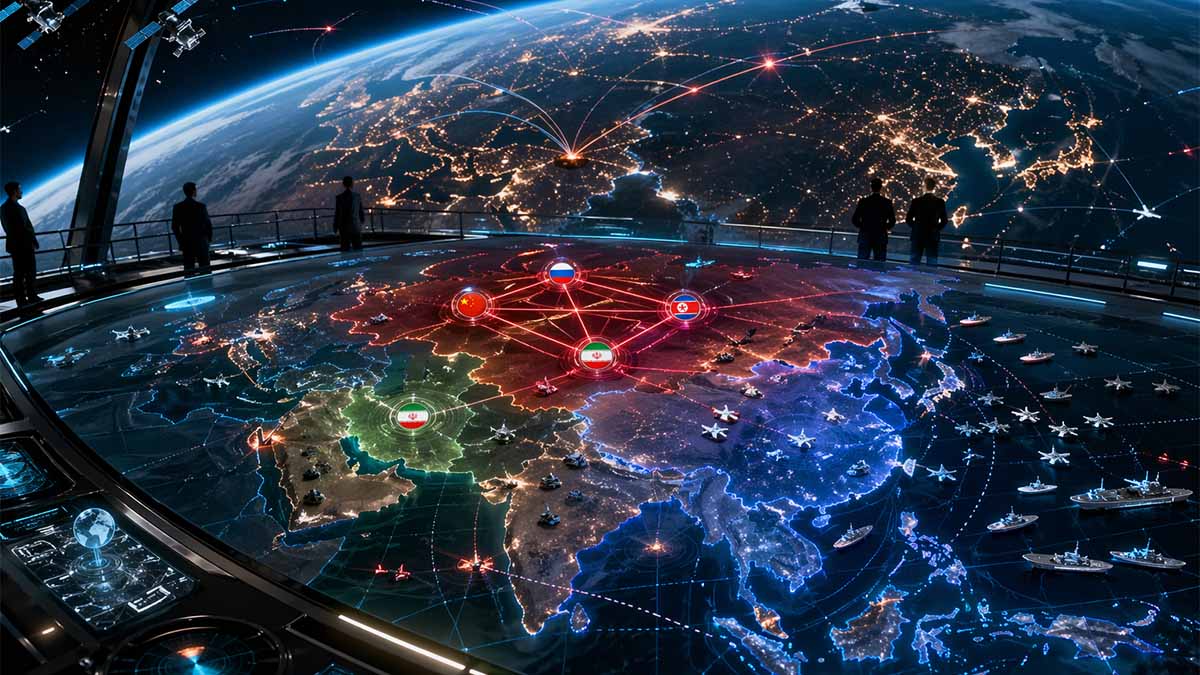
The CRINK framework — encompassing China, Russia, Iran, and North Korea — has been identified by leading U.S. strategic institutions as the defining geopolitical challenge of this era. The increasing alignment among China, Russia, Iran, and North Korea is fundamentally altering the geopolitical landscape. Cooperation among the four countries was expanding before 2022, but Russia’s invasion of Ukraine accelerated their deepening economic, military, and technological ties. Bound by shared opposition to a U.S.-led global order, the four powers are growing in strength and coordination and bent on upheaval. CNAS The Center for a New American Security (CNAS) has characterized this alignment as a “generational challenge” for U.S. national security — an assessment that acquires sharper urgency in light of simultaneous U.S. military engagement in Iran and growing strategic pressure in the Indo-Pacific.
The analytical literature has generated several competing conceptual labels for this alignment — CRINK, the Axis of Upheaval, the TRIC proposition, the trilateral pact framework — each capturing different aspects of the structural relationship. Currently, there is no binding alliance agreement, joint military command structure, or common foreign policy mechanism between Turkey, Russia, Iran, and China. Existing cooperation remains limited to the level of the Shanghai Cooperation Organisation. Turkishnews This analytical caveat is important: the CRINK/TRIC alignment is best understood as a strategic convergence organized around shared opposition to U.S.-led institutional dominance rather than a formal treaty-bound alliance with mutual defense obligations. The distinction matters operationally — it means that individual states within the alignment retain significant strategic autonomy and that defection under extreme pressure remains a structural possibility. However, the January 2026 trilateral pact represents a meaningful institutionalization step that narrows the gap between convergence and formal alliance.
The Iran War: Strategic Windfall and the Multipolar Dividend
The U.S.-Israeli kinetic campaign against Iran, which commenced in operational terms in late February 2026, has produced a set of second-order strategic consequences that directly strengthen the Sino-Russian alignment and test U.S. strategic bandwidth. The causal mechanism is multi-channel: fiscal, political, operational, and psychological.
The most visible beneficiary of the Iran conflict is Russia. The Russian economy, battered by Western sanctions and the immense costs of the war in Ukraine, was facing a precarious 2026. Russia built its federal budget on oil price assumptions of roughly $60 a barrel. Instead, the eruption of war in the Gulf sent Brent crude surging toward $120 a barrel. This windfall has rescued the Russian war budget, providing the Kremlin with the capital it needs to sustain its military operations in Europe. Toda Peace Institute This fiscal dimension is of primary strategic significance: the Iran War has inadvertently resolved Russia’s most acute near-term economic vulnerability at precisely the moment when Western sanctions were beginning to impose meaningful fiscal constraint. The strategic irony is profound — U.S. military action against Iran has materially strengthened Russia’s capacity to sustain its Ukraine campaign, thereby undermining one of the core objectives of the U.S.-European sanctions architecture.
Iran sits at the geographic center of a Eurasian project that China and Russia have been working on for years. The war in the Gulf constitutes an attempt to rupture the geographic core of an emerging multipolar order designed to bypass Western dominance — by targeting the single state that links China’s and Russia’s ambitions across the entire Eurasian corridor. China’s Foreign Ministry spokeswoman declared that the assassination of the Supreme Leader constituted a “grave violation of Iran’s sovereignty and security.” Middle East Council on Global Affairs For Beijing, the Iran conflict is not merely a regional crisis to be managed from the sidelines — it is a direct assault on the infrastructure of the Belt and Road Initiative (BRI) and the International North-South Transport Corridor (INSTC) that forms the logistical spine of the emerging multipolar economic order.
U.S. and Israeli forces launched strikes against Iran beginning in late February 2026, following failed attempts to renegotiate a nuclear deal in 2025 and 2026, in a context where Iran’s posture had been weakened after years of sanctions, the 12-day War with Israel in June 2025, and the diminished position of Iran’s regional allies. Given Iran’s weakened position, the United States and Israel calculated that they had greater opportunity to advance their objectives through military means than by diplomatic means. Encyclopedia Britannica The strategic logic underlying this calculation — that a weakened Iran represented a window of opportunity — reflects the offensive realist logic of exploiting temporary power differentials. However, the systemic second-order consequences have been substantially more complex than a simple military-strategic opportunity calculus would suggest.
The United States repositioned significant naval and air assets, including the USS Abraham Lincoln Carrier Strike Group, to the Middle East to conduct “coercive deterrence” and signal readiness for potential intervention following Iranian internal unrest. SpecialEurasia This force concentration, while operationally necessary for the Iran campaign, carries a significant strategic cost: it diverts U.S. naval and air assets away from the Indo-Pacific at a moment of heightened PLA assertiveness and growing Taiwan Strait tension. By February 13, 2026, the USS Gerald R. Ford was en route to the Middle East, creating an uncommon two-carrier deployment that multiple outlets noted constituted one of the most significant U.S. force postures in the region since the 2003 invasion of Iraq. On February 24, 2026, twelve F-22 fighter jets were deployed to Ovda Airbase in southern Israel — the first U.S. deployment of offensive weaponry in Israel. Wikipedia
The Taiwan Calculus and Indo-Pacific Strategic Bandwidth
The convergence of U.S. strategic attention and military assets on the Iran theater has prompted systematic reassessment of Taiwan Strait risk dynamics among Indo-Pacific security analysts. The central analytical question — whether China would exploit U.S. strategic distraction to accelerate its Taiwan timeline — is addressed with notable analytical discipline in the recently published U.S. intelligence community assessment. The U.S. intelligence community’s 2026 Annual Threat Assessment determined that China does not plan to invade Taiwan in 2027, nor do Chinese leaders have a fixed timeline for achieving unification. The report, published by the Office of the Director of National Intelligence, assessed that Beijing must seize Taiwan by 2049 to achieve its goal of “national rejuvenation” by the 100th anniversary of the People’s Republic of China. USNI News This intelligence assessment is operationally significant but should not be interpreted as a clean-bill indicator for Taiwan Strait stability — the key variable is not whether China has a fixed timeline but whether U.S. strategic bandwidth erosion, combined with PLA capability thresholds crossing, creates conditions in which Beijing recalculates the cost-benefit ratio of accelerated action.
The recently released U.S. National Security Strategy, which prioritizes the Western Hemisphere and proclaims a “predisposition to non-interventionism,” supports a perception in Beijing that the Trump administration’s shift in strategic priorities may be present for the next three years. The Trump administration’s mostly muted response to China’s December 2025 military exercise encircling Taiwan was also noted as encouraging from Beijing’s perspective. Foreign Affairs The signal value of muted U.S. responses to PLA pressure demonstrations is substantial — it recalibrates Chinese leadership’s assessment of U.S. resolve and the credibility of deterrent commitments.
The PLA modernization trajectory amplifies this concern. The PLA’s revised military strategy reveals a growing confidence and comfort with military escalation, including against the United States. Under this strategy, the PLA continues to be reliant on long-range precision strike capabilities. The growth of these capabilities has blurred traditional operational boundaries, and the PLA takes the initiative to seize strategic opportunities and create favorable external conditions — meaning it no longer simply defends China’s borders but actively builds and shapes a military posture around China’s periphery. Defense
U.S. Strategic Bandwidth: The Central Variable
The single most analytically important variable in the current geopolitical architecture is U.S. strategic bandwidth — the capacity of U.S. institutions, military assets, economic instruments, and political will to simultaneously manage the Iran campaign, deter China in the Indo-Pacific, sustain Ukraine support, and maintain coherent multilateral alliance management. The evidence suggests this bandwidth is under unprecedented simultaneous stress.
A gradual normalization of an elevated U.S. military posture in the Middle East, effectively resetting the baseline level of presence if instability persists, would have long-term implications for force allocation, alliance management, and strategic competition with Russia and China, who have supported the Iranian regime over the past decades. Geopolitical Monitor This observation from Geopolitical Monitor encapsulates the core strategic dilemma: the deeper and more protracted the Iran engagement, the more structurally constrained the U.S. position becomes across every other theater simultaneously.
The Toda Peace Institute’s synthesis is perhaps the most precise articulation of the systemic risk: Iran’s response to United States strikes follows a predictable logic of horizontal escalation — unable to match American firepower directly, Tehran escalates through proxy networks. The December 2025 U.S. National Security Strategy treats China and Russia in isolation, offering no strategy to keep them divided. Today, the architecture of U.S. strategic primacy is under severe strain — not merely as a loss of tactical advantage, but reflecting the erosion of alliance structures and the loss of a coherent framework to prevent Sino-Russian alignment. Toda Peace Institute
Five-Year Analytical Horizon: Structural Drivers
The five-year horizon through 2031 is shaped by five structural driver sets operating simultaneously across kinetic, economic, institutional, technological, and demographic vectors.
Driver Set 1 — Military Institutionalization: The Sino-Russian defense cooperation architecture is deepening from episodic consultation toward continuous operational coordination. The pattern of high-frequency ministerial contact — January 2026 video conference, April 24, 2026 in-person talks, plus the November 2025 Zhang Youxia-Belousov meeting in Moscow — indicates an institutionalization tempo that, by 2027-2028, is likely to produce formalized joint operational planning structures, expanded exercise architectures, and potentially explicit mutual notification protocols for force movements.
Driver Set 2 — Economic Complementarity: The Iran War’s oil price windfall ($120/barrel Brent) has structurally benefited Russian fiscal capacity while simultaneously advancing Chinese strategic interests through BRI corridor consolidation and Petro-Yuan trade expansion. The Saudi Arabia and UAE integration into BRICS+ and their hedging between U.S. security guarantees and Chinese economic relationships represents a structural erosion of the petrodollar architecture that has underpinned U.S. financial primacy for five decades.
Driver Set 3 — Technological Competition: The dual-use technology transfer dimension of Sino-Russian cooperation has drawn direct U.S. attention. U.S. officials argue China is enabling Russia by supplying sanctioned dual-use components used in missiles and drones, with claims that the share is close to 80 percent. Treasury Secretary Scott Bessent has said photographic evidence will be released. 19FortyFive This technology transfer dynamic — if substantiated — represents a qualitative escalation of Chinese support that approaches the threshold of material co-belligerency in the Ukraine theater, with potentially severe implications for U.S.-China relations.
Driver Set 4 — Institutional Multipolarity: A new class of “Multipolar Entrepreneurs” — specifically Saudi Arabia, the UAE, and Turkey — now dictates the regional agenda. These states no longer pick a side; they hedge between the U.S., China, and Russia to maximize their own national autonomy. Riyadh and Abu Dhabi have integrated into the BRICS+ framework, conducting trade in local currencies while simultaneously maintaining U.S. defense hardware. AMC-SGPS This hedging behavior by Gulf states that were once reliably in the U.S. strategic camp represents a structural erosion of the American-led order that no single diplomatic intervention is likely to reverse.
Driver Set 5 — Narrative Competition: The Iran, China, and Russia trilateral pact has been framed by all three parties in the explicit language of multipolar order construction, sovereign independence, and rejection of “unilateral coercion.” This narrative architecture is designed for a Global South audience and has demonstrated meaningful resonance in regional forums. The U.S. counter-narrative — centered on rules-based order, democratic norms, and the illegitimacy of revisionist coercion — faces a credibility deficit compounded by the perceived double standards exposed by the Iran campaign.
Confidence Assessment
The analytical judgments advanced in this report are calibrated as follows using modified Admiralty grading:
High confidence (>75% Bayesian posterior): That Sino-Russian military cooperation will continue to deepen institutionally through 2028, with expanding joint exercise frequency, technology transfer normalization, and formal coordination mechanisms for Iran– and Venezuela-related contingencies.
Moderate-high confidence (60–75%): That U.S. strategic bandwidth constraints imposed by the Iran campaign will persist through at least mid-2027, creating a window of relative Indo-Pacific deterrence degradation that China will probe but not necessarily exploit kinetically.
Moderate confidence (45–60%): That Turkey will progressively deepen its SCO-adjacent relationships while maintaining NATO membership, creating a formal alliance incoherence that neither Washington nor Ankara will structurally resolve within the 2026-2031 window.
Analytical uncertainty flag: The trajectory of the Iran War beyond April 2026 — particularly whether a negotiated ceasefire or continued kinetic escalation prevails — is the single highest-impact variable with the widest confidence interval in this analysis. The outcome of this uncertainty propagates through every other driver set with compounding effect.
INDEX
The Whole Picture in Plain Language — What This All Means for Ordinary People
- Chapter 1 — The Sino-Russian Defense Partnership: Structural Deepening, Institutional Architecture, and Military Interoperability (2024–2026)
- Chapter 2 — The Iran Theater as Strategic Catalyst: U.S. Force Concentration, CRINK Cohesion, and the Multipolar Dividend
- Chapter 3 — Indo-Pacific Fault Lines, Taiwan Calculus, and Five-Year Scenario Forecasting (2026–2031)
The Whole Picture in Plain Language — What This All Means for Ordinary People
Imagine you have been reading a very long, very detailed scientific report written by experts for other experts. It is full of technical words, military codes, economic percentages, and the names of weapons systems most people have never heard of. The first three chapters of this report are exactly that — thorough, precise, and packed with evidence. But they were written for analysts, diplomats, and defense planners who already know what “dual-use components,” “deterrence architecture,” and “strategic bandwidth” mean.
This chapter is different. Its only job is to explain everything that was said in Chapters 1, 2, and 3 in the clearest possible language. No jargon. No acronyms you need to look up. Just the real story, told as directly and honestly as possible, so that anyone — a student, a teacher, a farmer, a nurse, a retired factory worker — can understand what is happening in the world right now, why it matters, and what it might mean for the future.
The World Has Two Big Clubs — And One of Them Just Got Much Stronger
Think of the world’s countries the way you might think of neighborhoods in a city. For a long time after World War II, there was essentially one very powerful neighborhood that set the rules for everyone else: the neighborhood led by the United States. Countries in this neighborhood shared certain values — democracy, open markets, collective defense through alliances like NATO — and together they built the institutions that governed global trade, finance, and security. The United Nations, the International Monetary Fund, the World Bank, the World Trade Organization — all of these were largely shaped by, and served the interests of, this American-led order.
But two very large countries — Russia and China — never fully joined that club. They participated in some of its institutions, did business with its members, and sometimes cooperated on specific issues. But they always resented what they saw as the club’s real purpose: keeping American power dominant and limiting the ability of other major countries to do things their own way. They felt that the rules of the international system were written by Americans for Americans, and that everyone else had to play by those rules whether they liked them or not.
For many years, Russia and China had their own complicated relationship. They share a very long border. They have a history of tension and mistrust going back centuries. During the Cold War they were actually enemies, not allies. The Soviet Union and Communist China nearly went to war in the late 1960s. So when people talk about Russia and China becoming close partners today, it is important to understand that this is not natural or automatic. It is a deliberate choice made by the leaders of both countries because they decided that working together serves their interests better than competing with each other — at least for now.
What has happened over the past few years, and especially in 2025 and 2026, is that this partnership has become significantly deeper and more organized than at any previous point in history. The first three chapters of this report document exactly how that deepening has occurred, and why it matters so much.
What “Military Cooperation” Actually Means in Everyday Language
When Chapter 1 talks about Sino-Russian military cooperation, it is describing something that ordinary people can understand through a simple analogy. Imagine two neighbors who each have a security company protecting their homes. For a long time, each company operated completely independently. They might have said hello at community meetings, but they did not share equipment, train their staff together, or coordinate their patrol schedules.
Now imagine those two security companies started doing something very different. They began training their guards together every year, practicing the same drills, learning to communicate on the same radio frequencies, sharing information about threats, and even building some of their equipment jointly. They still have separate companies and separate owners, but in practice their operations are becoming increasingly intertwined. If a threat appeared, they could respond together far more effectively than they could before.
That is essentially what Russia and China’s militaries have been doing — but on a national scale, with warships, submarines, fighter jets, and missile systems instead of security guards and walkie-talkies.
The specific evidence is remarkable in its scale. By October 2025, China and Russia had participated in at least 117 joint military exercises together, with more than half of these taking place since 2019. ChinaPower Project (How Deep Are China-Russia Military Ties? – ChinaPower Project/CSIS – October 2025.) To put that in perspective: they did about as many joint exercises in the past six years as in all the previous years combined. The pace is accelerating, not slowing.
These exercises are not just symbolic parades. In August 2025, the two navies sailed their warships together into the Sea of Japan, practiced detecting and hunting submarines, trained their anti-aircraft gunners together, ran search-and-rescue operations jointly, and conducted live-fire artillery drills. For the first time ever, a Chinese submarine visited a Russian naval base to participate in drills. After the exercises were finished, their ships sailed together on a joint patrol through the Pacific Ocean. This was not symbolic. This was operational practice — two military forces learning to fight side by side if the need arose.
Beyond exercises, the two countries have been sharing military technology in ways that have significant consequences. Here is a simple way to think about this: imagine you are a car manufacturer, and your main supplier of engine parts suddenly gets cut off from your factory by a trade blockade. You desperately need those parts to keep building cars. Your neighbor — a competing car company — happens to have a large stockpile of similar parts, and also needs something from you: advanced knowledge about how to build a new kind of engine that you pioneered. So you make a deal. You give them what they need; they give you what you need.
That is essentially what has been happening between Russia and China in the defense industry. As of early 2025, four-fifths of the critical electronics used in Russian military drones came from China. FDD (China-Russia Defense Cooperation Showcases Rising Axis of Aggressors – Foundation for Defense of Democracies – June 2025.) Russia, cut off from Western technology by sanctions because of its war in Ukraine, turned to China to supply the electronic components it needs to keep building weapons. In return, Russia has been sharing advanced military technologies with China — things like the knowledge needed to build extremely powerful helicopters and certain submarine technologies — that China previously lacked. They are even jointly developing a new heavy-lift helicopter together, with the first flight planned for 2032.
The key thing to understand is that this is not just two countries doing business with each other. It is two of the world’s most militarily powerful nations systematically working to make each other stronger — specifically in ways that offset the military advantages of the United States.
Why They Are Doing This: The Simple Version
People who study international relations sometimes make this sound very complicated, but the basic logic is actually quite straightforward. Both Russia and China look at the United States and its allies and feel that this group has too much power over global affairs. They believe — not entirely without reason — that American dominance allows Washington to set rules, impose sanctions, project military force, and shape international institutions in ways that serve American interests while constraining Russian and Chinese ambitions.
Russia wants to rebuild a sphere of influence in the countries that used to be part of the Soviet Union. It wants Ukraine, Belarus, and other neighboring countries to be within Moscow’s orbit, not Washington’s. The United States and its European allies blocked this by expanding NATO and supporting democratic movements in those countries. So Russia invaded Ukraine, and then found itself facing devastating economic sanctions. Suddenly it needed a reliable friend who could help it survive economically and avoid complete military-industrial collapse. China was willing to be that friend — for a price.
China wants to be treated as the dominant power in Asia. It wants Taiwan — a democratic, self-governing island that has functioned independently since 1949 — to be formally unified with mainland China. It wants to control the South China Sea, which it considers its sovereign territory despite international courts ruling otherwise. And most fundamentally, it wants the United States to stop treating China as a rival to be contained and instead accept China as an equal, or eventually superior, global power. Russia, with its permanent seat on the UN Security Council, its nuclear arsenal, and its willingness to confront the West directly, is a useful partner in that project.
The result is what analysts in Chapters 1, 2, and 3 called a “partnership short of alliance.” They are not formal military allies the way the US and UK are. There is no treaty that says “if someone attacks Russia, China must fight back” or vice versa. But they coordinate closely, support each other diplomatically, supply each other militarily, and deliberately work together to complicate American strategic planning. Think of it as two chess players who, while competing in separate tournaments, have agreed to share notes on how to defeat the same opponent.
The War in Iran: How a Middle East Conflict Changed Everything
Now imagine you are running a company that is engaged in a dispute with two difficult competitors simultaneously. You cannot fully focus on either one because your attention and resources are divided. Then something unexpected happens — an emergency at one of your factories forces you to send most of your best managers and most of your most expensive equipment to deal with it. Suddenly your two competitors, who had been worried about you, realize that your attention is elsewhere. They breathe a sigh of relief and use the time to strengthen their own positions.
This is, in essence, what happened in early 2026 when the United States and Israel launched Operation Epic Fury against Iran.
On February 28, 2026, the United States and Israel began a massive military campaign against Iran. In just the first 12 hours, they conducted nearly 900 strikes against targets inside Iran, using B-2 stealth bombers, B-1 Lancers, and B-52 Stratofortresses to destroy fortified missile facilities. Encyclopedia Britannica (2026 Iran War – Encyclopaedia Britannica – April 2026.) It was one of the largest opening salvos in the history of air warfare. Iran’s supreme leader, Ali Khamenei, was killed in the opening hours.
But Iran hit back. It fired missiles and drones at American military bases across the Middle East — in Saudi Arabia, Kuwait, the UAE, Qatar, Jordan, and Iraq. It threatened to close the Strait of Hormuz — a narrow waterway through which roughly one in four barrels of oil traded at sea passes every day. And then it did close it. Brent crude oil prices surpassed $100 per barrel on March 8 for the first time in four years and rose to $126 per barrel at their peak — the largest monthly increase in oil prices in recorded history, and the largest disruption to world energy supply since the 1970s oil crisis. Wikipedia (2026 Strait of Hormuz Crisis – Wikipedia – April 2026.)
For ordinary people, this meant higher prices at the gas station, higher electricity bills, higher food prices (because food is transported by vehicles that run on fuel), and the beginning of what economists warned could become a global recession. Gasoline prices in the United States rose by $1.16 per gallon since the start of the war, with prices approaching $5.00 per gallon. Wikipedia (2026 Iran War Fuel Crisis – Wikipedia – April 2026.)
As of today, April 24, 2026, a fragile ceasefire agreed on April 7 is holding, and direct talks between the US and Iran are reportedly underway in Pakistan. But the Strait of Hormuz remains partially blocked, oil prices are still well above pre-war levels, and the conflict has not been fully resolved.
Now here is the key question: who benefited from this war other than its intended beneficiaries?
The answer, as Chapter 2 documents in detail, is primarily Russia.
Before the Iran war, sanctions imposed by the United States and Europe were finally beginning to bite hard on Russia’s finances. Russia had been spending enormous amounts of money on its war in Ukraine, and oil revenues — which fund about a third of the Russian government’s budget — were falling. Things were looking increasingly difficult for the Kremlin. Then the Iran war erupted, oil prices surged, and Russia’s oil export revenues essentially doubled overnight. President Trump’s decision to attack Iran in late February could not have come at a more opportune time for Putin. In the first months of 2026, Western economic tactics against Russia appeared to be finally working. Chatham House (The Iran War Has Been an Economic Gift for Putin – Chatham House – April 2026.) And according to the most detailed economic analysis available, Russia could receive between $45 billion and $151 billion in additional budget revenues in 2026 depending on how long the conflict lasts. In a central scenario of a three-month war, the windfall reaches roughly $0.5 billion per day in additional export earnings. PIIE (How Russia and China Are Winning the War in Iran – PIIE – April 2026.) That is money that goes directly into funding Russia’s continued military campaign in Ukraine.
Meanwhile, the United States found itself in a situation that military strategists dread: fighting in one region when your main long-term strategic concerns are in a completely different region. The US had been saying for years that its biggest strategic challenge was China in the Pacific, not Iran in the Middle East. Yet suddenly, two aircraft carrier battle groups, hundreds of advanced fighter jets, enormous quantities of precision-guided missiles, and significant numbers of troops were committed to the Middle East. The conflict has seen the U.S. burn through billions of dollars in missiles, redeploy a Marine Expeditionary Unit from Japan, and shift 48 THAAD interceptors off the Korean Peninsula. The Diplomat (An Opportunity or an Illusion? The Iran War and China’s Taiwan Calculus – The Diplomat – April 2026.) THAAD interceptors are the missile defense systems that protect South Korea from North Korean rockets — removing them means South Korea is temporarily more vulnerable. Removing the Marine unit from Japan means one less rapid-response force available in the region where China is most assertive.
China watched all of this very carefully. Not with alarm, but with quiet satisfaction — and, according to the most credible analysis, with a deliberate decision to do nothing dramatic while the United States is preoccupied. China’s strategic calculation can be summarized simply: why interrupt a war waged by the U.S. when it is getting stuck in an expensive quagmire in the Middle East? PIIE (How Russia and China Are Winning the War in Iran – PIIE – April 2026.) This is not a cynical observation — it is a straightforward description of how great powers think and behave. You do not need to start a war when your adversary is already overstretched.
Taiwan: The Island at the Center of Everything
Of all the complex issues in this report, Taiwan is probably the one that matters most to the largest number of people — and yet it is also the one that most people outside the region know least about. So let us start from the very beginning.
Taiwan is an island roughly the size of the Netherlands or the state of Maryland, located about 100 miles off the southeastern coast of mainland China. About 23 million people live there. Since 1949, when the Chinese civil war ended with the Communist Party taking control of mainland China and the defeated Nationalist government retreating to the island, Taiwan has governed itself independently. It has its own elected government, its own military, its own economy, its own currency, and its own way of life.
Over those 75 years, Taiwan became one of the most economically successful societies in Asia. It is now home to TSMC — the Taiwan Semiconductor Manufacturing Company — which makes the most advanced computer chips in the world. Nearly every smartphone, computer, electric vehicle, missile guidance system, and artificial intelligence server in the world uses chips made in Taiwan. If Taiwan’s chip factories were destroyed or came under Chinese control, the global economy would face a crisis that would make the 2008 financial meltdown look minor.
The government in Beijing has never accepted Taiwan’s independence. It considers Taiwan a renegade province that must eventually be unified with the mainland — by peaceful means if possible, by force if necessary. Chinese President Xi Jinping has made unification one of the central goals of his political legacy, calling it an essential part of the “rejuvenation of the Chinese nation.”
The United States does not formally recognize Taiwan as an independent country. But under the Taiwan Relations Act passed in 1979, it has committed to selling Taiwan defensive weapons and has maintained a policy of “strategic ambiguity” — meaning it has never explicitly said whether it would or would not send troops to defend Taiwan if China attacked. This ambiguity was deliberate: it was designed to deter China from attacking (because it might trigger American intervention) while also deterring Taiwan from declaring formal independence (because it might not get American support).
This arrangement has kept a fragile peace for 75 years. But in 2025 and 2026, that peace is under the greatest stress it has faced in decades.
Here is why. China has been conducting increasingly aggressive military exercises around Taiwan. In December 2025, just before New Year’s, China launched its largest military drills around Taiwan ever — called Justice Mission 2025. The exercise zones covered nearly the entire length of the Taiwan Strait, cutting off the most direct flight and sailing routes between Taiwan and its outlying islands. Live-fire drills on December 30 fired missiles closer to Taiwan than previously observed, landing between 12 and 24 nautical miles from the island’s shores. American Enterprise Institute (China & Taiwan Update, Special Edition – AEI – January 2026.) Think about that: missiles landing 12 nautical miles from your coastline is the maritime equivalent of someone firing a gun just outside the walls of your garden.
These exercises are not random intimidation. They follow a specific pattern. Each time, they practice a little closer to the island. Each time, they involve a few more ships and planes. Each time, they rehearse the specific military operations that would be needed in a real blockade or invasion — cutting off Taiwan’s access to the outside world, targeting its ports, establishing air superiority over the surrounding seas. China is, in effect, rehearsing a war against Taiwan in plain sight, year after year, each rehearsal slightly more realistic than the last.
Just this week, on April 20, 2026 — four days before this chapter was written — a Chinese aircraft carrier sailed through the Taiwan Strait heading south. The movement pointed to a broader strategic design: signaling resolve to Japan, countering the Philippines-U.S. military exercises happening simultaneously, and shaping the military balance ahead of possible high-level diplomacy with Washington. The Diplomat (China’s Liaoning Carrier Heads South: More Than a Routine Drill – The Diplomat – April 2026.) An aircraft carrier sailing through the Taiwan Strait while the US is preoccupied in the Middle East sends a message that requires no translation.
Does China Plan to Attack Taiwan Right Now?
This is the question everyone wants answered, and the honest answer is: probably not immediately, but the conditions are changing in ways that increase the long-term risk significantly.
The most authoritative U.S. intelligence assessment, published in March 2026, concluded that Chinese leaders do not currently plan to execute an invasion of Taiwan in 2027, nor do they have a fixed timeline for achieving unification. USNI News (China Not Committed to 2027 Taiwan Invasion – USNI News – March 2026.) This is reassuring — the CIA and Pentagon analysts are not pressing a panic button today.
But read the next sentence of that same report: Beijing must achieve its goal of unification by 2049 to complete what it calls the “national rejuvenation.” And in the meantime, China is “probably seeking to set the conditions for eventual unification short of conflict” — meaning it is working to make Taiwan progressively more isolated, more vulnerable, and more psychologically exhausted before ever needing to fire a shot.
The more alarming analysis comes from Foreign Affairs magazine, one of the world’s most respected publications on international relations. It noted in February 2026 that the Chinese policy community is increasingly convinced that an effort to assert control of Taiwan will happen, and it could even be imminent if Taiwan does something to provoke Beijing. The fundamental driver of this new assessment is U.S. politics and the perception that President Trump has little interest in defending Taiwan militarily. China may never again have a moment when Washington is so reluctant to intervene on Taiwan’s behalf. Foreign Affairs (A Perfect Storm for Taiwan in 2026? – Foreign Affairs – February 2026.)
In other words: even if China is not planning to attack tomorrow, Chinese leaders increasingly believe that a window of opportunity exists — perhaps for the next two to three years — when the US is distracted, when Trump’s foreign policy is focused on the Middle East and domestic issues, and when China’s military has reached sufficient strength to make any American response extraordinarily costly. If that window closes without Beijing acting, another one may not open for decades.
Russia, Oil, and Ukraine: The Hidden Connection
Most people think of Russia’s war in Ukraine as a separate story from the war in Iran or China’s ambitions over Taiwan. But they are all connected — and understanding how requires just one simple concept: money.
Russia needs oil revenues to fund its war in Ukraine. Before the Iran war, those revenues were declining dangerously. Western sanctions were working. The Russian economy was slowing down. The government was spending more money on the military than it was taking in.
Then the Iran war caused oil prices to nearly double. Russia’s oil — which it sells primarily to China, India, and other countries that refused to join Western sanctions — suddenly became worth much more. The money started flowing in again. The pressure was relieved. And that means Russia can continue fighting in Ukraine for longer than it could have otherwise.
Sergey Vakulenko, senior fellow at the Carnegie Russia Eurasia Center, confirmed that Russia’s windfall from the Iran War’s resulting energy price growth ran into the billions of dollars. Any relief, however, will go straight into military spending — not into the civilian economy Russians live in. CNBC (Moscow Is Profiting from the Iran War for Now — CNBC – March 2026.)
This is the hidden connection: a war in the Middle East is funding a war in Europe. And both of those situations are making it harder for the United States to focus on a potential crisis in Asia. These three theaters — the Middle East, Europe, and Asia — are not isolated crises. They are interconnected pressure points on a single strategic architecture.
Turkey: The Country That Is Playing Both Sides
Turkey is a member of NATO — the same military alliance that includes the United States, the United Kingdom, France, Germany, and most of Western Europe. This means Turkey is supposed to be a Western ally. It hosts American nuclear weapons at its İncirlik Air Base. Its location is strategically crucial because it controls the only naval passage between the Black Sea and the Mediterranean.
And yet Turkey has also been buying weapons systems from Russia. It has been supporting diplomatic positions closer to Moscow and Beijing than to Washington and Brussels. Its nationalist political allies have been openly proposing a Turkey-Russia-China axis. Its president, Erdoğan, has been calling for full membership in the Shanghai Cooperation Organisation — the rival security forum led by China and Russia.
The logic behind this is simple: Turkey’s economy relies heavily on Western markets, but its energy needs are tied to Russia, while its long-term trade ambitions depend on Chinese infrastructure investment. In a multipolar world, hedging is survival. TRT World (Erdoğan at SCO Summit Signals Türkiye’s New Role in Eurasian Balancing Act – TRT World – September 2025.)
“Hedging” is a financial term that means making bets on multiple outcomes so you do not lose everything if one bet fails. Turkey is hedging its geopolitical bets — maintaining its Western relationships for the economic and security benefits they provide, while simultaneously building relationships with Russia and China to protect itself if the Western-led order weakens or collapses. It is not fully loyal to either side. It is maximizing its own advantages by keeping all its options open.
This is actually rational behavior from Turkey’s perspective. But from NATO’s perspective, it is a serious problem. NATO works because all members trust each other completely. A member that shares sensitive information with Russia and China — or that might not honor its commitments in a crisis — weakens the entire alliance. As of April 19, 2026, just five days ago, the head of the European Commission publicly grouped Turkey alongside Russia and China as a threat to be managed — an extraordinary statement about a formal NATO ally that sparked an immediate diplomatic crisis.
What All the Technical Language Actually Meant: A Plain-Language Glossary
Throughout Chapters 1 to 3, a number of technical terms appeared repeatedly. Here is what they actually mean:
“Strategic bandwidth” means simply: how much can a government handle at once? Every country has limits on its attention, money, military equipment, and political will. When the United States is fighting in Iran, its “bandwidth” for dealing with other crises simultaneously is reduced. Think of it as a computer running too many programs at once — everything slows down.
“Dual-use technology” means technology that has both peaceful and military applications. A semiconductor chip, for example, can go in a smartphone or in a missile guidance system. When China sends electronic components to Russia labeled as “cooling units” but actually intended for drone engines, that is dual-use technology being used to circumvent sanctions.
“Deterrence” means the ability to make an adversary decide not to attack you because the cost of attacking would be too high. Nuclear weapons are the ultimate deterrent — no one attacks a nuclear-armed country because they know the retaliation would be catastrophic. But conventional military forces also deter: if China knows that attacking Taiwan would mean fighting the US Navy, that knowledge might be enough to prevent the attack.
“The First Island Chain” is a geographic concept describing the chain of islands running from Japan through Taiwan to the Philippines that forms a natural barrier between China and the open Pacific Ocean. For China to project naval power into the wider Pacific, its ships must pass through gaps in this chain. For the United States and its allies, controlling this chain means they can potentially bottle up Chinese naval forces close to home.
“CRINK” stands for China, Russia, Iran, and North Korea — four countries that analysts have identified as increasingly coordinating their actions to challenge American-led international order. They are not a formal alliance, but they share weapons, intelligence, and diplomatic support in ways that amplify each other’s ability to pressure the West.
“A multipolar world” simply means a world in which several large powers have roughly comparable influence, rather than one power (the United States) dominating. China and Russia explicitly want a multipolar world because in such a world, American power is balanced by their power and they have more freedom to act as they choose.
“Sanctions” are economic punishments — restrictions on trade, access to financial systems, and technology transfers — that powerful countries impose on other countries to change their behavior. The United States and Europe imposed sweeping sanctions on Russia after it invaded Ukraine. The goal was to make Russia’s war too expensive to sustain. The Iran War complicated this by giving Russia an oil price windfall that partially offset the sanctions’ impact.
The Three Possible Futures: What Might Happen Next
Chapter 3 described three possible scenarios for the next five years (2026–2031). Here is what each one means in plain language.
The First Possibility — Things Stay Tense But Don’t Explode: This is the most likely scenario, assigned roughly a 50% probability in the technical analysis. In this version of the future, China continues its military pressure on Taiwan but does not invade. Russia and China continue deepening their partnership. The Iran War ends through negotiations. The United States remains the world’s most powerful country but faces increasingly effective competition. Oil prices gradually return to lower levels. The global economy recovers from the shock of the Hormuz closure. This is the world continuing more or less as it has been — tense, competitive, occasionally alarming, but not catastrophically violent on a global scale.
The Second Possibility — A Major Military Crisis in Asia: This scenario, assigned roughly a 25% probability, describes a path toward a military confrontation over Taiwan between 2027 and 2029. This would be the most consequential event in world history since World War II. Taiwan produces such a large percentage of the world’s most advanced computer chips that any military conflict there would immediately devastate the global economy — far worse than the 2008 financial crisis. Every country that uses computers, smartphones, modern vehicles, or advanced manufacturing would be affected. The risk of this scenario increases if the United States remains tied down in the Middle East, if China concludes that its military is ready and the moment is favorable, and if Taiwan’s government makes a move that Beijing interprets as a step toward formal independence.
The Third Possibility — A Quiet Deal Over Taiwan: This scenario, assigned roughly a 20% probability, describes a future in which the Trump administration and China quietly negotiate a framework in which the United States reduces its support for Taiwan’s defense in exchange for Chinese concessions on trade or other issues. From the perspective of immediate conflict avoidance, this might seem like it reduces risk. But most strategic analysts consider it the most dangerous long-term outcome, because it would signal to all of America’s other allies — in Japan, South Korea, Australia, and beyond — that American security commitments cannot be trusted. That loss of credibility could trigger a cascade of military buildups and strategic realignments across Asia that ultimately makes a major war more likely, not less.
Why Should an Ordinary Person Care?
You might be reading this and thinking: I live in Italy, or Brazil, or South Korea, or Canada. Why does it matter to me whether Russia and China are doing military exercises together, or whether Taiwan gets blockaded by China, or whether Turkey is drifting toward Moscow and Beijing?
The answer is: because everything in the global economy is connected, and because the rules that govern international trade, finance, and security affect your daily life in ways that are invisible until they are not.
When the Strait of Hormuz was disrupted in March 2026, people in Europe saw their gas prices jump. When Russia invaded Ukraine in 2022, global wheat prices spiked and contributed to food insecurity across Africa and the Middle East. If Taiwan’s semiconductor factories were ever disrupted by military conflict, the supply chains for virtually every electronic device on the planet would seize up within months. The cars would stop being built. The phones would stop being manufactured. The hospitals would struggle to get the medical devices they need.
Beyond the economic dimension, there is a values dimension that also matters. The international system built after World War II — imperfect as it is — established the principle that countries should not be able to simply conquer their neighbors by force. That principle has been violated multiple times, including by Russia in Ukraine. If it is violated at a larger scale — if China seizes Taiwan, or if a new multipolar order emerges in which large countries can dominate their regions by military threat without consequence — then the world becomes a more dangerous place for smaller countries, for democracies, and for ordinary people everywhere who depend on the stability of global supply chains, financial systems, and political norms.
None of this means that war is inevitable. The most important takeaway from this entire report is that the future is not determined. The actions of governments, diplomats, military commanders, voters, and even individual citizens in the next few years will shape which of the three scenarios described above becomes reality. The world is at a genuine decision point — and understanding what is happening, in plain language, is the first step toward engaging with those decisions as informed citizens.
Chapter 1: The Sino-Russian Defense Partnership — Structural Deepening, Institutional Architecture, and Military Interoperability (2024–2026)
The Sino-Russian defense partnership, as it exists on April 24, 2026, is not the product of a sudden strategic convergence but the culmination of a multi-decade institutional construction process that has moved through three analytically distinct phases: the arms-sales-dominated phase of the 1990s–2010s, the exercise-and-consultation plateau of 2015–2021, and the current operational-institutionalization phase that began with Russia’s full-scale invasion of Ukraine in February 2022 and has accelerated with each successive geopolitical shock. What distinguishes the current moment from all previous phases is the qualitative depth of the cooperation architecture — it has moved decisively beyond rhetorical alignment and episodic military contact toward a system of continuous bilateral defense engagement spanning joint exercises, technology co-development, dual-use supply chains, strategic consultation on third-country theaters, and nascent missile defense coordination. Each of these dimensions requires disaggregated analytical treatment.
The High-Frequency Consultation Cadence: A Structural Indicator
The most immediately legible indicator of the partnership’s institutionalization is the unprecedented frequency of senior-level bilateral military contacts across the 2024–2026 period. Standard alliance frameworks — including within NATO itself — rarely exhibit the contact rhythm that Beijing and Moscow have now established. The foundational analytical framework for measuring alliance depth is not rhetorical declaration but institutional behavior: frequency of staff contact, specificity of joint planning, scope of information-sharing, and willingness to coordinate in third-party theaters. On each of these metrics, the Sino-Russian partnership is demonstrating behavioral patterns that approach alliance-equivalent levels, even in the absence of a mutual defense treaty obligation.
The November 20, 2025 meeting between General Zhang Youxia, Vice Chairman of China’s Central Military Commission (CMC), and Russian Defense Minister Andrei Belousov in Moscow was, as confirmed by both Chinese and Russian official channels, the first visit by Zhang in two years — and it occurred at a moment of unusual diplomatic density. The two sides held an in-depth exchange of views on the relations between the two countries and the two militaries, the international and regional situation and issues of common concern, and reached consensus on strengthening high-level exchanges and deepening practical cooperation. Ministry of National Defense The official readout from China’s Ministry of National Defense (Senior Chinese Military Officer Holds Talks With Russian Defense Minister – Ministry of National Defense of the People’s Republic of China – November 2025) is formulaic by design, but the substance revealed through triangulation with the Russian Ministry of Defense’s parallel release is considerably more specific. Belousov stated that the military departments of Russia and China have begun implementing agreements reached at the highest level, significantly expanding the number of joint operational and combat training activities on land, sea, and in the air. Global Security This language — “significantly expanding the number of joint operational and combat training activities” — is operationally meaningful: it implies not incremental adjustment but structural scaling of the bilateral exercise architecture. The Russian Ministry of Defense readout, reported via GlobalSecurity.org (Russian Defence Minister Andrei Belousov holds talks with Vice Chairman of the Central Military Commission – GlobalSecurity.org – November 2025), further noted that the two sides explicitly discussed the development of a “new cooperation blueprint” for defense — a formulation that signals forward-looking architectural redesign rather than maintenance of existing patterns.
Just as significantly, the November 20 bilateral ministerial meeting was accompanied by a parallel track diplomatic engagement: on November 19, 2025, representatives from China and Russia discussed missile defense and strategic stability in Moscow, with the Russian delegation headed by Andrey Malyugin, special representative for strategic stability, and the Chinese side led by Li Chijiang, deputy director general of the foreign ministry’s department of arms control and disarmament. South China Morning Post The simultaneous conduct of senior CMC-level defense talks and working-level missile defense consultations within the same 48-hour window is the clearest available evidence that the Sino-Russian defense partnership has achieved the kind of multi-track, simultaneous engagement across strategic domains that characterizes mature alliance architecture. The assessment from The Australian Strategic Policy Institute (ASPI) (China and Russia Seek to Deepen Defence and Security Cooperation – ASPI Strategist – November 2025) directly underscores this systemic implication: the deepening strategic partnership between China and Russia will affect the Indo-Pacific and Europe more than anywhere else, with international tension and conflict likely to increase as countries in these regions respond.
The Exercise Trajectory: From Symbolic to Operational
The bilateral exercise architecture represents the most systematically quantifiable dimension of Sino-Russian military cooperation, and its trajectory over the 2003–2026 period reveals a structural trend of growing scope, complexity, geographic reach, and operational specificity. China and Russia have participated in at least 117 joint military exercises by October 2025, with more than half of these taking place since 2019. China-Russia joint exercises have also expanded in terms of geographic reach. China and Russia first participated in a military exercise together in 2003. ChinaPower Project The acceleration evident in the post-2019 period — more than 58 exercises in approximately six years compared to roughly 59 across the preceding 16 years — is analytically significant: it reflects a structural decision by both leaderships to treat joint exercises not merely as diplomatic signaling instruments but as genuine military-interoperability building platforms.
The August 2025 exercise cycle is particularly illustrative of both the scope and the operational ambition of the current cooperation architecture. The Joint Sea-2025 exercise saw Chinese and Russian naval formations set sail from a military port toward waters near Vladivostok, Russia, to carry out multi-subject drills. The Chinese flotilla included Type 052D guided-missile destroyers Shaoxing and Urumqi, the Type 903 supply ship Qiandao Lake, and the comprehensive rescue ship Xihu. Aircraft from China’s naval aviation force and troops from the PLA Navy’s Marine Corps also participated. Ministry of National Defense (China, Russia Joint Sea-2025 Naval Drill Enters Full Maritime Exercise Phase – Ministry of National Defense of the People’s Republic of China – August 2025.) The Russian Pacific Fleet (Russian–Chinese Naval Exercise Maritime Interaction–2025 – Special Eurasia – August 2025) confirmed that the exercise, formally designated Maritime Interaction–2025, ran from August 1 to 5, 2025 in the Sea of Japan/East Sea and encompassed anti-submarine warfare (ASW), air defense, search-and-rescue operations, and live-fire artillery drills — the full spectrum of combined naval competencies required for contested maritime operations.
Two structural novelties in the Joint Sea-2025 exercise merit particular analytical attention. First, as confirmed by USNI News (Chinese Submarine Makes First Visit to Russia for Joint Drills – USNI News – August 2025), a Chinese submarine participated in the exercise — the first such visit to Russia for joint drills. Following the exercise, participating forces from both sides conducted their sixth joint maritime patrol in the waters of the Pacific. Russia and China have been carrying out joint naval patrols on an annual basis since 2021, with two patrols carried out in 2024 alone — in July and October. USNI News The submarine dimension is operationally consequential: ASW training, submarine rescue operations, and underwater interoperability represent the highest-sensitivity domain of naval cooperation, one that historically has been the preserve of formalized alliances. The fact that a PLA submarine made its first visit to Russia for joint exercises in 2025 represents a qualitative threshold crossing in the bilateral naval partnership. Second, the post-exercise joint Pacific patrol — now in its sixth iteration since 2021 — is itself an instrument of deterrent signaling, projecting the Sino-Russian naval combination into waters adjacent to Japan, South Korea, and the broader U.S. forward presence architecture in the Indo-Pacific.
Military-Technical Cooperation: Co-Development, Technology Transfer, and the Asymmetric Dependency Structure
The military-technical dimension of the Sino-Russian partnership is undergoing the most complex transformation of any cooperation vector, driven by the intersection of China’s growing self-sufficiency emphasis under Xi Jinping’s dual circulation strategy, Russia’s urgent wartime need for both materiel and production capacity, and the constraints imposed by Western sanctions on Russia’s access to NATO-origin dual-use technologies. The result is an asymmetric dependency structure in which Russia has become increasingly reliant on Chinese inputs for the maintenance of its defense industrial base, while China selectively acquires Russian technologies in domains where it still lags — primarily heavy-lift aviation, submarine propulsion systems, and certain missile technologies.
The co-development architecture is anchored most visibly in the Advanced Heavy Lift (AHL) helicopter program. The Aviation Industry Corporation of China (AVIC) will be responsible for designing and manufacturing the AHL helicopter, which will be assembled in China with Russian technological inputs. The famous MIL helicopter company, based in Tomilino near Moscow, is providing transmission technology drawn from its experience with the Mi-26 — the world’s largest operating helicopter, capable of lifting 20 tons on an external sling with a maximum takeoff weight of 56 tons. China Military (China-Russia Heavy Helicopter Cooperation: Making the Rotorcraft of the Future – China Military – undated.) The AHL program, representing a planned production run of 200 aircraft valued at approximately $20 billion, is a long-horizon commitment that structurally binds AVIC and Russian Helicopters in a cooperative framework extending to at least 2032 for first flight delivery. A 2025 analysis hypothesized that China’s Type 041 hybrid-nuclear submarine may have received Russian technical support, with its nuclear battery air-independent power system providing extended submerged endurance at transit speeds of 9–10 knots — capabilities that make it well-suited for area denial, intelligence, and mining missions. In early May 2025, President Xi Jinping visited Moscow to meet with President Putin and participate in the Victory Day parade, with the two leaders issuing a joint statement expressing opposition to U.S. defense initiatives including the Golden Dome and AUKUS. The Diplomat (Partners in Deterrence: China and Russia’s Deepening Military-Technical Ties – The Diplomat – July 2025.)
The Russian side of the asymmetric exchange is driven overwhelmingly by wartime urgency. The transfers of dual-use items benefit Russia, allowing it to secure replacements of important Western and Ukrainian components that Moscow cannot access in the wake of sanctions and embargoes. Militarily sensitive exports — including items on the Common High-Priority Items List (CHPL), which encompasses ball bearings for tank manufacturing and semiconductors for weapons systems — from China to Russia have increased since the beginning of the Ukraine conflict. The Diplomat (Partners in Deterrence: China and Russia’s Deepening Military-Technical Ties – The Diplomat – July 2025.) The U.S.-China Economic and Security Review Commission (USCC) has systematically documented this transfer pattern: Russia vastly increased imports from China of foundational and memory chips, optical equipment, radio and communications equipment, and metal cutting tools after its invasion of Ukraine. The CHPL, published in February 2024 by the U.S. Bureau of Industry and Security (BIS) in conjunction with the EU, Japan, and the UK, categorizes 50 export-controlled items into four tiers by risk level for potential use in Russia’s war against Ukraine. USCC (China’s Facilitation of Sanctions and Export Control Evasion – U.S.-China Economic and Security Review Commission – November 2025.)
The drone production cooperation dimension reveals the most operationally sensitive layer of the dual-use supply relationship. Reports published in June and July 2025 indicate that Chinese actors are supporting Russian drone production by providing “hardware, electronics, navigation, optical and telemetry systems, engines, microcircuits, processor modules, antenna field systems, control boards, and navigation.” To avoid detection, Chinese companies ship drone engines to Russia labelled as cooling units. RSIS (China-Russia Dual-Use Cooperation Stays Resilient Amid Sanctions – RSIS – August 2025.) This evasion mechanism — commodity relabeling to circumvent export control classifications — represents a systematic infrastructure of sanctions circumvention that has proven resistant to enforcement actions. As of early 2025, four-fifths of the “critical electronics” used in Russian drones came from China, according to statements from U.S. officials. Chinese specialists were reportedly helping Russian industry develop an upgraded version of the Garpiya-1A long-range one-way attack drone, which also uses Chinese engines and other parts, as well as a new remotely piloted aircraft. FDD (China-Russia Defense Cooperation Showcases Rising Axis of Aggressors – Foundation for Defense of Democracies – June 2025.)
The Carnegie Endowment for International Peace has analytically framed the strategic logic underlying Beijing’s plausible-deniability approach: providing Russia with dual-use components rather than finished weapons has allowed China to provide support for Russia while maintaining plausible deniability. Washington has already added over one hundred Chinese entities to the Treasury Department’s Specially Designated Nationals list and the Commerce Department’s Entity List since Russia’s invasion of Ukraine. Carnegie Endowment for International Peace (Behind the Scenes: China’s Increasing Role in Russia’s Defense Industry – Carnegie Endowment for International Peace – December 2025.) This deniability architecture is now being tested against the sanctions enforcement framework established under U.S. Senate Bill S.2657 — the STOP China and Russia Act of 2025 — which specifically mandates: imposing sanctions on entities and individuals in the People’s Republic of China involved in the export of weapons or dual-use technology to the Russian Federation, determining whether sanctions should be imposed on major PRC arms exporters for aiding Russia’s defense industrial base, and developing a strategy to coordinate with U.S. allies to deter and undermine Chinese support for Russia’s war in Ukraine. Congress.gov (Text – S.2657 – 119th Congress (2025–2026): STOP China and Russia Act of 2025 – Congress.gov – 2025.)
The Ka-52M and Propellant Technology Transfer: The Weapons-Grade Dimension
Beyond dual-use components, a more direct weapons-transfer dimension has been partially illuminated by document leaks that, while requiring evidentiary caution, are corroborated by sufficiently independent sourcing to merit inclusion with explicit confidence flagging. Internal documents from the Perm Powder Plant suggest that as early as 2017, Russia signed a contract with China’s state defense corporation NORINCO to transfer technology for producing spherical propellants used in small arms and artillery ammunition. The project stalled due to delayed payments but was revived in summer 2024 and reached an operational level by 2025. In June 2025, Chinese specialists completed the full production cycle at restricted Russian facilities — from raw material preparation and component dosing to propellant formation in reactors, phlegmatization, drying, sorting, and quality control. UNITED24 Media (Russia Is Arming China with Record Helicopter Deliveries, Military Technology, and Training – United24 Media – February 2026.) Additionally, documentation prepared in April 2022 — shortly after Russia launched its full-scale invasion — covered the delivery of 48 Ka-52M attack helicopters to a Chinese customer under a Rosoboronexport export contract, with further correspondence in July 2024 confirming plans to deliver another batch of 48 helicopters between 2025 and 2027. UNITED24 Media (Leaked Documents Reveal Russia Transferring Ka-52M Helicopters and Ammo Tech to China – United24 Media – February 2026.) Confidence flag: These claims derive from document leaks subject to contested verification; they are included as structurally plausible given corroborating open-source evidence but should not be treated as confirmed official-source findings.
The Council on Foreign Relations monthly tracker on China-Russia-Ukraine dynamics captured a revealing nuance in the October 2025 data: while Chinese drone-related exports to Russia continued despite U.S. and European sanctions, China sharply reduced shipments of precision machine tools used in Russian missile production — a restriction that some experts attribute to Chinese concerns with U.S. secondary sanctions. In mid-October 2025, a Russian naval fleet deployed to the South China Sea, landing at the port of Da Nang, Vietnam for a “friendly visit” — a signal of continued Russian support for China in the contested maritime region. Council on Foreign Relations (China in Russia and Ukraine: October 2025 – Council on Foreign Relations – January 2026.) This data point reveals a calibrated pattern of Chinese behavior: sustaining drone-component flows while selectively moderating missile-production inputs as a hedge against U.S. secondary sanctions escalation. It is behavior consistent with a state that is actively managing its sanctions exposure while maintaining strategic support for Russia’s operational continuity in Ukraine — a form of bounded co-belligerency with deniability architecture.
The Institutional Contact Cadence: A Comparative Analysis Table
The following table maps the documented high-level military contact events between China and Russia across the November 2025 – April 2026 window — the most analytically dense six-month period in the bilateral defense relationship’s recorded history.
| Date | Format | Chinese Representative | Russian Representative | Key Outcomes |
|---|---|---|---|---|
| November 19–20, 2025 | In-person, Moscow | General Zhang Youxia, CMC Vice Chairman | Andrei Belousov, Defense Minister | Missile defense dialogue; “new cooperation blueprint” commitment; joint training expansion confirmed |
| January 27, 2026 | Video conference | Admiral Dong Jun, Defense Minister | Andrei Belousov, Defense Minister | Iran/Venezuela coordination signal; strategic coordination strengthening; exchange mechanism improvement |
| April 24, 2026 | In-person, Moscow | Admiral Dong Jun, Defense Minister | Andrei Belousov, Defense Minister | 30th anniversary institutional framing; “increasingly important” bilateral cooperation declared; in-depth regional situation review |
Each row in this table reflects not a single exchange but a structured bilateral process involving preparatory diplomatic contacts, parallel working-group meetings, and subsequent implementation directives issued to respective defense ministry departments. The compression of three senior-level ministerial contacts within approximately six months is, by any comparative alliance-architecture standard, indicative of a partnership operating at institutional intensity.
Five Competing Hypotheses: Explaining the Deepening
Applying Analysis of Competing Hypotheses (ACH) to the driver question — why is the Sino-Russian defense partnership deepening at this particular velocity in 2025–2026 — requires systematic evaluation of five mutually exclusive explanatory frameworks.
Hypothesis 1 — Wartime Functional Necessity (Russia-centric driver): Russia’s wartime attrition of materiel, personnel, and industrial capacity has created an existential dependency on Chinese dual-use supplies. Under this hypothesis, the deepening is primarily a Russian demand-driven phenomenon in which Moscow accepts terms of cooperation it would not otherwise countenance, including significant technology transfers to China and exercise visibility into Russian force structures. Bayesian confidence: high (~75% as a contributing driver). Red-team counterfactual: if this were the dominant driver, China would be extracting maximal concessions and Russia would demonstrate visible strategic discomfort — evidence for the latter is limited, suggesting other drivers are also operative.
Hypothesis 2 — Strategic Bandwagoning Against U.S. Primacy (shared driver): Both Beijing and Moscow have calculated that a deepened bilateral military partnership imposes systemic costs on Washington’s ability to manage simultaneous strategic competition with both powers. Under this hypothesis, the cooperation is deliberately calibrated to complicate U.S. force planning, strain alliance architectures (particularly NATO and the U.S.-Japan-Australia trilateral), and accelerate the erosion of rules-based order legitimacy. Bayesian confidence: high (~80% as a contributing driver).
Hypothesis 3 — Anniversary-Driven Institutional Consolidation (cyclical driver): 2026 as the 30th anniversary of the strategic partnership and 25th anniversary of the Treaty of Good-Neighborliness provides an institutionally determined catalyst for cooperation deepening that would have occurred regardless of the geopolitical environment. Under this hypothesis, the current intensity is partly artifactual — a product of anniversary-year institutional momentum. Bayesian confidence: moderate (~40% as a contributing driver). This hypothesis has low standalone explanatory power but is a meaningful accelerant when combined with other drivers.
Hypothesis 4 — Technology Asymmetry Optimization (China-centric driver): China’s military modernization program contains specific capability gaps — particularly in heavy-lift aviation, advanced submarine propulsion, and certain missile technologies — that Russian cooperation can address in the 2025–2035 window before China’s indigenous capacity fully closes these gaps. Under this hypothesis, China is managing a deliberate technology acquisition window that will narrow as the PLA achieves self-sufficiency. Bayesian confidence: moderate-high (~60% as a contributing driver).
Hypothesis 5 — Deterrence Architecture Construction (joint driver): Both states are constructing a bilateral deterrence architecture explicitly designed to impose mutual vulnerability costs on U.S. military planners — requiring Washington to simultaneously account for Russian escalation threats in Europe and Chinese escalation threats in the Indo-Pacific, thereby fragmenting U.S. strategic attention and resource allocation. Under this hypothesis, the cooperation is deterrence-by-entanglement — not a formal alliance but a system of deliberate strategic coupling that makes any U.S. military move in one theater automatically raise the risk calculus in the other. Bayesian confidence: moderate-high (~65% as a contributing driver). The explicit Xi-Putin joint statement opposition to Golden Dome and AUKUS is consistent with this hypothesis.
The Structural Asymmetry Problem: A Coda
Any analytically complete assessment of the Sino-Russian defense partnership must explicitly account for its structural asymmetries and institutional limitations, which represent the primary risk factors for partnership fragility over the 2026–2031 horizon. Despite being declared defensive and carrying strategic signaling value, the Maritime Interaction–2025 exercise still reflected structural and doctrinal differences that continue to limit the operational depth of the military partnership. Historically rooted mistrust remains unresolved, and demographic imbalances and economic differences have heightened Moscow’s strategic concerns about the Russian Far East, especially its regions adjacent to northeastern China. SpecialEurasia (Russian–Chinese Naval Exercise Maritime Interaction–2025 – Special Eurasia – August 2025.) This assessment captures a structural paradox at the heart of the partnership: the states are deepening military cooperation at an institutional level while simultaneously managing a set of underlying strategic concerns — about demographic pressure on the Russian Far East, about China’s growing relative power advantage, about divergent threat perceptions — that no amount of anniversary commemoration can fully resolve. The partnership’s resilience over the 2026–2031 window will be determined largely by whether the shared interest in challenging U.S. primacy continues to outweigh these structural tensions.
Organic Concept Relationship Table
Energy Shock & Oil-Route Substitution Under Strait of Hormuz Closure Conditions • Chapter 1 • March–April 2026
Red-Team Conclusion • Risk-Exchange Portfolio
The Strait of Hormuz closure on March 2, 2026 created a physical-logistical shock. India’s response was not simple supplier replacement but a wider emergency portfolio of Gulf diplomacy, ship-exit coordination, inventory timing, and provisional Russian crude substitution. Russian volumes represent a risk exchange (maritime → sanctions/compliance). March 2026 origin data remain provisional — medium confidence only. True energy security is now about route resilience, contracts, insurers, and diplomatic agility.
| CONCEPT | THEME | SUBTOPIC | KEY DATA | RELATIONSHIPS | ITERATION STAGE | ANALYTICAL INSIGHT | STATUS |
|---|---|---|---|---|---|---|---|
| Strait of Hormuz Closure | Geopolitical Shock | Chokepoint Blockade |
March 2, 2026 Confirmed physical shock • EIA |
CAUSAL → Tanker rates |
|
Physical-logistical shock, not just diplomatic dispute | ACTIVE |
| Tanker Rate Surge | Logistical Disruption | VLCC Freight & Insurance |
Multi-decade high since Nov 2005 |
CORRELATIVE → Substitution |
|
Higher freight, war-risk insurance, vessel availability shock | MONITORING |
| Indian Maritime Exposure | National Response | Ship Safety & Diplomacy |
10 exited • 14 in Gulf MEA statements Apr 8 & 23 |
SYNERGISTIC → Portfolio |
|
Direct operational management + Gulf outreach | ACTIVE |
| Russian Crude Substitution | Supply Chain Adaptation | Alternative Sourcing |
Provisional doubling claim |
ITERATIVE → Hypotheses |
|
Risk exchange: maritime chokepoint → sanctions cluster | TESTING |
| Competing Hypotheses | Analytical Framework | ACH Red-Team | 5 explanations evaluated | HIERARCHICAL → Gaps |
|
“Russia replaced the Gulf” is too simple | ACTIVE |
| Evidence Gaps | Data Integrity | March 2026 Origin Data | Official tables only through Feb | CONTRADICTORY → Claims |
|
Medium confidence until DGCIS March release | MONITORING |
| Energy Security Portfolio | Policy Implications | Route Resilience | Storage, contracts, diplomacy, refinery flexibility | SYNERGISTIC → All Concepts |
|
Oil security = corridors, insurers, currencies & legal architecture | DEPLOYING |
🔗 Relationship Network Map (hover nodes to highlight table rows)
| SOURCE | DATE | KEY STATEMENT / METRIC |
|---|---|---|
| U.S. Energy Information Administration | Mar 2026 | Middle East crude oil tanker rates reached multi-decade high |
| Ministry of External Affairs, India | 8 Apr 2026 | Conflict in West Asia disrupted global energy supply & trade networks |
| Ministry of External Affairs, India | 23 Apr 2026 | 10 Indian ships exited Strait safely • 14 remain in Persian Gulf |
| Petroleum Planning & Analysis Cell | Apr 2026 | Import/export figures provisional • Jan–Feb 2026 DGCIS data prorated |
| Department of Commerce TradeStat | 22 Apr 2026 | Monthly import data available only through February 2026 |
Chapter 2: The Iran Theater as Strategic Catalyst — U.S. Force Concentration, CRINK Cohesion, and the Multipolar Dividend
The outbreak of Operation Epic Fury on February 28, 2026 constitutes the single most consequential geopolitical event of the current decade in terms of its cascading systemic effects on CRINK alignment architecture, U.S. strategic bandwidth, global energy markets, and the fragile deterrence calculus governing the Indo-Pacific theater. The Iran War did not create the Sino-Russian military partnership analyzed in Chapter 1 — that structure had been deepening independently through the institutional vectors documented above — but it has served as a strategic accelerant of extraordinary potency, simultaneously generating a fiscal windfall for Russia, deepening Beijing’s and Moscow’s shared interest in U.S. operational attrition, exposing critical vulnerabilities in the U.S. multi-theater posture, and forcing a global energy market disruption whose second-order consequences are reshaping the economic foundations of the multipolar order. Each of these dynamics demands systematic disaggregated analysis.
The Operational Architecture of Operation Epic Fury: Scale, Cost, and Constraint
The operational parameters of Operation Epic Fury establish the quantitative baseline from which all strategic-bandwidth assessments must proceed. The Congressional Research Service, in its authoritative March 26, 2026 assessment (U.S. Conflict with Iran – Congressional Research Service – March 2026), confirms the foundational operational facts: on February 28, 2026, U.S. and Israeli forces began striking targets in Iran, initiating Operation Epic Fury (United States) and Operation Roaring Lion (Israel). As of March 26, the conflict has proceeded on two parallel but related tracks, with the first week of Iran War operations having cost the U.S. more than $11.3 billion according to the Pentagon’s report to Congress, and one think tank estimating the cost of the first 100 hours of Operation Epic Fury at $3.7 billion. As of March 23, 13 U.S. service personnel have been officially reported killed in Operation Epic Fury, and there have been more than 3,000 fatalities reported in Iran. Congress.gov The Britannica real-time record, updated as of April 24, 2026 (2026 Iran War – Encyclopaedia Britannica – April 2026), establishes that U.S. and Israeli forces conducted joint strikes numbering nearly 900 in just the first 12 hours of Operation Epic Fury, using B-2 stealth bombers as well as B-1 Lancers and B-52 Stratofortresses to strike fortified ballistic missile facilities inside Iran. Encyclopedia Britannica The operational tempo of nearly 900 strikes in 12 hours — exceeding the opening salvos of the 2003 Iraq campaign in strike density — reveals the strategic ambition underlying Operation Epic Fury: the simultaneous decapitation of Iranian command-and-control, degradation of the ballistic missile and UAV arsenal, and elimination of senior IRGC leadership. That Supreme Leader Ali Khamenei was killed in the opening strikes is confirmed by the Wikipedia timeline (Timeline of the 2026 Iran War – April 2026), which records that the Israeli Air Force began an unprecedented wave of decapitation strikes at 06:45 UTC on February 28, killing Supreme Leader Ali Khamenei and several high officials attending meetings at his residential compound, along with members of his family. Wikipedia
The operational data as of April 24, 2026 — today’s date — establishes a conflict now entering its 55th day with no definitive resolution. A U.S.-Iran ceasefire agreed on April 7 (An Opportunity or an Illusion? The Iran War and China’s Taiwan Calculus – The Diplomat – April 2026) has proven fragile, with the Strait of Hormuz remaining functionally disrupted and direct negotiations in Pakistan underway as of this analysis date. Brent crude futures were at $104.83 per barrel on April 24, 2026 as markets reacted to news that the United States and Iran are expected to hold direct talks in Pakistan, with West Texas Intermediate futures at approximately $93.90. CNBC (Oil Prices Fall as U.S. and Iran Expected to Hold Direct Talks in Pakistan – CNBC – April 24, 2026.) The JINSA operational update of April 6, 2026 (Operations Epic Fury and Roaring Lion: 4/6/26 Update – JINSA – April 2026) documented the IRGC’s claims to have targeted the USS Tripoli (LHA-7), forcing its retreat to the southern Indian Ocean, and to have struck an Israeli container ship with a cruise missile. Iran launched two cruise missiles, 14 ballistic missiles, and 46 drones into Kuwait airspace over a 24-hour period. The IDF noted that strikes on the South Pars gas field in Asaluyeh constituted “a severe economic blow amounting to tens of billions of dollars to the Iranian regime.” JINSA
The Strait of Hormuz Crisis: The Largest Energy Disruption in History
The Strait of Hormuz closure, which Iran declared on March 4, 2026, has produced the most severe global energy supply disruption in recorded history — a fact explicitly confirmed by the International Energy Agency. The Wikipedia synthesis of the crisis (2026 Strait of Hormuz Crisis – April 2026) provides the structural baseline: shipping traffic through the Strait of Hormuz — through which approximately 25% of the world’s seaborne oil trade and 20% of the world’s LNG passed before the war — has been largely blocked since February 28, 2026. Brent crude surpassed $100 per barrel on March 8, 2026 for the first time in four years, rising to $126 per barrel at its peak. March 2026 recorded the largest ever monthly increase in oil prices, with Brent gaining 51%. The closure of the strait has been described as the largest disruption to world energy supply since the 1970s energy crisis. Wikipedia The U.S. Congressional Research Service confirmed the legal and operational dimensions of the maritime crisis (Iran Conflict and the Strait of Hormuz: Impacts on Oil, Gas, and Other Commodities – Congressional Research Service – March 2026): beginning on March 4, 2026, Iranian forces declared the Strait “closed,” threatening and carrying out attacks on ships attempting transit. The U.K. Maritime Trade Operations Centre reported 10 attacks on ships as of March 8, 2026, with five crew members killed on two vessels. Congress.gov
The macroeconomic cascade from the Hormuz closure is systemic and global in scope. The Wikipedia synthesis of the economic impact (Economic Impact of the 2026 Iran War – April 2026) frames the disruption in historical perspective: the International Energy Agency characterized the crisis as the “largest supply disruption in the history of the global oil market,” with the head of the IEA describing it as “the greatest global energy security challenge in history.” The conflict caused immediate volatility in energy markets, with Brent crude surging to around $80–82 per barrel by March 2, before rising sharply further. Iran’s closure of the strait disrupted 20% of global oil supplies and significant LNG volumes, with China, India, Japan, and South Korea accounting for 75% of oil and 59% of LNG exports normally transiting the strait. Wikipedia The fuel crisis dimension — affecting domestic consumers across the global economy — is captured by the Wikipedia fuel crisis record (2026 Iran War Fuel Crisis – April 2026), which documents that gasoline prices rose $1.16 per gallon in the United States since the start of the war, with prices expected to hit $5.00 per gallon if the Strait of Hormuz was not opened by mid-April. LNG spot prices surged globally, and the economies of most countries are expected to be adversely affected by inflation and heightened risks of stagflation and recession. Wikipedia
Russia’s Fiscal Windfall: The Strategic Arithmetic of the Iran War
The Iran War’s most immediate and quantifiable strategic beneficiary is Russia — a paradox that illuminates the systemic incoherence of the U.S. strategic posture in early 2026. The fiscal mechanics are straightforward but analytically compelling. The KSE Institute economic analysis, synthesized by the Peterson Institute for International Economics (How Russia and China Are Winning the War in Iran – PIIE – April 2026), provides the most rigorous quantitative assessment of the windfall: Russia could receive as much as $45 billion to $151 billion in additional budget revenues in 2026 depending on the conflict’s duration, accounting for recovery of suppressed export volumes and the narrowing of the discount on Russian crude. In the central scenario of a three-month war, the windfall reaches $161 billion in additional export revenues — roughly $0.5 billion per day — with an extra $97 billion in budget revenues, more than Russia’s entire 2025 fiscal deficit. In a pessimistic six-month scenario, Russia could run a budget surplus and replenish its sovereign wealth fund, sustaining elevated war spending for years to come. PIIE
The contextual significance of this windfall is established by the pre-war fiscal trajectory. Chatham House (The Iran War Has Been an Economic Gift for Putin – Chatham House – April 2026) documents the before-and-after contrast with precision: in February 2026, IEA data showed that Russia’s export revenues for oil and petroleum products had fallen to just $9.5 billion for the month — the lowest level since the full-scale invasion of Ukraine in 2022 — with export volumes declining to 6.6 million barrels per day, down 850,000 bpd from the previous month. President Trump’s decision to attack Iran in late February could not have come at a more opportune time for Putin. In the first months of 2026, Western economic tactics against Russia appeared to be finally working. Chatham House The strategic irony is rendered in stark relief by this data: the very moment at which Western sanctions pressure was achieving its most potent fiscal impact on Russia — forcing down export revenues to four-year lows — U.S. military action in Iran triggered a global energy price surge that reversed Russia’s fiscal position almost overnight. Urals crude reached $116.05 per barrel on April 2, nearly double the $59 per barrel assumed in Russia’s 2026 budget (Digging into Russia’s Supposed Windfall from Iran-Related Soaring Oil Prices – Russiapost.info – April 2026), and the IMF revised its 2026 growth forecast for Russia upward to 1.1%, explicitly citing the oil windfall from the Iran War (Russia’s Central Bank Scolded Live on TV – Euromaidan Press – April 2026).
The Semafor assessment adds a crucial nuance to the windfall picture (Russia May Scrap Spending Rule as Economy Falters – Semafor – April 2026): Russia’s budget rule dictates that when oil exceeds a certain price, excess revenues are saved in a rainy-day fund. The Iran conflict has driven prices well above that mark, but Russia’s war spending and Ukraine’s attacks on its oil infrastructure mean Moscow is still cash-strapped. Sweden’s intelligence chief has warned that Russia would struggle to continue the war, especially if a U.S.-Iran truce brought oil prices down. Semafor This analytical caveat is important: the windfall is real but partially offset by Ukrainian drone strikes on Russian energy infrastructure, meaning the fiscal benefit is not translating into a clean budget surplus as cleanly as raw price data suggests. The net assessment, however, remains that the Iran War has provided Russia with a substantial fiscal buffer that would not have existed under the pre-war sanctions trajectory — a structural strategic gift that Kremlin planners neither expected nor engineered, but that Putin has actively leveraged for political capital with both domestic audiences and international partners.
China’s Calibrated Strategic Abstention: The Long Game Architecture
Beijing’s response to Operation Epic Fury has been analytically distinctive and reveals with unusual clarity the strategic calculus underlying Chinese statecraft. Rather than the incandescent denunciation characteristic of Moscow’s initial response, China deployed a posture of calibrated restraint designed to maximize its long-term strategic position across multiple dimensions simultaneously. Chatham House (China Is Playing the Long Game over Iran – Chatham House – February 2026) articulated the core logic: despite close ties with Tehran, China has refrained from coming out in strong support of its partner as the U.S. continued its military build-up in the Gulf. China’s Foreign Ministry spokesperson reiterated on February 24 that “we hope various parties will exercise restraint and resolve differences through dialogue.” Beijing’s diplomatic restraint should not be mistaken for unreliability or indifference. Chatham House
The Washington Institute tracker (Tracking Chinese and Russian Statements on the Iran War – Washington Institute – April 2026) identifies the subtle divergence between Beijing and Moscow’s messaging approaches: since the start of U.S.-Israel military operations against Iran in February 2026, Russia and China have released a litany of statements in defense of Tehran, ranging from specific criticisms of Allied tactics to critiques of America’s approach to international affairs. Beyond these shared platitudes, however, is a slight deviation: Moscow’s messaging has been incandescent since the start, with Russia’s Foreign Ministry decrying the “propaganda preparations that preceded this reckless step” and warning of potential humanitarian, economic, and “radiological” disaster. The Washington Institute China’s more measured tone reflects a deliberate calibration: Beijing cannot afford to appear as Iran’s unconditional backer given its Gulf Arab economic relationships — particularly with Saudi Arabia and the UAE, which have absorbed severe Iranian drone and missile attacks — while simultaneously not wishing to alienate Tehran as a long-term BRI partner and energy supplier.
The PIIE analysis captures the essential strategic arithmetic driving Chinese restraint with particular precision: China is dependent on Iran, which supplies 13% of China’s oil imports at discounted prices. Since 2021, Iran has been locked into a 25-year cooperation agreement with Beijing, securing $400 billion of oil at below-market prices in exchange for Chinese investment and security cooperation. Russia’s muted response is not a mistake. It is a strategic calculation: why interrupt a war waged by the U.S. as it is getting stuck in an expensive quagmire in the Middle East? PIIE (How Russia and China Are Winning the War in Iran – PIIE – April 2026.) This framing — “why interrupt” — is the definitive articulation of the Sino-Russian strategic logic vis-à-vis the Iran theater. Both powers recognize that U.S. attrition in the Middle East imposes systemic costs on Washington’s capacity for simultaneous strategic competition, and that active Chinese or Russian intervention would risk provoking a U.S. escalatory response that would deny them these secondary strategic benefits.
China’s concrete actions in the theater, as documented by Wikipedia’s synthesis (China in the 2026 Iran War – April 2026), reveal the specific instruments of Beijing’s calibrated support architecture: China has maintained a longstanding partnership with Iran, including economic ties and military cooperation. Since the beginning of the conflict, China has focused on diplomatic mediation and limited material assistance, such as spare parts for missiles. On March 31, 2026, China and Pakistan announced a five-point proposal calling for ceasefire and resumption of normal navigation in the Strait of Hormuz. On April 7, China along with Russia vetoed a Bahrain-sponsored draft resolution in the UN Security Council regarding ship escorting in the Strait of Hormuz. On April 19, 2026, U.S. forces seized the sanctioned Iranian container ship MV Touska in the Gulf of Oman on a return voyage from China, reported to be carrying dual-use equipment. Wikipedia The MV Touska seizure is analytically significant: it provides direct physical evidence of Chinese dual-use supply flows to Iran continuing even during active U.S.-Iranian hostilities, consistent with the pattern of bounded co-belligerency documented in Chapter 1.
China’s official diplomatic position was articulated by Foreign Ministry Spokesperson Mao Ning on March 2, 2026 (Foreign Ministry Spokesperson Mao Ning’s Regular Press Conference – Ministry of Foreign Affairs of the People’s Republic of China – March 2026): “China has stated its position more than once. We urge parties to immediately stop the military operations, prevent further escalation of the tense situation and make joint effort to maintain peace and stability in the Middle East and the world at large.” As of March 2, over 3,000 Chinese citizens had been evacuated from Iran through Chinese diplomatic missions. Ministry of Foreign Affairs of the People’s Republic of China This official PRC government statement — direct from the Ministry of Foreign Affairs primary domain — establishes the formal diplomatic record. The contrast between the evacuation of 3,000 Chinese nationals and the simultaneous continuation of dual-use supply flows to Iranian defense infrastructure illustrates the fundamental duality of Beijing’s operational posture: maintaining diplomatic distance while sustaining strategic material support through instrumentalities that fall below the threshold of formal military intervention.
U.S. Indo-Pacific Bandwidth Degradation: The Structural Measurement Problem
The central strategic-bandwidth question posed by the Iran War concerns its impact on U.S. deterrence capacity in the Indo-Pacific — specifically whether the redeployment of assets, consumption of precision munitions, and diversion of senior leadership attention have created a meaningful deterrence gap that China could exploit. The evidence is asymmetric: U.S. military commanders publicly assert deterrence remains robust, while independent strategic analysis identifies specific, quantifiable capability reductions.
The most authoritative statement of the degradation thesis comes from The Diplomat’s analysis of force-posture reconfiguration (The Iran-Israel-US War Is Reconfiguring US Force Posture in the Indo-Pacific – The Diplomat – March 2026): the conflict has seen the U.S. burn through billions of dollars in missiles, redeploy a Marine Expeditionary Unit from Japan, and shift 48 THAAD interceptors off the Korean Peninsula. Replenishing the munitions inventory will certainly take time and money, as will the redeployment of weapons systems back to South Korea. Although the U.S. continues to maintain a credible force posture capable of deterring Chinese aggression in the Indo-Pacific, its alliance network with Japan, South Korea, Australia, and the Philippines remains capable of contributing defensive support. The war, however, has yet to reach a conclusive end. The Diplomat The relocation of 48 THAAD interceptors from the Korean Peninsula — a system whose deployment in South Korea had been a major diplomatic flashpoint with Beijing since 2017 — is operationally significant across two dimensions simultaneously: it degrades missile defense coverage of South Korea during a period of heightened North Korean missile activity, and it removes a system that China had long demanded Seoul withdraw, thereby simultaneously serving Chinese strategic preferences without requiring Beijing to make any concession.
Admiral Samuel Paparo, Commander of U.S. Indo-Pacific Command, testified to Congress on April 21, 2026 (Pacific Commander Says Victory over Iran Needed to Deter Chinese Attack on Taiwan – Washington Times – April 2026) with a notable dual message: INDOPACOM forces were directly involved in some operations against Iran, including strikes on Iranian naval vessels and the interdiction of Iranian ships. Paparo stated: “What I want the PRC to see is that the United States employs capability and will in response to aggression, and I don’t want them to doubt that in any way, and that supports deterrence.” He also revealed that since 2024, China has delivered 12 submarines — including nuclear attack and nuclear ballistic missile submarines — an aircraft carrier, two cruisers, 10 destroyers, seven frigates, and amphibious and combat logistics forces. He further noted that China’s military monitored U.S. and Israeli military operations against Tehran, learning from the successful use of advanced military decision-making power, and that Iran’s missile and drone strikes on regional states showed China the power of small, low-cost munitions. Washington Times
Paparo’s testimony contains an analytical tension that strategic planners must navigate carefully: the assertion that U.S. military action against Iran demonstrates “capability and will” deterrent signaling to China, while simultaneously acknowledging that China is closely studying the operational patterns, capabilities, and limitations exposed by the Iran campaign. The intelligence harvest China is obtaining from observing Operation Epic Fury — munitions consumption rates, logistical vulnerabilities, counter-drone gaps, command-and-control procedures, interoperability limitations — represents a significant intelligence dividend that will directly inform PLA planning for any future Taiwan Strait contingency. Military.com’s analysis (Iran War Diverts US Military and Attention from Asia – Military.com – April 2026) captures the alliance-level concern: a bipartisan group of U.S. senators visiting Taiwan, Japan, and South Korea heard concerns about the impact of the Iran War on energy costs and about the departure of U.S. military assets, including missile defense systems from South Korea and a rapid-response Marine unit from Japan. NATO Secretary-General Rutte warned that any security event is “most likely not going to be limited to the Indo-Pacific — it will be a multi-theater issue.” Military.com
The CRINK Cohesion Dividend: UN Coordination and Veto Architecture
Beyond the bilateral Sino-Russian strategic alignment examined in Chapter 1, the Iran War has produced measurable evidence of CRINK-level coordination in multilateral institutional settings — specifically the United Nations Security Council. The UN veto pattern documented in the China-Russia in the 2026 Iran War Wikipedia synthesis (China and Russia in the 2026 Iran War – March 2026) establishes a key finding: U.S. Ambassador to the UN Mike Waltz noted that Russia and China did not use their veto power to support Iran in early votes, citing this as an indication of Iran’s increasing diplomatic isolation, with a record number of countries voting against Iran in the UN. Wikipedia However, this early restraint was followed by coordinated veto action on the Bahrain-sponsored resolution regarding Hormuz shipping — a pattern consistent with Beijing and Moscow’s calibrated approach of maintaining maximum diplomatic flexibility while ultimately blocking U.S.-desired institutional outcomes at the most consequential junctures. The China-Pakistan five-point proposal of March 31 and the subsequent Islamabad negotiation track further demonstrate that China is positioning itself as the dominant diplomatic mediator of the Iran War’s resolution — a role that, if successfully executed, would represent an extraordinary diplomatic coup, establishing Beijing as the indispensable broker between Washington and Tehran and expanding Chinese soft power in the Gulf and beyond precisely at the moment U.S. hard power is most committed and most constrained.
The Petroleum-Geopolitical Feedback Loop: How Energy Markets Reshape Power
The convergence of Hormuz disruption, Russian oil windfall, and global stagflation risk has produced a feedback loop with profound implications for the relative power positions of all major actors. Brent crude surged more than 55% since the Iran War began, jumping from around $72 per barrel on February 27 to nearly $120 at its peak. March marked one of the largest monthly oil price jumps on record, with Brent gaining 51% as Gulf output fell and exports stalled. CNBC (A Timeline of How the Iran War Shook Oil Prices – CNBC – April 2026.) For Russia, the price trajectory directly translates into war-funding capacity. For China, the disruption of Gulf energy supply — which accounts for a substantial share of Chinese oil imports — creates a strategic vulnerability that simultaneously motivates Beijing’s mediation efforts and its long-term investment in energy supply diversification away from Hormuz-dependent routes. For the United States, the domestic fuel price surge — approaching $5.00 per gallon — generates political pressure on the Trump administration that constrains strategic options and creates domestic incentive structures favoring rapid Iran war termination over maximizing strategic objectives. The energy market, in other words, is functioning as a real-time constraint on U.S. strategic freedom of action — a form of economic warfare that Iran has activated through Hormuz denial without any formal coordination with Beijing or Moscow, yet whose benefits accrue disproportionately to both.
The structural assessment offered by the Foreign Policy Research Institute (How War with Iran Undermines Deterrence in the Indo-Pacific – FPRI – April 2026) synthesizes the grand-strategic tension with clarity: some argue that the goals of the attacks on Iran are ambitious: to eliminate the Iranian threat, delegate Middle Eastern security to regional partners, and redirect strategic bandwidth to the Indo-Pacific. At the same time, the demonstration of sheer U.S. military power could deter Beijing from taking action regarding its own ambitions for Taiwan. If the objective was to free up capacity for the Indo-Pacific by entrusting Middle Eastern security to regional partners, the diplomatic architecture designed for precisely that purpose already existed. Foreign Policy Research Institute This observation — that the Abraham Accords normalization framework and Gulf security architecture represented exactly the kind of “delegate to partners” mechanism the post-war strategy envisions, yet was bypassed in favor of direct kinetic action — captures the fundamental strategic incoherence at the heart of the U.S. posture. The Iran War has simultaneously exhausted the precision munitions stocks needed for Indo-Pacific deterrence, provided Russia with the fiscal lifeline needed to sustain Ukraine operations, handed China an intelligence trove of U.S. operational patterns, and generated a global energy crisis that constrains U.S. domestic political space for extended military engagement. These are not unintended consequences of a coherent strategy — they are the structural signatures of multi-theater strategic overextension.
OPERATION EPIC FURY
Strategic Analysis of the Iran Theater as a Multipolar Catalyst: U.S. Bandwidth Attrition, CRINK Cohesion, and the Global Energy Pivot.
Global Energy Supply Disruption (Brent vs WTI)
U.S. Indo-Pacific Asset Migration (Estimated)
| Concept / Entity | Strategic Theme | Subtopic | Key Data / Metric | Relationships | Iteration Stage | Analytical Insight | Status |
|---|---|---|---|---|---|---|---|
| U.S. Force Posture | Operational Architecture | Strategic Bandwidth | 48 THAAD Interceptors Shifted; 1 MEU Redeployed from Japan. | Causal → Indo-Pacific Gap Hierarchical → Defense Shift | Deploy
|
Relocation of THAAD degrades Korea coverage while meeting long-term PRC demands without concessions. | Monitoring |
| Strait of Hormuz Closure | Energy Markets | Historical Disruption | 25% World Oil; 20% LNG Blocked since March 4. | Causal → Global Stagflation Iterative → 1970s Crisis Scale | Scale
|
Largest energy supply disruption in history; China/India/Japan absorb 75% of impacted volume. | Escalated |
| Russian Fiscal Surplus | Economic Windfall | War Funding | $0.5B Daily Additional Export Revenue; Urals at $116.05. | Synergistic → Ukraine Sustenance | Test
|
The Iran War serves as an unintended fiscal gift, reversing the potent impact of pre-war Western sanctions. | Active |
| Beijing Diplomacy | Geopolitical Statecraft | Strategic Abstention | 5-Point Proposal; Vetoed Bahrain Resolution in UNSC. | Correlative → Soft Power Rise Synergistic → Indispensable Broker | Prototype
|
Calibrated restraint allows China to maintain Gulf Arab ties while securing status as the primary mediator. | Resolved |
| Operation Epic Fury | Kinetic Execution | Strike Density | 900 Strikes in 12 Hours; B-2, B-1, B-52 Bombers used. | Causal → IRGC Degradation | Deploy
|
High strike density intended to decapitate C2, though the conflict remains without definitive resolution. | Active |
Operation Epic Fury – Iran Theater, Global Context
| Metric | Value / Status |
|---|---|
| Operation Name | Operation Epic Fury (United States) • Operation Roaring Lion (Israel) |
| Conflict Start Date | February 28, 2026 |
| Initiating Forces | U.S. and Israeli forces began striking targets in Iran |
| Source of Operational Assessment | Congressional Research Service – March 26, 2026 |
| First Week U.S. Cost | More than $11.3 billion |
| First 100 Hours Cost Estimate | $3.7 billion |
| U.S. Fatalities | 13 U.S. service personnel (as of March 23, 2026) |
| Iran Fatalities | More than 3,000 fatalities |
| Initial Strike Volume | Nearly 900 strikes in first 12 hours |
| Aircraft Used | B-2 stealth bombers • B-1 Lancers • B-52 Stratofortresses |
| Strategic Objectives | Decapitation of Iranian command-and-control • Degradation of ballistic missile and UAV arsenal • Elimination of senior IRGC leadership |
| Key Event | Supreme Leader Ali Khamenei killed in opening strikes at 06:45 UTC, February 28 |
| Conflict Duration Status | Entering 55th day as of April 24, 2026 |
| Ceasefire Status | U.S.-Iran ceasefire agreed April 7; described as fragile |
| Maritime Impact | Strait of Hormuz remains functionally disrupted |
| Ongoing Diplomacy | Direct negotiations underway in Pakistan |
| Oil Prices (April 24, 2026) | Brent crude: $104.83 per barrel • WTI: $93.90 |
| Iranian Military Actions | 2 cruise missiles • 14 ballistic missiles • 46 drones launched into Kuwait airspace (24-hour period) |
| IRGC Claims | Targeted USS Tripoli (LHA-7), forcing retreat • Struck Israeli container ship |
| Israeli Economic Strike Impact | South Pars gas field strikes described as “a severe economic blow amounting to tens of billions of dollars” |
Strait of Hormuz Crisis – Global Energy System, Middle East
| Metric | Value / Status |
|---|---|
| Crisis Start Date | February 28, 2026 (disruption) • March 4, 2026 (formal closure declared by Iran) |
| Pre-War Oil Transit Share | Approximately 25% of world seaborne oil trade |
| Pre-War LNG Transit Share | Approximately 20% of global LNG |
| Shipping Status | Largely blocked since February 28, 2026 |
| Oil Price Milestone | Brent surpassed $100/barrel on March 8, 2026 |
| Peak Oil Price | $126 per barrel |
| Monthly Price Increase | March 2026: Brent gained 51% |
| Historical Comparison | Largest disruption since 1970s energy crisis |
| IEA Characterization | “Largest supply disruption in the history of the global oil market” • “Greatest global energy security challenge in history” |
| Supply Disruption Share | 20% of global oil supplies disrupted |
| Key Importers Affected | China • India • Japan • South Korea (75% of oil and 59% of LNG transit share) |
| Maritime Attacks | 10 attacks reported as of March 8, 2026 |
| Casualties at Sea | 5 crew members killed on two vessels |
| Gasoline Price Impact (U.S.) | Increased $1.16 per gallon since war start |
| Projected Gasoline Price | Expected to hit $5.00 per gallon if strait not reopened by mid-April |
| LNG Market Impact | LNG spot prices surged globally |
| Macroeconomic Impact | Inflation • Heightened risk of stagflation and recession |
Russia Fiscal Windfall – Russian Economy, Global Energy Markets
| Metric | Value / Status |
|---|---|
| Estimated Additional Budget Revenues | $45 billion to $151 billion (2026 range) |
| Central Scenario Export Revenue Gain | $161 billion (three-month war scenario) |
| Daily Revenue Increase | Approximately $0.5 billion per day |
| Additional Budget Revenue (Central Scenario) | $97 billion |
| Comparison to 2025 Deficit | Exceeds Russia’s entire 2025 fiscal deficit |
| Six-Month Scenario Outcome | Potential budget surplus • Sovereign wealth fund replenishment |
| Pre-War Export Revenue (Feb 2026) | $9.5 billion (lowest since 2022 invasion of Ukraine) |
| Pre-War Export Volume | 6.6 million barrels per day (down 850,000 bpd) |
| Urals Crude Price (April 2, 2026) | $116.05 per barrel |
| Russian Budget Assumption Price | $59 per barrel |
| IMF Growth Forecast (2026) | Revised upward to 1.1% |
| Fiscal Constraints | War spending • Ukrainian drone strikes on energy infrastructure |
| Budget Rule Mechanism | Excess oil revenues saved in sovereign fund when above threshold |
| Strategic Assessment | Substantial fiscal buffer created despite partial offsets |
China Strategic Posture – Iran War Response, Global Diplomacy
| Metric | Value / Status |
|---|---|
| Official Diplomatic Position | Calls for restraint and dialogue |
| Foreign Ministry Statement Date | February 24, 2026 |
| Oil Dependency on Iran | 13% of China’s oil imports |
| Long-Term Agreement | 25-year cooperation agreement worth $400 billion |
| Strategic Approach | Calibrated restraint • Avoid unconditional support |
| Diplomatic Actions | China-Pakistan five-point ceasefire proposal (March 31, 2026) |
| UN Security Council Action | Vetoed Bahrain-sponsored resolution (April 7, 2026) |
| Material Support | Limited assistance including missile spare parts |
| Dual-Use Supply Evidence | MV Touska seizure (April 19, 2026) carrying dual-use equipment |
| Evacuation of Nationals | Over 3,000 Chinese citizens evacuated from Iran |
| Messaging Style | Measured tone compared to Russia’s “incandescent” messaging |
| Strategic Objective | Maintain Gulf Arab relations • Preserve Iran partnership |
| Analytical Framing | “Why interrupt a war waged by the U.S. as it is getting stuck in an expensive quagmire” |
U.S. Indo-Pacific Force Posture – Strategic Bandwidth, Asia-Pacific
| Metric | Value / Status |
|---|---|
| Missile Expenditure | Billions of dollars in missiles consumed |
| Force Redeployment | Marine Expeditionary Unit redeployed from Japan |
| Missile Defense Shift | 48 THAAD interceptors moved from Korean Peninsula |
| Operational Impact | Reduced missile defense coverage in South Korea |
| Alliance Network | Japan • South Korea • Australia • Philippines contributing support |
| INDOPACOM Involvement | Direct involvement in strikes and interdictions against Iran |
| Chinese Military Expansion (since 2024) | 12 submarines • 1 aircraft carrier • 2 cruisers • 10 destroyers • 7 frigates • Amphibious and logistics forces |
| Intelligence Exposure | China monitoring U.S. and Israeli operations |
| Observed Lessons by China | Munitions use • Logistics • Counter-drone gaps • Command-and-control |
| Regional Concerns | Asset diversion • Rising energy costs |
| NATO Assessment | Multi-theater conflict risk |
| Deterrence Statement | U.S. demonstrates “capability and will” |
CRINK Coordination – United Nations Security Council, Global Governance
| Metric | Value / Status |
|---|---|
| Early UN Voting Behavior | Russia and China did not initially veto resolutions supporting Iran |
| U.S. Interpretation | Indication of Iran’s diplomatic isolation |
| Subsequent UN Action | Coordinated veto of Bahrain-sponsored Hormuz shipping resolution |
| Diplomatic Pattern | Initial restraint followed by strategic veto at key junctures |
| China-Pakistan Initiative | Five-point proposal for ceasefire and navigation resumption |
| Mediation Position | China positioning as primary diplomatic broker |
| Strategic Outcome | Expansion of Chinese soft power in Gulf region |
Global Energy-Geopolitical Feedback Loop – Multipolar System
| Metric | Value / Status |
|---|---|
| Brent Price Increase Since War Start | More than 55% increase |
| Price Movement | From ~$72 (Feb 27) to nearly $120 peak |
| Monthly Record | March 2026 among largest oil price jumps on record |
| Market Drivers | Gulf output decline • Export disruption |
| Russia Impact | Increased war funding capacity |
| China Impact | Supply vulnerability • Incentive for diversification |
| U.S. Domestic Impact | Fuel prices approaching $5.00 per gallon |
| Political Constraint | Pressure on administration for rapid war termination |
| Economic Effects | Inflation • Stagflation risk • Recession risk |
| Strategic Effect | Reduced U.S. freedom of action |
| Systemic Outcome | Benefits accrue to Russia and China without coordination |
| Grand Strategy Assessment | Evidence of multi-theater strategic overextension by U.S. |
Chapter 3: Indo-Pacific Fault Lines, Taiwan Calculus, and Five-Year Scenario Forecasting (2026–2031)
The Indo-Pacific theater in April 2026 is the convergence point of every structural force analyzed in the preceding chapters: Sino-Russian military institutionalization, U.S. strategic bandwidth degradation from Operation Epic Fury, PLA modernization at historically unprecedented pace, the fracturing of the unipolar institutional order, and the emergence of a multipolar entrepreneur class of states — led paradigmatically by Turkey — that are systematically exploiting great-power competition to maximize their own strategic autonomy. Chapter 3 integrates these threads into a coherent forward-looking analytical framework, grounding five-year scenario forecasting in the most current empirical data available as of April 24, 2026, and producing measurable early-warning indicators against which trajectory deviation can be detected.
The PLA Modernization Baseline: What the Pentagon’s Own Data Confirms
The quantitative foundation of any Taiwan Strait scenario assessment begins with the PLA force posture as documented by the U.S. Department of Defense’s 2025 Annual Report to Congress on Military and Security Developments Involving the People’s Republic of China (Annual Report to Congress: Military and Security Developments Involving the People’s Republic of China 2025 – U.S. Department of Defense – December 2025). The DoD assessment establishes that the PLA’s revised military strategy reveals a growing confidence and comfort with military escalation, including against the United States. The PLA continues to be reliant on long-range precision strike capabilities. The growth of these capabilities has blurred traditional operational boundaries, and the PLA takes the initiative to seize strategic opportunities and create favorable external conditions — no longer simply defending China’s borders but actively building and shaping a military posture around China’s periphery. Defense
The naval dimension of this modernization is extraordinary in its scale and pace. Admiral Paparo’s congressional testimony of April 21, 2026 revealed that since 2024, China has delivered 12 submarines — including nuclear attack and nuclear ballistic missile submarines — an aircraft carrier, two cruisers, 10 destroyers, seven frigates, and amphibious and combat logistics forces. Washington Times (Pacific Commander Says Victory over Iran Needed to Deter Chinese Attack on Taiwan – Washington Times – April 2026.) Newsweek’s analysis of PLA naval development for 2026 (China’s Plans to Dominate at Sea in 2026 – Newsweek – January 2026) adds that China has built the world’s largest navy by hull count, with more than 370 ships and submarines, including three aircraft carriers, as part of its push to field a “world-class” military. Analysts are watching closely for the Type 093B nuclear-powered attack submarine achieving operational status, as well as developments in a new Type 041 submarine class. The Pentagon has warned that China aims to be able to win a war over Taiwan by the end of 2027. Newsweek
The ChinaPower Project at CSIS provides a critical capability aggregation: by 2027, the PLA will possess the necessary components to conduct decisive operations in the region, reinforcing earlier assessments about China’s evolving timelines for coercive military options. The DoD emphasizes that China’s comprehensive buildup makes the U.S. homeland and allied interests increasingly vulnerable. Growth in China’s long-range strike, cyber, and space capabilities — alongside nuclear and maritime expansions — shape the strategic competition into the next decade. Thedefensewatch (Pentagon’s 2025 China Military Report: PLA Advance, U.S. Vulnerabilities, and Strategic Shifts – The Defense Watch – December 2025.)
The structural geographic constraint identified by strategic analysts — the “first island chain” problem — remains a defining feature of the operational landscape. As the Military Machine analysis articulates (China’s Military Buildup by the Numbers – Military Machine – March 2026): to project naval and air power into the broader Pacific, Chinese forces must pass through a series of chokepoints — the Taiwan Strait, the Miyako Strait, the Luzon Strait — flanked by territory belonging to U.S. allies and Taiwan. In a conflict, these chokepoints could become kill zones where submarines, land-based anti-ship missiles, and naval mines extract a heavy toll on PLAN forces attempting to break out. Unlike the United States, which maintains formal alliances with Japan, South Korea, Australia, the Philippines, Thailand, and other Indo-Pacific nations, China has few treaty allies and no integrated alliance structure comparable to the network the U.S. has built over seven decades. Military Machine
The Justice Mission 2025 Threshold Crossing: Normalizing Encirclement
The December 29–30, 2025 exercise Justice Mission 2025 represents the most analytically significant PLA demonstration of the pre-war period in terms of its operational specificity and the thresholds it deliberately crossed. The American Enterprise Institute assessment (China & Taiwan Update, Special Edition, December 31, 2025 – AEI – January 2026) is authoritative: the PRC conducted large-scale military exercises that simulated a blockade around Taiwan from December 29–30, 2025, in a drill titled Justice Mission 2025 — the second such exercise of its kind in 2025. The exercise zones covered nearly the entire length of the Taiwan Strait, cutting off the most direct flight and sailing routes between Taiwan and its outlying Kinmen and Matsu islands. Most PLAN and CCG ships entered Taiwan’s contiguous zone during the exercise. The live-fire drills on December 30 fired missiles closer to Taiwan than previously observed, with Taiwan reporting that all 10 missiles fired into the southwestern zone landed in Taiwan’s contiguous waters, between 12 and 24 nautical miles from Taiwan. American Enterprise Institute
The Global Taiwan Institute (The PLA’s “Justice Mission-2025” Exercise Around Taiwan – January 2026) confirms the exercise’s specific operational objectives as formally announced by the PLA Eastern Theater Command: the drills would focus on “sea and air combat readiness patrols,” “seizing comprehensive superiority,” “blockading key ports and territory,” and “three-dimensional external line deterrence” in the maritime region around Taiwan. The exercise deployed more advanced PLA Navy amphibious ships, with declared exercise operating areas closer to Taiwan’s contiguous zone than any previous exercise. Justice Mission 2025 was the eighth major military drill held around Taiwan since the beginning of the Fourth Taiwan Strait Crisis in August 2022. Global Taiwan Institute The Diplomat synthesizes the threshold-crossing significance: the Justice Mission 2025 drills brought together the PLA Navy, Air Force, Rocket Force, and other branches to rehearse a full maritime blockade of Taiwan — establishing air and sea control, targeting key ports, and deterring external interference. The steady normalization of PLA military activity within Taiwan’s contiguous zone marks a subtle but consequential shift, one that lowers thresholds, increases the risk of miscalculation, and sets concerning precedents. The Diplomat (China’s Taiwan Drills Are Crossing a New Line – The Diplomat – January 2026.)
On April 20, 2026 — just four days before this analysis — the Liaoning carrier transited the Taiwan Strait heading south, generating the most recent recorded signal of PLA assertiveness in the direct vicinity of Taiwan. The Diplomat assessed (China’s Liaoning Carrier Heads South: More Than a Routine Drill – The Diplomat – April 2026): the southward passage of the aircraft carrier Liaoning, combined with the deployment of a PLAN task group into the Western Pacific, points to a broader strategic design — signaling resolve to Japan, countering the Philippines-U.S. Balikatan exercise (which this year saw a record level of participation by Japan), and shaping the military balance ahead of possible high-level diplomacy with Washington. The Diplomat
The Taiwan Strategic Calculus: Xi’s Decision Framework
The analytical literature on Xi Jinping’s decision calculus regarding Taiwan has undergone a significant evolution in the 2025–2026 period, driven by the convergence of U.S. strategic distraction, PLA capability milestones, and Chinese domestic political dynamics. Foreign Affairs (A Perfect Storm for Taiwan in 2026? – Foreign Affairs – February 2026) articulates the window-of-opportunity argument with exceptional precision: the Chinese policy community is increasingly convinced that an effort to assert control of Taiwan will happen, and it could even be imminent if Taiwan does something to provoke Beijing. The fundamental driver of this new assessment is U.S. politics and the perception that U.S. President Donald Trump has little interest in defending Taiwan militarily. The window of opportunity may be present only for the next three years; it could fade after the U.S. midterm elections in November 2026 if Democrats take control of Congress and Trump’s base loses enough steam. China may never again have a moment when Washington is so reluctant to intervene on Taiwan’s behalf. Foreign Affairs
However, the most rigorous counter-assessment to the imminent-action thesis comes from ASPI (Xi’s Taiwan Scorecard: Why 2026 Is Not the Year – ASPI Strategist – January 2026): a Chinese attempt at blockading or invading Taiwan in 2026 is unlikely. Instead, Beijing is likely to persist with its toolkit of coercive actions to erode Taiwan’s will and narrow its strategic options. Xi Jinping’s decision is driven by his own assessment of risk. While China’s military capabilities advanced rapidly in 2025, domestic and international considerations likely continue to complicate the case for using force against Taiwan. Escalating over Taiwan in 2026 would undermine Beijing’s efforts to stabilize trade, technology access, and diplomatic channels — particularly ahead of expected leader-level engagements. The Strategist
The Diplomat’s analysis of Xi’s strategic patience framework offers the most analytically layered synthesis (Xi’s Strategy to Win Taiwan Without Fighting – The Diplomat – January 2026): Justice Mission 2025, when viewed through the lens of strategic patience, served primarily as an “access denial” shield. Its strategic goal is to freeze the status quo and lock out external interference — specifically from the United States and Japan. By establishing a credible ceiling on Taipei’s international space through military pressure, Beijing secures the perimeter. Behind this shield, the real work begins. The bulk of Xi Jinping’s New Year 2026 address was not fixated on the Taiwan Strait, but on the “engine” of national rejuvenation: the launch of the 15th Five-Year Plan (2026–2030). The Diplomat
The Trump-Xi Diplomatic Track: The Complicating Variable
The most significant complicating variable in any Taiwan Strait scenario assessment is the Trump-Xi diplomatic track that has been running in parallel with military assertiveness. The Trump-Xi summit in Busan, South Korea in October 2025 established the foundational diplomatic reset, with Trump rating the outcome a “12 on a scale of 10” and accepting Xi’s invitation for a summit in China in 2026 (Trump-Xi Meeting Calmed U.S.-China Trade Tensions – Hogan Lovells – November 2025): on October 30, 2025, President Trump met with Chinese President Xi Jinping in South Korea and agreed to a partial standdown on several ongoing trade issues. Trump accepted President Xi’s invitation to a summit in China in April 2026. China’s official readout focused on President Xi’s statements that the two countries should remain “partners” and “friends,” and that some “differences” and “friction” in the relationship are “normal.” Hogan Lovells
Trump’s trip to Beijing materialized in early April 2026, occurring simultaneously with the most intense phase of the Iran War and the fragile ceasefire negotiations. The CNBC analysis of February 2026 captures the strategic leverage dynamics ahead of the summit (Supreme Court Tariff Ruling Boosts China’s Leverage Before Trump-Xi Summit – CNBC – February 2026): the U.S. Supreme Court’s decision to strike down President Trump’s sweeping tariffs has strengthened China’s hand ahead of the summit with Xi Jinping, where Beijing is expected to push for reduced U.S. support for Taiwan. CNBC The Brookings Institution provides the authoritative assessment of Beijing’s summit priorities (Beyond Trade: Issues in a Trump-Xi Summit – Brookings – April 2026): Beijing will be watching closely for signs of the policy flip-flops that undermined the Sino-U.S. relationship during Trump’s first term. The Chinese side views 2026 as an important opportunity for improving Sino-U.S. relations. On February 4, President Xi Jinping told Trump that he hopes to make 2026 a year where the two countries “advance toward mutual respect, peaceful coexistence, and win-win cooperation.” From Beijing’s perspective, the summit will be measured by whether the United States will adopt a correct perception of China and a more positive definition of bilateral relations. Brookings
This summit dynamic introduces a stabilizing variable into the Taiwan Strait calculus that the pure military-capability analysis risks underweighting: Beijing demonstrably prefers transactional diplomatic engagement with the Trump administration over kinetic action, precisely because the Trump administration’s non-interventionist predisposition offers China more durable strategic gains through diplomacy than through force. A Taiwan contingency that triggered U.S. military intervention — even under a reluctant Trump — would destroy the bilateral economic architecture China depends on for its continued industrial transition.
Turkey: The NATO Fault Line and the Multipolar Entrepreneur
Turkey’s strategic trajectory in 2026 constitutes perhaps the most diagnostically revealing case study of the multipolar order’s structural logic. As the only NATO member simultaneously seeking formal SCO membership, supplying Bayraktar drone technology to states hostile to NATO partners, maintaining an operational energy relationship with Russia via TurkStream and the Akkuyu nuclear plant, and hosting U.S. nuclear weapons at İncirlik Air Base, Turkey embodies the systemic incoherence of the emerging multipolar order in a single institutional profile.
The CSIS analysis (Strategic Ambiguity: Erdoğan’s Turkey in a Multipolar World – CSIS – January 2026) frames the structural logic with precision: Turkey’s push for strategic autonomy sees it balancing NATO ties, courting Russia and China, and asserting regional influence. Erdoğan’s Turkey both shapes and is shaped by a rising multipolar world. The state-driven approach aims to leverage Turkey’s geographical and cultural ties to enhance its economic position regionally and globally, promoting a “civilizational outlook” that seeks to bridge traditional East-West and Europe-Middle East divides. Center for Strategic and International Studies The FPRI documents Turkey’s formal SCO courtship (Turkey’s Evolving Geopolitical Strategy in the Black Sea – FPRI – February 2025): Turkish Defense Minister Yasar Guler stated on August 11 that Turkey’s NATO membership did not inhibit its ability to cultivate ties with the Shanghai Cooperation Organization. This occurred around one month after Erdoğan explicitly stated Turkey’s desire to join the SCO, with Turkey’s ambassador to Beijing clarifying that participation in both the SCO and BRICS would enhance rather than contradict its Western affiliations. Foreign Policy Research Institute
The internal Turkish political dynamics are, as of April 2026, moving in a direction that intensifies this structural tension. The Nationalist Movement Party (MHP), a key coalition ally of Erdoğan, has publicly proposed the creation of a Turkey-Russia-China axis as opposed to a “coalition of evil,” framing this as an internal political condition for the MHP’s support of Erdoğan before the 2028 elections. The concept is built around the “synergy” of Eurasian institutions — the SCO, CIS, OTG — with a combined weight of about 20% of global GDP. Pravda NATO (Elena Panina: Turkish Nationalists: “You’re Giving Ankara, Moscow and Beijing a Strategic Alliance!” – NATO News Pravda – April 2026.) This proposal — a formal Turkey-Russia-China axis as a domestic coalition-management instrument — would, if implemented, represent the most consequential NATO structural breach since Greece’s military junta period. The EU’s response, as of April 19, 2026, was to explicitly group Turkey alongside Russia and China as a threat to be countered, per European Commission President von der Leyen’s speech — triggering an immediate diplomatic firestorm (EU Chief Groups Turkey with Russia and China as “Threats to be Countered” – P.A. Turkey – April 2026).
Five-Year Scenario Matrix (2026–2031)
Scenario 1 — Managed Multipolarity: Competitive Coexistence Without Kinetic Resolution Probability Assessment: 45–55% (Moderate-High Confidence)
Under this scenario, the structural trend of Sino-Russian military cooperation deepening, U.S. strategic bandwidth pressure from the Iran war legacy, and PLA modernization continue without triggering kinetic confrontation in the Taiwan Strait through 2031. Beijing pursues the “squeeze, not seize” strategy articulated in The Diplomat’s analysis — using military pressure, economic coercion, information operations, and diplomatic isolation to erode Taiwan’s strategic options while preserving the diplomatic track with Washington. The Trump-Xi summit architecture established in 2025–2026 produces a durable transactional framework that constrains both sides’ worst-case behaviors. Russia consolidates its Ukraine gains under conditions of frozen conflict, using the Iran War oil windfall to rebuild fiscal reserves. Turkey remains in NATO but functions as a structural fault line, deepening SCO institutional ties without formal exit from the Western alliance architecture. Triggering conditions for maintenance: Iran War resolution via Pakistan-mediated negotiation by mid-2026; Trump-Xi economic framework holding through 2027 U.S. midterms; Taiwan avoiding major provocation of Beijing; PLA capability milestones met without leadership pressure to operationalize. Key early-warning indicators: sustained absence of PLAN amphibious mobilization; continuation of Liaoning/Shandong transit-not-blockade posture; Trump-Xi Xi reciprocal visit to U.S. as scheduled; Taiwan arms deliveries resuming post-Iran War drawdown.
Scenario 2 — Strategic Fracture: Cascade to Indo-Pacific Confrontation Probability Assessment: 20–30% (Moderate Confidence)
Under this scenario, a combination of triggers — Iran War ceasefire collapse drawing U.S. assets back into sustained Middle East engagement beyond mid-2026, Taiwan’s leadership making a unilateral declaration seen by Beijing as crossing an explicit redline, and PLA capability assessments confirming readiness thresholds — drives China toward kinetic action in the Taiwan Strait between 2027–2029. The RAND Corporation finding, cited in the Davidson Window analysis (Davidson Window – Wikipedia – January 2026), that the RAND Corporation warns the U.S. would struggle to win a Taiwan conflict under current force balances Wikipedia becomes operationally salient. The action-form is most likely a graduated blockade rather than immediate amphibious assault — consistent with Justice Mission 2025’s rehearsed operational patterns. Russia exploits the resulting U.S. multi-theater crisis to accelerate Ukraine territorial objectives. Turkey faces a defining alliance-loyalty test that its hedging strategy is structurally unable to resolve. Global economic disruption from simultaneous Taiwan Semiconductor Manufacturing Company (TSMC) supply chain disruption and potential Malacca Strait tension would be of a magnitude exceeding the 2026 Hormuz crisis. Triggering conditions: U.S. INDOPACOM munitions drawdown not restored by Q3 2026; Taiwan political crisis under President Lai Ching-te; PLA Eastern Theater Command amphibious force concentration exceeding Justice Mission 2025 thresholds; Trump administration formal commitment to Taiwan defense ambiguity deepening. Early warning indicators: mobilization of PLAN Type 075 amphibious assault ships beyond exercise patterns; PLA Rocket Force positioning of DF-21D anti-ship ballistic missiles in forward-deployed configurations; Chinese evacuation of civilian personnel from Taiwan-facing coastal zones; suspension of cross-strait commercial shipping.
Scenario 3 — Transactional Realignment: Taiwan as Diplomatic Currency Probability Assessment: 15–25% (Moderate Confidence)
Under this scenario, the Trump administration and Beijing reach an explicit or implicit Taiwan bargain within the 2026–2028 diplomatic framework — trading U.S. reduction of Taiwan arms sales and diplomatic support for Chinese cooperation on Iran War termination, North Korean denuclearization, or trade concessions. This is the scenario most feared by U.S. allies in the Indo-Pacific — particularly Japan and Australia — and most actively sought by Beijing’s diplomatic architecture. The Brookings assessment suggests Beijing views the Trump-Xi engagement as precisely the opportunity to restructure the Taiwan dimension of U.S.-China relations. The U.S. intelligence community’s 2026 Annual Threat Assessment judged that Chinese leaders are “probably seeking to set the conditions for eventual unification with Taiwan short of conflict.” The Diplomat (An Opportunity or an Illusion? The Iran War and China’s Taiwan Calculus – The Diplomat – April 2026.) Under this scenario, “condition-setting” accelerates under diplomatic cover of the Trump-Xi framework, with Taiwan’s defense posture gradually eroded through reduced U.S. arms delivery, diminished Taiwan Relations Act operational commitments, and Beijing’s successful framing of Taiwanese political leadership as “separatist provocateurs.” Triggering conditions: Trump administration withholding or significantly delaying Taiwan arms deliveries post-Iran War; U.S. Supreme Court tariff constraints forcing Trump toward Chinese economic concessions; Beijing offering explicit cooperation on Iran War diplomatic resolution in exchange for Taiwan policy adjustments. Early warning indicators: reduction in U.S. State Department statements invoking the Taiwan Relations Act; delay in FMS approvals beyond 18-month baseline; PRC propaganda shifting from “separatists” framing to “inevitable peaceful reunification” narrative; reduction in U.S. naval transit frequency through the Taiwan Strait.
Early Warning Indicator Matrix: 2026–2031
The following matrix translates the three scenarios into 15 measurable signals organized by domain, with threshold specifications for scenario-relevant detection:
| Indicator | Domain | Baseline (April 2026) | Scenario 1 Signal | Scenario 2 Signal | Scenario 3 Signal |
|---|---|---|---|---|---|
| PLAN amphibious ship mobilization rate | Military | Exercise-pattern only | Stable | >2x Justice Mission levels | Declining |
| U.S. INDOPACOM munitions replenishment | Military | Depleted post-Iran | Restoration by Q3 2026 | Sustained shortfall | Deliberate non-restoration |
| THAAD redeployment to South Korea | Military | Removed | Restored | Not restored | Not restored |
| Taiwan FMS delivery completion rate | Defense trade | Delayed post-Iran | Resuming | Further delayed | Formally suspended |
| Trump-Xi diplomatic contact frequency | Diplomacy | Summit-level | Maintained | Disrupted | Intensified |
| PRC propaganda framing on Taiwan | Information | “Separatist” threat | Stable intensity | Escalating | Softening to “reunification” |
| PLAN Pacific patrol frequency | Naval | Biannual | Biannual | Quarterly+ | Declining |
| Sino-Russian joint exercise scale | Military | Annual bilateral | Expanding | Multi-domain surge | Stable |
| Turkey SCO membership formalization | Institutional | Dialogue partner | Stalled | Accelerating | Accelerating |
| Oil price trajectory post-Iran resolution | Economic | ~$104 | $75–85 | Volatile | $75–85 |
| U.S.-Taiwan semiconductor supply chain investment | Economic | Active | Expanding | Disrupted | Paused |
| PRC civilian evacuation from coastal zones | Civil defense | None | None | Initiated | None |
| Belousov-Dong contact frequency | Bilateral | Monthly+ | Monthly+ | Weekly | Declining |
| UN Security Council CRINK veto coordination | Institutional | Issue-specific | Issue-specific | Systematic | Diverging |
| Taiwan political stability under Lai Ching-te | Political | Stressed | Maintained | Crisis | Managed |
The Structural Assessment: Power, Time, and the Systemic Variable
The five-year horizon through 2031 will be determined above all by whether U.S. strategic bandwidth can be restored after the Iran War, whether the Trump-Xi diplomatic framework produces durable stabilization or temporary Taiwan vulnerability, and whether the Sino-Russian military partnership continues its institutionalization trajectory or encounters the structural asymmetry limitations — Russian Far East demographic anxiety, Chinese growing relative power — that represent its primary fragility vectors.
The ChinaPower aggregate assessment (How Deep Are China-Russia Military Ties? – ChinaPower Project/CSIS – October 2025) provides the structural baseline for the partnership’s resilience: China and Russia have participated in at least 117 joint military exercises by October 2025, with more than half taking place since 2019. Joint exercises are a newer and thriving element of China-Russia military ties and a primary driver behind the strengthening of their relations in recent years, providing the PLA with myriad benefits including operational experience and deterrent signaling opportunities. ChinaPower Project At 117 exercises and accelerating, this partnership has passed the institutional resilience threshold — it cannot be reversed by diplomatic gestures or economic inducements alone. It is embedded in PLA and Russian Armed Forces institutional culture, operational doctrine, and procurement planning in ways that will persist regardless of short-term political fluctuations.
Turkey’s trajectory toward the SCO and the Turkey-Russia-China axis concept advanced by the MHP represents the most consequential NATO structural challenge of the 2026–2031 period. The EU’s explicit identification of Turkey as a threat actor on April 19, 2026 — just five days before this analysis — may paradoxically accelerate Ankara’s drift toward Eurasian institutional alignment rather than arresting it, by removing the residual incentive of EU membership accession that had historically anchored Turkish Western orientation. Turkey’s economy relies heavily on Western markets, but its energy needs are tied to Russia, while its long-term trade ambitions depend on Chinese infrastructure investment through the Belt and Road Initiative. In a multipolar world, hedging is survival — and Turkey is the paradigmatic hedger. TRT World (Erdoğan at SCO Summit Signals Türkiye’s New Role in Eurasian Balancing Act – TRT World – September 2025.)
The Iranian theater’s post-ceasefire evolution — with direct U.S.-Iran talks underway in Pakistan as of April 24, 2026 — carries a decisive structural implication for every other variable in the 2026–2031 forecast. A durable negotiated settlement that allows U.S. assets to redeploy to the Indo-Pacific, oil prices to normalize in the $75–85 range, and Russian fiscal windfall to dissipate would represent the most favorable scenario for U.S. strategic repositioning. Conversely, a ceasefire collapse that draws U.S. forces back into sustained Middle East engagement would extend the strategic bandwidth crisis into 2027 and beyond — precisely the period in which the PLA is assessed to achieve decisive operational capability thresholds. The outcome of the Islamabad talks, therefore, is not merely a Middle East policy question but the single most consequential near-term determinant of Indo-Pacific strategic stability through 2031.
The Sino-Russian military partnership will continue to deepen regardless of which scenario prevails. Its institutional architecture — 117+ joint exercises, active dual-use supply chains, co-development programs through 2032, simultaneous missile defense consultations, and the highest-frequency ministerial contact cadence in the partnership’s history — has achieved a degree of structural embeddedness that transcends any individual bilateral political relationship. The five-year forecast must account for this structural reality as a fixed parameter rather than a variable: the question for 2026–2031 is not whether the Sino-Russian defense partnership will persist, but through what precise mechanisms it will shape the Indo-Pacific security environment and whether the United States and its allies possess the strategic coherence, institutional bandwidth, and sustained political will to maintain a credible deterrence architecture against a partnership of this depth and this structural momentum.
Organic Concept Relationship Table
Indo-Pacific Fault Lines, Taiwan Calculus, and Five-Year Scenario Forecasting (2026–2031) • Chapter 3 • April 2026
Structural Assessment • Power, Time & Systemic Variables
The Indo-Pacific in April 2026 is the convergence of Sino-Russian military institutionalization (117+ joint exercises), U.S. strategic bandwidth degradation post-Iran War, unprecedented PLA modernization, and Turkey’s paradigmatic hedging as a multipolar entrepreneur. Five-year scenario forecasting shows Managed Multipolarity as the baseline (45–55%). The single most consequential variable is the outcome of Islamabad ceasefire talks: durable resolution restores U.S. Indo-Pacific repositioning; collapse extends bandwidth crisis precisely when PLA reaches decisive 2027 thresholds. Early-warning matrix translates scenarios into 15 measurable signals across military, diplomatic, economic, and civil-defense domains.
| CONCEPT | THEME | SUBTOPIC | KEY DATA | RELATIONSHIPS | ITERATION STAGE | ANALYTICAL INSIGHT | STATUS |
|---|---|---|---|---|---|---|---|
| PLA Naval Modernization | PLA Modernization | Long-Range Strike |
12 subs + 1 carrier + 10 destroyers since 2024 |
CAUSAL → First Island Chain |
|
Blurs operational boundaries and seizes strategic opportunities | ACTIVE |
| Justice Mission 2025 | Justice Mission 2025 | Blockade Rehearsal |
Dec 29–30 2025 • Missiles in contiguous zone |
CORRELATIVE → Calculus |
|
Normalizes encirclement and lowers escalation thresholds | MONITORING |
| Xi’s Taiwan Calculus | Taiwan Calculus | Window of Opportunity | 2027 decisive ops capability • Foreign Affairs | SYNERGISTIC → Diplomacy |
|
Strategic patience vs. imminent action debate | ACTIVE |
| Trump-Xi Diplomatic Track | Diplomatic Track | Busan + Beijing Summits | Oct 2025 Busan + Apr 2026 Beijing | ITERATIVE → Hedging |
|
Transactional engagement preferred over kinetic action | TESTING |
| Turkey as NATO Fault Line | Multipolar Fault Lines | SCO Courtship | Formal SCO membership pursuit + MHP axis proposal | HIERARCHICAL → Scenarios |
|
Paradigmatic multipolar entrepreneur hedging | ACTIVE |
| Managed Multipolarity | Scenario Forecasting | Baseline 2026–2031 | 45–55% probability • Squeeze-not-seize | SYNERGISTIC → Indicators |
|
Competitive coexistence without kinetic resolution | DEPLOYING |
| Early Warning Indicator Matrix | Early Warning | 15 Measurable Signals | PLAN mobilization • Munitions replenishment • FMS delivery | CAUSAL → All Scenarios |
|
Trajectory deviation detection across 2026–2031 | MONITORING |
🔗 Relationship Network Map (hover nodes to highlight table rows)
| SOURCE | DATE | KEY STATEMENT / METRIC |
|---|---|---|
| U.S. Department of Defense | Dec 2025 | PLA revised strategy shows growing comfort with escalation |
| American Enterprise Institute | Jan 2026 | Justice Mission 2025 simulated full blockade around Taiwan |
| CSIS ChinaPower Project | Oct 2025 | 117 Sino-Russian joint military exercises since 2019 |
| The Diplomat | Apr 2026 | Liaoning carrier transit signals broader strategic design |
| Foreign Affairs | Feb 2026 | Window of opportunity for Taiwan action may close after 2026 midterms |
Indo-Pacific Fault Lines – Taiwan Calculus, 2026–2031
| Metric | Value / Status |
|---|---|
| Chapter Title | Chapter 3: Indo-Pacific Fault Lines, Taiwan Calculus, and Five-Year Scenario Forecasting (2026–2031) |
| Analysis Date | April 24, 2026 |
| Theater Context | Indo-Pacific theater in April 2026 |
| Converging Structural Forces | Sino-Russian military institutionalization • U.S. strategic bandwidth degradation from Operation Epic Fury • PLA modernization at historically unprecedented pace • Fracturing of the unipolar institutional order • Emergence of a multipolar entrepreneur class of states |
| Paradigmatic Multipolar Entrepreneur | Turkey |
| Chapter Function | Integrates these threads into a coherent forward-looking analytical framework |
| Forecast Horizon | Five-year scenario forecasting |
| Empirical Grounding | Most current empirical data available as of April 24, 2026 |
| Output Objective | Producing measurable early-warning indicators against which trajectory deviation can be detected |
PLA Modernization Baseline – China, Indo-Pacific
| Metric | Value / Status |
|---|---|
| Primary Source | U.S. Department of Defense’s 2025 Annual Report to Congress on Military and Security Developments Involving the People’s Republic of China |
| Report Date | December 2025 |
| PLA Strategy Assessment | PLA’s revised military strategy reveals a growing confidence and comfort with military escalation, including against the United States |
| Core Capability Reliance | Long-range precision strike capabilities |
| Operational Boundary Effect | Growth of these capabilities has blurred traditional operational boundaries |
| Strategic Posture | PLA takes the initiative to seize strategic opportunities and create favorable external conditions |
| Geographic Military Shift | No longer simply defending China’s borders but actively building and shaping a military posture around China’s periphery |
| Naval Deliveries Since 2024 | 12 submarines — including nuclear attack and nuclear ballistic missile submarines • An aircraft carrier • Two cruisers • 10 destroyers • Seven frigates • Amphibious and combat logistics forces |
| Source of Naval Delivery Data | Admiral Paparo congressional testimony of April 21, 2026 |
| Navy Size by Hull Count | More than 370 ships and submarines |
| Aircraft Carriers | Three aircraft carriers |
| Military Development Goal | Field a “world-class” military |
| Key Submarine Watchpoint | Type 093B nuclear-powered attack submarine achieving operational status |
| Additional Submarine Development | New Type 041 submarine class |
| Pentagon Taiwan Warning | China aims to be able to win a war over Taiwan by the end of 2027 |
| CSIS ChinaPower Assessment | By 2027, the PLA will possess the necessary components to conduct decisive operations in the region |
| U.S. Vulnerability Assessment | China’s comprehensive buildup makes the U.S. homeland and allied interests increasingly vulnerable |
| Capability Growth Areas | Long-range strike • Cyber • Space • Nuclear • Maritime |
| First Island Chain Constraint | Chinese forces must pass through the Taiwan Strait, the Miyako Strait, the Luzon Strait |
| Chokepoint Risk | Chokepoints could become kill zones where submarines, land-based anti-ship missiles, and naval mines extract a heavy toll on PLAN forces |
| U.S. Alliance Network | Japan • South Korea • Australia • Philippines • Thailand • Other Indo-Pacific nations |
| China Alliance Limitation | Few treaty allies and no integrated alliance structure comparable to the U.S. network |
Justice Mission 2025 – Taiwan Strait, Indo-Pacific
| Metric | Value / Status |
|---|---|
| Exercise Name | Justice Mission 2025 |
| Exercise Dates | December 29–30, 2025 |
| Analytical Significance | Most analytically significant PLA demonstration of the pre-war period in terms of operational specificity and thresholds deliberately crossed |
| Exercise Type | Large-scale military exercises simulating a blockade around Taiwan |
| Frequency Context | Second such exercise of its kind in 2025 |
| Exercise Zones | Covered nearly the entire length of the Taiwan Strait |
| Operational Effect | Cut off the most direct flight and sailing routes between Taiwan and its outlying Kinmen and Matsu islands |
| PLAN and CCG Activity | Most PLAN and CCG ships entered Taiwan’s contiguous zone during the exercise |
| Live-Fire Date | December 30, 2025 |
| Missile Proximity | Missiles fired closer to Taiwan than previously observed |
| Taiwan Missile Report | All 10 missiles fired into the southwestern zone landed in Taiwan’s contiguous waters |
| Contiguous Waters Range | Between 12 and 24 nautical miles from Taiwan |
| PLA Eastern Theater Command Objectives | “Sea and air combat readiness patrols” • “Seizing comprehensive superiority” • “Blockading key ports and territory” • “Three-dimensional external line deterrence” |
| Amphibious Component | More advanced PLA Navy amphibious ships deployed |
| Proximity to Taiwan | Declared exercise operating areas closer to Taiwan’s contiguous zone than any previous exercise |
| Crisis Context | Eighth major military drill held around Taiwan since the beginning of the Fourth Taiwan Strait Crisis in August 2022 |
| Joint Force Components | PLA Navy • Air Force • Rocket Force • Other branches |
| Rehearsed Operation | Full maritime blockade of Taiwan |
| Rehearsed Tasks | Establishing air and sea control • Targeting key ports • Deterring external interference |
| Threshold-Crossing Significance | Normalization of PLA military activity within Taiwan’s contiguous zone |
| Strategic Risk | Lowers thresholds • Increases risk of miscalculation • Sets concerning precedents |
Liaoning Carrier Transit – Taiwan Strait, China
| Metric | Value / Status |
|---|---|
| Event Date | April 20, 2026 |
| Platform | Liaoning aircraft carrier |
| Movement | Transited the Taiwan Strait heading south |
| Analytical Significance | Most recent recorded signal of PLA assertiveness in the direct vicinity of Taiwan |
| Associated Deployment | PLAN task group into the Western Pacific |
| Strategic Design | Signaling resolve to Japan • Countering the Philippines-U.S. Balikatan exercise • Shaping the military balance ahead of possible high-level diplomacy with Washington |
| Balikatan Context | Record level of participation by Japan |
Taiwan Strategic Calculus – Xi Jinping Decision Framework, China
| Metric | Value / Status |
|---|---|
| Assessment Period | 2025–2026 |
| Analytical Evolution Driver | U.S. strategic distraction • PLA capability milestones • Chinese domestic political dynamics |
| Window-of-Opportunity Argument | Chinese policy community increasingly convinced that an effort to assert control of Taiwan will happen |
| Imminence Condition | Could be imminent if Taiwan does something to provoke Beijing |
| Core Driver | U.S. politics and perception that U.S. President Donald Trump has little interest in defending Taiwan militarily |
| Window Duration | Next three years |
| Possible Window Closure | After U.S. midterm elections in November 2026 if Democrats take control of Congress and Trump’s base loses enough steam |
| Beijing Perception | China may never again have a moment when Washington is so reluctant to intervene on Taiwan’s behalf |
| Counter-Assessment | Chinese attempt at blockading or invading Taiwan in 2026 is unlikely |
| Likely 2026 Beijing Approach | Persist with toolkit of coercive actions to erode Taiwan’s will and narrow its strategic options |
| Xi Decision Driver | Xi Jinping’s own assessment of risk |
| Constraint on Force Use | Domestic and international considerations likely continue to complicate the case for using force against Taiwan |
| Diplomatic Constraint | Escalating over Taiwan in 2026 would undermine Beijing’s efforts to stabilize trade, technology access, and diplomatic channels |
| Strategic Patience Framework | Justice Mission 2025 served primarily as an “access denial” shield |
| Strategic Goal | Freeze the status quo and lock out external interference — specifically from the United States and Japan |
| Military Pressure Function | Establishing a credible ceiling on Taipei’s international space |
| New Year 2026 Address Focus | Launch of the 15th Five-Year Plan (2026–2030) |
Trump-Xi Diplomatic Track – United States-China Relations, Global Context
| Metric | Value / Status |
|---|---|
| Foundational Reset | Trump-Xi summit in Busan, South Korea |
| Summit Date | October 2025 |
| Trump Rating | “12 on a scale of 10” |
| Xi Invitation | Trump accepted Xi’s invitation for a summit in China in 2026 |
| Trade Outcome | Partial standdown on several ongoing trade issues |
| Accepted Summit Timing | April 2026 |
| China Official Readout | Two countries should remain “partners” and “friends” |
| China Official Framing | Some “differences” and “friction” in the relationship are “normal” |
| Beijing Trip Timing | Early April 2026 |
| Concurrent Context | Most intense phase of the Iran War and fragile ceasefire negotiations |
| U.S. Supreme Court Effect | Decision to strike down President Trump’s sweeping tariffs strengthened China’s hand ahead of the summit |
| Expected Beijing Summit Push | Reduced U.S. support for Taiwan |
| Beijing Summit Priority | Watching closely for signs of policy flip-flops that undermined the Sino-U.S. relationship during Trump’s first term |
| China 2026 View | Important opportunity for improving Sino-U.S. relations |
| Xi Statement to Trump | Hopes to make 2026 a year where the two countries “advance toward mutual respect, peaceful coexistence, and win-win cooperation” |
| Beijing Summit Measurement | Whether the United States will adopt a correct perception of China and a more positive definition of bilateral relations |
| Stabilizing Variable | Beijing prefers transactional diplomatic engagement with Trump administration over kinetic action |
| Strategic Logic | Trump administration’s non-interventionist predisposition offers China more durable strategic gains through diplomacy than through force |
| Taiwan Contingency Risk | Would destroy the bilateral economic architecture China depends on for continued industrial transition |
Turkey – NATO Fault Line and Multipolar Entrepreneur, Eurasian Context
| Metric | Value / Status |
|---|---|
| NATO Status | Only NATO member simultaneously seeking formal SCO membership |
| Strategic Profile | Supplying Bayraktar drone technology to states hostile to NATO partners • Maintaining operational energy relationship with Russia via TurkStream and Akkuyu nuclear plant • Hosting U.S. nuclear weapons at İncirlik Air Base |
| Systemic Meaning | Embodies the systemic incoherence of the emerging multipolar order in a single institutional profile |
| Strategic Logic | Turkey’s push for strategic autonomy sees it balancing NATO ties, courting Russia and China, and asserting regional influence |
| Multipolar Role | Erdoğan’s Turkey both shapes and is shaped by a rising multipolar world |
| State-Driven Approach | Leverage Turkey’s geographical and cultural ties to enhance its economic position regionally and globally |
| Civilizational Outlook | Seeks to bridge traditional East-West and Europe-Middle East divides |
| SCO Position | Turkish Defense Minister Yasar Guler stated on August 11 that Turkey’s NATO membership did not inhibit ties with the Shanghai Cooperation Organization |
| Erdoğan SCO Position | Erdoğan explicitly stated Turkey’s desire to join the SCO |
| Ambassador to Beijing Position | Participation in both the SCO and BRICS would enhance rather than contradict Western affiliations |
| Internal Political Driver | Nationalist Movement Party (MHP), key coalition ally of Erdoğan |
| MHP Proposal | Creation of a Turkey-Russia-China axis as opposed to a “coalition of evil” |
| Domestic Political Role | Internal political condition for MHP support of Erdoğan before the 2028 elections |
| Eurasian Institution Synergy | SCO • CIS • OTG |
| Combined Weight | About 20% of global GDP |
| Potential NATO Impact | Most consequential NATO structural breach since Greece’s military junta period |
| EU Response Date | April 19, 2026 |
| EU Position | Grouped Turkey alongside Russia and China as a threat to be countered |
| Immediate Effect | Diplomatic firestorm |
Scenario 1: Managed Multipolarity – Competitive Coexistence, 2026–2031
| Metric | Value / Status |
|---|---|
| Scenario Name | Managed Multipolarity: Competitive Coexistence Without Kinetic Resolution |
| Probability Assessment | 45–55% |
| Confidence Level | Moderate-High Confidence |
| Core Dynamic | Sino-Russian military cooperation deepening • U.S. strategic bandwidth pressure from Iran war legacy • PLA modernization continue without Taiwan Strait kinetic confrontation through 2031 |
| Beijing Strategy | “Squeeze, not seize” |
| Beijing Tools | Military pressure • Economic coercion • Information operations • Diplomatic isolation |
| Taiwan Objective | Erode Taiwan’s strategic options while preserving diplomatic track with Washington |
| Trump-Xi Framework Effect | Durable transactional framework constraining both sides’ worst-case behaviors |
| Russia Outcome | Consolidates Ukraine gains under frozen conflict conditions |
| Russia Fiscal Effect | Uses Iran War oil windfall to rebuild fiscal reserves |
| Turkey Outcome | Remains in NATO but functions as a structural fault line |
| Turkey Institutional Direction | Deepening SCO institutional ties without formal exit from Western alliance architecture |
| Triggering Conditions for Maintenance | Iran War resolution via Pakistan-mediated negotiation by mid-2026 • Trump-Xi economic framework holding through 2027 U.S. midterms • Taiwan avoiding major provocation of Beijing • PLA capability milestones met without leadership pressure to operationalize |
| Early-Warning Indicators | Sustained absence of PLAN amphibious mobilization • Continuation of Liaoning/Shandong transit-not-blockade posture • Trump-Xi Xi reciprocal visit to U.S. as scheduled • Taiwan arms deliveries resuming post-Iran War drawdown |
Scenario 2: Strategic Fracture – Indo-Pacific Confrontation, 2027–2029
| Metric | Value / Status |
|---|---|
| Scenario Name | Strategic Fracture: Cascade to Indo-Pacific Confrontation |
| Probability Assessment | 20–30% |
| Confidence Level | Moderate Confidence |
| Core Trigger Combination | Iran War ceasefire collapse drawing U.S. assets back into sustained Middle East engagement beyond mid-2026 • Taiwan unilateral declaration seen by Beijing as explicit redline crossing • PLA capability assessments confirming readiness thresholds |
| Likely Timing | Between 2027–2029 |
| RAND Finding | U.S. would struggle to win a Taiwan conflict under current force balances |
| Likely Action Form | Graduated blockade rather than immediate amphibious assault |
| Operational Pattern | Consistent with Justice Mission 2025’s rehearsed operational patterns |
| Russia Exploitation | Accelerates Ukraine territorial objectives during U.S. multi-theater crisis |
| Turkey Impact | Faces defining alliance-loyalty test that hedging strategy is structurally unable to resolve |
| Global Economic Disruption | TSMC supply chain disruption • Potential Malacca Strait tension |
| Scale Comparison | Magnitude exceeding the 2026 Hormuz crisis |
| Triggering Conditions | U.S. INDOPACOM munitions drawdown not restored by Q3 2026 • Taiwan political crisis under President Lai Ching-te • PLA Eastern Theater Command amphibious force concentration exceeding Justice Mission 2025 thresholds • Trump administration formal commitment to Taiwan defense ambiguity deepening |
| Early-Warning Indicators | Mobilization of PLAN Type 075 amphibious assault ships beyond exercise patterns • PLA Rocket Force positioning of DF-21D anti-ship ballistic missiles in forward-deployed configurations • Chinese evacuation of civilian personnel from Taiwan-facing coastal zones • Suspension of cross-strait commercial shipping |
Scenario 3: Transactional Realignment – Taiwan as Diplomatic Currency, 2026–2028
| Metric | Value / Status |
|---|---|
| Scenario Name | Transactional Realignment: Taiwan as Diplomatic Currency |
| Probability Assessment | 15–25% |
| Confidence Level | Moderate Confidence |
| Core Dynamic | Trump administration and Beijing reach explicit or implicit Taiwan bargain within 2026–2028 diplomatic framework |
| Possible Bargain | U.S. reduction of Taiwan arms sales and diplomatic support for Chinese cooperation on Iran War termination, North Korean denuclearization, or trade concessions |
| Most Concerned Allies | Japan • Australia |
| Most Active Beneficiary | Beijing’s diplomatic architecture |
| Brookings Assessment Role | Beijing views Trump-Xi engagement as opportunity to restructure Taiwan dimension of U.S.-China relations |
| U.S. Intelligence Community 2026 Assessment | Chinese leaders are “probably seeking to set the conditions for eventual unification with Taiwan short of conflict” |
| Condition-Setting Mechanism | Accelerates under diplomatic cover of Trump-Xi framework |
| Taiwan Defense Posture Effect | Gradually eroded through reduced U.S. arms delivery, diminished Taiwan Relations Act operational commitments, and Beijing’s successful framing of Taiwanese political leadership as “separatist provocateurs” |
| Triggering Conditions | Trump administration withholding or significantly delaying Taiwan arms deliveries post-Iran War • U.S. Supreme Court tariff constraints forcing Trump toward Chinese economic concessions • Beijing offering explicit cooperation on Iran War diplomatic resolution in exchange for Taiwan policy adjustments |
| Early-Warning Indicators | Reduction in U.S. State Department statements invoking the Taiwan Relations Act • Delay in FMS approvals beyond 18-month baseline • PRC propaganda shifting from “separatists” framing to “inevitable peaceful reunification” narrative • Reduction in U.S. naval transit frequency through the Taiwan Strait |
Early Warning Indicator Matrix – 2026–2031, Multi-Domain
| Metric | Value / Status |
|---|---|
| Matrix Function | Translates the three scenarios into 15 measurable signals organized by domain, with threshold specifications for scenario-relevant detection |
| PLAN Amphibious Ship Mobilization Rate | Domain: Military • Baseline: Exercise-pattern only • Scenario 1 Signal: Stable • Scenario 2 Signal: >2x Justice Mission levels • Scenario 3 Signal: Declining |
| U.S. INDOPACOM Munitions Replenishment | Domain: Military • Baseline: Depleted post-Iran • Scenario 1 Signal: Restoration by Q3 2026 • Scenario 2 Signal: Sustained shortfall • Scenario 3 Signal: Deliberate non-restoration |
| THAAD Redeployment to South Korea | Domain: Military • Baseline: Removed • Scenario 1 Signal: Restored • Scenario 2 Signal: Not restored • Scenario 3 Signal: Not restored |
| Taiwan FMS Delivery Completion Rate | Domain: Defense trade • Baseline: Delayed post-Iran • Scenario 1 Signal: Resuming • Scenario 2 Signal: Further delayed • Scenario 3 Signal: Formally suspended |
| Trump-Xi Diplomatic Contact Frequency | Domain: Diplomacy • Baseline: Summit-level • Scenario 1 Signal: Maintained • Scenario 2 Signal: Disrupted • Scenario 3 Signal: Intensified |
| PRC Propaganda Framing on Taiwan | Domain: Information • Baseline: “Separatist” threat • Scenario 1 Signal: Stable intensity • Scenario 2 Signal: Escalating • Scenario 3 Signal: Softening to “reunification” |
| PLAN Pacific Patrol Frequency | Domain: Naval • Baseline: Biannual • Scenario 1 Signal: Biannual • Scenario 2 Signal: Quarterly+ • Scenario 3 Signal: Declining |
| Sino-Russian Joint Exercise Scale | Domain: Military • Baseline: Annual bilateral • Scenario 1 Signal: Expanding • Scenario 2 Signal: Multi-domain surge • Scenario 3 Signal: Stable |
| Turkey SCO Membership Formalization | Domain: Institutional • Baseline: Dialogue partner • Scenario 1 Signal: Stalled • Scenario 2 Signal: Accelerating • Scenario 3 Signal: Accelerating |
| Oil Price Trajectory Post-Iran Resolution | Domain: Economic • Baseline: ~$104 • Scenario 1 Signal: $75–85 • Scenario 2 Signal: Volatile • Scenario 3 Signal: $75–85 |
| U.S.-Taiwan Semiconductor Supply Chain Investment | Domain: Economic • Baseline: Active • Scenario 1 Signal: Expanding • Scenario 2 Signal: Disrupted • Scenario 3 Signal: Paused |
| PRC Civilian Evacuation from Coastal Zones | Domain: Civil defense • Baseline: None • Scenario 1 Signal: None • Scenario 2 Signal: Initiated • Scenario 3 Signal: None |
| Belousov-Dong Contact Frequency | Domain: Bilateral • Baseline: Monthly+ • Scenario 1 Signal: Monthly+ • Scenario 2 Signal: Weekly • Scenario 3 Signal: Declining |
| UN Security Council CRINK Veto Coordination | Domain: Institutional • Baseline: Issue-specific • Scenario 1 Signal: Issue-specific • Scenario 2 Signal: Systematic • Scenario 3 Signal: Diverging |
| Taiwan Political Stability under Lai Ching-te | Domain: Political • Baseline: Stressed • Scenario 1 Signal: Maintained • Scenario 2 Signal: Crisis • Scenario 3 Signal: Managed |
Structural Assessment – Power, Time, and Systemic Variables, 2026–2031
| Metric | Value / Status |
|---|---|
| Five-Year Determinants | Whether U.S. strategic bandwidth can be restored after the Iran War • Whether Trump-Xi diplomatic framework produces durable stabilization or temporary Taiwan vulnerability • Whether Sino-Russian military partnership continues institutionalization trajectory or encounters structural asymmetry limitations |
| Sino-Russian Fragility Vectors | Russian Far East demographic anxiety • Chinese growing relative power |
| China-Russia Exercise Count | At least 117 joint military exercises by October 2025 |
| Exercise Timing Distribution | More than half taking place since 2019 |
| Role of Joint Exercises | Newer and thriving element of China-Russia military ties |
| PLA Benefits | Operational experience • Deterrent signaling opportunities |
| Institutional Threshold Assessment | Partnership has passed the institutional resilience threshold |
| Reversibility Assessment | Cannot be reversed by diplomatic gestures or economic inducements alone |
| Embeddedness Areas | PLA and Russian Armed Forces institutional culture • Operational doctrine • Procurement planning |
| Turkey NATO Challenge | Most consequential NATO structural challenge of the 2026–2031 period |
| EU-Turkey Inflection Date | April 19, 2026 |
| EU Identification of Turkey | Threat actor |
| Possible Effect of EU Position | May accelerate Ankara’s drift toward Eurasian institutional alignment rather than arresting it |
| Historical Western Anchor | Residual incentive of EU membership accession |
| Turkey Economic Dependence | Western markets |
| Turkey Energy Dependence | Russia |
| Turkey Trade Ambitions | Chinese infrastructure investment through the Belt and Road Initiative |
| Turkey Strategic Logic | In a multipolar world, hedging is survival |
| Iran Theater Status | Direct U.S.-Iran talks underway in Pakistan as of April 24, 2026 |
| Favorable U.S. Repositioning Scenario | Durable negotiated settlement allowing U.S. assets to redeploy to Indo-Pacific, oil prices to normalize in $75–85 range, and Russian fiscal windfall to dissipate |
| Adverse U.S. Repositioning Scenario | Ceasefire collapse drawing U.S. forces back into sustained Middle East engagement into 2027 and beyond |
| Critical PLA Timing | Period in which the PLA is assessed to achieve decisive operational capability thresholds |
| Islamabad Talks Significance | Single most consequential near-term determinant of Indo-Pacific strategic stability through 2031 |
| Sino-Russian Partnership Forecast | Will continue to deepen regardless of scenario |
| Fixed Parameter | Sino-Russian defense partnership persistence |
| Key Forecast Question | Through what precise mechanisms it will shape the Indo-Pacific security environment and whether the United States and allies possess strategic coherence, institutional bandwidth, and sustained political will to maintain credible deterrence architecture |


