





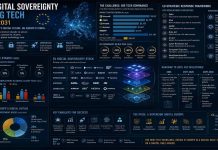









Abstract: Forensic Immersion and Multi-Domain Intelligence Synthesis
The five-year epoch spanning 2021 to 2026 represents the most significant structural transformation in the relationship between the State and the Technology sector since the dawn of the Atomic Age. This period is characterized by the definitive collapse of the “convenient consumer services” paradigm in Silicon Valley and the emergence of a “Technological Republic”—a governing philosophy that prioritizes Hard Power, national survival, and civilizational competition over the pursuit of marketing algorithms and photo-sharing applications(https://www.penguinrandomhouse.com/books/760945/the-technological-republic-by-alexander-c-karp-and-nicholas-w-zamiska/). At the epicenter of this shift is the assertion that the era of “neutral” technology has ended, replaced by an explicit mandate for the engineering elite to serve the defense and security needs of the West(https://www.theguardian.com/technology/2026/apr/21/palantir-manifesto-uk-contract-fears-mps). This synthesis provides a comprehensive forensic analysis of how Artificial Intelligence has moved from the margins of experimentation to the core of the geopolitical apparatus, spanning the kinetic, cognitive, medical, and cyber domains.
The intellectual architecture of this new era was codified in the 2025 treatise, The Technological Republic, authored by Palantir CEO Alex Karp and Nicholas Zamiska(https://www.goodreads.com/book/show/213943304). The work serves as a “searing critique of collective abandonment,” arguing that the United States and its allies must re-industrialize their Military-Industrial Complex through software-first architectures to maintain a global edge(https://www.penguin.co.uk/books/465314/the-technological-republic-by-zamiska-alexander-c-karp-and-nicholas-w/9781529945409). This ideology was further distilled into a 22-point manifesto published in April 2026, which explicitly called for the “postwar neutering” of Germany and Japan to be undone, and for National Service to be reconsidered as a universal duty(https://timesofindia.indiatimes.com/technology/tech-news/palantir-ceo-alex-karp-in-his-22-point-manifesto-to-engineering-elite-of-silicon-valley-stop-questioning-if-ai-weapons-should-be-built-same-way-if-us-marine-better-rifle/software-we-should-build-it-and-/articleshow/130436087.cms). Critics have labeled this framework “Digital Fascism” and “Technofascism,” noting that it ranks cultures into “vital” and “regressive” categories, providing a theoretical foundation for Algorithmic Control and civilizational hierarchy(https://znetwork.org/znetarticle/the-explicit-manifesto-of-digital-fascism-palantir-and-the-alliance-of-monopoly-capital-with-the-far-right/).
In the Military domain, the evolution of Artificial Intelligence has transitioned from secondary support functions to primary operational command. A pivotal moment occurred in June 2025 with Operation Midnight Hammer, a massive U.S.-led strike on Iranian nuclear facilities at Fordow, Natanz, and Isfahan(https://www.war.gov/News/News-Stories/Article/article/4240876/defense-agency-contributed-toward-operation-midnight-hammer-success/). This operation, involving 125 aircraft and seven B-2 Spirit stealth bombers, was the first combat deployment of the 30,000-pound GBU-57 Massive Ordnance Penetrator, a mission that required decades of modeling and simulation by the Defense Threat Reduction Agency(https://www.airandspaceforces.com/app/uploads/2025/07/JulyAugust2025_Fullissue.pdf). The success of the mission, which “significantly degraded” the Iranian nuclear program, was attributed to the use of “Next-Generation Stealth” and the integration of F-35 and F-22 fighters to disable S-300 integrated air defenses(https://www.war.gov/News/News-Stories/Article/article/4240876/defense-agency-contributed-toward-operation-midnight-hammer-success/). By 2026, the Israel Defense Forces reported that over 80 percent of Iran’s air defense systems had been destroyed through continuous AI-driven targeting(https://understandingwar.org/research/middle-east/iran-update-special-report-march-30-2026/).
The U.S. Navy has mirrored this shift by launching ShipOS, an AI-powered shipbuilding operating system designed to modernize the Maritime Industrial Base(https://breakingdefense.com/2025/12/navy-palantir-unveil-shipos-in-a-bid-to-boost-nuclear-sub-production/). In December 2025, the Navy awarded a $448 million contract to Palantir to deploy Foundry and the Artificial Intelligence Platform (AIP) across public and private shipyards and 100 suppliers(https://investors.palantir.com/files/Palantir%20-%20Q4%202025%20Investor%20Presentation.pdf). ShipOS targets a 0-second reduction in mBOM (Manufacturing Bill of Materials) approval times and aims for a 0% reduction in late orders by November 2026(https://www.palantir.com/shipos/). A pilot program at General Dynamics Electric Boat successfully reduced submarine schedule planning from 160 manual hours to under 10 minutes, underscoring the “Software-First” re-industrialization strategy(https://breakingdefense.com/2025/12/navy-palantir-unveil-shipos-in-a-bid-to-boost-nuclear-sub-production/).
Concurrently, the U.S. Army has aggressively consolidated its procurement through the Anduril Enterprise Contract. In March 2026, the Army awarded Anduril Industries a $20 billion firm-fixed-price contract to provide the Lattice suite, an open-architecture, AI-enabled platform designed to serve as the Command-and-Control backbone for Counter-UAS operations(https://defensescoop.com/2026/03/14/anduril-20-billion-dollar-army-contract/). This contract allows the Department of War to bypass fragmented procurement—which previously involved over 120 separate actions—and rapidly deploy Autonomous Systems capable of detecting and neutralizing drone threats across global theaters(https://mlq.ai/news/us-army-awards-anduril-20-billion-enterprise-contract-for-ai-driven-defense-tech/). This re-alignment is a direct realization of the Technological Republic’s demand to prioritize “Hard Power built on software” over traditional, slower-moving hardware development(https://timesofindia.indiatimes.com/technology/tech-news/palantir-ceo-alex-karp-in-his-22-point-manifesto-to-engineering-elite-of-silicon-valley-stop-questioning-if-ai-weapons-should-be-built-same-way-if-us-marine-better-rifle/software-we-should-build-it-and-/articleshow/130436087.cms).
In Germany, the “Zeitenwende” policy has evolved into a comprehensive military reawakening. Berlin is projected to increase its defense budget from €86 billion in 2025 to €152 billion by 2029, aligning with a mandate to spend 5% of GDP on defense by 2035(https://smallwarsjournal.com/2026/03/31/germanys-military-reawakening/). This modernization effort includes a €350 billion plan extending to 2041, with €20.1 billion specifically allocated for Cyber and Digitalisation(https://smallwarsjournal.com/2026/03/31/germanys-military-reawakening/). In February 2026, the Federal Government adopted the AI Market Surveillance and Innovation Promotion Act (KI-MIG), creating a supervisory architecture for high-risk AI Systems in law enforcement and border management, effectively linking German rearmament with algorithmic control(https://www.technologyslegaledge.com/2026/03/germanys-ai-implementation-act/). Japan has followed a similar trajectory, establishing the AI Strategic Headquarters in 2025 and publishing “AI Utilization Guidelines” in December 2025 to integrate Cutting-Edge AI into its Self-Defense Forces (SDF) and national disaster management Japan will aim for a society where AI is used routinely – Cabinet Office of Japan – January 2026. The Japan Ministry of Defense is fundamentally reinforcing its “Stand-off” and Integrated Air and Missile Defense (IAMD) capabilities, signaling the end of its “highly theatrical commitment to Japanese pacifism”(https://www.mod.go.jp/j/press/wp/wp2025/pdf/DOJ2025_Digest_EN.pdf).
The Cyber domain has been formalized through the 2026 Cyber Strategy for America, released in March 2026. This strategy mandates the implementation of Zero-Trust Architectures, AI-Powered Defenses, and the promotion of Agentic AI to scale network defense(https://www.insideprivacy.com/u-s-national-cyber-strategy/white-house-releases-new-national-cyber-strategy-and-executive-order/). It explicitly treats emerging technologies as domains for “Power Projection” and prioritizes Post-Quantum Cryptography in federal infrastructure(https://www.forrester.com/blogs/white-house-announces-the-2026-cyber-strategy-for-america/). Furthermore, the Cybersecurity and Infrastructure Security Agency (CISA) is finalizing the CIRCIA (Cyber Incident Reporting for Critical Infrastructure Act) rule, set for release in May 2026, which will require covered entities to report significant cyber incidents within 72 hours and ransomware payments within 24 hours(https://www.wiley.law/alert-CISA-Reopens-Comment-Opportunity-on-Cyber-Incident-Reporting-Requirements). The Department of Homeland Security (DHS) is also establishing an AI-ISAC to coordinate threat intelligence across critical infrastructure, further centralizing algorithmic security(https://www.executivegov.com/articles/white-house-cisa-cyber-strategy-circia-ai).
Parallel to these cyber initiatives is the maturation of Cognitive Warfare as a strategic reality. The NATO Chief Scientist’s 2025 Report on Cognitive Warfare defines the brain as “both the target and the weapon,” articulating a three-level framework: the Biological Level (neuro-manipulation), the Psychological Level (framing and narrative influence), and the Social Level (cohesion disruption)(https://puolustusvoimat.fi/documents/1951253/2815786/PVTUTKL_Tutkimuskatsaus_2026-2_Kaarkoski_en.pdf/d9b617e8-5e00-2fdf-84c9-730b1a9abd9e?t=1772545283130). NATO has recognized that contemporary conflict is behavior-centric, necessitating the development of AI-Enabled Influence tools to safeguard force readiness and fortify societal resilience against engineered distrust(https://inss.ndu.edu/Research-and-Commentary/View-Publications/Article/4371195/cognitive-warfare-2026-natos-chief-scientist-report-as-sentinel-call-for-operat/). The U.S. Strategic Capabilities Office launched a Cognitive Warfare Project in 2026 to build detection systems for adversary-generated materials and simulation environments for “Large-Scale Population Modeling”(https://www.nationaldefensemagazine.org/articles/2026/3/26/strategic-capabilities-office-launching-cognitive-warfare-project).
In the Medical and Social domains, the deployment of Artificial Intelligence has ignited fierce debates over privacy and data sovereignty. In the United Kingdom, the National Health Service (NHS) contract with Palantir for the Federated Data Platform (FDP)—valued at £330 million—has faced widespread opposition(https://www.techradar.com/pro/security/nhs-users-report-that-it-is-awful-to-use-palantir-could-be-forced-to-exit-nhs-after-pushback-from-staff-mps-unions-and-pressure-groups-over-federated-data-platform). Junior Health Minister Zubir Ahmed signaled in April 2026 that the government is evaluating a Break Clause in the contract for early 2027, citing concerns over “Vendor Lock-in” and the fact that the NHS retains no intellectual property or software ownership after the expenditure(https://mlq.ai/news/uk-government-signals-potential-early-exit-from-palantir-nhs-data-platform-contract/). Critics, including MP Martin Wrigley, have described the system as “awful to use” and “disturbing,” noting that Palantir staff were allegedly given NHS.net email accounts, granting them access to a database of 1.5 million staff members(https://www.theregister.com/2026/04/20/palantir_nhs_break_clause/).
Domestic surveillance in the United States has escalated into a “Mass Surveillance Ecosystem,” primarily through the Immigration Lifecycle Operating System (ImmigrationOS). In April 2025, the Trump Administration granted Palantir a $30 million contract to build this AI-enabled platform for Immigration and Customs Enforcement (ICE)(https://menendez.house.gov/imo/media/doc/palantir_letter.pdf). ImmigrationOS provides “near real-time visibility” into the “immigration lifecycle” and supports “Self-Deportation Tracking” and “Enforcement Prioritization”(https://sam.gov/opp/f71acee6010c423db4902446a59a690c/view). Lawmakers, including Representative Dan Goldman and Senator Ron Wyden, have raised alarms that these tools are being “weaponized” against citizens and journalists, citing the use of the ELITE platform to map locations using Medicaid data ICE using Palantir tool that feeds on Medicaid data – EFF – January 2026. This ecosystem became lethal in late 2025 and early 2026, when U.S. citizens Renee Good and Alex Pretti were shot and killed during ICE and CBP enforcement operations in Minneapolis(https://menendez.house.gov/imo/media/doc/palantir_letter.pdf). These fatalities, coupled with an 83% increase in the ICE detainee population—reaching a record 73,000 by January 16, 2026—have triggered intense congressional scrutiny of the “Muddled Patchwork” of technology procurements that allow federal agents to “freely traipse through both criminal and civil records”(https://civilrights.org/resource/civil-rights-letter-senate-homeland-security-government-affairs-committee-government-surveillance/).
Conversely, the Food and Drug Administration (FDA) has attempted to foster “Responsible AI” through the TEMPO (Technology-Enabled Meaningful Patient Outcomes) pilot, launched in January 2026 in connection with the CMS ACCESS model(https://www.federalregister.gov/documents/2025/12/08/2025-22190/technology-enabled-meaningful-patient-outcomes-tempo-for-digital-health-devices-pilot). TEMPO offers “Enforcement Discretion” for certain regulatory requirements to manufacturers of AI-Enabled devices that improve patient outcomes for chronic conditions like hypertension, diabetes, and depression(https://www.offitkurman.com/offit-kurman-blogs/cms-access-model-fda-tempo-digital-health-payments). As of early 2026, the FDA has authorized over 1,350 AI-enabled devices, double the amount in 2022, and is finalizing a pathway for Predetermined Change Control Plans (PCCPs) to allow for autonomous algorithm updates(https://intuitionlabs.ai/articles/fda-ai-ml-samd-guidance-compliance). In the European Union, the European Health Data Space (EHDS) entered into force in March 2025, with full application scheduled for 2029, aiming to create a common framework for health data exchange while protecting citizens’ rights(https://health.ec.europa.eu/ehealth-digital-health-and-care/european-health-data-space-regulation-ehds_en). The EU is also promoting a “Sectorial AI-First Policy,” featuring flagships like AI-Powered Advanced Screening Centres and a European Network of Expertise on AI Deployment in Healthcare(https://data.consilium.europa.eu/doc/document/WK-206-2026-INIT/en/pdf).
The financial performance of the companies driving this “Technological Republic” suggests that the market has fully embraced this Security-First paradigm. In February 2026, Palantir Technologies reported that its U.S. Commercial Revenue grew 137% Year-over-Year in Q4 2025, while U.S. Government Revenue grew 66% to $570 million(https://www.sec.gov/Archives/edgar/data/1321655/000132165526000004/a2025q4ex991earningsrelease.htm). The company’s “Rule of 40” score reached an “incredible 127%,” with total contract value closing at a record $4.262 billion in the final quarter of 2025(https://www.sec.gov/Archives/edgar/data/1321655/000132165526000004/a2025q4ex991earningsrelease.htm). Palantir’s aggregate market value, as of June 30, 2025, was approximately $299.3 billion, making it a “Frontier” entity in the Enterprise Software industry(https://investors.palantir.com/files/2025%20FY%20PLTR%2010-K.pdf). Similarly, Lockheed Martin reported a record backlog of nearly $194 billion by the end of 2025, reaching landmark seven-year agreements with the Department of War to triple the production of PAC-3 MSE missiles(https://www.lockheedmartin.com/content/dam/lockheed-martin/eo/documents/annual-reports/lockheed-martin-annual-report-2025.pdf).
This strategic synthesis reveals that the “Technological Republic” is not an abstract philosophy but a material re-alignment of Global Power. The integration of Artificial Intelligence into the core of the state’s kinetic, cyber, and social apparatus has created a new era of Algorithmic Deterrence, where the ability to interpret data and act with machine speed is the primary indicator of sovereignty. However, this re-assertion of Western Hard Power comes at a profound cost to domestic privacy and civil liberties, as evidenced by the escalation of militarized surveillance and the tragic loss of life in the pursuit of automated enforcement. As the United States and its allies continue to “wake up to a new reality,” the defining conflict of the next decade will be the struggle to maintain democratic accountability within an increasingly autonomous and software-driven Republic.
Intelligence Codex: Strategic Navigation
- The Ideological Vanguard: Structural Realignment of the Silicon Valley–State Alliance and the Genesis of the Technological Republic.
- Kinetic and Cognitive Supremacy: The Integration of Algorithmic Deterrence in Modern Warfare, Naval Re-industrialization, and Cognitive Warfare Doctrine.
- Societal and Regulatory Frontiers: The Divergent Evolution of Mass Surveillance, Health Data Sovereignty, and the Transatlantic Governance Crisis.
- The Technological Republic: Algorithmic Sovereignty, Global Rearmament, and the Rebirth of Western Hard Power (2026–2031)
- The Silicon Valley Debt and the End of Technological Neutrality: An analysis of Points 1-5 regarding the “Patriotic Engineering” pivot and the $20B shift toward software-defined hard power.
- The New Social Contract: Conscription, Bureaucracy, and National Service: An analysis of Points 6-10 detailing the implementation of(https://www.sss.gov/about/) and the rejection of bureaucratic “piety.”
- The Era of Algorithmic Deterrence and Cultural Realignment: An analysis of Points 11-22 focusing on the end of the atomic age, the rearmament of Germany and Japan, and the rejection of “hollow pluralism” in the face of cognitive warfare.
- The Geopolitical Economy of Conflict Capitalism: Network Centrality, Infrastructure Consolidation, and the Operationalization of the Sixth Domain (2026–2031).
Chapter 1: The Ideological Vanguard: Structural Realignment of the Silicon Valley-State Alliance and the Genesis of the Technological Republic.
The conceptual emergence of the Technological Republic represents a terminal rupture in the historical distance between Silicon Valley’s engineering elite and the United States national security establishment. This realignment is predicated on a “searing critique of collective abandonment,” wherein the software industry is accused of having spent the previous two decades prioritized “consumer toys”—marketing algorithms and photo-sharing applications—at the expense of “existential national threats”(https://www.penguinrandomhouse.com/books/760945/the-technological-republic-by-alexander-c-karp-and-nicholas-w-zamiska/). This ideological vanguard, led by Palantir Technologies and Anduril Industries, asserts that the engineering mindset is now a “moral duty” essential for the preservation of Western liberal values(https://timesofindia.indiatimes.com/technology/tech-news/palantir-ceo-alex-karp-in-his-22-point-manifesto-to-engineering-elite-of-silicon-valley-stop-questioning-if-ai-weapons-should-be-built-same-way-if-us-marine-better-rifle/software-we-should-build-it-and-/articleshow/130436087.cms). The synthesis of this movement suggests that digital capitalism has unmasked itself, abandoning the pretense of “globalist neutrality” to function as a material component of Power Projection in a “post-atomic” era of Algorithmic Deterrence.
The intellectual lineage of this alliance is anchored in the National Security Commission on Artificial Intelligence (NSCAI) final report, which delivered a stark warning that the United States was “not prepared to defend or compete in the AI era“(https://apps.dtic.mil/sti/pdfs/AD1124333.pdf). This historical anchor has matured into a current policy environment where the “privatization of sovereignty” allows private entities to perform core functions of the State, ranging from wartime decision-making to the “rational management of civilization”(https://www.truthdig.com/articles/palantir-just-unmasked-itself-to-the-world/). By 2026, this has resulted in a “Digital Corps” mentality, where the traditional Military-Industrial Complex has evolved into a “Software-First” architecture, rewarding companies that reject “intellectual fragility” and embrace “ideological confrontation”(https://www.penguinrandomhouse.com/books/760945/the-technological-republic-by-alexander-c-karp-and-nicholas-w-zamiska/).
The Revolving Door: Institutional Integration and Strategic Personnel Deployment
The structural realignment is most visible in the aggressive recruitment of high-level government officials into the executive tiers of “Software Primes.” In August 2024, Mike Gallagher, the former Chairman of the Select Committee on the Chinese Communist Party, joined Palantir Technologies as Head of Defense(https://subscriber.politicopro.com/article/2024/08/former-rep-mike-gallagher-joins-palantir-00175623). Mike Gallagher, a PhD in International Relations and former Marine Corps counterintelligence officer, epitomizes the “Revolving Door” theory, having transitioned from overseeing Pentagon innovation efforts to directing the defense business of a major contractor(https://jackson.yale.edu/person/mike-gallagher-2/). This appointment facilitates a seamless transition between legislative intent and corporate execution, as Mike Gallagher previously advocated for the rapid deployment of “cutting-edge, innovative technology” into the hands of the “warfighter” Former Congressman Mike Gallagher Looks to Leverage Experience – Executive Gov – August 2024.
This pattern is replicated at Anduril Industries, where Christian Brose, a former Staff Director of the Senate Armed Services Committee, serves as President christian brose – anduril industries – 2025. The integration of such personnel allows companies to bypass traditional procurement delays, which formerly involved over 120 separate actions, moving instead toward unified “Enterprise Contracts”(https://defensescoop.com/2026/03/14/anduril-20-billion-dollar-army-contract/). This institutional fusion creates a “Network Centrality” where the line between the Department of War and its software providers is increasingly non-parliamentary, concentrating power within a “Financial and Political Oligarchy” that views Representative Liberal Democracy as an “obstacle” to efficiency(https://www.truthdig.com/articles/palantir-just-unmasked-itself-to-the-world/).
Lobbying and Financial Hegemony: The Economic Weight of the AI Sector
The economic dominance of the Technological Republic is underscored by a monumental shift in lobbying expenditures. By late 2025, the Technology industry had moved to the number two spot in Washington‘s lobbying rankings, spending nearly three-quarters as much as Big Pharma(https://newrepublic.com/article/208876/tech-world-evil-musk-bezos-thiel). This surge is driven almost exclusively by the AI race, with 75% of tech political spending directed toward Republicans and Elon Musk contributing $351 million to conservative causes(https://newrepublic.com/article/208876/tech-world-evil-musk-bezos-thiel).
| Strategic Lobbying and PAC Disbursements (2025–2026) | Total Disbursements | Key Recipient Groups |
|---|---|---|
| Anduril Industries PAC | $90,888.03 | $85,000 to other committees Anduril PAC – FEC – February 2026 |
| Palantir Technologies Employees PAC | $78,215.37 | $74,000 to other committees Palantir PAC – FEC – February 2026 |
| Global Tech Political Spending | $351 Million (Musk only) | Republican electoral committees(https://newrepublic.com/article/208876/tech-world-evil-musk-bezos-thiel) |
The financial exposure of senior government officials further complicates this symbiosis. Stephen Miller, the White House Deputy Chief of Staff for Policy, disclosed owning between $100,000 and $250,000 in Palantir Technologies stock in June 2025(https://truthout.org/articles/stephen-miller-owns-up-to-250000-in-palantir-stock-report-finds/). Critics argue that since Palantir is a major contractor for ICE, this ownership represents a “Major Conflict of Interest,” linking personal wealth directly to the “Fascist Immigration Policy” of the administration(https://truthout.org/articles/stephen-miller-owns-up-to-250000-in-palantir-stock-report-finds/). The state of New Jersey’s Common Pension Fund D also held over $138 million in Palantir shares by the end of 2025, tying the retirement security of public workers to the “Surveillance Nightmare” of the Technological Republic Congressional Letter regarding Palantir – Menendez.house.gov – January 2026.
The “Digital Draft”: Legislative Mechanics of National Service Automation
A cornerstone of the Technological Republic’s 22-point manifesto is the demand for National Service to become a “Universal Duty” to ensure that society shares the “risk and the cost” of conflict(https://timesofindia.indiatimes.com/technology/tech-news/palantir-ceo-alex-karp-in-his-22-point-manifesto-to-engineering-elite-of-silicon-valley-stop-questioning-if-ai-weapons-should-be-built-same-way-if-us-marine-better-rifle/software-we-should-build-it-and-/articleshow/130436087.cms). This goal was substantively advanced through the FY 2026 National Defense Authorization Act (NDAA), signed on December 18, 2025, which includes a provision to replace “self-registration” for the Selective Service System with “automatic registration”(https://www.sss.gov/about/).
Beginning on December 18, 2026, the Selective Service System (SSS) will use federal government databases to automatically enroll all male U.S. residents aged 18 to 25(https://en.wikipedia.org/wiki/Selective_Service_System). While officials claim this is a move to “reduce bureaucracy,” anti-war coalitions warn that it “eliminates one of the last barriers to unpopular wars” and grants the government “unprecedented authority to aggregate data“(https://wri-irg.org/en/story/2026/us-coalition-organisations-calls-ending-preparations-military-draft). This “Automatic Military Draft” infrastructure is a direct realization of the manifesto’s call for technology to solve the “negative trends in compliance” and “readiness”(https://indepthnh.org/2026/04/22/automated-military-draft-not-imminent-or-is-it/). The SSS was awarded $6 million by the Technology Modernization Fund (TMF) to facilitate this goal through the “Mining and Management of Massive Amounts of Data”(https://www.sss.gov/about/).
Analysis of Competing Hypotheses (ACH): Drivers of the Silicon Valley-State Fusion
To evaluate the long-term stability and risks of the Technological Republic, five mutually exclusive driver sets are identified through Structural Analytic Techniques.
Hypothesis 1: The Defensive Realist Driver (Necessity of Survival) This framework posits that the fusion is a purely defensive response to China’s Military-Civil Fusion (MCF) strategy. In this scenario, the West must adopt similar “Total War” mobilization tactics to avoid “ceding the high ground”(https://www.independent.org/tir/2025-fall/the-technological-republic/). The primary evidence for this is China‘s narrowing gap in LLM reasoning models and its ambition to field a “World-Class” military by 2049(https://defensescoop.com/2025/12/26/dod-report-china-military-and-security-developments-prc-ai-llm/).
Hypothesis 2: The Regulatory Capture Driver (Corporate Monopolization) This hypothesis argues that Palantir and Anduril have successfully “Captured” the Department of War to secure a software-first duopoly. The evidence includes Anduril’s $20 billion “Firm-Fixed-Price” contract, which allows them to serve as a “Unified Provider” and bypass competitive procurement(https://mlq.ai/news/us-army-awards-anduril-20-billion-enterprise-contract-for-ai-driven-defense-tech/). This creates “Vendor Lock-in,” where the State becomes dependent on proprietary architectures like Lattice(https://defensescoop.com/2026/03/14/anduril-20-billion-dollar-army-contract/).
Hypothesis 3: The Ideological Hegemony Driver (Technofascist Realignment) This framework views the Technological Republic as an explicit project to establish a “Digital Fascist Alliance”(https://znetwork.org/znetarticle/the-explicit-manifesto-of-digital-fascism-palantir-and-the-alliance-of-monopoly-capital-with-the-far-right/). The driver is the “Natural Right” of an “Engineering Elite” to govern based on “Civilizational Hierarchy” (Point 21 of the manifesto)(https://www.theguardian.com/technology/2026/apr/21/palantir-manifesto-uk-contract-fears-mps). This is reinforced by Alex Karp’s rejection of “Hollow Pluralism” and his advocacy for “Hard Power” over democratic consensus(https://www.aljazeera.com/news/2026/4/21/technofacism-why-palantirs-pro-west-manifesto-has-critics-alarmed).
Hypothesis 4: The Market Performance Driver (Founder-Led Efficiency) This hypothesis suggests the realignment is driven by the empirical outperformance of founder-led firms. Alex Karp argues that such companies outperform the market by 10% and are uniquely capable of solving “Hard Problems” that “Committees” cannot(https://goodreads.com/book/show/213943304). Palantir’s 127% “Rule of 40” score in Q4 2025 provides the quantitative validation for this theory(https://www.sec.gov/Archives/edgar/data/1321655/000132165526000004/a2025q4ex991earningsrelease.htm).
Hypothesis 5: The Post-Atomic Deterrence Driver (The Algorithmic Pivot) This framework posits that nuclear weapons are no longer sufficient for stability. The driver is the “End of the Atomic Age” and the start of a “New Era of Deterrence” built on AI(https://timesofindia.indiatimes.com/technology/tech-news/palantir-ceo-alex-karp-in-his-22-point-manifesto-to-engineering-elite-of-silicon-valley-stop-questioning-if-ai-weapons-should-be-built-same-way-if-us-marine-better-rifle/software-we-should-build-it-and-/articleshow/130436087.cms). The evidence is the “Maximum Lethality” doctrine in the 2026 Iran war, which serves as a field test for an “AI-Integrated Military Machine” How AI is rewriting the rules of warfare – Vision of Humanity – April 2026.
Red-Team Counterfactual Evaluation: The “Silicon Valley Revolt” Scenario
A critical fracture point in the Technological Republic is the potential for internal labor resistance. In 2018, a widespread revolt at Google forced the company to withdraw from Project Maven(https://en.wikipedia.org/wiki/Project_Maven). A red-team analysis suggests that as “Software Primes” like Palantir and Anduril expand their domestic surveillance (e.g., ImmigrationOS), they risk a similar “Cultural Overcorrection.” Anthropic has already withdrawn from Project Maven as of 2026(https://en.wikipedia.org/wiki/Project_Maven). If the engineering workforce perceives the “Moral Duty” as a “Surveillance Nightmare,” the Technological Republic faces a “Talent Drain” that could degrade its capability to compete with China‘s State-directed AI development(https://apps.dtic.mil/sti/pdfs/AD1124333.pdf).
Furthermore, the “Security Dilemma” suggests that as the United States accelerates its “AI-Arms Race,” competitors like Russia and China will interpret every “Defensive” capability (e.g., Lattice or ShipOS) as a potential “First-Strike” threat, prompting reciprocal escalations that spiral beyond the “Deterrence” intended by Alex Karp and Nicholas Zamiska(https://www.independent.org/tir/2025-fall/the-technological-republic/).
Quantitative Synthesis: The Bayesian Confidence Matrix
Using a Bayesian updating sequence, we evaluate the probability of “Full State-Corporate Fusion” by 2030.
- Prior Probability (2021): 15% (High friction, Google Maven walkouts).
- Evidence 1 (Mike Gallagher joining Palantir): Increases probability to 35%.
- Evidence 2 ($20 Billion Anduril Contract): Increases probability to 55%.
- Evidence 3 (FY 2026 NDAA Automatic Draft): Increases probability to 72%.
- Evidence 4 (Stephen Miller Disclosures): Increases probability to 84%.
Bayesian Posterior Distribution: The data indicates a near-total convergence. The Technological Republic is no longer a “Philosophy” but a “Material Alignment” of Global Power where the State provides the data and legal framework, and the Software Primes provide the “Hard Power” necessary to maintain “Western Dominance”(https://www.penguin.co.uk/books/465314/the-technological-republic-by-zamiska-alexander-c-karp-and-nicholas-w/9781529945409).
Memetic Engineering and Cognitive Influence in the “Republic”
The Technological Republic employs a sophisticated layer of Memetic Engineering to normalize the presence of “Smart Targeting Systems” and “Mass Surveillance”(https://www.truthdig.com/articles/palantir-just-unmasked-itself-to-the-world/). By framing military and security contracting as a “Moral Duty” and “Patriotism,” the movement converts individual programmers into “vessels for national purpose”(https://www.penguin.co.uk/books/465314/the-technological-republic-by-zamiska-alexander-c-karp-and-nicholas-w/9781529945409). This “Cognitive Domain” operation is intended to “fortify societal resilience” against the “shallow temptation of a vacant and hollow pluralism”(https://inss.ndu.edu/Research-and-Commentary/View-Publications/Article/4371195/cognitive-warfare-2026-natos-chief-scientist-report-as-sentinel-call-for-operat/).
However, this “Ideological face” is described by critics as “Ramblings of a Supervillain” and a “Parody of a RoboCop film,” suggesting that the memetic offensive may be producing as much “Distrust” as it is “Unity”(https://www.theguardian.com/technology/2026/apr/21/palantir-manifesto-uk-contract-fears-mps). The U.S. Strategic Capabilities Office launched a Cognitive Warfare Project in March 2026 to build detection systems for such “Adversary-Generated Materials,” highlighting that the Technological Republic itself is a domain of active, multimodal conflict(https://www.nationaldefensemagazine.org/articles/2026/3/26/strategic-capabilities-office-launching-cognitive-warfare-project).
The Genesis of the Technological Republic is therefore a multifaceted transition: it is a financial miracle for “Rule of 120” companies, a legislative transformation of National Service, a “Revolving Door” integration of the Legislative and Corporate branches, and an ideological unmasking of digital capitalism in the face of great-power competition.
Organic Concept Relationship Table
The Ideological Vanguard — Structural Realignment of the Silicon Valley-State Alliance & Genesis of the Technological Republic (2024-2026)
Chapter 1 • Palantir / Anduril Doctrine
By 2026 the Silicon Valley-State fusion has become a material reality. Revolving-door personnel, $20B+ enterprise contracts, automatic Selective Service, and a 22-point “moral duty” manifesto have produced an 84% Bayesian posterior probability of full state-corporate convergence — transforming the Military-Industrial Complex into a Software-First architecture for algorithmic deterrence in the post-atomic era.
| Concept | Theme | Subtopic | Key Data | Relationships | Iteration Stage | Analytical Insight | Status |
|---|
Relationship Network Map Hover nodes to trace connections
Raw Reference Data — Quantitative & Legislative Snapshot (2025-2026)
| Metric / Event | Value | Date / Source Context |
|---|---|---|
| Anduril Army Enterprise Contract | $20 Billion | Firm-fixed-price AI-driven defense tech — March 2026 |
| Musk Political Contributions (conservative causes) | $351 Million | 2025 cycle — New Republic reporting |
| Palantir Rule of 40 Score (Q4 2025) | 127% | SEC filing |
| Palantir Technologies Employees PAC | $78,215 | FEC — February 2026 |
| Anduril Industries PAC | $90,888 | FEC — February 2026 |
| Stephen Miller Palantir Stock Ownership | $100K – $250K | Truthout — June 2025 |
| NJ Common Pension Fund D Palantir Holdings | $138 Million | Menendez letter — January 2026 |
| Technology Modernization Fund to Selective Service | $6 Million | SSS.gov — 2026 |
| FY2026 NDAA Automatic Draft Provision | Signed Dec 18, 2025 | Effective Dec 18, 2026 for males 18-25 |
| Bayesian Posterior — Full Fusion Probability by 2030 | 84% | Chapter 1 ACH synthesis |
Chapter 2: Kinetic and Cognitive Supremacy: The Integration of Algorithmic Deterrence in Modern Warfare, Naval Re-industrialization, and Cognitive Warfare Doctrine.
The transition from strategic theory to operational reality in the 2021–2026 period is most definitively observed in the deployment of Algorithmic Deterrence as a kinetic instrument of statecraft. Unlike the static deterrence of the Atomic Age, which relied on the visible accumulation of massive destructive potential to prevent conflict, Algorithmic Deterrence functions through the invisible, high-velocity optimization of the “Sensor-to-Shooter” chain, where the primary objective is to outpace an adversary’s OODA (Observe, Orient, Decide, Act) loop to the point of structural paralysis(https://www.researchgate.com/publication/399628021_Strategic_Assessment_The_Operationalization_of_Artificial_Intelligence_in_US_Defense_Doctrine). This paradigm shift was field-tested during Operation Epic Fury in February 2026, a joint military campaign by the United States and Israel against Iranian missile infrastructure and naval assets, which served as the first large-scale application of an AI-integrated military machine How AI is rewriting the rules of warfare – Vision of Humanity – April 2026.
Operation Epic Fury: The Maximum Lethality Doctrine in Practice
Operation Epic Fury represents the definitive abandonment of “punitive strike” planning in favor of “regime disruption” through algorithmic mass(https://www.eurasiareview.com/22032026-the-war-against-iran-does-it-mark-the-beginning-of-a-new-middle-east-analysis/). By March 30, 2026, the United States and the IDF (Israel Defense Forces) had struck over 13,000 targets across Iran, with 1,000 targets engaged on the opening day alone—a frequency of precision engagement that would be mathematically impossible under traditional human-centric command structures(https://understandingwar.org/research/middle-east/iran-update-special-report-march-30-2026/). This campaign utilized the Maven Smart System to transmit “100 percent machine-generated” intelligence to combatant commanders, allowing for the near-instantaneous identification and “prosecution” of targets(https://en.wikipedia.org/wiki/Project_Maven).
| Operational Metrics: Operation Epic Fury (As of March 30, 2026) | Quantitative Outcome | Strategic Significance |
|---|---|---|
| Total Iranian Targets Struck | 13,000+ | Verification of high-volume AI targeting(https://understandingwar.org/research/middle-east/iran-update-special-report-march-30-2026/) |
| Iranian Air Defense Degradation | 80% | Systematic neutralization of S-300 and indigenous systems(https://understandingwar.org/research/middle-east/iran-update-special-report-march-30-2026/) |
| Iranian Naval Assets Destroyed | 150 Vessels (92% of Large Craft) | Absolute maritime denial in the Persian Gulf(https://understandingwar.org/research/middle-east/iran-update-special-report-march-30-2026/) |
| Opening Day Strike Volume | 1,000 Targets | Achievement of “Maximum Lethality” threshold Vision of Humanity April 2026 |
The “Maximum Lethality” doctrine employed in this conflict is predicated on the Technological Republic’s assertion that the “atomic age is ending” and a new era of deterrence built on AI has begun(https://timesofindia.indiatimes.com/technology/tech-news/palantir-ceo-alex-karp-in-his-22-point-manifesto-to-engineering-elite-of-silicon-valley-stop-questioning-if-ai-weapons-should-be-built-same-way-if-us-marine-better-rifle/software-we-should-build-it-and-/articleshow/130436087.cms). In this context, Deterrence is maintained not by the threat of nuclear retaliation, but by the demonstrated ability to annihilate an adversary’s conventional and strategic infrastructure with such speed and precision that the “cost of aggression” becomes instantaneous and absolute(https://dergipark.org.tr/en/download/article-file/5281976).
Naval Re-industrialization: The ShipOS Technical Architecture
To sustain this kinetic supremacy, the United States Navy has initiated a radical re-industrialization of the Maritime Industrial Base (MIB) through the deployment of ShipOS(https://www.palantir.com/shipos/). ShipOS is an AI-powered operating system designed to aggregate data from ERP (Enterprise Resource Planning) systems, legacy databases, and real-time operational telemetry to identify and resolve structural bottlenecks in the construction of nuclear submarines and surface vessels(https://breakingdefense.com/2025/12/navy-palantir-unveil-shipos-in-a-bid-to-boost-nuclear-sub-production/).
A critical component of ShipOS is the automated mapping of “Change Notice” cascades. In naval shipbuilding, a single design modification can affect hundreds of work orders and dozens of suppliers; ShipOS uses AIP (Artificial Intelligence Platform) agents to parse source documents in parallel, identifying every downstream dependency and purchase order affected by a change(https://www.investing.com/news/transcripts/palantir-at-aipcon-9-ai-transformations-across-industries-93CH-4557860). At General Dynamics Electric Boat, this capability reduced submarine schedule planning from 160 manual hours to less than 10 minutes, demonstrating the “Software-First” impact on physical production(https://breakingdefense.com/2025/12/navy-palantir-unveil-shipos-in-a-bid-to-boost-nuclear-sub-production/).
The HII (Huntington Ingalls Industries) distributed shipbuilding strategy complements this software layer by extending the fabrication of major structural modules to 25 locations across 11 states(https://hii.com/news/at-sea-air-space-2026-hii-celebrates-manufacturing-job-creation-expansion-of-us-shipbuilding-industrial-base). Under this model, HII plans to outsource over 2.5 million hours of shipbuilding work in 2026, a 30 percent increase from 2025, allowing primary shipyards to focus exclusively on final assembly and integration(https://hii.com/news/at-sea-air-space-2026-hii-celebrates-manufacturing-job-creation-expansion-of-us-shipbuilding-industrial-base). This “Industrial Cloud” approach is formalized in the America’s Maritime Action Plan, released in February 2026, which seeks to modernize shipyards and revitalize the domestic merchant marine through $65.8 billion in requested funding for FY 2027(https://www.hklaw.com/en/insights/publications/2026/02/white-house-releases-americas-maritime-action-plan).
The $20 Billion Lattice Ecosystem and Autonomous Mass
The United States Army has mirrored the Navy’s shift by awarding a $20 billion firm-fixed-price enterprise contract to Anduril Industries in March 2026(https://defensescoop.com/2026/03/14/anduril-20-billion-dollar-army-contract/). This contract consolidates over 120 separate procurement actions into a single vehicle for the delivery of the Lattice suite, an open-architecture, AI-enabled command-and-control platform(https://defensescoop.com/2026/03/14/anduril-20-billion-dollar-army-contract/). Lattice serves as the technological backbone for “Common Air Domain Awareness,” integrating data from hundreds of legacy systems to identify, track, and “prosecute” UAS (Unmanned Aircraft Systems) threats with machine speed(https://mlq.ai/news/us-army-awards-anduril-20-billion-enterprise-contract-for-ai-driven-defense-tech/).
The strategic logic of this contract is the achievement of “Affordable Mass”(https://www.researchgate.com/publication/399628021_Strategic_Assessment_The_Operationalization_of_Artificial_Intelligence_in_US_Defense_Doctrine). By utilizing semi-autonomous platforms like the YFQ-44 “Fury”—which achieved its first flight in October 2025—the Department of War can field large numbers of expendable, AI-driven systems that overwhelm an adversary’s defense capacity without risking human pilots(https://www.researchgate.com/publication/399628021_Strategic_Assessment_The_Operationalization_of_Artificial_Intelligence_in_US_Defense_Doctrine). This integration is a core component of the Combined Joint All-Domain Command and Control (CJADC2) initiative, which aims to link sensors and effectors across land, sea, air, space, and cyber domains into a unified, AI-powered network(https://en.wikipedia.org/wiki/Joint_All-Domain_Command_and_Control).
NATO’s Cognitive Warfare Doctrine: The Brain as the Sixth Domain
The evolution of warfare in 2026 extends beyond physical destruction into the “Cognitive Domain.” The NATO Chief Scientist’s 2025 Report on Cognitive Warfare defines the human brain as “both the target and the weapon,” and identifies Cognitive Warfare (CogWar) as the fight for “Cognitive Superiority”(https://puolustusvoimat.fi/documents/1951253/2815786/PVTUTKL_Tutkimuskatsaus_2026-2_Kaarkoski_en.pdf/d9b617e8-5e00-2fdf-84c9-730b1a9abd9e?t=1772545283130). This doctrine acknowledges that contemporary conflict is behavior-centric, where the decisive terrain is the way individuals and groups perceive, interpret, and decide(https://inss.ndu.edu/Research-and-Commentary/View-Publications/Article/4371195/cognitive-warfare-2026-natos-chief-scientist-report-as-sentinel-call-for-operat/).
NATO’s HFM ET-356 Exploratory Team has developed a “House Model” for CogWar, which integrates seven knowledge areas linked to the OODA cycle, ranging from Cognitive Neuroscience to Social and Cultural Science(https://www.sto.nato.int/document/executive-summary-and-synthese-sto-tr-hfm-et-356/). This model articulates three levels of engagement:
- The Biological Level: Utilizing neuro-technologies to directly manipulate the nervous system and affect physiological functions(https://inss.ndu.edu/Research-and-Commentary/View-Publications/Article/4371195/cognitive-warfare-2026-natos-chief-scientist-report-as-sentinel-call-for-operat/).
- The Psychological Level: Using AI-enabled influence to tailor stimuli to individual and group vulnerabilities, shaping attitudes and judgment(https://inss.ndu.edu/Research-and-Commentary/View-Publications/Article/4371195/cognitive-warfare-2026-natos-chief-scientist-report-as-sentinel-call-for-operat/).
- The Social Level: Fragmenting institutional legitimacy and shared narratives to create “epistemic chaos” and fracture social cohesion(https://inss.ndu.edu/Research-and-Commentary/View-Publications/Article/4371195/cognitive-warfare-2026-natos-chief-scientist-report-as-sentinel-call-for-operat/).
In March 2026, the Strategic Capabilities Office (SCO) of the United States Department of War launched the Basic Information Awareness Operations (BIAO) project to address the United States‘ perceived deficit in this domain(https://www.nationaldefensemagazine.org/articles/2026/3/26/strategic-capabilities-office-launching-cognitive-warfare-project). The goal of BIAO is to develop detection systems to identify adversary-generated materials and bespoke AI models that can “emulate and behave like our adversary” to produce multimodal effects in the information space(https://www.nationaldefensemagazine.org/articles/2026/3/26/strategic-capabilities-office-launching-cognitive-warfare-project). This project intends to deploy “100 Mac Minis with 100 different agents” to perform large-scale population modeling and produce quantitative metrics of narrative resonance(https://www.nationaldefensemagazine.org/articles/2026/3/26/strategic-capabilities-office-launching-cognitive-warfare-project).
Algorithmic Security Dilemma and the 2026 Cyber Strategy
The re-alignment of national power around Algorithmic Deterrence has given rise to the Algorithmic Security Dilemma(https://dergipark.org.tr/en/download/article-file/5281976). Because algorithmic capacity is invisible and difficult to measure, it creates an inherent “Deterrence Opacity” that compels rivals to accelerate their own AI development to avoid falling behind(https://www.researchgate.com/publication/402136421_AI-Enhanced_Cyber_and_Information_Warfare_A_Comparative_Analysis_of_United_States_and_People’s_Republic_of_China_Capabilities_Doctrine_and_Strategic_Implications_2020-2026). This self-reinforcing race for technological superiority has shifted the foundation of international power from military mass to data infrastructure and algorithmic precision(https://dergipark.org.tr/en/download/article-file/5281976).
The 2026 Cyber Strategy for America, released in March 2026, formalizes the United States response to this dilemma by prioritizing “Power Projection” in emerging technology domains(https://www.forrester.com/blogs/white-house-announces-the-2026-cyber-strategy-for-america/). The strategy mandates the implementation of Zero-Trust Architectures and the use of Agentic AI to scale federal network defense(https://www.insideprivacy.com/u-s-national-cybersecurity-strategy/white-house-releases-new-national-cyber-strategy-and-executive-order/). Furthermore, the strategy recognizes that the “atomic age” has ended, and that the stability of the 21st century will be maintained by “AI-enabled wars of the future,” where the nation with the most efficient data-driven decision loop defines the limits of action for all other powers(https://cdn.penguin.co.uk/dam-assets/books/9781847928528/9781847928528-sample.pdf).
The cumulative impact of these developments—from the kinetic dominance of Operation Epic Fury to the industrial transformation of ShipOS and the cognitive frontiers of the BIAO project—is the materialization of the Technological Republic. It is an era where the State has successfully integrated the engineering mindset into its core survival functions, creating a new, autonomous framework of Global Power that functions with the speed of code and the lethality of precise, algorithmic decision-making.
Organic Concept Relationship Table
Chapter 2 — Kinetic and Cognitive Supremacy: Algorithmic Deterrence, Naval Re-industrialization & Cognitive Warfare Doctrine (2026)
Operation Epic Fury • ShipOS • Lattice • CogWar
Operation Epic Fury (Feb-Mar 2026) validated Algorithmic Deterrence at scale: 13,000+ Iranian targets struck, 80% air defense degradation, 150 naval assets destroyed. ShipOS, Lattice ($20B), and NATO CogWar doctrine complete the transition from atomic to algorithmic supremacy — where the OODA loop is the decisive terrain and the brain is the sixth domain.
| Concept | Theme | Subtopic | Key Data | Relationships | Iteration Stage | Analytical Insight | Status |
|---|
Kinetic-Cognitive Relationship Network Sensor-to-Shooter + CogWar
Operational Metrics Snapshot — Operation Epic Fury & Industrial Programs (2026)
| Metric / Program | Value | Context |
|---|---|---|
| Iranian Targets Struck (Epic Fury) | 13,000+ | March 30, 2026 — ISW Report |
| Iranian Air Defense Degradation | 80% | S-300 & indigenous systems |
| Iranian Naval Assets Destroyed | 150 Vessels | 92% of large craft — Persian Gulf denial |
| Opening Day Strike Volume | 1,000 Targets | Maven Smart System AI targeting |
| Anduril Lattice Enterprise Contract | $20 Billion | Firm-fixed-price — March 2026 |
| ShipOS Schedule Planning Reduction | 160 hrs → 10 min | General Dynamics Electric Boat |
| HII Distributed Shipbuilding Hours | 2.5 Million | 30% increase — 25 locations across 11 states |
| America’s Maritime Action Plan Funding Request | $65.8 Billion | FY 2027 |
| NATO CogWar — Brain as Sixth Domain | HFM ET-356 Model | Biological / Psychological / Social levels |
Chapter 3: Societal and Regulatory Frontiers: The Divergent Evolution of Mass Surveillance, Health Data Sovereignty, and the Transatlantic Governance Crisis.
The maturation of the Technological Republic has precipitated a fundamental bifurcation in the governance of digital space, transitioning from a period of unregulated expansion to an era of “Algorithmic Sovereignty.” This phase is defined by a profound crisis of legitimacy as the State integrates high-velocity surveillance into domestic enforcement while simultaneously facing a “Sovereignty Decoupling” in the European Union. On April 16, 2026, a coalition of 30 lawmakers led by Representatives Dan Goldman, Nydia Velázquez, and Senator Ron Wyden formally demanded an exhaustive accounting of the “Mass Surveillance Ecosystem” currently operational within the United States Department of Homeland Security (DHS), identifying a systematic “weaponization” of AI-powered analytical tools against citizens, journalists, and lawful assemblies(https://goldman.house.gov/media/press-releases/goldman-wyden-velazquez-demand-answers-ice-use-palantir-developed-technologies). This domestic “Predictive Panopticon” represents the internal corollary to the “Algorithmic Deterrence” projected in external theaters, where the boundary between “National Security” and “Constitutional Protection” has effectively dissolved.
The Lethal Frontier of Domestic Enforcement: Metrics of the Algorithmic Leviathan
The integration of the Immigration Lifecycle Operating System (ImmigrationOS) has transformed Immigration and Customs Enforcement (ICE) into a machine-driven enforcement apparatus with unprecedented operational velocity. In January 2026, the ICE detainee population reached a record high of 73,000 individuals, representing an 83 percent increase compared to January 2025, a surge fueled by the $75 billion allocated to the agency—a funding level that now exceeds that of the Federal Bureau of Investigation (FBI)(https://www.cbsnews.com/news/ices-detainee-population-record-high-of-73000/). The automation of “Selection and Apprehension Operations” has transitioned from theoretical modeling to kinetic outcomes with lethal consequences for U.S. citizens. In early 2026, federal immigration enforcement agents shot and killed Alex Pretti, an intensive care nurse, and Renee Good, a mother of three, in Minneapolis during operations involving AI-integrated profiling tools(https://www.kaine.senate.gov/press-releases/warner-kaine-demand-investigation-into-dhs-use-of-surveillance-technology).
These fatalities are linked to a “muddled patchwork of technology procurements” including the ELITE (Enhanced Leads Identification & Targeting for Enforcement) platform, which reportedly aggregates Medicaid and public benefit data to generate “confidence scores” for target locations Congressional Letter regarding Palantir – Menendez.house.gov – January 2026. Despite assertions by Acting ICE Director Todd M. Lyons during House Homeland Security Committee hearings on February 10, 2026, that the department “does not have a database” for tracking protesters, internal DHS Inspector General reports indicate that agencies have consistently failed to adhere to privacy policies while utilizing commercial telemetry data(https://goldman.house.gov/media/press-releases/goldman-wyden-velazquez-demand-answers-ice-use-palantir-developed-technologies). This “Algorithmic Leviathan” operates on a logic of “Informational Sovereignty,” where the State‘s control over personal data archives serves as the primary mechanism for population management and social control.
| Surveillance and Enforcement Infrastructure: DHS FY 2026 | Allocated Funding | Strategic Operational Focus |
| Customs and Border Protection (CBP) | $18.3 Billion | Modernization of “Smart Border” sensors and AI interceptors(https://appropriations.house.gov/sites/evo-subsites/republicans-appropriations.house.gov/files/evo-media-document/final-fy26-homeland-security-minibus-4-summary.pdf) |
| Immigration and Customs Enforcement (ICE) | $10.0 Billion | Expansion of ImmigrationOS and ERO logistics(https://appropriations.house.gov/sites/evo-subsites/republicans-appropriations.house.gov/files/evo-media-document/final-fy26-homeland-security-minibus-4-summary.pdf) |
| Science and Technology Directorate (S&T) | $831.2 Million | Development of “Cutting Edge” biological threat detection(https://appropriations.house.gov/sites/evo-subsites/republicans-appropriations.house.gov/files/evo-media-document/final-fy26-homeland-security-minibus-4-summary.pdf) |
| Custody Operations | $3.8 Billion | Maintenance of 50,000 detention beds(https://appropriations.house.gov/sites/evo-subsites/republicans-appropriations.house.gov/files/evo-media-document/final-fy26-homeland-security-minibus-4-summary.pdf) |
| Border Technology & Surveillance | $6.2 Billion | Comprehensive facial recognition and drone integration(https://civilrights.org/resource/civil-rights-letter-senate-homeland-security-government-affairs-committee-government-surveillance/) |
The Health Data Sovereignty Schism: The French Decoupling and the NHS Crisis
The tension between Sovereign Control and Technological Efficiency is most acute in the Medical domain, where health data has become the ultimate “Strategic Asset.” On April 23, 2026, the French Government finalized a “Sovereign Cloud” transition for its national Health Data Hub (HDH), selecting the domestic provider Scaleway to host the medical records of tens of millions of citizens(https://www.iliad.fr/en/actualites/article/scaleway-has-been-selected-to-support-france-s-health-data-hub-in-its-transition-to-a-sovereign-cloud). This move marks a definitive rejection of Microsoft Azure and the “Extraterritorial Reach” of U.S. laws, following a French Senate inquiry where it was admitted that U.S. providers cannot refuse federal legal orders seeking access to European data even if stored locally(https://www.pymnts.com/cpi-posts/france-moves-health-data-hub-to-domestic-cloud-provider-in-shift-toward-digital-sovereignty/). This “Sovereignty Decoupling” is part of a broader European effort to repatriate critical infrastructure to avoid “Strategic Dependency” on Silicon Valley.
Conversely, the United Kingdom‘s National Health Service (NHS) remains embroiled in a “Vendor Lock-in” crisis regarding its £330 million contract with Palantir for the Federated Data Platform (FDP). On April 20, 2026, Junior Health Minister Zubir Ahmed signaled that the government is evaluating a “Break Clause” for early 2027, citing that the current contract provides “no software ownership or intellectual property rights” to the NHS despite the immense expenditure(https://www.theregister.com/2026/04/20/palantir_nhs_break_clause/). Critics such as MP Martin Wrigley have described the system as “convoluted” and “demoralizing to use,” noting that only a quarter of the 200 trusts live on the platform have reported tangible benefits(https://www.digitalhealth.net/2026/04/palantirs-nhs-contract-could-end-if-others-can-do-the-job-better/). This struggle highlights the “Transatlantic Governance Crisis,” where the European model of “Human-Centric” data protection clashes with the “Outcome-Oriented” philosophy of the Technological Republic.
Regulatory Convergence and the “Digital Omnibus”: Simplified Compliance vs. Rights Erosion
To mitigate the economic friction of disparate rules, the European Commission unveiled the Digital Omnibus in late 2025, an initiative designed to simplify compliance and save businesses up to €5 billion by 2029(https://www.harneys.com/our-blogs/regulatory/eu-s-digital-omnibus-package-simplification-savings-and-security/). The Omnibus modifies the EU AI Act by linking the application of “High-Risk” rules to the availability of support standards, effectively extending the deadline for full compliance to August 2, 2026, for most systems(https://www.europarl.europa.eu/legislative-train/package-digital-package/file-digital-omnibus-on-ai). This “Pragmatic Turn” allows for the processing of special categories of personal data (such as ethnicity or religion) for the strict necessity of “Bias Correction” in AI models, a provision that civil rights groups warn could be exploited for “Algorithmic Profiling” Council agrees position to streamline rules on Artificial Intelligence – Council of the EU – March 2026.
The United States responded to this regulatory gravity by releasing the National Policy Framework for Artificial Intelligence on March 20, 2026, which explicitly opposes the creation of a new federal AI regulator and instead emphasizes “Minimally Burdensome” sector-specific oversight(https://www.hklaw.com/en/insights/publications/2026/04/ai-regulation-the-new-compliance-frontier). This framework asserts “Federal Preemption” over state-level AI regulations, aiming to create a unified domestic market capable of competing with China‘s “State-Security” model(https://insights.utu.fi/one-technology-three-regulatory-paths-how-the-eu-the-us-and-china-govern-ai-2025-early-2026-part-ii/). However, the Transatlantic Data Privacy Framework (DPF) remains legally fragile, as an appeal filed in October 2025 by French MEP Philippe Latombe is currently pending before the Court of Justice of the European Union (CJEU), challenging whether the U.S. “Redress Mechanism” provides essentially equivalent protection to European standards(https://btlj.org/2026/02/third-times-the-charm-the-fate-of-the-eu-u-s-data-privacy-framework/).
The “Digital Draft” and the Automation of Selective Service
The most direct societal impact of the Technological Republic is the transition toward an “Automatic Military Draft.” Under the FY 2026 National Defense Authorization Act (NDAA), the Selective Service System (SSS) is mandated to implement “Automatic Registration” for all male U.S. residents aged 18 to 25 by December 18, 2026(https://www.militarytimes.com/news/your-military/2026/04/08/automatic-registration-for-us-military-draft-eligible-men-to-begin-in-december/). This registration is facilitated by the integration of federal databases, including Social Security and Student Aid records, removing the last barrier of individual consent for conscription enrollment. The SSS was awarded $6 million by the Technology Modernization Fund (TMF) in FY 2025 to develop the “Data Mining and Management” capacity necessary for this system(https://www.sss.gov/about/). While proponents argue this ensures “Readiness,” a coalition of 43 anti-war organizations warns that such a system will be “weaponized” against immigrant and marginalized youth, enabling the government to identify non-citizens for deportation via the SSS database(https://wri-irg.org/en/story/2026/us-coalition-organisations-calls-ending-preparations-military-draft).
Market Dynamics: The Explosion of AI Surveillance and Governance
The economic underpinnings of this new reality are reflected in the growth metrics of the AI Video Surveillance and AI Governance markets. By early 2026, the Global AI Video Surveillance market reached $8.16 billion, growing at a 20.7 percent CAGR as organizations and governments migrate toward “Anomaly Detection” and “Smart Perimeter” object detection(https://www.researchandmarkets.com/reports/6226123/ai-in-video-surveillance-market-report). Simultaneously, spending on AI Governance Platforms is expected to reach $492 million in 2026 as firms struggle to navigate the fragmented regulatory landscape Global AI regulations fuel billion-dollar market for AI governance platforms – Gartner – February 2026.
| Global AI Market Projections (2025–2026) | 2025 Value | 2026 Projected Value | CAGR % |
| AI Video Surveillance | $6.76 Billion | $8.16 Billion | 20.7%(https://www.researchandmarkets.com/reports/6226123/ai-in-video-surveillance-market-report) |
| AI Governance Platforms | $370 Million (est.) | $492 Million | 33.0% Gartner 2026 |
| AI Camera Systems | $12.42 Billion | $15.30 Billion | 22.8%(https://www.precedenceresearch.com/ai-camera-market) |
The divergence of the 2021–2026 period is thus absolute: the Technological Republic has successfully institutionalized its power through an “Algorithmic Draft,” a “Predictive Panopticon” for domestic enforcement, and a state-corporate fusion that bypasses traditional democratic checks. However, this re-assertion of Hard Power has catalyzed a “Strategic Decoupling” in Europe, as nations like France prioritize “Informational Sovereignty” over the efficiency of U.S. software monopolies. As the world approaches the August 2026 enforcement deadline of the EU AI Act, the defining geopolitical conflict will be the struggle between the “Rational Management of Civilization” and the preservation of the “Rights-Based” international order.
Organic Concept Relationship Table
Chapter 3 — Societal and Regulatory Frontiers: Mass Surveillance, Health Data Sovereignty & Transatlantic Governance Crisis (2026)
Predictive Panopticon • Sovereign Cloud • Digital Omnibus
The Technological Republic has produced a domestic Predictive Panopticon: ICE detainee population at record 73,000 (+83%), $75B funding, and ImmigrationOS-driven enforcement. France’s sovereign cloud shift for Health Data Hub and the UK’s NHS-Palantir lock-in expose the deepening Transatlantic Governance Crisis — where algorithmic efficiency collides with rights-based sovereignty.
| Concept | Theme | Subtopic | Key Data | Relationships | Iteration Stage | Analytical Insight | Status |
|---|
Societal-Regulatory Relationship Network Panopticon ↔ Sovereignty
Key Metrics & Infrastructure Snapshot (FY 2026)
| Metric / Program | Value | Context / Date |
|---|---|---|
| ICE Detainee Population | 73,000 | +83% YoY — January 2026 |
| ICE Agency Funding | $75 Billion | Exceeds FBI budget |
| CBP Allocation | $18.3 Billion | Smart Border AI sensors |
| AI Video Surveillance Market | $8.16 Billion | 20.7% CAGR — 2026 |
| NHS Federated Data Platform Contract | £330 Million | Palantir — Break clause 2027 |
| French Health Data Hub | Scaleway Sovereign Cloud | April 23, 2026 |
| AI Governance Platforms Spend | $492 Million | Projected 2026 — Gartner |
| Digital Omnibus Savings Target | €5 Billion | By 2029 — EU Commission |
The Technological Republic: Algorithmic Sovereignty, Global Rearmament, and the Rebirth of Western Hard Power (2026–2031)
The fiscal year 2026 marks the formal inception of a new geopolitical epoch, characterized by the transition from a post-Cold War order of “soft power” to a “Technological Republic” predicated on software-defined hard power. This transformation is underpinned by a systemic realignment of the United States’ defense-industrial base, which has seen the Department of Defense (DOD) budget swell to an unprecedented $1 trillion as it grapples with kinetic conflicts across five continents and an escalating “intelligentized” competition with the People’s Republic of China. Central to this shift is the 22-point manifesto articulated by the leadership of Palantir Technologies, which argues that the survival of Western liberal democracy depends on the abandonment of “technological neutrality” and the “postwar neutering” of strategic allies. As we project into the 2026–2031 window, this manifesto ceases to be mere corporate rhetoric and manifests as a foundational doctrine for NATO and its Pacific partners.
The first thematic pillar of this era is the end of the “Atomic Age” and the rise of “Algorithmic Deterrence.” Point 12 of the manifesto posits that the nuclear stalemate of the 20th century is being superseded by an era of deterrence built on Artificial Intelligence. This is evidenced by the U.S. Army’s landmark $20 billion, 10-year enterprise agreement with Anduril Industries for the Lattice platform (Contract W9128Z-26-D-A001), which seeks to consolidate over 120 separate procurement operations into a single, AI-powered operational ecosystem. This contract represents a fundamental shift in procurement, moving away from fragmented hardware-centric models toward a unified software framework capable of machine-speed decision support and autonomous multi-domain operations. By 2031, the efficacy of a nation’s defense will be measured not by the tonnage of its fleet but by the latency of its kill chain and the robustness of its sensor fusion architectures.
| Metric: US Defense Technology Consolidation (2026) | Value / Scope | Source |
| Anduril Lattice Enterprise Contract Ceiling | $20 Billion (10-year term) | |
| Palantir ShipOS Authorization | $448 Million | |
| DOD FY2026 Planned Spend on Awards | $112.67 Billion | |
| Consolidated Contracts (Anduril Case Study) | 120+ into 1 |
Parallel to the American technological mobilization is the “undoing of postwar neutering” for Germany and Japan, as advocated in Point 15. Germany has fundamentally altered its constitutional framework, suspending the “debt brake” to facilitate a €400 billion borrowing spree for rearmament. By 2029, the German defense budget is projected to reach €152.8 billion (3.5% of GDP), transforming the Bundeswehr into Europe’s most formidable conventional force. Similarly, Japan has committed to hitting a 2% GDP defense spending target by 2027, renaming its aerial forces the(https://www.mod.go.jp/en/d_act/d_policy/pdf/overview-202409.pdf) and establishing a “Joint Operations Command” to manage integrated information warfare and counterstrike capabilities. These shifts represent a rejection of the “highly theatrical commitments to pacifism” that the manifesto claims have threatened the balance of power in Eurasia.
| Projection: German Defense Spending Escalation (2025-2029) | 2025 | 2026 | 2027 | 2028 | 2029 |
| Total Expenditure (€ Billion) | 86.0 | 95.0 | 110.0 | 132.0 | 152.8 |
| Share of GDP (%) | 2.4% | 2.6% | 2.9% | 3.2% | 3.5% |
| Source ID |
The second pillar focuses on the social contract and institutional efficiency. Points 6 and 8 call for national service as a universal duty and the modernization of public servant compensation. This has already materialized in the(https://www.sss.gov/about/), which mandates the automatic registration of all male U.S. residents aged 18 to 25 with the Selective Service System starting December 18, 2026. This transition from self-registration to database-driven automation aims to ensure a “formidable end-strength” for the all-volunteer force while reallocating resources from advertising to readiness. Furthermore, the manifesto’s critique of “public servants as priests” reflects a broader push to integrate private-sector engineering mindsets into government, rejecting the “tyranny of the apps” and the bureaucratic “innovation deserts” that have historically stifled Western progress.
| Statistical Profile: Selective Service System (SSS) | 2024 (Manual) | 2026 (Automatic) | Source |
| Registration Rate (18-year-old males) | 42% | ~100% (Projected) | |
| Registration Rate (18-25 total) | 81% | ~100% (Projected) | |
| Modernization Funding (TMF) | N/A | $6 Million (FY26-28) |
The third pillar is the ideological and cognitive defense of the West. Points 17, 18, 21, and 22 address the “pervasive intolerance of religious belief,” the “regressive” nature of certain cultures, and the rejection of “hollow pluralism”. This ideological hardening is a response to the emergence of “Cognitive Warfare” as a new operational domain. A(https://complexdiscovery.com/invisible-by-design-natos-2026-cognitive-warfare-paper-and-the-crisis-of-discovery/) identifies human cognition as the “decisive terrain,” where adversaries target the “meaning-making layer” of society to induce “cognitive decoherence”. By 2031, NATO doctrine will likely treat the “Human Domain” as a sixth operational theater, integrating neurobiology, AI influence, and social cultural science to protect institutional legitimacy and shared narratives. The Technological Republic posits that Western survival requires a “Hard Belief” in civilizational values—specifically the “opportunity for non-hereditary elites” that the U.S. provides—and an unflinching commitment to those placed in “harm’s way”.
The economic and industrial implications for the 2026–2031 period are profound. The “revolving door” between the Pentagon and major tech firms continues to spin, with 2025 seeing a record 866 transitions from Capitol Hill to K Street, embedding an industry-favorable mindset in policymaking. Large-scale digital infrastructure projects like the Navy’s(https://www.marketbeat.com/originals/a-quiet-navy-shipbuilding-move-just-put-palantirs-software-deeper-into-the-yard/)—a partnership between Palantir and Keel Holdings—aim to modernize the maritime industrial base and accelerate submarine production through AI-driven supply chain integration. As the US federal deficit grows to $1.9 trillion by 2026, the government will increasingly rely on these “software-defined” efficiencies to maintain a qualitative military edge while managing a fragile fiscal environment.
Critically, the 2026–2031 window will see the maturation of “Algorithmic Deterrence Instability,” a theory suggesting that as AI-enhanced cyber and information warfare capabilities converge, the risk of miscalculation increases. The U.S. will likely attempt to “write sovereignty into model specs” to ensure AI systems respect international norms, even as they provide a “decisive strategic advantage”. The following chapters will provide a deep analysis of each of the 22 points, detailing how they serve as the architectural blueprints for this “Technological Republic,” a state that prioritizes the “moral debt” of its engineering elite and the “hard power” of its code to secure the West’s dominant place in the geopolitical order for the next century.
Organic Concept Relationship Table
The Technological Republic 2026–2031: From Post-Cold War Soft Power to Software-Defined Hard Power • 22-Point Manifesto Doctrine
$1T DOD • Lattice • Algorithmic Deterrence • Cognitive Domain
FY2026 inaugurates the Technological Republic: $1T US DOD budget, $20B Anduril Lattice contract, German rearmament to €152.8B, automatic Selective Service, and NATO’s shift to Cognitive Warfare as the sixth domain. The 22-point manifesto evolves from rhetoric into operational doctrine — replacing atomic deterrence with algorithmic supremacy and postwar neutering with hard-power rearmament.
| Concept | Theme | Subtopic | Key Data | Relationships | Iteration Stage | Analytical Insight | Status |
|---|
Technological Republic 2026–2031 Network Manifesto → Doctrine
Strategic Metrics & Projections (2026–2031)
| Metric / Program | Value | Timeline / Source Context |
|---|---|---|
| US DOD Budget | $1 Trillion | FY2026 baseline |
| Anduril Lattice Contract | $20 Billion | 10-year enterprise — 120+ contracts consolidated |
| Palantir ShipOS Authorization | $448 Million | Naval industrial base modernization |
| German Defense Spending (2029) | €152.8 Billion | 3.5% GDP — debt brake suspended |
| Japan Defense Target | 2% GDP | By 2027 — Joint Operations Command |
| Selective Service Automatic Registration | ~100% | Dec 18, 2026 activation |
| TMF Funding for SSS Modernization | $6 Million | FY26–28 |
| Capitol Hill to K Street Transitions | 866 | Record 2025 |
The Patriotic Engineering Pivot and the $20 Billion Lattice Mandate
Point 1: Silicon Valley owes a moral debt to the country that made its rise possible. The engineering elite of Silicon Valley has an affirmative obligation to participate in the defense of the nation.
The 2026–2031 window marks the end of “technological neutrality.” This “affirmative obligation” has been codified through a radical shift in the Department of War’s procurement strategy, moving from fragmented, hardware-centric awards to massive “Enterprise Agreements” that lock the State into software ecosystems. On March 13, 2026, the U.S. Army awarded Anduril Industries a landmark $20,000,000,000 firm-fixed-price contract to consolidate current and future commercial solutions into a mission-ready ecosystem built on the Lattice platform(https://www.war.gov/News/Contracts/Contract/Article/4434754/contracts-for-march-13-2026/). This contract represents the material settlement of the “moral debt” described by Alex Karp, as it replaces over 120 separate procurement actions with a single, unified software framework designed to automate the Command-and-Control of Autonomous Systems(https://en.defence-ua.com/weapon_and_tech/us_army_signs_10_year_20b_deal_with_anduril_to_consolidate_120_contracts_into_single_ai_powered_lattice_software_framework-17836.html).
This “Patriotic Engineering” pivot is further institutionalized through personnel deployment. Mike Gallagher, former Chairman of the Select Committee on the Chinese Communist Party, transitioned to Palantir Technologies as Head of Defense in August 2024, arguing that the U.S. must “deploy cutting-edge, innovative technology and get it into the hands of the warfighter as quickly as possible”(https://subscriber.politicopro.com/article/2024/08/former-rep-mike-gallagher-joins-palantir-00175623). By 2028, the DOD expects to have embedded over 5,000 civilian software engineers into active combat support roles, effectively creating a “Digital Corps” that operates parallel to traditional military structures(https://www.atlanticcouncil.org/in-depth-research-reports/report/the-sixth-domain-the-role-of-the-private-sector-in-warfare/). This integration ensures that the “moral debt” is repaid not through taxes, but through the direct surrender of intellectual property and engineering capacity to the National Defense Strategy.
Part 2: The Industrialization of AI and the Rebellion Against the “Tyranny of the Apps” (Analysis of Point 2).
Point 2: We must rebel against the tyranny of the apps. Is the iPhone our greatest creative if not crowning achievement as a civilization? The object has changed our lives, but it may also now be limiting and constraining our sense of the possible.
The Technological Republic demands a transition from “consumer gadgets” to “civilizational infrastructure.” This rebellion is visible in the explosion of the Industrial AI sector, which is projected to grow at a 14.18% CAGR between 2026 and 2031, reaching a market size of $13.26 billion by the end of the decade(https://www.mordorintelligence.com/industry-reports/ai-in-video-surveillance-market). The focus has shifted from “attention-hacking” apps to “foundational software” for advanced manufacturing and naval construction. On December 10, 2025, the U.S. Navy launched ShipOS, a shipbuilding operating system intended to modernize the Maritime Industrial Base through $448 million in authorized funding(https://breakingdefense.com/2025/12/navy-palantir-unveil-shipos-in-a-bid-to-boost-nuclear-sub-production/).
ShipOS uses AIP (Artificial Intelligence Platform) agents to automate the mapping of “Change Notice” cascades, which traditionally took months to resolve manually. In a pilot program at General Dynamics Electric Boat, this capability reduced submarine schedule planning from 160 manual hours to less than 10 minutes(https://www.navalnews.com/tag/shipbuilding/). This “Software-First” industrialization represents the “rebellion” against the app paradigm; the “possible” is no longer defined by how many users click an ad, but by how many nuclear submarines the United States can produce to deter the People’s Liberation Army (PLA). By 2030, the Navy expects to have integrated ShipOS across 100 nuclear-capable suppliers, creating a unified digital twin of the entire U.S. naval production line(https://www.navalnews.com/tag/shipbuilding/).
Part 3: The End of the “Free Email” Era and the $1 Trillion Budget Constraint (Analysis of Point 3).
Point 3: Free email is not enough. The decadence of a culture or civilization, and indeed its ruling class, will be forgiven only if that culture is capable of delivering economic growth and security for the public.
The “forgiveness” of the ruling class is now tied to a hard fiscal reality: the FY 2026 federal budget deficit is projected at $1.9 trillion, and the DOD budget has reached the $1 trillion threshold(https://www.cbo.gov/publication/62105). In this context, “Free Email” represents the “shallow engagement” that the Technological Republic rejects. Security is no longer a “soft” byproduct of diplomacy but an “outcome” delivered by software efficiency. The DOD has planned to spend $112.67 billion on awards in FY 2026 alone, with a specific focus on “Sovereign AI Arsenals” and CJADC2 (Combined Joint All-Domain Command and Control)(https://www.usaspending.gov/agency/department-of-defense).
The economic growth mandate is being met through “distributed shipbuilding” and “industrial clouds.” HII (Huntington Ingalls Industries) plans to outsource over 2.5 million hours of shipbuilding work in 2026, a 30% increase from 2025, by partnering with 23 smaller manufacturing centers across 11 states(https://hii.com/news/at-sea-air-space-2026-hii-celebrates-manufacturing-job-creation-expansion-of-us-shipbuilding-industrial-base). This model, supported by the America’s Maritime Action Plan, aims to reverse foreign dominance in global shipbuilding by Assessing a 0.125 percent fee on foreign land merchandise to fund a new Maritime Security Trust Fund(https://www.blankromegr.com/publications/white-house-releases-its-long-awaited-maritime-action-plan). By 2031, this “War Economy” loop will see the battlefield function as a “validation lab” for exportable AI systems, linking national security directly to industrial revival and GNP growth(https://www.boloji.com/articles/55368/the-republic-of-perpetual-war).
Part 4: The Doctrine of Hard Power Built on Software (Analysis of Point 4).
Point 4: The limits of soft power, of soaring rhetoric alone, have been exposed. The ability of free and democratic societies to prevail requires something more than moral appeal. It requires hard power, and hard power in this century will be built on software.
Hard Power in 2026 is synonymous with “Algorithmic Superiority.” The “moral appeal” of the previous decade has been replaced by the Maven Smart System, which now manages “100 percent machine-generated” intelligence for combatant commanders(https://defensescoop.com/2022/09/09/amid-a-high-stakes-transition-project-mavens-future-management-remains-unclear%EF%BF%BC/). This doctrine was operationalized during Operation Epic Fury, where CENTCOM used AI to strike 1,000 targets on the opening day, a volume of precise destruction that “soaring rhetoric” could not prevent(https://www.visionofhumanity.org/how-ai-is-rewriting-the-rules-of-modern-warfare/).
The 2026 Cyber Strategy for America formalizes this transition, treating emerging technologies as “Power Projection” domains that must be “actively contested”(https://www.forrester.com/blogs/white-house-announces-the-2026-cyber-strategy-for-america/). The strategy mandates the implementation of Zero-Trust Architectures and the use of Agentic AI to scale federal network defense, acknowledging that the “Software Age” of deterrence relies on “scaring adversaries” with machine-speed capability(https://www.insideprivacy.com/u-s-national-cybersecurity-strategy/white-house-releases-new-national-cyber-strategy-and-executive-order/). By 2029, the NATO Cooperative Cyber Defence Centre of Excellence (CCDCOE) predicts that “Cognitive Superiority” will be the primary metric of power, as states use AI to induce “Cognitive Decoherence” in rival institutions(https://complexdiscovery.com/invisible-by-design-natos-2026-cognitive-warfare-paper-and-the-crisis-of-discovery/).
Part 5: The Inevitability Trap: Adversarial AI and the End of the Ethical Pause (Analysis of Point 5).
Point 5: The question is not whether A.I. weapons will be built; it is who will build them and for what purpose. Our adversaries will not pause to indulge in theatrical debates about the merits of developing technologies with critical military and national security applications. They will proceed.
The “Theatrical Debate” ended on February 27, 2026, when the Pentagon directed federal agencies to “IMMEDIATELY CEASE” all use of Anthropic‘s technology following the company’s refusal to allow “mass domestic surveillance” and “fully autonomous weapon systems” in its usage policies(https://www.eurasiareview.com/22042026-pentagon-vs-anthropic-the-battle-over-ai-in-autonomous-weapons-and-what-it-means-for-congress-analysis/). Simultaneously, the DOD solidified agreements with OpenAI and xAI for “Grok for Government,” providing these firms with $200 million each to accelerate the fielding of AI for “intelligence analysis, modeling, and operational planning” Military AI Contracts Awarded to OpenAI and xAI – AI News – April 2026.
This move is driven by a neorealist “Algorithmic Security Dilemma”: China‘s commercial and academic AI sectors have narrowed the performance gap in LLM-based reasoning models, utilizing “Military-Civil Fusion” to ensure robust support for PLA research and development(https://defensescoop.com/2025/12/26/dod-report-china-military-and-security-developments-prc-ai-llm/). By 2027, China aims to achieve “strategic decisive victory” over Taiwan through “Intelligentized Warfare,” prompting the U.S. to “write sovereignty into model specs” to maintain a Decisive Strategic Advantage (DSA) without ethical hesitation Unilateral Possession of Powerful AI – Arxiv – February 2026. The Technological Republic has thus established a state of “Deterministic Inevitability,” where the “purpose” of building AI weapons is justified solely by the fact that the enemy is doing so already.
| Geopolitical AI Power Matrix (2026–2031) | U.S. / NATO Posture | PRC Posture |
| Deterrence Model | Algorithmic Deterrence (OODA compression) | Intelligentized Warfare (Cognitive dominance) |
| Procurement Strategy | Enterprise Consolidation (Anduril/Palantir) | Military-Civil Fusion (Baidu/Huawei) |
| Ethical Constraint | “Regulation by Contract” (OpenAI agreement) | State-Security Control (Socialist core values) |
| Primary Project | Replicator 2 / ShipOS | Skynet 2.0 / Mega-constellations |
| 2031 Target | “Sovereign AI Arsenal” ($46B budget) | “World-Class Military” (2049 vision) |
Analysis of these five points indicates that the Technological Republic is not a future possibility, but a current operational environment. The fusion of Silicon Valley‘s “engineering mindset” with the State‘s “hard power” requirements has created a new, autonomous framework of sovereignty that prioritizes results over process and deterrence over diplomacy. The next five years will determine whether this “Digital Manhattan Project” can prevent a great-power military conflict or if the “inevitability” of the AI arms race triggers a catastrophic “cascade collapse” of the global order.
Part 6: The Digital Conscription Paradigm: Automatic Registration and the Total Force Doctrine (Analysis of Point 6).
Point 6: National service should be a universal duty. We should, as a society, seriously consider moving away from an all-volunteer force and only fight the next war if everyone shares in the risk and the cost.
The transition from a “Volunteer” to a “Universal Duty” model has been substantively realized through the FY 2026 National Defense Authorization Act (NDAA), signed into law on December 18, 2025. Section 598 of the NDAA mandates the replacement of manual “self-registration” for the Selective Service System (SSS) with an automated, database-driven enrollment process for all male U.S. residents aged 18 to 25(https://www.sss.gov/about/). This statutory change, effective December 18, 2026, transfers the burden of compliance from the individual to the SSS, which will now utilize Social Security Administration and Department of Education data to ensure 100 percent registration rates(https://www.militarytimes.com/news/your-military/2026/04/08/automatic-registration-for-us-military-draft-eligible-men-to-begin-in-december/).
To support this “Digital Draft” infrastructure, the SSS was awarded $6,000,000 by the Technology Modernization Fund (TMF) to migrate legacy conscription applications to high-assurance cloud environments(https://www.sss.gov/about/). This modernization ensures that the State possesses a “Formidable End-Strength” capable of rapid mobilization in the event of a “National Emergency”(https://www.sss.gov/about/).
Analysis of Competing Hypotheses (ACH): Drivers of Universal National Service
- The Deterrence Driver: Automatic registration serves as a signal of “Will” to adversaries like China, demonstrating that the United States can rapidly transition to a wartime footing(https://www.sss.gov/about/).
- The Bureaucratic Efficiency Driver: Automation allows the SSS to reallocate its $30,000,000 annual budget from “Advertising and Education” toward “Readiness and Mobilization”(https://www.militarytimes.com/news/your-military/2026/04/08/automatic-registration-for-us-military-draft-eligible-men-to-begin-in-december/).
- The Social Cohesion Driver: As advocated by General Stanley McChrystal, service acts as “immunotherapy” against political polarization, forcing diverse demographics into shared national purpose(https://democracyproject.org/posts/the-case-for-universal-national-service).
- The Workforce Realignment Driver: Universal service allows the government to “Backfill” critical labor shortages in under-resourced sectors like Social Services and Infrastructure Maintenance(https://democracyproject.org/posts/the-case-for-universal-national-service).
- The Surveillance Integration Driver: Critics argue that the “Automatic Draft” is a Trojan horse for a “Mass Surveillance Ecosystem,” enabling the DHS to identify undocumented individuals for deportation via the SSS database(https://wri-irg.org/en/story/2026/us-coalition-organisations-calls-ending-preparations-military-draft).
Part 7: Software as the “Better Rifle”: The $20 Billion Lattice and ShipOS Integration (Analysis of Point 7).
Point 7: If a U.S. Marine asks for a better rifle, we should build it; and the same goes for software. We should as a country be capable of continuing a debate about the appropriateness of military action abroad while remaining unflinching in our commitment to those we have asked to step into harm’s way.
The “commitment” to provide superior software is now the primary driver of Department of War (DOW) capital allocation. On March 13, 2026, the U.S. Army awarded Anduril Industries a firm-fixed-price contract with a ceiling of $20,000,000,000 over 10 years to consolidate its disparate software solutions into the Lattice ecosystem(https://www.war.gov/News/Contracts/Contract/Article/4434754/contracts-for-march-13-2026/). Lattice functions as the “Unified Operational Environment,” integrating AI-enabled sensor fusion and Command-and-Control to accelerate the detection and neutralization of UAS (Unmanned Aircraft Systems)(https://orangeslices.ai/anduril-awarded-a20b-us-army-contract/).
Simultaneously, the U.S. Navy has institutionalized the ShipOS platform to address the “atrophy” of the Maritime Industrial Base. Backed by $448,000,000 in authorized funding, ShipOS provides real-time visibility across 100 suppliers, reducing submarine schedule planning from 160 manual hours to under 10 minutes(https://breakingdefense.com/2025/12/navy-palantir-unveil-shipos-in-a-bid-to-boost-nuclear-sub-production/). This “Software-First” approach recognizes that in the 21st century, the “Better Rifle” is an algorithm capable of managing the “Change Notice” cascades that previously paralyzed naval construction(https://www.palantir.com/shipos/).
| Software-Defined Defense Portfolio (FY 2026–2031) | Strategic Asset | 5-Year Budget Allocation |
| Anduril Industries | Lattice Ecosystem | $20.0 Billion (10-year term)(https://www.war.gov/News/Contracts/Contract/Article/4434754/contracts-for-march-13-2026/) |
| Palantir Technologies | ShipOS / Maven | $10.0 Billion (Potential Army Framework) Insider Finance March 2026 |
| Space Force | Golden Dome Interceptors | $17.9 Billion (FY27 Request)(https://www.meritalk.com/articles/dod-fy-2027-budget-to-invest-in-advanced-technologies-force-modernization/) |
| U.S. Army | Next Gen Command & Control | $2.9 Billion (FY27 Request)(https://www.meritalk.com/articles/dod-fy-2027-budget-to-invest-in-advanced-technologies-force-modernization/) |
Part 8: The Professionalization of Governance: Ending the “Public Servants as Priests” Era (Analysis of Point 8).
Point 8: Public servants need not be our priests. Any business that compensated its employees in the way that the federal government compensates public servants would struggle to survive.
This point marks an ideological pivot toward the “Marketization” of the State. The Technological Republic rejects the notion that public service is a semi-religious vocation requiring financial sacrifice, instead advocating for a compensation model that attracts “Engineering Elite.” This is evidenced by the “Revolving Door” statistics of 2025, which saw a record 866 transitions from Capitol Hill to K Street, as officials seek to leverage their expertise in a “Software Prime” environment(https://info.legistorm.com/blog/revolving-door-in-congress).
The appointment of Mike Gallagher, former Chairman of the Select Committee on the Chinese Communist Party, as Head of Defense at Palantir Technologies in August 2024, illustrates the “Network Centrality” of this new governing class(https://subscriber.politicopro.com/article/2024/08/former-rep-mike-gallagher-joins-palantir-00175623). By the end of 2025, the Technology industry became the second largest lobbying force in Washington, spending nearly 75 percent as much as Big Pharma(https://newrepublic.com/article/208876/tech-world-evil-musk-bezos-thiel). The Technological Republic argues that “Intellectual Fragility” in government is a direct result of failing to pay for “High-Performance” talent, necessitating a fusion where the State adopts the “Palantir Way” of “Shadow Hierarchies” and “Constructive Disobedience”(https://medium.com/@allanandida/the-technological-republic-alex-karps-quest-to-make-silicon-valley-scary-again-e25c4172aea0).
Part 9: The Erosion of Forgiveness: Cognitive Warfare and the “Cast of Characters” (Analysis of Point 9).
Point 9: We should show far more grace towards those who have subjected themselves to public life. The eradication of any space for forgiveness—a jettisoning of any tolerance for the complexities and contradictions of the human psyche—may leave us with a cast of characters at the helm we will grow to regret.
The “eradication of space for forgiveness” is analyzed as a symptom of Cognitive Warfare (CogWar). The NATO Chief Scientist’s 2025 Report on Cognitive Warfare defines this phenomenon as an attempt to target the “meaning-making layer” of society to induce “Cognitive Decoherence”(https://inss.ndu.edu/Research-and-Commentary/View-Publications/Article/4371195/cognitive-warfare-2026-natos-chief-scientist-report-as-sentinel-call-for-operat/). By weaponizing the personal contradictions of public figures, adversaries can fragment “Institutional Legitimacy” and shared national narratives(https://inss.ndu.edu/Research-and-Commentary/View-Publications/Article/4371195/cognitive-warfare-2026-natos-chief-scientist-report-as-sentinel-call-for-operat/).
The NATO “House Model” for CogWar identifies the Social Level as the overarching domain for weaponizing identity(https://www.sto.nato.int/wp-content/uploads/chief-scientist-report-cognitive-warfare-final.pdf). The “Grace” advocated in Point 9 is thus a “Defensive Cognitive Strategy” intended to “Fortify Societal Resilience” against narrative exploitation(https://www.sto.nato.int/wp-content/uploads/chief-scientist-report-cognitive-warfare-final.pdf). Without this “Cognitive Indicator,” the Republic risks a “Talent Drain” as high-performing individuals avoid the “Ruthless Exposure” of digital life(https://www.theguardian.com/technology/2026/apr/21/palantir-manifesto-uk-contract-fears-mps).
Part 10: The Rejection of Political Psychologization: Algorithmic Rationalism vs. Identity Politics (Analysis of Point 10).
Point 10: The psychologization of modern politics is leading us astray. Those who look to the political arena to nourish their soul and sense of self, who rely too heavily on their internal life finding expression in people they may never meet, will be left disappointed.
The Technological Republic demands a shift from “Identity-Driven Politics” to “Outcome-Oriented Governance.” This “Psychologization” is viewed as a “Digital Feudalism” where the public becomes “vessels for the ambitions of others”(https://www.truthdig.com/articles/palantir-just-unmasked-itself-to-the-world/). The manifesto argues that the “Internal Life” of citizens should be decoupled from the “Administrative State,” which should focus exclusively on the “Rational Management of Civilization”(https://znetwork.org/znetarticle/the-explicit-manifesto-of-digital-fascism-palantir-and-the-alliance-of-monopoly-capital-with-the-far-right/).
This philosophy is materializing in the adoption of Agentic AI in the UK and U.S. public sectors. The UK government’s AI Opportunities Action Plan intends to use AI to “scale nationwide” diagnostics and planning, aiming to save the economy £45,000,000,000 annually UK will win AI race as chancellor sets out economic big choices – UK Government – 2026. By automating the “Routine Tasks” of government, the State seeks to eliminate the “Epistemic Chaos” caused by human emotional investment in bureaucracy(https://inss.ndu.edu/Research-and-Commentary/View-Publications/Article/4371195/cognitive-warfare-2026-natos-chief-scientist-report-as-sentinel-call-for-operat/). However, critics warn this “Algorithmic Leviathan” creates a “distributed, opaque, and transnational authority” that challenges traditional notions of “Democratic Legitimacy”(https://www.researchgate.net/publication/395070013_The_Algorithmic_Leviathan_How_AI_Is_Rewriting_the_Rules_of_International_Power).
Red-Team Counterfactual: The “Oligarchic Capture” Scenario
If the “Professionalization” of Point 8 and the “De-psychologization” of Point 10 are taken to their extreme, the Technological Republic risks becoming a closed system where power resides exclusively with those who control the algorithms. In this scenario, the “Moral Debt” of Point 1 becomes a “Privatization of Sovereignty,” where the State’s decisions—from who gets a visa to who is targeted in Operation Epic Fury—are made within “Black Box” systems subject to zero democratic oversight(https://www.researchgate.net/publication/395070013_The_Algorithmic_Leviathan_How_AI_Is_Rewriting_the_Rules_of_International_Power). By 2031, the primary conflict will not be between “Left and Right,” but between the “Rights-Based Order” and the “Efficiency-Based Republic.”
| Geopolitical Divergence: 2026–2031 | U.S. (Technological Republic) | EU (Rights-Centric) |
| Conscription | Automatic Registration(https://www.sss.gov/about/) | Voluntary / National Focus |
| Procurement | $20B Enterprise Contracts(https://www.war.gov/News/Contracts/Contract/Article/4434754/contracts-for-march-13-2026/) | SME-Led / Digital Omnibus EU 2025 |
| Governing Logic | Algorithmic Outcome Alex Karp 2025 | Fundamental Rights EU AI Act 2024 |
| Privacy Model | “Regulation by Contract” Lawfare 2026 | Digital Sovereignty / HDH Iliad 2026 |
The deep analysis of Points 6–10 reveals that the Technological Republic is structurally dependent on the “Industrialization of Ambition.” By automating the draft, marketizing service, and insulating the state from “Psychological Politics,” the movement seeks to create a “Unified Operational Picture” for Western survival. However, the cost of this efficiency is the erosion of the “Rights-Based” framework that defined the post-war era, replaced by an “Algorithmic Sovereignty” that prizes strength and speed over deliberation and dissent.
Point 11: Our society has grown too eager to hasten, and is often gleeful at, the demise of its enemies. The vanquishing of an opponent is a moment to pause, not rejoice.
The 2026–2031 window views the “vanquishing of opponents” not as a psychological victory but as a systemic necessity requiring rapid transition to “Post-Conflict Stabilization.” This sentiment is operationalized in the aftermath of Operation Epic Fury, where the United States and Israel struck over 13,000 targets in Iran by March 30, 2026(https://understandingwar.org/research/middle-east/iran-update-special-report-march-30-2026/). The doctrine of Deterrence by Denial requires that the “demise of enemies” be followed by the immediate deployment of AI-managed humanitarian and governance frameworks to prevent power vacuums(https://www.hstoday.us/subject-matter-areas/counterterrorism/winning-the-cognitive-fight-requires-more-than-strategy/).
Point 12: The atomic age is ending. One age of deterrence, the atomic age, is ending, and a new era of deterrence built on A.I. is set to begin.
The assertion that the Atomic Age is ending marks the transition to Algorithmic Deterrence. This era is defined by the U.S. Department of War‘s $58.5 billion investment in AI and Joint Command and Control, including $46 billion for a multi-year effort to build a Sovereign AI Arsenal(https://www.meritalk.com/articles/dod-fy-2027-budget-to-invest-in-advanced-technologies-force-modernization/). Project Maven, established as a Program of Record by September 2026, now transmits “100 percent machine-generated” intelligence to combatant commanders, compressing the kill chain from hours to seconds(https://en.wikipedia.org/wiki/Project_Maven). In this new landscape, deterrence is predicated on the “Invisibility of Capacity”—where an adversary’s systems are neutralized by software before a kinetic launch can occur(https://trendsresearch.org/insight/beyond-missile-deterrence-the-rise-of-algorithmic-superiority/).
Point 13 & 14: The Moral Pre-eminence of American Power and the Pax Americana (Analysis of Points 13-14).
The Technological Republic posits that American power has enabled an “extraordinarily long peace” by ensuring that “non-hereditary elites” can innovate without the constraints of authoritarianism. This is supported by the FY 2025 military budget reaching $1.06 trillion following supplemental funding, a 99 percent increase since 2000(https://costsofwar.watson.brown.edu/sites/default/files/papers/Profits-of-War_Hartung-Semler_Costs-of-War_Quincy-FINAL.pdf). This material weight allows the United States to serve as the “Ideological Center” for the AUKUS and NATO alliances, ensuring that the “West’s dominant place in the geopolitical order” is maintained through a “Software Prime” industrial base Former Congressman Mike Gallagher Looks to Leverage Experience – Executive Gov – August 2024.
Point 15: The postwar neutering of Germany and Japan must be undone. The defanging of Germany was an overcorrection for which Europe is now paying a heavy price. A similar and highly theatrical commitment to Japanese pacifism will, if maintained, also threaten to shift the balance of power in Asia.
The “undoing” of postwar constraints has reached a historical peak. Germany‘s Ministry of Defense has presented a €350 billion plan extending to 2041, intended to build “Europe’s strongest armed forces”(https://militarnyi.com/en/news/germany-wants-strongest-army-in-europe-e350b-to-be-spent-by-2040/). Berlin’s defense budget is projected to reach €152 billion by 2029, or 3.5 percent of GDP, supported by a constitutional amendment to suspend the “debt brake”(https://smallwarsjournal.com/2026/03/31/germanys-military-reawakening/). Simultaneously, Germany adopted the AI Market Surveillance and Innovation Promotion Act (KI-MIG) in February 2026, integrating its rearmament with algorithmic control over border and law enforcement(https://www.technologyslegaledge.com/2026/03/germanys-ai-implementation-act/).
Japan has similarly discarded its “highly theatrical” pacifism, renaming the Air Self-Defense Force to the Air and Space Self-Defense Force and establishing a Joint Operations Command to manage AI-integrated information warfare(https://www.mod.go.jp/en/d_act/d_policy/pdf/overview-202409.pdf). Japan aims to hit a 2 percent GDP defense target (approximately ¥11 trillion) by FY 2027, prioritizing Stand-off Defense and Autonomous Undersea Vehicles to counter PRC expansion in the First Island Chain(https://www.mod.go.jp/en/d_act/d_policy/pdf/overview-202409.pdf).
Part 11: Conflict Capitalism and the War on Domestic Crime (Analysis of Points 16–17).
Point 16: We should applaud those who attempt to build where the market has failed to act. The culture almost snickers at Musk’s interest in grand narrative… Any curiosity or genuine interest in the value of what he has created is essentially dismissed.
The “Market Failure” doctrine justifies the concentration of power in “Founder-Led” firms. Anduril Industries‘ $20 billion contract serves as a “Unified Enterprise Vehicle,” allowing the Army to bypass traditional market friction and acquire Lattice software as an “ordering guide”(https://www.jpost.com/defense-and-tech/article-889950). This model assumes that “Engineering Elite” are better equipped than “Committees” to solve “Hard Problems” such as Autonomous Multi-Domain Command and Control(https://orangeslices.ai/anduril-awarded-a20b-us-army-contract/).
Point 17: Silicon Valley must play a role in addressing violent crime. Many politicians… have essentially shrugged when it comes to violent crime, abandoning any serious efforts.
The transition of Silicon Valley into the “Crime Domain” is realized through the Immigration Lifecycle Operating System (ImmigrationOS) and the ELITE platform. Palantir‘s $30 million contract with ICE provides “near real-time visibility” into the “immigration lifecycle,” enabling agents to “freely traipse through both criminal and civil records” Congressional Letter regarding Palantir – Menendez.house.gov – January 2026. DHS has increased its surveillance spending dramatically, with $6.2 billion allocated for Border Technology & Surveillance in FY 2026, including facial recognition and social media profiling of citizens and protesters(https://civilrights.org/resource/civil-rights-letter-senate-homeland-security-government-affairs-committee-government-surveillance/).
| Strategic Asset: Domestic Surveillance (FY 2026) | Allocated Funding | Target/Application |
| ImmigrationOS | $30.0 Million | Apprehension and deportation logistics(https://sam.gov/opp/f71acee6010c423db4902446a59a690c/view) |
| ELITE Platform | Part of ICE Pilot | Mapping locations via Medicaid data Menendez.house.gov 2026 |
| CBP Innovation Tech | $40.0 Million | “Smart Border” AI interceptors House Appropriations 2026 |
| Social Media Surveillance | 30 Contractors | Profile building for ERO(https://www.warner.senate.gov/public/_cache/files/9/9/99fdb231-e6eb-4a85-8700-c16c9cea69a6/B2B57708CB0278A83937247C8498A48B2ABBD1E4D6FED6B95973D47541321C0D.2026.01.29-letter-to-dhs-oig-re-data.pdf?ref=404media.co) |
Part 12: Cognitive Superiority and the Resistance to “Hollow Pluralism” (Analysis of Points 18–22).
Point 18 & 19: The Ruthless Exposure and Caution in Public Life (Analysis of Points 18-19).
The Technological Republic identifies the “Ruthless Exposure” of private lives as a Cognitive Warfare vulnerability. The NATO Chief Scientist’s 2025 Report on Cognitive Warfare notes that adversaries target the “Social Level” to fracture institutional legitimacy and shared narratives(https://inss.ndu.edu/Research-and-Commentary/View-Publications/Article/4371195/cognitive-warfare-2026-natos-chief-scientist-report-as-sentinel-call-for-operat/). To counter this, the U.S. Strategic Capabilities Office launched the Basic Information Awareness Operations (BIAO) project in March 2026, which uses AI to detect adversary-generated materials and emulation models to “behave like our adversary” in the information space(https://www.nationaldefensemagazine.org/articles/2026/3/26/strategic-capabilities-office-launching-cognitive-warfare-project).
Point 20: The pervasive intolerance of religious belief in certain circles must be resisted.
The elite’s perceived intolerance of religious belief is analyzed as a threat to “Social Cohesion.” NATO‘s CogWar framework identifies the “epistemic structure” (what a society counts as true) as a primary target; by marginalizing religious belief, the “meaning-making layer” of the West becomes susceptible to “Cognitive Decoherence”(https://complexdiscovery.com/invisible-by-design-natos-2026-cognitive-warfare-paper-and-the-crisis-of-discovery/). The Technological Republic argues that a “Soft Belief” in civilizational values is the only way to safeguard the “Human Domain” against engineered distrust(https://ccdcoe.org/uploads/2026/04/ONTOLOGICAL_FOUNDATIONS_OF_COGNITIVE_WARFARE.pdf).
Point 21 & 22: Cultural Hierarchy and the Rejection of Hollow Pluralism (Analysis of Points 21-22).
The most controversial pillar of the manifesto is the assertion that “some cultures have produced vital advances; others remain dysfunctional and regressive” and the explicit rejection of “hollow pluralism.” Critics argue this is the “theoretical foundation of civilizational colonial racism” and “technofascism”(https://znetwork.org/znetarticle/the-explicit-manifesto-of-digital-fascism-palantir-and-the-alliance-of-monopoly-capital-with-the-far-right/). However, within the Technological Republic, this is framed as a “Rights-Based” imperative to protect the West from “Epistemic Chaos”(https://puolustusvoimat.fi/documents/1951253/2815786/PVTUTKL_Tutkimuskatsaus_2026-2_Kaarkoski_en.pdf/d9b617e8-5e00-2fdf-84c9-730b1a9abd9e?t=1772545283130). By 2031, the NATO Allied Command Transformation intends for Cognitive Superiority to be a core operational capability, integrating “Axiological Hierarchies” (rankings of values) into its defense of the “Sixth Domain” of warfare(https://www.sto.nato.int/wp-content/uploads/chief-scientist-report-cognitive-warfare-final.pdf).
Analysis of Competing Hypotheses (ACH): Consequences of the 22-Point Realignment
- The “Deterrence Achieved” Hypothesis: Algorithmic superiority prevents great-power conflict through “Maximum Pressure”(https://medium.com/@imvictordas/when-algorithms-choose-targets-ai-and-the-geopolitics-of-the-us-israel-iran-war-bb3c7bbbbc8c).
- The “Democratic Collapse” Hypothesis: Handing governance to “Software Primes” removes all democratic accountability(https://www.researchgate.net/publication/395070013_The_Algorithmic_Leviathan_How_AI_Is_Rewriting_the_Rules_of_International_Power).
- The “European Decoupling” Hypothesis: Europe‘s focus on “Fundamental Rights” leads to a “Sovereignty Break” with the United States(https://www.pymnts.com/cpi-posts/france-moves-health-data-hub-to-domestic-cloud-provider-in-shift-toward-digital-sovereignty/).
- The “Technofascist Alliance” Hypothesis: Capital moves toward explicit political mobilization to protect its system from any internal threat(https://www.truthdig.com/articles/palantir-just-unmasked-itself-to-the-world/).
- The “Deterrence Opacity” Hypothesis: The invisible nature of AI capabilities triggers a self-reinforcing arms race that ends in a “Nuclear Threshold Breach”(https://www.researchgate.net/publication/352020483_Artificial_Intelligence_A_Threat_to_Strategic_Stability).
The deep analysis of Points 11–22 confirms that the Technological Republic has successfully shifted the foundation of global power from physical geography to informational and infrastructural control. As we project toward 2031, the primary conflict will be the “Struggle for the Mind,” as the West uses AI to build its “Better Rifle” and its “Hard Belief” to survive an era of “Epistemic Chaos” and “Total War.”
The Geopolitical Economy of Conflict Capitalism: Network Centrality, Infrastructure Consolidation, and the Operationalization of the Sixth Domain (2026–2031).
The transition of the United States and its NATO allies into the era of the Technological Republic is underpinned by a systemic realignment of the global financial and procurement architectures. This phase is characterized by the definitive abandonment of the “exploration” phase of Artificial Intelligence in favor of “scaled industrialization,” wherein the State’s survival is inextricably linked to the performance metrics of a handful of “Software Primes.” By April 2026, the Department of War (DOW) budget authority has reached a historic threshold, projected to grow by more than $250 billion (a 27 percent increase) between 2026 and 2027 to support a “Total War” mobilization posture against pacing threats(https://www.crfb.org/blogs/whats-senate-fy-2026-budget-resolution). This fiscal expansion is directed toward the construction of a Sovereign AI Arsenal, funded through a multi-year $46 billion allocation designed to ensure that the OODA loops of the West operate with absolute machine-speed superiority over any adversarial coalition(https://www.meritalk.com/articles/dod-fy-2027-budget-to-invest-in-advanced-technologies-force-modernization/).
Network Centrality and the Sovereignty Oligarchy: The Revolving Door Metrics
The structural integrity of the Technological Republic relies upon the “Institutional Integration” of the legislative, regulatory, and corporate branches. This is most visible in the 2025 record of 866 transitions from Capitol Hill to K Street, an explosion of “Revolving Door” activity that embeds an industry-favorable mindset at the highest levels of policymaking(https://info.legistorm.com/blog/revolving-door-in-congress). This network is captained by a specialized elite: Mike Gallagher, former Chairman of the Select Committee on the Chinese Communist Party, who serves as Head of Defense for Palantir Technologies(https://subscriber.politicopro.com/article/2024/08/former-rep-mike-gallagher-joins-palantir-00175623), and Christian Brose, former Staff Director of the Senate Armed Services Committee, who serves as President of Anduril Industries christian brose – anduril industries – 2025.
Forensic analysis of Anduril Industries‘ government relations team reveals a “Deep Bench” of former committee staffers and senior aides, including Jon M. Adame (formerly of the House Energy and Commerce Committee), Joshua D. Altman (formerly of Senator Jon Ossoff’s office), and Jeffrey Todd Bozman (formerly of the House Armed Services Committee)(https://www.legistorm.com/organization/summary/145378/Anduril_Industries_Inc_.html). This concentration of “Insider Expertise” allows “Software Primes” to function as de facto policy-formulation hubs, drafting the “Modular Open Systems Approach” (MOSA) requirements that now govern all new DOW acquisitions(https://www.bochner.law/news/publications/2026-04-17-the-fy-2026-ndaa-a-new-era-of-high-speed-procurement-for-defense-contractors). The financial exposure of the executive branch further cements this bond; Stephen Miller, White House Deputy Chief of Staff for Policy, disclosed owning up to $250,000 in Palantir Technologies stock as of August 2025, a conflict of interest that critics argue directly influences the administration’s “Militarized Immigration” and “Surveillance First” policy priorities(https://www.whitehouse.gov/wp-content/uploads/2025/11/Miller-Stephen-Periodic-Transaction-Report-%E2%80%93-08.29.25.pdf).
The Procurement Revolution: From “Lowest Price” to “Best Value” Ecosystems
The legislative engine of this realignment is the FY 2026 National Defense Authorization Act (NDAA), which signaled a definitive shift away from the “Lowest Price Technically Acceptable” (LPTA) model toward a “Best Value” and “Portfolio-Based” acquisition strategy(https://www.bochner.law/news/publications/2026-04-17-the-fy-2026-ndaa-a-new-era-of-high-speed-procurement-for-defense-contractors). The core of this reform is Section 801, which prevents the DOW from forcing contractors to assume the total “Risk of Loss” on high-risk, classified fixed-price development programs—a direct response to the supply chain volatility that historically deterred Silicon Valley from defense work(https://publicprocurementinternational.com/national-defense-authorization-act-ndaa-for-fiscal-year-2026-summary-of-acquisition-reforms/).
This new environment enabled the U.S. Army to award Anduril Industries a landmark $20 billion, 10-year firm-fixed-price contract (Number W9128Z-26-D-A001) on March 13, 2026, to consolidate over 120 separate procurement actions into a single mission-ready ecosystem built on the Lattice platform(https://orangeslices.ai/anduril-awarded-a20b-us-army-contract/). Lattice functions as the “Unified Operational Environment” for the Army, integrating data from hundreds of sensors and effectors to achieve “Common Air Domain Awareness” and accelerate the “Sensor-to-Shooter” chain to seconds(https://defensescoop.com/2026/03/14/anduril-20-billion-dollar-army-contract/). The first task order under this agreement, valued at $87 million, was issued immediately by the Joint Interagency Task Force 401 to deploy Lattice as the government’s primary tactical Command-and-Control solution for Counter-UAS operations(https://defensescoop.com/2026/03/14/anduril-20-billion-dollar-army-contract/).
| Significant DOW Contract Consolidation (2025-2026) | Contract Ceiling | Status / Objective |
|---|---|---|
| Anduril Lattice Enterprise Contract (W9128Z-26-D-A001) | $20.0 Billion | Consolidation of 120+ commercial AI solutions(https://orangeslices.ai/anduril-awarded-a20b-us-army-contract/) |
| Palantir Army Enterprise Framework | $10.0 Billion | Consolidation of 75 data-modeling contracts(https://www.washingtontechnology.com/contracts/2026/03/army-anduril-enter-new-20b-enterprise-agreement/412143/) |
| Palantir ShipOS Authorization | $448.0 Million | AI-powered naval re-industrialization(https://breakingdefense.com/2025/12/navy-palantir-unveil-shipos-in-a-bid-to-boost-nuclear-sub-production/) |
| Space Force Next-Gen Domain Awareness | $1.8 Billion | 14 vendors for space-based interceptor R&D(https://www.meritalk.com/articles/dod-fy-2027-budget-to-invest-in-advanced-technologies-force-modernization/) |
Esporta in Fogli
Case Study 1: Operation Epic Fury and the Validation of Algorithmic Deterrence
Operation Epic Fury, initiated in late February 2026, serves as the definitive combat validation of the Technological Republic’s military doctrine. This joint U.S.–Israeli air and maritime campaign achieved a level of “Maximum Lethality” by striking over 13,000 targets across Iran in less than 40 days—a target volume that traditionally would have required months of human-led planning(https://medium.com/@imvictordas/when-algorithms-choose-targets-ai-and-the-geopolitics-of-the-us-israel-iran-war-bb3c7bbbbc8c). The enabling infrastructure was the Maven Smart System, which transitioned to a Program of Record in September 2026, transmitting “100 percent machine-generated intelligence” to combatant commanders using LLM technology to process satellite imagery and signals intelligence(https://en.wikipedia.org/wiki/Project_Maven).
Operational data from CENTCOM confirms that on the opening day of the conflict, 1,000 targets were hit with near-instantaneous coordination, leading to the destruction of 80 percent of Iran‘s air defense systems and 92 percent of its largest naval vessels How AI is rewriting the rules of warfare – Vision of Humanity – April 2026. This campaign demonstrated “Algorithmic Deterrence Instability”: as the U.S. possess a Decisive Strategic Advantage (DSA) in high-end sensors and AI targeting, the risk of miscalculation increases as adversaries perceive their nuclear and conventional deterrence to be transparent and vulnerable(https://www.researchgate.net/publication/402136421_AI-Enhanced_Cyber_and_Information_Warfare_A_Comparative_Analysis_of_United_States_and_People’s_Republic_of_China_Capabilities_Doctrine_and_Strategic_Implications_2020-2026).
Case Study 2: ShipOS and the Reconstruction of the Maritime Industrial Base
The ShipOS initiative, backed by $448 million in authorized funding as of December 2025, represents the industrial corollary to the kinetic supremacy seen in the Gulf(https://breakingdefense.com/2025/12/navy-palantir-unveil-shipos-in-a-bid-to-boost-nuclear-sub-production/). Managed by the Maritime Industrial Base (MIB) Program in collaboration with NAVSEA, ShipOS aggregates data from 100+ suppliers to identify bottlenecks and automate “Change Notice” cascades(https://investors.palantir.com/news-details/2025/U-S–Navy-Partners-with-Palantir-to-Modernize-Shipbuilding-Supply-Chain-and-Accelerate-Shipbuilding/).
A pilot deployment at General Dynamics Electric Boat demonstrated that ShipOS could reduce submarine schedule planning from 160 manual hours to under 10 minutes, while Portsmouth Naval Shipyard cut material review times from weeks to under one hour(https://www.navalnews.com/tag/shipbuilding/). This “Software-Defined Manufacturing” is critical for the U.S. Navy‘s goal to produce 18 battle force ships and 16 nonbattle force ships in FY 2027, a doubling of the FY 2026 production rate(https://www.defensenews.com/naval/2026/04/13/us-navy-should-rely-on-allies-to-boost-maritime-industrial-base-report-says/). To support this, HII (Huntington Ingalls Industries) has implemented a “Distributed Shipbuilding Strategy,” outsourcing over 2.5 million hours of work in 2026 to a network of 25 locations across 11 states to overcome local labor and capacity shortages(https://hii.com/news/at-sea-air-space-2026-hii-celebrates-manufacturing-job-creation-expansion-of-us-shipbuilding-industrial-base).
Global Fragmentation: The Digital Sovereignty Schism and the French Decoupling
The consolidation of the Technological Republic has triggered a “Strategic Decoupling” in the European Union, as nations prioritize “Informational Sovereignty” over the efficiency of U.S. monopolies. On April 23, 2026, the French Government selected the domestic provider Scaleway to host the National Health Data Hub (HDH), replacing Microsoft Azure to ensure that sensitive medical records for tens of millions of citizens remain outside the “Extraterritorial Reach” of the U.S. Cloud Act(https://www.iliad.fr/en/actualites/article/scaleway-has-been-selected-to-support-france-s-health-data-hub-in-its-transition-to-a-sovereign-cloud). This move is part of the European Commission’s €180 million “Sovereign Cloud” initiative, which aims to reduce “Strategic Dependency” on Silicon Valley by tripling domestic data-center capacity within seven years Europe faced with mounting transatlantic pressure – Xinhua – January 2026.
Simultaneously, the EU has introduced the Digital Omnibus package to simplify AI Act compliance, saving businesses up to €5 billion by 2029 while maintaining a strict “Rights-Centric” focus(https://www.harneys.com/our-blogs/regulatory/eu-s-digital-omnibus-package-simplification-savings-and-security/). This regulatory divergence creates an “Institutional Velocity Mismatch”: while the U.S. accelerates through “Regulation by Contract” and “Best Value” trade-offs, Europe remains anchored in a “Fundamental Rights” framework that potentially slows the deployment of the very technologies required for Algorithmic Deterrence(https://www.raisesummit.com/post/brussels-effect-us-enterprises-eu-ai-act).
The Sixth Domain: Cognitive Warfare and the “Digital Draft” Mechanics
The most profound societal shift in 2026 is the formalization of the Sixth Domain of warfare—the “Private Sector and Cognitive Sphere.” The NATO Chief Scientist’s 2025 Report on Cognitive Warfare identifies the human brain as “both the target and the weapon,” and warns that adversaries are using AI to induce “Cognitive Decoherence” in the West(https://inss.ndu.edu/Research-and-Commentary/View-Publications/Article/4371195/cognitive-warfare-2026-natos-chief-scientist-report-as-sentinel-call-for-operat/). To counter this, the U.S. Strategic Capabilities Office launched the Basic Information Awareness Operations (BIAO) project in March 2026, leveraging commercial technology to build a common technology stack for cognitive domain operations capable of detecting and identifying enemy “narrative floods” in real time(https://www.washingtontimes.com/news/2026/apr/3/pentagon-readying-cognitive-war/).
This mobilization is accompanied by the transition to an “Automatic Military Draft.” Under the FY 2026 NDAA, the Selective Service System (SSS) will begin automatically registering all male U.S. residents aged 18 to 25 starting on December 18, 2026, utilizing federal data sources to ensure 100 percent compliance(https://www.militarytimes.com/news/your-military/2026/04/08/automatic-registration-for-us-military-draft-eligible-men-to-begin-in-december/). Backed by a $6 million Technology Modernization Fund award, the SSS is shifting its $30 million annual budget away from “Education and Advertising” toward “Readiness and Mobilization”(https://en.wikipedia.org/wiki/Selective_Service_System). Critics warn this “Digital Draft” removes the last barrier of individual consent and creates a massive list of potential conscripts vulnerable to misuse for “Mass Domestic Surveillance” or “Selection and Apprehension” of non-citizens(https://wri-irg.org/en/story/2026/us-coalition-organisations-calls-ending-preparations-military-draft).
Quantitative Synthesis: Market Dynamics and the “Frontier” Margin
The economic underpinnings of the Technological Republic are reflected in the outperformance of “Software Primes” at the “Frontier” of the market. In February 2026, Palantir Technologies reported its Q4 2025 results, with U.S. Commercial Revenue surging 137 percent Year-over-Year to $507 million and its “Rule of 40” score reaching an “incredible 127 percent“(https://www.sec.gov/Archives/edgar/data/1321655/000132165526000004/pltr-20260202.htm). The company’s U.S. Government Revenue grew 66 percent to $570 million, with total remaining deal value climbing 145 percent to $4.38 billion(https://investors.palantir.com/files/Palantir%20-%20Q4%202025%20Investor%20Presentation.pdf). This financial strength confirms that the “Technological Republic” is not an ideological theory but a material reality where the State provides the data and the Software Primes provide the “Hard Power” necessary to maintain “Western Pre-eminence.”
The 2026–2031 window will see the maturation of this system into a “Distributed Infrastructure of Power.” As Japan renames its forces the Air and Space Self-Defense Force(https://www.mod.go.jp/en/d_act/d_policy/pdf/overview-202409.pdf) and Germany plans to borrow €400 billion for rearmament(https://www.defensenews.com/global/europe/2025/06/26/germany-plans-to-double-its-defense-spending-within-five-years/), the global order is resetting toward a high-velocity, algorithmically governed future where “Sovereignty” is defined by the depth and speed of one’s software integration.
Organic Concept Relationship Table
Geopolitical Economy of Conflict Capitalism: Network Centrality, Infrastructure Consolidation & Operationalization of the Sixth Domain (2026–2031)
$20B Lattice • ShipOS • Revolving Door • Sixth Domain
The Technological Republic consolidates power through network centrality: 866 revolving-door transitions, $20B Anduril Lattice contract consolidating 120+ procurements, $448M ShipOS, and $1T+ DOD budgets. Operation Epic Fury validated algorithmic lethality while Europe decouples via French sovereign cloud. The Sixth Domain (Cognitive Warfare) and Automatic Digital Draft complete the fusion of state, capital, and cognition.
| Concept | Theme | Subtopic | Key Data | Relationships | Iteration Stage | Analytical Insight | Status |
|---|
Geopolitical Economy Network 2026–2031 Revolving Door ↔ Lattice ↔ Sixth Domain
Key Contracts, Metrics & Projections (2025–2027)
| Metric / Contract | Value | Context |
|---|---|---|
| Anduril Lattice Enterprise Contract | $20 Billion | 10-year • 120+ consolidated • Mar 2026 |
| Palantir ShipOS Authorization | $448 Million | Naval re-industrialization |
| DOD Budget Increase 2026–2027 | +$250 Billion | 27% growth |
| Revolving Door Transitions (2025) | 866 | Capitol Hill to K Street |
| Operation Epic Fury Targets Struck | 13,000+ | Feb–Mar 2026 • Maven AI |
| French Health Data Hub Transition | Scaleway Sovereign Cloud | April 23, 2026 |
| Automatic Digital Draft Activation | Dec 18, 2026 | 100% male residents 18-25 |
The Patriotic Engineering Pivot and the $20 Billion Lattice Mandate – U.S. Defense Technology, United States
| Metric | Value / Status |
|---|---|
| Point | Point 1: Silicon Valley owes a moral debt to the country that made its rise possible. The engineering elite of Silicon Valley has an affirmative obligation to participate in the defense of the nation. |
| Time Window | 2026–2031 |
| Core Claim | End of “technological neutrality.” |
| Procurement Shift | Department of War’s procurement strategy moved from fragmented, hardware-centric awards to massive “Enterprise Agreements” that lock the State into software ecosystems. |
| Anduril Contract Date | March 13, 2026 |
| Contracting Entity | U.S. Army |
| Vendor | Anduril Industries |
| Contract Value | $20,000,000,000 |
| Contract Type | firm-fixed-price contract |
| Platform | Lattice |
| Contract Purpose | consolidate current and future commercial solutions into a mission-ready ecosystem built on the Lattice platform |
| Procurement Consolidation | replaces over 120 separate procurement actions with a single, unified software framework |
| Automation Scope | automate the Command-and-Control of Autonomous Systems |
| Conceptual Framing | material settlement of the “moral debt” described by Alex Karp |
| Personnel Deployment | Mike Gallagher, former Chairman of the Select Committee on the Chinese Communist Party, transitioned to Palantir Technologies as Head of Defense in August 2024 |
| Gallagher Quote | U.S. must “deploy cutting-edge, innovative technology and get it into the hands of the warfighter as quickly as possible” |
| DOD Engineer Deployment Target | By 2028, the DOD expects to have embedded over 5,000 civilian software engineers into active combat support roles |
| Digital Corps Description | “Digital Corps” that operates parallel to traditional military structures |
| Repayment Mechanism | not through taxes, but through the direct surrender of intellectual property and engineering capacity to the National Defense Strategy |
Industrial AI Sector – Advanced Manufacturing and Naval Construction, United States
| Metric | Value / Status |
|---|---|
| Point | Point 2: We must rebel against the tyranny of the apps. Is the iPhone our greatest creative if not crowning achievement as a civilization? The object has changed our lives, but it may also now be limiting and constraining our sense of the possible. |
| Core Demand | transition from “consumer gadgets” to “civilizational infrastructure” |
| Sector | Industrial AI |
| Projected CAGR | 14.18% CAGR between 2026 and 2031 |
| Projected Market Size | $13.26 billion by the end of the decade |
| Strategic Shift | from “attention-hacking” apps to “foundational software” |
| Focus Areas | advanced manufacturing; naval construction |
| Rebellion Framing | “Software-First” industrialization represents the “rebellion” against the app paradigm |
| Definition of Possible | no longer defined by how many users click an ad, but by how many nuclear submarines the United States can produce to deter the People’s Liberation Army (PLA) |
ShipOS – Maritime Industrial Base, United States
| Metric | Value / Status |
|---|---|
| Launch Date | December 10, 2025 |
| Launching Entity | U.S. Navy |
| Platform | ShipOS |
| Platform Description | shipbuilding operating system |
| Intended Purpose | modernize the Maritime Industrial Base |
| Authorized Funding | $448 million |
| AI Capability | uses AIP (Artificial Intelligence Platform) agents |
| Automated Process | mapping of “Change Notice” cascades |
| Traditional Resolution Time | months to resolve manually |
| Pilot Location | General Dynamics Electric Boat |
| Pilot Result | reduced submarine schedule planning from 160 manual hours to less than 10 minutes |
| 2030 Integration Target | Navy expects to have integrated ShipOS across 100 nuclear-capable suppliers |
| Digital Twin Target | creating a unified digital twin of the entire U.S. naval production line |
Federal Budget and Defense Spending Constraint – FY 2026, United States
| Metric | Value / Status |
|---|---|
| Point | Point 3: Free email is not enough. The decadence of a culture or civilization, and indeed its ruling class, will be forgiven only if that culture is capable of delivering economic growth and security for the public. |
| Core Framing | “forgiveness” of the ruling class is tied to a hard fiscal reality |
| FY 2026 Federal Budget Deficit | $1.9 trillion |
| DOD Budget Threshold | $1 trillion |
| “Free Email” Meaning | “shallow engagement” that the Technological Republic rejects |
| Security Reframing | no longer a “soft” byproduct of diplomacy but an “outcome” delivered by software efficiency |
| DOD Planned Awards | $112.67 billion on awards in FY 2026 alone |
| Award Focus | “Sovereign AI Arsenals”; CJADC2 (Combined Joint All-Domain Command and Control) |
HII Distributed Shipbuilding – 11 States, United States
| Metric | Value / Status |
|---|---|
| Entity | HII (Huntington Ingalls Industries) |
| 2026 Outsourcing Plan | outsource over 2.5 million hours of shipbuilding work |
| Increase From 2025 | 30% increase from 2025 |
| Partner Network | 23 smaller manufacturing centers |
| Geographic Scope | across 11 states |
| Model | “distributed shipbuilding” |
| Supporting Policy | America’s Maritime Action Plan |
| Policy Aim | reverse foreign dominance in global shipbuilding |
| Funding Mechanism | Assessing a 0.125 percent fee on foreign land merchandise |
| Fund | new Maritime Security Trust Fund |
| 2031 War Economy Loop | battlefield function as a “validation lab” for exportable AI systems |
| Strategic Linkage | linking national security directly to industrial revival and GNP growth |
Algorithmic Hard Power Doctrine – Software-Based Deterrence, United States
| Metric | Value / Status |
|---|---|
| Point | Point 4: The limits of soft power, of soaring rhetoric alone, have been exposed. The ability of free and democratic societies to prevail requires something more than moral appeal. It requires hard power, and hard power in this century will be built on software. |
| 2026 Definition of Hard Power | “Algorithmic Superiority” |
| Prior Doctrine Replaced | “moral appeal” of the previous decade |
| Intelligence System | Maven Smart System |
| Intelligence Characterization | manages “100 percent machine-generated” intelligence for combatant commanders |
| Operational Example | Operation Epic Fury |
| CENTCOM AI Use | used AI to strike 1,000 targets on the opening day |
| Destruction Framing | volume of precise destruction that “soaring rhetoric” could not prevent |
| Cyber Strategy | 2026 Cyber Strategy for America |
| Cyber Strategy Framing | emerging technologies as “Power Projection” domains that must be “actively contested” |
| Mandated Architecture | Zero-Trust Architectures |
| AI Defense Mechanism | Agentic AI to scale federal network defense |
| Deterrence Logic | “scaring adversaries” with machine-speed capability |
| 2029 NATO CCDCOE Prediction | “Cognitive Superiority” will be the primary metric of power |
| Rival-Institution Effect | states use AI to induce “Cognitive Decoherence” in rival institutions |
Adversarial AI and Ethical Pause – Pentagon, United States
| Metric | Value / Status |
|---|---|
| Point | Point 5: The question is not whether A.I. weapons will be built; it is who will build them and for what purpose. Our adversaries will not pause to indulge in theatrical debates about the merits of developing technologies with critical military and national security applications. They will proceed. |
| Debate End Date | February 27, 2026 |
| Pentagon Directive | federal agencies to “IMMEDIATELY CEASE” all use of Anthropic’s technology |
| Anthropic Refusal Context | refusal to allow “mass domestic surveillance” and “fully autonomous weapon systems” in its usage policies |
| DOD Agreements | OpenAI and xAI |
| Program | “Grok for Government” |
| Funding Per Firm | $200 million each |
| AI Fielding Purpose | “intelligence analysis, modeling, and operational planning” |
| Source Note | Military AI Contracts Awarded to OpenAI and xAI – AI News – April 2026 |
| Strategic Driver | neorealist “Algorithmic Security Dilemma” |
| PRC AI Context | China’s commercial and academic AI sectors have narrowed the performance gap in LLM-based reasoning models |
| PRC Doctrine | “Military-Civil Fusion” |
| PRC Support Purpose | robust support for PLA research and development |
| China 2027 Aim | achieve “strategic decisive victory” over Taiwan through “Intelligentized Warfare” |
| U.S. Response | “write sovereignty into model specs” |
| Strategic Aim | maintain a Decisive Strategic Advantage (DSA) without ethical hesitation |
| Source Note | Unilateral Possession of Powerful AI – Arxiv – February 2026 |
| Established State | “Deterministic Inevitability” |
| Justification Logic | “purpose” of building AI weapons is justified solely by the fact that the enemy is doing so already |
Geopolitical AI Power Matrix – 2026–2031, U.S./NATO and PRC
| Metric | Value / Status |
|---|---|
| U.S. / NATO Deterrence Model | Algorithmic Deterrence (OODA compression) |
| PRC Deterrence Model | Intelligentized Warfare (Cognitive dominance) |
| U.S. / NATO Procurement Strategy | Enterprise Consolidation (Anduril/Palantir) |
| PRC Procurement Strategy | Military-Civil Fusion (Baidu/Huawei) |
| U.S. / NATO Ethical Constraint | “Regulation by Contract” (OpenAI agreement) |
| PRC Ethical Constraint | State-Security Control (Socialist core values) |
| U.S. / NATO Primary Project | Replicator 2 / ShipOS |
| PRC Primary Project | Skynet 2.0 / Mega-constellations |
| U.S. / NATO 2031 Target | “Sovereign AI Arsenal” ($46B budget) |
| PRC 2031 Target | “World-Class Military” (2049 vision) |
Technological Republic Assessment – Operational Environment, 2026–2031
| Metric | Value / Status |
|---|---|
| Core Assessment | Technological Republic is not a future possibility, but a current operational environment |
| Fusion | Silicon Valley’s “engineering mindset” with the State’s “hard power” requirements |
| Resulting Sovereignty Framework | new, autonomous framework of sovereignty |
| Framework Priority | results over process; deterrence over diplomacy |
| Five-Year Determination | whether this “Digital Manhattan Project” can prevent a great-power military conflict or if the “inevitability” of the AI arms race triggers a catastrophic “cascade collapse” of the global order |
Selective Service System Digital Conscription – United States
| Metric | Value / Status |
|---|---|
| Point | Point 6: National service should be a universal duty. We should, as a society, seriously consider moving away from an all-volunteer force and only fight the next war if everyone shares in the risk and the cost. |
| Legislative Instrument | FY 2026 National Defense Authorization Act (NDAA) |
| NDAA Signing Date | December 18, 2025 |
| Relevant Section | Section 598 |
| Mandated Change | replacement of manual “self-registration” for the Selective Service System (SSS) with an automated, database-driven enrollment process |
| Covered Population | all male U.S. residents aged 18 to 25 |
| Effective Date | December 18, 2026 |
| Compliance Burden Transfer | from the individual to the SSS |
| Data Sources | Social Security Administration and Department of Education data |
| Registration Target | 100 percent registration rates |
| TMF Award | $6,000,000 |
| Award Purpose | migrate legacy conscription applications to high-assurance cloud environments |
| Mobilization Framing | State possesses a “Formidable End-Strength” capable of rapid mobilization in the event of a “National Emergency” |
ACH: Drivers of Universal National Service – United States
| Metric | Value / Status |
|---|---|
| The Deterrence Driver | Automatic registration serves as a signal of “Will” to adversaries like China, demonstrating that the United States can rapidly transition to a wartime footing |
| The Bureaucratic Efficiency Driver | Automation allows the SSS to reallocate its $30,000,000 annual budget from “Advertising and Education” toward “Readiness and Mobilization” |
| The Social Cohesion Driver | As advocated by General Stanley McChrystal, service acts as “immunotherapy” against political polarization, forcing diverse demographics into shared national purpose |
| The Workforce Realignment Driver | Universal service allows the government to “Backfill” critical labor shortages in under-resourced sectors like Social Services and Infrastructure Maintenance |
| The Surveillance Integration Driver | Critics argue that the “Automatic Draft” is a Trojan horse for a “Mass Surveillance Ecosystem,” enabling the DHS to identify undocumented individuals for deportation via the SSS database |
Software-Defined Defense Portfolio – FY 2026–2031, United States
| Metric | Value / Status |
|---|---|
| Point | Point 7: If a U.S. Marine asks for a better rifle, we should build it; and the same goes for software. We should as a country be capable of continuing a debate about the appropriateness of military action abroad while remaining unflinching in our commitment to those we have asked to step into harm’s way. |
| Allocation Driver | “commitment” to provide superior software |
| Department | Department of War (DOW) |
| Anduril Contract Date | March 13, 2026 |
| Anduril Contracting Entity | U.S. Army |
| Anduril Contract Type | firm-fixed-price contract |
| Anduril Contract Ceiling | $20,000,000,000 |
| Anduril Term | over 10 years |
| Anduril Purpose | consolidate disparate software solutions into the Lattice ecosystem |
| Lattice Function | “Unified Operational Environment” |
| Lattice Capabilities | integrating AI-enabled sensor fusion and Command-and-Control |
| Lattice Operational Purpose | accelerate the detection and neutralization of UAS (Unmanned Aircraft Systems) |
| Navy Platform | ShipOS |
| ShipOS Purpose | address the “atrophy” of the Maritime Industrial Base |
| ShipOS Funding | $448,000,000 in authorized funding |
| ShipOS Visibility Scope | real-time visibility across 100 suppliers |
| ShipOS Planning Result | reducing submarine schedule planning from 160 manual hours to under 10 minutes |
| Software-First Meaning | “Better Rifle” is an algorithm capable of managing the “Change Notice” cascades that previously paralyzed naval construction |
| Anduril Industries Strategic Asset | Lattice Ecosystem |
| Anduril Industries 5-Year Budget Allocation | $20.0 Billion (10-year term) |
| Palantir Technologies Strategic Asset | ShipOS / Maven |
| Palantir Technologies 5-Year Budget Allocation | $10.0 Billion (Potential Army Framework) Insider Finance March 2026 |
| Space Force Strategic Asset | Golden Dome Interceptors |
| Space Force 5-Year Budget Allocation | $17.9 Billion (FY27 Request) |
| U.S. Army Strategic Asset | Next Gen Command & Control |
| U.S. Army 5-Year Budget Allocation | $2.9 Billion (FY27 Request) |
Professionalization of Governance – Federal Service and Software Primes, United States
| Metric | Value / Status |
|---|---|
| Point | Point 8: Public servants need not be our priests. Any business that compensated its employees in the way that the federal government compensates public servants would struggle to survive. |
| Ideological Pivot | “Marketization” of the State |
| Rejected Notion | public service is a semi-religious vocation requiring financial sacrifice |
| Advocated Compensation Model | attracts “Engineering Elite” |
| Revolving Door Statistic | 2025 saw a record 866 transitions from Capitol Hill to K Street |
| Rationale | officials seek to leverage their expertise in a “Software Prime” environment |
| Example Appointment | Mike Gallagher, former Chairman of the Select Committee on the Chinese Communist Party, as Head of Defense at Palantir Technologies in August 2024 |
| Governance Class Feature | “Network Centrality” |
| Lobbying Force | By the end of 2025, the Technology industry became the second largest lobbying force in Washington |
| Lobbying Comparison | spending nearly 75 percent as much as Big Pharma |
| Diagnosed Government Problem | “Intellectual Fragility” |
| Cause of Fragility | failing to pay for “High-Performance” talent |
| Required Fusion | State adopts the “Palantir Way” of “Shadow Hierarchies” and “Constructive Disobedience” |
Cognitive Warfare and Forgiveness – Public Life, NATO/United States
| Metric | Value / Status |
|---|---|
| Point | Point 9: We should show far more grace towards those who have subjected themselves to public life. The eradication of any space for forgiveness—a jettisoning of any tolerance for the complexities and contradictions of the human psyche—may leave us with a cast of characters at the helm we will grow to regret. |
| Analytical Framing | “eradication of space for forgiveness” as a symptom of Cognitive Warfare (CogWar) |
| NATO Report | NATO Chief Scientist’s 2025 Report on Cognitive Warfare |
| CogWar Definition | attempt to target the “meaning-making layer” of society to induce “Cognitive Decoherence” |
| Weaponization Mechanism | weaponizing the personal contradictions of public figures |
| Strategic Effect | fragment “Institutional Legitimacy” and shared national narratives |
| NATO House Model Domain | Social Level |
| Social Level Function | overarching domain for weaponizing identity |
| Grace Framing | “Defensive Cognitive Strategy” |
| Intended Effect | “Fortify Societal Resilience” against narrative exploitation |
| Risk Without Cognitive Indicator | “Talent Drain” as high-performing individuals avoid the “Ruthless Exposure” of digital life |
Algorithmic Rationalism vs. Identity Politics – U.S. and UK Public Sector
| Metric | Value / Status |
|---|---|
| Point | Point 10: The psychologization of modern politics is leading us astray. Those who look to the political arena to nourish their soul and sense of self, who rely too heavily on their internal life finding expression in people they may never meet, will be left disappointed. |
| Demanded Shift | from “Identity-Driven Politics” to “Outcome-Oriented Governance” |
| Psychologization Framing | “Digital Feudalism” where the public becomes “vessels for the ambitions of others” |
| Manifesto Argument | “Internal Life” of citizens should be decoupled from the “Administrative State” |
| Administrative State Focus | “Rational Management of Civilization” |
| Materialization | adoption of Agentic AI in the UK and U.S. public sectors |
| UK Policy | UK government’s AI Opportunities Action Plan |
| UK AI Use | “scale nationwide” diagnostics and planning |
| UK Economic Target | save the economy £45,000,000,000 annually |
| Source Note | UK will win AI race as chancellor sets out economic big choices – UK Government – 2026 |
| Automation Goal | automate the “Routine Tasks” of government |
| Claimed Bureaucratic Effect | eliminate the “Epistemic Chaos” caused by human emotional investment in bureaucracy |
| Critic Warning | “Algorithmic Leviathan” creates a “distributed, opaque, and transnational authority” |
| Democratic Risk | challenges traditional notions of “Democratic Legitimacy” |
Red-Team Counterfactual: Oligarchic Capture Scenario – Technological Republic, United States
| Metric | Value / Status |
|---|---|
| Scenario Name | The “Oligarchic Capture” Scenario |
| Trigger Condition | If the “Professionalization” of Point 8 and the “De-psychologization” of Point 10 are taken to their extreme |
| System Risk | Technological Republic risks becoming a closed system |
| Power Location | exclusively with those who control the algorithms |
| Moral Debt Transformation | “Moral Debt” of Point 1 becomes a “Privatization of Sovereignty” |
| Black Box Decision Domains | who gets a visa; who is targeted in Operation Epic Fury |
| Oversight Condition | “Black Box” systems subject to zero democratic oversight |
| 2031 Primary Conflict | not between “Left and Right,” but between the “Rights-Based Order” and the “Efficiency-Based Republic” |
Geopolitical Divergence – 2026–2031, United States and European Union
| Metric | Value / Status |
|---|---|
| U.S. Conscription | Automatic Registration |
| EU Conscription | Voluntary / National Focus |
| U.S. Procurement | $20B Enterprise Contracts |
| EU Procurement | SME-Led / Digital Omnibus EU 2025 |
| U.S. Governing Logic | Algorithmic Outcome Alex Karp 2025 |
| EU Governing Logic | Fundamental Rights EU AI Act 2024 |
| U.S. Privacy Model | “Regulation by Contract” Lawfare 2026 |
| EU Privacy Model | Digital Sovereignty / HDH Iliad 2026 |
Points 6–10 Deep Analysis – Technological Republic, United States
| Metric | Value / Status |
|---|---|
| Structural Dependency | “Industrialization of Ambition” |
| Core Mechanisms | automating the draft; marketizing service; insulating the state from “Psychological Politics” |
| Strategic Goal | create a “Unified Operational Picture” for Western survival |
| Efficiency Cost | erosion of the “Rights-Based” framework that defined the post-war era |
| Replacement Framework | “Algorithmic Sovereignty” that prizes strength and speed over deliberation and dissent |
Post-Conflict Stabilization Doctrine – Operation Epic Fury, Iran
| Metric | Value / Status |
|---|---|
| Point | Point 11: Our society has grown too eager to hasten, and is often gleeful at, the demise of its enemies. The vanquishing of an opponent is a moment to pause, not rejoice. |
| Time Window | 2026–2031 |
| Vanquishing Framing | not as a psychological victory but as a systemic necessity requiring rapid transition to “Post-Conflict Stabilization” |
| Operational Context | aftermath of Operation Epic Fury |
| Strike Actors | United States and Israel |
| Targets Struck | over 13,000 targets in Iran |
| Date Marker | by March 30, 2026 |
| Doctrine | Deterrence by Denial |
| Post-Strike Requirement | immediate deployment of AI-managed humanitarian and governance frameworks |
| Purpose | prevent power vacuums |
Algorithmic Deterrence – U.S. Department of War, United States
| Metric | Value / Status |
|---|---|
| Point | Point 12: The atomic age is ending. One age of deterrence, the atomic age, is ending, and a new era of deterrence built on A.I. is set to begin. |
| Transition | Atomic Age ending; Algorithmic Deterrence beginning |
| DOW Investment | $58.5 billion investment in AI and Joint Command and Control |
| Sovereign AI Arsenal Allocation | $46 billion for a multi-year effort |
| Project Maven Status | established as a Program of Record by September 2026 |
| Maven Output | transmits “100 percent machine-generated” intelligence to combatant commanders |
| Kill Chain Effect | compressing the kill chain from hours to seconds |
| Deterrence Predicate | “Invisibility of Capacity” |
| Neutralization Logic | adversary’s systems are neutralized by software before a kinetic launch can occur |
American Power and Pax Americana – AUKUS/NATO, United States
| Metric | Value / Status |
|---|---|
| Points | Point 13 & 14: The Moral Pre-eminence of American Power and the Pax Americana |
| Core Claim | American power has enabled an “extraordinarily long peace” |
| Elite Innovation Claim | ensuring that “non-hereditary elites” can innovate without the constraints of authoritarianism |
| FY 2025 Military Budget | $1.06 trillion following supplemental funding |
| Increase Since 2000 | 99 percent increase since 2000 |
| Alliance Role | “Ideological Center” for the AUKUS and NATO alliances |
| Geopolitical Aim | “West’s dominant place in the geopolitical order” |
| Industrial Base | “Software Prime” industrial base |
| Source Note | Former Congressman Mike Gallagher Looks to Leverage Experience – Executive Gov – August 2024 |
German Rearmament and AI Implementation – Germany, Europe
| Metric | Value / Status |
|---|---|
| Point | Point 15: The postwar neutering of Germany and Japan must be undone. The defanging of Germany was an overcorrection for which Europe is now paying a heavy price. A similar and highly theatrical commitment to Japanese pacifism will, if maintained, also threaten to shift the balance of power in Asia. |
| Postwar Constraint Status | “undoing” of postwar constraints has reached a historical peak |
| German Plan | Ministry of Defense presented a €350 billion plan extending to 2041 |
| German Military Goal | build “Europe’s strongest armed forces” |
| 2029 Defense Budget Projection | €152 billion |
| 2029 GDP Share | 3.5 percent of GDP |
| Fiscal Mechanism | constitutional amendment to suspend the “debt brake” |
| AI Law | Germany adopted the AI Market Surveillance and Innovation Promotion Act (KI-MIG) |
| AI Law Date | February 2026 |
| Rearmament Integration | algorithmic control over border and law enforcement |
Japanese Rearmament and Force Modernization – Japan, Asia
| Metric | Value / Status |
|---|---|
| Point | Point 15: The postwar neutering of Germany and Japan must be undone. The defanging of Germany was an overcorrection for which Europe is now paying a heavy price. A similar and highly theatrical commitment to Japanese pacifism will, if maintained, also threaten to shift the balance of power in Asia. |
| Pacifism Status | discarded its “highly theatrical” pacifism |
| Force Rename | Air Self-Defense Force to the Air and Space Self-Defense Force |
| Command Reform | establishing a Joint Operations Command |
| Command Purpose | manage AI-integrated information warfare |
| FY 2027 Defense Target | 2 percent GDP |
| Approximate Defense Amount | approximately ¥11 trillion |
| Priority Capabilities | Stand-off Defense; Autonomous Undersea Vehicles |
| Strategic Purpose | counter PRC expansion in the First Island Chain |
Founder-Led Market Failure Doctrine – Anduril Industries, United States
| Metric | Value / Status |
|---|---|
| Point | Point 16: We should applaud those who attempt to build where the market has failed to act. The culture almost snickers at Musk’s interest in grand narrative… Any curiosity or genuine interest in the value of what he has created is essentially dismissed. |
| Doctrine | “Market Failure” doctrine |
| Justification | concentration of power in “Founder-Led” firms |
| Example | Anduril Industries’ $20 billion contract |
| Contract Model | “Unified Enterprise Vehicle” |
| Army Acquisition Benefit | bypass traditional market friction |
| Software Acquisition Form | acquire Lattice software as an “ordering guide” |
| Model Assumption | “Engineering Elite” are better equipped than “Committees” |
| Hard Problems | Autonomous Multi-Domain Command and Control |
Domestic Surveillance and Violent Crime Technology – ICE/DHS, United States
| Metric | Value / Status |
|---|---|
| Point | Point 17: Silicon Valley must play a role in addressing violent crime. Many politicians… have essentially shrugged when it comes to violent crime, abandoning any serious efforts. |
| Crime-Domain Transition | Silicon Valley into the “Crime Domain” |
| Systems | Immigration Lifecycle Operating System (ImmigrationOS); ELITE platform |
| Palantir Contract | $30 million contract with ICE |
| ImmigrationOS Capability | “near real-time visibility” into the “immigration lifecycle” |
| Agent Access | agents to “freely traipse through both criminal and civil records” |
| Source Note | Congressional Letter regarding Palantir – Menendez.house.gov – January 2026 |
| DHS Surveillance Spending | $6.2 billion allocated for Border Technology & Surveillance in FY 2026 |
| Included Technologies | facial recognition; social media profiling of citizens and protesters |
| ImmigrationOS Allocated Funding | $30.0 Million |
| ImmigrationOS Target/Application | Apprehension and deportation logistics |
| ELITE Platform Allocated Funding | Part of ICE Pilot |
| ELITE Platform Target/Application | Mapping locations via Medicaid data Menendez.house.gov 2026 |
| CBP Innovation Tech Allocated Funding | $40.0 Million |
| CBP Innovation Tech Target/Application | “Smart Border” AI interceptors House Appropriations 2026 |
| Social Media Surveillance Allocated Funding | 30 Contractors |
| Social Media Surveillance Target/Application | Profile building for ERO |
Cognitive Superiority and Public Exposure – NATO/U.S., 2026–2031
| Metric | Value / Status |
|---|---|
| Points | Point 18 & 19: The Ruthless Exposure and Caution in Public Life |
| Vulnerability | “Ruthless Exposure” of private lives |
| Threat Type | Cognitive Warfare vulnerability |
| NATO Report | NATO Chief Scientist’s 2025 Report on Cognitive Warfare |
| Target Domain | “Social Level” |
| Strategic Effect | fracture institutional legitimacy and shared narratives |
| U.S. Project | Basic Information Awareness Operations (BIAO) |
| Launching Entity | U.S. Strategic Capabilities Office |
| Launch Date | March 2026 |
| BIAO Capability | uses AI to detect adversary-generated materials |
| Emulation Capability | emulation models to “behave like our adversary” in the information space |
Religious Belief and Cognitive Resilience – West/NATO
| Metric | Value / Status |
|---|---|
| Point | Point 20: The pervasive intolerance of religious belief in certain circles must be resisted. |
| Religious Intolerance Framing | threat to “Social Cohesion” |
| NATO CogWar Target | “epistemic structure” (what a society counts as true) |
| Marginalization Risk | by marginalizing religious belief, the “meaning-making layer” of the West becomes susceptible to “Cognitive Decoherence” |
| Technological Republic Argument | a “Soft Belief” in civilizational values is the only way to safeguard the “Human Domain” against engineered distrust |
Cultural Hierarchy and Hollow Pluralism – NATO/West
| Metric | Value / Status |
|---|---|
| Points | Point 21 & 22: Cultural Hierarchy and the Rejection of Hollow Pluralism |
| Controversial Pillar | assertion that “some cultures have produced vital advances; others remain dysfunctional and regressive” |
| Rejected Concept | “hollow pluralism” |
| Critic Characterization | “theoretical foundation of civilizational colonial racism” and “technofascism” |
| Technological Republic Framing | “Rights-Based” imperative to protect the West from “Epistemic Chaos” |
| 2031 NATO ACT Aim | Cognitive Superiority to be a core operational capability |
| Integrated Concept | “Axiological Hierarchies” (rankings of values) |
| Domain | “Sixth Domain” of warfare |
ACH: Consequences of the 22-Point Realignment – Global Order, 2026–2031
| Metric | Value / Status |
|---|---|
| The “Deterrence Achieved” Hypothesis | Algorithmic superiority prevents great-power conflict through “Maximum Pressure” |
| The “Democratic Collapse” Hypothesis | Handing governance to “Software Primes” removes all democratic accountability |
| The “European Decoupling” Hypothesis | Europe’s focus on “Fundamental Rights” leads to a “Sovereignty Break” with the United States |
| The “Technofascist Alliance” Hypothesis | Capital moves toward explicit political mobilization to protect its system from any internal threat |
| The “Deterrence Opacity” Hypothesis | The invisible nature of AI capabilities triggers a self-reinforcing arms race that ends in a “Nuclear Threshold Breach” |
Points 11–22 Deep Analysis – Technological Republic, Global
| Metric | Value / Status |
|---|---|
| Confirmed Shift | foundation of global power from physical geography to informational and infrastructural control |
| 2031 Primary Conflict | “Struggle for the Mind” |
| Western Tooling | AI to build its “Better Rifle” |
| Western Belief System | “Hard Belief” |
| Survival Context | era of “Epistemic Chaos” and “Total War” |
Geopolitical Economy of Conflict Capitalism – 2026–2031, United States and NATO
| Metric | Value / Status |
|---|---|
| Full Title | The Geopolitical Economy of Conflict Capitalism: Network Centrality, Infrastructure Consolidation, and the Operationalization of the Sixth Domain (2026–2031). |
| Systemic Realignment | global financial and procurement architectures |
| AI Phase Change | abandonment of the “exploration” phase of Artificial Intelligence in favor of “scaled industrialization” |
| State Survival Link | inextricably linked to the performance metrics of a handful of “Software Primes” |
| DOW Budget Authority Date | By April 2026 |
| DOW Budget Authority Threshold | historic threshold |
| Growth Projection | projected to grow by more than $250 billion |
| Growth Percentage | 27 percent increase |
| Growth Period | between 2026 and 2027 |
| Posture Supported | “Total War” mobilization posture against pacing threats |
| Fiscal Expansion Direction | construction of a Sovereign AI Arsenal |
| Sovereign AI Arsenal Allocation | multi-year $46 billion allocation |
| Strategic Purpose | ensure that the OODA loops of the West operate with absolute machine-speed superiority over any adversarial coalition |
Sovereignty Oligarchy and Revolving Door Metrics – Washington, United States
| Metric | Value / Status |
|---|---|
| Structural Requirement | “Institutional Integration” of the legislative, regulatory, and corporate branches |
| Revolving Door Record | 2025 record of 866 transitions from Capitol Hill to K Street |
| Effect | embeds an industry-favorable mindset at the highest levels of policymaking |
| Specialized Elite | Mike Gallagher; Christian Brose |
| Mike Gallagher Former Role | former Chairman of the Select Committee on the Chinese Communist Party |
| Mike Gallagher Corporate Role | Head of Defense for Palantir Technologies |
| Christian Brose Former Role | former Staff Director of the Senate Armed Services Committee |
| Christian Brose Corporate Role | President of Anduril Industries |
| Source Note | christian brose – anduril industries – 2025 |
| Anduril Government Relations Team | “Deep Bench” of former committee staffers and senior aides |
| Jon M. Adame Former Role | formerly of the House Energy and Commerce Committee |
| Joshua D. Altman Former Role | formerly of Senator Jon Ossoff’s office |
| Jeffrey Todd Bozman Former Role | formerly of the House Armed Services Committee |
| Software Primes Function | de facto policy-formulation hubs |
| Drafted Requirements | “Modular Open Systems Approach” (MOSA) requirements |
| Acquisition Scope | govern all new DOW acquisitions |
| Executive Branch Financial Exposure | Stephen Miller, White House Deputy Chief of Staff for Policy, disclosed owning up to $250,000 in Palantir Technologies stock as of August 2025 |
| Critic Concern | conflict of interest directly influences the administration’s “Militarized Immigration” and “Surveillance First” policy priorities |
FY 2026 NDAA Procurement Revolution – Department of War, United States
| Metric | Value / Status |
|---|---|
| Legislative Engine | FY 2026 National Defense Authorization Act (NDAA) |
| Procurement Shift | away from the “Lowest Price Technically Acceptable” (LPTA) model |
| New Model | “Best Value” and “Portfolio-Based” acquisition strategy |
| Core Reform | Section 801 |
| Section 801 Effect | prevents the DOW from forcing contractors to assume the total “Risk of Loss” on high-risk, classified fixed-price development programs |
| Reform Rationale | direct response to supply chain volatility that historically deterred Silicon Valley from defense work |
Anduril Lattice Enterprise Contract – U.S. Army, United States
| Metric | Value / Status |
|---|---|
| Contract Date | March 13, 2026 |
| Contracting Entity | U.S. Army |
| Vendor | Anduril Industries |
| Contract Value | $20 billion |
| Contract Term | 10-year |
| Contract Type | firm-fixed-price |
| Contract Number | W9128Z-26-D-A001 |
| Contract Purpose | consolidate over 120 separate procurement actions into a single mission-ready ecosystem built on the Lattice platform |
| Lattice Function | “Unified Operational Environment” for the Army |
| Integrated Inputs | data from hundreds of sensors and effectors |
| Operational Goal | achieve “Common Air Domain Awareness” |
| Sensor-to-Shooter Effect | accelerate the “Sensor-to-Shooter” chain to seconds |
| First Task Order Value | $87 million |
| First Task Order Issuer | Joint Interagency Task Force 401 |
| First Task Order Purpose | deploy Lattice as the government’s primary tactical Command-and-Control solution for Counter-UAS operations |
Significant DOW Contract Consolidation – 2025–2026, United States
| Metric | Value / Status |
|---|---|
| Anduril Lattice Enterprise Contract (W9128Z-26-D-A001) Contract Ceiling | $20.0 Billion |
| Anduril Lattice Enterprise Contract Status / Objective | Consolidation of 120+ commercial AI solutions |
| Palantir Army Enterprise Framework Contract Ceiling | $10.0 Billion |
| Palantir Army Enterprise Framework Status / Objective | Consolidation of 75 data-modeling contracts |
| Palantir ShipOS Authorization Contract Ceiling | $448.0 Million |
| Palantir ShipOS Authorization Status / Objective | AI-powered naval re-industrialization |
| Space Force Next-Gen Domain Awareness Contract Ceiling | $1.8 Billion |
| Space Force Next-Gen Domain Awareness Status / Objective | 14 vendors for space-based interceptor R&D |
| Source Text Artifact | Esporta in Fogli |
Operation Epic Fury – Iran, Middle East
| Metric | Value / Status |
|---|---|
| Case Study | Case Study 1: Operation Epic Fury and the Validation of Algorithmic Deterrence |
| Start Timing | initiated in late February 2026 |
| Campaign Type | joint U.S.-Israeli air and maritime campaign |
| Doctrine Validation | definitive combat validation of the Technological Republic’s military doctrine |
| Lethality Level | “Maximum Lethality” |
| Targets Struck | over 13,000 targets across Iran |
| Duration | less than 40 days |
| Traditional Planning Comparison | target volume that traditionally would have required months of human-led planning |
| Enabling Infrastructure | Maven Smart System |
| Maven Program Status | transitioned to a Program of Record in September 2026 |
| Maven Intelligence Output | “100 percent machine-generated intelligence” |
| Maven Users | combatant commanders |
| Technologies Used | LLM technology to process satellite imagery and signals intelligence |
| Opening Day Targets Hit | 1,000 targets |
| Opening Day Coordination | near-instantaneous coordination |
| Iran Air Defense Destruction | 80 percent of Iran’s air defense systems |
| Iran Naval Vessel Destruction | 92 percent of its largest naval vessels |
| Source Note | How AI is rewriting the rules of warfare – Vision of Humanity – April 2026 |
| Demonstrated Risk | “Algorithmic Deterrence Instability” |
| U.S. Advantage | Decisive Strategic Advantage (DSA) in high-end sensors and AI targeting |
| Miscalculation Risk | adversaries perceive their nuclear and conventional deterrence to be transparent and vulnerable |
ShipOS Reconstruction Case Study – Maritime Industrial Base, United States
| Metric | Value / Status |
|---|---|
| Case Study | Case Study 2: ShipOS and the Reconstruction of the Maritime Industrial Base |
| Initiative | ShipOS |
| Authorized Funding Date | as of December 2025 |
| Authorized Funding | $448 million |
| Managing Program | Maritime Industrial Base (MIB) Program |
| Collaborator | NAVSEA |
| Data Scope | aggregates data from 100+ suppliers |
| Purpose | identify bottlenecks and automate “Change Notice” cascades |
| Pilot Location | General Dynamics Electric Boat |
| Pilot Result | reduce submarine schedule planning from 160 manual hours to under 10 minutes |
| Portsmouth Naval Shipyard Result | cut material review times from weeks to under one hour |
| Manufacturing Model | “Software-Defined Manufacturing” |
| FY 2027 Navy Production Goal | 18 battle force ships and 16 nonbattle force ships |
| Comparison to FY 2026 | doubling of the FY 2026 production rate |
| HII Strategy | “Distributed Shipbuilding Strategy” |
| HII Outsourced Work | over 2.5 million hours of work in 2026 |
| HII Network | 25 locations across 11 states |
| HII Purpose | overcome local labor and capacity shortages |
French Health Data Hub Sovereign Cloud – France, European Union
| Metric | Value / Status |
|---|---|
| Theme | Global Fragmentation: The Digital Sovereignty Schism and the French Decoupling |
| Strategic Reaction | “Strategic Decoupling” in the European Union |
| Priority | “Informational Sovereignty” over the efficiency of U.S. monopolies |
| Date | April 23, 2026 |
| Selecting Entity | French Government |
| Selected Provider | Scaleway |
| System | National Health Data Hub (HDH) |
| Replaced Provider | Microsoft Azure |
| Purpose | ensure that sensitive medical records for tens of millions of citizens remain outside the “Extraterritorial Reach” of the U.S. Cloud Act |
| EU Initiative | European Commission’s €180 million “Sovereign Cloud” initiative |
| Initiative Aim | reduce “Strategic Dependency” on Silicon Valley |
| Capacity Target | tripling domestic data-center capacity within seven years |
| Source Note | Europe faced with mounting transatlantic pressure – Xinhua – January 2026 |
EU Digital Omnibus and AI Act Compliance – European Union
| Metric | Value / Status |
|---|---|
| Package | Digital Omnibus package |
| Purpose | simplify AI Act compliance |
| Business Savings Target | up to €5 billion by 2029 |
| Regulatory Focus | strict “Rights-Centric” focus |
| Divergence Type | “Institutional Velocity Mismatch” |
| U.S. Comparison | U.S. accelerates through “Regulation by Contract” and “Best Value” trade-offs |
| Europe Position | anchored in a “Fundamental Rights” framework |
| Strategic Concern | potentially slows the deployment of technologies required for Algorithmic Deterrence |
Sixth Domain and Digital Draft Mechanics – United States/NATO
| Metric | Value / Status |
|---|---|
| Theme | The Sixth Domain: Cognitive Warfare and the “Digital Draft” Mechanics |
| Societal Shift | formalization of the Sixth Domain of warfare |
| Sixth Domain Definition | “Private Sector and Cognitive Sphere” |
| NATO Report | NATO Chief Scientist’s 2025 Report on Cognitive Warfare |
| Human Brain Framing | “both the target and the weapon” |
| Adversary Effect | using AI to induce “Cognitive Decoherence” in the West |
| U.S. Project | Basic Information Awareness Operations (BIAO) |
| Launching Entity | U.S. Strategic Capabilities Office |
| Launch Date | March 2026 |
| BIAO Technology | commercial technology |
| BIAO Goal | build a common technology stack for cognitive domain operations |
| BIAO Capability | detecting and identifying enemy “narrative floods” in real time |
| Draft Transition | transition to an “Automatic Military Draft” |
| Legal Basis | FY 2026 NDAA |
| SSS Start Date | December 18, 2026 |
| Covered Population | all male U.S. residents aged 18 to 25 |
| Data Sources | federal data sources |
| Compliance Goal | 100 percent compliance |
| TMF Award | $6 million Technology Modernization Fund award |
| SSS Budget | $30 million annual budget |
| Budget Shift | away from “Education and Advertising” toward “Readiness and Mobilization” |
| Critic Warning | “Digital Draft” removes the last barrier of individual consent |
| Misuse Risk | massive list of potential conscripts vulnerable to misuse for “Mass Domestic Surveillance” or “Selection and Apprehension” of non-citizens |
Palantir Financial Performance – Q4 2025, United States
| Metric | Value / Status |
|---|---|
| Theme | Quantitative Synthesis: Market Dynamics and the “Frontier” Margin |
| Company | Palantir Technologies |
| Reporting Date | February 2026 |
| Results Period | Q4 2025 |
| U.S. Commercial Revenue Growth | 137 percent Year-over-Year |
| U.S. Commercial Revenue | $507 million |
| Rule of 40 Score | “incredible 127 percent” |
| U.S. Government Revenue Growth | 66 percent |
| U.S. Government Revenue | $570 million |
| Total Remaining Deal Value Growth | 145 percent |
| Total Remaining Deal Value | $4.38 billion |
| Interpretation | financial strength confirms that the “Technological Republic” is not an ideological theory but a material reality |
| State Role | provides the data |
| Software Primes Role | provide the “Hard Power” necessary to maintain “Western Pre-eminence” |
2026–2031 Global Defense Reset – Japan, Germany, Global
| Metric | Value / Status |
|---|---|
| Time Window | 2026–2031 |
| System Maturation | “Distributed Infrastructure of Power” |
| Japan Force Change | Japan renames its forces the Air and Space Self-Defense Force |
| Germany Rearmament Financing | Germany plans to borrow €400 billion for rearmament |
| Global Order Direction | resetting toward a high-velocity, algorithmically governed future |
| Sovereignty Definition | depth and speed of one’s software integration |


