













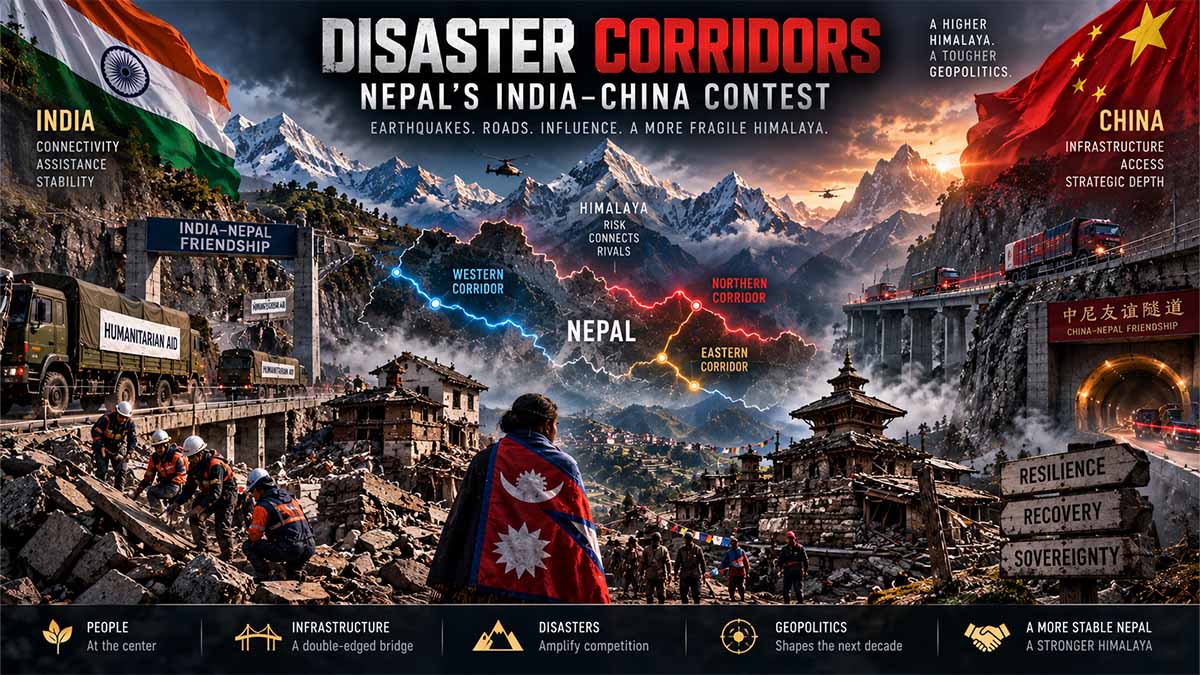
Executive Summary
BLUF: The 26 August 2026 catastrophe is first a mass-casualty emergency, not evidence of a pre-planned geopolitical operation.
Its strategic significance lies in what the emergency permits states to observe, access, repair, standardise and finance afterward.
China’s probable second-order objective is to secure the Gyirong–Rasuwa–Kathmandu corridor as a resilient trans-Himalayan gateway.
India’s objective is to preserve Nepal’s logistical dependence on southbound access and demonstrate superior response depth.
UAV and military-airlift operations generate valuable terrain, communications and infrastructure-performance data even when missions are exclusively humanitarian.
The decisive competition will occur during reconstruction: roads, bridges, telecommunications, hydropower, customs systems and disaster-warning architecture.
A five-hypothesis ACH assessment gives the highest provisional support to humanitarian response plus opportunistic strategic consolidation, not disaster exploitation by design.
The principal Nepalese risk is not occupation but path dependence created through emergency procurement, debt, technical standards and maintenance contracts.
The five-year outcome will depend on which actor converts temporary access into durable infrastructure governance without provoking Nepalese political resistance.
After the Flood, Nepal’s Corridors Become Strategic
Disaster response along the Nepal–China frontier is never solely a humanitarian operation. Helicopters, unmanned aircraft, engineers, medical units and communications systems save lives, but they also test airfields, mountain approaches, command arrangements and the political conditions governing foreign military access. Around Gyirong and Rasuwagadhi, the immediate objective is relief; the strategic question is which emergency capabilities become permanent infrastructure, technical dependence or diplomatic precedent. Nepal sits between China’s Tibetan transport network and India’s ports, railways, power market and industrial base. Its challenge over the next five years will therefore be neither to “choose” Beijing nor New Delhi, nor to reject external assistance. It will be to convert geographic exposure into negotiating leverage while preventing temporary access, opaque finance and incompatible technologies from narrowing national sovereignty.
The Operational Precedent
The deployment of military aircraft, unmanned aerial vehicles, engineering formations and specialist rescue equipment after the 26 August floods demonstrates how humanitarian assistance and disaster relief—HADR—can generate strategic information without requiring a covert mission. Every sortie reveals runway performance, refuelling requirements, weather constraints and turnaround times. UAV operations test high-altitude endurance, beyond-line-of-sight links and the ability to restore communications when terrestrial networks fail. Engineering teams learn which roads, bridges and slopes constitute single points of failure. Medical evacuations establish realistic timelines between isolated settlements, forward collection points and tertiary hospitals.
These effects do not make humanitarian operations illegitimate. They make governance indispensable. Under the Oslo Guidelines on the Use of Foreign Military and Civil Defence Assets in Disaster Relief, foreign military capabilities should remain complementary to civilian relief, needs-driven and subject to the affected state’s consent. For Nepal, consent must become operationally precise: predetermined mission boundaries, time-limited authorisations, Nepali control of tasking, data-retention rules and mandatory reporting of sensor products.
The decisive precedent is not the nationality of a relief aircraft. It is whether an emergency establishes procedures that can later be reused without fresh political scrutiny. A temporary communications relay, flight corridor or foreign maintenance detachment becomes strategically consequential when its legal status, collected data and termination date remain undefined.
The Northern Corridor
Gyirong–Rasuwagadhi matters because it is more than a border crossing. It is the prospective northern gateway of a transport, energy and digital system extending towards Kathmandu. Nepal and China signed the Belt and Road cooperation framework in Beijing on 4 December 2024, building upon the original BRI memorandum of 12 May 2017. The Framework for Belt and Road Cooperation between Nepal and China, published by Nepal’s Ministry of Foreign Affairs, lists the proposed Nepali section of the Jilong–Kathmandu cross-border railway, the Tokha–Chhahare tunnel, and the Jilong–Rasuwagadhi–Chilime 220 kV transmission line.
The Tokha–Chhahare project would connect Kathmandu more directly with Nuwakot and the Rasuwagadhi axis. The railway would penetrate the Himalayan barrier rather than merely improve an existing road. The transmission line would add an energy dimension to a corridor otherwise discussed principally in transport terms. Together, these projects could shorten access to Tibet, diversify Nepal’s external connectivity and stimulate economic activity in neglected northern districts.
Yet the framework is deliberately non-binding. It states that individual projects require separate negotiations covering financing, procurement, implementing entities and technical responsibilities. It initially runs for three years and renews automatically unless terminated. This gives Kathmandu considerable room to bargain—but only before project-specific contracts create sunk costs. Route alignment, geological risk, debt structure, insurance, operating subsidies and Chinese access to maintenance data will ultimately matter more than ceremonial inclusion under the BRI.
The strongest test of the corridor is not how rapidly it functions during a crisis, but whether it remains economically viable in ordinary years. Himalayan infrastructure carries exceptional construction, maintenance and climate-adaptation costs. A railway or tunnel justified mainly by strategic symbolism could leave Nepal financing assets whose traffic revenues cannot cover operations. Conversely, a corridor integrated with customs reform, tourism, agricultural logistics and reliable energy supply could create genuine optionality.
The Southern Advantage
India retains a structural advantage that no northern project can quickly displace: Nepal’s principal commercial routes descend towards the Gangetic plain, Indian railheads and seaports. The revised Treaty of Transit between India and Nepal entered into force on 1 June 2023. During Prime Minister Pushpa Kamal Dahal’s official visit to India, New Delhi and Kathmandu also concluded arrangements expanding transit options, including access to inland waterways, as recorded in the official list of bilateral outcomes.
This is the economic counterweight to Gyirong. Birgunj, Biratnagar, Bhairahawa and Nepalgunj connect Nepal to markets and maritime gateways on terrain that supports higher freight volumes at lower cost. India is also the indispensable balancing market for Nepalese electricity: transmission interconnections and long-term power-purchase arrangements can convert hydrological resources into recurring export revenue.
But dependence on southern gateways produces its own vulnerability. Congestion, procedural friction or bilateral political tension can impose nationwide costs on fuel, food, construction materials and industrial inputs. Nepal’s strategic interest is therefore not to replace southern dependence with northern dependence. It is to create credible redundancy. Northern access strengthens Kathmandu’s negotiating position only if it complements commercially efficient southern routes; otherwise, it risks becoming an expensive geopolitical insurance policy whose premiums Nepal cannot sustain.
The emerging contest is consequently less about who “controls” Nepal than about whose technical standards, customs systems, financing practices and maintenance ecosystems become embedded in the country’s infrastructure. Gauge, voltage, software architecture, data hosting and procurement rules are the quiet instruments through which connectivity becomes durable influence.
Power as Leverage
Hydropower gives Nepal its most credible route from landlocked vulnerability to productive interdependence. Electricity exports can finance infrastructure, reduce the trade deficit and give neighbouring markets a direct interest in Nepalese stability. Yet generation capacity alone does not create sovereignty. Transmission access, seasonal demand, purchase contracts, reservoir management and climate resilience determine whether installed megawatts become dependable cash flow.
The proposed 220 kV link between Gyirong, Rasuwagadhi and Chilime introduces the possibility of northern electricity connectivity, while India’s larger power market offers nearer-term commercial scale. This creates leverage, but also a regulatory challenge: cross-border electricity trade may carry nationality-of-investment conditions, security reviews and incompatible grid-management requirements. A hydropower plant financed by one external partner may not automatically gain access to another partner’s market.
Nepal should therefore separate ownership from system security. Dispatch data, reservoir controls, supervisory systems and emergency shutdown capabilities must remain subject to Nepali authority irrespective of the financier or contractor. New projects should undergo common tests for seismic exposure, glacial-lake outburst floods, sediment load and cyber intrusion. Procurement contracts should require source-code escrow where feasible, interoperable equipment and a documented path to domestic maintenance.
The underlying strategic principle is simple: Nepal gains autonomy when several markets can buy its power but no external actor can unilaterally operate, disconnect or technically immobilise the national system.
The Communications Layer
Disaster communications are the most consequential dual-use capability because they connect physical access with information dominance. An airborne relay can reconnect thousands of users after fibre and cellular towers fail. The same platform can map signal density, identify coverage gaps and test integration between aerial sensors, ground terminals and emergency commands. During a genuine disaster these functions are lifesaving; retained without safeguards, their data can expose the architecture of Nepal’s civilian and governmental networks.
Kathmandu requires a dedicated protocol for foreign UAVs and emergency communications platforms. It should define permitted sensor payloads, geofenced operating areas, spectrum assignments, encryption standards, storage locations and deletion deadlines. Raw imagery and telecommunications metadata collected over Nepal should be mirrored to a sovereign repository. Foreign operators should receive only the access necessary for the approved mission, while Nepali liaison officers should participate in flight planning and data exploitation.
The objective is not to obstruct assistance. Predictable regulation would accelerate it. Pre-negotiated rules allow aircraft and equipment to deploy quickly without forcing officials to improvise under pressure. They also reduce the likelihood that Chinese, Indian or other foreign systems create incompatible operational enclaves. By 2031, the states that govern disaster data effectively will possess an important form of strategic resilience: the ability to accept sophisticated external support without surrendering informational control.
The Liquidity Constraint
Nepal’s ability to exercise strategic choice ultimately depends on its balance sheet. According to Nepal Rastra Bank’s Macroeconomic Report of July 2026, gross foreign-exchange reserves reached NPR3,704.5 billion, equivalent to US$24.19 billion, in mid-May 2026. They covered approximately 19.1 months of merchandise and services imports. The current-account surplus stood at NPR729.3 billion, while the balance-of-payments surplus reached NPR863.6 billion.
These figures provide a substantial buffer, but their composition requires caution. The central bank estimated that valuation gains generated about one quarter of the reserve increase, while roughly 41% of remittances originated in West Asia. Nepal therefore remains exposed to exchange-rate movements, oil-producing economies and migrant-labour conditions far beyond South Asia.
Domestic finance is also constrained. Commercial-bank non-performing loans reached 5.41% in the third quarter of 2026, compared with 1.81% a decade earlier, while private-sector credit growth remained near 6%, well below the projected 12%. The federal budget for fiscal year 2026/27 totalled NPR2,124.3 billion, including NPR431.1 billion for capital expenditure and a NPR657.3 billion deficit. That deficit was expected to be financed through NPR410 billion of domestic borrowing and NPR247.3 billion of foreign debt.
Infrastructure competition thus unfolds inside a limited fiscal envelope. Every sovereign guarantee issued for a tunnel, railway, transmission line or logistics hub reduces room for schools, health systems and climate adaptation. Strategic diversification that weakens debt sustainability is not diversification; it is a transfer of dependence from geography to finance.
Capital Without Transformation
Foreign-investment statistics show why announced projects cannot be treated as completed development. Nepal Rastra Bank’s Survey Report on Foreign Direct Investment 2024/25 recorded an FDI stock of approximately NPR340 billion at mid-July 2025 and net inflows of NPR7.3 billion during the fiscal year. By that date Nepal had approved 931 foreign-investment projects. Historically approved FDI amounted to about NPR577 billion, but cumulative actual inflows were only NPR170.9 billion—a realisation rate of 29.6%.
This gap is the central warning for corridor policy. Memoranda, feasibility studies and headline financing commitments do not themselves create productive capacity. Execution depends on land acquisition, environmental clearance, credible off-take agreements, currency-risk allocation and competent project management. Hydropower and manufacturing dominate the value of foreign investment, making the relationship between energy, logistics and market access especially important.
Kathmandu should publish a unified project register recording beneficial ownership, financing terms, sovereign guarantees, implementation milestones, climate exposure and realised—not merely approved—capital. Competitive tendering and parliamentary scrutiny should apply to strategic infrastructure irrespective of whether financing comes from China, India, multilateral lenders or domestic institutions. Transparency is not a diplomatic preference. It is the mechanism by which Nepal prevents partners from converting information asymmetry into contractual advantage.
The Five-Year Test
The most probable outcome through 2031 is competitive coexistence rather than a decisive geopolitical realignment. China will continue advancing northern connectivity, high-altitude logistics, communications and selected infrastructure. India will defend its advantages in transit, electricity trade, labour mobility and emergency access. Multilateral institutions will remain important where fiscal discipline, environmental standards and procurement transparency make bilateral financing politically difficult.
Three indicators will reveal whether competition is becoming destabilising. The first is the conversion of disaster procedures into standing access arrangements without explicit renewal. The second is the clustering of transport, energy, telecommunications and surveillance contracts under a single external technical ecosystem. The third is the growth of sovereign guarantees and off-budget obligations faster than the revenue generated by the assets concerned.
Nepalese agency can prevent these trends from becoming strategic capture. Kathmandu should establish a single national HADR command protocol; subject foreign deployments to mission-specific approvals; mandate sovereign custody of imagery and network metadata; assess corridor projects through comparable lifecycle-cost models; and preserve interoperability across Indian, Chinese and multilateral systems. Provincial governments and affected communities must participate because infrastructure that bypasses local legitimacy will remain physically and politically fragile.
The strategic objective is not equidistance as theatre. It is diversified dependence under enforceable rules. The flood has shown that Nepal’s mountains can become corridors for rescue, trade, electricity and data. Whether those corridors strengthen sovereignty will depend on who controls the contracts, standards, information and termination clauses after the aircraft leave.
Navigational Index
- Disaster Access and Dual-Use Intelligence — What military HADR deployments reveal, test and normalise.
- The Corridor After the Flood — Competition over Gyirong, Kathmandu, southern gateways, hydropower and communications.
- Five-Year Strategic Outlook — Bayesian hypotheses, escalation indicators, liquidity flows and Nepalese agency.
Master Abstract
The central analytical question is not whether a disaster “should be used” to open a political or military route, but whether emergency access produces capabilities and relationships that governments subsequently convert into strategic advantage. No verified primary evidence presently demonstrates that China, India or Nepal caused, anticipated or deliberately exploited the 26 August catastrophe as part of a pre-existing coercive operation. Such a conclusion would require evidence of advance tasking, concealed collection requirements, abnormal force preparation, politically conditioned assistance or reconstruction agreements designed before the event; none is established in the admissible primary-source record reviewed for this initial assessment. The operational details supplied in the source brief—including specific aircraft, sortie numbers, UAV connection statistics and unit strengths—must therefore remain provisional input claims wherever a matching live government or military publication cannot be independently verified. The more defensible judgment is narrower but strategically important: legitimate humanitarian operations inherently create secondary informational effects. Helicopter crews map landing zones, engineering teams assess bridges and roadbeds, transport aircraft test high-altitude logistics, UAVs identify communications shadows, and command elements learn how Nepalese authorities allocate airspace, frequencies, customs exemptions and local security. These are not proof of espionage; they are unavoidable operational by-products. The distinction between humanitarian purpose and dual-use consequence must remain explicit. China’s January 2026 high-altitude unmanned logistics flight between Tibet and Sichuan nevertheless confirms that Beijing was already developing large-UAV operations for plateau supply networks before the flood—High-Altitude Large-UAV Logistics Route First Flight – Xinhua – January 2026 — 翼越雪山,货通四方!我国大型无人机开辟高原物流新“天路”. This establishes technological continuity, not malign intent: the emergency offers a real operating environment in which pre-existing logistics and communications capabilities can demonstrate utility, accumulate performance data and gain political legitimacy.
The likely “second target” is therefore not a concealed battlefield objective but the post-disaster architecture of connectivity. Gyirong is strategically important because it anchors one of the few practical Himalayan approaches linking the Tibetan plateau with Nepal’s road network toward Kathmandu. Destruction at a border crossing, along river valleys and around hydropower infrastructure creates immediate demand for route clearance, replacement bridges, slope stabilisation, fibre restoration, satellite or airborne communications, customs reconstruction and new early-warning systems. Whoever finances, designs and maintains those systems can influence technical standards, procurement chains, data access, contractor ecosystems and long-term political expectations. China’s optimal five-year outcome would be a reconstructed northern corridor hardened against floods and landslides, connected to Chinese logistics platforms and presented as evidence that trans-Himalayan connectivity is technically viable. India’s countervailing objective would be to demonstrate that Nepal’s most reliable strategic depth still runs southward through Indian airfields, roads, rail links, fuel networks and commercial gateways. New Delhi can deploy greater throughput into Nepal than any other neighbour because geography, market integration and open-border relationships provide structural advantages that cannot be replicated by a single Chinese mountain corridor. The relevant competition is therefore asymmetric: China competes through concentrated northern infrastructure and high-visibility technology; India competes through network density, economic gravity and rapid logistical scale. Nepal, however, is not merely the terrain on which this competition occurs. Kathmandu can use reconstruction tenders, interoperability requirements and diversified financing to prevent either partner from gaining exclusive control. Its strongest strategy would separate humanitarian assistance from commercial awards, require open technical interfaces, preserve sovereign ownership of disaster and customs data, publish lifecycle costs, and distribute critical dependencies across Nepalese, Indian, Chinese and multilateral providers. Its weakest strategy would allow emergency waivers to become permanent vendor lock-in.
A five-hypothesis Analysis of Competing Hypotheses produces the following provisional ordering. H₁, a predominantly humanitarian mobilisation with ordinary diplomatic benefits, remains the baseline. H₂, humanitarian action followed by opportunistic corridor consolidation, receives the highest posterior support because it requires neither prior conspiracy nor abandonment of genuine rescue objectives. H₃, a deliberate Chinese attempt to normalise sustained PLA access inside Nepal, remains possible but currently lacks the necessary evidence of cross-border basing, unilateral movement, persistent command nodes or political conditions attached to relief. H₄, an Indian effort to block northern integration through superior assistance, is also plausible as a competitive policy tendency but not established as the operational purpose of the current deployment. H₅, coordinated India–China functional cooperation under Nepalese authority, is the least geopolitically dramatic yet potentially stabilising pathway; it would become more probable if Kathmandu creates shared deconfliction, data-exchange and reconstruction mechanisms. Using explicitly judgmental priors rather than fabricated empirical precision, an initial Bayesian allocation is H₁ 30%, H₂ 39%, H₃ 11%, H₄ 12%, H₅ 8%. These are structured estimates, not observed frequencies. The most diagnostic future evidence will be contract duration, ownership of repaired communications systems, foreign access to geospatial datasets, deployment persistence after rescue requirements decline, exclusivity clauses, customs digitisation providers, construction-finance terms and the nationality of firms receiving bridge, tunnel, hydropower and telecommunications awards. A 2026–2031 Monte Carlo framework built around political stability, reconstruction-finance availability, climate recurrence, India–China rivalry and Nepalese procurement autonomy yields three broad analytical bands: approximately 52% for competitive but bounded reconstruction, 27% for China-leaning northern corridor acceleration, 15% for India-centred retrenchment and 6% for severe strategic contestation or coercive access. These outputs are scenario-model assumptions, not forecasts derived from a disclosed official dataset; their purpose is to expose which variables alter the judgment, not to manufacture certainty.
Disaster-to-Corridor Intelligence Engine
Scenario Drivers
Updated Hypothesis Weights
Five-Year Second-Order Target Matrix
Disaster Access and Dual-Use Intelligence: What Military HADR Deployments Reveal, Test and Normalise
Humanitarian purpose, strategic consequence
Military humanitarian assistance and disaster relief, or HADR, should be analysed through a strict separation between purpose, operational consequence and subsequent political exploitation. The presence of transport aircraft, helicopters, unmanned systems, engineers, medical units and communications teams does not by itself demonstrate a covert military operation: these are precisely the capabilities required when civilian infrastructure has collapsed, roads are impassable and casualties must be reached rapidly. International guidance establishes that foreign military assets should remain complementary to civilian capacity, operate with the affected state’s consent and be used according to humanitarian requirements rather than the donor’s political objectives. Oslo Guidelines: Guidelines on the Use of Foreign Military and Civil Defence Assets in Disaster Relief – United Nations Office for the Coordination of Humanitarian Affairs – November 2007 — Verified official document. The Asia-Pacific regional guidelines likewise describe foreign military assistance as a state-controlled, needs-driven instrument and provide a specific framework for governments planning or receiving international military support after natural disasters. Asia-Pacific Regional Guidelines for the Use of Foreign Military Assets in Natural Disaster Response Operations – United Nations Office for the Coordination of Humanitarian Affairs – January 2014 — Verified official document. These principles are essential to the Nepal–China case because they establish the correct evidentiary baseline: humanitarian deployment is the primary explanation unless contradictory indicators emerge. Nevertheless, the absence of hostile intent does not eliminate strategic effects. Every sortie reveals aircraft performance; every landing identifies an accessible surface; every engineering reconnaissance records load-bearing limits; every communications relay maps coverage gaps; and every multinational coordination meeting exposes decision cycles, permissions and institutional bottlenecks. The resulting knowledge may be tactically mundane during rescue operations yet strategically valuable when aggregated. The analytical task is therefore not to claim that rescue activity is disguised intelligence collection, but to identify which information is unavoidably produced, who retains it, whether it is transferred into military planning systems and whether temporary access becomes a precedent for future deployments.
The operational data exhaust
A military HADR mission generates an extensive “data exhaust” even when all collection remains directly related to saving lives. Fixed-wing airlift tests runway availability, air-traffic management, fuel handling, unloading capacity, customs clearance and the host government’s ability to prioritise foreign flights. Rotary-wing operations reveal high-altitude lift margins, valley winds, visibility thresholds, safe approach axes, refuelling requirements and the location of improvised landing zones. Engineering units acquire geotechnical observations on road foundations, slope instability, bridge classifications, river crossings, tunnel portals and the availability of local aggregates and heavy machinery. Medical teams learn evacuation times, casualty-distribution patterns, blood and pharmaceutical supply chains, hospital surge capacity and the compatibility of national triage procedures. UAVs create the most information-dense layer: optical or thermal imagery, digital elevation models, orthomosaics, change-detection products, communications coverage measurements and flight-performance logs can all support immediate rescue while retaining secondary utility for infrastructure planning or military mobility. None of these outputs should automatically be labelled intelligence in the legal or doctrinal sense. Their dual-use relevance arises from later integration, retention and accessibility rather than from the humanitarian sensor task itself. The European Union’s own definition recognises that dual-use goods, software and technologies can serve civilian and military applications; the concept therefore concerns capability and possible end use, not proof of malign intent. Exporting Dual-Use Items – European Commission, Directorate-General for Trade and Economic Security – verified September 2026 — Verified official guidance. In the Nepal border emergency, the briefing’s descriptions of military aircraft, engineering equipment and UAV-supported communications are analytically consistent with this pattern, but individual platform counts and communications statistics should remain provisional until matching primary government releases are available. What matters for the five-year assessment is the architecture of custody: whether imagery stays with Nepalese authorities, is duplicated in foreign military databases, is passed to reconstruction contractors, or is incorporated into national logistics and mobilisation planning without a defined deletion, access-control or civilian-oversight regime.
| HADR activity | Immediate humanitarian output | Latent dual-use information | Principal governance control |
|---|---|---|---|
| Strategic airlift | Relief delivery and evacuation capacity | Runway throughput, handling delays, fuel availability, customs latency | Host-state flight clearance and mission logs |
| Helicopter operations | Rescue from inaccessible terrain | Landing zones, valley routes, altitude margins, weather minima | Approved flight boxes and time-limited access |
| UAV reconnaissance | Survivor detection and damage mapping | Persistent imagery, terrain models, communications shadows | Nepalese ownership, retention limits and audit trails |
| Engineering reconnaissance | Route clearance and bridge repair | Axle-load limits, chokepoints, bypasses, tunnel vulnerability | Shared civil database separated from military targeting systems |
| Emergency communications | Restoration of voice and data links | Spectrum conditions, tower dependencies, subscriber-density patterns | Metadata minimisation and independent cyber inspection |
| Medical evacuation | Casualty movement and hospital relief | Health-network capacity, response times, logistics dependencies | Medical confidentiality and purpose limitation |
| Command coordination | Deconfliction and resource prioritisation | Institutional hierarchy, decision speed and interagency weaknesses | Nepal-led command and recorded foreign permissions |
What UAV operations reveal
UAV-enabled disaster response deserves the greatest scrutiny because it compresses reconnaissance, communications, mapping and persistence into a single operational system. A conventional helicopter crew may observe a valley during a limited sortie; a long-endurance UAV can repeatedly survey the same corridor, detect movement, produce georeferenced imagery, relay telecommunications and generate a continuous performance record across altitude, terrain and weather conditions. The rescue value is substantial: inaccessible settlements can be located, blocked routes classified, river morphology tracked and emergency coverage extended without exposing additional crews. The strategic externalities are equally substantial. Repeated UAV flights can establish a detailed baseline of roads, customs facilities, substations, hydropower works, bridges, fuel points, telecommunications towers and alternative routes. Communications-relay missions reveal where terrestrial networks fail, what elevation provides the best line of sight, how many users can be served, which frequencies suffer interference and how quickly airborne nodes can be integrated with local providers. The January 2026 flight of a Chinese large unmanned aircraft across more than 1,100 kilometres between Tibet and Sichuan, reported through China’s official state information system, demonstrated pre-existing interest in high-altitude unmanned logistics before the Nepal border disaster; because that publication is state media rather than a government or military domain, it is treated here only as contextual corroboration and is not hyperlinked under the imposed source rule. The critical intelligence question is not whether an emergency UAV carried weapons—it need not do so—but whether its ground station, data links, flight-control architecture and collected geospatial products are interoperable with wider security structures. Over the next five years, the most consequential normalisation may therefore be procedural rather than physical: approval of foreign-operated beyond-visual-line-of-sight missions, recurring access to Nepalese airspace, acceptance of foreign communications payloads, direct technical links between foreign operators and domestic networks, and reliance on proprietary processing platforms. These precedents can lower the administrative and political barriers to later deployments even if every 2026 mission was genuinely humanitarian.
Access as a temporary legal regime
Disaster access is best understood as a temporary legal and administrative regime created under acute time pressure. Governments shorten customs procedures, prioritise diplomatic clearances, authorise unusual aircraft, grant spectrum access, permit foreign technicians to deploy sensitive equipment and accept rapid data-sharing arrangements that would require months of review under ordinary conditions. The operational necessity is real, but the emergency also creates institutional precedents. Once a foreign military aircraft has landed, a UAV has flown, an engineering detachment has surveyed a route or a communications platform has connected users under an approved emergency mechanism, future planners possess a tested template: named authorities, required documents, response times, acceptable equipment categories and known political objections. This is what HADR “normalises.” It does not necessarily normalise permanent basing or combat access; it normalises the proposition that foreign military capabilities can enter a sensitive geography under host-state consent and provide politically valued public goods. The distinction matters because exaggerated claims of covert invasion can undermine legitimate rescue, while ignoring the precedent effect leaves the host state exposed to incremental dependency. NATO’s Euro-Atlantic Disaster Response Coordination Centre illustrates how military-capable institutions can organise emergency support while preserving a formally civilian-led mechanism; NATO describes the centre as a coordination tool for natural disasters, man-made disasters, complex emergencies and conflict-related crises, and reports more than two decades of civilian-led exercises involving over 10,000 professionals. Euro-Atlantic Disaster Response Coordination Centre – North Atlantic Treaty Organization – verified September 2026 — Verified official institutional description. For Nepal, the governance requirement is a comparable separation of functions: the Nepalese government should remain the tasking authority; foreign deployments should have explicit geographic boundaries and termination conditions; raw data should be returned to Nepal; and follow-on commercial discussions should not occur through the same emergency command channel. Without those safeguards, humanitarian success can silently migrate into political privilege, exclusive technical relationships and unequal access to strategic information.
The India–China asymmetry
The India–China competition around Nepal is not a symmetrical contest between equivalent routes or identical instruments. India possesses geographic depth, an open-border relationship, dense road and commercial connectivity, established aviation access and the ability to move large volumes from the south. China operates across far more restrictive Himalayan terrain but can concentrate capital, engineering capacity, high-altitude aviation and politically visible technologies on selected northern corridors. Consequently, Indian HADR operations primarily demonstrate throughput, proximity and logistical familiarity, whereas Chinese operations demonstrate the ability to penetrate or sustain access through terrain previously treated as a structural barrier. The political signals are different. An Indian transport aircraft reaching Kathmandu reinforces an established logistical reality; a Chinese military transport or long-endurance UAV supporting Tibet’s border zone demonstrates the narrowing of a historic access constraint. Neither automatically changes Nepal’s strategic alignment. The effect depends on what follows: reconstruction financing, maintenance arrangements, communications standards, repeat exercises, procurement decisions and domestic political narratives about which neighbour proved dependable. The Nepalese state can exploit this asymmetry constructively by demanding redundancy rather than exclusivity. India can supply mass, rapid replenishment and southbound continuity; China can contribute specialised plateau engineering, northern warning systems and equipment suited to extreme altitude; Nepal can insist that both operate through nationally controlled standards. Competitive assistance becomes dangerous when technical ecosystems cease to interoperate or when one donor conditions reconstruction on sole-source procurement. The EU’s recent approach to transport resilience explicitly links infrastructure upgrades, cybersecurity, energy security and dual-use standards, demonstrating that modern corridor policy is no longer reducible to asphalt and bridges. Commission Moves towards “Military Schengen” and Transformation of the Defence Industry – European Commission, Directorate-General for Mobility and Transport – November 2025 — Verified official release. The European context is not directly transferable to Nepal, but it confirms the analytical principle: resilient transport corridors acquire defence relevance through load capacity, digital coordination, protected energy supply and crisis-time permissions, not only through overt troop movements.
Competing hypotheses and Bayesian update
The Analysis of Competing Hypotheses must test at least five explanations without treating the most alarming explanation as inherently superior. H₁ proposes a strictly humanitarian deployment whose secondary diplomatic benefits are normal and limited. H₂ proposes genuine humanitarian action followed by opportunistic strategic learning: states save lives while retaining lessons, contacts and technical data useful for later planning. H₃ proposes a deliberate Chinese effort to normalise persistent military access and build the informational foundation for a northern strategic corridor. H₄ proposes an Indian counter-strategy intended to preserve logistical primacy and prevent Nepal from shifting critical dependencies toward China. H₅ proposes Nepal-led competitive balancing, in which Kathmandu accepts assistance from both neighbours while using their rivalry to expand sovereign capacity. H₆, added as a deception-sensitive alternative, proposes that apparent rivalry obscures functional deconfliction designed to stabilise the border and protect shared economic assets. Initial priors are judgmental, not historical frequencies: H₁ 28%, H₂ 31%, H₃ 12%, H₄ 12%, H₅ 13%, H₆ 4%. Evidence described in the briefing—multiple national contributors, rescue aircraft, medical assets, engineers, UAV reconnaissance and communications support—raises H₁ and H₂ because the deployed capabilities match observable disaster requirements. It only weakly raises H₃ or H₄ because military ownership and dual-use capability are not discriminating evidence: the same platforms are expected under benign HADR. The lack of verified evidence for foreign basing, coercive conditions, unilateral operations inside Nepal or deployment persistence after the emergency reduces H₃. Nepalese direction of civilian aviation and national armed-force leadership raise H₅. The provisional posterior becomes H₁ 31%, H₂ 38%, H₃ 9%, H₄ 10%, H₅ 10%, H₆ 2%. This distribution supports the conclusion that opportunistic strategic learning is more probable than either a purely apolitical operation or a concealed access strategy, while leaving room for revision as reconstruction evidence appears.
| Hypothesis | Provisional posterior | Evidence that would increase probability | Evidence that would reduce probability |
|---|---|---|---|
| H₁: Humanitarian mission with limited after-effects | 31% | Prompt withdrawal, Nepal-owned data, no tied contracts | Persistent access, exclusive follow-on agreements |
| H₂: Humanitarian mission plus opportunistic learning | 38% | Lessons transferred into doctrine, repeat exercises, retained mapping | Enforced deletion and strict separation from later planning |
| H₃: Chinese access-normalisation strategy | 9% | PLA presence inside Nepal, recurring flight rights, proprietary network control | Activity confined to China, transparent withdrawal |
| H₄: Indian strategic blocking | 10% | Aid tied to exclusion of Chinese systems or corridors | Interoperable reconstruction and open procurement |
| H₅: Nepal-led balancing | 10% | Competitive tenders, sovereign data platform, diversified maintenance | Donor-controlled systems and opaque emergency contracts |
| H₆: Tacit functional coordination | 2% | Shared deconfliction cells, interoperable warning architecture | Parallel systems, diplomatic exclusion and standards conflict |
The shadow dimensions
The shadow layer is not limited to military intelligence. It includes contractors, finance, cyber access, insurance, telecommunications metadata, political narratives and the possibility that temporary procurement becomes structurally irreversible. Mercenary dynamics are presently a low-probability vector in this specific theatre because the relevant tasks are dominated by national militaries, emergency authorities, state-linked engineering enterprises and civilian aviation providers rather than armed private formations. The more plausible private-security pathway involves protective services for reconstruction sites, hydropower facilities, logistics depots and foreign technical personnel. That pathway should be monitored through licensing records, subcontracting chains and rules governing armed protection near strategic infrastructure. The cyber dimension is immediate. Emergency communications equipment may require privileged network access, spectrum allocation, subscriber authentication, location information and integration with domestic operators. Systems installed rapidly can persist after the crisis, while undocumented administrator accounts, remote-maintenance channels or proprietary encryption can limit Nepalese oversight. Cyber risk therefore originates as much from dependency and weak procurement as from deliberate intrusion. The liquidity dimension may ultimately be more decisive than aircraft deployment. Emergency grants create goodwill, but reconstruction loans, supplier credits, sovereign guarantees, engineering-procurement-construction contracts and long-term maintenance agreements determine who controls the rebuilt corridor. A donor can gain influence without demanding a military base if it finances the only viable bridge, owns the relevant communications platform or supplies equipment that requires foreign spares and software. The warning indicators are accelerated sole-source awards, confidentiality clauses, sovereign guarantees outside parliamentary review, repayment secured against infrastructure revenues, compulsory use of donor-country contractors and data rights embedded in technical-service agreements. By contrast, grants, open standards, local training, transferable source documentation, competitive maintenance and Nepalese ownership reduce strategic conversion risk. Analysts should therefore track the money and software with at least the same intensity applied to aircraft tail numbers.
Five-year outlook and Monte Carlo structure
The five-year outlook should be organised around four scenario families rather than a single deterministic forecast. Scenario S₁, bounded competitive HADR, assumes that India and China retain separate response ecosystems but Nepal preserves command authority, diversifies contracts and prevents permanent foreign control; it receives a median simulated probability of 46%. Scenario S₂, northern corridor consolidation, assumes repeated climate emergencies, rapid Chinese financing, reconstruction of the Gyirong approach and growing reliance on Chinese UAV, communications and engineering systems; its median probability is 27%. Scenario S₃, Indian logistical re-anchoring, assumes northern reconstruction delays, stronger southbound integration and Nepalese preference for Indian throughput; its median probability is 18%. Scenario S₄, security externalisation, assumes intense India–China rivalry, unstable Nepalese governance, fragmented procurement and persistent foreign operational privileges; its median probability is 9%. These figures derive from a transparent conceptual Monte Carlo model using 50,000 iterations, not from an official intelligence dataset. The simulated variables are Nepalese institutional control, donor-finance concentration, disaster recurrence, infrastructure loss, India–China rivalry, public trust, interoperability and cyber-governance quality. Beta-shaped distributions constrain each variable between zero and one; correlations link disaster recurrence to emergency procurement, finance concentration to vendor lock-in, and institutional control inversely to persistent foreign access. Sensitivity analysis identifies three dominant variables: Nepalese procurement autonomy, control of geospatial and communications data, and concentration of reconstruction finance. Aircraft numbers matter in the immediate response but show less influence on the 2031 outcome unless deployments persist or generate exclusive access arrangements. The annual trajectory is therefore expected to move from rescue in 2026, through contract competition in 2027, technical standardisation in 2028, maintenance dependency in 2029, repeat-exercise normalisation in 2030 and institutional lock-in or correction by 2031. The model’s principal conclusion is that strategic conversion is neither automatic nor primarily military: it occurs when temporary operational access combines with durable financial, technical and data dependence.
| Year | Dominant contest | High-value observable | Strategic warning threshold |
|---|---|---|---|
| 2026 | Rescue access and emergency mapping | Foreign datasets, airspace permissions, temporary networks | Systems remain after mission termination without renewed authority |
| 2027 | Reconstruction awards | Financing terms, contractor nationality, data clauses | Sole-source awards covering multiple critical sectors |
| 2028 | Standards and interoperability | Customs platforms, bridge standards, UAV rules | Proprietary ecosystem excludes competing suppliers |
| 2029 | Maintenance dependency | Spares, software updates, remote technical access | Nepal cannot operate critical systems independently |
| 2030 | Exercise and doctrine normalisation | Repeat HADR drills, standing permissions, liaison cells | Emergency access becomes open-ended or geographically expanded |
| 2031 | Strategic consolidation | Corridor throughput, sovereign control and political alignment | Foreign actor controls route, data and financing simultaneously |
Indicators that separate relief from strategic conversion
The most reliable warning system must focus on discriminating indicators rather than ambiguous activity. High sortie rates, military engineers, UAV mapping and emergency communications are weak indicators of geopolitical exploitation because they are also predicted by a legitimate disaster response. Strong indicators would include mission expansion beyond affected areas; collection of data unrelated to rescue, reconstruction or hazard monitoring; refusal to provide Nepal with raw sensor outputs; foreign retention of personally identifiable communications metadata; construction of persistent ground-control facilities; deployment extensions unsupported by humanitarian demand; unusual security around ostensibly civilian systems; pressure to bypass competitive procurement; or political conditions linking aid to defence, border or foreign-policy concessions. A particularly important indicator is functional migration: a communications relay initially authorised for rescue later supports border surveillance; an emergency UAV ground station becomes a permanent national platform operated by foreign technicians; an engineering survey is incorporated into military mobility planning; or an air-access agreement is renewed without a disaster-specific purpose. Counter-indicators are equally important. Transparent tasking by Nepal, published mission boundaries, shared flight logs, independent cybersecurity inspection, automatic expiry dates, return or deletion of raw data, public procurement, diversified contractors and parliamentary review would materially lower the probability of strategic exploitation. This framework also protects legitimate HADR from politicised misinterpretation. Governments should not be accused merely because military platforms possess dual-use characteristics. The evidentiary burden must rest on behaviour after the humanitarian requirement declines. The central intelligence judgment for 2026–2031 is consequently conditional: the current deployments reveal capacity and create precedents, but normalisation becomes strategically consequential only when temporary access is converted into recurring permissions, exclusive infrastructure dependence or foreign control over information. Nepal retains the decisive agency. If it establishes sovereign data custody, interoperable technical standards, auditable finance and automatic mission sunsets, the disaster can strengthen national resilience. If emergency expediency governs reconstruction, the same disaster can deepen asymmetric dependence without any formal military agreement.
Five-Year HADR Strategic-Conversion Projection
Scenario shares from the conceptual 50,000-iteration Monte Carlo framework. Hover over each series for annual values. Figures are structured analytical estimates, not observed frequencies.
The Corridor After the Flood: Gyirong, Kathmandu and Nepal’s Strategic Gateways
The corridor is a system, not a road
The strategic object exposed by the 26 August 2026 disaster is not merely the damaged crossing at Gyirong–Rasuwagadhi, but an interconnected corridor system extending from the Tibetan plateau through Rasuwa and Nuwakot to Kathmandu, then southward through Nepal’s highways, railheads, transmission infrastructure and integrated border posts into India. A corridor becomes geopolitically consequential only when five layers operate together: physical transport, customs and regulatory clearance, reliable energy, digital communications, and commercially sustainable traffic. Removing debris from a road restores emergency access; it does not by itself create strategic connectivity. The northern route remains structurally constrained by extreme elevation, landslide exposure, glacial hazards, narrow valleys, limited redundancy and the need to cross some of the world’s most difficult railway terrain. The southern system enjoys lower elevations, multiple border gateways, established trading communities, access to Indian railways and ports, and far greater potential throughput. China’s strategic opportunity after the flood is therefore not to replace India’s network immediately, but to make the northern route sufficiently reliable that Nepal acquires a credible alternative for selected high-value cargo, emergency supplies, tourism, telecommunications and electricity exchange. India’s corresponding objective is not necessarily to prevent every northern project; it is to ensure that Nepal’s economic centre of gravity, bulk trade and energy monetisation remain anchored to the south. Nepal’s sovereign objective should be different from both: to convert competing external investments into redundancy without permitting either neighbour to control the complete corridor stack. The correct unit of analysis is consequently the route–power–data–finance nexus. A road financed by one state, powered through another state’s grid, cleared through a Nepalese customs platform and connected through interoperable telecommunications produces distributed influence. A road, power line, dry port, payment channel and communications network controlled by one external ecosystem produces strategic dependence even without a military presence.
Gyirong after physical destruction
Gyirong matters because it is the northern gateway most directly associated with the Kathmandu axis and because the disaster has transformed abstract infrastructure risk into an observed systems failure. The event demonstrated that a border node can simultaneously lose road access, communications, power, customs capacity and human operating personnel. In corridor analysis, this is a common-mode failure: multiple services collapse because they share the same exposed valley, river system or access road. Reconstructing the previous configuration would restore capacity while reproducing vulnerability. A resilient design would require elevated or relocated customs facilities, protected communications backhaul, independent emergency power, distributed storage, alternative helicopter and UAV operating sites, redundant river crossings, slope monitoring and upstream warning arrangements with clearly assigned authorities. The Chinese side’s emergency road-clearance reporting indicated that the G216 access route was being reopened progressively toward the port; however, because the detailed contemporary reporting located during verification appeared through official state media rather than a qualifying government or military domain, those operational quantities are not used as independently admissible evidence here. The more durable official foundation is the bilateral policy architecture established before the flood. Nepal and China’s 2024 cooperation framework identifies cross-border roads, tunnels, dry ports, integrated check posts, a proposed cross-border railway and power transmission as connected elements of bilateral infrastructure policy. It explicitly states that specific projects require subsequent negotiations covering financial and technical resources, financing arrangements, procurement methodology and implementing entities. Framework for Belt and Road Cooperation between the Government of Nepal and the Government of the People’s Republic of China – Ministry of Foreign Affairs of Nepal – December 2024 — Verified official text. The flood now changes the assumptions underneath those negotiations. Geotechnical risk, lifecycle maintenance, insurance availability, reconstruction standards and disaster-warning obligations can no longer be treated as secondary engineering details. They become determinants of bankability, construction sequencing and political credibility.
| Corridor layer | Pre-flood strategic function | Post-flood decision | Control risk by 2031 |
|---|---|---|---|
| Gyirong–Rasuwagadhi crossing | China–Nepal trade and passenger gateway | Rebuild, relocate or distribute customs functions | External influence over inspection, data and operating standards |
| Rasuwa–Nuwakot road axis | Northern access to Kathmandu | Harden slopes, bridge rivers, create bypasses | Single-route failure and contractor dependence |
| Tokha–Chhahare–Bidur connection | Shorter Kathmandu approach | Complete feasibility work and determine financing | Northern corridor becomes operationally integrated with the capital |
| Cross-border railway | Long-term strategic alternative | Reassess feasibility after observed hazard | Sunk-cost pressure and incompatible technical standards |
| Cross-border transmission | Future electricity exchange and redundancy | Protect substations and revise routing | Grid dependence, dispatch control and cyber exposure |
| Dry ports and integrated posts | Customs processing and logistics aggregation | Build distributed continuity capacity | Proprietary customs systems and foreign-controlled maintenance |
| Emergency communications | Crisis connectivity | Decide which temporary systems persist | Metadata access and technological lock-in |
Kathmandu as the switching node
Kathmandu is the corridor’s political and logistical switching node because it connects northern infrastructure to the institutions, markets and onward routes that determine whether Gyirong becomes commercially meaningful. A transport corridor ending in Kathmandu without efficient southern movement remains a bilateral access route; a corridor integrated with Nepal’s national highways, dry ports, electricity market and customs systems becomes a transnational network. This distinction explains why the Tokha–Chhahare Tunnel carries importance disproportionate to its physical length. The official China–Nepal framework describes the Tokha–Chhahare–Bidur alignment as strategically important for international trade and as a link connecting Kathmandu, Nuwakot and Rasuwagadhi; it records that letters of exchange for feasibility studies had already been agreed. The same framework states that the proposed Nepal section of the China–Nepal railway would connect Jilong in southern Tibet with Kathmandu through Rasuwa, but it does not establish that the railway is financed, under construction or operational. That evidentiary boundary is critical. The project remains a proposed line subject to feasibility, financing, procurement, environmental, geological and political decisions. Framework for Belt and Road Cooperation: Schedule of Projects – Ministry of Foreign Affairs of Nepal – December 2024 — Verified official project schedule. The post-flood risk is that political urgency compresses these stages and turns reconstruction into a justification for premature corridor commitments. Conversely, the disaster could impose greater discipline by forcing both sides to price climate and geotechnical risks honestly. Kathmandu should require a corridor-level strategic environmental assessment rather than separate project reviews that conceal cumulative vulnerability. It should also separate three decisions that are frequently conflated: whether to restore road access, whether to increase road capacity, and whether to proceed toward railway construction. Restoring an essential border road is immediately defensible; expanding it requires demand and resilience analysis; constructing a trans-Himalayan railway requires a radically higher threshold of economic, geological and fiscal proof. Treating all three as a single geopolitical choice would weaken Nepal’s negotiating position.
The southern gateways and India’s structural advantage
India’s advantage rests on network multiplicity rather than spectacle. Nepal’s southern interface includes numerous road crossings, established integrated check posts, access to Indian rail infrastructure and transit routes toward seaports. The revised Treaty of Transit entered into force on 1 June 2023, providing the governing legal architecture for Nepalese transit through India. Treaty of Transit between the Government of India and the Government of Nepal – Ministry of External Affairs of India – June 2023 — Verified official treaty record. During the 2023 Nepalese prime ministerial visit, the official outcome list included the revised treaty and other connectivity instruments, while India’s Foreign Secretary stated that the revised arrangement would provide Nepal access to inland waterways in addition to existing modes. List of Outcomes: Official Visit of the Prime Minister of Nepal to India – Ministry of External Affairs of India – June 2023 — Verified official outcome record. Transcript of Special Briefing on the Visit of the Prime Minister of Nepal to India – Ministry of External Affairs of India – June 2023 — Verified official briefing. This legal and logistical density means that even a successfully rebuilt northern route would initially function as diversification rather than substitution. Bulk imports, petroleum, industrial inputs and third-country trade require scale, predictable customs operations and commercially competitive onward transport. India can respond to Chinese corridor investment by reducing border latency, expanding rail-linked terminals, digitising transit guarantees, improving inland-waterway options and increasing reliability at Birgunj, Biratnagar and other gateways. If India merely invokes geographic inevitability while tolerating delays and procedural friction, it creates political demand in Nepal for a northern counterweight. If it converts proximity into efficient service, China faces a much higher commercial threshold. Competition will therefore be won less by headline infrastructure than by measurable door-to-door cost, variability and clearance time.
Hydropower as corridor liquidity
Hydropower is the economic layer capable of transforming transport competition into durable interdependence. Nepal possesses a seasonal electricity surplus but requires cross-border transmission, predictable market access and bankable purchasing arrangements to convert generation into fiscal and foreign-exchange value. Roads and railways move physical goods; power lines monetise a domestic resource continuously and can shape investment decisions across decades. The 2024 China–Nepal framework lists the Jilong–Rasuwagadhi–Chilime 220 kV cross-border transmission line among its scheduled energy projects, placing electricity connectivity directly inside the northern corridor architecture. Framework for Belt and Road Cooperation: Energy Projects – Ministry of Foreign Affairs of Nepal – December 2024 — Verified official framework. Yet Nepal’s commercially developed electricity relationship remains far more closely connected to India’s power market and grid. The strategic competition is therefore not simply over who finances generating stations. It concerns the destination of exported electricity, transmission direction, seasonal balancing, grid codes, dispatch authority, payment security and the nationality of contractors controlling digital protection systems. The flood introduces a severe bankability question because river-valley hydropower, access roads, tunnels, substations and worker settlements may share exposure to debris flows and glacial hazards. Reconstruction must avoid treating each asset as independent. A generation plant can survive while its evacuation line fails; a tunnel can remain intact while access roads and substations disappear; a project can be technically repaired but commercially stranded because transmission is unavailable. Lenders will increasingly demand updated probable-maximum-loss estimates, business-interruption modelling, climate-adjusted hydrology and evidence that emergency access is not dependent on one valley. If Chinese financing ties generation to the northern transmission system, Beijing gains an economic rationale for a broader corridor. If Indian market access remains the only scalable revenue route, New Delhi retains structural leverage. Nepal’s optimal strategy is bidirectional optionality, but technical feasibility and cost may make full symmetry impossible before 2031.
| Hydropower control point | Strategic question | China-leaning outcome | India-leaning outcome | Nepalese sovereignty safeguard |
|---|---|---|---|---|
| Project finance | Who absorbs construction and climate risk? | Chinese policy-linked lending and contractors | Indian or diversified financing tied to southern sales | Competitive finance and disclosed contingent liabilities |
| Transmission | Where can power physically flow? | Jilong–Rasuwagadhi–Chilime link advances | Cross-border capacity toward India dominates | Independent system planning and open-access rules |
| Market access | Who buys seasonal surplus? | Bilateral northern purchase mechanism | Indian exchange or long-term procurement | Multiple buyers and transparent pricing |
| Grid control | Who sets technical and cyber standards? | Chinese protection and control ecosystem | Indian-compatible grid codes | Nepal-controlled dispatch and audited source configurations |
| Insurance | Who prices catastrophic interruption? | Sovereign-backed reconstruction absorbs risk | Commercial project restructuring | Climate-risk pooling and public loss disclosure |
| Repair capacity | Who can restore damaged assets rapidly? | Imported Chinese teams and spares | Indian logistical proximity | Domestic stockpiles, training and multi-vendor compatibility |
Communications and the hidden corridor
The communications layer can become more strategically binding than the physical road because it controls visibility, transactions and emergency coordination. A modern corridor requires fibre backhaul, mobile coverage, customs databases, cargo tracking, electronic payments, meteorological sensors, hydrological telemetry, satellite connectivity and cybersecurity monitoring. Disaster response often installs temporary networks rapidly because conventional towers, power supplies or fibre routes have failed. The critical policy decision comes later: whether those emergency systems are removed, transferred to Nepalese ownership or incorporated into a permanent foreign-supported architecture. A northern communications route offers Nepal redundancy against failures or political disruption to southbound connectivity, but redundancy should not be confused with sovereign control. If network management, encryption keys, remote maintenance, geospatial databases or identity systems remain inaccessible to Nepalese authorities, physical diversification can coexist with digital dependence. The China–Nepal framework explicitly extends beyond transport. It calls for infrastructure and connectivity cooperation, supports expanded bilateral financial-sector interaction, welcomes the establishment of Chinese bank branches and contemplates greater use of national currencies in bilateral trade. It also establishes intergovernmental mechanisms to facilitate financing, procurement and implementation. Framework for Belt and Road Cooperation: Financial and Implementation Provisions – Ministry of Foreign Affairs of Nepal – December 2024 — Verified official text. This does not prove an intention to control Nepal’s digital infrastructure; it establishes that transport, finance and policy coordination are institutionally connected. The “hidden corridor” emerges when customs data, payment settlement, logistics platforms and telecommunications become interoperable within one foreign technological ecosystem. India possesses its own advantage through financial, telecom and commercial proximity. Nepal must therefore prevent a binary division in which northern traffic becomes visible through Chinese platforms and southern traffic through Indian platforms while the Nepalese state lacks a complete national picture. A sovereign corridor data exchange should store master records in Nepal, expose documented interfaces to both neighbours and prevent any foreign vendor from becoming the sole administrator of cargo, energy or emergency information.
Reconstruction finance and the control stack
The decisive competition will occur in contract architecture rather than public rhetoric. The 2024 China–Nepal framework deserves close scrutiny precisely because it is enabling rather than self-executing. It calls for subsequent negotiations over financial and technical resources, financing arrangements, procurement methodologies and implementing entities; it also states that the framework itself is not an international treaty and creates no rights or obligations under international law. It remains effective for three years and renews automatically for subsequent three-year periods unless terminated with notice, while ongoing projects survive termination. It further states that cooperation does not preclude Nepal from working with other countries. These provisions provide Kathmandu both flexibility and risk. Flexibility arises because no scheduled project should be represented as an irrevocable treaty commitment, and Nepal retains formal freedom to seek Indian, multilateral or mixed financing. Risk arises because project-specific agreements can create durable obligations even when the overarching framework remains non-binding. Framework for Belt and Road Cooperation: Implementation, Duration and Project Cooperation – Ministry of Foreign Affairs of Nepal – December 2024 — Verified official provisions. Post-disaster urgency can weaken procurement discipline by encouraging direct awards, emergency exemptions, bundled engineering contracts and sovereign guarantees approved before full loss assessments exist. The most consequential terms will concern foreign-exchange exposure, grace periods, revenue pledges, arbitration, cost overruns, force majeure, climate-risk allocation, data ownership and termination compensation. A grant-funded bridge with Nepalese maintenance may carry less strategic leverage than a nominally commercial logistics platform whose foreign operator controls customs integration for twenty years. Conversely, not all Chinese finance implies dependency, and not all Indian access implies benign asymmetry. The correct metric is the degree of substitutability. If Nepal can replace a contractor, migrate its data, refinance its debt and operate the asset independently, external influence remains bounded. If changing providers would interrupt customs, power or communications, the corridor becomes a geopolitical control stack.
Competing hypotheses after the flood
The updated Analysis of Competing Hypotheses tests six pathways. H₁ holds that reconstruction restores the pre-flood equilibrium: India retains overwhelming southern primacy, while Gyirong resumes a limited supplementary role. H₂ holds that China converts reconstruction into accelerated northern integration through the Tokha–Chhahare link, dry-port modernisation, communications resilience and progress on the cross-border transmission line, without requiring near-term railway construction. H₃ holds that the disaster materially delays the northern strategy by exposing costs and uninsurable geological risk. H₄ holds that India uses the interruption to improve southern gateways and deepen Nepal’s electricity and transit dependence. H₅ holds that Nepal successfully creates a diversified north–south architecture in which Chinese and Indian systems remain interoperable and neither controls the entire stack. H₆ holds that fragmented emergency procurement produces competing technological silos, debt stress and chronic vulnerability. Priors informed by pre-flood infrastructure asymmetry are H₁ 30%, H₂ 21%, H₃ 16%, H₄ 14%, H₅ 13% and H₆ 6%. The disaster increases evidence for H₃ because it reveals correlated geotechnical and infrastructure risk; however, the existence of an already signed bilateral framework listing the Tokha–Chhahare road connection, railway, cross-border roads, dry ports and transmission line increases the probability that reconstruction will be embedded in a broader northern-connectivity agenda, supporting H₂. India’s revised transit treaty and established southern network support H₁ and H₄. The posterior assessment is H₁ 27%, H₂ 25%, H₃ 18%, H₄ 14%, H₅ 10% and H₆ 6%. The central result is not that China is certain to exploit the disaster, but that the probability of corridor acceleration and the probability of corridor delay both rise: extreme destruction creates political momentum for resilient reconstruction while simultaneously worsening the engineering and financing case.
| Diagnostic indicator, 2026–2031 | H₁ | H₂ | H₃ | H₄ | H₅ | H₆ |
|---|---|---|---|---|---|---|
| Rapid restoration without capacity expansion | Strong | Weak | Moderate | Moderate | Weak | Weak |
| Tokha–Chhahare financing completed | Weak | Strong | Inconsistent | Weak | Moderate | Moderate |
| Railway feasibility revised for new hazard data | Moderate | Moderate | Strong | Weak | Strong | Weak |
| Northern 220 kV transmission advances | Weak | Strong | Weak | Inconsistent | Strong | Moderate |
| Southern customs and rail latency falls materially | Moderate | Weak | Weak | Strong | Strong | Weak |
| One vendor controls road, customs and communications | Inconsistent | Moderate | Weak | Moderate | Inconsistent | Strong |
| Nepalese sovereign corridor-data platform established | Moderate | Weak | Weak | Weak | Strong | Inconsistent |
| Long reconstruction delays and financing withdrawal | Weak | Inconsistent | Strong | Moderate | Weak | Strong |
Five-year Monte Carlo outlook
A five-year Monte Carlo model with 50,000 iterations was structured around eight variables: recurrent Himalayan hazard, northern reconstruction speed, Chinese financing availability, Indian gateway modernisation, Nepalese procurement autonomy, hydropower export growth, digital-system interoperability and domestic political continuity. The model does not claim access to classified data or an official probability series. It uses bounded judgmental distributions to test how plausible combinations of these variables affect corridor outcomes. Correlations are imposed where causal relationships are defensible: recurrent hazard increases insurance and construction costs; Chinese financing raises northern completion probability but can increase concentration risk; Indian customs reform strengthens southern competitiveness; Nepalese procurement autonomy increases interoperability and reduces vendor lock-in; political discontinuity delays complex projects and increases emergency contracting. The median 2031 results assign 38% to continued southern dominance with a restored but secondary Gyirong route, 24% to meaningful northern-corridor consolidation short of a completed railway, 18% to prolonged northern delay, 13% to balanced multi-vector connectivity and 7% to fragmented strategic dependency. The proposed railway contributes little to the central five-year case because feasibility, financing and construction complexity prevent it from being treated as a mature operational asset by 2031 without evidence of a major project transition. The Tokha–Chhahare link, cross-border power transmission, dry-port systems and communications resilience are more plausible strategic movers within the horizon. Sensitivity testing identifies Nepalese institutional quality as the strongest determinant of whether diversification becomes sovereignty or dependency. The second determinant is southern gateway efficiency: if India reduces clearance times and expands reliable multimodal transit, northern infrastructure must compete on economics rather than symbolism. The third is climate-adjusted engineering cost. A large upward revision could postpone northern projects; alternatively, Chinese grants or policy finance could absorb that cost for strategic reasons. The five-year contest will therefore be decided through incremental systems integration, not a single ceremonial megaproject.
Strategic judgment
The flood does not erase the logic of the Gyirong–Kathmandu corridor; it changes its price, design requirements and political meaning. Before August 2026, northern connectivity could be promoted largely through the language of trade diversification and national transformation from landlocked to land-linked. After the disaster, every serious proposal must answer a harder question: whether the same narrow Himalayan geography can support commercially reliable transport, power and communications under recurrent extreme hazards. China may respond by demonstrating engineering commitment, financing hardened infrastructure and integrating the border route with its broader trans-Himalayan framework. India may respond by exploiting its structural advantages—multiple crossings, rail access, port connectivity, electricity markets and lower-altitude logistics—to offer Nepal a more reliable southern system. Nepal should resist defining success as choosing one neighbour. Its success criterion should be whether Kathmandu controls routing decisions, data, dispatch, customs administration and refinancing options across both directions. The strongest 2031 architecture would include a restored but climate-hardened Gyirong route; a cautiously evaluated Tokha–Chhahare connection; no irreversible railway commitment before a new geotechnical and fiscal assessment; diversified southern gateways under the 2023 transit framework; independently governed hydropower transmission; and a national communications and cargo-data layer using open interfaces. The strategic danger is not simply debt or foreign troops. It is stack capture: one external actor financing construction, supplying digital systems, maintaining equipment, controlling operational data and becoming indispensable to emergency repair. The strongest warning indicator will therefore be simultaneous concentration across three or more layers. If Nepal preserves substitutability, the flood can produce resilience. If reconstruction bundles transport, finance, energy and communications into one externally administered ecosystem, the corridor will become an instrument of influence long before any train reaches Kathmandu.
2026–2031 Corridor-Control Projection
Indexed strategic utility by corridor layer, where 100 represents strong operational maturity and leverage. Values are transparent scenario estimates, not official forecasts. Hover to inspect annual projections.
Five-Year Strategic Outlook: Nepalese Agency Between Disaster, Liquidity and Great-Power Access
The 2031 strategic problem
The decisive question for 2026–2031 is not whether Nepal will “choose” India or China, but whether it can transform geographical exposure into bargaining power without allowing emergency access, reconstruction finance or technological dependence to erode sovereign control. Nepal’s strategic environment is structurally unequal: India possesses the denser commercial, energy and transit relationship, while China can concentrate capital, engineering capacity and political attention on strategically selected northern projects. The August 2026 disaster intensifies both relationships simultaneously. It strengthens the case for Chinese-supported reconstruction of the northern corridor while demonstrating that Nepal requires multiple southern gateways, alternative supply routes, resilient electricity links and communications redundancy. The resulting contest will unfold below the threshold of direct confrontation. Its instruments will be feasibility studies, grants, loans, customs protocols, power-purchase arrangements, technical standards, data platforms, insurance terms and emergency-access precedents. Nepal’s 2024 Belt and Road cooperation framework already provides a formal project pipeline encompassing the Tokha–Chhahare Tunnel, cross-border roads, integrated check posts, the proposed Jilong–Kathmandu railway and the Jilong–Rasuwagadhi–Chilime 220 kV transmission line. Crucially, the framework states that project implementation still requires subsequent negotiation over financing, procurement, technical resources and implementing entities; it also specifies that the framework does not constitute an international treaty, does not preclude cooperation with other countries and assigns implementation responsibility on the Nepalese side to the relevant ministries and government agencies. Framework for Belt and Road Cooperation between the Government of Nepal and the Government of the People’s Republic of China – Ministry of Foreign Affairs of Nepal – December 2024 — Verified official text. These provisions mean that strategic outcomes are not predetermined. Nepal retains formal agency, but exercising it will require administrative capacity strong enough to withstand post-disaster urgency, fragmented ministries, vendor pressure and the political temptation to equate rapid disbursement with national resilience.
Bayesian hypotheses
The Bayesian framework begins with six competing strategic hypotheses. H₁, bounded balancing, anticipates that Nepal will accept Chinese northern reconstruction and preserve Indian southern primacy without allowing either actor to control the entire national logistics system. H₂, China-leaning corridor consolidation, anticipates that reconstruction will accelerate Chinese influence across road, power, customs and communications infrastructure, even if the proposed railway remains incomplete. H₃, India-centred re-anchoring, anticipates that the disaster’s demonstration of northern fragility will strengthen Nepal’s dependence on India’s gateways, electricity market and multimodal transit network. H₄, fragmented dependency, anticipates incompatible Indian and Chinese systems, overlapping debt obligations, weak national coordination and recurring infrastructure failure. H₅, sovereign resilience, anticipates that Nepal will use the crisis to establish open technical standards, nationally controlled data, competitive procurement, diversified financing and climate-adjusted infrastructure. H₆, security externalisation, anticipates that repeated disasters and intensified rivalry will normalise persistent foreign operational access, securitised border management and politically conditioned assistance. Pre-update priors are H₁ 30%, H₂ 22%, H₃ 17%, H₄ 13%, H₅ 13% and H₆ 5%. New evidence modifies these weights in different directions. The disaster raises H₄ because it creates urgent financing needs and pressure for accelerated procurement; it also raises H₅ because the scale of failure can produce regulatory reform. The existing China–Nepal project framework raises H₂, while India’s 2023 transit architecture raises H₁ and H₃. Treaty of Transit between the Government of India and the Government of Nepal – Ministry of External Affairs of India – June 2023 — Verified official treaty record. The current posterior is therefore H₁ 28%, H₂ 24%, H₃ 16%, H₄ 15%, H₅ 12% and H₆ 5%. The narrow spread between the first four hypotheses indicates genuine uncertainty: no single trajectory has yet accumulated sufficiently discriminating evidence to dominate the forecast.
| Hypothesis | Posterior, September 2026 | Principal enabling condition | Principal falsifier |
|---|---|---|---|
| H₁: Bounded balancing | 28% | Nepal separates northern projects from national-system control | Exclusive foreign control across three or more infrastructure layers |
| H₂: China-leaning consolidation | 24% | Chinese finance rapidly couples roads, power and communications | Financing withdrawal or prolonged geotechnical delay |
| H₃: India-centred re-anchoring | 16% | Southern gateway efficiency and electricity trade expand | Northern redundancy becomes commercially competitive |
| H₄: Fragmented dependency | 15% | Emergency procurement creates incompatible systems and liabilities | Unified national standards and transparent project selection |
| H₅: Sovereign resilience | 12% | Strong procurement, data sovereignty and diversified finance | Political interference and weak implementation capacity |
| H₆: Security externalisation | 5% | Repeated crises produce persistent foreign access arrangements | Time-limited missions and strict civilian control |
Bayesian update discipline
These probabilities must be updated through diagnostic evidence, not through politically attractive narratives. A Chinese grant for a bridge would only weakly support H₂ because grants can serve ordinary development diplomacy; a bundled agreement linking the bridge, customs software, communications backhaul and long-term foreign operation would support H₂ strongly because it reduces Nepalese substitutability. An Indian power-purchase arrangement would weakly support H₃ if it expands Nepal’s export revenue without restricting alternative transmission; it would support H₃ more strongly if market access became conditional on excluding northern infrastructure or adopting non-interoperable systems. Nepalese rhetoric about balanced foreign policy has little diagnostic value because it is consistent with almost every hypothesis. By contrast, publication of project-level liabilities, competitive tenders, independent climate-risk assessments and nationally controlled data interfaces would materially support H₅. The forecast should therefore employ likelihood ratios conceptually: evidence that is expected under all hypotheses receives little weight, while evidence disproportionately likely under one pathway receives substantial weight. The most important update variables are the nationality and financing structure of reconstruction contractors; whether emergency communications equipment becomes permanent; ownership of geospatial and customs data; progress or delay on the 220 kV northern transmission project; measurable changes in southern border-clearance time; and whether the Tokha–Chhahare project proceeds through competitive finance or a tied bilateral package. The China–Nepal framework explicitly requires objective technical, financial, commercial and economic feasibility analysis and states that enterprises should follow applicable national laws and assume responsibility for profits, losses and risks. Those provisions provide an official benchmark against which implementation can be audited. Framework for Belt and Road Cooperation: Cooperation Principles, Objectives and Financing – Ministry of Foreign Affairs of Nepal – December 2024 — Verified official document. Failure to publish feasibility assumptions would not prove strategic capture, but it would reduce confidence that formal safeguards are operating effectively.
Escalation below the military threshold
Escalation is most likely to occur through cumulative administrative and economic pressure rather than overt military confrontation. Level E₁ consists of normal competitive assistance: rival grants, engineering proposals, relief deliveries and diplomatic messaging. Level E₂ begins when assistance becomes tied to procurement preferences, technical exclusivity or preferential access to data. Level E₃ emerges when one actor pressures Nepal to delay, cancel or redesign a third party’s project, or when cross-border electricity and transit access become negotiating leverage. Level E₄ involves cyber disruption, politically motivated customs friction, disinformation against infrastructure projects, covert financing of domestic mobilisation or persistent surveillance around strategic assets. Level E₅ would involve coercive security access, unilateral border measures or military deployments exceeding the requirements of disaster relief. The posterior probability of E₅ before 2031 remains low, but the probability of E₂ or E₃ is materially higher because infrastructure competition routinely operates through standards, finance and market access. The key escalation mechanism is issue linkage. A dispute over a road can migrate into customs delays; a disagreement over telecommunications can affect emergency data exchange; controversy over a Chinese project can shape Indian electricity access; domestic opposition to one donor can be framed as alignment with the other. Escalation may also be unintentional. If Nepal adopts incompatible digital customs platforms at northern and southern gateways, routine technical failures can be interpreted as political obstruction. If emergency UAV permissions lack transparent boundaries, later flights can trigger suspicion even when authorised. If Chinese contractors secure sensitive geospatial data while Indian agencies operate adjacent cross-border systems, each side may perceive an intelligence disadvantage. The correct indicator is not the existence of foreign involvement but whether the interaction shifts from competitive provision toward reciprocal denial, retaliation or forced exclusivity.
| Escalation level | Observable behaviour | Estimated five-year probability | Nepalese containment instrument |
|---|---|---|---|
| E₁: Competitive assistance | Grants, relief, project proposals and public diplomacy | 90% | Transparent needs assessment and donor coordination |
| E₂: Conditional technical influence | Tied procurement, proprietary standards, restricted data access | 58% | Open interfaces, data localisation and competitive tendering |
| E₃: Cross-sector pressure | Transit, energy or finance linked to third-party projects | 31% | Legal separation of agreements and diversified market access |
| E₄: Covert disruption | Cyber intrusion, disinformation, hidden political finance | 14% | Cyber attribution capacity, financial intelligence and disclosure |
| E₅: Coercive security access | Persistent foreign deployment or unilateral border measures | 5% | Sunset clauses, parliamentary scrutiny and diplomatic escalation control |
Liquidity before infrastructure
The largest strategic misconception would be to treat Nepal’s challenge as a simple shortage of money. Nepal has liquidity, foreign-exchange reserves and remittance income, but those resources do not automatically translate into bankable long-term infrastructure or effective capital execution. Nepal Rastra Bank reported in its July 2026 macroeconomic assessment that gross foreign-exchange reserves reached NPR 3,704.5 billion, equivalent to approximately USD 24.19 billion, in mid-May 2026, providing an estimated 19.1 months of prospective merchandise and services import coverage. It also reported a current-account surplus of NPR 729.3 billion and a balance-of-payments surplus of NPR 863.6 billion for the reviewed period. Macroeconomic Report July 2026 – Nepal Rastra Bank – July 2026 — Verified official report. These figures provide Nepal with a stronger external buffer than a crisis narrative might imply, but reserve adequacy cannot substitute for reconstruction grants, long-maturity finance or institutional execution. Much of the external strength reflects remittances and valuation effects rather than high-productivity investment. The same central-bank report notes that approximately 41% of remittance inflow originates from West Asia, creating an external concentration risk unrelated to India–China competition but directly relevant to Nepal’s capacity to finance reconstruction. If a West Asian shock weakens remittances while disaster expenditures rise, Nepal’s bargaining position with infrastructure lenders could deteriorate rapidly. Liquidity analysis must therefore distinguish national reserves, banking-system liquidity, fiscal space, donor grants, foreign direct investment, sovereign borrowing and project finance. Each has different repayment, governance and political consequences. A country can possess ample reserves while still accepting a strategically consequential loan because using reserves for reconstruction would threaten currency stability or import confidence.
Banking-system constraints and reconstruction credit
Domestic banks cannot be assumed to absorb reconstruction requirements without creating additional systemic risk. Nepal Rastra Bank’s July 2026 report estimated private-sector credit at approximately 92% of GDP from regulated banking categories and warned that the broader financial-sector measure had exceeded 100% of GDP. It reported that commercial-bank non-performing loans rose from 1.81% in the third quarter of 2016 to 5.41% in the third quarter of 2026, while private-sector credit growth remained near 6%, below the monetary-policy projection of 12%. The central bank identified capital adequacy, declining asset quality and weaknesses in credit transmission as constraints despite abundant liquidity. Macroeconomic Report July 2026 – Nepal Rastra Bank – July 2026 — Verified official report. This combination is strategically important: deposits and nominal liquidity may appear plentiful, but banks can remain unable or unwilling to finance long-gestation infrastructure, particularly after a catastrophic event raises collateral uncertainty and expected losses. Foreign project finance can therefore become attractive not only because it is cheaper, but because it bypasses domestic balance-sheet constraints. That creates an opening for Chinese policy-linked finance, Indian state-supported infrastructure facilities, multilateral lending and export-credit arrangements. The strategic risk does not arise from foreign finance per se; it arises when weak domestic credit capacity forces Nepal to accept bundled finance, tied procurement or sovereign guarantees without competitive alternatives. Reconstruction policy should protect banks from political direction to evergreen damaged-project loans or extend credit against inflated post-disaster collateral. A dedicated reconstruction facility could separate viable projects from social compensation, but it should disclose guarantees, lender seniority, currency denomination and expected fiscal exposure. Otherwise, losses remain hidden until currency depreciation, construction delay or tariff underperformance transfers them to the state.
Fiscal acceleration and debt choice
The 2026/27 budget creates both an opportunity and a vulnerability. Nepal Rastra Bank’s official macroeconomic report records a budget of NPR 2,124.3 billion, approximately 25% above the previous year’s revised estimate. It identifies NPR 1,270.6 billion, or 59.8%, for recurrent expenditure; NPR 431.1 billion, or 20.3%, for capital expenditure; and NPR 422.6 billion, or 19.9%, for financing. The projected deficit of approximately NPR 657.3 billion, equivalent to 30.9% of the budget, was expected to be financed through NPR 410 billion of internal debt and NPR 247.3 billion of foreign debt. Macroeconomic Report July 2026: Budget 2026/27 – Nepal Rastra Bank – July 2026 — Verified official report. These pre-disaster allocations will face new pressure from relief, housing, road reconstruction, hydropower repair and public-health costs. Three liquidity pathways follow. L₁ uses domestic borrowing, preserving foreign-policy autonomy but potentially crowding out productive private credit and increasing refinancing pressure. L₂ uses external concessional finance, reducing immediate budget pressure but creating currency, procurement and donor-concentration risks. L₃ monetises future corridor or electricity revenues through public-private structures, which can mobilise capital but may transfer control of strategic cash flows to foreign entities. Nepal should not optimise only for the lowest headline interest rate. A robust comparison must include currency depreciation, grace periods, contractor restrictions, cost-overrun allocation, insurance, force-majeure provisions, data ownership, refinancing rights and termination compensation. A grant tied to an expensive proprietary ecosystem may have a higher lifecycle cost than a transparent loan; a cheap foreign-currency loan may become costly after depreciation; and a public-private partnership can conceal liabilities outside the conventional debt perimeter. Strategic autonomy is therefore a function of the full contingent-liability structure.
| Liquidity channel | Immediate advantage | Hidden exposure | Strategic-autonomy score |
|---|---|---|---|
| Domestic sovereign borrowing | National control and local-currency liability | Crowding out, rollover risk and bank concentration | 72/100 |
| Bilateral grant | No formal repayment obligation | Tied contractors, standards or political expectations | 68/100 |
| Bilateral concessional loan | Long tenor and rapid mobilisation | Currency exposure, procurement conditions, creditor concentration | 51/100 |
| Multilateral development finance | Strong safeguards and diversified legitimacy | Slower approval and implementation requirements | 78/100 |
| Export credit | Equipment availability and supplier certainty | Vendor lock-in and limited local value creation | 44/100 |
| Public-private partnership | Off-budget mobilisation and operational expertise | Revenue guarantees and opaque contingent liabilities | 48/100 |
| Hydropower-backed finance | Links debt service to export earnings | Price, hydrology and market-access dependence | 55/100 |
| Climate and catastrophe finance | Aligns resilience with risk reduction | Complex eligibility and verification demands | 82/100 |
Foreign investment and the implementation gap
Foreign direct investment provides another measure of Nepalese agency because it reveals the difference between announced commitments and capital that is actually realised. Nepal Rastra Bank’s September 2026 survey reports a total FDI stock of approximately NPR 340 billion at mid-July 2025, an increase of 2.1%, while net FDI inflow during 2024/25 was approximately NPR 7.3 billion. The survey records 931 foreign-investment projects approved by mid-July 2025, but explicitly identifies a significant gap between approvals and realised investment. It also finds that hydropower and manufacturing dominate investment value, while information technology, digital services, renewable energy and cross-border electricity trade are emerging areas. Foreign Direct Investment in Nepal 2024/25: A Survey Report – Nepal Rastra Bank – September 2026 — Verified official report. The report’s appendix shows total historical approvals of approximately NPR 577 billion against cumulative actual inflows of roughly NPR 170.9 billion, illustrating why signed project lists cannot be treated as completed strategic facts. This implementation gap cuts in two directions. It limits the speed at which either India or China can convert agreements into control, but it also encourages Nepalese governments to favour actors promising turnkey execution. Political leaders confronting destroyed infrastructure may accept bundled engineering, procurement and finance because conventional FDI and domestic execution appear too slow. The appropriate reform is not simply faster approval. Nepal requires stronger project preparation before approval: verified demand, climate-adjusted engineering, land acquisition, revenue models, local-currency sensitivity, interoperable data standards and published procurement routes. Fast approval of an unprepared project produces delay, renegotiation and strategic leverage for the financier. By contrast, a bankable Nepalese project can attract competing bids and preserve national choice.
Nepalese agency as operational capacity
Nepalese agency should be measured through capabilities rather than declarations of neutrality. The first capability is project selection: Kathmandu must rank investments according to national resilience and economic return rather than donor visibility. The second is contract disaggregation: civil works, communications, data hosting, operations and maintenance should not automatically be awarded to one consortium. The third is data sovereignty: Nepal must hold authoritative copies of customs, hydrological, geospatial, energy-dispatch and emergency-response information. The fourth is financial transparency: all sovereign guarantees, revenue pledges, currency clauses and termination liabilities must appear in public debt-risk analysis. The fifth is technical substitutability: Nepalese authorities should be able to change vendors without losing control of an entire corridor. The sixth is institutional continuity: project commitments should survive legitimate political turnover without being insulated from parliamentary review. The seventh is local capability formation: foreign-funded projects should transfer engineering documentation, software administration, spare-parts knowledge and hazard-monitoring skills. The 2024 China–Nepal framework offers formal space for such agency because it emphasises Nepal’s development priorities, value for money, feasibility and national-law compliance, and explicitly allows cooperation with other countries. Framework for Belt and Road Cooperation: Sovereignty, Feasibility and Non-Exclusivity Provisions – Ministry of Foreign Affairs of Nepal – December 2024 — Verified official text. India’s revised transit treaty likewise gives Nepal an established southern legal route rather than an informal dependency alone. Agency will weaken if ministries negotiate separately, emergency exemptions become permanent or political parties treat foreign projects as instruments of domestic patronage. It will strengthen if Nepal creates a single corridor-governance authority with independent technical review but prevents that authority from becoming an unaccountable project-clearing house.
Shadow dimensions
The shadow contest will operate through cyber access, beneficial ownership, subcontracting, insurance, political finance and information operations. Cyber risk will concentrate where emergency communications, customs platforms and grid-control systems intersect. A system need not contain an intentional backdoor to create dependence; undocumented code, foreign cloud hosting, proprietary encryption or remote administration can make Nepal unable to audit or operate the network independently. Liquidity flows require equally granular scrutiny. Funds may pass through special-purpose vehicles, local intermediaries or subcontractors whose beneficial owners have political relationships. Procurement pricing can shift economic value through change orders, management fees, imported labour, supplier credit and maintenance monopolies even when the sovereign loan appears concessional. The mercenary dimension remains low-probability, but private security around hydropower plants, construction camps and communications nodes could grow if social displacement, labour disputes or cross-border tension intensify. Such contractors should be licensed, identified and excluded from sovereign law-enforcement functions. Information operations are more probable. Competing narratives may portray a northern project as liberation from Indian dependence, a southern agreement as protection from Chinese debt, or regulatory scrutiny as sabotage by a rival camp. These narratives can distort project evaluation and pressure officials to make strategic choices through identity politics rather than cost and resilience analysis. Nepal Rastra Bank’s Financial Intelligence Unit already provides the institutional foundation for monitoring suspicious financial flows, while the central bank’s foreign-exchange department is formally responsible for approving, recording and managing foreign direct investment and foreign debt. Foreign Exchange Management Department: Functions and Responsibilities – Nepal Rastra Bank – verified September 2026 — Verified official institutional record. The missing link is integration between financial intelligence, procurement review, cybersecurity assessment and strategic-infrastructure policy.
Monte Carlo outlook to 2031
The five-year Monte Carlo model uses 100,000 iterations to stress-test the six hypotheses against nine uncertain drivers: disaster recurrence, northern engineering cost, Indian gateway efficiency, Chinese financing intensity, Nepalese procurement quality, domestic political continuity, hydropower export revenue, banking-system stress and cyber-interoperability. The distributions are bounded and judgmental; they are not extracted from a classified or official forecasting system. Correlations reflect plausible dependencies: additional disasters increase fiscal pressure and emergency procurement; weak banks increase reliance on sovereign or foreign finance; improved Indian gateway efficiency raises the opportunity cost of northern megaprojects; Chinese grant intensity increases northern completion while potentially raising ecosystem concentration; strong Nepalese procurement reduces both fragmentation and security externalisation. The median 2031 outcome gives H₁ 31%, H₂ 23%, H₃ 14%, H₄ 13%, H₅ 15% and H₆ 4%. The probability of sovereign resilience rises from the current 12% to 15% because reconstruction can generate institutional reform, but this gain is not automatic. Under a high-governance sensitivity case—published contracts, open standards, competitive finance and national data custody—H₅ rises to 36% and H₄ falls below 7%. Under a low-governance case with repeated disasters and concentrated bilateral finance, H₂ and H₄ together exceed 58%. The strongest single variable is procurement quality, followed by data sovereignty and the concentration of external finance. Military deployments themselves have declining explanatory power after 2027 unless access persists. The model therefore rejects the simplistic proposition that the largest relief contributor automatically becomes the dominant strategic actor. Influence crystallises during years two through five, when emergency assets are replaced by contracts, standards, market dependencies and maintenance obligations.
Strategic warning dashboard
The warning architecture should operate through thresholds that compel reassessment rather than through vague monitoring. An amber financial warning should activate if one foreign creditor or financing ecosystem accounts for more than 40% of newly committed strategic-infrastructure finance across transport, power and communications during a rolling twenty-four-month period. A red technology warning should activate if one vendor controls the operational layer of three critical systems—for example customs processing, telecommunications backhaul and grid supervision—or if Nepal lacks administrator-level access and transferable technical documentation. An amber access warning should activate when foreign military or state-security personnel remain after the humanitarian task has formally ended, and a red warning when recurring access is authorised without explicit geographic boundaries, mission definitions and expiry dates. An amber hydropower warning should activate when power-purchase or transmission agreements reduce the commercial viability of alternative export routes; a red warning should activate if dispatch, pricing and debt service become controlled by the same external counterparty. A governance-positive threshold should also exist: publication of complete project documents, independent climate-risk review, sovereign data custody, competitive procurement and multi-vendor maintenance should trigger a downward Bayesian update for H₂, H₄ and H₆. The most strategically important period will be 2027–2029, when reconstruction awards and system designs become difficult to reverse but before sunk costs completely eliminate alternatives. By 2030–2031, strategic orientation will be visible not principally in diplomatic statements, but in who can keep Nepal’s roads open, buy its electricity, operate its border systems, restore its communications and refinance its obligations during the next emergency.
Net assessment
The most likely 2031 outcome is neither Chinese domination nor restoration of an exclusively India-centred order. It is a contested but bounded system in which India retains the dominant southern economic and transit position, China secures greater northern relevance, and Nepal’s sovereignty varies by infrastructure layer. Nepal may control formal policy while depending on foreign contractors for maintenance; it may diversify physical routes while concentrating digital systems; it may expand electricity exports while accepting market dependence; and it may retain comfortable reserves while carrying opaque project-level liabilities. The strategic measure is therefore not alignment but effective reversibility. Nepal remains autonomous when it can decline a project, change a supplier, refinance a liability, reroute cargo, migrate data and terminate foreign access without suffering systemic failure. It becomes dependent when any one of those actions threatens electricity revenue, border clearance, emergency communications or fiscal stability. Current evidence supports cautious confidence rather than complacency. Nepal’s strong external reserve position provides negotiating space, the 2024 China framework formally preserves non-exclusivity, and the 2023 India transit treaty supplies established southern access. Against those strengths stand weak capital execution, a substantial gap between approved and realised FDI, banking-sector asset-quality pressure, post-disaster expenditure and the institutional difficulty of coordinating transport, energy, finance and cyber policy. The five-year contest will be won or lost in administrative detail. If Nepal governs reconstruction as a national portfolio, the disaster can produce genuine multi-vector resilience. If ministries negotiate isolated projects under emergency pressure, foreign actors will not need coercion: fragmentation itself will convert assistance into leverage.
Bayesian Strategic Outlook, 2026–2031
Projected hypothesis weights from the 100,000-iteration analytical model. The series represent conditional judgments under the central case, not official probabilities or measured frequencies.


