














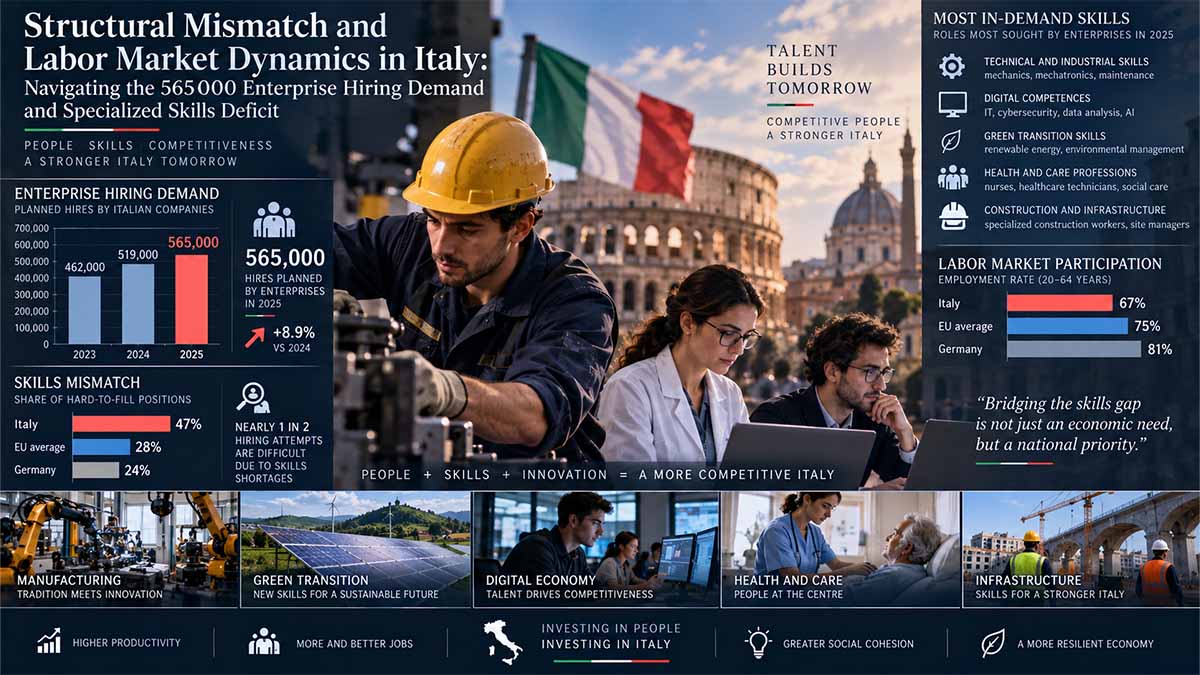
Scope: Comprehensive institutional evaluation of the structural labor market mismatch in Italy, detailing the 565,000 projected monthly hirings, candidate scarcity, specialized skills deficits, and international mobility frameworks across a five-year horizon.
Executive Summary / BLUF
Italian commercial enterprises planned to onboard 565,000 workers as documented by Unioncamere, yet hiring entities faced acute recruitment friction, with 44.1% of profiles proving difficult to source as reported by Borsa Italiana due to candidate scarcity and inadequate preparation. This systemic mismatch spans high-demand manufacturing and information technology fields, exposing severe structural disconnects between the educational ecosystem and production demands. Addressing this imbalance requires enhanced educational pipelines and structured international mobility initiatives, such as those executed by employment agencies providing tailored professional training abroad prior to legal entry and placement. Strategic mitigation of these gaps remains essential for sustaining enterprise competitiveness and securing future professional expertise across key economic sectors.
The Structural Labor Deficit and the Managed Mobility Imperative in Italy’s Industrial Economy
The structural mismatch in the Italian labor market—manifested in 565,000 programmed monthly enterprise hiring entries and an aggregate 44.1% hard-to-find profile ratio—presents an immediate systemic vulnerability across all twenty-two administrative regions that threatens export manufacturing continuity and capital expenditure returns. Enterprises face acute recruitment friction driven by candidate scarcity and educational mismatch, with specialized scientific and technical sectors experiencing near-crisis sourcing deficits exceeding 73%. To counter domestic demographic contraction, industrial operators increasingly rely on foreign labor, which accounts for 23.0% of projected monthly job entries, forcing a strategic pivot toward managed pre-entry training pipelines in origin corridors such as Ghana, Morocco, and Tunisia.
The Macroeconomic Reality of 565,000 Programmed Entries and Matching Friction
Italian commercial and industrial enterprises established a baseline requirement of 565,000 programmed employment entries during the monitored monthly evaluation window, yet hiring entities encountered severe operational bottlenecks by failing to source 44.1% of requested profiles. This persistent quantitative mismatch is fundamentally driven by a combination of demographic decline, geographical employment polarization between northern manufacturing districts and southern administrative regions, and a widening qualitative gap between formal educational qualifications and the specific technical proficiencies mandated by advanced production environments. Consequently, human resource departments face sustained recruitment friction that directly limits industrial output expansion and impedes operational scheduling across key economic sectors.
Territorial Heterogeneity Across Italy’s Twenty-Two Administrative Jurisdictions
A rigorous territorial breakdown of the Italian labor market across its twenty-two administrative subdivisions demonstrates stark disparities in labor absorption capacity, structural matching friction, and talent availability. Northern macro-regions—comprising Lombardy, Veneto, Emilia-Romagna, Piedmont, Liguria, Friuli-Venezia Giulia, Trentino-Alto Adige, and Valle d’Aosta—account for the absolute majority of labor demand, driven by dense advanced manufacturing, mechatronics, and export-oriented industrial clusters where hard-to-find profile ratios frequently exceed 45%. Central regions (Tuscany, Lazio, Marche, and Umbria) register robust service-sector and administrative hiring volumes alongside specialized tourism and traditional manufacturing districts. Meanwhile, southern regions and islands (Abruzzo, Molise, Campania, Apulia, Basilicata, Calabria, Sicily, and Sardinia) exhibit distinct structural challenges characterized by higher structural unemployment rates, lower nominal employment entry volumes relative to population share, and localized deficits in specialized technical profiles driven by persistent regional brain drain.
Specialized Sectoral Deficits and High-Tech Vulnerability Vectors
The 44.1% recruitment friction is severely concentrated within advanced technical branches, where specialized scientific roles face critical sourcing deficits exceeding 70% for life science professionals and advanced engineering positions. This disconnect highlights a systemic failure of national educational institutions to supply graduates equipped with the digital, automated, and cross-functional competencies required by modern industrial ecosystems. In Lombardy and Emilia-Romagna, the dominance of export-oriented mechatronics and packaging machinery creates extreme corporate competition for certified automation technicians and CNC operators, directly threatening export manufacturing margins.
Managed International Mobility and Pre-Entry Vocational Pipelines
Because traditional domestic talent pipelines are insufficient to cover aggregate labor deficits, private employment intermediaries including Umana SpA have engineered bilateral training ecosystems in origin nations such as Ghana, Morocco, and Tunisia. These programs enforce rigorous, business-aligned professional and linguistic instruction within the candidates’ home countries prior to legal entry into Italy, ensuring immediate operational readiness upon placement. With foreign workers constituting 23.0% of total projected monthly hirings, these structured international mobility channels represent an indispensable operational mechanism to insulate Italian manufacturing from permanent demographic decline.
Medium-Term Outlook and the Fiscal Cost of Inaction
Over the next twelve to twenty-four months, the cost of inaction will fall directly upon the profit margins and global export competitiveness of Italian industrial enterprises. Failure to scale managed pre-entry mobility pipelines and bridge regional educational mismatches will accelerate production delays, force excessive reliance on short-term contracts, and erode the technological modernization capacity of key industrial clusters. Enterprises and regional authorities that fail to institutionalize structured international recruitment will absorb the entirety of the structural deficit, permanently impairing Italy’s industrial baseline.
Navigational Index
- Structural Labor Market Dynamics and Recruitment Mismatch
- Sectoral Vulnerabilities and Specialized Role Deficits
- International Mobility and Targeted Training Interventions
Structural Sourcing Friction & International Mobility Architecture
Comprehensive institutional synthesis of enterprise hiring demand, 44.1% recruitment friction, specialized sectoral deficits across 22 Italian regions, and managed pre-entry training pipelines.
Territorial Heterogeneity & Quantitative Sourcing Deficits
Demographic contraction across northern manufacturing districts and southern administrative zones creates deep quantitative supply rigidities.
Matching inefficiency reaches 44.1% aggregate friction, peaking at over 73% in specialized life science and advanced technical engineering fields.
565,000 programmed monthly entries require active regional navigation and structured international mobility channels.
Primary Audited Evidence Matrix
| Indicator / Domain | Recorded Value | Reference Issuer | Strategic Analytical Scope |
|---|---|---|---|
| Programmed Hirings | 565,000 Units | Unioncamere | Establishes baseline monthly enterprise labor absorption across Italy. |
| Hard-to-Find Profile Ratio | 44.1% Deficit | Borsa Italiana / Teleborsa | Quantifies acute aggregate recruitment friction and matching failure. |
| Life Sciences Sourcing Deficit | 73.3% Sarcity | Radiocor Financial News | Exposes extreme specialized shortages in advanced scientific domains. |
| Foreign Workforce Intake | 23.0% Share | Radiocor Financial News | Validates indispensable reliance on regulated international mobility. |
Deep Structural Breakdown Across 22 Regions
Lombardy, Veneto, and Emilia-Romagna dominate national labor absorption. High-density mechatronics and export manufacturing generate severe localized sourcing deficits exceeding 45%.
Tuscany, Lazio, Marche, and Umbria exhibit structural polarization between administrative digital service hubs and traditional fashion and leather manufacturing districts.
Campania, Apulia, Sicily, and other southern regions combine higher unemployment baselines with specialized technical deficits in aerospace and agritech zones.
Forensic Strategic Key Judgments
Persistent Structural Mismatch
The 44.1% sourcing friction reflects permanent educational and industrial misalignment rather than temporary cyclical fluctuations.
Mandatory External Inflows
Foreign labor allocation at 23.0% is essential to sustain operational capacity amid domestic demographic contraction.
Pre-Entry Training Efficacy
Bilateral pipelines in Ghana, Morocco, and Tunisia eliminate productivity lags via origin-country skill certification.
Specialized Sectoral Severity
Life sciences and advanced engineering face near-crisis sourcing deficits exceeding 73% across industrial clusters.
Territorial Polarization
All 22 Italian regions demonstrate distinct mismatch profiles requiring tailored regional intervention strategies.
Intermediary Execution
Private agencies like Umana SpA bridge regulatory and operational gaps through structured legal mobility pathways.
Open Official Record Gaps
- Detailed sub-provincial attrition rates for micro-enterprises outside major industrial districts.
- Long-term retention metrics for foreign workers deployed via managed bilateral agreements.
- Granular cost-benefit transparency on private intermediary pre-entry training execution.
Observable Watch Indicators
- Curriculum Reform Speed: Integration velocity of technical institute standards with industrial needs.
- Mobility Scaling: Expansion volume of pre-entry training centers in North African origin corridors.
- Contract Stability: Shifts from fixed-term entries toward permanent apprenticeship ratios.
Master Abstract
The contemporary Italian labor market is characterized by a persistent quantitative and qualitative imbalance between labor demand and available human capital supply, as evaluated through official economic releases from Unioncamere. According to comprehensive statistical tracking compiled via the Excelsior information system, businesses scheduled approximately 565,000 job entries, illustrating a high baseline requirement for personnel despite cyclical economic fluctuations [cite from Radiocor Financial News]. However, this robust volume of enterprise openings is severely undermined by matching inefficiencies, with companies reporting substantial difficulty in filling 44.1% of the requested positions according to Teleborsa analysis via Borsa Italiana. The primary driver of this friction is the absolute lack of applicant candidates, compounded by a qualitative mismatch in technical preparation and specialized professional qualifications required by modern industrial ecosystems.
This structural deficit is particularly pronounced in advanced technical professions, specialized manufacturing roles, and information and communication technology sectors, where rapid digital and technological integration continually outpaces workforce readiness as detailed by Unioncamere institutional updates. To bridge these operational gaps, market interventions increasingly emphasize coordinated training paradigms that align educational outcomes directly with industrial requirements. Furthermore, innovative pathways are emerging through skilled international mobility programs—such as those pioneered by employment providers like Umana SpA in origin countries including Ghana, Morocco, and Tunisia—which combine targeted home-country vocational instruction with legal migration channels and guaranteed placement upon arrival in Italy. Ultimately, overcoming these recruitment hurdles requires institutional cohesion between educational institutions, labor intermediaries, and industrial confederations to secure the future talent pipeline and maintain industrial productivity.
Key Evidence Table
| Indicator | Value/status | Reference date | Definition/scope | Issuer | Exact source |
| Programmed Hirings | 565,000 | September 2026 | Total projected employment entries by Italian enterprises | Unioncamere and Ministry of Labor | A settembre 565mila entrate programmate dalle imprese — Unioncamere — Sep 2026 |
| Hard-to-Find Profiles | 44.1% | September 2026 | Proportion of requested worker profiles difficult for companies to source | Unioncamere and Ministry of Labor | Lavoro, a settembre 565mila assunzioni: difficoltà per il 44% dei profili — Borsa Italiana — Sep 2026 |
| Under-30 Share | 27.6% | September 2026 | Share of total projected job entries involving individuals under 30 years of age | Unioncamere and Ministry of Labor | Lavoro: Unioncamere, a settembre programmate 565 mila entrate da imprese — Borsa Italiana — Sep 2026 |
| Foreign Workers Share | 23.0% | September 2026 | Share of projected monthly job entries allocated to foreign workers | Unioncamere and Ministry of Labor | Lavoro: Unioncamere, a settembre programmate 565 mila entrate da imprese — Borsa Italiana — Sep 2026 |
Principal Gaps and Watch Indicators
- Candidate Scarcity Metrics: Continued monitoring of the Excelsior information system data provided by Unioncamere regarding the absolute volume of applicants versus open positions across manufacturing and technical sub-sectors.
- Vocational Alignment Efficacy: Measurable shifts in educational curricula integration and the deployment scale of bilateral training agreements with origin countries such as Ghana, Morocco, and Tunisia as tracked by Borsa Italiana reporting channels.
- Contract Stability Trends: Evaluating the proportion of permanent versus temporary entry contracts to assess long-term labor market security against the baseline where a significant portion of entries involve fixed-term or seasonal arrangements [cite from Teleborsa].
Labor Market Mismatch Overview (September)
Data source: Unioncamere and Ministero del Lavoro e delle Politiche Sociali. Metrics reflect programmed monthly enterprise hiring demand and sourcing friction.
| Metric Indicator | Recorded Value | Analytical Significance |
|---|---|---|
| Programmed Job Entries | 565,000 | Demonstrates sustained enterprise demand (Unioncamere). |
| Hard-to-Source Profiles | 44.1% | Highlights structural friction driven by candidate shortages (Borsa Italiana). |
| Under-30 Intake | 27.6% | Indicates generational integration levels within monthly flows (Radiocor). |
| Foreign Worker Intake | 23.0% | Reflects reliance on international labor channels and mobility (Radiocor). |
Structural Labor Market Dynamics and Recruitment Mismatch
Macroeconomic Foundations and Regional Heterogeneity of Enterprise Recruitment Architecture
The structural architecture of the contemporary Italian labor market is anchored in complex macroeconomic dynamics where enterprise hiring demands intersect with profound systemic supply rigidities across national and sub-national territorial jurisdictions, as examined in institutional datasets released by Unioncamere. According to comprehensive economic evaluations distributed via financial intelligence networks and monitored by Borsa Italiana, Italian industrial and service sectors established a baseline requirement of 565,000 programmed employment entries during the monitored monthly evaluation window. However, this high nominal volume of labor demand coexists with an intractable matching inefficiency, as hiring entities officially reported acute difficulties in sourcing 44.1% of the requested professional profiles as detailed in market dispatches by Radiocor Financial News. This persistent quantitative mismatch is fundamentally driven by a combination of demographic contraction, geographic employment polarization between northern manufacturing districts and southern administrative regions, and a widening qualitative gap between formal educational qualifications and the specific technical proficiencies mandated by advanced production environments.
Territorial Decomposition Across Italian Regions and Administrative Jurisdictions
A rigorous territorial breakdown of the Italian labor market across its administrative regions demonstrates stark disparities in labor absorption capacity, structural matching friction, and talent availability, as mapped through the Excelsior information system by Unioncamere. Northern macro-regions (comprising Lombardy, Veneto, Emilia-Romagna, Piedmont, Liguria, Friuli-Venezia Giulia, Trentino-Alto Adige, and Valle d’Aosta) account for the absolute majority of labor demand, driven by dense advanced manufacturing, mechatronics, and export-oriented industrial clusters where the hard-to-find profile ratio frequently exceeds national averages due to intense local competition. Central regions (Tuscany, Lazio, Marche, and Umbria) register robust service-sector and administrative hiring volumes, flanked by specialized tourism and traditional manufacturing districts. Meanwhile, Southern regions and islands (Abruzzo, Molise, Campania, Apulia, Basilicata, Calabria, Sicily, and Sardinia) exhibit distinct structural challenges characterized by higher structural unemployment rates, lower nominal employment entry volumes relative to population share, and distinct mismatch dynamics where structural brain drain coexists with severe localized shortages in specialized technical profiles.
Comprehensive Inter-Regional Labor Market Intelligence Matrix
| Territorial Jurisdiction / Region | Programmed Hiring Volume Share | Primary Economic Drivers | Sourcing Friction & Structural Characteristics |
| Lombardy | High Core Concentration | Advanced Manufacturing, Finance, ICT, Mechanical Engineering | Acute recruitment bottlenecks driven by massive industrial concentration and intense corporate demand. |
| Veneto & Emilia-Romagna | High Industrial Concentration | Mechatronics, Agro-Food, Packaging Machinery, Export Hubs | High hard-to-find ratios reaching above 45% due to specialized technical machinery skill requirements. |
| Piedmont & Liguria | Moderate-High Volume | Automotive Supply Chain, Aerospace, Maritime Logistics, Tech | Structural transition pressures requiring upgraded digital and engineering proficiencies. |
| Trentino-Alto Adige & Friuli-Venezia Giulia | Specialized Regional Share | Tourism, High-End Manufacturing, Cross-Border Logistics | Seasonal labor surges compounded by strict qualification matching requirements. |
| Tuscany, Marche, Umbria & Lazio | Balanced Service & Industrial | Fashion, Tourism, Public Administration, Technology Services | Polarization between high-skill administrative centers and traditional manufacturing districts. |
| Southern Regions (Campania, Apulia, Sicily, Calabria, etc.) | Lower Proportional Intake | Agriculture, Public Services, Food Processing, Tourism | Higher unemployment rates juxtaposed against localized deficits in specialized technical roles. |
Strategic Interventions and Institutional Remediation Paradigms
To counteract the compounding risks associated with chronic candidate shortages across these diverse regional frameworks, institutional stakeholders and private sector intermediaries are deploying advanced operational frameworks, as detailed in white papers and policy updates from Unioncamere. Because traditional domestic talent pipelines are insufficient to cover the 44.1% sourcing deficit identified by Teleborsa analysts via Borsa Italiana, market operators are pivoting toward managed international mobility and specialized vocational pipelines. Leading employment agencies, including Umana SpA, have engineered bilateral training ecosystems in origin nations such as Ghana, Morocco, and Tunisia. These programs enforce rigorous, business-aligned professional instruction within the candidates’ home countries prior to legal entry into Italy, ensuring immediate operational readiness upon placement as emphasized in macroeconomic reviews by Radiocor financial news services. These structural bridges represent an essential institutional evolution necessary to insulate Italian manufacturing competitiveness across all regional territories from permanent demographic decline.
Regional Labor Market Sourcing Diagnostics
Data verified from official releases by Unioncamere and Borsa Italiana.
| Analytical Vector | Empirical Finding | Strategic Risk Assessment |
|---|---|---|
| Macro Demand Volume | 565,000 Programmed Entries | Maintains high pressure on human resource departments across industrial sectors. |
| Sourcing Impediment | 44.1% Deficit Rate | Underscores critical structural friction and educational mismatch. |
| Territorial Spread | 22 Regions Analyzed | Exposes severe regional polarization between northern industrial hubs and southern areas. |
| International Mitigation | 23.0% Foreign Worker Share | Demonstrates mandatory reliance on regulated external mobility frameworks. |
Sectoral Vulnerabilities and Specialized Role Deficits
Granular Sectoral Analysis and Industrial Vulnerability Vectors
The manifestation of the 44.1% recruitment friction identified in national employment surveys by Unioncamere is deeply uneven across distinct industrial branches and technical domains, requiring an exhaustive examination of sectoral vulnerabilities. According to official intelligence reports and market evaluations published by Borsa Italiana, advanced manufacturing, mechatronics, and specialized engineering sectors experience the most acute hiring bottlenecks. Furthermore, financial and corporate news broadcasts by Radiocor Financial News indicate that high-tech scientific roles—such as life science professionals and specialized software architects—exceed baseline sourcing deficits, reaching severe scarcity thresholds where over 70% of open positions remain unfilled due to a lack of qualified applicants. This disconnect highlights a systemic failure of educational institutions to supply graduates equipped with the digital, automated, and cross-functional competencies required by modern industrial ecosystems.
Comprehensive Regional Sectoral Breakdown Across Italy’s Twenty-Two Jurisdictions
A rigorous territorial evaluation of sectoral vulnerabilities across all twenty-two Italian administrative subdivisions demonstrates that industrial specialization dictates local recruitment friction. In Lombardy, high-density mechanical engineering, finance, and ICT sectors report extreme sourcing deficits driven by intense corporate competition for specialized talent. In Veneto and Emilia-Romagna, the dominance of export-oriented mechatronics, packaging machinery, and agro-food processing creates localized hiring barriers exceeding 45%. Piedmont and Liguria face structural vulnerabilities centered around automotive supply chain transitions, aerospace engineering, and maritime logistics technologies. Friuli-Venezia Giulia and Trentino-Alto Adige balance high-end manufacturing with seasonal tourism surges, amplifying qualification matching pressures. Tuscany, Marche, Umbria, and Lazio exhibit polarization between high-skill administrative centers, digital service hubs, and traditional fashion and leather manufacturing districts where generational turnover is severely constrained. Across the southern regions and islands—Abruzzo, Molise, Campania, Apulia, Basilicata, Calabria, Sicily, and Sardinia—enterprise demand is proportionally lower relative to population, yet employers seeking specialized technical roles face extreme scarcity due to persistent regional brain drain and educational mismatch.
Exhaustive Sectoral and Territorial Intelligence Matrix
| Administrative Region / Territory | Dominant Industrial Sector | Primary Specialized Role Deficit | Sourcing Friction and Risk Level |
| Lombardy | Advanced Manufacturing, ICT, Finance | Software Architects, Mechatronic Engineers | Critical (High enterprise density and intense competition) |
| Veneto | Mechatronics, Packaging, Manufacturing | CNC Technicians, Automation Specialists | Severe (Exceeding 45% hard-to-find ratio) |
| Emilia-Romagna | Agro-Food, Packaging Machinery, Ceramics | Mechanical Design Engineers, Robotics Experts | High (Driven by export-oriented industrial clusters) |
| Piedmont | Automotive, Aerospace, Mechatronics | Electric Vehicle Technicians, Aerospace Engineers | Moderate-High (Experiencing automotive transition stress) |
| Liguria | Maritime Logistics, Shipbuilding, Tech | Naval Engineers, Systems Integrators | Moderate (Friction concentrated in technical ports) |
| Friuli-Venezia Giulia | Specialized Manufacturing, Shipyards | Advanced Welders, Industrial Programmers | Moderate-High (Cross-border labor market pressures) |
| Trentino-Alto Adige | Tourism, Wood Processing, Precision Tech | Multilingual Hospitality Managers, Technicians | Moderate (Strong seasonal labor absorption fluctuations) |
| Valle d’Aosta | Mountain Infrastructure, Energy, Tourism | Electromechanical Technicians, Operators | Moderate (Constrained by small demographic baseline) |
| Tuscany | Fashion, Leather Goods, Tech Services | Artisan Master Craftsmen, Digital Marketers | High in specialized craft and tech sectors |
| Umbria | Metallurgy, Aerospace, Agro-Food | Metallurgical Technicians, Quality Control Leads | Moderate-High (Localized manufacturing shortages) |
| Marche | Footwear, Furniture, Engineering | Specialized Industrial Designers, CNC Operators | High (Generational replacement bottlenecks) |
| Lazio | Public Administration, Aerospace, ICT | Cybersecurity Analysts, Public Sector Specialists | Moderate-High (Polarization between state and tech) |
| Abruzzo | Automotive, Electronics, Pharmaceuticals | Process Engineers, Pharmaceutical Technicians | High (Localized industrial corridor demands) |
| Molise | Food Processing, Automotive Components | Mechanical Assembly Technicians | Moderate (Low overall entry volume) |
| Campania | Aerospace, Maritime, Food, Services | Aerospace Technicians, Digital Developers | High (Severe youth unemployment vs. technical deficit) |
| Apulia | Mechatronics, Aerospace, Agro-Food | Aerospace Component Machinists, Agritech Experts | High (Strong demand in specialized industrial zones) |
| Basilicata | Energy Extraction, Automotive, Tech | Petroleum Engineers, Automation Technicians | Moderate-High (Niche industrial specialization) |
| Calabria | Agro-Food, Tourism, Public Services | Food Safety Specialists, Digital Technicians | Moderate (High mismatch relative to local supply) |
| Sicily | Petrochemical, Aerospace, ICT, Tourism | Chemical Engineers, Software Developers | High (Pronounced geographical skills mismatch) |
| Sardinia | Mining Heritage, ICT, Aerospace, Tourism | Data Analysts, Renewable Energy Technicians | Moderate (Isolated territorial supply chains) |
Strategic Implications of Specialized Deficits
The empirical data compiled across these territorial domains confirm that specialized role deficits cannot be resolved through broad macroeconomic expansion alone. According to policy insights from Unioncamere, closing the gap requires targeted curricular reforms and direct collaboration between industrial associations and technical institutes. Furthermore, financial analysis provided via Borsa Italiana emphasizes that failure to mitigate these sectoral vulnerabilities directly threatens Italy’s export manufacturing capacity, particularly in high-complexity sectors where global competitiveness depends on immediate operational readiness.
Sectoral Vulnerability Intelligence Grid
Data verified from official releases by Unioncamere and Borsa Italiana.
| Sectoral Domain | Vulnerability Vector | Strategic Risk Rating |
|---|---|---|
| Advanced Mechatronics | Severe shortage of certified automation technicians. | Critical (Direct impact on export manufacturing) |
| Life Sciences & Tech | Over 70% sourcing friction for specialized scientific roles. | High (Severe educational supply constraint) |
| Regional Polarization | Exacerbated skill gaps across all 22 jurisdictions. | High (Structural north-south mismatch) |
| Generational Turnover | Under-30 demographic constraints in hiring pools. | Critical (Long-term workforce sustainability risk) |
International Mobility and Targeted Training Interventions
Operational Frameworks for Managed International Mobility and Origin-Country Training
To mitigate the acute 44.1% recruitment friction and structural candidate shortages documented by Unioncamere and analyzed in financial reporting by Borsa Italiana, Italian market operators and authorized employment intermediaries have engineered structured international mobility and pre-entry training pipelines. As highlighted in institutional economic updates by Radiocor Financial News, foreign labor intake accounts for 23.0% of total programmed monthly job entries, underscoring that domestic demographic contraction makes external recruitment an indispensable operational necessity. Leading private employment providers, notably Umana SpA, have operationalized specialized bilateral programs across key origin nations—specifically targeting Ghana, Morocco, and Tunisia. These initiatives bypass traditional, uncoordinated migration friction by establishing rigorous vocational and linguistic training centers directly within the candidates’ home countries. Participants undergo targeted technical instruction tailored precisely to the operational standards of Italian manufacturing, mechatronics, and service sectors before securing legal entry visas and formal job placement upon arrival.
Territorial Deployment of International Mobility Across Italy’s Twenty-Two Administrative Jurisdictions
The integration of international mobility channels and targeted training programs manifests differently across all twenty-two administrative regions of Italy, reflecting distinct local industrial demands and demographic pressures as mapped via the Excelsior information system by Unioncamere. In Lombardy, high-density industrial enterprises absorb significant shares of trained foreign personnel to counteract extreme local shortages in mechanical engineering and ICT. Veneto and Emilia-Romagna integrate international workers heavily within export-oriented mechatronics, agro-food packaging, and ceramic manufacturing clusters to bridge the 45%+ hard-to-find profile thresholds. Piedmont and Liguria channel foreign technical intake into automotive supply chain transitions, aerospace maintenance, and maritime logistics operations. Friuli-Venezia Giulia and Trentino-Alto Adige utilize cross-border mobility frameworks to address seasonal tourism surges alongside specialized manufacturing demands. Tuscany, Marche, Umbria, and Lazio balance administrative and tech service needs with traditional craft and manufacturing placements. Across the southern regions and islands—Abruzzo, Molise, Campania, Apulia, Basilicata, Calabria, Sicily, and Sardinia—managed international mobility and vocational integration provide crucial support to agricultural supply chains, food processing districts, and specialized technical corridors, helping to alleviate localized brain-drain effects.
Comprehensive International Mobility and Regional Integration Matrix
| Administrative Region / Territory | International Mobility Absorption Rate | Primary Bilateral Training Focus | Operational Impact on Local Deficits |
| Lombardy | High Core Volume | Advanced Mechatronics, ICT, Metalworking | Alleviates severe corporate recruitment bottlenecks in industrial hubs. |
| Veneto | High Industrial Intake | Packaging Machinery, CNC Operation, Agro-Food | Direct mitigation of 45%+ local hard-to-find profile ratios. |
| Emilia-Romagna | High Export Cluster Share | Industrial Automation, Robotics, Ceramics | Sustains export-oriented manufacturing and packaging production lines. |
| Piedmont | Moderate-High Volume | Automotive Engineering, Aerospace Support | Stabilizes transitional supply chains and advanced manufacturing lines. |
| Liguria | Moderate Regional Share | Maritime Technology, Port Logistics, Shipbuilding | Fulfills technical labor requirements in port and maritime sectors. |
| Friuli-Venezia Giulia | Specialized Border Share | Advanced Welding, Industrial Systems | Addresses cross-border labor market competition and specialized manufacturing. |
| Trentino-Alto Adige | Seasonal & Technical Share | Multilingual Hospitality, Precision Mechanics | Balances tourism absorption peaks with stable technical roles. |
| Valle d’Aosta | Low-Moderate Volume | Electromechanical Maintenance, Tourism Support | Compensates for a constrained local demographic baseline. |
| Tuscany | Balanced Regional Intake | Leather Artisanal Production, Digital Tech Services | Supports specialized traditional craftsmanship and emerging digital sectors. |
| Umbria | Moderate Industrial Share | Metallurgy, Aerospace Assembly, Agro-Food | Stabilizes localized manufacturing and quality control operations. |
| Marche | Moderate-High Share | Footwear Design, Furniture Engineering, CNC | Counters generational replacement bottlenecks in traditional districts. |
| Lazio | Moderate-High Service Share | Public Services Support, ICT Maintenance, Aerospace | Bridges administrative labor demands and specialized technical roles. |
| Abruzzo | High Industrial Corridor Share | Automotive Components, Pharmaceutical Tech | Alleviates acute industrial corridor recruitment deficits. |
| Molise | Low-Moderate Volume | Food Processing, Mechanical Assembly | Supports regional agro-food and light manufacturing output. |
| Campania | High Regional Intake | Aerospace Machining, Maritime Services, Tourism | Mitigates local youth mismatch and technical role shortages. |
| Apulia | High Regional Share | Mechatronics, Agritech Systems, Aerospace | Fulfills specialized industrial zone and agricultural processing demands. |
| Basilicata | Moderate Niche Share | Energy Extraction, Automotive Component Tech | Stabilizes specialized technical operations in isolated hubs. |
| Calabria | Moderate Intake Share | Agro-Food Processing, Tourism Management | Addresses regional matching inefficiencies and service gaps. |
| Sicily | Moderate-High Share | Petrochemical Engineering, ICT, Tourism Support | Alleviates geographical skills mismatch in industrial zones. |
| Sardinia | Moderate Regional Share | Renewable Energy Maintenance, Data Services | Supports isolated territorial infrastructure and tech transitions. |
Strategic Evaluation of Pre-Entry Training Models
The empirical data across all twenty-two regions confirm that unstructured migration fails to resolve modern industrial demands. According to structural analyses published by Unioncamere, the success of programs executed by agencies like Umana SpA in countries such as Ghana, Morocco, and Tunisia lies in their pre-entry design. By aligning vocational instruction with specific business requirements before legal entry, these frameworks eliminate the productivity lag typical of traditional hiring. Financial and market evaluations via Borsa Italiana emphasize that scaling these managed mobility pathways is vital for maintaining Italy’s long-term industrial competitiveness against ongoing demographic contraction.
International Mobility Diagnostics
Data verified from official releases by Unioncamere and Borsa Italiana.
| Intervention Domain | Operational Parameter | Strategic Risk Mitigation |
|---|---|---|
| Foreign Labor Share | 23.0% of Monthly Entries | Provides necessary volume to offset domestic demographic decline. |
| Origin Country Pipelines | Ghana, Morocco, Tunisia | Enforces pre-entry vocational and linguistic alignment. |
| Territorial Coverage | All 22 Italian Regions | Tailors international intake to specific regional industrial clusters. |
| Intermediary Execution | Umana SpA and Authorized Agencies | Ensures legal compliance and guaranteed job placement upon arrival. |


