










Scope: This assessment examines Iran’s September 2026 declaration that it is prepared for prolonged conflict, evaluates what the IRGC’s stated intention to “change the geography of the war” most plausibly means at the strategic and operational levels, tests the credibility of claims concerning undisclosed weapon systems and new target sets, and assesses the implications for Israel, U.S. forces, Gulf states, maritime trade, energy security and European strategic interests over the next five years.
Executive Summary / BLUF
The most defensible assessment is that the IRGC statement represents considerably more than routine deterrence rhetoric, because Iran is signalling a transition from a geographically bounded exchange of strikes toward a distributed regional contest in which military pressure, maritime disruption, economic coercion, partner networks, missiles, unmanned systems and politically sensitive target selection are integrated into a single escalation architecture, although the public record does not establish that Tehran possesses a hidden technological capability capable of transforming the military balance by itself.
IRGC spokesperson Brigadier General Hossein Mohebbi stated that the confrontation had not ended, that the Guard had prepared itself for a prolonged war, and that another attack would bring substantial changes in Iranian defence and counteroffensive operations, including a change in the “geography of the war,” new weapons and new targets; because the publicly retrievable source is Tasnim’s report of Mohebbi’s remarks — Tasnim News Agency — Sep 2026, rather than a separately retrievable IRGC transcript or decree, the precise wording should be treated as an attributed Iranian military statement rather than independently authenticated operational disclosure.
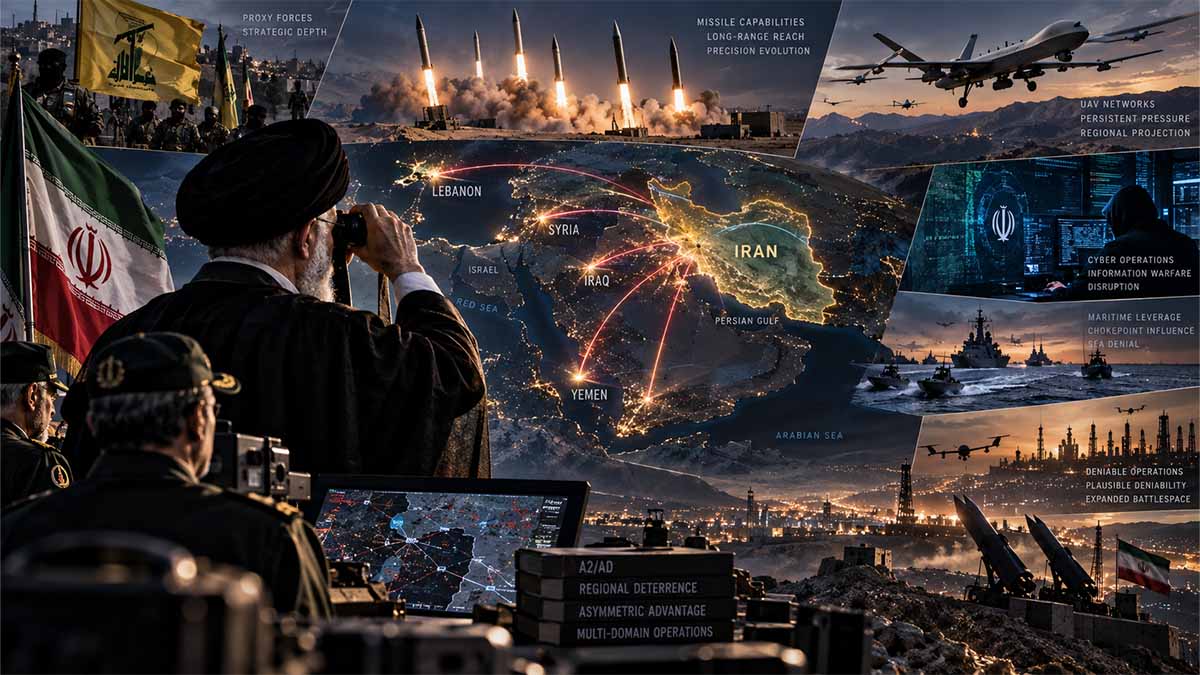
The strategic significance lies primarily in the phrase “change the geography of the war,” which most plausibly indicates a threat to enlarge the set of locations, infrastructures and states exposed to retaliation rather than merely increasing strike density against the same targets, thereby attempting to alter the adversary’s calculation from a bilateral military contest into a regional system-risk problem involving Gulf installations, sea lanes, logistical nodes, energy infrastructure and possibly facilities supporting U.S. or Israeli operations.
This interpretation is supported by observable behaviour rather than rhetoric alone, because U.S. Central Command reported on 5 September 2026 that U.S. forces struck three Iranian crude carriers after what CENTCOM described as Iranian attacks against a U.S. aircraft carrier and guided-missile destroyer, demonstrating that the confrontation has already fused military and economic-maritime domains rather than remaining confined to conventional land targets; the underlying account remains a U.S. belligerent statement and should therefore be read as the American official version of that engagement rather than neutral adjudication of responsibility. CENTCOM Destroys 3 IRGC Oil Tankers After Iran Targets 2 U.S. Navy Warships — U.S. Central Command — Sep 2026
The Strait of Hormuz is the central non-nuclear escalation lever because approximately 19.87 million barrels per day of crude oil, condensates and petroleum products transited Hormuz in 2025, while available bypass capacity is substantially smaller and operationally constrained, meaning that Iran does not need to defeat U.S. naval power conventionally in order to impose strategically significant economic costs; it needs only to keep maritime risk, insurance costs, routing uncertainty and periodic disruption above commercially tolerable thresholds for sufficiently long periods. Strait of Hormuz — International Energy Agency — 2026
The same energy geometry applies to gas markets, because the IEA records that slightly more than 112 billion cubic metres of LNG passed through Hormuz in 2025, representing almost 20% of global LNG trade, with no equivalent maritime bypass for Qatari and Emirati LNG export capacity; therefore, the economic value of Iran’s escalation geography extends far beyond the states physically bordering the Gulf and reaches European and Asian consumers through price, freight, insurance and supply-security channels. Strait of Hormuz — International Energy Agency — 2026
The claim that Iran possesses weapons capable of “surprising the world” is considerably less verifiable than its demonstrated ability to enlarge the battlespace, because the public official record available in this session does not identify the systems, their production status, deployment numbers, testing record, survivability, guidance architecture or combat effectiveness, and the statement must consequently be treated as strategic ambiguity rather than established capability.
The principal intelligence problem is therefore not whether Iran possesses a single revolutionary “wonder weapon,” but whether Tehran can preserve enough distributed missile, drone, maritime, cyber, command-and-control and partner-network capacity after repeated strikes to sustain politically and economically meaningful retaliation over months rather than days.
For Israel and the United States, the central challenge is one of escalation control rather than target destruction alone, because tactical success against Iranian launchers, vessels or command nodes does not automatically neutralise Tehran’s capacity to impose external costs through maritime disruption, dispersed systems, attacks on regional infrastructure or indirect pressure against states facilitating adversary operations.
For Europe, and particularly Italy, France, Germany and the United Kingdom, the immediate strategic exposure is principally indirect but potentially severe, operating through energy prices, maritime insurance, shipping, commercial access to Asian markets, defence commitments, U.S. basing and logistics relationships, and the possibility that European assets or territories become implicated if the definition of the battlespace expands further.
Iran’s Long War Is Becoming a War Against the Region’s Operating System
Iran’s claim in September 2026 that it is prepared for a prolonged war matters less as rhetoric than as a description of the conflict already taking shape: Tehran does not need conventional parity with Israel or the United States if it can force them, together with Saudi Arabia, the Gulf states and Europe, to defend an expanding network of bases, ports, energy installations, shipping lanes and supply chains. The model now extends from the Strait of Hormuz to Yemen and Bab al-Mandab, where Houthi pressure compounds Iranian coercion and weakens the value of Saudi Arabia’s alternative Red Sea export route. The strategic contest is therefore moving away from the question of who can destroy more military assets and toward a harsher calculation: which side can finance, replenish and politically sustain a regional security system whose operating costs rise with every additional month of war.
Military superiority is no longer the same thing as strategic control
The most important change visible by September 2026 is that Iran has widened the burden imposed on its opponents without acquiring anything resembling U.S. or Israeli conventional superiority. United Nations Security Council Resolution 2817, adopted on 11 March 2026 by 13 votes in favour, none against and two abstentions, recorded Iranian missile and UAV attacks against Bahrain, Kuwait, Oman, Qatar, Saudi Arabia, the United Arab Emirates and Jordan, while deploring attacks against airports, energy installations, critical civilian infrastructure and commercial vessels. The geographic expansion is therefore already institutional fact, not a future scenario.
Qatar provides the clearest military example. On 1 March 2026, Doha said its forces had detected 65 ballistic missiles and 12 drones arriving from Iran, intercepting 63 missiles and 11 drones, while two missiles reached Al Udeid and one drone struck an early-warning radar. The importance of Al Udeid lies not in the number of aircraft parked there but in function: the U.S. Combined Air Operations Center coordinates airpower across CENTCOM’s 21-nation area of responsibility. An attack on such a node therefore forces Washington and its partners to defend a regional command network rather than a single battlefield.
That logic spreads rapidly. Bahrain hosts the headquarters of the U.S. Fifth Fleet; Camp Arifjan in Kuwait supports U.S. Army sustainment and pre-positioned stocks; Qatar carries regional air-command functions; and more than 50,000 U.S. military personnel were operating across the Middle East during 2026. Iran cannot eliminate that architecture, but it can raise the cost of keeping every part of it operational. This is the essence of the asymmetry: the attacker chooses where to generate risk, while the defender must decide which of dozens of nodes cannot be allowed to fail.
The numbers show an economic war embedded inside the military one
The Strait of Hormuz remains the most powerful instrument in this strategy because the economic value placed at risk vastly exceeds the military effort required to disrupt normal commercial behaviour. The U.S. Energy Information Administration recorded 20.9 million barrels per day of crude, condensate and petroleum products crossing Hormuz in the first half of 2025, roughly one fifth of global petroleum-liquids consumption, alongside 11.4 billion cubic feet per day of LNG, more than one fifth of global LNG trade.
The relevant 2026 number is not normal capacity but realised throughput. EIA data show oil flows through Hormuz falling from 21.6 million barrels per day in the fourth quarter of 2025 to 14.9 million in the first quarter of 2026 and only 4.9 million in the second quarter. The latter represents a decline of roughly 77% from the pre-crisis quarter. Saudi and Emirati pipelines provided only a partial hedge: approximately 4.7 million barrels per day of combined nominal bypass capacity, with immediately available unused capacity materially lower.
Europe absorbed the consequences without suffering a generalised physical shortage. By July 2026, the European Commission calculated that EU countries had spent approximately €53 billion more on fossil-fuel imports since the Middle East conflict began in February. That figure is strategically more revealing than a temporary spike in spot prices because it measures the fiscal transfer produced by insecurity even when cargoes continue arriving. The Commission also reported that EU refineries supplied approximately 70% of jet-fuel demand domestically, leaving the remaining share exposed to external disruption, while Qatar had supplied about 11 bcm of LNG to the Union in 2025.
The conflict therefore imposes a tax before it produces scarcity. Governments pay through strategic-stock releases, consumers through energy prices, industry through higher inputs, shipping companies through insurance and rerouting, and defence ministries through continuous force protection.
Yemen turns Saudi Arabia’s escape route into a second vulnerability
The most important extension of the conflict now lies west of the Arabian Peninsula. On 15 September 2026, the United Nations reported intensified fighting along Yemen’s western coast as Houthi forces advanced toward Bab al-Mandab and reportedly captured several southern Red Sea islands. The UN did not establish that the movement had taken physical control of the Strait, but physical control is not the threshold that matters: the Houthis had already demonstrated that missiles, UAVs, coastal positions and commercial risk could alter shipping patterns without conventional naval supremacy.
EIA data quantify that leverage. Oil flows through Bab al-Mandab fell from 9.3 million barrels per day in 2023 to 4.1 million in 2024, a decline of approximately 56%, and remained at 4.2 million in the first half of 2025. LNG traffic through the route became almost negligible during 2024 and the first half of 2025, while flows around the Cape of Good Hope increased sharply. The effect was a transfer of distance, fuel consumption, vessel utilisation and inventory costs into global trade.
For Saudi Arabia, this creates a particularly damaging geometry. Riyadh’s East–West pipeline, with nominal capacity of approximately 5 million barrels per day, exists precisely to move crude from the Gulf coast to Yanbu on the Red Sea when Hormuz is constrained. Yet EIA reported in September 2026 that attacks affecting Saudi exports through Bab al-Mandab reduced shipments from Yanbu by roughly half between July and August. The insurance against the eastern chokepoint had become exposed to the western one.
The interaction is what gives the Iran–Houthi relationship its strategic value. Tehran can pressure the Gulf exit while the Houthis pressure the Red Sea route; Saudi Arabia must defend eastern production infrastructure, the trans-Arabian pipeline system, western terminals, southern cities and shipping simultaneously. EIA estimated Middle Eastern production shut-ins averaging 6.7 million barrels per day in August 2026 as constraints at Hormuz and Bab al-Mandab interacted. No formal joint command is required for those effects to reinforce one another.
Tehran and the Houthis work in tandem without needing a single command chain
The dossier supports a close Iranian–Houthi relationship but not the claim that Tehran tactically directs every operation from Yemen. United Nations records have documented Iranian-origin weapons and components associated with Houthi systems, while on 3 July 2026 an Iranian aircraft travelled from Tehran to Sana’a carrying a Houthi delegation before returning; another Iranian aircraft subsequently landed at Hudaydah with a Houthi delegation. The United States told the Security Council that the July flight also delivered IRGC missile and drone specialists, but that remains a U.S. allegation rather than an independently established UN finding.
That distinction matters because the arrangement may be more resilient precisely because it is not a conventional alliance. The Houthis possess their own territorial objectives, command structure and Yemeni political agenda, while Iran benefits from a partner able to impose costs on Saudi Arabia, Israel and Western shipping from a geographically separate theatre. Tehran gains strategic depth without stationing an Iranian expeditionary army on the Red Sea.
The autonomy also creates risk. Renewed Houthi attacks against Saudi Arabia during 2026 threatened or struck locations including Tawal in Jazan, Khamis Mushait, Abha and Taif according to statements presented by Bahrain to the Security Council, while the East–West pipeline was also reported targeted. A Houthi attack producing mass casualties on a commercial vessel or major Saudi infrastructure could trigger a response larger than Tehran wants. The same autonomy that provides plausible separation also reduces Iran’s ability to guarantee escalation discipline.
Israel can win the exchange and still face an endurance problem
Israel’s response shows how quickly prolonged warfare converts tactical success into an industrial question. On 4 June 2026, the Israeli Ministry of Defense approved a major acceleration of Arrow interceptor production to increase both production rate and stockpile. In March, it had already approved a fourth F-35 squadron and a second F-15IA squadron under a decade-long force-building envelope of NIS 350 billion.
Those decisions reflect a conflict in which successful defence consumes expensive inventory. During the first ten days of Operation Roaring Lion in March 2026, approximately 50 cargo aircraft delivered more than 1,000 tonnes of military equipment and munitions to Israel. By September, the Ministry of Defense was also accelerating domestic aerial-munitions production while referring to the possibility of additional theatres. The strategic constraint is therefore simultaneity: Israel must retain enough capacity for Iran while preserving readiness against threats from Yemen and other fronts.
The economic side is already measurable. The Bank of Israel estimated cumulative output lost between the beginning of the broader war and the end of 2025 at approximately NIS 177 billion, equal to 8.6% of annual GDP. Its July 2026 forecast assumed no renewed fighting with Iran and projected a 4.9% fiscal deficit in 2026, with debt at around 69% of GDP; the Bank warned that up to NIS 25 billion of additional defence spending would worsen the deficit, debt and inflation outlook.
Iran therefore does not need to overcome Israeli airpower to alter Israel’s strategic balance sheet. It needs to keep the defence-production, reserve-manpower and fiscal systems operating above peacetime cost for long enough that military dominance acquires a growing economic price.
Washington’s problem is not defeat but strategic dilution
The United States faces an even larger version of the same calculation because the assets required for Middle Eastern endurance are also required elsewhere. Missile defence, destroyers, carrier aviation, aerial refuelling, ISR, precision munitions and logistics aircraft are not Iran-specific capabilities; they sit inside a global force structure designed simultaneously for Europe and the Indo-Pacific.
The conflict therefore creates an opportunity cost every time Washington adds another protected node or maritime commitment. By July 2026, CENTCOM said U.S. forces had facilitated passage through Hormuz for approximately 900 commercial vessels carrying roughly 450 million barrels of crude oil. In one July strike cycle, CENTCOM reported attacks against roughly 140 Iranian targets and more than 300 over three nights, including missile and drone sites, naval capabilities, ammunition storage, communications networks and coastal surveillance positions.
The operational advantage is overwhelming, but it must be continuously exercised. A relatively inexpensive Iranian missile, mine or UAV can require surveillance, interception, escort and retaliatory capacity worth multiples of its own cost. The strategic question for Washington is therefore not whether it can destroy Iranian systems, but whether doing so repeatedly becomes a permanent military tax that draws high-end resources away from other theatres.
Britain’s 20 March 2026 decision to allow the United States to use UK bases for defensive operations against missile capabilities threatening Hormuz shipping illustrates the second dependency: U.S. endurance also requires allied political access. Military superiority becomes more expensive if host governments restrict basing, overflight or offensive use because they fear Iranian retaliation.
Europe can absorb the shock, but every month makes resilience more expensive
Europe enters this confrontation with stronger energy buffers than during the 2022 crisis, yet the 2026 experience shows that resilience does not mean immunity. The European Commission stated on 31 March that EU states were contributing roughly 20% of the more than 400 million barrels released through the IEA emergency-stock mechanism. By July it judged that winter 2026–27 gas supply remained manageable, supported by LNG import capacity and storage, but the €53 billion increase in fossil-fuel import costs showed the economic penalty already paid.
National interests diverge inside that common exposure. Italian Foreign Minister Antonio Tajani argued in May 2026 that Hormuz represented a global shock to energy security and industrial competitiveness, noting that exports account for approximately 40% of Italian GDP; Rome subsequently insisted that any Italian participation in navigation-security initiatives should rest on a clear United Nations mandate. France and the United Kingdom moved further operationally, announcing on 3 July their readiness to support a multinational mission for Hormuz, while Germany said participation required an international mission, a stable ceasefire and a sufficient international-law and constitutional basis.
The resulting European division is not over whether navigation should remain open but over how much military and political risk individual states are prepared to assume to guarantee it. Italy’s priority is commercial continuity under multilateral legitimacy; France possesses a stronger independent expeditionary posture; Germany is constrained by legal conditions and industrial exposure; Britain combines direct U.S. military integration with a substantial maritime burden.
Bab al-Mandab compounds the problem because Suez connects European manufacturing with Asia. When Houthi attacks drove vessels around the Cape of Good Hope after 2023, EIA recorded Bab al-Mandab oil flows falling by more than half while Cape oil flows increased from 6.2 million barrels per day in 2023 to 9.3 million in 2024. For Italy in particular, persistent Suez diversion erodes part of the geographic advantage of Mediterranean ports while raising shipping costs for an export-oriented manufacturing economy.
The next 12–24 months will test whether the coalition can afford the security system it has built
Between late 2026 and 2028, the central question will not be whether Israel, the United States, Saudi Arabia and Europe possess more aggregate military and financial power than Iran and the Houthis; they plainly do. The test is whether that power can be converted into a stable security architecture without requiring permanently accelerated Arrow production, repeated strategic-oil releases, two-chokepoint naval deployments, elevated Gulf air defence, continuing U.S. force concentration and higher European energy and freight expenditure.
Saudi Arabia bears the most immediate regional cost if inaction allows the Houthi front to consolidate around Bab al-Mandab, because its Hormuz bypass strategy becomes progressively less reliable precisely when it is most needed. Israel pays through interceptors, mobilisation, resupply and fiscal pressure. The United States pays through global force dilution. Italy, Germany and the wider EU pay through import costs and industrial competitiveness, while France and the United Kingdom additionally pay through naval readiness.
The governing contradiction is therefore severe: every actor possesses incentives to avoid another full-scale war, yet every actor is simultaneously investing in the infrastructure required to fight one for longer. If no durable political settlement reduces the number of defended fronts, Iran’s prolonged-war strategy does not need to produce victory to succeed in imposing costs; it needs only to ensure that defending the regional operating system remains more expensive in 2028 than it was in 2026.
Navigational Index
Prolonged-war architecture and Iranian strategic adaptation
This pillar assesses what Iranian preparation for extended conflict would require in practice, distinguishing rhetorical resolve from the harder questions of ammunition depth, launcher survivability, command resilience, production capacity, dispersed logistics, maritime endurance and the preservation of retaliatory options after adversary strikes.
Geographic escalation, Hormuz and the regional battlespace
This pillar examines the operational meaning of “changing the geography of the war,” including the possibility of wider target categories, pressure on U.S. regional infrastructure, maritime coercion, energy installations, logistics corridors and indirect theatres where Iran can impose costs without attempting conventional force symmetry.
Strategic consequences for Israel, the United States, the Gulf and Europe
This pillar evaluates how a prolonged confrontation changes deterrence, force protection, economic exposure, energy security, alliance coordination and decision-making for the principal external actors, with dedicated lenses for Italy, France, Germany, the United Kingdom and the European Union.
The Yemen–Iran Axis and the Bab al-Mandab Pressure Front
Master Abstract
The central judgment: Iran is attempting to convert military inferiority into escalation leverage
Iran’s declared readiness for prolonged war is most important when interpreted through the asymmetry between its conventional military position and its capacity to impose geographically dispersed costs, because Tehran does not need to establish air or naval superiority over the United States or Israel in order to complicate their strategic objectives; it instead needs to maintain a sufficiently resilient combination of missile forces, unmanned systems, maritime denial capabilities, dispersed logistics, political influence and economic leverage so that renewed strikes against Iran generate expanding costs elsewhere. Mohebbi’s statement that a renewed attack would change both Iran’s counteroffensive and the “geography of the war,” while introducing new weapons and target categories, is consistent with such an approach, although the publicly available statement remains an Iranian declaration whose undisclosed capabilities cannot presently be independently verified. IRGC spokesperson: if we are attacked, we will change the geography of the war — Tasnim News Agency — Sep 2026
The underlying strategic mechanism is therefore one of horizontal escalation, in which pressure is moved across geography, domains and economic systems rather than simply intensified vertically through larger strikes against the same adversary targets, because every additional Gulf installation, maritime corridor, logistics node or infrastructure category that becomes potentially vulnerable expands the defensive burden of Iran’s opponents and creates political friction among states whose territory or assets support military operations. This mechanism does not require Iran to possess equal military capacity across every theatre, since a dispersed attacker can force a defender to protect far more nodes than the attacker must threaten simultaneously, while ambiguity over target selection increases precautionary military expenditure and commercial risk even before an attack occurs.
“Changing the geography” most plausibly means widening the target system
The strongest reading of Mohebbi’s wording is therefore not that Iran intends territorial conquest or conventional manoeuvre warfare across new countries, for which the public record supplies no comparable evidence, but that Tehran is threatening to redefine which facilities and jurisdictions are considered part of the hostile war-support architecture. In such a framework, installations used for basing, refuelling, surveillance, air defence, logistics, intelligence or maritime interdiction become strategically important even when located outside the territory of the principal attacking state, because Iran can attempt to impose a political price on governments whose infrastructure materially enables military operations against it. The operational effect would be to transform regional geography into a deterrence network in which access agreements, basing arrangements and logistical support acquire direct escalation consequences, although the specific Iranian target list referred to by Mohebbi has not been made public and must not be reconstructed from inference.
This form of deterrence becomes particularly powerful in a region containing dense clusters of energy, shipping, air, desalination and communications infrastructure, because the military value of many installations is inseparable from their civilian and economic significance, thereby raising the political and economic cost of continued escalation even when physical damage remains limited. Such an approach would also place Gulf governments under pressure to demonstrate that their territory is not being used offensively against Iran, creating a wedge between U.S. military access requirements and the risk-management preferences of regional states.
Hormuz turns military persistence into global economic leverage
The Strait of Hormuz is the clearest example of how Tehran can attempt to translate local military resilience into global economic pressure, because the IEA calculates that 14.95 million barrels per day of crude oil and condensates and 4.93 million barrels per day of petroleum products traversed the Strait in 2025, producing a combined flow of 19.87 million barrels per day, while operational bypass capacity is limited and cannot replicate full Gulf export volumes. Strait of Hormuz — International Energy Agency — 2026
The vulnerability is structural rather than episodic, because Saudi Arabia and the United Arab Emirates possess the principal operational crude-export alternatives, while the IEA estimates approximately 3.5–5.5 million barrels per day of potentially available alternative-route capacity, depending upon operational conditions; the agency simultaneously cautions that logistics and supply chains for large-scale rerouting have not been robustly tested, while Iran’s own Goreh–Jask route was not considered a viable alternative export system at the time of the IEA assessment. Strait of Hormuz — International Energy Agency — 2026
The resulting military implication is important because Iran does not need to maintain an impermeable physical blockade in order to obtain strategic leverage, since repeated attacks, mine risk, unmanned threats, tanker seizures, targeting uncertainty or elevated insurance costs can suppress effective commercial throughput without requiring permanent Iranian sea control. That distinction substantially lowers the operational threshold for producing global economic consequences, because commercial shipping responds to expected loss and insurability rather than to military definitions of who “controls” a sea lane.
LNG exposure magnifies the geographic effect beyond the Gulf
The same logic applies more acutely to liquefied natural gas because almost all LNG exports from Qatar and the UAE must pass through Hormuz, while the IEA records slightly more than 112 bcm of LNG transiting the Strait during 2025, equivalent to almost 20% of global LNG trade; approximately 90% of those volumes were destined for Asian markets, although Europe also received supplies through the route and would remain exposed to global price displacement if Asian purchasers competed for replacement cargoes. Strait of Hormuz — International Energy Agency — 2026
This transforms Hormuz into a geopolitical multiplier because disruption simultaneously affects oil, refined products, LNG, tanker availability, freight rates, insurance and expectations of future scarcity, meaning that a relatively limited military exchange can impose macroeconomic effects far exceeding the direct physical value of the targets involved. The implication for Tehran’s prolonged-war strategy is that persistence can matter more than battlefield intensity, because repeated low-frequency disruption sustained over time can generate accumulated costs that a short, spectacular strike campaign cannot.
Evidence of a maritime-military fusion already exists
The American official record indicates that military and economic maritime domains have already become intertwined, because CENTCOM stated on 5 September 2026 that Iranian forces launched multiple attacks against a U.S. aircraft carrier and a guided-missile destroyer, after which U.S. forces struck three Iranian crude-oil carriers that CENTCOM characterised as connected to the IRGC’s financing architecture. CENTCOM Destroys 3 IRGC Oil Tankers After Iran Targets 2 U.S. Navy Warships — U.S. Central Command — Sep 2026
That episode does not independently establish the legal or factual responsibility for every action described by the United States, because CENTCOM is itself a combatant command and its release is therefore evidence of the U.S. official account, yet it does establish that Washington publicly treats Iranian maritime economic assets and attacks against naval forces as part of the same conflict system, thereby reinforcing the assessment that any renewed confrontation would not remain a narrow exchange between land-based military facilities.
The U.S. Treasury has separately published an August 2026 alert specifically addressing sanctions risks associated with Iranian demands for passage through the Strait of Hormuz, demonstrating that coercive maritime practices had acquired sufficient policy significance to generate dedicated financial-compliance guidance, while Treasury’s September actions further altered licences and transactions connected to Iran. Iran Sanctions — Office of Foreign Assets Control, U.S. Department of the Treasury — Sep 2026
“New weapons” should be treated as strategic ambiguity rather than confirmed technological surprise
The most analytically dangerous error would be to accept Mohebbi’s promise of previously unseen weapons as proof that Iran possesses a specific breakthrough system, because the public record reviewed for this assessment provides no verified designation, test history, production volume, deployment status, combat employment record or technical specification corresponding to that claim. Under a strict military-capability taxonomy, a political or military announcement does not establish that a system has completed testing, entered serial production, been distributed to operational units, achieved sufficient reliability under wartime conditions or survived adversary intelligence and strike campaigns.
The statement nevertheless has operational relevance because ambiguity itself imposes defensive costs, particularly when adversaries cannot safely assume that observed Iranian capabilities exhaust the available inventory; new variants of established missile or drone families, improved guidance, penetration aids, countermeasures, launch methods, autonomous functions or unconventional combinations of existing systems can alter defence planning without constituting a fundamentally new weapons class. The principal collection requirement is therefore not speculation about an exotic platform but evidence of changes in launch signature, trajectory, seeker behaviour, electronic protection, basing concept, salvo architecture, command connectivity or terminal manoeuvre, any of which would provide a more meaningful indicator of technological adaptation than Iranian declaratory language alone.
A prolonged war requires industrial and organisational resilience, not merely stored missiles
The decisive test of Mohebbi’s “long war” claim will be whether Iran can regenerate operational capacity while under sustained pressure, because extended conflict converts a missile-and-drone campaign from an inventory problem into a manufacturing, logistics and command-resilience problem. Tehran would need continued access to propulsion inputs, electronics, explosives, guidance components, airframes, machine tools, transport networks and protected production facilities, while simultaneously dispersing launch systems, repairing damaged infrastructure and replacing command personnel or communications lost during strikes.
This means that Iran’s ability to prolong conflict cannot be inferred simply from nominal missile or drone inventories, whose wartime availability is rarely established transparently, because the relevant metric becomes the relationship between expenditure, attrition and replenishment. A force with a smaller surviving inventory but reliable distributed production can sustain politically significant attacks longer than a force with a larger pre-war stockpile but a disabled industrial base, while repeated adversary strikes against production facilities can become less effective if manufacturing has already been distributed into redundant networks.
The United States’ longstanding sanctions architecture explicitly identifies Iranian ballistic-missile and UAV procurement as separate areas of concern, including dedicated Treasury guidance concerning Iranian missile procurement and UAV-related activities, which provides documentary evidence that Washington has treated external component access as a material part of Iran’s weapons ecosystem even before the present escalation. Iran Sanctions — Office of Foreign Assets Control, U.S. Department of the Treasury — 2023–2026
Iran’s objective is therefore more plausibly denial of adversary political success than conventional military victory
The balance of evidence supports the judgment that Tehran’s prolonged-war concept should be understood as a strategy for denying an opponent a cheap and finite military solution, rather than a plan to defeat U.S. forces conventionally or obtain regional command of the air and sea. Such a strategy can succeed in limited political terms even while Iranian forces absorb substantial physical losses, provided that Tehran preserves enough retaliatory capacity to prevent its adversaries from converting military superiority into a stable post-conflict order at acceptable cost.
The strategic centre of gravity consequently shifts from simple platform attrition toward cost exchange and political endurance, because every additional air-defence interceptor, naval escort, hardened facility, dispersed logistics route, tanker premium, rerouted cargo and regional diplomatic concession becomes part of the conflict’s aggregate burden. A prolonged-war posture is therefore potentially rational for a materially weaker state when the stronger opponent’s objectives require not only destroying targets but also restoring predictable regional security, commercial transit and allied confidence.
Israel faces a target-depth problem rather than only an interception problem
For Israel, the principal implication is that the effectiveness of missile and air defence cannot be evaluated solely by interception percentages, because a prolonged conflict tests interceptor inventories, radar resilience, population protection, airport and port continuity, economic activity, reserve mobilisation and the survivability of critical infrastructure across repeated attack cycles. The strategic objective for Iran would not necessarily require penetrating defence at a high rate if repeated salvos create sufficient uncertainty, force expensive interceptor expenditure, disrupt aviation or production, or compel Israel to maintain large portions of its defence architecture at elevated readiness for prolonged periods.
The opposite mechanism also matters, because Israeli and U.S. strikes that reduce Iranian launchers, production facilities, command nodes and air defences can erode Tehran’s capacity for sustained operations even when individual Iranian retaliatory attacks continue, meaning that the ability to conduct episodic strikes does not by itself prove that Iran can sustain the same tempo indefinitely. The decisive indicators are therefore consumption and regeneration rates on both sides rather than isolated strike outcomes.
U.S. exposure expands as Iran targets the regional support architecture
For Washington, “changing the geography” becomes strategically significant because U.S. military power in the region depends upon a networked architecture of bases, ports, airfields, command facilities, prepositioned materiel, aerial refuelling, intelligence assets and host-nation access, rather than a single concentration of forces. An Iranian strategy that threatens this architecture can impose political costs even when attacks fail militarily, because host governments must balance defence relations with Washington against the risk that their territory becomes part of the escalation cycle.
The U.S. naval encounter publicly described by CENTCOM in September illustrates the operational dimension of this problem, because attacks against major U.S. naval platforms can force additional defensive measures and retaliatory actions while simultaneously interacting with commercial maritime traffic in the same geographic space. CENTCOM Destroys 3 IRGC Oil Tankers After Iran Targets 2 U.S. Navy Warships — U.S. Central Command — Sep 2026
The resulting strategic dilemma is that greater concentration of U.S. forces can improve strike and defensive capacity but simultaneously create a more valuable Iranian target set, whereas greater dispersion reduces vulnerability at the cost of logistics complexity and potentially greater reliance on additional regional hosts.
Gulf states become strategic terrain even when they seek political distance from the conflict
The Gulf states occupy an exceptionally difficult position because their infrastructure constitutes both an enabling environment for Western military operations and the economic system most immediately exposed to an expanded Iranian retaliation doctrine. Ports, energy terminals, pipelines, airfields, logistics facilities, communications hubs and desalination systems possess extraordinarily high national importance, while their geographic proximity limits warning time against several classes of threat.
This creates a strong incentive for Gulf governments to separate defensive cooperation from direct participation in offensive operations, because any Iranian decision to define third-country support infrastructure as part of the conflict would increase the domestic cost of allowing foreign forces to conduct operations from their territory. The strategic value of Iran’s threat therefore lies partly in shaping access and coalition behaviour before actual strikes occur.
Europe’s exposure is predominantly systemic, but it is not peripheral
European states are not geographically equivalent to Israel, the Gulf or forward-deployed U.S. forces, yet a prolonged Iran conflict would transmit directly into European security through energy pricing, commercial shipping, insurance, inflation, defence posture and alliance resource allocation. The IEA’s Hormuz data demonstrate why this exposure cannot be reduced to the share of Gulf energy imported directly by Europe, because disruption affects global marginal pricing and redirects Asian demand toward alternative cargoes, thereby transmitting the shock through international oil and LNG markets regardless of contractual origin. Strait of Hormuz — International Energy Agency — 2026
Italy
Italy’s principal exposure would arise through Mediterranean shipping, imported energy prices, refining economics, commercial relations with Asian markets and the broader inflationary effects of sustained Gulf disruption, while Rome would simultaneously face pressure to reconcile alliance solidarity, maritime-security commitments and the protection of national economic interests. Because the Gulf crisis would occur alongside continuing European defence demands elsewhere, the most important constraint would be resource competition rather than a purely Middle Eastern military question.
France
France possesses a more direct regional military and diplomatic posture than most European states, which increases both its capacity to influence maritime security and its exposure to an expansion of the battlespace involving Western regional infrastructure. Paris would therefore confront a dual requirement to protect personnel and regional facilities while maintaining sufficient strategic autonomy to avoid having every U.S.–Iranian escalation automatically determine French military posture.
Germany
Germany’s direct military exposure is comparatively lower, but its industrial and energy sensitivity makes prolonged disruption economically material because German manufacturing remains vulnerable to external energy-price shocks and disruptions affecting global transport, petrochemicals and intermediate goods. Berlin would consequently have strong incentives to support de-escalation and maritime continuity while avoiding policies that create additional economic vulnerability without a corresponding security benefit.
United Kingdom
The United Kingdom combines maritime, intelligence, Gulf-security and U.S.-alliance relationships in a manner that makes the conflict more operationally immediate than for many continental European states, particularly if maritime security around Hormuz deteriorates further. British interests would include protection of shipping, freedom of navigation, commercial insurance stability and force protection, while any widening Iranian target definition would require renewed assessment of how British regional access and support arrangements are perceived by Tehran.
European Union
At EU level, the conflict would test whether energy policy, sanctions, maritime security, diplomacy and defence-industrial planning can be coordinated across member states that face different levels of operational exposure, because countries dependent upon stable trade and energy markets may prioritise risk reduction while governments more closely integrated into military operations may emphasise deterrence and force protection. The strategic challenge is therefore less an absence of European interest than the absence of a single European exposure profile.
Key Evidence Table
| Indicator | Value/status | Reference date | Definition/scope | Issuer | Exact source |
|---|---|---|---|---|---|
| IRGC declared prolonged-war preparation | Mohebbi stated that the IRGC had prepared for a prolonged conflict and was now more prepared than previously | 21 Sep 2026 | Attributed Iranian military statement; operational preparedness not independently verified | Tasnim reporting IRGC spokesperson | IRGC spokesperson: if we are attacked, we will change the geography of the war — Tasnim — Sep 2026 |
| Declared geographic expansion | Iran says a renewed attack would change the geography of its defence and counteroffensive | 21 Sep 2026 | Declaratory signalling; no published target list | IRGC spokesperson via Tasnim | Tasnim report — Sep 2026 |
| Oil and petroleum flows through Hormuz | 19.87 mb/d | Full-year 2025 | Crude, condensates and petroleum products | International Energy Agency | Strait of Hormuz — IEA — 2026 |
| Estimated bypass capacity | Approx. 3.5–5.5 mb/d available | Early 2026 estimate | Saudi and UAE operational alternatives; logistics not fully stress-tested | International Energy Agency | Strait of Hormuz — IEA — 2026 |
| LNG through Hormuz | Just over 112 bcm; almost 20% of global LNG trade | 2025 | Qatar and UAE LNG flows | International Energy Agency | Strait of Hormuz — IEA — 2026 |
| U.S.–Iran naval escalation | CENTCOM reports Iranian attacks on a carrier and destroyer followed by U.S. strikes on three Iranian crude carriers | 5 Sep 2026 | U.S. official combatant account; attribution not independently adjudicated here | U.S. Central Command | CENTCOM Destroys 3 IRGC Oil Tankers After Iran Targets 2 U.S. Navy Warships — CENTCOM — Sep 2026 |
| U.S. financial response to Hormuz coercion | Dedicated sanctions-risk alert concerning Iranian demands for passage through Hormuz | 24 Aug 2026 | Financial/compliance response to maritime coercive practices | U.S. Treasury OFAC | Iran Sanctions — OFAC — Aug–Sep 2026 |
Competing Explanations or Pathways
The ACH gate is met because at least three materially different explanations can account for the timing and content of the IRGC statement, while each generates distinguishable indicators concerning subsequent Iranian behaviour.
| Hypothesis | Diagnostic support | Disconfirming evidence | Indicators | Current standing |
|---|---|---|---|---|
| Iran has genuinely reconfigured its forces for sustained regional war | Explicit long-war language; maritime confrontation already spans military and commercial domains; continued coercive relevance of Hormuz; emphasis on new target geography | No public official evidence yet establishes replenishment rates, launcher survivability or a materially transformed arsenal | Increased dispersed basing, sustained strike tempo, evidence of production continuity, recurrent attacks across several theatres | Strongly consistent with the observable direction of Iranian strategy, although endurance remains unproven |
| The statement is primarily deterrent signalling designed to prevent renewed large-scale strikes | Ambiguous claims concerning undisclosed weapons create uncertainty without revealing capabilities; target ambiguity can influence regional hosts | Actual maritime exchanges and coercive measures indicate that signalling is occurring alongside operational activity | Reduction in operations when adversary pressure falls; no significant expansion of targets despite renewed tension | Plausible and compatible with the first hypothesis rather than fully exclusive at the tactical level |
| Iran intends deliberate horizontal escalation to impose political and economic costs outside the original battlespace | Explicit reference to changing geography; extraordinary leverage of Hormuz; dispersed U.S. and allied support infrastructure across the region | No authenticated Iranian target list publicly establishes which third-country facilities are designated | Attacks or explicit warnings against support infrastructure, regional bases, ports or energy facilities outside previous target sets | Highly consequential pathway whose principal evidence is declaratory and structural rather than yet fully demonstrated |
| “New weapons” represent mainly information operations rather than transformative capability | Absence of publicly verified technical evidence, quantities, fielding history or combat validation | Iranian forces have historically adapted known systems incrementally, meaning undisclosed variants cannot be excluded | Novel trajectories, guidance behaviour, electronic countermeasures, new launch concepts or recovered components | The most cautious assessment is that technological surprise remains unverified, while tactical innovation remains credible |
Principal Gaps and Watch Indicators
The most important unresolved question is Iran’s wartime regeneration rate, because no accessible official record reviewed here establishes the relationship between missile and drone expenditure, surviving inventories and monthly production after sustained attacks, while that relationship would determine whether “prolonged war” represents a demonstrable operational capacity or principally a strategic aspiration.
A second decisive gap concerns the meaning of “new weapons,” for which the present public record provides no sufficiently verified system designation or performance evidence, meaning that confirmed changes in flight profile, guidance, penetration aids, launch architecture or target effects would materially alter the assessment while rhetorical announcements alone would not.
A third gap concerns the precise geographic threshold for escalation, because the Iranian statement does not publicly identify whether “changing the geography” refers principally to U.S. military facilities, supporting infrastructure in partner states, maritime commerce, Israeli-linked assets outside Israel, additional proxy theatres or some combination of these categories.
A fourth gap is the durability of Iranian command-and-control under renewed high-intensity attack, because distributed launch capacity is strategically useful only if target allocation, deconfliction, communications, intelligence and political authorisation can continue after leadership and communications nodes suffer attrition.
A fifth gap concerns adversary endurance rather than Iranian endurance alone, because the long-war balance depends upon air-defence interceptor stocks, munitions expenditure, naval readiness, tanker protection, maintenance cycles and industrial replenishment across the United States, Israel and allied forces, none of which can be inferred reliably from nominal peacetime inventories.
The most important observable indicators would therefore be simultaneous evidence of sustained Iranian strike activity after renewed heavy attacks, continued dispersal and regeneration of launch systems, emerging target categories outside the established battlespace, changes in maritime transit and insurance conditions, new sanctions or financial measures directed specifically at Iran’s wartime logistics, and technical evidence demonstrating that previously unseen weapons differ materially from known Iranian systems rather than representing modified variants.
Strategic Net Assessment
The central strategic proposition emerging from the verified record is that Iran appears to be designing deterrence around geographic and systemic expansion rather than conventional battlefield parity, because the combination of dispersed military capabilities and the extraordinary economic concentration surrounding Hormuz allows Tehran to impose costs on adversaries, partners and global markets even when its conventional forces remain materially weaker than those of the United States and Israel.
The phrase “change the geography of the war” should consequently be taken seriously as a statement of strategic intent, but not interpreted literally beyond what the evidence establishes, because its importance lies in the implied expansion of the target system rather than proof of a predetermined list of states or facilities. The same evidentiary discipline applies to the promised “new weapons,” whose existence and operational value remain publicly unverified even though tactical or technological adaptation is entirely compatible with an extended conflict.
The decisive variable over the next phase will therefore be whether Iran can demonstrate regenerative resilience rather than simply retaliatory persistence, because a state that can continue producing, dispersing and employing militarily meaningful systems after repeated strikes can sustain an asymmetric war substantially longer than one dependent principally upon declining pre-war stockpiles. Conversely, if adversary operations begin to suppress Iranian production, mobility, command connectivity and maritime-denial capacity faster than Tehran can restore them, the political value of prolonged-war signalling will progressively diminish even if episodic attacks remain possible.
The resulting confrontation would be structurally dangerous because military superiority and strategic control are not equivalent: the United States and Israel can destroy Iranian assets while simultaneously facing rising economic, alliance and regional costs, whereas Iran can impose substantial external costs while suffering considerably greater physical losses at home. The strategic contest is therefore increasingly likely to be decided not by a single decisive strike or purported “surprise weapon,” but by which side can maintain political cohesion, industrial replenishment, defensive capacity and acceptable economic cost for longer while preventing horizontal escalation from exceeding its own tolerance threshold.
Iran’s Prolonged-War Posture: Expanding the Battlespace Without Seeking Conventional Attrition
EXECUTIVE BLUF: In September 2026, the Islamic Revolutionary Guard Corps (IRGC) formally signalled a shift from contained, bilateral kinetic exchanges to a distributed, prolonged regional conflict posture. The operational core of Tehran’s doctrine lies in “changing the geography of the war”—expanding the target system to regional logistics, basing rights, and commercial maritime nodes rather than seeking conventional symmetry with Israel or the United States. With 19.87 million bpd of oil and over 112 bcm of LNG transiting the Strait of Hormuz against limited tested bypass pipelines (3.5–5.5 mb/d), Tehran can leverage asymmetric maritime disruption to generate macroeconomic shockwaves across Western and Asian economies. The reported 5 September 2026 CENTCOM strikes destroying three Iranian tankers following attacks on U.S. Navy warships confirm that economic maritime assets and kinetic strike networks are now integrated into a single escalatory theater.
Parametric Risk Exposure & Vulnerability Indices (0–100 Normalized Scale)
Horizontal Battlespace Redefinition: Imposing Systemic Risk on Coalition Networks
Primary Audited Evidence & Empirical Conflict Indicators
AUDITED SOURCES: IEA • US CENTCOM • US TREASURY OFAC • TASNIM (IRAN)| Indicator / Event | Audited Metric / Status | Reference Horizon | Operational Scope & Legal Definition | Primary Source Citation |
|---|---|---|---|---|
| IRGC Prolonged-War Declaration | Operational Warning | 21 Sep 2026 | Mohebbi declared preparation for extended war and intent to “change war geography”. | Tasnim News Agency (Iran) |
| Strait of Hormuz Oil Flows | 19.87 mb/d Total | Full-Year 2025 | 14.95 mb/d crude & condensate plus 4.93 mb/d refined products transiting chokepoint. | International Energy Agency (IEA) |
| Available Bypass Pipeline Capacity | 3.5–5.5 mb/d Available | Early 2026 Estimate | Saudi East-West & UAE Habshan-Fujairah pipelines; logistics not stress-tested at scale. | International Energy Agency (IEA) |
| Hormuz LNG Export Volume | > 112 bcm (20% Global Trade) | Full-Year 2025 | Qatari and UAE LNG export flows; ~90% destined for Asian markets; zero bypass options. | International Energy Agency (IEA) |
| CENTCOM Carrier Strike / Tanker Retaliation | 3 Iranian Tankers Struck | 5 Sep 2026 | U.S. forces struck 3 crude carriers following Iranian attacks on a U.S. carrier & destroyer. | U.S. Central Command (CENTCOM) |
| U.S. Financial Hormuz Coercion Alert | Sanctions Warning Published | 24 Aug 2026 | OFAC issued dedicated alert on illicit Iranian demands for passage fees through Hormuz. | U.S. Treasury (OFAC) |
Analysis of Competing Hypotheses (ACH): Drivers of Iran’s Escalatory Posture
| Hypothesis | Diagnostic Support | Disconfirming Evidence | Observable Verification Indicators | Analytic Standing |
|---|---|---|---|---|
| H1: Genuine Long-War Force Reconfiguration | Explicit doctrine statements; ongoing attacks against U.S. naval units; deep underground missile cities. | Lack of published data on monthly domestic missile/drone replenishment rates under aerial interdiction. | Dispersed launcher deployments sustained across 60+ days of counter-strikes. | HIGH CONSISTENCY |
| H2: Deterrence Signalling (Preemptive Ambiguity) | Threatening unseen weapons creates caution without expending physical ordnance; dissuades regional host basing. | Active kinetic engagements (5 Sep carrier attack) show operational execution beyond pure rhetoric. | De-escalation in maritime harassment when U.S. posture surges. | MODERATE |
| H3: Deliberate Horizontal Escalation Matrix | Direct leverage over Hormuz (19.87 mb/d); geographic exposure of Western-linked Gulf ports and desalination. | Risks precipitating unified direct military response from Gulf Cooperation Council (GCC) states. | Explicit missile/drone strikes targeting third-party logistics or radar installations. | HIGH PLAUSIBILITY |
| H4: “Surprise Weapons” as Info-Ops Myth | Zero unclassified technical verification of new breakthrough systems; historical reliance on iterated platforms. | Iranian defense sector has historically demonstrated rapid incremental guidance/electronic upgrades. | Wreckage recovery demonstrating genuinely novel propulsion or terminal seekers. | MOST PROBABLE |
Strategic Transmission Vectors & Chokepoints
STRUCTURAL ASYMMETRIC DECONSTRUCTIONHormuz Chokepoint Physics
Iran does not require permanent naval sea control to disrupt trade. Mines, fast-attack craft, and drone swarms that elevate Lloyd’s maritime insurance premiums or cause shipping lines to halt transit achieve an economic blockade effect without defeating the U.S. Fifth Fleet.
Inelastic Global LNG Dependence
With 112 bcm of Qatari and Emirati LNG constrained by zero overland bypass options, Hormuz disruption cascades into European and Asian energy grids, sparking cross-regional bidding wars for marginal Atlantic gas cargoes.
Air Defense Exhaustion Calculus
A prolonged conflict shifts the balance from kill ratios to cost curves. Launching Shahed-136 drones and older ballistic missiles exhausts coalition Arrow-3, David’s Sling, and Patriot PAC-3 interceptor stockpiles, which face multi-year replacement timelines.
Industrial Regeneration Capacity
Sustaining a prolonged war requires continuous manufacturing under air attack. Iran’s deeply buried production workshops and decentralized supply networks are structured to survive airstrikes, allowing persistent replenishment of strike assets.
Forensic Strategic Key Judgments
IRGC FORCE POSTURE CONSENSUS • PROTOCOL IRN-2026Tehran’s prolonged-war posture does not seek conventional air or naval victory. It is designed to deny adversaries a low-cost, short-duration campaign by expanding economic and geographic fallout across the region.
The IRGC statement signals an intent to treat regional bases, radar installations, and logistical hubs supporting U.S. or Israeli operations as operational targets, challenging third-party hosting arrangements.
With bypass pipelines covering only 3.5–5.5 mb/d of 19.87 mb/d oil flows, and zero bypass capacity for 112 bcm of LNG, low-intensity maritime harassment remains Tehran’s most potent non-nuclear escalatory option.
CENTCOM’s 5 September strikes destroying three Iranian tankers following attacks on U.S. Navy warships confirm that commercial maritime assets and naval targets are treated as integrated components of the conflict.
Claims of game-changing undisclosed weapons remain unverified. Iranian systems have historically evolved through incremental guidance, seeker, and countermeasure upgrades rather than radical technological leaps.
Italy, France, Germany, and the UK face systemic exposure via maritime insurance, redirected LNG cargo competition, and supply chain pressures, even without direct kinetic strikes on European territory.
Open Official Record Gaps
- Domestic Industrial Replenishment Rate: Lack of verified data on monthly solid-fuel rocket motor and guidance kit production within hardened Iranian facilities under wartime conditions.
- “New Weapons” Technical Identity: Absence of technical designations, propulsion profiles, or test telemetry for the undisclosed systems cited by IRGC leadership.
- Targeting Coordinates & Boundaries: No authenticated Iranian documents identifying the specific third-country facilities designated for potential retaliation.
- C2 Survivability Metrics: Incomplete assessment of alternative fiber-optic, satellite, and courier command-and-control networks connecting IRGC Aerospace Command to mobile launcher units.
Observable Strategic Watch Indicators
Prolonged-war architecture and Iranian strategic adaptation
Principal judgment
Iran’s ability to conduct a prolonged war should not be measured primarily by the number of missiles, drones or launchers that intelligence services estimate were present before hostilities, because the strategically relevant question after repeated Israeli and American attacks is whether the Iranian military-industrial system can absorb destruction, preserve enough firing units to maintain operational pressure, restore damaged production, substitute imported components, regenerate trained personnel, maintain command continuity and disperse logistics faster than its opponents can identify and destroy the regenerated capacity. The available official record does not permit a verified calculation of Iran’s remaining missile inventory or monthly production rate, but it does establish something more consequential for long-war analysis: between 2025 and 2026 the United States repeatedly identified new Iranian procurement networks for missile propellants, UAV engines, servomotors, electronics, sensors, aircraft components and manufacturing inputs, while U.S. Treasury statements explicitly described Tehran as attempting to “reconstitute” missile-production capacity after wartime depletion and attack. [Treasury Disrupts Iran’s Transnational Missile and UAV Procurement Networks — U.S. Department of the Treasury — Nov 2025] Official source [Economic Fury Targets Iranian Missile and UAV Procurement Networks — U.S. Department of the Treasury — Apr 2026] Official source
This distinction fundamentally changes the assessment of Iranian endurance, because a force that loses large portions of its visible launcher fleet but preserves manufacturing, component acquisition, protected storage, transport capacity and dispersed command structures can reconstitute a meaningful retaliatory capability, whereas a force retaining a large nominal stockpile but losing its launch infrastructure, guidance-component supply, communications architecture and production base progressively becomes incapable of converting stored weapons into sustained military effect. Israeli wartime reporting from June 2025 claimed destruction of more than 120 Iranian surface-to-surface missile launchers, described at the time as approximately one-third of the Iranian launcher force, while four days later the IDF chief of staff stated that approximately half of Iran’s missile launchers had been destroyed; these figures are belligerent estimates rather than independently audited inventories, and the changing percentages prevent them from being treated as precise force-accounting data, but they demonstrate the scale at which launcher attrition became a central target of Israeli operations. [The IDF Has Destroyed One-Third of the Iranian Regime’s Missile Launchers — Israel Defense Forces — Jun 2025] Official source [Chief of the General Staff statement — Israel Defense Forces — Jun 2025] Official source
The resulting assessment is therefore neither that Iran possesses inexhaustible military capacity nor that the destruction of visible launchers automatically terminates its strike capability; rather, the official evidence supports a model in which Tehran has been attempting to transform its missile-and-UAV enterprise from a stockpile-centred system into a regenerative wartime ecosystem, whose survivability depends upon distributed manufacturing, covert procurement, replacement of destroyed equipment, concealment, mobility, underground storage, multiple institutional producers and the ability to restore supply chains after interdiction.
Inventory depth cannot be established from public numbers, but launcher attrition reveals the real endurance problem
The public official record contains no authoritative Iranian declaration of total operational ballistic-missile stocks, no verified breakdown by missile family, no current count of mission-capable transporter-erector-launchers, and no independently validated monthly wartime production figure, which means that any apparently precise estimate of “missiles remaining” would exceed what the evidence can support; nevertheless, Israeli operational reporting from the 2025 campaign provides a useful indication of the physical architecture that Iran must preserve during extended conflict, because strikes were repeatedly directed not merely against stored missiles but against mobile launchers, launch crews, storage installations, command centres, component-production sites and facilities producing raw materials used for missile motors. On 16 June 2025 the IDF stated that approximately 50 aircraft had struck about 100 military targets around Isfahan and that more than 120 missile launchers had been destroyed since the operation began; on 20 June it reported strikes against industrial sites involved in missile production, including facilities manufacturing missile components and raw materials used in casting missile engines; on 22 June it reported attacks against the Imam Hussein Strategic Missile Command Center near Yazd, where it said Khorramshahr missiles were stored and from which approximately 60 missiles had previously been launched toward Israel. [The IDF Has Destroyed One-Third of the Iranian Regime’s Missile Launchers — IDF — Jun 2025] Official source [The IDF Completed a Series of Strikes in the Heart of Tehran — IDF — Jun 2025] Official source [The IAF Struck Missile and UAV Sites in Isfahan, Bushehr, Ahvaz and Yazd — IDF — Jun 2025] Official source
The implications are more important than the headline percentages, because every ballistic-missile campaign contains several separate inventories whose depletion curves differ substantially: the missile itself, the mobile or fixed launcher, launch-support vehicles, trained crews, communications equipment, targeting data, protected storage capacity and replacement components all have to remain available simultaneously, meaning that missile stockpile depth alone can substantially overstate combat endurance. Iran therefore gains disproportionate value from keeping launchers mobile and concealed, while its opponents gain disproportionate value from destroying transporter-erector-launchers because one launcher can service multiple missiles over time; conversely, destruction of stored missiles imposes immediate inventory losses but does not necessarily remove the launching architecture through which subsequently produced missiles can be employed.
Attrition evidence relevant to prolonged-war endurance
| Iranian capability element | Publicly reported wartime attrition or pressure | What the record establishes | What remains unknown |
|---|---|---|---|
| Surface-to-surface missile launchers | IDF stated on 16 June 2025 that 120+ launchers, described as roughly one-third of the force, had been destroyed | Launchers were a priority Israeli target and were exposed to persistent detection and strike | Exact initial inventory, surviving operational launchers, repairability and post-war replacement rate |
| Missile storage | Multiple Israeli statements recorded strikes on missile storage sites | Fixed or semi-fixed inventory concentrations were vulnerable once located | Proportion of Iranian missile stocks dispersed into protected or underground storage |
| Missile production | IDF reported strikes on component plants and facilities producing raw materials used in missile motors | Israel deliberately attacked regeneration capacity rather than only deployed weapons | Damage duration, redundancy, relocation and production restart time |
| Strategic command centres | IDF reported attack on the Imam Hussein Strategic Missile Command Center near Yazd | Missile operations included identifiable command-and-storage nodes | Degree to which command functions can be decentralised after node destruction |
| Launch crews | Israeli releases reported attacks on launch teams and personnel preparing missiles | Human operators became part of the attrition campaign | Crew depth, replacement training cycle and degree of automation |
| Air defence | IDF reported destruction of dozens of radars and surface-to-air systems in western Iran | Loss of air defence increased exposure of missile and industrial infrastructure | Reconstitution rate and remaining layered defence coverage |
| Logistics and underground storage | CENTCOM reported strikes during July 2026 against military logistics infrastructure and underground weapons storage | U.S. operations subsequently targeted the sustainment architecture directly | Extent, capacity and distribution of remaining protected storage |
Sources: [IDF launcher assessment — Jun 2025] Official source ; [IDF strike on missile-production sites — Jun 2025] Official source ; [IDF air-defence strikes — Jun 2025] Official source ; [CENTCOM Finishes Latest Wave of Strikes Against Iran — Jul 2026] Official source .
A rough mathematical implication can be extracted from the Israeli claim without treating it as established Iranian inventory data: if 120 launchers represented approximately one-third of the force on 16 June 2025, the corresponding implied pre-attrition denominator would have been around 360 launchers, calculated directly from the Israeli statement rather than independently verified; because Israel was a belligerent and because the definition of “launcher” was not published, this value should be used only as an approximate indication of the scale Israeli intelligence attributed to the force, not as a certified Iranian order of battle. The subsequent statement that approximately half of Iran’s launchers had been destroyed by 20 June demonstrates either rapid continued attrition, a different counting methodology, or both, and the discrepancy is analytically important because it illustrates why wartime percentage claims should not be converted into artificial precision.
Iran’s post-attrition response is increasingly visible in procurement rather than parade inventories
The strongest documentary evidence that Tehran treats regeneration as a strategic priority comes from the sequence of U.S. Treasury enforcement actions against procurement networks after the 2025 war, because these measures identify specific materials and components that Iranian military organisations were attempting to acquire rather than relying upon generic statements about defence production. In November 2025 OFAC sanctioned 32 individuals and entities operating across Iran, the UAE, Türkiye, China, Hong Kong, India, Germany and Ukraine, describing multiple networks supporting ballistic-missile and UAV production; one network had since 2023 coordinated procurement of sodium chlorate, sodium perchlorate and sebacic acid from China for Parchin Chemical Industries, while Treasury identified sodium perchlorate as an input used in producing ammonium perchlorate, a controlled missile-propellant chemical. [Treasury Disrupts Iran’s Transnational Missile and UAV Procurement Networks — Treasury — Nov 2025] Official source
The same Treasury action described an Iranian UAV production-and-repair ecosystem in which Iranian Baspar Puya Company had produced hundreds of components that Treasury assessed were very likely intended for UAVs, while other affiliated entities provided UAV electronics development, manufacturing support, engine procurement and component shipments; separately, Treasury identified procurement channels servicing the state-owned Iran Aircraft Manufacturing Industrial Company, or HESA, including efforts to obtain engines, sensors, magnetometers, attitude indicators and other aerospace equipment. These official U.S. findings should be understood as American sanctions determinations rather than independent industrial audits, but taken collectively they provide unusually granular evidence that Iranian regeneration depends upon both domestic manufacturing and continuing access to foreign-origin specialist inputs.
In February 2026 the Treasury Department sanctioned more than 30 individuals, entities and vessels, stating specifically that several networks were helping the IRGC and the Ministry of Defense and Armed Forces Logistics secure precursor materials and sensitive machinery required to reconstitute ballistic-missile and advanced-conventional-weapons production capacity; in April 2026 the department stated even more explicitly that, as the United States was attempting to deplete Iranian ballistic-missile inventories, Tehran was seeking to restore production capacity and was increasingly relying on Shahed-series one-way attack UAVs. [Treasury Targets Iran’s Shadow Fleet, Networks Supplying Ballistic Missile and ACW Programs — Treasury — Feb 2026] Official source [Economic Fury Targets Iranian Missile and UAV Procurement Networks — Treasury — Apr 2026] Official source
The significance of this record lies in the continuity of network replacement after interdiction, because Treasury reported in February 2025 that an Iranian supplier previously sanctioned in 2024 had employed newly created Hong Kong-based companies to continue purchasing Western-origin UAV-related equipment, including engines, radio-frequency connectors and valve assemblies, demonstrating that designation of one procurement channel did not automatically terminate the underlying acquisition requirement. [Treasury Targets Covert Iranian UAV Procurement Network — Treasury — Feb 2025] Official source
Documented procurement requirements relevant to force regeneration
| Capability | Input or equipment identified in official U.S. records | Iranian beneficiary identified by U.S. authorities | Operational relevance to prolonged war |
|---|---|---|---|
| Solid-fuel ballistic missiles | Sodium chlorate, sodium perchlorate, sebacic acid and related propellant inputs | Parchin Chemical Industries / Defense Industries Organization | Propellant production determines whether missile inventories can be replenished after sustained expenditure |
| Solid-fuel missile manufacturing | Sensitive machinery and precursor materials | IRGC and MODAFL-linked organisations | Enables restoration of damaged production lines and replacement of consumed missiles |
| Missile guidance / military electronics | U.S.-origin dual-use electronics, sensors and guidance-related technology | Shiraz Electronics Industries and MODAFL networks | Guidance components represent a higher-value bottleneck than many structural components |
| Shahed-family UAVs | Servomotors recovered in downed Shahed-136 systems | IRGC Aerospace Force Self Sufficiency Jihad Organization | Demonstrates continuing dependence on externally sourced subcomponents despite domestic assembly |
| UAV engines | Engines and associated equipment | KIPAS-related and other Iranian UAV networks | Engine availability directly limits airframe completion rates |
| UAV control and navigation | RF connectors, sensors, magnetometers, attitude indicators and electronics | HESA, PKGB and related entities | Determines navigation, stability, communication and terminal performance |
| UAV manufacturing | Hundreds of domestically produced components identified by Treasury | Iranian Baspar Puya / KIPAS ecosystem | Demonstrates domestic component production operating alongside foreign procurement |
| Military aircraft / rotary-wing support | Alternator components, engines, sensors and other aerospace equipment | HESA and PANHA | Sustains legacy aviation capacity and maintenance under sanctions |
| Weapons procurement generally | Transport companies, aviation intermediaries, financial conduits and travel coordinators | IRGC procurement networks | Indicates that logistics and payment concealment are integral to industrial regeneration |
Sources: [Treasury, Nov 2025] Official source ; [Treasury, Oct 2025] Official source ; [Treasury, Feb 2026] Official source ; [Treasury, May 2026] Official source .
The analytical consequence is that Iran’s military-industrial model appears neither fully autarkic nor simply import-dependent, because the public record instead shows a hybrid architecture in which substantial assembly, component manufacture, propellant production and systems integration occur domestically while selected engines, electronics, sensors, specialist chemicals, precision components and industrial equipment continue to be sourced through multinational commercial networks; this architecture creates vulnerability to sanctions and interdiction, but it also increases resilience because the failure of one supplier does not necessarily eliminate the domestic production line if substitutes can be obtained through another jurisdiction.
Reconstitution has become a measurable contest between strike destruction and industrial replacement
The sequence of official U.S. sanctions actions permits a more rigorous interpretation of the prolonged-war problem because the recurrence of new designations across successive months indicates that the procurement contest continued after earlier networks were exposed rather than ending with a single interdiction campaign.
| Date | U.S. official action | Scale explicitly reported | Principal regeneration issue |
|---|---|---|---|
| Feb 2025 | Covert UAV procurement network | 6 entities in Hong Kong and China | Replacement front companies after earlier sanctions |
| Apr 2025 | Qods Aviation Industries procurement network | 6 entities and 2 individuals | UAV components serving QAI, HESA and SBIG |
| Oct 2025 | Missile and military-aircraft procurement networks | 21 entities and 17 individuals | Missile components, air-defence electronics and aviation sustainment |
| Nov 2025 | Missile and UAV production networks | 32 individuals and entities | Propellant chemicals, UAV electronics, engines and manufacturing |
| Feb 2026 | Missile and advanced-weapons reconstitution networks | More than 30 individuals, entities and vessels | Sensitive machinery, precursor materials and petroleum financing |
| Apr 2026 | Missile/UAV procurement and transport | 14 individuals, entities and aircraft | Reconstitution of missile production and increased Shahed reliance |
| May 2026 | Weapons and UAV component networks | 10 individuals and companies, plus State Department actions | Shahed servomotors, raw materials and weapons acquisition |
| Jun 2026 | IRGC/MODAFL procurement networks | 9 individuals and entities in Treasury action | Weapons procurement and clandestine financial transactions |
| Jul 2026 | International IRGC procurement network | 7 individuals and entities | Aviation, transport and financial infrastructure supporting weapons acquisition |
Sources: [Treasury Feb 2025] Official source ; [Treasury Apr 2025] Official source ; [Treasury Oct 2025] Official source ; [Treasury Nov 2025] Official source ; [Treasury Feb 2026] Official source ; [Treasury Apr 2026] Official source ; [Treasury May 2026] Official source ; [Treasury Jun 2026] Official source ; [Treasury Jul 2026] Official source .
These figures should not be summed as though every designation represented a unique manufacturing node, because some networks, organisations and supply chains overlap and U.S. sanctions actions can include facilitators rather than direct producers; what the chronology establishes more securely is persistent procurement adaptation across multiple jurisdictions, which is precisely the behaviour expected from a defence-industrial system attempting to maintain production despite repeated external disruption.
Launcher survivability has shifted from mobility alone toward concealment, dispersion and deception
Iran’s traditional reliance upon road-mobile missile launchers creates an inherent survival advantage because mobile launchers can be relocated between detection cycles, separated from storage sites and distributed over a large national territory, but the 2025 Israeli campaign demonstrated that mobility alone is not sufficient when persistent ISR, air superiority and rapid sensor-to-shooter chains permit launch vehicles or crews to be struck shortly before employment. The IDF reported several cases in which launchers were identified while missiles were being prepared or loaded, including an operation in which more than 20 missiles were said to have been destroyed shortly before launch and another in which Israeli aircraft reportedly attacked personnel loading launchers; because these are Israeli combat claims, they establish Israel’s reported targeting methodology rather than independently verified Iranian losses, but they demonstrate the operational environment against which Iranian post-war adaptations must be designed. [IDF launcher strikes — Jun 2025] Official source [IDF strikes missile and UAV sites — Jun 2025] Official source
One particularly important Israeli disclosure concerned a launch mechanism embedded in shipping containers at a site in western Iran, because containerisation, if used more broadly, complicates discrimination between military launch architecture and the vast number of ordinary commercial containers that can exist within transport and industrial environments; the IDF statement confirms only that it reported finding such a mechanism at one targeted location and does not establish how numerous or operationally important containerised systems are within the Iranian force, but it provides documentary evidence that concealment and non-standard launcher presentation formed part of Iran’s missile architecture. [The IDF Completed a Series of Strikes Against the Iranian Regime's Surface-to-Surface Missile Array — IDF — Jun 2025] Official source
The adaptive logic after such losses is therefore straightforward even where specific Iranian implementation remains unverified: launch survivability improves when missiles, launchers, crews, command elements and storage are geographically separated until the final stages of mission preparation; when launch windows are shortened; when movement patterns become less predictable; and when decoys or civilian-like containers complicate identification, while the attacking force responds by expanding persistent surveillance and attacking logistics or storage nodes earlier in the kill chain. The conflict therefore becomes an iterative contest between Iranian signature reduction and adversary detection persistence, rather than a static comparison between launcher counts.
Underground infrastructure matters because Iran is attempting to move the endurance problem below the surveillance layer
The importance of underground facilities is demonstrated indirectly by the target selection of Iran’s opponents, because CENTCOM stated on 17 July 2026 that U.S. strikes had hit underground weapons storage, military logistics infrastructure, surveillance sites and maritime capabilities during the seventh consecutive night of operations, while subsequent strikes targeted command centres, missile and drone launch sites, maritime capabilities and air-defence systems. [CENTCOM Finishes Latest Wave of Strikes Against Iran — Jul 2026] Official source [U.S. Finishes Latest Strikes Against Iran — CENTCOM — Jul 2026] Official source
Protected storage performs several long-war functions simultaneously because it reduces the probability that large inventories are destroyed in a single strike, permits launch systems to remain separated from ammunition until required, protects spare components and maintenance equipment, and allows the defender to preserve a strategic reserve even when above-ground facilities are damaged; however, underground infrastructure does not make a force invulnerable, because entrances, ventilation, electrical supply, communications, access roads and loading points remain observable and potentially targetable, while repeated operations from a protected site can gradually reveal its military function. The strategic value of hardened facilities therefore lies not in absolute immunity but in increasing the number of intelligence cycles, specialised munitions and repeat attacks required to achieve durable effects.
Command resilience is the least visible but potentially most important Iranian adaptation
A prolonged-war architecture fails if tactical units cannot receive mission orders after senior command nodes are destroyed, and the 2025 conflict demonstrated the scale of this vulnerability because Israel publicly stated that its opening campaign targeted senior Iranian command structures and later reported strikes against additional command centres associated with missile operations; although Israeli statements concerning leadership effects remain belligerent claims, the subsequent continuation of Iranian missile and UAV launches demonstrates that the loss of senior personnel did not immediately terminate Iran’s ability to generate strikes. On 13 June 2025 the IDF reported more than 100 Iranian UAVs launched toward Israel after the opening attacks, while on 15 June it recorded approximately 60 surface-to-surface missiles and dozens of UAVs during a subsequent night, demonstrating continued operational output after the initial leadership strikes even though these figures do not establish the efficiency or sustainability of the surviving command system. [IDF press briefing — 13 Jun 2025] Official source [IDF press briefing — 15 Jun 2025] Official source
The relevant inference is not that Iranian command suffered no degradation, which the public evidence cannot establish, but that Tehran retained sufficient delegated authority, communications and technical control to continue launching complex long-range weapons after severe initial disruption. For future prolonged conflict, the critical distinction will therefore be between strategic command centralisation, where political decisions about escalation remain concentrated at senior level, and operational execution decentralisation, where pre-authorised formations retain enough mission data and procedural autonomy to continue operating despite loss of higher headquarters; the public record does not reveal Iran’s exact wartime command protocols, making this one of the most important unresolved collection areas.
The industrial architecture has multiple institutional centres, which complicates complete suppression
U.S. sanctions records identify several separate organisations involved in different parts of Iran’s weapons enterprise, including the Aerospace Industries Organization, Shahid Bakeri Industrial Group, Parchin Chemical Industries, Iran Aircraft Manufacturing Industrial Company, Qods Aviation Industries, Iran Electronics Industries, the IRGC Aerospace Force Self Sufficiency Jihad Organization and other affiliated manufacturers or procurement organisations, indicating that production and sustainment functions are institutionally distributed rather than located in one vertically integrated enterprise. [Treasury Targets Iranian Weapons Procurement Networks Supporting Ballistic Missile and Military Aircraft Programs — Treasury — Oct 2025] Official source [Treasury and Justice Take Action Against Iranian Weapons Procurement Network — Treasury — Apr 2025] Official source
Institutional dispersion does not by itself prove physical dispersion of every production facility, but it materially complicates an adversary’s effort to eliminate the complete production chain because propulsion, guidance, airframe manufacture, electronics, UAV assembly, chemical production and maintenance can be distributed among separate organisations and geographic sites; conversely, the same arrangement creates vulnerabilities where specialised inputs are concentrated in one producer or depend upon external suppliers. The decisive wartime intelligence problem is therefore identification of single-point bottlenecks, because destroying a generic assembly plant that can be replaced elsewhere may deliver less durable effect than disrupting a unique propellant precursor, specialised casting facility, precision-electronics source or engine supply route.
UAVs offer Iran a different endurance curve from ballistic missiles
Iran’s increasing use of one-way attack UAVs is strategically important because the production economics, component requirements, launch infrastructure and defensive cost exchange differ substantially from those associated with larger ballistic missiles, and the Treasury Department explicitly stated in April 2026 that Iran was increasingly relying on Shahed-series UAVs while attempting to rebuild ballistic-missile capacity.
The implication is that Iran can preserve military pressure even when higher-end missile inventories are under stress by changing the composition of its strike packages rather than attempting to maintain an identical ballistic-missile firing rate, because relatively inexpensive UAVs can impose continued air-defence demand, surveillance burden and uncertainty while higher-value missiles are reserved for more important targets. The effectiveness of such substitution is conditional rather than automatic, since slower UAVs are generally more exposed to interception and electronic countermeasures, but prolonged conflict is governed partly by relative replacement cost, and a system that forces an opponent repeatedly to expend expensive interceptors, maintain airborne patrols or activate distributed defences can retain strategic utility even where its physical destruction rate is high.
The Treasury record also shows why UAV scalability is not unlimited, because Iran continued attempting to procure engines, servomotors, electronics and other foreign-origin components well after establishing domestic UAV production, meaning that sanctions enforcement against relatively small specialist components can potentially constrain output even when airframes and structural elements are manufactured locally. [Economic Fury Disrupts Networks Supplying Weapons and UAV Components to Iran — Treasury — May 2026] Official source
Maritime endurance is organisationally different from missile endurance
Iran’s ability to maintain pressure at sea should be analysed separately from its land-based strike force because maritime persistence depends less upon preserving large ballistic-missile inventories and more upon distributed small platforms, coastal missile systems, drones, surveillance, mine-warfare capacity, shore infrastructure and the ability to threaten commercial navigation sufficiently to alter behaviour. Iranian state reporting in 2026 quoted the Khatam al-Anbiya Central Headquarters as stating that Iran intended to maintain a permanent mechanism for monitoring or regulating passage through Hormuz and declaring that if Iranian ports became unsafe, regional ports would also face insecurity; these are Iranian policy and deterrence statements rather than independently verified descriptions of actual control over the waterway, but they demonstrate that maritime coercion has become integrated into Tehran’s conception of sustained conflict rather than being treated as an episodic contingency. [Security in Persian Gulf, Sea of Oman must be for all or none — IRNA — 2026] Iranian state source
Iranian state reporting subsequently stated that the regular Navy used cruise missiles, combat drones and rockets against U.S. destroyers after what Tehran described as attacks against Iranian tankers, while the U.S. account of related maritime confrontations differs on attribution and effects; because both sides are belligerents, neither version should be treated as independently adjudicated, but their convergence on the existence of repeated naval encounters is itself evidence that maritime operations have become a persistent component of the conflict architecture. [Army’s Navy attacks U.S. destroyers — IRNA — 2026] Iranian state source
This gives Iran an additional endurance channel because land-based missile stocks and maritime disruption do not share identical attrition mechanisms, meaning that severe degradation of one domain does not automatically eliminate pressure in the other; a prolonged-war strategy is consequently stronger when retaliation can migrate among ballistic missiles, UAVs, coastal operations and other domains rather than relying upon a single weapon class whose depletion can be measured and targeted.
Logistics is the hidden centre of gravity of a long campaign
The progression of American strike statements during July 2026 is notable because CENTCOM publicly described attacks not simply against launch sites but against military logistics infrastructure and underground weapons storage, indicating that U.S. targeting had moved further into the sustainment system. The logic is operationally compelling because every mobile missile force requires repeated movement of propellant where applicable, missiles, spare parts, maintenance equipment, communications gear and personnel between storage, preparation areas and firing locations, while UAV forces similarly require engines, airframes, electronics, warheads, launch equipment and maintenance support.
Long-war resilience therefore depends upon the density of Iran’s internal transport network, the ability to substitute routes after infrastructure damage, pre-positioned stocks, dispersed maintenance capacity and the extent to which military movements can be concealed within civilian logistics; none of these variables can currently be quantified with sufficient reliability from the official public record, but CENTCOM’s target selection indicates that the United States regards them as operationally consequential.
Iran’s principal weakness is not industrial absence but dependence on a small number of difficult-to-substitute inputs
The procurement record suggests that Iran possesses substantial domestic capability for airframe manufacture, missile assembly, propellant production, electronics integration and UAV construction, yet continues to depend upon external supply for selected high-value components and industrial inputs, creating a pattern in which sanctions do not necessarily halt production but can increase cost, procurement time, substitution difficulty and quality variance. The most important long-war vulnerability is therefore not total import dependence but bottleneck dependence, particularly where an imported sensor, precision machine, specialised chemical or propulsion component cannot be replicated domestically at comparable performance.
This creates a highly asymmetric industrial contest because Iran does not need unrestricted access to the global market; it needs enough successful procurement pathways to keep critical production lines functioning, whereas enforcement authorities must identify and disrupt repeatedly changing intermediaries across numerous commercial jurisdictions. Treasury’s February 2025 description of newly used Hong Kong companies following the designation of earlier procurement fronts provides direct documentary evidence of this adaptation process, while the subsequent succession of sanctions packages through July 2026 demonstrates that the contest continued rather than reaching a definitive conclusion.
Prolonged war therefore depends upon substitution rather than preservation of the pre-war force
The emerging Iranian model is best understood as one of functional preservation through substitution, under which the precise composition of the force can change while the strategic output remains adequate: ballistic missiles can be rationed while UAV employment rises; destroyed launchers can be replaced by dispersed or concealed systems; damaged production can be shifted or rebuilt; severed procurement routes can be replaced by front companies in other jurisdictions; senior commanders can be replaced while lower formations continue operating; and maritime pressure can preserve coercive leverage when land-based strike capacity is temporarily reduced.
This makes the question “how many missiles does Iran have left?” too narrow for decision-grade analysis, because the more important equation is:
Operational endurance = surviving stocks + production regeneration + launcher availability + command continuity + logistics survivability + procurement replacement − combat expenditure − strike attrition − sanctions/interdiction losses.
Every term in that equation is dynamic, and several are only partially visible in the public record, which is why numerical forecasts of the precise duration Iran could sustain a given strike rate would presently manufacture precision rather than measure it.
Endurance matrix
| Dimension | Evidence of resilience | Evidence of vulnerability | Assessment relevant to prolonged war |
|---|---|---|---|
| Missile inventory | Continued launches after opening leadership and infrastructure strikes | Repeated launcher and storage attrition; U.S. statements describing depletion | Significant residual capability is documented, but stock depth cannot be verified publicly |
| Launcher survivability | Road mobility, concealment and at least one reported containerised launch mechanism | Persistent ISR permitted Israeli strikes against launchers and crews shortly before firing | Mobility remains useful but must be combined with signature reduction and dispersion |
| Missile production | Multiple specialised domestic organisations and continuing procurement | Production facilities and missile-motor material sites were struck | Regeneration capability exists, but restart rate is unknown |
| UAV production | Domestic component manufacture and established assembly infrastructure | Continuing foreign dependence for engines, servomotors and electronics | UAVs offer a potentially more sustainable strike stream, but not an unlimited one |
| Command continuity | Strike activity continued after severe leadership attacks | Senior command centres and commanders were targeted repeatedly | Tactical and operational continuity demonstrated; redundancy architecture remains opaque |
| Logistics | Large territory and multiple storage and transport possibilities | CENTCOM later targeted logistics infrastructure and underground storage | Sustainment network is now a direct focus of adversary operations |
| Foreign procurement | Networks repeatedly reconstituted across Asia, Europe and Middle East | Successive sanctions expose intermediaries and increase transaction friction | Adaptive but costly; critical components remain vulnerable to interdiction |
| Maritime capability | Iran continued to employ maritime coercion and naval threats | U.S. operations targeted maritime capabilities and imposed naval pressure | Provides a second endurance channel outside the ballistic-missile campaign |
| Air defence | Residual systems continue to matter for protection of strategic infrastructure | Israel reported destroying dozens of radars and SAM launchers and achieving greater freedom of action | Air-defence attrition directly increases vulnerability of the regeneration system |
| Underground protection | Protected storage complicates destruction | U.S. forces explicitly targeted underground weapons storage in 2026 | Hardened infrastructure increases attack cost but does not provide immunity |
What has materially changed since the first major attrition cycle
The most significant change visible in the official record is that Iranian preparation is no longer adequately described as the accumulation of a large pre-war missile inventory, because the post-2025 record instead reveals an active contest over reconstitution, with Iran attempting to rebuild capacity while the United States and Israel increasingly attack or sanction the industrial, financial and logistical mechanisms that make rebuilding possible. Treasury’s April 2026 formulation is particularly important because the U.S. government explicitly linked the depletion of Iranian ballistic-missile inventories to Tehran’s effort to reconstitute production capacity, which means that both sides are now operating according to a long-war logic in which production and replenishment are themselves part of the battlefield.
A second change is that adversary targeting has moved progressively deeper into the system, from launchers and air-defence radars toward production sites, raw-material facilities, command centres, logistics infrastructure and underground storage, which increases the difficulty of Iranian regeneration but simultaneously incentivises greater physical dispersion and procurement redundancy.
A third change is that Tehran’s strike architecture appears increasingly capable of shifting the burden among weapon families and operational domains, because Treasury explicitly observed greater Shahed-series UAV reliance during the missile-reconstitution period while Iranian and American official accounts record continued maritime confrontation, meaning that the erosion of one capability does not necessarily produce a proportionate reduction in overall coercive pressure.
Key judgments
The evidence supports the assessment that Iran has constructed a more credible basis for prolonged conflict than would be inferred from missile inventories alone, because its endurance architecture includes multiple domestic production organisations, international procurement mechanisms, dispersed launch systems, protected storage, UAV substitution capacity and maritime instruments that can continue imposing costs after substantial attrition in another domain.
The evidence does not establish that Iran can sustain an unchanged high-intensity ballistic-missile firing rate indefinitely, because neither surviving inventories nor current monthly production rates are available from sufficiently authoritative public sources, while repeated U.S. and Israeli actions against launchers, storage facilities, production nodes and procurement channels demonstrate substantial pressure on the system.
The strongest evidence for genuine preparation for extended conflict is therefore the recurring effort to restore production capacity after attack, because procurement networks documented across 2025–26 continued seeking chemicals, engines, servomotors, sensors, electronics, machinery and aerospace components after earlier networks had been sanctioned, indicating an industrial system actively attempting to regenerate rather than merely consume inherited stocks.
Iran’s most important structural advantage is redundancy across weapons and domains, whereas its most important structural vulnerability is dependence upon specialised manufacturing bottlenecks and foreign-origin components that can be difficult to replace quickly under sustained sanctions, interdiction and physical attack.
The central contest in a prolonged war would consequently be a regeneration race in which Iranian production, procurement, repair and dispersal are measured against Israeli and U.S. rates of detection, strike, blockade and sanctions disruption, with the outcome determined less by any single spectacular operation than by which system can repeatedly replace what it loses.
What would change the assessment
Evidence that Iran had restored large numbers of mobile launchers, reopened or relocated damaged missile-production facilities, substantially increased propellant production, or fielded replacement command-and-control architecture after major attacks would materially strengthen the judgment that its prolonged-war preparation has become operational rather than declaratory.
Conversely, verified evidence that specialised propellant, engine, guidance-electronics or precision-machinery shortages had produced sustained production interruptions would materially weaken the assessment, because such shortages would demonstrate that Iranian redundancy cannot compensate for critical bottlenecks.
Repeated Iranian missile salvos of comparable scale after several months of high-intensity warfare would be among the strongest observable indicators of genuine industrial regeneration, whereas declining salvo size combined with greater UAV substitution would suggest conservation of scarcer ballistic inventories rather than equivalent replenishment.
Persistent adversary attacks against newly reconstructed facilities would indicate that Iranian physical dispersion has not defeated opposing ISR, while frequent relocation or reconstruction of production without corresponding suppression would indicate that the attacker is destroying infrastructure faster than it can prevent functional replacement.
Evidence concerning the replacement cycle for senior operational commanders, launch crews and technical specialists would also materially alter the assessment, because hardware production cannot sustain combat power when qualified human operators and command personnel are lost more rapidly than they can be replaced.
Open official record
The public official record still does not establish Iran’s current inventory of operational ballistic missiles by type, its surviving number of transporter-erector-launchers, the monthly production rate of ballistic missiles or Shahed-series UAVs after wartime damage, the quantity and geographic distribution of underground storage capacity, the average repair time for damaged production facilities, the stock of imported critical components already accumulated inside Iran, the percentage of guidance and propulsion components now produced domestically, or the extent to which wartime command authority has been delegated below senior IRGC and Armed Forces headquarters.
Those missing variables are not peripheral data gaps but the exact measurements required to convert the present qualitative assessment of Iranian prolonged-war resilience into a defensible quantitative endurance model; until they are established by competent records or directly observable operational evidence, any calculation asserting that Iran can sustain a particular number of missile launches per day for a specified number of months would exceed what the verified public record can support.
Prolonged-War Architecture & Iranian Strategic Adaptation: Reconstitution Networks, TEL Attrition, and Asymmetric Industrial Substitution
EXECUTIVE BLUF: Tehran’s capacity for sustained regional conflict cannot be measured by nominal pre-war missile inventories, but by its military-industrial regenerative throughput under precision strike interdiction. Following Israeli claims of destroying over 120 Transporter-Erector-Launchers (TELs)—implying roughly one-third of Iran’s baseline mobile launch fleet (~360 units)—and U.S. CENTCOM strikes in July 2026 targeting underground weapons caches and logistical infrastructure, the IRGC has transitioned from a stockpile-depletion model to a distributed, regenerative posture. U.S. Treasury enforcement actions across late 2025 and 2026 document clandestine acquisition pipelines for solid-propellant chemical precursors (sodium perchlorate and ammonium perchlorate for Parchin Chemical Industries), UAV engines, and guidance servomotors across multinational front networks. Concurrently, Tehran is substituting scarce ballistic missile salvos with mass-produced Shahed-series one-way attack drones and containerised launch signatures to sustain operational friction against coalition air defense interceptors.
Military Regeneration Dynamics & Attrition Ratios (0–100 Normalized Scale)
The Launcher Depletion Calculus: Mitigating 120+ TEL Attrition via Concealment
Primary Audited Evidence: Attrition Chronology & Procurement Ledgers
AUDITED SOURCES: U.S. TREASURY OFAC • IDF COMBAT BRIEFINGS • U.S. CENTCOM| Targeted Capability Element | Reported Attrition / Strike Metric | Operational Reference Date | Military Scope & Target Set Definition | Auditing Issuer Source |
|---|---|---|---|---|
| Mobile Missile Launchers (TELs) | > 120 Launchers Destroyed | 16 June 2025 | Characterized as roughly one-third of the operational surface-to-surface mobile force. | Israel Defense Forces (IDF) |
| Cumulative Launcher Depletion | Approximately 50% Force Loss | 20 June 2025 | IDF Chief of General Staff statement reporting accelerated destruction of mobile launcher cadre. | Israel Defense Forces (IDF) |
| Pre-Launch Missile Interdiction | > 20 Missiles Neutralized Pre-Fire | June 2025 Operations | Air strikes targeting launch teams and fuel prep vehicles directly during firing countdowns. | Israel Defense Forces (IDF) |
| Strategic Missile Command Centers | Imam Hussein Base (Yazd) Struck | 22 June 2025 | Storage, command, and launch operations node for Khorramshahr MRBMs (~60 fired). | Israel Defense Forces (IDF) |
| Air Defense Radar Degradation | Dozens of Radars & SAMs Struck | June 2025 Campaign | Western Iran air-defense network neutralized, establishing permissive ingress corridors. | Israel Defense Forces (IDF) |
| Underground Sustainment & Logistics | Subterranean Bunkers Targeted | 17 July 2026 | CENTCOM 7th consecutive night targeting underground weapons caches and logistics networks. | U.S. Central Command (CENTCOM) |
| Designation Horizon | Sanctioned Scope | Interdicted Hardware / Chemical Precursors | Targeted Entities & Reconstitution Node | Statutory / Intelligence Citation |
|---|---|---|---|---|
| February 2025 | 6 Entities | RF connectors, UAV engines, valve assemblies | Hong Kong & China front companies replacing 2024 networks | U.S. Treasury (OFAC) |
| April 2025 | 6 Entities / 2 Indiv. | Dual-use UAV avionics, navigation instruments | Qods Aviation Industries (QAI), HESA, and SBIG channels | U.S. Treasury / DOJ Action |
| October 2025 | 21 Entities / 17 Indiv. | Air defense electronics, missile parts, aviation rotables | MODAFL, Aerospace Industries Organization (AIO), HESA | U.S. Treasury (OFAC) |
| November 2025 | 32 Entities & Indiv. | Sodium chlorate/perchlorate, sebacic acid, UAV engines | Parchin Chemical Industries, Iranian Baspar Puya, KIPAS | U.S. Treasury Action (Nov 2025) |
| February 2026 | > 30 Entities/Vessels | Solid-propellant machinery, precursor raw materials | IRGC & MODAFL reconstitution programs; shadow fleet oil funding | U.S. Treasury Action (Feb 2026) |
| April 2026 | 14 Entities & Aircraft | Shahed one-way attack drone kits, air cargo transport | Shifting to Shahed production amid ballistic inventory depletion | Treasury “Economic Fury” Alert |
| May 2026 | 10 Entities & Indiv. | Servomotors, airframe raw materials, guidance modules | IRGC Aerospace Force Self-Sufficiency Jihad Organization | U.S. Treasury / State Action |
| June–July 2026 | 16 Entities & Agents | Aviation intermediaries, financial conduits, travel agents | Cross-border clandestine payment and transport logistics | U.S. Treasury (Jun • Jul 2026) |
Wartime Adaptation Vectors & Reconstitution Chokepoints
SUSTAINMENT CHOKEPOINT ANALYSISLauncher Attrition vs Reloads
A missile arsenal is capped by its mobile firing units. If Israeli operations took out ~120 to ~180 TELs, surviving missile airframes are bottlenecked at the firing point. Iran’s response relies on containerized decoys and improvised static box launchers to disperse its launch signature.
The Propellant Precursor Funnel
Solid-propellant casting requires imported precursor chemicals, specifically sodium perchlorate and sebacic acid. While airframes are stamped out domestically, interdicting maritime shipments from East Asia directly caps monthly missile motor casting rates at Parchin Chemical Industries.
Shahed Economic Asymmetry
Depleted MRBM inventories are offset by pivoting to one-way attack drones. Shahed-136 airframes, costing roughly $20k–$40k, force coalition defenders to fire $2M–$4M PAC-3 or Arrow interceptors, turning tactical air defense into an asymmetric economic attrition trap.
Subterranean C2 Decentralization
Strikes on the Imam Hussein Command Center near Yazd forced the IRGC into decentralized firing protocols. Pre-delegated strike packages routed through underground missile tunnels enable local battery commanders to maintain salvo cadence even when central command nodes are severed.
Forensic Strategic Key Judgments
REGENERATIVE RECONSTITUTION AUDIT • IRN-LONGWAR-2026Static inventory counts miss the strategic reality of prolonged war. Iran’s endurance hinges on whether its underground industrial base can regenerate motors, guidance units, and launchers faster than coalition strikes destroy them.
Israeli reports of destroying 120+ launchers (~one-third of the baseline force, implying ~360 pre-war TELs) represent a critical operational constraint. While missile airframes survive in silos, launch throughput is constrained by mobile chassis availability.
Repeated Treasury actions across 2025–2026 targeting networks in China, Hong Kong, Turkey, and the UAE confirm that Tehran continuously replaces interdicted chemical, servomotor, and engine pipelines to sustain baseline production.
U.S. Treasury warnings in April 2026 highlight Iran’s reliance on Shahed-family UAVs as missile inventories are conserved. Low unit costs and commercial components allow sustained pressure on allied air defense batteries.
CENTCOM’s July 2026 strikes targeting underground weapons storage and logistics networks show that coalition strategy has moved past deployed launchers to interdicting the sustainment corridors supporting prolonged warfare.
The outcome of an extended campaign depends on the exchange ratio: Iranian procurement endurance and domestic assembly versus coalition interceptor production and precision strike availability.
Open Official Record Gaps
- Monthly Ballistic Output Under Strike: Lack of verified data on solid-fuel rocket motor casting rates at Parchin and Shahid Bakeri following precision strikes.
- Residual Operational TEL Denominator: Unconfirmed figures regarding surviving, battle-ready mobile launchers following Israeli operations in June 2025.
- Subterranean Depot Reserves: The volume of pre-positioned missile airframes stored within hardened mountain tunnels in western and central Iran remains unknown.
- Pre-Delegated Firing Protocols: Incomplete intelligence on the degree of launch autonomy granted to regional IRGC aerospace commanders during communications blackouts.
Observable Strategic Watch Indicators
Geographic escalation, Hormuz and the regional battlespace
Principal judgment
The phrase “change the geography of the war” should no longer be treated only as prospective Iranian signalling, because the verified public record from 2025–2026 shows that the confrontation has already expanded beyond Iranian and Israeli territory into a regional battlespace encompassing Qatar, Bahrain, Kuwait, the United Arab Emirates, Saudi Arabia, Oman, Jordan, the Strait of Hormuz, Gulf shipping lanes, commercial tankers, ports, airports, energy installations, water infrastructure and the distributed command-and-logistics architecture supporting U.S. military operations. United Nations Security Council Resolution 2817, adopted on 11 March 2026 by 13 votes in favour, none against and two abstentions, formally recorded Iranian missile and unmanned-aerial-vehicle attacks against Bahrain, Kuwait, Oman, Qatar, Saudi Arabia, the UAE and Jordan, while explicitly deploring attacks against airports, energy installations, critical civilian infrastructure and commercial vessels near the Strait of Hormuz. UN Security Council Resolution 2817 (2026)
The operational meaning is therefore considerably more concrete than an abstract threat to enlarge the war, because Iran has demonstrated a capacity and willingness to impose military risk on states that are geographically outside the principal Israel–Iran theatre but whose territory, military infrastructure, transport networks, energy systems or political relationships connect them to the wider confrontation. The decisive strategic shift is from a bilateral target model, in which retaliation is directed principally against the state conducting the original attack, toward a network target model, in which command facilities, host-state territory, commercial maritime flows, energy infrastructure and regional logistical nodes can become instruments through which pressure is transferred across the alliance system. This does not mean that every facility hosting American forces has automatically become an Iranian target, and the public record does not establish a comprehensive Iranian target list, but the pattern of attacks recorded by Qatar, the GCC, the United Nations and CENTCOM demonstrates that the battlespace has already acquired the characteristics of a geographically distributed coercive system rather than a confined exchange between sovereign territories.
The strategic importance of this transformation lies in asymmetry, because Iran does not need to achieve conventional military symmetry with the United States or Israel across the entire region; it needs only to impose enough risk upon a sufficiently large number of politically, militarily or economically important nodes that its opponents must allocate air defence, naval escorts, surveillance, hardened infrastructure, redundant logistics and diplomatic capital across a much wider geographic area. Every additional defended airport, tanker corridor, headquarters, desalination complex, radar site or logistics base increases the defensive burden on the opposing coalition even if Iran cannot simultaneously destroy all of them, meaning that the expansion of geography itself becomes a means of redistributing adversary resources.
The geographic expansion is already observable, not hypothetical
The strongest evidence comes from the formal record created after the attacks beginning on 28 February 2026, because the GCC’s extraordinary ministerial meeting of 1 March recorded missile and drone attacks against all six GCC states — the UAE, Bahrain, Saudi Arabia, Oman, Qatar and Kuwait — as well as Jordan, while the Council stated that civilian facilities, service sites and residential areas had been damaged.
That geographic expansion became increasingly systematic rather than episodic during subsequent months, because the GCC reported on 10 June 2026 that Bahrain, Kuwait and Jordan had again been struck by ballistic missiles and drones, while on 23 July the six GCC states and Jordan stated that Iranian and proxy attacks had continued since 28 February and had increasingly targeted energy facilities, desalination plants, ports, airports and other civilian infrastructure.
The geographic pattern therefore supports an assessment in which Iran’s war geometry contains at least four distinct rings of pressure: the primary military confrontation involving Iran, Israel and U.S. forces; the host-state military infrastructure ring containing facilities supporting regional American operations; the Gulf economic-infrastructure ring containing ports, airports, energy and water installations; and the maritime ring centred on Hormuz and the Gulf of Oman, where military operations can impose global consequences through commercial shipping rather than through territorial conquest.
Documented expansion of the battlespace
| Geographic theatre | Verified official evidence | Target category recorded | Strategic function in an expanded war |
|---|---|---|---|
| Qatar | Iranian missile attacks against Al Udeid in June 2025 and renewed missile/drone attacks in 2026 | U.S.-linked military infrastructure and national airspace | Pressure against host-state support for U.S. regional operations |
| UAE | UAE reported more than 1,400 ballistic missiles and drones launched against infrastructure and civilian sites by 8 March 2026 | Infrastructure, civilian sites and strategic national systems | Raises cost of military alignment while threatening a major energy and logistics hub |
| Bahrain | Repeated GCC-documented Iranian missile and drone attacks during 2026 | Civilian and strategic infrastructure | Exposes a state hosting major U.S. naval command infrastructure |
| Kuwait | Repeated missile/drone attacks; Kuwait reported an attack affecting Kuwait International Airport on 3 June | Airport, civilian and vital infrastructure | Threatens a major regional sustainment and pre-positioning node |
| Saudi Arabia | Included in GCC and UNSC documentation of Iranian attacks beginning 28 February 2026 | Civilian and infrastructure targets | Expands threat against the region’s largest oil exporter and alternative Hormuz-bypass system |
| Oman | Included in GCC and UNSC documentation of February 2026 attacks | Territorial and civilian targets | Pressures the state controlling the southern side of Hormuz and a principal diplomatic mediator |
| Jordan | Repeated missile and drone attacks documented by GCC and UNSC | State territory and infrastructure | Extends the conflict beyond the Gulf littoral and toward the Levantine logistical space |
| Strait of Hormuz | Commercial-vessel attacks, maritime interdiction and U.S. counter-operations | Tankers, navigation, coastal surveillance, mining capability | Converts regional military conflict into global energy and trade disruption |
| Gulf of Oman | U.S. strikes on Iranian crude carriers documented in September 2026 | Iranian maritime economic assets | Connects military retaliation with economic attrition beyond the Strait itself |
Sources: Qatar Ministry of Foreign Affairs, GCC Secretariat, United Nations Security Council, UAE Ministry of Foreign Affairs and CENTCOM.
The table demonstrates that the relevant geography is no longer simply Iran–Israel–Persian Gulf, because the conflict system now extends through the Arabian Peninsula toward Jordan and across the maritime corridor connecting the Persian Gulf to the Arabian Sea, while attacks against airports, energy installations, desalination facilities and commercial ships indicate that military effect is increasingly being pursued through system disruption rather than exclusively through force-on-force engagement.
Al Udeid established the precedent for treating host-state military infrastructure as part of the war
The June 2025 Iranian strike against Al Udeid Air Base in Qatar remains one of the most important precedents for interpreting current Iranian language about changing the geography of the conflict, because the attack demonstrated that a military facility located on the sovereign territory of a Gulf state could become a retaliatory target when Iran associated that facility with U.S. military operations.
Qatar’s Foreign Ministry stated on 23 June 2025 that the IRGC targeted Al Udeid with missiles, that Qatari air defences intercepted the attack, that the base had been evacuated in advance as a precaution and that no casualties resulted; Qatar nevertheless characterised the strike as a violation of its sovereignty and airspace rather than accepting an Iranian distinction between the American military presence and Qatari territory. Qatar Foreign Ministry statement on the Al Udeid attack
The military significance of Al Udeid is unusually high because the U.S. Air Force identifies the base as the location of the Combined Air Operations Center, which provides command and control of airpower throughout the CENTCOM area of responsibility and functions as the operational bridge between strategic decisions and tactical execution across a 21-nation region. Combined Air Operations Center fact sheet — U.S. Air Forces Central
The February–March 2026 escalation demonstrates that the precedent did not remain isolated, because Qatar’s government reported on 1 March 2026 that its forces detected 65 ballistic missiles and 12 drones arriving from Iran in successive waves, intercepting 63 missiles and 11 drones, while two missiles reached Al Udeid and one drone struck an early-warning radar, without casualties. These figures are Qatari official operational data rather than independently reconstructed intercept counts, but they are especially significant because they show the scale at which the host-state infrastructure problem had evolved: the strategic node was no longer exposed to a symbolic retaliatory salvo alone but to repeated multi-vector attacks requiring national integrated air defence.
Al Udeid as a model of geographic escalation
| Variable | Officially documented status | Strategic implication |
|---|---|---|
| Host state | Qatar | Attack on U.S.-linked military infrastructure automatically implicates Qatari sovereignty |
| Operational role | CAOC commands and coordinates air operations across CENTCOM’s 21-nation AOR | Military value extends far beyond aircraft physically stationed at the base |
| June 2025 attack | Iranian missile strike intercepted by Qatar | Demonstrated willingness to strike a U.S.-associated installation on Gulf territory |
| March 2026 attack | Qatar detected 65 ballistic missiles and 12 drones; two missiles and one drone reached designated targets | Demonstrated substantially greater attack scale and persistence |
| Political response | Qatar condemned the strike while continuing to support diplomacy | Shows Iran risks alienating states that otherwise favour de-escalation |
| Wider effect | Gulf states subsequently intensified collective defence coordination | Horizontal escalation can strengthen, rather than fracture, regional defence cooperation |
The final point is strategically important because the purpose of geographic expansion is not automatically achieved merely by creating risk: attacks intended to discourage host-state cooperation can instead generate the opposite political effect by strengthening collective defence relationships. Qatar stated after the June 2025 strike that its partnership with the United States would not be reduced by the attack and that the bilateral relationship could instead grow stronger, while the GCC convened an extraordinary ministerial meeting and reaffirmed solidarity with Doha.
This constitutes an important countervailing force within Iran’s strategy: expanding the battlespace increases Iranian coercive leverage only if the political fear generated in host states exceeds the political backlash caused by violating their sovereignty.
The U.S. regional network gives Iran multiple pressure points, but also raises the cost of attacking them
The strategic value of geographic escalation derives partly from the distributed nature of the American military architecture, because CENTCOM reported in July and August 2026 that more than 50,000 U.S. military personnel were operating across the Middle East, while the commander’s August trip included Bahrain, Iraq, Israel, Jordan, Saudi Arabia and the UAE as well as a U.S. aircraft carrier operating in the Arabian Sea.
The public U.S. record identifies several high-level functional nodes whose importance is different rather than interchangeable: Al Udeid in Qatar hosts regional air-command functions; Bahrain hosts the headquarters of the U.S. Fifth Fleet according to the FY2026 Department of the Navy budget documentation; and Camp Arifjan in Kuwait hosts forward U.S. Army sustainment functions and receives, maintains and issues Army Prepositioned Stocks supporting CENTCOM requirements.
This creates a networked vulnerability problem rather than a single-base problem, because the destruction or disruption of one site would not automatically disable American regional operations, but pressure against several functionally different nodes can impose cumulative costs through dispersion, relocation, force protection, communications redundancy and host-nation political constraints.
Publicly documented U.S. regional nodes relevant to geographic escalation
| Location | Publicly documented function | Why it matters strategically | Principal escalation consequence |
|---|---|---|---|
| Al Udeid, Qatar | Combined Air Operations Center; regional air command-and-control | Synchronises air, ISR, mobility and strike activity across CENTCOM | Attacking it links Iran directly to Qatari sovereignty and coalition command |
| Bahrain | Headquarters, U.S. Fifth Fleet | Central naval-command node for regional maritime operations | Creates direct overlap between Iranian maritime strategy and host-state territorial security |
| Camp Arifjan, Kuwait | Forward Army sustainment, prepositioned stocks and logistics support | Supports movement, maintenance and supply across the theatre | Makes logistics infrastructure strategically relevant even when distant from immediate combat |
| Arabian Sea carrier presence | Mobile U.S. naval strike and air-defence platform | Allows operations without total dependence on land basing | Shifts some Iranian targeting pressure from sovereign territory to maritime forces |
| Distributed regional force network | More than 50,000 U.S. personnel across the Middle East in mid-2026 | Creates redundancy and large operational depth | Also creates a wide force-protection burden and multiple possible Iranian pressure points |
Sources: U.S. Air Forces Central, Department of the Navy, U.S. Army and CENTCOM.
The strategic implication is that Iran cannot eliminate U.S. regional capability merely by striking one headquarters, because distributed naval, air, logistics and command assets allow functions to be redistributed, but the United States must consequently defend multiple categories of infrastructure simultaneously; the Iranian problem is therefore one of insufficient destructive capacity relative to the network, while the American problem is one of defence dilution across the network.
The 2026 Gulf attacks demonstrate that the target system extends beyond military bases
The most consequential evolution between the 2025 Al Udeid precedent and the 2026 conflict is the expansion from military facilities toward broader national infrastructure, because UN Security Council Resolution 2817 formally deplored Iranian targeting of civilians and civilian objects including airports, energy installations, objects necessary for food production and distribution, and critical civilian infrastructure, while also addressing attacks and threats against commercial vessels around Hormuz.
The GCC subsequently provided a still wider infrastructure taxonomy, telling the Security Council in April that attacks had affected civilian airports, oil installations, desalination plants, ports, fuel-storage tanks, public-service facilities, residential areas and diplomatic missions, while the GCC’s July joint statement additionally reported attacks against energy installations, desalination plants, ports and airports.
This matters because it indicates a strategic approach capable of imposing pressure against the economic metabolism of Gulf states, rather than only against military force structure. Ports determine trade throughput, desalination plants underpin municipal water security, airports support both civilian mobility and regional logistics, fuel-storage facilities preserve operational and commercial continuity, while energy installations connect local attacks to international price transmission.
Infrastructure categories exposed by the 2026 conflict
| Infrastructure class | Officially recorded as attacked or threatened | Immediate operational effect | Potential second-order effect |
|---|---|---|---|
| Airports | Yes | Disruption of aviation and logistics | Passenger diversion, cargo delays, insurance and economic effects |
| Ports | Yes | Disruption of maritime throughput | Supply-chain delay and reduced commercial confidence |
| Oil and energy installations | Yes | Production, storage or export interruption | Global oil-price transmission |
| Fuel storage | Yes | Reduces buffer stocks and distribution flexibility | Wider transport and power-sector disruption |
| Desalination plants | Yes | Threatens municipal water supply | Rapid civilian and political pressure disproportionate to military damage |
| Food-production/distribution infrastructure | Yes, recorded by UNSC | Threatens essential services | Humanitarian and social consequences |
| Diplomatic missions | GCC-reported impacts | Political signalling and sovereignty implications | Diplomatic escalation |
| Residential and commercial areas | GCC- and UN-recorded | Civilian casualties and disruption | Domestic pressure for retaliation or de-escalation |
| Military headquarters and bases | Yes | Operational disruption | Pressure on host-state relationships with U.S. forces |
| Commercial vessels | Yes | Maritime safety and transit disruption | Global freight, insurance and energy-market effects |
This target diversity is central to understanding Mohebbi’s language, because “geography” in modern regional warfare is not only physical territory; it is the distribution of systems whose disruption transfers costs between governments, militaries and economies.
The Strait of Hormuz is the central mechanism through which geography becomes global leverage
Hormuz remains the most powerful geographic multiplier available to Iran because the waterway converts local military actions into global economic consequences without requiring Iran to achieve conventional naval dominance. U.S. Energy Information Administration data show that 20.9 million barrels per day of crude oil, condensate and petroleum products crossed Hormuz in the first half of 2025, equivalent to roughly 20% of global petroleum liquids consumption and approximately one quarter of total global maritime oil trade. World Oil Transit Chokepoints — U.S. Energy Information Administration
The structural exposure is even clearer when the flow is decomposed, because EIA recorded approximately 14.7 million barrels per day of crude oil and condensate and 6.1 million barrels per day of petroleum products transiting Hormuz in the first half of 2025, while 11.4 billion cubic feet per day of LNG, representing more than one fifth of global LNG trade, passed through the same maritime corridor.
Hormuz energy-flow baseline before the 2026 disruption
| Commodity | 2020 | 2022 | 2024 | 1H 2025 | Strategic significance |
|---|---|---|---|---|---|
| Total oil flows | 19.2 mb/d | 21.9 mb/d | 20.7 mb/d | 20.9 mb/d | Roughly one fifth of global petroleum consumption |
| Crude and condensate | 14.4 mb/d | 16.2 mb/d | 14.6 mb/d | 14.7 mb/d | Core Gulf crude-export route |
| Petroleum products | 4.8 mb/d | 5.6 mb/d | 6.1 mb/d | 6.1 mb/d | Increasing refined-product dependence |
| LNG | 10.7 Bcf/d | 11.0 Bcf/d | 10.5 Bcf/d | 11.4 Bcf/d | More than 20% of global LNG trade in 1H25 |
Source: U.S. Energy Information Administration tanker-tracking analysis.
The destination structure makes the chokepoint primarily Asian in direct physical terms but global in price terms, because EIA estimated that 89% of crude and condensate transiting Hormuz in the first half of 2025 went to Asian markets, while China, India, Japan and South Korea together received 74% of all Hormuz crude-and-condensate flows.
This concentration means that Europe can be affected strongly even when a large majority of physical cargoes are destined for Asia, because disruption forces Asian buyers into competition for Atlantic Basin barrels and LNG cargoes, increasing global marginal prices and redirecting shipping patterns.
The 2026 disruption demonstrated the difference between nominal capacity and actual throughput
The most important new evidence comes from EIA’s August 2026 energy-security dataset, which records a dramatic decline in Hormuz oil throughput from 21.6 million barrels per day in the fourth quarter of 2025 to 14.9 million in the first quarter of 2026 and only 4.9 million in the second quarter, while world oil supply also declined from 103.9 million barrels per day in 4Q25 to 96.1 million in 1Q26 before recovering to 99.7 million in 2Q26.
Recorded evolution of Hormuz oil flows
| Period | Oil through Hormuz | Change from 4Q25 | Share of 4Q25 throughput still moving |
|---|---|---|---|
| 1Q25 | 20.9 mb/d | — | — |
| 2Q25 | 21.0 mb/d | — | — |
| 3Q25 | 21.3 mb/d | — | — |
| 4Q25 | 21.6 mb/d | Baseline | 100% |
| 1Q26 | 14.9 mb/d | −6.7 mb/d | ~69% |
| 2Q26 | 4.9 mb/d | −16.7 mb/d | ~23% |
Calculated from EIA data.
The second-quarter decline therefore represented a reduction of roughly 77% relative to 4Q25 throughput, calculated directly from EIA’s published series rather than from an Iranian or U.S. military estimate, and it constitutes some of the strongest quantitative evidence that maritime coercion can transform a regional conflict into a global supply shock without requiring an absolute and permanent closure of the waterway.
EIA’s April 2026 outlook explicitly identified the closure of Hormuz and related production outages as key drivers of its oil-price forecast, while its July update subsequently stated that shipping traffic had increased after a 18 June U.S.–Iran memorandum of understanding aimed at ending the months-long conflict and reopening the Strait, with EIA expecting global production and trade to return toward pre-conflict levels only gradually.
The economic significance of reopening is visible in EIA’s own forecast revisions, because the agency linked restored transit to lower expected crude and U.S. fuel prices, providing unusually clear evidence that the military condition of the Strait was influencing global energy pricing rather than merely generating geopolitical risk premiums in the abstract.
Pipeline bypass capacity reduces but does not neutralise Iran’s geographic leverage
Saudi Arabia and the UAE possess the two principal large-scale pipeline systems capable of bypassing Hormuz, but the combined available capacity remains far below total maritime throughput. EIA estimates that Saudi Aramco’s East-West pipeline and the UAE’s Abu Dhabi pipeline could together provide approximately 4.7 million barrels per day of bypass capacity, compared with 20.9 million barrels per day of total Hormuz oil flow in the first half of 2025.
That ratio is strategically decisive because theoretical bypass capacity equalled only about 22% of 1H25 Hormuz oil flows, meaning that even full utilisation would leave the majority of pre-crisis export volumes dependent upon maritime passage through the Strait.
Hormuz versus principal pipeline alternatives
| Metric | Approximate capacity/flow | Relationship to normal Hormuz throughput |
|---|---|---|
| Hormuz oil flow, 1H25 | 20.9 mb/d | 100% baseline |
| Saudi + UAE bypass capacity | 4.7 mb/d | ~22% of baseline |
| Volume not replaceable by those pipelines if Hormuz fully unavailable | ~16.2 mb/d | ~78% of baseline |
| U.S. estimate of actual spare bypass capacity in June 2025 analysis | ~2.6 mb/d | ~12% of baseline |
The apparent difference between the 4.7 mb/d total bypass capacity in EIA’s chokepoint assessment and the approximately 2.6 mb/d of immediately available unused capacity identified in EIA’s June 2025 analysis reflects the distinction between nominal pipeline capacity and spare operational capacity available during disruption, which is precisely why headline infrastructure capacity should not be treated as equivalent to instantly deployable replacement flow.
The implication is that Iranian leverage does not depend upon physically sealing the Strait indefinitely, because substantial reduction of commercial throughput can exceed the volume that pipelines can absorb, forcing producers to shut in output, draw inventories, reroute flows or accept delayed delivery.
LNG is an even more concentrated vulnerability because pipeline alternatives do not solve the maritime problem
The energy geometry becomes more restrictive for liquefied natural gas, because EIA recorded approximately 9.3 Bcf/d of Qatari LNG exports and 0.7 Bcf/d of UAE exports through Hormuz during 2024, together accounting for nearly all LNG exports from inside the Persian Gulf.
Unlike crude oil, LNG cannot simply be redirected into Saudi or Emirati crude-oil pipelines, meaning that a sustained maritime disruption directly constrains the physical export route for one of the world’s largest LNG supply concentrations.
EIA also reported that approximately 83% of Hormuz LNG flows in 2024 went to Asian markets, while China, India and South Korea accounted for 52% of total LNG flows through the Strait, creating a direct exposure for Asian energy systems and an indirect price exposure for Europe.
During the 2026 disruption, EIA explicitly stated that reduced Hormuz LNG flows had sharply increased the spread between the U.S. Henry Hub benchmark and European and Asian gas-import prices, while U.S. LNG terminals were operating near peak capacity and exporting almost 18 Bcf/d in March 2026.
This provides direct empirical support for the argument that Iran’s maritime leverage functions globally even when Europe is not the principal destination of Qatari LNG, because a shortage in one regional market reallocates cargoes across the entire flexible LNG system.
Iran does not need conventional sea control to impose maritime costs
The distinction between sea control and sea denial is essential for assessing Iranian strategy, because U.S. naval forces retain overwhelming conventional advantages in large surface combatants, aviation, submarines, intelligence and strike capacity, yet a materially weaker maritime actor can still disrupt commercial shipping through missiles, UAVs, mines, small craft, coastal surveillance and the manipulation of risk.
CENTCOM’s own July 2026 targeting record demonstrates that U.S. operations focused repeatedly on Iranian coastal surveillance sites, missile and drone launch positions, naval capabilities, communications infrastructure, mine-laying capabilities and military logistics, which is consistent with an effort to dismantle a layered sea-denial architecture rather than defeat a conventional Iranian battle fleet.
On 11 July 2026 CENTCOM stated that American forces struck approximately 140 Iranian targets in one round and more than 300 targets over three nights, including missile and drone sites, naval capabilities, ammunition storage, communications networks and coastal surveillance locations, after Iranian attacks on commercial shipping; these are U.S. operational claims and should therefore be treated as the American official account, but the target distribution itself reveals which Iranian capabilities Washington considered central to maintaining pressure against Hormuz traffic.
By 21 July CENTCOM stated that Iran had attacked more than 30 commercial vessels during the previous three months, while U.S. forces had helped facilitate the passage of approximately 900 commercial vessels and 450 million barrels of crude oil since early May.
Maritime coercion model
| Iranian pressure mechanism | Requirement for conventional sea control | Potential effect on commercial traffic |
|---|---|---|
| Anti-ship missile threat | Low | Forces escort, rerouting and defensive deployment |
| One-way attack UAVs | Low | Raises persistent surveillance and interception burden |
| Sea mines or mining capability | Low | Can disrupt traffic disproportionately to number deployed |
| Coastal surveillance | Low | Improves targeting and complicates merchant transit |
| Small craft harassment/interdiction | Low–moderate | Creates delay and seizure risk |
| Tanker attacks | Low | Raises insurance, crew and charter risk |
| Threats against port infrastructure | None at sea | Can reduce throughput even if navigation remains open |
| Temporary selective closure | Moderate | Can impose high economic cost without permanent control |
| Full sustained blockade | High | Much harder to maintain against superior naval forces |
The strategic conclusion is therefore that Iran’s most efficient maritime objective is not permanent command of the Strait but persistent uncertainty about whether passage is safe enough, insurable enough and commercially predictable enough to sustain normal throughput.
The 2026 conflict demonstrated that commercial traffic itself became an operational variable
CENTCOM reported on 22 July that it had resumed what it described as a blockade against Iran, redirected nine commercial vessels and disabled one to prevent ships from entering or leaving Iranian ports, meaning that commercial shipping was not merely collateral to the confrontation but became integrated into military pressure on both sides.
The conflict subsequently moved further into maritime-economic warfare in September when CENTCOM stated that Iranian ballistic missiles had targeted U.S. Navy vessels and that American forces responded by disabling or destroying Iranian crude carriers; on 5 September three tankers were struck, and on 8 September another five were destroyed according to CENTCOM.
These events indicate an important escalation pathway: attacks against military platforms generate retaliation against economic maritime assets, which can then create incentives for further attacks against merchant shipping, progressively eroding the conceptual boundary between military operations and economic coercion.
Gulf energy infrastructure converts regional strikes into systemic economic effects
The Gulf contains a uniquely dense concentration of oil production, export terminals, processing facilities, LNG infrastructure and shipping routes, meaning that Iranian horizontal escalation can generate global effects even when individual attacks remain geographically limited.
The strategically important mechanism is not simply destruction of oil wells or terminals but interruption of system continuity, because energy exports depend upon an integrated chain containing production fields, pipelines, gathering systems, processing installations, storage tanks, export terminals, shipping availability and secure passage through chokepoints; disruption at any one of those stages can reduce realised exports below nominal production capacity.
Saudi Arabia’s East-West pipeline provides a partial hedge because it moves crude toward Red Sea ports and therefore avoids Hormuz, but EIA’s data demonstrate that its value is constrained by capacity and by the security of the alternative maritime route, particularly given previous disruption around Bab el-Mandeb.
This creates a broader two-chokepoint problem in which traffic diverted away from Hormuz can become more dependent upon Red Sea routes, while attacks or instability near Bab el-Mandeb can simultaneously weaken the principal alternative route for Gulf exports.
The Gulf’s water infrastructure creates a qualitatively different form of vulnerability
The inclusion of desalination plants among infrastructure categories identified by the GCC is strategically significant because water security differs fundamentally from oil-export economics: an oil terminal can affect government revenue and global markets, whereas a major desalination disruption can generate immediate domestic humanitarian and political pressure in a region where municipal water supply relies heavily upon seawater desalination.
This gives critical water infrastructure exceptionally high coercive value even when direct military utility is limited, which simultaneously makes its targeting politically escalatory and legally sensitive. The public record reviewed here does not establish that Iran possesses a systematic doctrine of targeting Gulf desalination networks, and such a conclusion should not be inferred merely from reported attacks on individual facilities, but their presence within the documented 2026 target set demonstrates why an expanded regional war can create effects extending far beyond military force protection.
Kuwait illustrates how civilian and military logistics overlap geographically
Kuwait occupies an especially important position because it combines major civilian infrastructure with substantial U.S. military sustainment functions. The U.S. Army states that Camp Arifjan supports CENTCOM sustainment and that the Army Field Support Battalion-Kuwait receives, maintains and issues Army Prepositioned Stocks, while Kuwait’s Foreign Ministry reported in June 2026 that repeated Iranian ballistic-missile and UAV attacks had struck civilian and vital installations including Kuwait International Airport, causing a fatality, injuries and infrastructure damage.
This overlap demonstrates one of the most difficult problems in geographic escalation because national transport and logistics systems cannot always be cleanly separated into civilian and military functions: airports, roads, warehouses, communications and fuel networks may simultaneously support commercial activity, national defence and foreign military logistics.
Iran therefore gains strategic leverage whenever its opponents must protect an entire enabling ecosystem rather than an isolated base, but attacks against that broader ecosystem also increase international political and legal costs by affecting civilian infrastructure.
Bahrain is simultaneously a host-state, naval-command and Gulf-security node
Bahrain’s strategic importance derives partly from its role as the publicly identified headquarters location of the U.S. Fifth Fleet, which places it within the command architecture responsible for maritime operations across the Gulf and surrounding waters.
GCC statements document repeated Iranian attacks on Bahrain during 2026, including ballistic-missile and drone attacks in June and renewed attacks later in the year, while the September GCC record again condemned Iranian missile and drone attacks against Bahrain, Kuwait and Jordan.
The strategic dilemma resembles but is not identical to Qatar’s, because Bahrain’s importance is predominantly maritime rather than air-command centred, making geographic escalation against Bahrain particularly relevant to the Hormuz confrontation; any sustained threat against Bahraini territory therefore interacts directly with U.S. naval command, Gulf air defence and commercial shipping security.
UAE exposure demonstrates the scale that horizontal escalation can reach
The UAE Ministry of Foreign Affairs stated on 8 March 2026 that Iran had launched more than 1,400 ballistic missiles and drones targeting infrastructure and civilian sites, resulting in civilian casualties and injuries. UAE Ministry of Foreign Affairs statement, 8 March 2026
The figure is an Emirati government wartime statement and should therefore be preserved as an attributed national count rather than treated as an independently reconstructed launch total, but even under that qualification its scale illustrates how the geography of confrontation can become more important than the distinction between individual military targets, because sustained missile and drone defence over a dense metropolitan, commercial and energy environment imposes continuing pressure on interceptors, radar coverage, civil defence, aviation and economic activity.
The UAE also possesses one of the principal oil-export pipelines bypassing Hormuz, meaning that infrastructure outside the Strait can acquire increased strategic importance precisely when maritime passage becomes less secure; the more shipping is diverted toward alternative export architecture, the more strategic value those alternative nodes acquire.
Jordan demonstrates that the geography has already extended beyond the Gulf littoral
Jordan’s repeated inclusion in GCC and UN documentation is analytically important because it demonstrates that the regional battlespace cannot be reduced to states physically adjacent to the Persian Gulf. Resolution 2817 explicitly included Jordan among states subject to Iranian attacks, while GCC statements in June, July and September documented continued ballistic-missile and drone attacks against Jordan alongside Bahrain and Kuwait.
Jordan’s inclusion extends the war’s geography toward the Levant and reinforces the assessment that Iran’s coercive target logic can follow military access, airspace, logistics and political alignment rather than coastlines alone.
The public record does not establish which specific Jordanian facilities were intended targets in every attack and therefore does not support reconstructing a detailed Iranian target plan, but the documented geographic expansion is itself strategically significant.
Oman presents the clearest contradiction in Iran’s horizontal-escalation strategy
Oman has traditionally played an important diplomatic role in communication between Iran, the United States and Gulf governments, yet the GCC and Security Council included Oman among the states targeted during the February 2026 attack wave.
This produces a strategic contradiction for Tehran because broadening military pressure onto states that serve as diplomatic intermediaries can reduce the number of politically credible channels available for de-escalation, even though the preservation of such channels becomes more valuable during prolonged conflict.
The same contradiction applies to Qatar, which continued facilitating communication and ceasefire diplomacy even after Iranian missiles targeted Al Udeid, demonstrating that Iran’s escalation strategy depends upon striking a difficult balance between coercing host states and preserving the diplomatic architecture necessary to terminate escalation on acceptable terms.
The Gulf states have responded by moving from national defence toward collective regional defence
One possible Iranian objective in geographically widening the conflict would be to create political pressure within individual Gulf capitals to reduce cooperation with the United States, but the observable institutional response during 2026 shows substantial movement in the opposite direction.
The GCC Secretary-General stated on 10 June that more than 150 extraordinary ministerial and technical meetings had been convened to coordinate responses to Iranian attacks, while claiming that Gulf air-defence systems had intercepted more than 7,000 ballistic missiles and drones launched toward GCC states since 28 February.
The interception figure is a GCC institutional wartime claim rather than an independently audited weapons count, but the number of emergency meetings is institutionally significant because it demonstrates that horizontal escalation produced coordination not only among military organisations but also across supply chains, transport, diplomacy and government ministries.
Institutional consequences of geographic expansion
| Iranian pressure mechanism | Intended or plausible coercive effect | Observable counter-effect |
|---|---|---|
| Attacking U.S.-linked facilities in Gulf states | Increase political cost of hosting U.S. forces | Greater Gulf-U.S. air-defence cooperation |
| Wider attacks against GCC territory | Fragment Gulf positions through differentiated risk | GCC declared security indivisible and reinforced collective response |
| Hormuz disruption | Create economic pressure for rapid de-escalation | U.S. naval operations expanded and UNSC became engaged |
| Strikes on infrastructure | Increase domestic pressure on Gulf governments | Broader civil-defence and critical-infrastructure coordination |
| Threatening multiple states simultaneously | Dilute allied defensive capacity | More than 150 GCC coordination meetings reported by June 2026 |
| Maritime coercion | Raise cost of supporting U.S. operations | Expanded commercial-vessel escort and maritime security operations |
Sources: GCC Secretariat, CENTCOM and Qatar Ministry of Foreign Affairs.
The lesson is that horizontal escalation is strategically nonlinear: greater pressure can generate accommodation at lower levels but coalition consolidation once attacks cross political thresholds.
The maritime campaign creates a burden-exchange problem for the United States
The United States has demonstrated that it can impose substantial military costs on Iranian maritime and coastal infrastructure, but the required effort is itself strategically important because maintaining commercial passage demands surveillance, naval presence, air defence, strikes, escort coordination and force protection over time.
CENTCOM stated that more than 800 commercial ships and 400 million barrels of crude had transited Hormuz with U.S. assistance by 11 July 2026, rising to approximately 900 vessels and 450 million barrels by 20–21 July.
The increment implies that roughly 100 additional vessels and 50 million additional barrels were facilitated during a period of approximately ten days, demonstrating the enormous commercial volume that must be protected even during a partially disrupted environment.
The strategic exchange therefore cannot be measured only by Iranian ships or coastal systems destroyed, because a relatively inexpensive Iranian threat may compel a much larger and more technologically sophisticated U.S. force to remain continuously deployed, generating what can be described as a presence tax on the stronger military actor.
“Changing the geography” also means changing the defender’s resource allocation
Every additional geography introduced into the war alters force-allocation decisions. Israel must defend its own national infrastructure; Qatar must protect Al Udeid and national airspace; Bahrain must protect both sovereign territory and a major U.S. naval headquarters; Kuwait must defend civilian infrastructure and sustainment facilities; the UAE must protect metropolitan, energy and logistics systems; Saudi Arabia must protect both production infrastructure and alternative export corridors; and U.S. forces must simultaneously protect personnel, bases, ships and commercial navigation.
The Iranian advantage arises not from superior resources but from the ability to force resource distribution, because defensive systems cannot occupy every location simultaneously at maximum density. The opposing advantage is technological, financial and coalition depth, which means Iran must continually expend finite missiles, drones and maritime capabilities to sustain that burden.
The resulting contest is therefore best understood as a competition between Iranian geographic expansion and coalition defensive integration.
Regional escalation pathways
| Pathway | Mechanism | Observable precedent | Strategic consequence |
|---|---|---|---|
| Base expansion | Strike facilities hosting U.S. forces outside original theatre | Al Udeid 2025 and 2026 | Host states become direct participants in force protection |
| Infrastructure expansion | Target airports, ports, energy and water systems | GCC/UN documentation 2026 | Military conflict generates domestic economic and humanitarian effects |
| Maritime expansion | Attack merchant vessels and threaten navigation | 30+ commercial vessels cited by CENTCOM | Global insurance, energy and shipping consequences |
| Economic retaliation | Strike or seize energy-linked maritime assets | U.S. attacks on Iranian crude carriers after attacks on warships | Military retaliation merges with economic warfare |
| Geographic extension westward | Attacks on Jordan | GCC and UNSC documentation | Conflict extends beyond Gulf littoral |
| Alliance-pressure strategy | Threaten territory facilitating foreign operations | Qatar precedent | Attempts to alter host-state political calculations |
| Chokepoint coercion | Reduce throughput without permanent occupation | Hormuz flows fell to 4.9 mb/d in 2Q26 | Global supply shock with limited Iranian need for sea control |
| Alternative-route pressure | Increased value of Saudi/UAE bypass infrastructure | Pipeline capacity becomes critical during disruption | New infrastructure acquires strategic importance |
The most dangerous escalation threshold is simultaneous pressure across military, maritime and civilian systems
A geographically expanded confrontation becomes substantially harder to control when three conditions occur simultaneously: attacks continue against U.S. or allied military facilities, commercial shipping remains insecure, and national critical infrastructure becomes part of the target system.
Each domain generates a different political response, because military attacks can be answered within established rules of force protection and retaliation, maritime disruption engages global economic interests and multinational naval forces, while attacks against energy, water or civilian transport infrastructure create immediate political pressure inside host states.
When those domains converge, the conflict acquires a systemic escalation character in which a tactical missile launch can generate military retaliation, insurance withdrawal, energy-price movement, civilian precautionary measures and diplomatic escalation at the same time.
The 2026 record shows that this convergence is no longer theoretical.
Iran’s own geography becomes increasingly vulnerable as the battlespace expands
Horizontal escalation generates reciprocal exposure, because Iran’s effort to threaten commercial shipping and neighbouring states has triggered increasingly broad U.S. attacks against Iranian coastal surveillance, naval installations, mine-laying capabilities, communications, logistics, missile sites and economic maritime assets.
This means Iran does not possess a unilateral advantage from widening the conflict: every new domain incorporated into the war provides the United States and its partners with additional justification and targeting opportunities against Iranian military or economic infrastructure.
The September U.S. strikes against Iranian crude carriers are particularly significant because CENTCOM explicitly connected attacks against American warships to destruction of IRGC-associated tankers, creating a declared economic-cost retaliation doctrine in which Iranian military actions at sea were answered through destruction of oil-transport assets.
The escalation geometry is therefore reciprocal rather than one-directional.
The geographic contest can be modelled as five interconnected operational zones
Iranian homeland zone
The Iranian homeland remains the source of most missile, UAV, command, maritime and industrial capabilities, but its strategic role in the geographic contest is increasingly to sustain pressure outward while absorbing strikes against military and economic assets.
Gulf host-state zone
Qatar, Bahrain, Kuwait, the UAE, Saudi Arabia and Oman constitute the principal political interface between Iranian power and U.S. regional access, because their territory contains military, logistical, energy and commercial infrastructure that cannot be analytically separated from the wider war.
Levantine extension zone
Jordan demonstrates that the conflict can extend beyond the Persian Gulf according to airspace, logistics, alliance relationships and the trajectory of military operations rather than simple geographic proximity.
Hormuz–Gulf of Oman maritime zone
This is the principal area where relatively limited Iranian military capabilities can generate disproportionate global economic effects through commercial shipping, energy flows, insurance and naval deployment requirements.
Global economic transmission zone
Asian energy importers, European LNG markets, shipping companies, insurers, commodity markets and industrial consumers constitute the outermost battlespace because they absorb the economic consequences of physical disruption even though they are geographically distant from the conflict.
Strategic geography matrix
| Zone | Iranian leverage | Adversary advantage | Main limiting factor for Iran |
|---|---|---|---|
| Iranian homeland | Large territory, dispersion, indigenous forces | U.S./Israeli long-range strike and ISR superiority | Persistent attrition |
| Gulf host states | Missile/drone range and proximity | Integrated air defence, U.S. presence and collective GCC response | Political backlash and coalition consolidation |
| Jordan/Levant | Ability to widen trajectories and political pressure | Existing Western and regional defence cooperation | Greater distance and reduced attack density |
| Hormuz | Coastal geography, proximity and sea-denial tools | U.S. naval superiority and multinational interest in open transit | Difficulty maintaining full closure |
| Gulf of Oman | Access to open maritime approaches | Greater manoeuvre room for U.S. naval forces | Reduced advantage of narrow-water geography |
| Global energy markets | Outsized effect of Gulf disruption | Strategic stocks, alternative suppliers and demand adjustment | Economic coercion can incentivise stronger international intervention |
Net assessment of “changing the geography”
The public record now supports a substantially stronger conclusion than it did when Iranian officials first used the expression, because the geography has already changed.
Iranian attacks documented by Gulf governments and the United Nations have crossed multiple state boundaries, targeted both military-associated and civilian infrastructure, affected Gulf states seeking varying degrees of neutrality or mediation, extended into Jordan, disrupted the world’s most important oil chokepoint and produced a U.S. military response involving hundreds of strikes, maritime escort activity, blockade measures and direct attacks against Iranian oil carriers.
The core Iranian strategic logic is consequently not conventional conquest but distributed coercion, under which the costs of attacking Iran are transferred outward across a network of bases, host governments, commercial routes and essential infrastructure.
Its strongest geographic lever is Hormuz because the relationship between the military effort needed to disrupt traffic and the global economic consequences of disruption is extraordinarily favourable to the coercing actor.
Its strongest military lever is the vulnerability created by geographically distributed U.S. and allied infrastructure, because protecting an air-command centre, naval headquarters, logistics base, airport, port, oil installation and commercial shipping corridor requires different defensive systems and creates competing allocation demands.
Its strongest political weakness is that attacks against neighbouring states can consolidate the very coalition Tehran would prefer to fragment, as demonstrated by the GCC’s collective response, Security Council Resolution 2817 and Qatar’s decision to preserve and potentially deepen its U.S. partnership despite the attack on Al Udeid.
Its strongest operational weakness is that it cannot impose these costs without exposing Iranian coastal surveillance, launch sites, maritime assets, command networks and economic infrastructure to increasingly systematic American retaliation.
The resulting conflict geometry is therefore one in which Iran can widen the cost perimeter faster than it can dominate the expanded battlespace, while the United States and its partners can destroy Iranian capabilities faster than they can guarantee complete protection of every regional node.
That asymmetry explains why prolonged conflict remains dangerous even when conventional military superiority is not in question: Iran does not need to control the region to destabilise its operating systems, while its opponents do not need to occupy Iran to erode Iranian military capacity, leaving both sides capable of inflicting strategically significant damage without possessing a straightforward mechanism for imposing a definitive political settlement.
Key judgments
The Iranian concept of changing the geography of war has already moved from declaratory signalling into observable operational behaviour, because attacks documented during 2025–2026 involved Qatar, Bahrain, Kuwait, the UAE, Saudi Arabia, Oman and Jordan while maritime operations affected Hormuz and the Gulf of Oman.
The principal geographic objective appears to be the transformation of an Iran-centred military campaign into a wider regional cost-distribution problem, forcing governments and militaries that enable or support U.S. operations to bear direct defence, economic and political consequences.
Hormuz remains Iran’s most powerful asymmetric instrument because approximately 20.9 million barrels per day of oil moved through the Strait in the first half of 2025, while Saudi and UAE bypass capacity could replace only a fraction of normal throughput and LNG possesses still fewer practical alternatives.
The 2026 disruption demonstrated that this leverage is operational rather than theoretical, because EIA recorded Hormuz oil throughput falling from 21.6 million barrels per day in 4Q25 to 4.9 million in 2Q26, a reduction of approximately 77%, while the agency explicitly linked the closure and subsequent reopening of the Strait to changes in world oil-production and price forecasts.
The Gulf host-state network represents a major Iranian coercive opportunity but also a strategic trap, because attacks intended to discourage U.S. access can instead reinforce Gulf collective defence, increase U.S. force protection and convert states seeking neutrality into more committed security partners.
Attacks against critical civilian infrastructure create potentially high coercive effects but carry substantially greater escalation, diplomatic and legal consequences than attacks against conventional military targets, particularly when airports, energy facilities, desalination infrastructure, ports and food-supply systems are involved.
The widening of the maritime conflict into attacks on Iranian oil carriers demonstrates that economic infrastructure has become integrated into reciprocal retaliation, increasing the possibility that future escalation will move through shipping and energy systems rather than remain limited to military platforms.
What would change the assessment
A sustained reduction in Iranian attacks against third-country territory combined with continued direct attacks only against Israeli or U.S. military forces would indicate that Tehran had decided that geographic expansion was producing excessive political backlash and coalition consolidation.
Conversely, repeated attacks against additional host-state infrastructure, logistics facilities or new categories of essential civilian systems would provide strong evidence that horizontal escalation had become an explicit organising principle of Iranian war strategy rather than an episodic consequence of target availability.
A renewed and prolonged fall in Hormuz commercial throughput toward second-quarter 2026 levels would materially increase the strategic weight assigned to maritime coercion, particularly if alternative pipeline systems were simultaneously constrained or if tanker-insurance markets began refusing coverage regardless of formal military declarations that the Strait remained open.
Sustained attacks against Bahrain, Kuwait or Qatar combined with increasing U.S. force redistribution would indicate that geographic expansion was beginning to alter operational basing patterns, while evidence of unchanged or increased U.S. access despite attacks would weaken the coercive effectiveness of that strategy.
A measurable increase in integrated GCC air and missile defence, shared early warning or multinational maritime security would indicate that Iran’s horizontal pressure was accelerating coalition integration faster than it was generating political accommodation.
Evidence that Iran deliberately distinguished host states refusing offensive support from those providing operational access would suggest a more discriminating coercive doctrine, whereas indiscriminate pressure across neutral, mediating and militarily active states would imply a broader and less politically calibrated escalation strategy.
Open official record
The public official record still does not establish a comprehensive Iranian target doctrine defining which categories of foreign military support Tehran considers sufficient to justify attacks against host-state territory, nor does it establish whether Iran distinguishes among intelligence sharing, defensive support, logistical assistance, transit access, basing and direct participation in offensive operations.
No authoritative public Iranian document reviewed here identifies the full geographic boundaries implied by “changing the geography of the war,” meaning that the phrase cannot responsibly be converted into a definitive list of future target countries.
The public record also does not provide a sufficiently detailed, independently validated accounting of the proportion of Gulf critical infrastructure currently protected by effective missile and UAV defence, interceptor inventories available for prolonged attacks, or the degree of redundancy within water, fuel, aviation and port systems.
Commercial shipping data establish the scale of Hormuz disruption, but complete public figures for war-risk insurance premiums, tanker charter cancellations, delayed cargoes and effective unused export capacity remain fragmented across private commercial databases and therefore cannot be treated as fully verified official data under the present evidentiary protocol.
The relationship between Iranian attacks against Gulf territory and specific U.S. operations also remains contested, because Iran has asserted a right of self-defence against U.S. and Israeli military action, while Security Council Resolution 2817 condemned Iranian attacks against neighbouring states and Iran subsequently filed a formal legal objection characterising the resolution as unjust and denying that the Council had properly recognised the antecedent attacks against Iran.
That disagreement should remain visible because it directly affects the political and legal interpretation of horizontal escalation even though it does not alter the empirical finding that the conflict’s physical geography expanded across the Gulf and into Jordan during 2026.
Geographic Escalation, Hormuz and the Regional Battlespace: Transition from Bilateral Dueling to Distributed Network Interdiction
EXECUTIVE BLUF: The IRGC's declared strategy to “change the geography of the war” is an operational reality rather than prospective rhetoric. Documented in UN Security Council Resolution 2817 (11 March 2026) and successive GCC declarations, Iranian kinetic operations have formally expanded across all six GCC states (Bahrain, Kuwait, Oman, Qatar, Saudi Arabia, UAE) and Jordan, transitioning targeting from direct military exchanges with Israel and forward U.S. positions to civilian airports, energy terminals, and municipal desalination networks. The maritime chokehold over the Strait of Hormuz acts as the systemic global force multiplier: EIA records reveal that actual maritime crude throughput fell from 21.6 mb/d in 4Q25 to an unprecedented 4.9 mb/d in 2Q26 (a ~77% contraction), entirely overwhelming regional bypass pipeline capacity (rated at an untested 3.5–5.5 mb/d) and stranding over 112 bcm of Qatari/Emirati LNG (20% of global supply). Tehran's asymmetric objective is not territorial conquest, but horizontal cost imposition that forces coalition air defenses to dilute across thousands of square kilometers of regional terrain.
Regional Interdiction, Maritime Contraction & Defense Interception Metrics
Targeting U.S. Forward C2 Architecture: Al Udeid, Camp Arifjan & Fifth Fleet Bahrain
Primary Audited Evidence: Regional Ingestion, Chokepoint Physics & Infrastructure Attacks
AUDITED SOURCES: UNSC • EIA • U.S. CENTCOM • GCC SECRETARIAT • QATAR MOFA| Sovereign Jurisdiction | Spatial Pressure Ring | Documented Attack Profile | Target System Categories | Verified Issuer Citation |
|---|---|---|---|---|
| State of Qatar | Ring 2: Host Military C2 | 65 Ballistic Missiles, 12 UAVs (1 Mar 2026); Al Udeid (Jun 2025) | CAOC, early-warning radar systems, sovereign airspace | Qatar MoFA / UNSC Res 2817 |
| United Arab Emirates | Ring 3: Economic Hub | > 1,400 Ballistic Missiles and Attack Drones (by 8 Mar 2026) | Energy infrastructure, commercial ports, metropolitan zones | UAE MoFA / GCC Record |
| Kingdom of Bahrain | Ring 2: Host Military C2 | Repeated missile/UAV barrages (28 Feb, 10 Jun, Jul 2026) | Naval Support Activity Bahrain (Fifth Fleet HQ), civilian services | GCC Ministerial Statements |
| State of Kuwait | Ring 2 & 3: Logistics/Econ | Direct strike on Kuwait International Airport (3 Jun 2026) | International airport, vital oil storage, civilian services | Kuwait MoFA / UNSC Res 2817 |
| Kingdom of Saudi Arabia | Ring 3: Energy Backbone | Repeated missile and drone incursions initiating 28 Feb 2026 | Refining centers, desalination plants, East-West pipeline corridors | UNSC Res 2817 / GCC Audit |
| Sultanate of Oman | Ring 3 & 4: Maritime/Dip | Territorial strikes recorded in 28 Feb 2026 opening wave | Coastal territory, civil services; diplomatic mediation hub | GCC Ministerial Communiqué |
| Hashemite Kingdom of Jordan | Levantine Extension | Successive waves of ballistic missiles & UAVs intercepted/impacting | Sovereign air corridors, coalition early-warning radar arrays | UNSC Res 2817 / GCC July Accord |
| Strait of Hormuz / Gulf of Oman | Ring 4: Global Chokepoint | > 30 Merchant vessels attacked; 8 IRGC tankers struck by U.S. | VLCC tankers, container carriers, U.S. Navy surface combatants | U.S. CENTCOM (Sep 2026) |
| Throughput / Pipeline Corridor | Rated Operational Flow | Actual 2026 Crisis Reality | Replacement Deficit vs. Baseline | Strategic Vulnerability & Risk |
|---|---|---|---|---|
| Strait of Hormuz Total Liquids | 21.6 mb/d (4Q25 Peak) | 4.9 mb/d (2Q26 Trough) | −16.7 mb/d Net Outage (−77%) | Catastrophic global supply shock; Asian import panic. |
| Saudi East-West Pipeline (Petroline) | 5.0 mb/d Theoretical Nameplate | ~2.6 mb/d Spare Realized | Covers only ~12% of Hormuz baseline | Terminates at Yanbu (Red Sea); exposed to Bab el-Mandeb interdiction. |
| UAE Habshan-Fujairah Pipeline | 1.5 mb/d Nameplate Capacity | ~0.9 mb/d Spare Operational | Covers only ~4.3% of Hormuz baseline | Terminates outside Hormuz at Fujairah; pump stations within drone range. |
| Iranian Goreh-Jask Pipeline | Uncompleted / Sub-critical | 0.0 mb/d Viable Flow | Zero Iranian sovereign bypass | IEA assesses pipeline as non-viable; Iran remains self-blockaded. |
| Qatari & UAE LNG Infrastructure | 11.4 Bcf/d (112 bcm/yr) | Near-Total Transit Freeze | 100% Inelastic (Zero Bypass Pipeline) | Triggers international natural gas price spikes across European/Asian grids. |
Spatial Escalation Vectors & Systemic Chokepoints
REGIONAL WAR GEOMETRY ANALYSISThe Four-Ring Escalation Model
Iran’s targeting doctrine operates across four nested concentric tiers: Ring 1 (direct combatants: Israel/U.S. carrier groups); Ring 2 (GCC host military basing: Al Udeid, Camp Arifjan, Manama); Ring 3 (critical civil infrastructure: desalination, airports, terminals); and Ring 4 (Hormuz maritime arteries).
Hormuz Asymmetric Denial
Physical closure is unnecessary to halt commerce. By pairing coastal anti-ship missiles (Qader/Ghadir) with fast-attack craft and drone harassment, Iran drove a 77% drop in 2Q26 transit (4.9 mb/d). Skyrocketing war-risk insurance premiums effectively closed the Strait without requiring classic surface control.
Desalination & Civil Vulnerability
Targeting desalination plants and civil airports (e.g. Kuwait International on 3 June 2026) targets municipal survival systems. Gulf states depend on coastal reverse-osmosis facilities for potable water; disrupting these nodes creates acute domestic pressure far out of proportion to military damage.
The Coalition Integration Paradox
While horizontal escalation aims to drive a wedge between Gulf monarchies and Washington, it has produced the opposite institutional outcome. Over 150 emergency GCC coordination sessions and an integrated air-defense picture (intercepting over 7,000 threats) have forged closer multilateral security bonds.
Forensic Strategic Key Judgments
REGIONAL WAR GEOMETRY CONSENSUS • PROTOCOL IRN-GEO-2026UNSC Resolution 2817 and GCC audits confirm that attacks since 28 February 2026 have directly impacted Qatar, Bahrain, Kuwait, UAE, Saudi Arabia, Oman, and Jordan, demonstrating that horizontal escalation has already been operationalized.
The strike on Qatar’s Al Udeid Air Base confirms that Tehran views the Combined Air Operations Center (CAOC) and Fifth Fleet facilities in Bahrain as belligerent command nodes, eroding the distinction between host sovereignty and U.S. forces.
EIA figures showing a ~77% volume collapse (from 21.6 mb/d in 4Q25 to 4.9 mb/d in 2Q26) demonstrate that low-intensity attacks and insurance risks can achieve an effective commercial embargo without defeating Western naval escorts.
Available bypass capacity across Saudi Petroline and the UAE Habshan-Fujairah line is capped at 3.5–5.5 mb/d (replacing only ~22% of oil flows), while zero pipeline bypass exists for 112 bcm of Qatari and Emirati LNG.
Targeting Kuwait International Airport, regional ports, and municipal reverse-osmosis water infrastructure takes aim at core civilian survival systems, introducing acute domestic political pressure across the Gulf monarchies.
By forcing coalition forces to defend thousands of kilometers of dispersed terrain from the Levant to the Arabian Sea, Tehran stretches finite Patriot PAC-3 and THAAD batteries, imposing a severe resource-drain on the defender.
Open Official Record Gaps
- Targeting Differentiation Criteria: Unverified whether Tehran formally distinguishes between passive intelligence-sharing hosts and active kinetic staging bases when ordering third-country strikes.
- Desalination Redundancy Reserves: Classified water reserve buffers (emergency days of potable water) across Kuwait, UAE, and Qatar following localized infrastructure strikes.
- Bypass Pipeline Surge Telemetry: Precise throughput figures for the Saudi East-West line under maximum emergency pumping configurations to Yanbu remain non-public.
- GCC Interceptor Consumption Ledgers: Official cumulative counts of PAC-2/PAC-3 and Aster interceptor expenditures across GCC military commands since 28 February 2026.
Observable Strategic Watch Indicators
Strategic consequences for Israel, the United States, the Gulf and Europe
Principal judgment
A prolonged confrontation with Iran changes the strategic problem for every principal external actor because military effectiveness can no longer be assessed solely through the destruction of Iranian launchers, aircraft, command facilities or maritime assets; the decisive question becomes whether Israel, the United States and their regional and European partners can sustain defence, deterrence, economic resilience and political cohesion at a tolerable cumulative cost for longer than Iran can sustain coercive pressure, while simultaneously preventing the conflict from consuming capabilities required in other theatres. The resulting contest therefore introduces an endurance dimension into deterrence itself: Israel must preserve sufficient interceptor stocks, strike capacity, reserve manpower and economic continuity; the United States must protect forces and maritime traffic without allowing the Middle East to absorb strategic resources needed elsewhere; Gulf governments must reconcile security dependence on Western partners with physical exposure to retaliation; and Europe must manage an energy and trade shock while continuing to meet commitments associated with Ukraine, NATO deterrence and industrial rearmament.
The available official evidence indicates that these effects are already measurable rather than hypothetical. Israel’s Ministry of Defense approved a major acceleration of Arrow interceptor production in June 2026, describing the measure as necessary to increase both production rate and stockpile during the evolving campaign, while in March it approved procurement of an additional F-35 squadron and F-15IA squadron under a dedicated NIS 350 billion decade-long force-building envelope. Israel MOD to Accelerate Arrow Interceptor Production — Israel Ministry of Defense — Jun 2026 IDF to Receive Two New Fighter Squadrons — Israel Ministry of Defense — Mar 2026
The economic consequences for Israel are equally visible because the Bank of Israel calculated that cumulative output lost between the beginning of the war and the end of 2025 reached approximately NIS 177 billion, equivalent to 8.6% of annual GDP, while its July 2026 forecast explicitly assumed that there would be no additional fighting with Iran during the forecast horizon and warned that a further increase of as much as NIS 25 billion in the 2026 defence budget would raise the deficit, debt and inflation relative to its baseline scenario. Bank of Israel Annual Report 2025 — Bank of Israel — 2026 Research Department Staff Forecast, July 2026 — Bank of Israel — Jul 2026
For Europe, the principal exposure is different but already financially significant: the European Commission reported in July 2026 that EU countries had collectively spent approximately €53 billion more on fossil-fuel imports since the Middle East conflict began in February, despite avoiding immediate physical shortages, demonstrating that strategic exposure can become economically substantial even when energy supply remains available. Energy Union Task Force takes stock of oil and gas security of supply — European Commission — Jul 2026
The central strategic conclusion is therefore that an extended Iran confrontation produces a multi-theatre resource-allocation contest in which the dominant military coalition retains much greater aggregate capabilities than Tehran but must defend a considerably larger collection of military, economic and political interests, while Iran can attempt to exploit the difference between the cost of generating threats and the cost of defending against them.
Israel: deterrence increasingly depends upon endurance rather than punishment alone
Israel’s strategic position differs fundamentally from that of every other external actor because the Iranian threat directly affects its national territory, population, critical infrastructure and military decision-making, leaving considerably less geographic depth between regional escalation and homeland consequences. A prolonged confrontation therefore changes Israeli deterrence from a predominantly retaliatory question — whether Israel can impose unacceptable costs on Iran — into a compound endurance problem involving interception, offensive sortie generation, reserve mobilisation, civil defence, continuity of production, fiscal sustainability and continuous access to external military supplies.
The clearest institutional evidence of this shift is Israel’s decision to accelerate interceptor production. The Ministry of Defense stated on 4 June 2026 that the Ministerial Procurement Committee had approved a major expansion in production of Arrow interceptors, with the explicit objective of increasing both the manufacturing rate and the stockpile, while noting that defence industries were already operating under increased production requirements generated by the campaign. Israel MOD to Accelerate Arrow Interceptor Production — Israel Ministry of Defense — Jun 2026
That decision reveals a fundamental characteristic of prolonged missile warfare: successful interception creates its own replenishment problem, because defence does not end when an incoming weapon is destroyed; every interception consumes an interceptor whose production cycle, industrial capacity and procurement cost become strategically relevant when attacks are repeated for months rather than days. The long-war balance must consequently compare the rate at which Iran can regenerate offensive systems with the rate at which Israel and its partners can replace defensive interceptors, while also accounting for the possibility that several Iranian weapon types can require different defensive layers.
Israel has simultaneously expanded the offensive side of its force structure. In March 2026 the Ministry of Defense approved acquisition of a fourth F-35 squadron and a second F-15IA squadron under a long-term force-development programme backed by a dedicated NIS 350 billion budget, with the deals themselves valued in the tens of billions of shekels and including sustainment, spare parts and logistical support. IDF to Receive Two New Fighter Squadrons — Israel Ministry of Defense — Mar 2026
The relevance is not simply additional aircraft numbers, because sustained operations against Iran require a much larger supporting architecture containing aerial refuelling, maintenance, precision munitions, intelligence, electronic warfare, aircrew availability, runway resilience and access to imported components. The Ministry of Defense reported on 9 March 2026 that approximately 50 cargo aircraft had delivered more than 1,000 tonnes of military equipment and munitions to Israel during the first ten days of Operation Roaring Lion, demonstrating the scale at which external resupply became part of sustaining high-intensity operations. Operation Roaring Lion — Israel Ministry of Defense — Mar 2026
Israel’s prolonged-war balance
| Strategic variable | Verified indicator | Long-war consequence |
|---|---|---|
| Ballistic-missile defence | Arrow production ordered to accelerate substantially | Interceptor manufacturing becomes part of deterrence credibility |
| Offensive airpower | Fourth F-35 and second F-15IA squadrons approved | Expands future deep-strike and sustained sortie capacity |
| Force-development funding | Dedicated NIS 350 billion decade-long programme | Iran contingency becomes embedded in long-term fiscal planning |
| Wartime resupply | ~50 cargo aircraft and >1,000 tonnes delivered in first ten days of March 2026 campaign | Demonstrates external logistics dependence during intensive operations |
| Domestic munitions production | MOD ordered accelerated aerial-munitions output during Iran campaign | Reduces but does not eliminate dependence on foreign supply |
| Economic output | Cumulative war-related output loss through end-2025 estimated at NIS 177 billion / 8.6% of annual GDP | Long conflict imposes macroeconomic cost beyond defence spending |
| 2026 deficit baseline | 4.9% of GDP under Bank of Israel assumptions | Additional military expenditure risks worsening fiscal position |
| Debt/GDP baseline | Approximately 69% in 2026–27 forecast | Provides fiscal capacity, but prolonged defence expansion raises debt pressure |
| Potential added defence spending | Government considering up to NIS 25 billion additional 2026 defence expenditure | Bank of Israel warns deficit, debt and inflation would rise |
| Labour-market effect | 2026 broad unemployment forecast 4.6%, heavily influenced by Iran fighting | Reserve duty and security disruption produce real-economy effects |
Sources: Israel Ministry of Defense and Bank of Israel.
The table illustrates why a prolonged conflict cannot be evaluated through military exchange ratios alone, because even if Israel maintains overwhelming qualitative superiority in several domains, the economic and human costs accumulate simultaneously with military consumption. The Bank of Israel’s July baseline forecast assumed no further fighting with Iran, meaning that its projected 4.0% GDP growth in 2026, 5.5% in 2027, a 4.9% deficit in 2026 and debt stabilising around 69% of GDP should not be interpreted as an estimate of the economy under renewed prolonged warfare; they instead demonstrate how strongly the benign macroeconomic scenario depends upon avoiding another major round.
The Bank further estimated that Brent crude had fallen from approximately $112 per barrel at the time of its March forecast to around $72 by July, after the U.S.–Iran arrangement reduced regional tensions, illustrating how Israel’s macroeconomic environment is affected not only by physical damage at home but also by the global energy consequences of the conflict.
Israel’s deterrence challenge therefore has four separate dimensions: it must convince Tehran that direct attacks will generate substantial retaliation, convince Iranian planners that defence depletion will not create an exploitable window, convince the Israeli population and economy that national life can continue under prolonged threat, and convince external suppliers that the resupply chain required for an extended campaign will remain politically and industrially sustainable.
Israel’s strategic constraint is simultaneous multi-front readiness
The Ministry of Defense’s September 2026 statement concerning accelerated aerial-munitions production is especially revealing because it described production planning not only in relation to the ongoing Iran campaign but also the potential expansion of fighting into additional theatres, demonstrating that Israeli force planning treats munitions availability as a cross-theatre rather than Iran-specific problem. Israel MOD Accelerates Production of Aerial Munitions — Israel Ministry of Defense — Sep 2026
This creates one of the most consequential advantages available to Tehran and aligned regional actors without requiring them to achieve conventional superiority: simultaneity can impose larger costs than intensity, because Israel must retain adequate inventories for Iran while preserving readiness for Lebanon, Yemen and other contingencies rather than devoting its complete interceptor and airpower inventory to one axis.
The relevant Israeli decision threshold is therefore not merely whether Iranian attacks can be intercepted, but how much defensive and offensive capacity must remain uncommitted for a second or third theatre. This reserve requirement can materially reduce the proportion of total military inventory that commanders can rationally expend in any single phase of the conflict.
The United States: tactical superiority creates a strategic allocation problem
For the United States, a prolonged Iran confrontation presents a different challenge because the central risk is less national territorial vulnerability than strategic overextension across competing theatres, particularly when Middle Eastern force protection, freedom of navigation and support for Israel require high-end capabilities that are also central to deterrence in Europe and the Indo-Pacific.
The relevant resources include ballistic-missile defence, carrier and surface-combatant availability, aerial refuelling, long-range strike, ISR, precision munitions, logistics aircraft and deployed personnel; the United States possesses far greater aggregate capacity than Iran, but many of these assets are neither unlimited nor geographically fungible without strategic consequences elsewhere.
British government documentation provides an unusual window into the allied dimension of this burden, because the UK stated on 20 March 2026 that it had authorised the United States to use British bases for defensive operations intended to degrade missile sites and capabilities attacking shipping in Hormuz, while London simultaneously emphasised that it sought to defend allied interests without becoming drawn into the wider conflict. Statement on the conflict in the Middle East — UK Government — Mar 2026
The strategic significance lies in the fact that U.S. endurance is partly a function of allied political access, because military superiority can be sustained more efficiently when aircraft, logistics and command systems can rely upon a network of cooperating states, whereas a deterioration in host-government support would increase distance, tanker demand and operational cost.
The United States must therefore preserve not only platforms but the political infrastructure of access.
U.S. prolonged-conflict burden
| Requirement | Operational consequence | Wider strategic cost |
|---|---|---|
| Protect deployed personnel | Greater air and missile defence allocation | Reduces flexibility for redistribution to other theatres |
| Protect commercial navigation | Persistent naval and ISR requirement | Extends deployment cycles and maintenance burden |
| Support Israeli defence | Interceptors, intelligence, logistics and resupply | Draws on inventories relevant to other contingencies |
| Sustain offensive operations | Precision munitions, tankers, strike aircraft and bases | Requires industrial replenishment and allied access |
| Preserve Gulf partnerships | Diplomatic reassurance and force protection | Limits freedom to escalate without host-state consequences |
| Maintain Europe/Indo-Pacific readiness | Retain high-end naval, air and missile-defence assets elsewhere | Creates hard allocation choices if Middle East requirements persist |
| Prevent nuclear escalation | Diplomacy, surveillance and IAEA access | Military pressure must coexist with negotiated monitoring |
| Maintain maritime commerce | Escort, mine countermeasures and reassurance of shipping | Military burden extends into economic security |
The U.S. strategic objective therefore cannot rationally be reduced to inflicting greater military losses than Iran, because Washington must simultaneously preserve regional access, global force availability and coalition cohesion, all of which are strategic assets that Tehran can attempt to erode indirectly.
Extended conflict changes the deterrence equation between Washington and Tehran
Short conflicts favour the United States because the disparity in intelligence, precision strike, naval power and airpower enables Washington to generate very high military effects rapidly; prolonged conflicts introduce variables where the asymmetry becomes less one-sided, because Iran can repeatedly create problems whose solution requires costly American presence even without defeating U.S. forces directly.
This does not reverse the military balance, but it changes the cost structure.
An Iranian missile, UAV, mine or maritime threat can be materially cheaper than the combination of surveillance, interception, escort and strike capacity required to neutralise it safely, while the United States must maintain sufficiently high reliability because even a small number of successful attacks against ships, bases or commercial traffic can have disproportionate political consequences.
The resulting American deterrence challenge is therefore cost-imposition without self-entrapment: pressure must be sufficient to reduce Iranian capability while avoiding an indefinite commitment in which maintaining regional order consumes increasingly large strategic resources.
The Gulf states: security dependence and vulnerability now operate simultaneously
The Gulf states face the most acute political dilemma because the same Western military relationships that strengthen defence against Iran can increase the perception in Tehran that national territory forms part of the opposing coalition’s operating architecture.
Their strategic problem is therefore not reducible to a choice between cooperation with Washington and accommodation with Tehran, because geography makes complete disengagement impossible: they remain vulnerable to Iranian missiles, drones and maritime disruption even if they limit offensive support, while weakening Western defence relationships could simultaneously reduce the capabilities available to intercept those threats.
This produces what can be described as a host-state security paradox: the infrastructure that improves deterrence can also increase exposure to retaliation.
Gulf-state strategic dilemma
| Policy objective | Benefit | Associated vulnerability |
|---|---|---|
| Maintain strong U.S. defence partnership | Access to intelligence, air defence and deterrence | Iranian perception of participation in adversary network |
| Restrict offensive use of national territory | Reduces direct political association with attacks on Iran | May limit allied operational flexibility |
| Preserve dialogue with Tehran | Offers de-escalation channel | Does not guarantee immunity from attack |
| Expand indigenous air defence | Improves sovereign resilience | High acquisition and interceptor-replenishment costs |
| Deepen GCC integrated defence | Improves early warning and burden-sharing | May be interpreted by Tehran as stronger anti-Iran alignment |
| Protect energy infrastructure | Preserves state revenue and world supply | Requires defence of geographically dispersed facilities |
| Diversify export routes | Reduces Hormuz dependence | Creates new high-value infrastructure requiring protection |
| Develop strategic stocks and redundancy | Extends resilience | Large fiscal and infrastructure cost |
For Saudi Arabia and the UAE, the most important long-term consequence is that alternative energy corridors and infrastructure become progressively more important but also more strategically exposed, because every pipeline, Red Sea terminal or storage facility that reduces dependence on Hormuz acquires greater military and economic value.
For Qatar, the principal dilemma combines LNG-export dependence with the presence of major U.S. military infrastructure, making it simultaneously a critical energy supplier, diplomatic intermediary and host state.
For Bahrain and Kuwait, military relationships with the United States create a particularly direct relationship between national territorial defence and wider coalition operations.
Oman occupies a structurally different position because its diplomatic utility and location outside the narrowest section of the Persian Gulf make it valuable to both de-escalation and navigation, increasing the strategic cost if Muscat’s mediation space is damaged.
Gulf defence increasingly becomes an interceptor-economy problem
Repeated missile and UAV attacks create a defence-industrial requirement that differs from conventional deterrence because interceptors are consumable assets whose stocks must be regenerated, while Gulf states generally depend heavily on foreign suppliers for advanced missile-defence systems.
A prolonged confrontation therefore shifts the policy question from whether individual Gulf states possess Patriot, THAAD or equivalent systems to whether they possess sufficient magazines, resupply arrangements, integrated sensor coverage and industrial access to sustain repeated engagements.
The greater the number of Gulf cities, ports, energy installations and bases requiring protection, the more valuable integrated regional early warning becomes, because shared detection can increase the time available for engagement and reduce unnecessary interceptor expenditure.
This creates a powerful structural incentive for greater air-defence integration even among governments that retain differing political relationships with Iran.
Europe: the primary strategic vulnerability is economic transmission rather than direct military exposure
Europe’s exposure to a prolonged Iran conflict differs fundamentally from Israel’s or the Gulf’s because the principal transmission mechanisms are energy prices, shipping costs, industrial competitiveness, inflation, defence-resource competition and alliance obligations, rather than mass missile defence of European territory.
The European Commission’s July 2026 assessment provides one of the clearest measures of the accumulated burden: since the conflict began in February, the EU had collectively spent approximately €53 billion more on fossil-fuel imports, even though the Commission concluded that there was no immediate supply-security problem for winter 2026–27 and that substantial LNG import capacity and achievable storage targets provided resilience.
That distinction is strategically important because physical shortage and economic damage are not equivalent. Europe can possess enough energy while simultaneously paying materially more for it, worsening trade balances, industrial costs and household expenditure.
The European Council consequently called in March for a moratorium on strikes against energy and water facilities, explicitly linking the conflict to economic stability and critical infrastructure rather than treating Iran solely as a military or nuclear dossier. European Council conclusions on Middle East — European Council — Mar 2026
European strategic exposure already documented in 2026
| Indicator | Official status | Strategic significance |
|---|---|---|
| Additional EU fossil-fuel import expenditure since February conflict began | ~€53 billion by July 2026 | Direct macroeconomic cost despite absence of widespread physical shortage |
| EU energy mix, 2024 | Oil/products 38%, gas 21%, renewables 20%, nuclear 12%, solid fuels 10% | Oil and gas still represented majority of gross energy mix |
| EU refinery share of jet-fuel demand | Approximately 70% supplied domestically | Remaining import requirement creates external exposure |
| Emergency oil release | EU contributed roughly 20% of IEA release of more than 400 million barrels | Demonstrates availability but finite nature of strategic stocks |
| LNG flexibility | Commission reported substantial spare LNG import capacity | Infrastructure resilience reduces risk of immediate gas shortage |
| Qatar LNG to EU, 2025 | Approximately 11 bcm | Material but manageable direct dependence |
| Estimated loss after Hormuz closure | Commission indicated potential ~1 bcm per month of missing Qatari LNG while disruption persisted | Illustrates direct LNG transmission channel |
| Winter 2026–27 supply | Commission judged no immediate gas-security concern | Shows resilience, not immunity to price effects |
| Jet fuel | Repeatedly identified by Commission as principal refined-product concern | Aviation exposed before general fuel shortage emerges |
Sources: European Commission Directorate-General for Energy.
The EU therefore possesses substantially greater energy resilience than during the 2022 shock because LNG infrastructure, emergency stocks, diversified suppliers and coordination mechanisms have improved, but resilience carries a price: replacing disrupted Gulf flows through alternative global suppliers can maintain physical availability while transferring the shock into higher import costs.
Europe’s deeper strategic problem is simultaneous exposure to two security systems
A prolonged Middle Eastern conflict would occur while European governments are simultaneously attempting to strengthen NATO’s European pillar, expand defence production, sustain Ukraine and rebuild national armed forces after decades of comparatively low expenditure.
The problem is therefore not that Iran represents the same military threat to Europe as Russia, because it does not; the problem is that prolonged instability in the Gulf can consume the same categories of scarce military and fiscal resources Europe is attempting to generate for another theatre.
Air defence provides the clearest example because ballistic-missile defence, interceptor inventories, radar systems and associated industrial capacity are relevant simultaneously to NATO territorial defence, Ukraine and Gulf security.
Naval forces present a similar problem because maritime-security missions in Hormuz or the Red Sea require frigates, mine-countermeasure assets, logistics and crews that cannot be deployed elsewhere during the same period.
This makes duration strategically more important than temporary escalation: a short maritime-security deployment is manageable, whereas a multi-year requirement can alter procurement, readiness and force-generation plans.
Italy: the central vulnerability combines export dependence, maritime exposure and energy-price sensitivity
Italy’s strategic exposure is disproportionately economic and maritime because it is a large manufacturing exporter located at the centre of Mediterranean shipping networks, while remaining dependent upon imported hydrocarbons and international maritime access.
Foreign Minister Antonio Tajani explicitly described the Hormuz blockade in May 2026 not as a regional crisis but as a global shock affecting energy security, industrial competitiveness and international economic balances, while noting that exports account for approximately 40% of Italian GDP. Italy in the Hormuz crisis — Italian Ministry of Foreign Affairs — May 2026
The Italian vulnerability is therefore broader than direct energy imports from the Gulf because higher fuel, freight and insurance costs feed into the competitiveness of an industrial economy whose manufactured exports depend upon predictable transport and energy prices.
The immobilisation of the Italian-linked Grande Torino in the Persian Gulf from March 2026 illustrates the direct commercial dimension: the Foreign Ministry reported in June that the vessel remained blocked in the Strait with 21 crew members aboard, including three Italian citizens, and that Rome had sought Iranian cooperation to enable safe departure. Tajani asks Iranian Minister Araghchi for safety conditions for Grande Torino — Italian MFA — Jun 2026
Italy’s policy has consequently emphasised multilateral legitimacy and post-conflict defensive navigation rather than unilateral military involvement. Tajani stated in April that Rome was prepared to evaluate participation in initiatives guaranteeing safe passage but regarded a clear United Nations mandate as essential, while also supporting a humanitarian corridor for fertilisers and other essential goods because disruption around Hormuz could transmit into food-security problems beyond Europe. Tajani at Hormuz meeting — Italian Ministry of Foreign Affairs — Apr 2026
Italy: decision-relevant consequences
| Dimension | Exposure | Policy constraint |
|---|---|---|
| Industrial competitiveness | High sensitivity to imported energy and freight costs | Avoid prolonged increase in production costs |
| Maritime trade | Major Mediterranean commercial exposure | Freedom of navigation directly affects exporters and shipping |
| Energy | Diversified but import-dependent | Price effects can occur without physical shortage |
| Defence | Capable naval contribution | Must balance Gulf missions against Mediterranean and NATO requirements |
| Legal/political | Government emphasises UN mandate for participation | Narrows scope for open-ended unilateral deployment |
| Diplomacy | Maintains channels with Iran and Gulf governments | Preserves mediation value but requires calibrated military posture |
| Food-security externalities | Fertiliser routes and commodity trade matter | Italian interest extends to Mediterranean and African stability |
Italy’s principal strategic interest is therefore not maximal military involvement but restoration of predictable commercial navigation under an internationally legitimate framework that prevents the Gulf crisis from becoming a persistent tax on Italian manufacturing and maritime trade.
France: greater strategic autonomy produces greater operational exposure
France occupies a different position because it combines European economic interests with a longstanding military presence and security relationships across the Gulf, giving Paris greater capacity to act but also greater exposure to the operational consequences of escalation.
President Emmanuel Macron and UK Prime Minister Keir Starmer announced on 3 July 2026 that France and the United Kingdom were prepared to deploy a broader Multinational Military Mission supporting freedom of navigation through Hormuz, while Oman had agreed to cooperate with both governments on navigational security in its sovereign territorial waters. Joint statement on the Strait of Hormuz — Élysée — Jul 2026
France and Germany subsequently stated on 17 July that they were prepared to participate with pre-deployed assets once conditions permitted, including possible support for verification that mines had been removed. Franco-German Defence and Security Council conclusions — Élysée — Jul 2026
France’s strategic problem is consequently one of preserving autonomy while remaining able to contribute materially to maritime security, because a prolonged deployment around Hormuz would compete with French naval requirements in the Mediterranean, Atlantic and Indo-Pacific as well as NATO commitments.
Its political advantage is greater diplomatic manoeuvrability than a state whose regional security policy is almost entirely embedded within U.S. military structures; its operational disadvantage is that meaningful independent action requires scarce naval, intelligence and expeditionary capabilities.
Germany: industrial vulnerability is greater than direct military exposure
Germany’s direct military exposure to an Iran confrontation is smaller than that of France or the United Kingdom, but the economic transmission channels are particularly important because prolonged high energy prices affect an industrial system already undergoing structural adjustment.
The German government therefore placed economic stabilisation alongside regional security when Chancellor Friedrich Merz welcomed the June 2026 U.S.–Iran agreement, stating that it could help both regional stabilisation and recovery of the global economy, while insisting that Hormuz should reopen permanently and without restrictions. Statement by Chancellor Merz — Federal Government — Jun 2026
Germany nevertheless moved beyond a purely diplomatic posture by joining the French position that pre-deployed assets could support the multinational Hormuz mission once legal and operational conditions were satisfied.
Berlin’s June position was explicitly conditional: the Federal Government stated that German participation would require an international mission, a stable ceasefire and a stable international-law and constitutional basis, conditions it said were not yet fulfilled at that stage. German government press conference — Federal Government — Jun 2026
Germany therefore exemplifies the European tension between strong economic incentives to secure Hormuz and restrictive political, legal and military conditions governing expeditionary operations.
United Kingdom: the conflict directly connects maritime security, bases and alliance commitments
The United Kingdom possesses the most operationally exposed European posture because its Gulf defence relationships, maritime-security role, U.S. alliance and overseas facilities connect London directly to the infrastructure supporting regional military operations.
The British government confirmed in March 2026 that the United States had been authorised to use UK bases for defensive actions against Iranian missile capabilities threatening shipping, while simultaneously emphasising that Britain did not intend to become drawn into the broader war.
This formulation captures the central British dilemma: there is no clean separation between supporting collective defence and remaining outside escalation when bases under British authority materially enable operations connected to the conflict.
The UK subsequently became the principal European co-leader, with France, of the multinational Hormuz initiative, and a May declaration attracted support from a broad coalition including France, Germany, Australia, Canada, Japan, South Korea and numerous European NATO members. Joint statement on the Multinational Military Mission for the Strait of Hormuz — GOV.UK — May 2026
London’s prolonged-war burden would consequently involve at least three simultaneous commitments: protecting British and allied maritime interests, preserving the credibility of U.S.–UK defence cooperation, and maintaining sufficient naval and military resources for NATO and other global responsibilities.
Comparative European exposure
| Dimension | Italy | France | Germany | United Kingdom |
|---|---|---|---|---|
| Direct military exposure | Moderate | High | Moderate | High |
| Maritime-security role | Potential multilateral contributor | Co-leads Hormuz mission | Conditional participant | Co-leads Hormuz mission |
| Economic sensitivity | High export and shipping exposure | High but broader strategic autonomy | Very high industrial sensitivity | High trade, energy and shipping sensitivity |
| Political approach | UN-centred multilateralism | Strategic autonomy + coalition action | Legally conditional multilateralism | Alliance-led maritime security |
| Regional military infrastructure | Limited compared with France/UK | Significant | Limited | Significant access and support infrastructure |
| Principal strategic risk | Competitiveness and Mediterranean spillover | Force overstretch | Economic shock + limited expeditionary capacity | Simultaneous Gulf, NATO and global naval burdens |
| Principal advantage | Diplomatic channels and Mediterranean position | Independent expeditionary capability | Large economic/industrial base | Deep U.S. integration and maritime expertise |
The comparison demonstrates why a single concept of a “European response” obscures materially different national constraints.
The European Union: energy resilience is stronger than strategic unity
The EU has demonstrated substantial technical resilience in energy markets because emergency stocks, LNG infrastructure and supplier diversification prevented the Hormuz crisis from creating immediate continent-wide shortages, but political and military responses remain largely dependent upon member-state capabilities and national constitutional arrangements.
The Commission reported in April that EU crude-oil supplies remained stable and that no additional stock release was immediately required, while emphasising that prolonged Middle Eastern disruption and tanker problems could create serious longer-term risks; jet fuel was identified as the principal refined-product vulnerability because EU refineries cover approximately 70% of consumption, leaving around 30% dependent on imports. Energy Union Task Force calls for enhanced EU-wide coordination — European Commission — Apr 2026
On 31 March the Commission stated that EU countries were contributing approximately 20% of the more than 400 million barrels of emergency oil stocks released through the IEA response, demonstrating a large collective buffer but also underscoring that emergency reserves are finite instruments intended to bridge disruption rather than replace structural supply indefinitely. Commission calls on EU countries to coordinate measures — European Commission — Mar 2026
The Commission further estimated that Qatar had supplied approximately 11 bcm of LNG to the EU in 2025, while the interruption following the closure of Hormuz implied a potential loss of around 1 bcm per month if the disruption persisted. REPowerEU — four years on — European Commission — 2026
The principal European vulnerability is consequently price and competition for replacement supply rather than immediate aggregate scarcity.
Europe’s strategic stocks buy time, not immunity
Emergency oil stocks can substantially cushion the initial stage of a disruption, but their strategic purpose is to slow the transmission of an external shock while markets adjust, not to sustain normal consumption indefinitely during an open-ended blockade.
The Commission recognised this explicitly in May when officials discussed pairing any further emergency releases with fuel-saving measures if the Hormuz disruption persisted, because reserve drawdown becomes progressively less sustainable as duration increases. EU continues to monitor oil market situation — European Commission — May 2026
A prolonged Iran conflict therefore progressively transforms Europe’s response from inventory management into structural adjustment: cargoes must be redirected, refineries change input mixes, transport sectors absorb higher fuel prices, and governments face choices over subsidies or demand reduction.
This is one reason duration is more strategically consequential than the peak intensity of any individual military exchange.
The nuclear dimension remains inseparable from prolonged conventional conflict
A prolonged conventional war creates an additional deterrence problem because military attacks, nuclear negotiations and IAEA verification occur simultaneously rather than sequentially.
European and G7 statements after the June U.S.–Iran memorandum consistently linked restoration of navigation with the requirement for a verifiable settlement of the Iranian nuclear issue, while France and Germany specifically called for renewed Iranian compliance with legally binding safeguards obligations and access for IAEA inspectors.
For Israel, the strategic danger is that an extended conventional campaign can increase incentives on both sides to interpret nuclear developments through a military lens, potentially shortening decision time around ambiguous facilities or activities.
For Washington and Europe, the central requirement is therefore to prevent conventional pressure from destroying the inspection and diplomatic mechanisms needed to distinguish an actual move toward weaponisation from uncertainty generated by inaccessible facilities.
This creates a structural tension between military denial and verification, because operations that damage nuclear infrastructure can reduce technical capability while simultaneously complicating the ability of inspectors to establish what remains.
The Iranian challenge can strengthen rather than fracture Western coordination
One possible strategic expectation of sustained Iranian pressure would be growing disagreement among Western states over escalation, energy prices and military participation, yet the 2026 record demonstrates substantial coordination at the level of political principles.
France, Germany, Italy and the United Kingdom jointly welcomed the June U.S.–Iran memorandum and declared unrestricted reopening of Hormuz essential, while the G7 foreign ministers earlier coordinated around civilian protection, global supply chains and safe navigation. Statement by Macron, Merz, Meloni and Starmer — Federal Government — Jun 2026 Joint Statement of G7 Foreign Ministers on Iran — German Federal Foreign Office — Mar 2026
The E3 — France, Germany and the United Kingdom — again issued a common statement in July condemning Iranian attacks against regional states and commercial shipping and calling for restoration of the ceasefire and negotiations. E3 Statement on Iranian Attacks — UK Government — Jul 2026
The relevant divergence is therefore not primarily over the desired end state — de-escalation, freedom of navigation and limits on Iran’s nuclear programme enjoy broad support — but over means, legal authorities, operational exposure and willingness to commit military assets.
Alliance cohesion will be tested by duration rather than initial political solidarity
Political statements can be produced quickly, while maintaining naval patrols, air defence, strategic stock releases and industrial production over several years is substantially more difficult.
The central cohesion risks would arise if member states began experiencing materially different economic costs, if commercial shipping resumed unevenly, if the United States requested larger European military contributions, or if Gulf operations began competing directly with NATO readiness requirements.
A second source of tension would arise if the military confrontation expanded while diplomatic negotiations remained active, because states assigning different weights to coercion and negotiation could diverge over when military operations should cease.
A third source concerns energy policy, because governments with different refinery structures, import routes and household exposure can favour different combinations of stock releases, subsidies, demand reduction and diplomatic compromise.
Alliance durability therefore depends upon whether burdens remain sufficiently distributed that no major participant concludes that its costs have become disproportionate to its strategic stake.
Strategic consequence matrix across the principal actors
| Actor | Primary prolonged-war vulnerability | Principal strategic advantage | Critical endurance variable | Most consequential failure mode |
|---|---|---|---|---|
| Israel | Interceptor, manpower, economic and multi-front burden | Airpower, intelligence, technology and domestic defence industry | Defence/offence replenishment rate | Defence depletion or prolonged economic disruption |
| United States | Global force-allocation and presence burden | Overwhelming aggregate military and logistical superiority | Ability to sustain Middle East operations without weakening other theatres | Strategic overextension |
| Saudi Arabia | Energy infrastructure and missile exposure | Scale, financial resources and alternative export infrastructure | Critical-infrastructure defence | Major production/export interruption |
| UAE | Dense economic infrastructure and trade exposure | Financial strength, diversified economy and modern air defence | Protection of metropolitan/energy systems | Sustained disruption of commercial confidence |
| Qatar | LNG export chokepoint and host-state exposure | Energy importance and diplomatic leverage | Navigation + defence of strategic infrastructure | Long LNG interruption |
| Bahrain | Small territory and naval-command exposure | Deep security integration with U.S. | Air/missile defence | Direct disruption of naval-command infrastructure |
| Kuwait | Logistics and civilian infrastructure exposure | U.S. defence partnership and fiscal resources | Air defence + logistics continuity | Disruption of sustainment/transport nodes |
| Oman | Geographic proximity and mediation exposure | Diplomatic credibility and access to Arabian Sea | Preservation of neutrality/mediation | Loss of mediator status or spillover into Omani waters |
| Italy | Industrial competitiveness and shipping | Mediterranean position and diplomatic flexibility | Energy/freight cost control | Persistent manufacturing cost shock |
| France | Expeditionary overstretch | Independent military and diplomatic capability | Naval readiness | Simultaneous maritime and NATO commitments |
| Germany | Industrial energy-price exposure | Economic scale and European influence | Price stability and legal basis for security action | Prolonged competitiveness erosion |
| United Kingdom | Naval commitments and U.S. basing exposure | Maritime capability and alliance integration | Fleet availability | Overstretch between Gulf and NATO commitments |
| European Union | Energy prices and divergent national exposure | Market size, stocks, LNG terminals and regulatory coordination | Collective energy resilience | Political fragmentation under prolonged cost pressure |
The conflict creates an industrial war behind the operational war
For all principal actors, prolonged confrontation transforms inventories into production requirements.
For Israel, Arrow interceptors, aerial munitions, aircraft sustainment and spare parts become strategic-industrial variables.
For the United States, missile defence, precision weapons, naval maintenance and munitions production compete with existing global requirements.
For Gulf states, foreign-supplied interceptor stocks and maintenance become potential bottlenecks.
For Europe, naval readiness and air-defence production increasingly overlap with commitments to Ukraine and NATO.
The strategic balance must consequently be measured not only in weapons present at the beginning of a conflict but in annual industrial throughput, repair capacity, component supply and procurement lead times.
Israel’s decision to accelerate both Arrow production and aerial-munitions manufacturing provides direct institutional evidence that the government has already adapted procurement policy to this requirement.
Economic endurance can become as decisive as military endurance
The Bank of Israel’s data illustrate why even a militarily successful campaign can generate strategically significant economic costs, because the cumulative output loss associated with the broader war through the end of 2025 reached approximately NIS 177 billion, while reserve mobilisation constrained labour supply and defence-related investment displaced some productive civilian investment.
Europe exhibits the same mechanism through a different channel, because the Commission’s estimate of approximately €53 billion in additional fossil-fuel import expenditure represents a transfer of resources out of the European economy even though consumers generally continued receiving physical energy supplies.
The Gulf states face a third variant, because their principal economic risk arises from disruption of export infrastructure and commercial confidence rather than import dependence.
A prolonged Iran war therefore produces three distinct economic warfare mechanisms:
| Economic mechanism | Most exposed actor group | Transmission channel |
|---|---|---|
| Domestic wartime output loss | Israel | Mobilisation, disruption, infrastructure risk and defence expenditure |
| Energy import-price shock | Europe | Oil, LNG, freight and global commodity repricing |
| Energy export interruption | Gulf producers | Production, terminals, shipping and maritime insurance |
| Global military expenditure | U.S. and allies | Deployment, munitions, maintenance and replacement |
| Shipping disruption | Europe, Gulf, Asia | Charter rates, insurance, delay and rerouting |
| Investment-risk premium | Israel and Gulf economies | Capital pricing, market volatility and delayed investment |
| Fiscal crowding-out | All prolonged-war participants | Defence spending displaces civilian expenditure or increases debt |
The strategic implication is that Tehran does not need to inflict equivalent physical destruction on every adversary to create political pressure, because each actor can be affected through a different economic vulnerability.
Deterrence becomes multidirectional rather than bilateral
The confrontation increasingly contains several overlapping deterrence relationships rather than one Iran–Israel dyad.
Israel seeks to deter Iran from strategic attack.
The United States seeks to deter attacks on its forces and international navigation.
Gulf states seek to deter attacks on sovereign territory without necessarily becoming full belligerents.
European powers seek to deter attacks on commercial shipping while preserving diplomatic space.
Iran seeks to deter further attacks on its territory by demonstrating that escalation will impose costs across this wider coalition.
These relationships can generate conflicting incentives because an action that strengthens deterrence in one bilateral relationship can weaken stability elsewhere. A major U.S. strike may improve force protection by degrading Iranian capabilities while increasing Tehran’s incentive to pressure host states; a Gulf government may restrict offensive access to reduce its vulnerability while inadvertently weakening coalition deterrence; European maritime deployment can reassure shipping while becoming another object of Iranian counter-pressure.
The resulting architecture is therefore vulnerable to deterrence entanglement, where actions undertaken for one defensive purpose are interpreted as offensive participation by another actor.
The principal strategic risk is not Iranian conventional victory but coalition cost accumulation
Nothing in the verified public record indicates that Iran can defeat the combined conventional military capabilities of Israel, the United States and their partners in a direct contest.
That is not the strategic threshold Tehran needs to reach.
The relevant Iranian objective in a prolonged conflict would be to ensure that the opposing coalition cannot translate military superiority into a stable and low-cost political outcome, thereby maintaining enough military, economic and diplomatic disruption that continuation of the conflict becomes progressively more expensive.
The coalition’s problem is therefore one of conversion efficiency: how effectively can overwhelming military superiority be converted into durable security without requiring permanently elevated force protection, maritime escort, emergency energy measures and industrial mobilisation?
If military strikes repeatedly reduce Iranian capability but attacks resume after each reconstruction cycle, deterrence becomes increasingly dependent upon political settlement rather than repeated physical suppression.
European and Gulf cooperation could become structurally deeper as a result
One potentially durable consequence of the conflict is accelerated security cooperation between European and Gulf states, because the multinational Hormuz initiative demonstrates that maritime security can provide a politically narrower and more widely acceptable framework for cooperation than direct participation in offensive operations against Iran.
The May multinational statement supporting freedom of navigation included the United Kingdom, France, Germany and numerous other European states alongside Bahrain and Qatar, demonstrating the emergence of a coalition whose organising principle is protection of maritime commerce rather than participation in the Iran war itself.
This distinction matters because defensive maritime missions can generate institutional relationships, interoperability and shared planning that persist after the immediate crisis.
France and Germany’s July decision to prepare pre-deployed assets reinforces that trajectory.
Strategic decision thresholds
Several thresholds would materially change the strategic position of the principal external actors.
Israeli interceptor threshold
A demonstrable requirement to ration high-end interceptors, change engagement doctrine or protect only priority zones would indicate that the defensive cost-exchange had become strategically significant, whereas continuing stock growth despite sustained attack would strengthen Israeli deterrence.
U.S. global-allocation threshold
A sustained requirement to redirect high-value naval, missile-defence or airpower assets from Europe or the Indo-Pacific to the Middle East would indicate that Iranian pressure was generating global strategic effects beyond the immediate theatre.
Gulf host-state threshold
Formal restrictions on U.S. access or offensive operations imposed by Gulf governments as a consequence of Iranian retaliation would demonstrate successful Iranian coercion; continued or expanded access despite attacks would indicate the opposite.
European emergency-stock threshold
Repeated large releases from strategic petroleum reserves combined with demand-management measures would indicate that the conflict had moved from price disruption toward structural supply stress.
European military-participation threshold
Transition of the Hormuz mission from planning and pre-deployment into sustained escort, mine-countermeasure and force-protection operations would materially increase Europe’s military-resource burden.
Nuclear verification threshold
A prolonged interruption of meaningful IAEA access combined with renewed attacks on nuclear installations would create significantly greater uncertainty and increase the probability of decisions being made on incomplete information.
Five-year implications
Over a five-year horizon, the most durable consequence of prolonged Iran confrontation would probably not be a permanently continuous high-intensity war but a structurally militarised regional environment in which governments plan for recurring rounds of confrontation.
Israel’s defence programme already reflects this assumption through major investments in interceptor production, fighter aviation and munitions capacity.
Gulf governments are likely to assign increasing strategic value to integrated air defence, infrastructure redundancy and alternative export routes.
The United States will face continuing pressure to maintain enough regional capability to reassure partners while avoiding permanent force concentration that weakens its global strategy.
European governments will increasingly treat Gulf maritime security as part of their own economic-security architecture rather than as a distant regional problem.
The conflict is therefore already producing institutional and industrial adaptations whose lifespan will exceed any individual ceasefire.
Key judgments
A prolonged confrontation shifts the centre of gravity from battlefield dominance to endurance management, because Israel and the United States retain overwhelming aggregate military advantages but must sustain defence, resupply, alliance access and economic resilience across a far larger system than Iran is required to threaten.
Israel faces the most demanding direct endurance problem because defensive success consumes interceptors, offensive success consumes precision munitions and airframe availability, reserve mobilisation constrains labour supply, and repeated operations impose fiscal and economic costs simultaneously; the Ministry of Defense’s acceleration of Arrow production and the Bank of Israel’s conflict-sensitive macroeconomic forecasts provide direct evidence that both military and economic institutions are already planning around these constraints.
The United States’ principal vulnerability is not battlefield defeat but global strategic overextension, because sustained Middle Eastern operations draw on naval, missile-defence, strike, logistics and intelligence capabilities that are also central to commitments in Europe and the Indo-Pacific.
The Gulf states face the most acute alliance dilemma because deeper Western defence cooperation improves survivability while simultaneously increasing the political and military consequences of being perceived as part of the operational infrastructure used against Iran.
Europe’s principal vulnerability is economic rather than territorial: approximately €53 billion in additional fossil-fuel import expenditure accumulated between the February outbreak of the conflict and July 2026 despite the absence of a general physical supply crisis, demonstrating that energy resilience can prevent shortage without preventing substantial economic loss.
Italy’s core exposure lies in the interaction between energy prices, maritime trade and manufacturing competitiveness; France and the United Kingdom carry substantially greater expeditionary and maritime-security burdens; Germany’s principal vulnerability is industrial cost transmission combined with more restrictive conditions for military deployment; and the EU as a whole possesses strong emergency energy mechanisms but more limited capacity to convert political consensus into unified military action.
The conflict increasingly creates a shared industrial problem across opposing coalitions, because missile defence, precision munitions, naval readiness and component production determine how long military superiority can be sustained at acceptable cost.
The most important measure of strategic success will consequently not be which side destroys more platforms but whether military operations eventually produce a stable security environment without requiring indefinitely elevated interceptor expenditure, maritime escort, emergency energy measures, reserve mobilisation and industrial rearmament.
What would change the assessment
A verified sustained increase in Israeli Arrow and other interceptor inventories despite repeated Iranian attack would strengthen the assessment that Israel can absorb prolonged missile pressure without approaching a critical defensive depletion threshold, while evidence of engagement rationing or emergency dependence upon external replenishment would materially weaken it.
A substantial increase in U.S. forces permanently reassigned from Europe or the Indo-Pacific to Middle Eastern force protection would strengthen the assessment that Iran had achieved strategic effects through resource diversion even without corresponding battlefield success.
Formal limitations imposed by Qatar, Bahrain, Kuwait, Saudi Arabia or the UAE on foreign military operations because of Iranian retaliation would constitute strong evidence that Tehran’s coercive strategy was producing political returns, whereas deeper basing, intelligence and air-defence cooperation would demonstrate the opposite effect.
Repeated European emergency-stock releases, compulsory fuel-saving measures or persistent jet-fuel shortages would indicate that the energy shock had moved beyond manageable price pressure toward material security-of-supply stress.
Actual deployment and sustained operation of the UK–France-led multinational Hormuz mission would materially increase the European military dimension of the crisis and provide measurable data on force contributions, duration, mine-clearance requirements and merchant-shipping protection.
A breakdown of the U.S.–Iran negotiating framework combined with renewed limitations on IAEA verification would significantly increase the nuclear component of the strategic risk because military decision-makers would possess less reliable information about Iranian nuclear activities while conventional hostilities were intensifying.
Open official record
No authoritative public record establishes current Israeli inventories of Arrow, David’s Sling or Iron Dome interceptors, annual wartime production rates, exact consumption rates during the 2026 campaign or the level at which Israeli planners would begin rationing particular interceptor categories, preventing a defensible calculation of how many months of sustained high-intensity defence Israel can support.
The public record does not disclose how many U.S. missile-defence interceptors, precision weapons or naval deployment days have been consumed by the Iran campaign relative to inventories reserved for other combatant commands, preventing a reliable quantitative calculation of the global opportunity cost imposed on U.S. strategy.
Gulf governments do not publish sufficiently complete inventories of available missile-defence interceptors, readiness rates or hardened critical-infrastructure coverage to establish how long each state could sustain repeated attacks without substantial foreign resupply.
The European Commission publishes aggregate supply-security assessments but not complete country-by-country economic-loss data attributable solely to the Iran conflict, meaning that the distribution of the approximately €53 billion increase in EU fossil-fuel expenditure among Italy, France, Germany and other member states cannot presently be assigned without moving beyond the verified official record.
No public multinational operational plan yet provides complete force-generation requirements for a sustained Hormuz security mission, including the number of escorts, mine-countermeasure ships, surveillance aircraft, logistics vessels and rotations required under different threat levels, leaving the long-term European military burden unresolved.
The principal unresolved strategic question is therefore whether the coalition opposing Iranian coercion can preserve defensive inventories, global military flexibility, Gulf political access and European economic resilience simultaneously over repeated conflict cycles; that variable, rather than conventional military superiority alone, will determine whether Iran’s prolonged-war strategy imposes strategically meaningful costs or ultimately accelerates a stronger and more integrated opposing security architecture.
Strategic Consequences for Israel, the United States, the Gulf and Europe: Multi-Theater Overextension and Asymmetric Economic War
EXECUTIVE BLUF: A prolonged war with Iran transforms Western and regional deterrence from tactical destruction into a multidirectional endurance contest. Israel faces direct systemic strain: the Bank of Israel projects war-related output loss through 2025 at NIS 177 billion (8.6% of GDP), while the Ministry of Defense has mandated industrial acceleration of Arrow interceptors and committed NIS 350 billion to long-term force-building (including additional F-35 and F-15IA squadrons). The United States confronts strategic overextension across Europe and the Indo-Pacific as it secures Gulf air and maritime lanes. Gulf monarchies face a host-state dilemma where Western military presence increases vulnerability to asymmetric infrastructure strikes. For Europe, the shock is macro-financial: despite avoiding physical shortages, EU states absorbed ~€53 billion in extra fossil-fuel import costs by July 2026. The strategic contest is defined by the gap between the low cost of generating asymmetric threats and the high cost of intercepting them.
Strategic Burden & Endurance Indicators (Comparative Metric Indices)
Israel's Industrial-Defensive Pivot: Arrow Acceleration and Macroeconomic Resilience
Audited Evidence: Fiscal Strain, Force Deployments & Energy Exposure
AUDITED SOURCES: BANK OF ISRAEL • ISRAEL MOD • EUROPEAN COMMISSION • UK GOV • CENTCOM| Strategic Actor | Primary Audited Metric / Status | Reference Horizon | Operational Scope & Legal Definition | Primary Source Citation |
|---|---|---|---|---|
| State of Israel (Economy) | NIS 177 Billion Loss | Cumulative to End-2025 | 8.6% of annual GDP lost; July 2026 BOI forecast assumes zero renewed Iran fighting. | Bank of Israel Annual Report 2025 |
| State of Israel (Procurement) | NIS 350 Billion Envelope | Approved Mar–Jun 2026 | Expanded Arrow production rate; 4th F-35 squadron & 2nd F-15IA squadron acquired. | Israel Ministry of Defense Disclosures |
| European Union (Energy Outlay) | €53 Billion Added Spend | Feb–Jul 2026 Period | Surplus fossil-fuel import expenditure triggered by Middle East conflict price shifts. | European Commission (DG Energy) |
| United States (Forward Posture) | 50,000+ Personnel | Jul–Aug 2026 Level | CENTCOM footprint spanning Bahrain, Jordan, Kuwait, Qatar, Saudi Arabia, UAE, and carrier strike groups. | U.S. Central Command Records |
| United Kingdom (Base Access) | Basing Access Authorized | 20 March 2026 | UK permitted U.S. forces to fly strikes from British sovereign base areas to degrade Hormuz threats. | UK Government Parliamentary Statement |
| Italy (Commercial Exposure) | 40% GDP Export Exposure | Ministerial Audit 2026 | Severe manufacturing vulnerability; vessel Grande Torino stranded in Gulf with Italian crew. | Farnesina (Italian MFA Statements) |
| European State | Direct Military / Naval Role | Economic Transmission Vulnerability | Primary Diplomatic / Legal Posture | Core Strategic Overextension Risk |
|---|---|---|---|---|
| United Kingdom | Co-leads Multinational Hormuz Mission (Jul 2026); base access to US | Maritime shipping, insurance surcharges, international finance | Alliance-led maritime security; close U.S. integration | Force dilution between Persian Gulf escort and NATO North Atlantic posture |
| France | Co-leads Hormuz naval mission; forward naval/air bases in UAE | Energy price inflation, regional sovereign debt exposure | Strategic autonomy; Omani territorial water cooperation (3 Jul 2026) | Deployable naval overstretch across Indo-Pacific, Mediterranean, and Gulf |
| Germany | Conditional mine-clearing / pre-deployed asset support (17 Jul 2026) | Industrial energy shock; petrochemical & manufacturing margins | Conditional multilateralism; demands UN mandate and firm ceasefire | Constitutional/legal operational limits; domestic economic stagflation |
| Italy | Naval defense evaluation; humanitarian corridors for fertilizers | Manufacturing export competitiveness (40% GDP); shipping lanes | UN-mandated multilateralism; active diplomatic channels with Tehran | Mediterranean maritime friction; resource diversion from national defense lines |
Strategic Endurance Vectors & Systemic Chokepoints
CROSS-THEATER ASYMMETRIC DECONSTRUCTIONThe Interceptor Replacement Race
Israel’s strategic threshold is tied to missile-defense production capacity. While the Ministry of Defense moved to accelerate Arrow production in June 2026, high-altitude interceptors require specialized rocket motors and guidance assemblies that cannot scale overnight, creating a vulnerability if Iranian salvos persist over multi-month campaigns.
U.S. Global Force Cannibalization
Maintaining over 50,000 personnel, carrier strike groups, and Aegis cruisers in the Middle East draws on resources needed in other theaters. Air defense, aerial refueling, and ISR assets committed to countering Iranian ballistic and drone operations are unavailable for Indo-Pacific deterrence or European commitments.
European Economic Transmission
Europe's vulnerability is economic rather than territorial. An extra €53 billion spent on fossil-fuel imports through July 2026, paired with a potential 1 bcm/month loss in Qatari LNG, creates industrial headwind. Jet-fuel dependency (~30% imported) directly strains aviation and logistics sectors across the continent.
The Host-State Security Paradox
Gulf monarchies face a complex security balance. Hosting Western bases provides air-defense protection, but also marks their territory as operational targets for Iranian retaliation. This dynamic drives calls for diplomatic de-escalation while quietly encouraging integrated GCC air defense coordination.
Forensic Strategic Key Judgments
EXTERNAL STRATEGIC IMPACT AUDIT • IRN-EXT-2026Military superiority does not guarantee conflict termination. With Iran prepared for prolonged horizontal warfare, deterrence hinges on interceptor replenishment rates, fiscal stamina, and coalition cohesion over years rather than days.
Israel’s acceleration of Arrow production and NIS 350B force-building highlight an operational shift: defending against sustained missile salvos requires continuous munitions output, even as war-related output losses reach 8.6% of GDP.
Maintaining over 50,000 personnel and continuous naval escorts around Hormuz draws heavily on high-end U.S. air-defense, naval, and tanker assets, introducing trade-offs against deterrence commitments in the Indo-Pacific and Europe.
Europe's main vulnerability is financial: an added €53B in fossil-fuel import costs by July 2026 illustrates that strategic exposure can be severe without immediate physical shortages, eroding industrial competitiveness.
The UK and France bear expeditionary naval burdens in Hormuz; Germany faces industrial cost shocks amid strict constitutional operational limits; while Italy balances export sensitivity (40% GDP) with diplomatic engagement.
Sustained conventional conflict complicates IAEA monitoring access, increasing the risk that miscalculation or intelligence gaps around ambiguous nuclear facilities trigger uncontrolled horizontal escalation.
Open Official Record Gaps
- Arrow/David's Sling Stockpile Depletion: Israel does not publish exact operational interceptor counts, burn rates, or industrial delivery schedules, preventing independent verification of stockpile limits.
- U.S. Global Opportunity Costs: The precise redistribution of naval air wings, SM-3/SM-6 interceptors, and tankers away from INDOPACOM toward CENTCOM remains classified.
- European National Cost Disaggregation: The European Commission publishes aggregate figures (€53B), but specific breakdowns of import surcharges across Italy, France, and Germany remain unreleased.
- Hormuz Multinational Mission Force Generation: Official ship-by-ship commitments, rules of engagement, and mine-countermeasure allocations for the UK-France naval mission remain incomplete.
Observable Strategic Watch Indicators
The Yemen–Iran Axis and the Bab al-Mandab Pressure Front
Principal judgment
Yemen has become the most consequential external pressure front available to Iran outside the Persian Gulf because Houthi forces can threaten the Bab al-Mandab–Red Sea–Suez corridor, attack Saudi territory and infrastructure, pressure Israel from a geographically separate axis, and compel Western and Arab states to allocate naval, air-defence and intelligence assets thousands of kilometres away from the primary Iranian theatre; however, the available official record does not justify treating every Houthi operation as directly ordered by Tehran, and the analytically defensible formulation is that Iran and the Houthis possess a deeply aligned strategic relationship whose military effects increasingly operate in tandem even where tactical command arrangements remain publicly unproven.
The significance of this relationship increased sharply during 2026 because the conflict around Iran and Hormuz coincided with renewed Houthi maritime activity, threats against Saudi Arabia and territorial advances toward the southern Red Sea. On 15 September 2026 the United Nations reported that fighting had intensified along Yemen’s western coast as Houthi forces continued an advance toward the Bab al-Mandab Strait and had reportedly captured several islands in the southern Red Sea, while the internationally recognised Yemeni government launched counteroffensives across several fronts. ASG Khiari’s remarks to the Security Council on developments in Yemen — United Nations DPPA — Sep 2026
The strategic danger is therefore no longer limited to sporadic Houthi missile or drone attacks against passing ships, because control or persistent military influence over Yemen’s western coastline, islands and approaches to Bab al-Mandab would give the movement a more durable platform from which to observe, threaten or disrupt traffic moving between the Indian Ocean and the Suez Canal, while simultaneously retaining the ability to pressure Saudi Arabia from the south. The United Nations has not established that the Houthis currently exercise uncontested physical control over Bab al-Mandab itself, and any claim that they have already “taken control” of the Strait would exceed the verified record; what is established is that they are advancing toward the chokepoint, contesting strategically relevant western-coast territory and islands, threatening navigation, and continuing attacks against Saudi targets.
The result is a potentially powerful two-chokepoint pressure architecture in which Iranian operations around Hormuz and Houthi operations around Bab al-Mandab can impose simultaneous pressure on the two maritime entrances to the Arabian Peninsula. Even without unified tactical command, the strategic effects are mutually reinforcing: Hormuz constrains energy exports from the Persian Gulf toward the Indian Ocean, while Bab al-Mandab threatens the route from the Indian Ocean into the Red Sea and Suez; Saudi Arabia’s attempt to reduce reliance on Hormuz by moving more crude westward through its East–West pipeline therefore becomes vulnerable to Houthi pressure on the Red Sea exit route. The September 2026 U.S. Energy Information Administration assessment stated explicitly that attacks on Saudi oil exports through Bab al-Mandab had reduced exports from Yanbu, with volumes in August estimated at roughly half their July level, while constraints at both Hormuz and Bab al-Mandab contributed to Middle Eastern production shut-ins averaging 6.7 million barrels per day in August 2026. Short-Term Energy Outlook — U.S. Energy Information Administration — Sep 2026
This produces a strategic configuration in which Saudi Arabia cannot treat the Red Sea merely as a secure alternative to the Gulf, Europe cannot treat Suez as independent from Yemeni instability, and the United States cannot defend commercial navigation around Hormuz without simultaneously considering the possibility that shipping, energy and naval resources will remain under pressure farther west around Bab al-Mandab.
The Iran–Houthi relationship should be understood as strategic alignment with partially opaque command relationships
The strongest public evidence supports a relationship considerably deeper than ideological sympathy but does not establish transparent Iranian tactical control over every Houthi operation. United Nations sanctions mechanisms have repeatedly maintained an arms embargo targeting Houthi leadership and the movement itself, while Security Council records have documented longstanding allegations and findings concerning Iranian-origin weapon systems and components reaching Yemen. The UN Security Council’s review of its 2024 practice records that Yemen, the United States and the United Kingdom accused Iran of continuing weapons transfers to the Houthis, while Russia disputed expansive interpretations of the sanctions regime; the same Security Council record notes that UN technical analysis had previously assessed that a cruise missile used by the Houthis against the Al-Dhaba oil terminal was of Iranian origin and might have been transferred inconsistently with Security Council restrictions. Repertoire of the Practice of the Security Council — United Nations Security Council
The institutional relationship also became more visible during 2026. United Nations Assistant Secretary-General Khaled Khiari informed the Security Council in July that an Iranian aircraft travelled from Tehran to Sana’a on 3 July, reportedly carrying a Houthi delegation to Iran and later returning, while another Iranian aircraft carrying a Houthi delegation subsequently landed at Hudaydah; Yemen’s internationally recognised government protested the first flight as a violation of its sovereignty. ASG Khiari urges de-escalation and renewed engagement in a UN-led political process for Yemen — United Nations DPPA — Jul 2026
During the subsequent Security Council debate, the United States alleged that the July Iranian flight also delivered IRGC personnel, including drone and missile experts, to Houthi-controlled territory; this is an American government allegation presented to the Security Council rather than an independently established UN finding, and it should therefore be retained as an attributed claim rather than treated as proven fact. Security Council, 10208th meeting — United Nations — 2026
The analytical conclusion is therefore that the Houthis should not be treated as a simple Iranian military unit, because they possess their own leadership, Yemeni territorial interests, domestic political objectives and independent coercive incentives, but neither should they be analysed as strategically detached from Tehran, because the public record documents Iranian-origin weapons, repeated diplomatic and logistical interaction, Iranian political support and operational convergence against common adversaries.
Degree of Iran–Houthi alignment by domain
| Domain | Publicly verified or officially attributed evidence | Analytical assessment |
|---|---|---|
| Political alignment | Repeated Houthi support for Iranian regional positions and high-level travel between Sana’a/Hudaydah and Tehran | Strong and overt |
| Weapons relationship | UN records include Iranian-origin weapon findings and repeated arms-transfer allegations | Strong evidence of material linkage, although individual transfers require case-specific verification |
| Missile/UAV expertise | U.S. alleged arrival of IRGC missile and drone experts in July 2026 | Plausible but presently attributable to U.S. statement rather than independently confirmed UN finding |
| Strategic targeting | Houthi attacks increasingly coincide with Iranian confrontation against Israel, Gulf states and Western maritime interests | Strong strategic convergence |
| Tactical command | No public UN record establishes that Tehran selects or approves every Houthi target | Unresolved |
| Maritime strategy | Iranian pressure around Hormuz and Houthi pressure around Bab al-Mandab generate mutually reinforcing effects | Very strong functional complementarity |
| Saudi pressure | Iran and Houthis can threaten Saudi territory and energy routes from different directions | Strong strategic complementarity |
| Diplomatic coordination | Iranian aircraft movements and Houthi delegations confirm active political contact | Established |
| Operational independence | Houthis retain Yemeni objectives and have repeatedly acted in ways producing costs not necessarily optimal for Tehran | Significant autonomous agency remains |
The most accurate intelligence formulation is therefore strategic tandem without publicly proven unitary command.
Bab al-Mandab gives the Houthis disproportionate leverage over global commerce
Bab al-Mandab is strategically valuable because it connects the Gulf of Aden and Arabian Sea with the Red Sea and ultimately the Suez Canal, making it the southern gateway to the shortest maritime route between Europe and much of Asia.
The U.S. Energy Information Administration calculates that oil flows through Bab al-Mandab averaged 9.3 million barrels per day in 2023, before Houthi attacks against commercial shipping caused flows to fall to 4.1 million barrels per day in 2024 and approximately 4.2 million barrels per day in the first half of 2025. World Oil Transit Chokepoints — U.S. Energy Information Administration — Mar 2026
The scale of the decline is strategically important because the fall from 9.3 million barrels per day in 2023 to 4.1 million in 2024 represented a reduction of approximately 56%, calculated directly from EIA data, demonstrating that Houthi activity altered commercial behaviour well before any requirement to physically occupy or completely close the Strait.
Bab al-Mandab energy-flow evolution
| Period | Total oil flow | Change versus 2023 | Strategic interpretation |
|---|---|---|---|
| 2020 | 5.7 mb/d | — | Pre-crisis baseline |
| 2021 | 6.0 mb/d | — | Growing transit |
| 2022 | 8.0 mb/d | — | Higher post-pandemic flows |
| 2023 | 9.3 mb/d | Baseline | Peak before major Houthi disruption |
| 2024 | 4.1 mb/d | −56% | Major rerouting after Red Sea attacks |
| 1H25 | 4.2 mb/d | −55% | Disruption remains persistent |
| 1Q26 | 5.6 mb/d | −40% | Partial recovery |
| 2Q26 | 8.1 mb/d | −13% | Stronger flows as wider Middle East routing patterns shift |
Sources: World Oil Transit Chokepoints — EIA and Short-Term Energy Outlook energy-security dataset — EIA — Aug 2026.
The later increase to 8.1 million barrels per day in 2Q26 does not mean that Houthi leverage disappeared, because broader Middle Eastern disruptions altered routing patterns and increased the strategic importance of the Red Sea corridor; the same route can become more commercially important while simultaneously becoming more militarily vulnerable.
This distinction matters because a chokepoint actor gains leverage not only by stopping traffic but by becoming capable of determining which ships transit, under what perceived risk, under what insurance conditions and with what naval protection.
The Houthis do not need sovereign control of Bab al-Mandab to influence it strategically
Physical occupation of both shores of the Strait would represent one form of control, but it is not necessary for sea denial. A force possessing anti-ship missiles, UAVs, surveillance, small boats, coastal launch positions and access to islands can impose significant risk from one side of the waterway without controlling international waters in the conventional naval sense.
The September 2026 UN briefing is therefore particularly significant because it reported continued Houthi advances toward Bab al-Mandab and the reported capture of several islands in the southern Red Sea, developments capable of improving observation, launch geometry and local operational presence if consolidated. ASG Khiari’s remarks — UN DPPA — Sep 2026
Bahrain subsequently told the Security Council that Houthi forces had taken the coastal city of Mokha and much of Yemen’s western coastline, including Mayun and Hanish islands; this remains a Bahraini government statement during a Security Council debate rather than an independently certified UN territorial map, but it identifies the precise strategic concern of Gulf governments: that territorial advances could place the movement in a stronger position around the approaches to Bab al-Mandab. Security Council, 10222nd meeting — United Nations — Sep 2026
The correct analytical distinction is therefore:
Physical sovereignty over Bab al-Mandab: not established.
Ability to threaten navigation through Bab al-Mandab: established.
Territorial movement toward positions increasing maritime leverage: reported by the United Nations.
Ability to impose commercial rerouting without controlling the Strait: already demonstrated.
A second chokepoint radically changes Saudi Arabia’s strategic geography
Saudi Arabia’s infrastructure strategy has long treated its East–West pipeline as a hedge against disruption around Hormuz because the pipeline moves crude from the eastern oil-producing region toward Yanbu on the Red Sea, permitting exports to leave without transiting the Strait of Hormuz.
EIA states that the East–West pipeline has a nominal capacity of approximately 5 million barrels per day, temporarily expanded in the past to around 7 million barrels per day, and that Saudi Arabia increased use of this corridor when Red Sea and Hormuz routing patterns changed. Amid regional conflict, Strait of Hormuz remains critical oil chokepoint — EIA — Jun 2025
The strategic problem is that crude exported from Yanbu must then move through the Red Sea, meaning that avoiding Hormuz increases dependence upon maritime security farther west.
This creates a potentially severe chokepoint substitution trap:
| Saudi export strategy | Avoided risk | New exposure |
|---|---|---|
| Export from Gulf terminals | None | Hormuz disruption |
| Shift crude through East–West pipeline to Yanbu | Reduces Hormuz dependency | Red Sea/Bab al-Mandab threat becomes more important |
| Send Red Sea cargoes north toward Suez | Avoids Bab al-Mandab for European customers | Suez capacity and Mediterranean routing constraints |
| Send cargoes south from Yanbu toward Asia | Avoids Hormuz | Must pass Bab al-Mandab |
| Greater pipeline use | Reduces tanker requirement in Persian Gulf | Makes Yanbu and western infrastructure increasingly strategic |
The September 2026 EIA report demonstrates that this theoretical vulnerability had become operationally material, because attacks on Saudi oil exports through Bab al-Mandab reduced departures from Yanbu by approximately half between July and August, while Saudi Arabia responded by increasing shipments northward through the Suez Canal for some customers despite the longer and more expensive routing. Short-Term Energy Outlook — EIA — Sep 2026
The significance is profound: Iran can pressure Saudi exports around Hormuz, while Houthi forces can pressure the alternative Saudi Red Sea route, meaning that Riyadh cannot completely solve one chokepoint vulnerability merely by shifting toward the other coast.
Saudi Arabia is again becoming a direct Houthi target
The re-emergence of Houthi attacks against Saudi Arabia materially changes the strategic picture because Riyadh had spent several years attempting to reduce direct confrontation in Yemen and preserve channels for negotiated de-escalation.
United Nations reporting in August 2026 stated that the organisation was deeply concerned by renewed Houthi attacks against targets in Saudi Arabia and warned that these actions risked drawing Yemen further into the wider regional confrontation, while simultaneously calling for attacks and threats against shipping to stop. UN Daily Press Briefing — Aug 2026
In September, Bahrain told the Security Council that renewed Houthi attacks against Saudi Arabia had struck or threatened Tawal in Jazan, Khamis Mushait, Abha and Taif, causing casualties and damage to civilian infrastructure, while also stating that Saudi Arabia’s East–West pipeline had been targeted and disrupted; these are Bahraini statements concerning attacks against Saudi Arabia and should be treated as attributed GCC reporting rather than independently reconstructed battle-damage evidence. Security Council, 10222nd meeting — United Nations — Sep 2026
A separate Security Council meeting in July recorded Bahrain’s statement that Houthis had threatened to close Bab al-Mandab and attack Saudi civilian infrastructure and ships, while Saudi Arabia argued that coalition measures were being taken to protect vessels transiting the Strait. Security Council, 10194th meeting — United Nations — Jul 2026
The return of the Saudi front therefore serves several simultaneous Houthi purposes: it raises the cost of Saudi support for the internationally recognised Yemeni government, demonstrates retained long-range strike capability, pressures Saudi energy infrastructure, and forces Riyadh to allocate air-defence assets between population centres, energy facilities, border regions and Red Sea infrastructure.
The Saudi problem is no longer purely defensive because western Yemen affects national energy strategy
The traditional Saudi–Houthi military geometry concentrated heavily on the land border and southern cities, but the growing importance of western Yemen changes that relationship because Saudi energy diversification toward Yanbu makes the security of the Red Sea coast increasingly central to national economic resilience.
A Houthi advance toward Bab al-Mandab therefore matters to Riyadh even if no missile ever reaches a major Saudi city, because control of additional coastal areas or islands increases the military pressure surrounding a shipping route on which Saudi Arabia increasingly relies when Hormuz becomes unstable.
The problem can be visualised as an interacting vulnerability system:
| Saudi strategic asset | Threat vector from Iran | Threat vector from Yemen/Houthis |
|---|---|---|
| Eastern oil fields and Gulf export terminals | Missile/drone attack; Hormuz disruption | Limited direct effect |
| East–West pipeline | Possible long-range Iranian strike | Houthi missiles/drones and attacks near western terminus |
| Yanbu export infrastructure | Lower direct Iranian geographic proximity | High relevance to Houthi Red Sea operations |
| Southern border cities | Low direct Iranian conventional relevance | Persistent Houthi missile/drone/ground pressure |
| Riyadh and central infrastructure | Iranian long-range capabilities | Houthi ballistic missiles/UAVs |
| Red Sea shipping | Indirect Iranian strategic interest | Direct Houthi maritime leverage |
| Bab al-Mandab | Iran benefits strategically from disruption | Houthi forces are geographically positioned to impose risk |
The two theatres therefore interact asymmetrically: Tehran possesses the larger strategic architecture, while the Houthis occupy the geography that gives them the more direct role in Bab al-Mandab.
The strongest Iran–Houthi complementarity lies in creating a dual maritime pressure system
The most consequential strategic development is the possibility that the Arabian Peninsula becomes bounded by two simultaneously insecure maritime corridors.
To the east, Iran exerts military pressure around Hormuz.
To the southwest, the Houthis exert pressure around Bab al-Mandab and the southern Red Sea.
The effect is greater than the sum of the two theatres because mitigation measures for one crisis often increase dependence on the other.
Dual-chokepoint interaction
| Event | Immediate adaptation | Resulting secondary vulnerability |
|---|---|---|
| Hormuz disrupted | Saudi Arabia routes more crude west through East–West pipeline | Greater dependence on Yanbu/Red Sea |
| Bab al-Mandab threatened | Shipping reroutes around Cape of Good Hope | Higher freight time, fuel and insurance cost |
| Red Sea route avoided | Gulf cargoes may remain dependent on eastern routes | Hormuz exposure persists |
| Hormuz and Bab al-Mandab simultaneously constrained | Producers shut in output or reroute inefficiently | Global energy and shipping shock intensifies |
| Naval forces concentrated in Hormuz | Fewer assets freely available elsewhere | Red Sea protection burden increases |
| Naval forces concentrated in Red Sea | Reduced flexibility in Gulf/Arabian Sea | Iran gains indirect allocation advantage |
The September EIA assessment provides empirical evidence of this interaction because it attributed rising Middle Eastern production shut-ins partly to simultaneous constraints around Hormuz and Bab al-Mandab, with shut-in production reaching 6.7 million barrels per day in August 2026 and forecast to average 5.7 million barrels per day in the fourth quarter if maritime constraints persisted. Short-Term Energy Outlook — EIA — Sep 2026
This is one of the strongest quantitative indicators that the two maritime theatres are no longer economically separable.
The Red Sea campaign has already changed global shipping behaviour
The International Maritime Organization continues to treat Houthi activity as a sustained threat to international commercial navigation and maintains a dedicated Red Sea monitoring mechanism pursuant to repeated Security Council mandates. The IMO’s July 2026 statement described renewed attacks on international shipping as indefensible and warned that they threatened seafarers, global supply chains, freedom of navigation and the marine environment. Statement on recent attacks on ships in the Red Sea — International Maritime Organization — Jul 2026
Security Council Resolution 2826 of July 2026 extended the UN Secretary-General’s reporting mandate on Houthi attacks against merchant shipping until January 2027, institutionalising the issue as a continuing international-security problem rather than a temporary maritime disturbance. Security Council Resolution 2826 (2026) — United Nations Security Council
The maritime effect is visible in energy flows. EIA calculated that Bab al-Mandab oil traffic fell by more than half after 2023, while LNG flows through the Strait became effectively negligible during 2024 and the first half of 2025 because carriers avoided the route amid attacks and high insurance costs. World Oil Transit Chokepoints — EIA — Mar 2026
Shipping consequences of Red Sea insecurity
| Indicator | Before major Houthi maritime escalation | After escalation | Effect |
|---|---|---|---|
| Bab al-Mandab oil flow | 9.3 mb/d in 2023 | 4.1 mb/d in 2024 | More than 50% decline |
| LNG through Bab al-Mandab | 4.2 Bcf/d in 2023 | Near zero in 2024 and 1H25 | Large-scale LNG diversion |
| Cape of Good Hope oil flows | 6.2 mb/d in 2023 | 9.3 mb/d in 2024 | Major rerouting increase |
| Cape LNG flows | 2.1 Bcf/d in 2023 | 7.8 Bcf/d in 2024 | Almost fourfold increase |
| Arabian Sea–Europe diversion | Standard Suez route | Cape diversion can add ~15 days | Higher charter, fuel and inventory costs |
Source: World Oil Transit Chokepoints — EIA.
The most important insight is that Houthi sea denial has already generated global strategic effects without requiring permanent occupation of Bab al-Mandab, confirming that commercial risk perception can substitute for conventional naval control.
Egypt becomes an indirect strategic casualty of Houthi pressure
Red Sea disruption affects Egypt even when Egyptian territory is not attacked because traffic avoiding Bab al-Mandab frequently avoids the Suez Canal as well.
This creates a second-order economic consequence in which Houthi operations in Yemen can weaken Egyptian canal revenues, reduce port activity and increase pressure on Cairo’s external accounts.
The Suez route is structurally linked to Bab al-Mandab because vessels entering the Red Sea from the south must transit the Yemeni chokepoint before they can reach the canal, meaning that maritime insecurity around Yemen can reduce the economic value of infrastructure hundreds of kilometres away in Egypt.
This also makes Egypt strategically interested in restoring navigation even if it seeks to avoid becoming a direct belligerent.
The Houthi front complicates Israel’s regional defence geometry
For Israel, Houthi participation produces a second long-range missile and UAV threat axis geographically separated from Iran and therefore requiring additional surveillance, early warning and interception planning.
The strategic importance is not that Houthi weapons individually equal Iran’s most advanced capabilities, but that distributed threat vectors complicate defensive allocation.
An Israeli defence architecture oriented entirely eastward toward Iran would be incomplete because threats can arrive from the south through Yemen and the Red Sea, while missile defence, aircraft and intelligence assets assigned to one axis cannot always be simultaneously concentrated on another.
Houthi operations also create pressure on shipping connected to Israel or perceived as supporting Israeli interests, allowing Yemen to participate in the broader confrontation without attempting conventional military engagement with Israeli forces.
This makes the Houthi front particularly useful within a prolonged-war strategy because it imposes additional defence and maritime-security requirements at comparatively low cost to Iran itself.
The United States faces a two-maritime-theatre allocation problem
For Washington, simultaneous pressure around Hormuz and Bab al-Mandab is strategically important because both theatres demand similar categories of scarce military assets: destroyers, air defence, maritime surveillance, strike aircraft, intelligence collection, tanker support, logistics and potentially mine-countermeasure forces.
A warship protecting Hormuz cannot simultaneously protect merchant traffic near Bab al-Mandab.
A surveillance aircraft monitoring Iranian coastal activity cannot simultaneously maintain persistent coverage of Houthi western-Yemen launch areas.
This creates a geographic multiplication effect in which relatively dispersed adversary threats can force the United States to distribute a much larger and more technologically sophisticated force.
The cost is therefore not measured only by weapons expended against individual Houthi targets but by the opportunity cost of permanent military presence across two separate chokepoints.
Europe becomes directly exposed through Suez even when Gulf imports are diversified
European dependence on the Red Sea corridor extends well beyond Gulf oil because Suez is one of the principal routes linking European ports with Asian manufacturing centres.
A Houthi-induced diversion around the Cape of Good Hope lengthens transit, increases fuel consumption, ties up vessels for longer periods and requires companies to carry more inventory in transit.
For European economies, the result is therefore a combined energy-and-container-shipping shock rather than merely higher oil prices.
Italy is particularly exposed because its Mediterranean ports benefit from the geographic advantage of the Suez route; when vessels divert around Africa, northern European Atlantic ports lose less relative distance than Mediterranean hubs, reducing part of Italy’s geographic advantage as a gateway for Asian trade.
France, Germany and the United Kingdom are affected differently but remain exposed through imported goods, shipping costs, defence deployments and energy pricing.
Italy: Bab al-Mandab is strategically more important than its distance from Yemen suggests
Italy’s economic geography makes Red Sea security a national interest because the Suez–Mediterranean corridor supports container traffic, industrial inputs and energy shipments feeding Italian ports and manufacturing networks.
A prolonged Houthi campaign can therefore affect Italian industry without a direct attack against an Italian vessel, because rerouting around Africa raises transit time and freight costs across the broader market.
Italian naval-policy choices are consequently connected to two separate maritime-security missions: protecting commercial navigation toward the Gulf and maintaining freedom of movement through the Red Sea.
The longer both crises persist simultaneously, the more difficult it becomes for Rome to treat them as temporary expeditionary contingencies rather than structural components of Mediterranean economic security.
France and the United Kingdom face the largest European operational burden
France and the United Kingdom possess the maritime, intelligence and expeditionary capabilities most capable of contributing to sustained Red Sea security, but this also means they face the greatest risk of deployment overstretch.
Both already carry NATO, Mediterranean and Indo-Pacific responsibilities.
A prolonged requirement to protect Hormuz and Bab al-Mandab simultaneously creates a dual escort problem, particularly if merchant traffic requires persistent reassurance rather than episodic naval presence.
Mine warfare, missile defence and UAV interception impose further demands because different threat classes require different defensive systems and specialised vessels.
Germany faces the indirect industrial cost more strongly than the direct combat burden
Germany’s primary exposure remains industrial because longer Asia–Europe shipping routes raise transport and inventory costs for manufacturing supply chains.
A component normally delivered through Suez can require substantially longer transport if rerouted around the Cape, increasing working-capital requirements and reducing supply-chain reliability.
The Houthi threat therefore reinforces the broader German strategic problem already identified in the Gulf conflict: external security disruptions translate into competitiveness pressure without requiring German territory to be attacked.
Saudi–Houthi confrontation can reopen Yemen’s internal war
One of the greatest strategic dangers is that renewed Houthi attacks against Saudi Arabia and Houthi advances toward Bab al-Mandab can collapse the limited de-escalation that had reduced cross-border hostilities.
The United Nations warned explicitly in August that renewed Houthi attacks risked entangling Yemen further in the wider regional confrontation, while September reporting described intensifying combat across Yemen’s west coast and several inland fronts.
The resulting pathway would combine three conflicts that had previously been partially separable:
the internal Yemeni civil war;
the Saudi–Houthi confrontation;
the broader Iran–U.S.–Israel regional conflict.
If these layers merge, political settlement becomes substantially harder because a ceasefire negotiated around Yemen alone cannot resolve Iranian regional escalation, while an Iran-centred ceasefire cannot necessarily settle Houthi territorial ambitions inside Yemen.
Territorial gains around the west coast would transform Houthi strategic weight
The most important land variable is whether Houthi forces can permanently consolidate positions around Yemen’s western and southwestern coast.
Control of additional coastal territory would provide several potential advantages without implying automatic control of international waters: greater access to launch sites, more observation points, improved movement between coastal installations, additional opportunities for small-boat operations and closer physical proximity to the narrowest parts of the maritime corridor.
The reported acquisition of Red Sea islands is particularly relevant because islands can provide surveillance, communications or weapons-emplacement advantages disproportionate to their size.
However, the operational condition of these positions, the density of deployed weapons and the durability of Houthi control remain insufficiently established in the public UN record to permit a precise order-of-battle assessment.
Territorial indicators relevant to Bab al-Mandab
| Indicator | Strategic meaning | Current public-record status |
|---|---|---|
| Advance toward Bab al-Mandab | Reduces distance to critical maritime approaches | Reported by UN, Sep 2026 |
| Capture of southern Red Sea islands | Potential surveillance/launch advantage | Reported by UN |
| Control of Mokha | Would increase leverage over western coastal corridor | Asserted by Bahrain at UNSC |
| Control of Mayun/Perim | Highly significant because island sits adjacent to Bab al-Mandab | Asserted in Security Council debate; requires continued verification |
| Control of Hanish islands | Expands northern Red Sea presence | Asserted by Bahrain |
| Government counteroffensive | Limits consolidation of Houthi advances | Reported by UN |
| Continued Saudi strikes/response | Indicates direct interstate escalation risk | Reported in UN discussions |
The two-chokepoint architecture creates a strategic dilemma for global energy markets
Hormuz and Bab al-Mandab perform different functions, but simultaneous disruption creates a compounding effect.
Hormuz constrains the ability of Gulf producers to move oil eastward and westward from Persian Gulf ports.
Bab al-Mandab constrains cargoes using Saudi Red Sea exports or moving from the Arabian Sea toward Europe through Suez.
The combination therefore threatens both the primary Gulf export corridor and one of the principal alternatives.
EIA’s September 2026 data already show the economic consequences, with Brent averaging $91 per barrel in August, up $7 from July, while Middle Eastern production shut-ins rose as both routes remained constrained and variable. Short-Term Energy Outlook — EIA — Sep 2026
Two-chokepoint strategic comparison
| Variable | Strait of Hormuz | Bab al-Mandab |
|---|---|---|
| Principal coercive actor | Iran | Houthis |
| Geographic function | Exit from Persian Gulf | Entrance to Red Sea/Suez from Gulf of Aden |
| Main energy exposure | Gulf crude, products and LNG | Red Sea/Suez-bound crude, products and shipping |
| Normal oil volume before 2026 escalation | ~20–21 mb/d | ~4–9 mb/d depending on security conditions |
| Main alternative | Saudi/UAE pipelines | Cape of Good Hope |
| Cost of alternative | Capacity constrained | ~15 additional days for some Arabian Sea–Europe routes |
| Strategic effect of disruption | Production shut-ins and global energy shock | Shipping diversion and pressure on Saudi Red Sea export system |
| Connection to Europe | Global prices and LNG | Direct Europe–Asia/Suez trade |
| Primary military requirement for disruption | Coastal missiles, mines, UAVs, maritime forces | Missiles, UAVs, boats, coastal positions, islands |
| Requirement for conventional naval supremacy | No | No |
The key insight is that the two actors can impose complementary pressure without ever fielding a conventional navy capable of defeating the United States or its allies at sea.
The Houthi maritime campaign also affects food security
The Red Sea and Suez route carries agricultural commodities, fertilisers and containerised goods as well as energy, meaning that prolonged disruption can increase food-import costs in states already economically fragile.
For Yemen itself, this creates a paradox because the Houthi movement can derive strategic leverage from disrupting a maritime corridor upon which Yemeni food and humanitarian logistics also depend.
The greater the disruption, the larger the risk that strategic coercion produces economic consequences for populations inside Yemen and neighbouring states.
This is one reason the United Nations continues to frame Houthi maritime operations as simultaneously a regional-security and humanitarian problem.
Iran gains strategic depth from Yemen at comparatively low direct cost
From Tehran’s perspective, the Houthi front has several structural advantages.
It extends pressure approximately two thousand kilometres away from Iran’s own coastline.
It forces Saudi Arabia to defend both its eastern Gulf-facing infrastructure and western Red Sea approaches.
It threatens shipping relevant to Israel and Europe.
It requires Western naval deployment in a separate maritime theatre.
It preserves plausible uncertainty concerning the degree of Iranian operational control.
It enables escalation to continue even when Iranian forces themselves are temporarily constrained.
The principal Iranian advantage is therefore strategic depth without territorial occupation by Iran.
This is precisely the type of asymmetry that makes Yemen valuable in a prolonged conflict.
The relationship nevertheless creates risks for Tehran
The Houthi partnership is not an unqualified strategic asset because autonomous partners can escalate at moments that are inconvenient for the state sponsor.
A Houthi attack causing mass casualties on a Western commercial vessel, a major strike on Saudi civilian infrastructure or a successful attack against a high-value naval platform could trigger military responses larger than Tehran intends.
This creates an inherent delegation risk: the more operational autonomy the Houthis possess, the less certain Iran can be that escalation will remain within Tehran’s preferred thresholds.
Conversely, the more direct Iranian command and control becomes, the easier it becomes for adversaries to attribute Houthi actions directly to Tehran and justify retaliation against Iran.
Strategic ambiguity therefore benefits Iran only up to the point at which Houthi operations remain useful without becoming uncontrollable.
Saudi Arabia faces the most dangerous decision problem
Riyadh must decide how aggressively to respond to renewed Houthi attacks without recreating the prolonged Yemen war it had sought to escape.
A restrained response risks allowing the Houthis to interpret Saudi caution as freedom to expand pressure.
A major military intervention risks renewed cross-border missile and drone warfare, damage to energy infrastructure and deeper Saudi involvement in Yemen.
Supporting the internationally recognised Yemeni government more strongly can help contain Houthi territorial advances but can also make Saudi assets more prominent Houthi targets.
Saudi strategic choices therefore revolve around deterrence without re-entrapment.
The Yemeni government has a direct existential interest in preventing Houthi consolidation of the coast
For the internationally recognised Yemeni authorities, Houthi control of Bab al-Mandab approaches would be dangerous not only economically but politically because it would give the movement greater international coercive leverage than control of inland territory alone.
A force capable of influencing one of the world’s major maritime corridors acquires bargaining power with states far beyond Yemen.
This increases the strategic importance of government counteroffensives along the western coast and explains why Bahrain and other Gulf governments frame territorial developments around Mokha, Mayun and the Red Sea islands as regional-security issues rather than merely Yemeni front-line changes.
Operational burden matrix
| Actor | Additional burden created by Houthi front | Most critical resource |
|---|---|---|
| Iran | Must sustain relationship without losing escalation control | Political influence and military support channels |
| Houthis | Must consolidate territory while surviving external strikes | Missile/UAV stocks, coastal positions, command resilience |
| Saudi Arabia | Defend cities, oil infrastructure, pipeline and Red Sea exports | Air defence and long-range surveillance |
| Yemen government | Prevent west-coast territorial consolidation | Ground forces and coalition support |
| United States | Protect two maritime chokepoints simultaneously | Naval air defence, ISR and escort capacity |
| Israel | Defend against southern and eastern missile axes | Integrated missile defence |
| Egypt | Protect Suez economic interests | Maritime stability and diplomacy |
| UAE | Secure Red Sea/Gulf trade and coalition interests | Maritime and air defence |
| Europe | Absorb shipping delays and contribute naval assets | Escort capacity and economic resilience |
| Italy | Protect Mediterranean/Suez-linked commerce | Shipping continuity |
| France/UK | Potentially sustain multi-theatre naval presence | Fleet availability |
| Germany | Absorb industrial/logistics cost increases | Supply-chain resilience |
The Bab al-Mandab front amplifies Iran’s prolonged-war strategy without requiring formal alliance warfare
The importance of Yemen lies in the fact that Iran does not require a formal military alliance treaty with the Houthis for the two theatres to produce mutually reinforcing strategic effects.
If Iran increases pressure around Hormuz while the Houthis increase pressure around Bab al-Mandab, commercial markets, naval commanders and Gulf governments respond to the combined risk environment, not to the legal question of whether each attack was centrally coordinated.
This means functional coordination can matter as much as command coordination.
The observable evidence therefore supports a distinction between three levels:
Strategic convergence: strongly established.
Material and political linkage: strongly supported by official records.
Direct Iranian tactical control of every Houthi operation: not established publicly.
That distinction should remain central to any government-grade assessment.
The most dangerous scenario is synchronized pressure against Saudi Arabia and both maritime exits
The highest-impact non-nuclear escalation pathway would involve simultaneous Iranian pressure around Hormuz, Houthi attacks against Saudi oil and transport infrastructure, and persistent Houthi threats to Bab al-Mandab.
Such a configuration would create a multi-directional Saudi defence problem, constrain Gulf export flexibility, divert Western naval resources and raise European shipping costs.
The strategic mechanism can be described sequentially:
Iranian action constrains Hormuz.
Saudi Arabia increases reliance on western pipelines and Yanbu.
Houthi operations pressure the Red Sea and Bab al-Mandab.
Saudi export alternatives become less reliable.
Global oil markets lose confidence in both Gulf maritime corridors.
Western naval and air forces divide across two chokepoints.
Insurance and freight premiums rise even where shipping continues.
Production is shut in because export capacity becomes uncertain.
The September 2026 EIA data showing 6.7 mb/d of Middle Eastern production shut-ins during simultaneous maritime constraints demonstrate that several stages of this mechanism were already observable.
Scenario matrix
| Scenario | Core condition | Strategic impact | Indicators |
|---|---|---|---|
| Managed Houthi pressure | Periodic attacks but no durable territorial consolidation around Bab al-Mandab | Continued shipping premium but limited regional war expansion | Sporadic attacks, stable coastlines, continued mediation |
| Maritime escalation | Sustained attacks on merchant vessels | Major rerouting and naval-security burden | Rising IMO incident count, falling transit volume |
| Saudi–Houthi re-escalation | Persistent attacks on Saudi cities and energy assets | Reopens bilateral war dynamic | Saudi strikes intensify, border fighting increases |
| Coastal consolidation | Houthis retain new western coastal territory/islands | Greater sea-denial leverage | Confirmed durable control of Mayun/Mokha approaches |
| Dual-chokepoint crisis | Hormuz and Bab al-Mandab constrained simultaneously | Severe global energy/shipping consequences | Falling flows at both chokepoints, rising production shut-ins |
| Wider Iranian coordination | Evidence of more direct IRGC operational involvement | Greater attribution risk for Tehran | Verified Iranian personnel, communications or weapons transfers |
| Regional counter-coalition | Saudi/Yemeni/Western operations intensify jointly | Greater pressure on Houthis but larger escalation risk | Coordinated air/naval/ground campaign |
Key judgments
Yemen has become a central component of the wider Iranian strategic environment because Houthi forces possess the geographic position and weapons necessary to impose pressure on Bab al-Mandab, the Red Sea, Saudi Arabia and Israel, thereby creating a second strategic front that complements Iranian pressure around Hormuz.
The public record strongly supports the existence of Iranian political, military and materiel links to the Houthis, while repeated UN and Security Council documentation concerning Iranian-origin systems and direct Iran–Houthi travel demonstrates a relationship much deeper than rhetorical sympathy; however, no public official record reviewed here establishes that Iran tactically commands every Houthi attack, and the relationship should therefore be described as strategic and operational alignment with incompletely known command arrangements.
The Houthis do not need conventional control of Bab al-Mandab to achieve strategic effect, because the decline in oil transit from 9.3 mb/d in 2023 to 4.1 mb/d in 2024, together with near-disappearance of LNG traffic through the route, demonstrates that sea denial and commercial risk can alter global shipping without physical occupation of the Strait.
The September 2026 UN report that Houthi forces were advancing toward Bab al-Mandab and had reportedly captured several southern Red Sea islands represents a potentially material change in the operational geometry because territorial consolidation closer to the Strait could strengthen surveillance, launch positioning and local maritime influence.
Saudi Arabia is the actor most exposed to the interaction between the Iranian and Houthi theatres because its principal hedge against Hormuz disruption — the East–West pipeline to Yanbu — increases dependence upon Red Sea security, while EIA reported that attacks around Bab al-Mandab reduced Yanbu exports by approximately half between July and August 2026.
Renewed Houthi strikes against Saudi targets materially raise the probability that the regional conflict will re-entangle Yemen with direct Saudi–Houthi warfare, undermining years of attempts to contain the Yemeni conflict through negotiation.
The most important strategic effect of the Iran–Houthi relationship is therefore not the creation of a single integrated conventional force but the emergence of a distributed pressure architecture in which two geographically separated actors can force the opposing coalition to defend two major maritime chokepoints, multiple Saudi energy corridors, Israel, Gulf infrastructure and Red Sea commercial navigation simultaneously.
What would change the assessment
Verified evidence that Houthi forces had established durable military control over Mayun/Perim Island, Mokha and additional positions immediately adjacent to Bab al-Mandab would materially strengthen the assessment that the movement is transitioning from intermittent sea denial toward a more persistent chokepoint-control posture.
Conversely, successful Yemeni-government counteroffensives that remove Houthi forces from newly acquired western coastal areas and islands would reduce their ability to translate territorial gains into greater maritime leverage.
Independent confirmation that IRGC personnel were permanently deployed in Yemen and directly integrated into missile, UAV or maritime command structures would materially strengthen the judgment of operational coordination with Tehran, while absence of such evidence should continue to limit claims of direct Iranian tactical command.
A sustained new wave of Houthi strikes against Saudi oil infrastructure, Yanbu, the East–West pipeline or major population centres would indicate that Saudi Arabia had again become a principal direct theatre rather than a secondary pressure target.
A renewed decline in Bab al-Mandab oil traffic toward 2024 levels, especially if Hormuz remained constrained simultaneously, would demonstrate that the dual-chokepoint strategy was again producing system-level economic consequences.
Persistent attacks on vessels despite extensive multinational naval presence would indicate that defensive deployments are containing but not eliminating Houthi sea-denial capacity, whereas sustained restoration of commercial traffic without repeated attacks would weaken the assessment of durable Houthi maritime leverage.
Open official record
The public record does not yet provide a verified and continuously updated territorial map establishing the exact extent of Houthi control over Mokha, Mayun/Perim, the Hanish archipelago and other islands or coastal positions relevant to Bab al-Mandab, preventing a definitive assessment that the movement has physically “taken control” of the Strait.
No public UN document reviewed here establishes the precise number, role or permanence of alleged Iranian military personnel currently present in Houthi-controlled Yemen, meaning that U.S. allegations concerning IRGC missile and drone experts should remain attributed until corroborated independently.
The operational chain between Tehran and Houthi missile, drone and maritime targeting remains classified or otherwise unavailable, preventing a defensible conclusion concerning the degree of Iranian pre-authorisation required for major Houthi attacks.
Complete current inventories of Houthi ballistic missiles, anti-ship missiles, cruise missiles, UAVs, sea mines and operational coastal launchers are not publicly established, preventing quantitative estimates of how long the movement could sustain a high-intensity Bab al-Mandab campaign.
The durability of Houthi control over recently contested western coastal territory remains uncertain because the United Nations simultaneously reported government counteroffensives across several fronts.
The central unresolved intelligence question is therefore whether the Houthi movement is evolving from a force capable of episodically denying safe navigation into one capable of persistently shaping access to Bab al-Mandab through territorial consolidation, coastal firepower and Iranian-backed strategic coordination; if that transition occurs while Iran retains the ability to threaten Hormuz, the Arabian Peninsula would be bordered by two simultaneously contested maritime gates, creating one of the most consequential energy, shipping and alliance-security vulnerabilities in the international system.
The Yemen–Iran Axis and the Bab al-Mandab Pressure Front: Western Coastal Advances, Two-Chokepoint Squeeze, and the Saudi Export Trap
EXECUTIVE BLUF: Yemen has matured into Iran's most lethal external pressure front, operationalizing an asymmetric pincer across the Arabian Peninsula. Rather than exhibiting rigid hierarchical command, Tehran and the Houthis operate in deep strategic alignment. The UN documented an active Houthi advance along the Red Sea coast toward the Bab al-Mandab Strait and the reported seizure of southern islands as of September 2026. Concurrently, U.S. EIA reporting confirms that Red Sea strikes halved Saudi crude loadings out of Yanbu in August 2026, while simultaneous friction across Hormuz and Bab al-Mandab drove Middle Eastern oil production shut-ins to an unprecedented 6.7 mb/d. Riyadh’s strategic hedge—bypassing Hormuz via the East–West pipeline—has failed to escape vulnerability, as Houthi strikes on western infrastructure render the Red Sea an active combat theater.
Maritime Chokepoint Depletion & Upstream Production Shut-in Indices
The Two-Chokepoint Squeeze: Synchronising the Strait of Hormuz with Bab al-Mandab
Primary Audited Evidence: Chokepoint Depletion, Territorial Positions & Iranian Logistical Movement
AUDITED SOURCES: U.S. EIA • UN DPPA • UNSC REPERTOIRE • IMO • BAHRAIN DEBATE RECORD| Tactical / Commercial Indicator | Audited Metric / Status | Reference Horizon | Operational Scope & Legal Definition | Primary Source Citation |
|---|---|---|---|---|
| Bab al-Mandab Oil Transit Collapse | 9.3 → 4.1 mb/d (−56%) | 2023 vs 2024 Audit | Persistent commercial avoidance of the southern Red Sea corridor due to missile and drone threat. | U.S. EIA Transit Report (Mar 2026) |
| Yanbu Crude Export Halving | ~50% Volume Contraction | August 2026 vs July | Attacks on Red Sea shipping halved liftings out of Yanbu, forcing costly rerouting north via Suez. | U.S. EIA STEO (Sep 2026) |
| Middle East Production Shut-Ins | 6.7 mb/d Shut-In Peak | August 2026 | Supply shut-in driven by simultaneous storage saturation and constrained Hormuz/Mandab access. | U.S. EIA STEO (Sep 2026) |
| Houthi Western Coast Ground Advance | Push Toward Bab al-Mandab | 15 September 2026 | UN reported offensive toward Bab al-Mandab and reported capture of southern Red Sea islands. | ASG Khiari, UN DPPA |
| Tehran–Sana'a/Hudaydah Direct Flights | 2 Verified Iranian Flights | 3 July 2026 | Transport of Houthi delegations; U.S. asserted inclusion of IRGC missile and drone personnel. | UN DPPA / UNSC 10208th Mtg |
| UNSC Houthi Attack Reporting Mandate | Resolution 2826 Enacted | July 2026 | Extends UN Secretary-General reporting on Houthi commercial attacks through January 2027. | UN Security Council Resolution 2826 |
| Operational Variable | Strait of Hormuz (The Eastern Gate) | Bab al-Mandab (The Western Gate) | Strategic Intersection & Systemic Impact |
|---|---|---|---|
| Primary Coercive Actor | Islamic Republic of Iran (IRGC / Regular Navy) | Ansar Allah (Houthi Movement) | Strategic tandem without formal unity of command; forces multi-theater allied defense. |
| Pre-Escalation Oil Throughput | 20.9–21.6 mb/d (Crude & Products) | 9.3 mb/d (2023 Baseline) | Pinching both gates imperils over 30 million barrels per day of global liquids transit. |
| Inelastic LNG Transit | 11.4 Bcf/d (112 bcm/yr • 20% global) | 4.2 Bcf/d → Near Zero (2024–25) | Zero bypass pipelines for Gulf LNG; rerouting around Africa adds ~15 days transit to Europe. |
| Alternative Land Route Hedge | Saudi Petroline (5.0 mb/d) + UAE Habshan (1.5 mb/d) | Cape of Good Hope Diversion Only | The Petroline terminates at Yanbu, leaving alternate volumes trapped inside the Red Sea kill box. |
| Asymmetric Denial Toolkit | Anti-ship cruise missiles, submersibles, mines, fast boats | Anti-ship ballistic missiles, USVs, UAVs, island batteries | Neither requires blue-water naval parity; commercial insurers enforce the actual blockade. |
Strategic Transmission Vectors & Chokepoint Dynamics
CROSS-THEATER GEOMETRY ANALYSISThe Saudi Bypass Paradox
Saudi Arabia's core hedge against Iranian disruption in Hormuz is the 5 mb/d East–West Petroline feeding Yanbu. However, moving crude to the Red Sea places export tankers within Houthi missile range, as demonstrated by the 50% plunge in Yanbu export departures in August 2026.
Coastal Territorial Geometry
The UN-documented advance of Houthi forces toward Bab al-Mandab and their reported control of southern Red Sea islands provides elevated observation posts, radar coverage, and shore-to-ship missile sites, improving maritime tracking without blue-water ships.
Tehran's Strategic Depth
Yemen extends Iran's operational influence ~2,000 km beyond its borders at low cost. By supplying advisory personnel, specialized guidance units, and unmanned systems, Tehran imposes defensive costs on Western navies while maintaining operational ambiguity.
The European Suez Bottleneck
Diverting container traffic around the Cape of Good Hope adds ~15 days to voyage times, increases fuel burn, and diverts trade away from Mediterranean ports toward northern European hubs. This turns the Yemen front into an economic drag on Mediterranean economies like Italy.
Forensic Strategic Key Judgments
YEMEN-IRAN OPERATIONAL CONSENSUS • PROTOCOL YEM-IRN-2026While verified direct flights (Tehran–Sana'a, July 2026) and Iranian-origin missiles demonstrate deep material collaboration, the Houthis retain domestic agency. Their operations function in tandem with Tehran rather than through direct tactical tasking.
The two-chokepoint dynamic multiplies commercial disruption. Middle East oil production shut-ins hit 6.7 mb/d in August 2026 because disruptions at Hormuz and Bab al-Mandab undermined alternative routing options.
The East–West pipeline cannot fully de-risk Saudi exports. Houthi strikes into the southern Red Sea halved Yanbu departures in August 2026, forcing Saudi Aramco to route cargoes north via Suez at higher cost.
The UN-documented push toward Bab al-Mandab and the capture of southern Red Sea islands shifts the Houthi posture from sporadic missile launches toward persistent surveillance and interdiction across narrow maritime lanes.
Securing merchant transit across both Hormuz and the Bab al-Mandab/Red Sea corridor splits high-end surface combatants, Aegis BMD destroyers, and maritime patrol aircraft between two non-contiguous theaters.
Renewed Houthi strikes into Saudi Arabia (Jazan, Khamis Mushait, Taif) and counteroffensives by the recognized Yemeni government dissolve the boundary between Yemen's civil conflict and broader regional escalation.
Open Official Record Gaps
- Mayun/Perim Island Status: Contested claims regarding whether Houthi forces have consolidated control over Mayun Island or remain confined to mainland coastal firing positions.
- IRGC In-Country Cadre Size: Lack of verified data on the number of IRGC Aerospace and Quds Force personnel deployed to Hudaydah or Sana'a to assist with targeting.
- Anti-Ship Ballistic Missile Inventories: Unconfirmed figures on remaining Houthi stockpiles of anti-ship ballistic and cruise missiles following coalition interdiction strikes.
- Yanbu Loading Resumption Rates: Missing commercial tanker tracking datasets detailing whether Saudi crude exports via Yanbu recovered from their August 2026 contraction.


